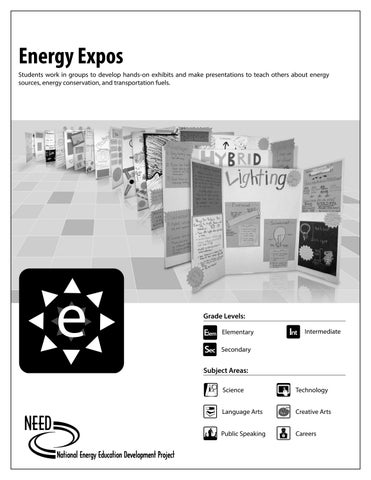
Energy Expos Students work in groups to develop hands-on exhibits and make presentations to teach others about energy sources, energy conservation, and transportation fuels.
e
Grade Levels:
Pri Ele
Int
Elem Elementary
Pri
Sec Secondary
Ele
Int
Intermediate
Sec
Subject Areas: Science
Technology
Language Arts
Creative Arts
Public Speaking
Careers
NEED Mission Statement The mission of The NEED Project is to promote an energy-conscious and educated society by creating effective networks of students, educators, business, government, and community leaders to design and deliver objective, multi-sided energy education programs.
Permission to Copy NEED curriculum is available for reproduction by classroom teachers only. NEED curriculum may only be reproduced for use outside the classroom setting when express written permission is obtained in advance from The NEED Project. Permission for use can be obtained by contacting info@need.org.
Energy Data Used in NEED Materials NEED believes in providing teachers and students with the most recently reported, available, and accurate energy data. Most statistics and data contained within this guide are derived from the U.S. Energy Information Administration. Data is compiled and updated annually where available. Where annual updates are not available, the most current, complete data year available at the time of updates is accessed and printed in NEED materials. To further research energy data, visit the EIA website at www.eia.gov.
Teacher Advisory Board
Teacher Advisory Board Constance Beatty Kankakee, IL
Robert Lazar Albuquerque, NM
La’Shree Branch Highland, IN
Melissa McDonald Gaithersburg, MD
Jim M. Brown Saratoga Springs, NY
Paula Miller Philadelphia, PA
Mark Case Randleman, NC
Hallie Mills St. Peters, MO
Lisa Cephas Philadelphia, PA Nina Corley Galveston, TX Samantha Danielli Vienna, VA
1.800.875.5029 Jennifer Mitchell www.NEED.org Winterbottom Pottstown, PA © 2026
Monette Mottenon Montgomery, AL
Mollie Mukhamedov Port St. Lucie, FL In support of NEED, the national Teacher Advisory Board (TAB) is dedicated to developing, Shannon Donovanimproving, and promoting standards-based, effective energy curriculum, training, and outreach. NEED thanks these individuals forRItheir support and collaboration. Greene, Cori Nelson Winfield, IL Greg Schanne Paula Miller, M.Ed Samantha Danielli, M.Ed Adebisi Babayemi, M.Ed, NBCT Michelle Garlick Philadelphia, PAJr. Philadelphia, PALong Grove, IL Vienna, VA Bowie, MD Don Pruett Amy Schott, WA M.Ed, NBCT Jennifer Davis, M.Ed Hallie Mills, Ed.D La’Shree Branch Puyallup, Raleigh, NC Sammamish, WA Cincinnati, OH Highland, IN Michelle Gay Kristin M.Ed Jennifer Mitchell-Winterbottom, M.Ed, WT Michelle Garlick, M.Ed James M. Brown, NBCT, CEM, BOC Daphne, AL JudySlota, Reeves Yardley, PA Saratoga Springs, NY Cary, IL Pottstown, PA Lake Charles, LA Mollie Mukhamedov Brandon Staton Karely Carlos, M.S. Nancy Gifford, M.S. Nancy Gifford Harwich, MA Port St. Lucie, FL Thomasville, NC Lodi, CA Harwich, MA Libby Robertson Jennifer Trochez Matthew Reis, Ph.D Mark Case, M.S. Erin Gockel, M.Ed Chicago, IL MacLean, M.Ed, NBCT Los Angeles, CA Chía, ColombiaErin Gockel Randleman, NC Farmington, NM Scott Valenta Lisa Cephas, M.Ed Greg Holman Craig Richard,Farmington, M.Ed NM Amy Schott Winfi eld, IL NC Philadelphia, PA Paradise, CA Atkinson, NH Raleigh, Libby Robertson Nina Corley Melissa King, MLIS Robert Griegoliet Chicago, IL Galveston, TX Gaithersburg, MD Naperville, IL Tom Spencer Chesapeake, VA Eric Havel Oakland, CA Jennifer Trochez MacLean NEED teachers eventually must retire from the classroom, but many remain engaged in their communities and with NEED curriculum, training, and DaNel Hogan Los Angeles, CA outreach activities. NEED thanks these individuals for their continued support and collaboration. Tucson, AZ Constance Beatty Barbara Lazar, M.Ed Cori Nelson Judy Reeves Wayne Yonkelowitz Kankakee, IL Albuquerque, NM Hinckley, IL Holman Lake Charles, LA Greg Fayetteville, WV Paradise, CA Melinda Forist Robert Lazar Don Pruett, Jr., M.Ed Wayne Yonkelowitz, M.Ed, NBCT,
NEED TAB Emeriti
Wellfleet, MA
Albuquerque, NM
Puyallup, WA
Barbara Lazar Albuquerque, NM
2
Milken Educator Fayetteville, WV
©2026 The NEED Project
Energy Expos
www.NEED.org
Energy Expos Table of Contents Standards Correlation Information
4
Teacher Guide
5
Energy Expo Exhibit Topic Suggestions
7
Sample Script
9
Student Rubric
10
Suggested Essential Questions
11
Graphical Representation
13
Additional Web Resources
14
Evaluation Form
15
e
©2026 The NEED Project
Energy Expos
www.NEED.org
3
Standards Correlation Information www.NEED.org/educators/curriculum-correlations
Next Generation Science Standards This guide effectively supports many Next Generation Science Standards. This material can satisfy performance expectations, science and engineering practices, disciplinary core ideas, and crosscutting concepts within your required curriculum. For more details on these correlations, please visit NEED’s curriculum correlations website.
Common Core State Standards This guide has been correlated to the Common Core State Standards in both language arts and mathematics. These correlations are broken down by grade level and guide title, and can be downloaded as a spreadsheet from the NEED curriculum correlations website.
Individual State Science Standards This guide has been correlated to each state’s individual science standards. These correlations are broken down by grade level and guide title, and can be downloaded as a spreadsheet from the NEED website.
4
©2026 The NEED Project
Energy Expos
www.NEED.org
e
Teacher Guide Grade Levels
Background Energy Expos is a cooperative learning activity designed to complement NEED’s Energy Infobooks and energy sources, electricity, careers, transportation, and efficiency and conservation curriculum. Students will use informational text from within these resources and their own research to create an exhibit that teaches others about their topic. Exhibits can be physical or digital and can be presented through a “museum walk” display or other presentation format. If you wish to model certain elements for students ahead of time, a sample PowerPoint, script, and graphics evaluation activity can be incorporated.
Elementary, grades 3-5 Intermediate, grades 6-8 Secondary, grades 9-12
Time
Students will be able to analyze nonfiction text and graphics to determine essential information. Students will be able to select appropriate charts, graphs, or figures to display data and information. Students will access language arts, creative arts, technology, and critical thinking skills to create and present projects in an interesting manner.
Expos can be completed quickly or over an extended number of classes, depending on the complexity of the topic and any research required, the size of student groups, outof-class time, and the format for delivery of the projects. Expect to use roughly 3-5 class periods at minimum, for research, creation, and presentation.
Materials
Technology Integration
Art supplies Energy 101 slides (optional) Exhibit boards (optional) Internet access (optional)
Students can be encouraged to create multimedia presentations as an alternative to physical exhibits. Programs like PowerPoint, Prezi, Canva, and the Google Suite, videos, and more are great options. Consider how you will modify the rubric and sharing of exhibits for multimedia versions.
Objectives
2 Preparation Gather a list of topics for use in this activity. A table with suggestions can be found on pages 7-8. You may also decide to allow groups to select their own topics. If teaching multiple classes, it is conceivable that all groups could cover a different topic. Review the essential information and questions for each topic you have selected and decide if you wish to require that groups answer these questions as-is, or if you wish to alter or add to required information. Prepare for how you will handle required content for groups selecting their own topics. Suggested essential questions can be found on pages 11-12. Decide if you wish for groups to create physical or digital exhibits, and what you will require from either option. Ensure students have access to the software or design applications you will allow for the projects. Download the sample Energy 101 PowerPoint or create your own exhibit to serve as a model for students on what to do and not to do when preparing presentation aids. Print the sample script if desired, or make a copy to project or share digitally. If you wish for students to evaluate and incorporate graphics, you may also opt to prepare copies of the Graphical Representation worksheet. Review and make a physical or digital copy of the Student Rubric to share with the class. Divide students into small groups based on the exhibit topics on which you have selected to focus. Depending on the ages and abilities of your learners, and the time available for work, you may wish to provide an information packet or resources list for each group to use for research. This can include a list of their essential questions, a rubric, and copies of text-based information like NEED’s Energy Infobook pages. It can be helpful to assemble this information into a digital or physical folder for each group with graphic organizers to help demonstrate organizational skills. A listing of suggested resources from NEED and beyond are provided on pages 7-8 and 14. If you wish for students to research their own information instead, consider providing a list of approved or suggested links. Gather additional supplies as needed, including exhibit boards, art supplies, etc. Decide how presentations of exhibits will occur, such as a museum walk or science fair format or singlegroup presentations. Reserve or prepare a space with proper furniture and flow of traffic.
CONTINUED ON NEXT PAGE ©2026 The NEED Project
Energy Expos
www.NEED.org
For older or more creative students, you may encourage that they create their own images, graphics, tables, and charts instead of using preprepared source material. See the extensions on page 6 and the handout on page 13 for more information and suggestions.
Additional Expos A few of NEED’s curriculum pieces contain their own expo-style activities. Check out the following examples for more in-depth expos: Nuclear Expo - Nuclear Guides Transportation Expo - Energy on the Move Trash & Waste - Talking Trash, Museum of Solid Waste, and All About Trash Marine and Hydrokinetic Research Commercial Exploring Marine Hydrokinetics Guides are available as a free download from www.NEED.org/shop
5
Procedure SESSION 1 1. Introduce the activity to your class. Explain to students that they will be working in small groups, researching an energy-related topic, and creating a physical or digital exhibit to present to others about their topic. Explain that students will use any suggested resources provided to research their topic, answer the suggested essential questions for their topic, and prepare an exhibit with talking points or script to showcase their topic. Discuss if you wish for them to conduct outside research on their own. 2. If students are new to making presentations or have not yet done so within your class, it might be a good idea to showcase a model or sample so students know what to expect. This also provides a good opportunity for you to show examples of work that is satisfactory and work that could use improvement. Use your own model or the preprepared Energy 101 slides if you wish. Present using the sample script on page 9 if you wish to incorporate scripted presentations as part of the group work. 3. Ask students to share things they learned from your presentation. Project or share your script for the class to see. Ask the class to discuss the advantages of creating a plan or script when presenting. Continue the discussion by asking the class to “grade” or evaluate the elements of your presentation. What images, script elements, text, graphics, etc. could have been better or might have been missing? How does color or creativity help the audience or learner? Can too much of some material make it harder for the learner? If you have older students and wish to further discuss graphics, review the extensions and have students complete the Graphical Representation worksheet. 4. Divide the students into their groups and assign their topics. Provide any printed resources, digital handouts, and supplies you have prepared. Discuss strategies for good teamwork and how to meet their goals as a group. 5. Review the rubric or your own modified version, discuss the timetable for completion and procedure for submitting work. 6. Encourage students to begin with a plan. Have each group discuss how they will work separately and together to research the essential questions you have provided and prepare their display and presentation elements. Remind them how they will be sharing their project with the class. SESSIONS 2-3 1. Monitor and check group work on research, exhibit, and presentation preparation, as listed on steps 1-4 on the student rubric. Provide guidance on time remaining to keep groups on track. 2. At the end of each session, remind the class of what remains to be completed and how exhibits and presentations will occur. PRESENTATION SESSION(S) 1. Review setup and presentation procedures with students and any other audiences you may have. 2. Direct groups in the setup you have described and make sure all groups are ready to go. 3. Allow presentations to proceed. Evaluate student work using the rubric provided or one of your own.
Extensions and Outreach Invite other classes, parents, or community members to visit your expo. Ask for other teachers, community leaders, former students, or energy experts to act as judges. Introduce the role of good graphics using the Graphical Representation activity prior to beginning the unit. Students can talk about their own graphics and evaluate the strengths and weaknesses of prepared graphics compared to their own. This can also be a great time to discuss different learning abilities and preferences. This activity is more appropriate for older learners, given the topic. See page 13 for this handout and adjust as needed. A list of topic suggestions is provided within the table on pages 7-8, and additional resources can be found on page 14. These sites can provide essential and supplemental information on any of the topics you choose. Consider having students evaluate the various sources provided and the additional sources you suggest to determine their validity as a source for this project. As an option to boost critical thinking skills, you can also provide a few detractor sources to help ensure students are thinking carefully and reading fully. In addition, you may also choose to combine forces with a language arts or library/media teacher to remind students about appropriately citing text, graphics, and other information.
6
©2026 The NEED Project
Energy Expos
www.NEED.org
e
Energy Expo Exhibit Topic Suggestions
Energy Expos are divided into categories based on topics. Use the table below to select categories, topics, and resources to assign and share with students. Additional resources can be found on page 14.
TOPIC Energy Sources
EXHIBIT IDEAS Introduction To Energy Biomass Coal Geothermal Hydropower and/or Marine Natural Gas Petroleum Propane Solar Uranium/Nuclear Wind Hydrogen
SUGGESTED NEED RESOURCES Energy Infobooks Energy At-A-Glance Sheets Coal Student Guides Hydropower Student Guides Oil and Natural Gas Student Guides Solar Student Guides Nuclear Student Guides Wind Student Guides H2Educate Student Guide
SUGGESTED WEB RESOURCES EIA Energy Kids - www.eia.gov/kids EIA Energy Explained www.eia.gov/energyexplained U.S. DOE Energy.Gov www.energy.gov/topics/energy-sources U.S. DOE Energy 101 YouTube Playlist https://youtube.com/playlist?list=PLACD8E92715335C B2&si=OB6IWHYtvGX2QHfC Student Energy YouTube Page – Energy Literacy playlist https://youtube.com/playlist?list=PL7b293q4n8alo87lK 74wa2iuJRVGmBxvH&si=doYsOjrVKmdo5cvh Switch Classroom Video Library https://switchclassroom.org/videos Stanford University, Understand Energy https://understand-energy.stanford.edu
Electricity
Electricity and Magnetism Generators The Grid Smart Meters and Smart/IOT Devices Electricity Generation in the U.S. EVs History Measuring Electricity Economics
Energy Infobooks ElectroWorks Student Guide Baseload Balance Hydropower Student Guides Solar Student Guides Nuclear Student Guide Wind Student Guides Efficiency and Conservation Student Guides
EIA Energy Kids - www.eia.gov/kids EIA Energy Explained www.eia.gov/energyexplained U.S. DOE Energy.Gov www.energy.gov/topics/energy-sources U.S. DOE Energy 101 YouTube Playlist https://youtube.com/playlist?list=PLACD8E92715335C B2&si=OB6IWHYtvGX2QHfC Student Energy YouTube Page - Energy Literacy playlist https://youtube.com/playlist?list=PL7b293q4n8alo87lK 74wa2iuJRVGmBxvH&si=doYsOjrVKmdo5cvh PBS Media, NOVA scienceNOW Smart Power Grid www.pbslearningmedia.org/resource/nsn11.sci.engin. systems.smartgrid/smart-power-grid Switch Classroom Video Library https://switchclassroom.org/videos
Energy Storage
Energy Efficiency and Conservation
Overview of Energy Storage Flywheels Thermal (Ice, Salt, Sand) Compressed Air Batteries or Bess Capacitors Hydrogen CO2 Emerging Technologies
Energy Infobooks Stock It Up! Energy Storage Sampler
Energy Consumption Saving Energy Is Important Heating & Cooling Lighting Water Heating Electrical Devices and Appliances
Energy Infobooks Efficiency and Conservation Student Guides Saving Energy at Home and School Building Science
EIA Energy Explained www.eia.gov/energyexplained Switch Classroom Video Library https://switchclassroom.org/videos University of Alberta Future Energy Systems YouTube Channel www.youtube.com/watch?v=DwdAFFDCI3U Stanford University, Understand Energy https://understand-energy.stanford.edu EIA Energy Explained www.eia.gov/energyexplained Stanford University, Understand Energy https://understand-energy.stanford.edu ENERGY STAR® - www.energystar.gov U.S. Department of Energy, Energy Savings Hub www.energy.gov/save EPA’s Carbon Footprint Calculator www.epa.gov/ghgemissions/carbon-footprintcalculator
CONTINUED ON NEXT PAGE ©2026 The NEED Project
Energy Expos
www.NEED.org
7
TOPIC Transportation Technologies and Fuels
Careers in Energy
Impactful Energy Scientists
8
EXHIBIT IDEAS
SUGGESTED NEED RESOURCES
Transportation in America Gasoline Ethanol Diesel Biodiesel Natural Gas (CNG, LNG) Propane Autogas HEV PHEV EV Hydrogen Fuel Cell EV Pipelines Shipping of Goods School Buses Emissions & Fuel Economy Racing Fuels
Energy Infobooks Energy on the Move Teacher and Student Guides
Could include but not limited to: Solar Installer Electrician Pipefitter/Welder Power Plant Operator HVAC Technician Lawyer Engineer Geologist Drone Pilot Ecologist Certified Energy Manager Architect Chemist Wind turbine technician Energy trader Planner/Estimator/Surveyor
Energy Careers Excursion Energy Career Enigma My Future Energy Career Energy on the Move Teacher Guide Hydropower Student Guides Solar Student Guides Nuclear Student Guides Wind Student Guides Climate Student Guides Oil and Natural Gas Student Guides Coal Guides Efficiency and Conservation Student Guides
Could include but not limited to: Henry Ford Albert Einstein Lise Meitner Marie Curie Eunice Newton Foote Thomas Edison Benjamin Franklin Robert Fulton Nikola Tesla James Prescott Joule Rudolf Diesel Granville Woods Maria Telkes Katherine Burr Blodgett Annie Easley Olga Gonzalez-Sanabria Shirley Ann Jackson Katherine Johnson
Energy Infobooks Nuclear Student Guides Solar Student Guides Oil and Natural Gas Guides Transportation Student Guides
SUGGESTED WEB RESOURCES U.S. Department of Energy Alternative Fuels Data Center https://afdc.energy.gov U.S. Department of Energy, Fuel Economy Information www.fueleconomy.gov EPA’s Clean School Bus Program www.epa.gov/cleanschoolbus EPA’s Carbon Footprint Calculator www.epa.gov/ghgemissions/carbon-footprint-calculator
Career One Stop - www.careeronestop.org Center for Energy Workforce Development, Get into Energy - www.getintoenergy.com NOVA LABS, Career Resources www.pbs.org/wgbh/nova/labs/opportunities/resources Science Buddies www.sciencebuddies.org/science-engineering-careers U.S. Department of Labor, Bureau of Labor Statistics Occupational Outlook Handbook www.bls.gov/ooh U.S. Department of Labor, Bureau of Labor Statistics Student Page - https://www.bls.gov/k12/students Workforce Solutions https://wrksolutions.com/for-individuals/careerexploration EIA Energy Kids - www.eia.gov/kids U.S. DOE Women’s History Month www.energy.gov/cmei/articles/womens-history-month2020-women-scientists-shaping-energy National Women’s Hall of Fame www.womenofthehall.org NASA - www.nasa.gov The Franklin Institute - https://fi.edu/en
©2026 The NEED Project
Energy Expos
www.NEED.org
e
Sample Script ENERGY 101
Slide One—Title Slide In this activity, you will work in small groups (or individually) to research an energy topic and create a physical or digital display to showcase what you’ve learned and engage othes in learning about your topic. PowerPoint is one of the options you can use for presenting about the topic. This PowerPoint will introduce you to energy and its consumption and model what you might create as a digital presentation. Look at the visuals and listen to the information presented. Consider how you might share this information differently.
Slide Two—What Is Energy? Energy is the ability to do work or cause change. Energy produces warmth, light, sound, movement, and growth. Energy powers technology. Where do you think energy comes from?
Slide Three—Where Do We Get Our Energy? Energy consumption is how much energy we consume or use. Turn to your neighbor and brainstorm the number of ways you have used energy since leaving your home this morning. Where do you get your energy to move, make noise, think, and grow? Yes, the food you eat is your fuel. The food you eat got its fuel from the sun. The sun is a key factor in photosynthesis and in the creation of many of our energy sources. Where do we get the energy to power the lights in this room? There are many sources of energy and electricity. Today we will talk about those sources and how they are used in the United States.
Slide Four—U.S. Energy Consumption by Source So where do we get the energy to heat our homes, manufacture goods, and drive our cars? There are ten energy sources used in the U.S., five of which renewable and five nonrenewable. Nonrenewable energy source supplies are limited, and people can’t make more in a short time. Renewable energy sources are ones that there is a continual supply of and are not in danger of depleting the supply. Why do you think petroleum is our number-one source of energy? It is a very valuable transportation fuel. Take a minute to write down the sources and their energy consumption percentages.
Slide Five—Home Energy Consumption In a typical home, almost half of the energy used is for heating and cooling. How could location play a factor in changing these numbers? Would desert areas like Las Vegas have the same heating/cooling percentages as Vermont? What could you do to help reduce some of these costs? How do you think energy use in a school compares to energy use at home?
Slide Six—Coming Soon Turn to a friend or group and critique this presentation. What do you like and dislike? What would you improve? This slide deck was made to be visually plain and boring on purpose. Have you ever seen slides with too much going on? How does too little or too much on a slide impact your ability to learn and retain information? Everyone has different learning styles that rely upon their five senses. Some people learn better when they hear, see, and/or say what they’re learning. Others learn better by doing. Combining more than one style is often the best situation for all. Consider how you will design your physical or digital display and what verbal and non-verbal items you will include to help all learners.
©2026 The NEED Project
Energy Expos
www.NEED.org
9
e
Student Rubric PLANNING GUIDE
Step 1: Learn About Your Energy Topic F Review the essential questions provided for your topic. Brainstorm as a team any other information you wish and make a list of the facts you want to teach others.
1-5 points
F Research and read about your energy topic as a group. Use the resources provided by your teacher, and conduct additional research as needed. If using printed resources, underline main ideas and highlight information that answers the essential questions.
1-5 points
Step 2: Plan Your Exhibit F Make a list of the ideas you have for displaying and showcasing your energy topic. Do you want to make a digital or a physical display? Do you want to include something hands-on or interactive that the audience can engage with? Do you want to include props, sounds, or other visuals?
1-5 points
F Make a list of the kinds of pictures, charts, or graphics you will use.
Step 3: Use Your Talent F As a group, decide who will do which jobs. Write down the name of each person in the group. Next to each name, write the person’s jobs. You can have more than one person helping on each job. Who will write the script? Who will make the exhibit or multimedia presentation? Who will collect the materials we need? Who will present each part of the information?
1-5 points
Step 4: Create Your Exhibit and Write Your Script F Write a two-to-four-minute script using the list of important facts.
1-5 points
F Create an interesting exhibit or multimedia project. Make sure your exhibit and script cover all of the essential information and the expo is neat and visually interesting.
1-5 points
F Rehearse your presentation as a group, making sure all members have a role.
1-5 points
Step 5: Teach Others 1-5 points
F Present your expo and energy topic to the class. Allow for questions about your presentation. Total Points:
__________
Positive Presentation Tips Memorize your part—or better yet—know the information so well that you do not need to memorize it. Avoid reading from the script, if you can, so you are able to make eye contact with the audience. Speak loudly enough so students in all corners of the room can hear you. Speak slowly and clearly. Be aware that you may have the tendency to talk too fast when you are nervous. Use some kind of pointer (if necessary or helpful) to discuss important parts of your exhibit. Position yourselves so that you can present the information without blocking the view of your audience. If you feel nervous speaking in front of others, remember that everyone else probably feels the same way. Practice your complete presentation a few times to make sure everyone is comfortable with their parts and can read or say all of the words correctly in their part of the presentation. Practice your part in the same spot you will present to the class. Or, practice your part in front of a group of friends or family members. These practices may help you to feel more comfortable when it is your turn to go in front of your classmates. Try to engage the audience in your presentation where you can. Is there a joke, hands-on activity, or question you can include?
10
©2026 The NEED Project
Energy Expos
www.NEED.org
e
Suggested Essential Questions
Each category has several topic options. Some essential question ideas have been outlined for you in each category. The amount and type of questions asked can vary depending on the age of your students, their familiarity with the content, the time you have available, and the topic itself. Preview the questions provided and decide which you will share with students, how you may alter them for each topic, and what else you might wish to add.
Energy Sources
Electricity
GENERAL ENERGY SOURCES QUESTIONS What is __________?
BASIC ELECTRICITY QUESTIONS What are electrons and where are they found?
How do we use ____________ in the United States? (electricity, heating, transportation, etc.)
What is the difference between magnets and magnetic fields?
Is _____________ renewable or nonrenewable?
What is a circuit?
How is _______________ formed? Where can it be found/where is it most used?
What are the ways electricity can be generated?
How do we get/harness ______________? How do we move it? How does using _______________ affect the environment? What are the advantages and disadvantages of using _____________?
How are electricity and magnetism related?
What are voltage, current, and power? How are they measured? GENERATORS AND POWER PLANTS QUESTIONS What are the parts of a generator? What are the two options for configuration of a generator?
ENERGY CONSUMPTION AND OVERVIEW QUESTIONS What is energy?
What is the turbine’s role in electricity generation?
What does energy do?
How are nuclear power plants different from other thermal power plants?
How is energy used in the U.S.? (sectors of the economy/energy consumers?) What sources of energy do we use most? How much of our energy use is renewable? Nonrenewable?
What is a thermal power plant? What sources are used?
What are the advantages and disadvantages of different types of power plants?
How much energy do we use in the U.S.? How does it compare to other countries?
UTILITIES, MANAGING DEMAND, AND THE GRID QUESTIONS How do utilities measure our electricity consumption? How are we charged?
How does energy use impact our environment? Our economy?
What U.S. areas pay the most for electricity? What areas pay the least? Which generation technologies are most expensive? What is the electrical grid and what do each of its the parts do? What is baseload power and peak demand? What is the difference between a blackout and a brownout? What is a smart meter and how does it work? What are the parts of a smart grid? HISTORY OF ELECTRICITY GENERATION What was Benjamin Franklin’s contribution to electricity discovery and research? What was Alessandro Volta’s invention? What did Michael Faraday learn about generating electrical current? What major developments did Thomas Edison receive credit for? Why did Edison feel threatened by Nikola Tesla?
CONTINUED ON NEXT PAGE ©2026 The NEED Project
Energy Expos
www.NEED.org
11
Energy Storage
Transportation Fuels & Technologies
What is energy storage? Why is it important?
What is ________?
Under what circumstances would energy storage be helpful?
How is the fuel produced and distributed?
What is _______ energy storage? How does it work? What conditions or equipment are needed?
What is the historical background of this fuel or technology?
What sources of energy can be used or combined with _______ energy storage?
What are the impacts, benefits, and challenges of using this fuel or technology?
What are the benefits and limitations of _______ energy storage?
What is the future of this fuel or technology?
Energy Efficiency and Conservation
Careers in Energy
How is ________ used today in the U.S. and abroad?
HEATING & COOLING Why do we heat/cool buildings and to what temperatures should we heat them?
What is the required education for this role?
What devices do we use to heat buildings and what fuels do they use?
Where do they work (offices, outside, etc.)?
What deices are used to cool buildings? What powers these devices?
What is the salary for this job?
How much energy does heating/cooling buildings consume?
Impactful Energy Scientists
How is energy wasted when heating/cooling buildings? How can we conserve energy when heating/cooling buildings?
What are the main things someone might do every day in this role? What are three skills you might need to have for this role?
What was their background or upbringing? What did they study? What were their hobbies?
LIGHTING Why is lighting important?
What was their contribution to the energy industry, discovery, and/ or research?
What types of lighting are used in homes and schools?
What challenges and successes did they encounter socially, professionally, or otherwise?
What is the energy consumption of different lights? How much light is needed for different tasks—reading, television, security?
What is one question you would want to ask them?
How can we reduce the energy used to light homes and schools? WATER HEATING Why is hot water important? What methods and energy sources do we use to heat water? How hot should water be to perform different tasks? How do we waste hot water? How can we save energy when heating water? ELECTRICAL APPLIANCES What energy sources generate electricity in the U.S.? Why is electricity important to the U.S. economy and individuals? How is electricity measured and how much does it cost? How do electrical devices and appliances waste energy? How can we save energy when using electrical devices and appliances?
12
©2026 The NEED Project
Energy Expos
www.NEED.org
e
Graphical Representation
&Background Ever wonder why designers use graphics? Graphics help our brains understand and synthesize information—they’re more than just a chart or a table. Graphics can include diagrams, maps, illustrations, photographs, a combination of graph types, and infographics, which are graphics that tell a story.
Procedure Read the text below. Underline and highlight any information you find to be important, interesting, or essential. Create a graphic that depicts some or all of the nonfiction text. Use colors, and any type of graphic you wish. Create your graphics digitally or on paper—whatever you are comfortable with. Share and discuss the graphics you have created as a class.
&Nonfiction Text Our Earth is surrounded by a blanket of gases called the atmosphere. Without this blanket, our Earth would be so cold that almost nothing could live. It would be a frozen planet. Our atmosphere keeps us alive and warm. The atmosphere is made up of many different gases. Most of the atmosphere (99 percent) is oxygen and nitrogen. Less than half of one percent is a mixture of greenhouse gases. Greenhouse gases include water vapor, carbon dioxide (CO2), methane, F-gases, ozone, and nitrous oxide (NOx). Water vapor is the most common greenhouse gas and its atmospheric concentration varies depending on the climate. Carbon dioxide is the gas we produce when we breathe and when we burn wood and fossil fuels. Methane is the main gas in natural gas. It is also produced when once-living matter decays, and from animal waste. The other greenhouse gases are produced by burning fuels and from other natural and human activity.
©2026 The NEED Project
Energy Expos
www.NEED.org
13
Additional Web Resources Alliance to Save Energy
Clean Fuels Alliance America
www.ase.org
www.cleanfuels.org
American Clean Power Association
National Hydropower Association
www.cleanpower.org
www.hydro.org
American Electric Power
National Ocean Industries Association
www.aep.com
American Geosciences Institute (AGI) www.americangeosciences.org
American Solar Energy Society www.ases.org
bp www.bp.com
U.S. Department of Energy, National Laboratory of the Rockies www.nrl.gov
U.S. Department of Energy, Energy Information Administration www.eia.gov
U.S. Department of Energy, Energy Information Administration, Energy Explained
www.noia.org
Northeast Sustainable Energy Association
www.eia.gov/energyexplained
www.NESEA.org
U.S. Department of Energy, Energy Information Administration, Energy Kids
Nuclear Energy Institute www.nei.org
Renewable Fuels Association
www.eia.gov/kids
www.ethanolrfa.org
U.S. Department of Energy and U.S. Environmental Protection Agency ENERGY STAR® Program
Bureau of Ocean Energy Management
Shell
www.boem.gov
www.shell.us
California Energy Commission
Solar Energy Industries Association
www.energy.ca.gov
www.seia.org
Electric Drive Transportation Association
Stanford University Understand Energy Learning Hub
www.electricdrive.org
www.understand-energy.stanford.edu
Engine Technology Forum
Suburban Propane
U.S. Environmental Protection Agency
www.enginetechforum.org
www.suburbanpropane.com
www.epa.gov
Independent Petroleum Association of America
www.switchon.org
www.ipaa.org
International Research Center for Energy and Economic Development www.iceed.org
International Renewable Energy Agency www.irena.org
Interstate Renewable Energy Council www.irecusa.org
Mineral Education Coalition
www.energystar.gov
U.S. Department of Energy and U.S. Environmental Protection Agency Fuel Economy www.fueleconomy.gov
Switch Energy Alliance U.S. Department of Energy www.energy.gov
U.S. Department of Energy, Alternative Fuels Data Center www.afdc.energy.gov
U.S. Department of Energy, Vehicles Program www.energy.gov/public-services/vehicles
U.S. Department of Energy, Alternative Fuels and Feedstocks office www.energy.gov/hydrogen-fuel-cells
www.mineraleducationcoalition.org
14
©2026 The NEED Project
Energy Expos
www.NEED.org
Energy Expos Evaluation Form State: ___________
Grade Level: ___________
Number of Students: __________
1. Did you conduct the entire activity?
Yes
No
2. Were the instructions clear and easy to follow?
Yes
No
3. Did the activity meet your academic objectives?
Yes
No
4. Was the activity age appropriate?
Yes
No
5. Was the allotted time sufficient to conduct the activity?
Yes
No
6. Was the activity easy to use?
Yes
No
7. Was the preparation required acceptable for the activity?
Yes
No
8. Were the students interested and motivated?
Yes
No
9. Was the energy knowledge content age appropriate?
Yes
No
10. Would you teach this activity again? Please explain any ‘no’ statement below
Yes
No
How would you rate the activity overall?
excellent
good
fair
poor
How would your students rate the activity overall?
excellent
good
fair
poor
What would make the activity more useful to you?
Other Comments:
Please fax or mail to: The NEED Project
8408 Kao Circle FAX: 1-800-847-1820 Manassas, VA 20110 Email: info@need.org
©2026 The NEED Project
Energy Expos
www.NEED.org
15
National Sponsors and Partners AES AES Clean Energy Development Ameresco American Electric Power Foundation Appalachian Voices Arizona Sustainability Alliance Atlanta Gas Light–Southern Company Gas Atlantic City Electric Avangrid Baltimore Gas & Electric Berkshire Gas–Avangrid BP America Inc Bob Moran Charitable Giving Fund Cape Light Compact–Massachusetts Celanese Foundation Central Alabama Electric Cooperative Chattanooga Gas Company–Southern Company Gas CITGO The City of Cuyahoga Falls Clean Virginia CLEAResult Clearloop ComEd Confluence ConocoPhillips Constellation Energy Foundation Delmarva Power Department of Education and Early Childhood Development–Government of New Brunswick, Canada Dominion Energy, Inc. Dominion Energy Charitable Foundation DonorsChoose Eagle Creek Renewable Energy East Baton Rouge Parish Schools East Kentucky Power Cooperative EcoCentricNow EDP Renewables EduCon Educational Consulting Elmo Foundation Enel Green Power North America EnergizeCT ENGIE Entergy Equinix Eversource Exelon Exelon Foundation Foundation for Environmental Education FPL Fuel–Future Use of Energy in Louisiana Generac Georgia Power Gerald Harrington, Geologist Government of Thailand–Energy Ministry Greater New Orleans STEM GREEN Charter Schools Green Power EMC Guilford County Schools–North Carolina ©2026 The NEED Project
Independent Petroleum Association of New Mexico Interstate Natural Gas Association of America Foundation Intuit Iowa Governor’s STEM Advisory Council–Scale Up Iowa Lakes Community College Iowa State University Iron Mountain Data Centers Kansas Corporation Energy Commission Kansas Energy Program–K-State Engineering Extension Katy Independent School District Kentucky Environmental Education Council Kentucky Office of Energy Policy Kentucky Power–An AEP Company Liberty Utilities Llano Land and Exploration Louisiana State Energy Office Louisiana State University–Agricultural Center LUMA Marshall University Mass Save Mercedes Benz USA Minneapolis Public Schools Mississippi Development Authority–Energy Division Motus Experiential National Fuel National Grid National Hydropower Association National Laboratory of the Rockies National Ocean Industries Association NC Green Power Nebraskans for Solar NextEra Energy Resources Nicor Gas NCi–Northeast Construction North Shore Gas Offshore Technology Conference Ohio Energy Project Oklahoma Gas and Electric Energy Corporation Omaha Public Power District ONEOK Ormat Pacific Gas and Electric Company PECO Peoples Gas Pepco Performance Services, Inc. Permian Basin Petroleum Museum Phillips 66 PowerSouth Energy Cooperative PPG Prince George’s County Office of Human Resource Management (MD) Prince George’s County Office of Sustainable Energy (MD) Providence Public Schools Public Service of Oklahoma–AEP
8408 Kao Circle, Manassas, VA 20110
1.800.875.5029
www.NEED.org
Quarto Publishing Group The Rapha Foundation Renewable Energy Alaska Project Rhoades Energy Rhode Island Office of Energy Resources Salal Foundation/Salal Credit Union Salt River Project Salt River Rural Electric Cooperative Schneider Electric C.T. Seaver Trust Secure Solar Futures, LLC Shell USA, Inc. Silicon Ranch Corporation SMUD Society of Petroleum Engineers South Carolina Energy Office Southern Company Gas Snohomish County PUD Starwood Digital Ventures SunTribe Solar TXU Energy United Way of Greater Philadelphia and Southern New Jersey United Illuminating Unitil University of Iowa University of Louisville University of North Carolina University of Northern Iowa University of Rhode Island U.S. Department of Energy U.S. Department of Energy–Office of Energy Efficiency and Renewable Energy U.S. Department of Energy–Solar Decathlon U.S. Department of Energy–Water Power Technologies Office U.S. Department of Energy–Wind for Schools U.S. Energy Information Administration United States Virgin Islands Energy Office Vineyard Wind Virginia Cooperative Extension Virginia Natural Gas Virginia Natural Gas–Southern Company Gas Vistra Energy We Care Solar West Virginia Office of Energy West Warwick Public Schools Williams Woodside Energy Workers Renewable Energy Fund Worldwide Mission Critical