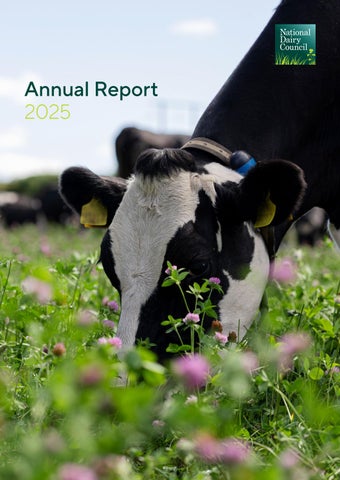
ANNUAL REPORT 2025
Annual Report 2025
1
NATIONAL DAIRY COUNCIL
The National Dairy Council protects and promotes the image, quality, taste and nutritional credentials of Irish dairy. It promotes the benefits of the dairy portfolio to the consumer as part of a balanced, healthy lifestyle while also safeguarding the reputation of Ireland’s dairy producers and processors. You can find out more about the work of the National Dairy Council at www.ndc.ie
Cover photo: Dora Kazmierak
2
ANNUAL REPORT 2025
Contents
02
04
Chairperson’s Statement
Chief Executive’s Review
07
17
NDC Strategic Framework
NDC Reports and Financial Statements
1
NATIONAL DAIRY COUNCIL
Chairperson’s Statement 2025 was a record-breaking year for Irish dairy. Irish dairy exports were valued at €7.3 billion, the highest ever, with an increase of 14% on the previous year. More than 1.6m tonnes were dispatched to 140 countries around the world. Butter sales exceeded €2 billion for the first time. Good grass growth in Spring and Summer led to plentiful milk supply. The Central Statistics Office (CSO) recorded milk production at a new high of 8.84 billion litres. Milk supply globally increased by 2.6% on foot of higher commodity prices and good weather. 2025 will be remembered for many positives for the dairy sector including strong milk prices, increased demand for calves, good weather and the positive decision on the Nitrates Derogation. It will also be remembered for a particularly sharp drop in milk prices at the end of the summer, creating considerable concern for farmers.
RETAINING THE NITRATES DEROGATION The end of the year brought welcome news with the European Commission’s December announcement, confirming that Ireland would retain the Nitrates Derogation subject to the terms of the Nitrates Action Plan. While this brought an end to the uncertainty and speculation, it did not come without conditions. Most importantly, the derogation runs only until the end of 2028, so it is incumbent on the sector to maintain its focus on this area and to continue to make improvements on water quality. Our government must continue to make the case in Europe for Ireland’s distinctive pasture-based system, recognising that the interests of Ireland’s economy, our farming system and our natural environment can be aligned.
SUSTAINABILITY Protecting water benefits both farming and the wider community. Clean water is essential for households and livestock, while also supporting wildlife, tourism, recreation, businesses and local economies. Improving water quality can therefore deliver benefits across rural communities while helping farmers play a practical role in protecting the environment. Farming for Water, the European Innovation Partnership (EIP) initiative continues to make progress. This voluntary programme has seen enormous interest, with almost six thousand farmers signed up and committed to measures including better nutrient management, reseeding and planting, and management of buffer zones and margins, and management of rainfall and runoff to protect watercourses. The co-operatives’ extensive sustainability programmes continue to utilise best practice, trialling measures and collecting data across water quality, emissions, biodiversity and animal welfare. This evidence-based research is then applied on farms through knowledge transfer, allowing evidence-based improvements to be scaled.
2
Irish dairy exports were valued at €7.3 billion, the highest ever, with an increase of 14% on the previous year. More than 1.6m tonnes were dispatched to 140 countries around the world. Butter sales exceeded €2 billion for the first time.
ANNUAL REPORT 2025
CONSUMPTION & AFFORDABILITY
It is imperative that the National Dairy Council amplifies the stories of those family farms, highlighting their focus on environmental stewardship, while maintaining the highest standards of milk quality and animal welfare.
Positive trends are clearly discernible in the domestic market with modest increases in the volume of milk consumed and evident increases in butter, cheese and particularly, yogurt. Dairy continues to appeal in terms of its nutrition, versatility, palatability, and affordability. While affordability continues to be an issue for consumers more generally, for most of 2025, core dairy products like milk and butter were priced at a level that better reflected the reality of the cost of production versus previous years. It was disappointing, however, to see retailers drop the prices on staple products like milk and butter towards the end of the year. Once again, these household essentials, the raw material for which is produced with so much care by Ireland’s dairy farmers, are weaponised in retailer price wars, which inevitably leads to downward pressure on the price available to farmers. While supermarkets can spread the cost of such price drops across the tens of thousands of lines they stock to recover margins if they so wish, farmers – who ultimately end up paying – have no such lever.
YEAR AHEAD Whether 2025’s record production numbers can realistically be matched in 2026 will depend on a number of factors, including weather and the recovery of the price payable to farmers, which in turn will be linked to global demand. That demand is clearly shaped by global production but for Ireland, it is also shaped by our unique offering – that of our pasture-based system from small, family-run farms and our commitment to sustainable practices.
NATIONAL DAIRY COUNCIL STRUCTURE CEO Emma Walls, in post since the end of 2024, led a restructuring of the NDC team and developed a new strategic framework to bring us up to 2028, which was approved by the NDC board. The new team and strategy ensure the organisation is well placed to deliver on an ambitious plan of activity, starting in 2026.
Eamonn Carroll Chairperson
It is imperative that the National Dairy Council amplifies the stories of those family farms, highlighting their focus on environmental stewardship, while maintaining the highest standards of milk quality and animal welfare. At the same time, the NDC must continue to advocate for dairy’s benefits to our health, encouraging the population to meet the dietary intake recommendations. 3
NATIONAL DAIRY COUNCIL
Chief Executive’s Review The story of Irish dairy is a story worth telling: it is the story of vibrant and viable rural communities, a buoyant national economy and a stellar global reputation. It’s a story of hard-working, futurefocused and resilient small family farms, producing high-quality, nutritious milk in an increasingly sustainable way.
REVIEW
It’s the story of fresh milk, from grass-fed herds, transformed into premium products and ingredients that reach 140 countries globally.
The review identified the significant progress that had been made by the NDC in helping the public understand the way in which Irish dairy farmers have taken on the challenge of climate change, with its successful Grassroots Movement. In 2022, just 47% of Irish people trusted dairy farmers to take care of the environment but by the end of 2024, that number had reached 72%. A shift too was seen in attitudes to dairy alternatives, the popularity of which appeared to have passed its peak.
In Ireland alone, it is understood to contribute up to €19 billion to our economy and supports 54,000 jobs. In an age of misinformation and disinformation, the NDC must shine a light on the many measures being taken at farm level to lessen dairy’s environmental impact and to highlight the vital role of dairy in the diet.
4
Having joined the National Dairy Council as CEO at the very end of 2024, 2025 was a year of review and restructuring at the agency, undertaken with some key principles in mind: first and foremost, a focused approach to the NDC’s mission – to provide effective, evidencebased advocacy for dairy products and dairy farming, recognising what is at stake in terms of our health, our heritage and our future. Secondly, a commitment to delivering value for money to our levy-paying farmers, who fund this important mission.
Challenges remained, however, in forging a connection with younger people, particularly those in rural towns and urban centres who are increasingly disconnected from agriculture, ignorant about where their food comes from and apathetic as to why it matters. A generation ago, those of us who didn’t come from a farming background likely knew someone who did – whether a relative, a friend or a neighbour – and that relationship mattered. In 2025, less than half of adults assert any sense of connection to farming and almost a third have never even spoken to a farmer. At the same time, both the absence of information and the presence of misinformation undermined the role of dairy in the diet. It was clear that we needed to recalibrate - doing more of what worked, less of what didn’t, and introducing new programmes with younger people in mind.
It’s the story of fresh milk, from grass-fed herds, transformed into premium products and ingredients that reach 140 countries globally.
ANNUAL REPORT 2025
A priority during 2025 was to remove any expenditure that no longer served our mission. We reduced expenditure on agencies and we paused some media investment as we considered how best to communicate our messages to younger audiences going forward.
The review further showed that the NDC Guarantee, a trusted symbol amongst consumers over many years, required investment to maintain awareness. The successful focus at the NDC on the story of sustainability had naturally consumed the team’s time and energy in recent years. It was important to start the process of investing in the Guarantee again.
NEW STRATEGIC FRAMEWORK The review led to the development of a new Strategic Framework that went before the NDC board of directors for consideration in October. Following its adoption, the NDC has built a new plan for 2026 to implement the approach. The plan is built around four strategic pillars or priorities. They are to protect our social licence to produce, to drive dairy consumption, to distinguish Republic of Ireland dairy with a renewed focus on the NDC Guarantee, and to deliver the EU School Milk Scheme. The strategy reflects the critical importance of social licence, recognising that more than 90% of Ireland’s dairy is exported. At the same time, we believe in an integrated approach: a population that consumes dairy is more likely to take pride in Ireland’s dairy sector and its global success. Our message is simple: • Ireland’s dairy is world-class. • It is world-class because of our grass, our pasture-based system and our farmers’ commitment to more sustainable actions. • The NDC Guarantee is a way to recognise Irish Dairy. In considering what projects should be developed as part of the plan, it is clearly understood that priority must be given to those which can support at least two – and preferably more – of the strategic pillars simultaneously, in order to drive value for money for our funders.
RESTRUCTURING & CULTURE The review considered the resources, including the internal and external expertise, required to implement our strategy. A priority during 2025 was to remove any expenditure that no longer served our mission. We reduced expenditure on agencies and we paused some media investment as we considered how best to communicate our messages to younger audiences going forward. The result was the delivery of a budget surplus at the end of 2025, ready to invest in the 2026 plan. There were several personnel changes throughout the year, designed to ensure that we had the right roles filled at NDC for the work at hand. A new charter was created, identifying the behaviours that would best position us for success going forward, and I am grateful for the way in which my colleagues adapted to the changes and embraced new ways of working, including being office-based. For those colleagues who departed the NDC during 2025 to move to new opportunities, I am deeply grateful for the important contribution they made.
5
NATIONAL DAIRY COUNCIL
The team in place carries an excellent mix of expertise and experience, along with an evident passion for Ireland’s dairy sector and an infectious optimism about the future of dairy. Aligned with our strategic priorities, and clear on their respective roles in delivering them, they are a focused, accountable and energetic team.
THE WIDER TEAM At the National Dairy Council, we are reliant on colleagues across the sector and particularly grateful for the support, collaboration and expertise afforded to us by our board of directors, by our co-operative partners, by our associate members, by Ireland’s farm organisations, by those entities engaged in research, education, health promotion, the promotion of food and drink, the delivery of increasingly sustainable actions in agriculture, and by the Department of Agriculture, Food and the Marine.
THE FARMER AMBASSADORS In particular, I would like to recognise the role of the National Dairy Council’s network of Farmer Ambassadors. Committed volunteers, they are a diverse group of exemplary dairy farmers, from small, family farms who are willing to share their stories. Through these ambassadors, we have the opportunity to share information about sustainability measures, milk quality, animal welfare and community engagement. Each of these farmers has an important story to tell and it is a particular joy to bring those stories to a wider audience. I am grateful for the thoughtful and committed way in which each of our ambassadors engages with the programme, and for their wise counsel on the NDC initiatives, helping to ensure that our campaigns represent dairy farming in an accurate, meaningful and authentic way.
PROGRESS By the end of 2025, our metrics showed further progress. Research from November 2025, carried out with a representative sample of 1,000 adults demonstrated that 74% now trust dairy farmers to take care of the environment. That’s a complete inversion of the 47% figure from 2022. At the same time, appreciation of dairy products is also improving: 81% now believe that dairy can be part of a healthy, balanced and sustainable diet. The trajectory is encouraging but there is much more work to be done.
THANK YOU Improving perceptions of dairy products and dairy farming cannot happen by storytelling alone. The changes happen because the sector itself is changing. In Ireland, our co-ops produce products and ingredients to ever-higher standards of quality and innovation. Our dairy farmers too strive for improved quality yearon-year as is evidenced by the stellar standards on display annually at the NDC & Kerrygold Quality Milk Awards. Our farmers continue to implement programmes at farm level to help to protect our environment, with multiple measures across water quality, emissions and biodiversity. Without this extraordinary commitment to continuous improvement, the National Dairy Council would not have the richness of stories to share. I am grateful for the resilience of Ireland’s dairy farmers who continue to do the work, rain or shine, in good years and bad, no matter how challenging the circumstances. It is a privilege to tell their story.
Emma Walls Chief Executive Officer
6
In Ireland, our co-ops produce products and ingredients to everhigher standards of quality and innovation. Our dairy farmers too strive for improved quality year-on-year as is evidenced by the stellar standards on display annually at the NDC & Kerrygold Quality Milk Awards.
ANNUAL REPORT 2025
Strategic Framework STRATEGIC PILLARS Our four strategic priorities are to effectively: • Advocate for Irish dairy farmers’ social licence to operate. • Celebrate dairy consumption and its role in a healthy, balanced and increasingly sustainable diet. • Champion dairy that is certified as farmed and processed in the Republic of Ireland, accredited by the NDC Trademark Guarantee. • Deliver the EU School Milk Scheme in partnership with the Department of Agriculture, Food and the Marine.
Our strategic priorities place advocacy at the apex, but our strategic pillars are intertwined: a population that embraces dairy as part of its diet can also take pride in Ireland’s dairy sector and its global success. To ensure the best use of NDC resources and to deliver value for money to stakeholders, a consolidated approach to projects will be adopted. Those projects which further at least two (and preferably more) of our strategic aims will be prioritised.
7
NATIONAL DAIRY COUNCIL
Culture THE TEAM We are farmer-funded, farmer-governed and advocate-led. Our executive team includes expertise in agriculture, communications and brand-building, education, nutrition and digital engagement. We are insight-led and evidence-based, using science and facts to dispel myths and tackle misinformation around dairy. We have a deep understanding of consumer behaviour and attitudes, and track public sentiment at intervals. We are experienced storytellers, with the technical knowledge to reach audiences of all demographics across multiple channels in both traditional and digital media. We aspire to be Ireland’s Most Effective Advocates.
Photo: Robbie Reynolds Photography
8
ANNUAL REPORT 2025
Farmers’ Social Licence to Produce NDC Farmer Ambassador Programme The Farmer Ambassador Programme brings together 17 dairy farmers from across the country. In 2025, three new ambassadors joined the programme: Dara and Beatrix Killeen, and Katie Gleeson. Farmer Ambassadors help communicate the positives of dairy farming to the general public, bridging the knowledge gap between consumers and the hardworking people who produce world-class dairy products. Photo: Clare Keogh Photography
NDC & Kerrygold Quality Milk Awards The NDC & Kerrygold Quality Milk Awards celebrated their 16th year at the Lyrath Estate Hotel on 23 October, where the Ryan family from Co. Tipperary was announced as the 2025 overall winner. Photo: Fennell Photography
Bord Bia Bloom
Bord Bia Bloom
For the third year in a row, the National Dairy Council brought dairy to life at Bord Bia Bloom in the Phoenix Park. The show garden, entitled The Grass Advantage, was designed by Robert Moore to capture the essence of Ireland’s lush, pasture-based dairy system.
The show garden provided an ideal backdrop for discussions and fireside chats with VIPs, including Taoiseach Micheál Martin, Milly the Cow, and the NDC Farmer Ambassadors, who engaged with curious visitors and answered their most pressing questions about dairy farming.
Photo: Robbie Reynolds Photography
Photo: Robbie Reynolds Photography
9
NATIONAL DAIRY COUNCIL
Farmers’ Social Licence to Produce Continued
Milk Quality Farm Walk On 28 August in Cahir, Co. Tipperary, Aidan and Derval Kennedy hosted this year’s Milk Quality Farm Walk. The annual event was organised jointly by Teagasc, Ornua, the National Dairy Council, and Dairygold Co-operative Society. Speakers included Michael Harte, CEO of Dairygold Co-operative Society Limited; Frank O’Mara, Director of Teagasc; Aidan and Derval Kennedy, 2024 Quality Milk Awards winners; Emma Walls, CEO of the National Dairy Council; and Conor Galvin, CEO of Ornua. Photos: O’Gorman Photography
IFJ Dairy Day The National Dairy Council was delighted to be a main sponsor of the Irish Farmers Journal Dairy Day. CEO Emma Walls joined a panel discussion with David Kennedy from Bord Bia, Christophe Lafougere from GIRA, and Simon Lynskey, a dairy farmer from New Zealand to speak about the NDC’s recent work, from showcasing improvements being made by dairy farmers to support environmental sustainability to reminding consumers about the nutritional benefits in dairy products and encouraging dairy consumption. Later in the day, Niamh Gunn, NDC Farm Advocacy Manager, joined a panel discussion with NDC Farmer Ambassadors Paddy O’Kelly and Katie Gleeson, highlighting the importance of amplifying farmers’ voices in public communication. Photos: Claire Nash Photography
Savour Kilkenny Farmer Ambassador Kate Fitzgerald joined celebrity chef and television presenter Rachel Allen on stage at Savour Kilkenny festival to share her experience as a dairy farmer and educate festival-goers about the origins of their dairy products. Kate spoke about the changes being made on her farm to build a more sustainable future for dairy farming while Rachel prepared a three-course menu centred around dairy. Photo: Dylan Vaughan Photography
10
ANNUAL REPORT 2025
NDC in the Media Throughout 2025, the NDC maintained a strong and varied presence across television, radio, print, and online media. NDC spokespeople, nutrition experts and Farmer Ambassadors shared trusted insights on dairy nutrition, farming and the value of Irish dairy, helping bring the people and stories behind the sector to audiences nationwide. Photos: Clare Keogh Photography
11
NATIONAL DAIRY COUNCIL
Reasons to Consume Irish Dairy
Nutrition talk at Agri Aware’s Open Farm day, Donadea, Co. Kildare The NDC supported Agri Aware on this event, providing nutrition talks to school children, to explain the food pyramid, healthy eating and the role of dairy products in the diet. Photo: Sean McCarthy
Expert panel discussions at Bord Bia Bloom As part of the Moo Crew interactive zone, NDC held a variety of panel discussions with Teagasc, UCC, Sport Ireland, and Beaumont Hospital, on topics including bone health, school milk and processed food. Photo: Robbie Reynolds Photography
NDC sponsored High Performance Nutrition Conference This annual event with Sport Ireland was sold out and attended by 120 sports nutrition professionals. A panel of experts from IRFU, GAA, Cricket Ireland and the French high performance sport institute, discussed the importance of nutrition throughout the life stages of professional athletes. Photo: Sport Ireland Institute 12
ANNUAL REPORT 2025
World Milk Day
School Milk Scheme
We celebrated World Milk Day on 1st June at Bord Bia Bloom with content creator James Doyle (aka Protein Bor) and Milly, the NDC’s friendly cow mascot.
The National Dairy Council had a second activation at Bloom with the objective to create awareness of the School Milk Scheme and to educate on the importance of dairy in the diet. The area saw approximately 28,000 people over the course of the five days. There were a total of 24,455 samples of milk, yogurt and cheese distributed, 1,550 people played Spin the Wheel and over 9,000 people engaged with the ‘Milk the Cow’ prop.
Photo: NDC
Photo: Robbie Reynolds Photography
New MooCrew website The MooCrew website had a brand new redesign and the platform was launched in April. It provides teachers, parents and students interactive and curriculum-linked lesson plans on dairy. Photo: Robbie Reynolds Photography
European programme ‘Yogurt, It’s Great Inside’ As part of the co-funded European programme ‘Yogurt, It’s Great Inside’, the NDC brought the story of Irish yogurt to life, from pasture to pot, with the help of social media influencer Miriam Mullins. Miriam travelled to West Cork to meet Kieran Daly, Irish dairy farmer, Alan Kingston, co-founder of Glenilen Farm, and Musgrave dairy buyer Dave Sheehan. Photo: Mammoth 13
NATIONAL DAIRY COUNCIL
Reasons to Consume Irish Dairy Continued
School Farm Visit Pilot Programme In June 2025, there was a pilot of school farm visits rolled out with approx. 350 students visiting 8 farms. The aim is to strengthen the connection between young people and the agricultural world by providing firsthand experiences of how milk is produced, processed, and brought to their classroom. Photo: Pauline Dennigan Photography
World School Milk Day The National Dairy Council hosted a webinar for schools on World School Milk Day, 24th September. The half-hour event included an interview with a school participating in the EU School Milk Scheme, an interview with a dairy farmer, a quiz with a dietitian and a cooking demonstration. 25,000 kids and their teachers from all over Ireland logged on to the webinar on the day. Photos: Robbie Reynolds Photography
14
ANNUAL REPORT 2025
Garry Ringrose Campaign NDC continued its collaboration with Irish Rugby player Garry Ringrose to promote the NDC Guarantee, a symbol that identifies milk and cream that is farmed and processed in the Republic of Ireland. The campaign appeared across TV, social media, radio, digital audio, on buses and billboards, as well as in Tesco and SuperValu stores around the country. Photo: Granite Digital
NDC Campaign More than 50,000 sports fans witnessed NDC’s firstever pitch-side advertisements, which appeared in and around the Aviva Stadium during the 2025 Guinness Men’s Six Nations match between Ireland and England. The messaging also reached a much wider TV audience. Rugby fans watched as NDC ambassador and Irish rugby player Garry Ringrose and his squad secured the win against England. Photos: Bauer Media
15
NATIONAL DAIRY COUNCIL
16
ANNUAL REPORT 2025
Reports and Financial Statements For the financial year ended 31 December 2025
Directors and Other Information
18
Directors’ Report
19
Directors’ Responsibilities Statement
21
Independent Auditor’s Report
22
Income Statement
25
Statement of Comprehensive Income
26
Statement of Financial Position
27
Statement of Changes in Equity
28
Statement of Cash Flows
29
Notes to the Financial Statements
30
17
NATIONAL DAIRY COUNCIL
Directors and Other Information DIRECTORS Mr. Eamonn Carroll (Chairperson) Mr. Larry Hannon Mr. Brendan Hinchion Mr. Patrick O’Keeffe Mr. Denis Drennan Mr. John O’Connor Mr. Con Callanan Mr. Henry Dunne Mr. Raymond Barlow Mr. Eamon Mooney Mr. Eamon O’Sullivan Mr. Stephen Blewitt Mr. Sean Deasy Mr. Padraig Mulligan Mr. Ronan Savage
SECRETARY Ms. Emma Walls
REGISTERED OFFICE Suite 6, The Mall Beacon Court Sandyford Dublin 18 D18 Y640
COMPANY NUMBER 21650
AUDITOR Deloitte Ireland LLP Chartered Accountants & Statutory Audit Firm Deloitte & Touche House 29 Earlsfort Terrace Dublin 2
BANKERS AIB 1 Lower Baggot Street Dublin 2 AIB St. Helen’s 1 Undershaft London EC3A BAB Bank of Ireland The Plaza Beacon South Quarter Dublin 18 D18 F729
SOLICITORS Gleeson McGrath Baldwin 29 Anglesea Street Dublin 2
18
ANNUAL REPORT 2025
Directors’ Report The directors present their report on the affairs of the Company, together with the financial statements and auditors’ report, for the financial year ended 31 December 2025. PRINCIPAL ACTIVITIES The principal activity of The National Dairy Council (“NDC”) is to support Irish dairy farmers by driving the positive position and consumption of milk and dairy products through integrated marketing and communications programmes, based on informed scientific evidence.
BUSINESS REVIEW AND RESULTS Income for the financial year amounted to €5,640,272 (2024: €5,547,138). The Company made a profit after taxation totalling €790,389 (2024: loss (€3,054,868)). In January 2025, the Company received a determination from the Tax Appeals Commission in relation to the ongoing engagement with the Revenue Commissioners concerning the appropriateness of VAT inputs claimed by the Company from years ended 31 December 2016 to 2024. The Company has obtained external professional advice on this matter and completed a detailed analysis to apportion input VAT previously claimed. As a result, a settlement offer was made to the Revenue Commissioners in July 2025. Included in the Income Statement for year ended 31 December 2024 is an exceptional item of €3,759,538, comprising a write down of VAT receivable balance of €2,887,847 and a settlement amount of €871,691 inclusive of interest costs being the Directors’ best estimate of liability. The results for year ended 31 December 2025 reflect a consistent apportionment between economic and non-economic activities of VAT inputs with a resulting expected VAT input claim recoverable of €147,915 being reflected in the VAT payable balance. The Company is in on-going discussions with the Revenue Commissioners and the settlement offer and apportionment methodology is subject to agreement with the Revenue Commissioners and is uncertain at the date of signing of the financial statements. The net current asset position of the Company as at the financial year end amounted to €3,713,011 (2024: net current asset €2,922,973).
The net asset position of the Company at the financial year end amounted to €3,736,738 (2024: net asset €2,946,349).
FUTURE DEVELOPMENTS The NDC is the appointed agency working on behalf of dairy farmers to champion the Irish dairy sector ensuring its social licence to produce top quality sustainable products endures. The NDC is the authoritative and trusted voice advancing the consumer perception of Irish milk & dairy products while supporting the industry in promoting their consumption. As part of the NDC’s strategy, it is anticipated that three sources of funding will support the delivery of services to the sector over the coming years. These include Farmer levy income, EU project income and Dairy businesses who wish to procure NDC services.
PRINCIPAL RISKS AND UNCERTAINTIES The main risk facing the Company during the financial year and anticipated in future years is the receipt of levy contributions and maintaining sufficient reserves to allow the entity to operate efficiently and effectively and any impact on the Company of final agreement with the Revenue Commissioners on the VAT matter outlined above. The Company is a member of the EEIG European Milk Forum (EEIG EMF), a grouping set up to promote dairy products throughout Europe. Participation in this group allows the National Dairy Council, among other activities, to apply for EU funding to support its campaigns. Included in the debtor balance at 31 December 2025 is an amount due to be refunded from the EEIG EMF of €745,135 (2024: €702,188). The EEIG EMF is currently the subject of a tax audit covering the 2020 and 2021 fiscal years, which began on January 9, 2023, as the tax authorities in France do not consider that EEIG EMF is subject to VAT. The EEIG EMF have obtained external professional advice on this matter and believe they are more likely than not, to achieve a successful outcome on this issue. 19
NATIONAL DAIRY COUNCIL
Directors’ Report Continued As at 31 December 2025 the portion of the EEIG EMF VAT under review, which correlates to The National Dairy Council’s participation in the relevant EU projects in the group amounts to €586,520 (2024 €538,664) no provision has been made for this amount in the financial statements. DIRECTORS The directors who served during the financial year and to the date of this report except as noted, were as follows: Mr. Stephen Arthur (Resigned 1 August 2025) Mr. Raymond Barlow (Appointed 1 August 2025) Mr. Stephen Blewitt Mr. Con Callanan Mr. Eamonn Carroll (Chairperson) Mr. Sean Deasy (Appointed 29 August 2025) Mr. Jerry Doody (Resigned 24 April 2025) Mr. Denis Drennan Mr. Henry Dunne Ms. Ann Fogarty (Appointed 24 April 2025 & Resigned 31 December 2025)
Mr. Vincent Gorman (Resigned 24 April 2025) Mr. Larry Hannon Mr. Brendan Hinchion (Appointed 11 February 2025) Mr. Eamon Mooney (Appointed 1 August 2025) Mr. Padraig Mulligan (Appointed 9 October 2025) Mr. John O’Brien (Resigned 19 June 2025) Mr. Sean O’Brien (Resigned 11 February 2025) Mr. John O’Connor Mr. Patrick O’Keeffe Mr. Eamon O’Sullivan (Resigned 24 April 2025 & Appointed 12 December 2025)
Mr. Conor Ryan Mr. Ronan Savage Mr. Patrick Sheahan
(Resigned 12 December 2025) (Appointed 11 February 2026) (Resigned 12 December 2025)
SECRETARY The secretary, who served during the financial year and to the date of this report except as noted, was as follows: Ms. Emma Walls DIRECTORS’ AND SECRETARY’S INTERESTS AND DEBENTURES The directors and secretary of the Company who held office at 31 December 2025 had no beneficial interest in the Company at 31 December 2025 or at 01 January 2025.
20
GOING CONCERN The directors have a reasonable expectation that the company has adequate resources to continue in operational existence for the foreseeable future. Thus, they continue to adopt the going concern basis in preparing the annual financial statements. Further details regarding the adoption of the going concern basis can be found in note 1 to the financial statements. EVENTS AFTER THE BALANCE SHEET DATE Details of significant events since the balance sheet date are contained in the note 20 to the financial statements. POLITICAL CONTRIBUTIONS There were no political donations made during the financial year. ACCOUNTING RECORDS The measures that the directors have taken to secure compliance with the requirements of sections 281 to 285 of the Companies Act 2014 with regard to the keeping of accounting records are the employment of appropriately qualified accounting personnel and the maintenance of computerised accounting systems. The Company’s accounting records are maintained at the Company’s registered office at Suite 6, The Mall, Beacon Court, Sandyford, Dublin, Ireland. DIRECTORS’ STATEMENT OF RELEVANT AUDIT INFORMATION So far as each of the directors in office at the date of approval of the financial statements is aware: a) There is no relevant audit information of which the Company’s auditors are unaware; and b) The Directors have taken all the steps that they ought to have taken as directors in order to make themselves aware of any relevant audit information and to establish that the Company’s auditors are aware of that information. This confirmation is given and should be interpreted in accordance with the provisions of Section 330 of the Companies Act 2014 (as amended). AUDITORS The auditors, Deloitte Ireland LLP, continue in office in accordance with Section 383(2) of the Companies Act 2014.
Approved by the Board of Directors and signed on its behalf by:
Mr Eamonn Carroll (Chairperson) Director
Mr Larry Hannon Director 10 July 2026
ANNUAL REPORT 2025
Directors’ Responsibilities Statement The directors are responsible for preparing the Directors’ Report and the financial statements in accordance with the Companies Act 2014. Irish company law requires the directors to prepare financial statements for each financial year. Under the law, the directors have elected to prepare the financial statements in accordance with FRS 102 The Financial Reporting Standard applicable in the UK and Republic of Ireland issued by the Financial Reporting Council (“relevant financial reporting framework”). Under company law, the directors must not approve the financial statements unless they are satisfied that they give a true and fair view of the assets, liabilities and financial position of the Company as at the financial year end date and of the profit or loss of the Company for the financial year and otherwise comply with the Companies Act 2014.
The directors are responsible for ensuring that the Company keeps or causes to be kept adequate accounting records which correctly explain and record the transactions of the Company, enable at any time the assets, liabilities, financial position and profit or loss of the Company to be determined with reasonable accuracy, enable them to ensure that the financial statements and Directors’ Report comply with the Companies Act 2014 and enable the financial statements to be audited. They are also responsible for safeguarding the assets of the Company and hence for taking reasonable steps for the prevention and detection of fraud and other irregularities.
In preparing these financial statements, the directors are required to: • Select suitable accounting policies for the Company financial statements and then apply them consistently; • Make judgements and estimates that are reasonable and prudent; • State whether the financial statements have been prepared in accordance with the applicable accounting standards, identify those standards, and note the effect and the reasons for any material departure from those standards; and • Prepare the financial statements on the going concern basis unless it is inappropriate to presume that the Company will continue in business. .
21
NATIONAL DAIRY COUNCIL
Independent Auditor’s Report To the Members of The National Dairy Council.
Report on the audit of the financial statements Opinion on the financial statements of The National Dairy Council (“the company”) In our opinion the Company’s financial statements: • give a true and fair view of the assets, liabilities and financial position of the company as at 31 December 2025 and of the loss for the financial year then ended; and • have been properly prepared in accordance with the relevant financial reporting framework and, in particular, with the requirements of the Companies Act 2014. The financial statements we have audited comprise: • the Income Statement; • the Statement of Comprehensive Income; • the Financial Position; • the Statement of Changes in Equity; • the Statement of Cash Flows; and • the related notes 1 to 20, including a summary of significant accounting policies as set out in note 1. The relevant financial reporting framework that has been applied in their preparation is the Companies Act 2014 and FRS 102 ‘The Financial Reporting Standard applicable in the UK and Republic of Ireland’ issued by the Financial Reporting Council (“the relevant financial reporting framework”). Basis for opinion We conducted our audit in accordance with International Standards on Auditing (Ireland) (ISAs (Ireland)) and applicable law. Our responsibilities under those standards are described below in the “Auditor’s responsibilities for the audit of the financial statements” section of our report.
22
We are independent of the company in accordance with the ethical requirements that are relevant to our audit of the financial statements in Ireland, including the Ethical Standard issued by the Irish Auditing and Accounting Supervisory Authority (IAASA), and we have fulfilled our other ethical responsibilities in accordance with these requirements. We believe that the audit evidence we have obtained is sufficient and appropriate to provide a basis for our opinion. Emphasis of matter – VAT settlement offer and related apportionment We draw attention to note 4 of the financial statements which explains the impact of the VAT settlement offer and related apportionment between economic and non-economic activities of VAT inputs. The settlement offer and related apportionment of VAT inputs are subject to agreement with the Revenue Commissioners and, therefore, an uncertainty exists relating to the acceptance of such settlement offer and related apportionment. Our opinion is not modified in respect of this matter. Conclusions relating to going concern In auditing the financial statements, we have concluded that the directors’ use of the going concern basis of accounting in the preparation of the financial statements is appropriate. Based on the work we have performed, we have not identified any material uncertainties relating to events or conditions that, individually or collectively, may cast significant doubt on the company’s ability to continue as a going concern for a period of at least twelve months from when the financial statements are authorised for issue. Our responsibilities and the responsibilities of the directors with respect to going concern are described in the relevant sections of this report.
ANNUAL REPORT 2025
Other information The other information comprises the information included in the Reports and Financial Statements, other than the financial statements and our auditor’s report thereon. The directors are responsible for the other information contained within the Reports and Financial Statements. Our opinion on the financial statements does not cover the other information and, except to the extent otherwise explicitly stated in our report, we do not express any form of assurance conclusion thereon. Our responsibility is to read the other information and, in doing so, consider whether the other information is materially inconsistent with the financial statements or our knowledge obtained in the audit or otherwise appears to be materially misstated. If we identify such material inconsistencies or apparent material misstatements, we are required to determine whether there is a material misstatement in the financial statements or a material misstatement of the other information. If, based on the work we have performed, we conclude that there is a material misstatement of this other information, we are required to report that fact. We have nothing to report in this regard. Responsibilities of directors As explained more fully in the Directors’ Responsibilities Statement, the directors are responsible for the preparation of the financial statements and for being satisfied that they give a true and fair view and otherwise comply with the Companies Act 2014, and for such internal control as the directors determine is necessary to enable the preparation of financial statements that are free from material misstatement, whether due to fraud or error. In preparing the financial statements, the directors are responsible for assessing the company’s ability to continue as a going concern, disclosing, as applicable, matters
related to going concern and using the going concern basis of accounting unless the directors either intend to liquidate the company or to cease operations, or have no realistic alternative but to do so. Auditor’s responsibilities for the audit of the financial statements Our objectives are to obtain reasonable assurance about whether the financial statements as a whole are free from material misstatement, whether due to fraud or error, and to issue an auditor’s report that includes our opinion. Reasonable assurance is a high level of assurance, but is not a guarantee that an audit conducted in accordance with ISAs (Ireland) will always detect a material misstatement when it exists. Misstatements can arise from fraud or error and are considered material if, individually or in the aggregate, they could reasonably be expected to influence the economic decisions of users taken on the basis of these financial statements. A further description of our responsibilities for the audit of the financial statements is located on IAASA’s website at: https://iaasa. ie/publications/description-of-the-auditorsresponsibilities-for-the-audit-of-the-financialstatements. This description forms part of our auditor’s report. Report on other legal and regulatory requirements Opinion on other matters prescribed by the Companies Act 2014 Based solely on the work undertaken in the course of the audit, we report that: • We have obtained all the information and explanations which we consider necessary for the purposes of our audit. • In our opinion the accounting records of the company were sufficient to permit the financial statements to be readily and properly audited.
23
NATIONAL DAIRY COUNCIL
Independent Auditor’s Report Continued
• •
•
The financial statements are in agreement with the accounting records. In our opinion the information given in the directors’ report is consistent with the financial statements. In our opinion, those parts of the directors’ report specified for our review, which does not include sustainability reporting when required by Part 28 of the Companies Act 2014, have been prepared in accordance with the Companies Act 2014.
Matters on which we are required to report by exception Based on the knowledge and understanding of the company and its environment obtained in the course of the audit, we have not identified material misstatements in the directors’ report. We have nothing to report in respect of the provisions in the Companies Act 2014 which require us to report to you if, in our opinion, the disclosures of directors’ remuneration and transactions specified by law are not made. Use of our report This report is made solely to the company’s members, as a body, in accordance with Section 391 of the Companies Act 2014. Our audit work has been undertaken so that we might state to the company’s members those matters we are required to state to them in an auditor’s report and for no other purpose. To the fullest extent permitted by law, we do not accept or assume responsibility to anyone other than t he company and the company’s members as a body, for our audit work, for this report, or for the opinions we have formed.
24
For and on behalf of Deloitte Ireland LLP Chartered Accountants & Statutory Audit Firm Deloitte & Touche Hse Charlotte Quay Limerick:
Niamh Keating
10 July 2026
ANNUAL REPORT 2025
Income Statement
For the financial year ended 31 December 2025
Notes
2025 €
2024 €
3
5,640,272
5,547,138
Cost of sales
(4,253,377)
(4,263,048)
Gross profit
1,386,895
1,284,090
Administrative expenses
(594,806)
(578,066)
Income
Exceptional item
4
–
(3,759,538)
Operating profit/(loss) before taxation
5
792,089
(3,053,514)
Tax on profit/(loss) on ordinary activities
7
(1,700)
(1,354)
790,389
(3,054,868)
Profit/(loss) for the financial year
All amounts relate to continuing operations. There were no recognised gains and losses for 2025 and 2024 other than those included in the Income Statement.
25
NATIONAL DAIRY COUNCIL
Statement of Comprehensive Income For the financial year ended 31 December 2025
2025 €
2024 €
790,389
(3,054,868)
Other comprehensive income
–
–
Total comprehensive income
790,389
(3,054,868)
Notes Profit/(loss) for the financial year
26
ANNUAL REPORT 2025
Statement of Financial Position As at 31 December 2025
Notes
2025 €
2024 €
8
23,727
23,376
23,727
23,376
Fixed assets Tangible assets
Current Assets Debtors
9
1,043,416
1,210,378
Cash at bank and in hand
10
4,018,321
3,027,583
5,061,737
4,237,961
(1,348,726)
(1,314,988)
Net current assets
3,713,011
2,922,973
Total assets less current liabilities
3,736,738
2,946,349
Net assets
3,736,738
2,946,349
3,736,738
2,946,349
3,736,738
2,946,349
Current liabilities Creditors: amounts falling due within one year
11
Reserves Profit and loss account
14
Total reserves
The financial statements of The National Dairy Council (registered number: 21650) were approved by the Board of Directors and authorised for issue on 10/07/2026. They were signed on its behalf by:
Mr. Eamonn Carroll (Chairperson) Director
Mr. Larry Hannon Director
27
NATIONAL DAIRY COUNCIL
Statement of Changes in Equity For the financial year ended 31 December 2025
Profit and loss account €
Total €
6,001,217
6,001,217
Loss for the financial year
(3,054,868)
(3,054,868)
At 31 December 2024
2,946,349
2,946,349
At 1 January 2025
2,946,349
2,946,349
790,389
790,389
3,736,738
3,736,738
At 1 January 2024
Profit for the financial year At 31 December 2025
28
ANNUAL REPORT 2025
Statement of Cash Flows
For the financial year ended 31 December 2025
2025 €
2024 €
996,524
10,557
(13,301)
(6,724)
Sales of fixed assets
1,248
–
Interest received
6,267
5,416
Net cash flows from investing activities
(5,786)
(1,308)
–
–
990,738
9,249
Cash and cash equivalents at beginning of year
3,027,583
3,018,334
Cash and cash equivalents at end of year
4,018,321
3,027,583
Cash at bank and in hand at end of year
4,018,321
3,027,583
Cash and cash equivalents at end of year
4,018,321
3,027,583
Net cash flows from operating activities (note 17) Cash flows from investing activities Purchase of fixed assets
Cash flows from financing activities Net cash flows from financing activities Net increase in cash and cash equivalents
Reconciliation to cash at bank and in hand
29
NATIONAL DAIRY COUNCIL
Notes to the Financial Statements For the financial year ended 31 December 2025 1. ACCOUNTING POLICIES The principal accounting policies are summarised below. The accounting policies and measurement bases have all been applied consistently throughout the financial year and to the preceding financial year.
General information and basis of accounting The National Dairy Council (registered number 21650) is a company, limited by guarantee, registered in Ireland under the Companies Act 2014. The address of the registered office is Suite 6, The Mall, Beacon Court, Sandyford, Dublin, Ireland. The nature of the Company’s operations and its principal activities are set out in the Directors’ Report. The financial statements have been prepared under the historical cost convention, modified to include certain items at fair value, and in accordance with the Companies Act 2014 and Financial Reporting Standard 102 (FRS 102) issued by the Financial Reporting Council. The functional currency of The National Dairy Council is considered to be euro because that is the currency of the primary economic environment in which the Company operates. These financial statements are separate financial statements.
Going concern The company’s business activities, together with the factors likely to affect its future development, performance and position are set out in the directors’ report. The directors have reviewed the company’s position at 31 December 2025 and have reviewed budgets prepared by management including the impact to budgets of the settlement offer with the Revenue Authorities as outlined in Note 4. The directors have a reasonable expectation that the company has adequate resources to continue in operational existence for the foreseeable future. Thus, they continue to
30
adopt the going concern basis of accounting in preparing the annual financial statements.
Income Income is comprised of voluntary levies, grant income, sales and interest receivable. Income received in the form of voluntary levy contributions is based on a price per litre of milk produced and is recognised on a receipts basis. All other income is credited to income in the period to which it relates.
Taxation The Company is exempt from Income Taxation in respect of its trading activities. Passive income, if any, (such as deposit interest) remains taxable.
Expenditure Expenditure is accounted for on an accrual basis.
Pension The Company operates a defined contribution pension scheme. Contributions payable to the scheme are charged to the income and expenditure account in the period to which they relate.
Tangible fixed assets Tangible fixed assets are stated at cost or valuation, net of depreciation and any provision for impairment. Depreciation is provided on all tangible fixed assets, other than investment property and freehold land, at rates calculated to write off the cost or valuation, less estimated residual value, of each asset on a straight-line or reducing balance basis over its expected useful life, as follows: Office equipment Computer equipment
4 years straight line 4 years straight line
Residual value represents the estimated amount which would currently be obtained from disposal of an asset, after deducting
ANNUAL REPORT 2025
Notes to the Financial Statements Continued
estimated costs of disposal, if the asset were already of the age and in the condition expected at the end of its useful life. The gain or loss arising on the disposal of an asset is determined as the difference between the sale proceeds and the carrying value of the asset and is credited or charged to profit or loss. Financial instruments Financial assets and financial liabilities are recognised when the Company becomes a party to the contractual provisions of the instrument. Financial liabilities and equity instruments are classified according to the substance of the contractual arrangements entered into. An equity instrument is any contract that evidences a residual interest in the assets of the Company after deducting all of its liabilities. Financial assets and liabilities are only offset in the Balance Sheet when, and only when there exists a legally enforceable right to set off the recognised amounts and the Company intends either to settle on a net basis, or to realise the asset and settle the liability simultaneously. Financial assets and liabilities All financial assets and liabilities are initially measured at transaction price (including transaction costs), except for those financial assets classified as at fair value through the Income Statement, which are initially measured at fair value (which is normally the transaction price excluding transaction costs), unless the arrangement constitutes a financing transaction. If an arrangement constitutes a financing transaction, the financial asset or financial liability is measured at the present value of the future payments discounted at a market rate of interest for a similar debt instrument.
Financial assets and liabilities are offset in the Statement of Financial Position when, and only when, there exists a legally enforceable right to set off the recognised amounts and the Company intends either to settle on a net basis, or to realise the asset and settle the liability simultaneously. Financial assets are recognised when and only when a) the contractual rights to the cash flows from the financial asset expire or are settled, b) the Company transfers to another party substantially all of the risks and rewards of ownership of the financial asset, or c) the Company, despite having retained some, but not all, significant risks and rewards of ownership, has transferred control of the asset to another party. Financial liabilities are recognised only when the obligation specified in the contract is discharged, cancelled or expires. Leases Operating lease costs are charged to the income statement as incurred. Exceptional items Exceptional items are material transactions or events that are unusual in nature and infrequent in occurrence, which merit separate disclosure in the Statement of Profit or Loss to provide a better understanding of the company’s financial performance. Examples of exceptional items include significant impairments, restructuring costs, profits or losses on disposal of operations, or costs arising from legal settlements. The classification of an item as exceptional is made in accordance with the company’s accounting policies and professional judgement, considering both the nature and the size of the item.
31
NATIONAL DAIRY COUNCIL
Notes to the Financial Statements Continued
Exceptional items are disclosed separately on the face of the Income Statement or in the notes to the accounts, with supporting narrative provided where necessary to explain their nature and financial effect. 2. CRITICAL ACCOUNTING JUDGEMENTS AND KEY SOURCES OF ESTIMATION UNCERTAINTY In the application of the Company’s accounting policies, which are described in note 1, the directors are required to make judgements, estimates and assumptions about the carrying amounts of assets and liabilities that are not readily apparent from other sources. The estimates and associated assumptions are based on historical experience and other factors that are considered to be relevant. Actual results may differ from these estimates. The estimates and underlying assumptions are reviewed on an ongoing basis. Revisions to accounting estimates are recognised in the financial year in which the estimate is revised if the revision affects only that period, or in the financial year of the revision and future periods if the revision affects both current and future periods. Critical judgements in applying the Company’s accounting policies The following are the critical judgements, apart from those involving estimations (which are dealt with separately below), that the directors have made in the process of applying the Company’s accounting policies and that have the most significant effect on the amounts recognised in the financial statements. Critical judgement - VAT settlement offer and apportionment of VAT inputs In January 2025, the Company received a determination from the Tax Appeals Commission in relation to the ongoing engagement with the Revenue Commissioners concerning the appropriateness of VAT inputs claimed by the Company for years ended 31 December 2016 to 2024. The determination provided that the input VAT incurred should be apportioned between economic and noneconomic activities. The Company has obtained
32
external professional advice on this matter and completed a detailed analysis to apportion input VAT previously claimed for years ended 31 December 2016 to 2024. In addition, the results for year ended 31 December 2025 reflect a consistent apportionment between economic and non-economic activities of related VAT inputs with a resulting expected VAT input claim recoverable of €147,915 being reflected in the VAT payable balance included in note 11. The Company is in ongoing discussions with the Revenue Commissioners, and the methodology proposed to apportion input VAT between economic and non-economic activities, must be agreed with the Revenue Commissioners which could impact the potential liability and related interest costs on the settlement offer made. The financial statements reflect the Directors’ best estimate of the liability but is subject to agreement with the Revenue Commissioners and is uncertain at the date of signing of financial statements. Critical judgement – EEIG EMF debtor balance The Company is a member of the EEIG European Milk Forum (EEIG EMF), a grouping set up to promote dairy products throughout Europe. Participation in this group allows the National Dairy Council, among other activities, to apply for EU funding to support its campaigns. Included in the debtor balance as of 31 December 2025 is an amount due to be refunded from the EEIG EMF of €745,135 (2024: €702,188). The EEIG EMF is currently the subject of a tax audit covering the 2020 and 2021 fiscal years, which began on January 9, 2023, as the tax authorities in France do not consider that EEIG EMF is subject to VAT. The EEIG EMF have obtained external professional advice on this matter and believe they are more likely than not to achieve a successful outcome on this issue. As at 31 December 2025 the portion of the EEIG EMF VAT under review correlates to The National Dairy Council’s participation in the relevant EU projects in the group amounts to €586,520 (2024: €538,664); no provision has been made for this amount in the financial statements.
ANNUAL REPORT 2025
Notes to the Financial Statements Continued 3. INCOME
Turnover is derived from its principal activities wholly undertaken in Ireland. An analysis of the Company’s turnover is as follows: 2025 €
2024 €
4,528,954
4,294,127
Ornua
114,503
64,393
Interest
6,267
5,416
Grants
979,892
1,121,452
Other
10,656
61,750
5,640,272
5,547,138
2025 €
2024 €
Provision for Vat payable
–
871,691
Write down of Vat receivable
–
2,887,847
–
3,759,538
Voluntary Levy
All income, apart from European Union Grant income of €979,892 (2024: €1,121,452) arose in the Republic of Ireland.
4. EXCEPTIONAL ITEM
In January 2025, the Company received a determination from the Tax Appeals Commission in relation to the ongoing engagement with the Revenue Commissioners concerning the appropriateness of VAT inputs claimed by the Company for years ended 31 December 2016 to 2024. The determination provided that the input VAT incurred should be apportioned between economic and non-economic activities whereby the Company had previously claimed a full deduction for input VAT. The Company has obtained external professional advice on this matter and completed a detailed analysis to apportion input VAT previously claimed. As a result, in July 2025 a settlement offer was made to the Revenue Commissioners. Included in the Income Statement for year ended 31 December 2024 is an exceptional item of €3,759,538, comprising a write down of VAT receivable balance of €2,887,847 and a settlement amount of €871,691 inclusive of interest costs being the Directors’ best estimate of liability. The results for year ended 31 December 2025 reflect a consistent apportionment between economic and non-economic
33
NATIONAL DAIRY COUNCIL
Notes to the Financial Statements Continued 4. EXCEPTIONAL ITEM Continued activities of VAT inputs and was not an exceptional item for 2025. This resulted in an expected VAT input claim recoverable of €147,915 being reflected in the VAT payable balance included in note 11. Both the settlement offer and the apportionment are subject to agreement with the Revenue Commissioners and the acceptance is uncertain at the date of signing of the financial statements. Refer to note 2 for critical judgement relating to the VAT settlement offer and apportionment of VAT inputs.
5. O PERATING PROFIT/(LOSS) ON ORDINARY ACTIVITIES BEFORE TAXATION
Operating profit/(loss) on ordinary activities before taxation is stated after charging/(crediting): 2025 €
2024 €
11,702
11,946
Write down of VAT Receivable
–
2,887,847
Provision for VAT Payable
–
871,691
Audit of financial statements
21,930
21,500
Tax compliance services
3,750
5,215
65,000
–
–
–
2025 Number
2024 Number
Employees
11
11
Directors
11
11
22
22
Depreciation of tangible fixed assets (note 8)
Auditor’s remuneration
Tax advisory services Other non-audit services
6. STAFF NUMBER AND COSTS
The average monthly number of employees (including directors) was:
34
ANNUAL REPORT 2025
Notes to the Financial Statements Continued 6. STAFF NUMBER AND COSTS Continued Their aggregate remuneration comprised: 2025 €
2024 €
Wages and salaries
881,232
821,348
Redundancy
59,831
–
Social security costs
101,581
88,749
Other retirement benefit costs (note 15)
65,766
62,233
1,108,410
972,330
The number of employees in the financial year ended 31 December 2025, including eleven directors, was 22 (2024: 22). The Company implemented a restructuring programme in response to organisational redesign. As part of this programme, several roles were made redundant. The total cost associated with redundancies recognised in the period was €59,831 (2024: €Nil). There were no contingent liabilities arising in respect of redundancy arrangements (2024: none).
Aggregate emoluments paid to or receivable by directors in respect of qualifying services
2025 €
2024 €
45,127
44,243
In addition to the remuneration disclosed above, the directors were reimbursed €13,575 (2024: €15,975) for expenses incurred in the provision of their services.
35
NATIONAL DAIRY COUNCIL
Notes to the Financial Statements Continued 7. TAX ON PROFIT ON ORDINARY ACTIVITIES
2025 €
2024 €
Irish corporation tax
1,700
1,354
Total current tax
1,700
1,354
Total tax on profit on ordinary activities
1,700
1,354
Current tax on profit/(loss) on ordinary activities
Tax reconciliation The differences between the total tax charge shown above and the amount calculated by applying the standard rate of Irish corporation tax to the profit before taxation is as follows: 2025 €
2024 €
Profit/(loss) on ordinary activities before taxation
792,089
(3,053,514)
Tax on profit/(loss) on ordinary activities at standard Irish corporation tax rate of 12.50% (2024: 12.50%)
99,011
(381,689)
(99,011)
(381,689)
Higher tax rates on interest
1,700
1,354
Total tax charge for year
1,700
1,354
Effects of: Net income and expenditure not subject to taxation
The National Dairy Council is chargeable to taxation on bank and other interest.
36
ANNUAL REPORT 2025
Notes to the Financial Statements Continued 8. TANGIBLE ASSETS Office equipment €
Computer equipment €
Total
24,529
53,225
77,754
Additions
1,114
12,187
13,301
Disposals
–
(2,354)
(2,354)
25,643
63,058
88,701
At 01 January 2025
17,248
37,130
54,378
Charge for the financial year
3,893
7,809
11,702
–
(1,106)
(1,106)
21,141
43,833
64,974
At 31 December 2025
4,502
19,225
23,727
At 31 December 2024
7,281
16,095
23,376
Cost At 01 January 2025
At 31 December 2025
€
Accumulated Depreciation
Disposals At 31 December 2025 Carrying value
9. DEBTORS
2025 €
2024 €
–
–
Corporation tax
147
–
Other debtors
225,326
318,871
VAT (note 4)
Prepayments and accrued income
817,943
891,507
1,043,416
1,210,378
Other debtors relate to grants receivable representing qualifying expenditure incurred for which claims will be made after the balance sheet date. As noted in critical judgement in note 2, included in prepayments and accrued income is €745,135 (2024: €702,188), due from EEIG EMF, no repayment will be made until the tax audit ongoing is finalised.
37
NATIONAL DAIRY COUNCIL
Notes to the Financial Statements Continued 10. CASH AND CASH EQUIVALENTS
2025 €
2024 €
4,018,321
3,027,583
2025 €
2024 €
Trade creditors
167,124
125,331
VAT payable (note 4)
756,114
887,962
–
823
Other taxation and social security
32,973
35,219
Other creditors
2,638
2,128
389,877
263,525
1,348,726
1,314,988
Cash at bank and in hand
11. CREDITORS: AMOUNTS FALLING DUE WITHIN ONE YEAR
Corporation tax
Accruals
As outlined in Note 4 included in the VAT balance is the Directors’ best estimate of VAT payable by the Company and reflects the settlement offer made to the Revenue Commissioners in July 2025 and apportionment exercise between economic and non-economic activities in respect of the year ended 31 December 2025.
38
ANNUAL REPORT 2025
Notes to the Financial Statements Continued 12. FINANCIAL INSTRUMENTS
2025 €
2024 €
225,326
318,871
– Trade creditors (note 11)
(167,124)
(125,331)
– Other payables (note 11)
(2,638)
(2,128)
55,564
191,412
2025 €
2024 €
28,000
28,000
25,667
53,667
53,667
81,667
Financial assets Measured at undiscounted amount receivable – Other debtors (note 9) Financial liabilities Measured at undiscounted amount payable
13. OPERATING LEASES
Total future minimum lease payments under non-cancellable operating leases are as follows: Due within one year Due between two and five years
39
NATIONAL DAIRY COUNCIL
Notes to the Financial Statements Continued 14. RESERVES
The Company’s other reserves are as follows: The profit and loss reserve represents cumulative profits or losses and other adjustments.
15. FINANCIAL COMMITMENTS
Commitments Guarantees The Company is a member of the GEIE European Milk Forum, a grouping set up to promote dairy products throughout Europe. The Company, in conjunction with the other nine members of the forum, has provided a guarantee in relation to any commitments of the forum to third parties which remain outstanding following liquidation of the forum. Disclosure of Bank guarantees The Company has entered bank guarantees in the normal course of business. The bank guarantees are required to secure grant funding received in advance from the Department of Agriculture, Food and the Marine. The amount outstanding at the balance sheet date was €100,000 (2024: €280,000).
16. RETIREMENT BENEFIT OBLIGATIONS
Defined contribution schemes: The Company operates a defined contribution pension scheme. Contributions payable in respect of the financial year ended 31 December 2025 amounted to €65,766 (2024: €62,233). Pension contributions outstanding at the financial year end were €1,600 (2024: €1,600).
40
ANNUAL REPORT 2025
Notes to the Financial Statements Continued 17. STATEMENT OF CASH FLOWS
2025 €
2024 €
792,089
(3,053,514)
11,702
11,946
Operating cash flows before movement in working capital
803,791
(3,041,568)
Decrease in debtors
167,109
2,254,608
Increase in creditors
34,561
803,442
1,005,461
16,482
Income taxes paid
(2,670)
(702)
Interest received
(6,267)
(5,416)
–
193
996,524
10,557
Operating profit/(loss) Adjustment for: Depreciation and amortisation
Cash generated by operations
Loss on disposal of fixed assets Net cash flows from operating activities
18. CONTINGENCIES
Contingent liabilities The Company is in receipt of grant funding in advance from the Department of Agriculture, Food and the Marine in its normal course of business. The amounts received in advance would have to be returned should the Department deem them to be repayable. The amount as at the balance sheet date was €134,812 (2024: €179,335). The Company is a member of the EEIG European Milk Forum (EEIG EMF), a grouping set up to promote dairy products throughout Europe. Participation in this group allows the National Dairy Council, among other activities, to apply for EU funding to support its campaigns. Included in the debtor balance at 31 December 2025 is an amount due to be refunded from the EEIG EMF of €745,135 (2024: €702,188). The EEIG EMF is currently the subject of a tax audit covering the 2020 and 2021 fiscal years, which began on January 9, 2023, as the tax authorities in France do not consider that EEIG EMF is subject to VAT. The EEIG EMF have obtained external professional advice on this matter and believe they are more likely than not to achieve a successful outcome on this issue. As at 31 December 2025 the portion of the EEIG EMF VAT under review correlates to The National Dairy Council’s participation in the relevant EU projects in the group amounts to €586,520 (2024: €538,664); no provision has been made for this amount in the financial statements.
41
NATIONAL DAIRY COUNCIL
Notes to the Financial Statements Continued 19. RELATED PARTY TRANSACTIONS
Certain directors of the Company are also directors of the co-operatives and other companies from which the Company receives voluntary levy income and other income. The total voluntary levy income and other income received in the normal course of business from these co-operatives and companies amounted to €4,076,058 (2024: €3,752,772). The total expenses payable to these co-operatives relating to their participation in the School Milk Scheme programme amounted to €131,297 (2024: €138,951). The amount payable to these co-operatives at the balance sheet date was €42,639 (2024: €39,655) and the amount receivable from these co-operatives and companies at the balance sheet date was €308 (2024: €15,215). The total expenses claimed by these directors for the financial year ended 31 December 2025 amounted to €11,055 (2024: €12,555). The directors held 6 meetings during the financial year ended 31 December 2025 (2024: 7 meetings). Transactions with the entity’s directors (or members of its governing body) Key management compensation
Key management compensation
2025 €
2024 €
438,587
240,311
20. EVENTS AFTER THE BALANCE SHEET DATE
There were no events after the balance sheet date affecting the Company since the financial year.
42
ANNUAL REPORT 2025
43
NATIONAL DAIRY COUNCIL
The National Dairy Council wishes to thank its member co-ops and associate members for their continued support, ensuring the long-term success of NDC dairy marketing campaigns and initiatives.
NDC Members Bainne Codladh Ltd. Arrabawn Tipperary Co-operative Society Ltd. Aurivo Co-operative Society Ltd. Bandon Co-operative Agricultural & Dairy Society Ltd. Barryroe Co-operative Ltd. Boherbue Co-operative Ltd. Callan Co-operative Agricultural & Dairy Society Ltd. Centenary Thurles Co-operative Society Ltd. Clóna Dairy Products Ltd. Dairygold Co-operative Society Ltd. Kerry Co-operative Creameries Ltd. Lee Strand Co-operative Creamery Ltd. Lisavaird Co-operative Creamery Ltd. Mullinahone Co-operative Dairy Society Ltd. North Cork Co-operative Creameries Ltd. Tirlán Ltd. Associate Members Fresh Milk Producers Group Ornua Co-operative Ltd. Progressive Genetics Co-operative Society Ltd.
44
ANNUAL REPORT 2025
45
NATIONAL DAIRY COUNCIL
T: +353 1 290 2451 E: hello@ndc.ie W: www.ndc.ie 46