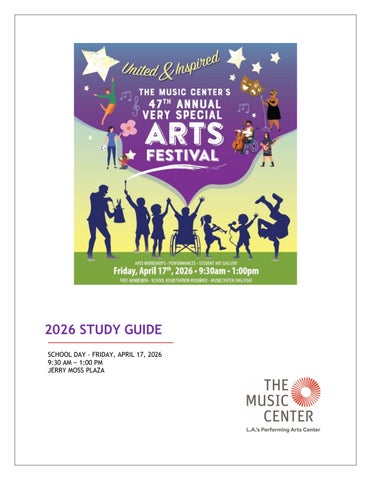
ABOUT THE VERY SPECIAL ARTS FESTIVAL
The Music Center's Very Special Arts Festival is an annual inclusive event celebrating the artistic achievements of students of all abilities. The festival features student and professional performances, visual and performing arts workshops, and a student art exhibit created around the theme. Presented in partnership with the Los Angeles Unified School District (LAUSD) and the Los Angeles County Office of Education (LACOE), the Very Special Arts Festival is free and open to all grade levels. The festival will offer students and teachers the opportunity to experience performances and participate in multiple art workshops and well as a digital and physical art gallery
Included in this study guide are three (3) lesson plans that were crafted to help teachers explore various ideas related to this year’s theme “United & Inspired”. The lessons have been prepared by Music Center teaching artists Lynnanne Hanson-Miller, Ana J. Miro Herrans and Pashyo Sarkin. The lessons were developed with a focus on empowerment and are thoughtful and dynamic ways to bring arts to the classroom. Teachers may wish to incorporate some of these ideas into their existing curriculum in preparation for the festival.
We can’t wait to see you there!
Photo from the 2023 Very Special Arts Festival at The Music Center.
United Through Dance
Teaching Artist: Lynnanne Hanson-Miller – Dance Grades - Elementary – Adaptable for Secondary
ESSENTIAL QUESTION
Current dance trends and historic cultural dance can inspire us and bring us together to connect with others. How can dance inspire us? How does social dance make us united? In what ways can we be informed about society as well as our own experience when we dance together?
ELEMENTS AND SKILLS OF ART FORM
Call and Response Communication/Collaboration Community Connections Dance Genres/Games Elements of Dance Following Directions Keen Listening/Observation Skills Safe Space Sustained Activity
KEY VOCABULARY
Caller Community Connections Figures Folk dance Formation Genre Pattern Posture Rhythm Sequence Synchronicity Tradition Well-being Locomotor movements travel through space: Gallop, March, Skip, Slide/Sashay, Walk Non-locomotor or Axial movements stay in place: Balance, Bend, Gesture, Hop, Jump, Reach, Stretch, Twist
PARTICIPANT OUTCOMES
Students will:
• Identify how moving in synchronicity within a dance can make communities united
• Experience how social awareness is innate when dancing as a group
• Develop a new understanding of traditional folk, historical vintage and current community dance trends.
• Demonstrate a united community through specified and free form sustained activities
• Discover how dances from here and abroad can provide inspiration
PROGRESSION OF CONTENT, SKILLS AND TASKS
Assessing Prior Knowledge
• What are various types, styles or genres of dance?
• Has anyone gone to see a dance performance or participate in a dance class?
• Have you participated in a group dance such as “The Chicken Dance” or country western line dance at a celebration such as a wedding or community festival?
• What are some of the social aspects of dance? Think of the reasons dance has been done for centuries by a specific culture or other group?
• We will create a “Why People Dance?” word web to affirm these ideas
Anticipatory Set
• Teaching Artist will discuss how all styles of dance have inspired her to create a safe space for students to unite through dance making community connections and experience sheer joy.
PROGRESSION OF CONTENT, SKILLS AND TASKS (cont.)
• Participants will be led through an axial movement warm-up exercise utilizing movement isolations.
Getting Smarter
• Students will experience being united and inspired by doing a selection of dances from the list below.
• Community line and circle dances:
o Cumbia (Colombia), Vals des Cerfs-Volants (Canada), Boots on the Ground (Am. Country Western), Pata Pata (South Africa)
• Set Dances:
o Sellenger’s Round (England), Virginia Reel, Oh Susanna (U.S.A.)
• Play Party Games:
o Looby Lou, Pease Porridge Hot, Pop Goes the Weasel (U.S.A.)
Becoming an Expert
TASK: Participants will choose one of the dances they have learned and perform it with minimal prompting from the Teaching Artist. Students may also choose to create new components for the dance.
CRITERIA: Students will:
• Present a dance chosen in collaboration with their peers.
• Demonstrate respectful cooperation with the group, with a partner and with others.
• Perform the dance with correct timing in rhythm with the music.
• Include all the skills of the dance including the correct steps, gestures, patterns and smooth transitions.
• Discuss what dance was chosen and, if any, what component(s) are original to the dance; what component(s) were created by you/your peers.
• Determine how their dance can bring unity to and inspire the community.
Making Connections: We will discuss:
• Why does learning dance skills require complete presence to execute movements, to practice partner and teamwork to attain the connection realized in the dance?
• How does that complete presence enable the feeling of being united and inspire a love of learning?
• At what events might these dances be done?
• What makes them qualify as social activities that unite and bring people together?
• Describe how the music influences the flow and feeling of a dance.
TEACHER FOLLOW-UP
Use the isolation movements and stretching warm up we began with or create your own.
Teach one or more of the dances we learned as part of a classroom celebration, a holiday or to “get the blood flowing.” Refer to the dance notes and music provided for the dances we learned.
Afterwards ask the students to think of one word that expresses how they felt while engaged in the dance/activity. Call on them individually to vocalize their ‘one-word’ feeling OR choose small groups to call out their word together on cue. You may have to ask them for suggestions and write them on the board so no student feels left out.
Play music from the list of “Fun dance tunes” to take brain breaks; let the students do their own moves. Have students reference the list of locomotor and non-locomotor movements.
California Arts Standards
2.DA:Pr5
a. Demonstrate a range of locomotor and non-locomotor movements, body patterning, and dance sequences that require moving through space using a variety of pathways.
b. Move safely in a variety of spatial relationships and formations with other dancers, sharing and maintaining personal space.
c. Repeat movements, with an awareness of self and others in space. Self-adjust and modify movements or placement upon request.
2.DA:Re9 – Observe or demonstrate dances from a genre or culture. Discuss movements and other aspects of the dances that make the dances work well and explain why they work. Use simple dance terminology.
Social Emotional Learning • Self-Management
Social Awareness
Relationship Skills
21st Century Learning Skills • Hands-on-Learning • Collaborative Problem Solving
Creating Patterns with Shapes, inspired by the artist Yayoi Kusama
Teaching Artist: Ana J. Miro Herrans - Visual Arts Grades – Elementary and Secondary
CONCEPT – Patterns are created by the repetition of lines, shapes and colors ESSENTIAL QUESTION- How can patterns connect and inspire us?
ELEMENTS, VOCABULARY AND SKILLS OF ART FORM –arranging drawing gluing layering painting patterns repetition
Element of art: line, color, shapes, texture.
STUDENT OUTCOMES
Students will:
• Discuss, identify and create patterns using lines, shapes and colors.
• Combine and layer patterns to create an art piece.
• Discuss and identify the use of patterns in Kusama’s art.
• Discuss and identify the use of patterns in quilts.
• Create texturized and pattern filled patches.
• Share two (2) of their patches and create a small quilt like art piece.
PROGRESSION OF CONTENT, SKILLS AND TASKS
Anticipatory Set: Warm-up
• Using hands and feet, students will repeat sound patterns made by teacher and then will create their own to be followed by the rest of the class.
• (For HIGH SCHOOL STUDENTS) Using lines and shapes create 3 different patterns across a paper (as if writing a sentence). Give sounds to each pattern and share them with the class, so they can repeat the sound back in unison.
Assessing Prior Knowledge:
• What patterns can they see around them? You can point to them
• Can patterns impact someone’s mood or feeling? How? - Draw a pattern that for you represents anger, stress, excitement.
• How can patterns be used to connect? - Refer to the sound exercise that we just did as a way patterns make us connect.
Getting Smarter:
• Introduce Yayoi Kusama, show 2 of her pieces, and have the students describe what they see. What role do patterns play in her artwork? What do her art pieces make you feel?
• Show different kinds of patterns. Explain the difference between visual and physical texture.
• What are quilts? Explain a bit of their history and how they were created to tell stories.
• How are Kusama’s work and real life quilts similar? How are they different? (students can point at the pictures to answer the question)
Becoming an Expert: Identifying, creating and using patterns to create a quilt-like texturized art piece.
FOR HIGH SCHOOL STUDENTS – Make sure each individual shape represents something about yourself (favorite color, shape, texture, mood, pattern, etc.)
Meaningful Task and Criteria - Performance-based Assessment:
TASK: This will be both an individual and a collaborative project. Students will use lines, shapes and colors to create patterns and texturize 4 to 6 paper squares as if making “patches”. Then exchange 2 of your “patches” with 2 other students. Connect all your patches onto a new paper by gluing them together, as to create a quilt-like art piece.
(HIGH SCHOOL STUDENTS – INSTEAD of squares, they can cut out their paper shapes into any geometrical shapes they want, and INSTEAD of gluing the pieces together, they will hole punch the edges of the pieces and then connect them with yarn, as if they were sewing them together.)
CRITERIA: Students will:
• Maintain focus throughout.
• Cut paper geometrical shapes.
• Use bubble wrap to print its texture onto some of the shapes
• Use stamps to create patterns.
• use crayons or markers to draw patterns.
• connect all their decorated shapes onto one quilt-like art piece
• work cooperatively with classmates
Verbal Assessment: Review the task – How many different patterns were you able to create? How does your quilt-like project represent you and why?
Making Connections:
• How can patterns and texture help people connect? How can it help people express themselves?
• Can we see something new in Kusama’s art now that we understand patterns better?
• Does everyone see color the same way?
TEACHER FOLLOW-UP:
Practice drawing and cutting irregular shapes, mixing colors and creating new ones, and using a paintbrush to create different kinds of lines (straight, zig zag, wavy, etc.).
FOR HIGH SCHOOL STUDENTS – Doing a bit more research on their family history, create and add 2 more “patches” to your “quilt”.
IMAGES TO USE:
CALIFORNIA ARTS STANDARDS
• 1.VA:Cr1.2 - Use observation and investigation in preparation for making a work of art.
• 2.VA:Cr2.2 - Demonstrate safe procedures for using and cleaning art tools, equipment, and studio spaces.
• 2.VA:Cr3 - Discuss and reflect with peers about choices made in creating artwork.
• 2.VA:Re9 - Use learned art vocabulary to express preferences about artwork
• 1.VA:Cn11 - Understand that people from different places and times have made art for a variety of reasons.
• Social and Emotional Learning - CASEL Wheel - Five core SEL Competencies Framework
• Self-Management
• Self-Awareness
• Responsible Decision-making
• 21st Century Skills
• Creativity
• Hands-on-Learning
• Critical Thinking
• Personal Responsibility and Initiative
Rhythm
Teaching Artist: Pashyo Sarkin - Music Grades – Secondary
CONCEPT and ESSENTIAL QUESTION
ELEMENTS, VOCABULARY AND SKILLS OF ART FORM
What purpose does rhythm fulfill in a song? call and response dynamics instruments rhythm steady beat tempo
STUDENT OUTCOMES
Students will:
• Play with shakers, handheld sound shape drums and bucket drums
• Engage in a game of “call and response”.
• Create short rhythmic phrases
• Improvise to music of different cultural backgrounds
PROGRESSION OF CONTENT, SKILLS AND TASKS
Anticipatory Set: Warm-up
• Try out various small percussion instruments like shakers and sound shape drums.
• Emphasizing the steady beat with movement and shaker playing.
• Starting and stopping on a count of 4.
• Adapting to changes in tempo.
Assessing Prior Knowledge:
• Do you play any instruments?
• To which instrument family (percussion, strings, woodwind or brass) does your instrument belong?
Getting Smarter:
• Learn drum stick technique
• Copy short rhythmic phrases
• Create a rhythm
• Play along to pop music
• Lead and follow in a game of “Call and Response”
Becoming an Expert:
Play together with a strong steady beat.
Meaningful Task and Criteria - Performance-based Assessment:
TASK: Students will play rhythmic patterns to recorded music
CRITERIA:
• Follow the steady beat and tempo of the music
• Start and stop the rhythm on a count of 4
• Modulate the dynamics of the drumming
• Work together as a group and maintain focus throughout
Verbal Assessment:
• How does it feel to play music together with others?
• Were you able to keep up with the steady beat of the music?
• Did you change the dynamics of your drumming at any point and why?
• What would you like to change to improve the quality of your performance?
Making Connections:
• How does music influence your mood and well-being?
• How does playing music as a group unite and inspire us?
TEACHER FOLLOW-UP:
Expose students to music from different cultures. Here are some music pieces that are easy to play along with: “Can’t Stop the Feeling” by Justin Timberlake, “Hair in the Air” by Trolls, “Dune – Eastern Road” by Ali Baba, “Kpanlogo” by Atsu Sokpor, “African Drums” by African Tribal Orchestra and any others of your liking.
• CALIFORNIA ARTS STANDARDS - https://www.cde.ca.gov/be/st/ss/documents/caartsstandards.pdf
Cr - Create Pr - Perform/Presenting/Producing Re - Respond Cn - Connect
2.MU:Cr1
a. Improvise rhythmic and melodic patterns and musical ideas for a specific purpose.
1. MU:Pr6
a. With limited guidance, perform music for a specific purpose with expression.
1. MU:Cn11
With limited guidance, discuss connections between music and culture.
2. MU:Cn11
Describe connections between music, society, and culture.
• Social and Emotional Learning - https://www.cde.ca.gov/ci/se/tselcompetencies.asp
• CASEL Wheel - Five core SEL Competencies Framework -
• Self-Awareness
1.C.1. Students name people, places, and ideas that are important to them. Students can describe their own family traditions.
1.D.1. Students understand acceptance versus exclusion and how they help or harm others.
1.G.1. Students are aware of, and distinguish between, their wants and needs. Students can name their strengths such as skills, knowledge, or talents.
• 21st Century Skills. - https://www.hunschool.org/resources/21-century-classroom
• Hands-on-Learning
• Cultural Competency
THE MUSIC CENTER
135 N. Grand Avenue Los Angeles, CA 90012 (213) 972-7211
musiccenter.org education@musiccenter.org
CONNECT WITH US @musiccenterla
TMC EDUCATION STAFF
Keith Wyffels Associate Vice President, Education
Susan Cambigue-Tracey Director of Special Projects
Patrice Cantarelli Associate Director, School Programs
Ebony Ruffin Manager, Professional Development
Juan Sanchez School Programs Coordinator
Jill Sowell Manager, School Programs
Monk Turner Director, Performing Arts in Schools and Neighborhoods
Vincent Lopez Coordinator
The 2025 Very Special Arts Festival at The Music Center. Photo by John McCoy.