04-09-26-FullIssue

Page 1


MONTAGEthe

STLCC BOARD ELECTION

New Board of Trustee members elected PAGE 3

DEAF CULTURE

Dr. Cruz presents on her published book on campus PAGE 5

REMEMBERING GAGE WARD

Coworkers and college call to mind departed student PAGE 4

BY

Meramec’s open house draws community interest

Prospective students and community members explore campus and engage with STLCC faculty

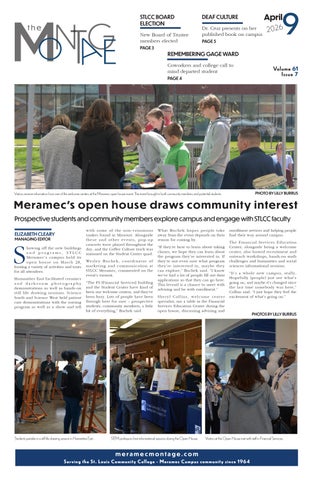
Showing off the new buildings and programs, STLCC Meramec’s campus held its open house on March 28, hosting a variety of activities and tours for all attendees.

Humanities East facilitated ceramics and darkroom photography demonstrations as well as hands-on still life drawing sessions. Science South and Science West held patient care demonstrations with the nursing program as well as a show and tell

with some of the non-venomous snakes found in Missouri. Alongside these and other events, pop-up concerts were played throughout the day, and the Coffee Culture truck was stationed on the Student Center quad.

Wesley Buchek, coordinator of marketing and communication at STLCC Meramec, commented on the event’s turnout.

“The FS [Financial Services] building and the Student Center have kind of been our welcome centers, and they’ve been busy. Lots of people have been through here for sure – prospective students, community members, a little bit of everything,” Buchek said.

What Buchek hopes people take away from the event depends on their reason for coming by.

“If they’re here to learn about taking classes, we hope they can learn about the program they’re interested in. If they’re not even sure what program they’re interested in, maybe they can explore,” Buchek said. “I know we’ve had a lot of people fill out their applications so that they can go here. This [event] is a chance to meet with advising and be with enrollment.”

Sheryl Collins, welcome center specialist, ran a table in the Financial Services Education Center during the open house, discussing advising and

enrollment services and helping people find their way around campus.

The Financial Services Education Center, alongside being a welcome center, also hosted recruitment and outreach workshops, hands-on math challenges and humanities and social sciences informational sessions.

“It’s a whole new campus, really. Hopefully [people] just see what’s going on, and maybe it’s changed since the last time somebody was here,” Collins said. “I just hope they feel the excitement of what’s going on.”

PHOTO
LILLY BURRUS
Visitors recieve information from one of the welcome centers at the Meramec open house event. The event brought in both community members and potential students.
Students partake in a still life drawing session in Humanities East . STEM professors host informational sessions during the Open House. Visitors at the Open House met with staff in Financial Services.

STAFF

Shannon Philpott-Sanders Faculty Adviser

Facebook.com/ meramecmontage/ Instagram.com “meramecmontage”

Youtube.com “TheMeramecMontageNewspaper”

X.com “@TheMontage”

To place an advertisement, contact the advertising manager for rates, sample issues, etc., at 314984-7857 or email ssanders147@ stlcc.edu.

Editorial views expressed or content contained in this publication are not necessarily the views of St. Louis Community College, the Board of Trustees or the administration.

The Montage is a student publication produced four times per semester at St. Louis Community College - Meramec, 11333 Big Bend Blvd., Kirkwood, Mo., 63122.

Editorial policy: All letters should be no longer than 500 words and must include identification as a student or faculty member, phone number and address for verification purposes. Phone numbers and addresses will not be published. All letters are subject to editing for content and length. All letters submitted will be published in print and online.

Proud member of

STLCC Board Election Puts Focus on College’s Future

Two new STLCC Board of Trustee members will be elected on April 7 for Subdistrict 1 and Subdistrict 4

Two seats are on the April 7 ballot for the St. Louis Community College Board of Trustees election, with candidates competing for seats in Subdistrict 1 and Subdistrict 4. Subdistrict 1 covers a large part of north and central St. Louis County including Hazelwood, Florissant and Clayton areas, while Subdistrict 4 covers portions of southwest St. Louis County including Valley Park, Parkway and Mehlville districts. The board’s main duties are to work with the chancellor of the school to hold plans accountable, elect new chancellors when necessary, and oversee the district’s spending.

Running for the Subdistrict 1 seat is incumbent Kevin Martin being challenged by Clem Smith and Theodis Brown Sr. The current Trustee for District 4, Mary Luebke, is not seeking reelection, so the candidates are Patrick McKelvey, Fielding Poe and Deborah Bush-Munson. However, Subdistrict 4 candidate Fielding Poe attempted to drop out of the race in February, but was told it was too late to get his name off the ballot. Poe is currently 73, and the term on the board is six years.

“I would be 79 years old, and honestly, I don’t think I have the energy to go for that length of time, and so it became a concern,” Poe said. “I don’t think that I would finish a six year term. I called the St. Louis County Election Court in early February, and I told them I wanted to resign. They said it’s too late.”

Poe is an attorney from Ballwin that went back to school after previously serving as a teacher in the Fox and Lincoln County school districts and working various other careers along the way to law school. He is also enrolled in a ceramics class at Meramec.

“I know a lot of the students who go to Meramec. I think I understand a lot of the challenges that college students and community colleges have,” said Poe.

“And I think that I understand pretty well that most people are going there to better themselves.”

Poe originally decided to run for the

board because of his lifelong interest in education and drive to serve his community in a positive way. Although he himself isn’t looking to win the election, he’s given support to his opponent, Patrick McKelvey.

“I think it’s important to teach and to offer opportunities to students in a way that they’ll learn. There are people in education, who kind of have a science growth mindset to the way people should be taught, and they don’t always work,” said Poe.

Patrick McKelvey, also running for Subdistrict 4, is the executive director of Arnold’s Gateway Food Pantry, has experience teaching higher education and is currently part of two other academic boards in the area. McKelvey previously ran for the board in 2020 at the age of 23, right at the start of the pandemic. He ran against Mary Luebke, the incumbent for the seat.

“I really had no idea what I was doing. [Mary] had worked at the college and retired from it and was an excellent choice. That was my crash course into politics,” McKelvey said about his first time running.

If elected, McKelvey is excited to eventually pick the new chancellor of the school as well as continuing to put an emphasis on the college’s health sciences and technical programs.

“I always wanted to run for this again, because I know how important a community college can be to a community. The community college students from 20 years ago look a lot different from community college students today, and I hope that STLCC continues to adapt to them,” McKelvey said.

The third candidate for Subdistrict 4, Deborah Bush-Munson, did not respond for a comment. Subdistrict 1 incumbent Kevin Martin is a middle school principal in the Parkway school district, and has been serving on the board since 2017. Him and his opponent former St. Louis County State Representative Clem Smith both failed to comment as well.

Fire Chief Theodis Brown Sr., also running for the Subdistrict 1 seat, was previously elected to the board in 2014 and stepped down in 2015. Brown is

running for a second time in this election and is dissatisfied with some of the actions of the current board, including removing pictures of previous board members from the walls of the college.

“I’m highly upset with this new board that’s in power, getting rid of the pictures of all the other trustees that were elected, and especially the African American ones that were elected ever since the 1960s and 70s,” Brown said.

Brown’s only comment regarding the election was about the pictures, and believes it is undermining Black history aspects in the college.

“I went to the college again, the guard didn’t even know who I was. When Black history comes around, you’re supposed to celebrate those things, not undermine those things,” said Brown.

Although the election is very prevalent and important for the people of these communities, the election is experiencing a lower turnout than normal.

“I don’t think people know all of the incredible things that STLCC does for their community, and if they did, they’d probably take this election a lot more seriously,” said McKelvey. “I’m confident that I put in the work and I’ve done everything I can do, but [I] have no way of knowing if I’m going to resonate with any of the voters.”

Across many of the candidates, the message and purpose behind their desire to serve the community is what will drive their election onto the board.

“Ultimately, I want students to be able to come to STLCC, receive a phenomenal education that allows them to go on to their four year university at half the price but the same quality. And then, I also want other students to be able to get their workforce education at STLCC and to be able to deal with the workforce and earn a high paying job,” said McKelvey. “I think a lot of that comes back to investing in students and investing in your staff.”

PHOTO BY LINDSEY

4 Gage Ward Passed, March 19

ART & LIFE |

Student and worker remembered by college

On March 19, 2026, STLCC Meramec and South County student and student worker

Gage Ward died in a traffic accident. Ward worked at the help desk in the Meramec Financial Services Building while pursuing a degree in general transfer studies and working toward a career in psychology or psychiatry.

“Gage was described as a kind, hardworking coworker and as a student who will be greatly missed by fellow classmates, faculty and staff,” a condolence notice sent to STLCC students said.

Ward was also a father of two children, who he was outspokenly proud of.

“He had two kids that he really loved and cared about; he was very proud,” Ward’s coworker Moth Rowe said. “He talked about

them a lot, though we never got to meet them.”

His coworkers at the Meramec Financial Services Welcome Desk will miss Ward, noting that he was kind and compassionate.

“He was very smart and very kind. He seemed to touch [the lives of] everyone,” Rowe said. “Everyone always described him like that. It’s just that, he was very quiet, but he had a way of being nice to other people.”

Ward, while attending the STLCC South County Campus, was often an example of student success and achievement.

“He was a truly remarkable guy,” said South County dean and director Rob Lee. “He was the sort of student we often highlighted as a success story for having overcome so much in his young life.”

His success was also noticed by coworkers, with his achievements being acknowledged by them.

“He was one of those people that you see talked about in newspapers and stuff because he’s smart and he’s willing to put in the hard work and effort to achieve a lot,” Rowe said. “Thats why it was so tragic, and when we found out, we were taken seriously off guard.”

Ward was a true help to both students on the Meramec and South County campuses, working in student-facing positions.

Gage served as a friendly face to many who needed help finding what they were looking for on campus,” the condolence notice said.

Ward’s coworkers want him to be remembered in a similar way, as someone who had a positive and lasting impact on the Meramec student body.

“Just knowing that he

touched as many lives as he did,” Rowe said. “Everyone that I’ve talked to just really, really felt for him and he connected with a lot of people.”

A celebration of Ward’s life will be held on Sunday, April 19, from 4-8 p.m. at Collier’s Funeral Home, 3400 N. Lindbergh Blvd., St. Ann, MO 63074.

Q&A with STLCC Student Christopher Weikel

Q: What was your dream job/ occupation/craft as a child?

A: To be a police officer actually. I went to the Police Academy at Golden West College when I was 18 and passed with flying colors with one of my buddies, but no agency will pick you up until 21 so we had three years to kill. Much later I joined the military.

Q: What’s your biggest fear? Has it always been that?

A: I wouldn’t say it’s always been this, because my biggest fear right now is the welfare for my kids. The world my kids live in and what they’ll inherit and if they’ll live a happy and productive life.

Q: What protests have you participated in, if any?

A: None.

Q: What is the scariest thing you’ve seen or experienced?

A: I mean, I guess I should say being shot at but it’s not, in the moment it’s more interesting and exhilarating, especially the aftermath. Honestly, breakups or like those moments when you feel something happening or a shift in relationships or if you know you’re not happy with your job and you have to like that fear of what are you going to do next?

Q: What’s something about you that people might not expect?

A: The artistic side of me, most people don’t expect. They see the big giant dude with the shaved head and the big giant beard. A lot of people outside of this building are usually surprised that I’m an artist.

Q: Did you vote in 2004?

A: No. To expand on that, I don’t like the two-party system. There’s a lot of red versus blue going on and

they’re equally failing. Some states have started a first second third choice voting system, and I think if we did that as a nation, it would offer up a third party system- or a third party to be a viable option. I think that’s what we need to do instead of diversity and division, we need unity and common ground.

Q: Who is your best friend?

A: Hutch, he’s my buddy. We met when we arrived in Korea on the same day. We both reinlisted and extended, and spent four years together in Korea and then the army sent us different ways. And we’ve ended up on employment together for a little bit of time. We’ve kept in touch ever since I got out. He still comes over for Thanksgiving.

Q: If you could do anything in the world, with no financial or physical limitations, what would you do?

A: Travel. The best experiences that I’ve had is going around the world and meeting people, experiencing cultures and their food. If I could just do anything I would travel.

Q: Who do you trust the most?

A: Probably Hutch.

Q: What level of power over people is too much?

A: Any. I mean, obviously we all have to abide by the rule of law, but I don’t believe that anybody should be interfering with anybody else’s life. I really believe in self empowerment, like it’s your responsibility to be a contributing member of society, without having rules or regulations imposed on you other than don’t lie, cheat, steal, kill.

Q: Should bombs exist?

A: Yes. They allow for tactical engagement with an enemy with minimal risk of your team’s side. With the advancements of technology, and the way things are going, there’s less and less collateral damage. But everything has room for improvement.

Q: Should nukes exist?

A: In a perfect world, obviously not, because of that whole collateral damage. But because they do exist and there are legitimate threats around the world then it’s “If you have them, I need them too” type of thing, so I wouldn’t say that it would be a wise decision for us to disarm first.

Q: What are your thoughts on American imperialism?

A: So as far as our nation goes, we do a lot of good around the world. South Korea is probably one of the best examples of how our influence can be a positive aspect on culture. But I’m also one of the ones that believes that if you have the power that we have as a nation it should be used for the benefit of mankind. I know, obviously it gets abused sometimes or misappropriated, but overall, I think we as a nation have a positive influence on the world. It’s a better place because of us. But as

far as expanding, I don’t think we are trying to take over governments, and claim more states or more territory for our own. Our goal, military wise, for a while has been to create allies and remove threats.

Q: Do you think our country has too much power?

A: No, because there are other countries that wish us harm. That if we reduced our power, we would be vulnerable to them, and it’s naive to think that we don’t have threats. You know, there are nations that would see us not exist the way we are, they would impose either our destruction or their way of life upon us and right now, we’re the most diverse culture in the world, we have the most freedoms. So I think that to maintain our quality of life and improve our quality of life, I think it’s beneficial that we have the power.

Q: Do you think we as a country wish other countries harm?

A: I mean, those nations that we deem as the adversary, or whateverwe would like to install or help install governments that would be friendly to our agendas. But I don’t think as a whole we want the destruction of another nation in its entirety. Our nation doesn’t have hate as a whole society towards another society. I don’t think we’re seeking out the destruction of anybody else. It’s just my opinion, that doesn’t represent the military.

Q: Do you trust the government?

A: No, but I love my country. There’s a big difference, and there’s a distinction between that. I don’t trust any government implicitly. So I think right now, one of our biggest issues is people are less patriotic, because they don’t trust our government, and they can’t separate the country from the government where you could still love your country and all the positive aspects of it. It’s possible to still want to improve what needs improvement and still have mistrust.

HIBA OBEED ART & LIFE EDITOR

Investigative Journalist Visits Meramec

Suzgo Chitete discusses his work and his passion for journalism with students

Award-winning investigative journalist Suzgo Chitete from Malawi, Africa, visited the STLCC Meramec campus and newsroom on March 24. With over 16 years of experience in broadcast, print and online media, he talked with “The Montage” staff and editors as well as the college’s Journalism I class.

Chitete discussed how he first got involved with investigative journalism.

“My first experience was working for the public media, but let’s call it the state controlled media. That was my main full time job, but I began working for community radio, which was called Radio Islam… Then I joined a private media house in Malawi, and I was given an opportunity to investigate,” Chitete said.

In his line of work, Chitete has run into controversial and ethical complications, navigating them not without some difficulty.

“My media house… survives on advertising. And what that means is when we’re writing stories, we really have to be careful. I’ve learned to avoid certain stories. We don’t want to do those stories because eventually we are antagonizing the hand that feeds us,” Chitete said.

While Chitete is careful about which stories he writes and what information he discloses, he also takes risks in his work.

“There’s one story that still stands out. I did a story about students who could not get into a university because the system was unfair. When I reported about it, the president became very mad. She accused me of being an agent of the opposition, that I want to bring the government down,” Chitete said. “But the good thing is, the two people that I wrote about, they got admitted into the university, and the government made a decision to end the system that really was unfair to get people into the university. That’s the

power of journalism.”

To Chitete, investigative journalism is for everyone. “Every journalist, I think, is an investigator in one way or another. If you read ‘The New York Times,’ you see that they have done big investigations,” Chitete said. “But for me, even if it’s just an interview that you do with somebody, if it’s more probing, it’s investigative in nature. I mean you can do it [investigative journalism] in that small way. Just have passion.”

Chitete feels that the journalism system in America is important and should be taken advantage of by student journalists.

“You could be the next big thing… because it’s possible to do cool journalism here [in America] with minimum threats. And as a public college, the students have a lot of protections as well,” Chitete said. “We are very fortunate that the administration does not censor any of the student newspapers on the campuses. I think it’s a great system.”

Seeing Sound: How Deaf Culture Redefines Music

On March 25, Dr. Ana Cruz gave a presentation about her book “Culture, Deafness & Music: Critical Pedagogy and a Path to Social Justice.” The book covers the arts of deaf people along with the unique language of ASL.

Cruz began her presentation by discussing the background behind the book.

“Everything that you see available today with this book, it was because I teach,” Cruz said.

The book comprises everything she has taught and learned in her 25-year career at STLCC. Cruz’s goal with her book was to bring more awareness to the Deaf community and for people who can hear to understand more about Deaf culture than they did before.

identity and a gender identity,” Cruz said.

Cruz mentioned that there are sign languages other than American, including French, German and Portuguese. ASL is not a universal language, but it has many forms around the world.

and a form of resistance “highlighting hegemonic relationships and oppression brought about by the hearing world.”

There are many forms of Deaf art, including Deaf Humor, Deaf Poetry, Deaf Theater, De’VIA (Deaf View/Image Art), Signed Music, and Music (performance and private activity). De’VIA is a form of art where deaf people express themselves and their experiences.

Cruz talked about whether Deaf culture is real, and the answer is yes: Deaf people have a very diverse culture with its own history, etiquette, rules and ways of communicating. Many people believe that Deaf culture is all the same, but Cruz discussed the geographic diversity of the community.

“Just because people are deaf doesn’t mean they don’t have other identities other than being deaf, there is a race

Coming back to the rich culture of the Deaf community and the arts, Cruz said that the book really took off when art was introduced, and it became a focal point of the book. Art is very close to Cruz’s heart, as she is an artist and grew up with it. Deaf artistic expression is often political, according to Cruz,

Music is also a big part of the Deaf community, with deaf people using music to express themselves. Cruz presented a performance by Ian Sanborn, called, “The Rooster Seeks Music.” Sanborn used a form of visual sign language to tell a story focused on imagery, rhythm and characterization.

Art is a form of physical poetry. Along with the physical art of Sanborn, there is also another form of music that deaf people use to express themselves, and that is rap. Cruz presented a song by Signmark, a deaf rapper whose song “Talk to the Hand” critiques audism and asserts Deaf pride.

Although the Deaf community has made many great strides, there are still things holding them back, according to Cruz, including oralism, audism and ableism as systemic barriers. Cruz mentioned critical pedagogy (an educational philosophy that empowers students to critically examine social inequalities and take

action toward social justice) as a way to push back against oppression.

Cruz’s presentation hoped to leave the audience with a shift in perspective: deafness is not defined by absence, but by identity, culture and expression. Through language, art and community, the Deaf experience reflects a rich and complex world that challenges common assumptions. By encouraging greater understanding and the use of critical pedagogy to confront inequality, Cruz’s work calls on society to move toward inclusion, equity and a deeper respect for Deaf culture.

PHOTO BY LILLY BURRUS
Suzgo Chitete explains the differences between media in Africa versus the U.S. at a staff meeting with The Montage on March 24.

BY

Jake’s Take: The Heart Of The City Downtown

JACOB POLITTE ONLINE EDITOR

NSt. Louis gets a bad rap

ever let anyone tell you that STLCC can’t get you places. Recently, I started a brand new, full time job at a downtown law firm. This was a position I obtained thanks in large part to the knowledge that I’ve gained during my participation in STLCC’s legal studies courses (thank you, Professor Wiseheart!), and while it has been an adjustment (jumping into office life after 10 years in retail is no easy feat, I am loving the work I’m doing. It is the exact kind of change of pace that I have been needing in my life, and I am grateful that I had the opportunity to make that kind of move.

Working at this office has resulted in me spending most of my week right in what I believe to be the heart of the city. I work right next to the Old Courthouse, and I walk the Arch Grounds on my lunch almost every day.

But I’ve also had the opportunity to walk around other areas downtown as well, and it paints a different picture than the one often portrayed in our local and national media programs, as well as the picture painted by some in our own community.

That’s not to say it’s perfect. Is it clean? Not really. Are there too many abandoned and empty spaces? Absolutely. But it’s not the beacon of crime that many seem to think it is. And it’s no more of a dirty environment than any other downtown in any other

The Magic of ‘Arcane’

When I was a freshman in high school, one of my childhood bands, Imagine Dragons, released a new single called “Enemy.” What’s more is that it was apparently in a show that was coming out soon called “Arcane,” which was based on the video game “League of Legends.” Prior to this, I had never played League, nor had I really consumed any media related to the game, but Imagine Dragons had a song in this show and I like Imagine Dragons. It was also animated, and I really enjoy animation, so I decided I would make an effort to watch the show when it came out. That’s where it all started.

Fast forward to winter break of that year, I had just finished the series, and it had been a roller coaster of emotion throughout the entire show for me with everything from death to heartbreak to really good music. But with that final shot of (no spoilers) that rocket launcher just starting to break the glass window and then the screen cutting to black,

that’s when I realized that my life had changed.

Of course, being only a high school freshman, I hadn’t entirely learned and understood some of the concepts that “Arcane” was trying to push to me, but as a high school freshman who was diagnosed with depression and GAD not even a year earlier and still trying to figure out what he wanted to be, this show would be the catalyst for me finding out who I really am.

Jump to December 2024, and I’m now a senior in high school and I had just finished the second season that had been released a couple weeks ago. I was older than when I had watched the first season, so I had now understood some

major city. For example… New Orleans. That’s a fun city. But it’s a dump that makes St. Louis look like the inside of a megachurch on Easter.

By and large, the people you meet are friendly. And if they’re not, a lot of them will just ignore you. Granted, I’m not wandering the streets of the city at two in the morning when things might be a little more crazy. But no one, especially not a responsible adult, should be out at two in the morning. During the day, I have yet to feel unsafe downtown whatsoever. I also have yet to feel unsafe on the MetroLink, which also gets a bad rap.

None of this is to suggest that crime doesn’t exist downtown. Of course, it does. But crime, in itself, is not isolated to downtown. There’s crime in South

City. There’s crime in West County and South County. Kirkwood, as nice as it is, is not immune from some absolutely crazy criminal activities itself. As someone who’s been down there enough to know now, I can honestly say that downtown St. Louis, while not perfect, is not the dangerous place that so many have portrayed it to be.

Most people know how to stay safe in public. Being downtown shouldn’t feel like something to be afraid of.

It could benefit from being more populated, that’s for sure. It feels like a ghost town at certain points of the day, which may add to the uneasy vibe. But in my opinion, that vibe is a smokescreeen.

Take a trip downtown with a friend sometime. You may be surprised.

of those same concepts and themes that Arcane was trying to push to me from the first season. This allowed me to understand why some of the characters did what they did. It allowed me to understand what was going on in the real world, and it even allowed me to find out more about myself and who I really was.

But it’s not just the themes and messages behind “Arcane” that makes it a favorite in my book. The animation and artwork of this show is unparalleled.

Somehow, while being a fictional universe with everything from mechanical arm cannons to a device that shoots trade ships across great distances at the speed of light, it feels so real. The way the characters move with fluidity

brings a kind of realism that is very hard for animated media to portray and that you really only ever see with live action media.

The way the colors work in the show is something that cannot be overlooked. Looking at basic color schemes, the dark and muted colors of Zaun carries the feel of a forgotten, crime-ridden city, but the occasional neon colors gives you the idea that nothing is ever dull in Zaun and that something is always happening. Mirroring this, the city of Piltover is built on colors of, mainly, white and gold, symbolizing a city that always strives for tomorrow with the occasional dark shadows showing how there’s always something shady going on. With these color schemes, the show gives the idea of how different the two different cities are, while also showing how those same, contrasting cities aren’t that different from one another.

With only two seasons with nine episodes each, “Arcane” does something that many animated media dream of doing: It breaks the rules in a way that changes them.

PHOTO
JACOB POLITTE
Pictured is the St. Louis Gateway Arch.

A Ballgame at the Grizzlies

From March 5-7, St. Louis

Community College Archers

baseball team lost four of four games in a series against Jefferson College at Arsenal BG Ballpark, formerly known as Grizzlies Stadium, just over the Mississippi River in Sauget, Illinois. These games were played at a neutral location due to consistent rain throughout the week, forcing the change away from a few home games for each team.

On March 6, the final score was 10-2, marking another loss in the third game of four. Five runs were scored by Jefferson College in the bottom of the first inning, pitched by William Merrikin. Merrikin kept his cool and threw a solid

next two innings to give hope to an offense looking for a break. The Archers got on the score board with their first run in the top of the third.

Derek Dankenbring joined the game to pitch against Jefferson College, holding them to only two more runs scored through innings four through six. One of those runs scored was a solo home run smacked by Jefferson College catcher Andrew Sands.

While some players started to hang their heads coming back to the dugout after closing out the inning, some of the Archers players could be heard attempting to rally their teammates’ spirits. Riley Schulz took the mound last, and it didn’t take long for Jefferson College to put the game to bed, scoring three more in the seventh to close it out.

Approximately 30 people were in

attendance to watch the game. There was quite a bit of talk between the umpires and just about everyone else. After some chatter on the field back and forth between the Archers coaching staff and the umpires, some supporters were then heard calling the umps “Garden Gnomes,” basically seeing them as nothing better than field ornaments.

“I just think that we felt that a couple of the close calls went against us in every aspect. It’s going to happen over the course of a season. You’re going to have a game where the calls go your way and you’re going to have games where calls go against you.” said Goodrich. “But still no excuse, we had a safe call at third base and then we threw a wild pitch to gift them a run.”

Arsenal BG Ballpark seats a maximum of 6,000 people with a turf field. This is a change of pace from both natural fields

that each team usually plays on.

“I think everyone likes playing turf because it makes it a little bit easier on the infield, you know? There’s no tricky hops usually. It certainly takes a lot of the guesswork out of defense and making plays.” said Goodrich.

Goodrich said that the team needs to find a way to pitch, hit and play defense better.

“We put those things together and we will be alright,” said Goodrich.

PHOTOS BY ZACH EDGAR Lane Elder surveys the play before stealing a base.
William Merrikin winds up to throw a pitch.
The Archers baseball team huddles up.

Turn static files into dynamic content formats.

Create a flipbook