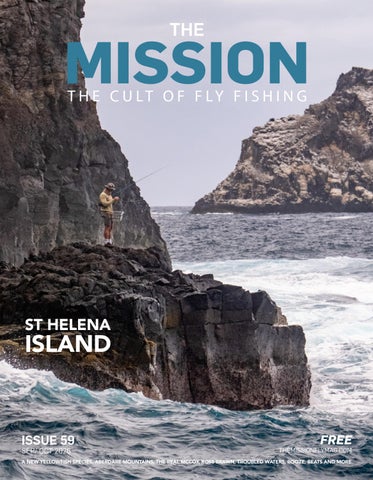
ST HELENA
ISLAND
ISSUE 59 SEP/ OCT 2026
FREE
THEMISSIONFLYMAG.COM
A NEW YELLOWFISH SPECIES, ABERDARE MOUNTAINS, THE REAL MCCOY, ROSS BRAWN, TROUBLED WATERS, BOOZE, BEATS AND MORE
INNOVATION
LEADERS. SA Pro Ben Paschal
For over 80 years, Scientific Anglers has been pushing the boundaries of material science to provide superior performance at every price point. Our leader and tippet are no exception. We offer the greatest breadth of product on the market, from the award-winning Absolute line-up that provides up to 40% higher wet knot strength compared to competitors, to the new Mastery series crafted from proprietary nylon copolymer blends.
If it says SA on the package, you can fish it with confidence.
If you make it to Glover’s Atoll, you’re not quitting early just because the light gets tough. Austin Campbell squeezes a few last casts out of the day. Photo: Andrew Burr © 2026 Patagonia, Inc.
Waterproof Was Just the Start
Guidewater Packs We weren’t done at dry. Our refined Guidewater Pack collection builds in welded seams for full waterproof protection, 800-denier fabric with TPU coating on both sides, multiple carry options, attachment points and intuitive organization so you can focus on your cast, not the conditions.
— RUGGED, 800-DENIER TPUCOATED MATERIAL — ERGONOMIC DESIGN AND OPTIMIZED LOAD DISTRIBUTION FOR ALL-DAY CARRY — MULTIPLE GEAR ATTACHMENT POINTS AND INTEGRATED LEFT- OR RIGHTHANDED NET SCABBARD
W W W . T H E M I S S I O N F LY M A G . C O M ISSUE 59 SEPTEMBER/OCTOBER
CONTENTS Cover: On the ‘wild’ side of St Helena Island, Jimmy Eagleton prepares for his next cast into black jack territory. Photo Matt Kennedy
24. YELLOW SUBMARINES New yellowfish… who dis? Meet Labeobarbus kylei. Not since Kylie Minogue in the ‘80’s has a “Kylie” excited us so much. Its namesake, fisheries scientist Rob Kyle, weighs in with the story of this large and exceptionally well-hidden, newly described species. 30. SLOW IT DOWN When his brother Oli was diagnosed with early-onset Alzheimer’s, for Andrew Nightingale, a long-overdue fishing trip into Kenya’s Aberdare Mountains chasing century-old descendants of Scottish trout became something else entirely. 42. THE REAL MCCOY Dave McCoy has spent 25 years building Emerald Water Anglers into one of the most respected fly fishing operations in the United States. It has cost him every day, but Dave’s a real one. He wouldn’t have it any other way 56. A ROCK AND A HARD PLACE How does hardcore, shore-based fly fishing off volcanic ledges, rope descents into hidden valleys, and a species list few (if any) fly rods have ever touched sound? Aroused? Good. Gird your loins, prepare your salivary glands and settle in - for we present to you, the first fly fishing expedition to St Helena Island in the middle of the Atlantic Ocean. 92. TROUBLED WATERS – GARDEN ROUTE How did an exclusive five-year licence to guide fishing on Swartvlei, the Garden Route’s premier estuary, end up in the hands of a single operator on the back of one small advert in a regional weekly? The Mission investigates.
REGULAR FEATURES 10. Ed’s Letter 14. Chum 20. Booze & Beats
78. Salad Bar 100. Lifer 110. Pop Quiz
Dave McCoy bombs out a spey cast while fishing for Atlantic steelhead on the Rio Santa Cruz in southern Argentina. Full interview with the man on page 42. Photo Lucas Young.
150 Years of Fly-Fishing Excellence Founded in 1872 in Alnwick, England, Hardy has become one of the most respected names in fly fishing. What began as a small family business grew into a global leader in premium fishing tackle, renowned for its innovation, craftsmanship, and performance. The launch of the iconic perfect reel in 1891 established Hardy’s reputation for engineering excellence, while decades of pioneering designs earned the company worldwide recognition and multiple royal warrants. From classic reels to modern carbon-fibre rods, Hardy has consistently combined traditional craftsmanship with cutting-edge technology. Today, more than 150 years later, Hardy remains dedicated to producing exceptional rods and reels for anglers who value precision, heritage, and the art of fly fishing.
For anglers looking to experience the legendary quality of Hardy firsthand, a selection of Hardy rods, reels, and accessories is available from Safari Fishing at Safari Outdoor® Lynnwood. Whether you’re a seasoned fly fisherman or just beginning your journey, Safari Fishing offers access to some of the finest tackle in the world.
Born in England, Fished Everywhere.
LYNNWOOD
T U D O R CA R A D O C - DAV I ES
UNFIT AT THE VICE
I
’ve been thinking a fair whack about fitness recently. There’s, of course, the fitness that is a perennial or annual challenge as a middle-aged man fighting gravity and gluttony and all those things. But the fitness that’s really top of mind now is my fly tying fitness. In my fly tying journey, I’ve gone through various ages and stages. There was a period 10-15 years ago where I was, to put it mildly, obsessed. I did a fly tying course with Gordon van der Spuy, aka The Feather Mechanic (highly recommended), then started running events in my apartment (Beer! Pizza! Fly Tying!) until the noise complaints came in. I then moved them into the Cape Piscatorial Society club rooms, where Vice Squad nights became the club’s main events for a few years. Then The Mission sprang up, life got busy, marriage, kids, and gradually my fly tying desk, which is always right there, just metres from my desk-desk, just became a place to layer more fly tying materials. The busyness and the fullness of life and career has been getting in the way of fly tying. I swore to myself that this upcoming trip to Tanzania would be different, that I would squirrel away the time, that I would stay up late and not vegetate in front of brainless series (shout out to Reacher). I swore that come hell or high water, Conrad, Platon, Andre and I would get together and tie flies. Well, we did get together a few times, and those three (all extremely accomplished fly tyers with their own signature patterns and storied reputations) tied up some superb flies. All fingers and thumbs, I tied up some hideous things that will still no doubt catch a Tanzanian tiger or two, but my gawd am I unfit at the vice. Dre, Platon and Conna left me in their dust years ago as fly tyers. They’re way more dedicated, they stick to the discipline despite the busyness of their lives, and it shows in their skills and their superb fly boxes. I felt like I was trying to learn how to ride bicycle again. Did I start to panic knowing how busy the last few weeks before the trip would be with our RAUFFFF film festival and getting this mag and other publications off to print? Yes. Did I pull the emergency cord, call the Garden Route savants Leroy Botha (aka the GOAT) and Jurg de Jager and hire them to tie me some phenomenal flies that will no doubt give me extra confidence while tackling ultra hangry fish that probably don’t care? You betcha.
10
“I TIED UP SOME HIDEOUS THINGS THAT WILL STILL NO DOUBT CATCH A TANZANIAN TIGER OR TWO, BUT MY GAWD AM I UNFIT AT THE VICE.” If I take anything away from this preparatory stage of the trip, it’s the reminder of the magic in just getting together. The kak praat, the strategizing, the visualization that (actual) sportsmen refer to before they execute iconic winning moments. Even if none of it comes to fruition, the story has already begun in our minds. Vision quest vibes whether that’s having a 50 kg vundu come up and swallow your fly, or a record-breaking Tanzanian tiger jumping out of the water and T-boning your giant-ass sailfish popper on the way down. It’s been the chats in person and in the WhatsApp group about R&D, from baitfish colouration to hook selection, leader building with wire trace, how we want to hook vundu on surface flies but also don’t want to get stuck fighting them for an hour; how some of the ugliest flies and some of the stupidest ideas from guests to guides on location actually turned into some of the greatest breakthroughs. E.g. Leonard Flemming’s Dinner Bell or Stu Harley’s Blue Stu. I’ll keep working on my fitness, both in the sense of one day having that six-pack or one day having that amazing self-tied fly pack again. I know I’ll get there. Maybe one day when my kids are big or life miraculously becomes more chilled. That happens, right?
W W W. T H E M I S S I O N F LY M A G . C O M
We added some T to the G.
T is for technology and the redesign of our legendary G Series...only lighter, speedier, feelier, and yes, even cooler. Check out the all new handcrafted high performance models at your Scott dealer. Scott Fly Rod Company | Handcrafted in Montrose, Colorado
www.scottflyrod.com
After surviving St Helena’s cliffs and angry seas Jimmy Eagleton got arrested for jaywalking.
EDITOR
Tudor Caradoc-Davies
ART DIRECTOR Brendan Body
EDITOR AT LARGE Conrad Botes
CONTACT THE MISSION The Mission Fly Fishing Magazine for Soutie Press (Pty) Ltd 25 Firth Road, Rondebosch, 7700, Cape Town, South Africa info@themissionflymag.com www.themissionflymag.com
CONTENT COORDINATOR Matt Kennedy
COPY EDITOR
Gillian Caradoc-Davies
CONTRIBUTORS #59 Leonard Flemming, Rob Kyle, Andrew Nightingale, Dave McCoy, Ross Brawn, Frans Malherbe PHOTOGRAPHERS #59 Matt Kennedy, Leonard Flemming, Dave McCoy, Oli Nightingale, Andrew Nightingale, Rob Kyle, Matthew DeLorme, Andrew Burr, LeRoy Botha, Deon Meyer
MANAGING DIRECTOR Ingrid Sinclair
ADVERTISING SALES
tudor@themissionflymag.com
THE MISSION IS PUBLISHED 6 TIMES A YEAR. THE MISSION WILL WELCOME CONTENT AND PHOTOS. WE WILL REVIEW THE CONTRIBUTION AND ASSESS WHETHER OR NOT IT CAN BE USED AS PRINT OR ONLINE CONTENT. THE OPINIONS EXPRESSED IN THIS MAGAZINE ARE NOT NECESSARILY THOSE OF THE MAGAZINE OR ITS OWNERS. THE MISSION IS THE COPYRIGHT OF SOUTIE PRESS (PTY) LTD. ANY DUPLICATION OF THIS MAGAZINE, FOR MEDIA OR SALE ACTIVITY, WILL RESULT IN LEGAL ACTION... EXILE TO A VOLCANIC ISLAND AND ETERNITY SPENT HIKING THE HILLS WHILE SINGING KURT DARREN’S KAPTEIN SPAN DIE SEILE.
12
W W W. T H E M I S S I O N F LY M A G . C O M
@THEMISSIONFLYMAG
THE WORLD’S MOST COMPLETE
FLY-FISHING EXPERIENCE
Every cast protects, together we fish for the future
S E YC H E L L E S
Alphonse Island | Cosmoledo Atoll | Astove Atoll | Farquhar Atoll Providence Atoll | Amirante Islands | Platte Island Previously Alphonse Fishing Company +248 422 9700 [GMT+4] | reservations@bluesafariflyfishing.com | www.bluesafariflyfishing.com
CHUM W O R L D C H A M P S A F F E R W O M E N , R AU F F F F R O U N D - U P, L A S T CA L L FO R L A R G I E B A R G I E , K E N YA F LY F I S H E R S C LU B , S E M P E R F LY, N E W X - FAC T O R S H O P, D A N I E L O S M O N D ’ S N E W B O O K , B LU E S A FA R I I N M EX I C O A N D A D R O O L -W O R T H Y C O L L A B . WORLD CHAMPIONS… …BRING HOME 2X GOLD Fishing for grayling and trout on wide rivers completely different to their home waters, the South African Fly Fishing ladies team steam rolled not only the home Norwegian team and their Scandinavian neighbours, but also all of the toughest international competitors. With veterans and debutants alike on the team, the thrashing saw team SA bringing home both the team gold medal, and individual gold medal (Marlize Blom Heyns). Put that in your hulle-weet-nie-wat-ons-weet-nie pipe and smoke it! fips-mouche.cips-fips.com RAUFFFFF 2026… …WAS SUPER SMOOTH. Three weeks, seven cities, and over 1000 bums in seats. RAUFFFF 2026 (sponsored by Epi-max Man) was bigger, better and more well received than we could have dreamed of. A huge thank you to our sponsors, everyone who came out and bought tickets, everyone who helped, put us up, fed us, and took us fishing. And most of all the filmmakers! If you’re a filmmaker and feeling inspired, start working on your ideas now for next year’s festival. Submissions close end of May 2027. themissionflymag.com
LAST CALL FOR... …LARGIE BARGIE On the second weekend of November 2026, Largie Bargie (the Vanderkloof Fly Fishing Festival organised by The Mission, Flyfishvanderkloof and ScientificFly) will descend upon South Africa’s second largest freshwater fishery. Two days of fly fishing across four productive beats in some of the best smallmouth and largemouth yellowfish spots around. With the inclusion of amazing prizes thanks to 15 industry sponsors, every guest will walk away with something from fishing trips to gear and vouchers. There’s just a handful of spots left, so secure yours ASAP. themissionflymag.com/largie-bargie-2026
14
W W W. T H E M I S S I O N F LY M A G . C O M
LEARN TO TIE THE SEMPER… …ANOTHER GT MUST HAVE Brendan Becker has spent his fair share of time on saltwater flats of the Indian Ocean. In those days, his go-to fly for GT fishing was the Semper in a black and purple (blurple) colourway. Ultimately a baitfish pattern, the consecutive bars of dark and very dark feathers move just right to entice the large predatory fish. To learn how to tie your own, watch the full step-by-step tutorial video shot in Mavungana Flyfishing’s Johannesburg store at themissionflymag.com. CLUB FOCUS – KENYA FLY FISHERS’ CLUB When you think of rainbow trout streams, the idea of bankside elephants and colobus monkeys in overhanging trees aren’t always in the same picture. One of the oldest fly fishing clubs in Southern Africa, the Kenya Fly Fishers’ Club has two camps in the rainforests of the Aberdare Mountains where that figment is a reality. Members of this venerable association are granted access to exclusive river beats and convenient accommodation + staff amenities. Visit themissionflymag.com for a full breakdown of the club and kenyaflyfishersclub.com for direct contact.
BOOK: PEACE, TROUT AND UNDERSTANDING BY DANIEL OSMOND If like author Daniel Osmond, you also care about nature, love fly fishing and have an opposition to the things that threaten water conservation, then his new book might be for you. Peace, Trout and Understanding consists of a collection of short stories from Dan (the hairy-trout bum man), with a general appreciation for the places we fish and a calm and caring attitude towards the conservation of fisheries in general. If there’s one thing we know about Daniel, he cares a hell of a lot about the environment. Full book review to come soon.peacetroutandunderstanding.com
NEW SHOP… …X-FACTOR ANGLING BRICKS AND MORTOR Johannesburg’s East Rand has been blessed with a new establishment, and no, it’s not a pub & grill. Featuring owner Dan Factor’s unique experience with competitionspecific gear, the X-Factor Angling Fly Fishing Pro Shop is the newest one-stop fly shop for inhabitants of the Big Smoke (and online shoppers). Along with expert advice, expect everything from a wall of Shiltons and semiautomatic reels to fine-mesh nets, imported bucktail, a ton of tungsten beads and other products from top end international brands. xfactorangling.co.za
“A COLLECTION OF SHORT STORIES FROM DAN (THE HAIRY-TROUT BUM MAN).”
16
W W W. T H E M I S S I O N F LY M A G . C O M
Experience More
SAVE 20%
The Complete Chobe Experience
YOUR GUIDE. YOUR BOAT. YOUR CHOBE. Where your own guide, your own boat and the rhythm of life on the Chobe River come together to create one of Africa's most personal fly-fishing experiences. Experience the Chobe from two unique perspectives. Stay at the tented Ichingo Chobe River Lodge and aboard the intimate Chobe Princess houseboat, combining two distinct experiences on one remarkable river. Stay at both and save 20%, or enjoy 15% off a stay at either property. Valid for stays from 1 October to 31 December 2026. *TERMS AND CONDITIONS APPLY
MAMBOVA RAPIDS
ZA CH
OB
MB
EZ
I
E
+27 21 715 2412 • enquiry@zqcollection.com • ichingochoberiverlodge.com
BOOK NOW
GONE FISHING COLLAB… …WITH PURPLE MOUNTAIN X DB JOURNEY Whenever non-industry brands enter the fly fishing gear game, sparks usually fly. That generalization is absolutely true for this collab between tech focused outdoor/ streetwear brand Purple Mountain Observatory (PMO), and DB Journey (Douchebags), a premium travel gear brand from Norway. What’s resulted is the Gone Fishing capsule, where street fashion meets stream mashin’. Headlining the ultra-lightweight yet durable ALUULA fabric, the only thing we would change is the colour - maybe a hint of rooibos red or Balkan blue, to blend in better with the surrounds - rather than reflecting UV light like a dodgy university club’s dance floor. purplemountainobservatory.co.uk , dbjourney.com BLUE SAFARI FLY FISHING… …GOES TO MEXICO After decades spent managing the finest saltwater fly fishing experiences in the Indian Ocean, Blue Safari Fly Fishing has opened up shop halfway across the world, at Sian Ka’An Lodge on the Boca Paila Peninsula, Mexico. The combination of the Blue Safari signature, a mixedspecies flats fishery on the Mayan coastline, and a lodge steeped in experience, this ought to be a destination high on the wish list. bluesafariflyfishing.com
SUBSCRIBE TO THE MISSION & SCORE WITH SCIENTIFICFLY & GNARLY HEADZ The Mission is free both in print and digital formats, however, if neither of those options work for you (there’s no stockist near you; you live outside of South Africa; or you just really want to support us – thanks!), you can subscribe and have the print magazine sent directly to you. As an extra bonus, with each new issue you will receive a premium fly (e.g. bass flies, tigerfish flies or saltwater flies) from ScientificFly & GnarlyHeadz. Annual subscription Receive 6 issues of The Mission Fly Mag in print • South Africa only: R980 per year for 6 issues, couriered to your door with no delays • Outside of South Africa: R3 900 per year Find out more at themissionflymag.com
18
Often the path to a good presentation has no path. Just bootprints on granite, water in your boots, and a hunch that something wild and spotty is waiting just up stream. We know, we live for that too. Step into remote waters with confidence.
Coachman’s Crossing Shopping Centre, Peter Place, Bryanston, Johannesburg Tel: (011) 463 9048/9 | www.frontierflyfishing.co.za
Shop online at frontierflyfishing.co.za
®
BOOZE & BEATS THE BOOZE - BOPLAAS–FRANS MALHERBE 10 YEAR PREMIUM BRANDY A limited release collab between double World Cup-winning Springbok tighthead (and angler) Frans Malherbe and the Nel family of Boplaas, the Boplass - Frans Maalherber 10 year brandy draws on pot still brandies aged 10, 15 and 20 years, delivering classic notes of ripe peach, Calitzdorp apricot and vanilla with a smooth, rounded finish that lingers. We spoke to Frans about how it all went down.
You went up to fish the Kunene River mouth in Angola. We’re talking driving the length of SA and Namibia, camping on the Skeleton Coast. How was it? It was my first time that far up the coast and it was amazing. I’ve fished Namibia before but never right up at the Kunene mouth. It’s an incredibly beautiful, remote part of the world. I’ll definitely be going back.
How does a brandy collab like this actually happen? I grew up in Bredasdorp, Daniel grew up in Calitzdorp. We met as students in Stellenbosch and the friendship grew from there. We share a love for the veld, the Karoo, the outdoors. His family is Klein Karoo, I’m a massive fan of the Groot Karoo. The Nels have been distilling brandy in Calitzdorp since 1880. They’re also passionate rugby supporters and came out to the 2023 World Cup, visited me before the quarter-finals. That’s when Oom Carel first asked why we don’t do something together. We threw a few ideas around, and then early last year I got injured and Daniel phoned me and said, “Let’s do something smart. A proper product, something we can be proud of.” We got going around May 2025, did the label design ourselves, worked out the blend, and launched the first week of November.
When does the brandy come out? All of the above, but realistically about 99% of the time it’s when you get back to camp and the fire is going and everyone is settling in. Most days you do a dune sundowner run and that might be your first one, otherwise later around the campfire is the perfect time. I don’t start too early. I think that’s a bit dangerous. boplaas.co.za
What does the fishing look like up there? Mostly surf fishing from the mouth. Some of the guys had success on artificials. The seaweed keeps you busy, which would make fly fishing a challenge, although maybe less so if you’re fishing top water. I’d be curious to see someone try it properly up there.
You’re known for being serious about brandy. Neat, on ice, at the braai, or dare we say it, with Coke? All of the above, honestly. Sometimes with a mixer, soda water or Coke, sometimes neat or on ice. There’s a general rule that you don’t pour a brandy while the sun is still up, but that’s not set in stone either. I drink it at a braai, in the veld, around a campfire, after a good day next to the ocean. That’s actually what we wanted to capture with this brandy: drink it how you want, where you want, with whoever you want. The blend draws on pot still brandies aged 10, 15 and 20 years. What does that actually mean in the glass? We did a lot of batch and blend testing. The base is a 10year pot still brandy with 15 and 20-year blended in for smoothness and complexity. We wanted something you could enjoy neat, on ice or with a mixer, and we wanted to be genuinely proud of it. I think we got there.
20
THE BEATS - BRANNEWYN BANGERS A brandy this good deserves a banging day-drinking playlist to match it. We canvassed opinion from the greater crew at The Mission and Feathers & Fluoro and came up with a playlist that features everything from The Doors, to Jack Parow, Lynyrd Skynyrd, Fokofpolisiekar, Beastie Boys and more.
Press Play
W W W. T H E M I S S I O N F LY M A G . C O M
COME FOR T H E FIS HIN G. STAY FOR THE H O S P IT AL IT Y Eleven trout dams and 3km of river will keep you busy from first light. When you're ready to come in, a roaring fire, warm hospitality and dinner at the Flying Scotsman await. Welcome to Walkersons Hotel & Spa.
013 253 7000 | www.walkersons.co.za | reservations@walkersons.co.za
Dry is for flies.
When you are waist-deep in a river, you learn a thing or two about what truly matters. Gear that lasts. Moments that count. Stories that live on. Stay as long as you like.
epimax.co.za Adcock Ingram Healthcare (Pty) Ltd. Co. Reg. No. 2007/019928/07. Private Bag X69, Bryanston, 2021, South Africa. Customer Care: 0860 ADCOCK/232625. 20261000004551 January 2026.
www.adcock.com.
YELLOW
SUBMARINES N E W Y E L LOWFI S H… WH O D I S ? MEET L A B EOBA RBU S KYLE I . NOT S I NCE K Y L I E MI N O G U E I N T HE ‘ 8 0’ S HAS A “ K Y L I E ” EXCI T E D U S S O M U CH. ITS N A M ESA K E , FI S H E RI ES S CI E NTIST R O B K YL E, WE I G H S I N WI T H T H E STORY O F T HI S L A RG E AN D EXCE PT I O NA LLY WE LL- HI D D EN, N E W LY D ES CRI BE D S P ECI ES.
T
Photos. C/o Rob Kyle
he Umzimkulu chiselmouth story started in September 2017. It was right at the end of the day’s fishing, and my father (Scotty Kyle) and I, were making our way back to where the bakkie was parked, when Dad had a fish eat the No. 16 hotspot nymph off the surface as he was lifting the rod to cast again. The fish gave a stubborn fight, but we didn’t think anything of it until he landed what we thought was a very funny looking scaly/natal yellow (Labeobarbus natalensis). We took some pics, but at the time didn’t think much more of it, as there was no other species in the river, besides a scaly, that it could be. On the way home, we started thinking about it again and decided that it was so fundamentally different that we were convinced that it had to be something else. We did some research, asked around and, ultimately, came up with several chiselmouth species. None of their distribution came anywhere close to the Umzimkulu, and none that should have reached the size of the one we had caught. There was also always the nagging thought, also suggested by many other people as well, that due to how incredibly variable the Natal yellows can be, it was probably just a different form of scaly. This thought faded however, as we went on to catch a few more identical looking fish that season. Once we started circulating photos of them to other guys fishing the river, they also started noticing them. The following year, in 2018, we decided to try to collect some DNA samples along with a whole specimen of the fish to send away to the freshwater guys at SAIAB (South African Institute for Aquatic Biodiversity) in Grahamstown to try and get to the bottom of the mystery. As we should have expected, we failed miserably for much of the season to catch another one of the mystery species and only on the last ditch attempt did I manage to get one, which was preserved and ultimately made its way to SAIAB after many delays.
24
W W W. T H E M I S S I O N F LY M A G . C O M
“IT’S A GAME OF VERY THIN LEADERS, SMALL FLIES, LONG CASTS, PATIENCE AND STEALTH.” Skip forward to 2020. Albert Chakona and some of his colleagues from SAIAB were finally able to put a trip together to come and properly investigate the yellowfish of KwaZulu-Natal (KZN) and this “chiselmouth” in particular. Prior to their trip, we had collected DNA samples from Natal yellows from most of the major river systems in central KZN for them to use as references to compare with the Umzimkulu fish. Keegan Kennedy, who at the time was working at Xplorer Fly Fishing in Durban, arranged for a group of fly fishermen to join what was to be a three-day “sampling” trip to the Umzimkulu. Anyone who has fished the Umzimkulu knows just how frustrating a river it is and how emotional the fish can be. The first full day of fishing produced only a handful of the standard scalies. The following day was again slow, and we fished a different section of the river which also only produced small to average scalies. On the evening of the second day, most of the other guys had gone home, and I headed down to one of the most promising looking spots. Finally, our luck changed right at the end of the day when I caught an average size male chisel which I triumphantly presented to Albert who looked at it and said, “Well, this is certainly something unusual”. That was all I had been waiting to hear!
26
The following morning I left camp in the dark and started fishing my way downstream. The fishing was exceptional, and every spot was producing quality scalies. Finally, after persisting for ages at a spot I thought looked perfect for a chisel, I hooked a fish that gave me a helluva hard time to land. It turned out to be a female chisel of 50cm FL (fork length). It was the biggest I had caught to date. I wrapped it in my shirt, popped it into my backpack and headed back to camp. Now they had three whole specimens to work with, a male and two females. This was enough to get, perhaps, to the bottom of the mystery and, in my ignorance, I was expecting an outcome within a few months. I was mistaken. Over the next few years I frequently followed up with Albert as to the progress with our fish, and we were able to collect some more DNA fin clip samples that were sent down to the team. One of the major challenges they had was trying to source DNA from the other described species of chiselmouth for comparisons. Ultimately, a few years in, we got the confirmation that they were convinced that it was indeed a full new species. Move forward another few years to the end of 2025, and I finally got the message from Albert to say that the paper describing the new species had been published and it was official. The Umzimkulu chiselmouth was confirmed as its own species and it had been named Labeobarbus kylei.
W W W. T H E M I S S I O N F LY M A G . C O M
It is amazing how a fish this size in a developed area was able to escape detection for so long and remain unknown to science. The scary part is that its distribution appears limited to only the Umzimkulu River, and not even the river in its entirety, but rather just a portion of it. There is no real protection afforded to this stretch of river whatsoever, as it runs through commercial agricultural lands, subsistence agricultural lands, community tribal areas and Umzimkulu town itself. Threats like the potential for pollution from agricultural run-off, pollution from the town and, probably most likely, unpoliced overfishing from neighbouring communities must make this the most threatened yellowfish species in South Africa. There is also talk of a major dam being built on the river above where the chisels occur. On top of this, the river is also teeming with the usual aliens carp, bass and even some trout in the upper reaches. Not surprisingly, over the last eight or so years, the Umzimkulu chisel has worked its way very close to my heart, and every year I look forward with great anticipation to the potentially very small window in the season where they are catchable, with some form of irregular regularity. A brilliant season is one where I catch more than two fish, and it’s not difficult to miss out completely for the year. I have only ever once caught more than five in a year. That’s not to say there aren’t a lot of them in the river. At the end of the dry season, when the levels are low and the water at its cleanest, you can see heaps of them, moving up and over rocks in the current, chasing each other around or just holding in the flow. But, if you can see them, you have close to zero chance of catching them and the ones you do get attached to are usually foul hooked. When they are in feeding mode however, they will hit a fly off the surface,making a splash, or the bite is so hard that it’s very easy to pop the tippet. Over the years, I have found that they are very specific to certain spots where they will feed, and other spots where they will move out the way to let your fly pass. They are also very specific as to what flies they want. If this didn’t make them hard enough, I have a feeling that they are on another level when it comes to sensing when you are nearby and, once they know you are there, good luck getting them to eat. It’s a game of very thin leaders, small flies, long casts, patience and stealth. And then you are still usually left frustrated and questioning yourself at the end of the day. Once hooked, however, they are a whole different creature. They usually start by frantically darting around the pool, followed by a long run or two once they have picked a direction and then, once they dig in, there is very little you can do to move them. It’s a game of angles and patience to lift them to the point where you can get at them. In some ways they appear similar to milkfish, where they seem to hit a point where they just don’t tire anymore. They are undoubtedly, weight for weight, the strongest freshwater fish I have ever tangled with. My PB and the biggest I know of, is 55cm FL which is probably in the region of a 3kg fish. They are built like rugby balls. I have definitely seen considerably bigger fish though, and it’s not impossible that there could be 60cm FL fish.
28
W W W. T H E M I S S I O N F LY M A G . C O M
“THEY ARE, UNDOUBTEDLY, WEIGHT FOR WEIGHT, THE STRONGEST FRESHWATER FISH I HAVE EVER TANGLED WITH.”
K E N YA
SLOW IT DOWN WHEN MY BROTHER OLI IS DIAGNOSED WITH EARLYONSET ALZHEIMER’S, A LONGOVERDUE FISHING TRIP INTO KENYA’S ABERDARE MOUNTAINS BECOMES SOMETHING ELSE ENTIRELY. CHASING CENTURYOLD DESCENDANTS OF SCOTTISH TROUT THROUGH HIGHLAND STREAMS THICK WITH ELEPHANT AND BUFFALO, WE RELEARN HOW TO SLOW DOWN, AND HOW MUCH THERE IS TO NOTICE ONCE YOU DO.
T
Photos. Andrew and Oli Nightingale
he high voltage hanging ticklers of the elephant fence tap our windscreen, then rattle across the Land Cruiser’s roof. We enter the forest reserve, drop down a gear and begin our ascent. This has to be one of my favourite roads in Africa, a narrow piece of tarmac hacked into the steep sides of the Aberdare Mountains in Kenya. At 7,000 feet, we climb out of the dark plantation conifers into the wild bamboo belt that surrounds each of equatorial Africa’s highland water towers, grumbling gently up through hundreds of square kilometres through this sea of giant grass. Occasional piles of ice in the roadside ditches fast melting in the morning sun, show a big hail storm came through last night As we clear 9,000 feet, the bamboo carpet gives way to moorland flora, dominated by giant heather and yellow flowering St John’s Wort. We pass roadside cutaways bearing scars where elephant have probed the deep red soil in search of precious salt. Dry ellie dung plasters the asphalt like patches of old straw, showing they haven’t been through here for weeks. There’s a cool crispness to the air, loaded with the fresh and heady scents of a myriad of mountain herbs and flowers, that bites our lungs. Soft pink everlasting flowers sparkle, impossibly turquoise delphiniums and scarlet gladioli delight our eyes. We crest the climb and pull up at the National Park gate, donate this week’s newspapers to the rangers based at this lonely outpost, check in, and at last we feel we’ve arrived. 30
We’re lucky enough to live on a highland farm in Kenya, away from the chaos and pollution of the urban race, but we still need a break. We’d been watching the Aberdares Mountains for a few weeks from our farm on the western slopes of the Great Rift Valley, monitoring the magnificent thunderheads build after a long dry spell. The rains had recently replenished the boggy moorlands and soothed the equatorial temperatures. Trout, whose ancestors were introduced to these mountains by our forefathers over a century ago, would be waking from their lethargic calorie-conserving stupor and getting on the feed. Clear, warm low water isn’t the best time to fish, but that time is now over. We drive between the pair of steel rhinos that guard the
W W W. T H E M I S S I O N F LY M A G . C O M
park entrance as the ribbon of tarmac switches to a dirt track that runs across the saddle of the incredibly scenic Aberdare National Park. My brother Oli and I hadn’t fished together for ages. Actually, I’d been really pissed off that our calendars and family commitments had been so out of sync for so many years. I’d been wishing for some quality time with my farming brother. He’d missed a couple of trips to the Nile, another to Turkana, then another to the Matthews Mountains. How had we over-filled our lives like this? And then some fairy godmother, that horrible bitch, waved her magic wand and before I knew it, my wishes had been granted.
Oli had been sent home. Mental stress meant he was not coping alone in the lonely outposts of pioneer farming way out in the bush. Months of visiting doctors, enforced rest, all kinds of tests, more doctors, more rest, and then that dreaded day. A diagnosos of early-onset Alzheimer’s. WTF? How? Why? What does that even mean? He’s still the same as he always was – my annoying bestie – my brother. But as the doctors pointed out, the signs were there. Why hadn’t we seen them? They had just come on so slowly and imperceptibly that we’d all evolved coping mechanisms to ignore the flashing lights. There was an emotional ache, too, as his independence was stripped away. I saw my wonderful brother no longer allowed to drive or operate dangerous machinery, not trusted to take his pills and, on bad days, watch his problem-solving abilities slowly being blurred by this dreadful disease. But my inveterate brother is still there, his biting wit, collective memories and emotions all intact, one hundred percent, I think. After going through several stages of rage and despair, helplessness and hopefulness, we realise we are going to have to reset and discover our new normal. We begin to understand how this horrible prognosis creeps up ever so slowly. Early-onset Alzheimer’s is a label that helps make sense of confusing little stress-causing incidents. But how does one get one’s mind around the full weight of this terminal illness? There’s nothing wrong with Oli; it’s a handicap rather than a complete disability. We just have to find a way through, even if it is harder, especially for Oli. What was good is that he came back home, giving some much-needed help on the family farm. There’s always a never-ending list of things that have to be done by the
32
custodians of any piece of land, and Oli has returned to be part of the family. Farming families grow stuff for many reasons: to please their souls, to challenge the elements, to challenge their patience, for novelty, and for nostalgia, but mostly for the joy of seeing stuff grow. It’s a lifestyle of obligation to the land. Simon Sinek wrote: “Working hard for something we don’t care about is called stress. Working hard for something we love is called passion.” We are a passionate family. We love what we do. Oli is the aggressively efficient one at work on the farm, and I’m often accused of being pedantically slow and
W W W. T H E M I S S I O N F LY M A G . C O M
fastidious in my approach to problem solving. We may clash at work and get frustrated with each other but, somehow, the balance works. We’ve learned from an early age to wear our business hats and fight for what we believe in. Then after voting on whatever resolution is being passed, we spend quality time together like good friends after a tough game of rugby. When you have rules to play by, and you play fair, you can always be friends after bashing heads.
I think we feel very strongly that life is for living, and any opportunity not taken to do something or be with someone you love is a bit more of one’s life wasted, no matter how frightening it is. We’d been lucky enough to have had a childhood full of confidence and selfassurance. Then we got smacked in the face by Randy Komisar’s warning: “The most dangerous risk of all — the risk of spending your life not doing what you want on the bet that you can buy yourself the freedom to do it later.”
There’s very little we can do but ride the wave together. Oli’s had a few fits, but is that a reason to stop living?
I am so glad Oli and I have this timeless moment together, this quietude of shared solace. Our families understand
that we all benefit from some collective and quality time in escapism, and I appreciate any time that they afford us this selfish indulgence of being someone other. We drive on across the undulating tussocky moorland, a million shades of green draped under a deep azure sky, soaking in the crisp clean beauty in the harsh mountain light. We’ve decided to head over to the upper reaches of the Honi River, then fish our way back south. An hour’s drive brings us to an old grassy track left over from the Mau Mau in the Rebellion in the Fifties when the Land and Freedom Army clashed with the might of British colonial forces in their struggle for political Independence. We park in the shade of a gnarled old mumondo tree, trunk inches deep in globulous green moss, bees humming round its thick cluster of nectar laden flowers. Coffee, breakfast, fly sticks rigged, waders and sunscreen on and we’re ready to go. Whistling and chatting loudly to warn any hidden creatures of our impending approach, we wander down the steep sides of the valley to the old bridge. Elephant have regularly used these old roads and kept them open for the seventy years since they were put in. In fact, these old tracks were probably built along already established ellie trails in the first place. These perspicacious pachyderms have always known the best way to get from hither to yon, and we humans have always followed their trails through the wilderness.
Sliding down the last bit of slope to the Honi, we are disappointed to find those promising rainstorms had obviously missed the patch of moorland that fed this stream. The water is a good foot below its normal level and, after exploring a few hundred metres upstream, casting into the few remaining dark holes, we decide to abandon this river in favour of somewhere wetter. Sucking hard on the thin mountain air, we trudge back up to the truck, strap the rods into their holders on the bonnet, and retrace our tracks back towards the wetter side of the mountain. The Chania River and the Gikururu are low, but one valley later the Magura River looks perfect. We make a plan to come back and fish this the next day and to carry on to the Karura River.
“THE ABERDARE MOUNTAINS HAVE A FEELING OF THE WEST COAST OF SCOTLAND, EXCEPT THE HEATHER HERE IS TWENTY FEET TALL, AND THERE ARE LIONS AND BUFFALO AND ELEPHANT ROAMING THROUGH IT.”
W W W. T H E M I S S I O N F LY M A G . C O M
35
The Aberdare Mountains are a place of stunning beauty, an extensive range whose craggy peaks tower 13,000 feet up into the equatorial sky. They have a feeling of the west coast of Scotland, except the heather here is twenty feet tall and there are lions and buffalo and elephant roaming through it. Crystal clear streams carve their way through this craggy Tolkien-like filmset. As we crest a hill, we look across the valley and see a small herd of eles grazing this sea of bamboo. We pause and enjoy the moment. Only their backs are visible, breaching the waving fronds like whales moving through an ocean of green. We hike down to gaze at the stunning waterfalls before starting our upstream fishing of the Karura River, swollen and slightly milky from the recent rains. We agree on our usual system to leapfrog each other as we fish our way up the valley, calling out as we pass each other. We pause by the stream in the sunlight filtering through a flower filled glade, surrounded by heather forest draped in old man’s beard. I love this time with my bro, just being together. Everyone was worried about us coming up into this mountain wilderness except him. Quietly stoic, he fumbles a bit with threading tippet through an eye, does it, ties a quick knot and signals he’s ready. Now we can go back to perfect. I point out a productive pool with space to back cast. He slides quietly in, shakes his graphite wand a bit, then relaxes into the cast and that old muscle memory takes over where the brain would not. His face relaxes and the lines of stress melt away. Alternately working our way up, casting into each of those promising spots, cherry picking rainbows after each quiet approach, we settle into a comfortable routine. I am fishing a variation of a fly called the Kenya Bug, black with silver rib, tied with a gold head perfectly imitating the caddis that are common under the rocks up here. Oli chooses an old favourite, a Prince’s Beaded Nymph. Oli whistles for my attention then waves to indicate he is crossing upstream on a well-used game trail just ahead. I acknowledge with a nod as I put my line back in. Observing a muddy cloud that drifts down towards me from Oli’s traverse, I cast and am rewarded with a confident take from a beautifully rainbowed half pounder. It kicks up quite a fight, negating any further action from that run. I follow the game trail after my bro, call out to him as I pass, and weave my rod through the stands of bamboo to access another productive stretch.
“ THE NEW VERSION OF MY BROTHER HAS SHOWN ME AGAIN TO STOP RUSHING THROUGH LIFE, WISHING MY PRECIOUS TIME AWAY. WHATEVER IS GOING TO HAPPEN IS BEARING DOWN ON US ALL TOO SOON, WE NEED TO LIVE MUCH MORE FOR NOW.”
36
The overhanging bamboo here is frustratingly tight, with very little wriggle room for any type of cast, so I climb back up onto the bank to continue following the animal track upstream. A series of overgrown cascades and riffles are visible below, choked with fallen branches killing any notion of attempting to tackle that stretch. I push on, carefully sidestepping berry-loaded brambles and the destruction they’d inflict on my waders. The thick vegetation opens and I regularly cough or whistle to alert any creatures in the area to my presence. An answering snort and a drumbeat of hooves up the hill indicate that a buffalo has heard my call. I cough again and cautiously move into the open. Up on the hill above, a lone male stares back down the muddy trail at me. We lock eyes for a moment, enough for me to slowly snap a photo, before he silently glides into the forest. I continue along the steepening trail being mindful that I am still in the recovery stages of a broken wrist. I realise it has been over half an hour since I’ve last seen Oli. He isn’t ahead of me, the buffalo was testament to that. With a niggling feeling of dread, I wonder if he is okay. Not wanting to get tangled up in the thick bamboo again, I lay my rod across some tussocks and retrace my steps. Unencumbered, I make rapid progress and soon see movement down in the stream below me. Feeling a bit foolish about my paranoia, I sit down and watch. Oli is happily working the whole stream one gentle step at a time. Starting with a bow-and-arrow cast under the overhanging heather, he rolls his leader with a deft flick, gently exploring every spot on the water – and I mean every spot - and he is milking it! Time after time this slow patience is rewarded and he gently releases another shimmering silver bullet back into the rippling shadows. I’d fished that spot earlier, spooked something, but he’d gone in gently and was rewarded, multiple times. I realise I’ve derailed my day by rushing past perfectly fishable spots in the quest to discover whatever might be around the next bend. Oli is enjoying the here and now of every moment. What a dude! I watch him fish on, a happy man, despite his medical history. Such beauty and peace. I return to my rod and continue upstream, to lose myself in the solace of slowing down. Why rush? As the sun drops down below the trees, clouds drift up the mountain on gentle currents, enfolding the valleys with soft shrouds of mist. We reach our endpoint where an old forestry track intersects the Karura, giving us a way back up to where we’d parked. We drive in comfortable silence back to the Gikururu River, down a rarely used firebreak and set up camp. Cup of tea, a reheated goulash from Esky, the campfire marking the end of a perfect day. As darkness falls, common duikers and reedbuck tip-toe into the open and join us in our Utopian serenity. Tree hyraxes begin to call from across the valley, and we crawl into our warm beds.
W W W. T H E M I S S I O N F LY M A G . C O M
With the first pink of dawn, I am wide awake, kick the campfire back to life and soon have a coffee in hand and a coil of boerewors sizzling over the coals. The darkness recedes and Oli crawls out of his cocoon to join me. We are surrounded by a winter wonderland, as a layer of sparkling frost blankets the scintillating landscape. Our breath, warmed by piping hot coffee, clouds the air around us. Heavenly. Stamping circulation through our chilly limbs, we devour our breakfast, pack up our tents and load the Cruiser.
“Yes, exactly! What did I ask for?” “Tick poo! Here, use this splinter from our firewood.”
Oli starts rummaging through the kitchen boxes. “What are you looking for?” I ask. “Tick poo.” “What?” “Tick poo. I’ve got some boerewors stuck between my teeth.” “Oh, a toothpick!”
We spend half an hour unsuccessfully plumbing the shrunken waters of the Gikururu River before calling it quits and heading off to the nearby Chania Falls. We enjoy a half hour rewarding ourselves by rather unfairly pulling little rainbows from the highly oxygenated pool below this spectacular waterfall – fish in a barrel. Then, soaked through from the chilly spray, we seek out a warmer, drier spot. The
38
We laugh. What else could we do but see the funny side of it. Laughter is a magic medicine. Taking a break from the seriousness of working together, especially to go fishing, is a tonic that allows us to shift the simmering frustrations and allows the underlying intense pain to subside. Up here we are given space to feel slightly calmer and more relaxed.
W W W. T H E M I S S I O N F LY M A G . C O M
The Magura is a deeply pooled stream whose waters ooze from the surrounding tussock filled boglands. It meanders through this decidedly “Scottish” landscape interspersed with thickets of pink flowering heather. Game trails either side of this water are treacherously muddy and we have to hop from one tussock to another to cross the wetter sections. There’s no way to fish this without getting knee deep in mud. For this reason, it is rarely fished and is surprisingly productive for those of us stubborn enough to give it a go. It seems each pool, if approached successfully, rewards us with a speckled treat. It’s not the fishing that is a challenge, it is the approach and presentation. Getting into position without stumbling or getting stuck, while staying below the skyline is a challenge, and once in place, there’s usually only a single strip through the bush in which one can unfold a cast, and there’s plenty of opportunity to f**k up. Again, Oli’s slow methodical approach yields success, and my luck falls back into line when I stop trying so hard. Far too quickly our time is up. We have a working day to get back to on the farm and, reluctantly, we have to pack up and go.
day before we’d agreed to revisit the Magura, a river that’s home to some beautiful brown trout, descendants of the original stocking of Loch Leven Salmo trutta. In 1906 a consortium of early pioneers defied all odds to bring a little bit of their homeland to the equatorial highlands of Africa. Tanks of aerating fresh water were packed into crates of insulating layers of ice and moss, carefully prepared at the Highland hatcheries. A team of aquaculturists tended the recently hatched alevin to survive and develop during the month-long journey through the Mediterranean, the scorching desert heat of the Suez Canal then south across the equator to Mombasa. From here they were transferred to a steam train that took another four days to travel inland, before being carried by a relay of porters up into the mountains to finally be released as fingerlings in the highland streams of the Aberdares. They thrived and bred – lucky us.
Oli is now actively dealing with the realities of his situation, planning for the future, and organising his family affairs. There’s a definite shift towards constructive engagement with the terrifying realities of his future. I don’t know how he can accept the reality of this illness. I guess outright denial may be the best go-to reaction. We all need to find a sense of peace, and experience moments of hope and meaning in the time that remains to us. The new version of my brother has shown me again to stop rushing through life, wishing my precious time away. Whatever is going to happen is bearing down on us all too soon. Oli understands more than many of us, that life is right here and he’s perfecting the art of appreciating every tiny moment. When something is taken away from you, one has to learn to appreciate and use whatever you have left. For Oli it’s time with his memories aligned and intact. Instead of rushing off on your next mission, take the time to hang out with someone who’s appreciating the absolute present, you’ll learn a lot about yourself.
S I F FY N B O S
L A V I V RE
get co n
SH
L
R e st o r i n g Rivers
saving species
CONNECTING COMMUNITIES
t b e h i n d loca l f i s h n s e r vat i o n w h e r e i t mat t e r s m o st click
INTERVIEW
THE REAL MCCOY D AV E M C C O Y H A S S P E N T 2 5 Y E A R S B U I L D I N G E M E R A L D WAT E R A N G L E R S I N T O O N E O F T H E M O S T R E S P E C T E D F LY F I S H I N G O P E R AT I O N S I N T H E U N I T E D S TAT E S . I T H A S C O S T H I M E V E R Y D AY. H E W O U L D N ’ T H AV E I T A N Y O T H E R WAY. Photos. C/o Dave McCoy, Andrew Burr, Matthew DeLorme.
Q: You haven’t left the States in eight months. How’s it going over there? A: What a shit show. I don’t want to be overly optimistic that we can actually shut this down and turn things back around, because we never should have been here in the first place - and that’s why I’m fairly pessimistic we’re capable of it. He’s (ed. the orange one) dismantling our education system so that he can rule Americans by fear and through total stupidity, because they just don’t have any cognitive processes left. They can’t see the forest for the trees. That is going to be the end of this country if we allow it to continue. Q: Speaking of trees, we see the Forest Service has been gutted. A: The West has gotten the worst snow - four years in a row of horrible snowpack. Only the fourth time in history that Washington State has actually declared a water emergency prior to summer. I’m a little freaked out, to be totally honest. I don’t think city people who don’t live on the water have any idea how fucked we are. Regardless of whatever level of expertise I or colleagues of mine might have, no one listens to it. They write it off saying, “You’re a lib tree hugger.” I’m like, “No, I live in this shit and I’m seeing it.” Q: Fly fishing tends to carry a certain kind of politics - land stewardship, property rights, tradition. The feeling I get from you, is that you come at things from a different angle. Do you see that division in the sport, and does it cause problems for you? A: Twenty one years ago I had my one and only child, and I think when you have a life that’s not centred around yourself, when you live a life based on community, on coexistence, on curiosity about other people and everything about them, their culture, their food, their language, where they live and why they live the way they
live, when your child comes into your hand and you look at it, you are immediately taken by that new existence. For me, that meant I was ready to forfeit what was going to be for me as a singular person in favour of trying to protect, build, inspire that life - or a better life - for my child moving forward. And if you really allow that to grab you, it can take you in some pretty crazy directions. I’ve always been far too inquisitive and curious to just see a paved road and go down it. I like to break my own trail. When my kid was born the internet was just starting to happen, social media wasn’t here yet, and carbon neutrality with a business, the awareness of what your footprint was within this sport, was just not being spoken of. I had recently become a Patagonia ambassador and had just finished reading Yvon Chouinard’s Let My People Go Surfing, and it was the combination of the birth of my child, my business getting ready to uptick, and that book that created a perfect cataclysmic storm. It reshaped my entire thinking on how I live within the sport of fly fishing. Because I wear that so prominently on my shirt sleeve, I probably have a cheesecloth around me that keeps a lot of people who disagree with that state of mind from spending time with me. Sadly, I probably don’t get the opportunity to have in-depth conversations with people who have opposing views, though I welcome that. Every time I do get somebody in the boat with me, or on a river, or sitting next to me on an airplane, in my opinion it’s an opportunity to hear and present differing points of view in a safe space, to hopefully leave an indelible mark on somebody who, maybe, had never had your point of view presented in a way where they couldn’t just brush it off. Because you’re too close, too intimate, too powerful in the moment. Q: Does standing for all of this cost you? A: Every day.
“LET MY PEOPLE GO SURFING RESHAPED MY ENTIRE THINKING ON HOW I LIVE WITHIN THE SPORT OF FLY FISHING.” W W W. T H E M I S S I O N F LY M A G . C O M
43
Q: Take me back to the beginning - growing up in Eugene, Oregon, and the path to Emerald Water Anglers. A: Everyone in my family fly fished. I think my dad became a teacher so that he had summers to fish, and it meant that as soon as he was done teaching, we were fishing every opportunity possible. My parents got divorced when I was five, so basically whenever he had the opportunity to have me, we were fishing. Week-long floats on the Deschutes, a week on the Umpqua, going out to Davis Lake or Crane Prairie - all these awesome fisheries within two and a half hours of Eugene. I’d wake up on the North Oregon coast during steelhead season when it was pitch black, pissing rain. Dad would say, “Go pick up some gravel.” And while I was doing that, he’d cut a little branch off a downed limb, use some surgical tubing he had, and build me a slingshot. That was my entertainment for the day if I wasn’t going to fish. I’d sit under the bow of the drift boat with a sheet of water rolling off in front of my face, tucked up with my little rain slicker, watching Dad. Q: And then you got to high school and pushed back hard. I wanted nothing to do with fly fishing. I’d find reasons to spend the night at friends’ houses on weekend nights so I didn’t have to go fishing in the morning. Soccer was way more important, girls were way more important. I got through that, eventually ended up in Colorado, and that first summer I needed a summer job. A buddy said, “Gorsuch Outfitters is doing a guide training seminar. Why don’t you go do that?” And the rest is kind of history. Everything they were working so hard to train the other guides on was just so natural to me. The rowing part was something I really enjoyed, and I still think rowing is one of the greatest things my dad ever taught me. I was a pretty solid athlete, so I think a lot of the things you’d have to really train yourself to become good at in fly fishing came pretty naturally. I might be more lucky than good in that respect. Q: How did you end up in Seattle? A: Natalie and I had a lot of friends who’d left Telluride and moved to Seattle at the very beginning of the dot-com boom, and we both had family there. When we came to visit, I went to drop off guide resumes at all the fly shops.
44
None of them had a guide service. They said, “That doesn’t exist here. You start your business, you become a guide, you take us fishing. If we like you, we send people to you and take 10, 15, 20 per cent.” Coming from Colorado, I couldn’t wrap my head around it. “So, you don’t provide equipment for people?” “Hell no, we sell it to them.” “You don’t pick people up?” “Hell no.” I’m like, ‘This is the wild west of guiding up here.’ Around 1998/1999 one of our very dear friends, Julie, called me over one day and said, ‘I’ve got a present for you.’ She and Natalie had been talking about it, and they’d come up with Emerald Water Anglers and Julie had built me my first website for free. I’d landed a job for a year and a half at REI in Seattle when they had a fly shop. Every
W W W. T H E M I S S I O N F LY M A G . C O M
time somebody walked in, I’d walk them over to one of the computers on the floor and pull up the Emerald Water Anglers website and talk to them about what we were doing in Seattle. One day I came home: “We had 22 visitors to the website today.” Natalie says, “How many of those were you taking people at REI to visit?” “Nine.” Q: What were the opportunities you could see in Seattle? A: Nobody here was paying any attention to small streams. It was all steelhead and salmon. Anything with water in it year-round here has trout. If you wanted trout, you went to the Yakima, or there are a ton of trout lakes around here. The Sage Centre Axis SP in a zero weight had just come out (ed. Sage and its parent company Farbank are based in Seattle) - none of the shops here had one, and three of
them had never heard of it. The “small” stream people would send you to when I moved here was the middle fork of the Snoqualmie River. Right now, after the rain, it’s probably at 1,500 to 2,000 CFS (cubic feet per second) and that’s what they were calling a small stream. I had the idea that we were going to have business travellers in Seattle who were without equipment, so I’m going to have equipment ideal for these different fisheries and I can pick them up, take them, fish them, drop them off. I picked ten hotels in downtown Seattle, made little placards, made a full book with pictures and testimonials, and dropped it with the concierges. Pretty soon the trips started coming in. At one point I think I had 18 guides here in Seattle.
people. Engage at a level above the fishing that helps us feel imprinted on by the experience. I’ve never been attracted to the five-star posh experience where the Wall Street Journal’s on your doorstep and you could be anywhere in the world in your air-conditioned room and not know where in the hell you were outside of the view out the window. I like sleeping in the dirt. I like eating whatever the food is. Roughing it isn’t quite the right term. I like adventure.
Q: And then the shop. A: I tell people I opened it a little bit out of spite. As a guide really trying to shake up what was existing in Seattle, I pissed some people off. To this day those people still don’t like me, and that’s fine. They’re lazy, they have money to exist, and they do nothing for the greater flyfishing community in this area. I wanted a bigger stage, a louder megaphone, bigger impact. And I wanted to give my wonderful employees who were coming through seasonally the opportunity to have a full-time job if any of them wanted that. This isn’t Montana where you just need to know some trout. We have five species of salmon, musky, pike, two species of bass, perch, small streams, freestones, tailwaters, steelhead in four seasons in four different parts of the state, tuna, saltwater species, sea-run cutthroat. My good staff will know 100 fisheries really well. Q: EWA runs hosted trips across what must be close to all six continents - places like Mongolia, Gabon, Sudan when it’s open, the South Pacific. When you’re scoping out a new destination, what are you actually looking for? A: I don’t design trips to go catch fish and come home. I design trips to experience the culture that surrounds the fish we hope to catch, and to provide the latitude within that experience to see the country, eat the food, meet the
Q: Moving to Seattle must have been a significant adjustment coming from Oregon and Colorado - tides, different species, saltwater trout. Take me through that baptism. A: Nathan Keane at Avid Angler said one day, “Have you fished Puget Sound before?” I said, “No.” He said, “We’re going to go do that tomorrow.” I think we squeezed in a couple of hours after the store closed. I stepped on the beach at Southworth, I can almost see it out my back door from here, and almost immediately I was like: ‘This is it. This is going to be home water.’ The vastness of it, the intimidation of it. I like challenges. The smell, the equipment, the skillset. Reading water. The fact that it’s not a river, but it has tidal current. The fact that these are trout, but in saltwater. You’re in the ocean, but not the ocean, you’re in a fjord or inland sea where it looks like a lake most of the time. Dolphins, sea otters. That vastness of biodiversity in one singular watershed right here in our backyard is so remarkably unique. And yet so many people here just disregard it. Q: You’ve written and spoken about urban fishing and frequency. What’s the argument? A: You see somebody come in really excited to go fish the Yakima, they’ve got the Mother’s Day caddis hatch scheduled. The river blows out. They can’t reschedule for two or three months. So, there’s a five-month chunk of the year where they didn’t fly fish, all because they were trying to hit the local namesake during the time they’re supposed to be there. What they’ve given up is walking down to Lincoln Park to fish Puget Sound, ten minutes from their house, getting an hour in before their kids are up for school. Think about training an athlete. When you coach ski racing, you don’t take a downhill racer and have them do ten downhills in a day. They’ve peaked and are fatigued after two. Same with fly fishing. You’re not getting better at hour five, six, seven, eight. You’re getting better in the first hour and a half, two hours. Call it, go to the office, and you’ll find that people are in a better state of mind and their skill gets better because they’ve taken little snippets of time where they can recognise deficiencies and focus on them next time. Being in an urban area like Seattle, we’ve got so much within ten or 15 minutes from where most people live. It’s mind-blowing.
“I LIKE SLEEPING IN THE DIRT. I LIKE EATING WHATEVER THE FOOD IS. ROUGHING IT ISN’T QUITE THE RIGHT TERM. I LIKE ADVENTURE.” 48
W W W. T H E M I S S I O N F LY M A G . C O M
Q: You were part of the fight to designate wild steelhead gene banks. I read the Patagonia piece on the Skagit, where you likened losing that fishery to climbers losing El Capitan. Where is the battle at now? A: It’s depressing. Science is so easily refuted by opinion now, and we’ve dissolved science to the point where you can buy the result of it in favour of whatever your agenda is, so people don’t know who to trust. John McMillan said something on a call recently that I was pretty excited to hear him say. He doesn’t believe steelhead will ever go extinct because they’re just too resilient. Not resilient like a bass or crappie where they repopulate quickly, but they will find cold water refuges, and that will be their salvation. Whether we will have the chance to fish for them for the rest of my life is yet to be determined.
“THIS IS THE BEST IT’S EVER GOING TO BE FOR YOU. PEOPLE HAVE TO BE REMINDED OF THAT - TO GIVE THEM A SENSE OF RELEVANCE AND WHY WE ARE FIGHTING AS HARD AS WE ARE NOW.” I’ve caught my steelhead. Do I enjoy catching them any less? Fuck no. But do I understand that every time I catch one, there’s upwards of ten per cent mortality from that interaction? I don’t take photos of fish out of water. I try to land them as quickly as possible. I hope that if, one day, my kid wakes up and decides they want to follow my path for a bit, those fish will still around for them. For me, seeing the rapid decline of steelhead in our watersheds just since I’ve been here - the message I’ve got to try to give people, especially new people coming in, is “This is your benchmark. This is the best it’s ever going to be for you.” People have to be reminded of that, not to make them feel bad, but to give them a sense of relevance and why we are fighting as hard as we are now.
50
W W W. T H E M I S S I O N F LY M A G . C O M
Q: How do you navigate guiding on a fishery that’s fighting for its survival? A: When we had 15, 18, 20 guides here, you could get lost in the enormity of it and not truly see what you’re doing to a watershed. We’ve intentionally downsized. Puget Sound is a good example. Those fish migrate but, just because they migrate, doesn’t mean they don’t likely understand where they are at any given time. When you start to pound a watershed with the number of people a guide service of 20 can, you start to see numbers of fish going down, size of fish going down. We have to spread ourselves out. I want our impact to be as thoughtful as possible, not only in what we’re physically doing, but in how we’re talking to our clients about why we’re leaving the beach after catching a couple of fish, why we don’t have 20 guides,
why we’re booked solid two months out when I could hire more guides. But should I? It’s the weirdest transition of my life - to be a fly fishing guide, a shop owner, and be advocating for things that wholly go against my business model. Q: At a time when a lot of brands and institutions are retreating from the kind of positions that were fairly mainstream just a few years ago, your partnerships with Patagonia and IndiFly appear stronger than ever. What do those partnerships actually mean to you? A: The term Patagonia came up with that is probably my favourite is ‘imperfect activism.’ Because the ability to be perfect might just be impossible. It creates paralysis. Patagonia and what Yvon did with it is genuinely
“I DESIGN TRIPS TO EXPERIENCE THE CULTURE THAT SURROUNDS THE FISH WE HOPE TO CATCH.”
54
W W W. T H E M I S S I O N F LY M A G . C O M
spectacular. Politics get in the way of being more popular, but a lot of that also has to do with the fact that we’ve just become such a polarised world that you can only really preach to your own choir anymore. With IndiFly, what Matt (Shilling) has always tried to do is so genuinely close to perfect that every time you think you’ve got a foothold on a criticism, it turns out all he has done is see a society that had a fishery and an opportunity to create something that would give a community some autonomy. Allow them to retain most, if not all, of what made them unique as a culture, but give them the opportunity to expose that to people a little bit, whether that’s in Guyana or on Ana in French Polynesia or in Lesotho or now the Wind River in Wyoming. Q: Your website describes EWA as pursuing a more inclusive narrative for fly fishing. In practical terms, on the water, in the shop, day to day, what does that actually look like? A: When we opened the store, Reed Curry and I were talking about what the sport was or was not doing. Having a daughter, having a wife, I saw when I walked into fly shops how women were completely disregarded. Marginalised through silence or inattentiveness. And, at the same time, I was hearing the sport talk about a levelling of interest. The hypocrisy that existed right there really struck me. I thought, ‘You not only don’t cater to women, but you blatantly put only men, white men, in every ad you put out. You literally build everything around this being a men’s sport. You didn’t make women’s rain jackets, much less women’s waders and have them in stock. You didn’t have anything that wasn’t navy blue or dark grey or olive or camo.’ What it’s come to mean is, if you don’t look like me, I want you to feel welcome here. If you’re not middle-aged and white, I want you to feel like this is every bit your place as it is mine. Period. And that is still to this day a very steep mountain for very many people in our sport to climb. That saddens me, and I will spend every breathing moment of my living life trying to fix that.
ST HELENA
A ROCK AND A HARD PLACE H A R D C O R E , S H O R E - B A S E D F LY F I S H I N G O F F V O L C A N I C L E D G E S , R O P E D E S C E N T S I N T O H I D D E N VA L L E Y S , A N D A S P E C I E S L I S T F E W ( I F A N Y ) F LY R O D S H AV E E V E R T O U C H E D - G I R D Y O U R L O I N S , P R E PA R E Y O U R S A L I VA R Y G L A N D S A N D S E T T L E I N - F O R W E P R E S E N T T O Y O U , T H E F I R S T F LY FISHING TRIP TO ST HELENA ISLAND IN THE MIDDLE OF THE AT L A N T I C O C E A N . Photos. Matt Kennedy, Leonard Flemming, Colby Thomas
B
alancing on the edge of a slippery, salty ledge on the Western Cape coast of South Africa, I was concentrating on dapping Crazy Charlies in front of multiple bream species circling below our feet. My longtime fishing friend (and a man who climbs on oil rigs for a living) Jimmy Eagleton, broke the silence by saying how he had always dreamt of doing a land-based fly- fishing mission to the volcanic island of St Helena. Via selective hearing I picked up words and phrases like ‘climbing’, ‘rappelling down’, ‘fly fishing off cliffs’, ‘pelagic fish’, ‘prison’ and ‘Napoleon’. I knew what some of Jimmy’s favourite fishing ledges around the Cape Peninsula looked like, so I imagined a similar, but more sinister setup somewhere far south in the Atlantic. I pictured this steep, dark grey pinnacle filled with caves and dungeons where Afrikaans people were locked up during and after the Anglo Boer war – an evil, creepy place getting bashed by ice-cold waters. ‘Why on earth would he want to go there and what fish species could possibly live there that he’d want to target with a fly?’, I quietly asked myself just before Jimmy lifted firmly into a nice Cape blacktail. “Got him!” Jimmy shouted, followed by a semi-jealous “Jou bliksem!” response from me, which was quickly backed up with “Errr…St Helena sounds interesting Jimmy”. “You know Leonard, there’s a fish just like our blacktail that lives around St Helena Island, it’s a different species and it only occurs there!” I looked up at Jimmy in disbelief. Now THAT line sold the destination to me. Once we got home ,I punched ‘St Helena Island’ into the search engine under ‘Images’. I scrolled in awe through scenic images of the sheer sea cliffs that looked ten-times higher than ours in South Africa. Underwater photos captured what looked like masses of butterflyfish and other colourful tropical reef species. Paintings and sketches of Napoleon Bonaparte also started to feature, and the penny dropped that St Helena Island was the final place where he was imprisoned by the British. Then, strings of ‘deep sea’ fishing photos displaying tuna, wahoo, amberjacks, jacks and even marlin started popping up on my screen. “What the heck, where is this place?” I mumbled surprised, the photos of large pelagic fish suddenly sparking even more interest. I switched to Google Earth to check the geographical location of this island and there it was, a fairly big piece of land in the South Atlantic Ocean but, instead of a dark volcanic dome, it had lush green mountain tops and it was much closer to the equator than I’d imagined.
“BIG WAVES CRASHING INTO A JAGGED SHORELINE, WHITE HORSES COVERING THE OCEAN - IT SIMPLY DIDN’T LOOK FISHABLE.” 58
W W W. T H E M I S S I O N F LY M A G . C O M
Jimmy’s blue runner from the bricks.
In Exile A few weeks later the Airlink Embraer E190 aircraft we were on banked hard across the Atlantic to land on the relatively new St Helena airstrip (which I later learned only started accommodating commercial flights in 2017). From the plane’s window and between the low clouds, I caught glimpses of the island’s peaks and cliffs which were way higher than I’d anticipated. The size of the weathered, sloping ledges dropping down to the sea sent cold shivers down my spine. Big waves were continuously crashing into the jagged shoreline, while large white horses covered the milling ocean on this, the easterly, side of the island. Although beyond excited about this fishing mission that was arranged at short notice by Tudor Caradoc-Davies (The Mission’s editor) and St Helena Island Tourism, I had been bit sceptical. We were about to embark on a twoweek recce to check out the shore-based and offshore fly-fishing potential of this island but, from the aerial perspective, it simply didn’t look fishable. A cool, stiff ocean breeze smacked us in the face as we exited the plane and the deserted landscape surrounding the airport made it feel like we had just been marooned on a desert island. It suddenly also hit home why St Helena was used as a prison up until the early 20th century. Unless you were of noble blood and lucky enough to be rescued by your country’s naval fleet, there was evidently no other way you’d successfully escape from this British territory, one of the most remote major islands on our planet.
Jamestown (above), and local Perry Leo catches a conger, a favourite on the menu for Saints (below).
The first afternoon and night flew by. At dawn the next day, having sorted out our essential kit and assembled our rods, we found ourselves following Tom Wortley of Rockmount Walking Tours to Gill Point in a 4x4 rental. These vehicles are essential on the island to navigate the steep, sometimes twin-track, gravel roads to the fishing spots. We reached the parking area at the top of the hike, half-a-kilometre above sea-level, where Tom introduced us to Perry Leo. Perry is a ‘Saint’ (what locals who have lived for several generations on St Helena call themselves) with a passion for rock and surf fishing. It’s a dying tradition on the island as youngsters are more interested in gaming, watching TV and doing other more domesticated stuff than taking brutal hikes to catch fish. Tom and Perry were to guide us around the island for the first week, which meant them taking us down some of the famous heritage hiking trails (known as post box walks) and beyond them to fish off the cliffs. We were hiking down the steep footpath that would eventually lead us to Gill Point and to one of Perry’s personal favourite spots nearby. As exciting as it sounded, the footpath was sporadically segregated by sheer drops with ropes tied to the cliff walls to aid people down. Drenched in sweat, we made it with our rods, all in one piece.
62
W W W. T H E M I S S I O N F LY M A G . C O M
“THE FOOTPATH WAS SPORADICALLY SEGREGATED BY SHEER DROPS WITH ROPES TIED TO THE CLIFF WALLS TO AID PEOPLE DOWN.”
33
Sharks Valley’s waters are a washing machine on a good day. 34
W W W. T H E M I S S I O N F LY M A G . C O M
By the time Jimmy and I had stumbled to the spot at Gill Point, exhausted and out of breath, Perry and his kids were already fishing and had landed several very big rock hind (a large grouper - Epinephelus adscensionis) and conger (a species of moray eel - Muraena helena). These two bottom dwelling fish are regular targets for the islanders who fish for them with thick nylon reminiscent of our ‘snoek’ handlines back home, heavy weights and octopus as bait. Our fly fishing approach was vastly different. To get the flies down deep in the foamy water, we were using DI7 – DI9 fast sinking lines with teams of tungsten-weighted Crazy Charlies and Clousers which we flung out with Echo Bad Ass Glass (BAG) rods. I could see Perry and co staring with great doubt at our weird style of saltwater fishing.
Leonard’s yellowtail amberjack from the bricks (above) and a St Helena hogfish (below).
At times it felt as though everything was working against us: sharp rocks catching our fly lines and huge swells threatening to wash us off our fishing perches close to the water’s edge, soaking us with saltwater in the process. We also lost a few good fish, such as big black triggerfish and highfin amberjacks (aka longfin yellowtail), creating a tense and slightly sinister atmosphere. At one point, I had to take a forced coffee break just to reset my mind and to build up some courage to return to the dodgy shelf I had been casting from. The fish were clearly around, but we struggled to deal with the combo of heavy wave action and treacherous rocks. Jimmy kept firmly at it, hurling his flies into the stormy ocean and, suddenly, his 6-weight glass rod buckled. This time around he hooked the fish well and that fish stunned both of us. It was an electric blue pompano, a true Trachinotus species (Trachinotus ovatus) that grows up to 70 cm long. My jealousy while watching him land the first St Helena ‘permit’ on fly was sufficient motivation for me to start working the water with the BAG again and I soon connected with a pompano. While the little blue permits started to come out more frequently for us, we also started to land the odd big blue damselfish. Our fly rigs started to selectively pick out many colourful reef species but, although insanely beautiful, to our embarrassment these fish were much smaller compared to the size of the fish Perry and his sons were catching.
“ST HELENA PARROTFISH, GREENFISH, SOLE, TRUMPETFISH, FILEFISH, LIZARDFISH, NEEDLEFISH, MORE BLUE PERMS AND SEVERAL MACKEREL - WE HAD AN ABSOLUTE BALL BASHING THE SPECIES.”
Black triggerfish (below) and St Helena white seabream (above).
“BLACKJACKS, BLUE RUNNERS, YELLOWTAIL AMBERJACK, OCEAN TRIGGERFISH THE SIZE OF SUNFISH - SHARKS VALLEY BECAME OUR HAPPY PLACE.”
Then, something much more powerful took my fly. After a great tussle on the 9-weight BAG, a beautiful adult St Helena white seabream (Diplodus helenae) came to hand. After about four hours of hard casting we finally got what we had come for, their version of our blacktail, and it suddenly started to feel like we were getting the hang of this gruelling rock and surf destination. The fish numbers picked up as we acclimatised to the foreign conditions, and our confidence also started to grow. Then Jimmy landed a stunningly striped version of the white seabream and shortly after releasing the fish I hooked a yellowtail amberjack (our Cape yellowtail). Although only a juvenile and by no means a trophy, it was a significant catch for us as we had been hunting them on fly from the shore in South Africa for over a decade without any luck. Chuffed with our initial successes, which far exceeded our best days’ fishing in the Western Cape, we headed back up the steep trail at dusk, chatting away with stories and plans.
Satanic GTs Back on our sore feet the next morning at first light, we found ourselves hiking down yet another steep valley. We were on our way down Sharks Valley, a deep riverine valley sculpted by a perennial stream carving through solidified lava-flow. It was a stark and contrasting landscape, the freshwater supporting lush green alien vegetation, including big banana trees, growing against a backdrop of black and orange volcanic rock hanging like giant stage curtains from the surrounding mountain ridges. Like the day before, we encountered vertical sections with ropes tied to the rocks where we basically had to rappel down with rods and heavy backpacks, full to the brim with fly boxes and camera gear. At the end of the trail the stream plummeted to sea-level in a long, narrow waterfall surrounded by bright green ferns and elephant ears. Vibrant orange-red chemical precipitation covering the soil and rocks around the river made it look like fresh lava oozing into the shoreline. As we exited the narrow gorge onto slightly more level terrain closer to sea, we got a glimpse of our fishing spot, which consisted of several large, dark platforms full of blood red Sally-Lightfoot crabs that scattered out of our way as we marched over their pedestals. The edges of these dramatic rock stages plummeted into a stormy sea smashing up against the steep rock faces. The force of the water delivered diabolical sounds, which added to the dramatic, hellish landscape. If I’d thought that Gill Point was dangerous and intense, Sharks Valley raised my nerves to a whole new level of anxiety. The noise of the ocean made it hard to hear each other and dodging the odd freak wave was mostly up to our own senses and agility. Nevertheless, we braved the conditions and sent the fast-sinking lines out and counted them down, up to thirty seconds in places, without touching the bottom. This area was clearly very deep and the perfect
68
“A PITCH-BLACK TREVALLY THAT LOOKED LIKE A GT STRAIGHT OUT OF HELL.” spot for larger pelagic species to ambush baitfish along the shoreline. Our dreams became reality when Jimmy hooked into a big predatory fish that bent his 9-weight BAG past the butt section as he held on for dear life, trying not to lose his balance while keeping the fish away from the bottom. Well out of my comfort zone, I clambered down to the water’s edge and netted a pitch-black trevally that looked like a GT straight out of hell. It was our first encounter with a black jack (Caranx lugubris), another fish that was high up on our St Helena species tick list. Between us, several more black jacks came out over the next few hours, and we realised that we had found their haunt. We were fascinated by their colours, which varied greatly from being almost entirely metallic pewter black to a combination of lime green and turquoise, some of the most stunningly coloured saltwater fish I have ever caught. Inspired by the black jacks and captivated by the energy of this place we returned to Sharks Valley again later in the trip to have another crack at these spectacular sportfish. During round two we got lucky and landed trophy sized adult black jacks over seventy centimetres long as well as blue runners from the bricks. We also saw big yellowtail amberjack and gigantic ocean triggerfish from these rocks. Some of the ocean triggers
W W W. T H E M I S S I O N F LY M A G . C O M
Black jacks aka black trevally were found in the wilder waters on the windward side of the island.
were so big that they looked like ocean sunfish cruising along the surface. A carefully presented crab got eaten by one of them, but that’s another story.
A Slice of Lemon… To give us a breather from the washing machine on the East coast of the island, Tom and Perry decided to take us to the lee side, or the West coast, where their capital, Jamestown, is also situated. We headed to a spot called Banks Battery first and, while most of the walk-in was level and like taking a stroll in your back yard, the descent to shore was still a nightmare to navigate over loose gravel on an eightydegree slope with the same old familiar ropes in places. However, once down at the water’s edge, the sea was like a swimming pool. Schools of tropical fish fluttered like colourful butterflies from the ocean floor to the surface as they followed our flies up the water column. Unlike the tricky east coast predators though, these fish were eager to eat our flies, which varied from tiny Crazy Charlies to the biggest Alphlexo crab patterns we had brought with us. We had an absolute ball ticking off the species. Among these were the infamous St Helena butterflyfish (also called ‘cunningfish’ by the locals because they’re great at stealing bait off hooks), St Helena parrotfish, greenfish (a striking, emerald-green wrasse), sole, trumpetfish, filefish, lizardfish, needlefish, more blue perms and several mackerel species. After a joyful day with an easy hike and countless vividly coloured fish, we decided to stay on the lee side for another day to recuperate and to take on Lemon Valley the following day, as per our hosts’ recommendations. The hike down Lemon Valley was remarkably different to any of the other post box walks we had done. Instead of the warmly coloured gravel, the narrow footpath was covered in moss and was initially like a tunnel through a forest before running over open hillside terrain where we also got a view over an infinite, glassy Atlantic Ocean. We tackled up, our hands shaking with anticipation as we watched the schools of colourful tropical fish swaying back and forth in the gentle swells. This was a true honey hole and it also proved to be one of the most productive fishing days we’d experience. All the fish we had encountered at Banks Battery were here, as well as numerous other species we badly wanted to catch before leaving the island. Our inshore species scorecards basically filled up with the St Helena hogfish, multicoloured surgeonfish, big black triggerfish and the tricky-to-find bullseye snapper. We had already given up on catching fair sized bullseye snapper from shore as they are by and large nocturnal. After we each got a tiny one fishing at night in Rupert’s Bay, we had lost interest in targeting bullseyes, having spent many daylight hours without even seeing one. That was until Jimmy found a cave full of these bright red little snappers in Lemon Valley.
70
Cast-for-cast we hooked up with nice bullseyes as they shot out of the cave to devour our Charlies and Clousers. They were so switched-on that we released our catch into a rock pool to photograph at a later stage just before releasing all of them and calling it a day. What we found amazing about this snapper was how they each had unique colour patterns. Some were almost completely red, some had turquoise blotches all over them and others were violet in colour. The fat smiles on our faces from the exceptional day’s fishing, quickly faded as we hiked up the steep hillside back to the car. We were warned about the hike out and that it could take more than an hour, so we pre-planned it and gave ourselves two hours of daylight to get out. However, this trail gave us some serious lemons on the way up and we ended up reaching the car well after sunset and just before total darkness.
Sea Horse During our second week on the island, and after the physical punishment endured in the first, to our relief we finally got to experience some boat fishing. The comfort of Wicked Wahoo’s offshore trips, an operation owned and run by Julian Thomas, sounded alluring and like a muchneeded break. Or so we thought… Knowing that St Helena Island’s commercial fishing industry relies on its rich and famous tuna stocks, Jimmy and I had rigged 12 – 14-weight rods with baitfish patterns tied on strong, thick wire hooks accompanied by reels with 500m of gel-spun backing. Matt Kennedy, our dedicated video photographer from The Mission Fly Mag, had also joined us by then and the three of us eagerly awaited the arrival of the Sea Horse, a robust 9.1 m Cygnus Cyclone hull with 250 hp engine, at the Jamestown docks at 4 am. We were going to help with live-bait collection before sunrise to ultimately chum the tuna up from the depths of the ‘tuna grounds’. These were offshore bluewater areas that dropped off from 60 m to over 100 m deep. Those who have tried to target seriously sized yellowfin tuna weighing 60 kg on fly, would understand how important
W W W. T H E M I S S I O N F LY M A G . C O M
Matt’s larger male St Helena parrotfish, known locally as “Blue Dad” (above) and a filefish (below).
“THE EXPLORATORY FLY FISHING MISSION TO THIS EXTRAORDINARY ISLAND SPOT FELT LIKE A SUCCESS.” chumming is and, apparently, the live bait really worked a treat at St Helena.
deck like a muppet, I realised that it was going to be one long, tough day out at sea.
Tied to a buoy just outside the harbour, we capitalised on the nocturnal species with plenty of bigeye scads, mackerel scads, Atlantic mackerel, Kingston, and red soldierfish. Once the sunrise turned the sky pink, these night fishes disappeared almost instantly.
When we reached the drop-off, Matthew (Julian’s helping hand) started the chumming process while Jimmy and I stood ready with flies in hand. The ‘chum’ brought the tuna up to the surface almost instantly. I was surprised at how well these predators could see and how quickly they reacted to relatively small baitfish being tossed into the ‘open’ ocean. There were feeding frenzies at times as schools of big yellowfin tuna smashed the surface chasing and eating the baitfish.
By the time we were done with collecting the live bait, we were covered from head to toe in fish slime and scales and had had our fill and were already content. The three hours spent catching hundreds of baitfish felt like we had already completed a Western Cape day’s outing and we were ready to eat breakfast and hit the sack again. But it was time to hunt tuna instead. We headed to the easterly side of the island, the area we’d seen from the aeroplane where the ocean was covered in white horses. The Sea Horse handled the rough water like a champion stallion, but I nearly got bucked overboard trying to keep my balance. Getting tossed around the
74
Initially we struggled to get any interest from the big predators. While trying various flies and methods, even dead-drifting chum flies without any luck, I eventually picked up a 10-weight with a Clouser for smaller predatory species that could also have been drawn into casting range by the chumming exercise. Then, of all things, a big tuna ate the Clouser. Within a matter of seconds, completely under-gunned with the 10-weight outfit, I almost got spooled as the tuna dived back down
W W W. T H E M I S S I O N F LY M A G . C O M
WHERE TO STAY Perry’s Guest House - nice and private, central to the fishing spots and the best home baked bread we tasted on the island. sthelenatourism.com
Yellowfin tuna.
into the depths. Chaos on the boat ended abruptly as the big fish sped away, eventually popping the ±23 kg core fly line. I was devastated. I didn’t touch that 10-weight on the boat again. Ironically, once armed with a 14-weight and Clousers, I started to catch the smaller predatory fishes. Among these were nice black jacks, white-tongue jacks, rainbow runners, a rock hind and even a white trevally, one of our wish list fish. We had a blast catching these smaller sport species from the boat. Jimmy was the only lucky chap who caught tunas. He scratched out two beautiful skipjack tuna that first day and on the final boat day, he hooked a nice yellowfin tuna. A well-timed cast into one of those surface feeding frenzies with an olive silicone baitfish pattern did the trick and resulted in the only yellowfin we’d successfully catch and release on the trip. That fish came as a huge relief to us all, as it would’ve felt like we’d come short without it. Although physically shattered and completely disinterested in fishing on the day of our departure, the exploratory fly fishing mission to this extraordinary island spot felt like a success. All the sleepless nights, stressing about blanking and looking like fools, were forgotten. In fact, we were barely back home before we started planning our next trip to St Helena Island. I simply cannot wait to step off a plane onto this volcanic turf and hike down those deep valleys again!
ROCK SPIDERS Jimmy, Leonard and Matt are all climbers, so were (mostly) comfortable scaling the cliffs and rocky approaches of St Helena’s coast. While the offshore-fishing is suitable for anyone with moderate fitness, the shore-based fishing should only be attempted by those who know what they are doing.
Jaye’s Guest House – located near High Knoll, which is close to shops and restaurants, this lovely spot has an incredible view across the Atlantic Ocean on the leeward side of the island. jayesguesthouse.co.sh WHO TO GO WITH For a combination of hiking and land-based fishing get in touch with Tom Wortley and Perry Leo of Rock Mount Walking Tours. rockmountbookings@gmail.com For offshore fishing, speak to Julian Thomas of Wicked Wahoo. wickedwahoosthelena.com
SHOP THE MISSION Echo Bad Ass Glass rods for shore based fishing – these glass rods have incredible flex which helps to protect tippets and fish can be held with the bend of the rod from the elevated rock shelves, preventing them from reefing you. echoflyfishing.com Scientific Anglers Sonar Titan Sink 3/Sink 5/Sink 7 Fly Line – a terrific fast sinking line that is useful for shore-based and offshore fishing when trying to reach fish in deep water quickly. scientificanglers.com Maxima fluorocarbon – this is an affordable, thick and robust hard fluorocarbon that can handle the beating fighting big fish in rocky terrain brings. maximafishingline.com Ahrex SA254 Salt Jig hook – a surprisingly strong, stainless jig hook that works a treat for tying crab flies; this hook also has a great fish hooking ability. ahrexhooks.com Owner 5170 Aki Hook – a very strong hook capable of hooking and landing big pelagic species. upstreamflyfishing.co.za
Marine Fish Guide App for A fish identification app of 249 species designed especially for the South African marine angler.
M and
The app is based on linefish research undertaken in South Africa over the last 50 years and includes the most recent information available. The app was compiled by Dr Bruce Mann, Senior Scientist at ORI.
Fish ID
Work out for yourself what fish species you have caught or seen.
Language
Compare
Search for fish names using their common name in English, Afrikaans or by using their scientific name.
Easily compare similar species.
r Southern Africa Marine Fis h Guide for Southe rn Africa
Fish Guide
Multiple high quality photos d a drawing for each species. A comprehensive species profile.
A simple map of the species’ distribution in southern African waters.
Length/ Weight Calculator Enter the length and the approximate weight is calculated.
Fish Groups A simple line drawing of the general shape of the different fish families.
Fishing Regulations The current linefish regulations for marine recreational anglers in South Africa.
L AT ES T R E L E A S ES
SALAD BAR FISHPOND – TRACKER HAT SALTY CAMO Need a new lid for stalking grunts, perms and other tricky species? Gaze upon the near-invisible beauty of this Salty Camo Tracker from Fishpond. Featuring six cotton panels with breathing holes for coverage, plus a sweatband to keep the UPF sun cream from blinding you at a critical moment. Nothing flashy, just a goodlooking cap that’ll become your salt-encrusted favourite in no time. fishpondusa.com, frontierflyfishing.com
ORVIS – TARPON TRUCKER Joseph Ernst’s tarpon artwork on a trucker built to actually survive saltwater, not just look like it could. orvis.com, flyfishing.co.za
ORVIS – BROWN TROUT FLAT BRIM Ryan Keene’s brown trout artwork on a flat brim, for anglers who’d wear it even if they never fished, but obviously do. orvis.com, flyfishing.co.za
SIMMS – DOUBLE HAUL ROPE CAP A mid-crown trucker with a woven rope trim across the brim seam, the one detail that stops it looking like every other twill cap in the boat. Structured 5-panel crown in 100% cotton, built to go from put-in to takeout and whatever the day turns into after that. simmsfishing.com, frontierflyfishing.com
RIO – MADE IN IDAHO TRUCKER RIO tests line in Idaho because Idaho’s got the water for it, and this trucker hat is the souvenir. Cotton twill front, mesh back, one size, built to get saltstained and faded exactly the way a good hat should. farbank.com, xplorerflyfishing.co.za
REDINGTON – SALMO TRUTTA FLAT BILL Named for the brown troots that ruin your evening in the best way, this unstructured 5-panel flat bill in cotton twill, comes in one size with no frills. farbank.com, xplorerflyfishing.co.za
78
W W W. T H E M I S S I O N F LY M A G . C O M
REDINGTON – AMERICANA SNAPBACK A structured 5-panel snapback in cotton twill, one size fits most, for days when the flat bill feels like too much commitment. farbank.com, xplorerflyfishing.co.za
It’s said that golf is a good walk spoiled. Nobody has ever said that about this.
FLYFISHING DONE PROPERLY SINCE 1997
From the Western Cape to the Eastern Cape - we’ve got you covered...
www.flyfishing.co.za
RIVER SMITH – TRAVEL PACK We’ve been eagerly awaiting the arrival of this brand in Africa for some time. Of their range, the most lust-worthy bag is the Travel Pack. Eight-plus rods, reels, and enough clothes for a few days, all in one hard-shell bag that fits in the overhead bin? Take our money! No rod tube, no checked bag, no watching baggage handlers decide how your gear survives the flight. Suitcase-style zip pockets keep clothes sorted, adjustable dividers let you build the interior around whatever you’re actually packing, so you land, walk out, and start fishing even if your check-in bag lands up in Bumfuck, Idaho. riversmith.com, wildfly.co.za
GREYS – WING TRAVEL ROD Coming in six pieces, small enough for a backpack or the overhead bin, and built specifically so you stop making excuses about what you can and can’t bring, Greys Wing Travel Rod features a Powerlux carbon blank with an action built for the job it’s meant to do, an AAA cork handle, and an alloy reel seat with locking nuts that won’t work loose three casts into a trip. Alignment dots and section IDs mean putting it together at 5am requires minimal brain power. Comes with a rod bag and hard tube. greysfishing.com, xplorerflyfishing.co.za
“SMALL ENOUGH FOR A BACKPACK.”
RIO – CRANKY KIT Swapping lines used to mean stripping the rod down and threading it back up from scratch. The Cranky Kit skips that: wind the old line off the reel, through the rod, onto the spool provided, unloop it from the backing, loop the new line on, wind it back onto the reel, done. No restringing. Grab a few extra spools and you’ve got a proper line library, ready for whatever the day throws at you. farbank.com, xplorerflyfishing.co.za
80
SIMMS – SOLARFLEX SUN GLOVES Condoms and sun gloves seem to share the same complaint namely that you lose an element of feel. This pair from Simms, give you that UPF 50+ protection without the trade-off. The open-palm construction means you keep full feel for knots, flies and the reel handle while the rest of your hands stay out of the sun for good. Light enough for you forget they’re even on. simmsfishing.com, frontierflyfishing.com
SCIENTIFIC ANGLERS – FREQUENCY MPX FLOATING FLY LINE Half a size heavy, built to load fast-action rods properly without turning every presentation into a fight. Redesigned from the GPX taper with more mass pushed toward the front of the head, so it keeps the power but casts with a lighter touch. One line for large dries, nymphs and streamers, rivers or stillwaters, this is the kind of all-rounder you reach for when you don’t want to think about which line to grab. scientificanglers.com, frontierflyfishing.com
“BUILT TO LOAD FAST-ACTION RODS PROPERLY WITHOUT TURNING EVERY PRESENTATION INTO A FIGHT.”
W W W. T H E M I S S I O N F LY M A G . C O M
THE
The question is: are you going to be the one taking the picture or the one holding the fish? asking for a friend...
“
LARGIE “ BARGIE
This may just be the solution to your problems.
Developed by Rob Nicol of FlyFish Vanderkloof and tied by ScientificFly. A fly that has been responsible for well over a dozen double figure largies.
Available in the
spacecoastflies@gmail.com
w w w. s c i e nt i f i c f l y. co m
|
i nfo @ s c i e nt i f i c f l y. co m
|
+27 63 418 6475
ORVIS – HYDROS II EURO REEL Somewhere in the marketing department of Orvis, a battle is being fought. In the one camp - people who like calling products things like Recon, Clearwater, Mirage and Mission. In the other camp (our preference) sits a scholar of classical civilisations naming rods after the Greek sun god (Helios) or reels after the god of fresh water (Hydros). On the latter, the popular new Hydros gets fully caged and tightened up for European nymphing, where line thin enough to disappear also loves finding the gap between spool and frame. Not on this one. Tolerances are locked down to stop that happening, the reel’s a touch heavier to balance properly on the 10’ and 11’ rods euro anglers get aroused over, and the drag knob’s been moved somewhere you can reach it mid-drift. Underneath it all is still the same bombproof Hydros drag, stacked carbon and stainless steel discs, zero startup inertia, now with a refined seal protecting the clutch bearing and a radiused reel foot that won’t kink your leader. Matte olive with silver accents, built for 3-5 weight setups. Endorsed by Odysseus himself. orvis.com, flyfishing.co.za
“BUILT FOR 3-5 WEIGHT SETUPS. ENDORSED BY ODYSSEUS HIMSELF.” HARDY – TIPPET Hardy’s copolymer threads the needle between fine and strong, with just enough stretch built in to save you when a fish smashes the fly instead of sipping it. Comes on 50m spools with a cutter built into the dispenser, so you’re not hunting for nail clippers mid-drift, colour-coded so you grab the right diameter without squinting, and finished satin clear so it disappears the moment it hits the water. Available in copolymer and fluorocarbon, from 02X–7X. hardyfishing.com, safarioutdoor.co.za
GREYS – GX1000 Machined from a single block of 6061 barstock and finished lean enough that you forget it’s on the rod, the GX1000 is Greys’ top freshwater reel for a reason. The concealed disc drag runs smoothly under pressure instead of grabbing and letting go, and the whole thing is built with enough industrial oomph to survive being dropped on rocks more times than you’d like to admit. greysfishing.com, safarioutdoor.co.za
CRAGHOPPERS – YOLANDA HYBRID JACKET With a hollowfibre-filled front panel that keeps your core warm while the stretch sleeves and back panel let you actually move, this jacket was built for hard use in even harder conditions. H2OShield’s plant-based, fluorocarbon-free finish keeps the weather off, thumbholes keep sleeves in place, and two zipped pockets hold what you need without the bulk of a proper insulated jacket. craghoppers.co.za, flyfishing.co.za
82
W W W. T H E M I S S I O N F LY M A G . C O M
FULLING MILL – BASSETT’S EXTRA TERRESTRIAL Tie it big and it’s a cicada that gets slapped onto the water and eaten out of pure Boetfaaaarter aggression. Go smaller and it covers beetles, blowflies, ants or caddis without you needing to swap patterns every hour. Fish it alone for fish that are up and looking, or drop a pheasant tail off the back when they’ve dropped deeper. The pick for New Zealand backcountry trout through summer, it travels just as well to skinny trout streams in SA and larger mixed species rivers in Lesotho. fullingmill.co.uk, flyfishing.co.za
CHOOSE YOUR COLOUR shiltonreels.com | sales@shiltonreels.com
TACKY – PESCADOR FLY BOXES Bought by Fishpond the best part of a decade ago, Tacky continues to make some of the best fly boxes in the business. In the Pescador range, their Medium Clear keeps the same waterproof, recycled-construction shell as the standard Pescador Medium but swaps one slit panel for a transparent lid, so you can see your whole lineup without opening the box. Up to 105 flies on the silicone side, less capacity than the standard version, more speed when you’re scanning and grabbing rather than digging. The Small shrinks the same waterproof build and patented silicone anchoring down to pocket size, both panels lined for up to 182 flies despite fitting in a chest pocket, sling or wading jacket without adding bulk. Latchless waterproof closure means one hand does the job, which is all you’ve got free most of the time anyway. fishpondusa.com, frontierflyfishing.com
GREYS – TITAL The reel at the top of the Greys range, built the same way whether you’re after trout in the Cape or GTs on the flats, the Tital is made from full barstock aluminium, with a sealed disc drag in fresh or saltwater spec, and a large arbour for max retrieve speed when something bigger than expected turns and runs. The spool comes off in one move, no fiddling, and the finish looks like it costs more than it does. greysfishing.com, safarioutdoor.co.za
HORIZON – TUNGSTEN CARBIDE SCISSORS The pair you’ll actually reach for more than anything else at the vice. Tungsten carbide blades hold a finer point and stay sharp longer than standard stainless, whether you’re clipping thread, trimming dubbing or shaping hair, feather fibres or your pubes. Comfortable finger-ring handles keep control on the fiddly stuff, and the price means there’s no excuse not to have a good pair in your kit. frontierflyfishing.com
SKWALA – FUSION SNAP SHIRT Insulated button-ups used to mean picking between warm and wearable. The Fusion Snap Shirt drops the stuffing: 40 grams of Toray 3DEFX+ for cool-day warmth, articulated sleeves and gusseted armpits for full range of motion whether you’re threading a cast under branches or hauling oars, and sharp enough to wear straight to dinner after. skwalafishing.com, wildfly.co.za
84
TOPO DESIGNS – ROVER PACK Whether you’re mooching through city streets or climbing trailhead, this spiffy pack from legendary Colorado bag brand Topo doesn’t care. A 1000D recycled nylon base and waterresistant pack cloth upper can handle whatever you throw at it, with a cinch-top main compartment, front and flap pockets for quick access, and a padded sleeve that fits most 16” laptops if this is pulling double duty as your everyday bag. Side pockets expand for water bottles or extra gear, compression straps cinch it down when you’re carrying less, and heavy-duty YKK zippers mean the pack outlasts whatever’s in it. 20 litres, 24oz, built to be the only bag you grab. topodesigns.com, flyfishing.co.za
“A 1000D RECYCLED NYLON BASE AND WATERRESISTANT PACK CLOTH UPPER CAN HANDLE WHATEVER YOU THROW AT IT.”
AIRFLO – DELTA TAPER STILLWATER INTERMEDIATE Clear water and educated fish mean your line is the first thing that gives you away, so the Delta Taper runs a crystal-clear polyurethane coating over an ultra-supple mono core built to disappear. Sinks at 1.5ips, just enough to hold your fly in the zone without spooking anything nearby, in clear or camo depending on how paranoid the fish are that day. Micro loops on both ends for quick, clean connections. airflofishing.com, escapeflyfishing.com
W W W. T H E M I S S I O N F LY M A G . C O M
PREDATOR SERIES STREAMER AND MULTI-DENSITY LINES ARE ESSENTIAL FOR TARGETING PREDATORY FISH
ELITE PREDATOR Designed To Cast Large, And Heavy Flies With Low-Stretch, Ultra-Slick Performance
Whether fishing for trout, tigerfish, yellowfish, or bass there are times when a large fly is the best option, and RIO’s Predator line series is designed specifically to cast them easily. Short, powerful front taper to cast large and heavy flies Low-stretch ConnectCore Plus for the best in performance and smoothness Built with RIO’s exceptionally slick, durable SlickCast Features RIO’s SureFire tricolored measuring system for increased accuracy and distance Distributed by Xplorer Fly Fishing | www.xplorerflyfishing.co.za | Contact 031 - 564 7368
GREYS – TAIL WADING JACKET Featuring three layers, 10,000mm of waterproofing and a C6 DWR finish that means water beads off instead of soaking in, this jacket dries fast and won’t turn into dead weight halfway through the day. Two big chest pockets swallow fly boxes, a smaller zippered one keeps leader material dry, and the handwarmer pockets are fleece-lined so your hands actually thaw instead of just hiding. An adjustable hood, and a D-ring on the back for the net completes the spec. greysfishing.com, xplorerflyfishing.co.za
THIS JACKET DRIES FAST AND WON’T TURN INTO DEAD WEIGHT HALFWAY THROUGH THE DAY.” HARDY – AVERON 5000 EURO REEL Built for euro nymphing, where thin lines and light rigs punish sloppy reels, Hardy’s Averon 5000 Euro Reel sports a shallow and wide-arboured spool, so it picks up line fast and stacks it neatly instead of birds-nesting your thinnest tippet. Tolerances are tightened right down to stop skinny lines slipping or snagging, and the enclosed multi-pad disc drag runs smooth from a standstill, with two and a half turns of adjustment for precision rather than guesswork. Comes with three balance weights, 0.6oz, 1.2oz and 1.8oz, so you can dial the reel to sit right on a long technical rod instead of fighting the lack of balance all day. hardyfishing.com, xplorerflyfishing.co.za
GREYS – GR80 STREAMFLEX PLUS The Streamflex range keeps raising its own bar, and the GR80 blank with 3M Powerlux 1000 resin is where that shows. Every rod in the range is built for one job, whether that’s presenting a dry fly like it fell out of the sky or nymphing something technical past fish that have seen every rig going. The upgraded SF+, with its longer extension section, is the pick if you want one rod that does light-line nymphing properly and everything else competently. greysfishing.com, safarioutdoor.co.za
HIGH N DRY – FLOATANT PRETREATMENT Step 3 of the HND Float System, this is for treating flies before they ever see water, not scrambling for gink mid-drift. Soak a batch the night before and the materials take up the waterproofing evenly, so flies resist saturation longer and keep floating deep into a long day instead of going soggy by lunch. Temperature-stable, non-toxic, built for guides prepping boxes or anyone tying attractors and terrestrials who’d rather fish than re-treat. highndryfishingproducts.com, escapeflyfishing.com
86
SKWALA – SOL WADING PANTS Hike up a kloof, wade the boulder run, hop the gunwale chasing a mate to the next spot, swap from poling platform to casting deck midfrenzy, the Sol does all of it without you having to think about what you’re wearing. UPF 40+, Primeflex and Dot Air fabric that breathes, articulated leg seams built for moving rather than standing around, and a blend that will dry before you’re back at the truck. Fitted waistband, modern fit through the leg, available as pants or shorts. skwalafishing.com, wildfly.co.za
FULLING MILL – JENKINS’ CDC RED TAG BARBLESS Barbless, and about as proven a grayling pattern as they come, this nymph will klap yellowfish and trout till your rod arm aches. Doesn’t need overthinking, just tie it on and fish it. fullingmill.co.uk, flyfishing.co.za
W W W. T H E M I S S I O N F LY M A G . C O M
THE ULTIMATE FLY FISHING DESTINATION
XFA FLY FISHING PRO SHOP
NOW OPEN AT HUDDLE PARK GOLF & RECREATION A brand-new destination for fly anglers.
ULTIMA TE RE’S E H FL P YIS M E
ECTION SEL
THE SOUTH ER N
NG HI IS F
H
Discover South Africaʼs newest fly-fishing specialty shop, bringing together an exceptional range of rods, reels, lines, flies, tying materials and specialist equipment - all under one roof.
AHEAD OF THE CURRENT
@xfactorangling @flyfishingproshop
MORE FLIES. MORE MATERIALS. MORE RODS. MORE POSSIBILITIES.
As well as Guideline, Hends, Rupert Harvey, Backcountry Skins, Fishient, FNF & more...
ANGLING.CO.ZA
+27 78 901 0198
Huddle Park Golf & Recreation 121 Club St, Linksfield, Johannesburg WWW.XFACTORANGLING.CO.ZA
xfactorangling@gmail.com
Mondays - Fridays
7am - 5pm
WWW.XFACTORANGLING.CO.ZA
Saturdays
8am - 1pm
WWW.XFACTORANGLING.CO.ZA
WWW.XFACTO
CLING – MAGNETIC PRODUCTS Built in Bozeman by people who actually fish, Cling’s whole range runs on rare-earth neodymium magnets strong enough to pin down pliers and forceps, gentle enough not to mangle a size 22 midge. The Boat Bar mounts to your boat, cooler or bakkie and holds over 250lbs, which is more than you’ll ever hang off it, while the Mini and Doublestack swap your foam fly patch for something that won’t rot, rust or lose a fly overboard. The Net Rack keeps your net exactly where you can reach it instead of tangled
SOLDARINI – DAYTONA SEMIAUTOMATIC EURONYMPH Flick the lever and the Daytona hoovers up metres of slack line before your nymph’s even sunk, keeping thin mono and tactical euro lines tight instead of trailing off downstream. It also opens fly fishing up to anglers who can’t manage a standard retrieve, which is reason enough to love it on its own. CNC-machined from 6061 aerograde aluminium, matt black, light enough to forget it’s there and tough enough not to care, the large arbour allows you to retrieve fast and with less line memory, while the micrometric drag is fine enough to babysit gossamer leaders, and the ceramic SIC line outlet that shrugs off abrasion from the skinniest lines you own. Other features include a quickrelease spool, an extra-long ergonomic lever built for down-locking seats, and an offset reel foot that keeps light nymph rods balanced instead of nose-heavy. Available in two sizes, #0-4 and #2-5, that cover the whole euronymph range. Neoprene case included. soldariniflytackle.com, xfactorangling.co.za
88
underfoot or six feet away when a fish is thrashing next to the boat, and the Rod Rack lets you stash a rigged rod hands-free, mid-fight, mid-lunch, mid-whatever, with a built-in needle for clearing gunked-up hook eyes thrown in. Everything’s aircraft-grade aluminium and saltwater rated, stronger than it has any right to be for something this small. New in, including the Boat Bar built for Sterkies, plus a run of Wildfly-branded Cling gear alongside it. clingfishing.com, wildfly.co.za
AHREX – XO784 BC GAME CHANGER HOOK Built with Blane Chocklett specifically for the Game Changer shank system, so no need to jerry rig your own solution, this purpose-built hook features a wider gap that keels properly, a stinger point that carries a slight upturn to keep hookups clean, and an oversized eye that makes shank attachment easy while letting the fly swim the way it’s meant to. Made from high carbon steel, with a black nickel finish, these hooks are chemically sharpened and feature a small barb. Sized by shank length, not the usual hook numbering, from 8mm right up to 80mm for whatever you’re throwing. ahrexhooks.com, escapeflyfishing.com BACKCOUNTRY SKINS Z SERIES 1.0 – NEOPRENE PANTS 1mm of neoprene cut close enough to move like your favourite trackies, yet plenty tough for whatever water you drag it through. The nylon lining wicks sweat and kills the chafe, four-way stretch and a compression fit keep it locked in, dual pockets and an adjustable drawstring mean you’re dressed and gone. Tested to 5°C in the water and 10°C on land, so wet wading, paddling the flats or hiking into your secret spot won’t leave you numb before the first cast. Protea fly fisherman Dan Factor of X-Factor reckons once you’re in these, waders start feeling optional. Base layer, wader liner, standalone wetsuit-lite, whatever the mission calls for, these pants turn up and do the job. backcountryskinz.com, xfactorangling.co.za
W W W. T H E M I S S I O N F LY M A G . C O M
Alu-Cab.com
Let the Fish Be the Hero
keepfishwet.org Photo by Amber Payliss
T R O U B E D WAT E R S
TROUBLE IN PARADISE HOW DID AN EXCLUSIVE FIVEYEAR LICENCE TO GUIDE F I S H I N G O N S WA R T V L E I , T H E GARDEN ROUTE’S PREMIER E S T U A R Y, E N D U P I N T H E H A N D S O F A S I N G L E O P E R AT O R O N T H E BACK OF ONE SMALL ADVERT I N A R E G I O N A L W E E K LY ? T H E M I S S I O N I N V E S T I G AT E S .
I
By Tudor Caradoc-Davies Photos. Matt Kennedy, LeRoy Botha, Deon Meyer
f you go down to the woods today, specifically the leafy stretch of coast known as South Africa’s Garden Route, and would like to get someone to guide you for a day’s fishing on Swartvlei, the area’s premier estuary, there is only one legal operator you can choose from. Why? It was never this way before. You could argue that, from a conservation standpoint, it makes sense to have better regulation of a scarce resource. After all, we are all looking for good water, and a free-for-all would be detrimental for the fishing and the environment. The issue here is less about controlling access to this fishery and more about who got that access, the manner in which it was allocated, and how everyone else with a valid claim to want access has now been shut out for at least the next five years. When asked about the process they undertook to decide who would get the sole commercial licence to guide anglers on these waters, South African National Parks (SANParks) confirmed in writing, in a letter signed by Antionet van Wyk, Acting Managing Executive: Parks, that the Request for Proposals was advertised on Thursday 23 May 2024 in the George Herald. Submissions closed 38 days later on 30 June 2024. Two applications were received. Simbavati On Sea got the boat cruises and kayaking concession. The Water Club got the fishing licence. SANParks describes the process as ‘transparent and competitive’ and says it complies with the Promotion of Administrative Justice Act (PAJA) and the National Environmental Management: Protected Areas Act (NEM:PAA). Permits are valid for five years.
92
A few problems with that. According to the Audit Bureau of Circulation, South Africa’s media auditor, the George Herald had a Q2 2024 circulation of 8,461 copies. We are champions of print media at The Mission, but let us get serious for a second. Who exactly is reading these regional weeklies, and how can a single advert on a single Thursday in a single, tiny, regional outlet qualify as an exhaustive process for advertising five-year exclusive rights to South Africa’s most famous estuary? If SANParks’ goal was to spread the net wide and attract the best operators, where were the adverts in fishing magazines, on the SANParks website, on social media, in national papers, or anywhere else a working operator might plausibly look? The second problem is the supposed competition. The two applications did not compete for the same thing. Simbavati applied for boat cruises and kayaking. The Water Club applied for fishing. For the fishing licence specifically, the Water Club was unopposed. SANParks’ ‘transparent and competitive process’ produced exactly
W W W. T H E M I S S I O N F LY M A G . C O M
one bidder for the contract that matters most to the fishing community. Then there is the drama of who actually won. The Water Club is a relatively new outfit with serious backing, running booze cruises, fishing and birding tours along the Garden Route. Heading up their fishing operation is Nathan Pahl, who previously guided for Mavungana Fly Fishing. (Disclosure: Mavungana is an advertiser in this magazine. Our regional editor on this story, Jazz Kuschke, also did freelance social media work for Mavungana some years ago.) The Mission put twelve questions in writing to Nathan Pahl regarding his role at the Water Club, the circumstances under which the Water Club came to bid for the concession, and the events involving Johann Rademeyer. He did not respond by the deadline given. Johann Rademeyer runs Mavungana’s Garden Route operation. He has guided commercially on Swartvlei since 2023 and grew up fishing the system. He and Nathan
had guided together at Mavungana and were friends. He told The Mission he first learned of the new exclusive concession on 15 July 2025, more than a year after the application deadline had closed. He learned about it from Nathan, over dinner at Pollocks restaurant. According to Johann’s written account, Nathan had contacted him in early March 2025 saying his parents were visiting the Garden Route and asking if there was a gap to go fishing together before Johann left for a guiding job in Angola. Ten days earlier, on 24 February, Johann had asked Nathan what he was working on professionally. Nathan said he was “currently looking at some options” and would love to do an international gig. On 5 March, Johann took him out. “Between that and the 15th of July he asked a lot of questions about the fishing there and especially the flies,” Johann told us. “I gave him my intellectual property and all the advice I could as I was under the impression he is from Joburg, doesn’t know shit from saltwater and is just there on a quick holiday with his folks.”
“PUBLIC PARTICIPATION PROCESS’ IS SUPPOSED TO BE TRANSPARENT, BUT ONE AS DAMN-NEAR INVISIBLE AS THIS ONE JUST SEEMS FISHY.” On 15 July, four months after the trip, Nathan asked Johann to meet urgently. Over dinner at Pollocks, according to Johann, Nathan told him the Water Club had bought seven licences across the Garden Route lake system: one on the Touw, three on Sedgefield (which is Swartvlei), and three on Knysna. A new fleet of fly fishing boats was on its way, and all existing operators on the system would be stopped. If ever there were an appropriate time to lay down the meme from Captain Philips where the pirate tells the ship’s captain played Tom Hanks, “Look at me. I am the captain now,” this would be it. The following month, on 15 August, Johann reached out to SANParks official Pheladi Cunene to verify what Nathan had told him. According to Johann, Cunene replied: “The application process for commercial operating licence was concluded last year. We are currently considering the possibility of another process and once finalised we will communicate the details.”
94
Set aside the fly fishing scene for a moment. What about the conventional guys, the longstanding local outfits running bait and lure operations for leervis, kob and grunter? They are no less locked out. Five years is a long time to be told that someone you have never met has paid a fee SANParks will not publish for exclusive rights to water you grew up on. A note on what we are actually talking about. The Wilderness Lakes and Swartvlei estuarine system sits inside the Garden Route National Park (GRNP), declared under NEM:PAA. The Wilderness Lakes form Ramsar Site no. 524, a designated Wetland of International Importance since 1991. Both Wilderness Lakes and Swartvlei sit within an internationally recognised Important Bird and Biodiversity Area. This is a wetland system governed by an Act of Parliament with stakeholder participation built into its DNA. Perhaps the biggest red flag about this whole saga is that SANParks cannot claim to have made a mistake here, because they know exactly how to engage with stakeholders. They have a 222-page document explaining how, in some detail. Section
W W W. T H E M I S S I O N F LY M A G . C O M
10.6 of the GRNP’s approved Management Plan 20202029, titled ‘Participative engagement’, commits the park to communicating with stakeholders through ‘media, social media, the SANParks’ website and focused publications’. The Communication Programme on page 136 lists explicit actions, including ‘proactive media engagements (including articles, media events, filming, supplements, internal and external newsletters)’ and updating the GRNP website. The stated objective is ‘to effectively share and communicate SANParks messages through use of multiple platforms (e.g. printed and social media)’. The plan also requires SANParks to maintain a stakeholder database and references the SANParks Communications Protocol, Media Policy and Procedures, and Guidelines for Stakeholder Participation.
On the nature of the process: ‘The process undertaken did not constitute a formal Public-Private Partnership or standard large-scale procurement process. Rather, it was implemented as an administratively guided process.’ By June this had become their official position. Yet in January, the same office had described the same process as ‘transparent and competitive’.
If that is the stated policy, what does SANParks actually do when it genuinely wants to be heard? We know, because Appendix 2 of the same plan documents how they consulted the public on the plan itself between 2018 and 2019. They direct-emailed every stakeholder on the GRNP database. They made personal follow-up phone calls to key stakeholders. They placed adverts in six regional newspapers (Knysna-Plett Herald, CX Express, George Herald, Action Ads, Kouga Express, The Edge), then again in the Sunday Times and Rapport. They posted on the SANParks Facebook page. They published a dedicated page on the SANParks website. They hosted six public workshops at community halls from Stormsriver to Wilderness, ran 14 focus group meetings, and pinned notices to public information boards at municipal offices, community centres and shop boards across nine separate towns. One of those focus groups was specifically for commercial users, attended by 31 registered operators. SANParks knows who these people are. They have email addresses. They have phone numbers. They have a Facebook page and a website. Despite all that, in May 2024, when the same organisation wanted to award a five-year exclusive commercial concession over an internationally recognised wetland system in a national park, they used one of those channels, on one day, in one regional weekly with a circulation of 8,461. That is their standard, set by them, in writing, applied by them only when it suits them. Open Rubric
When The Mission put a further round of questions to SANParks asking it to reconcile the May 2024 process with its own management plan and with the Promotion of Administrative Justice Act, the organisation replied in writing on 8 June 2026. The reply is worth quoting at length. On the channels used: ‘While broader national or digital platforms were not utilised in this instance, the intention was to align the opportunity with existing local participation dynamics.’ Translation: no website, no social media, no national press.
The SANParks advert that ran in The George Herald in May 2024.
On the evaluation: ‘A limited number of submissions was received. The process was therefore managed in line with the administrative approach described above, rather than through a formal evaluation panel as would be the case in a structured tender process.’ There was no evaluation panel. On the lessons learned: ‘We acknowledge that engagement approaches continue to evolve, and lessons from this process are informing ongoing efforts to strengthen communication across multiple platforms in future processes.’ There’s one more claim that demands scrutiny. SANParks told us the RFP had been ‘circulated to an established database of commercial operators active within the system’. Johann Rademeyer, who has guided commercially on
Swartvlei for Mavungana since 2023 and grew up fishing it for 25 years, did not receive any such communication. He learned of the concession from Nathan Pahl, over dinner at Pollocks, on 15 July 2025, more than a year after the application deadline closed. LeRoy Botha, a frequent contributor to this magazine and occasional guide on the Garden Route, including Swartvlei, confirms that he too did not receive any communication. He says, “Best I can tell, fewer than ten thousand copies of the George Herald is read by the almost 900 000 people that live in the area in which the paper is distributed. A ‘public participation process’ is supposed to be transparent, but one as damn-near invisible as this one just seems fishy. No one I know with an opinion on, or stake in the matter, reads the George Herald or had any opportunity to either object to the (arguably irresponsible) idea of the commercialising and wide-spread advertising of recreational fishing on the Garden Route estuaries, or to submit their own tenders. It’s tough to ignore the notion that someone screwed the pooch. I only occasionally guide fly fishers on our rivers, by personal request or wordof-mouth referrals, as the idea of ‘commercialising’ such a finite resource never sat well with me. I may be wrong about that, but there should’ve been opportunity to raise these concerns and get a ‘fair’ outcome. I hope they do better in future. In the meantime I’m left to wonder which fat cat’s lunch time hot dog I sponsored with my fishing licence, while I watch a new guide on his hot boat running at full speed over a once pristine grunter flat, ripping a trench hundreds of meters long, for the fourth time that
96
week, with no intent other than to ruin the fishing for the people who got there first, on foot.” Johann no longer runs commercial trips on Swartvlei. ‘We don’t post, we don’t advertise,’ he told us. ‘When repeat clients and friends are in the area on holiday and contact me I take them out at no charge. No one is stopping me from enjoying and sharing my home waters that I’ve been fishing for the last 25 years. After the day out I ask them to make a donation to our conservation charity should they want to.’ Asked what he would say to SANParks if given the chance, his answer was three words: ‘Make it fair.’ The long and the short of it. SANParks are coming out of this looking either extremely dodgy or extremely incompetent, or both. The Water Club, technically and legally, could argue they were just shrewder than their competitors and would probably label everyone complaining as sour grapes. We say, if they had come in as the new guys, offered a better service than existing operators and won customers fair and square, that would be dominance well earned. Dominating because nobody else was allowed to play is a different conversation. For now, the only outfit that can legally guide you for Reserve Bank Randelas on Swartvlei is The Water Club. According to Johann Rademeyer’s account, the same outfit also holds the licences for the Touw and the Knysna estuary, locking down the Garden Route’s three signature lake systems to a single operator until 2029. SANParks has the contacts, the channels, the policy and the written record of how to do this properly. For some reason, they chose not to.
W W W. T H E M I S S I O N F LY M A G . C O M
ULTRA PREMIUM FLUOROCARBON TIPPET
The #� Choice in Tippet for IGFA Cl�ss Records Cortl�nd Fishing products �v�il�ble through WildFly Outfitters. � Heather Lane, Polofields Centre, Nottingham Road, KZN 08� 094 4367 sales@wildfly.co.za www.wildfly.co.za/shop
LIFER
ROSS BRAWN FOR FOUR DECADES, ROSS BRAWN WAS ONE OF THE SHARPEST MINDS IN FORMULA ONE: THE TECHNICAL DIRECTOR BEHIND MICHAEL SCHUMACHER’S TITLE-WINNING YEARS AT BENETTON AND FERRARI, THE MAN WHO BUILT BRAWN GP OUT OF HONDA’S WRECKAGE AND WON THE CHAMPIONSHIP IN ITS ONLY SEASON, AND LATER FORMULA ONE’S OWN MANAGING DIRECTOR OF MOTORSPORT. THESE DAYS, THOUGH, THE IMPORTANT FS IN HIS LIFE HAVE NOTHING TO DO WITH FRONT WINGS OR FASTEST LAPS. THEY’RE FISH, FLIES AND FAMILY, WHETHER HE’S STALKING WILD BROWN TROUT ON HIS OWN STRETCH OF THE RIVER ITCHEN OR CHASING ATLANTIC SALMON ON NORWAY’S ALTA WITH OLD FRIENDS. Photos. C/o Ross Brawn
My earliest fishing memory is catching ‘bits’ on a float rod when I was a boy in the ponds and canals around Manchester. Watching a float was hypnotic and, like most anglers, I suspect I was hooked long before the fish was. I lived in Manchester for my first ten years, then Reading during my school days and my apprenticeship, then near Henley-on-Thames for 27 years. I now live near Winchester, on the River Itchen, which has become home. We also have a house on the coast in Tuscany, where we spend a good part of the summer. Different places, but they all have one thing in common: they’re close to water. My first proper job was as an instrument maker apprentice, which involved precision engineering. From there I worked as a machinist, then into motorsport as a mechanic, designer, technical director, team principal, and eventually managing Formula One itself. These days I’m retired, and I’m fortunate enough to spend more time on rivers than in boardrooms, although I still keep involved with a few projects. If I’m at home, a typical day starts with the dogs, a coffee, and a look at the weather. I’ll usually spend some time on family business or my various commitments before trying to escape outdoors. If I’m lucky, that’s a good walk around our small estate on the River Itchen. If I’m travelling, it depends whether I’m with the family, or fishing or hunting. What keeps pulling me back to fly fishing, after a career built on speed and split-second decisions, is its ability to take me to another world. One that still requires skill,
100
knowledge and strategy, but is nearly always in a beautiful environment, and, nearly always, without a definitive result. In fly fishing, you’re simply trying to reduce the odds, in a very enjoyable way. The River Itchen, my home water, is one of the great chalk streams. It’s beautifully clear, incredibly rich in insect life, and technically demanding. Everything is visible, including the fish, and they usually know far more about what’s happening than the angler does. It’s also an environment where I can have a direct influence and take responsibility for its wellbeing. I walk our stretch of the Itchen far more than I ever fish it, and I get more pleasure from friends and family catching there than catching myself. The best part is its beauty. Even on a difficult day, it’s a privilege simply to be there.
W W W. T H E M I S S I O N F LY M A G . C O M
22
The worst part is that modern pressures, low water, warmer summers, abstraction and habitat challenges, mean we can never take these rivers for granted. They’re precious and deserve protecting. The inefficiency and ineptitude of the authorities tasked with looking after these precious resources is so very disappointing. A wild brown trout in a chalk stream is an incredibly educated fish. You sight fish for them in incredibly clear water, where it can inspect every fly you present. Success depends less on distance and more on fieldcraft, observation, positioning and presentation. When everything comes together, it’s immensely satisfying, and when it doesn’t, they can leave you questioning everything you thought you knew. I usually fish a nine-foot four-weight with a floating line and long leader. It’s delicate enough for dry flies but has enough versatility to cover nymph fishing when conditions dictate. I like tackle that disappears and lets the fishing take centre stage. I’m probably more of a technical angler than I’d like to admit. I enjoy understanding why things work, whether it’s fly design, leader construction or line density. I always travel with far too much tackle and use one percent of it. But fishing has taught me that confidence often matters more than theory, and having the right tackle means I can focus on the fishing. That said, I don’t chop and change a lot. Once I’m locked in, I stop changing things and fish. Fishing is very much an alternative world for me, away from decades spent running huge teams. I really enjoy fishing with good friends, and I value good guides enormously, they always teach you something, but I’m also content fishing alone. Not many anglers are F1 fans, so I’m rarely bothered, but when I am approached, the conversation tends to move quickly to fishing… If I were to approach reel design with an F1 engineer’s mindset, I’d bear in mind that good engineering isn’t about adding things, it’s about removing unnecessary things. The best designs are the simplest. The ideal reel is invisible: it does everything you need for that application, and you don’t give it a second thought. In most cases, the lighter the better, and I think that’s where composite materials such as carbon fibre will play a big role in the future, reducing weight while maintaining strength and reliability. When it comes to patience, Atlantic salmon fishing has taught me more than anything else, without question. You can do everything right for days and never touch a fish. Then, in a few magical minutes, everything changes. GT
fishing on the Seychelles flats is demanding too, but on most days, you’re usually seeing something happen. The best advice I have ever been given is that luck is preparation waiting for an opportunity. I am most proud of the relationships I’ve built. Trophies eventually gather dust, but the friendships and mutual respect from working and fishing with talented people last much longer. Something I have had to work hard at is countering laziness. It’s always been too easy for me to slip sideways and have a more relaxed life. Curiosity, on the other hand, has always come naturally. I’ve always wanted to understand why things happen, why some people are better at things than others. I’ve learnt there is never a silver bullet to achieving anything worthwhile. The most satisfying fish I have caught so far was a thirty-five-pound Atlantic salmon on the Alta this summer. Not only because it was my biggest Atlantic salmon, but because of everything that went into it: the preparation, the conditions, the people I was fishing with, and the sheer privilege of catching a fish like that in such a remarkable river. But, as Enzo Ferrari famously said, my favourite race car is the one I’m about to design… My go to drink is a good cup of coffee in the morning and a glass of red wine in the evening, preferably shared with friends after a day’s fishing. Somewhere I’d never go back to? I have a remarkable ability not to focus on bad times, although I will always learn from them. I’d rather think about planning my next trip. Somewhere I have to return to is The Alta. It gets under your skin. I’ve been privileged to fish it twice. The first time as a guest of Dickie Bronks, a very good fishing friend. I didn’t know what to expect, and I don’t think I fished it very well. I left feeling honoured to have fished the river, but slightly disappointed in my own performance. Amazingly, a lovely angler and fishing legend, Ilya Sherbovich, couldn’t fish his 2026 rod and kindly offered it to me. As a bonus, my boat partner was Keith Rose-Innes, a very old friend. This time I did my homework, polished up the casting, and had an amazing time, culminating in a sixteen-kilogram, superfresh salmon, which was the ultimate for me. The only time it’s okay for an angler to lie is when estimating the size of the one that got away, and then everyone knows you’re lying, including yourself.
“I DON’T CHOP AND CHANGE A LOT. ONCE I’M LOCKED IN, I STOP CHANGING THINGS AND FISH.” W W W. T H E M I S S I O N F LY M A G . C O M
103
The handiest survival skill I have is looking calm when things get hectic. Whether it’s motorsport or fishing, panic rarely improves the outcome. I caught several big fish on the Alta, and the guides thought it a bit odd that I didn’t get more excited. I had to explain my swan theory: serene on the surface, thrashing away underneath.
grandchildren, and I want to introduce them properly to fly fishing, and hope it sticks with some of them. I also want to leave the fisheries I care about in better condition than I found them. We must reverse the decline of the Atlantic salmon. It’s not only a magnificent animal, it’s a canary in our coal mine.
A skill I would like to master is Spey casting. You never really master it, there are so many nuances. It’s terrifically rewarding when you put a session of good casting together.
What I get out of fly fishing has changed a great deal over the years. When I was younger, it was mostly about catching fish, and their size. Now it’s equally about the places, the wildlife, sharing the experience with friends, and the privilege that comes with standing in a river.
The biggest adventure I have ever been on professionally, was building championship-winning Formula One teams. Personally, it’s been exploring some of the world’s great salmon rivers and saltwater fisheries. Both have taken me to extraordinary places. Looking back, there isn’t much I’d do differently. Every mistake taught me something useful. I’d probably remind my younger self that success is important, but balance matters too. The best way to face one’s fears is to acknowledge them, prepare properly, and then get on with it. Confidence usually comes from preparation rather than bravado. Fail to prepare, prepare to fail. I’m pretty content doing what I’m doing. I have six
106
If I can change one thing about fly fishing it would be to see more effort put into protecting wild fisheries and making the sport more accessible to younger anglers. Without healthy rivers, nothing else matters. Something I have changed my mind about is that I used to think success came almost entirely through hard work and technical excellence. They matter enormously, but I’ve come to appreciate that kindness, trust and building the right culture are just as important. The last fish I caught was a 13.5-kilogram salmon on the River Alta, on the last session of the last day. It was a bit smaller than my biggest that week, but it fought the hardest of all the fish I hooked. Spectacular.
W W W. T H E M I S S I O N F LY M A G . C O M
Tigerfishing Barotseland Zambia www.ngombelodge.com ngombelodge@gmail.com +27(0) 82 477 2360
Flyfishing & Wingshooting Orange River South Africa www.gkhuigkhui.com info@gkhuigkhui.com +27(0) 82 403 2741
POP QUIZ M AT C H T H E H AT C H O R M I S S I T C O M P L E T E LY ? S H A R P E R T H A N A SIZE 22 MIDGE HOOK OR BLUNTER T H A N A K A R O O F E N C E P O S T ? TA K E O U R R A P I D - F I R E Q U I Z T O S E E I F YO U ABSORBED ANYTHING FROM THIS I S S U E , O R I F YO U S H O U L D J U S T G O T I E F L I ES I N S T E A D A N D S AV E YO U R S E L F T H E E M B A R R A S S M E N T. Photo. C/o Dave McCoy
In the McCoy family, male pattern balding took the shape of a vajazzle.
1. Who said, “They are undoubtedly, weight for weight, the strongest freshwater fish I have ever tangled with” and what was he talking about? A. Andrew Nightingale on the rainbow trout of Kenya’s Aberdare mountains. B. Ross Brawn on the brown trout of the Itchen. C. Rob Kyle on a new yellowfish species, the Umzimkulu chiselmouth. D. Andre van Wyk on his flesh-eating koi.
4. According to Leonard Flemming, the inhabitants of St Helena are called what? A. Helens. B. Karens. C. Boners. D. Nappies. E. Saints.
3. According to Dave McCoy, one of fly fishing’s biggest hypocrisies is...? A. Its obsession with trout when there are much better species out there. B. How hero shots negate catch and release practices. C. How women are disregarded or marginalised through silence and inattentiveness. D. The emphasis put on Euro-nymphing when Afro/Ozzie and Asian nymphing is just as valid.
110
6. How does our Lifer Ross Brawn explain his calm demeanour when things get hectic? A. Xanax. B. Meditation. C. Bottling his chi like the fly fishing equivalent of old Tantric Sting. D. Making like a swan - calm and serene up top, thrashing away below the surface. E. Visualising a black and white chequered flag, fluttering in slow motion.
Answers: 1. C, 2. A, 3.C, 4. E, 5. B, 6. D
2. According to Andrew Nightingale, the major differences between the Aberdare mountains and the west coast of Scotland are: A. Scotland has shorter heather. B. There are slightly more elephants, lions and buffalo in Kenya. C. Scotland has brown trout, not rainbows. D. You’re more likely to get bitten by a haggis in Scotland, whereas in the Aberdares, leopards have the edge.
5. What does LeRoy Botha believe the cost of his fishing license on the Garden Route has sponsored? A. The SANParks office party. B. A fat cat’s hot dog. C. Oysters and bubbly at The Water Club. D. Elephant tracking dogs in the forest.
W W W. T H E M I S S I O N F LY M A G . C O M
Four environments. Four identities. One reel system. Fro m R2 , 2 0 0
CNC MACHINED ALUMINIUM - CARBON DISC DRAG - QUICK-RELEASE SPOOL SYSTEM - FULLY CUSTOMISABLE
FOREST GREEN
KALAHARI ORANGE
ESTUARY BLUE
CAPE GUNSMOKE
Know your floating line instantly
Switch spools in seconds. No tools.
Built for salt. Finished to last.
Customise every part. Make it yours.
Colour-coded for floating line identification. One glance, no second-guessing on the water.
Front quick-release button swaps spools faster than any other system on the market.
Hard anodized protective coating. Ported to reduce weight without sacrificing strength.
Feet, drag plates, knobs, spool release are all switchable. One reel, built exactly to your spec.
SHOP ONLINE: WWW.XPLORERFLYFISHING.CO.ZA
AVAILABLE AT THE XPLORER CONCEPT STORE & SELECTED TACKLE DEALERS Contact Us: retail@xplorerflyfishing.co.za | Tel: 031 564 7468 Xplorer Concept Store: Unit 4, Marsailles Park, Durban North, Durban, 4051.
CONNECT WITH US:
For the end of a mission.
Epi-max® Man is a fragrance and colourant free emollient moisturiser for dry skin conditions.
Adcock Ingram Healthcare (Pty) Ltd. Co. Reg. No. 2007/019928/07. Private Bag X69, Bryanston, 2021, South Africa. Customer Care: 0860 ADCOCK/232625. 1000006312 August 2026. www.adcock.com.
epimax.co.za