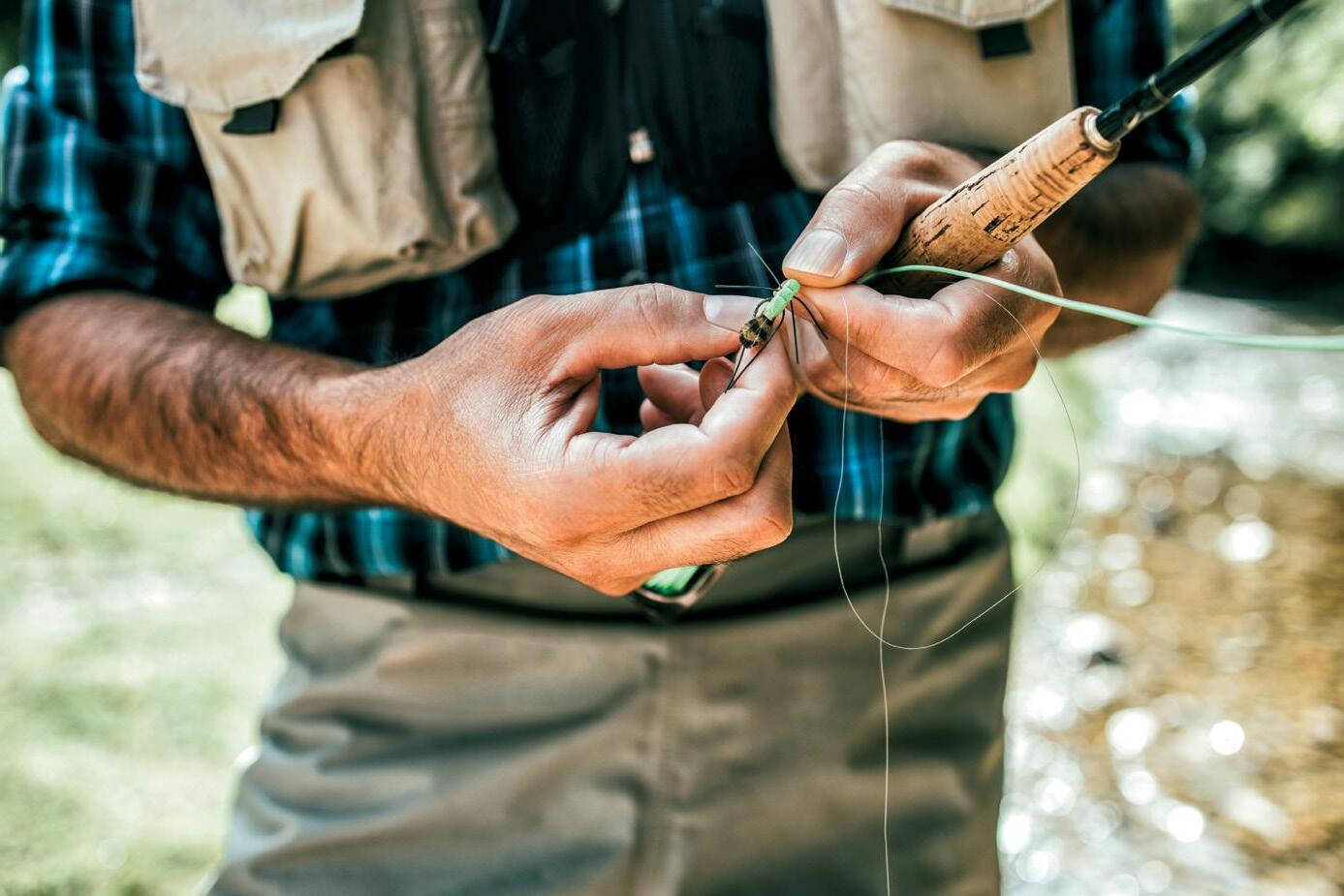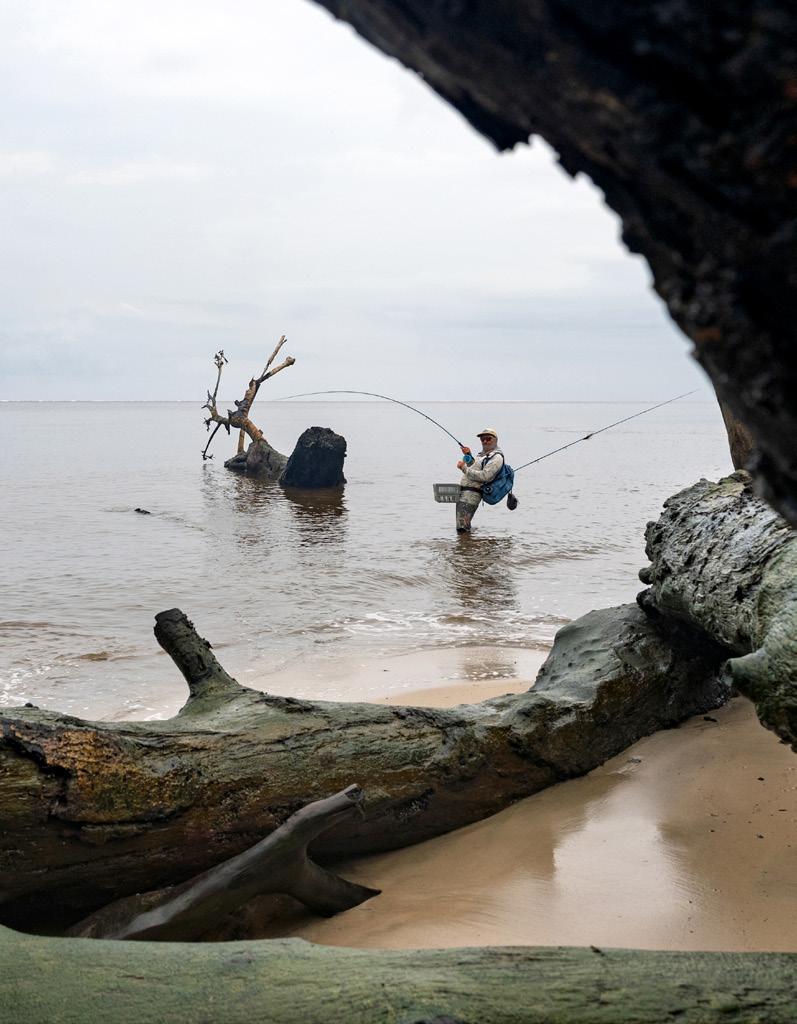
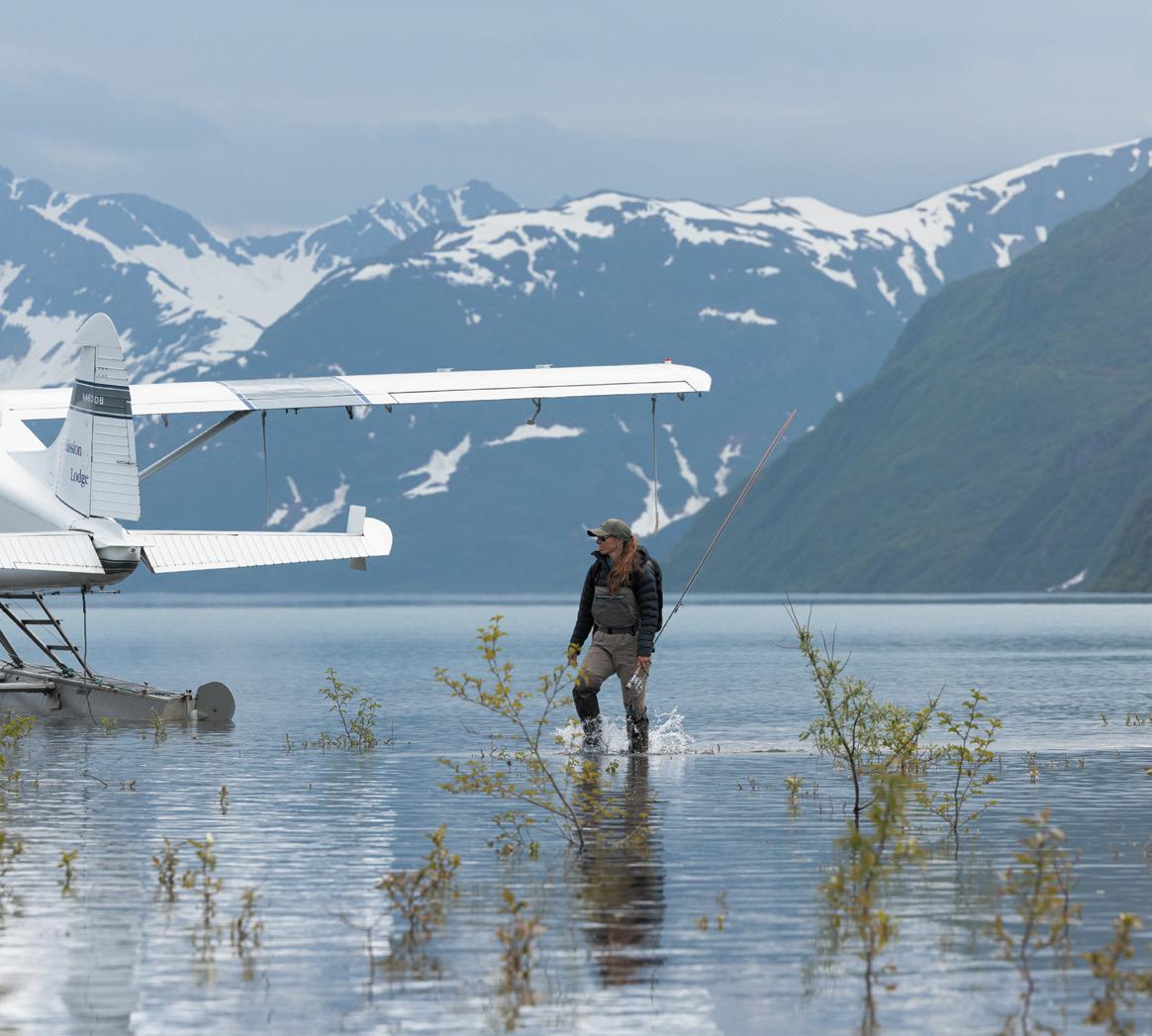
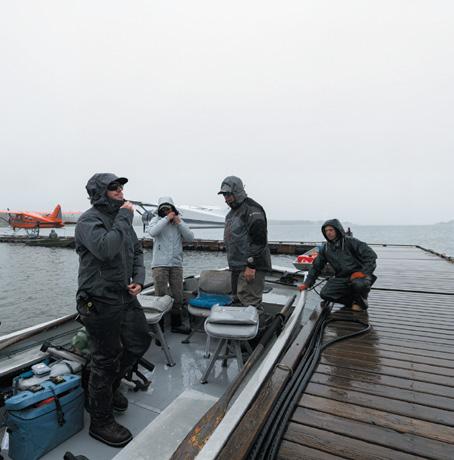
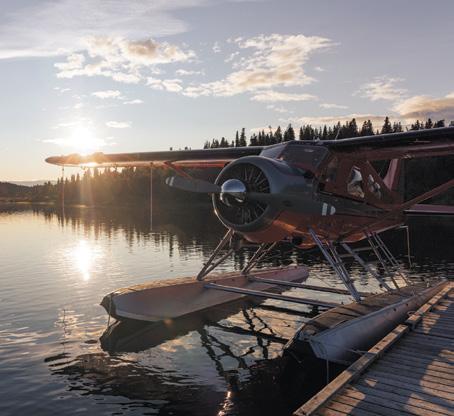
For over 80 years, we have been at the forefront of innovation. Sharpened by experience. Pushing the boundaries of material science to make our lines stronger and more durable. Then testing in the most demanding environments with the world’s best anglers. Those who demand the best choose Scientific Anglers.









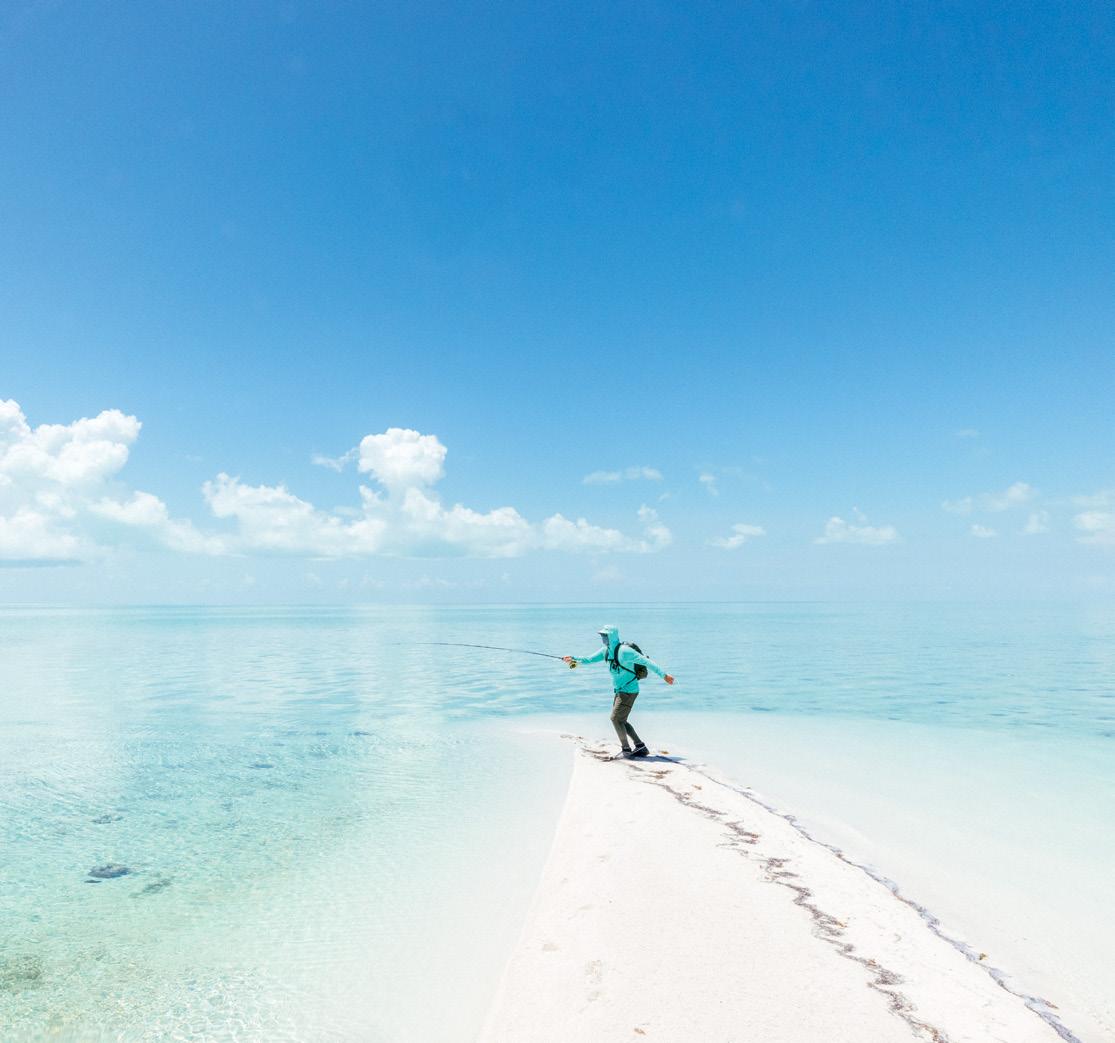
Introducing our fastest wicking tech tee ever, with 40+ UPF knit right in.

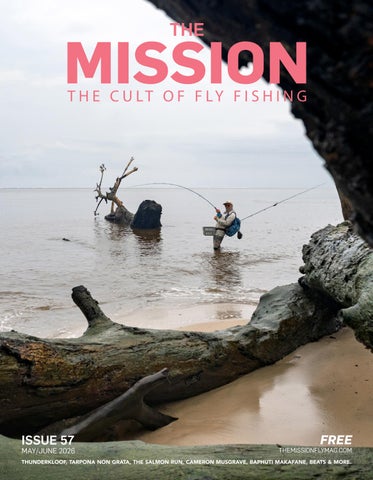
Feeling like an uninvited guest, Jeff Tyser attempts to get to grips with the size and scale of a Gabonese fishery and its forests.
Having caught an Atlantic salmon just hours before the race, Daniel Osmond took on the Salmon Run, a 43-mile (69km) ultra marathon along the River Exe in south-west England. The race pays tribute to and raises awareness of a species and a fishery in peril.
46.
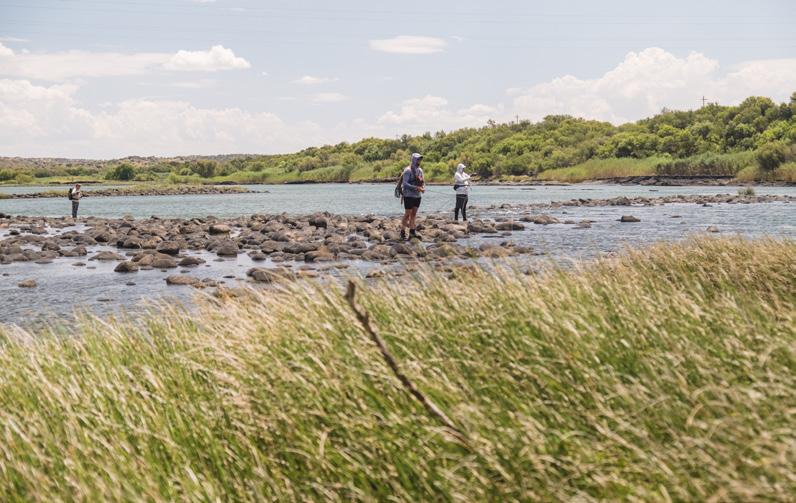
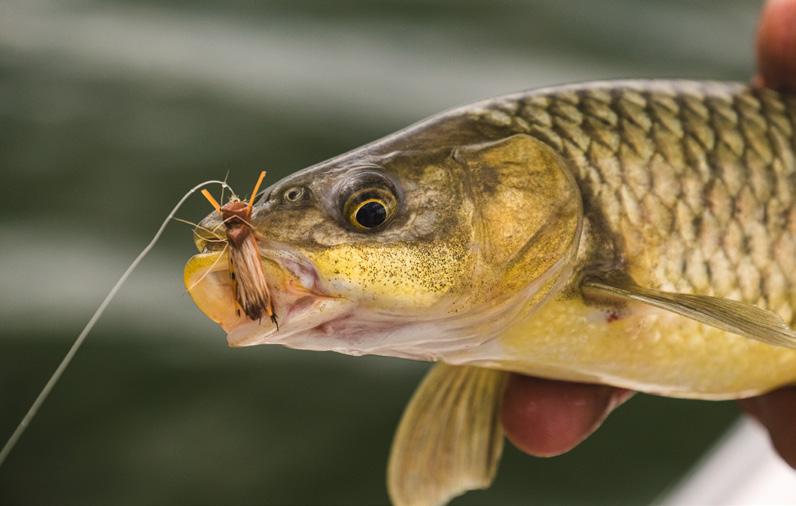
In a series of vignettes, Myburgh van Zyl recounts a week on South Africa’s second largest freshwater fishery, Vanderkloof Dam, and its features that made the greatest impressions on his experience.
64.
Ed Stoddard reconnects with a childhood friend in the Canadian Rockies and meets two species that wrote significant chapters in his fishing story.
70.
A soft-spoken stand-out and stalwart of the second wave generation of Seychelles guides, Cameron Musgrave might just be one of those bastards who has it all.
14. Chum 22. Books
28. High Fives
68. Salad Bar
88. Pay Day
102. The Little Guy 104.Fame or Lame
108. Pop Quiz
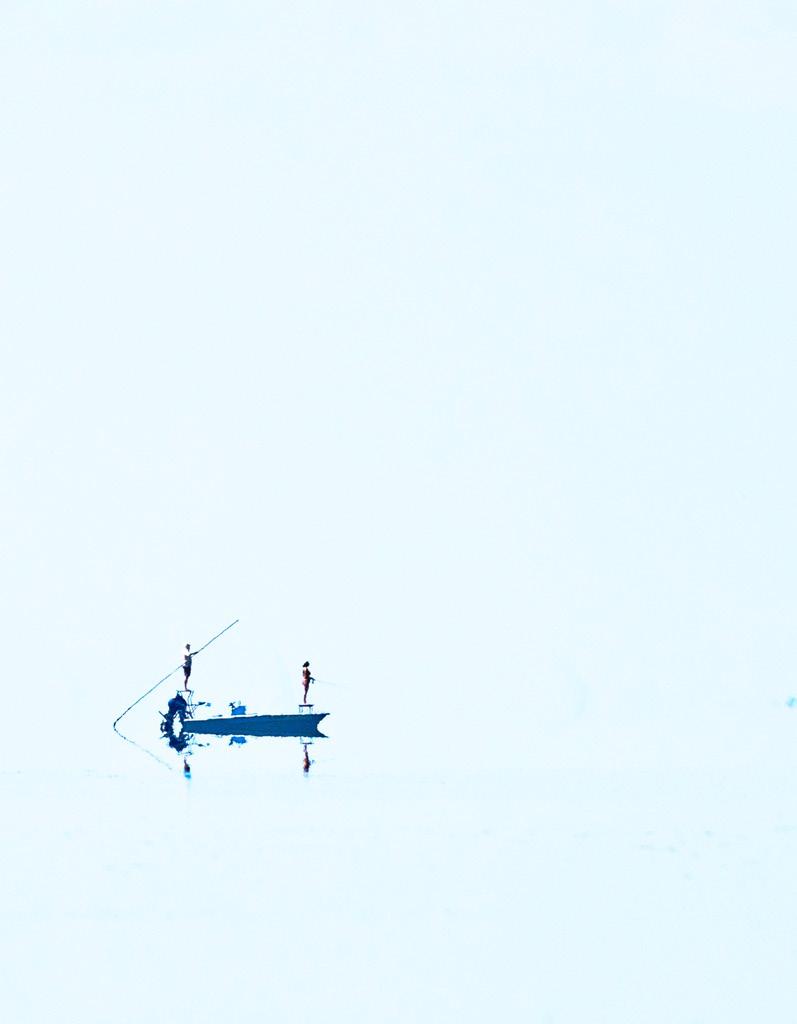
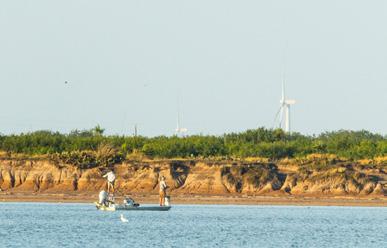
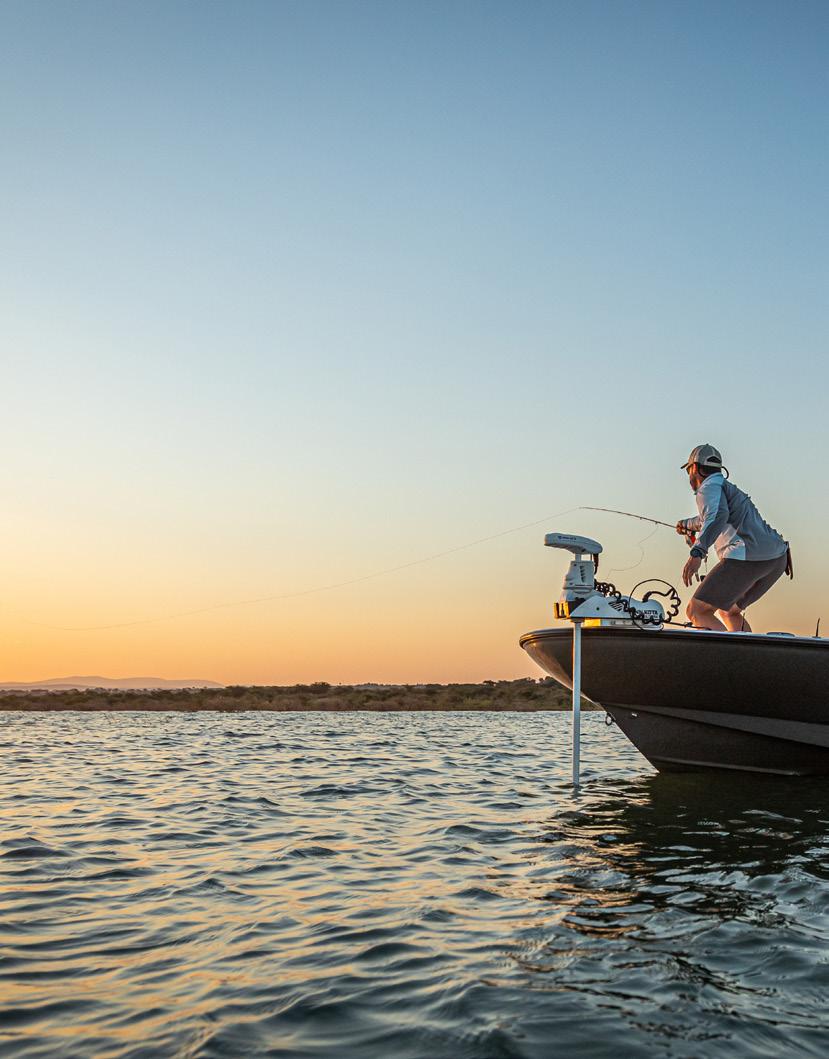
Like a flats fever dream, guide and angler pole across the Laguna Madre, Texas in search of speckled trout and redfish. Photo Andres Spinetti (page 22)
Dr y is for flies.
When you are waist-deep in a river, you learn a thing or two about what truly matters. Gear that lasts. Moments that count. Stories that live on.
Stay as long as you like.

Ilove how varied the fly fishing world is. I sit editing this on the couch in my living room, taking a break every now and then to second screen on Instagram. A man in a broad river somewhere in South America pops up, cradling an iridescent wolf fish, something I have never seen before as they’re usually a pretty ugly green-brown. It’s unusual, like seeing a rainbow-coloured pitbull. Then there’s a kid getting undergrad entomology-level familiar with the bug life of the Barkly East/Rhodes area, and another one starring in a Patagonia film about how one family introduced their children to fly fishing. Elsewhere there’s someone who gave up a corporate path to take a second swing at life as a guide and is rocking it despite dealing with chronic stomach issues from travelling to places that challenge the old gut biome. There’s a comp guy sharing in Braveheartlevel drama a detailed account of how he won a session by channelling self-help wisdom to catch one last fish, “for my family!” There are people fizzing about pilgrimages to established holy trout towns like Dullstroom, Notties, Rhodes, Glenwood Springs or Ennis. Others from different sub-tribes of the fly fishing nation see the departure points for the centre of their fly fishing universe as places like Port Gentil, Witsand, Kilombero or Port Mansfield. Each and every one of them sees fly fishing through very different filters. Nerds the lot of them all nerding out in their own nerdy niches.
Long before we started The Mission, I used to subscribe to a mailer called Reel Grease. It was run by a guy called Justin and was thing of singular authenticity and joy. Justin would share a new song (usually country or folk), give a bit of detail about the band or the solo artist and then connect it to the fly fishing in the area around where they came from. After following it religiously for a few years, it appeared to stop when Justin went off to do some kind of ministry work. Still, for a brief time, I loved the filter that he brought to fly fishing.
Speaking of music and filters and fly fishing, my wife, whose turn it is to put the twins down tonight, is in full voice. The two bedtime songs - Kumbaya and Rock a Bye Baby - hold no extra special meaning to us, they just lucked (or one might argue unlucked) themselves onto this shift. Our energy wanes depending on how much like little shits our three-year-olds were during the day, and on any given night you can tell by the gusto in the singing when the main duty parent is flat or when they are full of the joys of spring. Tonight is the latter. An introvert at heart, Ingrid was brought up musical and is surprisingly comfortable in front of a crowd. Tonight she is unleashed and going
full bore on Kumbaya. Iris, who normally sings along, is riffing a new jam doing a sort of smoky spoken word thing like a sad Gauloise-puffing Serge Gainsbourg through the melody coming out of Ingrid. Stella, who normally gets her own show in her own room, jumps the gun and is banging out the chorus role. It’s a fluke, but it’s working. My fly fishing filter being permanently on, my brain immediately goes to, “I cannot wait to fish with these little clowns.”
It’s perhaps odd, this filter, and maybe I am a lone weirdo to apply it to this extent to so many facets of life, but I wager a lot of you have some version of this running through you. I like to think of it as an offshoot of the urge to stop at every bridge to try and spot fish. I find it surges at times in that I find myself day dreaming about owning property on rivers, estuaries etc to the extent that I wake up on some Overberg real estate site wondering how the hell I got here.
In previous centuries, people might find you in such a rapturous fugue state and either canonize or institutionalise you. Now it’s easily explained away.
“Oh him, he’s REALLY into fly fishing.”
















EDITOR
Tudor Caradoc-Davies
ART DIRECTOR
Brendan Body
EDITOR AT LARGE
Conrad Botes
CONTENT COORDINATOR
CONTACT THE MISSION
The Mission Fly Fishing Magazine for Soutie Press (Pty) Ltd 25 Firth Road, Rondebosch, 7700, Cape Town, South Africa info@themissionflymag.com www.themissionflymag.com
Matt Kennedy
COPY EDITOR
Gillian Caradoc-Davies
MANAGING DIRECTOR
Ingrid Sinclair
ADVERTISING SALES tudor@themissionflymag.com
CONTRIBUTORS #57
Myburgh van Zijl, Frank Solomon, Cameron Musgrave, Ed Stoddard, Jeff Tyser, Baphuti Makafane, Daniel Osmond, Andres Spinetti, Riverhorse Nakadate
PHOTOGRAPHERS #57
Matt Kennedy, Arno Laubscher, Rob Nicol, Jeff Tyser, Leonard Flemming, Frank Solomon, Casey Pratt, Ed Stoddard, Andres Spinetti, Sven Musica, Antony Grote, Andylee Solomon
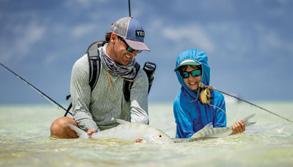
SEYCHELLES
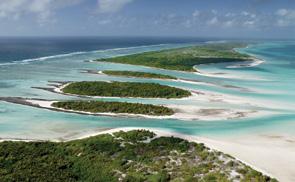
OUR FIRST FILM FEST, HARDY’S NEW STREAMER/SCREAMER, GET GUIDED BY SHAKU, GET THE MONTOYAGE T, SIGN UP FOR LARGIE BARGIE, TIE A MUISHOND AND GRAB YOUR PITCHFORK TO FIGHT GOVERNMENT OVERREACH
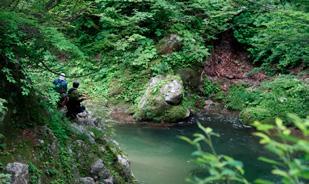
SHAKU GOES ON...
...A BEAR HUNT. Our favourite Japanese fly fishing clobber crowd, Shaku Hunter, are branching out into guiding in their home waters of the Tohoku region. An area famous for the natural beauty of its mountain streams, rather than winging it yourself on a visit to Japan you can now sign up with Ichiro Takeuchi and his crew and fly fish for native species such as Iwana (Japanese Char) and Yamame (Cherry Salmon). Throw in the odd break for an onsen visit or to indulge in the local cuisine and you’ll probably never want to leave. shaku-hunter.com
GET YOUR TICKETS...
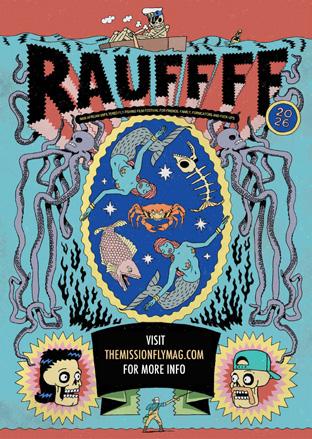
...TO RAUFFFF. Yes, it’s finally here The Mission’s inaugural Raw African Unfiltered Fly Fishing Film Festival (RAUFFFF + a few more choice “Fs” should you choose to throw them in), kicks off in August this year. With screenings in Johannesburg, Cape Town, Durban, Hilton and Knysna, there’s a good chance we are coming to a screen near you.
As with The Mission’s stories, the lineup will primarily feature films from or by African filmmakers focused on African destinations, species and characters, but as is our wont we will have a few global curve balls (cough... Rolf Nylinder) too.
Cape Town - Thursday, August 13, Labia Cinema
Durban - Tuesday, August 18, Rhumbelow Theatre
Hilton - Wednesday, August 19, Hilton College Theatre
Johannesburg - Thursday, August 20, Bryanston Country Club
Knysna - Thursday, August 27, Knysna Hollow
Visit themissionflymag.com for more information. Tickets are available from Quicket (quicket.co.za) and are limited, so get in early to avoid disappointment.
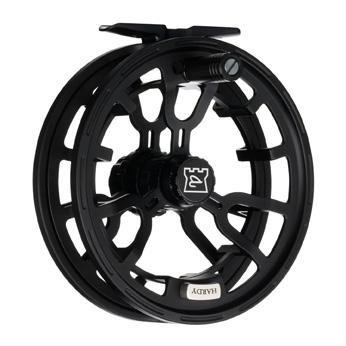
As celeb coupling goes, a Hardy X Kelly Galloup collab is like Kate Middleton hooking up with Kenny Powers, but we’d be lying if we said it didn’t make all credit cards within range vibrate towards our screens. The reel is called the Averon Streamer, which sounds like a Cockney claiming ownership over Anchorman’s main protagonist, but fits within Hardy’s existing Averon reel family, as well as the general crumpets and tea, castles and swords tradition and nomenclature coming out of Alnwick.
As Mr Galloup so convincingly says, “Nobody has ever built a reel specifically for streamer fishing. For years the industry has said “just use whatever reel you’ve got”, which you can; but when you’re hunting THE fish, I want a reel that does exactly what I need it to. That’s why we built this.” Okay already Kelly, take our money!
Built around an extra-large arbour that kills line memory and gets slack off the water fast, spin resistance has been stripped back to almost nothing, so a slap of the handle or rim clears line instantly. A widened, heavier spool adds rotational momentum and the kind of durability you’d expect from Hardy. Now, if Kelly were given true creative freedom it would no doubt be called the Hardy Hard-on or the Hardy Screamer, but for now we will take the win on the technological advancements and petition Hardy on the verbiage later. hardyfishing.com
TO THE MISSION & SCORE WITH SCIENTIFICFLY & GNARLY HEADZ
The Mission is free both in print and digital formats, however, if neither of those options work for you (there’s no stockist near you; you live outside of South Africa; or you just really want to support us – thanks!), you can subscribe and have the print magazine sent directly to you. As an extra bonus, with each new issue you will receive a premium fly (e.g. bass flies, tigerfish flies or saltwater flies) from ScientificFly & GnarlyHeadz.
Annual subscription
Receive 6 issues of The Mission Fly Mag in print
• South Africa only: R980 per year for 6 issues, couriered to your door with no delays
• Outside of South Africa: R3 900 per year
Find out more at themissionflymag.com

...
From the government that brought you such well thought out bangers as selling off our strategic fuel reserves circa 2015/2016 and banning open-toed shoe sales during Covid, comes a new idea that may very well mess with your ability to access regular fishing. If passed, the Department of Water and Sanitation’s (DWS) new proposed regulations for the management and control of government waterworks and surrounding stateowned land, will no longer recognise the public nature of water resources and instead will treat state dams as controlled assets that must be leased for use. They plan to do this by relegating recreational access to a discretionary privilege and lumping private landowners and clubs with the massive administrative schlep. Does this nonsensical brainfart threaten local businesses and community livelihoods as well as property rights? You betcha. The good news is the fightback from anglers, sailing clubs, plus tourism and accommodation groups has been pitchforklevel strong and the DWS has now offered a few piddling clarifications along the lines of, “it was just a draft proposal guys, sheesh, calm down.” La lutta continua ✊.
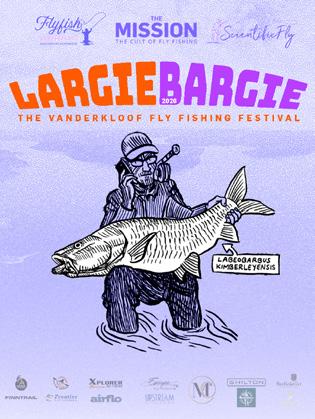
INTRODUCING LARGIE BARGIE
Prep your leaders, stroke your muishonds and make sure your beetles are floating high ‘n dry for the fantastical yellowfish fly fishing festival that’s about to descend upon the Northern Cape’s incredible Vanderkloof Dam. Say what? Yebo - 2 days, 4 beats, 5 species (if we’re counting muddies…), 24 anglers in groups of 4 and infinite gees
The Mission Fly Fishing Magazine, in partnership with Flyfish Vanderkloof and Scientific Fly presents Largie Bargie 2026. Join us from 12 - 15 November for this inaugural yellowfish fly fishing bash.
What’s included?
• Three nights of accommodation.
• All meals – two breakfasts and three dinners at Monte Crous hotel.
• Boats and inter-beat travel
• Guided-assistance fly fishing for largemouth and smallmouth yellowfish, African sharp-tooth catfish and common carp.
• A mix of result-lead prizegivings and raffles will see anglers score fly fishing gear, accessories and vouchers.
The cost?
Entry fees are set at R10 700 per person.
For more info, check out themissionflymag.com/largiebargie-2026
VIDEO: PIERRE JOUBERT’S MUISHOND
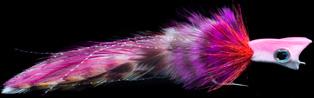
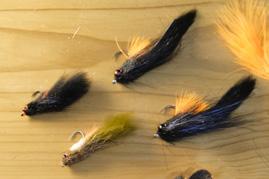
A zonker-based baitfish pattern originally designed for largies on the Vaal River system, this pattern is now used in yellowfish fisheries across the country. Fished very effectively towards structure, you can “call” the largies by slapping this beefy fly on the water’s surface. Following that up with short, sharp strips, generally does the trick. Size, colour and body material can be up to interpretation according to target species or prey-reference, however this version from Pierre Joubert of Stream and Sea covers the basics superbly. Watch the full thing on The Mission’s YouTube channel. themissionflymag.com
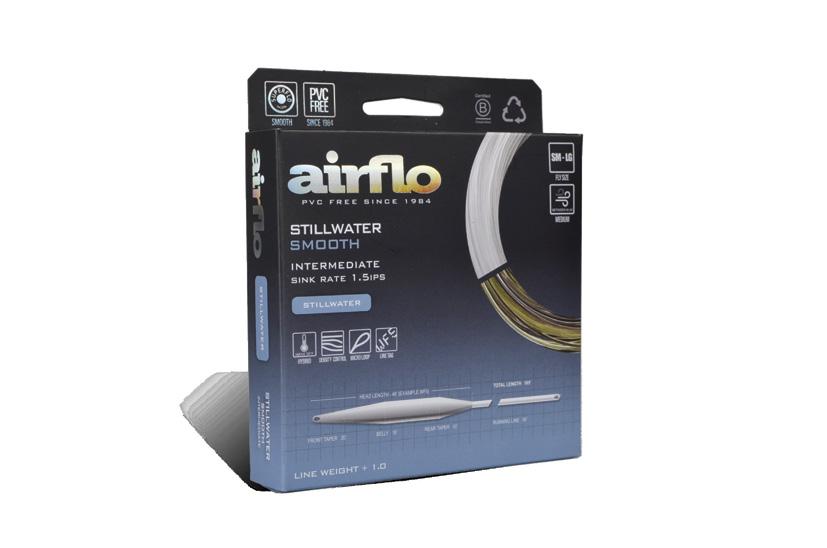
Clear waters call for stealth — and that’s why we designed the Delta Taper Stillwater intermediate. Featuring a crystal-clear polyurethane coating over an ultra-supple mono core, these lines offer near-invisibility for anglers looking to slip quietly below the surface film and deliver flies with subtlety and control.
Available in both Full Clear and Camo Intermediate WF5-8. Sink rate: 1.5 ips.
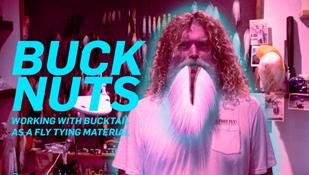
...BUCKNUTS. The Mission’s first technical fly tying livestream is coming to your screen in early June. If you’ve ever drooled over the life-like, hand-sized baitfish patterns posted all over social media and wondered why your attempts always came out looking more like a sardine stuffed sideways in a tin, then you wouldn’t be alone. That’s why we asked bucktail pro Andre van Wyk of Bucktail Flies to take us through more than the just… the gist. Introducing the BUCKNUTS webinar - an online lesson-and-a-half (we weren’t allowed to use the word ‘masterclass’ according to the sensei). Dre will cover working with bucktail as a fly tying material, the origins and sources, types of bucktail flies, where to use the different fibres, thread control, fly proportions, tying in stages and so much more, ending with a Q&A section. Short, long, fluffy or hollow, grab any bucktail you have lying around, a pen and paper, and get ready at the vice on Sunday the 14th of June. Tickets will go on sale at themissionflymag.com
“THE MISSION’S FIRST TECHNICAL FLY TYING LIVESTREAM IS COMING TO YOUR SCREEN
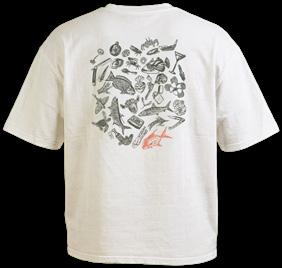
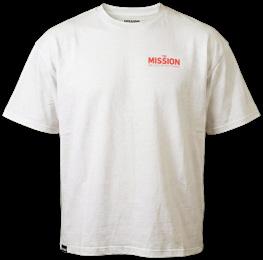
... THE MISSION’S NEW BOX-CUT T-SHIRT. Some shirts simply hang on a peg or off your shoulders. This one has more than a few stories behind it. “The Montoyage” is our Issue 55 cover brought to life, featuring a montage of original artwork by Ray Montoya, one of fly fishing’s most celebrated DIY adventurers. The back print is a collage of everything fly fishing actually is for Ray: fish species from permit to tarpon to triggerfish, the tools, the trinkets, the found objects that accumulate across a life spent finding fish on your own terms. The permit, rendered in red, anchors it all at the bottom. Off-white, boxy cut. An easygoing style. Just like Ray. themissionflymag.com
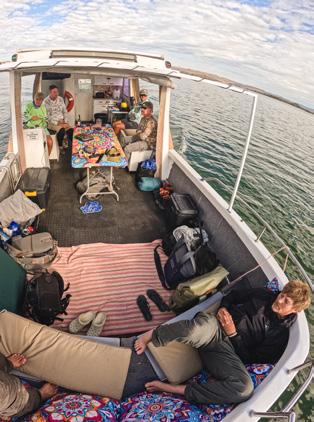
On The Mission’s latest jol to the famed largemouth yellowfish fishery, the crew tried to slowly remove the Englishman out of our content coordinator Matt, one brandy and coke at a time. From mellow psy-rock tunes to Sinead O’Connor screaming “I’d slay a dragon for you!”, the spirit of Vanderkloof Dam is embodied in this issue’s Beats playlist.

Just
Just
Step
Step


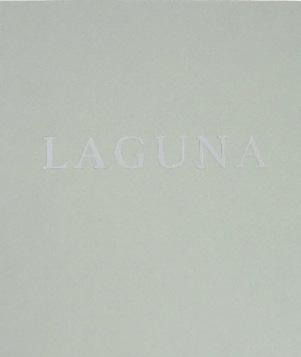
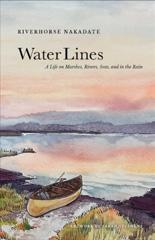
WE TAKE A LOOK AT AN AWESOME NEW COFFEE TABLE BOOK FROM THE LAGUNA MADRE , PLUS AN EXCERPT FROM WATERLINES, THE LONG-AWAITED COLLECTION OF SHORT STORIES FROM ONE OF OUR FAVOURITE WRITERS, RIVERHORSE NAKADATE .
Photos. Andres Spinetti
THE COFFEE TABLE BOOK: LAGUNA BY ANDRES SPINETTI
What is your background? Are you Texas (and Laguna Madre) born and bred or, like some of your contributors in this book (e.g. Jako Lucas), did you move to the area?
I was born in Austin, Texas. After a short stint in Louisiana, we moved back to Texas in 2003—McAllen, to be exact. At the time I had no idea I was only seventy-two miles from the Lower Laguna Madre, a place that would end up becoming a huge part of my life about a decade later.
When you’re not working on a massive project like this book, how do you make a living?
I’m a full-time sight-fishing and fly-fishing guide on the Lower Laguna Madre. I made the jump from part-time to full-time this year after guiding part-time since 2021. It felt like one of those moments where you either go for it or regret it later - so I went for it.
What motivated you to work on Laguna? Did the process change how you look at the place?
I remember seeing the YETI Presents: Tarpon book and thinking, “Wait… you can just do this?” I loved how selfaware it was- just fish and fish stories, no fluff. It felt like something I would’ve really enjoyed being part of. That was the inception for Laguna. The first actual Laguna file didn’t get rendered until almost four years later, in 2023. And honestly, the project didn’t change how I see the ecosystem - but it definitely changed how I move through it. I find myself fishing less when something truly wild is happening, because now my instinct is to document it. Those behind-the-scenes moments in nature don’t happen often, and I don’t want to miss them.
How did your experience of fishing this place shape the book? Did you start it and it turned out exactly as planned? Or was it more a case of it being shaped by the group effort of each contributor including your own? There really wasn’t a plan. I opened an Adobe InDesign file on my MacBook and started dropping images in. A lot of photos got swapped out, some got cut altogether. All
of the contributors donated images - no one helped with the design. That ended up being the best part. I had full creative control and could focus on showing the parts of the Laguna that feel special to me.
It’s a serious book - large, stunning photos, highend finishes. How long did it take to put together? What didn’t you expect about the whole process? Thank you for the compliment - that means a lot. From start to finish, it took about a year. What surprised me most was how detailed professional printing really is. There are so many small decisions that matter way more than you’d think (and yeah… shipping a book from Italy to the U.S. is its own adventure). I was really lucky to work with the team at Éditoriale Bortolazzi Stei. Their American ambassador, Johnathan Bortolazzi, helped me a ton through the process - despite the constant emails and questions on my end.
Did you already know all the contributors from the local fly fishing scene? How did you conduct your research, did it include time spent on the water, interviews, archival work, or scientific sources? Most of the contributors are people I originally met through my podcast. Everyone featured early in the book has either helped with the project, been on the podcast, or both.
The podcast ended up being a huge research tool without really feeling like “research.” Time on the water, conversations, history, shared experiences—it all kind of blended together. When I mention research, I’m mostly talking about The Laguna Podcast, which is available on all platforms.
If you had to choose a single quote, character, or image that best captures the essence of Laguna for you, what would it be and why?
“ I FIND MYSELF FISHING LESS WHEN SOMETHING TRULY WILD IS HAPPENING,”
“Remember the buffalo.” - Capt. David Rowsey
The Laguna is a world-class fishery and nursery, but it can easily become something we only talk about in the past if we take it for granted or act like its shorelines go on forever.
As you have become more familiar with this fishery over the years, what surprised you most about the ecology or the communities connected to it?
One thing that’s really stood out to me is how connected everyone is here in Texas. I can’t tell you how many podcast guests ended up knowing the same people through completely different paths. It feels like a much smaller world than you’d expect.
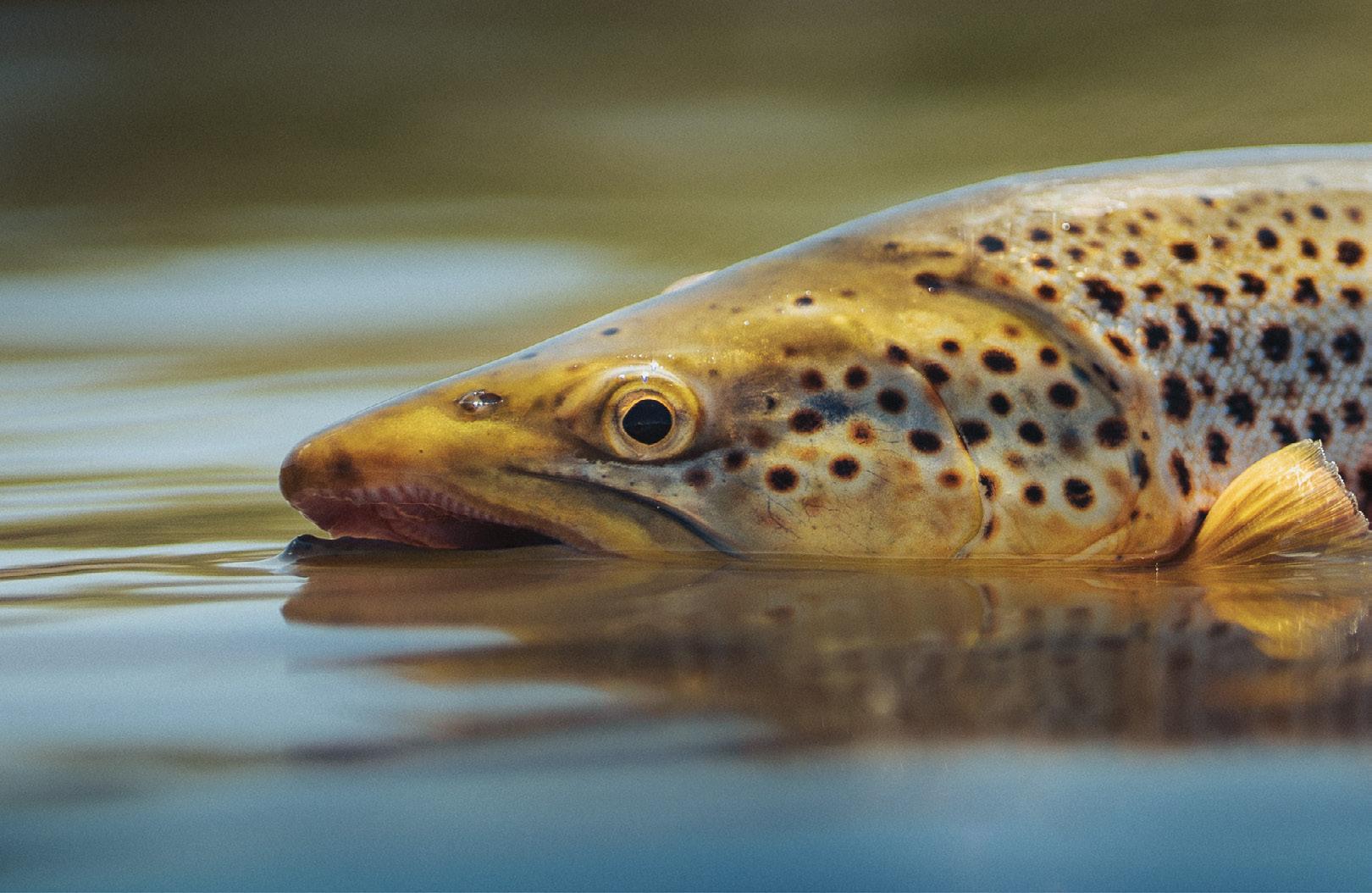
We are not familiar with speckled trout. Other than being good looking fish with a confusing name, what’s the appeal? Fight? Size? The way you target them? Fly fishing for speckled trout can be described as a zero sum game. It is not meant for those who give up easily, and in a game where one fish doesn’t just “make the day” but can also simultaneously be the fish of a lifetime, the high of holding a large gator trout that took a fly is... pretty kick ass. Usually a gator is classified as 25 or larger, but as we literally inch up the ruler the rarity and intelligence of the fish usually grows exponentially (for example a fish that is 30” statistically makes up for about 0.01% of the available biomass). These fish are extremely educated, extremely lazy, and extremely efficient in their feeding patterns, meaning that fly anglers must think outside of the box in order to fish an area for big trout. They don’t stay in one area, they respond to the “story” that is the conditions of the day, the wind, tide, sun, barometric pressure, solunar major and minor, water temp, etc. One of the benefits fly anglers have is that usually the big trophy females will occasionally hold in water clear enough or shallow enough to see them in. See, on the conventional side of the game, trout usually reward wading anglers that usually are in water not conducive to the fly fishing “requirements”. So we get the utmost fortune of being able to not only see one of these giant sow trout, but also feed one in full clear view of the action. It really does not get more awesome than that. The take of a big trout is one of the coolest things to me, the amount of force they have behind their jaws is very incredible, some of the softest takes have cause fly line to cut into my skin with ease. I actually would consider them to be more similar to a “flats grouper” than redfish, even though they are in the same drum family. My favourite way to take a big trout is to take one on foot. That usually requires a stealthy and patient angler. I have been blessed to have friends who are willing to fish alongside me as I have tried to pursue an understanding of these amazing fish.
Can you describe one fish you will never forget catching there, including conditions, tactics, and what made it memorable?
Big speckled trout are special to me. Sight-fishing a true gator trout on fly feels like the pinnacle of Texas fly fishing. I love redfish too - this is just my personal opinion.
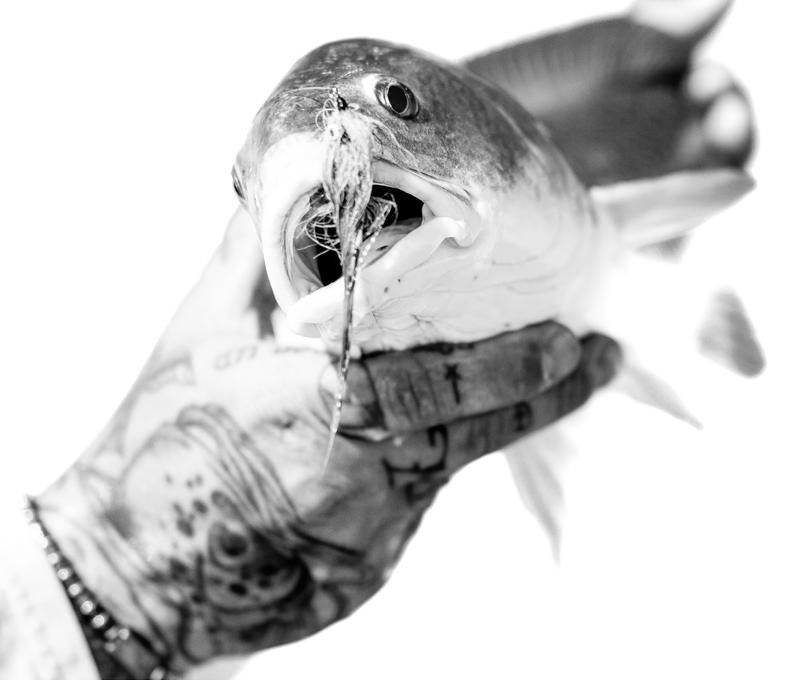
Recently, I put a 28.5-inch trout on the ruler with my friends Cruz Lamas and Glenn Harrison. That fish meant a lot because I’ve spent a ton of time working on distance casting. I was lucky enough to learn from Rick Hartman, one of the best to ever do it, and that completely changed how I approach casting. That morning was slick calm with heavy cloud cover—so heavy there was zero glare on the
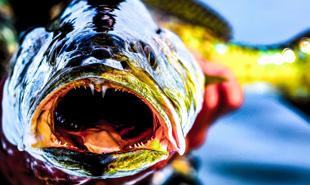
water. We spotted the fish around 60 feet out and moving away. I laid out a cast at about 67 feet, and everything lined up perfectly. The fish turned 180 degrees and ate the woolhead mullet I’d tied the night before.
Everyone on the boat felt locked in, everyone was so focused on that fish... Big trout fight with so much attitude - the head shakes, the mouth pops, all of it. After a few quick photos, we released her. A few minutes later I realized my hands were starting to shake. Big trout do that to you. One of my influences in fishing Wade Dunkin, calls them “The Black Wolf”. So cool.
How do you see Laguna Madre changing over the next decade? What are the obvious threats to the ecosystem you and other anglers have to contend with? What would you most like readers to do in response? You know, the city is building a new bridge just north of
my house, and while more traffic is inevitable, the biggest issue I see is a lack of boater education. Too many people run over incredible trout habitat because their boat can run shallow. It’s frustrating, especially in the summer. I’m also concerned about how SpaceX and LNG development might affect the south bay complex. I’d hate to see areas shut down because of avoidable mistakes. A lot of these problems come down to awareness and accountability.
What’s next for you? Do you have other book projects on the go?
Right now, I’m focused on selling the book, improving my photography, and putting more energy into my YouTube channel using footage I’ve been sitting on. I’ve also got a few other book projects in the works with some really cool people—but I’ll have to keep those quiet for now until I am able to confirm the details. buylagunabook.myshopify.com
Sandlot Carp
Excerpted from Water Lines: A Life on Marshes, Rivers, Seas and in the Rain by Riverhorse Nakadate. Reprinted with permission by Patagonia.
Chorizo. Banana peppers. Olive oil. Stacked with locally grown tomatoes. A trio of cheeses. All on flatbread, made here daily and then slathered in honey butter and cast-ironskillet toasted, with a heavy side of ruffle chips on a paper plate. This under-the-radar sandwich shop is a must when I pass by Duluth, where I’ve just taken the canoe for a quick fiberglass restoration en route to the Boundary Waters. I wait at the bar for my order and sip a frosty organic root beer. Outside, through the windows, I can see the canoe on the truck. All three giant flat-screen televisions on the wall are tuned to a baseball game, and most of the patrons sitting with me on the cushioned, round stools have jerseys on and yell a lot at the game.
I was into baseball for years. Even got on a roll in high school that found me hitting over .600 early in the season as a left-hander. This is twice what is considered to be a great performance average. A scout for the Dodgers, who also happened to be the coach at a small college in Iowa, talked to me and sent me a holiday card signed by all of the Los Angeles players and even their coach, Tommy Lasorda. Dad and I were impressed—that was pretty cool. But I knew I’d never make it, didn’t have the same talent as all of those who get drafted, not even close. I was just on a long, beautiful streak. Now, as I sit here eating the sandwich, I recall how a fish saved the season for me when I needed it most.
Early that fall, I buried a thirty-two-pound carp under the pitcher’s mound. I had caught it on a crayfish-coloured woolly bugger in a reservoir on the outskirts of Austin, with a 3-weight that broke during the fight. I had read that carp were lucky and figured it wouldn’t hurt. I have always been fascinated with the aura of wonder we give to things in life. There’s something to be said for mystique, for putting your gut money on dark horses just to see what will happen.
Late that next spring season, when the varsity team ran out of arms, I got called up from the sophomore team to sit on the bench. Lo and behold, at the end of a deadlocked game, I saw Coach looking my way. There was something wrong with Coach: He looked like a walking DUI mugshot or a wanted poster on the wall of the post office—and
often acted like it, too. Imagine the actor Gary Busey after thirty-eight consecutive tequila shots and a motorcycle wreck. Coach scared the shit out of us.
“Riverhorse, get on the mound—pronto,” he barked.
The carp was a few inches under my left foot, since I was pitching from the stretch, my body sidelong to the batter. Two out, with a rowdy, hot-dog-fuelled home crowd, runners on both corners and us up, 7–6. Shit. Shit. Shit. If there was any mojo in that carp, I’d need it—up at bat was their formidable catcher, who had a razorblade earring, was about 280 pounds of thundering lard, and wore a showstopper mullet hairdo that reached past the numbers on the back of his jersey
I shook off the breaking ball twice before Coach called time out. Looking pissed as could be, with a scarlet face and teeth-baring sneer, he stormed over to the mound along with the catcher. “What the hell is the problem, gentlemen?” asked Coach.
“I think a curveball is not really the call here, Coach,” I shared.
“ EARLY THAT FALL, I BURIED A THIRTYTWO-POUND CARP UNDER THE PITCHER’S MOUND. I HAD CAUGHT IT ON A CRAYFISH-COLOURED WOOLLY BUGGER IN A RESERVOIR ON THE OUTSKIRTS OF AUSTIN.”
There’s nothing like the crack of the bat, is there? That sound when you really connect, and even your shoulders and hips just flat-out drive the thing—that moment when the players and the spectators all crane their necks up to the sky in symphonic unison to see the damage done. I stood on the fish and watched as our centre fielder made a fantastic on-the-fly leaping catch at the fence. My tailbone would live to see another day. As for Coach, I let the air out of his front tires in his driveway at midnight. I was on the way to get a few more carp for the outfield. amazon.com
Visit themissionflymag.com for our Waterlines interview with Riverhorse.
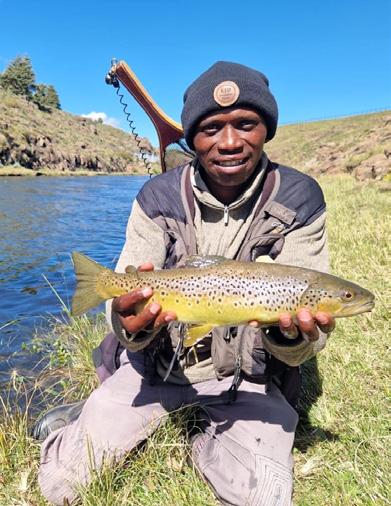
5 best things about where you guide?
1. I love fishing in Semonkong as this is where I grew upmy family are here and I know every bend in the river and all my favourite fishing holes.
2. There are so many adventures to be had from here, down into the Maletsunyane Gorge and along the Ketane River - beautiful places I know intimately.
3. The Maletsunyane Falls and the gorge below it are stunning landscapes, and being able to descend into that gorge and camp right on the river is something truly special.
4. I get to meet people from all over the world, which broadens my horizons every season.
5. I found meaningful work right here in my home town, close to my family.
5 indispensable flies for Semonkong?
1. Woolly Bugger.
2. Copper John.
3. Weighted Woolly Bugger.
4. Game Changer.
5. DDD flies.
5 things you are loving right now?
1. Exploring new places and guiding people - whether that’s hiking, horse-riding or fly-fishing.
2. Spring cleaning my home.
3. Playing football.
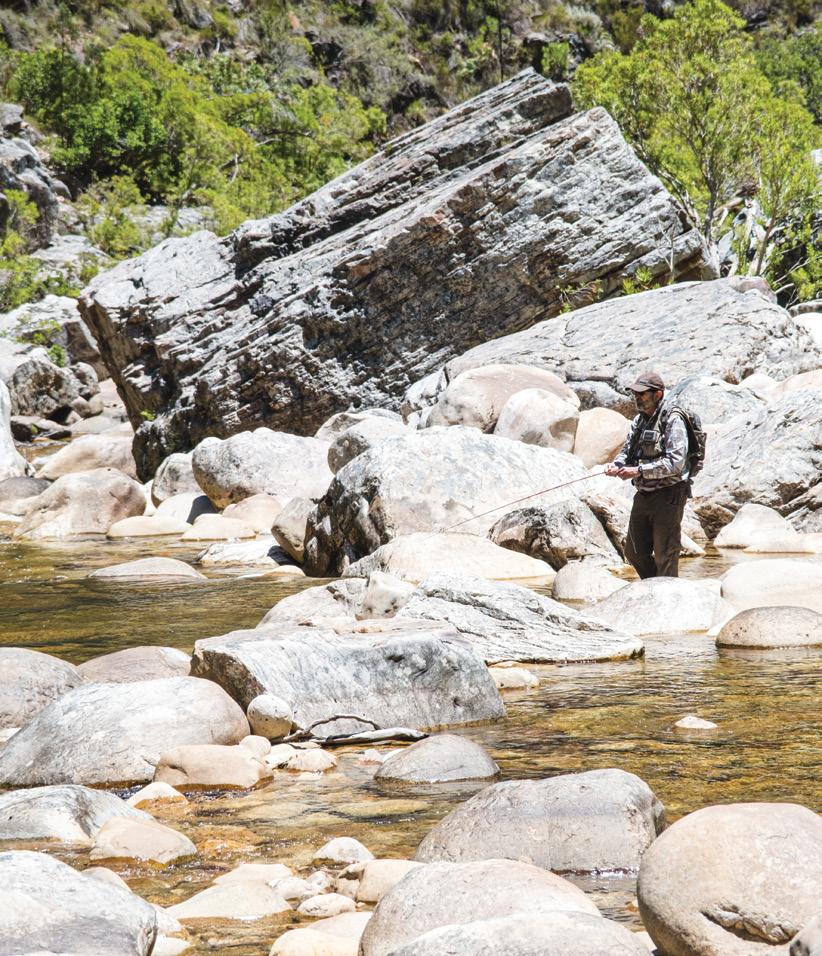
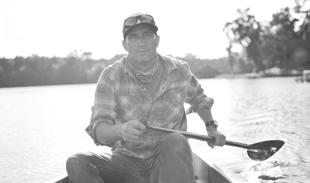
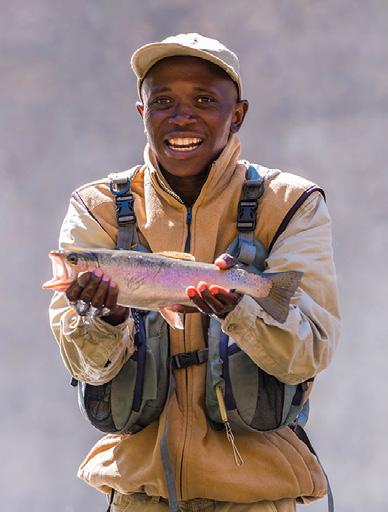
LESOTHO’S SEMONKONG LODGE, ALONG WITH THE MALETSUNYANE RIVER AND ITS JAW-DROPPING WATERFALL, IS ONE OF THE MOST ICONIC FLY FISHING DESTINATIONS IN AFRICA. YOUR MISSION, SHOULD YOU CHOOSE TO ACCEPT IT, IS TO GO THERE, VENTURE DEEP INTO THE VALLEYS AND CATCH GREAT BROWN TROUT, RAINBOWS AND YELLOWFISH. YOUR GUIDE? LOCAL LEGEND, BAPHUTI MAKAFANE.
Photos. Sven Musica, Casey Pratt
4. Farming and caring for my crops.
5. Cooking.
5 fly tying materials or fly triggers you swear by?
1. Black dubbing.
2. Copper wire.
3. Beads.
4. Hard Head Clear.
5. Barbless hooks.
5 of your favourite fly fishing scenarios?
1. When a fish attacks my fly and the strike connects.
2. The moment you net a good fish.
3. Taking the hook out carefully and holding the fish in the current.
4. Measuring it before the release - that moment of appreciation.
5. Watching it swim strongly back into the river.
5 things about life you wouldn’t have learned without guiding?
1. How to handle guests in a professional manner.
2. How to set up a camping tent and saddle both a riding horse and a packhorse.
3. To always make sure a guest doesn’t lose any of their equipment.
4. To be a good and patient person, whatever the circumstances.
5. Expanded knowledge about cultural topic such as art, history and sciences.
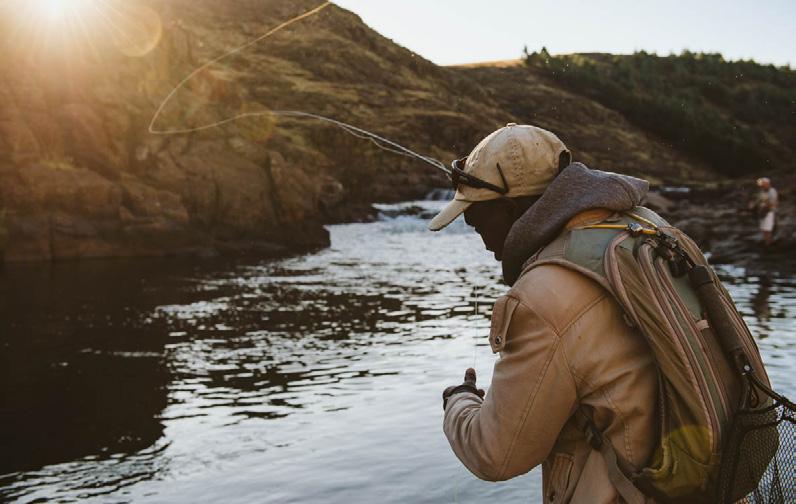
5 things your friends think you’re doing while at work?
1. Chilling and playing around.
2. Swimming - even though I don’t know how to swim!
3. Eating every fish I catch.
4. Sitting around chatting to tourists all day.
5. Eating guests’ food.
5 pieces of advice you’d give your younger self before your first guiding season?
1. Never go to work if you have been drinking.
2. Always be presentable, with the right equipment and attire.
3. Save your money for the future, not just for today.
4. Be respectful to absolutely everyone you meet.
5. Be more eager to learn something new every single day.
5 weather conditions that secretly make you happiest on the water?
1. When it’s drizzling softly - the fish seem to love it and so do I.
2. A beautiful, clear sunny day when the river is running clean.
3. When the river is flowing low and clear and you can spot fish easily.
4. A few days after heavy rain, when the river has dropped and is just starting to clear - the fishing can be exceptional then.
5. Good weather, not very hot as this helps me fish the
whole day, I only rest for breakfast and lunch then back to the river.
5 non-fishing things that have unexpectedly saved your ass while guiding?
1. Gumboots - for crossing the river and navigating difficult terrain.
2. Using a sack as an improvised landing net.
3. Fashioning a fly from a safety pin when you’ve run out of hooks.
4. Using a stick as a strike indicator.
5. Nail clippers doubling up perfectly as line cutters.
5 lies or myths about fly fishing you wish would die?
1. That the fish are killed and taken home to eat - we practise strict catch and release.
2. That fly fishing is an expensive hobby beyond most people’s reach.
3. That only big flies catch big fish.
4. That fly fishing is only for the wealthy and the elderly.
5. That a fish won’t take a second look at your fly after refusing it the first time - they absolutely will.
5 fish you’ve lost that still haunt you?
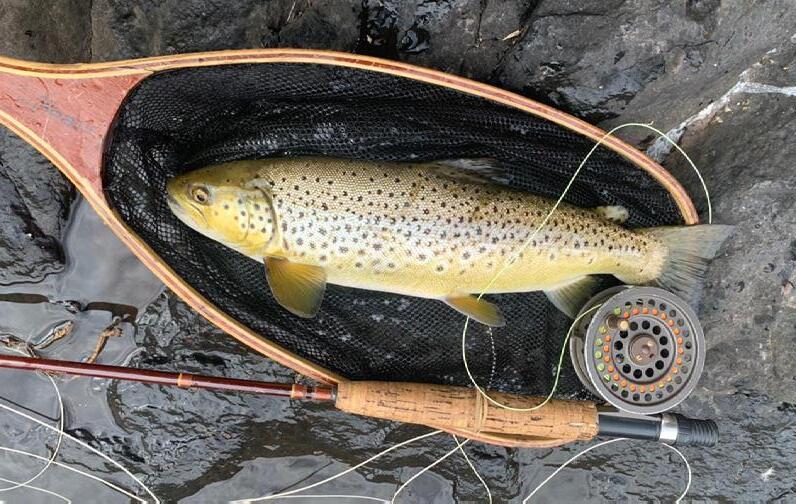
1. A big brown trout upstream of Semonkong Lodge - I was well into the fight when my line snapped.
2. On a trek into the gorge, fishing at Camp 2, I hooked something enormous - possibly the big yellowfish I’d
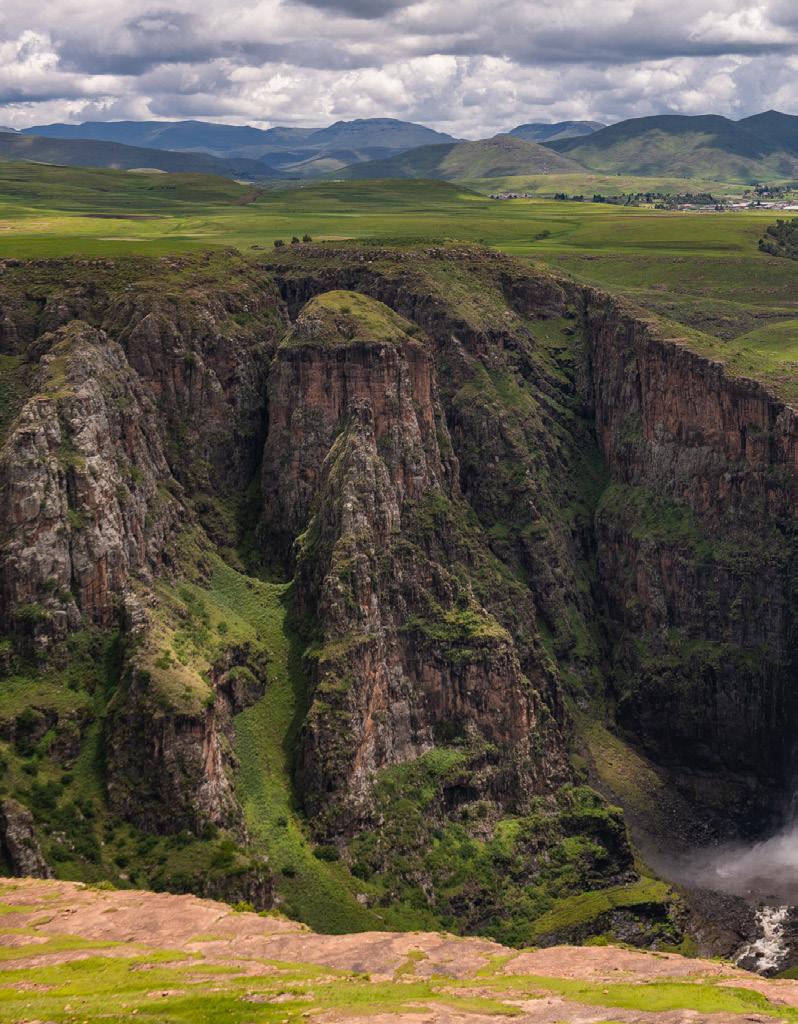
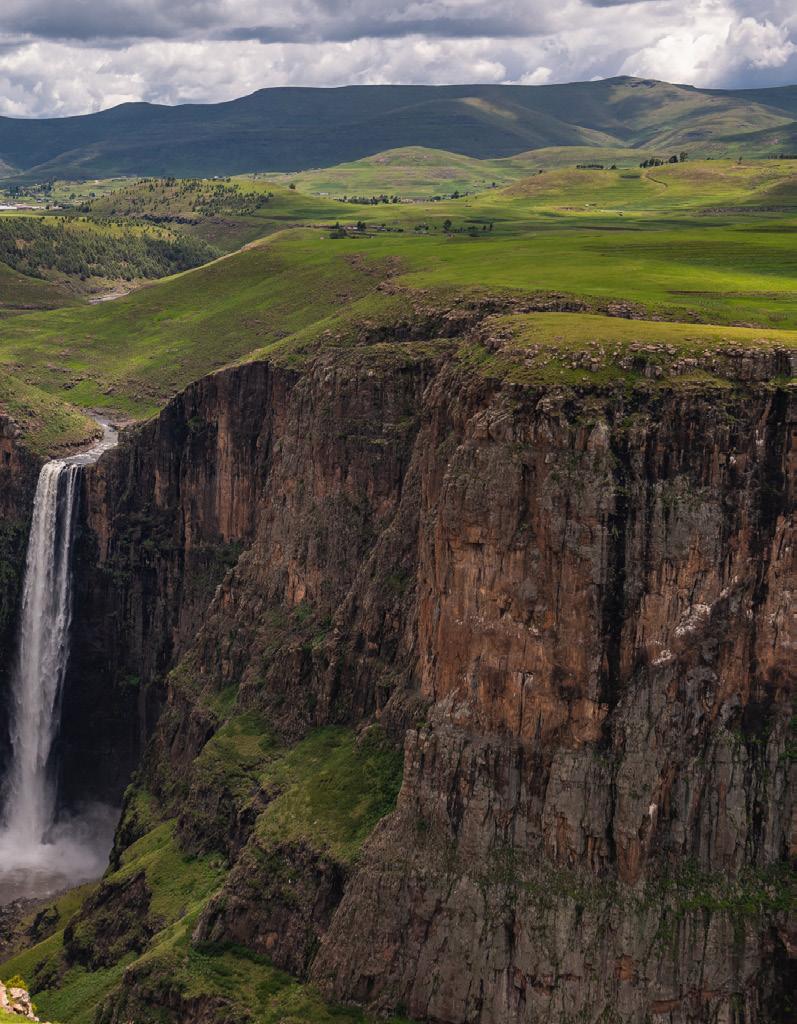
“WHERE I FISHWITH THE SHEER BEAUTY OF THE MALETSUNYANE FALLS AND THE GORGE BELOW - IS VERY SPECIAL.”
been searching for - and lost it before I could even see it properly.
3. I lost a beautiful rainbow trout at the bottom of the Ketane Falls.
4. I lost a BIG catfish on the Senqunyane River.
5. On another fishing trek with clients, at the bottom of the gorge, I lost a monster brown trout which would have made me win the competition.
5-step process for reading completely new water for the first time?
1. I look for any fish rising on the surface.
2. I check under rocks to see what insects and nymphs are living there.
3. I look for midges or flies hatching in the air above the water.
4. Watch the water movement, observing how the water moves, I look for active fish.
5. I look at the surface clues- sometimes the surfaces tells you everything (bird, diving or small ripples near rocks often mean there is feeding activity below.
5 other Lesotho fly fishing destinations you rate?
1. The Senqu River.
2. The Senqunyane River.
3. The Sebapala River.
4. The Malibabatsoe River.
5. Katse Dam
5 of the best things you have picked up from guiding?
1. Responsibility.
2. Learning how to manage people with very different characters and personalities.
3. Better timing on the water.
4. Teaching other guides how to fish properly.
5. Staying focused and sharp throughout a full day’s guiding.
5 of the most difficult guiding and teaching experiences so far?
1. Taking out a group of youngsters who have never fly fished before and keeping them all engaged and learning.
2. When a guest gets a hook in their finger or sustains an injury on the water.
3. When a guest falls into the river and the situation becomes genuinely dangerous.
4. When a guest has had a few drinks and will not follow fishing instructions.
5. Some guests tend to be unruly and make the whole experience pretty difficult.
5 things you didn’t expect about your career in fly fishing?
1. That resources would always be so limited out here.
2. The environmental concerns that come with the territory.
3. The challenge of catch and release - some guests simply refuse to let their fish go.
4. The difficulty of educating the broader community about why a healthy river matters for everyone.
5. The algae - locally called bolele - which can make fishing incredibly difficult at certain times of year.
5 hints that your client is a colossal tool?
1. When you’re trying to guide them on where to fish and they flat out refuse to listen - even though you’ve fished this river your whole life.
2. When they dismiss your fly selection advice before even trying your suggestion.
3. When beginner fishermen won’t take basic casting instruction on board.
4. When they blame the river, the fly or the guide rather than their own technique.
5. When they finally take your advice - but only after you’ve already caught the fish they couldn’t.
5 people you would like to guide or fish with?
1. Jonathan from Semonkong Lodge.
2. Yaqoob from JoziFly.
3. Elia from Limpopo - always a good time on the water.
4. Ntate Selemela, who gave me my fishing shoes.
5. James, who supplied me with fly-tying materials
5 things you would take up if you weren’t always fishing?
1. Overnight trekking.
2. Part-time work in the community.
3. Abseiling.
4. Horse-riding.
5. Hiking.
5 things outside of fishing that make where you fish so special?
1. Meeting extraordinary people from all corners of the world.
2. Going down to the Senqu to visit the ancient Bushman caves.
3. Semonkong is my home town - I know so many people here and my family are close by, which makes every day feel grounded.
4. The sheer beauty of the Maletsunyane Falls and the gorge below.
5. Riding to Ketane with packhorses loaded with tents, setting up camp right on the river - there’s nothing quite like it.
5 things about fly fishing you may never understand?
1. How to fish effectively when the river is running high and dirty.
2. Why I can catch fish consistently in one pool and then get not a single take in the very next one on the same day.
3. Why - when fish are rising freely, my cast is perfect and my fly is right - they sometimes still won’t take it.
4. Why do people like fishing yet they cannot hold the fish properly after catching it.
5. How you never know where big fish are.
Your last five casts were to… Last Sunday I was out with some fellow fishermen on the Maletsunyane River, and I had five casts at a big brown trout.
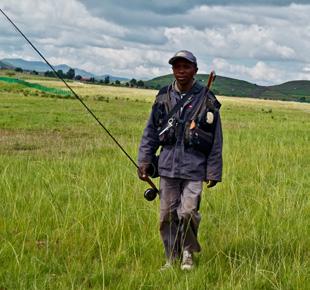
“I DIDN’T EXPECT THE DIFFICULTY OF EDUCATING THE BROADER COMMUNITY ABOUT WHY A HEALTHY RIVER MATTERS FOR EVERYONE.”
FEELING LIKE AN UNINVITED GUEST, JEFF TYSER ATTEMPTS TO GET TO GRIPS WITH THE SIZE AND SCALE OF A GABONESE FISHERY AND ITS FORESTS.
Photos. Jeff Tyser, Leonard Flemming
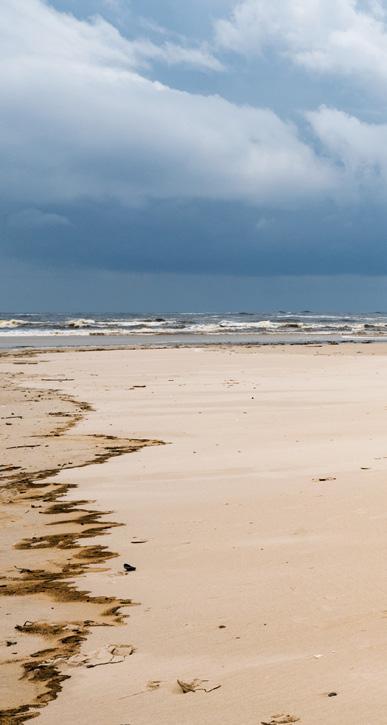
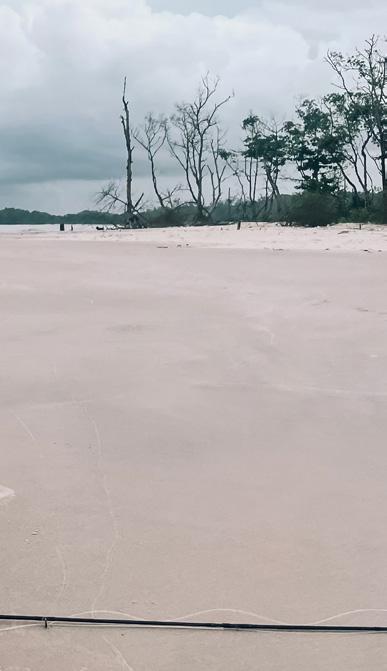
Amile beyond the mouth of a wild west African river, a little sand island is being steadily devoured. To the seagulls overhead, I imagine, it’s no more than a breadcrumb adrift on an endless ocean of coffee. Soon, there’ll be no more island left for the pushing tide to swallow. Every so often the boat that dropped us here bobs into view, a speck on the horizon, going nowhere slowly. Instinctively, my mind wanders. Engine trouble? Innocent miscalculation? Three hour slugfest with a 200lb poon? Kenwil the boathand paces anxiously across the last dry sand, cell phone held hopefully skywards, searching for the reassuring sliver of a connection to the outside world.
That’s when it hits me. An intoxicating sense of smallness. The humbling realisation that, to begin with, this vast, untamed landscape never wanted me in it. It couldn’t care less what happens now that I’m here. It dawns on me that it’s been far too long since I felt this way. ‘Damn!’, I catch myself thinking, ‘This is living.’ The boat arrives just as the first wave breaches the bar. All smiles, we clamber aboard and head for a place where our presence is a little more consequential - the lunch tent and a cool box of coldenough beers.
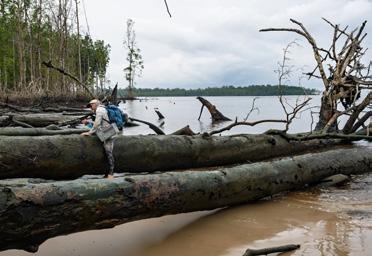
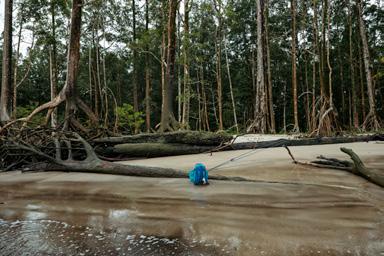
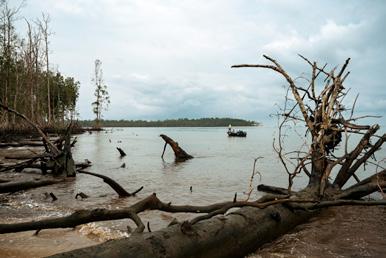
A day or two later it smacks me in the face again, as we pick our way through a tangled mess of head-high mangrove roots and colossal, upended trees. Gabon’s primordial lowland rainforest rises up behind its fallen giants, full of secrets and seemingly never-ending. ‘Holy shit, this place is unreal’, I think out loud. ‘Insane, hey?’, Conrad Botes an old Gabon hand mutters with a signature, glazed-over grin. This time there’s almost a little guilt mixed in with the waves of blissful insignificance. A part of me feels like an unwanted intruder here; a transient aberration on a shoreline that can’t have changed much since the dawn of time, let alone witnessed many fly fishermen. It’s an odd feeling. Because in this moment, in this place where I’m so alien and unwanted, there’s nowhere else on earth I want to be.
These daily reminders of one’s place in the cosmos aren’t the only reason to be here, of course. There are plenty of other worthy attractions. Not least of which, as has been well-documented, is the possibility of tangling with the fish of your lifetime, on a fly rod, feet firmly planted on terra firma. No big deal. Lofty expectations have a habit of ruining perfectly good trips. So, I arrive expecting the fishing to be tough and unforgiving yet, naturally, hoping to be pleasantly surprised. That all goes out the window on the first afternoon, on the very first throw of the trip.
Leaving the others behind at the river mouth, I amble down the beach in an attempt to calm my nerves and confirm that this is not, in fact, all a dream. A promising little trough, tight
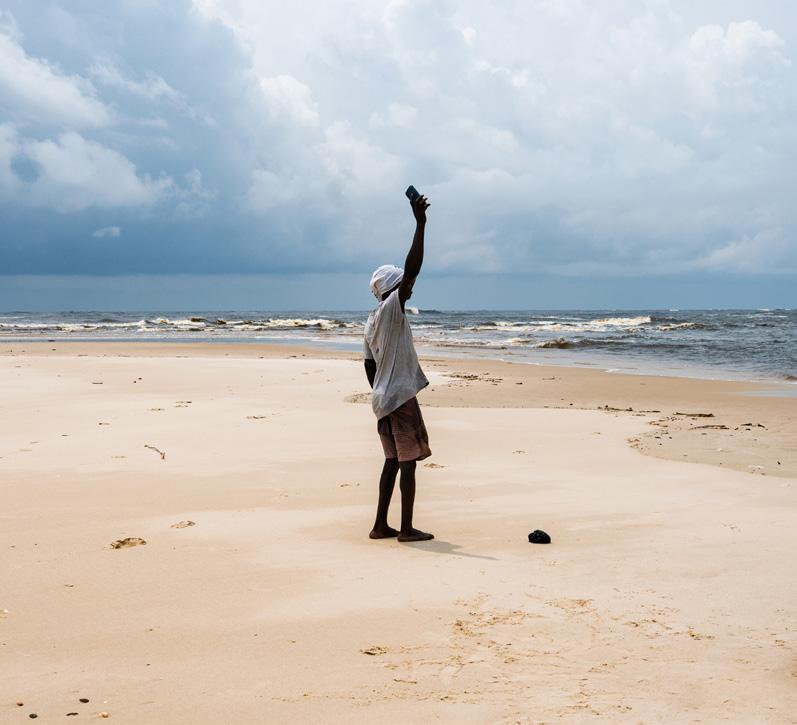
“LEAVING THE OTHERS BEHIND AT THE RIVER MOUTH, I AMBLE DOWN THE BEACH IN AN ATTEMPT TO CALM MY NERVES AND CONFIRM THAT THIS IS NOT, IN FACT, ALL A DREAM.”
against the beach, stops me in my tracks. I figure I’ll bounce a Clouser through the hole before continuing on my way. Just beyond the shore break something engulfs the fly and immediately runs straight out to sea, very nearly spooling me. Whatever it is, it’s as angry as it is heavy. I curse myself for grabbing the 8-weight off my pack instead of the 10, but there’s not much that can be done about that now. By the time my fly line reappears, I’m 500 metres along the beach, in disbelief that the 20lb tippet still hasn’t given way. Maybe I am dreaming. MC Coetzer, another member of our crew, has noticed the commotion and trots down to help. Diving valiantly into the wash, he tails the spent longfin jack, losing his prescription polaroids along the way. It’s a suitably chaotic ending to the craziest first cast of my life.
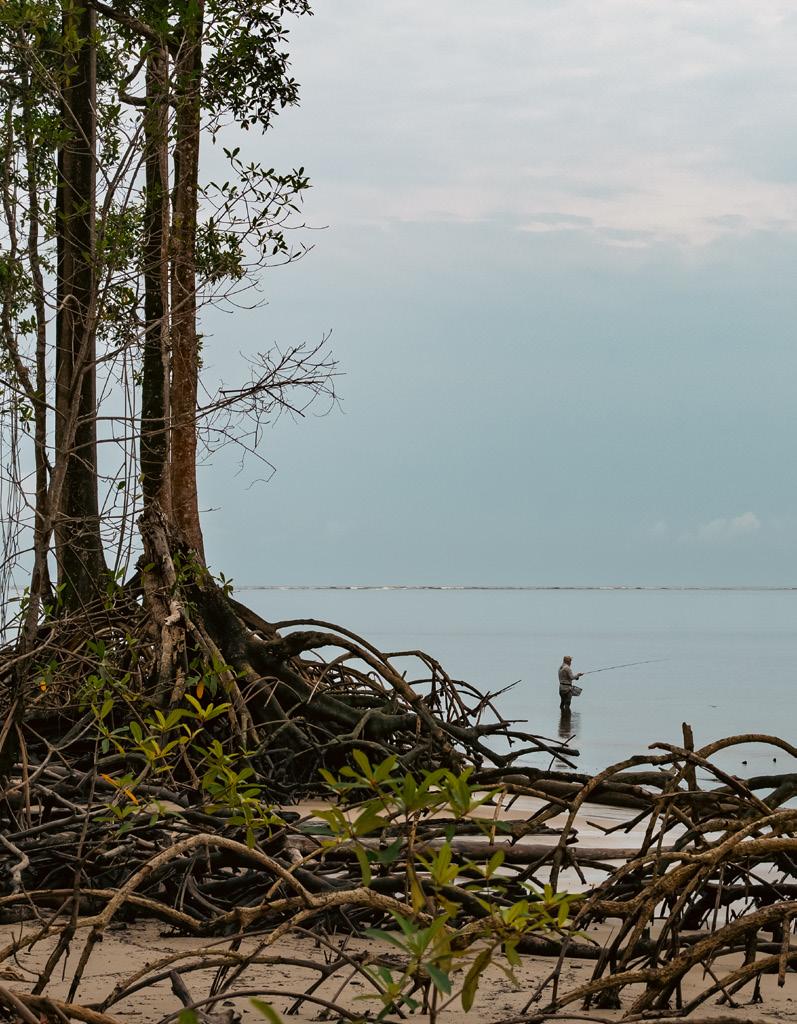
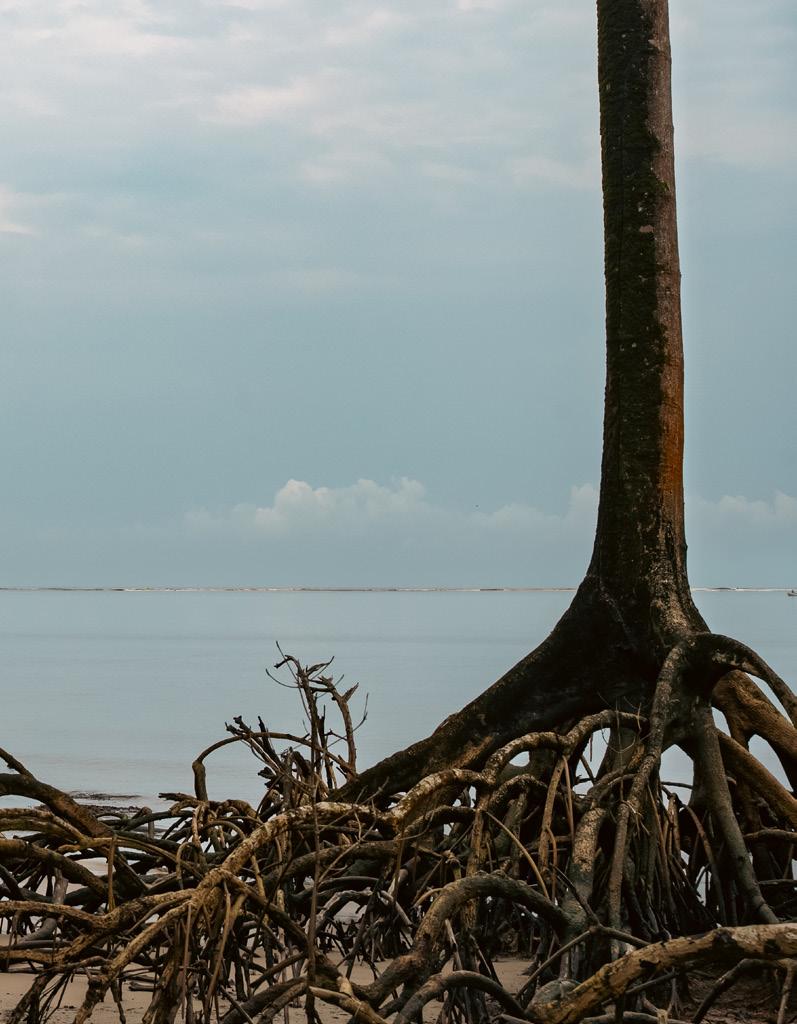
“WE PICK OUR WAY THROUGH A TANGLED MESS OF HEAD-HIGH MANGROVE ROOTS AND COLOSSAL, UPENDED TREES.”
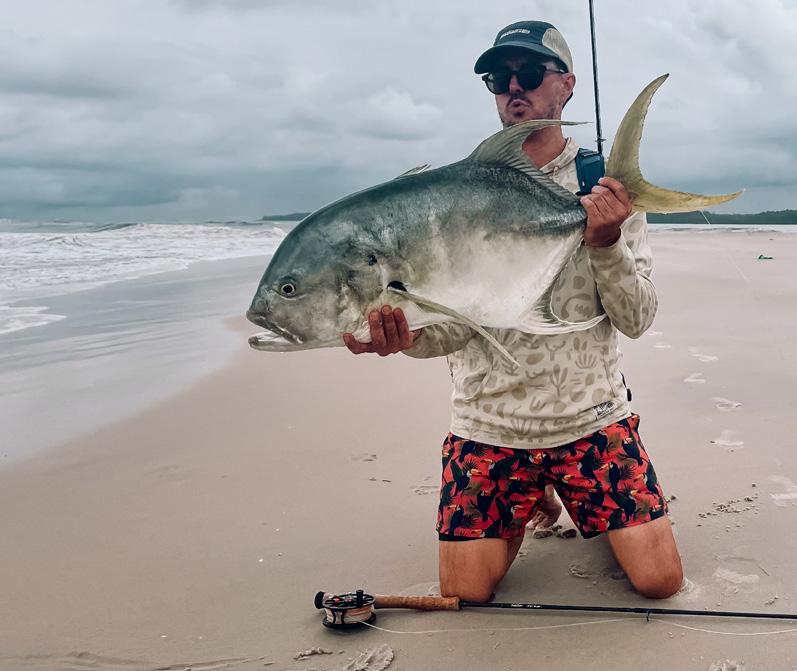
“WHO
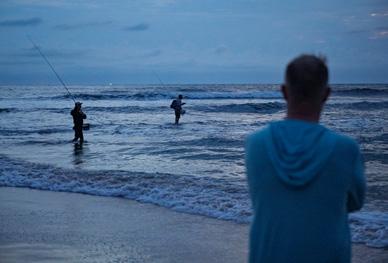
After that dramatic opening salvo, as you might imagine, my expectations for the trip go through the roof. In hindsight it would have been wiser to keep them tempered. Over the next several days, theories abound as to why the fishing never really turns on, at least like it can. Is it the lack of fresh water in the system? The alarming news of an oil spill down the coast? Could the structure of an ever-changing mouth be to blame? And who the hell told Megalops atlanticus that he wasn’t invited to the party? Perhaps the lack of solid answers should faze me a little more than it does.
I haven’t stopped thinking about Gabon’s wild coastline since returning home, the haunting sounds of the rainforest, the violence of the blitzing jacks at sunrise, the luminous-blue, pre-dawn light, that coffee-coloured surf, and the creatures it conceals. There can’t be many places left on earth, so raw and primal, that deliver such a visceral assault to the senses. It’s not lost on me how critical their protection is, and what a privilege it is to be immersed in them.
Places like that have a way of making you feel very small, and reminding you how fleeting your presence in the greater scheme of things really is. Chasing fish on a fly rod can certainly lead one to some far-flung corners of the globe, but in my experience they don’t all make you feel that way. As long as I’m able, I’ll keep seeking out the waters that do.
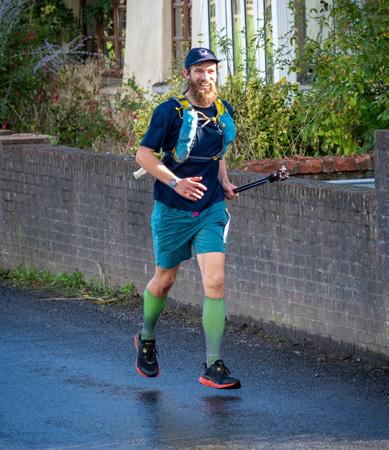
The rain doesn’t fall; it whips sideways and drives through my skin. The incessant motion, one foot falling and then the other, hopeless but resolved. Ahead stretches the Barle valley, the final destination that had seemed so remote at the start of this journey. Keep breathing. Pain rips below my ribs, the nervous system shouting to stop, but the damage is accepted and the feet continue to fall.
The journey had begun some time earlier, at the edge of the Exe estuary in Exmouth as a figure climbed from the red water, holding the shape of a shoal of salmon above its head. The invocation was read,
‘Bradan iasg, Usk, esoks, eqaluk, isca, salmo, Wysg, laks, salar, bradan, systir, broour, anaana, Mathair, brathair, athair, bradan’.
The words stir nervous energy, legs twitching to begin beating up the estuary. We had waited for this moment, staged at the mouth of the river. People gathered from across the country, here early one drizzly Saturday morning.
‘Salmon, father, sister, brother, mother, salmon. Species of the Exe, your story is our journey from sea to home’.
I look around at the other runners; they appear confident, ‘real runners’, and I bounce in trepidation. What the hell am I doing here? I’d been thinking of this moment for months, not knowing if it could be possible.
HAVING CAUGHT AN ATLANTIC SALMON JUST HOURS BEFORE THE RACE, DANIEL OSMOND TOOK ON THE SALMON RUN, A 43MILE (69KM) ULTRA MARATHON ALONG THE RIVER EXE IN SOUTHWEST ENGLAND. THE RACE PAYS TRIBUTE TO AND RAISES AWARENESS OF A SPECIES AND A FISHERY IN PERIL.
Photos. c/o Daniel Osmond
No indecision left, no more time for preparation.
‘My story is our story. Let our river live!’
A horn is blown and the journey begins, tempering to a cautious pace despite the excitement. Thirty-eight runners begin stepping out along the beach and up the river, gathered on a September morning for the Salmon Run.
This event is a community celebration of the life of the Atlantic salmon. Bringing together runners, artists, scientists, conservationists and all parts of the local community, the story of these silver leapers is not only recited but lived. Throughout the day, participants run the length of the river Exe, from the sea to the spawning headwaters. Thanks to a little healthy peer pressure, I found myself among the shoal at the start of these 44 miles, binding myself into the journey of these fish. During a summer of low-flows and bathwater temperatures, training had at least given some distraction from a terrible summer for a chronic troutbum.
“SALMON, FATHER, SISTER, BROTHER, MOTHER, SALMON. SPECIES OF THE EXE, YOUR STORY IS OUR JOURNEY FROM SEA TO HOME.”
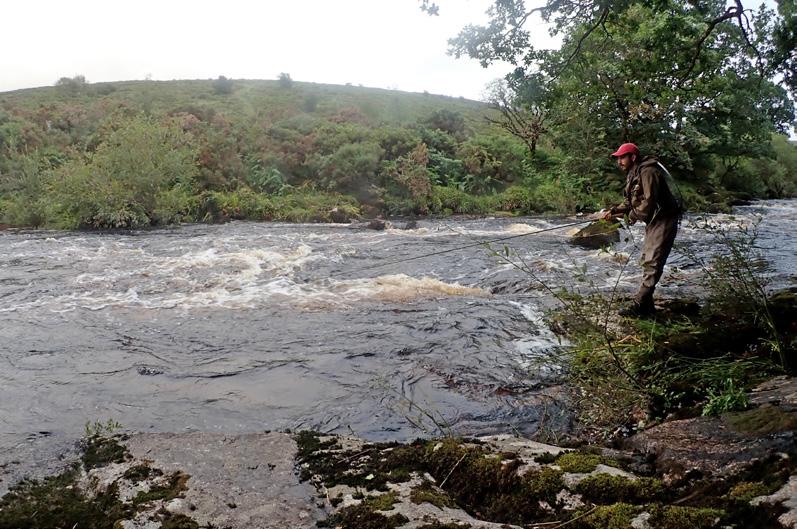
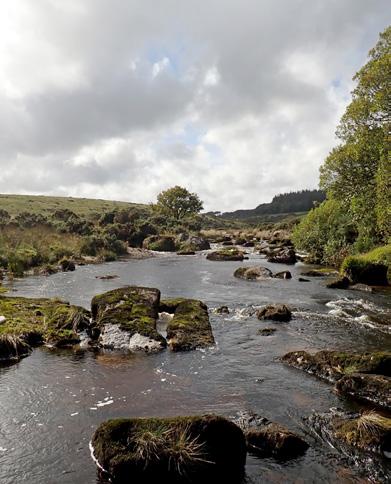
The previous afternoon, I’d sought solace from the gnawing feeling in my gut in the best way I knew; heading up to the moor with a rod in hand. The water here runs free and wild, an expanse for the mind to roam. The weather had at last been generous late in the season, and this steep spate river was still running at a good level: clear and yet the peat stain promising unseen life between the dancing forms of boulders. A large black lure is tied on as I thought of the sea trout my friend Gerald Spiers, a local fishing guide, had rudely encountered the day before while I’d been chained to my desk. The plan was to agitate an aggressive response in the bigger water to quiet a screaming mind. Hopping between boulders to gain suitable platforms, studs skid on polished granite. The overweighted fly is clumsily slung into slacks between boulders, jerked against the pull of heavy current.
The first miles of the race sink easily; the trail is tarmacked smooth and gradient low. We shoal for support, not yet territorial or competitive, exchanging tales of how we discovered this absurd and wonderful event. Most are runners, initially attracted to the challenge of the distance but drawn deeper by the substance of the day. Few have a prior relationship with salmon, beyond the farmed fluorescent toxicity that mocks in plastic supermarket packaging. And yet, by the end of the day, each has a deeper knowledge and appreciation of truly wild fish. For all of us, our story became their journey from sea to home.
All, however, is not well for our silver friends. Just short of the first half-marathon, putrid air fills the nostrils. During my cycle commute here, I had learned to hold my breath past the sewage treatment works, spilling over from decades of profiteering and complacency. In the mid 1800’s, the lower Exe became so toxic that any returning salmon would likely have had to hold their breath for worse than a bad smell, the water tainted by industrial and civil effluent from the city and mills. Scraping a snagged wet wipe from my tube fly in this section is an experience I’m not in a rush to repeat, and the soapy aroma of sewage clings to the slimy cobbles and bubbling silt. When I leave the river, I can shower myself in anti-bacterial alcohol gel. For the Exe salmon, trapped below the city behind weirs, they have to live in this shit.
A world away, and yet only hours before, the sacred waters of the moor drip from my hand and line is stripped backwards. I trudge along the river, recounting names of pools passed on by word of mouth. Such an oral history brings more than names alone to denote geomorphic features in the landscape but are accompanied by events that have passed between tellers. Passing Church Pool, I have a cast whilst thinking of Gerald’s unlikely sea trout here. Other pools have growing stories of my own that might become part of the evolving story of this landscape. As I’m bashing through bracken upriver, a small clearing and pot grabs my attention en-route to the more substantial pools. On the first cast across, the fly halts and line tightens with alarming urgency. A large salmon jumps.
In Exeter, food is enjoyed and water bottles are refilled. Available are homemade oat bars from Sarah, an environmental manager who helps run the Salmon Run, plus half bananas and sandwiches. This event is a world away from the slime of brand sponsorship, with every detail being authentic and not sold off to commercial interest. Refilled bottles taken from my wife, Charlotte, and friend, Lydia, it’s back to following the Exe further upstream. Where to though? This once living river, carving out a dancing curve through the shifting sediments of the valley, has now been imprisoned. Trapped in a straightened flood relief scheme to tame this wild thing, the water lies stagnant in canals and devoid of habitat. Salmon reaching this point must navigate the featureless, deoxygenated water; many likely becoming victims of disease and predation. At the end of this mile of confusion, greater peril lies still. Mill on the Exe, a lovely water feature to some, death to that which still lives in our rivers. A series of weirs cross the river, impounding flow and drowning habitat behind, blocking movement of fish in all but optimal flow conditions. Before the mills arrived, shad, sturgeon and lamprey would have accompanied salmon on their runs. Now, just the salmon cling on, the less athletic migratory fish barely a memory beyond our lived experience.
My reel is turning alarmingly, drag cranked as tight as I dare, rod flat-lined. Even up here, having run many miles and overcome the steep falls of the moor, this fish has energy still. After a few laps of the pool, the fish lifts head and tail – nearly a metre between the two. Hope and fear shout alarmingly for the duration of that moment. The fish then leaves the safety of the deeper water and my line draws a route beyond the tail of the pool. Shitting hell. I stumble between the boulders, water lapping over my waders, skipping to hold a grip with boots. Rod is held up high, desperate to maintain tension on the barbless hook and follow the fish down. Approaching some overhanging branches, I weave around them and into the current to avoid getting strained and instead end up bobbing, towed by the salmon until I can kick a grip a little further down. A hundred metres down river I pull myself out onto the bank, rod still bouncing as the fish pulls against the current.
‘DING DONG PYNES IS GONE’, reads my email to Stu a long-term angling friend, the mail accompanied by a photo of said collapsed weir. Already, not even halfway on the journey of the returning salmon, we’ve passed many main-river weirs that each take life from the water. Trews, Mill on the Exe, Cowley, Exwick and now here at Pynes. Removal of a redundant weir is by far the cheapest, most permanent and effective solution to restore ecological health and yet, our rate of success in achieving this
is staggeringly low. A dizzying maze of bureaucratic consents are required to gradually make progress: from gaining an impoundment license (yes, to remove the impoundment); flood risk activity permit; planning permission, archaeological surveys; landowner consent and now, one must even prove biodiversity net gain. This is all for an act that benefits aquatic biodiversity more than any other. If any one of these should fail, then there is no legal impetus for the process to continue, even after years of effort and thousands of pounds invested. Locally, some of the strongest opposition comes from the so-called guardians of the river, anglers, greedy for the ease of the weir pools to trap fish on their migrations. Titles are earned and not given. I wonder what title the last of the salmon would give to those who opposed ecological restoration for the sake of lazy fishing? Happily, the salmon’s prayer was answered in the winter of 2024. An act of divine judgement washed out the crumbling medieval structure of Pynes weir, moving more quickly and without the tangled web of consents required by an act of human intent. I stop to behold the fallen structure and then continue to run upwards.
Steadily, the miles of the Exe valley are eaten away. Clods of red soil stick to the tread of my trainers, the potato crop having been harvested leaving the fields barren. As I climb upwards, acres of rusty maize rustling in the wind cling to the slope, appearing like a scene from Interstellar. These fields will soon be harvested, leaving the soils exposed in increasingly wet winters, washing away the precious topsoil that nurtures growth and thus choking life from the river. We seem capable of creating great art and literature on the fragility of our biosphere, can discuss strategies for change and yet, short-term profit still seems to win. Passing Fortescue farm, hope springs still from the earth. Farmed and lived as an act of quiet defiance, there are still those that shine from the gloom as examples of a regenerative, life-supporting way of working the land. Footstep after footstep, the river flows between neighbouring ownership and opposing principles, mocking our individualistic notions of the land. The water that eddies here has drained from myriad catchment areas upstream and recruits more as it passes.
I pass thirty miles, reaching the town of Tiverton and the welcome sight of a gazebo filled with friendly faces. Charlotte interprets my incoherent but enthusiastic words, filling bottles with water and refilling my snack supply. Peanut butter sandwiches stick my mouth together, trying to say something about beginning to feel heavier and legs less compliant in recent miles. I hear of some of my earlier companions who would not make it to the headwaters, that had fallen victim during this great migration and dropped out. The river is once again confined to a concrete channel,
“ON THE FIRST CAST ACROSS, THE FLY HALTS AND LINE TIGHTENS WITH ALARMING URGENCY. A LARGE SALMON JUMPS.”
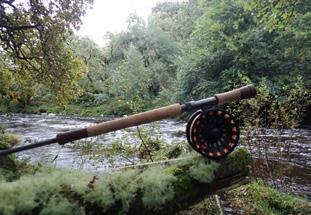
impounded behind a sloping weir. It is here that one of the former arteries of this river has been severed, violently mutilated in an act of hubris. The government agency responsible for the protection of our rivers and life within, entombed this tributary, the Lowman, in a uniform concrete channel. In this flume, where any refuge from the flow is routinely removed as ‘maintenance’, life is disconnected and killed. In arrogance, we have reduced this living form into an easily modelled flood channel, forgetting the reason that civilization first built itself around waterways.
North of Tiverton, the gradient of the river steepens as we approach Exmoor. The land changes, floodplain narrowing and bordered by steep oak-clad narrow valleys. I have now passed further than ever before, each stride into the unknown. It was in these upland waters of the Exe that I first came to be enthralled by rivers, poking with bamboo net and bucket for stoneloaches and bullheads beneath cobbles. If I was very fast, occasionally I would swipe a much faster speckled fish from the water: salmon parr at the beginning of its life. I too, much like the salmon returning to their natal river, have returned with older eyes to these familiar waters.
The passing miles begin to hang heavy. I am now beyond the point of preparation in physical stamina as the body begins to damage and degrade. A nagging begins behind one tight knee and then is forgotten as the other also weakens. Orange and brown leaves hiss against my dragging strides, the life of summer coming towards an end. By this time, salmon that would have entered the river months earlier would be physically depleted, even re-absorbing the edges of their scales to absorb what little nutrients they can. No longer feeding once returned to the river, the digestive track atrophies to prioritize every molecule of energy in the completion of this journey. Pain stabs at my gut and an uneasy feeling comes before I duck away into the trees. solidarity with the salmon, my guts have also begun to break down towards the end of this journey.
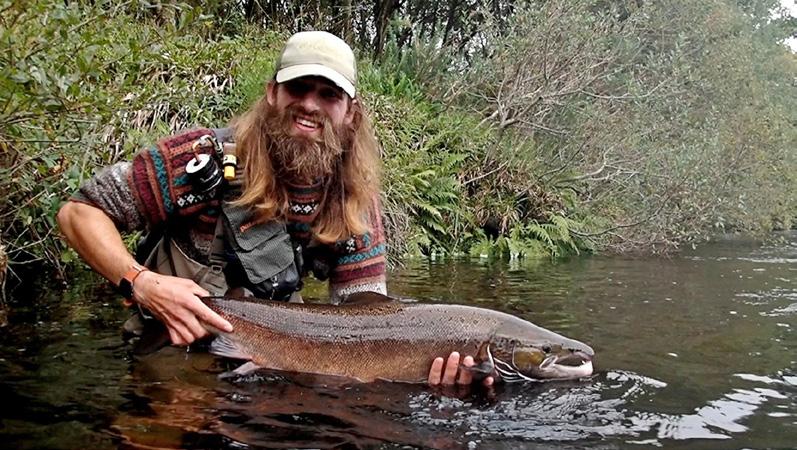
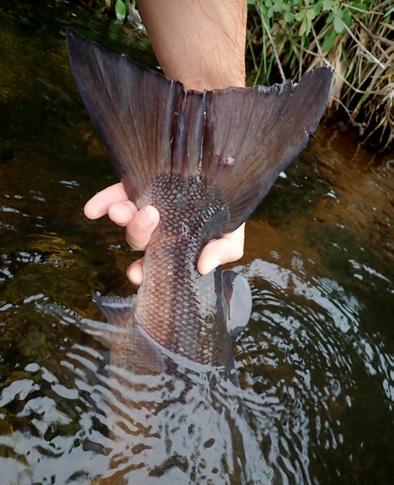
In the final miles, excitement grows. ‘How many other people caught a salmon hours before the run? You are the chosen one!’, my friend Tom, who works in fisheries management on the Exe, had encouraged before the start. The river had indeed smiled upon me. I think of that fish, a male salmon of a little over 90cms, that I had improbably cradled in my hands. Intertwined with his journey, I felt the prick of jagged teeth within his hooked jaw, sinew of muscle built in the north Atlantic thousands of miles away. He kicks instinctively, recovered and bound to complete his journey. The shadow merges into the flowing water and he belongs once more to the river, released from the moment of my selfish possession. The salmon had gifted me a moment, to become part of the story of his journey, a journey that I too was soon to complete.
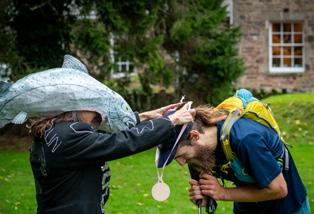
Most events focused on the conservation of salmon feel more like a dusty wake than having any air of possible life. Rooms of wealthy, elderly men self-adulating for how much they care to get dressed up in their dinner suits, course after course of environment pillaging dishes and, echoing the platitude, ‘only anglers care’. How many would dig into their pockets and repay the theft from our early industrialisation that has made us rich? This day though is different. Not exclusive, no egos, but with a pulse of life. Kids run the final stage of the relay into Dulverton, faces painted with fish, reclaiming the story of salmon for every person. My pace quickens down the street of Dulverton, buoyed by the sight of friends to see me home. A band strikes up a tune on the final stretch and I cross the line, gleefully incoherent. Wearing a papier-mâché salmon head, Anne-Marie, an artist who is largely responsible for the mad idea of the Salmon Run, places a medal of completion around my neck. I am captivated by the story of Atlantic salmon, their life and journey. It is a tale that has entangled my own life. Their story has become my journey, from sea to home, and I am grateful to have been allowed these shared moments.
“HOW MANY OTHER PEOPLE CAUGHT A SALMON HOURS BEFORE THE RUN?”
We don’t chase trends. We chase hatches, tides, moon phases, weather windows, and risers. High-performance apparel designed for better days on the water.
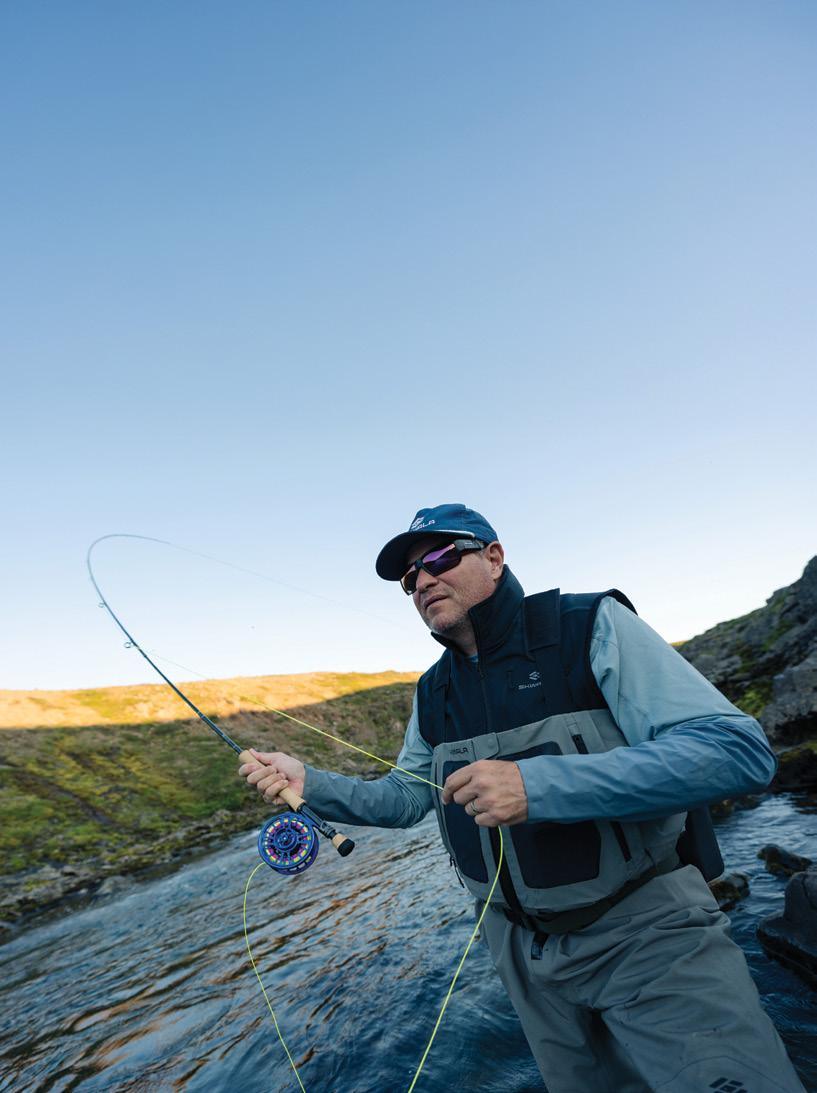
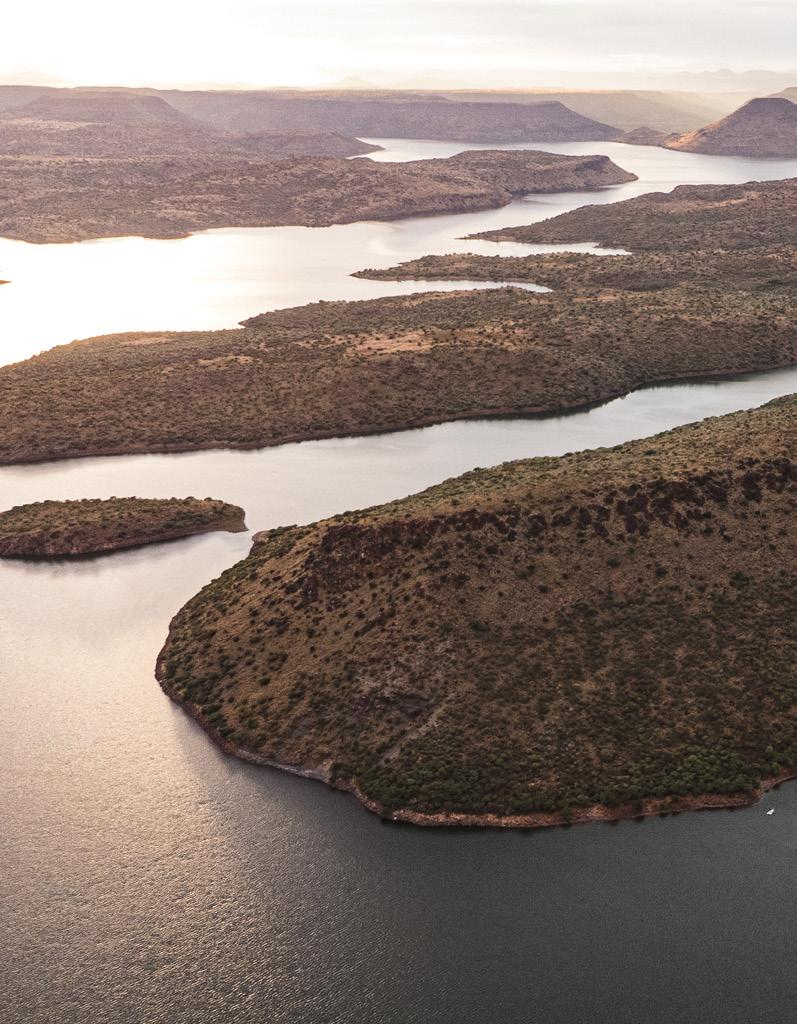
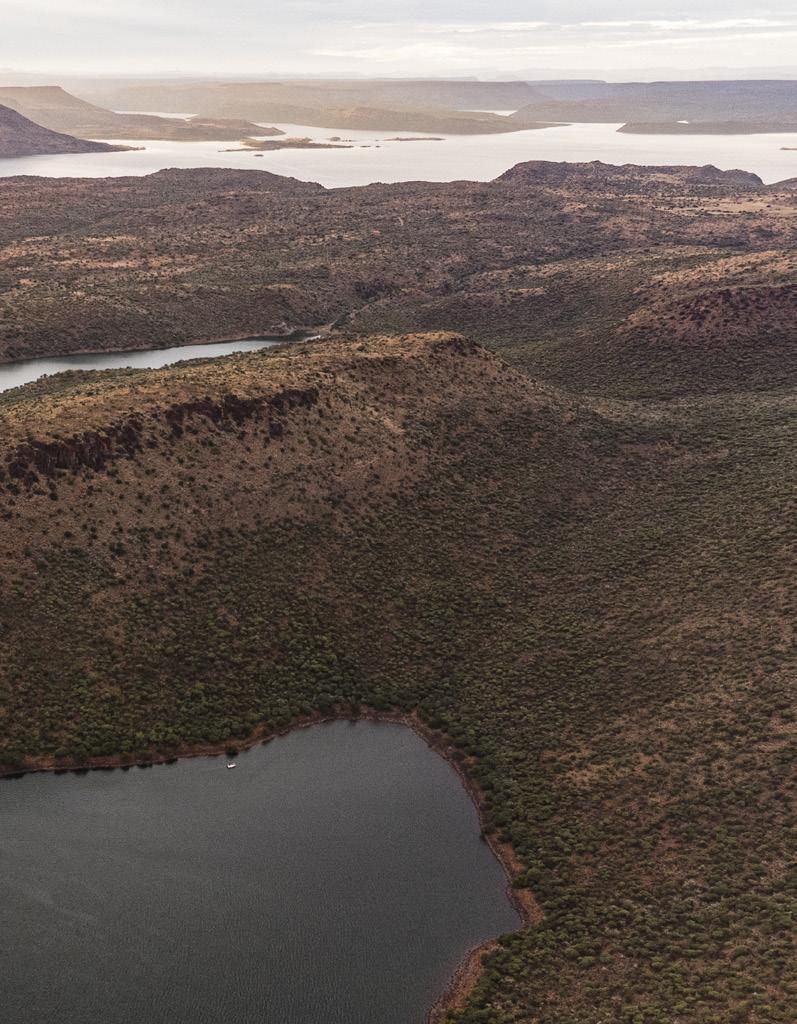
THROUGH NO REAL FAULT OF MY OWN, THE PROPRIETORS OF THIS PUBLICATION VERY GENEROUSLY INVITED ME TO COPILOT AN UPCOUNTRY MISSION TO VANDERKLOOF DAM IN THE NORTHERN CAPE, MEDIUM-DEEP INTO THE INTERIOR OF SOUTH AFRICA. I WAS IN SEARCH OF FISH AND MAYBE EVEN SOME ANSWERS. IT’S UNSETTLING HOW SIX DAYS OUT THERE CAN SEEM SO OPAQUE IN RETROSPECT. HAZY.
MAYBE TOO MUCH HAPPENED. THIS IS SOME OF WHAT I REMEMBER, I THINK.
“How do you feel about yellowfish?” It had been barely a week prior that Matt (Kennedy from The Mission) had asked me this.
“How do you feel about yellowfish?”
What an absurd question. I am easily offended, sure, and I was already in a bad mood. Sunday Blues. The Muizenberg Southeaster was busy auditioning for a role as the fifth horseman of the Apocalypse, and I was fresh off of suffering my bi-monthly Lakeside Double-up: Blanking spectacularly at the Vlei and missing the 18:00 closing time at PnP Liquor. Bleak, sans beer, about to bite down on the barrel of another banal week of busying myself with some or other bullshit and now this idiot asks me the most banal of leading questions.
“...I am pro yellowfish, Matthew.”A diplomatic response, arguably.
Pro is an understatement. I adore yellowfish in the same way I adore kudu biltong, Willie le Roux, loose law enforcement concerning riding in the back of bakkies, Stoney ginger beer, Kgalema Motlanthe, and the smell of Tabard. I adore them because they are here, they are of this place, they are... ours. We have something special that they, out there, do not have.
Hulle weet nie wat ons weet nie. Grayling? Pfft. Sies. Dorado? Keep ‘em. Steelhead? Pielheads is more like it.
Yellowfish. Can’t beat ‘em.
Despite being obtuse, Matt’s text really was a gift. I’d been suffering from a general itch to get as much the hell out of the dodge as practically possible. The world really seems to be hellishly bent on destroying itself, at least it was at the time of writing, and the gloomish glow growing on the horizon was and still is doing real horrors for my constitution. An unexpected invitation on a six-day schlep into the sticks seemed just the scratch.
We were going fishing. Planning time was negligible. Tying time? Lol. No. Pack up. Go.
The N1 is weird, man. Beaufort West marks the end of the familiar and of reasonable expectations. There are different vibrations in the Karoo desert. You cross over into the frontier when you depart Engen Swartberg.
Who are these people? Where are they going?
North, North East. The roads gradually straighten. Flatten. Dusty-white single-cab Hilux’s (Hiluxii?) flit in and out of the dysfunctional DRS (Drag Reduction System) train, over- and undertaking colourfully canvassed tractor-trailers owned by family-owned mid-tier long-haul logistics companies you’ve never heard of and never will again. They are all heading somewhere that the actual trains were intended to go. Apparently that’s why the roads are fucked. We all nervously pass each other at over 220km/h if you do the math, sometimes we flash a hazard-button-thanks. Three to four flashes just to make it clear and/or self-righteous. The math says another 350km before we get to call it. Eleven hours total then. Big day. Big enough.
The crows couldn’t be more stoked with the equation out here. A largely nature-proof ten metre tall post to nest on every 30 to 60 metres. Municipally-maintained HMA (Hot Mixed Asphalt) lines to reliably navigate by. More roadkill than their bird brains can compute. Blunt force trauma bycatch. Bargain. If you were deeply committed to the game you could probably collect a noteworthy assortment of obscure tying materials left behind by the cars and the corvids. Spotted Eagle Owl feathers are always startlingly beautiful in daylight. Maybe it was just sleeping. They’re nocturnal.
IF ZEUS EVER NEEDED A BIRDBATH
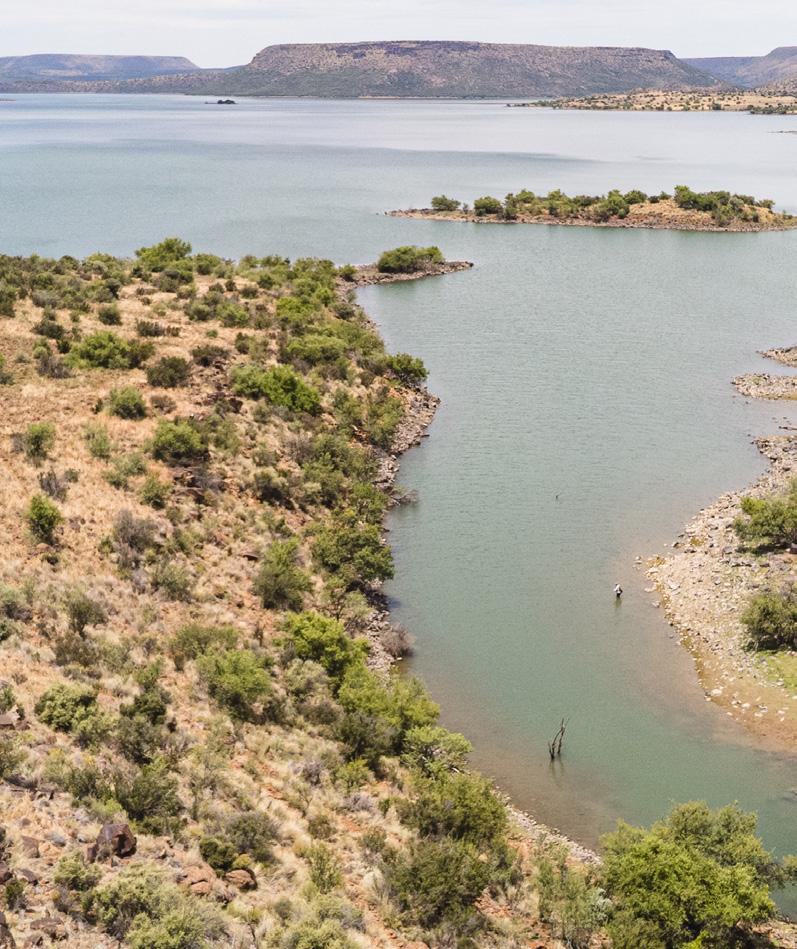
Vanderkloof Dam sneaks up on you in a way that something that aggressively colossal really shouldn›t and you don’t see it until suddenly it’s all you see. The wall is a 100m tall by 750m long, brutalist Gravity-Arch finished in a fifty-year-old khaki patina that looks rough to the touch even from a distance. A grey that wanted to be a yellow. Willie Meyeresque inclinations amongst the broader civil engineering community of the late 70s. Maybe. They say taupe is very soothing.
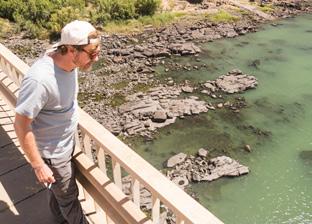
It towers over you and your whole life as you look up, up, and then down at a stretch of tail-watered Orange River running towards you from the Northern Cape’s version of the Lord of the Rings’ Argonath. Underneath is the comparably diminutive bridge and between your shaky legs, as you stare down in confusion is a scene that will haunt your dreams forever and ever. The number of visible fish stacked up below the dam in the 100-or-so metres of river around the bridge is a crippling sight. Stand still for a bit and you start picking out the bigger fish lazily Heroine-classing their way through the several schools of smallies, muddies and moggel. Who knows what else? Manthatisi, Maxeke, Modjadji the first.
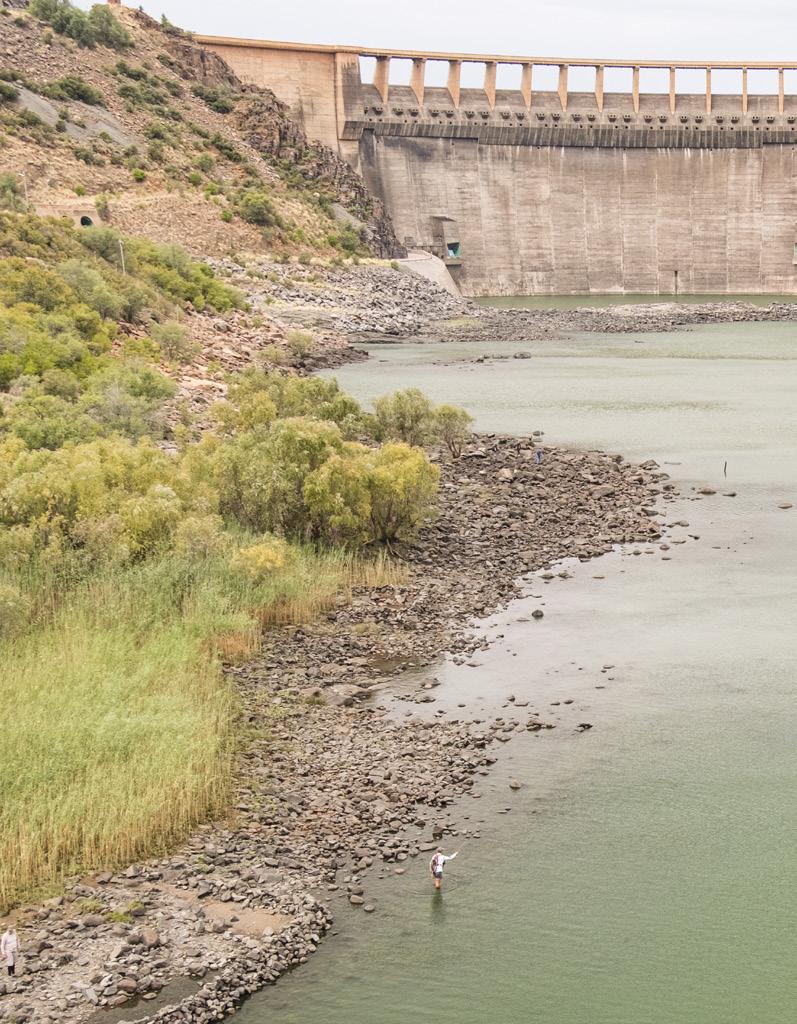
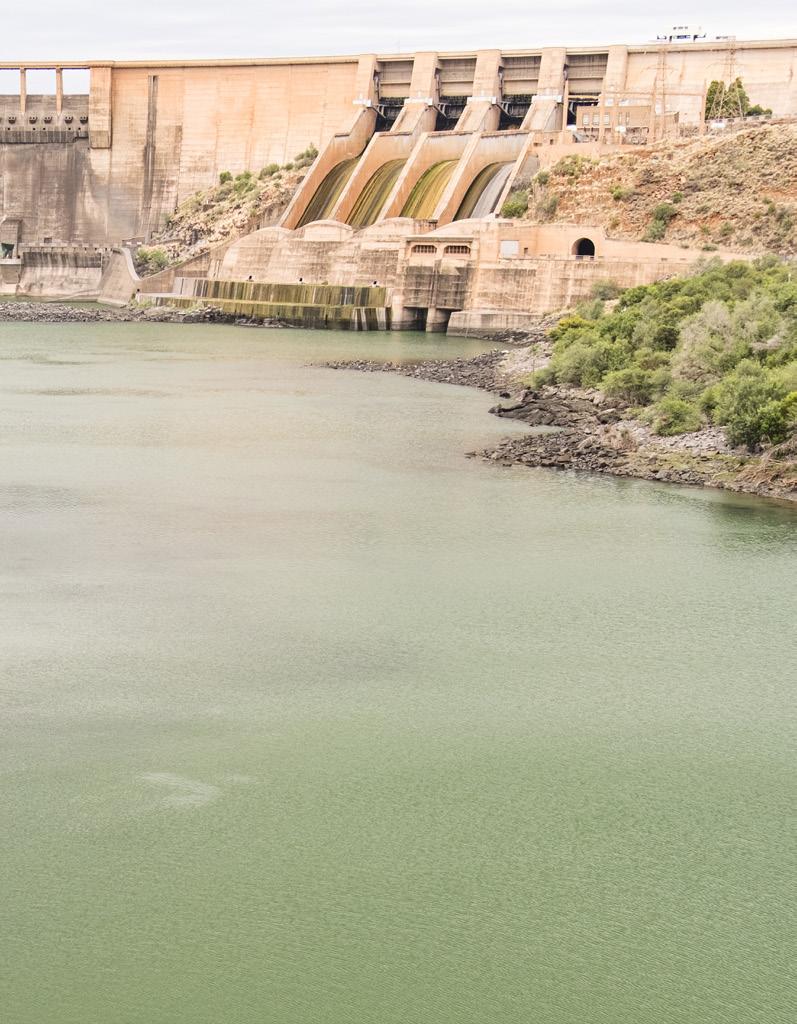
“THE WALL TOWERS OVER YOU AND YOUR WHOLE LIFE AS YOU LOOK UP, UP, AND THEN DOWN AT A STRETCH OF TAILWATERED ORANGE RIVER.”
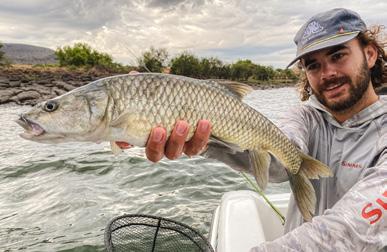
Are those largies? Maybe. Body shape seems diagnostic. Prominent shoulders. They certainly seem big enough, even from up on the small bridge. The barbel, jet black against the cloudy green, are easy enough to ID as they surface for gulps in the open water. We spot several in the “holy shit” to “fuck me” size classes.
A loud, but completely justified, Ford Ranger horn wipes the feeble-minded gawks from our faces and we remember we’re tourists blocking a single lane bridge while pointing at fish and we’re actively retarding the local agri-industrial complex. We have a GP number plate, so at least they could tell we were stupid without needing to talk to us.
Get out of the way and go fishing.
Seen from down on the water, the geography belies the true vastness of this place. You need to get way, way up, and the satellite imagery doesn’t really convey scale to your tiny human mind once you reach these kinds of numbers.
It is astoundingly large.
It is absolutely bloody massive.
Think the Baltic, but in the bush.
Call it what you like.
Die ou PK.
The Turquoise Gnar.
The Expanse.
Thunderkloof.
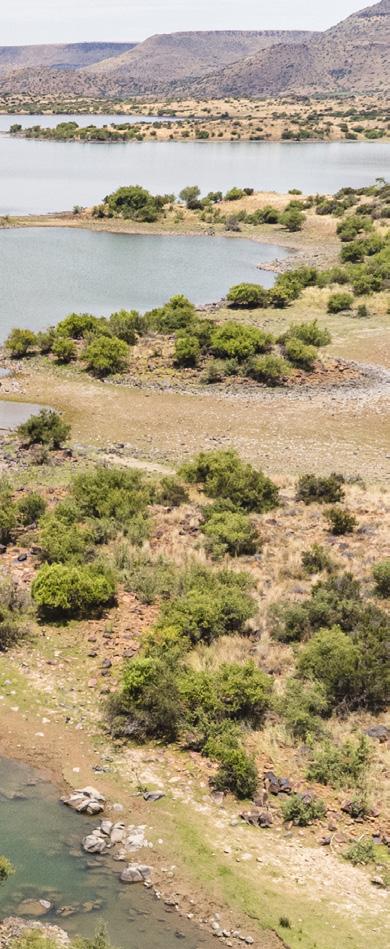
VDK Dam sits on the border of the Northern Cape and Free State, neither of which is a province I live in. Closest proper town is... well, none of them really. Vanderkloof, the town, certainly has more than just the basics, but you’re far from most things, for better or worse. Flooded in 1977, the dam covers what used to be a complex series of valleys and hills, somewhere to the tune of 14 000 hectares, creating psicobloc cliff faces and tendril-like channel arms and many, many an island. It stretches for 50kms from the wall upstream in the direction of Gariep Dam before you can start arguing that it’s now a river again.
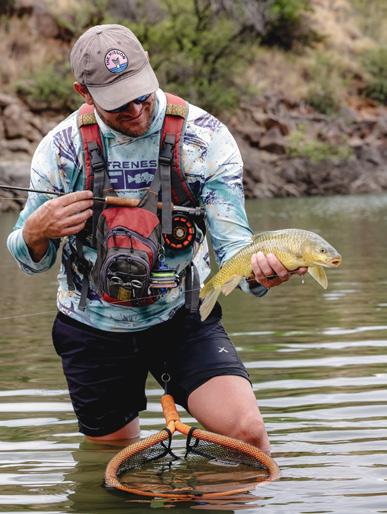
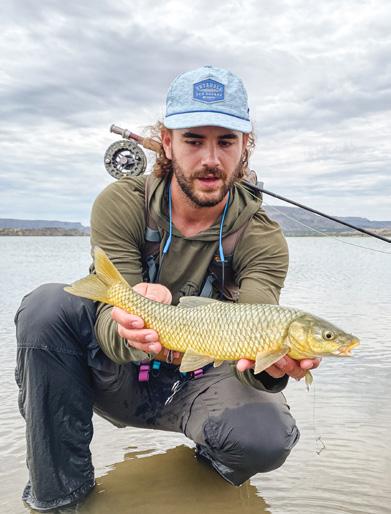
The banks are lined with thorn trees and big dark rocks and rondawel-shaped hillocks and fat ospreys and a deep lack of human habitation, crawling with inconsistent cell phone reception.
Game, though. Plenty. Nature reserves and hunting farms make up a notable portion of the waterfrontage, so kudu, gemsbok, wildebeest, warthog, etc, are all par for a morning’s viewing en route to the day’s fishing spot. Lechwe from central Africa. Loads. Boy, do humans love putting things where they don’t belong.
What strikes you, once you’re on the water and have turned one or two corners, is how easy it is to get yourself completely and irreparably lost out here. Everything looks the same and there’s always another bay, or channel, or peninsula, just around the bend, a little further. Without someone who knows their way around, you’d better have a compass, space blanket and flare gun on your boat. On the subject of boats, bigger’s probably better. Daily thunderstorms replete with hail and lightning materialise on the horizon faster than seems fair, pushing a small hurricane’s worth of wind straight into your face. That wind makes waves, and if Thor gets his angles right, those waves can build for a few kilometres before they get to you. Cape Point type shit. Sometimes you outrun the worst of the storm. You’re wet no matter what. Swell in the Karoo. Kowabunga.
ROOSTS COMMUNALLY
The first largie I caught, on the trip and also in life in general, wasn’t on a drift.
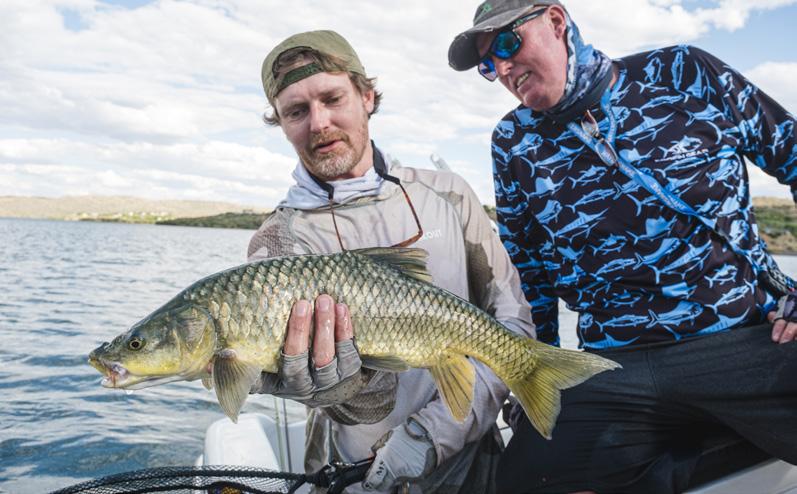
It was on a dry. We were hitting the FADs, trying to hold steady in a breeze unsure of its preferred orientation but not its stiffness, trying ourselves to maintain a loose balance between being close enough to put shots on target and far enough away to avoid spooking fish. A foam hopper splashed down millimetres from the floating metal barrel, about as delicately and accurately as you’d want to hit someone in the mouth with an ornate glass ashtray during the initial stages of a bar fight (with conviction but without making too big a fuss), produces a sickeningly large swirl. Oh shit there are fish here. Just listen to the captain. The next good cast gets an eat but the lift is late and I’m left with slack. Big splash. Smallie, probably. Definitely, actually. I saw the colours. Shorten the leader. Nine foot here is plenty if not too much. Slap the
“OH SHIT THERE ARE FISH HERE. JUST LISTEN TO THE
hopper down. Same spot. It doesn’t get eaten so much as cancelled. I’m fortunate that my brain’s hesitation in figuring out what the hell just happened was balanced with the fish having fokkol clue that it was hooked for the first five or so seconds. It then became pretty swiftly aware of that fact and made its knowledge explicit with equal swiftness. A boat can’t really chase a fish if it’s heading towards the bottom, so you hold on. Rob, the owner of Fly Fish Vanderkloof, nets the fish after a tense few minutes, about as effortlessly as you’d expect from someone who lives and guides out here. It’s not a massive animal but a 4-weight is not a skiff pole and the revs-per-cm on these things is noteworthy. Two more smallies round out the evening as the fading light becomes too dim for even the youngest eyes on the boat. You don’t want to be out here at night. In any case, hitting drums with dries isn’t why we came here.
We’d brought too much shit. Way too much. Loading it all onto the barge under the patient eyes of people who’d finished packing ages ago somehow casts into sharp relief how underprepared in our overpreparedness we managed to be. Small mercy that we had plenty of space. A barge is one of those things you don’t think you’d need until you have one at your disposal. Being able to aqua-mule all of your unnecessary junk upriver and thus transplant your basecamp further still into the maze makes not only for shorter runs to fresh banks to flog, but being able to wake up and pass out on said banks means those runs can start earlier and end later. Being crepuscular is a choice.
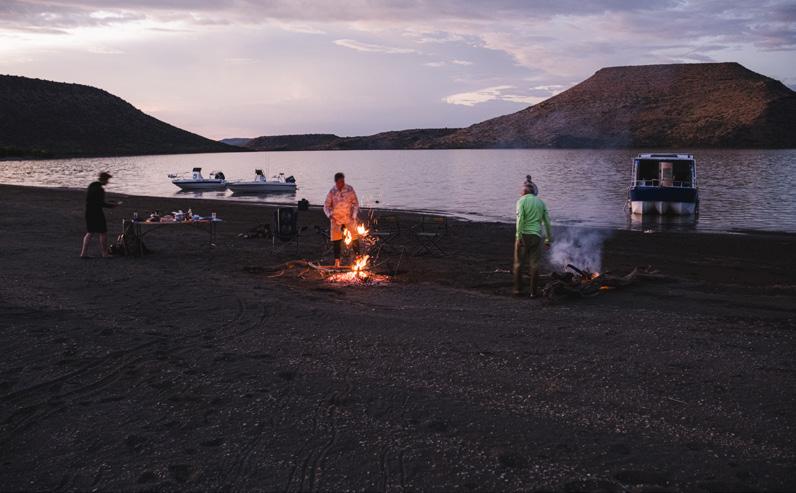
Barges aren’t jetboats so the going is slow. Fishing time is finite, so you notice. But, in exchange, you’re able to lounge about on what is essentially a lounge while being very much on the water, watching solid flocks of white breasted cormorants and solo African darters cruise by at eye level; losing count of the number of heron species you’ve clocked; alabaster cumulonimbus building apocalyptically over the hills with nothing but fresh Karoo air blocking your view. Yeah, it’s nice. The campsite Rob chose for us ticks all the boxes, presuming you’re into this kinda thing.
Soft sandy shore for the barge and the boats to smoothly beach on; flat patches of grass for tents; not too many rocks to rip your toenails off on in the dark and more driftwood than your invariably-overconfident bonfire can possibly hope to ever consume.
In the fading light a mayfly hatch gets into your ears and up your nose and you can see the shoals of smallies in the shallows feeding anxiously on the ephemeral. The glare-silhouetted rings from the risers are replaced now and again by a sudden violence as the barbel minivan themselves into the crowds. Baitfish tailwalk across the surface to avoid their conversion into nutrients. A few trade one horror for another and end up on the bank, left to suffocate in the dark with nothing but the stars and big earwigs as witnesses. Labidura? Forficula? Not sure. I don’t know enough about bugs.
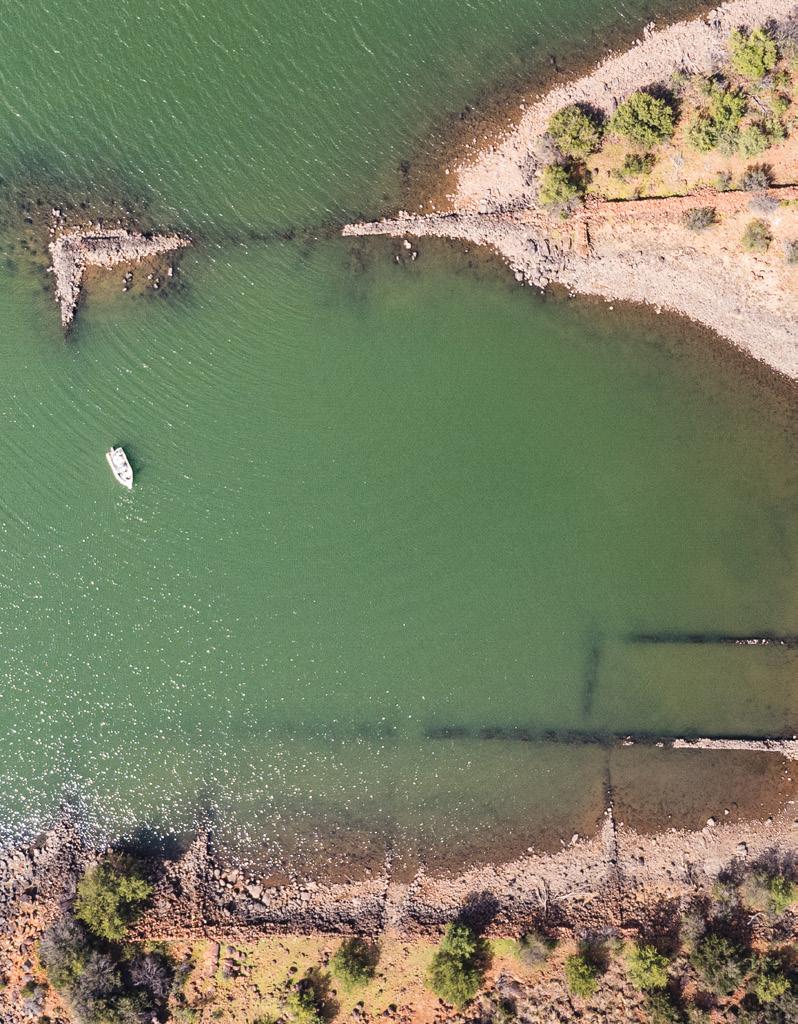
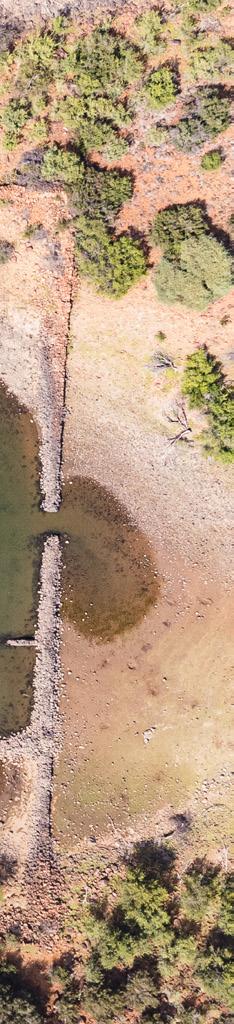
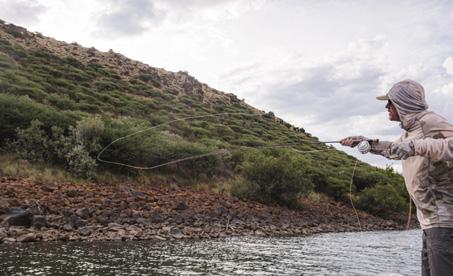
"YOU SPOT PLENTY OF LIFE WITHIN CASTING RANGE AS YOU TREK THE SHORELINE. MOSTLY SMALLIES EATING DRIES. CARP TAILING.”
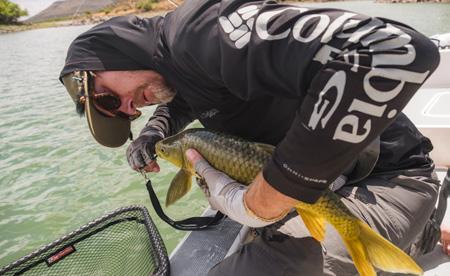
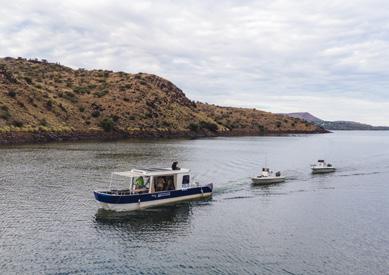
The potential for walking the banks and wading the shallows is too much to ignore, especially if you have the time. If the boat can’t get you there, there are some public access roads available if you can figure out how to get to them. Highclearance is non-negotiable. Low-range recommended.
You spot plenty of life within casting range as you trek the shoreline. Mostly smallies eating dries. Carp tailing, leaving streaks of detritus a slightly darker hue of cloudy brown within the already churned up wave zone. Gaining height by standing on a boulder or long-downed log, you spot cruising wolfpacks of smallies, some sauntering at a rate that justifies attempting an offering. Small caddis, beetles. Some of them eat. Some inspect and refuse. Some were never going to stop. Plenty of waterfowl about. The CDC potential verges on the commercial. Enough spurwing to justify buying a second 12-gauge.
The bankside topography here can be described as, at best, conspiratorial.
At worst, spiteful. You wouldn’t think a natural surface could act with malice but, never in the history of inconvenient shit to walk on has a combination of factors endeavoured so ambitiously to turn boat legs into fucked legs. Either you’re sinking into gravel-guard-surpassing mud on the water’s edge, or you’re perma-stumbling through a geominefield of grapefruit to watermelon sized mini-boulders, spread out in such a manner that avoiding contact is impossible. All are somehow sufficiently embedded in the ground so as to punish even boot-protected toes, but not embedded enough that you can step on them without them immediately rolling to whichever side will tear more ligaments. You stop stumbling every few minutes when you see rings, and you stop your grumbling after the seventh or eighth dry fly eat. The controlled falling back to Frank (part of our group) Solomon’s bakkie feels no easier than the way we came, but our gloves smell like fish and there’s beer waiting in the cooler.
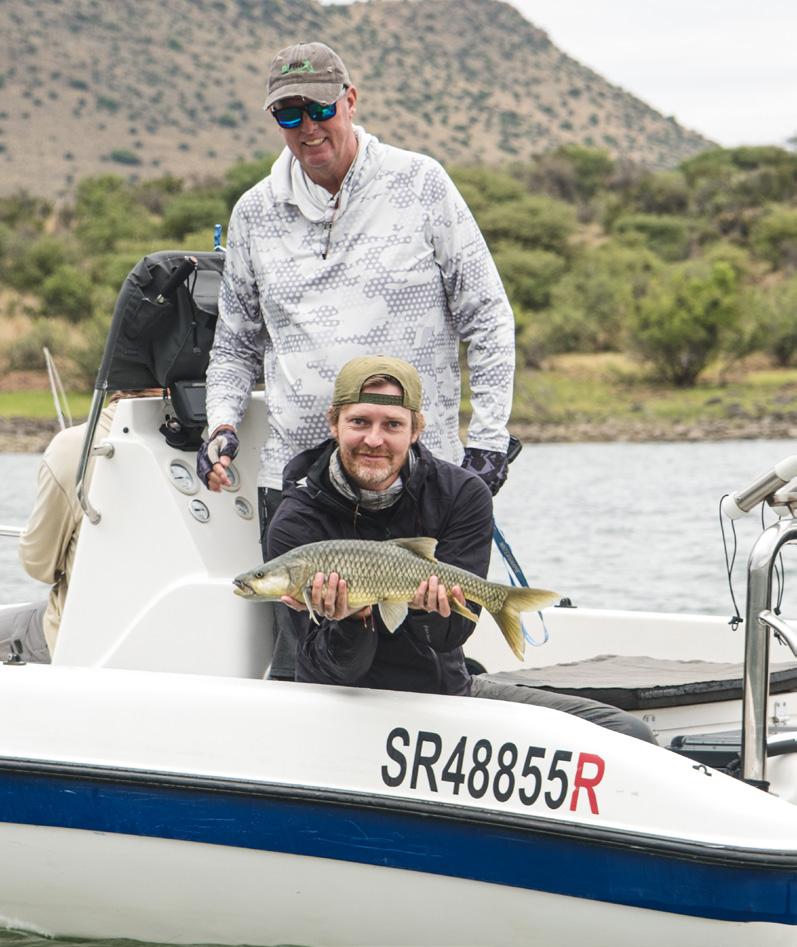
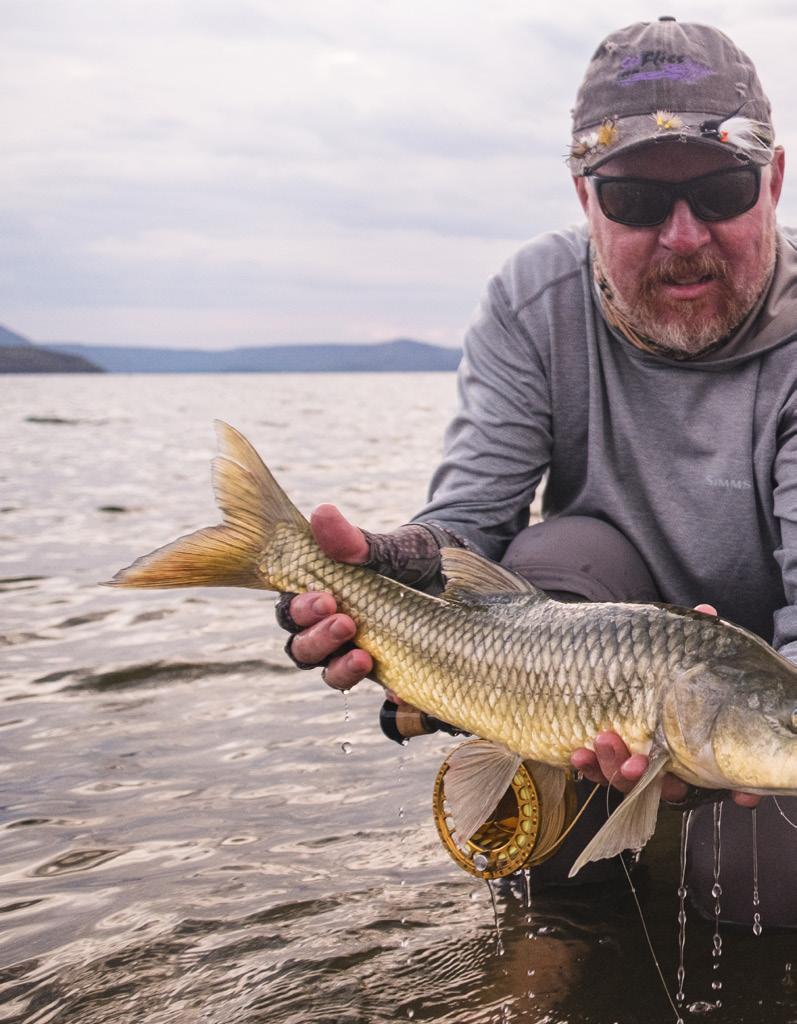
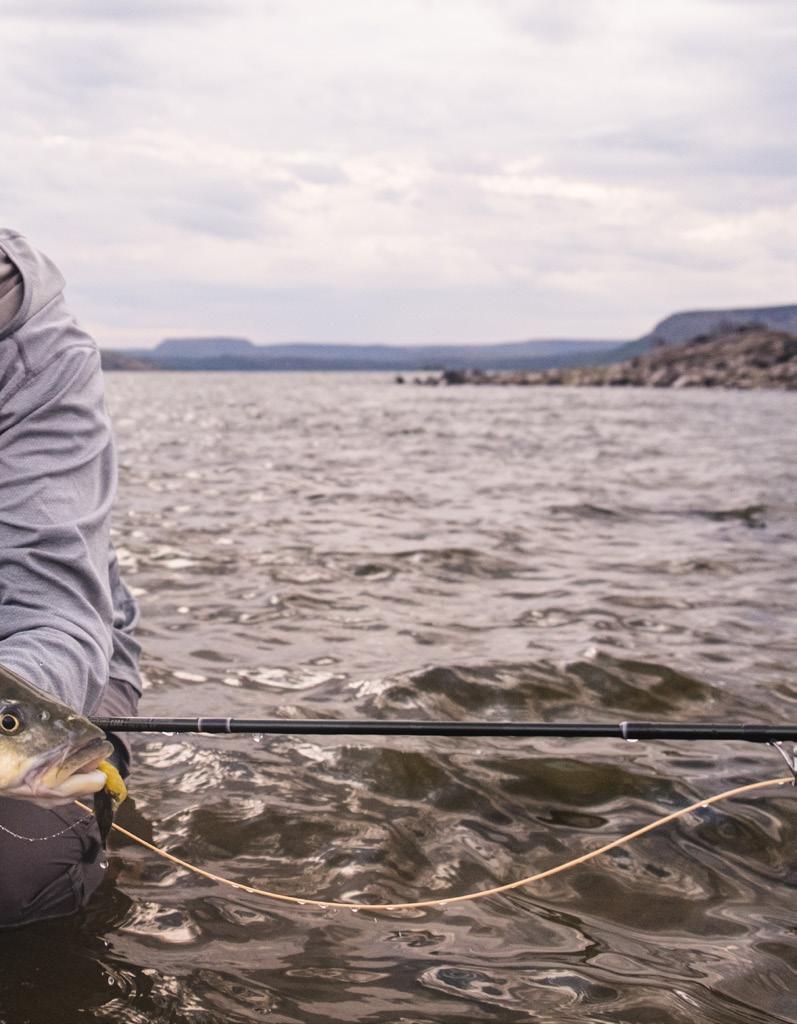
THE POTENTIAL FOR WALKING THE BANKS AND WADING THE SHALLOWS IS TOO MUCH TO IGNORE.”
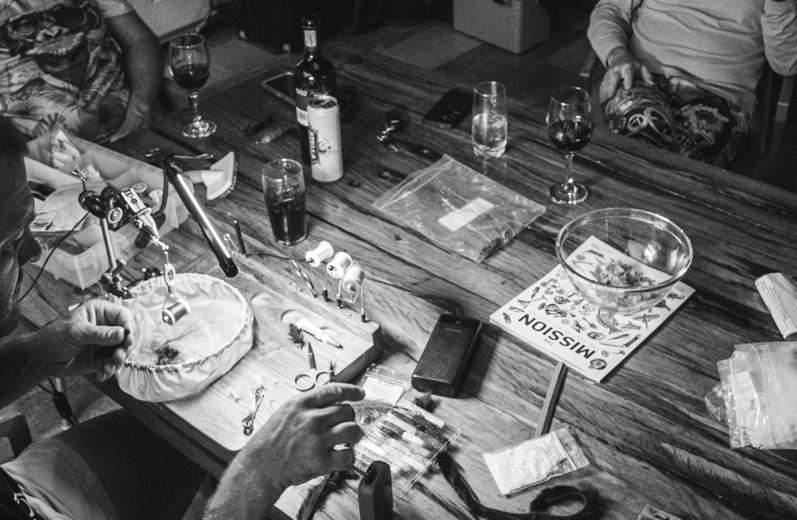
“IT’S A GOOD PLACE FOR MEMORIES.”
It sounds like you’re being buzzed by a Rock Kestrel. MSPs, that hook riding up streamer so beloved of largie fans - if you get one near your ear while casting at pace, it sounds like a tiny, angry raptor defending its nest. If you’re fishing short side on a boat, downwind of the drift, and afflicted with right-hand dominance, getting them danger-close to your head is unavoidable.
An MSP at the end of a modern fly line can hit 100km/h. Google it. It provokes a sharp, furry little scream. If you get them close enough you feel the hit before you hear the impact. Sometimes your shit casting means it’s the gunnel or the outboard cover or your boat partner who screams. Sorry Arno (Laubscher, owner of Scientific Fly)).
Mostly you connect with your own torso. It feels like you’ve been shot. I’m only ever fishing barbless from here on out. No exceptions. The size 4 B10S I pulled from my belly felt like a freebie from the fishing Gods, having stopped just short of the subsequently doomed barb. The size 2 (with 4.6mm tungsten dumbbells nogal) that Matt pulled out of my left kidney was nothing short of a threat.
Pinch that shit. Then cast a thank-you glance at the sky in response to your luck, flick your fly out, lift line, cast again.
There’s a trick to it, fishing for largies here. And, like a lot of tricks, it doesn’t really look like it’s going to work and it feels like a lot of the joke is propped up by hope alone. People love spouting the phrase “fish of a thousand casts”. Easy to scoff at when you’re hearing it over a beer, but you’re not at the bar now. Welcome to the suck.
You are going to cast, cast, and cast again. And then cast some more. And you’re going to cast with very few indicators that what you’re doing is in any way in aid of any cause whatsoever, other than burning through boat fuel and broadening the extent of your likely pre-existing connective tissue damage.
Invariably it’s going to take you a few shots to get your eye in and to get your shoulder, wrist, boat legs and line management to agree on some kind of interim GNU, but this is not the place to learn how to do those things. This is not a nurturing environment. You need to put 2025m casts five centimetres from the bank, ad infinitum, while also keeping your fly out of the rocks and away from your skull, and the line out from between your toes and out of the trolling prop and then stay sharp enough to actually do something about it if a fish does hit you.
I know all of this because I didn’t do any of this successfully and I suffered successive tough days out. It is largely a disaster from start to finish and, trying to keep your widely scattered shit together while the universe conspires against you, your angling becomes burdensome as the “golden hour” you woke up so early to meet, ticks swiftly by. They really do have a feeding window and, when it’s
gone’ it’s gone for the day. You start to limit your shots, not only because your tricep hasn’t fully recovered from your slew of mid-cast recovery attempts from the day before, but because you start to understand that accuracy trumps volume. Fewer flicks equate to fewer shit ones.
A gap between the boulders presents itself, a submerged tree sticking out maybe a metre to its right. The curve of the bay you’ve been peppering feeds your imagination on the idea of a prime ambush point for the largies between those rocks. A salad plate-sized target area. You miss, but the drift is slow enough that you have another shot in the same hole before your boat partner gets their try in the zone. Good cast, nice, for once.
A split second pause to get the MSP a centimetre or three down and for your left hand to find the line again. One big strip. Two. Nothing. A third, and marginally more exasperated strip, slams into a rock with a solidity that spells irretrievability. Fuck sakes. That’s streamer number three for the morning, maybe number seven for the trip.
And then, as calmly as a pipe bomb, the rock wakes up.
The physics jolts your brain sideways and you suffer a sudden hard rewrite of your understanding of hydrodynamics. Fly line shouldn’t cut through water that fast. The fish teleports ten metres to the right into the deep, almost certainly heading for some manner of structure. Your right index finger takes one for the team as you desperately try to pull line with your left while your right tries to point your rod in the opposite direction of the junkshow unfolding in front of you. Don’t bother trying to get it on the reel, there’s no time. The shock of the hit and the initial run bleeds into an inconsolable insecurity as the fight wears on. The quality of your hookset, the resilience of your leader, the calibre of your knots, everything is questioned. You finally get the fitful answer as you turn the fish’s head towards the boat a last time and the mesh quells your paranoia. Good Largie. Not a bus. Good though. Big enough to destroy your day if you’d dropped it. Big enough to celebrate landing it. Yeah, good Largie.
Last light on the last day cycles through the ritual spectrum of pastel skies. Almost time to head back to the launch. Lost my last good hopper on an average smallie, but landed the four that ate prior to that. Bored of 7-weight shenanigans I was picking off fish on a smaller stick, riding the coat-tails of Matt doggedly trying to wrestle out one last largie, slapping a hopper just off the bank in behind his streamer. Hilariously effective. They’re coming on now, but it’s time to go.
The long days prior already seemed distant as I break down the Beulah and sit down to roll a cigarette. It’s going to rain later.
Will I remember any of this when I’m old? I hope so.
It’s a good place for memories.
THERE ARE FISH THAT MARK YOU, THERE ARE FISH THAT SCAR YOU AND THERE ARE FISH YOU CAN NEVER FORGET. THEN THERE ARE THE FISH THAT TURN YOU INTO FISHERMEN. ED STODDARD RECONNECTS WITH A CHILDHOOD FRIEND IN THE CANADIAN ROCKIES AND MEETS TWO SPECIES THAT WROTE SIGNIFICANT CHAPTERS IN HIS FISHING STORY.
Photos. Ed Stoddard
The two significant fish that feature in my fishing story offer stark contrasts in size and style: one is a menacing torpedo with teeth, the other cuts a playful presence in the water with vivid colour patterns and a streamlined body capped by a sail-like dorsal fin.
For me, there is a fine line drawn between pike and grayling, a pair of cousins who long ago parted ways on their evolutionary journey. Both played outsized roles at formative junctions in my angling life. Decades later it was a pleasure to reconnect with them on tight lines in the wilds of British Columbia at the northern edge of the Rocky Mountain range.
In 1980, as an adolescent, during a month spent with an uncle and aunt in north-western Ontario, pike was the first sharp-toothed predator that I pursued. Fifteen years later in Lithuania, grayling became my passion as I emerged from my long, larval, spinning rod stage to sprout the garb of a fly fisherman. An opportunity arose recently to fish for both in the far north, an expedition hatched by my friend Ron who was a teenaged hunting and fishing companion in our native Nova Scotia. I decided to take the plunge and make the long trek across latitudes, time zones and seasons from my Johannesburg home.
We were hosted by Northern Rocky Adventures, a family operation with a lodge along the shores of Muncho Lake on the Alaska Highway. From that base we flew by float plane to remote waters flowing north to the Arctic Ocean. The flights, generally around 30 minutes in length, offered stunning views, testimony to the wilderness that still defines much of the Canadian landscape. Snow-capped peaks thrust from mostly evergreen forests of spruce and pine, sprinkled with ridges of aspen or birch.
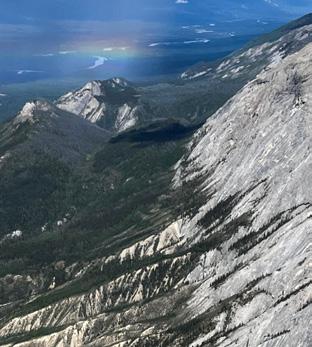
From our bird’s eye view, we saw moose on the edges of lakes and had a couple of sightings of mountain goats, their ivory coats standing out from ragged crests where snow had melted. In southern Africa, I have sought tiger fish on fly in waters teeming with hippos and crocodiles. These lakes and streams held no such terrors. But, on dry land, this is black and grizzly bear country while cougars and wolves prowl beneath the coniferous canopy. My friend Ron and his business associate Ogi, who hails from Mongolia, saw a grizzly one day on the shores of a lake near an outlet stream we fished. “I thought it was a moose at first, it was so big,” Ron said.
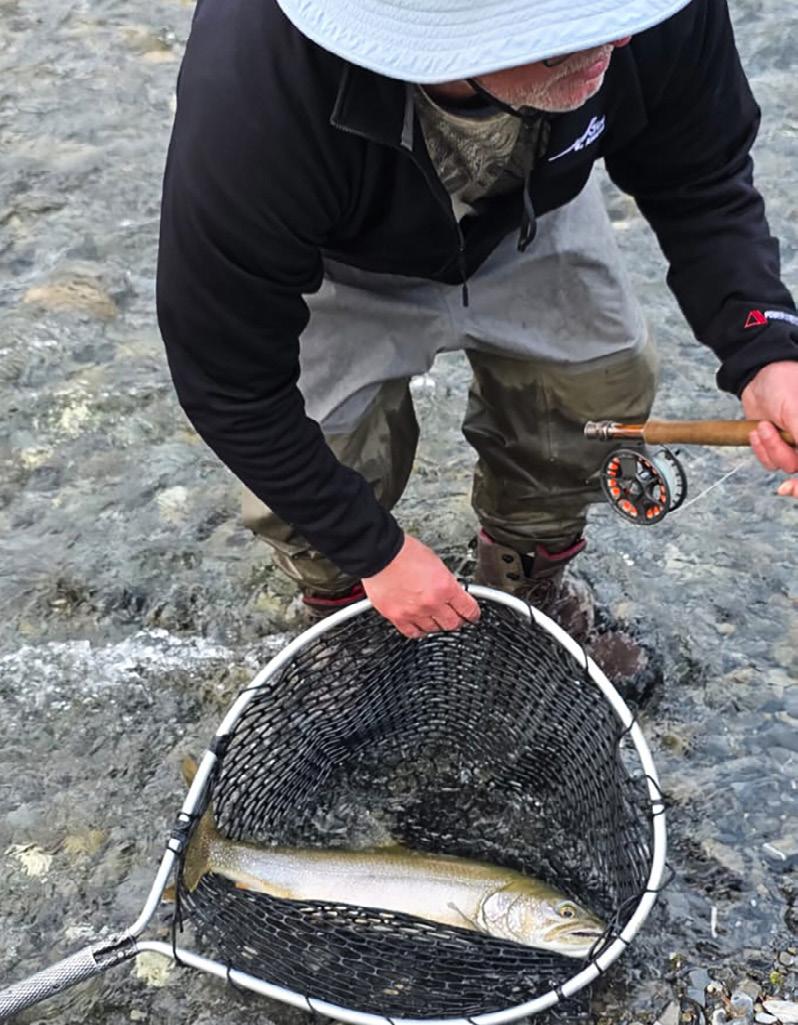
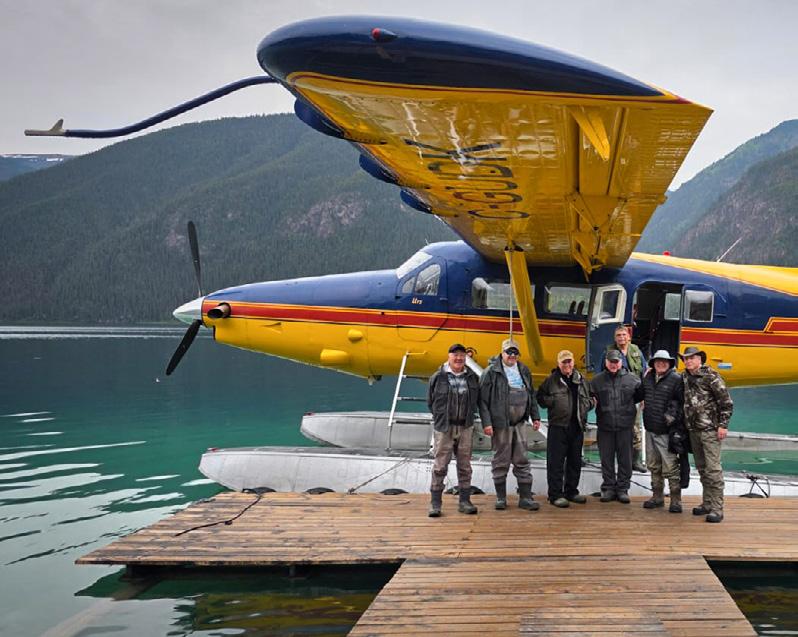
Two of the lakes we plied did have resident predators, but of the fishy kind - the northern pike. The biggest one I had landed in that youthful summer in Ontario weighed 9-1/2 pounds, taken on a spinning rod with a lure resembling a frog. It was long my crowning achievement as an angler. Forty-five years later and with a fly rod, I had bigger quarry in mind.
On day one of our expedition, we were after pike of various sizes in a gin-clear lake where we could sight fish. My weapon of choice was a 9-weight St. Croix I inherited from my late step-father Charles - a rod he bought in Johannesburg at the late Marshall Yelland’s shop in 2001.
It is well travelled and Charles had landed many Atlantic salmon with it.
The pike were mostly in the five-pound range and it was great fun to cast to them or, as you stripped line in, see one out of nowhere charge for the large, gaudy flies. These were attached to a thin steel trace, a rig I was familiar with from my tiger fishing expeditions.
Pike and tiger fish slice tippet like a hot knife through butter and although living thousands of miles apart, they have similar prey. Both are triggered by the same large fly patterns and clearly play matching roles in their respective
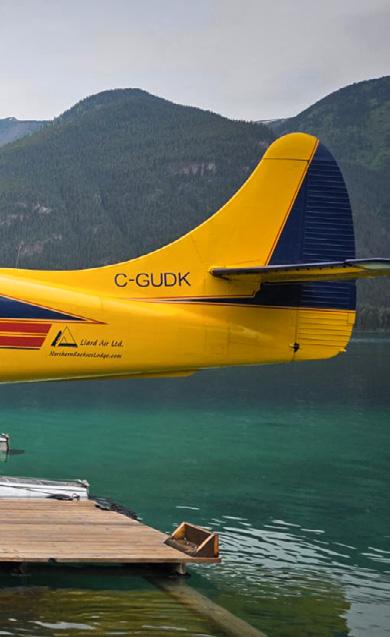
aquatic ecosystems - one cold and northern, the other warm and tropical. One notable difference was that the pike would take if the retrieve was stopped, while you need to keep stripping furiously to maintain the attention of a tiger fish. That may speak to the variance in visibility. The handful of waters where I have cast for tiger fish have been on the murky side.
Early in the afternoon we were casting close to the shore from our boat in an area with plenty of structure when there was a flash in the water and suddenly line was zinging at a frightful pace. Our guide, Daniel Schildknecht, caught a glimpse of the fish and reckoned it was not that big, and I
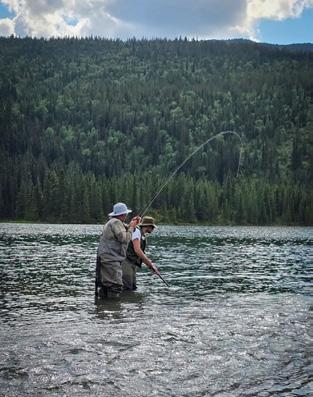
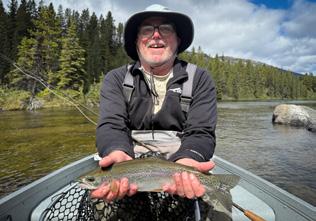
initially thought the same. The take was so fast that it was hard to get the measure of the fish. Five minutes into the fight, it was obvious it was a proper pike. At one point I managed to reel it within three metres of the boat and it briefly appeared on the surface - a glistening, coiled tube of muscle - then with a powerful stroke of its tail it surged away.
When I finally landed it, we reckoned it was in the 18 to 20-pound range - twice the size of my teenaged record. I was also scarred from this encounter. While holding the fish up for the obligatory photo, I accidentally thrust my right hand up into its gills, where the serrated rakers that lie within sheared my fingers.
“ARCTIC GRAYLING ARE MORE SPECKLED THAN THEIR EUROPEAN COUSINS, DAPPLED DAINTIES THAT WE REELED IN AGAINST A BREATH-TAKING MOUNTAINOUS BACKDROP.”
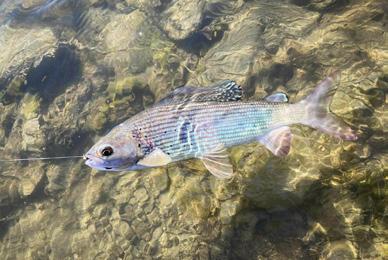
It was a rookie error. Daniel treated my lacerated fingers, applying anti-septic ointment and Band-Aids from his firstaid kit.
“You would have to be stupid to stick your fingers in a pike’s mouth,” was the matter-of-fact opinion rendered by Doug, a spritely American octogenarian and retired air force officer, who had come on the expedition with an old military mate.
The fish of one’s youth can cast a spell of enchantment that bubbles back to the surface in mid-life.
“... from when I was eight to when I was fifteen, what I chiefly remember is fishing,” recalls George Bowling, the hapless narrator of George Orwell’s novel Coming Up for Air. And pike were among the “coarse fish” he threw a line for with baited hook and fondly recalled decades later as he grappled with a mid-life crisis of note.
Day five of our expedition was also devoted to pike, but in that lake it was not a numbers game. We were after trophy fish. And the pike did not disappoint. I managed
to hook and land three whoppers, the biggest weighing in at around 30 pounds. We sight cast and trolled with our fly rods and in the transparent conditions the boat would glide over massive pike visible either lurking on the sandy bottom or swimming with purpose on the hunt. They looked almost pre-historic and smashed the fly like a Hilux bakkie.
The first one that tightened my friend Ron’s line destroyed his 8-weight Sage rod. It did not just break it. The rod literally exploded into shards. When he brought the fish to the side of the boat it suddenly dived under the hull, bending his rod in a way that would have tested the limits of a circus contortionist. On my first fish that day, he had suggested that the drag on my reel was too loose. Reserving comment, I did not offer my immediate view that his might have been too tight.
However, pike were not the only fish we were catching. Arctic grayling and trout were also “in the bag”. It was the grayling that brought me full circle to the first fish I fancied on fly. In 1995, while plying my trade as a hack stringing for Reuters in Lithuania, I joined a local fishing club. I was encouraged to dispense with my spinning gear to try my hand with a fly rod on a golden October day on the magical Merkys River, adorned with the scarlet leaves of autumn.
The two European grayling I landed that day are etched in my memory. A fish on fly is a totally different experience, in my case a transformative one. It was almost a spiritual connection and three decades later, it was a joy to catch the Arctic kin of the European variant on fly on a pair of streams, one running into and the other out of a lake.
Arctic grayling are more speckled than their European cousins, dappled dainties that we reeled in against a breath-taking mountain backdrop. I had caught dozens of European grayling on fly during my time in Vilnius in the Vilnya River which, literally, ran under the balcony of my modest flat on the edge of the city’s splendid Old Town. A brown trout would also on occasion take my fly. My grayling-to-trout ratio was about ten to one and, in the northern Canadian bush, I learned why.
“Grayling are not tippet shy,” Daniel informed me. As a novice in the art of the fly, I realise with hindsight that the leaders I used in my Lithuanian fishing phase were often on the short, thick side. Brown trout are warier in that regard. “I guess the brown trout you caught there were the stupid ones,” Daniel observed.
I was surprised that the wild rainbows and lake trout in this region were also not that tippet shy. Certainly in South Africa, my assumption has always been to go light on the leader and tippet.
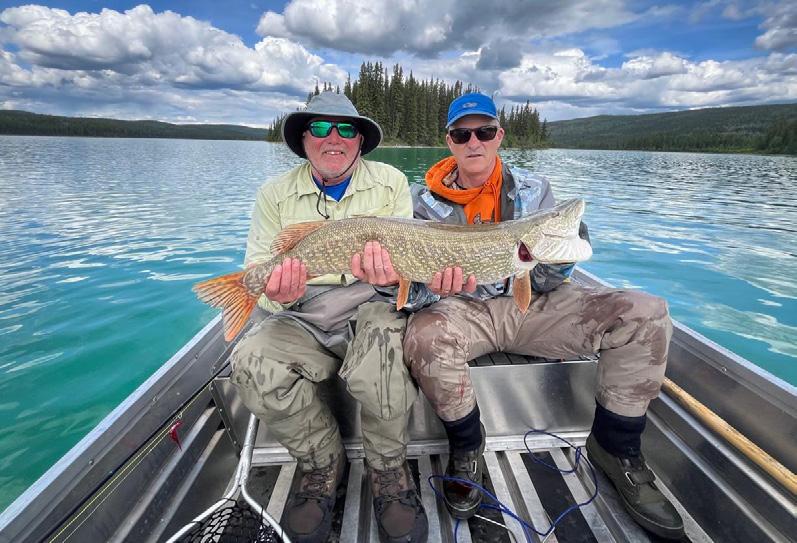
Catching rainbows in their native habitat and my native Canada for the first time had a special resonance, and these northern specimens just seemed to hit and pull harder, while their breaches from the water appeared more artistic. Perhaps that was my imagination running riot and romanticising the moment, but the stream of perception is the current of one’s reality.
On both of our “rainbow” days I took it as a promising sign that we saw rainbows from the plane shimmering over the mountains.
We were a party of four, my friend Ron and his business associates Pedro and Ogi. Four others were on this week-long adventure, including a middle-aged American couple from Massachusetts who now reside in Florida, Jeff and Patty. Jeff, a retired commercial fisherman, was delightfully foul-mouthed with a bluecollar, New England accent - he simply loved casting dry flies on the “wata”, usually preceded by adjectives not fit for print.
Doug and his mate Vern, also a retired US airforce officer in his 80s, completed our group.
A military man to the core, Vern would always address me as “Sir.” I once replied “Don’t call me Sir, I work for a living.”
Vern’s snappy response: “No you don’t, you’re a journalist!”
Northern Rocky Adventures is run by the affable Schildknecht family. Urs, a pilot with 50 years in the cockpit, and his wife, Marianne, immigrated to Canada from Switzerland in the 1970s. Their sons Daniel and Michael are also pilots and guides, and everything went like clockwork in an appropriately Swiss manner. We were always able to fly and there was scant turbulence.
The meals, like the fish, were big and delicious. We released the vast majority of our catch but kept a couple of pike and grayling for the table. The weather, while on the chilly side for late June, obliged, the daylight seemingly endless.
Back in South Africa there are angling opportunities galore. I am spoiled for outdoor choice in my adopted home. But I find myself dreaming of blue waters with pike and grayling, two species that spawned the passionate angler I have become.
A SOFT-SPOKEN STAND-OUT AND STALWART OF THE SECOND WAVE GENERATION OF SEYCHELLES GUIDES, CAMERON MUSGRAVE MIGHT JUST BE ONE OF THOSE BASTARDS WHO HAS IT ALL.
Photos. C/o Cameron Musgrave
That title, Cosmo Man, is something I have wanted to use for years in a profile featuring Cameron Musgrave. You see, I grew up in a magazine family. My mother worked in newspapers and magazines, from The Sunday Times to Fair Lady and Cosmopolitan. So it was no surprise I followed suit and landed up working in magazines like GQ, Men’s Health and Best Life. When The Mission got going and I heard of and started communicating with Cameron Musgrave, who at the time was head guide out at Cosmoledo in the Seychelles, my magazine upbringing filter and niche obsession with publishing world in-jokes, told me I had to do something with Cameron, that title and lampoon the idea of what a ‘Cosmo Man’ is. I even came close to organising a shoot with him as he was passing through Joburg a few years back. A fashion photographer (who happens to fly fish) volunteered to do a spoof photo shoot in studio (think Zoolander meets flats guide), but the scheduling didn’t work out and the window of opportunity was lost.
So, what the hell is a Cosmo Man anyway? In the Cosmopolitan magazine sense, it was the Ken to the Cosmo girl’s Barbie. The guy who got the girl, dressed well, knew the Kama Sutra, made all the money and had all the status (that imaginary men in the magazine phantasmagoria world seek). In short, the guy who had it all.
In real terms from the fly fishing world, Cameron is the Cosmo Man. While there’s a super-hero punchiness to such a title, you’d find few people who would contest his credentials as one of the ultimate saltwater Seychelles guides who, in the scattering of magic atolls and islands the Seychelles holds, has done it all. After over 17 years at the frontline, very few people can claim to know Cosmoledo, or the other wilder atolls and islands of the Seychelles like Farquhar or Providence better than Cameron does. To be clear, you would hear none of this from the man himself. Unassuming, soft-spoken, not drawn to the social media limelight, Cameron’s ego is firmly in check and the man is far too modest to make any of these claims. So I’ll do it for him.
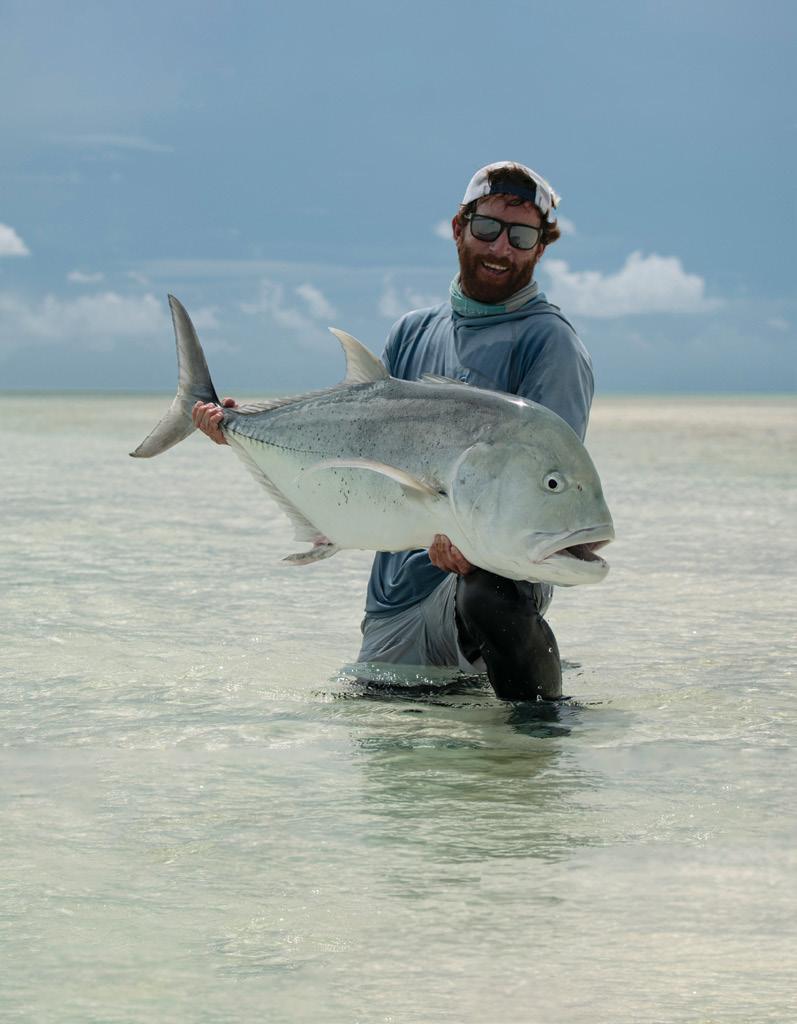
His beginnings in fishing started as it does for most of us, with his father. Growing up in the small seaside town of Scottburgh in southern KwaZulu-Natal, Cameron, his older brother Ashton and younger brother Bails (now a Seychelles guide too) spent quality time with their old man, Les, fishing the coastal gullies for blacktail and karanteen. While his dad was not a dedicated fly fisherman, the time spent taking his boys out to the rocks meant the fishing habit took hold fast.
“As we got older, our drive to fish outweighed his. But he was always encouraging.”
Before fishing skis became widely available, Cameron and his chommies were launching off into the surf on old lifesaving paddle craft. It was the kind of free-running, rough, physical exposure common to South Coast kids in the ‘90s and early 2000s, before helicopter parenting and screen time became pervasive. And it was out along the coastline that Cameron first encountered serious fish, the kind of catch that marks a young angler permanently.
The moment fly fishing properly took hold came in 1995, when Cameron was ten. A family trip to Zimbabwe included a visit to his uncle’s hobbyist trout farm. There was a condition attached to fishing the stocked ponds: you had to use a hook with feathers on it.
“I was oblivious to the fact that it was a holding pond with fed fish. I just loved it. That lit the fire.”
For his eleventh birthday Cameron received a Shakespeare 5/6-weight combo. A kid’s fly-tying vice followed shortly after. It’s here that I’d like to borrow the fast forward montage technique of film director Edgar Wright, renowned for spoofy British comedies like Hot Fuzz and Shaun of the Dead. Take the kid stockie-bashing in Zim, flogging his new rod and reel combo and tying flies and watch him hurtle forward in time.
Cast after cast, in stockie ponds, bass dams, in the shore break, through countless sunburns, passing out exhausted, having his first beer, first kiss, poaching water then running from landowners, playing rugby at school, fishing, fishing, fishing, arriving home after dark, matric dance, grinning for fish pics, high fives with mates, casting, casting, casting, catching, catching, catching.
Neither he nor his uncle would have had any idea at the time, but from breaking the seal in that stockie pond, Cameron was embarking on a mad fly fishing-obsessed trajectory that would eventually take him to the pinnacle of saltwater fly fishing: the Outer Islands of the Seychelles.
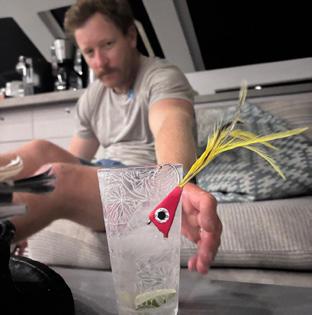
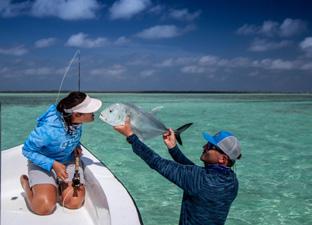
“HIGH FIVES WITH MATES, CASTING, CASTING, CASTING, CATCHING, CATCHING, CATCHING.”
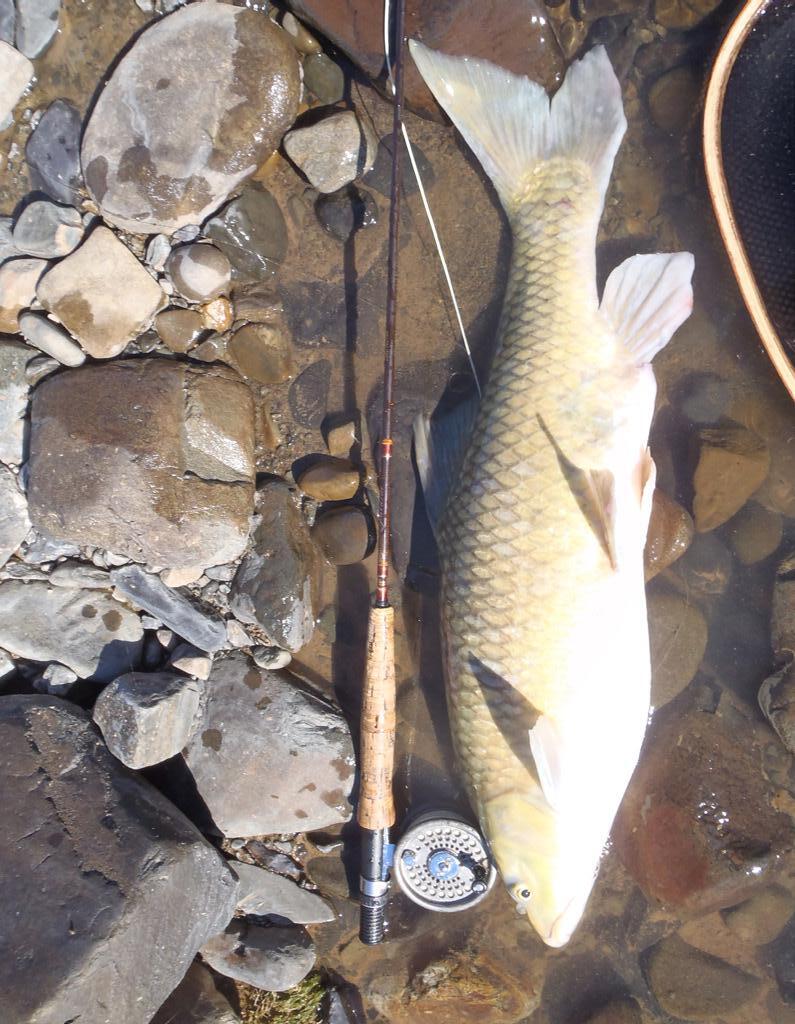
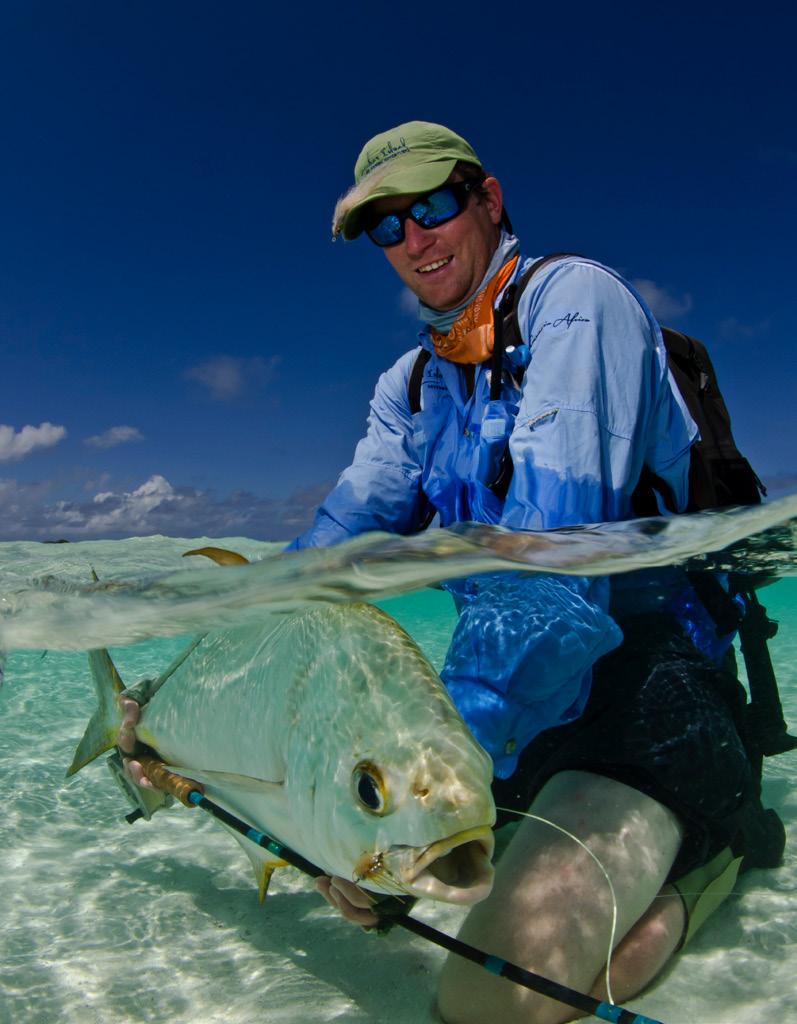
But first, he had to close a few doors before he could open his formative one in the Indian Ocean. After school, Cameron chose the University of Stirling in Scotland to study fishery science and aquaculture, staying on the fishing track, even academically. After university, wanting salt back in his veins, he was approached by Craig Thomassen to help build and run a lodge in Mozambique. The lodge was still under construction when he arrived, so the early months were a mix of physical labour and getting set up with the fishery. When guests arrived, it was mostly offshore conventional fishing, sailfish and dredging, with some fly work. It lasted around fourteen months.
“I had a small taste of what the guide role with guests was like. And I knew it was what I wanted.”
Back in the Eastern Cape, Cameron spent a couple of years on an abalone farm, applying his degree, managing people, trying to square the environmental circle. It didn’t last.
He says, “Despite their massive conscious effort not to have an environmental impact, there still was quite a big footprint. I felt like I was essentially part of the problem. And I was just managing people. It wasn’t exciting anymore.”
When an opportunity came up to interview for a position guiding for Indian Ocean specialists FlyCastaway, Cameron hopped a plane to Joburg and sat across from Keith RoseInnes and his then-partners with a simple proposition:
“Listen, I’ve never seen a bonefish. I don’t even know what a triggerfish looks like. I’ve never heard of permit. But I can fish, and I’m a quick study.”
He got the job. There was no Google, no social media background check. Just a handshake and a gut feel on their part that they had found a ‘good un who wanted it badly enough (“it” being whatever the Wild West of Indian Ocean flats guiding would throw at him).
His first proper flats season was supposed to be St Brandon’s, but the night before departure, the boat’s avionics failed and the season was cancelled. Just. Like. That. Cameron had already resigned from the farm, moved back to Natal, settled his dog at his parents’ place, and now was told not to come. He quickly got the farm job back and moved to the Eastern Cape to regroup. Eventually the next season came: Farquhar. The guests arrived on the same plane as Cameron.
“Are you fishing with us? Well... sort of, yes.”
In those days there was an offshore escape hatch. If the flats weren’t firing you could throw conventional tackle off the reef. Cameron used it wisely. And somewhere on that first Farquhar season, on St Josephs atoll around 2010, he caught his first permit.
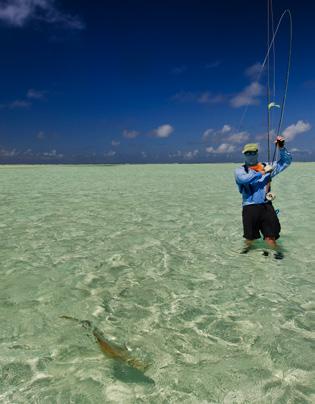
“SOMEWHERE ON THAT FIRST FARQUHAR SEASON, ON ST JOSEPHS ATOLL AROUND 2010, HE CAUGHT HIS FIRST PERMIT.”
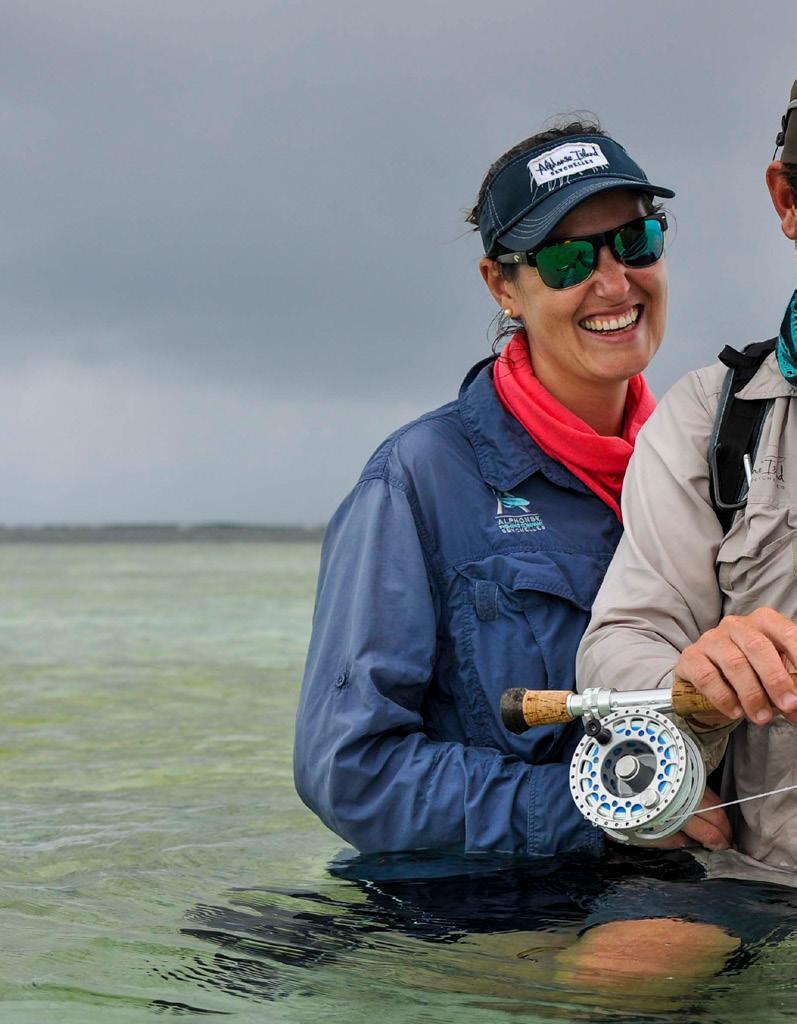
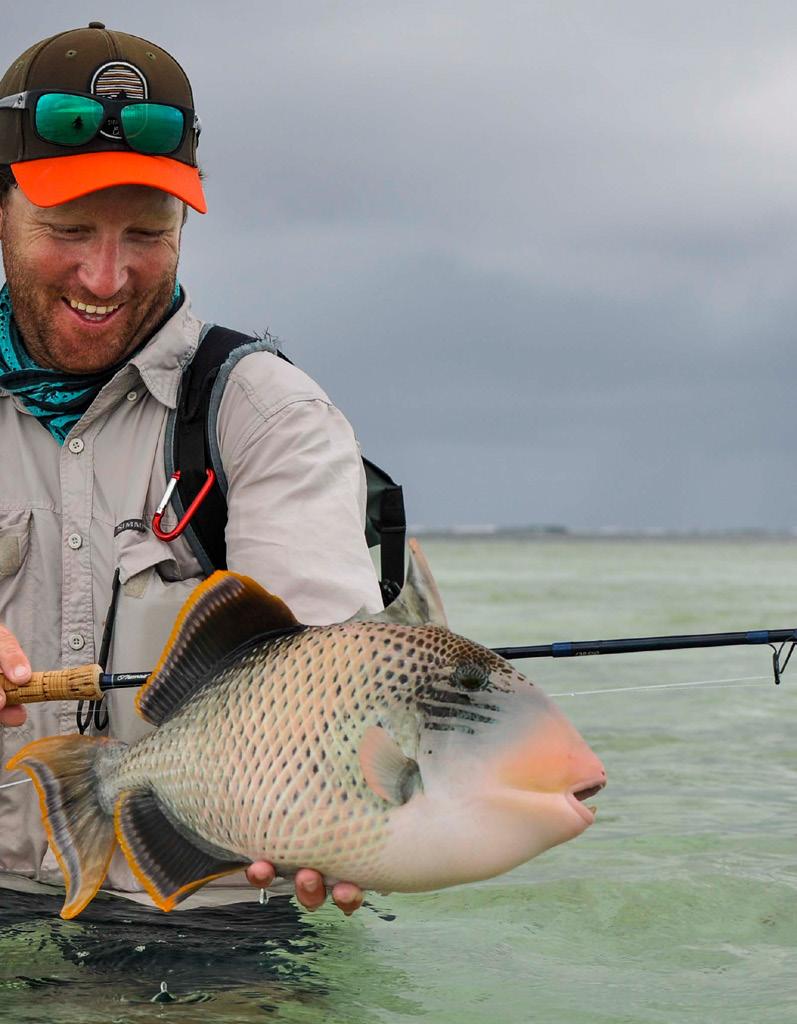
“IT’S NOT ALWAYS ABOUT THE ACTUAL FISH BUT RATHER WHO I SHARED THAT MOMENT WITH THAT MAKES IT MEMORABLE FOR ME. HAVING GABBY WITH ME ON THIS YELLOWMARGIN WAS SPECIAL.”
After Farquhar and the FlyCastaway split that saw Keith Rose-Innes head off to work with Alphonse Fishing Co. and the Collins clan, Cameron went to Des Roches with Keith for a full year, lifting up a fly fishing programme that had underperformed under previous operators. Then in 2013 the piracy ban was lifted in the Seychelles, Keith and Murray Collins secured the concession for Astove and Cosmoledo, and Cameron was there from day one. What followed was roughly a decade of building, pioneering, migrating between islands as seasons overlapped. Alphonse was the base of the operation. They set up Astove and launched it. Then it was on to Cosmoledo, which became the centre of his guiding career.
Over at Astove early in that chapter, heading the programme, Cameron and the legendary Seychellois veteran Serge Samson had a day off. Earlier in the week, guiding, they’d watched big GTs smashing baitfish just over ‘The Wall’, the dramatic drop-off along Astove’s reef edge, without managing to hook up. On their day off, they went back.
“After a broken fly line or two,” he says, “I finally managed to land that GT with Serge’s help. First GT over The Wall. Those are the moments that stay with you.”
Cosmo is where Cameron spent the most time and experienced his most formative years. It is, he notes, smaller than people assume, comprehensively fishable across a month-long tide cycle, which means to excel you have to know it very well.
“Stu Webb and I wouldn’t just say ‘we fished this flat to this bommie.’ We’d zoom into Google Earth and identify a specific tight ledge. You need to stand right here, on a pushing tide. Tide-specific, time-specific, location-specific - that’s how those spots were found.”
Those spots, established in that era of painstaking cartographic obsession, are still being used by the guides who followed. And some of the fish that came from them are the kind you carry for life. His biggest permit, landed at Cosmo with Dave Marshall and James Topham, fell on what happened to be Topham’s orientation day.
“Hard to forget your biggest permit. It wasn’t measured because measuring permit wasn’t a thing in those days, but I’d guess low 70s. It was Jamoe’s training day on Cosmo...”
Then there was the Bay of Plenty. A spot he and Stu Webb had been puzzling, drawn back by reports of monster GTs moving through an area they hadn’t fully figured out yet.
“Stu and I were trying to unlock that area. We’d seen some monster GTs there. This was the start of it all, the catalyst for understanding how and when to fish it. And it’s not every day you get a double-metre-plus fish grip-and-grin with your best mate. Mine was 4cm bigger, just for the
record. To Stu’s credit, he put in a lot of work in that spot afterwards and was rewarded with a 140cm, which he guided.”
Not quite misty-eyed, but close enough, Cameron gets wistful talking about what for him were obviously the good old days. Camaraderie, friendly competitiveness, the insane amount of hard labour and fishing R&D work they put in - it was the guiding brotherhood that made that Cosmo era special for him. When talking about that core guide group: himself, Dave Marshall, Stuart Webb, Ollie Thompson, Brandon Poole, Angus Forsyth, Sean Jacobs, and Alex Quatre - Cameron is at his most animated.
He says, “That bond was special because we were there for so long together, and because we went through some gnarly shit. Cyclones, weeks of poor fishing, managing guests when the ocean refuses to cooperate like red crab events. Those things build something that’s hard to replicate.”
The red crab event is one of those phenomena that tests the mettle of any guide team. A massive migration of ocean-going swimming crabs, hundreds of thousands of them, moves through the atoll, drawing every predator off the flats and onto the open water. It can last days. Proper Nat Geo or Attenborough Blue Earth material, Cameron calls it, genuinely spectacular from a natural history standpoint. But from the guiding side it wasn’t ideal: “When you’ve got the owner of Real Madrid on the boat and there’s nothing on the flat, you have to manage those expectations very carefully.”
The fish of Cameron’s lifetime came not during a guided session but on Christmas Eve 2019, with his wife and his best mate. A 135cm GT, which The Mission has already run the full story on in issue 20 (“Dear Santa”).
“AFTER A BROKEN FLY LINE OR TWO,” HE SAYS, “I FINALLY MANAGED TO LAND THAT GT WITH SERGE’S HELP.
FIRST GT OVER THE WALL. THOSE ARE THE MOMENTS THAT STAY WITH YOU.”
Cameron’s current Seychelles playground, Providence, is genuinely large, which means it rests well and still holds secrets. His last season there produced what he describes as a real breakthrough.
“We unlocked unbelievable stuff. It re-energised me completely. Having that ability to still find new fisheries within a destination you think you know. That’s what keeps guiding compelling after seventeen years.”
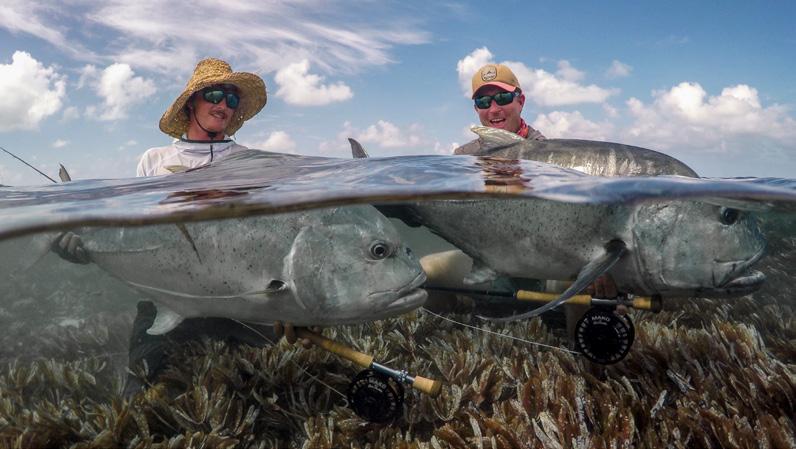
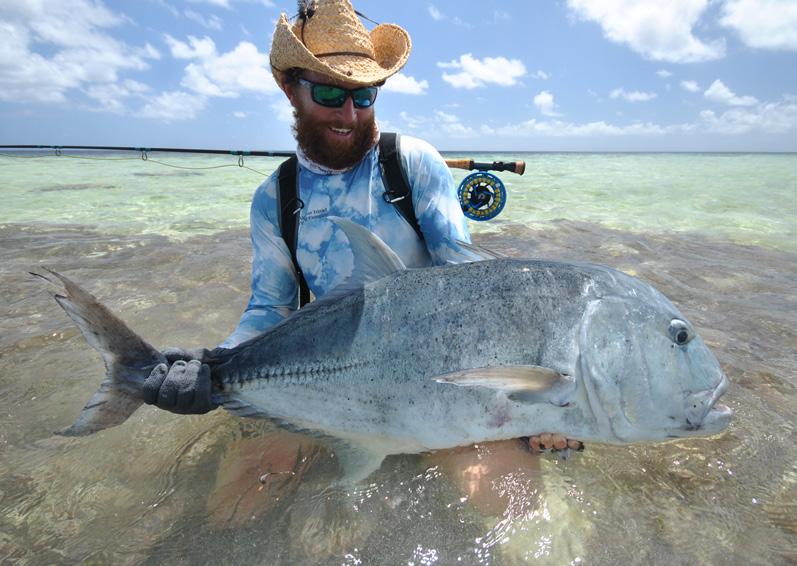
“THAT FISH WAS CAUGHT ON THE 24TH DECEMBER 2019 WITH GABBY AND STU. PROBABLY RIGHT UP THERE WITH THE FISH OF MY LIFETIME.”
I’ve interviewed a few older Seychelles guides over the years and in a slight Monty Python-esque style they are prone to harking back, “When we were young...” comparing how hard they had it to how soft things are for the guides of today. I think there is something to be said for the second wave of guides like Cameron and his cohorts who overlapped with the grizzled veterans and have trained today’s lighties. On that, Cameron speaks with real clarity about the layered history of how the Seychelles flats fishery developed, and his own place within it. The earliest pioneers, Keith, Jako, Tim, Arno Matthee, Wayne Haselau etc and the Indian Ocean Explorer days, worked without skiffs, in fisheries of extraordinary abundance. They laid the foundation. What came in the middle layer, proper flats skiffs, quiet motors, polling platforms, poles, evolved fly patterns, drone imaging, is the era Cameron was central to.
“Those early guys didn’t need to explore because there were so many fish, so close. As things get harder, you have to figure it out more deliberately. And that’s fine. It keeps it interesting.”
His younger brother Bails has come into guiding now, and Cameron is conscious of what that means. He has made sure Bails understands how quickly the body can go. The thing Cameron calls ‘guide’s back’ is real: colleagues from his generation like Kyle Simpson, Stu Webb, Scoty de Bruyn, plus the longer-serving veterans like boss/ mentor Keith Rose-Innes, are all carrying the cumulative damage of years of boat-driving in heavy swell, pushing poles, hauling gear. Think of the illustration of the ages of man from ape to neanderthal and then Homo sapiens and somewhere on the far right of the evolutionary arc, hunched over in pain, is the saltwater flats guide. Cameron’s own back gave out badly enough two years ago in Providence that he had to fly off the island for two weeks and bring in a replacement.
“I couldn’t do it to the guests, not being able to guide at a hundred percent. So I flew off. The Seychelles is always a bit of a ‘hope for the best’ situation with my back. I just kind of stick it together with bloody sticky tape and keep going.”
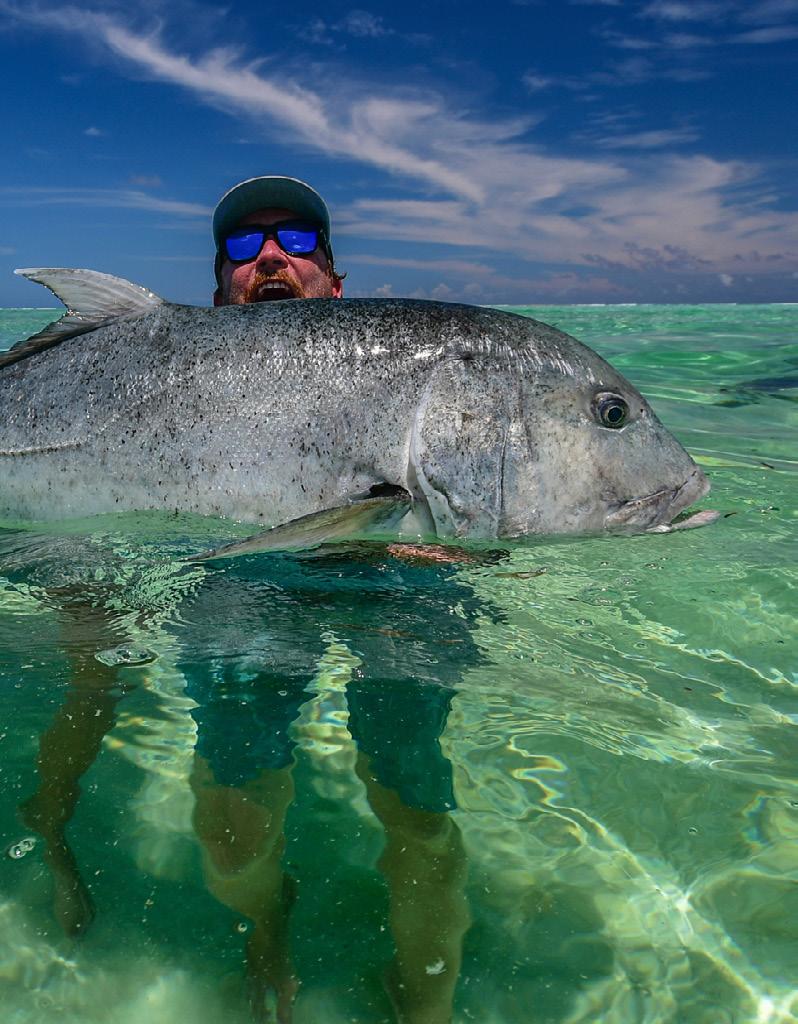
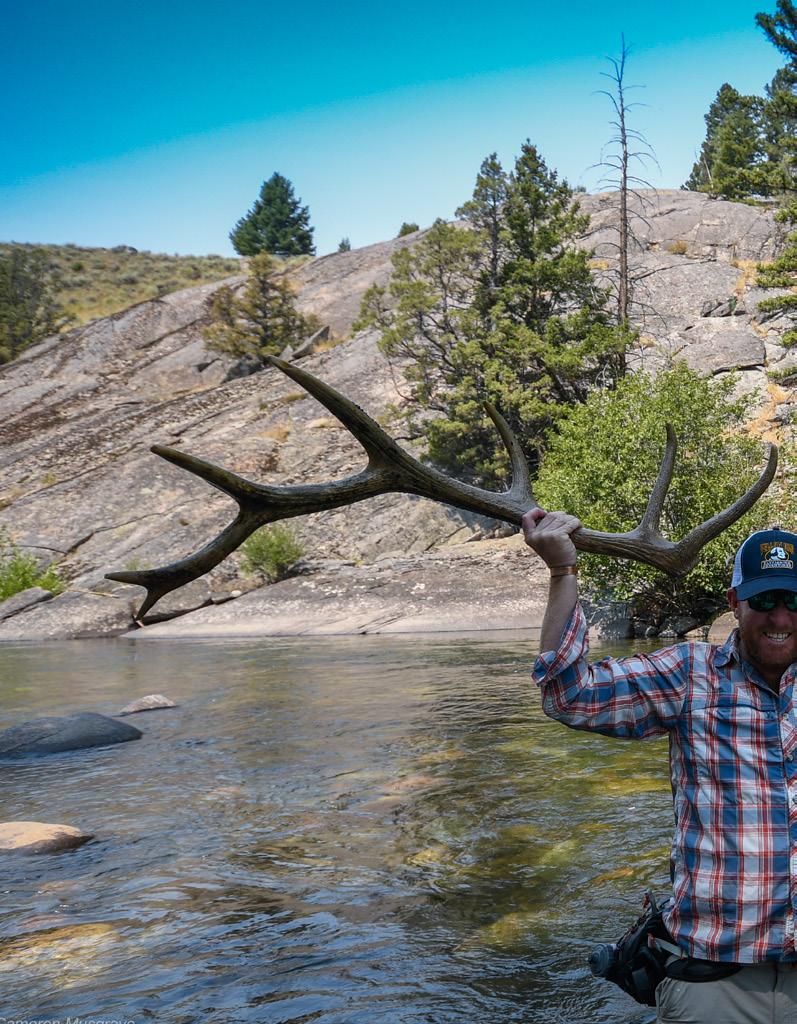
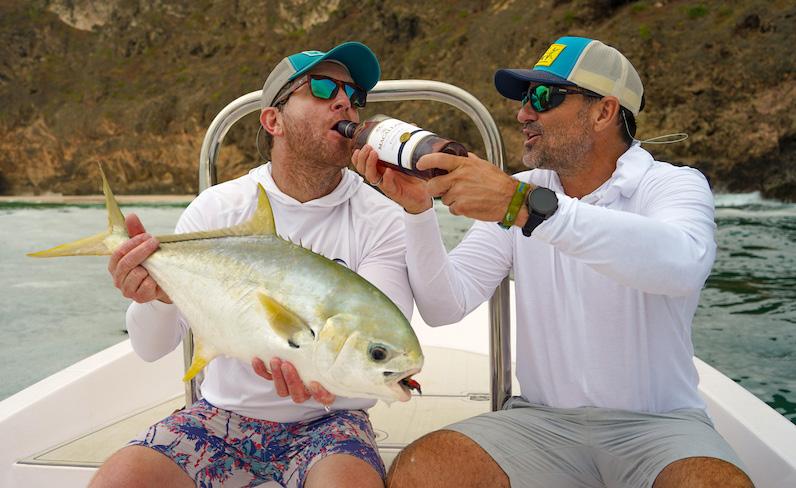
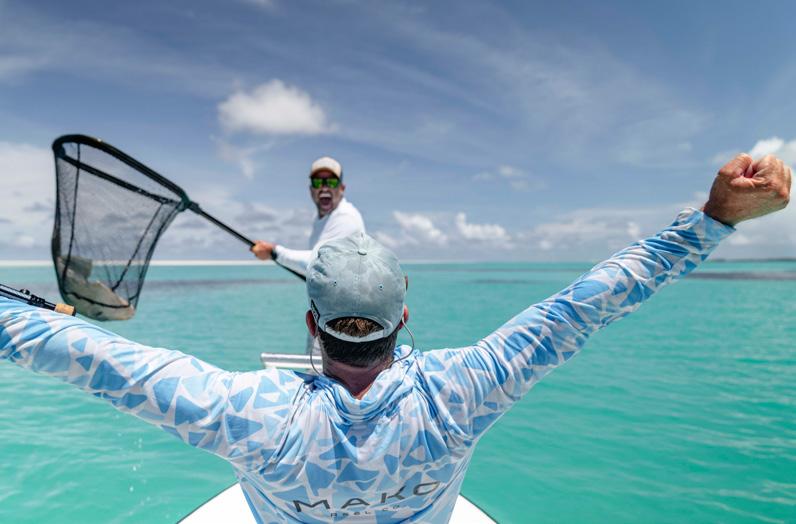
Seeking both physiological longevity and a different latitude, for the last three years Cameron has also been part of Peter Ripon’s guide team in Iceland, where the UK-based operator has the lease on a lodge and twentyone kilometres of river. To say that salmon guiding is vastly different from guiding the flats would be an understatement.
“It’s not like looking for sharks and rays on the flats, managing a pushing tide, launching your skiff through a wave, hitting bommies, missing turtles. Salmon fishing is comfortable. You get in your nice SUV with heated seats, fish the beat, drive back to the lodge for a beautiful lunch. It’s certainly not the Seychelles from an adrenaline point of view, but I still get the satisfaction of guiding guests into great fish.”
But on his off days, in the small tributaries off the main salmon river, armed with a five-weight, stalking sea trout in pocket water barely wider than a room, he has found his Iceland. And something else entirely happened in one of those tributaries, higher upstream, below a small waterfall where Cameron had gone targeting big browns and sea trout. He hooked a salmon instead. A 79cm secondseason-run fish landed on 8lb tippet.
“That fish literally brought me to tears, given the circumstances of the environment and the tackle used.”
About two months before this interview, Cameron registered Brushfly Outfitters. The plan is to step back from committed front-line guiding and move into hosting: taking clients to the destinations he knows cold, plus the ones he has always wanted to fish himself, like. Mexico, Bolivia and Patagonia. He has Providence for another season or two while the business builds its legs.
“I’ve got enough of a name globally, and enough loyal clients, that I’m not reaching into the dark. It wasn’t cold calling. It was a WhatsApp: ‘Hey, this is what I’m doing.’ And the response was great. Operators have welcomed me and clients have backed me.”
Going through his image archive we saw a ton of shots with people celebrating, usually with a drink in hand. Outside of fly fishing you might think this is just a crowd of heavy boozers, but the reality is Cameron has been there for so many people on what for many anglers is the happiest day of their lives (apologies to their children). It makes perfect sense that as he embarks on a new chapter they’d want to join him anywhere else on the planet for more of that crack (or craic).
The split-season structure running currently, Seychelles from January to March, Iceland from June to September, home in between, is also a deliberate restructuring. Gabby works as a school teacher in East London. Their first child has arrived. The six-month island stints of earlier years with a crew of fellow feral guides are behind him. It was time for a change.
“I WANTED TO TRANSITION INTO A SPACE WHERE I’M STILL DOING WHAT I LOVE, BUT HOME MORE FREQUENTLY.”
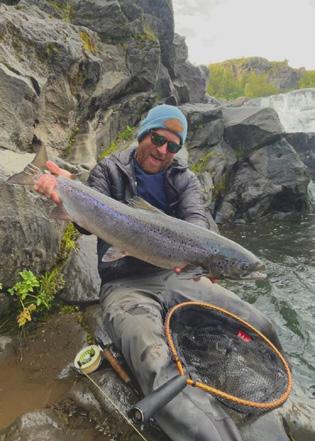
“I wanted to transition into a space where I’m still doing what I love, but home more frequently. Two or three months at a time rather than six months away. It doesn’t feel like those massive long distances anymore. That was tough on her. And on me.”
To be clear it’s just the where, the how and the when he’s changing up, not what makes him tick. One of the most well-travelled saltwater guides of his generation, Cam the Cosmo Man has caught everything the Indian Ocean could throw at him, built a lasting reputation with his labour on the flats, found love and started a family, and is now building the next chapter on his own terms.
Talk about having it all.
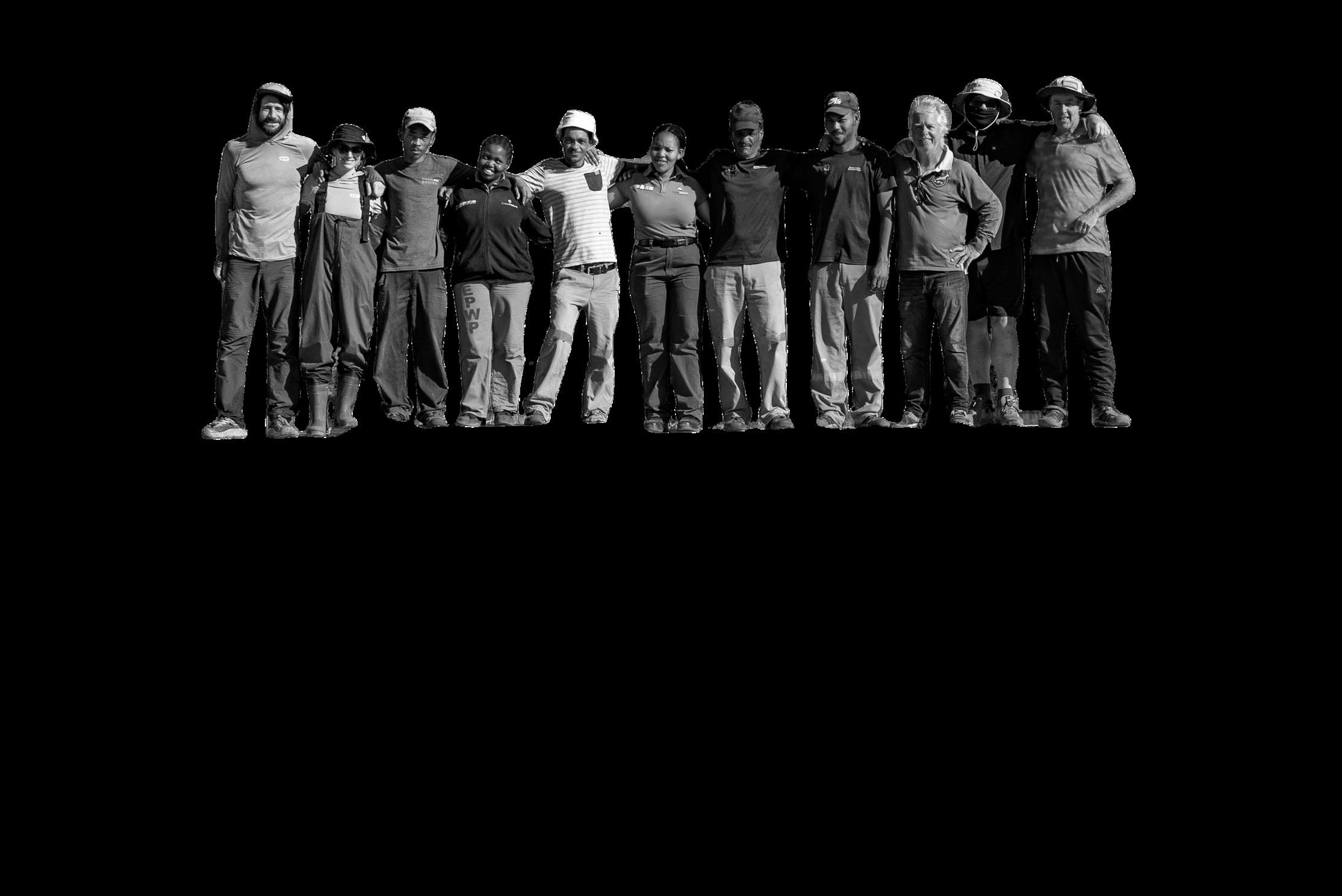
g e t g e t c o n c o n
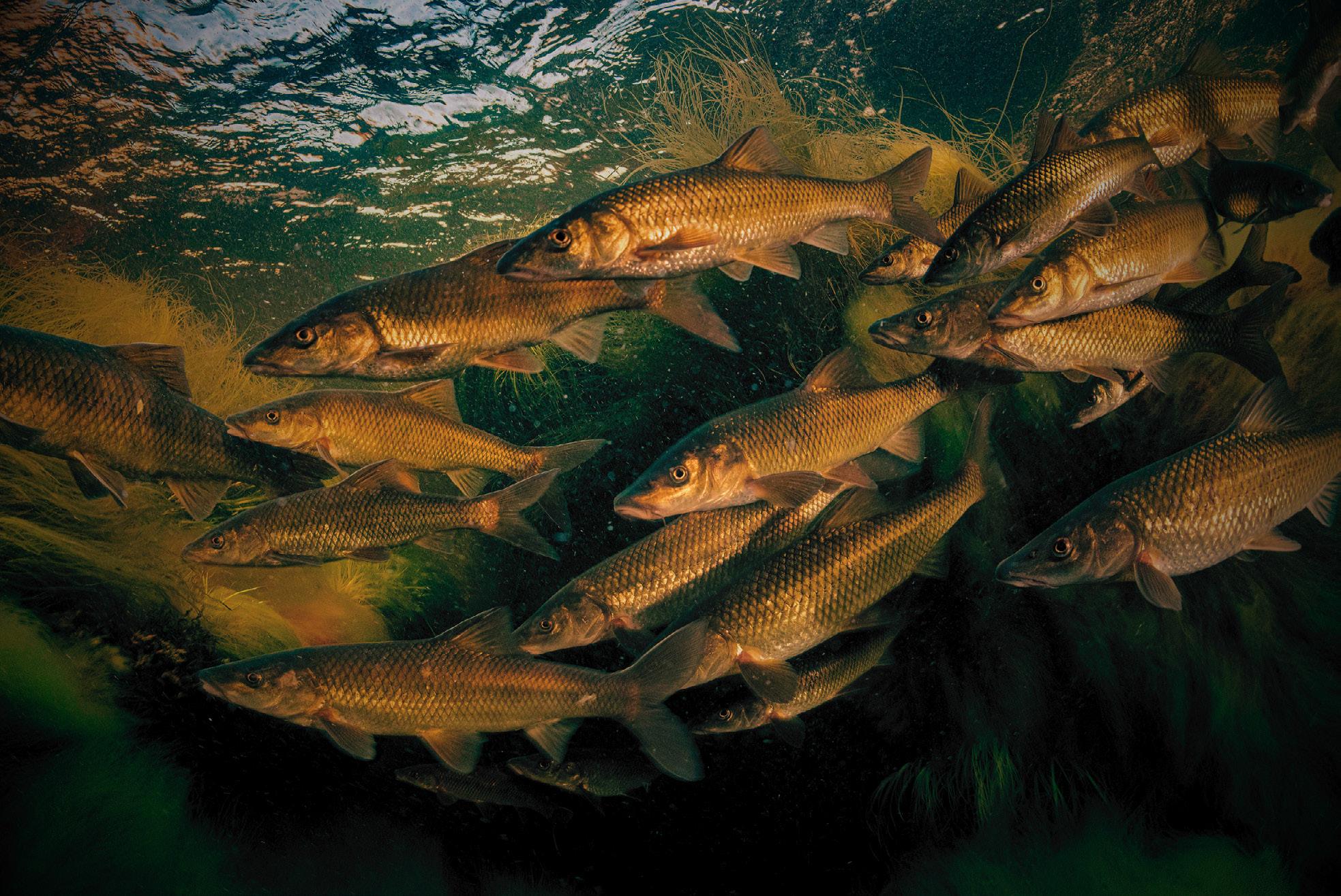
R e s to r i n g
R i v e r s
s a v i n g
s p e c i e s
C O N N E C T I N G
C O M M U N I T I E S
t b e h i n d t b e h i n d l o c a l f i s h l o c a l f i s h
s e r va t i o n s e r va t i o n w h e r e i t w h e r e i t
m a t t e r s m o s t
m a t t e r s m o s t
c l i c k
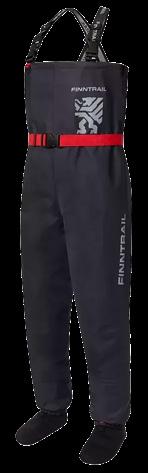
There’s a lot to be said for choosing the right tools for a job and overkill is a real thing. Take waders for example. Unless you fish in really extreme conditions, you probably do not need a pair of heavy duty waders, as much as you might think you are super hardcore and want them. For the vast majority of your fishing, especially for citizens of the mostly temperate winters of Mzansi, a pair of waders like the Finntrail Timber 1538 is just the ticket. The lightest wader in Estonian brand Finntrail’s range, the Timber is built for anglers who want to move. The build includes a 4-layer HARD-TEX membrane with Teflon coating that handles the waterproofing and wind protection, rated to 17,000mm, while staying genuinely breathable. The ergonomic knee cut means you can cover ground at places like Thrift, scramble in and out of tight kloofs, and not feel like you’ve run a half marathon before you’ve made your first cast. Stockingfoot lightweight neoprene socks, adjustable upper volume, elastic suspenders, an internal zip pocket, D-rings, and fully sealed seams round out the spec. finntrail.com
We love that there are people put on this earth to devise ways to make sweaty-ass casting in the tropics a more pleasurable experience. A few of those worker elves threw themselves into the R&D on this tech-savvy shirt from Orvis. Retaining the same lightweight, non-clingy yet breathable fabric as the original, the upgrades come in the form of reworked pockets for secure storage, and more ventilation to ensure you don’t platz from heat stroke. Throw in UPF 40 sun protection, three bungee cords (one pr sleeve for rolling them up and one on the chest pocket for tools and sunnies), plus built-in odour control so people don’t turn up their nose at you like Dar es Salaam’s fish market on a Sunday - and you have a winner. Available in men’s and women’s cuts. orvis.com, flyfishing.co.za
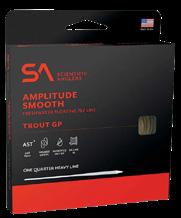
If you’re in the market for a smooth operator troot line as we head into winter in the Southern Hemisphere then you should probably get your paws on Scientific Anglers’ Amplitude Smooth Trout GP. A versatile mid-length head taper designed for the all-around trout angler, this line’s quarter-size-heavy design loads rods quickly and efficiently. At the risk of sounding utterly redundant, it’s a caster’s line, excelling at medium to long-range presentations where accuracy and mending control are essential. Scientific Anglers’ ultra-slick coating and braided multifilament core deliver smooth shooting and reliable handling across whatever freshwater trout (and most yellowfish) conditions you test it on. scientificanglers.com, frontierflyfishing.com
“A SMOOTH OPERATOR TROOT LINE.”
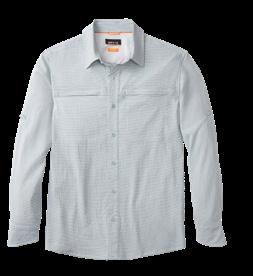
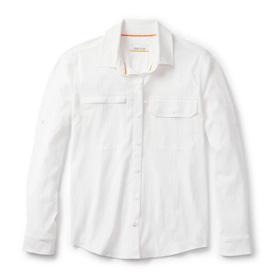
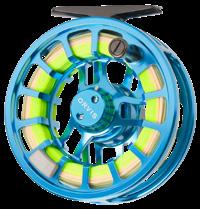
The Hydros was already doing blerrie well. Over-achievers Orvis have gone and made it better anyway. In this new iteration, you can expect a fully sealed end-to-end drag that laughs through its nose at grit and grime, a tool-free left/right retrieve conversion, and a drag knob ergonomic enough to actually use with cold hands at 6am. A type II anodized aluminium frame and spool, machined aluminium handle, and a larger arbor for faster retrieval complete the new spec. Available in three sizes covering lines 3-9.
“FULLY SEALED END-TO-END DRAG THAT LAUGHS THROUGH ITS NOSE AT GRIT AND GRIME.”
Instead of simply wrapping your hands in fabric and hoping for the best, with the Sol Tropics Skwala replaced the fingers and palms with low-profile elastic straps. Does that make these the bottomless chaps of sun gloves? Perhaps, but we are all for it if it reduces weight and keeps your palm and fingers in better touch with the rod and line. 40+ UPF, antimicrobial finish, same ultralight polyester knit as the Sol Tropic Hoody. skwalafishing.com, wildfly.co.za
More grunt you say? When your casting is beset by the usual frenemies - heavy wind, large flies, long shotsthen there’s a good chance your regular go-to rods are maxxing out (or outmaxxing if you are a colossal bell-end like Clavicular). If that sounds familiar then Sage’s latest R8 variant, the Power R8, is designed with you in mind. Taking the Revolution 8 tech of the R8 Core range and dialling it all the way up to eleventy, these rods are extremely fast. Available in eight models from a 590-4 to a 990-4 (with two fighting butt options), there’s an R8 Power designed for anything from technical five-weight fishing to bigger game fish in the salt. Smaller models feature either snubnose, half-wells cork handles, with full wells handles on larger models. farbank.com, frontierflyfishing.com
More supple than your pilates-lovin’ mum and stronger than your pig iron heftin’ pops, Rio backs their Powerflex Strong as the best nylon trout tippet out there. 30-yard spools and in three half-sizes, it has an extremely high strength-to-diameter ratio specifically formulated for increased suppleness and supreme knot strength. Long story short - you’ll be hard pressed to find better nylon tippet. farbank.com, xplorerflyfishing.co.za
“INCREASED
SUPPLENESS AND SUPREME KNOT STRENGTH.”
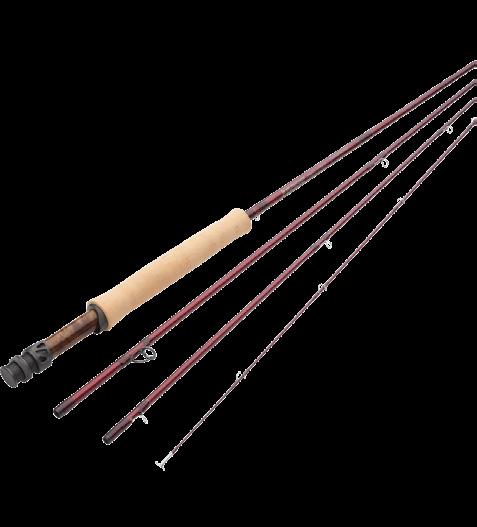
The big drawcard on these premium waders from Skwala (pronounced “squalor” we think, but with a Ben Affleck Boston/Southie accent) is a magnetic drop-top that flips you from chest-high to waist-high without any farting about, which means you’re not stewing in your own back juices by lunchtime (mmm, back juices). The rest is proper gear for the hard wading set: buckle-less shoulder yoke with concealed G-hooks, fourchette leg seams and an athletic cut that move like trousers, plus 4mm neoprene booties lined with antimicrobial jersey so the whiff of your wading boots doesn’t get you labelled a social biohazard. Light, tough, and built for fishing hard all while staying comfortable. skwalafishing.com, wildfly.co.za
“LIGHT, TOUGH, AND BUILT FOR FISHING HARD ALL WHILE STAYING COMFORTABLE”
Redesigned and built specifically for salt, the Predator Salt does not mess about. The Nano Resin graphite blank distributes force throughout the rod for a smooth stroke, genuine accuracy, and enough backbone to put serious pressure on serious fish. The hardware is built for the environment: chrome-plated stainless steel guides that resist corrosion and keep line moving fast, a fully anodized
Oh herrow! Sage’s new range of Arrow rods appear to answer any freshwater question you might care to ask. Ant-sipping smallies at Sterkies, small stream troots in the Western Cape or KZN, larger fish in larger rivers smashing streamers, you name it. Featuring the same KonneticHD tech that Sage sports in their X series, you can expect both power and feel in their fast-action blanks. Available in 14 (yes you read that correctly) models in a classic flint-coloured finish, whatever the flavour of your fishing, these beauties know how to sate your hunger. farbank.com, frontierflyfishing.com
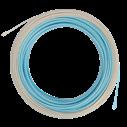
Built for the flats - specifically, the moment a permit materialises out of nowhere at 20 metres in a 25-knot headwind and you have about four seconds to not stuff it up (and have your guide glare daggers at the back of your pip for the rest of the day). Airflo’s Ridge 2.0 technology cuts friction and improves shooting for more distance with less effort, while a translucent intermediate tip sinks the fly into the strike zone without putting fish down. The Flats Universal taper handles wind and turns over bigger flies, and a low-stretch Power Core means you feel everything and miss (almost) nothing when it’s time
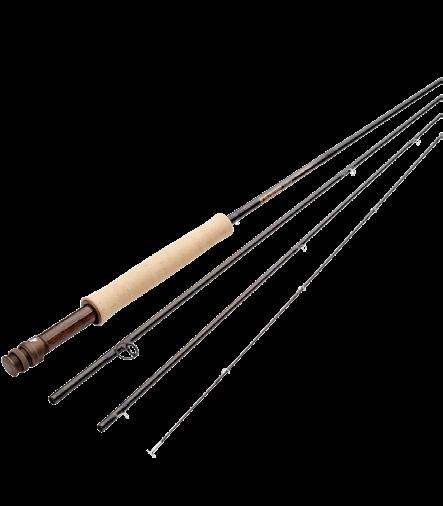
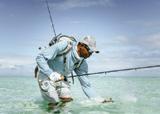
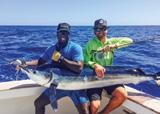
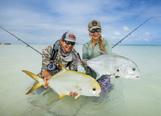
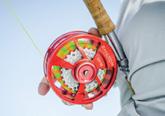
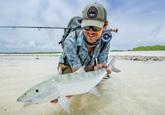
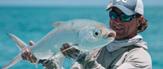



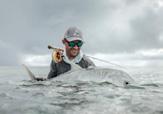
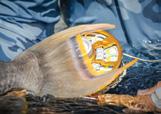



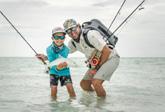
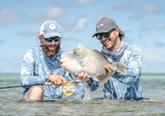
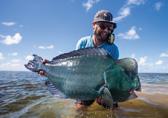




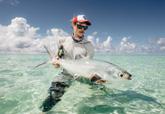
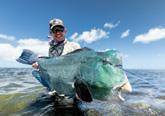


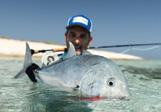
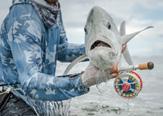



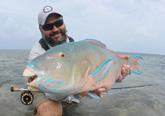
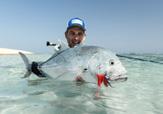
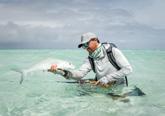
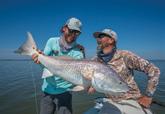
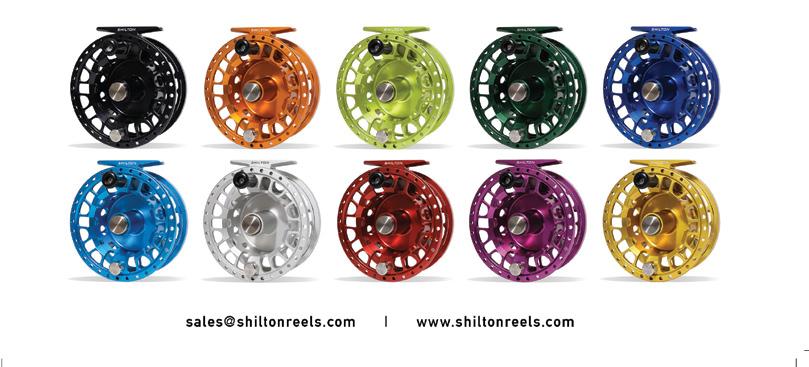
shiltonreels.com | sales@shiltonreels.com
“WEATHER-RESISTANT, PROPERLY TOUGH, AND BUILT TO SURVIVE BAGGAGE HANDLERS WITH UNRESOLVED ANGER ISSUES.”
Skinny, yet hard as nails, like the lovechild of Iggy Pop and Paddy Pimblett, Sage Shift LT reels have had as much excess machined from the frame and spool as possible, reducing weight without compromising strength. Featuring Sage’s sealed carbon SGS Drag System, a ported aluminium handle, an integrated counterweight and twice the drag adjustment resolution of the Seattle-based brand’s standard Shift reels, these premium workhorses are available in 3/4, 5/6, 7/8 and 9/10 iterations. farbank.com, frontierflyfishing.com
YET HARD AS NAILS, LIKE THE LOVECHILD OF IGGY POP AND PADDY PIMBLETT,”
Weather-resistant, properly tough, and built to survive baggage handlers with unresolved anger issues, this is the bag that goes where fishing takes you, swallows everything you throw at it and doesn’t complain. The U-shaped main compartment opens wide, with mesh zip pockets on the lid for the small stuff you’d otherwise lose forever, and an exterior zip pocket for what you need without digging. A padded bottom panel keeps everything from getting battered from below. Carrying options vary: padded removable shoulder straps, webbing handles with snap closure, haul loops at either end for linking bags, and daisy chains for lashing extra gear to the outside. Made from recycled materials throughout, with DWR finish on both fabrics. patagonia.com, xplorerflyfishing.co.za
Walking the walk as well as talking the climate change / material sourcing talk, Patagonia’s shweet Uprisal Hoody is made with 100% recycled fabric (from fabric scraps to recycled bottles), reducing their reliance on virgin raw materials. And, it’s made in a Fair Trade Certified™ factory, so you can look great and feel good about it too.. patagonia.com, xplorerflyfishing.co.za
Extra Sensory Perception for Extremely Sneaky Poephol-fish? You know that moment where you’re not quite sure if a fish ate, and by the time you’ve decided it had, it’s gone? Rio’s ESP tippet is the fix. Neither nylon, nor fluorocarbon, but something else entirely, it stretches a third as much as fluoro at low tension, which means subtle nymph takes transmit straight to your sighter or indicator instead of disappearing into the void. Be ye Euro nymphing, indicator nymphing, or fishing stillwaters with long leaders - ESP is the choice for people who prefer to hookup rather than going home alone and with regrets. Available from 2X to 7X. farbank.com, xplorerflyfishing.co.za
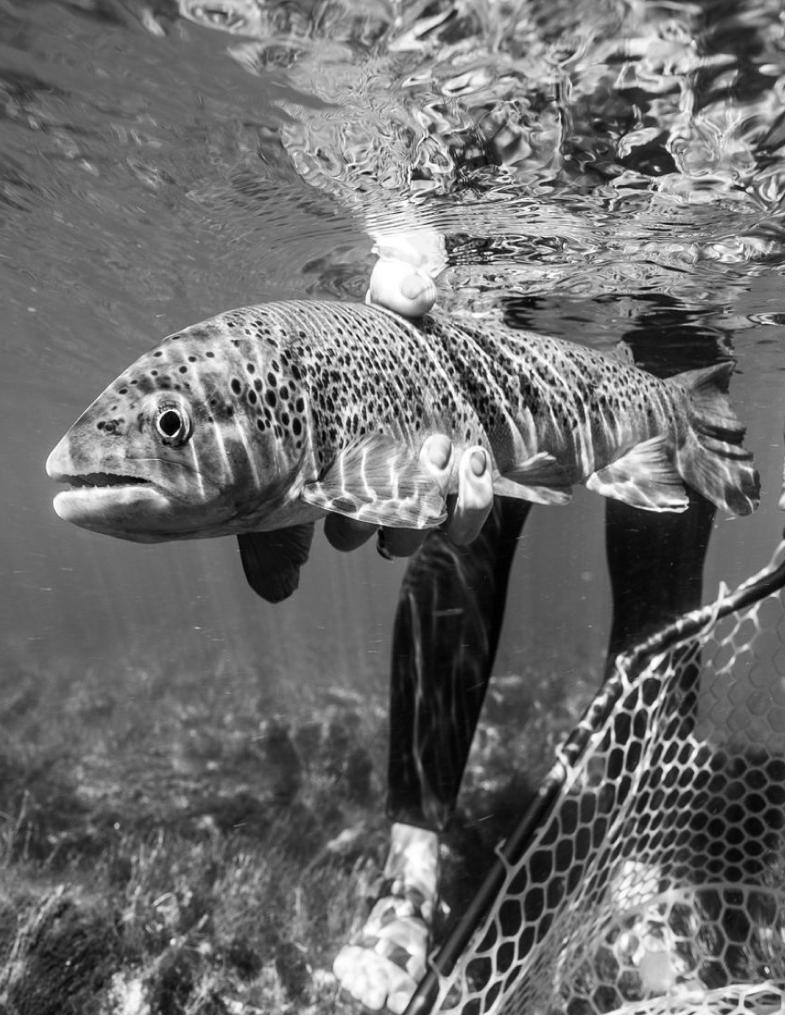
THE MOST SUPPLE, HIGHEST KNOT-STRENGTH NYLON TROUT TIPPET EVER MADE
RIO’s Powerflex Strong takes nylon tippet to the highest level of performance thanks to an extremely high strength-to-diameter ratio specifically formulated for increased suppleness and supreme knot strength.
Suppler material for higher knot-strength
Incredible strength to diameter ratio
Available in 30-yard spools


Floatants are one of those things you only really think about when your fly is drowning sans permission and the fish are rising. High N Dry floatant products entire raison d’être is to make sure that doesn’t happen, and they’re now available in South Africa via Escape Fly Fishing. The range covers every situation on the water: Gel Floatant that penetrates deep for long-lasting waterproofing; Liquid Floatant in dip, spray and drop form for fast, precise application; Paste Floatant for flies, leaders and tippets; Powdered Floatant with an applicator brush for reviving drowned flies streamside; a Pretreatment soak for getting your flies sorted before you even leave the house; Fly Line Dressing to keep your line clean and slick; Leader Wax for drag-free drifts; and a
FIBRE
Tying big flies for big fish? Then you should take a gander at Hemingway’s Predator Streamer materials which have been formulated to be A) ultra tough B) extremely supple and C) amazingly translucent in order to match the natural look and movement of many prey species. Measuring in at an amazing 40cm, these fibres are also designed to shed water on your backcast (thereby protecting your arm and keeping you fishing for longer). Available in 14 colours. hemingway-s.com, wildfly.co.za
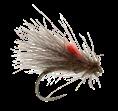
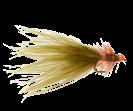
Sighter Wax for euro nymphers who need their indicator riding right without sacrificing sensitivity. Everything they make is 100% solids and solvent-free, so no evaporation, no harsh chemicals, and no excuses for a sinking dry fly. highndryfishingproducts.com
From the red perineum on Royal Coachman to hotspots, coloured heads, and ribbing on nymphs and other dries, this superb quality single strand multifilament poly floss has so many uses. It comes in a set of five fluorescent colours from Hemingway’s with each spool measuring 50 yds. hemingway-s.com, wildfly.co.za
FULLING MILL - UGLARET’S RED FLASH MAYFLY SUB
Aw shucks, here comes Untag Uglaret’s Red Flash Mayfly. Designed to imitate the subimago-stage of a mayfly (the stuff you can’t really see that fish go nuts for at the very start of a hatch), it sports a tag, which imitates the nymphal shuck. This allows the abdomen to remain submerged while the wings are fully deployed. And the wings are separated by fluorescent pink fibres, making the fly highly visible even in poor light conditions to middle-aged anglers with failing eyesight. Available in three sizes to match the hatch as precisely as possible. fullingmill.co.uk, flyfishing.co.za
FULLING MILL - BASSETT’S
Scruffy, buggy and fookin’ irresistible to members of the Salmonidae family, this deadly CDC caddis imitation matches caddis species the world over. In smaller sizes it’s ideal for targeting actively rising trout, while larger versions serve as excellent attractor patterns in faster water where, like you in front of a sushi train, the fish don’t have much time to think. fullingmill.co.uk, flyfishing.co.za
While it’s officially named the Pumpkin Head Damsel, Fulling Mill could just as easily have called this the Pumpkin Head Bugger or the Pumpkin Head Polisiekop. As comfortable imitating baitfish as it is a damsel nymph, it’s a great search pattern when you’re unsure what to try. Vary the retrieve and the profile, lifelike movement, and colour scheme should do the trick. Singing Crash Test Dummies’ The Ballad of Peter Pumpkinhead helps too. fullingmill.co.uk, flyfishing.co.za


The app is based on linefish research undertaken in South Africa over the last 50 years and includes the most recent information available. The app was compiled by Dr Bruce Mann, Senior Scientist at ORI.



Search for fish names using their common name in English, Afrikaans or by using their scientific name.

Easily compare similar species. A fish identification app of 249 species designed especially for the South African marine angler.



Work out for yourself what fish species you have caught or seen.


Fish Guide
Multiple high quality photos and a drawing for each species.
A comprehensive species profile.
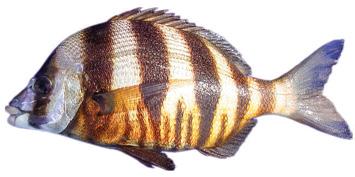
Marine Fish Guide for Southern Africa

A simple map of the species’ distribution in southern African waters.


A simple line drawing of the general shape of the different fish families.



Enter the length and the approximate weight is calculated.

The current linefish regulations for marine recreational anglers in South Africa.

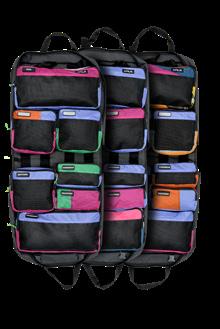
TO ORGANISE YOUR LIFE ON THE ROAD, LOOK NO FURTHER THAN THIS CLEVER FOLDING DUFFEL.
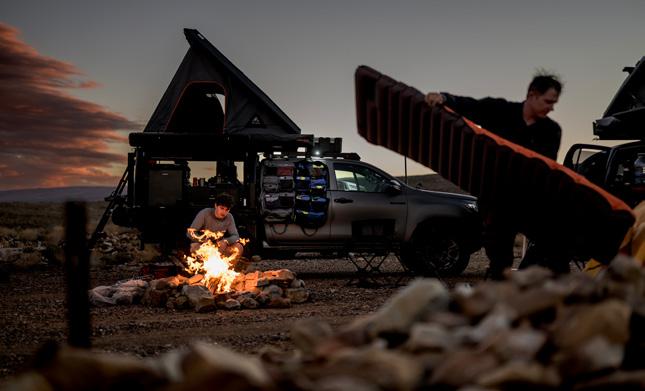
You’re car camping and you need to find something fast (headlamp, jocks, mozzie spray, blood pressure pills). You pull out your big-ass duffel and begin to dig. An hour later and your friends find you passed out on the ground, your brain melted into a Escher-like puddle of clothes and other clobber. Pro photographer and veteran MTB stage racer Craig Kolesky was fed up with this scenario so he designed the solution. Meet XPLR’s modular duffel. Possibly the best bag we have seen for nomadic types (car camping anglers, stage racing runners/cyclists, even your average business traveller), it’s designed to take the ballache out of either unpacking (the neat person’s approach) or digging (the lazy person’s tactic).
Elite trail runner Ryan Sandes belongs to the second category. He says, “I’m usually a super messy traveller, but
the XPLR Duffel has been a life saver, compact, easy to use, and it keeps my life in order on the road.”
Simply pull in to your camp site or hotel room, find something to hang it on and unfold. The modular pouches and prenamed labels allow you to customise and organise as you like, helping you to find what you need immediately. The Mission’s Eastern Cape contributing editor Jazz Kuschke has been testing his bag for months. His take, “Craig was the first person to turn me on to packing pods (way before it was trendy) and it changed the game. This is way beyond the next level of that.”
Regular XPLR duffels are made from 300D Riptech nylon and are available in black, navy and khaki, while Rekite Duffels made from upcycled kites come in a range of colour combos. xplrgear.co.za
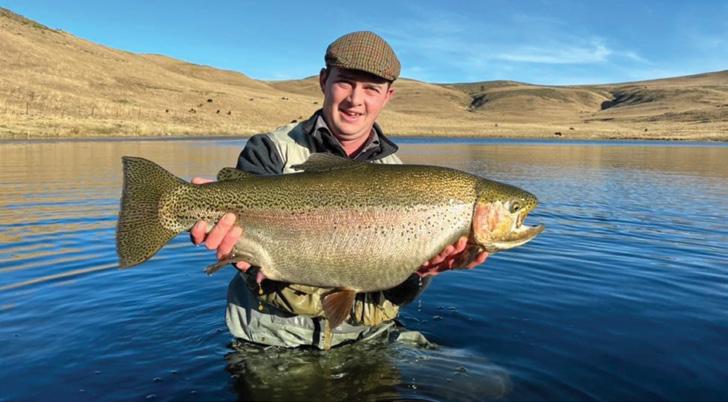
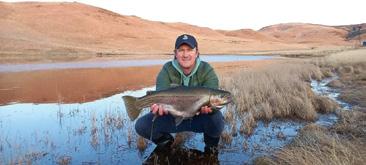
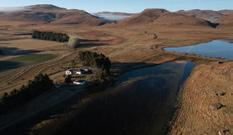
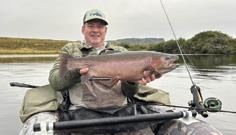
Trophy trout don’t get bigger than this without good reason. Jollifly Cottage sits on Vogel Vlei Farm in the Stormberg Mountains near Dordrecht, Eastern Cape, with access to some of the finest still-water trophy fishing in South Africa. Records nudge past 15lbs, fish stretch beyond 75cm, and the dams are stocked to back up every claim.
Comfortable accommodation, big mountains, and enough birding, hiking and cycling to justify bringing someone who doesn’t fish.
Follow the proof: @jollifly on Instagram & Facebook birchbros@nokwi.co.za
Enquiries & Bookings: Cell/WhatsApp
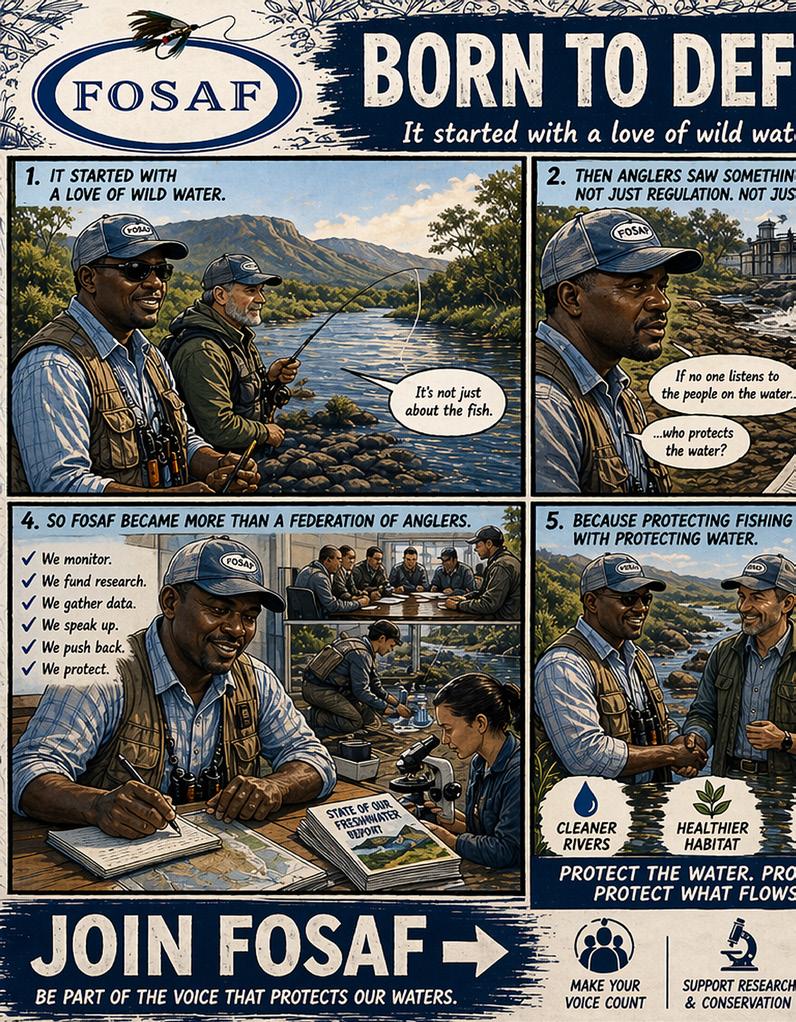
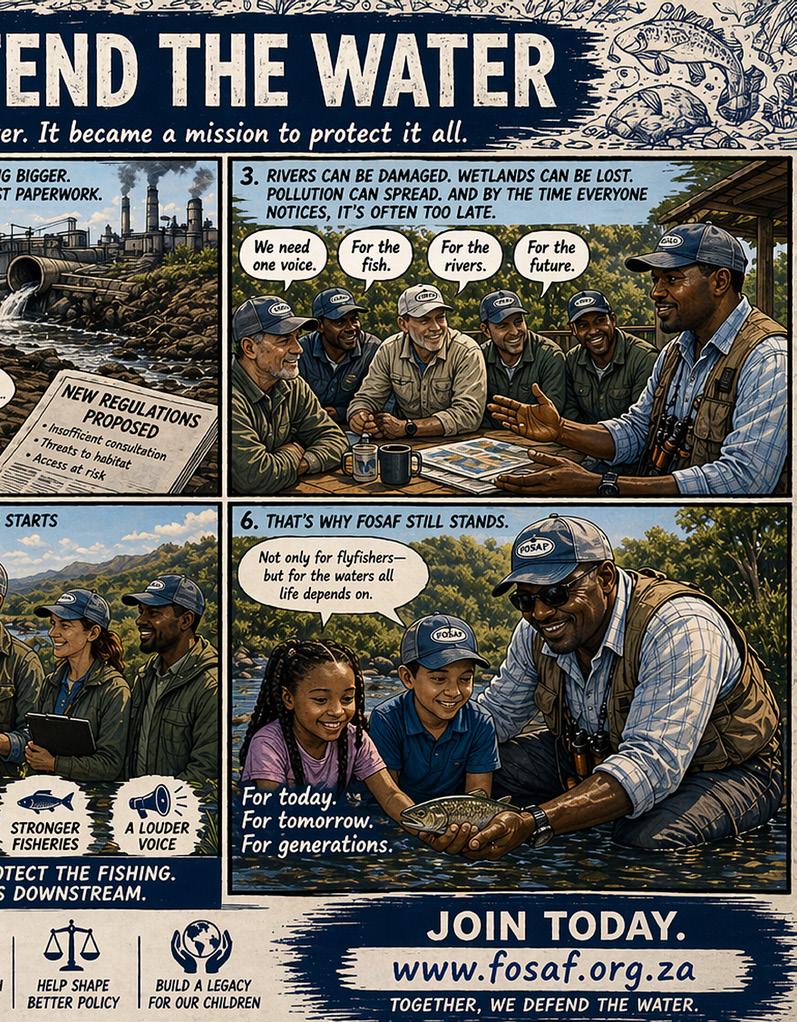
Who are you?
WHEN HE’S NOT CHASING YELLOWS, YOU’LL FIND FRANK SOLOMON IN HIS WORKSHOP, CRAFTING HIGH QUALITY HARDWOOD FLY TYING STANDS AND BENCHES FROM SCRATCH .
My name is Frank Solomon, owner of The Hobby Bench Co. I specialise in bespoke hardwood furniture for fly fishing and hobby enthusiasts, from fly tying to hunting and model building.
I’m a born and bred South African, proudly Afrikaans, despite the name sounding otherwise. I’ve always been drawn to the outdoors and fishing. After finishing school, I worked as a game ranger for four years before joining the family business in 2011.
Most of us start with conventional fishing and I was no different. Holidays were spent around a dam - any dam we could get to in the Lowveld - catching kurper with an old Dutch float. At the age of ten, I picked up a fly rod for the first time and the rest is history. Today, most of my fishing happens on the Vaal and Suikerbos Rivers, targeting smallmouth yellowfish, a species that has become a complete obsession for me.
What do you do for a living outside of hobby crafts?
My father, brother and I own a company that supplies tooling, consumables and machinery to the natural stone industry across Southern Africa. In simple terms, we supply everything in the value chain, from when granite is mined out of the earth to when it ends up installed as your kitchen countertop… or, if you’re unlucky, as a tombstone in a cemetery.
How does The Hobby Bench Co. fit into your life?
I’ve always enjoyed working with my hands and learning new skills like plumbing, tiling, welding and building. I have done it all and was lousy at most of them, but woodworking stuck. In 2019 I impulsively bought a container of hardwood at an auction. I had no plan. It was cheap, and I like wood – a good enough reason for me. I started by building furniture for our home: a dining table, server, and a few other pieces. Eventually I built myself a fly tying station, experimented with designs I saw online, and shared a few photos on Facebook. The response made it clear that there was real demand for high-quality, handmade fly tying furniture in South Africa. That’s how The Hobby Bench Co. started.
Most pieces are made to order, I don’t mass-produce tying stations. Every client has their own requirements preferred timber, colour, layout and storage needs. I work closely with them to create something functional and unique, often adding accent woods or small details to give each piece character. Lead times are long but worth the wait. One of my favourite builds was an American ash tying desk. It took 12 weeks to complete and had box joints on all the drawers, the drawer handles were hand-crafted trout sculptures by Chris Bladen, and it had enough storage space to hide a lifetime’s supply of feathers, fur and flash.
What’s next for The Hobby Bench Co?
I’m working on a range of in-stock products, smaller items that make a great purchase for that last minute birthday or Christmas gift. hobbybench.co.za
“EACH BENCH LEAVES THE WORKSHOP BUILT SPECIFICALLY FOR ITS OWNER AND NO TWO ARE EVER THE SAME.”
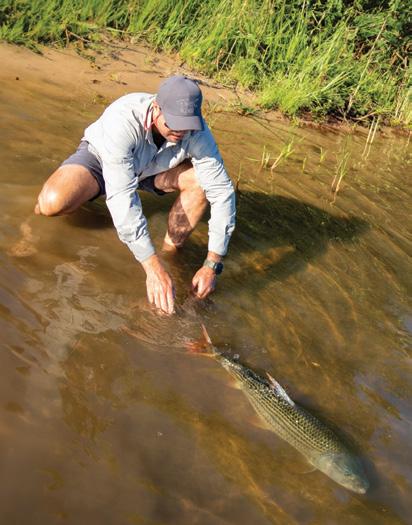
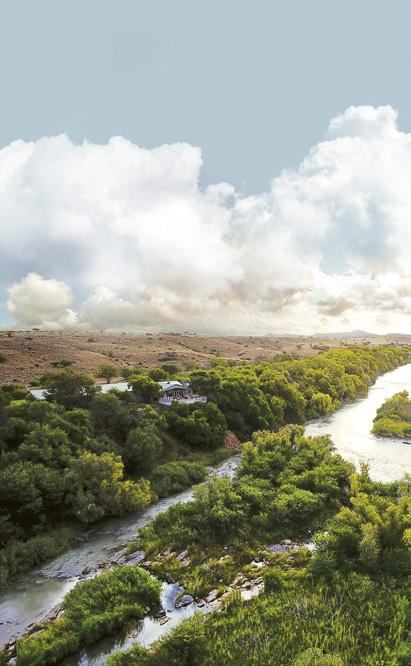
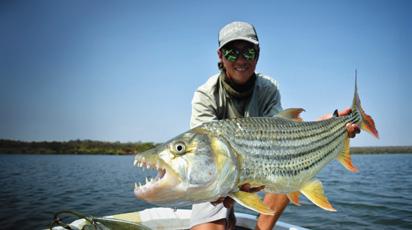
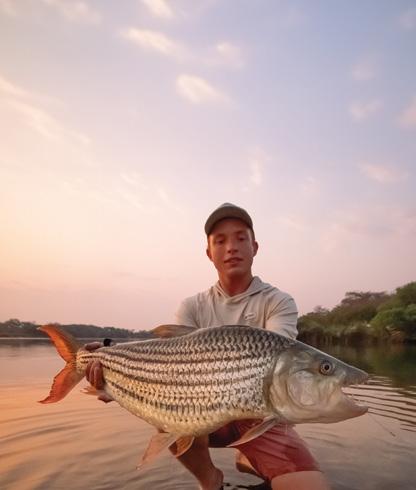
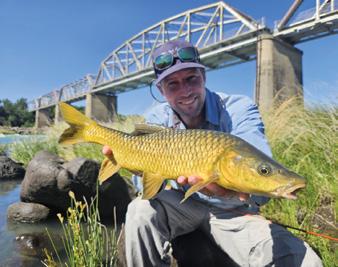
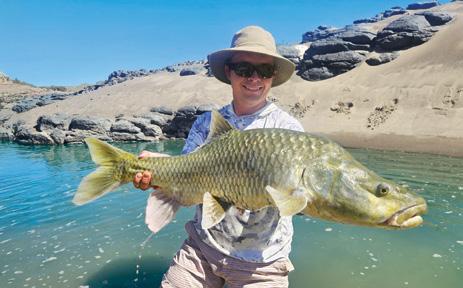
FAME OR LAME?
IN THE SECTION THAT GIVES YOU HOT TAKES ON EVERYTHING FROM VROT HAKES TO CUPCAKES AND DEEP FAKES, WE ASK WHETHER THE FLY FISHING INDUSTRY HAS COLLECTIVELY LOST THE PLOT OR JUST RUN OUT OF WORDS.
Is it just us or are there a lot of brands with products that sound the same? Take the name CrossCurrent for example. The OGs as far as we are concerned when this word is mentioned are G. Loomis. Their now discontinued CrossCurrent GLX is a legendary big fish rod (occasionally referred to uncharitably as an unbreakable broomstick). Guides who’ve spent thirty years on the saltwater flats of the Seychelles describe it with the kind of reverence usually reserved for Land Cruisers. It may not be the rod you envisage yourself using when you dream of doing battle with that record GT, but it will outlast your marriage, your second mortgage, and possibly you.
Then Fishpond entered the fray with a chest pack they named the Cross-Current. It holds your fly boxes, your phone and your smoking materials. Two’s company we guess... Moving on.
Now Sitka . A brand that has spent its existence dressing people who shoot large animals from cold mountains. You know...merino base layers, Gore-Tex shells, camouflage patterns with names that sound like classified military operations (as opposed to Hegsethian War n’ Gore Signal chat spankbank material). Sitka has entered the fly fishing market with waders and boots and are calling this range, with either tremendous confidence or spectacular indifference, the CrossCurrent wading system. A name two other brands in the same industry already own a piece of.
There are two possible readings for this. Either nobody at Sitka bothered to check, or they checked, lined Loomis and Fishpond up in their proverbial sights, and pulled the trigger.
If it’s the latter you can view it as either admirable swagger or a fairly clear message about how much they think the incumbents matter. We’re going with the second, because their gear is by all accounts excellent and we appreciate a smidgen of attitude.
Coincidentally, Sitka also have some spiffylooking GORE-TEX ® fishing jackets and pants named “Stormfront”, which is what Patagonia used to call their waterproof bag range (now called Guidewater), until someone realised the bunch who originally called dibs on “Stormfront” was one of the interweb’s first Nazi forums. Awkies.
To be clear, the CrossCurrent pileon is just one example from an industry with many same-same name games. E.g. see how many brands claim the old “Guide” and/or “Pro” label. Long story short - the fly fishing industry is crowded and our brains are full. When everything is CrossCurrent, nothing is. Differentiation should be seen as an overarching priority, because it is what makes someone remember you when they’re standing in a fly shop with money in their hand.*
Sitka: we’ll give you Fame on this one, but only just. Do better next time. As for everyone else reaching for a water-adjacent compound word for your next launch. Please
* Can someone please make a rod range inspired by the names, “Rodger, Roderick, and Brian”, named after the Monty Python Life of Brian scene?
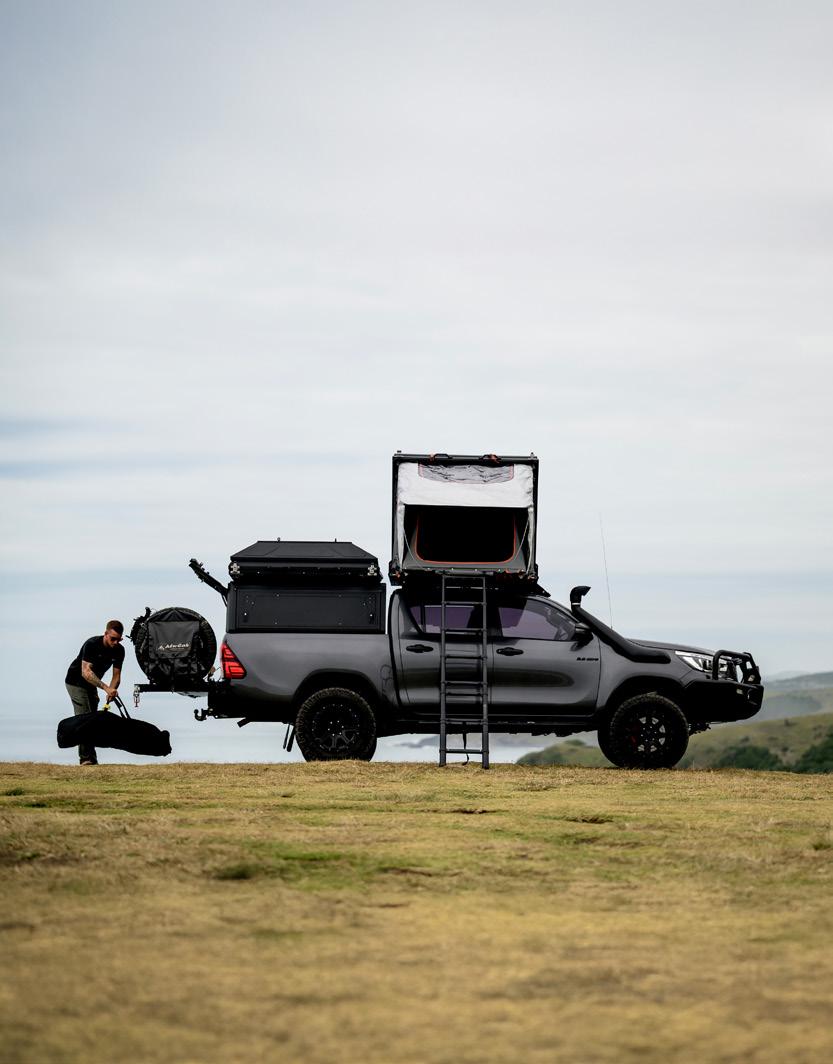
SHARPER THAN A B12S AND CRAFTIER THAN ELIOT NESS? TAKE OUR RAPID-FIRE QUIZ TO SEE IF ANYTHING FROM THIS ISSUE STUCK TO YOUR BRAIN, LIKE CRUD TO YOUR WADING BOOTS.
c/o Cameron Musgrave
1. When talking about Semonkong in Lesotho, according to Baphuti Makafane, what is “bolele” (page 28)?
A. Reverse lobola, aka asking for a refund on your spouse.
B. Adventure boule, reserved for when the weather makes fishing a non-starter.
C. What the Gipsy Kings were originally going to call Bamboleio
D. A slimy-green algae.
2. What has a habit of ruining a fishing trip in Jeff Tyser’s opinion (page 34)?
A. Stage 5 Delhi Belly.
B. Bringing a 5-weight to a 12-weight fight.
C. Losing your polaroids.
D. Lofty expectations.
E. An oil spill further down the coast.
3. According to Daniel Osmond, what does an Exe salmon have to contend with (page 40)?
A. The rejection of their love as you leave them taking the house, the dog and the kids.
B. Sewage, industrial pollution, profiteering and complacency.
C. Tube flies.
D. Redundant weirs and crocodile tears.
E. Lazy anglers.
“REDUNDANT
4. Which of the following does Myburgh van Zijl not love in the same way he adores yellowfish (page 46)?
A. Willie le Roux.
B. Amor Vittone.
C. Kudu biltong
D. The smell of Tabard.
E. Loose law enforcement.
5. Which of the following do Cameron Musgrave and several of his colleagues suffer from? (page 70)?
A. Guide’s back.
B. Wader’s crack.
C. Buffalo’s claw.
D. De Quervain’s Tenosynovitis.
E. Drinker’s elbow.
6. What did Riverhorse Nakadate bury and where did he bury it (page 26)?
A. A grudge in a garage.
B. A hatchet in the ground.
C. A redfish cooked barbacoa style in a pit oven.
D. A carp under the pitcher’s mound.