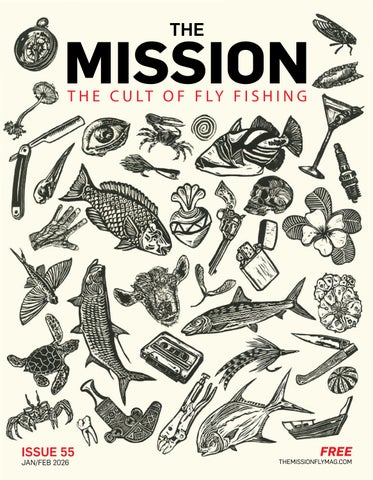
ISSUE 55 JAN/FEB 2026
FREE
THEMISSIONFLYMAG.COM
LEADING THROUGH
INNOVATION. SA Pro Ben Paschal
.
For over 80 years, we have been at the forefront of innovation. Sharpened by experience. Pushing the boundaries of material science to make our lines stronger and more durable. Then testing in the most demanding environments with the world’s best anglers. Those who demand the best choose Scientific Anglers.
SWIFTCURRENTⓇ WADERS
Traverse Zip-Front
For mobility and versatility. The lightweight Swiftcurrent® Traverse Zip-Front Waders are streamlined for long, overland approaches and technical wading in all environments. Rigorously tested and equipped with essential features, they are sturdy, comfortable and engineered for athletic movement in and out of the water. Plus, their durable water repellent finish is made without intentionally added PFAS chemicals.
Learn More
Traveling by packraft, Thad Ferrell, Sarah Tescher and photographer Andrew Burr paddled 45 miles of Alaska’s remote Kongakut River. Deep in the Arctic National Wildlife Refuge, the river’s wild Arctic char and grayling rarely see anglers. Photo: ANDREW BURR © 2025 Patagonia, Inc.
W W W . T H E M I S S I O N F LY M A G . C O M ISSUE 55 JAN / FEB 2026
CONTENTS Cover: The doyen of DIY fly fishing Ray Montoya encapsulates his idea of DIY fishing in a composite image of hand-etched lino (mostly Omani-inspired) prints.
30. SEY YOU, SEY ME In our new ‘Ask an expert’ advice section, we rope in Seychelles expert Ryan Foster to answer a question about tides and how they determine the fishing for specific species. 38. THE TAO OF DIY Best known as a permit-hound, Omani-beach vagabond, Ray Montoya has DIY fly fished around the world several times over. Here, he breaks down his philosophy. 44. SOUL SCIENCE Deep in a Congolese rainforest, scientist Russell Tate took a moment to put down his electrofisher and nets and pick up his fly rod instead. 50. UNFINNISHED BUSINESS Invited to Finland to fish the shallow lakes and Baltic Sea bays for mammoth pike and zander, Gerald Penkler and fellow Seffrican ex-pats Gary Glen-Young and Nicolaus van Zweel chase the magic marker of a one metre long fish. 58. THE FEATHERS AWARD 2025 From the salt to the fresh, the sublime to the ridiculous, we’ve thrown the metaphorical net wide and found a bevy of superb fish caught on fly on the African continent by you, our readers, this year. And the winner is...
REGULAR FEATURES 12. Ed’s Letter 18. Chum 26. Wish List Fish 28. Booze and Beats 70. Salad Bar
76. Pay Day 80. Potions & Lotions 84. Wands 94. Lifer 98. Pop Quiz
When people talk about stalking bonefish in ankle-deep water in the Seychelles, they’re not exaggerating. Photo. c/o Blue Safari Fly Fishing
Visit the new home of WildFly, SA’s largest Fly Fishing Outfitter 08� 094 4367 s�les@wildfly.co.z� www.wildfly.co.z�/shop
� He�ther L�ne, Polofields Centre, Nottingh�m Ro�d, KZN
yOUR NEXT LOCAL and iNTERNATIONAL ADVENTURE, NOW BACKED BY WORLD-CLASS OUTFITTERS
T U D O R CA R A D O C - DAV I ES
NO REGRETS
It doesn’t get more DIY than the cliffs and beaches of Socotra where Ray Montoya and Peter Coetzee where stranded under global Covid shut downs. More from Ray’s DIY learnings at page 38. Photo Peter Coetzee.
T
he DIY spirit runs deep through a lot of what we try to put out into the world at The Mission and this issue in particular embodies it. We have it in the cover art and the cover story by DIY veteran Ray Montoya, a man who has travelled to and lived in many places, and whose very DNA is intertwined with the fisheries he has explored and figured out, mostly on his own. His approach in our Undercurrents section, “The Tao of DIY”, is worth re-visiting time and time again whenever your own fly fishing is feeling a little stale, predictable or too manicured.
Then we have DIY exploration of a few different sorts in Gerald Penkler’s case it is floattubing the myriad Baltic Sea bays and inland lakes of Finland with fellow Saffer expats in search of predatory pike and zander. For aquatic biologist Russell Tate it’s taking advantage of a work trip deep into a Congolese rain forest where the stars aligned so that he could put down his scientific equipment and pick up a fly rod to prospect for a number of new species. Perhaps, along with Ray’s words of wisdom, the DIY spirit is represented most in the smorgasbord of Feathers Award entries for 2025, from which we had to choose a winner. These were anglers - to quote Barbera Kingsolver - who had appetites larger than sense, who hiked long distances, climbed rock faces, fished deep into the night, threw caution to the wind, crossed themselves and offered a few Hail Marys in order to catch the fish of their lifetimes. Speaking of lifetimes, we’re all faced, on the daily, with the reality of our own fleeting time on this planet.
12
And life really is too short to restrict yourself to metaphorical and literal stockie ponds even if that’s where a lot of us start. So, if I can encourage you to do anything on the fly fishing front this year, it’s to expand your horizons. Scratch those itches. Whether you prefer to do it solo, or link in with some friends - do the bloody thing. Check out that river you have always wondered about while driving past or stuffing around on Google Maps. Make a pilgrimage to that dam, that estuary, that stretch of beach. The trip you and your mates have discussed one hundred times over a braai? Set an actual date, start putting money aside (if that’s a sticking point) and commit. If it helps, imagine the moment of your death. Maybe it’s thirty seconds after finishing a Sloppy Sam’s heart attack burger; or stuck on the railway crossing between Wellington and Paarl as the 3pm train hurtles towards you; perhaps you experience extended post-coitus rigors that become a cardiac situation; or have an aneurysm after insincerely laughing through your nose at something your boss said. As the light fades and you think of your loved ones, the best happiest moments from your life and how much you love The Mission, you sure as hell do not want to have any fishing regrets. How do you do that? By ticking the bucket list before you kick the bucket. As I write this, Ray who spent a few decades exploring the beaches of southern Oman for permit and bream, is doing just that. This time he’s on the other side of the world, fishing remote beaches in Mexico’s Baja Peninsula, catching corbina and flounder while living on the beach. Instead of a to-do list, he made DIY a way of life.
W W W. T H E M I S S I O N F LY M A G . C O M
THE WORLD’S MOST COMPLETE
FLY-FISHING EXPERIENCE Every cast protects, together we fish for the future
S E YC H E L L E S
Alphonse Island | Cosmoledo Atoll | Astove Atoll | Farquhar Atoll Providence Atoll | Amirante Islands | Platte Island Previously Alphonse Fishing Company +248 422 9700 [GMT+4] | reservations@bluesafari.com | www.bluesafariflyfishing.com
Dry is for flies.
When you are waist-deep in a river, you learn a thing or two about what truly matters. Gear that lasts. Moments that count. Stories that live on. Stay as long as you like.
epimax.co.za Adcock Ingram Healthcare (Pty) Ltd. Co. Reg. No. 2007/019928/07. Private Bag X69, Bryanston, 2021, South Africa. Customer Care: 0860 ADCOCK/232625. 20261000004551 January 2026.
www.adcock.com.
Perm at 12 o’clock! Don’t f*#k it up.
EDITOR
Tudor Caradoc-Davies
ART DIRECTOR Brendan Body
EDITOR AT LARGE Conrad Botes
CONTACT THE MISSION The Mission Fly Fishing Magazine for Soutie Press (Pty) Ltd 25 Firth Road, Rondebosch, 7700, Cape Town, South Africa info@themissionflymag.com www.themissionflymag.com
CONTENT COORDINATOR Matt Kennedy
COPY EDITOR
Gillian Caradoc-Davies
MANAGING DIRECTOR Ingrid Sinclair
ADVERTISING SALES
tudor@themissionflymag.com
CONTRIBUTORS #55 Ray Montoya, Russell Tate, Gerald Penkler, Johann Rademeyer, Ryan Foster, Hannah Sharp, Herman Botes, Grevin Price, Leonard Flemming, Nick Ferreira, Jazz Kuschke, Conrad Ocker, Deon Meyer, Fred Davis PHOTOGRAPHERS #55 Ray Montoya, Russell Tate, Gerald Penkler, Hannah Sharp, Herman Botes, Conrad Botes, Fred Davis, Alphonse Fishing Co., Ryan Foster, Mavungana Flyfishing, Nick Ferreira, Conrad Ocker, Deon Meyer, Nicolaus van Zweel, Peter Coetzee, Swimming Head Productions, Beth Taylor, Ed Thorpe
THE MISSION IS PUBLISHED 6 TIMES A YEAR. THE MISSION WILL WELCOME CONTENT AND PHOTOS. WE WILL REVIEW THE CONTRIBUTION AND ASSESS WHETHER OR NOT IT CAN BE USED AS PRINT OR ONLINE CONTENT. THE OPINIONS EXPRESSED IN THIS MAGAZINE ARE NOT NECESSARILY THOSE OF THE MAGAZINE OR ITS OWNERS. THE MISSION IS THE COPYRIGHT OF SOUTIE PRESS (PTY) LTD. ANY DUPLICATION OF THIS MAGAZINE, FOR MEDIA OR SALE ACTIVITY, WILL RESULT IN LEGAL ACTION... AND A KARMIC POESKLAP THAT WILL REVERBERATE THROUGH THE GENERATIONS LEAVING THE SPAWN OF YOUR SPAWN TO BECOME...GOLFERS.
16
W W W. T H E M I S S I O N F LY M A G . C O M
@THEMISSIONFLYMAG
The best part of the first cast might just be the coffee before it. Steam rises with the sun and silence holdsthe weight of what the day might become. Before the flies, before the fish, there’s this. Let us outfit your mornings and your memories.
Coachman’s Crossing Shopping Centre, Peter Place, Bryanston, Johannesburg Tel: (011) 463 9048/9 | www.frontierflyfishing.co.za
Shop online at frontierflyfishing.co.za
®
CHUM A F LY F I S H I N G , B E E R - D R I N K I N G T R A I L R U N I N L E S O T H O , S K WA L A H I T S S O U T H A F R I C A , B I G S C O T T F LY R O D S A N D O R V I S N E W S , R AY ’ S S U N S E T F R E N Z Y T I G E R C L O U S E R , G O R D O N ’ S C D C T I LT W I N G , P L U S FILM FESTS GALORE.
ENTER THE... ... BOKONG FLYATHLON Love yellowfish, trout, trail running and beer? Looking for a new challenge this year? Then perchance you should try secure a spot at the annual Bokong Flyathlon held at African Waters’ Makhangoa Community Camp on the Bokong River in Lesotho. The only flyathlon on the African continent that we know of, this brilliant event involves a 20km trail run next to the river during which participants are required to A) catch at least one fish to qualify (maximum of three fish allowed, of which the length in cm would be deducted from the participant’s running time) and B) drink beer. Proceeds go towards local community projects like rebuilding a footbridge across the Bokong River. This year’s race will be held from the 19th - 22nd March. africanwaters.net
SKWALA MAKES LANDFALL IN SA We’ve been watching the growth of Skwala Fishing over the last few years as the Bozeman-based company recruited wisely from across the fly fishing industry and in particular from another Bozeman business (and competitor in the space), Simms. Skwala’s reputation for making world class waders, boots and technical gear proceeds them, but the problem was they just were not available in South Africa. Until now, because WildFly Outfitters have landed the account as the SA stockists for Skwala. If you are tempted to see the range in person, you’ll also get a chance to check out WildFly’s massive new multi-storey shop in Nottingham Road. While the footage we have seen so far of the new space is super impressive, we have one crit... they missed an opportunity to do it in the shape of a giant Nkandlaesque rondavel to rival the BassPro shop pyramid in Memphis, Tennessee.skwalafishing.com, wildfly.co.za GRAB YOUR TICKETS... ...FOR F3T! It’s that time of year again when the Fly Fishing Film Tour (F3T) rolls into South Africa and serves up a stellar selection of high-octane films from all over the world (while also dishing out a whack of hefty destination and clobber prizes to ticket holders). This year is extra special in that it’s the film tour’s 20th anniversary. Screenings will be held in Johannesburg (x 3), Durban, Cape Town and Pietermaritzburg. Tickets are R300 per adult and R200 for students and children. Find out more at flyfilmtour.com 18
SUBSCRIBE TO THE MISSION & SCORE WITH SCIENTIFICFLY & GNARLY HEADZ The Mission is free both in print and digital formats, however, if neither of those options work for you (there’s no stockist near you; you live outside of South Africa; or you just really want to support us – thanks!), you can subscribe and have the print magazine sent directly to you. As an extra bonus, with each new issue you will receive a premium fly (e.g. bass flies, tigerfish flies or saltwater flies) from ScientificFly & GnarlyHeadz. Annual subscription Receive 6 issues of The Mission Fly Mag in print • South Africa only: R980 per year for 6 issues, couriered to your door with no delays • Outside of South Africa: R3 900 per year Find out more at themissionflymag.com
SHAWN COMBS FROM ORVIS TO SCOTT Minor Days of our Lives meets Succession drama in the fly fishing industry alert as Scott fly Rods recently announced the hiring of Orvis’s Director of Product Design and Development, Shawn Combs (not to be confused with ol’ P. Diddler, aka Sean Combs). Why is this news? Well, Combs is the main designer behind Orvis’s iconic Helios range and in his new role as vice president of Scott, second only to Scott head honcho Jim Bartschi (the man behind iconic Scott rods like the Centric, Sector and Radian), he’ll be bringing decades of rival design IP from Vermont over to Scott’s HQ in Montrose, Colorado. To put this into perspective, imagine if iconic Apple designer, Jonny Ive, of the iMac, iPod, iPhone, iPad, and Apple Watch fame, went to headup Microsoft or Google product design? Or, if sportsball is more your thing, then it’s the equivalent of Rassie Erasmus poaching Tony Brown from New Zealand rugby to be his attack coach. While this is a coup for Scott, at the same time it opens up a gap for Orvis (who have recently re-focussed their attentions on fly fishing while dropping lifestyle ranges) to flex the chequebook and hire new talent too.
W W W. T H E M I S S I O N F LY M A G . C O M
15
VIDEO: GORDON TIES A TILTWING Gordon van der Spuy (aka @the_feather_mechanic) has adapted Ralph Cutter’s original EC Caddis design by replacing the hackle underneath the deer hair wing; instead using CDC in the Tiltwing, to serve better on slower-moving, ultra-clear trout streams. In this mayfly imitation, CDC works well as a parachute because it is a mobile material and is reactive in light; both things that encourage the successful imitation of a natural mayfly. Learn how to tie this fly over on our Youtube channel. youtube.com/@TheMissionFlyFishingMagazine
VIDEO: RAY’S SHARES HIS GO-TO TIGER CLOUSER Clouser Minnows = one of the most widely used baitfish fly patterns in fly fishing. According to Mavungana Flyfishing’s Illovo-based fly tyer, Raymond Mutemeri, the combination of a black-over-orange SF blend wing with a copper tinsel body wrap, makes the Sunset Frenzy Tiger Clouser a winner for the tigerfish in the Pongola and Zambezi systems. Ray also employs the use of a bucktail underwing and overwing, preventing the synthetic fibre from wrapping around the hook when being retrieved. Check out the step-by-step video on our Youtube channel. youtube.com/@TheMissionFlyFishingMagazine
ENTER THE... ...RAUFFFF (RAW AFRICAN FLY FISHING FILM FESTIVAL). Yes, as your favourite fly fishing hooligans, over at The Mission we are holding our own fly fishing film festival in July 2026. The first of its kind on the continent, in keeping with the style of the mag the focus will be on African destinations, species and personalities. We’re looking for new voices, fresh perspectives, large doses of humour and kick-ass films that celebrate fly fishing in Africa. Have a film project of not more than 12 minutes in the works? Then send through a pitch to info@themissionflymag.com. But wait, there’s more because we are also looking for contributions from the general populace of The Mission readership - specifically for the rough (RAUFFFF) cuts section (a super-cut to be shown in and amongst the full length films). So, if you have brilliant or funny clips of fly fishing fails, wins and other events on your phone or camera that you know you will never do anything more with, we want to see those too. Find out more at themissionflymag.com and send us a pitch. VISIT THEMISSIONFLYMAG.COM FOR MORE INFO
20
“KEEPING WITH THE STYLE OF THE MAG THE FOCUS WILL BE ON AFRICAN DESTINATIONS, SPECIES AND PERSONALITIES.”
W W W. T H E M I S S I O N F LY M A G . C O M
We added some T to the G.
T is for technology and the redesign of our legendary G Series...only lighter, speedier, feelier, and yes, even cooler. Check out the all new handcrafted high performance models at your Scott dealer. Scott Fly Rod Company | Handcrafted in Montrose, Colorado
www.scottflyrod.com
S I F FY N B O S
L A V I V RE
get co n
SH
L
R e st o r i n g Rivers
saving species
CONNECTING COMMUNITIES
t b e h i n d loca l f i s h n s e r vat i o n w h e r e i t mat t e r s m o st click
ADVERTORIAL
FLY FISHING THE EDGE OF THE WORLD St Helena, A Saltwater Frontier Like No Other
I
n the middle of the South Atlantic Ocean, 1,200 miles from the nearest continent, lies a speck of volcanic rock so remote it feels almost mythical. St Helena; best known as Napoleon’s final exile is now quietly emerging as one of the most intriguing frontiers for adventurous anglers. While it may not boast trout streams or bonefish flats, its deep-blue waters, towering cliffs and untamed marine life promise a salt-water fly-fishing experience like no other. The Allure of Isolation St Helena is one of the world’s most remote inhabited islands, a British Overseas Territory adrift between Africa and South America. This isolation has kept its marine ecosystem remarkably intact. The surrounding ocean drops away into deep pelagic water within a mile of the shore, attracting yellowfin and bigeye tuna, wahoo and dorado. Local fishing legend Julian from Wicked Wahoo St Helena, believes the future of fly-fishing is bright. He currently runs charters targeting tuna and wahoo and although relatively new to fly-fishing, he is excited about growing this offering. What’s there not to be excited about? St Helena has only a handful of charter operations plying their trade in an ocean area the size of France and here, the fishing ethos is refreshingly pure: one line, one hook, one fish at a time. The island’s 200-nautical-mile Exclusive Economic Zone has been declared a sustainable-use Marine Protected Area, preserving the delicate balance between heritage and modern sport. A New Kind of Fly Challenge Traditional freshwater fly-fishing doesn’t exist on St Helena, there are no large rivers or permanent lakes to wade through. Nor are there shallow brine estuaries or calm,
24
Photos. Swimming Head Productions, Beth Taylor, Ed Thorpe
sandy beaches. Instead, this is wild fish in untamed seas. From a small boat out of Jamestown Harbour, you can target schooling yellowfin on the fly, or tempt a dorado. The strike, when it comes, is savage and the fight, unforgettable. On calmer days, the island’s jagged shoreline invites the brave to clamber down ancient paths to cast into deep rock-cut gullies where amberjack and trevally patrol the drop-offs. “This isn’t a commercial destination” says Mark Scotchie Caswell, owner of Flex Fishing Charters, a local fishing operation specialising in authentic fishing experiences, “It’s about sharing our beautiful island and our deep fishing culture with you.” Respect the Ocean, Respect the Island Conservation is woven into the fabric of St Helena’s fishing culture. The island’s Marine Management Plan was written in conjunction with the fishermen and enforces strict regulations to protect local stocks and habitats. Traditional rock-fishing and spearfishing are still part of daily island life, carried out sustainably by local families.
W W W. T H E M I S S I O N F LY M A G . C O M
“ALTHOUGH RELATIVELY NEW TO FLY-FISHING, JULIAN FROM WICKED WAHOO ST HELENA BELIEVES THE FUTURE IS BRIGHT.” For visiting anglers, once you have caught what you need for dinner, catch-and-release, barbless hooks, and zero waste is encouraged. The reward? The privilege of fishing one of the cleanest, most carefully managed marine environments on Earth. Getting There St Helena may be remote, but it’s not unreachable. Weekly flights operate from Johannesburg, and accommodation varies from a boutique hotel and guest houses to selfcatering. Boats can be chartered for half-day or full-day outings although fly-specific charters are still developing, so bringing your own tackle and an open mind is essential. The Experience Imagine the dawn light over a prehistoric coastline, cliffs glowing amber, the air heavy with salt. You strip line into a
slow-rolling sea as a school of tuna erupts off the bow. The line goes tight, your reel screams, and for a few minutes, the rest of the world doesn’t exist. That’s St Helena, a place where time slows, and every cast feels like a discovery. For more info visit us at www.sthelenatourism.com or email visit@sainthelena.gov.sh Seasons and Species Peak season: April-August Target Species: Yellowfin Tuna, Bigeye Tuna, Wahoo, Dorado, Amberjack. Gear: 10-12-weight rods and saltwater reels with serious drag, large baitfish or streamer patterns. Access: Boat charters from Jamestown. Numerous shore opportunities from the rocks exist, but local guides are recommended - it is a climb.
WISH LIST FISH
FASKAR WHILE THE LOCAL ARABIC NAME FOR TWOBAR SEABREAM, FASKAR, SOUNDS JUST LIKE A SOUTH AFRICAN SKEEFING A HIGH-REVVING SUBARU IMPREZA AT THE TRAFFIC LIGHTS, QATAR-BASED FRED DAVIS SAYS YOU’RE MORE LIKELY TO FIND THESE FEISTY FISH IN THE ROUGH STUFF STRETCHING FROM AFRICA TO THE INDIAN SUBCONTINENT.
WHAT A classically proportioned bream of the genus Acanthopagrus, the twobar has, as per its name, two striking vertical black stripes across its face. Add to this the bright fins and tail in shades of orange and yellow, at complete odds with what you might expect to find in nature, it is a fish you cannot miss. There are two almost indistinguishable species of twobar: Acanthopagrus bifasciatus and Acanthopagrus catenula. Outside of giving your catch a colonoscopy and scale count, you will struggle to tell them apart. Twobar don’t grow huge; a 40cm specimen is considered a trophy fish. Most fish caught are between 10cm and 25cm and give a fairly decent account of themselves. WHERE While I’ve targeted them in the rocky environments of the Persian Gulf and Sea of Oman, their distribution ranges from as far south as Zululand all the way to Western India. The very best fishing that I’ve had for them are along the permit grounds of central and southern Oman, where they can be found foraging on rocky flats and shelves. They tend to inhabit areas that are rougher than where you might find permit – on top of shallow rocky shelves and in the white water of gullies.
HOW Their omnivorous habits make them a very targetable fish for fly rodders, and their striking colours add to the visual intensity that comes with sight fishing. While the odd, bigger fish is caught prospecting for reef dwellers with smaller shrimp imitations, they are most susceptible to a fly when they root around in the rocky gullies and gravel shallows. I have often targeted them while they lazily chew on urchins, seaweed and sponges or when digging crabs out of crevices. If you can spot one and get your fly in their face, then they will eat. Being quite Catholic in their diet, they are happy to eat a wide range of softly presented crustacean flies. My best fly for them is a carpet crab (think standard crab-type fly tied with dense felt body) but I have also caught them on Merkins, Flexos and the “never-leave-at-home” Crazy Charlie. They are lazy feeders and your presentations need to be accurate, landing your fly in a fairly narrow zone to get eaten. That being said, I have found them forgiving, where the same fish allows several presentations. WHO DIY is always the best option for me (there are extensive articles and blogs about the Oman fishery at themissionflymag.com). They will however feature on your menu if you hook up with any of the Oman operators, including Ocean Active Fly. oceanactivefly.com
“TWOBAR DON’T GROW HUGE; A 40CM SPECIMEN IS CONSIDERED A TROPHY FISH.” 26
W W W. T H E M I S S I O N F LY M A G . C O M
Tigerfishing Barotseland Zambia www.ngombelodge.com ngombelodge@gmail.com +27(0) 82 477 2360
Yellowfish Orange River South Africa www.gkhuigkhui.com info@gkhuigkhui.com +27(0) 82 477 2360
Hannah with a Bokong River smallmouth yellowfish.
FODDER
MUNCHIES HANNAH SHARP, “LITTLE CH E F A ND GU ID E” (HER OFFICIAL TITL E ) AT AFRICAN WATERS’ MAKHANGOA COMMUNITY CAMP ON THE BOKONG RIVER IN LESOTHO, SERV ES UP THIS ISSUE’S MUNCHIES RECIPE.
G
rowing up in London, the greatest escape from the city I found was when my family retreated north for most summers. Glenlivet was where my mission to catch anything on fly began. I was taught by Yuri Janssen, now a good friend, (ed. issue 40’s Lifer), whose knowledge of those Scottish rivers and whose contagious energy for life and fly fishing meant it was inevitable I was going to go down this path. The fact that Yuri’s mother and father also run a beautiful guest house with one of the best afternoon teas and fine dining experiences in the area, further fuelled my desire to combine both food and fishing somewhere down the line. After volunteering for two years as a rhino monitor in Limpopo, I realised more stability in both vocation and location, was needed. After a Zoom call with Keith Clover (African Waters’ head honcho) it was agreed that this Brit was to relocate to the banks of the Bokong River in Lesotho to cater for and host anglers of the African Waters Makhangoa Community Camp (MCC). From Highlands to Highlands. It used to be the guides who did everything at the MCC, from guiding to catering and hosting but now, with the roles more spread, it means more finesse can be added to each individual job. For me that meant desserts, afternoon teas and munchies. This sticky toffee pudding is a near fail-safe, family favourite of mine, straight from my mother’s cookbook (thanks mum). Note: you can never have enough sauce. I like having these puddings as individual servings (working on that finesse...) but it can also be done as one large cake. Find out more about the MCC at africanwaters.net
Ingredients: 75g butter (room temp) 150g caster sugar 2 eggs (beaten) 175g self-raising flour 175g stoned dates (chopped) 175ml boiling water ½ teaspoon vanilla essence 2 teaspoons coffee essence (I also just use instant coffee) ¾ teaspoon bicarbonate of soda Method: • Preheat oven to 350F (180C). Add the vanilla, coffee essence and bicarbonate of soda to a bowl and let sit. • Soak your dates in the 175ml boiling water and leave for at least 5 minutes. • Cream your butter and sugar. It should be light and fluffy (electric hand whisk can be useful for this). • Gradually add your beaten eggs to the creamed butter and sugar. I highly recommend the gradually rule – the consistency is wildly satisfying. • Fold in the flour first, then vanilla/coffee/bicarb mix. • Make sure the dates are soft and sufficiently mixed in with the water, almost like a paste, and continue to fold until all is combined. It will look very loose. Don’t worry. • Divide into eight separate containers (I use a well buttered silicone cupcake tray) or a single cake tin and bake for 25 minutes or until the middle does not wobble. Sauce: 175g Soft brown sugar 110g Butter 200ml Double cream 50g Roasted chopped pecan nuts Method: • Melt butter and sugar on low heat until fully combined. • Stir in your cream, add pecans and voila! Pour generously over cakes. Serve with ice cream or double pouring cream. • Pair with an after dinner Amarula or Speyside whisky for full enjoyment.
BOOZE & BEATS THE BEATS - THE MCC MIXTAPE From the yellowfish, brown and rainbow trout beats of the Bokong to your ears, this is what Makhangoa Community Camp guides, Rourke Dickson, James Barder and Hannah Sharp, have on repeat in Lesotho. Listen at themissionflymag.com Part Wolf - John Craigie Bonita Applebum - A Tribe Called Quest, Sir Piers and Si Ashton’s Curious House Mix) Rock City - Kings Of Leon) Standing Room - Stephane Deschezeaux The Boogie Den - Vincenzo Accuse - Alaska Damselfly - Loyle Carner The Weight - The Band Feelin’ The Same - Clinton Fearon You’re So Fine - Papa Bear and His Cubs Rose Gold - Jason Joshua and The Beholders Khala My Friend - Amanaz Even After All - Finley Quaye When U Go - Girls Of The Internet Old Man - Neil Diamond Mama Yo Mama Yo - Pigeon You Are Delicious - Mave & Dave Goeie Ou - Schwabie & Henru Helena - John Craigie Get With The Program - Doug Shorts THE BOOZE - THORNE & DAUGHTERS COPPER POT CHARDONNAY 2024 Every now and then we come across a white wine that’s a complete all-rounder. In this, the release of the 2024 Thorne & Daughters Copper Pot Chardonnay, we have the Jacques Kallis / carbon fibre 5-weight / Woolly Bugger of white wines. Made by fellow fly fisherman John Seccombe on the Cape south coast, it sports a classic chard nose and golden colour. With a braided flavour profile of oak, butterscotch and baked apple, it packs plenty of flavour but is not overwhelming. Infinitely quaffable, it’s as happy day-drinking with cougars as it is at sundowners. You can pair it with fish and chicken for sure, but it stands up to curries and heavier meat dishes and carries through to a sweet course too. Just saying... it’s not only restaurants that can have house wines and this beaut deserves that kind of placement in your home. thorneanddaughters.com
PRESS PLAY
ADVICE
SEY YOU SEY ME IN THE FIRST OF OUR N EW ‘ASK AN EX PERT’ ADVICE SECTION , W E ROPE IN A SEYCHELLES EX PERT TO AN SWER A QUESTION ABOUT TIDES. Photos. c/o Blue Safari Fly Fishing
Question: I’m finally ready to book a trip to the Outer Islands of the Seychelles, but I have no idea what I should be looking for when it comes to tides. Is selecting the right tide for your trip as important (and as complicated) as everyone thinks? Whether I go over a spring or a neap tide, what does this mean for the fishing and what does each entail? GT Ferrari The Expert: Ryan Foster from Blue Safari Fly Fishing (formerly Alphonse Fishing Co.). A conservationist by training and former Alphonse Fishing Co. guide, these days Ryan has a desk job at Blue Safari so, between his past on the flats and his present in the spreadsheets dealing with agents and customers, he is well qualified to field questions about a bucket list fishing trip to the Seychelles. Ryan: Tides are hotly debated when it comes to saltwater flyfishing, with tidal fluctuations often determining how, where and when to fish. The likes of the Bahamas, Sudanese flats and Belize often experience very little fluctuation, while the Seychelles and other oceanic atolls experience much larger tidal fluctuations. Deciding when to visit destinations that have highly variable tidal cycles can often be intimidating and even influence the outcome of a trip. For those of you who haven’t experienced or paid much attention to when the water disappears and reappears at the coast, let me provide a quick explanation. The tides are influenced by moon phases. During a full and new moon, large tidal fluctuations are observed between the low and high tides, these large fluctuations are typically referred to as Spring tides. Water moves on and off the flats at a speed of knots during these cycles, making for action-packed and fast-paced fishing with great opportunities to wade during the low tides and access to remote areas on the higher tides. My motto has always been “the tides wait for no one” and this is true with spring tides as they can leave you either high and dry or swimming in no time.
Giant Trevally, the first fish on many Seychelles bucket lists.
Neap tides, on the other hand, are the periods in-between the new and full moon spring tide cycle, where the fluctuation slows, though in the Seychelles they are still more significant than most other destinations worldwide. The slower fluctuation gives both fish and anglers the opportunity to spend longer on the flats, whether wading in certain areas or poling a skiff. So, back to the question, do the tides actually matter or not? The best way to answer this is by looking at the species you are most likely targeting when being guided in the Seychelles. Giant Trevally Giant trevally (GTs) remain one of the more soughtafter species when joining us, so let’s start here. Spring tides have been known to be the prime time to target GTs but, while there may be some truth in this theory, it is not always the case. The neap tides can equally be very productive and often allow anglers slightly easier
opportunities at fish. The way you target GTs during the neaps simply changes and you still get great fishing, albeit more dispersed throughout the day. Fishing for GTs during spring tides is often the most productive in the surf zone where they are most commonly found. This can be some of the most action-packed and exhilarating fishing but, at the same time, it’s also challenging due to everything happening extremely fast. This action-packed window is short and making the most of it is important. The neaps still allow access to the surf zone but also give you more time on the flats poling for fish on rays and cruising fish against islands. Things happen more slowly during the neaps and as a result more time can be spent setting up and getting ready to cast at a fish. Shots at fish may feel more dispersed but it is easier to make the most of them, particularly for GT noobs. In short, both cycles can be highly effective when fished correctly and with the right guests.
“SPRING TIDES HAVE BEEN KNOWN TO BE THE PRIME TIME TO TARGET GTS BUT, WHILE THERE MAY BE SOME TRUTH IN THIS THEORY, IT IS NOT ALWAYS THE CASE.” 32
W W W. T H E M I S S I O N F LY M A G . C O M
A bonefish (top) and a milkfish (below), two essential targets.
Triggerfish, loveable, toothy, bastard-clowns of the flats.
Bonefish This species needs no introduction and they are arguably one of the most widely targeted saltwater species on fly, but one that often doesn’t get nearly enough credit in the Seychelles. Spring or Neap tides, these fish can always be found in abundance, the location simply varies, no matter the atoll. The most important consideration is always to fish for them around the high tides and during the dropping tides. If you want to give your guide grey hairs, ask to fish for them on the push, unless you are in the surf zone, then it is some of the most action-packed bone fishing you’ll experience.
experience with the deeper and slower moving water providing comfort to the fish and allowing for longer feeding periods on the flats. This is where targeting them off a skiff and on the pole really comes into its own. This allows for great distances to be covered as well as a slightly stealthier approach. If you had to put the guides on the spot for the best tides, the answer would often be the transition between the two cycles allowing you to target them in the surf and on the flats as the tides transition from neaps to springs or vice versa.
Triggerfish Triggerfish are also targeted successfully on both tides; the method of approach just differs. Targeting them in the surf zone during spring low tides can be very productive but requires lots of walking and wading. This is when you’ll see the iconic wave of their tail and often their middle fin. This is when anglers get addicted to targeting them and it can be extremely rewarding fishing. The springs allow for a very short target window though and once the tide has pushed it becomes difficult to sight them and keep the fly in the zone. The neaps, however, present a different
Indo-Pacific Permit The Holy Grail, golden nuggets, fork-tailed bastards, call them what you will, permit have earned their reputation as one of the hardest species to catch on fly, for a reason. When targeting them tides are arguably the most important consideration. The neap tides and the interchange between springs and neaps is the most popular period to target them. The slower water movement provides ideal feeding conditions, holding fish on the flats longer. If a permit is the name of the game for your trip, then neap tides are what we would recommend. They are still caught during spring tides so don’t be perturbed if you are after a mix of species during your stay.
Permit, make you sad and drive you mad.
“THE MOST IMPORTANT CONSIDERATION IS ALWAYS TO FISH FOR BONEFISH AROUND THE HIGH TIDES AND DURING THE DROPPING TIDES.”
A herd of bumphead parrotfish graze across the flats.
Milkfish This is one species that has a mind of its own and is often difficult to predict. Wayne Haselau gave us all the skills and know-how but, when and where they are going to feed in the correct manner is often down to the wind, sun and ocean conditions. Driven by their food source of plankton and algae, they are found where it is concentrated. These concentrations occur throughout both tidal cycles, with large concentrations occurring offshore during spring low tides as the warm water drops off the flats and interacts with the oceanic currents. These concentrations can also be observed within the lagoons on the neap tides, and some interesting fishing can be had for them on foot. This is one species for which we cannot predict favourable tides. If you were on my boat, the rule was fish for them when they are around and feeding, otherwise you may not get another opportunity. Bumphead Parrotfish These alien looking fish are extremely popular and can only be actively targeted on the flats, on two destinations worldwide, Farquhar and Providence. Similar to triggerfish, they can be targeted on both sets of tides, with the interchange tides being popular. The spring tides have a tendency to concentrate them, with short target windows around the low tides. The neaps allow you to spend more time on the flats, but they can be dispersed
36
as a result. An interesting trait and something not a lot of people are aware of is their migration offshore during the new moon spring tide. They physically go and bump heads as a mating display (hence the name). This usually lasts a couple days and fish can, at times, be seen on and off the flats during this period but are less prevalent. The bottom line I bet when you started reading this article you thought you would have the perfect argument on the tides in the Seychelles to share the next time you sat around a fire with your fishing friends. The simple truth though is there isn’t a “best” or “perfect” set of tides but rather a set of tides best suited to you and your goals for a trip. What makes the tides great for someone may not be ideal for others. Every cycle offers a unique form of fishing, and all the species are regularly caught during both spring and neap tides on all our destinations. Rather than asking what the best tides are, consider a couple of the questions below. The answers to them will often reveal the best tides for your intended trip. – What species would you like to target most? - Which destination would you like to visit? - Do you prefer fishing from a boat or wading? - If wading is your choice, what is your wading ability? - And finally, what is your saltwater fly-fishing experience?
W W W. T H E M I S S I O N F LY M A G . C O M
Pay 3, Stay 4 All-Inclusive Adventure
•
From
R15 870 per person sharing f o r 4 n i g h t s* for travel until 31 March 2026
Private Local Guide & Boat
•
Fuel Included
Extend your stay at no extra cost. With a private guide and boat, you’ll work the Chobe’s prime channels each morning and afternoon, targeting Tigerfish and bream. The rate includes meals, drinks, accommodation, transfers, game viewing and guided fishing.
MAMBOVA RAPIDS
ZA
CH
OB
MB
EZ
I
E
+27 21 715 2412 • enquiry@zqcollection.com • ichingochoberiverlodge.com *TERMS AND CONDITIONS APPLY
BOOK NOW
UNDERCURRENTS
THE TAO OF DIY D I Y I S A N A M B I G U O U S C O N C E PT B U T, FO R T H E SA K E O F T H I S W R I T I N G, D I Y I M P L I ES F I S H I N G U N FA M I L I A R WAT E R W I T H O U T T H E AS S I STA N C E O F A G U I D E . T H I S A P P L I ES TO EX P LO R I N G N E W WAT E R I N YO U R H O M E C O U N T RY O R T R AV E L I N G A B R OA D. TO T R U LY G E T TO G R I P S W I T H T H E T E N E TS B E H I N D D I Y F LY F I S H I N G, W E R O P E D I N O N E O F I TS G R E AT EST P R O P O N E N TS . B EST K N O W N AS A P E R M I T- H O U N D, O M A N I - B E AC H VAGA B O N D, R AY M O N T OYA H AS D I Y F LY F I S H E D A R O U N D T H E WO R L D S E V E R A L T I M ES OV E R . H E R E , H E B R E A KS D O W N H I S P H I LO S O P H Y.
“In the beginner’s mind there are many possibilities but, in the expert’s mind, there are few.” - Shunryn Suzuki Why DIY? We all begin this journey with a novice’s mindset. Think about a time when your home water held limitless possibilities. Inevitably, with experience we begin to lose our ability to see beyond the traditional metrics of success and slowly we start to lose sight of the journey itself. For some this leads to a quest for bigger fish, or more exotic species but, in time, you’ll again reach that unfilled void. Unknowingly, we continue to fish to fill a space until finally we come to the conclusion that it’s not so much the fish that we seek, but a renewal of sorts, a getting back to a beginner’s mind. Is DIY for you? In my two decades in Oman I fielded many inquiries from wide-eyed adventurers. Typically, these exchanges fell into two categories. The first I would describe as openly curious and sincere in their intent to make the journey
and to see for themselves what Oman was all about. Generally, it took only a few emails to recognise a shared mindset or travel aesthetic, our conversations focusing not so much on details, but rather on a broader discussion of the natural history and culture of the region. Most often, these kindred spirits seemed satisfied with a rudimentary description of the coastline, the fishing and a reassurance that it was safe. In short, they were comfortable with both the known unknowns and the unknown unknowns. Then there were times when I felt besieged with emails probing every detail from exact GPS coordinates, to the specific brand, length and taper of my leaders. The more info I provided, the more insatiable they became and, though I did my best to accommodate every question, it soon became obvious that I would never be able to assuage their fears. Seemingly unable to leave anything to chance, let alone embrace the quintessential Arabic attitude of In’sha’allah, it was unlikely that they would ever pull the trigger and actually show up. Such is the dichotomy of DIY, where fly rod travellers divide between those who are simply seeking the possibilities and those who have to catch fish.
“WHEN YOU DIY, SHIT IS GOING TO HAPPEN AND, WHEN IT DOES, THE ABILITY TO SWERVE IS ESSENTIAL.”
The Five Pillars of DIY Ikigai The Japanese word for purpose, Ikigai, is apt for this first pillar as it encapsulates one’s passions, goals and desires into an overarching mission statement. A DIY exploration can encompass a variety of purposes. Most often it will include a desire for novelty or discovery, a need to push or test one’s limits, a longing for isolation, self-reliance, or simply an opportunity to step into a new culture or ecosystem. Your purpose should ultimately coalesce into a unique, uncontrived, unscripted, and unconventional journey which, hopefully, will fulfil your personal Ikigai. Genjitsu-shugi The second pillar, Genjitsu-shugi, implies a pragmatic realism. Keeping one’s expectations grounded is essential when planning and executing a DIY exploration. Let’s face it, for many of us, the planning, prepping and anticipation of a fishing trip can generate as much stoke as the trip itself but, unlike a hosted trip with all of its amenities, a DIY expedition will require a more thoughtful and pragmatic approach. Each day you will be tasked with a myriad of decisions and responsibilities - your transportation, accommodations, meals, maintenance of equipment and where to concentrate one’s search for fish.
“I WILL ALWAYS GIVE WAY TO A GUIDE ON THE WATER. THEY ARE OUT THERE MAKING A LIVING. I’M JUST OUT THERE TRYING TO FIND MYSELF.” These day-to-day tasks will seriously eat into your time on the water, testing both your perseverance and patience. The only way to adequately navigate the demands of a DIY experience is to consciously build in more time. With only a week to explore, I often experience mild anxiety arriving in a new location. But with two to three weeks available, I can scout out potential water, fish the best weather and tide windows, spend time with locals and, most importantly, slow down. One piece of advice… if you are fishing a new destination where there are local guides available, you would be wise to book a few days with them before setting off on your own. I will always give way to a guide on the water. They are out there making a living. I’m just out there trying to find myself. This will not only lessen your learning curve but act as a social salve if you happen to run into them in the village, or on the water.
20 4 6 8
“BE PREPARED TO EMBRACE THE FAILURES, IMPERFECT CONDITIONS AND UNFULFILLED EXPECTATIONS.”
During a 2020 expedition to Yemen with my mate, Peter Coetzee, we had initially planned to spend our first week exploring the main island of Socotra. Upon our arrival, plans quickly shifted and within hours we found ourselves on a rickety dhow sailing through a night of heavy swell to the remote island of Abd al Kuri. Six days after landing in AK, we received news via satellite phone that the world had shut down. Fate and the pandemic had first dealt us the opportunity to fish AK which also gave me time to solve the parrot fish puzzle because we had missed our escape flight out of the country. In the ensuing weeks, while stranded back in Socotra, I was able to record the first fly-caught Indo-Pacific permit in Yemen. The pivotal moment that led to that capture was my decision to change direction, leave the capital Hadibo, and spend my days with a local family on Qalansiyah beach. There’s more to the story, but I digress from the main point that, when you DIY, shit is going to happen, and when it does, the ability to swerve is essential. Ganbaru The fourth pillar, Ganbaru, refers to a quiet perseverance and staying positive no matter how difficult the conditions. As a former educator, I found that my most successful art students weren’t necessarily the most talented, but the ones who persevered. Finding fish in unfamiliar waters, sometimes in adverse conditions requires a serious and unwavering Ganbaru. Weather, tides, break downs, let alone traversing rugged and remote shorelines, flats and beaches day after day, will test not only your perseverance, but have you questioning your every decision. Be prepared to embrace the failures, imperfect conditions and unfulfilled expectations. Traveling with a partner can help shoulder some of the self-doubt when things get tough, as long as you’re with someone who shares your Ikigai, or at the very least has weed.
Tenkō The third pillar, Tenkō, literally translates into “changing directions”. Do your research, but in a mindful way so as not to box yourself in. Don’t be one of those blokes who demanded exact coordinates. Allow yourself to be open to exploration, changing direction, taking a side channel, or venturing down random paths. Again, this is the essence of a proper DIY experience. I can relate countless times when an unplanned event manifested into a memorable moment.
42
Okagesama The fifth pillar, Okagesama, embodies gratitude for the natural world including the people we meet in the course of our travels. It’s rarely the memories of fish that first come to mind when recounting a past DIY trip. Imagine a collage of all the small moments replayed on a loop - the myriad ocean blues, desolate landscapes, bioluminescent seas, cheeky ghost crabs, sunrises, the break downs, physical fatigue, stinging creatures, obstacles conquered, meals cooked, codes cracked, the hospitality of strangers, starry nights and, of course, the journey home. Be mindful to hold on to these moments and practise humility and caution when sharing. Trying to relate even snippets of your DIY journey will at times elicit a strange blend of awe and scepticism. Many of the emotional elements will not be translatable, but these are the memories that we hold secretly, ever mindful to keep a little something for ourselves, an internal gratitude that is the embodiment of Okagesama.
W W W. T H E M I S S I O N F LY M A G . C O M
THE MOST ADVANCED POPPERS YOU WILL EVER FISH TRADE INQUIRIES Available in the
+27 13 741 2232 info@scientificfly.com www.scientificfly.com
spacecoastflies@gmail.com
REPUBLIC OF CONGO
SOUL SCIENCE D E E P I N A C O N G O L E S E R A I N F O R E S T, S C I E N T I S T R U S S E L L TAT E TOOK A MOMENT TO PUT DOWN HIS ELECTROFISHER AND NETS, A N D P I C K U P H I S F LY R O D I N S T E A D .
I
Photos. Russell Tate
’m one lucky bastard. I studied the effects of chemicals on aquatic organisms, and this niche area of expertise has taken me all over Africa looking at rivers. I’m part of a team who classifies important natural habitats. We use this information to produce strategies that protect these areas from development. As part of the work I am tasked to catch as many species of fish as possible. To do this I will usually use a backpack electrofisher and an array of nets, but rarely get to do any angling let alone fly fishing. Despite this, on these trips I always carry at least one of my fly rods, packed in tightly with all the scientific equipment. Most of my recent work has taken me into the dense, jungled Afro-Tropics, places like Cameroon, Ghana, Sierra Leone and Liberia. Rivers in these places are insane, highly biodiverse, breath-takingly beautiful and very much understudied either by scientists or by fly anglers. The rivers I’ve end up surveying are usually small (1-5m), mostly rocky and under the complete shade of massive riverine forest. Fly fishing is usually tight under the forest canopy and the fish aren’t massive so there isn’t a need for any large rods. I typically pack my Reel Fly Fishing Origin 8’ 1-weight. It’s small enough to fit into my boxes and perfect for the small tropical streams. A recent opportunity saw me team up with my two close colleagues, Llwelyn Coertzen, our botanist (usually balls deep in swamp forest), and Phil Patton, our birder (usually seen with a pair of binoculars glued to his face), to conduct a rapid survey of habitats in a part of coastal northern Republic of Congo. When I received the news of this survey, I immediately thought of the African Waters camp at Sette Camma and my mind went into overdrive thinking that I’d be knee deep in some seriously fishy waters. For this trip I decided I’d probably need to up the ante in terms of rod size, so packed my Stealth Bomber 8-weight. I also took the opportunity to steal some flies - Gamechangers, NYAPS’s, and brushflies - from my fly fishing brother Gareth Tate, in prep for the trip.
A survey in remote Central Africa is never straightforward. Landing in the Republic of Congo with a valid visa from Pretoria, only to be promptly ushered into a small room for questioning, quickly confirmed that fact. After surrendering our gear for a “thorough inspection,” we were eventually released and headed west, towards the Gabonese border and the wilds of Conkouati-Douli National Park (CDNP). The park has recently opened to tourists, with a few cottages and lodges being built, but getting around can be a bit tricky and if you want to head deeper into the jungle, a boat is needed. The rolling grasslands and forested valleys of the park quickly made us forget the drama of lost luggage. We’ve worked across Central and West Africa’s tropics, but never witnessed wildlife in such abundance. A silverback gorilla here, a troop of chimpanzees there and, as if on cue, a herd of forest elephants bursting from the canopy into the open grasslands. The place felt raw, alive, and utterly untamed. Time, however, was not on our side. Delayed logistics and gear meant our deeper jungle survey, to be reached only by boat, was postponed. When transport finally arrived, we pushed off across wide estuarine lakes, into dense swamp forest, and slowly meandered upstream into a winding, rocky river shaded by trees rising 20–30 metres above the banks.
“IF YOU WANT TO HEAD DEEPER INTO THE JUNGLE, A BOAT IS NEEDED.”
W W W. T H E M I S S I O N F LY M A G . C O M
45
“PULLING INTO THE RANGER CAMP FOR THE NIGHT TO THE CALLS OF CHIMPANZEES, THE PLACE HUMMED WITH LIFE. FOR ANY FISHERMAN, IT WAS IMPOSSIBLE NOT TO FEEL EXCITED.” Pulling into the ranger camp for the night to the calls of chimpanzees, the place hummed with life. For any fisherman, it was impossible not to feel excited. Every swirl, splash, or bubble could mean an undiscovered fish species or a lurking tropical giant. Yet the jungle kept us on edge too, every crack of a branch or sudden rustle was a reminder of the forest elephants that dominate these valleys. We had only one night before heading back downstream, so we strung up hammocks by the river, sipped whiskey, and guessed at the creatures stirring beyond the firelight. It’s always exciting sleeping in these wild spaces, the jungle is never really a quiet place and you never really know what’s lurking in the shadows. The whiskey helps with that though. Morning came. The boat didn’t which, in hindsight, was perfect. Lemons and lemonade, hay and the sunshine. The jungle came alive, birds screaming, mist hanging low over the river, and fish rising all over the place. I could feel that buzz building. I just knew it was still going to be a good day. Out came the fly rods and, with the schedule briefly out the window, it was time to fish. Fish communities in these rivers are really understudied and we weren’t sure what we might encounter on the rods. Based on lists from surrounding rivers, there were an estimated 32 different species of barb and yellowfish in the river, so we really weren’t sure what to expect!
46
The section of river that we decided to fish was the tail end of a large deep pool emptying into a cobbled braided riffle which then became a series of interconnected sandy pools. In the pools, woody debris falling from the adjacent riverine forest formed structure we thought we would target. I started simply, in a section where a cobbled riffle emptied into a small pool, casting for “anything that bites,” usually small insectivores but in a place like this, even the smallest fish felt like a discovery waiting to happen. Every birthday since about the age of 13 my boet, Gareth, usually sends me a box of his discarded nymphs, what he refers to as “all sorts”. These are usually nymph imitations (Flashback Hares Ears, PTNs, GHREs etc.). His trash, my GOLD! I have found that these flashy flies work a charm on the smaller fish like the barbs (Enteromius) and tetra (Brachyalestes). Dry flies also work a trick. I’ve found that the larger flies work well to instigate a take, imitating an unfortunate insect falling from the forest canopy. It didn’t take long before the first fish hit, a dark-striped, feisty Kingsley’s Robber (Brachyalestes kingsleyae). Aggressive beyond its size, it hammered a dry Royal Coachman with all the attitude of a miniature tigerfish. A few more followed in quick succession, but nothing else showed up. So I switched tactics. Out came my go-to river rig, a heavy tungsten beaded caddisfly imitation as point and a PTN hotspot. After a few adjustments to get the flies down into the strike zone of the cobbled riffle, success! A stunning Ngongo
W W W. T H E M I S S I O N F LY M A G . C O M
“AFTER A FEW ADJUSTMENTS TO GET THE FLIES DOWN INTO THE STRIKE ZONE, SUCCESS! A STUNNING NGONGO BLUE-TINGED YELLOWFISH (LABEOBARBUS CARDOZOI) SLID INTO THE NET.” blue-tinged yellowfish (Labeobarbus cardozoi) slid into the net. With that beauty in hand it felt like time to scale things up and hunt for predators, some mysterious migrants from the estuarine lakes downstream that are known to migrate for kilometres upriver. I was certain that migratory estuarine species from the lakes were present, as I had caught an Atlantic Spotted Grunter in my gill nets. This meant exciting species like Guinea River snapper (Lutjanus endecacanthus) and springer (Elops senegalensis) might have migrated upriver from the extensive coastal lakes. Llwelyn and I began probing the deeper pools and runs with large streamers, mixing up retrieves. In many ways, the fishing was like what I had experienced fishing for tigerfish on the Pongola River, fishing tight against woody debris and drifting into pools with drop-offs. On one cast, I swung the fly past a tangle of woody debris and let it sink deep. The line went tight and I thought, ‘This is it, perhaps I have one of the snappers?’ After a short but exciting fight, a toothy surprise came to hand, a Hepsetus lineatus, the lined African pike. Sleek, mean-looking, and a new species on fly for me. That fish opened the proverbial floodgates as Llwelyn and I leapfrogged between the pools, working the tail outs up towards the larger pool at the top of the reach. One after another, more of the pike came to the net, each one
48
armed with a mouthful of teeth and a bad attitude. The air was thick with humidity and the smell of damp leaves. Each strip of the line sent droplets flicking into the air, each strike a bolt through the wrist. Between fights, we wiped sweat and grinned, half concerned the boat may never arrive, half worried it might arrive too soon. Every strike was quick, the line ripping tight, big rods only bucking slightly though on the small fish. A flash of silver in the tea-stained water was still exciting as we still didn’t know what species to expect and were quietly hoping for an estuarine predator. Each fish fought with unpredictable bursts, some diving straight into the structure, others gapping it downstream. Between laughs and mangled leaders, we were completely lost in it. Before long, the putter of an approaching engine signalled the end of our stolen fishing window. Our ride had arrived, and the Ngongo River adventure was over almost as quickly as it began. We never found the bigger fish we were hoping for but I’m convinced that, with a little more time, this river would reveal a few more treasures. There are now detailed hydro-biology studies taking place in the park so hopefully a more thorough jungle survey will take place soon. Work took us there, but it was the river that kept us. Somewhere in those tea-stained pools, between the barbs and the pike, science met soul and I’ll be back for both. Until next time.
W W W. T H E M I S S I O N F LY M A G . C O M
FINLAND
UNFINNISHED BUSINESS I N V I T E D T O F I N L A N D T O F I S H T H E S H A L L O W L A K E S A N D B A LT I C S E A B AY S F O R M A M M O T H P I K E A N D Z A N D E R , G E R A L D P E N K L E R A N D F E L L O W S E F F R I C A N E X - PAT S G A R Y G L E N - Y O U N G A N D N I C O L A U S VA N Z W E E L C H A S E T H E M A G I C M A R K E R O F A O N E M E T R E L O N G F I S H .
R
Photos. Gerald Penkler
eeds, islands and huge expanses of water flowed into view as the plane banked towards Helsinki. My imagination quickly added in shadows of giant zander and pike lurking beneath those dark waters. South African ex-pat Nicolaus van Zweel had kindly invited me to visit him for the weekend and experience this predator heaven. He has spent the last couple of seasons exploring the myriad Finnish species including trout, sea trout, salmon, pike, zander and perch.
Predictions of high winds, storms and rain evaporated. Instead, blue skies with mild and low wind conditions were on the menu. Perfect for float tubing, although predators can become a bit shy with the sun. The plan was simple. On day one we would explore a shallow lake in search of pike and zander. Day two, the plan was to shift and explore the shallow bays and reed lines of the Baltic Sea. In the Netherlands where I live, I am accustomed to predator fishing in deep water with structure such as drop offs, pinnacles and boulders. I rarely fish shallows of less than two metres in depth, so it felt odd taking only a floating and an intermediate line along. But the idea of speeding bow waves and massive topwater smashes in less than a metre of water had me salivating. Over dinner and beer, Nic walked me through the tactics for the next day. Fellow South African ex-pat Gary Glen-Young (ed. inventor of the GUN nymph) and Tomi Paakkunainen would be in a rowboat. We would be on float tubes. The target lake had a big shallow basin which holds baitfish and, as we were soon to discover, the predatory zander and pike are never far behind. The problem was that without structure it is a case of searching, casting and moving all day. If we were lucky, we might just come across some big zander. Nic also shared that although he had caught several pike in the nineties, the magic 100cm pike remained a monkey on his back. UnFinnished business. I struggled to sleep, dreaming of huge golden zander in the dark stained Finnish waters, and impatiently waiting for my alarm to go off. Mist enveloped the lake as we pumped up tubes, rigged up rods, selected flies and talked tactics. Looking at the expanse of water, I was glad of my large scuba fins and hoped that the wind did not pick up. 50
THE IDEA OF SPEEDING BOW WAVES AND MASSIVE TOPWATER SMASHES IN LESS THAN A METRE OF WATER HAD ME SALIVATING.” Gary and Tomi threw out a rope and kindly towed me out to the basin. And so started the metronomic routine - cast, retrieve, paddle. Cast, retrieve, paddle. In the distance, I could see Gary’s rod in a deep bend. Finally, some action. “Good Zander” crackled over the radio. “It took a silver wiggle tail fly”. ‘Excellent’, I thought, maybe they were waking up. Back and forth we criss-crossed around the basin, trying the edges, the centre and everything in between. The radio cracked again, “Good pike, mid 90s”. Gary was at it again. Motivation rebooted, Nic and I continued our fruitless paddle, cast, retrieve. “Usually, we have a lot more action than this”, Nic said. Shortly afterwards, Tomi’s rod was bucking and bending deeply. Again, a stunning pike. This time we were close enough for some photos.
W W W. T H E M I S S I O N F LY M A G . C O M
“THE COLOUR, DEPTH, STRENGTH AND FEROCITY, A LITTLE TASTER OF THE 15KG MONSTERS THAT ROAM THE FINNISH WATERS.”
Rowing boat - 3, float tubes - 0. It was time to buckle down and concentrate. Gary and Tomi were fishing small flies, at least by Netherlands standards, so I switched to a small 15cm natural bucktail fleye. And, with fresh determination, I continued. A blip appeared on my sonar. Something was there and based on the signal, it was a decent-sized something. Out flew the bucktail fleye. Strip, strip, strip. Nothing. Out it went again, and same result. Time to go back to my trusty big and bold flies, in this case a 25cm black mega gamechanger. First cast, on the third strip it went solid.’ Finally, a decent pike’, I thought as it stayed deep and powered away with all its might. And then, a tell- tale dorsal fin appeared from the dark water - zander! A deep, golden-copper body and big fins emerged from the tannin-stained water. This is what I’d come for - a gorgeous Finnish zander. The colour, depth, strength and ferocity, a little taster of the 15kg monsters that roam the Finnish waters. 52
Day 2. Bleary-eyed yet coffee-fuelled, we were meandering along a misty road. “Keep an eye out for moose”, Nic said. Pumping up float tubes, Nic explained the tactics for the day. We needed to get the pike out of the reeds, so had to be prepared to cast between the reeds, and give long pauses. Paddling into a shallow weedy bay, I could not believe my eyes. Clear water, and super shallow. We could have waded. Somewhat sceptically, I started casting at the reeds. All doubt was blasted away as a pike charged Nic’s fly and erupted out of the water. The hook did not stick, but I had a big grin on my face. This was going to be fun. The mirror calm surface swirled as a pike moved through the shallow water near the corner of the bay. “Go catch him”, Nic said. I paddled over and plopped out a popper. After a couple of casts, I switched to a streamer. Immediately a bow wave cruised out of the reeds in pursuit of the fly. A few splashes and cartwheels later a little pike came to hand. And so continued the action. Every so often a pike would explode onto our flies. On one occasion my line was
W W W. T H E M I S S I O N F LY M A G . C O M
“ROWING BOAT - 3, FLOAT TUBES - 0. GARY GLEN-YOUNG AND TOMI PAAKKUNAINEN WERE FISHING SMALL FLIES, SO I SWITCHED TO A SMALL 15CM NATURAL BUCKTAIL FLEYE.”
“A 120CM BEHEMOTH IN FANTASTIC CONDITION. CAUGHT IN LESS THAN A METRE OF WATER.” over some reeds and, as my fly lifted out of the water over the reeds, a pike smashed it. The morning was electric, and we could hear the pike smashing baitfish deep in the reeds. With all the action, the camera had stayed in its bag, but now I needed some photos. I asked Nic if he had a hot spot with a definite fish. I wanted to get prepared for a photo action sequence. “This corner usually has something”, he said, and so I nestled into the reeds across the little bay. At the sight of movement Nic made a cast in the direction of a bow wave meandering between the reeds. The camera stutter-clicked to life - Chika-chika-chika-chkchk, as I rolled off some photos in anticipation. After a pause, Nic made the first strip. Boom, the line went tight. Chika-chika-chika-chk-chk. “Good fish”, Nic shouted, with a big grin on his face. “Looks like an eighty or ninety”, as it surged, splashed and exploded to the left and right. After dragging Nic around in circles, it came closer to the net. “This could be a metre. It is big,” Nic said. Was this the 56
monkey remover fish? After another pass in front of Nic, the doubts crept in. “No, it’s a ninety or so, not a metre.” When the head did not fit into the net, and the fish surged away on another run, Nic’s now excited, but nervous voice filtered over the bay, “I think it’s a metre.” Finally, she flowed into the net. I won’t forget the head that emerged from the net when Nic lifted it out for the first time. My first thought, was that this was a giant, a 110cm plus fish. The camera agreed, Chika-chika-chikachk-chk After a few photos, we laid it out on the measuring mat. We could not believe our eyes, readjusting and remeasuring three times, just to be sure. A 120cm behemoth in fantastic condition. Caught in less than a metre of water. Documented from start to finish. The metre monkey had well and truly evaporated. Finnished Business.
W W W. T H E M I S S I O N F LY M A G . C O M
THE FEATHERS AWARD 2025 WITH A BRAG-WORTHY TROPHY AND A TRACK R E C O R D O F R E M A R K A B L E C AT C H E S I N T H E R E A R V I E W M I R R O R , E A C H Y E A R T H E F E AT H E R S AWA R D G E T S H A R D E R A N D H A R D E R T O J U D G E . BUT JUDGE WE MUST AND THE MISSION’S BRAINS TRUST HAS FOUND THE WINNER FOR THE MOST R E M A R K A B L E F I S H C A U G H T O N F LY O N T H E AFRICAN CONTINENT IN 2025.
L
ooking at the entries we have received over the years for the Feathers Award, it’s interesting how we (the judges yes, but also the general public at large) have changed over the years in terms of what is seen as a truly remarkable catch. Take tarpon off the west coast of Africa in Angola and Gabon. Catching this massive fish on fly and on foot, often at night, is still a fantastic achievement, but from the work put in by early pioneers like Conrad Botes and Arno van der Nest the techniques have progressed (the most interesting being a new circle hook fly set-up that results in a better hook-up ratio) and now catching poons off the beach is a pretty regular thing. Therefore, as ridiculous as it might seem to anyone who has ever connected with one of these freight trains, the catches no longer stand out as being as remarkable as they once were. The catches that do stand out in our minds are always the ones that tell a story and indicate the effort that went in to making them happen. Generally, that means the anglers that are doing it themselves. By the very
nature of DIY - the sweat equity of hours invested, distance covered, casts made, techniques tried, days blanked - it’s easy to understand why these anglers tend to get more respect than the guys who get guided into remarkable fish. It’s not to say that all of us (or at least most of us) are not both of these people - DIYers and the guided. Whether the “guiding” was informal or not, who hasn’t had someone show them how to approach a fishery? Much of what we know about fly fishing has been handed down from someone else who learned from someone else and so on till we finally get to a person who figured out something new for themselves. The DIYer. From the salt to the fresh, the common to the rarities, the following fish either all deserve a mention or all garnered votes and comments from our panel of judges. There were other entries that do not feature here that were great catches in their own right and which the anglers involved should be proud of.
“THE CATCHES THAT DO STAND OUT IN OUR MINDS ARE ALWAYS THE ONES THAT TELL A STORY AND INDICATE THE EFFORT THAT WENT IN TO MAKING THEM HAPPEN.”
58
W W W. T H E M I S S I O N F LY M A G . C O M
Photo. Ryan Janssens
A RECORD CATFISH We kick off with a fish that might soon be confirmed as a world record - Gerty Babich’s African sharptooth catfish that she caught while fishing with her other half, Terry Babich (issue 23’s Lifer) this past winter. Gerty writes, “Terry and I have been fishing during winter because there are fewer small fish out and about. I currently have one registered line class IGFA record this year and two pending ratification including this catch. Terry had been trudging around a Free State dam the whole day, casting the water to a foam, but we know that on cold winter days, these fish literally only make an appearance in the last hour or so before sunset. Unlike Terry, this is the only time of the day when I emerge from the (warm) vehicle to make the most of the golden hour. On this occasion I managed to hook a monster African sharptooth catfish on my pink 9-weight Xplorer ProCast (custom painted with a hydro dip). The fish kept me busy for about 95 minutes; it just kept running me into my backing, and because of the vegetation at the edge of the dam, had to be landed in deeper water. This also meant that it had to be lifted high enough to get all 1.4 metres of its long body into the net. This fish weighed in at an impressive 20.28kgs and was caught on a 14lbs leader meaning it can register under the 16lbs line class record. We use lighter line to try avoid it failing the line class records line test. What a fish – even bigger than Terry’s record for the same line class that has stood unchallenged for 20 years. This is probably the biggest freshwater fish caught on fly by a lady in South Africa.”
60
COLOSSAL GRASS CARP Next up we have another huge freshwater fish from the highveld, this time a massive grass carp caught on the Vaal River by Andre Hoffmann. Andre writes, “Having invested in a new rod, the Horizon Nitro 5-weight from Frontier Fly Fishing, I decided to test it out on my home waters on the Vaal River at Wag ‘n Bietjie Ekoplaas, on a stretch called Boomtuin. Wanting to experience the full range of the Nitro’s abilities, I went down to the bottom pool, rigged it with a 5-weight floating line, 3x and 4x tippet, a strike indicator, a size #14 caddis emerger pattern and a #18 PTN nymph.
W W W. T H E M I S S I O N F LY M A G . C O M
I fished towards a sandbank, when I saw a subtle swirl along the drop off of said sandbank. Thinking that it could be a nice sized yellow, I made a cast towards the spot, mending the drag out and watching the yarn indicator for any movement. Suddenly there was a slight twitch in line and a delicate twist on the indicator, and I gave it a quick strip strike and bang, fish on. I immediately knew it was a big fish, as I felt the rhythmic pull of the fight. A slow but powerful swim, that tore the line of the reel, metres at a time, for every pulsating paddle. I gently pulled it sideways, realising I had hooked in on either a #14 fly with 3x tippet or a #18 fly on a 4x tippet. I was able to turn its head slowly towards the side, and the fish turned with the current back towards the sandbank. I realised that I would have to get it into the bay on the other side of the sandbank. It was at this point, 10 minutes into the fight and when I got it to swim over the sand bank, that I saw it for the first time. A monster of a grass carp, over a metre long. Then I knew that this fight wasn’t over yet. After a 40 minute fight, I was able to pull it onto the sand at the riverbank and net it, sort of, as it went in only as far as its pectoral fins. The fly was set inside the top lip, which I believe kept it from being bent open. It was a fatty, the biggest I had ever seen, around 25kg, as my previous biggest was 21kg and not nearly as fat as this one. It was a fight to remember, and the first fish landed on my new rod. The first of many.” DOUBLE DE MOND DELIGHT Taking a break from the freshwater for a bit, we move over to the salt and to one particular small estuary in the Overberg, De Mond, that served up two fine entries. Compared to its larger neighbour, the Breede, De Mond is known for being quite a challenging fishery with only the most elite fly fishing ninjas getting consistent success with ghostly grunter on the sandflats. For the most part, success comes in the form of small-ish kob and leervis. Both Ewan Naude with his stunning kob and Cavan Osborne with his magnficent leervis/garrick show that this estuary is not to be underestimated and that larger fish can be found. Cavan’s catch is all the more impressive considering what he tried to get an eat. “I blasted out a big fat flipper a couple of times and the little garrick were snapping, but it was more than they could chew. So I trailed a size 8 Crazy Charlie with some 8lb from the bend of the flipper. The very next cast I was on. It felt a little heavier than the snappers and it sure was.” As one of our judges, fisheries scientist Dr JD Filmalter (who has caught more than his share of impressive saltwater species in the name of science) remarked, “ Garrick on a Charlie in the skinny waters of De Mond!? Exceptional fish in that fishery.” Regarding Ewan’s kob, judge Andre van Wyk said, “Fishing in a shirt that camp and still catching a fish that good deserves some kind of recognition.”
“THIS ESTUARY IS NOT TO BE UNDERESTIMATED. LARGER FISH CAN BE FOUND.”
A TRIO OF YELLOWFISH Moving back to the fresh, we had some wonderful entries from the greater yellowfish family including a stonkingly good largemouth yellowfish from Eddie Rall, a Natal Scalie worth writing home about for Tersia Mathews and a brilliant mouse-eating bushveld yellow for Craig Pappin. Eddie Rall and his largemouth yellowfish of a lifetime Guide Eddie Rall has spent 13 years chasing largemouth yellowfish, perhaps South Africa’s most iconic freshwater species, in the Vaal and Orange River systems, including getting to know Vanderkloof Dam like the back of his hand. That’s where he (fought and) caught this special fish. He writes, “The take was explosive. As the fish broke the surface, I saw the hump and I knew something was different. It tore 150 meters of backing off in its first run without hesitation. I was on foot when I hooked it. Thankfully, a friend swung the boat around just in time, giving me the chance to continue the fight from the water. The fish charged into structure multiple times, wrapping the line around underwater snags. Somehow I managed to finesse the line free and keep the dream alive. Fifteen minutes of tension followed. The spool nearly emptied twice, my hands were shaking and when the fish finally came close enough to net, the weight was overwhelming – literally. The net tore and gave way, losing the fish. That’s when instinct took over. I jumped off the boat and cradled the fish in the water, my thumb locked gently in her mouth. I was in complete awe.” Tersia Mathews and her impressive scalie (aka Natal yellowfish). “It was our second and final visit to the Zingela valley for the season, chasing the elusive scaly yellowfish found in the Kwa-Zulu Natal province. The fishing was going slow but well with a few catches under our belts on day one. Day two my husband Glen caught his PB (57cm fork length) and was snapped off by two other big girls. I had managed to catch a few decent sized fish too, which we were both super happy about. Day three had proven to be a particularly unsuccessful one for me, snapped off three times and missing the strike on another two fish. The weather was turning, the distant rumbles of the first summer rains had been approaching all afternoon. A hot berg wind was pushing down the river and the fish were coming alive in the long slow moving pool that we had planned to end the day fishing. Things looked promising – our last chance before the river bulged chocolate brown and marked the end of the season. In spite of the rises all around us, we got nothing! Glen called out to me “Come fish here and catch a 58cm one”, challenging me to beat his catch. I waded over and changed my fly to a hotspot P.T.N size #16 and cast where he suggested. It wasn’t the most delicate of casts, so I stripped in at a faster pace than usual to get another cast in, and bang I got the bite.
62
“Nice one Tersh. YES! Just take your time, don’t rush it…” Glen said as I played her back through the rocky section. After another five minutes of nerve wrecking fighting, Glen reached out and netted the fish and yelled out “It’s a stonker!”. Then to our amazement on measuring it, it was 58cm FL, my PB, and how funny that Glen had called it. Minutes later the storm broke and as we sat on the banks of the Tugela River in the pouring rain enjoying the spectacle only an African bushveld storm can give; we were happy and knew we would be back again soon.” Craig Pappin’s mouse-eating smallscale yellow Craig and his mates have been fishing for bushveld yellows amid crocs and hippos since they were boys (see issue 6’s Two Boys and the Other Yellow). Mostly it’s been a technical game with fine tippet and small nymphs, but over the last few years they have had success throwing massive Mongolian taimen mouse patterns to elicit strikes from smallscale yellows. Craig writes, “My mates and I were piling out of a vehicle at a closed farm gate, finding every possible place to stash beers in our kit, talking kak after not seeing each other in years. Thankfully there were no distractions and soon we were off into the jungle of the Sabie River Valley. We arrived at a chocolate river, visibility at 42cm and big mist pushing off the waterfalls. While the cicadas did their thing, we were all amped to watch baas James (Ed: James Topham, a salmon guide in Norway) put a fly in after a moerse absence from our home waters. As James does, he put a neatly placed fly along the bank of roots under the huge matumi trees and was immediately on. I hiked downstream to put another mate on one of the best pools around, however getting there requires you don’t look at all the beautiful spots along the way – he looked at those spots, and was into fingerlings in skinny twisting currents similar to a Bolivian head water. Distracted by the fishing upriver, my buddy left ‘the’ pool for me to fish. After placing a few deadly drifts with other flies, I put my mouse pattern on and plopped it a few metres from me, almost not expecting anything. A smaller fish swirled at it and then I gave a small strip. A huge platanna-looking face emerged from the depths, paused and then absolutely hammered the fly. On! Two or three strip strikes and that thing took off straight into the branches of a downed matumi tree, out the other end and pinned it downstream. Screaming for my mates, my excitement could have been heard in the Kruger. My whistles were so loud that even the late Ian Veldsman replied “Craigo!” up the valley. Trying to get a response from anyone, anything could’ve gone wrong and the fish would’ve been history. Luckily my mates heard my impressions of a howler monkey ball drop, and arrived to bear witness to this long and skinny 3kg bushveld smallscale yellowfish.”
W W W. T H E M I S S I O N F LY M A G . C O M
“I JUMPED OFF THE BOAT AND CRADLED THE FISH IN THE WATER, MY THUMB LOCKED GENTLY IN HER MOUTH. I WAS IN COMPLETE AWE.”
TWO FRIENDS AND THE FANTASTIC FOUR For the final four entries (which are the ones that garnered the most first and second-placed votes), we are not grouping them by freshwater or saltwater or by fish families or by geographic locations. The common thread with these four entries is that they were caught by two hard-fishing friends - Leonard Flemming and Jimmy Eagleton - who are often found fishing together. To be clear, they only fish together in the salt, because Jimmy says he will only start fly fishing in fresh water when he gets old. Hammertime We start with Leonard’s hammerhead shark caught off the rocks along the Southern Cape coast. Leonard writes, “After a lot of presentations and much frustration I eventually managed to hook a small hammer in the mouth – but the fish pulled loose within seconds due to the slack in the fly line caused by our elevation on the rocks. I was gutted and it suddenly felt like I had lost a fish of a lifetime…But, as I was standing there in silence, gathering the slack and trying not to lose myself, I saw a much bigger hammer swim into casting range and this time much closer to me.
After setting the hook, maintaining direct contact with the hammer was key as any slack would result in a thrown hook from the violent headshakes of the shark (which made me lose the previous one). The hooked hammer then bolted off into the bay and went on a proper fast and hard run. Amazed by its power and speed, I clenched onto the 12-weight and tightened the drag as tight as I felt comfortable with 30 lb tippet. By then, Jimmy was standing next to me shouting instructions as we both watched backing disappear into the ocean. Instead of bullying the hammer I just let it do its own thing out there. It eventually tired and came to shore, where Jimmy tailed the fish along the sketchy rock shelf below our feet.”
Confident with the specific colour of the silicone (they seemed to have a preference for a silicone with a fluorescent white head – as per Jimmy’s input) and the right distance between the popper and the dropper (slightly longer, like 1.5 m, which worked better than 1 m), I flicked the flies out and placed them about 2 m ahead of the shark. The hammer reacted instantly, gliding towards the splash where the flies landed and it started circling that immediate area. I left the silicone to sink in line with the shark before giving a few short strips, which really got the shark interested. The hammer lit up with the sub-surface ‘walkthe-dog’ motion of the silicone baitfish and started giving chase aggressively; the trick was then to suddenly stop the retrieve and let the silicone ‘flutter’ down; the lit-up shark would then engulf the seemingly ‘injured’ baitfish slowly sinking into the depths. Everything went according to the plan, I stopped the jerky retrieve, the fly slowly sank down and the hammer made its move, it swam over the baitfish fly with its wide head and visibly engulfed it (gills flaring). I gave the shark about 2 seconds before setting the hook as hard as I could without snapping the 30 lb tippet.
Tail off a tube Next we look at what we believe may be a first in South Africa, a yellowtail (aka kingie if you are from Australasia) caught on fly off a float tube. In classic Jimmy style (just as he did when catching the first ever geelbek/Cape salmon on fly off the rocks), the photo is a bit shit, almost an afterthought, snapped as he released the tail next to his tube. Judge Jazz Kuschke commented, “ For me, that’s my winner. Tail from a float tube is just fucking nuts.”
54
Through trial and error, dangerous climbs and icy swims, Jimmy’s managed to find a few hard-to-reach cliffside haunts where the marine life is still relatively pristine. By putting the time in, he’s managed to catch a range of species very few people have ever tackled on fly, from Cape bream to Jutjaw, Fransmadam to John Brown and Red Roman. What he’s also discovered is that these cliffs and reefs are home to red steenbras. Using a size #6 Clouser Minnow on a 6-weight Echo BAG glass rod, Jimmy hasn’t just caught one as a fluke, but rather has a growing tally of 12 of these super-rare-to-catch (especially on the fly) species. Now that’s rock ‘n roll. The Clan Man Then we have Leonard’s amazing Clanwilliam yellowfish, a species he specialises in. Leonard is a previous Feathers Award winner in 2021 for another massive Clannie, and this one is equally as impressive. Leonard writes, “This is my biggest Olifants system Clan. 23 years of searching and school fees. 4.5X fluoro and a weightless #8 crab suspended or sinking very slowly under overhangs. I have never sweated so much blood fighting a fish.” Red bricks All this leads us to the final, and arguably (and trust us, there was much argument) most remarkable entry, Jimmy Eagleton’s red (also known as copper) steenbras from the bricks. To understand why this fish is so special you probably need to be relatively familiar with South Africa’s marine species, because red steenbras are a fish that have been decimated over the last few decades.
As JD Filmalter commented, “Red Steenbras from the bricks - absolutely incredible. It’s got a lot going on, not only is it back in traditional areas where it hasn’t been caught for 60 years. But obviously it is a red steenbras, highly endangered and caught on foot. Off the rocks. On fly.” Coming back to the spirit of DIY we looked into in the preamble, you can see why the majority of our 12 judges ultimately narrowed the contenders down to these four entries - the hammerhead, the yellowtail, the Clannie and the red steenbras. All of them reflect an extreme sense of self-sufficiency, ingenuity and drive in the angler to catch special fish. Finding a fishery that no one else fishes (at least on fly), let alone figuring it out and consistently catching several species that no one else catches, again on fly, is the stuff dreams are made of. And that’s why Jimmy Eagleton and his red steenbras breakthrough are the winners of the 2025 Feathers Award.
"RED STEENBRAS FROM THE BRICKS - ABSOLUTELY INCREDIBLE. HIGHLY ENDANGERED AND CAUGHT ON FOOT. OFF THE ROCKS. ON FLY.”
Marine Fish Guide App for A fish identification app of 249 species designed especially for the South African marine angler.
M and
The app is based on linefish research undertaken in South Africa over the last 50 years and includes the most recent information available. The app was compiled by Dr Bruce Mann, Senior Scientist at ORI.
Fish ID
Work out for yourself what fish species you have caught or seen.
Language
Compare
Search for fish names using their common name in English, Afrikaans or by using their scientific name.
Easily compare similar species.
r Southern Africa Marine Fis h Guide for Southe rn Africa
Fish Guide
Multiple high quality photos d a drawing for each species. A comprehensive species profile.
A simple map of the species’ distribution in southern African waters.
Length/ Weight Calculator Enter the length and the approximate weight is calculated.
.
Fish Groups A simple line drawing of the general shape of the different fish families.
Fishing Regulations The current linefish regulations for marine recreational anglers in South Africa.
L AT ES T R E L E A S ES
SALAD BAR
SCOTT – GT SERIES A new Scott fly rod release is more eagerly awaited than Xmas, birthdays and the Brood X hatch. Their latest GT series - the evolution of their iconic G series - certainly has our attention. It sports new tech innovations like the X-Core design principles that produce the thinnest walled blanks Scott has ever created, and new multi-modulus lay ups that - when combined with Scott’s ARC2 multi directional fibres - give each rod increased recovery and line speed, resulting in ultra-stable extremely accurate rods. Even the ferrules got a re-design and are 20%
XPLORER – SOLARTECH HOODIES From one of SA’s homegrown favourites comes the Xplorer SolarTech Hoodie in a pair of snazzy colourways - Sea Spray and Riparian Sage. With long days under the sun in mind they have been built with high UV protection and lightweight, breathable fabric to keep you cool and protected from harmful UV rays. Expect moisture-wicking technology and quick-dry performance in the materials, plus an ergonomic hood and integrated thumbholes in the design for extra coverage without restricting movement. xplorerflyfishing.co.za
lighter and designed to flex in tandem with the blanks. The result is four or five piece rods that feel like one-piece rods. Other features include milled aluminium reel seats with type 3 hard coat, stunning cocobolo wood inserts, Flor grade cork grips, titanium framed Zirconia no tangle stripping guides and Snake Brand Universal guides, measuring wraps and alignment dots. They come in some interesting rod lengths too, like an 8′ 10″ 3-weight for technical dry fly fishing and a 9’8″ 4-weight for nymphing tailwaters. scottflyrod.com
SEMPERFLI – ABC (ANDY’S BUGS AND CREATURES) BODIES “A B C, It’s easy as 1 2 3, as simple as do re mi.” You’ll have the Jackson Five’s classic banger in mind when getting to grips with Semperfli’s ABC Bodies, because as the name would suggest these cleverly engineered synthetic materials make creating super realistic Mayfly and Dragonfly nymphs, crabs and other critters extremely easy. Bringing a whole new level of realism and functionality to the table, the laser-cut suede provides your flies with detail and flexibility that truly mimics the natural movement of bugs and crustaceans. semperfli.net, xplorerflyfishing.co.za
HORIZON – STOMACH PUMP There’s probably a weird corner of the internet dedicated to people who fetishize over this, but we know that your interest in forcing trout to throw up is purely scientific. This nifty stomach pump from Horizon is a safe and effective tool for determining what fish have been feeding on, which makes your next fly selection more accurate. Simply fill it with water, gently insert, and draw out the contents while apologizing for ruining the fish’s last meal. frontierflyfishing.com
70
W W W. T H E M I S S I O N F LY M A G . C O M
SKWALA – CARBON WADING BOOT Light and as comfortable as a hiking boot, but with the hardcore wet traction and support of a wading boot, Skwala’s Carbon is a stellar example of where wading boot technology has got to today. Featuring an innovative tritiered, stair-step, lug pattern developed with Vibram®, dual-density EVA midsoles for cushioning and Figure-8 ESS rock plates for top notch protection and torsional stability when wading. Throw in the “Burrito-wrap” tongue that locks your foot into place, a moulded toecap to protect your feet from rocks, bonded seams, and double lasting TPU-reinforced uppers and you have bombproof boots that Skwala back to last season after season. skwalafishing.com, wildfly.co.za
“A STELLAR EXAMPLE OF WADING BOOT TECHNOLOGY.”
RIO - MICRO LEADER MATERIAL You can make Euro Nymphing as simple or as complicated as you like, but one thing is certain - it’s not a case of one method catches all, as nymphomaniacs take customization to the next level. With Rio’s easyknotting micro nylon leader-building material you can customize to your Euro rigs to your heart’s content to suit your local fishing. It comes in a low-visibility brown (available in 1X through 4X) and a high-visibility white and pink available in 1X through 6X and in 30 yard spools. farbank.com, xplorerflyfishing.co.za
ORVIS – C.F.O CLICK REEL Look we get it - we too are fans of indestructible reels that can wrassle any leviathan into submission, but for plenty of your fishing the truth is that that is overkill. That’s where our attention turns to classic looks and heritage like the C.F.O click reel from Orvis. Inspired by renowned fly reel designer Stan Bogdan’s 1971 revival of the timeless, ventilated-port design first patented by Charles Frederick Orvis in 1874 with the same black frame and spool with silver accents as Bogdan’s 1971 icon, Orvis’s 50th anniversary USA-made click-and-pawl C.F.O. Reel is both something you will want to display on a mantelpiece and fish. Available in both size II (1-3-weight) and III (3-5-weight), it features an easy left- to right-hand retrieve conversion and comes with a neoprene reel case. orvis.com, flyfishing.co.za
HUNT’S ORIGINAL - FLY FISHING PREPARATIONS Whether your flies need hair gel or booger sugar, floatant or sinkant, or your leaders needs greasing or sinking, we recommend you take a look at the line-up of Hunt’s Original Fly Fishing Preparations from Sprite Fishing (same folks who own Partridge of Redditch). From the Up High Fly Floatant and the High and Dry Floatant Powder, to the Down Low Wet Fly Sinkant, the Mud Degreaser, Fluff Dust Dry Shake Floatant, the Original Floatant with Brush and the Slime and Grime Fly Cleaner whatever your needs on the water this selection has you covered. spritefishing.com, xplorerflyfishing.co.za
“WHATEVER YOUR NEEDS ON THE WATER THIS SELECTION HAS YOU COVERED.”
REDINGTON GRANDE- LIMITED EDITION There was a time a few decades back where every angler and hunter who had ever had any success worth bragging about, sent the unfortunate critter off to a taxidermist to get stuffed. That’s why your grandpa has a warthog and a tigerfish eyeballing each other above the mampoer in his home bush pub. For the most part, today we know better now than to kill everything, but like the shmodel-clad walls we had as randy teenagers, we still like to see that which we covet. For fly anglers into bonefish and tarpon, you can now show off your favourite fish WHILE YOU FISH with Redington’s Limited Edition Grande reels, their top tier, fully anodized, machined aluminium reel which features Redington’s sealed SUPER-TORQUE carbon drag system. Featuring laser-etched artwork by Seattle-based angler and artist Alana Louise Lyons, not only will you handle big fish, but you’ll look tit doing it. xplorerflyfishing.co.za, farbank.com
“FEATURES REDINGTON’S SEALED SUPER-TORQUE CARBON DRAG SYSTEM.” ORVIS – SLIM FLY BOXES R&D departments at fly fishing brands the world over spend hours on the water refining clobber and the crew at Orvis have figured out that if you take the bulk of out your fly boxes (that extra half an inch of wasted space), you can actually fit more fly boxes or other stuff (or carry less stuff). Both the Slim Waterproof Boxes and Super Slim Pocket Fly Box, hit the ‘less is more’ brief. Featuring magnetic compartments and/or slit foam for easy organization, plus secure latch closure, they are easy to pack, while the clear lids keep your fly choices visible. orvis.com, flyfishing.co.za
CRAGHOPPERS – WOMEN’S NOSILIFE ADVENTURE LONG SLEEVED SHIRT III Fly nerds love some in-built tech and this classic sun-protective shirt from Craghoppers is a gem. Incorporating NosiLife insect-repellent and odour-elimination tech, it delivers reliable performance in fierce heat and humidity. Constructed from quick-drying ripstop with a vented back and cooling collar for round-the-clock freshness, it features a Zip’n’Clip security pocket, a sunglasses wipe and hanger loop, roll-up sleeves, a modesty button to prevent gaping at the bust and UPF 50+ sunprotection. Available at Mavungana Flyfishing in a colourway of “soft mushroom” (which coincidentally is our art director’s adult film name). craghoppers.com, flyfishing.co.za
“FLY NERDS LOVE SOME IN-BUILT TECH AND THIS CLASSIC SUN-PROTECTIVE SHIRT FROM CRAGHOPPERS IS A GEM.”
72
W W W. T H E M I S S I O N F LY M A G . C O M
XPLORER - CARBON LONG HANDLE TROUT “Has anyone brought a net?” While rigging up to fish a river that boasts big trout, chunky smallmouth bass and behemoth carp the other day, we realised that the only net any of us had on us was one for small stream trout, the kind of thing that can only fit the head of a large river carp. What we needed was a specimen like this long handle carbon offering from Xplorer. Measuring 95cm long x 33cm wide and 31cm deep, it’s light, hardy and perfect for both boat fishing and stalking large fish from the bank. xplorerflyfishing.co.za
“HAS ANYONE BROUGHT A NET?”
TFO - DISPATCH ROD Speak to any fly angler about their rod collection and once you get past the fancier rods that they eventually saved and/or graduated to, there will be a few midrange rods that the owner still swears by. These are not purely nostalgic picks, but rather affordable soldiers that have done duty for years and still get frequent use (shout out to Redington’s Classic Trout and Stealth’s Bomber). TFO’s Dispatch rod range feels like it’s going to be one of those all-time favourites. Every model features premium cork grips, SiC-style stripping guides, and anodized double-foot stainless steel snake guides and
come in a range of weights from an 8’6″ 4-weight for small streams and light presentations, to a do-anything 9′ 5-weight, a 9′ 6-weight for bigger water, larger flies, or windy days and a 9′ 8-weight for bass, streamers, and even light saltwater use. With a mid-range price point and a moderate action, these are easy access, easy casting, forgiving rods that will take you on your journey from a rank beginner to an accomplished angler. Built to be simple, solid, and ready for wherever fly fishing takes you, and backed by TFO’s full lifetime warranty. tforods.com, wildfly.co.za
FISHPOND – NET HOLSTER Like Zorro’s scabbard or Ron Jeremy’s Y-fronts, we all need a place to slot our most essential tool - our net (yes... your rod has a claim but with big fish if you have no net, you have no catch). Fishpond’s net holster keeps your landing net secure and out of the way on your belt, pack, or boat frame when you don’t need it, but easily within reach when you do thanks to a sleeve that locks the hoop in place, while a snap-on webbing strap mounts cleanly to Fishpond moulded tabs or most wading belts. fishpondusa.com, frontierflyfishing.com
“LIKE ZORRO’S SCABBARD, WE ALL NEED A PLACE TO SLOT OUR MOST ESSENTIAL TOOL.”
WATER SHED – PERMANENT WATERPROOFING LIQUID If you a) tie your own flies and b) fish a lot of dry flies, then this magic ointment is going to speak to you. Water Shed is a permanent waterproofing liquid designed to keep dry flies riding high. Applied to freshly tied patterns, it penetrates fibres and seals them against moisture. Once dry, it creates a hydrophobic barrier that repels water, ensuring consistent flotation and performance across multiple outings. Simply apply a small amount to wings, hackles, or dubbing and allow it to dry overnight. frontierflyfishing.com
HEY DUDE – WALLY STRETCH MESH Luggage weight restrictions on small airplane flights to some of the world’s best fly fishing destinations are necessary, but it means you must be ruthless when selecting what makes it into your bags. Like Rassie Erasmus and the Springbok bench, items that can play multiple roles come in handy. Hey Dude shoes are fantastic contenders in the après-fish category and especially the Wally Stretch Mesh range. These stylish brothel creepers are so ridiculously light it feels like you’re wearing cotton wool on your feet. Designed for slip on slip off comfort, they are perfect for air travel and getting through security checks, while aesthetically they do duty on the beach as well as they do at the bar or a swanky restaurant. After your wading boots, they’re pretty much the only other pair of shoes you need pack. heydudeshoes.co.za
CORTLAND - INDICATOR MONO LEADER TRI-COLOR Much beloved by the comp nerds for their Euro-nymphing applications, this tri-colour mono leaders material from Cortland helps you keep track of your flies and detect bites in variable light conditions. While the yellows shows up on brighter days, the red will absorb more light on darker days. cortlandline.com, wildfly.co.za
“MUCH BELOVED BY THE COMP NERDS.”
SKWALA - SOL DEFENSE HOODY Man vs sun or man vs bugs, Skwala and their growing legion of fans are confident the Sol Defense hoody can handle it. Whether you are dealing with the scorching midday sun while stalking grunts or getting eaten alive by mosquitoes deep in a Big 5 Limpopo valley following hippo paths to tigerfish water, this hoody made from breathable, high-stretch knit fabric provides a light and airy feel with full 50+ UPF sun protection while insecticidetreated core fibers repel biting insects. The result is you get to stay cool, comfortable, and fully protected, so you can focus on fishing. skwalafishing.com, wildfly.co.za
74
FLYING FISHERMAN – SUNBANDIT PROSERIES GLOVES Because they are exposed to the sun most of the time, hands age faster than almost any other body part (save for the starfish of the perineum tanning tribe). So, while the rest of your rig may look 30, your hands scream, “septuagenarian”. Who wants early ouma hands? Wearing gloves like Flying Fisherman’s Sunbandit™ Pro Series Fishing Gloves works. It also saves your hands from skin cancer - bonus! Made with have a half-finger design to improve flexibility and dexterity, plus easy on-off wrist and finger pull tabs help to slip on fast when you need them and off when you don’t, the silicone synthetic leather padding on the palm and fingers of these gloves add for a better grip and increased durability. Featuring an extended cuff and 50+ UPF protection from the sun’s harmful UV rays, they are made of breathable, 4-way stretch polyspandex fabric that fits snugly, and dries quickly. Bahama Blue design available in sizes L/XL & S/M. xplorerflyfishing.co.za
W W W. T H E M I S S I O N F LY M A G . C O M
CHOOSE YOUR COLOUR shiltonreels.com | sales@shiltonreels.com
PAY DAY LEONARD FLEMMING GETS S T U C K I N T O H I G H LY R E S P E C T E D F O R M E R J O U R N A L I S T, F LY T Y I N G N U T A N D C A P E P I S C AT O R I A L SOCIETY VETERAN ED HERBST’S NEW BOOK, A COLOURFUL, BIOGRAPHICAL DEEP DIVE INTO S M A L L S T R E A M F LY F I S H I N G F O R T R O U T.
“Lilliput can be a lonely thing among cluttered rocks, desolate and sear with only the wind for it to chatter to for company.” “Yet, for the most part, the fun and the joy of Lilliput will come from its regular sprite-like inhabitants, and the wise fisher will match his tackle to what he may reasonably expect rather than to wishful thinking.” Lilliput Water, by Peter Turnbull-Kemp at the start of Chapter 2 of The Delicate Fly Fisher. Ed Herbst’s history runs deep in South Africa, and I knew of him long before I considered myself a fisherman (never mind a fly fisherman!). “Ed Herbst, SAUK, Johannesburg” were the familiar words on national TV whenever he signed out after presenting Afrikaans news reports. Years later while studying at Stellenbosch University and teaching myself how to cast a fly and catch rainbows in the Eerste River, I learned that Ed was not just a well-known news reporter, but also a VIP member of the Western Cape fly fishing fraternity. Ed loved to catch trout and especially small stream fish. It was via conversations with Tom Sutcliffe and through Ed’s fly fishing articles published in the Piscator (the fly fishing journal of the Cape Piscatorial Society) that I found out about the Little River in the Stellenbosch area and the rest is history. I tested out this ‘Lilliput Water’ for myself and completely fell in love with the relatively small and delicate fly gear - from lightweight rods and reels to thin tippets and small flies - required to catch trout in small, bushed-in rivers.
In his recently published book, The Delicate Fly Fisher, Ed describes his forty-year journey as a small stream fly fishing fanatic. He touches on the history of the genre, his introduction to it, rod design, ideal lightweight reels, leaders and fly patterns among other things and references suitable history along with these aspects of small stream fishing. Through his writing, accompanied by illustrations and photographs, Ed beautifully captures the essence of the small stream theme and the unique approach required to successfully target the stunted trout that inhabit these smaller headwaters. There is clearly much to learn and, through Ed’s experience, this book is the perfect small stream encyclopedia for anyone who wishes to enter the Lilliput realm, or for small stream veterans who want to reflect and expand their knowledge. Like Ed, I find small stream fishing very addictive. Even though as fly fishers we tend to venture out onto larger waters to hunt bigger fish from time to time, being a small stream addict I will always return to tiny headwaters to target rainbow trout, brown trout, Clanwilliam yellowfish and sawfin. Fortunately, the information about gear and flies in The Delicate Fly Fisher is applicable to a wide variety of fish, and not only trout. That’s part of what gives Ed’s book a sense of timelessness. As your own fishing evolves, it’s something that you will always go back to and enjoy reading, relate to and pick up on tips over time. Small stream fishing is a big enough sub-category of fly fishing to have an international cult following. Besides Ed (see ed_herbst346 on Instagram), there are countless small stream fanatics on social media, many from the UK, Japan, USA and South Africa. The Delicate Fly Fisher is, in my opinion, a valuable contribution to this niche that continues to thrive despite the modern fly-fishing industry’s emphasis on size of fish and speed of rod. amazon.com
“ED CAPTURES THE ESSENCE OF THE SMALL STREAM AND THE UNIQUE APPROACH REQUIRED TO TARGET THESE SMALLER HEADWATERS.” 76
W W W. T H E M I S S I O N F LY M A G . C O M
S T E R K F O N T E I N D A M , F R E E S TAT E , S O U T H A F R I C A .
CHASING GOLD.
“THE ULTIMATE MULTIPURPOSE LINE FOR ANGLERS WITH A DRY-FLY FOCUS, BUT A READINESS TO ADAPT TO SUBSURFACE PURSUITS AS CONDITIONS CHANGE.”
RIO GOLD SERIES
Xplorer Fly Fishing - Distributor of Rio Lines Contact | www.xplorerflyfishing.co.za | 031 - 564 7368 | support@xplorerflyfishing.co.za
Let the Fish Be the Hero
keepfishwet.org Photo by Amber Payliss
POTIONS & LOTIONS CREAMS, OINTMENTS, LUBES - FOR A LOT OF PEOPLE THIS STUFF IS THE PURVEY OF Y U P P I E S A N D S I M P LY A N AT H E M A TO THE OUTDOOR LIFE. E S P E C I A L LY W I T H M E N , T H E A S S U M P T I O N I S T O WA S H Y O U R BALLS, BRUSH YOUR TEETH AND HEAD OUT THE DOOR. E X C E P T, W H E N Y O U S P E N D A T O N O F T I M E O U T D O O R S A S F LY ANGLERS DO, YOUR RIG AND YOUR MONEYMAKER ARE GOING T O TA K E A B E AT I N G F R O M T H E S U N , T H E W I N D , SWEAT AND SAND. FROM ARCTIC FORESTS TO T H E F L AT S , T H E D E S E R T T O T H E S WA M P S , W E S P O K E T O A HANDFUL OF HARD-CHARGING ANGLERS AND OUTDOORSMEN TO F I N D O U T W H AT P R O D U C T S T H E Y S W E A R B Y. EPI-MAX MAN - NICK FERREIRA Whether you have been wind-blasted at Thrift Dam and/ or the Andean steppes at Jurassic Lake, or sun-baked into oblivion on an Indian Ocean atoll or in the Tankwa Karoo, a long day out fishing usually leaves its mark in your skin. You can ignore it entirely (and land up looking like the lovechild of a liaison between Nick Nolte’s scrotum and a leprous walnut) or you can do the bare minimum and slap on some moisturiser. Future you will thank you. From the Orange River to Lesotho’s highlands, Nick Ferreira turns to Epi-max Man, an all-purpose, fragrance-free emollient moisturiser for dry skin, eczema and psoriasis. “Every year, a couple of mates and I go into the mountains in autumn to catch trout. We are all knowledge workers with delicate middle class skin (especially Hout Bay Mark, who we found one year in the Bloemfontein Airport Mugg and Bean trying to explain the concept of a cortado to the barista). After a couple of days of hiking, wading, casting
80
and tying flies on at high altitude, that delicate skin turns into a dry, cracked patchwork. One year, Bryanston Dave’s wife packed a huge tub of Epi-max Man cream into his duffel, and now we all lather it on at the end of every day. It’s magic for those cracked hands and scaly legs. And it says “Man” on the tub so it preserves your masculinity too.”
W W W. T H E M I S S I O N F LY M A G . C O M
IT SAYS “MAN” ON THE TUB SO IT PRESERVES YOUR MASCULINITY TOO.”
“A FEW HOURS OF SALTWATER, SWEAT AND SAND - THE CHAFE STILL FINDS YOU.” ASS MAGIC - JAZZ KUSCHKE There are few things that make grown men cry, waddle like sporting mascots and lose their joie de vivre as quickly as chafe, but we have seen it happen on numerous occasions. Sun, salt, sand, water and (occasionally) chubby-ass thighs all conspire to rub your flesh raw and ruin your fishing. A simple dab of anti-chafe cream applied before, during and after a mission can make all the difference. Cycling nut, surfer and fly fisherman Jazz Kuschke recommends Ass Magic. “I’m a lapsed cyclist, but a few things from my cycling days have stuck around — lycra (you gotta love it!), Milton to clean the hydration pack and water bottles, and Ass Magic! The name says enough. Back then it was to prevent saddle sores during long days in the saddle. Now it’s for those slow, ball-deep wades through estuaries, hikes into
82
remote stillwaters, and grinding my Southbound fat e-bike along the beach at low tide. Either way, the chafe still finds you. A few hours of saltwater, sweat and sand, and the old ‘ball rash’ makes a comeback that’d humble a pro peloton. “Ass Magic’s lanolin and zinc oxide base lays down a barrier like a proper chamois pad — slick enough to stop friction, antibacterial enough to keep things civilised. The tea tree oil keeps the bugs (and odours) honest, while the beeswax gives it staying power through hours of wading or pedalling. It was cooked up by a mate of mine, ex roadracing pro, Chris Wolhuter in his mother-in-law’s kitchen in Cape Town, which feels about right: Half science, half real understanding of what is needed. Whatever it is, it works. And these days, that’s all the magic I need.” assmagic.co.za
W W W. T H E M I S S I O N F LY M A G . C O M
SUN CREAM - DEON MEYER The sun gives us life but, as we all know but often choose to forget, it can also toast us to cinders and kill us. Keep praising Ra the Sun god but, at the same time listen to your mothers and slap on the serious SPF sun creams. Need more convincing? Then heed the warnings of Deon Meyer who has survived a bout with a nasty skin cancer and is still fishing harder than ever. He swears by Heliocare and ISDIN. “From 2018-2023 I was one of the commentators for the then APB and current IBC Bodyboarding world tour. I was the promoter of the Walker Bay Pro, Tand Invitational and brought the big names to our shores. I was lucky enough to chase waves, travel the world, talk kak and get paid for it thanks to a sport that gave me so much in my life. From maxing Nazaré in Portugal, to death defying slabs in the Canary Islands, Brazil and Chile, I saw it all, including the absolute highest level of competition you will ever witness at El Gringo in Arica, Chile. BUSHMAN MOZZIE SPRAY - CONRAD OCKER There are mosquitoes that merely irritate you with a bit of an itch and some interrupted sleep and then there are mozzies that can turn your body into the harvest table in Valhalla or simply kill you. Exploration geologist (and founder of the African Somerset Feast-ival), Conrad Ocker is not a fly fisherman, but he goes to places we go to and arguably spends even more time tussling with mosquitoes. Having tested them all, his go-to spray is Bushman. “The immortal statement by Brian Fantana of Anchorman (2004) fame that, “Sixty percent of the time, it works every time,” might have been in reference to his preferred cologne, Sex Panther, but it is certainly apt for most bug repellents too. However, having tried pretty much every other bug repellent on the market, Ozzie brand Bushman is by far the best. It can also be used to strip wallpaper, so I like the versatility! Having worked extensively across Africa as an Exploration Geologist for 15 years before relocating to the UK, I wish I had found Bushman earlier as it might have limited my malaria experiences to less than a handful. I first came across Bushman in northern Sweden in around 2020 whilst exploring in the Arctic. After the snow melts, the bugs are beyond rampant and although less life-threatening than our African mozzies, they are in abundance and relentlessly brutal! The same can be said for the Canadian Arctic in summer. For local sub-Saharan African conditions, local brands like Peaceful Sleep and Tabard generally do the job, but most importantly is to be vigilant about covering up and spraying at sunset if in a malaria area.” bushman-repellent.com Top tip: Find yourself in a fish heaven but also in mozzie-infested hell and forgot to pack the repellent? Try to find some Dettol, dilute it a little with water and spritz or rub that on your skin instead.
After spending so much time in the bodyboarding world, life has steered me back to the one passion I can’t and will not live without - the adventure that is fly fishing. The tug is truly the drug. But, having spent the better part of my life outdoors in the surf and sun, last year I got diagnosed with Dermal Sarcoma skin cancer. It’s a very rare and aggressive type of skin cancer caused by the sun that goes into your muscle fibres and spreads. I had a little BB bullet-sized mole on my back that started looking a bit funny and felt weird. Long story short, after hectic invasive surgery and months of recovery with a huge hole in my back, I am alive and thriving. I’m still fishing hard with trips to Gabon, Cape York and elsewhere in my near-to-medium future, but these days I slather on 100SPF Heliocare and 50 SPF ISDIN. At the very least I would recommend putting the SPF 50 on every single damn day because we all think we are invincible, until we aren’t anymore. If I can give anyone advice it is that early detection is the best medicine. If something looks weird or you feel a bit out of sorts, go get it checked. Ignorance isn’t bliss.” dermastore.co.za
WANDS
THE EVERYMAN ESTUARY WEAPON T H E R E ’ S N O S U C H T H I N G A S A “ Q U I V E R K I L L E R ” F LY R O D . D E S P I T E T H E M A R K E T I N G F L U F F, T R U E A L L - R O U N D E R S D O N ’ T E X I S T. I T ’ S J U S T T H E N AT U R E O F T H E G A M E . AT L E A S T T H AT ’ S W H AT J A Z Z K U S C H K E BELIEVED UNTIL HE PICKED UP THE TEMPLE FORK OUTFITTERS (TFO) M A N G R O V E C O A S T 9 - F O O T 7 - W E I G H T. Photos. Jazz Kuschke
Every now and then a stick comes along that genuinely punches across categories without asking you to sip the cultish Kool-Aid of the brand in question. For me, that rod is the TFO Mangrove Coast. I’ve fished it from the mudbanks of the Eastern Cape estuaries to the algaeslick edges of farm ponds and bigger dams, and I can confidently say: it’s one rod that actually does double duty without complaining.
When it comes to lines, I found the Cortland Tropic Plus All Purpose Taper WF7F to be a great match for the estuary. Its longer, balanced head delivers controlled turnover for long fluorocarbon leaders and subtle prawn presentations without dumping energy at the end of the cast. Yet the taper still carries enough mass to lift and fire small poppers or crease flies at leeries, giving the line genuine range when the estuary shifts from finesse to fast-twitch chaos.
THE GRUNTER PROBLEM (AND WHY A 7-WEIGHT MAKES SENSE) Let’s start with grunter, because that’s where rods (and anglers) go to get their feelings hurt. Good ole Pomadasys is like the fussy love-child of a bonefish and a moody house cat. All attitude, no guarantees - the South African ‘flats Holy Grail’ and all that. They want what they want until they don’t, and then they tail off stage left and ghost you completely. Sometimes they’ll murder a Shawn or a crab in ankle-deep water. Sometimes they’ll inspect your LeRoy Botha-tied JAM like it’s expired polony and (not-so) gently decline the honour. And while Southern Cape grunter often demand all the subtlety of a Swiss watchmaker and a PhD in prawn biology, Eastern Cape fish are (occasionally) less dramatic. They’ll even eat a spawning shrimp or a Clouser if they’re in a generous mood. But you didn’t hear that from me. And don’t ask where.
THE BASS SIDE HUSTLE Pair the Mangrove Coast with a punchy line like the RIO Gold Max and the whole setup gets even more unreasonably capable. That compact, rear-loaded head turns over bass poppers and other “chuck-and-duck” payloads with zero attitude, especially in tight quarters. Just don’t expect it to tiptoe delicate JAMs to spooky grunter on glassy flats. The Gold Max is a brawler, not a ballet dancer (full review in an upcoming issue).
This rod fits that world perfectly. The Mangrove Coast’s moderate-fast action lands slap-bang in the grunter sweet spot. Not a broomstick. Not a noodle. Just that easyloading, mid-flex goodness that lets you pick up 10-12 metres of line with one false cast, drop a long leader tight to a tailer, and pretend you meant it. In a word: Forgiving, without being charity. Under the hood the important parts are all Saffa saltworthy hardware: anodised reel seat, burly fighting butt, corrosion-resistant guides. Why opt for a 7-weight? For me that’s always been kind of the middle-ground estuary rod, not a skinny 6, not a 9 with grunt. Enough oomph to handle a decent leerie or a schoolie-sized kob that shows up uninvited, but still delicate enough to feed a picky fish that’s working a prawn bank in shin-deep water.
84
W W W. T H E M I S S I O N F LY M A G . C O M
THE VERDICT It’s that duality, soft enough for fluoro-tippet grunter games, stout enough for bass., that makes the MC7 a rare crossover. Most rods ask you to choose one world. This one just changes lines and shrugs: “Okay, where to next?”
their fly boxes by Pantone colours. What the Mangrove Coast is, is a proper crossover, an honest-to-goodness estuary wand that moonlights as a bass bruiser. I wager it will be a great yellowfish rod too. Think of it as a bakkie (truck/ute) that looks respectable at school dropoff (or on a date!) but still has sand on the dash and a wet anchor rope in the back. A brilliant, honest, hard-working stick that doesn’t pretend to be anything it isn’t, the TFO Mangrove Coast 7-wt is salt-ready, bass-capable, pleasant to cast, easy on the arm, and genuinely fun to fish. Don’t blame me if the rest of your quiver might start to look neglected and dusty. I’m just the messenger.
Is this the perfect rod? No. Perfection is for Instagram influencers and people who arrange
For more info, visit tfo.com or, if in South Africa, check out wildfly.co.za
Because the Mangrove Coast is moderately fast, not ultra-stiff, you don’t feel like you’re casting a steel girder. It’s comfortable, friendly, even. There’s enough butt strength to keep a largemouth out of the drowned timber, but the rod never becomes a physical chore which, at my age and fitness levels, is a feature.
FLUFF
CLASS A PUGS W E ’ V E K N O W N FO R A W H I L E T H AT H I G H V E L D F LY G U Y H E R M A N B O T ES H AS B E E N O N TO S O M E T H I N G P R E T T Y S P EC I A L W I T H H I S N E W ST R E A M E R PAT T E R N , A N D N O W, H AV I N G F I S H E D I T O U R S E LV ES , W E CA N C O N F I R M T H AT I T D O ES I N D E E D K L A P F I S H . TO H E L P H E R M A N B R I N G T H E ‘ P U G ’ TO T H E WO R L D, W E SAT D O W N W I T H H I M , L E A R N E D A B O U T T H E W H AT, T H E W H Y A N D T H E H O W, A N D E V E N M A D E A ST E P - BY- ST E P V I D EO D E M O N ST R AT I N G H O W TO T I E I T. Photos. Herman Botes, Matt Kennedy
in developing a swim fly came from following streamer junkies on Instagram, such as Gunner Brammer’s Custom Flies, who explained everything. While most streamers commonly used in South Africa are, in fact, jig flies with an up-down action, they only imitate a baitfish fairly well and more or less swim like a bait fish, and that’s where it ends. What you don’t see a lot of here are swim flies.” Herman subscribes to Larry Dahlberg’s view in his foreword to Blane Chocklett’s Game Changer book that, as Herman paraphrases, “With most trout insect flies, where you are imitating insects and other freshwater creatures, your fly must look like the creature. When it comes to representing a baitfish, your pattern doesn’t need to look that much like a baitfish - it needs to act like a baitfish. A swim fly, like the Pug, which has a side-to-side action when retrieved, acts like a baitfish.”
I
n this game you might assume ‘Pug’ an overly clever acronym explaining this fly’s origins, uses and materials? Well, in this case, you’d be wrong. Unlike many flies that have enigmatic names, this one is simple. Flat-faced, with both eyes popping out, and looking as though it ran (or swam) into a brick wall - the Pug looks like… a pug. Ultimately, it is the flat face of the Pug that gives it the uncanny movement of an injured, erratically swerving baitfish, resisting water with every strip of the line. Herman is no stranger to creating innovative fly patterns that have become standard in certain South African flyfishing spheres. Like his lethal stillwater dragonfly pattern, the Papa Roach, or his Vaal nymph, the Plaza Pupa, the Pug possesses a few key features that set it apart. This new baitfish pattern brings to life what he’s always wanted in a bulkhead streamer. Herman says, “My initial interest
86
The main characteristic of the Pug and why it’s called the Pug, is all to do with the design of the fly’s head. “Many streamer patterns require a lot of time to be spent on the head, whether trimming fibres or glueing eyes. The Pug’s head takes no time at all to shape.” Herman explains an idea he learned from American streamer junkies Blane Chocklett and Mike Schultz of Schultz Outfitters, that “The head drives the train” of any streamer fly. As in, the head determines how the rest of the fly will behave/swim. The Pug employs that mantra, where its vertically displaced flat head shape forces water around the fly, causing it to jerk sideways erratically. “During a regular cadence of retrieving, on each pause, the vertically displaced head of the Pug causes the fly to swerve left or right; something a jig fly cannot do.” says Herman. So, what do you need to tie the Pug? Herman uses a size #2 Ringed Chinu Mustad hook. The Pug’s plastic bead chain eyes give the fly a neutral weight and create a chassis that helps shape the head of the fly.
W W W. T H E M I S S I O N F LY M A G . C O M
“FLAT FACED, BOTH EYES POPPING OUT, LOOKING AS THOUGH IT RAN (OR SWAM) INTO A BRICK WALL.”
82
“WHEN IT COMES TO REPRESENTING A BAITFISH, YOUR PATTERN DOESN’T NEED TO LOOK THAT MUCH LIKE A BAITFISH - IT NEEDS TO ACT LIKE A BAITFISH.” A bit of lead wire wrapped around the bend of the hook also assists with the keeling action when retrieved. As for the tail and body, stacks of craft fur and sculpting fibre provide shape and movement. At the business end of the fly, Herman employs a wrapped brush to give bulk towards the head and ends off with a reverse tie of carded Lazer Dub, both on the top and bottom of the hook shank. The flat head shape is created by carefully supergluing the head into place. Acrylic marker pens adhere well onto the synthetic materials, making colour optional and customisable. The Pug comes in the normal version, which has a long tail and a hook up front and is very effective for predatory fish
like bass that attack their prey at the head. Herman also makes an articulated version with a stinger hook for fish that nip at the tails of baitfish patterns, like trout. As far as fishing it goes, Herman says “You can fish this fly at any depth on any line. I’d use an intermediate or floating line, with or without a poly leader, depending on if I wanted the fly to sink or not. The Pug doesn’t have much weight to it and remains stationary on the pause. It’s the retrieve, and the action of the fly that’s important.” Want to start pugging around? Really want to pug fish up? Get tying, with Herman’s step-by-step tutorial on how to tie his Pug streamer swim fly. themissionflymag.com.
W W W. T H E M I S S I O N F LY M A G . C O M
89
84
LIFER
THE WEAPON FROM THE HONOURS ROLLS LINING THE WALLS OF THE NOTTIES HOTEL PUB, TO THE DEBATES AMONG ANYONE WHO KNOWS THE PROVINCE’S TROUT FISHING SCENE, GREVIN PRICE’S NAME WILL ALWAYS COME UP WHEN SOMEONE WANTS TO KNOW WHO THE BEST FLY ANGLER IN THE KWAZULUNATAL MIDLANDS IS. THE MAN IS AN ABSOLUTE WEAPON. A MODEST, SOFTSPOKEN SHEEP FARMER, YOU WOULD NEVER HEAR IT FROM HIM THOUGH. Photos. C/o Grevin Price, WildFly
The first fish I remember catching was a largemouth bass, fishing with my great grandfather in Dargle as a young pip. The places I’ve called home over the years are really only Howick (schooling) and Nottingham Road. I have been very blessed to have kiff mates, some of them from Class 1. Most of them fish. I have had a few jobs over the years. I’ve been a nature conservationist, cleaned industrial rubbish bins in the UK and made blocks for building. I’ve done sawmilling and carpentry, built timber homes, and worked in earthmoving and landscaping. These days I farm sheep and work as a civils contractor. I also occasionally do some fly fishing guiding. On a typical day I have got separate teams working on site, preparing for and placing concrete. Then the rest of the day is taken up with site visits, client meetings, quotes, etc., and thinking about fishing. Sundays are my church day on the water. My home waters are the Mooi River and nearby stillwaters. The upper Mooi is great when there is decent flow (above town). I don’t believe it’s fair to pick on the river’s brown trout when the water is low. I fish the lower
Mooi for Natal scalies in spring as that’s when it’s clean. Dirty water is just not cricket. Our browns are reluctant to take dries until late afternoon or unless they’re rising to a hatch. This is mostly because there is a great deal of sediment. Browns being browns, they very rarely expose themselves to unnecessary danger and seldom chase things down like a rainbow. Pockety water fished with a hopper is great fun and very rewarding, especially around the first frosts. The best days on the Mooi are when the browns are leaping out making a spectacle of themselves to an adult grey wing mayfly hatch. But this rarely happens. They can be pretty sulky and although you can smash them nymphing, those fish are generally smaller in size. Bigger fish hold in big submerged bouldery sections. Dead calm pools are a challenge and don’t necessarily provide cover for the fish or the angler. That said, those bigger fish are relatively easy to aggravate with a streamer in decent flow. Most flies work as long as they’re black. I typically fish a 10-foot 3-weight rod when nymphing and for high sticking pockets, and a 9-foot 5-weight with a fast-sinking line for guerrilla tactics with streamers. The best advice I have ever been given is to listen more and speak less. The less you speak the more you hear.
“THE BEST DAYS ON THE MOOI ARE WHEN THE BROWNS ARE LEAPING OUT MAKING A SPECTACLE OF THEMSELVES TO AN ADULT GREY WING MAYFLY HATCH.” W W W. T H E M I S S I O N F LY M A G . C O M
93
“IF YOU’RE UNDER PRESSURE DON’T TAKE ON MORE. RATHER DO LESS PROPERLY.” I am most proud of my three beautiful daughters and my wife who have allowed my fly fishing disease to run riot. I’ve seen my arse twice through being let down and agreements having been broken, then taking on additional responsibilities while under pressure. Those are the things that sink you. I landed up going into voluntary liquidation (after following very bad legal advice). We have had to start again from scratch twice with no home, vehicles and resources. If you’re under pressure don’t take on more. Rather do less properly. It’s always best to keep your head when the chips are down. Don’t panic. Reduce the risk and keep it simple. If it’s not going your way then stop, go fishing and sort your head out. Clarity comes with time. The greatest party trick I have ever seen was when my schoolmate, Hamish, swallowed a lit gwaai (cigarette) and retrieved it from his rear end a few minutes later. The most satisfying fish I ever hooked was a metre long salmon, which I had on for 15 minutes on the River Spey in Scotland on my 5-weight TFO.
94
My go to drink is Guinness on a Friday after graft, and a decent single malt after fishing. One place, never again for fishing would be Scotland. It has very limited guided opportunities. If they are there you can’t find them easily except on the salmon beats with a gillie. It’s very difficult as a visitor to find decent fish. This is the complete opposite to New Zealand, which has an organised system and a great deal of information. One place I have to return to is Chile for a float/camp trip. I think if you combine the hospitality of Chileans with superb red meat and red wine plus incredible scenery and great fishing where you spend days and nights on a wild section of river - there’s not much that beats that. The handiest survival skill I have is keeping a calm head when things go to shite. A skill I would like to master is cabinetry. It can be extremely rewarding and it’s great to be creative.
W W W. T H E M I S S I O N F LY M A G . C O M
“YOU’VE GOT TO REWARD YOURSELF WITH TIME OUT. FOR ME THAT’S BEING ON THE WATER.”
The biggest adventure I have ever been on was to Farquhar (Seychelles) with the WildFly crew. I caught my first trigger, first bonefish and first proper GT. To experience a true marine wilderness is a life-changing and truly remarkable experience. Watching bumphead parrotfish graze like a herd of Angus cattle was something else. I really have a score to settle with them. On average the fish usually win.
of open space and being immersed in the environment (closely followed by finding the right thing to unlock a non-committal fish).
The best way to face one’s fears is the same as eating an elephant - one bite at a time. Complacency is the enemy of progress.
Looking back on my life thus far, I don’t think there is anything I would do differently. I think it’s getting more difficult for many to get the balance right these days. You’ve got to reward yourself with time out. For me that’s being on the water. I’ve been fortunate enough to have a happy balance (my wife might beg to differ).
Before I die I want to go fishing in so many places. I am really keen to get some yellowtail and monster browns in New Zealand (ed. while compiling his answers for this Lifer, Grevin was in New Zealand doing just this), sight fish a golden dorado, catch taimen... jeepers where does it end? What I get out of fly fishing has definitely changed over the years. I’m now more drawn to the appreciation
96
If I could change one thing in fly fishing it would be the snobbery. Thank goodness things have changed and a great many people are prepared to share advice and their experience, otherwise we would all know very little.
Something I have changed my mind about is that I’m not sure any hangover is good. I’m still learning that lesson. The last fish I caught was a Swartberg stillwater rainbow.
W W W. T H E M I S S I O N F LY M A G . C O M
SPECIALISTS IN-STORE 28 years in the game
EXPERTS ON THE WATER 34 countries fished
www.flyfishing.co.za
POP QUIZ BIBLIOPHILE OR REDACTED FILE? SMART AS HELL OR KASH PATEL? TAKE OUR RAPIDFIRE QUIZ TO SEE IF YOU ABSORBED ANYTHING FROM THIS ISSUE (THEREBY INDICATING 2026 IS OFF TO A GOOD START), OR IF YOU SHOULD HEAD BACK TO THE BEACH.
On a Clannie mission into the mountains, our art director Bod gets his feet under the door of a Cederberg bottle store at 8:59am to ensure prompt service.
1. What ‘80s smash hit sounds like the Arabic name for our Wish List Fish, the Twobar Seabream (page 26)? A. A-ha’s Take On Me. B. Linton Kwesi Johnson’s Inglan Is a Bitch. C. Minor Threat’s Straight Edge. D. Dexys Midnight Runners’ Come On Eileen. E. Tracy Chapman’s Fast Car.
4. According to Nick Ferreira, which of his fishing buddies tried to explain to a Bloem airport barista how to make a cortado (page 50)? A. Bryanston Dave. B. Constantia Kevin. C. Parkhurst Paul. D. Hout Bay Mark. E. Ballito Chetty.
2. Where did our Munchies contributor, African Waters’ Hannah Sharp (aka ‘Little Chef’) learn to fly fish (page 28)? A. Glenmorangie. B. Glen McGrath. C. Glenlivet. D. Glenda Kemp. E. Glengarry Glen Ross.
5. Which of the following are not flies credited to Herman Botes (page 86)? A. The Herman-hamer. B. Papa Roach. C. The Water-Botesman. D. The Pug. E. The Plaza Pupa. 6. What surprising destination would Grevin Price never go back to for the fishing (page 92)? A. Iceland - aggressive trout but the fairies have a drinking problem and serious canines. B. Nkandla - poorly stocked firepool. C. Scotland - limited guided opportunities. D. New Zealand - small hands, smell like cabbage, kak at rugby, but solid sheep. Answers: 1. E, 2. C, 3. A, C, D, 4. D, 5. C, 6. C
3. According to Ray Montoya, what should one look for when considering a DIY fly fishing travel partner (page 38)? A. Someone who has weed. B. Someone who will rub your feet at the end of the day. C. Someone who can help shoulder your self-doubt. D. Someone who shares your ikigai-ness. E. Someone who shares your icky guy-ness.
“NEW ZEALAND - SMALL HANDS, SMELL LIKE CABBAGE, KAK AT RUGBY, BUT SOLID SHEEP.” 98
W W W. T H E M I S S I O N F LY M A G . C O M
FROM THE STORE TO THE SHORELINE. VISIT THE
CONCEPT STORE.
START YOUR SESSION HERE: Unit 4, Marsailles Park, Durban North, Durban, 4051. RODS ~ REELS ~ FLOAT CRAFT ~ FLY TYING ~ GEAR ~ APPAREL
THE LARGEST RANGE OF FLY TACKLE IN SA - COMPLETE OUTFITTING SERVICE - DESIGNED IN SA, SOURCED FROM THE WORLD
Shop Online: www.xplorerflyfishing.co.za
Contact Us: retail@xplorerflyfishing.co.za | Tel: 031 564 7468
CONNECT WITH US:
Moisture-rise.
Epi-max® Man is a fragrance and colourant free emollient moisturiser for dry skin conditions.
Adcock Ingram Healthcare (Pty) Ltd. Co. Reg. No. 2007/019928/07. Private Bag X69, Bryanston, 2021, South Africa. Customer Care: 0860 ADCOCK/232625. 11.20251000004379 November 2025. www.adcock.com.
epimax.co.za