By Joshua Bass Senior News & Politics Editor joshua.bass@morehouse.edu
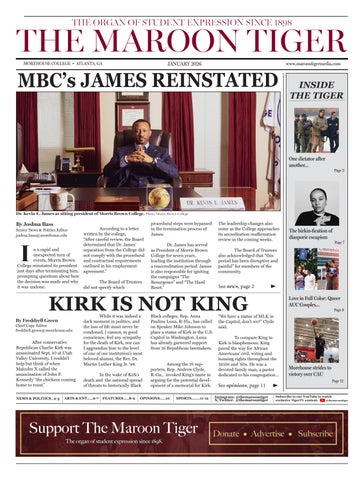
In a rapid and unexpected turn of events, Morris Brown College reinstated its president just days after terminating him, prompting questions about how the decision was made and why it was undone.
According to a letter written by the college, “After careful review, the Board determined that Dr. James’ separation from the College did not comply with the procedural and contractual requirements outlined in his employment agreement.”
The Board of Trustees did not specify which
procedural steps were bypassed in the termination process of James.
Dr. James has served as President of Morris Brown College for seven years, leading the institution through a reaccreditation period. James is also responsible for igniting the campaigns “The Resurgence” and “The Hard Reset.”
The leadership changes also come as the College approaches its accreditation reaffirmation review in the coming weeks.
The Board of Trustees also acknowledged that “this period has been disruptive and painful” for members of the community.
news, page 2
KIRK IS NOT KING
By Freddrell Green Chief Copy Editor freddrell.green@morehouse.edu
After conservative
Republican Charlie Kirk was assassinated Sept. 10 at Utah Valley University, I couldn’t help but think of when Malcolm X called the assassination of John F. Kennedy “the chickens coming home to roost.”
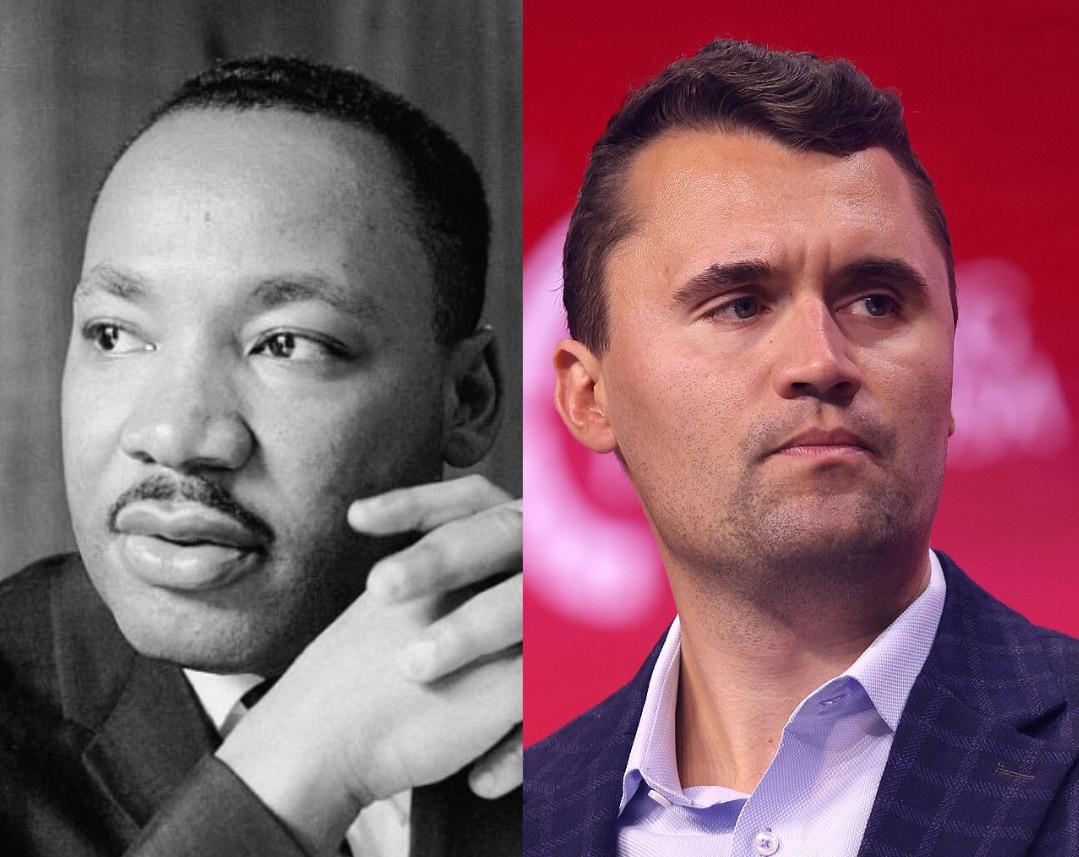
While it was indeed a dark moment in politics, and the loss of life must never be condoned, I cannot, in good conscience, feel any sympathy for the death of Kirk, nor can I aggrandize him to the level of one of our institution’s most beloved alumni, the Rev. Dr. Martin Luther King Jr. ‘48.
In the wake of Kirk’s death and the national spread of threats to historically Black
Black colleges, Rep. Anna Paulina Luna, R-Fla., has called on Speaker Mike Johnson to place a statue of Kirk in the U.S. Capitol in Washington. Luna has already garnered support from 16 Republican lawmakers.
Among the 16 supporters, Rep. Andrew Clyde, R-Ga., invoked King’s name in arguing for the potential development of a memorial for Kirk.
“We have a statue of MLK in the Capitol, don’t we?” Clyde said.
To compare King to Kirk is blasphemous. King paved the way for African Americans’ civil, voting and housing rights throughout the 1950s and ’60s. He was a devoted family man, a pastor dedicated to his congregation...
See opinions, page 11
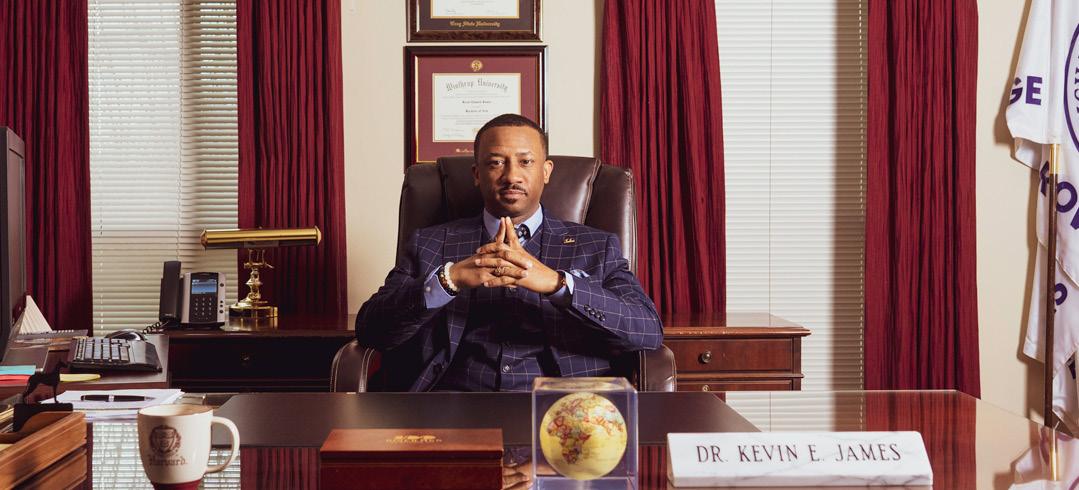
Dr. Kevin E. James as sitting president of Morris Brown College. Photo/Morris Brown College
NEWS & POLITICS 2
EDITORIAL BOARD
Geondre Baldwin ‘26
Editor-in-Chief
Niles Garrison ‘26
Managing Editor niles.garrison@morehouse.edu
Seth Beamer ‘27
Multimedia Director seth.beamer@morehouse.edu
Julian Reyes ‘27
Chief Business Officer julian.reyes@morehouse.edu
EXECUTIVE BOARD PRINT & MULTIMEDIA
Freddrell Green ‘27
Chief Copy Editor freddrell.green@morehouse.edu
Joshua Bass ‘27
Executive Producer | Senior News & Politics
Editor joshua.bass@morehouse.edu
Madeline Daniel ‘27
Senior Opinions Editor madelinedaniel@spelman.edu
Aeiress Stancil
Senior Arts & Ent. Editor aeiressstancil@spelman.edu
Elijah Qualls ‘27
Senior Features Editor elijah.qualls@spelman.edu
Tyler Lewis ‘27
Senior Sports Editor tyler.lewis1@morehouse.edu
Darian Crisp ‘27
Video Director darian.crisp@morehouse.edu
Isaiah Turman ‘28
Chief Photo Editor isaiah.turman@morehouse.edu
Kennedy Crisp
Chief Layout Editor kennedycrisp@spelman.edu
Aaron Fields ‘28
Associate Producer aaron.fields@morehouse.edu
Joshua Bryant ‘26
Associate Producer joshua.bryant@morehouse.edu
Jiana K. McDonald ‘27
Sports Producer jianamcdonald@morehouse.edu
Laila Surafiel ‘27
Sports Producer lailasurafiel@spelman.edu
Tiffani Billups ‘27
Secretary tiffanibillups@spelman.edu
Paris Graves ‘27
Secretary parisgraves@spelman.edu
Jeremiah Mitchell ‘27
Digital Content Manager jeremiah.mitchell@morehouse.edu
FICO challenge returns: Morehouse enters another year of AI learning
By Niles Garrison Managing Editor niles.garrison@morehouse.edu
One of the world’s leading global analitics software companies is expanding its diversity with HBCUs and Morehouse College is assisting their mission.
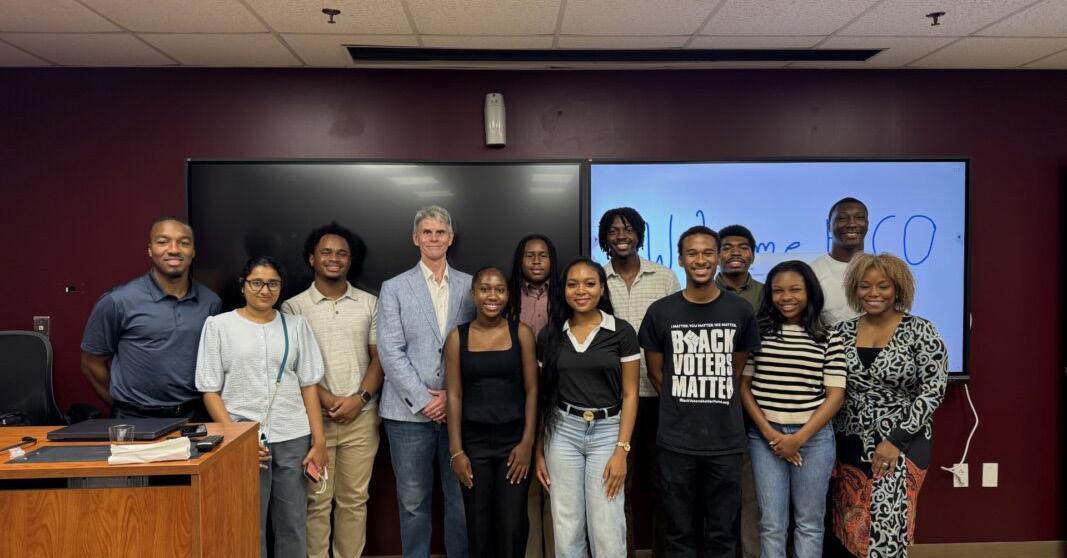
The Fair Isaac Corporation (FICO) announced their return for a third year of their FICO Educational Analytics Challenge and their second year working with Morehouse. This semester-long program will partner with Bowie State
University, Delaware State University, Alabama A&M University and Morehouse to develop the next generation of Black data scientists.
This year’s challenge will focus on artificial intelligence, with hopes to train students in developing large/ small language models.
“One thing I want to focus on is what are the responsible ways to use generative AI,” said Dr. Scott Zoldi, chief analytics officer of FICO. “We want the students to know how they are built, how they work and how they can be biased so we
Morris Brown College reinstates Dr. Kevin E. James’ after sudden termination
Continued from front page
The rapid reversal and abrupt changes have raised questions about internal governance at the college. In a Facebook post following his termination, James received significant engagement within the community, receiving 6.1k reactions, 2.1k comments, and 1.1k shares. While many comments were in favor of James, not all reactions have been supportive.
One comment said, “I’m in disbelief. This seems counterintuitive. I hope that the board can provide concrete reasoning as to why this is occurring, and pray that the overall impact on the school and the student body’s success is not negative.”
While another stated, “Looking forward to hearing from the Board to get the other side of the story.”
On the other hand, a former board member is calling for his removal as President. In an interview with WSBTV, Jeffery Miller voted him in as president seven years ago.
can use the technology more responsibly in the future.”
“Anyone can build these models with sufficient training.”
Last year’s challenge focused on detecting fraud. The transition to building language models is a result of the proliferation in AI.
Students at each university will be broken into teams for the semester. Attending lectures and scrums are necessary, with the goal of the challenge being to complete a final project.
“The project is to learn enough about these new technologies,” Zoldi said. “Use these transformer technologies to generate synthetic conversation. They will use these technologies to simulate a banking employee and customer .”
Included in this year’s cohort for the FICO challenge are Spelman women. The college is not a direct partner with FICO but data scientists come from all backgrounds.
“We are always looking for a gender balance,” Zoldi said. “We are very pleased to see Spelman participants this year.”
The challenge is not only beneficial in the short term but long term as well, with internship opportunities available at FICO. If individuals wish to pursue other opportunities in the tech industry, the mentors assigned during the program will be present as a reference and can help guide them through that process.
Certainly, FICO’s return for another year at Morehouse showcases their dedication to achieving diversity in their occupational field. Morehouse may not have all the resources, but Dr. Zoldi and FICO are here to assist in any way possible. Their mission is to provide the necessary knowledge to the next generation.
“We really encourage students to take a very serious look at doing the challenge,” Zoldi said.
“I still stand by my vote that he was the right person for that time. Now, it’s a different story,” Miller said.
What’s next for Morris Brown?
James will return to his role as president. His contract is set to run through 2029.
The Board of Trustees said it is “committed to ensuring that appropriate processes exist for concerns to be raised safely, reviewed fairly, and addressed responsibly.”
The Maroon Tiger is set to have a sit down conversation with James for the ‘State of the House’ series. The interview will be conducted in the coming weeks.
he Foodhive, a popular stop for snacks and meals for students and staff on campus, has introduced a new self-checkout system that allows students to scan and pay for items without the assistance of a cashier.
“I think the self-checkout system is very nice and innovative and a good way to incorporate technology to make things easier,” said Kaya Riggs, a sophomore at Spelman College.
Travis Pierce, a sophomore at Morehouse College, also thinks the new self-checkout option provides additional benefits for students.
“I like how quick and easy it is for students. I kind of wish we had more of that,” Pierce said. “But I also do like the register, so it would be great if we continue to have both options.”
Buzz at the Foodhive: Students react to self-checkout rollout
By Miles Pierre Staff Writer/Photojournalist miles.pierre@morehouse.edu
The rollout has drawn mixed reactions from students at both Morehouse and Spelman. Some say the changes make it easier to grab items after class, while others note that items cost more because of the added tax.
A few students also raised concerns that if the self-checkout system expands, it could reduce the number of cashier jobs available, cutting into the personal connections between students and staff that help define the Foodhive experience.
As the Foodhive continues to adjust its services, students agree that the store’s growth will shape their on-campus dining experience — whether through self-serve technology or expanded food selections.
Dr. Scott Zoldi with the 3rd year FICO E.A.C. Cohort. Jessica Butalla/FICO
Photo/Miles Pierre
One dictator for another? The threat of further intervention on Latin America
By Freddrell Green Chief Copy Editor freddrell.green@morehouse.edu
In a bold move to allegedly combat narcoterrorism and potentially strengthen the United States’ economy, President Donald Trump launched an assault on Caracas, Venezuela, on Jan. 3, 2026, capturing Venezuelan President Nicolás Maduro and his wife, Cilia Flores. Despite Trump’s dominant display of military power over the Venezuelan president, his continued threats of intervention place other Latin American countries in a state of uncertainty.
“Drill, baby, drill”
President Trump plans to restore oil production in Venezuela through U.S. oversight and private sector-led investment into the country’s oil reserves. Amidst calling on petroleum companies such as Chevron, ExxonMobil and ConocoPhillips, Trump seeks $100 billion in capital from the private sector to invest in the redevelopment of Venezuela’s oil infrastructure. Many oil companies, despite Trump’s plea, view Venezuela as “uninvestable”.
When Operation Absolute Resolve (codename for the U.S. assault on Venezuela) materialized in Caracas, junior software engineering major and futures trader Korey Moore ‘27 spotted an outpour of oil contracts being sold in the
commodity market, an anticipatory maneuver regarding the oil reserves falling in the U.S.’ s hands. Following that, Moore alleges that a group of oil beneficiaries manipulated the market in an effort to maintain oil prices, bringing them up 2.55% on Jan. 5.
“What we observed is basic supply and demand mechanics,” he said. “Even though there were some manipulators trying to uphold the price of oil in order to protect their profitability, you can only manipulate the market for so long before natural conditions prevail.”
After Trump announced his plan to restore oil production in Venezuela under U.S. oversight on Jan. 6, oil prices dropped by 4.01% within hours of the news breaking.
Despite pushback from Congress against military action, the Trump administration claims that U.S. oversight will “benefit the people of Venezuela and the United States.” In an interview with CNN’s Jake Tapper, White House Deputy Chief of Staff Stephen Miller echoed the U.S.’s supposed predominance, justifying authoritative measures towards countries of value to American interests.
“We live in a world, in the real world, Jake, that is governed by strength, that is governed by force, that is governed by power,” Miller said. “It is absurd that we would allow a nation in our own backyard to become the supplier of resources to our
us.”
John Jairo Garcia Díaz, a Colombian pastor who resided in Venezuela, the U.S. and now Spain, believes Venezuela is a pawn in the U.S’s game of chess against China and Russia. The Asian nations were two major beneficiaries of his former country’s oil reserves before U.S. intervention.
“It’s about weakening the other countries,” he said. “Donald Trump doesn’t even fake it. He says it very clearly: ‘That is our petroleum, our oil. Those are our lands and we’re going to make a lot of money.’”
Maduro inherited an already poverty-stricken Venezuela after his appointment in 2013 by Hugo Chávez. Diplomatic conflicts with the U.S. and neighboring countries resulted in further sanctions on their ability to trade. Despite accusations of an iron fisted rule,
Garcia Díaz doesn’t consider Maduro a dictator. Rather, he points much of the blame for Venezuela’s economic struggles to the U.S.
“How could they (Venezuela) sustain themselves?” he said. “Nobody could sell them food… and the oil that they could sell, they had to sell with a lot of discounts.”
Sectoral sanctions, restrictions on specific industrial activities within a country, were first introduced to Venezuela by the Trump administration in 2017. These sanctions are an intensified model of the Obama administration’s individual sanctions on Venezuelan officials from 2014-2015.
With Venezuela now under mandate to trade their oil exclusively with the U.S., Cuba, an already struggling nation, is now stranded in even more economic ruin without their top supplier of subsidized
mandate to trade their oil exclusively with the U.S., Cuba, an already struggling nation, is now stranded in even more economic ruin without their top supplier of subsidized oil.
“I can’t envision Cuba getting any worse,” junior sociology and comparative women’s studies double major and president of Afro-Latinidad Joasia Jacobs said. “In order to sustain a life in Cuba, you need a family who’s in the United States that sends you items, your necessities.”
Garcia Díaz believes the U.S. midterm elections will determine the future of foreign relations between the U.S. and Latin American countries. With overwhelming democratic influence in the U.S. Senate and deals between South American countries and U.S. liberals, Garcia Díaz believes the interventions can cease if democratic principles prevail in the midterms.
“The Democrats are going to be in charge of restoring democracy”
Garcia Díaz stated. “That’s going to be the route that they will follow.”
[Left] Donald Trump. [Right] Nicolás Maduro. Graphic/Freddrell Green
adversaries but not to
STATE OF THE READER
Where do we stand in the digital era?
By Geondre Baldwin Editor-in-Chief
geondre.baldwin@morehouse.edu
In a time where skimming the surface is almost inevitable, The Maroon Tiger stands defiant in a world eager to simplify. What started as a monthly student journal in ‘The Athenaeum’ has now become one of the biggest student-run publications at any historically Black college or university in the nation.
A century’s past was a different time. What once encapsulated truth and freedom think has become sparse. As the word becomes increasingly
digitized, newsrooms everywhere are shutting down their print services.
So, why does The Maroon Tiger still print? After years of sporadic newspaper issues and magazine emphasis, why still produce a paper? Quite frankly, we did not inherit a newspaper. We inherited a responsibility. We inherited a culture. We inherited a legacy.
The real question we must ask ourselves is, why are we so afraid of reading? At an institution built on thinkers and truth seekers, the decline of student readership should concern us all. We exist as
questioning. Nevertheless, the same hunger for truth that once flooded those Athenaeum pages
continues to call out from The Maroon Tiger one hundred years later.
We must challenge ourselves in proximity while the world promotes intellectual scarcity. We can no longer be plagued by a headline-only landscape.
Brethren, it is in our best interest to continue reading as much as we possibly can. We shall continue to instill as much context in our lives as we can. We cannot let them take our intellectual eye. We vow to remain true to the vision of The Maroon Tiger, passed down from generations of young and hungry scholars and journalists.
“The voice of the students at Morehouse College” as we once said.
We are The Tiger. We are MT. We are the winning team. We are the organ of student expression.
MAGA rage over Bad Bunny Super Bowl continues
By Jaiden Jones Staff Writer jaiden.jones@morehouse.edu
Turning Point, the group founded by the late Charlie Kirk, announced that it will host its own Super Bowl halftime show.
“It’s true, Turning Point USA is thrilled to announce The All American Halftime Show,” Turning Point USA posted on X. “Performers and event details coming soon.”
This announcement comes amidst the selection of Puerto Rican superstar Bad Bunny as the 2026 headliner. Many people in Turning Point USA have voiced their concern of having the artist perform on one of the biggest stages.
Previously Bunny skipped touring the U.S. on his latest tour due to President Donal Trump’s administration’s use of ICE immigration crackdown.
ARTS & ENTERTAINMENT
“I don’t know who he is, I don’t know why they’re doing it; it’s crazy,” Trump said in response to Newsmax’s Greg Kelly late Monday about Bad Bunny selection. “I think it’s absolutely ridiculous.”
Bunny hosted “Saturday Night Live” on Oct. 4th, where the singer delivered a message in Spanish, “If you didn’t understand what I just said, you have four months to learn.”
Later, it was announced ICE will be in attendance at Bunny’s performance at Super Bowl 2026, Homeland Security Secretary Kristi Noem confirmed. “We’ll be all over that place.” Noem said.
With Turning Point entering the halftime controversy, Bunny’s performance shows no signs of slowing down before kickoff.
Did you know?
In 1997, Morehouse College’s Homecoming activities included the names of Jay-Z, Ice Cube, Lisa ‘Left Eye’ Lopez, Kirk Franklin, and Jamie Foxx.
All the Acclaim and Applause, Without the Award: Black Cinema and the Awards Gap
How
the Golden Globes loss of Sinners revived long-standing questions about race, recognition and Hollywood’s gatekeepers
By Aeiress Stancil Senior Arts & Entertainment Editor aeiressstancil@spelman.edu
At the 2026 Golden Globe Awards, director Ryan Coogler’s film Sinners received recognition in several respectable categories, including best cinematic and box office achievement and best original score, which was presented during a commercial break and not televised.
The disappointment felt less like a surprise and more like a reminder of how often Black excellence is applauded by audiences but overlooked by Hollywood power structures. The night’s most scrutinized loss came in the best actor category, where Michael B. Jordan’s performance in Sinners fell to Timothée Chalamet for Marty Supreme, which was released only seventeen days prior to the Golden Globes. Many viewers questioned how Sinners, a film that had been in theaters longer and maintained cultural relevance, failed to receive comparable award status. The concern was not the excellence of Marty Supreme, but a familiar imbalance in how acclaim is distributed.
More than a single loss, Sinners has reignited a broader
broader question: why do Black films so often leave lasting cultural footprints without earning the industry’s highest accolades?
“Black people have always been an offshoot,” Tiffany Jones, a Spelman College anthropology assistant professor, said. “Historically, Black people weren’t deemed as human; everything centers on whiteness and Eurocentrism.”
That history continues to shape how Black stories are received within Hollywood’s awards system. The response to Sinners reflects a long-standing pattern in which Black films are widely celebrated by audiences who are able to in some sense see a reflection of them and their people praised for its cultural impact, yet repeatedly fall short in top awards categories.
“It’s hard for people who are not the same race to see themselves in the stories, even if it’s the exact same story,” Jones said.
That disconnect was central to the “Oscars So White” movement, which began in 2015 after consecutive years of all-white acting nominees and drew attention to the lack of racial diversity among awards voters. Even after those changes, the recognition gap for Black creatives has not fully
closed across major awards shows.
Marty Supreme may have resonated more with voters because of its familiarity. As a biopic, it offered a clear character arc that awards bodies often favor. Jones noted that awards success is driven less by box office performance than by strategic campaigning. In contrast, genre films like Sinners, which uses vampire mythology to symbolize systemic racism and cultural exploitation of Black communities, have historically struggled for recognition.
Ultimately, Sinners’ loss reflects more than a single awards outcome. For many viewers, it points to a pattern in which Black films generate cultural impact while still falling short of institutional recognition. The future of recognition in Hollywood may depend less on who chooses the winners and more on which stories audiences refuse to let go unseen.
After snubs, Sinners wins 2 out of 7 Golden Globe Awards. Photo/Golden Globes
ARTS & ENTERTAINMENT 7
The birkin-fication of diasporic escapism
By Laila Surafiel Sports Producer lailasurafiel@spelman.edu
Hermès appointed Grace Wales Bonner as the new creative director of menswear. The appointment by the prestigious French fashion house was a landmark event for Black fashion. Wales Bonner is the first Black woman in history to lead a major European Fashion House.
Hermès announced the monumental decision on Oct. 21, 2025, via their official publication. Wales Bonner’s first collection for the house will debut in Winter 2027. She succeeds Véronique Nichanian, who held the position for 37 years. That is the longest tenure of any serving creative director in fashion.
Wales Bonner has long admired the house that she now leads. In a 2019 interview, she shared that one of her professional dreams was “to work with a brand like Hermès.” A dream that has culminated in this historic achievement 6 years later.
The appointment prompts a consideration in the Black community. What does it mean for a Black creator to inhabit a powerful role within a historically white institution?
It brings into focus the concept of Diasporic Escapism. A concept that addresses how Black creators and
communities have historically envisioned and constructed a world without oppression, an escape.
Historically, spaces of Black liberation and luxurious autonomy exist because Black people built them to reflect their history and perspective.
Polo Ralph Lauren and its
MT Review Corner
By Miles Pierre Staff Writer/Photojournalist miles.pierre@morehouse.edu
After a decade of Demogorgons, the Upside Down, and supernatural events in Hawkins, Indiana, Stranger Things, arguably Netflix’s biggest hit series, ended on New Year’s Eve with its Season 5 finale.
From its debut, created by Matt and Ross Duffer, the show built its reputation on horror, mystery, and sci-fi, grabbing fans’ attention. Since 2022, viewers wondered what would become of characters like
ters like Jane Hopper/Eleven (Millie Bobby Brown), Mike Wheeler (Finn Wolfhard), Dustin Henderson (Gaten Matarazzo), Lucas Sinclair (Caleb McLaughlin), Max Mayfield (Sadie Sink), Steve Harrington (Joe Keery), and the rest of the Hawkins crew.
While many longtime fans appreciated the closure, others argued the finale failed to live up to the strongest seasons. Seasons 3 and 4 delivered high stakes, shocking twists, fan-favorite deaths, and introduced Vecna/Henry Creel (Jamie Campbell Bower) as a terrifying threat. Fans expected answers to lingering plot holes and theories, but many felt these were rushed or unresolved.
A major discussion centered on Will Byers’ (Noah Schnapp) coming out scene. Some saw it as long overdue and emotionally honest, while others felt it slowed the climax and was unnecessary for the larger plot.
partnership with Morehouse College and Spelman College is a prominent example. Such institutions do not exist solely for the purpose of education. HBCUs have carefully crafted pockets of solace and freedom for Black students to thrive in. Institutions as such benefit from enriched communities strengthened by Black perspectives.
However, the creation of these luxurious pockets of peace often brings with it the complication of respectability politics. The internal pressure within marginalized groups to conform to the dominant majority’s values and norms to gain acceptance.
Is diasporic escapism the creation of luxurious spaces that mirror those that excluded us? The problem is, we define luxury the same way our majority counterpart does. In doing so, the Black perception of massive wealth and significance of creations is restricted.
This is precisely where Wales Bonner’s appointment becomes a powerful cultural moment.
It forces us to confront the overarching question: What does it mean for Black people to have a Black woman directing a historical luxury and status symbol like Hermès, a brand that still remains financially
RATING
6.8
Another criticism was the finale’s lack of meaningful stakes. Despite facing Vecna and the Mind Flayer, with Demogorgons absent, the main cast survives. Previous seasons killed off characters like Bob Newby, Eddie Munson, Chrissy Cunningham, and Billy Hargrove, raising emotional stakes. Season 5’s avoidance of a major irreversible death felt like a missed opportunity.
Ultimately, the divided response highlights the challenge of concluding a massive cultural phenomenon. The discussion around Stranger Things will linger long after the Upside Down fades.
inaccessable to much of the Black community? This moment presents an opportunity for optimism, a belief that this historic achievement will expand the doors of what is considered attainable for and by Black people.
When a Black woman stands at the helm of an institution whose very essence is a global standard of status and wealth, the language of luxury will begin to shift.
It is said that you truly do not know the importance of representation until you are represented. Grace Wales Bonner is not just creating high-end fashion; she is creating history, offering a tangible vision of Black creativity and authority at the very pinnacle of global culture.
Her presence alone challenges the established parameters of the fashion world and hints at a future where Black legacy will be synonymous with luxury’s highest standards.
20 QUESTIONSWHAT EVEN IS A FIZZ???
1) The basketball team doing good but why they fire the last coach?
2) How much is Spelman paying to stay #1 for 19 years?
3) Why Morehouse football been a** for a decade?
4) Is fried chicken Wednesday overrated?
5) Will Morehouse give the money back that Diddy gave?
6) Why does 1911 keep going on C&D?
7) Why does LLC even have RAs?
8) Is Spelhouse embezzling their donation money?
9) Why don’t I have a gf? 10) Who’s worse, Financial Aid or Math Department? 11) Does Sodexo serve raw meat? 12) What does David Wall Rice even do? 13) Who truly runs the yard? 14) Why did half that line get dropped last spring? 15) Where do Morehouse funds go?
16) Why doesn’t anyone go to Crown?
17) Who was the RA with the Class of ‘29?
18) Why Morehouse don’t care about us?
19) Were Spelman sports ever good?
20) Will CAU ever crack Top 10 on the HBCU ranks? ?
Grace Wells Bonner on Instagram. Photo/Malick Bodian
Hermes bag and turtleneck.
Photo/ Jason Kibbler
FEATURES
Love in full color: Queer AUC couplesredefine representation and visibility
By Myles Chapman Staff Writer myles.chapman@morehouse.edu
In the heart of the Atlanta University Center, love blooms in many forms. For generations, the AUC, home to Morehouse, Spelman and Clark Atlanta, has been celebrated for cultivating Black excellence. But for queer students, that journey toward excellence often includes the task of carving out space where love can exist freely and authentically.
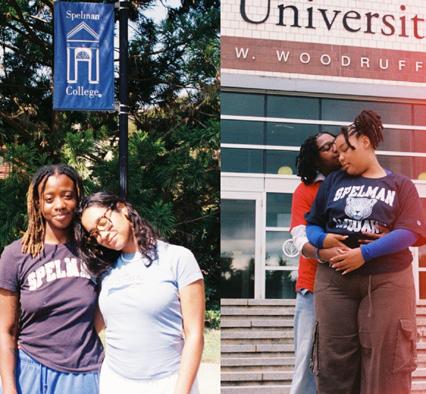
Across the three campuses, three couples are doing just that: John McGee and Benjamin Cabral (Morehouse, Class of 2028), Makayla Moore and Ana Villavasso (Spelman, Class of 2026) and Jaylin Lee-Sumlin (Clark Atlanta University, Class of 2025) with Olivia Payton (Spelman, Class of 2026). Through vulnerability, courage and joy, they are expanding the definition of Black love and reshaping what it means to be queer in the AUC.
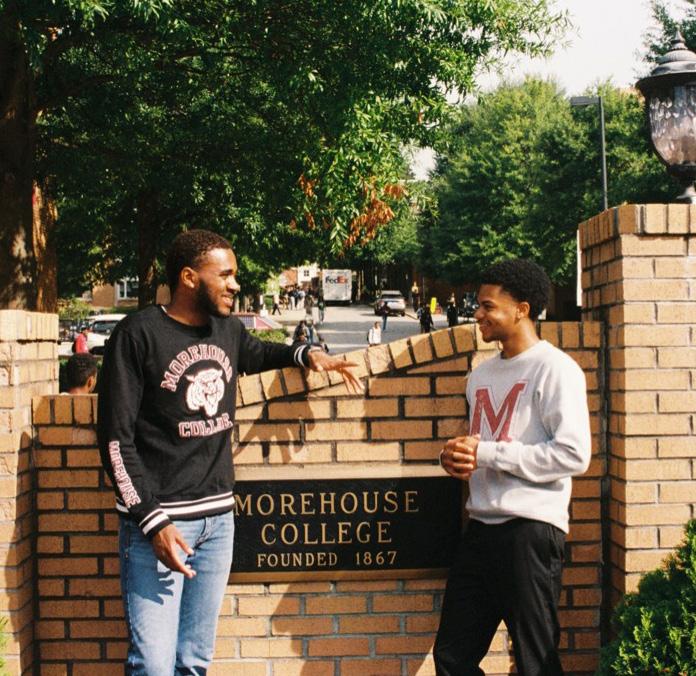
When sophomores John McGee and Benjamin Cabral first crossed paths at Morehouse, neither expected their story to become a statement about visibility and belonging.
“I didn’t come here with a plan like saying I would navigate a relationship this way,” McGee, a political science major, admits.
For both, love became an act of resistance and representation.
“I hope they see themselves in us,” McGee says. “I hope they know that they can be a man from Morehouse and be in a gay relationship at the same time. You don’t have to choose between the two.”
Still, being openly affectionate on a campus steeped in tradition wasn’t always easy.
“I was very uncomfortable showing physical affection because of how Black masculinity paints homosexuality,” Cabral recalls. “But queer students at Morehouse take up space in a way that allows us to love each other. I wouldn’t attribute my comfort here to the institution but rather to the people.”
For McGee, that community support has been key. “I don’t think the institution does anything proactively to create that space,” he says, “but our friend groups allow us to create our own space.”
Their partnership is also deeply tied to purpose. McGee is an aspiring constitutional law attorney and/or federal judge — an area that often tests authenticity.
“[When] People vote for me, they’ll be voting for me for who I am,” he says. “Not for some type of false narrative that I present to them.”
Meanwhile, Cabral sees empathy, the foundation of his international studies major, as central to understanding queerness itself.
“At the root of all things international affairs related is empathy,” he says. “Seeing other people and being empathetic
toward their situations is what helped me come to terms with being gay.”
Together, McGee and Cabral embody a new era of Morehouse men — unapologetically Black, queer and visible.
“At the root of all things international affairs related is empathy,” he says. “Seeing other people and being empathetic toward their situations is what helped me come to terms with being gay.”
Together, McGee and Cabral embody a new era of Morehouse men — unapologetically Black, queer and visible.
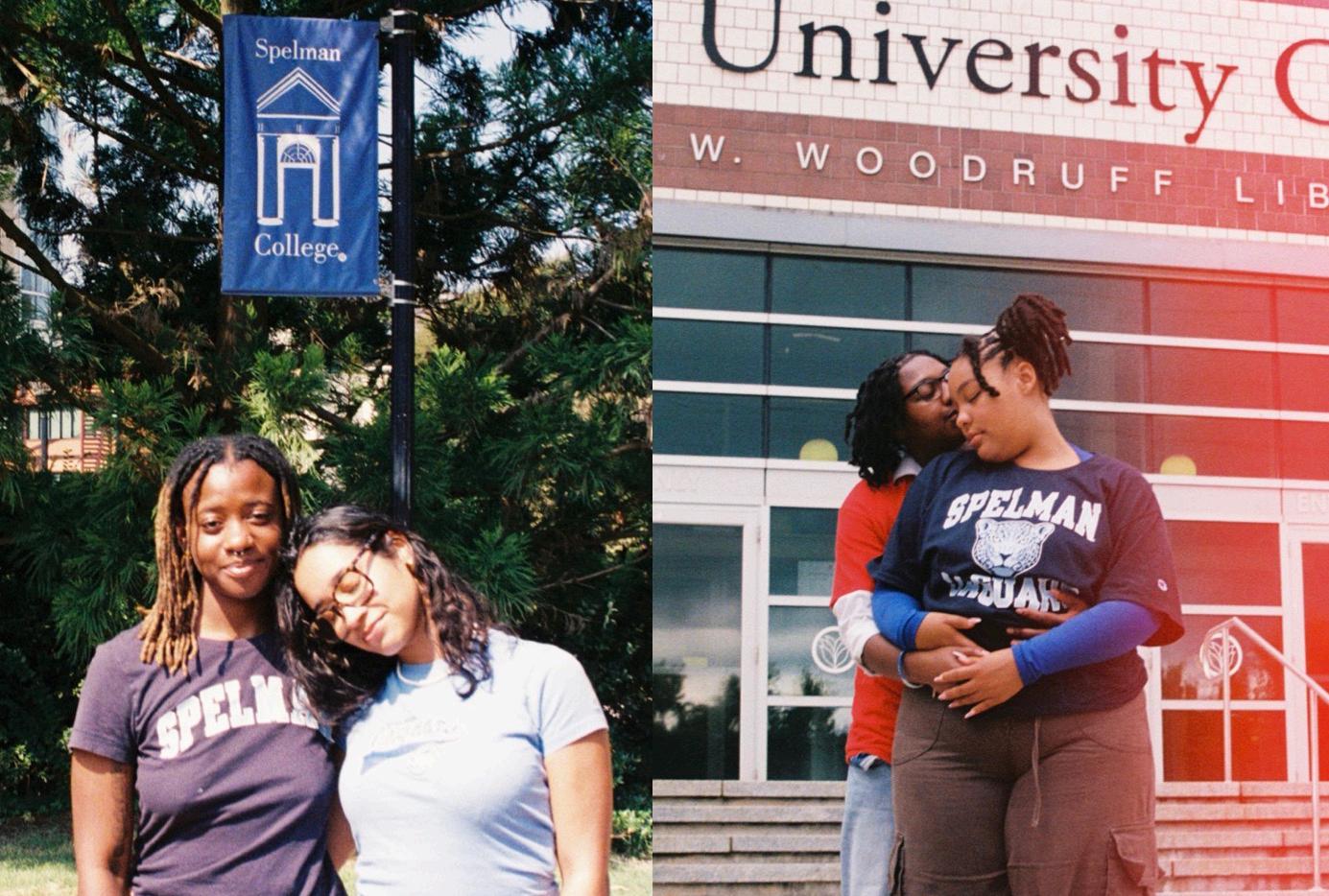
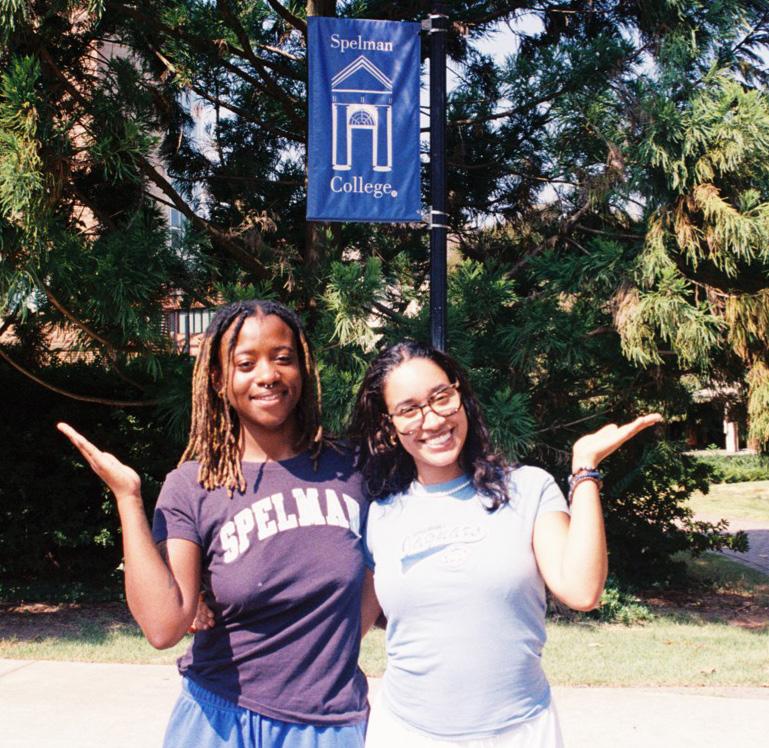
Spelman College seniors Makayla Moore and Ana Villavasso have seen their school as both a sanctuary and a challenge.
“I feel like Spelman definitely has shifted the way I see womanhood in general,” Moore says. “Being in an environment surrounded completely by women made me appreciate different aspects of femininity more.”
Villavasso echoes that sentiment: “I definitely think I appreciate aspects of womanhood more and being able to express who I am as a non-binary son and as a woman as well.”
Lee-Sumlin, a proud member of Zeta Phi Beta Sorority Inc., describes the challenge of being a masculine-presenting woman in spaces that often expect femininity.
As leaders and members of Alpha Kappa Alpha Sorority Inc., both Moore and Villavasso are helping shift conversations about queerness within Black Greek life. Villavasso was the 2024-2025 President of Spelman Afrekete, Spelman’s LGBTQ+ student organization.
“Being in a sorority and being the president of the queer organization on campus, I was able to shift the narrative about what it means to be intentional in those spaces,” Villavasso explains. Still, Moore admits that not everyone feels that same freedom.
“It’s really disheartening to hear that some people are still kind of battling with how to express their sexuality at Spelman,” she says, “because I feel like this is the one place where you should be able to express it very freely.”
Both women recognize that progress is ongoing with Moore stating “there’s still not enough education about how different queer identities present themselves.”Yet their presence — and leadership — have already begun changing the narrative.
Ana expresses that she hopes her and Moore’s story can inspire people to be who they are.
Together, Moore and Villavasso are redefining sisterhood, queerness and authenticity whilst proving that love and leadership can coexist unapologetically.
When Clark Atlanta alumna Jaylin Lee-Sumlin met Spelman senior Olivia Payton, their connection was immediate. Payton recalled it as “a sunshine moment” and “feeling really natural.”
Their relationship, however, exists within complex layers of identity and visibility.
“There are not many Zetas that are masculine-presenting and openly queer,” she says. “It’s hard but if you’re strong, and you’ve got community and sisterhood, that makes all the difference.”
Payton, a member of Sigma Gamma Rho Sorority Inc., has also navigated her queerness within traditionally hyper-feminine environments.
“It’s been a journey to feel comfortable in spaces that often expect you to conform to certain gender norms,” Payton said. “But it’s so important to find your community and not be afraid to seek out spaces where you can truly be yourself.”
Their partnership — built on mutual respect and intention — offers lessons for love itself. Payton advises students to be intentional with their relationships.
“Be intentional with your love. Be intentional with your sex,” Payton said.
“You cannot pour into other people, let alone a relationship, if you are not pouring into yourself,” Lee-Sumlin adds.
Both have faced the realities of long distance and external judgment but remain committed to each other’s growth.
“We knew very quickly that we were for the long haul,” Lee-Sumlin says. “When we have trials and tribulations, and when we’re at 60 versus when we’re at 100, we support each other no matter what.”
Each of these couples exist as living testaments to what it means to be Black, queer, and deeply in love in spaces not always built with them in mind. Their stories confront long-held stigmas and remind the AUC community that queerness is not an exception to Black identity — it is a part of it.
Photo description
John & Benjamin Photo/Myles Chapman
Makayla & Ana Photo/Myles Chapman
Jaylin & Olivia Photo/Myles Chapman
Inside Morehouse’s growing voice acting program
By Geondre Baldwin Editor-In-Chief geondre.baldwin@morehouse.edu
Voice acting has emerged as one of the most unexpected creative lanes at Morehouse College. The program has gained momentum since its launch and is already set to expand further in the upcoming spring semester.
The Communication Studies Department launched its first Intro to Voice Acting course in fall 2024 with instructor David K. Price. Before the class took shape, Department Chair Felicia Stewart recognized the work Price had been doing with clients on and off campus. The course quickly attracted students looking to sharpen their performance skills and explore a field that is often difficult to access at the undergraduate level.
Professor Price, a 28-year veteran in public speaking and voice acting, leads the program.
“There’s a standard set in terms of how we carry ourselves,” Price said. “As we say here at Morehouse, there’s a crown over our head we must reach towards.”
Price teaches his students that communication begins long before they speak.
“Students understand that they speak before they speak. Everything about you speaks from just your presence,” he said.
He also tells them that excellence is a habit that extends beyond the classroom.
“I’m always pushing excellence; not just in speaking well but living well as much as you can,” he said.
Price believes the biggest misconception about voice acting is that it depends on having a naturally strong or interesting voice. He stresses that the craft requires performance skills.
“Voice acting is understanding how to act, and you’re acting with this instrument that you call your voice,” Price said.
Students say the class has helped them grow and develop. Junior journalism major Miles Pierre said the course sharpened his performance ability.
“My voice is far more controlled than before I took this class,” Pierre said. “There are not many voice acting classes that you can take in college, so this is a once in a blue moon experience.” He added that he would recommend the course to anyone with creative interests.
Senior communication studies major Will Smith said the class helped him understand the mindset of a strong performer.
“I’ve gotten a better understanding of what makes good voice actors,” Smith said. “I’m not always the most outspoken
person, so being able to do this in front of an audience, that being the class, you learn all the mental things that go into it as well.”
Many students describe Professor Price’s teaching style as encouraging and transformative. They say his approach builds confidence and helps them find new ways to express themselves.
The idea has now expanded into a developing program. Morehouse now offers an advanced section of the
course that challenges students to build demos and prepare for paid opportunities in the industry. The expansion reflects a rising interest among students who hope to take their talents into professional spaces.
For those unsure about taking a voice acting class, Professor Price has a simple message: He believes it is an opportunity worth taking and encourages students to explore the craft while they have access
WORDHUNT
Find ten hidden words in this letter scramble.
N I T A O F M O R
The fall ‘25 class for Intro to Voice Acting. Photo/@morehouseva03
KIRK IS NOT KING
By Freddrell Green Chief Copy Editor freddrell.green@morehouse.edu
He was a devoted family man, a pastor dedicated to his congregation and an exemplary orator –putting it mildly.
Kirk’s life was the contrary. Despite the vanity from the right wing in comparing the two, Kirk besmirched the name of our beloved alum in the past, calling him “awful” and the Civil Rights Act a “huge mistake.”
To add context to my argument, let’s look at the opposing circumstances in which both these figures were assassinated. When King initiated the Poor People’s Campaign in 1968, he faced overwhelming disapproval both within the campaign and from outside institutions like the U.S. Government. Many critics have argued this pursuit was the motive for his assassination.
While MAGA supporters would prematurely claim King’s adversity to be an identical trait, Kirk’s circumstance lacked the moral pursuit that King had in his campaign for economic empowerment.
Kirk wasn’t advocating for our civil liberties. He wasn’t pressuring Congress to protect our voting rights. Instead, he spent his last moments falsely claiming that transgender people make up “too many” gun violence perpetrators in America.
Sadly, his life was taken immediately afterwards by the same instrument he has time and again argued in favor of – in the exact same fashion.
“I think it’s worth it to have a cost of, unfortunately, some gun deaths every single year so that we can have the Second Amendment to protect our other God-given rights,” Kirk said at a Turning Point USA Faith event April 5, 2023.
“That is a prudent deal. It is rational.”
Regardless of my own judgement, I feel for the family and friends of Kirk. No one should have to lose a loved one in that manner.
Kirk’s death was tragic, but to memorialize his passing as our nation has done so for King isn’t a comparison; it’s a mockery.
Queries? Feedback? Suggestions? Write to us: mt@morehouse.edu
Why are we the scapegoats?
By Jordan Lewis Staff Writer jordan.lewis@morehouse.edu
The concept of two Americas has been a focus in American academic thought for decades. When the veil between these “Black” and “white” Americas is pierced, America’s true nature is often revealed.
In the wake of conservative media personality Charlie Kirk’s death, several historically Black colleges and universities reported receiving threats and were forced to suspend campus operations on Sept. 11, 2025. The resounding question for many in the HBCU community was clear: What do we have to do with Kirk’s death?
In times of national tension, Black Americans are often scapegoated. History shows this cycle – from being labeled the “Negro problem” post-Reconstruction, to being unjustly blamed for crime following police brutality, to accusations of unfair advantage tied to diversity, equity, and inclusion initiatives. Consistently, Black achievement is framed as an attack on whiteness.
Whiteness has been deemed the standard, and anything that threatens that standard is deemed an attack on whiteness itself. Blackness has been deemed the antithesis of whiteness, and every Black success is a declaration of war against whiteness in the minds of radical right-wingers.
Fans or family: The dangers of fanaticism
The producers of “Love Island USA” issued a statement on social media urging fans to be respectful of the show’s contestants. The message pointed to a troubling trend in online interactions.
“We appreciate the fans, the
passion for the series, and the amazing group of islanders who are sharing their summer with us. Please just remember they’re real people – so let’s be kind and spread the love,” the official Instagram account posted.
What began as a light
hearted summer show quickly took a darker turn. Contestants have faced a wave of negative and often cruel online comments.
These comments, however, have gone beyond casual criticism. Many have targeted cast
The best response towards such bigotry, especially when fueled by online discourse, is to dismiss it as baseless. Black students and professionals must continue to thrive – earning internships, scholarships, and jobs – despite narratives that cast their success as a product of DEI rather than merit.
The idea of an impending race war has become a recurring theme in far-right circles. It’s almost as if a population of Americans craves war so their bigotry may finally be ethically justified in a “kill-or-be-killed” way. The guttural violence, hate speech and general ill-will toward African Americans is nothing more than misplaced aggression.
“[The poor white man] ate Jim Crow, a psychological bird that told him that no matter how bad off he was, at least he was a white man, better than the Black man,” Dr. Martin Luther King Jr. ‘48 said in his speech, “Our God is Marching On”.
Today, that mindset extends beyond class lines into an entire political ideology.
In America, where whiteness has long been the standard, Black excellence is treated as an attack on white mediocrity. Yet, the call remains the same: embrace your identity, pursue your goals and let every achievement stand as proof of resilience. Continue to be excellent. Continue to live and thrive. Continue to be Black.
members’ behavior, looks and relationships. In some cases, contestants have even been subjected to racist remarks.
This behavior highlights a larger issue: obsessive fan culture. For example, many viewers develop one-sided relationships with reality TV personalities and begin to feel entitled to comment on their lives.
As a result, emotional investment often blurs healthy boundaries. Since contestants willingly enter the public eye, some fans assume they deserve full access to their lives. Therefore, when their favorite is criticized, they feel compelled to lash out in defense.
Of course, this isn’t a new phenomenon. Paparazzi have long invaded the lives of celebrities like Princess Diana and Britney Spears, often forcing private struggles into the public eye.
By Madeline Daniel Senior Opinions Editor madelinedaniel@spelman.edu
Now, however, the problem is amplified by social media. Anyone can comment, criticize or attack—instantly and publicly. In addition, viral content can spread harassment faster than ever before.
It’s important to remember: Being on television or social media does not erase someone’s right to privacy. While visibility is part of the job, harassment is not.
Liking a post, for instance, doesn’t mean you’re entitled to personal access. Similarly, defending a contestant by attacking others is not friendship — it’s obsession.
Queries? Feedback? Suggestions? Write to us: mt@morehouse.edu
Continued from front page
[Left] Martin Luther King, Jr.; [Right] Charlie Kirk. Graphic/Freddrell Green
Glen Martin/California Alumni Association
Morehouse parts ways with Coach Mathis
By Tyler Lewis Senior Sports Editor tyler.lewis1@morehouse.edu
An anonymous, reliable source inside the Morehouse College football program revealed that the school will not renew Head Coach Terance Mathis’ contract. The decision came today at noon. The college also dismissed Offensive Line Coach Bob Whitfield and Associate Athletics Director for Compliance Andre Roach.
“I was informed at 12 noon that my contract will not be renewed. I love you guys, and you are going to be great,” Mathis said in a HUDL post to his players.
Morehouse College Athletic Director Harold Ellis ’92 formally announced the staffing changes to the campus community in a statement released at 7:24 p.m.
“All three gentlemen have served with enthusiasm throughout their time at Morehouse, and we wish them the very best in their next endeavors,” Ellis said.
No players or remaining staff members have commented publicly.
The move follows a season in which Morehouse football posted its best record since 2021. Before the 2025 season, Mathis emphasized the
MOREHOUSE | 86
need for more exposure and opportunities for his players. Over the past two years, the team gained more visibility through trips to major events, including the HBCU NY Football Classic in New York City and the first Essence HBCU Classic in Boston.
Morehouse named assistant head coach and defensive coordinator George Copeland as interim head coach. Allen Edwards, the program’s general manager, will serve as director of football operations. Copeland has been part of the Morehouse coaching staff since 2007 and has more than 30 years of coaching experience overall.
According to the team’s online roster, “Copeland joined the Morehouse coaching staff in 2007… Employing an attacking style, the 2010 Morehouse defense finished the regular season ranked 1st nationally in takeaways and tackles-for-loss. The 2009 Maroon Tigers led the SIAC in red-zone defense and posted top numbers for takeaways. The 2008 Tigers were 2nd in
total defense. The 2024 Maroon Tigers ranked 1st in the SIAC against the pass.”
This marks the third head coaching change for the football program in the past four years.
CLARK ATLANTA | 64
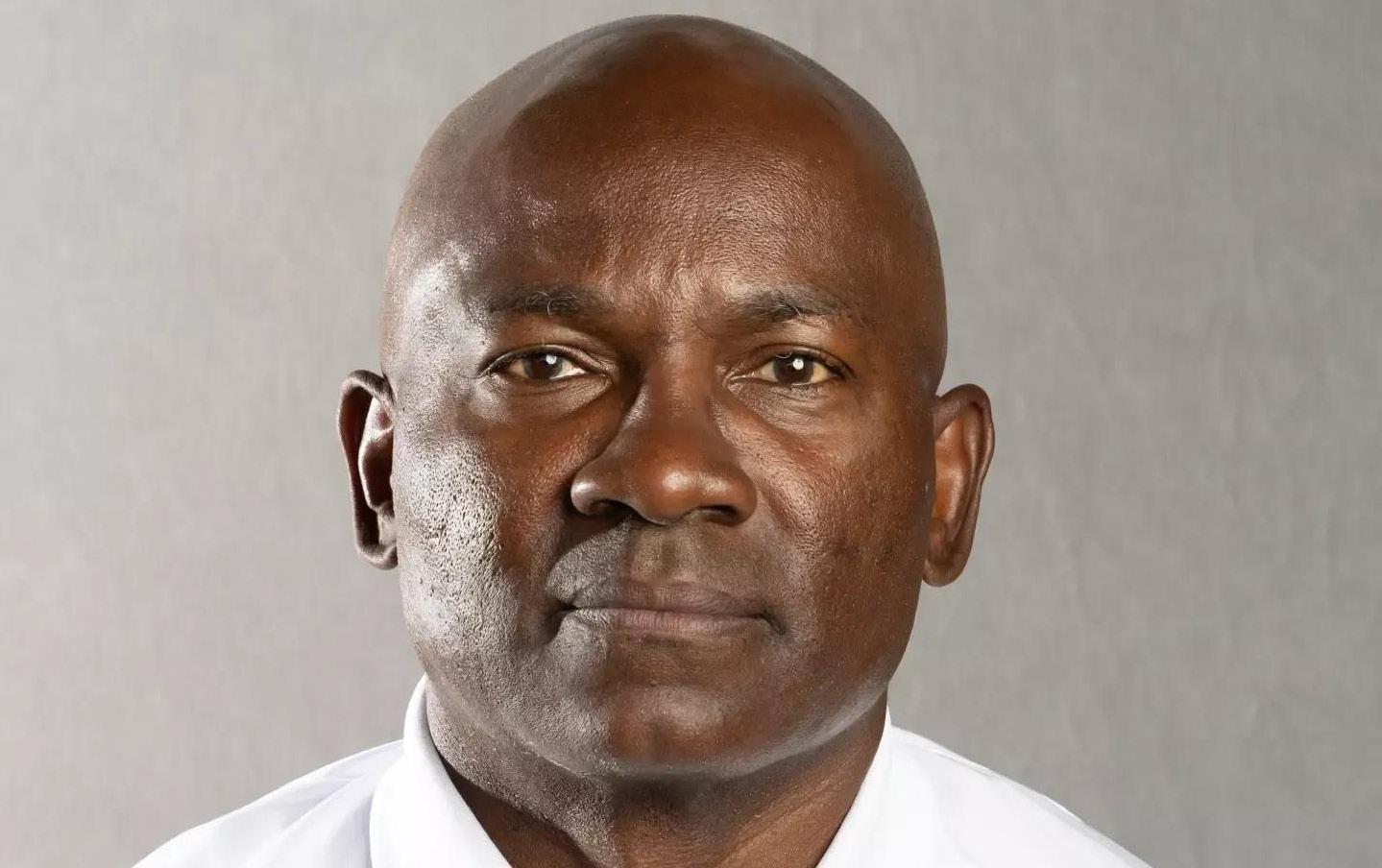
Headshot of former Coach Terance Mathis. Photo/Morehouse Athletics
SPORTS
By Tyler Lewis Senior Sports Editor tyler.lewis1@morehouse.edu
In the first Big Cat Basketball Classic of the year, the Maroon Tigers dominated from start to finish, earning an 86–64 victory over Clark Atlanta University. This game was more than a rivalry matchup; it was also a clash between the two top teams on the Eastern side of the SIAC.
WALK IN THEIR TRAP... TAKE OVER THEIR TRAP!
Morehouse takes over Club Epps in dominant fashion
The atmosphere in Burr Gymnasium was electric from the opening tip. The packed crowd pulsed with energy, and AUC rivalry chants echoed off the walls, sparking reactions from both student sections with every basket and defensive stop.
Morehouse set the pace early, jumping out to an 11-point lead before Clark Atlanta narrowed the gap to 43–42 early in the second half. The surge was short-lived, however, as
Morehouse regained control with timely three-pointers and key defensive stops that swung momentum back in their favor.
Morehouse’s victory was a complete team effort.
The Tigers shot over 50% from the field, including an exact 50% from beyond the arc. Four players reached double-digit scoring, three of them starters, with senior forward JerMontae Hill, an Atlanta native, leading the charge with 18
points, six rebounds, and three assists.
After Wednesday’s win against Fort Valley State, Head Coach Larry Dixon praised his team’s mental and physical growth. “Those two losses at the CP3 tournament were pivotal in our development as a team,” he said. As of Jan. 21, Morehouse has now won three straight matchups against Clark Atlanta. The Maroon Tigers now hold a record of 10-7.
See box scores on page 11.
Morehouse Basketball star Omar Farah scoring a layup during the ‘Battle of the AUC’ basketball game in L.S. Epps Gym, Atlanta, GA Isaiah Turman/MT