13 WEEKLY 2026
JULY
A
B A L D W I N
C I T Y
VOL 4 NO. 25 FREE DIGITAL VERSION
N E W S P A P E R
BULLPEN’S FUTURE UNCERTAIN IN CITY-OWNED BUILDING
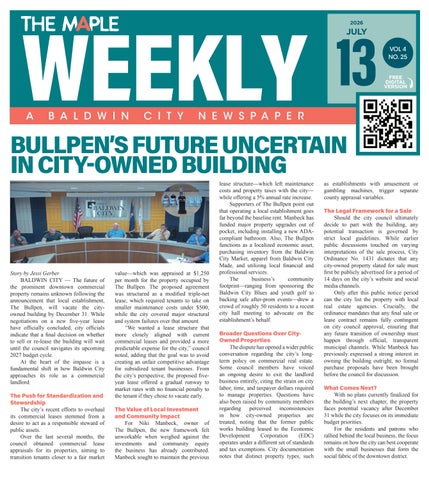
Story by Jessi Gerber BALDWIN CITY — The future of the prominent downtown commercial property remains unknown following the announcement that local establishment, The Bullpen, will vacate the cityowned building by December 31. While negotiations on a new five-year lease have officially concluded, city officials indicate that a final decision on whether to sell or re-lease the building will wait until the council navigates its upcoming 2027 budget cycle. At the heart of the impasse is a fundamental shift in how Baldwin City approaches its role as a commercial landlord. The Push for Standardization and Stewardship The city’s recent efforts to overhaul its commercial leases stemmed from a desire to act as a responsible steward of public assets. Over the last several months, the council obtained commercial lease appraisals for its properties, aiming to transition tenants closer to a fair market
value—which was appraised at $1,250 per month for the property occupied by The Bullpen. The proposed agreement was structured as a modified triple-net lease, which required tenants to take on smaller maintenance costs under $500, while the city covered major structural and system failures over that amount. “We wanted a lease structure that more closely aligned with current commercial leases and provided a more predictable expense for the city,” council noted, adding that the goal was to avoid creating an unfair competitive advantage for subsidized tenant businesses. From the city’s perspective, the proposed fiveyear lease offered a gradual runway to market rates with no financial penalty to the tenant if they chose to vacate early. The Value of Local Investment and Community Impact For Niki Manbeck, owner of The Bullpen, the new framework felt unworkable when weighed against the investments and community equity the business has already contributed. Manbeck sought to maintain the previous
lease structure—which left maintenance costs and property taxes with the city— while offering a 5% annual rate increase. Supporters of The Bullpen point out that operating a local establishment goes far beyond the baseline rent. Manbeck has funded major property upgrades out of pocket, including installing a new ADAcompliant bathroom. Also, The Bullpen functions as a localized economic asset, purchasing inventory from the Baldwin City Market, apparel from Baldwin City Made, and utilizing local financial and professional services. The business’s community footprint—ranging from sponsoring the Baldwin City Blues and youth golf to backing safe after-prom events—drew a crowd of roughly 50 residents to a recent city hall meeting to advocate on the establishment’s behalf. Broader Questions Over CityOwned Properties The dispute has opened a wider public conversation regarding the city’s longterm policy on commercial real estate. Some council members have voiced an ongoing desire to exit the landlord business entirely, citing the strain on city labor, time, and taxpayer dollars required to manage properties. Questions have also been raised by community members regarding perceived inconsistencies in how city-owned properties are treated, noting that the former public works building leased to the Economic Development Corporation (EDC) operates under a different set of standards and tax exemptions. City documentation notes that distinct property types, such
as establishments with amusement or gambling machines, trigger separate county appraisal variables. The Legal Framework for a Sale Should the city council ultimately decide to part with the building, any potential transaction is governed by strict local guidelines. While earlier public discussions touched on varying interpretations of the sale process, City Ordinance No. 1431 dictates that any city-owned property slated for sale must first be publicly advertised for a period of 14 days on the city’s website and social media channels. Only after this public notice period can the city list the property with local real estate agencies. Crucially, the ordinance mandates that any final sale or lease contract remains fully contingent on city council approval, ensuring that any future transition of ownership must happen through official, transparent municipal channels. While Manbeck has previously expressed a strong interest in owning the building outright, no formal purchase proposals have been brought before the council for discussion. What Comes Next? With no plans currently finalized for the building’s next chapter, the property faces potential vacancy after December 31 while the city focuses on its immediate budget priorities. For the residents and patrons who rallied behind the local business, the focus remains on how the city can best cooperate with the small businesses that form the social fabric of the downtown district.