




Joe Bush jbush@nineteengroup.com
If ever any proof was needed that bad news sells, one would only need to look at The Manufacturer’s website traffic for January.
We had one of our most successful months ever in terms of number of views on the site, primarily down to three stories.
Breaking only ten days apart, Nestlé announced a huge global recall of over 800 baby food products after a contaminant was found; thousands of jobs at Leonardo Helicopters were thought to be at risk amid fears that the company would fail to secure a long-awaited order from the Ministry of Defence; and the steel sector received another blow as rumours hit the headlines that the Net Zero Teesside project would be sourcing its steel from a Chinese supplier rather than from British Steel – a decision that Gareth Stace, DirectorGeneral, UK Steel, said: “Beggared belief”.
In more positive (but clearly less clickable) news, January also saw the UK start the new year on a firm footing, with activity expanding at its fastest rate for 17 months as new orders and output gathered momentum. Figures released by the S&P Global UK Manufacturing Purchasing Managers’ Index rose to 51.8 in January, up from 50.6 in December and above the earlier flash estimate, marking the third consecutive month in positive territory.
So, all-in-all it’s been an eventful start to 2026. And as you’d expect, all the major issues and trends that matter to manufacturers are covered in our first issue of the year. To kick things off, our lead interview for Q1 sees me sit down with Professor Chris Dungey of the High Value Manufacturing (HVM) Catapult who has recently been named as the government’s
new national AI Champion. The purpose of the role is to help accelerate adoption of AI across industry and boost productivity and growth. Find out how Chris plans to achieve this on page 10
In the ever-burning issue of skills, Molly Cooper paid a visit to the Atlassian Williams F1 Team, to find out more about the motorsport giant’s inspiring STEM workshops, which welcomed nearly 14,000 students through its doors last year, in a programme aimed at nurturing the next generation of engineering talent. See page 26.
With a spotlight on sustainability, we also went to see Forterra’s Measham plant in Leicestershire, to see how this brick maker is piloting the use of hydrogen in its kilns in order to reduce its carbon impact and the energy intensive nature of this centuries-old manufacturing process. See page 30.
And finally, I hope you spotted the Sir Arthur Conan Doyle themed pun on this issue’s cover story as we find out how Bacardi is deploying automation at its John Dewar & Sons site near Glasgow.
A trial using robotic dogs has helped the whisky manufacturer better detect ethanol evaporation (or angel’s share) during the maturation process. Again, this is further proof that a traditional manufacturing process with an old and storied history, can still evolve, look forward and embrace emerging technology for the betterment of the business. See page 46.
All this and much more in this issue. Enjoy. C D E M
@TheManufacturer www.themanufacturer.com


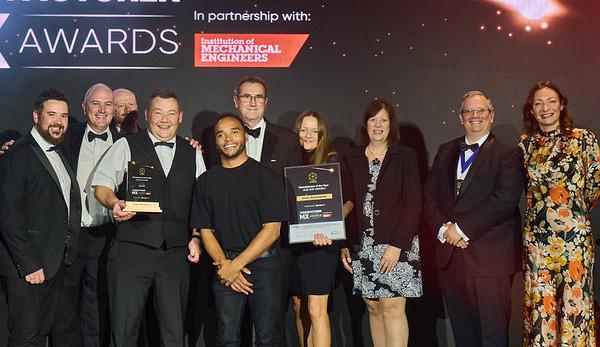
4 Britain’s finest A look back at the winners of The Manufacturer MX Awards 2025

8 Navigating risk and opportunity UK manufacturing in 2026
22 A knead for change Building a connected bakery Manufacturing’s new AI champion A sit down with Prof. Chris Dungey



26 Racing to inspire Inside the Atlassian Williams F1 Team’s STEM workshops
30 Stacking up nicely Brick manufacturing in the 21st century
34 Driving food and drink forward How the FDF aim to capitalise on a £14bn growth opportunity

38 Unlocking the door The key to scalable automation



INDUSTRY FOCUS A UK space odyssey
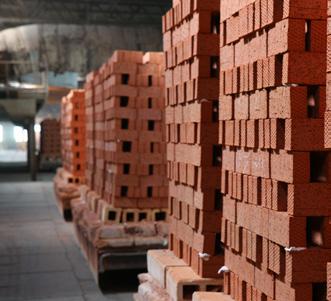
Brick manufacturing in the 21st century
42 Flying high with 2025’s Young Manufacturer of the Year From aerospace apprentice to engineering master
48 Booze hound! Sniffing out the ‘angel’s share’

52 Dare you enter the Smart Tank? Entrepreneurial pitching event returns to Smart Manufacturing Week 2026
SME Focus
58 Filing for the future How a storage manufacturer is diversifying
62 People, process and progress The Big Bear necessities
66 The fabric of innovation How one textile manufacturer is weaving its growth journey




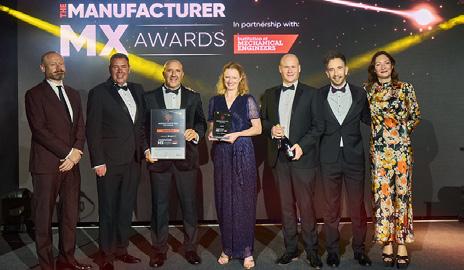
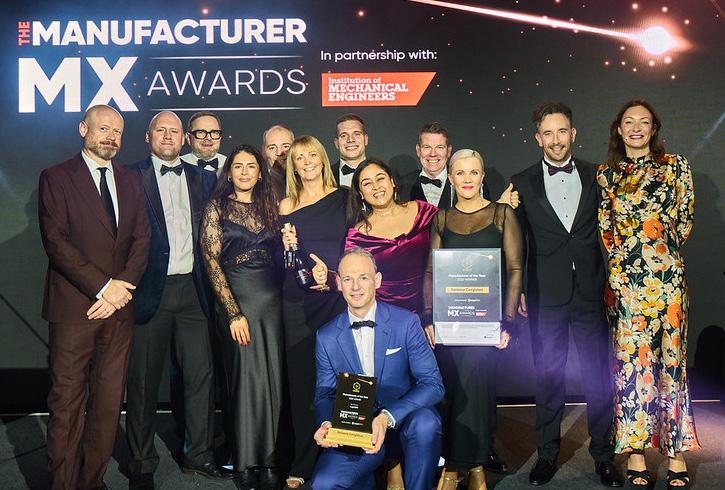
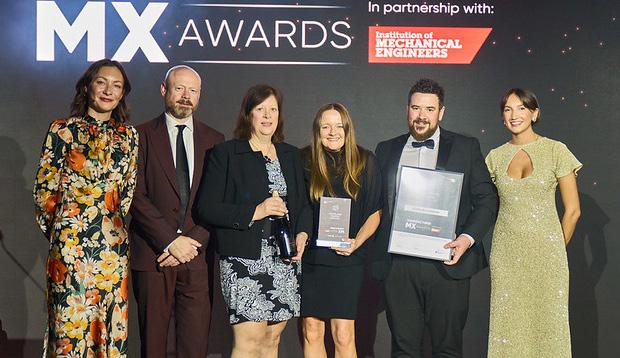
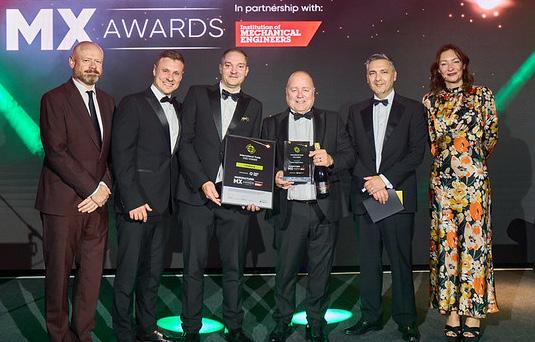
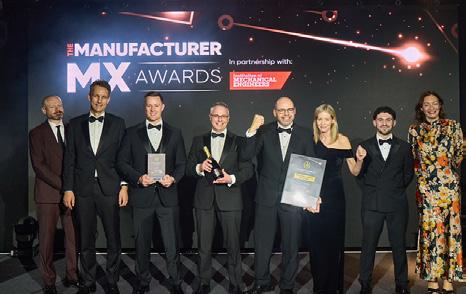
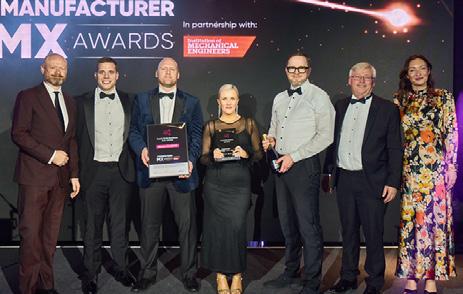
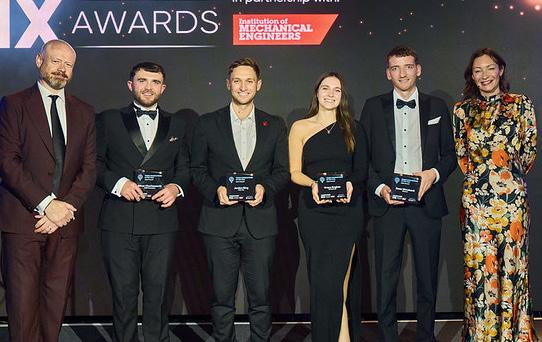
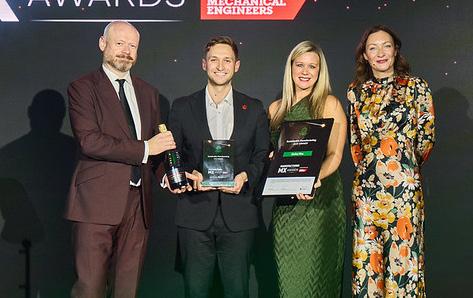
Back in November, the winners of The Manufacturer MX (TMMX) Awards 2025 were announced at a black-tie ceremony and gala dinner at the Titanic Hotel Liverpool, the culmination of The Manufacturer Live event
Amid the many challenges that defined 2025, UK manufacturers once again demonstrated unwavering resolve - turning adversity into opportunity and reaffirming the industry’s reputation for ingenuity and strength. TMMX Awards stand as a testament to that spirit, bringing together some of the most
talented, innovative and dedicated manufacturers from across the nation.
Speaking on the night, Grace Gilling, Managing Director of The Manufacturer, praised all this year’s finalists: “No other manufacturing industry awards match the level of scrutiny we bring. Every finalist in this room has undergone a rigorous judging process, dedicating



significant time and resources to take part. And I’d like to take this opportunity to congratulate all of the finalists.
“It’s an incredible joy to witness the innovation, dedication and sheer brilliance of this community. As moderators during judging, many of us hear your stories firsthand, and they inspire us deeply.”
Take a look at the 2025 winners...







Equity, Diversity & Inclusion
Evtec Automotive
Presented by

"What an evening celebrating all things manufacturing.
Thank you to The Manufacturer for holding the torch for UK manufacturing and making events like this happen, that celebrate so many workers' efforts in our industry"
David Reynolds, Head of Engineering Services, Siemens


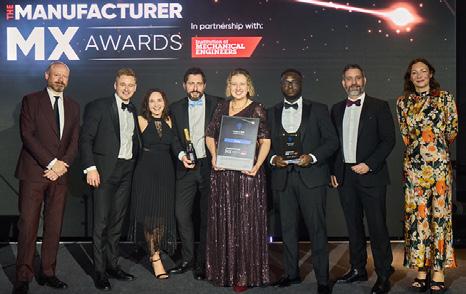

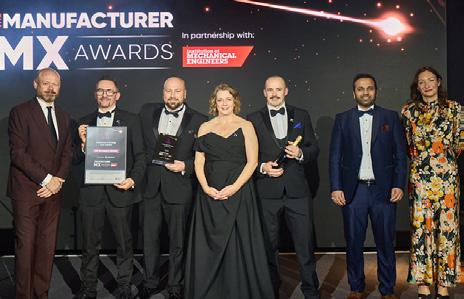

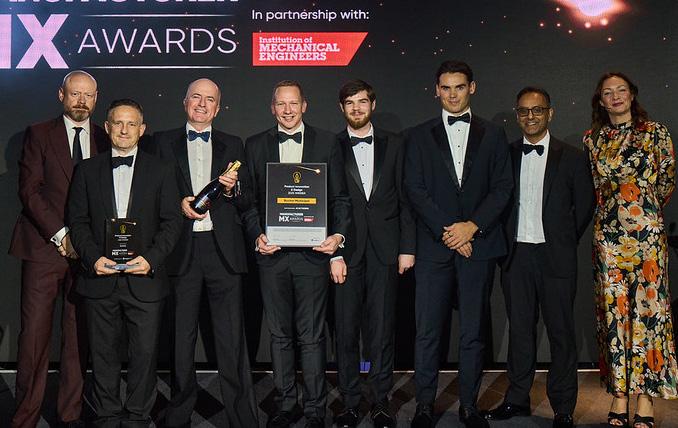

Rebecca Galley, CEO, Tornado Wire Winner: Achieving
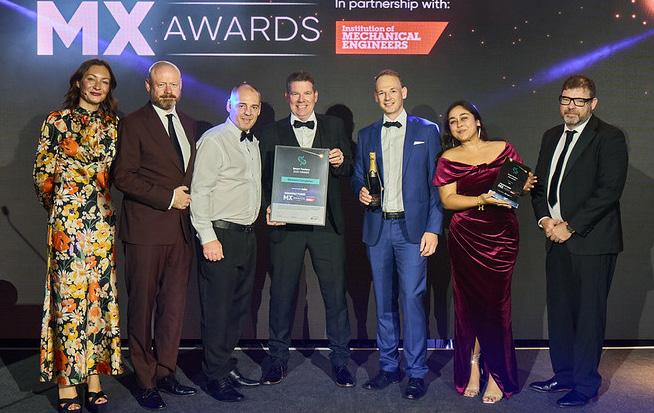





Kevin Hubbard, Managing Director, Evtec




“ The path forward demands a cleareyed assessment of the risks, strategic investment in resilience and the agility to capitalise on new growth avenues
Dave Atkinson, UK Head of Manufacturing SME & Mid Corporates, Lloyds
Dave Atkinson , UK Head of Manufacturing SME & Mid Corporates, Lloyds, takes the opportunity to reflect on the key factors that will influence decision-making in the years ahead
Now that 2026 is well and truly underway, manufacturers face a landscape defined by heightened security threats, unprecedented cost pressures and geopolitical uncertainty.
Yet alongside these challenges lie significant opportunities - from a £75bn defence spending commitment to the transformative potential of AI.
For SMEs and mid-sized manufacturers, the path forward demands a cleareyed assessment of the risks, strategic investment in resilience and the agility to capitalise on new growth avenues. Here are seven key factors that will help shape the sector during 2026.
Cyber security: the leading threat
Cyber security emerged as a top business risk during 2025, with a high-profile attack on Jaguar Land Rover. The threat landscape has evolved; manufacturing systems increasingly integrate digital technologies with physical operations, creating new attack surfaces. A breach doesn't just compromise data; it can halt production lines, disrupt delivery schedules and damage customer relationships. For manufacturers integrated into complex supply chains, a vulnerability in one supplier can cascade across multiple organisations.
The challenge is particularly acute for smaller manufacturers who may lack
dedicated cyber security resources. Yet the cost of inaction - in lost production, remediation expenses and reputational damage - far exceeds the investment required to build digital resilience, including insurance and cyber security as a service. For manufacturers, cyber security is not just an IT problem, but a fundamental business capability.
Defence expansion: a growth engine
The government's Defence Industrial Strategy represents a genuine opportunity for UK manufacturers. The £75bn commitment over six years aims to make defence "an engine for growth", with SMEs placed at the centre of this vision.
The strategy explicitly targets regional ecosystems, innovation funds and export support to create jobs and build industrial capacity across the country.
Regional defence clusters are creating pathways for SMEs to integrate into highvalue supply chains. These clusters offer access to procurement opportunities, R&D funding and collaborative networks that can help smaller manufacturers scale and compete for contracts that might previously have seemed out of reach.
The strategy also addresses skills development through five new Defence Technical Excellence Colleges and regional training hubs, recognising that a skilled workforce is essential to delivering on defence commitments.
Cost pressures: the margin squeeze
Cost pressures have continued to intensify across the sector; in 2025 Make UK reported that 79% of manufacturers faced raw material cost increases and 70% expected energy costs to rise furtheri
Rising employment taxes, logistics expenses and persistent inflation are impacting on margins and SMEs are often less able to absorb these increased costs. They typically have less pricing power with customers and have been slower to adopt automation technologies that might help offset labour cost increases.
The UK has some of the highest industrial electricity prices in the worldii, creating a structural disadvantage that affects competitiveness, and this will continue to present a significant challenge for manufacturers in 2026, who are particularly exposed.
Geopolitical uncertainty and supply chain disruption
Geopolitical instability continues to reshape global trade. Disruption in the Red Sea, the ongoing conflict in Ukraine and Middle East tensions have created persistent supply chain challenges and inflated logistics costs.
This uncertainty is driving a significant shift toward reshoring and nearshoring.
For UK manufacturers, this presents both challenge and opportunity. Building resilient supply chains requires investment and relationship development. However, the trend toward regional sourcing is already creating openings for UK-based suppliers who can offer reliability and proximity advantages.
Digital transformation: the adoption gap
Manufacturers are making substantial investments in AI, robotics and digitalisation to help offset cost pressures and improve operational resilience. These technologies offer real productivity gains, including better quality control, predictive maintenance and reduced waste.
However, a significant adoption gap exists. Capital constraints, skills shortages and uncertainties over return on investment mean some SMEs are lagging behind larger firms.
But these transformative technologies will undoubtedly be decisive to future competitiveness. The opportunity lies in strategic, phased implementation rather
than wholesale transformation.
A good starting point is to contact Lloyds’ long-term strategic partner MTC (Manufacturing Technology Centre), which employs a team of experts who visit manufacturers to carry out free line walks. It’s an opportunity to review how you work and identify opportunities to automate, drive productivity and adopt new technologies that can create the capability to diversify into new supply chains.
Workforce challenges: the £6bn problem According to Make UK, labour shortages are costing the manufacturing sector £6bn in lost output every yeariii. While the skills pipeline remains weak, wage pressures have continued to rise.
At a time when manufacturers are struggling to attract young talent and retain experienced workers, apprenticeship programmes, upskilling initiatives and retention strategies will prove critical, both for individual businesses and the wider sector.
That will mean a focus on workforce development, creating clear career pathways, investing in training and building workplace cultures that value people.
And the sector must also continue its work to engage with the education sector and promote STEM skills if we are
to build the skilled workforce advanced manufacturers need.
Looking ahead: resilience and agility 2026 has brought with it significant headwinds for the UK manufacturing sector, but there are equally substantial opportunities to access. Defence expansion, digital transformation and regional industrial clusters offer strategic growth pathways for manufacturers who can navigate this complex landscape.
The priorities for SME manufacturers must include resilience, agility and targeted investments in productivity, technology, sustainability and cyber security, as well as securing access to robust, diversified supply chains.
The manufacturers who thrive won't necessarily be the biggest or best resourced, but those who invest strategically in capabilities that matter, and remain agile enough to seize opportunities.
As ever, I remain optimistic and look forward to working with the sector during this time of transformation. l
Footnotes: i https://www.bdo.co.uk/en-gb/news/2025/manufacturing-hitsthe-buffers-as-tax-and-cost-increases-bite-make-uk-bdo-survey ii https://fullfact.org/economy/uk-world-electricity-prices/ iii https://www.makeuk.org/make-uk-industrial-strategy-skillscommission-report-2025
The UK government has appointed the High Value Manufacturing (HVM) Catapult’s Chief Technology Officer, Professor Chris Dungey, to the role of national AI Champion to accelerate adoption of AI across industry and boost productivity and growth. The Manufacturer Editor Joe Bush sat down with Chris to find out more
Supported by a team of HVM Catapult specialists and a steering board of government and industry representatives, Chris Dungey’s mission is to turn the UK’s industrial AI potential into widespread, practical adoption, especially among SMEs.
His role brings together government, technology providers, researchers and manufacturers to design and deliver AI programmes that go beyond advancing digital capability to materially improve productivity, reduce inefficiencies and cut operating costs.
As AI Champion, Chris is responsible for strengthening the critical link between innovation and implementation, ensuring that proven AI technologies don’t remain locked in labs or pilots, but are applied on real shop floors to real industrial problems. Chris picks up the story.
Why has the role of AI Champion been created?
CD: This role, created by the Department for Business & Trade (DBT) in partnership with Make UK, Made Smarter and the HVM Catapult network, has been established to tackle the well-known challenge of AI adoption in UK manufacturing remaining far too low, particularly when compared with global competitors.

Professor Chris Dungey, Chief Technology Officer, High Value Manufacturing (HVM) Catapult and AI Champion

So, how can AI and associated technologies - such as robotics and advanced automation - come together to help the UK to maintain and ultimately increase its global competitiveness, and therefore GVA to the economy?
Manufacturing is central to UK growth and productivity, yet the sector’s digital and AI maturity varies enormously. Many SMEs simply don’t know where to start. AI is in the news every day, but most companies want to know the business value it delivers. The choices can be complex, but the benefits - lower energy bills, reduced scrap, shorter cycle times and stronger resilience - can start quickly with relatively simple, low-cost steps.
At the recent AI Champion Steering Group meeting, one message was clear: manufacturers don’t want conversations focused on technology for its own sake, they want proof of impact. The priority is helping companies see measurable improvements in business performance and this insight is shaping a practical, commercially grounded and outcomes-focused approach.
My job is to bring clarity, coordination and confidence, helping manufacturers on their AI adoption journey to understand what’s relevant, connecting them to credible providers, ensuring solutions are practical and then shaping policy so adoption becomes easier and less risky.
No two manufacturers start from the same point. So a core responsibility is convening the ecosystem - industry, tech developers, government, academia and innovators - and serving as a bridge between manufacturers and the wider AI landscape.
Equally important is representing industry to government, ensuring that we are developing appropriate capabilities, testbeds and solutions and, ultimately, pathways for companies to access AI tools, expertise and resources.
Raising awareness of AI and the associated workforce skills among SMEs is absolutely fundamental and there is a huge focus on SMEs as part of this role. It's not exclusive to those smaller businesses, but the government appreciate that if the UK can support SMEs, and increase their performance - even by a fraction of a per cent - it can provide a huge boost to the UK economy.
Where does AI have the most potential within manufacturing?
AI offers huge value across the sector, from quality inspection and defect detection, autonomous and adaptive process control, energy and material optimisation, predictive maintenance to real-time quality control, and workforce augmentation and knowledge capture.
But the most compelling opportunities are those that deliver immediate operational gains, such as reduced waste, fewer unplanned downtime events and lower energy consumption. These improvements often stem from modest digital interventions rather than major transformation programmes.
One fast-return area is energy optimisation. With rising energy costs, even small efficiency gains matter. Simple digital twinning of factory assets - such as ovens, compressors and HVAC systems - can reveal hidden inefficiencies, reduce peak-time energy draw and cut bills while supporting decarbonisation goals. These are low-risk, low-cost steps that companies can trial quickly.
A major priority of the AI Champion role is building a digital front door for industrial AI, giving manufacturers a single place to understand what AI can do today, identify credible solution providers, access structured use cases, provide advice and guidance on key regulatory considerations, identify relevant skills and content providers for your business and see relatable examples from companies ‘like them’.
“
If we can understand what AI means for manufacturing, and actually help the community embrace the technology, it will offer a disruptive step change in facing down the challenges the sector faces
Professor Chris Dungey, Chief Technology Officer, High Value Manufacturing (HVM) Catapult and AI Champion
BELOW: The AI landscape is crowded and fast-moving, and manufacturers often struggle to distinguish what is real, reliable and worth investment
While we’re trying to develop AI capability, we also need to make sure that the output is actually trustworthy
Professor Chris Dungey, Chief Technology Officer, High Value Manufacturing (HVM) Catapult and AI Champion
Not only will they highlight what is sensible and relatable in a manufacturing context with a realistic return on investment, these use cases will actually lead a business down the route of acquiring the capability, and show the hard yards needed to bring the technology on board. Because the integration effort, skills, change management and true cost is often not fully understood.
How do we break down the barriers to AI adoption?
The AI landscape is crowded and fast-moving, and manufacturers often struggle to distinguish what is real, reliable and worth investment. Companies also find it hard to demonstrate true
impact and value from acquiring AI capabilities because the objective isn’t well defined at the very beginning.
Clear, relatable use cases are essential to cut through the noise and help companies understand where AI will deliver measurable value - whether saving thousands in energy costs, improving throughput or reducing scrap.
Many manufacturers assume AI requires major investment, but some of the highest-return opportunities start small. ‘Lightweight’ analytics on machine energy use or digital twins modelling live consumption can deliver rapid payback without disrupting production, helping companies build confidence incrementally. My role is to help organisations focus
on what’s practical and appropriate, not theoretical. The technology exists; the challenge now is integration, and supporting companies through that journey is central to this mission.
How do we raise awareness of AI capabilities?
Connecting manufacturers to expertise, testbeds and sandboxes is vital. These controlled environments allow companies to trial AI solutions to see if it works for them and their product without disrupting production or taking unnecessary risks. They also help companies explore low-cost, high-impact interventions first; for example, running energy optimisation algorithms in a testbed to estimate savings before
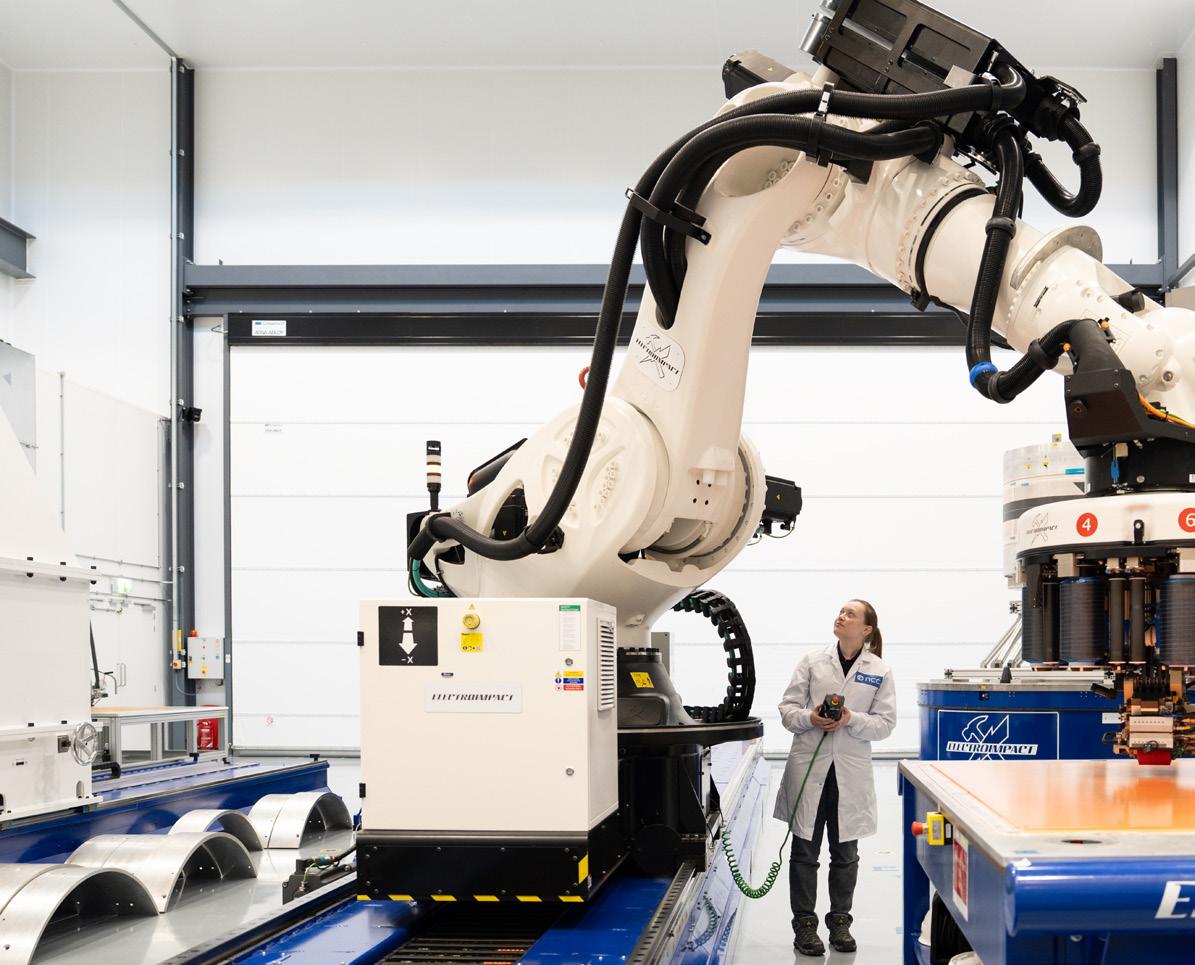
LEFT: AI and associated technologies - such as robotics and advanced automation – can come together to help the UK to maintain and ultimately increase its global competitiveness
committing to on-site deployment.
SMEs are lean for a reason; they have fine margins and don't want to invest without first having a high degree of confidence that it’s going to pay back. So these testbeds are key to be able to bring the provider and end user together to prove the tech can be deployed with as low a risk as possible before it goes anywhere near the shop floor. This applies to skills as well, so these environments essentially offer an opportunity to train people offline.
One of the recommendations we will make is that the UK needs more platformbased AI environments where companies can trial solutions with speed and confidence.
These are the relatively quick wins, which is great for industry, but alongside this we are also looking at more ambitious opportunities: how we innovate across engineering, from design all the way through to manufacture, prototyping, iteration and refinement, production, and then end of life and second life to enable new business models.
It is not just what's in front of us - which is really important for industry to actually start moving the needle in this particular spacebut also what we do next.
Help drive the adoption of AI in UK manufacturing by sharing your insights into the current barriers and priorities.
Scan the QR code to answer a short survey that asks three questions:
- How best can the AI champion team engage manufacturers to understand the current barriers to adoption?
- What help do you need to exploit AI solutions for your business?
- What use cases would you like to see demonstrated?

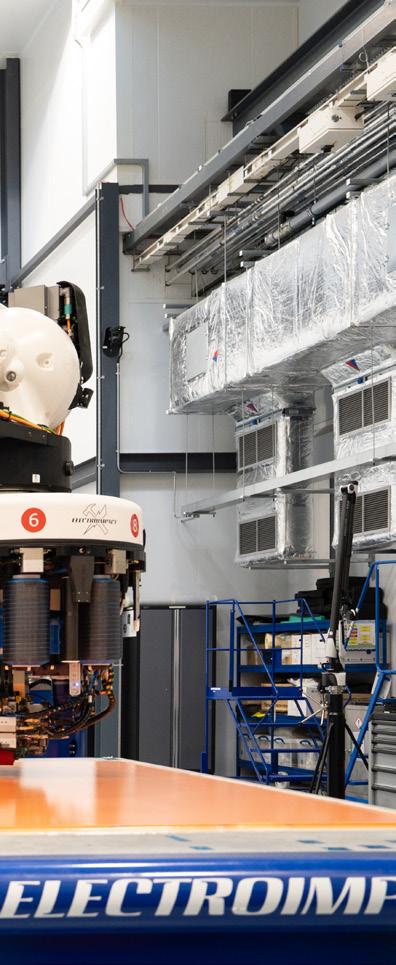
BELOW: AI offers huge value across manufacturing, from quality inspection and defect detection, autonomous and adaptive process control, energy and material optimisation, predictive maintenance to real time quality control, and workforce augmentation and knowledge capture
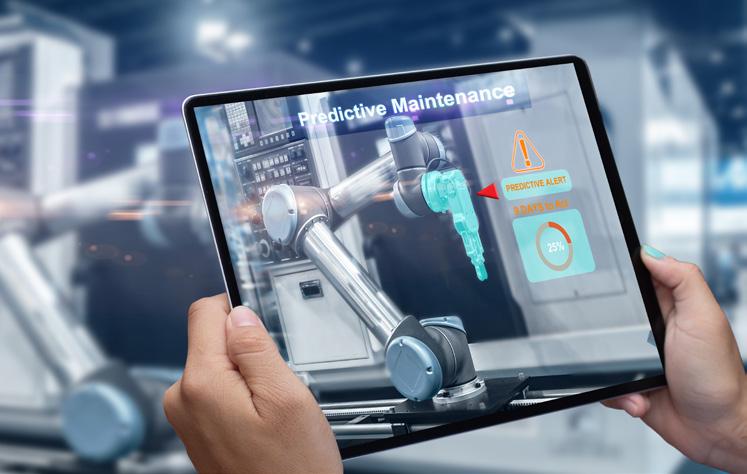
The biggest barrier to unlocking AI’s impact is that many organisations adopt it without grasping what it truly involves - leading to missed value, stalled pilots and unrealised potential
Professor
Chris Dungey, Chief Technology Officer, High Value Manufacturing (HVM) Catapult and AI Champion
How do we make sure everyone works together?
The ecosystem is fragmented. Numerous initiatives exist, but manufacturers rarely see a joined up picture. This role puts a strong emphasis on coordination, stitching together UK capabilities and ensuring the system behaves as a connected whole.
Success very much depends on connection and coordination between industry, academia, government and tech providers. Understanding 'the art of the possible' and feeding that knowledge back into industry is a core part of what the AI Champion must deliver.
What about security concerns around AI?
There are many safety critical applications within manufacturing and engineering, so AI must be trustworthy, explainable and compliant.
Trustworthy AI is a core pillar of this role. Is it explainable? Is it transparent? Is it fair? Is the governance piece in place? And as part of the role, I’ll be working with regulators very closely to understand what needs to happen in terms of AI evolution, to make sure that what's developed is trustworthy.
At HVM Catapult, we have an AI model ‘MoT centre’, an environment where AI systems can be independently evaluated for safety, data quality and regulatory alignment. This gives manufacturers reassurance that models they intend to deploy meet current ISO and British Standards.
So, we have an environment where organisations can work with us to test and validate AI models so they are ‘compliance confident’. Although, the fact that the regulatory landscape is
changing does add to the complexity and the nervousness of industry to get involved.
What does the future look like for the AI Champion?
Looking ahead, we are strengthening strategic alignment with DBT and shaping the UK’s long-term approach to manufacturing for AI and specifically AI for manufacturing.
We will continue to evolve national sandboxes, define skills requirements and develop clearer pathways for adoption. Myself and the steering board will also be acting as a trusted advisor to UK government and making sure we've got a strong voice that enables us to represent manufacturing on this topic.
Part of that will be highlighting the opportunities, challenges and, therefore, the appropriate interventions government need to make.
And that's always a challenge as it’s an environment that can become over-complicated. So the model will not only look at the quick wins that are achievable, but also identify the more profound goals we need to focus on in parallel to make sure, ultimately, that the UK wins this race, and is actually at the forefront of AI so we can really push the envelope and use the technology to create world-class businesses.
Ultimately, success will be measured not by how much AI is discussed, but by how much productivity, competitiveness and cost reduction UK manufacturers achieve by adopting it, from lower energy bills to more efficient workflows and more resilient operations. By keeping the focus on practical adoption and tangible outcomes, the UK can build world-class industrial performance powered by AI. l
• The AI Champion role exists to close the adoption gap in manufacturing - especially for SMEs:
The UK government created the role to tackle low AI uptake in manufacturing and improve productivity and global competitiveness. A core priority is supporting SMEs, where even small performance gains can deliver significant economic impact
• The focus is on implementation, not research:
AI technologies for manufacturing are already mature and available. The challenge is helping businesses understand what’s relevant, affordable and practical
• Clear, practical use cases are critical to driving adoption:
An ‘AI industrial front door’ will showcase relatable manufacturing use cases such as predictive maintenance, quality inspection, energy optimisation, and autonomous process control, helping firms understand both benefits and true costs of adoption
• Testbeds, sandboxes and skills development reduce risk and build confidence:
Safe, off-line environments allow manufacturers to trial AI solutions, validate ROI and train staff without disrupting production
• Trust, coordination and policy alignment are essential for long-term success: Widespread AI adoption depends on collaboration across industry, government, academia and tech providers, alongside strong governance for ‘trustworthy AI’





Expert voices. Timely insights. Real impact. Our webinars spotlight leading manufacturers and tech providers, offering practical knowledge on the tools, skills and behaviours shaping the modern industry.
Exclusive insight, senior connection and real conversations. A private space for senior manufacturing executives to network, share challenges, and gain strategic insight through high-level roundtables.
Where insight meets influence. From exclusive reports to targeted events, Marketing to Manufacturers’ helps solution providers connect with manufacturers and turn expert knowledge into commercial growth.
Entries open. Recognised as the gold standard awards programme in UK manufacturing, test your excellence across categories including innovation, sustainability, digitalisation, leadership, and staff engagement. Submit your entries and showcase your achievements.
The festival of industrial innovation. Returning for its fifth edition, four expos, one summit, one awards, and dozens of fringe events unite the industry for cutting-edge thinking, smart technology and the latest hardware driving real world results on the factory floor, and celebration. 3-4 JUN
Back for its 7th year, Manufacturing Digitalisation Summit unites digital leaders to explore how to turn digital vision into industrial reality. 3-4 JUN
Each November, the UK’s top manufacturing minds gather in Liverpool for The Manufacturer Live - a prestigious series of award-winning events driving innovation, strategy, and recognition. With over 50 years of legacy, it’s the premier gathering for those shaping the future of industry.
Where the industrial elite converge. This award-winning Summit is a catalyst for transformation, covering the topics most pertinent to manufacturing leaders alongside economic and market factors, operational challenges and organisational challenges.
9-11 NOV
10-11 NOV
The UK space industry aspires to be one of the most advanced and fast-growing space sectors in the world, spanning satellite manufacturing, launch services, applications, research and downstream data services. Employing nearly 50,000 people and contributing around £7bn in GVA, the sector plays a strategic role in the economy. The Manufacturer sat down with Dr Alice Bunn OBE, President, UKspace, to find out more
Across the world, the space industry is entering something of an inflection point. It’s been just over 25 years since the launch of the International Space Station and plans are in place for its eventual deorbiting after 2030.
As Alice explained, the project involved huge scale, international governmental collaboration, the likes of which we may not see again for some time. “It’s been a really inspiring piece of engineering infrastructure with many different partners involved. It doesn't feel like we're going to get something on a similar scale anytime soon,” she said.
However, the fact that space is entering such a pivotal stage means that opportunities are still knocking for the sector’s manufacturers. The development of reusable rocket technology has seen launch costs in the sector steadily decline, which has in turn, opened up new commercial opportunities, particularly in manufacturing.
“The ISS has been fantastic for creating a research environment where we can look at novel materials and production techniques. However, we’re now moving
beyond that to a point where the manufacture of some of these products is far more viable because those costs have come down so much. So, it is a really interesting time for the sector.”
Indeed, due to the decrease in costs, we’ve also seen changes around what can actually be taken into space and as such, a further trend has emerged around the increased challenges associated with the operating environment.
It's increasingly a congested and contested arena, which is in turn creating plenty of opportunities in terms of continuing to manage and operate safely in space.
The UK – a view from space
Looking at the UK in isolation, Alice explained that a vibrant community now exists around in-orbit servicing and manufacturing to enable more life to be extracted out of satellites that are already in space.
The traditional model was far more disposable and Alice likened it to buying a new car, driving it until it runs out of petrol and then abandoning it by the side of the road. “That doesn't make a lot

of sense,” she added. “So now, with this new capability around close proximity of operations, we can get to the point where we can refuel and get more life out of existing satellites.”
There are several companies in the UK emerging as experts in this arena as well as others displaying capabilities in debris removal capability. Alongside that, the UK is developing increasing capabilities in space domain awareness and continues to be strong in satellite applications such as Earth observation and large-scale communications.
Space is getting crowded
The sector is faced with something of a double-edged sword. The aforementioned reduction in launch costs is making it far easier and more feasible to get projects – literally – off the ground. However, by definition that almost promotes a singleuse, disposable culture, at a time when the sector should be thinking more closely about reuse and removal.
The nature of the sector meant that this throwaway ethos was ingrained from the beginning. You only have to turn the clock back a few decades to see that it was once

“We’re now moving to a point where the manufacture of some space products is far more viable due to the reduction in launch costs. So, it is a really interesting time for the sector
Dr Alice Bunn OBE, President, UKspace

MAIN PIC: The UK is developing increasing capabilities in space domain awareness and continues to be strong in satellite applications
“ Space today fundamentally underpins our modern lives. If we took that away, we simply wouldn't be able to live the way we do. And that is going to be increasingly important in the future, so we need to act now to protect our capability or lose out
Dr Alice Bunn OBE, President, UKspace
just the superpowers of the US and the then Soviet Union that were players in the sector.
Now, over 100 countries are involved, as well as thousands of commercial operators and academia. Alice added: “We’ve got thousands of different entities launching stuff into space, so it’s definitely a more challenging environment. And it’s also one that we rely on far more than we used to.
“Our dependence on space has grown enormously. It was only in 2000 that the US opened up the GPS signal, instantly improving accuracy for civilians. Being without that feels unimaginable now, so our dependence on space has grown enormously.”
While space underpins our civil and defence capabilities in terms of strategic advantages, Alice highlighted that the UK is utterly dependent on space capability. “The US were the first to realise its importance during the first Gulf War 35 years ago,” she added.
It seems the UK has been playing catch up ever since and while the traditional strengths around secure satellite
BELOW: iCOMAT, a spin-out company from the University of Bristol, delivers the lightest and strongest components for launch vehicles and satellites
communications remain, nowadays the modern battlefield relies on space capability for operations. “We don't have that homegrown navigation capability, so we still work very closely with the US on that,” she added.
The UK’s strengths lie in Earth observation and understanding what's happening in that space environment, whether that be threats from adversaries moving satellites, or operating them in a way that will hamper the ability of the UK and its allies to operate.
This also applies to natural risks, such as space weather and understanding what's happening inside the enormous geomagnetic storms that can come from the sun's surface, and here again, the UK’s relationship with the US is key.
There is also enormous potential in the UK around in-space manufacturing in areas such as semiconductors and pharmaceuticals, and there is a question around whether the space stations of the future could be smaller, commercially run manufacturing operations rather than large government partnerships. “The UK certainly has a competitive edge where that’s concerned, but we do need to see it followed through,” Alice added.
Barriers to growth
Alice added that the investment landscape within the sector and the understanding of the capability required is currently creating some challenges.
“There is a role for government to play as a customer for space services, even though it can make them nervous,” she added. “That doesn't mean that we expect government to pay for whole satellite systems, but it is appropriate that they procure satellite services and data.”
Therefore, if government would step up and take a small stake in the amount of space applications and services, it would enable the private sector to leverage investment opportunities far more effectively.
Perhaps unsurprisingly, the biggest product coming out of the space sector is data, and Alice added that it would be extremely beneficial if the government added more clarity around its procurement strategy in this regard.
While this is work in progress, any headway achieved so far has often been at local level and Alice warned that there could be instances where different government agencies or departments are paying twice for the same data.


Despite the sector being characterised by a variety of SMEs, it can be a tough sector to break into, and this is where the government needs to step up and make sure that procurement frameworks are more user-friendly.
“We're talking to a lot of people in the Cabinet Office in particular about how we can make the sector more accessible for the SME community,” added Alice. “What’s worrying is that we're very good at creating businesses, but in the absence of a really strong, clear market in the UK, the risk is that those businesses will get bought up by companies overseas, typically in the US.”
It wasn’t all that long ago that the National Security and Investment (NSI) Act was introduced to protect national security by preventing the sale of some capabilities that were of key national interest.
However, Alice believes the UK is yet to see the benefits of this. “My experience of that act is that the threshold for reporting is very low but the threshold for acting, i.e. preventing any overseas acquisition, is actually really high. So, we're doing a lot of reporting against it, but there's very little intervention happening.
“We need to stop dithering and come off the fence about where our priorities are in order to maintain the confidence of the sector and keep it in the UK, otherwise people and businesses will look for lucrative offers overseas.”
That being said, the space sector is far from the only manufacturing vertical looking for government backing and support. Steel has had an incredibly tough 12 months and other sectors such as automotive and food and drink have also been banging the drum for greater backing from Westminster. It would therefore appear that the government has some tough choices to make.
Alice added: “We have to make hard choices. And that's difficult coming as President of a trade association, because UKspace is a membership organisation and we're here to represent the interests of all of our members. But actually, when it comes to government backing, there's no such thing as a bad choice; what we don’t want is no decision at all and we feel very much in that space at the moment.”
RIGHT: The UK’s strengths lie in Earth observation and understanding what's happening in the space environment
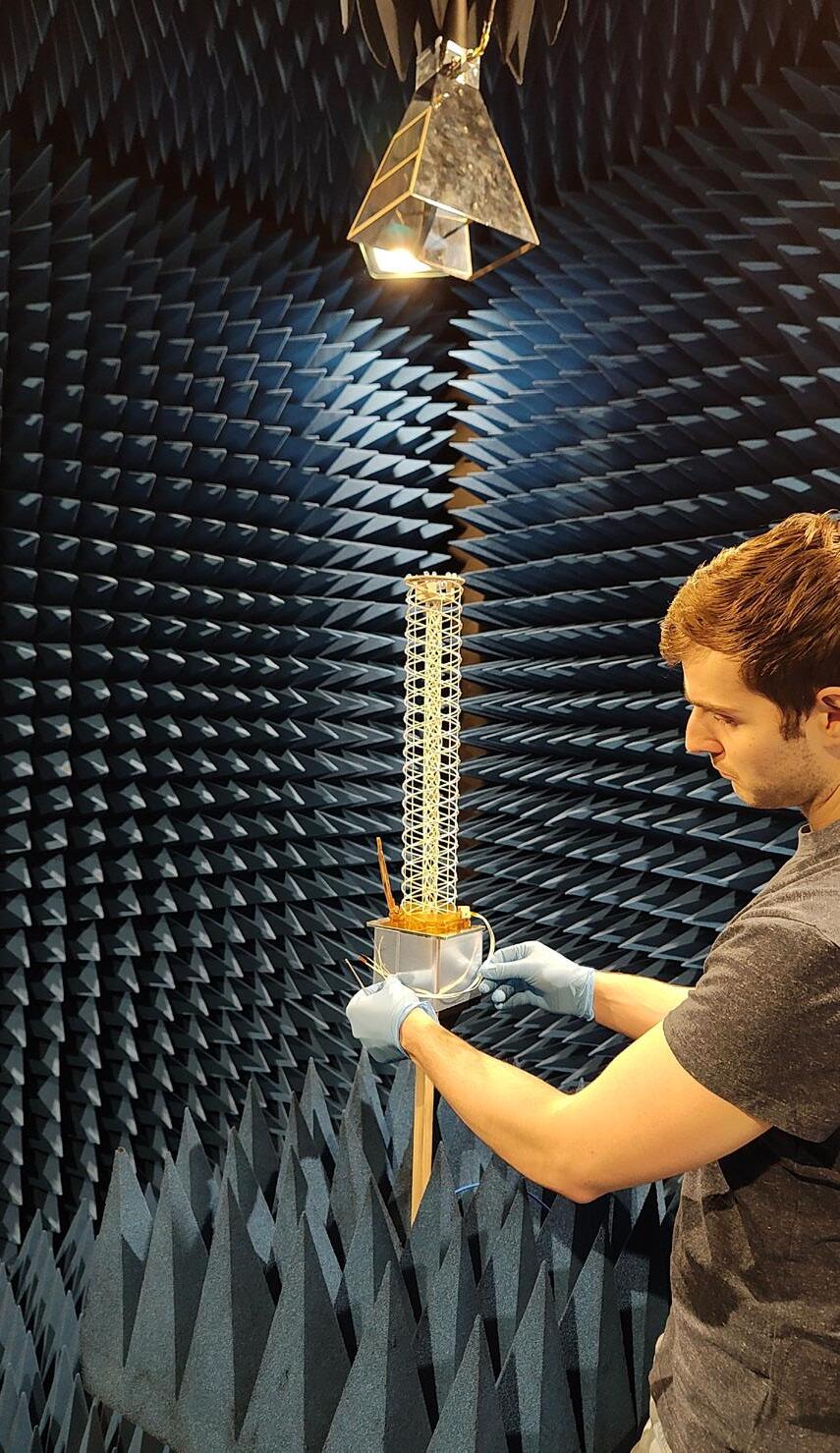


When it comes to government backing, there's no such thing as a bad choice; what we don’t want is no decision at all
Dr Alice Bunn OBE, President, UKspace
Like many other sectors, space incorporates quite a fragmented landscape. The Department for Science, Innovation and Technology (DSIT) is responsible for R&D, but procurement is occurring across the board, from the Department for Transport, the Department for Business & Trade and the Department for Environment, Food & Rural Affairs (DEFRA), and Alice explained that it is fiendishly difficult to find a way of pulling all those different requirements together into a procurement strategy which not only makes the most sense and creates the best value for government, but also creates a strong signal for the industry in order to leverage private finance.
“Our ability to make those crossdepartmental decisions is something we really need to get right. It brings to mind the pioneering work that Baroness Louise Casey did when she was looking at troubled families and joining up the provisions that needed to be made across social services, education, crime, health and welfare.
“It's not lost on me that every time I talk about the need for better crossdepartmental coordination, people usually come up with that example; because it’s a rare example of it being done successfully.”
success – 2030 and beyond Part of the future success of the sector, Alice explained, is built around the sustainability of the operating
environment – a combination of debris removal, space domain awareness and even space weather.
“If we focus our efforts there, we will have a very big contribution to make on the global stage because the benefit of UK companies can also be duplicated for our allies internationally as well.
“And in terms of creating the ability to manage our changing planet, the Earth observation programmes will be really strong, so if we can get the government procurement strategy right, we will increase the commercial opportunity.
“Space today fundamentally underpins our modern lives. If we took that away, we simply wouldn't be able to live the way we do. That is going to be increasingly important in the future, so we need to act now to protect our capability or we will lose out.”
So, clear government procurement signals, stronger cross-departmental coordination and targeted support for SMEs will be critical to unlocking private investment and retaining strategic capability onshore. Sustainability, security and resilience in space are no longer optional – they underpin modern life and national security alike. The opportunity is clear; the challenge now is to move faster, align priorities and ensure the UK remains a leading space nation well beyond 2030. l
The space sector is at a major inflection point: With the International Space Station approaching deorbiting and launch costs falling, the industry is shifting from large, government-led programmes to more commercial, manufacturing-led and servicebased space activities
The UK has strong niche strengths but must act to maintain them: The UK is well positioned in areas such as Earth observation, satellite applications, in-orbit servicing, debris removal and space domain awareness, but these advantages need sustained investment to remain competitive
Space is becoming more crowded, contested and strategically vital: The rapid increase in satellites and operators is creating safety, sustainability and security challenges, while society’s dependence on space data and services has never been greater
LEFT: Space is entering a pivotal stage which means that opportunities are knocking for the sector’s manufacturers
Government procurement and policy clarity are critical growth levers: Clear, coordinated government demand for space services and data would help unlock private investment, reduce duplication across departments and provide a stronger domestic market for UK space companies
SMEs face growth and retention risks without stronger UK support: While SMEs drive innovation in the sector, complex procurement frameworks and uncertain policy risk pushing promising UK companies into overseas ownership, potentially weakening long-term national capability
















After 15 years helping to reshape Finsbury Food Group, Chief Operating Officer (COO) Lucy Wills is driving a transformation that connects digital systems, people development and operational excellence across ten UK sites
From integrating acquisitions and embedding data-led decision-making, to investing in apprenticeships, automation and sustainability, the approach shows how a specialist bakery can scale without losing craft or culture. The Manufacturer’s James Devonshire spoke with Lucy to find out more.
When Lucy reflects on her 15 years at Finsbury, she sees a business that has changed almost beyond recognition. What began as a collection of specialist bakeries has evolved into a unified, data-driven manufacturer employing 3,500 people across ten UK sites. As COO, Lucy has been at the centre of that journey, overseeing acquisitions, digital integration and a cultural shift designed to ensure the group can thrive in an increasingly complex food landscape.
Trained originally as a food scientist, Lucy entered fast-moving consumer goods (FMCG) two decades ago, working first in chilled foods before moving into bakery. Her career at Finsbury has taken her from site leadership to divisional managing director and now to a role that spans the entire value chain. “I look after everything from supply base through to the point where our products hit the customer,” she explained. “Commercial and finance sit outside my remit, but everything else in between fits collectively under my responsibility.”
Finsbury’s portfolio reflects the breadth of modern bakery. The group produces celebration cakes, artisan loaves and snack products, largely under private label for major retailers, but also through licensed brands such as Mars, Disney and Minecraft. The acquisition of Lola’s Cupcakes marked its first serious step into direct-to-consumer retail, adding a new dimension to the

ABOVE: Finsbury’s specialist bakery portfolio spans artisan loaves, celebration cakes and licensed branded products
business model. Yet despite that diversity, Lucy insists the company occupies a clearly defined niche. “We are a specialty bakery. What you won’t see Finsbury manufacturing is large-scale plant bread like some bakery businesses. We operate in those very specialist areas where we can drive expertise.”
From acquisitions to integration
One of the most significant challenges Finsbury has faced in recent years was turning a series of acquisitions into a coherent group. When Lucy came on board, the business was emerging from an intense period of deal-making, leaving it with disparate systems and ways of working. The answer, she says, was digital alignment.
For over a decade the company implemented a core ERP platform supported by complementary systems for recipe management, lifecycle control and planning. The objective was not technology for its own sake, but a single, trusted source of data. “What that has done is allowed us to join up our group and leverage our scale, and to have one high-quality source of data that we can use to run the business effectively and drive continuous improvement,” Lucy noted.
The impact on acquisitions has been profound. New businesses can now be integrated within a year using a standard systems blueprint. Even where the model differs, such as Lola’s consumer-facing operation, the approach provides a common language. “It allows us to have the data and insights to integrate quickly and gain any synergies. What was more unexpected is that it actually helps with cultural integration as well, because everybody is speaking the same language.”


“The future is that businesses are going to have to grow and develop their own talent. Labour is becoming a scarce resource, so we’re very committed to it
Lucy Wills, Chief Operating Officer, Finsbury Food Group
“
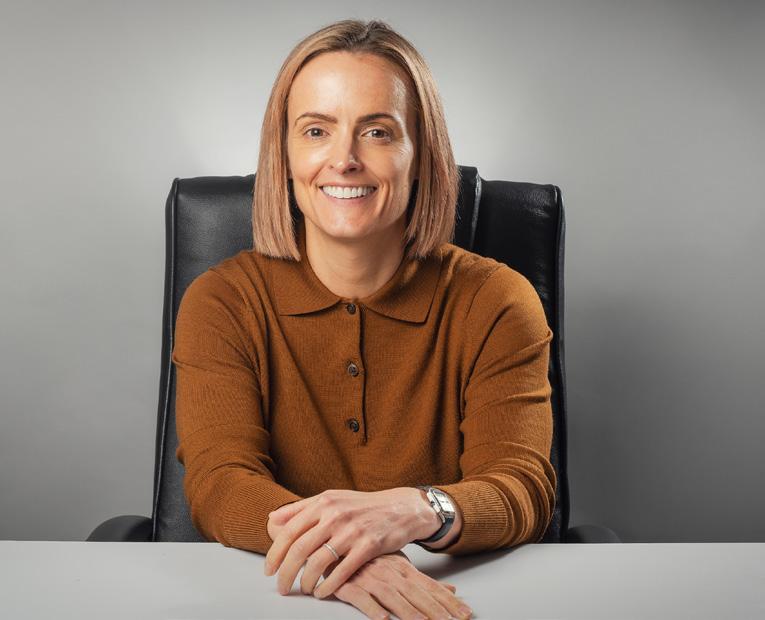
Automation strategies can fail to have an impact if the skills to leverage them aren’t there
Lucy Wills, Chief Operating Officer, Finsbury Food Group
BELOW:
The F1 excellence programme is seen as a differentiator, helping align 3,500 employees behind shared goals and consistent ways of working
Turning data into performance
Many manufacturers collect vast quantities of information without seeing tangible benefit. Lucy is candid about that risk.
“Unless you can harness and use data correctly, it won't drive the added value you want.”

Finsbury’s answer is its internal ‘F1’ excellence programme, which connects performance data with a structured improvement framework across the business.
Cultural adoption has proved more demanding than technology however. Employees who previously relied on experience rather than dashboards have had to learn new habits. “It’s more about the cultural adoption of using information,” Lucy said. “We put a huge amount of effort into building capability so people understand how the data works and how to use it properly.”
The approach also requires discipline. The business regularly audits what it measures to avoid data collection becoming an end in itself. “What is right for a point in time may need to evolve for the future,” she added, acknowledging that maturity changes what information truly matters.
To understand how that works in practice, Lucy pointed to the structure of the F1 excellence programme.
Inside the F1 excellence programme
Over time, the F1 framework has expanded into a holistic improvement system built around four pillars: performance, people, automation and sustainability. Each pillar has clear objectives and governance routines, ensuring that improvement in one area reinforces progress in another.
A new automation project, for example, is evaluated not only on productivity gains but also on its impact on skills development, carbon reduction and customer value. That alignment ensures that operational decisions support broader strategic goals.
At site level, F1 is visible in the rhythm of work. Frontline teams review results daily, identify root causes and test solutions. Best practice is shared across sites, allowing successful ideas to scale quickly across the group’s diverse bakery operations.
The framework also provides a cultural anchor. By giving teams common definitions and shared goals, it bridges the differences between businesses that produce everything from artisan sourdough to licensed celebration cakes. The same language of performance helps integrate new acquisitions and reduces the risk of silos.
Training is embedded through the Finsbury Academy, where employees learn not only technical skills but also how to interpret data and lead improvement
activity. The aim is to make frontline teams increasingly self-sufficient, able to identify problems and implement solutions without waiting for direction.
Internally, F1 is seen as a differentiator, helping align 3,500 employees behind shared goals and consistent ways of working.
Developing skills at scale
With thousands of employees, building capability consistently across sites is no small task. The F1 framework provides the spine, supported by a dedicated People Excellence strategy and the recently formalised Finsbury Academy.
The academy hosts apprenticeships, graduate schemes and leadership pathways, but also routes for technical mastery on the factory floor. Engineering apprenticeships alone exceed 30 intakes a year, while cohorts across the business can reach 80 people. “The future is that businesses are going to have to grow and develop their own talent. Labour is becoming a scarce resource, so we’re very committed to it,” Lucy said.
Operational apprenticeships are particularly important in bakery, where craft knowledge remains critical. The skills required to produce artisan sourdough differ markedly from those needed for Scottish snack lines, and the academy aims to preserve that expertise while opening up progression routes. Finsbury is also developing a degree apprenticeship programme, which could eventually prepare employees for senior leadership roles, including positions at an executive level, like Lucy’s.
Automation with people at the centre
Automation is a key part of the strategy, but Finsbury has sought to avoid the common trap of technology outpacing capability. Each automation initiative includes a parallel focus on culture and skills.
“There have been a lot of automation strategies that haven’t been as impactful as hoped because the skills to leverage them aren’t there,” Lucy noted. “People are just as important as putting the equipment in.”
The company has pursued automation for more than 12 years without significant workforce resistance, largely because it has prioritised redeployment and upskilling over redundancy. “We communicate the opportunities it brings - new skills, enhanced pay - and explain the why. If you tell people the purpose, they generally engage.”
Leadership without silos
As the group has expanded, leadership style has had to evolve. Lucy described learning to operate at different ‘altitudes’ - moving from site-level execution to enterprise-wide design. Her focus now is on ensuring programmes such as F1 deliver against the overall strategy while allowing others to flourish.
Organisational design is often developed ahead of immediate need to create headroom for growth. That approach, she believes, aids retention by giving people visible career pathways and greater challenges. “It’s a self-fulfilling prophecy. I can lead at altitude because I have a fantastic team that allows that to happen.”
Culturally, Finsbury has invested heavily in cross-functional coaching through a programme called Good to Great, bringing commercial, operational and supply chain leaders together. Shared objectives anchored in profitable growth are intended to replace departmental boundaries with collective ownership. “Building relationships is what allows the best results, because people trust each other and get on board with driving those results.”
Sustainability as value creation
Sustainability forms the fourth pillar of the excellence model. Rather than treating it as a separate compliance agenda, Finsbury integrates environmental metrics into the same reporting cadence as productivity and quality.
The current strategy focuses on three priorities: aligning with customers’ sustainability goals, strengthening internal expertise, and delivering end-to-end carbon reduction that also generates commercial value. Projects include groupwide solar deployment and a pipeline of infrastructure initiatives designed to cut emissions while supporting cost efficiency.
The approach has become more targeted over time. Earlier programmes were broad but struggled for traction. “We probably weren’t focused enough,” Lucy admitted. “Now we’re in a phase of driving sustainability in a way that adds value and does the right things to tread lightly on the planet; for us and our stakeholders.”
Throughout our conversation, Lucy returned to the same theme: integration. Whether discussing digital systems, apprenticeships or carbon reduction, the goal is to connect activity across a diverse business so that improvement in one area reinforces another.
Internally, the excellence programme is viewed as a genuine competitive differentiator, helping align the workforce around consistent standards and shared objectives.
For a sector often characterised by thin margins and intense retailer pressure, Finsbury’s experience suggests that long-term investment - in data, skills and leadership behaviour - can create resilience. As the group continues to expand its footprint from artisan loaves to consumer cupcakes, the challenge will be maintaining that coherence. If Lucy’s journey is any guide, the recipe is already well rehearsed. l
ABOVE: Digital systems and real-time production data support consistent quality and faster integration across Finsbury’s UK manufacturing sites
• Digital integration, unified acquisitions: A core ERP and shared data model turned disparate bakeries into a scalable, cohesive group
• Culture makes data valuable: Finsbury’s F1 programme links analytics to daily improvement, backed by workforce training
• Excellence rests on four pillars: Performance, people, automation and sustainability are integrated into one operating model
• Talent pipelines are strategic: Apprenticeships and the Finsbury Academy build scarce skills and preserve craft expertise
• Automation and sustainability drive value: Both are embedded into operations to boost productivity, resilience and commercial outcomes
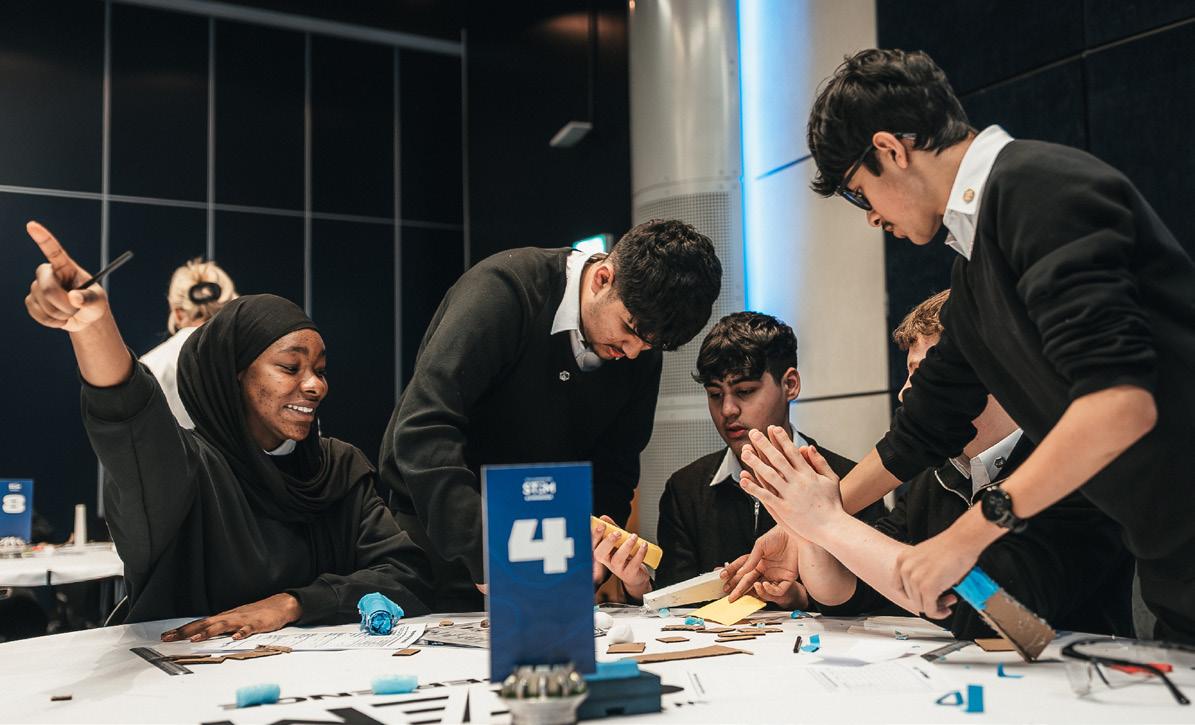
Beyond the glamour of the grid, Atlassian Williams F1 is attracting engineering talent. Through free, inspiring STEM workshops, the team is turning Formula 1’s aspirational appeal into a powerhouse for the next generation of talent
Rapid innovation, complex data and the pursuit of millisecond gains are the heartbeat of Formula 1. Williams are opening their doors and inviting students in to see what lies beyond the track.
Right now, the engineering industry is facing a massive and existential problem; a lack of skills and new talent, further hampered by unappealing and outdated stereotypes. Albeit very much part of the engineering sector, motorsport doesn’t have that problem. Glamourised on social media, television and film, a career in
the sport is a dream come true for many young people. What is perhaps a little less understood is the wide variety of roles and opportunities available.
Williams has been running STEM workshops for school children aged 8-16 since 2023. Originating as a roadshow, in 2024 the team decided to bring this inhouse and give these workshops a home at the Williams Experience Centre, in Grove, Oxfordshire - on the same site as the official home for its F1 team.
The success is clear to see. The site welcomed over 7,000 students from
across the UK in 2024; that figure almost doubled last year. Opening its doors five days a week - to two schools a daythe whole experience is offered free of charge, with Williams even organising transport and activities.
“We have around 2,000 contacts registered to bring a group to the programme, spanning more than 1,000 different schools. We receive constant emails from teachers asking when more dates will be available,” said Georgina Phillips, Instructional Design and Delivery Manager at Atlassian Williams F1 Team.
LEFT: In 2025, the Atlassian Williams F1 Team welcomed over 13,000 students through its doors into its STEM programme
programme
As an ex-teacher herself, Georgina has a passion for education, as do many others who have joined her on the programme from similar backgrounds.
The day consists of three parts: a workshop which incorporates building, testing and presenting of Formula 1 nose cones, a tour of the Williams Heritage Museum and a session on a Formula 1 simulator. The same activities are given to every student whether 8 or 16 years old and covers elements of maths, science and technology.
The aim is to expose children to careers in STEM and the world of motorsport engineering. “Our goal is to inspire students to pursue STEM school subjects and ultimately STEM career paths, be it in Formula 1 or elsewhere. That includes both the need for foundational STEM skills and softer skills like teamwork,” said Katherine Solomon, Head of Education at Atlassian Williams F1 Team.
The aim of the workshop is to replicate what happens in real life. “During the workshop students can approach me to say their team are not listening. Instances like this we see as an opportunity to discuss why; is there a better way to get your voice across and how can you be a better listener when someone else is speaking? These are all skills that we need, beyond the technical aspect of engineering,” Georgina explained.
The softer skills are just as important and can be difficult to teach. “Students take part in the engineering and design
process from ideation to prototyping and through the crash test rig. But within their teams, they each have a role. There is a team principal, someone will be in charge of finance, while another individual will be looking at the marketing of the vehicle. They get to see that if one aspect of the team doesn't pull their weight, none of them will succeed. It mimics what jobs are like in real life, when you need to collaborate and work together,” said Katherine.
A new environment
“Teachers are often amazed at how engaged the students are,” added Georgina. A key reason for this is the environment. “They're out of their comfort zone, which is a great start. They're in our environment and we put them into mixed teams,” she said.

“
Inevitably there will sometimes be a reluctant student, but when the challenge begins, they quickly become engaged and want to get on with it. “Working with people they don’t usually interact with helps the students focus on the task at hand and use teamwork and communication skills in different ways than they may have before,” she said.
One of Georgina’s highlights of the programme is seeing the confidence grow within the students. “At first, they can be shy, but they often end up fully embracing the challenge. When they stand up on the stage at the end of the session, they are proud of what they have done,” she said.
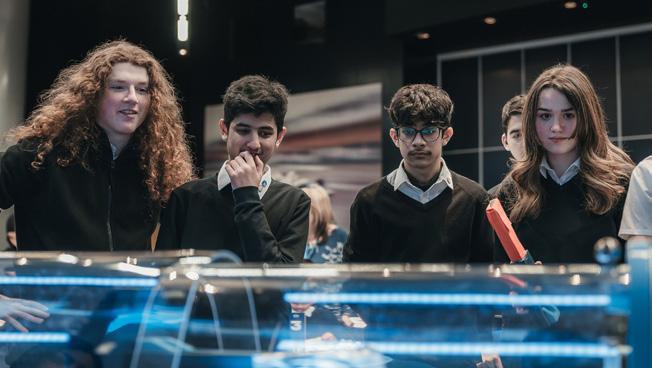
Every teacher that comes into the programme is asked if they’d like to be part of the programme’s advisory board. This helps us to test resources with them and find out what they need from us
Katherine Solomon, Head of Education, Atlassian Williams F1 Team
Often the presentation is a time where students have the opportunity to reflect on what went well, and elements of the day that were perhaps, less successful. “They realise that it might have been harder to communicate with one another than they first thought, or they may have misspent the budget. But they learn from that and can talk about what they could do differently in future,” Georgina said.
The Williams STEM Experience is one day of the school year and although impactful, it creates engagement with students that teachers want to continue in their classrooms. “Every teacher that comes into the programme is asked if they’d like to be part of the programme’s
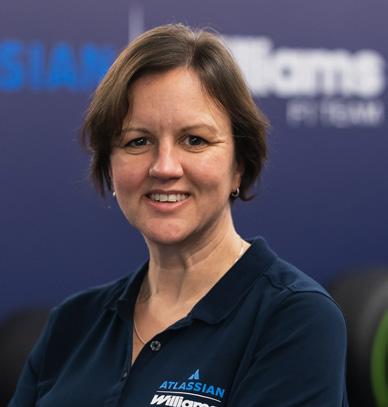
“As a company we need new skills to develop, and this could be a pipeline for the future
Georgina Phillips, Instructional Design and Delivery Manager, Atlassian Williams F1 Team
advisory board. This helps us to test resources with them and find out what they need from us,” explained Katherine.
One of the concepts that has emerged from the advisory board is a community website to serve parents and educators, providing exciting STEM focused resources so they can supplement what the Atlassian Williams F1 Team did outside of the classroom.
“Examples of these resources are pre- and post-visit activities and lesson plans for teachers to use in the classroom. We want them to reinforce what was demonstrated on-site while still being aligned with different national curriculum components, be it STEM specific or some of those softer skills,” added Katherine.
Williams are currently testing a quarterly newsletter of resources and fun hands-on activities that can be used by educators and parents at home. For 2026 the programme is focussing on the key influencers within a student’s life who can help them on their academic journeys. “We have a few activities up
our sleeve, keeping in mind how we can approach the goal of the programme from every angle,” she said.
Measuring ROI can be difficult and due to the relatively short time the programme has been running, Williams is yet to have any students who have attended the STEM workshops returning as engineers or apprentices. “One day in the future, that would be the ultimate measurement of success,” said Georgina.
Students are asked how interested they are in STEM careers both when they first arrive for a STEM workshop and again at the end of the day, with some contrasting responses. “When they arrive around 52% tell us that a STEM career is something they’d be interested in pursuing. By the end of the day this figure jumps to around 87%, showing the influence of our programme,” said Katherine.
Williams measure student satisfaction using the Net Promoter Score (NPS) metric and its overall score is 65, more than double the global benchmark of 30 for the 14+ age demographic.
Williams is not measuring if students have learned the concepts of maths and science, but how to apply them in the challenge.
Williams and its partners collectively recognise that there is a shortage of skills within the engineering sector, and nothing will change without a push from within industry.
“We’ve got to look at the skills that are missing now and what skills we need for the next 20-30 years in order to keep the sector alive. If our programme can influence young people to pursue a career in the industry, then we’ve made an impact. But, if everyone could do that, imagine how great the change could be,” said Georgina.
Many young people who are still in school are unaware of all the roles that exist within manufacturing and engineering. For other businesses, Georgina says it’s all about opening the door to the opportunities that exist. “As a company you need new skills to develop, and this could be your pipeline for the future. Show them what you do and why it’s a cool industry to work in,” she added. l
Last year, Williams welcomed nearly 150 people across all its different Early Careers programmes, industrial placements, graduate programmes and apprenticeships.
While on-site, Molly Cooper sat down with Aaron Cheeseman, CNC Programmer and Machinist at Atlassian Williams F1 Team, who started his journey with the company five years ago. He began as a Level 3 apprentice during his first year of college and is now completing his Level 6.
From a day-to-day perspective, how quickly after starting your Level 3 apprenticeship did you become involved in machining operations?
AC: It was very quick. In my first year I spent most of my time at college learning basic techniques and skills, but by my second year I was fully integrated into the business. For me, once I’d proved my competency, I was placed on some important projects which gave me a purpose to what I was studying.
What knowledge have you gained through the academic side of the apprenticeship that has been applicable on the shop floor?
There are many different skills that have been immediately transferable. One key lesson has been around different methods of research and how to conduct formal and informal interviews with people in my department.
In my work, I have been changing templates and then using questionnaires to gain feedback on the current process. Once I have collated this information, I have then been acting on the findings. It’s been a great way to help me improve.
Can you describe how your apprenticeship with Williams provided on-the-job training and development?
Throughout the early stages of the apprenticeship, I was given various training from the business. One week every month I would be placed on various
selected projects to take part in practical work. It gave me the opportunity to develop through guidance from senior machinists and engineers as well as offering a safe space to learn and make mistakes.
The most important thing that I have found in my apprenticeship is the ability to find new methods through trial and error.
How essential is mentorship from senior machinists to your success?
Mentorship has been essential and I have learned so much from senior machinists and engineers.
Something that is part of the culture is an open environment for discussion. If you have tried something, you can talk with senior employees and get their opinions. Sometimes they would give advice on what they would do differently, but sometimes they will confess that they would never have thought of doing something that way.
In that situation, you can enhance current methods, creating better processes for everyone.

Why did you choose the apprenticeship pathway over a full-time university degree?
I started my apprenticeship after my GCSEs. I'm a very practical learner and I learn through doing.
I did initially begin my A Levels and was given opportunities to play about with products, using trial and error, but there was no purpose to it.
When I’m in an environment where trial and error has tangible benefits and the changes I make matter, it suits my learning style much more.
Where do you see your career progressing within Williams or the wider manufacturing industry?
I would love a career in aerodynamic design as it’s always been a career I have dreamed about since I was younger. I never thought that it would be something I could achieve but now, taking my initial apprenticeship at Williams, they continue to bring out my potential. They have allowed me to develop and taking my Level 6 apprenticeship has given me the confidence to go on to pursue that.
Why should manufacturing or engineering businesses start or significantly expand an apprenticeship programme?
There are many different reasons why investing in the future is great. The talent needs to come from somewhere. New talent needs to be trained by the employers at some point, even if they take the education route.
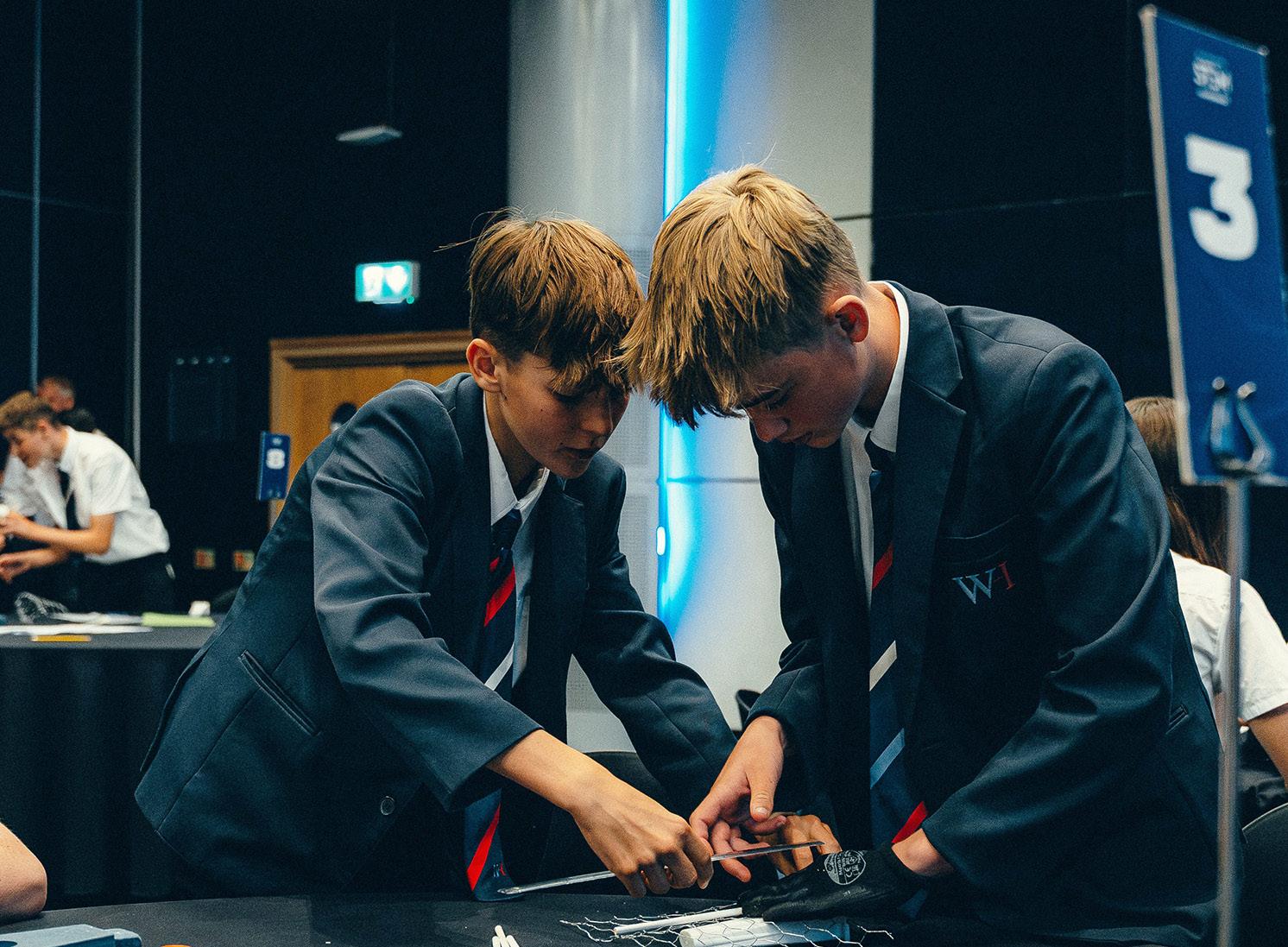
It also provides the opportunity for other people in the business to learn from new people with ideas that are different from the traditional. Someone may have worked in one role for 30 years and they might be stuck in a certain way of working. An apprentice can come in and show them something new.
Apprenticeships are beneficial to both people and the business.
What
do you get when you combine an ageold manufacturing process with modern digital transformation and sustainability strategies? The Manufacturer Editor Joe Bush found out when he visited the Measham brickworks of Forterra
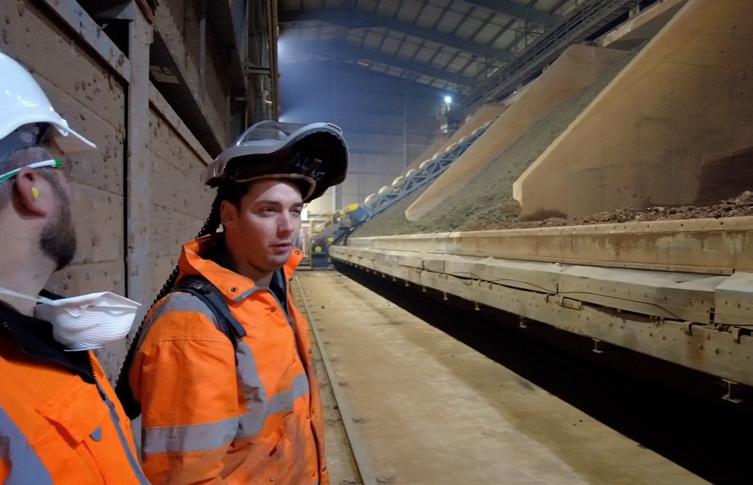
It’s not every day you get to see a manufacturing process that has been around for (literally) millennia. A quick Google search revealed that brick making began around 7,000 BC in what is now modern-day Turkey, with sun-dried mud bricks. Fired bricks are a relatively new kid on the block, appearing only around 3,500 BC in Mesopotamia!
Even looking at Forterra in isolation, many of its 11 UK sites, including the brickworks at Measham in Leicestershire, have been around for well over a century. And with that sort of legacy, it’s hardly surprising that the team at Forterra takes great pride in the products it manufacturers across all its UK sites.
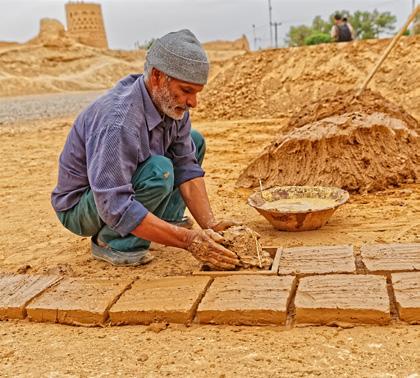
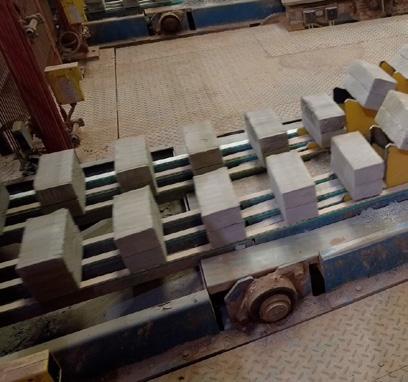
The Measham plant has the capacity to produce 100 million bricks per year. These are designed to replicate those that have been hand-made, in what is known as a soft mud plant. Dave Manley, Forterra’s Head of Sustainability, explained: “Essentially, we're trying to replicate what people did thousands of years ago, in terms of throwing clay into a mould and then firing it.”
Clay is sourced from an on-site quarry a mere 200 metres from the brickworks. This is then processed, moulded, dried and fired in kilns, reflecting centuries-old techniques adapted for modern efficiency.
Indeed, it was quite unusual to talk to a manufacturer that hadn’t been overtly burdened by the myriad supply chain challenges that have impacted the sector in recent years.
The majority of Forterra’s raw material supply is within its own control, with around 90% of the clay used on-site originating from the quarry on the other side of the road – not the longest supply chain in the world!
LEFT: Brick manufacturing is an age-old process, beginning around 7,000 BC in what is now modern-day Turkey
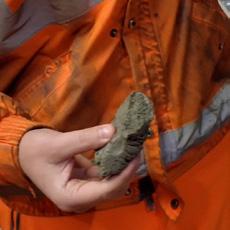
ABOVE: Clay is sourced from an on-site quarry a mere 200 metres from the brickworks
MAIN PIC: Forterra’s story is one of evolution rather than reinvention. A process rooted in thousands of years of history is being carefully adapted through digital tools and product innovation

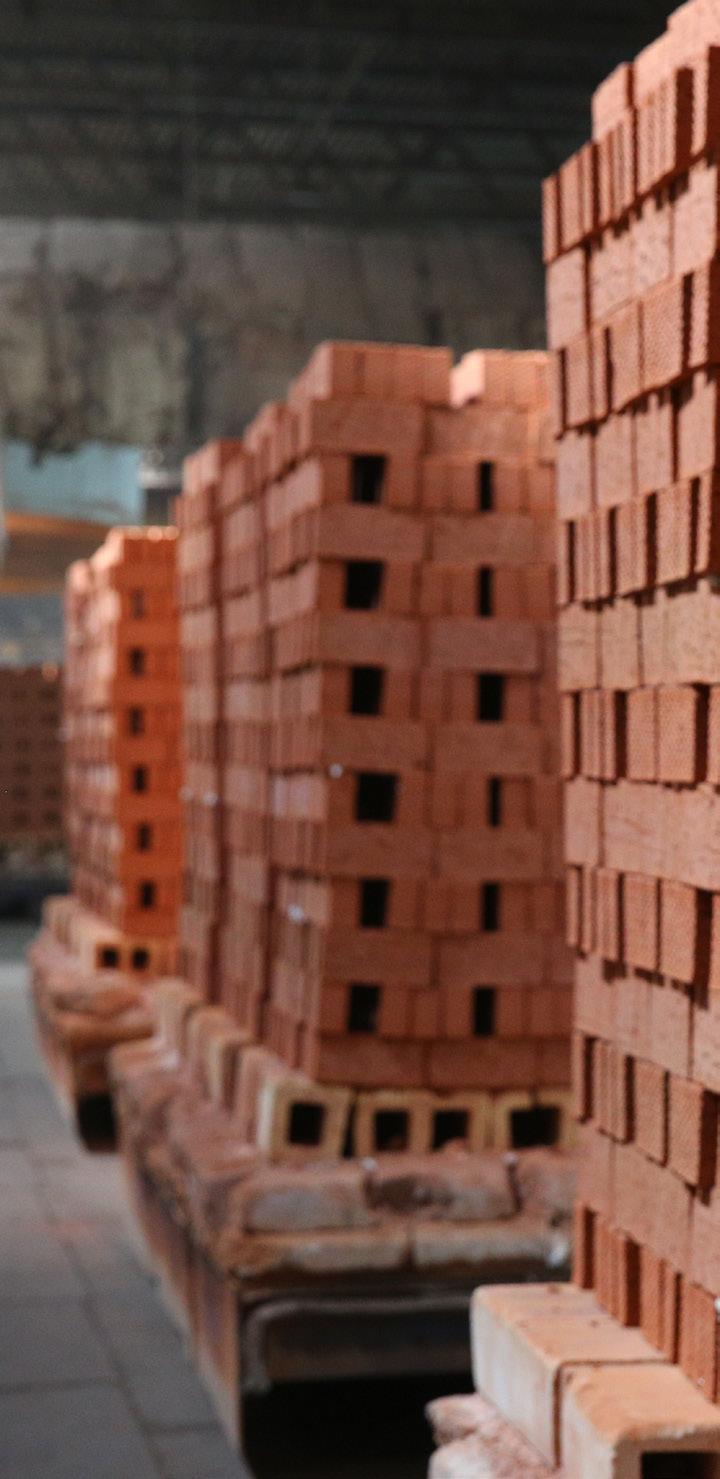
“ As part of a trial, we found that we couldn’t tell the difference between the products that were fired on hydrogen and the ones that were fired through natural gas
Dave Manley, Head of Sustainability, Forterra
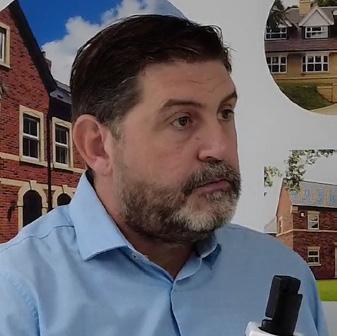
Many of the easy wins that we achieved 15-20 years ago are only now being considered by some other businesses
Dave Manley, Head of Sustainability, Forterra
Sand, a key element to producing soft mud brick, is also sourced locally. “It’s a completely different process to an extruded brickworks, which basically makes bricks like toothpaste,” added Dave. “The clay is squeezed out in a large column, the individual bricks get cut off, and they then go into a kiln. For soft mud bricks the clay gets thrown into moulds.
“Our process here is more energy intensive, but we manufacture a premium product, due to the fact it looks handmade. An extruded brick is very uniform, while a soft mud brick has more texture and detail, which is valued by our customers.”
However, with large, energy intensive kilns, the demands of modern manufacturing has seen the company adapt in recent years, incorporating new processes for more efficient, sustainable operations.
Product diversification is also a key part of the company’s recent evolution, and while brick is Forterra’s main focus in terms of production, concrete blocks, air crew blocks and pre-cast building materials also make up the product range.
Indeed, the company has recently launched a new product for the commercial space - the Omnia brick slip - which brings together the character of real clay with the performance needed for modern construction. Produced using Forterra’s advanced extrusion technology,
Bringing in people and different maintenance techniques from other sectors has helped to create more synergy across our sites
Dave Manley, Head of Sustainability, Forterra
their lightweight format supports easier handling and efficient installation while maintaining the refined appearance of traditional brickwork.
Dave added: “Currently, to achieve this effect, the face is cut from the side of an entire brick. With luck, it is sometimes possible to cut the face from both sides, creating two slips from one single brick. However, the rest will be thrown away, which isn't very efficient. Our Accrington plant has been set up to produce a unit with four slips which significantly reduces the amount of waste from that process.”
Designed for external installation and commercial buildings, the slips are available in a wide palette of colours, textures and engobed finishes. This offers architects and specifiers the freedom to create distinctive façades without compromising on performance, while supporting Forterra’s wider sustainability commitments.
The company is also seeing changes in customer demand with increasing
requirements for colour variety in the product offering, which again plays to the strengths and flexibility of the Omnia brand.
The manufacturing process
This has created its own challenges, namely the retrofitting of equipment on Forterra’s various plants. The company is currently in the process of recommissioning its Wilnecote plant in Staffordshire, which involves stripping the site and adding a new kiln and production equipment.
Dave explained that the company has also invested heavily in building information modelling (BIM) as the need to extract insight from the wealth of data being generated around Forterra’s products has become apparent. “I'm heavily involved with producing environmental product declarations, for example,” he added. “The information can go into a BIM model, which allows the customer to accurately calculate the carbon footprint of a building.”
Over the last decade there has also been a drive across the business of recruiting expertise from other sectors such as aerospace and automotive. Dave explained that while the traditional employee journey of working up from the shop floor to be work’s manager has its advantages –namely empathy and understanding up and down the workforce hierarchy – it did create disjointed elements across the business.
“Bringing in people and different maintenance techniques from other sectors has helped create more synergy. This can mean simple changes, such as making sure we have one type of PLC controller across the business. That means that if a breakdown occurs, we know that if there’s no spare on-site, there will be one elsewhere that can be brought across to replace it. So there’s no single point of failure.”
LEFT: Forterra’s Measham plant has the capacity to produce 100 million bricks per year
As discussed previously, the traditional process of firing bricks in kilns is very energy intensive. Unsurprisingly therefore, there have been significant developments in kiln technology in recent years, and that has been incorporated into the operations across Forterra’s sites to improve efficiency.
Kilns were originally manufactured at a time when the energy needed to power them was relatively cheap. Now, of course, costs in that regard have skyrocketed. Forterra mitigates this through hedging. Buying well in advance allows the company to know exactly what it will be charging customers in the future because the energy has already been secured at a certain price.
The net zero agenda is integral to Forterra and likewise, kiln efficiency is the number one priority. “The key questions that would be asked of a brickworks back in the 1980s would be how much product can be manufactured and at what cost?,” Dave continued. “Those two questions are still prevalent, but efficiency is now a key part of the discussion. For example, at our Desford plant just outside Leicester, the gas efficiency of the kiln was written into the contract.”
Highlighting hydrogen
So, how do you bring a centuries old, energy intensive process into the modern era without compromising quality and the bottom line? Dave explained that net zero is not only Forterra’s key priority, it is also the biggest challenge.
Not least because of the fact that the level of net zero maturity differs enormously across the manufacturing spectrum. “Everyone is at a different stage in their journey,” he added. “I’ve been in the business a long time, and many of the easy wins that we achieved 15-20 years ago are only now being considered by some other businesses.”
That’s certainly good news on the one hand as you could say Forterra is one of the pace-setters around net zero, and are well on the way to achieving its ultimate goals. However, Dave added that the low-hanging fruit has now been picked and ticked off the to-do list, so the company is now left with only the most challenging pieces of the net zero puzzle.
For example, around 60% of Forterra’s carbon footprint comes from the natural gas used to fire the bricks, and that’s a difficult figure for the company to navigate around. Forterra is looking at and experimenting with hydrogen as a long-term solution but Dave explained that grid connection is at least a decade away, despite the fact that there are positives in the equation – such as the proximity of Forterra’s Kirton plant to the East Coast Hydrogen Network. “We need to do the groundwork now to make sure that we can actually use hydrogen as a fuel when the time comes,” he added.
Despite these challenges, the work that Forterra has done thus far helps ensure the company’s readiness if the government blended hydrogen into the grid. And at the Measham site, Forterra has a small batch kiln which is capable of firing around 10,000 to 12,000 bricks.
“That kiln was converted several years ago to run on a 20-25% hydrogen blend, to see what effect it would have; not only on the product but also on the refractories within the kiln,” Dave added. “We found that we couldn't tell the difference between the products that were fired on hydrogen and the ones that were fired through natural gas.”
And this potential for hydrogen’s use within the sector was further underlined through a sector-wide project in St Helens, where Ceramics UK and consortium partners (including Forterra), helped build a 100% hydrogen kiln. Members all put product through to highlight how easily hydrogen could be used.
However, the challenge for the sector is not proving the viability of hydrogen as a fuel source. Rather, as so often is the case, it’s cost that is proving to be the X-factor. “We can't afford to go out and build a brand new, dedicated hydrogen kiln,” said Dave.
also looking at carbon capture. For us, net zero is a long journey that isn’t going to be completed overnight.”
Ultimately, Forterra’s story is one of evolution rather than reinvention. At Measham, a process rooted in thousands of years of history is being carefully adapted through digital tools, product innovation and a relentless focus on sustainability.
While the path to net zero for an energy intensive industry is complex and far from complete, Forterra’s willingness to invest, experiment and collaborate shows how even the most traditional forms of manufacturing can move with the timeswithout losing the quality and character that made them enduring in the first place. l
BELOW: Forterra is seeing changes in customer demand with increasing requirements for colour variety in the product offering
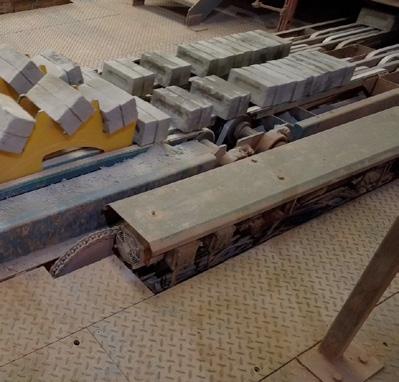
Therefore, he explained that most hydrogen deployment will be centred around retrofit. As such, Forterra has been speaking to its kiln suppliers to establish what a large-scale, real-world hydrogen kiln will look like. For example, dual fired kilns have been muted as a possible option –with two burners, one using natural gas and one using hydrogen.
The next stage of the trial process will be to convert one of Forterra’s smaller kilns to 100% hydrogen, which the company is aiming to have working this year.
Of course, industrial projects at this size and scale will inevitably need higher levels of support. However, Dave explained that although help is available, this process also comes with its own set of obstacles. “In terms of government support, we struggle with timing. Government funding is linked to distinct timelines, and if you don't have a project ready to submit, it's very difficult to fall in line with those.
“Government funding could come with months of delays. To a degree, I guess we’re guilty of being impatient, but we want to get out there and get on with it.
“Part of our USP is the fact that we’re open to trying anything, as evidenced by the number of different hydrogen options we’re trialling at the moment. Plus, we're
• Ancient processes can still evolve: Brickmaking may be thousands of years old, but Forterra shows how traditional manufacturing can be modernised through digital tools, automation and smarter processes - without sacrificing product quality
• Vertical integration strengthens resilience: With around 90% of its clay sourced on-site, Forterra has avoided many of the supply chain disruptions affecting the wider manufacturing sector
• Premium products justify energy intensity: Soft mud bricks are more energy intensive to produce, but their handmade appearance, texture and customer appeal allow Forterra to differentiate and deliver higher-value products
• Innovation extends beyond bricks: Product diversification, such as the Omnia brick slip range, is helping Forterra reduce waste, improve installation efficiency and meet changing customer and architectural demands
• Net zero is a long-term, highstakes challenge: While Forterra has already captured many early sustainability gains, the biggest challenge remains decarbonising kiln firing - where hydrogen shows promise, but cost, infrastructure and timing remain critical hurdles
Last summer The Manufacturer sat down with Caroline Keohane, Head of Industry Growth at the Food and Drink Federation (FDF) to discuss the launch of the new Food and Drink Technology Taskforce. This is a collaboration that brings together experts from technology providers, manufacturers, academia, catapults and finance, to work on unlocking the potential £14bn growth opportunity for the sector which was identified in the federation’s 2025 Future Factory Report
This report also identified a number of barriers preventing businesses in the food and drink sector from adopting technology and the taskforce - which includes the likes of NatWest Bank, ABB Robotics, Warburtons and Premier Foods – is now looking at the next phase of that journey which will address those issues and pinpoint the practical actions the industry can take to realise its potential.
This next step takes the form of a follow up report, unsurprisingly named Future Factory II, where the taskforce sets out the priorities that will accelerate technology adoption and deliver measurable benefits for businesses. We caught up with Caroline to get an update.
Late in 2025, the federation held its annual Food and Drink Investment Summit, where, along with the launch of
Main pic: 2026 will be about moving from insight to implementation in the food and drink sector
the second instalment of report, the FDF also introduced its ambition for growth, which set out the vision for the food and drink manufacturing sector over the next decade.
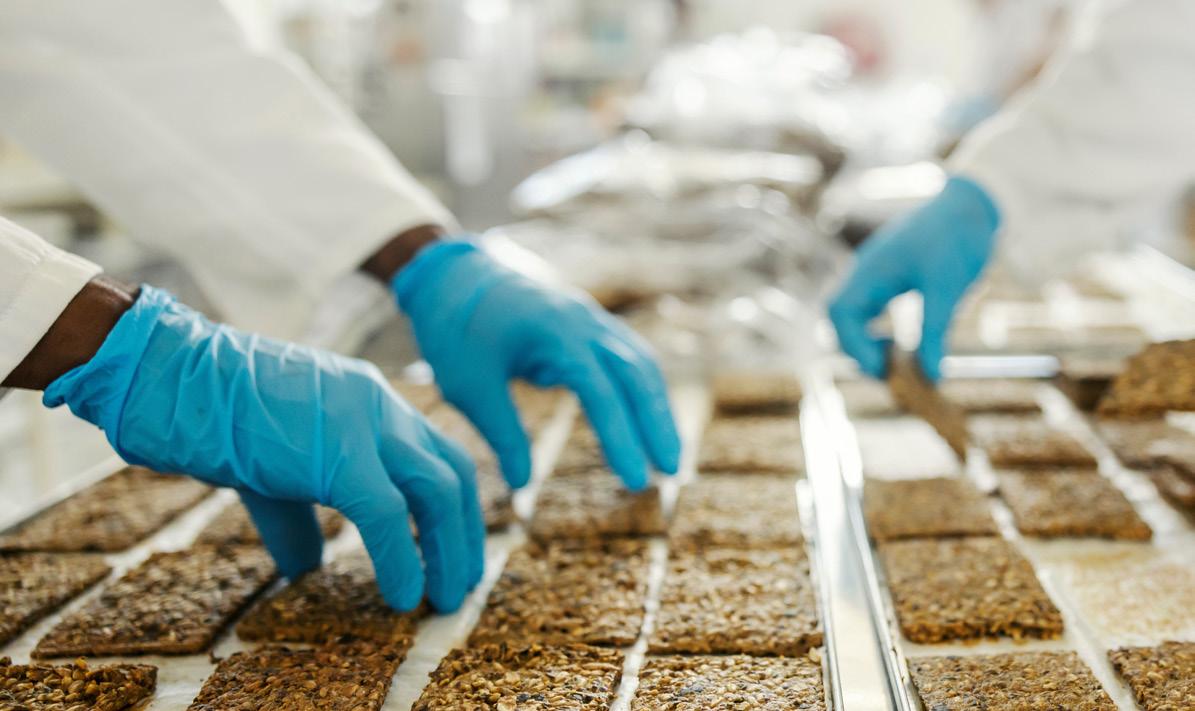

We know the opportunities that exist and we know the barriers in terms of the commercial environment, skills and technology integration
Caroline Keohane, Head of Industry Growth, the Food and Drink Federation (FDF)
Caroline commented: “As a sector we want to double business investment to around £12bn, grow our exports by a third to £35bn and generate £50bn pounds worth of GVA; this all feeds into the growth opportunity that we had identified in the first version of the report. A key part of this future vision for the sector is to also make the UK a global hub for food and drink R&D and healthier product innovation.”
To underpin this ambition for growth, the FDF has recognised the role of technology as a key enabler. As such, Caroline highlighted the importance of taking the insights, findings and learnings from the first report and moving into an implementation phase so that new and emerging technology can be a driving force for change and transformation.
“We’re definitely moving from insight to implementation,” she added. “We know the opportunities that exist and we know the barriers in terms of the commercial environment, skills and technology integration. It’s now all about practical action through collaboration, to raise awareness of what's out there, and to help SMEs in particular.”
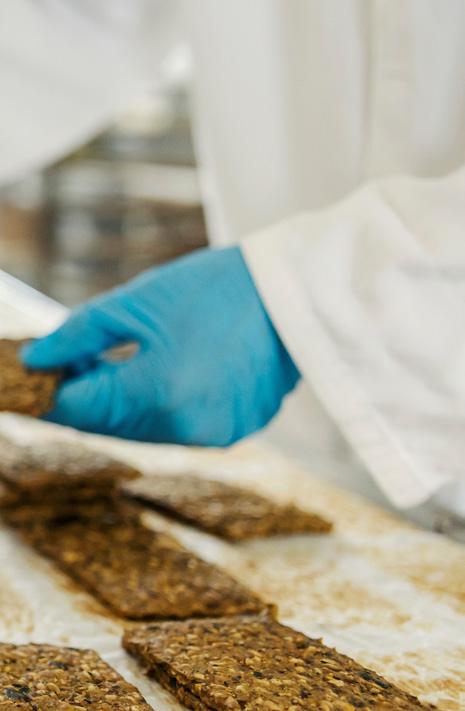
Key characteristics of the sector F&B is a dynamic and diverse sector, influenced greatly by changing consumer demand which can drive frequent changes to stock-keeping units and production configurations. Raw materials are also inherently variable, influenced by weather, geography and global supply conditions, and this is an area where technology has huge potential impact when it comes to predicting ingredient anomalies, disruption and variations, and adapt recipes accordingly.
While some of this technology is undoubtedly coming on board, gaps still exist and, in the commercial environment, businesses are often operating on shorter-term contracts compared to other manufacturing sectors that have longer lead times. This can create a challenging environment with which to put forward a business case for long-term investment.
Like all other sectors within manufacturing, food and beverage is seeing a spike in demand for skills in relation to AI, digital and data, creating a highly competitive landscape. However, this is another area where the FDF is being
ABOVE: F&B is a dynamic and diverse sector, influenced greatly by changing consumer demand which can drive frequent changes to stock-keeping units and production configurations
proactive, as Caroline continued: “We've developed a programme with Wigan and Leigh College and the Greater Manchester Combined Authority to multi-skill our engineers from mechanical to electrical and vice-versa, and then also taking our technical operators and upskilling them with some engineering capabilities, which all helps with accelerating tech adoption.”
Indeed, the sector saw a 60% increase in robotic adoption over the last 12 months and food and drink businesses are increasingly deploying AI, not only in manufacturing processes but also in new product development.
For example, the FDF has begun work with a start-up that is deploying an AI platform to help reduce food waste. Zest’s platform reads data in real time and identifies pinch points where waste is occurring. The company has worked with the likes of Nestlé which managed to reduce edible food waste by 87% over a two week period at one pilot site. “Examples like this are practical applications of AI having a real world impact,” Caroline added.
The Industrial Strategy – missing the mark?
As food and drink wasn't identified as an advanced manufacturing sector in last year’s Industrial Strategy announcement, Caroline feels that an opportunity has definitely been missed. “We’re the UK's largest manufacturing sector, we're located in every part of the country, and so we have massive productivity growth potential. Not only that, but food security is national security.”
The first step is to tap into existing aeras of support and make sure we get our fair share of what's already out there
Caroline Keohane, Head of Industry Growth, the Food and Drink Federation (FDF)
This is yet another area where the federation have been active in addressing the challenges that exist; trying to advocate for the sector and make sure that businesses have access to the support programmes that were announced as part of the Industrial Strategy.
And this is by no means idle talk. The FDF has already managed to secure some vital wins in that area, with food and drink manufacturers now able to access the Engineering Skills Package, and the robotics adoption hubs due to come on stream later this year.
While this is a firm foundation, Caroline admits that more could and needs to be done, particularly around energy. Like most manufacturing businesses in the UK, rising energy costs have been extremely prohibitive in recent years, yet, as it stands, businesses in the food and drink sector won’t be able to access the support offered through the British Industrial Competitiveness Scheme. As such the FDF will be lobbying government so that businesses in the sector can gain access to that programme.
Indeed, the two priorities outlined in the Future Factory II Report are around setting up support programmes and centres of excellence, and the development of a technology adoption blueprint. Caroline outlined what needs to happen to make these priorities a reality
and what they would both look like in practice.
“The first step is to tap into existing aeras of support and make sure we get our fair share of what's already out there,” she said. “In particular, the Made Smarter Adoption Programme, and we've had some real success stories where food and drink SMEs have benefited from that support.
“We need more of that and it’s important to raise awareness that programmes like this aren’t the sole domain of the more traditional manufacturing or engineering companies, and that food and drink businesses can benefit too.”
Centres of excellence already exist such as the Advanced Food Innovation Centre at Sheffield Hallam, the National Food Manufacturing Centre at the University of Lincoln, AMRC Cymru, as well as the various catapults, and the FDF is now aiming to bring all those together to create demonstrator hubs where businesses –particularly SMEs - can trial and test new technologies in a food grade environment.
Furthermore, the adoption blueprint aims to be a step-by-step guide covering all the key factors a business needs to think
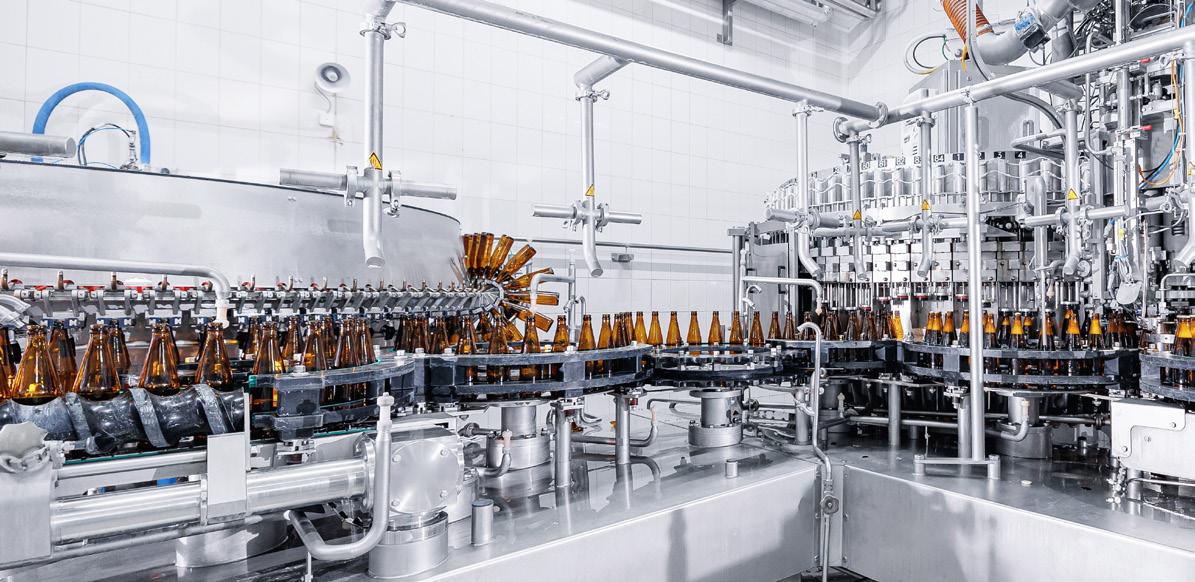
about when building a successful business case for technology adoption - whether that be access to finance or taking on apprentices.
“We're looking to tap into the expertise that we've already got within the taskforce and bring it all into one place,” added Caroline. “We know that businesses really value independent advice. Our members might not feel as though they are the most informed of consumers when they are reaching out to tech providers, so having that information and support to hand is really beneficial.”
Like the majority of manufacturing sectors, the vast majority of businesses in the food and drink space are SMEs (97%) and Caroline emphasised the need to prioritise those companies that don't necessarily have the time and resource to invest in digital transformation projects.
MAIN PIC: Food and drink manufacturing is aiming to double business investment to around £12bn, grow exports by a third to £35bn and generate £50bn pounds worth of GVA
“That’s why the collaboration piece is so important and helpful,” she added. “The businesses that are part of the taskforce have a lot to offer, and they can share their experiences and the journey they've been on to help smaller businesses that are unsure of their own next step.
“We're such a diverse sector – a bakery will have very different needs to a soft drinks company for example – however, there are common themes across sub sectors. As such, we’ll be running challenge workshops in 2026 aimed at identifying common pinch points across the industry so that businesses can tackle those challenges together. The takeaways from these will then also feed into the Technology Adoption Blueprint.”
The food and drink roadmap for 2026 As mentioned, 2026 will be about moving from insight to implementation in the food and drink sector. “We will be moving forward with the blueprint and the other areas around the support programmes,” said Caroline. “We also want to work in partnership with government to deliver our ambition for growth.
“We've set out some big numbers so we’ll be looking at the actions we need to take, with other government departments, to realise that ambition. With the robotics adoption hubs, the Growth and Skills Levy, and Made Smarter Innovation funding, we know that there'll be pots of money available in 2026 and we want to make sure that we can come together and competitively bid for those funds.”
To put this into perspective, food and drink manufacturers receive around 0.1% of UK government funding for R&D - compared to aerospace which receives around 12% - and with some strategic challenges around health and sustainability, it will be important for the sector to secure a more significant piece of that pie moving forward.
The message from industry is clear: the food and drink manufacturing sector understands the opportunity, acknowledges the challenges, and is ready to act. With collaboration, practical guidance and targeted support, the transition from insight to implementation is well underway.
As the Future Factory agenda evolves, the focus will be less on reports and more on results - embedding technology, boosting productivity and ensuring that the UK’s largest manufacturing sector remains competitive, resilient and fit for the future. l
• The sector is shifting from insight to action: With the launch of Future Factory II, the Food and Drink Federation (FDF) is moving beyond identifying barriers to technology adoption and into practical implementation
• Technology is central to long-term growth and competitiveness: Automation, AI and digital technologies are seen as critical enablers for productivity, waste reduction, resilience and innovation
• Skills and collaboration are key enablers of adoption: Acute skills shortages in digital, data and AI are being tackled through targeted upskilling initiatives and cross-sector collaboration
• SMEs are the primary focus for support: As 97% of food and drink manufacturers are SMEs, the FDF is prioritising access to support programmes, centres of excellence and demonstrator hubs, alongside a technology adoption blueprint to help smaller businesses
• Policy support and funding remain critical challenges: Despite being the UK’s largest manufacturing sector, food and drink has been overlooked in parts of the Industrial Strategy and receives a disproportionately small share of R&D funding
Visit foodanddrinktechnology.com to download to Future Factory II report:
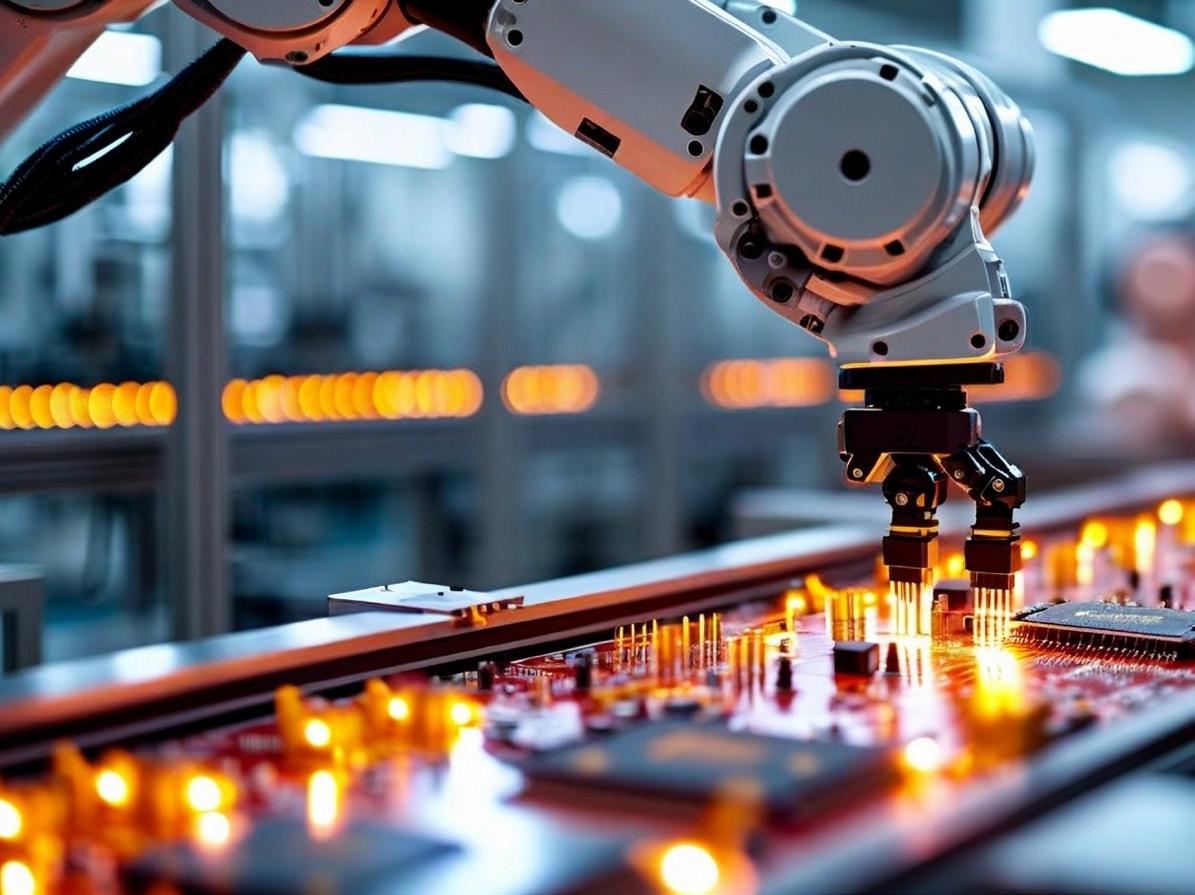
As manufacturers push to scale automation across complex global operations, many face the challenge of knowing where to start. Wabtec Corporation – one of the world’s leading transportation technology companies – addressed this headon by partnering with IfM Engage and applying a research-backed Automation Assessment. The collaboration delivered significant gains in idea generation, prioritisation, decision-making and internal capability building
Wabtec is a leading global provider of equipment, systems, digital solutions and value-added services for the freight and transit rail sectors. With more than 150 years of experience, the organisation has consistently set the industry standard for safety, efficiency, reliability, innovation and productivity.
Its technologies stretch beyond rail into mining, industrial and marine applications, helping accelerate the future of transportation around the world. At the core of Wabtec’s success are its people – 27,000 employees across more than 50 countries whose collective expertise drives continuous progress.
The ambition to embrace automation at Wabtec was clear and backed by senior leadership. An ‘automation council’ was formed to define a corporate strategy, but faced a critical hurdle: the high-level
ambition was there but lacked a practical, structured process to identify and prioritise the right projects at the facility level. The company needed a proven methodology to serve as the starting point and foundation for scaling automation.
The leadership team explored various external vendors but found most offered product-specific solutions. They needed an impartial partner to help build a robust, insightful approach from the ground up. The search for this led them to the Institute for Manufacturing (IfM) at the University of Cambridge and its researchbacked Automation Assessment.
“Most solutions we found were productled or focused on a single technology or solution provider wanting to sell their products. We needed an approach that was independent of an actual solution provider. That way we could focus in on the significant value in the ideas from our employees who understand the context of our organisation and facilities. The IfM’s Automation Assessment was unique in this regard and exactly what we were looking for," said Thomas Rupp, Lead Manufacturing Engineer, Wabtec Corporation.
Turning site-level ideas into a prioritised portfolio
The IfM’s Automation Assessment is a structured, five-step process to guide companies from initial scoping to a prioritised implementation plan. The series of workshops is designed to be a collaborative, practical process through which experts across the organisation identify automation opportunities and projects.
IfM Engage, the knowledge transfer arm of the IfM, facilitated two initial pilot workshops with Wabtec in facilities in the US. The engagements were intentionally framed by Wabtec not as a top down ‘assessment’, but as a collaborative ‘workout’. The goal was to harness the deep knowledge that already existed within the facilities and channel it into a structured, prioritised plan.
The experience was very successful, leading Wabtec to scale the initial initiative to an additional five facilities, making seven in total to date. From the seven ‘workout’ events, over 250 distinct automation opportunities have been identified.
A wide range of processes and activities across Wabtec’s operations were considered, including machine tending and deburring, inventory management, assembly and foundry
Most solutions were product-led or focused on a single technology or solution provider wanting to sell their products. We needed an approach that was independent of an actual solution provider
Thomas Rupp, Lead Manufacturing Engineer, Wabtec Corporation
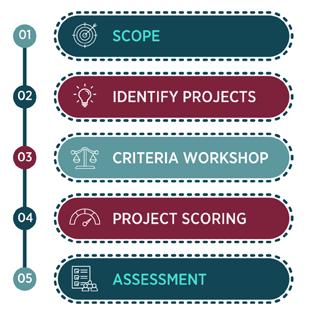
IfM Engage's expert facilitation of 'workout' events were key to securing buyin from day one
Thomas Rupp, Lead Manufacturing Engineer, Wabtec Corporation
operations, empowering teams to think broadly. This resulted in ideas that ranged from the physical to the digital, including projects to exploit technologies like robotics, cobots, AGVs and palletisers, alongside data-driven solutions targeting process optimisation in inventory management and automated inspection.
The real power in the approach, however, was in providing a clear, objective method to filter this high volume of ideas.
The Automation Assessment’s data-driven framework gave the teams the focus they needed, enabling them to distil a long list of possibilities into 15 key initiatives. Just as importantly, it provided clarity on the reasons behind each decision, ensuring alignment and consensus on which opportunities to move forward with.
The tool also acted as a ‘translator’ between technical teams and senior leadership. Its simple visual output allowed leaders to see the ‘why’ behind each priority, creating a shared language and building the confidence needed to fully invest in the long-term, scaled-up strategy. This shared language and alignment also enables local engineers to have the confidence to champion new and innovative ideas.
"The tool gives us a data-driven way to filter a high volume of potential projects, giving us much needed focus. It clearly shows us the key areas to pursue, but just as critically, it also highlights which projects to avoid, preventing us from investing resources in low value initiatives," said Thomas.
• Start with an objective, technologyagnostic assessment: Successful automation depends on evaluating opportunities based on value and feasibility – not on specific products or vendor-driven solutions.
• Involve the people who understand the work best: Frontline employees and cross-functional teams hold critical insights into daily processes. Structured, collaborative workshops (‘workouts’) unlock richer ideas and create buy-in
• Use a consistent, data-driven framework to filter ideas: Automation portfolios grow quickly. A clear framework enables organisations to prioritise high-value opportunities and avoid low-impact or high-risk projects
• Make the process visual to support alignment and decision-making: Visual mapping and scoring help technical teams and senior leaders build a shared understanding, speeding up communication and strengthening confidence in investment decisions.
• Build internal capability – not dependency: Long-term automation success comes from developing repeatable methods, internal tools and cross-site expertise so teams can continually reassess, refresh and scale automation.
Ready to explore how this could work in your organisation?
Learn more about the IfM’s Automation Assessment and the wider support available from IfM Engage: www.engage.ifm.eng.cam.ac.uk

Financial returns, stronger capability, smarter decisions
The Automation Assessment delivered significant, measurable impact across the organisation – from the factory floor to the boardroom. Financially, the process has been transformational. The 15 major projects identified and prioritised through the assessment are already projected to generate more than $2.5m in recurring annual earnings (EBIT), and when Wabtec extrapolates that value across the wider set of opportunities uncovered, the total potential rises to around $15m.
However, the story isn’t only about returns. A defining feature of the approach was the emphasis on capability building and knowledge transfer – designed to leave the organisation stronger and more selfsufficient at the end of the engagement than at the start.
Wabtec has since developed its own custom tool based on the IfM methodology, enabling teams to run the process independently. The ‘workout’ events also became a powerful internal mechanism for team-building; they helped spread practical automation capability, raise confidence and create shared ownership across sites and functions.
Just as importantly, the assessment improved how decisions get made. The tool has bridged the knowledge gap between technical teams and senior leadership. It provides a shared, robust decision-making platform for the company's automation strategy, and is now embedded to a point where any major automation project must be validated through a workout before it progresses.
"The IfM Engage team were great partners in this project. Their expert facilitation of 'workout' events were key to securing buy-in from day one. They provided critical support for our pilot workshops and have been a fantastic source of guidance in helping us build the internal capability to scale the solution ourselves," concluded Thomas.
A model for manufacturers beginning their automation journey For manufacturers earlier in their automation journey, Wabtec’s experience offers a practical blueprint. The partnership with IfM Engage has delivered not just a multi-million-dollar project pipeline, but a repeatable methodology – and the internal confidence to scale automation well into the future. l
Why waste budget on empty clicks? With access to 667,000+ manufacturing professionals and a core community of 103,000 engaged leaders, our campaigns deliver:
• A trusted platform to connect your solutions with manufacturers seeking answers
• Account-based reporting for measurable ROI
• Tailored campaigns that accelerate pipeline growth
In November 2025, The Manufacturer hosted The Manufacturer MX Awards at a gala ceremony in Liverpool, with Alexia Williams of Rolls-Royce winning the prestigious Young Manufacturer of the Year. Molly Cooper sat down with her to find out more about her current role and route into aerospace engineering
When in Year 9, Alexia attended a careers fair and while there, spoke with a recent graduate from GKN Aerospace about her passions of maths, science and design technology. It was this conversation that would be the catalyst behind her journey into engineering. “He was a graduate and his role in engineering sounded great. More importantly, he mentioned a colleague that had opted for the apprenticeship route over academia and
as a consequence, was able to get started on his career much earlier and didn't have any student debt,” she said. This sounded like the right path for Alexia so she began researching and found that she could take a degree apprenticeship after her A-levels and get straight into the workplace. “As someone who didn’t really enjoy sitting in a classroom, committing to another three years of that at university didn’t seem like the route for me,” she added.
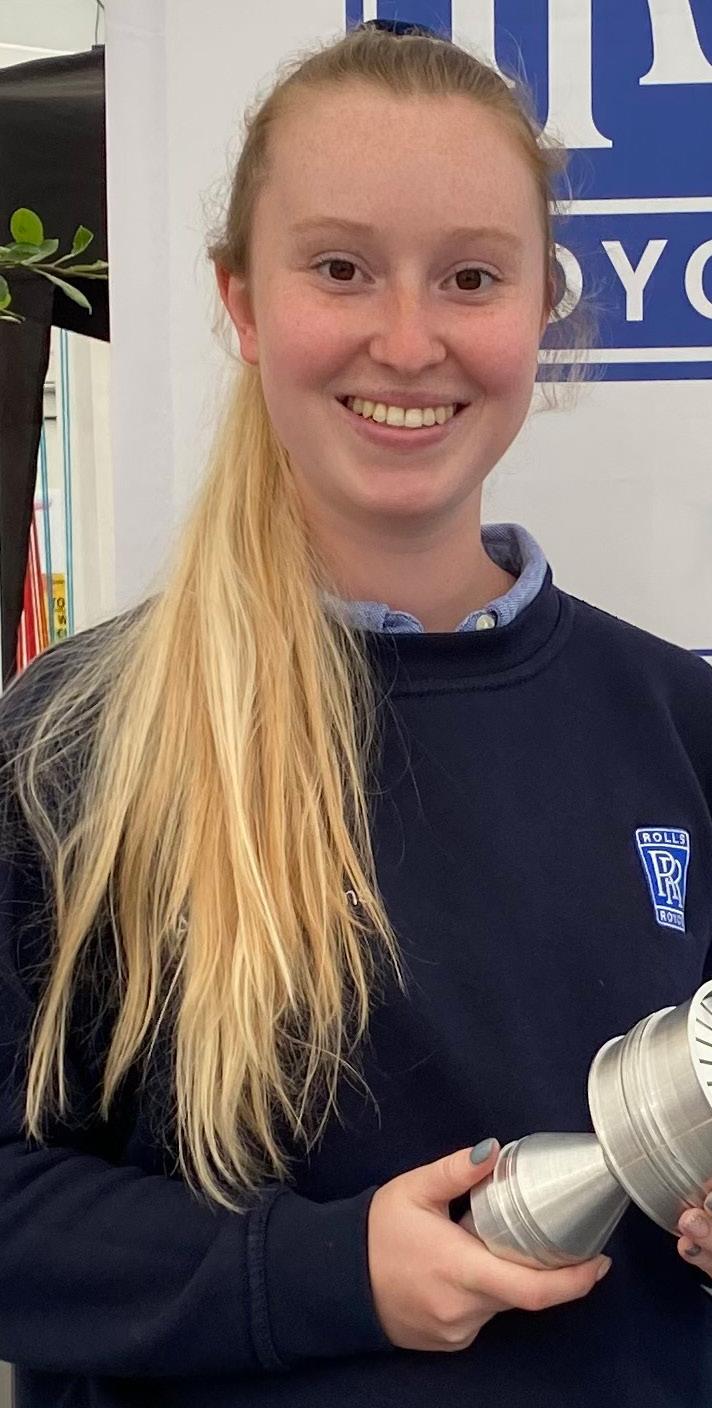

LEFT: Alexia representing RollsRoyce at an industry event BELOW: Alexia started her apprenticeship with Rolls-Royce after her A-Levels
From there, Alexia found a four-year apprenticeship in aerospace engineering at Rolls-Royce from which she advanced to secure a full-time role as a Deployed Life Cycle Engineer.
Yet Alexia wanted more and found that she could continue her studies and complete a master’s degree with Cranfield University. After pitching it to Rolls-Royce, she found that although the company weren’t currently funding master’s degrees, it would fund a master’s apprenticeship degree, meaning the business only needed to allow Alexia time to study and fund her accommodation. “From this, I became the first person at Rolls-Royce to do a master's engineering apprenticeship degree,” she said.
After this Alexia has performed a variety of roles at Rolls-Royce, with her current position being Technical Lead. “Earlier last year, I received my chartership, meaning I became one of only 12 women to become a chartered engineer by the age of 25.”
In her current role, Alexia works with long life assets, yet most of her time is spent working with Rolls-Royce’s partner companies and the Ministry of Defence. “We work together to make improvements, feasibility studies and projects. But the focus is availability, making the product last longer and

As someone who didn’t enjoy sitting in a classroom, committing to another three years of that by going to university didn’t seem like the route for me
Alexia Williams, Technical Lead, Rolls-Royce
to operate better for the customer by reducing maintenance and improving performance,” she said.
In previous roles, Alexia has spent more time on the shop floor, something which she looks back on fondly. “My last job was one of my career highlights within

Earlier last year, I received my chartership, meaning I became one of only 12 women to become a chartered engineer by the age of 25
Alexia Williams, Technical Lead, Rolls-Royce
engineering. I was leading on turnaround time for a project which allowed me to meet and speak with suppliers, find new technologies in the manufacturing space and look at how we could make improvements on the shop floor,” Alexia explained.
The project focused on using robotic arms with cameras for inspection which required new tooling. “I scanned the whole product and then 3D printed each
part, which were identical to their real counterparts. This allowed me to test all the tooling, inspection and instructions using 3D printed components,” said Alexia. For her, this was a great example of how modern technology can be used to make processes faster. “Also, we didn’t have to worry about accidentally damaging a £600,000 part,” she added.
Leading the way
“I often get asked if I find it challenging being a woman in engineering. The answer is no, I don’t. For me, being a woman in the sector is a superpower because there's not as many of us. This means you’re more memorable,” Alexia explained. “On my apprenticeship cohort I was the only girl. However, the ratio is now around 50/50 so it’s been great to witness an increase in the number of girls applying.”
As she has been remembered for excelling in her roles, people have been supportive of Alexia, pushed her and helped her challenge herself. “When I’ve reached out to people about roles or activities - because they remember methey are more likely to help,” she added.
The main challenge Alexia has faced was breaking new ground and being something of a guinea pig. “I was in the first cohort of aerospace degree
ABOVE: Alexia appeared on BBC Points West discussing A-Level Results Day and showcasing the opportunities of apprenticeships
apprentices and then again with my engineering master’s apprenticeship degree. So, it’s been a journey of trial and error in finding out what works and what doesn’t. But this has allowed us to improve along the way,” she said.
Now Alexia is contacted by people throughout the business who ask about her experience in taking a master’s apprenticeship. Two others have followed in her footsteps and are already on the course. “It’s been great to lead the way for others,” she added
As we know all too well, careers in manufacturing and engineering often come with an outdated stereotype, but Alexia is keen to look beyond that, and towards what the industry actually has to offer. “One of the key factors that attracted me to the apprenticeship at Rolls-Royce was that I wasn't pigeonholed. I was given the opportunity to move around and to find out where my passion within engineering and aerospace actually was,” she explained.
This is the advice Alexia would give to other employers; let apprentices work within different areas of the business and find out the inner-workings across a range of potential careers. “Where there are spaces you want to fill, or skills that are lacking, let them try. Often, they won’t know what suits them straight away as there are so many roles within engineering businesses - many of which will be unknown to most apprentices,” she added.
It is rare that all apprentices will want to follow the same path; some will prefer design and CAD, others research and development. “By allowing them to find their own passion, it’s likely they’ll stay longer in the company because they'll enjoy it and the business will organically fill its gaps.”
The importance of mentoring Mentoring is a vital part of evolving careers within the manufacturing sector, from internal mentors passing down skills and knowledge, to external networking groups offering careers advice.
Alexia has been involved in both, as a mentor and mentee. “While going through my apprenticeship and my first role at Rolls-Royce, I was mentored internally by a senior women in engineering. It was great to see her perspective of how to climb the ladder,” she said.
She also had a manager who worked as her silent champion when positions
TMMX had an interview stage which helped reinforce some of the key points I wanted to get across. It allows the judges to understand what motivates you and why. That’s something which can get missed in a written application
Alexia Williams, Technical Lead, Rolls-Royce
BELOW: Alexia speaking at the 2024 South Regional Manufacturing Awards
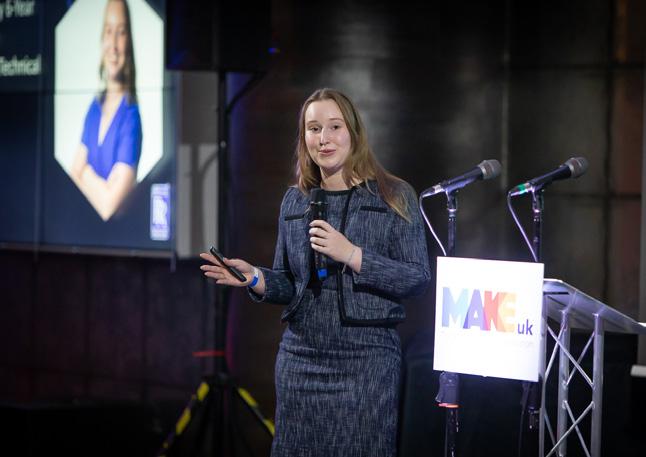
became available. “He was in a role I could see myself doing one day, so he was really helpful in terms of providing tips and advice on how he got there. He was also supportive of my growth, mentioning my name when positions for which I’d be a good fit became available,” she said.
However, one of the most beneficial mentors Alexia has had on her journey thus far was found through the UWE Women Like Me Mentoring Scheme, where young women early in their career are paired with more senior women within engineering and STEM.
“I was partnered with a woman that worked at a completely different company, and was around seven years further ahead on her career. Having someone that had worked in engineering, gone through similar stages and encountered different challenges, was particularly useful. The fact she was also external meant she could offer a view from outside of the Rolls-Royce bubble,” Alexia explained.
The scheme was only supposed to last a year but now, two years later, Alexia is still having mentor sessions once every few months. “We have now gone full circle and started some reverse mentoring as well. She's now asking me career questions that I'm helping her with,” she added.
In November 2025, Alexia was named Young Manufacturer of the Year at The Manufacturer MX Awards. “It was a very nice surprise as I wasn't expecting to win. I initially entered to share what I get up to and why I want more young people to get into manufacturing,” she said.
“Winning an award is always great; it’s a recognition of all your work and an indication to keep doing what you’re doing. Many people don’t see what I do, so it’s nice to know it’s appreciated both internally and externally,” she added.
The process of judging the award takes place over a few months and includes an initial application with an online form and then an in-person judging day. “Unlike other awards I’ve entered, TMMX had an interview stage which helped reinforce some of the key points I wanted to get across. It allows the judges to understand what motivates you and why. That’s something which can get missed in a written application,” said Alexia.
On my apprenticeship cohort I was the only girl; now that ratio is around 50/50, so it’s been great to witness an increase in the number of girls applying
Alexia Williams, Technical Lead, Rolls-Royce
Sharing your story
“For anyone entering the awards, my top tip would be to share as much as you can. I thought about not including some details that the judges ended up picking up on,” Alexia said.
One of those parts highlighted by the judges was the work Alexia is doing around sustainability. “I moved all our shop floor processes from paper to digital. To me, it felt like just a small part of my role, but the judges found that it had a huge impact and wanted to know the steps I had taken to make that change,” she explained.
“The whole process was a great way to reflect on the last few years of my career. Even though I have internal reviews as part of my work, those smaller details don’t always get captured, such as speaking at STEM events, representing the company or taking part in a scheme. TMMX has really helped me reflect on how far I’ve come in the industry.”
Aiming high
For now, Alexia wants to explore as much of the Rolls-Royce business as she can. “For my next role, I want to step slightly away from engineering to experience the business and financial side of an engineering company. I want to learn how they operate from a contract side,” she said. l
Taahir Patel, Process Development Manager at LISI Aerospace in Rugby, won Young Manufacturer of the Year at The Manufacturer MX Awards in 2023. In 2025, Taahir was on the judging panel, and a key part of the decisionmaking process to crown Alexia winner of the Young Manufacturer of the Year.
What was it like being a judge for The Manufacturer MX Awards?
It was a real privilege. I have been involved in the process ever since winning the award in 2023, and being on the other side of the table has been a genuinely enjoyable experience. The process is thorough and robust and it really pushes candidates to showcase their achievements. For me, the most enjoyable part is the second stage of judging, where each candidate has to concisely present their journey in a short space of time and reflect on what they have achieved so far. The whole process is truly inspiring and highlights the incredible talent we have across the industry.
Why is the in-person judging day so important?
The first stage of the process focuses on written submissions, which gives the judges a good understanding of each candidate and their achievements. However, the in-person judging day is where candidates can really bring their application to life. It allows them to expand on their written submission, demonstrate their passion and confidence, and show how they think and communicate under pressure. This stage gives the judges a deeper insight into the individual behind the application and plays a crucial role in final decisionmaking.
What made Alexia stand out?
Within an extremely competitive and talented group of finalists, Alexia’s presentation was very well structured and engaging, demonstrating her passion behind everything she does. What particularly stood out for me was the way she used analytics to evidence her STEM activities, showing not just what she was doing, but the real impact of her efforts. The scale of her outreach and the measurable difference she is making through these

engagements was impressive. To see the level of influence alongside her very busy role, demonstrated her motivation and commitment to the industry, which really set her apart.
What advice would you give to young people thinking of entering in 2026? I would encourage potential entrants to see the process as an opportunity to reflect on everything that’s been achieved during the time in industry. Use the submission to tell the judges about project involvements and the people who have been supported along the way. The more evidence that can be provided, the stronger the submission will be. That includes additional information around personal journeys and the inspiration to join the industry; this really helps bring the application to life and adds an important personal touch.
What do the judges look for in each application?
We’re looking for a clear picture of the candidate’s journey and their career path - supported by evidence of how defined goals are to be achieved. Include examples of projects and the impact they have had on the organisation. Sharing testimonials or feedback from individuals who have been mentored is also valuable, as it helps demonstrate influence, leadership and the difference being made beyond the own role.


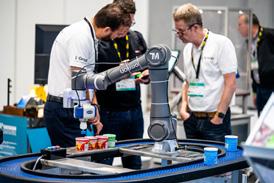

At this scale, ethanol evaporation is one of the biggest issues in the industry. We want to limit what the angels take from us
Angus Holmes, Whisky Category Director, Bacardi
The Manufacturer recently covered the story of a robotics project taking place at the Bacardiowned John Dewar & Sons maturation site near Glasgow. Supported by The National Manufacturing Institute Scotland (NMIS) and the Scotch Whisky Research Institute (SWRI), the project is deploying a robotic dog to detect expensive ethanol vapour leaks in whisky casks. We caught up with Angus Holmes (right), Whisky Category Director at Bacardi, to find out more.
Ethanol evaporation is a natural part of the whisky maturation process, which happens as the liquid sits in the barrel to age. This loss is known as the ‘angel’s share’ – which can be up to two per cent of the cask annually in cooler climates like Scotland – and requires careful monitoring to ensure as much liquid as possible is kept in the barrel, as well as ensuring safety.
John Dewar & Sons is one of the biggest whisky companies in the world and due to the nature of whisky production, stores huge amounts of whisky casks all over Scotland, including at the company’s dedicated palletised warehouse in Glasgow. “For a spirit to legally become Scotch whisky, it needs to be matured in oak casks for a minimum of three years, and as such, we have many warehouses of ageing spirit to manage,” Angus commented.
“At this scale, the ethanol evaporation is one of the biggest issues in the industry. We want to limit what the angels take from us, so it’s key that across the thousands of casks that we have in storage, we identify where those losses are and where they are greatest.”
While detecting leaks can actually be managed quite easily at lower levels of production, it becomes more challenging at the scale of inventory dealt with by Bacardi, which would need many people working full-time to search for and detect ethanol leaks across all sites.
Angus added: “As such, we looked at different solutions to potentially automate this process, and with our partners we’ve come up with the robot dog which uses a sensor, held by a 3D-printed arm, to detect ethanol vapour levels as the robot follows a defined path through the warehouse. This underlines the great potential technology has to support the industry to become more efficient and data-driven.

MAIN IMAGE: Ethanol evaporation, known as the ‘angel’s share’, can be up to two per cent of the cask annually in cooler climates like Scotland
“The first stage of the project was making sure the area was safe to operate. So we conducted a separate trial on a single cask to prove that the technology could work. We then took the robot into a warehouse and tried it on a larger scale, where the robot dog could begin to pick up and detect slightly higher losses.”
Angus explained that in order to create flavour in the whisky, there still needs to be a degree of evaporation inside the cask. “The last thing we want to do is to create an inert liquid and ageing is such an important part of the process, so we are not trying to remove the angel’s share completely,” he said.
“Fundamentally we're looking for tools to help us with problems within our manufacturing processes. We are not aiming to change the craft of whisky production. The flavours whisky drinkers enjoy are developed in the distilleries, and then through maturation. We don't want to change that flavour development in any way. All we're targeting is the more exceptional losses through larger leaks.
“We've got hundreds of years of craftsmanship that goes into making whisky, so we’re not interested in interfering with that and creating an inferior product. This project is purely about enhancing the process. Fundamentally, we are all about creating great experiences, and these are just tools that enable us to do that.”
Fundamentally we're looking for tools to help us with problems within our manufacturing processes. We are not aiming to change the craft of whisky production
Angus Holmes, Whisky Category Director, Bacardi
Scaling up automation across whisky production
While the focus for this project has been on whisky casks, the same sensing approach could also help improve efficiencies in other routine inspection tasks in different manufacturing environments.
One particular limitation of the robot dog is that it can only operate at ground level, yet whisky casks can sometimes be stacked up to seven or eight high. Therefore, while the proof of concept of the project was fundamentally around demonstrating how sensors and robotics can work in combination, the next stage will incorporate wider trials.
Continuing to collaborate with The National Manufacturing Institute Scotland (NMIS) and other partners, Bacardi will now be looking at further rollouts of robotics and technology that will allow vertical operation. This has involved conversations

50
with the National Robotorium, based at Heriot-Watt University, around drones or even a spider-style robot which has the ability to climb the casks.
“We have warehouses storing spirits all across the world; the ideal scenario would be if we could map every single one of those and identify where the leak hot spots are. That would then give our operating teams the tools they need to have visibility across the country,” added Angus.
“The robot dog is a huge step forward from the days of sending people around to find leaks manually. But it's a continuous improvement journey. We're a very traditional process that relies on craftsmanship but we also need to ask ourselves how we use emerging technology to enhance the crafts of our distillers, blenders and our team.”
Indeed, Angus added that as part of the wider business, a further stage in the process would be additional proof of concepts in the company’s Barcardi rum warehouses in Puerto Rico or Patrón and Cazadores tequila stores in Mexico, where the same problem exists.
Reducing this further would also have a wider global sustainability impact for the business, as reducing the angel’s share will mean the business won’t have to run its distilleries as hard, thus reducing carbon and waste.
ABOVE: The robot dog uses a sensor, held by a 3D-printed arm created by NMIS engineers, to detect ethanol vapour levels as the robot follows a defined path through the warehouse
RIGHT: The whisky sector is responsible for generating £3 in every £100 of Scotland’s total Gross Value Added (GVA), and is the second most productive sector in Scotland, ranked just behind energy
The challenges of robotic deployment Angus highlighted a variety of challenges that the project had to surmount, which included the attachment, positioning and control of the sensor, as well as the aforementioned height restrictions of the dog itself. However, he also stated that these issues also presented the business with an opportunity to bring the right people together.
“The project not only excited us, it enthused NMIS and the Scotch Whisky Research Institute (SWRI). People were very excited to be part of this project because they can see the potential,” he added.
And for good reason. Angus added that a misconception exists around the realities of the whisky sector with people unfamiliar with the industry picturing remote
distilleries perched on misty mountain sides, producing very small amounts of spirit. However, the truth is that the whisky industry plays a hugely significant role in the Scottish economy.
The sector supports 66,000 jobs across the UK, of which 41,000 are in Scotland. The sector is responsible for generating £3 in every £100 of Scotland’s total Gross Value Added (GVA), and is the second most productive sector in Scotland, ranked just behind energy.
“Whisky is part of our Scottish identity, so people want to get involved and help solve the issues we have,” Angus added. “It’s an industry people are proud to be part of so while there's always challenges, when you get the right people in the room it removes blockers and people want to work together.”
Like many manufacturing processes and techniques that have been around for many years, it can sometimes be tricky to make a case for the deployment of new technology. There are set rules in the way that Scotch whisky is manufactured and defined. For example, as well as being aged in oak casks for a minimum of three years - as mentioned before - it also needs to be made in pot stills and be matured in Scotland. That unique selling point is what makes Scotch whisky desired globally.
However, Angus also emphasised that just because a product has always been made a certain way, new technologies can still be looked at to drive improvement – the key is where it’s deployed. “We don't want to interfere with any of our traditional steps. We're not interested in introducing robotics or AI to take away from what the distillers do to control flavour. That craftsmanship is fundamental to us; and is the genuine story behind how we make whisky.
“However, AI is out there as a tool we can use to analyse the many different data points within our warehouses, which would be impossible for a human. When computers were introduced into industry all those decades ago, people probably had the same conversations we’re having now around robotics and AI. All we're doing is using more modern tools and technologies that didn't exist before, to help improve our processes.”
Advice around robotic rollout
When considering the deployment of any new technology, it is an advantage for any manufacturer to be inquisitive and ask questions of the technology and its provider.
“There's a Scottish expression that says ‘shy bairns get no sweeties',” Angus added. “So don't be shy; go beyond the four walls or your business, see what's out there and ask for help. If you only look inwards and internally to find solutions you can miss out.”
He added that while John Dewar & Sons is looking into the possibilities of AI with regards to better warehouse planning and forecasting across the group, the company is also conscious of not falling into the trap of thinking that AI is a silver bullet.
“AI will not solve all of life's problems. It’s just another tool that has recently become more available and accessible. Sure, embrace technology as it comes around. Explore, and choose whether you want to be a pioneer or go with the masses. But for us, it's more about networking and building up relationships and it’s really important that we build on our stories. There's other companies out there who have great ideas so we want to publicise that we’re up for innovation and open for business.
“We produce the world's most awarded blended Scotch whisky; we don't want to change that. We want our customers to continue to love and enjoy our whisky. But we also want them to know that we’re out there exploring and working with other companies to find tools that will help us enhance our processes.”
The future of robotics in whisky manufacturing NMIS will be continuing to work with the robotic dog to gather more data and further prove its capabilities and limitations. Cask leaks have already been fixed and the company has saved on waste, but this is very much a starting point for John Dewar & Sons and the next stage will be very much focused on scale.
Angus added that innovation is now at the core of the business, and technologies such as the robotic dog are fundamental to the company doing business in the long-term, and replacing more manual roles that will allow its teams to focus on the craftsmanship of their skills.
The project at John Dewar & Sons shows that emerging technologies can be thoughtfully integrated into even the most traditional industries. By automating the detection of the angel’s share, the initiative has improved efficiency, safety and sustainability while respecting the craftsmanship that defines Scotch whisky.
As the industry continues to balance heritage with innovation, projects like this highlight how technology can enhance long-established processes and help secure the industry’s future. l

• Robotics can significantly reduce whisky losses without harming tradition: Bacardi’s use of a robotic dog to detect ethanol vapour leaks targets exceptional losses from faulty casks, not the natural ‘angel’s share’ needed for flavour development—preserving craftsmanship while improving efficiency
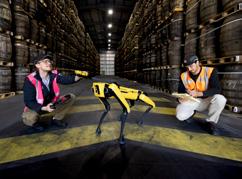
• Scale is the real challenge, not detection itself: While ethanol leaks are easy to spot at small scale, managing thousands of casks across multiple warehouses makes manual inspection impractical, pushing the need for automation and data-driven solutions
• Technology is positioned as a support tool, not a replacement for craft: Bacardi believe that robotics and AI are meant to enhance operations and free up human expertise not interfere with distilling, maturation, or flavour creation - the heart of Scotch whisky’s identity
• Early trials proved value, but limitations remain: The robotic dog successfully detected leaks at warehouse scale, but its groundlevel operation limits coverage for stacked casks - prompting exploration of drones or climbing robots as part of the next phase
• Innovation brings sustainability and broader industry impact: Reducing whisky losses lowers waste, energy use and carbon output. The same sensing technology could be applied across other spirits and manufacturing sectors
Smart Manufacturing Week 2026, taking place at the NEC in Birmingham on 3-4 June, will also the return of the Smart Tank feature, an exciting platform for entrepreneurs to pitch business ideas and product concepts to a panel of industry experts, designed to nurture and accelerate innovation
Smart Tank injects the excitement of the start-up environment onto the expo floor, where exhibitors in Innovation Alley will pitch their ideas to a live audience and a panel of expert judges.
Designed to be fast-paced, engaging, and filled with innovative ideas, Smart Tank
offers emerging companies an opportunity to present their vision directly to investors, academics, industry influencers, the media and the show audience.
Smart Tank’s winners walk away with a prize package designed to supercharge their growth, alongside a complimentary exhibitor space at next year’s event. The

winners will also gain access to a mentor, direct introductions to investors, coverage from the press and free online advertising with both Smart Manufacturing Week and The Manufacturer.
We caught up with two such winners from last year’s event to find out more about them.
Dr. Niccolò Corsini, Founder and CEO, Logidot
LOGIDOT creates a digital twin of a warehouse, factory or operations by digitally connecting and tracking its mobile assets
Logidot’s solution consists of a cloud platform and sensors that can be placed on assets (or worn by an operator) to detect hazardous behaviour and noncompliance in industrial environments. Automated alerts, reports and analytics help feed this information into continuous improvement of operations and operator training. Founder and CEO, Dr. Niccolò Corsini, picks up the story.
Can you provide some background into Logidot?
My passion for manufacturing was born out of a childhood trip to see a biscuit and chocolate factory my father was running.
And my passion for technology and industry is what led me to start Logidot, which, in a nutshell, creates a digital twin of a warehouse, factory or operations by digitally connecting and tracking its mobile assets – forklifts, tools, stock, robots - everything that moves inside as well as outside of a site.
It then orchestrates all the material handling operations in real time. We do that by combining uniquely low cost plug-and-play and high-performance location tracking sensors with an AIbased intelligence platform.
This gives managers and operatives actionable data to continuously improve performance to make the factory smarter.
What problems does the Logidot solution solve?
The core issue that we address is the lack of real time visibility in industrial sites and the lack of intelligence that would bring them into an optimal flow.
While we’re used to using GPS in our daily lives, there's no real equivalent in an industrial environment. And so this lack of visibility is what causes a lot of operational inefficiencies, quality and safety issues, and ultimately, operational waste. I've always wondered why we couldn't use tech such as GPS or mobile apps to solve these problems.
While I was studying for my PhD, I dug a little deeper and realised that existing technologies were either inaccurate, expensive or difficult to use - hence why they were not widely adopted by industry.
At Logidot, we've developed a tracking solution that is truly plug-and-play, scalable and can be installed - fully wirelessly, without expert skills and with minimal disruption to operations - in a matter of days, without sacrificing the performance or breaking the bank.
It hits the sweet spot in terms of the ease of use, accuracy and costs, to really make it more accessible to operators, whether they are a small warehouse or a big factory. The cost of downtime in factory environments is extremely high, so new technology needs to be installed very quickly with minimal disruption, because manufacturers don't have the luxury of halting operations for a week while new technology is deployed.
That’s effectively what our solution does. And, not only can it be installed very quickly without cabling, it can calibrate itself without the need for excessive intervention. So it can be rolled out at a much lower cost, without compromising the high accuracy and robustness that is required in these environments.
What are some of the main use cases for the Logidot solution?
One very common use case is tracking forklifts, both inside the warehouse as well as in production. We can track their location and movement, but also those of the pallets that are being picked up and dropped. We can map their movement which helps end users understand the utilisation of their fleet - are they being managed effectively? Are they being managed safely?
This means we can dynamically optimise their routes, in the same way we as consumers would use certain travel apps. Logidot can figure out where the congestion and traffic might be and find a better route. This helps reduce the distance travelled, as well as the travel on empty.
One of our FMCG clients for example, through better routing and scheduling, have experienced a 20% reduction in idle time, and a 10% increase in pallet throughput. There have also been benefits on the safety side via a reduction in


Our solution can work as a standalone system or it can seamlessly integrate into existing factory management systems
Dr. Niccolò Corsini, Founder and CEO, Logidot “
“

We've designed a system that's fully integrated, from collecting data right up to the recommendations to the end user
Dr. Niccolò Corsini, Founder and CEO, Logidot
incidents, such as collisions and speeding in pedestrian areas. This has resulted in a payback in less than eight months.
Our solution can work as a standalone system or it can seamlessly integrate into existing factory management systems, and can augment with real time location, process data and intelligence. So it doesn’t just collect location data, it can also use other sensory information, such as environmental conditions and other process signals that are then leveraged to make decisions and actions on the
shopfloor. So, by combining real time tracking with AI-based intelligence, Logidot gives managers and operatives the data to continuously improve performance.
The plug-and-play nature of the solution means we can acquire data on existing operational bottlenecks very quickly, which gives managers the opportunity to continuously improve performance and take remedial actions.
On top of that, we also have a simulator which uses the collected data to understand different scenarios and how they would impact performance.
So before any change or technology is implemented, its impact can be simulated so users can better understand whether it would make sense from a business standpoint. All of that then feeds into better planning, but also improved training of staff and allocation of resources.
What does the Logidot customer journey look like?
We usually conduct a phased deployment and typically start with the installation of wireless sensors and configuration of a standalone platform. This gives customers rapid visibility into the operations and actual data of their operations to improve efficiency, safety and sustainability across a variety of use cases.
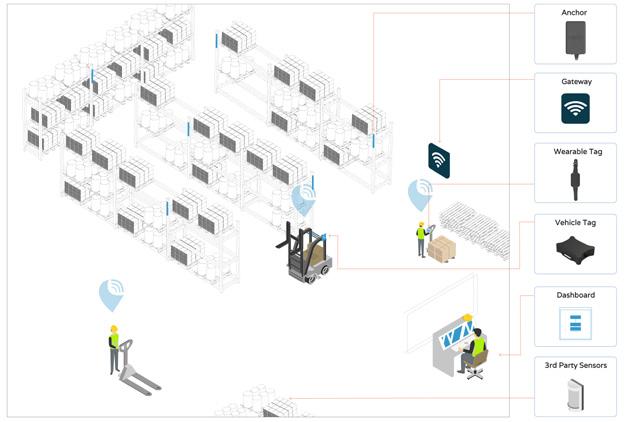
For longer installations, we also have the option of wiring the sensors and connecting them to the main power supply so that they last for many years. But in order to derive the full benefit, many customers also want to integrate the Logidot solution into their existing systems, whether that's ERPs, WMS or MES. And doing that helps augment their systems with location awareness and intelligence.
Customers can also leverage our AI assistant where we can build an operational knowledge repository that effectively allows the customer to upload the company-specific documentation - SOPs, training manuals, health and safety procedures, etc. The AI assistant then leverages that knowledge to give very specific responses and insights to the users, whether they are operatives or managers.
And we can fine tune this, depending on the needs of the customer, with the goal of making the system feel as native as possible to the operator.
We are conducting user testing on our AI-Assistant based learning tool are looking for operators (managers, frontline workers, planners/continuous improvement) who would be willing to give a brief interview. You can book a slot directly by contacting Logidot: info@ logidot.com.
What’s Logidot’s USP?
Our secret sauce comes from the plugand-play, high-performance hardware, which comes with mesh protocols that are robust, low power, very easy to install and deploy, and are combined with physical AI algorithms.
So we've designed a system that's fully integrated, from collecting data right up to the recommendations to the end user. Many companies just focus on the hardware or software, but to get the best performance, you need a fully integrated stack.
This combination of proprietary technologies is what gives us a solution that's leading-edge in terms of asset tracking and optimisation capabilities. If you consider the performance, ease of use and total cost of a system, it has to perform well on all these parameters, regardless of whether it's a high value manufacturer or a logistics operator that operates on smaller margins.
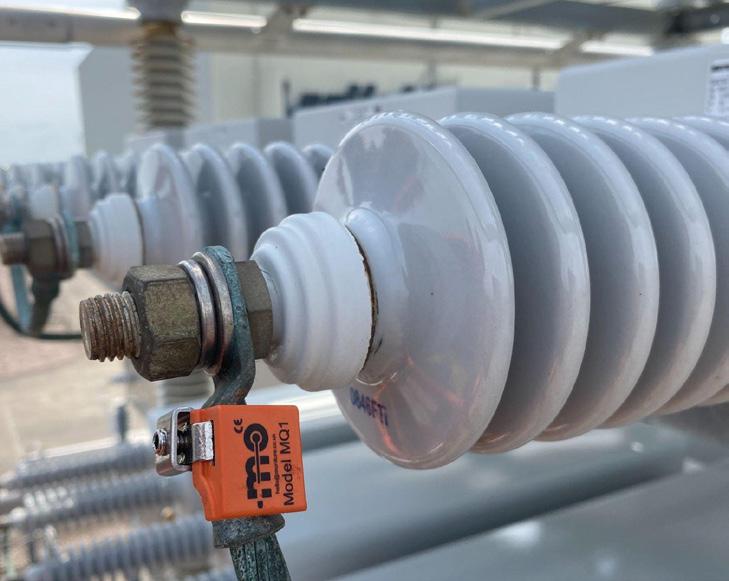
Keith Gallant, Director, Uie
THE MONITURE solutions allows engineers to monitor the temperature of joints and contactors, minute-by-minute, recording far greater amounts of information from their machines. That’s why Moniture stands out. It offers batteryless, wireless monitoring of temperatures within electrical components.
Uie as a business aims to understand machinery problems and create innovative solutions on how industry can monitor the health of the machinery, while improving the engineering and maintenance practices for equipment reliability. Keith Galant, Director at Uie (understand, innovate, elevate) explains more.
At Smart Tank you showcased the Moniture sensor. What problem was the sensor designed to solve for critical electrical infrastructure?
KG: The problem is that in settings that incorporate high voltages inside the electrical panels, workers are not able open the panels and use thermal imaging cameras to check the temperature or condition of the electrical components.
One solution is to install windowseither polymer or crystal - in the doors but this is prohibitive in some instances. This creates an issue around how to monitor the condition of electrical components.
We looked at the sensor technology that was currently available and put together the Moniture system, which is essentially an energy harvesting sensor. Moniture is fitted onto the electrical component and if it's an AC component over six amps, it will induce power into the sensor wirelessly. This then creates enough power to record the temperature every minute and transmit that wirelessly through the electrical panel -through concrete buildings up to approximately 150–200m away.
This allows laboratories to monitor the temperature of joints and contactors, minute-by-minute, recording far greater amounts of information from their machines. Being able to compare the real time data allows them to also predict problems before they arise.
Real-time temperature monitoring is key to predictive maintenance. Can you share a specific use case that illustrates the return on investment (ROI)?
We installed a system for a customer that was experiencing repeat failures on an inverter drive which had problems with temperature and load balancing.
The system allowed them to monitor the temperature on the inverter, so if the load and the temperature increased, the company could make changes to the process environment to reduce the load on the inverter and the fan that was running.
In cost terms, the inverter wear is greatly reduced; these cost around £20,000 per module to replace and there's around
“
It can be daunting for a customer to try and install our sensors throughout the entirety of its sites, so we first look at the most critical components where failure would have the biggest impact on the plant
Keith Gallant, Director, Uie



six modules. With our installation the customer was able to see which inverter was degrading and could plan a repair before any catastrophic event, making the repair cost lower and less frequent.
There is also a saving on process costs. If the system was to fail during a process, then there would be huge losses for every day the system was offline. Our system and installation came at a fraction of that cost.
Beyond the sensor itself, what kind of data does the Moniture system collect? What role does software play in translating the data into an action for the owner of critical components?
Our Moniture sensor speaks wirelessly to a gateway, sending simple data such as serial numbers, temperature and time stamps. The gateway is then able to output data streams from all channels in an industrial PC language such as SCADA. We can configure our gateway to align with the customer’s needs. Some customers want to take that data straight into their own systems and we can give them that option.
We can also provide a cloud software service where we can send data into our own cloud, or the customer's IoT cloud.
We currently use traditional thresholdbased analytics, but as we can take more data from across a plant, we plan to store it in data lakes and apply more advanced machine learning analytics to identify new opportunities for our customers.
Smart Tank was really enjoyable. It felt like mini Dragon’s Den and I really liked being bombarded with zero nonsense questions by industry veterans who have seen many businesses before and know what works and what doesn't. So it was enjoyable having that fast paced interaction. And I enjoyed being challenged like that.
Dr. Niccolò Corsini, Company Founder, CEO
Taking part and winning the Smart Tank competition was a positive experience for us. We built a good rapport with the panel and because they clearly understood the space in which we are operating, it made it easier to explain our pitch and have insightful conversations about the value of our solution.
Keith Galant, Director, Uie
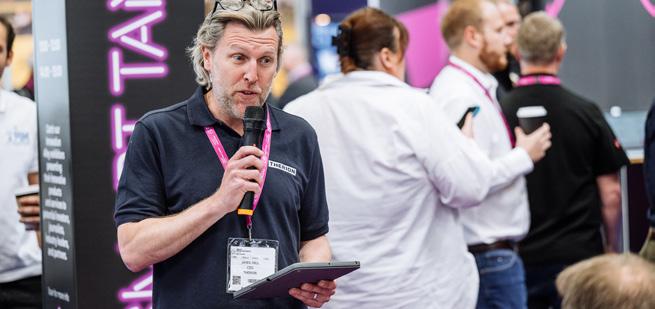

Smart Tank will once again be returning to the show floor of Smart Manufacturing Week. To register your interest visit www.smartmanufacturingweek.com
Can you explain the installation and deployment process for a customer integrating Moniture across its facility?
What aspects make it scalable for widespread industrial use?
It can be daunting for a customer to try and install our sensors throughout the entirety of its sites, so we first look at the most critical components where failure would have the biggest impact on the plant. Then, we would only add sensors to the failure points on the machine. It is unlikely a business would place them on everything within the plant.
When we first interact with a customer, we would visit the site and carry out a survey. Some businesses are aware of the criticality of their assets, some are not, so we are able to help with raising awareness levels. Then we design the gateway around the needs of the customer, how many points there are and where they are on-site.
Once the installation is made, we help the customer with integration with existing systems, whether they are choosing to host on our platform or their own.
In a rapidly evolving IIoT space, how does Uie view its position relative to other monitoring solutions?
Our main USP is that our sensor is wireless and batteryless, making it completely unique in the marketplace. There currently aren't any other fixed monitoring systems for electrical points that go to this level of scalability.
This is due to the fact that most others are battery powered or operate via a wired connection. Moniture sensors are selfpowered, have wireless communication, can cover large distances and through materials which we find on industrial sites such as thick concrete and steel piping.
What is your long-term vision for Uie?
Looking ahead, our focus is on building on recent major utility and government contracts, expanding into multi-site deployments and continuing to grow our connected condition monitoring offering as the business scales.
We are experiencing quick growth and as such, are adding analysts and software engineers to our workforce to expand our own technology IP and software.
We want to grow to be the premier condition monitoring company within the UK and Europe, in terms of batteryless technology. Right now, we are well-placed to help the energy industry to understand the condition of assets in real time and manage the systems. l
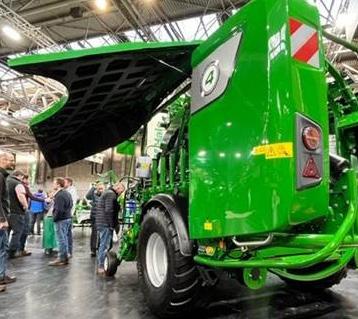
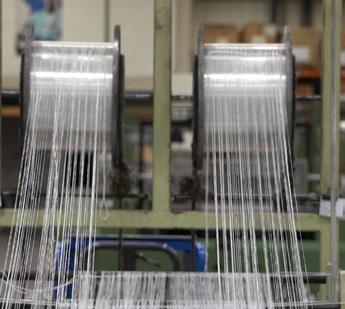
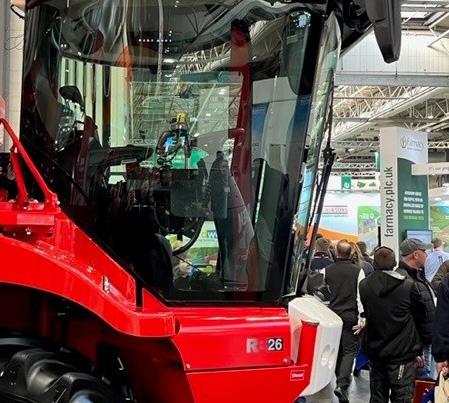
THIS MONTH BISLEY
SMALL
BIG BEAR WISLA
At the end of last year, The Manufacturer team visited Bisley, a furniture manufacturer in Newport, South Wales. Molly Cooper spoke to CEO Richard Costin and Lead Designer, Chris Fowler, about how the business is keeping up with a rapidly-changing world

If you’re sat at your office desk while reading this article, take a few seconds to look around. There’s a fair chance you will catch a glimpse of a Bisley product in your vicinity. Known initially for its filing cabinets and office furniture, the company - founded in the 1930sbegan manufacturing its iconic steel storage units in the 1950s. These quickly became globally popular and remain a design classic to this day.
Bisley is also a leading example of a manufacturer that has embraced diversification in recent years to keep up with modern-day trends, as offices turn increasingly towards paperless operation and employees work around a more hybrid pattern.
“Bisley started as a family business and has been operating for over 94 years. It initially began as a purely steel manufacturer of office storage systems,” said Richard Costin, CEO at Bisley Group.
The company once produced around 20,000 tonnes of steel storage products each year, which over time has reduced to around 7,000 due to the increased diversity across the product range in order to incorporate a wider range of materials, such as wood. “As of now we are the only manufacturer in the UK that can provide both wood and steel storage units,” Richard added.
Trends and production
Bisley is helping businesses bring a homely touch into the workplace, to incorporate those people now returning to the office after years of being used to working remotely since the COVID pandemic.
“One of the trends we are seeing is biophilia; bringing greenery into the office landscape and a mix of materials in the furniture. For us, a mix of steel and wood has been very positive,” explained Chris Fowler, Bisley’s Lead Designer.
The Bisley site processes its steel at a very early stage. “We begin with the fundamental flat steel panels and work all the way through to piercing, notching and folding those parts to make the sub-assemblies. There is then a process of finalising the finished components to go on the paint line,” he said. After that, the parts move into final assembly which is where drawer bodies, decorative fronts, handles, locks and the like are added.
Having the whole process within one factory allows for a seamless progression that can take anywhere from six to

The trends we are seeing is biophilia; bringing greenery into the office landscape and a mix of materials in the furniture
Chris Fowler, Lead Designer, Bisley Group
eight hours to complete. However, wood product creation is kept separate behind an internal firewall and has a different flow line.
“The wood line is mainly a panelbased construction with no paint process required, so that’s an assembly line that incorporates more hand tools,” said Chris.
The way in which Bisley incorporates automation into its processes is based around logistics, as Chris added: “We use automation to create product codes so purchasing and planning can stay on schedule. But we require a human touch for the finishing stages of production. There’s an opportunity in modern design to use automation for the foundation, while letting craftsmen handle the features that make a product unique.”
In February last year, Bisley launched its BeSmart range, bringing a more personal touch to its product offerings.
“As a business we are seeing technology driving people back to the office and BeSmart offers a solution to make that transition easier,” explained Richard. Many employees are now looking for some personal space and storage in the office in the era of hotdesking.
“People need somewhere to store various business and personal items such as gym clothes, a change of shoes or bike helmet and our manufacturing expertise, combined with our global smart technology lock partners, has
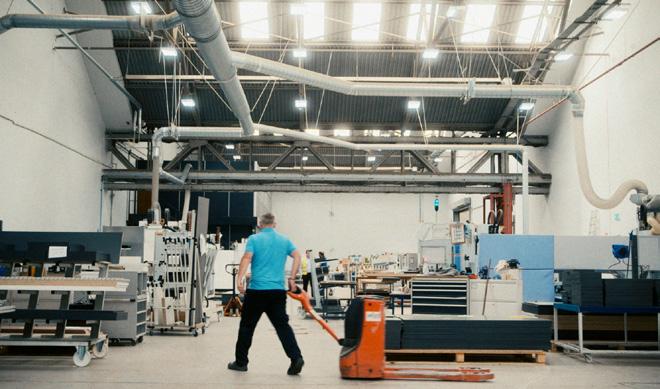
60

Bisley started as a family business and has been operating for over 94 years. The company initially began as purely a steel manufacturer of office storage but we have diversified over the years
Richard Costin, CEO, Bisley Group
delivered this. Each product is designed and developed alongside the customer to meet the needs of its people,” explained Richard. This includes fitting bespoke products to small, confined spaces, branding cabinets and making the right product for the right budget.
In the corporate world safety is a number one priority. “There are many companies offering a solution like this, but it’s not as easy as merely selling the
BELOW: There’s an opportunity in modern design to use automation
for
the foundation, while letting craftsmen handle the features that make a
product
unique
technology. It needs to integrate with the organisation’s Wi-Fi for example, and that of course involves cyber security.”
Not only that but the technology also provides Bisley with tangible customer data. “We can help organisations to make decisions on how many lockers they need for the amount of staff activity coming through the office,” explained Richard.
When walking around the factory, Chris highlighted the £80m investments that Bisley has been incorporating into its machinery, assets and overall production facility.
“For us, digitalisation is essential. When you look at our machines, rather than seeing people operating them manually, you have an example of how everything can be pre-programmed digitally,” he explained. This starts at the design stage and continues right through the order process. “All of our assets are programmed directly from the design, which then drives how the products are manufactured.”
Bisley has also diversified into incorporating more intelligent tools on its website. “Now, when putting a quotation together, the customer is able to specify exactly what they are looking for and the
• Bisley is moving through the paperless-office era by pivoting its production from high-volume steel cabinets into a high-value mix of wood and metal furniture
• The business is using digital automation for the foundation of its production but keeping skilled craftsmen for the unique finishing details
• Bisley has combated shipping and supply chain volatility by bringing more processes in-house and partnering with local subcontractors
• The company is moving beyond hardware by integrating smart technology that provides customers with real-time data and analytics
• The business is improving recruitment and long-term retention by transitioning to an Employee Ownership Trust that gives employees a direct stake in success

pricing is provided,” said Richard.
This is then transferred to the customer service team who then process the order. “That’s then transferred through to the factory on the MRP system, and then through to invoicing, delivery and finally, track and trace,” he added.
"Many of Bisley’s employees in the UK have been with the company for many years and have become used to production and processes. But they have also embraced new technology and automation, and it’s been fantastic to see how they’ve adapted,” said Richard.
“As a UK business, we ship to over 50 countries worldwide, including our own subsidiaries, so that has presented us with logistical challenges since Brexit. We initially made some minor errors due to the change in paperwork requirements involved in the process. However, we took the time to train and educate our teams on the changes needed to ensure it was completed correctly. If your paperwork is incorrect, the delivery will not make it into its destination country,” added Richard.
To further aid this process, Bisley is attempting to diversify and find more local suppliers to help address and tackle some of the supply chain challenges that have faced the sector over the last few years. “Our mantra is to be as vertically integrated as we can by bringing as much of those processes into the Bisley fold as possible,” said Chris.
As the business begins new product journeys it is also looking for local suppliers and subcontractors to provide support on that path. “We've welcomed those suppliers, got on board with them, and visited their sites to develop an understanding of their issues as well as our own. It is a valuable front-end experience,” said Chris.
ABOVE: Bisley is a prime example of a manufacturer that has had to diversify in recent years to keep up with modern-day trends
He also highlighted that this experience has served to broaden his horizons by allowing him to look at other industries to find out what they do and how they go about it. “As a designer, I’m naturally inquisitive about what can be achieved. Everyday I’m learning something new, continuing to evolve and push forward our product offering."
Bisley was a family-owned business, founded by Freddie Brown who then passed and sold the company on to his son, Tony. And part of Tony’s legacy was the introduction an Employee Ownership Trust. “Right now, we have around 500 staff globally and every one of those employees participate in our Employee Ownership Trust after one year of employment,” explained Richard.
Bisley gifted 51% of the ownership of the group to its beneficiaries (the staff members) free of charge. “They are not shareholders, but rather a beneficiary of the organisation. This means that should the company be sold in its entirety in the future, 51% of the value would be paid to the beneficiaries,” said Richard.
Bisley has found that the scheme has been a strong motivator for staff retention. Not only that but Bisley can also offer EOT bonuses to its employees on a yearly basis, tax-free subject to performance and profitability. “It’s hugely attractive for prospective employees,” he added.
Bisley is on an upwards trajectory and for Richard, the company’s growth is focused around its selling channels. “We have diversified into online, working with B2C and B2B. I don't want to start creating lots of new projects but rather, focus on delivering against our current objectives,” Richard added.
Bisley plans to continue using wood, laminate, plastics, upholstery and soft furnishings as well as introducing a wider range of new materials to be used in furniture making.
“While office furniture is still our stronghold, there are no boundaries around us gaining business in other sectors. When we are handed a customer floor plan we want to know that we can deliver what they’re asking, but if not, we can also work with partners to create their vision. That's the driving force of the business,” said Chris. l
Founded in the late 90s by automotive veteran Gerald Bloom, Big Bear Plastic Products has grown into a heavy-gauge thermoforming powerhouse. Now led by his daughter, Emma Hockley, the Droitwich-based manufacturer combines some of the largest vacuum forming capabilities in Europe based around hard-won resilience forged through COVID, supply-chain disruption and rapid, unplanned growth. The Manufacturer caught up with Emma to find out more about the company’s journey
Big Bear Plastics is one of those manufacturers we just love writing about; a family affair with a unique backstory, and a company that has shown the agility, flexibility and determination to thrive under pressure.
It’s also a manufacturer whose products you probably encounter every single day, but completely take for granted.
Big Bear’s primary business is heavygauge plastic thermoforming, producing caravan bumper panels, roofs for diggers
and tractors, agricultural panels, highly technical lightweight aircraft seats and even garden ponds.
The heavy-gauge vacuum forming process involves heating a piece of plastic sheet (1mm thickness and above), applying it to an aluminium mould tool to get the desired shape, before it is trimmed on the company’s CNC machines. The business can also perform compression moulding, which is used primarily for lightweight interior trim parts, such as headliners, which involves
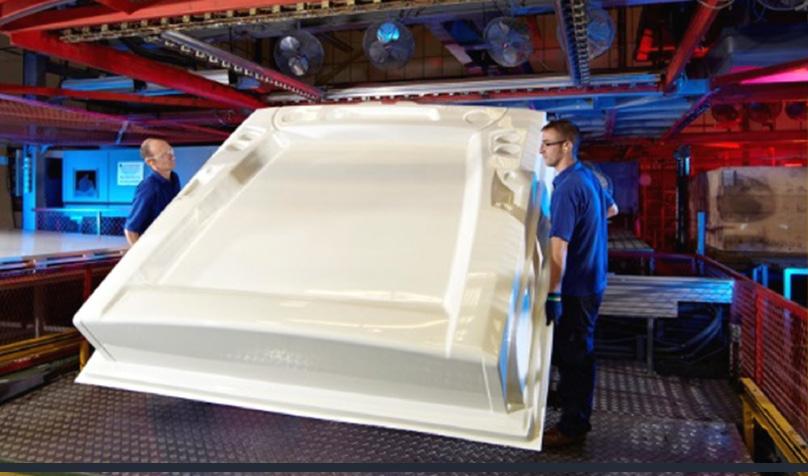
composite materials which are compressed and then trimmed using water jets.
At this stage in the company’s evolution, the primary focus is on vacuum forming technology, and Big Bear can mould parts up to 3.5m x 2.5m on its five large machines. However, compression moulding is an emerging technology and is an area where Big Bear has targeted expansion in the future.
“We like to bring innovation to our customers,” said Emma. “And for that, we like to work hard with our supplier partners around the use of materials. The technology of vacuum forming evolves as materials develop and that’s where innovation is really shining through.
“This is leading to an emergence of new products which have lighter weight, better impact and UV resistance, and increased stability. And, of course, keeping an eye on cost is something that's always important to our customers.
“We tend to focus on larger products and that's probably our USP, and where we really live up to our name. Big Bear means
LEFT: Big Bear Plastic Products is a privately owned manufacturer based in Droitwich, Worcestershire, specialising in plastic thermoforming
big products, big service, big quality and big quantity.”
An example of this innovation in action can be seen in the company’s Bearex material, used as a lighter weight, more cost-effective alternative to ABS, for exterior panels which require excellent impact strength. For example, a particularly successful implementation of Bearex has been in the caravan industry, where it has been used for front and rear caravan bumpers, eliminating warranty claims due to cracks, breakages and stone chip damage; Bearex is shatterproof and crackproof, even at low temperatures, so is ideally suited for this type of application.
Growth journey – no teddy bears’ picnic
The journey so far for both Big Bear as a business and Emma as an individual, has certainly come with its own challenges. Emma came into the business with no manufacturing experience, having spent much of the previous decade at Harrods, as Buyer for the Perfumery & Cosmetics department, and then heading up marketing for the Beauty division.
Not only that, but she took over the reigns as Managing Director at Big Bear in March 2020, right at the start of the COVID-19 pandemic. “I had to get to grips with the business pretty quickly with a very limited team,” Emma added. “Not coming from a manufacturing background has been challenging and joining the company as the owner’s daughter meant I certainly had a bad case of imposter syndrome in those early years.
“However, I have a great team who support me and share the vision for the company’s success. Even though we had a lot of people on furlough during COVID we still kept going and were even able to pivot to make products for the NHS. So, I'm really proud of everything that we’ve done.”
That resilience of the Big Bear business was evident as the company began to emerge from the pandemic. Just as customers began to return and the business seemed to be emerging from the trials and tribulations of COVID, there was a devastating fire at one of Big Bear’s largest competitors. Thankfully no one was seriously hurt, but it sent the whole supply chain into chaos.
Big Bear were called upon to assist, which resulted in the company receiving a lot of new business. But equally, it put huge pressure on operations, processes and people as Emma explained. “We essentially doubled the size of the company overnight.
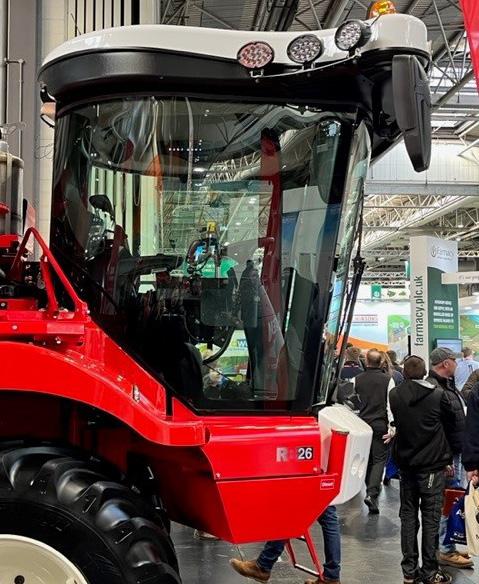
We all believe in British manufacturing and want it to succeed so it would be nice to have some recognition and some support from government
Emma Hockley, Managing Director, Big Bear Plastic Products
ABOVE: Big Bear offer full support from low volume prototypes through to medium and high-volume production
And when you take on that volume of new, unplanned work – much of which involved very large components – suffice to say it was a very challenging time!”
Big Bear took on fire damaged tools which then had to be modified to fit its machines. CNC jigs had to be built, tools had to be stored and those extra components had to be incorporated into the production plan for trimming, moulding, assembly etc. This resulted in a reorganisation of the factory into different production cells, with a dedicated manager for each area. There was also huge investment in new machinery that came about as a result of the increased demand.

All the while customers were continuing to build their machines. “Our customers were building up a backlog. So not only did we have to jump on a moving train in terms of catching up with their production, we also had to fill a huge backlog of parts. So the strain on us was immense,” added Emma.
However, with the company in the strong position it is today, Emma was keen to stress that this period of disruption proved a real catalyst for change in the business; the driver behind Big Bear being able to take that next leap forward. “It was a real sink or swim moment, but the fact we’re still here –and stronger than ever - proves that it worked.
“We really had to lean on our reputation that we had built up over the previous years of delivering good service and quality product. We had quite a lot of difficult conversations but, by the end of that summer, we were back delivering on time and in full, and we've maintained and improved on that position ever since.”
Like many manufacturers, Emma explained that sustainability has become more important to Big Bear’s customers, and likewise it has also become more integral within the business.
The technology of vacuum forming evolves largely through the technologies we use, and that’s where innovation is really shining through
Emma Hockley, Managing Director, Big Bear Plastic Products
meet certain flammability requirements, with very precise specifications, so would almost certainly need a virgin sheet.
“We are very mindful of our footprint and what we're doing,” said Emma. “So, we use recycled materials in our processes wherever we can. We are delighted that we have recently achieved our ISO14001 certification, which represents a real achievement and commitment to our sustainability goals.”
As an SME and a local employer, Big Bear certainly hasn’t been immune from market pressures over the last few years and Emma was less than complimentary of the government’s perceived support for the sector outlined in last year’s Industrial Strategy.
“It currently feels like the situation is being made harder for SMEs, rather than easier. We have all felt the impact of taxes, the National Insurance rise and The Employment Rights Bill. In my experience, employers like us value our people above anything, and we look after them well - but this bill seems to assume that we don't.
“It's frustrating; trying to employ people and bring innovation into a business can be difficult when it feels like that's not valued. I'm sure everyone shares the concerns about the lack of support for British manufacturing at government level. I know there's a level of competition, but generally speaking we’re an industry that tries to support each other. We all believe in British manufacturing and want it to succeed so it would be nice to have some recognition and some support.”
For Emma, the key factor that sets the business apart today is its people. She freely admits the difficulties in joining the business as someone with no experience, which meant she really had to lean and rely on the people around her.
The result is that Big Bear is awash with people who are supportive, positive and not afraid to challenge the status quo. “This can make a massive difference to having people who always tell you how things can't be done,” she added.
We hear much in the wider media around plastics and its use, but most of the materials Big Bear work with are recyclable and its cut offs are returned to the supplier, where they are reground and made into products such as garden ponds etc.
However, a product that would be installed on an aircraft for example, has to
“For me, our people are the most important part of the business, and it's really important to me to treat them with respect. We are lucky enough to have some colleagues around us who have worked for my father for over 30 years, which is testament to how he treats people. And that's always something that I've learned from him.”
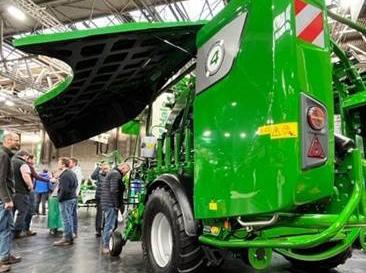
ABOVE: Big Bear customers cover a diverse range of global industries that includes automotive / commercial, off-highway, retail POS, leisure, aviation, rail and bus and coach
BELOW: Future plans for Big Bear involve working even closer with the company’s supply chain partners, crucially around new material coming into the market
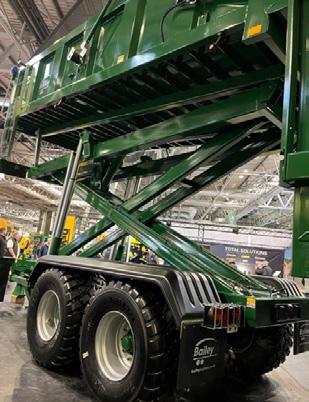
Future plans
Far from being discouraged by the challenges associated with the rapid rise of the business after the pandemic, Emma’s mantra for Big Bear moving forward remains focused on growth and will be looking to increase the volume of work the company is doing.
“We've got ourselves in a really strong position – operationally we're better than we've ever been. We're delivering good product for our customers, on time, and we're getting great feedback,” she continued.
Part of those future plans will be working even closer with the company’s supply chain partners, crucially around new material coming into the market with some amazing innovations available already.
“We're really keen to innovate, create prototype parts and then move them on to production manufacture which will help us build on a very firm foundation. I’m really confident that we can build on that and continue to grow the business - as best we can in a challenging environment!”
As Big Bear Plastics looks to the future, the business stands as a compelling example of how resilience, innovation and people-first leadership can drive longterm success. From navigating a global pandemic to absorbing unprecedented demand and reshaping its operations, the
• Resilience as a defining force: Big Bear Plastics has repeatedly proven its ability to adapt, navigating COVID, severe supply chain disruption and sudden, unplanned growth to emerge operationally stronger
• Scale is the company’s competitive edge: With some of the largest vacuum forming machines in Europe, Big Bear has carved out a clear niche in large, heavy-gauge thermoformed components across multiple sectors
• Innovation is driven by materials: While the core vacuum forming technology remains stable, advances in materials are delivering lighter, tougher and more costeffective products for customers
• People underpin performance: A strong, experienced team and a culture that encourages accountability, collaboration and challenge have been central to stabilising operations and supporting growth
• Sustainability and future growth go hand-in-hand: The business is increasing its use of recyclable materials, progressing towards ISO 14001, and investing in emerging technologies like compression moulding to support long-term, responsible growth
ABOVE: Compression moulding is an emerging technology and is an area where Big Bear has targeted expansion in the future
company has repeatedly proven its ability to adapt and thrive. With investment in new technologies, a clear sustainability roadmap and a strong appetite for material-led innovation, Big Bear is well positioned for its next phase of growth. l
In Droylsden, just east of Manchester, high-performance textiles are being woven into some of the most demanding applications in the world. From aerospace to equipment supplied to the Great Britain Olympic Cycling Team, Wisla Narrow Fabrics has built a reputation as a specialist manufacturer operating at the cutting-edge of the narrow fabrics industry
Founder Edward Kozaczek, or Eddie as he goes by, is proud of his legacy. I’m not just referring to the business that he and his wife, Ingrid, founded in 2004. He is also proud of his Polish routes. Indeed, the name Wisla is a reference to the families of both his parents, who lived in small villages on the banks of the Vistula river. In Polish, the river is called the Wisła.
His mother, Irena, was 14 years old in May 1942. She and her family were displaced by the Nazis and were sent to Germany to work as labourers on a farm. Her mother and sister were then sent back to Poland, to the concentration camp in Łódź.
Around a year later, her father was also taken away to work at the Westfalia Coal Mine. He wrote to her saying he was starving and losing weight, and if it hadn’t been for Irena somehow managing to steal provisions such as flour to send to him, he may well have died.
Irena worked alone at the farm until the end of the war, with no knowledge of her family’s welfare. In 1947, the allied authorities informed Polish people that their country had been devastated by the war, and that there was nothing to return home to.
Irena decided to come to England, first living and working in Bolton. She continued to write regularly to her family, but received no reply. Until eventually, The
Red Cross wrote to inform her that her family had survived the war.
Now, her son Eddie has a company that marked its 21st anniversary last year. This is a milestone that represents not only commercial longevity, but also the evolution of a sector that has undergone significant technological change, particularly from a materials perspective.
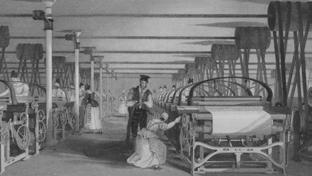
ABOVE: An engraving of an 1835 power loom weaving machine
This has, and will continue to open up new markers for Wisla. I think this is another story that offers up valuable lessons for SME manufacturers around diversification, talent acquisition, sustainability pressures and shifting global supply chains.
From legacy to leverage Wisla’s origins lie in deep sector knowledge, a lot of which starts with
Eddie. He had already spent two decades immersed in the textiles industry - which he said he was led into largely by the North West’s heritage in this area and its famous old mills. From textiles machinery he went into the manufacturing of spindle tapes, the forerunner to narrow fabrics.
He then spent around 20 years embedded in the development and evolution of narrow fabrics. Learning and experimenting with “the yarns and fabrics, and what you can do with them, all the while realising how technically sophisticated webbings can become,” as he put it.
Upon starting Wisla, the market base was mainly safety products. Narrow fabrics, which include webbings, tapes and elasticated textiles, are often unseen components within larger assemblies. They are, however, absolutely missioncritical, in fall arrest systems, load-bearing harnesses, cargo restraint systems, personal height safety – pretty much anything with a safety element to it.
The general product profile is still safety, but the markets are expanding. “We see opportunities,” said Eddie, “not product specific, but industry specific. The range was quite significant, from aerospace, aeronautical, mining, transport, height safety - and we saw significant potential for growth.”
And the industries keep expanding; materials handling, agri-ventilation
systems, and as mentioned, the Great Britain Olympic Cycling Team is a customer, supplied with bespoke straps.
Eddie then paused to look down at his wrist as he was going through the various markets: “Watch straps!” he exclaimed, as if he’d missed something glaringly obvious.
This diversification has been made possible by the incredible innovations that are happening from a materials perspective.
“The concept of weaving had a major sea change back in the late 1960s-mid1970s,” said Eddie. “Conventional weaving was replaced by needle loom weaving, or shuttleless weaving as it’s now known.
“But it hasn’t really changed since then. You can spend money on a new loom that runs a little bit faster, but in terms of what they do, it’s much the same as it was 20 years ago.”
He continued: “Where we differentiate now is the yarns that we weave the product from, and from the finishesthe dyes and chemicals – which are all becoming a lot more environmentally friendly.”
The level of sophistication in these materials is quite remarkable, and is an area of real excitement for Eddie and Wisla. There are fibres that are spun into yarns that, for instance, provide the same strength as steel.
You can have the malleability of a textile webbing, but the strength of a steel rod - there is such a yarn that can be woven quite easily. It would appear that from the perspective of fibre, there’s not much that’s off the table.
“There’s a lot of investment going on in developing new technical fibres,” said Eddie. “Flame resistance, anti-wicking, flame retardancy, high elongation, high strength-to-weight ratios – it’s a really exciting area.”
Wisla designs specifications around the properties of yarns to meet the needs of fabricators who themselves must differentiate in competitive markets. “That front end - yarn preparation and identification of yarns - is critical,” added Eddie.
The companies that understand material science, even if they’re not polymer producers themselves, can create real technical advantage.
High-performance fibres such as aramids, high-tenacity polyesters and
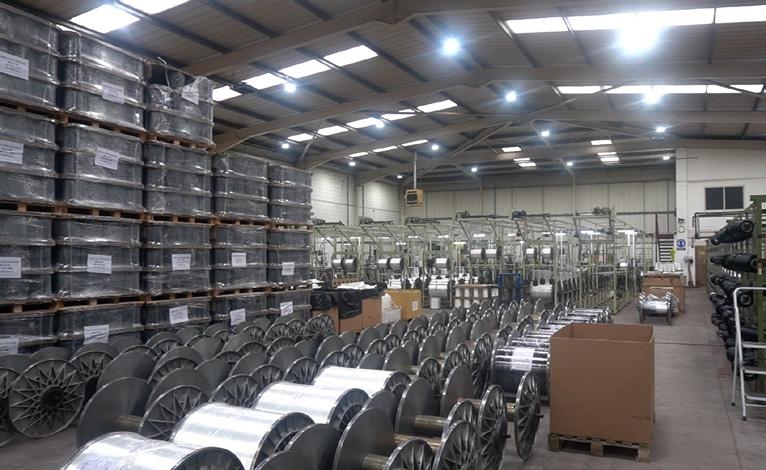
ABOVE: Wisla Narrow Fabrics celebrated its 21st anniversary last year
specialist blends are enabling lighter, stronger and more durable textile components. This becomes particularly handy in industries like aerospace and transport, where strength-to-weight ratios all lead directly to fuel savings and carbon reduction.
Gifts from the east
Much of this fibre innovation is coming from the Far East, particularly from Japan. This obviously raises the question of supply.
Like many UK manufacturers, Wisla experienced disruption triggered by the pandemic and subsequent geopolitical disruptions.
“There’s still some volatility,” Eddie admitted. “Back in the COVID years, a lot of people started to look a bit closer to home for raw material supply.”
He went on: “We retain good levels of stock management to make sure that we don’t run out of raw materials, and we also have second lines of supply as and when necessary. We don’t have single points of failure.”
The Red Sea disruptions and broader geopolitical instability have reinforced the importance of buffer strategies.
“Supply lines coming in from the
Where we differentiate is the yarns we weave the product from, and from the finishes - the dyes and chemicals – which are all becoming a lot more environmentally friendly
Edward Kozaczek, Founder, Wisla Narrow Fabrics
We’re looking to recruit people based on their attitude rather than their experience
Tom Judge, Managing Director, Wisla Narrow Fabrics
Far East are sometimes affected by geopolitical factors,” he said. “We always cater for additional lead times in that event. Things have eased now, but they can very rapidly change.”
‘The times they are changin' There is recent change afoot at Wisla. In providing a shareholder exit for Ingrid and himself, Eddie will continue to work with the new father-son management team of David and Tom Judge.
A new chapter in the company’s history was marked by new plans, which includes investment into new machinery.
The innovations also continue, with research and development opportunities including trials of embossed PVC-coated webbings for a prospective US customer.
Recruitment is also an area of focus, as the company looks to grow. “We’re looking to recruit people based on their attitude rather than their experience,” said Tom. “This is an industry where you have to show a willingness to learn, because there’s so much to get your head around.
“But we’ve got people that have worked with us for 20 years. If we put them with
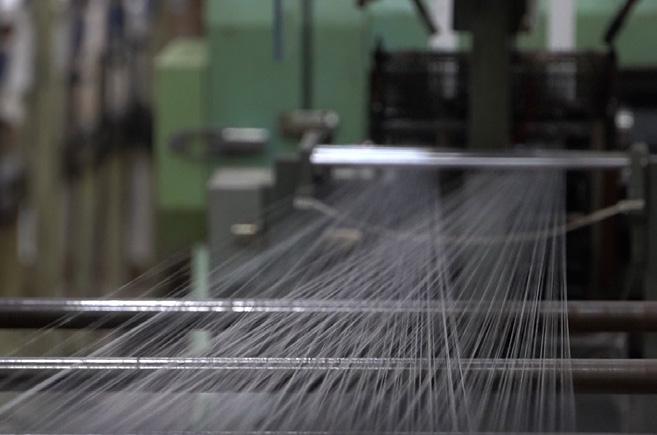
one of those guys for a couple of days they just need to have the willingness to learn.”
But what does the new ownership mean for Eddie?
“It’s freed up my time,” he said. “The knowledge and experience - not just of myself but colleagues here - is going to enable me to consolidate what we’ve already got with existing clients and develop an expanding client base into newer markets requiring better finishes, newer specifications and higher spec materials.”
A succession and ownership transition can often be fraught for SMEs, particularly those built around founder expertise, which Wisla undoubtedly is. But the transition appears to be focused on leveraging institutional knowledge while unlocking growth capacity.
A sector in quiet transformation I was left surprised and slightly embarrassed when I was asked the question: “Have you ever been to a mill before?” Because my answer was, “No.”
This is a modern-day mill, and the webbings that are produced end up in critical infrastructure, transport systems, safety equipment and high-performance sport, to name just a few applications.
The industry’s transformation through advanced fibres - the capabilities of which defy belief - reflects a frustration we hold of manufacturing more broadly. Why the hell don’t more people know about this?
One incredible application where you’ll find Wisla’s narrow fabrics is in drogue refuelling, which allows aircraft to refuel mid-flight.
Wisla provides a technically adept three millimetre webbing manufactured out of Dyneema. An almost shuttlecock-shaped mesh trails from the back of the aircraft and allows fuel to run through it – an application that took years to develop and refine. But it’s now the industry standard.
It’s innovations like this that really do make the future of narrow fabrics absolutely fascinating, and will continue to drive people like Eddie. He may not run the show anymore, but I don’t see him stepping away anytime soon.
“We’ve gone through 20 years and some heartache from time to time,” he reflected. “But on the whole, it’s been a successful journey.” l
• Specialise deeply, diversify broadly: Specialising in your field is the first step, then you can explore different markets
• Stay close to material science: Innovation often begins with fibres and yarns. Upstream awareness enables downstream differentiation
• Build supply chain resilience: Avoid single points of failure. Maintain disciplined stock management and multiple suppliers
• A willingness to learn outweighs experience: In an increasingly hard recruitment environment, good attitudes and impressive soft skills shouldn’t be underestimated
• Embrace continuous evolution: Technological shifts define competitive eras, make sure you’re not left behind
IN THE HIGH COURT OF JUSTICE CLAIM NO: CR-2025-003092
BUSINESS AND PROPERTY COURTS OF ENGLAND AND WALES COMPANIES COURT (ChD)
IN THE MATTER OF ZURICH INSURANCE COMPANY LTD -and-
IN THE MATTER OF CATALINA WORTHING INSURANCE LIMITED -and-
IN THE MATTER OF PART VII THE FINANCIAL SERVICES AND MARKETS ACT 2000
NOTICE IS HEREBY GIVEN that on 11 November 2025 Zurich Insurance Company Ltd (acting through its UK branch) (“Zurich”) and Catalina Worthing Insurance Limited (“Catalina”) (together, the “Parties”) applied to the High Court of Justice of England and Wales for an Order under section 111(1) of the Financial Services and Markets Act 2000 (the “Act”) sanctioning an insurance business transfer scheme (the “Scheme”) providing for the transfer to Catalina of a portfolio of employers’ liability insurance policies insured by Zurich and issued before 1 January 2007 in the United Kingdom, the Channel Islands and the Isle of Man (the “Business”), and for the making of ancillary provisions in connection with the Scheme under sections 112 and 112A of the Act.
The Business comprises both policies issued by Zurich and policies transferred to Zurich and issued by the following predecessor companies or under the following trading names: Eagle; Star; British Dominions Marine Insurance Company; British Dominions General; Eagle & British Dominions; Eagle, Star & British Dominions Insurance Company Ltd; Bedford General; Navigators & General Insurance Company Ltd; Eagle Star Insurance Company Ltd; and Midland Employers’ Mutual Assurance / Midland Assurance Limited.
The proposed transfer will result in the Business, which is currently being carried on by Zurich, being carried on by Catalina. If the Scheme is sanctioned, it is expected to come into effect on 31 March 2026. Further information about the Scheme, including:
• a copy of the full Scheme document;
• a summary of the terms of the Scheme;
• a copy of the report on the terms of the Scheme prepared by an independent expert in accordance with section 109(1) of the Act; and
• a summary of the independent expert’s report, are available free of charge and copies can be downloaded from www.zurich.co.uk/eltransfer and https:// catalinaworthing.co.uk/ zurich-transfer/ or requested by calling or writing to us at the addresses below, from the date of publication of this notice until the date on which the application is heard by the Court.
To speak to Zurich about the proposed transfer, please call us on 0800 652 0589 (freephone in the UK) or +44 3330 490 752 (international). The information line will be open from 9.00am to 5.00pm on Monday to Friday (excluding bank holidays) until the Scheme takes effect (currently expected to occur on 31 March 2026). Alternatively, you can write to us by email to eltransfer@uk.zurich.com or by post to Zurich EL Transfer, c/o Davies Specialist Services, PO Box 81791, London EC3P 3GB.
To speak to Catalina about the proposed transfer, please call us on 0800 652 0595 (freephone in the UK) or +44 3330 491 080 (international). The information line will be open from 9.00am to 5.00pm on Monday to Friday (excluding bank holidays) until the Scheme takes effect (currently expected to occur on 31 March 2026). Alternatively, you can write to us by email to zurichtransfer@catalinare.com or by post to Catalina Worthing Insurance Limited, c/o Davies Specialist Services, PO Box 81791, London EC3P 3GB.
The application is expected to be heard at the High Court of Justice, 7 Rolls Buildings, Fetter Lane, London EC4A 1NL on 25 March 2026 (the “Hearing”). Any person who thinks that they may be adversely affected by the carrying out of the Scheme may attend the Hearing and express their views either in person or through legal Counsel. Anyone who intends to appear at the Hearing is requested to notify their objections to us by 18 March 2026, setting out why they believe they would be adversely affected. Any person who does not intend to attend the Hearing but wishes to make representations about the Scheme or considers that they may be adversely affected is requested to communicate their views to us by calling or writing using the above contact details, preferably before 18 March 2026.
Zurich appointed solicitors: Slaughter and May (Ref: JADM/RZXS/AYHC)
Catalina appointed solicitors: A&O Shearman (Ref: PEHJ)
Visit www.zurich.co.uk/eltransfer or https://catalinaworthing.co.uk/zurich-transfer/ for more information.