MANUFACTURING THE ADDITIVE SPECIAL
04
A beginners guide to additive manufacturing
This guide outlines where manufacturers can start, the benefits to reap and the pitfalls to avoid when beginning to implement additive manufacturing.
10 AM’s role in building supply chain resilience
From digital part libraries to on-site spare production, additive manufacturing is emerging as a powerful tool for building more agile and resilient supply chains.
16
RYSE 3D: a UK addtitive ME built for manufactrung
Mitchell Barnes, CEO of RYSE 3D, tells The Manufacturer about the modern-day world of 3D printing and importantly, where it goes next.
18 Why does design and technology matter?
Ryan Ball, Director of Education at Design and Technology Association, explores how additive manufacturing is unlocking creativity in primary classrooms across the country.
20 A guide to industrial 3D printing technologies
3D printing is creating a whole new world for design engineers, enabling rapid creation of functional prototypes and end use parts. However, it is far from a one-sizefits-all technology.
24
How AM is being used across the sector
The use of additive manufacturing is rapidly growing across the sector from automotive to aerospace. The Manufacturer breaks down some of the most recent case studies.
28
Pushing the limits of AM materials
3M BIC Technology Manager Janine Downs explains how the centre’s holistic approach to additive manufacturing is de-risking R&D and accelerating product development for UK manufacturers.
31 Directory
Find information on additive manufacturing companies here.

WELCOME
Molly Cooper, Features Editor, The Manufactruer
Often when manufacturers hear 3D printing, they imagine hobbyists at home printing personal phone stands and mini figurines in their office. However, the technology has moved far beyond that, and the term additive manufacturing stirs up different connotations, although they are one and the same.
The use of additive manufacturing is rapidly growing across the sector from automotive to aerospace, and more businesses are reaping the benefits of the technology.
According to Additive Manufacturing UK, 11 years ago the worldwide additive manufacturing and service market was worth £3.59bn and was expected to grow at an annual rate of 31.5% in the last three years. It estimates that the UK alone has the potential to win up to eight per cent of the rapidly growing market, as it was set to reach a staggering £69bn last year.
Speaking with experts in the industry, it seems manufacturers are using additive manufacturing to quickly create, test and refine designs before mass production, but not yet in its full capacity.
From speaking with the sector, I have the impression that while many manufacturers would like to investigate additive manufacturing further, they just have far greater priorities in terms of technology investment, and additive manufacturing remains a nice-to-have rather than a business imperative.
Yet, those who are on board have gained the power to offer mass personalisation, secure resilient, localised supply chains and produce previously impossible, high-performance structures.
This supplement from The Manufacturer explores the current additive manufacturing landscape and those who are utilising it successfully. With an industry association, we explore the growing role of additive manufacturing, highlighting its flexibility as a tool-less technology that accelerates prototyping, shortens design cycles and supports both enduse parts and tooling. We hear from an SME on how to take advantage of this tool and where it’s heading next. And importantly, for those who are unsure, we lay out a beginners guide to additive manufacturing speaking with the experts themselves.
So, as you read through this supplement, something to consider: where could additive manufacturing fit within your organisation? Could it help strengthen supply chain, bring production closer to home or unlock new efficiencies? And as digital transformation continues to reshape the sector, might additive manufacturing become one of the tools helping manufacturers innovate and stay competitive?
A beginner’s guide to additive manufacturing
Many manufacturers are using additive manufacturing for prototyping but have not yet moved into making real parts. Why? This guide outlines where manufacturers can start, the benefits to reap and the pitfalls to avoid when beginning to implement additive manufacturing
Often when manufacturers hear 3D printing, they imagine hobbyists at home 3D printing phone stands and mini figurines in their office. However, the technology has moved far beyond that, and the term additive manufacturing stirs up different connotations, although they are one and the same.
Additive manufacturing is a hands-off process, with little time required for setting up, operating or finishing products and is an efficient way to produce one part or small batches. The process is also flexible with batches of parts being produced with slight differences with no additional cost to that variance.
3D printers are becoming more capable, materials are more functional and easier to use. It’s not one size that fits all, but there is a size for many.
MAJOR MANUFACTURING TRENDS
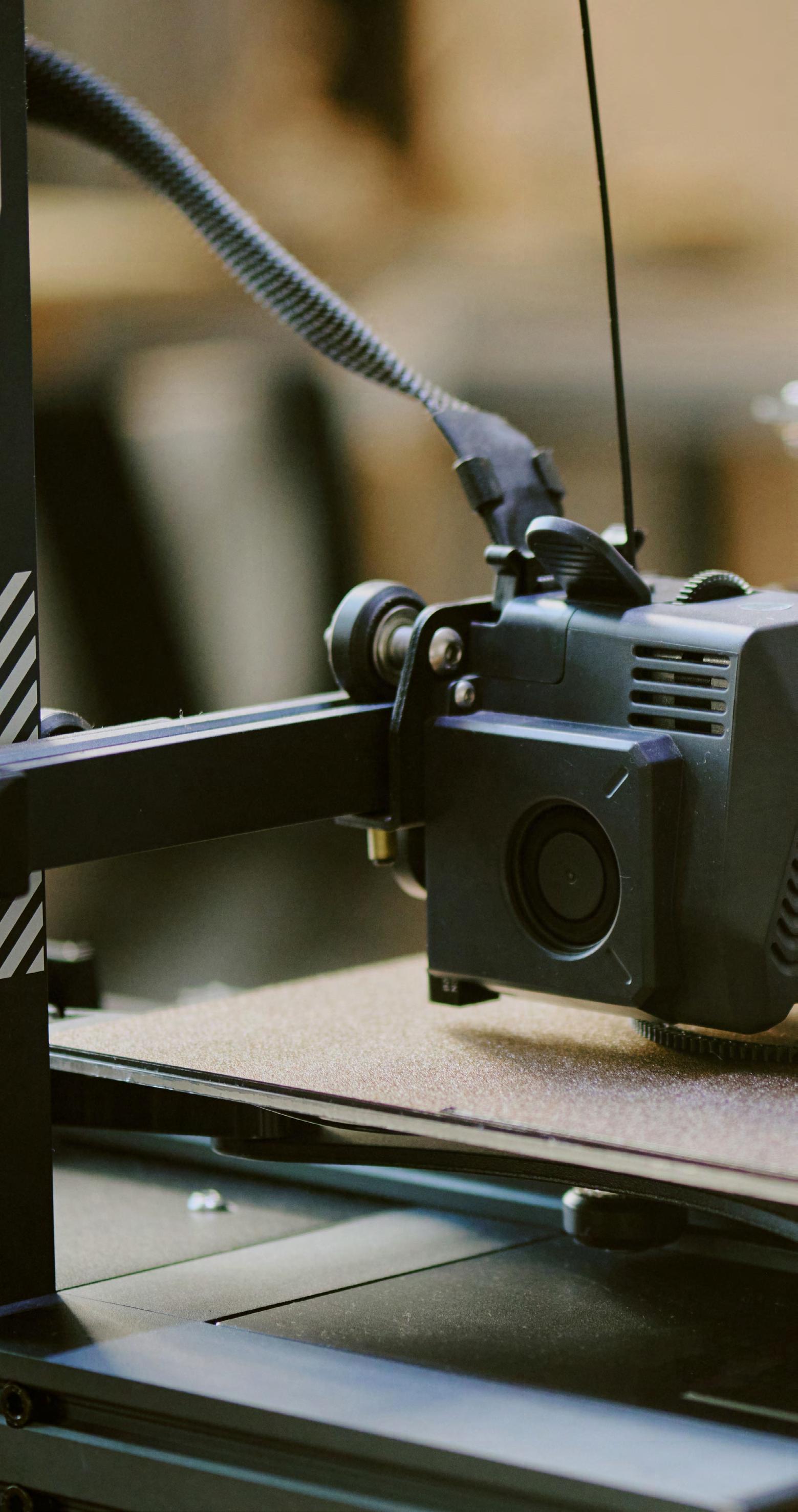
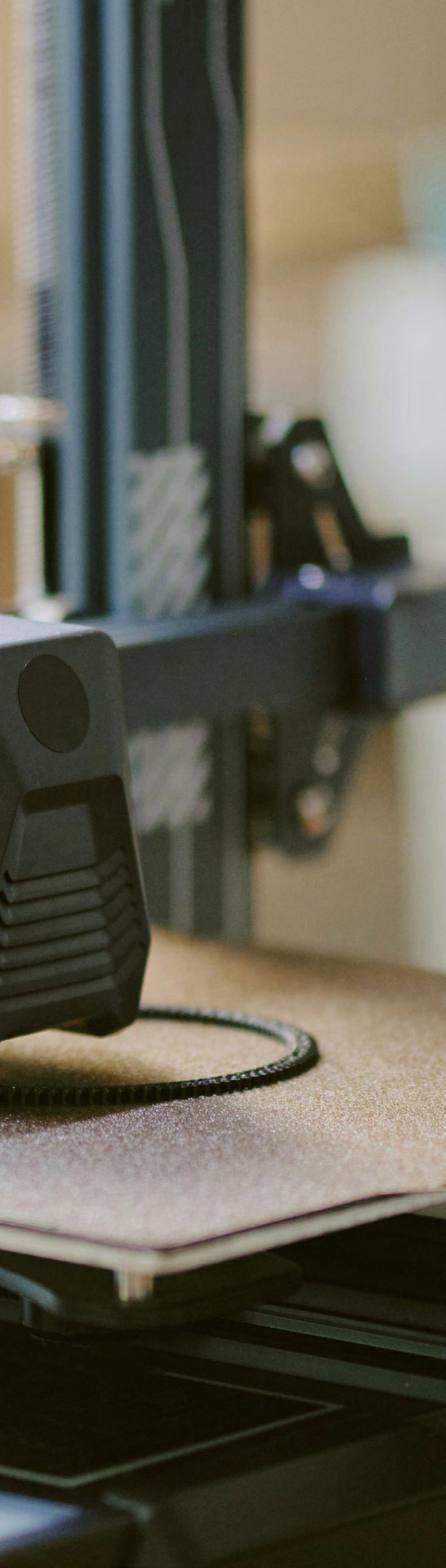
In 2026, additive manufacturing displayed some revealing and potentially impactful trends. First is the low cost of desktop machines. These printers are now around £1,000 which has led to a big jump in the number of businesses who are trying out the capabilities of a printer and are starting to understand the benefits for their business. By using this type of printer as a trial, they are learning how useful 3D printing can be before they move onto something more reliable with greater accuracy, speed and flexibility of materials.
The second trend is the greater availability and variety of printing materials. Beginning with a small selection of plastics for basic prototyping, the technology has broadened into an expansive selection of industrial-grade options, ranging from alloys, ceramics, reinforced composites and high-strength polymers.
This shift has been driven by the demands of sectors like healthcare, aviation and automotive engineering, where components must deliver in realworld applications.
KEY BUSINESS BENEFITS
Additive manufacturing can provide significant business advantages by shifting production from a tool-heavy method to being flexible, digital and ondemand. Many manufacturers want to see immediate ROI if they are spending money on new technology, and many financial benefits can be hard to quantify.
Yet, by implementing 3D printing as part of your production you will find:
• Greater business flexibility:
Sometimes a part is needed to keep a production line running. With a 3D printer it can be produced quickly, cheaply and on-site, reducing reliance on external suppliers. It also makes the process faster without the need to get quotes, fill in paperwork, and all while reducing any risks caused from the supply chain.
• Cost reduction:
Additive manufacturing significantly reduces production costs in many ways. Most businesses see up to a 90% cost saving from implementing 3D printing. This is particularly strong in areas where a business is printing bespoke tooling to make current production methods more efficient. Businesses are also looking to reduce the cash that is tied up in spare parts held in warehouses. To reduce this, they’re producing the parts on-demand and in location using 3D printing.
• Quicker lead times:
With greater business flexibility comes time saving. Manufacturers can often wait months for parts required for production, yet by using 3D printing, they could have these parts in their hands in a matter of hours.
• Less manual labour:
Due to the current skills gap the manufacturing sector is facing, 3D printing is a definite aid. Human skills can be difficult to find and expensive but if a business can redesign components as a single print, rather than multi-part assembly, it can simplify the process enormously. This results in time savings as parts can be assembled and made ready without the need for human intervention.
• Greater opportunities:
Beyond having a printer in-house, businesses can also outsource parts as well as becoming a manufacturer for other businesses, making parts which can generate additional revenue streams.
Additive manufacturing is growing in the same way as the PC did many years ago. Most manufacturers begin with a single machine and then grow into a full additive manufacturing strategy across the business.
SME VS ENTERPRISE NEEDS
In this case, an SME (small and medium-sized enterprise) is defined as a business with fewer than 250 employees, along with annual turnover under £50m and an enterprise is a larger company with a high number of employees and substantial annual turnover above £50m.
Depending on whether you’re an SME or an enterprise business, your additive manufacturing needs may differ. But some things are required by all.
SME Everyone Enterprise
Strategy Versatile machines that can cover all bases across various project types.
IT/ Security
Fewer users and direct access; complex IT hurdles are less critical.
Support A ‘go-it-alone’ approach to maintenance and troubleshooting.
Risk Prioritising lower entry costs over high-end security features.
Consistent uptime and dependable performance.
Intuitive interfaces and straightforward workflows.
Accurate, robust and productiongrade part output.
Dedicated machines for niche, highly specific applications.
SO 27001, Single Sign-On (SSO), and Role-Based Access Control (RBAC).
Next-business-day repair and formal support contracts.
A direct correlation between spend and performance. Avoiding restricted hardware for defence/military sites.
The most significant difference is security. Although key for any manufacturer, risk and security is typically higher with a larger corporation which may be connected to other parts of a business across the country or even the globe.
Recent US defence legislation restricts the use of Chinese made 3D printers within the sector due to security risks. This means that when purchasing, manufacturers now need to consider the hardware of the product as much as the quality of the parts it produces.
DON’T FORGET ABOUT CYBER SECURITY
A 3D printer is part of a business and will, in most cases, be connected to the network in some way, meaning it poses a security risk.
You can run many 3D printers offline making them safe but even some of the software which they use will be hosted online. As a manufacturer, you will be importing and uploading designs onto an online programme, meaning you must know where those designs are going.
Once that information is online, questions arise around where it may end up, who is using it, or what they’re going to use it for. To use the software, you will have created a user account, therefore, the software knows the company that
uploaded it and from there can find the team, location and access that data remotely.
The second biggest threat is the unintended consequences. As you are connecting a new device to the business network, you don’t know if that has a backdoor or vulnerability that could be exploited in the future.
But it’s not an issue that should stop manufacturers from embracing additive, they just need to be aware and follow the same considerations as they would any new technology.
Lower cost and hobbyist printers are more susceptible to cyber attacks, but the more professional and industrial printers are built with these considerations in mind. It’s about matching the right technology with the right security that benefits manufacturers in the best way.
DIFFERENT TYPES OF PRINTERS
There are three main tiers of 3D printers on the market, ranging from desktop hobbyist models to industrial mass production units. Not every printer will be suitable for every use case and businesses must evaluate where in the business they want to implement additive manufacturing and what type and quality of materials they need to do this.
Tier
Hobbyist/ Entry level
£200 – £1,500
Professional £5,000 – £60,000
Desktop FDM (Filament)
Visual proof of concept models and non-critical workshop organisers.
spending beyond what they need too, on something that doesn’t work.
Experts suggest purchasing a printer that can provide you with 60-80% of what you need and outsource the rest. A business will save money and time and can grow its printer portfolio when appropriate.
Thirdly, businesses can be under the commonly held belief that 3D printers require expert and constant monitoring and as such, will have to invest in new teams to handle them. This is not true. A 3D printer is just another tool that can be accessed by a whole host of people that can then benefit from it. This means integration should be easy.
High End/ Industrial
£150,000 –£500,000+
Risk Prioritising lower entry costs over high-end security features.
Benchtop SLS (Powder), Professional FDM, Engineering SLA
Large-scale SLS, Multi Jet Fusion (MJF), Metal DMLS/ SLM
A direct correlation between spend and performance.
Functional end-use parts, complex jigs/ fixtures, and low-volume production runs.
Mass-production (thousands of units), aerospace-certified components and exotic high-temp materials.
Avoiding restricted hardware for defence/ military sites.
For most manufacturers, the professional middle ground printer is the most beneficial to start with. £50,000 is a reasonable investment and not unaffordable. For the price point, they provide industrial level capabilities.
COMMON MISTAKES
When it comes to implementing additive manufacturing there are three main mistakes that businesses make.
The first is when businesses look for 3D printers, purchase one for £500-1,000 (the hobbyist end of the scale) and then dismiss the whole technology when it doesn’t meet the standard they require. This experience can be very damaging and significantly reduce the likelihood of that business giving the technology another try, particularly when that will mean spending more money for better results.
The second is that the company does its research too thoroughly and approaches it from the opposite direction. The business finds 40 applications for the printer (great in theory), but it is unlikely they will find one printer that is able to fulfill all those needs. They then purchase what they think covers the most bases,
CRITICAL EVALUATION
Every business that purchases a 3D printer is unique and has its own way of doing things. It will have its own systems, processes and skill sets for the staff with different levels of experience.
It will then have its own unique needs for what it wants to print and its intentions for what it needs a printer for. This means there is no one size that fits all and it is difficult to point out the best solution.
The best next step is to speak to experts. Businesses need to engage with people who understand the technology, who use it every day and can help them figure out what they want to achieve, while being realistic.
But, more importantly, a change in mindset is required. When a business owner stands before a CNC machine, they instinctively view it as a strategic investment. They understand that
by spending a specific amount on the hardware, they can generate a predictable volume of work and a stream of revenue. The machine is seen as an asset that pays for itself through production, yet this isn’t the same when it comes to additive manufacturing. For many, the 3D printer is still seen as an overhead cost rather than a production tool.
The mindset needs to change; look at the return on investment rather than the initial price. By recognising how 3D printing cuts lead time and expensive outsourcing, companies can see that these machines are money savers.
INDUSTRY IS CHANGING
In industry, the term 3D printing and additive manufacturing are used interchangeably, but to an outsider these often have different connotations. Many think of 3D printing as low-end machines; great for prototyping, but not for much else.
Additive manufacturing is often seen as the next level up. Here businesses can print carbon composites or aerospace grade metals. They are also creating tooling to make their current production more efficient.
The UK manufacturing sector is known for its high value, low volume products, which is where additive manufacturing fits best. Businesses should not be committing to an injection mould tool to produce 1,000 parts a year; this only stifles their ability to evolve design.
External 3D printing companies, who make parts for manufacturers, are finding themselves receiving increasing amounts of small batch printing. These are typically on standing order for so many parts per month until the design changes or a new part is required. This is currently the fastest growing area within additive manufacturing.
For many manufacturers, prototyping is a safe area and in an industry which can be traditional and change averse, this is something they are comfortable
with. Because companies that successfully transition to end-use production often keep their methods a secret to maintain a competitive edge, the wider industry mostly hears about prototypes rather than finished parts. This creates a gap in understanding.
One criticism of a 3D printed part is that it may have a faint layer line that may be visible, yet manufacturers will ignore the visible ejector pin marks or seams on an injection-moulded piece simply because they are already accepted defects.
Modern 3D printing now rivals the quality of traditional moulding. However, it will take time for the industry to move past historical biases and recognise that the technology has evolved into a highquality, front-line manufacturing solution.
TOP TIPS
When beginning your additive manufacturing journey, there are three things to remember:
1. Speak with experts
Many businesses are not even aware of their own buying criteria and speaking with experts can help them understand that. Decision makers will look at technological specifications and look at what seems best, without knowing why that would be the best option.
With additive manufacturing, accuracy of a printer has often been judged by the height of layers the printer can produce. Yet, this is not relevant. Although it is an important feature, it does not mean that one printer should be considered over another without knowing how this would benefit you directly. Comparing stats and details can be meaningless to a manufacturer, giving good reason to speak with an expert.
This also allows businesses to ask any questions they may have, not just around product choice, but software, implementation and understanding where you currently are and how you can make the transition. Then once implemented,
you can continue to rely on those experts if and when problems may arise.
2. Long-term plan
Buying a printer is not about the initial spend, it’s about the long-term plan.
Businesses need to consider where they want to be in five years, how they are going to integrate additive processes into the business and what processes will change as a result. Not only plans, but people. What systems need to be changed, do people need training if their role is now evolving to include new technology and how will this be rolled out?
There is a lot to it, but it is achievable. Manufacturers need to be prepared for a long journey, but it can have great results if done properly.
3. In-house or outsource
Just because you want to start 3D printing parts, it doesn’t mean you must have a printer in-house. Although this can sometimes be the best solution, it’s not necessarily right for everyone.
Some businesses may have a printer inhouse, but use a mixed strategy meaning they will outsource more niche projects that their in-house printer cannot do. It
also works well for project overflow, or when demand has increased.
There are many ways in which additive manufacturing can work for a business, and there is not one single approach.
SUMMARY
This step-by-step guide is designed to help manufacturers launch their additive manufacturing journeys or evaluate their current progress. Success in the future of production will rely on building a workforce skilled in design for additive manufacturing, integrating 3D printing workflows into existing operations and bridging the gap between digital design and physical output. Deploying these technologies with a focus on repeatable standards and robust material governance is essential.
The result will be a more agile operation, empowered engineering teams and the ability to shift from mass production to on-demand manufacturing. Ultimately, this creates a more efficient, resilient and innovative business that can respond to market changes in real time.
THANKS TO...
Thank you to Sabina Gonzalez-George and Simon Chandler, Directors at Creat3D.


AM’s role in building supply chain resilience
From digital part libraries to on-site spare production, additive manufacturing is emerging as a powerful tool for building more agile and resilient supply chains.
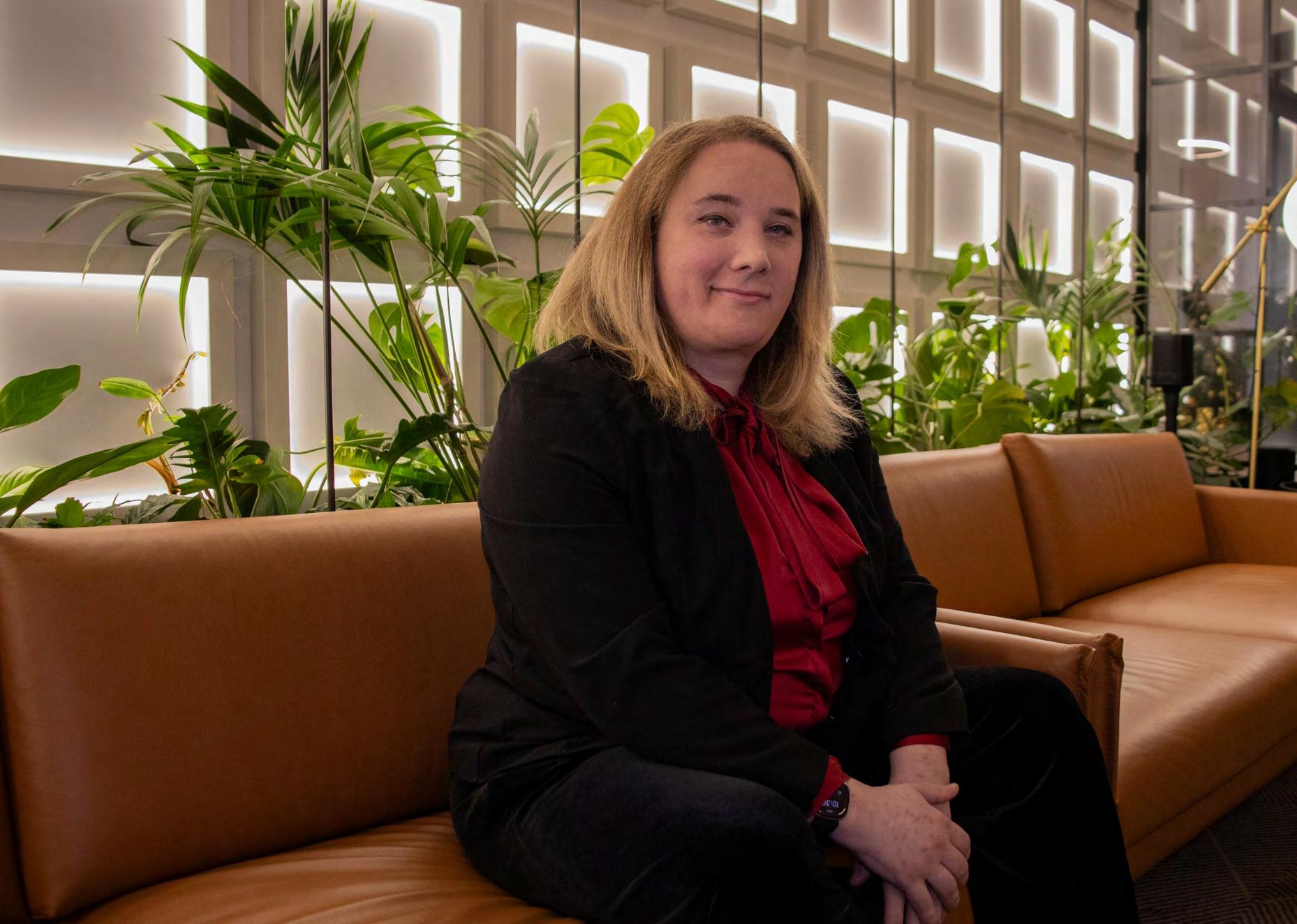
Made Smarter North West’s Technology Adoption Specialist
Claire Scott, explores the growing role of additive manufacturing (AM) across industry, highlighting its flexibility as a tool-less technology that accelerates prototyping, shortens design cycles and supports both end-use parts and tooling.
ARE THERE ADVANTAGES OF ADDITIVE MANUFACTURING WHICH MANUFACTURERS MIGHT NOT BE AWARE OF?
CS: One of the main benefits of 3D printing/additive manufacturing (AM) is that it’s a tool-less technology. Traditional manufacturing involves processes like injection moulding where tooling is essential. That takes time and comes at a cost. Because tooling is not required in AM, it means manufacturers can create a variety of different types of products with one machine, providing businesses with extra flexibility.
Manufacturers designing their own products can create multiple different prototypes within a relatively short period of time. This can reduce the design life
cycle and can also be used for visual aids.
For example, one business I’m working with develops architectural terracotta products, and they’re using the technology to help communicate with their customers, as well as for tooling for its own products.
This is still an example of indirect AM so
it’s not used in the final product but within the overall work flow and design lifecycle.
Claire Scott, Technology Adoption Specialist, Made Smarter and Director of Printcity
HOW
DO THE BENEFITS OF AM DIFFER BETWEEN SMES AND LARGE-SCALE
BUSINESSES?
In terms of business size, it can become a little tricky. AM is an umbrella term that encompasses multiple different technologies, each with their own specific applications. As such there are also varying levels of cost to run and to manufacture.
However, I am certainly seeing a trend whereby the barrier to entry for smaller businesses who want to start investigating AM is lowering. A small business can now buy a very good prototyping machine for around £1,500, and depending on the use case, could potentially make end use parts.
Additive manufacturing is a technology that can be used by multiple sectors – from the creative industries to traditional manufacturing - and the potential applications are vast.
A decade ago, a machine with the equivalent capabilities would have been around £10,000-20,000. The barriers to entry have continued to drop which is a great starting point in terms of making the technology more ubiquitous across industry.
Once businesses start delving into
metallics and more advanced forms of additive technology, it’s then that the price starts to rack up into the tens to hundreds of thousands of pounds, not to mention the health and safety and associated adoption challenges that come with it.
It’s worth noting however, that these are all considerations if a business is bringing the technology in-house. Adoption doesn’t necessarily mean bringing the technology within the four walls of the organisation and actually having a machine in-situ.
There are other ways of utilising AM within a manufacturing business. There are print bureaus and subcontract manufacturers who offer those services. So, a variety of options around adoption are on the table meaning that AM deployment is experiencing an all-round uptick.
Working together with the Made Smarter South East team, Andy Wort, Founder of Ashley and James Coachbuilding, has created a digital strategy that maps how technology and new skills could complement his traditional hand-built methods
Andy Wort, Ashley and James Coachbuilding

ARE MANUFACTURERS WAKING UP TO THE POTENTIAL OF AM?
3D Printing became mainstream in hobbyist arena. When I started my career no one in the industry was really aware of the technology. I actually discovered that my university did have a 3D printer but it was sat idle in a corner, and was only ever used for prototyping. Even though the technology has been around for 20-30 years, it’s only recently where its deployment has grown. That being said, it’s still fairly niche.
There was a recent study conducted by the University of Manchester, and published by the Department for Science, Innovation and Technology (DSIT), which revealed the North West is now second in the country in terms of AM adoption, with around 20% of businesses having adopted the technology.
This makes the region something of an AM hotspot with the highest adoption rate in the UK outside London (30%). Since launching in 2019, Made Smarter North
West has supported 27 manufacturers to invest £1.6m in 3D printing technologies, backed by £442,000 in grant funding. These projects are expected to create 128 jobs, upskill 117 roles, and add £15.6m in GVA to the North West economy.
However, one of the main reasons why the uptake (although accelerating) has been slow up to now is the hype that came with the technology when it first hit the mainstream. It came with a lot of promises and was marketed as a technology that could literally do anything. When it was revealed that it wasn’t the solution to all industrial problems, it put many people off.


The reality is that AM is a workflow, not a Star Trek replicator - it isn’t as easy as just pressing a button. There is a lot of skill behind getting parts ready. Designs need to be digital, which is certainly one of the challenges that exist for SMEs who may not have the in-house skills to capitalise on the technology’s potential.
Most firms I speak to would like to adopt the technology, but they also have other priorities. Yes, AM might be on their list, but not in front of projects focused on data and systems, and robotics and automation. Those have a wider impact on a business, and therefore are more pressing.
That being said, we do hear of incredible use cases where dedicated individuals have literally seen a 3D printer in the central aisle in Aldi, learned how to use the equipment, and actually redesigned a part which went on to win a contract for the business. It shows the potential of the technology, but businesses need to have an application in mind. It’s not enough just to want to deploy AM. Manufacturers need to know where they want to use it and how it will impact the business.
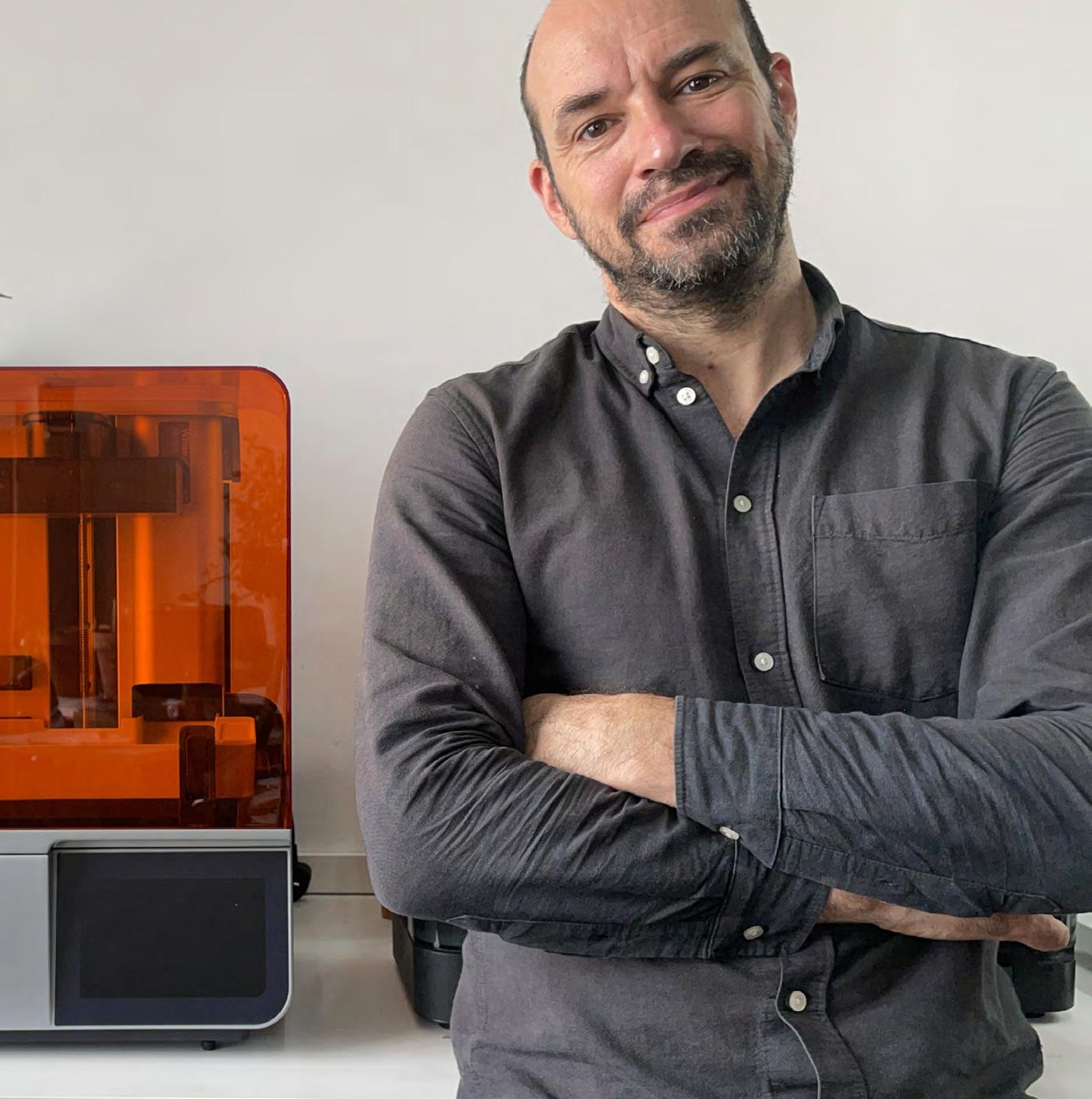
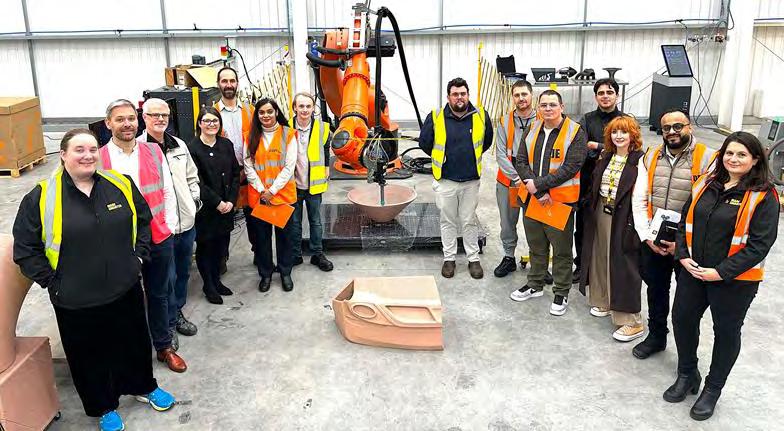
Daniel Isler of D Squared Product Development, based in Liverpool, helped to secure a grant towards a project to invest in a Formlabs Form 4 3D printer and xTool P2S laser cutter.
Daniel Isler, D Squared Product Development
WHAT ROLE CAN AM PLAY IN ALLEVIATING SUPPLY CHAIN RISK?
One advantage of AM that is becoming more integral to the conversation is distributed manufacturing. A printer can be sent to a site which can print out parts in-situ and the likes of Manchester Metropolitan University’s Printcity has shared examples of businesses that now have a digital repository of parts that can be printed directly on-site.
Having the technology on-demand reduces the amount of time needed for a company to get back up and running following maintenance or a breakdown.
Having the opportunity to print spare parts for a manufacturing line, if it goes down, can be a game-changer for manufacturers. Using AM this process could take a couple of hours or perhaps a day, but it can get the business up and
running far quicker than if that part was being replaced using traditional channels.
And even if that AM printed part will ultimately be replaced by the official spare part when it arrives, it offers an invaluable stop-gap to get manufacturers back to production.
When looking to utilise AM, always ask why? What does AM offer the business that no other technology can? Has an application been identified where AM would offer a real benefit?
In aerospace, for example, there is a clear use case as AM can reduce the buyto-fly ratio (the weight of raw material purchased to the weight of the final finished part).
There are also obvious applications around waste reduction, although it is important to look at the whole product lifecycle. There are ongoing discussions with regards to some additive technologies and whether they are as ‘green’ as they first appear.
Indeed, it’s advisable to look at the technology as a whole through a holistic lens. An AM part might be a little more expensive, but if it reduces costs everywhere else then that is also a benefit to be considered.
Don’t take a narrow view in terms of looking merely at the end part. Look at the whole lifecycle, and look at AM as an entire benefit. It’s a technology that enables businesses to create products they couldn’t make any other way. However, businesses need to have
an open mindset, and to think slightly differently in terms of how to incorporate AM into business processes.
At our recent events it’s also been interesting to see how the technology is intersecting with others. We’re now beginning to see AM mentioned in the same conversations as AI and robotics which is a further indication of how far the technology has come.
WHAT’S NEXT?
AM is a technology that can only grow. I’d like to see greater adoption of the technology and there are growing support networks to help facilitate that.
AM is becoming an important tool in strengthening and reshaping supply chains. By enabling distributed manufacturing, businesses can produce parts closer to the point of use, reducing reliance on long, complex global supply networks.
Digital repositories allow companies to store part files and print components on demand, cutting lead times and minimising downtime during breakdowns. AM also offers a valuable stop-gap solution, producing temporary spare parts while official replacements are in transit. Although adoption remains gradual, falling costs and service bureau models are widening access.
SME FOCUS
RYSE 3D: A
UK additive SME built for manufacturing, not demonstrations
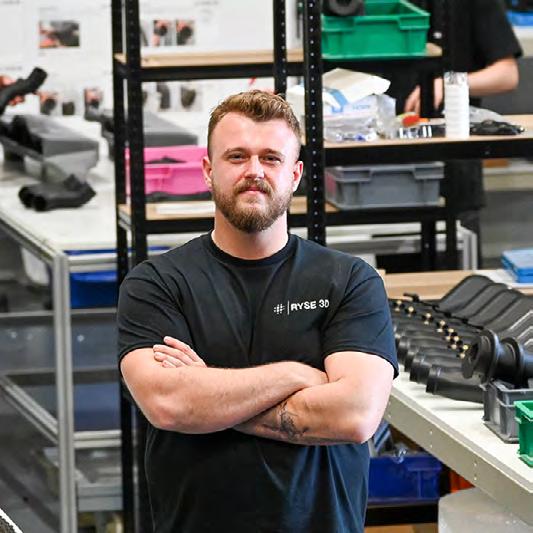
Mitchell Barnes, CEO of RYSE 3D, tells The Manufacturer about the modern-day world of 3D printing and importantly, where it goes next
3
D printing has spent years being described as ‘the future of manufacturing’. From where I’m sitting in our transformed offices on Tilemans Lane in Shipston on Stour, that future has already arrived - but only for companies using additive as a production tool, not a novelty.
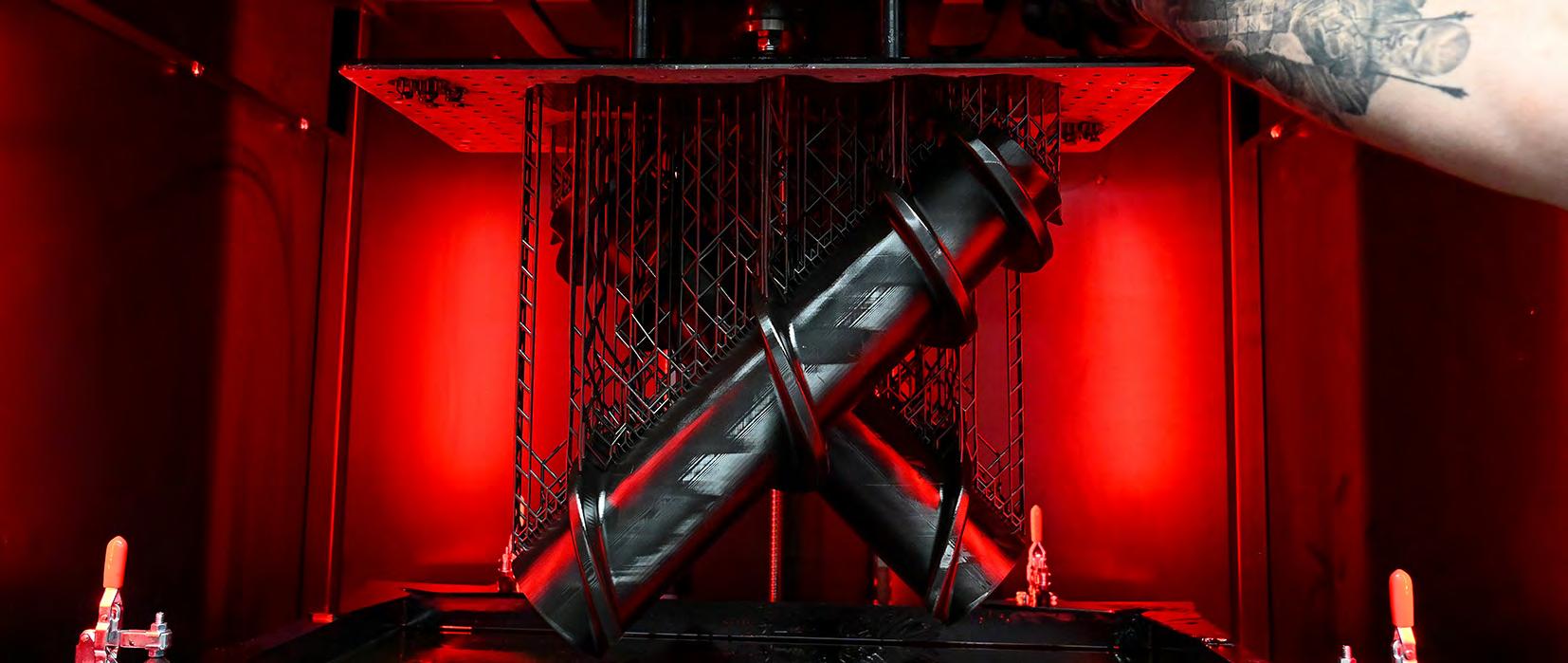
RYSE 3D builds production polymer parts for tens of global customers across automotive, supercars, aerospace, medical and energy generation. Importantly, and unlike many of our competitors, we manufacture our own industrial 3D printers through our sister company LANDR 3D.
This dual perspective matters because it keeps us grounded in what our clients require: repeatability, delivery pace, controlled processes and clear accountability. Traceability is increasingly becoming another sought-after trait.
ADDITIVE’S REAL VALUE: REMOVING BOTTLENECKS
Tooling lead-times dragging on a programme, or a supplier missing a delivery window, are two common issues we tend to help with, not to mention
the age-old conundrum of engineering changes landing late and production not being able to pause for another 8–16 weeks while mould tools catch up.
This is where additive earns its place at the top table. Not by pretending it replaces every conventional process, but by removing the most common failure point in modern supply chains: the time and rigidity that tooling introduces.
Most customers don’t approach us because they ‘want a 3D printed part’; the conservation normally starts because they are stuck and facing a production dilemma.
Mitchell Barnes, CEO, RYSE 3D
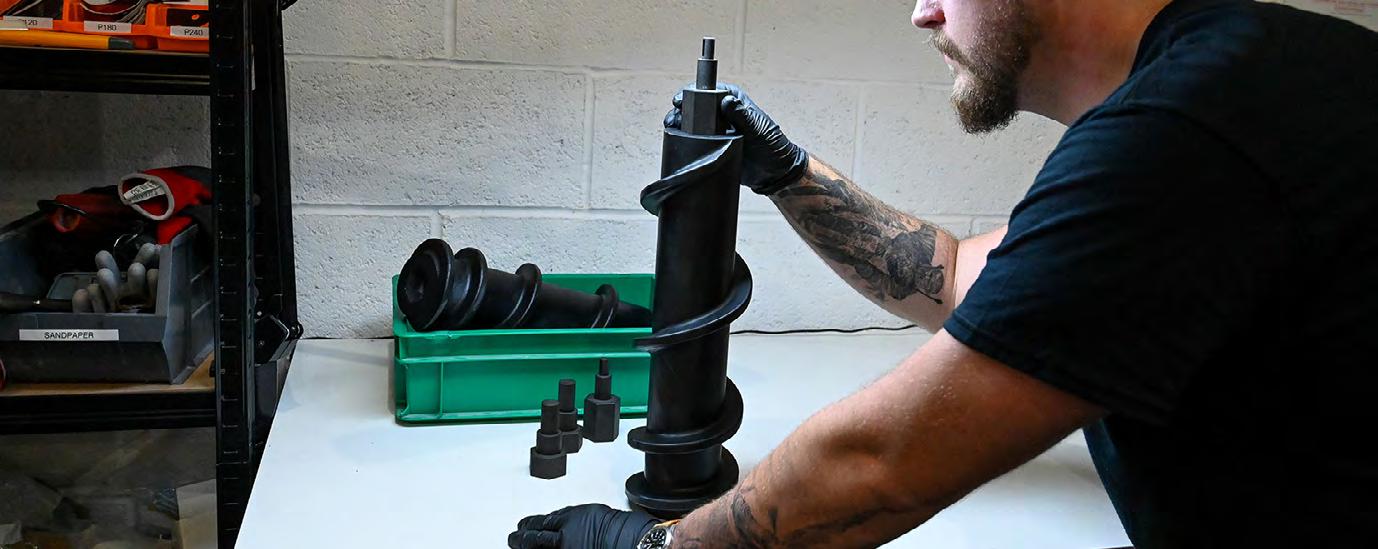
In automotive, defence, marine and advanced engineering, additive is ideal for components like ducting, housings, brackets, mounts and functional assemblies - parts that need to be right,
need to fit and arrive quickly. For many applications, polymer additive is not about aesthetics, it’s about performance, speed and resilience.
MANUFACTURING PARTS, NOT PROTOTYPES
At RYSE 3D focus is on bridging production and end-use parts where additive has structural advantages.
These include:
• Low-to-mid volume production without committing to mould tools
• Complex internal geometry (ducts/ channels) that would be expensive or impossible to produce as a single component
Part consolidation that reduces leak paths, fasteners, assembly time and quality risk
Legacy and obsolete spares, where the original supply chain no longer exists
• Iteration speed without resetting tooling timelines.
There’s still a misconception that 3D printing is mostly for prototypes. Prototyping is useful, but it’s not the reason additive has become commercially viable and increasingly important.
Mitchell Barnes, CEO, RYSE
3D
When additive is treated like manufacturing, with the right material selection, build strategy, post-processing and inspection, it becomes a dependable route for real-world components.
BUILDING 3D PRINTERS
LANDR 3D exists because making parts at scale teaches you what matters - and importantly, what doesn’t - in production hardware.
There are plenty of machines that look impressive on paper. But when you’re running jobs under delivery pressure, the priorities are different. Your engineers are considering throughput, reliability, serviceability, material capability and cost-per-part. Downtime isn’t inconvenient for an SME, it’s existential.
By building our own industrial systems, we can design around these realities. It also gives us a practical, honest view of the industry: additive succeeds when it is engineered as a repeatable process, not sold as a technology story.
Our industry appears to agree. The LANDR500 large format FDM printer, which features an expansive 500x500x500mm build volume and offers a 100°C heated chamber, has a pipeline of orders that is nearly £1m strong.
ADDITIVE TRANSFORMING MANUFACTURING
Additive is shifting manufacturing from a tooling-led model to a data-led model. That change shows up in a few concrete ways.
Firstly, tooling independence. You can hold programme momentum without waiting for a tool slot, a revised mould or a re-quote cycle. Additive gives engineering teams the ability to iterate and production teams the ability to keep moving.
Secondly, digital inventory. Instead of warehousing slow-moving parts for
years, businesses can hold validated CAD and process control, then manufacture on demand. That reduces stockholding, obsolescence risk and working capital tied up in inventory, while at the same time improving service-part availability.
Then we have geometry that performs. Additive enables internal channels, integrated features and lightweight structures in a way that traditional processes often penalise. In the right applications, it improves performance and reduces assembly complexity at the same time.
Finally, localised supply. If you want resilient supply chains, you need methods that can be deployed regionally without retooling entire production systems. Additive supports local production and dual sourcing in a way that conventional tooling-heavy routes struggle to match.
HARD TRUTH: WHAT STILL HOLDS ADOPTION BACK?
If additive is going to scale properly in UK manufacturing, we need a dose of realism.
The biggest constraint is rarely the printer. It’s qualification, process control and quality culture. It’s material traceability, repeatable post-processing, inspection strategies and design rules that account for additive from day one.
The print is only one stage of manufacturing. Finishing, inserts, machining interfaces and verification are where production credibility is won or lost.
Another constraint is procurement mindset. The businesses moving fastest are those evaluating additive like any other manufacturing process, rather than treating it as a special case.
WHERE ARE WE HEADING?
The next phase of additive is not hypedriven. It’s system-driven: validated processes, data capture, traceability and smarter integration alongside machining, moulding, composites and fabrication.
In the coming years, the winners won’t
be the companies ‘doing 3D printing’. It’ll be the companies using additive as a standard manufacturing lever, chosen where it genuinely reduces lead times, derisks supply and enables geometry that performs.
That’s what we’re trying to build at RYSE 3D - a manufacturing SME using additive for what it does best, delivering production polymer parts faster, with fewer bottlenecks and with the discipline industry rightly demands.
Key takeaways
• Additive manufacturing has already arrived as a production tool, but not for everyone. RYSE 3D treats it as disciplined manufacturing rather than a demonstration technology.
• The real value of polymer additive lies in removing tooling-driven bottlenecks, enabling fast, flexible delivery of functional parts when traditional supply chains slow or fail.
• 3D printing’s commercial impact comes from end-use production advantages, low-volume manufacture, complex geometry, part consolidation and rapid iteration.
• Building and running printers at scale, as RYSE 3D does through LANDR 3D, reveals that throughput, reliability and cost-per-part matter more than headline machine specifications.
• The future of additive is systemled manufacturing with validated processes, traceability and integration alongside conventional methods.
Why does design and technology matter?

From overcoming tech-dread to the high-fives of a successful 3D printed bubble wand, Ryan Ball, Director of Education at Design & Technology Association, explores how additive manufacturing is unlocking resilience and creativity in primary classrooms across the country
Why does design and technology matter? I ask this question dozens of times a month. Through my job, I am fortunate to work with teachers, support staff, business and industry. I deliver training, consultancy and support to schools across the country. Conversations and presentations will often begin with this question. I have asked it to thousands of people and in my nearly 20-year teaching career, I have reflected on it many times with colleagues.
The answers are amazingly similar each time: “It helps to develop problem-solving, resilience, creativity, critical thinking…”
These skills and attributes developed and nurtured by this important school subject are key and underpin the topic, as I see it.
THE PRIMARY SCHOOL CHALLENGE
As we progress with the course, training, consultancy or chat, the conversation often lands on approaches, technology, processes and more. I spend a large proportion of my time speaking with primary teachers, who never cease to amaze me. Their passion, enthusiasm and willingness to learn are infectious. They juggle teaching all the subjects on the timetable and often find themselves taking the lead on one at their school, in charge of developing its impact while guiding and supporting all other staff.
Many D&T coordinators I have spoken with often wince at the thought of being seen as an expert at their school. Often their last encounter with the subject may have been when they were aged 14, and now, metaphorically, they have drawn the short straw and are in the position of leading it within their role.

BREAKING DOWN BARRIERS TO 3D PRINTING
Mention using 3D printing to a primary teacher, and most will look at you like you are mad. “I wouldn’t know where to start!”, “We don’t have thousands to spend on a printer, unfortunately”, “I don’t really know what they do”, are all comments I heard when I raised the idea at a recent primary teacher training event.
The fact is, it is often not on the radar of most primary schools and teachers and even if it was, they wouldn’t know where to start, or if it was a good idea to begin with.
MOVING BEYOND SURFACE LEVEL
The current National Curriculum in schools was published in 2014 and while curriculum drafters are currently behind the scenes working on a long-awaited revision, the
Ryan Ball, Director of Education at Design & Technology Association
“Additive manufacturing will continue to evolve and the school curriculum will struggle to keep up. It’s not really about the 3D printer, it’s about what it can unlock.”
Ryan
Ball, Director of Education at Design &
Technology Association

fact is that there is (and likely will continue to be) an openness in the curriculum that allows schools a degree of flexibility and variety of what is delivered, and how.
There is a requirement for children in Key Stage 2 (ages 7-11) to use ComputerAided Design, but nothing regarding any output. As a result, generic surface design, some text and decoration on packaging, or posters may be produced, but ‘real’ CAD can often be limited.
Even if a CAD program is used, it is often superficial and limited, with the result being a ‘nice to have’ but with minimal understanding of the benefit to children, and so the surface is often scratched, but not explored in any real detail. This means that enthusiasm, interest and intrigue are often not ignited in children.
THE MICROWAVE PHILOSOPHY
This is where the magic of a 3D printer can come in. We will reference throughout conversations the initial reasons why design and technology matters. This list of thoughts becomes the go-to for measuring everything.
As one teacher once told me, they put their list above the microwave in the staff room. Her response when she could see my obvious confusion was that it was ‘prime real estate’ as every teacher microwaved their lunch for a few minutes and stared at the wall while they waited for it to cook. Her D&T importance list was permeating brains as the microwaves did the same to the Cup-a-Soup.
THE BUBBLE WAND TEST
One of the fun little tasks we do in training sessions is to create a bubble wand to blow bubbles across the room.
Firstly, explaining to teachers that the software (such as Tinkercad) is free, can be used on a whole range of devices from iPad to PC to Chromebook, and even that battered old computer they have in the classroom, is a welcome surprise.
Then, demonstrating the various things you can do with the software, before showing the 3D printer. “But don’t they cost a fortune?” A quick search of some starter machines quickly reassures them that this isn’t out of the realms of possibility and that children in their class may even have asked Santa for one last Christmas.
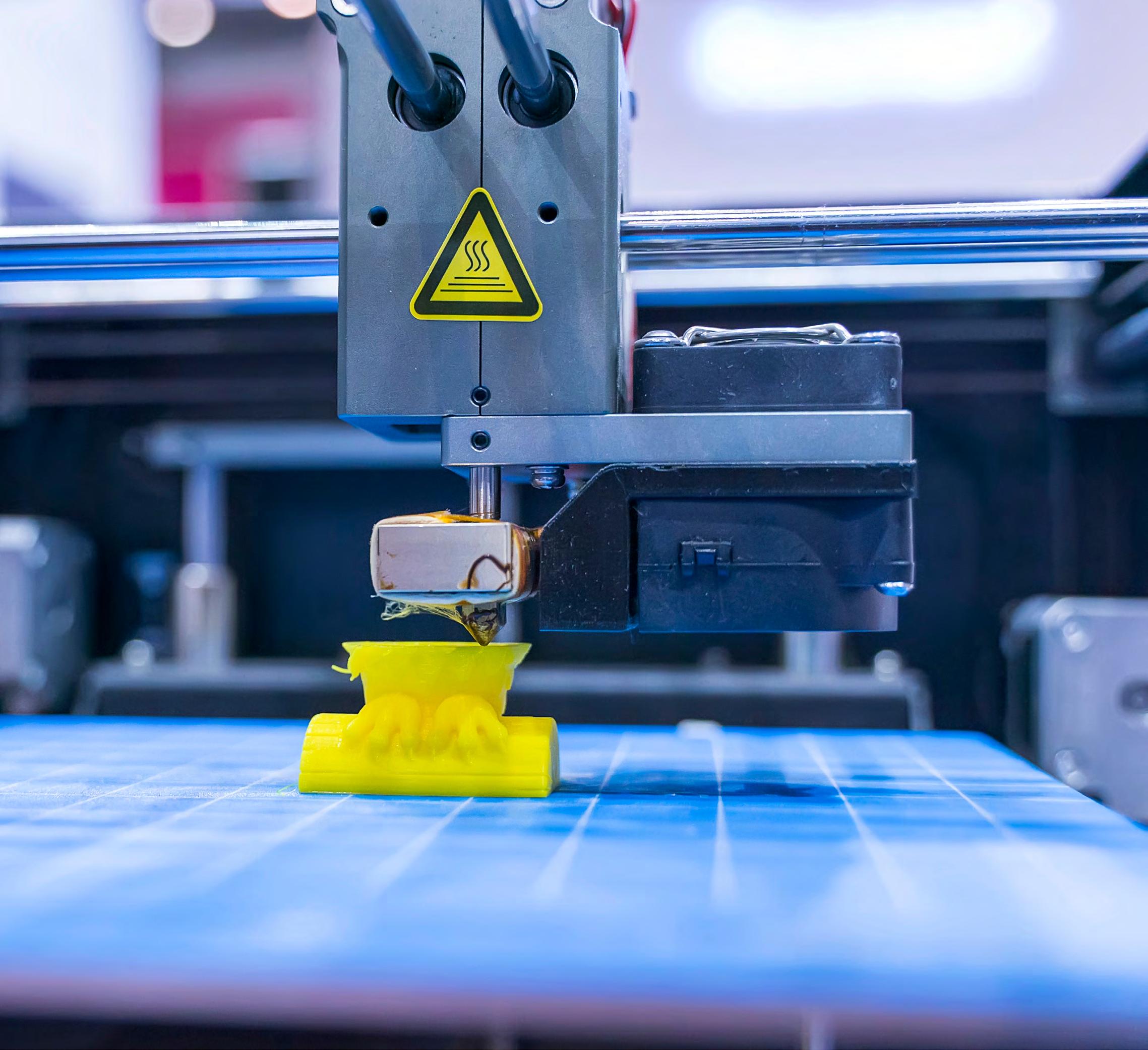
Then comes the print. There is still a magic to additive manufacturing and the perceived making of something from nothing, right in front of your eyes. I’ve had the most active child, stop and watch in awe as the machine whirs away, building their design layer after layer.
THE POWER OF PRODUCT TESTING
For me, the key part in all this is the tactile element and the resultant testing. Printing artefacts from Thingiverse (online, open-source community and repository for discovering, sharing and downloading 3D-printable digital design files) is a good way to show the capabilities of a printer, but we really hit the sweet spot when you hear “Argh, it doesn’t fit in the bottle”, “Hmm, it only blows one bubble”, “The handle has bent” … At which point I reference yet again the ‘D&T matters’ list we compiled. This is it. It’s different to other subjects. It’s not linear, it’s not easy, it’s messy, it goes wrong, it’s frustrating and rewarding all at the same time.
When the design lives on the screen, it’s hard to critique. It looks correct; in fact, it looks pretty impressive, certainly better than I can draw in 3D, and it was quick to produce, too. But until we can hold it, test it, and use it as intended, we really don’t know.
In this simple exercise alone, we explore constraints, material properties, surface area, structures, finance, surface tension, user needs and much more.
WHY D&T MATTERS
If I told the teachers at the start of the day they would be whooping and giving their colleagues high-fives for successfully blowing bubbles in a few hours, they’d
have thought I was mad, but here we are, a room full of bubbles, cheers and pride in what these adults have achieved with a free CAD program and some extruded plastic.
These things matter. Problem-solving, resilience, creativity, and critical thinking all matter. We need to build these skills and attributes in our teachers and, in turn, in our young people. What better way to do it than with design and technology? A tangible, contextualised subject at school that makes science make sense, makes maths meaningful and English enjoyable.
UNLOCKING THE FUTURE
The Design & Technology Association is an educational charity that supports D&T education. Our tagline is ‘D&T matters’, and it really does. 3D printing is a great vehicle for teaching everything that is important in our subject and everything that is key for young people growing up in an ever-changing world.
Additive manufacturing will continue to evolve, and the school curriculum will struggle to keep up. It’s not really about the 3D printer, it’s about what it can unlock. We need industry to help us, give schools and teachers the tools to inspire young people to find out more about our industry, and develop all those skills and attributes scribbled on those flipcharts across the UK.
And 3D printing? A one-print, working 3D printed gearbox off Thingiverse may be good, but a bubble-wand?... Now you’re talking!
If you are able to support the Design and Technology Association with its ambition to support all teachers in the country with free training, resources and expert support to develop D&T, design, manufacturing and engineering, please get in touch with Ryan at ryan.ball@designtechnology.org.uk.
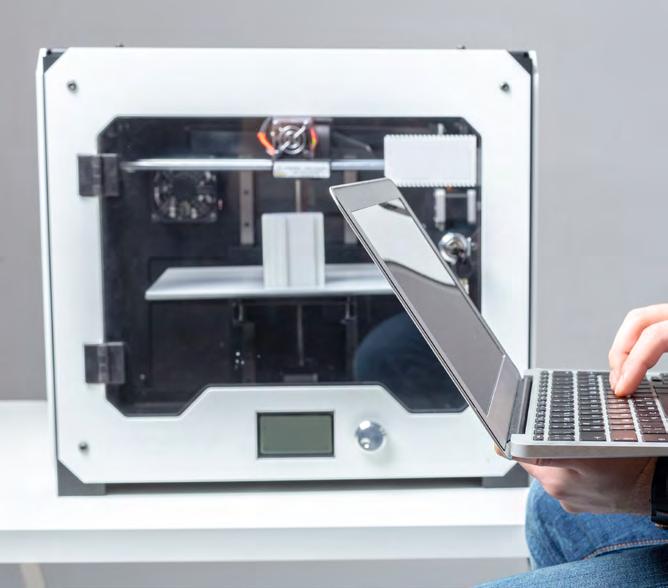
A manufacturer’s guide to industrial 3D printing technologies
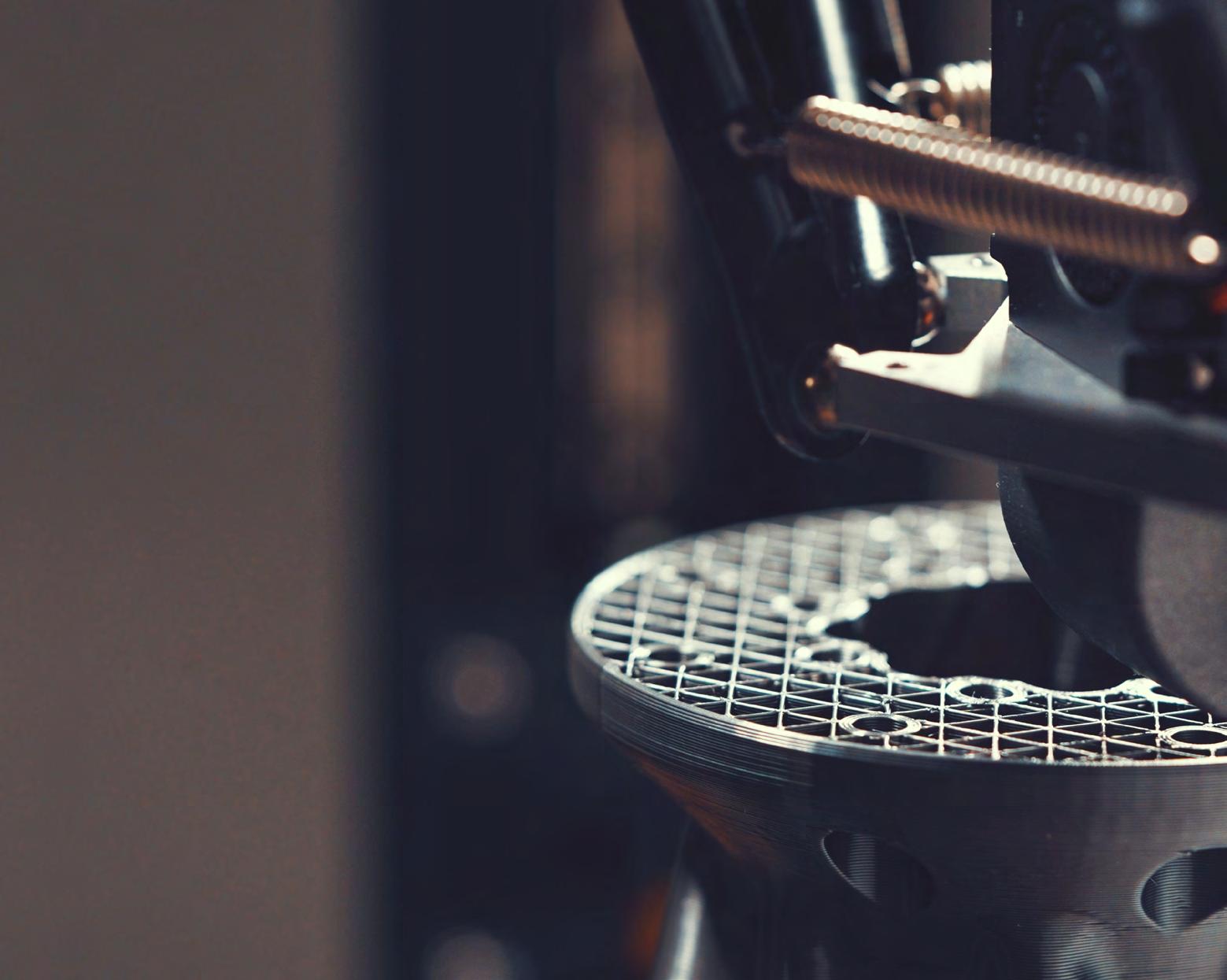
3D printing is creating a whole new world for design engineers, enabling rapid creation of functional prototypes and end use parts. However, it is far from a one-size-fits-all technology.
The potential and variety of application for additive manufacturing within manufacturing environments is vast. Not only does the technology help unshackle design engineers and give them the freedom to be creative, the technology also enables faster development cycles through rapid prototyping, parts consolidation, reduced waste, faster time to market and customisation at scale.
That being said, up until now there has been slight reticence within the industry to embrace the technology as it has traditionally been viewed – perhaps unfairly – as a technology that was more in the domain of the hobbyist, and not well suited to professional, industrial environments.
Not only that but additive manufacturing is a multi-faceted technology, involving a myriad of processes, techniques and materials (including metal, plastic and ceramics), each suited to different functions and end use applications.
As such, this has muddied the waters slightly, leaving manufacturers unsure of
which method of additive manufacturing is the one for them and which applications would benefit the most from deployment. Indeed, those applications are changing as use cases begin to move beyond prototyping and are found more and more in end use applications.
Here, we look at some of the technologies available to manufacturers thinking of introducing 3D printing into their processes and their different applications.
METAL 3D PRINTING/SLM
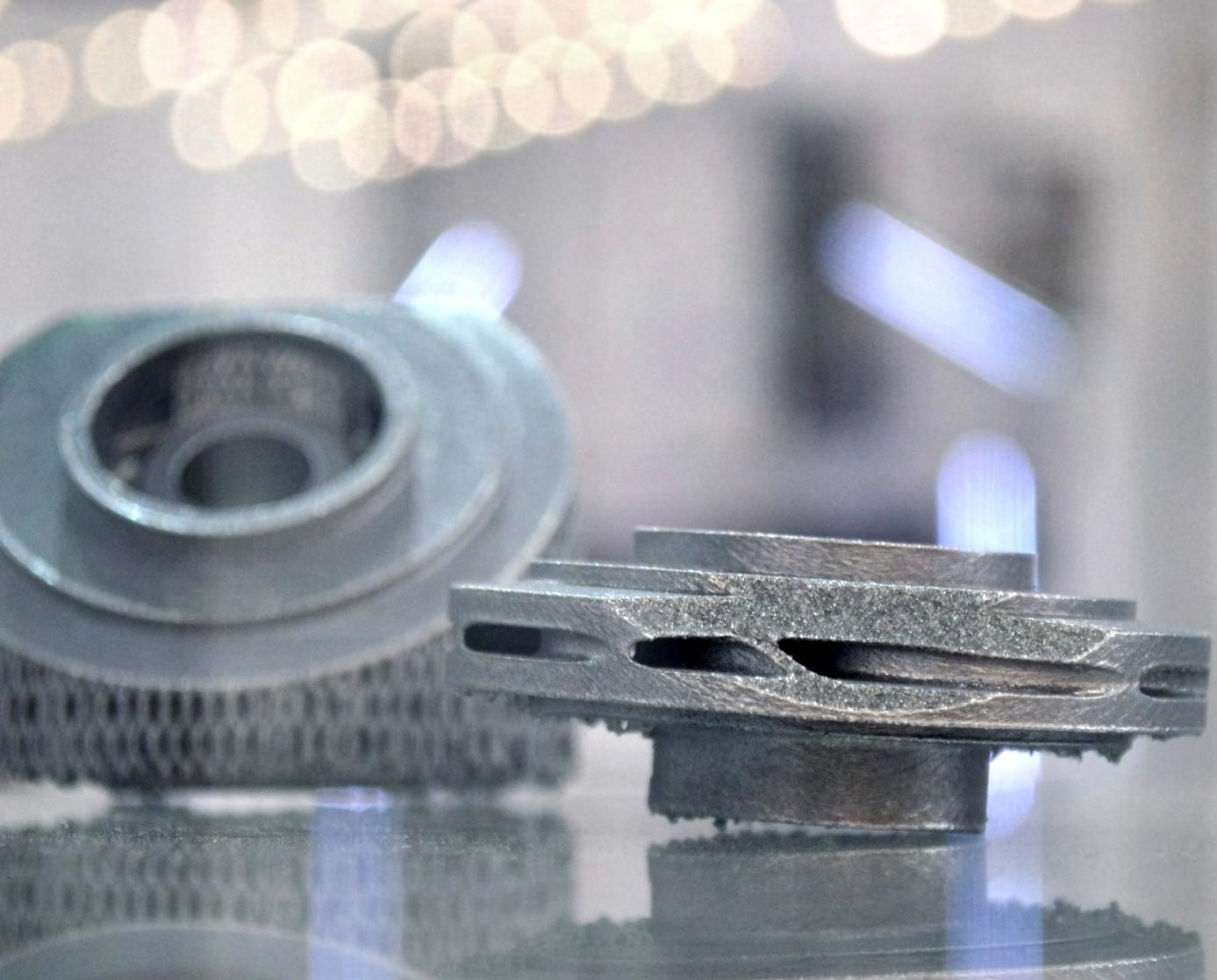
Metal 3D printing, or selective laser melting (SLM), combines the design flexibility of 3D printing with the mechanical properties of high-performance metal alloys to create unique, strong and lightweight parts.
In the process, laser beams heat and fuse selected parts of the upper layer of a metal powder with underlying areas that are already solid. Once a layer is complete, the metal powder bed is lowered by one layer width and a new powder layer is applied – the laser then fuses selected areas of the metal
powder again.
By continuously repeating these steps, the component with its support structures is created layer by layer.
The supports are of great importance in SLM because they not only hold the component in position, but also absorb internal stresses, dissipate heat and thus prevent deformation and other construction errors.
The strengths of SLM lie in the combination of the design freedom of 3D printing with the material properties of the various metals that can be used. The technology makes it possible to implement highly complex geometries in a single component.
This makes it possible to create lightweight structures that bring major benefits not only to car manufacturing and aerospace, but also to all other applications in which parts are frequently accelerated and decelerated.
SLM production can be useful for many end products, especially if they are required individually or in small batches. These include production tools, moulds and inserts, but also spare parts.
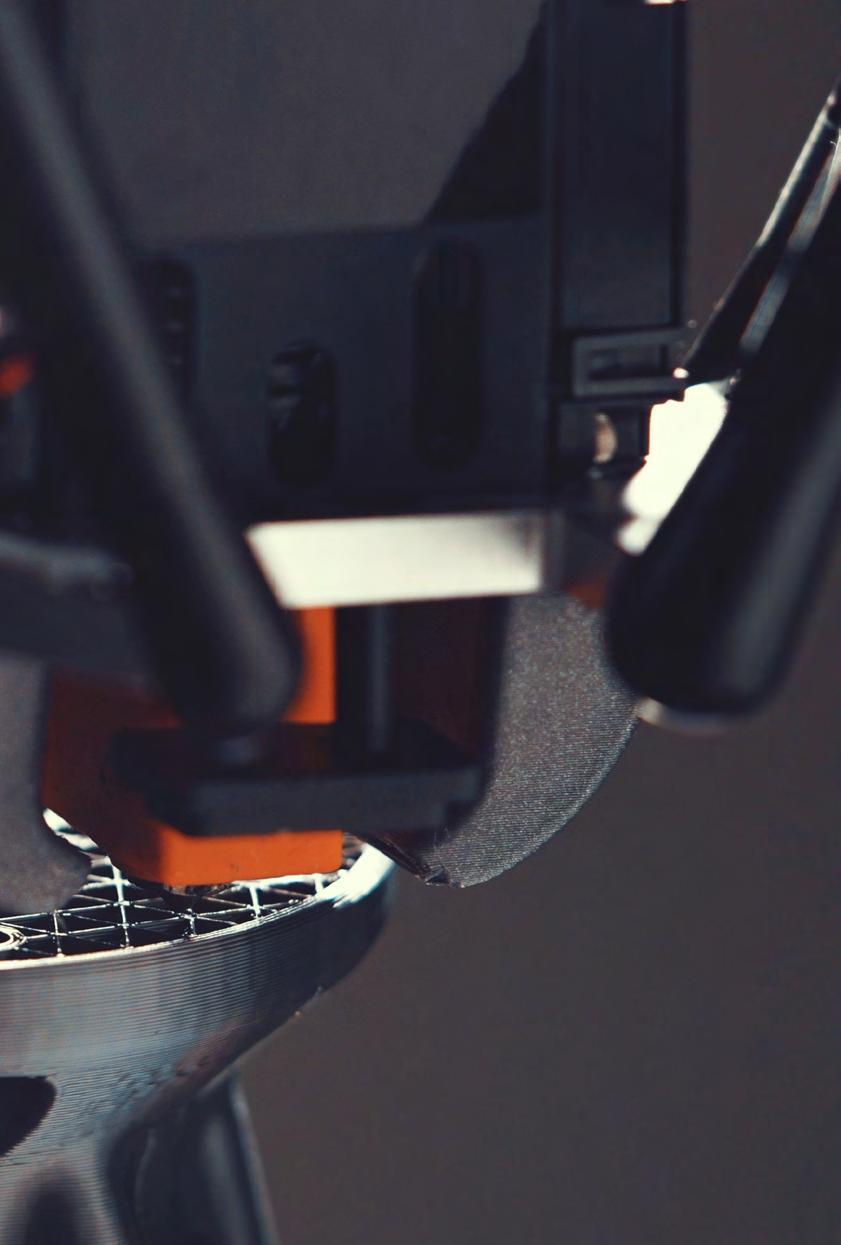
Pros of Metal 3D Printing (SLM)
• Extensive design freedom
• High part density and strength
• Part consolidation
Ideal for low-volume, high-value parts
• Rapid iteration for metal parts
• Lightweighting and performance optimisation
• On-demand and digital inventory
Cons of Metal 3D Printing (SLM)
• High equipment and operating cost
• Slow layer-by-layer build speeds
• Mandatory post-processing
• Surface finish limitations
• Size constraints
• Residual stresses and distortion
• Powder handling and safety concerns
• Material limitations
When SLM makes sense
• Complex geometry
• Lightweight or performance-critical parts
• Low-to-medium volumes
• High-value applications
• Custom or internal features needed
When it doesn’t
Simple geometries
• Large production runs
• Tight cost targets
• Large parts with no complexity
MULTI JET FUSION (MJF)
The fast build time offered by MJF provides an attractive alternative to injection moulding. With no support structures needed and surfaces that require minimal post-processing, this technology is well suited for functional prototypes and small series of even complex end use parts.
Although it is based on powder as the printing material, it does not use lasers. Instead, it deploys two liquids as well as infrared light. The powder bed in the build area is heated evenly at the start of the process, and the individual powder layers are applied step-by- step.
As such, MJF offers good timing predictability. Since the melting process is not based on laser movement, which varies depending on the area to be exposed, the printing process takes exactly the same time for each layer.
This means that the printing time can be precisely predicted. Therefore, users can benefit from shorter lead times and the ability to produce more components of sufficient quality in one build job.
The strengths of components produced by MJF result from the fine-grained nature of the powder used. It enables ultra-thin layers of 80um which produce components with higher density and low porosity when printed.
Pros of MJF
• Strong mechanical properties
• Fast build times
• No support structures required
• Good surface detail and consistency
• Competitive cost per part at scale
• Good post-processing and finishing options
Cons of MJF
• Limited material selection
• Expensive machines
• Grainy surface finish
• Limited build volume
• Thermal sensitivity and warping risk
• Powder reuse limitations
• Colour mostly post-process\
When MJF makes sense
• Functional plastic parts
• Snap-fits, enclosures, clips
• Low-to-medium volume production
• Consistent, repeatable quality
When it doesn’t
• High-temperature requirements
• Metal parts
Very large components
• Cosmetic parts without post-processing
FUSED DEPOSITION MODELLING (FDM)
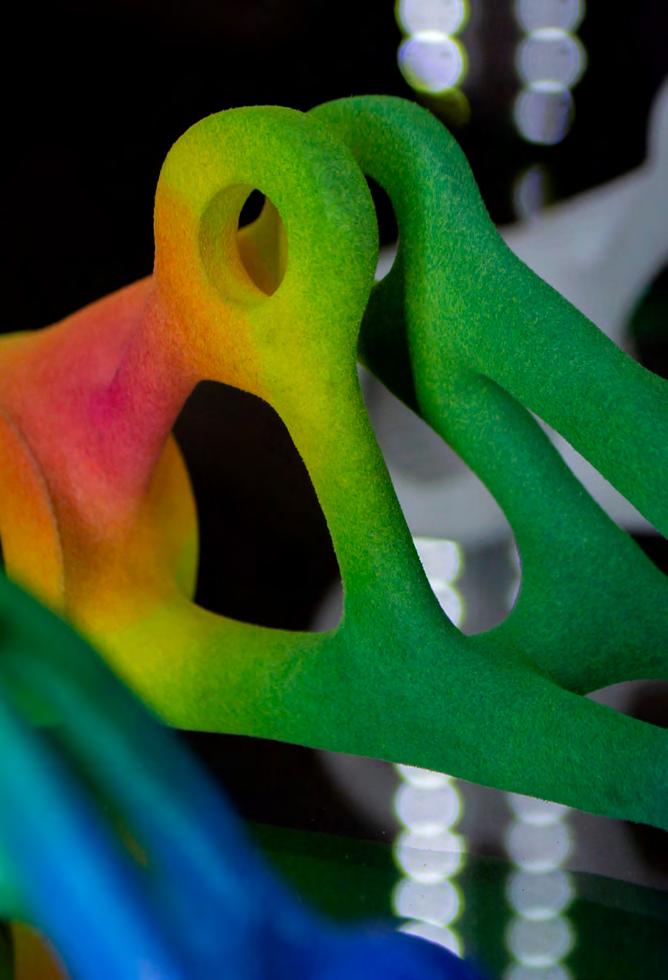
FDM, also known as Fused Filament Fabrication (FFF), is one of the most popular 3D printing processes for the additive manufacturing of plastic components. FDM is based on thermoplastic modelling filament, which is meltable plastic provided in wire form on rolls.
The filament is fed through an extruder nozzle, where the material is heated and then applied in layers to the required areas on a build platform. Once all areas of a layer have been applied, the nozzle is moved up and the next layer is printed on top of the one below.
FDM combines 3D printing’s design freedom and fast lead times with production-grade thermoplastics to create durable parts with excellent mechanical properties.
FDM is a 3D printing process that can be used to create almost any geometry with particularly low distortion, as no thermal stresses are introduced into the component since heating is only carried out at specific points.
In principle, the construction dimensions are unlimited, as the components can consist of different segments that can be
joined together very easily after printing.
One of the major advantages of the process is that the mechanical properties of materials that can be used with FDM remain stable over time. As a result, the components are not only of high quality, but also have high longevity.
Pros of FDM
• Low cost and accessibility
• Wide material selection
• Simple operation and maintenance
• Large build volumes available
• Fast and cheap prototyping
• Minimal post-processing
• Strong in-plane (X-Y) strength
Cons of FDM
• Weak layer bonding (anisotropy)
• Visible layer lines and rough surface finish
• Support structures required
• Lower dimensional accuracy
• Slower for batch production
• Limited fine detail
• Environmental sensitivity
When FDM makes sense
• Concept models and early prototypes
• Jigs, fixtures and tooling Large, simple parts
• Low-cost custom or one-off parts
When it doesn’t
• High-strength or safety-critical parts
• Smooth, cosmetic components
• High-volume production
• Very tight tolerances
SELECTIVE LASER SINTERING (SLS)
Laser sintering is a popular and versatile 3D printing technology thanks to its high precision, design freedom and wide range of production-grade materials.
Suitable for all stages of the production lifecycle, from prototyping to small series or custom manufacturing, laser sintered parts need no support structures - since overhanging structures are stabilised in the powder bed - making it possible to produce even the most complex geometries.
In laser sintering, plastic powder is distributed over the entire surface of a build platform using a roller or squeegee and then selectively bonded by melting with a high-power laser beam.
Once the laser has completely processed the first layer, the platform lowers, and a new layer of powder is applied. The laser then melts the areas defined in this layer.
This procedure is continually repeated, gradually creating the component. Because SLS needs no support structures, any three-dimensional geometries can
be created. These can have undercuts that cannot be produced in conventional mechanical or casting manufacturing.
The process can also be used to create highly complex designs such as moving parts, hinges and chains in a single piece, which saves subsequent assembly steps or enables completely new design solutions and applications.
Another strength of laser sintering is that several independent components can be printed simultaneously in the build space. By strategically arranging the parts (nesting), the available build space in each machine can be optimally utilised, which makes the production of small series or different prototype variants, for example, relatively fast and cost-effective.
Pros of SLS
• No support structures required
• Strong, functional parts
• High level of design freedom
• Good surface durability
• Efficient batch production
Broad polymer material options
• Proven, mature technology
Cons of SLS
• High equipment and operating cost
• Surface finish often needs postprocessing
• Limited colour options
• Long cooling time
• Powder reuse limitations
Skilled labour required
• Part size limitations
When SLS makes sense
• Functional end-use plastic parts
• Complex geometry with no supports
• Low-to-medium volume production
• Durable, impact-resistant components
When it doesn’t
Smooth cosmetic parts (without postprocessing)
• Very high-temperature requirements
• Very large parts
• Tight cost targets at high volumes
STEREOLITHOGRAPHY
Stereolithography is one of the most widely used 3D printing technologies. Its surface quality, ability to produce fine details and wide selection of materials make it well suited for high quality visual models and prototypes, complex aesthetic
parts and masters for techniques like vacuum casting and lost wax casting.
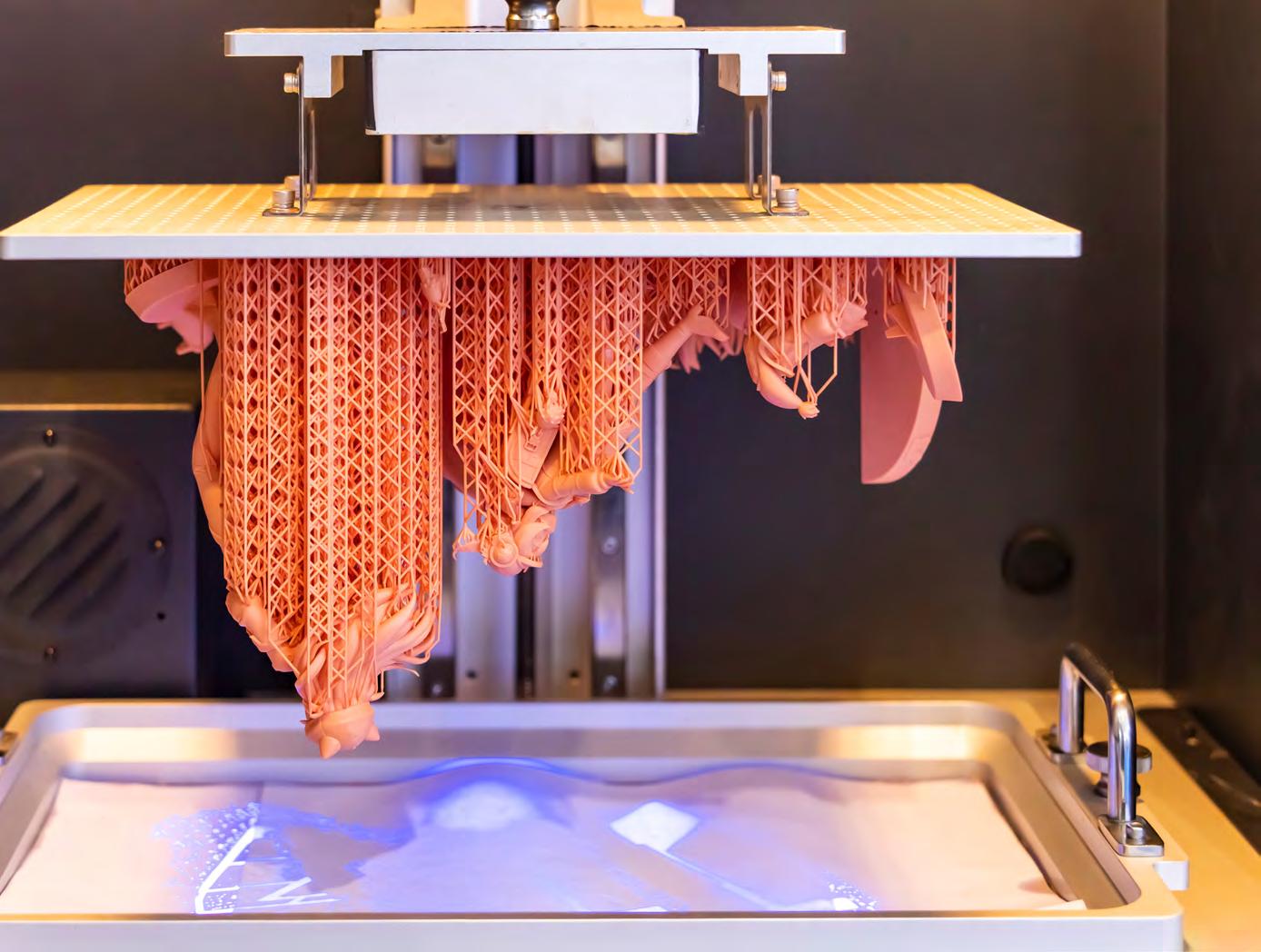
The basic version of the technology is based on UV sensitive liquid resins that are applied to a platform and then selectively cured by laser beam, from which different variants have evolved over time.
During the manufacturing process, the platform gradually lowers and the component grows layer by layer. To prevent the printed object from moving in the resin bath, it is fixed to the build platform by means of support structures.
The strengths of SLA lie in the combination of very high dimensional accuracy, high surface quality and relatively short production times. Furthermore, apart from Polyjet, SLA is the only additive manufacturing technology that can also be used to create transparent objects. Stereolithography can also be used to produce large components in one piece.
Pros of Stereolithography
• Exceptional surface finish and detail
• High dimensional accuracy
• Great for visual and presentation models
• Can print fine details, thin walls and small features
• Broad range of specialty resins available
• Relatively fast for small, detailed parts
Cons of Stereolithography
• Brittle material behaviour makes it unsuited to load-bearing or snap-fit parts
• Support structures are required
• Mandatory post-processing
• Material degradation over time
• Smaller build volumes (generally)
• Resin handling and safety concerns
• Higher material cost than FDM
When Stereolithography makes sense
• High-detail prototypes
• Cosmetic or presentation parts
• Small, precise components
• Molds for silicone casting
• Dental, jewellery, medical models
When it doesn’t
Structural or impact-loaded parts
• Outdoor or UV-exposed applications
• Large production runs
• Parts requiring flexibility or fatigue resistance
POLYJET
• Pros of Polyjet
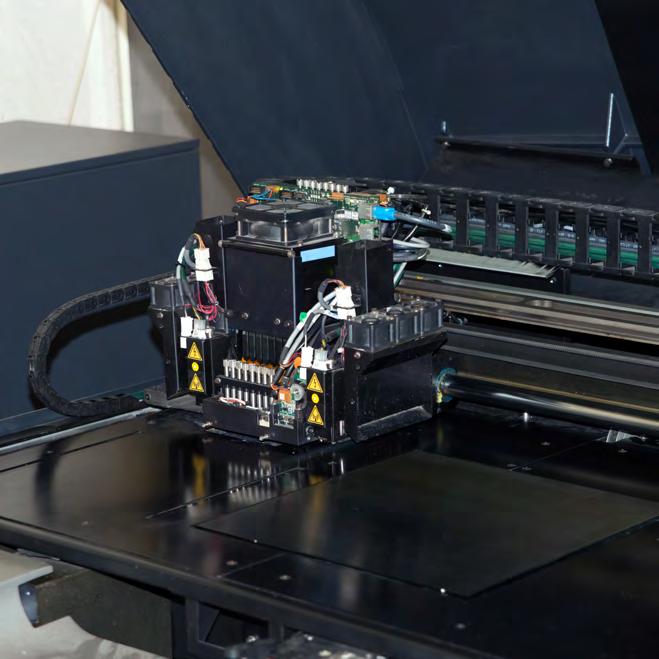
In addition to its high detail and smooth surfaces, PolyJet offers the unique ability to print precision parts and assemblies with multiple materials, all in a single build. A single part can contain different colours, levels of transparency and diverse physical and mechanical properties, making PolyJet well suited for complex visual models and prototypes. In the process, photopolymer resins are applied in ultra-thin layers to a build platform via print heads –similar to inkjet printers – and cured immediately after application using UV light. For complicated geometries and overhangs, a gel-like, water-soluble support material is also applied via the print head. Once a layer is complete, the platform moves down by one layer thickness and the next layer follows. PolyJet printers have several print heads which allow different materials and colours to be combined during printing. As a result, not only can specific colours and hardness be achieved, but a component with several colours and different mechanical properties can also be produced in a single printing process. Another key feature of the polyjet process is that the light transmission of the material can be varied. Even complete transparency is possible. Furthermore, the technology enables the printing of very fine details, as the layers are only 32um thick.
• High quality surface finish and detail
• True multi-material printing
• Full-colour printing
• High dimensional accuracy
Complex geometry with soluble supports
• Minimal visible layer lines
Cons of Polyjet
• Expensive machines and materials
• Weak long-term mechanical properties
• Material degradation over time
• Poor heat resistance
• Support material cleanup can be messy and labour intensive
Small-to-medium build volumes
• High cost per part
When Polyjet makes sense
• High-fidelity visual prototypes
• Multi-material and overmould simulations
• Ergonomic testing
• Colour-accurate presentation models
• Medical, dental, and product design mockups
When it doesn’t
• Functional mechanical parts
• High-temperature or outdoor applications
• Cost-sensitive projects
• Medium-to-high volume production
INNOVATION

How additive manufacturing is being used across the sector
The use of additive manufacturing is rapidly growing across the sector. From automotive and aerospace, to food and pharma, more businesses are reaping the benefits of 3D printing. The Manufacturer breaks down some of the most recent use cases.
According to Additive Manufacturing UK, 11 years ago the worldwide additive manufacturing and service market was worth £3.59bn and was expected to grow at an annual rate of 31.5% in the last three years. It estimates that the UK alone has the potential to win up to eight per cent of the rapidly growing market, as it was set to reach a staggering £6bn last year.
Additive manufacturing is currently making the transition from a specialised prototyping tool into a high-volume industrial production methodology.
The biggest shift is the move towards production at scale. Rather than using 3D printing merely to visualise a design and create a prototype, manufacturers are now deploying fleets of industrial machines to produce end-use, flight-ready and roadqualified parts.
Here, we explain the key benefits and advantages for seven manufacturers across the sector.
SHEFFIELD FORGEMASTERS
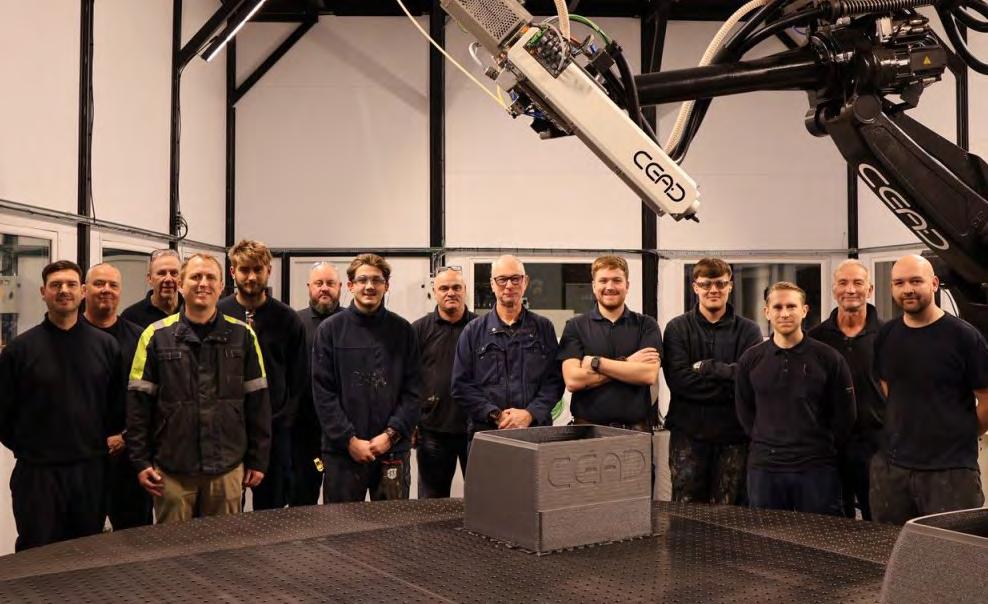
Sheffield Forgemasters has integrated a CEAD Flexbot hybrid system that combines 3D printing with precision milling. By using this technology to produce patterns - the solid forms used to create steel moulds - the company has modernised a traditionally manual process. The system prints at 60kg per hour and operates across two tables, allowing for continuous, autonomous production.
• Key benefits: Enhanced capacity through 24/7 autonomous operation, significantly reduced production costs and shorter lead times for high-volume castings.
• Manufacturer advantage: This investment allows Sheffield Forgemasters to maintain production outside standard working hours while simultaneously upskilling its workforce in digital manufacturing techniques.
BENTLEY MOTORS
Bentley Motors has evolved its in-house 3D printing capabilities from a singlemachine operation into a state-of-theart facility at its Crewe headquarters. Now housing 13 machines across six distinct technologies, the facility supports the entire vehicle lifecycle, from rapid prototyping and aerodynamic testing to
the production of high-value, single-print components for bespoke commissions. The facility utilises diverse methods, including Fused Deposition Modelling (FDM) for functional parts and Lithography-based Metal Manufacturing (LMM) for extreme precision.
• Key benefits: Dramatically accelerated product development cycles through rapid iteration, significant waste
reduction via material recycling and the ability to
• Manufacturer advantage: By maintaining an advanced, multitechnology 3D printing hub in-house, Bentley can deliver unparalleled levels of personalisation for its coachbuilt models while simultaneously streamlining its transition toward an electrified vehicle lineup.

HOPE TECHNOLOGY AND RENISHAW
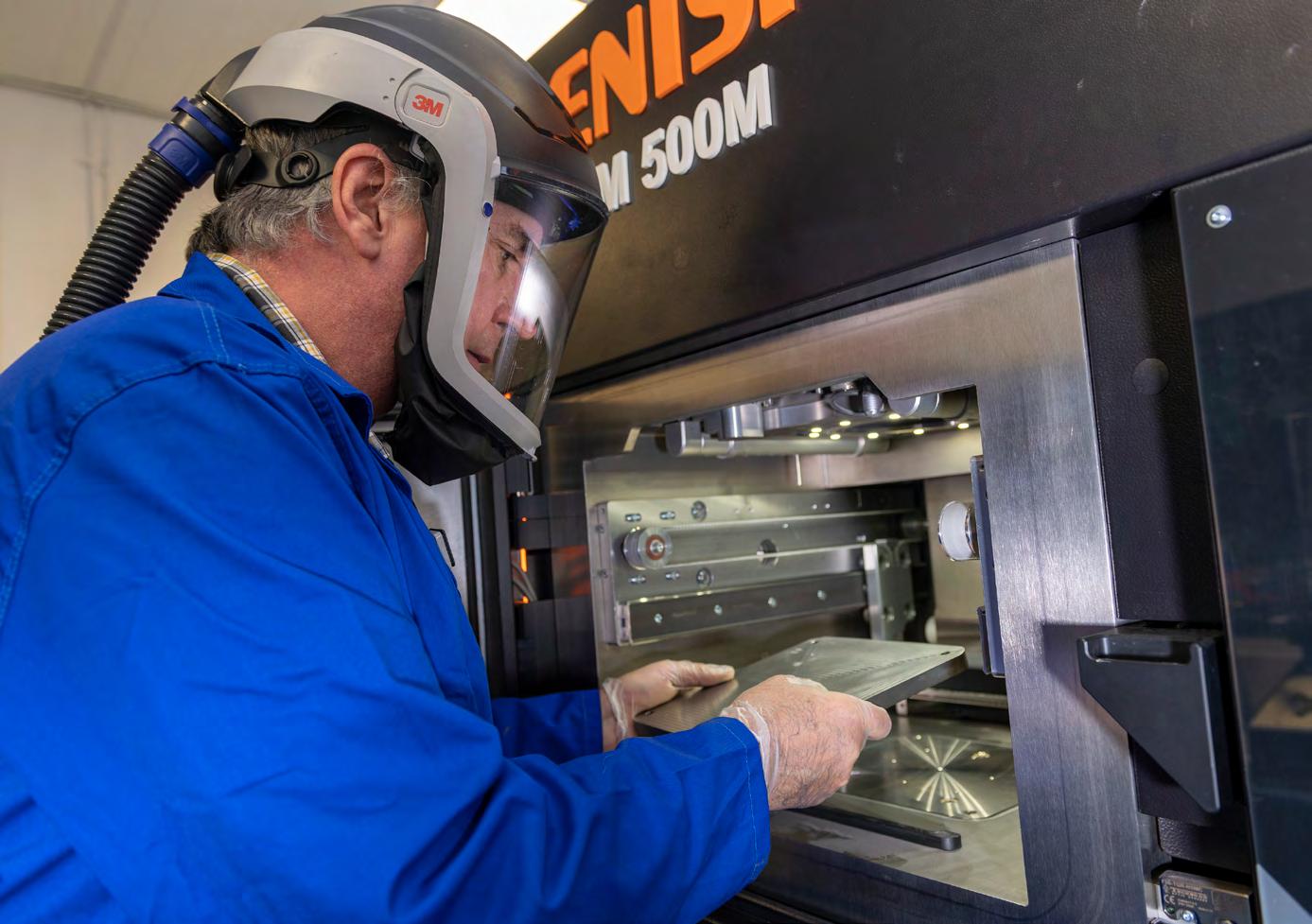
Hope Technology partnered with Renishaw to utilise the RenAM 500Q multi-laser system for metal 3D printing. This collaboration shifted the production of elite bicycle components from standard CNC machining to a hybrid additive approach. By using four high-power lasers to fuse titanium and aluminium powders, Hope created structures that were previously impossible to manufacture.
• Key benefits: Massive reduction in part weight (e.g., seat posts 44% lighter than aluminium versions), extreme design freedom and the ability to rapidly iterate prototypes for track testing.
Manufacturer advantage: Metal 3D printing enables Hope Technology to produce stronger, lighter and more complex components with minimal material waste and no need for expensive bespoke tooling.
GKN AEROSPACE AND MATERIALISE
GKN Aerospace and Materialise extended their long-term partnership to focus on polymer 3D printed parts for the aviation industry, specifically for electric vertical take-off and landing (eVTOL) aircraft. Their collaboration produced the 3D-printed wingtip for Eviation’s Alice, the world’s largest all-electric aircraft. The partnership focused on moving from rapid prototyping to fully certified, flight-critical aerostructures.
• Key benefits: Accelerated certification of 3D-printed parts, significant weight savings for electric aircraft and a 40% reduction in production concessions for complex tools.
• Manufacturer advantage: GKN Aerospace has successfully reduced the development cycle of primary structural components from five years to just 14 months while lowering the cost of damage-prone parts.

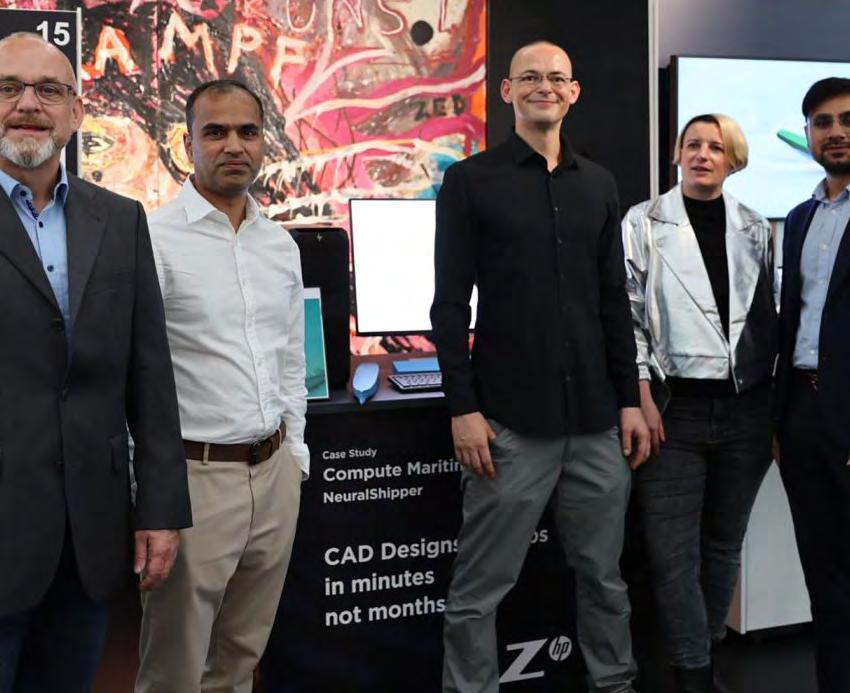
COMPUTE MARITIME AND RAPID FUSION
Compute Maritime led a £700,000 project to revolutionise ship design by combining generative AI with Rapid Fusion’s robotic 3D printing system. This initiative targeted the production of large-scale maritime components, such as hydrofoils and hull forms, using fibre-reinforced polymers. AI ensured that designs were optimised for both hydrodynamics and the specific constraints of the robotic printer.
Key benefits: A 90% reduction in material costs by using pellets instead of filament, 20% faster design cycles and a 50% increase in overall design efficiency.
• Manufacturer advantage: Compute Maritime leverages robotic automation to produce large-scale, lightweight maritime structures that directly contribute to the industry’s 2030 decarbonisation targets.
ARGIVE
Oxford-based start-up Argive has developed the A300, a 3D-printed gas microturbine used to power MGI Engineering’s SkyShark drones. By printing with a specialised nickel superalloy, Argive has consolidated the engine’s internal components, drastically reducing the number of parts. The digital nature of the engine allows it to be resized and retuned for different thrust requirements in weeks rather than months.
• Key benefits: A fourfold reduction in part count, high thermal resistance for components and a compact power-toweight ratio ideal for long-range drone missions.
• Manufacturer advantage: Argive has achieved world-class propulsion performance at a fraction of the traditional cost while securing a resilient, localised supply chain for critical defence technology.
CARFULAN GROUP
The Carfulan Group has achieved record-breaking growth by providing a comprehensive ecosystem of advanced manufacturing tools, including 3D printing, multi-sensor measurement and tool inspection. Through its SYS Systems division, the company has specifically transformed the dental sector by deploying specialised 3D printers and patented resins to produce high-precision medical devices.
• Key benefits: Access to a multitechnology portfolio that allows for designing freely and measuring accurately, alongside significant efficiency gains in tool presetting and dental appliance production.
• Manufacturer advantage: By partnering with Carfulan, companies across the supply chain can combat rising costs and optimise complex component manufacturing through a combination
of tailored 3D printing and shopfloor metrology.
SUMMARY
It seems that the ultimate advantage for the modern manufacturer is to start viewing additive manufacturing as strategic asset rather than a prototyping tool. By integrating 3D printing into the core production line, companies are no longer just making parts; they are reinventing their business models.
They have gained the power to offer mass personalisation, secure resilient, localised supply chains and produce previously impossible high-performance structures.
In 2026, the competitive edge belongs to those who use AM to remove production complexity from cost, allowing for faster innovation and a more sustainable, responsive factory floor.
Pushing the limits of AM materials
From high-performance metals to rapid prototyping, 3M BIC Technology Manager Janine Downs explains how the centre’s holistic approach to additive manufacturing de-risking R&D is and accelerating product development for UK manufacturers.
Established over 14 years ago to bridge the gap between academia and industry, the 3M Buckley Innovation Centre (3M BIC) in Huddersfield was one of the UK’s first university-led innovation hubs.
As a subsidiary of the University of Huddersfield, the 3M BIC has played a pivotal role in connecting commercial needs with academic expertise, supporting businesses - particularly SMEs - to access facilities, knowledge and technology required to innovate and grow.
Along the way it has attracted organisations from the wide range of sectors - including pharmaceutical, engineering, gaming and software application groups - to base their operations within the centre.
The centre has since grown into a nationally recognised model of collaboration with hundreds of businesses supported regionally and nationally, enabling high-impact R&D, while establishing itself as a place where companies can innovate, test and scale.
LEADERS IN ADDITIVE MANUFACTURING (AM)
Focusing on additive manufacturing, nondestructive testing and microscopy, the 3M BIC has positioned itself as a hub for innovation and growth. What sets it apart is its advantageous holistic approach to product development, design and implementation.
One of our key goals is how AM

technology can support and advance manufacturing industries by accelerating product development, improving prototyping and associated costs, including cost-effective customisation and small volume production options.
We house a comprehensive suite of AM technologies, including Fused Deposition Modelling (FDM) including large-format capabilities, Selective Laser Melting (SLM), Selective Laser Sintering (SLS), Material Jetting, and several key software applications to support design optimisation.
Our equipment includes two Renishaw metal powder bed fusion systems for producing high-performance metal parts, an EOS Formiga P110 SLS machine for durable nylon components, and a ProJet MJP 2500 for high-detail resin prototyping.
Other AM technologies include SLA Formlabs 4 printers, FDM Bambu’s and our Landr large format printer, enabling capabilities using performance materials such as carbon-fibre, PDVF and flameretardant filaments plus silicon and biocompatible resins.
This breadth of choice and accessibility enables organisations to explore new design possibilities, optimise performance and de-risk investment by understanding exactly how different materials behave before committing to production.
This advanced approach for both the development and manufacturing process, reduces lead times and improves efficiency while ensuring a more robust and resilient supply chain, all vital advantages in product progression to market.

NEXT GENERATION AM MATERIALS
AM technology is constantly evolving from large format printing to the latest advanced materials. Our capabilities now cover over 40 different 3D printing materials ranging from high performance metals such as titanium, stainless steel, tungsten, aluminium and copper.
We also offer engineering-grade performance polymers, including nylon powders, flexible materials, chemical-resistant and durable composites, high-detail resins for precision components, and biocompatible options. Each material opens a different set of possibilities depending on what manufacturers need to create, test or refine.
Having such a wide palette to work with means businesses can tailor prints
Janine Downs, 3M BIC Technology Manager
to real-world conditions, in areas such as extreme environments and highly regulated sectors, providing a much clearer understanding of the genuine advantages of AM.
Industries including aerospace and automotive have embraced the process for lightweighting, optimised product design development and material prototype testing, as well as bespoke small volume production.
Janine Downs, 3M BIC Technology Manager
A current collaboration is underway with a new spin-out company, involving academia and industry utilising AM technology for the advancement of tungsten manufacturing. This explores new design and production possibilities, alongside X-CT validation for this material.
DESIGN, TEST, REFINE
Our holistic approach to product design and development, supports not only new ideas aiming to break into markets but also existing products seeking to evolve, improve and stay competitive.
Designing for AM is key to the development process, enabling manufacturers to design complex and intricate features. This may include lattice or cellular structures which would prove difficult or impossible by conventional methods.
By looking at the full lifecycle - from concept and design to refinement and optimisation - we help businesses enhance performance, unlock new opportunities and strengthen the long-term value of their products.
We can act as a test bed for manufacturers, giving them the ability to trial new materials before making major investments. Allowing the space to experiment, challenge assumptions, test numerous design iterations and prototypes before committing to new machinery, tooling, or full product redesigns. Enabling this proof of process, manufacturers can get to grips with the full advantages and benefits of AM.
For those who need speed, we can design, print, scan, refine, reprint and repeat – alongside small batch, low-volume production capabilities, dramatically shortening R&D timelines and turning ideas into validated prototypes in a fraction of the usual time.
Another example of cost saving for manufacturers via AM is the potential for on demand production that enables reduction in stock holding and a more efficient controlled supply chain.
Janine Downs, 3M BIC Technology Manager
A PLACE TO TEST AND LEARN
AM material testing and verification is another but important process, where we utilise in-house non-destructive technologies - including advanced X-CT scanning and microscopy capabilities - to examine external and internal imaging to verify several aspects within the material. This may include tolerances, measurements, potential defects, micro-fissures or inclusions.
Manufacturers gain validation, visual data and deep insight into how a part performs, thus identifying potential weak
or fracture points and how it can be improved, re-designed and rectified.
By combining virtual modelling with physical testing, we offer a safe place to test and learn - giving businesses the confidence to experiment, challenge assumptions and optimise products before committing to full production.
As manufacturing continues to evolve, places like the 3M BIC will shape how quickly and confidently organisations can adapt. We will continue to provide the tools, time and space for manufacturers to test what works and continue to look ahead at what’s coming next in the world of additive manufacturing.
Key takeaways
• The 3M BIC connects academic expertise with commercial needs to help businesses (especially SMEs) grow.
• Success comes from a ‘design, test, refine’ approach that looks at the entire product lifecycle, not just the print.
• With over 40 materials—from titanium to biocompatible resins— companies can tailor prototypes to real-world conditions.
• The centre acts as a ‘test bed’, allowing firms to validate designs and materials before making major financial investments.
• Additive manufacturing reduces lead times and enables ondemand production, creating more resilient supply chains.





Additive Manufacturing Directory

3M Buckley Innovation Centre (3M BIC) supports manufacturers with advanced product development facilities, including additive manufacturing in performance materials, verification and low volume production. Its collaborative workspace and strong links with the University of Huddersfield also help companies access academic expertise, explore new solutions and improve processes.
LAPTOP-MOBILE https://3mbic.com/ PHONE-HANGUP 01484 505601
@ info@3mbic.com
Additive-X offers leading 3D printing technology solutions, carefully selected to deliver real benefits, serving its business customers across a wide range of sectors. It is made up of solution-focused individuals, committed to providing great customer service and technical support. Offering impartial advice by working with a range of technologies and brands, it wants to help you get the right solution for your application. Whether you are introducing the technology into your business or expanding your additive manufacturing capabilities, it can help you get the best return on your investment.
@ sales@additive-x.com LAPTOP-MOBILE https://www.additive-x.com/
01765 694 007
3D People manufacture custom plastic parts using industrial 3D printing at their UK facility. Specialising in high-quality polymer prototypes and serial production, it offers a streamlined online platform for functional components like housings and brackets. Its agile, in-house service requires no tooling or minimum order quantities.
LAPTOP-MOBILE https://www.3dpeople.uk/ PHONE-HANGUP +44 20 3051 2298
@ print@3dpeople.uk
As the UK partner for Markforged, Mark3D provides high-end composite and metal 3D printers, materials and consultancy. It helps industries - including aerospace, automotive, and manufacturing - implement the Digital Forge platform to build resilient supply chains. Mark3D specialises in evaluating and integrating industrial additive manufacturing directly into existing production processes.
LAPTOP-MOBILE https://www.mark3d.com/en/
@ printstronger@mark3d.co.uk
+44 121 661 1151
Be Part of The Manufacturer Supplement
About THE MANUFACTURER
WE KNOW MANUFACTURING.
The Manufacturer has been at the heart of the sector for over 30 years, giving us unrivalled reach and expertise in the industry. As rapid advances in technology drive transformation in the industrial landscape, we’re on the frontline of that change, working with the most innovative manufacturers and technology providers. We share that insight with our community. Manufacturers prosper because we make sense of the change and maximise resulting business opportunities for our community, putting them ahead of the curve. We do this every day, meeting and talking with manufacturing companies across the UK, Europe and the USA and reporting on their challenges and successes across our multimedia portfolio, providing the insights and connections to help them make the right decisions and thrive.
365 DAYS A YEAR.
The knowledge you need, delivered the way you want it. Daily news, interviews and thought leadership across our publishing channels. If daily is too much, we publish weekly digital briefings and hold monthly physical and virtual learning and networking events. Annually, we host the leading industry awards programmes that recognise manufacturing talent and business excellence.
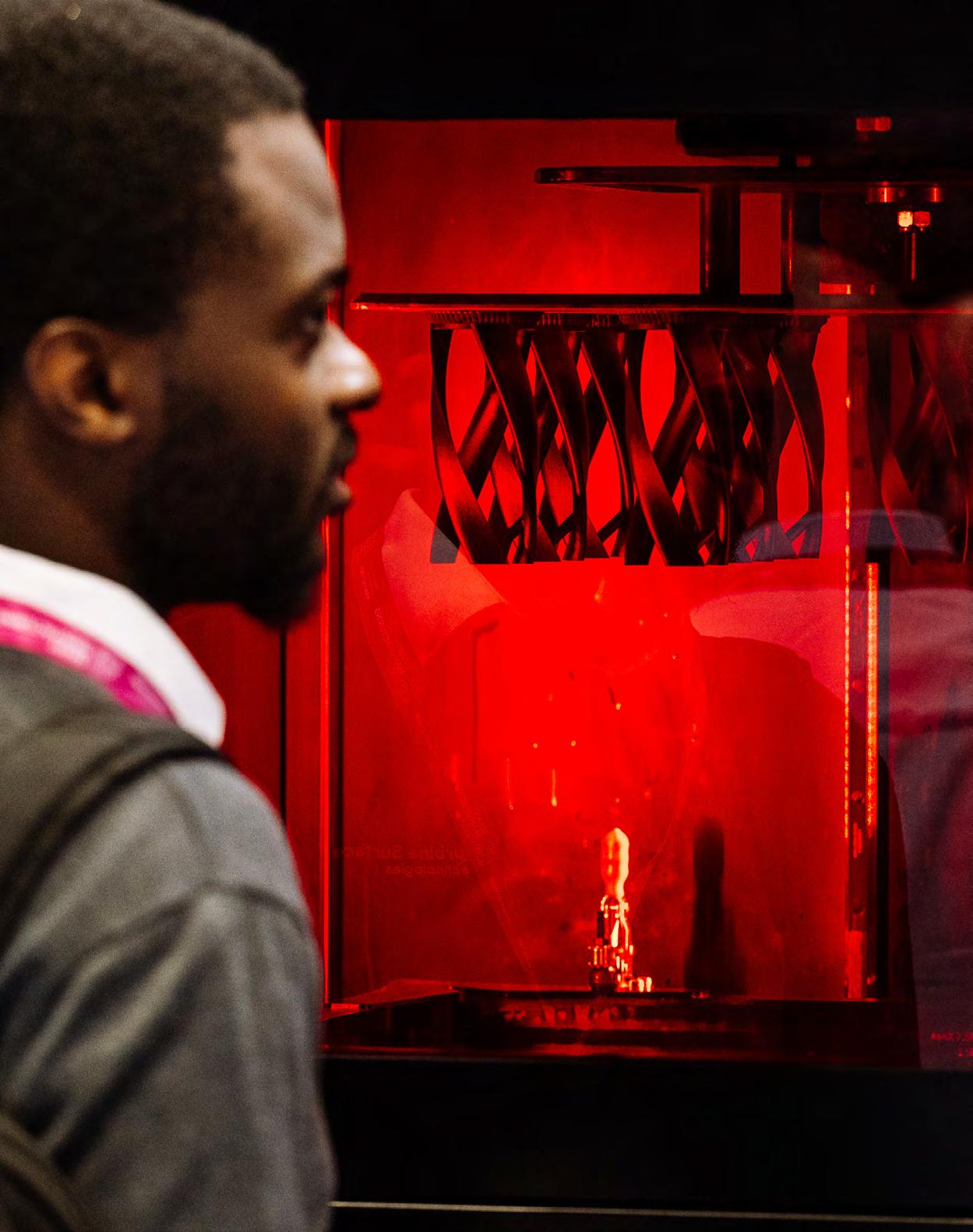
In-digital, in-print, or in-person, The Manufacturer offers ideas, insight and innovation to the manufacturing community when they need it, in the format they desire. Because sharing the knowledge benefits everyone.
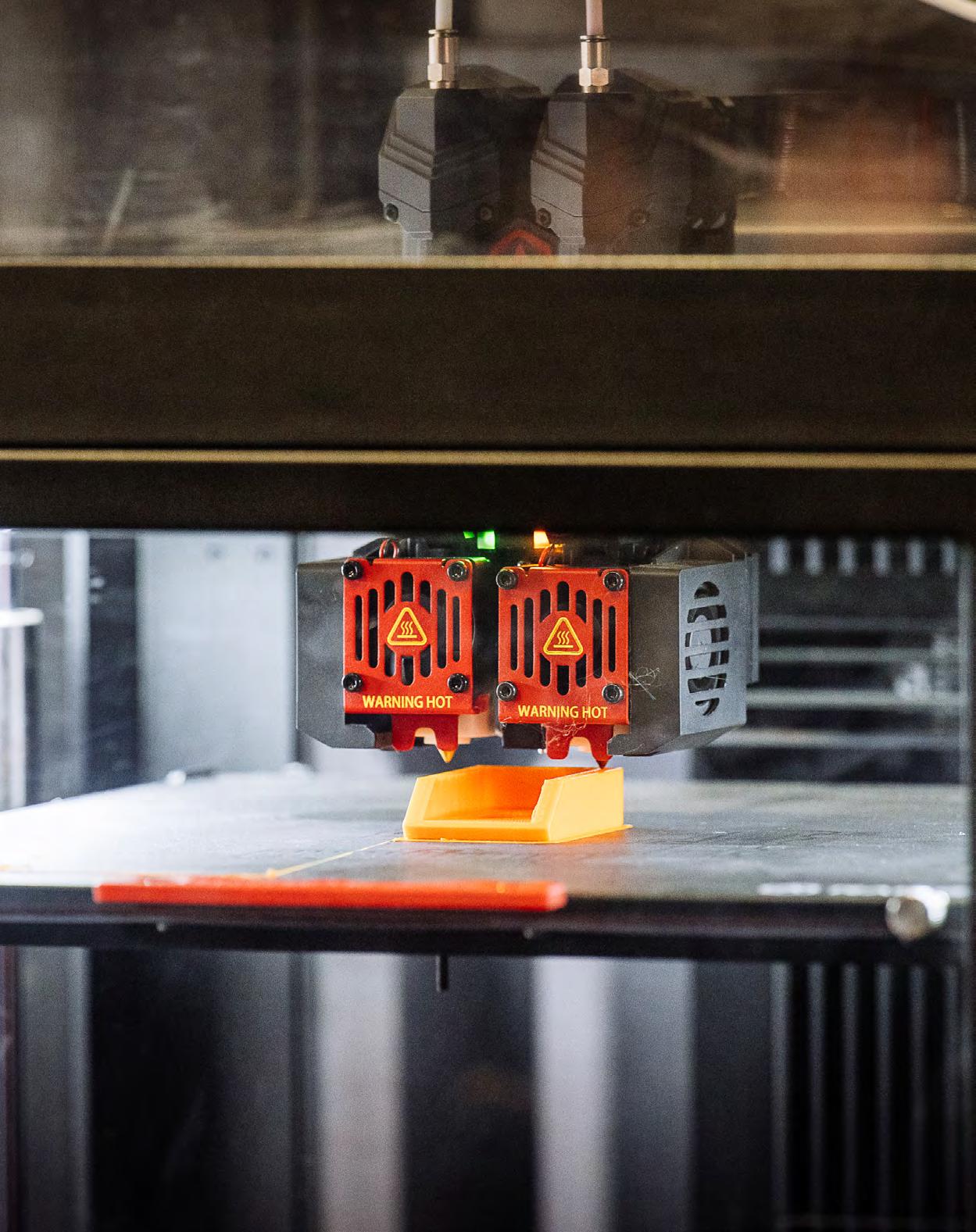
How You Stay Connected with


Unlimited digital access to The Manufacturer
Weekly news, insights & interviews
Sign up free - stay informed anytime

PRIORITY
Quarterly print magazine delivered to you
Exclusive reports & VIP rates
Plus, all the benefits of Access Scan to