GRAPHICS EDITOR Emma Gillich graphics@themanitoban.com
GRAPHICS ASSOCIATE Teegan Gillich
AUDIO AND VIDEO
AUDIO EDITOR Max Reid audio@themanitoban.com
PHOTO EDITOR Mike Thiessen photo@themanitoban.com
PHOTO ASSOCIATE Ebunoluwa Akinbo
VIDEO EDITOR Zulkifl Rafah video@themanitoban.com
DIGITAL MEDIA EDITOR Faisal Rahman social@themanitoban.com
SOCIAL MEDIA ASSOCIATE Paula Robles Andia
REPORTERS
NEWS Arifah Gheesah
NEWS Nafisa Al Lilo
RESEARCH & TECHNOLOGY Nawal Semir
COMMENT Thandeka Katsika
COMMENT Kyra Campbell
ARTS & CULTURE Carrington Dong
ARTS & CULTURE Jordan Anglin
SPORTS Faiyaz Chowdhury
SPORTS Israel Abejoye
VOLUNTEERS
VOLUNTEERS
VOLUNTEER STAFF
Marco Tolentino & Maryam Beg
interested in volunteering? email me@themanitoban.com today!
The Manitoban is the official student newspaper of the University of Manitoba. It is published monthly during the summer and each week of regular classes during the academic year by the Manitoban Newspaper Publications Corporation.
The Manitoban is an independent and democratic student organization, open to participation from all students. It exists to serve its readers as students and citizens.
The Manitoban is a member of the Canadian University Press, and our journalistic standards can be found on the Manitoban’s website.
The newspaper’s primary mandate is to report fairly and objectively on issues and events of importance and interest to the students of the University of Manitoba, to provide an open forum for the free expression and exchange of opinions and ideas and to stimulate meaningful debate on issues that affect or would otherwise be of interest to the student body and/ or society in general. The Manitoban serves as a training ground for students interested in any aspect of journalism.
Students and other interested parties are invited to contribute to any section of the newspaper. Please contact the appropriate editor for submission guidelines.
The Manitoban reserves the right to edit all submissions and will not publish any material deemed by its Editorial Board to be discriminatory, racist, sexist, homophobic or transphobic, ableist or libellous.
Opinions expressed in letters and articles are solely those of the authors. Editorials in the Manitoban are signed and represent the opinions of the writer(s), not necessarily those of the Manitoban staff, Editorial Board or the publisher.
A “volunteer staff” member is defined as a person who has had three volunteer articles, photographs or pieces of art of reasonable length and/ or substance published in the current publishing year of the Manitoban
Any individual who qualifies as a volunteer staff member must be voted in by a majority vote at a Manitoban editorial board meeting. Elected representatives and non-students may be excluded from holding votes as volunteer staff members in accordance with the Manitoban Constitution.
Students rally against 4 per cent tuition increase
UMSU advocates for accessible, affordable education
Arifah
Gheesah, staff
UMSU held a rally in front of the U of M Admin Building on April 2 to call on the university’s leadership to stop the four per cent increase in tuition fees and advocate for a more affordable and accessible education.
“[The tuition increase] is really [going to] affect students in a negative way and reduce the accessibility of education for students overall”
— Tharindu Kottegoda, undergraduate student and rally attendee
Tharindu Kottegoda, an undergraduate student and an attendee of the rally thought the rally was “pretty effective.”
“We talked more in depth about how this is going to affect students, how it might lead to them going into debt,” Kottegoda explained. He also mentioned how the increase affects mature students who
will have less time and money to spend with their kids. “It’s really [going to] affect students in a negative way and reduce the accessibility of education for students overall.”
Hunter Reynolds, another attendee of the rally, also thought positively of the event. “It felt like there [were] a lot of different people coming together and it did feel like there was a lot of unity in the crowd.”
Kottegoda currently works a part-time job, but on reflecting on the impact of the increase, he believed that it would lead to working more, studying less and “doing the opposite of what [one wants] to do, which is to get an education in order to give yourself a better opportunity.”
Reynolds mentioned his friends are struggling to afford university. “That worries me a lot,” he expressed.
Kottegoda believed that the best way to move forward is to let members of parliament know. Hunter suggested awareness — to speak to friends and family about it.
For more information and follow-up questions, visit @myumsu on Instagram.
U of M responds to ALC safety incident
Delayed alerts spark campus safety concerns
Arifah Gheesah, staff
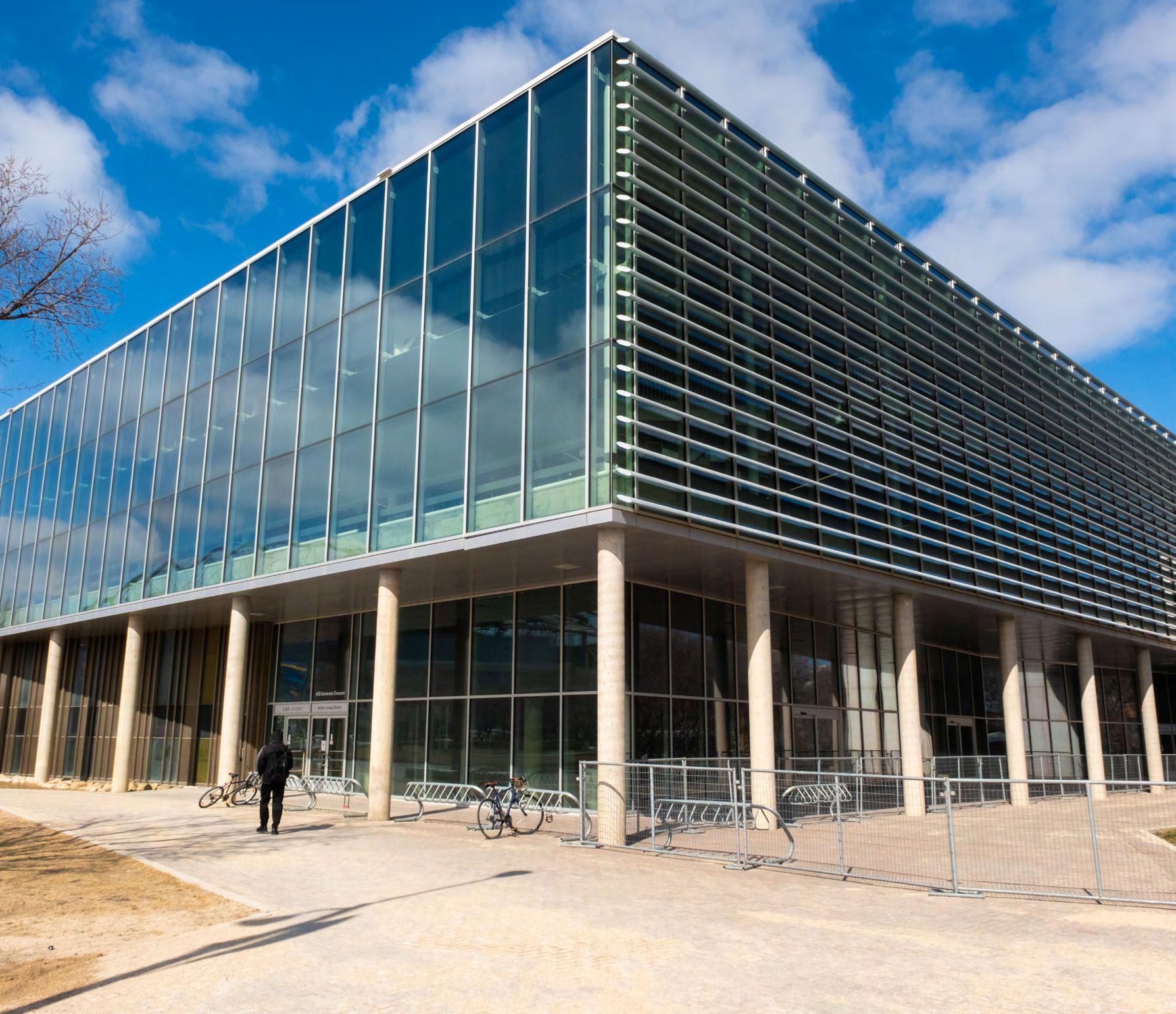
The U of M has given a response following a March 26 incident at the Active Living Centre, addressing questions about campus safety and communication with students.
According to university media relations, the incident occurred at approximately 7:35 p.m. and involved individuals who were known to each other. The U of M Security Services (UMSS), alongside the Winnipeg Police Service (WPS) and the Winnipeg Fire Paramedic Service, responded to the situation.
UMSS identified the location of the suspect and assisted WPS, who made an arrest without incident. Emergency responders cleared the scene shortly after 8 p.m.
On addressing raised concerns about delays in notifying students, particularly through the UM Safe app, the university responded that the app is reserved for situations where there is an “ongoing and imminent” risk to the
broader campus community.
“The situation was contained rapidly due to the quick actions of [UMSS] and emergency services,” the statement read.
Instead of an immediate alert from the app, the university sent an all-student and staff email the following morning, while WPS issued a public release later that day.
The university, emphasizing the role of UMSS in maintaining campus safety, noted that the service operates 24/7 and conducts patrols and crime prevention initiatives.
Students requiring emergency assistance on campus are advised to call #555 on mobile devices using Bell MTS or Rogers Wireless, or on a university phone, or call 204-474-9314 to reach security services directly.
For further updates, students can refer to official university communications and releases from WPS.
PHOTOS BY EBUNOLUWA AKINBO / STAFF
PHOTO BY MIKE THIESSEN / STAFF
STUDENTS PROTEST THE FOUR PER CENT TUITION RATE HIKE ON APRIL 2.
Exiting UMES senior stick reflects on role
Historic president shares journey, community impact and future goals
Nafisa Al Lilo, staff
The U of M highlights student leadership through voices shaping campus life, including biosystems engineering student Simran Gill.
Gill is currently in her final year of studies and has taken on one of the most prominent student roles in the engineering faculty. She is the first woman of colour and tenth woman to be senior stick for the U of M Engineering Society (UMES), as well as the second person to hold the position for two years in a row.
She credits those who came before her as key to her achievements.
“I could not have done it without the women before me [who] walked so I could run,” Gill stated. “It is a great honour and a great privilege.”
The position is the head of the engineering student body, which involves overseeing a large student council and representing the interests of nearly 2,000 students.
Gill said, “Our council is made up of 110 students, and we do everything from social [and] professional events [to]
student outreach.”
Gill was born and raised in Winnipeg, with her family originally coming from Punjab, India. Her academic path is guided by a broader goal of using engineering to support those who are often overlooked.
“I’m really passionate about using engineering for good. So, I’m planning to pursue a master’s in using engineering to help marginalized communities,” Gill said.
The focus is already reflected in her current academic work, which involves collaboration beyond the classroom.
“I’m in a capstone project, and we are building a land shelter in a participatory co-engagement project with an Indigenous community,” she said.
“I’ve been on UMES since my first year as a frosh intern and I really loved the environment,” she said. Gill’s involvement in student leadership began during the COVID-19 pandemic, when many students were navigating isolation.
Despite the circumstances,
she found connection through student involvement.
“I signed up because I didn’t have anything else to do, and I just fell in love since then,” Gill explained. “Even if I was meeting on Zoom with other students, there was still that sense of community.”
That early experience led her to continue taking on increasing responsibility within the student body.
“It was really just the community and the great support that came through UMES,” she explained.
Throughout her term, one of the most meaningful aspects of the role has been engaging directly with students.
“I really love having our events and overseeing all of our events and seeing the smile on people’s face when they come,” Gill said.
As her term concludes, Gill reflected on the experience with appreciation for the students she represented.
“I just want to say thank you,” she said. “These two years have been great.”

SIMRAN GILL, UMES SENIOR STICK.
PHOTO BY MIKE THIESSEN / STAFF
High-stake calls, higher-stake lifts
Winnipeg-based fireman is the first Canadian to win World’s Strongest Firefighter
Boris Tsun Hang Leung & Faiyaz Chowdhury, staff
W innipeg-based Royal
Canadian Air Force firefighter Evan Yaworski won the title in the World’s Strongest Firefighter competition in March, bringing home a historic win not only for the city but also for the country.
The 2026 World’s Strongest Firefighter competition took place in Columbus, Ohio. It welcomes firefighters from around the world to compete for the title in challenges such as carrying hydrants, lifting ladders and even pulling a truck with a harness and rope for 50 feet.
“It’s an interesting feeling, going from such a high of competing on a stage like that, and then going back to regular life the following week. So, it was more of an emotional rollercoaster than I was expecting,” said Yaworski about his accomplishment.
Yaworski admitted that his nerves crept in before the opening event, but once the first event was done, something clicked in him. “It primes your body for the rest of the events,” he said. “You just get into a groove for the competition.”
Yaworski’s journey to the championship was not a short
one. Originally from Saskatoon, he first joined a firefighting college “on a whim,” feeling like it was something he could do. He wanted to pursue aircraft rescue firefighting when he laid eyes on the firetrucks and then joined the military in 2017.
In 2024, Yaworski relocated from Edmonton to Winnipeg, working on a crash response base. Yaworski sometimes spends his shifts only training, maintaining trucks and testing fire alarms, but he reflected on the challenges and risks of firefighting.
“Highway accidents [and] medical calls for mental health, those kinds of situations […] can be quite stressful. There’s a lot of unknown, a lot of factors to consider there, but it’s what you train for,” he said.
Yaworski also highlighted the overlap between competition and firefighting. The same fitness and athleticism nurtured through competing carry over to firefighting, and the composure required for high-stress emergency calls translates to the mental strength needed in sports.
Yaworski aims to continue competing this year and return to the Arnold Sports
Impressively, the strongman does it all himself, creating his own program and occasionally drawing perspectives from those around him, including his wife. “She approaches training differently than I do,” he said.
When asked if there’s anything he would go back and change in his firefighting and strongman careers, he stated, “I don’t think I’ve experienced something yet where I’ve
gone back to the hall and was regretful for how it went.”
Yaworski stressed the value of persevering through hardships and seeing where it leads you.
“When things are tough, they won’t always be tough, so you just have to endure it, make the best of it and come out on top […] At the end of the day, what I find most motivating is getting up to what I think my potential is or sur-
passing it,” he remarked.
“When I started this part, I never thought I would be a competitive person on a world stage. I just started one thing at a time, eventually more opportunities came, and that kind of thing is pretty motivating.”
Yaworski shared a piece of advice for U of M students.
“Try something new. You never know where it’s going to take you.”
U of M PACS celebrates 20 years of its PhD program Anniversary hybrid conference to unite students, alumni and practitioners
Roy Albright Obah, staff
The U of M’s peace and conflict studies (PACS) program will mark the 20th anniversary of its PhD program with a two-day conference, Small Peace, Petite Love, from April 17 to 18 in a hybrid format at St. Paul’s College.
Jessica Senehi, director of the PACS program, said the conference is intended to create space for exchange and collaboration. It is “a great opportunity for graduate students to share knowledge and network,” she said, adding that it allows participants to connect across programs, universities and with alumni.
The PACS program was launched in January 2006, emerging from the work of the Arthur V. Mauro Institute for Peace and Justice at St. Paul’s College.
Sean Byrne, a pioneer of the program, said, “The vision was to advance human rights, conflict resolution, global citizenship, peace and social justice through education,
research and practice, and to prepare leaders in a multiplicity of contexts who make a difference locally, nationally and globally.”
Byrne said graduates continue to contribute across sectors. “PACS alumni are working in key roles in the public and private sector,” he said. “PACS doctoral alumni are contributing to scholarship, working with government agencies and NGOs, and some are leading PACS and other academic programs.”
The conference will also serve as a platform for scholarly works to be presented. Ha (Cassie) Dong said it brings together participants across areas of study. “I hope everyone knows this conference is interdisciplinary,” she added.
She said, “I think this will be a wonderful opportunity for students, researchers and community members to share ideas and learn from each other and perhaps find people you want to collaborate with in the future.”
Jessica Laus, president of the PACS Students’ Association (PACSSA), said the anniversary carries significance in the current global context. “I am reminded time and again how far I have come, how far our discipline has come and how we both continue to persevere,” she said.
Saad Ahmad Khan, chair of the PACS Joint Master’s Program and an alumnus, said the conference responds to current global conditions. “Our contemporary world is witnessing the crumbling of the rules-based world order,” he said. “I hope that this conference will be one such step toward discovering those novel and innovative solutions.” The conference will also serve as a space for reflection and continued dialogue within the PACS community.
Byrne said the 20th anniversary conference creates space for alumni to “return and share their innovative insights about practice and scholarship and create an
ongoing dialogue.” Khan hopes participants leave with a sense of possibility. “My deepest hope is that both participants and attendees see the immense good there is in this world, and those who want to change it for the better.”
Further details about the conference will be shared in the coming days. To stay updated, follow PACSSA’s page on Instagram at @umanitobapacssa.
Festival in 2027.
PHOTO BY ZULKIFL RAFAH / STAFF
Research & Technology
Multilingualism is more than a language skill
Psychology research reveals links between language, cognition and creativity
Mansura Akter Meghla, staff
Does knowing more than one language amount to just another skill on a resume? Research suggests otherwise. Speaking more than one language can feel like switching between different versions of oneself. So much so that it is considered a deeply personal experience, one that may also shape how the brain thinks, feels and solves problems.
For Ashley Chung-Fat-Yim, an assistant professor in the department of psychology at the U of M, that experience is not just familiar, but foundational to her research. ChungFat-Yim studies “what happens in the mind and brain when people know more than one language,” focusing on how speaking multiple languages affects cognition, attention and emotion.
“Because bilinguals are constantly juggling two languages in their minds, that experience may strengthen abilities,” she explained. “Like holding information in memory, shifting between tasks and focusing on relevant information while ignoring irrelevant information.”
According to Chung-Fat-Yim,
these abilities, known as executive function, are essential for everyday thinking and problem-solving.
Her research also explores how language shapes emotional processing and engagement with stories. She aims to know whether the brain processes emotions differently depending on the language being used, and how language shapes immersion in stories. To answer these questions, her lab uses tools like the Electroencephalogram (EEG), which measures brain activity in real time, and eye tracking, which reveals where attention is directed.
Her early awareness of language-switching shaped her curiosity about the mind and led her to notice how language could influence identity and thought.
“From an early age, I noticed that switching between languages sometimes felt like switching between two different versions of myself. I became curious about what
Spanish-English bilinguals in both of their languages using the Alternate Uses Task, a measure of divergent thinking. “Because bilingualism is a complex, multidimensional experience, we wanted to examine how specific factors, such as language proficiency and dominance, might shape creative thinking,” she explained.
“Because bilinguals are constantly juggling two languages in their minds, that experience may strengthen abilities”
— Ashley Chung-Fat-Yim, assistant professor in the U of M department of psychology
was happening behind the scenes in my mind,” she said.
Chung-Fat-Yim’s interest in multilingualism began with her own lived experience growing up in a multilingual environment. “I have always been fascinated by languages. I grew up in a household where Mauritian Creole was spoken, while living in an English-speaking environment and attending a French elementary school,” she said.
Chung-Fat-Yim remains motivated by the constantly evolving nature of the field as it continues to reveal new insights into multilingualism, cognition and how the brain works. “Every study feels like another piece of a much larger puzzle,” she added.
One of her recent projects examined the connection between bilingualism and creativity by testing
The findings showed that bilingual individuals performed differently depending on their language proficiency, producing more original ideas in the language that they were stronger in. It showed how language experience shapes creative expression and suggests that bilingualism can be a powerful tool for thinking in new and unexpected ways. The research also raises concerns about how creativity is assessed.
Chung-Fat-Yim noted that by evaluating multilingual individuals in only one language, “we risk inaccurately
capturing or underestimating [the individual’s] creative potential in both research and everyday life.”
Beyond individual studies, Chung-Fat-Yim sees her work as part of a broader effort to better understand how language shapes thinking, learning and feeling. She mentioned that these insights are especially relevant in a linguistically diverse country like Canada.
Looking ahead, she plans to explore how attention operates in more realistic social contexts. “I am interested in designing experiments that incorporate faces, emotional expressions and social cues, like gaze direction, to better approximate how attention operates in real-world interactions,” she stated, using EEG to capture how the brain reorganizes information during those real-time interactions.
For students interested in research, her advice was simple — “Follow your curiosity and passion. Get involved in research early and don’t be afraid to explore different areas,” she said.
GRAPHIC BY TEEGAN GILLICH / STAFF
On behalf of UMSU, we wish you great success in your upcoming exams!
May luck be in your favour and your preparation bring fantastic outcomes!
APRIL 4-5: 8AM to 11PM APRIL 11-12: 8AM to 2AM
We will be opening at 8AM instead of 12PM.
3rd Floor - UMSU University Centre
Rethinking violence beyond punishment
Marie Laperrière challenges dominant assumptions, opens space for alternatives
Mansura Akter Meghla, staff
C an people unlearn violence?
For sociologist and U of M assistant professor Marie Laperrière, the answer lies in understanding violence beyond why it happens and focusing on how it can be prevented, as well as how people can change. Laperrière studies gender-based violence, including both victimization and perpetration.
While much research in the field has focused on the causes of violence, Laperrière’s work focuses on the conditions that support individuals in moving away from violence — shifting attention from punishment to prevention and transformation.
“I found this work very rewarding, but also very frustrating,” she said.
That experience led her to rethink how violence is addressed. Rather than focusing only on intervention after harms occur, she became interested in understanding what enables longterm change. “I wanted to better understand how violence can be prevented in the first place,” she explained.
Her current research centres on men who have perpetrated domestic violence and are participating in rehabili-
existing rehabilitative programs actually support rather than challenge the beliefs that support domestic violence.”
The reason was that in some ways these programs “focus on very traditional notions of masculinity that are often rooted in unachievable standards.” These notions foster resentment and, in some cases, perpetuate harmful behaviours.
“A lot of existing rehabilitative programs actually support rather than challenge the beliefs that support domestic violence”
— Marie Laperrière, assistant professor in the U of M’s department of sociology and criminology
Her interest in the field began through hands-on experience in college. While volunteering with organizations supporting survivors of domestic violence, she encountered both the importance and the limitations of existing responses.
tative programs. Through this work, she examines how individuals interpret their own actions and how broader cultural narratives shape both violence and the possibility of desistance.
Laperrière shared that one key finding was that “a lot of
Another finding was that these programs are “extremely unequal [...] They are more effective at supporting men who are more privileged, [so] men who are more disadvantaged due to race, class, etc.are less likely to successfully complete those programs and receive the support that they need to become non-violent in the future.”
Beyond these findings, Laperrière’s work contributes to a broader rethinking of how society responds to violence. Rather than viewing perpetrators solely through a puni-
tive lens, she emphasized the importance of understanding their capacity for change.
Laperrière’s broader aims are to challenge dominant assumptions and to open space for alternative approaches that prioritize prevention and rehabilitation. Referring to the two main objectives of her research, Laperrière said, “The first one is contributing to efforts at preventing domestic violence. The second objective is to challenge stereotypical ideas of violent offenders so that we can start thinking creatively about how to enhance their capacity for change
rather than focusing on punishment.”
For students interested in this field, Laperrière noted that the work can be both meaningful and demanding. Studying violence requires not only intellectual engagement but also emotional resilience and strong support systems.
Through her research, Laperrière continues to push the field toward more nuanced and compassionate approaches to understand violence as a complex social issue and emphasize the possibility of transformation.
PHOTO BY ZULKIFL RAFAH / STAFF
MARIE LAPERRIÈRE.
Newspapers are bigger than us
Next time you are in your local coffee shop, pick up your local newspaper
Quinn Mayhew, staff
Physical print has always been important to me. Every inch of my house is covered with books, newspapers and letters, reflecting my ongoing need for remembering and connecting beyond the digital realm — a realm that can sometimes feel soulless and devoid of intimacy.
As more and more people choose to get information online, I find myself searching for a connection that only physical print can offer amidst the artificial intelligence and psychological decline that the internet is slowly growing amongst the masses.
Newspapers have always acted as a source of mass communication issued daily, weekly or biweekly. The Acta diurna, the forerunner of modern-day newspapers, was created in ancient Rome, posting statements of political and social events. Newspapers maintain the same purpose — to inform and act as a connection within the public sphere.
A few years ago, I remember telling a friend I had joined
the Manitoban, expressing my desire and enthusiasm for journalism, to which she had responded with something along the lines of, “Newspapers are dying anyway.”
Many people, like my friend, view journalism — especially in the print media context — as a dying venture. I’d like to assert that perhaps it is people who insist it’s “dying,” who are undereducated about its political and historical importance.
Print media has a form of quiet intimacy. It fosters community, whether it’s in the form of book launches, art exhibitions or just reading a newspaper or magazine over a morning coffee. There’s something special in physically
holding something that you have helped create.
These outside spheres of
on Facebook who insists the world is flat.
thirdparty locations act as meeting places that facilitate meaningful conversations and intelligence that go beyond arguing with a 56-year-old named Todd
The little elements of physicality that come with interacting with art or being in the vicinity of physical or print media create moments of ownership. Whether it’s owning the newspaper or magazine you helped create or being immersed in the creative space and appreciating the time and effort that went into making work you can physically hold, these experiences deepen a sense of connection and value.
Nostalgia also strongly contributes to my longing for physical media. My childhood memories are filled with televisions with fuzzy screens and
magazines were a go-to staple for fashion information. I find that people still yearn for the familiarity of these mediums, rather than the unfamiliar feel of a cold screen.
Despite being able to easily find news online, there’s something special about being able to hold it in your hand. I would like to encourage everyone to pick up a piece of print media from your local coffee shop, doctor’s office or bookstore and enjoy the experience of being immersed in something other than your screen. Newspapers, like all physical media, are important tools of connection. I encourage anyone passionate about writing or creating something bigger than themselves to sign up for an art club or maybe even join their local newspaper if they even have an inkling of interest.
I’d like to end this article by saying how much I’ve enjoyed writing articles this year for whoever reads them. I hope you enjoyed reading them as much as I did writing them. This is Quinn signing off.
GRAPHICBY
EMMAGILLICH/STAFF
Diversions
Maryam Beg, volunteer
Resilience
You will wash and wear your favourite dress again, You will sew again the parts they tore.
You will glue the pieces of glass together, The glass they smashed onto the floor, You will still wear the paired bracelets they gifted you To feel your existence while they’re away. You will not let them write, say or groan. You will step into their burnt gardens, you will plant your favourite rose.
You will sing and sing and beat the drum Till their hearts are full of remorse and us.
You Will defy their expectations of hate You Will live for, live by, live with love.
To complete Sudoku, fill the board by entering numbers 1 to 9 such that each row, column, and 3x3 box contains every number uniquely. In Straights, like Sudoku, no single number 1 to 9 can repeat in any row or column. But rows and columns are divided by black squares into compartments. Each compartment must form a “straight.” A straight is a set of numbers with no gaps but it can be in any order, eg [7,6,9,8]. Clues in black cells remove that number as an option in that row and column, and are not part of any straight. Glance at the solution to see how “straights” are formed.
Straights Puzzle by Signdicated Puzzles Puzzle by Signdicated Puzzles
Sudoku Sudoku Solution
Poets’ Corner
The Manitoban horoscope for the week of April 6
Zodiac sign mania, flip a coin and see your fate this week
Quinn Mayhew, staff
AQUARIUS
January 20 –February 18
Dear Aquarius, make sure you are fueling your body with what it needs. As exam season approaches, you may be feeling stressed. Make sure you are focusing on your mental health as well as your exams.
drawn-out love affair is not working. Please realize your self worth instead of letting this situation fester into something that turns ugly.
PISCES
February 19 –March 20
Pisces, you need to pay attention. Sometimes you get distracted by what’s in front of you instead of what actually matters. Make sure you remember and start prioritizing the important things.
TAURUS April 20 –May 20
Taurus, go buy yourself what you’ve been wanting. That item you’ve been debating purchasing for a while — this is your sign from the universe to go purchase it.
ARIES
March 21 –April 19
Aries, end your toxic situationship now. This ongoing,
CANCER
June 21 – July 22
Cancers, take a dance class this week. Do something spontaneous instead of being locked down by your normal schedule. Take a chance and do something different.
GEMINI May 21 – June 20
Gemini, you are very kindhearted, but stop letting people walk all over you. It’s high time you started saying no to things that make you uncomfortable or you just don’t want to do.
LEO
July 23 –August 22
Leos, go connect with nature. You’ve been doomscrolling a little too much on your phone and have been disconnecting from things around you that matter. Go take a long walk.
Ikea or getting yourself some low-cost ice cream.
LIBRA
September 23 –October 22
Libras, I want you to know it’s you, not me. If you are feeling a little too self-involved, make sure you are doing something for others this week rather than yourself.
VIRGO
August 23 –September 22
Virgos, stay alert. Bad energy might be sneaking up on you. Try to combat this by going to
SAGITTARIUS
November 22 –December 21
Your vibes are off at Applebee’s. You are out of your groove. Consult a friend for advice instead of this horoscope.
SCORPIO
October 23 –November 21
Scorpios, it’s your time to shine. This week is going to yield good news, either interpersonally or gradewise. Check UM Learn and your email for good news.
CAPRICORN
December 22 –January 19
Capricorns, I believe that you can achieve great things, but your dog named Giggles is praying for your downfall. Look out for people trying to dampen your sunshine.
My roses and thorns of Winnipeg
The good, the bad and the cold of three years spent living in Winnipeg
Kyra Campbell, staff
As I get ready to leave Winnipeg, it feels only right to offer a final, deeply subjective assessment of the city. This is not a tourism ad, and it is not a takedown either. It is just an honest list of what I have loved, what has driven me crazy and what I will end up defending once I am gone. Let’s start with the obvious thorn, because leaving it out would feel dishonest. The winters are brutal. Waiting for a bus in -30 C weather feels like some sort of punishment, and it is even worse when the bus is off schedule or late. Then, once you finally get on, you go from freezing to sweating almost immediately, still bundled up in all your winter gear, which ends up making the commute worse.
Then there is the way the city is laid out. Winnipeg can feel so spread out, and the transit system (or lack thereof) does not make navigating it any easier. Living near the university often means that getting downtown, or to plenty of other places worth going, takes longer than it really should. The urban sprawl and car dependence can make the city feel less connected than it ought to be. There were definitely moments when I thought, surely getting places should not require this much
logistical planning.
Another thorn, and this is just the Atlantic Canadian in me talking, is the lack of that easy coastal escape. Can this be fixed? No. Am I still going to complain about it? Yes. Not because every city needs an ocean, but because once you grow up with that kind of access to water, it is hard not to miss it. So yes, I am using this moment for a quick pitch. If you are looking to avoid the U.S. or elsewhere, come visit Atlantic Canada. There are the red sand beaches of Prince Edward Island, the wineries of Nova Scotia, the puffins of Newfoundland and Labrador and the Bay of Fundy tides in New Brunswick. I had to sneak that in somewhere.
It also took me a while to meet people here at first. The U of M, being such a commuter school, can make social circles feel fairly established and sometimes a bit closed off when you are new. That is not unique to Winnipeg, but I did feel it.
And finally, on a much less serious but still emotionally real note, the wasps. Enough said.
Still, some of the biggest thorns are tied to one of the things I admire most about Winnipeg. There is often a feeling that the city does not live up to its full potential. You
can see the effects of underinvestment, and you can feel the frustration of what Winnipeg could be with more care, more investment and more follow-through. But what stands out just as much is how many people are actively trying to make it better. There are so many NGOs, advocates, organizers and community groups doing real work to improve the city for everyone. This is one of the reasons it is hard not to root for Winnipeg.
Now for the roses.
The Winnipeg Jets have been a huge one for me. Getting to see my favourite NHL team play in person over these past three years has been so much fun. Even when this reason has been, at times, a little rough, there is still something incredible about the energy around the team. Also, I am holding out hope that Winnipeg gets a Professional Women’s Hockey League team someday. When that happens, you’d better support them.
I also need to mention the pelicans. I had never seen them before moving here, I did not know that Winnipeg had them and was delighted to find out that it does. Seeing them during summer walks around a nearby pond makes those walks much better. The same goes for the geese, and yes, I know that
A lazy girl’s guide to finals
one may be divisive, but I love watching them. They are one of those things that make me slow down and notice what is actually around me.
The Forks is another rose. It is one of those places that feels like Winnipeg at its best — lively, scenic and designed for people to enjoy being there. It is one of the spots in the city that always feels like a safe bet, whether you want to walk around, meet up with friends or just be reminded that Winnipeg is genuinely charming. Now for the more important roses, which are the
How to manage a last-minute lock in for final exams
Thandeka Katsika, staff
Finals are upon us, and this semester for me is like every other. I started the semester telling myself I would not wait until the last minute to start studying for finals. Yet here I am, at the last minute, starting to prepare for my finals.
I think many university students struggle with procrastination. It is difficult to sit down and focus, especially if there is no immediate deadline ahead. I find myself every time finding it especially difficult to sit down and actively study for finals when they seem so far away. But on the flip side, by the time they become an immediate problem, there is not much time to learn all the content needed for the exams.
Luckily, because I find myself in this position a lot, I have come up with a few strategies to navigate last-minute preparation, and they are as
follows.
Do not waste any time wishing you had done things differently. It is easy to fall into a pattern of regret and waste time wishing things were different. Instead, focus on what you can do moving forward. With however little time you have left, there are things you can accomplish.
I like to make a list of everything I need to do before my final, and approximately how long each task will take me. Once I have a list for each one of my courses, I rank the tasks in order of priority. The first, of course, being the bigger or more important topic that I will most likely see in my final exam.
The lower the number, the less important the topic or task is. This is crucial because there is only a limited amount of time to go through things, so if you have to pick between studying for a topic that will be worth 10 marks versus a
topic that will be worth three on your final, you pick the one with the most value. Additionally, the list method can give you a sense of control. The amount of work for a course may seem super overwhelming, but I find that when I write things down they feel less heavy and more doable. At times, when I need to jumpstart my motivation, I use self-intimidation. I know this may be a bit controversial, but it does work for me. I imagine myself getting a failing grade in a course. I think of what it will do to my GPA and how it will make me feel, This usually kickstarts my studying. I know some people also do this, but in a more positive way. They imagine themselves getting a great grade in a course as opposed to the self-intimidation tactic I use. I think both can be effective, depending on whether you, as a person, respond more to positive or negative reinforce-
ment.
It is also important to take regular breaks. I know when I have a lot of work to do it can be difficult to take a break because it feels like a waste of valuable time, but trust me, breaks are vital to lastminute studies. Before, I used to study for maybe two to three hours without any breaks and by the second hour, my brain began shutting down, and by the third, I was completely burnt out. Recently, I started using the Pomodoro method — a time management technique that breaks work into short, regular intervals to reduce the feeling of being overwhelmed and prevent burnout — and now
friends I have made here, and the Manitoban, of course, for letting me write and for being such a great part of my year. Both gave shape to my time in Winnipeg in ways that matter more than any favourite place or minor complaint, and both are a big part of what I will miss when I leave. So that is Winnipeg to me — a place with real frustrations, real charm and plenty worth carrying with me when I go.
I can study for more than five hours at a time. Cornell Health states that purposeful breaks from studies refresh the brain and help increase efficiency and the ability to focus. Studying for finals is stressful, and I do not think anyone ever feels 100 per cent prepared for the exams. But as long as you do your best with the time you have, you should definitely be proud of yourself in the end.
GRAPHIC BY EMMA GILLICH / STAFF
GRAPHIC BY TEEGAN GILLICH / STAFF
A day in the life of Agatha Bock
Agatha’s Almanac details the quiet wisdom of this 90-year-old in rural Manitoba
Boris Tsun Hang Leung, staff
F or many Winnipeggers, life without cell phones, internet access or even running water is practically unfathomable, but this is how Agatha Bock lives on her 54-acre farm in rural southern Manitoba.
Agatha’s Almanac, a documentary directed by Bock’s Manitoba-born and Saskatoon-based filmmaker niece Amalie Atkins, captures the life and everyday gardening wisdom of this 90-year-old solo dweller. Filmed over six years by an all-woman crew on a 16 mm film camera, the result is a colourful meditation on simple rural living — an antithesis to the hustle culture that seems to permeate much of urban life.
“We have spent a lot of time together in the last six years, more than ever before, and that was part of the impetus for making the project, because she is the last remaining [woman] in the family […] It seems important to spend time with her,” said Atkins about the film’s conception.
Bock might lead a slow life, but she is anything but idle. She spends her time tending dozens of crops by hand, and she is seen sowing seeds, picking strawberries and threshing beans by herself. Bock has a certain thoughtfulness when preparing dishes, and she partakes in what Atkins calls “the pierogi ritual” where she methodically makes large batches of pierogies.
Bock’s lifestyle has allowed her to cultivate a special relationship with food that not many can relate to. In an article for CBC, Atkins wrote that the crew once filmed Bock carving the rind off of a watermelon she grew for over two hours. They later discovered that the watermelon grew from heirloom seeds that have been in her family for over 40 years, making each fruit a vestige of a loved one.
“These connections would emerge, and it would make sense exactly why it was important to her,” Atkins explained.
“I remember once she was irritated with me that I cut half a watermelon up for the guests, [and] she’s like, ‘I do not want to see that wasted,’ because she’s grown it, it’s taken months. And it’s not just any watermelon, it’s watermelon seeds from her mother, and so there’s so much care and intention put into growing that watermelon that I think just cutting up half a watermelon seems maybe
careless to her or not giving it enough attention or respect,” she added.
“I learned [to] respect the watermelon and respect the time it took to grow something and pick something and harvest it and package it. All of this, it’s so much work,” Atkins said.
The rural gardener is resourceful, explaining tricks she uses to deter pests and using tape to fix virtually anything from broken buckets to leaking windows. Although she is Atkins’s aunt, she is unmistakably grandmotherly, giving her niece saskatoon berries and leaving her voicemails to check up on her.
Bock’s life was not always easy. Born during the Great Depression, Atkins described her as thick skinned, resilient and unstoppable. She experienced the deaths of her sisters, naming each one in the film and describing how their passings have affected her growing up.
“I did talk to her about it in advance to make sure she would be comfortable discussing these things on camera, but it wasn’t hard for her to share. She is the monologue queen,” Atkins commented.
“She takes on a lot of responsibility in the family, being the oldest sister, and then having gone through these early deaths. Back then, the deaths were part of your domestic life […] The family is the one caring for the body, and so she would have had
these early life experiences dealing with lost sisters.”
Agatha’s Almanac is screening in seven countries, winning the Best Canadian Feature Documentary Award at Hot Docs last year, but the now 92-year-old is unbothered and has been living the analogue life since long before it became a Gen Z trend.
“It doesn’t affect her. It’s sort of outside of her world, all of what’s happening, because she’s not on a phone. She’s not
online,” Atkins said.
“What’s important to her is her life in the moment […] Her friends and her family, those are the things that are really important to her […] It could be the wildest thing happening, but it would not faze her.”
When asked about what Atkins hoped viewers will take away from the film, she responded, “I hope they run out and get some seeds and plant something, whether it’s a little garden or a huge garden
[…] and then also talk to their elders, talk to their grandparents […] or any older person if you don’t have a grandparent, like older neighbors.”
Agatha’s Almanac is being screened at Dave Barber Cinematheque until April 15. For more information on the project, visit @agathasalmanac on Instagram.
PHOTO PROVIDED BY KATHRYN TAYLOR
PHOTO PROVIDED BY KRISTIANE CHURCH
AGATHA BOCK.
Met School students build community through theatre
Theatre Hub to put on production of A Midsummer Night’s Dream
Marco Tolentino, volunteer
staff
W innipeg may not have the biggest theatre scene, but that did not stop these high school students from building a community around it. Nearly at the center of it all is Marley Passante, a grade 12 student at the Maples Met School and one of the original founders of Theatre Hub.
Theatre Hub is a student-led group where students in grades nine through 12 across all three Met Schools
collaborate to produce plays. Passante said that students are able to participate as cast and crew, and students in grades 10 through 12 make up the managing roles of the productions.
The group also invites mentors to guide fight choreography and vocal warm-ups, Passante said.
Passante started the theatre group after they performed in She Kills Monsters in grade 10 and wanted to form closer bonds with students from the other Met Schools. That was when Passante’s teacher sug-
gested making a theatre group spanning across all three Met Schools. From then on, Passante started reaching out to and collaborating with Met School students, including Ehrian Lane Federis, Jaxon German and Tatiana Tuazon. With advisors Emma GehrsWhyte from Maples Met School and Terri Willard from Seven Oaks Met School, they started Theatre Hub.
The hub produced CLUE in 2025, and this year they will be performing a celebrated play — A Midsummer Night’s Dream by William Shake-
speare.
Passante said the Met School students involved in Theatre Hub are interested in putting on plays that are less mainstream for their age group.
A Midsummer Night’s Dream may be well known, but the students are setting themselves apart from other student productions by using the original language, promising an entertaining production to audiences.
“Not a lot of people like to do [A Midsummer Night’s Dream], especially in the
Shakespearean language that we are doing it in, because we did not grab a modern translation,” they said.
“It’s going to be a fun time,” Passante promised.
Theatre Hub’s production of A Midsummer Night’s Dream will take place at the Seven Oaks Performing Arts Centre at 7 p.m on May 6. Tickets are $5 for students and $10 for adults.
PHOTOS PROVIDED BY MARLEY PASSANTE
RMTC’s The Last Wife a moving take on royal history
The play tells the story of Henry VIII’s last wife, Catherine Parr, with a modern twist
Carrington Dong, staff
O
ne can remember King Henry VIII’s wives with the rhyme, “Divorced, beheaded, died, divorced, beheaded, survived,” based on their ultimate fates. However, many would not be able to state anything else about the “survivor,” Catherine Parr, other than the very fact that she was Henry’s final wife.
Royal Manitoba Theatre Centre’s (RMTC) latest production places Parr front and centre in the play The Last Wife. Written by Kate Hennig and directed by Cherissa Richards, it follows Parr, known as Kate, as she agrees to marry Henry on her own terms, asserting her own agency and fighting for the rights of Henry’s daughters, Mary and Bess. The play reimagines these historical figures through a “contemporary lens.”
“[Kate is] this smart, confident and passionate woman who’s thrust into this world of intense competition, in a world that is rife with threat, with the threat of violence, and the lure of deceit,” said Richards. “Every choice she makes, even getting married to Henry, could send her to an early grave because you never know with King Henry VIII.” Richards graduated from the University of Winnipeg with a degree in theatre and has worked as an actor for
over 20 years, appearing in shows such as Sense and Sensibility and The Mountaintop She began directing in 2015, something that she said happened by accident.
“I had been touring a kids’ show with MTYP [Manitoba Theatre for Young People], and we were touring in Montreal with [a co-production] with [MTYP] and Black Theatre Workshop,” she explained.
Having been with the production for many years, Richards was asked if she wanted to direct MTYP’s production of The Power of Harriet T! At first, she resisted.
“I turned them down flat,” she recalled. “I was like, ‘No, no, I’m an actor. I’m not a director.’ And then […] I thought about it, and I was like, ‘Oh, should I do this?’ And a friend of mine, who was a director, I called him and asked his advice, and he was like, ‘Yeah, give it a whirl. I think you might like it.’”
Red Velvet
As a director, Richards expressed that she loves collaborating with and nurturing other artists.
“The thing I love most about directing is the collaboration process […] Being of service to artists, as a director, is something that I am really passionate about,” she reflected.
In her approach to directing The Last Wife, Richards has focused on creating an opulent atmosphere, befitting the play’s setting and themes. She aimed to convey the set-
Richards has loved working with the cast and crew of the production. She highlighted the design work done by Brian Perchaluk (set design), Hugh Conacher (lighting), Torquil Campbell (composer and sound designer) and Joseph Abetria (costumes).
Amelia Sargisson leads the cast of The Last Wife as Kate. Richards praised her work in the role, saying, “[Sargisson] is just a phenom of an actor. She’s so incredibly connected, her connection to her craft is just excellent.”
“I really want audiences to come away with how personal it is, how daring it is, and that it will challenge them”
— Cherissa Richards, director
ting as a “billionaire’s playground” and blend a contemporary look with nods to the Tudor era.
Richards took the leap and has not looked back since. After spending time interning for and assisting experienced directors, she eventually began to direct on her own, leading to jobs across the country and winning two Dora Awards for her work on
“I just wanted [it] to be […] a very dark and oppressive world, and danger lies around every corner. But we have this brave woman who is in a man’s world daring to make change,” she said. “So the juxtaposition of this beautiful, feminine woman who is passionate, but is in Henry’s dark, oppressive world, and how she manoeuvres through that […] was my inspiration for where I wanted to start with the play.”
Alongside Sargisson in the cast are Sébastien Heins as Thom, Blake Beachell as Eddie (the future King Edward VI), Katie Welham as Bess (the future Queen Elizabeth I) and two U of M alumni, Desautels alumna Julie Lumsden as Mary (the future Queen Mary I) and faculty of education alumnus Cory Wojcik as King Henry.
“I’m so lucky,” said Richards. “We have an exceptional, exceptional cast.”
In casting, Richards highlighted the complexity in the actors’ interpretations of roles, noting that some, like Wojcik, are playing against type.
“[Wojcik] is a Winnipeg
favourite and has played lots of silly, goofy, funny characters on our stages […] We’re getting to see a real darker side of him,” Richards commented.
The Last Wife has received acclaim during its run so far. On RMTC’s website, one audience member called it “one of the best this year,” while another said, “I was captivated from beginning to end.”
When asked what she thought audiences would love about the production, Richards highlighted the mix of dark drama and humour, calling it one of the most dangerous and sexy shows to be staged on RMTC’s stage in some time.
As for what she hopes audiences will take away, Richards said that they can expect to be challenged by the show’s perspective on events.
“I really want audiences to come away with how personal it is, how daring it is, and that it will challenge them,” Richards stated. “The playwright is challenging the audience to see things in different ways. That’s going to be exciting and maybe a little scary at times.”
RMTC’s production of The Last Wife runs through April 18 at the John Hirsch Mainstage. For tickets and more information, visit royalmtc.ca.
AMELIA SARGISSON AND SÉBASTIEN HEINS IN THE LAST WIFE
Songs of surviving cancer
Ukrainian-Canadian musician Tired Cossack does not hold back on Zima
Jordan Anglin, staff
Local musician Tired Cossack released his latest album on March 26. The title, Zima, is the Ukrainian word for “winter,” matching the album’s cold Eastern European style of postpunk as well as the larger lyrical themes of debilitating loss and searches for existential meaning in the aftermath. Under his stage name, Stephen Levko Halas composed songs while undergoing chemotherapy after a cancer diagnosis in early 2024.
Halas remarked that starting the treatment would have been harder on him if he had known the full extent of the process. As the traumatic experience was prolonged, he began to lose his own sense of self.
“Everything in my life felt upside down and abnormal [and] poisoned in a lot of ways, because I was being poisoned, basically, very regularly. And
it was physically and mentally destroying me, which is ironic because it’s the thing that saved my life,” he said.
The process was far from a straightforward path, and there were many periods of perceived progress only for symptoms to return. Despite everything, his intense focus on composition provided escapism.
“When everything else felt wrong or felt tainted, I could run into the arms of making music,” Halas recalled. “To just hyperfocus on making a song, or whatever it is, for four hours, and I would just forget where I was.”
“I’m piecing things together using music,” Halas described.
“It’s kind of like this golden thread that connects [the] before and after […] I’ve been clinging to that quite hard, and so it’s like a reminder that I’m the same person, [and I] dictate [who] I am.”
Halas recorded an estimated 40 demos of his com-
positions on his laptop, when he could during weeks between medical interventions. After the second line of treatment, he began to recover. As he listens back to Zima now, Halas can feel compassion for himself as he struggles to return to his life before cancer and fulfill others’ expectations of his recovery.
The song “Dexsomnia” is one of the most vivid depictions of his experience. As the portmanteau suggests, the song describes Halas’s struggle to endure the insomnia caused by dexamethasone.
“[‘Dexsomnia’ is] very specific […] but I think that feeling is universal,” he related. “There are some things that are horrible that you just have [to] let go through you, because it’s going to happen anyway.”
The closing track, “Gran Turismo,” is an even more bleak representation of the fluorescently-lit treatment
room. The lyrics contain an overt reference to a struggle with suicidal ideation. Halas was hesitant to include the line for fear of reaction from others in his personal life, but he ultimately decided it was better not to censor himself. Now that the song is out to the public, he hopes the honest portrayal of his mental state can provide comfort for potential listeners with similar experiences.
The presence of Ukrainian culture is another notable element of Tired Cossack’s music. Halas’s youth was spent surrounded by his Ukrainian heritage, so as a longtime fan of post-punk music, he was intrigued when he first heard the band Kino and discovered the genre’s prominence in Eastern Europe. Tired Cossack takes strong inspiration from them, and some songs are even sung in Ukrainian. The stage name itself was inspired by a motif of Ukrainian folk art.
Track two of Zima, “November 14,” also features vocalist Zagublena of the Kyivbased post-punk band sportcafé. Halas reached out to her as a fan to propose the collaboration.
“Something I’ve always wanted to do [is] celebrate being Ukrainian independently [of] fundamentalized ideas around the Ukrainian identity in Canada. [Everybody knows] Folklorama, the dancing, the vyshyvankas, the food. And I’m not saying those are bad or anything, [but] I know all that. I don’t care about it anymore,” Halas explained.
“I want to think about [what] it means to me [now], and [what] contemporary Ukrainian culture means that is dictated by ourselves […] not dictated by anyone fundamentalizing or saying what it should be.”
PHOTO PROVIDED BY LYLE KOKESCH
TIRED COSSACK.
The many homes of The Sheepdogs
Ryan Gullen reflects on the comforts of classic rock and performing in Winnipeg
Jordan Anglin, staff
anadian roots rock
Cband The Sheepdogs released their eighth studio album, Keep Out of the Storm, in late February. The band began a Canadian tour in March and will perform in Winnipeg on April 16 and 17. “We want to create music that […] is positive,” bassist Ryan Gullen described. “Songs that make you feel cool or songs that empower you.”
He continued to say that listening to the classic rock music which inspired The Sheepdogs was a form of uplifting escapism for the band members as young adults, and that he hopes to facilitate the same escape for others who need it.
The musicians now reside in different places, but they formed in Saskatoon in 2004. At the start of their career, they were reliant on taking trips to play in other cities for exposure. Notably, Winnipeg was the first city where they found receptive fans. Gullen even calls Winnipeg The Sheepdogs’s second home. He calculates that out of any non-Winnipeg-based bands,
The Sheepdogs would likely hold the record for performing at the most venues in the city. “What was really interesting about when we started coming to Winnipeg and meeting different musicians and getting to play lots of different shows with different people is that we got to discover what other people were doing.” Gullen explained, “Saskatoon has a very strong music scene, but there [weren’t] a lot of people that played in rock bands, and so it felt a little bit insular for us. And so when we came to Winnipeg, we started meeting all these people at [Times Change(d) High and Lonesome Club], and all these different bands that we kind of became friends with. And it inspired us.”
The Sheepdogs have collaborated many times with local band Waking Eyes’s multi-instrumentalist Rusty Matyas. They first bonded when Matyas worked as the audio technician at The Cavern for The Sheepdogs’s first-ever show in Winnipeg. In addition, Boy Golden supported The Sheepdogs on their last tour.
However, The Sheepdogs were surprised and somewhat jealous seeing that many Winnipeg-based musical acts of the late 2000s were well-established in the music industry and still able to keep living here, like the Waking Eyes.
The founding members of The Sheepdogs grew up in the early stages of online music discovery through websites like Napster, which is how they became fans of classic
rock, rather than the music of their own generation. When they first had their songs played on the radio, they were often criticized for playing an old-fashioned style of rock, rather than embracing the post-grunge music that was more popular at the time. Gullen appreciates changes the internet has brought to the music industry. As demonstrated, younger people can enjoy older music. He noted that the internet also allows
for more diversity in the industry and for fans to more easily find others who enjoy the same music.
The Sheepdogs are set to perform at the Burton Cummings Theatre on April 17. They will also play a sold-out show at the Times Change(d) High and Lonesome Club the night before, with all ticket sale proceeds going to the charity Home First Winnipeg.
Liv Valmestad exhibits Ma(r)king Space in Dafoe Library
U of M art librarian paints landscapes of the North Atlantic and the sublime
Boris Tsun Hang Leung, staff
U of M art librarian and artist Liv Valmestad concluded her exhibition Ma(r) king Space last week at the Dr. Paul H. T. Thorlakson Gallery on the third floor of the Elizabeth Dafoe Library. Using soft shades of blues, pinks and lilacs, her artwork depicts serene but stirring landscapes of the North Atlantic coast and the Prairies.
Valmestad’s artistic practice is deeply shaped by her love of nature, describing it as a place of inspiration, solace and refuge. Her work is also informed by her identity as a Norwegian Canadian, and she has spent much time in Norway and the Prairies. In the past decade, she completed artist residencies in Norway, Iceland and recently Newfoundland — the focus of this exhibition.
“In my latest series, I explore the raw beauty of Newfoundland’s Atlantic coast, continuing my inquiry into Nature’s emotional and spatial presence,” she wrote about Ma(r)king Space. “Newfoundland: Peaches and
Cream,” for example, depicts swirling purple skies juxtaposed by a calm sea, evoking an undulating landscape.
Valmestad’s coastal paintings contrast with the prairie landscapes in the exhibition, but the theme of the sublime unites works in Ma(r)king Space
“The whole notion of a sublime as an aesthetic framework [is] where nature or landscape inspires a sense of awe in the viewer […] They’re rendered awestruck, either from nature’s power or the scale or the expanse of nature. So I was very much interested in that,” she commented.
The sublime can also be terrorizing, according to Valmestad, invoking a kind of horror or unease.
“There [are] different definitions for the sublime, but one of them is this infinite space and vastness, and we feel dwarfed by that.”
This can be seen in “Alone,” a painting where a dusky sunset and globular clouds rest on a long prairie highway with the headlights of a lone car in the far distance.
Other than the sublime, Valmestad writes that her work is guided by deep ecology, a theory developed by Norwegian philosopher Arne Naess and author George Sessions advocating for the intrinsic value of all lives and the importance of biodiversity.
“[Naess] talks about how important nature is and how we need to respect it, and how it has inherent rights and needs to be respected in that way,” the artist stated.
Valmestad wishes her art will inform people on what our place in nature should be.
“We need to be stewards of
nature. And if we [aren’t], we won’t have any of these spaces to find refuge in or to even depict,” she said.
For more information on Liv Valmestad and her work, visit livvalmestadart.wordpress.com.
PHOTO PROVIDED BY MAT DUNLAP
PHOTO BY EBUNOLUWA AKINBO / STAFF
THE SHEEPDOGS.
ARTWORK BY LIV VALMESTAD IN THE DR. PAUL H. T. THORLAKSON GALLERY.
U of M at Kin Games 2026
Toba team shares experience at the games, making lifelong friendships in four days
Faiyaz Chowdhury, staff
While most students were settling into the second half of the winter semester, a group of kinesiology students at the U of M were flying to Sudbury, Ontario to compete in Kin Games 2026 from March 28 to 22.
The Kin Games are said to be the largest undergraduate student kinesiology conference in Canada. This year, 25 universities showed up to compete across four pillars, including spirit, academics, athletics and dance over four days. At the end, one team walked away with the shoe, a trophy painted in the winning university’s colours. Jonathan Hiebert, Naomi Hudson and Abigail Mitchell-Lawson captained U of M’s team, Toba, through Kin Games 2026.
The team consisted of 16 to 18 kinesiology students drawn from all four programs in the faculty — kinesiology, athletic therapy, recreation management and physical education. Hudson explained that tryouts were held at the beginning of the school year, and from there, the team practiced once or twice a week all the way until the conference.
“We don’t charge for the trials at all,” Hudson said. “Anybody who wants to try out is more than welcome to come try out.” The cost comes in the form of conference and travelling fees. This year, with Kin Games being hosted in Sudbury, Mitchell-Lawson noted the total per-person cost climbed to roughly $1,600, out of which the $650 conference
“Kin Games [focuses] on [...] just having fun and enjoyment rather than winning”
— Naomi Hudson
fee covered accommodations, some meals, the closing gala dinner and sponsor merchandise, while flights from Winnipeg ran close to $1,000.
Hudson noted that costs vary significantly depending on where the conference is hosted, taking into context the flights and a train ticket which came at a hefty price. She added, “that’s strictly because of the fact that Sudbury is a bit of a difficult place to get to.”
To offset costs, the team ran several fundraisers throughout the year. Mitchell-Lawson said their social event at VW’s, a bake sale, a climbing
event at The Hive and individual pizza and cheese fundraisers allowed team members to raise money for themselves directly. Between all of it, Hudson confirmed that they raised approximately $4,100. This year’s conference theme was The Great Outdoors, and the events reflected it. On the athletics side, teams competed in wheelchair basketball, Kho Kho (a traditional Indian tagand-chase sport), flag football and a surprise Hunger Games-style free-for-all flag tag match. Kickball, originally planned as an outdoor event but cancelled due to weather, was replaced with dodgeball, while flag football and the pre-conference Team Ironman Challenge went ahead as planned.
Mitchell-Lawson highlighted wheelchair basketball as standout. “That was a really cool experience for us as kin students especially,” she said, “to put ourselves into that position and see what that’s like.”
Hiebert was equally taken by it. “I’m probably never [going to] play wheelchair basketball again,” he said. “It was great. It was fun.”
On the academic side, events included KinTank, similar to Shark Tank, where participants pitched research projects, a secret challenge called Cash Bus revealed only once teams boarded, a canoe
portage relay where distance determined question difficulty and a 20-minute escape room set inside squash courts where teams solved a missing person’s case using kinesiology knowledge. Spirit challenges ran throughout the year, including community acts of kindness and pen pal letters. Hudson explained that this year Toba was paired with the University of Ottawa. Team members exchanged postcards with photos and stickers in February, then got to meet their pen pals face-to-face at the conference. “It was nice to have that familiar face,” Hudson said.
Dance opened the conference at the opening ceremonies on day one. “Regardless of if you can dance or not, everyone puts 110 per cent in,” Hudson said. “And that’s all I can ask for from the team.”
Toba finished 14th out of 25 teams overall — eighth in dance, 14th in academics, 16th in spirit and 18th in athletics. “It’s not just about the outcome,” Mitchell-Lawson said. “We’re proud as captains for all the work that everyone put in.”
Hiebert put it plainly, “Kin Games in general moreso focuses on fostering intrinsic motivation, just having fun and enjoyment rather than winning.”
Hudson pointed to something bigger. The team started
this year with three brandnew captains and an almost entirely new roster. “I’m incredibly proud of everybody,” she said, “and just being able to still make that community within our team, these guys are going to be my friends forever.” Hudson compared the energy to a high school gym but at a university level. “We say at Kin Games, we’re all best friends,” she said. “You go around, you meet everybody, you make so many friends across Canada.”
For Hiebert, finding that energy was something he had been looking for since starting university. “I struggled to find people who are like me, who just enjoy playing sports, having fun, trying new things,” he said. “And then all of a sudden I found Kin Games, and I realize there’s a whole group of people who like to do that, and then you go to the conference and there’s 400 people who like to do that.”
Four days of minimal sleep have its side effects. Hiebert said one of the running jokes at every Kin Games is catching people asleep mid-event. “Everybody’s playing sports over here, and there’s someone fast asleep,” he said.
Mitchell-Lawson added that the kinesiology folks have a shared social media page where they post photos of teammates napping. “All of a sudden I see them over in the corner, they’re bringing
the spirit,” she said. “It’s crazy how you can go from one personality to another all within an hour.”
Hudson described watching shy team members completely transform once they arrived at the conference. “Who are you and what have you done?” she said. “You have no choice but to feed into the energy because it’s all around you.”
The journey home was its own experience. “You leave and you get hit with the most severe case of tinnitus ever because you’ve just left your 500 new best friends,” Hudson said. The exhaustion is real too. “You’ve screamed for four days, you’ve gotten 10 hours of sleep over four days,” Hudson added.
Mitchell-Lawson put it simply as coming back to campus and seeing teammates bring it all back. “It just brings a smile to my face,” she said. “[Remembering] what we just did last week.”
Hudson summed up what the whole conference experience was. “The relationships that you make and the conversations that you have and the networking experience, that’s what really stands out. Not the ranking.”
Next year’s Kin Games will be held in Lethbridge, Alberta.
PHOTO PROVIDED BY U OF M KIN GAMES / TOBA TEAM
U OF M KINESEOLOGY STUDENTS AT KIN GAMES 26.
Dean Douglas Brown discusses the U of M gym
Learn about the gym, access, student membership, pool renovation and initiatives
Israel Adeogo Abejoye, staff
I
n an exclusive interview, Douglas Brown, dean of the faculty of kinesiology and recreation management, shared exciting insights about the gym’s offerings and changes.
According to the U of M 30,917 students were registered for the 2026 winter term. Each registered student pays $105.73 as sport and recreational fees. This means that the gym generated about $3,268,854.41 from the service.
According to Brown, “between 62 and 67 per cent of all [U of M] students [activate] their card so that they can access the facilities.” He remarked, “That’s a lot of students.”
He included that the gym activated a total of 19, 329 UM gym access (Students Banner Import), and the total number of visits by students who are assessed for sports and recreational fee in the Fall 2025 term had swiped their cards 61,609 times.
The gym’s diverse programs cater to different interests, ensuring there is something for everyone. “One thing that we do really well is that we recognize that students and
members alike all have different interests, and we need to try and provide a wide range of activities that are appealing to that diversity.” Peak hours are weekdays, 10:30 a.m. to 2 p.m. and 4 to 8 p.m., making it easy to fit in a workout around students’ and members’ schedule. The gym is committed to accessibility, with ongoing efforts to improve facilities and accommodate special needs. “Accessibility means more than just making sure the door opens and closes,” emphasized Brown.
“Accessibility means [asking] ‘Do people feel safe in this space? Do they feel comfortable in this space? Do the spaces accommodate special needs?”
served populations, such as CanU and the Winnipeg Newcomer Sport Academy. These partnerships demonstrate the gym’s dedication to promoting wellness and inclusivity. The gym also rents its facilities to community groups, increasing access to specialized facilities.
The gym values student input and encourages everyone to have a say. “We mostly employ students, and we
“Accessibility means more than just making sure the door opens and closes, it is about ensuring people feel safe and comfortable in our spaces”
the gym upgrades its equipment every year, with a focus on cardio machines and lifting equipment that tend to get more use. “We have a plan and a fund that allows us to, on a cyclical basis, move pieces in and out,” said Brown. This ensures that the gym always has the latest equipment and minimizes downtime due to equipment failure. The gym also budgets for repair and maintenance, with a focus on replacing equipment before it becomes a liability.
— Douglas Brown, dean of the faculty of kinesiology and recreation management
Brown also cleared the air about the ongoing pool renovation. “I don’t have an exact date. My hope is [that at] some point in the summer it will be open,” said Brown. The gym also partners with community groups, offering subsidized programs for under-
count on a lot of the students [...] to give us the point of view of students,” said Brown. By getting involved, students can help shape the gym’s future and make it an even better space for everyone.
The gym is committed to providing top-notch facilities and equipment for its students and community members. According to Brown,
The gym promotes wellness and encourages member engagement through a diverse range of programs and activities. Programs include intramural sports, Bison sports, dance classes, yoga classes and relaxation sessions. The gym also offers low-impact fitness classes and adapts its programs based on student feedback and surveys. “The [recreation] staff are really great at adapting and trying new things,” Brown
noted. This approach ensures that the gym’s programs meet the evolving needs of its members.
The gym prioritizes accessibility and safety, with measures in place to ensure that facilities are accessible to all. While the gym is not open 24 hours, Brown explained that this is due to safety concerns and the reliance on student staff. “We are always conscious of students’ and members’ safety, and we don’t want people coming and going when there [are] very few people around,” Brown stated. In addition, he mentioned that the gym caters to different fitness levels or abilities by having certified gym staff and personal trainers who help gym members learn about the equipment and help spot people.
By prioritizing facilities, programs and accessibility, the U of M gym is committed to promoting wellness and supporting the university community. Whether you are a student, staff or community member, the gym is considered a good place to get fit, make friends and stay active.
PHOTO PROVIDED BY DOUGLAS BROWN
How students can spark interest in tennis
Craig Hillier shares steps to begin playing tennis and explore its opportunities
Abdul-Jalilu Ahmed, staff
he U of M Tennis Club
T(UMTC) president, Craig Hillier, has encouraged students to take up tennis. He shared practical steps on how to build interest in the sport, including making it more accessible and welcoming to beginners.
“You can start today. Watch
“Invite a friend to hit some balls or check out local tennis groups and beginner classes”
— Craig Hillier, UMTC president
a tennis match, maybe a Grand Slam on TV, and find a player who inspires you,” said Hillier. “Invite a friend to hit some balls or check out local tennis groups and beginner classes.”
U of M’s outdoor courts or courts within the commun-
ity are great places to begin to acquire the skill, Hillier added. However, at the UMTC, interested individuals can “meet new people and have fun learning together.”
Hillier explained why tennis is a valuable sport for students who often spend a lot of time sitting at a computer. “Tennis offers the perfect escape, providing a refreshing break from the routine that recharges your mind and body. Hitting the courts is a great stress reliever during busy exam periods, and it’s a fun way to connect with others. By making time for tennis, you can boost your mood, sharpen your focus and create lasting memories as part of your student experience.”
Although tennis can be difficult for beginners, he suggested ways to assist students in overcoming the challenge. “Every new adventure has its challenges, and tennis is no different […] Embrace the process, focus on small, daily improvements and celebrate
every success, whether it’s a great rally or your first match win.”
To Hillier, beginners do not need to worry about keeping up with others. “It’s your progress that matters most. Stay curious, ask questions and remember that every step forward is a victory,” Hillier advised. “Tennis is one of the best sports for boosting both your body and your mind,” Hillier said, highlighting the physical and mental health benefits of the sports. “Every match gets you moving, thinking quickly and improving your fitness. It’s a full-body workout that builds strength, endurance and heart health, while also keeping your mind sharp and focused,” he included.
Playing tennis has lifetime benefits. It helps build strong bones and maintain body balance that keeps one “active for years to come.” Hillier added that players “often see improvements in concentration and grades,” proving that the lessons learned on the
A trail to find yourself Summer hiking with the U of M Parks Club
Faiyaz Chowdhury, staff
As the winter semester comes to an end and summer approaches, U of M students looking to get outside may want to take a closer look at one of U of M’s adventurous clubs, the U of M Parks Club (UMPC).
UMPC is an outdoor activity club focused on hiking, camping and exploring. Co-leader Amira Alyfe described it as more than just a hiking group. “We also explore the different parks, the provincial parks that Manitoba has to offer,” she said, adding that the hikes are educational and informative.
Co-leader Vihan Fernando added that the main goal is simple — “For people to relax and get to know [and meet] new people […] along with developing outdoor skills, such as building a fire.”
Alyfe said that the membership is free and open to everyone, including the general public, though the students are given priority for overnight cabin and camping trips. Signing up is as easy as following a link
on the club’s Instagram page, filling out a form and joining the mailing list and Telegram group.
For day hikes, there is no cost beyond contributing to gas if carpooling is needed.
Fernando also highlighted that overnight cabin trips, typically held during reading week, run between $90 and $110 per person for a twonight, three-day stay, with food included. Fernando noted that carpooling is a big part of what the club offers.
“A lot of students don’t have access to vehicles so they can’t leave the city,” he said, “so we provide carpooling as much as seats are available, so that people who never get to go out get the chance to go and enjoy the trails.”
packs and jackets on winter hikes for anyone who comes unprepared. Alyfe said trails are chosen with all experience levels in mind, from beginner friendly routes to more challenging ones and members are always informed of a trail’s difficulty before signing up.
When it comes to safety on the trail, executives carry personal first aid kits, walkie talkies to communicate across the group and extra water and gear. Both Fernando and Alyfe say they hold first aid training and certificates.
court can be transferred to the classroom. He urged students to sign up for tennis, as it offers many opportunities. “The tennis community is welcoming and full of opportunities, from casual rallies to exciting tournaments and live events” that fosters “health, happiness and
a sense of belonging.”
“There’s a place for everyone to play tennis. If you’re ready to dive deeper, connect with your local tennis club or reach out to Tennis Manitoba for advice on where to start. There’s a whole community waiting to welcome you.”
“We [...] explore the different [...] provincial parks that Manitoba has to offer”
— Amira Alyfe, co-leader of UMPC
No special gear or experience is required to join. Fernando also mentioned that for cabin trips, the cabin provides most of what is needed, and executives make a point of bringing extra gloves, heat
An executive always leads from the front, another brings up the rear and no one is ever left behind. “When we meet an obstacle on the trail, we make sure everyone gets across before continuing,” Fernando said. If someone needs to stop early, an executive accompanies them back and stays with them. In a serious situation, Fernando said they would call emergency services if necessary.
For the summer, from May onward there will be at least two hikes (one in the day) every month, claimed Alyfe,
and on the weekends, added Fernando. For the bigger trips Alyfe made it clear, “It is still in the planning progress […] We’re just waiting on the location to open up first before we do any bookings.” She added, “Around late July and August is when we plan those cabin camping trips.” Alyfe mentioned “The furthest we’ve been is Kenora, Ontario, which is also a really good experience for students that have never ventured out of Winnipeg.”
For students curious about getting outside this summer, UMPC is a chance to meet people from across faculties, learn about outdoor conservation and see parts of Manitoba most people never get to explore.