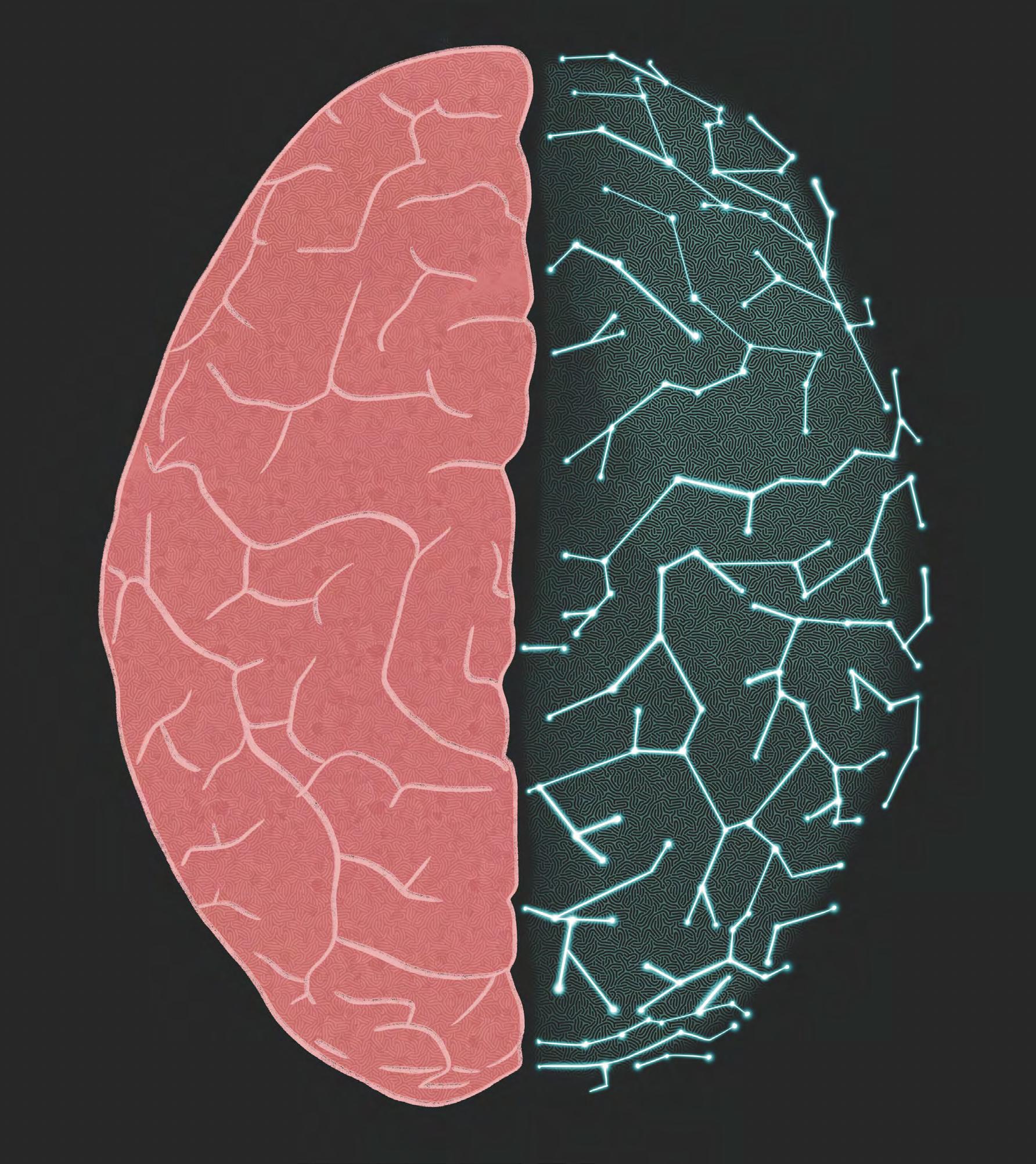
GRAPHICS EDITOR Emma Gillich graphics@themanitoban.com
GRAPHICS ASSOCIATE Teegan Gillich
AUDIO AND VIDEO
AUDIO EDITOR Max Reid audio@themanitoban.com
PHOTO EDITOR Mike Thiessen photo@themanitoban.com
PHOTO ASSOCIATE Ebunoluwa Akinbo
VIDEO EDITOR Zulkifl Rafah video@themanitoban.com
DIGITAL MEDIA EDITOR Faisal Rahman social@themanitoban.com
SOCIAL MEDIA ASSOCIATE Paula Robles Andia
REPORTERS
NEWS Arifah Gheesah
NEWS Nafisa Al Lilo
RESEARCH & TECHNOLOGY Nawal Semir
COMMENT Thandeka Katsika
COMMENT Kyra Campbell
ARTS & CULTURE Carrington Dong
ARTS & CULTURE Jordan Anglin
SPORTS Faiyaz Chowdhury
SPORTS Israel Abejoye
VOLUNTEERS
VOLUNTEER STAFF
Adam Johnston & Audrey Stotter
interested in volunteering?
email me@themanitoban.com today!
The Manitoban is the official student newspaper of the University of Manitoba. It is published monthly during the summer and each week of regular classes during the academic year by the Manitoban Newspaper Publications Corporation.
The Manitoban is an independent and democratic student organization, open to participation from all students. It exists to serve its readers as students and citizens.
The Manitoban is a member of the Canadian University Press, and our journalistic standards can be found on the Manitoban’s website.
The newspaper’s primary mandate is to report fairly and objectively on issues and events of importance and interest to the students of the University of Manitoba, to provide an open forum for the free expression and exchange of opinions and ideas and to stimulate meaningful debate on issues that affect or would otherwise be of interest to the student body and/ or society in general. The Manitoban serves as a training ground for students interested in any aspect of journalism.
Students and other interested parties are invited to contribute to any section of the newspaper. Please contact the appropriate editor for submission guidelines.
The Manitoban reserves the right to edit all submissions and will not publish any material deemed by its Editorial Board to be discriminatory, racist, sexist, homophobic or transphobic, ableist or libellous.
Opinions expressed in letters and articles are solely those of the authors. Editorials in the Manitoban are signed and represent the opinions of the writer(s), not necessarily those of the Manitoban staff, Editorial Board or the publisher.
A “volunteer staff” member is defined as a person who has had three volunteer articles, photographs or pieces of art of reasonable length and/ or substance published in the current publishing year of the Manitoban
Any individual who qualifies as a volunteer staff member must be voted in by a majority vote at a Manitoban editorial board meeting. Elected representatives and non-students may be excluded from holding votes as volunteer staff members in accordance with the Manitoban Constitution.
Grand Iftar unites Muslim student groups in Winnipeg
Campus collaboration raises funds for Sudan and builds community
Nafisa Al Lilo, staff
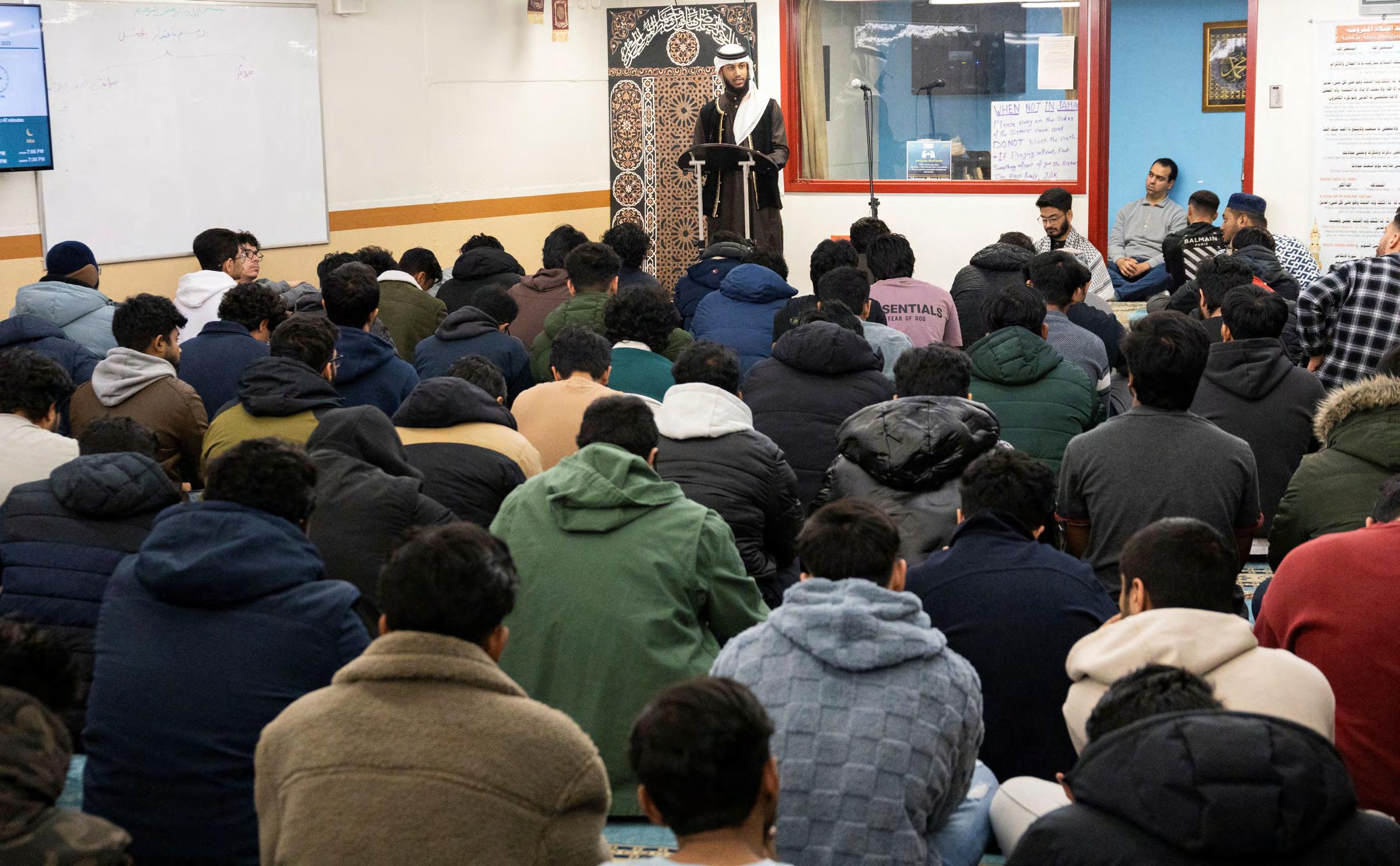
M uslim students from across Winnipeg campuses gathered on March 13 at the Dakota Community Centre for a large collaborative Grand Iftar that combined community-building, fundraising and Ramadan traditions.
The event, organized by the U of M Muslim Students’ Association (MSA), brought together eight student clubs from the U of M and the University of Winnipeg, along with two sponsors. Organizers say it was possibly one of the largest collaborative events of its kind for Muslim students on post-secondary campuses.
Rania Ibrahim, East African Student Association president, said the gathering was designed to bring Muslim students from different backgrounds together during the holy month.
“The Grand Iftar […] was a collaboration with eight student groups on campus representing diverse Muslim students,” Ibrahim explained. “We got sponsorship from Islamic Relief Canada and the International Community Centre to be able to put on this event to bring Muslim students together.”
The evening began with a Qur’an recitation, followed by welcoming remarks from representatives of each participating club. An Islamic lecture, or Halaqa, was also part of the program, then an auction occurred right before the fast was broken.
Aref AlAswad, who represented the Syrian Students’ Club (SSC) and co-hosted the
event, said each club contributed to the planning and logistics of the evening.
“Every club had [a] different role. Our club was mainly responsible for the food catering. Other clubs were responsible for the setting up, cleaning up, different roles, but [all of the] tasks were divided evenly,” AlAswad said.
One of the central features of the nighttime event was a charity auction. Each participating club contributed an item for attendees to bid on, with proceeds directed toward relief efforts in Sudan.
Adil Hayat, MSA external relations manager, said interest in the event was high, with tickets selling out before general sales opened.
“We actually sold out in early-bird, which is very rare,” Hayat said.
Hayat said the charity auction was one of the most memorable parts of the evening, especially since students knew the funds would go toward humanitarian aid.
“The best part is everybody did it for the sake of unity and donations and the proceeds going to Sudan,” he explained.
UMSU BOD meeting highlights
Tax, advocacy and
Arifah Gheesah, staff
The UMSU board of directors meeting on March 9 started with updates from Prabhnoor Singh, UMSU president. UMSU will host its fourth annual Free Tax Clinic from March 17 to April 2 at University Centre. The clinic, supported by more than 50 volunteers and the Canada Revenue Agency, will help students file simple tax returns at no cost. Last year’s clinic processed more than 1,100 returns.
UMSU is also working with student associations across Manitoba to formally establish Manitoba Students, a
student services
newly registered organization aimed at coordinating student advocacy across the province.
The initiative will bring together student union executives and staff to ensure advocacy efforts continue even as student leadership changes year to year.
Carolyn Wang, vice-president finance & operations, congratulated the newly elected 2026-27 UMSU executives and community representatives.
Heaven Kaur, vice-president university affairs, shared progress regarding reinstating international students’
healthcare. Though UMSU did not receive any response , their advocacy work continues. An update from the report is the university’s decision to create a permanent $300,000 annual budget line for menstrual equity initiatives across its three campuses. The announcement comes as Manitoba recently became the first province in Canada to require employers to provide menstrual products free of charge in workplaces.
“All the MSA brothers got together and bought a painting for $1,300.”
Faisal Shamim Zahed, MSA president, expressed that the Grand Iftar is also a way to recognize the volunteers who help run Ramadan programming throughout the month.
“The MSA does 30 days of iftar and 10 nights of free suhoor for everyone, where the team is heavily invested, especially the volunteers, working day and night,” Zahed said. “So, this is just a gesture for us to give it back to them and the crowd as well.”
Zahed said expanding partnerships with other student groups was a goal this year as the organization works to create a more inclusive campus community.
“I wanted MSA to be more diverse, more accepting and more welcoming to other people,” he explained. “Unfortunately, throughout the years, people have had a lot of negative notions about MSA, how it’s only for a specific set of people, a specific ethnicity, but I am trying to change that notion.”
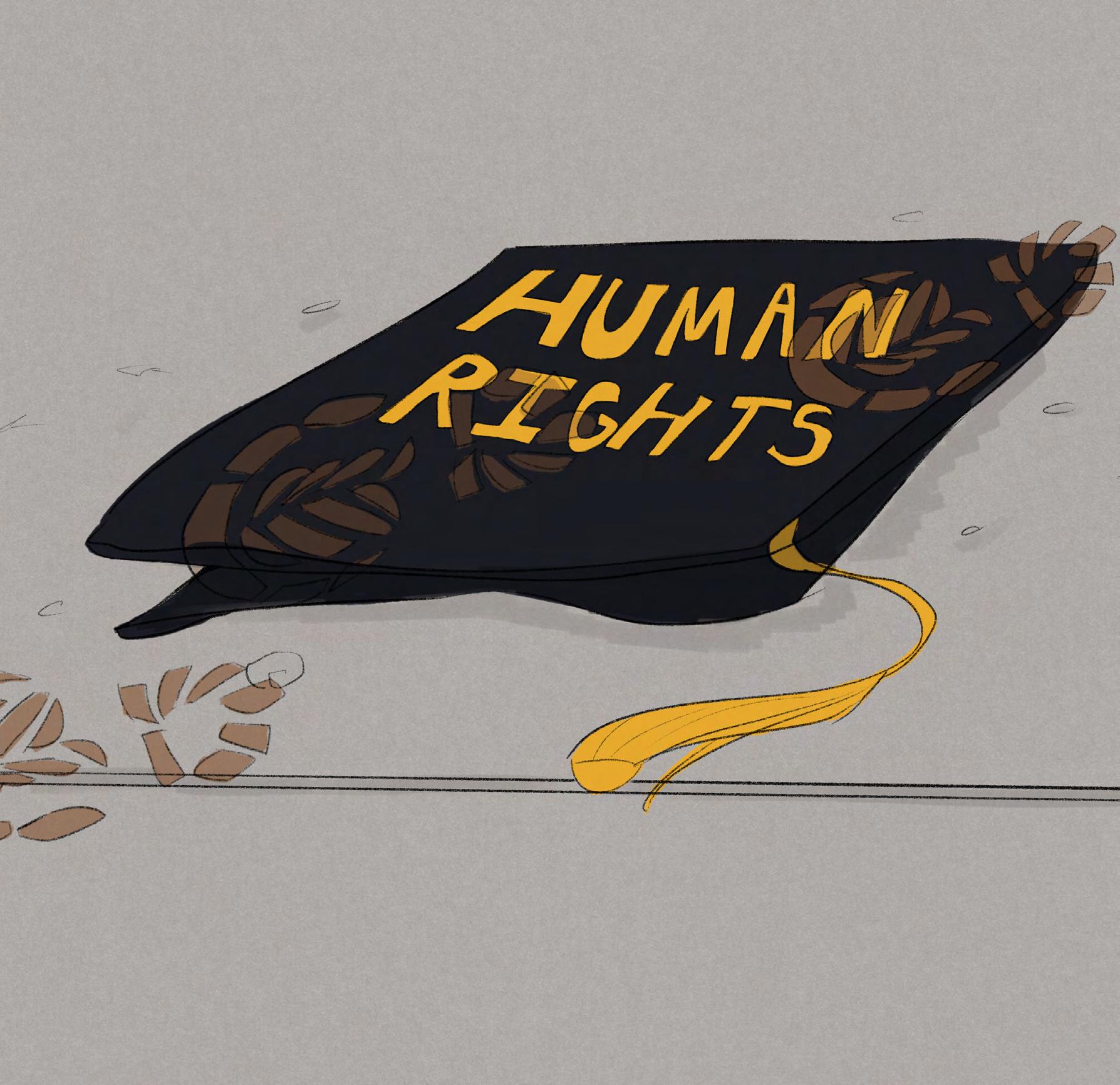
GRAPHIC BY TEEGAN GILLICH / STAFF
PHOTO BY EBUNOLUWA AKINBO / STAFF
U of M’s OET celebrates 20 years of challenging ableism
Reflecting on the journey since Convention on the Rights of Persons with Disabilities
Roy Albright Obah, staff
T
he U of M Office of Equity Transformation (OET) hosted an event on March 10 centred on disability as part of the broader conversation reflecting on 20 years since the adoption of the Convention on the Rights of Persons with Disabilities.
The event, which took place at the Fireside Lounge of UMSU University Centre, brought together keynote speakers, experts, panellists with lived experience and community organizations involved in disability advocacy and its related work.
Tina Mai Chen, vice-provost (equity), said the event aimed to amplify the voices of people with disabilities, noting that “over time, people with disabilities don’t always feel seen, valued or heard at the university.” She acknowledged that while there has been progress in addressing ableism, it remains incremental, describing it as always “step by step.”
Angie Conrad, the antiableism and age inclusivity specialist, explained the extensive work that went into organizing the event. “A lot of work [went into] connecting
with community members, connecting with folks here at the university […] or connecting with external community organizations [and] advocacy organizations, and really blending the two and creating a dialogue,” she said.
Conrad described the forum’s theme as “centring disability justice,” focusing on human rights, the Accessibility for Manitobans Act, the Human Rights Code and the lived experiences of people with disabilities.
Chen emphasized that meaningful progress requires recognizing ableism as a “system of oppression” that must be challenged alongside racism, sexism, homophobia and transphobia, and stressed the importance of consistently asking whether equity initiatives are also advancing disability justice.
Karen Sharma, executive director of the Manitoba Human Rights Commission, provided a provincial perspective on the rights of persons with disabilities.
Sharma presented on the shift over the 20th century from policies of institutionalization and segregation to a rights-based approach, sup -
ported by the Charter of Rights and Freedoms, the Manitoba Human Rights Code and provincial accessibility legislation.
Sharma also emphasized the importance of vigilance in protecting these rights. She noted that progress is not always linear and can face setbacks. “[Students with disabilities should] remember that your right to equity […] is entrenched in law, and that it has been through the collective work of people with disabilities that we’ve seen advancements in the law,” she said, urging continued advocacy to ensure future progress.
Amy Shawcross, director of advocacy and professional development with Inclusion Winnipeg, was also present to support the event, and she shared that her organization’s mission aligns closely with the goals of the one-day gathering.
Shawcross explained that the organization works to ensure that every person feels that they belong in their community and that they are cared for and supported in the ways that they need as an individual. “Every person belongs in their home communities with
the right supports and services around them,” she said, emphasizing the importance of inclusion and accessibility in building stronger communities.
Heidi Hutchison, president of People First of Manitoba, said advocacy efforts continue to push for stronger voices and greater autonomy for people with intellectual disabilities. While acknowledging that progress has been made, she emphasized that much work remains.
“We do have autonomy. We are given a chance to have our voice, but there’s 100 per cent still so much work to be done,” Hutchinson said, adding that she hopes continued advocacy will bring meaningful changes and greater self-determination in the years ahead.
Among the participants at the event was Bashiru Salifu, a PhD candidate in peace and conflict studies at the U of M, who attended to learn more about disability advocacy and inclusion. Salifu expressed the importance of meaningful inclusion in policymaking. “Nothing can be done without us,” he said, quoting a speaker who emphasized the need to involve people with disabil-
ities in decisions that affect them.
He also encouraged other students to expand their perspectives. “It’s very important for us to really broaden our horizon […] We don’t always have to just limit ourselves to what we are familiar with,” Salifu said.
Conrad encouraged students to engage, even if they do not identify with a specific community. “Be curious, ask questions, be human, be empathetic. Ask how you can support […] Join a group. Become part of the conversation.”
Shawcross outlined practical ways students and community members can support the organization’s work. “We look for volunteers all the time to help us out,” she said, explaining that as a nonprofit with limited funding, community support plays an important role.
Chen offered a message of support to the U of M community, affirming that people with disabilities “belong here [and] there really is a community here to support you,” and that difference is something the community should embrace.
Scholars shine at St. Paul’s recognition and reception
Annual event showcases faculty research, interdisciplinary ties ahead of centennial
Roy Albright Obah, staff
S
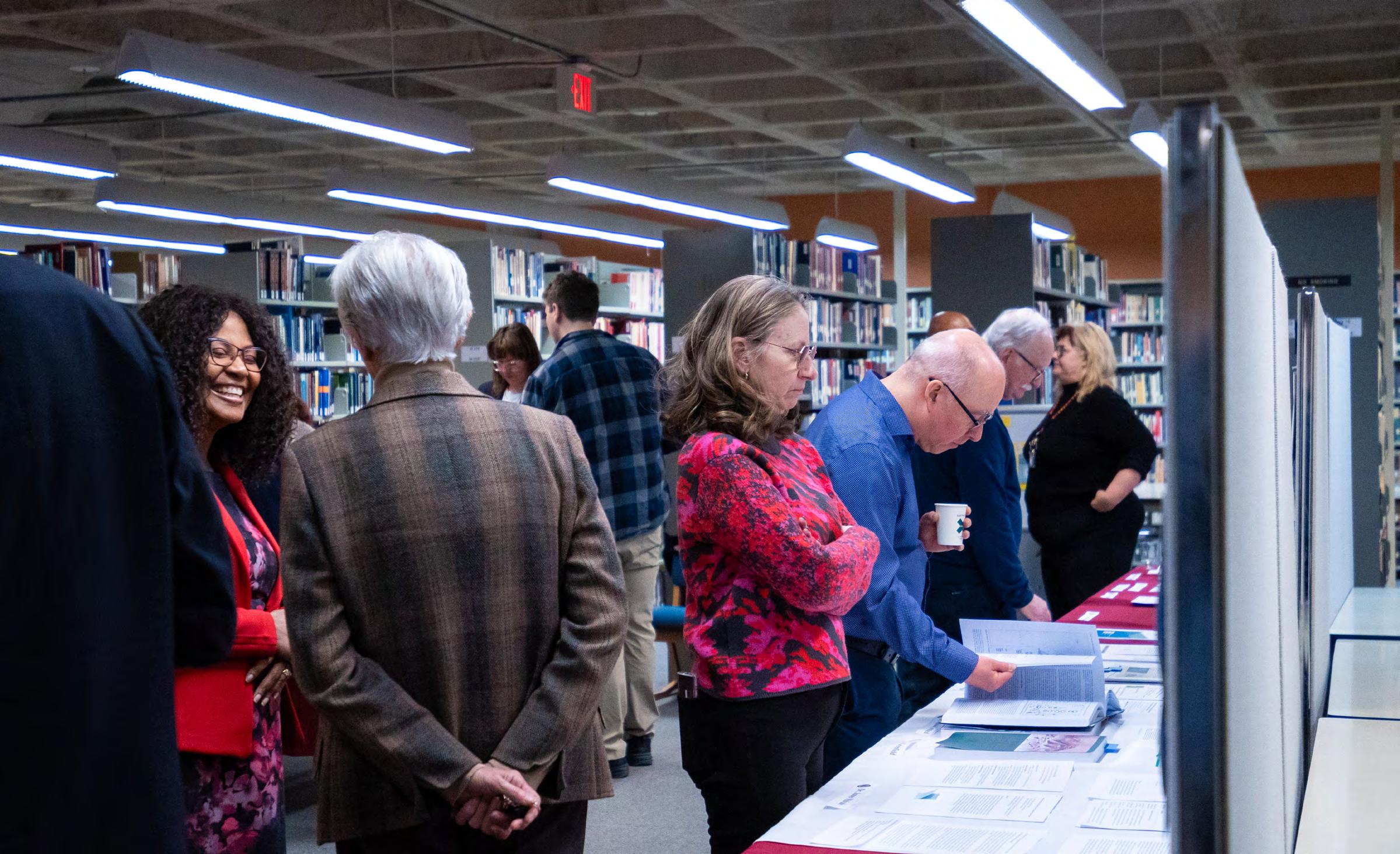
t. Paul’s College hosted its annual Scholars’ Recognition and Reception on March 12 at the Fr. Harold Drake Library, bringing together faculty members from across disciplines to present their research contributions over the past year.
Faculty members from diverse fields were invited to share brief presentations about their research projects, allowing attendees to gain insight into ongoing academic work.
Christopher Adams, rector of St. Paul’s College, said the event was intended to show the interdisciplinary nature of the college’s academic community and “highlight all the work that’s happening among [their] scholars.”
During the reception, each scholar was given two minutes to present their research. This offered a snapshot of topics ranging from genetics and agriculture to political science and religious studies.
According to Adams, the event reflects the college’s unique interdisciplinary environment where faculty members from various U of M departments collaborate and share ideas. The gathering also allows students and visitors to see the scope of research being conducted beyond the classroom.
Dilantha Fernando, dean of St. Paul’s College and professor in the faculty of agricultural and food sciences, emphasized that bringing researchers from different disciplines together can strengthen academic work. Interdisciplinary research allows scholars to “learn from each other” and build collaborations that can lead to new research proposals and solutions to real-world issues.
Meredith Bacola, associate professor in Catholic studies and acting director of the Jesuit Centre for Catholic Studies, said events like this provide an opportunity for students to learn about faculty members’ areas of expertise and the research they
conduct alongside teaching responsibilities.
“Sometimes they only see us as professors or staff members here within an institution,” Bacola said. “The other part of academic work is that we are all researchers or experts in our own field or discipline.”
For faculty members who would want to join the community, Fernando clarified that the college welcomes faculty from any department at U of M who are interested in contributing to its mission of social justice and community engagement.
Despite the impact of research, academics said balancing responsibilities can present challenges. Bacola pointed to time management as one of the difficulties scholars face. “The demands within a term, as our students know very well, are very cyclical,” she said, noting that faculty members often have to balance teaching, marking and administrative responsibilities while finding time to con-
duct research.
Researchers also emphasized that collaboration plays an important role in overcoming these challenges.
Maneka Malalgoda, assistant professor in the department of food and human nutritional sciences, said partnerships with other researchers can help advance projects by combining different areas of expertise.
Malalgoda shared one of her recent projects focusing on improving the nutritional value of bakery products by increasing fibre and protein content, reflecting growing consumer interest in nutrient-dense foods.
For students interested in pursuing research, scholars at the event encouraged curiosity and initiative. Bacola advised students to pursue topics that genuinely interest them. “Follow your passion,” she said, adding that curiosity often leads students toward meaningful careers.
Malalgoda also encouraged students to take advantage of
research opportunities offered by the university and funding agencies. “If you have the opportunity, I think students should definitely apply,” she said, encouraging students to reach out to professors whose work interests them.
Similarly, Haskel Greenfield, distinguished professor of anthropology, encouraged students to get involved by volunteering in research labs. “Find a professor that you want to work with and volunteer in their lab so that they get to know you,” he said as such connections can lead to future research opportunities and funding.
The college is set to celebrate its 100th anniversary, marking a century of academic scholarship, community engagement and interdisciplinary learning within the university community.
Fernando described the upcoming milestone as a reflection of a century of scholarship and collaboration. “[The] centennial means a lot because we have come a
long way, a hundred years of excellence in academics,” he said. The centennial celebrations are expected to begin in September 2026 and continue through the 2026-27 academic year, featuring scholarly and community events that celebrate the college’s history and contributions to the U of M community.
Students, alumni, faculty and community members who wish to take part in this celebration are invited to scan the QR code to explore the various ways to get involved.
PHOTO BY MIKAELA WARKENTIN / STAFF
FACULTY MEMBERS FROM ACROSS DISCIPLINES SHARED THEIR RESEARCH FROM THE PAST YEAR AT THE ST. PAUL’S COLLEGE SCHOLAR’S RECOGNITION AND RECEPTION
Research & Technology
AI use in immigration processing
IRCC releases its new artificial intelligence strategy
Nawal Semir, staff
I
mmigration, Refugees and Citizenship Canada (IRCC) has officially rolled out a formal strategy governing its use of artificial intelligence (AI), signaling that the technology is now deeply embedded in the country’s immigration processing machinery after more than a decade of experimentation. Since first deploying AI tools in 2013 and expanding to machine learning in 2018, the department has quietly used automated systems to assess over seven million applications, primarily to triage cases and flag straightforward files for faster officer review while directing more complex matters to human staff.
Currently, AI handles significant volumes of routine administrative work, including triaging roughly four million emails annually through client support centres and powering “Quaid,” a chatbot that responds to about 80 per cent of basic online inquiries without human involvement. The department is also testing more intrusive applications, including fraud detection tools designed to scan documents for anomalies and predictive analytics that would recommend settlement locations to economic immigrants based on past earnings data and regional economic indicators.
However, officials claim that all systems operate under strict limitations. They further emphasized that no AI is permitted to refuse an application, final decisions remain with human officers and the department avoids “black box” models that cannot provide clear explanations for their outputs. The newly published strategy outlines ongoing efforts to monitor these tools for bias, protect private data and maintain human oversight. However, critics noted that the growing reliance on automation raises persistent questions about transparency and the potential for embedded discrimination in systems processing millions of vulnerable applicants.
As the department pushes forward with experiments in generative AI and advanced analytics, it faces the delicate task of balancing operational efficiency against the life-altering consequences of its decisions.
While the Canadian government has been formalizing its approach to AI in immigration, applicants are increas-
ingly turning to the tool to informally aid in the navigation of the nation’s immigration landscape. Many newcomers are using AI to draft crucial documents such as submission letters and to conduct research on which immigration pathway might suit them best, often as a cost-saving measure when they cannot afford legal representation.
The most frequently accessible AI systems to these applicants are usually general-purpose chatbots like ChatGPT. However, increased usage carries significant risks, as these general chatbots are trained on broad datasets and are not reliable for high-stakes legal matters. They frequently “hallucinate” information, generating confident sounding but entirely fictitious court cases and laws — a problem highlighted recently when 31 Cameroonian applicants cited the same non-existent case law in their applications. While specialized legal tools exist, the average applicant’s reliance
on generic chatbots threatens to undermine the system’s integrity and jeopardize individual cases.
Unlike Canada’s relatively cautious approach focused on triaging applications and reducing processing backlogs, the U.S. Department of Homeland Security has built what critics describe as a sprawling surveillance infrastructure that increasingly targets not just undocumented immigrants but American citizens who exercise their First Amendment rights. The contrast could hardly be starker — while IRCC explicitly prohibits AI from refusing applications and maintains human oversight, United States Immigration and Customs Enforcement (ICE) has deployed AI tools that help identify, track and detain people with deadly consequences.
The human toll of this technological arms race is already visible. Since September 2025, ICE and U.S. Customs and Border Protection (CBP) agents have shot four-
teen people, resulting in four deaths, including two U.S. citizens, Renée Good and Alex Pretti, both killed in January 2026. In Good’s case, an ICE agent was recording her on a cellphone moments before fatally shooting her as she observed agents from inside her SUV. The violence has sparked rare public dissent within the tech industry itself. Nearly 1,000 Google employees signed a letter condemning the violent law enforcement actions of ICE and CBP, expressing horror at the killings and demanding the company disclose and terminate its contracts with these agencies.
The contrast between these cases raised an important question — whether AI serves as a tool to assist overwhelmed immigration systems or becomes a weapon turned against the people those systems are meant to serve.
For Canada, the challenge lies in ensuring its cautious approach does not become
an excuse for complacency, allowing bias to creep in under the guise of efficiency. The department’s reliance on automation to process millions of applications demands continuous scrutiny, not just periodic reassurances. Alternatively, for the U.S., the question is whether the surveillance infrastructure now being built can ever be meaningfully restrained or whether the country has already crossed a line that makes accountability nearly impossible.
What is clear is that the immigration debate is no longer just about borders and backlogs. It is about surveillance, data collection and, as the deaths in Minneapolis and the application backlogs in Ottawa make plain, the consequences of getting it wrong are not theoretical. They are measured in ruined lives, broken families and a fundamental erosion of trust in the institutions meant to serve the public.
GRAPHIC BY TEEGAN GILLICH / STAFF
Inside the mind
Understanding how meaning emerges from memory
Mansura Akter Meghla, staff
U
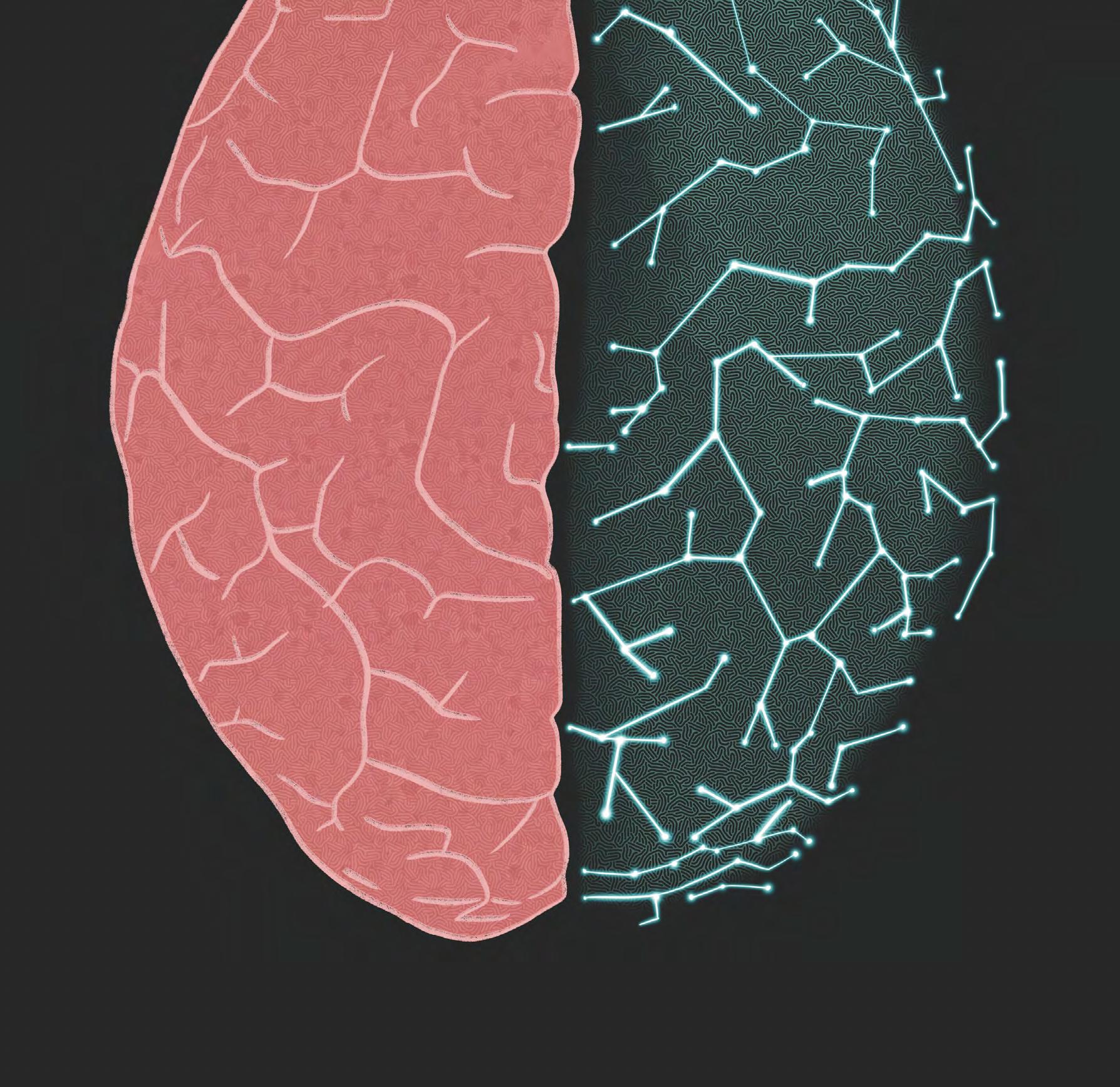
nderstanding how people think might seem abstract, but for Randy Jamieson, it is a question that sits at the centre of human intelligence and, increasingly, the future of artificial intelligence (AI).
Jamieson, a U of M professor of brain and cognitive sciences in the department of psychology, studies how
people learn, remember and understand language. Using laboratory experiments and computational modelling, his research examines how meaning forms in the human mind.
While his work intersects with AI, Jamieson said his focus is not on building technologies. “I’m really focused on understanding how people work,” he said.
Jamieson’s interest in cog-
nitive science began in the 1990s while studying auditory cognition and music perception during his master’s degree in auditory cognition. During that time, he encountered computational psychology — a field that uses computer models to simulate human thinking. The discovery reshaped his academic path.
“I switched over for my PhD
to study how people learn artificial languages,” he said.
That work later expanded into natural language processing, a field that underpins large language models (LLMs) and modern AI systems. Although the recent surge in AI development has drawn attention to machine language systems, Jamieson believes insights from psychology remain crucial.
“I’m really excited about integrating what we know about how the human mind works to build cognitive machines that are more psychologically like us,” he said. “It’s a very interesting moment in cognitive history.”
One of Jamieson’s major research projects explores how humans construct meaning from language experiences.
In 2018, his team developed what he calls an “instancebased model of semantic cognition.” Unlike many AI systems that assign fixed representations to words, the model assumes people remember individual language experiences and construct meaning dynamically.
“The modern LLM approach is to develop methods for machine representations of words, one for each word,” Jamieson said. However, his model proposes a different process. “In my approach, I assume that people remember each of their individual language experiences and that the brain constructs a momentary meaning by ad hoc parallel retrieval,” he said.
The model has already shown promising results. Jamieson believes that it can successfully predict how people interpret words and judge meaning in experimental settings. “Humans are more like a meaning making
machine than a machine that stores and retrieves words,” he explained. Recent discussions in the field suggest that this instance-based perspective might overlap with the architecture of modern AI systems, he noted.
Beyond theoretical modelling, Jamieson’s lab is also investigating everyday cognitive experiences, including the frustrating moment when a word seems just out of reach.
One of his graduate students is currently studying the “tip-of-the-tongue” phenomenon, where people feel certain they know a word but cannot fully recall it. These moments reveal surprising details about how memory works. Even when people cannot recall a word, they often remember pieces of information about it. “How can people claim they don’t know the word and yet tell you the word starts with an ‘s’ sound and has three syllables[?]” Jamieson asked.
By modelling these states computationally, researchers hope to better understand how knowledge moves between awareness and memory.
“We’re excited about getting that down in a computational model, to figure out how words come to mind, recede and hang around in intermediate knowledge states at the experiential and threshold of consciousness,” he said.
For Jamieson, the main goal of his work is not technological innovation but intellectual contribution.
“All I ever wanted was to be a part of the history of ideas,” he said. “I hope the things we’ve been thinking about are interesting to others and might even help them to step forward into even more interesting ideas.”
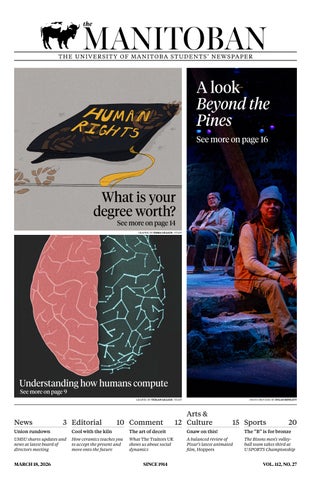
GRAPHIC BY TEEGAN GILLICH / STAFF
Ceramics is the art of acceptance
Understanding the limited control in the outcome of ceramic works
Emma Gillich, staff
If there is one thing ceramic artists can agree on, it is that you have to be ready for any and all outcomes. I spend weeks on the work that I do, and I know that it could go wrong at any point.
I have watched works be knocked to the ground and shatter, fall off the wall and smash into a thousand tiny pieces or break right in half when it was carried wrong. There is no silence quite like the one that follows in the studio when there’s an unexplained crashing sound. It is disappointing to have the outcome of such hard work end so abruptly.
However, I have never seen acceptance come faster than after a work is broken. There is nothing to be done except to move forward and there is no going back to how it was before. The best thing to do is
to try again. I employ that same philosophy with my own work — whatever happens happens. It often happens that a crack will mysteriously appear overnight, or the clay will warp or sag or any number of things will go wrong. More often than not, damage control is what I become preoccupied with. Even after taking delicate care to ensure the best chance of success, there is no guarantee that it will be okay at the end. It is a cathartic experience. Before every firing, I lean over the kiln and look at my work one last time, remembering it exactly as it was in that moment because when I see it again it will never be the same. I close the lid and accept that there is no going back, I can’t hit the brakes on it now.
Even when things don’t turn out as planned, I have learned that there is still much
to gain from a bad outcome. I learn the limits of my techniques, what needs fine-tuning and what I can do better next time.
There’s no possible way to control the exact outcome — it may work, it may not. Maybe it will be beautiful or horrifically ugly. Does it feel like a personal betrayal when my work has a crack or doesn’t work out? It does! But for a little while. I knew it could happen anytime, but acceptance swiftly follows.
I am of the opinion that when you’re unhappy with an artwork, it’s best to tuck it away for a while before looking at it again. When I pull it out again, I look at it with much kinder eyes. Maybe it’s not what I wanted, but that’s okay. Its existence is proof that I exist, and isn’t that a wonderful thing?
To complete Sudoku, fill the board by entering numbers 1 to 9 such that each row, column, and 3x3 box contains every number uniquely. In Straights, like Sudoku, no single number 1 to 9 can repeat in any row or column. But rows and columns are divided by black squares into compartments. Each compartment must form a “straight.” A straight is a set of numbers with no gaps but it can be in any order, eg [7,6,9,8]. Clues in black cells remove that number as an option in that row and column, and are not part of any straight. Glance at the solution to see how “straights” are formed.
Re: It pays to be informed
U
of M student responds to March 4 article
Cole Dimitroff
D ear Editor,
Thomas Gray wrote that “where ignorance is bliss, it is folly to be wise.” I do not believe in ignorance, yet I have begun to understand what he meant.
I have stayed informed. I have read everything I could, voiced everything I could and listened to every voice the article says I should. And the world kept burning anyway.
What staying informed has given me, more than anything, is grief. A daily sadness that spills into my relationships, my family, and my community.
For me, living with OCD means every headline about the sixth extinction or war
crimes does not stay as information. It becomes a weight I carry all day. What the news reminds me of, more than anything, is how powerless I am to stop any of it.
For some people, chronic news consumption becomes something closer to drowning, a slow erosion of the ability to function, connect, or feel hope. We are not weak for feeling this. We are human. You cannot pour from an empty cup.
There is also a deeper harm the article does not address.
As a Métis person, I have watched media, even well-intentioned media, treat First Nations, Inuit, and Métis peoples as subject matter.
Our land, our history, our lives framed as issues to dis-
cuss rather than realities to respect. When you see your people reduced to a headline every day, it does something to you. Not because you stop caring, but because caring starts to cost too much.
Staying informed, through a system that has rarely covered Indigenous peoples fairly for example, asks me and other Métis, Inuit, and First Nations people to absorb that harm in the name of civic duty. That is not a reasonable ask.
To note, this is not an experience unique to Indigenous peoples. The intersection of race, identity, and other characteristics that make a human a human through history means the news is rarely a neutral source of information for many of us. It arrives
loaded with context that reminds you, again, of where you stand in the world. There is meaningful trauma in that.
Shamefully I will quote Billy Joel where he once sang, “We didn’t start the fire, it was always burning.” From what I gather from Billy, being asked to watch it endlessly does not put it out. It just burns you too.
Staying informed matters, and I believe in journalism. But choosing to step
Charisma, social perception and traitors
away is not always ignorance. For many, it is a response to trauma delivered through the very outlets asking us to keep watching.
Merci beaucoup,
Cole Dimitroff (he/him) BSW StudentFort Garry Program
The University of Manitoba
What The Traitors UK season two reveals about popularity and accountability
Thandeka Katsika, staff
In reality television competitions, social dynamics often reveal how strongly charisma and popularity can influence the way people judge behaviour. A good example of this is in season two of The Traitors UK, particularly the way in which contestant Paul Gordon’s actions are received by the rest of the contestants.
In The Traitors UK, contestants must work together to identify the traitors among them while the traitors attempt to secretly manipulate the group and eliminate others from the game. Because the game relies heavily on trust and social perception, players who build strong relationships often gain a significant advantage.
The show itself is built around deception, strategy and social manipulation. As such, I think it makes a useful case study for understanding how personality traits, such as charm and sociability, are able to shape the way in which people interpret each other’s actions. I think Gordon’s role on the show helps illustrate how charismatic individuals can sometimes receive more forgiveness and support for questionable behaviour than people who have less social influence.
I acknowledge that Gordon played a deceptive and manipulative game, as he should. However, when other contestants displayed sus-
picious or strategic behaviour, they were often quickly targeted or criticized by the group. By contrast, Gordon frequently received the benefit of the doubt, and many players continued to trust him even when evidence was suggesting he may not have been acting honestly. His sociable personality and ability to connect with others seemed to shield him from the level of scrutiny that the other contestants received.
This dynamic reflects a broader psychological phenomenon that some people refer to as the “halo effect.” This is when people’s positive impressions of a person in one area, such as their friendliness or listening ability, influence their overall perception of the person. In Gordon’s case, I think his outgoing personality and social confidence made others more likely to interpret his behaviour as positive rather than suspicious or “traitorous.” Instead of viewing his actions as manipulative, many contestants framed them as just being a part of his outgoing personality.

What makes this even more interesting is that we can observe the same pattern outside of reality television. In many cases, I have witnessed that people who are highly charismatic are sometimes defended even when their actions should be widely criticized. Their supporters may downplay their negative behavior, reinterpret events to
make them more favourable or even argue that people are being too critical or overreacting. I have observed that charisma can function as a kind of social protection that shapes how audiences interpret a person’s behaviour.
The same thing is observed on social media, particularly with influencers, celebrities and public figures who are charming and have strong fanbase. Because fans feel emotionally connected to them, they are more likely to defend them when controversies arise. Even when an individual is dead wrong, people find an excuse to defend their behaviour or downplay it as being “not that deep.”
The environment of The Traitors UK makes these
dynamics clear because, as viewers, we can observe the social relationships between contestants in both high-pressure and low-pressure situations. When trust, suspicion and group opinion interact, personality traits like charisma can significantly influence the group’s collective decision-making. During a number of occasions where a traitor like Gordon should have been voted out, we see players who are less socially strong get voted out instead.
Gordon’s role in The Traitors UK season two demonstrates how powerful these social factors can be. Even when his actions could be interpreted as manipulative or self-serving, his strong social presence allowed him
to maintain influence within the group for a significant portion of the game. I would also like to contrast Gordon’s appearance as a traitor with Jaz Singh, who served as a faithful within the game. Singh managed to correctly identify every traitor in the game, but because he was less socially persuasive, no one believed him. The reactions toward both these contestants expose how charisma can shape social perception and cause people to overlook behaviours they ordinarily would question.
Ultimately, The Traitors UK provides a small but revealing example of how social dynamics operate more broadly in society.
GRAPHIC BY EMMA GILLICH / STAFF
Bold vision for Winnipeg
Why Winnipeg city council needs a progressive shift in the next municipal election
Adam Johnston, volunteer staff
W innipeg heads to the municipal polls this October as years of fiscal mismanagement come to an end. Property taxes, water and sewer rates and transit fares keep rising while services decline and roads crumble. Yet the city plans to pour over $1 billion into road expansions on Kenaston Boulevard and Chief Peguis Trail, despite the challenges we face with poverty, crime, equity and a changing climate. This election will test whether the City of Winnipeg’s mayoral and council candidates can offer a progressive, sustainable vision for a city that works for everyone.
Winnipeg needs to take big bites out of its climate ambitions, not keep nibbling at the edges. Nearly half of Winnipeg’s emissions come from transportation, dominated by private vehicles, even as the city aims for a 50 per cent sustainable mode share by 2050. Still, major road expan-
sions outrank investments in transit, active transportation and climate resilience. With an infrastructure deficit expected to run into billions for years, candidates must offer a vision that strengthens inner-city communities and builds sustainable economic opportunities rather than deepening sprawl.
Mayoral and council candidates who treat Winnipeg Transit as an essential public service can unlock its full potential as an equalizer for those who rely on it more frequently — youth, BIPOC, disabled people and women. These riders are hit hardest when service is cut or fares rise. Civic leaders should champion stable multiyear funding, stronger evening and weekend service on major routes, bus-only lanes, an accelerated Transit Master Plan, frozen fares and a path toward fare-free transit for youth, seniors and low-income riders. Candidates who advance this vision position transit as a core affordability
tool, delivering equitable, reliable mobility for those who need it most.
Winnipeg’s active transportation network still feels like a jigsaw puzzle — fragmented, inconsistent and forcing people into unsafe gaps. Completing it is one of the most affordable, climate-resilient investments the city can make. Redirecting funds from major road expansions toward a fully connected, year-round-maintained network would give residents a low-cost alternative to driving and cut transportation emissions. Linking protected bike lanes with river-trail pathways strengthens neighbourhoods, boosts local economies and supports healthier, more climate-ready communities.
Poor land-use planning has pushed Winnipeg toward a car-centric, unaffordable and unsustainable model. As local writer Michel Durand-Wood warned, “The cold, hard reality is this: there isn’t enough money to maintain everything our city owns, not even
close. And there never will be. Not as long as we keep pretending there is.” Candidates seeking the mayor’s chair or a council seat need to level with residents about our finances.
Winnipeg cannot afford massive road expansions, we need to redirect scarce dollars toward what strengthens the city — better transit and active transportation, repairing roads and pipes in mature neighbourhoods, adding wading pools and expanding library hours. These investments build a healthier, more resilient and more affordable city for everyone.
Winnipeggers are demanding real solutions — ones that make life more affordable, cut emissions and build a city that can withstand the climate realities already at our doorstep. Voters this October deserve more than recycled talking points. They deserve leaders willing to make hard choices and
reject the status quo that has held us back. The next council must choose a path that strengthens neighbourhoods, lowers costs and delivers a climate-ready Winnipeg. Future generations will judge us by whether we acted with courage or avoided the truth.
Adam Johnston hosts “Not Necessarily The Automobile” on Thursdays at 11:30 a.m. on UMFM 101.5. He can be reached at notnecessarilytheautomobile@gmail. com.
The Manitoban horoscope for the week of March 16
Zodiac sign mania, flip a coin and see your fate
Quinn Mayhew, staff
AQUARIUS
January 20 –February 18
Aquarius, go take a break. This week is going to feel very long for you. Try to counteract that by going for a long walk, going to the aquarium or taking yourself on a mental health shopping spree
PISCES
February 19 –March 20
Pisces, not everything is about you. You need to listen to what people are trying to tell you. You guys are kind-hearted but have been neglecting your
friends for your relationships. It is time to recognize this and make amends
ARIES
March 21 –April 19
Aries, you reap what you sow. You need to be careful this week. Your actions may have long-lasting consequences if you don’t consider other people’s feelings.
eating the Caesar salad your friend’s grandma made, as it may upset your stomach. Make sure you pay attention this week, whether it’s your schoolwork or your job, and you might get recognized for your efforts.
TAURUS
April 20 –May 20
Taurus, what are we going to do with you? This week is going to be interesting for different reasons. At the beginning of the week, you may get a message from a friend you haven’t spoken to in a while. While nearing the end of the week, you may experience fatigue due to family
GEMINI
May 21 –
June 20
Geminis, I have one piece of advice for this week — avoid
CANCER
June 21 –July 22
Cancers, do not eat the 3 a.m. cabbage. Take chances this week. Instead of playing it safe all the time, take a chance on yourself. Believe in yourself instead of doubting things you are more than capable of tackling.
LEO
July 23 –August 22
Leo, please take a deep breath and now order yourself some McDonald’s. This week is going to be a rough one. Family may be a source of distress for you rather than a source of support. Make sure you protect yourself emotionally.
VIRGO
August 23 –September 22
Virgos, go to the doctor about that cold you’ve convinced yourself is still going on without medical intervention. Stop trying to cure yourself through essential oils, they can only do so much
ing things. You need to stop before your bank account is drained.
LIBRA
September 23 –October 22
Bonjour, Libras! Stop avoiding tasks that bring you anxiety. You can’t always bury your problems or pretend they don’t exist by orienting your existence toward other things or focusing on what others (friends or partner) may need. Just because we ignore a problem doesn’t mean it’s not there.
SAGITTARIUS
November 22 –December 21
Do not become a mascot for your local university. You may feel the urge to give in to your impulses to become a public figure, but let me be the one to tell you — you do not have time for that.
CAPRICORN December 22 –January 19
Capricorns, do not eat the strawberries that grow on the side of the road. Just because things look better on the other side doesn’t mean they are. Be careful of who you trust.
SCORPIO
October 23 –November 21
Scorpios, you may not help yourself to the last deepfried pickle in the fridge. You have disregarded my advice from last week to stop buyGRAPHICS BY EMMA GILLICH /
GRAPHIC BY EMMA GILLICH / STAFF
Who decided your degree was worthless?
Governments keep cutting the work that makes society more just and livable
Kyra Campbell, staff
F or years, students in the arts, humanities, environmental studies and other degrees that do not lead neatly to one obvious job have been met with the same smug question — “What are you going to do with that degree?” The question pretends to be sensible, but more often serves to police ambition, curiosity and value.
It suggests that education is only worthwhile if it can be translated into a familiar salary, a clearly marketable career or a job title that impresses other people at dinner. At a moment when governments are making student support more precarious, that question feels even more insulting. It shows up when Doug Ford dismisses students with lines about “basket weaving” courses, and when the federal government claims to care about the climate, but keeps cutting the research, scientific capacity and public investment that would let people work on protecting it.
The problem is not that too
many young people are studying the wrong things. It is that we have built a political culture that wills them to be practical while shrinking the grants, institutions and public sectors that would let meaningful work exist.
My degree is in human rights, and I would love to spend my career helping to protect and advance them, especially at a time when we are confronted with human rights crises and injustices, both close to home and around the world. But that requires governments, institutions and employers to care enough to fund the work, sustain the programs and treat labour as necessary rather than ornamental.
The same is true for people who study the environment, work in museums or libraries, pursue writing or build careers in the arts. This is no longer just a gap between words and action. Governments are moving in the wrong direction, cutting support, weakening institutions and treating work tied to human rights,
the environment, culture and public life as expendable.
This is why the lazy joke about the “useless degree” wears so thin. It turns a political failure into a personal one. Instead of asking why meaningful work has become harder to fund, sustain or even imagine, the burden is placed on students to justify their interests as if the real problem were poor choices rather than a shrinking public vision.
Along with the discussion about jobs, it is also about what kinds of knowledge and values are treated as legitimate. The contempt for certain degrees often reflects an older worldview, one more comfortable with conformity, hierarchy and economic usefulness than with critical thinking, social change or work aimed at making public life more just and decent.
Part of what makes this rhetoric so frustrating is that it narrows education into obedience. It treats learning only as worthwhile as far as it supports the kind of order governments prefer, rather than
when it supports fields and areas they gut or demonize.
Trades, healthcare, engineering — they all matter. Skilled labour keeps the country running. But it is a failure to treat them like they are the only legitimate destinations for “serious” students.
A good society needs more than what can be measured in quarterly outputs. It needs archivists, artists, conservationists, writers, librarians, advocates and researchers. It needs people who preserve memory, protect dignity, explain the world and make life richer than work alone. Education should not be limited to addressing labour shortages. It should also be building a society worth living in.
This is part of what so many people in my generation are reacting against. More and more young people understand that employers do not automatically reward loyalty, that hard work does not reliably produce stability and the distance between effort and job security keeps grow-
ing. In that environment, being told to choose a more “useful” degree feels less like advice and more like a lecture from people who have no intention to support the many kinds of work a healthy society depends on.
What frustrates me most is how narrow the whole conversation has become. The world does not exist just for us to work. It is also about enjoying the planet we are on, preserving culture, understanding history, creating joy, asking difficult questions and imagining something better than permanent exhaustion in service of someone else’s bottom line.
The issue is not that young people expect too much. It is that the government keeps asking them to expect less — less support, less beauty, less imagination, less hope — all in the name of economic necessity. But, a society cannot cut its way to meaning. If we want a better world, we cannot stay complacent while the things that make it worth living in are treated as dispensable.
GRAPHIC BY EMMA GILLICH / STAFF
Hoppers is pretty “dam” good
Pixar gets political in beaver-themed environmentalist film
Boris Tsun Hang Leung, staff
Pixar released their latest sci-fi comedy Hoppers earlier this month. Directed by Daniel Chong, the creator of the popular cartoon We Bare Bears, this whimsical, sometimes unhinged beaver-centred environmentalist film is entertaining, but also surprisingly philosophical and anti-establishment.
The film follows Mabel (voiced by Piper Curda), a nineteen-year-old animal-loving university student and environmental activist in Beaverton. She grew up at her grandmother’s house, spending much of her time admiring the wildlife in a nearby glade. One day, to Mabel’s distress, Beaverton Mayor Jerry (Jon Hamm) decides to build an overpass in the area, draining the glade and displacing the animals.
Mabel eventually discovers that her professors have created a “hopping” technology that allows people to transport their consciousness into lifelike robot animals. Determined to save the glade and bring the wildlife back, she hijacks the professors’ project and hops into a beaver model to rally the animals. However, in the process, the outspoken teenager inadvertently sparks an uprising in the animal kingdom, which now wants to assassinate Jerry.
Truthfully, some of the Pixar releases of this decade have been rather lackluster. Moreover, the environmentalist theme has already been explored in WALL·E, and the hopping technology in Hoppers is suspiciously similar to that of Avatar, prompting one Letterboxd user to call the film “Avatar (2009) for furries.”
However, I enjoyed the film, and there are things that Hoppers does well. The rotund and plush design of the animals are delightful, and the beavers, particularly King George and Loaf, are charismatic and endearing. The plot keeps the audience on their toes as well, with a climax that made the whole theatre gasp.
The film tackles relevant and important topics, depicting habitat loss due to human encroachment in a fun and digestible way. It highlights the interconnectedness and value of all beings, a notion known as deep ecology. The animals even see humans as their equals despite the destruction of their glade, before they got radicalized by Mabel.
Hoppers reminds viewers that non-human animals have agency, which must be recognized and respected. In both the movie and in real life, beaver dams create wet ecosystems that can stop forest fires. While animals in real
life cannot exactly conspire the assassination of a politician, the film teaches that bad things can happen when capitalistic hubris oversteps boundaries.
Lastly, the film depicts a young person as a driver of social change on the front lines of conservation. Mabel is not afraid to take initiative, even if it means doing it alone. Although she accidentally incites violence against Jerry, she takes accountability and unites the human and non-human worlds in the end.
Unfortunately, the Moana-esque grandmother
arc in the film feels shallow and cliché. The film’s art style and slapstick humour work well with children, but the ending derails into absurdity and uncanny body horror, which will likely frighten younger audiences. It is, however, still less unnerving than the blue humanoids in Avatar It is also hard to overlook the irony of Pixar, owned by the multibillion-dollar Walt Disney Company, producing an anti-establishment film. Despite pledges of sustainability and donations to conservation efforts, it came to light in
2021 that Disney is part of a lobby group that fights against climate legislation in the U.S. — a rude awakening from the kumbaya ending in Hoppers Can Hoppers top animal-themed Pixar classics such as Finding Nemo and Ratatouille? Probably not, but it is one of the more memorable and charming films to have come out in recent years. For those interested in animated films, environmentalism and lovable beavers, Hoppers might be the right log for you to chew on.
GAEREA’s Loss a thrilling work of melodic metal Portuguese black metal band creates contrast in upcoming release
Carrington Dong, staff
Portuguese masked band GAEREA’s upcoming album, Loss, marks a shift from their earlier work. Their first album to be released through new label Century Media Records, Loss, focuses on personal experiences while maintaining their signature heavy-hitting sound.
Speaking to V13’s Graham Finney, the group’s frontman, known only as Alpha, said that the album was inspired by his personal experiences.
“I learned that, when you write songs to express something buried within yourself, it doesn’t mean everything goes away and is resolved just because you wrote about it. It’s a journey. Some things you will always feel,” Alpha said. “Writing is a coping mechanism, something you do for
yourself to help you deal with it and view things from a different perspective.”
Even though I am not a diehard metal enthusiast, I found the album intriguing and moving. The contrast between the melodic aspects and soulful vocals with trademark heavy metal screams and loud instrumentals was executed well and I enjoyed it, with certain tracks standing out.
Loss opens strong with “Luminary,” which features heavy synths and combines a melodic guitar with the band’s established black metal sound. It is an opening that gives a clear glimpse of what is to come throughout the rest of the album.
The closing track “Stardust” is my favourite song on Loss. At nearly eight minutes, the longest on the album, the
song perfectly captures the balance of the album between soft and hard. The haunting, melodic vocals tell the story of someone longing for a loved one and feeling an emptiness without them. Then, partway through the song, the beat drops and the screams and heavy instrumentals return, the rest of the song feeling like an angry cry for the lost loved one. It is a perfect way to close out the album.
Other standout tracks include “Submerged,” which opens with delicate piano keys and whispers before unleashing into loud guitar riffs and powerful drums with powerful, raspy scream vocals, and the softer “LBRNTH,” which feels like a walk through a labyrinth with slow, patterned drums and an ethereal female vocal. As one of the few songs that remains relatively soft, it leaves a lasting impression.
For those who love hard-hitting metal and emotional storytelling in music, there is plenty to be found on GAEREA’s Loss. It is well worth a listen.
GAEREA’s fifth full-length album, Loss, will be released on March 20. For more information, visit gaerea.com or follow the band on Instagram @gaerea_.
PHOTO COURTESY OF IMDB
PHOTO COURTESY OF BANDCAMP
HOPPERS (2026).
GAEREA - LOSS (2026).
RMTC premieres In the Shadow Beyond the Pines
A chat with Indigenous playwright Rhonda Apetagon and review of the horror play
Carrington Dong and Jordan Anglin, staff
Interview by Carrington Dong
F or the final Tom Hendry Warehouse play of its 2025-26 season, Royal Manitoba Theatre Centre (RMTC) presents the world premiere of In the Shadow Beyond the Pines.
Written by Indigenous playwright and artist Rhonda Apetagon and directed by Jimmy Blais, the play takes place in the wilderness of northern Manitoba. In RMTC’s words, it “explores the shadows of Indigenous life and lore with a hint of humour.”
In the Shadow Beyond the Pines follows friends Shane, Dale and George who go into the northern Manitoba wilderness to light a sacred fire in honour of their friend who has recently passed away.
“None of them are really well-versed in traditional ceremony, so they’re doing the best that they can to try and give their friend a good sendoff,” Apetagon explained.
“But then, the place that they choose to have their sacred fire has some history, and there are legends that surface as they’re out there, about […] mysteries and terrifying experiences — both legend and more contemporary — that have occurred in that area.”
Apetagon, a member of Norway House Cree Nation, described her playwriting style as “[trying] to capture the Indigenous perspective.” She developed her playwriting, including In the Shadow Beyond the Pines, through the Pimootayowin Creators Circle, under the mentorship of Governor General Award-winning playwright Ian Ross. She said that the Creators Circle is unique as it provides an opportunity for Indigenous creators to explore ideas that reflect their culture, history and experiences.
“Ian taught us the technical side of writing, but really emphasized that the Indigenous perspective is really important and there’s an audience for that right now,” she recalled. “It’s something that’s in the public sphere a lot more, I think, than it had been, particularly in theatre, in the past.”
Initially, Apetagon joined the Creators Circle in 2022 virtually due to restrictions following the COVID-19 pandemic. She was based out of northern Manitoba at the time, and said that the remote aspect allowed her to participate in the program when she
may not have been able to otherwise.
When asked about the inspiration for the play, Apetagon said, “I had, in the first year [of taking part in Pimootayowin], shared with Ian that I had this idea of going into the theatre and having this experience where the light is dim and something has happened […] Theatre is perfect for that, for something that’s a little bit more creepy and edgy.”
With this being the first staging of In the Shadow Beyond the Pines, Apetagon has found it surreal seeing her vision come to life.
“Having only imagined what it would look like […] seeing it actually come to life in this way has been amazing,” she reflected. “To see people that really have only existed within your imagination come out onto the stage has been pretty life-changing.”
Apetagon hopes that this play will inspire people to take an interest in Indigenous horror, noting that there are many Indigenous authors exploring the genre. She concluded by encouraging young aspiring Indigenous artists to tell their tales, echoing Ross.
“The world is ripe to hear our stories right now, and there’s room there, there’s a receptive audience and there’s support to get your art out there,” She stated.
Rhonda Apetagon’s In the Shadow Beyond the Pines will run from March 11 through 28 at RMTC’s Tom Hendry Warehouse. For tickets and further information, visit royalmtc. ca. Discounts for youths and those under 30 are available.
Review by Jordan Anglin
RMTC has accomplished an impressive production of In the Shadow Beyond the Pines Upon entering the Tom Hendry Warehouse, audiences see the stage dressed with set pieces resembling a semicircle of large rocks and tree trunks bent inwards, giving the to-be campsite an insulated and uneasy feeling, like it is a space cut off from the world they know. In a sense, the rocks are reminiscent of a warped petroform. However, the true feat of the set design only becomes apparent after the performance begins, when the sacred fire is produced with actual flames and remains lit for the duration of the show.
The opening dialogue is
written as comedic banter that keeps the audience roaring at every other line while successfully establishing the personalities and motivations for each of the three friends. This is a compliment not only to Apetagon, but also director Jimmy Blais and the entire cast for creating such entertaining and believable characters. The group’s de-facto leader, George (James Dallas Smith), is determined to follow his grandfather’s traditional knowledge. Shane (Daniel Knight) is agreeable out of his denialist grief, while Dale (Jeremy Proulx) is more argumentative and reluctant to be there instead of at the funeral for Warren, their deceased friend.
The more thrilling side of In the Shadow Beyond the Pines begins when Dale finally elaborates why he is so reluc-
tant. He tells the fearful tale of his cousin’s encounter with a humanoid creature in the same woods. Afterwards, Shane and George share related testimonies to piece their collective knowledge together, depicting Indigenous storytelling traditions. The framing of the creature as an extension of the woods also highlights the real-life myths’ inherent connections to the land.
The suspense is especially driven by sound designer Jason Burnstick’s foley, making the audience feel like they are in the flashback. Blais’s decision to withhold any dramatizations to accompany their stories increases the suspense, as it leaves the audience hearing everything but seeing none of it.
trols the actors’ shadows to give them dynamic movements, which also heighten the production’s eerie feeling. In the final portion of the play, the unnamed creature takes George, and he returns to the campsite with a much more blissful and passive attitude than his previously established demeanor. Smith demonstrates his wide range of acting capabilities by essentially playing two different characters and fitting both roles perfectly. The uncanny 180-degree turn he performs makes the whole production. Moreover, there are similarities between the changes to George’s behaviour and reallife personality shifts caused by drug addiction, so the story is particularly impactful for audience members who have personally witnessed substance abuse.
PHOTO PROVIDED BY CONNIE TAMOTO RHONDA APETAGON.
PHOTO PROVIDED BY DYLAN HEWLETT
JEREMY PROULX, DANIEL KNIGHT AND JAMES DALLAS SMITH IN IN THE SHADOW BEYOND THE PINES.
U of M students reclaim gallery space with clay
Ceramics exhibition concludes at School of Art Student Gallery
Boris Tsun Hang Leung, staff
he School of Art Stu-
Tdent Gallery’s previous exhibition, titled reCLAYm, recently concluded on March 11. Curated by final-year fine arts student Madeleine Alsip, reCLAYm showcased pieces by U of M ceramics students created in the Art Barn to celebrate the diversity of works that can be made with the medium.
“[The Art Barn] is the ceramics and sculpture building, and so that is the only place where ceramics students can make their work […] We’re kind of detached from the primary ARTLab,” Alsip said.
The Art Barn may be detached, but there is a thriving and tight-knit ceramics program at the U of M, according to Alsip, hence the desire to reclaim and take up space
in the ARTLab. reCLAYm featured works by Alsip and 13 other students. One of pieces is Alsip’s “matter & mattress,” which shows a figure levitating above a bed with a colour scheme reminiscent of blue and white pottery.
“It depicts a person or a figure, upside down, caught in a web of fabric attached to this mattress […] It’s up to the viewer to interpret whether they’re stuck within the mattress or trying to escape, if fabric’s holding them back or if they’re trying to break out of it,” the curator explained.
Emma Gillich, one of the featured artists and the Manitoban’s graphics editor, created “Mace me,” a spiky ceramic mace coated with a dark glaze. She commented that humour is an integral element
of her piece.
“So much about what I’m doing in my honours year is so serious and just annoyingly high art. So I thought […] what’s more fun than making a funny weapon that people just want to pick up and wave around?” she said.
“I visited Germany as a child, and they had so much medieval weaponry there […] I’d always dreamed of making my own, so I decided now’s the best time [to] take that and just run with it, very much fulfilling my childhood dreams.”
Another artist behind the exhibition is Michael Wood, a longtime ceramist who created “The Arcanum” to explore the relationship between geology and ceramics. He collected rocks from all over New Brunswick, crushed
them into powder and applied them onto clay, giving it a glassy appearance.
“[I brought the] pieces together with a rock mounted to the wall. The rocks themselves [are] made into ceramics,” he said. “I’ve made copies of those [rocks] to think about the connection of deep time in relation to human time, and how ceramics is recreating the rocks […] on a shorter time scale.”
Alsip noted this is the last show she will curate at the school of art, and it is one dear to her heart. She hoped that with reCLAYm, she has shown that ceramics is more than a craft medium and a versatile fine arts material.
Wood echoed the sentiment, highlighting how something as unassuming as clay
has shaped not only art, but humanity as a whole.
“When we think about ceramics, we just think of functional things, and sometimes the sculpture or the building material or the construction aspect or the geology,” he stated. “[But] ceramics is so ingrained in our history, and it allowed us to […] start agriculture and to share information and to store things and to travel. It’s such an important part of our lives and our time.”
For future exhibits at the School of Art Student Gallery, visit umanitoba.ca/art/student-gallery.
PHOTOS BY BORIS TSUN HANG LEUNG / STAFF
“THE ARCANUM” BY MICHAEL WOOD.
“MACE ME” BY EMMA GILLICH. “MATTER AND MATTRESS” BY MADELEINE ALSIP.
Centuries-old clothing uncovers Indigenous history
Indigenous scholar Sherry Farrell Racette speaks at U of M
Jordan Anglin, staff
U of M students and faculty gathered in St. John’s College for the Centre for Human Rights Research event Stitching Histories: A Scholar-Artist In Archives And Museums on March 11 to hear Indigenous scholar Sherry Farrell Racette present her research on historic garments, especially those with limited provenance.
Racette has a particular interest in what she called a “grandfather” or “old man” — long hide coats predating the more well-known style of Métis jackets. Moreover, the coats bring light to lesser-known aspects of Manitoban Indigenous history and the wider fur trade. Such negligent records of Indigenous artefacts’ origins are very common in museums, according to Racette. She indicated she aims to facilitate repatriation.
“So much of the material that’s in museum collection is orphaned,” Racette explained. “It’s been completely disconnected from its source community. There’s no named art-
ist [or culture], it’s just a lot of educated guessing.”
Racette talked about her research into a quillwork-adorned hide coat in Newcastle upon Tyne, England that belonged to a late-eighteenth-century Hudson’s Bay Company worker named Alfred Robinson. It was an unusual garment, comprising only two seams, and it uses the front legs of the animal as its sleeves.
The artefact’s provenance detailed only that Robinson’s son donated it to another museum, who transferred it to Newcastle only 38 years ago.
The label left behind from the previous museum dated it to 1786 and credited a woman’s name, but none of the Cree speakers Racette consulted were able to understand such an archaic form of their language.
Upon seeing Racette’s photos of the coat, an elder informed her it was most likely a cow hide. It was, at one point, more common to make garments from cows that nourished calves and grew larger bodies from it. Her
research discovered that Robinson was a surgeon tasked with implementing health and care measures to reduce spreading of the 1780s smallpox epidemic in the York Factory settlement, south of Churchill. It was the first smallpox epidemic to reach the Hudson’s Bay trading post. The region also suffered a series of forest fires and declines in animal populations during Robinson’s time there. By his return to England, the record showed that he left behind a Cree wife and child, so his wife must have been the one to invest the time and care to make the intricate coat for him. And in that case, Racette noted that the peculiarity of its construction would have been a very innovative design as Cree clothing of the era only featured removeable sleeves.
“What I’m wanting to do is not so much curate an exhibition, but to facilitate […] a degree of community engagement that’s possibly, kind of unprecedented,” Racette shared.
Racette recalled a similar coat at the Smithson-
ian’s National Museum of the American Indian. One owner’s journal proved a line of ownership to 1851 in Saint Paul, Minnesota. Unexpectedly, the Smithsonian attributed its creation to Mohicans. But Racette found that Métis individuals of the Red
River Settlement would bring carts full of items to sell or exchange for American products. At the border, they were charged a 20 per cent duty on buffalo hide robes and 30 per cent on moccasins, indicating that a prevalent market existed for those items.
PHOTO BY JORDAN ANGLIN / STAFF
SHERRY FARRELL RACETTE SPEAKS AT STITCHING HISTORIES.
UMTC president outlines short and long-term goals
Craig Hillier to build a more competitive team after the women’s team’s historic feat
Abdul-Jalilu Ahmed, staff
T
he U of M Tennis Club (UMTC) president, Craig Hillier, has stated that the club’s long-term goal is to build a competitive varsity team for U SPORTS. The club also aims to expand the program and create a welcoming space where students of all skill levels can play tennis.
Hillier said that developing a stronger, more competitive team will help them perform at a higher level and compete for titles at both the Prairie Regional Championship and the Western Championship.
The short-term goals for the team include increasing funding and competitive play.
Earlier this month, the UMTC women’s team scored its first-ever series of wins in both singles and doubles. Hillier noted that the historic feat is an “important milestone.” He added, “In a very short time putting the team together, we’ve been able to work together to form a cohesive team and also take that next step that we’re looking for to work toward a more competitive team within the prairie provinces.”
He reflected on the women’s
team’s performance against the University of Calgary.
“The girls did an excellent job. They enjoyed themselves and cheered one another on and played very loose, which allowed them to be successful against a Calgary team that
may not have put in as much training as we had.”
Hillier said the funding from Tennis Canada has been helpful for the team and expressed hope that the support will continue in the coming years to allow them “push
the boundaries and make that extra step to being even more competitive next year.”
“I think [both programs] made great strides in the last few years,” Hillier said. “Every year, for both teams, we’ve become more and more com-
petitive […] I think we’ve really started to make waves, and our waves are starting to get a little bit larger. I think the other universities are starting to feel that, that we’re more than just a tennis club.”
Hidden in a secret vault, the U of M Esports Club
An effort to grow the Esports Club to accommodate more people
Faiyaz Chowdhury, staff
The U of M Esports Club (UME) is a student-led and run club for playing competitive video games. They organize gaming tournaments and casual meetups, which are open to students and the public.
The main weekly event, Back to the Lab Again, is a Super Smash Bros. tournament with side brackets for other games and the option to play casually. The event takes place on Friday evenings in 219 Animal Sciences.
Anthony Campbell, UME president, explained the club’s focus. “We try to accommodate both the casual gamers of campus — people who play games for comfort — as well as people who see it as an opportunity and take games to be more competitive,” he said. “Some of our events try to stem from different types of casual game nights, just in the community, maybe people who [like] a specific game and play it for fun.” Campbell clarified that the
events are open to everyone.
“We see it as making sure that everybody can be represented in our events, whether you’re a university student going here or [you go to the University of Winnipeg or Red River College], or even if you’re not going to school, because at the end of the day we want this club to be an inclusive community that allows everybody to feel welcome and allows people to display their passions as a part of our club.”
Jared Vergara, UME director of community affairs, said players should come prepared with their own equipment, depending on the event. For the weekly Super Smash Bros. tournament, he recommended players bring their own controllers that can connect to a Nintendo Switch, though the club does have extras available. He specified that for online tournaments, participants are expected to have their own PC or console at home.
The club is open to expanding into games like League
of Legends and Valorant, but would require additional resources “and a bit more support from the university and UMSU.”
The club’s biggest priority is recruiting team captains and building team structures to enter collegiate competitions. Securing a physical space on campus is another major goal. “We know that for student clubs, it’s been a bit difficult since COVID and everything with different university spaces being used for different things,” said Vergara. “Our hope is that eventually we can get our own space so that it helps grow the club — there’s a stable presence for the club on campus, people could come hang out and that’ll help the club grow more.”
Vergara said the club also has several events planned before the end of the semester, including a larger Back to the Lab semester finale that will be free to attend and feature additional side brackets and games.
“We’re in talks to maybe
bring in some potential sponsors,” Vergara said. “There is quite a bit of outside support for our club that are interested in working with us, but we haven’t quite had the chance to set that up.”
He added that the club is also involved in planning a larger esports event sched-
uled for the summer at the RBC Convention Centre that will bring together several gaming communities from across Winnipeg.
To learn more and keep up with UME events, follow the club on Instagram @esportsum.
PHOTO BY ZULKIFL RAFAH / STAFF
PHOTO BY MIKE THIESSEN / STAFF
UM TENNIS COACH CRAIG HILLIER.
Bisons experience a bitter-sweet weekend
Bisons advance to semifinals, lose 1-3 to Thunderbirds but return home with bronze
Israel Adeogo Abejoye, staff
T
he Bisons men’s volleyball team advanced to the 2026 National Championship semifinals with a convincing 3-0 victory over Université Laval Rouge et Or on Friday, March 13. The Bisons won the match in straight sets, 25-20, 25-16 and 25-17.
In the first set, the Bisons struck first, but the Rouge et Or immediately responded. At 2-2, the Bisons scored three consecutive points to take a 5-2 lead. The Rouge et Or responded with five consecutive points to take a 5-7 lead. After both teams traded points for a while, the Bisons took a confident lead of 19-14 after scoring five consecutive
points. The gap was too much for the Rouge et Or to close, and the Bisons won 25-20.
In the second set, the Rouge et Or struck first, but the Bisons quickly responded. Both teams did not allow the other to gain a significant advantage until the Bisons scored seven consecutive points to take a 21-11 lead. The Rouge et Or was only able to score five more points before the Bisons called it a wrap with a score of 25-16.
The start of the third set was no different from the second set. The Rouge et Or struck first, and the Bisons responded, with both teams trading points. The Bisons first gained a significant advantage
after scoring four consecutive points to take a 7-4 lead, and a comfortable 18-10 lead after scoring five points. Despite the Rouge et Or’s attempts to tally the points, the Bisons won the set after also winning the last three consecutive points, 25-17. This win led them into the semifinals.
On Saturday, March 14, the Bisons men’s volleyball team suffered a 1-3 defeat to the University of British Columbia Thunderbirds in the semifinals.
In the first set, the Bisons scored the first point, and Jordon Heppner helped the Bisons win the second point with an ace. The Thunderbirds won their first point
from a service error by Heppner. The Bisons held on and increased their lead at every given opportunity, winning the set 25-15.
The Thunderbirds came strong into the second set, winning the first three points. The Bisons did not get close, and at 10-19, the Thunderbirds scored six consecutive points to win 10-25.
The Bisons came determined to the third set, winning the first point. However, they lost their 4-2 lead after the Thunderbirds scored four consecutive points to take a 4-6 lead. The Bisons bounced back to take a 16-14 lead and maintained it until 21-19, after which the Thunderbirds
scored four consecutive points to take a 21-23 lead. Despite the Bisons’ effort to tie, the Thunderbirds won 22-25.
The Bisons were nine points away when the Thunderbirds won the set. The Thunderbirds struck first again in the fourth set, but the Bisons immediately responded. The teams traded points until the Thunderbirds scored seven consecutive points to take a 4-10 lead.
On Sunday, March 15, the Bisons played against the University of Windsor Lancers and won 3-0 (25-23,25-16 and 25-23) to claim the bronze medal at the U SPORTS Men’s Volleyball Championship.
PHOTOS PROVIDED BY MIKE STILL
JORDON HEPPNER (17) MAKES A HIT DURING THE BISONS QUARTERFINALS GAME AGAINST LAVAL.