


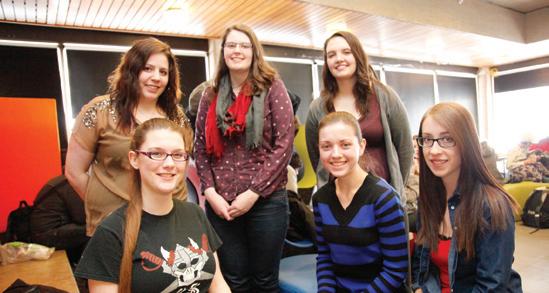







Kevin Lin KL ater, staff
W
innipeg is hosting the second International Winter Cycling Congress (IWCC) from Feb. 12-14.
The three-day congress will showcase winter cycling techniques, host numerous community, cultural, and educational events, and provide a forum for planners and policy makers to share ideas and inspiration around the subject of cycling during the winter.
The congress seeks to show that cycling during the winter is possible, and is a choice that many Winnipeggers are making.
Numerous speakers and participants from around the world, from Norway to the United States, will
take part, covering topics from health to city planning.
Activities will occur throughout the week and into the weekend relating to cycling, including a restaurant tour and bike polo tournament.
Premier Greg Selinger will open the congress the morning of Feb. 12.
Winnipeg Mayor Sam Katz will open the panels and discussions on Feb. 13.
Winnipeg is unique in the cycling world in that it has a large number of community bike shops, where individuals can learn about bike repair and connect with their local cycling communities. These shops are often hubs of cycling activism, and serve as
repositories of mechanical know-how for do-it-yourselfers.
Winnipeg cycling enthusiast Anders Swanson attended the first winter cycling congress in Finland last year and is responsible for bringing the event to this side of the Atlantic.
“A big part of this is to show that cycling during the winter is something that everyone can do. We’ve seen more people continue to cycle when the cold comes, and I think that’s a really encouraging sign,” said Swanson.
Swanson also volunteers at the Bike Dungeon at the University of Manitoba – a place where students
can service their bikes at the Fort Garry campus.
Friday will see a panel discussion at the U of M in conjunction with IWCC titled Cold Campus Cycling.
Sarah Thiessen, a volunteer at the University of Winnipeg’s Bike Lab and member of the University of Winnipeg Students’ Association Ice Riders student group, will share her thoughts about the vibrant cycling culture developing in Winnipeg, and the foundation this provides for community building and activism.
“I’m really proud of the state of activism on campus here, how egoless and fun it is – how fun is a really big part of involving people in a cause.
People won’t want to do something if it’s a drag. It’s a big part of why the Ice Riders group is so successful, we have fun,” Thiessen told the Manitoban Panelists from Finland; Madison, Wisconsin; and Chicago will join Thiessen to share experiences and insights from their cities.
The final day of the congress, Feb. 14, is also Winter Bike to Work Day. Winnipeg will be competing against numerous other cities around the world to see which will have the largest winter cycling turnout.
Participants can register for Winter Bike to Work Day at winterbiketoworkday.org
Joint project of the office of sustainability and Campus Food Strategy seeks to improve the way the U of M does food
Kevin Lin KL ater, staff
Last week the Campus Food Strategy Group (CFSG) held an information session to educate students about sustainability initiatives being undertaken concerning the food system at the University of Manitoba.
The group is developing a Campus Food Strategy, a process and vision that seeks to change the way the campus food system operates. The CFSG is partnering with the U of M’s office of sustainability.
Ian Hall is the director of the office of sustainability at the U of M.
“Over the next year we are going
university of m anitoBa senate meeting
The U of M senate will meet for the second time in 2014 on Wednesday, Feb. 5. Scheduled for that meeting are tributes to three recently deceased U of M faculty members: Jaroslav Rozumnyj (Arts), Reginald Litz, (Asper school of business), and David Singer (dentistry).
Also on the agenda is a recommendation from John Doering, faculty of graduate studies dean, that the U of M suspend admissions to the school’s PhD program in cancer control. According to a memo written by Doering, the program is rendered obsolete by the new PhD program in nursing.
“As the PhD program in nursing is up and running and has successfully taken in two cohorts of students, I believe it is time to suspend admission to the PhD program in cancer control,” wrote Doering.
to be doing research and talking to the university community, helping the university to create a plan to make the most of the potential that we have, and ideally seeing some positive social, environmental, and economic outcomes happen in the area of food,” said Hall.
Julie Rempel is a co-ordinator for the CFSG and has become increasingly involved with food issues on campus over the last few years.
“Everyone we have reached out to is interested. The challenges that we’ve run into are that this isn’t on anyone’s priority list – it’s not in
anyone’s job description. Even with folks who want to champion this and take it on, you’re still trying to work your way up, and work your
“This provides a great opportunity to try and create really rooted policy change” – Julie Rempel
way down through an entire organization, depending on who you’re in contact with,” said Rempel. Hall spoke of the all-encom-
passing nature of addressing the campus food system, and the opportunities this presents for students to engage in hands-on learning at the campus.
It’s a really diverse group, which makes for great conversations to look at things from a variety of perspectives and really interrogate the research findings.”
“We’re getting a lot of help from student volunteers who are doing applied sustainability research as part of their studies. We have close to 20 volunteers now who are going to be delivering parts of this research project for us, and hopefully getting some education or professional development benefits from it. We’ve got people from environmental design, economics, and some business students.
The university’s largest food procurement contract with Aramark is set to expire this year, when a new request for proposal (RFP) will be tendered.
“This provides a great opportunity to try and create really rooted policy change within both the RFP and with the contract that would subsequently follow,” said Rempel.
By Quinn Richert, staff
According to the note, it had been understood when the doctoral program in nursing was introduced in 2011 that it would eventually replace the cancer control program, and that the latter would be discontinued.
The meeting will occur at 1:30 p.m. in the senate chambers (E3-262 Engineering Building) and is open to all members of the university community.
faculty of eDucation stuDents host expo
Last week, education students had a chance to meet their potential employers when the faculty of education student council held an expo, drawing in representatives of school divisions in Winnipeg, rural Manitoba, Canada, and around the world.
“This is an excellent opportunity for our Teacher Candidates to see who is
hiring and what they are looking for, but also to gain a better understanding of the unique needs and priorities of various school divisions and independent schools,” said faculty of education dean David Mandzuk in a U of M press release.
The expo, which ran for three days, featured one day of booths, which candidates could freely browse, and two days of arranged interviews between students and division reps.
phoenix sinclair inquiry: recommenDations releaseD
Last week, Ted Hughes, the commissioner overseeing the inquiry into the death of Phoenix Sinclair, issued his recommendations for how the Manitoba child welfare system can prevent similar cases from going unnoticed. His recommendations came in the
form of a massive, three-volume report, which also details the events leading up to the death of Sinclair on Fisher River First Nation, and the discovery of her body.
Among Hughes’ 62 recommendations is that caseworkers be responsible for no more than 20 cases at a time. Hughes also implored social workers to keep “complete and accurate records of all involvement with children and families,” and called for updates to the software used in case management.
Hughes also suggested that all caseworkers employed in Manitoba should be required to hold a university degree in social work.
“Child welfare workers do complex, demanding work that requires a high level of knowledge, skills, and analytical abilities,” he explained.
The provincial government has stated that it is prepared to act imme-
diately on all of the recommendations of the inquiry.
The report was published on Jan. 31 and is available to the public online.
m an not guilty in foster son’s Death Manitoban Roderick Blacksmith has been found not guilty in the death of his 13-month-old foster son, who died from head injuries in 2008.
Judge Deborah McCawley ruled that insufficient evidence had been presented to prove that Blacksmith was in fact guilty of murder. The court heard testimony from a neuropathologist as well as RCMP officers involved in the investigation.
A babysitter had also been suspected in the case, but was never charged.




Katy MacKinnon, staff
Adiverse group of cheery faces and eager entrepreneurs gathered in the basement of Knox United Church last Friday for the grand opening of Knox Community Kitchen. The kitchen, completed in July of 2013, was put to use as local food businesses served up spring rolls, soup, and more.
The kitchen cost $450,000, all of which was fundraised from a number of sponsors: The Winnipeg Foundation, the Government of Canada, the Province of Manitoba, the City of Winnipeg, the United Way of Winnipeg, the Central Neighbourhoods Development Corporation, the Manitoba Community Services Council Inc., and the Blennerhassett Family Foundation.
“It was really everybody coming to the table, all levels of government and the smaller organizations and foundations to get the project done,” said Natasha Ross, Knox Centre development and kitchen coordinator.
Knox Community Kitchen is available for rent to budding and established businesses that require use of a shiny new commercial kitchen. The space can be used for various needs – from catering, to cooking classes, to events.
“For established businesses we charge market rents, so we’re trying to balance generating some revenue to cover our operating costs while at the same time providing subsidized space for budding entrepreneurs,” said Ross.
During the grand opening, tables were set up just outside the kitchen displaying local food businesses, non-profit organizations, and community groups. As the food businesses served an assortment
of ethnically diverse foods free of charge, organizations spoke with visitors about their causes.
The kitchen is partnering with SEED Winnipeg, a non-profit organization working to reduce poverty in Winnipeg through business development assistance programs.
SEED Winnipeg is arranging workshops at Knox United Church.
One workshop titled “Doing Business in Canada” instructs participants about the nature of Canadian business culture, said Billy Granger, business consultant with SEED Winnipeg.
Knox Community Kitchen is available for rent to budding and established businesses that require use of a shiny new commercial kitchen
“That can be a very important part – how do business transactions happen here, what are our business behaviours, and what are the norms? We also want a presence at this market so that we can create more awareness in the community for our programs and channel people to the work that we do,” he said.
Previous clients of SEED Winnipeg include Mondragon and author Anne Mahon.
Food Matters Manitoba will be running a bi-weekly produce market in the basement of the church.
“With the closing of three grocery stores in the downtown area, we’re trying to provide, fresh, healthy, affordable food,” said Kelly Janz,
community food assessment implementation co-ordinator for Food Matters Manitoba.
The bi-weekly produce market will be set up four times through February and March.
“Prices are at cost for this market, so things are extremely affordable,” said Janz.
In addition to helping out aspiring entrepreneurs, the kitchen hopes to build community interaction and involvement.
“We’re a very densely populated neighbourhood, and we have a lot of newcomers in our neighbourhood [ . . . ] We still need to work on getting more people into the neighbourhood and experiencing this really vibrant mix of people that we have. We feel like we can do this through food, because this is what most people know how to connect with,” said Ross. With the creation of new kitchen market opportunities, Ross wants to increase the vibrancy of the neighbourhood.
Knox Community Kitchen is full of ideas for the future. “We want to become a cultural food destination,” said Ross.
Ross hopes to have a “food park” with a direct link from the kitchen to Central Park. She also aspires to an indoor pop-up café, since the pop-up movement seems to be taking off in Winnipeg.
“I think it’s a real movement, and it has less of a financial commitment and it’s more responsive to what your vendors need,” she said.
For kitchen specifications, photos, and bookings, visit knoxkitchen.ca
UMSU tradition embraces ‘life and learning’
The University of Manitoba Students’ Union (UMSU) helped to ease the late-January monotony last week with guest speakers, events at the Hub, and free breakfasts.
All of this was part of the annual Celebration Week, an UMSU tradition that in the past has brought George Stroumboulopoulos, Gwynne Dyer, Buffy Sainte-Marie, and many other distinguished speakers to campus.
Last Monday, Breaking Bad cast member RJ Mitte (Walter Jr.) spoke to a crowd gathered in University Centre’s multipurpose room. Winnipeg Jets chairman and governor Mark Chipman was the guest lecturer at a Thursday event, and artist Cliff Derksen shared a presentation featuring much of his work on Friday.
Derksen’s sculpting deals with the disappearance and murder of his daughter Candace and the trial of Mark Edward Grant, who was charged in her death. Just last year, Grant’s conviction was overturned and a retrial was ordered.
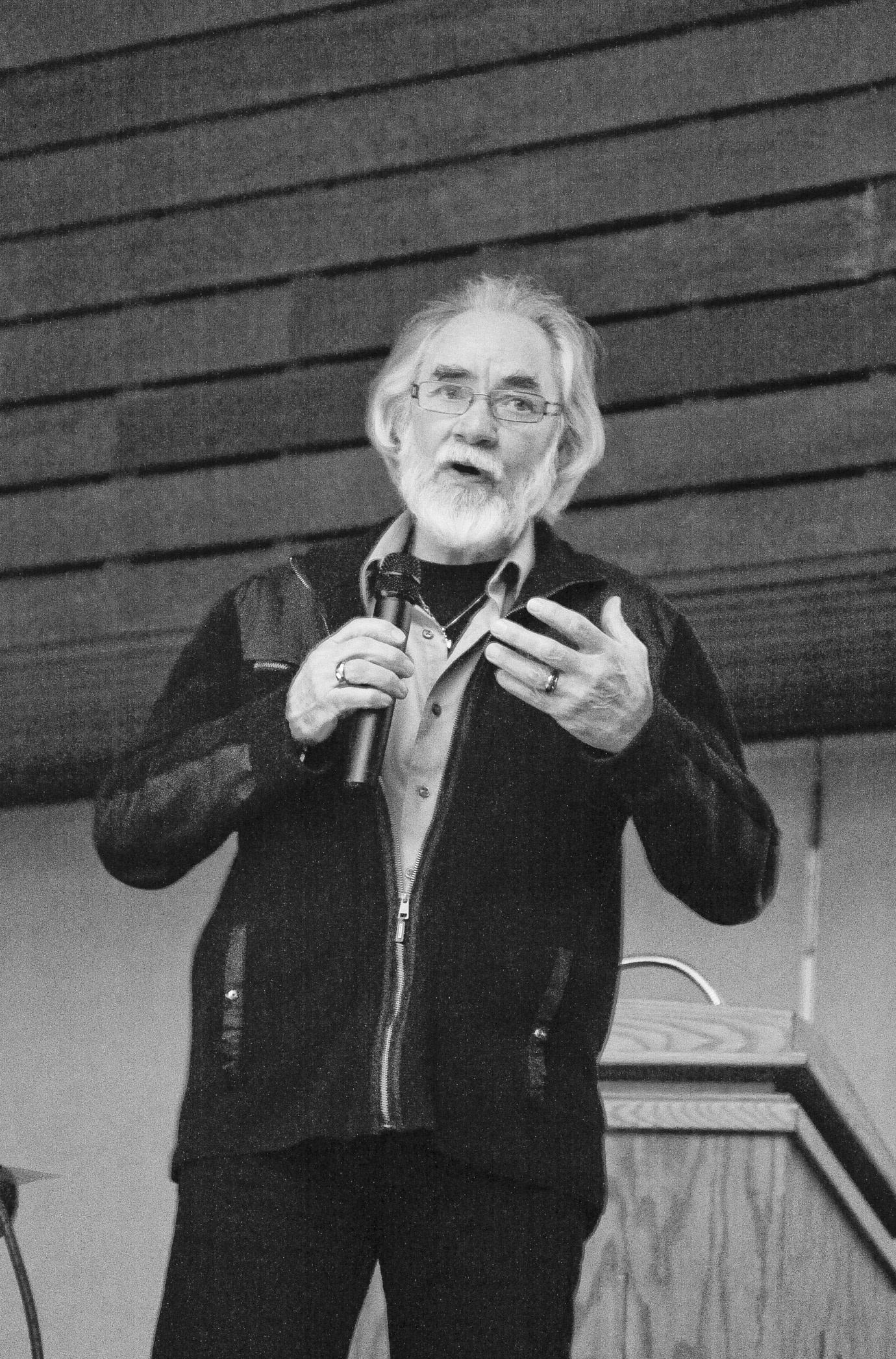
Winnipeg Jets governor Mark Chipman was the guest lecturer at a Thursday event, and artist Cliff Derksen shared a presentation on Friday
Other Celebration Week activities included an international movie festival, a magic show, an art sale, live music, and a wine tasting festival. “Drag show superstar” Victoria Lush performed on Wednesday.
While most Celebration Week events were held on the U of M’s Fort Garry campus, Bannatyne students were not entirely left out. Free breakfast, lunch, and one day of the wine tasting event were offered over the week of Jan. 20 at the downtown campus.





Marc Lagace, staff
The way we receive and digest news is constantly changing. I know whenever I hear about live breaking news, I’m more inclined to check my social media networks than respected news sources like CNN or CBC for the latest updates. I’m certainly not going to wait until the next day to read about what’s happening in a newspaper. As a consumer of news, I love the immediacy of following a breaking story from wherever I happen to be and being able to immediately join in on the discussions and speculation.
But when I step back and look at things from the perspective of a journalist, these same trends in the public consumption of news are forcing the journalism industry to make drastic changes in how breaking news is covered, what stories are considered newsworthy, and, ultimately, how information is reported to the public.
Boston Police scanners, posting and dissecting photos from the scene, and spreading speculation and the latest reported news on social media.
The influences of websites like Twitter and Reddit have changed the way many journalists facilitate viral content and measure the public’s interest in different news stories or issues
It’s no secret that newspapers are losing their grasp on the techsavvy consumers. Not only can information and content be found with a swipe of a finger, but practically anyone can upload and publish news and information, with the potential to reach as wide an audience as any newsroom.
The influences of websites like Twitter and Reddit have changed the way many journalists facilitate viral content and measure the public’s interest in different news stories or issues. There are also growing examples of citizen journalists using social media to crowdsource the workload when investigating breaking stories.
In the wake of the Boston Marathon bombing last April, Twitter and Reddit were red hot with speculation about what happened and who was responsible. Suddenly, thousands of people from around the world (myself included) decided to become citizen journalists: listening to
With all sorts of information, misinformation, and rumours swirling about online, news agencies with actual reporters on the ground in Boston were forced to try and keep pace with the public’s desire for information. Unlike an anonymous poster on Reddit who may think he’s tracked down the suspect’s Facebook account, laws regarding defamation require journalists to be responsible in their reporting habits and always act in the public’s best interest. Journalism is still very much a business, and a struggling one at that, so adapting to using Twitter and other social media to not only distribute the day’s news but also find and follow stories is increasingly becoming the norm. Locally, we’ve seen stories about the public’s reaction/backlash towards Winnipeg Jets or Blue Bombers players who have made ill-advised comments or posts on Twitter or Instagram. Personally, I would consider these to be nonstories, barely worth mention on a respected news outlet’s website let alone in the pages of the print edition.
But therein lies the heart of the issue I have with the way journalism is trending. Due to competition with social media, journalists are forced to take more risks with their reporting, or cater to ours. To illustrate my point, I’ll use an example that everyone is familiar with: Rob Ford.
While the Toronto Star did a lot of great coverage on Ford’s alleged drug use video, it was all in response to a Gawker.com article that broke the story first. And when the Star reporters Robyn Doolittle and Kevin Donovan went forward with their claims of seeing the video firsthand, they were put-


ting themselves into a potentially litigious situation.
According to Doolittle, the Star had been working on the Rob Ford story for months before Gawker broke their story. Despite not having a copy of the video in question —which Gawker was attempting to buy with money from a Kickstarter campaign—the Star was basically forced to keep up with Gawker’s coverage of the story. The justification was that since Ford was Toronto’s mayor, it was within the public’s best interest to know about it.
Of course, given how bizarre the story was and Ford’s ongoing antics, we’re at the point where the public is interested in any story about Toronto’s top politician. Case in point, I find an article posted late Friday evening about Rob Ford receiving a ticket for jaywalking in Greater Vancouver. Is this news? Is this the sort of

thing we consider to be news now?
Watching the absurd stories that seem to follow Ford around like eager puppies sure is fun, but it’s sad that stories like Ford’s ticket and Justin Bieber’s legal troubles are actually big, front-page stories when there are so many other more pressing issues around the country and internationally.
I am certainly not discounting the hard work that the Star put into the original Ford crack story, but news outlets covering stories about Ford, Bieber, and other celebrities is a clear attempt to pander to the masses. Again, from a business standpoint, if an outrageous story about Justin Bieber on the cover of the newspaper will get people to pick it up, then that’s what papers will have to do to compete with trending news stories online.
It’s just troubling that on top of all the massive layoffs occurring here in Winnipeg and elsewhere,
the leaders within the industry are still collectively scratching their heads trying to figure out how to compete with social media.
Maybe traditional media just can’t compete anymore. Maybe there’s no place in our world for daily newspapers. Maybe all of our news should be fed to us in 140 character notifications on our smartphones.
Perhaps I’m being overly cynical about the state of journalism. Talented reporters are still producing great work, especially longform journalism that often requires months of research and interviews. But for every reader interested in a long piece on the ongoing conflict in Syria, 20 more are looking for something quick to share with their friends on Facebook or Twitter.
Sadly, for an industry on the ropes, that’s where the money is at these days.


U of M sends first-ever allwomen’s team to CS Games
to

The Computer Science Students’ Association (CSSA) has announced that they will be sending two teams to the 2014 Computer Science (CS) Games, one of which will be the first-ever all-women’s team to attend the Games.
The CS Games were founded by students of McGill University in 2003. The Games include a mix of computing and programming challenges, pen-and-paper computer science tests, and social activities like sports and gaming.
Although the Games are meant to be an intellectual challenge, they also function as a social and professional networking event for undergraduate computer science students. Major industry sponsors include Microsoft and Google. According to Laurent Dang, the sponsorship director for the CS Games, one of the purposes of the event is to connect students with companies in the industry to help them find jobs or internships. Dang found an internship with Shopify through last year’s games.
The University of Manitoba first got involved with the CS Games in 2008. A team of 10 undergraduate students was sent to Sherbrooke, Quebec, with support from the department of computer science, the faculty of science, the Science Students’ Association, and UMSU. Since that time, the U of M has sent teams every year, and even hosted the Games in 2012.
This year the two teams from the U of M are called /b/rothers and U of M CS Women. Adam Duncan, the current CSSA president, is the captain of /b/rothers. Diana Carrier is the captain of the U of M CS Women team. Since the Games began, no school has ever sent out an all-women’s team. In 2008, over 300 students from over 30 universities took part in the games, and only 24 were women.
“Usually there are 15-20 schools, and each school is allowed to bring two to three teams of 10 people,” Carrier told the Manitoban
“In all that time, out of all those people, no school has ever brought more than four or five women. Per school, not per team. Many schools bring no women at all. So having a team of 10 women is absolutely unheard of. That is why it is so significant.”
There is a broader trend of female underrepresentation in computer-related fields. A United States Census survey published last September found that although there is a greater proportion of women in science and technology fields than there was in the 1970s, women are still underrepresented in the computer and engineering fields that make up over 80 per cent of science and technology jobs.
Carrier’s experiences in the tech world have been positive. “In my experience, the tech world itself is quite welcoming,” she said. “I’ve never seen any evidence that people thought I was less capable for being female.”
However, she pointed to some structural issues that she believes keep women out of computer science.
“Computer science is a very male-dominated field, though, and that can be a little intimidating to women looking to get into it,” she said.
“I actually think society is to blame for the lack of women in the tech industry [ . . . ] It’s little things, like how the science and engineering toys tend to all be in the boys’ section, and the girls’ section is all princesses and crafts. Or how the media portrays people in these industries as being sad, lonely (usually male) nerds.”
For some, U of M CS Women is an encouraging sign of boundaries being broken down. According to Raymond Laramee, former vice president of the CSSA, equal representation is one of the goals of the CS Games. “Having an all-female team at the CS Games shows to the other 20+ schools and sponsors [ . . . ] that the U of M’s department of computer science is progressing towards this goal.”

eL izabeth Drewni K , staff
University of Manitoba engineering student Cameron MacGregor is the winner of the third annual Sunnybrook Prize competition for internship research in biomedical engineering, held at the Sunnybrook Research Institute in Toronto. His project on the development of an efficient and inexpensive diagnostic screening technique for obstructive sleep apnea earned him first place in the competition, as well as a $10,000 cash prize.
MacGregor was among five undergraduate finalists from across Canada who presented research at the Sunnybrook Prize competition. The other projects focused on topics ranging from cardiac to cancer research.
Studying electrical engineering with an interdisciplinary application in biomedical technology, MacGregor is expecting to graduate by June 2014. The young scientist has already made many great strides in his career.
In addition to his victory at the SRI, MacGregor has presented research at three conferences. He received third place in the Innovative Design category at the Western Engineering Competition in Edmonton.
He also presented at the Canadian Student Health Research Forum Manitoba Poster Competition, where he received the Dean of Graduate Studies Poster Award, as well as the 2012 University of Manitoba Undergraduate Research Poster Competition.
In addition to his achievements in research, MacGregor has also received multiple scholarships and awards for his outstanding academic achievements, including being listed on the faculty of engineering Dean’s Honour List for six consecutive years. He won the University of Manitoba Emerging Leader Aaward in 2013.
The origin story for MacGregor’s success at the Sunnybrook Prize competition is one filled with serendipity. Only a year ago, he was searching graduate programs at other universities. “I happened upon the Sunnybrook Prize competition in the results of a Google search,” said MacGregor in an interview with the Manitoban
After a one-year hiatus from his academic studies to work in the lab of his supervisor, Zahra Moussavi, MacGregor decided to take the opportunity and apply to the competition.
“I was prompted to apply just to
see how far I could take my research.
I’m always open to exposing myself to new opportunities and situations, and I thought I had a reasonable chance of getting selected as a finalist, so I thought, ‘why not?’”
Selection criteria for the competition included two reference letters describing the applicant’s research potential, and a two-page summary of the research. The final round involved a 10-minute presentation with five minutes of questions.
“Three of the five finalists were
“Basically a person has to go to a sleep lab overnight at a hospital and have all this crazy equipment hooked up to them – it’s a very uncomfortable, expensive process” – Cameron MacGregor in an interview with CBC
from Ontario universities, and had conducted their research projects at either Harvard University or in the Harvard-MIT Health Sciences Technology program in Boston during co-op work terms, so this was no doubt very tough competition,” said MacGregor.
The project, he later explained in an interview with CBC Manitoba Information Radio, was inherited from a master’s student of the same lab he performed his research in.
When MacGregor began, some of the basic research in developing the technology had already been completed. MacGregor developed a new classification technique, increasing the accuracy of the pre-screening process for individuals who may have sleep apnea.
Diagnosing obstructive sleep apnea is currently time-consuming and costly. The process involves an overnight polysomnogram at a lab. Polysomnography, commonly used to diagnose sleep disorders, gathers information on patients by recording their brain waves, as well as moni-
toring blood oxygen levels, breathing, heart rate, and eye and leg movement. The process takes place while the patient is asleep.
“Basically a person has to go to a sleep lab overnight at a hospital and have all this crazy equipment hooked up to them – it’s a very uncomfortable, expensive process,” said MacGregor in his interview with CBC Radio. The procedure costs $500 per person. In addition to the cost, there is a long waiting list for this test to be administered: one to three years.
It is estimated that only about 10 per cent of the people afflicted with the condition are actually diagnosed.
The hope is that this newly developed pre-screening diagnostic technology will reduce the cost of diagnosing individuals with sleep apnea, while cutting down the wait list for those who really need a polysomnogram.
MacGregor’s technique examines the breathing of individuals who may have sleep apnea. People afflicted with the disorder tend to have narrower upper airways that are collapsed, even when they are not asleep. This changes the sound of their breathing.
“It’s basically like a musical instrument,” said MacGregor.
MacGregor’s technique involves recording and examining patients’ breathing sounds. The information collected can then be used to determine if the individual has a narrower airway or not. Over 100 different sound features, such as pitch, are examined and analyzed in the pre-diagnostic process. What’s more, this test can be done while the person is awake, and with little complication.
The award for the Sunnybrook Prize competition was established in 2011 to acknowledge and support undergraduate scientists across Canada in their final two years of study. Funding for the award was established by royalties generated from technology developed at the Sunnybrook Research Institute.
With the prize money, MacGregor intends to further his education by enrolling in a master’s program in biomedical engineering at the U of M. This novel program was established by MacGregor’s supervisor, and MacGregor will be one of the first students to join.
If everything goes as planned, MacGregor is seriously considering enrolling in a PhD program for sleep apnea research.




O’Leary entertaining, but news can do without his cutthroat rhetoric
Michae L Lee
“…Really?”
I’m sure many of you shared with Amanda Lang that same exasperated reaction upon hearing Kevin O’Leary’s perplexing comments on the Lang & O’Leary Exchange. Upon learning of Oxfam’s latest findings that the world’s 85 richest people own as much as 3.5 billion people do globally, Kevin O’Leary responded with this:
“It’s fantastic. And this is a great thing because it inspires everybody, gets the motivation to look up at the one per cent and say, ‘I want to become one of those people. I’m going to fight hard to get up to the top.’ This is fantastic news and of course I applaud it. What can be wrong with this?”
What could possibly be wrong with this? While most people would see 3.5 billion living in poverty as wrong, O’Leary considers the income disparity to be a form of inspiration, a call to get off of our couches and start making money.
Co-host Lang was quick in vilifying O’Leary, retorting, “The only thing between me and that guy is motivation? I just need to pull up my socks… oh wait, I don’t have any socks!”
More worrisome, however, is O’Leary’s completely misguided reading of these figures. He made it clear that he does not have any issue with these staggering rates of global poverty, nor with the conditions these people live in, and instead
chooses to admire those few people living with extreme wealth. It’s as though the rich should be seen as shining examples of hard work meant to bolster our self-esteem. We must simply try harder.
In an attempt to sway O’Leary’s opinions, a still-mystified Lang made sure to remind him of the true issue at hand. “We’re talking about people in extreme, abject poverty. That’s how you get 3.5 billion in this category.”
I hope that as long as Kevin O’Leary remains on television, others like Amanda Lang will also be there to keep him in check
Unfortunately, it was not enough. “No, we’re not. You were just talking about really rich people,” said an unwavering O’Leary. Seeing that this battle would remain unwinnable, Lang chose to relent there.
For the uninitiated, Kevin O’Leary is a man who refers to himself as “Mr. Wonderful.” He is most well-known for his outrageous antics on CBC’s Dragons’ Den, where eager entrepreneurs seek to gain financial support for their small businesses
from five “dragons,” including O’Leary. He also appears alongside Amanda Lang on CBC’s Lang & O’Leary Exchange
Since selling his company, SoftKey Software Products, for $3.7 billion in 1999, he sits on the investment committee of Hamilton Trust and is the chairman of O’Leary Funds. He is perhaps Canada’s most controversial and outspoken television personality, unafraid to share his views on income redistribution and free market capitalism, known as well for his staunch refusal to acknowledge any advantage to increases in taxes on corporations and the wealthiest one per cent of the population.
Indeed, this is not the first time nor will it be the last time O’Leary makes controversial remarks on television. During the heyday of the Occupy movement, O’Leary referred to Chris Hedges, a Pulitzer-Prizewinning journalist who appeared on the Lang & O’Leary Exchange, as a “left wing nutbar” for his support of the movement. Naturally, many people found his comments offensive and complained, with some demanding he be fired.
In a more recent example earlier this month, O’Leary went on CNBC to promote the network’s premiere of Shark Tank, the American spinoff of Dragons’ Den, only to describe the entrepreneurial spirit of America as having been “beaten down” by “regulation” and “taxation,” and to
describe the minimum wage debate as “insane” and in no way helping small businesses.
He went on to say, “The government doesn’t create anything. It’s the man and woman starting a business, that pays tax, that provides everything.”
It did not end there. O’Leary continued to speak out in support of corporations, even going so far as to get protective of them: “We’ve vilified our financial leaders. We call them ‘fat cats.’ We depress their interests and their desires. That’s completely insane. That’s not American.”
I’m not completely convinced that the interests and desires of our most successful business leaders are as depressed as O’Leary would claim, but, like Amanda Lang, O’Leary’s interviewer also expressed disbelief at what he referred to as “cutthroat capitalism.”
On the topic of “cutthroat capitalism,” a later video posted by CNBC promoting Shark Tank shows a much calmer, relaxed O’Leary giving a chillingly honest description of himself and his business practices. He refers to himself as “hardcore right wing, slightly right of Attila the Hun,” with the belief that “money solves a lot of problems in life and people just don’t like to admit it.” When it came to the nitty-gritty of business, O’Leary had no qualms with saying, “I’m not trying to make friends. I don’t care what their personalities are, I’m trying to make
money. I’ve made a lot of money with a lot of assholes.”
And of course, his tirade did not end there. “If you have to fire your mother to keep your cash flow positive, you got to fire your mother. You got to take your brother out behind the barn and you know what you got to do. You have to stay alive. It’s all about the business. That’s the only thing that matters.”
It should not come as a surprise that people such as O’Leary have such a presence on the news, and in television in general, but nonetheless it continues to amaze me. Indeed, the ability to garner such media attention is a valuable asset for the ratings of any television station, even for “informative” public broadcasting.
But these sorts of attacks and remarks should not be promoted and only serve to foster a hostile, narrowminded news media and public. In fact, the aforementioned Chris Hedges referred to the treatment he received as akin to what someone might receive on Fox News.
While O’Leary continues to be who he is, people will continue to watch him. I hope that as long as Kevin O’Leary remains on television, others like Amanda Lang will also be there to keep him in check. He is like the Don Cherry to our Ron MacLean or the Joker to our Batman. Every superhero must have their super villain.
But do we really need this joker?
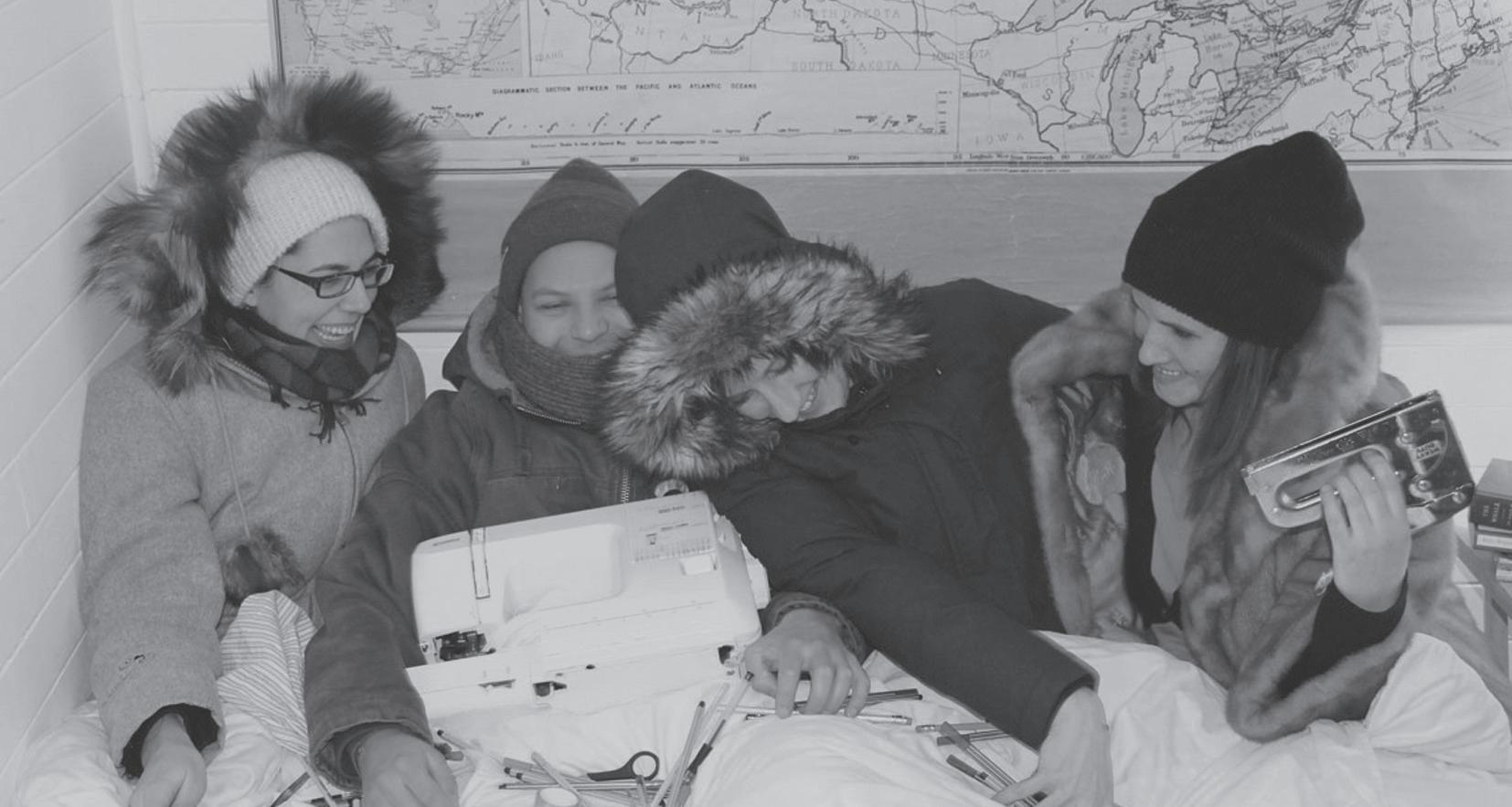
Experience the beautiful creativity of the North End at craft sale Point Douglas is for Lovers
Lu K as t hiessen, staff
What comes to mind when you think of Point Douglas?
Perhaps you know the area is named for the 5th Earl of Selkirk, who established the Red River Colony in 1812, or that it has the lowest family income and highest unemployment of any riding in Manitoba. Some people also insist the area’s crime rate is its most notable feature.
On the other hand, you might know of the deep passion and creativity in the neighbourhood. These are the features emphasized by Ricardo Lopez-Aguilar, who moved to the area in August 2012.
“The city as a whole needs to make more of an effort to get to know more about the North End,” says LopezAguilar, who works at a group home. “People have a fear of coming down here, and [a] fear of the people who live here. There are families here. Kids who play on the street. It’s not the neighbourhood that some people think that it is.”
He is chair of the Point Douglas Residents Committee, which late last year decided to host an event to draw people to the neighbourhood. Out
of the ideas was Point Douglas is for Lovers, a community-based craft and bake sale with a welcome invitation to the rest of the city.
“Everything at the sale is handmade: bead work, silkscreening, reworking old clothing into something new. Everyone has submitted something amazing,” says LopezAguilar.
Organizers wanted to allow as many artists as possible to showcase their work, regardless of income or professional status, so they kept the application fee low. “We’re giving priority to people who live, work, and love in the North End.”
The event is put on in tandem with the North Point Douglas Women’s Centre and will be hosted by Grace Point Church, which Lopez-Aguilar says is perfect because of its central location, size, and welcoming atmosphere.
Working with Lopez-Aguilar are Jillian Ramsay, Julia Wake, and Kate Sjoberg. Ramsay is involved in arts programming in the North End, Wake works at Graffiti Art Programming, and Sjoberg works

Michae L c ar L is
During the month of September, in the middle of the North Atlantic, a fishing boat sinks. The crew of six escapes into two dories as the boat plunges into the ocean. It happens so quickly that the fishermen are only able to grab a few supplies. With no sign of rescue in sight, the decision is made to paddle to shore –wherever the shore may be.
The stakes are high for these brave but seemingly doomed men. Not only are their lives on the line,
but their sanity as well. Each day is a great strain on the men’s minds – they must grapple with the fact that they may never reach land, and that they don’t even know where that land is.
Food quickly becomes a luxury: in the middle of nowhere, a seagull is even seen as a delicacy. The director also does a very good job of creating a distorted sense of time and space. At its very core The Disappeared is a survival story of the highest calibre. The film dissects society’s
Stylin’ I! To meander through downtown as part of Genderfest
a nastasia c hipe L s K i, staff
Many of this week’s Genderfest events offer opportunities to reflect on and discuss the meaning of gender, and Stylin’ I! is no exception.
Self-billed as an “unauthorized roving performance in the skywalk/ underground,” collaborators Coral Maloney and Ian Mozdzen will present the latest incarnation of a piece that first appeared in a 2011 Young Lungs Dance Exchange performance.
Along with musical promises of “ideal beauty and sexuality,” Maloney and Mozdzen “interrogate” this notion by robotically performing the grooming “rites” that humans do all the time.
on the board with the West Central Women’s Resource Centre and as the executive director of the North Point Douglas Women’s Resource Centre.
The event was named because of a quality of the residents of Point Douglas. “I felt it when I first moved into the area. It struck me as really unique and interesting,” says LopezAguilar.
“The people that live here, I don’t even think love is a strong enough word. There is a burning passion and pride from the [people]. It’s incredible.”
The event date was also planned when one member of the organizing team suggested people could acquire gifts to give loved ones on Valentine’s Day.
On Saturday, Feb. 8, come to Grace Point Church, 137 Euclid Avenue, from 12-4 p.m. For $1 you have admission to one of the best craft sales in the city. Check out their promo video on Vimeo, made by local music video genius Christian Procter, with music by the band ATLAAS, a local duo consisting of Lopez-Aguilar and Heather Thomas.
codes of masculinity. Though each man puts up a front of stereotypical machismo, the vulnerability of a survival situation reveals their true identity. Society’s ideal masculine characteristics—such as competitiveness and the bottling of emotions— ultimately work against the group and compromise their survival. If they wish to see their families again, they must move past their aggressive feelings.
In conclusion, The Disappeared is a riveting and suspenseful work of art. The ending is left open and each actor is terrific. This film is easily one of the best dramas of last year and is worth more than a few viewings. 5/5
Check out more of Michael’s reviews at goodbadcritic.blogspot.ca, and catch a screening of The Disappeared at Cinematheque (100 Arthur Street) on Friday, Feb. 7 at 9 p.m., as well as Feb. 8, 9, and 12 at 7 p.m.
“We juxtapose these rites with speed, intensity, repetition, oddball conversation, ‘correctness’ or ‘wrongness,’ procedural attitude, [and] sculptural images,” says Maloney.
As these beauty rites are performed simultaneously by both Maloney and Mozdzen, the gendered nature of these acts are called into question, as well as the nature of gender itself.
“Through performing gendered rites together we create a blank slate.
The blanker the slate, the more we feel.”
While the piece itself has changed since 2011 “to accommodate the context and where we are at as ‘I,’” the location will also be changing throughout the piece. Maloney and Mozdzen recently performed a roving version of Stylin’ I! as part of Art Souterrain 2013 in Montreal, which “was a foundation for this next go-around.”
“It always seemed that Stylin’ I! would work in this context. It’s a ‘friendly’ piece, but strange enough to elicit complicated experience.”
Maloney and Mozdzen expect that the piece could inspire a variety of reactions from audiences as they pass through.
“It’s all appropriate given the nature of the piece – which is to induce head scratching, body/bodily consciousness, spatial awareness, and the humour, and delight, and discomfort found in the performance of self.”
Stylin’ I! will be reincarnated once again on Feb. 7 at 2:05 p.m., beginning at the Convention Centre and continuing through the indoor walkway system.

GenderfeSt 2014 eventS
wedneSdAy, februAry 5
The Oppressions Within Queer CommunitiesA Panel Discussion University of Winnipeg, the Hive, 6 p.m.
SAturdAy, februAry 8
Genderfest: SlutWalk Winnipeg’s Panel 2nd floor, Millenium Library, 1-3 p.m.
SAturdAy, februAry 8
All Bodies Swim Eldon Ross Pool, 1887 Pacific West, 5:30-7:30 p.m.
fridAy, februAry 9
CinemaPolitica Screening: A Jihad For Love The Hive, University of Winnipeg
thurSdAy, februAry 13
FtF: Female to Femme
Film Screening
Rainbow Resource Centre, 7-9 p.m. (limited seating, advance registration required)
fridAy, februAry 14
Feminist Porn: Representing Pleasure with Courtney Trouble Gas Station Theatre, 7 p.m.
SAturdAy, februAry 15
Let’s talk about porn 318 Ross ave, 12:30-3:30 p.m.
SAturdAy, februAry 15
Queer as Fuck - Genderfest’s Queer & Trans Play Party 9 pm-1:30 a.m.
SundAy, februAry 16
Pin ups and Sailors – the Genderfest Wrap Party Club 200, 9 p.m.










Marc Lagace, staff

The Bison men’s volleyball team kept their playoff dreams alive while the women’s team split their weekend series as the UBC Okanagan Heat visited Investors Group Athletic Centre on Jan. 31 and Feb. 1.
The Bisons schooled the Heat on Friday. In the women’s game, Rachel Cockrell and Taylor Pischke both had 10 kills as the Bisons made mincemeat of their visitors in straight sets 3-0 (26-24, 25-17, 25-21). The Heat proved to be a threat in the first set, as they had the first shot at set point. The Bisons rallied with Crystal Mulder following up a Rachel Cockrell kill with a setclinching service ace.
From there, the Bisons rolled forward and only trailed the Heat twice through the remainder of the match.
“The first set doesn’t determine the match, not at this point in the year,” said Bison head coach Ken Bentley. “We held firm there. They’re a very good team and we kind of controlled it.”
The following day was a completely different result, as UBCO dominated the first two sets. Manitoba would rally to force a decisive fifth set, but the Heat would capitalize on seven Bison attack errors and hold on for the win.
Three Heat players finished the match with double-digit kills. With the split, Manitoba and UBCO remain tied for fourth in the Canada West standings with identical records of 12-8.
Meanwhile, the Bison men’s volleyball players know they need to essentially win out this season to make the playoffs, and they took a huge step towards that goal with a pair of dominating wins over UBCO.
On Friday, the Bison men followed up the women’s straight-set victory with a straight-set victory of their own, 3-0 (25-19, 25-21, 25-22).
Adam DeJonckheere and Devren Dear were the dominant attackers for Manitoba, finishing with 13 and 11 kills respectively, while Kevin Falconer had nine digs as the Bisons took it to the Heat all night long.
“That was an important match for us to do well in,” said Bison head coach Cam Johnson. “We focused on the little things and we did those little things well: passing and first

contact.”
“Every game from here on out is important for momentum.”
The next game proved to be another showcase for DeJonckheere and Dear, as they again led the Bison attack. DeJonckheere led all players with 19 kills, while Dear had 17 kills and eight digs.
The Heat provided a bigger challenge for Manitoba on the day, as the teams battled for control of the match. The Bisons took the first set handily, but couldn’t take the second despite a late lead. In the third, the Bisons showed their composure and came back after allowing UBCO to jump out to an early lead in the crucial set. After taking the third set 26-24, the Bisons built on the momentum in the fourth set and clinched the match 3-1 (25-13, 23-25, 26-24, 25-19).
After the wins, the Bisons find themselves in a four-way tie for the final playoff spot in the Canada West conference. They will need some help from other teams in the standings, but coach Johnson believes in his team’s ability.
“This team can make the playoffs, no doubt,” said Johnson. “I haven’t looked at how much help we need, we’ve just been looking at what we need to do against the next team. That’s all we can control.”
The Canada West volleyball regular seasons will wrap up this weekend. The Bisons will travel to Kamloops to play Thompson Rivers on Feb. 7 and 8.
phOtOs by beibei Lu

Men’s hockey swept by Regina
The stakes couldn’t have been any higher heading into this past weekend, as just one point separated the Manitoba Bisons and Regina Cougars in the Canada West standings. After being swept by Regina on the road earlier this season, the Bisons were looking for a measure of revenge on home ice.
Friday’s action was a fast-paced, non-stop slugfest, with the feel of a playoff matchup. After the dust had settled, Regina emerged with the 3-1 win, their goaltending stealing the show.
While neither team was able to find the back of the net in the first period, there was no lack of chances at either end. Bison forward Dylan Kelly merited the first chance of the game just over three minutes in as he was sprung on a partial breakaway, but Cougar goalie Andrew Hayes shut the door. Regina sprung to life and pressured Bison goalie Joe Caligiuri on multiple occasions, but neither team could break the scoreless tie.
they left off in the third, making it 3-0 at just over six minutes in.
Tyler Henry snuck out from behind the net and secured a wraparound behind Caligiuri. The Bisons were able to snap Hayes’ bid at a fourth shutout this season in the final minute, as Craig Scott’s weak backhand shot went off the Regina goalie’s stick and in. The goal came far too late, as Regina came away with the victory.
“At this point in the season we’ve gotta be at our best [ . . . ] it’s not acceptable to lose at home at this time of the year”- Coach Mike Sirant
The furious action carried on early on in the second. Lee Christianson received a great feed on the right wing, but was stopped in tight by a composed Hayes. Regina fed off the stellar play of their goalie again, and capitalized on a big rebound by Caligiuri. Troy Hunter cleaned up the garbage in front and hammered it into the open net for the lead. The Bisons carried the majority of quality chances through the rest of the second, but continued to be stymied by Hayes, who had 16 stops at that point in the game.
With just 2:03 remaining in the period, the Cougars added to their lead. After a furious forecheck, Ian McNulty jumped on a loose puck and slid it past Caligiuri. Regina took the 2-0 lead heading into the third.
The Cougars picked up where
Hayes was flat-out brilliant in the first game of the weekend, stopping a whopping 41 shots in the win.
While Regina’s goaltending was outstanding, head coach Mike Sirant felt there were other factors that led to the final score as well.
“It’s too easy to say that Hayes stole the game,” said Sirant. “Obviously he was a factor but we just weren’t good enough tonight.”
“At this point in the season we’ve gotta be at our best [ . . . ] it’s not acceptable to lose at home at this time of the year.”
The Bisons had plenty of scoring chances again on Saturday afternoon, but could not capitalize, suffering a devastating 3-2 double overtime loss.
The start of Saturday’s game played out very similarly to the night prior, with Manitoba outshooting Regina 10-5 and garnering a multitude of scoring chances. Unfortunately, the post was the
Bisons’ enemy, ensuring a parallel score of 0-0.
Penalties dictated the second period, with all three goals attained on 5-on-3 advantages. Regina got on the board first at 11:50, when Mark Schneider slipped a wrister past Caligiuri. Just 18 seconds later, they added to their lead, as Ryan Dech deflected a slapshot through traffic.
Manitoba slowly reeled themselves back into the game at 14:08, as Jordan DePape was finally rewarded for his strong offensive play. He deflected a Luke Paulsen shot past Lucas Gore for his sixth of the season. Heading into the final 20 minutes, the Bisons trailed 2-1.
After giving up two goals on the penalty kill, the Bison penalty killers gained a measure of revenge at 7:06 in the third. Jesse Paradis netted his ninth of the year as he jumped on a rebound after the Bisons broke out on a shorthanded 2-on-1 rush, while Jordan DePape sat in the penalty box for charging. The game slowed down after that, and headed to the extra session tied 2-2.
Manitoba owned the momentum in both overtime periods, outshooting Regina 11-2 overall. A costly turnover in the 3-on-3 double overtime period ultimately sealed their fate, however. John Sonntag put this one to rest.
With the pair of victories, Regina leapfrogged over Manitoba into fourth in the Canada West standings. They are ahead by two points with just two weeks to go in the regular season. The Bisons’ next action takes place in Lethbridge in a two-game weekend series. The first game is Friday, Feb. 7 at 8 p.m. phOtOs by beibei Lu

aDa M p e L eshaty, volunteer staff
These men and women, in all likelihood, will not win medals in Sochi. In fact, some of them don’t even rank in the top 1,000 worldwide in their event. However, every four years, they are the greatest curiosities of the Winter Olympics: athletes representing nations without cold.
Beginning when Mexico sent a bobsled team to the 1928 Winter Olympics in St. Moritz, Switzerland and popularized by the Jamaican bobsled team 60 years later in Calgary, warm-weather countries have participated at the Winter Olympics with little success. This year in Sochi, seven nations will make their Winter Olympic debuts: Dominica, Malta, Paraguay, Timor-Leste, Togo, Tonga, and Zimbabwe.
While some may say other athletes are more deserving to compete, they have exceeded standards and have arrived in Sochi despite little spon sorship or funding. Some of them also have interesting backgrounds: vanessa vanakorn, thailand, alpine skiing
Singapore-born, English-raised Vanakorn will compete for her father’s native Thailand, becom ing the first female athlete from that country to compete in the Winter Games. A performing violinist, she is better known as Vanessa-Mae, whose albums, combining classical music with techno, have charted in the U.K. She also per formed on Janet Jackson’s 1997 album The Velvet Rope, hit #1 in the U.S.
Gary and Angelica di Silvestri, dominica, cross-country skiing
The husband-and-wife duo, aged 46 and 48 respectively, live and train in Canmore, Alta. and are the first two athletes to represent Dominica at the Winter Games. Years after they were given Dominican citizenship for their philanthropic work in the nation, the Dominica Olympic Committee approached the thenrecreational skiers to represent them in the Olympics. They accepted, and after forming a ski federation in the
Murphy will compete in his second Olympics after making his debut in Vancouver. He is the third athlete ever to compete for Bermuda in the Winter Games, and the only skier. His appearance also continues an impressive streak by the nation: Bermuda has competed at every Winter Olympics since 1992.
Adam Lamhamedi, Morocco, alpine skiing
The 18-year-old Quebec-born skier is one of two athletes representing Morocco and has also won an Olympic gold medal… sort of. He
skating
The Manila-born and trained 17-year-old Martinez is the only Filipino athlete going to Sochi and the first in a Winter Games since 1992. In last year’s World Junior Championships he finished fifth, and this season he won bronze at a Junior Grand Prix event in Estonia. Interestingly, he skated his short program to a Vanakorn piece last season.
bruno banani, tonga, luge Banani, the 26-year-old former soldier recruited by the military to
Committee (IOC) president Thomas Bach called it “a perverse marketing idea,” but admitted there was nothing the IOC could do if the name change is legal.
hubertus von hohenlohe, Mexico, alpine skiing
The most interesting athlete competing in Sochi. The 55-year-old is competing in his sixth Olympic games having represented Mexico in 1984, 1988, 1992, 1994, and 2010. While born in Mexico, von Hohenlohe, the son of a German prince and an Austrian-Italian princess, was raised in Spain and Austria. He is a photographer and musician who met Andy Warhol in the 1970s. His racing suit will be a mariachi-style outfit and he was photographed singing with a mariachi band when he went to Mexico to be

Marc Lagace, Staff
women’s hockey
The Bison women’s hockey came out of their weekend trip to Regina with a pair of huge wins, which clinched home-ice advantage in the first round of the Canada West playoffs.
On Friday, the Bisons rallied with a late third period goal to force overtime. Michelle Pawluk scored just 1:49 into the extra frame to clinch a 3-2 victory for Manitoba. Alana Serhan opened the scoring for the Bisons in the first period, while Maggie Litchfield-Medd scored the late game-tying goal.
The following night, Manitoba’s power play stole the show as the Bisons scored three straight goals then outlasted a frantic Regina comeback attempt in the third for a 3-2 victory. Jessica Rosenbaum opened
scoring early in the first period with an unassisted goal. From there, the Bison power play clicked as Brenley Anderson, Kyleigh Palmer, and Amy Lee were in on Manitoba’s two power play goals on the day. The Bisons were dominant all day, outshooting the Cougars 42-17.
The Cougars came to life in the third, cutting Manitoba’s lead to one, but Dee-Ana Marion and the Bisons were able to hold on for the victory.
The Bisons wrap up their 2013-14 Canada West regular season at home against the Lethbridge Pronghorns on Feb. 7 and 8.
basketball
The men’s and women’s basketball teams both bounced back from losses against the Thompson Rivers Wolf Pack with wins over UBC Okanagan

Heat on their road trip out West this past weekend.
On Friday, the women lost 59-72, while the men fell 60-76.
The following night saw a pair of Bison athletes put the team on their back. In the women’s game, Sheree Carmona-Galdamez scored nine points in the final seven minutes of the fourth quarter to pull the Bisons ahead for a 74-67 win. CarmonaGaldamez would finish the game with 17 points, while Allison Balasko was also huge for the Bisons, scoring game-highs for points (18) and rebounds (7).
Rookie sensation Andre Arruda was once again brilliant for the Bisons, as he led all players with 22 points, going 5-for-6 from beyond the arc. Dave Penner scored six points in the final five-minutes to secure the
win. The Bison men came away with a 76-68 victory.
With the wins, the women’s team improves to 4-14 on the year, while the men’s record is now 5-13 heading into the final weekend of action. The Bison basketball season wraps up at home against Alberta on Feb. 7 and 8.
Swimming
Bison swimmer Dillon Perron came away from the 2014 Canada West Swimming Championship with four medals.
Perron earned silver medals in the men’s 200-metre breaststroke with a time of 2:13.21 (a new provincial record) and the 50-metre butterfly with a time of 24.64. He also claimed bronze in the men’s 50-metre breaststroke with a time of 28.61 and in the
100-metre breaststroke with a time of 1:01.86.
Fourth-year swimmer Kimberley Moors was the strongest Bison woman in competition, placing fourth in the women’s 50-metre butterfly and 50-metre freestyle.
“Dillon swam very well this weekend by reaching the podium on four occasions and setting a new provincial record,” said Bison swimming head coach Vlastimil Cerny to Bison Sports.
“Kim also had strong swims and just missed out on a podium finish. We had several fast swims by both teams and pleased with our overall results at this conference championship.”
The 2014 CIS Swimming Championships will be hosted by the University of Toronto from Feb. 20-22.
Mi K e s ti LL , staff
M
ark Chipman paid a visit to the University of Manitoba’s Fort Garry campus on Jan. 30 as part of Celebration Week. The executive chairman of the Board of True North Sports and Entertainment Ltd. and governor of the Winnipeg Jets discussed his involvement in reacquiring the Jets, as well as the behind-thescenes decisions that have shaped the team.
“In 2007 I was called to a meeting in New York along with four other cities, all being interviewed for the potential of a new market, whether it be a relocation or expansion [ . . . ] We made our presentation and it seemed as though we made an impression because right after that, we started getting calls on different possible relocation opportunities,” said Chipman.
The official announcement of
the Jets’ return took place on May 31, 2011. While it was a very exciting moment for many Winnipeg residents, Chipman stressed the importance of confidentiality throughout the process.
“We had lived through the loss of the team in 1996 and the emotion [ . . . ] The last thing we wanted to do was create that level of emotion again and let people down. We kept the group real tight and said we just can’t play with fire here, we can’t announce this until we’ve got something that’s real.”
Chipman also touched on the process of hiring Paul Maurice, and how difficult it was to let Claude Noel go.
“We wouldn’t have let Claude go if Paul Maurice hadn’t been available,” remarked the Jets governor. “It was a very, very long and deliberate pro-
cess that we went through before we made that decision [ . . . ] You can’t imagine how deeply Claude cared about our success, and for whatever reason he did lose our room.”
“As happy as I am for the success Paul has had—and it was his 1,000plus games of experience and his age and approach to the game that was very appealing—I’m still really struggling with the fact that we had to let a guy [Noel] of that quality go.”
Chipman also stressed the importance of development, mentioning the state of the Atlanta Thrashers at the time.
“We bought a distressed asset, and it had some good, young pieces to it, but they played in the league far too soon. Evander [Kane], [Alexander] Burmistrov, and even Bogo [Zach Bogosian] would have done well to go back and go through the normal process.”
Chipman, the Winnipeg native, is in his 18th year in the professional hockey business. He has received numerous honours, including the Order of Manitoba in July 2012, which was established to recognize Manitobans who have benefited the social, cultural, and economic wellbeing of the province. Despite his plethora of achievements, he is still focused on the development of the Jets and increasing their competitiveness in the NHL.
“We’re in the league, but we’re a .500 hockey team through 186 games,” said Chipman. “We’ve got a lot of growing to do, and a lot of things to get right in this league, because there’s so much at stake.”
phOtO by eric Lui