





Are you aware?
Israeli Apartheid
Far out
Ghost Launch
CIS Volleyball Champ Rachel Cockerell

Are you aware?


by
Chefs come together to fill bellies, support children in need
Katy MacKinnon, staff
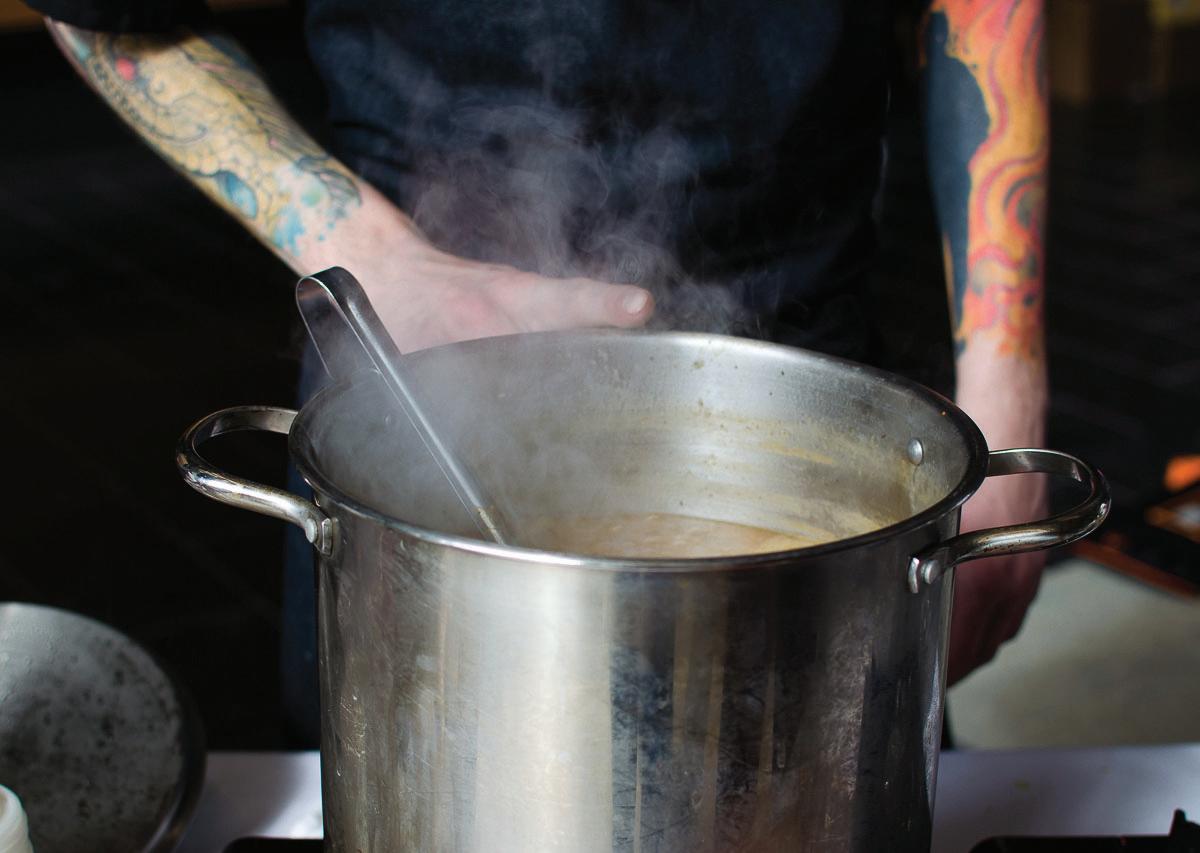
Last Wednesday in the Manitoba Hydro building, Winnipeg chefs stirred up some friendly competition for a cause. The Child Nutrition Council of Manitoba (CNCM) held their annual Stone Soup fundraiser to support breakfast and snack programs in Winnipeg schools.
Viola Prowse, executive director of the CNCM, said that the purpose of the organization is to contribute to students’ success.
“At least a third of elementary students aren’t having any breakfast before they go to school, about twothirds of high school students aren’t, and, besides that, there’s a very small percentage of students that are getting the fruits and vegetables they
need throughout the day,” she said.
Prowse spoke to the far-reaching impact of the program in that children are receiving nutrition education along with a meal. This education manifests itself in the lunches some children bring to school, she said.
Breakfast and snack programs allow for a feeling of community and promote a positive school culture, since teachers often take time to eat with the students.
The Stone Soup fundraiser is based on a folktale that provides a lesson in co-operation and togetherness. In the tale, the community comes together to produce ingredients for a nourishing soup to be enjoyed by all.
Eleven Winnipeg restaurants
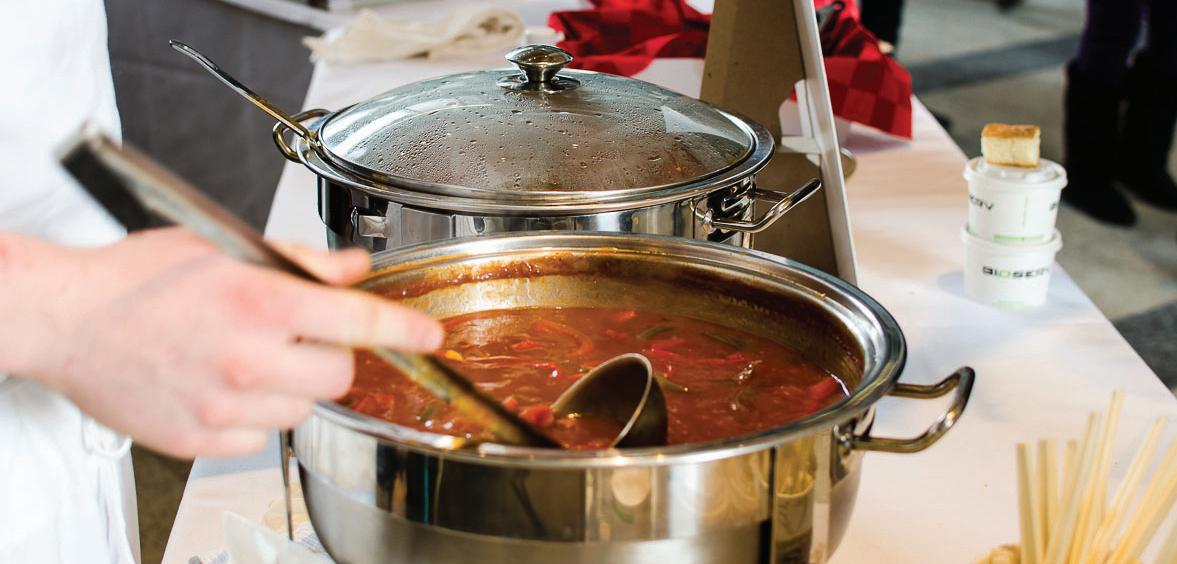
stayed true to the tale, serving sideby-side to support children in need. This is not to say there was not a little friendly competition for the silver ladle – a prize awarded for the best soup in the building based on patrons’ votes.
Deseo Bistro’s head chef Scott Bagshaw joked about a rivalry with executive chef Ben Kramer from Diversity Foods, who responded, “Our rival? Not even close. I think he meant mentor.”
Bagshaw created a vegan and gluten-free wild mushroom bisque –with black trumpet, cremini, oyster, and shitake mushrooms, soybeans, and truffle oil.
Kramer served an inventive
“Manitoba Pho” with hemp seeds, bean sprouts, fresh herbs, and local elk – or, as he called it, “happy elk.”
Neechi Commons’ Talia Syrie served “Three Sisters Soup,” made with butternut squash, corn, and beans. The soup was smooth and warming with just a hint of spice.
Terrace in the Park won the silver ladle for a second year in a row with their seafood chowder, a soup made with crab, corn, Manitoba pickerel, scallops, and shrimp, and garnished with roasted garlic and tarragon oil.
While a diverse group of Winnipeggers enjoyed the sampling of soups—so much so that some chefs ran out—a high school vocal jazz group provided entertainment.
Prowse said that, though the CNCM is trying its best to provide for all children in need, for logistical and monetary reasons, some schools are not able to host programs where the need exists.
Securing money for the food is important, but schools also need to have space available to cook the food and wash dishes. Since schools must raise funds for 75 per cent of the costs, the individuals who believe in and work for the cause are essential, said Prowse.
“We only fund at about—in a real good year—25 per cent of the cost of the program. The schools still have to do a lot of work, and that tells you how significant those programs are.”
Kevin Lin KL ater, staff
T
he issue of youth unemployment was front-and-centre last Friday at a forum hosted by the Canadian Federation of Students (CFS), the Canadian Labour Congress, the Canadian Centre for Policy Alternatives, and several labour unions.
The daylong event featured panels, presentations, and round table discussions on the problem of youth unemployment and underemployment, and also saw participants explore possible solutions.
The issue of youth unemployment was raised at the most recent CFS national convention, and Bilan Arte, Manitoba chairperson for CFS, helped organize Friday’s event.
“The discussion around youth underemployment and unemployment really came to light at our last national general meeting. There were many member locals from Ontario that were talking about this issue of unpaid internships, and the problems that graduates were facing after they finished their degrees,” she said on Friday.
Kevin Chief, provincial Minister for Children and Youth Opportunities,
spoke at the event, highlighting the challenges faced by young people in his constituency of Point Douglas. Dave Sauer, president of the Winnipeg Labour Council, also addressed attendees.
“The fact that we have had to hold a forum like this, to come together and talk about this issue, I think speaks to the growing urgency of the problem,” said Sauer.
“It is very worrying to see these trends, and more needs to be done to help young people be successful when they leave university, or college, or high school.”
The economic impact of unemployment and underemployment among Canada’s youth was highlighted in a report released last year by TD bank senior economist Martin Schwerdtfeger, who estimated the loss in wages to be $10.7 billion over a three-year period.
The federal government previously claimed that a “skills gap” arose in the labour force; that is, that job vacancies exist—especially in skilled trades
and technical areas—but that workers do not have the skills that businesses require.
Several panellists and participants on Friday rejected this assertion, instead arguing that a sheer lack of jobs is the true problem.
Canadian economist Don Drummond’s work supports this view. A recent report by Drummond found that there have been no wage spikes in the skilled trades, nor in the scientific or technical fields – something one would expect if there were an unmet demand for such workers.
In addition, a Statistics Canada survey of job vacancies from May of last year found that there were 6.3 unemployed people for every job vacancy, suggesting a lack of openings.
“Let’s face it, we have too many jobs without people, and too many people without jobs,” said Jason Kenney, the federal Minister for Employment and Social Development, during a speech last year to the Economic Club of Canada.
The Manitoba government increased funding for trades and job training for
young people when it released the provincial budget earlier this month. The budget includes a $5,000 tax credit for employers who hire apprentices, and also offers incentives for expanding high school apprenticeship programs.
The issue of training was also addressed at last Friday’s forum. Lynne Fernandez of the Canadian Centre for Policy Alternatives spoke about the private sector’s shirking of its traditional responsibility for training young people, and the offloading of this task onto the public sector.
“Why are these employers not providing training themselves? They are trying to move that responsibility for training onto our public institutions. This is a trend that is definitely very different from when I was young, where employers would take the time and actually train you,” said Fernandez.
The federal government recently reached an agreement with all provinces (except Quebec) to implement the much-publicized Canada Job Grant (CJG).
The CJG seeks to encourage the hiring of more workers by subsidizing the
costs that businesses incur when training new employees. However, the CJG will likely defund existing programs that target groups with low labour market participation, such as youth, new immigrants, Aboriginal Canadians, and the long-term unemployed.
Janet Layte, a career counsellor at Sara Riel Inc., an organization that helps people with mental health issues re-enter the workforce, can already see this trend developing.
Layte’s organization, which provides assistance to many young people, has seen its budget cut this year, and may not be able to help as many people as in the past.
“There’s no doubt that a lot of people would still be on social assistance or not working if they didn’t get help from us or similar organizations,” said Layte.
The national youth unemployment rate stands at 13.9 per cent – roughly double the rate of other workers. When you include young people who are underemployed, or have given up looking for work, the rate jumps to 27.7 per cent.
U of M students raise over $20,000 for local charity
Quinn r ichert, staff
A
s per tradition, University of Manitoba Asper school of business students camped outside last week in participation with the Canada-wide Five Days for the Homeless (5DH) campaign.
Typically, five Asper students spend five nights in a makeshift shelter outside University Centre, eating only what is given to them by friends, supporters, and passersby.
The rules applied as usual this year, except only four out of five participants were Asper students; Matt Odger, Riley George, Sara Bulloch, and Sam Davidson were joined by political studies student Martin Machalak.
In addition to the campers, many commerce (and non-commerce) students joined in, soliciting donations around campus for Resource Assistance for Youth (RaY), a local non-profit organization the school has partnered with in years past.
“I think the reason we keep going back to them is that they service people who are our age,” said George.
“We’ve had RaY come by every day. I’ve met a couple of the people they’ve helped, and I can relate to them when they’re 19 years old and I’m 20 years
old,” he continued.
The students began sleeping outside on Sunday night and wrapped up their endeavour Friday night. In addition to their highly visible campaign, a past user of RaY’s services visited the U of M on Thursday to meet with the campers, to describe his own past history with homelessness, and to discuss the various services RaY offers to young people living without a fixed address.
Davidson and George acknowledged that while the response from people on campus has been mostly supportive, some have shared with them their misgivings about the campaign. One individual told George that the five days outside did not truly mirror the plight of homeless youth; George and Davidson both agreed.
“This isn’t really to simulate homelessness. It’s to create attention,” said Davidson.
“There is such a negative stigma associated with homelessness, and [5DH] is really to get the conversation going. In the end, when people who aren’t as supportive come talk to us, that’s just it. They’re getting the conversation going [ . . . ] in the end, they may not support it, but we’re
raising awareness and we’re raising funds.”
As the campaign wound down last Friday, the U of M’s 5DH campaign counted a total of $20,701, surpassing their goal of $20,000. A total of $184,969 was raised nationally, with all schools donating 100 per cent of proceeds to local charities.
The 5DH campaign has its roots at the University of Alberta, whose school of business initiated the campaign in 2005. By 2011, 22 schools across Canada were involved.
Reflecting on the second and coldest day of the experience, Davidson remarked that, if anything, it had only made the survival of homeless youth in Winnipeg seem more remarkable.
“It really puts things in perspective. You have to wonder, after two days for us and we’re feeling like this, imagine the people that are in way worse conditions, doing this for three weeks, three months, three years, or even three decades. For us this is something where we can take that personal sacrifice to create some awareness and keep the conversation going.”

Blog post criticizing Conservative government removed
The Canadian Museum for Human Rights (CMHR) has again come under fire in the media, this time due to accusations by historian Veronica Strong-Boag that the organization engaged in censorship when it removed a commissioned blog post she had written criticizing the Conservative government.
In the original post, titled “International Women’s Day (IWD) and Human Rights 2014,” StrongBoag detailed the history of IWD from its inception to the current day.
Strong-Boag—whose primary research interests include the history of education, gender studies, and children and youth—wrote in the post in question about the perceived “anti-woman record” of the Canadian government, citing the termination of plans for a national child-care program, defunding to Status of Women Canada, civil servants being prohibited from “taking pay equity complaints” to the Canadian Human Rights Commission, the lack of funding for international abortion, and funding cuts to public services that employ and provide assistance to women.
The post was live on the blog for several hours before CMHR staff removed it.
Angela Cassie, director of communications at the CMHR, wrote to Strong-Boag expressing her apologies for the confusion, and stating that “CMHR blogs are intended to consist of interesting short stories on human rights themes and topics, ideally from a first-person perspective, written primarily by CMHR staff as an opportunity to showcase the depth and diversity of their work and experiences.”
She further explained that what the CMHR had intended for the blog was “anecdotal accounts of first-person experiences that illuminate human rights themes, and that they include ‘rich media’ relevant to the story (photos, images),” and that “guest blogs [should] not be used as, or be perceived as, a platform for political positions or partisan statements.”
Strong-Boag responded, arguing that such limitations were “both naive and pedagogically unsound for a museum supposedly dedicated to (the promotion of) human rights.”
“It suggests,” wrote the historian, “that human rights are almost purely about entertainment and that authors can pretend impartiality in dealing with them [ . . . ] museums and institutions of public memory are not normally intended to imitate
Disneyland but to provide serious, although engaging and accessible, observations on the world.”
This is not the first time CMHR content has faced criticism. Aboriginal groups have expressed anger that the crimes committed in the past against them will not be labelled as genocide. Disagreements persist over how much space should be allocated to different historical atrocities.
The initial proposal of having a permanent, separate exhibit devoted to the Holocaust raised the ire of other groups who wanted all genocides to be grouped together in one exhibit room.
Ukrainian interest groups have been advocating for separate exhibits for both the Holodomor—the genocide of Ukrainians under Stalin—and the mass Ukrainian internment by the Canadian government during WWI.
The museum, which is scheduled to open this fall, has also seen the departure of a number of its staff, some of whom have claimed that the museum’s content is being softened to reflect a more positive Canadian history. The museum has denied these claims.
Such problems have led some to believe that the CMHR is tied too closely to the federal government, from which a significant portion of its funding comes.
In her correspondence with Cassie, Strong-Boag stated that Cassie’s “attempt at an explanation for censorship suggests the museum needs to engage in some serious self-reflection about its mandate and its apparent subordination to political masters.”
Despite Strong-Hoag’s allegations, Ken McDonald, a retired lawyer, maintains that the museum has done nothing legally wrong.
“What’s important to remember in this particular case is the context of the situation. The blog is the museum’s and they are allowed to put what they want on it. Whatever your personal opinion is of the government’s policies—whether you think they’re anti-women or not—the museum is allowed to refuse to broadcast your opinion. You can go get your own blog,” said McDonald.
“I think that the kind of discussion that [Strong-Boag] was trying to instigate is an interesting one, but given where the museum gets its funding, and the fact that it’s a public place that already gets a lot of attention for showing a lot of governments at their worst [ . . . ] it’s not really that surprising that they didn’t want to have that discussion on their website.”
c a L eigh MacDona LD, staff

Last week, UMSU student group
Rainbow Pride Mosaic (RPM) hosted their annual LGBTTQ* Awareness Week on the University of Manitoba campus. The event is designed to create a positive understanding of LGBTTQ*
community members and the issues they face.
Monday and Tuesday featured the creation of a “Mosaic of Diversity” at the RPM art table, as well as the screening of two films.
Monday’s film, titled “If These
Walls Could Talk 2,” is a drama that follows the stories of three generations of lesbian women as they navigate through life.
Tuesday’s “For the Bible Tells Me So ” is a documentary about the clash between religion and homosexuality. It focuses primarily on religious parents with children who expressed non-traditional sexual orientations.
Nancy Allan, NDP MLA and former Minister of Education, spoke on Wednesday about Bill 18. The bill was passed by the provincial government in September of last year.
Bill 18, otherwise known as the Public Schools Amendment Act (Safe and Inclusive Schools), requires schools to establish a policy that directly encourages respect for diversity, and forces educators to become involved in cases of bullying. It requires all schools to provide support to any students wishing to initiate or lead actions that promote gender equity, anti-racism, and awareness and advocacy for LGBTTQ* or disabled students.
On Wednesday, RPM held an open house at the Student Group Resource Centre in 180 Helen Glass. The RPM office is not only a safe space, but also has resources that
provide pertinent information about sexual health to those who identify as LGBTTQ*.
According to an MLA Member’s Statement by Allan, this population constitutes over 1,100 (four per cent) of University of Manitoba students and employees.
Thursday featured a panel discussion titled “Gender Identity and Fluidity: Breaking the Binary,” which was followed by the games carnival on Friday.
Overall, RPM member Steph Knelsen considered the activities of the group’s awareness week very effective.
“The effect we hope to have is to enlighten the community on the LGBTTQ* community and everything we stand for: equality, respect, individualism, [and] acceptance of diversity,” Knelsen told the Manitoban
“I think that [these values] need to be reinforced at the U of M. We are on the right track, but not quite there [ . . . ] there are still a lot of people who are not well-informed on our community, and don’t quite understand what it is to be LGBTTQ*. Because of this, they can’t really treat us as equals.”
This is why the RPM exists, according to its members.
“RPM is just a kind of safe place for anyone who needs it. You can just come here and play video games, or do your homework or whatever, and you don’t have to worry about any of the shit out there. You can just relax and be whoever you are,” said a member who wished to remain anonymous.
Allan expressed similar feelings in her Member’s Statement.
“We see time and time again the importance of having groups that advocate for and provide resources to the LGBTTQ* community. By providing a safe space and engaging people in meaningful dialogue, RPM is creating a more inclusive learning environment so that all students reach their full potential,” she wrote.
Knelsen admitted that it’s difficult to objectively track the progress made by the organization in changing attitudes and sentiment towards members of the LGBTTQ* community. But she is optimistic.
“Success to me is informing even just one person [about] the LGBTTQ* community,” she said. “So I’m hopeful.”
and students speak on importance of Bill 18
Kevin Lin KL ater, staff

Nancy Allan, former Manitoba Minister of Education and current MLA for St. Vital, spoke at the University of Manitoba last Wednesday as part of LGBTTQ* Awareness Week.
On Sept. 13 of last year, the provincial government ratified anti-bullying legislation with the passage of Bill 18 – The Public Schools Amendment Act (Safe and Inclusive Schools). Allan
spearheaded the passage of the bill, and shared her experiences at the U of M in a keynote speech.
“It was a long struggle from start to finish. But it was something I felt really strongly about. If young people aren’t safe in school and don’t feel accepted, they cannot learn. It was something we had to address.”
The legislation was contentious to some because it required schools to
accommodate students who wanted to start anti-bullying clubs, including the formation and promotion of gaystraight alliances.
Some Manitobans opposed the bill, arguing that these clubs would oppose their religious beliefs, and that requiring schools to allow such clubs would infringe on religious freedom.
Allan said the death of Amanda Todd sparked a conversation within
Allan’s office. Todd committed suicide in October of 2012 after being bullied online and at school.
“We started to talk about it in my office, and I said to my staff, ‘I think we need to have a response to this provincially’ [ . . . ] we need to be there to support young people; regardless of who they are, we need to support them.”
Allan introduced the bill in the fall of 2012. Over the next year, a protracted battle developed between supporters and opponents of the legislation.
“It was an incredible journey [ . . . ] it galvanized the people who were against Bill 18, but more importantly, it galvanized the people who were for it. It was probably the most important human rights debate that we have had in this province since we passed a law to implement same-sex marriage.”
One of the most visible proponents to emerge in the debate was Evan Wiens, a high school student from Steinbach Regional Secondary School.
Wiens was barred from advertising a gay-straight alliance group he started at his school. The group has since been allowed to advertise their presence.
Danny Enright, a U of M student
from Steinbach and a close friend of Wiens’, was present in the audience on Wednesday.
“I think this has had an impact at my old high school; the attitudes have gotten better. Some people would always tear down the posters, and I heard [that] at the beginning of this most recent school year, people actually got suspended temporarily when they were caught.”
Opposition stemmed strongly from the Southland Community Church in Steinbach, where the pastor, Ray Duerksen, called Bill 18 “the biggest challenge the Canadian church has ever faced.”
During the public hearings stage of the legislative process, MLAs heard from 260 speakers.
“In Manitoba, we’re the only jurisdiction in Canada that has a public process where every piece of legislation goes through a public hearing at the legislature, and anyone who wants to speak to a piece of legislation can come and speak,” said Allan.
“It was gruelling at times, but my caucus stood beside me. Even those who were religious stood beside me and supported me. They knew this needed to be done. They knew this was about human rights.”



Alexander Motyl provides theories on threat posed by Putin
Bryce hoye, staff
Will Ukraine survive Yanukovych? Such was the name of a talk Alexander Motyl delivered last Friday on the U of M campus.
Motyl, a professor of political science at Rutgers University, spoke to the institutional devastation suffered by the Ukraine at the hands of former President Viktor Yanukovych and an oligarchic elite, and the prospect of a post-Yanukovych democratic state in Ukraine.
Motyl began by framing the recent revolt in the Ukraine within a broader cultural context.
“Yanukovych created a political system that resembled a hub and spokes with him at the centre, and almost all key political appointees directly responsible to him,” Motyl told the audience. “Such a regime is and was intrinsically brittle and unstable [ . . . ] it is incompatible with both a modern economy and society, which can be governed only with flexible and effective institutions and it is also incompatible with an increasingly globalised world – within which the free flow of information defines effective government.”
By Motyl’s own admission, the Yanukovych regime’s official dissolution in late February was inevitabile.
“A weak regime confronted a strong civil society for the period from early 2010, when Yanukovych was elected, to late 2013. When Yanukovych turned his back on the association agreement with the European Union, he pushed popular discontent over the edge,” said Motyl. “The important thing to remember is the discontent was there: it was latent, it was active [ . . . ] all it needed was a spark.”
Klavida Tatar was present for Motyl’s lecture. Tatar, a master’s student in the U of M’s department of history and a Ukrainian native, grew up in Kyiv and studied political science in Russia for five years, where she was involved with the local Ukrainian activist community.
Tatar feels a sense of optimism growing out of the local UkrainianCanadian community in the face of Yanukovych’s overthrow; however, present entanglements with Russia have her worried.
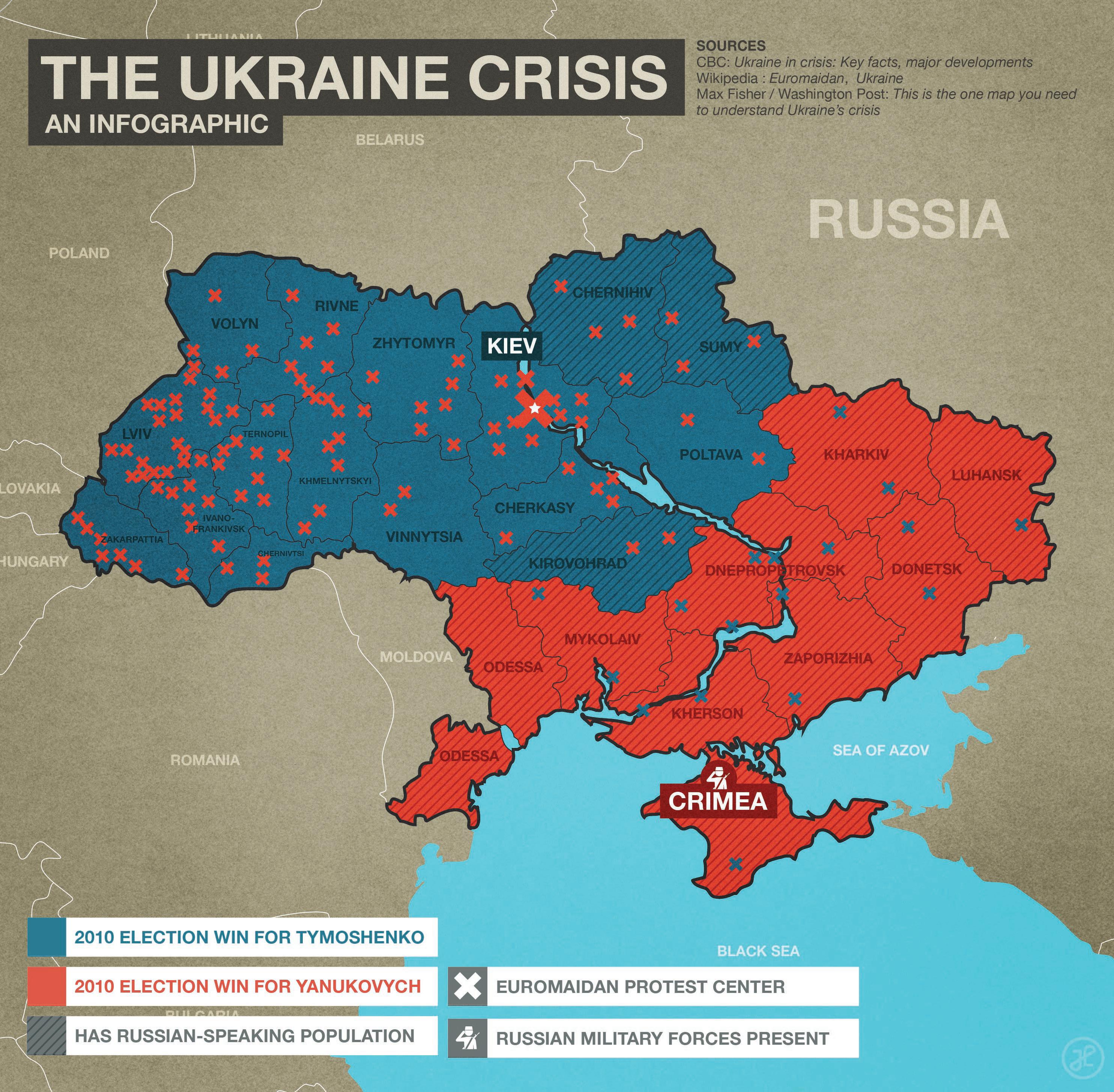
“Russia’s invasion of Crimea sets a precedent in modern history, one that is unacceptable for the 21st century, as it endangers Ukraine’s transformation, even its unity,” said Tatar. “I am afraid that Russia won’t be satisfied with Crimea, and the South-Eastern regions of Ukraine are under no less threat. All these regions are also predominantly Russian-speaking, with a large percentage of ethnic Russians. Even though they consider themselves Ukrainian, there is nothing to pre-
vent Russia from doing just what it is doing in Crimea [elsewhere in Ukraine].”
PuTiN, riGhT secTor, svobodA
In light of recent developments on the ground in Crimea—a republic in the southwest of Ukraine— Motyl opted to shift the focus of his talk toward the imminent threat presented by Russian President Vladimir Putin. Putin’s brand of fascism poses the biggest challenge to a vulnerable Ukraine. Ukrainian far-right nationalist factions such as Svoboda and the Right Sector—groups criticized for having xenophobic or neo-Nazis values— are of less concern to Motyl. Svoboda and the Right Sector “are not fascist [organizations],” according to Motyl.
“What I can say is they [Svoboda] sound more like right-wing republican Tea Party characters. Now I wouldn’t want America to be ruled by right-wing republican Tea Party members; on the other hand, they’re not fascists,” Motyl told the Manitoban. “They are [Right Sector] opposed to the European Union, but they’re pro-democracy, and they’re actually more liberal and tolerant than Svoboda,” said Motyl.
“To me, what makes a fascists primarily is behaviour. It is partly what you say, but it’s mostly what you do. I’m not sure that what Svoboda and the Right Sector has said they’ll do is necessarily fascistic, although it’s certainly Tea Party-ish. To me the burden of proof is on the people who say they are [fascists]. Putin, absolutely – he’s created the state. He has a whole system, an apparatus. These guys, I’m not sure: they’ve got to be monitored, you have to keep an eye on them [ . . . ] I don’t want them to be in power, but then they’re not. The [Ukraine] is being run by a far larger coalition and they’re just a small part of it.”
During the question period following the lecture, Motyl entertained the notion of whether loosing Crimea to Russia ought to be considered a loss or a benefit to Ukraine in the long run. “My fear isn’t losing Crimea, frankly [. . . ] I am worried about the southeast of Ukraine. As unlikely as I think a full scale war will be, I am still very worried about it, because a five per cent chance is roughly five per cent too much.”
Earlier this week Crimeans voted overwhelmingly in favour of leaving Ukraine and joining Russia. The vote has been called illegitimate by some, as the referendum took place while Crimea was under occupation by Russian forces. The Manitoban will be providing updates on developments in the Ukraine as they unfold.

Kara Passey, staff
Last fall, my friends and I were leaving the bar at the Windsor Hotel making our way home in the early hours of the morning. We came across an Aboriginal woman passed out in the doorway of a building. Passed out— not tucked in for the night—with her purse strewn out next to her, and a hospital bracelet on her wrist.
A couple stood near her, and as we approached we asked if they were with her and if everything was alright. They didn’t respond, and—in a reaction common among Winnipeggers—gave us looks like, “Hell no, I’m not taking any responsibility for this.”
“Come on,” the woman said to her partner. “Someone probably called already.”
And they walked away.
No one called. We called. It took five minutes for an ambulance to show up and we continued on our way.
This past January I boarded a bus, and an Aboriginal woman was seated up front with a freshly beaten face and not looking so well. Unfortunately, the bus was crowded and I got quickly pushed to the back. The bus was en route to the Health Sciences Centre, and I remember thinking that maybe she was okay and on her way to get herself some help. At the end of my 20-minute bus ride—and after noticing that she hadn’t gotten off, especially not at the stop for the HSC—I pushed my way to the front to discover her completely passed out.
I asked the man sitting next to her if she was with him; he wasn’t. I told the bus driver and an ambulance was called. A lot of perfectly capable people had stood by watching and doing nothing – okay, not nothing: one guy poked her and laughed to himself.
I have a lot of stories like this, and I don’t share them to have people tell me that I’m some kind of hero. I share them because I’m frustrated that the bare minimum of compassion is lacking, and that the status quo is to respond with apathy, thus contributing to the reality that is an unsafe world for Aboriginal women.
I also work alongside the school system, so I am aware that not much has changed when it comes to educating people on the culture, history, and genocide of Canada’s indigenous people – certainly not much has changed when it comes to teaching that white people still benefit from it today. School-aged kids are still taught racism towards Aboriginal people—including slurs—and their knowledge of Aboriginal culture usually consists of taking a workshop on how to make a dreamcatcher. One wonders how future generations can not repeat the mistakes of history when they receive a watered down, one-sided interpretation of how their country was established.
I still hear grown adults saying things like, “Who cares? That happened like a thousand years ago.”
crAsh course: how we’ve fAiled ANd exPloiTed cANAdA’s iNdiGeNous PeoPle
The royAl ProclAMATioN was issued by King George III in 1763, stating that First Nations people have title to land until ceded by treaty. European settlers are given permission to colonize and purchase First Nation lands. While the Royal Proclamation gave First Nations rights and title to land, it was made by colonists to establish a monopoly over First Nation land by the British Crown.
The reserve sysTeM was established in 1830 so First Nations couldn’t block future settlements. Aboriginals were pushed onto small reserves with poor living conditions – many of which still exist and are in use today.
The civilizATioN of iNdiAN Tribes AcT was passed in 1857 by the colonial government as a first attempt to assimilate Aboriginal people. If an Indian man were to pledge to “live as a white” he could have the right “to vote, own property, and serve on juries” – but he would have to give up his status.
The iNdiAN AcT was made in 1876 and while it was never translated into any native tongue, it set out the rules and regulations that status Indians had to follow: status, land, resources, wills, education, band administration, etc. Later revisions also banned Aboriginal people from practising their culture.
resideNTiAl schools
In 1923 First Nations children were taken from their families and legally forced to attend residential schools, where through abuse they were forced to forget their language and culture.
It wasn’t until 1951 that the ban on ceremonies was lifted, or until 1960 that Aboriginal men got the right to vote in federal elections, or even until 1996 that the last residential school in Canada closed. If you think of it in terms of generations, there are children whose parents or grandparents have attended residential schools in our school system today – children who, if they aren’t well connected with their community, are still learning inaccurate histories about their own people.
And as these intergenerational oppressions still affect First Nations and Métis people— leaving them to cope with poverty and mental illness in a country which has insufficient supports for either—there are still events continuing to unfold and contribute to the oppression of Canada’s Aboriginal people.
This didn’t happen a thousand years ago; in fact, we are living it now.
Research done by master’s student Christine Stark last year reported that indigenous women (and children, and babies), especially from northern reserves, are victims of sex trafficking, and are sold into the sex trade on ships along Lake Superior.
In the spring of 2011, Manitoba officials diverted flood water from the Assiniboine River to protect the city of Winnipeg, which subsequently destroyed the 140-year-old reserve of Lake St. Martin. Evacuees are still living in Winnipeg hotels and “temporary” housing today. Protesters for the rights of Aboriginals and participants in movements like Idle No More are treated as terrorists and arrested on their own land.
Most recently, the demand for a national inquiry on missing and murdered Aboriginal women was high, and the Conservative government fought hard against it, claiming that existing initiatives were sufficient. Peter MacKay, Canada’s Minister of Justice, was quoted as saying, “With the greatest respect, the biggest mistake that we could make on this issue would be to spend more time studying it.”
The initiatives mentioned focused mostly on a DNA database for missing persons, police presence, convictions, and not on preventative measures. “We need more substantive tools for police to investigate violent crime, to hold offenders accountable,” added MacKay.
The call for a national inquiry was rejected
on March 7, 2014. A sensible person might wonder if such an apathetic government could have done an inquiry justice in the first place.
The 2004 General Social Survey (Statistics Canada) reported that “Aboriginal women experience much higher rates of violence than non-Aboriginal women.” This report included statistics on race and gender-based violence, as well as accounts of family-based violence.
While working on her PhD in law, Maryanne Pearce wrote her thesis “An Awkward Silence: Missing and Murdered Vulnerable Women and the Canadian Justice System,” which lists key factors of violence against Aboriginal women to include street prostitution, addiction, and insecure housing.
A disturbing and informative article by Jacqueline Lynne and Melissa Farley entitled “Prostitution of Indigenous Women: Sex Inequality and the Colonization of Canada’s First Nations Women” outlines how capitalism has contributed to the commodification of Aboriginal women’s bodies. The article also includes statistics such as the fact that 80-90 per cent of single Aboriginal mothers (in urban Winnipeg, Regina, and Saskatoon) were living below poverty level, and that “84 per cent of Aboriginal households on reserves did not have sufficient income to cover housing.” When Aboriginal sex workers are asked for a list of needs to escape prostitution, stable housing is at the top.
Possible preventative measures start to become visible when examining the causes of violence: the string of historical—and ongoing—acts of assimilation and oppression set up Aboriginal people for a life of poverty and poor living conditions.
Poverty contributes to issues with mental and physical health (as does the abuse that survivors of residential schools are still in recovery from today), which can lead to self-medication and addiction. Education in low-income neighbourhoods is significantly poorer and the changing character of the job market today makes it difficult to find full-time work – or any at all. Affordable housing is almost nonexistent, so families and communities suffer, and the conditions that lead to gangs are created as a byproduct; as you can expect, with gangs comes sex work, illegal drugs, and related violence.
By framing the relationship between poverty and violence as a complex issue and examining its contributing factors, we can begin to assess the needs of those who are affected by it. In addition to acknowledging the rights of Aboriginal people—and working with them to form solutions—the federal government needs to appropriately address the complexities of poverty and violence.
Asset-based community development that involves the input of those who access these services could include affordable housing (rental and social), a living wage, accessible health care (including sufficient health care for those living with a mental illness and/ or addiction), access to healthy food, and support to restore those involved with gangrelated crimes are all concepts that could be addressed in a preventative action plan against violence and poverty.
It goes without saying, I hope, that the first step would be the acknowledgment that we are still living in a society actively denying genocide and contributing to the oppression of Aboriginal people.
“With the greatest respect, the biggest mistake that we could make on this issue would be to spend more time studying it” – Peter MacKay, Minister of Justice



Michae L Lee, volunteer staff
With the help of the media, coverage of rape culture on university campuses is increasingly being brought to the fore. Rape culture is most certainly real and to simply sweep it under the rug does a great disservice to those who have been victims of sexual assault. Unfortunately, there are still those who think otherwise.
Earlier this month, Barbara Kay of the National Post and Margaret Wente of the Globe and Mail offered their own critiques of the growing awareness, and fear, of rape culture.
In Kay’s article, “Rape culture and the delusions of the feminist mind,” she provides a blunt characterization of rape culture by stating, “The fact is that ‘rape culture’ is a form of popular mania like so many others before it. It does not exist. Or if it does, nobody has yet brought forward evidence of it.”
To Kay, then, the fear surrounding rape is one brought about by “ideology attached to a great deal of personal narrative regarding unwanted or regretted sex,” that, while “compelling,” is “unsupported by evidence.”
Kay does offer a brief moment of empathy by suggesting that no woman should ever be sexually assaulted. However, she suggests to young women to exercise a bit of caution: to “not drink to excess,” to be “prudent about the kinds of parties they attend,” and to be “selective about their sexual partners in general.” She seems to adhere to the notion that, while there is no real danger, one must still be cautious – to not panic but still be suspicious about that guy across the room at a party.
Does this not propagate the very over-heightened fear that Kay argues rape culture promotes? Should a woman not be able to navigate freely without fear? Instead of blaming women, perhaps a solution lies in changing the actions and perceptions of men.
Kay appears to place all of the
responsibility on women while absolving any responsibility from men. This is what I believe to be the greatest misstep in altering our perceptions of rape culture. Rape is not solely a women’s problem or a feminists’ problem – it is also a men’s problem.
Wente’s article in the Globe and Mail —“Can she consent to sex after drinking?”—takes a slightly different approach compared to Kay’s piece. Wente argues that alcohol is the real issue at hand here. The Campus Sexual Assault Study, which she references, has shown that the vast majority of sexual assaults involve alcohol, but adds that not only do the vast majority of these women victims not believe they were raped, but two-thirds did not even think the incident serious enough to report to the authorities.
In an earlier article for the Globe and Mail titled “When rape culture and booze culture meet,” Wente offers some advice for young women to avoid what she refers to as “the perils of ‘rape culture’”: “Don’t get drunk.”
Advocating for women to not “get drunk” nor to “binge drink” is an entirely misguided approach to combating rape; although, the Campus Sexual Assault Study does suggest “combining sexual assault prevention education with alcohol and drug education programming.”
However, one point that Wente fails to consider is whether men should forgo alcohol as well. If “drunken men in groups often behave worse than drunken men on their own, because they’re full of bravado and egg each other on,” as she suggests in “When rape culture and booze culture meet,” should we then not similarly tell men to not get drunk?
Regardless of whether alcohol is involved or not, the fact still remains that men are raping women, and this is what needs to change. While educating people on responsible drinking will certainly lead to progress, the conversation must delve even deeper. We must also consider how we can alter the mindsets of men
so that they do not rape in the first place.
Jackson Katz, an anti-sexism educator, touches on this very issue.
In a 2012 TED Talk aptly named “Violence against women – it’s a men’s issue,” Katz offers a spirited and thought-provoking analysis whereby he questions society’s perceptions of rape.
Not only do we blame the victim, Katz argues, but we are also asking the wrong questions. Instead, we should be asking, “Why is domestic violence still a big problem in
the United States and all over the world? [ . . . ] Why do so many men abuse—physically, emotionally, verbally, and other ways—the women and girls, and the men and boys, that they claim to love? What’s going on with men?”
These are the more salient questions that should be asked and once we are able to tackle these issues, we should see a dramatic shift towards the better.
I refuse to accept that men should not play a part in eliminating sexual assault. On the contrary, men
should play just as active of a role as women. Men and women should fight together against this rape mentality.
Later in the talk, Katz says, “[It’s] not just understanding these issues as men’s issues, but they’re also leadership issues for men.” I agree that proper male—and female— leadership is the key in helping future generations fight back against the preventable tragedy of sexual assault.


Gimme Some Truth highlights the art of documentary by experienced and emerging filmmakers
a nastasia c hi P e L s K i, staff
Local filmmakers, film connoisseurs, and any others who feel the gravitational pull towards the stories not often told or the roads less travelled should set their sights on Cinematheque this weekend, host to the sixth annual Gimme Some Truth Documentary Festival.
“Gimme Some Truth was created to showcase the world’s most challenging, uncompromising, and poignant documentary, and to invite the most renowned veteran documentary filmmakers to Winnipeg to share that history with our local emerging filmmakers,” says Kier-La Janisse, one of the festival’s organizers. Gimme Some Truth is put on through the Winnipeg Film Group, and is a collective effort between Janisse, Jaimz Asmundson, Dave Barber, and Alex Rogalski.
Documentary films often live in a grey area between news and art, and can have a lasting, transformative effect on audiences, igniting passions and changing worldviews.
“Growing up watching Joe Berlinger’s Paradise Lost (1996) made me realize the potential power of documentary not only as an art form but as a politically charged document that can create actual changes in our world,” says Asmundson.
“I think it was at that point that I realized at a young age that documentary films were not one-sided news pieces but were powerful works of art that could be dangerous, controversial, and inspiring in ways that narrative film can never be.”
The festival will also feature panellists and speakers like John Greyson, who is seen by Barber
as “one of the bravest independent Canadian filmmakers.” Greyson will be part of a panel on personal and political filmmaking, bringing his recent experience of having spent seven weeks in an Egyptian prison with him, as well as the documentary Rebel in the Night (The Human Rights Shorts of John Greyson).
Local talent will also be highlighted throughout Gimme Some Truth. Says Asmundson, “We have an immense pool of talented artists in Winnipeg and it’s important to highlight the continually amazing output from our local filmmakers as well as their successes abroad.”
Specifically, two local films will be making their world premieres this weekend.On the Trail of the Far Fur Country by Kevin Nikkel is “an epic piece of research into the 1920 silent film that follows a film crew’s epic journey across Canada’s North,” and will be showing on March 23 at 7 p.m.
A “hilarious and in-depth look at the mark our local music scene left on [the] punk landscape in the late 70s and early 80s,” Kathryn Martin’s Piss on You: Winnipeg’s Early Punk Scene has already sold out of the first screening, and festival organizers have added a second showing at 11 p.m. on March 22.
The relative democratization of technology has opened up new possibilities in the field of documentary making, which is an exciting development for those passionate about the form.
Dave Barber believes the medium of documentary is especially relevant because “you can explore the truth and tell a story in many creative ways through documentary filmmaking and can manipulate imagery in very subtle,

imaginative ways. With the rise of digital cameras the craft is really open to anyone with a good idea who is careful in how they assemble the film.”
There is a lot more to documentary making than simply grabbing a camera and capturing footage of events, however, and the art of storytelling and selection is showcased in films selected for Gimme Some Truth.
“I wanted to show that documentary filmmaking is not just a means of recording, but of knowing what to record, and knowing how to read it,” says Janisse. “Documentary is wrongly assumed by many to be an “easy” stepping stone to making narrative films. But documentary is an art form, and when I first envisioned Gimme Some Truth it was to make filmmakers push themselves a bit harder to meet that standard.”
On the more visually spectacular end of the spectrum, festival organizers are excited to screen Picture of Light by Peter Mettler, which Asmundson describes as “one of the most remarkably gorgeous documentations of the Northern Lights in Churchill to be ever captured on film.”
Beyond offering exquisite renderings of the Aurora Borealis and capturing an earlier version of our local punks, Gimme Some Truth hopes to provide the chance for film fans to connect with filmmakers, their works, and their process. Asmundson promises, “This is not your typical weekend at Cinematheque!”
Gimme Some Truth is held from March 20-23 at Cinematheque, 100 Arthur Street. Visit www.gimmesometruth.ca for more information.


Lu K as t hiessen, staff
There is always time for more hard work. In the midst of her third year as a PhD student in the department of English, film, and theatre at the University of Manitoba, Kendra MagnusJohnston is exerting her talents to co-ordinate Wine & Words, an innovative event for the company Theatre by the River that combines theatre, literature, and wine.
Magnus-Johnston is on the board for Theatre by the River and works as their promotions and marketing coordinator. She also recently worked as chief returning officer for the U of M Graduate Students’ Association elections, and serves on the boards of the Graduate Students’ Association and the Association of Graduate English Students.
She serves on the board of directors for the quarterly-published Contemporary Verse 2: The Canadian Journal of Poetry and Critical Writing. She also volunteers with the Manitoba Editors’ Association, and is a research and teaching assistant with the University of Winnipeg in the department of Women’s and Gender Studies. Her work has been published in the Journal of Folklore Research , Children’s Literature Association Quarterly , Marvels & Tales, and Young Scholars in Writing
The event is produced in conjunction with the Spur festival. Spur is interdisciplinary in nature and promoted as “a festival of politics, art, and ideas.” The Spur festival is conceptualized as a living magazine, showcased in the form of debates, conversations, book readings, walking tours, literary cabarets, parties, and more.
Hosted in the past at Red River College, and last year at the University of Winnipeg’s Asper Centre for Theatre and Film, Wine & Words is now in its fifth year, and they are planning to remount this show as their season launch this coming fall. The event is a boundary-crossing smorgasbord.
“There will be pieces from poets, playwrights, filmmakers, and authors of fiction and non-fiction,” says Magnus-Johnston. “Some pieces are slow, others are rhythmic, still others are downright sad, while others are comedic.” All of the pieces are written and performed by locals.
Do not expect traditional theatrical fare.
“Audience members should note that these are ‘staged readings’ – that means very minimalist,” Magnus-Johnston explains. “No sets and no costumes. Just actors and local celebrities who are reading the pieces in tribute to the authors who’ve written them.”
A variety of local artists from different fields have contributed to the event in various genres. “George Toles recently pitched that I include his Facebook status posts in the showcase; I will admit, the idea has stuck with me,” says MagnusJohnston, imagining a future opportunity for this idea.
Other artists whose written work will be part of the event include filmmaker Guy Maddin and photographer Leif Norman, and writers Sally Ito and Steve Locke.
She sees the event as an opportunity to give back to the community.
“Art should be shared. It should exist to enrich the life of the producer
and his/her peers. Reading and writing should be shared. I think we should all strive to make connections, to know our neighbours and the things they are passionate about,” she explains.
The organizers are adamant about presenting the works as a tribute to the authors who devoted their time to crafting them.
Magnus-Johnston emphasizes the importance of sharing an opportunity as well as physical and ideological space among people in various fields, citing faculty mergers at the university level and funding cuts to different departments. “The [interdisciplinary quality] of the festival is a political and tangible subject that we should be talking about,” she asserts.
There will be a panel discussion before the performances begin. The speakers—Paul Holdengräber (Live from the New York Public Library), George Prochnik (author of In Pursuit of Silence: Listening for Meaning in a World of Noise) and Arthur Schafer (director of the centre for professional and applied ethics, U of M)—are going to discuss “the search for meaning in a saturated world.”
Wine & Words takes place March 20 at 8:30 p.m. at the Winnipeg Art Gallery (300 Memorial Boulevard). The panel discussion is at 7 p.m. Tickets are $25 and available at www.brownpapertickets.com or by using your Spur weekend pass.

Do not expect traditional theatrical fare













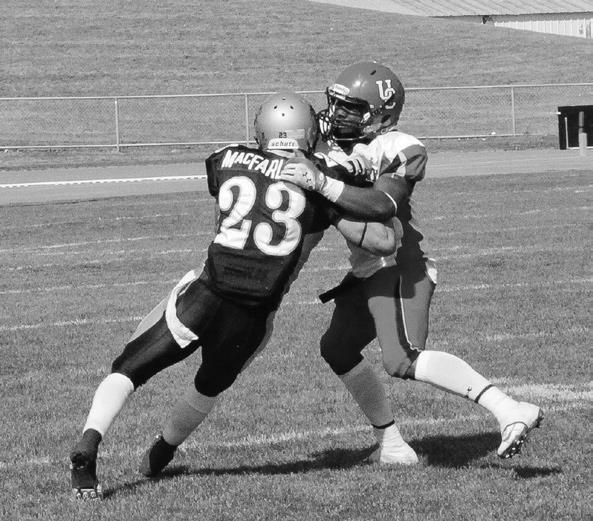
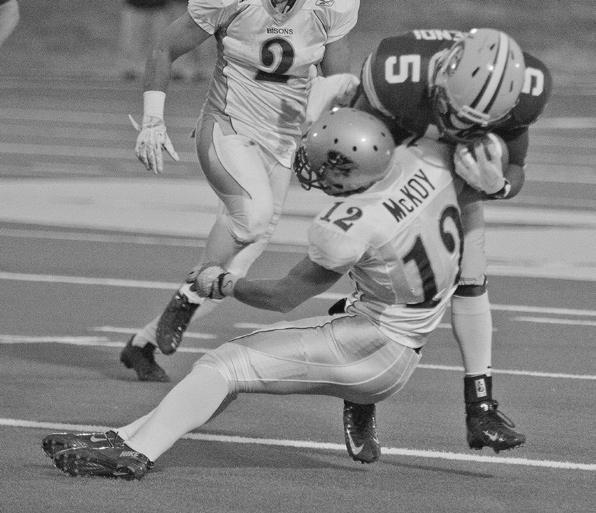
Bison DBs Brett MacFarlane and Jayden McKoy give their thoughts on playing south of the border
Mi K e s ti LL , staff
Football never stops. This is a common saying all across the United States, and for many people, it extends beyond a passion for the game. It becomes a way of life.
Bison halfback Brett MacFarlane can speak firsthand to the contrast in playing/coaching styles down South, compared to Canada. He spent 10 months in Menifee, California, participating in his sophomore season with the Paloma Valley Wildcats in 2007-08. The former Grant Park Pirate noticed the change of intensity immediately.
“It’s such a big difference in the culture, and the coaching, and expectations they have. The players are so conditioned to it. I was just kind of jumped in the stream and went with what everybody else was doing,” commented MacFarlane. “You have your season. Once your season is done, they have two weeks off and then they have workouts.”
The training in Menifee consisted of base workouts, aimed to increase strength, power, and endurance. Following that was spring football, at
the same time as in Canada. The biggest difference came in the summer.
Coming from Winnipeg, MacFarlane, a quarterback at the time, was used to having the summer off after the season, and returning to camp in mid-August. The case was far different at Paloma Valley.
“Every day you have workouts with your team, five days a week, and on the weekends you have passing tournaments where you go to different parts around Southern California, different schools within your district,” mentioned the seasoned DB.
“I relished in it,” he said emphatically. “Growing up in Winnipeg, I would always get frustrated because there was a part of me that knew there was something better and bigger. If I would have stayed, I wouldn’t be the
While the change in training definitely came as a shock, MacFarlane took pleasure in honing his craft and improving as a football player.
the throws are quicker. Transition a kid from Canada to playing on that [American] field, and he’ll do a lot better, just because of the range.”
player I am now. I don’t know if I’d even be a university football player.”
While MacFarlane favoured the attitude taken to the game in America, he also preferred the playing style.
“Playing quarterback in the American game is a lot better, because the field is a lot more condensed, and
Fellow Bison defensive back Jayden McKoy’s American football experience occurred in a slightly different form. This past February, he competed as one of the 60 members on Canada’s U19 junior national roster against Team USA as part of the 2014 International Bowl series. The game was played at the University of Texas-Arlington.
Much like MacFarlane, he enjoyed the difference in playing style.
“I’d say I prefer to play the American game, because you get to be right in the guy’s face,” noted McKoy.
“As a defensive back, it makes it a lot
U of M associate professor Bill Diehl-Jones returns to Boston Marathon one year following bombings
Mi K e s ti LL
, staff
April 21 will be an emotional day in Boston, as the 118th Boston Athletic Association Marathon gets underway. It has been nearly a year since the tragic Boston Marathon bombings at the 2013 race, which took the lives of three people and injured hundreds of others.
The marathon is the longest running and most prestigious annual marathon in the world. As a result, there is a certain level of honour in being able to compete in the event. A total of 36,000 marathoners from across the globe run in the race.
The attacks at the Boston Marathon sent shock waves around the world, and put a massive damper on what was supposed to be a celebration of life, and a culmination of the years of hard work for many. Bill Diehl-Jones, an associate professor at the University of Manitoba, was there that day.
To understand the importance of Diehl-Jones’ presence at the marathon, we must go back 11 years prior. The avid marathoner’s impressive running career began at the 2003 Manitoba Marathon, where he posted a finishing time of 3:15 and qualified for Boston. This accomplishment was even more inspiring,
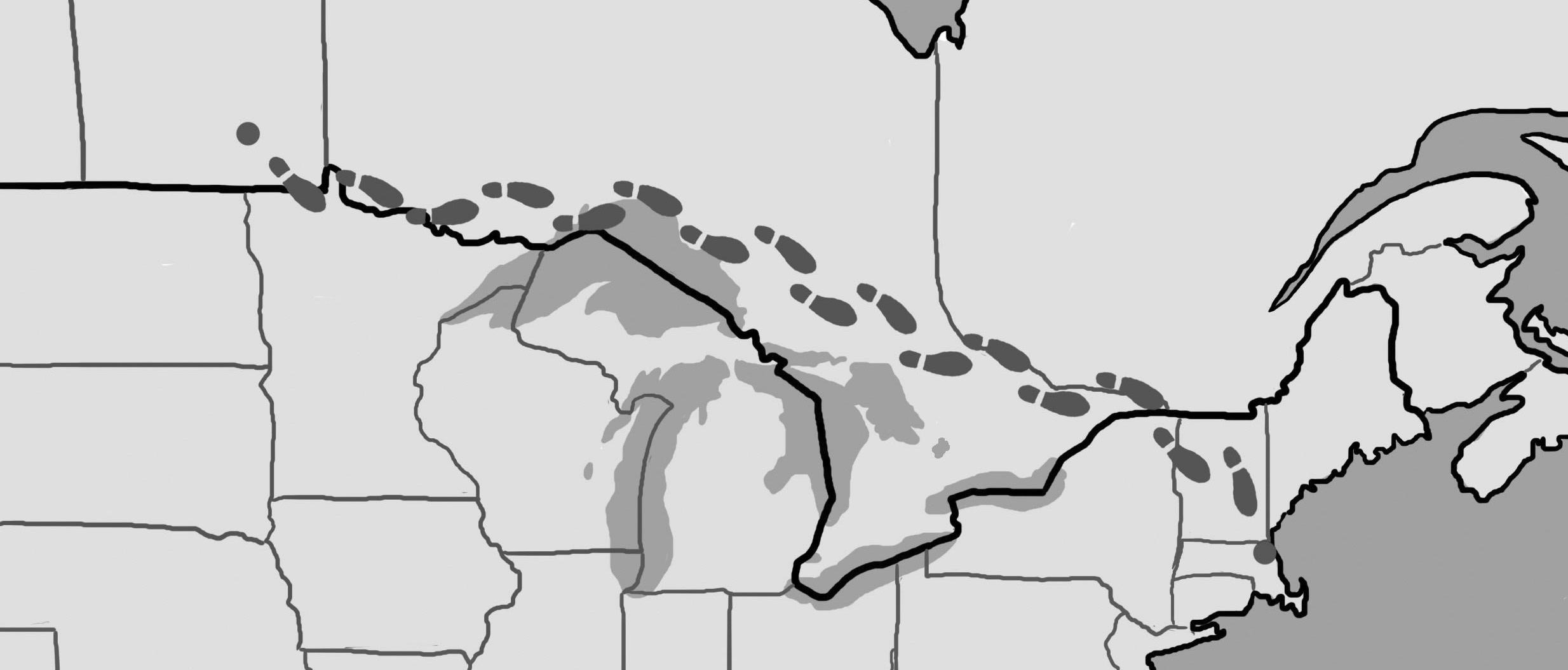
considering the health news DiehlJones’ received just one year prior.
At that time, Diehl-Jones’ cardiologist told him that he was hypertensive, a condition that could threaten his life. Hearing this, Diehl-Jones made the decision to start training for long-distance running.
Having qualified for the Boston Marathon, an acquaintance of his suggested he run Boston.
“I asked, ‘What’s the big deal with Boston?’ Then I realized it’s the granddaddy, it’s the oldest, longest running one; it’s historic,” com-
mented Diehl-Jones with a smile.
“It’s got all this lush history of world-class runners. So, I thought, ‘I’m not a world-class runner, but I’d love to rub shoulders with them, and just see,’ so my second marathon was Boston. Ever since then, I’ve made it a point to qualify every year, whether I run or not.”
Last year, Diehl-Jones did not run. His decision had big implications, considering what happened.
“I decided on the day of the marathon not to actually run it, because I was injured,” Diehl-Jones told the
Manitoban.
“I was going to run with my buddy Kevin Donnelly. He had to slow down because he was injured. If I had run with Kevin, we would have kept up pace I think, and he was right there when the explosions went off, just past the line.”
Diehl-Jones vividly recalls the unity of his friends and running partners, who were all shaken up following what happened.
“It was a very emotional time for all of us. I was there cheering, my friends were all there running, and
easier, because [the receiver] really has nowhere to go, you’re already right up on him.”
Both McKoy and MacFarlane also touched on the somewhat complicated coverage systems run by the Bison secondary. In America, with a smaller field and different assignments, the game became slightly simplified.
“I feel like it’s easier, because there’s literally less room for error. If you’re covering someone, or you have a zone, your zone is so much smaller,” added McKoy. “There’s less options for the quarterback, so that gives you less to think through.”
The effect that playing in the United States had on both players is quite evident. While they may prefer the playing style in America, there is no doubt that what they’ve learned can—and already does—apply to their performance on the field in Canada.
I remember that night. Everything was on lockdown, and we just sat in the hotel, and hugged each other, and cried, and talked. It was an incredible experience.”
After successfully qualifying for the race yet this year, DiehlJones will be going to Boston again, along with his comrades, without any fear.
“We all want to go back, because we want to show if you want to intimidate a group of marathoners, we’re the wrong people to try that with. I also want to make the statement that human potential, and spirit, and good, is stronger than evil.”
“You can’t live life in fear, and you have to go for it,” Diehl-Jones added.
This year’s event will mark the 35th marathon in the past 12 years for Diehl-Jones. While finishing each marathon is tremendous, this one adds extra meaning.
“I know all of us, when we run down Boylston Street past that place across the line, and we all will, there’s going to be a lot of emotion. There always is at the end of a marathon, but this will be special.”
Marc Lagace, staff

This year has been pretty good to Rachel Cockrell and the Bison women’s volleyball team.
The Bisons capped off a 14-8 regular season with a silver medal at the Canada West championships, and a golden performance at the CIS women’s volleyball championships in Regina. Cockrell, in her third year of eligibility with the Bisons, finished the tournament with 43 kills through nine sets, and was at her best against the UBC Thunderbirds in the CIS finals.
Cockrell was also named tournament MVP for her efforts, and named CIS female athlete of the week.
The Manitoban caught up with Cockrell a few days after the big win to get her perspective on the tournament and her journey thus far as a Bison athlete.
the Manitoban: The team finished second at the Canada West tournament, and entered the CIS championships as the second seed. What was your mindset heading into the national tournament?
rachel cockrell: As a team, our mindset was obviously to win a national championship. In our meetings before the tournament, our main focus was to beat whatever team was in our way.


As far as the mindset that we had when we were playing, we worried about playing in the present. We didn’t worry about the future, and we didn’t let the past affect how we played. I thought that was very important going into this tournament.
M: Obviously UBC is a very good team, not only in the conference but nationally. After losing to them in the Canada West final, heading into the CIS final, what did you know that you needed to do well or differently to win this time around?
rc: I think we just needed to minimize our errors, and we stuck to our game plan really well. The difference between the Canada West final and the CIS final is we had more variation in our attacking. We had more roll shots and tips to keep them moving on defence, so it was more difficult for them to defend. That was our biggest difference.
M: When I was talking with coach Ken Bentley, he mentioned that being closer to home was an advantage. Having played so many matches in Regina, it felt a little bit more like a home game in ways according to Bentley.
rc: Yeah, it was for sure great. It was definitely nice to be pretty close to home. We took the bus there, so there was no flying, which gets tiring. It was really nice and to our advantage to play so close to home; we were able to have lots of fans come out and cheer us on, like our parents and students around campus.
take in this moment and experience it all together.
M: A couple seasons ago, you missed an entire season to injury. To come back from that, and not only help your team win a championship but also be named tournament MVP, can you describe your journey as a Bison thus far?
rc: It was definitely a long journey coming back from that injury. It took a lot of hard work and effort to get back to where I was, so it was definitely rewarding to get to where we were and win a national championship. Honestly, I wouldn’t have gotten this far if it wasn’t for my teammates and all the encouragement and positivity. It’s a really great group of girls and I’m very thankful to be a part of a team with them.
M: Obviously the team put in a solid effort all season, but how awesome was that feeling to beat UBC, the six-time defending national champions?
rc: It was pretty awesome, but they were just another team in the way of our end goal. More than anything, we just really wanted to win a national championship and it didn’t matter who we played in the final. But it was nice to play them again; to beat them was definitely exciting.
“Our mindset was to win a national championship. In our meetings before the tournament, our main focus was to beat whatever team was in our way” – Rachel Cockrell
The Big Horns [ . . . ] drove out to Regina. Obviously it was very beneficial that it was only a six-hour drive, whereas if [the national tournament] was in Ontario or somewhere out West, they wouldn’t have been able to come.
M: How special was that moment, winning in front of so many fans and family?
rc: It was very surreal. Honestly, everything still hasn’t sunken in, but it was nice that each and every one of the athletes on our team had parents there, or friends there that they were able to celebrate with afterward. It was really rewarding for everyone. It’s not just the team, but our family and friends can also
M : After taking the first two matches of the national tournament in straight sets, when you guys went up 2-0 against UBC in the finals, did you get that sense that this was going to happen?
rc: I wouldn’t say that. They’re a good team and are able to fight back. Every set that a team loses, they fight back harder and harder. I don’t think any of us had that mindset, “Oh, we got this, we’re going to win.” Our coach always says the game is not over until the refs blow the whistle, and we definitely had that mentality.
M : With the season now officially over, what are your plans for the summer months?
rc: That’s a good question. Honestly, I haven’t put too much thought into it yet. I’m hoping to play beach volleyball, but now that indoor is done, I’m just going to figure those things out and let everything sink in.
photo by Chris zuK
Winnipeg and Vancouver are franchises heading in opposite directions
Marc Lagace, staff
When the Vancouver Canucks visited the Winnipeg Jets, the two teams found themselves tied in the standings. Both teams were in the throes of an untimely losing streak and looking to get things going with less than 15 games remaining in the schedule.
The Jets seemed to have things figured out under head coach Paul Maurice. They had won nine out of 13 games under him, heading into the Olympic break, and won their first two games when the season resumed. When young centre Mark Scheifele went down during an overtime loss to the New York Islanders, the wheels seemed to come off the proverbial bus. Over the next five games, the Jets managed just two points coming in overtime losses since Scheifele’s injury – including the 3-2 shootout loss to the Canucks on March 12.
The Canucks on the other hand entered the game in Winnipeg only having won two of their last 10 games, and had been outscored 14-6 by opponents since trading Roberto Luongo to the Florida Panthers before the trade deadline on March 4. Their win against the Jets put them just ahead of Winnipeg going into the final playoff spot sprint.
It’s an odd sight to see the Canucks battling the Jets for that spot. Since this is Winnipeg’s first year in the Western Conference, it’s never been a possibility before.
It’s also strange to see the Canucks scraping by just to qualify for playoffs. Vancouver is perennially considered a threat to win the Stanley Cup, qualifying for the playoffs six times since the 2004-05 NHL lockout. But there has been some big changes in Van City of late, starting at the very top of the organization.
Mike Gillis joined the Canucks as general manager in 2008, and under his tutelage, the team has won five straight North-West division titles, set team records for wins, and made it to the Stanley Cup final for the second time in franchise history.
This year, Gillis made some big moves that shook things up. He fired head coach Alain Vigneault after the Canucks were swept in the first round of the 2012-13 playoffs, and hired John Tortorella to replace him. Tortorella is one of the most contentious coaches in the NHL, notorious for his aggressive attitude and outbursts in front of the media.
Tortorella’s antics followed him to Vancouver where he was suspended for 15 days after trying to enter the Calgary Flames’ locker room to confront opposing players after a brawl on the ice. During the



Olympics he raised more eyebrows when he was forced to apologize after stating he was cheering for Sweden over Canada in the men’s hockey gold medal game.
On the ice, the Canucks have struggled under Tortorella. They are currently fifth in the Pacific division, and have scored the fifth-least goals across the league so far this season. In net, the goalie controversy that has haunted the Vancouver Canucks for years has resulted in both Corey Schneider and Roberto Luongo being traded away. When the Canucks were blown out 6-1 by the Dallas Stars just two days after trading Luongo to the Panthers, Luongo took to Twitter, sharing, “If I was still back up I coulda came in [sic] and mopped this game up nicely.”
The Canucks have been dealing with injuries as well, notably Hendrik Sedin who has been suffering through a rib injury since Jan. 16 and was shut down by the club in early February. But the brunt of the fault for this catastrophe-laden season falls at the feet of Gillis, who most recently dodged questions about Tortorella’s position with the team moving forward. Like his dealings with the Luongo-
Schneider issue, Gillis’ actions and comments have done little to placate speculations surrounding the team’s direction.
Meanwhile, back in Winnipeg, things seem to be shaping up nicely for the future. The club has to be impressed with the change Maurice has brought in. Young stars like Scheifele and Jacob Trouba are leaders on the ice—when healthy— which bodes well for the team’s future.
Jets GM Kevin Cheveldayoff will be considering a contract extension for Maurice based on his limited time with the club. If Maurice is back next season, it will be interesting to see how he leads through a full year. He has so far coached the Jets to a 12-7-5 record since taking over.
The Jets have a number of big games down the stretch against division opponents, including a five-game western road trip from March 24-April 1. While a playoff spot will likely remain just out of reach for the Jets, a strong finish will help the team heading into the off-season.
photos by bEibEi lu