It will be the traditional Chinese New Year’s eve on January 30th. You are welcome to enjoy a traditional Chinese New Year at the UMCSSA Chinese Spring Festival Gala at the University of Manitoba (Room 210 University Center, 6 p.m., Feb. 1st, 2014).
Listen to HELLO,WINNIPEG, a Mandarin radio show at UMFM 101.5 at 1 p.m. every Tuesday.
photo eDitor Beibei Lu photo@themanitoban.com / 474.6775
Design associate Aichelle Sayuno
graphics associate Bram Keast
r eporters
n ews Caleigh MacDonald n ews
s
Volunteer Contributors
Will Gibson, Justin Ladia, Gloria Joe, Keegan Steele, Chris Kreamer, Bob Tinker, Samantha Secter, Michael Carlisle, Grace Kennedy
MANITOBAN
105 UNIVERSITY CENTRE
UNIVERSITY OF MANITOBA WINNIPEG, MB R3T 2N2
General Inqu I r I es & a dvert I s I n G
Phone: (204) 474.6535
Fax: (204) 474.7651
Email: manitoban@themanitoban.com
n at I onal & Mult I -Market a dvert I s I n G
Campus Plus Media Services
Toll-Free (In Canada): 1.800.265.5372
Email: info@campusplus.com
Canadian Publications Mail Product Sales Agreement #589160
A “volunteer staff” member is defined as a person who has had three volunteer articles, photographs, or pieces of art of reasonable length and/or substance published in three different issues of the current publishing year of the Manitoban. Any individual who qualifies must be voted in by a majority vote at a Manitoban staff meeting. Elected representatives and non-students may be excluded from holding votes as volunteer staff members in accordance with the Manitoban Constitution.
The Manitoban is the official student newspaper of the University of Manitoba. It is published monthly during the summer and each week of regular classes during the academic year by the Manitoban Newspaper Publications Corporation.
The Manitoban is an independent and democratic student organization, open to participation from all students. It exists to serve its readers as students and citizens.
Building aesthetics to encourage community involvement in active living
Grace Kennedy, volunteer staff
Students and the community have taken notice of the ongoing construction alongside Frank Kennedy Centre at the University of Manitoba. The space will be home to the Active Living Centre, a $45 million campus addition set to open in early 2015.
Gary Thompson, director of active
living at the U of M, told the Manitoban that the primary driving factor of the project was to get out of the Gritty Grotto, which he said looks, smells, and feels like a basement.
“We believe the University of Manitoba students deserve better,” said Thompson.
He said that enhancing the student experience by offering these facilities is a big priority in light of research that shows a strong connection between recreational physical activity and mental health.
The brand-new components of the facilities will include three multipurpose rooms; an enhanced climbing wall, which will be more dynamic and higher than the current one; and the “agora,” an open meeting space with flexible seating and new food service options, which Thompson said will be “much different from Timmy’s.”
Another addition is the Applied Research Centre, a 10,000-squarefoot space (the Active Living Centre is 100,000 square feet overall).
Gordon Giesbrecht, a professor from the faculty of kinesiology and recreation management at the U of M, said the research centre will help “design and evaluate programs that will actually get people active.”
Thompson described a “getting started suite” after identifying that there are a lot of people who chronically
fail at getting started on and sustaining an active lifestyle.
“Some of that is through social anxiety and body image issues, so we wanted a smaller place, not in the general public, where we can work with those groups to learn the language of fitness, and to learn how to use the basics of equipment to the point where they felt well-equipped to go into the public.”
Andrea Hilderman of architectural services at the U of M’s physical plant, said other fitness facilities in the community will not be able to offer what the university can with the research and knowledge base the centre will provide.
The aesthetics of the building are central to the faculty’s mission to engage people in active living.
“We anticipate there will be a dropoff point outside the western doors of the centre to induce people to come into the building, and [be able to] access the tunnels to all of campus [ . . . ] Because the building is made of glass, even if you’re not walking in it you’ll be able to
see inside it and see people being active,” said Thompson.
The project team hired polar-opposite user groups to deal with issues— such as the use of the track, and the use of the fitness area and privacy area— and the groups found harmonious solutions together.
“We paid a lot of attention to the different types of users based on focus groups. There are places for people who want to look outside or watch the TV or Internet, or people who want to be seen, and people that want privacy,” said Thompson.
John Danakas, director of marketing communications for the U of M, said the current cost of $126 for a fourmonth membership and $162 for an eight-month membership for fulltime students will decrease to $75 and $150, respectively, with the opening of the new centre.
A two-term membership (Fall and Winter) for part-time students will cost $112.50 and a Summer Session membership will be $56.25.
Former Canadian ambassador to China taken to task on report by U of M Asian studies professor
Report slammed as biased and partisan
Kevin Lin KL ater, staff
T
his past Thursday, the Asia Pacific Foundation of Canada (APFC), a Canadian think tank, hosted a panel discussion at the University of Manitoba on the mounting importance of Asia entitled “The rise of Asia: Are we ready?”
Former Canadian ambassador to China David Mulroney (2009 to 2012), who now serves as co-chair of the APFC’s Task Force on Asia Competence, presented at the event.
Mulroney outlined the findings of a recent APFC report in his opening remarks to the panel, and argued that Canada needs to better prepare itself for the rising position of Asia in global affairs, particularly in the case of China.
“It seems pretty clear that we’re not, as Canadians, responding to this shift in a manner that is as smart, active, or connected as some other jurisdictions. But it’s worse than that. We’re not even having the conversation that precedes policy development and action,” said Mulroney.
Members of the panel then weighed in on the report, providing their thoughts and feedback. This involved mostly agreement with Mulroney, until the panel heard from William Lee, associate professor and director of the Asian studies centre at the U of M. Lee took a critical view, focusing
his comments on what he saw as “the report’s major flaw, which is its very narrow and partisan agenda.”
Lee outlined three points of criticism; namely, the report’s “unabashed business orientation,” overwhelming focus on China, and stance on Canada’s energy sector, the Alberta oil sands in particular.
“The unspoken assumption here is of further, even ramped up extraction from Alberta’s tar sands [ . . . ] This scenario, however, is not inevitable, and there are many Canadians, I among them, who are not convinced that Canada’s future well-being depends on finding ways to fast-track the exploitation of our natural resources, despite the certain environmental degradation for short-term economic gain.”
Lee also took issue with the relationship Canada has with China, and the uncritical stance the federal government has taken in regards to the latter’s human rights record.
“Nowhere is it mentioned in the report that China is governed by an authoritarian regime which limits free speech to its citizens and has a very poor human rights record. The report’s silence on these issues would seem to indicate that it is considered a non-issue. But is it? Whether we should simply abandon our own principles or values for the sake of business profits
is a debate I believe [is] worth having,” said Lee.
Mulroney and Lee also clashed on the role that Confucius Institutes play in Canada, with Lee characterizing them as the Chinese government’s international “propaganda instruments.”
In his response, Mulroney acknowledged that “there is undeniable controversy around the work of at least some Confucius Institutes, where there was a perception, and in some cases fairly strong evidence, of an effort to influence Canadian standards, Canadian norms and values in ways that are inappropriate.”
He nonetheless took a much less critical view of the institutes, stating, “Let me be clear that everybody we talked to who has a Confucius Institute in their institution expressed nothing but positive feelings about the relationship.”
Following the panel discussion, Lee spoke briefly to the Manitoban about his views on the APFC.
“The organization never used to be such a pro-business lobby. When it was created in the 1980s, it was mainly focused on increasing understanding and things like that, but now it has certainly transformed into a mouthpiece for the business class in this country.”
When Stephen Harper initially came to power in 2006, he took a criti-
cal stance on the Chinese government, focusing on its poor human rights record – a policy for which Harper was applauded by some human rights groups, but bemoaned by those in favour of stronger trade ties with the country of 1.3 billion. Harper has since embraced trade with China.
Lee closed his remarks by emphasizing the need for Canada to balance trade and human rights considerations in its dealings with China, alluding
to the externalities that come along with the gradual shifting of geopolitical dynamics.
“At the very least when we consider our relationship with China we must ask ourselves how the pursuit of our own economic interests impacts the citizens of that country and in what ways it serves directly or indirectly to support the non-democratic regime there.”
phOtO by bEibEi Lu
phOtO by bEibEi Lu
How to feed the world
Visionary Conversations panelists suggest waste management, focus on access
Quinn r ichert, staff
The first Visionary Conversations talk of 2014 was held at the University of Manitoba’s Fort Garry campus last week. This time, an interdisciplinary panel of current and former faculty discussed the impending problem of feeding a packed planet: at nine billion mouths to feed, who will get fed first?
Featured speakers included Digvir Jayas, vice-president (research and international) and distinguished professor in biosystems engineering; Karin Wittenberg, associate dean (research) and professor of animal science; and Vaclav Smil, distinguished professor emeritus in the Clayton H. Riddell faculty of environment, earth, and resources. Each of the three shared their ideas on how to feed the world as the population presumably booms and resources begin to deplete.
Jayas focused on the minimization of agricultural waste. Wittenberg talked about the need for farmers to adapt new technologies to their local contexts. Smil denied that a population boom was underway at all.
“The title ‘Global Population Boom’ is wrong,” said Smil.
“We’ve been decelerating in rela-
tive terms, the global population, since 1967, and in absolute terms since 1987.”
Smil went on to argue that most countries produce more food per capita (in kilocalories) than required to feed their populations, and that the solution to the problem of feeding the world would come from cutting waste and re-evaluating distribution.
“We need to make sure that people have access to food in places like India, parts of rural China, and large parts of the Middle East [ . . . ] mind you, even in the U.S., 49 million people are on food stamps and they produce 3,700 kcal [of food] per capita. You will not increase access to food by increasing the production of food,” he told the audience.
Questions from the audience focused on the 100-Mile Diet (mocked by Smil and supported by Wittenberg), anthropocentrism and the loss of biodiversity during food production, and the cruelty of sow stalls.
The final audience questioner of the night, U of M English professor Dana Medoro, took aim at Wittenberg and the department of animal science, criticizing
Wittenberg’s financial connections to Manitoba Pork. Medoro volunteers with the Winnipeg Humane Society (WHS) investigating the confinement of farm animals.
“In Manitoba, the public has produced tens of thousands of signatures opposing the confinement of farm animals. We brought those signatures to the U of M, which is a public institution, and asked a researcher here, ‘how can we change this?’ How does this industry change? [ . . . ]
We’re talking about vast numbers of farm animals in cages in warehouses as we speak. How do we begin to change that, because I understand Dr. Barnard said you won an award from Manitoba Pork. So how can I reach you without their influence?” asked Medoro, inciting applause from the audience.
In the past, Medoro has published articles in the Manitoban critical of the Manitoba pork industry, one of which prompted a response from animal science department head Laurie Connor. series still well-receiveD
Consistently well-attended from the beginning, the Visionary Conversations series has since
expanded into the digital world, taking questions from Twitter, and partnering with CBC Radio. According to John Danakas, director of marketing communications at the U of M, working with CBC will help the series achieve its goals as a community outreach initiative.
“The goal of the Visionary Conversations has always been to share U of M expertise with respect to current issues with the wider public,” said Danakas.
“Having a media partner like CBC helps us reach a larger audience and an engaged audience.”
U of M president David Barnard, in a statement to the Manitoban, also emphasized the importance of sharing the school’s attributes with the general public.
“Visionary Conversations was intended to raise in the general public an awareness of the university as a place where informed opinion on current and complex subjects exists, and where informed debate about these matters can occur,” said Barnard.
In 2012, the U of M was presented with an award from the Canadian Council for the Advancement of Education, recognizing Visionary
Attention back on assisted suicide debate
Supreme Court of Canada will hear appeal for physician-assisted death
c a L ei G h Mac d ona L d, staff
Another chapter in the Canadian debate over physician-assisted suicide has begun in Ottawa, where the Supreme Court of Canada will hear an appeal in the case of two British Columbian women, Kay Carter and Gloria Taylor.
Taylor, a grandmother diagnosed with amyotrophic lateral sclerosis— more commonly referred to as ALS or Lou Gehrig’s disease—became the face of the British Columbia Civil Liberties Association’s (BCCLA) battle for right-to-die legislation when she joined their 2012 suit, which argued the law against physician-assisted suicide was unconstitutional.
Taylor was joined in that case by two members of Carter’s family, who had escorted Carter to Zurich, Switzerland in January 2010 so she could legally receive the help of a medical professional in ending her life after being diagnosed with spinal stenosis.
Justice Lynn Smith of the British Columbia Supreme Court, who ultimately ruled the existing law against physician-assisted suicide to be unconstitutional, initially deferred her ruling for a year to allow the federal govern-
ment to write new legislation. She allowed Taylor an exemption to allow her to end her life as she saw fit.
Smith’s ruling was overturned at the provincial court of appeal, but the exemption was permitted to stand.
Taylor passed away following an infection in October 2012, her exemption never used.
This time around, the focus of the Supreme Court hearings will be on whether terminally ill and mentally competent persons should be permitted to end their own life with the assistance of a licensed physician, under certain regulations.
Elayne Shapray, a 67-year-old multiple sclerosis patient, has joined this new appeal.
In an interview with the CBC, Shapray stated, “I can no longer turn over or even move in bed – or find comfort in any position for any period of time [ . . . ] My choices for bringing about my death unassisted are selfstarvation, over-medication or some violent self-inflicted injury.”
In an earlier interview, Shapray also said that the law as it stands could actually drive her to end her life sooner than she would have otherwise.
“I might have to prematurely make that decision, because you have to do it yourself, and I only have the use of my right hand now [ . . . ] If you don’t do it soon enough, then you lose your
The focus of the Supreme Court hearings will be on whether terminally ill and mentally competent persons should be permitted to end their own life with the assistance of a licensed physician, under certain regulations
opportunity, unless you ask someone in your family to do something illegal, which I wouldn’t do.”
Primary legal opposition to the
suit rests on the landmark 1993 Sue Rodriguez case, which determined physician-assisted suicide to be unconstitutional.
Supporters of assisted suicide argue that the ruling on the Rodriguez case is outdated. Since the overturning of the case, Belgium, Luxembourg, and the Netherlands, as well as four U.S. states, have legalized physician-assisted suicide and implemented regulations to control it.
“Choice is a key element of our medical system. Patients have a right to accept or refuse medical treatment [ . . . ] even if that choice leads to death,” said BCCLA lawyer Sheila Tucker in a recent press release.
“It is not the role of government to say that some medical choices result in a ‘natural’ death, while others do not.”
According to the federal government, however, as of right now Rodriguez is the rule on the matter.
The decision to allow the appeal has been met with excitement by many within the right-to-die advocacy community.
“There are few rights more fundamental, or more deeply personal, than
Conversations as the “best community outreach initiative” from any university in Canada.
“We’re very proud of Visionary Conversations and what it has been able to achieve, and we hope we can keep it interesting and appealing to audiences for as long as possible,” said Danakas, when asked about the future of the lecture series. He added that there are no plans to change the format of the events.
“The question period is longer than you’re going to find in most types of events like this, and that is intentional [ . . . ] for the most part, the aspect of Visionary Conversations being a conversation and including as many people as possible, and different perspectives, is one that has been retained and we think we will retain into the future.”
The next Visionary Conversations event will be held Wednesday, Mar. 12 at the Robert B. Schultz lecture theatre. The topic will be “What have we learned from Mandela? Race and ethnic relations around the world and here at home.”
the right to determine how much suffering to endure and whether to seek a doctor’s assistance to hasten death if living becomes unbearable. We are relieved that the Supreme Court of Canada has decided to hear our case,” said BCCLA litigation director Grace Pastine in a recent statement. Shapray concurred, saying she is “overjoyed” by the decision.
“My hope is that the Court will allow people in my situation who endure intolerable suffering from a variety of conditions to choose a peaceful, dignified death surrounded by loved ones and many friends,” said Shapray.
A 2013 Environics Research Group study showed that 71 per cent of surveyed Canadians approved of physician-assisted suicide, compared to 19 per cent who disapproved. A further 10 per cent said that it depends, or that they do not have an opinion. These numbers have remained fairly steady since 1992, when approval sat at 64 per cent.
No date has yet been set for when the Supreme Court of Canada will hear the BCCLA’s appeal.
Mondra-gone
Local co-op closes its doors, A-Zone building considers future
Katy MacKinnon, staff
Local co-operative Mondragon made an undeniable impression on Winnipeggers as the restaurant bustled with activity during its last days. Enjoyed by vegans, anarchists, and savoured by those looking for a fresh meal and a fascinating read, Mondragon—situated in the Albert Street Autonomous Zone (A-Zone) building—closed its doors last Sunday.
Mondragon functioned as a co-op, run under a “participatory economics” model. For the restaurant-bookstoregrocer, this meant an equitable division of tasks.
Mopping the floor would not be ordered on a new employee; rather, each member of the co-op worked in the absence of hierarchy with “the same balance of empowering and un-empowering tasks,” said Jamie Campbell, past member of the co-op.
“In practice, the formal non-hierarchal structure does allow for the realization of actual, tangible workplace democracy,” said Charley Justice, previous member of Mondragon.
“But here’s the catch – it can only succeed if the people, the participants, actively choose to make it work.”
Wages were organized without differential remuneration and instead doled out based on hours worked. Members of the co-op took positions as directors, “taking on payroll deductions to pay into the co-op share – each individual member had their own share value,” said Campbell.
Allocating a living wage payment as opposed to minimum wage was always a goal for Mondragon, but never a reality due to the financial circumstance of the business.
“It’s always been frustrating to not be able to do more than [minimum wage], but just to stay open as long as they have, they didn’t really have a choice,” said Campbell.
Beginning in 2013, Mondragon experienced a significant labour pool drop. This necessitated volunteers, something that had been rare in previous years.
“2013 is the first year that I have seen that has had such incredibly low sales [ . . . ] Mondragon did its best to adapt and survive in those sorts of circumstances,” said Campbell.
To Daniel Thau-Eleff, a volunteer for the A-Zone building, “Mondragon has been struggling for a couple of years.” Running out of certain food items was commonplace.
Around May of 2013, workers underwent delays in wage payment, and by August of 2013 pay had “ground to a complete halt,” said Campbell.
The members of the co-op were “doing as best as they could to be able to both afford new food to be able to continue selling, and as much wages as was possible,” said Campbell. “In the end, everyone who was still working were acting as members or owners so nobody was in the dark about anything, including money.”
An event was held earlier this month titled “wages for workers,” with the idea that workers would take home all proceeds of food sold. Mondragon wrote, “All fall we’ve overworked and underpaid ourselves.”
“I think that Mondragon had the misfortune of attempting to do three of the most difficult businesses, whether they be co-ops or capitalist businesses,” said Campbell, referring to the decline in popularity of bookstores, restaurants, and small grocers.
Campbell noted that the 18-year run of Mondragon was likely longer than many capitalist businesses.
“I don’t really view this as a failure; I think that all business completes at some point,” he said. “I think we should celebrate Mondragon’s suc-
cesses and the number of other coops it has helped to facilitate.”
Campbell is a current member of ParIT, a co-op in the A-Zone building. He credited the existence of ParIT to Mondragon.
According to Thau-Eleff, Mondragon was the face of the building, which currently includes 10 other member groups. These groups follow the A-Zone’s principles of participatory economics, including autonomy, solidarity, and fair and equitable work.
“Mondragon is, I think, the main way the general public related to the A-Zone,” said Thau-Eleff.
The restaurant was known for providing leftover soup to homeless people in the area. This fulfilled two tasks: community involvement and waste reduction.
“Mondragon [didn’t] ever like throwing food out,” said Campbell. “That was a way of helping in the community on the one hand and reducing environmental issues and waste on the other hand – so it’s win-win.”
The A-Zone posted a call for proposals online, and is “hoping to find somebody that fits as much as possible with [their] vision of that building as a social space and community space – a progressive space politically,” said Thau-Eleff. The proposals are due Jan. 31.
Members of Mondragon have conversed about future plans, and are interested in continuing working in a co-op business.
Whether that be a food-based business or something else entirely, Campell said, “This building still has great potential to thrive as a progressive space.”
“Whatever ends up in that space now, it may not be as radical as Mondragon is, but I think that it will still be potentially progressive and worth nurturing.”
Natural gas explosion near Otterburne
Thousands without services after pipeline explodes c a L ei G h Mac d ona L d, staff
ATransCanada PipeLines Ltd.
natural gas supply line experienced a fire and explosion near Otterburne, Man., a small community off of Highway 59, at approximately 1:00 a.m. on Saturday, Jan. 25.
The explosion sent a fireball into the air, which could be seen from several kilometres away. Witnesses described 200- to 300-metre-high flames lighting up the sky for nearly half an hour, the sound similar to a jet plane.
The flames burned on for nearly 12 hours before they were finally extinguished.
The cause of the explosion is under investigation, and no one was reported injured, though five homes were evacuated.
As a result of the explosion, multiple natural gas stations experienced significantly reduced levels of pressure, which will affect service in numerous communities, including the registered municipalities of Hanover, Niverville, Otterburne, Kleefeld, St-Pierre-Jolys, Grunthal, St. Malo, Dufrost, Ste. Agathe, De Salaberry, Ritchot, and New Bothwell.
Though only one of the two pipelines that supply the area was damaged, both have been shut off.
No information is currently known about how long these areas will experience outages, and officials are telling the 4,000 affected customers to be prepared for an extended wait to get their heat back.
This raises the concerns of many, as cold weather is projected to return to the province in the coming weeks, the temperature in Otterburne expected to plunge near -30 C in the coming days.
“We know it’s cold and people
may be concerned about that but we are on the job here,” said Emergency Measures spokesperson Nicki Albus to the CBC. “We have a great group of people at the site and in the communities who have set up their emergency operation centres to handle this dilemma.”
A pre-recorded message installed on Manitoba Hydro’s information line recommends affected individuals to “use only approved space heaters and, where possible, conserve use of electricity.”
Communal warming centres have also been set up to help those in need of heat.
The gas released from the explosion consists primarily of methane and, according to reports given by the RCMP, is not considered dangerous.
Despite this, officials say that if you smell natural gas, or have a natural gas emergency, you should call the Manitoba Hydro line and choose “natural gas emergency” from the options provided in the menu.
The explosion happened at a time when the safety records of Canadian natural gas transporters are facing close examination. TransCanada PipeLines Ltd. is among the companies vying for government approval to construct new pipelines for oil and natural gas, a plan hotly contested by environmentalists and numerous Aboriginal groups.
Manitoba Hydro is currently trying to determine which areas of the province will be the most affected. Initially, critical services such as hospitals, nursing homes, and warming centres will be provided with gas until regular services resume.
gRaphiC by aiChELLE SayuNO
Proposed changes to Canada Post met with backlash from labour union
CUPW hosts Winnipeg actions
Kevin Lin KL ater, staff
Last month, the management of Canada Post announced sweeping changes that would drastically alter the public crown corporation’s delivery of services.
A five-point plan was put forward that would see, in the next few years, increases in the price of postage, the cutting of 6,000 to 8,000 jobs through attrition, and the termination of door-to-door delivery in urban areas.
A study by the Conference Board of Canada commissioned by Canada Post predicted that the postal service would lose $1 billion annually by 2020.
However, Canada Post has consistently posted profits over the last 18 years, losing money only in 2011. In 2012, the federal crown corporation posted a profit of $127 million.
A number of actions were held last week as the Canadian Union of Postal Workers (CUPW) sought to resist the upcoming changes.
A discussion was held last Thursday evening, where Ben Zorn, president of the Winnipeg local of CUPW, addressed the proposed changes in front of members of the Winnipeg New Socialist Group.
“Postal workers have decided, as we have historically, that we’re not going to simply roll over and accept the decrees of the state, or the decrees of our employer, and we are going to engage in a concerted fight-back against these changes,” said Zorn.
Zorn explained that the postal workers’ union has been organizing, but will not be engaging in strikes.
“After a lot of agonizing we came to the determination that it would send the wrong message to the public. Instead we’ve decided that we need to engage the public in this campaign. It’s the public post office and the public needs to be a part of the decisionmaking process in terms of how their post office will look and how it will serve them in the future.”
On Saturday the CUPW held a rally in front of the provincial legislature, calling on workers to stand up to the impending changes.
Arlyn Doran, a letter carrier and education officer for the Winnipeg local of CUPW, spoke with the Manitoban about Canada Post’s decision.
“No business in the 21st century jacks prices and pulls back on services and can think that they’re going to be successful.
It’s clearly a line to make the post office fail so they have justification to say that it isn’t working and that it should be privatized,” he said.
The question of ultimately privatizing Canada Post came up frequently, with many at the rally suspecting that these changes are meant to set up the crown corporation for eventual privatization.
“There are parts of Canada Post that are quite profitable, and it wouldn’t surprise me to see these carved off and sold off to corporations, while taxpayers are left to cover the cost of the remaining parts of the postal system, those routes that aren’t profitable,” said Doran.
Sharon Blady, NDP member of the legislative assembly for Kirkfield Park, was also present at the rally and spoke to the Manitoban
“I think it goes to a larger political agenda that we’ve seen. It’s part of a conservative mindset—and I say that both with capital and small “c”—about moving towards privatization and the undermining of a public service so that you can put in on the chopping block later and sell it. We’ve seen this, for example, in Manitoba with the privatization of MTS.”
Blady is the provincial minister of healthy living and seniors, and also voiced concerns about what ending door-to-door delivery would mean for people with mobility issues.
“Think of what this winter’s been like and what the sidewalks have been like. How many more folks are we going to have falling down, breaking a hip, breaking a leg, just trying to get to their mail? And that’s really unfair and unreasonable, especially at a time when they’re also increasing the fee for the service. Other jurisdictions have found ways of modernizing their service without undermining their service,” said Blady.
Allen Mankewich, a protester present at the rally who uses a wheelchair, was concerned with how the proposed changes would affect him.
“It’s going to be terrible to be honest. I have no idea how I’m going to get my mail without relying on a friend or a family member to get my mail for me. They’re not even exploring any other options such as delivering the mail twice a week. They say they’ve consulted, but I haven’t seen any meaningful consultation.”
phOtO by KEViN LiNKLatER
Is altruism enough?
The possibility of introducing economic incentives to blood donation
danie L Schipper, staff
On Jan. 13, Canadian Blood Services (CBS) announced that Canada was in the midst of a nationwide blood shortage, partially due to a frigid December that left much of Central and Eastern Canada in an Arctic chill. Between late December and mid-January, CBS was forced to close 24 donor clinics, and therefore missed out on 1,200 potential donations. In order to tackle the blood shortage, CBS projected that approximately 31,000 appointments would need to be filled between Jan. 13 and Feb. 3.
While it is true that this past December caused everything east of the prairies to descend into an uncharacteristically brutal deep freeze—precipitating the forced closure of several clinics and, no doubt, increasing rates of donor absenteeism as donors sought refuge from the cold—this recent shortage is in reality not much of an outlier.
Barring highly irregular circumstances, blood shortages generally occur during the same two time periods every year. First, the harshest winter months (December-January) often result in shortages due to the one-two punch of gnashing frost and holiday festivities, as witnessed during this year’s shortage. The second period susceptible to shortages is the dog days of summer (July-August), when regular donors tend to be away on vacation.
A quick online search for Canadian blood shortages in recent years yields a number of news stories that support these conclusions. For
example, CBS announced a “concerning” shortage (50,000 donors needed in less than four weeks) on Aug. 7, 2013; a 3,000 donation shortage on Dec. 22, 2012; and a 4,300 donation shortage on July 16, 2012. To quote Mark Twain, “history doesn’t repeat itself, but it does rhyme.”
Given our understanding of the annual trends that blood shortages follow, one might ask: Why not try to pre-empt these shortages by inducing a spike in donations just before they occur? In addition, if we agree that combatting the shortage problem would be a worthwhile goal, another question is: How exactly can we do it?
As an entirely voluntary system, CBS provides citizens with the information and infrastructure needed for blood donation, invests heavily in recruiting young adults, advertises clinic dates, sponsors blood drives, and generally raises awareness for the cause of blood donation. Yet, as a voluntary system, CBS relies almost entirely on the altruism of Canadians.
Given some of the implicit costs of donation (such as foregone wages, foregone leisure time, and energy drain following blood extraction), altruism may not always win the day for busy citizens. If we seriously want to tackle the shortage problem, maybe it’s time to offer donors a little quid pro quo. Simply put, maybe it’s time (gasp!) to offer people an economic incentive to donate.
The current orthodoxy on induc-
ing blood donation through economic incentives is that it is, simply stated, a bad idea. For the past 40 years, the World Health Organization’s position has been that compensation for donation would prove detrimental to both the amount of blood collected and the safety of the blood supply. In terms of the amount of blood collected, this view suggests that economic incentives would decrease intrinsic motivations to donate, which could result in a net decrease in donations.
As for blood safety, it is argued that the introduction of an economic incentive would encourage some people to lie about their medical histories during the screening process in order to be compensated. The result of more people willing to cheat on their screening tests would be that, on average, “worse donors” would comprise a larger portion of the total donor pool. Consequently, the quality of the overall blood supply would see a net decrease.
While these concerns seem theoretically sound, they may not hold under further inspection. Today, a new body of scholarship is emerging which suggests that economic incentives, when applied correctly, can have a positive effect on the blood supply without compromising its quality.
In the May 24 edition of Science Magazine, authors Nicola Lacetera, Mario Macis, and Robert Slonim present new research suggesting that economic incentives, if administered correctly, should have a positive
On average, every 60 seconds, someone in Canada requires blood or a blood product.
•Approximately 900,000 units of blood are collected each year in Canada.
•Demand for blood is growing steadily by 2 per cent each year, which means CBS will require an additional 17,000 donations in 2014.
•Blood donations can be stockpiled for a maximum of 42 days, which means that meeting existing demand requires a constant stream of donors.
-Canadian Blood Services
effect on the blood supply. One study in the U.S. shows, for example, that introducing T-shirts and coupon giveaways resulted in a 16 per cent increase in Red Cross donations. In another study, administered in Italy, citizens were awarded a one-day paid leave in exchange for donating, with the result that overall donation levels increased by a significant margin of 40 per cent.
What is additionally impressive about these results is that, even as the overall number of donors increased, and contrary to the “worse donor” problem presented by older studies, the quality of the blood supply remained unchanged. This is due to the fact that rewards were given to people for showing up to the clinic rather than for donating – a tiny distinction which, quite crucially, removed the motivation for people to give incorrect information in order to receive a reward.
The overall effect reported by the studies, then, was that when economic incentives were introduced to blood donation, the overall supply of donors increased, and the overall quality of the blood supply remained unchanged. Essentially, compensation for donation proved a winner on both counts.
So, the question remains: would offering economic incentives to Canadians increase donation levels and help combat the cycle of blood shortages? It is hard to know with certainty, but at the very least, the literature seems to demand that we re-examine this issue, challenge the
current orthodoxy, and pilot-project these ideas to see if they hold water in the Canadian context.
Ultimately, blood shortages impose very real costs on our economy. Through delaying vital surgeries, they create higher levels of patient duress while also decreasing economic output due to health-related working days lost. Furthermore, region-specific shortages draw funds from our national system by requiring inter-provincial transportation of needed blood stores, which only serves to further increase CBS’s operating costs. As it stands, new research is offering up some clear policy suggestions on how we can tackle our seasonal blood shortages while cutting costs. Given the fact that blood shortages in Canada continue to follow a fairly predictable timeline, and that they usually occur over a short period of time, CBS should attempt to run a few test clinics that offer economic incentives on strategic dates, such as mid-December and mid-July.
By carrying out a little experimentation, maybe we can improve upon the current donation system and save some lives while we’re at it.
Canadian Blood Services is still looking to fill its shortage quota, and is holding clinics at the University of Manitoba on Feb. 6 and 11. Call 1-888-2-DONATE to book an appointment.
iLLuStRatiON by SaMaNtha SECtER
ETHICAL CONSUMERISM
Fra S er n e Lund, staff
The term “ethical consumer” grew into Western culture in the late 1980s – it was the title of a British magazine. The idea of support being rendered and distaste being expressed through purchasing habits is far older. Currently the concept of ethical consumption is growing in scope, as large corporations scramble to express their social responsibility and consumers gain easier access to information related to the source and effects of the production of the products they purchase.
Consumption rules our lives. We live it from the moment we wake up to food and caffeine (products) through the moment we turn off whatever light (product) we’ve been reading (a product) by.
In part, this is the nature of being a live creature. Imagine a squirrel that does not gather nuts.
In part, this is the nature of the culture we find ourselves in.
Imagine a squirrel that spends its days playing video games, watching
movies, racing cars, globe-trotting, drinking and smoking like a mad man, then buys nuts (nuts gathered by starving baby squirrels) on credit when winter comes.
The ethics of consumption are of primary interest to all of us. Dollar voting is the idea that the consumers that drive economies can guide them in the “correct” direction. In engaging in consumer activism are we successfully practising dollar voting? Can we?
How do we weigh environmental and social concerns? To what degree should we value the social and environmental impact versus the personal impact of our dollar? What additional responsibility do we have, as privileged citizens of the world? How important is it to know the source of the products we purchase? What products come out of an ethically problematic production process? What should we do about it?
What roles do group purchasing, greenwashing, maker culture,
consumer movements, and the media play in the quest for a moral economy? Do morals have any place in the market? Can morals have any place in a culture where “YOLO” and “FOMO” serve as premises? How effective is ethical consumption? How effective can it be?
For myself, as I came to this feature, I found it much easier to ask questions than to find answers. Greenwashing is effective, or corporations would not engage in it. From what I can gather it has in turn led to a backlash of overstatement and oversimplification on the part of those seeking absolution from the developed world’s collective guilt. Economic disparity, power disparity (what are resources if not power?) and obfuscation dominate relations in our supply chains.
As I write this introduction, it occurs to me that I do not know where any of the items in my living room came from. I am so far removed, alienated, from the labours behind my environment that turn-
ing an “Allen key” is the closest to the production of the objects herein that I have come. After researching for several days, I can say, with some degree of certainty, that the computer I am typing upon has components originating in horrid places, ravaged landscapes, from the hands of people labouring in conditions indistinguishable from slavery to all but a pedant. So too the food I look forward to. So too the clothes I wear.
I live a life of luxury, built on the backs of my fellow humans and financed with an advance on the inheritance of future generations.
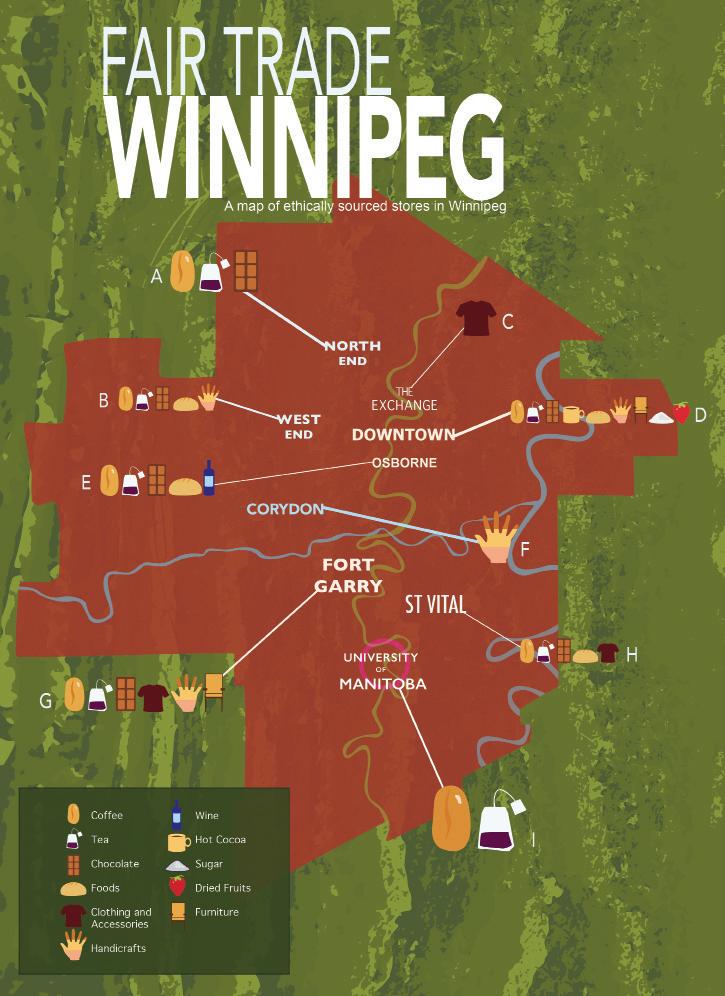
This feature turns a multifaceted lens on the issue of ethical consumption. We begin with a look at some locals who are taking action. Kevin Linklater highlights a recent sustainability event on the University of Manitoba’s Fort Garry campus. Katy MacKinnon examines a local business, offering a tempting taste of the potential of the fair trade movement. Our centrefold is a sampling of loca-
tions around Winnipeg where fair trade products are offered, compiled by MacKinnon, with a map provided by Bram Keast. Katerina Tefft outlines the tenets of veganarchism, a political philosophy founded on the premise that oppressions do not occur in isolation. Quinn Richert troubles the idea of acting without sufficient knowledge or power. The feature ends with examinations of the progress of free software, textile production, and the animal entertainment industry, by Tom Ingram, Anastasia Chipelski, and Carlyn Schellenberg, respectively. Bradly Wohlgemuth’s illustrations on these pages emphasize oft hidden implications of consuming even the most mundane products.
I hope this feature raises questions for our readers, as it did for me. I hope that we are challenged as the scope of our actions is revealed, that the smokescreen loses a bit of its opacity, and that we address the most important question: Where to start?
Sustainability and business – not such strange bedfellows after all
Office of sustainability at the U of M hosts seminar at Asper school of business
Kevin Lin KL ater, staff
Sustainability has entered the modern lexicon in a significant way. Business people and those who teach business are increasingly employing the term, once used almost exclusively by artists and activists, as an important part of smart decision-making.
To highlight the importance of incorporating sustainability in teaching modern business practices, the office of sustainability at the University of Manitoba recently held a seminar in the Asper school of business, with talks given by the faculty’s Bruno Dyck, and Ken Berg, a representative from Mountain Equipment Co-op (MEC).
Dyck, who teaches courses in management and organizational theory, has co-authored a textbook entitled Management: Current Practices and Future Directions
It was refreshing to hear a business professor talk about the importance of businesses being mindful of economic equality and environmental protection.
“Why aren’t all our cases putting sustainability front and centre if we
believe that economic inequality, and climate change, and externalities are important issues? Why isn’t it part of all our teaching and all our models? We need to overcome shortcomings of the short-term planning and budgeting cycles that still dominate business practices today.”
Dyck went on to make the case that not only can sustainability help people and the environment, but it can also improve the bottom line, and help companies succeed.
This success has no better example than that of MEC. The Vancouverbased co-operative was founded in 1971, and has since expanded across the country, to stores in 16 cities.
Berg spoke about some of the things MEC does to be more sustainable.
“We make sure our supply chains use fair labour practices, that conditions are safe, that people are being paid a decent wage, and we partner with other brands to help give us leverage in our sourcing.”
Berg explained that the company is constantly looking to improve, and reduce its environmental footprint.
“We had compostable toilets put in, so that our water usage is now way down. We have to shovel out the end result [ . . . ] but we have a strong culture, and people are always wanting to pitch in and do more. I think it makes us a very dynamic place to work, and the people who work with us see that and want to do more themselves for the environment.”
Dyck pointed out that firms with sustainable business practices are often more innovative and may have higher satisfaction and productivity from their employees.
According to Dyck, Asper has incorporated more sustainability content at the undergrad and graduate levels.
“We now have courses on corporate social and environmental responsibility, and on alternative management frameworks, which takes things out of the traditional profit maximizing framework [ . . . ] we need to educate business students, and we need to equip firms to understand the macro-sustainability issues which are going to be critical to the future of the planet.”
Chocolatier Constance Popp producing local,
ethical, artisanal
chocolates
Award-winning chocolates are full of creativity and spice
Katy MacKinnon, staff
T
o Constance Popp, purchasing local and ethical just makes sense. “We’ve become quite known for making and using local ingredients. We’ve been doing it for years.”
Walking into the Chocolatier Constance Popp shop, you’re greeted with a smile and offered samples of the latest chocolate creations. The minimalist décor, clean white walls, and shelves perfectly lined with truffles, bark, and bars make it clear that you’re entering an exquisite, upscale chocolate universe.
“We spend a lot of money on our chocolate, so why would we mask it with sugar, or artificial flavours? Here we only use premium-grade chocolate and only whole foods,” says Popp.
A master’s degree from the U of M’s natural resources institute and a job working for the City of Winnipeg’s waste minimization project helped shape Popp’s passion for ethical consumption.
Her award-winning Manitobar is the epitome of locally sourced ingredients, containing sunflower seeds, honey, flaxseed, and Manitoba Harvest hemp hearts.
Even though many of Popp’s chocolates are chock-full of nutrients, she doesn’t like to advertise so, “Because then people will think it’s a health bar and think it won’t taste good.”
Popp need not worry, because the palm-sized Manitoba-shaped bar tastes sinfully decadent – far from what might be conventionally considered “healthy.” The bottom layer is crunchy, sweet, and salty all at once. The treat is topped with a soft layer of gianduja chocolate and praline paste, and dipped in a honey and rich dark chocolate ganache.
Wendell Estate honey, which has appeared on the CBC television show Dragon’s Den, shows up in many of the chocolates, as well as birch syrup tapped from an area just north of The Pas, Man.
“For 16 litres of birch syrup it costs me a thousand dollars, and that was the wholesale price. So I knew that I had to make something special with that; I couldn’t just put it in a truffle, because it would be buried. I want it to be featured.”
And featured it is. Take a close look at the Birch Bark Bar and you’ll notice
the gnarled impressions of an actual piece of birch bark, used to create the mould.
The Spicy Edamame Bar is deceiving at first glance. The squares look like they’re broken off of your average chocolate bar, but the bottom is studded with tiny pieces of roasted local edamame beans.
On first bite, the chocolate begins to melt in your mouth as the beans provide a nice little crunch, and all of a sudden, it hits you – the hot spicy pepper tantalizes your taste buds and lingers afterward, leaving you wanting more.
“It’s spicy, it’s rich, it’s nutty. It’s just a good, honest chocolate, I think.”
Don’t be fooled by the pretty, seethrough, cellophane-type packaging that encases all the chocolates – it’s compostable. Ethical packaging has come a long way since scratchy cardboard boxes.
Popp is full of ideas as she chats about the many directions her business may go in the future. She’s working on a new chocolate bar, too, but it’s top secret and she’s “not going to talk about it yet.” You’ll have to wait and see.
Not only can sustainability help people and the environment, but it can also improve the bottom line, and help companies succeed
WHERE TO SHOP FAIR TRADE IN WINNIPEG
Interested in purchasing fair trade but not sure where to begin? Here’s a handy list of Winnipeg’s finest fair trade retailers to carry around in your pocket the next time you go shopping.
Campus retailers
Degrees Restaurant, third floor university centre (coffee and tea)
IQ’s Billiards and Café, third floor university centre (coffee)
Robins, fletcher argue (coffee)
a . North eNd Black Pearl Coffee, 460 Dufferin Avenue (coffee, tea chocolate)
B. West eNd Eatit.ca, 603 Wall Street (coffee, tea, chocolate, other foods)
La Parfumerie, 145 Evanson Street (handicrafts, other)
C. exChaNge distriCt Mondragon Bookstore and Coffeehouse,( CLOSED) 91 Albert Street (coffee, tea, chocolate, hot cocoa, foods, clothing and accessories)
d. CeNtral/doWNtoWN Brave New World, 141 Sherbrook Street (handicrafts)
Food Fare, 905 Portage Avenue (coffee, tea)
Global Connections, 230-25 Forks Market Road (coffee, tea, chocolates, other foods, handicrafts, furniture)
Manitoba Council for International Cooperation, 302-280 Smith Street (coffee, tea, hot chocolate, chocolate, sugar, dried fruit, other foods, handicrafts)
Vita Health, 234 Donald Street (coffee, chocolate)
e osBorNe Village
Organza, 230 Osborne Street (coffee, tea, chocolate, other foods)
Crampton’s Market, 1765 Waverly Street (coffee, chocolate, other foods – summer only)
Katy MacKinnon, staff
Plastics polluting the waters
Waste accumulation in the Thames gets attention
eL izabeth d rewni K , staff
We live in an age of being environmentally conscious about our planet, so it is no surprise when topics like pollution cause a stir within our communities. A team of environmental scientists led by David Morritt, a researcher from Royal Holloway, a college of the University of London, examined pollution of the River Thames in England. In particular, this examination was of the upper region of the river, held across seven locations.
The endeavour started out as an accident.
During a collaborative project between researchers from Royal Holloway and the Natural History Museum that was designed to study the commercial exploitation of a species of crab in the Thames, the nets meant to collect the crabs caught a large amount of garbage as well. While the nets were being cleaned off, the scientists noticed that the majority of the litter consisted of sanitary products (particularly the backing strips of sanitary pads) and plastics.
This got the researchers thinking about examining the sources of the Thames’ pollution. Once again they deployed the nets, but this time with an additional goal in mind: catching and cataloguing garbage.
The nets remained in the water for three days, collecting litter that was then examined and documented. They captured 8,490 pieces of trash. There were 54 different types of waste, which they grouped into seven causal categories.
Of these sources across the seven locations, the largest contributors were food wrappers and containers, which represented 25.3 per cent of the pollution. The study did not, however, find any particular trend in the types of litter con-
tributing to the pollution.
But what they did find to be consistent was the amount of litter associated with certain locations. The garbage had the largest accumulation in Crossness and Littlebrook, two locations along the river near sewage treatment outfalls.
Condoms and menstrual pads were one of the most concerning sources of litter, representing over 22 per cent of the litter at the most contaminated sites along the Thames.
The problem with sanitary products—particularly the plastic backing strips of sanitary pads—is that they are not biodegradable – they do not break down once trashed. Since they last a very long time in the environment, they accumulate.
These products were most likely entering the river system through being flushed down toilets, which is not how they are designed to be disposed of. Proposed solutions include changing people’s behaviour so they discard these products properly, as well as improving the biodegradability of the products.
In a recent Japanese study exploring the effects of marine pollution, a team of researchers led by Kosuke Tanaka looked at the impact of chemical pollutants from plastics in seabirds of the North Pacific Ocean. Some of the birds were discovered to have high levels of polybrominated diphenyl ethers (PBDEs) – a group of chemicals used as flame retardants that can be found in products including computers, carpets, and curtains. They are considered global pollutants known to be toxic to the environment.
When the stomach contents of the birds were examined, it was discovered that those with the highest levels of PBDEs
had ingested plastic products. This suggested that the toxic chemicals from the plastics had been absorbed into their tissues.
Many marine organisms will actually mistake plastic products for food and eat them. These plastics can inhibit digestion and cause injury.
However, direct consumption of plastics is not the only way in which the birds can be exposed. If the natural prey of the birds also ingests the plastic, the chemicals can spread through the food web. So long as there is plastic polluting the waters, it looks to be a lose-lose situation for marine life.
Once released into the environment and exposed to the tissues of animals, chemicals derived from these plastics have great potential to cause harm on a cellular level. Due to the small molecular sizes of the chemicals, they are able to enter into cells. Once that happens, they are free to chemically react with important molecules necessary for healthy survival. Examples of detrimental effects include disruption of the endocrine system – a very important system of glands involved in the regulation of hormone levels.
According to reports from Environment Canada, toxic chemicals like PBDEs can contribute to behavioural disturbances, have effects on the liver, as well as interfere with the normal production of certain thyroid hormones if there is exposure during critical periods of growth and development.
These studies and others underline the potential dangers of river pollution, which are not isolated to one location. “Not only are the species that live in and around rivers affected, but also those in seas that rivers feed into,” said Morritt.
Since sanitary products last a very long time in the environment, they accumulate
i
To Bee, or not to Bee
Sherbrook Street venue undergoes another change
The rousing notes of Andrew Neville and the Poor Choices, Cheering for the Bad Guy, the drifting voices of countless karaoke superstars, and the laughter generated by comedians hang in the air like a smokers’ haze at 61 Sherbrook.
The garage door that opened for many summers onto Sherbrook Street will next be lifted under a new name. The sign over the entrance has variously read Eddy’s Garage Bistro Bar, Hooligans Neighbourhood Pub, the Standard Tavern, and most recently, the Rose n’ Bee.
Matt Rosenby, who ran the Rose n’ Bee along with his brother Mike, had great things to say about many people connected to the location. He highlights positive relationships with surrounding business owners like the West Broadway Biz, and the people at Times Change(d) High and Lonesome Club.
His enthusiasm for the performers is heartfelt. “I really want to thank Andrew Neville and the Poor Choices who played every Wednesday, Mike Green, who hosted comedy every Thursday, Mischa Decter and Micah Erenberg who did [the booking of acts for and promoted] the Sundays. We had such great shows,” says Rosenby.
Rose n’ Bee bartender Ben Jones; former co-owner of the Standard, Jill Hisco; and Sheldon Birnie of
Cheering for the Bad Guy—whose group often played the venue—emphasize the importance of Neville’s band.
“I’ll really miss being able to count on the spot for a great Wednesday night of getting wild with Andrew Neville and the Poor Choices, that’s for sure,” says Birnie.
Hisco celebrates the long tradition of that group. “It was, and through every incarnation remained to be, the go-to joint on Wednesdays for Neville,” she says.
“I knew just about everybody that was in there by name. Those people became friends,” says Rosenby, who gives special thanks to Jones for being an integral part of the place.
Bruce Berven, of Mariachi Ghost—whose former bands the Xanad00ds and the Shouting Ground played the venue—expresses warm sentiments about the management. “When Matt and his brother took it over, from my perspective it was on its way up.”
“A live music venue is needed in the area, but who has the money to do major renos in that space?” asks Berven.
The kitchen splits the venue into two parts, separating the dining area from the bar, and no one ever uses the dining space, he explains.
“As most people know, the most defining characteristic of the bar over
its four incarnations was the truly insane and idiotic placement of the kitchen,” Jones concurs. “Otherwise [ . . . ] it was born as a divey little bar, and it generally stayed that way, and that’s sort of why so many people loved it, I think.”
Rosenby reflects that he and his brother were aware of those concerns, and sees the issues as more structural. He explains there was debate over responsibility for renovations, and how the lease agreement and rental dues reflected this matter. Building owner Eric Eyford had not been reached for comment at press time.
Birnie reminisces, “When Stompin’ Tom died last year, I just put on my boots and headed down there knowing we could hear plenty of Stompin’ Tom tunes before the night was done.” Who will play the wake for the Rose n’ Bee?
“If I would have known this would have come to end, we would have thrown a huge blowout, a big celebration,” says Rosenby.
“I wish the new owner, whoever that may be [ . . . ] all the best,” says Hisco.
Jones concludes, “If there was a cool, new, well-planned and laid out venue with a 100+ capacity in that area it would do really well. But that particular spot might just have a curse on it at this point.”
Arts & Culture
Review: Nosferatu: A Symphony of Horror
F.W. Murnau’s 1922 classic Nosferatu– starring Max Schreck as Count Orlok—portrays a merciless vampire interested in a new castle to lure his victims to and, more importantly, lusts after the blood of his real estate agent’s wife.
A haunting experience, Murnau takes you to a place where madness lurks around every corner and your worst nightmares become reality. The film is about all the things mankind has worried about: death, insanity, disease, and war. It is shocking yet brilliant.
Unlike Bela Lugosi, who plays a flamboyant vampire in Tod Browning’s 1931 version of Bram Stroker’s novel, Schreck plays the vampire like a rabid creature filled with hunger and hate. He is a remorseless predator that should exist only in the bowels of hell.
Nosferatu is filled with sexual undertones – however, the sexual-
ity presented in Nosferatu is rather terrifying. It holds us in our fear of AIDS and rape, both of which remain present in our modern society. The vampire is an unholy being who has desires that stretch far beyond finding a mate. It stalks after the innocent and those who find themselves in the wrong place at the wrong time. Though it’s full of despair, Nosferatu is a classic that certainly stands the test of time. See it immediately.
5/5
Check out more of Michael’s reviews at goodbadcritic.blogspot.ca, and catch a screening of Nosferatu: A Symphony of Horror at Cinematheque (100 Arthur Street) on Friday, Jan. 31 at 9 p.m., as well as Feb. 1 at 9 p.m., Feb. 5 at 7 p.m., and Feb. 6 at 9 p.m.
Michae
phOtO by aNaStaSia ChipELSKi
Big Fun in review
Indicator Indicator, Yes We Mystic, The Bros. Landreth, ATLAAS, and Les Jupes do the Windsor
As one night of the event Big Fun, itself paired with the New Music Festival, Jan. 24 at the barely ventilated Windsor Hotel was a crashing success.
Where else could you hear classic pop, folk rock, psychedelic Southern blues, a computer and keytar duo, and goth rock in the span of four hours and know these were all hometown heroes without an ounce of pretension?
The opening act was Indicator Indicator, headed by local pop superstar Sandy Taronno, drum-
mer Kevin Kornelson, whose prog rock style à la Neil Peart would be welcome in any group, and Matthew Harder.
Says Taronno, “To me the frontlines of pop music is like— and this sounds stupid—but like, the Ke$has and producer-based stuff that’s actually on the radio. Like the really hard side-chained synth stuff. They’re doing insane, marvellous stuff in pop music. And we try to pull a few of those things, but honestly, in my heart of hearts, we do pretty classic pop.”
‘I am B.A. Johnston, and I’m sorry’
Big Fun showcases pop and debauchery with B.A. Johnston, Boats, and J.R Hill and the Magic Bears
a na S ta S ia c hipe LSK i, staff
AB.A. Johnston performance has very little to do with music; it’s a booze-soaked whirlwind of sad-sack ditties interrupted by moderate acts of destruction.
The songs penned by Johnston chronicle the mundane rituals of this self-proclaimed “slacker hero,” and are paired with a level of irreverent self-deprecation that is only matched by his scathing indictments of the audience drinking it up.
J.R. Hill and the Magic Bears opened the evening on a more upbeat, poppy note. Their offering of well-crafted songs with surprising melodic twists inspired a fair amount of bouncing and bobbing in the audience. If you’re into the
cassette-resurrection movement, humble banter, and understated talent, make a point of seeking them out around town – you won’t be disappointed.
Boats were fast out of the gate with an energetic burst of noise before coasting into a poppy swell mid-set, and were gladly prompted to finish on a more frenetic note.
After a brief soundcheck to the tune of “mock chicken, check, one, two, mock chicken,” Johnston took to the stage and fell right into lambasting the audience: “Don’t judge me, fuckers, I know where you live.”
His irreverent barbs were mostly met with open-mouthed laughter and willing audience
But in this reviewer’s heart, if what Indicator Indicator do is called “classic,” then groups like the Beatles are still in the stone age.
Yes We Mystic (YWM) took second spot on the bill, after doing the Hangover Breakfast show for Big Fun last year. Like Taronno, YWM frontman Adam Fuhr also doesn’t believe they’re anymore on the frontlines than anyone else.
“We could be writing these songs 20 years ago, or 20 years from now, and we hope they’d be the same, the structure or the feel.”
The third act, the Bros. Landreth, could have stepped out of a time portal off the stage at the Windsor and onto the platform at Woodstock and not one person would have batted an eye. The four-person act has enough hair to put the Sheepdogs to shame. Frontman Joey Landreth and his brother Dave grew up on that music. “We come by it honestly,” says the former. “We can’t help but really love great, old rocking stuff.”
participation, much to his own amusement (or disgust?).
Johnston spent more time in the crowd than on stage, where he would occasionally return to reset the atmosphere of spit, beer, and disdain before launching into another round of hijinks loosely based in song.
“That was a test to see what kind of shitty songs you [would] put up with,” he declared at one such interval, returning to the stage to check on his guitar or old discman that he referred to as “my iPhone 5.”
Trailing an impossibly long mic cable and barrelling through the audience, he was met with surprisingly little resistance – even as
he grabbed a bottle of liquor from behind the bar and poured it down his throat.
One audience member did confront him and unplug his mic during the final song (featuring casual references to date rape), a refreshingly gutsy move.
Just below the trashy veneer of the anti-hero performance, there are elements of Johnston’s lyrics that could hint at the kind of comedy that illuminates the darker, more desperate parts of life: reliance on GST cheques and McDonald’s coupons, and cats that eat better than he does.
But as the revellers cheer under a shower of B.A.’s beer spray, I wonder, are they in on the joke?
A night of Winnipeg for Winnipeg
Romi Mayes presents a 20-artist and songwriter extravaganza
For the third year in a row, Romi Mayes has collected 20 of her favourite local songwriters, bringing them together for one night of exceptional performances.
The Romi Mayes 3rd Annual Songwriters Extravaganza is an early show—starting at 7 p.m.—in order to fit all the talent into one night.
In this city it’s not hard to put together a stellar lineup, says Mayes.
“I’m constantly blown away by the calibre of musicianship and creativity we have
right here around us. What is amazing is that it seems every couple of months I meet a new songwriter or band that I didn’t even know existed in Winnipeg, to add to the list of amazing artists in this town. It’s endless here.”
The list of performers span a wide range of genres. From folk, to indie rock, to garage, to every other genre imaginable, the festival represents the full charm of the Winnipeg scene as being “diverse and unpretentious,” says Mayes.
“The banjo player in [one]
bluegrass band also plays metal drums in [another] band. And the singer from [one] pop band sings harmonies in this other electro-funk band. The scene sets its own bar high, and so we all rise to the challenge to be better all the time because we are all inspiring each other and pushing [each other].”
While she’s been taking a break from touring for almost a year now, Mayes is “laying low” and working on her own songwriting. That hasn’t kept her off the scene though – she’s been promoting other Canadian bands through her new booking agency, Sure Shot Bookings. And, of course, she’s taking time to celebrate the scene that’s supported her as well, planning a “night of Winnipeg for Winnipeg, where we can all be proud of how immensely rich our music scene is.”
The Romi Mayes 3rd Annual Songwriters Extravaganza will be held on Feb. 2 at the Park Theatre. For full details, visit www.parktheatrevideo.com
A passion for pints
Craft beer enthusiasts find new home in Barley Brothers
a na S ta S ia c hipe LSK i, staff
M
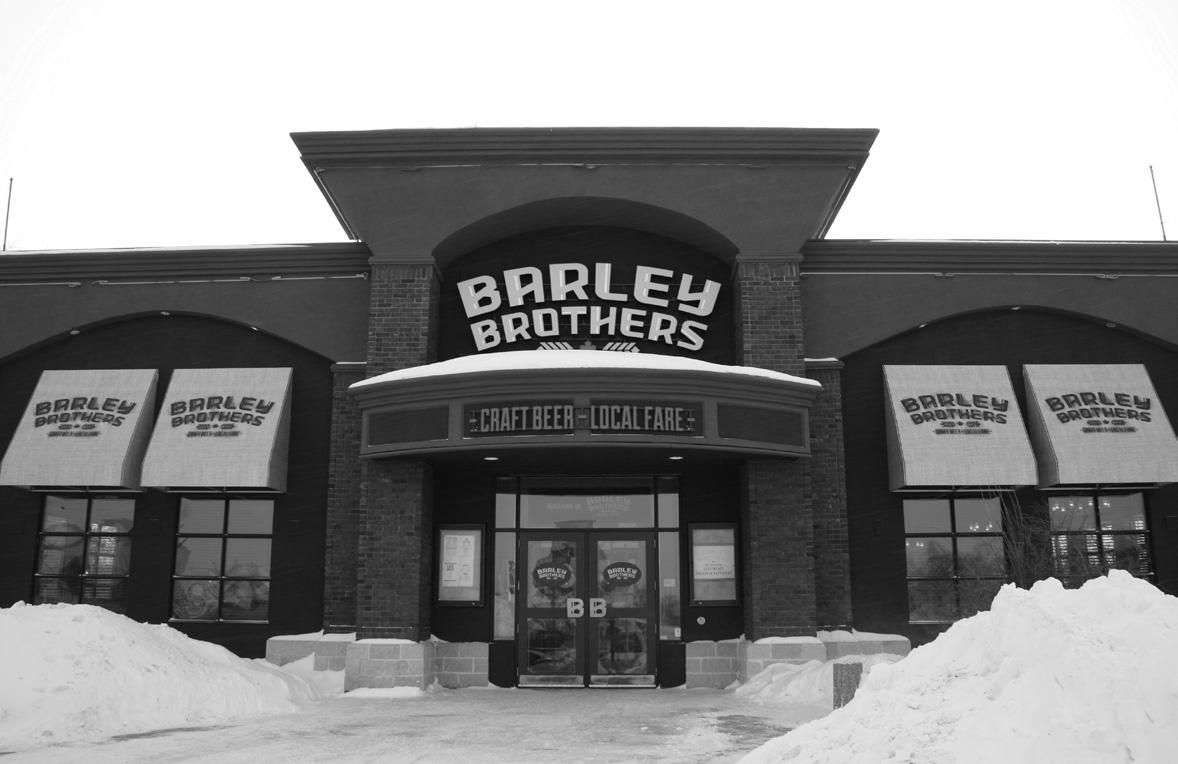
ost restaurants plan a concept and a menu, and then pair their liquors accordingly – but at Barley Brothers in Winnipeg, it’s all about the beer.
Raj Maniar, who holds the title of Beer Manager, puts together an everrotating menu of 72 craft beers, which are the central focus of the restaurant. Their beer menu “is bigger than most people’s food menus,” says Maniar. “Here the food complements the alcohol – well, the beer.”
While their menu boasts some familiar pub fare, if you look a little closer you’ll also find beer incorporated into many of the dishes as well. Their house-made Senf—a German Beer Mustard—“goes with everything,” says Maniar.
House-made, fresh, hot pretzels dipped in the Senf or Obatzda (Bavarian Beer Cheese Dip) are exceptional treats to share while working your way through a pint, or a flight, or two.
The menu may be designed to complement the beer, but that doesn’t mean it was given any less care. “I really try to [ . . . ] make as much stuff in-house and be doing stuff where people can learn. I really like that in a restaurant,” says chef Paul Stafford.
Meat for the burgers is ground in-house, and Stafford is particularly pleased with the smoker in the Barley Brothers kitchen. “I love the fact that I have a restaurant where I can just make my own sausages.”
Some classic sausages—like the bratwurst—can be found peppered
throughout the menu, but they’re also offered up on their own as a sampler, alongside sauerkraut and German potato salad. Other treats include Atlantic oysters, which Stafford paired with a mignonette and stabilized beer foam.
“Beer and oysters is such a classic combination,” says Stafford, and he hints at the possibility of offering bucka-shuck in the near future.
While their culinary influences are somewhat varied, the roots of the restaurant are undoubtedly local. Maniar explains that the sepia-toned images decorating the walls of the dining room are a mix of old Manitoba breweries and of the restaurant owners on their childhood farms.
These “local boys” own a few other Winnipeg restaurants, including Corrientes, Hermanos, Carnaval, and Prairie 360. They’re considering opening a second Barley Bothers in the summer or fall, based on the recent success of the first.
“The concept’s going to be duplicated, but the menu’s going to be a little bit different, the beer’s going to be a little bit different, the feel might be a little bit different,” says Maniar.
This expansion would also make room for more taps—in their current setup, 72 is the limit—and an even larger beer menu. While some pubs will contract their taps out to larger breweries, Maniar maintains control and doesn’t sell taps, which “gives me full range for what I bring in.”
Of course, there will always be room
for local standards. Maniar has pledged to save some taps for Half Pints and Fort Garry: “Local stuff is always going to be here [ . . . ] Besides that, everything’s up for grabs.”
Nicole Barry, co-owner of Half Pints, reflects on how the craft beer scene in Winnipeg has changed.
“We started in 2004, but had been working on it since early 2003. At the time there was just Fort Garry, who had just been bought by Russell Brewing Company. It was a craft beer wasteland, which we were happy to help change –and I think we succeeded!”
Even five years ago, most craft beer enthusiasts had just a few tiny shelves at the MLCC to peruse, so the availability of special local seasonal offerings on tap is more than welcome at Barley Brothers.
“The thing about craft breweries is they’re the ones that are going to be pushing the envelope. [They’re] doing old, cool, traditional European stuff, or doing old prohibition stuff, but it’s going to be different,” says Maniar. Take, for example, Anderson Valley’s Wild Turkey Barrel Aged Stout—a distinctively chocolatey, bourbon-tinged stout—which was earmarked as a staff favourite early on.
The proof is in the pint, and while it could take a while to work through all 72, Maniar is confident that his bartenders can offer at least a few recommendations: “We’re trying to develop a culture, more than just our business.”
Make your own craft beer dinner (and dessert)
Bring to a boil, then reduce to medium-low and simmer uncovered for 30 minutes. Season with salt and pepper and discard the bay leaf.
The Ingredients:
1 Tbsp butter
1 super giant Vidalia onion and 1 normal onion (or 1 1/2 lbs. of yellow onions), sliced
1 Tbsp all-purpose flour
1 cup of Half Pints Beer – St. James or Bulldog Amber Ale
4 cups vegetable stock
2 tsp fresh minced thyme, or 1 tsp dried
1 bay leaf
Salt and pepper
1 baguette
A melty cheese like Gruyère, grated, or vegan cheese option
In a large soup pot, melt the butter over medium heat. Add the sliced onions, stir well, cover, and cook for 5 minutes. Uncover, reduce heat to medium-low, and cook until onions are tender and deep golden brown (about 30 minutes). Don’t forget to stir them occasionally.
Sprinkle the flour over the onions and stir until combined. Gradually stir in the beer, then the stock, the thyme, and bay leaf.
Preheat your broiler. Cut the baguette ~1 cm thick, 2 slices per bowl being served. Broil them lightly on both sides and set aside.
Position the oven rack 12 inches from the broiler and leave it on.
Ladle the hot soup into bowls. Sprinkle cheese onto baguette slices, place slices on soup, and broil until the cheese is golden and bubbling.
Quick and impressive: pour Stir Stick Stout over vanilla ice cream and shave dark chocolate on top. Beer float!
French Onion Soup by Sarah Michaelson (blogs at foodadventureclub.blogspot.ca)
phOtOS by aNaStaSia ChipELSKi
Bison athlete profile
Andre Arruda, forward, men’s basketball
To say that Andre Arruda is a playmaker would be a massive understatement. The 6’4 Canada West rookie sensation out of Garden City has done just about everything for the Bisons this season. He leads the team in average minutes per game (31.2), scoring average (14.2), and has been the top point-getter in five of Manitoba’s 15 games so far. Following another 14-point performance and a big win over the Regina Cougars on Friday, Arudda took a few minutes postgame to talk to the Manitoban the Manitoban: When did you start playing basketball?
andre arruda: I started playing about 11 years ago. I was in a lot of sports and trying them out and seeing what was happening. At that point I wasn’t really all basketball. I played volleyball too, all the way through high school.
M: What do you enjoy most about the game?
aa: Just the competitiveness. Going out and trying to win every day. It’s just fun to get away.
M: How many hours do you spend training during the week?
aa: We have a practice every day, for two hours. Usually we get in to shoot and stuff before and a little bit after, so about two and a half hours total.
M: What other things do you like to do in your free time?
aa: I just like all sports. I like watching sports, and I like to dance.
M: What types of dance do you do?
aa: A lot of types of dance. I was in it in school, and just for fun.
M: Would you say there’s anyone you try to model your game around?
aa: Well my favourite player was Kobe. I saw the way he shot the fadeaway and I liked it, I like that shot. I guess the passion and stuff comes from my high school coach. He was always really fired up and made us work hard.
M: Was there anything about your experience in high school that moulded you into the player you are now?
aa: Just the whole aspect of hard work – always working hard. There’s no point in coming to the gym and just playing around. You just always got to want to work and want to win. You get good results out of working hard.
M: Do you have any role models?
aa: A lot of my role models are just my coaches and people I’ve played with throughout high school.
M: What are your goals for the rest of the season and going into next?
aa: For the rest of the season we want to finish with a respectable record. I know we’re a good team. We’ve had some really tough games that were pretty close but there’s nothing we can do about it now, just finish off
strong. For next season just keep working hard, keep doing what we’re doing. We’ll get our guys back from injury and stuff.
M: What kind of effect has [Bison basketball head coach Kirby] Schepp had on you?
aa: He’s taught me how to always work hard, always communicate with your teammates, and be a part of the team. Off the court, focus on school as much as you can. Do everything we got to do to make sure we’re successful both in school and as a man, and on the basketball court.
M: What kind of chemistry do you have with your teammates? Do you do anything together outside of basketball?
aa: We always do an event once or twice a year as a team, whether it’s paintball or anything like that. A lot of us hang out outside of classes too, even if it’s just on campus.
M: What would you like to do with basketball after university?
aa: I would like to see if I could play pro, or in Portugal and see what happens.
M: What motivates you?
aa: What motivates me is to just go out there every day with my teammates and try to get a win, not only for me, but also for them. To work as a team, just do whatever you gotta do to get the win.
Meeting the test at East-West
Evan Gill becomes third Bison to play in prestigious shrine game
Mi K e Sti LL , staff
Coming out of high school, it was quite apparent that Evan Gill was something special. At 6’3, 245-lbs, he was an impressive physical specimen. A three-time provincial team member, as well as part of the 2008 ANAVETS Bowl championship team with Churchill High School, Gill was highly sought after by many university programs.
The University of Manitoba was fortunate to recruit him to play for the Bisons. Gill emerged as one of the team leaders on defence, and received opportunities to play in showcase games, such as the 2012 International Bowl. Just this past weekend, the now 292-lbs Gill had the honour of playing in the EastWest Shrine Game, becoming just the third Bison (Israel Idonije and Jason Rauhaus were the others) to do so. At 89 years and counting, it is the oldest college all-star game in the United States.
“It’s come a long way,” remarked Gill from his hotel in Bradenton, Florida. “I remember the first day I stepped on the field with the Bisons, it was real tough. You got thrown around. It was a big adjustment.”
After redshirting as a rookie in 2010, Gill adjusted just fine to the
CIS game. Over the course of three seasons with the Bisons, Gill has accumulated 84.5 tackles, 7.5 sacks, and two forced fumbles, all without missing a single conference regular season game or playoff contest.
Just like the adjustment from high school to university play, there was also a learning curve heading down to Florida for the big all-star match-up. Gill had to adapt to the differences between the Canadian and American games.
“The shrine game was difficult at first,” explained Gill. “There are a lot of little differences in technique and drills that we do every single day.”
Once you get down to the basics, however, football is still football. Gill was able to do what he does best, which is make plays and create an impact.
“It was big for my confidence, to finally get to the game and just focus on what I had to do.”
Gill spoke of a conversation he had with Israel Idonije, Detroit Lions defensive lineman and Bison alumnus. Having been through the same process, Idonije offered advice and words of encouragement when Gill mentioned that things weren’t going too well at the start of the week.
“He really just kinda kept my head up. It was kinda interesting to hear that he was having the exact same struggles that I was having when I came down there,” Gill told the Manitoban. “It was nice to have someone to actually relate to.”
Gill mentioned that he intends to train with the NFL star within the next few months up in Chicago, as he attempts to hone his skills ahead of the CFL evaluation camp in late March.
“It’s gonna be big for me. [Idonije] is really enthusiastic and he’s been really helpful throughout the whole process.”
Since the day Gill signed with the Bisons, head coach Brian Dobie
Bring on the Banny Bowl
has been proud to have him on the football team. With Gill looking to make it into the professional ranks, coach Dobie had nothing but positive things to say.
“Evan gets it,” said Dobie. “He’s a student of the game, and he’s an intelligent, classy young man who’s filled with integrity.”
While the next few months will bring tons of excitement for Gill as he tries to dictate his own future in football, he remains focused on the here and now. Almost immediately after the Shrine Game had ended, Gill took a second to enjoy the moment, and then was back at it. He is currently training twice a day with Athletic Edge in Bradenton,
Bannatyne students put on hockey tournament in support of WISH Clinic
Marc LaG ace, staff
U
niversity of Manitoba students from the Bannatyne campus will be lacing up their skates and hitting the ice in the first ever Banny Bowl hockey tournament on Feb. 8 at the MTS Iceplex.
According to event organizer and fourth-year dentistry student Todd Honcharik, the main goal of the tournament is to bring students from the faculties of medicine, dentistry, and pharmacy, and the school of medical rehabilitation together for a day of sports and socializing. The hockey starts at 1:50 p.m. and wraps up at 6:30. The day will be capped off with a party from 10 p.m. until 2 a.m. at the Exchange Event Centre on Bannatyne Avenue.
“I wanted to get an event that involved the whole campus, instead of ‘this is a dentistry social’ or ‘this is a med event,’” said Honcharik. “A hockey tournament seemed like something that might work.”
The event has garnered enough interest from students around the
campus for the tournament to feature four teams – one representing each area of focus on Bannatyne, and two “All-Star” teams that will face off in the marquee match-up.
Three other Bannatyne stu-
just off of Main Street. Since opening its doors in March 2008, the clinic has allowed students to provide a valuable service to the community of Point Douglas, going beyond medical check- ups and
getting himself ready with combinespecific drills. He is on the field in the morning and in the gym in the afternoon.
Gill will return home in March for three weeks, before heading to Toronto for the incredibly important CFL evaluation camp, taking place Mar. 21-23.
In his typically humble fashion, Gill is taking everything in stride, but continuing to work hard just as he always does.
“It’s all mind-blowing, it hasn’t really sunk in yet,” said Gill. “I’m just trying to stay positive and keep working, and we’ll see where this all takes me.”
Katlyn Taylor is a pharmacy student and a co-chair at the WISH Clinic.
“We’re really excited to have this new event going on to support the WISH Clinic, and provide a fun
and Robyn McClelland from the faculty of medicine, and Alanna Doell from the faculty of pharmacy. It was their input that led to the event being partnered up with the Winnipeg Interprofessional StudentRun Health (WISH) Clinic.
The WISH Clinic is open on Sundays at Mount Carmel Clinic
offering youth programming and outreach events for the surrounding neighbourhoods.
“It’s a clinic that everyone on the campus kind of participates in to help low-income people, so it just seemed like the perfect thing to do,” said Honcharik.
provide some exposure for the WISH Clinic, which only operates with the support of the U of M student body.
“WISH Clinic, in my own personal experience as a student at Fort Garry campus, is really something that’s been kept on the down-low,” said Taylor. “Not many people know about it, unless you’re in a few key faculties such as nursing or human ecology.”
“It’s really unfortunate, because there’s opportunities for every student, from every academic background and year of study. So this is something that we’re really trying to promote and get the word out there so more students can be involved in this initiative.”
This is Honcharik’s final year at the U of M. If the Banny Bowl proves to be successful in its first year, he says there is hope for it to become an annual
“There are some people in med who are really into it, and willing to take it on next year,” said Honcharik.
Social tickets will get you into both the hockey games and the Exchange District party, and are available for $10 at the Answers kiosk on the Bannatyne and Fort Garry campuses.