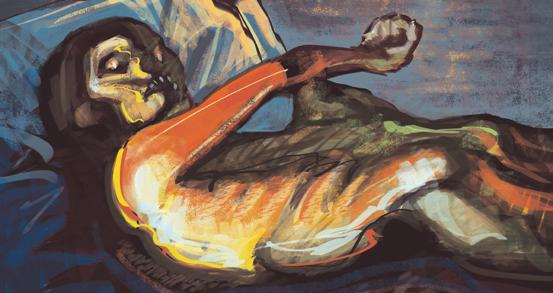
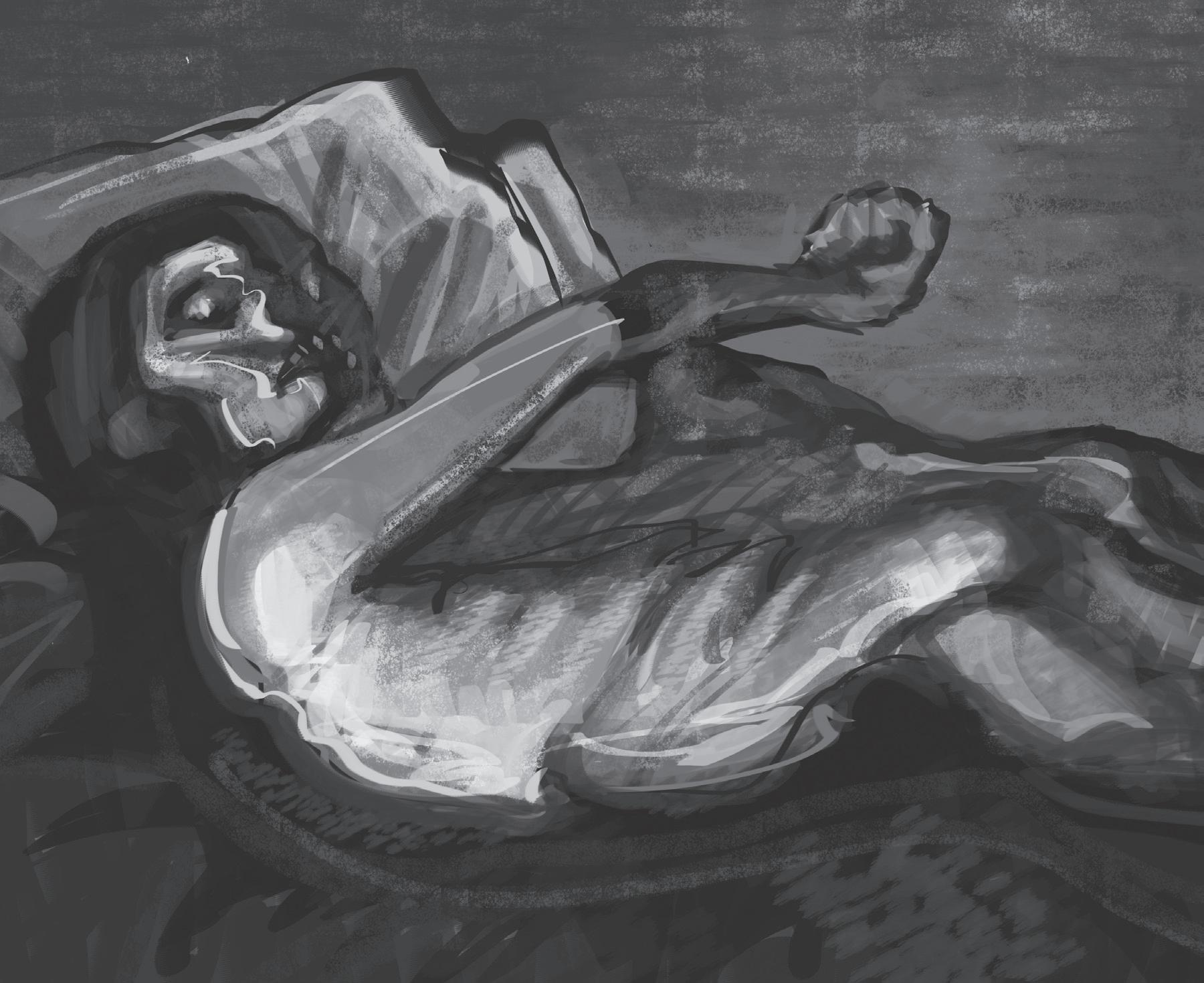
Please contact designteam@themanitoban.com if you are interested in submitting a cover image.
For other volunteer inquiries, please come to our office in University Centre (across from Tim Horton’s, behind GOSA) or email the editor of the section for which you are interested in writing.
Please direct all other inquiries to editor@themanitoban.com
Toban Talkback
MacKinnon, staff
3 Snowden continues to leak documents
NSA accused of spying on world leaders via telephone monitoring
Caleigh MaCDonalD, staff
Atale resembling a James Bond film is playing out on a global scale thanks to the work of whistleblower Edward Snowden. Snowden has once again released documents implicating the American National Security Agency (NSA), which now stands accused of spying on foreign leaders around the world.
One of Snowden’s leaked documents details an NSA signals intelligence program codenamed “Stateroom.” According to the document, the project involves “covert [signal intelligence] collection sites located in diplomatic facilities abroad,” including Canadian embassies. The surveillance equipment is allegedly hidden on consulate property “in false architectural features or roof maintenance sheds.”
Also involved in the latest scandal is German Chancellor Angela Merkel. Snowden’s information leaks claim that the NSA monitored Merkel’s
phone. In a statement, Merkel was translated saying, “I’ve made it clear to the US president that spying on friends is not acceptable,” adding that the trust between allies must now be renewed.
Merkel has received expressions of support from other global leaders, including Dutch Prime Minister Mark Rutte. Finnish Prime Minister Jyrki Katainen told the BBC that “We have to get clarification of what has happened and we also need a guarantee that this will never happen again, if it has happened.”
Reports indicated that the U.S. was eavesdropping on millions of French phone calls, Italian phones and Internet, and, according to Panorama magazine, the Vatican – a claim that the NSA has said is simply “not true.”
Italian Prime Minister Enrico Letta used the words “inconceivable and unacceptable” to describe
the accusations. However, George MacLean, professor of political studies at the University of Manitoba, said he was not surprised.
“Governments actually do this all the time. What is not so much said is just how frequently,” said MacLean. “[Governments] have rights to act in ways that other groups, actors, or individuals simply don’t. It doesn’t mean that ethically or morally it’s without criticism, because spying on anyone would be ethically and morally suspect, but in the name of national security [ . . . ] or of the protection of citizens, governments do all sorts of things, including spying on their own friends and neighbours, all the time as a means of gathering information.”
MacLean described Merkel’s response to the spy revelations as “diplomatic.”
“I think that fundamentally Angela Merkel is not losing too much sleep
over the Americans spying on her country. I do think, though, that politically and diplomatically she has to say something about it, [ . . . ] because [to remain silent] would be a tacit acceptance at best, or she might be avoiding her responsibilities at worst.”
MacLean further explained, “No one is going to come right out and say ‘look, this is an accepted political practice of nations, even nations that are friendly toward one another,’ because to do that would almost be to admit [to] something so obvious to us but at the same time almost forbidden.”
“We don’t speak of this because to admit it would mean that someone else would be able to say, ‘Well, how could you do such a thing?’ when in fact all countries are pretty much involved to some degree,” said MacLean.
Now that many of the NSA’s
tactics are being revealed, MacLean questioned whether or not people would reconsider their privacy and rights.
He pointed out that over two decades ago, individuals could maintain a high degree of privacy in their lives. According to MacLean, this privacy is almost unattainable today.
“That’s something that’s just accepted. We recognize that we could piece together at least a brief bio of just about anyone by looking on the Internet and knowing some basic information, and it’s become easier as well for that information to be available for countries.”
“[Thus] espionage and spying has taken on a whole new realm of activity. It has also taken place in a period where people are far more aware than they ever were before about the vulnerability of privacy.”
Scandals hit city hall
Sam Katz facing calls for his resignation
roblems for Winnipeg mayor
Sam Katz continue to mount as two city councillors, Harvey Smith and Ross Eadie, have called for Katz’s resignation.
The councillors cite cost overruns for a new police headquarters and an audit showing several improprieties in the awarding of contracts to build four new fire halls in the city. The police headquarters project is now reportedly an additional $17.2 million over budget – on top of an initial $28 million in previously reported overruns. The city purchased the old Canada Post building on Graham Avenue and is renovating it to be the new Public Safety Building. Project manager Ossama AbouZeid has been at the receiving end of much of the blame for the cost overruns.
This comes on the heels of a scathing audit released on Oct. 21, which accused the city’s (now former) chief administrative officer, Phil Sheegl, of showing favouritism toward real estate developer Shindico in awarding contracts to have the new fire halls built.
The contract to build the new fire halls was broken up into four separate contracts, with each coming in under $10 million – that is, the threshold amount that requires city hall oversight for spending on capital projects. Consequently, Sheegl reportedly meted out the four separate contracts without city hall oversight or approval.
Shindico was awarded the contracts in a non-competitive process, the audit found. This debacle brought down the city’s fire chief, Reid Douglas, who was fired in late
September, as well as Sheegl, who resigned only days before the audit was released.
Katz has had close business ties to Shindico Realty in the past. Katz and the two directors of the company, Robert and Sandy Shindleman, were prior business partners, co-owning the Winnipeg Goldeyes baseball team together.
The Shindleman brothers also served as directors of Riverside Park Management, a non-profit organization that sublets city-owned land to their former baseball franchise. In 2012, Katz purchased a home in the Phoenix suburb of Scottsdale from Teri Nordstrom, the sister of Shindico CFO Diane Shindleman.
Katz severed his business ties with the Shindlemans in the lead up to the release of the fire hall
audit, buying out their shares in the Goldeyes baseball club.
Katz and Sheegl were also close friends and had done business in the past, with Katz purchasing an Arizona-based company from Sheegl in 2012 for one dollar. Later that year, the mayor sold the company back to Sheegl.
The Canadian Centre for Policy Alternatives (CCPA) had voiced concern at Sheegl’s appointment in 2008, saying that Sheegl’s background in land development could raise conflicts of interest in his post as the city’s chief administrative officer.
“Sheegl’s background is not in city planning, but real estate sales and development [ . . . ] His background is particularly problematic as the interests of developers and the public can often be at odds,”
said the CCPA in a report.
Adding to the string of departures from city hall, two other city councillors, Dan Vandal of St. Boniface and Scott Fielding of St. James-Brooklands, recently left their positions on the Executive Policy Committee (EPC). The EPC is essentially the city council’s cabinet, with different councillors appointed to various portfolios by the mayor. Up until the resignations in late October, the EPC consisted of six councillors, plus Katz.
On Monday, Katz appointed councillors Grant Nordman and Justin Swandel to fill Vandal and Fielding’s spots on the EPC. The mayor also announced the creation of a new EPC position, secretary of economic development, which will be held by Russ Wyatt.
phOtO by CCyyRRee
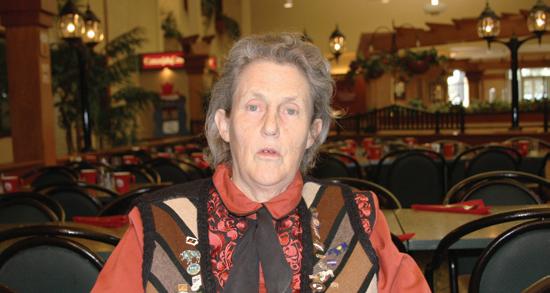
Q&A with Temple Grandin
Grandin talks early intervention, bullying, and the new DSM-5
Katy MaCKinnon, staff
Temple Grandin is a renowned autism and animal welfare advocate, and was named one of Time Magazine ’s 100 Most Influential People in the World in 2010. Grandin has autism, and has published eight books sharing her perspective on the disorder and discussing the needs of animals.
The U of M played host to Grandin last week for two speaking events. The Manitoban had a chance to interview her prior to the events.
The Manitoban: Can you describe the focus of your presentations at the U of M campus?
temple
gR andin: I’ve got a lot of things I’m going to talk about, from the importance of early educational intervention, sensory issues—I think that’s one area where they really need to be doing a lot of research—[ . . . ] and different kinds of thinking styles. You know, people that are good at art, people that are good at math, people that are good at writing.
Another really big issue is learning how to work, and employment. Because the problem you’ve got in autism is that at one end of the spectrum you’ve got Einstein and Steve Jobs, and at the other end of the spectrum you’ve got someone who’s definitely not going to be doing those kinds of jobs. It’s a very big spectrum, and I’m seeing too many kids that are really smart, but they’re not learning work skills.
M: What was your personal experience trying to find work as a young adult?
gR andin: Well, I started out doing freelance – freelance art. I started out just writing one article at a time for the state farm maga-
zine. I started out painting signs, [ . . . ] designing corrals, you know, sort of one little project at a time, building up my business.
M: Did you experience challenges during your early work experience? If so, what were they?
gR andin: Oh, I certainly did. I can tell you, being a woman and going into a man’s field in the 70s, that’s a huge challenge. If you’ve seen in the movie where I got kicked out of Scottsdale Feed Yard, that actually happened. They actually did put bull testicles in my car. That actually did happen.
M: What did it feel like once you discovered the cattle industry, something you connected with so well?
program. The kids that are mathematicians, let’s get them in programming classes. And those are free online, at Udacity.
M: What are some challenges that students with autism might experience?
gR andin: Bullying and teasing is one of the worst. [ . . . ] What seems to be going on in high school (and I was one to get bullied and teased. I got [thrown out of] high school for throwing a book at a girl who teased me), is that bullying and teasing is a
kid, not torturing him. And when you set up those kinds of programs, that can work.
The other thing is to get the kid into shared interest things, like band, the school play, the school newspaper, robotics clubs, art clubs [ . . . ] things that they can do with other students. [ . . . ] Get them involved with the students that are interested in some specialized interest.
M: As you know, not every child has the chance for early intervention. What would you suggest for these children?
“At one end of the spectrum you’ve got Einstein and Steve Jobs, and at the other end of the spectrum you’ve got someone who’s definitely not going to be doing those
kinds of jobs. It’s a very big spectrum” – Temple Grandin
gR andin: It’s very motivating to find something you really like to do. This brings up a really important thing. If you don’t expose kids to things like cattle, for example, they’re not going to get interested in them. [ . . . ] We need to be exposing kids to all kinds of interesting things.
I think one of the worst things that our schools have done [ . . . ] is taking [skilled trade programs] out. [ . . . ] One of the things about autistic-like kids is that they get fixated on their interests. Too many of these kids are getting fixated on video games and they’re going nowhere.
And some people are saying, “well, you’re just an old fogey who doesn’t like video games.” Well you can’t get paid to play video games. And they’re not learning how to
major issue [not limited to autistic children].
Down in the states we just had a [non-autistic] student jump off an abandoned cement plant because two other 12 and 14-year-olds were writing things on her Facebook page like, “drink bleach and die.” That’s the stuff that’s printable. The other things they wrote on the Facebook page are not printable. This girl committed suicide.
M: How can we work to combat bullying?
gR andin: Well, one of the things that helps to combat bullying, is that you need to explain to the other students, you know, that the kid has some social circuits not hooked up and they need to be helping this
gR andin: Getting language started, [ . . . ] [is] the most important thing. If you have two-anda-half-year-olds not talking, [ . . . ] regardless [of] the reason, the worst thing you can do is nothing. And if you can’t get services, you work with this kid.
One of the big emphases is turntaking – all kinds of activities where they’ve got to wait their turn. [ . . . ] It’s real, real important. And then all kinds of just, interaction, social interaction stuff… but you’ve gotta work with these kids. [ . . . ] When you have a developmental problem, it’s often hard to wait. [ . . . ] This [concept] was taught to me with board games.
M: Do you think a diagnosis of autism is necessary for children who exhibit symptoms of the disorder?
gR andin: The problem with autism is that there’s such a big spectrum. Even Einstein would be labelled autistic today – no speech
until age three. See, there’s kind of like three kinds of kids.
There’s the ones where there’s no speech delay, and they’re just geeks and the nerds, you know, the mild geeks and nerds, Asperger-type. Then you’ve got the ones where, like me, at age three look pretty bad. You know, fully nonverbal, but with a lot of intervention, fit fairly well in the normal elementary school. [ . . . ] Then you’ve got the ones where [support staff has] worked really hard on. They don’t get speech, and they remain really handicapped, you see.
And they all have the same name. And those ones that remain nonverbal or just partially verbal, they’re going to need a lot of services. [ . . . ] The more severe ones, they need the labels.
M: How do you feel about the removal of the term Asperger’s disorder from the new DSM-5?
gR andin: Well, you see, now they’ve made this new category called social communication disorder, and to say that’s not autism is just pure rubbish, because social communication problems is a core criteria in autism.
The problem is these labels are not precise. And what worries me, especially on the higher end of the spectrum [fully verbal], I’ve seen too many kids becoming a label. [ . . . ] I’m seeing too many kids where their label is becoming their total identity; I don’t think it’s good. I don’t like it when 10-year-olds walk up to me and want to tell me about their autism. Tell me about astronomy. Tell me that you love history, or you like cats, or something.
phoTo eDiTor Beibei Lu photo@themanitoban.com / 474.6775
Design associaTe Aichelle Sayuno
graphics associaTe Bram Keast
r eporters
n ews Caleigh MacDonald
n ews Kevin Linklater
science Elizabeth Drewnik
arTs & culTure Lukas Thiessen
arTs & culTure Anastasia Chipelski
sporTs Mike Still
assisTanT copy eDiTor Vacant
volunteer Contributors
Will Gibson, Gabriel Bako, Tariq Sohail, Steve Snyder, Michelle Saromo, Adam Peleshaty, John Stinzi, Gloria Joe, Caroline Norman, Keegan Steele, Jodie Layne, David Skene, Shahnoor Habib Munmun
MANITOBAN
105 UNIVERSITY CENTRE UNIVERSITY OF MANITOBA WINNIPEG, MB R3T 2N2
General Inqu I r I es & a dvert I s I n G
Phone: (204) 474.6535
Fax: (204) 474.7651
Email: manitoban@themanitoban.com
n at I onal & Mult I -Market a dvert I s I n G Campus Plus Media Services
Toll-Free (In Canada): 1.800.265.5372
Email: info@campusplus.com
Canadian Publications Mail Product Sales Agreement #589160
A “volunteer staff” member is defined as a person who has had three volunteer articles, photographs, or pieces of art of reasonable length and/or substance published in three different issues of the current publishing year of the Manitoban. Any individual who qualifies must be voted in by a majority vote at a Manitoban staff meeting. Elected representatives and non-students may be excluded from holding votes as volunteer staff members in accordance with the Manitoban Constitution. The Manitoban is the official student newspaper of the University of Manitoba. It is published monthly during the summer and each week of regular classes during the academic year by the Manitoban Newspaper Publications Corporation.
The Manitoban is an independent and democratic student organization, open to participation from all students. It exists to serve its readers as students and citizens.
Total project cost would amount to more than provincial debt
Caleigh MaCDonalD, staff
It is nearly impossible to survive a Manitoban winter without the resources of Manitoba Hydro. Yet consumers may soon find that what they are paying the company to provide for these services has gone up, according to an announcement recently made by Manitoba Hydro.
The first of several rate increases, which became effective on May 1, was implemented in order to help finance the company’s plans to significantly increase its hydroelectric generating and transmission assets.
With the support of the NDP government, the plan will involve the building of multiple hydro dams, financed by rate increases of approximately four per cent annually for all hydro customers over the next 10 to 20 years. The total cost of this plan, according to Colin Craig of the Canadian Taxpayers Federation, would amount to about $34 billion, more than the current provincial debt.
While many applaud the move toward a perceivably more eco-friendly source of energy, others, like Craig, point to the highrisk nature of the plan as being a sign that it needs further review. In order for the motion to be successful, Hydro would have to be able to sell large quantities of hydroelectricity to the United States, something that cannot be guaranteed given the abundant sources of energy already present within the country, particularly in the form of recently discovered shale gas.
Critics say that if the company were
unable to sell the energy, utility rates would increase by far more than four per cent, putting significant strain on Manitoba families. Furthermore, they say that the emphasis on new hydroelectric power generation ignores the benefits of using natural gas to create electricity, a resource present in significant amounts in Canada, and which Manitoba’s infrastructure could accommodate.
Natural gas is significantly cheaper in North America than virtually anywhere else in the world due to its abundance. According to a 2012 report by the Economist, “gas is the only fossil fuel set to increase its share of energy demand in the years to come.”
The same report noted, “only half a decade ago it looked as though the world might have only 50 or 60 years-worth of gas. Now shale and other unconventional as well as new conventional gas finds have increased that period to 200 years or more.”
The process of generating electricity from gas is also more environmentally friendly than doing so from coal, releasing 50 per cent less carbon dioxide.
Furthermore, hydroelectricity critics draw parallels between the potential Manitoba expansion and that which has been taking place in the European Union (EU), a transition that invoked an unprecedented blow to the European economy, and resulted in what was ultimately a very small reduction of carbon output.
Germany, for example, underwent a massive greenhouse gas transformation,
which has now led to it running on an almost entirely renewable energy system. That transformation, however, came at what will ultimately be an EU $1 trillion cost by 2020.
Throughout the EU there are countries that tell a similar tale, which has helped to put 27 million people out of work, and place numerous countries on the verge of bankruptcy. With the once-stable utility board investments now falling apart, things like pension funds, being bound up financially with said investments, are in jeopardy.
What’s more is that through all of this, carbon emissions have remained virtually unchanged. According to the International Energy Agency (IEA), “56.7 tonnes of carbon were emitted for each unit of energy produced around the world in 2010 compared with 57.1 tonnes in 1990.” Furthermore, the IEA has said that unless governments spend billions more, carbon-based energy sources will remain dominant globally.
What it comes down to is a choice that Manitobans have to make. Are we willing to pay more now for clean energy that we won’t see for years? Do we see ourselves as fundamentally different from the EU, and able to avoid a similar economic downturn? Is it worth taking a chance that places our economy at risk on the bet that the U.S. will purchase our energy over what’s in their backyards?
The Iceman cometh
Frozen mummy’s modern descendants discovered
e lizabeth Drewni K , staff
On Sept. 19, 1991, Erika and Helmut Simon, vacationers from Nuremberg, Germany, discovered a man’s body protruding from the ice in the mountains of the Ötztal valley. They were on their way down from the Finail peak when they strayed from the designated hiking path to take a shortcut. As they passed a gully filled with thawing ice, they spotted what turned out to be a human corpse. They assumed it was the body of an unlucky mountaineer who had died in a recent accident. What they did not expect was that they had stumbled across a distant ancestor. Due to the location of his discovery, he was dubbed “Ötzi the
Ice Man.”
At 5,300 years old, the Ice Man sheds light on Chalcolithic life, early human culture, and the history of disease. Thanks to modern
Though Ötzi’s life came to a bitter end, reports indicate that his lineage continues to live on in modern Austria.
DNA sequencing techniques, the genome of the Ice Man, holding rare and valuable information, has been sequenced.
Unfortunately for our friend, he has been diagnosed with a multi-
tude of medical conditions. One very significant ailment the Ice Man was diagnosed with was arteriosclerosis: the hardening of artery walls. It may not seem like much, but this finding changes our perspectives on heart disease. The Ice Man was found to have a genetic predisposition to this condition. However, living the life of a hunter-gatherer, Ötzi did not have any of the risk factors for arteriosclerosis: being overweight, not getting enough exercise, smoking, and drinking.
“This new data suggests that we might be less able to prevent arteriosclerosis than we believed,” said Gregory Thomas, a cardiologist and
Google’s mystery barges
Secret project turns out to be floating marketing centre
For two weeks now, a story has been developing that seems more like the ominous beginning of a science fiction novel than genuine news.
On Oct. 25, the technology news website CNET reported on a floating barge that had been spotted off Treasure Island, a former U.S. Navy base in the San Francisco bay. On the barge is a four-storey building constructed from welded-together shipping containers, and the nearby hangar where the structure was
apparently put together is surrounded by a security fence and aggressively watched by private security guards.
The barge is one of four registered to a holding company called By and Large LLC (the name is probably a reference to Buy n Large, the fictional megacorporation from the Pixar film WALL-E). CNET’s reporters were able to connect By and Large to Google through the real estate agent that oversaw the rental of the hangar. But what does Google want with a
bunch of boxes on a boat? The CNET article pointed to a patent granted to Google in 2009 for a water-based data centre that would use wave-generated power and take advantage of the sea as a heat sink. Experts consulted by CNET confirmed that this is a possibility – there are many advantages to a floating data centre, not the least of which being the free clean power and cheap cooling. Needless to say, Google has declined to comment on any of this.
mummy expert at the University of California, Irvine.
Another very significant medical find is that the Ice Man is the first known carrier of Lyme disease, which is caused by the bacterium Borrelia burgdorferi . A 60 per cent complete Lyme disease bacterium genome was isolated from the Ice Man, suggesting that the disease has been present for thousands of years.
Other medical problems found in the Ice Man include worn joints, gallstones, a growth on his little toe (thought to be caused by frostbite), eggs of parasitic worms in his gut, gum disease and tooth decay, and very high levels of arsenic in his body.
He also had several abnormalities, including the lack of both wisdom teeth, a gap between his front teeth (known as a diastema), the lack of the 12th pair of ribs, and possible infertility.
Aside from knowing the slew of medical conditions that plagued our Ice Man (the poor guy must have had a rough life), scientists were also able to gather information contributing to humanity’s cultural history.
The Ice Man had helped researchers learn more about the cultural history of the Chalcolithic era. He was fondly buried with his possessions, including: a bow, arrows, a copper axe, a cloak made of woven grass, a coat and leggings from goat skin, and a bearskin cap with a leather chinstrap.
According to an examination of his stomach contents, the Ice Man had eaten a final meal of venison and ibex. Along with this meat, 30 different species of pollen were also found in his stomach. This was a significant discovery, as the pollen analysis allowed for the researchers to pinpoint his death as occurring in the seasons of spring or early summer, as well as making it possible to trace out his movements through
the mountains.
The Ice Man discovery also contributed to bettering our understanding of the history of tattoos. Ötzi had over 50 tattoos in total. The tattoos were made by rubbing charcoal into cuts on the skin. Some researchers believe that, rather than for decorative purposes, these ancient tattoos served as markings for points of acupuncture, since the tattoos were mainly located in areas prone to injury or pain, including the joints and the back.
Archaeological researchers have discovered evidence of foul play in Ötzi’s death. A flint arrowhead was found lodged in his left shoulder, having severed a major blood vessel. Wounds on the hands indicated that he had been involved in hand-tohand combat shortly before dying, and a skull fracture indicates a fall or blow to the head. It is estimated that the Ice Man would have been around 45 years of age at the time of his death.
Though Ötzi’s life came to a bitter end, reports indicate that his lineage continues to live on in modern Austria.
Tests were previously conducted with mitochondrial DNA , which can only be passed on through the maternal line. Unfortunately, the maternal line of the Ice Man is believed to be extinct. Researchers then turned to DNA from the Y chromosome, which can only be paternally inherited.
From 3,700 blood donors in Western Austria, 19 males were found to share the same rare genetic trait with the Ice Man. These 19 individuals, who have not been informed of their ancestry, are unlikely to be the only descendants of the Ice Man. To find more modern-day genetic matches with the Ice Man, researchers are looking into testing individuals from regions of South Tyrol, Italy and Engadine, Switzerland that are near the excavation site.
Later, another one of By and Large’s barges surfaced off the U.S. East Coast, near Portland, Maine, with a similar structure on it. A third barge has been photographed in the San Francisco bay without any structure built on top of it. The fourth is unaccounted for.
The statements by government and U.S. Coast Guard officials were confusing. A Coast Guard spokesman confirmed Google’s connection to the barges. Later the same day, a differ-
ent spokesman said the Coast Guard would neither confirm nor deny that Google is involved with the barges. Last Thursday, the mystery of the barges was finally put to rest when KPIX 5, a local cable affiliate in San Francisco, reported that a source who had been on board the barge described it as a luxury showroom with a party deck intended to hawk the Google Glass and other Google hardware to potential clients, confirming some earlier speculations.
iLLustRatiON by bRaM Keast
Thursday, Nov. 7
RE:BUILD THEM by Ian August Gallery 1C03
Thursday, Nov. 14 –
Wednesday, Nov. 13 Protest the Hero / Architects / The Kindred / Affifance
Tuesday, Nov. 12 – 15 Grassroutes: Living on (Un)Settled Land www.grassroutes.ca
Ar ts & Culture
Meet the intercultural poltergeist
Prepare for the posthumous protester
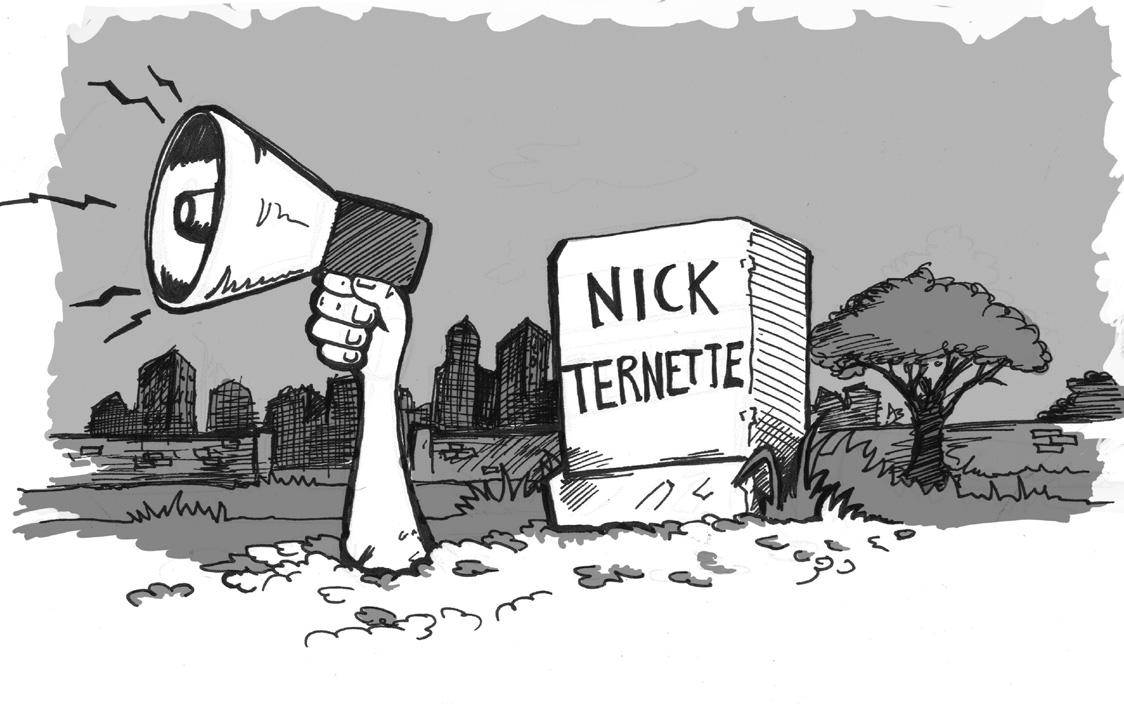
The late, left-leaning Winnipeg activist Nick Ternette’s autobiography Rebel Without a Pause launches at McNally Robinson
K as thiessen, staff
lu
Three-quarters of a year before the end of the Second World War, a child was born in the ruined city of Berlin and grew up to be perhaps the loudest voice of the political left in Winnipeg.
a nastasia ChipelsK i, staff
What can we possibly expect from a performance art piece described only as “a live art ritual involving body-based practice and spoken word”?
The answer can’t be summed up in a short text, or even in a video. All I can say for certain right now is that a performance, featuring Guillermo Gómez-Peña and Saul Garcia Lopez, and entitled Mapa Corpo 3.0, will occur at Urban Shaman Gallery on Nov. 8.
If we don’t know what will happen, at least we can delve a bit into how these artists have defined their performance practice, and the performances they’ve held in the past, following the—potentially futile— hope that we may get a sense of what comes next.
For those unfamiliar with his work, Gómez-Peña has created a photo gallery and virtual archive of his work online, stating:
“For over 30 years, I’ve been obsessed with photographic documentation of my performance work always in dialogue with history. Why? As a self defined Chicano, I need to be in control of my image. If not, Anglo theorists and curators will.”
Bearing this in mind, GómezPeña chooses whose words and appraisals of his work will be given space in this virtual gallery, and includes insight into his performance pieces that was provided by Laura Levin:
“In his celebrated performance art pieces, this complex negotiation [of destabilizing purist and tourist conceptions of cultural identity] is played out in cheeky acts of translation and mistranslation, with performance personae making up words, switching accents, blending languages, and ultimately ending up somewhere that can neither be described as English or Spanish, art or activism.”
This virtual history is, of course, completely subjective, an element openly acknowledged, and indeed encouraged, by Gómez-Peña:
“This performance photo album in permanent progress was conceived as an activist intervention into the historical discourses of performance art that often exclude the contributions of Latin American and Chicano artists. At the same time, it is an invitation [ . . . ] for my performance artist peers to engage in similar genealogical projects; to think of ourselves as artist/documentarians.”
Through the performance troupe
La Pocha Nostra (of which GómezPeña is a director and Garcia Lopez is a member), artists are invited to “ challenge, cross, and erase dangerous borders between art and politics, practice and theory, artist and spectator, mentor and apprentice, body and cultural nightmares.”
La Pocha Nostra describes itself as an “intercultural poltergeist,” an “an ever-morphing trans-disciplinary arts organization,” a “virtual maquiladora, a conceptual assembly plant
that produces brand-new metaphors, symbols, images, and words to articulate the complexities of our times.”
Many of the teachings of La Pocha Nostra, who hold workshops in order to form communities of artists, albeit temporarily, have been summarized in a book by GómezPeña and Roberto Sifuentes, titled Exercises for Rebel Artists: Radical Performance Pedagogy
These teachings will also be shared after the performance on Nov. 8, as it is also the first event—and the only event open to the public—of the Inter-cultural Dialogue Performance Workshop, facilitated by GómezPeña and Garcia Lopez.
After the performance, GómezPeña, Garcia Lopez, and the workshop participants will be working for the next five days to “develop new models for relationships between artists and communities which are neither colonial nor condescending.”
Perhaps we will see signs of these new communities beginning, borders being challenged, and the playfulness of language at Mapa Corpo 3.0 on Nov. 8, or perhaps it will be something else entirely.
In the meantime, explore the living archive created by Gómez-Peña at interculturalpoltergeist.tumblr.com, and experience Mapa Corpo 3.0 in person on Nov. 8 at Urban Shaman Gallery, 203-290 McDermot Avenue at 8 p.m.
After moving to our fair city in 1955—and despite locals in his newfound prairie home namecalling the 10-year-old newcomer a Nazi, Ternette spent much of his adult life in this city as a tireless advocate for the exploited, underprivileged, and mistreated. His radicalism began when he was 23 when he participated in a peaceful May Day demonstration in his birth city, Berlin.
Fellow local activist Rodney Graham defined Ternette’s approach to issues: “He was not a politician – he was an activist. It was change for the less fortunate, for the underdog that he wanted. Nick Ternette was the best kind of socialist.”
He ran for numerous government offices, including mayor of Winnipeg, and for the same position in Calgary. He was a longtime peace activist who also lobbied on behalf of squeegee kids, people with disabilities, individuals living in poverty, and women’s rights; he protested increases in transit fees, concert ticket prices, use of pesticides, and the recent waste management contract negotiated for Winnipeg. These efforts are only a short list of the many projects in which he was involved and issues that concerned him.
Nominated for both the Manitoba Human Rights Achievements Award (1999) and the Order of Manitoba (2005), in 2010, when he announced his retirement from politics, he received a host of accolades. With his wife Emily, he was the co-recipient of a Lifetime Achievement Award at the Canadian Dimension “Red” Carpet Gala Awards. That same year he also won the Uniter Journalism Award,
Distinguished Alumni Award from the University of Winnipeg, and two years later a Volunteer Manitoba award.
In a series of honourific tweets posted in memoriam to Ternette by the Winnipeg Sun at the time of his passing, the man was saluted with many titles, including: “Winnipeg’s Sweetheart”; “A true Winnipeg original”; “My personal superhero of social justice”; “The most sincere MB politico in generations”; “A childhood hero”; “A tough SOB that cared a lot about Winnipeg”; “The oft described activist and self described sh#_ disturber”; “A strong, tenacious man with a lot of spirit and fight in him”; “One of the good guys”; “Tireless fighter”; and “Social justice champion.”
For a city whose residents find such words of praise for their late fellow citizen, it is fitting to commemorate his work by reading his own words, published posthumously in his autobiography Rebel Without a Pause
“There’s nearly no history of the ‘60s [of social activism in Winnipeg] in our libraries here,” explained Ternette, in a radio interview with CBC’s Terry MacLeod about the book.
Ternette said he created a trust fund with the Winnipeg Foundation, which would ensure his co-author would see the book was published if unfinished before his death.
The book is published by Roseway Publishing, the social justice arm of Fernwood Publishing. The latter is a company, with offices in Winnipeg and Halifax, that produces literature challenging political themes that deal with issues of sexuality, race, class, and gender. Ternette’s book was launched at Winnipeg’s McNally Robinson at Grant Park on Monday, Nov. 4.
iMage pROVided by La pOChaNOstRa
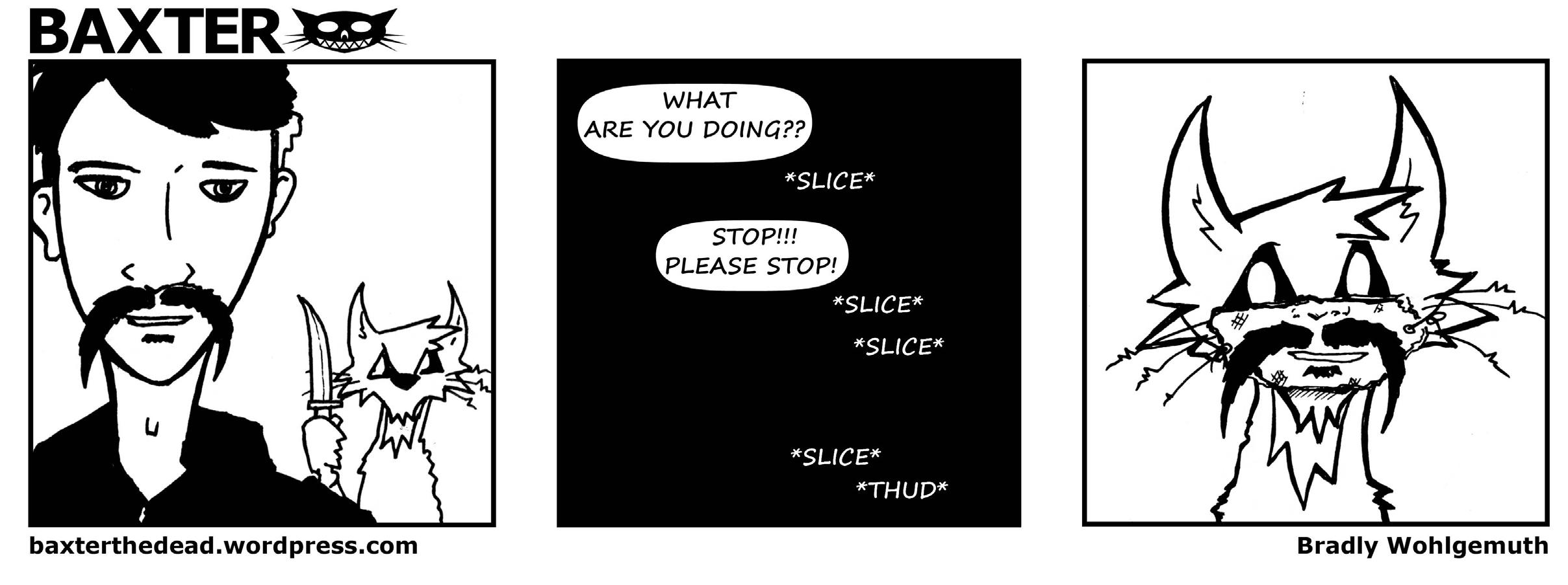
iLLustRatiON by bRadLyWOhLgeMuth
Mitten Claps – a pair that
sounds bigger than its
parts
Brothers to release new EP at the Rose n’ Bee
Mi Chelle saroMo, volunteer staff
One is such a lonely number.
Three’s already a crowd. Two is enough to start a band, and that’s what Jonathan and Randall Hildebrand figured when they formed alt-pop/ alt-folk duo Mitten Claps.
The two-piece band of brothers from Altona had been practicing together well before the band’s official start, patiently hoping for more members to join in. But eventually, Jonathan explains, they caved.
“Instead of hoping that maybe we’ll find other members that will fit perfectly and be able to do the parts we want, we just said, ‘Well, we enjoy making music together. It’s pretty easy, it’s pretty fun, and let’s just keep that going.’”
The brothers started with a good foundation for their music, coming from a musically inclined family.
“We didn’t want to be the full-on von Trapps,” Jonathan laughs, when referring to the duo’s two other siblings – although he does attribute his guitar lessons to his other brother.
With Jonathan heading the songwriting and guitar and Randall providing the percussion, being a duo seems to be working out for them. They released their first self-titled EP in 2012, the end result sounding “bigger than the sum of two parts,” and on Nov. 10 they’ll be following up
with the release of their second EP entitled Tactics. Compared to the first EP, the selection of songs for Tactics was more consciously cohesive.
“I think themes sort of came into the picture more for Tactics,” says Jonathan, adding that the concept of geography and movement played a big influence in writing the music.
“Whereas some songs [I’ve written on my own] might be geared or dealing with people and relationships, the songs that I’ve been working on as Mitten Claps do deal with those, but the sort of foundation of it is place and geography and feeling, how you relate to a place and how you move between places.”
In some of the song titles and soft-spoken lyrics the theme is evident right from the get-go, but it’s Mitten Claps’ ability to capture the theme within their sound that leaves me impressed. Listening to the pensive rhythm and melancholy chords on “Hinterland” conjures up feelings of distance and remoteness. The soft percussion at the start of “Forgot Places” sets a quiet, hushed mood of places left abandoned; its gradual buildup elicits a sense of recollection.
Despite the themes of place and movement, the duo has been rooted to performing in and around
Winnipeg. They’ve had a chance to perform with other local acts like Alanadale, From Giants, and Federal Lights, to name a few – they’ve even played at last year’s Rainbow Trout Music Festival. Being a fairly new band, Jonathan says that they’re still trying to find their footing in the city’s growing arts scene.
“We’re in a comfortable place because Winnipeg’s music community is amazing, it’s so supportive. But we’re also really new too so we’re still sort of establishing, meeting people and forming relationships.”
Although social media has made it much easier to establish their place in the scene, Jonathan attributes many new friendships he’s made to any success they have had.
“I think that personal relationships, sort of forming those, is still the core of a community – in this case, a music community for sure. That’s the foundation of it, I think.”
Mitten Claps will be performing at their Tactics EP release party this Sunday, Nov. 10 at the Rose n’ Bee Pub starting at 10 p.m., along with Dust Adam Dust and the Ugly Brothers. Be on the lookout for their first video, coming out within the next month or so. You won’t want to lose sight of this pair of Mittens!
Spell Indian. Spell genocide. Spell artist.
Urban Shaman Gallery mounts retrospective of local Saulteaux cinematic artist Darryl Nepinak
Cinematic artist Darryl Nepinak, a Saulteaux man from the Ojibway Nation who grew up and lives in Winnipeg, does it all. His approach to film is both humorous and serious, as well as political, thoughtful, and indigenous.
Nepinak described his filmmaking approach as “Indian, proud Indian, mate,” to the Manitoban Nepinak’s assessment of the city’s movie theatres carries this flavour in a set of film reviews he wrote in 2007 for the short-lived periodical The Moose, produced for the Winnipeg Film Group, with some articles now available online at “Cineflyer Winnipeg,” an online feed for motion picture and related arts in Winnipeg.
“I’ll just review the movies I seen. The last one I watched was at the Towne 8 Cinema, which I call the Neechie theatre because of all the family and friends I see there and it’s cheap too. No disrespect to the Winnipeg’s Film Group Cinematheque, which is by far the best cinema in the city next to the Imax of course.”
The characters he creates also depict Nepinak’s vision. They include: the skeptical tracker Donald Smith who listens to Iron Maiden while guiding a clueless white hunter in search of bigfoot; the campy savage Indians who chase after a beautiful goddess—who looks similar to Walt Disney’s conception of Pocahontas—until they bathe in the Sea of Sebastian the Piglord and become powerful warriors; the Native man at a spelling bee who cannot spell “Indian” and the white contestant who cannot spell “genocide”; and the personal autobiographical experience of receiving his Indian name.
brings to mind the rabble rousing Madchester sound best exemplified by the Happy Mondays.
Now, if you are a regular reader of this column you know that I am as interested in presentation as the music itself – the medium is the message, right?
Currently, Nepinak’s film work includes a new drama for the Aboriginal Peoples Television Network called The Band Office which won the best drama pitch competition at imagineNATIVE 2010—and directing 10 short films with the National Film Board. In addition to his own art projects, Nepinak supports the local film industry and young Aboriginal people in Winnipeg. He has worked or is working as: the film and video coordinator for Career Trek, a college preparatory program for at-risk youth; a staff member at Ndinawe Youth Resource Centre; as the production training coordinator for the Winnipeg Film Group; and as the video club facilitator at the Winnipeg North End Arts Centre, where he works with urban Aboriginal youth.
He has also worked with indigenous communities in other nations, including in 2004 as director of a documentary about Te Ora Hou Aotearoa, a Maori youth organization in Gisborne, New Zealand, where he mentored Maori teens in video production.
A 10-year retrospective of Nepinak’s work is on display until Dec. 7 at the Urban Shaman Gallery, where the artist previously served on the board. A leader in the cultivation of indigenous art, Urban Shaman is an Aboriginal artist-run centre that offers a venue for artistic expression across the gamut of disciplines at all levels. Urban Shaman Gallery is located at 203-290 McDermot Avenue in the Exchange District and is open Tuesday through Saturday from noon until 5 p.m. This event is the second time this year a showcase of his films has been mounted; the first took place during Nuit Blanche at Zsa Zsa West.
tappin’ and fingers a snappin’. Their vocals nimbly
dance through hyped up emotional extremes in a way that is vaguely reminiscent of the Cure, while the music that accompanies the vocals
Hana Lulu are no slackers when it come to presentation. The addition of drum loops and samples can drain a lot of kinetic energy from a live performance, forcing the performers to remain stationary. Hana Lulu makes up for this with wild light shows and smoke machines. Their EP release features visual art courtesy of Toxic Prophecy Productions, a contemporary video artist who transforms organic images into meditational landscapes
that are heavily influenced by fractal patterning embedded within the natural order of the universe. Rounding out the bill we have the Attica Riots and DJ Fran Pham. The Attica Riots play sweet sounding poppy rock that also drinks heavily from the goblet of Britpop; unlike the headliner, they seem to stick to mostly organic instruments. DJ Fran Pham’s love of spacey funk is sure to keep the party going all night and into the wee hours. This show should be one for the record books, so clear your dance card and make your way to 72 Princess Street on Friday, Nov. 15 to get your world rocked.
Hana Lulu
Davi D sK ene, volunteer staff
L et’s talk Hana Lulu, a synthbased electronic dance-pop trio that will be releasing their debut EP on Nov. 15 at 72 Princess Street.
Hana Lulu deftly mixes rock and roll energy with beats that get the toes a
iMage pROVided by MitteNCLaps.COM
Ar ts & Culture
Want a festival? Do it yourself.
Sixth annual Anarchist BookFair and DIY
If we didn’t have leaders, bosses, or managers, how would we ever get anything done?
This weekend’s Anarchist BookFair & DIY Fest proves that you can hold a weekend-long festival without falling into typical organizational structures or hierarchies.
While the festival is in its sixth year, it has a very loose organizational structure. It doesn’t have an annual date or time, and past festivals have happened anywhere between May and September.
This year, as the organizing committee lost members and energy, it looked like it might not happen at all. But as new members came forward, the committee was invigorated.
“Our organizing team has no established structure, but rather works upon ideas being voiced and people volunteering to take on that role. We are not organizing this because it will bring in money, but because we wish to see something and act upon it by organizing it ourselves,” says Quincy Brandt, an organizing committee member for the BookFair & DIY Fest.
This year’s festival has many
offerings, including but not limited to books.
“We have a solid mix of evening entertainment both fun and educational and daytime learning opportunities, so I think it’s shaping up to be a really good weekend for anyone willing to try it out,” says Tim Brandt, another organizing committee member.
The festival will open with a cabaret on Friday night, followed by a talk and book launch by Norman Nawrocki on Saturday night, as well as a later-evening dance party for those who choose to dance their way to revolution.
Of course, there will be a BookFair, and out of respect for the November weather, it will be entirely indoors this year.
“We’ve had the tables outside every year and withstood some cold days but this year we took so long to get going we had to plan for a time that’s just too late to be out there so it’ll be the first one entirely inside and we’ll make maximum use of the A-Zone,” says Quincy, referring to the Autonomous Zone Co-op building located at 91 Albert Street.
The book tables will wind their way up the stairs from Mondragon,
all the way to the top level of the building. Quincy commented that they had to make the difficult choice to hold the BookFair in a venue that wouldn’t be accessible to all due to time constraints and a very “shoestring budget,” which is mostly based on small donations.
The workshops—held on Saturday and Sunday—are also based on donations of time and expertise. They range from the theoretical and ideological, such as Building Class Struggle on the Prairies, and Privilege, to practical skills like Plumbing Basics, Fermentation Sensation, ScreenPrinting, and Intro to Electronics and Soldering.
Other workshops explore local political contexts, from a panel discussion called “Indians Wear Red: Colonialism, Resistance and Aboriginal Street Gangs,” to the politically personal topics of consent and Alternative Travel. For those who may crave a cold beer after all of this discussion, there’s even An Introduction to Home Brewing workshop – though they’re not promising immediate results.
Tim hopes that besides learning concrete skills, people may be able to take something more from these workshops.
“I would love it if some newcomers learned about how terrible the artificial constructs we call nation states are to the planet,” said Tim, adding “how much better we’d all be if we stopped being obsessed with monetary wealth and things, and just learned to live free and simply!”
While some of the evening events are on a sliding-scale or pay-whatyou-can basis, most of the other daytime events, including the BookFair and workshops, are free, and the organizers invite everyone to come and see what DIY and Anarchist organizing is all about:
“[The Anarchist BookFair & DIY Fest is the only annual festival in town that offers everything for everyone without any corporate sponsors whatsoever!”
For the full events listing, visit http://wpgbookfairdiyfest. com. The Anarchist BookFair & DIY Fest will be held from Nov. 8-10 at the A-Zone, (http://a-zone.org/news/632/)
Lingerie that doesn’t suck
Jo D ie l ayne, volunteer staff
Can we be real here? I was not stoked when Victoria’s Secret opened here last winter. I wasn’t actively against it, but unlike the throngs that lined the halls at Polo Park I was just feeling entirely ambivalent. Don’t get me wrong – I love... well, I’m borderline addicted to lingerie.
Whether you’re single or partnered, for some reason wearing a matching set of something special under your clothes or all on its own makes you feel like you have your shit together and are also the foxiest, femmiest, or most handsome being on earth. Not everyone is into lace and pink and sparkles. For those who want a bit of a change or a more androgynous look, there is an alternative.
Sure, Victoria’s Secret, La Senza, or La Vie en Rose do the trick and are super budget-friendly, but in my recent forays into higher quality underthings I’ve noticed a world of difference.
Unfortunately, a lot of specialty underwear is pricier. While hand making things, using better materials, and supporting indie designers is more desirable, I’d love to see a change in the lingerie industry to allow those who are not super feminine to have an alternative to conventional lingerie options. Whether you’re trying to feel more confident in or out of your clothes, it’s harder to do with scratchy, stretched-out fake lace sagging off of your bodacious bod. Here are some alternatives to your classic standbys:
eveRyday undies
lunapanties
The women-owned, ethically made (in Canada), eco-conscious reusable menstrual pads have a counterpart. I definitely have a crush on this company in a big way and after trying out their underwear, I do even more so. Whether it’s that time of the month or not, they make underwear out of quality cotton that fits all sizes of bodies and make you feel good. They have panties with no extra coverage for regular wear and panties that have a little coverage for those days you have a light flow, to full-on pairs that have extra leak
protection and a Lunapad holder! My favourite are the Selene Briefs which have a thick band of lace at the top so they wear more like a high-waist style. The perfect mix of sexy and functional!
Dear KaTe
Also made for providing a little leak coverage, but these are underwear I actually love wearing all the time. Elegant and delicate, these timeless styles made in the U.S. are structured from a revolutionary fabric that wicks moisture away while feeling super soft against your skin. Perfect for the gym or hot yoga, these babies are beautiful but kick a whole bunch of ass.
lingeRie
hopeless lingerie
I have been a fan of this Aussiemade brand for ages and have not only bought their pieces for myself, but happily given their pieces as gifts. Truly unique, this brand is more fatale and less femme but is absolutely, devastatingly sexy. Hand-cut, seaweed-inspired leather garters, horror-movieinspired underwear, sheer shorts, witchy pentagram harnesses, and tasteful bum-bearing underwear – it’s a thing! This line spans from androgynous to a little feminine in the best way possible. A bit pricey, but a good investment.
fyi By Dani reaD
This is the most handsome line of lingerie I’ve ever seen in my life! They’ve made lingerie overalls in the past and currently have a militaryinspired “Commander” collection featuring big, shiny buttons and buckles and button-down shirtesque silk robes. Their pieces are also BDSMinspired in more of a sophisticated domme way than a Rihanna-musicvideo way, including briefs that have restraints built in. Are you in love yet?
You can confidentially submit a question or topic to jodie.m.w.layne@gmail.com.
iMage pROVided by WpgbOOKfaiRdiyfest.COM
London calling
NFL continues to pursue the idea of a Brit franchise
aDa M peleshaty
On Oct. 27, the Jacksonville Jaguars played at home against the reigning NFC champions, the San Francisco 49ers.
“Home” being a hollow term.
Despite being named the home team, the Jaguars actually played 6,875 km away from Jacksonville at London’s Wembley Stadium. It was the first of four Jaguar “home” games to be played in the British capital, one each season through 2016. It was also the second time this season an NFL game was played in London; the Minnesota Vikings defeated the Pittsburgh Steelers 34-27 at Wembley on Sept. 29.
The NFL has tried to expand its fan base outside North America since the 1980s with pre-season games in England, Japan, and Germany. The first NFL regular-season game outside of the U.S. was held in 2005 in Mexico City.
Since 2007, the NFL launched the International Series, which includes one NFL regular-season game per team per season to be held in London in order to expand interest in the league overseas. Every game
in London, except in 2011, exceeded 80,000 spectators in attendance. Due to these figures, the NFL added an extra game this season and will play three games in London in 2014.
CBS Sports’ Jason La Canfora, in an article last year, wrote that the NFL has discussed the possibility of a permanent NFL franchise in London and according to a source who attended a league meeting, “It didn’t sound like an ‘if,’ we took it as a ‘when.’” While expansion is a possibility, the Jacksonville Jaguars are the prime prospects for relocation across the pond due to stadium and attendance concerns. Their owner, Shahid Khan, is also owner of English Premier League soccer club Fulham.
While the games in London have been successful, and according to the NFL, there has been a 30 per cent increase in “avid fans” since 2011, it may still be a novelty and there are still many obstacles for the league going eastward.
The NFL once had a developmental league in Europe, NFL Europe, which existed from 1991 to 2007. When the league folded, there was no team in the
Into the wild
U.K. and five of the six teams in the league were in Germany. Despite the NFL’s best efforts, American football is still not a global sport and very few of its players were born outside of the U.S., let alone North America. Two U.K.born players are Atlanta defensive end Osi Umenyiora and Tampa Bay kicker Lawrence Tynes.
If a team is to be placed in London,
Bombers in tough heading back to West Division
MarC l agaCe, staff
The Blue Bombers’ “magical” first season at Investors Group Field (IGF) is in the books. They finished the season with a record of 3-15, missed the playoffs, and will enter the off-season with more questions than answers.
The Bombers conceded the most points and scored the fewest. They didn’t win at home until September, and their future prospects look so bleak that the Ottawa RedBlacks would likely be considered favourites over the Bombers next season – and they’ve yet to draft their team.
Since firing the duo of Joe Mack and Garth Buchko on Aug. 9, the Bombers won two of twelve games – an unlikely victory over the Saskatchewan Roughriders in the Banjo Bowl and an equally rare road win against the Montreal Alouettes. The win over the
support from the NFL Players Association isn’t exactly unanimous.
ESPN’s Kristi Dosh listed other issues in a recent article such as the higher British tax rate, visa issues (especially for players with criminal records), and labour laws concerning the NFL Draft. Unlike the league, the European Union has no age restrictions on clubs signing athletes.
While the NFL tries to expand its global reach, Los Angeles may be a safer option to place a team. However, the city needs a new stadium in order for that to happen.
For NFL commissioner Roger Goodell, London is the future of the league and it may adopt the Union Jack sooner than later.
Riders was the first and only home victory for the Bombers in their first season at Investors Group Field.
The Banjo Bowl victory was the lone highlight of the season. Unfortunately, the Bomber’s second win of the season was followed up by back-to-back losses to the equally miserable Edmonton Eskimos.
The team now prepares to transition back over to the West Division, after seven unpredictable seasons in the East. They join the aforementioned Eskimos—who continue to rebuild after trading away Ricky Ray for a kicker, a draft pick, and former Bomber QB Steven Jyles—and will likely spend the next few seasons struggling to claw out of last place while the Riders, B.C. Lions, and Calgary Stampeders continue to play top-notch football.
All things considered, the move out west could not have come at a worse time for the Blue Bombers.
On the cusp of a potential overhaul of nearly every aspect of football operations, Kyle Walters, the acting general manager and director of Canadian Scouting, will have the difficult task of determining which players to protect in the Ottawa expansion draft.
He then must begin to build a team that can compete in a highscoring West Division. The three playoff teams all averaged over 27 points per game this season; the Bombers averaged a league-low 20 points per game.
The Bombers need to create a new identity for the team. They obviously still have a wonderful new stadium as their home, despite their innumerable shortcomings on and off the field; they still managed to draw an announced attendance of 26,316 to a nothing game against the Hamilton Tiger-Cats while the Jets simultaneously hosted the Chicago Blackhawks downtown.
The Bombers are near the bottom for every key stat in the league except for rushing yards against. Middle linebacker Henoc Muamba finished the season with 106 tackles, and was nominated for three CFL awards by the team, including most outstanding player of the year. The third-year non-import out of St. Francis Xavier would be the perfect cornerstone to build a defence around. Imports Alex Suber, Demond Washington, and Bryant Turner Jr. are but a few standout defenders on the Bomber roster who are worthy of protecting. On the other side of the ball, things are bad. The offence is going to take a long time to get right, and head coach Tim Burke might not be the right man for that particular job.
The Winnipeg Blue Bombers will have to make some big moves to keep butts in the seats at IGF. From top to bottom, the organization needs to go back to the basics, focus on doing the easy stuff right, and then slowly rebuild from there.
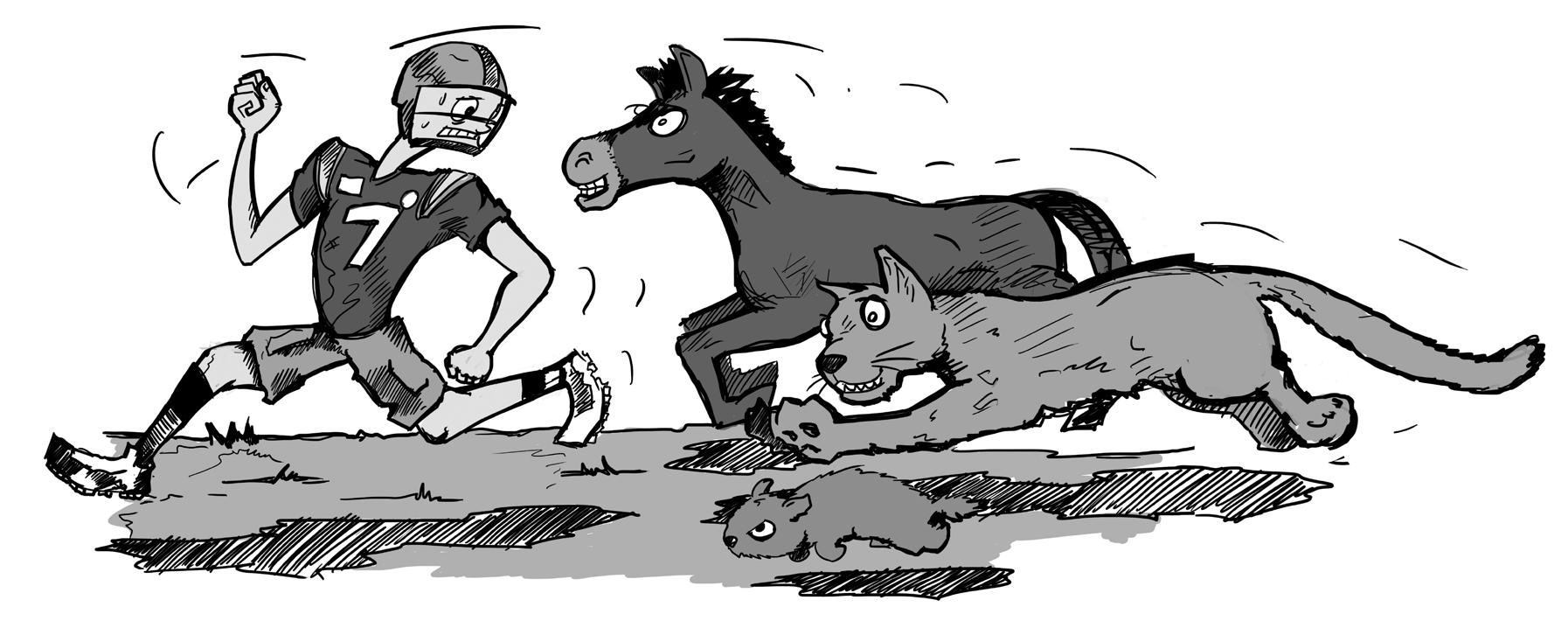
iLLustRatiON by bRadLy WOhLgeMuth
iLLustRatiON by bRaM Keast
Bisons win first playoff game in IGF
Football advances to Canada West final
Mi K e still, staff
The Manitoba Bisons secured their first playoff win since the 2007 Vanier Cup championship season, after a heart-stopping 37-36 comefrom-behind victory over the 10thranked Saskatchewan Huskies this past Friday night at Investors Group Field.
This was the third time the two teams met this season. Saskatchewan won the first game, 36-34 (Sept. 7), and Manitoba the second, 33-26 (Oct. 18). Both regular season games were nail-biting finishes. The playoff matchup was no different, with the game ultimately decided on the final play.
The game got off to a slow start, as both defences limited the point production of either side. The early difference was two Saskatchewan interceptions. The second, from linebacker Dylan Kemp, resulted in a 32-yard field goal from kicker Denton Kolodzinski –the only points scored in the first quarter.
started to pick apart the Bison secondary. Huskies quarterback Drew Burko made the biggest impact, throwing for 217 yards and two touchdown passes. The Huskies scored on their first drive of the second half with a 61-yard touchdown reception by Kit Hillis. After a Manitoba punt, Saskatchewan cracked the scoreboard again, this time off a 43-yard Kolodzinski kick. The Huskies took the lead on their next drive, as Burko found Mitch Hillis on a 10-yard touchdown reception. The key play was a 27-yard grab by Mitch Hillis, who found a rhythm with his quarterback. Heading into the fourth quarter, the Huskies led 22-17.
reach the end zone with 5:02 left. Demski hauled in his second touchdown of the quarter from 13 yards out. Yantz was able to spread the ball effectively on the drive, hitting Smith and Coombs with gains of 17 and 15 respectively.
Manitoba got the ball again with 2:59 remaining. The Bisons engineered a seven-play, 65-yard drive. Demski’s third touchdown reception was a phenomenal 32-yard grab with a Huskies defensive back draped all over him. The touchdown put Manitoba in front 37-36, their first lead of the fourth quarter. The Bisons went for two but were unsuccessful.
“Laval wouldn’t fold, Calgary wouldn’t fold. Western wouldn’t fold. Manitoba didn’t fold. Good teams are resilient and find a way” – Bison head coach Brian Dobie
Manitoba got things going in the second quarter, scoring three times while taking the momentum heading into halftime. They cracked the scoreboard on each of their first two series, capping an 11-play 58-yard drive with a 42-yard Nick Boyd field goal. Their second possession led to a 16-yard Anthony Coombs touchdown reception, the first major score of the game. Manitoba widened their lead to 17-3 with 2:03 remaining, as quarterback Jordan Yantz found fellow team captain Andrew Smith on a 29-yard touchdown pass. The Bisons gave up a team safety with 50 seconds left, but looked strong heading into halftime up 17-5. Saskatchewan came out roaring in the third quarter, outscoring Manitoba 17-0. Their passing game opened up, as the Huskies slowly
Things didn’t look good for the Bisons to start the fourth, as Burko connected on another massive touchdown pass—50 yards to receiver Mitch Stevens—on Saskatchewan’s opening drive. Manitoba, however, answered right back, as Yantz completed two big passes. The first was a 46-yard gain to Matt Sawyer, and the second, a 39-yard touchdown to Nic Demski, who would factor enormously in the fourth quarter. Saskatchewan showed no signs of slowing down. They scored again on their next drive, on a 46-yard touchdown reception by Mitch Hillis. The scoring drive gave Saskatchewan their second 12-point lead of the game with just under 10 minutes left to play. Cue the Manitoba comeback.
After both defences came up with key stops, the Bisons were able to
It all came down to Saskatchewan’s final drive of the game, the Huskies taking over with just 1:17 remaining after the Bisons’ go-ahead touchdown. Needing only a field goal to win, the Huskies drove the ball down to the Manitoba 32-yard line, and looked poised to pull off a last-second victory. The energetic Manitoba fans had something to say about that as the cheering of the announced crowd of 2,242 reached deafening levels, resulting in a costly Saskatchewan procedure penalty. This pushed Kolodzinski back five yards from the 39 to the 44. Kolodzinski shanked the kick, ending the game and sending Manitoba to the Hardy Cup.
Head coach Brian Dobie was pleased with the resiliency his team showed, especially in the second half.
“Saskatchewan scored 24 unanswered points on us tonight. Most teams in the country—not all, not the elite teams—fold at that point. That’s human nature,” said Dobie. “But as I said to our guys, Laval wouldn’t fold, Calgary wouldn’t fold. Western wouldn’t fold. Manitoba didn’t fold.
Good teams are resilient and find a way.”
Yantz, who finished the game 23-of-36 for 371 yards, with four touchdowns and two interceptions, spoke of the team’s determination when they were down midway through the second half.
“We had a little chat on the sidelines, and said, ‘you know we can’t wait for someone to start making plays. We gotta do it together, do it yourself.’ Everybody just started rising up.”
Demski, who finished with seven receptions for 115 yards and three huge touchdowns, tried to explain his fourth quarter surge:
“I told Smitty [Andrew Smith] I just needed to get hit hard and that happened in the second half and I woke up.”
Manitoba will now travel to take on the third-ranked Calgary Dinos in the Hardy Cup. The winner will represent Canada West in the Mitchell Bowl on Nov. 16 against either the Western Mustangs or the Queen’s Gaels of the Ontario University Athletics conference. The Hardy Cup kicks off in Calgary Saturday at 3 p.m. The game will be broadcast live on Shaw TV. phOtOs by beibei Lu
Bisons hit the hard court
Basketball season starts with three wins out of four opening weekend games
Mi K e still, staff
The Manitoba Bison basketball teams had a successful start to the 2013-14 Canada West conference season, as they took three out of four games at Investors Group Athletic Centre. The men suffered the only loss of the weekend, falling 77-71 Friday night against the UNBC Timberwolves.
The Timberwolves dictated the tempo early, going 10-for-15 in the first quarter. UNBC led by six heading into the second. Despite some turnover trouble, Manitoba was able to fight back. Led by first-year players Andre Arruda and Justus Alleyn, the Bisons took a brief 30-29 lead. UNBC would not back down, however, retaking the lead and heading into the break up 37-32.
Manitoba opened up the second half on fire, going on a 13-2 run, and led 51-49 by the start of the fourth. The Bisons were unable to sustain the lead, as UNBC broke away in the final five minutes of the fourth and held on for the victory. Charles Barton of the Timberwolves led all scorers with 20 points.
The men’s team found a better result the following evening, pulling off an 83-78 win over the Mount Royal Cougars.
Manitoba took the momentum early, going 6-for-14 from the floor, and opening up a 16-9 first-quarter lead. After a sluggish start to the second frame, Mount Royal managed to find a groove and evened the score at 20-20. That seemed to wake Manitoba up, as they went on a 10-3 run towards the middle of the second, and finished the half up 37-27. Amarjit Basi led all scorers in the first half with 14 points, shooting 5-for-8 for Manitoba.
The Bisons pushed their lead to as much as 18 points. Third-year guard Mike Holloway certainly contributed to the Bisons’ success, as his play provided tons of energy for the team. Mount Royal stayed determined and stuck to long-range opportunities to stay in the game. James Lefebvre netted two key triples for the Cougars, which shrunk the lead to 10.
Things got interesting in the fourth quarter as Mount Royal cut the difference to one. The score sat at 71-70 with 4:20 remaining. Yigit Ozsayiner
nailed five of his six free throws on the night in the final five minutes as Manitoba held onto their first win of the season, 83-78.
Bison head coach Kirby Schepp touched on the Mount Royal comeback, saying, “We had a comfortable lead and to their credit, they battled back and upped their intensity defensively. We struggled to get good looks after that and we needed to be more disciplined offensively. We got a few good looks at the end and that eventually pulled us away.”
The Bisons (1-1) will take to the road for games on Nov. 8 and 9 against the Lethbridge Pronghorns.
In women’s action, the Bisons started off the season strong, with a 73-69 victory over the UNBC Timberwolves on Friday night at Investors Group Athletic Centre.
Manitoba trailed for most of the first quarter, but took a 22-18 lead after going on an 11-3 run late in the opening frame.
Robyn Eyer, who had a great weekend from beyond the arc, hit back-to-back threes in the second, as Manitoba took the 40-31 halftime lead.
The Bisons kept the pace going in the second half. UNBC never regained the lead as Manitoba clinched a 73-69 win. Allison Balasko led Manitoba with 16 points, and Emily Kaehn of UNBC led all scorers with 22 points.
The following night, Manitoba dominated the Mount Royal Cougars 73-48.
It was a slow start for the Bisons, as early turnovers proved costly. Mount Royal headed into the second frame with a one-point lead. Manitoba picked things up in the second quarter, taking the 35-28 halftime lead. The Bisons out-rebounded the Cougars by a total of 23-14 in the first half.
Manitoba took over in the third quarter. Robyn Eyer’s game-high 17 points included three triples, and helped increase the Bison lead to 16. The home team was an electric 10-for-17 from the field in the third quarter, and led by 21 points heading into the final frame.
Mount Royal attempted something of a comeback in the fourth
quarter, but it was not enough, as the Bisons rolled to 2-0 with the 73-48 victory.
Co-head coach Michele Hynes commented on the success her team had beyond the arc.
“We got really good defensive stops, which allowed us a lot of space in transition and we hit those threes because we were in the right rhythm,” said Hynes post-game.
The women will also head to Lethbridge this weekend to take on the Pronghorns, with games on Friday and Saturday.