Please contact designteam@themanitoban.com if you are interested in submitting a cover image.
For other volunteer inquiries, please come to our office in University Centre (across from Tim Horton’s, behind GOSA) or email the editor of the section for which you are interested in writing.
Please direct all other inquiries to editor@themanitoban.com
Toban Talkback
Katy MacKinnon, staff
Gabriela Carazato Janessa Tham Shadab Malik Khashayar Pejhan
h ea L th news briefs
By Katy MacKinnon, staff
Study relateS meat conSumption to weight, health effectS
Recent research by Loma Linda University in California found that individuals following a vegetarian diet had a lower body mass index (BMI) than those following a diet including meat, even though all participants in the study had a similar caloric intake.
The purpose of the study was to examine lifestyle factors that could possibly prevent and treat metabolic syndrome, which is characterized by numerous health risk factors including low HDL cholesterol and high blood pressure.
Non-vegetarians measured at the highest mean BMI out of all participants, while strict vegetarians measured at the lowest BMI.
cheek SwabS: the next online dating?
Instant Chemistry in Toronto is taking dating services to the next level by matching applicants by genes. The process begins with individuals swabbing their own cheeks and mailing the swabs to licensed laboratories. Instant Chemistry then analyzes the results and matches people accordingly.
The company says their methods are backed by scientific research. According to Instant Chemistry, “couples in longterm relationships [are] often found to have very different immune system genes from
their partner.” The company also claims that biologically compatible couples have better sex lives.
cuStom-fit toothbruSh can bruSh in Six SecondS
Blizzident has invented a new type of toothbrush, developed on a 3D printer. The brush resembles the shape of a mouthguard, instead of the stick-like shape of an average toothbrush. The company claims the entire brushing process will be complete in six seconds.
The brush will initially cost $300, but replacements will be cheaper and are only required annually. Blizzident’s website asserts that the brush is available from dentists around the world, with a tooth impression taken from the dentist.
medical School on probation
The University of Saskatchewan’s College of Medicine has changed their status to “accreditation with probation” after being warned of a possibility of probation in July of 2011.
The president of the university has suggested that the problems in the college are not due to insufficient funding, but rather to a 60-year-old structural model that is not currently satisfactory.
The college was found to be weak or deficient in 10 measurements, including faculty members not responding to students in a timely fashion.
A LOOK AT MENTAL HEALTH
Speaking up for mental illness
Awareness week held at U of M
“ Stigma arises from fear, the fear of the unknown. What changes fear is making something that’ s unknown, known” — Nicole Chammartin, CMHA
J
oin your fellow students throughout the week in a challenge to Stomp Out Stigma. The University of Manitoba is taking part in Mental Illness Awareness Week, a national project coordinated by the Canadian Alliance on Mental Illness and Mental Health (CAMIMH).
Mental Illness Awareness Week has been held for over 20 years.
“The goal is to reduce stigma,” said Nicole Chammartin, executive director of the Winnipeg Region of the Canadian Mental Health Association (CMHA). Stigmas often associated with mental illness involve the notion of violent, crazy, or antisocial behaviours.
A variety of activities are scheduled to occur on campus from Monday, Oct. 7 to Friday, Oct. 11, including “We Love Dogs” by St. John’s Ambulance.
Students can visit the fireplace lounge from 11:30 to 1:30 p.m. on Wednesday
(Tuesday in the Buhler Atrium at the Bannatyne campus) to relax and de-stress with pet therapy dogs. Interaction with our canine friends can help counteract negative feelings, specifically those associated with depression and anxiety.
The Gold Card will be handed out for the first time this week. Crafted by the Health and Wellness Program, the Counselling and Career Centre, and Student Advocacy, the Gold Card is a small reference card listing mental health resources both on and off campus.
Lisa Erickson, a nursing student at the U of M, spoke to the Manitoban about her experience coping with a mental illness while being in university.
Erickson has schizoaffective disorder, an illness she described as including symptoms of depression, mania, and psychosis.
“When I was depressed it was hard to make it to class; it was hard to concentrate.
[It’s the] same as when I’m psychotic: it’s hard to concentrate for sure. In general it’s hard to find people who understand. It’s just hard to get support,” she explained.
Although the U of M campus has a drop-in service for personal counselling sessions, Erickson was turned away twice before she was able to secure an appointment and speak with a professional. Drop-in appointments are limited and available on a first-come, first-serve basis.
“Once we got the ball rolling, the help was there. But just getting started, getting turned away, and feeling like nobody really cares, that was how it felt starting out,” she said. It was two months before Erickson saw a psychiatrist at University Health Service. The psychiatrist only visits there once every two weeks.
Students who hear Erickson’s story often relate to her experiences, confiding their own depression and anxiety. However, many of these students have not sought treatment for their own mental illness.
Erickson spoke at a kickoff event by CMHA Monday night about her experiences with mental illness. Fortunately, the responses she has received when speaking on the topic have been positive, with many people commending her bravery.
“Everyone’s been really supportive,” she said.
Luckily Erickson has not experienced the stigma of mental illness herself, but Chammartin indicated that stigma is still present in Canada.
“I think stigma still exists [ . . . ] Stigma arises from fear, the fear of the unknown. What changes fear is making something that’s unknown, known,” she offered. “The piece that I do believe is changing in Canada, and certainly in our community, is the amount people are talking about it.”
Students can take personal steps towards caring for their mental health.
Chammartin suggested making a list of the top things that are disturbing students in their private lives. From this list, she recommended making a plan as to what changes can be made personally, and what things are outside of a person’s control. She also advised creating small goals for change with rewards along the way.
“When we make small changes in our life we can often have [a] big payout,” she said. Mental illness manifests in various ways, but Erickson shared some warning signs. She listed “any kind of withdrawal from friends or from classes,” as well as sadness lasting for more than a few days as examples.
Students wishing to access personal counselling should visit 474 University Centre at 8:30 a.m. as limited drop-in appointments are available. The centre also offers group workshops in a wide range of topics, such as mood management, career planning, and relationship strengthening.
Katy MacKinnon, staff
It is a well-established fact that rates of mental disorders (e.g., anxiety, depression, schizophrenia) within the general population are strongly correlated with income. In other words, as individual incomes decrease, rates of mental disorder sharply increase. This consistent relationship has been demonstrated around the world and, in reference to both mental and physical health, it has come to be known as the social gradient in health.
However, until the last 15-20 years, two apparently contradictory meanings or interpretations of the inverse relationship between income and mental health were supported by different sets of scientific findings.
On one hand, some research suggested that development of a serious mental disorder caused people to (a) achieve lower levels of education, relegating them to low-paying jobs and/or (b) become less employable, especially at highly skilled, well-paying jobs, which in turn caused their income to decline significantly. Essentially, the so-called social selection hypothesis argued that mentally disordered persons were over-represented among the poor because they were handicapped economically by their disorder.
On the other hand, the so-called social causation hypothesis argued that mentally disordered persons were over-represented among the poor because poverty, with all its attendant disadvantages, was a major (perhaps the major) driver of mental disorder. That is, poverty caused mental disorder, rather than resulted from mental disorder.
This debate between competing interpretations of the relationship between poverty and mental health was not only important scientifically; it also had great practical importance. The social selection hypothesis suggested that nothing much could be done about the poverty of mentally disordered persons, whereas the social causation hypothesis suggested that mental disorder could be reduced by taking steps to reduce poverty. Moreover, those who adhered to the latter position further argued that society has a moral or ethical obligation to take such steps, as poverty and the relatively poor health of those living in poverty were unfair and reprehensible.
Fortunately, recent longitudinal research, combined with sophisticated statistical modelling largely ended the above debate by showing that, although both social selection and social causation occur (i.e. they are not mutually exclusive processes), they are not equal in their influence. Developing a serious mental disorder can be (but is not always) a major, life-altering event with
direct economic consequences. However, research has also shown that social causation is far more significant in accounting for the strong relationship between poverty and mental disorder.
It is meaningful to distinguish between the effects of poverty defined as material deprivation regarding the basic necessities of life (e.g. food, clothing, shelter) and the more subtle psychosocial effects of poverty defined as economic inequality. Material deprivation involves chronic and/or repetitive exposure to major stressors such as (a) insecure, crowded, substandard housing; (b) unemployment, insecure employment, or employment in high stress/low control jobs; (c) living in noisy, unsafe neighborhoods; and (d) gendered violence, to name just a few. Social inequality involves conditions such as discrimination, powerlessness, lack of opportunity, social scorn, and internalized low self-esteem.
Both material deprivation and social inequality result in destructively high levels of physiological arousal, cognitive impairment, affective arousal, and affective distress (e.g. depression). Some research has even suggested that people chronically exposed to the effects of poverty lose the ability to regulate their internal state and thus remain unstable and over-reactive indefinitely. Moreover, individuals disabled by poverty often cope in counterproductive ways, such as through substance abuse and antisocial behaviour, which exacerbates their problems, alienates social supports, and further impairs their mental health.
The dynamics described above apply primarily to adults whose development is relatively complete. The negative consequences of these dynamics are multiplied many times when you consider that mentally and economically disadvantaged adults are less capable of providing adequate material, social, and psychological resources (e.g. consistent, nurturing parenting) needed by their children, who are still developing and, therefore, are more vulnerable to deprivation.
Most mental disorders originate in childhood and adolescence. Many of the mental, emotional, and behavioural problems common to these ages (e.g. social anxiety, low self-esteem, learning difficulties) are resolved, especially with professional treatment. However, many such problems worsen over time and can significantly decrease the odds of children successfully negotiating the many developmental tasks facing them on their path to healthy adulthood.
Research on early child development has shown that children of affluent parents typi-
cally get on a positive trajectory in which educational and social success leads to further success, whereas children of poor parents are far more likely to get on a negative trajectory in which failure leads to further failure. Moreover, the longer children are on a negative trajectory, the more severe and intractable will be its effects on their mental and physical health.
For nearly three decades, middle class incomes in both the United States and Canada have stagnated in real dollar terms and lower class incomes have actually decreased. In contrast, the incomes of the top 10 per cent have increased enormously. Essentially, the middle class is being hollowed out and more families are descending into poverty. Economic insecurity among young adults is rampant and it is predicted that this generation will be, for the first time in modern history, significantly less affluent than their parents.
No less an authority than Alan Krueger, Chairman of the U.S. Council of Economic Advisers, has stated with alarm that we are increasingly becoming a “winner take all economy” in which the few become very wealthy at the expense of everyone else, especially those at the bottom of the economic ladder. It is no wonder that rates of mental disorder are increasing and that the World Health Organization has forecast that mental disorders combined with substance abuse will soon become the greatest source of health-related disability in the world.
What could you do here in Manitoba to help reduce poverty and, consequently, reduce suffering due to mental disorder?
First, lobby your MLA or Premier Selinger for long overdue increases to the Employment and Income Assistance program, about 80 per cent of whose recipients are either disabled or single mothers staying home to care for young children. Similarly, lobby the government to increase the provincial minimum wage, which is significantly below the living wage necessary to meet basic needs. Third, support income supplements, administered through the tax code, to provide non-stigmatizing help for poor individuals and families. Last, support policies that promote job growth, healthy workplaces, affordable housing, and safe neighbourhoods. There are organizations locally engaged in all of these efforts. Get involved. Speak out. It will be good for your mental health.
Dr. Bruce Tefft is an associate professor of psychology at the University of Manitoba.
The World Health Organization has forecast that mental disorders combined with substance abuse will soon become the greatest source of health-related disability in the world
A misunderstood correlation
Winnipeg Zombie Walk cancellation indicates unattainable regulations
Community-building events should be more affordable
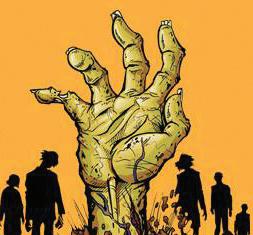
Afew short weeks ago it was announced that Winnipeg’s annual Zombie Walk would not occur this year. The event, which attracts thousands of Winnipeg residents to dress as the “undead” and take to the streets for a lively, fun-filled walk, was closed down by its organizers, who said that the cost for the event had become too high.
The City of Winnipeg requires that street events with an attendance of 800 people or more obtain a use-of-street permit, as well as recoup the costs incurred by public works-traffic services. These costs would come in at nearly $4,000 for the two-to-three-hour event.
The costs do not end there, though. It is likely that the Zombie Walk would require off-duty Winnipeg Police Service personnel to be present, which in some cases costs close to $100 an hour, as well as waste management services such as portable toilets, and garbage and recycling receptacles.
It is easy to see why this event and many other small events are cancelled, or never develop. The cost of
the city’s regulations is just too high unless events find ways to secure revenues from their participants. For many community events, this is simply not an option. The Zombie Walk is a casual, come-and-go event that is open to anyone and everyone. It is a chance for individuals to get out onto the street and experience our city at night. Charging for services like this does not seem fair and, even if justified, the fees are too much for most to afford.
The city needs to look at what these events promote within Winnipeg. The Zombie Walk and dozens of similar events foster culture and community while providing a safe environment. Careful planning goes into events like this to ensure a safe route is followed, and that individuals are not put at risk. Additionally, by travelling as a group, the chance of violent crime is minimized, allowing individuals to feel safe in and explore areas of the city they may not have otherwise.
However, the city’s regulations are not the sole cause of event cancellations. The province of Manitoba, which distributes liquor and lottery
permits, also has a difficult system for small community events to go through. The process of applying for a liquor permit is complex, with over a dozen different licences available for a range of poorly-defined event s. The task of applying for lottery permits is even more arduous and confusing. Similar to event regulation, this liquor permit process makes it harder for individuals to host and take part in events that are beneficial to the community and enjoyed by its residents.
Though the city and province may credit these regulations with keeping us safe—as safety concerns was a cited factor in the walk’s cancellation—it seems more likely that they have a stake in the revenues they draw in from individuals who hold events, or it is simply easier for them to prevent some of these events from ever getting off the ground. The city and province should be looking at how they can help event organizers plan their events in a safe manner, so that communities can come together and celebrate our amazing city.
The less you can afford, the more you have to pay
Why interest rates on student loans should be
scrapped
b i L an a rte
Canada currently uses provincial and federal student loans as a way to increase the accessibility of our post-secondary education system. The idea is simple: lump sums of money are provided to students from low-income families to help pay for their school and living expenses for the duration of their post-secondary education program. In return, students must repay these monies, according to a schedule, with interest beginning to accumulate on loans as early as six months after graduation.
More specifically, in Manitoba, provincial student loans are dealt with under a dual funding model that incorporates the Canada Student Loans Program. This equates to Manitoba students paying different interest amounts to both government bodies.
The intent is meant to offset the inequality between students: those who can afford the upfront cost of post-secondary education, and those who cannot. The reality is that over time, students who can not afford school find themselves paying double, sometimes triple, the original amount due to the compounded interest on their loans, with the average repayment taking 10 years.
average of $20,000, the price tag is just too steep. Student loans aren’t working to provide an equitable path towards education; in fact, once interest rates are applied, student loans have actually contributed to deepening the divide.
Provincial and federal governments need to be investing more in upfront grants and bursaries. These programs are non-repayable – meaning students don’t have to pay them back, which results in lower debt loads. In actuality, these programs enable students to pursue higher education rather than punishing them down the road.
Poorer students end up paying more than students from wealthier backgrounds for the exact same education
In Manitoba, our government has taken many steps to ensure a more affordable post-secondary experience, including the creation of the Manitoba Bursary Program, the reduction of interest rates on provincial loans to prime, and— most recently—increased funding to the Manitoba Bursary Loan Remission Program.
The result is that poorer students end up paying more than students from wealthier backgrounds for the exact same education, pointing to the inherent flaw of charging interest rates on student loans: it hurts the very people the loans were intended to help. Students from lower-income backgrounds are more debt-averse than their wealthier counterparts.
With student debt soaring to an
However, it is time our province took it a step further, as did Newfoundland and Labrador, with the complete elimination of interest rates on provincial student loans. We have a proud ranking today as one of the most accessible provinces to study in. Through the removal of interest rates on provincial student loans, we can ensure that our provincial student loan program isn’t punishing those students who need it the most.
Bilan Arte is Manitoba chairperson of the Canadian Federation of Students and a former UMSU president (2012-2013)
ediTor-in-chief Bryce Hoye
editor@themanitoban.com / 474.8293
Business manager Foster Lyle accounts@themanitoban.com / 474.6535
adverTising coordinaTor Daniel Schipper ads@themanitoban.com / 474.6535
e ditoria L
senior n eWs ediTor Quinn Richert news@themanitoban.com / 474.6770
n eWs ediTor Katy MacKinnon katy@themanitoban.com / 474.6770
phoTo ediTor Beibei Lu photo@themanitoban.com / 474.6775
design associaTe Aichelle Sayuno
graphics associaTe Bram Keast
r eporters
n eWs Kevin Linklater
n eWs Vacant
science Elizabeth Drewnik
arTs & culTure Anastasia Chipelski
arTs & culTure Lukas Thiessen
sporTs Vacant
assisTanT copy ediTor Vacant
vo Lunteer contributors
Will Gibson, Keegan Steele, Dany Reede, Gloria Joe, S. Arden Hill, Matt Geisbrecht, Jeremy Strong, David Skeene, Jodie Layne, Nolan Kowal, Holly Ervick-Knote, Bruce Tefft, James Culleton, Adam Peleshaty
MANITOBAN
105 UNIVERSITY CENTRE UNIVERSITY OF MANITOBA WINNIPEG, MB R3T 2N2
General Inqu I r I es & a dvert I s I n G
Phone: (204) 474.6535
Fax: (204) 474.7651
Email: manitoban@themanitoban.com
n at I onal & Mult I -Market a dvert I s I n G Campus Plus Media Services Toll-Free (In Canada): 1.800.265.5372
Email: info@campusplus.com
Canadian Publications Mail Product Sales Agreement #589160
A “volunteer staff” member is defined as a person who has had three volunteer articles, photographs, or pieces of art of reasonable length and/or substance published in three different issues of the current publishing year of the Manitoban. Any individual who qualifies must be voted in by a majority vote at a Manitoban staff meeting. Elected representatives and non-students may be excluded from holding votes as volunteer staff members in accordance with the Manitoban Constitution. The Manitoban is the official student newspaper of the University of Manitoba. It is published monthly during the summer and each week of regular classes during the academic year by the Manitoban Newspaper Publications Corporation.
The Manitoban is an independent and democratic student organization, open to participation from all students. It exists to serve its readers as students and citizens.
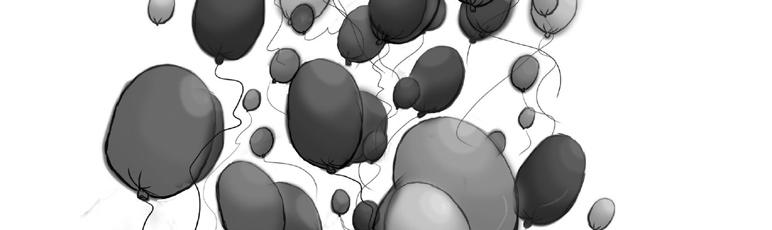
It’s getting harder to fill a balloon these days. That’s because we’re in the midst of a helium shortage as the U.S. prepares to shut down a major storage facility near Amarillo, Texas.
Although its lighter-than-air properties make it the ideal filling for decorative balloons, helium has a number of more practical uses. It is used as a shielding agent by arc welders. It is used in labs and high tech manufacturing. It is absolutely essential to the functioning of MRI machines, which use it to cool their superconducting magnets. Because of
helium’s chemical properties, no other element is suitable for the task.
Helium is one of the most abundant elements in the universe, but the helium in the atmosphere is unrecoverable. Extracting it in a form that’s usable is a difficult task: a large proportion of the world’s helium is produced as a by-product of natural gas. The gas fields near Amarillo are rich in helium, which is why the U.S. established the Federal Helium Reserve (FHR) there and encouraged natural gas companies to produce helium and sell it to the government.
The FHR is responsible for around 30 per cent of the world’s helium supply. However, the reserve is destined to close down. A 1996 bill required that the entire reserve be sold off by 2015.
“The legislation in 1996 says we were supposed to get out of the helium business,” said Joe Peterson, the Bureau of Land Management’s Assistant Field Manager in Amarillo.
It was expected that by 2015 there would be new privately owned sources of helium in the U.S. But the date is looming, and new sources have not yet taken up the slack, said Peterson.
The prices, long kept at an artificial low by the U.S. government due to the peculiar economics of helium production, have spiked abruptly. Demand for helium is rising, and production is actually falling due to a slump in the price of helium-bearing natural gas. The effects of this could be quite drastic.
“If the liquid helium supply was to suddenly vanish, our society would be turned upside down,” said Marinda Li Wu, president of the American Chemical Society.
The impact would be felt especially hard in medicine. An MRI machine requires up to 10,000 litres of helium. Without it, the superconducting magnet can be damaged. The high cost incurred in replacing the magnets could limit access to MRI machines.
“If the supply constraint on helium continues unabated, it could be very harmful to patient care,” said Tom Rauch, global sourcing manager for GE Healthcare, a manufacturer of MRIs.
In the midst of this situation, companies are looking into the possibility of extraction directly from helium
wells, rather than producing the gas as a by-product. Among the potential targets are the helium reserves in Western Canada, which were discovered by government studies between the 1950s and 80s but were never exploited. Weil Helium LLC, a Texasbased helium company, is proposing to begin production on two helium wells drilled in the 1960s near Swift Current, Saskatchewan.
Weil is planning to use new technology that allows them to distribute the helium immediately without storing it in vast reserves. “We’ll be able to deal directly with the end user. In our case, it’s going to be the balloon guys and the welders,” said Bo Sears Jr., a Weil executive.
The U.S. is in the process of passing a bill that will keep the Federal Helium Reserve open for a few more years. The reserve can support helium production until 2020. Under this bill, it will continue production as usual for the next year and then auction off its stores over the following six years. Party planners rejoice: the helium crisis may yet be averted.
iLLustRatiON by gLORia jOe
Science & Technology
A day in the life: Wrapping up the blot
The
Wof the experiment
elcome back, dear readers!
Last time, we finished Day 1 of the Western blot. This issue, we’ll get into Day 2, which will complete the experiment.
After we retrieve our membrane from incubation with the primary antibody, we need to wash it and treat it with the secondary antibody. Then we can image the blot!
The secondary antibody is covalently bonded to an enzyme. Horseradish peroxidase (HRP) is one of the enzymes used for secondary antibodies. Specific to the primary antibody, the secondary antibody will only bind to the area where the protein of interest is located. To understand why, here’s a quick explanation regarding the structure of antibodies.
Think of the antibody as in the shape of a “Y.” The top branches of the Y are responsible for binding to the antigen. In our case, the antigen is our protein of interest. The “tail” end of the Y is sticking up. This allows for us to bind the secondary antibody to the primary antibody. The portion that
binds to the antigen is called the variable region. It is unique in that every antigen has its own corresponding antibody.
The other end of the antibody—the one that “sticks up”—is known as the constant region. The constant region is not the same in every species: the constant region of an antibody from a rabbit will differ from the constant region of an antibody from a mouse. So if our primary antibody against the protein of interest was established in a mouse, we can then generate a secondary antibody from a rabbit that targets the constant region of the mouse’s primary antibody.
Once the secondary antibody is added, it must be left to incubate for some time. Just as with the primary antibody, the incubation ensures that the antibody is able to properly conjugate with its antigen – in this case, the constant region of the primary antibody. Next we add the chemiluminescent substrate.
The substrate will interact with the HRP enzyme conjugated to the secondary antibody, and the
chemical interaction will release a light signal. This enables us to detect the location of the protein of interest on the membrane.
The next step is imaging. The imaging method we will be focusing on is quite similar to the development of photographic negatives in a darkroom. The membrane is placed into a cassette. An X-ray film is placed over top of the membrane. As X-ray films are sensitive to light, it is crucial to do this step in the dark. We then leave the film to absorb the chemiluminescent reaction.
After this incubation is complete, we take the film and dunk it in the film developer, rinse it, dunk in the fixative, rinse again, and set to dry. We then observe the image. If all has worked nicely, you will see a dark band indicating the presence of your protein.
Thank you very much for taking the time to read this series of Day in the Life articles. This is the last entry for the series. I sincerely hope you’ve enjoyed reading and learning about select lab techniques. Cheers!
Science opinion: Creating trouble
The future of scientific education may be at risk in the heart of the Bible Belt
h o LLy e rvicK-Knote
Texas is currently preparing to select the biology textbooks that will be used in high school classrooms for the next decade. Recently it was discovered that several reviewers objected on religious grounds to coverage of evolution in the textbooks. There were 28 people invited to review the textbooks, and at least six of them challenge or reject fundamental scientific ideas such as evolution and climate change, according to documents obtained in July by the Texas Freedom Network, an organization that opposes the religious right in Texas.
Because Texas is home to a disproportionately large number of students, publishers often base the standards for textbooks to be used nation-wide on what is required in Texas
At least two of them participated in the important final stage of the review. One reviewer, Raymond Bohlin, is a research fellow for the Discovery Institute – a centre that promotes intelligent design. Another, Walter Bradley, co-wrote a book on intelligent design and is a fellow at the Discovery Institute’s Center for Science and Culture. These and other panel members are suggesting that publishers include disclaimers about evolution or even include “creation science” as a valid scientific alternative to evolutionary theory in the textbooks.
One reviewer wrote, “I understand the National Academy of Sciences’ strong support of the theory of evolution. At the same time, this is a theory. As an educator, parent, and grandparent, I feel very firmly that ‘creation science’ based on Biblical principles should be incorporated into every biology book that is up for adoption.”
Another debated whether the fossil record actually demonstrates evolutionary processes of mutation and natural selection over time, saying, “The fossil record can be interpreted in other ways than evolutionary with equal justification.”.
In another case, Bohlin disputed claims about climate change. “We don’t really know that the carbon cycle has been altered,” and, even if we did, “we don’t know what climate change will do to species diversity [ . . . ] . [The] question seems to imply that ecosystems will be disrupted which we simply don’t know yet.”
The National Center for Science Education (NCSE), an organization that defends the teaching of evolution and climate science in the U.S., criticized the scientific background of the reviewers. The NCSE claims that few of the reviewers criticizing the textbooks have any scientific background or credentials, and the ones that do are involved in anti-evolution organizations like the Discovery Institute.
“Publishers should listen to real experts, not unqualified reviewers who don’t seem to understand even basic scientific terms,” said the NCSE’s Joshua Rosenau.
The outcome of this review process has implications for the rest of the U.S. as well. Because Texas is home to a disproportionately large number of students, publishers often base the standards for textbooks to be used nationwide on what is required in Texas, meaning that—in effect— schools throughout the U.S. could end up using watered-down biology textbooks infused with bad science and religious ideology.
Stronger regulation on science textbooks is no doubt crucial in ensuring that topics such as evolution and climate change are accurately and thoroughly covered in classrooms. But even if the proposed revisions are rejected, the material actually covered in classrooms depends significantly on teachers themselves and the biases and beliefs that they bring into the classroom.
In an interview with the New York Times, Rosenau said, “most educational decisions are made in the 17,000 school districts and by individual schoolteachers in the classroom, [ . . . ] and it is really hard to know what is happening there.”
Michael Berkman and Eric Plutzer, political scientists at Penn State University, surveyed over 900 high school biology teachers and found that one in eight taught creationism or intelligent design as scientific alternatives to the theory of evolution.
The final decisions on what will be included in the new textbooks will be made between Nov. 19 and 22. As of now creationists represent a minority on the board. Some panellists want drafts to be made available by mid-October in order to give time for debate.
It would seem that selecting such a high proportion of people who profit from rejecting the most fundamental scientific ideas would be an obvious conflict of interest, but the region has a history of blurring the lines between church and state. The power struggle between science and religion stems from a deeply rooted cultural tension present throughout the Bible Belt. Nevertheless, it would be nice to see biology textbooks stick to teaching what they were intended to teach: science.
A wearable history
Insights into social change through clothing and textiles
a nastasia chipe L sK i, staff
History is written in many forms – through buildings and books, our everyday lives, and the clothes we wear.
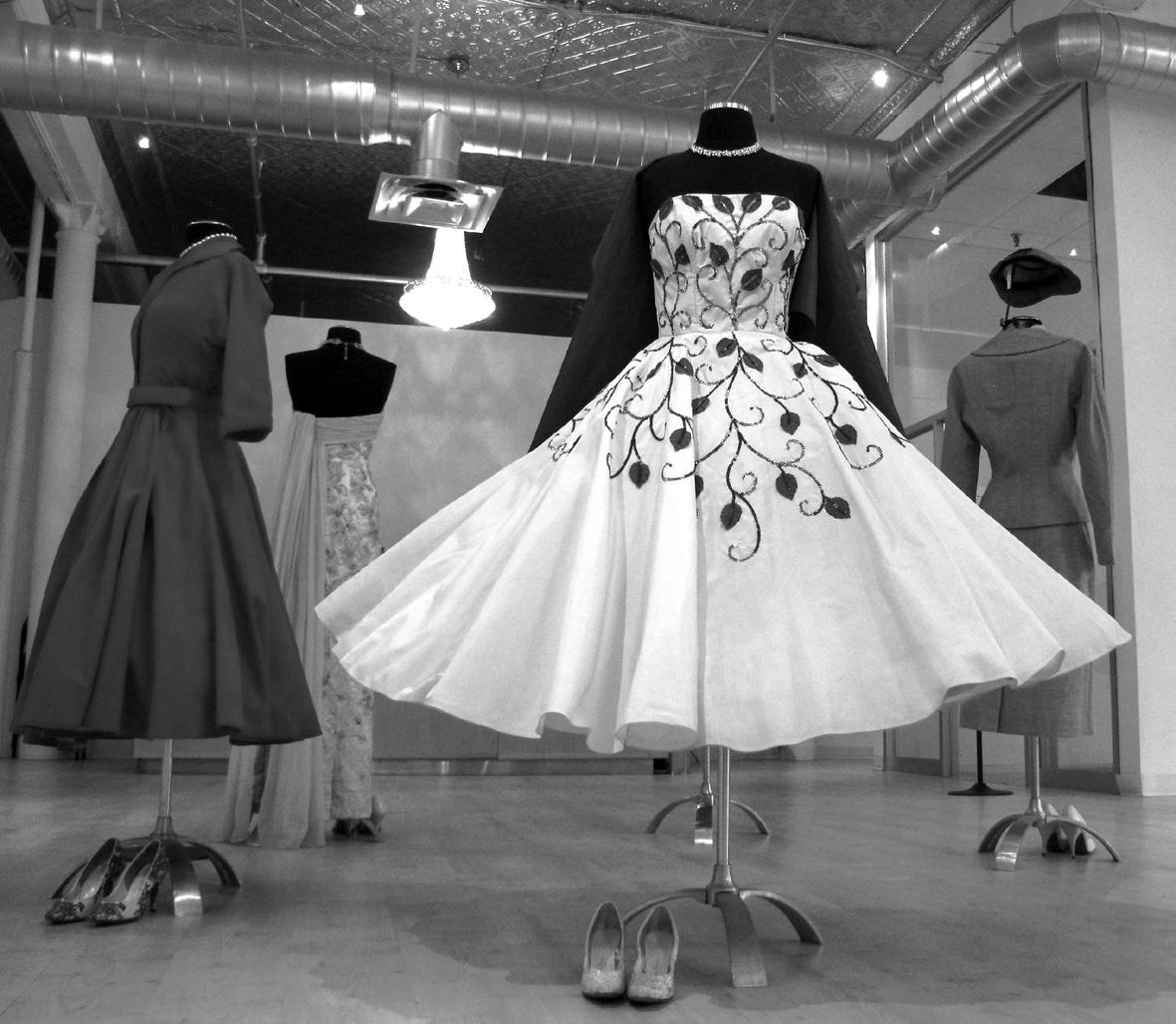
In the latest exhibit from the Costume Museum of Canada (CMC)—From Bloomers to Bikinis: Women’s Wear and Social Change history is written in patterns, hemlines, and colours.
“The Costume Museum is neither a fashion nor a history of fashion museum,” says Jo Ann Greisman, treasurer for the Costume Museum of Canada. “The CMC is a material history museum focusing on what we wear. It looks at apparel and accessories in relation to social history.”
As you walk through the exhibition, expect to see carefully put together
outfits for everyday life and for special occasions, along with explanations of the historical moments that created them. One dress from the 1950s appears to be made from old flour or sugar sacks, in a bright floral pattern that was unusual for the time.
“Everything was recycled during the war,” Greisman explains. A small scrap of velvet may be salvaged and used for a trim, or a collar from an old dress would be transferred to another.
“Buttons were not easily available [ . . . ] so most buttons were reused from another dress.”
Moments such as the Persons Case, World War II, the availability of the birth control pill, and the amendment of the Indian Act, are highlighted in the exhibit. As these events affected many women’s private and public lives, including increasing and decreasing participation in the workforce and rates of university graduation, they were also reflected in the clothes being made and worn.
In the early 1900s, hemlines rose ever so slightly as the bicycle gained popularity, and skirts were designed so that they could be gathered up for ease of movement. In the 20s, with the rise of the flapper, they rose again, then snuck down in the 30s, and crept
back up in the 40s.
Greisman explained that many of these aesthetic conventions were also reflections of not only what women wanted, but what society at large—and the government—wanted of them.
Smart dress suits showed up for working women throughout the war, but the desired silhouette became hyper-feminine in the post-war period, reflecting the pressure for women to step back from the workforce into their traditional feminine roles. There was a push towards propriety: Greisman notes that the 50s were huge for hats.
“You couldn’t go anywhere without hats and gloves.”
The exhibit runs up to the 80s, and also includes the 2000s, labelled as a “mash-up era.” Greisman explains that it’s harder to find a common thread, a theme, or a few exemplary styles of a time while we’re living in it. Looking back, we may be able to pick out some outstanding looks, but the attitude towards clothing—and manufacturing—has also changed.
“It’s hard for people to save clothes when they don’t know that it’s going to be valuable,” says Greisman. The CMC’s collection—all 35,000 pieces—were procured through donations. Many people aren’t aware of the his-
torical value of what’s in their closet, and these days, she says, many items will simply end up in the trash or at the secondhand store within a year.
However, they are still welcoming donations of well-preserved items, especially from the 50s and 60s. If they don’t collect them now, says Greisman, they will be lost forever.
While it is entirely volunteer-run, and will not have a dedicated space as a formal museum, the CMC is aiming to continue holding exhibitions, like this one, that pair apparel and history in temporary spaces for at least a month at a time.
Beyond history, many pieces are simply wonders on their own. The beadwork—all done meticulously by hand—on some of the dresses from the 20s is astounding. While we may look back at these pieces as costumes, they remind us that in daily life, our clothing is a distinct reflection of our current social space.
From Bloomers to Bikinis will be open at 264 McDermot Avenue until Oct. 26. Gallery hours are Tuesday, Wednesday, and Saturday from noon until 6 p.m. and Thursday and Friday from noon until 9 p.m. For more information, visit costumemuseumcanada.wordpress.com.
B.R.A.V.E. boys for safer, healthier communities
New program in West Broadway takes an innovative approach to fighting violence against women
a nastasia chipe L sK i, staff
There is a movement afoot to engage boys and men in the work of ending violence against women, and a new program at the Broadway Neighbourhood Centre (BNC) is the first of its kind in Canada to receive funding for this kind of work.
The newly renamed B.R.A.V.E. program—Brothers Resisting All Violence Everyday—hopes to question unhealthy versions of masculinity, and build new leaders and role models in the community.
Why work with boys? While this is the first in Canada, B.R.A.V.E. builds on the success of previous programs.
“It’s been done in the [U.S.] and has been proven to be extremely useful in reducing sexual assaults; in reducing all forms of violence, we’re hoping that it will have the same effects here,” says Jodie Layne, project coordinator for B.R.A.V.E.
While many boys and men want to play a role, and be active in ending violence against women, they may not know who to ask or know if they should.
B.R.A.V.E. programming officially starts on Oct. 7, and will work with 15 youths (between the ages of 15 and 25) for the next 18 months. Along with the program co-ordinator, two maleidentified staff members will lead the
majority of the programming.
“It’s really important for the boys to have male role models who can model behaviors, who can look like they do, who have firsthand experience,” says Layne.
The program is also working with other role models in the community, such as cultural leaders from newcomer and indigenous communities. These partnerships will help make the program meaningful in a cultural way, and include teachings from beyond the BNC.
The University of Winnipeg’s basketball team, the Wesmen, are on board.
“Basketball is huge in West Broadway,” says Layne.
In a community assessment, when asked who they looked up to, many of the youths chose basketball players. The program will incorporate physical activity—such as basketball workshops—to engage in a way that’s nuanced as meaningful, and model a variety of ways to display healthy masculinity in sport.
And what exactly is this “healthy masculinity” that the program looks to foster? This is something that, with the help of the facilitators, the youth are going to figure out.
“ We don’t want to create new rigid
gender norms or expectations for the boys; we want to open it up for them to define it for themselves.”
The program will work on this through weekly discussion nights as well as activities.
“[B.R.A.V.E. will use] activities to strengthen boys’ bonds to each other, to be able to open up and talk about those things that we see as masculine, that we don’t see as masculine, that we see as traditionally feminine.”
The B.R.A.V.E boys can expect to engage in a variety of activities. In addition to basketball, they will take in plays at Manitoba Theatre for Young People, visit the corn maze, go to cooking classes, and try boxing. They will also be talking about how to engage with others outside the program, if they see behaviours or attitudes that could contribute to violence.
“We know that the quickest way to stop violence is with the problematic attitude that it stems from, and with bystander intervention,” says Layne.
The program will also talk to the boys about how to cope with less healthy versions of masculinity that they see in their home and community, and how they can work to change those realities.
Near the end of the program, the boys will create something of their choosing—a video, skit, or curriculum for a school—and use it to share what they’ve learned and spread the message. They will also be attending block parties and other events designed to engage the community with the program. Above all, the boys themselves will shape the program. Layne believes that every person is the expert on their own experience.
“Everyone’s experience is so varied; we can’t just say, ‘this is the way to have healthy masculinity and be a healthy male.’”
Check out www.thebnc.ca for more information on B.R.A.V.E.
phOtO by aNastasia ChipeLsKi
phOtO COuRtesy Of jOdie LayNe
The A-B-Cs of S-E-X, gender
Jodie Layne, volUnteer staff
Hello readers, I want to make sure we are on the same page when it comes to some fundamental parts of sex and sexuality. “Going Deep” will be rolling out a few columns over the next few months that will help you understand some of the other topics I discuss and that will probably just make you a better human being. If there’s anything you want to know, you can always email me at jodie.m.w.layne@gmail.com.
Okay, so gender. That’s where you check the “male”or “female” box off on a form and you’re good.
Right?
Well, not really.
Over the years, gender and sex have gotten mixed up in a linguistic tango and have become nearly inseparable. The best way to break it down for you is: biological sex is what’s between your legs and gender is what’s between your ears. Meaning that the parts and hormones you have determine your sex (male, female, intersex), and gender is the identity that you feel suits you. Now it’s pretty obvious that the old “check one” method doesn’t really seem to apply here anymore, isn’t it?
Gender is fluid, meaning someone may be born with a certain biological sex and feel that their gender identity matches that while they’re growing up; when what is between your legs and ears matches up, it’s called being cisgender.
That person can become a teenager and start to identify with the traits and the roles that society ascribes to another gender. Identifying with a gender that doesn’t match up with the sex you were born with can result in a person identifying as transgender. Contrary to popular belief, a
medical or surgical transition does not need to take place to be considered transgender – it’s up to that person to decide how they identify.
The term transsexual is not the same as transgender and is used when referring to people who occasionally dress or act like a gender that does not match their own.
Our hypothetical person can also feel like they have a tough time identifying with any gender and not conform to the roles, expectations, socialization, or pronouns of any gender: this can be called gender-ambiguous, gender non-conforming, gender-variant, bi-gender, pan-gender, genderqueer, non-binary, or—my favorite—gender-creative.
Some indigenous peoples who identify with male and female traits choose to identify as Two Spirit as opposed to the above options. Prior to colonization, Two-Spirited people held a special place in their communities and their ability to understand a multitude of perspectives often meant that they had special status as leaders and medicine people.
There are a whole other variety of genders that people identify with that I could never come close to covering; they’re as varied as the way people experience gender and the way the world interprets it.
So when it comes to gender, it’s important that we respect people’s choices and decisions about their own damn gender. If they would like to be referred to as he, she, they, zir, ze, or whatever, it’s pretty easy to do. It’s not a huge inconvenience to your life and chances are that it will mean everything in the world to that person to have their identity confirmed.
See?
You’re a better person already.
The nights are cold and bleak. No matter how much you try to bundle up, the biting winter wind is going to catch you and hold you in a frozen embrace. You stare at your mittens debating whether the weather is finally going to make you give up hope for one more, nice day. No matter how much you try to fight forever, it’s always just a blink away. The heartsick elixir of melancholy hides in every shiver and falling leaf. Fall is the most unforgiving of adversaries; that’s why you can only fight it with the strongest magic.
It’s times like these that I like to put on my headphones – luckily, Kindest Cuts has just put up a bunch of new demos. Their mix of synth and depression is just the kind of jazz to get my mojo going.
They describe themselves as “synth pop/ post-punk from the hinterlands,” a description remarkably on the nose for the sound they create. “Handsome Killer” has a majestic transition from violin to a cold, calculated beat
– ice pick synths and reverb-drenched vocals spinning the gossamer web of a psychopath. It’s the kind of song that begs to be enjoyed again and again.
The song “Prone” demonstrates a passion for its musical forefathers. The constant shadow of acts like New Order and Depeche Mode let you know that Patrick Short and Stacy Gaudreau have done their homework; this is obviously the kind of music they listen to and want to hear. Wouldn’t it be a better world if goth night was every night?
“The Dive” is simple and atmospheric: sounds whistle and screech like the wind outside your window, hinting at the illusion of a scream in the distance. Not bad for a song only one minute and 10 seconds long.
So pop on over to their Facebook page (www.facebook.com/kindestcuts) or SoundCloud (soundcloud.com/kindest-cuts) and stop fighting fall – give it a soundtrack worthy of its inevitability.
Kindest Cuts
david sK ene, volUnteer staff
“Queer Zombies and Modern Media”
Little Queer School House presents a series of talks to inspire public discourse
Kara passey, staff
In the 1970s-80s, there was a boom in political authors criticizing heteronormative culture and investigating sexuality and gender as a social construct. The majority of content on same-sex history, literature, and analysis was made by the queer community for the queer community and was shared in a public setting. By the 1990s, queer theory was taught in universities – a triumph with a downside, since now this discourse is less available to the general public.
“[Writings and commentaries] were closely connected to communitybased activism and political organizing that sought to transform public attitudes, resist discrimination and violence, and provide valuable resources for community members,” says Dr. David Churchill, an associate professor in history at the University of Manitoba. “In newspapers, literary magazines, art collectives, and oral history projects [LGBTTQ*] writers, teachers, and researchers engaged the queer public as participant members.”
artifact of the zombie meet on a Venn diagram, that’s where I’m hanging out right now, holding a cold cup of coffee.”
Strong wonders if the zombie is a tool of fantasy or if it is subversive: their non-normative reproduction echoes fears of sexuality, the goal of a gun-protected fortress echoes conservative gated communities, and the fear of becoming infected echoes the AIDS epidemic and the sexual orientation debate in the 1980s.
By considering the zombie as a cultural artifact, Strong finds it to be a representation of a new humanity
“Academic research and teaching has been tremendously sophisticated, nuanced and innovative, but it has principally been geared toward an academic audience,” said Churchill.
Inspired by public initiatives that share LGBTTQ* histories outside of academic settings— such as OutHistory and the Pop-up Museum of Queer History— Churchill responded to the lack of engagement with a series of talks open to the public as part of a group called Little Queer School House (LQSH). Over October and November LQSH will present three talks in the Millennium Library’s Anhang Room, covering issues such as history, education, literature, cultural studies, the law, and public policy.
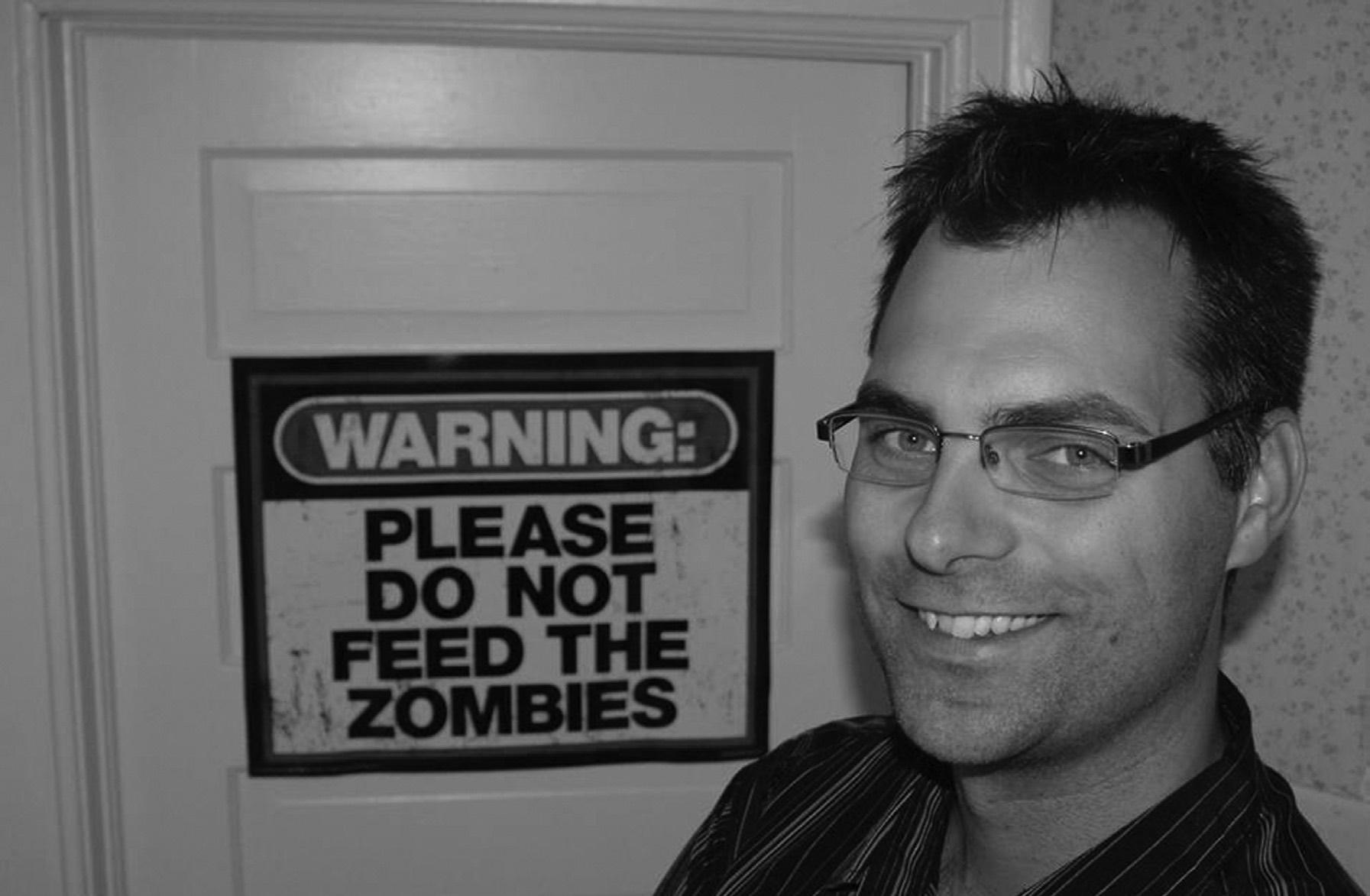
The first talk, “Queer Zombies and Modern Media,” takes place on Thursday, Oct. 10 at 7 p.m. and is being presented by Jeremy Strong, a teaching assistant at the U of M who is working on his MA in creative writing.
While Strong doesn’t have any major affiliations with Winnipeg’s queer or zombie communities, his interest in non-normative perspectives and ability to push boundaries of established schools of thought will make for an interesting talk.
“I am sort of hanging out on the sidelines, thinking, and drinking a lot of coffee,” says Strong. “I like to think of myself standing in the middle of one of those Venn diagrams, you know, with the intersecting circles? [ . . . ] Where the queer experience and the cultural
Considering the zombie as a cultural artifact, Strong finds it to be a representation of a new humanity.
While referring to media such as The Walking Dead , Warm Bodies , World War Z , and Pride and Prejudice and Zombies, Strong contemplates what the zombie can contribute to queer theory.
In addition to referring to zombie media, Strong will make references to the texts “Powers of Horror: An Essay on Abjection” by Julia Kristeva and Skin Shows: Gothic Horror and the Technology of Monsters by J. Jack Halberstam.
“[Kristeva’s essay] is one of my key texts for situating my discussion of post-apocalyptic bodies and their representative power in the realm of popular culture and examining,” says Strong. “That is, abjection has everything to do with the zombie being the primer of culture, or the place where critical discussions such as mine should naturally arise.”
“Halberstam’s theories about how our monsters are extensions and products of an always changing and fluctuating cultural fear have some great applicability to the way in which I study zombies.”
Strong is excited to support the LQSH initiative and hopes his talk will inspire a discussion with those attending.
Following “Queer Zombies and Modern Media” will be a talk by Catherine Taylor, a professor in the faculty of education and department of rhetoric, writing, and communications at the University of Winnipeg. Taylor’s talk will take place on Nov. 16 at 2 p.m., and will address the anti-bullying legislation in Manitoba as well as the controversy surrounding it. Churchill will finish the 2013 series on Nov. 20 at 7 p.m. with a talk on 19th-century advocacy surrounding sexual difference and its relationship to the emergence of queer culture.
To find out more about Little Queer School House, find their group on Facebook.
event Listings
Childish Gambino
Photo by Joseph K
Call for Proposals for 2013 Spinal Cord Injury Research Projects
The Manitoba Spinal Cord Injury Research Committee (MSCIRC) is pleased to announce that the 2013 Grants and Awards competition is now underway and accepting applications for spinal cord injury research projects in Manitoba.
Purpose
Grants provided through this initiative aim to increase understanding of spinal cord function, reduce the disability related to spinal cord injury, increase functional capacity after spinal cord injury, reduce the incidence and effects of secondary complications after spinal cord injury, and increase quality of life and community integration after spinal cord injury. In addition, funding is available for projects that will clearly lead to reduced SCI-related health care costs and projects that have the potential to address SCI-related research and health delivery gaps in Manitoba.
“Connect” funding is available for this year to support the Manitoba component of a research project that is National in scope, involving collaboration with researcher(s) in at least one other province or the Rick Hansen Institute.
Eligibility
Grant applications will only be considered from applicants appointed at accredited educational institutions, disability related organizations, research institutions or hospitals.
Deadline
All project applications must be received by 4:00 p.m. on November 25, 2013.
Inquiries
Inquiries about the application process are to be directed to:
MSCIRC, c/o Canadian Paraplegic Association (Manitoba) Inc.
Telephone: 204-786-4753, ext. 222
Toll Free within Manitoba 1-800-720-4933
Fax: 204-786-1140
Email: aconley@canparaplegic.org
Application Package
All forms are available from the Canadian Paraplegic Association (Manitoba) Inc.’s website at www.cpamanitoba.ca
Rock the rinks
Major
events in the upcoming curling season
a da M pe Leshaty, volUnteer staff
Road to The Roar – November 5-10, Kitchener, ON It’s the qualifying tournament of the Roar of The Rings, the Canadian Olympic Curling Trials. Twelve teams of each gender will try to win the remaining two berths each into the Roar.
Teams include those skipped by 2013 Brier champion Brad Jacobs, 2006 Olympic gold medallist Brad Gushue, 2007 world champion Kelly Scott, and last Olympic’s Canadian women’s skips, Shannon Kleibrink and Cheryl Bernard.
Two-thousand-ten Olympic gold medallist John Morris, who left Kevin Martin’s team last spring, will skip Jim Cotter’s team from B.C. and Cathy Overton-Clapham, former third for Jennifer Jones, has joined Crystal Webster’s rink.
Brandon’s Rob Fowler and Winnipeg’s Barb Spencer will also skip their foursomes in Kitchener.
Fowler was the 2012 Manitoba champion while Spencer reached the final of last year’s provincial championship.
roar of the ringS –december 1-8, winnipeg, mb
In an overdue move, Canada’s Olympic Curling Trials will be held at the MTS Centre; they will be the most prestigious curling event to be held in Winnipeg since the 2008 Brier.
Four Manitoban teams will compete in front of a home crowd: former world champions Jeff Stoughton and Jennifer Jones will be there, along with Mike McEwen, and Chelsea Carey.
However, they will face tough competition. For the men, former world champions Glenn Howard and Kevin Koe will compete, along with 2010 Olympic gold medallist Kevin Martin—who replaced Morris with four-time Brier champion and three-time world champion Scott Epping—rounding out the field.
As for the women, 2013 Scotties
champion Rachel Homan and 2012 champion Heather Nedohin will compete, as will top-ranked teams skipped by Stefanie Lawton and Sherry Middaugh.
olympic Qualification event – december 11-15, fuSSen, ger
Eight men’s teams and seven women’s teams will fight for two Olympic berths, each for their countries in the first-ever Olympic curling qualifier. Under the most pressure-to-win berths would be both German teams as well as the Chinese women’s and American men’s teams. Germany usually performs well at world championships and the Chinese women were world champions in 2008.
Continental Cup of Curling –January 16-19, Las Vegas, NV This is not a misprint: there will be curling in Sin City.
After years of playing in Canadian cities, at smaller venues every year, this Ryder Cup-type event pitting North American teams versus the World will be played at Orleans Arena, home of the Las Vegas Wranglers of the East Coast Hockey League. Five resorts are now offering preferred rates to curling fans; the rooms at the host hotel were booked to capacity.
olympic gameS – february 10-21, Sochi, ruS
The curling events will be held at the Ice Cube Curling Center, opened in 2012. Winnipeg’s Matt Dunstone won a World Junior bronze medal in that arena last February. Canada has medalled in every Olympic curling event since 1998; the men will look to win gold for the third straight time while the women will try to win gold for the first time since Sandra Schmirler’s triumph in 1998. Eve Muirhead and David Murdoch of Great Britain, Sweden’s Margaretha Sigfridsson, and Niklas Edin, will be some of Canada’s top competition.
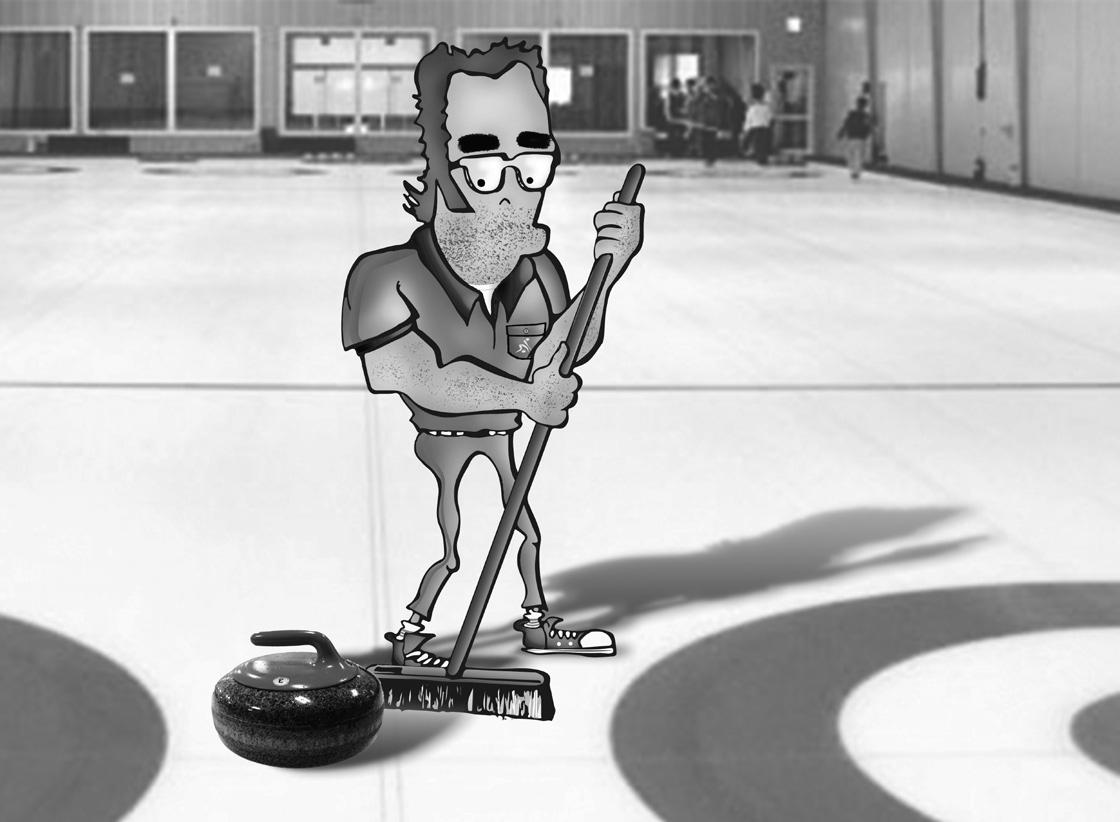
iLLustRatiON by CaROLiNe NORMaN
Bisons lose a tough one to UBC
Playoff spot uncertain heading into bye week
Marc LaG ace, staff
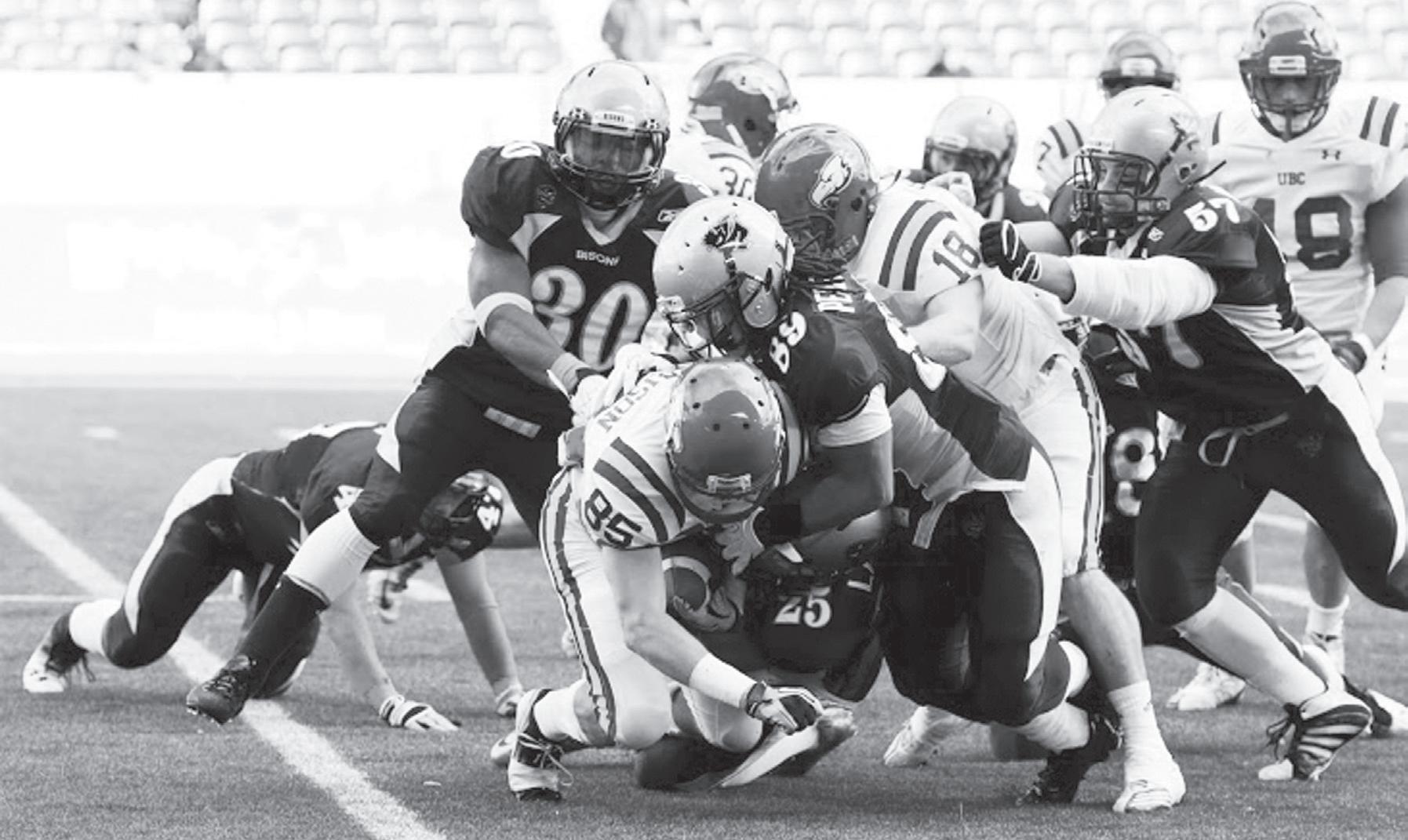
It was an opportunity for Manitoba to move into a tie for second place and all but secure a playoff spot. Instead, a dramatic 28–24 loss to the UBC Thunderbirds in the final home game of the 2013 regular season has dropped the Bisons to 3-3. The Bisons are in jeopardy of finishing with a losing record for the sixth season in a row since the perfect season and Vanier Cup victory of 2007.
In week three, the Bisons completed a wild comeback in the fourth quarter over the Thunderbirds on the road. UBC entered this past weekend’s game just one win back from the Bisons in the standings, looking for redemption.
Both teams were sluggish to start the game. Nick Boyd opened scoring with a 32-yard field goal. Boyd
had missed on a 40-yard field goal attempt on the Bisons’ opening drive of the game.
UBC took over in the second quarter. Carson Williams came in at quarterback for the Thunderbirds and connected with David Scott on a 58-yard passing play. Greg Bowcott came in for a third-and-one from the Bison two-yard line, driving his way into the end zone. A Bison two-andout led to UBC scoring a punting rouge on their next possession, making it 8–3 for the visitors.
It was a tough quarter for the Bison offence. Of the seven drives in the second, five ended with a Boyd punt after a two-and-out. QB Jordan Yantz was sacked and stripped of the ball on another. The turnover led to a UBC touchdown. UBC also hit a
Let’s get critical
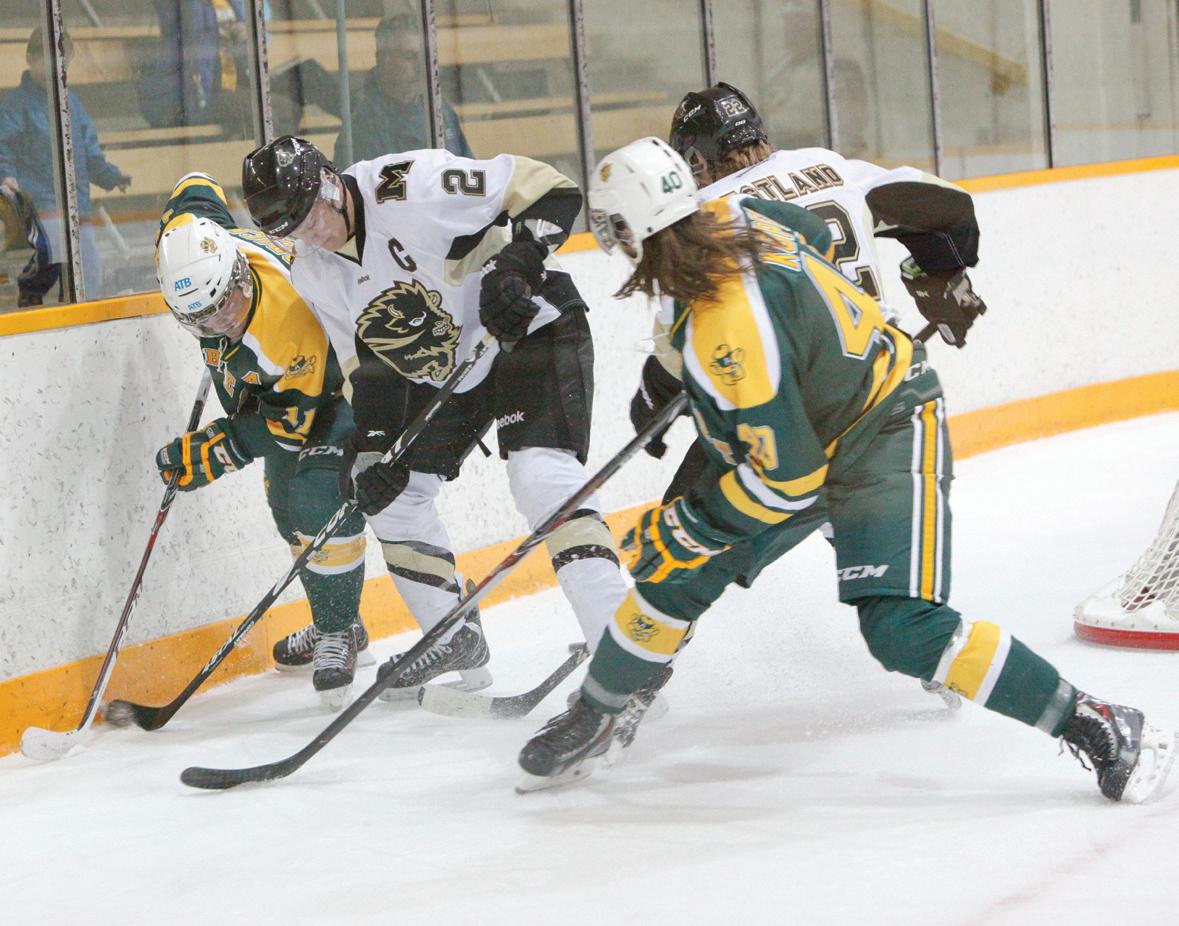
biSon men’S hockey loSeS alberta rematch 4-0
After dropping their first game 5-0, the Bisons have moved to 0-2-0 in the 2013-14 season, suffering a second shutout loss to the Alberta Golden Bears. Undisciplined play resulted in two 10-minute misconducts as the Bisons were outshot 32–16. Taylor Dickin led the Bisons with five shots.
The Bisons hope to bounce back against the Saskatchewan Huskies (1-1-0) on Oct. 11 and 12 at the newly named Wayne Fleming Arena.
biSon women’S hockey SplitS road SerieS to open SeaSon
Playing against the Alberta Pandas, the Bison women are 1-1-0 after losing their first game of the season 5-1 and bouncing back for a gritty 1-0 win the following evening.
In the win, a power play early in the second period allowed Brenley Anderson to score the only goal of the game. Dée Ana Marion earned her second shutout as a Bison.
The Bisons will travel to Saskatoon to play the Saskatchewan Huskies on Oct. 11 and 12.
field goal. It was 18-3 for UBC heading into halftime.
The Bisons needed a big play to get them back in the game, and it came early in the third quarter. After an illegal kickoff gave the Thunderbirds the ball at the UBC 40, Bami Adewale forced a Bowcott fumble, which DJ Lalama returned 50 yards for the Bison touchdown.
The score cut the Thunderbirds’ lead to 18–10 and brought the announced crowd of 1,457 to their feet.
The game came to a grinding halt on the Bisons’ next offensive drive. After Yantz connected with Nic Demski on a 24-yard pass to the UBC 3-yard line, defensive back Miguel Barker came in to make a tackle. Barker removed his helmet after the hit, clearly in a lot of pain.
He was taken off the field by stretcher as a precaution.
Once the game had resumed, Kienan LaFrance punched the ball in to make the score 18–17.
Things went awry for the Bisons in the final minute of the third. A Thunderbird punt hit return man Matt Sawyer in the shoulder, bouncing its way into the arms of the UBC cover team. The gaffe gave the Thunderbirds great field position and resulted in a field goal. UBC led 21–17 heading into the fourth.
The ground game started to work for the Bisons early in the final quarter. Anthony Coombs ripped off a 41-yard run. A pair of Yantz rushes set up a five-yard pass to Coombs that put the Bisons back in front. The score tied Coombs’ personal season touchdown record (nine, which he reached in 2011 and 2012) and tied him with Matt Henry for second most career touchdowns in Bison history.
The lead was short lived. Williams found Micha Theil with a 15-yard touchdown pass to the back of the end zone.
The Bisons were desperate to respond, but the UBC front seven mounted incredible pressure on Yantz and the offensive line. The Thunderbirds sacked Yantz four times in the final 10 minutes, including a crucial loss of yards on the Bisons’ final drive of the game.
Getting the ball back with two minutes left, the Bisons started their drive from their own 44. On the first play, UBC nose tackle Donovan Dale sacked Yantz. An 18-yard run by Yantz set up a key third-and-one around mid-field. LaFrance muscled his way through and earned a new set
of downs, and one last chance for a comeback. Yantz completed a 20-yard pass to Nic Demski, who went out of bounds at the 35-yard line, and pass interference on the next play gave the Bisons a first down at the UBC 20.
With nothing to show on the first two downs, it all came down to the pivotal final play for the Bisons. With Coombs running a wheel route, the offensive line made time for Yantz, who threw a perfect pass into the end zone. Coombs looked to have caught the ball in the back of the end zone, but Riley Jones slapped the ball out of his hands at the last possible moment.
“Unfortunately I was turned around when I caught the ball,” said Coombs, after the game. “He got a good angle to swipe it.”
“I lost my focus for one second and he made a great play,” said Coombs.
While the dropped pass seems like the most obvious reason the Bisons lost the game, the players and coaches know better.
“To be honest, I thought it was our poorest game of the season,” said head coach Brian Dobie.
“We didn’t lose the game on the last play,” said fourth-year defensive lineman Lauren Kroeker. “If you went [into the locker room] and talked to every single guy, they could name you three different plays they got beat on.”
With the loss, the Bisons (3-3) are now tied with UBC for third in Canada West heading into the conference bye. With games remaining against Saskatchewan (4-2) and Alberta (0-6), dreams of a home playoff game remain – but only if the Bisons win out.
Marc LaG ace
phOtO by MattheW giesbReCht
Winnipeg. I thought it was something only the cool cities had,” joked Unger.
Kevin Lin KL ater, staff
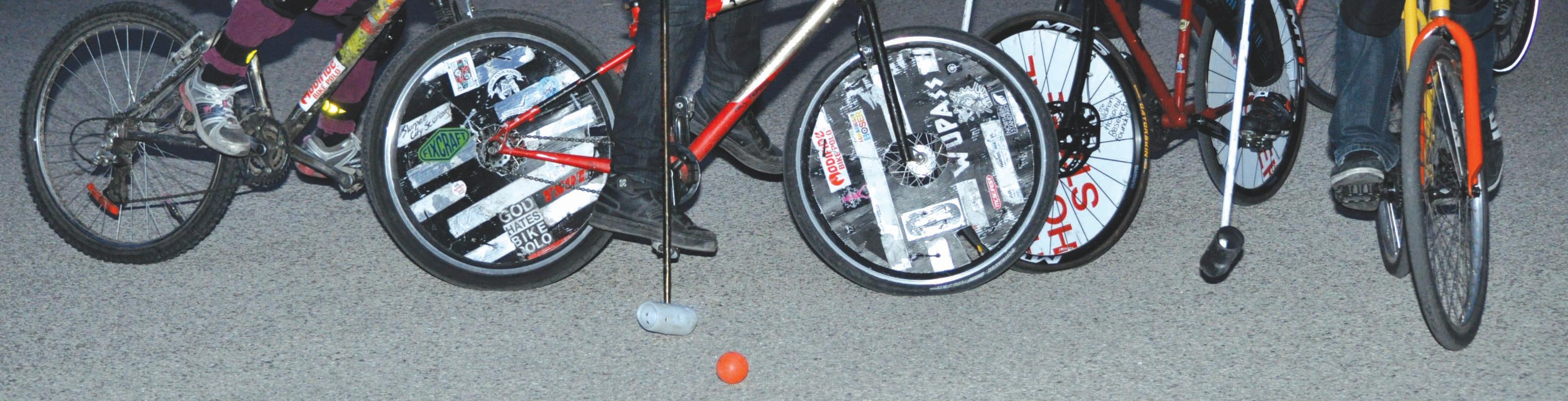
When thinking about recreational sports played in Winnipeg, what comes to mind? Hockey? Soccer? Hardcourt bike polo? If you are like me, you know next to nothing about that last one.
As a sport, modern hardcourt bike polo, or simply “hardcourt,” has only been around for perhaps a dozen years, and was introduced to Winnipeg hockey rinks and tennis courts in the mid-2000s.
The sport involves two teams of three players each, on bicycles, attempting to knock a ball hockey ball into the opposing team’s goal. The game can be played on any hard surface, with hockey rinks and tennis courts being
popular choices.
The bike polo scene has grown since coming to Winnipeg, with the Winnipeg Urban Polo Association, or WUPAss, being formed to help organize games and other bike polo events in the city. The sport still retains its informal feel, however, with players gathering together and playing pickup games well into the night with whoever shows up.
Greg Unger started playing in 2009, when he happened across a game of bike polo being played at Ciclovia, part of Winnipeg’s Manyfest street festival.
“I’d heard of bike polo before that, but I didn’t think that it existed in
Players in Winnipeg gather together three times a week, usually at the River Osborne Community Centre, and play games on the hockey rink. Mondays are casual and generally for beginners, while Wednesdays are competitive: “no fun Wednesdays,” said Unger. “We play hard on that night, and let our adrenaline get the better of us.” Fridays are casual again, and the games generally last into the night.
Fabian Suarez-Amaya has been playing bike polo on Winnipeg’s tennis courts and hockey rinks for a few years and recounts how bike polo first got started in Winnipeg.
“Apparently in 2005, some hardbitten courier types just started getting together to play in warehouses, using really improvised mallets and balls,” said Suarez-Amaya. “Then in 2008, a few Winnipeg couriers went to the World Cycling Messenger Championships in Guatemala and learned a more formalized game, with
more standard formatting of mallet size and ball type and playing surface, and brought it back to Winnipeg.”
The sport of bicycle polo has actually been around since the late 1800s or early 1900s, and was played on grass. It was even included as a sport in the 1908 Olympics. Interest in the sport waned after World War II, however, and it virtually disappeared. It was not until the late 1990s and early 2000s that it re-emerged.
The modern game is no longer played on grass, but on a hard surface—thus the convention of referring to the sport in its modern iteration as simply “hardcourt”—and is played across the world, having spread to most major urban centres in North America, Europe, Australia, and Latin America from its origins in early-2000s Seattle.
There is now a governing body for bike polo in North America— North American Hardcourt—which has established set rules and helps organize regional and even World
Championships.
“It has really exploded in parts of North America and Europe [ . . . ] there are tournaments going down every weekend somewhere,” said Unger. Because of the grassroots nature of the game, many cities still have their own house rules and particular conventions.
This weekend WUPAss is having its annual Thanksgiving bike polo tournament, and will be joined by teams from Thunder Bay and Saskatoon. Ten teams are registered, but anyone is welcome to come down and join in on pickup teams.
“As soon as you start playing, it gets you. It combines riding bikes and hockey, and is a sport that is instinctively enjoyable,” said Suarez-Amaya. The World Championships are being held from Oct. 16-20 in Ft. Lauderdale, Florida. There are 103 teams set to participate from cities across the globe –including a team from Saskatoon who earned a spot after placing ninth in the North American round.
Golden Bears beat Bisons in hockey home opener
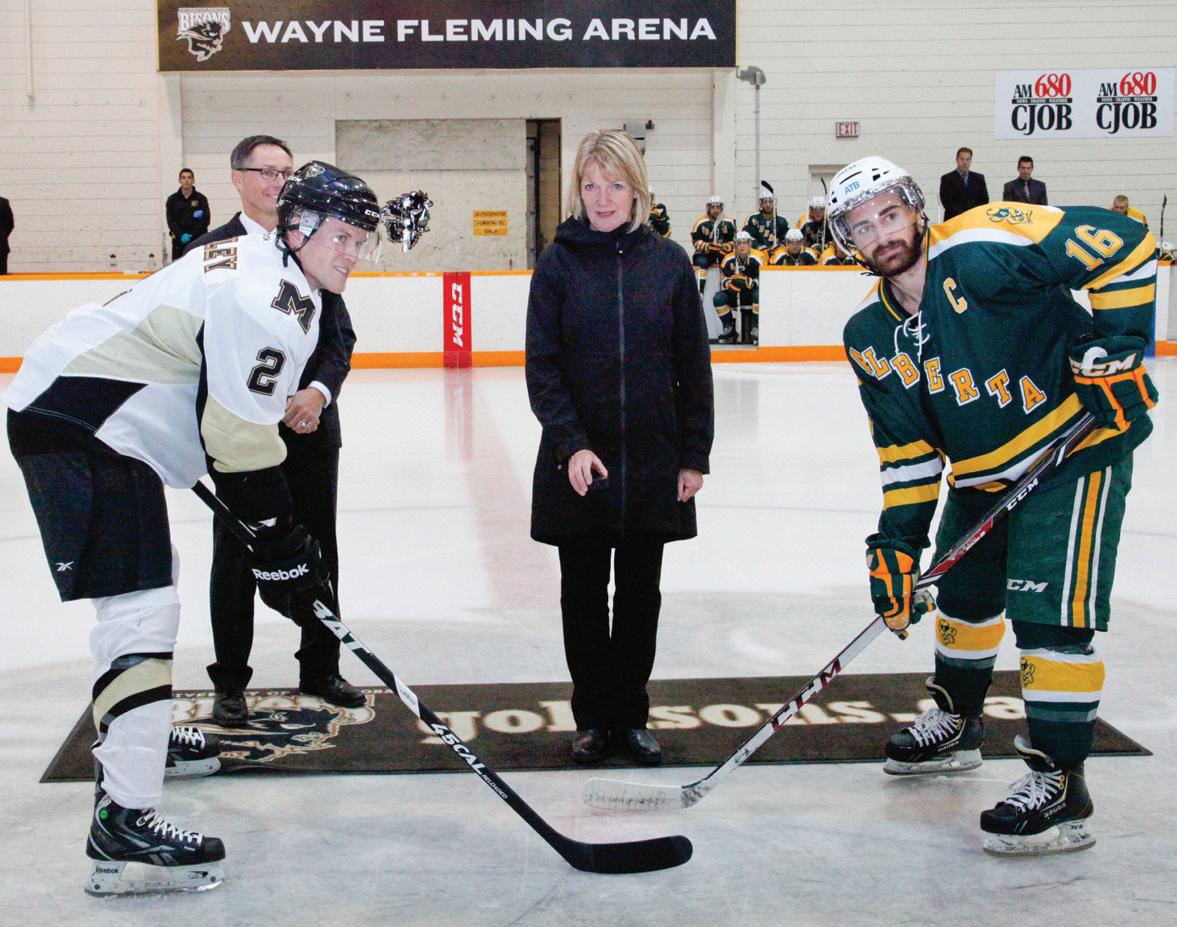
On Friday night the Manitoba Bisons men’s hockey team honoured former Bison coach and player Wayne Fleming. A special ceremony was held prior to puck drop between the Alberta Golden Bears and Manitoba Bisons. Bison captain Dane Crowley was also honoured, as he received the inaugural Wayne Fleming Legacy Athletic Scholarship.
Once the pre-game festivities wrapped up, the Golden Bears and Bisons were set to open their 20132014 CIS hockey season. Manitoba came out flat to start the game, and could only watch as Alberta powered their way to a 5-0 shutout win.
Jamie Crooks opened the scoring for the defending Canada West champion Golden Bears midway through the first period when he
took a pass from team-mate Brett Ferguson and rifled a shot over the shoulder of Bison netminder Joe Caligiuri.
Alberta never looked back. As the first period wore on, Manitoba struggled to keep up with Alberta’s speed and ran into penalty trouble as a result. The Golden Bears scored twice on the power play before the end of the
period, with defenseman Jordan Rowley notching his first of the season followed by Ian Barteaux’s marker with just fourteen seconds left. All told, Alberta simply dominated the first period, outshooting the Bisons 16-2 and scoring three unanswered goals.
Alberta continued to pour it on in the second period. Forward Jordan Hickmott found himself
alone in the slot and sniped a perfect shot top shelf to make the score 4-0. Shortly thereafter, Manitoba coughed up the puck on the power play and allowed Alberta to break in on a shorthanded odd man rush.
Levko Koper was the recipient of a slick pass by Hickmott and made no mistake from in close, putting the Golden Bears up by five.
There was no scoring in what was a rather uneventful third period. There were a few scrums after the whistle. The Bisons actually had some sustained pressure early in the third for the first time in the game, but were unable to generate any good scoring chances. In the end, Manitoba mustered only 12 shots in the game.
Alberta forward and former Red Deer Rebel, Brett Ferguson, finished the night with two assists. He was named the first star for his efforts. Fifth-year defenseman Ian Barteaux also had two points for the Golden Bears. Defenseman Lee Christensen and forward Craig Scott were each minus three on the night for Manitoba, and the Herd registered a combined total of 40 penalty minutes, many of which resulted from a lack of discipline.