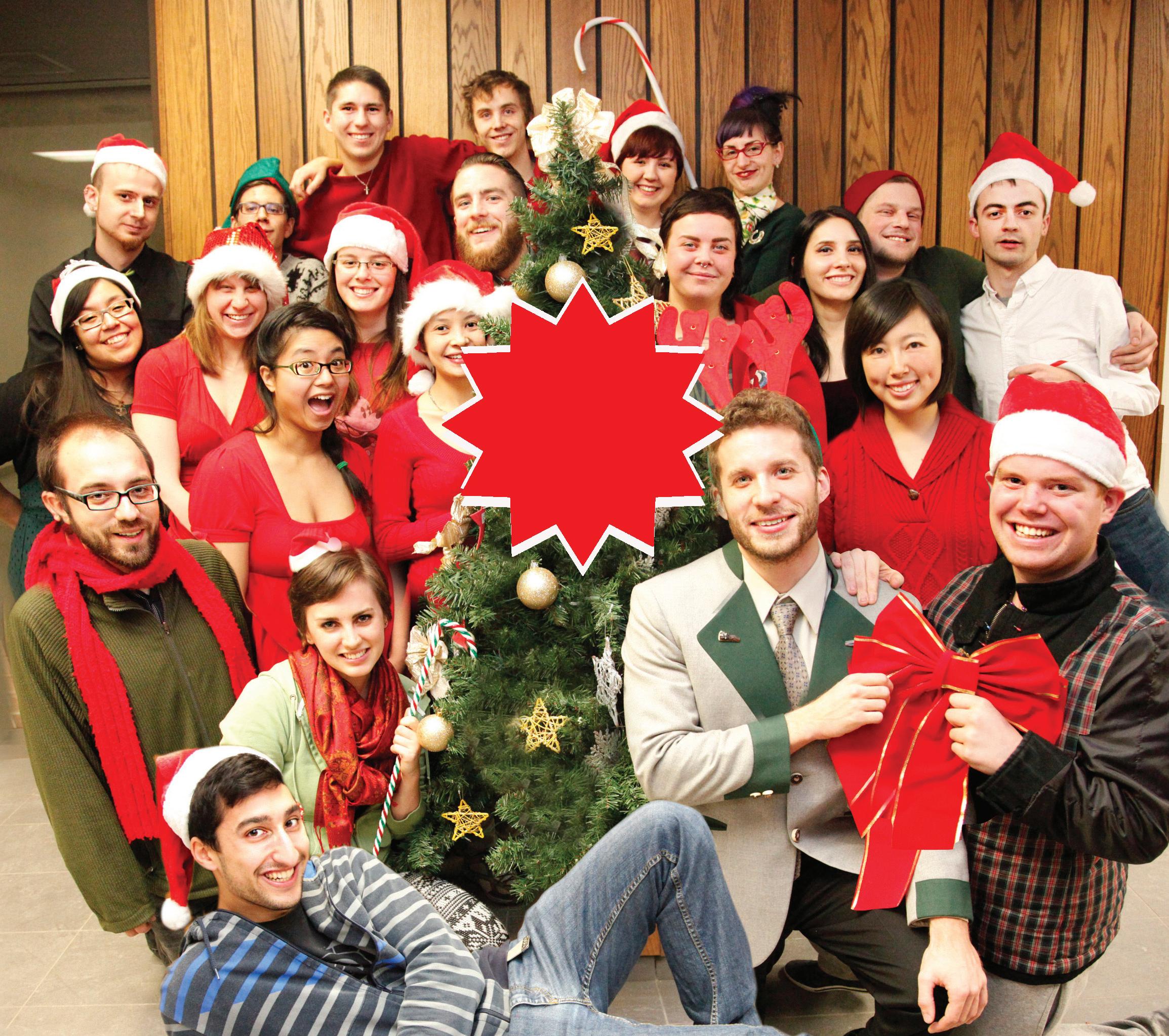
Measure for measure, we explore music and science Winners inside for your reading pleasure Bison Big Horns cheer squad profiled NHL concussed Players file lawsuit, claim league negligent
SInclair inquest reveals issues of negligence in MB
Sound findings Lit. competition Herd spirit
cover image
by Bryce Hoye & Beibei Lu
Please contact designteam@themanitoban.com if you are interested in submitting a cover image. For other volunteer inquiries, please come to our office in University Centre (across from Tim Horton’s, behind GOSA) or email the editor of the section for which you are interested in writing.
Please direct all other inquiries to editor@themanitoban.com
Toban Talkback
“Fighting in hockey should be allowed [because] it would make people be responsible for their actions. If somebody took a head shot and knew that they were going to get beat up by somebody like [Zdeno] Chára they probably wouldn’t take that headshot anymore.” “Hockey
Caleigh
staff
Krystie Jansen Faculty of Science
Kelly MacWilliam Faculty of Arts
3
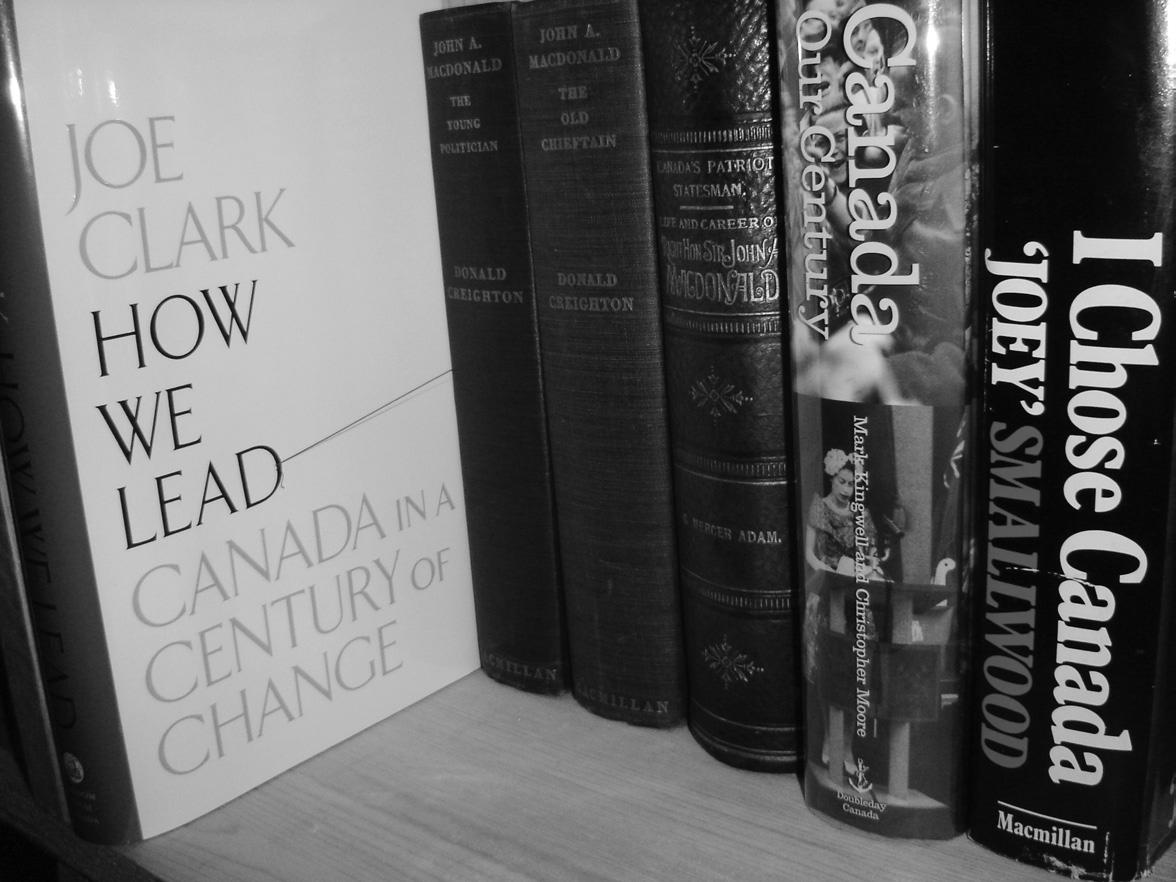
Joe Clark visits UMFM to promote new book
Book suggests changes to Canada’s current governing strategy
Katy MacKinnon, staff
F
ormer prime minister Joe Clark visited UMFM last week to promote his new book, How We Lead: Canada in a Century of Change The interview by program director Michael Elves will be aired on Turning Pages Dec. 4.
Since 1958, Clark has been actively involved with Canadian politics. He led the Conservative Party of Canada to victory in 1979, where his term as prime minister lasted nine months. Clark was 39 at the time, and historically Canada’s youngest prime minister.
During the interview with Elves, Clark discussed the collaborative nature of political parties in the past, versus the segmented nature of political parties today.
“[In the past] you were formed, before you got to the cabinet table, with a sense of appreciation of people who came from very different parts of the country.”
He referred to a case in which Brian Mulroney arranged for Donald Mazankowski, an Albertan, and Benoit Bouchard, a Quebecer, to work together. The two were able to learn about Canada from each other.
Clark suggested that present-day Canadian politics is tool-driven and
mechanical, referring to robocalls as an example.
In 2011, automated phone calls were sent to individuals on Election Day, directing them to incorrect polling stations. Conservative staffer Michael Sona was charged with purposefully preventing electors from voting.
“There’s been a lot of talk recently about robocalls. People assume only one party uses them. Well, that’s not the case. All parties, unfortunately, use them. And that means the human element—the dynamic of being part of a human entity—has dissipated,” said Clark.
“All parties” or select MPs associated with them—save for the Green Party of Canada and the Parti Québécois—have at one time or another been fined for violating Canadian Radio-television and Telecommunications Commission rules prohibiting the use of robocall technology.
Some present-day politicians, according to Clark, use a base strategy to maintain political presence and voters.
“If you come from a party where you know what your base is, you’re going to spend much more time
with your base, and you are going to become, if not indifferent to, at least uninformed about, other Canadians. I don’t know that we’ll ever repair that, but it’s like so much: you don’t know what you’ve lost until it’s gone.”
“I think now, with the base, there is a tendency to say, ‘these are not my voters, I’m going to worry much less about them than I should.’”
Clark feels this strategy is dangerous, given that our country has been developed on people working together, such as during national conversations on confederation and medical care.
Although during the interview Clark was careful to say that the current federal government is “not particularly malicious,” in his new book he criticizes the current government’s foreign policies.
“This is not a priority for them, this idea of becoming engaged in other communities. I think they think that [Canada] has a major challenge [ . . . ] in developing our own domestic strengths. [The current government] sees the world [ . . . ] in terms of other developed countries and our capacity to be effective there.”
He commended the efforts of Canadians internationally—such
as their aid to the crisis in the Philippines and famine in Ethiopia— but noted that this involvement is a response rather than an anticipation of disaster.
Clark added that the current government is inexperienced in terms of Canada’s previous impact on developing countries.
“A good part of the reason I wrote the book was not just to have it read but because I hope it may have an
Solitary confinement: a phenomenological perspective
afterlife. I hope we may be able to take some of the ideas that I put forward and have them examined critically and constructively in public discussions to see if these things are really possible to do.”
To hear the full interview, tune in to 101.5 UMFM on Wednesday, Dec. 4 at 10:30 a.m.
Philosopher Lisa Guenther speaks with students, faculty, and activists about prisoners’ rights
Quinn Riche R t, staff
L isa Guenther, Vanderbilt University associate professor and former Winnipegger, was in town last week to discuss solitary confinement – an issue touching on notions of class, race, and gender.
Guenther gave two talks on Thursday, both co-sponsored by the University of Manitoba faculty of law.
During the afternoon, Guenther presented a talk, entitled “Social Death and Collective Resistance in the California Prison Hunger Strikes,” to law students and faculty. She argued that California’s management of striking prisoners constituted a refusal to acknowledge the political underpinnings of their imprisonment, and the “criminalization of resistance.”
“They want to be recognized as political prisoners,” Guenther told the Manitoban , referring to hunger-striking inmates in California’s Pelican Bay State Prison.
“Even if they came into the prison
system as gangbangers [ . . . ] they also became aware, either before or during their incarceration, of the social character of their incarceration and became increasingly political in their own identifications as a prisoner class.”
During that talk, Guenther also analyzed the legal ramifications of California’s “refeeding” orders for prisoners refusing nourishment.
In the evening Guenther presented at the Millennium Library’s Carol Shields Auditorium, this time drawing upon her academic background in phenomenology to explain the curious physiological effects of solitary confinement, and also to advance the position that it is akin to “a living death sentence.’”
According to Guenther, prisoners kept isolated for long periods of time frequently report visual and auditory hallucinations, as well as symptoms of anxiety to varying degrees of severity. The condition is referred to as SHU syndrome. The
moniker comes from the “Special Housing Units” used to isolate prisoners in the United States.
Guenther told the Manitoban that while the term does not show up in the Diagnostic and Statistical Manual of Mental Disorders , it is “used and taken seriously in classaction lawsuits.”
“You could imagine people being bored or anxious because they are not in relation to other people, but why would the borders around things start to waver? Why would a mesh door start to seem like it’s moving just because you’re alone?
Phenomenology helps us to see how the sensory and the social interconnect, and how we draw on our perceptual relation to other social beings to make sense of our own experience,” Guenther explained.
“When we are deprived of that sensory social contact, then the everyday supports for our experience are diminished.”
For Guenther, the ability of
solitary confinement to cut off the person’s meaningful relations to the world around her is also what makes it so intolerable – again, a concept she says is best explained through the language of phenomenology.
“It is akin to murder in the sense that murder extinguishes a life, but solitary confinement attacks the conditions under which life becomes meaningful. That is a form of violence against the sense of living being,” argued Guenther.
Beyond the strictly philosophical, Guenther also spoke with the audience about how the differing social contexts of Canada and Nashville (her place of work and residence) influence solitary confinement.
“When you have the death penalty as this absolute irreversible punishment, all other extreme punishments start to look relatively moderate in comparison. The fact that the U.S. has the death penalty helps it to normalize other forms of extreme punishment like life with-
out parole and solitary confinement,” said Guenther.
She proposed that the legacy of slavery in the United States has played a role in the country’s continuing acceptance of not only solitary confinement, but also the death penalty.
“Even the 13th Amendment abolishes slavery for everyone except convicted criminals,” mentioned Guenther, referring to the work of Angela Davis, who discussed the topic at length in her book, Are Prisons Obsolete?
Currently on sabbatical in Montreal, Guenther was brought to speak in Winnipeg stemming from a connection with Debra Parkes, a U of M associate professor of law also interested in prisoners’ rights. During her time in Winnipeg, Guenther also appeared on Black Mask, an anarchist radio show on the University of Winnipeg’s CKUW 95.9 FM.
phOtO by MiChaEL ELVES
The Iranian nuclear deal: rapprochement or realpolitik?
U of M professors give insights into groundbreaking agreement
Iran and the five permanent members of the security council, the P5+1 (China, France, Russia, the U.K., the U.S., and Germany) reached an agreement on Nov. 24 which will provide limited relief of sanctions in exchange for slowing or stopping aspects of the Iranian nuclear program.
“[The significance of the deal] remains to be seen [ . . . ] it depends on the implementation of the agreement – for example, the kind of access that the inspectors are allowed to have from the Iranians, and if further talks can ultimately resolve this problem,” said James Fergusson, director of the Centre for Defence and Security Studies and professor of political studies at the University of Manitoba.
“The fact that they’re at the table is itself a major change in the relationship between Iran and the U.S.” –George MacLean
Fergusson presented a variety of explanations as to why the Iranians have come to the table, but was skeptical of the possibility that the deal represented a genuine shift within Iran itself. He also voiced concern that the new moderate president, Hassan Rouhani, may not actually signal a significant change on foreign policy.
“It may be possible that what we’re seeing is just a short-term response to an immediate [economic] crisis within Iran, and it’s just putting the nuclear question on pause for now. It depends on how you see the clerics and how you see the new president,” said Fergusson.
U of M political studies professor George A. MacLean views the deal as significant in itself, even if it does fall apart moving forward.
“There’s quite a bit of significance here. First off, there’s actually a deal. It’s a temporary one, but it’s a huge step. The fact that they’re at the table is itself a major change in the relationship between Iran and the U.S.≠≠,” said MacLean.
MacLean is relatively optimistic, viewing the deal as a genuine rapprochement between Iran and the West.
“We should be cautiously optimistic about this. I don’t think Iran will want to backtrack into intransigence
again. [They] seem to increasingly be playing to their domestic audience, which has shown a lot of support for this deal.”
MacLean noted that even in Israel, where the hardline government of Benjamin Netanyahu has called the agreement “a bad deal,” the population has been in favour of the diplomacy between Iran and the P5+1.
“Generally, Israelis are supportive of this,” said MacLean.
“Even the stock market surged and there were lots of statements coming out of the national press in Israel saying this is a good deal. Netanyahu saying it’s a bad deal seems to be at odds with sentiments of Israeli society generally.”
Fergusson pointed to the vast differences that remain between Iran and the United States, arguing that aside from their willingness to engage on the nuclear issue, he sees little to suggest a significant shift in Iran’s overall foreign policy.
“Until I see some more long-term evidence of bigger shifts in Iranian foreign policy, I remain skeptical of it. For example, there’s no indication that the Iranians are going to alter their support for Hezbollah and Hamas, and those are key elements.”
MacLean and Fergusson agree that the U.S. is engaging Iran partly because of the need to solve the Syrian crisis.
“Iran is going to have to play a role in the resolution of the Syrian crisis, and this could create a space for progress to be had in ending or at least ameliorating some of it,” said MacLean.
MacLean also points out that Barack Obama may pursue the normalization of relations with the Islamic Republic of Iran as the lasting foreign policy legacy achieved under his administration.
“Obama has had few foreign policy successes, and this deal is probably being celebrated in Washington. I suspect that they will want to continue this momentum and have it carry over into a permanent solution.”
On the Iranian side, Fergusson points to the role of international sanctions in weakening the Iranian economy, thereby forcing Tehran to engage with the outside world.
“The regime faces a potentially dangerous internal situation and there is a need to relax these sanctions, to open up the Iranian economy again,” he said.
The deal between the P5+1 and Iran is set to last six months. That period will act as a negotiating window during which the two sides will attempt to work out a permanent agreement.
Notable political economist Leo Panitch in Winnipeg
U of M Global Political Economy lecture provides Marxist perspective on the integration of Canada into the American empire
Last Wednesday evening at the Fort Garry Hotel, the Global Political Economy (GPE) program at the University of Manitoba hosted a lecture by Leo Panitch.
Panitch, a notable Marxist political economist, U of M alumnus, and professor of political science at York University, spoke about what he interprets as Canada’s incorporation into the American imperial project, and elaborated on the history of American international capital in general.
“Foreign capital came here not primarily to suck our resources out, nor to draw surpluses out; it came here to sell to a market. Already we can see the Canadian experience is different from that of most countries in the third world,” said Panitch during the talk.
In speaking about the history of American capital flow, Panitch emphasized the transformational effects that outside investment may have on foreign countries.
“Capital, and especially American capital, isn’t just a flow of money. It moves as a class force [ . . . ] When American multinational capital moved, it was crucial in organizing and restructuring the capitalist classes in the countries it moved to.”
Panitch recently co-wrote a book with Sam Gindin, entitled The Making of Global Capitalism: The Political Economy of American Empire, which argues that global capitalism was not something that developed unilaterally, but was built collaboratively, with the United States acting in a central role.
The book also argues that the major political outcome of the recent global financial crisis, far from putting neoliberalism on the back burner, has been the entrenchment of neoliberal policies.
“We can see class struggle in action in the growing wealth inequalities, or in the protections afforded to bond-holders while working-class mortgage-holders were tossed to the curb, or to the declaration of a new age of permanent austerity by David Cameron in the U.K.,” said Mark Hudson, co-ordinator of the GPE program and U of M assistant professor of sociology, in his introductory remarks of the evening.
A Q&A period followed in which the conversation was refocused onto speculations on the future of the left. Panitch expressed skepticism over the notion that any leftist political movement representing the interests of the working class could emerge and take power, even during moments of capitalism-in-crisis.
“Because when the whole thing really falls apart, who is going to prevent fascism from becoming the answer to that? There are movements,
but they are not organizing [ . . . ] All I can say is, for God’s sake, stop planning the next protest and start organizing politically.”
Leo Panitch grew up in Winnipeg’s North End, and took economics at the U of M, before moving on to the London School of Economics and Political Science where he earned his master of science degree and PhD.
Panitch takes a Marxist approach to his analysis, and puts class struggle at the centre of his arguments. He is a supporter of the Greater Toronto Workers Assembly – a group concerned with organiz ing activists in the working class movement.
Panitch is the third Deutscher-Prize-winner to present in the GPE program’s series of lectures, the other two being Robert Brenner, an economic historian from UCLA, and David Harvey, a distinguished his tory professor at the City University of New York with a research interest in Marxism.
Other academics the GPE pro gram has brought to Winnipeg include Gérard Duménil, Li Minqi, Diane Elson, and Giovanni Arrighi.
PHOTO EDITOR Beibei Lu photo@themanitoban.com / 474.6775
DESIgN ASSOcIATE Aichelle Sayuno
gRAPHIcS ASSOcIATE Bram Keast
Repo Rte R s
N EwS Caleigh MacDonald
N EwS Kevin Linklater
ScIENcE Elizabeth Drewnik
ARTS & culTu RE Anastasia Chipelski
ARTS & culTu RE Lukas Thiessen
SPORTS Mike Still
ASSISTANT cOPy EDITOR Angela England
voluntee R contR ibuto R s Will Gibson, Justin Ladia, Connor Duff, Seamus HamiltonPattison, John Stinzi, Keegan Steele, Gloria Joe, Heather Kat Cole, Christian Worthington, Caroline Norman, Kaz Andrew, Michael Elves
MANITOBAN
105 UNIVERSITY CENTRE
UNIVERSITY OF MANITOBA WINNIPEG, MB
R3T 2N2
General Inqu I r I es & a dvert I s I n G
Phone: (204) 474.6535
Fax: (204) 474.7651
Email: manitoban@themanitoban.com
n at I onal & Mult I -Market a dvert I s I n G Campus Plus Media Services Toll-Free (In Canada): 1.800.265.5372
Email: info@campusplus.com
Canadian Publications Mail Product Sales Agreement #589160
A “volunteer staff” member is defined as a person who has had three volunteer articles, photographs, or pieces of art of reasonable length and/or substance published in three different issues of the current publishing year of the Manitoban. Any individual who qualifies must be voted in by a majority vote at a Manitoban staff meeting. Elected representatives and non-students may be excluded from holding votes as volunteer staff members in accordance with the Manitoban Constitution. The Manitoban is the official student newspaper of the University of Manitoba. It is published monthly during the summer and each week of regular classes during the academic year by the Manitoban Newspaper Publications Corporation.
The Manitoban is an independent and democratic student organization, open to participation from all students. It exists to serve its readers as students and citizens.
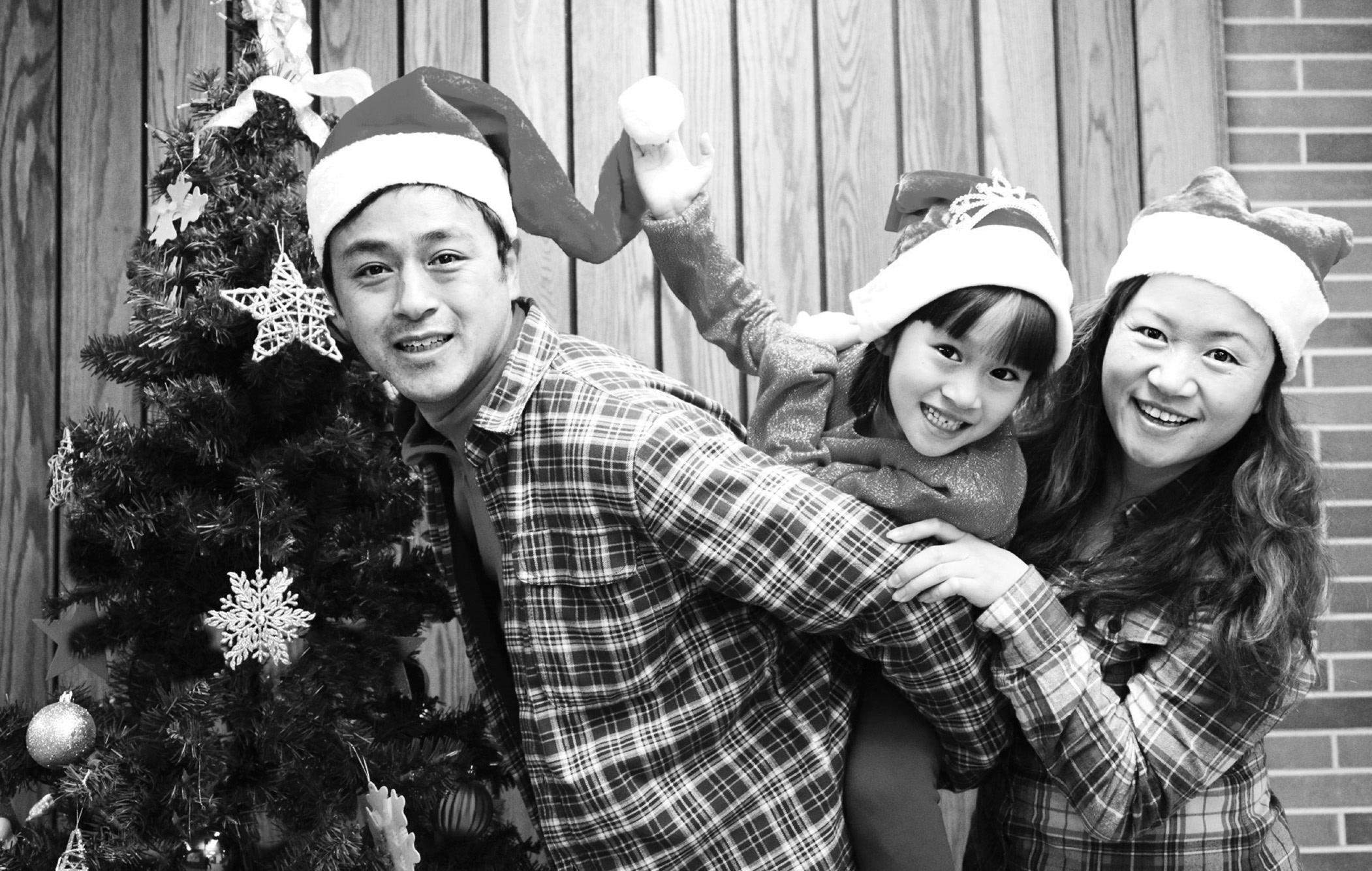
2013 Free Family Portrait project will bring great memories to your family
Joy of the season – have your family portrait done for free b eibei lu, staff
Have you had your family portrait done for this coming Christmas? With your parents, kids, friends, or your buddies?
We all have our own definition of “family,” no matter where we are or what we are doing. So, when the holidays come around, wouldn’t you like your family portrait done as a means of supporting the community? Come to our Free Family Portrait event and get your family photo and tons of happiness, for free. This Free Family Portrait project, which began last winter, is a personal photography project operating due to the great support of communities and friends. The purpose was originally directed at providing portraits for members of the Chinese community as a special holiday gift for each immigrant family. This year, the project has expanded and is open to all Winnipeggers. It can be really hard to get the whole family together, and
this is especially true for immigrant families. For immigrants’ communities, a family portrait can mean much more, as they’ve travelled a long way to move to Canada to start their lives here. I believe that each family has their special story, no matter if it’s an immigrant family or a family native to Winnipeg. This portrait will be a great season’s greeting for the whole family, as well as an icon to mark their good luck for the coming new year. So, this is a special invitation to everyone—no matter if you are studying abroad or enjoying your holiday vacation with your family—to come and have a family portrait done with your family or friends to commemorate 2013!
For more information, or if you want to support the project, please contact photographer Beibei Lu at freephotome@gmail.com
Huaxin xu’s family NEW IMMIGRANTS TO C ANADA Of fOUR MONThS. A NEW BEGINNING AS fRESh AS ThE SNOW
Helen Wang and Her daugHter, Hanna. hER fAMILy hAS BEEN IN C ANADA fOR 18 yEARS. ThEy ARE PROUD TO BE WINNIPEGGERS
Remaining Bison home games
There are only seven weeks of Bison sports regular season action left. Here are all the remaining games played in Winnipeg. Follow the Manitoban on Facebook and @toban_sports on Twitter for opportunities to win free tickets to all remaining Bison home games.
January
3 and 4
Women’s hockey vs Saskatchewan
10 Women’s basketball vs Trinity Western Men’s hockey vs Mount Royal Men’s basketball vs Trinity Western
11 Women’s basketball vs Fraser Valley Men’s hockey vs Mount Royal Men’s basketball vs Fraser Valley
17 and 18 Women’s volleyball vs Mount Royal Women’s hockey vs Calgary Men’s volleyball vs Mount Royal
24 and 25 Women’s basketball vs Regina Men’s basketball vs Regina
31 Women’s volleyball vs UBC Okanagan Men’s hockey vs Regina Men’s volleyball vs UBC Okanagan
February
1 Women’s volleyball vs UBC Okanagan
7 and 8 Women’s basketball vs Alberta Women’s hockey vs Lethbridge Men’s basketball vs Alberta
13 Women’s basketball vs Winnipeg Men’s basketball vs Winnipeg
14 Men’s hockey vs UBC Women’s basketball vs Winnipeg (@U of W) Men’s basketball vs Winnipeg (@U of W)
15 Men’s hockey vs UBC
Half-time report
Bison Sports mid-season review
Mi K e still an D Ma Rc l agace, staff
women’s hockey
Record: 9-5-2
Record in last 6 games: 4-1-1
Team leader in scoring: meagan vestby – 15 pts (2 g, 13 A) in 16 games
ANALySIS: The Bison women play a fast, physical style of hockey, forcing turnovers and creating scoring opportunities. They are also the third-most-penalized team in the Canada West conference and have struggled on the power play at times. They have not cracked the CIS top 10 this year, but could very well be among the nation’s best by the end of the season.
PLAyOff PROjECTION: Heading into the winter break, the Bisons are in a good position to move up the standings. They’re currently fourth in the conference and five points back from the conferenceleading UBC Thunderbirds. With games remaining against the three conference-basement-dwellers, the Bisons should be able to make a strong push for a home ice advantage in the first round of playoffs.
men’s hockey
Record: 7-8-1
Record in last 6 games: 5-1-0
Team leader in scoring: Aaron lewadniuk - 17 pts (6 g, 11 A), tied for sixth in canada west
ANALySIS: The team is coming off a huge win against top-ranked Alberta heading into the break and has averaged 4.67 goals per game in their last six. They have gotten big production from their rookies. Luke Paulsen has added energy to the team, playing in all 16 games, and Jordan DePape is tied for fifth in rookie scoring with 12 points. The Bisons are tied for seventh in total goals in Canada West, with just 46, and have the fewest power play goals (four) in the conference.
PLAyOff PROjECTION: Right in the thick of the playoff race. Just two points behind third-placed Saskatchewan. Six of the final 12 games are against teams in the top four including 15-0-1 Calgary. That series could decide the Bisons’ placing at the end of the season.
men’s volleyball
Record: 5-7
Record in last 6 games: 3-3
Team leader in kills per set: Devren Dear – 3.52 K/set (183 kills in 52 sets played)
ANALySIS: 2013-14 has proved to be a challenging season of change for the Bisons. They’ve got a new head coach—Cam Johnson filling in for the legendary Garth Pischke—and a roster that is almost entirely players in their first or second year of CIS eligibility. With that in mind, the promise that Manitoba has shown in this first half of the season outweighs their shortcomings. Their most recent match against the top-ranked Trinity Western proves that the Bisons can be competitive against any team in the conference.
PLAyOff PROjECTION: Currently one spot out from the final Canada West playoff spot, and sitting just below .500, the Bisons could very well make the playoffs this year if they can do better at capitalizing on their opportunities. A pair of matches against winless Regina in late January should be an easy four-point standings boost.
women’s volleyball Record: 6-6
Record in last 6 games: 2-4
Team leader in kills: Rachel cockrell (171)
ANALySIS: Rachel Cockrell and Taylor Pischke continue to lead the nationally-ranked Bison attack. Manitoba is a very strong team, but cannot afford to let any more matches slip away; despite winning four matches in three-set sweeps, they have also lost three of four matches that have gone to a fifth set.
PLAyOff PROjECTION: There is incredible parity in Canada West this season, as all but two teams in the conference are in the playoff hunt. The Bisons have the talent to not only secure a playoff spot but also be in contention for a national championship, as long as they continue to execute on the court.
Men’s basketball Record: 1-9
Record in last 6 games: 0-6
Team leader in points per game: Andre Arruda (11.9)
ANALySIS:The loss of co-captain Stephan Walton to a knee injury before the season has hurt the team. They are starting two rookies: Andre Arruda and Justus Alleyn (7.5 PPG). Both have had immediate impacts, but don’t bring the same leadership as Walton. His hopeful return in the second half of the season will add a big lift in production
PLAyO ff PROjECTION: Manitoba has not had a winning record in the second half of a season in over 10 years. Add to that the fact that they have lost eight straight games: playoff chances are bleak.
Women’s basketball Record: 3-7
Record in last 6 games: 0-6
Team leader in 3-point fGS made: Robyn Eyer (23/56)
ANALySIS: After starting the season 3-1, the women have lost their last six in a row. They are first in three-point percentage in the Canada West prairie division at 35.6, but last in the division in points per game, averaging just 60.4.
PLAyOff PROjECTION: The team has played tough against both Saskatchewan and Calgary, who are first and second, respectively. Considering the fact that they only won two games all of last year, this season has been encouraging. Unfortunately, it won’t be enough to crack the playoffs this year with such a young team.
Ma Rc l agace, staff
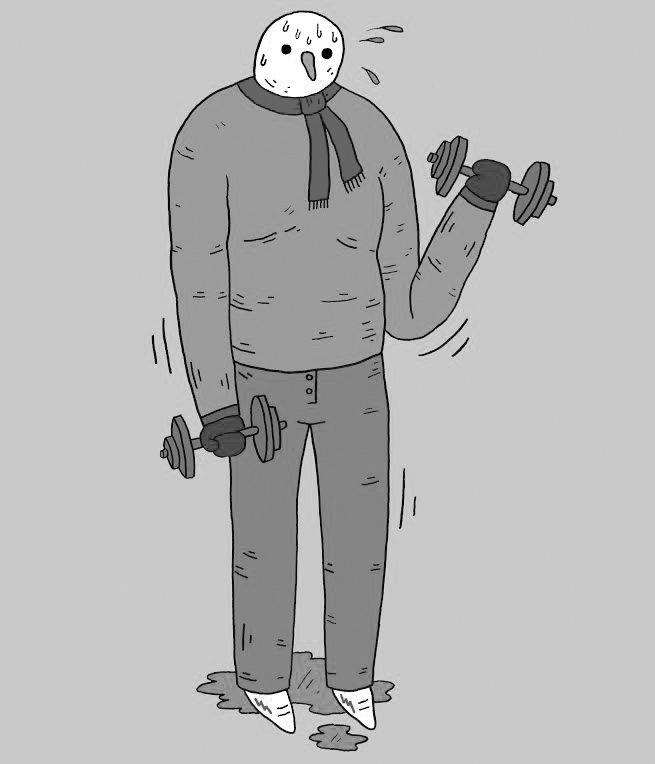
Get your winter workout on
How to make the most of a Winnipeg winter
Katy MacKinnon, staff
If there’s anything Winnipeg does best, it’s winter. If there’s anything Winnipeggers do best, it’s making the most of wind chill, frostbite, and constant runny noses.
To capitalize on our five-month
winter, you’re going to want to take part in some invigorating winter workouts. The spiked hot chocolate will taste that much better afterwards.
Snowshoeing
Modern-day snowshoes look quite different from those you remember the voyageurs wearing from history class. The ones made of aluminum are very lightweight – perfect for hopping around knee-deep snow.
Snowshoeing is as simple as finding a trail and trekking. If you don’t want to make the investment of purchasing your own pair, Olympia Cycle and Ski offers snowshoe rentals for $15 per day.
FortWhyte Alive rents snowshoes for free to its members and three dollars to non-members. There, you can explore over seven kilometres of trails, interact with wildlife, and maybe even do some birding.
Other great trails include Beaudry Provincial Park, Birds Hill Provincial Park, and La Barriere Park. To access provincial parks you’ll need a park pass – $40 for the year or five dollars for a single day.
Of course, you can always head into a wide-open field, grab a friend, and play a little tag. #Nofacewashes.
Cross-country skiing
Cross-country skiing is a great way to make use of Manitoba’s vast prairie landscape. It might take some practice to find your rhythm, but the activity is fairly easy to pick up with a little help from a seasoned skier.
Cross-country skis are thinner
Bisons grab momentum
heads into break with win
T
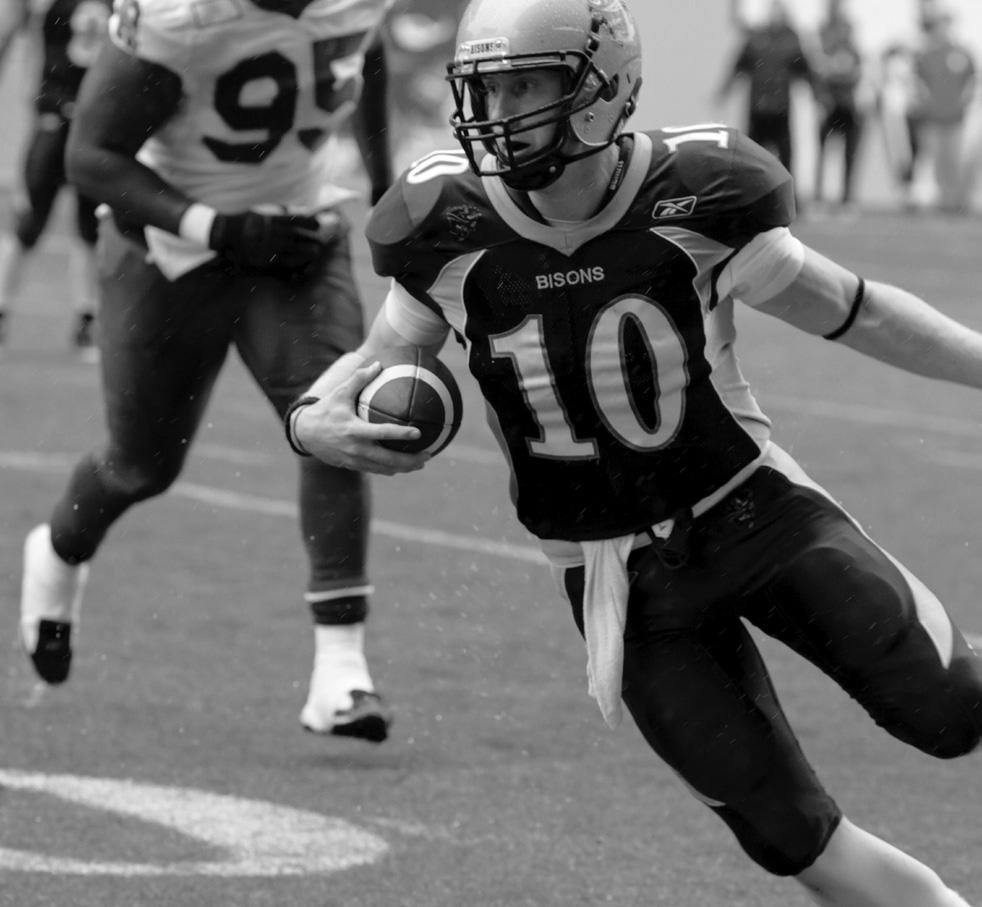
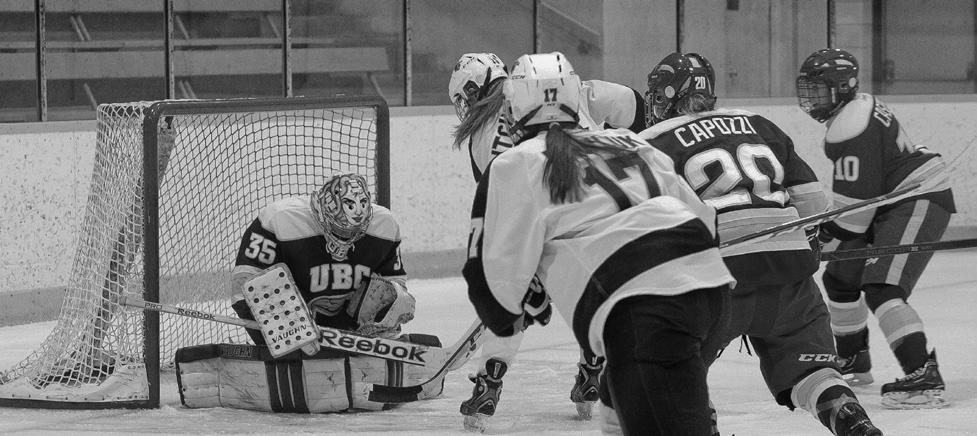
he Bison women’s hockey team played a huge pair of games at home this weekend. They went into the matchup trailing their opponent, the Alberta Pandas, by just one point in the standings.
The weekend got off to a rough start as the Bisons fell 2-0 on Friday night. The Bisons were held in check for the majority of the opening frame, managing to generate little offensively. They mustered five shots to Alberta’s eight.
Alberta opened the scoring on the
power play with 3:21 left in the first period. Forward Kayla Lavallee flipped a harmless-looking shot that made it past a screened Amanda Schubert. The goal turned out to be the gamewinner.
The second period yielded few opportunities for either team. Manitoba picked up their intensity, but were unable to develop many chances in the Alberta zone. The Pandas had the greatest opportunity of the period with 5:34 left on a two-on-one, but Schubert
came up with a great stick save.
The Pandas added to their lead at 8:55 of the third, scoring their second power play goal. Goaltender Lindsey Post shut the door the rest of the way for Alberta, as they cruised to victory.
The 22-save performance from Post was her fifth consecutive shutout, setting a new Canada West record. Despite the loss, Schubert displayed poise in the net, stopping 19 of 21 shots.
The difference in this one was the power play. Alberta went two for three,
than downhill skis, and equipment (skis, poles, and boots) purchased new can range anywhere from $100-$400. If you’re just looking to test the waters, Olympia Cycle and Ski offers rentals for $15 per day.
Mountain Equipment Co-op (MEC) also offers ski rentals for $15 per day, with a little discount if you rent for a week. To rent or purchase equipment from MEC you’ll need to be a member (a one-time fee of five dollars).
To ski on trails in the city, check out Assiniboine Park, St. Vital Park, Windsor Park, and FortWhyte Alive. Provincial parks such as Beaudry and Birds Hill are a little further from the city, but their beauty is worth the trek. Most of these trails can be skied either for free (Assiniboine Park and St. Vital Park) or for a small fee.
Shovelling snow
Here’s one you can do just outside your front door, and you get double the benefit: a great workout and a clean driveway. If you’re careful to warm up ahead of time (a brisk walk and some arm circles, perhaps), shovelling snow can be an excellent cardiovascular and strength workout.
If one driveway isn’t enough, offer to help out your neighbour to get a little extra calorie-burn. Or just shovel their driveway while they’re sleeping, and they’ll have a nice surprise upon
waking in the morning.
Tobogganing
This exhilarating activity is not just for kids. The adrenaline rush from zooming down a hill at top speed is coupled with some intense cardio from the run back up.
Sleds are pretty inexpensive at Walmart and Canadian Tire – some costing only five dollars. A large sheet of heavy-duty cardboard works in a pinch.
Dress warmly, and wear waterresistant pants if possible. Snow pants are your best bet, but if you don’t have those, track pants overtop of leggings or long underwear is fine. Don’t forget to bring a flask to warm up when your nose starts to go numb.
Kings Park, as well as numerous local parks around the city, has hills perfect for tobogganing.
fatbikes
If you’re an avid summer cycler but dread dangerous cycling conditions in the winter, never fear – fatbikes are here! They can be ridden year round, but their wide tires are especially made for slippery, snowy conditions. The bikes give you more traction, stability, and control on soft trails. Fatbikes are available for rental from Woodcock Cycle Works for $50 a day.
Embrace Winnipeg’s snowscapes!
while the Bisons failed to score on three opportunities.
“We tried to do some things in the offensive zone, but we never had the puck the whole game. When you don’t have the puck it’s very hard to create offence,” said Bison head coach Jon Rempel after the game.
Manitoba answered back the following night, picking up two crucial points in the Canada West standings.
The Bisons were the clear aggressors early on, generating many quality chances. Their persistence paid off just over six minutes in, as Kyleigh Palmer zipped a loose puck in the slot past Post. The goal officially ended Post’s shutout streak, which started on Oct. 26 and lasted a jaw-dropping 351 minutes and 18 seconds.
The Bisons kept the pressure going throughout the period, outshooting Alberta 9-4, and headed into the second up 1-0. Alberta got back into the game early in the second on the strength of their power play. Jayden Skoye tallied her team-leading ninth goal of the season at 3:11 to tie things up.
The Bisons would go just one-forsix on the night with the man advan-
tage, but their lone power play marker was the game-deciding goal; Meagan Vestby hammered home a slap shot with 3:05 left in the frame to retake the lead.
The third period saw a total of five combined shots as both teams tightened up defensively. Manitoba protected their lead and finished with a hardfought 2-1 victory. Dee-Ana Marion benefitted from great play from her team all night. She was only forced to stop 12 shots to pick up the win. Post made 20 saves in the loss.
“I thought there was way more passion, way more energy, way more attention to detail, much more physical,” commented Rempel. “That’s the way we have to play.”
With the win the Bisons improve to 9-5-2, while Alberta falls to 9-4-3. Despite the loss, the Pandas still remain one point ahead of Manitoba for third place.
The Bisons now head into winter break. They return to action at home on Friday, Jan. 3 and Saturday, Jan. 4 in another big series against second-place Saskatchewan. Game times are 7 and 6 p.m., respectively.
phOtO by bEibEi Lu
iLLuStRatiON by KEEgaN StEELE
Growing health gap a concern for poor Manitobans
Brian Sinclair inquest reveals outstanding issues of negligence
sea Mus h a M
ilton- pattison, voLuNteer
staff
Given the rate modern medicine progresses, it should come as no surprise that overall, health in our province has been improving. Since approximately 1985, for example, the number of tuberculosis hospitalizations per 100,000 people in Manitoba has been cut nearly in half.
That being said, while health care has drastically improved over the past 20 years, it has not done so equitably. In that time, the health gap between the province’s wealthy and poor has only grown.
In September 2010, the University of Manitoba’s faculty of medicine released a report outlining the growth in income and health gaps between the province’s rich and poor. The report goes on to point out the large inequities in untimely deaths and disease between these high and low-earners.
As we aspire to live in a fair and ethical province, this was all done to determine which of these areas required the most attention to restore a balance of adequate health care for all Manitobans.
So just how poor are Manitoba’s low-income residents by comparison?
Between 1986 and 2006, the earnings gap of urban and rural residents had more than doubled (the gap between rural residents tends to be smaller than that between urban residents), with the average wealthy urban household making $114,300 per year and the poorest getting by on a mere $34,400 per year.
Unfortunately, the increasing health gap is just as startling. Premature death—occurring prior to the age of 75—is
overall, but the improvement has hardly extended to the province’s lowest income bracket.
Based on the most recent data recorded in 2010, a third of all premature deaths among urban residents struck within the poorest 19.5 per cent. Premature death also happens to represent one of the highest inequalities within the health gap itself – meaning a number of highly targeted policies for the poorest demographics will need implementation before we can expect to see any positive change.
This is a good time to discuss the Brian Sinclair inquest – not just in the interest of promoting awareness in the health care provided to the low-income demographic, but also in regards to the initial treatment they receive.
Brian Sinclair was a 45-year-old double-amputee who arrived at a hospital ER at the advice of a doctor from a clinic. An inquest was necessary because, despite patiently waiting in the ER for an astonishing 34 hours, Sinclair never received treatment, triage, or even attention, and died of an entirely treatable bladder infection.
Relying on multiple eyewitness accounts and verbal testimony from the nurses on staff that night, the inquest reveals that upon Sinclair’s arrival, he spoke with a triage aide and wheeled himself into the waiting room – never receiving further assistance.
A nurse on staff the morning of Sept. 20, 2008 reportedly took “30 seconds to decide that the sleeping Sinclair was intoxicated,” though she did not actually assess or attempt to wake him.
The nurse claims she assumed he was an IPDA patient—a patient so intoxicated they are waiting to be detained by the police—but in order to be determined to be such, Sinclair would have needed to be admitted to a doctor in the first place.
While we undoubtedly have a long way to go to reverse the health gap between the wealthy and impoverished citizens of our province, ending gross negligence such as this would be a good first step.
‘Nerd’
is not an insult
Being science fiction or fantasy-obsessed is cool nowadays
conno R Duff
Nerd. In high school, who didn’t dread being called that?
Well, on the contrary, “nerd” isn’t some degrading insult that everyone will find offensive. If you call a good amount of high school or university students a nerd, the response you may likely get is, “Thank you.”
While driving home from work one day, I remember having a conversation with my dad where I brought up that I am a nerd. When he heard that, his immediate response was to console me, saying, “Son, don’t say that. You’re not a nerd.”
I gave him a funny look. Turns out he thought I was depreciating myself, and saying, “Oh, I’m such a nerd. Nobody loves me.”
In reality, I was saying, “I’m such a nerd. Everybody loves me.”
If one is to look up the literal definition of “nerd,” you should find something along the lines of, “a stupid, irritating, ineffectual, or unattractive person,” and “an intelligent but single-minded person obsessed with a non-social hobby or pursuit.”
Wow. Those sound incredibly offensive and insulting. No wonder my dad wanted to tell me I wasn’t a nerd. Those definitions have incredibly negative connotations, and in theory being a nerd is probably one of the worst things to be. As a matter of fact, it’s the other way around in practice.
Typically when a person says “nerd” or “geek,” they are referring
to the second definition. When this definition says “non-social hobby or pursuit,” it refers to things such as a “computer nerd,” which could refer to either someone who is good with computers, or who plays a lot of computer games.
Now sure, in the past social activities would pretty much revolve around things like dating, playing sports, and so forth. The media also seems to peg the antisocial “nerd” as someone who is into science fiction, fantasy, and video games. Today, that could not be further from the truth.
What’s wrong with being able to name every single character in the DC or Marvel universes? Today, that is often considered pretty cool
At my old high school, there’s a Pokémon fan club. Students from around the school gather there to play the card and video games.
A club, of course, implies social interaction, and this is a club themed on what is considered a “nerd” activity. Even here at the U of M, I have plenty of friends who are still into Pokémon – even though “friends” and “Pokémon” in the
same sentence sounds paradoxical. Today, we have the annual event known as Comic-Con – a convention held in many North American cities that celebrates nerd culture, and advertises itself as such.
People go out in costume and meet others in costume, as well as several science fiction or comicbook-related celebrities, and browse through mountains of science fiction material. Having attended twice already, I can tell you there are a ton of people.
One of the largest Comic-Cons (in San Diego) sold out in an hour and a half this year.
The definition of “nerd” that mentions how one is “obsessed” with certain activities may sound bad, but what’s wrong with being able to name every single character in the DC or Marvel universes? Or owning just about every single video game system in existence?
Today, that’s something often considered pretty cool. The socalled “anti-social” nerds all partake in those sorts of things, and rather than implying someone is some weirdo who spends every waking moment in his or her basement by calling someone a “nerd,” today people mean an aficionado—someone who loves something, typically science fiction or fantasy-related—to the extent that it is a part of his or her identity.
That, to me, sounds like a much better definition than the one you’ll find in any dictionary.
Lit. Comp.
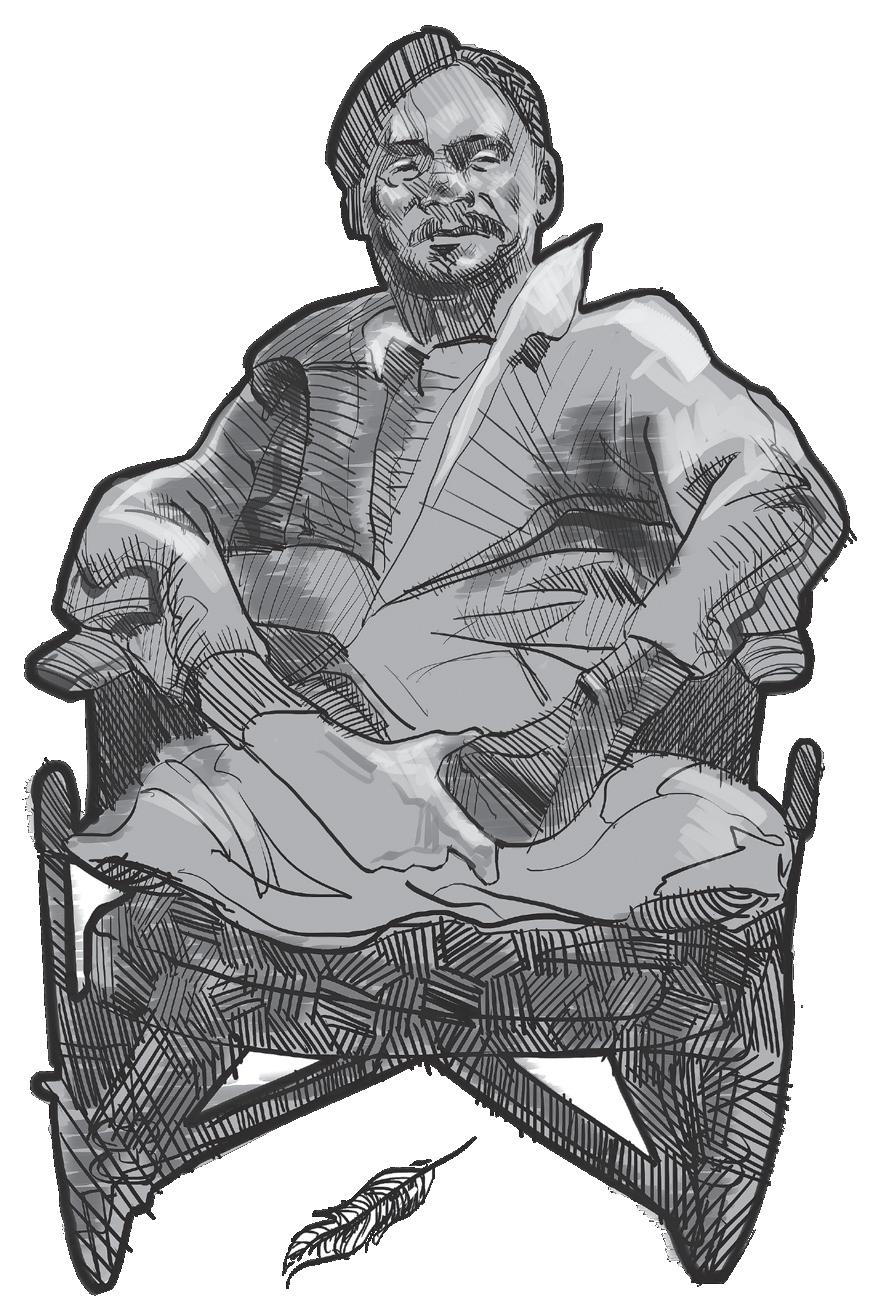
I was a fool to think that I could make it to Provo by car so late after his coming. I will never understand why he returned in Provo, Utah of all places, or even the States for that matter (I have no idea how resurrection works)
DECEMBER 2014
Dan hRynicK
People are dying all around me. Food is scarce, water sources are undrinkable and running out. Winter is about to hit us hard. There are huddled masses and garbage as far as the eye can see. It smells like shit anywhere you go, although I can’t say that I have moved very much in the past week, except to a cave up in the hills where I get my writing done. I’m starving and I haven’t gotten any closer to Christ since I crossed the state border into Utah. I have been rationing my food for over a week now and I fear I am starting to lose my mind. Maybe writing will take my mind away from the gravity of the situation around me and give me the strength to persevere through my journey.
People tried to scavenge all they could once they realized that they were on their own and no one could help them but themselves. But all the rows upon rows of corn, all the cattle, all the hogs that have been left to stand in the fields along the highways aren’t fit for human consumption. People have tried eating the corn, the cows, the hogs, but it only makes you sick. Who the fuck actually knows how to prepare food? Every fast food joint off of the interstate was raided for whatever food they had left. Only in this instance, thankfully, people with the skills to prepare the food were not hard to come by. The burgers and fries keep remarkably well and are the only food sources that might last the winter for the lucky souls who were able to get their hands on the stuff. I’ve been keeping two McDonald’s pies in my glove box and they still look as they did the day I found them a month ago. I’m just choked that they are rhubarb and not apple (what a shitty promotional flavour).
The outlook is grim. There is no military anymore, there is no economy. There is no aid coming. How would it get here? Who would provide it? There is no way in or out and nobody
to provide any aid. People can hardly move in any direction, can’t turn around to leave. There are hordes of people right behind you, here for the same reason you are. And there is only one man who can really help us in our time of crisis, but we have no chance of surviving long enough to see him. Everybody put their normal lives on hold and stopped whatever they were doing to come to Provo only to find that they were already too late.
I’ve never experienced this kind of chaos. Opening night at Investors Group Field in my hometown (the Taylor Swift concert, not the One Heart celebration) was nothing compared to this. I remember my old man took me to see Taylor Swift for my birthday. I laugh when I think how our voices were so hoarse the next day. Not from cheering for Taylor, no. But from screeching and taking the Lord’s name in vain the whole time we were trying to get out of the parking lot. Only difference is that people eventually made it out of the parking lot and nobody died going to see Taylor Swift.
I was a fool to think that I could make it to Provo by car so late after his coming. I will never understand why he returned in Provo, Utah of all places, or even the States for that matter (I have no idea how resurrection works). I guess he could have returned anywhere, really. They must have gotten something right at Brigham Young. Maybe Max Hall could’ve provided insight about his alma mater if we hadn’t cut his ass. Naturally, it took a while for people to be convinced that he had actually returned. It wasn’t uncommon before the return to find any nut on the street claiming to be your Lord and saviour. But this time, it was the real thing. Any miracle they said he could do, he did. When the media was still a thing, everyone was talking about the man in Provo, Utah who could
walk on water, turn water into wine, but most importantly, heal the sick. And that’s when the proverbial shit hit the fan. As if the economy wasn’t bad enough. When he came back, the economy really went to shit. People everywhere quit their jobs to travel to Utah. Who would want to be in the military, work for a septic company, or pick up garbage in a glorious time like this? Everybody was too over the moon to give a shit, which is probably why there’s garbage everywhere and the smell of shit in the air. We were waiting for somebody else to solve our problems and our salvation finally showed up. Nobody was turned away when they got to the States. Who knows how many people are in Utah right now. Billions, at least. Who knew that everybody was sick or in need of a shepherd? Of course, it was mostly the people who needed a shepherd and had the money to get to Utah in the first place who made it into Provo before anybody else. Most of the people who really need saving are now doomed to the obscurity of the highways, dying from exposure because there are no medical services available anymore. I think I am witnessing the largest-scale humanitarian crisis of all time unfold before my very eyes.
The sun is beginning to set and I’m getting too cold to write. But more importantly, I have a rhubarb pie calling my name from a glove box.
Until next time.
UPDATE!
While I was writing, some asshole broke into my car and stole both of my pies.
John stintzi
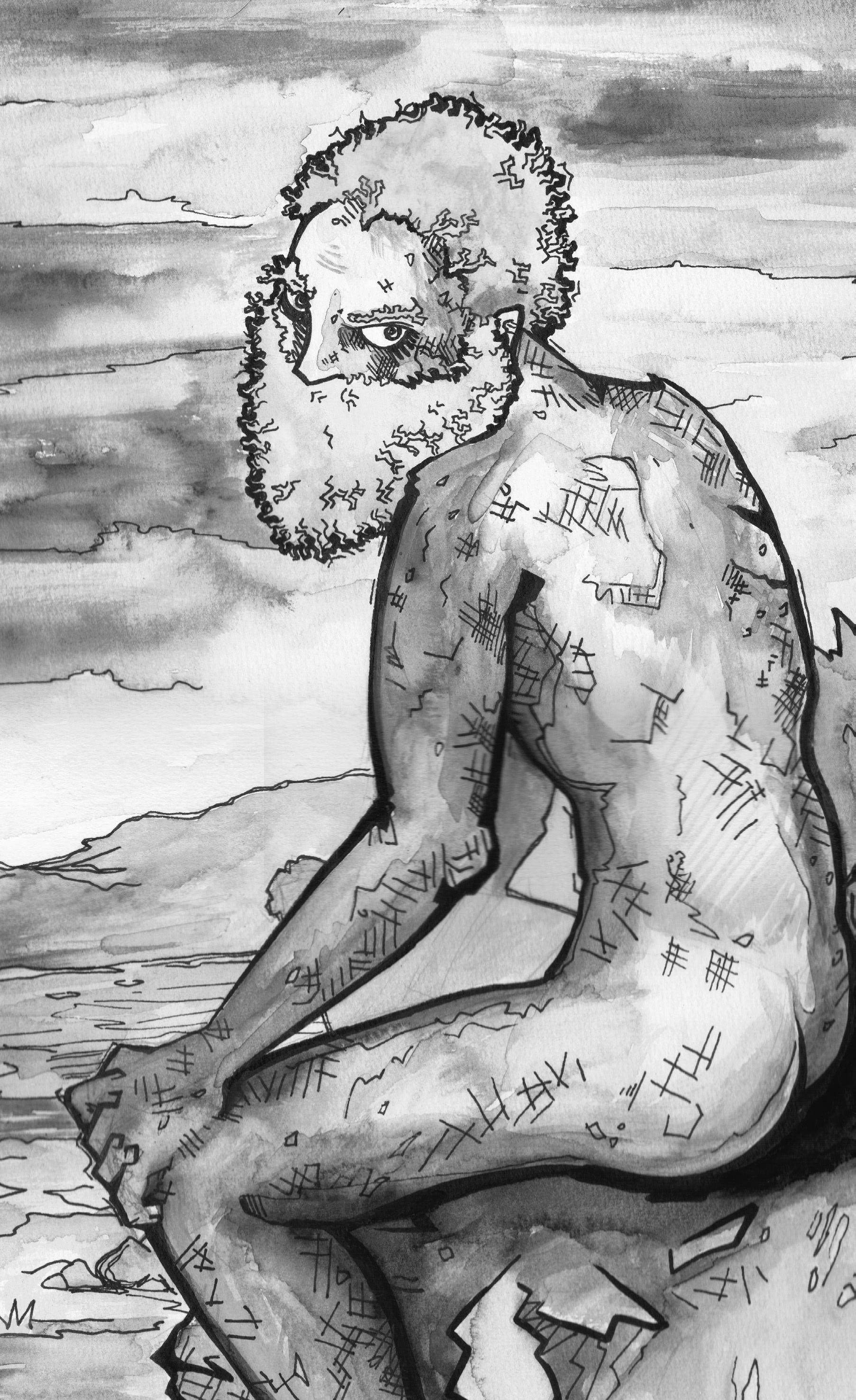
The other day I ran across a naked man who had a rather wide beard. I was in the field, cutting hay, and he came out of the woods and walked up to my tractor, turning his head at me like a curious dog. I stopped and waited for him to scurry off but he just stood in front of me staring at me. So I got out to shoo him off but he didn’t leave, only scurrying away a few feet as I approached. So I chased him and he finally ran off, but when I came back to the tractor and turned around he was there again, looking at me, curious. This time I just walked at him and he went slowly, looking back at me now and again, toward the woods.
I was tired, yawning, and had nearly fallen asleep behind the wheel a few times, so the walk would do me good. I followed the strange naked man with the wide beard into the woods. As we walked he walked slower until I was right behind him, and then right beside him. We walked in the woods for awhile, unsure who was leading who, silent.
I couldn’t hear my tractor going anymore and I liked that. Under our feet was the sound of twigs snapping and the wet leaves squishing. I didn’t even look over to my strange naked man with the wide beard for a while. We just walked. I liked the way we were walking.
But then after a while I looked at him and was a bit shocked at what I saw. He had slowed some and was having a bit of trouble walking because he was turning grey and rough. He was turning to stone. His beard and body hair were turning to lichen. His eyes were turning to nothing but dark spots on the rock surface. His body was reforming itself: his legs began to shorten and his arms disappeared until he was hardly able to waddle at all. I just walked beside him, slowing down to his pace. We went slower and slower, and the trees began to hide the sunlight more and more and I began to realize it was becoming night.
By the time I heard my father and brother yelling my name from the forest’s edge, having come to pick me up, my rock companion had made it into a small clearing in the woods that had boulders everywhere. I could feel his dark spots watch me as he made one final roll and fell onto a patch of pressed down grass. I stood there for a moment, looking at him and the other boulders while my name was being yelled. I saw each and every boulder and I wondered if each and every boulder saw me. I left the place. I didn’t feel tired and the time we spent together seemed like it was only a moment though it had to have been at least four or five hours. The moon was high and big and there was a lot of light as I walked back toward the field and my family. I didn’t know how I was going to explain anything. I suppose I felt insane though I didn’t believe it. Well I explained it away, somehow. And when we got to the truck I turned around and looked at the shadow’s edge of the forest hoping to see my friend but he never showed up. On the way home we didn’t talk much. I told them about the cutting. When we got there I got out of the truck and looked down at the little stones that made up the gravel, and for the first time in my life I felt like the world was interested.
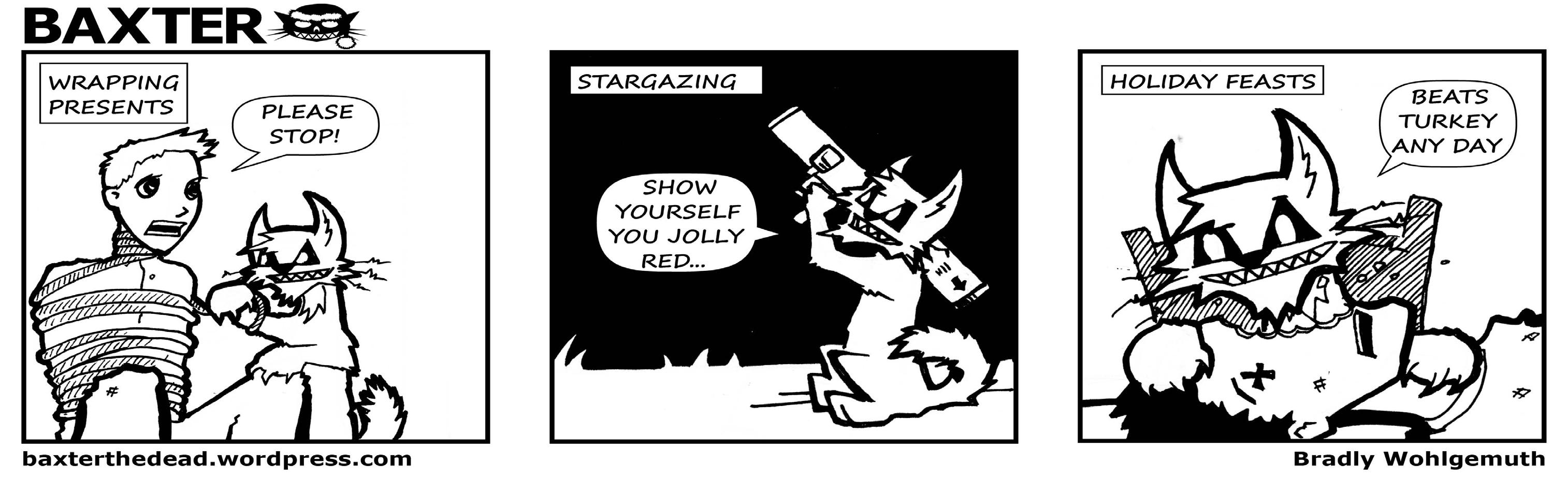
iLLuStRatiON by bRaDLy wOhLgEMuth
Lit. Comp.
These are the Lines They Make in the Light
Breanna Muir
At night I hang my paper dolls across the ceiling –they sway like dancing children by the open window
They are charcoal slivers when my lids are shut or the long black stems of the hydrangea plant
These are the lines they make in the light holding hands –
A moving carousel of paper bodies encircling a mirror
I stop here to watch their little mouths spreading wide
Drooling rosary beads onto the floor –
As they drop they burn in rhythm behind my eyes
and I become dizzy and stop to ask them, does my mother know me?
To her I am a golden egg, a piece of turquoise, the string of paper dolls
Yet I told them my room would be shadowless, floodless,
From a fine ink line of calligraphy the moon curls into one high point and the paper bodies round me move desiring to feel its light performing on the window ledge
stintzi
It was a cold night, even for October. I had brought gloves and a scarf, and my pea coat had buttons I knew how to use.
She always looked beautiful when she was cold. When I first noticed her she was shivering and it beguiled me. At night I’d imagine her underdressed and embracing herself.
As I walked her home on that cold night I found myself lost. I asked her what she thought about when she had nothing to think about and she couldn’t answer. I told her that when I have nothing to think about I think about how I’d like two particular rooms in my house: one where the entire floor is a bed, and another that’s a huge ball pit.
She laughed. I noticed her cramming her cold hands into her pockets. The night was breathing a frozen wind softly upon us. I thought about giving her my coat but I’d done that before and didn’t want to mingle the girls.
Here, I said, handing her my left glove, lined with fur. She took it questioningly. Put it on, I said. You don’t want to lose your fingers.
She put on the glove.
Then I gave her my gloveless hand.
Take it, I said. It’s still a while until your place. We don’t want to lose our fingers.
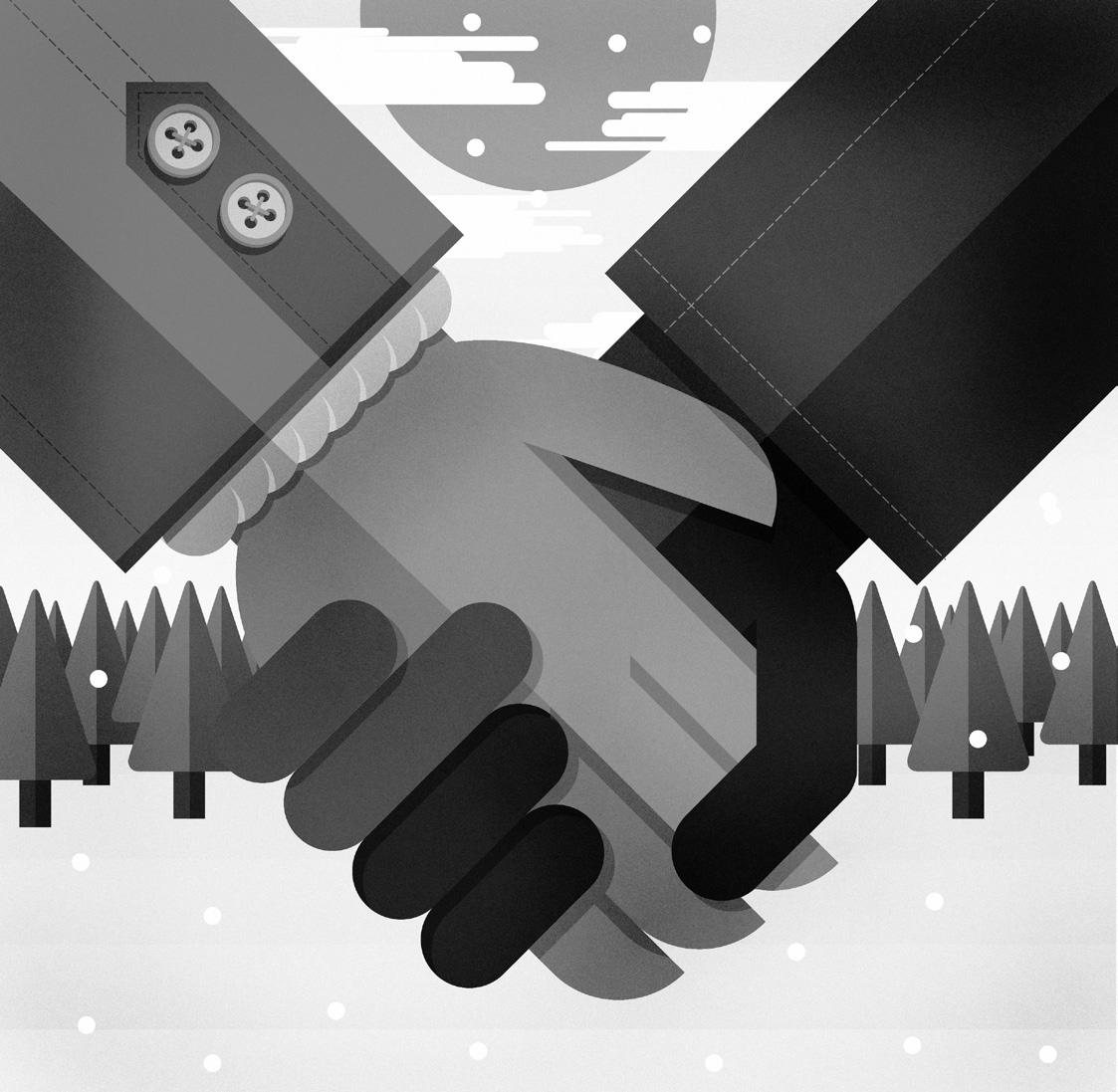
After a moment she took it and our bare hands clung together in the cold night.
We walked like that and we didn’t say anything. There was a silent fire burning between us, and we held our palms tight together to protect the world from its flames.
After a while she looked at me; after a while we stopped and sat on a cold bench. After a while our breath-fogs mingled and we thought about nothing in particular.
John
iLLuStRatiON by juStiN LaDia
iLLuStRatiON by hEathER Kat COLE
Arts & Culture
Ease the chill of winter
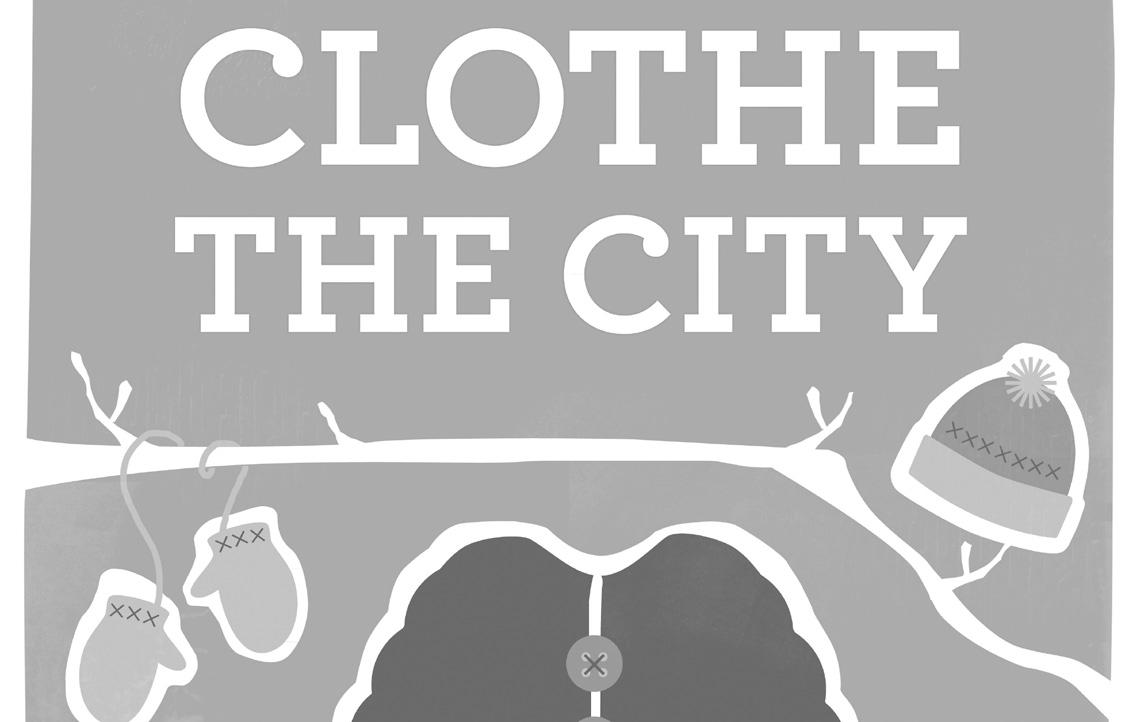
Clothe the City urges Winnipeggers to “give the gift of warmth” to those in need
a nastasia chipelsK i, staff
N
ow that we have a decent layer of snow on the ground, it’s clear that winter is really here. The season brings a laundry list of pet peeves— the obstacle course of sidewalks, irregular buses, perilous street conditions—but beyond inconveniences, the real demand levied by winter is to stay warm.
But what about those who don’t have access to appropriate winter clothes?
Ashley Wood is urging Winnipeggers to consider this question, and to “give the gift of warmth.”
Since 2006, Wood and her co-director Andrea Dyck have been putting on an annual event called Clothe the City, which offers free winter clothing as well as a warm meal to those in need.
The event is based on donations and volunteer time, and at the beginning Wood “wanted to test the ‘pay it forward’ theory.”
“There are a lot of charities already that provide clothing for children, which is fantastic, but I wanted to do something for the adults. I was and still am overwhelmed by the generosity of Winnipeggers. All it takes is an idea and people jump on board right away and are eager to help out in anyway that they can.”
Meghan Kinita, a past volunteer, is helping out again this year by collecting food donations and feeding attendees on the day of the event.
“Part of the reason why I volunteer is to stay close to some of the values that I grew up with and how my parents influenced me. [ . . . ] We always made sure there was an extra plate of food for someone and sharing was important!
This event encompasses both of those values for me,” says Kinita.
Empathy and understanding how poverty works is also crucial to Wood.
“I really do believe that the ‘system’ that we have is not structured correctly to begin solving the poverty issues that many survive each day within our city. Although I do not have the answers on how these issues can be fixed, it is important to recognize that people do not choose to be in the situation that they are in. On top of political and historical factors, mental health and addictions do play a huge part in the fate of so many lives.”
Wood encourages others to develop their understanding of the poverty experience through the poverty simulation program called Living on the Edge put on by the United Way. She has also seen the connections made possible by the event.
“Our volunteers chat with folks who attend, help them find appropriate clothing and sizes, serve warm meals, and share stories with each other.”
While it won’t provide the solution for every problem, Clothe the City hopes to at least relive a bit of the cold bite of the coming months.
“This is a cold city come winter. Even now it’s getting chilly and I feel better knowing that more people will be feeling a little bit warmer after Dec. 8,” says Kinita.
Clothe the City is being held on Sunday, Dec. 8 from 10 a.m.–3 p.m. at Lighthouse Mission (669 Main Street). You can learn more about them, including how to get involved or donate, at www.facebook.com/clothethecity
‘An honest, fun, and raw show’
Toronto comics come to Winnipeg’s Park Theatre
c a Rlyn s
chellenbe Rg, staff
If you take four Toronto stand-up comedians—Dave Merheje, Aisha Alfa, Garrett Jamieson, and Ben Beauchemin, three of whom are former Winnipeggers—put them at the Park Theatre, and add one Winnipeg comic to host (Chantel Marostica), you’ll get Family Affair: Holiday Edition Family Affair is Dave Merheje’s one-man show, and was part of the Just for Laughs Comedy Festival in Montreal.
Along with Aisha Alfa, Merheje will headline the Dec. 12 event, telling personal stories of his Middle Eastern family and growing up in a Lebanese household.
“It will be an honest, fun, and raw show. I will leave it all up there,” says Merheje.
The Just for Laughs 2011 Homegrown Competition winner and previous cast member of MTV Live, Merheje likes to rant and tell stories on stage.
“Whatever I feel at the moment, I talk about; I have set jokes but I like to improvise and be organic and have a stream of [consciousness].”
Aisha Alfa, winner of Winnipeg’s Funniest Person with a Day Job in 2011, got into comedy “on a whim.”
After a successful first set at Rumor’s, she realized her passion for telling jokes. As soon as she got off stage, she was offered another gig.
When asked about her own comedic style, Alfa says she has trouble answering that question.
“I asked Chantel Marostica and she [described my style as] ‘worldly, energetic, silly, with a positive perspective on life.’ So… that, I guess!”
Winnipeg native—and actor
(New in Town) Ben Beauchemin has been in Toronto for over two years working on his stand-up career.
Like Alfa—who uses her afro, dating, and her family for joke material—Beauchemin draws on personal experiences for inspiration.
On his comedic approach, Beauchemin says, “I don’t really want people to know where I’m going with [my] bit.” He enjoys playing with the audience, losing them for a second, and then winning them
Jamieson says Winnipeg’s comedy scene is not too different from Toronto’s, but that more people in Winnipeg come out to support shows
back with “the big swing.”
Beauchemin’s worst onstage experience occurred when he started recording his set and got heckled as soon as he began.
“I [couldn’t] quite hear what the person was saying, or see who they were, so I kept stopping mid-sentence and trying to tell people to be quiet and so on [ . . . ] When I finished my time I took the recorder off the seat and saw that I had pressed play rather than record, so I ended up getting heckled by a recorded version of my own voice.”
Garrett Jamieson moved from Winnipeg to Toronto when he was
22, and showcases a “bizarre” comedic style: “Look at a picture of me, and it would be very disjointed, all over the place [ . . . ] [a big] party where anything goes.”
Jamieson and Mark DeBonis created The Lot, a comedy club which was recently the runner-up in Now magazine’s Best Comedy Club in Toronto.
Jamieson says Winnipeg’s comedy scene is not too different from Toronto’s, but that more people in Winnipeg come out to support shows. Beauchemin agrees that the crowds in Winnipeg are larger, but notes that there are more opportunities for shows in Toronto.
“I think the most amount of shows I did in Winnipeg was three in a week. [ . . . ] In Toronto the most I’ve done is 14 shows in a week, and I usually try and stay above four a week or so.”
Alfa says this group of friends is very excited to do the show. Beauchemin also looks warmly on his fellow performers, noting that host Marostica is one of his favourite Winnipeg comics, and says “the three other comics on the show are some of the best in the country.”
When asked what to expect from him on Dec. 12, Jamieson says, “a machine gun full of one-liner jokes.” He notes that the comics of Family Affair: Holiday Edition are “from a newer generation of comedy (which is good for comedy to come from).”
Come to the Park Theatre on Dec. 12 for Family Affair: Holiday Edition. Doors open at 7:30 p.m. and the 16+ show starts at 8 p.m. Tickets are $20 at the door and $15 in advance at www.eventbrite.ca
Beauty without a challenge
Gurevich Fine Art hosts Christian Worthington’s exhibit Three
lu K as thiessen, staff
Art has to relate to the world, and people are fucking exhausted.”
Christian Worthington, a Winnipeg painter of works at once abstract and classical, does not demand that viewers reform their sensibilities.
“Some artists would like it if they were told their work challenges people [ . . . ] I want art to be relief. I don’t want it to be a challenge.”
Studious and diligent in the areas of painting, drawing, and sculpture, Worthington not only expresses what works for him personally, but explores a universal, multi-dimensional focus on beauty – profoundly referencing Old Masters.
The visible connections to great painters of the past shine in his work.
“It’s not the colour people are responding to – it’s the tone.
Painting is flavoured tones.” Worthington describes his new exhibit—titled Three— opening Nov. 28 at Gurevich Fine Art, as a fresh extension of what he began in the past.
“What I want is for people to get a good impression of my day-inday-out process. This is the last 120 days of my life.”
Having carefully selected one-third of a year’s work with gallery owner Howard Gurevich, Worthington points out there are even more pieces not included in the show.
“I like big drama, big abstract
works,” Worthington says on the size and presence of his art.
“Every artist’s relationship to scale is different [ . . . ] A [painting by 17th-century Dutch painter Johannes] Vermeer is a precious jewel, and a [painting by 21st-century American Jackson] Pollock will blow you away. I’m interested in how a work is experienced by not just the viewer, but the artist as well.”
There is a sculptural element to Worthington’s pieces. “They are in your space.” Worthington also prefers certain techniques.
“I use a lot of glazes, and layers, and translucency,” he says, adding that artists whose work he is fond of don’t necessarily influence his use of colour. “Gerhard Richter is one of my absolute favourites, but his palette is too saturated for me.”
Worthington says the best way to understand which artists have a great understanding of colour is to look at their works in black and white. “The way I learned how to paint was to work for two years with no colour. Just black and white. It’s about the tone and the edges. You have to train your eyes to see an infinite diversity of edges.”
His CV exemplifies his private study over a period of nearly 10 years: the National Gallery in London, the Louvre, the Rijksmuseum, the Metropolitan Museum of Art, and far more. He left art school after only a few months and spent years teaching himself by working at premier institutions instead.
He laughs at the idea of teaching others, mentioning his stringent expectations.
“My students would have to spend eight years in training, draw for five, and no colour for three years. There would be a 10,000hour commitment.”
Three is a conceptually open exhibition. To show paintings, drawings, and sculptures by one artist as an eclectic package is unusual, says Worthington.
“There is a trend to have very tight conceptual packages for shows. That is a good choice if you have a process that is very conceptual. My process is not like that.”
He is dedicated to the idea of not demanding a certain reaction from his audience.
“You can only control an audience’s introduction to a show so much. For me, I still believe in the individual work. Some people might read the show as eclectic as a shortcoming, but I want people to read the differences between my works.”
And what if someone wants more background behind the collection? “I totally like questions,” enthuses Worthington.
Come see Three – an exhibition on the product of 120 days of an artist’s work in the area of painting, sculpture, and drawing at Gurevich Fine Art, on the second floor at 62 Albert Street. The show runs from Nov. 28 to Dec. 28.
The 10 commandments of exam week
Steps to success during hell week
Katy MacKinnon, staff
1. ThOU ShALT NOT LEAVE STUDyING TO ThE LAST MINUTE
Although getting a good sleep is better for your memory than an all-night cram session, neither is going to do you any good if you don’t know the material. It’s a simple concept – make studying a priority earlier than you think you need to, and reduce your stress on the big day.
2. THOu SHAlT NOT DRESS TO ImPRESS
Whether you have one exam or 20, if you show up looking like Beyoncé on the red carpet, you’re going to get a lot of evil stares. Exam week means a week of late nights partying studying, and if you really have the time to curl your hair and wear a fashion-week-worthy outfit, are you truly partying studying enough?
3. ThOU ShALT NOT MAkE Ex AM NUMBER COMPARISONS
“I have four exams to write.”
“I only have three, but they’re back-to-back over two days.”
“I have one exam, but I work all week and have three assignments due, and no time to study.”
Don’t. Just don’t. We’re all students here.
4. ThOU ShALT TAkE A BREAk ONCE IN A WhILE
As important as these grades are, your friends and family are important too. A little relaxation time might make the studying go even easier. If you really can’t take a break, try to plan a study group with like-minded individuals and take solace in the saying “misery loves company.”
5. ThOUGh ShALT NOT STUDy DRUNk.
I don’t care how many people say this works for them. Alcohol inhibits your long-term memory. Period.
6. ThOUGh ShALT NOT STUDy hIGh.
Marijuana, on the other hand, interferes with your short-term memory. Not too helpful when you’re trying to load up your brain with last-minute facts and figures. See commandment three.
7. ThOU ShALT STOCk ThOU’S PANTRy AND fRIDGE WITh DELICIOUS STUDy SNACkS Study snacks are truly the best part of studying. They are called Smarties for a reason, you know.
8. ThOU ShALT NOT WEAR PERfUME/COLOGNE IN ThE Ex AM ROOM
Yeah, there is such a thing as a perfume allergy. But not everyone is interested in smelling wafts of Purr. Or Seduction in Black. That being said, please take a shower the morning of.
9. ThOU ShALT NOT ASk “CLARIfICATION qUESTIONS” DURING ThE Ex AM
If you really need “clarification,” you probably haven’t studied enough. It’s super annoying to everyone around you who thinks you’re getting all the answers, and it’s not like the profs can give you the solutions anyways.
10. ThOU ShALT WAIT UNTIL ThOU LEAVES Ex AM ROOM BEfORE jUMPING fOR jOy AND SINGING Af TER ThOU’S LAST Ex AM . ThOU ShALT ALSO PLAN fOR AN ExCITING END - Of-Ex AMS CELEBRATION TO MARk ThIS WONDERfUL OCCASION
Congrats! Hell week is over! Of course you have reason to celebrate. But unless you want that dreaded evil eye from everyone who still has an exam on Dec. 23, save your celebrating for after you’ve left the Brown Gym. Have a little respect for those of us whose winter break is a full week shorter than yours because of exam scheduling.
“
phOtO by ChRiStiaN wORthiNgtON
iLLuStRatiON by CaROLiNE NORMaN
Ar ts & Culture
Atheists at work
Some employers and employees find the province to be welcoming to both believers and non-believers
lu K as thiessen, staff
There are many people in the Keystone Province who do not believe in God. For some, lack of belief is a non-issue, for others, it raises various concerns.
Do employers care if you don’t believe in God or describe yourself as an atheist? Would you be less likely to find a job if an employer knew you associated regularly with other non-believers?
The 2011 National Household Survey Profile for Manitoba reports that 311,105 people in the province— approximately one-quarter of the population—have no religious affiliation. 2006 Census Data for Winnipeg shows slightly more than 20 per cent of the city’s population had no religion.
There are local groups like the Humanists, Atheists & Agnostics of Manitoba (HAAM), and organizations with similar understandings such as the Winnipeg Skeptics and the Winnipeg Secularists. There have been atheist film festivals, a recent advertising campaign on Winnipeg buses to build support amongst people who don’t believe in God, and public talks given by prominent atheists, such as P.Z. Myers and A.C. Grayling.
With a large population of the unreligious, and with various cultural activities and social groups for those who are non-believers, it seems safe to assume atheists would be accepted in this society. To find out how employers respond to a lack of religious beliefs in the workplace, the Manitoban attempted to interview winners of Manitoba’s Top Employers for 2014. Most did not respond to requests for interviews. A few referred to their company’s policy of not discriminating amongst employees based on religious beliefs, or explained they were not equipped to discuss the subject. Presented with the inter-
view topic, a representative for one of the winners, Monsanto, replied, “Religious beliefs or lack thereof?
I don’t think I’m going to touch that one. Thanks though!” The only winner to share more than a few sentences about how their organization acknowledges both believers and non-believers was Seven Oaks General Hospital.
Toby Maloney (Public Relations Manager) describes the hospital origins as unique, and not founded by any specific religious group –unlike other health-care facilities in Winnipeg. “The history, as it was told to me, is that Seven Oaks was the result of a multi-community approach [ . . . ] a coalition of a spectrum of various political and religious convictions.”
From the outset, Seven Oaks has sought to provide service to everyone in the community who needed it. Helen Holbrook (spiritual care co-ordinator) emphasizes her work is not to create a religious atmosphere, but to “listen and journey” with those who seek her services.
“Every person is trying to make sense of their experience [ . . . ] they may have no religious conviction. My job is just to listen to them,” says Holbrook.
Maloney says services offered by Holbrook and her colleagues are available for those who request them, and Holbrook explains that both religious and non-religious people come to her. Some employers, as Maloney and Holbrook indicate, are actively welcoming to both religious and non-religious employees and clients.
Amongst religious organizations, there is a tentative openness towards employing non-believers. Kirsten Schroeder, director of human resources at Mennonite Church Canada, explains that in addition
More than Just TV
Annual showcase highlights creative talents of youth in the Broadway Neighbourhood Centre
a nastasia chipelsK i, staff
At some level, we’re all looking for a place to belong. For the last five years the Just TV program at the Broadway Neighbourhood Centre has provided exactly that: a safe space for people aged 16-24 to express themselves and learn how to produce their own media.
“[Two] things that every youth have in common are that they want to belong to something, and they want people to genuinely listen to what they have to say. It is often easier to share your story or express yourself through [the] arts,” says Laura Johnson, program manager.
to Manitoba’s non-discrimination laws, there is also the Bona Fide Occupational Requirement, which allows employers to hire based on appropriate qualifications. While her organization seeks candidates who are Anabaptist Christians, Schroeder affirms that if the right candidate applied, the potential employee’s application would be reviewed for employment even if they did not believe in God.
How do employees find the culture of acceptance for non-believers in Manitoba? A grade seven teacher in rural Manitoba who chose to remain anonymous says it took some time before he was willing to mention his atheism to people in the school.
“The first couple years I was just nervous because I was new,” he says, and states that the situation is now different. “I say very clearly that I do not believe in God, but I don’t get in religious debates with students ever.”
He has other atheist colleagues, and is not concerned with how administrators would respond to his beliefs.
“It’s the parents that I worry about.”
He describes rural schools as more likely to be staunchly religious. At the same time, he is happy about Manitoba’s laws. When asked if he is concerned about being known as an atheist, he credits Canada’s legal system.
“We’re pretty lucky in Canada. If I was ever fired for being an atheist, I’d get paid anyway. They can’t do anything to my job because I don’t believe in God.”
Many people may not be ready to discuss religion or a lack of it, but as Maloney, Holbrook, and Schroeder demonstrate, at least some employers, as well as the legal system in Manitoba, are willing to support those who don’t believe.
The program encourages youth “to express themselves through multimedia in a safe, fun, creative environment as an alternative to negative influences such as drugs, gangs, and violence.”
Every year they have an opportunity to showcase their work for their friends, family, and the broader community.
Just TV’s annual showcase is being held on Dec. 11, and “will feature all of the videos and music that the youth have [created] over the year – including music videos, cultural videos, public service announcements, [and] hip-hop performances,” says Johnson.
“[T]his program and the showcase are inspiring; and it’s because of the talented young people who have worked so hard to make their own dreams a reality.”
The youth who participate in the program learn technical skills that can lead to career opportunities and skill development in related areas such as public speaking. Youth from the program have received awards,
and have had opportunities to share the fruits of their labour at other events and conferences.
Engagement with a program like Just TV isn’t only about building a career, though.
“Music/the arts are something you can bring into your life and take with you no matter where you go. Creative expression gives youth many of the elements gangs do in a positive way – a place they belong, a place to hang out, validation of their perspective of the world,” says Johnson.
The program also encourages past members to stick around as volunteers “mentoring and supporting new participants – developing their leadership skills and paying it forward,” says Johnson.
The mentorship role is clear in videos like “Summer Time,” produced by Just TV and featuring younger members of an after-school hip-hop program rhyming and singing about the joys of summer in their neighbourhood. The enthusiasm of the kids comes through clearly in a highly polished, welldirected professional video.
“The energy at [JUST TV’s annual showcase] is contagious – we look forward to seeing you there!”
JUST TV’s 2013 annual showcase is being held at the West End Cultural Centre on Dec. 11. Doors open at 7:15 p.m., and the show is at 7:45 p.m. The event is free. To request tickets, please call 204-4219253. For more information on the program, visit www.thebnc.ca, or check out some of their work at www. youtube.com/user/Justtvbnc/video
iLLuStRatiON by hEathER Kat COLE
event Listings
Monday, Dec. 2 – Dec. 13
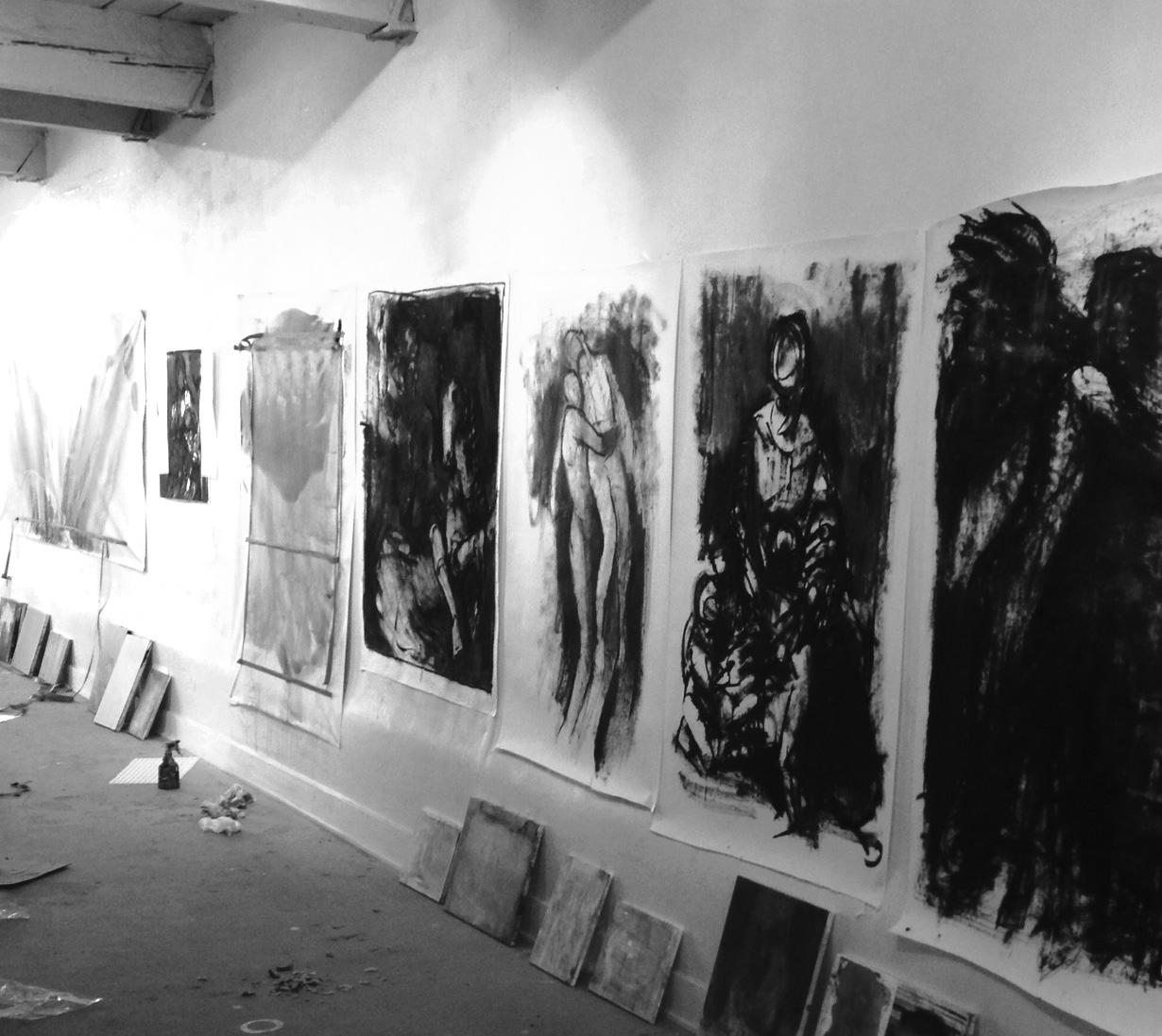
PAINTING IS NOT DEAD! Curated by Hollande Bezan Gallery of Student Art, University of Manitoba
Thursday, Dec. 5 – Dec. 31
“12” – an exhibition of 12 small works by 12 locals artists Tara Davis Studio Boutique
Friday, Dec. 6
Simple Impact by Miss Lyndsay Ladobruk Zsa Zsa West
Saturday, Dec. 7
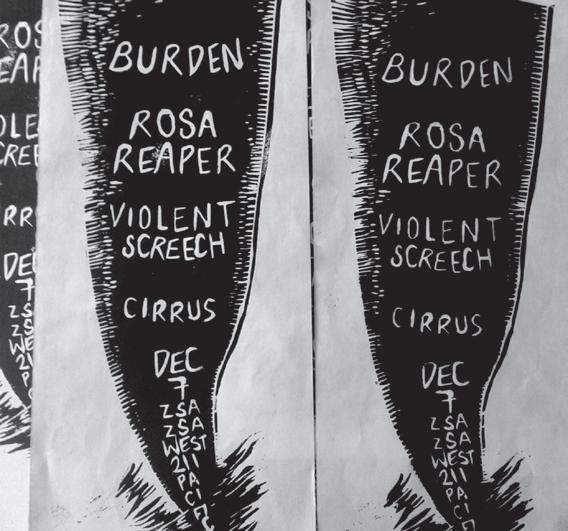
BURDEN / ROSA REAPER / VIOLENT SCREECH / CIRRUS Zsa Zsa West
Friday, Dec. 6 – 7
Saturday, Dec. 7
Ex Modern Teen / The Psychics / The Uncanny Valley Girls The Rose n’ Bee Pub
Saturday, Dec. 14 PUTRESCENCE / ZOMBIE ASSAULT / CETASCEAN / INVERTED SERENITY The Windsor Hotel