Please contact designteam@themanitoban.com if you are interested in submitting a cover image.
For other volunteer inquiries, please come to our office in University Centre (across from Tim Horton’s, behind GOSA) or email the editor of the section for which you are interested in writing.
Please direct all other inquiries to editor@themanitoban.com
Toban Talkback
“Pilot”
3
Talking business with Jeremy Bloom
Olympian and Super Bowl winner gives keynote address at 47th annual Commerce Business Banquet
Quinn Riche R t, staff
Last Thursday marked the beginning of a busy few days for the University of Manitoba’s Asper school of business.
That evening, students and guests from the Winnipeg commerce community attended the school’s 47th annual banquet event. During the afternoon, keynote speaker Jeremy Bloom held a Q&A session in the Drake Centre Fishbowl.
Bloom, a two-time Olympian (skiing), Super Bowl winner, and co-founder of marketing software firm Integrate, spoke to students about his own career and transition from athletics to business. He also provided advice to up-and-coming entrepreneurs.
“So many people come into an interview process and they are a little scared [ . . . ] It is incredible when someone comes in and just blows you away and they can’t wait to start,” said Bloom, addressing a student’s question about the relative importance of interviewing well and
resume padding.
“If you can get an interview, blow them away with your excitement. Pretend that you’re a founder of that company, and you can’t wait. That is way more important than a resume.”
At the evening banquet, Bloom spoke on the theme of managing personal failures. He also discussed his efforts as founder of Wish of a Lifetime, a non-profit organization aimed at granting wishes to the elderly. Bloom announced that Wish of a Lifetime would soon be expanding its operations into Canada.
Towards the end of his talk, he offered students advice on how to build successful enterprises.
“Hire people that are smarter than you and treat them well. That is the reason Integrate has grown and been successful,” said Bloom. “My number one responsibility [at Integrate] is to identify talent, steal that talent, and keep that talent happy. I can’t stress that enough.”
Winnipeg Mayor Sam Katz, Asper dean Michael Benarroch, and TransX owner and founder Louie Tolaini also spoke at the banquet.
Riley George, president of the U of M Commerce Students’
Association told the Manitoban that while the evening banquet is a celebratory event for Asper students, it is also an educational opportunity.
“Every student is sitting at a corporate rep’s table. Aside from hearing Jeremy speak and having a cool night, all the students here are meeting people in Winnipeg’s business community,” said George.
“I know several jobs do get lined up through this night, and companies do use it as a recruiting tool.”
According to George, out-ofclassroom events like the commerce banquet play an increasingly significant role in a complete undergraduate business education.
“I think it doesn’t mean the same thing to have an undergraduate degree than it might have meant 20 or 30 years ago [ . . . ] That is why events like business banquets are important, because it is hard to just get a job without doing anything outside of the classroom,” he said.
The banquet served as the opening event of the National Business School Conference (NBSC) at the U of M. The conference ran through the weekend, and featured a keynote speech by Glen Daman, president of the Dilawri Automotive Group.
Bus driver assaults endemic in Canada
Suspect in recent Winnipeg incident apprehended; city considering hiring WPS transit police
c aleigh MacDonal D, staff
A23-year-old man was recently arrested and charged in connection with a September assault on a Winnipeg Transit bus driver, just the latest Winnipeg example of what has become an outbreak of violent attacks on Canadian bus drivers.
Dwight John Stevenson was charged with the assault of a 50-year-old transit driver. The attack was caught on tape and released to the public by police on Oct. 29. Stevenson was arrested for an unrelated violent incident that took place on Halloween. He is currently being held at the Winnipeg Remand Centre.
The video shows a man getting on a bus, refusing to pay the fare, and upon being refused a transfer, repeatedly punching and kicking the driver.
The attack lasts between two and three minutes, and is stopped only when two other men get on the bus and intervene.
Unfortunately, such incidents are not uncommon across the country.
The Honourable Bob Runciman, in his Nov. 7 statement at the Senate regarding violence against bus drivers, noted what he perceived as an “insufficient response by our justice system” in cases of bus driver assaults, particularly of one that occurred against Ottawa driver John Karagiannis in April. Said Runciman: “I’d like to say this attack was an isolated incident, but it was not. Two-thousand bus drivers are assaulted every year in Canada.”
One such attack, which occurred in Edmonton in 2009, inspired the pro-
posal of a bill—which did not become law—called “Bregg’s Law.” The bill would have introduced harsher sentences for those who assault transit drivers by introducing a “public transit operator” definition in the Criminal Code, thereby making the assault of a driver an aggravating circumstance when sentences were being determined.
This private member’s bill was named after Edmonton driver Tom Bregg who was assaulted by an intoxicated passenger. Assailant Gary Mattson knocked Bregg unconscious, then dragged him off the bus, where he stomped on his head a total of 15 times, putting the driver into the intensive care unit for two weeks and causing him to permanently lose vision in his
left eye.
Mattson pleaded guilty to aggravated assault and has been classified as a dangerous offender, to be held in prison until he is determined to no longer be a danger to society.
The number of assaults in Winnipeg has decreased slightly each year since 2009, but union members and city officials say there is still much left to be done.
James Girden, president of the Amalgamated Transit Union Local 1505—which represents Winnipeg Transit drivers—stated that in Winnipeg alone there have been 36 reported acts of violence against drivers between Jan. 1 and Oct. 31 of this year.
Of the 36, only seven have resulted in arrests and charges being laid – a solve rate of just under 20 per cent.
When asked about the nature of the crimes, Girden said that 20 out of the reported 36 had been related to customers not wanting to pay their bus fares, and 20 involved intoxicated assailants. He also cited a lack of enforcement of bus fares as a possible reason for the prevalence of the attacks.
“It shouldn’t be our responsibility to have to go out there and arm-wrestle a bus fare out of your pocket [ . . . ] they should be ticketing people who are not paying a proper fare, because it’s like stealing a service and it’s got to
be treated as theft.”
When asked what he believed could be a possible remedy to the problem, Girden said, “We need more videos posted like we did the last time [ . . . ] This last video that went out there was a lot of outpouring from the citizens of Winnipeg saying, ‘this is just totally unacceptable on a bus.’”
Other suggestions to increase driver and rider safety have appeared in a specially commissioned Enhancing Public Safety on Transit report. Such suggestions include hiring six police officers specifically for Winnipeg Transit—at a cost of more than $500,000 annually—to attend to some of the more dangerous routes, and handing out tickets, fines, and bans to disorderly passengers.
Other security measures have already been implemented. All 565 of Winnipeg’s Transit busses are equipped with video surveillance and GPS systems, in addition to assault prevention training for all drivers.
Girden said, “99.9 per cent of people who ride the bus are fantastic, and there’s the .1 per cent that creates a problem [ . . . ] but I got to tell you, our bus service is second to none and we are as safe to be riding as the public. It’s just unfortunate that we get these people.”
phOtO by MiKe LatsChisLaw
phOtO by DaVeR112
Chris Hadfield speaks to UMFM about his new book
Hadfield talks career decisions, philosophy of life
gR ace Kenne Dy, voLunteer staff
Last week retired Canadian astronaut Chris Hadfield made a stop at UMFM during his book tour for An Astronaut’s Guide to Life on Earth. Hadfield spoke with UMFM program director Michael Elves about his experiences in space and his career path.
Hadfield’s last five-month mission aboard the International Space Station earned him fans around the world. Hadfield connected with
people on Earth via Twitter and YouTube, posting videos of himself playing guitar in space.
Hadfield told Elves that “space travel is interesting, and it serves a lot of purposes, [ . . . ] but it’s pointless if it doesn’t have some application back to life on Earth.”
He said that understanding the planet is worthwhile to us, but there is also a cultural side to space travel: what it means to us as a species to be
leaving our planet and seeing it the way astronauts do.
Hadfield discussed his initial interest in space exploration, saying that his journey to a career as an astronaut was anything but straightforward.
“It is a wide open idea of having an opportunity way off in the far distance that may some day become possible, and then picking your way through the maze of life so that it improves your chances of maybe get-
ting there someday. [ . . . ] In retrospect, I think a lot of people think it looks like some sort of linear path, and it was not. It was full of dead ends and blind corners and a lot of changed decisions.”
Hadfield said that his career objective influenced how he lived his life, partaking in occupations that suited him more and more each time.
“Each whatever jagged step you take, each reaction to what’s happening [ . . . ] each of those destinations along the way – they are not stepping stones, they are resting places, [in] that if all the stars align, [they] might actually take you even further to the direction you want to go.”
When asked if life’s resting places, as he called them, are comparable to base camps while climbing Everest, he responded, “Only if it didn’t really matter if you climbed Everest or not.”
He said living by a bucket list is the opposite of how he’s lived his life.
“You should wake up every morning with an empty bucket and go to bed every single day with your bucket absolutely full of all the little things that are your true life – because otherwise you walk around your whole life with a partially empty bucket, which seems just like a sad way to live.”
At the end of Hadfield’s book, he addresses the question of what he will do now that his journey in space has ended. He referred to his space
U of M saxophone instructor launches memoir in Winnipeg
Jon Gordon chronicles gritty upbringing in book
L
ast Tuesday, University of Manitoba jazz saxophone instructor Jon Gordon celebrated the Winnipeg launch of his new book, For Sue, at McNally Robinson. Gordon was on hand to read excerpts, take questions, sign copies, and play a few tunes.
The book is an autobiographical account of the jazz musician’s life, focusing on the pivotal role played by his mother, Sue Gordon.
The book deals mostly with Gordon’s early life with his mother, and their struggles growing up poor in New York City in the 1970s.
“I started to become aware around the age of seven, that my mother was bright, funny, talented – a woman that lot of people loved, but who was also profoundly ill. [ . . . ] Sue experienced an incredible series of tragedies, losing her first husband in a car accident [ . .
. ] losing a child to leukemia, another partner who was shot a bar fight, [ . . . ] dealing with drug and alcohol problems, and poverty.”
Gordon was born into a precarious situation. With his mother in and out of rehab and unable to hold down work, the two relied on family and friends to get by.
“At a very young age, I essentially became my mother’s caretaker. [ . . . ] From the age of seven till 27, I was basically trying to save my mother’s life, trying to get her through detox, grand mal seizures, suicide attempts. But I had a lot of help. [ . . . ] I had friends and teachers along the way who really helped me out.”
A few years ago, Gordon went back to university to finish his undergraduate degree and begin his master’s degree, and wound up taking a memoir-
writing course as part of an academic requirement.
“Partway through the course I went on tour to Japan, and I had to complete an assignment for this course, so I wrote a bunch of stories from my past while we were over there. Once I started writing, though, I couldn’t stop. It was very cathartic having this stuff come out.”
Gordon picked up the saxophone at a young age, inspired by the stories his mother told him about her first husband, Bob Gordon, an accomplished jazz saxophone player.
“I started playing sax in the sixth grade. The man who I thought was my father was this great jazz saxophonist, and so of course I wanted to be like him.”
Gordon dedicated himself to his music, and has since become a great
jazz saxophonist, cutting his teeth in New York’s jazz clubs in the 1980s and 90s. Gordon was introduced to Steve Kirby during their shared time at the Manhattan School of Music. Kirby is now a fellow faculty member at the U of M.
“Steve and I were at the Manhattan School of Music together in the late 80s, and we became friends there. However, we’d only seen each other two or three times in the intervening 20 years since then. [ . . . ] I don’t know what made him think of me, but he told me about this opening at the U of M and said I should check it out.”
Gordon got the job and moved to Winnipeg in August to take up a teaching position at the U of M. The jazz program at the university now boasts some highly notable faculty, including Quincy Davis, Derrick Gardner, Will
travel as existing on a long continuum of experiences in life that he is challenged by and enjoys.
“If you only see Usain Bolt when he’s running his hundred metres, then you might think, ‘well gosh, now that he’s reached the finish line, what’s he ever going to do with himself?’ [ . . . ] He loves running [ . . . ] but it’s the life that he loves. [ . . . ] I don’t think that when he gets to the finish line each time he feels that life is over.”
As of December 2012, Hadfield had been an astronaut for 20 years, but he had only been in space for 20 days, a point he made to show that the life of an astronaut is not in space; rather, it is in preparing for space travel.
Hadfield has spoken to the public thousands of times, and said that over this period he has learned that his speeches must teach what is useful about flying in space, all the while capturing people’s attention.
“I’m not just a juggler up there entertaining people. But at the end of it they come away with, ‘wow, that was really good juggling, but I learned some stuff, too,’ and the book is just the result of that.”
To hear the full interview, tune in to 101.5 UMFM on Friday, Nov. 22 between 6:30 p.m. and 8 p.m. and Wednesday, Nov. 27 at 10:30 a.m.
Bonness, and Larry Roy.
“I think what’s going on here is pretty special. [ . . . ] [Steve Kirby] has built an incredible program. He started the regular jam sessions and he started dig! Magazine. There is now a legit jazz scene here, which there really wasn’t even 10 years ago. You have some of the best faculty in the world here, and the cost of going here is a small fraction of what the schools in the states charge. It’s a stunning resource, and an incredible thing for Winnipeg to have.”
Over the years Gordon has played with musicians such as Benny Carter, Aretha Franklin, Lionel Hampton, Harry Connick, Jr., Bruce Springsteen, John Scofield, and Phil Woods.
Gordon will be departing for another Japanese tour this week, playing with Ken Peplowski and others over the course of the four-week tour.
iLLustRatiON by justiN LaDia
Elizabeth Dafoe Library houses extensive indigenous graphic novel collection
New collection to be one of the largest of its kind
Kevin lin K late R , staff
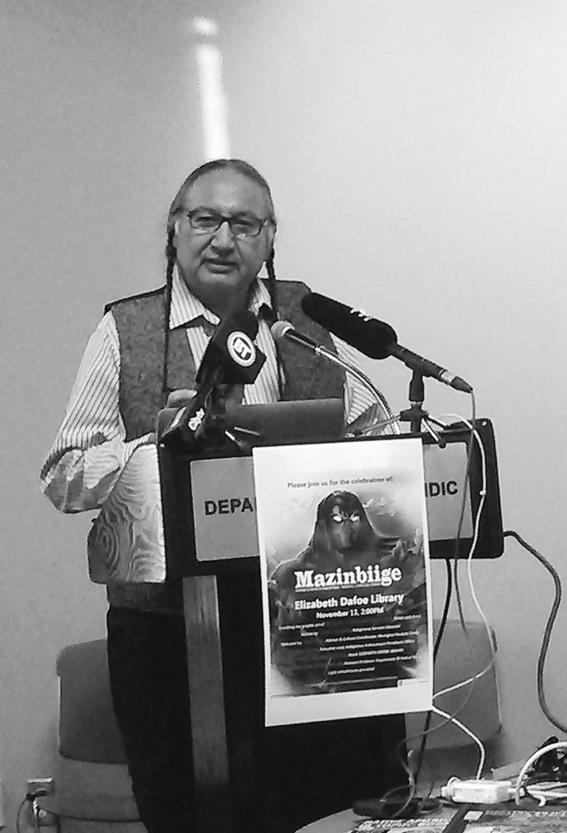
Last Wednesday the University of Manitoba unveiled a new indigenous graphic novel collection, which is to be permanently housed at the Elizabeth Dafoe Library.
The extensive collection contains some 200 pieces from both native and non-native authors, but all the titles have indigenous peoples as their subject matter. Camille Callison, the indigenous services librarian at the U of M, compiled the collection.
The event was well-attended and included an opening prayer from Carl Stone—who is a student advisor and instructor for the Aboriginal Student Centre at the U of M—the artwork of First Nations artist Jay Odjick—whose work appears in some of the titles—and a lecture from Niigaanwewidam James Sinclair, assistant professor of native studies, about graphic novels and comic books as a literary genre.
Sinclair teaches a course at the university on indigenous graphic novels entitled “Super Savages and Aboriginal Images in Graphic
Novels.”
“Graphic novels are the collaboration of words and images to tell stories and histories. They bring together imagery and words in a very powerful way,” Sinclair told the audience in his opening remarks.
He introduced some concepts useful to analyzing graphic novels, and later spoke to the Manitoban about the emerging importance of graphic novels as a literary genre.
“Comic books have traditionally not been very friendly to indigenous people, portraying them as stereotypes, and in rather inhuman ways. But this genre has been something that indigenous people have really adapted as their own, and made really meaningful,” said Sinclair. “It’s amazing how many indigenous artists and writers are now in the graphic novel or comic book genre.”
Red and white poppy disagreement
Students encourage white-poppy-wearing, politicians disagree
c aleigh MacDonal D, staff
Agroup of university students in Ottawa have sparked controversy through the ceasefire.ca white poppy campaign, set forth by Rideau Institute. The pacifist program has attracted the criticism of many nationwide.
The campaign involved the distribution of white poppies with the words “I remember for peace” to the general public in the days leading up to Remembrance Day. Bill Maxwell, secretary of the Royal Canadian Legion’s poppy remembrance committee, feared that the white poppy would be taken as a personal insult to those who served on behalf of Canada.
Veterans Affairs Minister Julian Fantino told the Toronto Sun that the white poppies are disrespectful towards the purpose of Remembrance Day.
“To try and intervene in this fashion, I think, is totally disrespectful, and I would suspect that most reasonable Canadians would see it that way.”
The red poppy plays a significant part in Remembrance Day ceremonies today.
The University of Ottawa students criticized the traditional red poppy movement. White poppy activist Celyn Dufay told Sun News, “Young people don’t want to celebrate war. We want to work for peace.”
Originating in the United Kingdom, the white poppies were introduced to Canada in the 1930s. After 1945 they became less common, but were promoted later during the Cold War to ask for peace.
Peace Pledge Union, a Londonbased pacifist organization that promotes white-poppy-wearing
stated, “The white [poppies were] not intended as an insult to those who died in the First World War—a war in which many of the white poppy supporters lost husbands, brothers, sons and lovers—but [as] a challenge to the continuing drive to war.”
In the publication Common Ground , Geoff Olson wrote that the red poppy represents only one side of sacrifices. The white poppy also represents the losses of civilians and the continued hope for peace, and can be worn to complement its red cousin.
In 2010, the Royal Canadian Legion threatened to bring legal action against a distributor of white poppies. As a result, the original supplier stopped selling the white flowers, only for several other businesses to offer to sell the poppies. Many have voiced their dis -
Callison worked closely with Sinclair to put together the collection, in part to support the course Sinclair is now teaching.
“I first got the idea for this from trying to indigenize the collection of our libraries and indigenize the space [ . . . ] and because there was a course being taught at the academic level, I was able to build this collection. Without that course I wouldn’t have been able to gather and collect all of this material,” said Callison.
Callison emphasized the ethnographic importance of comics and graphic novels in reflecting the attitudes of the larger society, and how that role has changed over time.
“[W]e wanted to show how the portrayal of First Nations people has changed and how graphic novels and comics have either supported or detracted from indigenous people and their struggle for selfdetermination and decolonization,” said Callison.
Three students from Sinclair’s class will be publishing their own graphic novels.
“Some students from the class read a native story by Warren Cariou, [an associate] professor here at the U of M, and adapted it into a graphic novel and are having it published. I think it’s awesome,” said Sinclair.
Callison highlighted the importance of graphic novels and comics in reaching new audiences, especially young people.
“People who wouldn’t have picked up a book and read about some of these issues will pick up a comic book or graphic novel and can learn about native histories and cultures. For young First Nations, this is really becoming a powerful tool to reconnect them to their culture.”
The collection will be available on reserve for students and staff.
appointment at the continued distribution.
“[Veterans] made their sacrifices in blood, and for us to disrespect them, I think the young individuals should really reconsider what they’re doing and get a reality check,” MP Jim Karygiannis told the Toronto Sun
His sentiment was echoed on Twitter by London, Ontario radio host Jeff Wareham who tweeted, “Count me among those who wish to slap anyone wearing #whitepoppy.”
Politicians outside of Veterans Affairs Canada have made it clear that they do not support the white poppy campaign. MPP Catherine
Fife told the Cord , “If you have something that is working then you shouldn’t have to introduce something else. [ . . . ] There are strong traditions within this sector and I think that those traditions exist for a reason.”
MP Ted Opitz of the Conservative Party of Canada echoed this in a call to the Liberal and NDP parties to reject the white poppy pins.
Regardless of the controversy, Dufay said he will not stop handing out the white poppies.
“We can’t account for other people’s feelings, however, no one has a monopoly over Remembrance Day.”
phOtO by QuiNN RiCheRt
iLLustRatiON by gLORia jOe
MANITOBAN
A “volunteer staff” member is defined as a person who has had three volunteer articles, photographs, or pieces of art of reasonable length and/or substance published in three different issues of the current publishing year of the Manitoban. Any individual who qualifies must be voted in by a majority vote at a Manitoban staff meeting. Elected representatives and non-students may be excluded from holding votes as volunteer staff members in accordance with the Manitoban Constitution. The Manitoban is the official student newspaper of the University of Manitoba. It is published monthly during the summer and each week of regular classes during the academic year by the Manitoban Newspaper Publications Corporation.
The Manitoban is an independent and democratic student organization, open to participation from all students. It exists to serve its readers as students and citizens.
16 artists take over the Graffiti Gallery En Masse
a nastasia chipelsK i, staff
Take 16 artists and give them five days, black and white paint, and free reign to transform the Graffiti Gallery, floor to ceiling.
The final result is Collective Chaos, a partnership between Graffiti Art Programming (GAP)—which is celebrating their 15th year—and the En Masse project.
En Masse, based in Montreal, “draws life from the many creative individuals who take part in the project to create large-scale, highly spontaneous drawings in black and white.” Collective Chaos opened on Nov. 14, and until Jan. 15, 2014, the entire interior of the Graffiti Gallery will be covered by the work of the 16 contributing artists.
The final result pulls the viewer between taking in as much as possible—which varies, depending on whether you’re on the main floor or the elevated catwalk, or which corner of the room you’re standing in—and being drawn in from the glorious cacophony to focus on the individual elements.
It is, as the title suggests, a balance between collectivity and chaos.
“To many of the audience the result may appear as ‘chaotic,’ but after spending many hours with other artists and knowing better about them in the environment, I feel that the result is very well controlled,” says Takashi Iwasaki, one of the contributing artists.
Though there are no clear boundaries between one artist’s work and another’s, subtle cues are offered through individual stylistic elements, in the meeting points and transitions between different contributions, as individuals move closer towards collaboration.
“Everyone was a little apprehen-
sive at first. Art tends to be a solitary process and [this collaboration] was probably a little out of the comfort zone for many of us, especially since we were painting minutes after most of us had met for the first time,” says Christian Procter, another contributing artist .
Comfort zones were stretched for many of the artists through working on a larger scale, in different media, with the limitations of only black and white paint. Matt Bohemier says he wasn’t even sure what he was signing up for when he was invited to join the project by GAP artistic director Pat Lazo.
“‘Bring brushes,’ he said. I was under the impression I was just going to help do some filling in.”
And the process, well – that was also up to interpretation.
“There are no rules, create big or small but share the space. Work off each other or go in a totally different direction. Just enjoy creating something. That’s the process from my perspective,” says Rodrigo Pradel, a local artist who specializes in modern pinups.
However, once they got going, a sense of camaraderie quickly developed. Gabrielle Funk and some of the other artists “began to refer to the experience [ . . . ] as a sort of ‘summer camp for artists,’ or ‘better than art school.’ It was a very immersive experience trying to transform the gallery in less than a week and a lot of us didn’t want it to be over when it was complete.”
Lazo, who also contributed to Collective Chaos as an artist, had more of a sense of what to expect. He worked with En Masse in 2012 in Miami, and worked with Jason Botkin of En Masse to make this
Arts & Culture
‘How does the artist decolonize?’
Writer Roewan Crowe and visual artist Paul Robles discuss their recent collaboration on Quivering Land
lu K as thiessen, staff
Anticipation, fear, and pleasure all connect with the adjective “quivering.” In naming her experimental long poem Quivering Land, local author, academic, and curator Roewan Crowe applies all of these meanings.
and knowledge – a metaphor of the human condition [and] a central theme to Roewan’s story [ . . . ] Being able to reconfigure/shape/ slash/trim/reassemble to create new myths, new worlds, hopefully gives the reader/viewer greater options.”
happen in Winnipeg.
“I always welcome opportunities of collaboration as I try to absorb the energy and make mental notes of techniques. It didn’t take long for people to get their groove and just zone out and just create. The music was blaring and the artists just had fun creating art next to or above one another. I was really inspired by the process and happy with the end result,” says Lazo.
One of the goals of the En Masse project is to “nurtur[e] the broadening and solidification of artistic communities everywhere it goes, serving artists from extremely diverse backgrounds,” and the artists involved spoke highly of their experiences in the project, from meeting and befriending new artists to developing a sense of collaboration and sharing artistic influences.
“Seeing how similar we all can be [ . . . ] it’s hard not to be influenced by each other’s work. In fact, I believe it broadens our own visions,” says Pradel.
At the end of the project, Funk found that, “Breaking down my urge to stand out as an individual artist in order to contribute to a project greater than any one aesthetic or style was a humbling and invigorating process and I am so glad to [have] had the opportunity to take part in it.”
Take in Collective Chaos while you can, before Jan. 15, 2014 – ‘cause when it’s gone, it’s gone. See www. graffitigallery.ca for more details. You can support Graffiti Art Programming by purchasing photographic prints of one of the gallery views, or En Masse/Graffiti Gallery t-shirts. Individual artists’ smaller works are also available for sale.
“It is important to me that words remain open, so that possible meanings might begin to proliferate. I was drawn to the word quiver/ing, drawn to tremulous, shaking movement as a gesture, or response, a word that communicates embodied experience. It is a word I can feel in my body.”
Two of the narrative’s characters exist in distinct realms. One, Clem, resides in the Western, which is filled with ghost towns, cowboys, and gunslingers. The other, Violet, is found in her studio making art. For Crowe, this distinction between locations questions the solidity of the Western:
“I also wanted to confine Clem in the Western and Violet in the studio/gallery to see what would happen for them. Is it possible to decolonize the Western? How does the artist decolonize? What are decolonizing actions?”
Crowe explains both her and visual artist Paul Robles—whose work accompanies the publication— begin in a place of abundance, and end up without excess, taking only what is necessary and leaving room for something else to occur.
“Paul’s process of cutting images is similar to my writing process. We both start with a blank page. Paul removes cuts of paper, I remove words. My process involves laying down an abundance of words, intense writing, overwriting, and then I edit down, remove words to create space in the text.”
Robles works primarily with origami paper, approaching it unconventionally by cutting—instead of folding—it.
“Paper can be fragile and vulnerable, yet may hold some power
Decolonization occurs when openness is offered.
“I hope the reader might also find space for their own experiences and imagination. Paul’s images do this too: they are evocative and do not dictate meaning,” Crowe says.
Even in their collaborative process, Robles explains that the work of one did not dictate what the other artist had to do.
“The themes in Quivering that resonate for me and my work were the exploration of the self, to be loved, and the struggles—often violently—to be open and free – to be borderless. The notion of nowhere is “home” – or potentially everywhere, was my interpretation.”
Robles elucidates his understanding of feminism—significant in working with Crowe, who has a feminist approach to her academic career—as part of connecting with those we are not familiar with and who are different from us.
In academia as well as in art, Crowe recognizes a rigidity by which she has chosen not to be confined. Moving across established boundaries speaks to the notion of decolonization.
“Writing territories have been claimed through the use of categorization, language, and power,” says Crowe. “I remember using the word ‘experimental’ to describe my work with a writer who clearly thought I did not fit in this category.
Quivering Land is my experimental poem.”
Quivering Land, published by Arbeiter Ring, is being launched at McNally Robinson at Grant Park in the atrium on Wednesday, Nov. 27, at 7:00 p.m.
phOtO by CaM NiKKeL
iMage pROViDeD by pauL RObLes
Arts & Culture
Getting to the heart of art
Accessible show and sale encourages low-income artists to create and build community
a nastasia chipelsK i, staff
While art-making may be an important part in many people’s lives, making the leap to showing or selling art can be intimidating, especially for lower-income artists. Art From the Heart has been working to change this for the last 14 years, and this year is no different.
“We try to remove as many barriers to participation, for example, by not charging an entry fee and by allowing the artists to keep 100 per cent of sales. We also go out of our way to help people get their artworks to us, and to get them matted and ready for the sale, because some of our members do not have transportation or are homeless,” says Carole O’Brien, coordinator for Art From the Heart.
because of the warmth and welcoming atmosphere of the community and organizers. [Some] artists see each other annually at this show; it is always a very pleasant encounter,” says Nova.
The atmosphere at the show has inspired artists like photographer Andrew Lane to join in.
“The atmosphere in the place and the people who were participating inspired me to think of my own creativity”
—Andrew Lane
“After going to [last year’s show by] Art From the Heart, I think the atmosphere in the place and the people who were participating inspired me to think of my own creativity and how I might be able to express myself artistically,” says Lane.
‘Give it time’
Curator Oliver Botar discusses current exhibition of practicing 90-year-old innovative artist Eli Bornstein
lu K as thiessen, staff
What do you expect from an artist who has lived almost one century? If that artist is 90-year-old Eli Bornstein, expect something magnificent.
Curator Oliver Botar organized
An Art at the Mercy of Light, a show of 20 of Bornstein’s works from 1995 to 2013 at the University of Manitoba’s School of Art Gallery. He explains that the artist is still working regularly.
“He’s making art every day, and he’s making the best work of his career right now.”
Botar refers to Bornstein as one of the most sophisticated Canadian colourists, along with Agnes Martin and Yves Gaucher, and goes on to describe how his labour-intensive and perfectionist approach provides a rare complexity and harmony of colour.
founder of Canada’s longest-running arts magazine, the Structurist The magazine printed its last issue in 2010 after half a century of publishing on the forefront of artistic, cultural, and scientific advancement. Bornstein exemplifies the qualities of the periodical – in May this year he was the only Canadian invited to give a keynote address for the international conference 100 Years of Abstract Art: Theory and Practice at Jacobs University in Bremen, Germany.
Mary Reid—director of the gallery—and Botar partnered with the U of M bookstore to acquire back issues of the magazine. Visitors can purchase many of its 31 issues.
Botar celebrates the journal as an unprecedented achievement.
“It’s entirely unique; there’s nothing like it, even internationally.”
modernism, informed by the work of artists like Piet Mondrian and Paul Cézanne; but the artist’s modernism is not what Botar calls the stereotypical, Clement Greenbergbased genre, which avoided questions of politics, nature, science, or architecture.
Botar said that while interest in abstraction comes and goes regularly, there has been a tendency towards perceptual art in the last 10 to 15 years that is focused on light, such as that found in the work of James Turrell and Olafur Eliasson.
This year’s show includes 120 artists across a wide array of media, from paintings, sketches, and watercolours, to sculptures and other three-dimensional work, as well as textiles.
This year will be Ildiko Nova’s third year in Art From the Heart She got involved after helping out with a community mosaic at Red Road Lodge when she was new to Winnipeg, having just moved from Toronto.
“[This] event is special for me
Lane’s experience affirms O’Brien’s hopes for this event: beyond their mission of “addressing economic and social imbalances in our community,” the show will also help to validate artists’ experiences and skills, and make them feel included in a community.
Experience Art From the Heart and support your local artists on Nov. 22 from 7-9 p.m. and Nov. 23 from 10:30-3 p.m. at the Magnus Eliason Recreation Centre at 430 Langside Street. Find them on Facebook at http://www.facebook. com/events/352975454848197/
“In his early work, he created simpler works, using primary colours on a white background. Over the years, his use of colour has become increasingly complex, although it’s never been baroque. Despite first appearances, there are differences between the colours of his ground planes; the more you look, the more you see how different each tone and hue are.”
Prolonged contemplation is encouraged for visitors to this exhibition.
“You can’t appreciate his works unless you stand in front of them and take time,” says Botar. “It doesn’t give itself up immediately. Give it time.”
Bornstein, described as an elegantly dressed gentleman, is the
The Structurist was different from the average art history journal. It offered excellent scholarship, but it was also the first arts periodical in Canada to publish nature photography, articles on science and technology, and address environmentalism. It was the first Canadian art journal to publish the NASA photographs of Earth from space in 1971. Of the two galleries, the smaller room has three works by Bornstein and all issues of the journal on display.
Botar is a full-time professor and his curatorial work needs to meet certain criteria. His field is early 20th-century modernism, and he occasionally does contemporary art shows.
Bornstein is unique in that he has a firm foundation in early
Turrell’s and Eliasson’s works use projected light while Bornstein’s pieces have the colour contained in the material, but all three artists typify perceptual art’s invitation to learn how to see. Bornstein’s works do not resemble nature, as they are abstract, shares Botar, but they derive their colours and configurations from nature.
Bornstein’s artwork is already visible at the U of M; his freestanding work in greens outside the Architecture II Building has been in place since 2007, and soon, the south wall of the Frank Kennedy Centre will be adorned with the immense piece that once captivated travellers strolling through the old Winnipeg Airport.
An Art at the Mercy of Light runs until Feb. 21, 2014 at the U of M school of art (255 ARTlab, 180 Dafoe Road). Admission is free and the galleries are open Monday to Friday from 9 a.m. until 4 p.m.
A close connection
Alexa Dirks of Chic Gamine and Joey Landreth of The Bros. Landreth
bRyce h oye, staff
T
o the uninitiated, local bands Chic Gamine and the Bros. Landreth have little in common, save for being composed of some of Winnipeg’s most talented young musicians. The Bros. Landreth and their recently released debut album, Let it Lie, have a mellow country and blues-rock sound, while Chic Gamine describes themselves as having a “60s girl-group [ . . . ] straight out of Motown [vibe].”
The Juno Award-winning Chic Gamine started off seven years ago with very little instrumentation, relying more on the sonorous harmonies of songstresses Ariane Jean, Andrina Turenne, Annick Bremault, and Alexa Dirks, as well as beats from the slimmed-down percussion and world beats-driven kit of drummer Sasha Daoud.
Over the years, however, Daoud’s kit has grown; the girls don guitars and play keys regularly, and the Chics’ overall sound has evolved far from its humble a cappella beginnings into something much edgier.
“I hesitate to say we’re more of a rock band, but we are – way more than what we used to be,” says Dirks. “The show [on Nov. 23 at Union Sound Hall] is definitely going to display that to people who think they know what we’re like.”
“We came together as a band of five people that wanted to play together but not necessarily realizing our limitations. [ . . . ] We didn’t want to be an a cappella band, because none of us even listened to a cappella music. But then that inevitably became part of our identity, even though that isn’t
what we really set out to do.”
Chic Gamine’s live show, while still containing some of the same a cappella elements their fanbase loves, is far more aggressive than it once was.
“Over the years we’ve discovered we’re more comfortable stepping out of our comfort zone. We want to present ourselves as what we always heard ourselves as being, which is a full band.”
wheRe BRos. and chic meet
Despite the obvious musical differences, Alexa Dirks and frontman of the Bros. Landreth, Joey Landreth, are as thick as thieves and longtime collaborators. Dirks is credited with co-writing the tracks “Let it Lie” and “Nothing” off of the Bros’ album, Let it Lie. “I’m so proud to be a part of [Let it Lie] in any capacity,” says Dirks.
“Just to watch [Joey] be a frontman and be so highly regarded [ . . . ] it [is] so moving to see him take his place.”
Aside from being great friends and former roommates, the two have coevolved artistically over the past 10 years.
“We started out playing in a Christian rock band [with] Jon Buller,” says Landreth. “Alexa was brought on board as an additional singer. We were 15-16 years old, hated the idea of having a ringer brought in. It was kind of an uncomfortable transition: we were young, probably pretty arrogant, but it sort of turned into a really cool friendship.”
Along with drummer Ryan Voth and Meg Dolovich on bass, Dirks and Landreth later went on to form the
now-defunct band Little Boy Boom (LBB).
Little Boy Boom played the Wednesday slot at a venue then known as Hooligans (currently The Rose n’ Bee) on Sherbrook Street for well over a year, before hitting the big stage at The King’s Head.
“We got an offer from the bar manager at The Kings Head. He came up to me and said, ‘you know, we’re going to steal you guys [from Hooligans].’
It felt like getting a record deal, getting to play The Kings Head,” says Landreth.
“But we never quite made the same connection. What we discovered was that Hooligans had a neighbourhood crowd, and we were expecting that crowd to come with us and they didn’t, because you can’t walk drunkenly home from The King’s Head to Wolseley.”
Little Boy Boom eventually separated. Dirks’ career with Chic Gamine took off and Joey started touring with the likes of country acts Codie Prevost and Doc Walker, among others. Nevertheless, the two remain great friends and are reuniting LBB for a reunion show at Times Change(d) High and Lonesome Club on Dec. 26 at 9 p.m.
“It is going to be a tear-filled show,” says Landreth.
Check out Chic Gamine this Saturday, Nov. 23 at 9 p.m. at Union Sound Hall, 110 Market Avenue.
The Bros. Landreth play Nov. 20 at the West End Cultural Centre alongside Sweet Alibi at 8 p.m., and again on Nov. 22 at 9 p.m. at the Fairmont with Ani DiFranco.
iLLustRatiON by bRaM Keast OF jOey LaNDReth aND aLexa DiRKs
phOtOs COuRtesy OF the bROs. LaNDReth aND ChiC gaMiNe
event Listings
Thursday, Nov. 14 – Jan. 15
Killing it at home
Bison volleyball gives Bobcats all they can handle
Ma Rc l agace, staff
It was an exciting weekend for the Manitoba men’s and women’s volleyball team, as the Bisons hosted the Brandon Bobcats on Nov. 15 and 16. The Bison men swept the visitors, while the women split their twogame series.
The men’s and women’s matches Friday night went the distance, with the Bisons winning both in the fifth set.
In the women’s game, the Bisons came out strong in the first set, but dropped the second and third. Meaghan Robertson tried to serve out the match for the Bobcats with the Bisons sitting on set point, but the comeback came up four points short.
Manitoba jumped out to a crucial early lead in the fifth set and never looked back, winning the match 3-2 (25-18, 18-25, 23-25, 25-21, 15-8). Rachel Cockrell led all players with 20 kills, while Taylor Pischke returned to the Bison lineup to contribute 14 kills and nine digs.
The Bison men got their weekend started with a huge 3-2 (16-25, 25-21, 25-22, 14-25, 15-12) win over the nationally-ranked Brandon Bobcats. After Brandon took the first set handily, the Bisons bounced back in the second and third and ultimately clinched the match in the fifth. Devren Dear, who led all players with 23 kills, was a key contributor to the Bisons’ victory.
In the women’s rematch on Saturday, Brandon reclaimed their second-place position in the Canada West standings by defeating Manitoba 3-1 (24-26, 26-24, 25-20, 25-21). After coming out and winning the first set, the Bisons had an opportunity to go up two sets to none. Unfortunately, 11 second-set attack errors kept Brandon in the game and allowed them to build momentum.
Bisons trample Pronghorns
Manitoba takes all four games against Lethbridge
Mi K e still, staff
T
he U of M men’s hockey team absolutely embarrassed the Lethbridge Pronghorns over the weekend, dominating both games played at the Wayne Fleming Arena at Max Bell Centre. On Nov. 15, a strong defensive performance merited a 3-0 Bison win.
Manitoba started off as the aggressors, outshooting Lethbridge 17-6 in the first period, but could not find the back of the net. The biggest factor in the opening frame was the Bisons playing shorthanded. Manitoba killed four minor penalties, including a 5-on-3 for
almost two full minutes towards the end of the first.
The Bisons built momentum off the opening period’s penalty killing. They set the pace with a number of heavy checks while keeping the play in the Lethbridge zone. Their hard work
Brandon swept the remaining sets for the match. Brandon’s Shanlee McLennan led all players with 18 kills.
The Bison men ended the weekend with another thrilling five-set victory over the Bobcats, winning 3-2 (25-18, 25-20, 21-25, 19-25, 15-10). Dear was once again huge for Manitoba with 18 kills, while teammate Adam DeJonckheere led all players with 20
kills on the night. The women now sit tied for fourth in Canada West with a record of 5-3, while the men’s victories propelled them into a tie with three other teams—including Brandon—for sixth place in the competitive Canada West volleyball conference. The Bisons will travel to Edmonton this weekend to take on the University of Alberta on Nov. 22 and 23.
paid off as forward Luke Cain notched his second goal of the year with 4:04 remaining in the second. The Bisons did not let up, tallying with 1:14 left. Forward Jory Coates’ first career CIS goal gave the Bisons a 2-0 lead heading into the third.
Aaron Lewadniuk notched his team-leading fourth goal of the season just 26 seconds into the third period to give the Bisons a 3-0 lead. Bison goalie Joe Caligiuri had a relatively easy night, stopping all 17 shutout shots. Meanwhile, at the other end, Lethbridge goalie Dylan Tait faced 43 shots.
Head coach Mike Sirant touched on the importance of the victory, saying, “This was a very important win for us tonight. A real important two points so that we can start turning things around, and start the long climb back up into the standings.”
The Bisons continued their climb the following night, picking up an impressive 7-0 victory.
Manitoba took control early on and never let go. Forward Craig Scott opened up the scoring just 2:59 into the first, taking advantage of a helpless Lethbridge defenceman who had lost his stick. The Bisons added to their lead at 14:23 as forward Jesse Paradis scored on a 3-on-1. Manitoba led 2-0 heading into the second period.
The Bisons chased Pronghorn starting goalie Damien Ketlo out of the net in the second period. Dylan Kelly scored for Manitoba just 30 seconds into the frame, putting away a loose rebound. Taylor Dickin then added to the lead at 5:44, stealing Ketlo’s attempted pass away, notching an easy goal. The goal forced the Lethbridge bench to replace Ketlo with Tait. Dickin won his second goal of the game just 16 seconds later. Ian Duval capped off the wild second period with a goal at 13:52 that gave Manitoba a 6-0 lead heading into the
final frame.
The third period didn’t merit much action, the only goal coming at 15:39 as Dickin topped off a great night with the hat trick. Joe Caligiuri recorded his second straight shutout, stopping 23 Lethbridge shots.
Head coach Mike Sirant talked about the importance of having a great start: “We didn’t want to give our opponents any momentum for the game, and to try to take that away from them early, but then also to continue to really strive for a full 60-minute game tonight.”
The Bisons (4-7-1) will now head on the road for a huge weekend set against the UBC Thunderbirds (3-8-1). Games are Nov. 22 at 7 p.m. and Nov. 23 at 7 p.m.
Bison women victorious in Lethbridge
The Bisons cracked the scoreboard twice in the final minute of the first period, holding on the rest of the way to a 4-3 victory against Lethbridge on Nov. 15. Scoring for the Bisons were Kyleigh Palmer, Caitlin MacDonald, and Amy Lee with two goals. Megan Bailey added two goals for Lethbridge, as well as Sadie Lenstra with one.
The rematch the following evening produced even better results for Manitoba as they emerged with a 3-0 victory. Scoring for the Bisons were Maggie Litchfield-Medd, Jessica Rosenbaum, and Caitlin MacDonald. Dée-Ana Marion stopped 22 shots for the shutout.
With the pair of victories, the Bisons improved to 7-4-1 on the season, while the Pronghorns fell to 3-7-2. The next women’s action takes place on the road, as Manitoba faces off against the UBC Thunderbirds with games on Nov. 22 at 7 p.m. and Nov. 23 at 6 p.m.
2013 CFL Player Awards predictions
aDa M peleshaty, voLunteer staff
For the past two years, Adam Peleshaty has correctly predicted the CFL Player Awards. He goes for his third year of perfection in 2013.
most outstanDing player
Jon Cornish, RB, Stampeders
Ricky Ray, QB, argonauts
Going into 2013, some believed Jon Cornish would not be able to duplicate his rushing total of 1,457 yards from 2012 the most by any Canadian. Not only did he duplicate it, he smashed it, rushing for a leagueleading 1,813 yards this season, thanks to nine games where he tallied over
Help needed!
Bombers go headhunting for a new coach
Ma Rc l agace, staff
Newly-appointed Winnipeg Blue Bomber president and CEO Wade Miller made the first decision of the 2013 off-season, firing Tim Burke as head coach on Nov. 13.
The move comes after Burke—in his first full season as head coach— led the Bombers to their worst record since 1998. Burke’s move from defensive co-ordinator to head coach appears to have been a mistake As the Bombers’ defensive co-ordinator, Burke was the strategic mastermind behind the “Swaggerville” defence that made it to the Grey Cup in 2011.
In his media release, Miller appeared to address Burke’s value as a defensive co-ordinator, stating, “If an opportunity does arise for him to join our staff as a defensive co-ordinator, our organization would definitely be open
100 yards.
Ricky Ray also had an impressive season, setting pro football records for a completion percentage of 77.2 and a QB rating of 126.4. Unfortunately his accomplishments—only 10 games— were too few to win the award this season. Jon Cornish will be the third Canadian to win MOP, following Russ Jackson and Tony Gabriel.
most outstanDing canaDian
Jon Cornish, RB, Stampeders h enoc m uamba, LB, Blue Bombers
Barring a failure in logic, Cornish will win this award. Muamba did, however, have a terrific season on the moribund Blue Bomber squad. His 106 tackles led the team and ranked second in the league next to Montreal’s Chip Cox. A free agent going into this off-season, it is a high priority for the Bombers to re-sign him for 2014 and beyond.
most outstanDing
Defensive player
charleston hughes, de, stampeders
Chip Cox, LB, Alouettes
Both players are effective sackmasters. Hughes led the league with 18 sacks this season while Cox had a
team-leading total of 12. But the difference between Hughes and Cox is the latter’s versatility. As well as having 12 sacks, Cox led the league with 114 tackles and also had four interceptions this season. The Als led the league in eight defensive categories and Cox is the main reason why.
most outstanDing special teams player
Rene Paredes, K, Stampeders marc Beswick, LB/st, tiger-cats
Paredes had a record-breaking season converting 54 of 57 field goal attempts for a percentage of 94.7 per cent, while also setting the record for most consecutive field goals with 39 over the 2012 and 2013 seasons. Beswick led the league with 24 special teams tackles. One wonders why Bombers RB/KR Will Ford was not picked as the East nominee. It would have made more sense.
most outstanDing rookie
Brett jones, c, stampeders
C.J. Gable, RB, Tiger-Cats
In his first year of pro football, Brett Jones has been a surprise on Calgary’s sometimes patchwork offensive line. He was the only offensive lineman to play every game for Calgary this season and has per-
formed well in making rushing gaps for Cornish and protecting QB Kevin Glenn. However, Gable is fourth in yards from scrimmage (1,382) while making highlight-reel runs and scoring 12 touchdowns. Although Jones should be acknowledged for his play, those in high-profile positions usually win this award.
most outstanDing lineman
Brendon LaBatte, G, Roughriders jeff keeping, c, argonauts
LaBatte protected Riders QB Darian Durant, which enabled career-highs in touchdowns and QB ratings. LaBatte also created holes for running back Kory Sheets, the only real challenge to Cornish for the league rushing title this season.
As for the converted defensivelineman Keeping, he helped protect both Ray and backup QB Zach Collaros. The Riders, however, allowed fewer sacks and had more rushing yards. Considering LaBatte unseated reigning MOL winner Jovan Olafioye of B.C. for the West Division nomination and the award ceremony is in Regina this year, the Roughrider may be the winner.
to exploring this with Tim.”
Currently, Winnipeg, Ottawa, Edmonton, and Montreal are all searching for a new head coach. Here are Winnipeg’s top candidates for the opening:
1. marcel Bellefeuille
Bellefeuille was brought in to replace Gary Crowton as Blue Bomber offensive co-ordinator midway through the 2013 season. Bellefeuille has 18 years of coaching experience, including three years as head coach of the Hamilton Tiger-Cats, from 2008-2011. Seeing as he’s already on the payroll, if Miller and company were satisfied with his performance as offensive co-ordinator, he would be the easiest pick.
2. khari jones
Khari Jones is a Winnipeg legend. Although he never won a Grey Cup in Winnipeg, he played pass and catch with Milt Stegall in his prime and was part of some very exciting Bomber teams in the early 2000s. While his performances on the field cemented him as a quarterback legend, Jones doesn’t have the coaching portfolio the Bombers should be looking for during such an important rebuild. He only has four years of coaching experience –three as a quarterbacks coach and one year as an offensive co-ordinator. He started his coaching career as support staff to the Bellefeuille-led Ti-Cats. If the Bombers tap Bellefeuille, Jones may join as offensive coordinator.
3. jacques chapdelaine
Chapdelaine is arguably the most sought-after interviewee for the position of head coach heading into this off-season. With over 10 years of coaching and offensive co-ordinating experience – including two Grey Cup rings as offensive co-ordinator for the B.C. Lions in 2006 and 2011, the 52-year-old Canadian has potential to be the next great CFL head coach. Unfortunately for the Bombers, he’s going to be highly sought after. This means he might be less inclined to join the mess in Winnipeg when he could spearhead a fresh start in Ottawa or help the Alouettes out of their postCalvillo funk.
4. milt stegall
In response to Burke’s firing, Stegall took to Twitter with the following message: “The Bombers need a head coach. I’m finally ready to make that move.
Wade Miller you owe me an interview. If not me, WHO should it be?”
Stegall has always been quick with jokes, and he was clearly having some fun with the tweet. Besides, have we learned nothing from Wayne Gretzky’s stint behind the bench for Phoenix?
Being the greatest to ever play the game doesn’t mark you as a capable coach.
5. paul Lapolice
If Miller talks about bringing Burke back on as defensive co-ordinator, then why not continue to undo all of former GM Joe Mack’s mistakes by bringing back LaPolice? After leading the Bombers to an unexpected Grey Cup berth in 2011, LaPolice was unceremoniously fired by Mack. Since his dismissal, he’s been a regular contributor to TSN’s CFL broadcasts as a coaching analyst.
iLLustRatiON by CaROLiNe NORMaN
phOtO by beibei Lu
Bisons bruised by Dinos
Basketball fails to produce win in weekend set
Mi K e still, staff
It was an unsuccessful weekend for the Bison men’s and women’s basketball teams, as neither could pick up a victory at home against the Calgary Dinos on Nov. 15 and 16.
The women started things off early Friday afternoon, dropping the first game of the weekend 67-58.
Due to poor discipline on Calgary’s part—the Dinos committed nine first quarter fouls— the Bisons got out to an early lead. Manitoba was in the bonus just over four minutes into the game, and took a 16-12 lead after one quarter of play.
Calgary picked up their tempo in the second quarter. The Dinos took hold of the lead just over three minutes in and never let go. Tamara Jarrett led the charge for the Dinos, going 8-for-8 from the free-throw line. The teams headed into the half with Calgary leading 32-26.
Based on strong rebounding and second and third chance points, Calgary pulled away in the fourth quarter, determining the pace of the second half and extending their lead to as much as 16. Calgary outworked Manitoba as the game went along and held the Bisons to 21-for-60 shooting overall in the win.
Jarrett led all scorers with 14 points, while Sheree Carmona-Galdamez pitched in 11 points for the Bisons.
Bison co-head coach Michele Hynes touched on her team’s energy level as a whole, saying, “We talk about it all the time, we are really good when we have five people on
the floor playing really hard at the same time.”
“We didn’t have a lot of five people playing hard today.”
The two teams met again the following afternoon as Manitoba looked for some revenge. The Bisons fought hard, but came up just short, losing 65-63.
Calgary opened up an 18-9 lead in the first quarter, and took a 30-23 lead into the half. Jessica Thielen led the Dinos by going 3-for-3 with seven points in the first half.
The third quarter was much of the same. Calgary was fierce on the boards, out-rebounding the Bisons 8-6 on the Manitoba glass, and opening their lead up to 13 after three quarters.
The Bisons showed tons of resolve in the fourth quarter, getting back into the game on the strength of their three-point shooting. Robin Eyer and Jenilyn Monton each hit two from beyond the arc, leading a 15-1 Bison charge with just under six minutes left to play.
Manitoba took their first lead of the game with 3:21 remaining but were unable to hold on as Calgary jumped ahead on a pull-up jumper from Kristie Sheils in the final minute. The Dinos survived Manitoba’s late push to pick up the 65-63 win.
Bison co-head coach Michele Hynes was proud of her team’s overall performance, saying, “We have been in a lot of tight games this year already. It was nice to see some dif-
ferent players step up and I thought we had a good fight.”
With the pair of losses, the Bisons fall to 3-3 on the season, while Calgary improves to 4-2. The next Bison action takes place in B.C., with games on Nov. 22 against the Victoria Vikes at 8 p.m. and Nov. 23 at 7 p.m. against the UBC Thunderbirds.
The men’s basketball team continued their early season woes, falling 86-66 to Calgary at home late Friday afternoon.
The game started out fairly close, with the teams managing nearly identical shooting success. Manitoba was 7-of-17 in the first, whereas Calgary shot 7-of-18. The Dinos took the lead in the dying seconds of the quarter and headed into the second up 18-16.
The Dinos pulled away in the second quarter. Calgary was led by Matt Letkeman’s 11 second quarter points, while Winnipeg native Jared Ogungbemi-Jackson pitched in nine points—including a last second three pointer—which gave Calgary a 16-point lead heading into the break.
Calgary continued to outwork Manitoba in the second half. They maintained a double-digit lead through the third and fourth quarters en route to their first win of the 2013-14 regular season.
The Dinos got major production from Letkeman, who was hard to defend in the paint, and led all shooters with 21 points. Mike Holloway
led the Bisons with 12 points and provided energy all game.
“It’s a bit of a gut check,” said Bison head coach Kirby Schepp, speaking about his team’s performance after the game.
“It’s a matter of as a man, how do you feel when somebody out-physically-competes you, and see the way we respond from that.”
The Bisons had a far stronger performance on Saturday afternoon but could not pick up the win, losing an overtime thriller, 89-87.
Calgary led by nine after one quarter, and 10 at the break. Ogungbemi-Jackson led all scorers with 14 points.
The Bisons were a determined force in the second half, picking up their intensity and tying the game with 10 seconds remaining in the third quarter. Ogungbemi-Jackson, however, hit a clutch three-pointer at the buzzer to give the Dinos a 62-59 lead heading into a crazy fourth quarter.
The Bisons took their first lead of the game two and a half minutes into the fourth on an Amarjit Basi layup, but it was short-lived. The Dinos retook the lead and led 78-75 as Calgary headed into the final 90 seconds. Basi worked his magic again, scoring a clutch runner with just 23 seconds left, bringing Manitoba to within one. Ogungbemi-Jackson was fouled, but hit only one of two free throws, setting up a dramatic final 11 seconds.
The Bisons put their trust in Basi and it paid off. He darted through the lane and hit his third clutch shot of the game, sending the game into overtime.
The overtime session went back and forth with the majority of points being scored at the free throw line due to the aggressive play from both sides.
The key play of the overtime period occurred in the final 30 seconds with Manitoba down 88-87. Basi could not convert on a layup opportunity, forcing the Bisons to commit a foul. Philip Barndt of Calgary only hit one of two free throws, which opened the door for Manitoba to either tie or win the game in the final six seconds. It was not to be, though, as Yigit Ozsaynier missed a last-second three-pointer, giving Calgary the close win.
The Bisons had five players score in double digits, led by Basi who put up 23 points.
“We were much more competitive today which was nice to see,” said coach Schepp. “You hope sometimes that that competitiveness is rewarded and today, it wasn’t.”
With the defeat, the Bisons fall to 1-5 on the season. Calgary, meanwhile, earned their first two wins and improved to 2-4. The men travel to B.C. this weekend, with games on Nov.22 at 8 p.m. against the Victoria Vikes, and Nov. 23 at 7 p.m. against the UBC Thunderbirds.