graphics eDitor Bradly Wohlgemuth graphics@themanitoban.com / 474.6775 photo eDitor Beibei Lu photo@themanitoban.com / 474.6775 D
r eporters
n
Volunteer Contributors
Will Gibson, Ce Zhou, Gloria Joe, John Stinzi, Keegan Steele, Michael Lee, Chris Hearn, Justin Ladia, Michael Carlisle, Jodie Layne, Grace kennedy, Adam Peleshaty, Caroline Norman, Aaron Pierre, Duncan McNairnay
n at I onal & Mult I -Market a dvert I s I n G Campus Plus Media Services
Toll-Free (In Canada): 1.800.265.5372
Email: info@campusplus.com
Canadian Publications Mail Product Sales Agreement #589160
A “volunteer staff” member is defined as a person who has had three volunteer articles, photographs, or pieces of art of reasonable length and/or substance published in three different issues of the current publishing year of the Manitoban. Any individual who qualifies must be voted in by a majority vote at a Manitoban staff meeting. Elected representatives and non-students may be excluded from holding votes as volunteer staff members in accordance with the Manitoban Constitution.
The Manitoban is the official student newspaper of the University of Manitoba. It is published monthly during the summer and each week of regular classes during the academic year by the Manitoban Newspaper Publications Corporation.
The Manitoban is an independent and democratic student organization, open to participation from all students. It exists to serve its readers as students and citizens.
U.S. audit raises concerns about food processing in Canada
Caleigh MaCDonalD, Staff
Areport recently released by American health inspectors said that Canadian food is safe enough to be exported – but barely.
The report, written in 2012 and only made public last month, expressed concerns over both the cleanliness of the facilities examined and the welfare of animals being processed within.
The inspection assessed conditions at seven food-processing plants, five Canadian Food Inspection Agency (CFIA) offices, and two laboratories. Eventually Canada’s system was graded as “adequate.” According to the standards of the grading scheme, this is the lowest possible evaluation a country can receive while retaining the right to import foodstuffs into the United States.
Alberta’s XL Foods, which was at the centre of a massive meat recall in 2012, was one of the plants to have been found with violations.
The report described greasy spots on conveyor belts as well as malfunctioning herding gates that would fall on, and injure animals as they awaited slaughter. Steel bolts jutted out from
walls risking injury to animals, and dust was found on ventilators and blowers, a potential source of product contamination. Another processing plant was reported to have rusted pipes and flaking paint.
University of Manitoba food scientist Claudia Narvaez said she is not surprised by the findings, and called the results of the audit part of “a long-standing problem.”
In order to be a legally operating food processing company, procedures to ensure food safety are required. These mandatory procedures are called Good Manufacturing Practices (GMP), Sanitation Standard Operating Procedures (SSOP), and Hazard Analysis and Critical Control Points (HACCP).
ing management and employees in the importance of their role producing quality and safe foods.”
“[But] often the employees do not clearly understand the importance of their role within the food production industry. It is difficult to answer why exactly this is happening,” said Narvaez.
food recall system as requiring serious improvement, outlining several shortcomings before parliament last November.
According to Ferguson’s report, the CFIA frequently failed to adequately document the various processes of recalls, and failed in many cases to follow up on routine food recalls.
The report described greasy spots on conveyor belts and malfunctioning herding gates and cages that would fall on and injure animals
Narvaez says while the processes may be in place on paper, that doesn’t always mean that they are followed through.
“SSOP, GMP, and HACCP system depends on educating and train-
She suggested a lack of emphasis on food safety, lack of employee education, poor training programs, inexperienced personnel, and unrealistic workloads as possible sources for some of the problems found by the audit.
“You can find all sorts of difficult situations,” she said.
Canadian auditor general Michael Ferguson also pointed to the CFIA’s
“We felt that there was confusion with the agency, who was making decisions, and also some confusion between the agency and the companies involved in those recalls,” Ferguson said at a press conference.
That documentation, according to Narvaez, is paramount.
“For SSOP, GMP, and HACCP systems, monitoring and record keeping are essential. This is one of the reasons that these programs are difficult to successfully maintain, and why people have to be committed with it,” she said.
“If one single link fails, the whole
news briefs
By Quinn Richert, staff
system could fail.”
The American report did note that immediate corrective action had been taken by the CFIA with regard to all of the audit’s recommendations.
Director of CFIA’s meat programs division Richard Arsenault recently told CTV News that while the organization is treating these findings seriously, Canadians need to remember that the system did get a “passing grade,” and that the CFIA is “just as confident in the [American] system as [they] are in [theirs].”
He further stressed that Canadians should not worry about the report because “the system is working and the system will and can continue to improve.”
Dr Narvaez shares his belief.
“I firmly believe that the food industry, the government, and universities need to work as a team to meet this goal,” she said.
“The good news is that this is a problem we can address and fix to improve Canada’s food safety system.”
military issues memo on whistleBlowers
Lt.-Gen. Marquis Haines of the Canadian army distributed a memo to service members recently announcing his commitment to disciplining service members caught leaking confidential military information to the press.
“As in the previous year, the Army is still experiencing instances of information and documents being released, or ‘leaked’ to media agencies and other unauthorized recipients,” reads the document.
“I intend to pursue disciplinary action against any member of the Army who is found complicit in the unauthorized leak of information.”
The memo was only made public after CBC expressed their intention
to file a request under the Freedom of Information Act.
senate auDit on the way
Auditor General Michael Ferguson is about to begin an investigation into the spending history of the Canadian Senate.
The audit, which will reportedly be the most rigorous examination of senators’ expense claims in Canadian history, will require individuals to procure receipts for purchases listed as “senate business.”
Those under review may also be subjected to physical examinations of their Ottawa-area residences, and interviews with their neighbours may be conducted.
Ferguson’s forensic audit is a far cry from the “honour system”
scrapped by the senate earlier this year, which only required the term “senate business” to be logged to track expenses.
canaDian journalist imprisoneD in egypt Mohammed Fahmy, a CanadianEgyptian working with Al Jazeera remains in custody after he was arrested in Egypt late last month along with two other members of his team. Multiple news agencies around the globe are now calling for their release.
Egypt’s Interior Ministry accuses the journalists of disseminating information on behalf of the Muslim Brotherhood, which is considered a terrorist organization by the government.
protests in QueBec
People are taking to the streets in Quebec to mark their opposition to the province’s Bill 60, which prohibits public employees from donning religious regalia at work.
The peaceful protests are organized by a group called Support the Others. Demonstrators are making a point of wearing religious symbols at rallies and also in at least one workplace.
The bill, also known as the Quebec Charter of Values, is expected to be a key point in the province’s upcoming elections.
ariel sharon Dies
Former Israeli Prime Minister Ariel Sharon passed away last week-
end at the age of 85.
He was laid to rest in a state funeral attended by United States Vice-president Joe Biden, where he was acknowledged as an aggressive leader and a key figure in Israeli history.
“Like all historic leaders, Prime Minister Sharon was a complex man [ . . . ] who engendered strong opinions from everyone,” said Biden during his eulogy for Sharon.
“But like all historic leaders, all real leaders, he had a North Star that guided him – a North Star from which he never, in my observation, never deviated. His North Star was the survival of the State of Israel and the Jewish people, wherever they resided.”
U of M Bangladeshi students and grads protest violence against religious minorities
Politicization
of religion – a growing concern for some
in Bangladesh
Violence and turmoil rocked Bangladesh leading up to, and during the national parliamentary elections held Jan. 5.
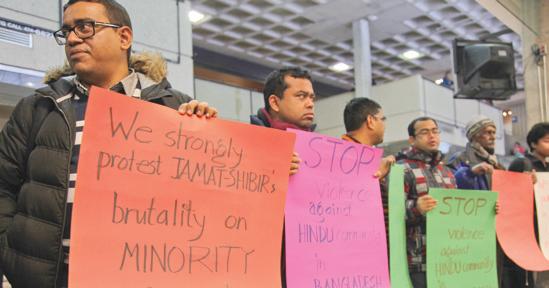
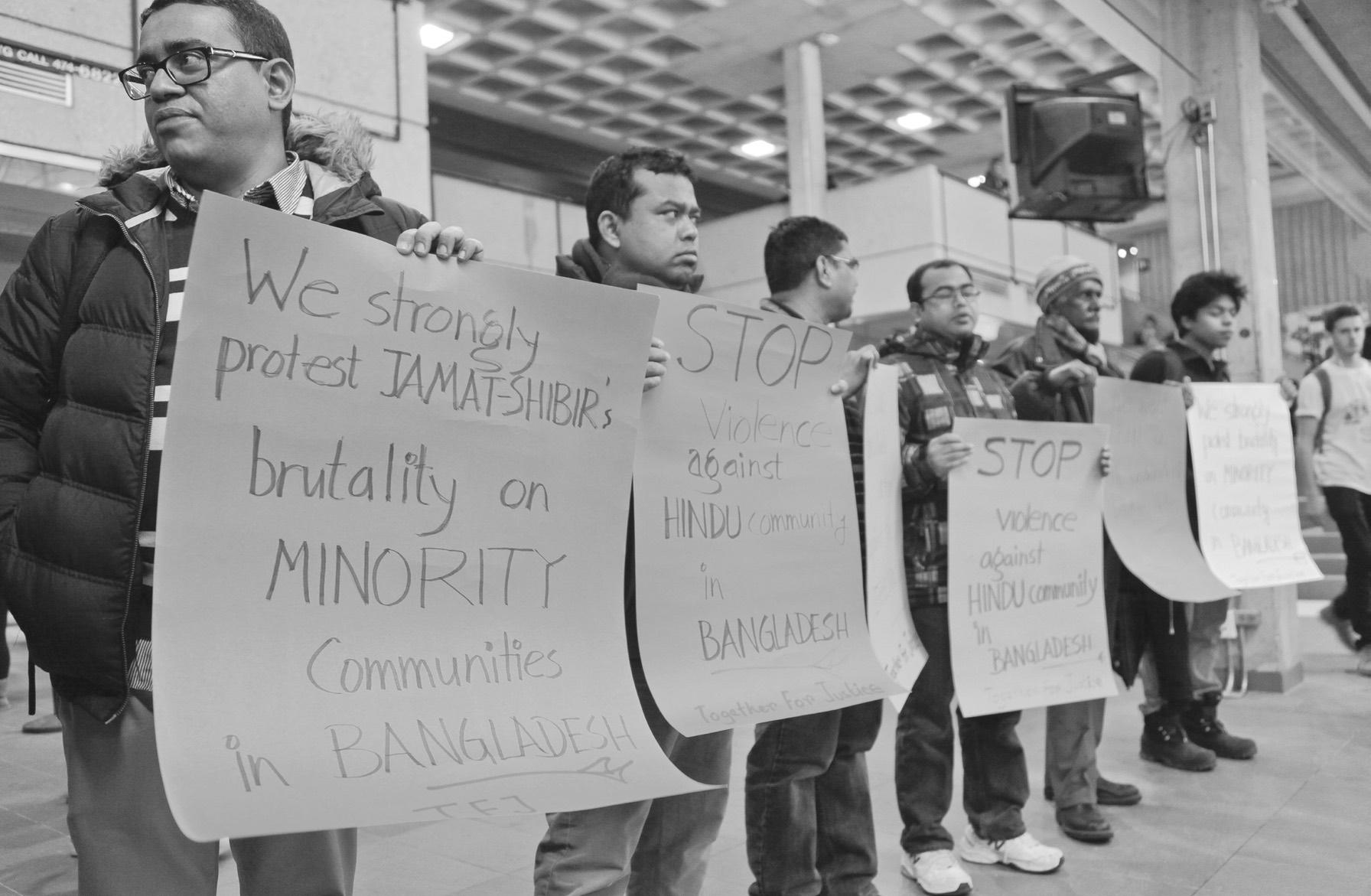
A group of U of M alumni and students brought to light some of the issues facing the densely populated South-Asian country, holding a protest in university centre last Friday.
“Our concern is to show support for our brothers and sisters in the minority communities, and at the same time to make people aware that these attacks are happening, and are orchestrated in a very specific way: so that the minorities do not participate in any sort of democratic process in Bangladesh,” said Ahmed Tazmeen,
a PhD student in the faculty of economics.
“There are religious parties that are encouraging attacks on minorities. We want punishment for those who are attacking people, no matter what party they come from. [ . . . ] We aren’t favouring any political party. We want justice and equality for all Bangladeshi people.”
The ruling Awami League was re-elected in an election boycotted by the main opposition, the Bangladesh Nationalist Party (BNP). Voter turnout was low.
The BNP ruled Bangladesh from 2001 to 2006 in a coalition with rightwing religious parties, including
Jamaat-e-Islami.
“[Jamaat-e-Islami] are adding this religious aspect into politics to create instability throughout the country. We don’t identify as a religious group, we are an ethnic group – the Bangali people. We speak [the] same language – Bangali. That’s our unity. It’s not from religion. But now there are some political parties using religion, and creating hatred against people who don’t share their view,” said Tazmeen.
Ranjan Saha, a graduate student in the faculty of computer science, emphasized Bangladesh’s multicultural identity.
“In Bangladesh, every religious
LGBTTQ* ally training offered at U of M
Student groups host 2-part Rainbow Resource Centre course
Quinn ri Chert, Staff
Last week, the University of Manitoba Students’ Union (UMSU), the UMSU Womyn’s Centre, and the Rainbow Pride Mosaic (RPM) jointly organized and held part one of a two-part LGBTTQ* ally training course in the UMSU council chambers.
The program offers participants 6.5 total hours of training in a designated safe space, and is free for all U of M students.
A sizable chunk of the first session was spent establishing a common vocabulary for discussing sexual orientation – though session leader Tara Lambert was careful to point out the potential pitfalls of attempting to neatly and concisely define a universal terminology.
Also on the agenda for the Jan. 7 meeting was an interactive look at the gender normative bias of everyday language: participants were asked to pair off and carry out a discussion without the use of gendered pronouns, and followed-up with a discussion of how and why such language is occasionally problematic.
In keeping with the safe space policy of the training, participants declined to be interviewed or otherwise identified by the Manitoban UMSU women’s representative Charly Wreggit, who helped organize the course, said that the Womyn’s Centre, along with UMSU and RPM, try to hold at least two or three training sessions per year, and that this was the first session to be offered since
August.
“I think it’s important for people to be aware of the issues that the [LGBTTQ*] community faces and to acknowledge the history of oppression,” said Wreggit.
“It’s a great way for people going into all aspects of the workforce, to learn ways to be supportive of LGBTTQ* individuals, and to gain awareness of appropriate language. For example, asking individuals if they have a partner versus asking if they have a boyfriend/girlfriend, to not use insulting/ derogatory language, et cetera.”
Wreggit has been working with the Womyn’s Centre for a year and a half, and took the same ally training course last year.
“The session I attended was pretty
group [ . . . ] has national holidays, for Christmas, for Eid al-Fitr, so we are talking about multiculturalism. That’s Bangladesh. We have been living—all religious groups—together for centuries, thousands of years, and we didn’t have any problems. And now some are trying to invent this division and create conflict between Bangladeshis for political purposes.”
Bangladesh has had a troubled political history. Formerly East Pakistan, the territory fought an eight-month war of independence in 1971 in order to secede from West Pakistan, which had dominated the country’s political and economic affairs.
Jamaat-e-Islami collaborated with Pakistan during the war and was against the movement towards an independent Bangladesh. Today, the party seeks closer ties with Pakistan, Saudi Arabia, and the creation of an Islamic state within Bangladesh.
The government of Bangladesh recently executed a senior leader of Jamaat-e-Islami, Abdul Quader Mollah, after accusing him of war crimes during the 1971 war of independence.
This brought to the surface underlying tensions within Bangladeshi society. Those who wish to see the country become an Islamic state with a conservative social system underpinned by Islamic (Sharia) law, and those who want to preserve the country’s secular, multi-religious identity, battled it out in elections and on the street. A similar tension is being played-out in many Muslim majority countries across the world.
Anthropology student Rumel Haldar drew a connection between
evenly mixed between students who identified as LGBTTQ* and as hetero, which led to great discussion on comfort levels while in public with partners of same versus different sex,” said Wreggit.
The ally training offered at the U of M is one of a whole catalogue of courses offered by the Rainbow Resource Centre (RRC), which also provides counseling, a library, and peer support groups for LGBTTQ* individuals.
RRC education coordinator Reece Malone told the Manitoban that the ultimate goal of ally training is to offer a forum for open discussions of homophobia, thereby reducing harm and creating healthier spaces for LGBTTQ* individuals.
“All our training sessions are to provide a broad perspective on the lives of lesbian, gay, bisexual, transgender and two-spirit people and to inform the public the impacts of homophobia, biphobia, transphobia and heterosexism,” said Malone.
“Thereafter, we hope that individuals leave with greater knowledge and
the struggle for independence over 40 years ago, and the current tensions.
“These are the same people who attacked Bangladeshi people in 1971, who assisted the Pakistani army to carry out massacres. Pakistan has a particular state ideology and that is what Jamaat-e-Islami follows, and they want to establish the same state ideology in Bangladesh. Our country is far removed from that kind of religious based, [ . . . ] narrow kind of policy. We are more of a liberal kind of state, in terms of religion, in terms of feelings of nationality.”
Since gaining independence in 1971, however, the country has seen its large minority Hindu population dwindle – once constituting 28 per cent of the population, Hindus accounted for only 9.6 per cent in 2001.
“There is a kind of gradual ethnic cleansing going on in the name of religion, and in the name of politics and elections. They are saying ‘Hindus are the enemy, they are allied to India, we have to get rid of those people from our holy Islamic land,’ but Bangali people, we don’t believe that,” Tazmeen told the Manitoban “When we talk about ethnic cleansing, it’s not in the form of massive massacre[s] or anything like that. It is more in terms of intimidation, forced eviction, taking property, and things like this.”
“Our fear is that if Jamaat-e-Islami is able to have a strong hold somehow, the whole situation may escalate towards that. The forced eviction[s] and intimidation may lead to systematic killings and a worse situation for minorities.”
practical tools on how to create a more LGBTTQ* positive and nurturing environment.”
According to Malone, who has been coordinating RRC’s education programs for seven years, the centre has provided various training programs at the U of M before, even working with several faculties including nursing, education, medicine, and social work.
“We also work as a student placement agency and have several U of M students complete their hours with us,” adds Malone.
Moreover, RRC has its roots at the University of Manitoba where it began in 1972 as the Campus Gay Club, and one year later became Gays for Equality.
The second part of the January ally training sessions will be held in the UMSU council chambers on Jan. 14 at 5 p.m. In order to receive recognition for completing the training however, students are required to have attended the first session. Another ally training class is being planned for the spring following final exams.
phOtO by bEibEi Lu
Senate scrutinizes International College of Manitoba at monthly meeting
Controversial college delivers annual report to the senate
The U of M senate convened last week for its monthly meeting, where the International College of Manitoba (ICM) presented its annual report on college operations.
David Collins, U of M vice-provost of academic planning and programs, read highlights from the report in the senate chamber. Collins sits on the UM/ICM Academic Advisory Committee, along with three other U of M faculty members and three faculty members from ICM. The ICM Advisory Committee plays an important role in overseeing the activities at the college, and writes a report after each of ICM’s three academic terms.
Enrolment at ICM has grown from 11 students in August 2009 to 144 in August 2013. With it, the number of students going on to study at the U of M has risen from 23 full- and part-time students in 2009-10, to 237 full- and part-time students in 2012-13.
To date, 825 students have graduated from the ICM program. Seventeen per cent of all international students at the U of M were also previously students at the college.
The financial impact this has had on the university is considerable.
“ICM pays a royalty to the university, and in 2012‐13 the royalty payments totalled $1.7 million, bringing the amount paid since ICM’s inception to $4.6 million,” according to the report.
Students at ICM paid $148,000 to the U of M in the form of student service fees in 2012-13, and enrolment in university Englishlanguage programs brought in another $238,000. “The dollar value that is generated is significant. [ . . . ] To this point, the univer-
sity has obtained just over six million dollars from the relationship with ICM,” Collins told the senate.
ICM has been accused in the past of being misleading about the relationship it has with the university.
Students attending ICM pay between $12,480 and $13,395 a year to attend the college’s “pre-university” and “university level” programs.
Susan Prentice, sociology professor at the U of M, raised concerns that students coming from ICM do not have the same suc cess rates as other students in the faculty of arts – typically having marks one full grade point below that of other students.
“One of the main reasons the campus welcomed ICM in was with the promise of accelerated, exceptional, unusual sup ports to facilitate the inte of international students, and if the outcomes aren’t bearing that out, it raises questions about the efficacy of the program and perhaps the welcome that’s being offered.”
Manitoba chapter of the Canadian Federation of Students launches new campaign aimed at eliminating interest on loans
Actions held at the U of M campus bring attention to student debt
Ke V in lin K later, Staff
Last week the Canadian Federation of Students (CFS) undertook a series of actions on the U of M campus to launch a new campaign aimed at eliminating interest on student loans.
The CFS took over the Fireside Lounge for three days last week, engaging and raising awareness about the rising debt loads of students in Manitoba.
Bilan Arte, president of the Manitoba chapter of the CFS, sat down with Manitoban to talk about the initiative.
“Students have identified the exact same issue over and over again; we need to address the fact that for those domestic students that have provincial student loans, the average [loan] balance is close to $25,000 per student,” she said.
Students in the province are increasingly taking on debt as tuition levels have
Brendan Hughes, executive director of career services at the university, has seen the
effects of rising tuition fees.
“When students contact us, they’re usually worried about affordability. They’re trying to find a job to pay for tuition, whether it’s a job while you’re a student or after you graduate, and typically it does come up as that anxiety. I think we’re entering a generation of debt.”
Arte pointed out that the current loan system makes those who are less able to pay for education pay more when interest on loans come due.
“When students are paying back interest on top of their loan, students usually end up paying 20 per cent more than a student who was able to pay up front. We are calling on government, as part of the Manitoba 2014 budget, to eliminate interest rates on provincial student loans.”
The provincial budget will be released in the near future, and Arte hopes the campaign will put pressure on the government to increase support for post-secondary education.
The province is in a financially restrained position and has been in a deficit situation for several years, previously promising to balance the budget by 2016.
Manitoba is facing a dire long-term fiscal situation as rising health-care costs are projected to eat up an increasingly large part of the provincial budget, possibly squeezing out funding for other priorities such as education.
event Listings
The arts events to attend this weekend
viSual arT MuSic oTher
Monday, Jan. 13 until Jan. 17
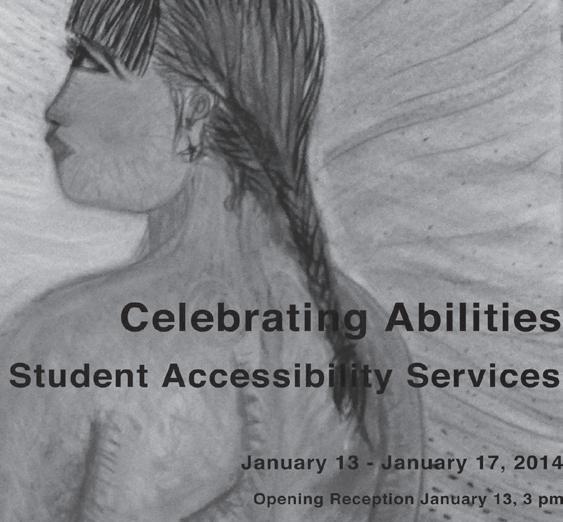
Celebrating Abilities curated by Student Accessibility Services
GoSA Gallery at the University of Manitoba
Thursday, Jan. 16 until Feb. 15
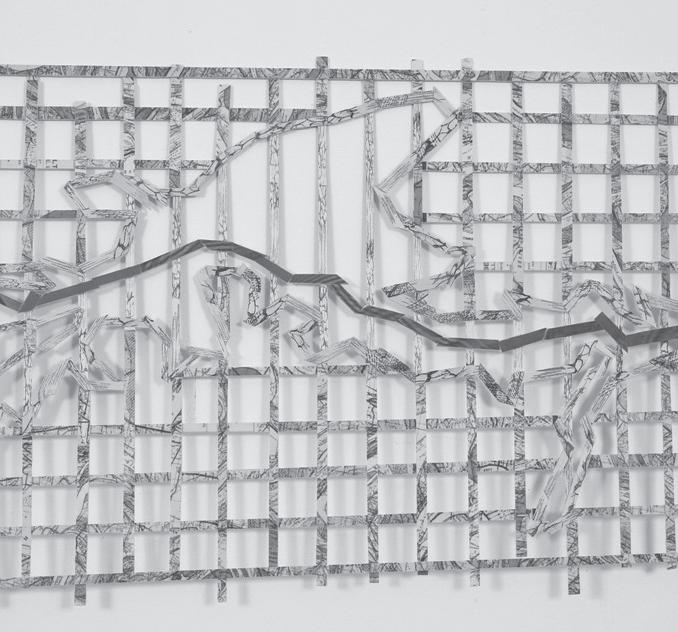
Water Memory Table by Patrick Mahon Gallery 1C03 at the University of Winnipeg
Friday, Jan. 17
Apparatus by Andrew J. Milne RAW: Gallery of Architecture and Design
Thursday, Jan. 16
Thursday, Jan. 16
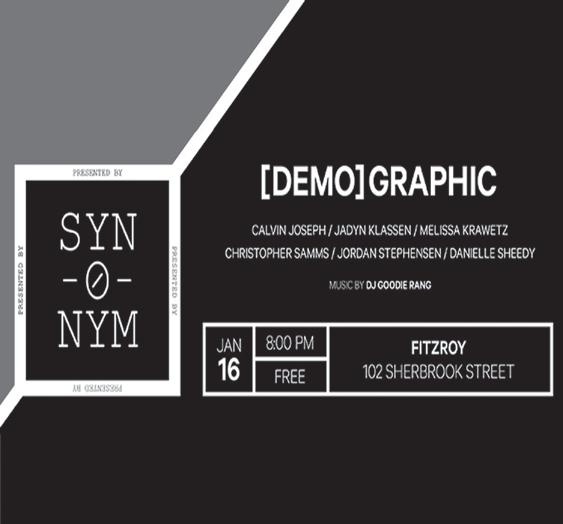
[Demo]Graphic curated by Synonym Art Consultation Fitzroy Restaurant
Saturday, Jan. 18 Bound By Art The Boutique: Erotica and Artistry Friday, Jan. 17
Sunday, Jan. 19
Birdapres & Grey Jay album release: “If and Only If” The Union Sound Hall
Monday, Jan. 20
FILMAGE: The Story of DESCENDENTS/ALL The Park Theatre
Wednesday, Jan. 15 Human Rights Workshop by Corey Shefman Rainbow Resource Centre
Vernissage: L'avènement de MarieAndrée Houde La Maison des artistes visuels
Friday, Jan. 17
The Uniter Fiver Showcase: FINN / Hearing Trees / PANTS / Greek Riots / Sibyl The Park Theatre
Under the moon of winter are living stories
Neechi Commons and the Millenium Library present Manidoo-Kiizis/Kinepisim Manitoba Indigenous Writers Festival
lu K as thiessen, Staff
anuary is the time to tell stories.
J
Taking a page from the national traditions of Cree and Anishinaabe culture, the local Indigenous Writers Collective (IWC), in participation with the Winnipeg Public Library and the department of native studies at the University of Manitoba, presents Manidoo-Giizis/Kinepisim Manitoba Indigenous Writers Festival 2014. The title of the event is composed of the Anishinaabe and Cree words for Big Spirit Moon, referring to the annual storytelling time that occurs during January’s full moon.
Katherena Vermette of the Indigenous Writers Collective is one of the main organizers for the event, though she works alongside other members of the group. She identifies some of the strengths in this region for indigenous writers.
“What we have here in Manitoba is an incredibly indigenous province. Winnipeg is a beautiful artistic community, we’re also a close-knit community; we support and promote each other whenever we can.”
The event boasts three days of readings, panels, workshops, film screenings, a comedic writers’ cage match, and much more. Attention will be given to children’s literature, graphic novels, emerging authors, and other written works.
The vast literatures by indigenous peoples were largely ignored by the public until a few decades ago, explains Renate Eigenbrod, professor in the
department of native studies at the University of Manitoba.
When she presented the possibility of teaching an indigenous literature course at Thunder Bay’s Lakehead University in the early 1980s, she encountered resistance. “It was a hard sell; people didn’t believe me that there was indigenous literature.”
Eigenbrod refers to a select few works by indigenous writers in Canada that had been published when she was trying to start teaching in the field. “At that time, Maria Campbell’s Halfbreed had come out in 1973 [ . . . ] it was noticed, but not in a major way, not as it should have been noticed. Beatrice
Culleton Mosionier’s In Search of April Raintree [came out] in 1983, and [in 1986] Tomson Highway’s Rez Sisters was another milestone.”
She explains that in the late 1980s and early 1990s, the public at large and academics began to admit and accept that there was a vast field of indigenous literature.
One of the organizers, who will host the opening show as well as the panel discussion on indigenous graphic novels, is University of Manitoba assistant professor Niigaanwewidam James Sinclair.
He discusses the millennia-old written work of indigenous people, stating that poems, graphic novels, novels, and other modern forms of literature are continuations of older forms.
“The fastest growing form of indigenous literatures is graphic novels,” says
You are cordially invited...
to an arcade-style 1,000,051st birthday party
a nastasia ChipelsK i, Staff
M
id-January is not well-known as a holiday season, unless your friend circle has a robust crop of January birthdays. But there is one very significant birthday coming up, a birthday that deserves celebration by one and all – a birthday that has inspired festivities all across the globe.
Mark your calendars: Jan. 17 is Art’s birthday.
No, not some fellow named Art, but Art, as in fine art, visual art, performance art, sound art – all of it. Without getting hung up on definitions and divisions (as this year marks Art’s 1,000,051st birthday, there are bound to be many branches in Art’s lineage), this is a day to celebrate all of Art.
The concept of an annual celebration of the birthday of Art is younger than Art itself. It was proposed in 1963 by French artist Robert Filliou, who claimed that Art began at a specific
point in time, one million years before, on Jan. 17.
According to a history provided by the Western Front, Vancouver’s artistrun centre, “[Art] happened when someone dropped a dry sponge into a bucket of water. Modest beginnings, but look at us now,” reads the description on www.artsbirthday.net.
To mark this year’s birthday, Video Pool is holding a games and gameshow-styled event (on Jan. 17, of course). The celebration, titled Fortuna’s Arcade, features a curated selection of video games courtesy of mrghosty (Skot Deeming), and the titular Fortuna’s Wheel, created by Ken Gregory and Andy Rudolph. “Fortuna was the goddess of fortune and personification of luck in ancient days. She might bring good luck or bad,” says Gregory. “At the beginning of the year, what better can one do than participate in a ritual designed to bring luck into our lives?”
Sinclair. “There is also a lot more social media—non-fiction—work by indigenous writers which is coming out at the same pace as graphic novels.” He also mentioned a large book coming out soon based on social media writings created as part of Idle No More. He highlights the writers’ cage match between Cree and Anishinaabe writers at the last festival as one of the most fun and funniest events he has
ever attended. Last time it was packed, and he encourages people to check it out.
Vermette emphasizes the accessibility of the event: “Everything is free.”
“This event offers a chance to get the widest array of indigenous writing in Manitoba,” says Sinclair. It is one of the most creative events I’ve ever been a part of. There is some of the best comedy, stuff that will make you cry [ . . . ]
Things that will change your life.” Come witness amazing storytelling: 7 p.m. at Neechi Commons (865 Main Street) on Thursday, Jan. 16, Friday, Jan. 17, and Saturday, Jan. 18; and a full day of panels and readings at the Millennium Library on Saturday, Jan. 18, from 10 a.m. until the last event at 4 p.m.
Fortuna’s wheel was made through “DIY hardware and software hacking and a classic game of chance,” says Gregory. He’s been involved in organizing and participating in Art’s birthday events in Winnipeg since the first local observance in 2005, which he “helped organize [ . . . ] as part of [a] media arts residency [he] did at the Western Front.”
Entry to the event is five dollars, with the option to “play to win” your cover at the door. Danceable music will resound courtesy of DJ Beekeeni; she also participated in a previous Art’s birthday party, and recalls “some wild martini ice machine that made drinks by people in other countries celebrating this annual event and there was a big cake that was thrown, I believe.” Beekeeni brings both her tunes and her enthusiasm for Art to the party.
“I’m excited because I love Art in all forms. A celebration is ALWAYS needed to remind everyone that it is important or we will be living in a douchebag city.”
For Gregory, the local aspect is as important as the sense of connection that this event engenders.
“Art’s birthday is celebrated globally. The spirit of celebration and the fact that we are all doing something inspired by Robert Filliou’s concept brings us all together.”
Whether your personal style of revelry involves spinning the wheel, playing mrghosty’s games, dancing, or pondering the community created by such an event, Gregory and Beekeeni both invite anyone and everyone to attend.
Beekeeni promises to play “the wildest stuff I have in my repertoire
and then some,” including “b-sides in retro, weird beats, and taking chances [on] the dance floor mixes I make,” and there will also be pizza at midnight. This is, after all, a birthday party for a celebrant that hopes to be everpresent in all of our lives. Gregory reminds us, “Some of the best parties ever for almost anyone is a celebration of their entrance into the world. It’s one thing we all have in common. We are all Art! Celebrate!”
Fortuna’s Arcade is being held from 8 p.m. until 1 a.m. on Jan. 17 at Video Pool Media Arts Centre, third floor of Artspace (100 Arthur Street). See www.videopool.org for more information, and find other iterations of Art’s birthday at www.artsbirthday.net.
Ar ts & Culture
Storytelling in the Park
The Park Theatre and UMFM present a brand-new way to share stories with a live audience
lu K as thiessen, Staff
Winnipeg is about to become the birthplace of a new format for live storytelling that will broadcast over the airwaves. Tales are told together, recorded, and repeated on radio.
You may have heard wonderful story-based radio shows on CBC Radio such as the Vinyl Cafe, WireTap, Public Radio Exchange’s Moth Radio Hour, and Chicago radio station WBEZ’s This American Life Perhaps you’ve attended a poetry slam in Winnipeg, and were blown away by the versatility of performers. Likely, someone has cornered you and launched into an unsolicited description of a bizarre or boring event they have experienced.
These three ways of telling stories join forces at the first monthly Hear/Say Live Story Exchange. Each month, the Park Theatre will host a night of free-form and curated storytelling, in which all stories are based around a particular theme. The inaugural event’s fitting theme is New Beginnings, and it will be hosted by Kaj Hasselriis, producer of CBC Radio’s storytelling show DNTO (Definitely Not the Opera).
Kevin Mozdzen, graphic designer and new employee at the Park Theatre, has been captivated by storytelling since he was young. He was excited when he pitched the idea to the Park’s owner, Erick Casselman, who gave Hear/Say the green light.
“I’ve just always loved hearing people talk,” says Mozdzen. “As a little kid, I loved it when my parents
had their friends over and I loved just listening to them talk and tell stories.”
Mozdzen is working with a team of organizers from the University of Manitoba’s campus radio station UMFM. The team includes station manager Jared McKetiak, program director Michael Elves, and Tessa Vanderhart, who sits on the board of directors and produces the UMFM show West End Dumplings
Each night of Hear/Say will be divided into two offerings. The initial part will consist of short stories told by audience members who signed up when they arrived. These stories are not discussed with organizers beforehand, so the possibilities are almost endless – they need to fit into the theme of the night, but the content is not judged before their telling.
The second part will consist of curated stories submitted to the organizers; the deadline for submissions was Jan. 9.
“It’s the openness of that portion that isn’t preselected, the random, radical possibilities that make this such an important event,” says Vanderhart. The nights will all be recorded and later broadcast on UMFM. “Other storytelling shows are much more planned, where everything has a predetermined feel to it. Hear/Say has some of that, but it is way more unpredictable.”
Mozdzen says he was spurred to his idea by the work of others.
“In the States, there’s the Moth, which really is where I took inspira-
tion from. It started nearly 20 years ago on the founder’s porch, and now they do theatre shows across the States.” When asked if there were future plans to take Hear/Say on tour, Mozdzen smiles. “Ideally, yes, we would take it to other cities, but that’s far into the future.”
While both Vanderhart and Mozdzen have a passion for storytelling, they have different approaches to sharing stories in front of an audience. Vanderhart expressed interest in participating in the event as a storyteller, but she said as organizers they had to determine if it constituted a conflict of interest.
Mozdzen said as a kid he was fond of writing, and hoped to be published. He does not, however, want to speak in front of the audience. “I have debilitating stage fright so I won’t be on stage ever.” Radio is a different story. “I’ll be the voice of the radio show,” says Mozdzen.
The event is all ages, but Mozdzen and Vanderhart explained there was no move yet to censor any of the stories.
“There’s no restrictions on what people can talk about, as long as it fits in the theme,” explains Mozdzen.
“It’s an event we’re excited about and looking forward to sharing.”
Listen to stories and perhaps share your own: Hear/Say Live Story Exchange: #1 New Beginnings happens Thursday, Jan. 16 at 7 p.m. at the Park Theatre, 698 Osborne Street. For more information, check out their website at www.hearsaystoryexchange.com
Review: Mon oncle Antoine and When Jews Were Funny
Mi Chael Carlisle, volunteer Staff
Mon oncle anToine
Canada produces many quality pictures and Mon oncle Antoine has ranked first on the list of Top 10 Canadian Films of All Time, three decades in a row, by a poll held every decade at the Toronto International Film Festival.
Claude Jutra’s adolescent melodrama is set in a cold rural mining town in Quebec during Christmas time. The camera follows a young boy and the life of his family, who owns the town’s convenience store; meanwhile, the miners are getting unruly.
The story opens with a funeral, an atmosphere of death, and a loss of innocence. Young Benoit is transitioning from childhood to adulthood; throughout the picture he has miraculous and heartbreaking experiences that shape his emotional development. We are given the opportunity to see Benoit’s psyche unfold as he first encounters love, sexual passion, and spiritual depression. Each character in Jutra’s masterpiece is fully realized; we care for all of them and enjoy seeing them grow before our eyes.
In conclusion, Jutra’s film is wonderfully made and profoundly entertaining. Though it can be depressing at times, there are many lessons to be learned and characters to meet.
5/5
when JewS were Funny
Forty years from now people will be laughing at Woody Allen movies like Annie Hall and Manhattan and praising him as a comedic master of his time, much as we do now with silent genius Charlie Chaplin. Director Alan Zweig seeks to answer the question: why are Jews so funny?
When Jews Were Funny is a decidedly bold picture, because it
seeks answers from a community scattered throughout the globe. Consisting of talking head interviews with Jewish comedians, and interrupted by stock footage of stand-up comedy, the approach appears rather formulaic for a documentary; however, it is full of insightful and philosophical thought.
Zweig dissects what it means to be Jewish, whether the comedy is a result of heritage, or he analyzes the nature of a Jewish joke. Is the Jewish joke completely different from any other joke? His interviewees, who range from Howie Mandel to Super Dave Osborne, certainly think so. They give their unique thoughts and opinions, often arguing about semantics and giving us a unique historical perspective from the Jewish lens.
Perhaps Jewish comedy is different in style because of a long history of persecution; perhaps it is dark because Judaism has been through dark times.
Another layer to this picture is the fact that it’s also about Zweig’s personal life. He’s 60 years old, newly married, and a new father. He battles with the fear that his child may not grow up Jewish at all and that his legacy as a Jew will die with the next generation. This adds a great deal to an already complex film filled with interesting dialogue and witty banter. It’s definitely a picture that deserves some accolades.
3.5/5
Check out more of Michael’s reviews at goodbadcritic.blogspot.ca, and catch a screening of When Jews Were Funny at Cinematheque (100 Arthur Street) on Jan. 16 and 17 at 7 p.m., and Jan. 18 at 9 p.m.
phOtO by haNdOut
New Year’s sex resolutions
Igenerally think resolutions are stupid: we all pledge some variation of the same vague things we think we should be doing to be a more acceptable version of a human being.
We’re going to “eat better,” “work out more,” “do better at school,” and “be a better girlfriend/boyfriend/ partner.” Sure, these are okay things to wish for – but they didn’t work for you last year or the year before that. You were sick of lettuce by the following week, you let your gym membership lapse, chants of “Cs get degrees” could be heard coming out of your mouth, and you missed your partner’s family’s last Sunday brunch.
I’m here to help you make resolutions you might actually keep, so you can start respecting yourself again, for crying out loud. These resolutions are for you, whether you’re single, in a relationship, married, or in relationships. The best part is that I don’t expect you to do all of them all of the time.
Just give a few of ‘em a shot at least once – or twice, if you really like them. Some of these are inspired by my very own sexual agenda for 2014, so I’m not just telling you to do weird shit and secretly laughing at you, I promise. have leSS Sex
I promise this isn’t a trick – a sex columnist telling you to have less sex. The caveat here is to replace regular old manual or oral stimulation and penetration with other sensual and physically intimate activities. Find ways to stimulate yourself and/or your partner(s) without putting parts into other parts. It’s easy to fall into sexual patterns, so slow-
ing down to explore sensuality in different ways is a good idea. geT over your Fear
oF “dirT y Talk”
There is a lot of silly-sounding dialogue in mainstream porn. I totally get it if you’re scared to open your mouth to do more than make a little noise. Dirty talk can be ridiculously hot and turn good sex into really great sex. If you’re a newbie, just start by being honest and obvious: “That feels so good,” “I want you to ____” “You/your ____ are/is really hot,” or just a simple, “I’m going to cum,” engage your audible senses in sex and can turn on your partner and you!
Make a BudgeT For porn STOP ONLY WATCHING FREE PORN. Support real couples, queer performers, and indie sites by paying for content every now and again. Sites like Cherrystems, The Crash Pad Series, and Make Love Not Porn are alternatives to your usual hump, pump, and moan. With prices as low as five dollars for a three-week rental, you can definitely indulge at least a few times in 2014.
geT STi-TeSTed FrequenTly If you’re sexually active, you should be tested every six months. Period. It’s not the end of the world to have an STI, but you need to know. Many infections don’t have symptoms and many take months to actually show up on a test. Even if you’re in a relationship, I beg of you: get tested.
You can confidentially submit a question or topic to jodie.m.w.layne@gmail.com.
“Find escape in music / That no one can defeat”
Review:
Sybil’s debut EP Basement Sounds
a nastasia ChipelsK i, Staff
Iwould expect an EP with the word “Basement” in the title, recorded by the band members themselves, to be a sparse sketch of a few songs. But the title, I soon learned, was referring elsewhere, and the instrumentation on Sybil’s five debut tracks is lush and well-rounded without going overboard.
The EP opens on a pop note, with “Dream” showcasing the band’s sweet airy harmonies sweeping around lead vocalist Tesia Rhind. Whether delicately quavering among the group or soaring solo, Rhind’s range and expression pull the compositions together gently, like a silk ribbon.
Sibyl moves into more playful melodies and singsong rhymes in “Half Moon”; the band is well at home in the field of folk. “Skipping Stones” begins on a sparser note, with care-
fully plucked strings, before dancing deftly back into lush vocal swells. The final track, “April Showers,” delves into the eerier side of Sybil’s sensibilities as haunting vocals and a cascading piano line emerge through a curtain of falling rain.
The title track, “Basement Sounds,” is a love song to music itself. While it may ring saccharine to some, it is a clear homage to the refuge that many find in music and sound. Beneath any cynical mask, what music lover won’t see themselves in the refrain, “Find escape in music / That no one can defeat”?
Find their EP at bandsibyl.bandcamp.com, and catch them live on Jan. 17 at the Park Theatre as part of the Uniter Fiver Showcase.
Staying cool, Winnipeg style
Outdoor ice-skating dance party returns for the 7th year
a nastasia ChipelsK i, Staff
While we may gripe and grumble about the weather, most Winnipeggers pride themselves for surviving the bite of winter with a sly smirk. How else could a city that spends 113 days of the year below freezing be crowned Slurpee capital of the world 14 years in a row?
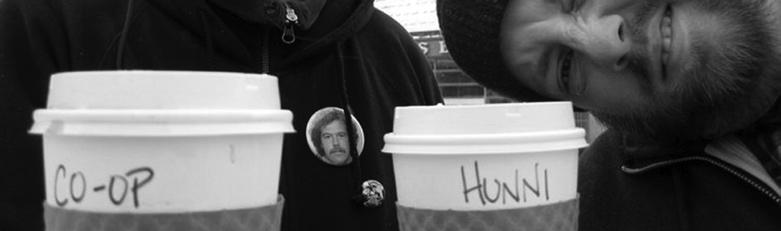
This Winnipeg spirit is celebrated every Sunday in January at Soul on Ice, an ice-skating party hosted by DJs Co-op and Hunnicutt (aka Tim Hoover and Tyler Sneesby). From 2-5 p.m., they take to a stage in the centre of the rink under the canopy at the Forks.
“We always thought it would be cool to put a Winnipeg spin on the classic roller-skating jam,” says Co-op. “Unlike spinning in a nightclub, we can have all ages and abilities join us at the Forks. Lots of our friends bring their kids, parents, grandparents – even dogs!”
The Forks provides skate rentals for all ages as well, at rates of three dollars for children/seniors and five dollars for adults. Once
you’re bundled and laced up, the rest of the party is free. Through Soul on Ice—now in its seventh year—Co-op and Hunnicutt hope to bring their “unique blend of hip hop, funk, disco, rock, reggae and everything else” to people who may not otherwise be able to see them in their usual haunts, which are often 18+.
“Lots of our friends bring their kids, parents, grandparents – even dogs!” –DJ Co-op
It’s also a great reason to get outside and try something new.
“People love going for a skate and often tell us this gives them a reason to get moving and do it!” says Co-op, “Hunnicutt and I are always cooking up new and creative ways to present our music.”
This creative approach sometimes means spinning in the middle of a frozen rink in mid-January, which can present a few hazards. They will cancel the event if there is a wind chill warning (which was the case on Jan. 5), both for their own safety and out of concern for potential skaters.
“[If] there’s a wind chill warning in effect, it’s just not safe to be out there spinning for three hours, [nor] should people really be coming out without proper gear,” says Co-op. At least one skating day has been cancelled each year due to severe cold.
The unusual party environment can also affect their equipment, but in classic Winnipeg style, Co-op looks on the bright side: “To be honest it’s not as bad as spinning outdoors in the summer and having things overheat.”
For a full listing of winter events at the Forks—including Soul on Ice—go to www.theforks.com/ events/calendar-of-events
Is Canada golden?
Evaluating the men’s Olympic hockey roster
Mi K e still, Staff
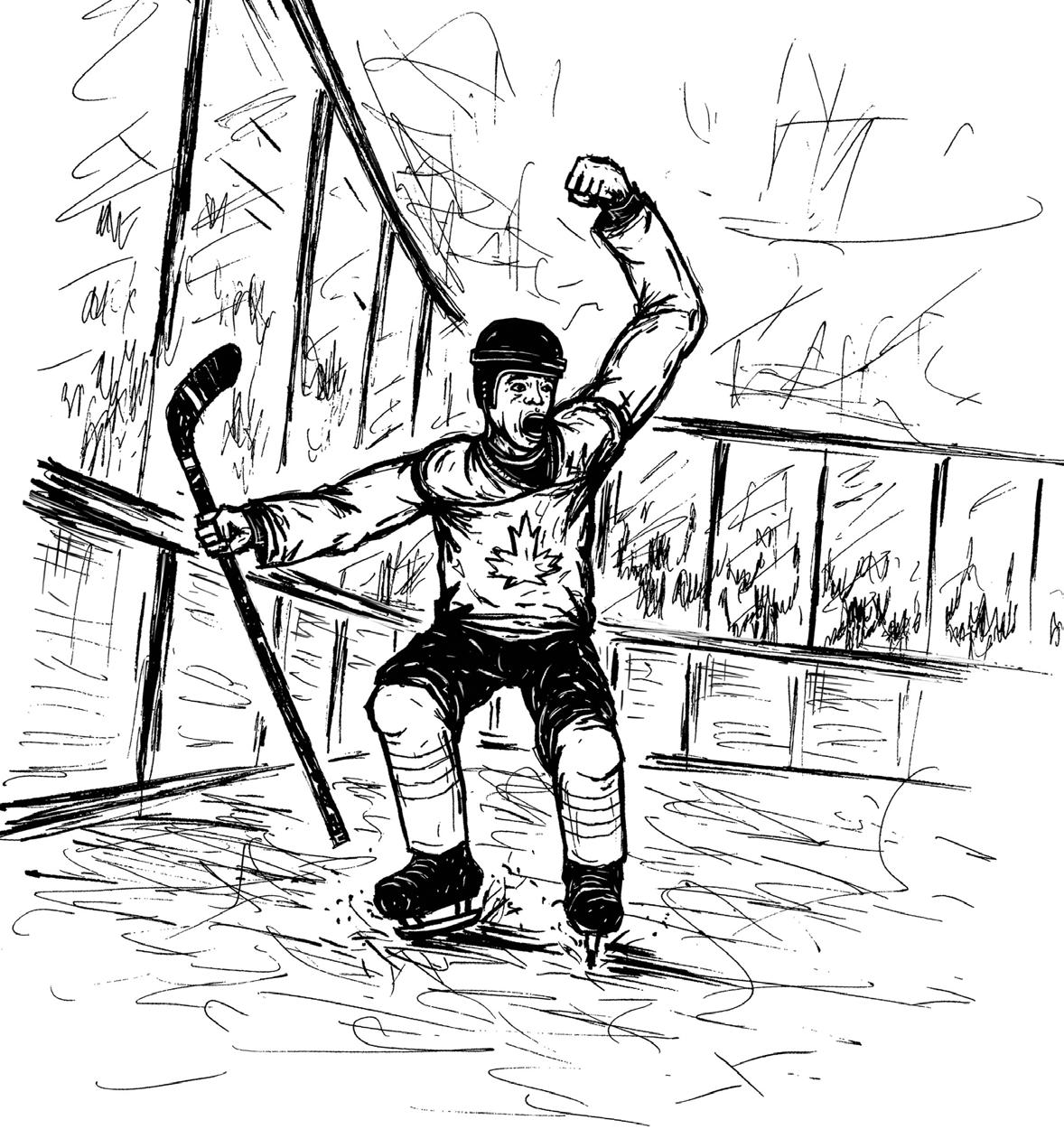
Last week, Hockey Canada officially announced the Team Canada men’s hockey roster for the 2014 Sochi Olympics. The group will feature 14 first-time Olympians who will seek to repeat 2010’s gold medal performance. While there are a few noticeable snubs, such as Martin St. Louis and Brent Seabrook, Team Canada still boasts a strong unit that includes seven of the top 10 scorers in the NHL. Below is my analysis of each position, highlighting a few potential players that should make the difference for Canada.
Forwards:
Jamie Benn, Patrice Bergeron, Jeff Carter, Sidney Crosby, Matt Duchene, Ryan Getzlaf, Chris Kunitz, Patrick Marleau, Rick Nash, Corey Perry, Patrick Sharp, Steven Stamkos, John Tavares, Jonathan Toews.
analysis:
Team Canada has arguably the best group of centres in the tournament, as all seven are high-end, gamebreaking players. Sidney Crosby, 2010 Olympic hero and potential Team Canada captain, leads the way.
Joining Crosby are Jonathan Toews (Chicago) and Ryan Getzlaf (Anaheim). Both are captains of their respective teams and bring leadership and poise to the lineup. Patrice
Bergeron also returns from the 2010 team, and adds stability to any line he is on.
Of all the forwards selected, Tampa Bay’s Steven Stamkos is the player with the most questions swirling around him ahead of Sochi. Stamkos will be coming off of a broken right tibia, sustained in early November, and may not be back at full strength. I believe his teammate Martin St. Louis deserved the roster spot instead. St. Louis has stepped up since Stamkos’ injury, scoring 10 goals in 22 games. Lastly, but not least, are John Tavares (New York Islanders) and Matt Duchene (Colorado), who are making their Olympic debut. Their presence will be key, as both have experience on the wings at the international level. Crosby, Tavares, and Getzlaf are also all in the top five in NHL scoring, giving the Canadians a heavy edge.
defencemen: Jay Bouwmeester, Drew Doughty, Duncan Keith, Dan Hamhuis, Alex Pietrangelo, P. K. Subban, MarcÉdouard Vlasic, Shea Weber.
analysis:
Team Canada’s defence will feature the most turnover from 2010 for a few reasons. Olympic veterans Chris
Pronger and Scott Niedermayer will not be competing, so Canada will look to 2010 Olympians Drew Doughty, Duncan Keith, and Shea Weber to step up as leaders on defence. Jay Bouwmeester, a member of the 2006 Olympic team, will add versatility to the defensive core as well.
The second change has to do with numbers. Canada will bring eight defencemen as opposed to seven, the number they had in Vancouver. P. K. Subban will be making his Olympic debut, and while he may not see much playing time in even strength situations, his presence on the penalty kill will be felt.
The most noticeable snub was Brent Seabrook, a member of the 2010 team. Look for Dan Hamhuis to step up – the man to potentially take his spot.
goalies: Roberto Luongo, Carey Price, Mike Smith.
analysis: Luongo is the lone goalie returning to the team from 2010, and has posted a respectable 2.23 goals against average this season.
My pick to steal the show at Sochi is Carey Price. His stats read better than Luongo’s in almost every category this season, and I believe he
A successful return
Bisons sweep Cougars to start second half of the season
Mi
K e still, Staff
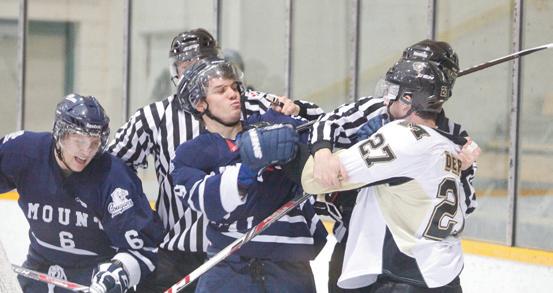
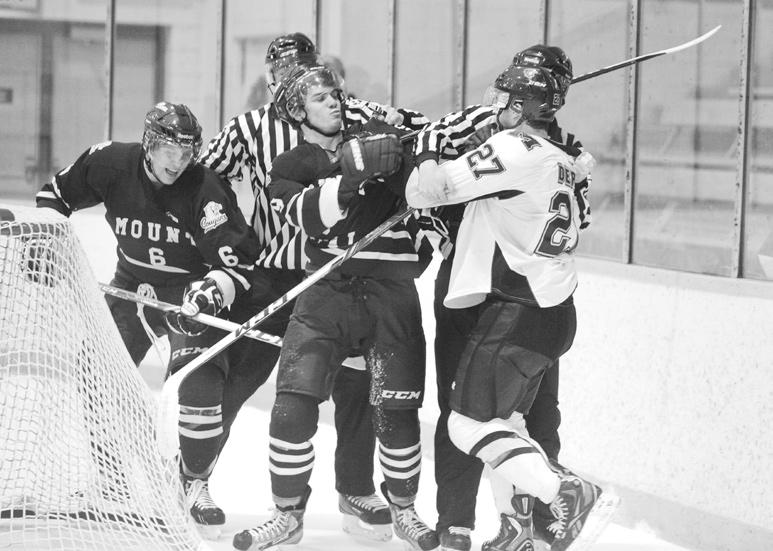
The Manitoba Bison men’s hockey team did not disappoint in their first home games of 2014. They took all four points against the Mount Royal Cougars in a weekend set.
Special teams were the difference in the first game on Friday; Manitoba was 2-for-5 on the power play while Mount Royal went an abysmal 0-for-8 with the man advantage, and the Bisons emerged with a 5-2 victory. Both teams combined for 11 shots in the first period, with just one attempt finding the back of the net. Aaron Lewadniuk capitalized on a 2-on-1, sliding the puck past the Cougars’ Dalyn Flette at the 11:30 mark. The teamleading goal was his ninth of the season.
The second period opened with a flurry of action. Mount Royal dictated the play early. Cody Cartier scored off a deflection, putting the Cougars onto the scoreboard at 7:42. Manitoba regained the lead as Jordan DePape squeaked a backhand past Flette with just over five minutes
left in the period. The lead was shortlived, as the Cougars tied the game little more than a minute later.
Overall, the Bisons were outplayed in the second. The Cougars outshot the Bisons 13-8 in the period. The game was tied up at two, heading into the third.
Manitoba capitalized on their power play in the final 20 minutes, converting twice in the first 10 min-
one-timer off a Brendan Rowinski pass.
Mount Royal had an excellent opportunity to get back into the game at 13:05 of the third. A pair of minor penalties gave the Cougars a full two minutes of 5-on-3; however, Bison goalie Joe Caligiuri shut the door. DePape added an empty net goal in the final minute, putting the Bisons at 5-2 for the victory.
utes. Ian Duval got the first power play goal at 4:44, with Luke Paulsen adding to the lead at 7:50 on a nice
Caligiuri was the difference for the Bisons, stopping 31 of 33 shots in the win. At the other end, Flette made 28 saves for the Cougars in the loss.
Head coach Mike Sirant had nothing but positive things to say about Caligiuri after the game.
“Joe was outstanding tonight. He has been very good for us this year, making the saves he’s supposed to, and stepping up and making big saves in key points during the game.”
The two teams met for a matinee game at 1 p.m. the following day, with
is overdue to shine on the international stage again. He and Jonathan Toews were responsible for stealing the show at the 2007 International Ice Hockey Federation World Juniors Championship.
Marc-Andre Fleury was left off
the team in favour of Mike Smith. I don’t agree with this decision, as Fleury has Olympic experience and would have added a veteran presence to the team that Price and Smith lack.
Manitoba securing a 5-3 win. Neither team managed much offensively to start the game. Despite registering only four shots in the first period, the Bisons took the lead at 12:39. Craig Scott potted the puck off a mad scramble in the Cougar zone.
Mount Royal had 55 seconds with a 5-on-3 power play within the final five minutes of the period, but again managed very little. The Bison defence, led by captain Dane Crowley, shut down any opportunities.
Both teams’ goal scorers got going in the second period. A combined five goals were scored in the first 10 minutes.
Just 47 seconds into the period, Tyler Fiddler utilized his excellent speed and stickhandling, beating Caligiuri and tying the game 1-1.
Manitoba retook the lead at 4:03 on the power play, as Lewadniuk continued his strong season with a tic-tactoe goal. Duval added to the Bison lead, scoring shorthanded at 5:57 as he raced down the right side and slid a brilliant wraparound past Flette.
Jesse Paradis continued the Bisons’ scoring burst with his seventh of the
season at 7:19, giving the Bisons a massive 4-1 lead.
To the Cougars’ credit, they did not shy away. Fiddler took matters into his own hands, deking out almost the entire Manitoba team and narrowing the score to 4-2 heading into the third.
Mount Royal came out aggressive in the third, cutting the Bison lead with a goal that went in off of a deflection. It was not enough, as Manitoba held on the rest of the way, grabbing an empty net goal in the final 40 seconds from Luke Cain to secure the 5-3 victory.
“It was really good for us to get the four points, and get some momentum behind us as we head into a big series next weekend against Calgary,” said coach Sirant after the game.
Manitoba (9-9-2) will now travel to face top-ranked Calgary in a crucial weekend set, while Mount Royal (6-11-1) will venture to Regina to play the other Cougar hockey team in the Canada West conference.
phOtO by bEibEi Lu
iLLuStRatiON by SCOtt fORd
“Where is Dale Begg-Smith?”
Australia’s multi-million-dollar Sochi hopeful continues to draw controversy
aDa M peleshaty, volunteer Staff
It was one of the most indelible images of the 2010 Winter Olympic Games in Vancouver: Alexandre Bilodeau, standing jubilant on top of the podium after becoming the first
Canadian athlete to win an Olympic gold medal in Canada. Meanwhile, the man to his right, silver medal winner Dale BeggSmith of Australia, appears as if he
Heartbreak city
Men’s basketball loses both games by single point
T
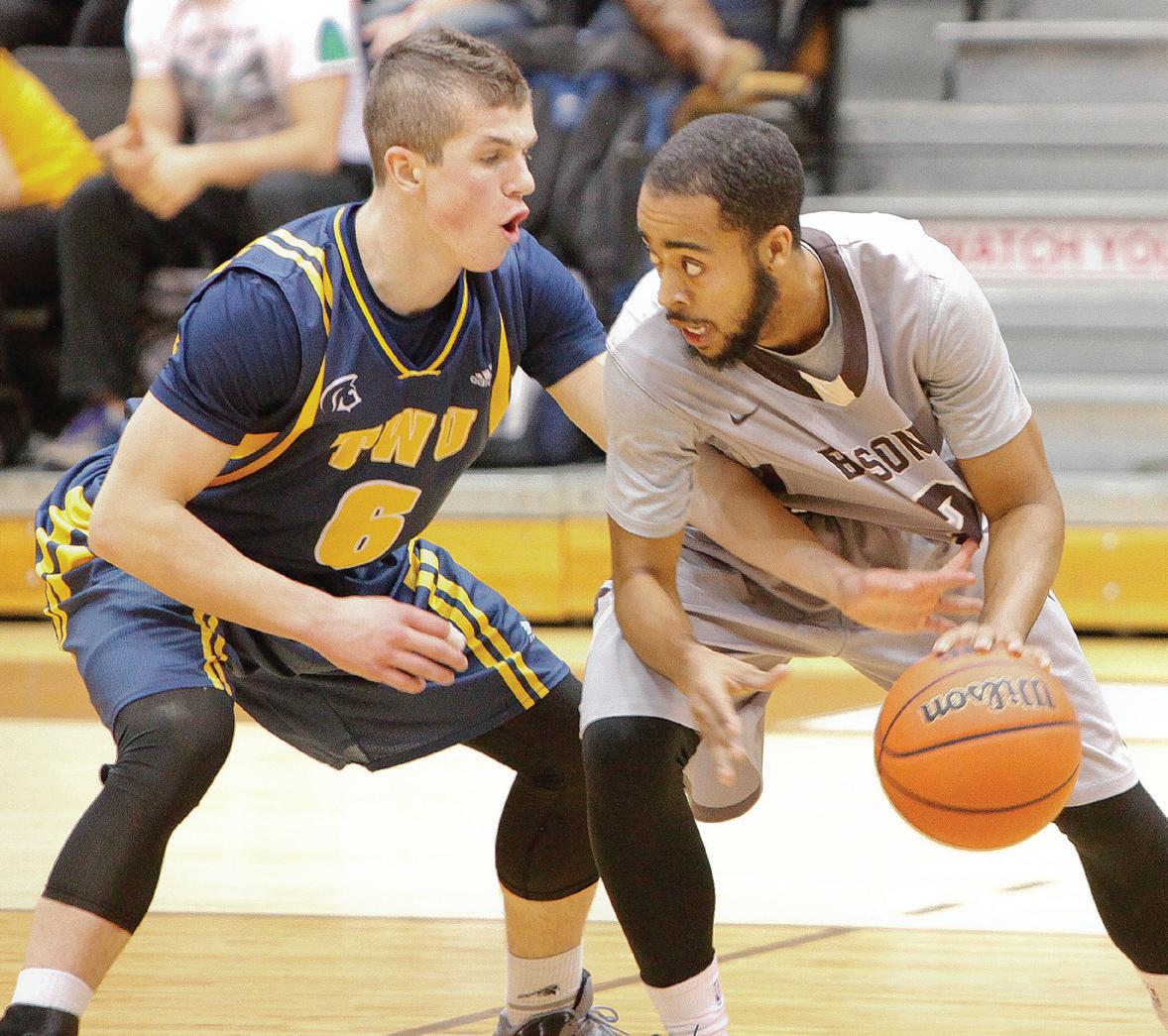
he Manitoba Bison men’s basketball team opened up the second half of their season at home, looking to gain momentum after the winter break. Instead, the Bisons suffered two separate losses by a single point as the team let two potential wins slip away. Manitoba welcomed two separate teams from B. C. to town, hosting the Trinity Western Spartans (6-5)
on Friday night. The Bisons led by 16 points in the third quarter, but let the Spartans come back to win 85-84.
The Bisons came out hot in the first half, shooting 21-for-33 from the field and led by Amarjit Basi, who scored 15 points off the bench. Trinity Western kept things close and did a good job of preventing turnovers. Despite the Spartans’
does not want to be there.
In the eyes of some Canadians, it was unsportsmanlike behaviour by the Vancouver native who had already been portrayed as a traitor for leaving Canada as a teenager to compete for his adopted homeland.
In the eyes of Australians, he is the mysterious Internet millionaire who is only one of two Australian men to win multiple Winter Olympic medals for their country.
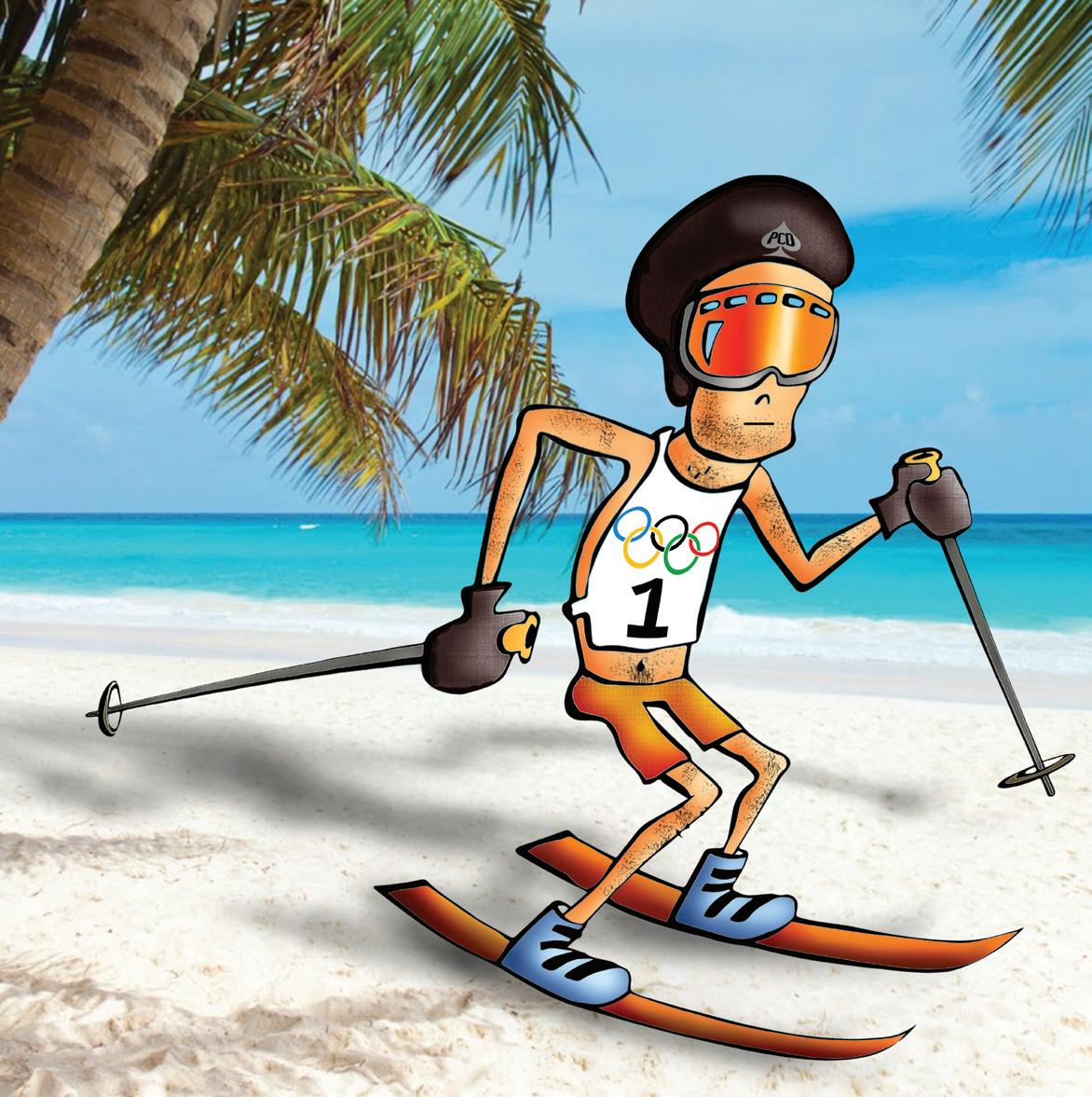
Despite winning Olympic gold in 2006 as well as four World Cup season titles in men’s moguls skiing, Begg-Smith has made just as much news off the hill than on it. This is somewhat unexpected from an athlete who is so reserved and taciturn, but those qualities have also made him a curiosity for the press.
Dale, along with his older brother and teammate Jason, started an Internet business as teenagers while living in Canada and training with the Canadian Freestyle Ski Association. When coaches asked the Begg-Smiths to concentrate more on skiing, they refused and left the program.
Both brothers immigrated to
safe play, Manitoba still went into the break leading 54-41 and seemed poised to end their nine-game losing streak.
Trinity Western stayed patient and slowly worked their way back into the game in the second half. Mark Perrin led the Spartan comeback and finished the game with a team-high 20 points. Free throws were the difference in this one, as the Bisons let 13 free throw points bounce out.
The Spartans—who were in front just twice in the second half— capped the comeback in exciting fashion. Robert Rodriguez charged into the paint, hitting a leaning floater while being fouled with just five seconds left to steal the lead and ultimately the win.
Despite the loss, the Bisons still had bright spots, none bigger than freshman Andre Arruda. He finished with 22 points, leading all scorers.
Head coach Kirby Schepp spoke highly of his young star after the game.
“[Andre’s] probably the Canada West rookie of the year right now; I can’t see any way he’s not. He’s got a real bright future ahead of him, no question.”
The men returned to the court the following evening looking to avenge Friday’s loss. But it was déjà vu for the Bisons, as they fell by a single point to the University of the Fraser Valley Cascades (7-5).
The Cascades took control of the game from the start and led by as many as 11 points in the second quarter. Despite the deficit, Manitoba stayed composed. Two late three-pointers helped to cut the Cascades’ lead. The teams went into
Australia and continued their online business dealings while representing the Australian national ski program. They made their World Cup debuts in 2001. It was the start of a great career for Dale. In 72 World Cup events, he reached the podium 29 times, winning 18. For the 2006 Olympics, however, more attention was placed on his business and wealth.
One report—which Begg-Smith disputed—stated that his businesses were worth over AUS $40 million. After winning gold in 2006, he was asked about his Lamborghini. The Australian media also reported that his businesses were in online pop-up advertising and he was then dubbed the “Spam Man.”
When he arrived in Vancouver for the 2010 Games, Begg-Smith only allowed the Australian media for his press conference. It didn’t make it better for him when Australia’s high-performance director Geoff Lipshut claimed that judges were biased toward Bilodeau’s run, preventing Begg-Smith from winning Olympic gold. After winning silver, he did not comment on the judging, only saying it was “great that Canada
the half with the visitors leading by six points.
The Bisons came out energized in the third quarter and upped their physicality. The strategy paid off, as they took their first lead late in the third quarter. In the waning moments of the quarter, Kevon Parchmen hit a shot that gave the Cascades the lead back heading into the fourth.
Turnovers haunted Manitoba in the final quarter, ultimately costing them the game. Despite three straight Bison three-pointers late
won gold.”
Begg-Smith took a break from competition after suffering a knee injury in December 2010. Little did anyone know that the break would last three years. After his coaches hadn’t had any contact with him in months, in August, News Corp reporter Anthony Sharwood found him in the Cayman Islands and called him. According to Sharwood, when Sharwood identified himself as a reporter, Begg-Smith hung up.
With his third Olympic appearance seemingly in doubt, he surprised the skiing world by competing at a World Cup event in Ruka, Finland last month. Even more surprising was his fifth-place finish. At the next event in Calgary, he finished in 12th place. He was the top Australian in both events.
It appears likely that BeggSmith will compete in Sochi against Bilodeau and reigning World Cup champion Mikael Kingsbury of Canada. Whether or not he wins a medal, his skiing will do all the talking.
iLLuStRatiON by CaROLiNE NORMaN
in the game, the Cascades were still able to hold on, grinding out the 84-83 win.
Jasper Moedt finished with a double-double and led the Cascades with 23 points and 16 rebounds. Bison Dan Penner also recorded a double-double, with 19 points and 10 rebounds.
The Bisons drop to 1-11 on the year, and have now fallen in 10 consecutive conference games. They will travel to Brandon next, on Jan. 17 and 18, to face the Bobcats.