Kraynyk’s work will be displayed in the GSA until Nov. 15
Please contact designteam@themanitoban.com if you are interested in submitting a cover image.
For other volunteer inquiries, please come to our office in University Centre (across from Tim Horton’s, behind GOSA) or email the editor of the section for which you are interested in writing.
Please direct all other inquiries to editor@themanitoban.com
Toban Talkback
Quinn Richert, staff
campus news briefs
By Katy MacKinnon,staff
Final exam policy changed
The U of M implemented changes to the final exam and final grades policy effective Sept. 1 of this year. The policy applies to final exams scheduled within exam week, deferred examinations, and supplemental examinations.
Six pertinent revisions were made to the policy.
When requiring a deferred exam, students must submit their application within 48 hours of the date the final exam is scheduled.
Once a final exam is completed, deferred exams will not be permitted.
Students who are not able to write exams as a result of athletic, academic, or religious responsibilities must make requests within their faculty using the deferred exam process.
When bringing possessions to final exam rooms, students must now place them below their exam desk instead of at the front of the room.
The faculty of engineering is now using the term “supplemental examinations” instead of the previous “special examinations.”
Final course grades will be displayed on Aurora only.
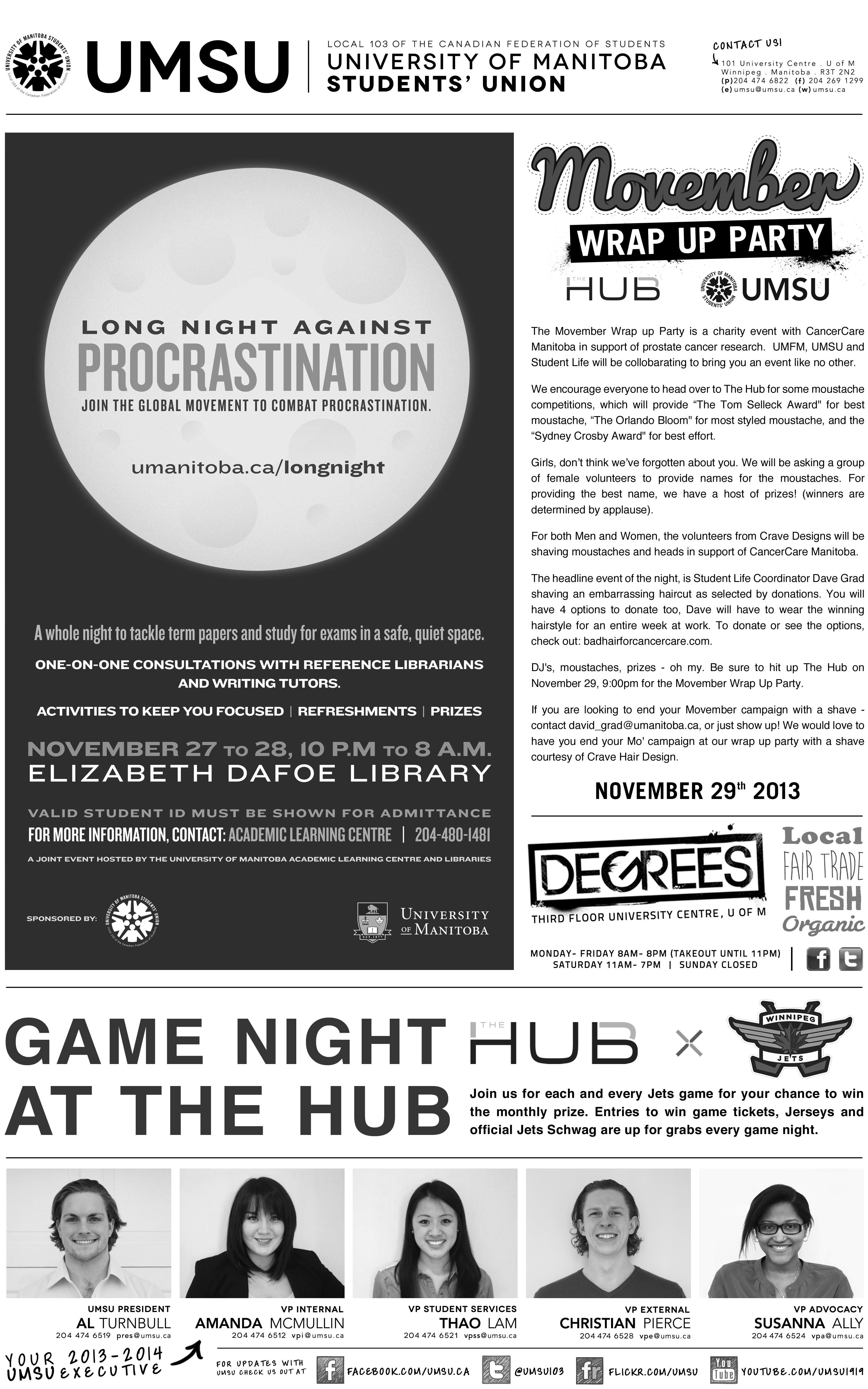
asper students hold polar bear swim
Students donned bumblebee outfits and bathing suits to jump in a swimming pool filled with cold water at the Duckworth Quadrangle on Thursday. The “Chillin’ 4 Charity” event raised money for United Way of Winnipeg, a non-profit organization that helps finance other charitable organizations and programs.
The original goal was to raise $15,000 for United Way. By Friday, earnings had reached $14,865, and donations will be accepted until the end of the month.
world opportunities week (wow) promotes cultural diversity
Special events including displays, speakers, and information sessions were held throughout the week to promote the variety of international opportunities available to students at the U of M.
WOW is held every year by the World W.I.S.E. Resource Centre. A Student Exchange fair was set up in University Centre, with tables and displays showcasing various countries offering exchange opportunities. Volunteers were situated by the displays to respond to questions and share their stories from international experiences.
Dancers performed at the Fireside Lounge Wednesday afternoon.
Keynote speaker Michel Chikwanine spoke Thursday afternoon about making positive changes in the community. Chikwanine was a child soldier, and left home at the age of 11 as a refugee.
The week wrapped up with a workshop on food security by Engineers Without Borders.
new display in gallery oF student art (gsa) explodes with colour
U of M student Vladimir Kraynyk filled the Gallery of Student Art in University Centre with bright, colourful oil paintings.
According to Kraynyk, the paintings encourage personal interpretation by the individual. He is inspired by surrealist painting, and a theme presented throughout the series is exploring the subconscious.
Kraynyk’s work will be displayed in the GSA until Nov. 15, and can also be found on large murals in the tunnels at the U of M.
Albert Street Autonomous Zone hosts Winnipeg’s 6th Anarchist BookFair
Literature and DIY offered at annual event for leftists and other critical folks in the Peg
Kevin Lin KL ater, Staff
This past weekend, Winnipeg leftists, anti-capitalists, and other folks critical of the current state of affairs gathered at the Albert Street Autonomous Zone at 91 Albert St. in Winnipeg’s Exchange District for the sixth iteration of the Winnipeg Anarchist BookFair and DIY Fest.
The event ran over three days— beginning with a kickoff concert on Friday, and ending with a sold-out supper and discussion on Sunday night—and featured workshops, discussions, concerts, and other community events throughout the weekend.
Tim Brandt, a volunteer at Junto Local 91, a collectively-run, anarchist lending library located in the second floor of 91 Albert Street, has been involved with the book fair from the beginning.
“Some of the volunteers here, myself included, had been to the Montreal Anarchist Bookfair, which is about five years older than the one here, and it’s pretty big, the biggest in North America. We knew that there are anarchist book fairs in other cities and we wanted to have one in Winnipeg, so we started organizing and got the first one off in 2008,” he told the Manitoban
Each year is a little different, explained Brandt: “Every year we start fresh, so whoever is around and willing to help organize it makes it happen. This year we were thinking it wouldn’t happen. By June we had all but given up hope that we could pull off another book fair because there didn’t seem to be anyone who wanted
to help. But then in mid-June, during the peace walk and after, some people came forward and we were able to start organizing for this year.”
Many different groups take part in the Anarchist BookFair from year to year. The participants are not limited to anarchist groups.
This year, the Winnipeg chapter of the Industrial Workers of the World, the Winnipeg New Socialist Group, the Communist Party of Canada, as well as several anarchist collectives—including Prairie Struggle and Turning the Tide—took part.
“I think there is that misconception that as an anarchist book fair, it’s only for and about anarchists,” said Brandt.
“We use that term because we like the philosophy and use an anarchist sort of framework in what we do here, in that we try to do things without hierarchies and use consensus-based planning and decision-making, but we welcome anyone who is openminded and wants to learn more about critical and alternative ideas.”
The Anarchist BookFair has attracted many different publications in the past. Canadian Dimension, a magazine started in Winnipeg by Cy Gonick in 1963, Briarpatch, another long-running magazine out of Regina, and Upping the Anti, a radical journal from Toronto, have had tables at the Winnipeg Anarchist BookFair.
“Because the event is inside this year, we don’t have as much space for book tables and we’ve focused a bit more on the DIY side of things,” said Brandt.
The DIY workshops covered a range of diverse topics, from plumbing, bike repair, electronics and soldering workshops, to a capoeira class, guitar tech, home brewing, and a seminar about travelling cheaply.
The weekend also saw musical and artistic events, with Montreal-based artist Norman Nawrocki playing two shows and promoting the release of his new novel Cazzarola!: Anarchy, Romani, Love, Italy.
Nawrocki played Friday with a number of other artists including Süss, David Sweatman, Scott Leroux, Osani & Kenneth, and Ladybug the Rambler. The evening included a poetry reading and a theatrical performance by Adhere and Deny.
On Saturday night, a number of Winnipeg DJs played sets on the third floor of the A-Zone in the Rudolf Rocker Cultural Centre.
While speaking about his involvement with the book fair, Brandt was careful to emphasize the importance of clarifying what “anarchism” means.
“The word ‘anarchist’ frightens people. It’s funny what that word does; I think that it’s probably one of the most misunderstood terms there is. A lot of people think it means chaos, but it is about wanting to be treated as equals, without hierarchies. If people would take the time to learn about anarchism as a philosophy, I think most people would find that they agree with a lot of what anarchism is about.”
phOtO by beibei Lu
the LiKeNess Of peteR KROpOtKiN, the "aNaRChist pRiNCe," Reads upON his "thRONe" by CaROLiNe NORMaN
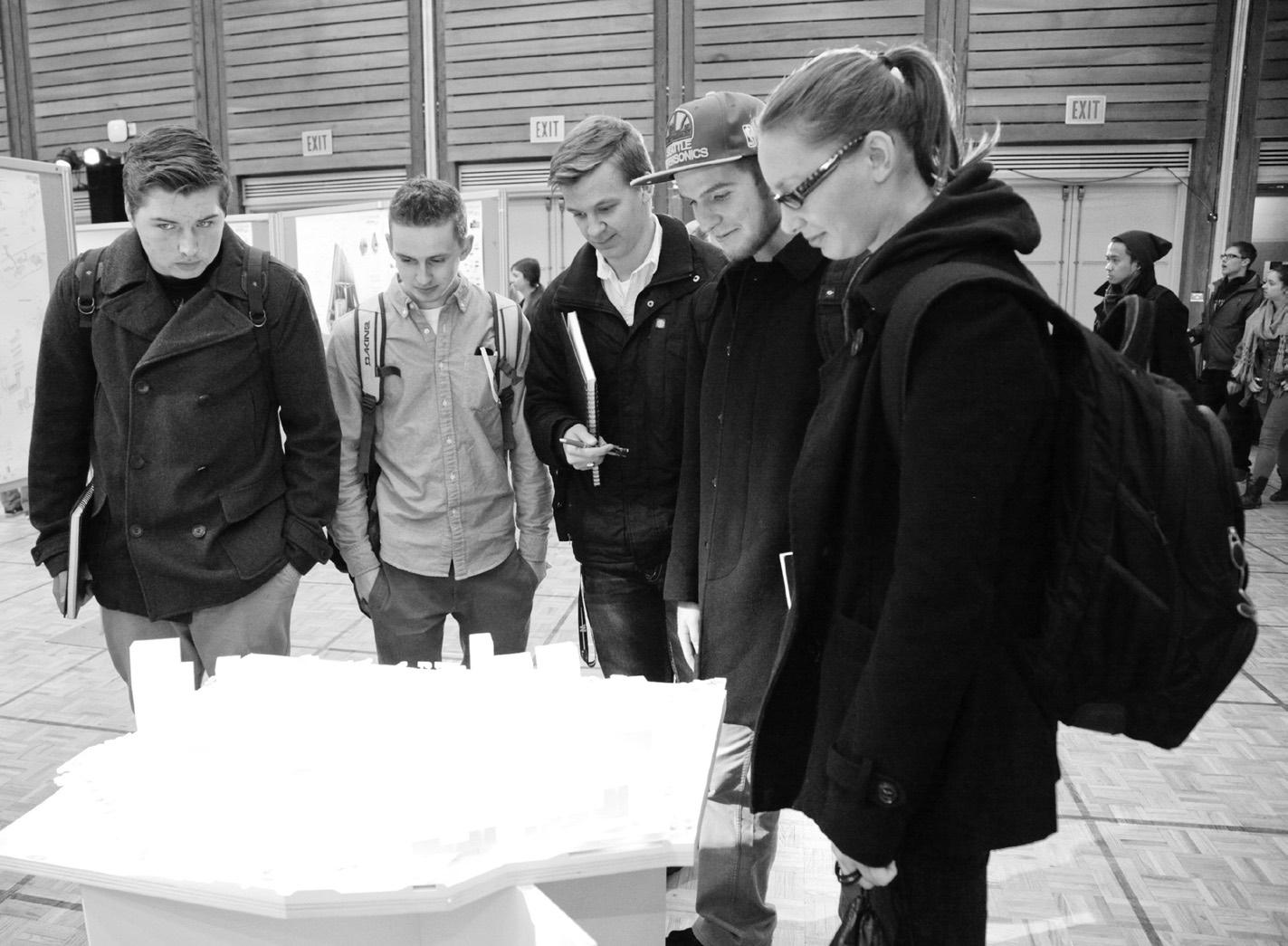
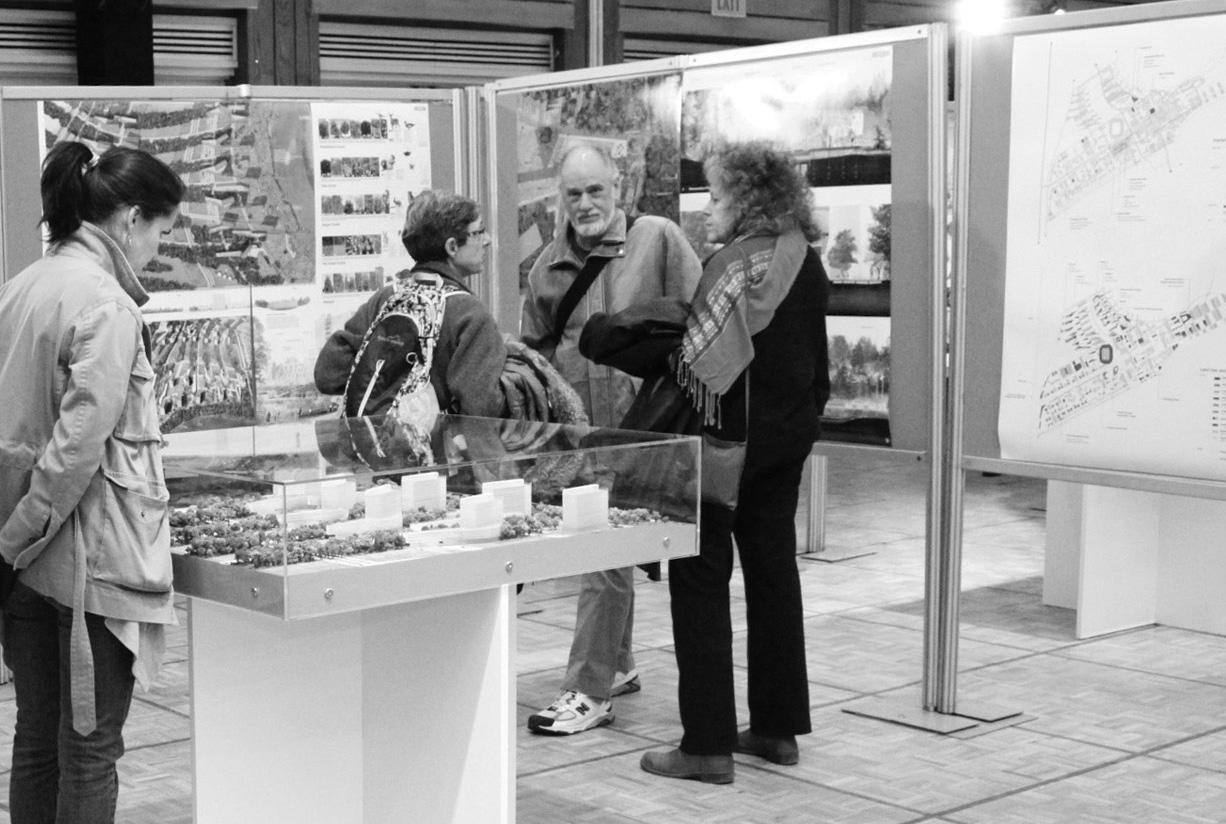
Campus redesign winners announced
Exhibition held in University Centre to showcase plans
Grace Kennedy, volunteeR Staff
On Nov. 3 the University of Manitoba announced the winners of the Visionary (re)Generation Open International Design Competition, a contest that drew submissions from around the globe for the redesign of the Fort Garry campus and Southwood Lands.
Toronto’s Janet Rosenberg and Studio Inc. and Arup Canada Inc., in partnership with Winnipeg’s Cibinel Architects Ltd. and Landmark Planning and Design Inc., were named the winners.
George Cibinel of Cibinel Architects Ltd. and Donovan Toews of Landmark Planning and Design Inc. are both U of M graduates.
Michelle Richard, director of campus planning at the U of M, said the group was chosen largely because they “started with the concept of the landscape first and then layered systems on top of that. Landscape, transportation, infrastructure, and then build form [ . . . ] they got it.”
One of the elements of the competition brief was to work with the land, in contrast to traditional methods of
formulating building plans, which give only secondary consideration to the environmental surroundings.
Going forward with the planning process, it will take about a year before anything materializes. There is still plenty more community engagement to take place in realizing the formal plans.
Richard said extensive stakeholder engagement was undertaken, which helped the U of M formulate elements of the competition brief.
One of the key drivers of the project, said Richard, is the completion of the Southwest Transitway, which will enhance transportation to campus.
Students can look forward to their continued involvement in planning, including design charrettes – a collaborative process designers use to interact with stakeholders in order to create design solutions.
The winning creative concepts illustrate respect for nature by presenting infrastructure secondary to the natural landscape, especially in regards to the former Southwood golf course and riverbank, and provide a
mix of public and private services and residential space for a denser community on campus.
Janet Rosenberg told the Manitoban that as a firm, Janet Rosenberg and Studio Inc. “are looking at design differently.”
“After years and years of just taking sites and seeing nothing recognizable after the development, we’ve taken a different approach [ . . . ] how there is a relationship between existing vegetation and water for livability. How people live: their walkways, their park systems, engagement of the river, shelter bands – so that the wind would make outdoor spaces much more comfortable. We looked at what existed and supplemented those so there are good forms of recreation that would prevail against the weather.”
A prevalent theme in many of the submissions was the development of the river as a recreational setting and transportation mode.
Richard, who has travelled to Hamburg and witnessed the engineering of structures surrounding their riv-
ers, said it can be done sustainably.
Rosenberg echoes this sentiment:
“[Our concept] includes boat rentals and a restaurant by the water because we think this should be a major mode of transportation and way of igniting people to come down to the campus and really engage the campus this way… [the flooding] doesn’t mean it can’t happen, as well as dealing with all the water on-site and not dumping any of it – using all of it on-site and being respectful of it.”
A sustainable campus—in all forms, especially energy—was another fundamental component in the competition brief, said Richard. Manitoba Hydro has been a partner, providing their expertise on the project.
Jay Robertson, a master’s student in architecture at the U of M, told the Manitoban it is great to see new ideas and potential for the campus, but he believes the feasibility and financing may be challenging.
Richard said that as of yet, funding is largely uncertain for the project, in part because it is still in the conceptual stages, and the mix of
public-private use is yet to be determined. According to Richard, the U of M will soon be looking for several development partners.
On the winning proposal, Robertson said, “considering it is winter for [almost] six months of the year and [the] U of M lacks quality indoor social space, it would be nice to see non-commercial social spaces in the demonstration plan. Gathering spaces should take precedent over cafes and retail space.”
While Roberston acknowledged that he is pleased with the landscape and ecology integrated in the proposal, he added, “the distance between housing blocks and lack of density would likely limit the social vibrancy portrayed in the renderings.”
He believes the second-place submission addresses housing and density in a much more effective way.
Students and community members can stay tuned for invitations for involvement in the project from the U of M campus planning office.
phOtOs
A tale of 2 student groups
AJDOC will move ahead with SGPAC approval; SAIA awaits final word
Quinn richert, Staff
Two U of M student groups interested in examining the Arab-Israeli conflict were recently before the University of Manitoba Students’ Union’s (UMSU) Student Group Promotion and Affairs Committee (SGPAC) seeking official group status approval. They were met with opposite results.
Arab Jewish Dialogue on Campus (AJDOC), founded by co-chairs Josh Morry and Mohammed Abas, received the go-ahead from SGPAC. Students Against Israeli Apartheid (SAIA), ultimately, did not.
SAIA had their student group status revoked by UMSU last year after Morry and Maria Gluskin, who served on council as commerce reps at the time, were able to convince a majority of councillors that the group violated UMSU policy 2009, which forbids “behaviour that is likely to undermine the dignity, selfesteem or productivity of any of its members or employees and prohibits any form of discrimination or harassment.”
SAIA asked SGPAC to reconsider earlier this year, and on Nov. 1, Brian Latour, a founding member, was told that the group had been approved.
On Nov. 4, however, Thao Lam, UMSU vice-president student services and SGPAC chair, informed SAIA the committee required more time for “intensive research and deliberation” before his group could be approved.
“The committee has unanimously decided to withhold your group’s current status, pending further legal opinion,” wrote Lam in a correspondence with the group.
“I don’t know what else they need, or what else they’re looking for, especially considering they’ve already approved us and then went back on it,” Latour told the Manitoban
“I’m not sure what the process is, but I’m trying to contact the committee and trying to contact the VP-SS [Lam] to see if we can get more information.”
Latour rejects the claim that SAIA has ever been in violation of policy 2009, pointing out that the group worked regularly with Independent Jewish Voices (IJV), and never received any official complaints.
“We are an anti-racist organization. We are dedicated to organizing against apartheid, and we’ve
raised that issue on campus. We haven’t been engaging in any harassment or discrimination, and we’re opposed to all forms of racism, including Islamophobia and anti-Semitism,” he said.
Meanwhile, AJDOC is looking forward to its first meeting, which Morry expects will be held between late November and early December.
“We want to make better living and working relationships between Arabs and Jews at the U of M and in Canada. In order to do that I think you really have to get the two sides sitting down and talking about the issues” – Josh Morry
AJDOC is affiliated with Arab Jewish Dialogue (AJD), a Winnipeg-based group that shares almost the exact same “core values and beliefs” as outlined in AJDOC’s constitution.
The only difference is a ninth section tailored to the U of M campus and agreed upon by Morry and Abas, indicating that AJDOC “condemn[s] any student group on campus that undermines the dignity and self-respect of any student group on campus because of their views on Israel, Palestine, or any other Arab country.”
“It is blurry wording, but for good reason,” Morry told the Manitoban , making reference to the fact that the ninth section deliberately uses language taken from UMSU policy 2009.
“It is designed to protect students who feel unsafe or feel threatened by the actions of someone else [ . . . ] I think that the drafters of the UMSU policies wanted students to read into them what they will, because UMSU is very keen on protecting students who feel threatened.”
A key difference between SAIA and AJDOC is that while SAIA membership was open to “all University of Manitoba stu-
dents, faculty, staff and members of the community,” AJDOC is a “‘closed group’ based on ethnicity or peoplehood.”
Morry says that the reason for this is that the conflict is fundamentally one between Jews and Arabs, and both sides will benefit from a one-on-one dialogue format.
“It gets back to our values [ . . . ] we want to make better living and working relationships between Arabs and Jews at the U of M and in Canada. In order to do that I think you really have to get the two sides sitting down and talking about the issues, while not having people talk for them and while not being clouded out by other groups,” said Morry.
AJDOC will consist of six Arab and six Jewish members, but will hold general meetings at which all are welcome.
Whether or not SAIA ultimately receives SGPAC’s blessing, both groups are doing their best to move forward with their plans for the remainder of the school year.
Christine Melnick, former minister of Immigration and Multiculturalism, has invited AJDOC to hold their first group meeting at the Manitoba Legislative Building. They are also considering inviting speakers from academia and elsewhere to address the group. Eventually, they would like to expand onto other campuses.
“Mohammed [Abas] and I have discussed how to expand, but before that, we first have to get our start. But our goal is to expand,” said Morry.
SAIA, for the time being, will continue to meet outside of UMSU spaces and attempt to find ways to operate without student group status.
“We’re going to work on reconstituting ourselves, whether we have student group status or not,” said Latour.
“We are going to look into holding public events on campus over the next few months without student group status; we want to look into booking other spaces on campus, for example.”
As of press time, there is no word on when—or if—SAIA will again be welcome in UMSU spaces.
Follow the Manitoban for further updates on the activities of both AJDOC and SAIA.
U of M panel highlights Canada’s worsening international reputation
Canadian mining and energy firms’ reputations sully the country’s image abroad
Kevin Lin KL ater, Staff
Canada’s waning international reputation was the subject of a panel discussion hosted last Tuesday by the global political economy program at the University of Manitoba, as a part of World Opportunities Week. The panellists were John Serieux, Fabiana Li, and Jonathan Peyton from the departments of economics, anthropology, and environment and geography, respectively.
The panel focused on the poor reputation that Canada’s mining and extractive firms have in the developing world and the increasingly negative reputation that the country as a whole is developing as a result.
Canada has become a major player in global mining and energy sectors in terms of mineral exploration, production, and exports. According to a report released by the Mining Association of Canada, the Toronto Stock Exchange (TSX) and the TSX Venture Exchange now account for “40 per cent of global mining equity capital.”
Natural Resources Canada stipulates that Canadian firms are increasingly involved in resource extraction globally, with “assets abroad valued at over $129 billion in 100 countries.”
“There has been a lot of recent investment in large-scale mining projects by Canadian companies, for example, in Latin America. We’re seeing an expansion of resource extraction into areas that were used for other economic purposes, so agriculture and farming are competing with extractive industries, which use a lot of water and land,” Li explained at the discussion. “The people living in the vicinity of these projects are not seeing much benefit from these mining projects, and are suffering from considerable environmental and social costs that result from these activities.”
Canadian mining firms have earned a particularly bad reputation in the countries in which they operate, and the panellists argued that this is progressively affecting Canada’s international reputation as a whole.
Serieux pointed to the role of the federal government in exacerbating this growing negative perception of the country abroad.
“Under the Harper regime there has been a much more conscious effort to attach Canada’s reputation, and the considerable influence that the Canadian government has, to the fortunes of Canadian extractive firms. Things like putting CIDA [the Canadian
International Development Agency] within DFAIT [the Department of Foreign Affairs and International Trade] are very much a conscious effort to bring the two agendas together – the aid agenda, and the trade and foreign relations agenda.”
Li added, “NGOs and grassroots organizations that oppose mining projects sometimes see their funding cut off because their activities are not consistent with the interests of the Canadian government.”
Serieux elaborated on why creating growth and development is very difficult within an economy that is heavily dependent on resource extraction.
“Resource extraction typically does not produce high levels of employment, it is very capital intensive, these activities do not have a lot of linkages to the rest of the economy, and the output is exported. So the direct dynamic impact on the economy is limited. On top of that, most of the wealth that accrues through resource extraction is through the tax system—royalties—which goes directly into government coffers, which often times is not equitably distributed.”
Li said, “With any resourcebased economy, you are vulnerable to changes in prices on international markets. I think it’s dangerous to build an economy based on industries that are not stable in the long run and that are so heavily contingent upon something that is outside of the country’s control.”
Serieux commented on the lack of regulatory oversight that Canadian firms operate under when outside of the country. “[Canada] has refused to develop laws for regulating the behaviour of these firms abroad, essentially allowing these companies to do whatever they want and get away with it.”
Li also pointed out that, “There is no way for Canadian companies operating internationally to be made legally accountable here in Canada for their actions abroad.”
As an indication of Canada’s worsening international image, the panel said that the practice of travellers affixing Canadian flags to their backpacks is less common nowadays than it once was.
“In certain parts of the world, being an American is easier than being a Canadian; it’s true and it’s not a joke. [It’s] something that, two decades ago, was definitely not the case,” said Serieux.
Toronto mayor, on the rock(s)
Rob Ford’s questionable behaviour through the ages
c a Lei G h m acd ona L d, Staff
Rob Ford is no stranger to controversy. The recent scandal involving a video of him under the influence of crack cocaine is just the latest in the saga of Ford’s public run-ins with the law that stretch back into his time as a city councillor.
As far back as 2006, there are documented cases of Ford behaving poorly in public. On April 15 of that year, the nowmayor was ejected from a Toronto Maple Leafs game for obnoxious behaviour.
When asked by an attendee to “be quiet,” Ford began to shout profanitylaced insults at him.
“Are you a fucking teacher?” Ford reportedly asked the fan, later adding, “do you want your little wife to go over to Iran and get raped and shot?”
Ford was identified through a business card he left behind. He initially denied attending the game, but later
admitted to the media that this was a lie.
Two years later, charges were filed against Ford for assaulting and threatening to kill his wife Renata. The charges were ultimately dropped due to discrepancies in statements she made following the incident.
Ford encountered his next round of public difficulties when he was seen by Ottilie Mason and her six-year-old daughter talking on his phone while driving. The pair gave the mayor a “thumbs-down” for distracted driving, and rolled down the window to shout, “get off your cell phone!”
According to Mason, the mayor gave them the middle finger, swore at them from behind the glass of his own windows, and then drove off in a vehicle with licence plate “ROBFORD.” Ford responded to the account, admitting
that while he had been on his phone, he did not make any rude gestures.
“This [accusation] is a misunderstanding,” said Ford on Twitter.
One year later, a photograph was taken of Ford once again distracted while behind the wheel, this time reading while driving at a reported 70 kilometres per hour. Ford responded that it “probably” was him.
“Yeah, probably, yeah. I’m [trying] to catch up on my work and you know I keep my eyes on the road, but I’m a busy man,” Ford said to a reporter following the incident.
March of 2012 saw Ford’s next incident involving public inebriation, he appeared drunk at city hall on St. Patrick’s Day after a night of partying.
According to a security memo, Ford “had problems walking, was sweating profusely, and was swearing at [senior
aide Earl] Provost as he walked by the security desk.”
The evening ended with Ford shoving his assistant Brooks Barnett, who was trying to stop him from making phone calls, and Ford being escorted home in a cab.
In late February of 2013, Ford fell under scrutiny after being kicked out of the Toronto Garrison Ball, an event that honours military members and raises money for wounded soldiers, for his alleged level of intoxication.
Just two weeks later, he was accused of acting inappropriately towards political rival Sarah Thomson at a gala. According to Thomson, he groped her and made sexually suggestive remarks about her coming to Florida with him.
That July, Ford was also caught on camera urinating, and disposing of empty alcohol containers behind a public
school in broad daylight.
May of this year saw the beginning of the scandal centred on a video of Ford allegedly smoking crack cocaine – allegations further supported by Toronto police Chief Bill Blair on Oct. 31. Ford confirmed earlier this month that he had in fact smoked crack in the past. Finally, Nov. 7 saw the release of a video in which Ford graphically describes a desire to murder someone. It is unclear whom he is referring to, but a gesticulating Ford is seen explaining how he will “rip his fucking throat out” and “poke his eyes out.”
Since the video’s release, Ford has apologized publicly, but has stuck to his assertion that he will not step down from his position. As of Nov. 9 he maintained a 44 per cent approval rating.
eDitor-in-chief Bryce Hoye
editor@themanitoban.com / 474.8293
Business manager Foster Lyle accounts@themanitoban.com / 474.6535
aDvertising coorDinator Daniel Schipper ads@themanitoban.com / 474.6535
e ditoria L
senior n ews eDitor Quinn Richert
news@themanitoban.com / 474.6770
n ews eDitor Katy MacKinnon katy@themanitoban.com / 474.6770
photo eDitor Beibei Lu photo@themanitoban.com / 474.6775
Design associate Aichelle Sayuno
graphics associate Bram Keast
r eporters
n ews Caleigh MacDonald
n ews Kevin Linklater
science Elizabeth Drewnik
arts & culture Anastasia Chipelski
arts & culture Lukas Thiessen
sports Mike Still
assistant copy eDitor Angela England
vo Lunteer contributors
Will Gibson, Caroline Norman, John Stinzi, Keegan Steele, Jodie Layne, Heather Kat Cole, Josh O'Brien, Justin Ladia, Grace Kennedy, Alex Passey, Seamus Hamilton-Pattison, Adam Peleshaty
MANITOBAN
105 UNIVERSITY CENTRE UNIVERSITY OF MANITOBA WINNIPEG, MB R3T 2N2
General Inqu I r I es & a dvert I s I n G
Phone: (204) 474.6535
Fax: (204) 474.7651
Email: manitoban@themanitoban.com
n at I onal & Mult I -Market a dvert I s I n G Campus Plus Media Services Toll-Free (In Canada): 1.800.265.5372
Email: info@campusplus.com
Canadian Publications Mail Product Sales Agreement #589160
A “volunteer staff” member is defined as a person who has had three volunteer articles, photographs, or pieces of art of reasonable length and/or substance published in three different issues of the current publishing year of the Manitoban. Any individual who qualifies must be voted in by a majority vote at a Manitoban staff meeting. Elected representatives and non-students may be excluded from holding votes as volunteer staff members in accordance with the Manitoban Constitution. The Manitoban is the official student newspaper of the University of Manitoba. It is published monthly during the summer and each week of regular classes during the academic year by the Manitoban Newspaper Publications Corporation.
The Manitoban is an independent and democratic student organization, open to participation from all students. It exists to serve its readers as students and citizens.
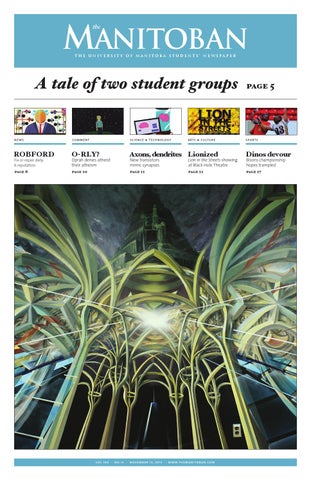
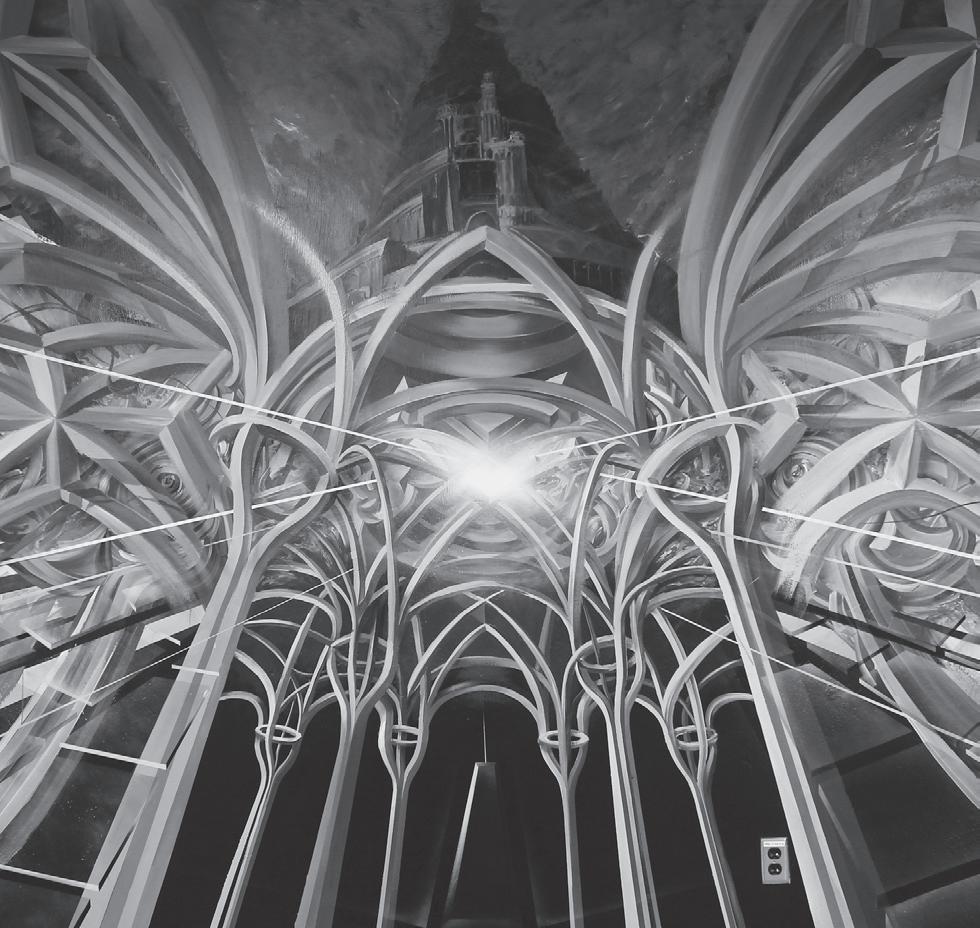
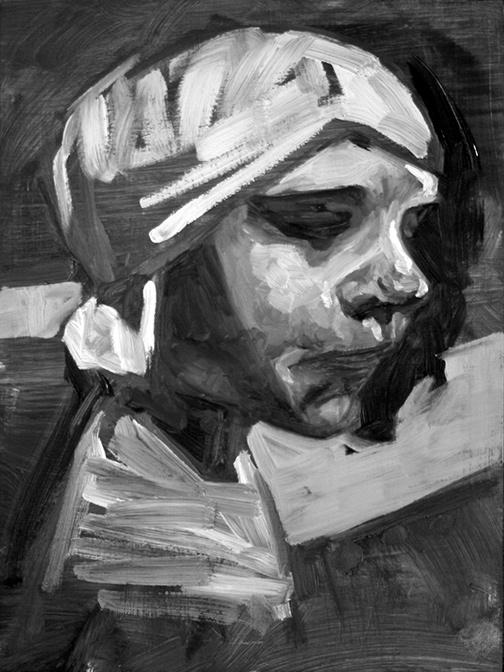
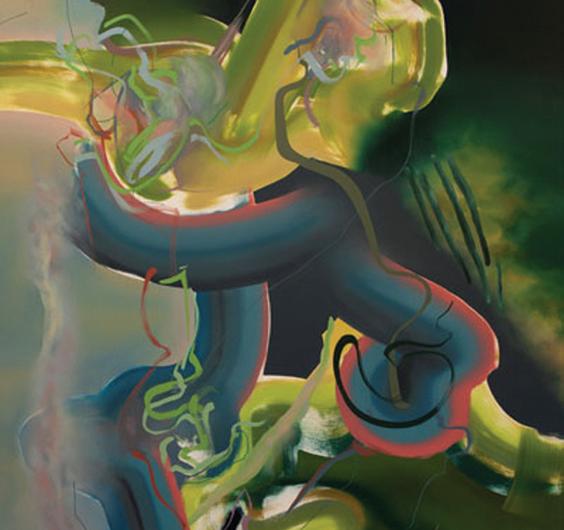
the above oil painting references a post-surgery photo of a recovering young child that i discovered following a series of debates between the deaf and hearing communities that revived my concerns about cochlear implant surgery. the picture in question shows a child who was born deaf to hearing parents, and underwent surgery to receive cochlear implants to restore his hearing based on his parents’ wishes.
my painting depicts the aftermath of the surgery in attempt to capture not only the
emotional turmoil of the child but also my own. i am hearing impaired and have worn hearing aids for most of my life, and while i have never had such a surgery, i’ve always considered it a distant possibility. but such a surgery would constitute a rejection of the identity of a lifetime. it means quite literally to leave one world and enter another. this is not an easy decision for me, but this child never had a chance to consider it. whether this is “good” or “bad” depends on which world you come from.
—Bram Keast, graphics associate
iLLustRatiON by bRaM Keast
Blackface Halloween costumes unacceptable
Historical context of minstrelsy and slavery cannot be erased
seamus h ami Lton- pattison
It’s that time of year again. Another Halloween has come and gone in Winnipeg, as have all the seasonal amenities that go along with it. If you’re in your late teens or early adulthood, you’ve likely partaken in Winnipeg’s diverse, rambunctious Halloween nightlife. In the week leading up to and directly following Halloween, Winnipeg is inundated with a plethora of socials, house parties, and bar events. During this festive time, it’s quite common to walk into your favourite club to find people in spandex suits, comically-rendered animal costumes, celebrity lookalikes, young men in blackface . . . Wait, what? Hold on. Let’s talk about that last one.
During a Saturday event on Oct. 26 at Stereo Nightclub, one young man made the decision to spend his evening in a Halloween costume that did not appear to consist of much more than donning blackface. This costume was not only permitted by the club in question—as the man was able to enter the club—but was even posted in Stereo’s Facebook album promoting the event after the fact. Though this photo was removed posthaste by the club (reportedly about 12 hours after posting), the image was shared widely on social media and has
resulted in a great deal of righteous community outrage.
However, a surprisingly comparable amount of people have spoken out on various social media outlets stating they do not see why this is a cause for alarm or offence. Blackface is representative of a period in history during which black men and women were mocked, dehumanized, and generally ridiculed as a performance art. As such, I argue that it is alarming, it is offensive, and the continued existence of this practice in society should not be condoned or ignored.
Blackface has a history of dehumanizing and mocking an entire demographic of recently enslaved men and women, with stereotyped characters that persist in advertising today
the American Civil War. Originally a part of a theatrical performance style known as minstrelsy, white performers would don blackface by applying burnt cork as facial makeup and engage in productions based wholly around the stereotyping and mockery of the black slave culture that had emerged over the decades.
The performers would imitate and exaggerate slave accents, dancing, and music, and even created “black” characters that would endure as stereotypes for years to come.
recognizable characters were Mammy and Uncle Tom: older, wise parental figures who would not abide by any backtalk from their offspring, and loved by advertisers across the country. You might know these archetypes by their current titles: Aunt Jemima and Uncle Ben.
In response to the Stereo blackface incident, for every person willing to stand up and publicly state that this was not okay, there have been an equal number of responses either dismissing or even outright defending this young man’s choice of costume. One needs only to peruse the comments section of CBC’s online coverage to see evidence of this, and it must be addressed.
One of the most prevalent defences of the costume I’ve come across is the comment that a black man clad in white facial makeup would not face the same public outrage, so why should blackface? The implication of this comment is that there is some form of double standard here that promotes inequitable treatment, but this comparison is faulty, as the connotations and cultural significance of “whiteface” and blackface are entirely different. Blackface has a history of dehumanizing and mocking an entire demographic of recently enslaved men and women, with stereotyped characters that persist in advertising today. What cultural significance or stigma does “whiteface” have? An ill-conceived movie by the Wayans brothers called White Chicks that was unpopular with critics and all but forgotten in cinematic history.
Before we address the Stereo Nightclub incident and the reactions to it in further detail, a brief history of the origins and intentions of blackface is in order. Blackface first appeared in the 19th century during the years leading up to and primarily following
The characters of Jim Crow and Zip Coon were among the first of these stereotypes to emerge in the 1830s, mocking the assumed arrogance and pretension of freed blacks and eventually merging into one recurring character simply known as “Coon.” Some of the most easily
All these characters and stereotypes recurred throughout minstrel shows in the 19th century, and in the words of Dr. Paul Lawrie—a University of Winnipeg assistant professor of history—largely represented a “culture of nostalgia” after the American Civil War and the abolition of slavery had taken place. One might extrapolate that this “culture” rose out of many white Southerners longing for the black slaves they had systematically bought, worked, and abused throughout the Antebellum Era. The general historic consensus is that blackface and minstrelsy gained prominence due to this nostalgia, and out of a desire for white Americans to reinstate their status and power over the black population by way of simple mockery. After all, isn’t absolute power the act of proving you can dehumanize and ridicule an entire race unchallenged? To again quote Dr. Lawrie, it was as if blackface made the statement, “I’m doing this to mock you because I can.”
Another common argument used by apologists of this incident is that the young man in question simply did not know the connotations of blackface and that he donned the costume out of complete ignorance. Considering the “costume” consisted of few components other than the facial makeup itself, what else could the intention have been? I have a hard time believing the young man harboured no intention to offend with his actions.
However, say for the sake of argument that I’m incorrect. Perhaps the costume was done in absolute ignorance with no ill intent. The club still allowed him to stay for the duration of their event, a photographer still took his picture, and—even more perplexingly—the nightclub decided to use the photo in an album promoting their event. An offensive image or act with no ill intent is still offensive. Whether the man knew what blackface was or not, it still shouldn’t be condoned or excused.
One person’s race is not another’s costume; it’s as simple as that. Those who have been pigeonholed as bleeding hearts crying out for political correctness are really the few unafraid to take a stand and say that grotesque, discriminatory symbols from the past ought to be left there.
iLLustRatiON by bRaM Keast
Brain computing
New synaptic transistor is inspired by biology
eLizabeth d rewni K , Staff
Scientists at the Harvard School of Engineering and Applied Sciences (SEAS) have developed a revolutionary transistor that behaves
in similar ways to the synapses of neurons in our brains.
The brain is the world’s greatest computer, and it runs on 20 watts –less power than a light bulb. This efficiency makes it an attractive model for engineers.
“There’s extraordinary interest in building energy-efficient electronics these days. [ . . . ] With electronics becoming more and more powerful and ubiquitous, you could have a huge impact by cutting down the amount of energy they consume,” said Shriram Ramanathan, principal investigator on the project.
Synapses are the junction between two structures called axons and dendrites. The axon is the part of a neuron (nerve cell) that conducts a signal, while the dendrite receives it. Synapses adapt to changes in signals. When a neuron fires out a signal, the neuron receiving it reacts in such a way that the strength of the connecting synapse between them is increased.
“Essentially, [the synapse] memo-
rizes the action between the neurons,” explained Jian Shi, a postdoctoral fellow at SEAS and the lead author on the paper published in Nature Communications. The synaptic transistor operates in an analogous way. It has platinum terminals corresponding to axons and dendrites, and the ability of the “synapse” to carry a signal is strengthened each time it is used. The entire device is only a few hundred microns—a fraction of a millimetre—in length and can operate above room temperature on a silicon chip.
The transistor does not use the binary system of ones and zeroes used in most modern computers. “It would be rather challenging to use CMOS, the traditional circuit technology, to imitate a synapse, because real biological synapses have a practically unlimited number of possible states – not just ‘on’ or ‘off,’” said Shi.
These states are non-volatile, meaning that the device does not forget its state if power is interrupted. The device takes advantage
of some unusual chemical properties of samarium nickelate that makes it extremely sensitive.
“A very small excitation allows you to get a large signal, so the input energy required to drive this switching is potentially very small. That could translate into a large boost for energy efficiency,” said Ramanathan.
At present, the main challenge is the size of the transistor, which has an effect on speed. The device built by the Harvard researchers as a proof of concept simplified the engineering by placing the components farther apart from each other, but to take full advantage of the technology’s potential it would be necessary to place them closer together. Ramanathan and his team are working with SEAS microfluidics experts to investigate the engineering challenges involved.
With increased demands for energy-efficient technology, researchers are hoping that this new transistor will be able to cater to the growing needs of our technologically evolving society.
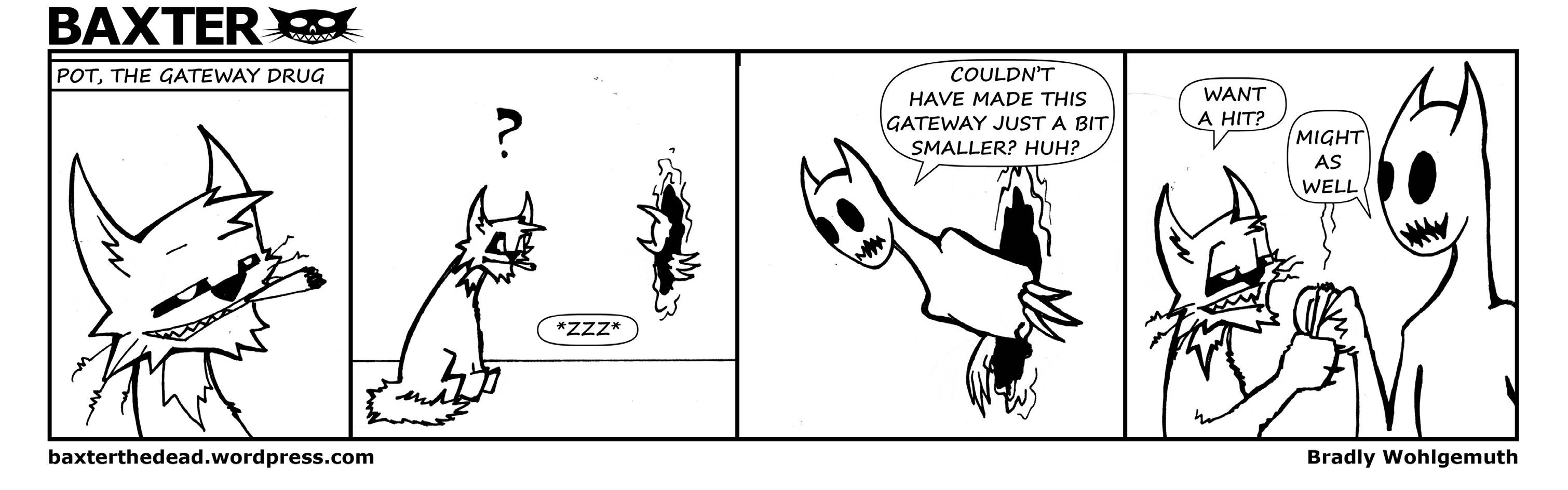
iLLustRatiON by bRadLy wOhLgeMuth
Today, the Cake n’ Shakes. Tomorrow, the world
Winnipeg’s most experimental new venue hosts every conceivable performance imaginable
Winnipeg’s answer to Andy Warhol’s Factory in the 1960s is the Frame Arts Warehouse.
Run by local performance artists Paul Little and J.D. Renaud, the space is pretty cheap – you can expect to pay 12 to 15 dollars per-square-foot for a similar space on Albert Street in the Exchange and about 75 cents per-square-foot at Frame.
Based on a conversation they had on New Year’s Day 2013, Little and Renaud created Winnipeg’s most experimental performance venue. First opened in March of this year, the venue hosts a plethora of acts including laser tag, Sunday matinee all-ages hardcore shows, dance parties, improv, experimental noise-core, stand-up comedy, and more.
“We’re catering to just-underthe-cusp comedians, musicians, artists who can’t book the Cavern, the Pyramid, the Park Theatre, the Gas Station Theatre,” says Renaud. “They’re expensive; we’re more affordable. Can you get 50 to 60 people to come to your show? Then you should be at the Purple Room.”
“The key word is weird,” says Little. “This is a weird room in the best possible sense of the word.”
Little describes one of the events he cherishes the most and hopes to nourish: the Cake n’ Shakes. Eight years ago he invited people to his dad’s living room to celebrate a friend’s birthday with cake and milkshakes.
“She made the cake, I made the shakes.”
By the fifth annual celebration it was held at a pub with live music as a fundraising social. Last year it was at Frame’s A Gallery, and this year it was at the Purple Room as a daylong festival.
“I have this weird vision of cake and shakes spreading across North America,” says Little.
Plans for next year involve sponsorships from bakeries. The plan for year 10 is a daylong outdoor festival at Old Market Square.
Inspiration for Frame Arts Warehouse came from two particular sources: the Upright Citizens Brigade (UCB) Theatre and Hotel Café.
UCB Theatre, an improv troupe that began in Chicago, has two theatres in New York and one in Los Angeles. The small venues hold either just over 90 or up to slightly over 150 people. Shows are inexpensive: $8
or free—and several shows run any given night. People take classes and attend events there and small audiences can see big names – comedians such as Ben Schwartz, Patton Oswalt, Louis C.K., and Donald Glover have performed at its locations.
A few blocks from the UCB Theatre in L.A. is Hotel Café, a performance space that holds about 50 people – Frame Arts Warehouse’s Purple Room also has a seating capacity of 50, and standing room maxes out around 90. All performers get exactly the same amount of time onstage.
During set up and tear down artists interact and possibly end up collaborating. Hotel Café has launched numerous huge names in the entertainment industry, including Katy Perry. Little hopes to recreate in Winnipeg what UCB and Hotel Café are doing in L.A., and Renaud concurs: “It’s like, ‘I took the journey to the Purple Room where I hope to see something I’d never seen before.”
The entrance is off an alley behind the building, bordered by a chainlink car park and a furrier. Renaud says the garbage bin is often full of animal carcasses, but from far down the alley at night, the magical hue of white and purple lights illuminates the otherwise decrepit back lane, beckoning the adventurous patron. Renaud laughs, “It’s not dangerous; it’s just a strange journey.”
The venue is alcohol-free, allowing audiences and performers of all ages to attend.
To get a taste of the vision of these artist-producers, check out the By Coincidence Comedy Festival. The event includes a performance by Vancouver comedian Simon King, and next Saturday Renaud is reshowing his award-winning Fringe Festival performance SelfDestructivism for one night only, followed by an Electric-Circus-esque dance party. There will also be a show by Rumble Pak Improv, and Comedy Prom, a night of stand-up comedy, professionally-led classes, improv, and a 1980s and 1990s-themed promnight-styled dance party.
The Purple Room is a 1,300 squarefoot space in Frame Arts Warehouse at 318 Ross Avenue, on the edge of the Exchange District. To book an event call 204-799-4389 or visit www.thepurpleroomatframe.com.
The A-B-C’s of
S-E-X: kinks, fetishes, and vanilla sex
The words “kink” and “fetish” are thrown around a lot in mainstream culture without most of us knowing what they really mean. It seems like if you want to write a lady-mag article about “Ways to Spice His Pumpkin This Fall” or “How to be Crazy Enough in Bed That Your Husband Won’t Divorce You, Leaving You Desperate and Alone,” it’s imperative that you use the words “kinky,” “freaky,” and “fetish” liberally.
But what are they? While they’re substituted as a catch-all for sex “outside the norm,” kinks and fetishes are two different things.
A fetish is something that brings a person pleasure or makes them aroused – sometimes even just by the thought of it. Often this is an object, sensation, or objectified body part. Fetishes that are pretty common in our cultural lexicon are: feet, leather, and shoes. In fact, those are three of the top five fetishes as reported by Discovery Health. Fetishes drive a strong fixation and gratifying sexual experiences are impossible or almost impossible without having some aspect
of the fetish present, even if only in fantasy.
Fetishists can often feel or be made to feel marginalized or strange because of their fetishes –especially since they often involve things that are not inherently sexual or that are inanimate objects. A quick zip around the Internet will show you, though, that no matter what gets you hot, you’re likely not alone.
Kinks, on the other hand, are feelings and activities that are pleasureful and wonderfully exciting when indulged, but aren’t necessary in order for sexual gratification to occur. Things that are fetishes for some might be kinks for others, so lists of common kinky activities and fetishes are actually quite similar.
Things like bondage, water sports (urine play), sensation play (like flogging or using impact toys, hot wax, or tickling), electricity play, outdoor sex, breast manipulation, incorporating food, and genital control are a very short sampling of some common kinks.
There are also lots of not as common kinks and fetishes such as clowns, diapers, furries, and even
popping balloons. If you can think of it, it’s probably someone’s kink. What defines kink, and what’s the norm? What are you if you don’t like anything that you think is kinky? People who don’t indulge in kinks are usually called “vanilla.” You know, just kind of plain. Some people say it like a curse word, as though the worst thing in the world is to enjoy some light humping and frenching while Barry White plays.
Being vanilla is fine. Being kinky is fine. Having a fetish is fine! Sex that satisfies you and doesn’t hurt anyone (in a non-consensual way, of course) is all fine. Great, even!
Like many other things in this world, our predisposition is to fear or mock anything we don’t understand. It can be scary to have a partner with a kink or fetish that you don’t share, but a little sexual negotiation and open minds— and legs—are all it takes for some mutual satisfaction.
You can confidentially submit a question or topic to jodie.m.w.layne@gmail.com.
Jodie Layne, volunteeR Staff
Ar ts & Culture
Creative futures for street kids
Fundraising for Kimisagara Orphanage in Rwanda provides both basic necessities and artistic skills
a nastasia chipe L sK i, Staff
Rebuilding lives means more than just providing the basic necessities, and sometimes art can play a part in building a future that involves more than basic survival. Those are the hopes, at the very least, of Julie Epp and Ivy Gowen.
Since she first visited Rwanda in 2010, bringing two hockey bags of donated shoes to a local orphanage, Epp has been fundraising to provide this orphanage with the basic necessities as well as opportunities to develop creative skills. The Kimisagara Orphanage is run by one man, a former street kid and mechanic.
“[He] just takes kids off the street and tries to house them and feed them and give them education,” says Epp. “[He’s] a mechanic, and all the money he makes at this mechanic shop supports 100 kids.”
When Epp first visited the orphanage, it had no electricity.
“All the kids walked in carrying candles, so that stuck with me.”
When she returned to Canada, she raised $8,000 and brought it back to Rwanda, to build a new dormitory building and to see what else was needed – be it water filtration systems, mosquito nets, or crates of laundry soap.
In March 2013, when Epp was joined by her friend Ivy Gowen, they spontaneously decided to ask for donations, and showed up at Kimisagara with 10 cameras.
“[It] became such a big part of our time there because the kids really loved using the cameras, and it became something that we did every single day; when we’d visit the orphanage we’d bring the cameras.”
Epp and Gowen would return
home and empty the memory cards, then bring the cameras back the next day. The end result was 16,000 photographs, as well as joy and a sense of community as the orphanage’s kids learned and shared skills.
As they are both involved in the arts in one form or another—Epp is an art therapist, graphic designer, and videographer, while Gowen is a tattoo artist, photographer, and graphic designer—including art in their support to the orphanage was a natural extension.
“[W]hen countries are at war, the first thing that goes is culture,” says Gowen.
Through the arts, Gowen believes that these kids are starting to gain some cultural insight into their history and backgrounds, all while rebuilding a cultural identity.
There is also a practical side, as these kids may not be able to find conventional jobs after high school. Gowen sees teaching them about photography—and hopefully Photoshop and other design programs later on—as “implementing self-sustaining goals and activities that will give them future employment.”
Believe it or not, the street kids of Kimisagara Orphanage are holding their first exhibition this month, at Winnipeg’s Tara Davis Studio Boutique. Though they won’t be here to see it in person, 100 per cent of sales from the Through Their Eyes photography exhibition is going straight back to Kimisagara.
This ethic runs through all of the fundraising work Epp and Gowen are committed to.
“We pay for own costs to travel
and our own costs for everything. [ . . . ] We don’t take a dollar of that money,” says Epp.
While they are currently not registered as an official non-profit, or affiliated with any religious organization, Epp and Gowen maintain the credibility of their fundraising efforts through daily blog posts and updates while they are visiting the orphanage. Gowen and Epp want those who support their project to see what they are doing, and to know that even if people have only donated $20, that full $20 is going to the kids of Kimisagara.
They’ll be returning to Rwanda on Dec. 17, but in the meantime, there is a lot of work to be done. Besides their day jobs, they held a fundraising benefit concert on Nov. 9, as well as an opening reception for the Through Their Eyes exhibit on Nov. 14. They’re also asking for donations of cameras, cell phones with SIM card slots, or used laptops to take back with them.
While they hope to grow their project one day—and welcome the support and input of anyone else interested in joining them—they have no intention of slowing down their efforts to help improve the lives of the street kids of Kimisagara.
“It’s for the kids. They’re just kids, after all,” says Gowen.
Learn more about this project at www.streetkidsofrwanda.blogspot. ca, and visit the opening reception of Through Their Eyes on Nov. 14 from 5-9 p.m. at Tara Davis Studio Boutique, 246 McDermot Avenue. The exhibit will be open until Nov. 30. You can also visit their GoFundMe campaign at www. gofundme.com/streetkidsofrwanda.
From South Furby
Local singer-songwriter Matthew Carter releases debut solo album
Kara passey, Staff
If you are a resident of Wolseley, Matthew Carter’s debut solo album From South Furby could be a welcome soundtrack in your quiet time.
Matthew has made some major changes since releasing his first EP, Thrift Shopping, in 2009. Under the name Matt Ward, he wrote songs with a backing band that was extremely lively compared to his stripped-down solo sound –not to mention his country twang that stayed true to his Oakbank, Manitoba roots.
“Working solo is great because you get so much control over the growth of the sound and direction of the lyrics,” says Matthew, when asked about his preference during the writing process.
“It definitely has some disadvantages at points but I believe they can be overcome. Doing it all yourself is extremely exhausting [and] I just had to realize that asking other people for help is not only okay to do, but a beautiful thing to do. This album would not have been possible without the help of way too many people to list.”
Matthew’s work has matured since 2009; it shows especially in his voice. His vocals are steady and deep, and mimic harmonies reminiscent of Bon Iver, one of Matthew’s noted inspirations. The high-energy folk songs he used to write are not present on this album, but replaced with something that reminds me of the town troubadour from Gilmore Girls
From South Furby is an album created by Matthew as a way to cope with and reflect upon a transitional point in his life. The inside cover reads, “The house on Furby Street in Winnipeg, Manitoba was a beautiful place to experience positive growth and change.”
“Though I only lived at Furby for
nine months, leaving it behind definitely was a transitional point for me,” says Matthew. “I moved into that warm home after a tough breakup with my now-ex-fiancée.”
“The five others living there encouraged me to start down the path of finding myself again. The spaces in that place loved to be serenaded and they embraced my songwriting, as did my great roommates [ . . . ] In the short time I lived there I came to love each one of them like family,” Matthew told the Manitoban
“When time came to leave it all behind, I found that I had grown into a stronger individual with a more focused vision and drive for my life. I feel ready for anything.”
The album contains 11 songs that lead us through the story of the sad termination of Matthew’s relationship to the positive reflection at the end, with all the coping and conflict in between. While lackluster lyrics such as “I feel nervous and I don’t know why,” beg for Matthew to give us more in the song “From the Taxi Window,” more pointed lines like, “the lease ends mid-February, it’s time to start a new home,” in the song “Tapestry Telepathy” give insight to some of Matthew’s vulnerability while working on From South Furby. “Thank You,” the final track, is a nice coming-to-terms song, and really sums up the transitional theme of the album.
While individual songs may not stand up on their own, overall the album is an enjoyable piece of storytelling. Writing autobiographical songs about our personal hardships is not an easy task, and Matthew Carter makes a solid effort with From South Furby
Check out the album release for From South Furby at aceartinc. on Friday, Nov. 15 at 8 p.m. Tickets are $10 and available at Into the Music.
Thursday, Nov. 14 – Jan. 15
Collective Chaos by EN MASSE x Graffiti Gallery The Graffiti Gallery
event Listings
The arts events to attend this weekend
visual arT Music oTher
Friday, Nov. 15 – 28
Nov. 18
Wednesday, Nov. 13
Protest the Hero / Architects / The Kindred / Affifance Union Sound Hall
Friday, Nov. 15
Tuesday, Nov. 12 – 15
Grassroutes: Living on (Un)Settled Land www.grassroutes.ca
Monday, Nov. 18
Friday, Nov. 15
Lulu EP release
Riots 72 Princess Street
saturday, Nov. 23
Chic Gamine with guest The Reverend Rambler Tickets $20 plus fees in advance Union Sound Hall
Winnipeg launch of A Healthy Society by Dr. Ryan Meili McNally Robinson
Hana
with Attica
New works by Natasha Gusta The Edge Gallery and Urban Art Centre
Matthew Carter album release with Haley Carr aceartinc.
Monday,
The Balconies / The Motorleague / Salinas Union Sound Hall
Dinos devour Bisons
Calgary shuts down Manitoba to win 6th straight Hardy Cup
m i K e sti LL , Staff
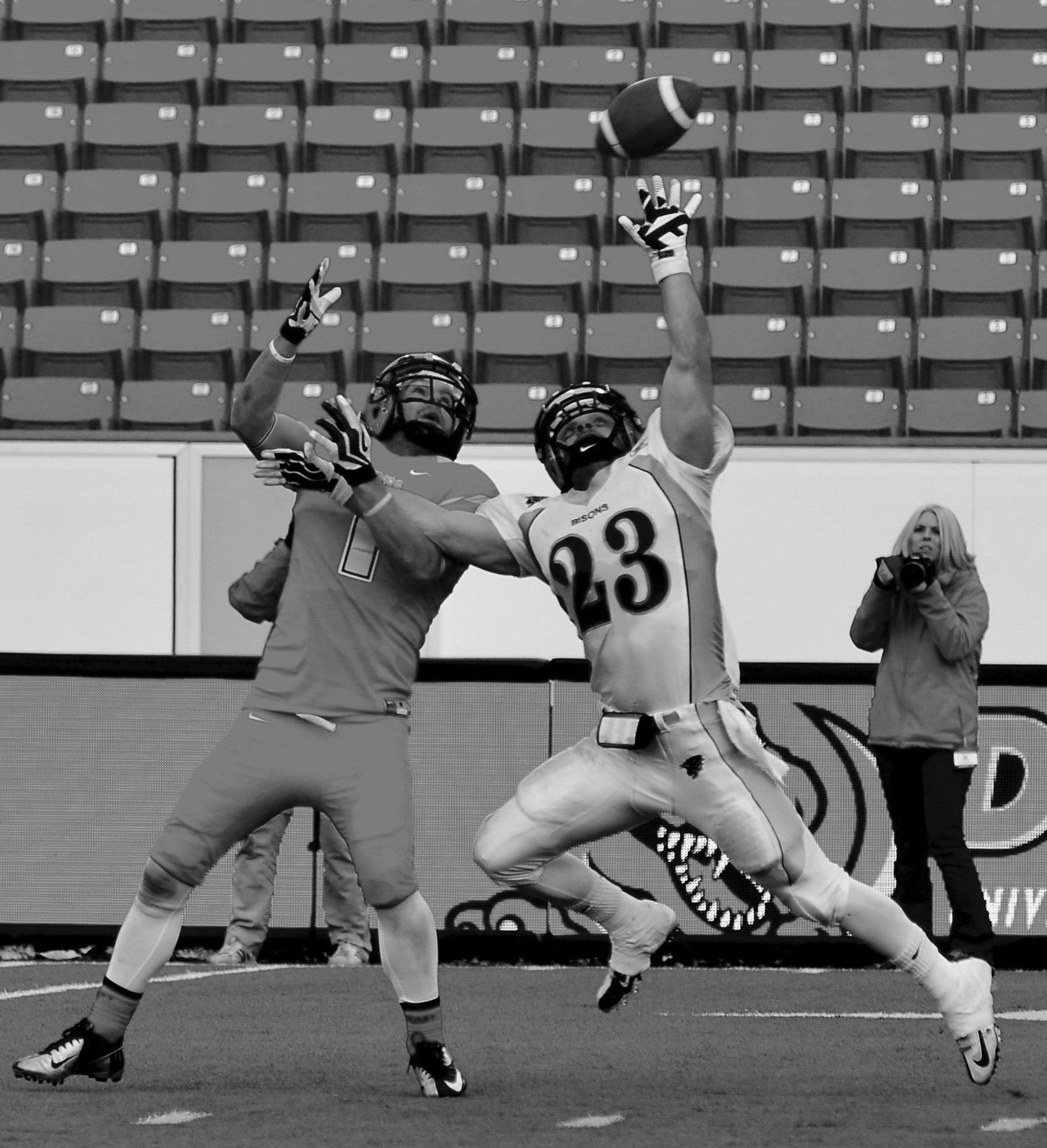
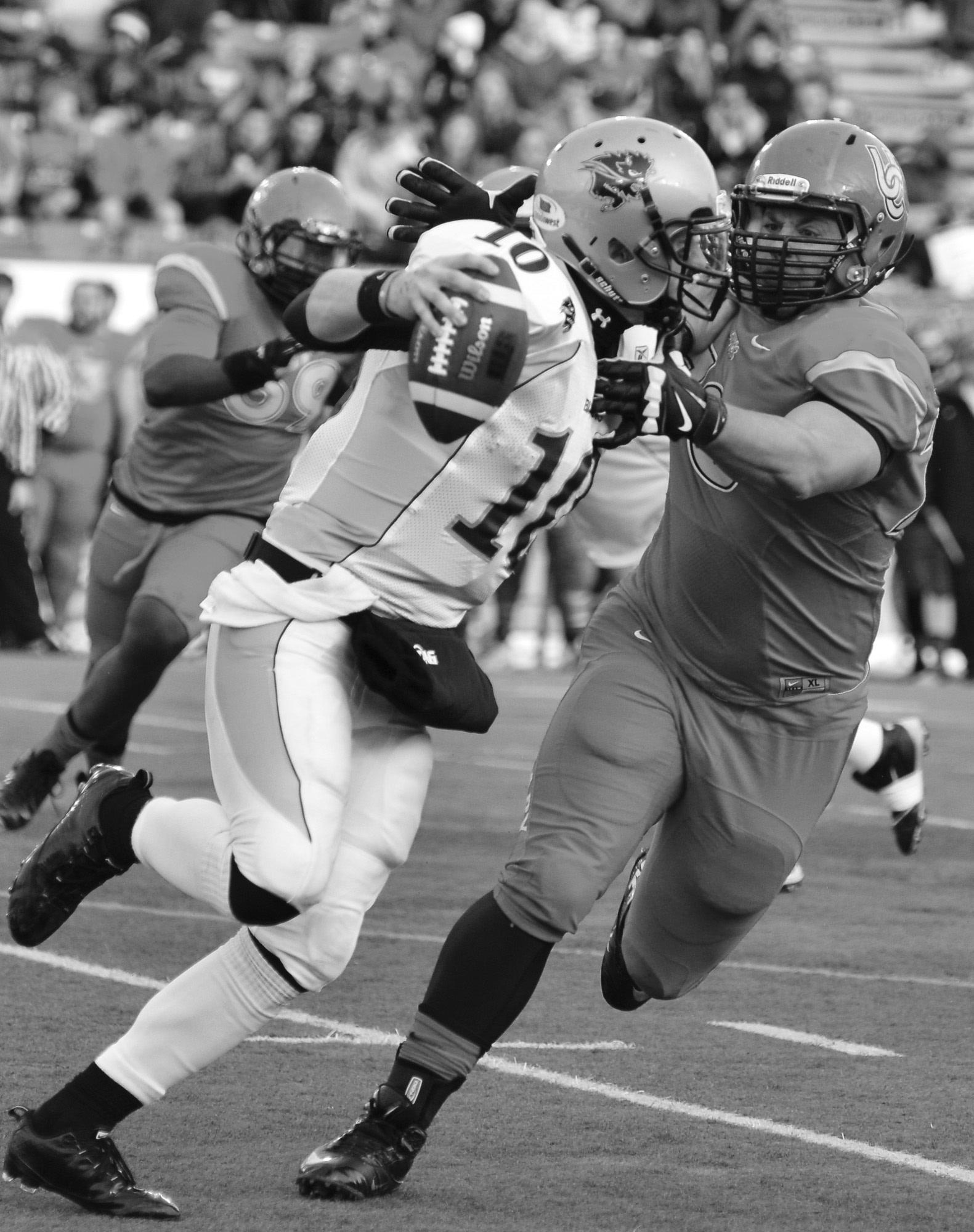
The Manitoba Bisons were officially eliminated from the Vanier Cup hunt, with a 43-28 loss at the hands of the Calgary Dinos on Saturday afternoon at McMahon Stadium.
The Dinos jumped out of the gate with fervor, scoring a touchdown on their first drive of the game courtesy of a 27-yard run by running back Mercer Timmis, who had a brilliant game for Calgary. Things got worse for Manitoba on their first drive, as Canada West all-star running back Anthony Coombs went down on the first play from scrimmage and never returned. The Dinos added two more points to their total on that same drive, forcing Manitoba to concede a safety after pinning them deep in their own end.
The Bisons were shut down for most of the first, but mounted a solid six-play, 67-yard drive to end the quarter, capped off by a brilliant 21-yard touchdown reception by Kienan LaFrance, who played valiantly in place of the injured Coombs. Heading into the second, the Dinos led 9-7.
The second quarter was all Calgary, as they outscored the Bisons 17-0 and took a 26-7 lead into the half.
The Dinos moved the ball 98 yards on 12 plays, capped off by a Jake Harty seven-yard touchdown
reception at 4:47 of the second.
Calgary struck again on their next drive, this time on a big 57-yard touchdown pass from quarterback Andrew Buckley to Canada West rookie of the year Rashaun Simonise. Calgary capped off their scoring with a 43-yard Johnny Mark field goal with less than 30 seconds left to play in the half. Manitoba quarterback Jordan Yantz struggled to find a rhythm in the first half. Calgary’s front four provided enormous pressure, essentially shutting down the Bisons’ passing game.
The Bisons got a bit of luck at the beginning of the second half. Manitoba defensive back Jordan Linnen recovered a Simonise fumbled punt reception deep in Calgary’s zone. The Bisons wasted little time capitalizing, Yantz found receiver Andrew Smith in the end zone from 19 yards out, cutting the Calgary lead to 26-14. That was where the Bisons’ luck ran out. The Dinos proceeded to outscore Manitoba 10-0 in the final 13:15 of the third quarter. Calgary’s scoring started out on the following drive after the Bison touchdown, as fifth-year running back Cuong Thai Lieu scooted into the end zone from 42 yards out. The Dinos added a field goal with 2:29 left in the quarter to take a comfortable 22-point lead into the fourth.
Manitoba would not go down
easily in this one, getting back on the scoreboard with 7:40 left in the game on a 37-yard Yantz touchdown pass to Matt Sawyer. The scoring play was set up by a massive 64-yard reception from Nic Demski. The Dinos seized the momentum right back after the scoring play, as Timmis secured his second touchdown of the game with 4:49 left. The 33-yard touchdown gave the Dinos a 43-21 lead.
Manitoba kept fighting, scoring on their next drive, a nine-play, 83-yard march downfield capped by a 13-yard Smith touchdown reception. The Bisons then recovered an onside kick, but were unable to capitalize.
Timmis was the gamebreaker in this one, piling up a Dinos post-season record 279 yards on 28 carries, as well as two touchdowns. As a whole, the Dinos put up a whopping 623 yards of total offence, marching up and down the field all day.
Yantz finished the day 18-of-40, with 277 yards, along with four touchdowns and two interceptions. It was another strong performance, but ultimately was not enough to keep the Dinos from their sixth consecutive Hardy Cup title.
The Dinos will move on to face the Western Mustangs in the Mitchell Bowl next weekend.
phOtOs by jOsh O'bRieN
At the rim
Canada Basketball hoping for wild card spot at 2014 FIBA World Cup
a dam pe Leshaty, volunteeR
At the 2013 FIBA Americas Championship last September, the hopes of Canada’s men’s basketball team qualifying for the 2014 FIBA Basketball World Cup seemed to vanish.
Needing a top-four finish at the tournament to qualify, Canada lost its final three games to finish in sixth place. It was a bitter disappointment for a country with more NBA players than ever and a rebuilt men’s program with Steve Nash as general manager and Jay Triano brought on for a second stint as national team head coach.
However, FIBA may give Canada a second act.
Canada Basketball has applied to FIBA for one of four wildcard berths into the Basketball World Cup to be held in Spain from Aug. 30 to Sept. 14. Fourteen other countries have also applied, including Canada’s zonal rivals Brazil and Venezuela and top10-ranked Greece, Russia, and Turkey, who failed to qualify out of the 2013 EuroBasket tournament.
FIBA may create a shortlist of teams for the berths by Nov. 23-24 before making their final decision in February.
According to FIBA rules, at least two zonal regions must be represented in the four wildcard berths.
Despite Canada Basketball launching a Twitter campaign to FIBA with the hashtag “#Can4Spain2014,” Canada is in tough for a berth. The number of Canadian players making waves in the NBA and NCAA, as well as better international results in the youth and women’s levels and increased interest in the international game, could sway FIBA’s Central Board.
While basketball is popular in Canada, their 25th world ranking is lower than some of the teams competing for berths. Canada may be suitable according to some of FIBA’s criteria, but not others.
However, how these berths are granted is improper.
The idea that some of the countries chosen to play in the Basketball World Cup would be determined not on a basketball court, but in a boardroom, is dubious at best.
It can be expected that three more European teams will be added as wildcards. Half of the top-24-ranked men’s national teams are from Europe, but,
despite only accounting for almost onequarter of FIBA’s national federations, 10 of its 23 Central Board members hail from Europe – including four out of five executive members. Out of eight wildcard spots given over the past two
World Championships, six were given to European nations. FIBA holds a last-chance qualifying tournament to determine which teams go to the Olympics. Why can it not be the same for the Basketball
World Cup? Such a qualifier could be held a month prior to the event, during the NBA off-season. Settling it on the court is a better alternative. But for now, all Canada can do is wait.
Huskies swept away
Bison women’s volleyball improves to 4-2
m arc LaG ace, Staff
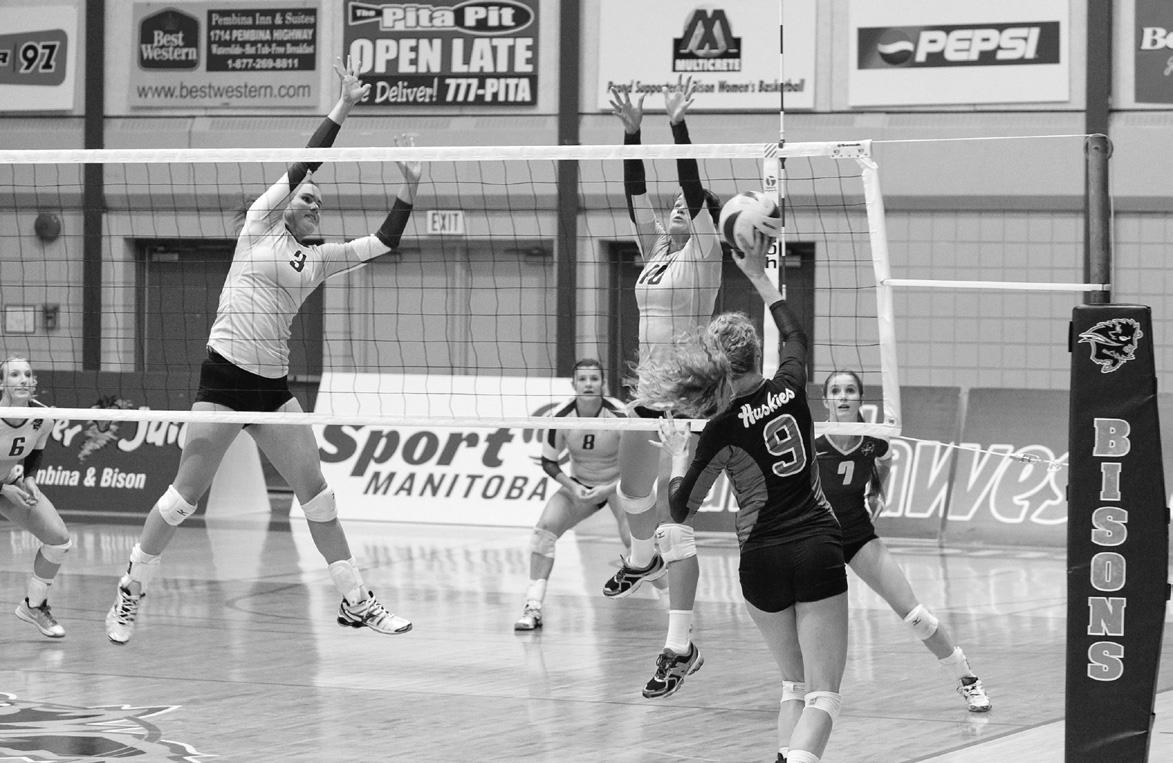
It only took six sets for the U of M women’s volleyball team to send the University of Saskatchewan Huskies packing. The Bisons swept the Huskies three sets to none in games played at Investors Group Athletic Centre (IGAC) on Nov. 8 and 9.
The Bisons were without Taylor Pischke, who led the team in kills and points scored heading into the weekend. The Bisons were able to fill Pischke’s spot in the rotation without missing a beat, dominating the Huskies in nearly every set.
On Friday, Rachel Cockrell’s 12 kills and 14 points led all players and helped secure the Bison win 3-0 (25-13, 25-18, 25-14). The Bisons started the match by going on a 6-0 run, which was aided by four attack
errors committed by the Huskies. The early lead set the tone for the first set, as the Bisons took it to the visitors 25-13.
Candace Hueser and Kayla Tycholiz led Saskatchewan with 10 points a piece on the night. The Huskies took their only lead of the match in the second set, but the Bisons still won the second set 25-18 and cruised to victory in the third.
On Saturday, the Huskies put up a better fight, but were still no match for the Bisons. Crystal Mulder was the star, leading all players with 11 kills, nailing two service aces and pitching in on defence with 10 digs.
“It’s what I expect from [Mulder],” said Bison head coach Ken Bentley.
“She’s one of the rocks of the team and I expect her to play like that.”
Saskatchewan looked to come from behind and steal the first set, but an attack error by Anne Hanbidge on set point gave the Bisons the edge, 25-23. The Bisons continued to dominate the Huskies for the remainder of the game, winning 3-0 (25-23, 25-17, 25-18).
“I’m very happy with their play; we played six very solid sets of volleyball,” said coach Bentley.
“Our defence was really strong. We had an idea of how we wanted to play them, and I thought we did a great job of sticking to that idea throughout the weekend.”+
With the wins, the Bisons are 4-2 and in a three-way tie for third place in the Canada West conference with Calgary and UBC Okanagan. Their two losses on the season came on the road against the undefeated UBC Thunderbirds. Their next two matches are against the second place (5-1) Brandon Bobcats at IGAC.
“[Brandon] is a very good team so we have to play really good volleyball to beat those guys,” said coach Bentley. “But it is nice to be home for a couple of weeks and get settled in. The extra time you get during the week for your preparation is invaluable.”
Check out the Bisons taking on the Bobcats at IGAC Nov. 15 at 6 p.m. and Nov. 16 at 5 p.m.
iLLustRatiON by bRaM Keast
phOtOs by beibei Lu
Bison briefs
Hockey and basketball
men’s hockey
The Bisons (2-8-0) lost both away games this past weekend against the Regina Cougars (6-4-0), falling 2-1 on Friday night and 7-4 on Saturday. Regina scored the game-winning goal Friday with just 2:43 left in the third period. Manitoba registered 27 shots, but only cashed in once against goalie Andrew Hayes, the tally coming via forward Aaron Lewadniuk at 3:35 of the second period.
Saturday afternoon’s game was far less promising, as Manitoba was dominated, despite registering 54 shots. The Cougars scored three goals in both the first and second periods, chasing starting Bison goalie Deven Dubyk from the net after 40 minutes. They added one more goal in the third to cap a seven-goal evening. Manitoba’s four
goals came from forwards Brendan Rowinski, Ian Duval, and Aaron Lewadniuk, who scored two.
The next action for the men is Friday, Nov. 15 and Saturday, Nov. 16 against Lethbridge at Wayne Fleming Arena. Game times are 7 p.m. and 6 p.m., respectively.
women’s basketball
The Bisons (3-1) took one out of two games on the road against the Lethbridge Pronghorns (2-2) this past weekend. Manitoba suffered their first loss of the young season Friday night, falling 59-54. The Pronghorns had early momentum, going on an 8-0 run to start the game. Manitoba slowly clawed back and took the lead in the second quarter; however, Lethbridge finished the half on a 9-0 run and led 24-20 at halftime. The Pronghorns
would hold on to their lead. Kim Veldman of Lethbridge led all scorers with 23 points. Sheree CarmonaGaldamez added 13 for Manitoba.
The Bisons had a better result Saturday night, emerging with a 61-53 victory. Lethbridge held onto a slim lead in the first and second quarters, shooting 13-of-27 in the first half and going into the break up 33-31. Manitoba increased the pace after the break, going 7-of-13 overall from beyond the arc and heading into the fourth quarter with a 49-43 advantage. The Bison defence was the difference in this one, holding the Pronghorns to an abysmal 6-of-33 from the field in the second half to preserve the lead and the eventual victory. Stephanie Gill of Manitoba led all scorers with 17 points.
The women take to the court
again next weekend at the Investors Group Athletic Centre, welcoming Calgary to town with afternoon games on Friday at 1 p.m. and Saturday at 12:00 p.m.
men’s basketball
The men took on Lethbridge this past weekend for games on Friday and Saturday night. The result was not what the Bisons (1-3) were looking for, as they fell in both games to the Pronghorns (3-1). Friday night was the closer of the two contests, as Manitoba lost a tough one 74-69.
The Pronghorns led by as much as 13 points and took a 40-29 lead into halftime. The Bisons showed resilience in the second half, managing to eventually take the lead late in the fourth quarter. The Pronghorns would not let this one slip away, going on a 7-0 run with
less than three minutes remaining to retake the lead. Brent Watkins of Lethbridge and Yigit Ozsayiner of Manitoba both had 18 points to lead all scorers.
The following evening’s game saw Lethbridge dominate from beginning to end, en route to an 82-58 win. The Bisons struggled to get anything going offensively, and were outscored 21-8 in the second quarter. Manitoba finished the night shooting 20-of-63, with a season-low 58 points. Andre Arruda was one of the lone bright spots for the Bisons, putting up 19 points in the loss.
The Bisons return home for games at the Investors Group Athletic Centre this Friday and Saturday against the Calgary Dinos. Game times are 3 p.m. and 2 p.m., respectively.