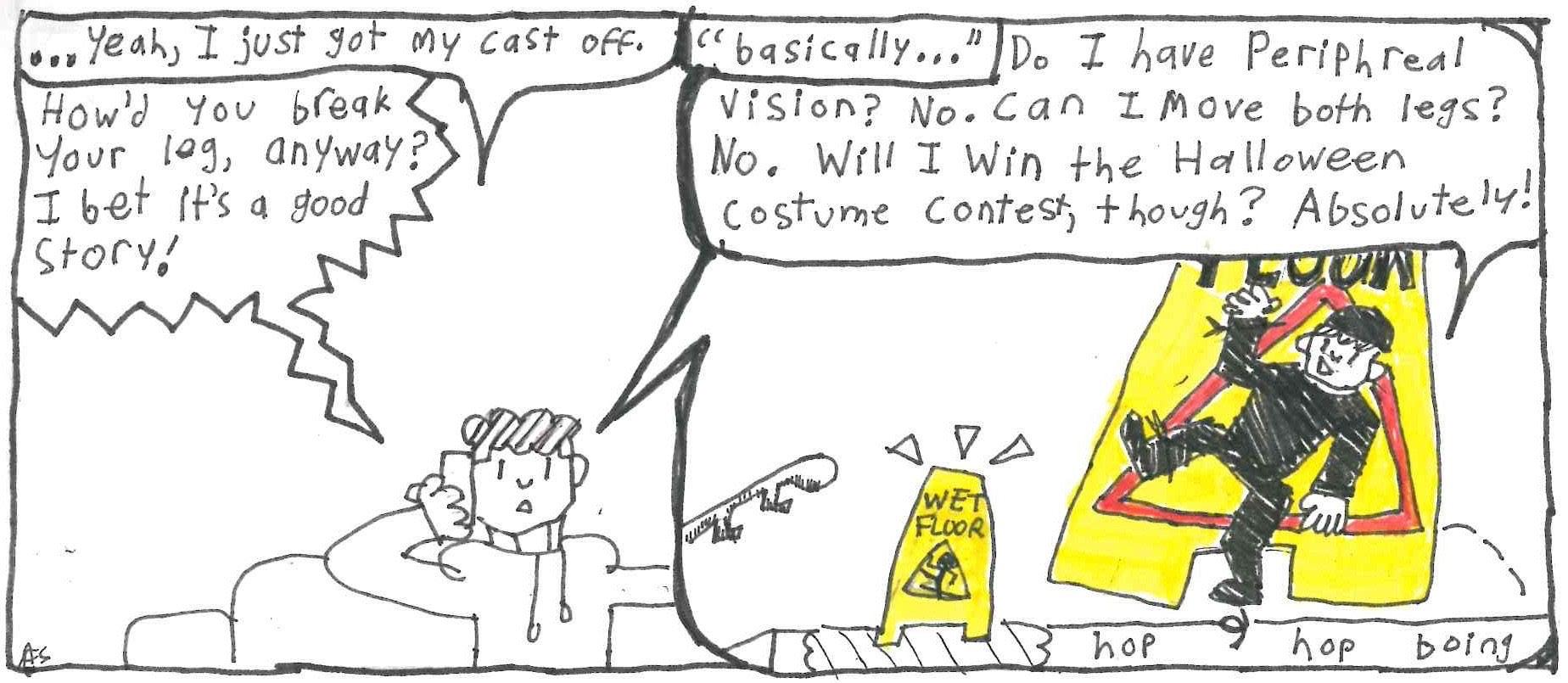
GRAPHICS EDITOR Emma Gillich graphics@themanitoban.com
GRAPHICS ASSOCIATE Teegan Gillich
AUDIO AND VIDEO
AUDIO EDITOR Max Reid audio@themanitoban.com
PHOTO EDITOR Mike Thiessen photo@themanitoban.com
PHOTO ASSOCIATE Ebunoluwa Akinbo
VIDEO EDITOR Zulkifl Rafah video@themanitoban.com
DIGITAL MEDIA EDITOR Faisal Rahman social@themanitoban.com
SOCIAL MEDIA ASSOCIATE Paula Robles Andia
REPORTERS
NEWS Arifah Gheesah
NEWS Nafisa Al Lilo
RESEARCH & TECHNOLOGY Nawal Semir
COMMENT Thandeka Katsika
COMMENT Kyra Campbell
ARTS & CULTURE Carrington Dong
ARTS & CULTURE Jordan Anglin
SPORTS Faiyaz Chowdhury
SPORTS Israel Abejoye
VOLUNTEERS
VOLUNTEER STAFF
Adam Johnston
VOLUNTEERS
Ronal Amata, Aubrey Stotter, Emmanuel Laramee, & Mei M. interested in volunteering?
email me@themanitoban.com today!
The Manitoban is the official student newspaper of the University of Manitoba. It is published monthly during the summer and each week of regular classes during the academic year by the Manitoban Newspaper Publications Corporation.
The Manitoban is an independent and democratic student organization, open to participation from all students. It exists to serve its readers as students and citizens.
The Manitoban is a member of the Canadian University Press, and our journalistic standards can be found on the Manitoban’s website.
The newspaper’s primary mandate is to report fairly and objectively on issues and events of importance and interest to the students of the University of Manitoba, to provide an open forum for the free expression and exchange of opinions and ideas and to stimulate meaningful debate on issues that affect or would otherwise be of interest to the student body and/ or society in general. The Manitoban serves as a training ground for students interested in any aspect of journalism.
Students and other interested parties are invited to contribute to any section of the newspaper. Please contact the appropriate editor for submission guidelines.
The Manitoban reserves the right to edit all submissions and will not publish any material deemed by its Editorial Board to be discriminatory, racist, sexist, homophobic or transphobic, ableist or libellous.
Opinions expressed in letters and articles are solely those of the authors. Editorials in the Manitoban are signed and represent the opinions of the writer(s), not necessarily those of the Manitoban staff, Editorial Board or the publisher.
A “volunteer staff” member is defined as a person who has had three volunteer articles, photographs or pieces of art of reasonable length and/ or substance published in the current publishing year of the Manitoban
Any individual who qualifies as a volunteer staff member must be voted in by a majority vote at a Manitoban editorial board meeting. Elected representatives and non-students may be excluded from holding votes as volunteer staff members in accordance with the Manitoban Constitution.
Students invited to shape the future of digital communication
Roy Albright Obah, staff
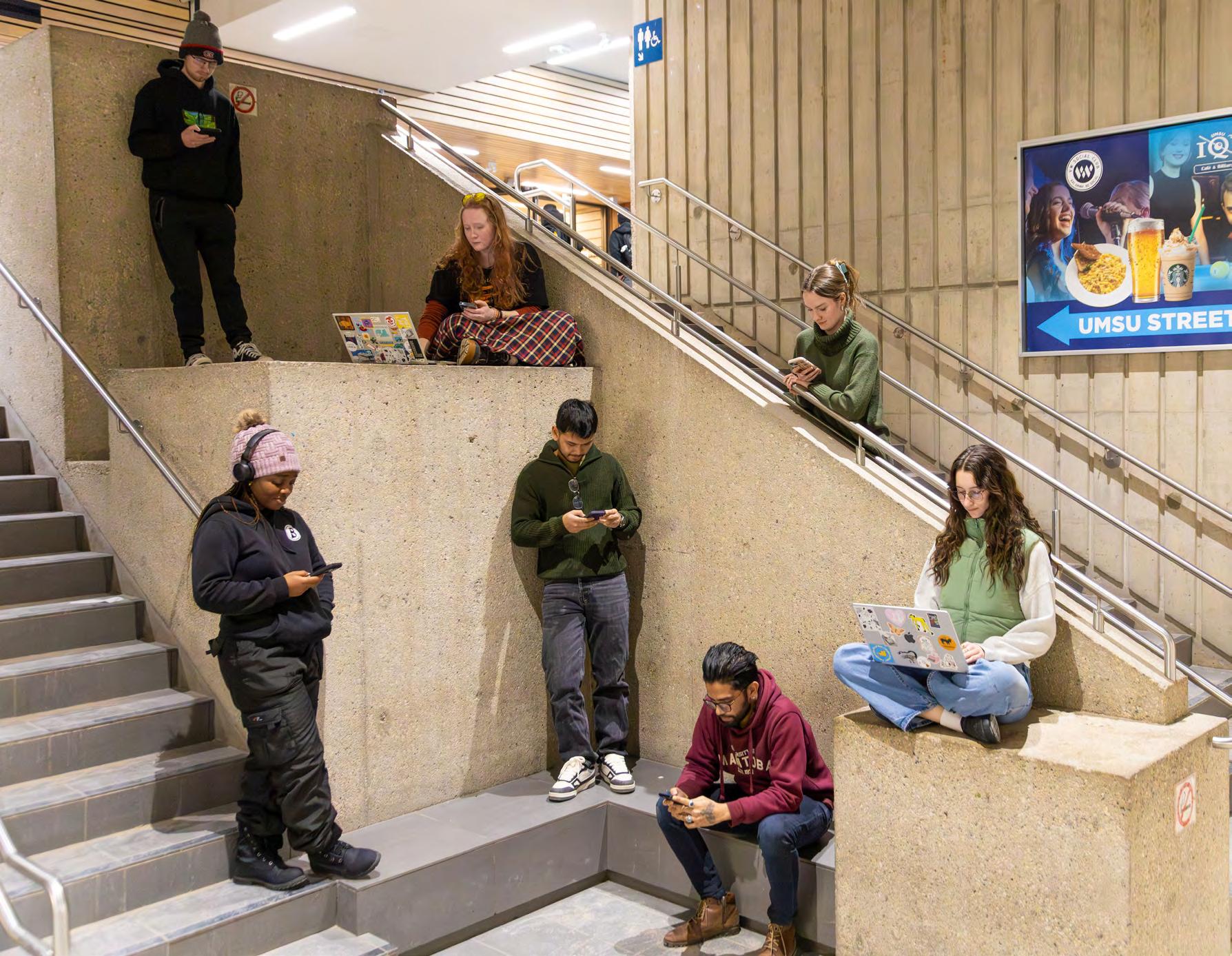
U of M launched a campus-wide digital communications survey the week of Feb. 2 to give students the opportunity to share feedback on how the university communicates online and how those systems can be improved.
The survey is part of a broader initiative led by Student Affairs to review and enhance the university’s digital communication landscape.
“We’re at a place right now where we really want to investigate and hear directly from students,” said Brandy Usick, executive director of student engagement and success.
“The tools we’re [using] were developed many years ago, and the importance of digital communication has only increased, particularly since the pandemic.”
Usick said the goal of the survey is to better understand how students currently access information, what platforms they rely on most and where gaps or challenges exist.
The findings will help inform future decisions around whether existing systems should be improved or replaced with more modern, integrated tools.
The upcoming survey builds on insights from a 2025 Perception Study conducted by an external research group
for U of M’s strategic marketing and communications team, which found that the dominant source of information was UM Learn for undergraduate students and emails for graduate students at the university.
Across all students surveyed, 87 per cent relied on UM Learn, 68 per cent on email, 61 per cent on professor communications and 54 per cent on the university website to stay informed.
While those findings provided a useful snapshot, Usick said the new survey will go further by focusing specifically on how students want to engage with the university beyond coursework.
“We want to [dig] deeper into where students go for information about what’s happening on campus, how to get involved and how they want to engage with the university community,” she said.
In addition to the online survey, students will also be invited to participate in small focus groups where they can provide more detailed feedback and discuss their experiences with digital communication tools.
Usick emphasized that student participation is essential and noted that students are best positioned to identify what works and what does not.
“Students […] are the largest constituent group on our campus,” she said. “Their voices matter in shaping how we communicate as a community.”
To encourage participation, students who complete the survey have a chance to win some incentives including bookstore gift cards, dining services gift cards and U of M Bisons merchandise.
“[This] is an opportunity to
lend your voice to a decision that will impact [current and future students],” Usick said. “We hope to hear how students want to communicate and engage with us as an institution.”
The link for participation in the survey will close on Feb.15. Students can access the survey via https://umanitoba. ca/student-survey.
Fighting fascism starts with migrant justice
Arifah Gheesah, staff
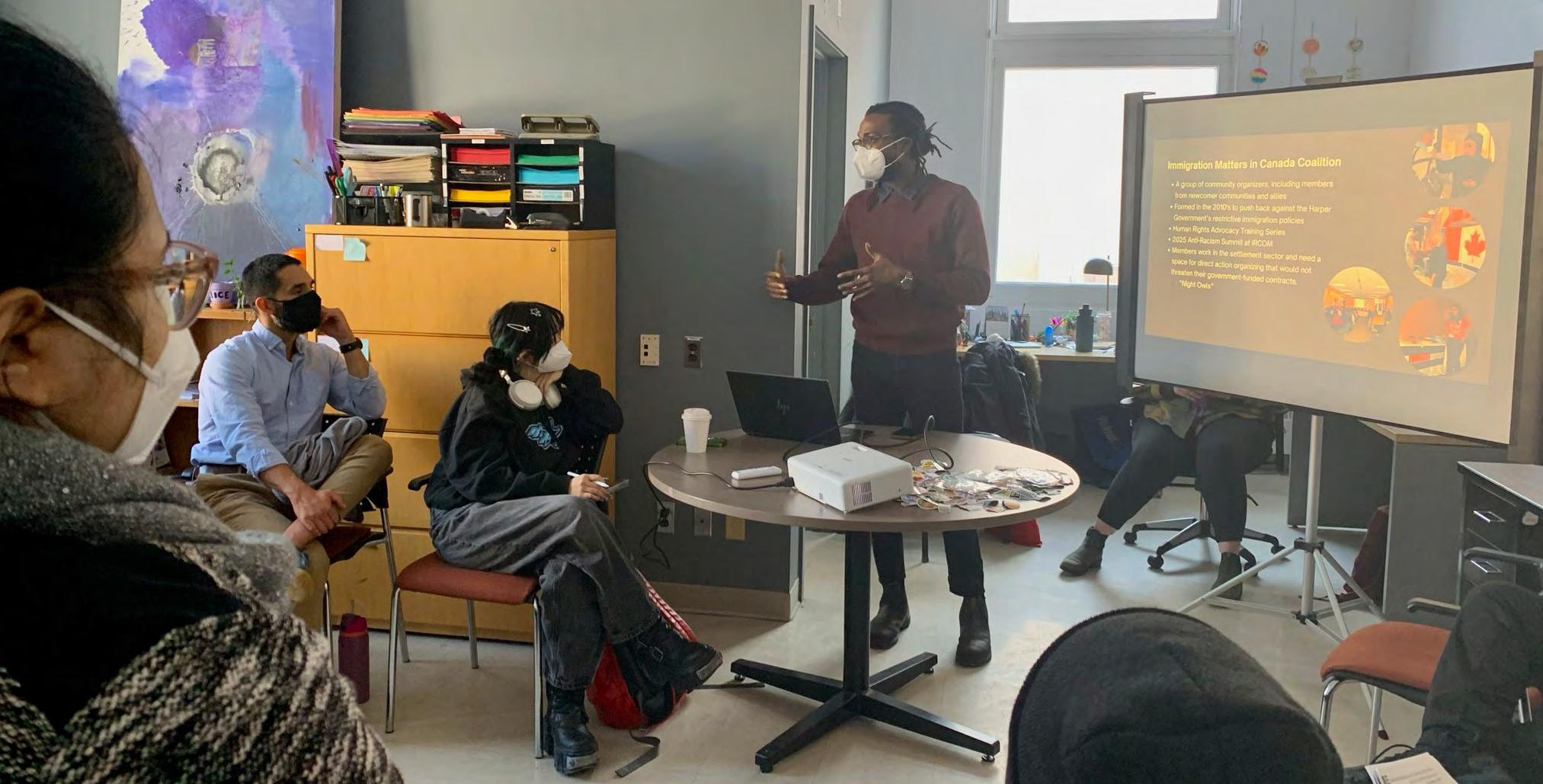
The Social Justice Hub’s teach-in for January, titled Migrant Justice Organizing, took place on Jan. 27 and was co-hosted by Migrante Manitoba, Anakbayan and the Social Planning Council.
The Social Justice Hub has a monthly teach-in where they discuss different social justice issues while bringing university staff, faculty and community partners to co-host sessions. This is a resource on campus for students who are interested in social change and community work.
Mandalyn Unger, Social Justice Hub coordinator, explained how those teach-ins are for students to learn how to do community work more effectively and sustainably. “We’re really an office that focuses on moving students
from identifying problems to then taking action on addressing them,” they said.
For January’s event in particular, the hub brought local community organizations that are working on the issue of migrant justice organizing so that students could learn from them and get involved. Unger added that these organizations can also learn directly from students about the challenges emerging in an increasingly anti-migrant political climate.
the history of colonialism and capitalism and its impact on the Philippines and on migration for Filipino people into Canada.
“When it comes to resisting fascism and resisting state suppression, your neighbour is the most powerful ally”
— Mandalyn Unger, Social Justice Hub coordinator
“I think especially with what we’re seeing happen in Minneapolis and the complicity of Canadian companies that are funding ICE either through the sale of
tanks or other resources, we wanted to make sure that we were talking about how we can make a difference in that fight here locally,” Unger said, reflecting on the economic barriers that are applied to international students and the impacts of anti-migrant rhetorics.
During the event, attendees were able to hear presentations from the three organizations. Various topics were discussed such as the importance of student leaders in social justice movements and mass movements and
The Social Planning Council talked about Bill C-12, the Strengthening Canada’s Immigration System and Borders Act, which aims to enhance border security and the Canadian immigration system. “It’s a huge bill that severely impacts migrants, newcomers [and] refugees, but also has implications for citizens,” Unger stressed.
Unger shared how Bill C-12 expands the surveillance state and the information that can be shared about people between government
agencies, which invades people’s privacy. It implies power to the government to mass-cancel immigrant applications. They believe that we are seeing as much antimigrant rhetoric and policy being put forward as we are in the U.S. Unger explained there is a “deportation machine” that is being built by Bill C-12 which will be mass-deporting people, regardless of the impact that will have on their lives.
The Migrant Rights Network, a cross-Canada alliance, is leading a campaign to ask people to write to their senators who are the last chance to stop this bill. People who want to contribute to that change can go to migrantrights.ca to write
Cont’d p. 4 / a letter <
PHOTO BY EBUNOLUWA AKINBO / STAFF
Social Justice Hub partnered with community groups to discuss migrant justice
< Cont’d from page 3
a letter to their senator.
“We do have the power to change the circumstances that make our lives so hard, and we have a much better chance of doing that if we work together than if we work alone,” Unger said, reflecting on the discussions that students had during the event.
With current happenings in the U.S., Unger is convinced empathy for our neighbours is necessary and want them to be safe and secure. An issue need not personally impact us to care about it. “Whenever we see state violence being enacted on a more marginalized or vulnerable group, we need to understand that it will never stop there,” they added.
“Our struggles are linked,” Unger said. “There is strength in […] working together, [and] we can support each other’s fights.”
Canada is a multi-cultural country, and it is important we know who we live next to, who we work beside and who
we go to school with and build personal relationships with.
Our neighbours have all levels of immigration status and hold all kinds of identities.
“When it comes to resisting
fascism or resisting state suppression, your neighbour is the most powerful ally,” Unger said.
The Social Justice Hub
remains a safe space for students to facilitate community organizing.
Students can find out at umanitoba.ca/communityengaged-learning/social-
justice-hub and can email Mandalyn Unger at mandalyn.unger@ umanitoba.ca for more about student organizing for migrant justice.
Career Fair provides guidance, links students with jobs
Employers, alumni and career services connect students with job options
Nafisa Al Lilo, staff
The U of M’s annual Career Fair on Jan. 27 and 28 brought students, alumni and employers together to explore career opportunities, network and learn more about paths available after graduation.
The event featured organizations from a range of sectors, including public service, finance and international graduate education.
Students were able to speak directly with representatives and learn more about employment and postgraduate opportunities.
Malek Rose, a program support staff member with U of M Career Services, spoke about the career fair.
“We have a bunch of employers come in and students and alumni have a chance to have direct one-toone contact with employers to find out more about opportunities.”
Rose spent the day at the Career Services booth promoting resources available through the office, including resume support, interview preparation and job search assistance.
“This is obviously a service that’s free for alumni and students to use. A lot of people don’t know that it’s available
to them,” he explained. Career Services is located on the fourth floor of University Centre, room 474.
Rose encouraged students, particularly those nearing graduation, to take advantage of their services.
The fair also included international education options.
Zhaoying Hu represented the Community Solution Education System.
“We are a group of universities in the U.S.,” Hu stated. “We are all private, non-profit and we offer career focused graduate level education.”
Referencing one of the schools in the group — The Chicago School — Hu explained that although it initially “focused on psychology” it has since expanded to other programs.
She included that they were at the fair “because many of the programs that [they] offer are very limited in Canada, [whether] it’s mental health [and/or] physical health [programs],” she said, implying that “a lot of students have to go somewhere else to pursue that dream.” She encouraged everyone to keep exploring as there are many opportunities out there.
Janet Reichert, recruitment and communication specialist
for the Brandon Police Service, said the organization was attending the fair to recruit.
“We are looking for recruit officers. As well, we will have a cadet program opening coming up.”
Reichert explained that the Brandon Police Service prioritizes member wellness.
“Our executives are always looking out for our wellbeing, and we have a wellness committee,” she said. “We have one of the first psychologists in a small department coming on board.”
Genevieve Yoko, representative of Median Credit Union, explained the credit union is Indigenousfocused and owned but open to everyone.
Yoko highlighted specific benefits available to students and young adults.
“We have an account for 29 and under that has no fees at all,” she explained. “We also have many opportunities for anyone that would like to join us.”
Taqua Shapan, a third-year psychology student, attended the career fair. “I think that this is a very important event that you should all go to because it’ll open your eyes to the different companies that are in Manitoba,” Shapan said.
PHOTO PROVIDED BY SOCIAL JUSTICE HUB
PHOTO BY MATTHEW MERKEL / STAFF
THE MIGRANT JUSTICE ORGANIZING TEACH-IN ON JAN. 27.
SJP holds general body meeting at U of M
Meeting outlined past events, current campaigns and ways to get involved
Nafisa Al Lilo, staff
S
tudents for Justice in Palestine (SJP) held a general body meeting on Jan. 28 to introduce the organization to students, outline activities and explain opportunities for involvement.
Hussein Chokr, SJP vicepresident, led the meeting.
“The idea of the general body meeting was to essentially be more transparent to our community,” Chokr explained.
“And perhaps introduce SJP to people who have never attended our events, and to expand our reach on campus.”
“The general body meeting was divided into three aspects,” Chokr said.
and scope were described during the meeting.
“We are a group on campus that wants to advocate for Palestinian rights and to express solidarity with the Palestinian people,” he said.
“But our role isn’t limited to that. We also advocate for different groups and racialized communities.”
Previous events organized by SJP include Night in Palestine, held in December 2025 and similar events such as the Palestine Gala in 2024.
Chokr said the previous
talented performers within the pro-Palestine community, and we also had an Indigenous performance.”
The meeting highlighted the educational programming, particularly during the 2024 student encampment.
“The peak of the educational events happened during the 2024 encampment, where we collaborated with faculty members,” Chokr said. “They [gave] teachings regarding the economy, oppression and a lot of various topics.”
The campaign also discussed university investments.
“We are a group on campus that wants to advocate for Palestine rights and to express solidarity with the Palestinian people”
— Hussein Chokr, Students for Justice in Palestine vice-president
“This includes events that we have done in the past, the campaigns that we’re currently doing and […] how we can get people to be more involved.”
The organization’s mandate
events “had everything that you [could] ask for in a pavilion, [including] Palestinian food, culture, dances [and] a museum aspect.” He added, “We had performances by multiple
“Thanks to the encampment back in 2024, the university has disclosed a lot of their investments,” Chokr stated. “A working group of students and faculty combed through all of the investments and found that there are some organizations or companies that are complicit in the genocide in
Palestine.”
A new update about the club is that a lot of the current members will be graduating, which opens up opportunities for other students to fill their roles.
The evening concluded with representatives from SJP advising students to join the club. “Please be involved,”
UMUSA welcomes its members
Chokr said. “The work for Palestinian solidarity and solidarity within the greater U of M community is still important.”
To learn more about SJP and to stay up to date with their events, find them on Instagram @sjpuofm.
An evening of celebration and an opportunity for shared knowledge creation
Roy Albright Obah, staff
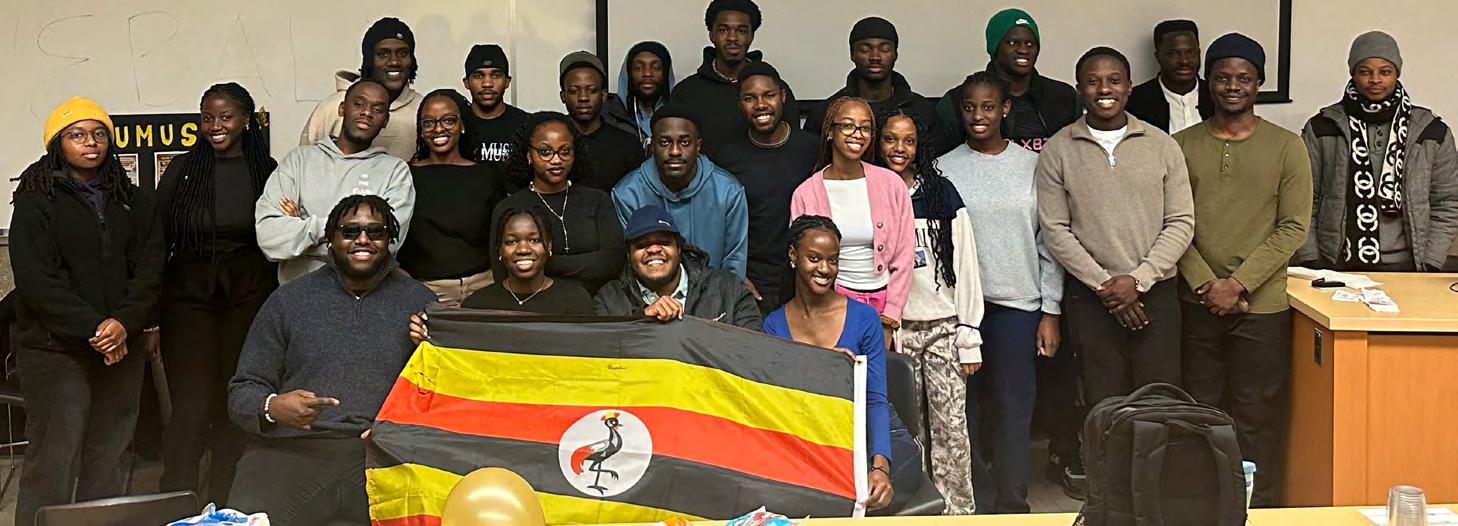
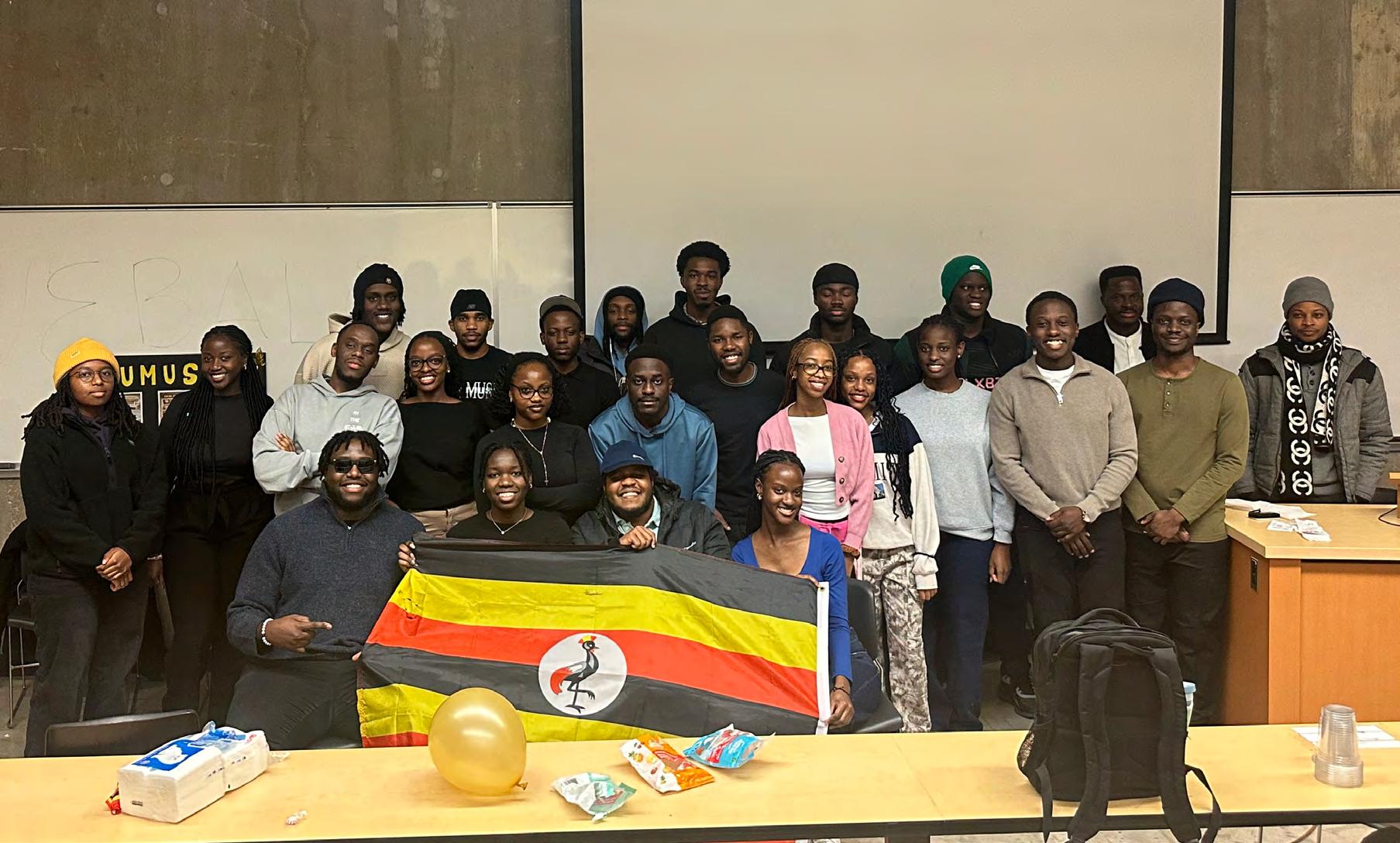
The U of M Ugandan Students’ Association (UMUSA) held its maiden community event on Jan. 23, bringing members together for a meet-and-greet aimed at fostering connection and engagement among Ugandan students on campus.
Hayley Gabriella Nanyange, president of UMUSA, said the gathering was designed to create an opportunity for members and executives to meet and share ideas for future events.
“The purpose of the club [is] to create a welcoming and supportive community for Ugandan students at [the U of M],” Nanyange said.
Paul Watuwa, UMUSA events coordinator, spoke about the ambiance of the event as one of its most meaningful elements. He described it as a “welcoming atmosphere” that encouraged participation and interaction.
informal structure of the meet-and-greet helped foster genuine connections and a strong sense of community.”
He attributed the positive outcome of the event to “strong teamwork, preparation and clear communication.” He added, “We aimed to make the event as inclusive as possible [which] required careful consideration.”
Nanyange acknowledged the novelty of the club.
“The club is still finding its footing within the university […] There are various plans ahead [which] will provide strong support for the student community,” she said.
connections among students.
“The world we are entering [into] after university requires more than just
a degree”
— Hayley Gabriella Nanyange, UMUSA president
Watuwa included that “the
Among the initiatives being considered are events like career fairs and cultural days, which Nanyange identified as notable opportunities for engagement. She also stressed the association’s current focus on building meaningful
The club, she said, works to “ensure presence and connection between students to make sure they [do not] feel alone on their journey.” Nanyange expressed hope
that UMUSA will continue to grow into a vital space for students. She said she aspires to see the association thrive “and provide a safe haven and landing spot for all Ugandan students […] as well as furthering knowledge about Ugandan culture and its people.”
In a message to students, Nanyange encouraged
involvement beyond academics, stressing the importance of engagement outside the classroom. “Participating in student clubs is an essential part of university experience,” she said. “The world we are entering [into] after university requires more than just a degree.”
PHOTO BY NAFISA AL LILO / STAFF PHOTO PROVIDED BY UMUSA
IMAGE OF THE U OF M UGANDA STUDENTS ASSOCIATION.
Research & Technology
Managing water for the future of prairie agriculture
Smarter irrigation and drainage can boost yields and protect resources
Mansura Akter Meghla, staff
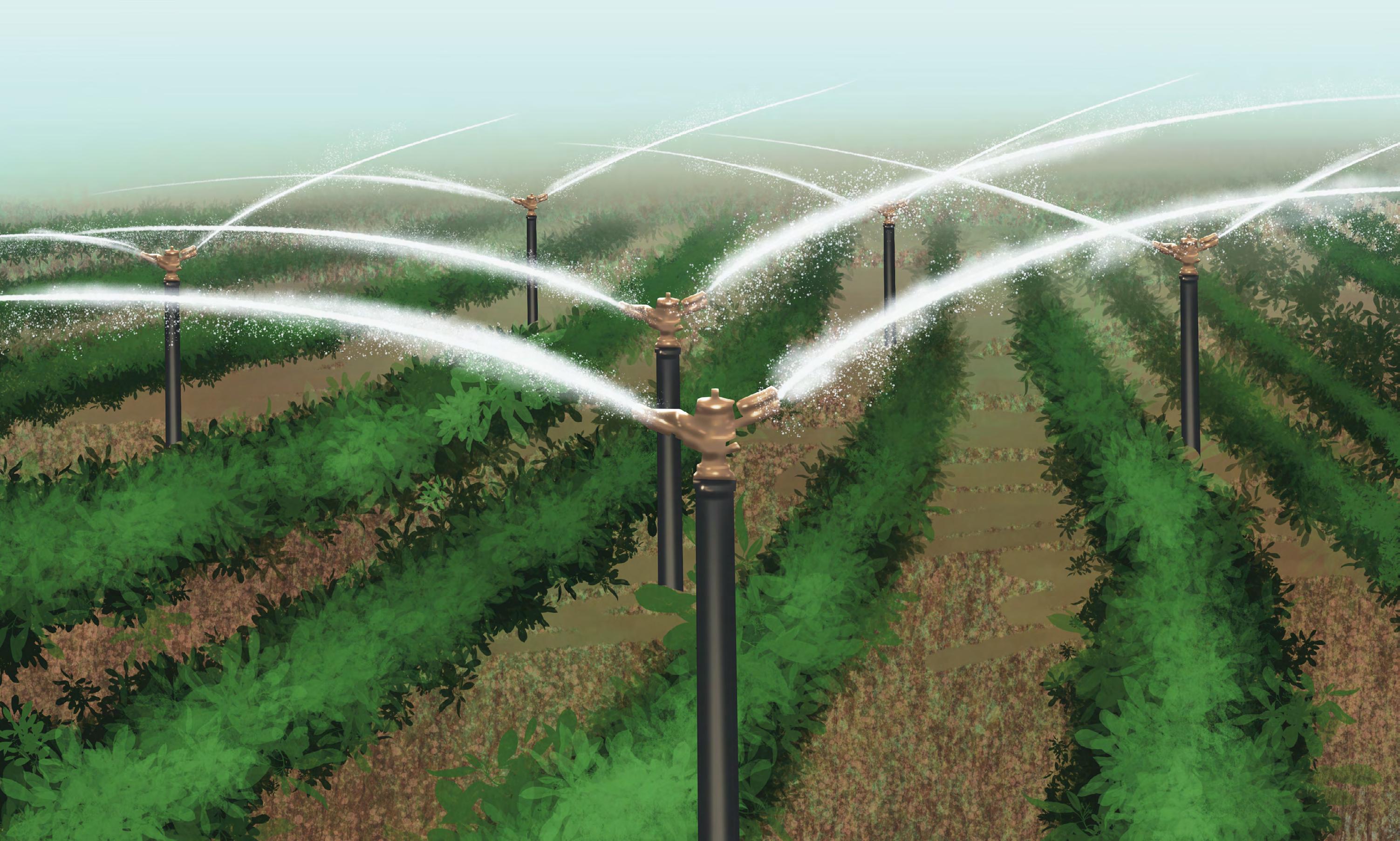
R anjan R. Sri Ranjan is a professor and associate head (graduate) in the U of M department of biosystems engineering. Sri Ranjan believes that water management is at the centre of sustainable agriculture on the prairies. Hence, his research focuses on soil and water engineering, with particular attention to irrigation and drainage systems on farms. His work combines longterm field research, computer modelling and applied engineering to help farmers improve crop yield and quality while preserving water and nutrients.
Much of Sri Ranjan’s research is conducted directly in farmers’ fields. Using fully instrumented field plots, his team has studied how water management affects crops such as potatoes, corn, canola, soybeans and wheat. That data is then used to develop computer models of fields growing specific crops.
Once these models are calibrated and validated, Sri Ranjan explained, they can be used to simulate how crops respond to different weather patterns and water management scenarios. “The idea is to develop best management practices that conserve water and
nutrients within the field while maintaining long-term sustainability,” he said. By running simulations across multiple years of weather data, the research helps predict outcomes under increasingly variable climate conditions.
One of the issues that first drew Sri Ranjan into this field of research was potato quality.
For potatoes destined for the processing industry, visual and chemical quality matters as much as yield. When potato plants experience water stress, poor root and canopy development can cause sugars to accumulate in the tuber. When those potatoes are fried, the sugars caramelize, creating what are known as “sugar ends,” or brown tips on french fries. Potatoes with sugar ends are often rejected, resulting in lost income for farmers.
According to Sri Ranjan, theoretically, irrigation and proper drainage could reduce this problem by creating better soil conditions for plant growth. To prove this, Sri Ranjan’s team conducted replicated field experiments to test different water management strategies. The research was funded by the Canadian and Manitoban governments, along with support from industry and producer groups. The
results of the research were significant. Fields with improved irrigation and drainage showed yield increases of up to 30 per cent compared to plots with no water management, while potato quality was also far superior.
The research did not stop with potatoes. Because tile drainage systems are expensive to install, Sri Ranjan said it was important to evaluate their benefits across crop rotations that include corn, soybeans, canola and wheat. Traditional drainage systems allow excess water to leave the field freely, often carrying valuable nutrients with it. By contrast, drainage control structures can limit water outflow, helping retain both water and nutrients in the soil.
In clay soils near Arborg, Manitoba, Sri Ranjan’s team has conducted extensive drainage research that has resulted in significant yield increases for canola and soybeans. The work explored a less conventional approach, using tile drains not only to remove excess water, but also to add water back into the soil through subirrigation. During dry periods in 2023 and 2025, applying water through the tile drainage system helped plants grow more effectively,
leading to higher soybean yields than in plots without drains.
Alongside field research, Sri Ranjan has also developed a patented irrigation decision-support device. The technology is designed to tell farmers exactly how much water to apply during their next irrigation, he explained. The device, which is currently being refined for field testing, will connect to a smartphone app. Before irrigating, farmers will be able to check the app to see the recommended water depth, helping them avoid overwatering or wasting scarce resources.
Sri Ranjan emphasized that this work is increasingly important in the context of climate change. Extreme and unpredictable weather is becoming more common on the prairies, making effective water management essential for sustaining crop yields. Tile drainage and controlled irrigation, he said, will play a critical role in adapting to these conditions and ensuring food security for a growing population.
According to Sri Ranjan, the research also has major implications for Manitoba’s agricultural economy. Manitoba is currently the second-largest potato producer in Canada,
contributing roughly $2 billion in economic benefits and supporting more than 4,700 jobs. There is now a push to expand potato production by 5,000 acres to meet processing capacity. Because potatoes must be rotated with other crops, this expansion would require developing roughly 15,000 acres with adequate irrigation and drainage infrastructure.
To Sri Ranjan, tools like the irrigation decisionmaking app will help farmers manage limited water supplies more precisely as production expands. At the same time, his work plays a key role in training the next generation of biosystems engineers. Students involved in his research gain hands-on experience designing and evaluating irrigation and drainage systems that will “sustainably grow crops, increase agricultural production, and boost Manitoba’s GDP.”
For students interested in this field, Sri Ranjan advised that students can work on research projects, earn funding and explore whether graduate studies are a good fit through summer research internships. “Summer research internships are a great way to explore your passion,” he said.
The Earth has entered a new era of water bankruptcy
A UNU-INWEH report calls for immediate action to mitigate damages
Nawal Semir, staff
A new report from the United Nations University Institute for Water, Environment, and Health (UNU-INWEH) suggested that the globe has entered a new era of “water bankruptcy.” For the past four decades, the phrase “global water crisis” has been widely used to describe the world’s water situation. However, the report finds that this term is no longer sufficient to explain the current hydrological state — the condition and movement of water in the environment, including rivers, groundwater and rainfall.
Whereas the “crisis” narrative implied that baseline conditions remain viable despite the shock of disaster, conditions in many parts of the world suggest that water baselines have irreparably shifted. The problem in mischaracterizing the water trends is that such description creates the illusion that “with more infrastructure, better coordination and stronger emergency responses, the world can ‘return’ to a desirable past state,” the report explained. This, however, is an impossibility for many water systems.
As humans continue to affect and reshape global water systems, what were once acute impacts have now become chronic hydrological conditions. While an earlier UN press release suggested that 77.6 per cent of the Earth’s land is now drier than it was in the 30-year period preceding 2020, drought is not the only threat the Earth’s water systems face.
Man-made pollution has damaged water systems, promoting “eutrophication, harmful algal blooms [and] pathogen contamination,” as described in the 2026 report. Because of this, reports of water quantities overstate the availability of safe drinking water.
The UNU-INWEH report revealed that while the era of crisis warnings has come and gone, we have entered the new era of diagnosis — water bankruptcy. According to the report, this diagnosis shows “an admission of failure and the first step toward a fresh start.” In a hydrological context, water bankruptcy operates similarly to financial bankruptcy. As is the case with bank accounts, humans can draw on annual income and long-term savings. Per annum, regions receive a yearly “income” of water through rain and snow to be spent throughout the year.
When demand for water rises, “savings” — made up of aquifers, glaciers, wetlands and other natural resources — are accessed to compensate. However, in many places of the world, “these accounts have been systematically overdrawn, with withdrawals exceeding renewable inflows and safe depletion limits for years or decades, degrading the natural capital that once underpinned resilience,” the report described. This has caused damage that is irreversible on human timescales, making reversion of previous water levels an unrealistic goal. Even though not every water basin has dried up, enough global critical systems have been fundamentally altered to accurately diagnose global
water bankruptcy.
While humans focus on the big picture consequences of water bankruptcy, artificial intelligence (AI) companies silently contribute to the rising issue. In order to operate, AI servers require water to cool them and prevent them from overheating. Daily, ChatGPT
Our current reality requires humans to share this meager percentage with man’s new best friend, AI.
In the U.S., the water consumption of the 5,426 data centres across the nation have left noticeable impacts.
“While humans focus on the big picture consequences of water bankruptcy, artificial intelligence (AI) companies silently contribute to the rising issue”
alone uses 39.16 million gallons of water in order to operate. The water required to cool these AI servers is the same freshwater that humans use in our daily lives. However, fresh water makes up only three per cent of the world’s water supply, and only 0.5 per cent of all water is safe for human consumption.
In Northern Virginia, where 300 of these data centres reside, two billion gallons of water were consumed in 2023 alone. In certain counties in the region, this has led to a call for the use of potable water to cool data centres. In other states, residents attribute the water consumption of local data centres to increasingly discoloured, sediment-filled water flowing from their taps.
Despite the UNU-INWEH report’s strong stance that a just approach to water
bankruptcy management is required to mitigate harmful effects, it is unclear how such interests can be balanced with the presence of largescale AI consumers. The report indicated that affected communities “should have a voice in shaping reallocation plans, infrastructure choices and adaptation strategies.”
Meanwhile, AI companies seek to develop their data centres in Africa, with current sights set on Kenya, Nigeria, Morocco and Egypt, areas traditionally affected by water stress. It is unclear what steps are being taken to mitigate further damage to the region and its inhabitants. In fact, many African AI strategies have failed to address climate and labour concerns. Continued failures to adhere to the report’s call for a new global water agenda may lead to greater geopolitical instabilities.
GRAPHIC BY TEEGAN GILLICH / STAFF
I love beer and cussing
Succeeding in a field dominated by men
Quinn Mayhew, staff
As a woman who has been constantly reprimanded for swearing, whether in public or by my mother, I will openly tell anyone that I swear like a sailor. I find swearing to be almost a therapeutic way of expression that can sometimes help me communicate frustration when regular words fail me.
It’s not just my love for cussing that is controversial, but also my love for beer. I think there’s something so whimsical about a woman who loves drinking beer and cusses.
In many spaces, beer is still seen as a drink that is intrinsically associated with the masculine, with ads tapping into imagery of beer being something rugged and gritty, often associated with aggressive masculine traits.
As a woman who enjoys a pint of Guinness as her drink of choice, I am unashamed in my brazen campaigning of beer being not only a drink that is catered to men but should be seen as a beverage which should be enjoyed by anyone who wants to crack open a cold one.
I see my beer drinking and cussing as the equivalent of the internet trend “#womeninmalefields.” I feel as though both cussing and drinking beer are often
idealized and perpetuated as mainly male-dominated activities, and I see my participation as resistance to this audience.
While I don’t happen to drink beer that often, I am constantly cussing. I find my cussing to be something of a hereditary gene that has been passed along for generations. My grandma loved to cuss, so much so that she would meld certain curse words together to create new ones.
Profanity is frowned upon for its crude nature, although this begs the question of why some people get so upset with swearing. I deduce that swearing gives people the power of interpretation — some view certain curse words as worse than others
For me, drinking beer and swearing go hand in hand. In my opinion as an Irish woman, there’s just something so Irish about it. As a veteran Guinness drinker, I highly advise going out, getting a pint and tossing around a few f-bombs and seeing where the night takes you.
More women should take up space in bars and pubs. I think it’s time to stop thinking of bars as an inherently masculine space, and the world of beer commercials as only a masculine place of existence. These aren’t exclusive experiences, so why
are we acting like they are?
For me, beer and swearing are something therapeutic, freeing almost. I want to take up space in male-dominated
spheres. I want to cuss without it being seen as “unladylike” by a group of misogynistic males vaping in the back corner of Leopold’s. I find
drinking and swearing not profane but expressive, not blasphemous but liberating.
GRAPHIC BY EMMA GILLICH / STAFF
I saw you in seasons
I saw you in winter... and thought of tree branches feathered by starlight in poorly lit neighbourhoods A hearth where I found the more honest parts of myself I am bared fetal warmed upon welcomed
I saw you in spring... and thought of long drives through the countryside in the rain Ice cream melting from our chins dancing petrichor upon our toes Kissing by the sea shore
I saw you in summer... and thought of sleepy boathouses uncovering ancient childhood treasures in the woods A secret lake somewhere the sky’s reflection in promise Windy hilltops upon which to blame each other for the sunrise
I saw you in autumn... and thought of scarfs and cafes city streets and sunsets where we watched each other’s breath escape Apartment staircases where windchill hibernates the world slowing down around us from your window
The first time I saw You I thought to myself... I could live there
Do you have a poem you’d like to submit to the Manitoban? Email your submissions to arts@themanitoban.com
To complete Sudoku, fill the board by entering numbers 1 to 9 such that each row, column, and 3x3 box contains every number uniquely. In Straights, like Sudoku, no single number 1 to 9 can repeat in any row or column. But rows and columns are divided by black squares into compartments. Each compartment must form a “straight.” A straight is a set of numbers with no gaps but it can be in any order, eg [7,6,9,8]. Clues in black cells remove that number as an option in that row and column, and are not part of any straight. Glance at the solution to see how “straights” are formed.
Poets’ Corner
Ronal Amata, volunteer
Aubrey Stotter, volunteer
Canada’s arms exports are hitting closer to home
ICE in Minneapolis shows what Canada’s export loophole is built to allow
Kyra Campbell, staff
C anada’s arms export story is usually told as an overseas one. This story is not wrong, but it is incomplete. A large part of Canada’s export pipeline runs into the U.S., including equipment now being used by Immigration and Customs Enforcement (ICE).
In December 2025, reporting based on U.S. procurement records showed ICE moving ahead with a rush order worth roughly $10 million for 20 armoured vehicles from Roshel, a defence manufacturer based in Brampton, Ontario. The vehicles, designed to withstand bullets and blasts, are marketed for law enforcement, border patrol and military uses. This is not what most people expect when they hear “arms exports.”
These are Canadian-made, or Canadian-supplied armoured vehicles intended to support ICE operations within the U.S. Minnesota, where ICE operations have intensified, sits just across the Canadian border. Our geographical proximity to the current tensions makes the point unavoidable. Thus, Canadian armoured vehicles deployed there should be seen as a local problem to Canadians.
ICE has become synonymous with raids, family separation and the expansion of coercive state power against migrant communities. In Minneapolis, this enforcement has turned deadly. On Jan. 7, an ICE officer fatally shot Renée Nicole Good, and on Jan. 24, federal officers shot and killed Alex Pretti, with videos of the shooting raising alarm bells about the media narratives being spun. In this context, the presence of armoured vehicles is not only to use as transportation, but also to escalate fear and intimidate
communities.
So, why is Canada still congratulating itself for being a “responsible exporter” while supplying this machinery?
The short answer is Canada’s export controls treat the U.S. differently, and this difference creates an accountability gap.
Government guidance states that export permits are not required for most controlled goods or technology destined to a final recipient in the U.S., subject to limited exceptions. This means transfers that would trigger case-by-case reviews, assessments and ministerial scrutiny for other destinations can flow south with far less transparency. The result is that most arms exports to the U.S. are permit-free, and they bypass the case-by-case risk assessment Canada claims to apply through the Arms Trade Treaty aligned framework.
This is also why the U.S. loophole cannot be treated as a narrow technical issue. It is the same pathway advocates have warned can allow Canadian-made military components to reach Israel through U.S. transfers, even when Canadians are told exports are being paused or restricted. Roshel itself has been linked to controversy surrounding Israeli sales, including reports about plans to supply Israeli police with armoured vehicles and public debates about whether Canada should allow such exports.
The geography is different, but the structure is the same. Canada lets controlled goods move into the U.S. with less scrutiny, losing visibility over end use and then acting surprised when the consequences come to light, whether in Gaza or Minneapolis.
This is why Canada’s current economic attitude is so misleading. Governments love
announcing manufacturing wins. They point to jobs, contracts and the pride of Canadian industry. But when a human rights lens is missing from our business deals, the contracts we sign become political choices, affirming both the harms we are willing to enable and the harms we are willing to ignore.
This is where Bill C-233 comes in. Introduced by MP Jenny Kwan, Bill C-233 would amend the Export and Import Permits Act by removing destination-based exemptions, narrowing permit-free pathways and strengthening human rights
and humanitarian law safeguards, including end use certification and stronger reporting to parliament. Plainly, it targets the very logic that gives the U.S. a pass.
Critics argue that the Canada-U.S. defence relationship is deeply integrated, and they raise concerns about economic fallout. But integration is not an excuse for inaction. If supply chains are integrated, accountability must be integrated too. Otherwise “we did not know it would be used for this” becomes the permanent alibi of a country that keeps benefiting from the
deal.
Canada cannot keep marketing itself as a human rights nation while treating arms exports as a jobs program and never an ethical question. If Canadian-made Roshel vehicles are supporting ICE operations, it should trigger the scrutiny our export regime claims to exist for. Parliament should move Bill C-233 forward, and Canadians should demand an export system that puts human rights at the centre, regardless of whether the buyer is our closest neighbour.
GRAPHIC BY MEI M. / VOLUNTEER
Exploring men’s relationship with incompetence
Spotting weaponized incompetence in your relationship
Thandeka Katsika, staff
I
f you have a boyfriend or husband who seems to struggle with the most basic tasks, like loading a dishwasher, folding laundry or making breakfast, and he makes you feel like you need to raise him the way you would a child, you are probably dealing with weaponized incompetence. This is a manipulative action where a person pretends to be bad at or incapable of doing tasks to avoid responsibility, forcing others to do the work instead.
Over the last couple of decades, the roles of men and women have become less distinct. Traditionally, men were expected to engage only with jobs and requirements outside of the home. They interacted directly with society through paid labour, military service and voting. Conversely, women were expected to focus only on work within the home, such as cooking and cleaning. Now, these roles are far less strict. Men and women alike are expected to work both inside and outside the household.
We no longer live in a society where only women perform domestic labour tasks, and so grown men should be able to contribute equally to household maintenance. Yet it seems like a considerably high number of men portray incompetence when it comes to household chores.
Somehow, men do not display this same incompetence outside of the household. Your boyfriend can maintain a good GPA with a full course load, but grocery shopping is beyond him?
I feel that because of traditional gender roles, men can feign inability without too much push back, while women are expected to occupy certain roles and perform many tasks.
Weaponized incompetence can be characterized by a number of different behaviours. The first is pretending to have no idea how to do something to avoid doing it when asked. I saw a comment on social media where a user complained that her ex-husband couldn’t pick up their sons from school because he didn’t know which
school they attended. There are obvious issues with this man’s response. If he was being honest, it is extremely irresponsible to be a parent who does not know what school his children attend.
Often, when weaponized incompetence is used, the manipulator will try to make it seem like this lack of not knowing can and will stop them from completing a task. They might say something like, “I can’t do the dishes because I don’t know how to load the dishwasher,” or “I can’t empty the dishwasher because I don’t know where everything goes.” But the answers to these problems are simple and can be found by doing a quick Google search or opening the kitchen cupboards.
Weaponized incompetence can also be seen in men who will complete a task, but will purposefully complete it poorly to avoid being asked to do it again. Your boyfriend knows that if he makes you feel like it is a waste of your time and energy to make him do something, you will
probably end up just doing it yourself. The problem in both cases is that it puts unnecessary pressure on one party in the relationship. It is selfish and manipulative, and ultimately reflects that your partner does not really care about your well-being.
It is 2026, and every adult should be self-sufficient. Being able to wash clothes and dishes and clean up after oneself is a basic thing to expect from any grown-up, and if your partner claims not to know how to do these things, don’t baby them. Tell them to figure it out.