Crucial issues are working their way into our water columns. Dive into our immersive coverage.
Pages 4, 9, 10, and 11
EDITORIAL
DESIGN
REPORTERS
VOLUNTEER CONTRIBUTORS
MANITOBAN
105 UNIVERSITY CENTRE
UNIVERSITY OF MANITOBA WINNIPEG, MB R3T
A “volunteer staff” member is defined as a person who has had three volunteer articles, photographs, or pieces of art of reasonable length and/or substance published in three different issues of the current publishing year of the Manitoban. Any individual who qualifies must be voted in by a majority vote at a Manitoban staff meeting. Elected representatives and non-students may be excluded from holding votes as volunteer staff members in accordance with the Manitoban Constitution. The Manitoban is the official student newspaper of the University of Manitoba. It is published monthly during the summer and each week of regular classes during the academic year by the Manitoban Newspaper Publications Corporation.
The Manitoban is an independent and democratic student organization, open to participation from all students. It exists to serve its readers as students and citizens.
Council signs long-term health and dental contract
Student union makes changes to policy manual in order to sign 5 to 7 year health and dental contract
CRAIG ADOLPHE, STAFF
At the June 16 council meeting
UMSU approved changes to their policy manual allowing the student union to enter into longterm health and dental contracts. Council subsequently approved a second motion to sign a multi-year health and dental contract with its broker for the 2013-2014 school year, StudentCare .
The first motion changed policy #2508 of UMSU’s Policy Manual, which addresses contracts and agreements, under the section “Multi-year Contracts.” The change removes a line prohibiting UMSU from signing an agreement for the provision or brokerage of a health, dental, or other insurance plan that would commit UMSU or its membership to any one provider for more than one year.
Other changes to come with this motion included an expansion of responsibility for the executive committee, extending their mandate to include reviewing and approving all multi-year contracts instead of just those related to UMSU businesses.
tional option, has since been signed. Kopp said the changes will benefit UMSU members.
The new contract will provide long-term stability, reduce costs associated with undergoing an annual tendering process, and lock in a set health and dental fee rate for the duration of the contract, said Kopp.
Council minutes also indicate that the deal with StudentCare includes provisions for a onetime $100,000 donation to UMSU in the 2014-2015 school year as well as $10,000 in annual sponsorships.
“Establishing a long-term partner creates huge sponsorship potential,” Kopp said.
“I think that in a system where the governing body is elected yearly, the ability to sign multi-year contracts is an overreach and may be considered undemocratic by students who feel unrepresented” –Emily Zarychta, University 1 council representative
A similar expansion of responsibility was given to the UMSU Council, extending their mandate to include reviewing and approving all multi-year contracts instead of just those outside of UMSU businesses.
There was a shift in mandate for the finance committee, mandating review and approval by the finance committee of all multi-year contracts relating to UMSU businesses while removing responsibilities to review and approve non-UMSU businessesrelated multi-year contracts.
The second motion submitted by the executive committee called for the executive to “finalize negotiation of and execute a multi-year agreement with UMSU’s current health and dental insurance plan broker.” Both motions were adopted.
Jeremiah Kopp, UMSU vicepresident internal and chair of the policy and bylaws, finance, and health and dental plan committees, told the Manitoban that a contract for five years, with a two-year addi-
“This is money that will go right back to the students’ pockets and into new and existing services for students.”
Only 27 of 44 sitting council members were in attendance for the June council meeting. UMSU’s meetings move to a monthly format for the summer months when attendance tends to be significantly lower than normal. Excluding the meeting held during last year’s UMSU election, the meetings in May and June represented the two least attended meetings since Nov. 18, 2013.
Despite the low attendance, Kopp expressed confidence in the level of consultation done with council.
“Council was extremely wellversed in the negotiations and process,” said Kopp. “They were updated every step of the way at council meetings and the UMSU retreat.
“It was very important to us that our actions reflected the will of UMSU Council. Everyone received proper notification of motions as per UMSU bylaws and policies,” he said.
Faculty of Music Students’ Association vice-stick Kieran Labossière was in attendance for council’s June meeting and described the experience differently.
“We’d come back from the UMSU retreat the day prior [ . . . ] [the multi-year contract] was only briefly touched upon,” said Labossière.
When asked if there were any
concerns from council about signing a long-term health and dental contract, Kopp said there were none.
A note from the meeting’s minutes indicates that the recording device for the meeting failed to operate correctly and as a result questions and comments about the change in policy from the meeting weren’t transcribed.
“There were quite a few questions,” Labossière noted. “Much of them along the line of ‘a multi-year contract, is that really a good idea? What if [ . . . ] we’ve signed into this longer contract with poor service for us?’”
University 1 council rep Emily Zarychta said she was one of the council members to raise concerns at the June meeting.
“The benefit is that the student union can theoretically receive discounts and cheaper prices with multi-year contracts, and the costs associated with negotiations will be cheaper because the negotiations will happen less frequently than if the negotiations occurred yearly,” said Zarychta.
“The downside is that the union will be trapped in contracts for terms longer than the UMSU positions, which are one year in length [ . . . ] It is possible that new students at the University of Manitoba may feel unrepresented over multi-year contracts being imposed on them,” said Zarychta.
“I think that in a system where the governing body is elected yearly, the ability to sign multi-year contracts is an overreach and may be considered undemocratic by students who feel unrepresented – if, say, another slate is elected the following year over an issue that they cannot contractually change, due to a previously signed multi-year contract.”
Arts Student Body Council representative Jack Zinger also raised questions at the June council meeting, but feels confident about the multi-year plan.
“I just wanted a little more information about it, but after hearing the actual benefits I definitely think it’s a great idea,” said Zinger.
“I know lots of other schools across Canada are switching to multi-year plans as well; that way you can negotiate better rates with the broker who in turn can get multi-year deals with the actual insurers like Blue Cross.
“I think there could have been a bit more notice but at the same time I believe it was a work in progress, so until they got a deal they weren’t going to present it to students,” said Zinger.
OLD POLICY
Any multi-year contract or agreement relating to the operation of the UMSU businesses must be reviewed and approved by the Executive Committee prior to being signed.
Any other multi-year contract or agreement must be reviewed and approved by the Finance Committee and UMSU Council.
UMSU is prohibited from signing an agreement for the provision or brokerage of a health, dental, or other insurance plan that would commit UMSU or its membership to any one provider for more than one year. (From UMSU policy manual)
Both of these excerpts are verbatim transcripts from UMSU documents.
NEW POLICY
A multi-year contract or agreement relating to the operation of the UMSU businesses must be reviewed and approved by Finance Committee.
Multi-year contracts or agreements must be reviewed and approved by the Executive Committee followed by the approval of UMSU Council.’
“UMSU is prohibited from entering into an agreement for the brokerage of a health, dental, or other insurance plan that would commit UMSU to a multi-year contract with an insurer.” (UMSU council minutes, June 16)
It appears as if the final line of the new policy includes information contradicting the intent of the change to the multiyear section of the policy. This appears to be a clerical error.
International students protest faculty of engineering admission policies
Students protest policies they call discriminatory outside of University of Manitoba administration building
CRAIG ADOLPHE, STAFF
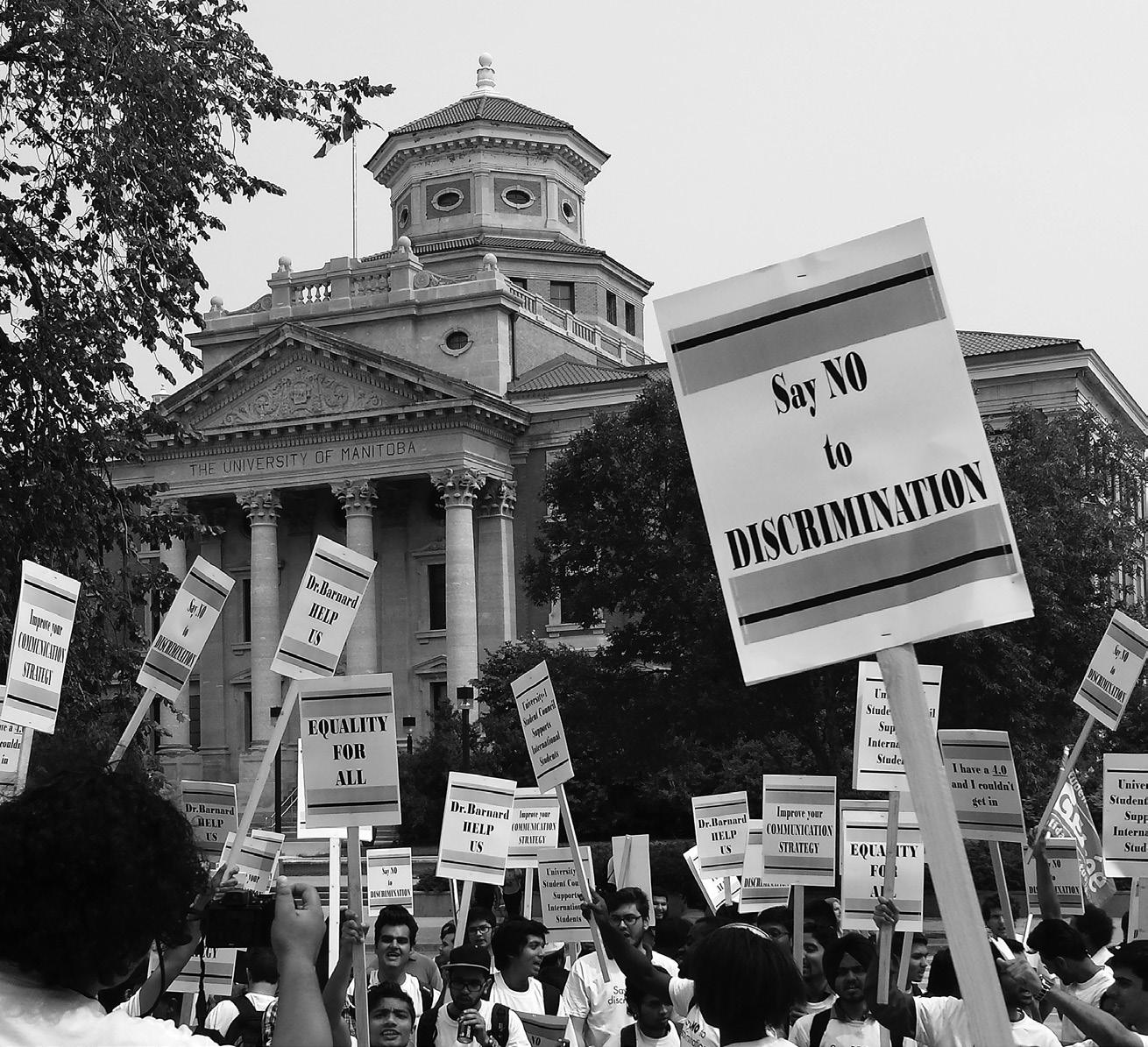
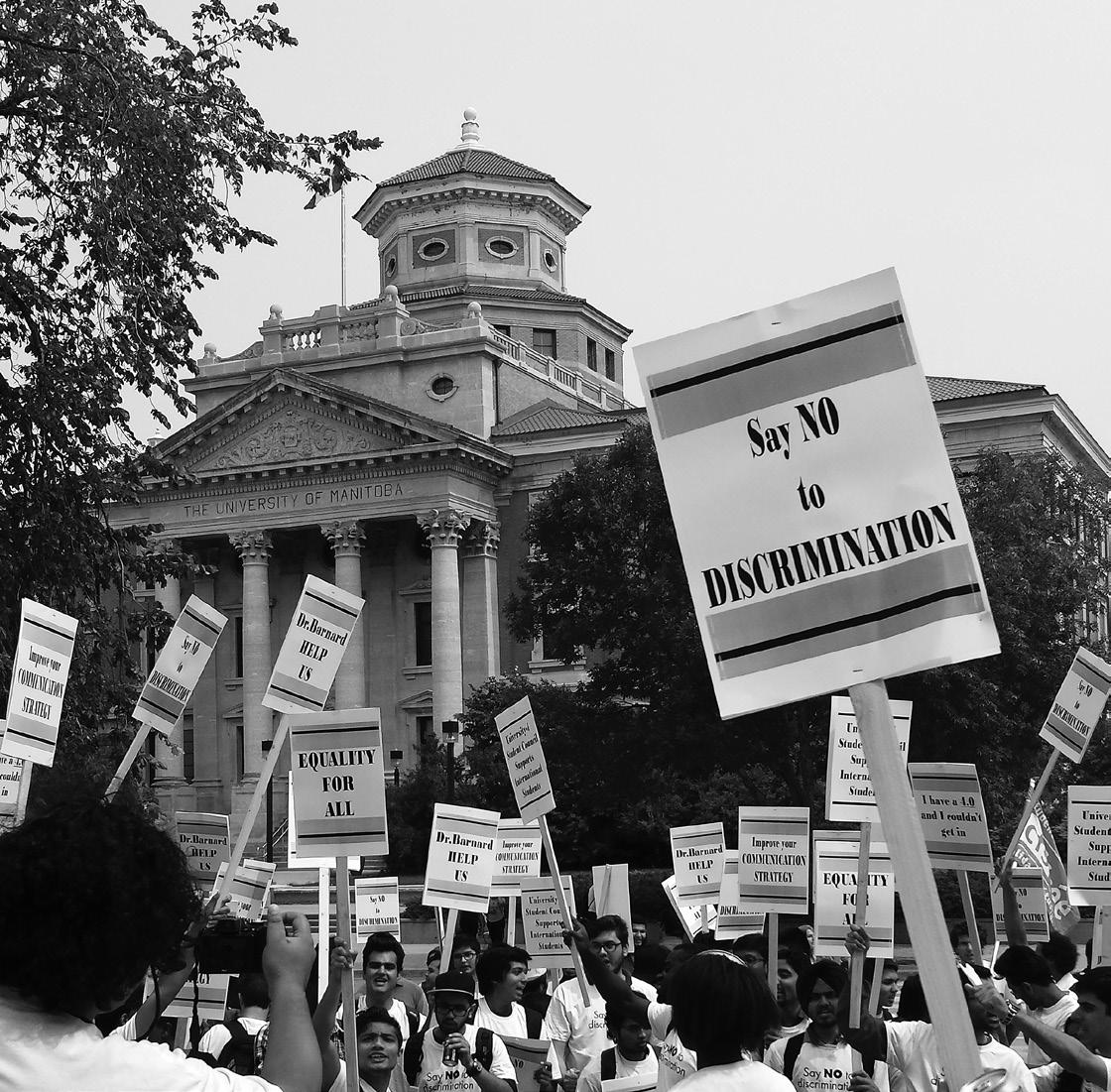
Agroup of University of Manitoba students and supporters protested on July 17 against what they called discriminatory admissions policies at the university’s faculty of engineering.
Demonstrators were protesting the discrepancy between admissions cut-offs for international students and domestic students.
Domestic students required a minimum 2.94 GPA to be considered for the faculty’s civil engineering stream in the 2014-2015 academic year, while international students required a minimum 4.13 GPA. Civil engineering has the largest differential between domestic and international students but similar differences exist for the biosystems, computer, electrical, and mechanical streams.
Representatives of the Canadian Federation of Students, including CFS-Manitoba chairperson Zach Fleisher, were on hand to offer support to protesters.
“I was asked to help co-ordinate the media,” said Fleisher. “The big thing for me was to be there to support students.”
Astitwa Thapa, president of the Nepali Students’ Association, was one such student.
Thapa, a student in the faculty of environment, earth, and resources, helped organize the protest and has been calling on the faculty of engineering to end what he calls a discriminatory policy. He characterizes the high cut-off rate for international students as a surprise for many international students expecting to attend in the 2014-2015 academic year.
“You’re entitled to make a change in the policy but you’re not entitled to not share this with the students and ruin their lives,” Thapa told the Manitoban
But faculty of engineering dean Jonathan Beddoes said no changes have been made to the faculty’s admissions policy and that the faculty has actually increased its number of admitted international students over the past several years.
“Last year 57 international students were admitted to engineering programs,” said Beddoes. “But in 2008 there were only 22 admissions of international students.”
The faculty of engineering aims to have 12 to 15 per cent of spots set
aside for international students. In this year’s cohort that number is 13.7 per cent with 48 of the 348 admitted to the faculty are international students. That figure puts the U of M on par with the national average of 13.7 per cent for engineering faculties and above the University Strategic Enrolment Plan’s stated goal of 10 per cent, Beddoes said.
“The faculty of engineering works closely with the university Enrolment Services, International College of Manitoba (ICM), and others on international student enrolment,” said Beddoes. “All first-year ENG engineering courses have been offered successfully for many years by ICM and all will again be offered in the upcoming 2014/15 academic year.”
Beddoes said that the high GPA cut-off for international students is a result of a large number of international students applying, adding that “within the resources available, every effort is being made to expand enrolment in engineering programs to satisfy student demand to study engineering.”
Thapa remains unsatisfied. He said that under existing policies, international students are being turned away unexpectedly.
“People come here, they come to Canada, thinking they will go to school,” said Thapa. “Some of them went to Ottawa, some of them went to Red River College
because they couldn’t get into the faculty of engineering.”
“It’s so sad because this issue could have been resolved if [the faculty] had indicated [the cut-off] properly to the students.”
The policy of limiting numbers of international students is not specific to the faculty of engineering.
The University of Manitoba’s Admissions Viewbook states: “First responsibility is the provision of education for residents of the province of Manitoba who are Canadian citizens/permanent residents. Therefore, admission of international or out-of-province students to some programs may be limited.”
Although Thapa thinks international students applying to the faculty of engineering were treated unfairly, he was aware the faculty has a policy that favours charging international students more than Canadians.
“I came to Canada knowing that my tuition fee was high and I have no problem paying differential tuition fees.”
Despite the tension between the international students and the faculty of engineering, Fleisher said he believes there are solutions.
“What I’d like to see is a system [developed] across all universities in Manitoba where the students have representation through these decision-making mechanisms.”
Fighting for water rights in First Nation communities
Reflections on the struggle for water and sanitation in Canada
DANA HATHERLY, STAFF
On June 25 to 26 the University of Manitoba faculty of law hosted the CREATE H20 and Water Rights Conference, which focused on the struggle for securing clean drinking water and sanitation facilities in First Nation communities.
Communities in our country continue to face water contamination from industrial pollution and waste. These communities have been stripped from access to high-quality and affordable water resources in their region.
The city’s clean drinking water is supplied from Shoal Lake to Winnipeg along a historic 150 metre underground aqueduct. The region supplies water to urban centres, yet rural communities in the Shoal Lake region experience difficulty affording and accessing clean drinking water for themselves.
about how to study and address water issues and inequalities.
Interdisciplinary research was highlighted at the conference, demonstrating that holistic approaches are required to grapple with critical questions about water resources.
Cross-faculty participation and community-based orientation at the conference allowed for the sharing of ideas between academics and communities about watershed studies, including environmental, engineering, microbiological, economic, psychological, and legal considerations.
The struggle for water persists, driving debates in both the academy and courtroom
Depending on the source and the region, residents have been under boil-water advisory for 12-20 years. The community resorts to hauling in their drinking water.
Water resources in the area are consistently being extracted, exported, and sold at more affordable rates to people living outside the region.
Evidently the struggle for water persists, driving debates in both the academy and courtroom.
Indigenous and non-indigenous academics, community members, and activists who participated in the water conference revisited the debate over universal human rights to water. Questions were raised
People at the conference explored the idea of combining scientific and traditional indigenous perspectives about water and life in First Nation communities for determining drinking water quality and contamination and improving access to water in First Nations regions.
Debates about water rights have occurred at Robson Hall before. This year’s event reflected the previous 2012-2013 Critical Conversations seminar series on the right to water in First Nation communities, hosted by U of M law professor and Centre for Human Rights Research director Karen Busby.
The CREATE H20 and Water Rights Conference further contributes to research and development on water and sanitation in northern rural communities. The conference is part of a larger social science project on the right to clean water, coordinated by the U of M’s Centre for Human Rights Research.
PHOTO BY ZACH FLEISHER
Researchers examine the question of genocide in Canada
U of M hosts annual international conference on genocide and indigenous studies
DANA HATHERLY, STAFF
How will it be determined whether indigenous people were the victims of genocide in Canada?
These types of questions were raised in front of the largest group of indigenous scholars from around the world gathered at the International Association of Genocide Scholars conference from July 16-19 at the University of Manitoba.
Academics, community members, and survivors of genocide from Rwanda, Kurdistan, Australia, Argentina and other countries in Latin America and North America met to learn, present on, and participate in debates about genocide and indigenous studies.
The conference looked at whether mass killings; prohibiting political, religious, economic, and cultural practices; and failing to allow groups to maintain livelihoods and fulfill basic survival needs, are all forms of genocide.
One of the overarching themes of the conference related to the challenges of defining genocide in a contemporary context and whether that definition then applies to Canada’s historical treatment of its Aboriginal peoples.
Is the Canadian case relevant?
One of the lead organizers and U of M sociology professor Andrew Woolford hoped that the conference demonstrated to other genocide scholars that the Canadian case deserves greater attention.
Canada presently only recognizes physical forms of genocide, which is even narrower than the international guidelines in the UN convention and case law. Scholars at the conference explored if these measures for framing the issue match the circumstances in Canada, and whether genocide needs to be recognized and addressed as part of our development and practices.
Based on the work of Raphael Lemkin, scholarly work has been done elsewhere to show that genocide involves not only mass killing, but also the destruction of groups and group living.
According to Woolford, what happened in Canada in terms of assimilative policies “provided a vivid illustration of how the attempted destruction of groups can take place in a multitude of ways. In Canada we have [ . . . ] instances of forced starvation, forced assimilation, widespread physical and sexual abuses that attempted to sever the bonds between group members, between family members, between people and their culture, and between people and their territories.”
The conference provided insight on the impacts of assimilative policies on communities in relation to their connection to territory and the
destruction of surrounding environment, and whether different forms of more or less overt group control, other than physical violence, constitute as genocide.
The U of M provided a historically symbolic geographical location for hosting a symposium on genocide studies and indigenous people, as the campus was constructed and exists on what some scholars at the conference would consider occupied land.
In a welcoming letter to conference attendees and officials, U of M president David Barnard acknowledged that the university campus was established at the epicentre of Anishinaabe, Metis, Cree, Dakota, and Oji-Cree Nations in Treaty One Territory.
Genocide involves not only mass killing, but also the destruction of groups and group living
Specifically, the university was founded on traditional lands of the Anishinaabe and the homeland of the Metis Nation. Arguments raised during this conference suggested cases of land expropriation and other violations against First Nations should be genocidal in nature.
Aboriginals underrepresented at U of M
To this day, the visible, longstanding impacts of genocide can be witnessed on our campus, some have claimed.
“The university is committed to building a society where First Nations, Metis, and Inuit peoples, cultures, and traditions are reflected and respected in schools, workplaces, and all public institutions,” Barnard said.
However, population demographics show that First Nations are underrepresented at the U of M.
Only 210 employees and 32 faculty members out of 8,700 faculty and staff members identified as Aboriginal, with representation in nine faculties. Additionally, only 7 .2 per cent of the student population claimed Aboriginal identity.
According to the provincial government, First Nations represent 13.6 per cent of the entire Manitoba population, and just two-thirds of that population received an education at or above the high school level.
Low proportional representation in post-secondary institutions such as the U of M may reflect generational impacts on a wider population that survived patterns of genocide.
Woolford spoke to supposed patterns of genocide, including those expressed by government policies and practices associated with the residential school system, and those who continue to live with and suffer from the negative repercussions of the colonially imposed system.
These patterns are reflective of the historical oppression experienced by Canada’s First Nations, and also happen to meet some of the standard measures collectively proposed by various scholars to morally and legally redefine genocide in Canada.
Redefining genocide
Popular notions of genocide are rooted in common perceptions about it that involve only mass killings and overt forms of physical violence against particular groups of people. Some researchers at the conference agreed that fully engaging in truth and reconciliation involves publicly clarifying amendments to definitions of the term as part of our shared understanding and for the purpose of adapting national charters, international conventions, and legal codes.
Other scholars cautioned against
this by arguing that the term reconciliation is a new assimilative notion, rather than something developed by those affected.
Without undermining variable experiences of genocide, genocidal patterns of group control, and the extent of impact in each global situation, some conference attendees hoped that redefining the term would allow supposed cases of genocide in this country to be re-examined. This could lead to improved measures for determining human rights violations and a new understanding of human rights in Canada.
Survivors of genocide delved into their own stories and experiences of the Rwandan and Kurdish genocides.
Conference-members attended a trip to Turtle Lodge of the Sagkeeng First Nation where victims of assimilative policies now reside. The attendees were welcomed with gift giving, stories, and speeches about the history of the Sagkeeng First Nation and their experiences with genocide and continued survival.
Other circumstances of human group domination and events of physical and psycho-social control were also examined over the course
of the conference.
Although many examples explored at the conference showed signs of genocidal patterns, some of the cases, like the one in Sagkeeng, have yet to be recognized as genocide.
The debates also stimulated critical discussion of the Canadian Museum for Human Rights (CMHR), opening Sept. 20. The museum will showcase issues of human rights violations and triumphs. It will also present exhibits on genocide.
Conference attendees agreed that the CMHR, the first institution of its kind in the world, is the appropriate platform for the genocide debate in Canada to spark international attention. The CMHR has not declared the existence of genocide in Canada. The word ‘genocide’ will come up throughout this exhibit, but will not be directly applied to the Canadian context.
Woolford stated that although settler-colonial genocide would not be explicitly exhibited at the museum, the question would be raised. The museum seeks to provide context to museum observers, and then ask observers to determine whether or not genocide has occurred for themselves.
It gets bitter
We should talk about mental illness all the time, not just when someone famous dies
KARA PASSEY
W
hen I got home from work on Monday, Aug. 11, I had experienced a particularly emotionally exhausting day. Then, when I signed into Facebook, I read the news about Robin Williams’ passing. It was soon after the news had broken, because barely any news sources mentioned his struggle with addiction and mental un-wellness, and my newsfeed was flooded with posts of, “I can’t believe it!” and, “Now my favourite movies are so sad!”
Grief and mourning are difficult things to maneuver, and I am certainly not one to tell people to be more up-to-date on the lives of celebrities – but these reactions didn’t sit well with me. It was a shining example of the lens through which mental health is viewed; no one acknowledges its severity until it is too late.
And now, two weeks later, many of us are moving on with our lives and forgetting how shocked we were that someone so beloved and successful took their own life. Many of us won’t even think about mental illness again until another suicide makes the headlines, not realizing that Canada averages 3,777 suicides a year. But those of us who deal with mental illness will still remain here, even when the headlines are gone.
When I was small, my grandfather, who was experiencing the early signs of Alzheimer’s, took his own life. To me he had only ever been a smiling, loving man full of quips and lively stories. Yet for some reason, when my mother told me what had happened, I was able to accept it. It made sense, and I never thought him selfish or cowardly for it.
Maybe it’s because my mother explained it in terms of, “He got very sick, and now he’s died,” as if death is death, whether by cancer or depression – or maybe it’s because I grew up to continually struggle with a state of mental un-wellness. My understanding is that death can be the ultimate result of mental illness, just as it is of physical illness.
I currently spend my days teaching music to a group of kids in a setting that encourages discussions of mood disorders, addiction, abuse, and the pursuit of recovery from mental wellness. While I spend so much time with these kids making music, joking around, and watching goofy videos on YouTube, I’ve had the opportunity to get to know their struggles and get my heart wrenched as I realize that these kids are dealing with the same things I am.
I can’t help but reflect on the times that I’ve reached out to people only to have them tell me that I have my shit together and not to worry, or to have them say that they’re there for me but be too busy to answer my call in a crucial moment, or to have them tell me that I just need some vitamins and exercise, or that “everyone gets sad sometimes.”
There are moments when I’m shaking and hyperventilating and
people say, “But you’re so outspoken! I wish I had your confidence!” And I can’t help but notice that maybe I have something in common with Williams in that I have managed to be functional and successful enough in my life that it’s hard to convince people of my struggling.
If you’ve never experienced relapse while dealing with mental illness and addiction, let me tell you that it’s a terrifying thought that people will keep on swimming by, totally unaware that you are drowning.
When I’m talking about mental health to youth, I never use the words, “It gets better.” The phrase makes a mockery of mental illness. It implies that once you grow up and get a good job and find a partner who loves you, everything will be okay! It doesn’t provide any of the support needed to actually help people make it through school, get any job—never mind a good one—and build healthy relationships with others.
Mental illness isn’t selective; you can struggle with it even if you have a wonderful support system, even if you’re a successful actor, even when you appear to be strong and happy on the outside – and yes, even once you’ve addressed an issue with addiction.
Mental illness isn’t selective; you can struggle with it even if you’re a successful actor, even when you appear to be strong and are smiling on the outside
It also doesn’t prepare you for the disturbing realization that the chemical imbalance in your brain doesn’t disappear when something good happens in your life.
Recovery isn’t a point on a map with a straight road leading to it; it’s an ill-planned road trip with too many stops and not enough days to visit them all. But each stop does have important lessons and memories to collect, and if we embark upon this journey, we will learn to cope, deal, and realize our warning signs along the way. Each trip is different for every person, as are the landmarks and lessons.
What could proper supports for those hoping to achieve mental wellness look like?
•An end to stigmatization, including and not limited to doctors, peers, and family giving mental illness the same weight and respect as physical illness.
•The incorporation of mental
health into the public school curriculum. When facilitating group therapy for youth, I discovered that, not only is it a good way to let kids get stuff off their chest, it’s a great exercise in active listening, and learning to support and care for our peers.
•Mental health awareness in the workplace. We should never feel afraid of losing our jobs because of depression and should never feel ashamed of taking a mental health day.
•An intersectional approach to health care that includes access to stable housing, nutritional food, and peer support.
•The acknowledgment that addic-
tion does not cause mental illness but is more commonly the response to it. When someone is struggling with addiction and mental illness simultaneously, it is called a co-occurring disorder, and treatment needs to address both issues in tandem – something at which currently available resources often fail.
•Patience.
If you are experiencing a mental health emergency, Winnipeg is now home to the first centre in Canada devoted entirely to addressing mental health crises. The Crisis Response Centre is located at 817 Bannatyne Ave. and is open 24 hours a day, seven days a week.
GRAPHIC BY HEATHER KAT COLE
Comment Editor: Katerina Tefft
Police militarization on the rise
Since 9/11, America has seen a marked increase in direct military response by authorities every time a new conflict springs up
ANDREW VINEBERG
Awar is raging in a strange and backward part of the world. An occupying army is using advanced military technology and weaponry against a terrified population, drawing the eyes of human rights observers and critics across the globe. I’m speaking, of course, about the American Midwest.
Violence in the Midwest exploded again recently in the settlement of Ferguson, Missouri, a region with a history of apartheid and sectarian division. The chaos has drawn the world’s attention once again to the tragic and seemingly intractable conflict in this historically troubled region.
Tensions flared after the shooting of an unarmed 18-year-old African American man by a white police officer on Aug. 9. The victim, Michael Brown, was stopped by Officer Darren Wilson for jaywalking.
Such check stops are a routine part of any war zone, but high stakes nonetheless. Although Wilson was unaware of this at the time, a cigarillo theft at a convenience store earlier that evening had no doubt produced a general atmosphere of tension and fear in the town, which made violence inevitable.
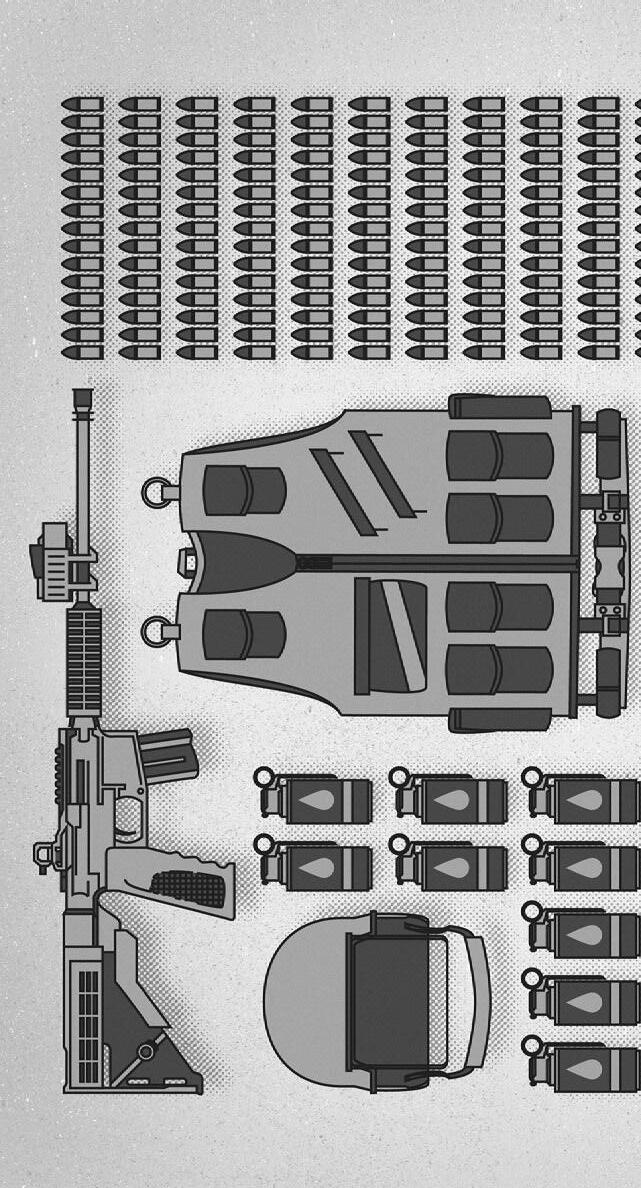
Following the revelation of the killing, as well as further revelations that Brown was shot “more than just a couple” of times (to use the police chief’s words), Ferguson saw the surge of protest and unrest that typically follows the uncovering of such civilian casualties of war. The town’s police enacted a swift military response, deploying their officers as soldiers in green camouflage, wearing body armour and gas masks, and carrying assault rifles and shields. Ferguson soon had all the hallmarks of a classic U.S. military war zone: armoured cars, snipers, tear gas, auditory weapons, and other commonplace tools of control during a military occupation, like a curfew, a media blackout, and a no-fly zone.
Police officers have been pointing their weapons indiscriminately at unarmed civilians and challenging bystanders: “Bring it, you fucking animals, bring it.” Much like in Iraq, journalists in Ferguson must now avoid being shot or taken prisoner.
As usual, there has been no formal declaration of war. The government states as always that this is not a war but “police action.”
And as is typical of American conflicts, international criticism and scrutiny have followed.
Amnesty International has sent in human rights personnel to monitor the crisis. The police force’s actions have provoked criticism from foreign governments and the United Nations. Observers in Palestine have broadcast their solidarity, offering advice on treating tear gas injuries.
Last week, the governor of Missouri declared a state of emergency and placed the area under the
authority of the National Guard.
Securing dominance in the strategically important and energy-rich region of the Midwest has always been a priority for the U.S., but since 9/11 America has seen a marked increase in direct military response by authorities every time a new conflict springs up.
Following America’s declaration of war on both terror and drugs, a huge influx of surplus military weaponry has fallen into the hands of American law enforcement. These armaments are acquired for the necessity of stopping terrorism – a responsibility which has always been a top priority for local American police departments.
There are questions about whether these weapons and tactics are being used strictly for the purpose of fighting terrorism. In war, definitions are often subjective. Might these alleged “terrorists” being fought by police also be called “freedom fighters,” “petty criminals,” “minor offenders,” or “innocent civilians?”
This conflict has many names and many fronts, from the War on Drugs to the War on Terror. Ultimately, every front is part of the broader war that is America’s law enforcement—a war waged between the paramilitary forces of the cities and towns of the United States, and the residents of those cities and towns—or at least certain classes of residents, like those in African American communities which stubbornly insist on not reflecting the ethnic makeup of their local police department. For impacted civilians, life is an enduring siege.
Since 9/11, America has seen a marked increase in direct military response by authorities every time a new conflict springs up
Statistics about civilian casualties are uncertain; there is no tally of how many Americans are killed by police each year. A conservative estimate by the FBI of certain types of “justifiable police homicides” records an average of about 400 a year.
More complete estimates report around 5,000 Americans killed in this war since 9/11. Law enforcement claims a black man’s life in America every 28 hours. Local militaries have increased their number of SWAT team raids 1,500 per cent over the last 20 years; most are for drug-related search warrants which are disproportionately carried out against people of colour, and have increasingly resulted in non-suspect casualties. The war has produced the world’s
highest incarceration rate: 2.2 million people.
As with many of America’s wars, Canada has been eager to join the coalition.
Canada’s war against Canadians is nothing new; in particular, the centuries-old fight against First Nations peoples has shifted from royal armies to the police, from the Great Plains to the city streets and prisons.
The North-West Mounted Police, founded as a paramilitary to quell native resistance, was succeeded by the RCMP, who proudly continue those practices. Provincial and city police carry on the Indian wars, whether it’s tactical strikes against unarmed native men, or a war of attrition in the form of procedural indifference over Aboriginal deaths.
In British Columbia, one of the war’s bloodiest fronts, police have killed 267 people in the last 15 years, and ceasefire prospects are grim.
Several recent high-profile skirmishes have brought Canada’s police war back into the public eye, from shooting a schizophrenic cartoonist crawling on the street to their decisive nine-bullet victory over a teenage boy with a knife on an empty streetcar. The shooting of an unarmed man at a baseball game in the Norway House reserve in northern Manitoba served as a stark reminder that war can rear its head anywhere.
Like America, Canada has begun the transition of its “police action” into a war of aggression, and their law enforcement agencies into elite militaries.
During the 2012 G20 protests,
Toronto police encircled and contained their civilian opponents with expert military maneuvering. Armoured assault vehicles have been acquired by Ottawa, York, Quebec City, Montreal, and even New Glasgow, Nova Scotia, population 9,500.
This year, Montreal police purchased not just tanks but also longrange sound cannons in the wake of their clashes with hordes of dangerous young people in 2012. And, of course, the RCMP has been proudly returning to their military-colonial roots, not just accumulating multiple armoured vehicles, but sending in heavily-armed squads of Mountie soldiers to ambush peaceful antifracking protests in New Brunswick, brandishing Tasers and firing rubber bullets.
There is no question: Canada and the U.S. are embroiled in yet another long, ill-defined, asymmetrical war of occupation in a perilous region full of deep ethnocultural tensions and intractable centuries-old conflicts. A war against the embattled and anguished peoples of North America.
The question is: Might their military involvement be doing anything to prolong the conflict, as opposed to ending it? Certainly crime and unrest in this part of the world are of grave concern. Equally concerning is the creeping rise of volatile radicalism, as indicated by these latest outbreaks of protest. These currents of dissent and insurrection stand opposed to cherished American and Canadian values, like eternal trust in the moral legitimacy of our law enforcement system.
But is military action the proper response to these issues, or simply escalating the violence and frustration in these beleaguered lands?
Furthermore, is there perhaps some larger historical context that links the frustrations of poor Americans back to actions of the U.S. government? Could the economy of the U.S., in some, complicated, hard-to-fathom way, have negatively impacted the financial stability of people all the way in Missouri?
Has the U.S. ever done anything to lose their trust, to draw their rancour? What could possibly motivate them to brazenly take to the streets and demand that officers stop shooting unarmed members of their community?
When citizens take valuable water and milk from an innocent McDonald’s to treat their tear-gassed eyes, is it simple immorality? Or are the police somehow contributing to their actions? These questions are perhaps best left to the sociologists. The most pressing question of all is, are we simply to resign ourselves to the inevitability of this war? Shall we not ask ourselves if America and Canada might withdraw their forces, scale back their militarism and seek peaceful negotiation with their bruised and scarred civilian populations?
Maybe this is the moment we finally shake off the chains of inevitability and say we will not accept any more of this war.
GRAPHIC BY JUSTIN LADIA
Engineering institutional bonds
The proceedings of the 8th annual International Prairie Student Conference in environmental engineering
BAILEY RANKINE, STAFF
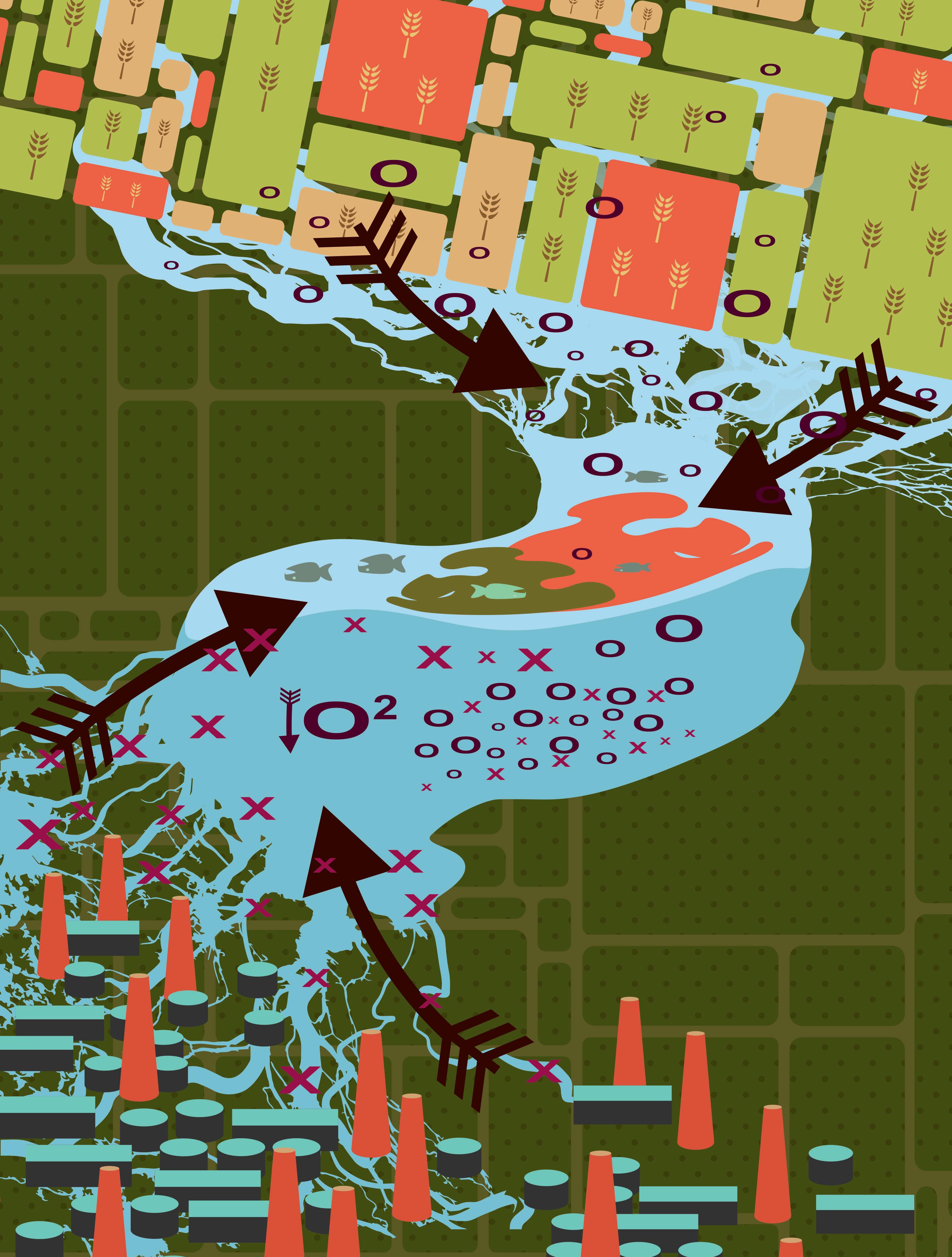
Water is arguably the world’s most valuable resource. With threats of drought caused by climate change and the influx of industrial pollution, it is paramount that innovative technologies in water treatment and waste management are supported.
On Aug. 6, civil and environmental engineering students from universities throughout the Red River basin descended on Fargo for the eighth annual International Prairie Student Conference (IPSC) hosted by the North Dakota State University student chapter of American Water Works Association/Water Environment Federation (NDSU AWWA/WEF).
The AWWA focuses primarily on drinking water, whereas WEF’s attentions are aimed at wastewater; both organizations provided sponsorship for the conference. The civil and environmental engineering and the environmental and conservation
sciences departments at NDSU also contributed funds.
The conference is organized by students and designed to promote networking opportunities within the industry.
The guest list was short but impressive; academics in attendance included those from the University of Manitoba, University of Winnipeg, University of North Dakota, and South Dakota State University. Industry professionals were invited from Advanced Engineering and Environmental Services, Inc.; Moore Engineering, Inc.; and Apex Engineering Group, Inc.
Last year the conference was hosted by the U of M which, like NDSU, has a student chapter of WEF (University of Manitoba Water Environment Federation) and is currently working to gain AWWA affiliation. University of Manitoba Water Environment Federation president Nick Svenda will be stepping down within the next few weeks at which point Tanner Devlin, the current vice-president, will assume the role of president.
Devlin was the first undergraduate to be formally involved with the student chapter and since then has been trying to increase undergraduate membership.
“Right now we stand at a total of 27 members combined, where historically it’s been 10 to 15 graduate students,” he boasted.
Innovation and collaborative research
Devlin presented the proposal for his MSc. project, which he will be embarking on this fall in the department of civil engineering at the U of M. His investigation will study “enhanced biochemical processes for wastewater treatment.”
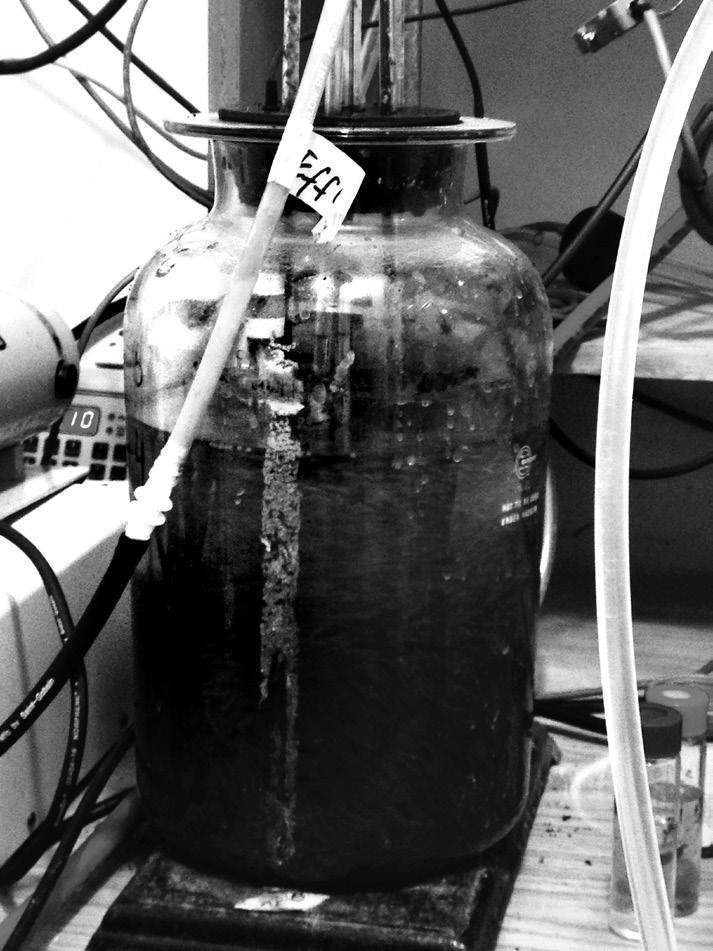
He is specifically interested in the biochemical process of aerobic granulation. Granules are made up of a suite of microorganisms that specialize in the removal of organics, nitrogen, and phosphorus collectively from the water.
Traditionally, biological treatments of wastewater have been accomplished using a combination of activated sludge systems, biofilters, oxidation ditches, and rotating biological contactors. These systems generally require large areas and they remove very little organics, nitrogen, or phosphorus – three compounds that can accelerate the eutrophication of surface waters.
On the other hand, aerobic granular sludge processes promise to reduce the energy requirements of water treatment by at least 30 per cent and space requirements by as much as 80 per cent. Implementing granular sludge systems in place of conventional technologies would therefore benefit both the economy and environment.
In general, bacteria will secrete proteins and polysaccharides when external stressors are applied, such as aeration or periodic episodes of starvation. These compounds act as cement and transform the flocculent bacteria utilized in conventional biological treatment systems into denser granules.
The water people
The problem is that the exact mechanism of granulation is still debatable and more studies must be undertaken to determine how flocculent bacteria are transformed into their granular counterparts.
The IPSC is an outlet for sharing ideas and encouraging research collaborations between universities.
A prime example of this was the presentation of U of M/U of W duo Tyler Epp and Ken Breziniski. They discussed “rapid solid phase extraction as an attractive alternative to resin fraction methods. Solid phase extraction will reduce resin condition and sample preparation times.”
Currently, resin fractionation is the most commonly used technique to separate and classify natural organic matter based on its solubility in water; however, this technique is time-consuming, tedious, and not applicable to monitoring aquatic humic substances at water treatment plants.
Aquatic humic substances are caused by the decay of plant material and are highly chemically reactive. The aquatic humic substances fraction of natural organic matter is believed to contain the organic compounds required to form trihalomethanes. Trihalomethanes are suspected to cause cancer in humans and are created when the organic compounds from the humic substances come in contact with chlorine added to disinfect our drinking water.
Epp and Breziniski’s method proposes the use of solid phase extraction, which is a sample preparation process that separates compounds in a liquid from other compounds in the mixture according to their physical and chemical properties.
Solid phase extraction bodes to be a much more efficient method of monitoring aquatic humic substances in water.
Student chapter and local involvement
This year’s chief organizer, Kevin Young, first started to get involved with the NDSU AWWA/WEF student chapter during his freshman year in 2008 and has held various officer positions in his time at NDSU.
Young explained how he found himself heading the event: “The group’s student advisor asked me to take the lead for planning the International Prairie Student Conference this year. I thought it might be in my best interest to say ‘yes’ since I would like to graduate soon.”
Each year the group sends a team to the Student Design Competition at the Water Environment Federation’s Technical Exhibition and Conference. They also make an effort to go on a few group field trips related to water engineering.
Conference attendees got a taste of these field trips with the opportunity to participate in the RiverKeepers Service Project - Storm Drain Marking Program, and take tours of Fargo’s wastewater treatment plant and effluent reuse facility.
Young expressed that “in the future, [he’s] hoping the group continues to work on service projects in Fargo with groups like RiverKeepers.”
The IPSC is just one of many student conferences offered annually. Regardless of faculty or academic focus, these student-run events are essential for providing an informal setting for students to practice presenting and discussing their research.
The University of Manitoba’s student chapter of the Water Environment Federation
TANNER DEVLIN
Have you ever sat down and thought about how much water you use in a day? If you live a conventional life, you probably shower, go to the washroom a couple of times, and pick up a double-double or two. This all adds up, resulting in the consumption of over 150 litres of water per day per person on average in North America.
Although water is essential to our well-being, how many of us can say that we know about the processes that bring water to our taps or deal with the waste that flows down our drains? The water does not just appear and disappear; those 200 litres have to come from and
return to somewhere. This is where environmental engineers and scientists, the folks that design treatment systems to meet our first-world demands and also ensure the protection of our environment, come in. They are the individuals who make sure you start the day fresh and maintain a sufficient level of caffeine, directly contributing to your everyday life.
Now you are aware of the crusaders that work behind the taps and drains, but our work does not end there. At the University of Manitoba, the Water Environment Federation’s student chapter (UMWEF) strives to involve individuals from all sectors of the
water industry, setting up networking events and a platform for public education.
The parent organization of UMWEF was instituted in 1928 and is a non-profit organization that globally represents water quality professionals. Since the organization’s inception, members have proudly fulfilled their commitments to public health within their local communities and aim to provide clean water worldwide.
These ideals were brought to the University of Manitoba in the 2006-2007 calendar year by a group of committed students in civil engineering. Past UMWEF president Stan Lozecznik wanted to set up
the framework to allow students to explore the water industry and develop their professional skills.
The chapter’s first venture was the 2006-2007 joint seminar between the University of Manitoba and North Dakota State University, which later developed into the annual International Student Prairie Conference on Environmental Issues.
The conference now also involves South Dakota State University, the University of North Dakota, and the University of Winnipeg, and covers the area known as the Red River Basin.
Local events organized by UMWEF include an annual summer barbeque and sports tournament,
a series of guest lectures given by professionals in the field, and various other social and networking functions. The main goal of the chapter is bringing interested students together to promote their professional development while educating members of the public.
Although UMWEF specializes in the fields of environmental engineering and science, there is a place for anyone who wants to learn more about or be involved with water. Anyone interested by UMWEF can email me at umdevli5@myumanitoba. ca or drop by the civil engineering department on the third floor of the EITC building at the University of Manitoba.
Editor-In-Chief:Bryce Hoye
Pages from the past
A look back at the Manitoban's 100 years in publishing
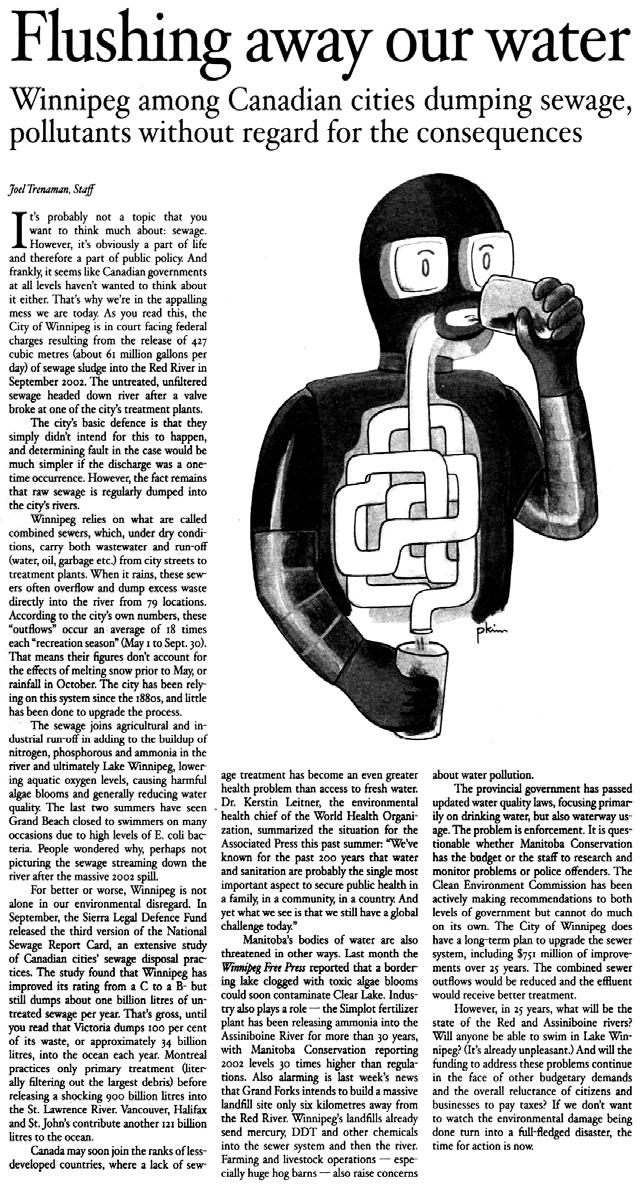
The Manitoban will celebrate its 100th birthday this coming Nov. 5. As a way of celebrating and honouring this paper's long and successful run, we will be regularly reprinting articles published at various points over the course of the last century.
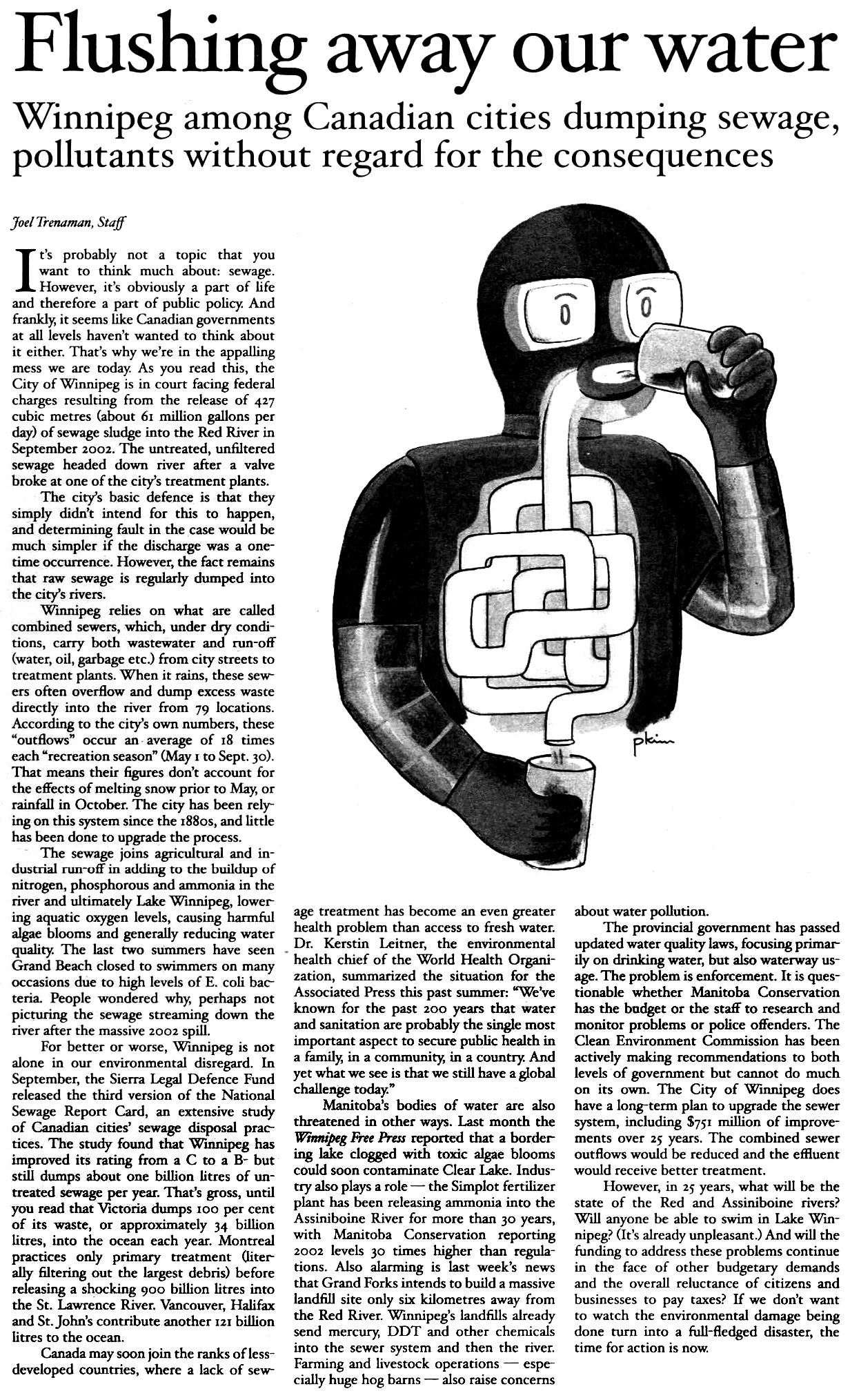
In this issue, with its heavy influence on water—from issues of human rights to toxic algal blooms and nutrient cycling in fresh water
basins—we're featuring an editorial on the topic of nutrient loading and cycling in Lake Winnipeg.
The piece was penned by former Editor-in-Chief of the Manitoban, Joel Trenaman, now serving as the director of communications and publishing for the International Institute for Sustainable Development.
The IISD made headlines last fall and this year when it was announced
the organization would be teaming up with the Ontario government to manage the Experimental Lakes Area (ELA). The ELA is a series of 58 lakes in Northwestern Ontario where scientists have been conducting whole-ecosystem-based experiments for over 45 years.
The following article was published Nov. 17, 2004.
Small town, big dreams
Local band with unique sound releases their first album
CAITLYN MASKIEW
Chilling harmonies, poetically crafted lyrics, and a style all their own, Blue Rubies are a band originating in small-town Manitoba hoping to make it big.
The band recently released their debut EP and are currently performing wherever they can.
Blue Rubies had their start at the 2013 Winnipeg Folk Festival. Prior to the genesis of Blue Rubies, Ben Mak-Wiebe (bass, vocals) and Cory Sulyma (guitar, drums, vocals) were in a rock band called Hey Rube, while Mady Reimer (auxiliary percussion, vocals) and Sulyma were part of a folk band, Horizon Me.
When the lead guitarist of Hey Rube left and caused the parting of the band, the three friends came together and applied for the Young Performer’s program at Folk Fest.
“At that point we were just jamming,” says Sulyma. “One person would say, ‘Oh I have a song,’ and we’d just play it.” Not long after, the band was born.
After last year’s Folk Fest they started picking up speed. This summer they’ve been busy, gaining popularity from word of mouth alone, getting invites to perform at
events ranging from parties, to larger shows with other bands such as The Heroin Hayride, Once Nomadic, and Wooden Horsemen . The band’s most recent performance was at Trout Forest Music Festival in Ontario . Their success prompted them to create their first ever album, a fivesong EP titled Blue Rubies released on Aug. 14. The album features all original songs, with each band member pitching in on vocals.
Not only did the three write their own lyrics and music, they also recorded and produced their EP
They have a unique, raw sound Mak-Weibe described as “today’s folk scene mixed with an old fashioned sound.”
Not only did the three write their own lyrics and music, they also recorded and produced their EP. The album was recorded in Mak-
Weibe’s basement, with Mak-Weibe editing and mixing the sound. They wanted the sound to be raw, as if the listener felt they were at a live show, and the band succeeded.
The homemade quality of the sound still remains studio professional. The CDs are burned and in recycled casing with the band’s name on the front, giving them a home-
grown feel and keeping the cost at only $5.
When asked their favourite songs, the members had a hard time picking just one.
Mak-Weibe decided on the album opener, “By and By,” describing it as an upbeat, exciting song to get the listener into the groove for the rest of the album. Reimer chose “Rollin’”
because of how the song complements her voice . Sulyma’s favourite song is newer and wasn’t ready for this album, but the band says they’ll likely be including it on their next album.
Find Blue Rubies on Facebook , visit their website (http://bluerubiesmusic. com/), and buy their EP at http:// bluerubies.bandcamp.com/releases
PHOTO BY BLUE RUBIES
Folk Fest 2014 Photo Gallery
Grace & Tony
PHOTO BY TRAVIS ROSS
Baskery
PHOTO BY TRAVIS ROSS
PHOTO BY KATY MACKINNON
PHOTO BY KATY MACKINNON
PHOTO BY KATY MACKINNON
PHOTO BY KATY MACKINNON
ILLUSTRATION BY MARIANA MUNOZ
Road to the Vanier
2014-15 Bison football preview
MIKE STILL, STAFF
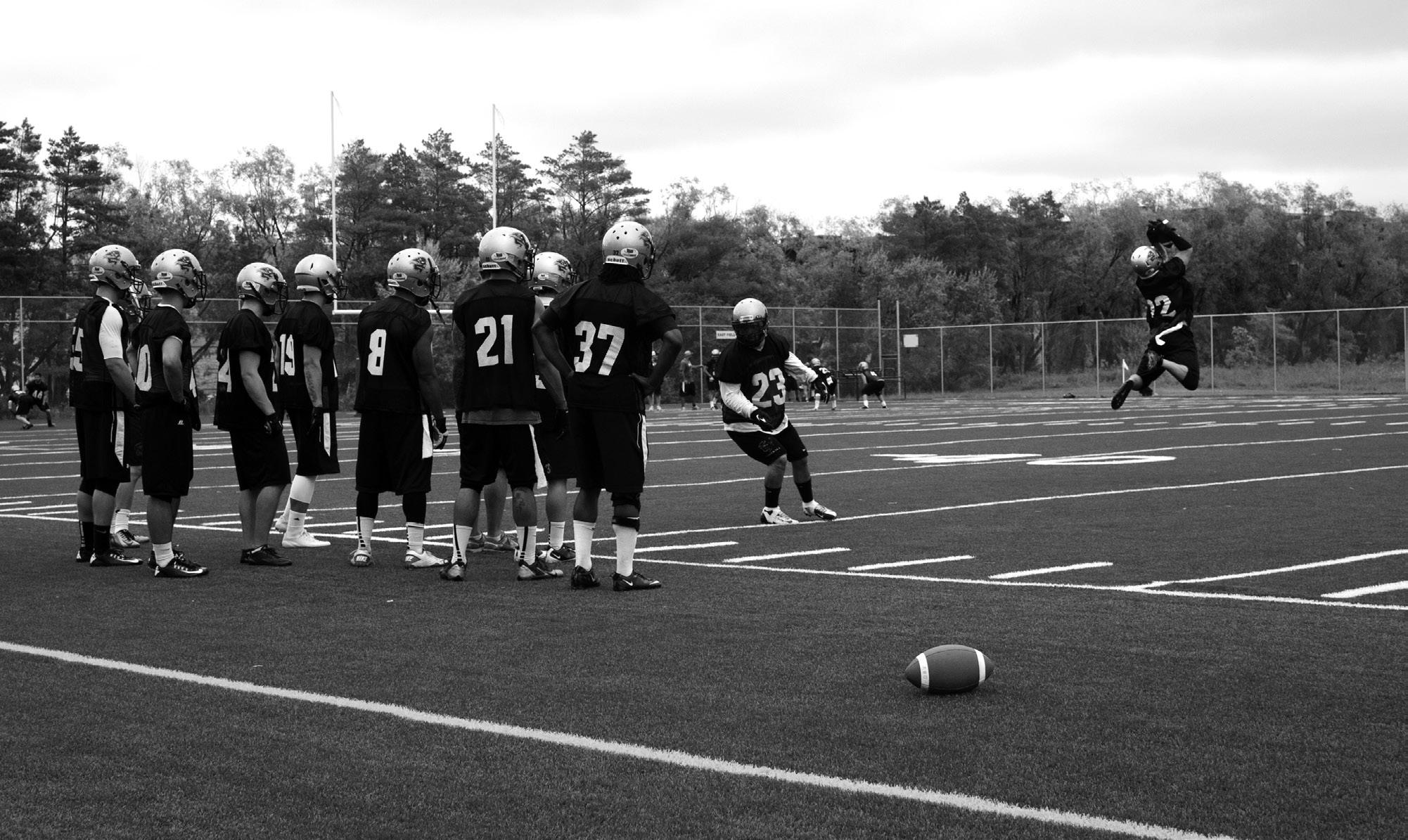
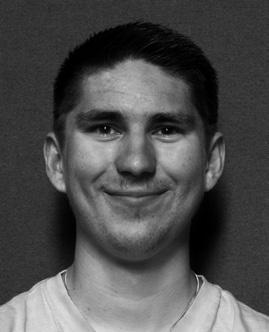
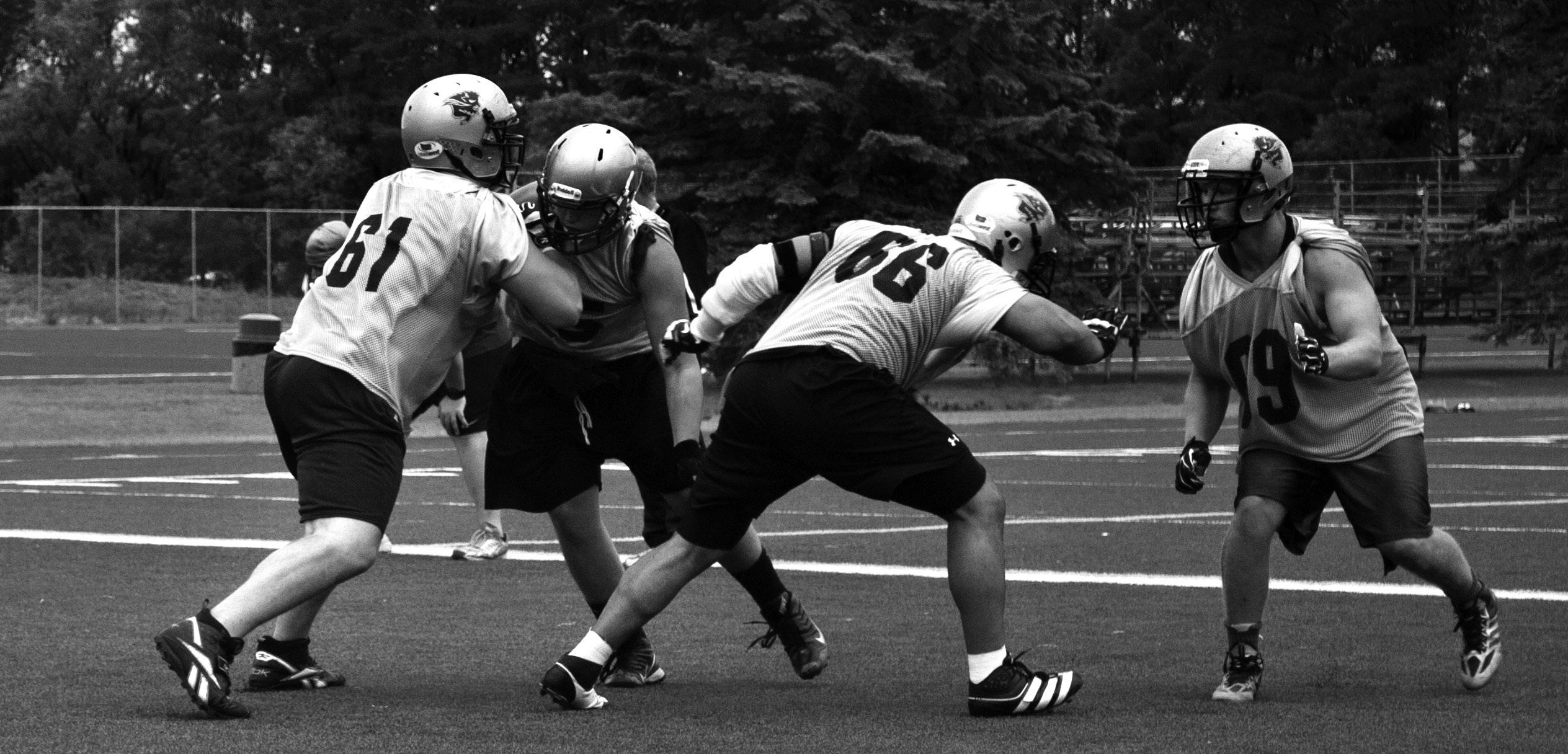
The 2013-14 football season was a year of promise for the University of Manitoba Bisons. A 5-3 finish , their best record since winning the Vanier Cup in 2007 , and a Hardy Cup berth showed that Manitoba is taking strides in the right direction. With eight of 12 starters on defence, and 10 of 12 starters on offense returning to the fold in 2014, the upcoming edition of Bison football should be an exciting team to watch.
In preparation, the Manitoban has taken the time to preview each individual position heading into main camp, and what fans can expect to see.
Offence (Quarterback)
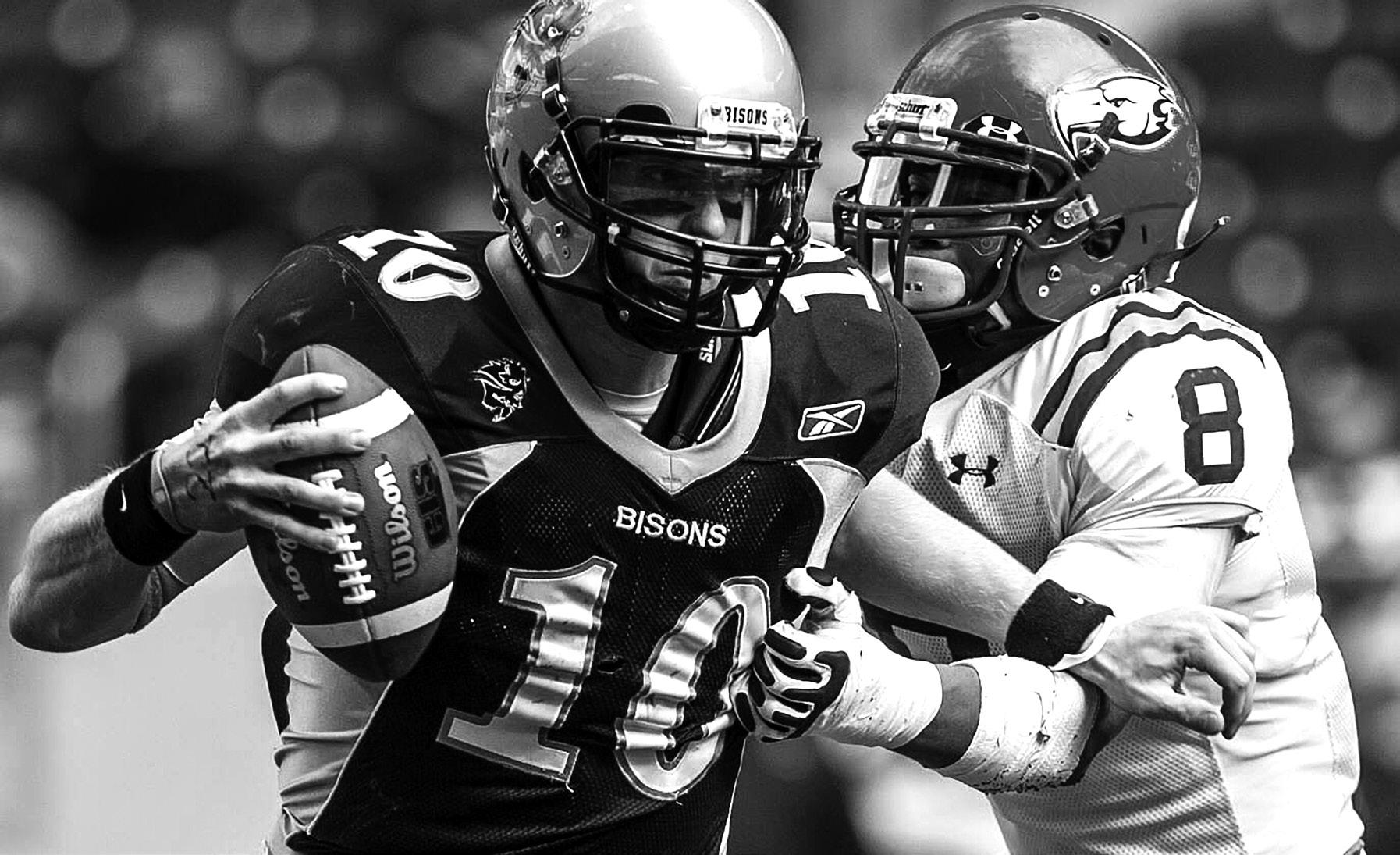
The quarterback conversation starts and ends with Jordan Yantz.
A conference all-star in his first year as a Bison in 2013 , the Regina product returns for his final season of CIS eligibility. The 23-year-old is hoping to build off of an outstanding campaign, where he was first in the Canada West conference in both passing yards, (2,474) as well as touchdowns (25).
Yantz has had quite the off-season, participating in both the East West Bowl and Winnipeg Blue Bombers training camp, and enters 2014 primed and ready for another big year.
Running back
For the first time in three seasons , a running back not named Anthony Coombs will start for Manitoba. The Winnipeg native was taken by Toronto in the first round of the 2014 CFL draft , leaving a relatively large void to fill.
But the position shouldn’t see a drop in production in 2014, with fourth-year veteran Kienan LaFrance stepping in .
LaFrance has gone through the ranks of football in Manitoba –winning a Winnipeg High School Football League championship alongside Coombs in 2008 , as well as being named the Prairie Football
Conference’s outstanding offensive player in 2010 with the Winnipeg Rifles .
LaFrance has had previous success in the backfield for Manitoba (467 rushing yards in 2012), and with the job now his for the taking, he should be in for a breakout season. Fourth-year fullback Andrew Barry—a captain last season— will also be instrumental in ensuring that LaFrance has room to run.
Receivers (Slotback)
Manitoba will retain most of its receiving corps this year, with the biggest loss being slot back and captain Andrew Smith, who was drafted by the Montreal Alouettes . Danny Turek—a former Canadian Junior Football League all-Canadian in 2009 with the Okanagan Sun , and mainstay at slot back for Manitoba in 2012— makes his return in 2014. He missed last year due to personal reasons, but looks to have an immediate impact in place of Smith.
With a multitude of returning faces, the upcoming edition of Bison football should be an exciting team to watch
Nic Demski and Alex Vitt both return to the paddock in 2014, and are expected to build off of their respective numbers in 2013.
Look for Demski, a three-time conference all-star , to potentially put up record-breaking numbers this year. He finished second in Canada West in receiving yards last season (640).
Receivers (Wide out)
The 2014 season could very well be the Vancouver Island show at the
wide out position.
Both Matt Sawyer (nine receiving touchdowns in 2012 with V.I.) and Dustin Pederson (574 receiving yards in 2012 with V.I.) enter their second year with the Bisons , and add immediate chemistry with their former Raider teammate Jordan Yantz. With one year in the system, the two junior football standouts appear ready to make the leap forward in the CIS.
Offensive Line
Manitoba retains all five of its starters on the offensive line , who paved the way for over 1,800 yards on the ground last year. Fifth-year centre Tyler Fabbri will anchor the big men , along with 2013 conference all-star Alex McKay, at the tackle position . Look for Geoff Gray to step up as well, heading into his sophomore season.
Defence (Interior Lineman)
Both starters from 2013 will suit up yet again, led by Evan Gill . A conference all-star last year, Gill was drafted in the first round by the Hamilton Tiger-Cats , but opted to return to school this year. With proready ability, as proven by his trip to the East-West Shrine Game , as
well as CFL selection , look for Gill to have a monster campaign at the defensive tackle position.
Joining him for a second consecutive season will be David Onyemata, a native of Lagos, Nigeria. Onyemata recorded 17 tackles and a sack in his first full year as a starter in 2013 . Look for him to build off of that success in 2014.
Defensive Ends
Lauren Kroeker, a captain last season , returns for his final year with the Bisons in 2014. He has amassed a total of 126 tackles over four seasons with the herd , and should be consistent again off the edge.
Ranji Atwall, another captain in 2013, has finished off his CIS eligibility , leaving the other end position vacant. The battle for the starting spot should be quite intriguing, with two former junior football and British Columbia Football Conference allstars, Tyler Lee (Kamloops ) and Evan Foster (Langley) , leading the way.
Linebackers
Manitoba retains just one starting linebacker from last season, with Bami Adewale returning at the weak
side position. He led the team in solo tackles last season with 37, while adding two sacks. That production should continue in 2014.
With Thomas Miles’ selection by the Toronto Argonauts in the CFL draft , the Bisons have a need at the middle linebacker position. Look for DJ Lalama, a local standout at Saint Paul’s High School and special teams phenom last year, to step up.
The strong side linebacker spot will feature an interesting battle between Riley Wiggett (15 solo tackles, one sack) and Jonathan Jones, another standout from Vancouver Island .
Defensive Backs
The secondary was a position of weakness for Manitoba last year; however, with numerous veterans back, that trend shouldn’t continue in 2014.
Brett MacFarlane (25 solo tackles, 1 INT) and Cam Teschuk (24 solo tackles, 2 INT) lead the way at halfback and corner, respectively. Look for Tremaine Apperley (led team with six pass breakups), Jordan Linnen, and Jayden McCoy to factor in as well.
PHOTO BY CAROLYNE KROEKER
PHOTO BY CAROLYNE KROEKER
Going the distance
Bison track and field thrower Carter
Wilson shares experiences at 2014 North American Indigenous Games
MIKE STILL, STAFF
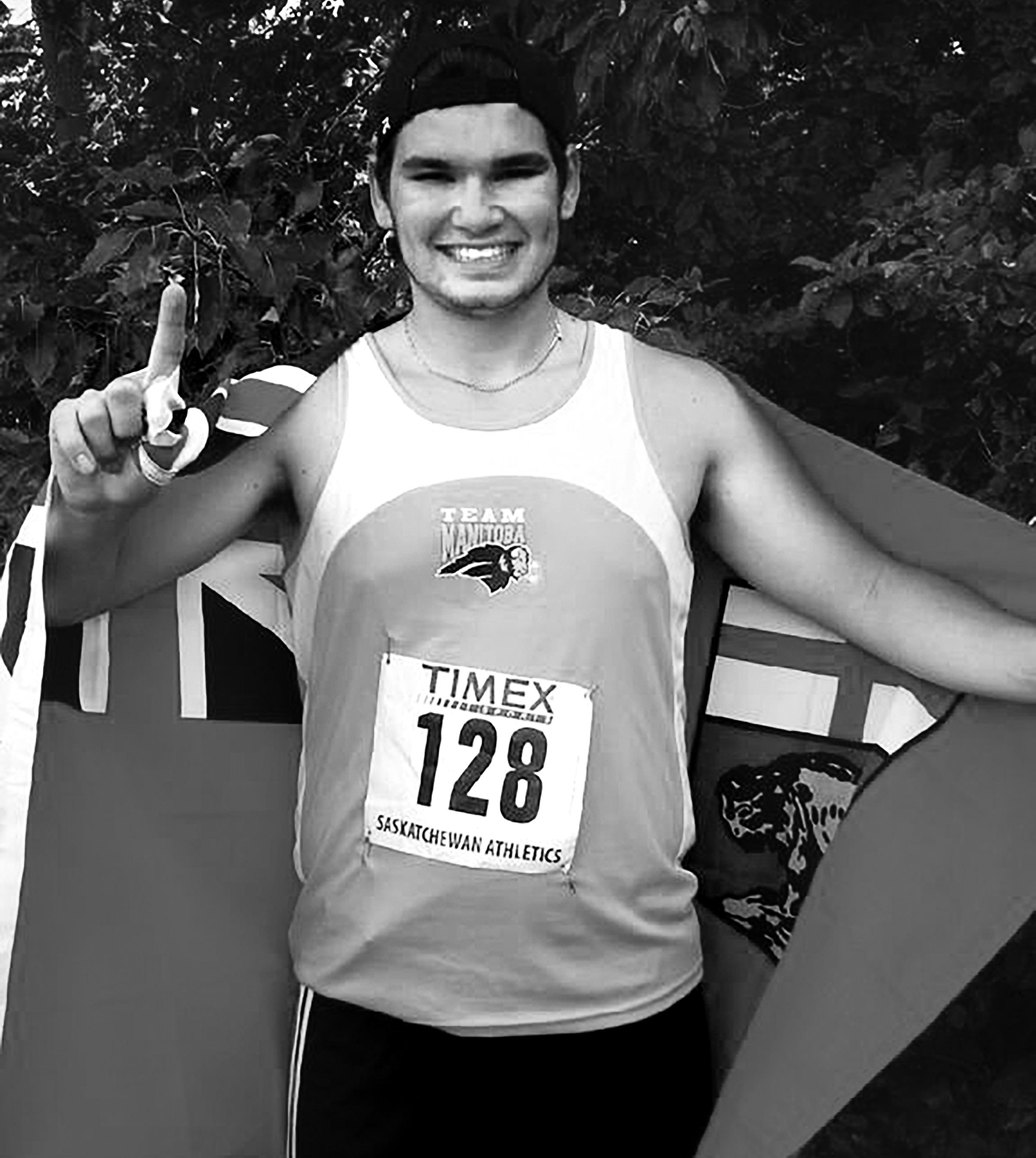
Carter Wilson has travelled a long way to get where he is today.
Originally born in Peguis First Nation, he lived most of his adolescent life in Fisher Branch, Manitoba – roughly two hours away from Winnipeg.
Growing up, he didn’t put very much emphasis on track and field – and didn’t actually become involved in the sport until grade nine at West Kildonan Collegiate, thanks largely in part to his older brother, who excelled in high jump.
“My brother was in track, so it was like, if he’s going to do this, then I’m going to do this,” said Wilson.
“I wasn’t very good at the start; I didn’t even make it to provincials. Then, my second year, I got third at provincials.”
After a strong progression throughout high school in both javelin and shot-put, Wilson chose to attend the University of Manitoba in the fall of 2013. He trained with the U of M team leading into the school year. He gained national ranking (15th) in javelin for the first time that July, after a throw of
52.79 metres at the Canada West Challenge in Calgary.
His performance continued to grow from there, as this past May, he leaped up to seventh nationally, after a third place showing at the Canadian Junior Track and Field Championships in Sainte-Therese, Quebec. At that event, he threw a personal best of 53.17 metres.
“Everybody was native, and so no one disliked the culture or anything. It was so inclusive.”
–Carter Wilson
Wilson continued to ride his momentum, blowing the competition away in javelin at the 2014 North American Indigenous Games in Regina, which took place in July. He took home the gold medal for Manitoba in both javelin and shot-put.
The 18-year-old described himself as a speed thrower in shot-put,
and a power thrower in javelin.
“I’m really fast in the circle compared to other, bigger guys at shotput,” said Wilson.
“When it comes to javelin, they’re two completely opposite sides of the spectrum. You’re built more like a sprinter rather than a thrower.”
The games featured indigenous athletes from both Canada and the United States, including Wisconsin and New York, which was a new experience for Wilson.
“[The North American Indigenous Games] was the first time I had competed nationally against teams in the States. It was a very cool experience,” Wilson said.
While the Indigenous Games were a much smaller venue, with far less crowd support, Wilson appreciated being able to return to his roots and train with other indigenous athletes.
“Just meeting more Native people was a big take-away. One day, we had this big round dance. Some guy just came into the middle of the two residences, and started playing drums and singing,” said Wilson.
“Everybody was native, and so no one disliked the culture or anything. It was so inclusive.”
Big Horn breakdown
Details on the start of school pep rally
DAVID GRAD, VOLUNTEER
A good year for Bison pride
Varsity sports teams represent a huge part of any university’s culture. Our teams are a point of pride and represent us, just like the Jets or the Bombers represent Winnipeg. Our athletes are in the business of protecting our school’s pride. They spend their weekdays in class, at the library studying, and going through workouts, practices, and game-tape reviews.
As students, it is also up to us to defend our school’s name. We do so by running student groups, putting on great concerts (like Tiesto on Sept. 14 ), achieving good grades, and backing up our athletes.
We don’t just cheer for a team, we cheer for our team. We cheer for our school and we cheer for our fellow students. Other students travel from across the country to play the Bisons. Make no mistake – we are defending our campus’ culture at every game.
This upcoming year the Big Horns and Student Life plan on infusing our campus culture with some enthusiasm and an increased sense of pride. We are starting with the biggest pep rally we’ve ever held.
Pep rally
Almost every university with enviable campus culture has a great pep rally.
It’s an event that builds culture by bringing everyone together to celebrate the school community. There are some common qualities every great pep rally has, so let’s see if the U of M can pass the litmus test. Every successful pep rally has energetic students and a top-notch stadium. It’s also important a school has talented sports teams. A big show with a campus cheer, , and cheerleaders are a must, too. Finally, there should be some kind of big game where we can rally behind our school.
Well, the good news is, we have everything but a marching band. If you happen to be a marching band and are reading this, first, apologies for missing you, and second, we should become friends. We could use a good marching band.
So here are the details for the biggest pep rally the U of M has ever held. On Friday, Sept. 12 at the Bison football home opener we will be celebrating our athletes, school, and campus community right before kickoff.
Gold rush
Everyone wear gold. Gold is one of our school’s and province’s defining colours. Gold represents wheat and the vast expanses of prairie land. We want anyone coming into our house to know they are in Manitoba, and that they are playing against the province’s best university. If you don’t have gold, we are handing out 6,000 free gold fan shirts . You can get a free shirt when you buy a student ticket on the Curry Pedway from Sept. 2 to 12, or you can redeem your student ticket at Gate 3 on game day.
Pyrotechnics
University 1 Student Council and Arts Student Body Council will be treating everyone in attendance to a pyrotechnic display. Our grand finale, with the Bison cheer team performing to an explosive show, will blow you away. Not literally. It is quite safe.
Props
This is our chance to give the recognition our recent national champions, the women’s volleyball and golf teams, deserve. We will be honouring them before kickoff.
New cheer
Every school has a defining fight song, chant, or cheer. Ours is the herd call. Learn the herd call. Love the herd call. Once you do, you will have something in common with every student here!
Motivate and inspire By the end of the pep rally we are hoping to motivate and inspire all four hundred of our athletes, every student, and our entire faculty, staff, and alumni.
We have a great community here, made up of so many wonderful people. Let’s showcase it on Sept. 12!
PHOTO BY CARTER WILSON
GRAPHIC BY BRENDA STILL
Yakking with Yantz
Talking training camp preparation
MIKE STILL, STAFF
W
ith the regular season looming, and anticipation at its peak, the University of Manitoba Bisons football team entered August all but waiting to get back on the field. The Manitoban sat down with Jordan Yantz prior to training camp, opening on the Aug. 22, to get his preliminary thoughts on what he expects to see heading into camp and the regular season.
THE MANITOBAN : You led Canada West in passing yards last season in your first year . What expectations do you place on yourself based on those numbers? Are you almost at the point of it being Vanier or bust?
JORDAN YANTZ: Absolutely. Obviously some people say it’s a long stretch, but I’m not going to go out there and play for a ‘finalist’ [finish]. You play to win. Regardless of the season we had last year, regardless of what it is, we play to win. I don’t care what it is – you could have a group of young guys or a group of old guys, it’s all about the team coming together.
I think already in this off-season we have become a closer team. Obviously we’re going to take it one week at a time, but yeah, we want to win, and I’m going to do everything in my power in my last season of amateur football to win, whatever it takes.
M: Is there also a higher expectation on the team as a whole heading into this season with so many veterans returning from last year?
YANTZ: I think so for sure. There’s a lot of stuff that myself, I need to correct, and a lot of stuff that overall as an offense we can get better at. That’s something that already we’ve been working at in the off-season. I’ve been meeting every Monday night with my offensive co-ordinator and quarterbacks coach going over every single play we ran last year, critiquing it, not criticizing, and making sure we know what we can correct.
M: Last year, the offensive was electric. Without saying too much, do you think there will be a heavier emphasis on the pass this year based on last season’s success, or will it be a balanced attack?
“We aren’t short of any weapons. Now it just comes down to executing” – Jordan Yantz, quarterback, U of M Bisons
YANTZ: I don’t think much will change from last year. If anything, it may lean a little bit more to the pass. We really want to maximize the amount of plays that we run in a game, and we want to be positive on those plays, and be successful on those plays. We’re going to try and have a high-tempo offence, and dictate the game.
Bison briefs
Hockey and men’s volleyball
Hockey
On June 26, Canadian Interuniversity Sport revealed both the men’s and women’s coaching staffs that will lead their respective hockey teams at the 2015 Winter Universiade in Granada, Spain. The biennial, multi-sport event runs from Feb. 4 to 14.
Manitoba will be proudly represented on both sides, as women’s head coach Jon Rempel and men’s head coach Mike Sirant were both selected to represent Canada.
Rempel, entering his 11th season at the helm for Manitoba, was named head coach for the women’s side. This is his first opportunity to be a part of Team Canada.
“I am extremely proud to be representing our country, CIS, the University of Manitoba, and Bison
women’s hockey at such a prestigious event as the Winter Universiade,” coach Rempel told gobisons.ca.
On the men’s side, Sirant, entering his 19th season as head coach, was named one of two associate coaches alongside Mark Howell of the University of Calgary. Dave Adolph of the University of Saskatchewan will serve as head coach. This will be the second appearance with Team Canada for Sirant, who was previously head coach at the 1997 Universiade, when Canada won bronze.
“I am honoured and thrilled to be a part of the Canada West team that will represent Canada at the 2015 Winter Universiade,” Sirant told gobisons.ca.
“This is a special opportunity and I look forward to sharing my past
M: Are there any specific areas offensively that you are looking to improve on from last year?
YANTZ: We’ve got to capitalize on our chances to score in the red zone, because obviously it’s tougher, and things get a lot smaller when you’re inside that zone. We also can’t be getting on the field and having two and outs. Yes it happens, but we’ve got to worry about moving the ball, and moving the chains, and not relying on 60-yard plays all the time.
M: How important is the chemistry you have already established with
certain members of the offence from last season?
YANTZ: Coming into spring camp, it was very evident that the chemistry was there. Guys were a lot sharper than they were last year, at the end of the year. I think chemistry-wise it can only get better. With [Matt] Sawyer, [Dustin] Pederson – those guys I’ve been playing with for six years. With [Nic] Demksi, it’s just Demski. Me and him have our thing, you know. Nobody can stop us; we are the best duo in the CIS, hands down. We aren’t short of any weapons. Now it just comes down to executing.
M: What are your thoughts on the change this year: having an intersquad scrimmage as opposed to a pre-season game against a fellow Canada West team?
YANTZ: The big thing about it is that we want to see what some of the young guys have got. It’s never the same in practice when, for example, quarterbacks aren’t getting hit and all that. But, we need to have guys to have that grit in training camp. So, it is what it is, and we’ve got to go about it, and be ready for week one. There’s no excuses just because we don’t have a pre-season game that we can’t be ready.
international hockey experiences to help our team go for gold in Spain.”
Men’s volleyball
On July 21, 2014, second-year Bison volleyball player Adam DeJonckheere was named to Canada’s 14-man Junior National Volleyball Team. DeJonckheere, who was a member of the 201314 CIS All-Rookie Team, had an impressive showing at the National Team Challenge Cup—held from July 15-20 at the Team Canada National Training Centre in Gatineau, Quebec—which aided in his selection.
The National Team Challenge Cup is a yearly inter-provincial volleyball championship, which includes the top under-19 athletes from every province.