A “volunteer staff” member is defined as a person who has had three volunteer articles, photographs, or pieces of art of reasonable length and/or substance published in three different issues of the current publishing year of the Manitoban. Any individual who qualifies must be voted in by a majority vote at a Manitoban staff meeting. Elected representatives and non-students may be excluded from holding votes as volunteer staff members in accordance with the Manitoban Constitution.
The Manitoban is the official student newspaper of the University of Manitoba. It is published monthly during the summer and each week of regular classes during the academic year by the Manitoban Newspaper Publications Corporation.
The Manitoban is an independent and democratic student organization, open to participation from all students. It exists to serve its readers as students and citizens.
Garbage pickers sweep up data from trashed Red River shoreline
Removing litter to better understand and contribute to healthier lakes and rivers
PHILMA SCHEEPERS, STAFF
Last Friday, the first-ever Red River shoreline cleanup took place on the shores of the University of Manitoba campus. Nine volunteers contributed to the project, spending nearly two hours walking along the riverbank and collecting any waste materials they came across.
Selena Randall, the research development co-ordinator for the Watershed Systems Research Program (WSRP), organized the event as part of a national campaign to facilitate research and understanding of the health and state of Canada’s aquatic ecosystems.
According to Randall, the nationwide watershed restoration project is not just about cleaning the environment; it’s about collecting information about what is there.
The volunteers split into two teams, each combing over a different section of the riverbank. As they picked up garbage, they recorded information about each piece of litter they found, which will be sent to a national database of shoreline health.
“Every piece of trash is something that an animal might eat or try to use, and because it’s not part of the natural environment if we can remove it, it’s a good thing,” Randall told the Manitoban. “Every little bit helps, and we do the beautification of the campus once a year, so it’s nice to do the shoreline as well.”
In total, the volunteers collected nine kilograms of recyclable materials and nine kilograms of glass and sharp metal.
In addition to things like bottles and plastic bags, the volunteers also came across a great deal of building materials—foam and cardboard— and other larger items.
“Most of the garbage we found we could not even pick up, such as metal pipes and wooden beams, which would have busted our total in terms of mass by a lot,” said Genevieve Ali, U of M assistant professor of hydrology and junior
Winnipeg mayoral candidates weigh in on ranked ballots
Ouellette and Sanders voice support for alternative voting system
CRAIG ADOLPHE, STAFF
chair on the WSRP. “This is definitely an underestimation of what was actually encountered.
“We kind of take our rivers for granted. We have a very antagonistic relationship with them,” Ali added.
“We want to live close to them because they’re pretty, but we’re angry when they flood – which is a natural process. Then we want them to be clean and blue; but at the same time we basically dump our garbage in them.”
“We kind of take our rivers for granted. We have a very antagonistic relationship with them” – Genevieve Ali, hydrology assistant professor
Second-year anthropology PhD candidate David Landry, one of the volunteers involved in the cleanup, told the Manitoban he’d like to see more students involved in the cleanup effort next year.
“I would really like to see more participation in terms of students volunteering to do this sort of thing next year,” said Landry.
“I think it’s a good way to get out and do something important for the environment that will have a lasting impact.”
As she had never organized something like this before, Randall did not want to promote the event too widely. After their first positive experience, she said that she would be happy having more people involved next year.
“There may even be scope to make a real University of Manitoba effort,” said Randall.
Robert-Falcon Ouellette, David Sanders, Judy Wasylycia-Leis, and Brian Bowman voiced their opinions on ranked ballots as an alternative to first-past-the-post for future Winnipeg elections.
The Manitoban contacted all of the mayoral candidates for their position on ranked ballots.
Sanders and Ouellette spoke in favour of the system.
Under a ranked ballot system, voters rate their preference for candidates.
In its most common form, preferential voting, the candidate with the lowest number of first votes is eliminated and their votes are transferred to the next favourite candidate on each voter’s list.
This process continues until one candidate has the majority of votes.
In an interview with the Manitoban, Ouellette voiced his support for ranked ballots at the municipal level, saying they could lead to election results that are more representative of people’s real preferences.
“I think this is one of the most important things that we could be experimenting with at the municipal level,” said Ouellette.
“The people who are often elected say, ‘Well I was elected under the old system, and that favours me,’ and so they’re very unwilling often to change and actually look at ways of doing things differently.”
Sanders also voiced his support for preferential ballots but added that it would have to be a decision made by the province.
“It would have to be approved by the provincial legislature. It’s not something city council can decide. But I would support a preferential ballot.”
Sanders said he followed elections as the city hall and metro reporter for the Winnipeg Tribute newspaper and covered at least one election of the Metropolitan Corporation of Greater Winnipeg, which he said used preferential ballots in that capacity in the 60s.
“I think this is one of the most important things that we could be experimenting with at the municipal level” – RobertFalcon Ouellette, mayoral candidate
“I was familiar with how the preferential ballot worked and it worked quite well.
“And with this particular election, with the number of candidates and the distribution that may well happen, it would certainly have been preferable to have the winning candidate be able to say that they are the preferred choice of a majority of people – to have a mandate to govern with some assurance.”
Brian Bowman said he was interested in any reforms that
would increase voter turnout but clarified that ranked ballots were not something his campaign had looked at specifically.
“I certainly would be open to any form of reform that can try to assist with a greater representation of democracy as well as [ . . . ] increase voter participation. That would be an objective that if ranking could help I’d be supportive of it.
“I don’t think the status quo is the end all and if there’s other forms that should be looked at then I’d be open to doing that. In fact, one of the reasons I’ve proposed a new office of public engagement is so that we could have the city try to drive some of these conversations a little more.”
Peter Dalla-Vicenza, a mediarepresentative for Wasylycia-Leis’s campaign, told the Manitoban that ranked ballots are not a priority for Wasylycia-Leis in this election.
“Any change in democracy is an interesting idea but really when it comes to those things—when it comes to any decision on how municipal elections are run—that’s usually [ . . . ] a Winnipeg charter issue, it’s a provincial government issue.
“Throughout our campaign our main message has been to fix the city and to fix city hall. We want to work on the issues that we actually can control [ . . . ] There are many things that a city government can do within its own purview and that’s where we’re going to focus our attention.”
The remaining three candidates— Gord Steeves, Paula Havixbeck, and Michel Fillion—have not responded to the Manitoban as of press time.
GRAPHIC BY JUSTIN LADIA
CFS-MB releases, retracts city mayoral candidate report card
Mayoral hopeful and UMSU president give CFS report card a failing grade
CRAIG ADOLPHE, STAFF
T
he Canadian Federation of Students-Manitoba released a report last week assigning grades to all of the mayoral candidates still in the running for Winnipeg’s municipal elections, and then proceeded to retract it later in the week.
The report card was part of an effort to inform and mobilize students for the municipal election and came after a period of interviews— dating back to at least mid-August— by CFS-MB leadership with mayoral and city council candidates.
The report did not include a legend, index, or grading system explaining how candidates were assessed a grade.
Robert-Falcon Ouellette and Judy Wasylycia-Leis were given A- grades, Brian Bowman was given a B+, Paula Havixbeck and David Sanders were given C+ grades, Michel Fillion was given a D, and Gord Steeves was given an F.
The grades were uploaded online along with caricatures of each of the candidates and a few bullet points detailing CFS-MB’s interpretation of each of the candidates’ platforms.
After a board meeting on Oct. 2, CFS-MB removed the report card from its website and social media accounts.
Zach Fleisher, chair of CFS-MB, refused to provide a comment on the report card or its removal after the board meeting.
Jesse Blackman, UWSA representative for the CFS-MB executive, was present at the board meeting and
said “the board has decided to not comment publicly on this matter.”
However, CFS-MB deputy chairperson Mitchell van Ineveld told the Manitoban that a motion was passed at the meeting to remove the report card from the CFS-MB’s website and social media accounts, effectively cancelling the project.
“I have to wonder who got control of this particular report card because that is completely inaccurate and I think inappropriate, for myself, and therefore I would wonder about comments for everyone else as well” – David Sanders, Winnipeg mayoral candidate
Van Ineveld added that the CFS-MB would not be putting out a revised version but would instead be putting out some material encouraging students to vote along with infor-
mation on how to vote.
He did not comment on the state of reports on city council candidates.
Although the report was pulled from CFS-MB’s website and social media accounts, it was widely shared online, including by mayoral candidate Robert-Falcon Ouellette.
By press time, the image Ouellette uploaded had received 113 likes and 77 shares on his campaign Facebook page.
Turnbull calls report ‘juvenile’
UMSU president Al Turnbull was not at the CFS board meeting, but was aware of the report card and voiced his disapproval of it to the Manitoban
“It was a juvenile gradient of the candidates that failed to mask the subjectivity and bias of the organization; the Canadian Federation of Students represents all students and should be focused on presenting the information to its members and leaving them to decide.
“An arbitrary evaluation based on no metric is a fairly disgraceful way for a seemingly reputable organization to weigh in on civic politics.”
Sanders asks: ‘Who got control of this particular report?’
Mayoral candidate David Sanders did not voice concern about the CFS’s decision to give grades in general but said he disagreed with the CFS’s assessment of his campaign or platform.
The Canadian Federation of Students-Manitoba would not provide details about what criteria went into assigning grades, but remarks for mayoral candidate David Sanders included:
“Has supported U-Pass in the past and opposes the current routing of rapid transit [ . . . ] Wants Winnipeg to be a more attractive place for families and students [ . . . ] Has limited governance experience and has a limited platform at this point [ . . . ] Has focused primarily on criticizing leading candidates.”
Sanders disputes the claim that he has limited governance experience.
“I think it’s neither accurate, nor fair. And I’m surprised. Because I did meet with the [ . . . ] Canadian Federation of Students and they’ve certainly seen me [ . . . ] at city hall for the last year and a half speaking out in favour of student concerns such as the U-Pass.
“I think if the remark is that I have limited government experience, I think that says it all. I have more government experience than all of the other candidates put together and stacked upside down. There’s no doubt about it. So if that’s the con-
clusion they draw I suspect there’s something seriously wrong with their analysis.”
Sanders also questioned the significance of the line “has focused primarily on criticizing leading candidates,” which was included in his summary.
“The idea that there’s something wrong with criticizing other candidates, when the other candidates come out with either wild or unachievable proposals – part of political debate is to expose that. And so I’ve been doing only a very little bit of that so far, but there’s more to come, frankly. And in fact there’s a lot that needs to be clarified for the benefit of the voters.”
Sanders said he told CFS representatives about his own background working on student issues and his own advocacy for universal accessibility to university.
“I have to wonder who got control of this particular report card because that is completely inaccurate and I think inappropriate, for myself, and therefore I would wonder about comments for everyone else as well.
“I would have expected much better from Zach Fleisher and the CFS.”
Bowman says ‘a lot of spinning going on’
Mayoral candidate Brian Bowman did not dispute the grade he received in the report card.
“Obviously I’d like an A+ but, you
know, any group is fair to judge any of the candidates and when you put yourself up for elected office you’ve got to be prepared that some people are going to like what you stand for and some people aren’t.”
However, Bowman did dispute the merit of a Facebook comment left by Van Ineveld in response to early criticism of the report.
Van Ineveld’s comment read “Note: This report was authored before Brian Bowman announced his tax policy and cuts to benefits for new city employees. Both of these, especially his new tax policy, would dramatically increase the financial burden that already overwhelms students in our city. It is safe to say that [ . . . ] if the report were re-written today his grade would be lower.”
Bowman disagreed with Van Ineveld’s analysis.
“Some of my competitors are saying that I’m going to introduce a municipal sales tax, which is false. I don’t have the power, if I’m elected mayor. It’s provincial jurisdiction [ . . . ] There’s a lot of spinning going on from competitors who don’t want to see us change the status quo,” said Bowman.
“I would just caution any group [to make] sure you’re actually looking at what the candidates have held out— what their policies are—rather than what their competitors are doing or saying about it.”
University of Manitoba protesters demand fair elections for Hong Kong
Students in solidarity with friends, family in the streets
DANA HATHERLY, STAFF
University students have boycotted their classes and students, professors, and citizens alike have occupied the streets in Hong Kong. Since Sept. 22, people have been taking part in a pro-democracy protest to counter what they believe to be Hong Kong’s ineffective electoral system and to seek political reform.
Over the past week in Hong Kong, tens of thousands of discontented students and citizens have taken to the streets outside government offices to challenge decisions made nearly 2,000 kilometres away in Beijing about how elections will be run in the semiautonomous territory of China.
It has become the biggest public demonstration in the history of the business and financial hub of Asia, according to Daniel Ng, University of Manitoba alumni who graduated last term with a degree in politics and a minor in geography.
“I can assure you that there has never been anything bigger in Hong Kong,” Ng told the Manitoban
A dedicated group of U of M students with ties to Hong Kong have organized in solidarity with those back in their home country. Around 10 students had initially met, and then they approached the Hong Kong Students’ Association to seek their support and involvement.
The group is composed of mostly students and alumni from faculties across campus. “Most of us are U of M students [or alumni] and International College of Manitoba students,” said U of M geography student Jo Tse.
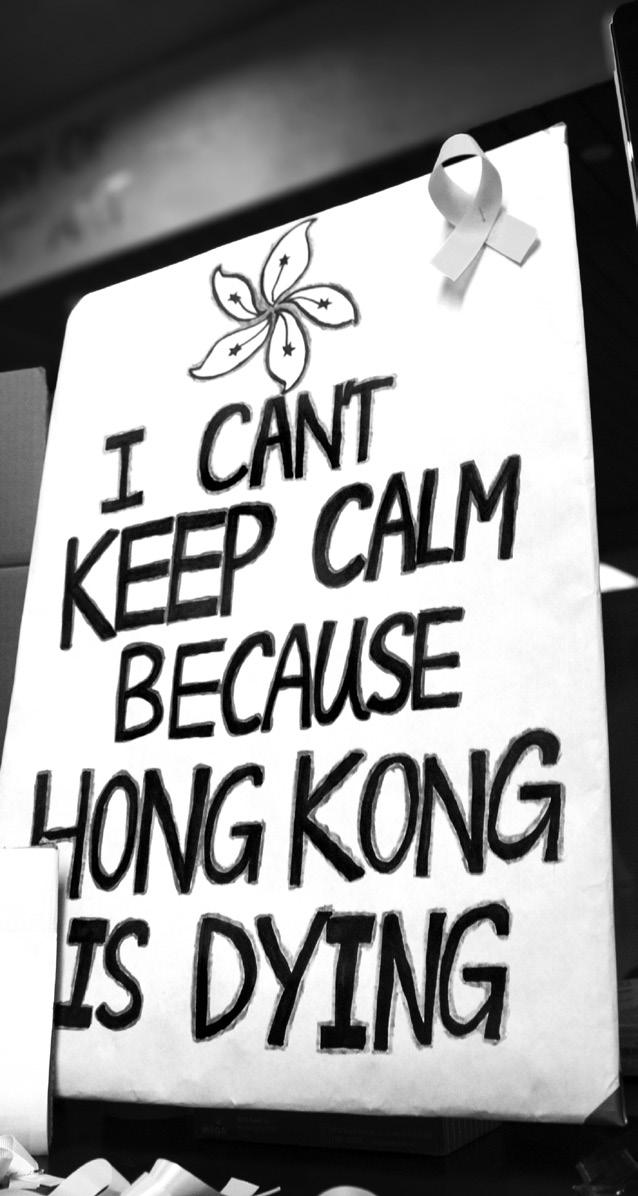
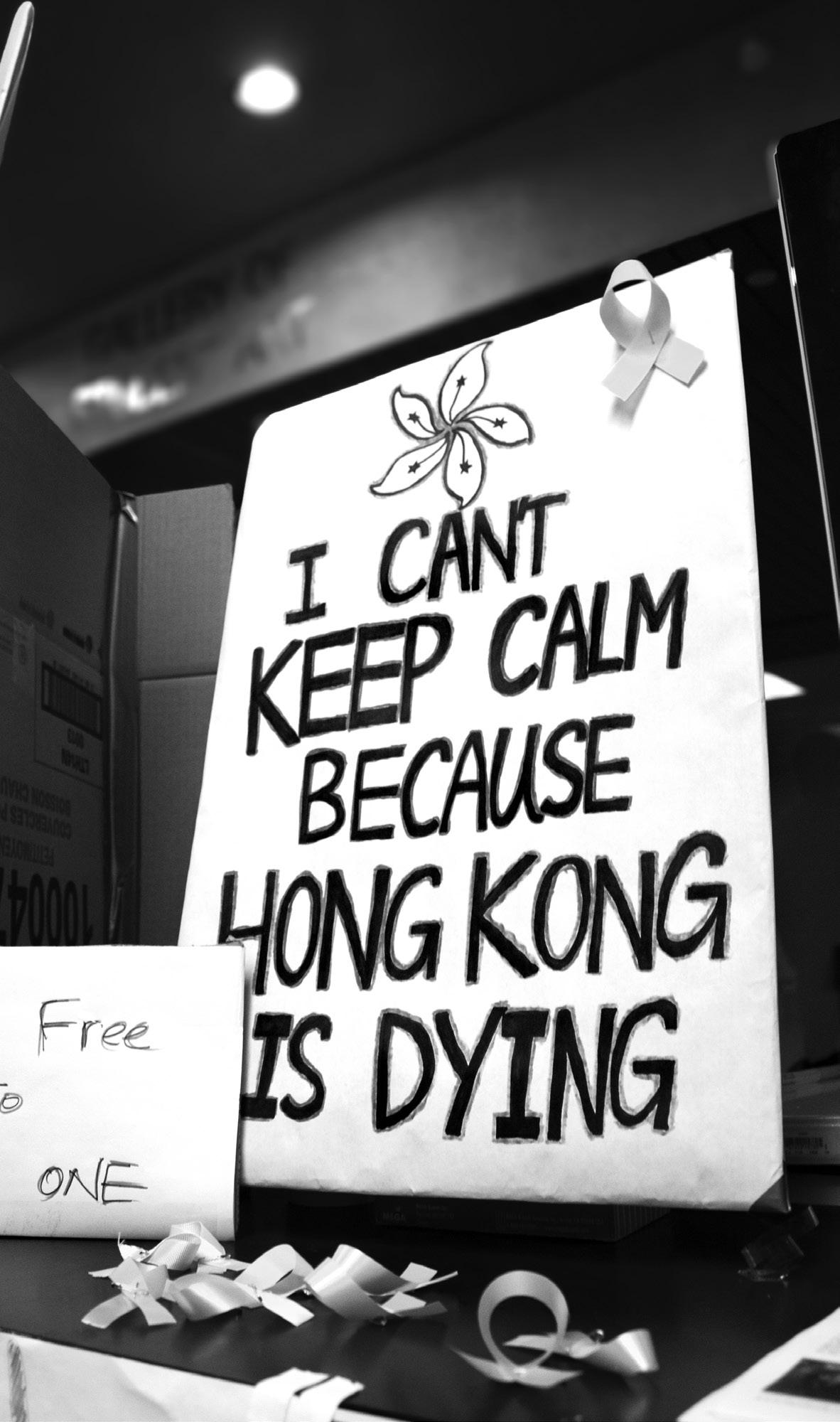
By setting up a table in University Centre with news footage of the protests rolling on a television, and pamphlets and signs demanding democracy and a more fair electoral system, these students hoped to draw attention to and inform others on campus and in Winnipeg about the situation in Hong Kong.
“Canada is made up of a lot of immigrants, and lots of people are from Hong Kong or have ties to Hong Kong. Everyone at the table [in University Centre at the U of M] has some relation to Hong Kong,” said Tse.
“We had to do something.”
“I’m here to raise awareness for supporting our protest activity in Hong Kong,” U of M student Jacky Lam told the Manitoban
Pro-democracy protest developments
The origins of the recent political movement date back to when Hong Kong was once a British colony –before the handover, which entailed Britain transferring power of Hong Kong over to China in 1997.
The British and Chinese government agreed that, ultimately, Hong Kong would be a democratic territory. Ng told the Manitoban that this was a
promise made in the joint declaration by both governments. It is also written in the constitutional document of Hong Kong and basic law.
“Being a colony, we cannot vote,” explained Tse.
“[After the handover], both sides promised that there would be a high level of autonomy with two systems in one country – one country of China, two systems of governance. But, things have changed. It’s not that different anymore.
“What we feel is that the level of freedom that we have been enjoying is going to be restricted,” Tse said. “We feel threatened by that. The instructions are coming from the Chinese government – elections are part of freedom and democracy.”
According to Ng, the people of Hong Kong believe that the Chinese government has failed to fulfill their promise and has been denying them democracy. On Aug. 31, the Chinese government proclaimed that there would be no universal suffrage by 2017 in time for the next election in Hong Kong.
Initially, a couple thousand students had attended a general assembly meeting held on one of the university campuses in Hong Kong. Based on the outcomes of that meeting, “The reason for the first occupation,” Ng explained, “is because the students didn’t see any signs of direct dialogue between them and the government, so they decided that they were going to the headquarters.
“The students, the university students, they started it. The class boycott started on Sept. 22, on Monday.
“[The students] occupied what we call the civil square, which is right next to the headquarters of the Hong Kong government. And of course, the police came in and arrested some students, but then more people came and they started occupying on the streets nearby,” said Ng. “Then the riot police came, they used pepper spray and tear gases trying to disperse the protest, but the protesters stood their ground.”
The standoff—which has clearly involved animosity between riot police, protesters, and anti-protesters—is ongoing.
The top leader in Hong Kong, Chief Executive C.Y. Leung, had declared Monday, Oct. 6 in Hong Kong as the deadline for demonstrators to clear the streets. According to various news sources, the chief executive called on the protesters to end the occupation and disperse from the streets and the highways so that classes may resume and government workers may return to work in their offices.
Up until now, the two sides have yet to reach an accord, but have agreed to continue the dialogue in a direct, mutually respectable manner.
The Hong Kong Federation of
Students has laid out three conditions that they believe are necessary for future talks: ongoing dialogue, equal treatment of student leaders, and that actionable political change must incur from the talks.
“My friends are out in the streets, and my parents have been there. I have been in the streets. I have been an activist, and I have always been concerned with this development,” Ng told the Manitoban
“The general picture [is that] people want democracy; people want to choose,” said Tse. “Because right now, people cannot choose.”
Tse referred to the fact that the chief executive of Hong Kong is elected by 1,200 elected representatives who are part of an election council. These 1,200 people are elected by and represent all of Hong Kong – a total population of nearly 7.2 million people.
Tse expressed disappointment with the lack of fair representation in the current electoral system, stating that “maybe you can select or vote for [the members of the election council], but even if you elect 1,200 people, it is not representative.”
A new proposal was drafted for the political reform. Some Hong Kong citizens were unhappy with the draft proposal, as Tse further explained.
“People can vote, but the candidates for the head of Hong Kong would be screened by the Chinese government. So, technically, that is not really a free election. It’s like, ‘You’re allowed to vote, but I’ll let you choose between this person and this person.’
“The feeling is like you have been tricked, cheated by the government.”
Upon comparing the situation to the elections in Winnipeg, Tse said, “The candidates, maybe you don’t like all of them [ . . . ] but at least they go through a process; they’re not appointed by someone else far away who doesn’t know what is happening.”
Protesters upset with the first draft proposal are expecting and waiting for a new proposition from the government.
The deadline imposed by the government on protesters was to clear the streets by Monday morning in Hong Kong, but it is unclear what the demonstrators’ actions will be depending on whether a new draft proposal is presented – and whether or not they approve of it.
The crowd had dwindled down to around 100 protesters outside government offices at one protest site by early Monday morning, and only around 10 were situated outside the chief executive’s office. Elsewhere in Hong Kong, several hundred protesters remained –following clashes with anti-protesters and despite calls from organizers to retreat from that site.
“I want to have a self-determined
future,” said U of M psychology student Enoch Chan.
“You don’t have to be a political studies student to realize that democracy is not the final answer to all problems, but I do believe that universal suffrage and a fair and democratic political system would do way better in holding the government accountable and responsible to these people.”
Ng noted that democracy “is not a western thing or a Hong Kong issue.”
“It is a universal, global value that
all kinds of people deserve to have – a representative government.”
Ng added that, “I would just ask people here in Winnipeg to keep an eye on the situation.”
Tse echoed Ng’s words.
“I want to tell them that they are not alone, that people are watching them,” said Tse. “I want to tell my friends that they are not alone, and I want to tell the government that around the world, people are watching.”
PHOTOS BY CAROLYNE KROEKER
Washington on the defence
The Daily Show panel highlights the need to stop trying to avoid blame and start making positive change
TOM INGRAM, STAFF
Recently, the Daily Show aired
a segment pitting a panel of Native American activists who are pushing for a new name for a certain Washington-based football team against a panel of fans who are opposed to a name change.
The segment is an amusing take on the sordid situation, but while it contrasts the views of the two panels, there is almost no interaction between them. The reason for this became clear when one of the pro-name change activists, Migizi Pensoneau, published an article in the Missoula Independent about his experience behind the scenes.
According to Pensoneau, the plan was for the segment’s host, Jason Jones, to have the antiname-change group make their argument, and then ask, “Would you say all of this stuff directly to a Native American?” They would presumably say ‘yes,’ at which point Pensoneau and company would be brought out, awkwardness would ensue, and the anti-name-changers would leave.
But during the event Kelli O’Dell, one of the anti-namechange panellists, burst into tears and accused the pro-namechangers of “ambushing and lying,” Pensoneau wrote. After filming but before the segment aired, O’Dell told the Washington Post that she felt “in danger” and was “going to be defamed.”
In his article, Pensoneau revealed that during a portion of the filming that did not make it to television, he was harassed and threatened by Washington fans at a tailgate party. He pointed out that though he was overtly threatened (one fan told him, “I’ll fucking cut you”), he did not back down because of his conviction that he is right. He also mentioned that
O’Dell’s dramatics do not speak well for her own convictions.
“I thought she was crying because she was caught unaware and was afraid,” Pensoneau wrote. “But I realized that was her defence mechanism, and that by overly dramatizing her experience, she continued to trivialize ours.”
What is required of those of us who are in a position of privilege is this: stop thinking about avoiding blame and placating angry interlocutors
Essentially, a response like O’Dell’s takes the privileged person’s discomfort at arguing with a real person rather than a hypothetical one and raises it above the discrimination faced by oppressed groups.
You see this phenomenon all over the place. Watch any middle class person confronted by a panhandler at a bus stop, for example. They will probably refuse more or less politely to give the panhandler money, then quietly seethe for the rest of their wait. (I’m not proud of it, but I have been this person).
Maybe they will post an angry Facebook status.
In the mind of our hypothetical commuter, the panhandler doesn’t even merit mention. We all agree that something ought to be done about poverty, but when confronted with an actual poor person we mostly want them to
go away and stop bothering us so we can go back to business as usual. They make us uncomfortable, and the considerably larger discomfort that anyone reduced to panhandling must be facing is not a concern for us.
A similar thing happens with many men when they are exposed to feminist discourse. There is currently a big discussion being had in the online gaming community about sexism. Some male gamers of my acquaintance are frustrated at what they perceive as being a lack of options for avoiding sexism; it seems to them that no matter what they do, someone is going to call them sexist. There’s no way to just fix the problem and go back to business as usual.
What they fail to recognize is that business as usual is the problem. When affairs have been arranged such that one group is systematically oppressed, there is no way to simply patch it up and move on. Any substantial change has to be a long and involved process that will force the people in a position of privilege to confront things they do not feel comfortable confronting. And the end result will never be business as usual.
What is required of those of us who are in a position of privilege is this: stop thinking about avoiding blame and placating angry interlocutors. This puts the focus of the discussion on your comfort, your concerns, your needs, and this is where the focus has been all along – which is why we need to have these conversations in the first place.
The ideal we should instead aspire to is listening to actual people and understanding their concerns, and doing our best to redress them. A good place to start: change the goddamn team name already.
GRAPHIC BY BRAM KEAST
An introduction: A call for communication
FRASER NELUND, STAFF
It is Mental Illness Awareness Week.
It is likely that you have been touched by mental illness, be it directly or through the suffering of friends and family.
Being aware, however, is not a matter of having something affect us. It is a matter of keeping knowledge present in our day-to-day activities and decision-making.
That there are stigmas associated with mental illness is not up for debate. That mental illness takes an
excruciating toll on Canadian society is a well-documented fact.
Sometimes it is necessary to state and restate the obvious: as our tribulations are played out it is easy to lose track of the minds behind matters.
Do not be afraid to reach out if you desire assistance. Want and need are easily confused when our mental state comes into play.
Do not be afraid to offer support.
Whether you can speak from experience, or listen with an earnest desire to help, the relationships that lend
structure to our lives are crucial.
Mental illness is as diverse as its sufferers. The focus of this feature has landed upon depression and anxiety because our contributors felt best able to speak to these topics.
This feature contains discussion of some of the resources available on campus. Katy MacKinnon summarizes places on campus intended to serve as supportive spaces for those in need. Dana Hatherly examines the newly launched UM for U campaign, Active Minds, aimed at
A study of anxiety
BRADLY WOHLGEMUTH, STAFF
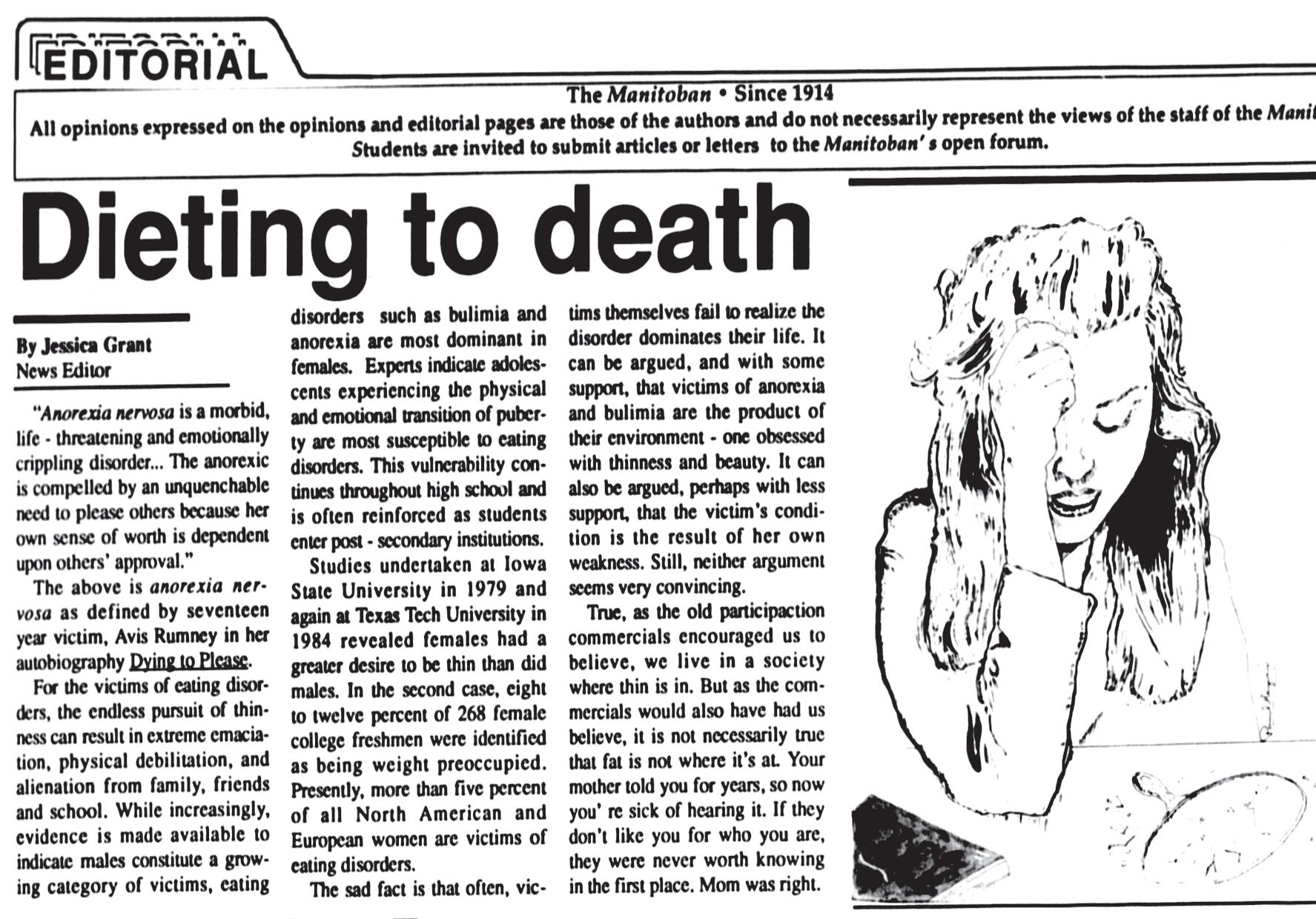
ensuring University of Manitoba students can rely on the backing of their peers. An editorial from an old Manitoban illustrates the perserverance required in the struggle against mental illness.
The crux of addressing mental illness is in the acknowledgement of its impact in our lives. Four Manitoban staff have provided personal pieces, and exemplary honesty.
In the art of Bradly Wohlgemuth and Carolyne Kroeker, and in the stories of Tom Ingram and Mike
Still, I hope readers find succor and inspiration.
I opened my introduction with the disheartening assertion that mental illness is common to most of our lives. I will close with a request.
Release preconceptions about the nature of the difficulties those suffering from mental illness face, be it yourself or another; the experience is unique, the processes of healing are individualized, the stigmas are exacerbating barriers we should all endeavour to dismantle.
Searching for answers
The ongoing mental battle with depression
MIKE STILL, STAFF
Background
Mental illness has commonly been referred to as an invisible disease, since symptoms are not immediately noticeable to the public eye. One of the strongest examples is mood disorders, specifically depression.
It can be easy to brush off certain signs of depression—sadness, feelings of guilt, a lack of motivation, or fatigue—attributing the symptoms to simply “having a bad day.”
Because of the broad range of symptoms, it is also hard for individuals to recognize. Doctors can diagnose depression fairly easily (compared to some other psychiatric disorders), but individuals find it difficult to identify in themselves because of the confusion between the disorder and just being sad.
According to the Public Health Agency of Canada, there are over 15 common symptoms of depression. Nearly all of these examples could easily be attributed to something else, and, as a result, depression gets swept under the rug. This is a problem.
According to Statistics Canada, “depression is the most common mental illness among those who die from suicide, with approximately 60 per cent suffering from this condition.” Despite adequate resources being readily available, more than two thirds of those suffering from depression will never seek help, whether from friends, family, or medical professionals.
Experience with depression
There are a number of different reasons why individuals may choose not to consult a professional when it comes to the setbacks they are facing. Guilt, fear, frustration, and confusion are all among the variety of emotions a person may feel when bouts of depression come along.
I can speak personally on this topic, having seen the effects of depression tear my family apart. My brother struggled with the medical condition for many years, and the results were a nightmare for all involved. His symptoms began in grade seven, unbeknownst to all of us. My parents were shocked and confused as they witnessed his personality slowly change.
It wasn’t until two years later that any of us truly clicked in that something was seriously wrong. I cannot personally fathom what it must have been like for my brother to fight those personal demons on his own for such an extended amount of time. In grade nine, he was finally diagnosed with double depression, a combination of major depression and dysthymia (also known as chronic depression).
One form of depression on its own is tough enough, but to combine the two is almost unthinkable. It’s like being punched in the gut when you already have the wind knocked out of you.
My brother, and our family as a whole, went through the mental health system completely blind. None of us had any prior knowledge of depression, how to treat it appropriately, and especially how to handle it within our own household.
Every day was a battle. My parents went to a couple of different doctors with my brother, hoping that the professionals would be able to guide them in the right direction. Instead, it was an endless circle, as whatever medication my brother was given proved ineffective, and sometimes even made things worse. For a particular period of time, it didn’t seem like there would be a happy ending to this story.
Time and experience turned things around for my brother. The
bottom line of this story is that he saved himself. Using his genuine interests, such as writing and playing music, as well as helping children in situations that were more challenging than his own, he turned things in the right direction.
There is one particular memory that I will never forget. My brother was having a really hard day, and didn’t get out of bed. My dad, who is usually very level-headed, got frustrated, and called him lazy. My brother responded by saying, “I’m not lazy, I’m working really hard.” My dad asked angrily, “On what?” His response will always stick with me. He said: “I’m working to stay alive.” Everyone experiences and responds to mental illness in different ways. Some have a family history, and therefore a greater knowledge on what approaches might need to be taken. Others, such as our family, had no clue. The bottom line, regardless of the situation, is to remain strong, because things will get easier with the right support, and perseverance. You are never alone.
GRAPHIC BY SCOTT FORD
End the romanticization of mental illness
CAROLYNE KROEKER, STAFF
Mental illnesses cannot be characterized by one unwavering, constant mood or symptom, and people do not need to be in crisis on a regular basis in order to have a mental illness. This triptych, informed by my personal experience with generalized anxiety disorder, addresses the emotional complexities of mental illness that are often ignored in dialogue. My personal experience with generalized anxiety disorder has included spans of extreme irritability, emotional and physical lows, and periods of incessant worry. When presenting this triptych at a group critique, I was told by a guest critic that my mental illness was a “gift” that I could harness and moderate to my creative benefit as an artist, and that artwork speaking on mental illness is “disingenuous” unless produced during a period of crisis. This implication that mental illness can be conveniently exploited is not only untrue, but harmful to those of us living with a mental illness, as it trivializes our experience. Stop romanticizing mental illness and conflating it with artistic genius.
"Low" Digital print of acrylic paint on glass. 2014.
"Panic" Digital print of acrylic paint on glass. 2014.
"Fever" Digital print of acrylic paint on glass. 2014.
Mental health resources at the University of Manitoba
KATY MACKINNON, STAFF
Accessing resources for mental health in the city can be a daunting task, especially if you’re new to the whole “getting help” game. The University of Manitoba has many resources available to you, from counselling, to safe spaces to relax. Here’s the rundown of a few:
Peers: Students Helping Students
If you’re more likely to confide in a friend than seek professional help, Peers is the resource for you. Peers volunteers are U of M students who have completed at least 18 credit hours. They are trained on topics such as active listening and empathic communication, crisis intervention, and
Seeking help
My anticlimactic trip to the shrink
TOM INGRAM, STAFF
I’ve never been what you might call a cheery person. I was seven when it first occurred to me that one day I will die and the rest of my life must be lived in the shadow of that fact. But I never needed, like, a doctor or anything.
This all changed the summer after my first year of university. I was lonely. The real world was distressingly close. I couldn’t get a proper job that didn’t involve writing for a student newspaper. Eventually I couldn’t do much of anything. I spent entire days in bed, and in the evenings I played video games and loud music to drown out the ambient noise in my head.
It was quite a while before I even considered seeking help, and even then there was a wait. There were three appointments and several weeks separating the day I averted my eyes as I told my mother I thought I might be depressed and the day I spoke to a specialist.
In the intervening time my con-
dition did not improve, but it did become tinged with an ominous ambivalence about psychiatry and drugs. At my second appointment—a physical—I feared to discuss mood issues and did not mention them until the resident brought them up. Then I very nearly walked out of the appointment with a prescription for antidepressants before he thought better of it and scheduled me to be seen by the clinic’s psychiatrist.
Part of my ambivalence was a fear of drugs. But mostly I was worried they’d think I was a fraud. After all, there are so many people who desperately need help, and who the hell am I? Sure, I was in pain, and there were times I couldn’t bring myself to get out of bed. Sure, I was depressed. But did I have depression? What a jerk they’d think I was if I didn’t – and they’d be right.
I finally saw the psychiatrist. Mostly I spoke to a resident while he watched and judged. I explained
that I don’t hear voices per se, but there’s something like a voice telling me how worthless I am, but not like in a crazy way.
The psychiatrist explained to me his philosophy on drugs, then recommended that I get some exercise, read some books, and come back to him. I did the first two. I changed my environment, read widely, and got my situation more or less under control. I still have regular fits of depression and anxiety, which I treat with the time-tested blanket-and-fetal-position method, but I’m a lot more serene about the whole thing.
So what’s the point of this anticlimactic story? Well, for one thing, seeking help is practically guaranteed to be uncomfortable. You’re letting people into your private sphere to poke around and ask questions about whether you hear voices. And through the whole process you’ll feel like a fraud in inverse proportion to how much of a fraud you are – that’s
student-related issues.
Peers are there to listen when you have a personal problem, or to provide options for other resources on campus. All services provided by Peers are confidential and free.
Student Counselling Centre
This centre offers a variety of resources to students at the U of M, including free personal counselling. To access counselling, visit 474 University Centre in person and request an intake appointment for that day. Intake appointments are first-come first-serve. Crisis counselling is also available.
A variety of group workshops are held, such as: Managing Your Mood, Mindful De-Stressing, Managing Exam Stress, and Wednesday Women’s Circle. Visit the Student Counselling Centre’s website for a list of online and print self-help resources..
Psychological Service Centre
The Psychological Service Centre is located in 161 Dafoe (right by the Greenhouse Café) and acts as training for graduate students in clinical psychology. Free and confidential therapy and assessment services are available, but there are no crisis services. You can access the centre from September to April, and you do not need to be a U of M student.
Student Accessibility Services (SAS)
There are numerous resources offered to students experiencing
mental illness (and a range of other disabilities) through SAS at 520 University Centre. Some include: a computer/study room, computerized note-takers, and the academic assistant or attendant program. Student Accessibility Services also offers a program called ACT (Acceptance and Commitment Therapy) for Anxiety. The program is free to those registered with SAS and focuses on mindfulness and acceptance strategies.
Rainbow Pride Mosaic (RPM)
Though not directly mental health-focused, RPM offers a safe space for LGBTTQ* and straight ally individuals. A variety of programming is held throughout the year, including LGBTTQ* Awareness Week and LGBTTQ* ally training. Visit 113 Helen Glass for peer support and community resource referrals.
Womyn’s Centre
Like RPM, the Womyn’s Centre offers a safe space on campus for women to connect, have fun, or just chill out. Visit the artwork-filled and serene quiet room for a personal talk or some alone time, or hang out on the futons to talk feminism and make new friends. The resource library can direct you to other services, and there are free menstrual products, pregnancy tests, condoms, and lube. The Womyn’s Centre is located at 190 Helen Glass.
how they getcha.
All this is true. But if you think you are depressed and need help, don’t let this keep you from getting it. It’s a mistake to think of depression as a disease you either have or don’t. All there is is pain, and if that pain is
bad enough to bring you to a doctor’s office, perhaps that is a good place for you to be. Whether or not you think you deserve it, whether or not you end up getting treatment, whether or not you “really” need it: if you need help, seek help.
PHOTOS BY CAROLYNE KROEKER
GRAPHIC BY KELLY CAMPBELL
Changing the conversation about mental health on campus
Active Minds is first mental health awareness student group at the University of Manitoba
DANA HATHERLY, STAFF
Last month in the United States, National Suicide Prevention Week took place to engage and inform health-care professionals and the general public about the major cause of premature and preventable deaths: suicide. Across the country, people were given an opportunity to remember those lost to suicide, support survivors of suicide, and reinforce the message that suicide is preventable.
Research from Statistics Canada shows that “mental illness is the most important risk factor for suicide; and that more than 90 per cent of people who commit suicide have a mental or addictive disorder.” Furthermore, there is no one single determining factor, but a combination of factors, including—but not limited to—mental illness, with depression being the most common type of illness among those who die from suicide.
The Active Minds student group at the University of Manitoba is part of a broader international movement to bring awareness to suicide prevention and mental health issues.
On the Active Minds campaign website it reads that “suicide claims the lives of more than 1,100 college students each year.”
The campaign itself is oriented to stop the stigma preventing students who struggle with mental health issues from seeking help.
Alison Malmon founded Active Minds on the University of Pennsylvania campus in 2003 after her brother, Brian Malmon, killed himself. Since this tragic incident, the mental health awareness movement has expanded onto more than 350 university and college campuses across the U.S.
Deborah Chan, U of M nursing student and one of the lead campaign organizers, told the Manitoban that Active Minds was the first mental health group ever established on campus. Chan expressed how surprising this was, considering that the “U of M is such an old university, and one in four students will suffer from mental health issues.”
ness educator on campus, initiated the student group and supplies them with resources and connections to mental health experts and crisis services.
“The initiation of Active Minds was in response to the lack of a student-run, student-led mental health awareness, education, and advocacy group on campus,” Kutryk told the Manitoban
“Active Minds is changing the conversation about mental health and removing stigma” –Cindy Ye, president of Active Minds
Katie Kutryk, a health and well-
From a nursing perspective, Chan spoke about why our definition of health must incorporate both physical and emotional health, and how important it is to promote mental health awareness.
The new student group has reached out to students across campus. It has a contact list of about 50 members, and a core group of between 10-20 active participants.
“I just heard about the group, and then I got involved,” said Cindy Ye, current president of Active Minds.
“We are [here for] advocacy. We
are not here to act as a counsellor because we by no means have that knowledge, but we would probably direct [students with mental health issues or suicidal concerns] to peers – to talk to peers or the Student Counselling Centre.”
Ye wants students to know that there are people and resources available. Cards with crisis phone lines and suicide prevention lines are available to the student group and sometimes distributed to students by members.
“It’s about knowing the symptoms [of mental health suffering] and being aware that this stuff does happen and to be ready to deal with it before it’s too late,” explained Ye.
“[Malmon’s brother] was suffering from a mental illness. She didn’t think he was unhappy; he was a pretty popular guy, so she was thinking like, ‘He was really loved,’” said Ye. “So, she was unaware and then one day [her brother] just committed suicide.
“She was devastated because she didn’t talk to him but she wished that she did.
“She doesn’t want the same thing to happen to other people.”
According to the Huffington Post, Active Minds is “the nation’s leading
Pages from the past
organization dedicated to empowering students to speak openly about mental health in order to educate others and encourage seeking help.”
Their group is organizing a chalking event to bring visibility and awareness to the issue of stigma surrounding mental health diagnoses, and change the conversation about mental health.
Ye explained that using chalk to express mental health issues is effective because it makes people stop and ask about it.
She said that Active Minds is “all about changing the conversation about mental health
“We are hoping this year we can do a little more.”
The chalking event to raise awareness and ignite conversations about mental health will be taking place soon (as of the Manitoban’s production deadline it had been postponed over weather concerns). To get involved, or for more info, email activemindsumanitoba@gmail.com or visit facebook.com/activemindsumanitoba
Arts & Culture
Coyote: Proof of Life
Pop-rock group’s second EP lyrical and addictive
ALANA TRACHENKO
At first listen, the five-piece band
Coyote may seem like the garden variety pop-rock group, but as you work through their EP Proof of Life, the Charlottetown, PEI group’s dimensions and complexity become clear.
The six song EP is well set up; the songs move from upbeat to reflective, but somehow don’t lose energy in the process.
Proof of Life is worth repeated listens; the first listen had me unimpressed with occasionally insubstantial lyrics, but going back, I enjoyed the singer’s vocals enough to make up for it. The lyrics become more meaningful as you move through, accompanied by thoughtful soundscapes made up of salient guitar solos and animated keyboarding.
The EP’s synth is reminiscent of Motion City Soundtrack, but the vocals are far more robust than those of Motion City’s lead singer Justin Pierre; in fact they are more similar to U2’s Bono (in the best way possible).
The opening track on Proof of Life grabs your attention with energetic piano and pop synth, and exhibits frontman Josh Carter’s wide vocal range. The title track “Proof of Life” displays Carter’s vocal abilities to their fullest and makes the track more than a little addictive. The emotion is raw and compelling and the rest of the band takes well-coordinated breaks
while Carter urgently asks, “What do you do when the truth becomes a lie?”
He goes on to question the difference between wrong and right, and choosing light over dark. The metaphors are clichéd, but Carter gives them new feeling – he believes enough in what he’s saying to convince the rest of us of his sincerity.
The next and final track opens with dreamy acoustic and electronic
guitar. Carter fades into the background, seemingly gutted after his last exclamation. Halfway through the group catches their breath and begins to pick it up.
Coyote seems to be operating under the premise that they have only a little bit of time and a lot to say. It makes for an incredibly easy listen; compact song lengths and lack of repetition keep the EP from ever dragging.
My main criticism is actually the packaging of this album: the solemn, two-tone woman on the front cover gives no indication of the refreshing pop-rock tracks inside.
The photograph seems tritely artistic and to that end is a bad attempt at mainstream indie album art. The group might have been better off using a photo of their hometown, a place that’s a mystery to most of us and boasts the kind of natural landscapes (red sand beaches, say) that are also in vogue on album covers.
Overall, Coyote has almost too many directions it can go in, so I can hardly blame them for not being able to nail down the perfect signature image on their first EP.
The EP was an appropriate showcase; however, Coyote’s first fulllength album should be more focused and individual, or they risk going the way of Mumford and Sons, becoming another icon of radio popularity.
PHOTO BY SCOTT BLACKBURN
Out in the Night with REEL Pride
Film exposes prevailing ignorance about LGBTTQ* rights
Partnered with the women’s and gender studies program at the University of Manitoba, REEL Pride Film Festival presented a free screening of Out in the Night on Oct. 2 with a follow-up discussion facilitated by Liz Millward, associate professor in women ’s and gender studies.
Aimed to celebrate queer media arts and contribute to Winnipeg’ s queer community by focusing on issues of interest and supporting queer artists and stories, REEL Pride presented the film Out in the Night, hoping to cultivate dialogue on pressing issues within the LGBTTQ* community. Out in the Night is described as “Orange is the New Black meets real life.”
The film, based on a true story, chronicles four African-American lesbian women enjoying a night out in New York City ’s West Village. What begins as a fun night quickly turns sour when the threatening act of street harassment escalates to something more violent and more sexually threatening.
The four women, known as “ The New Jersey 4,” are charged with gang assault and attempted murder, sparking a media mania when they plead not guilty on the grounds of self-defence.
Through testimonials and interviews with these women and members of their families, Out in the Night provides an eye-opening commen-
On her own
tary on the roles of race, sexuality, gender, and class in the outcome of a trial as well as in the framing of a case.
The women are convicted in the court and in the media as a “gang of killer lesbians,” demonstrating not only the power the media holds in the public’s perception of critical events, but also the extreme bias that still permeates the legal system.
This film gives us a glimpse into the lives at stake when negative stigmas infiltrate everyday occurrences, as well as provides more colour to the grey areas of the nuances and complexities associated with life in the LGBTTQ* community. The result is an incredibly personal story made
Sc Mira releases single from forthcoming EP
KATY MACKINNON, STAFF
If you’ve yet to hear the distinctive voice of the lead singer Sc of Sc Mira, you’re in for a treat. Sc Mira is set to perform at The Cavern on Oct. 11 at the beginning of their CanadaU.S. tour.
Sc Mira is made up of Sc on lead vocals and guitar, Tyler Wagar on guitar, Mario Lagasse on bass, Jed Desilets on drums, and Justin Delorme on keys.
The local folk-rock-indie pop group recently released On My Own, a single from their forthcoming 2015 EP Waiting Room Baby
The tune is catchy and fun, but pay attention to the lyrics and you’ ll be told a story of Sc’s personal struggle with cancer.
Sc says the lyrics reveal her feelings of being “trapped and stuck ” in a body that wasn’t doing much for her.
Playing a guitar was synonymous to writing in a journal for Sc. Originally, she had no intention of taking the music further than her bedroom, but when Sc began collaborating with Wagar, the two formed a duo and eventually became the band they are now.
The six songs featured on Waiting Room Baby are “very personal,” says Sc. It hasn’t been easy for her to talk about them – she says she’s quite introverted and talking about the meaning behind the words is out of her comfort zone.
But she really enjoys being on stage.
“Performing them is great because although they ’re all about these daunting topics, we put on a good rock show.”
Attend an Sc Mira show and you’ ll get the best of both worlds – lyrical
substance while feeling free to dance the night away.
Halloween EP
Sc Mira will also be releasing an EP for free on Soundcloud before Halloween. The three songs on the EP will be covers: "Somebody Super Like You," "Life at Last" (both from Phantom of the Paradise), and "Halloween" (The Misfits).
While recording their 2015 EP, Sc and Wagar found a vintage record from the 1974 rock opera Phantom of Paradise, which inspired the creation of the Halloween EP.
“ It’s also fun being able to recreate the songs with our band when we both watched the movie so many times as kids,” says Sc. Catch Sc Mira playing a hometown show at The Cavern on Oct. 11.
universal. We are allowed into the lives of these women and are made to see that this is, unfortunately, not a rare incident.
Director Blair Doroshwalther integrates pieces of security footage of the women being physically attacked with portions of the testimony against the women. The result is a telling picture of the legal system corruption and the prejudices that continue to infiltrate societal perceptions of the LGBTTQ* community.
The LGBTTQ* community across the globe continues to experience violence such as murder, assault, rape, and threats. The anti-propaganda law implemented in Russia has resulted in a large increase in the amount of
violent attacks against LGBTTQ* individuals and a subsequent lack of police action to prosecute the perpetrators.
Although we have made steps in the direction of equality, it is very clear that this reality is further away than we would like to believe. Cases like “ The New Jersey 4” serve as a reminder of the distance we still need to traverse to reach total equality. This screening is part of a pre-festival warm up; there is much more to come as we delve deeper into October and the film festival gets underway.
For a full schedule of events, visit the REEL Pride website at reelpride.org.
LAUREN SIDDALL, STAFF
PHOTO BY TRAVIS ROSS
Brunch is the new black
Winnipeg’s best brunch nooks
LAUREN SIDDALL, STAFF
As the art of creating the perfect brunch has taken centre stage in the culinary world, increasingly more brunch-centric restaurants are sprouting up in Winnipeg. These local restaurants are here to make the most important meal of the day the best one, too.
The Tallest Poppy
After a one-year hiatus to oversee the Come N ’ Eat Café in the Neechi Commons food co-operative, Talia Syrie is revitalizing The Tallest Poppy in a brand new location within the Sherbrook Inn.
This new space will essentially triple the seating available at the previous Main Street location, allowing Syrie and her business partner Steve Ackerman to expand the business in tandem with her growing menu.
The Tallest Poppy will continue to serve all the old favourites, as well as elaborating their menu to incorporate dinner entrees.
Keeping with the comfort and familiarity The Tallest Poppy is known for, the new location boasts a warm retro design with bright windows to set the charming mood. In addition to the excitement of once again running her own restaurant, Syrie will also be contributing to the growing neighbourhood of West Broadway, which has transformed into Winnipeg’s most coveted real estate space. In February, the area had a waiting list of business owners wanting to be part of the movement.
Stella's Café
Stella’s all-day breakfast draws a massive crowd; they are always packed on the weekends.
In addition to their mouthwatering breakfast menu, Stella’s also has a wide array of specialty cocktails, dinner options, and desserts to fit every
Stella’s has grown from its humble beginnings into one of Winnipeg’s favourite chains. Stella’s now has five locations (seven counting its Sherbrooke Street bakery and Edna’s Café) popping up everywhere from Kenaston Boulevard and Grant Avenue to the newly redesigned Winnipeg James Armstrong Richardson International Airport – inevitable expansions from their Osborne Street origins in 1999.
culinary occasion. I order from their breakfast selection no matter what –their maple caramel French toast is to die for.
Do yourself a favour and check out the Sherbrook Street location. With Winnipeg’s emerging West Broadway culture as the backdrop, this restaurant is on prime real estate.
The patio has beautiful incandescent light bulbs strung across the trees, juxtaposed with a killer graffiti wall – all while offering a perfect view of Westminster Church. It ’s not too late to enjoy a coffee on the patio, so bundle up! The view is worth it.
Osborne Village Café
This hidden-treasure resides within the unassuming walls of the Osborne Village Motor Inn. Under the management of chef Leighton Fontaine, this restaurant breathes refreshing new life into the tired venue.
As a first-time executive chef and manager, Fontaine is focusing on inventive recipes to shake the dust off the over-used, mundane breakfast menus of plain buttermilk pancakes and toast.
Instead, you will find innovative meals such as The Pineapple Express Omelette filled with pineapple chutney, mozzarella, and Manitoba hemp hearts, and The Elvis breakfast sandwich, a grilled peanut butter, bacon, and banana sandwich.
There is a strong emphasis on making every menu item fresh and from scratch. Everything you order is cooked for you on the spot, making what may seem like a simple menu item labour-intensive and complex. This underdog of the Osborne strip is definitely one to watch.
Harp & harmony from Janelle Nadeau
Singer-songwriter releases These Roads at the WECC
IAN T.D. THOMSON, VOLUNTEER STAFF
W
hile the classical harp may not be the most accessible instrument, it was singer-songwriter Janelle Nadeau’s passion at first sight.
“My parents took me to the symphony when I was about three-yearsold,” says Nadeau. “ It was there that I saw and fell in love with the harp I then started playing when I was sevenyears-old and I never looked back.”
Combining aspects of Spanish, Celtic, blues, country, and original music, Nadeau will be releasing her debut album These Roads on Oct. 8 at the West End Cultural Centre (WECC).
Although this is her debut album, Nadeau’s resume over the years is wide-ranging. She has toured with such organizations as the National
Youth Orchestra of Canada and the Manitoba Arts Council. Nadeau has serenaded audiences at close to 200 concerts in care homes and hospitals in working with the Health Arts Society. She even backed up Kanye West during one of his Vancouver shows.
On top of being a musician, Nadeau stays true to her roots. While she spends the winter months recording and playing the harp in Vancouver, in the summer months the classically trained harpist can be seen working farm machinery on her family’s grain farm in Fannystelle, Man.
In regards to how she transitions from the sprawl of Vancouver to Manitoba farmland, Nadeau says, “All of this just seems so natural and
the way it should be.” These Roads can be seen as an account of the uniqueness of Nadeau’ s ever changing settings.
“I chose this title because I feel that this album is an account of the many roads I have travelled throughout my life,” says Nadeau.
“I grew up on Manitoban country roads; I have traveled city roads as well as many around the world. All of these experiences have influenced me, my music and my stories thus creating my debut album These Roads ” Nadeau recruited the assistance of local singer-songwriter Jaylene Johnson to compose the songs. Johnson has had her music featured on programs such as Pretty Little Liars and Degrassi: The Next Generation
The two musicians immediately clicked.
“I am so lucky that [Johnson] and I have always been on the same page,” says Nadeau. “We connected from the beginning.
“ Though most of our interactions have been through songwriting, I told her the other day that I feel like I know her so incredibly well even though we haven’t known each other for a long time. Maybe that’s the magic of songwriting.”
The outcome of their relationship has led to seven co-written songs for Nadeau’s album.
Nadeau says while the upcoming performance will be harp-heavy in nature, fans should expect more than just strings.
With a backing band featuring drums/percussion (Ian Mackie) and added guitar, bass and vocals (Stephen Fisk), Nadeau’s live performance will not be made up entirely of classic harp music and will also feature Nadeau sharing introspective stories behind the music.
“It ’s not a typical harp concert,” she says.
Catch Nadeau at the WECC on Oct. 8. Tickets are $25 in advance and $30 at the door (available at the WECC, Music Trader, Winnipeg Folk Festival Music Store and Ticketmaster). Doors open at 7:15 p.m. with music starting at 8 p.m.
PHOTO BY LAUREN SIDDALL
PHOTO BY LAUREN SIDDALL
Upset in Alberta
Bison football falls just short against Golden Bears
MIKE STILL, STAFF
For the second consecutive game, the 10th-ranked Manitoba Bison football team found themselves on the verge of a tremendous comeback. Unfortunately, just like last week, they couldn’t get it done in the dying seconds, suffering a 38-31 loss to the underdog Alberta Golden Bears.
Despite Manitoba holding Alberta quarterback Curtis Dell to a measly 104 yards passing, the
Golden Bears still walked out of Foote Field with a victory, thanks largely to running back Ed Ilnicki, who churned out 192 yards on the ground, and three touchdowns in the win.
Manitoba couldn’t have dreamt up a better start, as Alberta fumbled the opening kickoff, and DJ Lalama recovered for the Bisons at the Golden Bears 45-yard line. Manitoba moved the ball into the Alberta red zone, utilizing the legs of Kienan LaFrance, who started the
game off with four straight carries for 40 yards.
The Golden Bears still walked out of Foote Field with a victory, thanks largely in part to running back Ed Ilnicki, who churned out 192 yards on the ground, and three touchdowns in the win
The Bisons were stymied from there, but able to pick up the game’s first points, on a 12-yard chip shot from kicker Ryan Jones, to make the score 3-0.
After both defences stood tall, Alberta would seize the momentum just over five minutes in, as Ryan Migadel intercepted a Jordan Yantz pass. The ensuing drive didn’t result in any points,
but it certainly woke up the Golden Bears. They scored just over two minutes later on their very next possession, and never gave up the lead after that.
Levon Hawreliak put the first points on the board for Alberta, scoring a 10-yard rushing touchdown, and Tyler Henry added to the lead with a 15-yard receiving touchdown on the next offensive drive.
The Bisons answered back with a big defensive play of their own in the second quarter, as Lalama intercepted a Dell pass, taking it 26 yards to the house. The jubilation was shortlived for the Bisons, as Ilnicki capped off a 77-yard drive on the ensuing Alberta possession, making the score 21-10 at the half.
Ilnicki continued his offensive output in the second half, scoring once in the third and once in the fourth quarter. The touchdown runs were from five and 11 yards out,
respectively. Alberta kicker Stephen Fabian also added a single, after missing a 33-yard field goal.
Manitoba quarterback Jordan Yantz battled back, throwing a 22-yard touchdown pass to Matt Sawyer, as well as scampering in twice himself, but also faced a stingy Golden Bears defence, which forced two fumbles in the fourth quarter, including a safety.
Yantz had the offence in a position to tie the game with under a minute left to go in regulation, driving all the way down to the Alberta 23-yard line. It wasn’t meant to be on this night, though, as defensive back Tak Landry knocked down a pass intended for receiver Dustin Pedersen on a second down play.
All of the Canada West will go on a bye for the upcoming Thanksgiving weekend. Manitoba’s next action will be Oct. 17 at home against Saskatchewan.
GRAPHIC BY BRADLY WOHLGEMUTH
Battling through adversity
The story of Bison men’s hockey forward Jordan DePape
MIKE STILL, STAFF
J
ordan DePape’s hockey journey
is a long one. The current forward for the Manitoba Bisons started with the sport when he was just four years old. According to DePape, his decision to play was initially made because of his hockey player brother Ryan, four years Jordan’s senior.
“He was my older brother, so I always looked up to him and he was a role model, so I just wanted to do anything he did,” DePape said.
“I obviously just fell in love with the game, and year by year I finally made my way onto junior, and had a pretty successful career there, and now I’m here with the Bisons.”
DePape has had a rather impressive resume up to this point. He was originally drafted into the Western Hockey League (WHL) in the third round in 2007 by the Brandon Wheat Kings. DePape was 14 years old at that time. In the 2008-09 season, his first year playing junior hockey at age 16, he was named the Manitoba Junior Hockey League rookie of the year, after producing 85 points in 55 games with the Winnipeg Saints.
That same year, DePape was named the captain of Team Canada West at the 2009 World Under-17 Hockey Challenge. The roster included current NHLers Jaden Schwartz and Quinton Howden.
Following his experience with the U17 team, DePape made his WHL debut the very next season. He played 22 games with the Brandon Wheat Kings before being traded to the Kamloops Blazers, where he spent parts of four seasons.
In his six years and 144 games in the WHL, he accumulated 107 points. In 2011, things were looking very promising for the young star. He was offered a free agent tryout with the hometown Winnipeg Jets – their first year back in the NHL. After a successful experience with Winnipeg, DePape was looking to take his game to another level.
“I
was still able to come back and play university, and you never know, if I have a few successful seasons here with the Bisons, maybe there will be other opportunities elsewhere afterwards” –Jordan DePape, Manitoba Bisons forward
Unfortunately, a dislocated left shoulder just five games into the 2011-12 season with Kamloops put him on the shelf. DePape stayed focused, though, coming back for the playoffs, where he tallied
13 points in 11 games. Once again, things were looking up.
Fate was sadly not on DePape’s side, however, as he dislocated his right shoulder the very next season. He underwent surgery, essentially ending his dreams of making it in the NHL at that time.
“At the time I was getting older, and that was something hard to deal with, just because it was your last shot type of deal,” said DePape.
Despite the adversity, the Winnipeg native has remained positive. While some people may have called it quits, DePape stayed focused, and chose to come to Manitoba for the 2013-14 season.
“At the same time, I was still able to come back and play university, and you never know, if I have a few successful seasons here with the Bisons, maybe there will be other opportunities elsewhere afterwards,” said DePape.
The right winger has done his part so far. In his first year with Manitoba last season, he put up 24 points, which was good for third in rookie scoring.
“It did take me a little while to transition, but especially after Christmas I think I really elevated my game, and became a young leader on the team,” said DePape.
Regardless as to what happens next in DePape’s career, he can be happy knowing that he fought through incredible adversity, and has made an impact at the University of Manitoba.
Fast and furious
Bison men’s hockey gets it done in home opener
MIKE STILL, STAFF
Coming off of two tough losses at Calgary to start the 2014-15 Canada West hockey season, the Manitoba Bisons channelled their frustrations at home this weekend, sweeping the Regina Cougars in a weekend set. Manitoba outscored Regina 10-1 over the two games, displaying their scoring touch.
Friday’s game featured three goals in two separate periods for Manitoba, as they completed a 6-0 shellacking of the Cougars, which saw six different players score a goal.
was distributed amongst the team, which is good to have that balanced attack.”
Saturday was much of the same for Manitoba, as they opened up a 3-0 lead after two periods and never looked back.
DePape got things started for Manitoba at 4:13 of the first, as the Bisons pressured Regina with nine opening period shots. The Cougars responded with six shots of their own, but Dubyk remained solid between the posts.
Manitoba got on the board just 3:56 into the game, as last year’s points leader Aaron Lewadniuk notched his second goal of the season. Jordan DePape would add his first of the campaign exactly one minute later on the power play. The Bisons led by two not even five minutes in.
“Scoring
was distributed amongst the team, which is good to have that balanced attack” – Mike Sirant, Bison men’s hockey head coach
The Bisons would chase Cougars goaltender Lucas Gore from the game at 17:45 of the first frame, after defenceman Brock Sutherland pounded a shot into the back of the net.
Manitoba had a chance to add to their lead in the second, going on a five-on-three advantage for just under a minute; however, Mitch Kilgore—Gore’s replacement in net—stood strong.
The third period was déjà vu for the Cougars, as Manitoba added three more goals, with two coming in the first five minutes.
Shaquille Merasty would score the Bisons’ second power play goal at 1:41, capitalizing on a Reid Gow rebound, and Kyle Rous made things 5-0 at 2:48, finishing off a spectacular pass from Jesse Paradis.
The scoring was capped off at 10:03, as Dustin Bruyere tipped in a Joel Schreyer shot to make the final 6-0.
Deven Dubyk was poised in net for Manitoba, stopping all 25 shots he faced, including a five-on-three early in the third period to grab his first win of the year.
“You could see that it was a solid team win,” said Bison head coach Mike Sirant post-game. “Scoring
The Bisons essentially put the game to rest in the second period, scoring two goals just over a minute apart.
Merasty added his second goal of the series at 5:41, after some brilliant stickhandling, and Taylor Dickin would make the score 3-0 on the power play at 6:55. It was a rough weekend for Gore, who, after the Dickin goal, was relieved of his duties in net for a second consecutive game.
Regina would finally solve Dubyk at 15:44 of the third, as Tyler Penny ended the bid for a second consecutive shutout. It was too little too late for the Cougars, though, as the Bisons would add an empty net goal from DePape, making the final score 4-1.
Game notes
Manitoba’s four alternate captains all had a big impact over the weekend. DePape led the way, producing five points over the two games, while Paradis and Sutherland each had two points— Sutherland with a plus seven rating—and Luke Paulsen had one point.
Merasty also had an impressive showing, with four points, and a plus four rating.
Manitoba will hit the road again this weekend, taking on the Saskatchewan Huskies. Game times are 8 p.m. on both Friday and Saturday.