UMSU Board of Trustees confident in reworked endowment fund
S E amu S Hamilton-Patti S on, staff
The University of Manitoba Students’ Union (UMSU) executive has spent much of the current academic year restructuring the management and operation of the union’s endowment fund.
The fund, which was created as a charitable foundation to ensure essential student groups and services have stable funding, has been subject to numerous major changes over the current academic year to ensure the fund can operate as an “accountable and responsible organization” for years to come, according to UMSU Council meeting minutes.
The changes include a new firm to handle the endowment fund and the approval of various policies necessary to maintain the charitable status of the organization.
The endowment fund currently sees all funds it receives matched by provincial funding from the Manitoba Scholarship and Bursary Initiative, creating combined annual revenue of approximately $1.2 million. The fund is managed by the eightmember University of Manitoba Students’ Union Board of Trustees.
Jeremiah Kopp, vice-president internal for UMSU and the incoming president of the union, told the Manitoban that the UMSU executive had been unhappy with the state of the fund since he first came to office. He hopes that the structural changes made to the fund will ensure that it generates more revenue on a longterm basis through a higher rate of interest.
“The endowment fund, [the executive] singled out specifically as a cause for concern,” Kopp said.
“The expenses of the fund yearly were much higher than what the capital interest was.”
Kopp cited the fund’s former Guaranteed Interest Certificate (GIC) rate of 2.5 per cent as a major contributor to the aforementioned expense issues. The fund had been receiving a rate of five per cent prior to this past academic year.
The board of trustees met on Nov. 3 last year to review the previous fiscal year’s financial statement and motion to adopt several policies the board had previously lacked. This included a code of conduct for the board and policies to clearly state the fund’s charitable purposes, investments, and activities.
Kopp described the restructuring of the endowment fund as a three-step process: looking at where the fund was going, creating the RFP so the money could be invested differently, and scaling back many of UMSU’s previous cuts to the budget
A Request for Proposals (RFP) was also presented to allow UMSU and the board of trustees to select an investment manager for the fund. All documents presented at the meeting were successfully motioned in.
Kopp told the Manitoban that the adoption of the many new policies was a vital step in the readjustment of the fund, as they had not existed in any form prior to the meeting.
“None of the documents that were approved had been there, which—on the advice of our legal counsel and financial advisors—was a huge mistake. We took the important steps in making sure the endowment fund was as transparent and accountable as possible,” he said.
The cuts
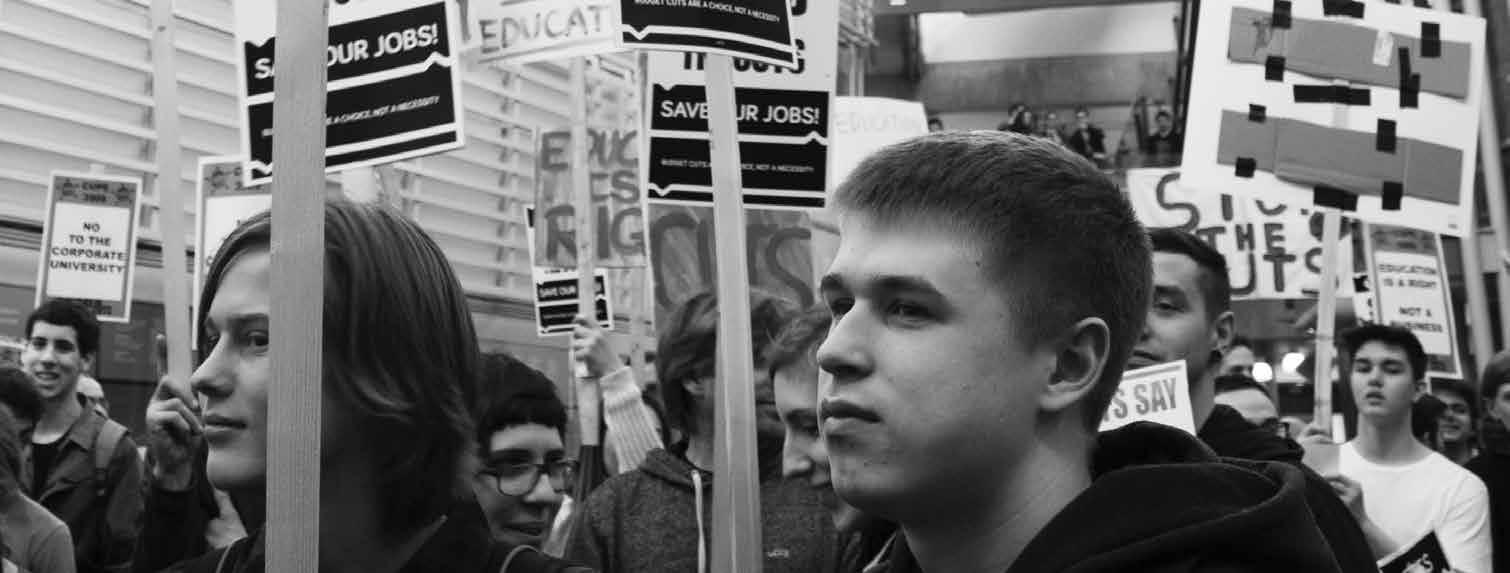
The students’ union came under fire at the beginning of the academic year for their controversial decision to cut funding to several student services paid for through the endowment fund.
The decision to cut $9,000 in funding from the Gallery of Student Art (GoSA) in particular was the subject of much criticism from students and staff in the fine arts faculty.
Endowment fund financial statements show that over the previous academic year, UMSU cut nearly $40,000 in expenses to student services paid for through the endowment fund.
Kopp told the Manitoban that, due in part to the board’s RFP, UMSU should be able to restore funding in the years to come.
“The reason that services were reduced temporarily was the financial issues that were seen with the fund,” Kopp said.
“Nobody runs for student government to cut money. Everybody’s excited about new programs, new initiatives, building the organization. That’s fine, but because there’s executive turnover almost every year, you’re going to have the fund continually expand and that’s when you have to take a strategic look at it and say, ‘Okay, what should be here? What doesn’t need to be here?’”
Kopp described the restructuring of the endowment fund as a threestep process: looking at where the fund was going, creating the RFP so the money could be invested differently, and scaling back many of UMSU’s previous budget cuts.
The changes
The University of Manitoba Students’ Union first reported securing a new company to manage the fund’s investments in the minutes of an UMSU Council meeting on Dec. 8, 2014. During the following meeting, on Jan. 12, 2015, it was announced that the contract had been awarded to
the National Bank of Canada.
“National Bank is a high-quality firm, much like the other applicants. But they understood the unique needs of UMSU,” Kopp said.
“They placed a lot of emphasis on ethical investing, and had different options for that while we were building up our portfolio. They’re also a smaller operation that we found to be attentive to our needs and that we’d always have access to.”
Other documents motioned in during the Nov. 3 board of trustees meeting made a clear record of the fund’s intent and purpose.
The fund’s newly instituted statement of charitable purposes specifies the mandate of the fund to advance education by providing financial assistance to students in need and to provide student support services and aid programs. The statement also emphasized the need to maintain the fund’s status as a charitable organization in accordance with Canada Revenue Agency standards.
In co-ordination with this statement, the board also motioned in a charitable activities policy that denotes the fund’s purpose as providing aid and assistance to U of M students. The policy states that the fund can do so directly through, for example, providing scholarships. The fund is also permitted to function indirectly, by helping spread awareness of scholarships and financial aid not available to students through the fund.
The disbursement quota policy passed during the same meeting sets out a method of determining how much money must be spent in a charitable capacity from the fund each year, so it may retain its status as a charitable organization. This
amount is derived by first determining the average value of the fund’s real estate and investment assets not used for charitable activities during the 24 months prior to the start of the organization’s fiscal period. This amount is then multiplied by 0.035 to determine the disbursement quota in accordance with the Income Tax Act.
Lastly, an investment policy statement passed by the board permits it to “accumulate, retain, invest, and re-invest” any funds received by the endowment fund in order to achieve the investment goals of the fund. For example, the board has determined the minimum investment return required to achieve the fund’s granting goals and cover the cost of managing the organization is five per cent. The board is therefore able to hold or invest the funds necessary to maintain this rate of return.
Kopp stated that although much work has been accomplished with the fund, UMSU will still look to improve it in the coming years.
“We’re always going to be looking to build the finances of the union and making sure we can provide frontline services [ . . . ] ultimately it’s the students’ money and we want to spend it on student services. The endowment fund allows us to do that, and the stronger the endowment fund is, the stronger our services are going to be,” Kopp said.
“Luckily the hard part is over. Now we’re going to be looking at how we can create programs that are beneficial to the membership.”
photo by Carolyne KroeKer
UMSU officially endorses fossil fuel divestment
Students push for the union, university administration to divest from fossil fuel companies
Dana Hat HE rly, staff
The University of Manitoba Students’ Union approved a motion this week to seek divestment from fossil fuel companies.
At the University of Manitoba Students’ Union (UMSU) Council meeting on April 6, council voted in favour of a motion to endorse the fossil fuel divestment campaign, which was spearheaded by the Divest Manitoba student group on campus, and Fossil Free Canada, a campus-based fossil fuel divestment movement
The University of Manitoba Students’ Union’s initiative follows in the footsteps of a rising number of students’ union initiatives and endorsements across the continent.
Dalhousie Students’ Union agreed to divest their $2.5 million in fossil fuels, with a growing number of associations’ committing to fossil fuel divestment campaigns as part of a nationwide shift toward environmental sustainability and renewable energy.
The University of Winnipeg Students’ Association also recently committed to the fossil fuel divestment movement, endorsing the Canadian Federation of Students campaign in order to pressure their university’s administration to reevaluate the University of Winnipeg Foundation’s investment portfolio. The university’s investment in the fund totals about $41 million, according to a research brief by the Sustainability and Education Policy Network, with $2.46 million invested in fossil fuels.
At the U of M, the UMSU motion was proposed at the March 23 council meeting by Astitwa Thapa, honours student in the faculty of environmental science and incoming UMSU vice-president external. It was seconded by Jeremiah Kopp, vice-president internal and president-elect.
The motion resolved that UMSU officially endorse the fossil fuel divestment campaign and lobby the U of M Board of Governors to divest
funds from public equities and corporate bonds that include fossil fuels within five years. The motion also recommends that the UMSU Board of Trustees, which administers the UMSU endowment fund, divest its funds from publicly-traded companies that operate within the coal, oil, and gas industry.
The motion further resolved that UMSU would send an email to all its members to sign an online petition supporting its divestment campaign. Furthermore, the campaigns and government relations committee was directed to draft a fossil fuel divestment campaign for the UMSU Campaigns Guide.
The process of divestment would be two-fold, beginning by divesting from UMSU’s endowment fund, which, Thapa said, is a small fund, and he is unsure what percentage is invested in fossil fuels.
The next step would be to pressure the university administration to commit to fossil fuel divestment,
investing in sustainable, renewable energy companies, he said, adding that the U of M has a substantially larger fund.
“I hope that the University of Manitoba will be the first university
in Manitoba to divest,” Thapa said. “As an institute of higher learning, if we divest, we are sending a message that this is not something that we want to be involved in, this is not something we want to profit on.”
photo by Carolyne KroeKer
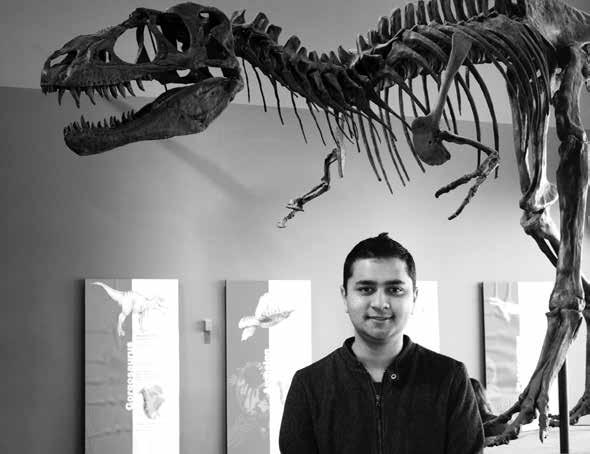
Photo of Astitwa Thapa
Colour vision deficiency
How technology can help those with colour blindness
J E r E mia H yarmi E , staff
EnChroma—a company based out of Berkeley, California—is developing glass lenses with the intent of assisting individuals with colour blindness.
Not so fast, the EnChroma Cx Lenses aren’t a treatment for the condition; colour blindness cannot be cured. This technology works in a manner that is similar to how hearing aids assist those who are hard of hearing.
EnChroma is collaborating with Valspar Paints in a campaign entitled #ColorForAll. The campaign has a series of YouTube videos in which individuals describe their experience with colour blindness, including when they learned when they were colour blind.
Colour vision deficiency
Colour blindness, more accurately termed colour vision deficiency, comes in many forms and has many different causes. It was first recognized in the scientific community at the end of the 18th century. It is estimated that 300 million people have colour vision deficiency worldwide.
There are millions of light-detecting retinal cone cells containing molecules called photopigments at the back of the eye in a layer called the retina. These cells are divided into rods, which work most effectively in low light, and cones, which detect coloured light.
When these photopigments are activated by light targets, they send information to the brain, which enable people to see.
There are three active types of cones in the eye that are specific for different colour ranges of light. We have one type that works best for red light, one type for green light, and another for blue light. People with properly functioning colour vision are said to have trichromacy.
One of the most common forms of colour blindness, anomalous trichromacy, is usually caused by extremely high overlap in the colours that are detected by red cones and green cones. All of the cones in the eye work, but they are a bit faulty.
These conditions are usually caused by small changes in the genes that encode for the parts that detect light – molecules called opsins.
There is usually a fair amount of overlap in the colour ranges detected by the red and green cones.
In anomalous trichromacy, however, either the red cone absorbs too much green light, called protanomaly, or the green cone absorbs too much red light, called deuteranomaly.
The relation between green and red cones is determined on a genetic basis. The opsins used in red and green cones are encoded in genes and found together on the X chromosome.
Colour blindness, more accurately termed colour vision deficiency, has many different causes
The X and Y chromosomes are known as the sex chromosomes, and are responsible for the determination of sex in a developing human. XY individuals typically develop male sex characteristics, while XX individuals typically develop female sex characteristics.
Colour vision deficiency defects on the X chromosome are very common. The red and green opsin genes are often damaged or missing. These conditions are sometimes referred to as red-green colour blindness.
Red-green colour vision deficiencies are hereditary and are linked to sex. XY individuals are most likely to be affected by red-green colour vision deficiency because they only possess one X chromosome.
In XX individuals, colour vision deficiency is recessive. This means that XX individuals require two defective copies; in individuals with one faulty copy, the good one picks up the slack.
Individuals who only have two working cone types have dichromatic colour vision. If the red cones are missing, this is called protanopia and if the green cones are missing, this is called deuteranopia.
Colour vision deficiencies regarding blue cones are extremely rare. These types of colour vision deficiencies are caused by defects of the blue cone opsin gene on chromosome 7.
Colour vision deficiency caused by faulty blue cones is called tritanomaly, while the loss of blue cones is called tritanopia.
Since blue cone defects are not found on the X chromosome, they
affect XY and XX individuals equally – they are not sex-linked.
Individuals with only one working set of cones cannot distinguish colour. This extremely rare condition, called monochromacy, results in the world being perceived in greyscale.
So how does EnChroma work?
The EnChroma lenses were developed through a project that was funded by the National Eye Institute, a division of the United State’s National Institutes of Health.
The colour-boosting technology was developed after more than 10 years of research and development.
EnChroma is headed by lawyer Tony Dykes, glass scientist Don McPherson, and applied mathematician Andrew Schmeder.
The idea for the glasses stems from lenses that McPherson had developed while working on laser eye surgery protection.
The project began with the development of a computer model of human colour vision. This in silico modelling allowed the researchers to determine the colour filters required to assist different cases of colour
vision deficiency.
Clinical trials were conducted at the University of California’s Davis Eye Center and Berkeley School of Optometry.
The EnChroma lenses work by emphasizing the separation between the colours of light detected by red cones and green cones. EnChroma lenses work specifically for individuals with anomalous trichromacy.
The lenses work by creating something the developers call a “spectral notch,” which causes a divide in the overlapping colours that red and green cones detect.
Unfortunately, if these colour ranges overlap completely between the two cone types, then there is no difference that can be enhanced to aid in detection.
By removing the fuzziness that occurs where the red and green cones overlap, the filter allows for easier differentiation between the two colour ranges in colour vision deficient individuals.
Based on studies of effectiveness, EnChroma has concluded that about 80 per cent of colour vision deficiency cases can be aided by their glasses. The effects experienced by users
include colour perception that is brighter, with increased saturation. This allows for improved colour discrimination.
The colour-enhancement effect also works on individuals with unimpaired colour vision. EnChroma lenses are designed in a way that doesn’t alter the colour balance of the glasses – they boost all three colours simultaneously.
The lenses function as basically a colour-enhancing pair of sunglasses. The creators of EnChroma suggest optimal use whenever venturing outside.
The EnChroma glasses are intended to improve the quality of life of individuals with colour vision deficiency. They are not intended for colour vision deficient individuals to pass occupational tests which restrict them based on safety concerns.
EnChroma Cx glasses range in price, from $324.95 to $449.95 USD, on their website. The company also has a colour blindness test that you can take to see if their product will work for you.
With the development of EnChroma glasses, the future of eyesight technology is looking bright.
Comment Editor: Tom Ingram
Letter to the Editor
Re: Problems in the department of economics
Letters published in the Manitoban are edited for spelling, grammar, and punctuation. Views expressed in the letters are those of the authors and do not necessarily reflect the views of the Manitoban
Enough is enough: it is time that the president of the University of Manitoba stop denying the existence of serious problems in the department of economics and start resolving them. These problems have been acknowledged, in writing, by the current dean of arts who has tried, albeit unsuccessfully, to address them internally. The current head of economics, appointed on a promise to deal with the problems that were openly acknowledged at that time and to bring the department together, has made the situation much worse.
The problems are major: curriculum changes that significantly reduce the heterodox content of our degrees; the discriminatory treatment of graduate students working with heterodox supervisors; the negative treatment of heterodox colleagues at departmental meetings; the selection of external reviewers for the undergraduate program who would not be sympathetic to the heterodox approach; the aborted attempt to re-assign macroeconomics to a proponent of the orthodox view; the intimidation of the labour studies members of the department and then their removal from the department; the arbitrary reviewing of a course taught by a heterodox professor and then assigning it to someone with an orthodox view; the dramatic deterioration of collegiality with respect to retreats
and invited speakers, especially by ignoring the heterodox interests; the undermining of the achievements and work of heterodox members of the department and the absence of hiring a heterodox economist for a decade after the former dean, Richard Sigurdson, cancelled a hiring search where heterodox women candidates were shortlisted and the top candidate interviewed.
It is not a small minority raising these serious issues but a sizeable minority, made smaller by the exclusion of the labour studies program from the department, intervention in recruiting by the former dean and by bringing in the head from outside. This minority is hardworking and accomplished, bringing the university great credit for its teaching, graduate supervision, research, and
grant-raising record. Yet at no time has the president approached them to hear their concerns.
On the contrary, when the Canadian Association of University Teachers (CAUT) inquiry was announced, the president encouraged the majority not to participate in the exercise and implicitly supported their positions, thereby helping scupper any process that might have improved the situation.
His actions helped create what he now finds deficient in the CAUT report. Also, contrary to his assertion, the problems are not being dealt with in-house. The president’s reaction of attacking CAUT only diverts attention from the real issues.
Especially baffling is his critique (in his recent speeches to the Senate) of the University of Manitoba Faculty
Association, which has played no role in the inquiry. Making veiled threats to the participants in the report borders on intimidation.
What has been allowed to happen in economics must be addressed by the university community and resolved, not ignored. The president must start becoming part of the solution instead of part of the problem.
John Loxley
Ian Hudson
John Serieux
Robert Chernomas
Ardeshir Sepehri
Fletcher Baragar
Department of economics, University of Manitoba
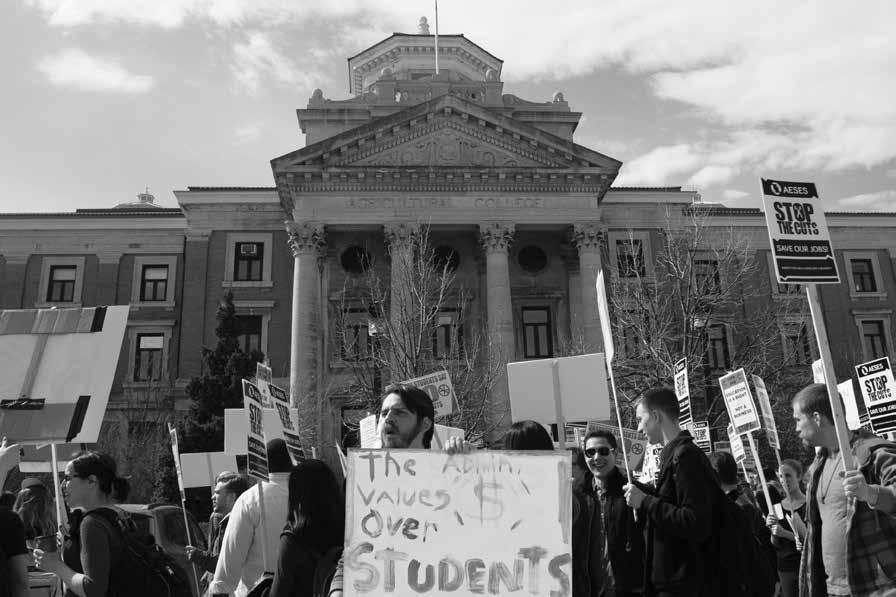
U of M budget woes a function of weak provincial leadership
Student movement demands everything under the sun except price tag
Et H an Cab E l, staff
The modern student movement, namely the Canadian Federation of Students and their ilk, has accomplished something that is at once absurd and increasingly detrimental: they have transformed university students, one of the most privileged groups of people in society, into a revolutionary class. But they do not seek to lift suffering individuals out of poverty or help give them a leg up in the job market so they can raise families and fulfil their goals.
The condescending rhetoric of the modern student movement scoffs at the notion that a university education should have any direct connection to the practical realities of the Canadian economy. Virtually any discussion of private sector job prospects and more practical approaches to education is met with idealistic intonations about the “inherent value” of a university education.
Rather, the modern university that has captivated the imagination of striking students in Quebec and marching student activists across the country is a publicly funded refuge from the harsh fiscal and socioeconomic realities of the modern world. Given the historically close, but increasingly bizarre, relationship between student and faculty unions, members of the student movement dismiss any argument that the ratio of teaching and research for tenured faculty may need to be readjusted to ensure that more students receive first-rate instruction in a period of increasing enrolment. After all, questioning the compensation or labour practices of high-paid faculty is the equivalent of union-busting and facilitating a neoliberal agenda.
University research, so long as it does not serve private and monied interests, is an inherent good. As such, the only solution to the increasing use
of sessional instructors is to make those instructors tenured faculty.
Furthermore, not only does the student movement want universities to remain eminently public and elitist when it comes to high-level academics, they also want Canadian campuses to provide a vast array of social services. They want cheap and easy access to a state-of-the-art gymnasium, fully subsidized counselling services, a daycare centre, a subsidized universal bus pass, a fall reading week, a dental/health plan, and a well-staffed human rights office.
And if you open a restaurant or a bar on campus, it better serve organic, locally-sourced, vegan options. It shouldn’t be associated with a big American franchise or corporation, either.
All of these expectations come with no price tag. After all, members of the student movement are unwilling to pay any more money in tuition, and many of them espouse the virtues of a completely subsidized post-secondary education. If they are to incur any debt at all, it should be interest-free and with little to no strings attached.
Beyond the clear financial cost of this laundry list of demands (most of which have been met), the real damaging part of the vision of universities advanced by the student movement is the extent to which it is divorced from the actual needs of the silent majority of students.
At the risk of over-generalizing, in my experience most student union and activist groups are populated with left-wing humanities students whose parents are funding their education or who have incurred some form of government student loan debt to pay for it. They have prioritized student politics over their academic careers and are proponents of a fantastical ideal of openness and acces-
sibility, where students can take as many or as few courses as they’d like in whatever subject area piques their interest, paying as little as possible to do so.
In short, when members of the student movement take to the streets, they are largely defending their own interests. One of the best examples of this fact is the continued insistence by the student movement that tuition freezes and other financial relief policies should apply to every student across the board, regardless of background and family income. The same progressive activists who rally in favour of higher corporate taxes and high-income taxes for wealthy Canadians do not extend that progressive outlook to the children of lawyers and business executives.
The real damaging part of the vision of universities advanced by the student movement is the extent to which it is divorced from the actual needs of the silent majority of students
This broad vision of post-secondary education policy has been followed, almost to the letter, by the Manitoba New Democratic Party (NDP), which is reliant on the student movement as a talent pool of future campaign volunteers and staffers. And it is these policies that have sowed the seeds of the University of Manitoba’s current budgetary woes.
University of Manitoba budget
The NDP under Premier Gary Doer instituted a decade-long tuition freeze in 1999 that helped starve universities in the province of a major source of long-term, stable funding. After allowing fees to increase by 4.5 per cent in 2009 and five per cent in 2010, the NDP capped tuition at the rate of inflation, where it has remained since 2011.
As compensation for low tuition, the government promised to increase their operating grant by five per cent a year for the next three years. They reneged on that commitment in 2013, increasing the operating grant by 2.5 per cent in each of the last two years.
In an environment where tuition is capped at the rate of inflation and government grants barely exceed inflation, the University of Manitoba Faculty Association negotiated a collective bargaining agreement for 201316 that built in a 6.9 per cent salary increase.
While on the surface it appears that the university breaks even (or comes close to it) in this scenario, looks can be deceiving. The 6.9 per cent negotiated increase is not only an automatic base salary increase over three years, it applies to salary increments based on set thresholds as well. Additionally there are other financial incentives, like recruitment and retention market adjustments, built into the collective bargaining agreement. In short, faculty salaries remain an increasing drain on finances at the University of Manitoba.
And despite burgeoning class sizes and increasing reliance on sessional instructors, a significant portion of faculty salaries is paying for research output.
Hearing the faculty union tell it, however, one could be forgiven for believing that the university’s admin-
istration is raiding annual operating surpluses to fund superfluous marketing and capital expenditures.
But the marketing campaign for the U of M has clearly been driven in large part by the need to raise funds from private donors. Given the university’s $500-million Front and Centre fundraising campaign, is it any wonder that the Trailblazer ads seek to tug on the heartstrings of potential U of M alumni donors?
Furthermore, given the laundry list of expectations inherent in the agenda of the modern student movement, and the projected $300 million worth of deferred maintenance costs at the university, transfers to capital expenditures are hardly the kind of indulgent expenses that the faculty union makes them out to be.
There is nothing unique about the budgetary challenges facing the University of Manitoba. Postsecondary institutions across the country are facing similar challenges as they grapple with how to live up to the changing expectations of students and the evolving Canadian economy. There are no easy answers and major reforms will be necessary.
However, major reforms cannot fall on the U of M administration alone. Ultimately, it needs a dance partner in order to have any legitimacy. But with a student movement and a provincial government demanding virtually everything under the sun without paying for it, there is a significant gap in practical post-secondary policy leadership in Manitoba. At the U of M, that gap is being filled with survival tactics and austerity measures.
photo by Carolyne KroeKer
The politics of fear
We make bad decisions when we allow ourselves to be swayed by fear
a l E x Pa SSE y, volunteer staff
E very human action is rooted in either love or fear. It’s not a new or a particularly complicated analysis of the human condition, but it is an apt and important one. As individuals most people profess to live by the former, but very often our larger societies seem to succumb to the latter. So why is there such a gap between our philosophy and our policies?
Of course this is a question that is far too big to fully answer in a single page of text, but a broad answer would be that we have institutionalized fear. There are institutions that were traditionally established to protect and inform us, like our government, the media, or organized religions, to name a few big ones.
But as such these institutions also became centres of power, and of course they seek to maintain that power through relevance, and the best way for them to maintain that relevance is through perpetuating messages of fear.
Whether it is microscopic antigens or global climate catastrophe, the person next door or the terrorist on the other side of the world, or even what will happen beyond the life of our biological bodies, we are plagued by messages of fear. These institutions disseminate the idea that the world is a complex, chaotic, and scary place, and that the only shelter we might find is under their umbrella.
Recently in the Israeli election the citizens voted for fear. In a nation plagued by economic woes that had been steadily getting worse under the incumbent prime minister, Benjamin Netanyahu, national security was framed as an equally pressing election issue as the economy.
Netanyahu was touted, by himself and the media, as the choice for a hardline stance against Palestinian aggression and as the best option for protecting the citizenry. So, despite his abysmal economic record, Netanyahu marched on to win his fourth term as prime minister. What’s even more surprising is that, when looked at objectively, it can be argued that Netanyahu’s record on security is about as bad as his record on the economy.
The most recent conflict between Israel and Palestine was sparked by the kidnapping and subsequent murder of three Israeli teenagers, which Netanyahu was quick to blame on Hamas. Evidence later surfaced strongly suggesting that only a small independent cell of Hamas operatives, and not Hamas as a whole, was responsible for the crime, but Netanyahu used the occasion to round up 300 Hamas members in the West Bank, raising tensions and triggering war.
Even giving Netanyahu the total benefit of the doubt, assuming that he
truly believed Hamas was responsible for the murders and thought he was doling out justice with his aggressive actions, and that he had no intention of a wider conflict with Palestine, he was still wrong, and consequently plunged the region into a conflict that resulted in the deaths of 66 Israeli soldiers and five civilians.
Keep in mind that is only the calculable harm done directly to Israel, and doesn’t factor in that the over 2,100 Palestinian deaths and severe infrastructure damage done to Palestine will doubtlessly destabilize the region even further and cause Israel to be even less secure. Under his leadership Israel has become less secure, and yet Netanyahu was still voted in on a platform of security. This kind of dissonance can only be achieved when the people’s perspective is distorted by the prism of fear.
The Middle East is an extreme example, but the politics of fear are hardly unique to that area. It isn’t something that any particular political brand is innocent of either. Doubtlessly next November in the Canadian election there will be a sizable amount of people who vote for Stephen Harper’s Conservatives because they are afraid of “radical jihadists” or a number of other xenophobic reasons.
However, the opposition parties also try to garner votes by cashing in
on a fear of Stephen Harper, spending their time trying to make the public afraid of how the prime minister is changing Canada into something unseemly, instead of fully focusing their energy demonstrating how they themselves might be a positive force for change. These are tactics that demonstratively win elections, and they all foster and cater to a climate of fear. It is very easy for us to pass the buck onto institutions like the media and the government and say that we are afraid because they are bombard-
ing us with messages of fear, but I would suggest that we are equally to blame because we allow ourselves to be a fearful people.
Whether we are afraid because of their fearmongering narrative or whether they are perpetuating their narrative because we are a fearful people who respond to such tactics is irrelevant, because ultimately the result is still very much like a snake eating its own tail. Our institutions can’t be expected to change their policies until our philosophy renders such policies absurd.
UMSU needs a strategic plan
What will the University of Manitoba Students’ Union (UMSU) look like in 10 years? Five years? Next year? We don’t know because UMSU has no long-term plan.
The lack of a long-term plan was obvious at the March 23 meeting of UMSU Council when incoming vicepresident external Astitwa Thapa introduced a motion for a fossil fuels divestment campaign.
Students were left wondering why this motion was brought before council. It wasn’t in response to any climate change crisis on campus, nor was there mention of fossil fuels at preceding UMSU meetings. While climate change is an important issue, it wasn’t clear to students why UMSU should suddenly take an interest. Having no long-term plan leaves
UMSU with no long-term direction. This makes UMSU vulnerable to the whims of councillors with pet projects.
The lack of overall vision is seen in the hodgepodge of campaigns that UMSU currently supports. Campaigns for gender-inclusive washrooms, fair trade, universal transportation, resisting all forms of oppression and discrimination, and ending blood donation bans further the aims of the individual campaigns. But when taken together, the campaigns don’t measurably contribute to a central goal.
The University of Manitoba Students’ Union doesn’t know where it’s going, and it doesn’t know how to get there.
A long-term plan would formalize what UMSU wants to achieve over
the next few years, and what specifically UMSU needs to do to achieve it. With a long-term plan, UMSU could avoid impulsive motions, and instead focus on agreed-upon priorities.
UMSU doesn’t know where it’s going, and it doesn’t know how to get there
A long-term plan would add stability to UMSU, even as leadership changes from year to year. The recent election showed the problems of continuous turnover constantly reinventing UMSU. While one slate favoured investment in infrastructure,
the other slate preferred increased services.
Capital projects are multi-year commitments that cannot be supported by one executive and council, only to be cancelled by the next. The same holds true for UMSU services. Students can’t make plans around services that may or may not be there next year.
The University of Manitoba Students’ Union wouldn’t be the first organization on campus to use long-term planning. The University of Manitoba has a new five-year strategic plan. It identifies five priority areas, with goals and supporting actions for each. The priority areas are broad themes like innovative and quality teaching. The goals within each priority area are more specific such as enhancing student mobility. The supporting actions for each goal are tangible and measurable. To enhance student mobility, a supporting action is to increase the number of transfer-credit agreements with other educational institutions.
The student union is not totally without guidance. The provincial University of Manitoba Students’ Union Act of 1975 defines the objects of the union. These include promot-
ing the interests and welfare of students in all matters respecting their common interests, and encouraging student participation in cultural, athletic, intellectual, and social activities. While the objects are intentionally vague, they do provide UMSU with an outline of a long-term plan.
The University of Manitoba Students’ Union further refines its mission in the Declaration of Principles. Self-declared principles include building a socially just education system, fighting discrimination and inequality, and mobilizing around issues that affect members and their communities. These principles are more specific than the provincially legislated objects, but they are still not specific enough to constitute a long-term plan.
The University of Manitoba Students’ Union needs a long-term plan. It needs to establish goals and work towards reaching them. Each motion before council needs to be viewed in the context of how it furthers that long-term plan. Only then can UMSU’s resources be co-ordinated effectively to achieve something tangible and meaningful.
graphiC by evan tremblay
photo by Carolyne KroeKer
THE ARTS TRIBUNE
EDITORS’ note
For this very special issue of the Arts Tribune, the Arts Student Body Council has collaborated with The Manitoban to publish an anthology of works which represent the diversity of student experiences at the University of Manitoba. We put out a call for works of fiction, non-fiction and art on the theme of Identity: Finding/Losing Yourself in University. We received numerous submissions meditating on love, loss, happiness, sorrow, art, growth, passion, poetry, religion, ethnicity, gender, the student experience etc. These pieces reflect the complexity of life at any and every age, and the triumphs, struggles and creativity that make the human experience what it is. We hope you appreciate them as much as we did, and, if nothing else, that they provide a reprieve from the long study sessions you are probably enduring at this time!
Anu Lotay & Adam Pawlak
Co-editors, Arts Tribune
Arts Student Body Council
To provide feedback/submissions, please contact us at: artstribune@gmail.com
Disclaimer: The opinions expressed in each work herein belong to their respective authors and do not necessarily reflect the opinions of the University of Manitoba Arts Student Body Council or The Manitoban.
Editors:
Anu Lotay
Adam Pawlak
Layout & Design:
Bradly Wohlgemuth
Arts Tribune Assistant: Bénédicte LeMaître
Special Thanks to all our contributors:
Arthur Anyaduba
Ben Bawdon
Luis Castro
Kalyn Connelly
Theo Deezar
Kasia Keiloch
Bénédicte LeMaître
Ian McKay
Kevin Ramberran
Abdul Smith
Lea Soliman
Malgorzata Tomczyk
Marie Tully
Sanjana Vijayann
Sofia Vivas
Spencer Yasui
And, those who contributed anonymously
Disclaimer: All photos and images reproduced in this publication have been checked for copyrights. If a photo or image is used, it is because its use has been authorized, it is known to be in the public domain, or because it has been licensed to use in printed materials. It is not the intention of this publication to violate copyrights or intellectual ownership in any way; no copyright infringement is intended.
This Is Not You
Lea Soliman
Kalyn Connelly
The Wanderer By Kalyn Connelly
“But you don’t look it”: The challenges and joys of having mixed ethnicity By Bénédicte LeMaître
Love Identity By Abdul Smith
I am India’s Daughter: A Response By Sanjana Vijayann
Realizing… By Ben Bawdon
Sound and Colour, Universal Art
On Gender Identity: Our Anatomy Is Not Our Destiny By Anu Lotay
Identity, Culture, and Truth By Ian McKay
What Identity Means to Me By Kasia Keiloch
THE ARTS TRIBUNE
This Is Not You
By Lea Soliman
You hear the news anchors talk about the weather before signing off and wishing you a good morning, and you are flattered, because you always wanted someone to greet you in the morning. You pull yourself off the ground, or desk, or floor, or wherever it is that you landed when your eyes refused to stay awake. You squint at your computer screen and the half-finished paper, groan, and start to get ready. You feel the ache and strain of your muscles cry against having to move so much on so little sleep.
“This is not me,” you say to yourself. You fight against traffic, then against parking spots, then against the crowds. You fight against the ticking clock and the hectic atmosphere, and you sit in stuffy classrooms and fight the drowsiness, then the confusion, then the crowds again. When time permits, you fight the lines and grab coffee in order to stay awake. You sit and listen to lecturers, you are silent, and you watch as they fill your week with things to finish. You smile when you pass them in the hallways though. You are 1 of 28,000 students here. You hold 24 of 252,423 credit hours – 30, if you really hate yourself. You are one person in a 200 capacity lecture hall. You are a point on a scale that starts with 0 and ends with 4.5, and your name is a 7-digit combination. You possess 1 of 90 possible degrees, and you will possibly fight 18 months after that, trying to find a job. You are one person in a 47-person line waiting for the bus pass, or in a 21-person line waiting for coffee, or a 12-person line waiting for an advisor. For now, you shake your head, and pay $10 for a sandwich and a drink.
“This is not me,” you say to yourself.
You watch, you sit and read, you memorize symbols and letters in particular orders, and then find pictures about them and memorize those too. You read charts and graphs and organize them in your mind. You run out of pencils writing endless lines of text that dance on the page when you stare for too long, and you feel your arms groan with the weight of your books, but you keep going. You do this more times than you can remember, and then, at the end of a long, treacherous road, you get an A on a paper, or a number on a screen, and you’re happy… for the time.
“This is not me,” you say to yourself.
When you are too exhausted to possibly do anything else, you go to work. Some days, the place is slow, and you can spare some energy to worry about fitting a 28-hour schedule in a 24-hour day. Right now, you are at one of two, sometimes three jobs, and it’s still not enough. You remember that there is a limbo on bi-weekly pay and that rent, cell phones, gas – these are all things that require money. You remember that tuition is a necessity, but is sometimes priced as a luxury. You remember that you will not be alone in having a $40,000 debt when you graduate.
“This is not me,” you say to yourself. After work, you want to rest, but due dates loom above you and it takes too much energy to endure food poisoning for a doctor’s note. You remember that you are not the first in your family to go to university. But you are the first to hold down 4 jobs at once, you hear a voice in your head say. You remember that in roughly three and a half weeks, there will be 5 exams, all under your name. You remember that the number you score defines what you can do in the coming years.
“This is not me,” you say to yourself. Later, when the sky is dark and the time
on your phone reads 3:45am, your TV is tuned to a random channel, and you hear Inigo Montoya ask Cary Elwes, “Who are you?”
You panic when you realize that you know the script to Princess Bride by heart, but you can’t answer the question in relation to yourself. You recall all the stress and anger and sadness packed into 8 months of the year (10 if you really, really hate yourself) and the 5 hours of sleep you get a night, if you’re lucky.
But with it, you remember all the good, too. You remember the first time you learned how to pay bills, and put a roof over your own head. You remember learning what sacrifices to make, and staring with pride at yourself from all that you’ve accomplished. You remember meeting people who are now considered friends, at 10:00 pm in the library, cramming for that exam. You remember bonding with a bunch of strangers at a Bison game, and receiving notes from a random person when you missed class. You remember lucking out and getting a lab partner that actually gave a shit, and meeting professors who understood all you had to endure, and let you laugh about it. You remember that you discovered your love for Alan Moore because your English professor made you bullshit an essay about The Watchmen, or that you can vaguely understand what’s fiction on medical TV dramas. You remember that you came to know about the Black Hole Theatre, the planetarium, and the buffet in Pembina Hall, all by accident.
Above all, you remember that you’re still here – that you’re alive, and fighting, and fearless because there sure ain’t a damn thing alive that could scare you once you’ve survived this. You realize that you can pull two back-to-back all nighters and still head to The Hub right after Friday classes. You’re overworked and tired, but you’re also resilient and determined. You might not yet know who you are, but all of that will come with time, and patience… lots and lots of patience. And coffee, definitely, lots of coffee.
“So maybe that’s who you are,” you say to yourself.
You smile, and sigh when the clock reads 4:15am and figure that you can finish whatever you were working on tomorrow. You collapse on your bed and shove your face on your pillow, before setting a useless 3-hour alarm, to start all over again.
Hair
By Kalyn Connelly
Her hair represented Her freedom, Untamed, fierce, Feminine.
She imagined What her portrait Would look like, Hair flowing-
But no! She would not be Positioned for the male gaze.
She would hire An illustrator To knot her in a manuscript.
She imagined Her hair in tendrils, Winding their way Across the leaves.
Like Medusa, She thought. Serpentine Tendrils and a look that Could turn men to stone.
Her hair woven Into intricate knots, Framing the text, Caressing the capitols.
This, she thought This is how I want to be Remembered.
The Wanderer
By Kalyn Connelly
My mind, So full of words: Beautiful songs, Poems and tales.
Yet alas, It now has space Enough for only One master.
All I know And long to know, Has been suspended In my mind.
My consciousness, All one masterpiece, One work of art In which I’m trapped,
Stuck atop A mountain As if in thick oil paint, Awaiting the wanderer.
Surrounded by Scenes that delight the senses, yet the sonic Crowns my sensory hierarchy.
I cannot feel the Gilded sunlight Dance across my Shoulders,
Smell the sulphurous scent of the waterfall, Or taste the mountain air.
It is a sound for which I lie in wait.
The tumultuous thunder Of a sonorous storm.
A loud, clear clap Of thunder, before lightening Strikes my languid frame And silences my insipid musings.
“But you don’t look it”: The challenges and joys of having mixed ethnicity
By Bénédicte LeMaître
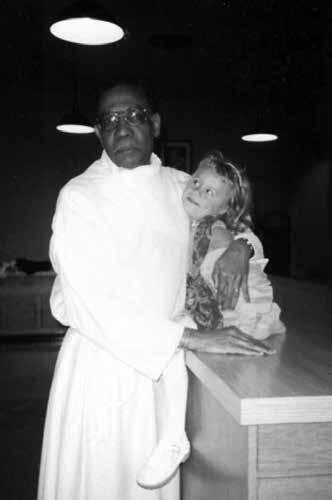
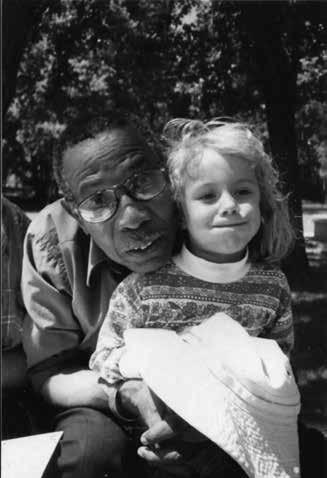
I am ethnically mixed. I grew up with an inability to grasp why race boundaries existed. After all, half of my family was a different colour than the other half, yet we still loved each other, and recognized our unique beauty. My grandfather is a strong black man of Yoruba Nigerian descent, born in Trinidad because of the Yorubaland slave trade that brought his ancestors in inhumane conditions from Nigeria through the Atlantic Ocean to Trinidad. I often get asked if I am French because my last name, LeMaître, is quite French. Though it is nearly impossible to trace its exact origins, my last name is probably French because slaves often took the last name of their slave owners and, presumably, the sugar plantation which “owned” my ancestors was French. To an ignorant onlooker, I look nothing like my grandfather, but if you look closely, I’ve inherited his skeletal structure, particularly noticeable in my cheeks, forehead, and totally flat long feet. My skin is much lighter than my grandfather’s, and people often don’t see the Nigerian blood in me. However, it is more noticeable in my three cousins even though we are all 1/2 Slavic, 1/4 Scottish, and 1/4 Nigerian/Trinidadian. Though my bone structure resembles my mother’s, my colouring, especially in my childhood, imitated that of my father’s Slavic, mostly Polish, genes.
As a child I had golden-green eyes and curly blonde ringlets, though my hair darkened after I passed puberty. My parents separated when I was an infant, and my dad left Winnipeg, leaving me fatherless. My mom’s dad, my noble grandfather, stepped in and played a huge role in my upbringing as both father and grandfather. When I look at my grandfather, I see the strongest father figure I have ever known, and nothing less than wisdom, integrity, and love. When people say that I’m not dark enough to be his granddaughter, it hurts. I did not choose what colour skin I was born with. When I was young I didn’t understand the confusion on people’s faces when they’d look at me with my grandpa. I had no idea that not every golden haired child’s papa had deep chestnut coloured skin.
At one point when I was a child, I even danced in the African pavilion at Folklorama with my Nigerian Godsiblings. Every Saturday I’d go with my mom and grandpa to get groceries and I recall many people staring at us as though something was amiss. Was there? Is there? I think not, but unfortunately some people thought it was bizarre
for a 70 year old black man to be carrying a 5 year old blonde child. Even my own mother had trouble when she’d pass with me through airport security.
Now that I’m older, I notice more and more children with the same sort of ethnic mix as I, but even so, I often hear the muffled ridiculing of those around me when it is mentioned that I am part Nigerian or Trinidadian. I am constantly being told by others that I am not black. It is true that my skin may not be black, but a part of my blood is, and the man who is my father to me is. What therefore am I supposed to identify with in terms of ethnicity? I struggle with this every day. Where do I belong? A part of me belongs in many different cultures, yet not fully in one. I’ve seen comments on social media saying things such as “Lol at Benedicte thinking she’s black”. What does it feel like to be ridiculed and be told I’m not something that is so much a part of me and my upbringing? It hurts. What am I to tell people? Am I to feed people a believable lie and tell them that I am solely of European descent? I can’t do that. It’s not who I am. A large percentage of the family that I know well is not Caucasian. I may not look like them, but they raised me and love me.
I’ve looked in the mirror, I’m not blind; I know that my skin is not black. It never will be, and I’m well aware that I’ve never had to personally live some of the challenges that society has placed upon those with darker skin.
But don’t ever tell me I’ve never experienced the hurt of racism towards those of African descent. The pain that I feel when my grandpa tells me about the racism he endured when he passed through the southern states to get to Canada makes me sick to my stomach. The anger I experience when I learn how the racism that was prevalent in Saskatchewan in the 50’s played a big role in preventing him from completing law school makes my blood boil. The sadness I feel at the knowledge that my grandparents, at their wedding, felt the heat of racism as many people refused to show their faces at a mixed race wedding pierces the very core of my being.
I grew up learning to eat fou fou properly with my tongue and palate, I grew up eating my grandpa’s curried roti, jerk chicken, browned down chicken (a childhood favourite), and callilou.
I sat beside my cousin as she played with my hair and lamented over how she wished hers had the same texture as mine, even though I had always wished that I had her tight curls because I wanted to look more like her, my aunt, and my mom.
I listened to friends tell me they wished they had my skin, because growing up, the media did a great job of bashing the self-confidence of any woman who does not meet the standards of European beauty. To that issue, I see no response but to echo that all women are beautiful in their diversity!
I touched the softness of my great-grandma’s dark hands and arms knowing that without her existence I would never have been born.
My grandpa’s grandmother told him to never forget that he is Yoruba. I too, will never forget that the man who raised me, as well as a quarter of my blood, is Yoruba. My grandpa’s great grandparents were transported in treacherous, inhumane conditions across the Atlantic to Trinidad....and they survived. Wow. To have physically endured this is unimaginable, but what really moves me is the incredible inner strength, hope, resilience and endurance that they must’ve needed to survive. Of anything, the strength of this part of my ethnicity contributes to my identity in a way in which I am most proud. The Yoruba blood is strong they say, and so, I am proud to have that as a part of who I am, no matter what the amount may be.
Love Identity
By Abdul Smith
The love poem never written, was composed by a thoughtless soul, who for love, would force his mind to think, and when thoughts were present, his heart would ink. His words, compressed in time, for lovers to one day find. See the love poem never written, was not composed in a day, for each day love would amaze him, and old words would be erased and replaced with new. See inevitably in time he knew, love would one day cause him to be lost for words, for beauty would be refined by night to glow by day, and smiles to be envied by stars at night, and the sun by day.
See the love poem never written some believe was composed by a blind soul, who for love was given a gift, he was given a woman of beauty, but however she was more than her looks. Unable to admire her beauty, he fell in love with her mind, she was flawless, her smile contagious but hidden from sight, so he preferred her laughter instead. See we are born, we grow, we age, and we die, but in old age the things we take for granted, are the ones that matter the most. When you can no longer stimulate her sexually, stimulate her mind instead. When she is old and grey, admire her laughter, admire her smile.
For see my lover, she resides in my dreams, but a vivid description brings her closer to reality, see I will close my eyes to love her till eternity. For she moves at the beat of her own drums, playing melodies unique to my ears. She is the unspoken truth, the hidden diamond in the ground, precious but yet to be found. She is intriguing, she captures my mind, my heart, my soul with a single smile. She moves with such elegance that my innerbeing is unable to comprehend. See I will not pretend, she exists beyond my greatest imaginations, but yet she is my greatest reality, so I'll close my eyes to love her till eternity.
For she forces my mind to think, my thoughts to shiver, my heart to sink, just to gaze at perfection, my eyes would blink, but only for moments. A testimony, for If God's existence was ever questioned, she would be the unequivocal proof. To speak of others, I lie, she is the truth. To speak of goals, she is the aim, a target, but before I shot, I load my guns with metaphors, and similes, but yet there is no one LIKE or AS, beautiful. See the love poem never written, some may say does not exist, but for those who believe, have once loved hopelessly.
junctures of their life. This is an exploration of your mind. Of how well you realize the complexities that go on inside. Arguably, many things move through your subconscious: look at her hair, his plaid shirt, the colour of that car, etcetera. When you tweet your thoughts to the world you may not “think” about what you are doing. But how can you change? It is a slow process, but when you start observing your own thoughts, ideas, and all of those things held most dear you begin to reach deeper into your being. Your subconscious would be the gatekeeper to your inner being. To reach past this gate you begin to see new perspectives upon which to reflect and change. Do not be afraid though, this is an exploration process of new frontier and visions. Consciousness is a means to self-fulfillment. How else can you realize your dreams, aspirations, and potential?
Author’s Note: This was a typical diary entry from my 3rd year of University when I was at my most depressed. I am better now but I often go back and read these entries to remind myself of what I’ve been through and why happiness is worth fighting for. To all those struggling with depression and related issues, just know that it can and will get better.
November 1, 2013
Dear Diary,
I am a burden. I am a burden on everyone. He said so earlier today, quite nonchalantly, and I casually accepted this knife into my body. I already knew this burdensome fact, but it is something else altogether to hear it from the person you don’t want to hear it from. A voice whispers in my head: a siren, or worse, like Medusa beckoning that I look her in the eye. She says only: “…do it. You should do it. It’s better for everyone.” I don’t know what it is. Actually, I know what it is. These thoughts are feathers in my pillow.
Yesterday, or maybe the day before, my mom said, “Those girls, look at them, they used to be so ugly but they seem to have fixed themselves, they are so pretty now.” She repeated this several times for my benefit. I can’t help but feel that they all hate me in parts, or that they hate parts of me. But…that is all me.
Of course they love me. Do they? What if they grow to resent me? They deserve better, don’t they? I deserve better, too.
My body is not mine to command. My skin is wrong. My flesh is chewed and broken. I am no phoenix; my body will not rise from any ash or fiery dust. I want to escape so badly. I want to be away from here and yet I don’t. What is my life without my past, what is it without my family. I am already so alone; maybe, I want my surrounding to reflect my loneliness. Must be why I dream about that house on an island, about rose curtains and windows of blue water.
Sometimes it feels like there is no life for me; like I am some cruel joke, an experiment on misery, a study in stagnation. These are the times when Medusa’s voice is quiet because she doesn’t even need to say anything. I move and I stay in the same place anyway, like jogging on the spot.
Everything is a construct, nothing is real, nothing matters, “dust in the wind” etc. Even the nihilism grows tedious now.
Editor's Note: If you are feeling depressed or suicidal, please do not hesitate to contact Klinic's 24Hour Crisis Line at (204) 786-8686 / Toll free 1-888-322-3019.
THE ARTS TRIBUNE
Relationships: The Link between Social Identity and Personal Success
Luis A. Castro
Knowing who you truly are is essential and necessary for personal success, for it helps to define, plan, and act upon it. Knowing yourself makes it easier to trust yourself and it is only when you trust yourself that you can be confident to consistently be yourself. Being yourself at the moment that matters is what’s going to set you apart from the rest, a condition often necessary for personal success to happen.
Most of us have heard the advice “Be yourself!” at some point in our life for a very important interview, public presentation or even when asking someone out on a date. However, the challenge is not so much recognizing but exhibiting our authenticity, especially at the critical moment. Stress, nervousness and self-defeating thoughts tend to get in the way to our goal. Confidence, the antidote, comes from self-trust, which is in turn achieved by knowing ourselves. We are back to square one: personal success depends on accurate perception of our identity.
So, what defines you? Most of us answer this question by focusing on our inner qualities, personality traits, interests, occupations, and positions within a system we belong to. However, such aspects, even if accurate, may or may not be useful in our quest of defining ourselves. In fact, even if we could generate and memorize a hypothetical list of all our inner characteristics, we would still fall short at knowing ourselves as it relates to our strategy for personal success. The high degree of subjectivity within our list would make the latter of little practical value when not considered in conjunction with its shaping force: the environment.
The familiarity with our environment makes it possible to define in
a relatively objective and thus practical way, the dynamics between our environment and inner characteristics that make up our identity. A good starting point is focusing on our social environment. This is because whether we like it or not, the actual or even imagined presence of others influences to varying degrees our thoughts, feelings and behaviors. As social beings, our relationships shape our identity and thus can be utilized to understand and define our inner subjective nature.
In practical terms, the first step is to recognize the inevitable influence of others on oneself. This makes it possible to evaluate and monitor how a particular person or group of people affect our thoughts, emotions and behavior in a specific situation. By shifting our primary focus from our inner characteristics to the influence of social relationships, we not only make it possible to accurately know ourselves but also identify practical areas of self-improvement.
Social relationships give meaning, purpose and/or reason to our existence. It is through them that we can comprehend our complicated inner nature. They help us grow, adapt, learn, and discover all the beautiful features that make us human. This unique beauty facilitates self-trust, which in turn give us the confidence we need to be ourselves regardless of the circumstance. The goal is to achieve this state of mind for it itself is the essence of personal success, attainable through our social relationships.
Say something about yourself
By Sofia Vivas
As a University student we have all at one point or another been asked to introduce ourselves in a class. “Say something about yourself”, is usually the way we are asked to reveal our identity to others. This is a moment of great pressure, in which the student must rummage through all the traits that make up who they are and pick some that are relevant and, hopefully, somewhat flattering, but in a subtle way.
The first student never has enough time to process this selection process and is thrown into the spotlight, nervously uttering something along the lines of “Hi, my name is Michael. I’m in University 1 and I like to wakeboard.” The courteous giggling commences and the next person has a template on what is an acceptable introduction.
Each student is now double checking what their name is, just in case they should forget, what they are studying and what hobby or activity would render them as amicable. The odd student will attempt to cover up the absence of the latter and jokingly state that Netflix be their hobby. This is however, never a joke and as the next student begins to recite their identity, an awkward frown will have formed on the couch potato’s face.
Let us get back to Michael, who by now has had time to go over his speech several times. It echoes in his mind, mocking him and as he hears
it over and over again he starts to ask himself whether he has accurately condensed his identity to the class. Michael has gone wakeboarding twice in his life, six years ago at summer camp and had enjoyed it very much.
By the end of the introductions everyone has painted some sort of image of themselves that they feel is somewhat in line with Michael’s. Some are true, some aren’t. It is a feeling we as University students all know: The panic of having to be someone, of having our identity at the ready. The truth is that most of us have no idea who we are and the task of summarizing ourselves into a few words is enough to make us want to throw up a little bit.
This is why it is so important for us to realize that we are all in the same situation. So much of the time we are nervous to join new groups or voice our opinions because we aren’t sure of ourselves. If we were to acknowledge that the vast majority of us are feeling this way, perhaps it wouldn’t be so difficult to break out of our comfort zone and meet new people. When we try to join a student group or go to an event we should remember that we are all young adults trying to figure out where we fit in, so lets not try and pretend we are someone that we aren’t. We’re just students who want to find an identity but haven’t yet, we may as well acknowledge it and be awkward together.
Complexities of Leaving Faith
Anonymous
The past four years in university has been a defining a moment for me, as it has been for anyone else. I am humbled by the opportunities I have ceased and have become more enlightened through it all. A professor once mentioned during a class that if you have not changed as a person while spending your time in your undergraduate studies, then you haven’t really done anything useful with your time here. For me, my entire undergrad, I have evolved into something completely different and unrecognizable from my high school years.
I am a product of Islamic/nationalistic culture. I am also a product of Canadian society and Western culture. And I am product of neither as well. I know I am not alone because my identity does not fit into any category or social group in Canadian society. I don’t fit into my own community here or my place of birth. I would like to say: I am not a loner, I do have friends, I am not a social outcast, but this is just how I feel. I am also not alone in this feeling. I can interact with most social groups but I can never feel like I belong because to feel that I must be able to relate to them on some deeper level.
My Background
I was born into an educated Muslim family. My family are practicing Muslims, not too religious, believe in the rule of law, and immigrated to Canada for a better life than they had back home. As for me, I was brought up Muslim but had never really taken my faith with much seriousness. It was just something that I identified with because that was my identity. However, I had begun to take my religious faith seriously in my teenage years, reading the Quran (Islam’s Holy Book) & the Hadith (sayings of the Prophet Muhammad), reading up on Islamic literature and fervently tried to rationalize every aspect of my given religion. But everything changed when I started university, it perhaps has very little to do with university studies directly, but more so with just what I would say was the natural outcome of the path I was on.
Eventually midway into my university career I no longer believed in organized religion. As difficult as it was for me, it relieved a huge part of me. It brought so much happiness from the intellectual and spiritual breakthrough I had accomplished. Losing faith in Islam isn’t something easy, nor is it similar to losing faith in Christianity or other orthodox religious ideologies. Perhaps, what one has to go through when it comes to leaving Islam is starkly different and can definitely destroy close relationships most people take for granted. Relationships like those with your parents, siblings and close friends can be broken if they ever find out as many people fear. Most people remain hidden, in secret, to maintain those relationships and not hurt anyone emotionally, and this is quite prevalent in nations that have religious freedom by law and practice.
The Problem
The issue is that for far too long the liberal and left-wing of the political spectrum has abandoned Muslims who no longer believe in their faith. Some people decide to speak their mind, which is politically incorrect and does not go with the message that liberals & left-wingers promote: all religions are equal and deserving of respect. People are deserving of respect, dignity and equality. As for religions, they are no less deserving of criticism as communism, capitalism, Marxism, Leninism, fascism, or any other philosophy or way of life. Ultimately, criticizing a religion, like Islam in this case, may offend people, but that does not mean it is unacceptable in a free country. In fact, liberals & et.al, refuse to stand up for those whose voices are most silenced and repressed. Either they ignore that there is legitimate criticism of Islam (a huge disservice to their core liberal principles) or jump on the narrative that it is islamophobia (a word I find ridiculous because it should be called Muslimphobia if one hates Muslims).
The right-wing in this case is also of no help to those whose voices are marginalized and who represent thoughts of rational minds. Conservatives often, in this case, use criticism of Islam as a tool to promote their political agendas and cater to their racist and xenophobic base. This in return leads to allegations of islamophobia against anyone criticizing Islam and altogether silences anyone in the Muslim community of ever speaking their mind. This silences true reform that must come from within Muslim communities as opposed to reform being forced upon it. It’s true, discrimination towards Muslims has gone up, and that has a lot to do with white-supremacists and the rise of neoNazis in the Western world, including Canada.
When the far-right, neo-Nazis, white supremacists and takfiris1 purport a clash of civilizations, it becomes difficult for those within the Muslim community, like myself, to openly and legitimately have a public dialogue regarding 1 A takfiri (Arabic: تكفيري takfīrī) is a Muslim who accuses another Muslim (or an adherent of another Abrahamic faith) of apostasy. The accusation itself is called takfir, derived from the word kafir (infidel), and is described as when “one who is, or claims to be, a Muslim is declared impure.”
reform within the Islamic religion. It pits one side against the other and leaves no ground to those who would rather not see the world burn. In every way, both the far-right and takfirists reinforce each other. Despite these being political events, it happens to shape many peoples identity within the Muslim world. For some it reinforces the narrative that the West is at war with Islam and for others it leads them away from religion who do so quietly and remain hidden. Let me be clear, no one has the right to use criticism of Islam as a basis for discrimination against Muslims. Most Muslims don’t believe in the questionable practices in Islam and I would know because I live among them but, personally, as is my choice, I can no longer believe in it. However, I for one have come to accept that I will forever be Muslim as that is what society wants to see, and it has nothing to do with whether I’m practicing or not. I can break all the core tenets of my religion; I’ll still be a Muslim because that’s what people want to see.
THE ARTS TRIBUNE
Open
By Anu Lotay
Malgorzata Tomczyk
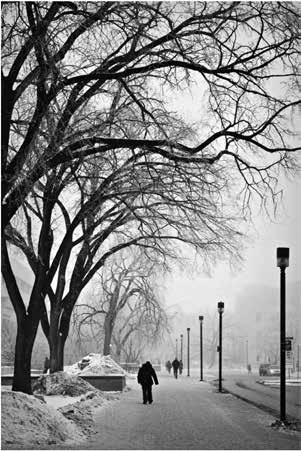
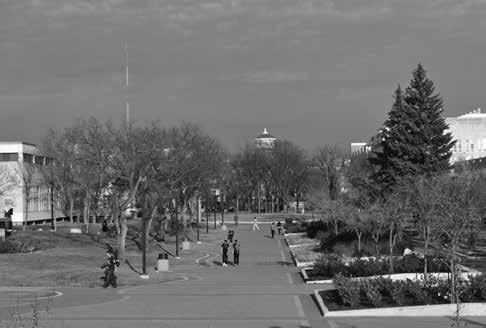
I looked back through my photography portfolio to when I first started my university experience. I remember taking this photo my first semester on campus. It was a particularly gloomy November morning and the cold air stung my fingers as I snapped photographs of the foggy campus grounds. During that time in my life- just starring a degree, not being sure if I really belonged on campus or not- this photograph gave me a horrible melancholy feeling. Fast-forward four years: I am in my last semester of my undergrad degree. The shadowy figures in the photograph no longer make me feel anxious and lonely as they once did. Instead, I look at them with a smile knowing how much my experience at the University of Manitoba has helped me grow as a photographer, as a friend, and as a human being.
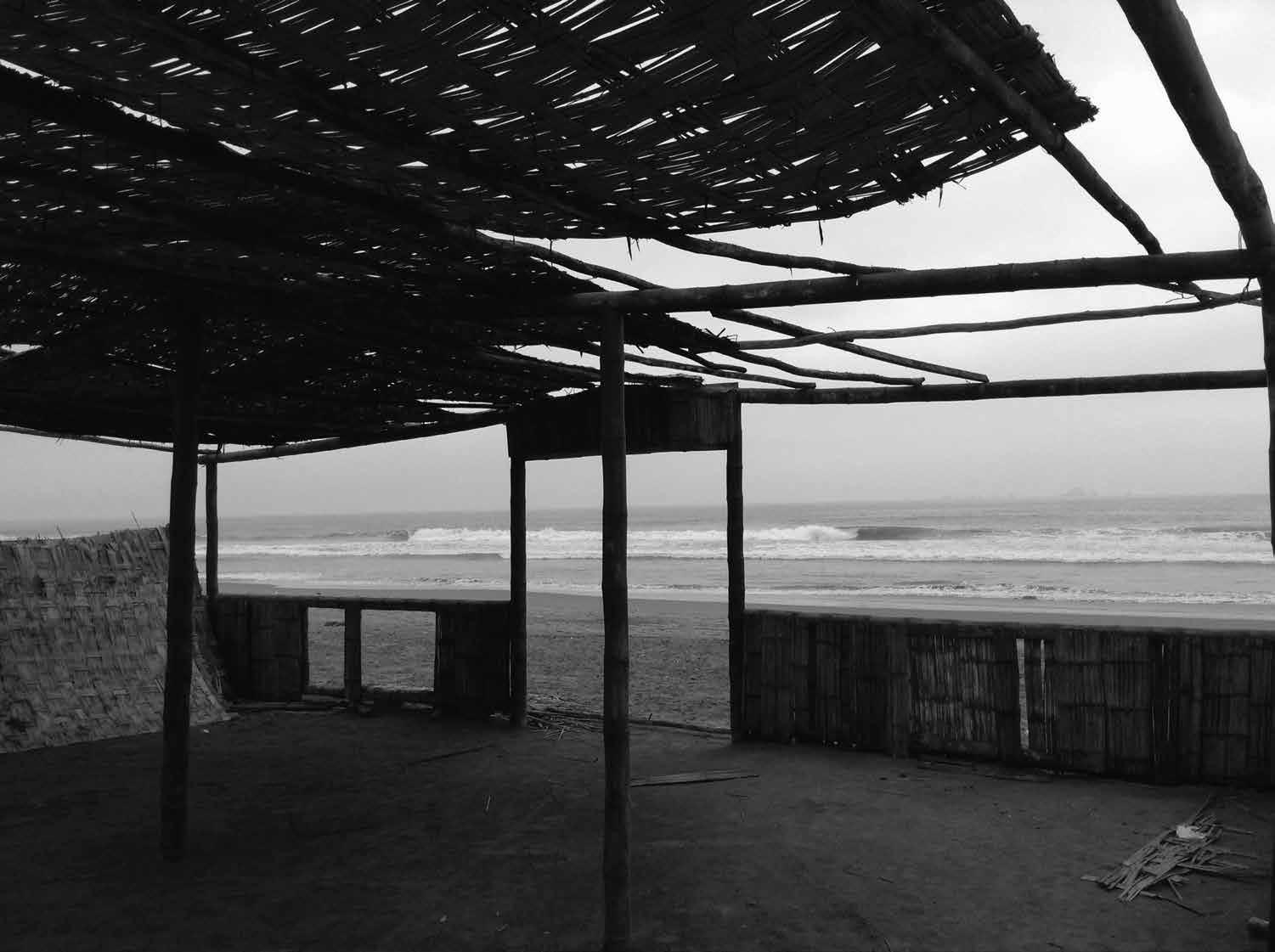
These photos were taken in Southern Lima, Peru, in July. While Winnipeggers basked in the summer sun, Peruvians were bracing through their winter. Nonetheless, nothing could put a damper on the sights and sounds of South America, especially during the World Cup! I was lucky to traverse Machu Picchu and enjoy the sites of Cusco, explore the archeological site of Pachacamac, appreciate the night life in the city, and witness the ravages of poverty and inequality in the slums high atop the hills of Lima. But, these particular images, taken at a brisk, desolate beach, during a chance detour, is the one that continues to…come back to me. A broken shelter, looking out onto the Pacific; a doorway to vast nothingness or an entrance into the wide open world?
THE ARTS TRIBUNE
SOLOMON
By Kevin Ramberran
Content note: The following work of fiction contains references to abuse/domestic violence which may be triggering for some readers.
Lights up.
A stark interrogation room.
A large metal table with a chair on either side. The stage left wall has a large mirror inside it. For staging purposes, this mirror should be a window.
SOLOMON sits at the table.
Across from SOLOMON is a paper coffee cup.
In the mirror, NOMOLOS acts as SOLOMON’s reflection. He mimics SOLOMON until noted.
SOLOMON rises and walks over to the coffee cup. He picks it up and drinks from it. It burns him.
SOLOMON/NOMOLOS: Ouch! Still kind of hot.
SOLOMON puts down the cup and goes to the mirror. He raises his hands and does some actions, observing his reflection.
SOLOMON/NOMOLOS: It’s probably cooler now, eh?
NOMOLOS: Yup.
NOMOLOS goes to the coffee cup and downs it. SOLOMON is shocked.
SOLOMON: Wh…what?
NOMOLOS: Hm?
SOLOMON: Aren’t you…supposed to…
SOLOMON shakes his arm trying to make NOMOLOS move.
NOMOLOS: Oh. Sure, if you want.
NOMOLOS mimics SOLOMON. NOMOLOS’s arm gets tired.
NOMOLOS: Can we switch arms?
SOLOMON: What the hell!
NOMOLOS: What?!
SOLOMON: What are you?!
NOMOLOS: Stop yelling, Jesus.
SOLOMON: What?!
NOMOLOS: I said stop yelling!
SOLOMON: You’re not Jesus!
NOMOLOS: I said ‘Jesus’ like ‘Oh Jesus, stop!’ not like ‘I am jesus’.
SOLOMON: Oh.
NOMOLOS: Yeah.
SOLOMON: But…who are you?
NOMOLOS: I think I’m you.
SOLOMON: Me?
NOMOLOS: Yeah. Wait. Are you Jesus? Because if you’re Jesus then I might be Jesus too.
SOLOMON: I’m not Jesus.
NOMOLOS: Who are you?
SOLOMON: I’m Solomon.
NOMOLOS: Cool. Me too.
SOLOMON: I don’t understand.
NOMOLOS: That’s okay.
SOLOMON: Is it?
NOMOLOS: I think so.
SOLOMON: Okay.
NOMOLOS: Can I come over there? I wanna know what it’s like.
SOLOMON: I guess.
NOMOLOS: Great.
THE ARTS TRIBUNE
NOMOLOS climbs through the window frame. He looks around.
NOMOLOS: This place is weird.
SOLOMON: Weird?
NOMOLOS: Yeah, everything is backward.
NOMOLOS bumps into the table.
NOMOLOS: See. (indicating the coffee cup) You gonna drink that?
SOLOMON: What? The coffee?
NOMOLOS: Yeah.
SOLOMON: You can have it.
NOMOLOS: Cool.
NOMOLOS picks up the cup and is about to drink it. Stops.
NOMOLOS: Wait, you don’t have, like, mono or anything right?
SOLOMON: What?
NOMOLOS: Or like, mouth herpes? I don’t wanna catch anything because we shared a drink.
SOLOMON: If I have mouth herpes, wouldn’t you have mouth herpes?
NOMOLOS: Oh yeah.
Pause.
NOMOLOS: Do we have mouth herpes?
SOLOMON: No!
NOMOLOS: Cool.
NOMOLOS downs the coffee.
NOMOLOS: Ugh. The coffee here sucks.
SOLOMON: Well, it’s not like it’s known for it.
NOMOLOS: What are we doing here anyway?
SOLOMON: I don’t know.
NOMOLOS: Yeah right.
SOLOMON: I don’t!
NOMOLOS: For real?
SOLOMON: For real.
NOMOLOS: Huh. (beat) Where is the other guy?
SOLOMON: I don’t know. Had a phone call or something.
NOMOLOS: Huh.
THE ARTS TRIBUNE
Pause.
SOLOMON: Why hasn’t this happened before?
NOMOLOS: What?
SOLOMON: Why hasn’t this happened before?
NOMOLOS: What do you mean?
SOLOMON: I mean, I’ve got mirrors. I’ve seen plenty of mirrors. I’ve seen my reflection plenty of times. What’s different now?
NOMOLOS: I don’t know.
SOLOMON: How can you not know?!
NOMOLOS: I don’t know!
SOLOMON: You climbed out of the mirror!
NOMOLOS: You don’t even know why you’re in this room! How am I supposed to know why I climbed out of the damn mirror.
SOLOMON: But you’ve never done that before!
NOMOLOS: Have you ever been in this room before?
SOLOMON: No. Maybe. I don’t think so.
NOMOLOS: Well, then there you go.
SOLOMON: No, no, no. Why do you exist?
NOMOLOS: Why do you exist?
SOLOMON: I don’t know.
NOMOLOS gives SOLOMON a look to say ‘Well?’
SOLOMON: Ugh. This is just very confusing.
NOMOLOS: Don’t stress out about it.
SOLOMON: How can I not stress out about it?
NOMOLOS: Just don’t think about it.
SOLOMON: My reflection just started interacting with me!
NOMOLOS: Hey!
SOLOMON: What?
NOMOLOS: For all you know, you might be my reflection.
SOLOMON: Really?
NOMOLOS: Yeah. You could be. Maybe, over there (indicating the mirror) you’re my reflection and I climbed into the mirror to see what your world is like. Maybe that.
SOLOMON: Is that what happened?
NOMOLOS: No. Not at all. But it could’ve!
SOLOMON: Ugh. (beat) I hope he comes back soon.
NOMOLOS: Yeah.
SOLOMON: If he comes back, you have to go back over there.
NOMOLOS: Why?
SOLOMON: Because he’ll be confused. He’ll think I snuck you in here.
NOMOLOS: But I’m you.
SOLOMON: But he’s not going to know that.
NOMOLOS: But I kind of like it here.
SOLOMON: Too bad.
NOMOLOS: That’s not fair.
SOLOMON: It’s completely fair. Who knows what could happen?!
NOMOLOS: Ugh. You’re such a party pooper.
SOLOMON: Too bad for you.
Pause.
NOMOLOS: Hey.
SOLOMON: What?
NOMOLOS: We should make out.
SOLOMON: What?!
NOMOLOS: Come on.
SOLOMON: What is wrong with you?!
NOMOLOS: Come on! I’ve always wondered if I was a good kisser. Oh man! We could even fool around a bit, you know.
SOLOMON: What the hell? No.
NOMOLOS: Come on!
SOLOMON: That’s gross.
NOMOLOS: No it’s not!
SOLOMON: Yes it is! And I’m not gay.
NOMOLOS: Neither am I.
SOLOMON: You just asked me to make out.
NOMOLOS: I’m pretty sure these circumstances are exceptional. Be a bit more open minded. How often do you get to make out with yourself?
SOLOMON: I’m not making out with you.
NOMOLOS: Fine, fine.
Pause.
SOLOMON: Weirdo.
NOMOLOS: Dick.
Pause.
NOMOLOS: God, this place is boring.
SOLOMON: I know.
NOMOLOS: You know what we should do?
SOLOMON: What?
NOMOLOS: Let’s do something crazy.
SOLOMON: I’m not making out with you!
NOMOLOS: I know! I’m thinking that we, like, just turn this table over or something and when he comes back, you can act like nothing happened. Just like, normal. It’ll be hilarious.
SOLOMON: No!
NOMOLOS: Yes! Come on. Grab the other side and help me.
SOLOMON: We’re not flipping the table over!
NOMOLOS: Why not?!
SOLOMON: Because he’s going to come back and be pissed off.
NOMOLOS: Exactly! It’ll be hilarious.
SOLOMON: That’s easy for you to say. He’s not going to do anything to you!
NOMOLOS: You think he’d do something?
SOLOMON: I don’t know. I’m not willing to risk it!
NOMOLOS: Ugh. Fine.
Pause.
NOMOLOS: You suuuuuuuure you didn’t do anything?
SOLOMON: What?
NOMOLOS: I’m just saying, you got us in here. You sure you didn’t do anything?
SOLOMON: I don’t know! I told you.
NOMOLOS: How can you not know?
SOLOMON: Because they didn’t tell me anything. He brought me here, took me to this room, told me to wait a moment and then left.
NOMOLOS: Huh. Really?
SOLOMON: Yeah.
NOMOLOS: Well, did you, like, do anything wrong?
SOLOMON: Not that I remember.
NOMOLOS: Hm.
SOLOMON: Maybe it’s about that car accident I witnessed.
NOMOLOS: We witnessed a car accident?
SOLOMON: Yeah.
NOMOLOS: And I missed it? Damnit!
SOLOMON: It was horrible.
NOMOLOS: Were there like, dead bodies?
SOLOMON: This one little girl was really badly hurt.
NOMOLOS: Holy.
SOLOMON: She was all cut up.
NOMOLOS: Did she die?
SOLOMON: I don’t know.
Pause.
NOMOLOS: Cool.
SOLOMON: What?!
NOMOLOS: It’s a cool story.
SOLOMON: She might’ve died!
NOMOLOS: I know!
SOLOMON: What the hell is wrong with you?
NOMOLOS: What?!
SOLOMON: A girl maybe dies and you say ‘cool dude’!
NOMOLOS: I didn’t say ‘dude’!
SOLOMON: Whatever. You’re messed up.
NOMOLOS: So are you. I’m you, remember?
SOLOMON: Whatever.
Pause.
NOMOLOS: You’re a grouch.
SOLOMON: Listen, I’m trying to gather my thoughts and figure out what this guy wants from me.
NOMOLOS: From us.
SOLOMON: No. From me. You can’t be here when he comes back in. In fact, you should just get back over there now.
SOLOMON tries to push NOMOLOS back through the mirror.
NOMOLOS: Hey! Quit it!
SOLOMON: Come on!
NOMOLOS: Stop that!
SOLOMON: Ugh!
NOMOLOS: Alright, alright! Jesus.
NOMOLOS climbs through the mirror.
NOMOLOS: You’re a jerk.
SOLOMON: Whatever.
NOMOLOS: You know, I think I know why we’re here.
SOLOMON: Shut up.
NOMOLOS: I do.
SOLOMON: Be quiet.
NOMOLOS: I think it’s because of her.
SOLOMON: Shut up!
NOMOLOS: I bet she finally did it.
SOLOMON: You shut your goddamn mouth!
THE ARTS TRIBUNE
NOMOLOS: How long ago was that, anyway?
SOLOMON: I said be quiet!
NOMOLOS: Like, two years?
SOLOMON: SHUT UP!
NOMOLOS: Two years since you hit her, eh?
SOLOMON: …two years.
NOMOLOS: Yeah. That’s probably what it is.
SOLOMON: …How do you know about that?
NOMOLOS: What do you mean?
SOLOMON: You don’t know about the car accident. You don’t know how we got here. How do you know about that?
NOMOLOS: Oh. I was a big part of that.
SOLOMON: What do you mean?
NOMOLOS: Well, if you think back to right before it happened. There was some yelling and screaming-
SOLOMON: And I stormed out of the bedroomNOMOLOS: And intoSOLOMON: The bathroom.
NOMOLOS and SOLOMON speak in unison for the next four lines.
NOMOLOS: And you looked at me.
SOLOMON: And I looked at myself.
NOMOLOS: You were shaking.
SOLOMON: I was shaking.
NOMOLOS: And she saidSOLOMON: “I can’t do this anymore.”
NOMOLOS and SOLOMON speak in unison for the next four lines.
NOMOLOS: And you said to me,
SOLOMON: And I said to myself,
NOMOLOS: “I hate you”
SOLOMON: “I hate myself”
NOMOLOS: And you left.
SOLOMON: And I went to the kitchen.
NOMOLOS: And you hit her.
SOLOMON: …I hit her.
Pause.
SOLOMON: You were there?
NOMOLOS: I was there.
SOLOMON: And now we’re here.
NOMOLOS: And now we’re here. Pause.
NOMOLOS rises. SOLOMON is defeated.
NOMOLOS: I’m gonna take off for a while. Hope everything works out. When he comes back in, I mean.
SOLOMON: Okay.
NOMOLOS: Catch ya later.
SOLOMON: Yeah.
NOMOLOS exits.
SOLOMON hangs his head. Blackout.
Sound and Colour, Universal Art
By Theo Deezar
There is a reason why art is awesome everywhere you go. Not only is it beautiful in appearance or powerful in its capacity to enamor young and old, it is an important feature of the human experience. The experience as it pertains to the apparent universe. The two core art forms are physical and intellectual. Physical, as in playing an instrument, dancing, painting a masterpiece or sculpting. Intellectual, as in the thoughts processed during the creation and observation of art. Art has been in continuous evolution with its earliest appearance 540,000 years ago thanks to Mr. Homo Erectus. It is easily understandable that art’s importance in expression of self is essential to communication, down to the accents and intonation of language. It is noted that Maslow’s hierarchy of needs cannot be disregarded. A person who is starving or threatened by unpredictable dangers will not be thinking of artistry. In order for art to be created, times of peace and comfort must be abundant. In order to maximize enjoyment of the limited time allocated on this planet, humans depend upon art. After all, people did hear about YOLO in a song.
The connection between sound and color is difficult to portray in 750 words or less. Music: a noise organized in thought. Noise is the culmination of sound frequencies, the lower the speed of the frequency, the lower the note or tone. These tones have been measured; do, re,
mi, fa, sol, la, ti, do. Or the simplified version of C, D, E, F, G, A, B, C. Seven different letters or tones that, when put together in proper order, form lowest to highest on an octave ending one octave above the first tone. When the tones are combined, chords may be formed. Alone the C tone sounds simple and calm. When combined with E and G in synchronization, a C-chord is formed. There is a combination for all chords, some of which involve half notes. Multiple sounds being created in unity to introduce emotion and pleasure. A noise so beautiful one must stop everything and listen. This is a rarity over the course of one’s life. Without musicians, musical evolution would cease and we would be stuck listening to the same music.
ROY G BIV, or otherwise known as the colors of the rainbow: Red, Orange, Yellow, Green, Blue, Indigo, Violet. Understanding colors can be complex but if you look at them like the notes on a piano it can be quite simple. Lowest to highest, the frequency of light rays, colors are ordered. The color red is associated with the musical tone C. The C chord, is C(red), E(yellow) and G(Blue), the primary colors. The most basic colors and the most basic musical chord on the scales are intertwined. Creating harmony is important in art as it is the glue that holds the piece together. Similar to all else in the universe, where there is harmony there is peace and progression.
Creating harmony can be done by any person, it is only a matter of will. Time and effort are the only commitment required to produce a harmonious piece of history that when digested associates a closer bond with the human experience. The harmony a person produces on a daily basis is going to be related to the overall experience. Life is not to be branded as a contest or race, but as an experience where harmony increases the overall value of time. As humanity matures, the ideal future would entail a harmonious relationship between all of nature. The music produced by the next generation will be what is created by the richest, not the artists. Harmony is disappearing from street corners where kids hung out and biked. Today in Canada it is common to see an 8 year old who already knows the meaning of an iCloud and loves to sing along to Miley Cyrus. This article is meant to encourage those who are reading to try exercising their imaginations and make art. Whether it is dancing, singing, painting etc. anyone can express themselves through art! This is a world of excess, but there can never be a surplus of art as it is the only thing that separates us from being savage.
THE ARTS TRIBUNE
On Gender Identity: Our Anatomy Is Not Our Destiny
By Anu Lotay
In Western culture today, there is an assumption that our biology determines who we are as individuals. This is biological determinism: the hypothesis that biological factors, such as an organism’s genes, completely determine how this organism behaves or changes over time. This implies that our anatomy determines who we are and what we are capable of doing, or that “our anatomy is our destiny,” a phrase originally attributed to Sigmund Freud. This type of thinking also suggests that our gender is an experience conditioned by nature, that it is fixed and unchangeable. The problem with this belief is that it is incredibly limiting and premised on antiquated Euro-American ideas about nature, culture and gender. Prominent scholars such as Margaret Mead and Judith Butler have presented alternate ideas about culture, biology and gender which show that anatomy is not destiny and that our cultural beliefs shape our understanding of biology so that this culturally constructed biology, thus, influences our gender identity.
A popular and controversial anthropologist in her time, Margaret Mead set out to examine the role of culture and environment in gender differences. She sought to move beyond biology as the explanatory model for gender behaviour. Instead, she was interested in how socialization and the cultural environment influence the ways in which people performed maleness and femaleness. She believed that cultural differences were not innate but rather a matter of interpretation.
Published in the early twentieth century, Mead’s ground-breaking works, Sex and Temperament in Three Primitive Societies (1935) and Coming of Age in Samoa (1928), presented ethnographic examples of the impact of enculturation in sex roles.1 She claimed that, in contrast to prominent American beliefs, the New Guinean populations she studied showed that sex roles were not programmed by nature. The tempestuousness characteristic of American adolescence was not seen in the adolescent Samoan girls Mead studied which led her to conclude that these behaviours were not biologically determined but a product of socialization and child rearing. Therefore, according to Mead, the differences in the experience of adolescence for young people can be attributed to environmental factors.
In her study of the Tchambouli, a society in New Guinea, Mead found that traditional Euro-American gender roles were reversed in this context. Women were the business people and breadwinners as they also fished and farmed. Women also displayed stereotypically male characteristics as they were said to be easy-going, hardworking and authoritative. On the other hand, men were “the weaker sex” in the Tchambouli context. They spent their time preoccupied with their appearance and adorning their bodies. They also displayed other behaviours considered to be stereotypically female in Western contexts, such as becoming timid and self-effacing when in the presence of women. This reinforced Mead’s cultural-determinist position that gender roles were not determined by nature but were dependent on culture.
This begs the question whether biology has any role to play in the formation of gender roles. The famous gender theorist Judith Butler proposed a radical idea regarding the interplay between culture, biology and gender that helps answer this question. Butler suggested a performative theory of gender, in her seminal work Gender Trouble (1990), which stated that both sex and gender are cultural constructions. This idea seeks to destabilize existing gender binaries by drawing our attention to the arbitrariness of social practices which define gender differences.
Butler tells us that the naturalness of gender, “womanhood/manhood” and “man/woman” are illusions. Our culture itself inundates us with narratives regarding the essential unity of biological sex, gender and sexual orientation which leads us to believe that our biological sex and gender “go together”. However, we are actually being misled because gender is not dictated by nature but rather by the propaganda of cultural constructions. The unity of sex and gender is a creation of culture.
Therefore, we can conclude that the formation of our gender identity is indeed influenced by biology, but the biology itself is figured and understood through our cultural lens. Our human body is not determined by biology but is interpreted by cultural meanings. In Butler’s view, sex and biological differences cannot be understood as an anatomical, precultural fact. Thus, rather than under-
standing gender as an outcome of biology, we must think of gender norms as structuring biology itself. Our culture organizes our nature and this is because we reproduce our culture in our day-to-day lives. Therefore, our anatomy is not our destiny.
This is further illustrated by the fact that other cultures, and our own, consist of individuals that defy categorization into the gender binary. The western view of gender is essentialist, unchanging, and dichotomizes into natural and moral entities of male and female into which all persons are categorized. However, every society at one time or another has consisted of individuals who did not fit these discrete gender categories. These include people who are born with genitalia that are neither clearly male nor female by Western standards. People who change their biological sex through surgical procedures, exhibit behavior deemed more socially appropriate for the opposite sex, and those who take on gender roles that do not “fit” with the one indicated by their genitalia, can also be considered to be beyond the gender binary. Cross-cultural examples include the hijras of India who are considered to be a “third sex”, “intersexed”, or “neither man or woman,” and the two-spirit or berdache persons of certain Native American and Canadian Indigenous cultures who are described as males who feel an affinity for female characteristics or occupations.2 These alternative gender identities reinforce the idea that gender roles are not fixed and that we must re-examine our own interpretations regarding our binary gender system.
1 Erickson, Paul A. and Liam D. Murphy, eds. 2013 A History of Anthropological Theory. Toronto: University of Toronto Press.
2 Brettell, Caroline B. and Carolyn F. Sargent, eds. 2009 Gender in Cross-Cultural Perspective, Fifth Edition. Pearson/Prentice-Hall (Electronic).
Identity, Culture, and Truth
By Ian McKay
The word "identity" is one of the great buzzwords of our time. It's certainly not a new word, but it has taken on quite new connotations. As a result of the postmodern worldview, "identity construction" has become the study of numerous courses and even whole faculties in Western universities. The basic starting assumption behind it all is that people are so constrained by language and bias as to never be able to know whether or not there is any absolute truth. Therefore, an interest has been taken in how people have made their own view of reality, how they have crafted an identity, how they have tried to give their lives meaning. Is the absence of absolutes a great truth (pun intended) that only postmodern man has attained unto? If it is, then we needn't bother with the matter any further. This is because when one decides that "there is no such thing as absolute truth," he is automatically incorrect. He has 1) asserted that his statement is not always true, and 2) proclaimed an absolute. There is no other way to phrase it. If all ideas are just social constructions, then so, too, is that one. Contradictory statements cannot be correct. Logic dictates that there must be absolute truth.
A person's "identity" is not necessarily fully right or wrong. Identities comprise major things like language, ethnic background, and faith or religion, as well as minor things like our tastes in music and favourite coffee shop. Disagreement in some of these means little. The way we choose to dress or the things we like to eat often aren't good or bad (except when it comes to Tim's or Starbucks, in which case, of course, there is a correct choice). Other areas of division are more consequential and show us the folly of believing that all beliefs are equally true. If someone makes stealing a part of their identity it does not mean that
stealing is just another interesting way of living. Parts of our identities can be wrong, rather than just different. That we can recognize this, however, reaffirms that we can be unique from each other and still acknowledge the same fundamental truths.
Our cultures and personal decisions which make up our identities tell us a few simple things. One of these is that man is inventive. He possesses enormous creative energies and has a natural penchant to exercise them. Another is that he has free will to disagree with others and make his own way. Traits like these are what separates us from the animal kingdom. They are also traits which cannot be adequately explained in a naturalistic universe.
I submit that the Bible gives us the best explanation for why man is unique in these ways. It tells us we were made from the beginning in the image of a God Who is also creative and inventive. We should not be surprised to see the artistic wall paintings of cave men, or the marvellously beautiful and advanced achievements of the early Greeks and Egyptians. As well, God's Word tells us that we have been created with free will to accept or reject Him as we would, explaining the origins and proliferation of our opposing beliefs. God wanted man to choose to reap His blessings through obedience and fellowship with Him. When Adam, the first man, chose to rebel, he became only the first to make his own way.
The 'identities' of man contain such diversity because man has been fashioned in the image of a God Who first was diverse. At this level, diversity can be a wonderful thing. It is in the greater free will decisions, rather than cultural tastes, that differing identities become divisive. It is only when man accepts God's gift of redemption from
sin and reconciliation to Himself through Jesus Christ that man, in all his diversity, can also obtain true unity. When we speak about identities, we must be mindful not to forget that absolute truth does exist. This truth is not just a Canadian idea or a part of Western identity. Absolute truth does not belong to any one culture. It is transcendent. It is eternal. Cultures rise and fall, ideas comes and go, but Truth is constant. It is up to us to discover that truth and to align our identities in accordance with it.
1 - Take music, for example. It's an important part of culture, but naturalism (nature-is-all-there-is atheism) can't explain it. See Greg Demme, "Does Music have Evolutionary Origins?" a review of Musicophilia, Tales of Music and the Brain (revised and expanded) by Oliver Sacks, Journal of Creation 25, no. 1 (2011): 40-43. http://creation.com/images/pdfs/tj/j25_1/j25_1_40-43.pdf.
2 - For discussing the contradictions between the popular idea of primitive man and the advanced civilizations of our earliest recorded history, see Steve Cardno, "The Mystery of Ancient Man," Creation Ministries International, http://creation.com/the-mysteryof-ancient-man. For the scientific aspects of the question, see, for example, Peter Line, "Fossil Evidence for Alleged Apemen-Part 1: The Genus Homo," Creation Ministries International, http://creation. com/fossil-evidence-for-alleged-apemenpart-1-the-genus-homo.
3 - The capital is purposely used here. Jesus said “I am the way, the truth, and the life: no man cometh unto the Father, but by me” (John 14:6). For absolute truth to exist, there must be a constant, objective foundation for it. Ultimately, all truth is grounded in the Person of Christ Himself.
CALL FOR SUBMISSIONS
Architexts: Imagining Architecture, Rights, Memory and the Canadian Museum for Human Rights
The call for submission is for a book project that is designed to harvest creative responses from students on the recently opened Canadian Museum for Human Rights (CMHR). This publication will engage students to submit poetry, short prose, short play, and short creative non-fiction pieces that reflect their views or impressions about the CMHR. As members of pAGES creative writing group, we hope to engage students in the department and beyond in a project that will not only get them to think about their relationship with happenings within the city of Winnipeg, but also about how the monumental architecture for human rights in the city influences their recent understanding and imagination of the city. Our focus on the relationships that exist between architecture, public memory and human imagination led us to theme the project, Architexts: Imagining Architecture, Rights, Memory.
By ‘architext’ (a term we borrow from Evelyne Ender’s book, Architexts of Memory), we will be seeking creative examination of the patterns and dynamics of human imagination in relation to architecture, public memory and human rights, specifically in the context of the CMHR in Winnipeg.
Therefore, we invite students (graduates and undergraduates) to submit a creative piece (poetry, short story, creative non-fiction, short play) on the theme above or on much broader understanding of the CMHR that catches their fancy. To submit a piece, please see the guidelines below.
SUBMISSION GUIDELINES:
• Poetry category: maximum of three poems of not more than 20 lines for each poem.
• Short story, creative non-fiction, and short play category: for this category, submit only ONE piece of not more than 3000 words.
• You may submit a piece each for both of the categories above. But note that you can only be published for one category.
• Please ensure to have a separate cover page wherein you include your name, institutional affiliation, e-mail, and title(s) of piece(s).
• Please send your submission(s) to Arthur Anyaduba (anyadubc@myumanitoba. ca) or to Jennifer Black (jenniferilseblack@gmail.com) on or before Thursday, April 30, 2015. Submissions should be attached as Microsoft Word Document or PDF format.
For queries or concerns, please contact Arthur Anyaduba: anyadubc@myumanitoba.ca
THE ARTS TRIBUNE
What Identity Means to Me
By Kasia Keiloch
With the school year coming to an end students are finishing their final assignments, preparing to study for exams, celebrating the conclusion of another academic year, and are involving themselves on and off campus in countless ways. This last school year has called for me to reflect on who I am and what it means to have an identity. Lately I have been asking what it means to have a sense of self, how I distinguish myself, and what makes me who I am. I have 5 thoughts to share about the meaning and importance of identity.
Firstly, people are not able to witness how awesome you are if you don’t get involved in your community. There are numerous opportunities at different community levels. There are dozens of student groups and organization on campus, plus there is a world beyond the walls of the University of Manitoba. Whether you are a member of a religious community, interest group, team, or organization, there are plenty of ways that you can get involved. Involvement does not always require you to become a leader, but the idea of coordinating efforts with others to reach a common goal should not be intimidating. How does involvement relate to identity? There is no better way to learn about who you are than learning about and serving others. You are likely to be surprised by your hidden capabilities,
talents, and skills by working with others, especially when your intentions are selfless.
Secondly, it is important to try new things and move out of your comfort zone. Taking chances makes life so much more interesting and allows you to explore different facets of your identity. One of the most positive risks that I have taken is participating in public speaking tournaments throughout high school. I went from being a very shy wallflower to an excellent orator and am rarely nervous when I speak in front of crowds of any size! I never would have discovered my love for public speaking and ability to be an extrovert had I not competed in tournaments and practiced public speaking. One of the largest obstacles that people notice in regard to trying new things is the fear of getting their foot in the door. More often than not, members of whatever community or group that you want to join or learn more about are friendly and glad to have your interest. Don’t be shy or afraid of introducing yourself to new people! You will never discover certain aspects of your identity until you take a few risks and go out of your comfort zone.
Thirdly, it is important to maintain balance in your life. While the idea of being a member of several groups can be super exciting, spreading yourself too thin causes stress. You are the best version of you when you are able to have a school, work, family, and community involvement balance. This means that you will face the difficult decision of having to say “no” to certain opportunities. I like to limit the number of days with events to three per week in order to avoid getting too stressed out. When you maintain balance in your life, you reflect the strongest components of your identity. I find that I learn more about who I am as an individual when I focus on fewer initiatives and work on maximizing the quality of my work instead of the quantity.
Fourthly, it is ok to be imperfect. Mistakes are your best teachers. They demonstrate how you can become stronger and able to face new challenges in the future. Overcoming challenges reveals aspects of your identity
that you may not see on a regular basis. When you are challenged, your true colours are revealed, enabling you to improve and expresses a fuller and clearer version of your identity. I like to believe that people are given challenges and make mistakes in life to learn more, become better individuals, and to discover their capabilities by overcoming adversity. Every time you think that a door has closed, that situation is an opportunity for you to remove your blinders and discover newly opened ones.
Lastly, it is not the individual things that we do that should define us. What you study, where you work, your hobbies, and your friends are all different types of things that people examine in order to determine who you are. Your entre identity cannot be defined by the individual things that shape who you are. This is because you are a combination of all of the things you do, and instead of your identity being an accumulation of individual characteristics or acts, it is multifaceted, and the things that you do interlock in a way that brings about exponential results. Hence, the more that you experience in life, the more diverse your identity can be. It is easy to get caught up in trying to be one type of person, but it is essential to take a step back and look at the way in which your identity displayed to others.
George R.R. Martin once said, “Never forget who you are, for surely the world will not. Make it your strength. Then it can never be your weakness. Armour yourself in it, and it will never be used to hurt you”. I think that it is important to be proud of yourself and celebrate who you are. Live a life that you are proud of, leave no stones unturned, and remember to always treat others with dignity and respect. A well-rounded identity permits people to look back on their previous actions and be proud of what they have done and the direction that they are going in.
I THINK OF THE LOVES I HAVE LOST
By Arthur Anyaduba
I think of the loves I have lost
And the twin pains of faces and touches
No more accessible
For the intimacies once shared.
I think of the tears I have lost
When in losing the throb of friendship, Its panting fits and laughter, I also lost its pricking angst.
I think of the memories I have lost
And the cuddles that excite imaginations
Now fragmented out of a disembodied desire
To move. My mobility is always my loss.
I think of my thoughts of loss
And how loss resonates as the lexicon of my growth, How loves lost and remembered
Remain the fixed points of all the homage I pay to life.
THE ARTS TRIBUNE
An Open Letter
By Spencer Yasui
My name is Spencer Yasui, and I recently ran for UMSU President (in the 2015 General Election) with the CLEAR Slate. I wrote this open letter, posted online, as a way of sharing my thoughts on the campaign. It was truly a defining moment in my life. I discovered things about myself that I was surprised to find I hadn’t previously been aware of. The following letter encapsulates those discoveries, and is an uncut, unfiltered representation of who I am, how I think, and the way I view the world. I hope that you find something in these pages that means something to you. I became “involved” on campus only recently, and though I could not have previously imagined myself in such places, I assure you I can no longer imagine myself without them. University is a place where we’re supposed to find our true selves, and if our school has done its job, that self shall be set free. But we must take an active role in mastering our destinies. This has always been the way of the world. Above all else, I hope I might inspire even just one fellow student to take hold of their campus experience and find the way to find themselves within it. This is something that you can do. Now without further ado…
Hello all!
Let me begin by recognizing the achievement of those elected. Congratulations to Jeremiah Kopp, Jessica Morrison, Astitwa Thapa, Rebecca Kunzman, and Zach Leclerc. I look forward to working with you next year!!! I speak now directly to Reanna Blair, Jesse Greenberg, Benedicte LeMaitre, and Chris Belanger - it wasn’t for nothing.
Last February, I joined the Refresh team. I believed in Al Turnbull’s vision for a University that students were proud to go to. It was there that I caught the bug for elections - the busyness, the bravery, the pride in public service. I decided then and there that if ever I had the ideas, and the right team, I would run myself.
I was fortunate enough to find both and the CLEAR Slate was born. I envisioned a slate that was as transparent as it could get. We would tell the students where their money was going, even if we weren’t doing as well as we’d like to. We would unite the faculties, and indeed the campus. We would invest our money in services, and not in private businesses. We would run a campaign powered by positivity and the passions of dreamers. We would put ourselves in front of 26,000 people and see what happened.
It hasn’t always been easy, though I’ve loved every second. Reading Week, a time to relax and catch-up, accomplished exactly the opposite for me. I couldn’t relax when I needed to spend 70 hours on campus preparing. I couldn’t catch-up on homework when there were visions to build. I’ve had arguments. I’ve fought complaints (and appeals to those complaints). I’ve missed deadlines. I’ve neglected relationships. I’ve weathered horrible insults and social media posts. I’m terribly sorry to say that I’ve lost friendships. This is perhaps my one regret, but it was out of my hands. Some just aren’t as prepared to work on opposite sides while maintaining goodwill and perspective. These are the risks you take when you run for public office - even in University.
But I’d rather spend my time here talking about the good. There was so much of it throughout this process. I made friendships that I believe will last me a lifetime. I was humbled by the staggering support I received from total strangers. People that had never met me before volunteered hours upon endless hours with us in the warroom (530 University Centre) and abroad, painstakingly painting within tiny font on banners, standing beside us on the floor or in classrooms, putting up posters, putting themselves out there hundreds of times per day while postcarding during polling days, the list goes on - these were people who woke up early, rejected the plans of friends and family, and took hours out of their day to help us without pay, and I hope it’s because they believed in our vision for an exciting campus. I cannot ever repay them for their kindness and generosity, particularly as I truly believe time is our most precious commodity.
We met thousands of students. They waved to us
in the halls. They messaged us. They told their friends about us. They smiled. They believed in us. I cannot ever say why, nor express truly what it means to work that hard, in front of an audience that large, and watch with your own eyes as folks buy into what you’ve built. I express my endless gratitude to the thousands of students who stood in line and checked the boxes next to our names. I won’t ever forget that. I’m thankful that you trusted me with your campus, and though I fell just short of the finish line in this particular race, I promise you I will continue doing everything in my power to make your experience at the University of Manitoba unforgettable
To my wonderful team, thank you for absolutely everything. I gave you very little information when we met. Then I asked you a big question. Then I gave you a short period of time to answer it. I cannot accurately describe with the language at my disposal what it means to me that you put your faith in me. You trusted me. You gave up so much for my ridiculous request. I asked you to sacrifice all that I described above, and you did. If I did nothing for the rest of my life but try to thank you adequately for that faith and trust, I would not have accomplished it by my life›s end. You saw the vision, and you worked harder than I have ever seen people work to deliver on those promises for the good of the students. You’re leaders. That’s what leaders do. That’s why I asked you, specifically, to join me on this unexpected and most unforgettable journey. Your work ethic, your determination, and your passion fueled this campaign. I had a couple ideas. You made them real. Thank you Benedicte, Jesse, Reanna, and Zach. You are very dear to me now.
To my campaign manager Shawn Singh, the sixth and equal member of our team. Thank you for facilitating our work. Thank you for keeping us to deadline. Thank you for doing what needed to be done, even when we didn’t like it. It was hard to follow your No-Yik-Yak Rule, particularly when people were telling us about the sorts of things being said, but it was in our best interest, as was every decision you ever made. You brought years of leadership and organizational experience to the table, and you absolutely made the chaos inside our heads translate into something palatable, and actionable. I meant it when I said to you that I truly could not have done it without you. You like to argue that point with me, and I love you for it, but I know it in my heart to be the truth.
To Jacqueline Keena, the CRO. Thank you for indulging our endless questions, and the follies that follow tenacity. You were an excellent example for how that job should be performed. You dedicated as much time, (if not more) than the rest of us did, and your job isn’t easy.
I want to assure those who voted for CLEAR Candidates that weren’t elected that our very good friend Zach Leclerc, who did accomplish what the rest of us sought out to, will carry our vision forward. He’s got years upon years of leadership experience, a truly golden heart, and
the straightest moral compass I’ve yet encountered. He will be CLEAR about your finances. He will hold himself and others accountable to you. He will continue to deliver on promises made. I can’t tell you, Zach, how proud I am of you, and how very happy I am for all of us that get to call you our Vice-President Internal. Congratulations. I urge those who haven’t yet gotten involved to do so. It really does affect your experience. You pay UMSU fees every semester. You should be happy with where that money goes. Even if you’re one of those students that just comes to school, sits in class, and goes home - you pay those fees too, and just maybe you might help elect someone who will make your campus experience about more than that - even for you. We haven’t heard your voice. If you had voted, things might have turned out differently. If you’re unhappy with the result now, know that you had and will have again the power to influence things. Maybe things would have turned out the same anyway. It’s impossible to know, but what is certain is that the 5 minutes or less that it takes to vote is worth the improvement of your whole year.
To those brave enough to consider getting involved next year, I urge you to act on it. You gain so many wonderful experiences. I gave interviews. I debated (twice). The planning, the marketing strategy, the groundwork, the networking, they’re all experiences that you can’t find anywhere else. There’s so much involved. Having photos taken, websites made, videos done, design created (for everything from posters to policy pdf’s). It’s difficult, make no mistake, but it’s unbelievably rewarding. Win or lose, the experience of running is worth the price of admission.
In closing, I would like to thank everyone who got involved. If you voted, you have my eternal thanks (regardless of who you voted for). If you volunteered, you have my debt. If you ran, you have my admiration. It’s not easy to put yourself in front of 26,000 people. It’s not easy to open yourself up to that sort of scrutiny. But I hope that, whether you won or “lost,” you can agree that we gained experience that will stay with us forever.
Onwards and upwards! I will never forget those who touched my life throughout this very great experience. Thank you so very, very much.
#CLEARUMSU Spencer D.T. Yasui
Who am I?
By Bénédicte LeMaître
I am radiant and dynamic, yet I am capable of placidity.
I can sparkle like sunlight on water, yet wisp away like the smoky breath of a dying flame.
My life is a dance, and my being is the quintessential part of its song. My physical being knows strength and fearlessness, yet I am mortal and not exempt from defeat.
I am beautiful when that which is within me delights in integrity, and breaks through the wondrous temple of my physicality as an immortal brightness, into the midst of those around me.
I am loved,
And when I attain the fullest potential and wholeness of my being, I am love,
And I desire for you also to be love.
Thanks
I did not want to write this
Fra SE r nE lun D, staff
I did not want to write this.
The first draft was a rant, an unmitigated calling out of the administrators of various organizations in the University of Manitoba community.
The second was a cold, exacting news-like piece. A tally of jigsawed happenings, a picture of a university in turmoil.
The third was a simpering love letter, an overstated acknowledgement of the ever-shifting beauty of the educational landscape.
Each draft left me feeling nauseous. Though maybe that’s the allcoffee diet. I feel nauseous right now.
The fact is that I didn’t want to write this editorial because it is the last piece I will publish as an employee of the Manitoban
I’m a distance education student from B.C. Circumstance brought be me to Manitoba.
I was looking for a community. I found the Manitoban
The first article I wrote was about poker; it was titled “5 reasons to fold your poker ambitions.” By print the title read “5 reasons to fold to your poker ambitions.” These are very different things, and I will never let the perpetrator live it down.
From volunteer to editor-in-chief,
learning has been the only constant in my career at the Manitoban. There’s been no light to chase, I have no farreaching accomplishment to hang my hat on. Each article came at the expense of another, unwritten. Each task was completed on time that was due to three others. There is infinitely more to do, to understand.
Here
I’ve learned to let (most) errors go. There’s not time.
I’ve learned that the common wisdom, that politicians are not to be trusted, is understated. Cliffs are not to be trusted, politicians are
Dear volunteers,
The Manitoban depends on the contributions of volunteers to fill its pages every week. This year we’ve had volunteer contributors writing for each section as well as a number of graphic artists and photographers. Their work helps to make the Toban what it is. We would like to thank the volunteers for all their contributions. Thank you.
earthquakes.
I’ve learned that I’m not a reporter. A reporter writes the exacting story, then moves on to another, because that is how they write.
We need reporters. Goddamn it, they deserve our appreciation. Try writing an in-depth piece, each line a revelation, with as little bias as you can manage. Just try it once.
I come to more thoroughly appreciate art (though, please, do not tell the design team, they thrive on being underappreciated). Not the fancy stuff, the mural-sized paintings or sculptures of obscure dimensions. Rather the commercial sort, the
bang-on interpretations and additions – comics and cleverness shining a light.
I’ve learned that a workplace can be a good place.
I’ve learned to edit, to write.
I didn’t want to write this.
I hope the people I’ve worked alongside know they’ve helped to make my years here happy.
I hope my child and partner can forgive my late nights away.
I want to tell the University of Manitoba community: Thank you for this place.
Extra thanks to our volunteer writer of the year Raylene Paci Image above from "Ten Thousand Coffees teams up with Etsy"
Extra thanks to our graphic volunteer of the year Caroline Norman
Arts & Culture
Try to get out alive
Escape room trend finds its way to Winnipeg
a ng E la Englan D, staff
The concept behind the escape room is simple. Locked in a room, your group must uncover clues to solve puzzles and codes while racing against the clock. With three escape room companies all having opened in Winnipeg within the last six months, the Manitoban visited each one to see if they live up to the hype that surrounds them.
Enigma Escapes, the city’s most recent addition, opened last month off Sterling Lyon Parkway and is already ranked first place on Tripadvisor for city activities. They currently offer two different rooms, each with their own theme and sets of clues and puzzles. In “The Lost Jewel of Zanzibar” you are in 1930s Africa trying to find a mystical gem that’s been hidden from a warlord who is hunting both you and the jewel. “Prohibition – The Lucky Duck” profiles the 1925 prohibition in which you are a team of investigators trying to identify the leader of a criminal organization before a bomb destroys all of the evidence.
The other two companies, the Real Escape Canada and Epic Escape Winnipeg, both opened in November. The Real Escape presents “The Nuclear Meltdown,” where a power plant tour goes wrong and system failure triggers an emergency lockdown. Epic Escapes’ scenario has you trying to escape being mysteriously locked in a New York City loft.
All three locations boast tremendous popularity and are routinely booked solid on weekends. Alexander Shannon from Epic Escape recommends booking at least three weeks in advance if you want a room and Laura Hawkins from Enigma Escapes suggests the same. Megan Schmidt at the Real Escape usually needs a month’s notice if you are hoping to snag a Friday or Saturday night.
The different venues were exciting and surprisingly dissimilar from one
another. Each has its own quirks and charms. Four guys who met through the Asper MBA program run Epic Escapes. Their New York game was the most challenging by far and my group was unable to escape this one. Unlike the other games, which offer the possibility of unlimited hints, Epic only allows a maximum of two.
To request a hint, you press a buzzer in the room and your guide (that has been watching your group via security camera) comes in to offer help. This was my least favourite system, compared to Enigma’s wallmounted television screens that ask if you want hints and Real Escape’s method of sliding hints under the door.
All three locations boast tremendous popularity and are routinely booked solid on weekends
What makes Epic fun, though, is the challenge rating of their game. With hints being limited and the nature of the clues more difficult, when tasks are solved it feels more rewarding. When you complete a puzzle, you know it is because of your own ingenuity – a great ego stroke.
Epic is also unique in that it offers “duelling rooms” that allow two teams to compete against one another. This is perfect for larger groups because the recommended number of people per room is three to five.
The New York theme runs through August with another game being unveiled early this summer. Come September, they will introduce another duelling room as well. The game room is also fully handicap-accessible.
Comparatively, Real Escape’s puzzles were moderately challenging and the most intuitive.
This game room is the city’s largest, allowing for the biggest group – up to 10 players. If you have a larger group of friends interested in the activities like I do, not being forced to exclude people is a big draw.
The meltdown game ends April 12, so if you want to catch it before it is gone, you better hurry. It will be replaced by a new game called “Escape from Death Row” starting April 23.
A family who has played rooms across Dublin, Athens, Paris, Toronto, and Las Vegas runs Enigma Escapes. Their experience is obvious, as they offer the most diverse variety in puzzles. They also get my vote as the most beginner and cross-generational-friendly.
Because of their hint system, the staff can more easily tailor the game to players’ skill levels and preferences. Enigma’s games offer the best cohesive and immersive narrative. This location is on the main floor and also features handicap-accessible rooms.
There are currently two more games in development at Enigma. “Blackbeard’s Brig” will have you held hostage by an evil pirate captain, while “Cypherspace” will be a sci-fi adventure where you must find coordinates to a wormhole or be forever lost in space.
Although Winnipeg may be late to jump onto the escape room trend, the city now offers many ways of trapping yourself in a room with your friends and family.
Flying high
Third + Bird platform for local artisans soars
l aur E n Si DDall, staff
Winnipeg is quickly gaining a reputation as an extremely talented city. Local restaurants and shops are sprouting up in all areas of the city to showcase the talent housed within its limits. But despite the platforms becoming increasingly available, there is still so much untapped talent.
Cue Chandra Kremski, Charla Smeall, and Kris Antonius of Third + Bird.
Although Third + Bird had humble beginnings, starting out as a fundraiser for art programming, Kremski and Smeall quickly realized the potential of the craft show.
“We tapped into something that was clearly a desire, a want, a need, within the community,” said Kremski.
Fast-forward seven years and Third + Bird now finds itself curating two events annually to showcase the work of local artisans and connect patrons to Manitoba makers.
“We see our role in the event as providing a really beautiful, artistic space, finding great material, social media, and advertising, and giving a huge spotlight to these vendors who may not have really strong market-
ing skills or may not have the retail outlets that they are super deserving of,” said Kremski.
“We see ourselves as facilitators; we want to bring a spotlight to local, handmade vendors. So our criteria is making sure we find really high quality products made by people who are from Manitoba.”
“We tapped into something that was clearly a desire, a want, a need, within the community” –Chandra Kremski, Third + Bird organizer
Finding the best handmade goods in Manitoba is not an easy task.
Following an intensive application process, a jury weighs the pros and cons of each applicant before the final lineup is chosen. Third + Bird now has to turn down over 50 per cent of the applicants because of space
restraints.
“It’s a happy kind of chaos,” said Smeall.
“We want to know what will speak to the vast majority of people. I think part of the uniqueness of our sale is that we have product that other people don’t have.”
At the end of the process, they are left with two full floors of tables featuring the best artisanal products in the province.
While fostering the talent of local arts, Third + Bird also aims to develop artisans globally by raising money for the Nepali Women’s Co-Op.
“The women’s co-op in Nepal has always been something that has been a part of that church. In the Himalayan region, there are a lot of women who are living on the streets or living in the slums – living in really awful circumstances and have no skills,” said Kremski.
“So what they do is take a handful of women and put them through a tailoring program and at the end of the program, they give them a sewing machine and they are fully employable because they now have these skills.”
The philanthropic aspect of Third + Bird creates a full circle effect of artisans supporting artisans, whether it be on a local scale or a broader global platform. The craft show also always features a table carrying goods made by the women in Nepal.
“It’s such a good partnership because we’re highlighting and supporting local artists and getting revenue to them, and so it makes sense to be supporting women artisans out there and bringing revenue and life skills. It just felt like a perfect match.”
Third + Bird attributes the success of their ability to support local and global artisans through their events
to the buy-local attitude prevalent in Winnipeg.
“We really appreciate the Winnipeg community, because I think what’s really special about this city is that people do really value supporting local events or local shops. I think Winnipeggers are really conscientious of that, and they’re excited. They see the value in what’s taking place. That’s really huge.”
The second annual spring market is on May 2 from 10 a.m. - 5 p.m. at 782 Main Street. Admission is $3. For more information, visit thirdandbirdevents.com
Straight from the [White]horse’s mouth
Ontario rock duo brings looping madness to Burton Cummings April 24
i an t.D. tH om S on, staff
Promoting their latest album,
Leave No Bridge Unburned, the indie-rock couple Whitehorse takes their unique and expansive live sound to the Burton Cummings Theatre on April 24.
Whitehorse consists of married singer-songwriters Luke Doucet and Melissa McClelland. While both were able to establish a presence as solo acts before and after their marriage in 2006, the two decided to pool their musical talents in 2010.
To make sure that Whitehorse succeeded, the band made sure not to label it as a “side project” and put promoting themselves as solo artists on hiatus until further notice.
“It was really important to me right from the very beginning that if we were going to do this at all, it was not going to be a side project,” Doucet said in a 2013 interview.
“It was really deliberate for us to back out of promoting ourselves as individuals and trying to focus all of
that energy on the collective.”
Since then, the band has released three albums and two EPs to both critical and commercial acclamation. Their second album, The Fate of the World Depends on This Kiss, saw the band shortlisted for the 2013 Polaris Prize. During their accompanying tour, the band also performed at the historic Massey Hall in Toronto. After playing the venue, the duo released an EP entitled The Road to Massey Hall, which features six covers of folk artists, such as Gordon Lightfoot and Blue Rodeo, who had played the venue before them.
Their latest record, Leave No Bridge Unburned, was released in February of this year and features the track “Downtown.” Released as the album’s first single in January, the track is an ideal example of the band’s musical eclecticism. The song also exemplifies the band’s modern Brit-pop influences, with a chaotic guitar tremolo and distorted bass
tone similar to that of the Klaxons. “Downtown” also provides listeners with the playful dynamic of Doucet and McClelland’s vocals.
Beginning their tour in support of their third album, Whitehorse’s live performances change the conceptualization of live music. With McCelland and Doucet as the only members of the rock and roll act, the duo utilizes loop pedal effects to create a more expansive sound.
Watching Whitehorse perform live is also an event in itself. On a moment’s notice, both members are seen switching between guitars, playing the drums, or performing vocal harmonies through a telephone.
While this process sounds difficult to co-ordinate, especially in front of an audience, Whitehorse makes it seem natural.
“We wanted it to just be the two of us. Partly for practical reasons,” said Doucet.
“And at this point, now that the
looping has become such a big part of it and the live show has sort of taken on a life of its own, it feels like maybe that’s the point of this band, that it is just the two of us.”
Whitehorse takes the stage on April 24 at the Burton Cummings Theatre with Noah Gundersen. Tickets are $32.50 in advance and are available on Ticketmaster.
Micah Visser: ok night
Local singer-songwriter to release debut cassette
r ayl E n E PaC i, volunteer staff
Micah Visser has yet to reach his 20th birthday, but with a few EPs under his belt and a debut, full-length cassette launching at the Park Theatre on April 23, this alternative-folk act is already taking the Winnipeg music scene by storm.
His upcoming album, ok night, is the product of many years of music-making and experimental composition.
“I started writing music when I was very young. I’ve been playing violin since I was seven years old and started composing as soon as I had a firm enough grasp on the mechanics of it,” said Visser.
“Writing and recording the music I’m making now just seems like a natural progression of that. Huddled in my attic with a pen and paper, trying to make something better than what I was making before.”
Intricately crafted and beautifully composed, ok night features a mix of styles ranging from haunting acoustic love songs to epic anthems with pounding drum beats. Visser’s raw and bittersweet vocals easily soar over every track, occasionally joined
by the mellow harmonies of Chantel Emond from the local act, French Press.
He credits the unique sound on the album to a lot of skulking around to find innovative ways of recording.
“It’s sort of a love letter to all the people I don’t talk to enough” –Micah Visser
“It made for a lot of short, highpressure recording situations, but I kind of like what that did to the sound. I can listen and think, ‘that’s the part I recorded with a freakishly expensive mic in a freakishly expensive ISO booth’ or ‘that’s the part I recorded in my aunt’s living room on her grand piano.’ Really eclectic and scrappy.”
Visser’s songwriting is dreamy, thoughtful, and emotionally moving. Filled with chilling melancholy and
vulnerability, he manages to perfectly capture the pain of youth, as well as the confusing transition into adulthood. Lyrics such as, “But you’ve got the moon in a jar, and your head is sitting somewhere in the stars” are effortlessly poetic.
“It’s sort of a love letter to all the people I don’t talk to enough. At the time I was writing it, a few of my friends were struggling with mental illness, lots of people were moving away after high school and I was dealing with an anxiety disorder that was at its very worst,” he said.
“I felt very selfish and angry; I was so absorbed in my own issues that I couldn’t help the people who were going through so much more than I was. Writing this album was therapeutic because I felt like I could at least turn that into something positive and tell those people I cared.”
Though ok night showcases many moments of sorrow and hurt, it glimmers with a sweet sense of hopefulness for the future. The final lyric of the title track says it all: “But even when I’m writing and screaming why’s everyone leaving / I want you
Elephant Revival
Colorado quintet takes stage at WECC April 25
i an t.D. tH om S on, staff
Combining elements of folk, Americana, and Celtic music is Colorado quintet, Elephant Revival. On tour in support of their 2013 release These Changing Skies, the band will take the stage at the West End Cultural Centre on April 25.
Elephant Revival is a five-piece bluegrass outfit from Nederland, Colorado. The group formed in October of 2006 and consists of Bonnie Paine, Bridget Law, Charlie Rose, Dango Rose, and Daniel Rodriguez. Having always seemed to bump paths at various festivals,
the five came together from various parts of Oklahoma and Colorado to Nederland and started booking shows under the name “Elephant Revival Concept.”
The band has released four recordings, their latest being 2013’s These Changing Skies. The album was recorded at Bear Creek Studios, near Seattle, and had the quintet living in a barn for three weeks to find the right atmosphere.
“We did have accommodations, so we weren’t sleeping on the hay. It was a focused endeavour with a
lot of intention behind it,” explained member Dango Rose in an interview with CMT Edge
“And we’re really happy with the results and really happy with this album.”
It is difficult to place the music of the album in one specific category. While the sound can certainly be described as acoustic, each song is quite different. The track “Birds and Stars” is reminiscent of indie-folk acts such as Australia’s Boy & Bear or Winnipeg’s Chic Gamine. With a dramatic buildup led by a string section and backed up by vocal harmonization, the song demonstrates a more melancholic Elephant Revival.
In contrast, the twominute instrumental track “The Pasture” presents the quintet as more lighthearted. With a playful riff led by a violin and mandolin, the song is presented as though one overhearing a group of musicians jam on the Nashville circuit. This track may also remind listeners of jams by the bluegrass band Trampled by Turtles.
to know life still tastes so sweet.”
Since finishing the album, Visser has revealed that new material is already on the way – some of which will be played at the cassette release party.
“I’m at a much better place than I was during ok night and that shows in the new songs. It’s much less bogged down in melodrama, much more
positive and energetic. I want to get people dancing.”
Micah Visser’s cassette launch party is on April 23 at 8 p.m. at the Park Theatre. Tickets are $10 and are available through Music Trader or myparktheatre.com. Ozconscious and Champagne Years will also be performing.
a single genre.
“It’s tough to really say one type of music that I like to play, because the
The track “Birds and Stars” can be described as reminiscent of indiefolk acts such as Australia’s Boy & Bear or Winnipeg’s Chic Gamine
The musicianship of the membership is striking. Each member of Elephant Revival plays at least two instruments in the group, ranging from the double bass to stompbox –making it difficult to put the band in
style that we have comes from all of our own upbringings in the music world. Five people with completely different outcroppings and influences were all coming together to listen to each other and come up with parts,” said multi-instrumentalist Daniel Rodriguez.
“I think that’s really where the uniqueness comes from.”
Outside of music, Elephant Revival has worked with several nonprofit organizations for the promotion of humanitarian causes. The band contributes to organizations such as the Conscious Alliance and Calling All Crows. Their name itself represents their charitable outlook, referencing a pair of zoo pachyderms who died on the same day upon being separated for 16 years.
Elephant Revival is playing the West End Cultural Centre on April 25 at 8 p.m. Tickets are $25 and are available at Ticketmaster.
photo by angie barnes
photo by austin maCKay
Kailey trevithiCK
Kailey trevithiCK
Caroline norman
evan tremblay
Sports Editor: Mike Still
Northern stars
Selecting Canada’s 23-player roster ahead of the 2015 Women’s World Cup
a n Dy C HE , staff
As the Women’s World Cup draws near, Canada head coach John Herdman will have a headache in assembling his 23-player roster ahead of the Canada-hosted tournament.
The red and white possess a diverse selection ranging from young talent to seasoned leaders, a few of which have already clinched their status on Herdman’s shortlist. The Manitoban breaks down who has secured their position and if there are any shock selections in store.
Perhaps the most definitive department for the Canadians is their goalkeeping selection. Erin McLeod has solidified her status as the first-choice goalkeeper, having started the 2011 edition of the World Cup and backstopping the Canadians to an Olympic bronze medal in 2012.
Like the backline, Canada’s midfielders include an experienced core which have locked their roster status. This group includes Sophie Schmidt, former Manitoba Bison Desiree Scott, Kaylyn Kyle, Diana Matheson, and versatile midfielder Brittany Baxter.
Teenagers Ashley Lawrence and Jessie Fleming have broken through the Canadian senior team within the past year and could be amongst the exclusive group come June.
The red and white possess a diverse selection ranging from young talent to seasoned leaders, a few of which have already clinched their status on Herdman’s shortlist
While Karina LeBlanc and Stephanie Labbe are the two most likely substitute goalkeepers, 19-year-old Kailen Sheridan stands a chance of cracking the roster following her performance at the 2014 U20 Women’s World Cup.
Canada’s defencemen possess a group of veterans at the pinnacle of their career, which includes Robyn Gayle, Emily Zurrer, Carmelina Moscato Rhian Wilkinson, and Marie-Eve Nault. With nearly 500 national caps between them, this exclusive club has secured their respective spot on the Canadian roster.
Although still a teenager, Kadeisha Buchanan’s impressive 33 caps by age 19 might have also claimed roster status. The rest of the defender spots remain wide open between Allysha Chapman, Rebecca Quinn, and Sura Yekka.
Selenia Iacchelli is another name who is being tipped for the squad; however, at age 28, she only has four Canada caps to her credit.
Captain and forward Christine Sinclair is a sure bet to make the roster, along with Melissa Tancredi, Jonelle Filigno, and Josée Bélanger
Christina Julien is also a strong candidate for Canada, however potential stars Adriana Leon and Janine Beckie are emphasizing the team’s youth.
Herdman is likely to select Julien as the fifth forward, but Leon’s adaptability to forward and wing would make her a tempting selection.
Looking back at the 1928 Allan Cup champions from the University of Manitoba
r i CK b rignall
Hockey in Manitoba has gone through many different high and low periods. No matter how low it has gotten, hockey always found a way to bounce back.
The return of the Winnipeg Jets became a modern-day example of this resilience. In earlier days, the 1928 University of Manitoba senior Varsity squad was an example of a team bringing hockey back from the brink.
When the Allan Cup amateur senior hockey challenge was first introduced in 1909, teams from Manitoba became perennial national champions.
Between 1911 and 1920, the championship team was rarely found outside the province. This included the 1920 Winnipeg Falcons Allan Cup victory and record-setting Olympic gold medal championship.
The Varsity “Brown and Gold” squad
The years that followed were tough on Manitoba hockey. Manitoba amateur hockey lost players to other province’s senior teams and professional teams.
One of the greatest factors of senior amateur hockey’s decline started in the 1925-26 season when the Winnipeg Maroons joined the United States’ Central Hockey League. Its lineup featured the best senior players left in the city.
Senior hockey was taking its final breath before the start of the 1927-28 season. The historic Winnipeg clubs of the Victorias, Monarchs, and Winnipegs were gone. Even the Falcons lost interest
in senior hockey. Only three Manitoba teams were interested in playing senior hockey. The teams included the Brandon Wheat Kings, the Elmwood Millionaires, and the University of Manitoba Varsity squad. They couldn’t decide whether they should form a league. If they couldn’t form a league, no Manitoba club would qualify for the Allan Cup play-downs.
Thunder Bay senior clubs were dealing with a similar situation. To make things easier they joined the Manitoba clubs to form an interprovincial league, which included Fort William, the returning Allan Cup champions.
The Varsity “Brown and Gold” squad was coached by Jack Hughes, and had a strong forward line, which included Andy Blair. He would go on to play nine NHL seasons, and win the 1932 Stanley Cup with Toronto.
After moving onto the Western Canada final, the Varsity faced off against the Trail Smoke Eaters. They were seen as stiff competition. People expected to witness a real hard-fought and exciting contest. But Manitoba Varsity outclassed the Smoke Eaters in every department. The students won the overall, with a total goal series of 10 to nothing.
As Western champs the Varsity earned a spot in the Allan Cup final against the Montreal Victorias. It would be a best of a three-game series.
Practically the entire student body turned out at the train depot to give the Varsity squad a roaring send-off. The students paraded the
team noisily from the university to the station, which they took completely by storm.
The Varsity was seen as slight favourites over the Victorias before the series started. Their chance of a championship dropped to doubtful when they lost the first game 2-0. The Varsity’s end was near when Montreal took a 3-2 lead into the third period of the second game. Then, with their backs to the wall, came the Varsity’s real fight. It was a case of do-or-die where another loss would have meant going home empty-handed. The students showed their spirit.
After tying the game at three, Blair would give Varsity the lead and two more goals secured a victory. The Varsity stayed in the fight for the Allan Cup.
The Varsity joined other great Winnipeg teams by winning the Allan Cup. The defence kept a 1-0 lead intact to secure the victory.
Thousands of people celebrated the return of the Allan Cup champions. The Varsity players were carried shoulder-high from the train to waiting automobiles. A mile-long parade of trucks and cars wound slowly though densely packed streets to the university campus. Horns, fireworks, and every other noisemaker was used to cheer for the team. While surrounded by students at the university they cheered out, “Man-i-to-ba, rahrah-rah, Manitoba, r-a-a-a-h!” On this day Winnipeg opened their hearts to the Manitoba Varsity team. The student squad almost single-handedly saved senior hockey from extinction in Manitoba.
Eye on the ball: Erin McLeod secures the number-one spot under coach John Herdman
Sports opinion: Lead by example
Bison volleyball players allege harassment by coach
m i KE Still, staff
For many individuals, becoming a CIS athlete is a dream come true. It is the culmination of years of hard work and sacrifice. Once the dream is realized, though, the workload continues to increase, and an enhanced amount of pressure is put on the athlete to succeed.
Tack on a hectic school schedule, along with personal commitments to family and friends, and the CIS experience can become overwhelming.
Athletes develop strong bonds with their fellow teammates and coaches because they spend a hefty amount of time practising, training, and communicating with these people. It is these relationships that can also help an athlete cope with the stress around them, mainly because their comrades are probably going through similar situations.
If all goes according to plan, a student-athlete will spend five to six years (redshirt dependent) training and honing their abilities with the same squad. That’s a lot of time getting to know your fellow athletes and coaching staff. It can become a familial bond.
There is, however, a downside to all of this. Coaches and players run the risk of getting lost in the heat of the moment during a competitive or stressful season, and issues can arise. It is possible to lose sight of the athletic side of things, which has occurred in certain instances in the CIS.
Bison volleyball
Last season, the Bison women’s volleyball team won a national championship, their first since 2001-02. They showed tremendous heart all season, and won the admiration of
many in the process.
What most people didn’t know, though, was that there was turmoil within the squad during the 2013-14 championship run, allegedly due to actions by head coach Ken Bentley, who, according to members of the team, verbally harassed players –inappropriately belittling them during the season.
The CIS’s harassment and discrimination policies state that “harassment is prohibited by the Canadian Human Rights Code and by human rights legislation in every province and territory of Canada. Harassment can also be an offence under Canada’s Criminal Code.”
The policy goes on to state the definition of harassment, which involves “comment(s), conduct,or gesture(s) directed towards an individual or group, which is insulting, intimidating, humiliating, hurtful, malicious, degrading, or otherwise offensive and which a reasonable person would know, or ought reasonably to know, to have this effect.”
The issue of verbal harassment was taken up with staff members of Bison Sports by concerned members of the squad after the season ended, but the result wasn’t positive.
“I am disappointed that our faculty and Bison Sports did not take our issues more seriously,” commented one of the players. “We asked for very little changes and simply wanted to create some awareness about some of the negative aspects of our season.”
When the news came at the end of June 2014 that no changes would be made, a number of players decided that they wouldn’t be returning to the team for 2014-15.
“Most of the team felt drained from the amount of work we put into
creating this awareness and we lost our passion for the game. Many of us did not return this past season for that reason,” said the player.
While there was an apparent change in the environment for this season, a number of players had already left by that point, due to the tension and stress of the prior year.
The Manitoban reached out to coach Bentley for comment, and received a response from Douglas Brown, the dean of the faculty of kinesiology and recreation management. Brown stated that he reached out to all of the athletes on the team at the end of the season, after the concerns were brought to his attention.
“I reached out to all the athletes on the team [at the end of the season] to acquire more detailed information on their concerns. They chose to remain anonymous,” Brown said.
“While I am unable to comment on allegations made by anonymous sources, it is important to note that we do not condone abusive behaviour of any kind and are dedicated to providing a respectful environment for our athletes, students, and staff.”
The verbal abuse allegedly occurred amidst a national championship. Positive external appearances do not always reveal internal conflict.
Ryerson and Ottawa
Other schools have encountered discipline issues related to sport in the past. Ryerson’s hockey team was suspended for seven days, and forfeited two games in November of 2013, after the consumption of alcohol during a pre-season trip to New Jersey.
The Ryerson student athlete handbook states that “athletes may not consume alcohol at any time during road trips,” and goes on to add that
“each student-athlete is a representative of Ryerson and is highly visible to other people, regardless of whether the team meets on or off campus.”
These rules are very clear cut, and in no way am I defending the actions of the student-athletes at Ryerson, but blame must be placed equally on the coaching staff – to properly introduce and engage with the players, to convey to them the proper way to conduct themselves when on the road, especially for those entering their first season, who could have been on their first road trip as part of the squad.
Head coach Graham Wise was suspended for four games for the incident. With over 20 years of CIS experience, he should have had a better grasp of school conduct, and the most appropriate ways to enforce rules. While he may have spoken to the players, it is evident that he didn’t do enough.
While the Ryerson situation was a negative one, it didn’t result in any excessive penalties. The team resumed play on Nov. 15.
The Ottawa Gee-Gees men’s hockey team, on the other hand, was handed a significant sanction after inappropriate conduct on a road trip to Thunder Bay, back in early February of 2014.
A further investigation resulted in two Gee-Gees being charged with sexual assault, and the hockey program was shut down for the 2014-15 and 2015-16 seasons, while former head coach Réal Paiement was fired.
Exacerbating this case is the fact that it wasn’t brought to the Thunder Bay Police’s attention until Feb. 25, almost a month after the incident first occurred. Administrators at the University of Ottawa were also not informed of the situation, and didn’t
The life of an average hockey player
Iam not a phenomenal hockey player by any means. I was never taught how to skate growing up. I am known as a rather poor skater, and my name has never rolled off the tongue of any professional scout. What I did have growing up was an extreme passion for the game –something that holds true today. At a young age I fell in love with the game. Ryan Smyth was my favourite player because he had the same name as me and I was a big fan of the Edmonton Oilers. I read the Winnipeg Free Press’ sports section every morning, soaking up anything I could. Hockey was everywhere, it was so readily available to me. I read so many books about hockey it’s not even funny. You can ask my parents; hockey has been a massive part of my life.
I started off playing hockey mostly on the streets and in my driveway, perfecting my stick work. I am no Patrick Kane when it comes to stickhandling, but my wrist shot can be attributed to hours of shooting a tennis ball at my garage door.
I eventually got on skates when I was around nine years old, making the trip to East End Arena on Saturday mornings. I fell in love with the game even more, if that’s possible. The cold air on your face as you skate around, the digging of your skates into the hard ice – it was magical.
I started playing hockey competitively at 13, playing A3 hockey for the Bronx Park Bruins; I was the assistant captain, and what a huge honour that was for me. I had a good year and I figured I was going to play a level up the following year.
I was wrong, I got stuck playing A3 again – something that I look back on with fondness. I was the captain of my team and led my team in scoring. I learned that year that you have to make the most of a bad situation.
I ended up playing a game for the A2 Gateway Flyers that year, scoring a goal, and proving to myself and others that I wasn’t that bad of a hockey player. Eventually, when I was 15, I cracked the roster to play for the A1 team, a feat I would’ve thought was not possible. It was possibly the best year of hockey I ever had, as the on-ice aspect was good, but the memories with all my teammates was even better.
Hockey has thrown me some curveballs, every one of which I have enjoyed. It somehow always pays you back for all you put into it. I had been cut from my high school team
receive word until just before the police had begun an investigation.
While suspensions were likely handed down internally, the attitude the coach took was not one of urgency. If it was, then the university would have been informed far earlier.
Again, I am not trying to give the individuals involved a “free pass,” or any sort of pass at all, but for a coach who had been teaching the game for longer than a lot of his players had been alive, he should have reacted and responded in a far more professional way.
Policies and procedures
The CIS has a general code of ethics, and it includes principles and guidelines that are “intended for all Canadian Interuniversity Sport Members: coaches, athletes, and administrators.”
The guideline that applies directly to all three cases mentioned here, and to any other situation involving CIS athlete-coach interaction, is this:
To “recognize the pressures of academics and athletic excellence placed on athletes and provide leadership that fosters a positive experience.”
While I’m not personally a CIS athlete, I do understand the pressures of performing at an elite level, as a committed marathon runner. I also have many close friends who participate at the CIS level. On more than one occasion, they have told me that it can be emotionally draining. I fully respect the hard work and effort that all coaches put in, and am not generalizing this article to every single coach out there. I simply feel it is important to foster a healthy sporting environment to your players, and the first step in accomplishing this is to lead by example.
two years in a row and each time I bounced back and enjoyed my season wherever I played.
After getting cut from my high school team for the second time, I felt as if I had hit rock bottom. Well, it wasn’t rock bottom, and I ended up playing AA hockey for the River East Marauders, the highest level of hockey I had ever played.
We enjoyed some success during
the regular season and made it to the finals, only to be swept.
That was it, my short minor hockey career was over.
My story might be a little different from most Canadian kids, as I wasn’t thrown on the ice as a toddler, playing Timbits and going on to play higher levels of hockey. I was allowed to find hockey for myself, and I have loved it ever since.