Please contact designteam@themanitoban.com if you are interested in submitting a cover image. For other volunteer inquiries, please come to our office in University Centre (across from Tim Horton’s, behind GOSA) or email the editor of the section for which you are interested in writing.
Please direct all other inquiries to editor@themanitoban.com
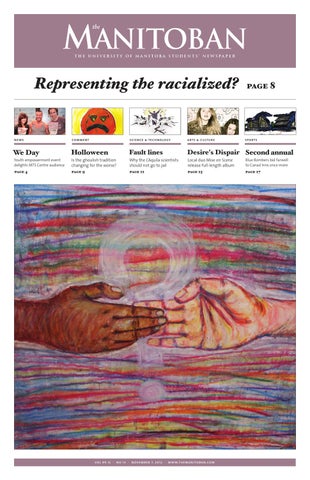
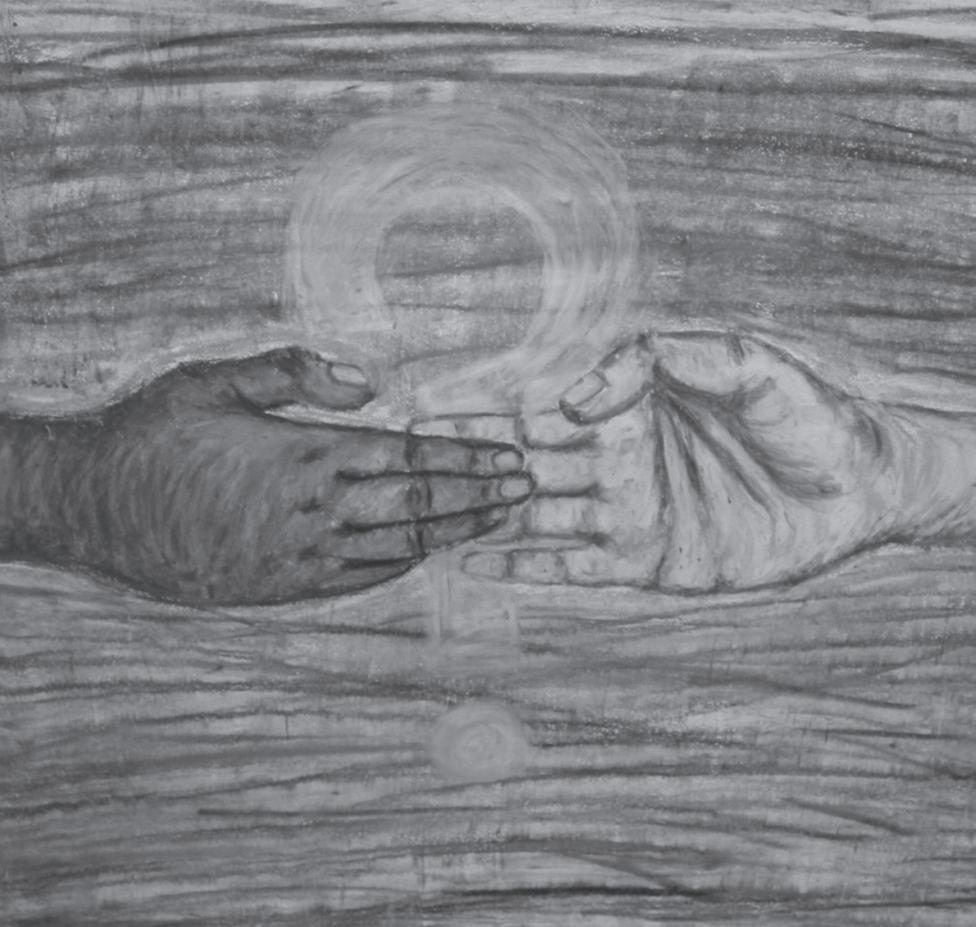
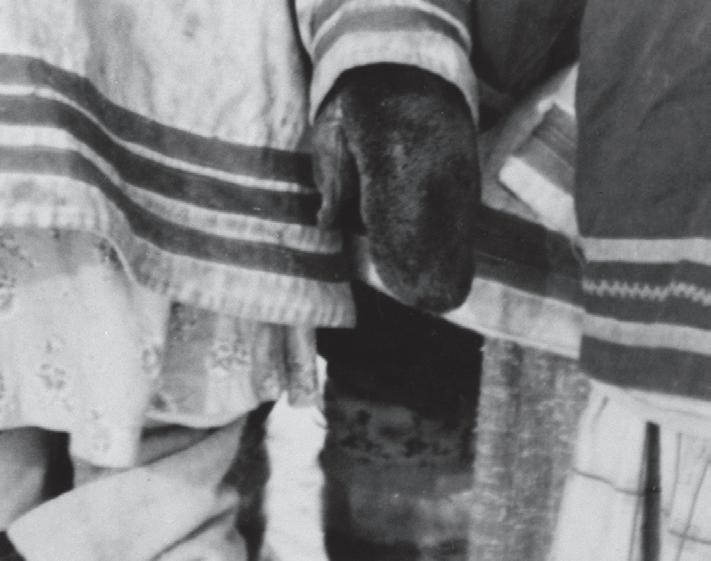
“The Almost Handshake” by Aichelle Sayuno
There is no I in We Day
Youth focus on collaborating for change
a lycia Rod Rigues, staff
W
e Day left 18,000 youthful fans supercharged for change as it celebrated its second year in Winnipeg. Students from over 396 schools, who earned a ticket by volunteering or fundraising for a local or global cause, filled the MTS Centre to commemorate their accomplishments.
RBC and TELUS created a five-year sponsorship with We Day to take the event beyond Canada.
Events are held in eight different cities in Canada and in Seattle on March 27, 2013.
Free The Children, the charity behind We Day, was founded by Craig and Mark Kielburger in 1995 and has built over 650 schools and classrooms while providing access to clean water, health care, and sanitation for over a million people internationally.
The paradigm for We Day amalgamates motivational speakers with popular artists from around the world, collaborating to promote, educate, and empower change in youth at the annual concert.
Former President of the Soviet Union and Nobel Peace Laureate, Mikhail Gorbachev, who is recognized for ending the Cold War, attended this year’s event.
There was a respectful silence in the crowd as Gorbachev spoke, followed by loud cheering and enthusiastic applause for acts such as Shawn Desman and Lights.
Gorbachev claimed that the
number one issue for youth is preserving peace. He stated that 100,000 nuclear weapons were available to him, each with the power to destroy a city such as Winnipeg, but he did not want that kind of a world for his children or grandchildren. It will not be easy, he said, but youth must work for and defend their freedom.
The former Soviet leader ended his presentation by saying that change is created by being united, showing no fear, and embracing truth, honesty, and justice.
Gorbachev gave advice on ending the threat of nuclear weapons by moving to a world that does not test or create them.
Older generations share the same desire too, he stated, and a common view is a key factor. He suggested moving away from militarization of politics and society.
tional speaker in attendance, spoke to the audience about climbing Mount Kilimanjaro. He climbed the highest mountain in Africa without any legs, using only his hands. West argued that if he is able to climb a mountain without any legs then youth are able to create social change.
The mountain of social change is difficult, West said, but possible with the right mindset.
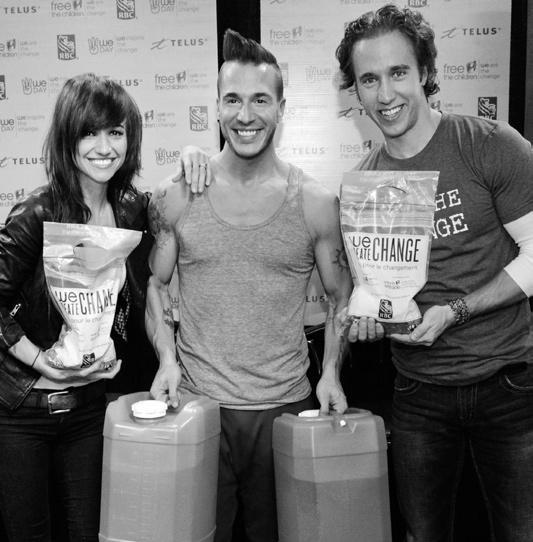
Youth in attendance were sent home with a reusable gift bag containing promotional materials for We Day, Free the Children, and RBC’s Blue Water Project.
The Blue Water Project is an initiative that aims to put the penny to good use, until it is eliminated in Canada. If a Blue Water Project re-sealable bag, included in the gift bag, is filled with pennies to the red line it makes $25 and will go towards providing clean drinking water to one person. The bags will be received by RBC locations across Canada from Nov. 1 to Dec. 21 and again in spring 2013.
“I very much want the world to move toward peace, democracy, justice, and saving the environment. I am here because [ . . . ] I love you guys.”
Spencer West, another motiva-
“Growing up, I’m sure I wasn’t alone in having a piggy bank filled with pennies and loose change, so why not use this change to help make real change possible? Free The Children is going back to basics this year [ . . . ] and it is now easier than ever to make your cents count,” said Craig Keilburger.
Immigration Minister criticized bilingual job requirements
Official says English requirement is hampering French language
Jill Patte R son, staff
Bilingualism requirements for jobs in Quebec have, over the years, resulted in many immigrants being denied work. Diane de Courcy, Quebec immigration minister, says that it is a very serious problem that needs to be resolved.
Immigrants from Latin America and francophone countries have been denied jobs in Montreal, not because they lack French language skills but because they cannot speak English. Some have even been told they may have better luck looking outside of Montreal for employment, to places that are more French speaking.
In response to this, de Courcy said that the fact immigrants are being told to look elsewhere constitutes a major problem.
“I firmly believe that we can improve the regionalization of immigrants to contribute to economic development [ . . . ] but when someone suggests to (immigrants) that they leave Montreal to improve their career prospects because they are weak in English, I think we have a serious problem.”
In light of this, there have been requests from immigrants looking for work for the province to provide access to English speaking courses so that they can improve their chances of employment..
According to the MP for Crémazie and former head of the Commission scolaire de Montréal, bilingualism requirements for jobs are moving too far into the workplace and societal realm.
“Making bilingualism a requirement for hiring worries me. I have the impression we’ve gone a bit too
far. When bilingualism moves into the workplace, for reasons that aren’t valid, we’re getting to the point where it’ll also move into society.”
At the core of the issue, for de Courcy and other Quebec officials, is the erosion of the French language in Quebec and how policies, such as the one in question, have contributed to this erosion.
According to de Courcy, the irony of the issue is that the decline in French speaking is due, in part, to these same immigrants from Europe, Africa, and the Middle East.
De Courcy is calling for governmental action to prevent a perceived decline of French speaking and culture in Montreal and says that this erosion will be further advanced if bilingualism becomes mandatory and the norm for employment.
The Office Québécois de la Langue Françoise, the department in charge of language issues and representation, is planning to release two studies before the end of 2012, which will outline the state of affairs with regards to the French language in the workplace.
A federal census, conducted late October, suggests that the proportion of households in Montreal that use the French language primarily has decreased from 56 per cent in 2001 to 54.2 per cent in 2006 and 53 per cent in 2011.
According to de Courcy, both studies to be released by the Office Québécois de la Langue Françoise and the federal census data show that French is indeed on decline, and will help the Parti Quebecois government decide on its next move.
This annual award recognizes teaching excellence among teachers of University 1 courses. The winners will receive a small monetary award and be acknowledged on the Wall of Recognition in University Centre. WIN ONE OF TWO $50 GIFT CERTIFICATES FOR THE BOOKSTORE. Each student who nominates a teacher will be entered into a draw.
DEADLINE FOR NOMINATIONS IS FRIDAY, DECEMBER 7, 2012
For more info on eligible courses or to nominate a teacher, visit: umanitoba.ca/student/u1
Hurricane Sandy devastates the East Coast
Debate over climate change as a factor for storm
a lycia Rod Rigues, staff
Destruction caused by Hurricane Sandy on the East Coast of the U.S. has so far totalled approximately US $50 billion dollars in damage, with a reported death toll of 112. The cost of the storm and death toll continues to rise as the wreckage is sorted through.
According to the National Weather Service, the highest storm surge was 4.23 metres with a maximum storm size of 1,609 kilometres, the brunt of which hit New York. At least 17 other states were affected by intense wind, snow, and rain. The strongest wind gust, felt on Mount Washington, was 225 kilometres per hour. Maryland felt the most rainfall, which reached 31.9 centimetres in Easton, and the most snow with 75 centimetres that fell in Redhouse.
Approximately 8.5 million people were without power at the peak of the power outage caused by the storm.
Warnings of the hurricane labelled “Frankenstorm,” due to the expected amalgamation with two other weather systems over Halloween, began around Oct. 26 after it devastated the Bahamas, moving towards North America to wreak havoc on the East Coast.
Environment Canada’s chief climatologist David Phillips discussed his issues about humanizing weather patterns with CBC. According to Phillips, humanizing weather patterns motivates them to prepare for storms. If the storm is not as intense as expected then people tend to distrust the sources, making future warning attempts futile. It is important to warn people to give them time to prepare for the impact in a way that they do not lose faith in the warning system, Phillips said. Initially, expected damages were estimated to be approximately US $1 billion. The aftermath of the storm makes it evident
that the storm was as bad, if not worse, than expected.
Host of Quirks and Quarks , Bob McDonald, spoke to CBC about the difference between a specific weather event and global climate change. According to McDonald, it is risky when the media links specific weather patterns and storms specifically to global warming, which does not consist of one or two intense weather events but, rather, it is the changes that are occurring simultaneously across the planet that make up climate change.
“Storms are weather. Weather is what happens every day. Climate change is the whole planet and it’s averaged over a long period of time,” said McDonald.
McDonald agreed that global climate change, like the warming of the oceans, could have contributed but also said Sandy was so extraordinary for reasons other than just global warming. Hurricanes happen often but most of them tend to run their course in the Atlantic Ocean and, following the trade winds, head north east because of the earth’s rotation.
However, Sandy did the opposite of that. It veered north east toward the coast where it devastated millions of people living there.
Sandy was also taken in by another storm system creating a ripple effect that intensified the storm. Another factor not mentioned was the full moon, which brings in higher tides along the coast.
Hurricane relief continued in New York City as Mayor Michael Bloomberg cancelled the annual marathon amidst criticism that the event would deter much needed resources for the city’s relief.
Strangers in New Homelands conference brings immigrant issues to light
Conference takes a close look at challenges facing immigrants and refugees
Quinn Riche R t, staff
University of Manitoba faculties of sociology and social work hosted their fifth annual Strangers in New Homelands: Deconstructing and Reconstructing "Home" Among Immigrants and Refugees in the Diaspora conference last Thursday and Friday. The conference brought together social workers, government officials, academics, and students to discuss issues critical to the experience of newly settled immigrants, especially in Canada and the United States.
The theme of the conference was “crossing borders from old homes, settling in new societies: exploring critical issues on migration, integration, and adaptation of newcomers in host societies.”
Dr. Michael Baffoe, conference
We
life in their new home.
“We have to continue to be welcoming and thankful that people have come. If we don’t continue to make it relatively easy for people to come live in Manitoba, we will all suffer. I know that there are many changes that are happening now with the federal government, many of which are unilateral changes and quite concerning. The provincial government is talking to the federal government in any way we can.”
Only briefly alluding to recent changes in the federal government’s policies on immigration, Melnick assured the audience that she would be available to speak in greater detail about her criticisms in the future.
Manitoba has accepted newcomers from 140 countries within the
have to continue to be welcoming and thankful that people have come. If we don’t continue to make it relatively easy for people to come live in Manitoba, we will all suffer.”
– Christine
Melnick
chair and professor of social work at the U of M, opened the conference with some brief welcoming remarks, followed by Dr. Harvey Frankel, dean of the faculty of social work, who discussed the centrality of immigrant and refugee issues to the study and practice of social work.
“For social work, immigrant and refugee issues are really a core of who we are and what we do. Social work in Canada and the United States really owes much of its origins to working with immigrant and refugee populations,” said Frankel.
Manitoba’s Minister of Immigration and Multiculturalism, Christine Melnick, also addressed the audience. Her speech focused on the integral role that newcomers play in maintaining the economic prosperity of the province and the need for governmental and nongovernmental organizations to help new Manitobans smoothly adjust to
last ten years, according to Melnick.
Manitoba has a retention rate of 84 per cent and 25 per cent of new Manitoba residents have settled beyond the perimeter highway.
Jean Augustine, the first Fairness Commissioner for the province of Ontario and recipient of the Order of Canada, delivered the conference’s keynote speech.
Augustine spoke of her current role as Fairness Commissioner in Ontario, which was created with the passing of the Fair Access to the Regulated Professions Act in Ontario in 2007. The role involves “ensuring that barriers that hinder the smooth entry of foreign credentials of newcomers to Canada are removed.”
According to Augustine, immigrant workers have often been caught in a tough situation when attempting to have their credentials approved for work in Canada.
“In some of the professions, the employer says, ‘I can’t hire you
because you don’t have a license,’ but then, 'I can’t license you because you don’t have Canadian work experience,' so the individual is caught in a conundrum. We have been pleased to collaborate with regulators to find solutions to this issue of having to have Canadian work experience.”
A presentation was given in the senate chambers following Augustine’s speech entitled “Raising African Immigrant Children in the Diaspora: A Critical Analysis of Parents’ Perspectives.” The talk was presented jointly by Baffoe and professor Lewis Asimeng-Boahene of Penn State University and moderated by professor Buster Ogbuagu of the University of St. Francis. During the discussion period after the presentation, one member of the audience informed the presenters that there are organizations in Winnipeg involved with pairing newly settled families with families that have been living in the city for years in order to help form bridges between cultural practices. .
Baffoe told the Manitoban that although the International Students Centre was an effective support structure for immigrant students, more could be done to ease their transition into student life in Manitoba.
Baffoe suggested a buddy or mentor system for students in which they could be paired not only with other students, but also with supportive faculty members who have also been through the transition experience, similar to the Winnipeg program mentioned during the discussion period.
A documentary depicting the difficulties of a Burmese refugee and his family settling in one of the poorest areas of Buffalo, New York, titled Nickel City Smiler, was presented at the conference.
Day two of the event opened with a presentation by Joseph Mensah, professor of geography and international studies at York University in Toronto entitled “Gender, Power, and Religious Transnationalism Among the African Diaspora in Canada.”
eDitor-in-chief Ryan Harby editor@themanitoban.com / 474.8293
Voluntee R contR ibuto R s Jeff Kent, Lauren Boulet, Emilie St. Hillaire, Justin Ladia, Philipp Fisch, Adam Peleshaty, Brandi M. Shabaga, Mathieu Boulet, James Culleton, Dany Reede, Caroline Norman, Chris Hearn
MANITOBAN
105 UNIVERSITY CENTRE
UNIVERSITY OF MANITOBA WINNIPEG, MB R3T 2N2
General Inqu I r I es & a dvert I s I n G
Phone: (204) 474.6535
Fax: (204) 474.7651
Email: manitoban@themanitoban.com
n at I onal & Mult I -Market a dvert I s I n G Campus Plus Media Services Toll-Free (In Canada): 1.800.265.5372
Email: info@campusplus.com
Canadian Publications Mail Product Sales Agreement #589160
A “volunteer staff” member is defined as a person who has had three volunteer articles, photographs, or pieces of art of reasonable length and/or substance published in three different issues of the current publishing year of the Manitoban. Any individual who qualifies must be voted in by a majority vote at a Manitoban staff meeting. Elected representatives and non-students may be excluded from holding votes as volunteer staff members in accordance with the Manitoban Constitution. The Manitoban is the official student newspaper of the University of Manitoba. It is published monthly during the summer and each week of regular classes during the academic year by the Manitoban Newspaper Publications Corporation. The Manitoban is an independent and democratic student organization, open to participation from all students. It exists to serve its readers as students and citizens.
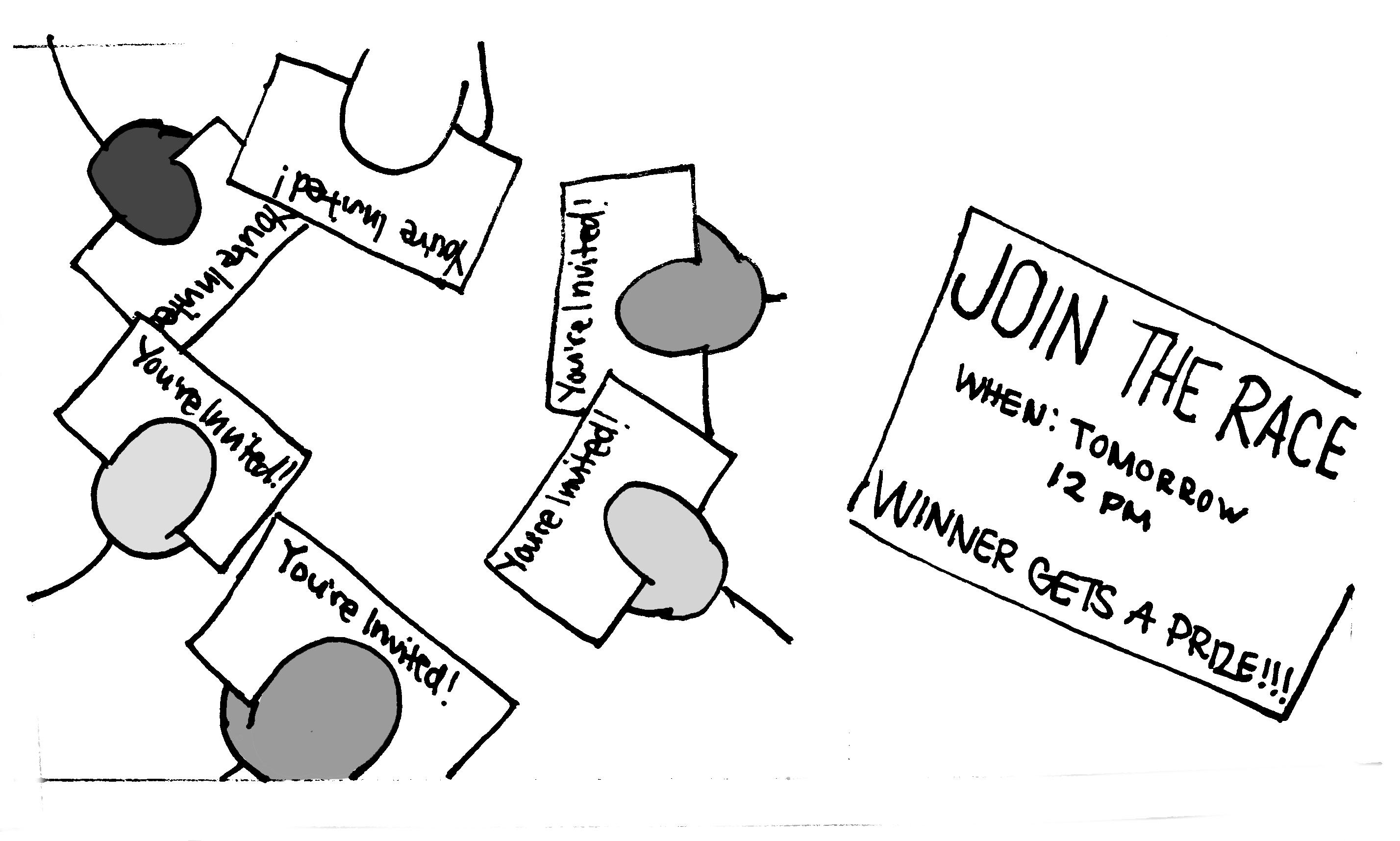
I am better than everyone else! I will win! They have no chance! I’m superior! . . . But can’t we all win?
Afterall, there is only one race . . . the human race.
ra·cial·ize verb (used with object), ra·cial·ized, ra·cial·iz·ing.
1: To impose a racial interpretation on; place in a racial context.
2: To perceive, view, or experience in a racial context.
3: To categorize or differentiate on the basis of race.
Some members of UMSU are considering the creation of a “Racialized Students” Representative. The interpretation of the term “Racialized” is generally taken to mean all students who are not white. The term also involves categorizing and differentiating people on the basis of their race, and imposing a racial interpretation. A racialized rep would be elected to represent everyone who is considered “racialized.”
At the outset of this piece, I feel it’s important for me to state clearly that I believe those who favor the creation of the racialized rep have good intentions. They are making a sincere effort to make the world a better place. My disagreement is not with their intentions, but the method they have chosen.
As we consider this issue, let’s ask ourselves a few questions:
First, should there be an UMSU rep elected on the basis of their skin colour?
Second, is it fair to create a position that could exclude white students and discourage them from running or voting for it?
Third, should every non-white student be grouped into one category and represented by one person?
My answer to these questions is no. Questions like these will be discussed as UMSU decides whether or not to create a racialized student's representative, a position that could divide students into two categories: white and non-white.
In my opinion, this would be a serious step backwards.
I want to be very clear. By oppos-
We are more than the colour of our skin
Why I believe creating a racialized rep is a step in the wrong direction
sPence R Fe Rnando, staff
ing the creation of a racialized student’s representative, I’m not saying that racism doesn’t exist, and I’m not saying that racism should be ignored. I must admit that at times I have made insensitive comments. And as the son of a black father and white mother I know that racism is still a reality. I have been called the “n-word.” When my parents were together and went to the malls in the 1980s, they often got stares and insulting comments thrown at them. My mother was even called an “n-word” lover. My family, and myself personally, understand the pain that racism can cause because we have lived it.
On a broader level, in Canada, the tragic legacy of residential schools and the inherent unfairness of the Indian Act is a constant reminder that we have some work to do ensuring equal rights in our own country.
Yet, it is also true that racism has lessened over time, often in dramatic fashion. Things are much different today then they were even 10 or 20 years ago.
Why has this progress been made? Was racial progress achieved by finding new ways to categorize people? Have we become a more equal society by finding new divisions to draw between each other?
I don’t think so.
The progress we have made is due to our increasing ability to see past skin colour and to recognize that we are all unique human beings, worthy of dignity and respect.
And when it comes to dignity and respect, I do not believe it is fair to create a position that clearly implies that white people are not welcome to run or vote for it. While this may not be the intention of the racialized representative, it is a possible side effect.
Excluding people because of their skin colour is what we are trying to stop. We have to be very clear on this principle: excluding someone—or implying that they are not welcome— because of their skin colour is not the right thing to do, whether that skin colour is black, white, or brown.
The way I see it, that would be going in exactly the wrong direction.
This isn’t about ignoring race. It is a fact that people have different skin colours. What I’m talking about is whether we should use skin colour as our defining standard for people. It’s whether we will form our judgments of people based on what we can control (our actions and choices) or what we can’t control (our skin colour).
We must consider the context in which this position is being proposed. Look at our own campus. Our current UMSU Executive – a very diverse group of people –was elected in a free vote of students from all racial backgrounds.
This is about showing trust in the students of this university. This is about trusting that we can see past race and make our choices based on our assessment of those we elect; or, to use the words of Martin Luther King Jr., “to judge people not by the colour of their skin, but by the content of their character.” People didn’t vote for our current UMSU Executive because of their racial backgrounds, they voted for them because they thought they were the best people for the job. That’s how it should be.
First Nations student.”
The concern that many people— including Silvana, Rachel, and myself—have with the racialized rep position is that it is an overly broad and simplistic measure of categorization. One person cannot adequately represent such a broad and diverse group of people.
To think that everyone who has a darker shade of skin should be grouped into one category is a disturbing echo of the attitudes that led to racial discrimination in the past.
Throughout our lives, each of us struggles to define ourselves, to forge our own path in the world. We shouldn’t be judged by the colour of skin we happen to be born with.
Yes, where we are born, our background, and our economic status definitely has an effect on our opportunities. Some people are born into a much better situation than others. Some people face a long uphill struggle to succeed. These are facts. But there is a difference between acknowledging differing circumstances and acting as if the only circumstance that matters is race.
The idea of dividing people by their race belongs in our past, not our future.
Now, I recognize that one of the goals of a racialized representative could be to create the room for a discussion about racism in today’s world. This is a worthwhile goal. The question is, is creating a racialized rep the best way to accomplish this?
I don’t think so, and some of my colleagues here at the Manitoban don’t think so either.
Silvana Moran, the Manitoban’s Graphics Editor, whose family is from El Salvador, had this to say about the Racialized Rep position: “I think it’s completely insulting to assume that my needs are the same as an International Student from another country. Just because I’m brown doesn’t mean my needs are the same as another brown person.”
Rachel Wood, the Manitoban ’s Senior News Editor also stated her concerns: “The needs of a student from China are not the same as a
We know that throughout history there have been attempts to force people into categories and suppress our distinctiveness. Even though a racialized representative may be well intentioned, it is a repeat of the mistakes of the past.
Recently, I was reminded just how far we have come from our difficult past of racial discrimination.
I was sitting in the Tim Hortons on Pembina across from the university with a friend of mine, a 75-year-old former U of M student and professor. In the midst of our conversation, my attention was drawn to the room around me and in that moment I was struck by the diversity of the crowd.
I saw a person wearing a Hijab sitting next to a family from India, their little baby sitting in a stroller. A group of white seniors sat next to a table where a young black man and white women were talking with each other. A family speaking Arabic
was seated at the table next to mine. And I realized that this scene would have been nearly impossible when my 75-year-old friend was my age.
When he was a student, people his age in the United States were participating in the Civil Rights movement. Some were shot and killed by the Ku Klux Klan for standing up for equal rights and human dignity. About that time, right here in Canada, it was not until the year 1960 that Aboriginal people living on reserves were given the right to vote.
Think of how far we have come since then. Think of how much progress we have made.
As I sat there, I wasn’t looking at “racialized” or “non-racialized” people. These weren’t people who fit into a neat little box or needed a new label imposed upon them, they were just people: mothers and fathers, sons and daughters. Each with their own life stories, their own hopes and fears, strengths and weaknesses, dreams and challenges.
Today a scene like that diverse coffee shop crowd seems normal and we take it for granted. And yet, this moment didn’t come about easily. It came about because people fought for equal rights, because people fought against racism and oppression. Many sacrificed everything they had to create a world where people of different races and cultural backgrounds could come together and share a cup of coffee in the same place. People gave their lives for it, and we must never forget what it took to get us here.
The idea of dividing people by their race belongs in our past, not our future. The advance towards a more just and equal world has come as we respect every person for who they are on the inside, not what they look like on the outside.
I believe that our best hope of continuing the progress we have made is by respecting the distinctiveness and worth of every human being, not forcing people into categories. This is why I oppose the creation of a Racialized Representative. We’ve made too much progress to turn back now.
Spencer Fernando is the Comment Editor for the Manitoban.
More like Holloween
How we’re ruining Halloween and what can be done to fix it
Ma Rc l agace, staff
Halloween 2012 has come and gone and I can’t be the only one who’s wondering what exactly has happened to one of my most favourite yearly traditions.
I can so clearly remember the days of my youth, where every Oct. 31—through rain or snow—my rag tag group of costumed pals would prowl the neighbourhood. Racing against the clock to score as much sugary loot as possible before we were expected to return home, every year was a great time.
But these days, it feels like there’s almost a war on Halloween. I’ve noticed a few disconcerting trends that have me questioning whether it’s even worth keeping the tradition alive.
trick-or-treating at a mall I get that there are reasons for kids and parents to be on the cautious side on Halloween. I’m not denying that there aren’t some sickos out there who offer up dangerous tricks instead of
delicious treats. But up until this year, I was completely oblivious to the existence of mall trick-or-treating. And I don’t like it.
Listen, I understand the arguments; trick-or-treating at the mall is safer. Everything is sterile, well lit, and it’s perfect for families with small children.
But you know what? If it’s too much to take your young kid around the block, or stop in at a few relatives’ houses to show off their costumes, then don’t bother. Trick-or-treating at the mall just seems like a crummy compromise for the kids, who don’t get to experience the true experience and atmosphere that you get walking around the neigbourhood. When you’re a kid, Halloween is all about going out trick-or-treating. And trick-or-treating is all about hanging out with friends, walking around the neighbourhood checking out the creepy decorations and carved pumpkins while yelling “trick or treat” as
loud as you can at each house.
I don’t care if stores are giving away full-sized chocolate bars; if you’re going store-to-store instead of doorto-door for Halloween, you’re doing it wrong.
Creative costumes > sexy costumes
I’m not going to lecture any adults out there who like to have fun and dress up in a sexy costume for Halloween parties. But I think that the amount of pressure that’s being put on women to conform to the sexy Halloween costume trend—and the possible affect that this objectification might have on the younger generations—is certainly more trouble than it’s worth.
As an example, many advertisements now showcase sexy versions of perfectly reasonable costumes. Why be a cop when you could be a sexy cop? Why be an M&M when you could be a sexy M&M? Why be
Praying the crime away
Devon Clunis’ trial by fire
ch Ris h ea Rn, volUnteeR staff
D
evon Clunis is Winnipeg’s newly sworn-in chief of police. He is also a proud Christian who believes that prayer can help cut down crime in Winnipeg.
First off, let me say that based on interviews and articles, Clunis (who has been with the Winnipeg police for 25 years and served as a chaplain with the force for 14) comes across as an intelligent, grounded, thoughtful, interesting, and dedicated man. The first instinct for many, including myself, was to think “Uh-oh. This is not sounding good!” when he started to publically discuss his views on the roles of religion in helping to reduce crime. Clunis believes that if people are praying for one another, they are less likely to do crimes against their neighbours.
“I think if we have a community that’s consistently praying for one another, hopefully we’ll now see the physical reduction of crime and violence in our city,” Clunis said to the CBC.
Not a bad idea in theory, although I question whether or not that is true. I don’t feel that bringing religion into an equation reduces violence, especially seeing as I think that much of the world’s current strife seems to revolve around religion in one way or another. But, yes, in theory his idea sounds quite good. Clunis has made it clear, however, that prayer is not enough; that it has to be backed up by action. This is a fair, level-headed
statement with an even slightly inspiring message.
I think it’s quite clear that although Clunis is a strong Christian who has stated he cannot separate his Christian beliefs from his work life because that is fundamentally who he is, he appears sensible enough to know the boundaries. Of course, those boundaries, in the eyes of most looking for a separation of church and state, are proselytizing or pushing religious ideas and doctrines on staff or prisoners. I sense, based on what I see and hear of him, that Clunis understands the limits but encourages those who are religious to use their faith for good.
So, I think Clunis deserves to be cut some slack. This isn’t to say I don’t have concerns. Although I think he’s sensible, if someone is declaring that something is at the very foundation of everything they do, that is a massive bias that can easily lead to the overstepping of boundaries without even really thinking about it. It would be completely unacceptable to turn the Winnipeg police force into an instrument of god, or use religion as a way to rehabilitate wrongdoers who aren’t religious to begin with. And, it would be completely unacceptable if those who are either not Christian or not even religious started to feel alienated both on the force and in the community.
Ultimately, I would rather have heard that people are the very founda-
tion of everything that Clunis does rather than religion. But he is who he is and I believe he understands, or at least should understand, he is working for and representing all Winnipeggers. Clunis may believe he got his job thanks to god but he doesn’t work for god, he works for the community.
Putting your religious beliefs on your sleeve is always a tad risky. Religion, of course, is a sensitive and often divisive subject. With the controversy Clunis has created with his statements he is getting a first-hand lesson of just how true that is. I don’t think he expected his statements to be as controversial as they have become and he has stated that he feels what was said has been misconstrued. Fair enough.
Clunis does have his supporters, both non-religious and religious. There are those who are fed up with crime and believe prayer within the community can help. Okay, it may. I won’t say that it isn’t possible. It is. Religion, when used in a positive way can be quite productive. But I also think crime can be reduced in a secular way. Caring about your neighbour doesn’t have to come through prayer. It can be just, you know, caring about your neighbour, which is a good thing to do, period.
Time will tell how Devon Clunis will perform in his new role. Does he deserve the benefit of the doubt when it comes to how he will use religion
Dorothy from Wizard of Oz when you could be sexy Dorothy?
As much as this is something costume and party stores must work to remedy, I feel like our society should show more concern for the message being sent to young girls and boys. These sleazy Halloween costume flyers, with all those naughty costumes for adults, inevitably find their way into the hands of impressionable youth. Before long, they too will come to expect that sexy costumes on women are the social norm.
Sexy costumes should be the exception, not the rule for Halloween. Store bought costumes, in general, are incredibly lame. In any costume contest, my vote will go towards the creative, homemade costume that took thought and time to prepare, rather than a sexed up Disney princess costume that was probably bought last minute.
The weirdest part is how they’ll have princess costumes for girls and
then the same costume, sexed-up for adults. That seems to be sending a pretty clear message to young girls: see this skimpy version of your costume? This is what is expected from you once you grow up. You can still be a princess, as long as you’re showing cleavage.
I won’t even touch the topic of risqué kids costumes, though I know that it’s becoming a growing concern among some parents.
Overall, the issue comes down to parenting. Speaking on behalf of my generation—the 20-somethings who might be considering starting families—it’s ultimately up to us to restore the good name of Halloween. As we settle down and buy our own houses, we need to continue to support the trick-or-treat tradition and foster safe and fun neighbourhood environments for kids and families to explore on Oct. 31. When you have kids of your own, skip the mall and hit the streets.
in his job? I think he does. I think it’s fair to look at who he appears to be and take comfort in knowing that he seems to be a good, smart, fair man. As long as this continues and he
can maintain a relative separation of church and state then I think he will be someone all Winnipeggers can support. If he can’t, I can see plenty more controversy in the future.
1921 Pembina Hwy (204) 275 1000
Science & technology
Robot roll call
Introducing
toM i ng R a M , staff
Canada’s new space robots
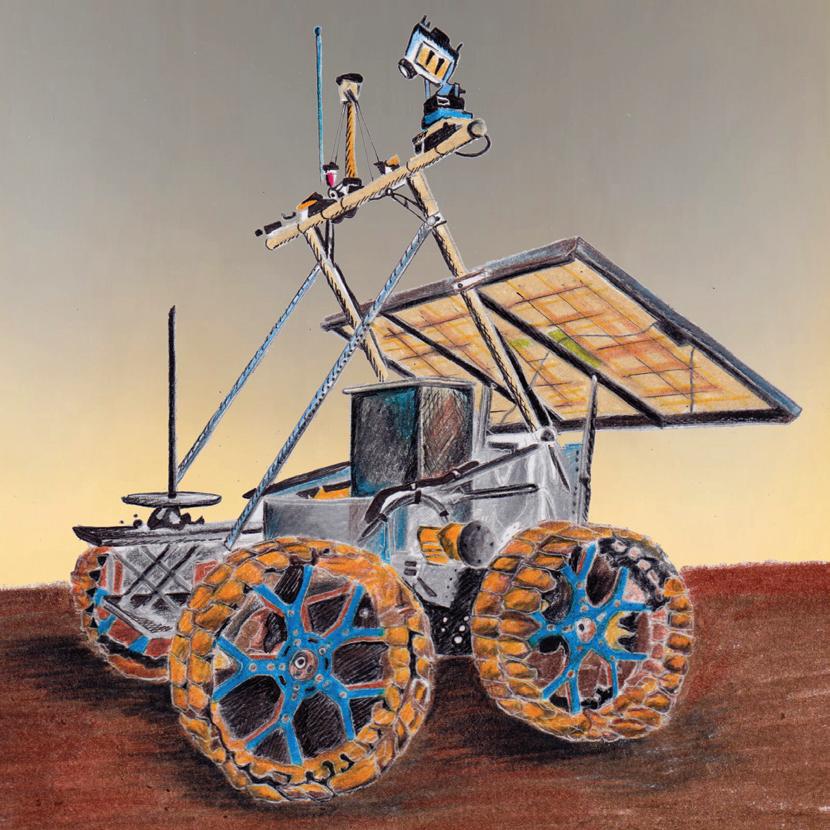
Recently the Canadian Space Agency (CSA) showed off their latest prototypes of rovers designed for use on the moon and Mars. The rovers—five of which are brand new
Weighing in at 900 kg, the six-wheeled vehicle is designed to be a mobile moon lab, but it can be upgraded to transport humans.
designs and one of which has been upgraded—are being put through their paces at the CSA’s simulated testing grounds.
Canada is known for its space robotics technology. The famous
Canadarm and Canadarm 2 (used on the space shuttle and the International Space Station, respectively), as well as Dextre, the two-armed robot on the International Space Station, were mainly built by MacDonald, Dettwiler, and Associates (MDA), a contractor based in B.C. MDA is a major figure in the CSA’s line of terrestrial rovers – they were the prime contractor on three of them. The CSA contributed a robotic arm to NASA’s rover “Curiosity,” which landed on Mars this past summer.
The largest and fastest of the CSA’s rovers is the Lunar Exploration Light Rover. Weighing in at 900 kg, the six-wheeled vehicle is designed to be a mobile moon lab, but it can be upgraded to transport
humans. It can carry up to 300 kg of science payloads and travel at
speeds of 15 km/h – by contrast, the LRV (“moon buggy”) that was used
in the Apollo program had a speed limit of 10 km/h. The rover is semiautonomous, meaning it can manoeuvre around obstacles without direct human intervention.
The Mars Exploration Science Rover, a smaller six-wheel vehicle with solar power, is designed to collect and return samples from Mars. It includes a robotic arm with a microscope and mini-corer for geological research. Most lunar and Mars missions involve geology, and Gilles Leclerc, the CSA’s director-general of space exploration, told CBC that Canada’s experience with mining technology is valuable in these situations.
Also included in the CSA’s fleet are “micro-rovers”: small, short-range vehicles tethered to larger
rovers. The fully-autonomous Kapvik micro-rover, weighing 40 kg, could be useful in a variety of roles. It is capable of helping an astronaut or larger rover dig. It can enter tight spaces that would be inaccessible to a larger vehicle. Especially useful is its ability to travel on slopes as steep as 65 degrees. The moon is full of craters that are of interest to geologists but too steep to be accessible to larger vehicles.
At this point, the rovers are still earthbound prototypes. The rovers have not yet been to space, and it could be a long time before they are finally put into use as intended. “The horizon we’re looking at in terms of taking the technologies on these terrestrial prototypes and transferring them into a real space mission to the moon or Mars is about 2020,” said Leclerc in an interview with the CBC.
iLLustRatiON by CaROLiNe NORmaN
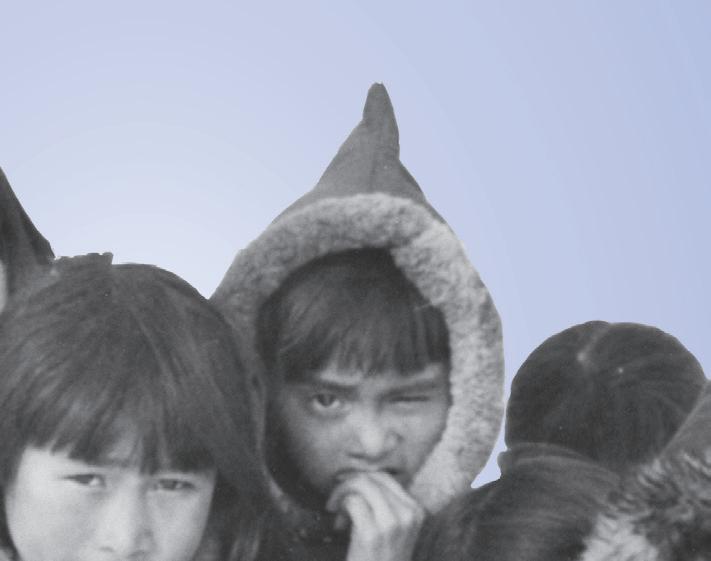
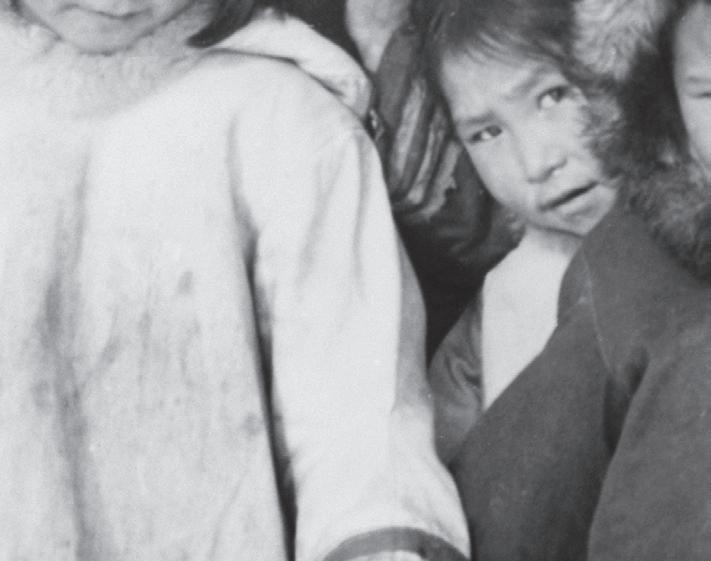
An exhibition that presents the Inuit experience of residential schools through the voices of 8 courageous Survivors.
Produced by the Legacy of Hope Foundation, Aboriginal Healing Foundation, and Library and Archives Canada with financial support from the Government of Canada
On Now until Nov. 16 Mon-Fri 6am - 10pm Sat & Sun 8:30am - 7pm
For more information, contact: Andrea Bilash 204-480-1473 or andrea_bilash@umanitoba.ca
EXECUTIVE LEAD FOR INDIGENOUS ACHIEVEMENT, OFFICE OF THE PRESIDENT INVITES YOU TO ATTEND EVERYONE
Magnitude 7.7 earthquake hits British Columbia
Canada’s largest quake in over six decades
bR andi M. shabaga, volUnteeR staff
“Beautiful British Columbia,” the license plates don’t lie. But beneath those beautiful mountains and rugged terranes exist one of the most violent and deadly of all natural hazards – earthquakes.
On Saturday, Oct. 27, 2012, a magnitude (M) 7.7 earthquake struck off the west coast of British Columbia in the Haida Gwaii Region (the former Queen Charlotte Islands) at 8:04:09 p.m. Pacific Daylight Time. The earthquake’s epicenter was located 141km south of the nearest village, Masset, B.C., and occurred at a depth of 17.5 kms below the Pacific Ocean floor.
Aftershocks following the initial M 7.7 quake have carried on into early November, with a total (so far) of 86 of these aftershocks or “mini earthquakes” measuring with magnitudes between 4.0 and 6.3. While the quake was not felt here in Manitoba, the University of Manitoba’s seismograph in the department of geological sci-
Fault lines
ences was able to detect and record the seismic activity of the initial quake and its tremors. The data and geologic summary are currently on display in the department’s museum located in the Wallace Building on the Fort Garry campus.
Anatomy of an earthquake Earthquakes are generated at great depths, by the release of a large amount of energy stored as built up strain within the Earth’s crust.
The solid outermost layer of the Earth’s crust, known to geologists as the “lithosphere,” is divided into pieces called tectonic plates. These plates roughly fit together like pieces of a jigsaw puzzle and are in constant motion while floating atop the underlying, molten hot, liquid portion of the Earth’s crust called the “asthenosphere.” Since these plates are dynamic (moving at extremely slow rates of only millimeters per year), geologists study the ways in which
these plates move and interact with one another to better understand how the Earth works.
When tectonic plates move towards one another and collide in convergent boundary settings, they can form thrust faults (where one plate is thrust up over the other) or subduction zones (where one plate is pushed underneath the other). In both cases, the amount of strain can accumulate until finally it is overcome and released in the form of an earthquake.
Tectonic plates can also scrape passed one another to transform boundary settings (resulting in transform faults), where they can get caught and become locked onto each other. As the plates attempt to slide past one another, the buildup of strain will continue until they eventually jolt free from one another and release an enormous amount of energy, triggering an earthquake. Perhaps the most famous example of an active
Opinion: Why the L’Aquila scientists should not go to jail
Alittle over two weeks ago, six Italian earthquake scientists and one public official were convicted of manslaughter.
The biggest mistake people are making in discussions of the trial is seeing it as a politically or religiously motivated assault on science. At least one article has (absurdly) compared the defendants to Galileo. This kind of rhetoric is distracting because it makes people get emotional quickly, and they begin to yell at each other over things that are irrelevant to the actual issues at stake, which are barely scientific at all.
It has been stressed many times that the scientists were not on trial because of their failure to predict the earthquake (which, as far as we know, is impossible). The prosecutor and the victims’ groups had a very specific bone to pick with the Major Risks Commission: according to them, misleading statements from scientists and public officials led people to underestimate the risks and stay inside, rather than do what they would normally do in an earthquake scenario. This is an institutional issue and a communication issue – it has nothing to do with an actual or perceived war on science. By all accounts the defendants actually did all the things they were accused of doing: they communicated poorly, if at all, and failed to carry out
a thorough risk assessment. The public officials were concerned more with keeping people calm than informed and made reassuring statements laced with scientific gibberish in press
nature.
James Bagian, a doctor and former NASA astronaut, was featured in Slate ’s “The Wrong Stuff” interview series in 2010. Bagian spoke in
conferences the scientists were not even told about. Clearly there were problems that need to be fixed in the future to prevent more tragedies of this scale. The prosecutor was not wrong about that. The judge’s verdict is an outrage not because there are no problems with Italy’s earthquake warning infrastructure, but because these problems are not criminal in
his capacity as the director of the US Veteran Administration’s National Center for Patient Safety, and as a member of the committee that investigated the Challenger disaster. In the interview, he emphasized his “systems perspective” on risk management, both in medicine and aerospace. “We’re not terribly interested in what some individual did,” he said.
transform boundary setting is the San Andreas Fault in California.
A close call
While British Columbia may be nearly 3,000 km away from California’s San Andreas Fault, the province has its own equivalent: the Queen Charlotte Fault. Both of these geologic structures are a result of the North American Plate grinding against the Pacific Plate, which was the cause of the M 7.7 quake on Oct. 27.
Historically, this fault system has seen a fair bit of action; high magnitude earthquakes are not foreign to Canada’s West Coast. In 1949, a massive M 8.1 earthquake struck only 100 kms away from the epicenter of the recent M 7.7 quake. Also hitting off the coast of British Columbia (or what would eventually be known as British Columbia) was the M9 Cascadia Megathrust Earthquake, one of the world’s largest earthquakes,
which occurred in 1700, registering at a magnitude of approximately 9.0.
Shortly after the recent earthquake occurred, a tsunami warning was issued for the West Coast of Canada and the U.S, as well as neighboring Alaska, and Hawaii. A small wave was generated, however, a full-scale tsunami was not part of the aftermath. Although the magnitude of the earthquake was large, the movement along transverse faults is horizontal rather than vertical. Tsunamis generally occur when the displacement along a fault is vertical, which results in a sudden displacement of a large body of water, creating a massive tidal wave.
According to geophysics experts at Simon Fraser University in B.C., aftershocks and small tremors could continue for at least a week after a quake of this size. To date, no significant damage or injuries have been reported as a result of the earthquake.
The example Bagian provided had to do with nurses accidentally administering the wrong medication to patients. It’s useless, he says, to punish the nurses or tell them to be more careful – even the best ones are bound to make some mistakes. Instead, the best solution is to ask why these mistakes happen.
“Maybe there were two drugs that looked almost the same. That’s a packaging problem; we can solve that,” remarked Bagian. “Maybe the nurse was expected to administer drugs to ten patients in five minutes. That’s a scheduling problem; we can solve that.”
Before instituting the use of barcodes for medicine, Bagian found that 7 to 10 per cent of all administrations involved an error in dose, patient, or route. After barcodes, that number dropped to 0.1 per cent.
Bagian’s “systems perspective” removes responsibility, fault, and all that fun Kantian stuff from the equation, focusing exclusively on cause and effect. This makes it seem rather cold, but it means that lives are saved and the system is able to constantly improve – doctors and nurses actually report their errors and close calls, knowing that no one will point and scream at them like in Invasion of the Body Snatchers So what does this tell us about
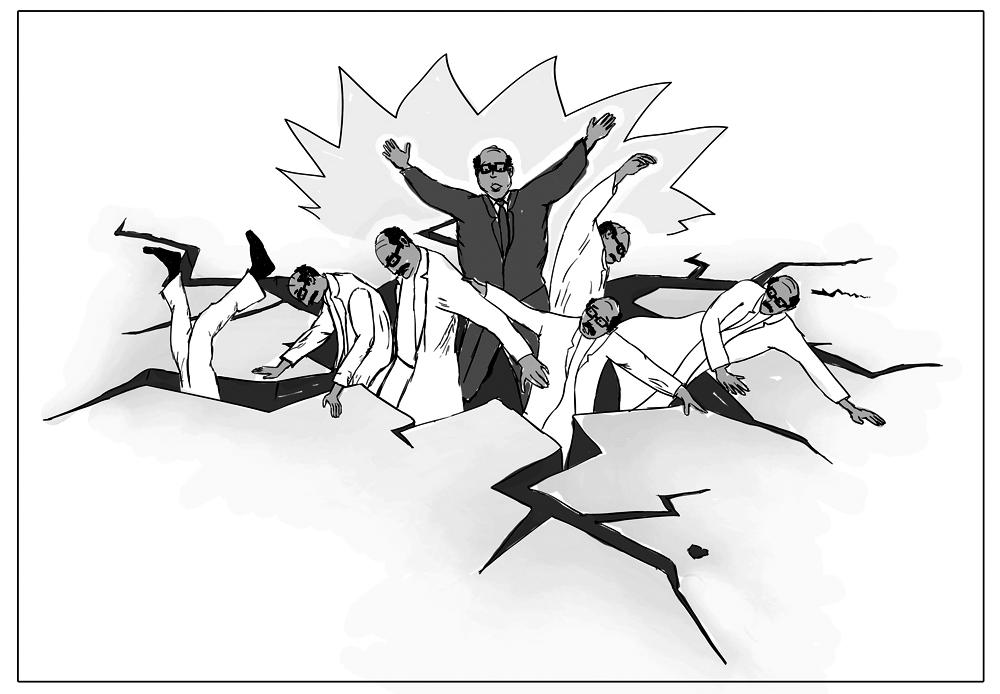
Earth sciences in Italy? There seems to have been a sense that the Major Risks Commission meeting was just a formality, convened to reassure the people that Science was on the case. That’s an institutional problem. There also appears to have been a basic divide between the scientists, whose job is to assess risk, and the laypeople who do not have a rigorous mathematical concept of what “risk” means. That’s a communication problem. Some scientists have voiced concerns about the methods Italy uses to predict earthquakes, and several have said that it’s not useful to focus on prediction at all, that strict building codes are far more important. These are scientific problems, and will have to be hashed out by specialists at obscure conferences. All these problems can be fixed without dragging scientists away on dubious manslaughter charges. Even more importantly, if Italy drags the scientists away and does nothing else, these problems will remain in place and nothing will be accomplished. The system that allowed this to happen is bigger than any one of the people involved. If we want better earthquake risk assessment, it’s the system that will have to change, not the individual scientists.
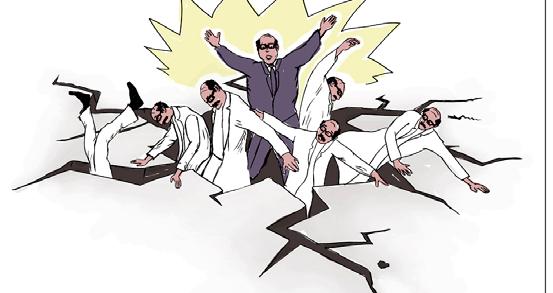
iLLustRatiON by phiLipp FisCh
Arts & Culture
Café culture
Thom Bargen and Café Postal to elaborate Winnipeg’s café scene
Jodie l ayne, staff
If you like to wake up and smell
the really delicious, artisan coffee there are going to be two new places to do so. With the opening of Café Postal on Provencher Boulevard this weekend and the imminent opening of Thom Bargen on Sherbrook Avenue, they will join the city’s burgeoning coffee scene.
Those in search of a perfectlybrewed cuppa are presently relegated to Nils Vik and his team of talented espresso-slingers at Parlour Coffee on Main, but that is changing.
be demand for more shops to open up with these standards. The more quality shops there are, the better it is for everyone, including the farmer,” says Graham Bargen – the Bargen of Thom Bargen.
“Coffee has run my life for the last three years. As a high functioning coffee addict, I feel like I need to open a shop to have better access to coffee and help me maintain relationships.”
“The coffee culture is growing and it’s increasing awareness to the ethics and quality of coffee, and there will
When Parlour first opened its doors over a year ago on Main Street, the response was overwhelming.
“It’s very flattering to see people respond so well to something that you’ve poured a lot of time and thought into,” Vik says of his café’s success. “I think the community has responded in this way because there is a dire need for quality, passion, and specialization in the service and retail landscape of Winnipeg.”
All three proprietors site similar
reasons for embarking into the bean and caffeine business – the luxury of an incredible coffee shop on every corner in cities they travelled to left them craving the same kind of experiences regularly in Winnipeg.
“Winnipeg’s coffee culture is increasingly getting better. Not to say it was terrible before, but the culture has evolved in many ways and we were falling behind. I’m so glad to see some evolution in the city and not in just coffee culture, but in general,” says Adrienne Huard, co-owner of Café Postal.
Another common thread that runs through all three businesses is the tangible passion of their owners – the cafés are not just a place to sit and give yourself fuel to get through another workday; they are labours of love and the culmination of years of hard work. Huard has worked in the coffee industry for ten years and travelled across North America, becoming inspired by the coffee culture in other cities. She is even considering a trip to Guatemala to see the source of the beans she grinds in her cafe.
TJ Hiebert of Thom Bargen, who toured Los Angeles solely to research its cafés, can relate.
“Coffee has run my life for the last three years. As a high functioning coffee addict, I feel like I need to open a shop to have better access to coffee and help me maintain relationships.”
In all seriousness, Hiebert says he cares about coffee and great hospitality and is excited to turn the café into a place to meet and a hub that fosters creativity and where people can be inspired.
The neighbourhoods and their residents have been gratefully welcoming these shops to the many corners of the city where they are opening for business; Parlour downtown, Café Postal in St. Boniface, and Thom Bargen in West Broadway.
“I think Provencher really needed a coffee shop and the support from the community has been overwhelmingly positive. Many people are saying ‘This is exactly what St. Boniface needs,’” says Huard.
West Broadway resident Izzy Goluch says the same for Thom
Bargen.
“In West Broadway people love their bikes and their coffee. I think having a non-chain coffee shop will be a welcome addition to a rapidlychanging street.”
Bargen and Vik agree on the fact that one of the misconceptions about Winnipeg is that well-designed spaces can’t or won’t do well, which has been completely disproved by Parlour’s success and the success of many other high-end, specialty businesses in Winnipeg.
Our reputation as bargain-hunters is potentially the most untrue belief.
“I would say that the biggest misconception about doing business in Winnipeg is the assumption that Winnipeggers are cheap. To categorize an entire city as cheap is as stupid as saying all Calgarians are rich – we are just like any other city, we have people who fit into every category concerning income and spending habits,” claims Vik.
So far, the evidence is in his favour and the newest shops to open stand to prove the theory.
Maskwa
By Tong Yue
Whorl of Sleep
Rosemary Scanlon paints narratives of life and history up north
Ka R a Passey, staff
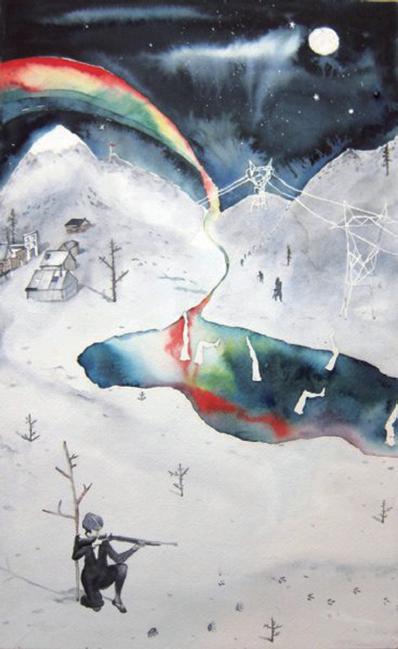
For the next month aceartinc. is home to Rosemary Scanlon’s exhibition Whorl of Sleep , a series of Darger-esque watercolour paintings that locate the tension between the fantasy and reality of northern life.
Scanlon completed her MFA at the Glasgow School of Art in 2010 and her BFA at Concordia University in Montreal (2006).
and works in Whitehorse, Yukon.
Scanlon has exhibited internationally and currently lives
While Scanlon has created installation and photographic works in the past, Whorl of Sleep is comprised entirely of watercolour paintings that have evolved from influences of medieval tapestry and vernacular photography.
The paintings are based off of a composite of images that Scanlon collects, whether it is from online or a photograph she takes of her surroundings.
100 Years of Loss
Scanlon is interested in how medieval tapestries overlay images, ignore ground and perspective, fill all space, and build a narrative of daily life.
“When I first started coming up to the Yukon, life up here was so surreal. It was so magical and strange – the atmosphere, the crisp quietness of when it gets really cold and really dark, the lynx slinking across the road ahead of you, wild adventures in pickup trucks, the things that go on under the midnight sun,” Scanlon told the San Francisco Chronicle. “My experiences here had a huge influence on my artwork and me. I like to attempt to locate that feeling of tension between the fantasy and reality of northern life.”
Scanlon’s painting, “The Looking
Glass” features an overlay of the Yukon’s flora and fauna on a dark background. A rainbow climbs out of some dead trees and a bear is perched on top of it. Various animals and flowers are scattered about as well as a mushroom ring and a pick-up truck covered in Christmas lights.
“All the animals are painted [from taxidermy],” said Scanlon. “I was interested in different representations of nature and how we preserve it. You slowly go through it and find the different animals and start making your own stories.”
The painting “Bang Bang” depicts a snowscape atop of an icy-looking black sky housing a full moon. The city of Dawson, Yukon is at the base of some snowy mountains and a rainbow pours
down from the sky, trickles a river through the mountains and creates a lake in the middle of a snow-covered plain. White legs kick out of the rainbow water and a woman crouches with a rifle in the foreground.
“While I was [doing a residency in Dawson] they were digging up the ground for a new sewage plant and they had come across some bodies [ . . . ] and they found that they came from the turn of the century [during the gold rush],” said Scanlon. “There were all these stories flying around about who they were [ . . . ] I was thinking about how things float up over time.”
Whorl of Sleep is a free exhibition and will be on display at aceartinc. until Dec. 7.
Mobile exhibit on Canada’s residential school system comes to the William Norrie Centre
Jenna d iubaldo, staff
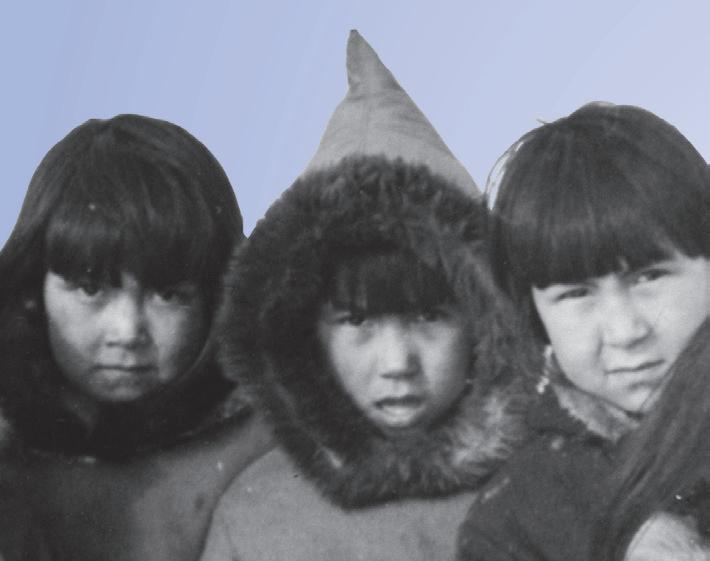
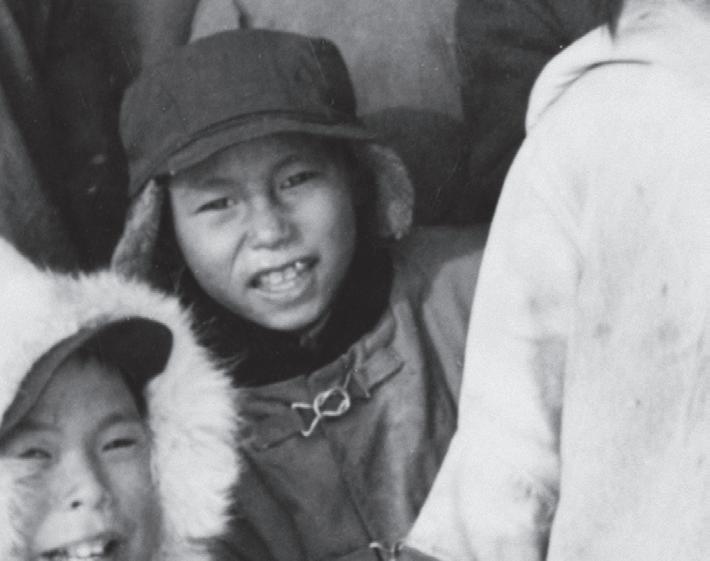
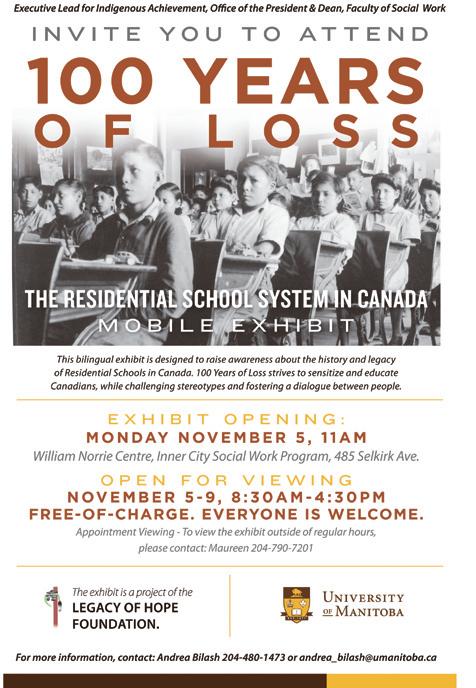
From Nov. 5 to 9, the University of Manitoba Inner City Social Work Campus (William Norrie Centre) will be hosting a mobile exhibit entitled 100 Years of Loss – The Residential School System in Canada
This exhibit is part two of a threepart mobile exhibit created by the Legacy of Hope Foundation, a charitable organization that aims to increase awareness and understanding of residential schools and the impact that this system has had on Aboriginal peoples in Canada.
Part two of the exhibit—We Were So Far Away - the Inuit Experience of Residential Schools—is currently on display at the Bannatyne campus, and part three—Where are the Children? Healing the Legacy of Residential
Schools—will be unveiled in February, 2013, at the Fort Garry campus.
100 Years of Loss: The Residential School System in Canada is made up of eight pods—each with a different theme—and offers information about the history and effects of residential schools in Canada in both English and French languages.
“Hosting exhibitions on residential schools builds upon the University’s Statement of Apology and Reconciliation to Residential School Survivors,” said Deborah Young, executive lead for Indigenous Achievement at the University of Manitoba.
“While our university recognizes that we cannot undo the shameful past, we can assist in building more
awareness on the history and the impact that residential schools had [on] generations of individuals, families, and communities."
The residential school system was created by the government of Canada, as well as several different church denominations, as a way to assimilate First Nations, Inuit, and Métis peoples into mainstream, dominant society. Over 150,000 chil-
dren were forced away from their families and into these schools and the effects continue to resonate throughout survivors and their families.
The exhibit will open on Nov. 5 with Ted Fontaine sharing his experiences as a survivor of the residential school system. Fontaine is also the author of Broken Circle: The Dark Legacy of Indian Residential Schools, a memoir
Polished acoustic folk songs
Hollerin’ Pines release their self-titled EP this November
Hollerin’ Pines will be releasing a new album of rootsy/folk songs that will please your ears and warm your heart. The self-titled, five-song EP is the band’s second release, but their first with their current line-up of musicians.
“For the first EP the band was just taking shape,” stated Scott Malcolmson, guitarist/vocalist for the band. “[Everyone’s] parts had not quite been worked out yet, and we recorded it with a friend Alan Nagelberg who played several of the instruments on each track. By the time we recorded the second EP we had the full band together and all six of us went into the studio to record it as a group.” The album captures a sound comparable to a bunch of friends playing acoustic instruments around a campfire, while still maintaining
polished and well thought-out song structures and instrumental elements. It is easy to see how the band’s songwriting abilities have matured since their last album, especially while listening to the opening track, “On
My Mind.”
The sextet recently returned from a Western Canadian tour to promote their new album – a tour that Malcolmson describes as a “big success.”
“It was the first time for this band on the road together and for quite a few of the members it was their first tour,” said Malcolmson. “We played some really great shows and made some good contacts for future tours, and had a lot of fun along the way. We made a point of hitting the streets to busk and spread the word about our shows while at the same time making a few bucks to cover a
recounting his time within residential schools and how it has impacted his life.
100 Years of Loss: The Residential School System in Canada is a free exhibit, and people of all ages are encouraged to attend.
“The exhibit is open to the public [ . . . ] and there is no cost to view it,” stated Young. “We are encouraging local schools, community members, and organizations to come in and see the exhibit.”
100 Years of Loss will be open for viewing between 8:30 a.m. to 4:30 p.m. from Nov. 5 to 9 at the University of Manitoba Inner City Social Work Campus. For appointment viewing outside of regular hours please contact Maureen at (204) 790-7201.
portion of our tour expenses.”
The album release will take place on Nov. 10 at the Times Change(d) High & Lonesome Club with an opening set from Adam Young.
“We have been working on some new songs since our return from the tour so folks who have seen us many times can expect four or five brand new songs,” said Malcolmson.
“It should be a great night and we’re excited to finally release the EP in Winnipeg and get it into the hands of family, friends, and music lovers in our hometown!”
Masturbation and porn are not the enemy
Working at an adult boutique can be an eye-opening experience and a practice in ridding yourself of expectations and stereotypes.
You become immediately comfortable speaking of intimate things with strangers, saying out loud words and desires that may have before only been rehearsed in your mind. Selling sex toys as a parttime job is rewarding to say the least, and being a part of someone’s self-guided, self-determined journey to pleasure always feels like an astute honour. There are moments when we are called to help people break through hangups and the lingering beliefs of a generation much more sex-negative than ours. This responsibility can also seep into our personal lives, for instance, when a co-worker recently had someone reach out to her for help with an issue, as often happens to those of us whom people feel safe with.
be defined by each partnership and needs to be something both partners feel comfortable with, I think that the idea of what our own individual sexuality is in a multiperson partnership deserves a little challenging.
The fact is that as soon as we enter a partnership, we do not lose our individual sexual desires or sexual agency. Our bodies and sexuality are our own, even if we have committed to sharing that with a partner regularly and/or exclusively. We get to choose when we have sex or don’t, we still have the absolute privilege and duty to ourselves to be the source of pleasure to our own bodies.
We live in a monogamybased society, and this is not an uncommon problem.
Masturbation is, in my opinion, an important part of self-care. It makes sense – I nourish my mind with books, films, and meditation, my spirit with music and time with friends, and my body with vegan food, long baths, and giving myself orgasms.
The person in question had a problem with their partner viewing porn. They felt cheated on and betrayed and asked their partner to refrain from using it while continuing their relationship. Their partner could not agree to this and the couple’s sex life completely fizzled out – one of them felt betrayed and one of them felt censored.
We live in a monogamy-based society and this is not an uncommon problem.
We are taught that our partner is our property; we alone are allowed access to their bodies, minds, emotions, affections, and sexual experiences. Looking at another person, having sexual fantasies, masturbating alone, going to see strippers, or watching porn are usually seen as deviations to this ideal. While monogamy (or nonmonogamy) is something that must
We are still allowed to explore what turns us on, what definitely doesn’t, and what makes our stomachs churn. It might be an active imagination that allows us to fantasize about different scenarios that excite us, that allow us to partake on this journey, or we might want or need visual aids. Yep, porn. There are many politics in porn and we will discuss them another day, but the fact of the matter is that there are many of us who use it.
We humans are complex and multi-faceted and when you put two or more of us together to navigate those facets, it can be messy and complicated to say the least. We all come to relationships with varied life experiences, belief systems, baggage, and stuff of some sort. Our job as partners is to help one another unpack that baggage.
We will be comfortable with certain things because of our life
experiences so far and we will be uncomfortable with some things for the same reason. Neither one is right or wrong. It’s understandable that we could feel jealous at the thought of our partner having an orgasm without us, something that is so intimate when done together. It is also understandable that someone is excited by the images of people they will never sleep with doing things that they may never do – but masturbating and sex are completely different things. Having a partner who is in tune with their desires and is still excited and invested in their pleasure is a gift.
Drawing boundaries and having your partner respect those boundaries are important. If the idea of a partner using porn, sex toys, or masturbating is threatening to you, that is a valid feeling. If your partner agrees to not do any of these things, cool. The chances are, though, that at some point these things will come up. When they do, at the very minimum, be open to doing the hard work of figuring out where your hesitation comes from and communicating that.
“It makes me feel insecure that you watch porn with people that look different than I do in them,” can lead to a conversation about insecurities and an action plan to have your partner reassure you of all the things they find astounding about you.
Of course, there are many reasons why you may feel uncomfortable. So explore them, communicate, and take baby steps towards being more comfortable and open. It is important to remember that shutting out a partner for talking about their desires and closing yourself off just leads to them feeling like they can’t share their most intimate thoughts, which means that they’ll just keep things secret – the exact opposite of the intimacy you are craving.
You can confidentially submit a question or topic to jodie.m.w.layne@ gmail.com
Jodie l ayne, staff
Effortless talent
Dan Mangan plays the Burton Cummings Theatre
Rachel Wood, staff
Canadian singer-songwriter
Dan Mangan rocked the Burton Cummings Theatre on Nov. 1 with his renowned growling voice and songs that have the ability to get everyone on their feet and put the entire crowd in a ballad-induced trance only minutes later.
After a one-hour performance by the Rural Alberta Advantage, Mangan took the stage. He played a variety of songs from the albums Nice, Nice, Very Nice, Oh, Fortune and his new 7” Radicals, entertaining the crowd in between songs with anecdotes about Winnipeg, including rave reviews of Mondragon and Deer + Almond.
Mangan continually puts on interactive shows, connecting with the audience at every opportunity available – this one was no different. Mangan often gave a back-story of the songs he was about to perform. Preceding “Road Regrets,” a song
that produced an eruption of cheers from the audience when the first
from a long drive to Texas in which he found himself in the middle of a harsh storm.
lyric was sung, Mangan spoke of his inspiration for the song, which came
Desire’s Despair
Mangan immersed himself fully in the audience, entering into the crowd and playing for the audience in the balcony while standing on a seat in the first few rows, often getting the crowd to sing harmonies and lyrics along with him.
Towards the end of the show, Mangan encouraged those who didn’t have floor access tickets to enter the area anyways, much to appreciation of his fans and the dismay of event security.
Mangan told the Manitoban how amazing it is to see people who continually attend his shows who have followed his career from when he was opening for bands at the Lo Pub to now crowded shows at large venues such as the Garrick Theatre and the Burton Cummings Theatre.
When asked if touring has changed with his increasing popularity, Mangan explained that logistically it has but that the core remains the same.
“When it comes down to it, it has to do with the time you’re on stage and the people you are in front of and trying to make that as special as possible [ . . . ] you have to get the most out of the good stuff on stage.”
His new 7” was less of an anxietydriven release, according to Mangan, who is typically very emotionally involved in his albums.
“I like the idea of a song on each side. It’s kind of a nostalgic thing to do. It’s an old thing to do,” said Mangan.
It makes sense, then, that Radicals consists of a B-side from Oh, Fortune and a Yukon Blonde cover, a band that he performed with at his wedding last month. The album has been released on vinyl and is available digitally.
Admittedly not a songwriter who composes love songs, Mangan doesn’t expect that to change now that he is married. Mangan writes about a wide variety of topics, ranging from his hometown of Vancouver
(comparing the ever-changing city to Tina Turner’s career) in “Tina’s Glorious Comeback,” to the idea of aging gracefully in “Basket.”
Mangan’s fast track success is evident in the recent release of a documentary centered on the artist.
“What Happens Next,” directed and produced by Jon Siddall and Brent Hodge, follows Mangan on the night before his performance at the Orpheum theatre in Vancouver.
“They did a good job of being flies on the wall [ . . . ] Obviously it’s a very flattering thing to have a film made about you. It’s kind of a weird thing to get over,” explained Mangan.
After a few more weeks touring and a European tour with Jason Collett, Mangan will be taking a break and then aims to be back in the studio by late 2013.
The Nov. 1 show proved once again that Mangan’s seemingly effortless talent, humility, and charming presence on stage all come together to produce a dynamic show that you’ll be sorry to miss. Do yourself a favour and check out Mangan’s next performance – I can guarantee that you won’t regret it.
Winnipeg locals Mise en Scene release their first full-length album
Jenna d iubaldo, staff
O
ne of the greatest aspects of Winnipeg’s music scene is an undeniable, commanding presence from some of Canada’s greatest female musicians, who not only demand attention, but also deliver fresh, creative, passionate music.
Local indie rock duo Mise en Scene is a prime example of a strong female presence within our city’s music scene.
Stefanie Blondal Johnson (guitar/ vocals) and Jodi Dunlop (drums) released their debut EP Late Night Triple Feature in 2010, and with it made their first trek outside of Winnipeg bringing their raw, melodic sound across the country. The pair has been drawing attention ever since and is now ready to unleash their next album.
With the impending release of their follow-up full-length album entitled Desire’s Despair, Mise en Scene have begun to gain momentum in the Canadian
music scene, with their newest release reaching #11 on the Earshot National College Chart prior to the album even hitting stores. The Manitoban had the opportunity to chat with Mise en Scene about their new album and here’s how it went.
stores in November. Given that this is your first full-length release, do you feel as though this album came out the way you had planned, and accurately portrays your sound and music?
stefanie Blondal Johnson: We are really proud of our album. We had to focus on staying true to our sound when we were recording and [made] sure there was heavy emphasis on drums, guitar, and vocals in the production. Since we worked with three amazing different producers on this album, it was interesting to see how they interpreted our music and their take on our sound as a duo.
the Manitoban: Desire’s Despair officially hits
M: Desire’s Despair has been garnering much attention on the national charts these days. What is your reaction to this?
sBJ:
We are obviously very happy to be on the charts and to have our music playing and charting nationally. It’s always great to see results after working so hard on a project. Making an album takes time, patience and tons of effort, so we are very pleased with it doing so well.
M: There are a lot of additional instruments on this recording – did you work with session musicians and if so, how was that experience?
sBJ:
We worked closely with the additional musicians on the album – it’s always nice to work with people you know and trust. We oversaw every session they were on in order to make sure that they were adding the right feel and sound to what we wanted.
M: How do you feel that your label Pipe & Hat has impacted your music?
sBJ:
Pipe & Hat is a wonderful label that has given us tons of support and helped us get this album recognized at the level that we feel it deserves. We really like that [they] let us do our
thing when it comes to writing the music and being Mise en Scene. Things get overwhelming when you are taking music to the next level, [so] it’s important to start building a great team around you that will help you in the areas where you need help with so you can concentrate on the music, and Tim and Kenny (Pipe & Hat) do a great job with that.
M: What can fans look forward to at your album release show in December?
sBJ: Fans will get a chance to see us play a great show at a fantastic venue. It’s going to be a big celebration in honour of [our] past year as a band. Jodi and I have been through a lot to get to this point. It’s important to celebrate the release of our first fulllength album – it’s a milestone in the band’s history. We are ready to party with fans, friends and family – it’s going to be a great night.
Mise en Scene’s newest full-length album is currently available online at miseenscene.bandcamp.com/album/ desires-despair, and will be released in stores on Nov. 13. Check out their album release show at the West End Cultural Centre on Dec. 1.
Bombers play second annual last game ever at Canad Inns Stadium
Hopeful for happier times at Investors Group Field after disappointing season
d e Re K g agnon, staff
T
his time they mean it!
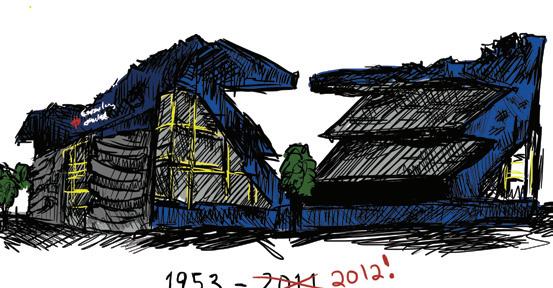
After construction delays to Investors Group Field on the University of Manitoba campus saw the Winnipeg Blue Bombers play an additional season at Canad Inns Stadium, the Bombers played what we hope will be their last game at the old barn on Saturday, Nov. 2, against the Montreal Alouettes.
The game was of little importance to either team, as final standings were already decided. It translated to the field, where a snoozer of a game eventually saw the Bombers prevail by a score of 19-11. Most of the starters for both teams were left watching from the sidelines, as nobody wants to get hurt in a game with no bearing.
The most significant thing about this game was the fact that it will be the last CFL game ever played at Canad Inns Stadium. If the script sounds familiar, it’s because you heard it last year when the Bombers played
in the Eastern Division Final against the Hamilton Tiger-Cats on Nov. 20, where a –22 wind chill greeted a sold out house rooting the Winnipeg team on to a victory and a chance at the Grey Cup. You could not ask for a better ending, as local hero Doug Brown played his last game in front of home fans, and the final play was a Blue Bomber touch down. It was almost poetic.
One lost title game and a season of disappointment later, the Bombers once again managed to close out the stadium with a victory, with the final play being a quarterback sack by Bomber defensive end Kenny Mainor. Still a memorable game, but it will never be as good. Looking forward to next sea-
son there are a lot of questions in Bomberville, as the organization has faced scrutiny from top to bottom after failing to make the playoffs. Players and staff remain optimistic they can turn this ship around and be a competitive team next
quarterback for the club next year?
questions endure: Can general manager Joe Mack return this team to championship form? If Buck Pierce has lost the faith of the most loyal of fans, who will be the starting
The Calgary catastrophe: part two
Bisons end season with loss to dominant Dinos
Ma Rc l agace, staff
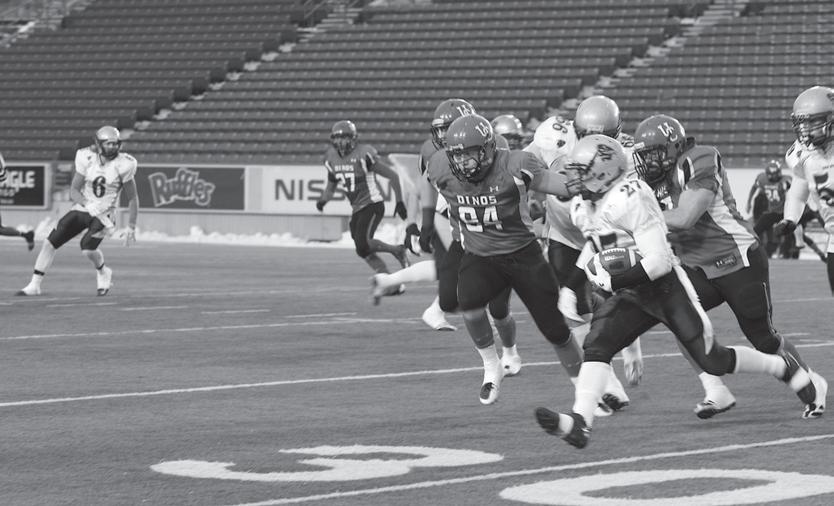
Playing in their first playoff game since 2007, the Manitoba Bisons were completely dominated by the Calgary Dinos in a 57-18 blowout. The defending conference champion Dinos will play in the Canada West finals, looking to secure the Hardy Cup for the fifth consecutive year. The blowout comes one week after the Dinos and the Bisons broke team, Canada West, and CIS records with a crazy 78-54 offensive shootout, a victory for Calgary that included 42 points scored in the second quarter alone.
Simply put, Calgary was the better team in both games, but especially in the playoff game. Manitoba turned over the ball five times in the first half
as Calgary amassed an impressive 393 yards of total offence and a 41-0 lead by halftime. The Dinos controlled the line of scrimmage on both sides of the ball and capitalized on every opportunity the Bisons provided. Making things worse for Manitoba, Anthony Coombs—one of the most explosive offensive weapons—was forced out of the game early in the first quarter with a lower body injury. To lose a player of Coombs’ caliber at any point is disasterous, and especially so early when the game was still up for grabs. It
Whether or not the Bombers look for help elsewhere at the QB position will be a storyline of interest this off-season, as when you play in the Canadian Football League your team is only as good as your quarterback. The Bombers currently have five quarterbacks on their roster, with Pierce, Joey Elliott, Alex Brink, Justin Goltz, and R.J. Archer all looking to keep their jobs next spring when the team moves to the new stadium.
Investors Group Field is nearing completion, and the 33,422seat stadium continues to look more magnificent as the days go by. Gone will be the trough and steel benches. Replacing them will be a state-ofthe-art stadium, where fans and play-
ers alike look to make many happy memories for years to come.
Quarterback Alex Brink was gushing after the game about playing in the new stadium next year.
“It can’t be described how much we’re looking forward to it. It’s going to be so special to have that facility, hands down the nicest facility in Canada to play football in. The locker room and facilities aspect is going to be great for the players and we can’t wait to get in there.”
With the Bombers and the Ticats on the outside looking in, the CFL playoffs will kick off on Remembrance Day. The Toronto Argonauts host the Edmonton Eskimos at 12:00 p.m., while the Calgary Stampeders host the Saskatchewan Roughriders at 3:30 p.m..
seemed to set the tone for the rest of the evening. The injury bug bit the Bisons again in the second half, as another key
weapon, Nic Demski, left the game.
Bisons split games with Dinos
Hometown hoopster gives Manitoba all they can handle
Ma Rc l agace, staff
The Calgary Dinos and Manitoba Bisons split a two-game series to open the 2012-13 Canada West men’s basketball season.
The Dinos picked up an 87-78 victory on Friday, in large part due to the spectacular play of Winnipeg
Cam Clark struggled in the first half, completing only five passes for 55 yards. Clark finished the game completing 12-of-34 passes for two touchdowns and one interception, in what was the last game of his CIS career. Ryan Marsch came in briefly during the first half, but his only pass of the game was deflected, intercepted, and returned for a touchdown.
With Coombs and Demski out, the Bisons rallied around power back Kienan LaFrance. He ran for 124 yards and a touchdown on
22 carries, and hauled in two touchdown passes for a total of 58 receiving yards.
The Bisons played honourably and, just like the week before, never showed signs of giving up despite the lopsided score. The loss marks the end of an era for Bison football, as they look forward to moving into Investors Group Field, where they will organize and prepare for their first season at the new home for football on campus.
Calgary will host the Regina Rams for the 76th Hardy Cup on Saturday, Nov. 10. The game will be broadcast live on TSN at 3:00 p.m. CST.
phOtO by JustiN seWaRd
native Jarred Ogungbemi-Jackson. The third-year point guard led all players with 33 points. In post-game comments, Bison guard Jonar Huertas explained that the Bisons needed to do a better job covering Ogungbemi-Jackson; he
burned them all night long, going 7-for-7 from beyond the arc.
In the rematch, the Bisons did a better job containing OgungbemiJackson - although he still led the Dinos with 21 points. Five Manitoba players finished with over ten points
as the Bisons evened the series with a 76-68 win, and the team improved their overall shooting by five percentage points. With a 1-1 record, the Bisons will look to improve their record against the winless Brandon Bobcats. Both
the men and women’s teams will play their first home games of the regular season, Nov. 9 and 10 at the Investors Group Athletic Centre. The women play at 6:00 p.m. each night, with the men’s games tipping off at 8:00 p.m..
iLLustRatiON by bRadLy WOhLgemuth
Veterans in the line up
Remembering athletes who served in the military
a da M Peleshaty, volUnteeR staff
This Sunday is Remembrance Day.
It’s the time of the year when we stop to pay tribute to the brave men and women who have served our country overseas in the defence of our freedom. They came from many walks of life and volunteered to risk their own lives.
It is hard to imagine today that professional athletes would be willing to fight overseas in battle, but in the days of World War II professional athletes were everymen who often had off-season jobs. However, these men were willing to sacrifice their own athletic careers and their lives so that we may enjoy life in Canada and the United States to the fullest.
Professional hockey players became involved with the war effort in World War I, which coincided with the advent of the professional game and the founding of the National Hockey League. Sadly, two of the game’s earliest stars were killed in battle. Frank McGee, who once scored a record 14 goals in a 1905 Stanley Cup game and an inaugural inductee of the Hockey Hall of Fame (HHOF), was killed in the Battle of the Somme in 1916. Scotty Davidson, one of the game’s top wingers, was killed in France at the age of 23. He was inducted into the HHOF in 1950. In 1919, the Memorial Cup was dedi-
cated to those who had lost their lives in WWI and is currently given to the champions of the Canadian Hockey League.
The attack on Pearl Harbor in 1941 was the impetus for many NHLers to put their careers on hold and join the war effort. By 1942, a total of 80 NHLers served in the armed forces including some of the league’s best, such as Detroit’s Sid Abel, Toronto’s Turk Broda and Syl Apps, and Chicago’s Max Bentley.
The attack on Pearl Harbor in 1941 was the impetus for many NHLers to put their careers on hold and join the war effort.
The “Kraut Line” of the Boston Bruins— which consisted of Woody Dumart, Milt Schmidt, and Bobby Bauer— enlisted into the Canadian Army in 1942. In the three years prior, they won two Stanley Cups and became the first teammates to finish 1-2-3 in league scoring. Two NHL players died in battle: Joe Turner, who played one game with the Red Wings as a goalie, and Red Garrett, who played 23 games with the New York Rangers.
Football would also be affected by war. Teams in the NFL either folded or merged due to the number of players who served in WWII. In all, 600 NFLers served in WWII, 19 of whom died in action. In the Vietnam War, Roger Staubach fought before playing in the NFL while one active NFLer, Buffalo offensive guard Bob Kalsu,
died in battle in 1970.
In Canada, the precursors of the CFL—the Western Interprovincial Football Union and the Interprovincial Rugby Football Union—halted play from 1942-44, which allowed military and university teams to compete for the Grey Cup. The Winnipeg RCAF (Royal Canadian Air Force) Bombers reached the Grey Cup game and lost in 1942 and 1943.
The 1941 Major League Baseball (MLB) season is remembered for Red Sox LF Ted Williams hitting for .400 and Yankees CF Joe DiMaggio’s 56-game hitting streak. Months after the season ended, both fought in the war. While U.S. President Franklin Roosevelt allowed the MLB to play during wartime, more than 500 of its
players enlisted, including big names such as Cleveland’s Bob Feller, St. Louis’ Stan Musial, and the Yankees’ Yogi Berra.
Over 4,000 minor leaguers also volunteered to serve. Two major leaguers, Elmer Gedeon and Harry O’Neill, were MLB’s only casualties. Don Stewart, a minor league umpire, died in 1941 while serving with the Canadian Army’s Calgary Highlanders. Willie Mays, one of baseball’s greatest players, served in the Korean War.
It is rare for professional athletes to give up their careers in modern times to join the armed forces, but there have been two recent instances. Arizona Cardinals safety Pat Tillman turned down a $3.6 million contract to
enlist in the U.S. Army. He fought in Afghanistan but was tragically killed by friendly fire in 2004. Philadelphia Flyers prospect Ben Stafford enlisted into the U.S. Marines shortly after winning an AHL Calder Cup in 2005, and was deployed into Iraq. He survived his tour of duty, but ended up retiring from pro hockey. While many in sports journalism are prone to use war-related terms to describe a hard-fought game or to describe players as heroes, it should be made clear that these athletes and the men and women who served with them are true heroes. For that, we are forever grateful.
iLLustRatiON by mathieu
Volleyball teams keeps rolling
Ma Rc l agace, staff
Both the Bison men’s and women’s volleyball teams preserved their perfect records with victories over the Calgary Dinos on Nov. 1 and 2.
On Thursday night, the Manitoba women nearly let Calgary force a fifth set, but managed to shut down a desperate Dino team in the fourth to secure a 3-1 victory (25-20, 19-25, 25-13, 25-23). Rachel Cockrell and Emily Erickson were the players of the match, as they led the Bisons’ offensive attack. Cockrell led all players with 19 kills, while Erickson had the second-most kills on the team, including four service aces.
The men finished the night by quickly and effectively putting the Dinos away in straight sets, 3-0 (25-13, 25-19, 25-17). The Bisons were stronger offensively and defensively; Dane Pischke led all players with 13 kills, while first year middle hitter Kenny Rooney showed his defensive prow-
ess, helping with nine blocks of the night.
The following day, Calgary took the Bisons women to the limit with a five-set match that the Bisons ultimately won 3-2 (25-27, 25-17, 25-17, 14-25, 15-9). Three Bisons players had kills in the double digits: Cockrell (17), Crystal Mulder (16), and Erickson (12).
The men finished the road trip with a win over Calgary 3-1 (15-25, 25-19, 25-18, 25-14). The win keeps their perfect record intact and sees them tied at the top of the standings with Alberta.
The Bisons will face some stiff competition this upcoming weekend as they visit their cross-province rivals, the Brandon Bobcats, for two evenings of volleyball on Nov. 9 and 10.
Beauty The Beast
We all need to manage the waste we create. If you’re like 90% of Manitobans, you already recycle. But one third of us admit we still throw into the trash some items that could be re-used or recycled into useful materials. Let’s manage to do better!
More than half of all household garbage can be recycled. Are you recycling all you can?