A “volunteer staff” member is defined as a person who has had three volunteer articles, photographs, or pieces of art of reasonable length and/or substance published in three different issues of the current publishing year of the Manitoban. Any individual who qualifies must be voted in by a majority vote at a Manitoban staff meeting. Elected representatives and non-students may be excluded from holding votes as volunteer staff members in accordance with the Manitoban Constitution. The Manitoban is the official student newspaper of the University of Manitoba. It is published monthly during the summer and each week of regular classes during the academic year by the Manitoban Newspaper Publications Corporation.
The Manitoban is an independent and democratic student organization, open to participation from all students. It exists to serve its readers as students and citizens.
Executive refuses to pay national student union until demands are met
Craig a dolphe, staff
The University of Manitoba Students’ Union is refusing to hand over roughly $640,000 in student fees owed to the Canadian Federation of Students.
The fees include: $197,000 owed to the CFS for the 2013-14 academic year; roughly $190,000 expected for 2014-15 after including fees being collected in the winter term; $131,000 owed to CFS’s regional wing, CFSManitoba, for the 2013-14 academic year; and roughly $125,000 expected for 2014-15 after including fees being collected in the winter term.
As local 103 of the CFS, the fees were collected by UMSU on behalf of the CFS. The UMSU executive is refusing to hand over the fees until the CFS meets certain demands, which they say the two unions have been at odds over since the beginning of the 2013-14 academic year.
The sum of fees includes all those collected during the 2013-14 academic year as well as for the fall 2014 term.
All U of M undergraduate students are members of the Canadian Federation of Students, which includes the national wing and the regional wing. As members of CFS, all UMSU members pay fees to the student union, are eligible for services, and pay to support lobbying on student issues at different levels of government.
Students at the Fort Garry campus pay $7.10 per semester in CFS fees. Students at the Bannatyne campus pay double that, $14.20 per semester. Higher fees are common for students on the Bannatyne campus, who also pay twice as much for all other student fees, with the exception of the UMSU operating fee. The operating fee is set at $23.50 for each campus, and faculty, college, and residence fees vary, ranging from $7.75 to $27.75.
Turnbull’s take
In a September interview, UMSU president Al Turnbull said that UMSU had not paid the collected student fees to the organization because CFS had not responded to requests to turn over control of UMSU’s website and domain to the local.
“We don’t want CFS or any third party to own umsu.ca. We don’t want anyone except UMSU to own umsu.ca. So we’ve requested four or five times that we would like to own umsu.ca, and four or five times we’ve been either ignored or denied.
“It’s not a secret. We’re not hiding at all why we’re withholding fees,” Turnbull said. “We straight up say, ‘When you respond to our other emails we’ll pay you. When you give us back our domain name we’ll pay you.’”
Turnbull said that efforts by UMSU to regain control over the student union’s website and domain date back to his first term as UMSU president. Christian Pierce, UMSU vice-president external, who has served on the UMSU executive with Turnbull since 2013, was tasked with contacting CFS and negotiating a
deal to take control of www.umsu.ca.
Turnbull said that during last year’s fall term, Pierce was calling CFS on a daily basis. Turnbull suggested that he and Pierce were ignored.
“Finally we just gave up. And then we tried again this year with the new executive.”
When asked if withholding the fees was meant to be an act of defiance Turnbull responded, “I would actually go further and say that this is a respect act. We’ve asked for a couple things to happen, which are not unreasonable.”
When asked about the impact that withholding fees may have had on CFS-Manitoba, Turnbull pointed out that the majority of CFS-Manitoba’s funding comes from fees collected at the University of Manitoba. Fees from students at the University of Manitoba made up 62 per cent of CFS-Manitoba’s budget in 2013-14.
“We’re
not hiding at all why we’re withholding fees. We straight up say, ‘When you respond to our other emails we’ll pay you. When you give us back our domain name we’ll pay you’” – Al Turnbull, UMSU president
The majority of their budget “is gone. And we’re quibbling over some seriously small stuff,” said Turnbull.
Turnbull defended the UMSU executive’s decision to withhold the fees as a reasonable response. He denied that it was part of any plan to leave the CFS.
“We’re not doing this maliciously. And we’re not withholding fees for no reason,” Turnbull said.
“If we ever wanted to leave the CFS—and this is super hypothetical—that is the absolute worst way to do it,” Turnbull continued. “If you want to leave you’ve got to follow the rules to leave. And not paying fees is definitely an easy one for a judge to look at. That is not a strategy for us to do anything maliciously, it’s actually a strategy for us to get things done.”
National’s response
In an interview in September, Brent Farrington, CFS internal coordinator, said that UMSU had not provided CFS with any explanation as to why the fees remained unpaid.
Farrington described the national office’s interaction with Pierce differently, suggesting that CFS was under
the impression that the question of the domain had already been resolved.
“[Pierce] actually spoke to me at some point, probably in the late fall [2013], about transferring the domain name. It was explained to him that the entire website service was undergoing a transfer between hosting companies.” Farrington continued, “And so we provided notice that no domain could be transferred during that time but that locals would be billed for their domain. And so I believe that was explained to him. My understanding was that that was fine.
“I can tell you that, from a membership point of view, I’m not sure that that issue has been raised as a substantial concern and I don’t believe it was raised by the delegates at the [CFS national] general meetings that they’ve attended.”
Farrington acknowledged that communication between UMSU and CFS had deteriorated over the past year.
“All communications [to] UMSU about it have been ignored or not responded to.”
Farrington went on to state that, “There’s certainly no indication from them that they don’t intend to pay [the fees].”
Farrington said he expected that the financial impact would put a strain on resources and services offered by CFS-Manitoba for local students.
“Any reserves CFS-Manitoba has are likely quite low,” Farrington said, adding that the provincial organization was expected to administer and provide all resources and services, regardless of payments received.
“It’s certainly not the individual members who are not remitting these fees. They have in fact paid them and continue to pay them every semester. [The fees are] just not actually reaching the end destination.”
Kopp addresses regional relationships
Jeremiah Kopp, UMSU vicepresident internal, spoke with the Manitoban in early January 2015, echoing many of the complaints made by Turnbull last term.
“The main issue that we have in terms of payment of our fees is the access to our domain and our website and the refusal to hand over documents that we should be allowed to access as a member local,” said Kopp, referring to the constitution and other governing documents of CFS, as well as the original signing document between CFS national and UMSU.
“We’ve requested them all and none have been provided to us.
“The CFS is saying it’s in response to us not paying our fees. But we have communication with them going back much longer than we haven’t paid our fees. Just ignoring us, refusing to respond to emails. The only responses we get are when it concerns the finances or the fees.”
Kopp distinguished between CFS national and CFS-Manitoba in the
dispute. He praised CFS-Manitoba chair Zach Fleisher for efforts to reach out to UMSU.
“Zach Fleisher, the chair, has been very communicative and has always tried to reach out and has always done his best to be a liaison between national and our member local. So really we believe the problem is not with CFS-Manitoba – it’s with CFS national, in terms of them allowing us access to our domain.
Zach Fleisher denied that there was a financial breaking point for CFS-Manitoba
“So I’ll just say on the relation side the ball is totally in their court. We requested certain things and we haven’t gotten them so we’ve said ‘Okay, well we’re not going to pay for services that we don’t receive,’ so in terms of improved relations that’s where we’re at.”
Kopp said that UMSU would continue to hold CFS fees until the issue was resolved – including those collected at the start of the winter term.
“Until we have access to the services that we are supposed to receive as a member local we will not be paying for the services we are not receiving.”
CFS-Manitoba caught in the crossfire?
Zach Fleisher, CFS-Manitoba chairperson, said he disagreed with UMSU’s decision to withhold fees from the CFS.
“That money is earmarked for organizations,” said Fleisher. “I understand that [UMSU has] had issues with the national group in terms of that. Rest assured I’ve brought that up with the national group and opened up the lines of communication between the two of them.
“I feel I have kind of taken it as far as I can.”
Fleisher added that there are important conversations happening at the provincial level. “What we can look forward to, and I would hope that UMSU, at some point in time, sees the value of the work that we’re doing, and puts forward the fees that students have paid.”
Fleisher encouraged UMSU’s representative on the provincial executive of CFS-Manitoba, to raise those issues consistently. “They need to be bringing that up in an official context.”
When asked, Fleisher said that Pierce, the designated UMSU representative on the provincial executive, had not attended any of the provincial executive meetings so far in the 201415 academic year.
When asked, Turnbull confirmed this but said that the current UMSU executive did not feel it was a worthwhile investment of their time.
Fleisher expressed a desire to see a resolution to the fee debate. In regards to the impact the dispute has on the work of CFS-Manitoba, Fleisher said that they are operating on a much smaller scale in terms of budget.
“By working with other organizations and working to empower students I think we’re kind of navigating these budgetary pressures as we see them right now.”
Fleisher denied that there was a financial breaking point for CFSManitoba if the issue was not resolved soon. He said CFS-Manitoba has made cuts to their spending in order to avoid going into debt.
“I think what we’ve done is we’ve kind of readjusted our budget to best work within our current financial situation.”
“In the long term I think we’ll have to look at models that work for us but as of right now, I feel we’re getting the work done that we need to do. And students are seeing that [ . . . ] in terms of the policy changes at the provincial level and seeing the emergence of student action networks on their campuses.”
gRaPhic by bRam Keast, staff
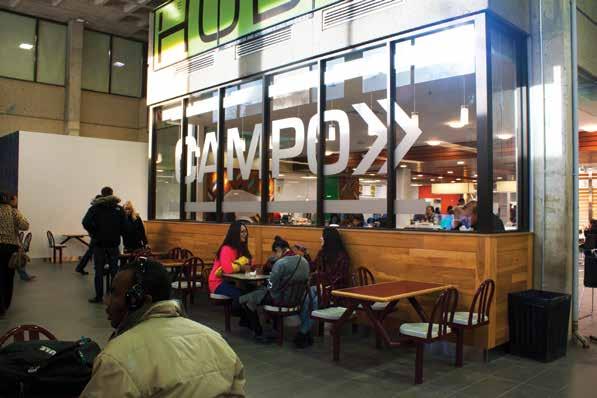
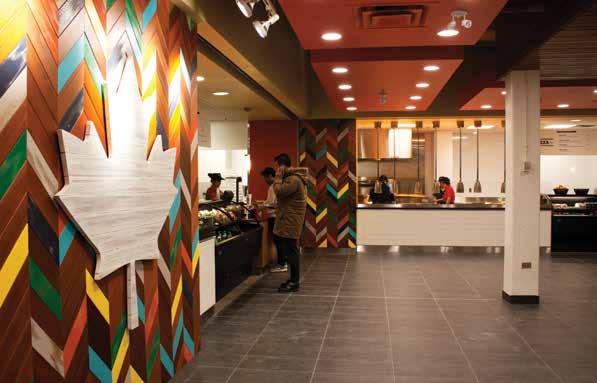
Campo opens for operation in University Centre
University Centre food court reopens after construction and holiday closure
dana h atherly, staff
O
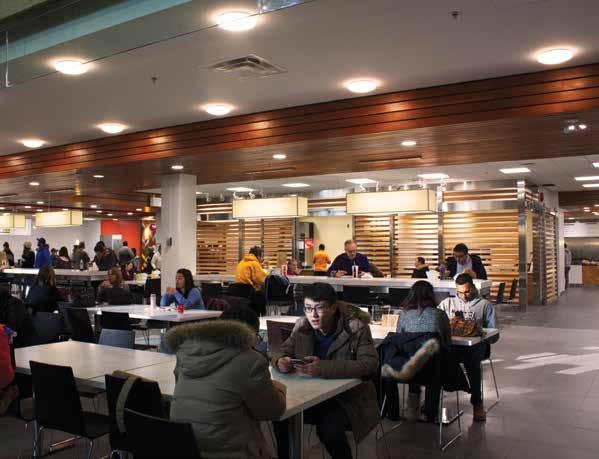
n Dec. 11, 2014, after undergoing extensive renovations for the first half of the academic year, Campo, the new campus food court in University Centre, briefly reopened its doors to the public.
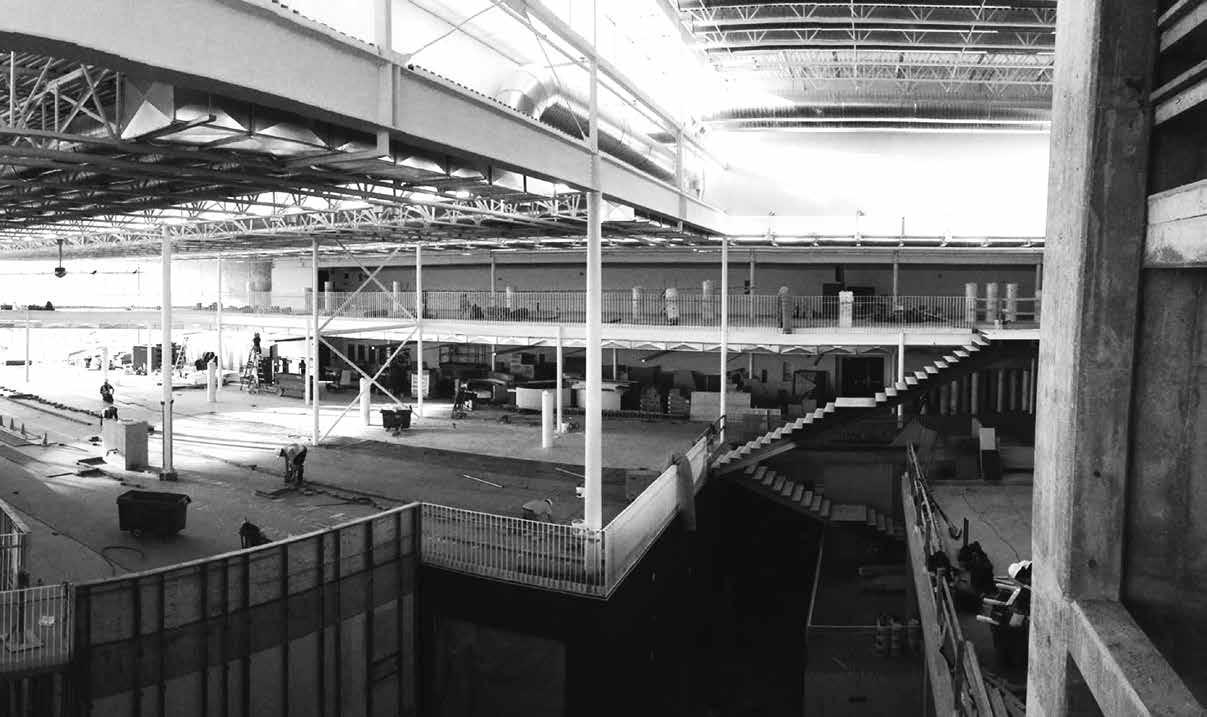
Construction of the central food court began on July 2, 2014 and included major changes to the food court’s layout, as well as new lighting, tables, and food stations. Temporary walls that closed down the food court to the public, preventing students and faculty from accessing food stations and seating in University Centre, opened up in time for the public’s entry on the Campo’s reopening date.
Less than two weeks after opening last month, the Campo fully closed down again, on Dec. 24 for the winter break, only to reopen for its first full semester on Jan 5.
“It looks fantastic,” said Christina Balanduk, first-year science student.
The campus Campo
Most food facilities listed under the University of Manitoba Dining Services (UMDS) were closed at some point over the winter break. The establishments were closed on dates varying from Dec. 19-24, 2014 until Jan. 3-5, 2015.
The Fresh Food Company meal plan in Pembina Hall was available from Dec. 21-Jan. 2 for students who were on campus over the break.
With classes resuming on Jan. 5, food services are expected to return to regular hours for the winter term.
Last updated December 2014, the fall term hours of operation for the Campo and other food businesses were provided online by the UMDS, including the scheduled hours over winter break up until the first day of classes.
“Hours of operation will change weekly,” reads the UMDS’s website.
“Please continually check [the website] for each week’s hours.”
Food oversight
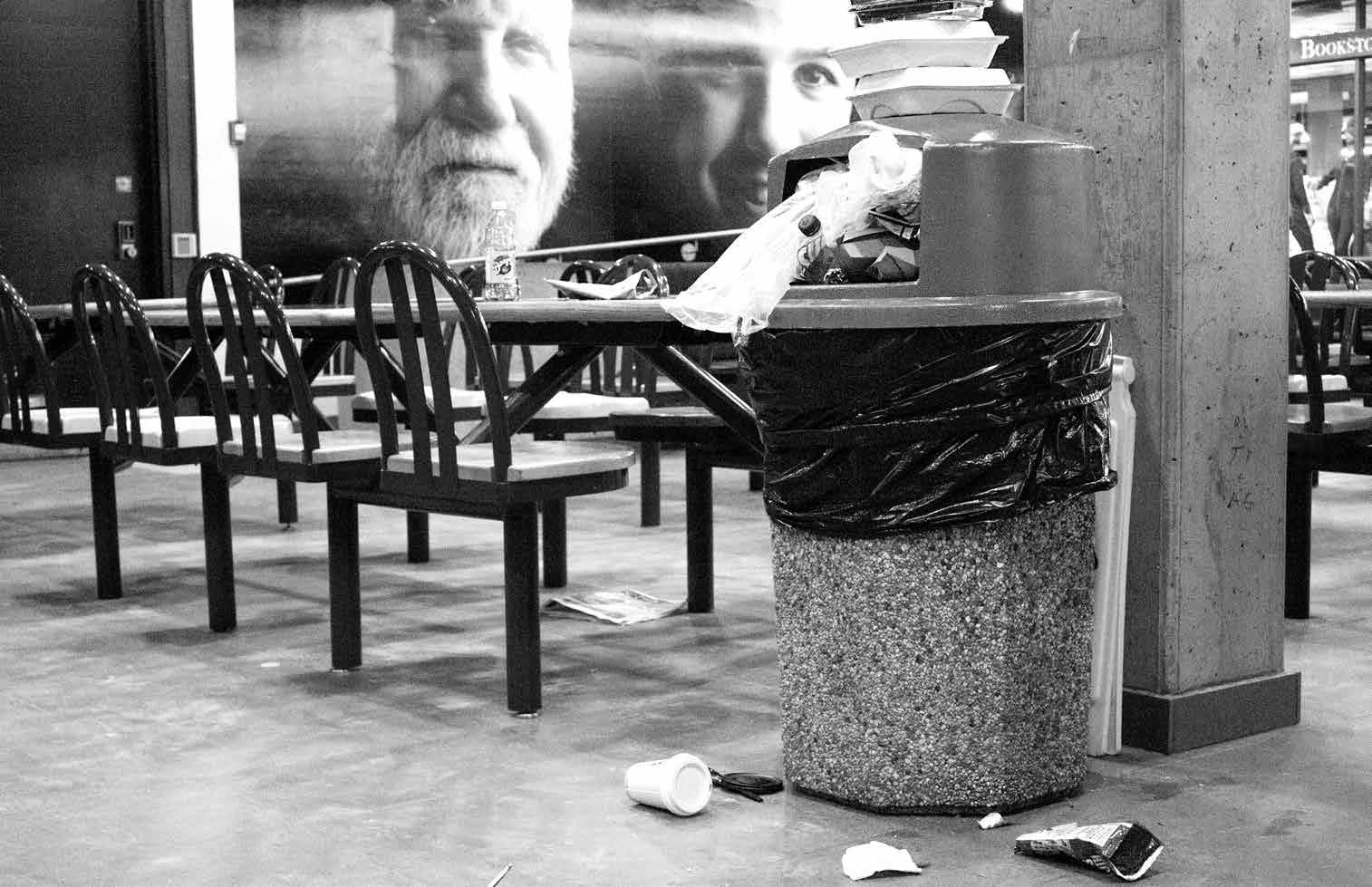
The food court in University Centre has been in operation since June of 1970. The Campo, presently run by Aramark, provides space for small private businesses.
The University of Manitoba Dining Services includes all of the general food services managed and operated by Aramark in connection with the U of M Ancillary Services.
The U of M Ancillary Services was responsible for overseeing the construction of the food services area.
The 10-year contract between the University of Manitoba and Aramark, effective April 1, 2014, allows Aramark to retain its status as the food services provider at the university – a position it has already held for over 20 years.
“Many of the new programs, offerings, and initiatives we will see in the coming months and years are a direct result of the feedback received from the campus-wide food services survey, conducted last fall,” read a report by UM Today
The U of M said in their
announcement that, as part of their recent agreement, “Aramark will invest millions of dollars into new food concepts and capital improvements, and introduce new initiatives in sustainability practice, healthy eating and easily accessible nutritional content.”
The students’ demands Some students remained skeptical prior to the reopening; others were relieved with the food court reopening.
Jenna Lang, first-year student in the faculty of science, said she was happy that construction had ended and is looking forward to diminished commotion, as well as more seating and food options.
On Oct. 4, 2012, past UMSU executive hosted an open forum on food services and meal plans at the Fort Garry campus. Students were given the opportunity to ask questions and voice their concerns about food quality and accessibility on campus.
Representatives from Aramark attended the 2012 forum to respond to questions and provide a presentation about some changes to their delivery of services on campus.
The Manitoban previously reported various concerns with Aramark’s policies and practices raised by students in regards to animal welfare in the production process of food items, and the inaccessibility to Halal food and more diverse food options on campus. Some raised general concerns about the near-monopolization of the university food services.
On Feb. 13, 2013, six unions representing students, faculty, and staff took to the steps of the U of M administration building to protest the increasing privatization of services, calling on the university to end the shift towards privatizing services, including custodial and food services, on campus.
At the 2013 protest, then-UMSU president Bilan Arte said, according to an article published by CBC, that students were unhappy about the cost and quality of food options.
Upon completion of the food services construction, Lang said that she was pleased about more culinary alternatives in University Centre.
Kopp told the Manitoban on Friday Jan. 2, 2015, “[UMSU’s] goal is to have sustainable, healthy, affordable, and diverse food options.”
Kopp said that the renovations are a positive change, in line with UMSU’s priorities regarding food services. He said that with the changes in University Centre, UMSU members will have more food options.
Kopp confirmed that UMSU was briefed and consulted with information about the renovations at regular meetings with U of M Ancillary Services.
Kopp said he was not concerned about the reopening of the food court affecting UMSU-owned businesses.
Photos by caRolyne KRoeKeR, staff
U of M awarded Top 25 Manitoba Employers distinction
Employee unions raise concerns over working conditions, cutbacks
e than Cabel, staff
The University of Manitoba has been named one of Manitoba’s Top 25 Employers for the third year in a row, prompting mixed reactions from unions representing U of M employees.
The ninth annual edition of Manitoba’s Top Employers was published by Toronto-based company Mediacorp Canada Inc. after a competition that saw a range of employers apply for the recognition.
The top 25 employers were ultimately selected by a panel of jurors from universities across Canada. The jurors assessed the companies on the basis of eight criteria, according to UM Today, including “physical workplace; work atmosphere; health, financial and family benefits; vacation and time off; employee communications; performance management; training and skills development; and community involvement.”
“As the province’s largest university and one of its major employers, we are committed to ensuring an outstanding workplace,” David Barnard, president of the U of M, said in a statement.
“We need to attract the best and brightest faculty and staff, and the best and brightest need to know that working at the University of Manitoba is a remarkably rewarding experience.”
Jeremiah Kopp, University of
Manitoba Students’ Union vicepresident internal, told the Manitoban that the distinction is well-deserved.
“When you think of the University of Manitoba, you automatically think of higher education in the province; you think of a huge organization that touches so many people’s lives,” Kopp said.
“It’s hard to go somewhere in Winnipeg without knowing somebody or talking to somebody who works at the University of Manitoba and it’s great to see that the U of M is recognized.”
Over 9,000 people work at the U of M, with over 5,000 academic positions and 4,000 support staff.
According to the Top 25 Manitoba Employers report, the benefits to being a U of M employee include a hybrid defined-contribution and defined-benefit pension plan; health care benefits of $650 a year for fulltime employees; a 17-week, 100 per cent paid maternity leave; and a three-week paid vacation allowance every year.
However, Ana Vialard Hart, president of the Canadian Union of Public Employees Local 3909, said that not all employees have access to those benefits.
The Canadian Union of Public Employees 3909 represents 250-300 sessional instructors and roughly 50 student lecturers/instructors each
term at the U of M.
“The eight criteria mentioned, for the most part, don’t apply to our members who are contract workers,” Hart told the Manitoban, referring in particular to the employee benefits package cited in the Top 25 Manitoba Employers report. The package includes $650 per year in health care spending accounts for full-time employees and $420 per year for part-time employees.
“Sessional members must work 18 credit hours during the fall and winter term in order to be eligible for part-time benefits the following year, provided they remain employed by the university. The existing benefits package does not recognize summer term, so any work undertaken during summer does not count towards eligibility.
Hart continued, “It has been a priority of the union to fix this inequity between university employees but there have been no changes in benefit eligibility to date.”
Dave Brown, chairperson for Unifor Local 3007, suggested to the Manitoban that the Top 25 distinction has more to do with advertising the university than accurately assessing the working conditions of U of M employees. Unifor local 3007 represents the over 550 caretaking, food service, general services, and trades employees at the U of M.
“The workload has doubled what it used to be,” Brown said.
“Caretaking staff should be looking after an average of 20, maybe 30,000 square feet, and we have people looking after 40 and 50,000 square feet [ . . . ] These people are just being overworked, and they just can’t keep up” – Dave Brown, Unifor 3007 chairperson
“Caretaking staff should be looking after an average of [20,000], maybe 30,000 square feet, and we have people looking after [40,000] and 50,000 square feet [ . . . ] These people are just being overworked, and they just can’t keep up.”
While many of the benefits outlined by Media Corp—including
paid vacation time, the pension plan, and health care benefits—apply to Unifor members, Brown said that the university may be undermining the union by contracting out services and hiring employees with minimal weekly hours.
The University of Manitoba Faculty Association represents some of the best paid employees on campus, including all tenured faculty members at the U of M.
University of Manitoba Faculty Association president Thomas Kucera raised concerns with the Manitoban weeks ago about the working conditions of his members given news that the U of M is considering across-theboard budget cuts of four per cent this year and four per cent next year.
“The university always plays hardball with its unions in terms of monies available,” Kucera said.
“While we can bargain for our salaries and fringe benefits we cannot negotiate what the university’s budget is going to be, so concerns about the university’s budget, the types of cutbacks and how they impact on our working conditions are of grave concern to our members.”
When asked about the Top 25 Manitoba Employers distinction, the U of M administration would not provide additional comment, referring the Manitoban to Barnard’s previous statements.
Photo by caRolyne KRoeKeR staff
Active Living Centre set to open next month
UMGSA says students weren’t consulted on tuition fee to pay for gym, Bison games
e than Cabel, staff
The new Active Living Centre at the University of Manitoba—a 100,000-sq.-ft., $45 million facility— will be open to all U of M students next month, accompanied by a sports and recreation fee tacked onto winter tuition.
The sports and recreation fee, which amounts to $56.25 for full-time students and $42.20 for part-time students over the 2015 winter term, will pay for operating and capital costs associated with campus recreation facilities, including the Active Living Centre. The fee gives students access to all campus gym and athletic facilities along with full access to U of M Bison sports home games.
Given that the Active Living Centre will not officially open until February, the fee is slightly less than what it will be in each of the 2015 fall and 2016 winter terms. With the exception of this winter term, fulltime students will normally pay $75 per term and part-time students will pay $56.25 per term.
The Active Living Centre will replace the “Gritty Grotto” gym in the basement of the Frank Kennedy Centre. In addition to higher ceilings and improved lighting, the Active Living Centre features several additions to campus facilities, including a 200-metre elevated running track and a 40-foot climbing wall.
Gene Muller, active living director at the U of M, said that the new Active Living Centre is an important contribution to campus life.
“I want [students] to look back on their time at the U of M, and to look back on it fondly, and to use this time to develop mentally and physically and to set the tone for the rest of their lives,” Muller said.
“I think we were missing a big piece of the puzzle, and the Active
Living Centre, in my mind, is the solution to that.”
The sports and recreation fee applies to all U of M students, resulting in savings for those students previously paying U of M gym membership fees. Annual rates for U of M students for the 2013-14 academic year were $204. With the instalment of the sports and recreation fee, fulltime students will pay the equivalent of $150 a year.
“Nobody likes fees; nobody likes tuition or anything like that, but at the end of the day a capital project of this nature that allows an improved health and wellness facility on our campus is good for everybody”
– Jeremiah Kopp, UMSU vicepresident internal
The fee also translates into savings for students who will no longer have to pay for tickets to Bison sports games. Coleen Dufresne, athletic director for Bison sports, hopes that free entry to games will markedly bolster attendance for campus sporting events.
“We want that home court advantage,” Dufresne said.
“Our athletes really appreciate the
support of the students so I think they love it when there are a lot of people in the stands and if we could get that on a consistent basis, I’d be thrilled.”
Unlike other students fees—such as the universal transit pass that will likely be implemented within the next year after two referendums were held over the amount U of M students were slated to pay—there was no vote held over the sports and recreation fee.
According to Jared Ladobruk, marketing coordinator for U of M recreation services, the fee was approved by the university’s Board of Governors in 2011 and received the support of UMSU and the University of Manitoba Graduate Students’ Association (UMGSA) at that time.
The sports and recreation fee at the U of M is modelled after the wellness centre fee charged to students at the University of Winnipeg, Ladobruk said.
The wellness fee costs U of W students $30.65 every term in order to pay for operating and capital costs associated with the $40 million United Health and RecPlex. While various levels of government contributed $17 million to that project, the remaining capital funding has been raised by private donations in addition to the wellness fee.
At the U of M, various levels of government have contributed $22 million to the construction of the $45 million Active Living Centre, with the remaining capital costs coming from private donors as well as the sports and recreation fee.
However, the U of W wellness fee went to a referendum among the student population in 2011, where 57.5 per cent of student voters supported the levy. Around the same time, the U of
M Board of Governors approved the sports and recreation fee four years before its ultimate implementation.
“There is some concern that it has been a while since the fee was [approved] but there certainly was some consultation with the student body to make sure that questions were answered regarding the fee and how they would benefit from that,”
Ladobruk said, adding that there are six student representatives on the 23-member Board of Governors.
Laura Rempel, UMGSA presi-
dent, told the Manitoban that more consultation between university administration and students was needed in order to build support for the fee.
“There are some issues with the process,” Rempel said.
“Limited consultation seems to be a recurring issue [ . . . ] we definitely need to have more genuine participatory processes so that voices are heard from students and other stakeholders.”
Rempel was elected UMGSA president in May 2014, and did not receive any communication from U of M administration about the sports and recreation fee until November, when the university asked the UMGSA for a formal letter of support for a prorated fee to compensate for a month-long delay in opening the Active Living Centre.
The UMGSA council did not support the fee when it came to a vote shortly before the holiday break. The University of Manitoba Students’ Union supported the prorated fee, however.
“To us, this was an issue that was voted on, decided by a previous UMSU [Council], a previous Board of Governors, so rather than reopen it [ . . . ] we’ve just been fighting to make sure that we keep to the original agreement,” said Jeremiah Kopp, UMSU vice president internal.
“Nobody likes fees; nobody likes tuition or anything like that, but at the end of the day a capital project of this nature that allows an improved health and wellness facility on our campus is good for everybody.”
Photo by JaRed ladobRuK
Stop defining yourself
Post-secondary education is not a place for personal branding
tom i ngram, staff
If you’ve read a newspaper, visited the airport, or looked at any of the University of Manitoba’s official literature, you’ve almost certainly seen the “Trailblazer” ad campaign. Some of the ads feature pictures of students against imposing backgrounds. In the bottom right is the university’s logo. In the bottom left is the slogan “Define who you really are.”
Across the centre of the ads there is a word branding the student as an inspiring figure. According to the University of Manitoba’s Visual Identity Guide, an amusing document available for free online, these words are “brand tenets”: rebel, pioneer, creator, innovator, maverick, trailblazer, challenger, defender, visionary, explorer, adventurer.
I’ve always found it puzzling that a major Canadian university feels the need to create this outward face for itself and plaster it all around the city. There’s something desperately tryhard about brand enforcement in uni-
versities. The U of M trying to portray itself as a Galt’s Gulch of mavericks and explorers is as cringe-inducing as your dad wearing a sideways baseball cap and calling people “dawg.”
The ads are not just laughable; they’re contradictory in a subtle but insidious way. This contradiction has the same form as those hilarious University of Regina ads that say “Question Authority: Find out how at www.uregina.ca/arts/journalism.”
Obviously, if you need someone to tell you how to question authority, you’re not really questioning anything. In the same way, if you feel the need to tell people you’re a maverick, you’re not one. In fact, the word’s history gives it strong overtones of opposition to branding. No genuine maverick will ever be attracted to a university that brands itself as a haven of mavericks.
And there’s no inherent value in being a maverick or a rebel. People accidentally become mavericks or
rebels when they have discovered a new way of doing things that is not yet accepted by the old guard. Being contrary for its own sake is the mark of a person who wishes to appear a certain way rather than accomplish a certain task.
No genuine maverick will ever be attracted to a university that brands itself as a haven of mavericks
From one point of view, these ads are designed to attract the kind of person that an institution of higher learning shouldn’t want: the kind of person who is easily duped by branding, who places more importance on broadcast identity than on actions. It’s more alarming, though, if
you think of it another way: this ad campaign is evidence of a paradigm shift in the kind of student universities want to attract, and the nature of the education that is offered to them.
This campaign was carefully thought out. It was designed by McKim Communications Group, a major and new media-savvy Winnipeg-based advertising firm, and won numerous awards. So the chance that the ads are accidentally sending the wrong message is fairly low. Which means the university is intentionally aiming to recruit the kind of people who would be attracted, rather than grossed out, by the “Trailblazer” campaign.
It’s common now for university ad campaigns to place emphasis on personal identity. The “Trailblazer” campaign invites you to “Define yourself.”
The University of Winnipeg proclaims itself the “You of W: Where you matter most.”
These campaigns speak to people
interested in being something sexy rather than doing something valuable. They effectively rebrand higher education as something that gives you an identity rather than something that gives you valuable knowledge you can use to grow corn, design a clinical trial, or interpret the law.
Essentially what I’m saying is that the “Trailblazer” ads are both a symptom and a partial cause of the watering down of higher education. When you see them, you ought to be suspicious. When you find that faculties are facing budget cuts while the office of the vice-president external, which is responsible for advertising, has seen its budget nearly double since 2009, you should be even more suspicious. What we need, and what we should demand of our institutions of higher learning, is to stop defining ourselves through branding and to start defining ourselves by meaningful actions.
gRaPhic by Justin ladia
Beyond the evil
The Pakistani people must take a strong stand against the Taliban
tarique Khawaja
Pakistan is in the headlines once again. On Dec. 16, 2014, Tehreeke-Taliban Pakistan, a notorious terrorist group, launched a deadly attack on a school killing 132 children in Peshawar, Pakistan.
The alarming and heartbreaking attack has been condemned widely, including in Canada. Students from the University of Manitoba and the International College of Manitoba mourned this heinous act by holding a candlelight vigil on Dec. 19 to grieve for the victims.
The Pakistani Taliban claimed responsibility for the gruesome tragedy during its occurrence, calling it a response to Pakistan’s recent military actions against militant groups in the tribal belt. A Taliban spokesperson said the attack was a retaliation for the deaths of family members of Taliban fighters in North Waziristan.
What started as a regular school day ended with a brutal massacre. The wounded children who managed to survive the attack emerged with horror stories about how these fanatics were wearing explosive jackets and opened fire indiscriminately in the school auditorium.
Although similar terrorist incidents have recently occurred in Pakistan, this has been the Taliban’s deadliest one. It was not long ago
when Pakistani child education activist Malala Yousafzai was shot in the head in a failed assassination attempt by the Taliban for speaking up for girls’ rights to education. In Pakistan she has been accused of being a CIA agent, working with Indian spies, and acting as an agent of Zionists.
Extremism in Pakistan is increasing day by day and becoming a threat not only to the country itself but to the Western world as well
With the recent attack on the Peshawar school, some in Pakistan are shifting the blame onto Indian forces or other Western and antiIslamic foreign agencies rather than accepting responsibility for Pakistani nationals committing these atrocities.
Widespread radical ideological thinking and an ambivalent attitude toward the Taliban is the reason terrorist acts like this are possible in
Pakistan. Extremism in Pakistan is increasing every day and becoming a threat not only to the country itself but to the Western world as well. Pakistan’s religious leaders need to preach tolerance and humanity rather than hatred and violence to stop these
acts from happening.
There is no religion in the world that teaches terrorism – including Islam. Islam, commonly known as a religion of peace, has been hijacked by the people of a specific mindset who do not believe in the humanity of all people. Pakistan needs to adapt to the ideal model of secular education, and moderate religion, knowledge, tolerance, and peace for minority groups from the Western world in order to eradicate the terrorism it has long been known for.
Letter to the editor: UMSU on cuts
University of Manitoba students,
The University of Manitoba administration has recently announced that cuts will be made in the upcoming budget.
We would like to articulate the current position of the University of Manitoba Students’ Union.
We are opposed to cuts.
Our stance is not one of neutrality, but of rationality. As the sole representative for University of Manitoba undergraduate students, UMSU is active in the University of Manitoba’s budgetary process and holds seats on the Board of Governors.
Furthermore, UMSU recognizes the university’s complex budget outlook, limited revenue sources, and the need to balance competing priorities. We recognize that the university is burdened with the incredible task of operating on a budget that included the promise of a five per cent increase from the province – which has decreased to 2.5 per cent over the last two years. Within the context of a budget comprised of upwards of a billion dollars, this represents a significant loss in projected funds from the provincial government.
As the largest student association in Manitoba, with the responsibility of advocating on behalf of our membership to all levels of government
involved with post-secondary education, including federal, provincial, and municipal, UMSU will be intimately involved in this issue. We will provide accurate and relevant information to students and act according to the interests and well-being of our membership in a deliberate and respectful manner.
We will be active throughout this process, and will continue to advocate for the best interests of our students, as we have always done. We will work co-operatively and transparently with students, faculty, and administration. UMSU will continue to provide students with updates and information as it becomes available, and we invite students to contact us throughout this ongoing process with any individual concerns or questions they may have.
UMSU’s goal, above all else, is to ensure that our students receive a high-quality and accessible education.
Al Turnbull, President – University of Manitoba Students’ Union
Rebecca Kunzman, Vice-President Advocacy – University of Manitoba Students’ Union
Jeremiah Kopp, Vice-President Internal – University of Manitoba Students’ Union
Photo by oWais KhuRsheed
Five Hundred and One Paintings + Buildings: recent works by Cliff Eyland
Gallery tells Eyland’s story in bits and pieces
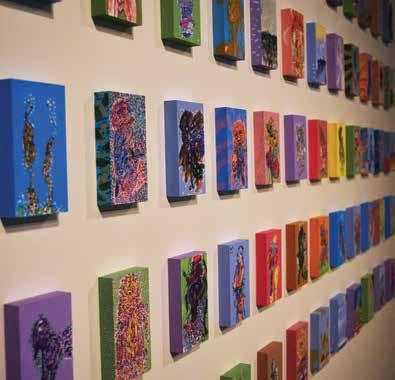
Walking through Cliff Eyland’s exhibit at Actual Gallery feels like flipping through the chapters of a book, which comes as no surprise, as the Canadian artist and designer is also a writer.
In keeping with his preferred format, Eyland’s Five Hundred and One Paintings + Buildings are on index cards, which are raised on pieces of wood. In addition to adding depth to the paintings, the wood comes into play when the back of the exhibit is reached, where the wood has been used to create sculptures reminiscent of city models.
Organization is a defining element in the exhibit. The paintings are arranged by several distinct themes, the first being a theme of textures.
Colours and brush strokes suggest elements such as water, wood, fire, and temperature. This first set focuses more on feeling and sensation than a linear story, while maintaining a
À La Mode releases debut EP
Local singer-songwriter gives listeners a sincere look into her heart
r aylene paC i
ÀLa Mode is the indie pop jewel created by Winnipeg’s own Dominique Lemoine. Her self-titled debut EP was released on Dec. 14, 2014 and was co-produced by J. Riley Hill of Mortfell Recording.
Lemoine is a newcomer to the music industry.
“My favourite part of the process of working on this EP was learning how to realize my musical ideas in a studio setting, having been my first experience recording solo. Sitting down and listening to the mastered tracks for the first time is also exciting and rewarding,” she said.
However, it would be nearly impossible to listen to the EP and come to the conclusion that this was the product of a first-time effort. With a sound quality that exudes sophistication and carries a soft charm, it resembles the work of
a veteran singer-songwriter.
“I can’t say I had the intention of getting any particular reaction, although now I do hope that there are things of value to be gleaned from the work.”
Accompanied by the sweet sounds of synthesized strings and nostalgic piano melodies, Lemoine’s voice is soft and mellow, yet rich in character and able to tell a tale like no other. The whole effect is rather airy and light, resulting in a sensation that can only be described as floating through the sky.
Her songwriting only adds to this already strong musical base. She weaves a beautiful tapestry of nature-based imagery and allows the listener to feel like the main character in this vivid story. Lyrics like “Memories we try to leave behind flutter down without a sound” and “You hide such loneliness under your dark cloak” are painfully
relatable and easy to connect to.
“The songs are about emotional reactions to personal life situations. And you know [ . . . ] exploring the fundamental nature of knowledge, reality, and existence, or whatever,” said Lemoine.
À La Mode is filled with the most sincere human emotions and the struggle to make sense of not only yourself, but also those you love.
“Once the EP was done all I could really do was close my eyes and throw it out there. I find there’s a vulnerability you have to embrace when you make your music public.”
À La Mode is due to release a music video online next week for the track “New Leaves” and hopes to perform a show after the winter semester. Her self-titled debut EP is now available.
sense of togetherness that compels the viewer to look at each painting.
The exhibit then shifts from the open and abstract theme of textures to the vivid storybook theme of the neighbouring set.
These paintings seem childlike and fantastical at first – pastels, flowers, and Roy Lichtenstein dots dominate. However, a closer look uncovers surprising elements, such as creatures that are half human and half animal, and images of bodies that do not shy away from appearing sexual.
Perhaps the most realistic, resounding part of the exhibit is the landscape section. Eyland has provided just enough detail to represent images of trees, forests, and horizons. The easily contrived motif is made fresh using tiny windows through which the viewer must view these images, outfitted with vivid colours that depart sharply from anything one would find in real life.
Characters are absent from this theme, resulting in a feeling of of loneliness and isolation. The landscapes, though colourful, are open – free spaces for the viewer to fill with whatever perceptions of the Canadian wilderness they wish.
The sculptures in the back are unexpected. They draw the eye right to the floor, and then bring up the question of what Eyland could be suggesting. If they are supposed to be cities, they are utilitarian and somewhat desolate in style.
Juxtaposing the whimsical lines and textures found in the rest of the exhibit, the sculptures belong on their own in a place where the viewer can explore the rigid streets before coming back to a place of colour and light.
Five Hundred and One Paintings + Buildings will be displayed until Feb. 28 at the Actual Gallery (300 Ross Ave).
Photo by alana tRachenKo, staff
The current and future Canadian art landscape
Sobey Art Award exhibition featuring shortlisted nominees presented at the WAG
i an t d t homson, staff
Since Nov. 1, 2014, the Winnipeg Art Gallery (WAG) has been hosting an exhibition of the nominees of the Sobey Art Award. Presenting the shortlisted artists for the award, the show will run until Jan. 25 and is the first time the exhibition has been held in Western Canada.
The Sobey Art Award was first created in 2002 as a prize for aspiring Canadian artists aged 40 and under. The award, which was created by the Sobey Art Foundation, annually gives $50,000 to an individual who has “exhibited in a public or commercial art gallery within 18 months of being nominated.”
The Art Gallery of Nova Scotia administers the Sobey Art Award and exhibition. On Nov. 19, Nadia Myre was announced as the competition winner.
“Myre has built a distinctive
visual vocabulary by translating her experience and that of others into works that employ traditional crafts within a contemporary, multidisciplinary practice,” said the Sobey Art Award jury in a press release.
“Her artwork creates a symbolic image of wounding and resilience that conveys something deeply human while addressing urgent social concerns.”
and Montreal. Many of Myre’s pieces draw on themes of “identity, language, longing, and loss.”
One such piece at the WAG is Myre’s “Scar Project,” an ongoing
“Myre has
Born in 1974, Nadia Myre is a visual artist from Quebec. Myre is an Algonquin member of the Kitigan Zibi Anishnabeg First Nation and has had her work featured in exhibitions around the world, including in New York, Nancy,
the scars being taken from places such as youth groups, senior centres, and prisons, Myre has accumulated over 800 scars for exhibition across Canada and the United States.
built a distinctive visual vocabulary by translating her experience and that of others into works that employ traditional crafts within a contemporary, multidisciplinary practice” – Sobey Art Award Jury
project by the artist that invites viewers to sew with fibres and threads to create “a canvas representation of a physical, emotional, psychological, or spiritual scar they may have.” With
Another of Myre’s notable pieces is “Hydro Quebec,” from her series Journey of the Seventh Fire. The piece displays a large letter Q, the logo of Hydro-Quebec. The piece and the series are meant to bring attention to industrial companies causing environmental damage.
“This series, [ Journey of the Seventh Fire], borrows ideas from the Seven Fires Prophesy Wampum Belt, which speaks about the destruction of the
earth if we do not shift from materialism to spirituality,” explained Myre. Along with Myre’s pieces, the exhibit features the works of four other artists nominated for the prize, with each artist representing different areas of Canada.
Pieces by Evan Lee (West Coast and the Yukon), Chris Curreri (Ontario), Graeme Patterson (Atlantic), and Neil Farber and Michael Dumontier (Prairies and the North) are featured within the exhibit. With Myre representing Quebec, the WAG exhibit presents a strong depiction of the current and future Canadian art landscape.
The Sobey Art Award exhibit runs until Jan. 25, 2015. For more information visit wag.ca
Ar ts & Culture
Ingrain by Anthony Nelson
Art while you eat
a lana t raC hen Ko, staff
W
innipeg artist Anthony Nelson, member of Synonym Art Consultation, continues to expand his repertoire with his latest exhibit showing at the Cornerstone on Osborne. The current showcase breaks away from his previous work, such as his opening in 2013 where he presented his collages, which he described as being put together blindly, in a way that is true to his subconscious.
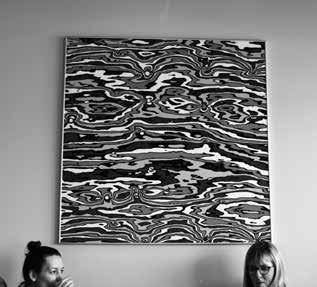
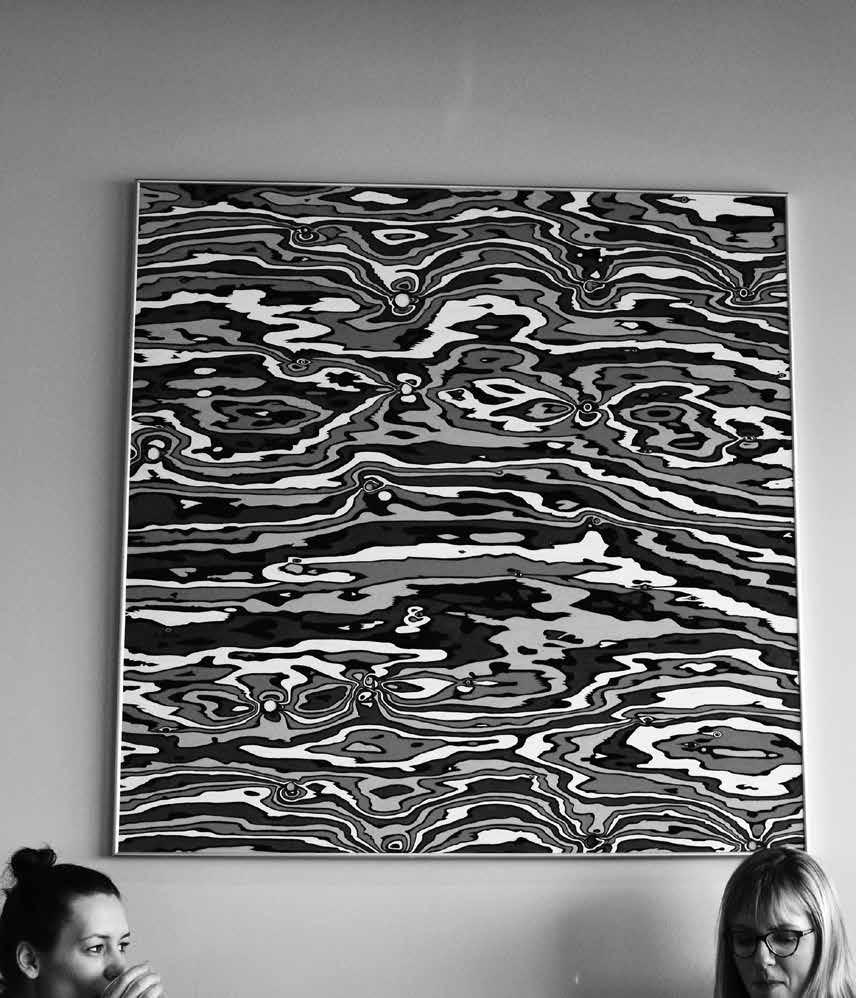
Nelson’s current show is anything but unintentional. Aptly named Ingrain, the images share the common theme of depicting wood grain. The lines are thick and the colours bold, but the patterns are unmistakably of wood. Nelson plays with different colour combinations, sizes, and series of images.
Nelson has taken an image typically seen in neutral colours and added energetic reds, oranges, and blues. The juxtaposition compels the viewer to think about the nature of a material that we are so used to, we forget to notice it.
Nelson seems to want you to remember that wood is a constant topic in our society; it is a raw mate-
rial and source of energy whose use is constantly being debated by governments and companies. It surrounds us not only in nature, but also in every room and building. It is used to construct, create art, and draw us around the bonfire during the summer.
Wood is used to construct, create art, and draw us around the bonfire during the summer
Cornerstone provides a surprisingly suitable backdrop for Nelson’s work. The wood grain is complemented by open white walls and brick, and occupants have the pleasure of observing the paintings at length, either for the simple aesthetics of the colours or for the deeper implications that one could take from the images.
Synonym Art Consultation is focusing on presenting art in public
spaces, rather than keeping exhibits limited to galleries. Art in public spaces has been a key objective in improving the city’s quality of living, as well as a counter to instances of graffiti.
Local artists get more exposure and city residents are able to view art in places other than galleries, which may not operate during hours that are convenient to everyone. In addition, some people may not feel as if they are part of the crowd that can attend art shows, because of their association with a particular scene in Winnipeg.
Chloe Chafe and Andrew Eastman of Synonym Art Consultation say that showcasing art in public spaces means the art is enjoyed by more people for longer lengths of time, and benefits both the artist and the business. Businesses that may not want the task of constantly changing art in their space can pass the task off to Synonym, who are more than happy to do it.
Love is Strange
Film shares contemporary gay love narrative, makes its way to Winnipeg’s Cinematheque
i an t d t homson, staff
When you live with people, you know them better than you care to” – Ben, Love is Strange.
Love is Strange tells the story of Ben and George, a gay couple living in New York City. With its universal title, the film will be screened at Winnipeg’s Cinematheque throughout the month of January.
After being together for 39 years, the couple—played by John Lithgow and Alfred Molina—are finally able to get married. However, this doesn’t come without its problems.
George, who has been working for a Catholic school, is swiftly fired after coming out and subsequently getting married. Due to a lack of funds, the couple is forced to temporarily split up and sell their apartment in an attempt to find a more affordable location. The pair are thrust into completely different interpersonal situations as George moves in with his nephew and his family, and Ben moves in with two extraverted gay cops, forcing the newly-wed couple to adjust to their new surroundings.
Directed and co-written by Ira Sachs (Keep the Lights On, Married Life) the film has received critical acclaim following its debut at the Sundance Film Festival in January of 2014. It currently holds a 96 per cent rating on Rotten Tomatoes.
The motion picture has been praised for its touching display of commitment in the face of adversity, displayed by Lithgow and Molina’s on-camera chemistry.
“They capture the ease of such a relationship, but also the irritability, the telepathic quick looks, and then the sudden swoons of intimacy
[especially when the going gets rough],” explained Sheila O’Malley in a four-star review for Rogerebert. com.
“On set, [Lithgow and Molina] found all the things necessary to bring that intimacy to their portrayals [ . . . ] They have a lot of shared history professionally and as actors and as men of a certain age,” said Sachs in a press release.
“They used all of that to make something real.”
The movie also explores homosexual stereotypes and stigma that are still relevant in 21st-century culture. In one scene, an adolescent refers to Ben’s painting as “gay”; however, Ben’s nephew clarifies the comment rather bluntly.
“He doesn’t mean ‘homosexual,’ Uncle Ben. He just means ‘stupid.’” The Marriage Equality Act, allowing the marriage of same-sex individuals, passed into law in New York in June of 2011, operating as a catalyst for the plot of the film.
For Sachs, however, the film is not meant to focus on themes of discrimination. Instead, he believes the focus is on human relationships and how people connect and care for one another, regardless of sexual orientation.
“The catalysts of the film are politically charged, but the results are human,” explained Sachs.
“The film is very much about how people connect to each other, and how they take care of each other.”
Love is Strange plays at Cinematheque (100 Arthur Street). For more information on shows and showtimes, visit winnipegfilmgroup.com/cinematheque
“
Photo by alana tRachenKo, staff
Photo PRovided by mongRel media
Keeping spirits bright
7 ways to retain (some of) your sanity this term
l auren s iddall, staff
Winter is long and classwork piles up fast. Keep your stress levels low and morale high while you patiently wait for the ground to thaw and sessions to end.
1. Sing in the car
Whether you can belt it like Mariah Carey in her prime or believe your voice is better left unheard, pop in your favourite song or blast the radio and sing. Singing releases endorphins and the neurotransmitter oxytocin and reduces cortisol levels, resulting in feelings of elation and less stress. I survive traffic jams and long road trips by aggressively singing ’80s power ballads with my trusty passenger.
2. Study with the right people
Find someone who has the same work ethic as you to study with, grab a coffee (or 12), and get to work. The key is to be able to focus on studying with them there but be able to goof off when it’s time for a break. The subject you are studying doesn’t matter, so long as you make progress. Do I know anything about thermodynamics? No, but my study buddy sure does.
3. Read for fun
My favourite professor once told me he is at his most creative when reading a book on the side that he enjoys. Sometimes you need to give yourself a break to better understand complex material. Set aside some time just before bed to read your book and wind down. Don’t worry about reading something from the literary canon – read something you enjoy.
4. Make time for something you love
By incorporating something you are passionate about into your day-today routine, you are adding a positive reinforcer, which will increase your level of happiness and satisfaction. Finished a full chapter for Abnormal Psychology today? Reward yourself with time to draw or watch your favourite movie.
5. Budget your time more carefully
Nothing is worse than worrying about a project due tomorrow that you have yet to touch. Save yourself the trouble by splitting the project, essay, or research paper into smaller sections and assigning yourself one
section to complete each day. Create a checklist of each component and check it off once you’re done. Overwhelming tasks seem more manageable when pared down.
6. Make yourself an awesome breakfast
What is better than a great breakfast? Nothing. If you’re not inclined towards the culinary arts, check out
a breakfast spot you have never been to before. Some of my favourites are: Edna Fedya, The Tallest Poppy, and Smith. If you’re feeling adventurous, try making yourself breakfast for dinner.
7. Genuinely give thanks
Taking the time to write a card is so much more meaningful than shooting off a quick text. Next time
someone goes out of his or her way to do a favour for you, express your gratitude with a card. In addition to making them smile, it will boost your spirits. Expressing gratitude is incredibly important. Giving someone a genuine token of appreciation brings everything into perspective. The sun does not rise and set on your GPA; remember what is important.
Photo by lauRen siddall, staff
Science & Technology Editor: Chantelle Dubois
Contact: science@themanitoban.com / 474.6529
Notes from Gnaraloo: A prairie girl’s account of conservation in wild Western Australia
Nesting turtles and lurking dingoes
December 2, 2014
It’s been nearly six weeks since my arrival in Western Australia (WA) and I can’t seem to decide if time is flying by or dragging on. It was a slow start, but lately things have finally taken off.
The Gnaraloo sea turtle nesting season officially began on Nov. 1, but the first nest wasn’t recorded until Nov. 10 and it took another week before the rookery received its second. With such a slow start we were resigned to long days in front of computers polishing community
presentations and completing endless training exercises. Being cooped up in cabins while looking out onto the pristine coastline of our research site is a special kind of torture for field biologists.
As cabin fever began to get the best of us, our scientific minds strained to come up with answers for the turtles’ delay. We considered the possibility of some destructive event occurring 30 years ago in the rookery, as this is the time it takes for one generation of hatchlings to reach sexual maturity and return to their hatching beach to breed and nest.
A nesting loggerhead (Caretta caretta) female lays between 100-130 eggs per clutch, which incubates in the sand for approximately two months. Even at this early stage the developing turtles are threatened.
In 2008, 100 per cent of sea turtle nests in sections of Gnaraloo Bay Rookery were predated by feral animals, predominately the European red fox (Vulpes vulpes), brought to Australia in the mid-1800s by Europeans intent upon enjoy the hunting traditions of their homeland. When an introduced species threatens biodiversity and adds competitive pressures on native species they are deemed invasive (also feral). They invade habit and pillage food sources. In a foreign land there are rarely predators or diseases to act as population limiters. It’s very difficult for an ecosystem to adapt and evolve rapidly enough to survive their exploding numbers without any consequence.
It’s not as though sea turtle nests in WA are immune to native predators such as ghost crabs (Ocypode convexa) and goannas (Varanus spp.), but these predators are a natural part of the ecosystem and therefore able to maintain a sustainable population balance between predator and prey. Predation by the introduced species can be so heavy it leads to the collapse of sensitive species populations, such
as the dynamic with the European red fox and the loggerhead sea turtle.
Luckily, thanks to target baiting practices, for the past four years neither of the rookeries in Gnaraloo have seen predation by feral animals, including the red fox. We continue to monitor the presence of feral animals in the rookery by identifying and recording the GPS location of tracks.
Each month we send this data off to Animal Pest Management Services to determine the best mode of action.
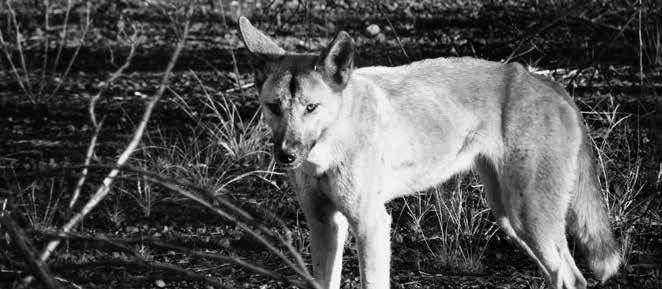
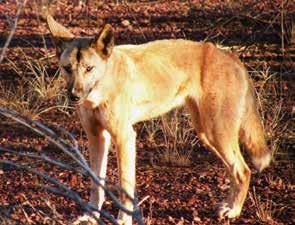
This season a dingo (Canis lupus dingo, or wild dog) roams the rookery and has so far evaded all control methods. There is some debate as to whether dingos should still be considered a feral species since they have been in Australia for 3,500-4,000 years. Over thousands of years in the desert, dingos have evolved to the conditions. Dingos exhibit large ears (common to desert species), which aid in cooling body temperature.
One morning at sunrise, embarking on our daily beach survey, my partner and I heard a muffled bark behind us. We turned around and finally caught a glimpse of the dingo whose tracks have haunted the beach
2015: A space odyssey
Exploration
and discovery
Chantelle d ubois, staff
T
he year 2014 saw many exciting space missions come to fruition; the European Space Agency’s (ESA) Rosetta mission saw its first rover land on a comet, and the Indian Space Research Organisation’s Mars Orbiter Mission was lauded as being the first agency to have a successful first mission to Mars. Looking forward, the world can expect just as much excitement for 2015. Here are just a few examples to look out for.
Canadian Space Agency (CSA)
In 2015 the CSA will continue working on large-scale projects in partnership with other space agen-
in the coming year
cies around the world. The CSA has ongoing collaborations with the National Aeronautics and Space Administration ( NASA), Japan Aerospace Exploration Agency (JAXA), and ESA.
NASA expects the Dawn space probe to arrive at Ceres in March
One of the exciting projects the agency will be working on over the 2015 year is the ASTRO-H tele-
scope, a mission led by the JAXA. ASTRO-H is an X-ray telescope which will study X-ray bands above 10 keV. Canada’s contribution to the mission will be the Canadian ASTRO-H Metrology System, an advanced laser alignment system.
National Aeronautics and Space Administration (NASA)
The National Aeronautics and Space Administration starts 2015 off with a two per cent budget increase from the U.S. government, a promising outlook for the agency, which had been struggling with financial cuts for many years. While two per cent
may not sound like a lot, it was more than had been requested by NASA and translates to an increase of US $364 million.
Financial talk aside, NASA expects the Dawn space probe to arrive at Ceres in March 2015. Ceres is a dwarf planet in the asteroid belt between Mars and Jupiter, and the orbiter will map and study the celestial object, getting as close as 375 km from Ceres’ surface.
European Space Agency (ESA)
The European Space Agency will be implementing the next phase of its Cosmic Vision program for the 2015
since the beginning of the season. It was curious but timid, and as we approached to try and snap a photo, it ran off into the inland parabolic dunes.
We followed its tracks a little ways to see if it had come up from foraging on the beach, but instead discovered it was chasing our vehicle. I took this as evidence of social behaviour and its bark at the end of its chase now seemed more playful, as if it was asking why we stopped.
The dingo has yet to predate any of the nests in the rookery, but action will still be taken to eliminate it. Now after my encounter I’m conflicted over the situation, but know it has to be done for the good of the turtles. City life with domesticated pets has made me soft, I guess.
In the end, all the worry generated in our anticipation was for nothing. Loggerhead turtles have been visiting the rookery regularly now since Nov. 23, with up to eight nesting activities recorded per night. Our nest count is currently budding at 34 with a steep climb ahead of us to reach the predicted minimum of 300.
to 2025 period, a scientific program overseeing long-term space missions for the agency. The program classifies its missions into three categories: S-class (small mission) M-class (medium mission) and L-class (large mission). Each mission also falls under one of the 150 proposed themes. One of such missions chosen for the Cosmic Vision program is the Euclid mission, an M-class mission exploring Cosmic Vision theme 4: How did the universe originate and what is it made of? Euclid will measure the acceleration of the universe to map the geometries of dark energy and dark matter.
Photo by miKe butcheR
Preventing chronic wasting disease in deer
A promising vaccine in the fight against prion disease
j eremiah yarmie, staff
Prions are normal body proteins found in the brain of many animals, including humans. It is believed that prion proteins play a role in brain cell communication.
Infectious prions are, lightly put, renegade zombie-proteins. They propagate by converting normal healthy prion proteins into the infectious unhealthy form.
Proteins gain their functions through their molecular structure, particularly from how they fold. Infectious prions are improperly folded proteins. They act as a template to convert healthy prion proteins into infectious ones by causing them to misfold. These newly infectious prion proteins can then go off and cause more conversions, much like the way a fictional zombie infects other humans.
Prion infectious typically cause spongiform encephalopathies. Infectious prion proteins tend to aggregate into dense plaques which form holes in the brain, resulting in a sponge-like semblance.
Prion infections tend to have a very long incubation time, lasting from several years to decades. Infectious prion proteins are also very resistant to things like heat, disinfectants, and proteases, proteins which specialize in the destruction of other proteins.
Chronic wasting disease (CWD) is a fatal prion disorder that affects cervid animals like deer, elk, and moose. The disease is characterized
by chronic weight loss resulting in death. It is one of the most easily transmitted prion diseases known.
Researchers from New York University have developed a vaccine against CWD. In their study, the researchers exposed 11 deer to prioninfected brain tissue, after administering the vaccine to five of them. The 11 deer were all kept in the same constant exposure to the infectious prions.
Within two years, all of the untreated deer developed CWD. Of the vaccinated deer, four developed the disease, notably with a much longer incubation period, while one remains healthy.
One out of five does not seem significant, but when the fact that these infectious prions are incurable is considered, it is an important finding.
The vaccine was developed by using genetically modified Salmonella bacteria. This was done to mimic ingestion, the typical infection route for prion diseases. The Salmonella vector was weakened so that it was no longer able to cause infections.
The bacteria were genetically modified to express the prion protein. This allows the immune system presence in the intestine to develop an antibody response against the infectious protein. The group had previous success with a similar vaccine in mice.
A member of the parliament announced in December that the federal and Saskatchewan governments would contribute up to 1.16 million
dollars to the development of a new vaccine for CWD. The importance of this new vaccination is that CWD is affecting wildlife herds of elk in Saskatchewan and Alberta.
It is hoped that these developing vaccines will help protect captive cervids herds from CWD, which can see an infection rate of up to 100 per cent within a captive population.
These vaccines will potentially be beneficial to other species, as similar technologies can be implemented in the prevention of bovine spongiform encephalopathy in cattle and prion diseases in humans.
Prion diseases in humans can be caused through various routes. Creutzfeldt-Jakob disease (CJD), a
human prion disease, has many different categories, the most common of which is sporadic CJD which occurs in one out of one million people and makes up 85 per cent of CJD cases. Other types of CJD include a genetic disease known as familial CJD, and iatrogenic CJD, which is attributed to contaminations through medical procedures.
Bovine spongiform encephalopathy, colloquially known as mad cow disease, is a prion disease that can spread from cattle to humans, and the suspected cause of variant CJD. Mad cow disease devastated the U.K. in the 1990s.
Kuru is a prion disease that was transmitted among the Fore tribe of
Scrutinizing television physicians
Recommended to be taken with a grain of salt
j eremiah yarmie, staff
Dr. Mehmet Oz is an American surgeon, best known for his television program, The Dr. Oz Show. By all accounts, Oz is an accomplished and capable cardiac surgeon, but you may want to be cautious about taking his show to heart.
Oz’s show and similar programs like The Doctors intend to help viewers live healthier lives by suggesting products and practices that might not be well-known. These two shows have each garnered over two million viewers per day in the 2012-2013 season.
Research from the University of Alberta suggests that the reason some of these shows’ recommendations may not be well known is because they have little supportive scientific evidence.
The researchers recorded about
four months’ worth of episodes of The Dr. Oz Show and The Doctors from the beginning of 2013. From those episodes, 40 episodes from each program were randomly selected. The most common topic addressed by both programs was found to be general medical advice, followed by dietary and weight loss advice. The programs’ recommendations were divided based on the strength of the claims — more strongly worded or more frequently repeated claims were classified as stronger. Details on the benefits of the recommendations were mostly nonspecific, typically presented without actual figures or detailed quantified data. When figures were given, they were often relative.
Of the recommendations made in the selected episodes, 54 per cent were
characterized as being supported by evidence.
This past summer, Oz met before the U.S. Senate regarding pseudoscience weight loss claims made on The Dr. Oz Show, such as using green coffee extract to lose weight
Of the recommendations made on the selected episodes of The Dr. Oz
Show, 46 per cent were found to be supported by evidence. Evidence was not found for 39 per cent of the recommendations made, and evidence contradicted 15 per cent of them.
Recommendations made on selected episodes of The Doctors fared a bit better, with evidence supporting 63 per cent of them. Evidence was not found for 24 per cent of recommendations, and 14 per cent were contradicted by evidence.
Around 15 per cent of the recommendations on both of these shows suggest solutions to health and lifestyle problems that the researchers determined do not have any evidence supporting the existence of health benefits.
This past summer, Oz appeared before the U.S. Senate regarding pseudoscience weight loss claims
Papua New Guinea, first noticed in the 1950s. The disease spread through the practice of mortuary cannibalism. The remains of the deceased were consumed by other members of the tribe and it was through the remains, particularly the brain, that the kuru prions spread.
Prions are interesting since they are simply protein. Conventional infectious agents like viruses, bacteria, fungi, protozoans, and parasites have some sort of genome – genetic information that allows them to continue to propagate and infect. Zombies may be real after all, if not at a macroscopic scale.
made on The Dr. Oz Show, such as using green coffee extract to lose weight.
“I actually do personally believe in the items I talk about on the show. I passionately study them. I recognize they don’t have the scientific muster to present as fact but nevertheless I would give my audience the advice I give my family all the time, and I have given my family these products,” said Oz.
If Dr. Oz’s show is supposed to inform actual health decisions, this research casts doubt on its ability to do so reliably.
Be skeptical.
The study is open access and can be found at bmj.com (BMJ 2014;349:g7346).
gRaPhic by bRam Keast, staff
illustRation by evan tRemblay
bRam Keast
lauRen goWleR
Bison Briefs
Winter break updates
david g rad, staff
Three’s the magic number
The Bison men’s basketball team placed third at the 48th annual Wesmen Classic for the second year in a row. The University of Alberta Golden Bears took first place after defeating our city rivals and tournament hosts, the University of Winnipeg.
In quarter-final action, the Bisons defeated the University of Regina Cougars 85-74. Third-year guard A.J. Basi controlled the game, putting up 25 points, connecting five times from beyond the arc, and recording three steals. The Bisons ordered a double-double from Wyatt Anders, who dropped 17 points and 15 rebounds. Manitoba held the lead in all four quarters but narrowly escaped a strong comeback effort by the Cougars in the fourth.
In their semifinal matchup, Manitoba lost a heartbreaker to the Wesmen, 91-77. The Bisons
seemed to have the upper hand in the first half, going into the break with a comfortable 47-34 lead. The Wesmen must have received a pretty strong inspirational speech, as they almost doubled the Bisons’ point production in the second half of the game. Despite the loss, A.J. Basi has another strong game, putting up 17 points and two steals. Alfreeman Flowers led the Herd in rebounds with 10.
In their final match, for third place, the Bisons narrowly edged out the Brandon Bobcats in a nailbiter, 77-75. The Herd was led by the usual suspects: A.J. Basi and Wyatt Anders. Basi put up 20 points and earned recognition as a Tournament All-Star for his overall performance. Anders pulled down 15 rebounds and contributed 10 points for his second double-double of tournament play.
All-Stars herded from Bison Hockey
Standouts Jordan DePape and Luke Paulsen from the Bison men’s hockey team have been selected to represent Canada at the 2015 Winter Universiade Tournament in Granada, Spain from February 3-14. Bison coach Mike Sirant was selected as an assistant to Team Canada. Sirant won a bronze medal with Canada in 1997 as head coach.
Canada will face off against 11 of the strongest teams comprised of university students across the world, similar to teams represented in the World Juniors or the Olympics.
Canada has brought home 13 medals in 14 appearances at Universiade and will look to continue their dominant play in February.
Captains named
The track and field team named their six captains for the 2014-2015
season over the Christmas break.
In his final year as a Bison, Wilfred Samking will serve as captain for a third straight season. The long-time serving captain has qualified for CIS nationals four times.
Also named captain were fifthyear middle distance runner Eric Thacher, third-year triple jump specialist Gee-ef Nkwonta, fifthyear and four-time CIS National qualifier Sarah Huebert, third-year high jumper Tamara Paetsch, and second-year and long distance runner Rebekah Sass.
The new captains will be in action at home Feb. 27 and 28, as the Bisons host the Canada West Track and Field Championships at Max Bell Fieldhouse.
Hall
of Fame, High School class
The Manitoba Bisons will be well represented in the Hall of Fame
Yakking with Yantz
Discussing end-of-season plans
m i K e s till, staff
It seems like just yesterday that Jordan Yantz took his first snap as starting quarterback of the University of Manitoba Bison football team. In reality, it was over two years ago, and the Regina native has accomplished many feats within that timespan for Manitoba. From helping lead the team to their first playoff win since 2007, to capturing the Hardy Cup this season, Yantz has left his mark on the program.
Now that his time with the Bisons has come to an end, Yantz is looking
toward the future, and the Manitoban had a chance to get his thoughts on the 2014-15 season, along with his plans going forward.
the Manitoban: How would you describe the 2014-15 season as a whole?
Jordan Yantz: We had an unreal season. Including the playoffs, we knocked off Calgary, and broke a streak [winning the Hardy Cup] they had going for six years. That itself was something special. From me possibly
not having the opportunity to ever play again when I was concussed, and coming back, and us sneaking into the playoffs and making an unbelievable run, it was very cool.
M: Going back to the Uteck Bowl very briefly, take me through what’s going on in your head as you retake the ball with a minute and a half left to go, and a chance to win the game.
Yantz: I love those times. Your back’s up against the wall, and it’s
Class of 2015 for the Manitoba High Schools Athletic Association, with four former Bison athletes and the current head coach for the football team being inducted.
Coach Brian Dobie, formerly of Churchill High School, has been inducted under the Builder category. Dobie has played a key role in building the Bison Football program that has seen nothing but success under his reign.
Former Bison athletes that received induction were Bryon Goodwin (Grant Park High School – track); Scott Koskie (Dakota Collegiate – volleyball, basketball, track, curling, and soccer); Linda Pttaert (Dakota Collegiate – cross country, volleyball, basketball, and track & field); and former NFL player Israel Idonije (Vincent Massey High School – football).
time to turn the lights on and let go. At that point, when [Montreal] punted the ball, I was eager to get on the field, and I was excited about it. We drove 95 yards and got into a position to score, and it was something special. We put ourselves in the right position to win the game, and didn’t get it, but it was still a special thing to be a part of.
M: Now that the season, and your time as quarterback with Manitoba is over, what do the next few months have in store for you? Are you planning on staying here, or going back home?
Yantz: At this point, I’ve lived away from home my whole entire life, and realistically if someone were to ask me where home is, I would say my life is here. I’m a registered Manitoban. I want to find work, and stay here and train, and get ready for the CFL draft. If the draft doesn’t work out for me, and I don’t get a shot, then I’m most certainly going to pursue my electrician career, but as of right now, I’m going to keep training, and see what that brings.
M: What would it mean to you to get an opportunity in the CFL?
“I love football, and I’ve been doing this for the past 16 years, and this would be the ultimate goal, to be a pro – Jordan Yantz, quarterback, Manitoba Bisons
Yantz: Whether someone decides to give me a shot or they don’t, I’m going to keep on training, and keep my head high, and hope that I do get a chance. At this point I love football, and I’ve been doing this for the past 16 years, and this would be the ultimate goal, to be a pro, and if it comes in front of me, I’m going to do it.
Photo PRovided by bison sPoRts
International flight
Reviewing the 6 Winnipeg Jets prospects at the 2015 World Junior Championships a ndy Che, volunteer staff
The Winnipeg Jets must be pleased with the performances of their six prospects at the 2015 World Junior Championships. Six is the most out of any NHL team.
introduction
In 2012, Nic Petan and Josh Morrissey played a role in Canada’s gold medal win at the U18 Ivan Hlinka Tournament, one year prior to being drafted by the Jets. Both players were also returnees from the 2014 World Junior team.
Team Canada added another piece of that victorious 2012 Ivan Hlinka squad to this year’s World Junior team in goaltender Eric Comrie, another 2013 Winnipeg draft pick.
The final North American Jet performing in this year’s World Junior Championships was United States forward Chase De Leo, a WHL teammate of Nic Petan and the Portland Winterhawks.
Also represented were Denmark’s Nikolaj Ehlers and the Czech Republic’s Jan Kostalek.
Ehlers played an integral role in the Danes’ Division gold medal win at both the 2014 World Juniors and 2013 U18 World Championships. He led all players in scoring at the latter
tournament.
Kostalek entered the 2015 tournament as a returnee of the Czech team that crashed out at the quarterfinal stage last year to eventual gold medallists Finland.
Here is a complete breakdown and analysis of all six Winnipeg Jets who performed at this year’s tournament.
Team Canada: Petan
The Jets’ 43rd overall selection in the 2013 NHL draft is often seen as an undersized player who shies from the physical aspect of the game. With a lack in size comes a tremendous advantage in speed, which Petan put to full use for Portland before leaving for the World Juniors. Named captain earlier this season, Petan has collected 33 points in 26 games, leading the WHL team with 27 assists.
Though Petan did not live up to his scoring repertoire in the round robin – only one goal on four shots in four games – his skating and dangling ability was on full display.
A terror to knock off the puck from the neutral zone into the opposing end, Petan’s soft hands combined with quick feet ignited plenty of Canada’s chances, many of which were finished off. He led Canada
with seven assists through five games.
Morrissey
One of two Canadian players to have been traded during the tournament, Morrissey finished his final season as the Prince Albert Raiders’ captain with 21 points in 27 games. A dominant point-scoring defenceman, Morrissey displayed his natural offensive ability in Canada’s first game of the pre-tournament, sneaking behind the Russian defence to score the only goal in an eventual 2-1 loss.
Comrie kept the United States at bay for over 30 minutes, during which Canada scored two second period goals
During the tournament Morrissey emerged as one of the smoothest puck handling defencemen in Canada’s arsenal, often leading the attack from the backline.
The final round robin match
against the United States highlighted the positives and negatives of Morrissey’s game. His power play goal in the second period gave Canada a timely 2-0 lead, but late in that contest, Morrissey committed a horrendous turnover into his own zone, which nearly cost Canada a regulation win.
An offensive-minded blue liner with strong hockey IQ and high confidence in possession, Morrissey has a slight tendency to overplay the puck. More often than not, it has worked out for the better, especially in Canada’s case. The Calgary native notched three points in five games in the tournament.
Comrie
The Tri-City American left for Team Canada as one of the top goaltenders in the WHL, ranking second overall in season save percentage. Comrie performed in one exhibition match, a 5-2 win against Sweden, where the Edmonton native made 17 saves. He made his World Junior debut against the Germans in Canada’s second round robin game, turning aside all 17 shots.
Though the 4-0 win appears to have been a typical Canadian victory with one-way traffic, Comrie stood out in the second period as the Canadians were outshot 10-6 and even denied the Germans on a breakaway.
It was a shock to many when coach Benoit Groulx bestowed Comrie the duties of starting against the United States, especially considering Zach Fucale’s spirited 27-save performance against Finland the game prior.
Comrie kept the United States at bay for over 30 minutes, during which Canada scored two second period goals and hardly could be to blame for two of the three U.S. goals scored in a rollercoaster 5-3 win. Yet, a late slip up when Comrie allowed Dylan Larkin’s relatively tame shot past his high glove might have sealed Fucale’s return in goal for the quarterfinal match against Denmark.
Team United States: De Leo
The Jets’ 99th overall selection in 2014 has a five-foot-nine frame, quick hands, and a speed-oriented style of play, similar to that of Petan. It saw De Leo reach a point-per-game average with the Portland Winterhawks in 2013-14.
De Leo was a quiet performer on the world stage, and collected his lone goal of the tournament credited as a shootout winner in U.S.A.’s opening match against Finland.
With a team-leading 42 points in 34 games before he left for the tournament, it’s fair to say that De Leo definitively played his way onto the U.S. team.
Despite his strong numbers this season, along with an 81-point campaign last season, the native of La Mirada, California underperformed at the tournament. De Leo’s failure to register a single point in regulation
or overtime during the entire tournament is disappointing, to say the least.
Team Denmark: Ehlers
It’s not hard to see why the Winnipeg Jets reportedly wanted to bring Ehlers into the NHL fresh out of the draft instead of returning him to the QMJHL’s Halifax Mooseheads. By the start of the 201415 season, the verdict was a return to the QMJHL for the 18-year-old left winger, where he notched an astounding 47 points in 23 games before reporting to the Danish junior team.
Alongside Columbus prospect Oliver Bjorkstrand, Ehlers and the Danes made a bold statement of intent as soon as the puck dropped in Group B. Both players scored in the opener against Russia, forcing last year’s bronze medallists into a shootout.
Like Petan on Team Canada, Ehlers’ speed and quick hands contributed greatly to the good of Team Denmark. It wasn’t uncommon to see his confidence with the puck come through, as Ehlers often opted to challenge more than one opponent while in possession.
More importantly, his integral role in Denmark’s 4-3 shootout win against the Swiss in the final round robin game marked the nation’s first-ever win in World Junior Championship history. The win also clinched qualification into the knockout phases. Ehlers contributed with a shootout goal and concluded the memorable tournament with a goal and three assists.
Team Czech Republic: Kostalek
As he has proven for his junior team, the Rimouski Oceanic, Kostalek stepped up as a bonafide and versatile defenceman for the Czechs at the 2015 World Junior Championships. The 19-year-old saved his best performance for when his country needed it most, scoring in a crucial 4-3 overtime victory against the Danes in his third round robin game, in which he was named the Czech’s Player of the Game.
While Kostalek is beginning to grow into a fine example of the next generation of mobile puck-moving defencemen, his physical game was a slight disappointment throughout the tournament.
A noticeable trait for most of the defencemen who play in the World Juniors, Kostalek lacked an edge to his game. However, the 114th selection of the 2013 draft easily stood out among the Czech defence, which lacked positional consistency and the ability to settle the puck down along either blue line.
Repeatedly eyeing a pass up the middle of the ice to initiate a rush, he finished the tournament with a goal and two assists.
Stats do not include Jan. 5th's gold medal game.
Big Horn Breakdown
year, new cheer
Apopular trend around this time of year is the “New Year’s resolution.” Most of you will likely be recommitting yourselves to the gym or healthier diets. In case you didn’t know, if you paid your tuition this semester, you now have access to the gym facilities, so get cracking!
I’ve got another resolution for you; this one doesn’t revolve around improving your physical fitness. I challenge you to be a bigger part of your school. Of course, I’d prefer if you did that by joining the Big Horns or coming to Bison games, but I’d be just as happy if you joined a student group or volunteered for a faculty council. Maybe take up swing dancing, there’s a pretty sweet club for that.
There’re even volunteer programs that work with community organizations, so you’re not just getting involved on campus, you’re making Winnipeg better – just like a number of Bison athletes did over the winter break.
Led by Jessica Rosenbaum (women’s hockey team), Bison athletes helped out at Siloam Mission for the 10th year in a row! Athletes from track & field, swimming, basketball, soccer, hockey, volleyball, and golf helped out in the kitchen,
serving meals and sorting donations. Kudos to all the athletes for using their break to help out an organization that makes a meaningful contribution to our inner city.
Our school is supposed to embody the spirit of a herd – and a herd is just about the most collective analogy you could draw from
Merry-making with the Big Horns To help ring in the New Year and second half of the Bison season, the Big Horns are having a social at the Hub on Jan. 23rd. It’s a chance for you to meet some new people— maybe some of our athletes—and build some school pride through Bison-themed beverages, draws, and events.
You can also join us at the basketball double header on the 23rd
in the Investors Group Athletic Centre and learn the art of “the heckle.” It’s a new year, so you might as well pick up some new skills. Much like a master brewer always looking to add new flavours to perfect their craft, the Big Horns love to add new flavours to the heckle mix (people equal flavour in this equation).
Now, let me put this caveat out there. We try our best not to be the obnoxious sports fans, arming their team with game-winning comments like “Throw the ball!” and “Shoot!”; or degrading the other team with disgusting commentary. Instead, our goal is to make the other team laugh. We use clever social commentary (okay, maybe not that clever) to throw visiting players off their game. We use cheers to bring energy to our team and overwhelm visiting teams. Our goal is to make the University of Manitoba legendary in its school spirit and energy. After all, our school is supposed to embody the spirit of a herd – and a herd is just about the most collective analogy you could draw from. Sure, bisons may look inert, but have you ever seen a bison run? Intense. That is all I have to say.
Prying for position
Men’s hockey splits series with UBC, still a point back
m i K e s till, staff
Returning from winter break, the University of Manitoba Bisons and UBC Thunderbirds found themselves right beside each other in the standings. The Thunderbirds held a one-point lead for the fifth spot, and that didn’t change this past weekend as the two squads split the opening series of 2015. Showing their resilience, the Bisons overcame a sluggish start on Saturday night to capture a 3-1 victory. Manitoba received goals from three different lines, while goalie Deven Dubyk again proved why he is one of the top goaltenders in the conference, with a 35-save performance.
Deven Dubyk again proved why he is one of the top goaltenders in the conference
The third period saw a total of five penalties; however, neither team was able to cash in with the extra man. The Thunderbirds had a chance on the power play with 5:08 left to make things interesting, but Dubyk shut the door with three consecutive stops in tight to preserve the victory. The Bison goaltender improved his save percentage to .932, good for a share of fourth in the CIS. Despite his success, Dubyk was quick to praise his teammates postgame.
The University of British Columbia set the tempo early in the first 20 seconds of the opening frame and didn’t let up for all 20 minutes, en route to a 1-0 lead heading into the break. Their lone goal was scored at 15:19, on a Manraj Hayer power play goal.
Manitoba could have easily been down by five or six if not for the play of Dubyk, who made 12 saves in the period, including an impressive stop on a 3-on-1.
“I usually just play my game. The team helps me out a lot,” Dubyk said. “It’s not just my play that’s helping the team win, it’s the defensive play, and just our teamminded game. When we play like that, we’re good to go.”
Sunday afternoon’s rematch was an entirely different story, with a combined 14 goals finding the back of the net. In a wild affair, UBC was able to pull out the 8-6 win.
Sunday afternoon’s rematch was an entirely different story, with a combined 14
goals finding the back of the net
The Bisons were able to muster just five shots in the first, as the Thunderbirds did an effective job keeping Manitoba to the outside, not letting them get any quality shots or second chance rebounds.
The second proved the definitive period. The Bisons scored three goals in just over two minutes to not only take the lead but also the momentum for the remainder of the game.
Chad Robinson was the first to solve UBC goalie Eric Williams, crashing the net and slipping a loose puck in at 5:16. Brett Dudar would then score the game-winning goal at 6:42, stealing a puck at the Bison blue line and using his speed to race in on a breakaway, finishing with a wrist shot top shelf that Williams never had a chance at blocking.
Jesse Paradis would cap the scoring spree less than a minute later on another wrister, after the Bisons sped in on an odd man rush.
Cole Wilson of the Thunderbirds registered a hat trick, scoring two of his three goals in the third period, including the game winner, at 14:14. The two teams were deadlocked at five heading into the final frame. The Thunderbirds took a 4-2 lead into the first intermission, but Manitoba responded with three goals in the second to tie things up entering the last 20 minutes.
That’s where Wilson took over, scoring the first goal of the period at 9:41 and following it up just under five minutes later, after Jordan DePape had tied things up at 13:23.
Along with Wilson five different UBC players found the back of the net, while Manitoba countered with two goals from Robinson and single tallies from Dudar, Darren Bestland, Aaron Lewadniuk, and DePape.
Next up for Manitoba is a tilt with the last place Lethbridge Pronghorns. Game times are 7 and 1 p.m. on Jan. 9 and 10, respectively, at Wayne Fleming Arena.