Please contact designteam@themanitoban.com if you are interested in submitting a cover image. For other volunteer inquiries, please come to our office in University Centre (across from Tim Horton’s, behind GOSA) or email the editor of the section for which you are interested in writing.
Please direct all other inquiries to editor@themanitoban.com
Want to volunteer for the Manitoban? Interested in getting your very own work published in the
Visit: www.themanitoban.com/apply-to-volunteer and get in touch with our friendly section editors!
Toban Talkback
Jill Patterson, staff
2013 u M su General e lections i nterviews Fresh slate
By Quinn Richert, staff
a longer
of
1. If you are elected, how will you approach the next stages of the U-Pass adoption?
Christian Pierce, VP external:
What we want to do is work with Winnipeg Transit to implement a good U-Pass that works for all students and is a fair assessment for the students. Subsidizing the University of Winnipeg is not in our mandate. We are pro U-Pass, but we want to make sure we have the appropriate opt-outs.
Al Turnbull, president:
One of the things we want to do in this process is make sure that there is full disclosure. I think that when people did the referendum they weren’t aware that they were also subsidizing the U of W, and that it actually ended up raising the price of the U-Pass.
2. What appears to you to be the biggest concerns of students? How will you address them if elected?
Susie Ally, VP advocacy:
Food is a huge issue for all students on campus – especially resident students and international students. We want to have more affordable food, better food, and more variety. Aramark conversations have started already. It is clear that their contract will soon
To access a longer
1. If you are elected, how will you approach the next stages of the U-Pass adoption?
Ronnie Cruz, VP student services: We’re going to continue to work on the negotiations, trying to find the best opt-out options for those who drive. Basically, we want to try to find more funding to lower it to more than $170 per student. And, hopefully, we can implement it sooner than September, 2014.
Bilan Arte, president:
One thing we’re also really passionate about is improving transit services in general. I think it would be cool to have forums and more interactive discussions with students and Winnipeg Transit on campus on how we can improve transit services to all of our campuses.
2. What appears to you to be the biggest concerns of students? How will you address them if elected?
Rachel Fields, VP external: We keep hearing about food and parking at both campuses. On the issue of parking on the Fort Garry campus, we’re going to have to address the fact that, during Bomber games, students aren’t allowed to drive onto campus [ . . . ] We want to continue to fight for our right to access this campus. On the food issue, the Aramark contract is coming up in 2014 and the [Your Voice]
be coming up. We definitely want to get in on these conversations and start addressing the issues. We want to be able to tell them, “these are the things that students want,” while the contract negotiation process is underway.
Turnbull:
I want to point out that we also want to work in a very diplomatic fashion. We want to work assertively, but in conjunction with Aramark, towards a compromise that will please all students.
3. Please outline the core values of your slate – or, what underlying principles will guide your decision-making if elected?
Amanda McMullin, VP internal: Fresh understands what the mandate of the union is supposed to be. Our focus is on the internal things that students can touch, see, and feel on campus. That includes things like parking, food, and student spirit. For us, we want to make sure that we are focusing on things that are internal, and not outstepping the mandate of the union.
Pierce: I want to draw attention to the full disclosure policy. When we bring stuff up to the administration or others that we may be negotiating with, we want to make sure it
is on behalf of the students, and not simply what the five executives want to do. That is what I view as a key value for us.
4. Do you expect that your slate will draw voters disproportionately from one locus along the political spectrum? Please explain why or why not.
Thao Lam, VP student services: We’ve decided to remain politically neutral and we want to be as inclusive as possible. We feel that many political issues are external. UMSU should not alienate any of its members. Conversely, it should aim to include all of them.
5. What can your slate do to improve and expand study spaces at the U of M?
Lam:
One of our platform points is providing more outlets for students. They are hugely lacking right now. Our campus is not quite up to date. We also want to make existing study spaces cleaner and more comfortable and we want to increase Wi-Fi coverage across campus.
6. Is there anything else I have not asked about that you would like to tell the
Your voice slate
executive [ . . . ] will have the opportunity to begin talks to get new food services or improve the existing food services. We’re aiming for more options, such as more vegan, halal, kosher, and gluten-free, as well as less expensive food, better quality, and longer service hours.
3. Please outline the core values of your slate – or, what underlying principles will guide your decision-making if elected?
Arte:
I think we emphasize that when we talk about “Your Voice,” we’re talking about student issues and things that students care about. We understand that our student body has a diverse number of interests and needs. We’ve tried to reflect that in our platform.
Neil Loewen, VP internal:
Moving forward, what Bilan is talking about is going to be manifested through, for example, the Hub advisory committee or the business advisory committee, where students sit on these committees that directly impact how these businesses are run. I think the overriding characteristic of our slate is that we want student voices to be heard and it needs to be completely transparent so that students are consulted in every step of the process.
4. Do you expect that your slate will draw voters disproportionately from one locus along the
political spectrum? Please explain why or why not.
Jennifer Black, VP advocacy:
I think a lot of our ideas are really progressive and I think that we can appeal to anyone on campus. Our platform is about 50 points long and is really diverse. If you aren’t too interested in equity campaigns, you might be more interested in, say, Ronnie’s events ideas or Neil’s services plans. And, of course, we want students to help us build our ideas.
5. What can your slate do to improve and expand study spaces at the U of M?
Arte:
We realize that we are a commuter campus and, a lot of the time, that is because space is really rare. Ultimately, expanding those spaces is something student unions should be advocating for. I don’t think they should be funding it because, at the end of the day, it is university space and we pay a lot of money into the university for capital infrastructure costs, so I think that it is something that needs to be prioritized better in the university’s budget.
Black:
The university is undergoing a space audit currently, so I think now is a really good time to step in and make sure they’re not just planning where they’re going to put their offices but recognize that students need a space on campus, too.
readers of the Manitoban?
Turnbull:
First, I want to make it clear that at this moment, I am speaking on behalf of myself and not anyone else on the slate: next year will be a one-year term if we do win. There will be no worries about re-election for me. That is something I’m excited about because it is going to be my only priority and I think, because of that, I will be motivated to do the best job I can.
7. Maverick, trailblazer, innovator, challenger, visionary, explorer, or rebel?
Turnbull: We talked about this and, on behalf of all of us, we’re none of those. We’re Fresh. We’re here for the students. And that’s what we want to be next year.
6. Is there anything else I have not asked about that you would like to tell the readers of the Manitoban?
Arte:
Visit our website, voteforyourvoice.umsu.ca. There are bios for each of us and you can find out more about our personal goals under our own portfolios. Above, we’ve talked a little bit about our platform but there are about 50 different points, so there is something there for all students to identify with. Also, we want students to know we are always at our table, so if you want to ask us questions, we will be there until the end.
7. Maverick, trailblazer, innovator, challenger, visionary, explorer, or rebel?
Arte:
We encourage students to define us!
To access
version
this article scan code to the left.
version of this article scan code to the left.
Student unions should redirect their efforts
The true concern is the inflation of textbook prices
richard Jun G , volUnteer Staff
Student unions across Canada and our student union, UMSU, participate in a series of “Days of Action” every year to promote tuition freezes and reductions in student loans, amongst other things. In Manitoba, opposing tuition fee increases has been a primary issue for every slate that has decided to run for UMSU. While understanding the rationale behind making postsecondary education affordable for students from different social classes, UMSU seems to be overlooking a major issue at hand. Every student, regardless of qualifying for scholarships or bursaries, is often forced (if not, the potential penalty is their grades) to purchase textbooks for their classes.
City
A comparison of statistics reveals that while tuition fees have been at a relative constant (due to tuition freezes), textbook prices have been skyrocketing. From 2010/2011 to 2011/2012, the average undergrad tuition fee in Manitoba changed from $3,593 to $3,645, a difference of 1.4 per cent compared to the national average of a 4.3 per cent change. In this same year, Manitoba’s inflation rate—based on a change in the Consumer Price Index (CPI)—has fluctuated from 3.0 to 1.6 per cent. Based on this stat, our tuition fees have actually decreased from 20102011.
In fact, based on the 2012 Annual Report of the U of M, “The 2011-2012 provincial budget provided for an
Councillors’
ward budgets
Fair to the taxpayers?
steve sn Y der, volUnteer Staff
The City of Winnipeg 2013 budget has been approved and with it comes an additional $40,000 to each City Councillor for their ward budget. Well, it seems that Councillor Mayes is receiving some flak for spending $28,000 of his increase on Save Our Seine, a non-profit group, with many people calling it a bid for re-election. Before you pass judgment on Councillor Mayes, perhaps we should take a look at these other ward councillors’ spending for 2012. Please note: all these numbers do not include December, 2012; those numbers have not yet been made available to the public.
First off is Councillor Russ Wyatt. In 2012, Mr. Wyatt decided his ward was best served with flowers and food. A total of $5,256 was spent on florists and $5,437 spent on dinner tickets, luncheons, and golf tournaments. Included in this amount is a total of $4,190 to one particular florist, Myra Rose Florists.
Secondly, Councillor Devi Sharma, who in 2012 spent over $1,000 for her new iPad and protective case, and over $15,000 on her ward office. Perhaps with the addition of the $40,000 she can get a bigger office.
What is even more maddening is that in 2011 Sharma was quoted as saying “this has been done with existing dollars. No new taxpayer money went to fund this.”
Can this still be said, councillor?
Councillor Grant Nordman was one of the most active councillors, or it would appear so by how much he advertises. What he advertises, I’m not too sure; perhaps he advertises
the fact that he exists. His spending on advertising surpassed the $7,500 mark, which is about one-tenth of his total allowance. At that ratio, we can expect another $4,000 in advertising being put out by Nordman. Not included in that number is the printing of calendars and business cards, coming in at $2,050.
Now, all of this is bad, but in my opinion the worst spender is Justin Swandel. Councillor Swandel managed to spend almost as much as Nordman in advertising ($6,663), almost as much as Wyatt in business lunches and event tickets ($3,721), and managed to pay for his home phone, internet, and television ($1,175) with his ward allowance. I don’t know how you justify television as a ward expense, but when you have an answer to that, please let me know. These three expenses alone cost the taxpayer $11,559, and it doesn’t even include December, 2012.
Now, I shouldn’t rag on Swandel too much because he was against the increase, along with Mayes, but all three of the other councillors I mentioned above were for it. This reality, coupled with the fact that they cut funds to several not-for-profit groups, is somewhat disheartening.
So, keep advertising your existence, filling your face, or leasing a second office.
Councillor Mayes is doing what he feels is right, and what the council governance committee believes he is allowed to do. It really doesn’t matter which councillor you look at; all of them use their ward allowance as a tool to get re-elected.
operating grant increase of five per cent in the 2011–2012 fiscal year and in the subsequent two years, as well as a commitment to tie future tuition increases to the rate of inflation, subsequently confirmed by the province to be one per cent for 2011-12.”
Funding from the Council on Post-Secondary Education (COPSE) provides roughly 59 per cent of the University of Manitoba’s budget; this is followed by tuition fees, providing 23 per cent of the budget. So the fact that real tuition fees have decreased in 2010/2011-2011/2012 (based on Stats Canada data) is a concern to address. While making university affordable for students, it will come at a cost of other income sources, mainly by increasing the burden on other tax-
payers in the economy (as COPSE is a provincial program, thus funded by our tax dollars).
Although UMSU and the Canadian Federation of Students (CFS) promote tuition freezes, they fail to acknowledge the problem of textbook price increases. In the United States, from 1978 until 2012, textbook prices have increased 812 per cent vs. the 250 per cent increase in the CPI. These figures could be similar in Canada; it is quite possible that textbook prices increased more in Canada due to pricing differences (even though our currency is at par).
In the core textbooks for undergrad students (i.e., calculus, economics, etc.), publishers have been releasing new editions or having electronic
testing banks packaged with their textbooks to force students to purchase these updated texts.
Information that is available in these first-year textbooks have been known for centuries, and often do not require “new” or “updated” textbooks for something as simple as F = ma. While student unions propose to make university more affordable for students, they are not focusing on the textbook hikes that are threatening our wallets and that seem to be increasing at an unprecedented pace. I, for one, would certainly want student groups to raise awareness to the broader student populous of these astonishing increases in textbook prices and to focus on controlling these rates.
ComPAny: The Manitoban
sALAry: Approximately $20,000 annually
ConTr ACT: May 1, 2013 – May 14, 2014
DuTies: The Editor-in-Chief (EiC) is one of two executives of the Manitoban. The EiC is responsible for the day-to-day running of the editorial side of the paper, and has final say over the editorial content within. The EiC is also the chair of the Editorial Board and Manitoban Newspaper Publications Corporation, which oversees the long-term operations of the paper.
QuALifiCATions: The ideal candidate will have experience in student media and will be familiar with the Manitoban. They should have a strong understanding of the English language including spelling, punctuation, and grammar as well as a working knowledge of Canadian Press style. Previous experience managing employees and working in a non-profit environment will be considered an asset.
How To APPLy: Email your resume and cover letter to hiring@themanitoban.com before March 20, 2013.
Visit themanitoban.com for more details
PosiTion: Editor-in-Chief
JOB POSTING
Predicting the papacy
What might be next for the Vatican
steven Yaschu K
The surprise resignation of Pope Benedict XVI as head of the Catholic Church on Feb. 11 of this year has left many people curious as to who the next pope will be, and the process of how they are elected. Here is my prediction, along with some details on the process itself.
For starters, popes are elected by a conclave, which is a meeting of the College of Cardinals – the body of all cardinals within the church. There isn’t much for “nominations,” but speculation on who will be elected Bishop of Rome is made based on papability, or the credentials of a cardinal in relation to being elected pope.
this conclave is much more progressive than the last (in 2005 with the death of Pope John Paul II), it is unlikely we will see a non-European or non-Caucasian pope for this election. The Catholic Church hasn’t changed many policies within its borders and has faced many controversies. The assumption that the next pope will come from within Europe
The assumption that the next pope will come from within Europe is a safe one.
There are currently 25 papable cardinals from all levels of cardinal seniority, all positions within the church and from around the world. Although, this list can easily be narrowed down based on previous voting of papal conclaves. In the past two centuries, all elected popes have come from within Europe. Unless
is a safe one. This narrows the candidates down to 11 – they are mostly from Italy, where the Vatican state is located.
There is also seniority and experience to consider. There are three levels of cardinalship: deacon, priest, and bishop. In the last two centuries, elected popes have held, at least, car-
dinal-priesthood. This shortens the list down to eight likely candidates.
We must also look at priorities of papability, such as age and physical/ mental ability. As Pope Benedict XVI resigned because he wasn’t able to handle the role of leader anymore, another resignation is not something cardinals want to see, as the pope title is often passed on by death. In recent years, with advancements in medical science, and the fact that heads of large bodies and organizations have superb health care, life expectancy among leaders is up, though quality and ability not so much.
In 1970 under Pope Paul VI, the church even enacted a rule that no cardinal over the age of 80 could vote for the pope.
This leads the college to look for a young candidate that can handle the strains of the job, and will be withered by it, dying with it before they can lose their grips on life. Assuming anyone over the age of 70 will be seen as too old, this narrows us down to six candidates. Finally, we look at political leaning, which, within any organization, is very fine-tuned, detailed, and hard to analyze from a generalized perspective. Of the 117 cardinals that can vote, the majority of them are over the age of 70 and are right leaning. We can expect the next pope to be the same. This leaves two can-
didates: Angelo Bagnasco of Italy and Antonio Cañizares Llovera of Spain. The last point of order, and papability indicator, is ethnicity and appropriateness. As the church is rooted in Italian culture, history, and language, I predict that Angelo Bagnasco, being young, conservative, and Italian, will be the next pope.
Idle No More symposium
Come see what it’s all about
rYan d uplassie
The Native Studies Graduate Students’ Association will be hosting an all-day Idle No More symposium, 10 a.m. – 5 p.m. Friday, Mar. 8. It will be held in the UC 2nd floor Multi-Purpose Room.
There will be hourly featured presentations with open Q & A. The event is free and all are welcome; come for an hour or two or stay for the day, as you please, and refreshments will be provided.
This symposium serves to provide a space for public conversation about the purpose, meaning, and importance of the Idle No More movement. How has Idle No More moved you? What has its movement meant to you? We each have perspectives and have formed opinions about its surge over the past few months. Many of us have shared our views in our classrooms, around dinner tables, and in online comment sections attached to our daily headlines. Many of us have mixed messages and have maybe even wondered what it is all really about. Idle No More is many things, and they all come down to relationships – relationships with our fellows, with our environment, and with our ecologies.
If you’re concerned about climate change and ecological integrity, or clean water shortages, renewable
agriculture, urban sprawl, or sustainable models, about clean engineering, renewable energies, the availability of medicine and nutritious food, about planning for the future – then we need to have that conversation. The solutions to these challenges are found in the way we relate.
Treaties between nations are about relationships, whether in Europe, Africa, or here in Canada. The Treaties are protected in the Constitution, the highest law of the land. Yet clearly, Aboriginal people harbour grievances about the failed relationship, which is evident in the disrespect for ethical Treaty implementation, and want the freedom to prosper. If you’ve found yourself wondering what Treaties mean, please come out.
Online comment sections have exposed a great deal of misinformation and miseducation about the place of Canada’s Aboriginal peoples in the grander scheme. It appears that there is a considerable lack of clarity as to the import of our Treaty relationships as solemn agreements to share the lands, waters, and decision-making powers when it comes to resource development in Canada. If you’ve found yourself wondering about the connection between omnibus Bill
C-45, Canada’s environmental protection policies, and Treaties, then this conversation needs to happen.
Five members of the Native Studies Graduate Students’ Association and three Anishinaabe guest presenters invite you into their
This symposium serves to provide a space for public conversation about the purpose, meaning, and importance of the Idle No More movement.
understanding of Idle No More so that these conversations can take place on our campus. As Friday, Mar. 8 is International Women’s Day, it is appropriate that this symposium is inaugurated by Anishinaabe women in prayer and song.
From 10 a.m., Helen Agger, Anishinaabe PhD candidate, and Judy Da Silva, longtime Anishinaabe grassroots activist from Grassy Narrows First Nation, Treaty 3, will introduce Idle No More and the meaning of decolonization for
Aboriginal and non-Aboriginal Canadians. From 11 a.m., Ryan Duplassie, Anishinaabe PhD candidate, and Charles Wagamese— Anishinaabe educator and former executive director of Treaty 3—will provide information about Treaties and how the Indian Act serves as a draconian set of legislation that not only abrogates Treaties, but has set First Nations peoples up to fail as a matter of policy. Residential schools are but one heinous example of how the Indian Act has attempted, through policy, to fracture Aboriginal relationships with families and sustainable economies. Following these talks—from 12 p.m.—is a relationship-building ceremony, a round dance. Come out and join us outside Migizii Agamik.
At 1 p.m., Shavon Sinclair— Anishinaabe from Hollow Water First Nation, Treaty 5—will speak to us about traditional Anishinaabe governance systems, and how the Indian Act has impacted the status of women in the Anishinaabe nation and in Canada. From 2 p.m., Métis PhD candidate Emily Grafton will relate to us the reason that all Canadians —Aboriginal and non-Aboriginal—
should care about the impending impacts of Bill C-45. From 3 p.m., Métis PhD candidate Paul Murphy will bust some myths we have found rampant on online comment sections regarding Aboriginal taxation, housing, and education. If you’ve found yourself forming opinions on such, but weren’t sure you had the facts, we invite you to this session.
At 4 p.m., Charles Wagamese and M.A. student Alon Weinberg— long-time solidarity activist and Green Party member—provide some bridge-building strategies so that non-Aboriginal Canadians can meaningfully engage with Aboriginal peoples to move this country forward positively, ethically, and respectfully. The solutions to our constitutional, economic, and ecological challenges lie in these relationships. This is not an “Indian problem.” This is our collective problem, and decolonization and healing are imperative within all circles. It is easy to be complacent in these times, to put up walls and shut out uncomfortable discourse. But we all must be Idle No More. Please join us.
Ryan Duplassie is a PhD candidate in the department of native studies at the University of Manitoba.
Bird flu research to resume
New guidelines published by U.S. regulators
toM i n G ra M , Staff
Two new sets of guidelines dealing with potentially dangerous biological research have just been published in the U.S. These guidelines follow the publication of a controversial experiment on avian influenza (H5N1) in ferrets that resulted in a temporary moratorium on H5N1 research last year.
In 2011, two experiments—one led by Ron Fouchier in the Netherlands and the other by Yoshihiro Kawaoka in the United States—demonstrated that, with a few mutations, bird flu could be made to spread between ferrets, which are good models for influenza in humans.
Birds can transmit H5N1 to humans, but the disease does not easily spread between mammals. The research could help health experts predict a pandemic before it hap-
pens, but it was considered by some to be irresponsible and dangerous. A science advisory board in the U.S. argued that it should not be published except in redacted form, to prevent bioterrorism.
Flu scientists around the world agreed last January to a voluntary moratorium on further research of this kind until the security concerns could be sorted out. Eventually the advisory board allowed the full publication of the studies, which appeared in journals in mid-2012. The moratorium ended in January of this year, when a letter appeared in Science and Nature announcing that it had served its purpose of giving regulators a chance to discuss the security
implications of this research.
The new guidelines are the result of those discussions. The U.S.’s National Institute of Health (NIH), which funds most of this research, released
tional oversight for so-called “dualuse” research.
“Laws and regulations will slow down people with good intentions, but will do nothing against people with bad intentions.” – Ron Fouchier
its final framework for approval of funding for certain types of experiments. The Office of Science and Technology Policy (OSTP) also published its draft policy on institu-
The NIH policy introduces two new layers of review for studies like the ones done by Fouchier and Kawaoka. Studies that will cause H5N1 to be transmissible in mammals via respiratory droplets will have to demonstrate a clear public health benefit and show how researchers can minimize the risk of accidents or malicious misuse of the virus.
The OSTP policy deals with oversight of research involving certain pathogens and toxins off a list of 15 – including bird flu, ebola, and anthrax. It outlines the responsibilities of scientists, institutions, and the government with
respect to dual-use research. Fouchier found the policy’s list of agents and toxins odd.
“If I were to do harm, I would use bugs that are not on this list,” Fouchier told Nature. He argued in favour of a general code of conduct rather than a list of specific rules.
“Laws and regulations will slow down people with good intentions, but will do nothing against people with bad intentions,” remarked Fouchier.
These policies only apply to U.S.based and U.S.-funded research.
The World Health Organization is meeting in Geneva, Switzerland, to hold an international consultation on dual-use research. The voluntary moratorium will continue in countries that have not yet implemented similar policies.
The case for electric vehicles
To an individual consumer, one of the biggest benefits of owning an electric vehicle (EV) is the very low operating cost. The gasoline expense adds up over the life of an internal combustion engine (ICE) vehicle, whereas electricity is relatively cheap, especially in Manitoba.
According to the province’s Electric Vehicle Roadmap, the average Manitoba ICE vehicle requires about 15 litres of fuel per 100 kilometres (km). Driving on average 16,000 km over the course of a year, as Manitobans do, requires 2,400 litres of fuel. At only $1 per litre, the annual fuel cost would amount to $2,400, which works out to 15 cents per kilometre.
An electric vehicle, by contrast, will cost much less for energy. The Manitoba Electric Vehicle Association (MEVA) states that driving electric vehicles is like driving for 15 cents a litre. At this rate, to cover the same 16,000 km in an EV it would only cost about $360, which works out to 2.2 cents per kilometre.
There have been reports of even lower operating costs. In 2010, UBC students converted a Volkswagen Beetle and drove approximately 6,400 km from Vancouver to Halifax, charging at RV parks along the way. Their estimate of the electricity expense was only $64, which is about 1 cent per kilometre.
The savings in energy expenses can
then be used for the down payment on a house, investments, or season tickets to the Jets.
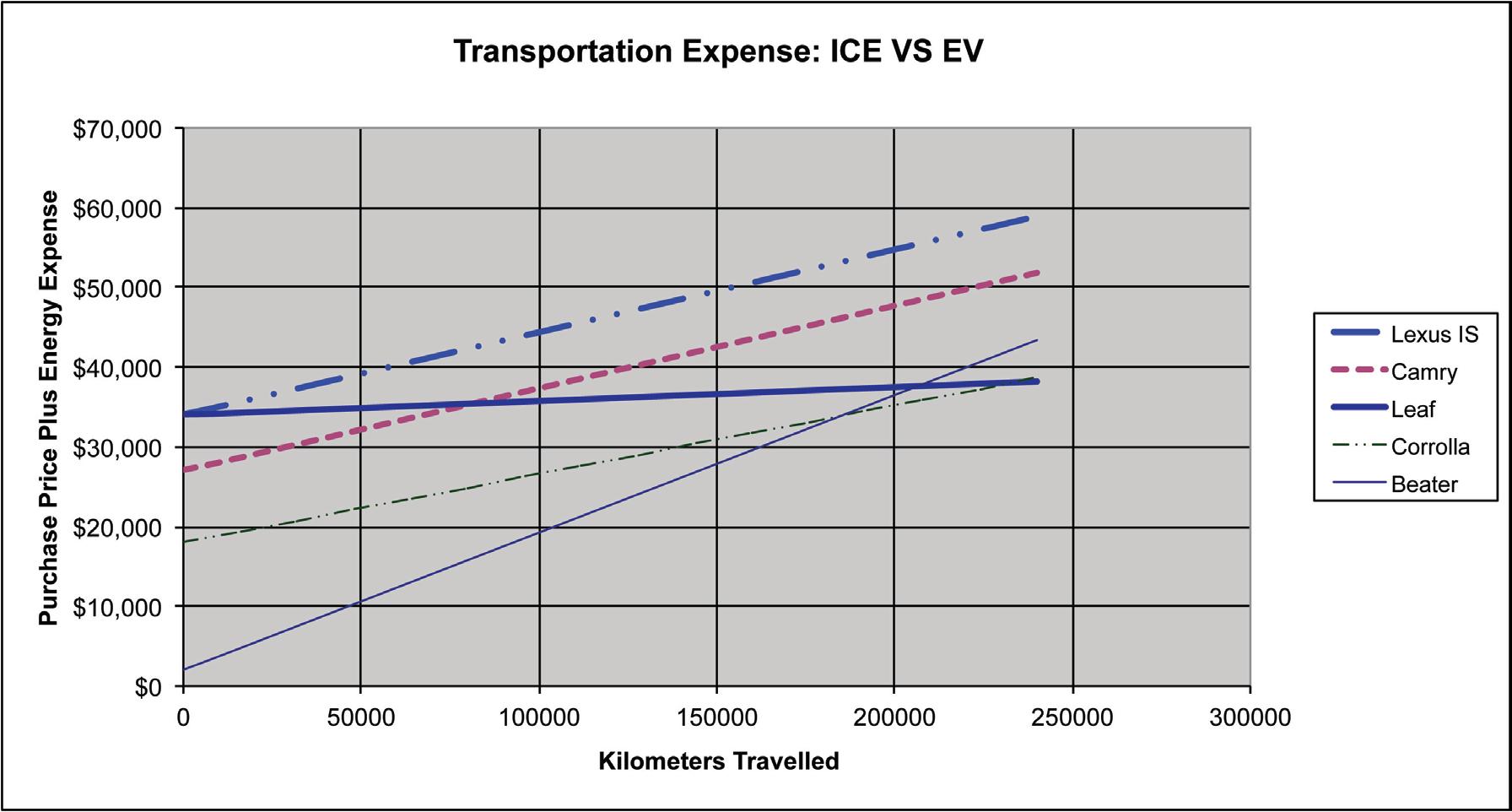
The Mitsubishi Miev and Nissan Leaf currently sell in the range of $32,000 to $40,000. While this may cost more than some vehicles, eventually the total cost of ownership over the life of the vehicle may be cheaper than other ICE vehicles. The graph featured lists the initial purchase price, plus the cumulative energy expense of driving different vehicles over distances. Sidebar: this graph is deliberately simplified and does not include any other variables, such as interest rates, inflation, maintenance costs, insurance, depreciation, rebates, etc.
A big concern that many con-
sumers have is that electric vehicles won’t drive 500 or 600 kms on a single charge, as ICE vehicles do. However, how many times a year do you drive this distance in a single day? Studies have shown that on a daily basis, 80 per cent of commuters drive 80 km or less, and 50 per cent drive 40 km or less.
Winnipeg is a relatively small city, unlike a metropolis such as Los Angeles, or other big American cities. Using the Perimeter Highway as a boundary, Winnipeg is only about 30 km from east to west and north to south at its longest distances. Using data loggers, Dr. Eric Bibeau from the U of M’s engineering faculty conducted a detailed study on Winnipeg commuters, and concluded that the size of the batteries could actually be reduced in size by around 40 per cent. As a daily commuting vehicle in Winnipeg, an electric vehicle makes a lot of sense!
For those concerned with driving long distances, a new company, Sun Country Highway, has begun installing charging stations all across Canada, with the idea of making cross-country trips by electric vehicles possible and practical.
Public policy
The Manitoba Electric Vehicle Roadmap has estimated that Manitoba spends between two and three billion dollars importing fossil fuels each year. At the same time, Manitoba Hydro generates an abun-
dance of “clean” electricity, so much that Hydro exports surplus energy to the U.S.A. About 98 per cent of the electricity comes from renewable energy sources such as wind and hydro. The Roadmap states, “We could easily convert one of our greatest energy weaknesses (imported fossil fuels) to one of our greatest strengths (hydroelectricity).”
By switching to electric vehicles, less money would leave the province, and there could be an economic multiplier effect. The local economy would get a boost, as if the government engaged in public spending. However, there would be one important difference: the “spending” would not need to be recouped by higher taxes at a later date. The benefits would come via greater efficiencies arising from the technological shift.
In conclusion, the case for electric vehicles can be summarized as follows. From an environmental standpoint, EVs are many times cleaner than traditional ICE vehicles. From a consumer standpoint, EVs cost much less to operate, require a notably lesser degree of maintenance than ICE vehicles, and pay for themselves in the long run. From a public policy standpoint, EVs would reduce fossil fuel imports and, by using locally generated electricity, create a local economic multiplier effect. Go electric! Rodger Lepinsky is a U of M alumnus and a member of the Manitoba Electric Vehicle Association: manitobaev.ca
A day in the life
Counting cells, playing the waiting game
e lizabeth d rewni K , volUnteer Staff
Last time we explored cell splitting and the errors involved in the process. Today, we will look at how cell splitting can be applied to attaining experimental data. Experiments involving drug treatments utilize the technique of cell splitting to better understand how a cell (and, ideally, an organism) responds to certain doses, concentrations, and combinations of drugs.
The past couple weeks have been devoted to growing up various cells and splitting them to generate enough cells to work with for the desired experiment: treating the cells with drugs. But how many of the cells will need to be used for the experiment? How do we know that we’ve even grown enough cells? Before we get down and dirty with the physical portion of the experiment, we first need to crunch some numbers.
Generally, these experiments are performed in 96-well plates, where 100 microliters (µl) of solution are added to each well. We need to conduct a simple calculation to determine the concentration of cells we are adding to the wells before plating the cells. To do this, we use a cell counter.
When the cells merge together and are thus confluent, trypsin is
administered, and the cells are centrifuged and resuspended, just as with the initial steps for cell splitting. The difference is that once the cells are resuspended, a small sample is mixed with a specific dye that tests for viability of the cells, and the mixture is placed onto a cell counting slide. The slide is inserted into a cell counting machine, and after waiting for less than a minute the results are in!
The cell counting machine provides the total and live counts of cells, as well as the per cent viability, which can be used to determine the volume of cells needed to fill all the relevant wells of however many of the 96-well plates are being utilized.
Once the correct concentrations of cells are determined, the amount of cells needed for the experiment is calculated, and the cells are added to the wells of the plate, or “plated.”
The cells are then left to grow until they reach the appropriate confluence to work with.
The largest issue involving this procedure is having to play the waiting game. Every different cell line grows at a different pace. Just as plants bud at different rates (e.g., weeds will grow rather quickly whereas roses take much longer to mature), different cell types vary in
Strike six: you’re out!
copyright initiative takes effect in U.S.
their rates of growth. As such, it is important to be aware of these specific characteristics with the cell types you are working with.
There are times when a cell type does not grow as expected. For example, one might think that a week would be plenty of time to grow enough cells to fill five 96-well plates for a certain experiment. As
it turns out, on the day that the cells are counted (the day that you expect to plate the cells), there are sometimes not nearly enough cells to run the experiment. What else can be done other than wait for the cells to grow? Nothing, really. Just wait. The cells will be ready – but not today.
Problems may also arise if the
samples of cells are lost, either through misconducted aspiration or through something as simple as knocking the sample tubes over with your elbow. Once the cells are gone, they’re gone. The situation is nothing like in undergraduate labs, where when something is spilled or lost, you can borrow an extra sample from a partner across the room, or perhaps ask the TA for additional samples that are stored for such an occasion. Not so, in the life of a researcher.
The experiment must be started from the beginning. Cells must be thawed from the –80 C environment at which they are stored, and split until there are enough cells to conduct the desired experiments. That cell splitting process may take several weeks, depending on how quickly your specific cells grow, and how many cells you require for your experiment.
Accidents such as these are very costly. Knowing this provides an appreciation for how much preparative energy is put into undergraduate labs, where accidents happen all of the time.
We will continue with the remainder of drug additions in the coming week, after our plated cells are confluent.
iLLustRatiON by CaROL Ne NORMaN
Last week a new program aimed at reducing illegal downloads of copyrighted materials took effect in the U.S. Conceived in 2011, the Copyright Alert System (CAS) is a partnership between several media industry organizations and the major American Internet service providers. The intention is to make illegal downloading more difficult and inform users who may be unaware that their activities are illegal.
This is how the system is supposed to work: representatives of copyright owners join public peer-to-peer networks (specifically, public BitTorrent trackers like The Pirate Bay) and look for copyrighted material that is being shared illegally. If they find it, they verify that the shared file is a com-
plete copy, not just a part, and send a notice to the Internet service providers (ISP) of the user sharing the file. From there, the ISP will take one of several actions, depending on the number of notices a user has received. The first few will simply trigger an email from the ISP, while further notices will lead to more intrusive measures such as throttling download speeds or requiring the user to watch an educational video.
The Center for Copyright Information, the organization in charge of the CAS, emphasizes that the copyright owners are only working with Internet Protocol (IP) addresses – unless they obtain a subpoena, they never see information that would allow them to tie the address to a specific person. There is also an independent review process for wrongful copyright alerts –though the user has only 14 days to file for a review and the process costs US $35, which is refunded only in the event of a successful claim.
Many ISPs already have similar programs, with more or less consistent enforcement. What’s new about
the CAS is that it is a large-scale, coordinated, and publicized effort. At this point there are still many details that have not been announced. Each provider will handle copyright alerts in its own way. So far, Verizon is the only ISP that has announced it will temporarily slow down connections to near dial-up speeds for users with six alerts. Cablevision will temporarily suspend accounts, and AT&T will block certain websites until the user completes an online copyright education course. No provider so far has considered completely cutting off service to offending users.
All these measures are temporary and, seemingly, rather toothless –more irritating than coercive. The system is meant to educate users who may be unaware that what they’re doing is illegal (if such people actually exist), and gently encourage them to seek out legal means of getting a hold of their media.
In fact, although the CAS has been described as a six-strike system, after the sixth alert no further action will be taken against a user’s account.
“We hope that by the time people get to alerts number five or six, they will stop,” said Jill Lesser, executive director of the Center for Copyright Information.
“Once they’ve been mitigated, they’ve received several alerts, we’re just not gonna send them any more alerts because they’re not the kind of customer that we’re going to reach with this program.”
Of course, legal action against offending users is not out of the question. Once the alerts stop, the records remain, and it’s not clear how they could be used in court. Also, the ISPs will have to let the copyright holders know which IP addresses receive more than one alert, which would make litigation easier.
At this point, a lot still depends on how the system is implemented and how the rules are enforced. In the meantime, virtual private networks and proxy services are seeing increased subscriptions. The CAS seems like a refreshing alternative to gigantic lawsuits against individual users, but it remains to be seen how, if at all, it will work in practice.
A Casio-playing man-beast with mutton chops
B.A. Johnston returns to Winnipeg to play the Windsor
Jenna d iubaldo, Staff
B
.A. Johnston is to indie music what Zach Galifianakis is to film – not to mention that they bear somewhat of a resemblance.
If you’ve ever seen this muttonchop-sporting, Casio-keyboardplaying, beast of a man, half-naked on stage singing songs about video games and neck tattoos, then you are aware of the magic that is B.A. Johnston. If you haven’t yet experienced this ridiculous trucker-cap-wearing ginger work a crowd with the confidence of a pop
icon—or perhaps simply a man who has drank far too many beers—then you ought to get yourself on down to the Windsor Hotel on Mar. 9 to check out this sweaty Hamiltonian perform in all his stinking glory.
“You basically get the minivan madness – a lot of singing to yourself, trying to have conversations with teenagers at McDonald’s, and yelling at the CBC.”
Johnston spends most of his time driving around Canada in a Toyota Previa since he is pretty much constantly on tour, and releases music just as frequently, with eight albums and a DVD out over the past decade and another one planned for release in late
Wearable art
2013 or early 2014.
One of the most interesting and hilarious aspects of Johnston’s music is the album artwork that accompanies it. His newest album Hi Dudes! released in 2012—features a screenshot of the creature from the movie Weird Science on the front cover. His CD prior to that, entitled Thank You For Being a Friend, includes album artwork that is an artists’ rendition of Johnston alongside John Candy, the Hamburglar, and what looks like a gremlin from the movie Gremlins posed in the style of the Golden Girls
Recently, Johnston was able to take a few minutes out of his relentless touring schedule to answer a few questions for the Manitoban, so read on to learn more about douches, hugging, and how to stay entertained when you basically live in a van.
The Manitoban : “Eye of the Douchestorm” off your newest album Hi Dudes! might just be your best work yet. Were there any particular douches that inspired this song?
B.A. Johnston: This song was actually inspired by a bouncer in a bar I was playing in Montreal. I asked him if the Montreal Canadiens were playing that night and his exact response was, “If they were it would be a total douchestorm in here.” And then the song just wrote itself, basically.
M: You spend a lot of time on the road by yourself in a van. How do you manage to not feel lonely and bored?
BAJ: Well, you don’t. You basically get the minivan madness – a lot of singing to yourself, trying to have conversations with teenagers at McDonald’s, and yelling at the CBC. The loneliness can at times be surreal and horrifying, but you get more drink tickets this way.
M: You recently put out a 7” with the Magnificent 7s from Winnipeg. How was that experience?
BAJ: It was great. It really exposed my weakness as a technical musician, though. They kept trying to tell me
what key things were in.
M: What’s your favourite place to eat when you stop in Winnipeg?
BAJ: Falafel Place is good, as is the Nook and the Black Sheep. I miss the Shanghai, mostly for the awesome sign and getting to eat in a restaurant where the waiters wore tuxedos.
M: You’re known for moving to impromptu locations during your shows such as bathrooms and on top of vending machines. What’s your favourite memory of this?
BAJ: Once in Saskatoon I did the encore in the bathroom and two dudes started to fight. I made everyone in the bathroom yell “hug it out” until they stopped and hugged. It was pretty life-affirming.
B.A. Johnston will be performing at the Windsor Hotel (likely in the bathroom) on Mar. 9 alongside the Lonely Vulcans and the Bad Nerves.
Unravelled exhibit comes to the School of Art Gallery at the U of M
Joelle Kidd
On Mar. 8, the University of Manitoba School of Art Gallery will open an exhibit featuring a group of six Manitoba-based artists whose work explores the relationship between fashion and art. Unravelled: Artists and Designers Deconstructing Garments is curated by Jennifer Smith and features the work of Teresa Burrows, Lisa Dyck, Lita Fontaine, Helga Jakobson, Roy Liang, and Melanie Wesley.
The exhibit explores the interaction between fashion and art, and the ability of one to inspire the other. Unravelled contains work by both visual artists and fashion designers.
Smith had met while working at the Costume Museum of Canada and artists whose work she had been interested in.
“I spent time doing studio visits and research on various Manitoba artists and designers before selecting,” says Smith.
One of the contributors, Teresa
Unravelled explores the interaction between fashion and art, and the ability of one to inspire the other.
“Through research I have been doing on the use of craft in contemporary art, I started coming across a lot of work that I was very interested in, that showed a crossover between fashion and art,” says Smith. “I became interested in artists that were creating garment-based sculpture. It made me think about how fashion designers could also be considered sculptors.”
The group of artists and designers chosen for Unravelled are people
Burrows, is a graduate of the University of Manitoba school of art, and has now established a career making art. Her contribution to the exhibit, “Hide-Secrets of the Skin Room,” is inspired by a fairytale about a girl who chooses to wear skins and disguise herself as an animal rather than suffer sexual abuse from her father and brothers.
Burrows was also inspired by the Grandmothers Circle, a group of women who advocate for the safety of children in northern communities.
The group was born out of an incident in 2007, when a young girl from Wasagamack was found to be pregnant by her grandfather. The work Burrows does as a probation officer and addictions counsellor, as well as her home life in northern Manitoba, greatly influences her art. The exhibit also includes work by Lisa Dyck, a designer who works as a tailor and creates custom garments for clients. Her contributions to Unravelled make use of her technical skills while allowing her to stretch her creativity. Dyck’s pieces include “Hands,” a gown adorned with a trail of dip-dyed gloves, and “Hope Over Fear,” which uses quilting techniques.
Melanie Wesley is a mixed-media artist who creates wearable art and visual pieces. In her pieces “I see you…”, “Soldier on,” and “Liberation,” she experiments with a freedom of process that allowed her to create without following traditional dressmaking rules. Her pieces use handstitching and mixing of fibers and materials to create a free-spirited deconstruction of classic clothing forms.
Designer Roy Liang uses his pattern-making and silk-screening skills to create unique artistic pieces.
In his piece “Terry Fox,” Liang seeks to infuse practical fashion pieces with memories, making everyday items thought-provoking, such as his jogging suit printed with a life-size image of Terry Fox.
Lita Fontaine mixes contemporary elements with traditional designs to evoke the motifs of Dakota celebratory ceremonies. Helga Jakobson,
who is currently studying art at the University of Manitoba, has contributed wedding dresses that explore the concept and rituals of marriage through their construction and materials.
The exhibit ran earlier this year in Altona at Gallery in the Park, and Smith is excited to reopen the show at the U of M.
“The space we will be using is beautiful,” says Smith. “It is exciting to know that a large portion of the audience will be students.”
Smith says that as the exhibit has progressed, Unravelled has become not only about exploring the roles of and relationship between designers and artists, but also about telling stories.
“The new question I asked myself became, ‘Are garments a way of sharing our ideas?’” says Smith. “I would say, yes.”
Unravelled will be housed in the U of M School of Art Gallery at 180 Dafoe from Mar. 8 until Apr. 19. An opening reception will take place on Mar. 8 from 5 p.m. until 8 p.m.
More information on the show can be found at www.unravelledshow.com and on the Manitoba Craft Council website.
phOtO by MeLaNie WesLey
Taylor and Young of Urban Street Funk
david sKene, volUnteer Staff
hen the sun starts to shine and the snow begins to melt, Winnipeggers get the itch to put their parkas and Sorels in the closet and go outside unencumbered by their winter regalia.
For me, winter is officially over when I’m walking around the Exchange District and I hear that low groove rising and falling somewhere off in the distance. There is an ebb and flow of the wah pedal intertwining with a crunchy beat, and a soulful voice singing songs about fire and heartbreak, rising above the din
of city life.
Yes, while you are listening for the tweet of the robin, I’m waiting for the moment I hear Taylor and Young play some Urban Street Funk, a band and a genre that is unapologetically only for Winnipeg.
They have designed their presentation and their sound to speak the language of our dirty little city
Sure, anybody can enjoy Urban Street Funk, but to really get it you have to stumble upon that grey-haired gentleman with the kickin ‘stache, ripping into his portable drum kit. You have to hear the petite woman
with long hair and sunglasses, playing guitar like a preacher giving a sermon about brimstone and damnation. You have to be there when she ends her solo and repeats the last refrain of their song “Fire.” Not until the words,
“We’re not so different, you and I,” echo off interlocking brick and craggy facades of the Exchange, do you really get it.
What? That hasn’t happened to you? Well, give it time. Karen Taylor and Scott Young are out there on the street right now, making life in Winnipeg more like a music video. They have designed their presentation and their sound to speak the language of our dirty little city. They play in public places but
they’re not buskers—they jam outside because that’s where the music sounds best. They rock the covered alleyway beside the Artspace building like it was the Fillmore, back when rock and roll was deserving of such palaces.
I’ve said it before and I’m going to keep saying it: Urban Street Funk is the reason you should throw away your iPod, take the phone out of your ear, and listen to the sound of the street. When that low groove off in the distance makes its siren call, you don’t want to miss it.
or elsewhere. You can make your claim on your income tax return.
can claim your rebate over as little as six years or as long as twenty years.
Here are some examples of what
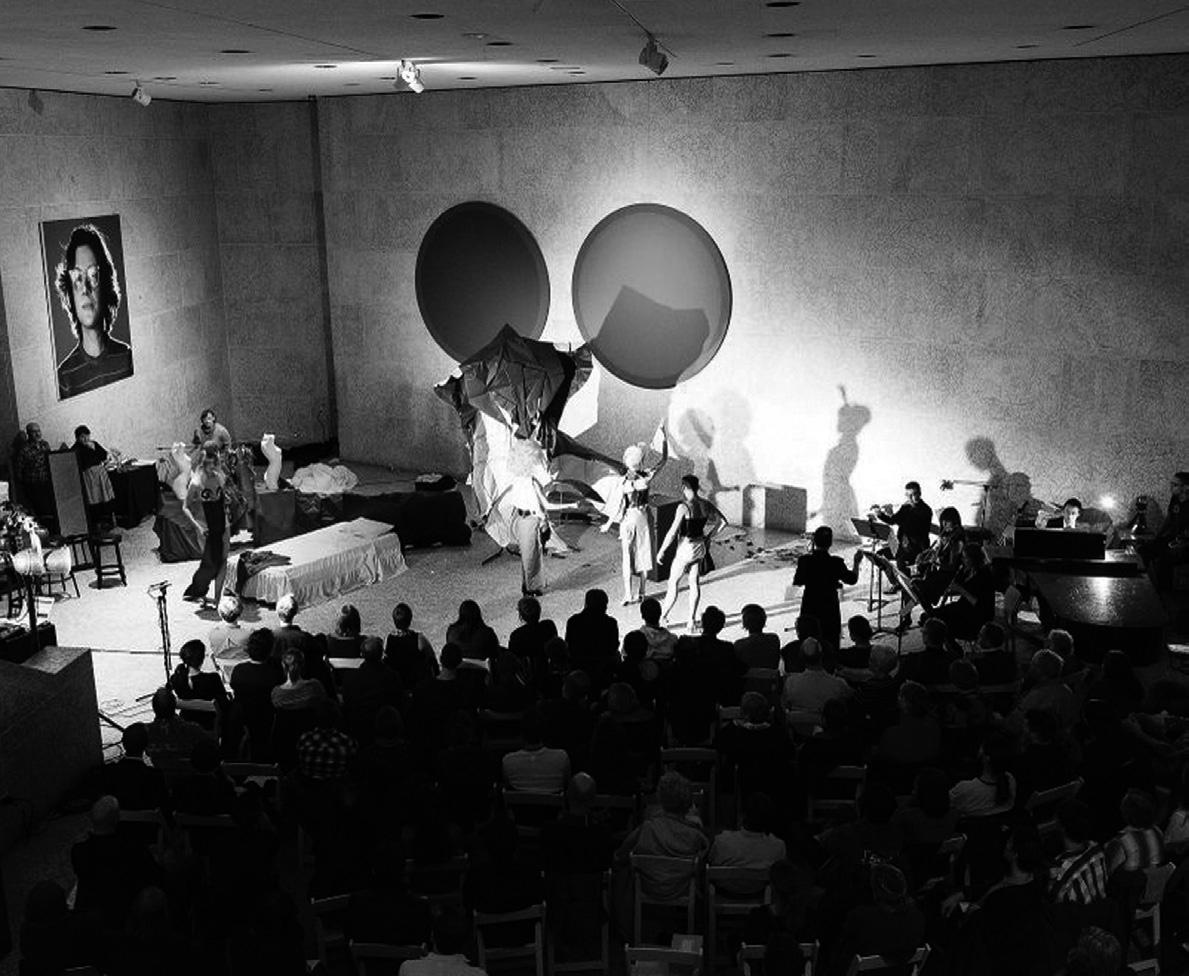
The marriage of music and art
The Cluster New Music & Integrated Arts Festival
Jenna d iubaldo, Staff
The Cluster New Music & Integrated Arts Festival is the perfect marriage of music and art, two creative mediums that go together like peanut butter and jam.
Heidi Ouellette and Luke Nickel began planning the festival in 2008 with the intention of creating an event that provided a venue for new and emerging artists to display their work and push the boundaries of art to the limit.
“Luke and I started the festival because we wanted to see and hear more music and art in the city that was truly new, exciting, risk-taking, and high quality,” states Ouellette, one of the event’s co-directors. “We wanted to create the opportunity for artists to push the boundaries of their own work, and to collaborate.”
Cluster takes place over the course of eight days at the Urban Shaman Gallery, featuring 30+ artists and
musicians from Winnipeg and around the globe.
“We generally focus on a theme which really helps guide who we work with,” says Ouellette regarding the process for choosing performers. “We always have our eyes open for potential festival artists; things fall in our lap, friends recommend interesting acts [or] works they see. We try to have a good balance of visiting and local artists, emerging and more established people.”
“Winnipeg has such a special, thriving arts community and Cluster is an event that helps bring this diverse group of people together to create, to experience something new, and to get inspired.”
Some of the featured performers this year include Lori Freedman, a Montreal-based clarinetist, and Ensemble Paramirabo, a woodwind/ string/piano quintet. Also scheduled to perform are Winnipeg-based musicians Slattern, and Mise En Scene.
installation,” states Ouellette. “Luke and I have admired his work for years, and to see this amazing structure come to life and completely transform the performance space is going to be amazing.”
The structure that Ouellette is referring to is an art installation from artist Martin Böttger, also known as TSAWORKS, that will literally utilize the entire gallery in order to convert the festival space itself into a geometric work of art.
The festival will come to close with a concert called Reasons, a group performance from almost all of the
trio, This Hisses.
Given that this is the fourth year of the festival, it certainly has grown over the years, specifically in size: it doubled in budget and audience by its second year and tripled in number of performers.
“After doing it for a number of years, we have become more organized and things run smoother,” says Ouellette. “Beyond those reasonably measurable changes, it has also evolved quite a bit. We constantly re-evaluate and experiment with the structure of the festival [and] how we present the works.”
“The last thing we want is for the festival to feel predictable, stagnant, or uninspired.
"Winnipeg has such a special, thriving arts community and Cluster is an event that helps bring this diverse group of people together to create, to experience something new, and to get inspired."
“The exhibit I’m looking most forward to is definitely TSAWORKS’
artists scheduled to attend, including improvisation, collaboration, a Sound Brush—an instrument created by David Storen that includes balloons and vacuums—and finally a performance from local surf noir
Every year is a blank slate, and a new adventure.”
The Cluster New Music & Integrated Arts Festival spans from Mar. 9 – 16 at the Urban Shaman Gallery. Student passes are $25 each and can be purchased by emailing info@lusterfestival.com or by visiting McNally Robinson Bookstore. Check out www.clusterfestival.com for more information.
Nice guys and online dating
Jodie l aY ne, Staff
So, dating can suck sometimes/ most of the time.
This is the common refrain from single friends. Back in the days when I was single, navigating my way around emotions, etiquette, and completely unrealistic expectations, it wasn’t really a party either. There’s the vulnerability that comes with having to build trust and honesty with another person, the balance of trying to make them see that you are actually great but not perfect (so they don’t get a case of those impractical expectations), and the excitement of actual dates, holding hands, and having your parts touch their parts in ways that feel good. But, there is also the chance that the dreaded moment will arise when you realize that you have found yourself on a date or interested in a “nice guy.”
If you’re lucky, your relationship will organically grow with an acquaintance or you’ll have a Meg Ryan rom-com-caliber meeting. If you’re of the 20 per cent of people whose hands don’t magically brush with a babe over the last bunch of kale at Organic Planet, or have a friend whose romantic potential you never
imagine they didn’t have to deal with the repercussions of what they said to you in any way, shape, or form. Yep, Internet dating involves a lot of filterless and tactless racism, misogyny, fat-shaming, fetishization, and other forms of terribleness.
Internet dating involves a lot of filterless and tactless racism, misogyny, fat-shaming, fetishization, and other forms of terribleness.
saw before, or even friends who actually like you enough to introduce you to the catches they know – you’re in for an even harder time.
Online dating can really suck. You know all the creepy things people say to you at the bar, when they are actually face-to-face with you? Now,
Well, thank tits that there are some pretty rad Internet renegades who are not only responding to these douchebags, but calling them out publicly on their bullshit. The most popular site being, “The Nice Guys of OkCupid,” which openly exposes the hypocrisy of the “Nice Guy.” You know him, we all know a guy like this: bemoans being put in the “friend-zone” by women, claims he’s such a good guy but that he’s single because “girls like jerks.” Basically, he thinks he is owed sex or a relationship just for being “nice.”
Well, the Internet has news for
you, dudes – being nice and expecting something in return doesn’t make you nice. It makes you a jerk, actually.
There are also the special cases of racism and fetishization of people of colour – the latest blog to expose and shame these creeps is the blog “Creepy White Guys.” It features interactions between its Asian author and guys from OkCupid who incorrectly guess her race, try and woo her with stereotypes, and try to prove the superiority of their culture. It’s offensive, disgusting, and reeks of the privilege to say whatever you want whenever you want to women, which is why I fully support these sites that name and shame the perpetrators.
Most of the things in these messages are the messages pretty much every single woman will receive in her online dating inbox at a fairly regular frequency. Yet, these only make up a fraction of the still-frustrating interactions that women have with men in real life.
The keyboard and sole interaction
with a 2D profile embolden the abandonment of acceptable interpersonal communications. It allows for objectification and the lack of immediate consequences. If a guy in person said half the things that a guy on Plenty of Fish said to me during my stint in online dating, he would be verbally chewed out.
Most guys wouldn’t have the courage to spout their misogynist, sexist, racist, sizeist bullshit in person for fear of being held accountable. By calling them out publicly, we help to redefine what is acceptable and create accountability on the Internet. I’m all for protecting privacy and having the ability to pursue your desires legitimately and respectfully without fear of ridicule. However, these are not cases of disparate desires – this is straight-up sexism and it’s nice to see the Internet won’t let it slide.
You can confidentially submit a question or topic to jodie.m.w.layne@gmail. com
The Pluto Shot
Black Hole Theatre premieres play written and produced at the U of M
Jodie l aY ne, Staff
What do science and theatre have in common? On the surface not a whole lot, but when The Pluto Shot begins its run at the Black Hole Theatre next week, audiences will see the two collide.
Set in Berkeley in the early 1960s, The Pluto Shot follows two scientists who have been hired to work on creating a new bomb. Tides change when they make a big discovery and begin to work on something else – which results in making them glow as if they are radioactive.
This is recognized as a sign by a budding group of cultists who seek to find their source of illumination.
“It’s a complex piece on paper, but when you put it on stage, it’s incredibly funny and intricate,” says Kevin Ramberran, a performer at the Black Hole Theatre Company.
He should know – he’s one of the leads of the play.
“I think that the show manages to strike a fantastic balance between sexual hilarity, snappy wit, and heartfelt emotion. I’m excited to see which characters the audience achieves catharsis with and how that affects their experience of the show,” says Ramberran. While the show is primarily about politics in science and takes place in the 1960s, Ramberran argues that it’s still highly relatable.
“It’s easy to look at the 1960s and think that as human beings we’ve changed so much. Something I think The Pluto Shot brings out is that although society has changed a lot, humans have always been a little crazy.”
The play runs from March 12 until 16 and again from March 19 until 23. It is the world premiere of The Pluto Shot , which was written by Dr. Robert Smith, an instructor in the faculty of arts at the University of Manitoba.
Project instructors Bill Kerr and Chris Johnson. Ramberran says the process has brought life to the upcoming production.
“We’re trying to put more focus on the development of new work in the Black Hole Theatre Company.
“The things the audience reacts to, laughs at, and finds intriguing are going to be things that Robert, Chris, and the cast pick up on. Audience members will find themselves part of the creative process, whether they like it or not.”
The world premiere of a play is a unique opportunity for an audience to see something truly distinct and reform the way the play is delivered in the future.
The script is a product of a theatre department project aptly titled, the New Play Development Project. The project aims to provide students with a comprehensive look at how plays are created and give students a chance to try their hands at the many roles in bringing a play to life.
The Pluto Shot is the product of collaboration between Smith and fellow New Play Development
We still love doing established plays, and will continue to produce those as well, but we feel there is a great deal to be learned from working on an entirely new work,” says Ramberran.
The world premiere of a play is a unique opportunity for an audience to see something truly distinct and reform the way the play is delivered in the future.
Aside from the new work, audiences should come down to appreciate what talent is on offer for every show. Ramberran thinks the Black Hole Theatre Company is underrated and urges would-be audience members to get in the seats.
“There are many reasons to support the Black Hole: the young talent, the fantastic productions, the local artistry and such. The main reason though, is the artistic inspiration that having an audience provides. The audience is going to have a great experience and that experience will only become more exciting as our audience grows.”
Local and low-budget films
New film festival will cater to filmmakers needing their “first break”
Jodie l aY ne, Staff
Emerging filmmakers and film students alike will have a new festival to show off their work come this May. Cleo Leslie, Nigel Webber, and Scott Angus are the trio behind 1st Break Film Festival.
“Another festival had the name First Steps, which we wanted, mostly so I could interview filmmakers on steps,” says Leslie jokingly.
The festival will be a celebration of the art of low-budget, amateur films.
who shared similar feelings.
The goal was to create an event that would allow filmmakers to get their work seen and out there without having to wait for a big budget or years of experience.
“I think when you first graduate from school, there is a lot to
from industry experts, distributors, and other filmmakers. 1st Break wants the event to help students learn that they can become professional filmmakers and provide the tools to make the transition.
“Sure, it’s easier to stay at home, but it’s so much more rewarding to go out and create something.”
Inspired by their visit to the Gimli Film Festival this past summer, Webber and Leslie decided they wanted to participate in a similar event, but knew that their films weren’t quite at a level to be included yet. Despite co-producing a film for Winnipeg on Demand, shooting the Rainbow Trout and Big Fun music festivals, and filming some of the most buzz-worthy bands in Winnipeg, they knew that they weren’t yet ready and that they had filmmaking peers
be learned from having your work watched and seeing how people respond to it. When you’re so close to a product, you can’t necessarily see if the ideas are being translated or if there are any gaps,” says Leslie.
There are many filmmakers who graduate from school and are not sure how to make a career out of their degree; the film festival won’t just exhibit low-budget work, but it will also provide instruction and insight
There are panels planned on everything including how to get a film funded, doing the film festival circuit, and the relationship between actors and filmmakers. Leslie says she doesn’t want to name-drop yet, but will be releasing the names of people on the panel shortly in a video.
“You send emails to people and expect people to turn you down, but the response has been so positive,” says Leslie. “You know, you have an idea and you think it’s great but you really have to put yourself on the line to put it out there and get people excited.”
Leslie says that this type of support is typical of the film community in Winnipeg and one of the best parts
of planning the festival is getting to work with people she admires.
“Even if you’re not completely immersed in the film community, you start shooting stuff and people get interested. They don’t have to be nice and give you the time of day, but they do.”
Leslie and Webber want the festival to reflect the inclusive nature
of the industry and Leslie says that the festival is going to be like a “big hug.”
1st Break is going to give their audience the chance to see emerging filmmakers before they make it big.
“Think of how awesome it would [have been] to see David Lynch’s shorts he was producing as a 20-yearold. It would have been some pretty crazy, messed up stuff and these people are right at that age. They’re the next batch of filmmakers to come out of the city and this really gives you a chance to see what’s happening before it happens,” says Leslie.
While trying to carve out a film career for themselves and trying to plan a film festival definitely keep the trio more than busy, Leslie says it’s worth it to see the community being formed and the buzz around the event building.
“Sure, it’s easier to stay at home, but it’s so much more rewarding to go out and create something.”
For more information, check out www.1stbreakwinnipeg.com.
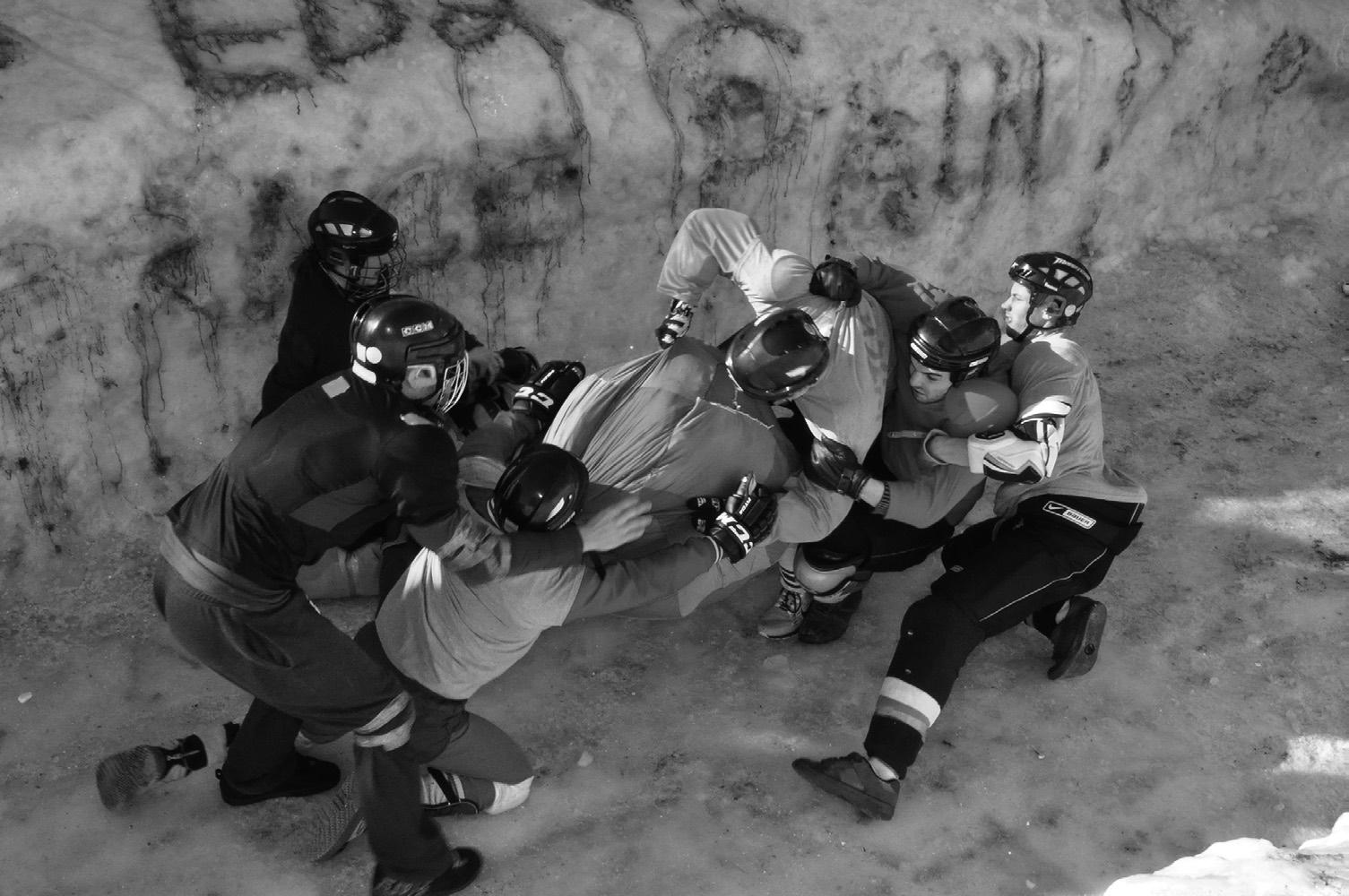
Ditchball 2013 by Marc Lagace
PHOTO
Sometimes, life's a ditch
Marc l aG ace, Staff
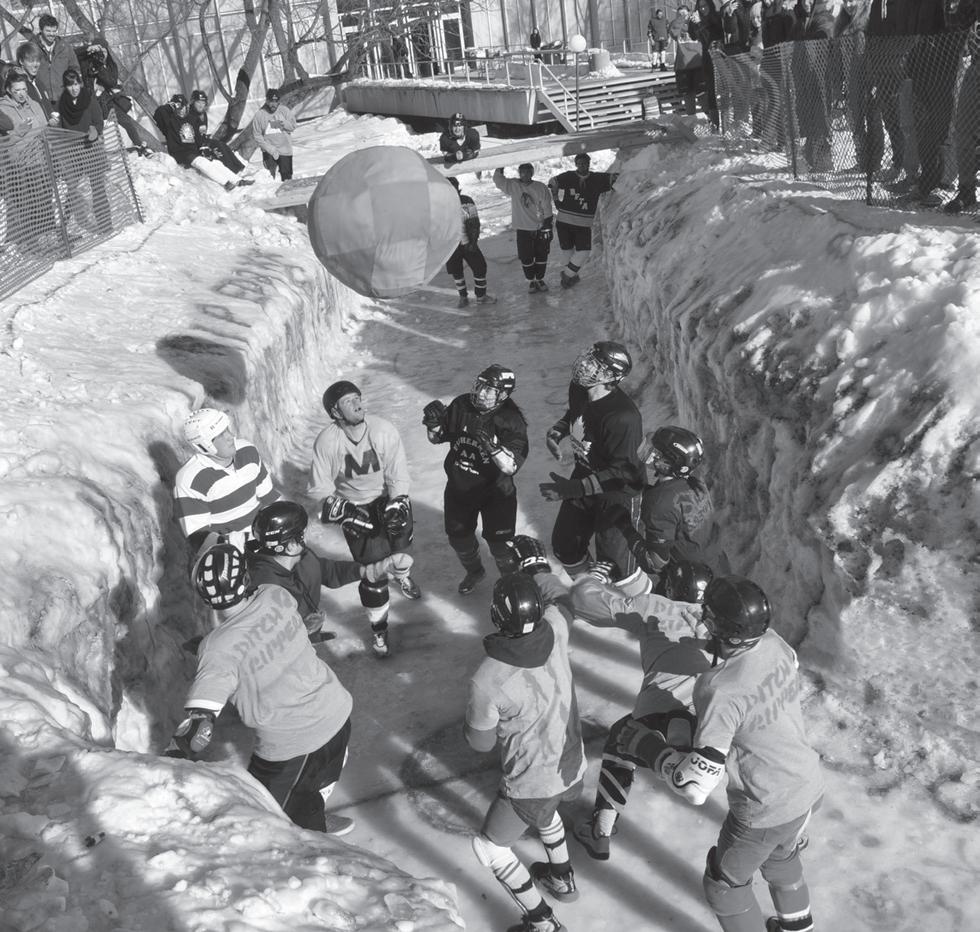
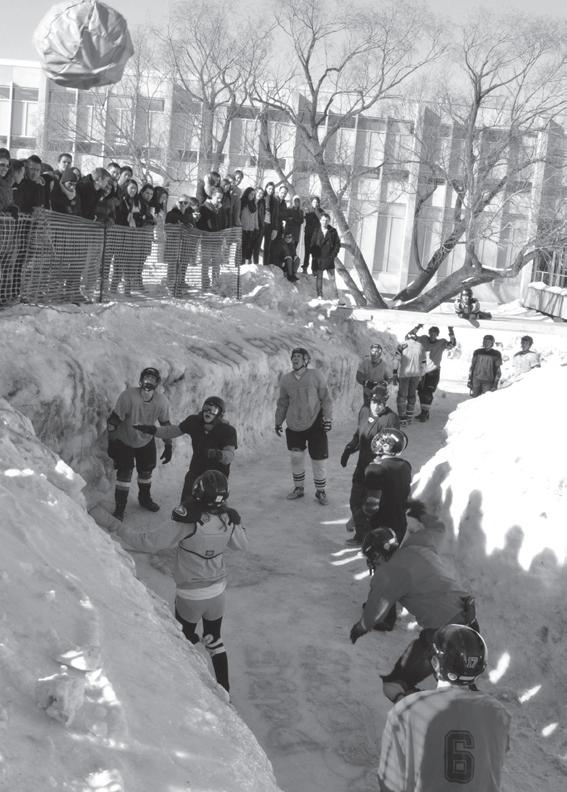
For the 35th year in a row, students from the faculty of architecture congregated around an icy ditch carved right through a huge mountain of snow located just south of the Russell Building.
This annual tradition is entirely unique to the University of Manitoba, and is called Ditchball.
Verne Reimer, a member of the graduating class of ’79, was one of the 16 architecture students behind the creation of Ditchball. He explained that the genesis of the sport occurred during a trip up to Hecla Island in 1976, when a combination of boredom, an icy ditch, and too much free time led to an impromptu game of ditch shinny/soccer with a group of architecture students kicking a big clump of dirt around to pass some time.
Later, Reimer and a group of likeminded people decided to elaborate on that spur-of-the-moment activ-
ity as a theme for an annual winter festival that would serve as a faculty social event.
“As part of the winter festival, we needed a signature event,” Reimer explained. “So we sort of went back
“It’s a bit like playing hockey or soccer in a ditch, I guess. It’s an activity, a faculty activity, but you could call it a game or a sport. It’s whatever you want to make of it.” – Verne Reimer, Ditchball pioneer
in time a bit and said ‘well, how about that ditch? Why don’t we make that something?’”
And so, a small group of guys got together to brainstorm a small set of rules that would come to define
Ditchball.
The goal of the game is for a team of five to get the oversized ball, formerly called the rhombicuboctahedron on account of its 24 sides, through to the other end of the ditch, where one member of their team waits on a bridge over the ditch to grab the rhombicuboctahedron. That’s good for one point. The team with the most points after two 10-minute halves moves on in the tournament.
There are only a few rules: all players must wear a helmet (most are clad in full hockey gear), participants will not strike one another, and any action deemed too violent by the referees may result in ejection from the game or the tournament itself.
As one of the organizers of the 2013 tournament, Aaron Pollock explained that the tradition has become so ingrained in the fabric of the faculty and the school, that
the folks from the physical plant who clear the snow from campus know just where to dump it, and help to clear out the ditch.
“I think it’s really important (to preserve the tradition),” Pollock stated, adding, “This faculty itself is very unique, and that culture is a big part of it.”
Reimer, who was on campus to officially open the tournament, is proud to see that the tradition and culture he had a hand in creating is still going strong.
“It’s fantastic. For anything to go this long is pretty neat.”
“I hope it continues as long as the faculty continues and the University continues,” said Reimer, “I think it’s got proven lasting power so far, and so long as people find it interesting they’ll continue doing it.”
Happy International Women’s Day
for St. Boniface Premier of Manitoba 204-237-9247 GregSelinger.ca
phOtO by MaRC LagaCe
Triumph after tragedy
Lokomotiv Yaroslavl’s incredible return to the KHL
a da M peleshat Y, Staff
eptember
S
7, 2011 was the saddest day in hockey history.
On that day, the plane carrying the members of Lokomotiv Yaroslavl of Russia’s Kontinental Hockey League crashed on takeoff from Tunoshna Airport near the city of Yaroslavl. No one from Lokomotiv onboard survived the accident.
Among the deceased were NHL veterans Pavol Demitra, Ruslan Salei, Karlis Skrastins, Josef Vasicek, and Karel Rachunek, as well as its new head coach, Brad McCrimmon. Two players from Russia’s 2011 World Junior gold medal winning team, Daniil Sobchenko and Yuri Urychev, both 20, also died.
In an instant, an entire hockey team was gone.
The team chose not to play in the KHL for the 2011-12 season, but instead joined Russia’s top minor league, the Major Hockey League (VHL), mid-season with a makeshift roster.
This season, Lokomotiv made its return to the KHL, but the effort to field a winning team, yet alone a competitive one, would require one of the greatest rebuilding projects in the history of professional sports.
First, they needed a head coach, and they found one in Tom Rowe, a former assistant coach with the Carolina Hurricanes. Then, an entire roster of players was needed.
The KHL helped out by holding a draft made up of unprotected players from other KHL clubs. The league also waived Lokomotiv’s limit of import players and even offered an automatic playoff spot, which the team declined.
The team proceeded to sign KHL
veterans such as forwards Alexei Kalyuzhny and Mikelis Redlihs, as well as forward Niklas Hagman who played 770 games in the NHL. On defence, Vitaly Vishnevski, who played seven seasons with Salei for the Mighty Ducks of Anaheim, returned for a second stint with Yaroslavl. The team also signed Swedish national team defenceman Staffan Kronwall and former Winnipeg Jet Mark Flood. In goal, Lokomotiv signed former KHL AllStar Vitaly Kolesnik, as well as former AHL All-Star Curtis Sanford. Eight players from Lokomotiv’s VHL team also made the jump to the KHL. A short time later, they were aided by the NHL lockout with three players joining the team: Colorado goalie Semyon Varlamov, Florida defenceman Dmitri Kulikov, and Columbus forward Artem Anisimov.
The team began the season with a road trip starting in Novosibirsk,
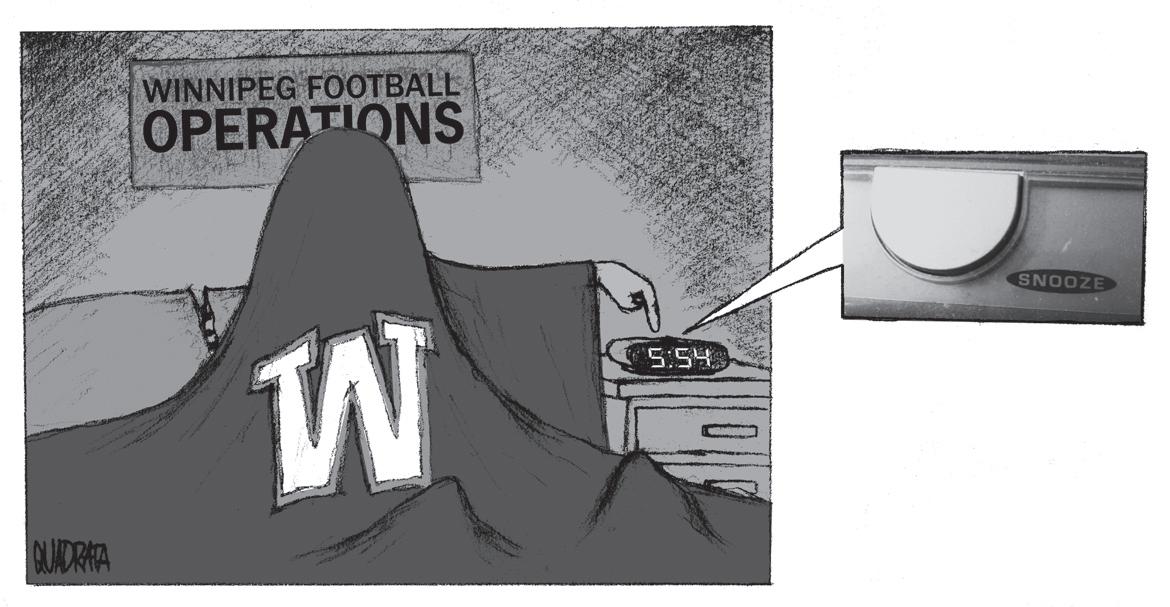
Bombers content to suck again
where Lokomotiv won 5-2, a victory celebrated by KHL fans all over Russia. They made their emotional debut at home against Atlant Moscow on Sept. 16. The home team lost 2-1, and despite the new pre-game tradition of three bell tolls to remember the victims, the game returned a sense of normalcy lost by the disaster. After the loss, the team went on a six-game winning streak and forward Daniil Apalkov, who played on the VHL team last season, was named KHL Rookie of the Month for September. With Varlamov’s 1.74 GAA (goals against average) and Anisimov eventually scoring 29 points in 36 games, the team won 22 of its first 27 games. However, as the NHL lockout ended, the team’s play tapered off. Lokomotiv went 12-13 afterwards, but it was good enough for fourth place in the Western Conference and they made history as the first team in KHL
GM Joe Mack and Co. have done little to improve team in off-season
d ere K GaG non, Staff
While the Bombers are all set to move into the new Investors Group Field on the University of Manitoba campus this summer, the Bombers’ front office has yet to make any significant off-season moves that might help put more butts in those extra seats.
General Manager Joe Mack and company have sat on their hands thus far, as other teams beat them to the punch on numerous opportunities that could have helped to improve a team that finished last season with a record of 6-12 and did not make the playoffs. When a team misses the playoffs, especially in a league like the CFL where six out of the eight teams make it to the post-season, it is safe to say that changes need to be made to ensure it does not happen again in the proceeding season.
Rebuilding is especially important with the team moving into a brand spanking new stadium; a revamped,
The
competetive team would give fans paying higher ticket prices an incentive to come out to the stadium.
Nobody really wants to see a crappy football team taking the field week after week, but the front office seems to think that that’s a perfectly fine strategy.
This off-season has seen the Bombers lose two defensive starters, as defensive end Jason Vega
departed for the NFL and Marcellus Bowman headed for greener pastures in Hamilton just days after Joe Mack said that they would work out a deal with the linebacker.
What did the Bombers do to replace these players? They added a backup offensive lineman and Canadian safety Cauchy Muamba, the brother of current Bomber linebacker Henoc Muamba. Safety
is a position where the Bombers already had a star Canadian player in Ian Logan, so the acquisition was questionable.
Meanwhile, a number of viable free agents got scooped up by other teams for positions that the Bombers could have benefitted from a significant upgrade in. Meanwhile, almost every team made splashes in the off-season to improve their squads, as division rivals the Montreal Alouettes, Hamilton Tiger-Cats, and the defending Grey Cup Champion Toronto Argonauts took steps to improve their clubs. The Bombers have either remained at the status quo, or have actually gotten worse, depending on your point of view.
The position of quarterback was a glaring weakness for the Bombers last year, and for a position as important as QB, it seemed only logical that the Bombers would try to improve there. The big target this off-season
history to go undefeated in overtime and shootouts in a season (10-0). The team played Severstal Cherepovets in the first round of the playoffs and the teams exchanged 2-1 wins in the first two games. In game three, Severstal scored with 33 seconds left to win 3-2 and in game four, the longest in KHL history, Sanford made a recordbreaking 80 saves but Severstal won 3-2 in triple OT. Lokomotiv came back with a 3-2 win in game five, but was eliminated from the playoffs in game six.
Lokomotiv Yaroslavl was not the first sports team to be involved in an air disaster, and other teams who were affected eventually returned to their previous levels of success. However, this team is one of the rare ones to become so good so quickly. People may remember Lokomotiv for tragedy, but they should also be remembered for victory.
for a team looking for a QB was B.C. Lions backup Mike Reilly. The Bombers were reportedly interested, but not enough to outbid Edmonton, who obtained the QB via trade. Thus the Bombers remain with an injury-prone Buck Pierce, uninspiring Joey Elliott and Alex Brink, and the untested Justin Goltz. None of those names put much hope in the hearts of Bomber fans that this season will be any better.
Sure, the new Investors Group Field will be nice, with its bigger seats, cupholders, and state-of-theart video screens. But all of that stuff will only satisfy Bomber fans for so long before, once again, they demand that the team actually try to win their first Grey Cup since 1990.
iLLustRatiON by F_QuadRata
Hockey prophets
Five bold predictions for the second half of the NHL season
Marc l aG ace, d ere K GaG non, rYan h arbY, Staff
CHICAgO’S ON FIRE
It’s hard to determine exactly when the Chicago Blackhawks will suffer their first regulation loss; through 22 games, they’ve only lost three games in extra time, so far amassing 41 points. As of press time, they will host the Minnesota Wild and Colorado Avalanche to play in backto-back games, and their incredible streak could very well come to an end this week. Nevertheless, I predict that, with 26 games remaining, the Chicago Blackhawks will lose no more than 10 games in regulation this season.
That is to say, the Chicago Blackhawks will pick up points in at least 39 games this season, if not more. They would also have to be any sane person’s Stanley Cup pick at this point, as they’ve yet to show any crack in the armour and should run away with the #1 seed in the west.
– Marc Lagace
THE RETURN OF REDMOND
Zach Redmond was enjoying a solid rookie year for the Winnipeg Jets, earning four points in eight games as a defender and slowly cementing a spot on the Jets roster when the unthinkable happened. In a gruesome example of how quickly things can go wrong, Redmond had his femoral artery and popliteal vein cut by the skate blade of a teammate while working out near the end of a Jets practice. Quick thinking and action saved his life, but his season is over as he works on his recovery.
My prediction here is that Redmond makes his recovery and plays for the Jets next year. The extent of the injury is what makes this bold in my mind, as it very well could mean his career is over. However, my faith in modern medicine and his hockey abilities make me believe that he will return to the ice, play, and win the Bill Masterton Memorial Trophy for the 2013-2014 NHL season. The Masterton Memorial Trophy is given annually to the player who best exemplifies the qualities of perseverance, sportsmanship, and dedication to hockey.
– Derek Gagnon
CUP COMES HOME
I figure someone has to do it, so I’ll go ahead and make a whopper of a prediction. THE word, the big one, the queen mother of predictions. I am saying that a Canadian team will win the Stanley Cup. Why? Because 20 years is quite long enough. Four Canadian teams currently sit in a playoff position (Montréal, Ottawa, Toronto, and Vancouver), while Winnipeg, Edmonton, and Calgary are not far out of the hunt. The odds have not been this high since the few years in the early nineties when the Quebec Nordiques were around and there were eight Canadian teams.
The two teams most likely to accomplish the feat are the Canadiens and the Canucks, as they are at or near the top of their respective positions, and have the depth on their rosters required to make a lengthy playoff run. Vancouver has the Sedin twins and a two-headed monster in net, as Roberto Luongo and Cory Schneider vie for playing time. Montreal has a healthy Andrei Markov, P.K. Subban, and backstopper Carey Price trying to end Montreal’s longest streak without a Cup.
– Derek Gagnon
Bison Briefs
AN ORIgINAL SIx CUP FINAL
Specifically, I think Chicago and Boston are going to steamroll their way into the Cup Final, but in order to better my odds I’ll say this will be the year of the original six team.
As of print time, all six of the original six NHL teams are well situated for a playoff spot (only New York sits one point out but has games in hand). The reason I make this pick, though, isn’t because I’m hot for NHL history, it’s because in a shortened season players who know their roles, and teams who have an established identity will hold a distinct advantage when all the chips are down.
Boston, Chicago, Detroit, and New York all have the same coaching staffs they’ve had for consecutive years and with a season as compact as this you can expect the message to be simple and consistent. Teams like Minnesota or Toronto might struggle with stability down the stretch, but familiarity with the system and the personnel will keep teams like the Bruins and the Blackhawks one step ahead of most right until June.
– Ryan Harby
L.A. WILL MAKE THE PLAyOFFS, gET BOUNCED IN ROUND ONE
First, let me address a pet peeve of mine: the Stanley Cup hangover. The idea follows that teams who recently took part in a Cup Final will inevi-
To access more predictions scan code to the right.
tably struggle the next year simply because the NHL schedule is too long and grinding for players to adequately rest and reset their batteries for another full season.
Those in sports media invoke the notion of the hangover with irritating regularity and the fact of the matter is: it doesn’t exist. Yes, the NHL schedule (regular season and playoffs) is brutal for the players but what we are actually seeing when Carolina fails to make the playoffs the year after they win the cup is evidence that the number of teams realistically battling for the Stanley Cup is much larger now than it ever was in the 80s or in the pre-expansion dynasty-heavy era of hockey.
Having said all that, I think the L.A. Kings will struggle to make
the playoffs and get bounced as an eight-seed in the first round.
A lot of people forget that before the Kings turned into the worldbeaters of the 2011-12 playoffs, they finished the regular season eighth in the Western Conference, almost dead last in team goals-per-game. The competition will be tough to get into the West playoff picture this year and L.A. may waste most of their energy getting their franchise onto the ledger in the first place. Look for the Kings to let their foot off the gas and exhale once the post-season begins, only to have the first seed in the west punch them in the stomach and carry the momentum.
– Ryan Harby
phOtOs by CuRtis bOuVieR 2012-13 season award winners
Marc laG ace, Staff
W
ith their seasons over, several Bison athletes picked up yearend awards and honours.
Stephan Walton was named as 2012-13 Canada West Men’s Basketball Second Team All-Star. In his second year with the Bisons, Walton, 26, led the team as a cocaptain and with his play on the court, scoring 17.3 points per game and competing in all 22 regular
season games. In his final year with the Bison men’s volleyball team, Dane Pischke earned a pair of impressive season honours. He was selected as the 2012-13 CIS Dale Iwanoczko Student-Athlete Award winner for his excellence in volleyball, academics, and community service. He was also selected as the 2012-13 CIS First Team All-Canadian at
the right side position. Pischke’s teammate, middle hitter Kenny Rooney, was also named to the 2012-13 CIS Men’s Volleyball AllRookie Team.
On the ice, players from both the men’s and women’s hockey teams received year-end honours.
For the women’s team, defenceman Caitlin MacDonald earned her third conference selection in
four years at the U of M, as she was named a 2012-13 Canada West Women’s Hockey First Team AllStar. Fifth-year forward Nellie Minshull was named a Second Team All-Star. Minshull finished her Bison career as the second leading scorer in Bison team history with 97 points (44 goals, 53 assists).
On the men’s team, four play-
ers earned All-Star honours. Blair Macaulay and Dane Crowley were both named 2012-13 Canada West Men’s Hockey First Team AllStars, while their teammates Jeremy Schappert and Tyler Dittmer were selected as Second Team All-Stars. Dittmer wrapped up his CIS career with his best year as a Bison, finishing sixth in conference scoring with 28 points (15 goals, 13 assists).