Please contact designteam@themanitoban.com if you are interested in submitting a cover image. For other volunteer inquiries, please come to our office in University Centre (across from Tim Horton’s, behind GOSA) or email the editor of the section for which you are interested in writing. Please direct all other inquiries to editor@themanitoban.com
Retraction
In the Aug. 22 edition of the Manitoban, an article titled “Gambling study may have important real world implications” incorrectly attributed a number of research findings to work recently undertaken by assistant professor of Psychology Michael Ellery. While Dr. Ellery does study the psychological effects/ramifications related to gambling, the article in question did not accurately represent the ongoing work of Dr. Ellery specifically.
The Manitoban would like to apologize for the misrepresentation of Dr. Ellery’s work. We, the staff of the student newspaper, regret the error.
Toban Staff Talkback
Rachel Wood, staff
Bryce Hoye Science Editor
“It means there are less places that are open after hours to continue the party . . . sigh.”
“Cruise
Campus news briefs
Rachel Wood, staff
DafoE library rEopEns
During rEnovaTions
The Elizabeth Dafoe library is re-opening despite continued renovations. The library hours are now Monday to Friday from 8:00 a.m. to 11:00 p.m., Saturday from 9:00 a.m. to 5:00 p.m., and Sunday from 1:00 p.m. to 9:00 p.m..
The main entrance to the library, however, is still closed. Library services will be available on the second floor.
The library location of Starbucks will be closed until further notice.
A YouTube video of the available entrances to the library is available through the U of M library website.
The renovations of the Elizabeth Dafoe library will provide 40 new study spaces, better furniture and services as well as upgraded heating, lighting electrical capacities, a new entrance, a self-serve check out, and reserve room.
u of M oriEnTaTion EvEnTs coMMEncE
The traditional U of M orientation events begin during the first week of the academic year. The orientation week has events for new and returning students.
The events include orientations for University 1 students, international students, students living in residency, and a Bannatyne campus orientation.
Campus events include free breakfasts, performances by bands including the Lytics and Royal Canoe, a free market to drop off unwanted belongings, a movie night, beverage gardens, and a performance by Ludacris and K’naan.
UMSU orientation begins on Sept. 6 and lasts until Sept. 14.
More information regarding orientation week can be found on the
UMSU website.
faculTiEs of MEDicinE
anD DEnTisTry rEcEivE
nEW sTuDEnTs
The future doctors and dentists of Manitoba began their programs this past week.
The White Coat Ceremony welcomed 62 first year dentistry, dental hygiene and international students at the U of M Bannatyne Campus on Aug. 23. The ceremony included the students reciting the Community Code for dentistry.
Dean of dentistry, Anthony Lacopino, says that the U of M dentistry program is committed to excellence in oral health.
“Our university has pioneered an international reputation of producing some of the best prepared graduates of any in the oral health field today,” states Lacopino.
The dentistry program includes a mentorship aspect between students and practicing dentists in Manitoba.
The U of M faculty of medicine welcomed 106 Manitoban students into the program on Aug. 22. during their White Coat Ceremony. A total of 110 students were inducted into the faculty.
Forty per cent of the Manitoban students possess rural attributes, meaning they had rural roots or rural work or volunteer experience.
Dean of medicine, Brian Postl, explains that these attributes are a way to impact rural health in a positive way.
“We continue to focus our efforts on attracting students with diverse backgrounds, and rural attributes, as these will have a positive impact on future health care delivery across the province,” says Postl.
u of M profEssor DiscovErs ThaT M araThons arE safE for olDEr aDulTs
Davinder Jassal, an associate professor of medicine, radiology and physiology in the U of M faculty of medicine, found that adults over the age of 50 are able to run marathons without health risks.
Jassal and a team of researchers discovered that any cardio abnormalities, including swelling and weakness of the right side of the heart and a transient increase in blood markers, disappear a week after the marathon.
The researchers tested volunteers from the 2010 and 2011 Manitoba Full Marathon through CTs, MRIs, blood tests and ultrasounds of the heart.
“This is the first study worldwide to use cardiac CT in marathoners over the age of 50 to detect the presence of blocked arteries,” said Jassal.
Question of replacing welfare a hot topic for many
Winnipeg Harvest hosts discussion over possibility of guaranteed income for Winnipeg
Jill Patte R son, staff
Manitoba has for a long time operated with a very intricate welfare system which was designed to assist those who have been disadvantaged and require monetary assistance in order to survive and make a living. Recently there have been talks about the potential benefits of removing this welfare system in Manitoba entirely and replacing it with what is called a “guaranteed income.”
Discussions about the potential benefits and outcomes of this guaranteed income was hosted by Winnipeg Harvest, and took place on Aug. 22 in an open forum, where everyone was welcome to attend.
Broken down, a guaranteed annual income (GAI) is similar to welfare in that it provides impoverished and unemployed people with a weekly or monthly salary, however, the new guaranteed income would, in theory, widen its net to include all individuals who are living below the poverty line. Unlike the current welfare system, this would include individuals who are employed but do not have a high enough income to provide for their family. This, of course, creates logistical impediments as there is no widely accepted definition of where exactly the poverty line is.
Many people who joined in on
the debate about a potential welfare system overhaul appeared skeptical in that they doubted that Manitoba’s NDP government would be willing to implement what many people would see as a radical change.
The proposed benefits of such a system could, however, according to many members of the debate, have a significant impact.
“There are certainly challenges with implementing a GAI today. Neither the electorate nor the governing parties are… in a mood to discuss raising taxes to pay for the expansion of social programs…”
According to Evelyn Forget, a University of Manitoba professor and researcher of Community Health Science, research shows that with the implementation of a guaranteed income there was an increase in people’s health, more students graduated from high school and employment was not decreased from people refusing to work due to the guaranteed income.
It has been claimed that a simpli-
fied guaranteed income would allow social workers more time to do more meaningful work, such as helping people with addiction problems, teaching people career skills, and helping them find affordable housing and daycare services. It has also been claimed that such a system could reduce the various poverty services and agencies funded by the government, such as food banks, clothing drives, and various charities.
“The biggest benefit of the GAI," said Forget, "is the elimination of the extreme oversight and many regulations that are attached to social assistance schemes. It is a largely automatic scheme that treats people like adults, and allows them to take control of their own lives.”
This same guaranteed income sys-
tem was implemented in Dauphin, Manitoba in the 1970s with very positive prospects. The social experiment, called Mincome, took place from 1974 to 1978 and provided every family of Dauphin with a guaranteed income.
Forget, who conducted a study of Mincome, found that the rates of hospitalization from mental illness and accidents among people of Dauphin where above the average in Manitoba, and after the study commenced these rates dropped to below average. However, once the study was finished the effects started to dwindle and hospitalization rates slowly rose again, but still remained below the previous rates.
The main argument against a guaranteed income policy is that once people are given a guaranteed salary even when they are already employed, people will eventually stop working as they no longer need that income in order to play the bills. Forget found that this was not the case in Dauphin. People continued to work, but now had a little extra money to help support their families and raise their children.
Forget, however, has her doubts as well, to the implementation of a Guaranteed Annual Income for Winnipeg.
“ There are certainly challenges with implementing a GAI today. Neither the electorate nor the governing parties are [ . . . ] in a mood to discuss raising taxes to pay for the expansion of social programs and a GAI, if it were to be effective, would require additional resources.”
According to Forget, though, such a system is possible for Winnipeg; it would only require political will to implement it.
“If I were designing such a scheme, I would do it by expanding very significantly a ‘working income tax credit’ which would address the one remaining very large gap in the system,” which is the lack of a supplemental income for the working poor, said Forget.
The issue of a guaranteed income has recently come to light due to that fact that the current welfare system in Manitoba, and Canada as a whole, is increasingly expensive and time consuming. The province has already implemented certain aspects of a guaranteed annual income program which can be seen in the national child benefit and the guaranteed income supplement for seniors.
New research grant from feds for Arctic research
Harper announces $142M to be spent on research centre
Jill Patte R son, staff
Prime Minister Steven Harper recently announced plans for a $142.4 million grant for research to be conducted in Canada’s Arctic region.
The multi-million dollar grant will go towards funding the construction and development of a research center in Cambridge Bay, Nunavut over the next six years. An additional $42.6 million will also be spent over the next six years to fund the centre’s technological equipment, instruments, and project. The centre in question will be called the Canadian High Arctic Research Station (CHARS).
The main goals of the research facility are to increase Canada’s Arctic sovereignty, improve community health, increase resource development, and conduct more research into climate change and environmental issues.
lion would be spent looking into the idea of an arctic research facility, and again in 2010 an announcement was made that another $18 million would be spent over the next four years to develop design plans for the research station.
During his announcement of the research grant, Harper claimed that “the North is a fundamental part of Canada’s heritage, future, and identity; and we must continue to assert our sovereignty over Canada’s Arctic. This new station will undertake science and technology research that will support the responsible development of Canada’s North, inform environmental stewardship, and enhance the quality of life of Northerners and all Canadians.”
Nunavut, reported to have been closed due to a lack of funding.
During his visit to Nunavut, Harper also made the announcement that the government will be giving $270 000 to help fund an expedition to discover two ships, the HMS Erebus and the HMS Terror. Lost over 160 years ago, the ships are believed to be residing somewhere in Canada’s vast Arctic. The reasoning behind this expedition, according to Harper, is one of national obligation.
“The wreckage of the Franklin expedition is a national historic site designated some time ago—it is the only undiscovered national historic site, we feel an obligation to discover it,” said Harper.
It has been reported that the facility will become fully operational by the year 2017 and will at that time employ between 35 and 40 people both part time and full time. Throughout its construction and development the research centre will reportedly employ approximately 150 people locally. Construction of the facility is set to begin sometime in the next year.
plans to build a northern research facility. Only recently, however, has the project had a monetary amount fixed for its total costs.
Talks about developing a research centre in Northern Canada have been ongoing since 2007 when the Conservative government announced
Already millions have been spent on the centre’s future development in conducting studies to gauge the centre’s feasibility and practicality. In 2009 it was announced that $2 mil-
The news of a research grant comes at a time when the Conservative government has been subject to wide spread criticism over what the public has called a stifling of scientific research and enquiry.
One example of this is the Polar Environment Atmospheric Research Laboratory (PEARL) in Eureka,
It is unclear at this time if the Arctic expedition has any connection with the research centre funding or if it is its own separate research project, as both announcements were made within days of each other during the same visit to Northern Canada.
Memorials across Canada held to remember Jack Layton
Canadian
politicians honour late leader on anniversary of his passing
Rachel Wood, staff
The one-year anniversary of Jack Layton’s death was marked with memorials across the county, including Winnipeg. Winnipeggers celebrated the late leader of the Official Opposition at the Lo Pub, the same place where people gathered to mourn on the night of his death.
Open invitations to the event were distributed online as well as through a media release from former Winnipeg mayoral candidate Judy WasylyciaLeis.
“Clearly his legacy is so enduring and people really feel the need to meet again this year – in celebration, not sadness,” said Wasylycia-Leis.
The memorial included speeches from Wasylycia-Leis, Wolseley MLA Rob Altemeyer, MP for Winnipeg Centre Pat Martin, and NDP president Rebecca Blaikie.
Donations were being accepted to the Broadbent Institute. The Broadbent Institute is an organization that promotes social democratic ideas, and was supported and endorsed by Layton.
The largest memorial event was held in Nathan Phillips Square, the same location where individuals took to the pavement to mourn Layton through condolences in chalk in 2011. The square is located outside of Toronto City Hall.
outpouring of grief and support from Canadians in 2011. Nathan Phillips Square was filled with chalk images of mustaches, representing Layton’s iconic facial hair, phrases such as “Jack Layton was the reason I started voting,” and other words of mourning.
The atmosphere in the square was said to be optimistic as those closest to him, both in his personal life and political career, as well as supporters and Toronto residents, gathered to remember the political pioneer.
Olivia Chow, Layton’s widow, wrote in orange chalk, “Alive in our hearts.”
While Chow stated that her late husband would have loved the memorial, he would have also wanted people to move on and go make a difference. Chow urged people to celebrate Layton, but also to move on and improve Toronto and the country by working together.
New NDP leader Thomas Mulcair, attended the Toronto ceremony and stressed the positive messages that Layton brought to politics and to Canadians in general.
“Clearly his legacy is so enduring and people really feel the need to meet again this year – in celebration, not sadness,” — Judy Wasylycia-Leis.
Layton’s death led to a tremendous
UN says Gaza oN its way to destRUctioN
A recent report by the UN has said that Gaza will not be a livable country by the year 2020. Estimates by the report state that the population is expected to rise to 2.1 million from 1.6 million people by 2020.
Accompanying this has been the estimation that as early as 2016 Gaza’s only source of fresh water, the coastal aquifer, may not be usable.
Similarly, Gaza will require approximately 800 more hospital beds and will have to double its number of schools, according to the UN report.
Neil aR mstRoNG dies at 82
Neil Armstrong, the first man to walk on the moon, died on Aug. 25
“That sort of sunny optimism, that message of hope is one we hope to build on,” said Mulcair. In Calgary, people drank Orange Crush, symbolizing the NDP movement during the 2011 federal election, while watching a live stream of the Toronto events.
Montreal residents remembered Layton at his favourite bar in that city, Les Bobards.
A biopic about Layton, Smilin’ Jack: The Jack Layton Story, is being filmed in Winnipeg, further memorializing the late leader in the city. The film follows the last year of Layton’s life, from the emergence of the Conservative budget to his death.
Chow visited the Winnipeg set and was moved as she watched the filming of the poignant hospital scenes in which Layton and Chow learn that his illness was incurable.
The film is being produced by Pier 21 Films and Eagle Vision Inc., along with CBC and will be release in 2013. It features Rick Roberts as Layton and Sook-Yin Lee as Chow.
Amidst the memorial celebrations, there has been some criticism that the grief surrounding Layton’s death is being used as a way to further the NDP agenda.
NDP MP Paul Dewar delivered a partisan message at the memorial in Ottawa and focused on furthering Layton’s political agenda.
“I miss him dearly, but he would be telling us all right now to roll up those sleeves, get to work and get moving with making a difference,” said Dewar.
Dewar then went on to discuss the NDP agenda, focusing on the recent cuts to refugee health care by the federal Conservatives.
Former NDP staff, Robin MachLachlan, defended the partisan message by stating that community was politics for Layton and there was no difference between the two in his mind.
Criticism has also emerged at the release of the cost of Layton’s state funeral; allegedly $369,326 was spent
on the funeral.
Prime Minister Stephen Harper offered the state funeral to Chow after Layton’s death. This kind of ceremony is typically only offered to current or former governor generals, prime ministers, or sitting members of cabinets.
Layton’s funeral included 1,700 guests comprising of family, politicians, and other guests. The Toronto Symphony Orchestra, Richard Underhill, and the Metropolitan Community Church choir provided musical performances. Stephen Lewis, Layton’s two children, and Laytons senior press secretary Karl Bélanger
gave three separate eulogies.
St. Catherines Standard columnist Warren Kinsella, in particular, believes that NDP politicians have exploited Layton’s memory by capitalizing on Layton’s death to further NDP support and donations.
Layton’s ashes were interred in Toronto at the Necropolis Cemetery during a private ceremony on Aug 22.
Layton was 61 when he died on Aug. 22, 2011. His death came after he led the NDPs to the status of Official Opposition for the first time in the party’s history.
inte R national ne W s b R iefs
By Jill Patterson, staff
at the age of 82.
The former astronaut left a legacy as being one of only two astronauts to to step foot on the moon. Armstrong’s famous quote from his initial moon walk, “That’s one small step for man, one giant leap for mankind,” has become one of history’s most famous quotes.
Armstrong’s family issued the following statement: “For those who may ask what they can do to honour Neil, we have a simple request, honour his example of service, accomplishment and modesty, and the next time you walk outside on a clear night and see the moon smiling down at you, think of Neil Armstrong and give him a wink.”
HURRicaNe isaac passes tHRoUGH New oRleaNs
In late August Hurricane Isaac formed and passed through New Orleans. Although the storm’s intensity had dwindled by the time it reached Louisiana, there were still possible threats of flooding and damage from high winds.
The storm had killed 24 people during its transit through Haiti and the Dominican Republic.
Isaac made its appearance in New Orleans almost seven years after Hurricane but the city’s levee system held up this time against the force of the storm.
It is predicted that the storm will continue moving more inland before finally dissipating.
Us aNaRcHist soldieRs caUGHt iN GoveRNmeNt oveRtHRow plaNs
A group of US military soldiers were recently apprehended by US authorities for allegedly plotting to overthrow the United States government and planning the assassination of US President Obama.
The group, calling themselves FEAR (Forever Enduring Always Ready) had even gone so far as to initiate steps toward their plan. One of the group’s members, Private Aguigui, allegedly used $500,000 that he received from life insurance from the death of his pregnant wife, for purchasing weapons and land for the group.
Authorities are unclear as to how big the group is and how many members comprise FEAR. The case is still ongoing.
wwii bomb detoNated iN mUNicH
A bomb left over from WWII was discovered on Aug. 27 during the renovations of a local bar in Munich.
The bomb is thought to have been left there by the US during one of the many bombing attacks in the area
Upon the discovery of the bomb the authorities were called and it was decided that moving the bomb would be too dangerous. They opted instead for a controlled demolition, by attaching dynamite and explosives.
Before the demolition 2,500 people were evacuated. No one was hurt during the demolition; however, surrounding buildings saw some damage.
iLLuStRatiON by SeumaS gibSON
editoR-i N-cH ief Ryan Harby editor@themanitoban.com / 474.8293
bUsi N ess maNaGeR Foster Lyle accounts@themanitoban.com / 474.6535
adveRtisi NG cooRdi NatoR Arynne McMurray ads@themanitoban.com / 474.6535
e dito R ial
seN ioR News editoR Rachel Wood rachel@themanitoban.com / 474.6770
Voluntee R contR ibuto R s Lauren Boulet, Dany Reede, Seumas Gibson, Leif Larsen, Jeff Kent, Chris Hearn, Tom Ingram, David Krause, David Scammell, Michelle Saromo, Jodie Layne, Adam Peleshaty, Christian Mourné
MANITOBAN
105 UNIVERSITY CENTRE UNIVERSITY OF MANITOBA WINNIPEG, MB R3T 2N2
General Inqu I r I es & a dvert I s I n G
Phone: (204) 474.6535
Fax: (204) 474.7651
Email: manitoban@themanitoban.com
n at I onal & Mult I -Market a dvert I s I n G Campus Plus Media Services Toll-Free (In Canada): 1.800.265.5372
Email: info@campusplus.com Canadian Publications Mail Product Sales Agreement #589160
A “volunteer staff” member is defined as a person who has had three volunteer articles, photographs, or pieces of art of reasonable length and/or substance published in three different issues of the current publishing year of the Manitoban. Any individual who qualifies must be voted in by a majority vote at a Manitoban staff meeting. Elected representatives and non-students may be excluded from holding votes as volunteer staff members in accordance with the Manitoban Constitution.
I’ve spent the better part of the past three months trying to buy a specific model of midi keyboard. Through the course of my journey I’ve searched local stores, ordered twice online from different places, become familiar with what’s popular in on-hold music, and even sent photocopies of my driver’s license to verify my address and identity.
The entire fiasco was a mess. I still haven’t managed to get the midi keyboard, and for now I’ve resigned myself to the seemingly impossible challenge, but that’s neither here nor there. I just wanted to share my frustration as I use this sentence to smoothly transition to my main point.
it was empty. It’s nothing like Toronto, and I was not impressed,” she shared. (Mind you I’m paraphrasing, but I cannot stress enough that she was not impressed.)
I’m ashamed to report that I sheepishly mumbled about downtown undergoing revitalization, before giggling nervously and making mention of Osborne and Corydon.
If she hadn’t been holding my credit card charge ransom I would have, of course, defended Winnipeg’s honour ruthlessly, and in hindsight I really wish I had, I really do.
During one phone call to a retailer in Toronto, at the climax of my failed quest to obtain a midi keyboard, I encountered a woman who was pleasant and competent with a shrill but kind voice.
What made this woman memorable to me was a comment she made about her impression of Winnipeg.
“I’m from Toronto but I was traveling through Winnipeg by train, and I was not impressed. It was a Saturday morning, and I got out and looked around downtown and
I’m not trying to make an excuse for my cowardice, but, I was trying to talk this woman into providing me with a full refund, and so I had to be gentle. If she hadn’t been holding my credit card charge ransom I would have, of course, defended Winnipeg’s honour ruthlessly, and in hindsight I really wish I had, I really do.
Visitors don’t seem fond of Winnipeg— especially Rob Lowe—even some residents seem to resent Winnipeg.
I remember a night when I first moved to Winnipeg. I was standing in line with my brother to get into a bar. I was eating my tangerine and trying to look sober when I somehow found myself defending my decision to move to Winnipeg—a group ahead of me that had grown-up in Winnipeg felt I’d made the wrong decision.
At the time, the defense of my decision was lead by alcohol and the whimsy of being in a new place, but now having lived in Winnipeg for two years I can say with confidence that it was one of the best decisions I’ve made.
I cannot grasp why Winnipeg has such a bad reputation.
Winnipeg can get cold (but not unbearably), there are no mountains or skyscrapers, and the streets aren’t always swarming with people, but it is anything but a dead city. It’s filled with easygoing people that keep it alive, and a seemingly never-ending array of festivals and events, good food, and enough culture to keep running from January to December.
Sure Winnipeg isn’t a metropolis like Toronto, it isn’t exceptionally beautiful like BC, nor is it cultural to the extent of Quebec – but it has also never claimed to be any of those things.
If anything Winnipeg’s claim to fame has always been friendliness, and that’s very impressive for a city to rely on its people to foster its identity.
I really wish I had said something to defend Winnipeg to that woman on the phone.
Having had time to think of a comeback I think I would have said, “Hey woman, I lived in Toronto and you know what? I wasn’t impressed, that’s why I moved to Winnipeg!”
chuthan Ponnam Palam, staff
iLLuStRatiON by
Securing your quality of life
Investing in Canadian energy infrastructure
sPence R fe Rnando, staff
Two weeks ago in the Manitoban, David Scammel proposed cutting off all support for Canadian energy infrastructure. In his article, Mr. Scammell wrote “in order to stop our dependency on oil we must first stop the construction of infrastructure to support inexpensive consumption of fossil fuels.”
Before we look at the consequences of this proposal, let’s look at the role that Canadian energy plays in our economy.
According to the Canadian National Energy Board, the Canadian Energy Industry directly accounts for 9.9 per cent of Canada’s gross domestic product (GDP), and directly employs 365,000 people. According to this same report, energy export revenues accounted for 20 per cent of the value of all Canadian exports, for a total of $87 billion dollars.
The Canadian Energy Research Institute (CERI)—an independent, not for profit research establishment—also makes clear the importance of Canadian energy, specifically in regards to the oil sands: “Other provincial governments, as well as municipal governments, receive tax revenue as a result of investment and employment in the oil sands. CERI estimates oil sands will create more than $307 billion in tax revenue across Canada over the next 25 years. Nearly 61 per cent, or $187 billion, will go to the federal government.”
This Canadian energy sector revenue goes towards healthcare, education, roads, and plays a vital role in securing our quality of life.
Knowing these facts, it is clear that three things would immediately occur if all support for Canadian
This Canadian energy sector revenue goes towards healthcare, education, roads, and plays a vital role in securing our quality of life.
energy infrastructure was cut off: Investment in the Canadian Energy Industry—an industry that accounts for nearly one tenth of our economy—would collapse.
Thousands of working Canadians in the energy sector—which directly employs 365,000 people—would lose their jobs.
Our healthcare and educational systems would be devastated, as the financial support the energy sector provides through economic growth and revenue simply would evaporate. Seniors and students would suffer immensely.
There are real consequences behind seemingly benign comments to end the “inexpensive consumption of fossil fuels.” We know that an end to the “inexpensive consumption of fossil fuels” means the beginning of the expensive consumption of fossil fuels. We will still need cars and buses. We will still need to fly and heat our homes. Consumption will not go away. Cutting off support for Canadian energy infrastructure would devastate our economy, causing an immediate and noticeable decline in your quality of life.
Another consequence of cutting off support for Canadian energy infra-
structure would be forcing people in the Canadian energy industry to work in crumbling and dangerous buildings and jobsites, greatly increasing the risk that they could be injured or killed while on the job. This would be caused by facilities wearing down over time, and not being repaired or replaced. This is unacceptable. Those who provide us with the energy our economy needs deserve to work in the safest possible conditions.
Rather than the radical approach of cutting off our energy investments, it makes much more sense to take a balanced approach that protects our environment and invests in new sources of Canadian energy, as well as enhancing our infrastructure.
Canadians support this balanced approach, as evidenced in a poll conducted by Ipsos-Reid showing that 65 per cent of Canadians agree that “it is possible to increase oil and gas production while protecting the environment at the same time.”
Ending support for Canadian energy infrastructure would also take money out of your pockets and give it away to foreign oil producing nations. Mr. Scammell also states in his article, “In contrast if we reduced the extraction rate the current infrastructure would be usable for a longer period, essentially making the profits for companies higher and leaving no need to build more infrastructure.”
This would result in an increased reliance on imported energy from unstable regions of the world. It does not make sense to severely damage the Canadian Energy industry in order to increase the profits of unstable, undemocratic foreign oil regimes.
It must be made clear that cutting off support for Canadian energy infrastructure would directly hurt you, your family, and our entire economy.
In his article, Mr. Scammell also stated that he doesn’t like the “ugly eyesores of oil platforms, refineries, and pipelines.” Our Canadian Energy infrastructure may not always be pleasing to the eyes, but those who advocate cutting off support for this infrastructure must explain how we can sustain our economy and quality of life without oil platforms, refineries, and pipelines. They must explain how we can fund healthcare and post-secondary education without the revenue the Canadian energy sector provides. And they must explain how we can provide support to our seniors and students when their antiinfrastructure proposals cause our economy to decline and poverty to increase.
Instead of cutting off support for Canadian energy infrastructure, we are much better off staying on the path we are on, a path that is balanced and based upon common sense: Supporting Canadian energy exploration, investing in infrastructure, innovation and research, and ensuring that energy is available and affordable, while at the same time investing in environmental protection to protect our shared natural heritage. This balanced approach will ensure that our quality of life is secured and protected.
Spencer Fernando is the Comment Editor for the Manitoban
Academic Essays
iLLuStRatiON by SiLVaNa mORaN
Curious and brutal
The case of Rimsha Masih
ch Ris h ea Rn, volunteeR staff
It is hard to comprehend the idea of wanting to kill a person over “insulting” a religion. I just can’t grasp this concept. The recent story of Rimsha Masih, a young girl from Islamabad, Pakistan, who was arrested for supposedly burning religious texts, is unsettling and difficult to understand.
Now, there seems to be conflicting information over the girl. It is being reported that she is 11 years old, Christian, and has Down’s syndrome. However, some are refuting this saying that she is 14 or 16 and does not have Down’s Syndrome.
Apparently, being an impoverished Christian girl, she was a “sweeper,” doing a menial street cleaning job that Muslims in Pakistan would shun, which is common. It is still unclear what exactly happened, but word got out that she was in possession of these burnt texts. There was little fuss until a local cleric began to whip up a mob of people into a frenzy. Police took the girl and her mother into custody, but this was partly for protection seeing as a crowd of up to 1,000 people formed, demanding to have the girl handed over to be burned. And there we have it; a bizarre and twisted story.
Sadly, what it shows is just how much power these religious clerics hold over people. Many in this poor neighbourhood would most likely be illiterate, especially if they had Down’s syndrome. As a result, all
information about their religion, Islam, is taught to them by their clerics. If they end up with an extremist as a cleric, guess what? That’s what is being taught to his followers. Then, add into this Pakistan’s blasphemy laws. On the books, the punishment for blasphemy against Islam is death, although usually offenders only get life sentences if they haven’t been
The story of Rimsha Masih can only point out how hard some people in this world have it, and how grateful we should be for what we have.
killed by angry mobs already. These laws only add to the power these clerics have, and are often further misused and abused, usually against minorities, such as Christians or Hindus.
It should be noted that there are many groups in Pakistan itself, the Human Rights Commission of Pakistan, for example, who are completely outraged by this case. So, it isn’t fair to just say that Pakistan is a backward country and write it off. It is fair to say that Pakistan is a
very complicated, difficult country to understand. It is also fair to say that at the moment, there is a tremendous battle going on between religious extremists and liberal Pakistanis. Sadly, it seems the extremists are gaining ground.
So, what is the answer? Who knows! Even if the blasphemy laws are repealed, that won’t stop vigilante justice. It even sounds as though Rimsha Masih is actually better off and safer in prison. Efforts to curb the blasphemy laws in the past have ended in bloodshed. Last year, Shahbaz Bhatti and Salman Taseer, two government officials who criticized the laws, were slaughtered by extremists. When even being critical about blasphemy laws can get a person killed, there is not a lot of incentive to do so.
Does “The West” have any power? Not really. The West meddling in the affairs of Pakistan will only inflame anti-Western sentiment which is already high as the result of drone strikes that have killed civilians. There is plenty of anger in Pakistan that the country is even involved in this “War on Terror” with NATO. So, the West really does not have much power. It’s hard to argue that Pakistan has to be held to account for human rights abuses as Pakistani civilians get killed by western drones. Inside the country, human rights groups struggle and fight the best they can,
but are up against fierce forces in the form of ultra conservative religious extremists, corrupt government officials, tribalism, poverty, and lack of education in some areas.
Sadly, instead of a happy ending, the story of Rimsha Masih can only point out how hard some people in this world have it, and how grateful we should be for what we have. Any change that will happen will be gradual and will be on Pakistan’s terms, and that’s just the way it is going to be, as hard as that is to accept. And it is very hard to accept, especially when a young girl is facing death.
Standing with the Sikh Community
Solidarity in a time of grief
sPence R fe Rnando, staff
O
n Sunday, Aug. 5, a lone gunman entered a Sikh temple in Oak Creek Wisconsin, close to the city of Milwaukee
The gunman opened fire on unarmed worshippers during a service, killing six in the process.
While this tragic and despicable crime did not occur in Canada, there is a strong connection among Sikh’s in Canada and the United States, and the grief of the Sikh family stretches across borders.
Tragic and heartbreaking moments like this are when we must come together and reaffirm our commitment to being a welcoming nation to individuals and families from all across the world.
Many of us either came from different countries, or had family members born outside Canada. Each of us brings something unique to the makeup of our country, and each of is proud to call ourselves Canadian. My own father came here from Trinidad as a young man. He chose Canada
above all other nations in which to live and pursue his dreams. He is a proud Canadian.
Prime Minister Stephen Harper forthrightly expressed this truth about our nation in the 2011 Canadian Federal Leaders Debate:
“What Canadians need to understand about multiculturalism is that people who make the hard decision to [ . . . ] come here, they first and foremost want to belong to this country [ . . . ] They also at the same time will change our country."
“And we show through multiculturalism our willingness to accommodate their differences, so they are more comfortable.”
“That’s why we’re so successful integrating people as a country. I think we’re probably the most successful country in the world in that regard.”
It is with this in mind that we know our country is made stronger by the contributions and values of the Sikh community. At this time of grief for many Sikh’s, all of us must stand
together and affirm that our nation is a welcoming and safe place.
Canadian Sikh’s have a respect for family and an entrepreneurial spirit that embody the deepest values of our country. Their peaceful faith enriches our country.
This moment is a reminder that we must stand up for religious freedom, the right of individuals and families to worship openly and safely.
This tragedy also reminds us that there are still those who are motivated by prejudice and hate. And while we cannot guarantee that hateful people will never commit terrible acts, we can ensure that we always strive to live up to the principles that have made our country the greatest nation on Earth.
One of the best way’s to do that is to go out there and meet with Canadians from many cultural communities.
I say this because I have had the opportunity to attend a service at a Sikh Temple and it was a wonder-
ful experience. The Temple was an incredibly welcoming environment, full of beautiful colours, wonderful food, and kind-hearted people. I encourage everyone who reads this to take the time to attend a Sikh temple service, and see for yourself
the positive impact the Sikh community makes in our city, our province, and our country.
Spencer Fernando is the Comment Editor for the Manitoban.
iLLuStRatiON by S LVaNa mORaN
Where’s our giant leap?
Astronaut deaths prompt thinking about space exploration
O
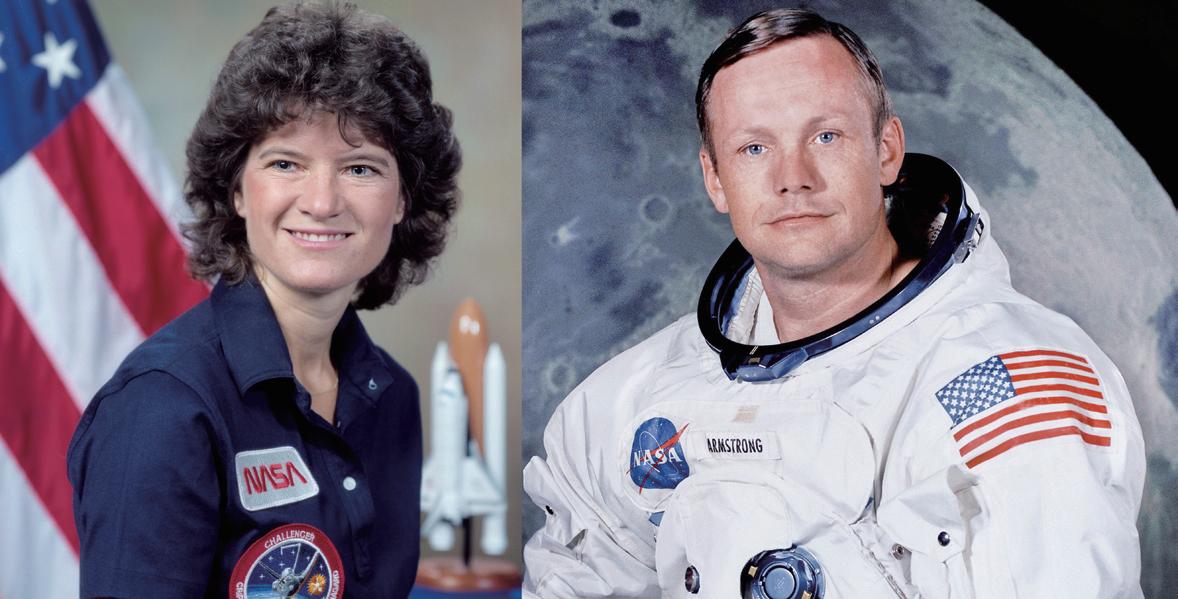
ver the summer, we lost two great scientific heroes. Neil Armstrong, the first man to walk on the moon, and Sally Ride, the first American woman and first openly LGBT astronaut in space, died at ages 82 and 61 respectively.
Armstrong first went into space in 1966, on the Gemini 8 mission. On July 20, 1969, the Apollo 11 mission landed on the moon; Armstrong was the commander. As he stepped off the ladder and onto the moon’s surface, he uttered the immortal words: “That’s one small step for a man, one giant leap for mankind.” After Apollo 11, he did not return to space. In 1971, he resigned from NASA and became a professor of engineering.
The former astronaut lived a quiet life after that, rarely making appearances as a public figure and declining to enter politics. Armstrong was part of the panel investigating the Apollo 13 mission and vice-chairman of the investigation of the Challenger disaster. He was occasionally critical of the waning interest in space exploration. “I fully expected that, by the end of the century, we would have achieved substantially more than we actually did,” he told CBS in 2005. Reportedly, Armstrong volunteered to command a manned mission to Mars at age 80.
On Aug. 25, Armstrong died of complications resulting from heart surgery.
When Sally Ride first went into space in 1983, she was 32 years old; at the time, the youngest person to go into
space, and still the youngest American.
On the Challenger space shuttle, she operated the “Canadarm,” which she helped design. A second flight followed in 1984, and a third was scheduled, but cancelled in the wake of the Challenger disaster. Ride also served on the investigating committee for the accident, as well as the one for the 2003 Columbia disaster.
After retiring from NASA, Ride became a professor and founded Sally Ride Science, an organization dedicated to promoting interest in science and engineering among children, especially girls. She died of pancreatic cancer on July 23 of this year.
Manned spaceflight is one of humanity’s most amazing accomplishments. Through cooperation, vigorous intellectual exchange, and great feats of science and engineering, we have managed not only to “get off this rock,” but to actually set foot on another celestial body. Spaceflight was achieved in a spirit of benign curiosity, international competition, and a desire for the betterment of all humanity. Narrow national interests were involved, of course – the race to the moon was in part fuelled by the Cold War feud between the U.S. and the USSR. But there was a feeling that, in the space age, such things were rapidly becoming irrelevant. As Ursula K. Le Guin wrote in her 1969 novel The Left Hand of Darkness, “Our border now is no line between two hills, but the line our planet makes in circling the sun. To stake shifgrethor [roughly,
honour] on any lesser chance is a fool’s doing, now.”
Space exploration has an inherent value, and that is what motivated people like Ride and Armstrong. These two—both considered to be especially highly qualified even among NASA astronauts—represent some of the great heights of human excellence in service of this inherent value. We need to know about the moon, the solar system, the galaxy, the universe, simply because they are there. Any other reason is beside the point.
The deaths of great men and women are always cause for mourning, but these two are made more bitter by the fact that they confirm the end of a golden age of spaceflight. The belief that the moon landing was a hoax is becoming increasingly common, and it’s not hard to see why. The last person to walk on the moon was Eugene Cernan, in 1972. The forty-year anniversary is this December. Since that time there have been fewer ambitious, boundary-pushing manned missions, a single measly space station, and a proliferation of high-tech drones. This is a far cry from the future implicitly promised by Armstrong’s moonwalk. Forget Le Guin’s future; we haven’t even achieved our own.
The will to “get off this rock” seems to have evaporated in an era where it might be more important than ever. The problem of climate change becomes more urgent with each passing year, and in one of the most powerful countries in the world, science education is debased on a daily basis. The ambitious projects, the difficult ones that will yield little in the way of monetary profit, are not being taken on. The likes of Neil Armstrong and Sally Ride are still among us, but they’re not getting their chance to prove it.
Let’s put another team on the moon. Hell, let’s build a base there. Send a manned mission to Mars. The moon, the solar system, the galaxy, and the universe are still there. They call to us with a challenge. Are we willing to meet it?
leagues—Tuesday and Wednesday evenings Ladies League—Thursday evenings Mixed Fun League—Friday evenings, as many players you want, one set price.
more information email: lasallecurlingclub@gmail.com or go to our website www.lasallecurlingclub.ca
is Monday September 17th from 7 to 9 PM.
phOtO COuRteSy Of NaSa
Notes from the Northern Boreal: A wandering bird biologist’s field journals
Lichenous white-spruce; black bears abound; boreal plant and animal artifacts collected
bRyce h oye, staff
17 JunE, 2012
“Close at hand the moss and grasses were full of tiny flowers – it is another world of beauty. The more I see as I sit here among the rocks, the more I wonder about what I am not seeing” – Dick Proenneke, Alone in the Wilderness.
It’s been a few weeks since entering the woods to study birds, and already the bouquet of boreal flora begins to take on new dimensions, to transform. The first days in the field every summer, the forest seems awash with unnamed greenery –vegetative species’ names lost on me. I am, after all, more birder than botanizer. After studying plant field guides with a sense of urgency for a time, and living among them, I surprise myself with a sudden ability to recognize a variety of common flowering plant species. Suddenly I can see more of the details.
In the fens and bogs, Labrador tea (Rhododendron groenlandicum), marsh marigold (Caltha palustris), bog laurel (Kalmia polifolia) and bog rosemary ( Andromeda polifolia) catch my eye, while in the mixedwood and deciduous forests prickly rose (Rosa acicularis), beaked hazelnut (Corylus cornuta), twinning honeysuckle (Lonicera dioica), twin flower (Linnaea borealis), bluebell (Hyacinthoides non-scripta) and others become the more familiar. Simply a matter of letting the taxonomic concepts gleaned from the pages of the plant guide marinade for a few days, I suppose.
Paradoxically, even after a surge in confident plant identification in the field, in the last couple days the many discreet microhabitats and biological communities of flora and fauna seem the more foreign and irreconcilably complex to me. It isn’t extraordinary to figure that at any given point, I may be standing on half a dozen species of moss and lichen unknown to me, flattened beneath my steps through the chlorophyll-lush forest floor.
I know this sense of unease intimately: the feeling that you are missing something integral right in front of you.
And this is how I felt this afternoon. My coworker Stacy and I made camp in a densely populated white spruce stand that was completely lychenized; rather, it was cloaked in a variety of lichen species.
Lichen is a symbiotic species (the, often mutually beneficial, interaction between two separate organisms surviving in close physical proximity to each other), the composite of algae and fungus. Basically, these two spe-
cies join to form lichen, and in this symbiotic relationship, fungi provide the organism’s structure while the algae produces its nutrients through photosynthesis. Because it obtains food through photosynthesizing and trapping water from the atmosphere, lichen is regarded as a reliable indicator of environmental pollution.
Every white spruce tree in the area—from their needles to their scaly bark—was covered in unknown lichen. Crusted, blistering, fragile, whitish species coat the trunk from root to apex; wispy, drooping, beard-like species hang and thrive along the trees’ many branches. An attempt to photograph this fecund and diverse lichen community yielded what looked more like an image of a forested snowscape. The flash of the camera saturated the white lichen-lined spruces to the point of overexposure, rendering the image washed-out in appearance.
I eagerly teased off a few strands of the wispy species and carved off a piece of bark containing a couple of the dry and crusted species, and found a lone and obliging aspen tree to sit up against while flipping through my plant book.
From perusing the lichen sec-
tion of the book, at least one of these wispy species may be a “beard” lichen – perhaps shaggy old man’s beard (Usnea). Another foliose species, bound-up with the aforementioned beard lichen, looks to be a spruce moss or boreal oakmoss lichen (Evernia prunastri). (My plant book alleges that the beard lichen and spruce moss are often found together on white spruce branches.)
I suspect the oakmoss lichen’s light-green and whitish colouration is but one of the reasons my photos turned out with that glaring snowblink texture to them.
I’ve pressed the beard lichen in an envelope to send home to a friend.
18 JunE, 2012
Today I hastily extricated myself from a survey area via ATV (all-terrain-vehicle or “quad”), nervously checking behind me the entire way back to camp. Today I had an encounter with wildlife: the big, black, toothy, furry kind.
Around 9 a.m. I was finishing a point-count, listening to the songs of the migratory warblers and sparrows around me, when I came across an area with several beautiful wildflowers. I took occasion to pluck (and
wantonly destroy) some of the roses and beaked honeysuckle flowers, to press and send home to family and friends. I put them between the pages of my bird book for the time being and placed it at the bottom of my backpack with an assortment of other artifacts I’d found in the woods in the past few days: half of a young, male white tail deer’s weathered rack (horns) and its bushy tail, and a few tertiary feathers of a spruce grouse found at the base of a hill yesterday.
I have, in a way, made this into a ritual: collecting objects found on the job, in the wilds, and sending them home to loved ones. In past years, friends and family have been surprised to receive nondescript packages, with no return-address, containing bird feathers, claws, beaks and nests; deer/fox/wolf/ moose skulls and/or bones; and, of course, wildflowers.
Recently Ive begun feeling conflicted about this practice. From a purest naturalist perspective, even things like shed feathers and bones are best left to decay where they lay, and picking a wildflower seems to be as blasphemous to some as would be tearing out pages from a holy
book. Conflicted, but not yet conflicted enough to retire this funny way of sending my greetings to kin from in the back of beyond.
Often I hang on to some of these artifacts for myself, although by the end of the field season they aren’t the exotic and beautiful objects they once were. Bones may fester, poorly pressed flowers wilt and mold, and feathers ruffle beyond unruffling in the multipurpose bag I store them all in. By the end of the season it’s all a slimy wad of unventilated ephemera from the boreal – my own twisted take on potpourri.
After placing that book with the pressed flowers in my pack, I continued bushwhacking towards where I’d parked my ATV on a nearby pipeline. Eyes fastened to the screen of my gps most of the way, I eventually looked up not 30 metres from my destination. I was startled to a halt. A thin band of willow and alder thickets separated and obscured what looked to be my parked, red ATV, but with a black bear (Ursus americanusI ) standing over the back tires, tearing apart the seat with its large canines.
“Whoa, buddy,” I uttered softly. Alarmed by my voice, it leapt from the vehicle, sprinted 10-metres down the pipeline and away from me. And then its inquisitive nature took over. It slowly walked back towards me, and ambled through that thin band of shrubs separating us. There we both stood in that sedgy knoll for the next 2 minutes—me with my bear mace drawn in one hand, he with his shy eyes peering in my general direction—and we waited on one another to make a move. I sidestepped slowly through the shrubs, careful not to arise suspicion, mounted my quad and rode off in a hurry.
When I arrived back at camp to show my coworker the three huge holes torn into my quad’s foam seat by the bear, she blurted out a similar though more serious encounter she had just had with a completely different bear. It scared her off of surveying one of her points.
We had a laugh together at each other’s brushes with bears. Then we went to change out of our field clothes. Our tents looked on the cockeyed side. Mine was particularly slanted. Upon closer inspection, it appeared as if a third bear had taken an interest in our tents, and left me with bent tent poles and a few fine lacerations in the shell of my tent. They told me there were occupational hazards to working in the remote wilderness…
i LLuStRatiON by Si LVaNa mORaN
Aqua Books needs your help!
Used bookstore changes into non-profit venue
Ka R a Passey, staff
Aqua Books was, and still plans to be, a staple in Winnipeg’s creative community. With venues in Winnipeg closing one by one, it is time for the community to step up and lend a hand.
In its time at its 8,400 square foot home at 274 Garry Street, Aqua Books hosted over 350 live events every year and claimed to be the second biggest arts and culture centre in Western Canada. The used bookstore that provided a venue for music, theatre and book launches closed its doors last year and ever since there has been talk of keeping the dream alive.
a non-profit venue and move it to a smaller location at 123 Princess Street in the Exchange District.
Hughes had nicknamed the theatre at Aqua Books “Winnipeg’s Cultural City Hall” (WCCH) in an attempt to describe the diversity of events that occurred there. In heart of its inclusive agenda, the new space has adopted that name formally.
“Winnipeg has more artists and musicians per capita than anywhere else. They need a venue like this and this is a perfect place for them.”
Owner Kelly Hughes mentioned that the reduction of book sales was a contributing factor when making the decision to close. Book sales at Aqua Books had dropped 30 per cent in the year before their closing. Hughes has made the decision to change Aqua Books into
“[We’re calling it] Winnipeg’s Cultural City Hall [Inc.] because it’s not just a music venue, it’s not just a theatre venue – really, we want to encompass all the creative things that people are doing,” says Hughes.
While the 2,400 square foot basement space is a considerable downsize, the new venue will still house a bar, a stage for theatre, music, poetry and stand up comedy – as well as space for workshops and meetings.
“This is a community that is filled
Robert Houle: enuhmo andúhyaun
The Road Home
daV id K R ause
Hou le’s ARTlab exhibition, Robert Houle: enuhmo andúhyaun (the road home) (Sept. 6, - Oct. 12) is one in a series of art exhibitions at the University of Manitoba. The art shows are being launched in celebration of The School of Art Gallery at the University of Manitoba move into ARTlab. Anihšināpē artist, Robert Houle will be present at his art reception, which will be held on Sept. 6 from 4-7 p.m..
While Houle’s paintings and drawings are based on childhood fears and trauma inflicted by elementary school systems, he also incorporates the themes of reconciliation and forgiveness. We all live in Canada and moving on together, while being aware of past atrocities is a very powerful concept, which can heal people along with educating them.
The School of Art Gallery director and curator Mary Reid reinforced the idea of forgiveness and being aware of the crimes of the past.
“Colonization and (the not so distant) past Canadian government policies of assimilation have had an extremely detrimental effect on First Nations culture. It was essentially
cultural and spiritual genocide,” says Reid.
“Houle’s artwork is about remembering not only mentally but also physically. A lot of the memories actually came through his body first. He remembered the abuse and the subsequent shame through his body and then his memory. He created the drawings almost automatically, allowing his hand to move without thinking, and then the images came flooding back into his mind.”
“In many cases he had suppressed a lot of this trauma and it started resurfacing when he was creating this work. This act of remembering and drawing was a means to let go but not to forget, to come to terms with what happened to him and have the strength to acknowledge it and move past it, to let the sadness go,” says Reid.
“The images are very evocative and are based on experiences and memories of his time there. The rawness of the images evokes many feelings and emotions, dealing both with reckoning what happened but also having the strength to overcome and move forward. Although
with incredibly talented people. Winnipeg has more artists and musicians per capita than anywhere else. They need a venue like this and this is a perfect place for them,” says WCCH board member, Karen Naylor. WCCH hopes to open their doors soon and have already begun planning programming. The space will
host new works of theatre and comedy by Carolyn Gray, Bruce Clark, and Daniel Thau-Eleff. WCCH will also host the new Aboriginal Writers Festival and the University of Manitoba’s jazz studies master classes.
“We can hardly wait to open and get started, this is your place, this is your organization,” adds Naylor. Winnipeg’s Cultural City Hall Inc. is looking for a last push of funding to finish renovations, get an occupancy permit, and open their doors. To contribute, visit http:// www.indiegogo.com/AquaBooks.
very personal they can be a testament for others. The demonstrate strength and power to triumph over adversity. They offer a road, a path forward.”
According to Reid, the outcomes of Houle’s art and show are lofty but noble. “I hope that this exhibition will offer hope and strength. It will raise attention about the treatment of First Nations children in Indian Residential School from a very personal perspective. This exhibition is not only about telling the truth, it is about remembering, not forgetting. It is about being able to move past the trauma.”
Filmmaker Shelley Niro’s documentary on Houle, entitled Robert’s Paintings, is being screened at Urban Shaman on Thursday, Sept. 6 at 7p.m. with a director’s introduction. The film examines his life as an artist, curator, educator and cultural theorist.
Robert Houle: enuhmo andúhyaun (the road home) takes place Sept. 6, 2012 - Oct. 12, 2012. The Sept 6 show will be attended by the artist and will be held between 4-7p.m..
phOtO by KeLLy hugheS
Concert Review: Indian City
CD release party for Indian City’s debut album
daV id scammell
The West End Cultural Centre is well-known for its awesome live shows. One of the latest acts, Indian City, was no exception.
Indian City is a recently formed 10-piece super group that consists of Vince Fontaine, Pamela Davis, William Prince, Neewa Mason, Tik Mason, Don Amero, Marty Chapman, Gerry Atwell, Ray Stevenson, and Buffy Handel. All artists have an important place in the band; such as song writing by Vince Fontaine, or modern interpretive dance by multi-style dancer and choreographer, Buffy Handel.
Indian City held their CD release party on the night of Aug. 24 at the West End Cultural Centre which debuted the group’s first album Supernation. But, before the band played the crowd enjoyed a diverse series of opening acts.
Andrew Belfour, a Cree composer of Fisher River First Nation, opened
up the show with a traditional song that had the crowd mesmerized.
A vocalist, from the choral group Camerata Nova, mixed his voice with a steady drum beat and created an intensely emotional atmosphere.
William Prince, of Peguis First Nation, followed with a solo performance on an acoustic guitar and amazing vocals playing songs such as “Keep You,” “Meant for Me,” and “Young Romantics” that would pluck at anyone’s heartstrings. Princes’ deep voice, joking yet somber attitude and solid black attire gave the impression of a modern day Johnny Cash.
Then Buddy Big Mountain performed, a man who is widely accepted as the first Native American ventriloquist with internationally recognized status. His puppets consisted of Wendel the Cowboy, Ironhorse, and Forest Red lightning, all of which did several jokes and at least one song about their own history.
Buffy Handel performed a multistyle dance in a solo act. Handel performed one song in a graceful interpretive dance style that seemed to capture the imagination of the audience, placing them within the scenery alongside the feathers of her costume.
The album Supernation is titled after the first song Indian City played of the night, which got the crowd up and cheering. The sound of the vocals was lower than it should have been and it was difficult to hear the lyrics being sung at times. This did get corrected as the show progressed.
Indian City then rocked out a total of seven more songs including “Laughing Song,” which featured the deep vocals of William Prince. Another one of the highlights of the night was the singing of Don Amero in the song “Stand.” Amero has been nominated seventeen times for Aboriginal People’s Choice Awards but still has yet to win. This year he has received three Aboriginal People’s Choice nominations for single of the year, Aboriginal male entertainer of the year, and best pop CD.
The WECC was packed with people who applauded Indian City all night and cheered them back for an encore song. The music flowed well and left the crowd wanting more at the end of the night. Indian City is sure to make more music and please more crowds – I would recommend this show to anyone interested in local music by unique artists.
They Told Me
Sophomore album by the Lytics to be released this October
m ichelle sa Romo, volunteeR staff
It’s been a couple years since the debut of the Lytics’ self-titled EP, but the wait is almost over. The popular Winnipeg hip-hop group will soon be following up with their full sophomore album, They
Told Me, which will be released this October.
The Lytics—comprised of brothers Andrew, Alex, and Anthony Sannie, along with cousin Mungala Londe and “new” brother, DJ Lonny Ce—have long been at the forefront of Winnipeg’s local music scene. They have performed for various events and venues around the city and gained attention across North America.
In 2011 alone, they performed at two large-scale music festivals: the South by Southwest (SXSW) Festival in Austin, Texas, and the Canadian Music Festival in Toronto. Yet with all their success, the guys remain grounded and are committed to continue making music for the masses – music that the general public can relate to.
“A lot of hip hop musicians, they talk about unrealistic things, you know? Things that most of the world don’t have to deal with,” says Andrew. “A lot of us don’t have like ten cars to choose from. A lot of us don’t have the major issues that all of
the major hip hop artists are talking about. We’re just making music for real people.”
“We’re not really trying to make escapist music,” adds Alex. “Not that [the stuff that major hip hop artists talk about] isn’t real, it’s pretty real to them. But that’s not what we want to be talking about. You can escape reality if you want, but that’s only for so long.”
It’s not just the context of the songs that separates them from other hip hop acts. The Lytics draw their inspiration from many different musical genres, including but not limited to 90’s hip hop, afrobeat, 60’s R&B, electro, and funk.
If you try comparing their latest single, “Stay Calm,” to any of their previous works, you’d only barely be able to recognize that it’s from the same group. It’s as if each song that the Lytics make has its own distinct signature.
“I feel like, us being able to have so many different styles in one record, or even in one song, it separates us from other people. And I don’t even
think that we did it on purpose, I think it’s the way it came out. That’s something that I’m really proud of, it’s something that sets us aside,” says Andrew.
The creative process of the second album was different than that of their first – and definitely a lot more challenging the second time around. Whereas The Lytics EP was a little bit more of a spontaneous project, They Told Me started off much more structured. However, they all agreed that the end result was well worth the trials.
“[They Told Me] totally exceeded my expectations,” Alex notes. “[We’re] finished with it and [we’re] still happy, even more happy because now everybody else on the planet has the ability to enjoy it with [us]. And the more people that can enjoy something that you’re proud of, the better.”
The Lytics will be performing on Sept. 6 at the University of Manitoba. Their new album, They Told Me , is scheduled for release on Oct. 16.
What your gym teacher never told you
Jodie l ayne, volunteeR staff
For most people, growing up in Canada means our sex education looks a little like this: a few minutes of your gym teacher awkwardly saying the names of body parts, explaining how sperm works, telling you sex will get you pregnant or for sure give you an STI, and then calling it a day –we’re left to piece together just about everything else. If we’re lucky, we get the right information from awesome adults in our lives and if not we get whatever Cosmo, our friends, and the media tell us. Younger teens are lucky with the development of things like Teen Talk, but most of us are still of the age where the real sex education came from late night Showcase programs and Playboy magazines passed around.
If you went to Catholic school like I did, well, you were shit out of luck. Where is the discussion about the meaning of consent? What's an orgasm? How do I know what form of birth control is right for me? Is monogamy my only option? What kind of protection do I need if I'm queer? What about masturbation? How do I have a safe and fun one-night stand? What is a clitoris for and where the hell is it? Is the g-spot a real thing?
we break the stigma. Kids have more knowledge and more confidence. They feel okay about asking for what
I want you to have really, really good sex – whether that is with yourself, with a long-term partner, with someone you just met, or with a bunch of people.
Non-comprehensive sex education does a real disservice to everyone. By being open and not being squeamish about talking with kids about sex and sexuality,
they want and need, they can say no when they mean it and enthusiasti-
cally give consent as well. They feel empowered to know when they are ready for sex, what pleasure feels like in their own bodies, and what healthy sexual relationships look like.
For a long time, I have yearned for sex education for adults. This column will aim to fill that gap and will talk about the things your gym teacher didn’t tell you. This will be a fiercely sex-positive space, LGBTTQ* friendly, non-judgmental, and generally awesome place. I will share with you the knowledge that I have tirelessly sought out and call in some experts when needed.
I want you to have really, really good sex – whether that is with yourself, with a long-term partner, with someone you just met, or with a bunch of people. I want you to be able to ask someone to put on a condom, to have the courage to tell your doctor that the pill might not be for you, and to know what to expect when you get a pelvic exam. I want to talk about ‘ethical’ porn, sex toys, phone sex, and how queer people get it on. Sex should be fun, playful, and healthy.
So let’s do this – let’s get deep!
You can confidentially submit a question or topic to jodie.m.w.layne@gmail.com.
Manyfest
Nine downtown events to finish off your summer
m ichelle sa Romo, volunteeR staff
As much as I would have loved to take advantage of the time off to travel, as a struggling student my funds—or lack thereof—have forced me to stay in the city for the summer. Though with the smorgasbord of activities and events that have taken place around the city, my time has been well occupied and there’s certainly never been a dull moment.
Now with summer coming to a close, so too are the city’s outdoor festivals. Fortunately, we still have one more to look forward to: from Sept. 7–9, Manyfest is set to take over downtown Winnipeg.
The fest is only on its third year, but is expecting a turnout of over 30, 000 people. Organized by the Downtown Winnipeg Biz, Manyfest aims to revitalize people’s perceptions of the downtown area by highlighting its positive points and promoting what it has to offer. It is a massive celebration of the local arts, culture, and community.
Manyfest has certainly evolved over the years. It began as two separate festivals—Ciclovia, the now national cyclists’ event, and Lights on Broadway—then grew into Five
Events One Weekend, and now it’s one big festival composed of nine (NINE!) different activities, all packed into a span of three days. There’s the Giant Movie in the Park, Taste of Downtown Wine & Cheese Festival, Lights on Broadway, Big Dance on Broadway, the 10 & 10 Race, Zumbathon, Ciclovia, a Farmers and Artisans’ Market, and there’s even a Minifest Kids Zone for the little ones. With so many different events offered, there’s no way you’re allowed to complain about being bored this weekend!
Jason Syvixay, public relations coordinator of the Downtown Winnipeg Biz, notes that the popular event Lights on Broadway has a slightly modified interpretation this year, to make for an even grander celebration on the Winnipeg street.
“[Broadway is] one of our most iconic areas for people to visit. There’s some really great history there, some really great architecture, and so we really want to see Broadway lit up for the next couple of years,” says Syvixay.
“[This year] we’re going to do a living parade of lights, so instead
Fun with Siri
of lighting up the trees we’re gonna light up people, so people will literally come to Lights on Broadway.”
Each participant will get a candle and they will all form a procession down the street. They will also be accompanied by various bikers from across the city who will have their own bikes decorated with different light assortments. Throughout the procession, musicians, artists, and dancers down the street will also light up as people walk by them.
Weird ways Apple’s virtual life coach interprets pop culture
W
e all know that Siri, the newest iOS voice recognition software, is an amazing feat of modern technology. Apple Inc. has told us as much ever since the release of the iPhone 4S last October. It’s one of those special products that actually represents a real life, functional version of a device science fiction writers decades ago envisioned when they wrote about the technological advances of the distant future.
For those of us who have our very own Siri accompanying our phones, however, it can be obvious at times that the iPhone’s mobile Mac Genius doesn’t always hear what you say. If I were to believe that my iPhone had
the active ability to be rude, I’d say sometimes it’s like Siri isn’t even paying attention to what I’m saying. A one-sided conversation, for sure .
“Oh, what’s that? Yes, of course I’m listening. You said something about beef jerky, right? Do you want me to email beef jerky?”
Generally speaking, the quality of your response from Siri is directly related to the clarity of the audio you provide. If you’re in a complete sound vacuum and clearly enunciate all your words Siri will understand you perfectly. Conversely, the more white noise you add to the equation, the more you slur or mumble certain words, the less likely Siri will totally “get” what you’re saying. This got me thinking, what happens when your source of audio never changes in quality, intonation, inflection, but
could only alter itself in volume?
How does the all-knowing, magic “ping” interpret things that have been forever committed to document like a famous speech, a play, or a movie? Will she always remember human history a certain way based on the sound quality to which it was committed?
This got me thinking, what happens when your source of audio never changes in quality, intonation, inflection, but could only alter itself in volume?
The short answer is no. No matter what the source of audio the results vary considerably depending on where the voice is projected and how loud it is played. In the name of fun, however, it can still prove entertaining to see just how Apple’s Siri program interprets certain snippets of pop culture. And so—again, in the name of fun—the following is an example of our world as interpreted by the world’s most popular personal assistant.
“Broadway is definitely going to be a hub of activity. You know people are gonna be hustling and bustling to enjoy the show,” says Syvixay. In line with the healthy and active living mandate of the festival, the downtown artist-run centre aceartinc. will also be adding another event into the roster of activities. On Sunday, Sept. 9, aceart will be hosting their Second Annual Soap Box Derby fundraiser down Broadway. Jamie Wright, co-director of aceartinc., says
that the idea of having a soap box derby event “seemed to fit well around Winnipeg – it’s a very car-centered kind of city.”
“We’ve made it so that the cars have to be pushed, sort of like bobsled style. The idea of the soap box derby has been sort of manipulated to be more representational of a [flat] prairie landscape,” says Wright. Registrations for the derby have been extended and will be ongoing until the day before the race. Wright believes that initiatives such as Manyfest, as well as artistrun centres like aceartinc., are providing positive changes in regards to the perception of downtown. Although this revitalized perception may not be echoed all throughout the city just yet, Wright says that there’s a great deal of potential for perceptions to change. “A festival like this, or an organization like ours, can point to that potential and encourage it,” says Wright.
For further information on how to register for some of the events, you can visit www.manyfest. ca and www.aceart.org/2ndannual-soap-box-derby
Jack Nicholson as Colonel Jessep, 1992, A Few Good Men
“You can't handle the truth!
Son, we live in a world that has walls. And those walls have to be guarded by men with guns. Who’s gonna do it? You? You, Lieut. Weinberg? I have a greater responsibility than you can possibly fathom. You weep for Santiago and you curse the Marines. You have that luxury. You have the luxury of not knowing what I know: that Santiago's death, while tragic, probably saved lives. And my existence, while grotesque and incomprehensible to you, saves lives.
You don't want the truth. Because deep down, in places you don't talk about at parties, you want me on that wall. You need me on that wall.
We use words like “honour,” “code,” “loyalty.” We use these words as the backbone to a life spent defending something. You use them as a punch line. I have neither the time nor the inclination to explain myself to a man who rises and sleeps under the blanket of the very freedom I provide, then questions the manner in which I provide it! I'd rather you just said thank you and went on your way.”
Jack Nicholson as Colonel Jessep, 1992, A Few Good Men (interpreted through Siri)
“You should just place to talk Hartenstein!
Sunwing to the world has walls and those walls have to be guarded by men with guns. To do with you Lieut. Weinberg? I have a greater responsibility than you can possibly fat give week for Santiago. When you curse the Marines you have been much evening no Santiago’s death Reggie we see Jesus incomprehensible to you soon. You.
Do you want the truth because deep down in please talk partings you want me on that blog you need me on that wall.
Because you won’t believe me the words like honour, code, loyalty. We use these words like bank and Glisan defending something it uses a punch in time and inclination to explain myself. Lamanto rises and sleeps under the blanket of the vertebrae. Provide uninflected manner in which I provide, I’m writing to say thank you.”
iLLuStRatiON by SiLVaNa mORaN
phOtO by JaNeSSa bRuNet
Event listings
Thursday, Sept. 6
Gallery 1c03 at the U of w
Storytime: Glen Johnson and Leslie Supnet
Wednesday, Sept. 5
Negative space
Katie and the Lichen / The Gunness / Savant Flaneur
Thursday, Sept. 6
Urban shaman
Screening: ROBERT’S PAINTINGS Directed by Shelley Niro
Friday, Sept. 7
frame arts warehouse
Pickle: Josh Roach and Teresa Braun
Sunday, Sept. 9
Urban forest coffee shop and lounge
Narwhal Strike / In Medias Res / FMSEA
Saturday, Sept. 8 the pyramidcaberet
The Brat Attack / Kids and Heroes / Terrorist / Bad Juju
September 7 – 9 broadway Manyfest! – www. manyfest.ca
Tuesday, Sept. 11
Negative space
Pip Skid / Rob Crooks / Zucchini Drive / DJ Co-op
Thursday, Sept. 6
school of art Gallery (U of m)
enuhmo andúhyaun (the road home): Robert Houle
Friday, Sept. 7 the edge village and Gallery
RITUAL INFINITE: Rodrigo Pradel
Thursday, Sept. 6
la maison des artistes
Éveil dans la ville: hannah_g, Chantel Mierau and Stéphane Oystryk
Thursday, Sept. 6
Negative space
Lakes / Fletcher Pratt / Two Rocks of Stone / Mallory Knox / Burden
Saturday, Sept. 8 the mondragon
Anarchist Book Fair fundraising dance party!
Leif LaRSeN
CuRtONbummiNgS.tumbLR COm
LauReN bOuLet
Armstrong meets his Waterloo
What happens when
a dam Peleshaty, volunteeR staff
a
sport legend loses the battle for his integrity?
Over the last decade and a half, Lance Armstrong had been known to do one thing: attack. Armstrong attacked in 1996 when he faced the testicular cancer that had spread to his brain and lungs. He attacked through torturous mountain climbs in the Pyrenees and Alps as well as numerous pelotons to win the Tour de France seven times from 1999 to 2005, gaining millions of new fans.
With the same amount of ferocity, he also attacked those who dared to question the legitimacy of those wins, people who included former teammates, friends, other cyclists, and even government agencies.
After deciding not to go to arbitration by the United States AntiDoping Agency (USADA)—having dropped any challenges to their allegations of blood doping and the use
of banned substances—Armstrong blasted USADA calling their process “one-sided and unfair” and disputed their authority to take away his Tour wins and erase his cycling career since August, 1998.
Despite Armstrong’s defiance, he still did what no one ever thought he would do: surrender.
Even if Armstrong were never found guilty through drug testing, he would have been guilty by association. Armstrong dominated his sport in an era infamous for the number of top cyclists who had admitted to or were found to have taken part in doping. Should Armstrong’s Tour de France victories be given to the runner-ups, chances were they had doped too. German rider Jan Ullrich, who finished second to Armstrong three times in the Tour, was suspended from the 2006 event for doping and retired the next year.
The 1999 runner-up Alex Zulle was part of the infamous Festina team that was banned from the previous year’s Tour and 2005 runner-up Ivan Basso admitted to planning to dope. At that time, it was almost necessary to use banned substances to be competitive.
It would be Armstrong’s former teammates, however, who led the charge against him. First, it was Frankie Andreu, and his wife Betsy who claimed to have heard Armstrong reveal to a doctor the banned substances he had used for racing. Then it was Floyd Landis, who lost his 2006 Tour de France victory because of a positive EPO test, also implicating Armstrong in a series of e-mails. Tyler Hamilton, who lost his 2004 Olympic gold medal, revealed in a 2011 interview on 60 Minutes his own drug use, but also accused Armstrong of the same. Even Armstrong’s right-hand man for all of his Tour wins, George Hincapie, once described as being loyal to him as a friend, co-operated with the USADA’s investigation.
Yet the lack of analytical evidence has been Armstrong’s best friend during his ordeal. A federal investigation based on Landis’s accusations against him was dropped in February. While Armstrong’s lawsuit against USADA was thrown out three days before he stopped challenging their allegations, Judge Sam Sparks in his decision questioned USADA’s motives for charging Armstrong and if due process was given. Armstrong had
called the USADA’s investigation an “unconstitutional witch hunt.”
Armstrong’s submission to USADA has now complicated his legacy even further. Many still see him as an inspiration to those who suffered from cancer. Many still see that the Lance Armstrong Foundation had raised almost half a billion dollars for cancer research. His fundraising efforts and activism has saved lives and his own recovery from the disease was nothing short of powerful, but it must be said that the amount of money raised may have been less without his Tour de France wins. An admission of doping would turn him from a saint into a charlatan overnight.
None of this matters to Armstrong, though. He still maintains his innocence and hopes that people see past the allegations and judge him by his accomplishments and good works. Retired from road cycling, he took part in a mountain bike race in Aspen, Colorado. Afterwards, he told reporters, “Don’t cry for me. I’m going to be great.”
Armstrong hopes now that he does not have to attack anymore.
Super rich football clubs
Lack of salary caps ruining competitive spirit in European soccer
Soccer is a huge sport in Europe and continues to grow in popularity throughout North America. With all the lockout talks in the NBA and NHL, people tend to forget or just don’t know about the poor state of soccer in Europe.
All over Europe very rich owners acquire soccer clubs. Nothing wrong with that, you might you say? The problem is that we are talking about a
How long will we as fans wait for miracles to happen? That’s the question.
small number of owners and a select group of elite clubs. The consequence: a small number of clubs are dominating the different leagues all over Europe, basically killing the competition. As a sports aficionado it really bothers me. I won’t say that I don’t have a favourite team in soccer or that I don’t want any big teams with lots of money, that would be a lie. Nevertheless, I like real and fair competition as fair as
it can be nowadays. Let me give you an example: in France, Paris Saint Germain (PSG), the biggest soccer club in the French capital city, just bought five players this summer for approx. 150 million euros. It represents 70 per cent of the money used by French soccer clubs in transfer transactions! It is crazy and no other club in the entire French league can compete with that kind of firepower.
The same phenomenon is happening in Russia, Spain, and England. Capitalism, anyone?
I’m not naive or leaving in a dream world. Money makes the world go round, and I doubt we will ever be able to change that. I want to enjoy great games against fairly equal teams, real competition, suspense, and excitement. There is little enjoyment that can be derived from watching the undisputed
best team play a boring game against a team with only a marginal amount of resources, in comparison.
This is the state of soccer in Europe and it is scary.
Super teams are always attractive—see the Miami Heat or the Los Angeles Lakers of the NBA—but even for them there is a salary cap to follow. Meanwhile, FC Barcelona and Real Madrid in Spain; PSG in France; and Manchester City and Chelsea in England are so ahead of their opposition financially that everybody knows that they will finish on top of their leagues, season after season. It can be boring and it certainly doesn’t encourage the fighting spirit and the greatness of real competition.
Luckily, magic can happen and teams can defy the implacable fate of the rich clubs winning. It’s rare, but it raises our love of the game and prevents us from turning off the TV. How long will we as fans wait for those miracles to happen? That’s the question. Soccer is as big in Europe as hockey is in Canada, and the big clubs know that they have a reliable fan base. That’s probably a curse but I’ll keep waiting for magical moments — even thought I already know who is probably going to win it all.
The NFL system, with their draft, redistribution of 60 per cent of all league and team profits evenly shared between all the teams, and a salary cap, seems to be the right system for a healthy, balanced league. Any team can win the Super Bowl and that’s the beauty of the NFL.
iLLuStRatiON by SiLVaNa mORaN
iLLuStRatiON by SiLVaNa mORaN
Mistakes cost T-Birds as UofM takes season
Bisons use balanced attack to claim victory in first game of the year
c J Pentland ( the u byssey, univeRsity of BRitish ColumBia)
What looked to be a broken play turned out to be the turning point that cost the UBC Thunderbirds their first game of the regular season, as the Manitoba Bisons defeated the ‘Birds by a score of 31-24 on Saturday afternoon at Thunderbird Stadium.
In what started out as a low-scoring game with both teams struggling to get much going on offence, the second half started with a bang when Manitoba kick returner Nick Dempsey returned a punt 101 yards for a touchdown just 2:57 after the break, making the score 16-6 for the Bisons. It looked as if the T-Birds would pin the Bisons in their own end as the punt rolled towards the goal line, but Dempsey picked up the bouncing ball and broke off several tackles before busting free and flying down the field.
Manitoba’s attack on the ground
during the entire game proved to be UBC’s demise. The Thunderbirds gave up 270 yards rushing, with Kienan LaFrance leading the way with 174 yards. The air attack also was complimenting the rush, as Bisons quarterback Cam Clark threw for 194 yards.
The rushing game was also UBC’s strong point. With Manitoba keying in on reigning CIS MVP Billy Greene and his passing, the Thunderbirds’ backfield was able to rack up 291 yards on the ground. It was this that kept the ‘Birds in the game for the majority of the contest, as Greene and the UBC receivers weren’t able to get much going.
“A lot of the stuff we had was there all game,” said UBC head coach Shawn Olson. “You know, we just weren’t hitting it or we weren’t aligning properly. There’s little, subtle
things as far as our receivers [go] [ . . . ] that’s some of the detailed stuff that we just didn’t seem to have right for whatever reason and that ends up
leading to missed assignments.”
A rushing TD by Lucas Spagnuolo put UBC up 6-2 in the first quarter, but that lead was short lived after
Manitoba put up seven points on their next possession. It was a lead that the Bisons never relinquished.
After Dempsey made the score 16-6, a Thomas Moult field goal trimmed the Bison lead to seven, but that was as close as UBC would get. Manitoba pushed the lead to two touchdowns in the fourth quarter. Greene, who threw for 232 yards and rushed for 90, finally found his rhythm in the last ten minutes of the game, throwing two touchdowns, but it proved to be too little too late. UBC’s defence could not keep the Bisons off the board, leaving little hope for a comeback.
The Bisons play their first home game of the season at University Stadium this Saturday, September 8 at 1 p.m..
phOtO by JOSh CuRRaN
The leaders of the Herd’s defence
Team captains will be cornerstones of Bison defence
m a Rc l agace, staff
Before a convincing 29-13 victory over the Regina Rams, the Bisons coaching staff made some important decisions heading into their first game of the 2012 regular season.
The reigns of the offence has been put in the capable hands of fifthyear quarterback Cam Clarke. A strong camp and an impressive showing against Regina has the coaching staff convinced that Clarke deserves the opportunity to lead the team to start the season.
Meanwhile, on the defensive side of the ball, there appears to be a good balance of veterans and newcomers within each group. This year, three fifth-year veterans representing the three different defensive groups were named as team captains.
in his final year of playing, and will play an important role on a defensive secondary that was the top-ranked pass defence in the Canada West conference in 2011. Sherman made an impressive statement against the Rams, picking off three passes.
A strong camp and an impressive showing against Regina has the coaching staff convinced that Clarke deserves the opportunity
Safety Teague Sherman will be a team captain for the fourth time
The Bison secondary lost two key veterans over the offseason, as three-time Canada West All-star halfback Pete Adams and cornerback Grayson Wells both completed their university football careers. Surrounding Sherman in the secondary will be a group of young guns who have proven to be capable of locking down the passing game in training camp. One standout that head coach Brian Dobie singled out at the weekly press conference is cornerback Cam Teschuk. After red-shirting last season, Teschuk worked hard throughout camp and
earned himself a starting position on the team.
“He is smart, he is aggressive,” said Dobie, adding, “He came out of nowhere. That’s just hard work and that’s being coachable. He’s done
going to give [the offence] as many chances as possible. Any time we hit the runner we’ll try and keep him up and strip the ball.”
Thomas Hall, who was named team captain for the third time in
everything that it takes, he deserves the credit I’m giving him right now.”
When asked what the defensive game plan is, Sherman was blunt.
“On defence, we’re trying to get the ball,” explained Sherman. “We’re
(Don’t) believe the hype
Could Joey Elliot be the Blue Bombers’ savior in 2012?
m a Rc l agace, staff
In the wake of the disastrous 2012 Labour Day Classic game against the Saskatchewan Rough Riders, the jury is still out on Joey Elliot’s future as the Winnipeg Blue Bomber’s starting quarterback.
We knew heading into Labour Day weekend that newly appointed head coach Tim Burke still believes that Buck Pierce—who continues to recover from a foot injury suffered on July 13—has done nothing to lose his job as starter.
Bomber fans have some reason to be excited for Elliot’s potential; in his first start this season, he calmly lead the Bombers past Hamilton on Aug. 13 and then did all he could do to force overtime against the league-leading BC Lions the following week.
But before you go out and pick up a Bomber jersey with ELLIOT stitched on the back (or, conversely, burn an effigy with the same name), take a moment to ponder the past 20 years of Blue Bomber quarterback history. There’s been a veritable parade of pivots airdropped in with the team’s season riding on their shoulders – then promptly chased out of town by a mob with pitchforks and torches.
In 1993, Matt Dunigan had led the Bombers through the majority of a successful 14-4 season that saw
Winnipeg finish at the top of the East Division. Unfortunately, due to
There’s been a veritable parade of pivots airdropped in with the team’s season riding on their shoulders – then promptly chased out of town by a mob with pitchforks and torches.
injury, Dunigan was unavailable for the East Final versus the Hamilton Ti-cats, so back-up Sammy Garza was called to play in the biggest game of his career.
In only his third start of the season, Garza played well enough to lead the Bombers past Hamilton and straight to the Grey Cup where they were to face Damon Allen and the Edmonton Eskimos.
The Grey Cup game was a disas-
ter. The Bombers turned the ball over seven times, including two interceptions by Garza, and lost 33-23 in a game that saw them down 0-21 at one point.
Garza—who happened to be the son-in-law of then head coach and general manager Cal Murphy— started six more games for the Bombers over the next two seasons but never was able to win the starter position permanently and ended his career playing for the Ottawa Rough Riders.
The tale of Garza might be eerily familiar for fans who recall Ryan Dinwiddie’s time with the Bombers. In 2007, Kevin Glenn took all 18 starts as he lead the Bombers into the playoffs with a record of 10-7-1. Glenn and the Bombers could have won the Cup that year, had it not been for a freak injury in the East Division final that made him unavailable for the championship game.
Enter Dinwiddie, the raw rookie with the beautiful blue eyes who was tasked with defeating the rival Saskatchewan Roughriders for the Grey Cup in his first start in the CFL. It could have been the perfect script for a sports movie – if not for the late interception that sealed the
his CIS career, is another veteran that will be providing guidance and leadership in the huddle, on the sidelines and in the locker room. Hall has earned major accolades during his time with the Bisons, including
winning the CIS Russ Jackson award back-to-back in 2009 and 2010.
Now, heading into his final year with the Bisons, Hall is focused on getting the UofM squad into the CIS Top Ten and playoff contention.
Said Hall, “We had a brief taste of getting back into the top ten last year and it was nice.”
“From what I’ve seen in training camp and everything, it’s somewhere I see us getting back to pretty quickly. And I certainly hope it’s driving some of the younger guys who realize the significance of what it means to be top ten.”
The coaching staff has tweaked the defensive line this year, as Evan Gill moves from playing defensive end in his first year to playing alongside defensive tackle (and team captain) Adam Hindley. The two formidable defenders should provide ample push up the middle and help shut down rushes up the gut.
Pitching in on the D-line is Ranji Atwall. After playing junior football the last five seasons at linebacker with the Vancouver Island Raiders, Atwall appears to have successfully converted to playing defensive end.
Bombers fate.
The loss was a bitter pill to swallow for fans on this side of the ManitobaSaskatchewan boarder, but when Glenn and the Bombers started the 2008 season winless after four games, many thought that Dinwiddie could be the spark plug the Bomber offence needed moving forward.
Dinwiddie was given the start in week five against Calgary and was impressive. In his first start since the Grey Cup, Dinwiddie completed 24 of 39 passes for 450 yards, including a memorable last minute Hail Mary
touchdown that clinched the Bombers first win of the season. Unfortunately, the Bombers would fail to pan out over the next two games and was replaced by Kevin Glenn as starter in week eight.
Hmm. Bombers start the season 0-and-4? Raw quarterback, patiently waiting in the wings, gets dramatic win in his first opportunity of the season?
Sounds awfully familiar. Let’s hope for Elliot’s sake (and the sake of Bomber fans everywhere) that history doesn’t repeat itself this time around.
BISONS V S DINOS
ANNUAL HOMECOMING FOOTBALL GAME
HOMECOMING 2012
University of Manitoba Bisons vs. University of Calgary Dinos at University Stadium Saturday, September 15
Pre-game party: 11:30 a.m. Kick-off: 1:00 p.m.
Families, children and Bison fans – come early and join us for Billy the Bison, face painting, food, music and games before kick-o ! Brought to you by Mini U and other partners.
Tickets: $8 in advance, $10 at the door
Advance tickets available at: Answers, Bison Sports o ce (call 204.474.9611) and the Frank Kennedy Customer Service Desk.
For more information on all Homecoming events visit: umanitoba.ca/homecoming