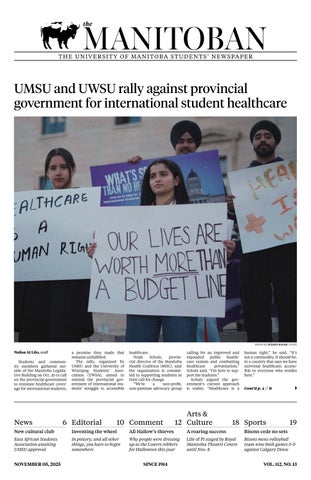

UMSU and UWSU rally against provincial government for international student healthcare

Students and community members gathered outside of the Manitoba Legislative Building on Oct. 30 to call on the provincial government to reinstate healthcare coverage for international students, a promise they made that remains unfulfilled.
The rally, organized by UMSU and the University of Winnipeg Students’ Association (UWSA), aimed to remind the provincial government of international students’ struggle to accessible healthcare.
Noah Schulz, provincial director of the Manitoba Health Coalition (MHC), said the organization is committed to supporting students in their call for change.
“We’re a non-profit, non-partisan advocacy group
News 6
New cultural club
East African Students Association awaiting UMSU approval
Editorial 10
Inventing the wheel
In pottery, and all other things, you have to begin somewhere
Comment 12
All Hallow’s thieves
Why people were dressing up as the Louvre robbers for Halloween this year
calling for an improved and expanded public healthcare system and combatting healthcare privatization,” Schulz said. “I’m here to support the students.”
Schulz argued the government’s current approach is unfair. “Healthcare is a
A roaring success
Life of Pi staged by Royal Manitoba Theatre Centre until Nov. 8 Arts & Culture 18
human right,” he said. “It’s not a commodity. It should be, in a country that says we have universal healthcare, accessible to everyone who resides here.”
Cont’d p. 4 / It <
Sports 19
Bisons cede no sets
Bisons mens volleyball team wins both games 3-0 against Calgary Dinos
PHOTO BY ZULKIFL RAFAH / STAFF
Nafisa Al Lilo, staff


109 HELEN GLASS BUILDING UNIVERSITY OF MANITOBA WINNIPEG, MB THEMANITOBAN.COM | 204. 474. 6535
GENERAL INQUIRIES: ME@THEMANITOBAN.COM
CIRCULATION INQUIRIES:
MISSING OR INCOMPLETE PAPER?
EMAIL: DISTRIBUTION@THEMANITOBAN.COM
EDITOR-IN-CHIEF Mikaela Warkentin editor@themanitoban.com
BUSINESS MANAGER Alice Teufack accounts@themanitoban.com
BUSINESS SUPPORT MANAGER Joshua Herold ads@themanitoban.com
EDITORIAL
MANAGING EDITOR Peace Ifeanyi me@themanitoban.com
COPY EDITOR Eden Quiring copy@themanitoban.com
COPY ASSOCIATE Mursal Ghiyasi
NEWS EDITOR Jesse Brogan news@themanitoban.com
NEWS EDITOR Roy Albright Obah news@themanitoban.com
RESEARCH & TECHNOLOGY EDITOR Mansura Meghla research@themanitoban.com
COMMENT EDITOR Quinn Mayhew comment@themanitoban.com
ARTS & CULTURE EDITOR Boris Tsun Hang Leung arts@themanitoban.com
SPORTS EDITOR Abdul-Jalilu Ahmed sports@themanitoban.com
DESIGN
DESIGN EDITOR Deveney Jarrow design@themanitoban.com
DESIGN ASSOCIATE Patricia Sanque
GRAPHICS EDITOR Emma Gillich graphics@themanitoban.com
GRAPHICS ASSOCIATE Teegan Gillich
AUDIO AND VIDEO
AUDIO EDITOR Max Reid audio@themanitoban.com
PHOTO EDITOR Mike Thiessen photo@themanitoban.com
PHOTO ASSOCIATE Ebunoluwa Akinbo
VIDEO EDITOR Zulkifl Rafah video@themanitoban.com
DIGITAL MEDIA EDITOR Faisal Rahman social@themanitoban.com
SOCIAL MEDIA ASSOCIATE Paula Robles Andia
REPORTERS
NEWS Arifah Gheesah
NEWS Nafisa Al Lilo
RESEARCH & TECHNOLOGY Nawal Semir
COMMENT Thandeka Katsika
COMMENT Kyra Campbell
ARTS & CULTURE Carrington Dong
ARTS & CULTURE Jordan Anglin
SPORTS Faiyaz Chowdhury
SPORTS Israel Abejoye
VOLUNTEERS
VOLUNTEERS
Mohamed Soussi Gounni
interested in volunteering?
email me@themanitoban.com today!
The Manitoban is the official student newspaper of the University of Manitoba. It is published monthly during the summer and each week of regular classes during the academic year by the Manitoban Newspaper Publications Corporation.
The Manitoban is an independent and democratic student organization, open to participation from all students. It exists to serve its readers as students and citizens.
The Manitoban is a member of the Canadian University Press, and our journalistic standards can be found on the Manitoban’s website.
The newspaper’s primary mandate is to report fairly and objectively on issues and events of importance and interest to the students of the University of Manitoba, to provide an open forum for the free expression and exchange of opinions and ideas and to stimulate meaningful debate on issues that affect or would otherwise be of interest to the student body and/ or society in general. The Manitoban serves as a training ground for students interested in any aspect of journalism.
Students and other interested parties are invited to contribute to any section of the newspaper. Please contact the appropriate editor for submission guidelines.
The Manitoban reserves the right to edit all submissions and will not publish any material deemed by its Editorial Board to be discriminatory, racist, sexist, homophobic or transphobic, ableist or libellous.
Opinions expressed in letters and articles are solely those of the authors. Editorials in the Manitoban are signed and represent the opinions of the writer(s), not necessarily those of the Manitoban staff, Editorial Board or the publisher.
A “volunteer staff” member is defined as a person who has had three volunteer articles, photographs or pieces of art of reasonable length and/ or substance published in the current publishing year of the Manitoban
Any individual who qualifies as a volunteer staff member must be voted in by a majority vote at a Manitoban editorial board meeting. Elected representatives and non-students may be excluded from holding votes as volunteer staff members in accordance with the Manitoban Constitution.
All contents are ©2025 and may not be reprinted without the express written permission of the Editor-in-Chief.







U of M security September 2025 report
Report shows changes in campus safety and security trends
Roy Albright obah, staff
The U of M Security Ser-
vices has released its September 2025 Monthly Report, providing an overview of incidents and safety activities across the Fort Garry and Bannatyne campuses. The report offers insights into community safety trends and the ongoing work of Security Services in ensuring a secure campus environment.
Medical emergencies rose notably from 16 cases September 2024 to 20 in September 2025. The report recorded 18 theft incidents this month at the Fort Garry campus and four at the Bannatyne campus, compared to about 30 cases last September.
Thefts in September 2025 involved nine personal items and seven bicycles, with a case of vehicular theft. Mischief reports, including graffiti and minor vandalism, totalled six this September, showing a reduction from 13 incidents recorded in September 2024.
New to this month’s report were three cases of hate propaganda discovered at UMSU University Centre, Fletcher Argue Building and Tier Building. Other reported incidents included one case
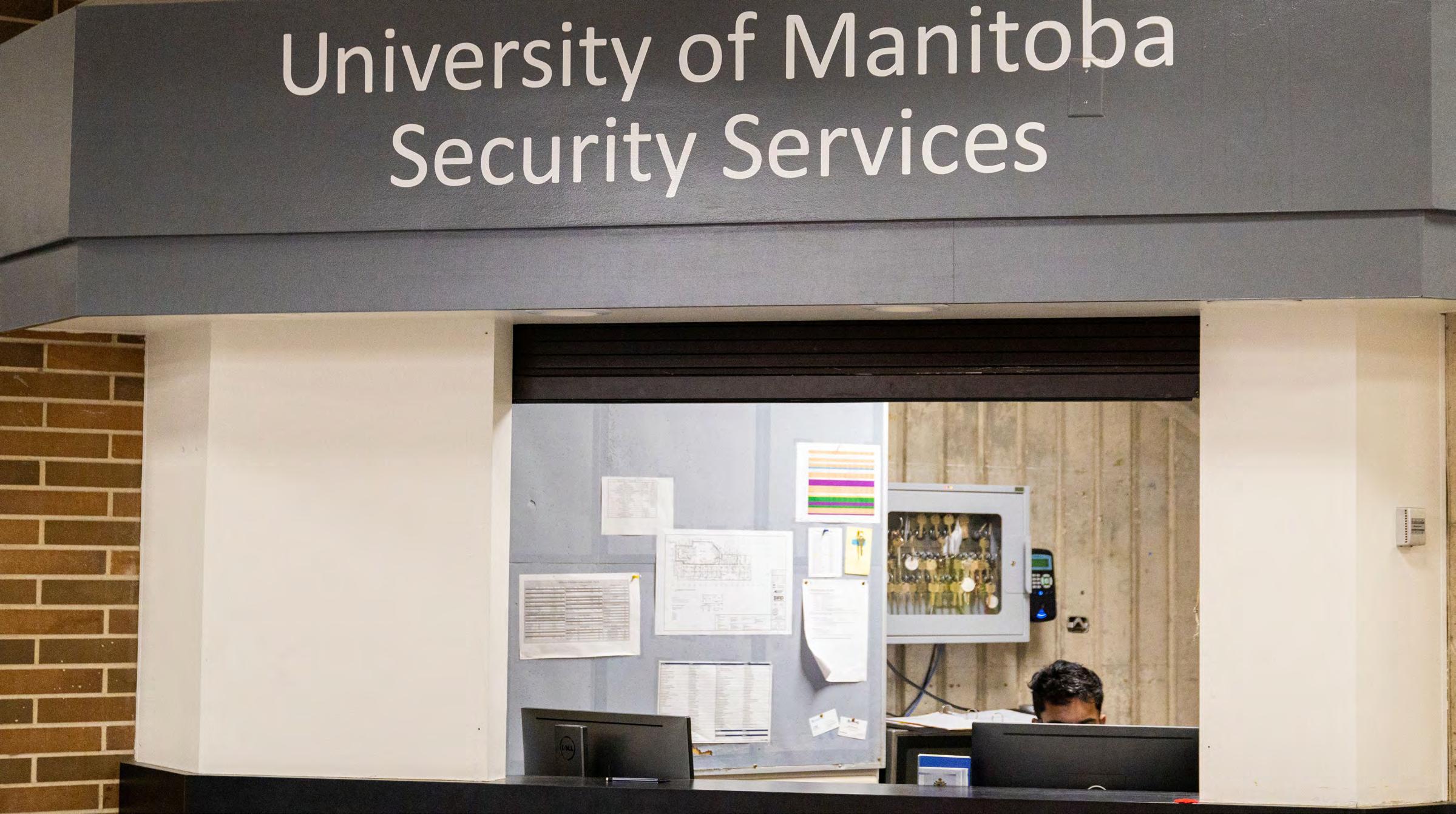
of fraud, seven City of Winnipeg bylaw infractions, two intoxicated persons and three traffic-related offences.
Security Services responded to 201 alarms, up from 191 last September, and processed 202 unscheduled
‘Toban news briefs
Jesse Brogan, staff
Late-night Winnipeg Transit
Winnipeg Transit plans to extend late-night service on 11 fixed routes starting in 2026, funded by $3 million in 2026 and $4.4 million in 2027. The proposal adds 33 staff positions and would permanently extend hours on 10 on-request routes to just before 2 a.m. from Monday through Saturday and 12:45 a.m. on Sundays and holidays. Winnipeg city council’s public works committee will vote this week to include the plan in next year’s budget.
Four-week residency at the Winnipeg Art GalleryQuamajuq
Nunavut’s Department of Culture and Heritage invites resident Nunavut Inuit visual and media artists to a four-week residency at WAG–Qaumajuq in 2026. The program offers studio and media equipment access for creating work, advising and promoting the Government of Nunavut’s Inuit art collection. Selected artists will receive $10,000, an expense allowance, accommodation, round-trip travel and materials.
access requests.
Security Services provide a range of programs and initiatives designed to enhance safety and support a positive campus experience for students, staff and visitors. These include the UM Safe app,
workshops, training sessions and educational programs.
The department’s primary goal is to ensure a secure environment where the U of M community can live, learn and work with confidence.
Staffed by licensed, full-
time security officers, the department offers 24/7 protection, maintaining a continuous presence across campuses.
City making changes to homeless encampments in November
Starting Nov. 17, Winnipeg will ban tents within 50 metres of playgrounds, splash pads, pools and daycares, and within 30 metres of transit shelters, bridges and docks. The policy follows an increase in the number of encampments, with last year’s count estimated at 2,500 people experiencing homelessness and about 100 camps housing up to 700 people. Enforcement will begin with outreach using existing staff. Fort Rouge–East Fort Garry Coun. Sherri Rollins said the rules may simply push people elsewhere.
Winnipeg launches parking plan and strategy
The City of Winnipeg released a five-year parking and mobility strategy to modernize how curbside spaces and parking are managed. The plan aims to improve convenience, accessibility and fairness through better signage and payment options, regular reviews of rates and hours and exploration of on-street EV charging. It will go to the Public Works committee on Nov. 6 before moving to executive policy committee and council for approval.
Winnipeg-wide compost program
Curbside compost collection is being planned for 2030. A new motion at City Hall asks Winnipeg’s public service to consider handling the work in-house rather than contracting it out. The motion detailed the costs, potential entry-level jobs for disadvantaged communities and savings from joint-equipment purchases with other cities. It also suggests aligning collector wages with garbage and recycling rates to control costs. The motion requires council approval. Currently, Winnipeg only offers compost drop-off zones.

PHOTO BY EBUNOLUWA AKINBO / STAFF
CIPA hosting first Winnipeg event
Event showcases training and support for immigrant professionals
Roy Albright Obah, staff
he Canadian Immi-
Tgrant Professional Alliance (CIPA) is set to host its first event in Winnipeg on Wednesday, Nov. 12, marking a milestone for immigrant-led professional empowerment in Canada.
The event will take place at the Roundhouse Auditorium, Red River College Polytech and bring together immigrant professionals, students, community leaders and employers to explore career pathways and inclusive workforce strategies.
Juanita Ama DeSouza-Huletey, founder, president and CEO of CIPA, said the organization was born out of experience and the conviction that immigrants can “come together to build something sustainable from within their own strength.” She emphasized collaboration forms the foundation of CIPA’s operations. The organization works with universities, employers and community agencies to align efforts and maximize impact.
Its programs align with several UN Sustainable Development Goals, including those focused on partnerships, decent work and innovation, aiming to bridge the gap between settlement and professional success.
CIPA integrates coaching, mentorship, digital training and social wellness into a single ecosystem. Through its coaching & mentorship hub, immigrant professionals receive guidance from mentors who understand cultural and professional transitions.
A key part of CIPA’s vision is empowering young immigrant and international stu-

dents to transition successfully into Canada’s workforce. The organization partners with institutions such as the University of Winnipeg and RRC Polytech to offer mentorship, internships and digital training.
“Students are at the heart of what we do,” DeSouza-Huletey said. “Integration must begin long before graduation.”
Beyond professional development, CIPA believes “true integration extends beyond employment,” DeSouza-Huletey noted. Workshops on mental health, parenting and community-building reinforce that “professional success is sustained
by personal and community well-being.”
“CIPA doesn’t aim to duplicate” DeSouza-Huletey added. “We exist to strengthen what already works […] We are immigrant-led and lived experience-driven, founded and powered by professionals who have personally navigated Canada’s social, cultural and professional systems,” she said.
CIPA’s framework is built on “the Five Cs,” which are coaching, connecting, collaborating, catalyzing change, and cultivating community. Its programs combine mentorship, digital training and social support, provid-
ing immigrants with resources that extend beyond settlement to long-term career success.
The Winnipeg launch event will showcase these programs, offering attendees opportunities to connect with partner organizations and access resources that support both professional and community integration.
DeSouza-Huletey said the goal is for CIPA to become “a national model for partnership-driven integration, where collaboration replaces competition, where every talent is recognized and where every immigrant professional can say with confidence, ‘I
belong. I am contributing. I am thriving.’”
She added the launch event will mark a “true celebration of collaboration, courage and community,” before moving toward the next phase — securing funding to sustain its growing ecosystem.
DeSouza-Huletey advised “Don’t give up on your dream. Your skills, your story, your accent, your experience — they are valuable, even if they aren’t always recognized right away.”
For more information and to participate in CIPA’s launch event, visit luma.com/3b6ey6wc.

PHOTO PROVIDED BY JUANITA DESOUZA-HUTELEY


Research & Technology
Finding power in words
Exploring language, control and community through
Mansura Akter Meghla, staff
Erin Weinberg, an instructor II in the U of M department of English, theatre, film and media, spends her days exploring how stories from different eras reveal enduring questions about language, power and identity. Her work bridges classic texts by authors like William Shakespeare and Jane Austen with broader conversations that continue to shape how we understand the world today.
“I’m a Renaissance drama scholar by training, and my secondary research field is Jane Austen,” Weinberg said. “Lucky me, I get to read all the time!”
Weinberg’s academic journey reflects both curiosity and range. According to her, being an instructor allows her to explore a variety of interests from early modern theatre to crime fiction. “I pursue anything related to English literature that interests me,” she said. “Sometimes it’s Shakespeare, sometimes it’s Austen,” she added. Her recent conference paper focused on “Jane Austen and engagements,” which argued the period between engagement and marriage is a time of instability rather than triumph. Weinberg argued that Austen’s heroines often find themselves in a vulnerable position during this liminal phase, when their futures are still uncertain.
Weinberg’s work often returns to questions of power. “My research, as well as my teaching, tends to circle back to power dynamics,” she said. “Who has power, who wants power and what a person or group is willing to do to achieve that power.” Her work also focuses on how wealth, class, gender and ability influence who holds power, why certain voices carry more weight and the challenges of speaking truth to that power.
Beyond Austen and Shakespeare, Weinberg’s research also engages with how language can be used as a tool of control. She studies memoirs by people who have escaped cults and coercive groups, analyzing how leaders manipulate meaning to maintain dominance. “While words don’t have any physical dimension, the value systems behind [them] can be more restrictive than handcuffs or an electric fence,” she said. “Cult leaders redefine words in order to control members, and a significant part of deconstruction from a cult […] is redefining those words outside the context of damna-
literature

tion.”
Weinberg’s fascination with language extends into the classroom. Earlier this year, she caught international attention after a tweet about using Taylor Swift’s album
The Tortured Poets Department to teach grammar went viral, earning her an interview with The New York Times. “Is it a department of tortured poets or for tortured poets?” she asked. “This was a great opportunity to use current events as a teachable moment.”
see literature as something that reflects lived experience. In her “Literature and Food” course, Weinberg uses food
with scholars across disciplines to explore how food connects people and ideas.
“While words don’t have any physical dimension, the value systems behind [them] can be more restrictive than handcuffs or an electric fence”
— Erin Weinberg, instructor II in the U of M department of English, theatre, film and media
“It’s immensely inspiring,” she said. “I can’t tell you what a joy it is to spend time eating with other food lovers from across disciplines!”
have power” and literature is never just about words on a page.
Her teaching philosophy, like her research, emphasizes connection and creativity. She often encourages students to
as a lens for exploring themes of community, identity and survival. “Food isn’t just the stuff that we consume — it’s a symbol of community and identity,” she explained. As a member of the Food Matters Research Cluster at the U of M Institute for the Humanities, Weinberg collaborates
Looking ahead, Weinberg is studying how victims are portrayed in Agatha Christie’s The Body in the Library. She is examining how language and perspective can shift sympathy away from the victim to other characters. Her approach of blending close reading with questions of ethics and voice demonstrates her belief that “words
Special note from Erin Weinberg — “I’d like to remember Dr. Refaat Alareer. He was a university professor at the Islamic University of Gaza and a fellow scholar of Renaissance literature. The Israeli Occupation Forces demolished his entire university on Oct. 10, 2023. They targeted Dr. Alareer and bombed the building where he was sheltering, killing him, his siblings and his siblings’ children. Dr. Alareer spent his life harnessing the power of words to maintain hope, and the targeted nature of his murder and the demolition of his entire university shows just how powerful words, verse and education can be.”
GRAPHIC BY EMMA GILLICH / STAFF
Critical theory’s critique of judicial appointments
Professor emeritus visits Robson Hall for the Distinguished Visitors Lecture Series
Richard Devlin, professor emeritus at the Dalhousie University Schulich school of law, brought his expertise to the Robson Hall Distinguished Visitors Lecture Series on Oct. 25, challenging faculty and staff to rethink the foundations of the legal profession. Devlin’s lecture, “Glimpses of a Critical Theory of Canadian Law,” synthesized his 40 years of research, critically analyzing the judiciary and the judicial appointment process.
Drawing from the work of the Honourable Murray Sinclair, Devlin started the lecture by outlining how a person’s social context impacts their understanding of law. Devlin grew up in Belfast during the ’70s and ’80s, a time of great discrimination against Irish people, supported by both the British Parliament and celebrated common law judges such as Lord Denning, Lord Diplock and Lord Scarman. Shaped by the state violence and colonization of his youth, Devlin was drawn, during law and graduate school, to critical theorists whose conceptions of law mirrored his own experiences.
adjudicators, but rather normal people with their own thoughts and opinions.
According to Devlin, when judges construct ideas of the rule of law, the result reflects their own worldviews. Devlin argued, “Most critical theorists have strong reconstructive aspirations, programs and proposals.”
Using critical theory as a backdrop, Devlin mapped out the ongoing failures inherent in the Canadian judicial appointment process he has observed and reported on in the last few decades.
Devlin described the appointment process for federally appointed judges as an “executive failure.” On this matter, he co-authored an article titled, “Reducing the Democratic Deficit: Representation on Diversity in the Canadian Judiciary.” The 25-year-old paper argued, as Devlin explained, “that the Canadian judiciary [at the time] was hegemonically white and male.” The paper further noted that “the ultimate decision in the employ-

“Most critical theorists have strong reconstructive aspirations, programs and proposals”
— Richard Devlin, professor emeritus at the Dalhousie University Schulich school of law
Devlin explained that critical theory “is an intervention and ongoing conversation on the nature of law and the function of law,” with its main focus being on the relationship between law and power. According to critical theory, the judiciary is a political institution and judges serve as political actors. This theory posits that law is inherently indeterminate, allowing for significant judicial discretion. Devlin explained that judges are not impartial
ment process lay either with the minister of justice or the prime minister,” adding that these appointments “tended to correspond with the political ideologies of the government in power.”
To remedy this issue, Devlin and his co-authors suggested “independent judicial appointment commissions across the country [to] ensure judges were impartial, independent and purportedly representative.”
In 2016, Devlin and his co-author Adam Dodek, full professor and former dean at the University of Ottawa faculty of law, published their book, Regulating Judges: Beyond Independence and Accountability, introducing accountability, transparency and efficiency as important principles to consider in the appointment process. Devlin explained that this work constructed “an alternative narrative [beyond] just independence and impartiality,” building off the criticisms in his earlier work.
Devlin wrote another article on this topic in 2017 for a conference in South Africa titled “Dirty Laundry.” This piece examined Canadian judicial appointments under
the Stephen Harper government, finding that every judge appointed in Nova Scotia at the time was a personal friend of the minister of justice. Implementing the principles highlighted in his previous works, Devlin concluded that “independence was called into question, accountability was located exclusively in the executive, transparency was negligible, representativeness was very much a work in progress and efficiency was questionable.”
Devlin’s latest piece on the subject, “Trudeau’s Judicial Appointments: Good Looks Will Only Get You So Far,” was published in 2024. He argued significant issues persisted within the appointment process. “While there had been significant [...] progress in terms of diversity in the judiciary, many of the other values remain underdeveloped,” he explained. “In fact, things got so bad in terms of the appoint-
ment process, there were about 60 or 70 unfilled judicial vacancies.” It was discovered that this delay resulted from the minister of justice’s office rigorously vetting candidates for their political credentials. For Devlin, this is indicative of a still underdeveloped and failed process.
Devlin’s lecture also examined the failures in judicial discipline, judicial reconstruction and the dangers inherent in the self-regulation of the legal profession. Ultimately, this lecture served as a call to action, urging legal professionals and scholars to move beyond complacency and actively reimagine a legal system grounded in genuine accountability, substantive diversity and a critical awareness of its own political nature.
His lifelong work demonstrates that understanding the law’s relationship with power is the first and most necessary step toward transforming it.

PHOTO BY EBUNOLUWA AKINBO / STAFF
Nawal Semir, staff
The gift of being a beginner
On the path of learning, the first step is the most important
Emma Gillich, staff
As someone who works with clay, I can confidently say that learning how to wheel-throw was a humbling experience. I was sitting in a classroom surrounded by other nervous students, all sitting at the wheel, our professor having just finished effortlessly throwing a cylinder. Needless to say, none of ours went as smoothly. At the end of the class, I had a wobbly clay-thing that sort of resembled a deflated bowl. Covered in clay, my arms and back aching, I saw the challenge in front of me — I was supposed to make 40 cylinders, each
15 centimetres tall. That felt quite impossible at the time.
I spent hours in the studio each week, making cylinder after cylinder until finally the day came when I presented what I had accomplished to my professor. They weren’t perfect, some of them weren’t tall enough or didn’t have even walls, but all I saw was my progress. At the end of that project, I chose my best attempts, fired and glazed them, and proudly displayed them on my shelf. As for the rest, I had the cathartic experience of smashing them into pieces to reclaim them as clay and begin again.
It was a whirlwind of learning, with long days and more failures. Some days I wanted to quit, other days I felt so much triumph in having a single completed work to show. It is a humbling experience to dedicate an immense amount of time to learning something, to commit to being a beginner.
As I progressed, my own standards became harsher. I no longer felt pride at merely the completion of a competent work — instead I felt as though it was an expectation. On the days of continuous failure, I felt the aches from my long hours hunched over the wheel even sharper. I had lost
the charming feeling of being a beginner, and I scoffed at my early attempts.
This was until one day, my professor talked about how she still had her first pieces of pottery. Suddenly, it clicked. If someone at her level still spoke about her first works with pride, why didn’t I? If I had never been a beginner, I would never have gotten to where I am now. Those early attempts mark the start of my journey — they are stepping stones, they show my levels of experience.
This is why I now embrace each new challenge with open arms. If it takes me days or
weeks to master a new technique, I know that the eventual success will be even sweeter. I stand atop a mountain of failures and proudly add more to my collection. Each day comes with its own hardships. Often, I have to remind myself after a difficult day that trying makes me better than yesterday, and that there’s nothing wrong with having another go tomorrow. I may never be the beginner pottery artist with wobbly cylinders that I was, but I will always cherish the fact that I was her, and that she committed to not giving up.

GRAPHIC BY EMMA GILLICH / STAFF
Pop stars boost civic engagement on the concert floor
Sabrina Carpenter’s U.S. tour shows how to increase Canadian youth voter turnout
Kyra Campbell, staff
W hen pop star Sabrina Carpenter announced that HeadCount, a nonprofit organization focused on democratic engagement, would again be present at her Short n’ Sweet tour dates across the U.S. this fall, I was disappointed to realize there is no equivalent partnership for Canadian artists.
HeadCount works alongside performers at concerts and festivals and has helped register over 1.7 million voters since its founding. Over the next month, fans of Carpenter, mainly young women, will continue attending her shows to see the star’s glittering performance in what feels like a dream house slumber party.
Alongside the fun, upbeat vibes of the concert, fans are provided with a chance to learn about civic action and get involved in the democratic process right on the concert floor.
During the first leg of her tour, HeadCount said that Carpenter’s partnership led to 35,814 registered voters and reached another 263,087 potential voters through information and outreach.
It’s easy to dismiss these initiatives as distinctly American, especially given the often-chaotic nature of politics south of the border. The reality is that Canadian politics, while generally less dramatic, still struggles with youth voter turnout and engagement.
Our mild political attitudes may be a blessing, but they also mean that many young people feel disconnected from politics or simply do not see the point in participating.
According to Elections Canada, turnout among eligible voters aged 18 to 24 was just 46.7 per cent in the 2021 federal election, well below the overall turnout of 62.2 per cent.
So, how can civic engagement be made relevant, exciting and accessible for Canadian youth? One answer could be to take a page out of Carpenter’s playbook and look to the concert stage. Imagine if more Canadian stars like Shawn Mendes, Tate McRae or The Weeknd teamed up with non-partisan organizations to promote political participation at their shows — this approach would be a direct way to bring democratic engagement out of the abstract and into real life.
There is already precedent for this in Canada. During the 2008 federal election, the non-profit organization Apathy is Boring hosted four

concerts in Quebec City, Halifax and Montreal. The aim was to increase youth voting and encourage them to understand “what it means to have a voice as a citizen.” While not as prominent as HeadCount’s efforts in the U.S., these events show that the concept can work here too.
Since we haven’t seen anything similar since 2008, some might wonder if such partnerships are even legal in Canada. The answer is yes. This is because non-partisan civic engagement activities, such as concerts, that encourage voting are not regulated by Elections Canada outside of official election periods. This is as long as they do not promote or oppose any specific party or candidate. In other
words, the focus is on participation rather than pushing a political agenda.
Importantly, in-person engagement at concerts could help address some of the barriers to youth voter participation. Media campaigns, while widespread, often get lost in endless scrolling or fail to reach those who avoid politics online. In contrast, concerts are spaces where youth already gather, often with friends and an openness to new experiences. Meeting a non-profit volunteer faceto-face, getting questions answered or simply seeing that voting is something their peers are doing could make a difference for many Canadian youth.
Of course, this is not a
Since Canadian politics is often seen as boring, it is all the more reason to bring democracy to where the excitement is — the live stage. It is time to promote engagement among youth and make voter participation the headline act. magic solution. Issues of trust, accessibility and civic education still need to be addressed at the policy level. However, as artists and influencers, Canadian musicians are in a unique position to make democracy feel hopeful, interesting and even fun.

GRAPHIC BY TEEGAN GILLICH / STAFF

To complete Sudoku, fill the board by entering numbers 1 to 9 such that each row, column, and 3x3 box contains every number uniquely. In Straights, like Sudoku, no single number 1 to 9 can repeat in any row or column. But rows and columns are divided by black squares into compartments. Each compartment must form a “straight.” A straight is a set of numbers with no gaps but it can be in any order, eg [7,6,9,8]. Clues in black cells remove that number as an option in that row and column, and are not part of any straight. Glance at the solution to see how “straights” are formed.