Iconic downtown eatery closes after nearly 60 years page 4
Inauguration
Renewed optimism as Obama begins second term
Weak treaty
Local and fair Standing tall
cover image
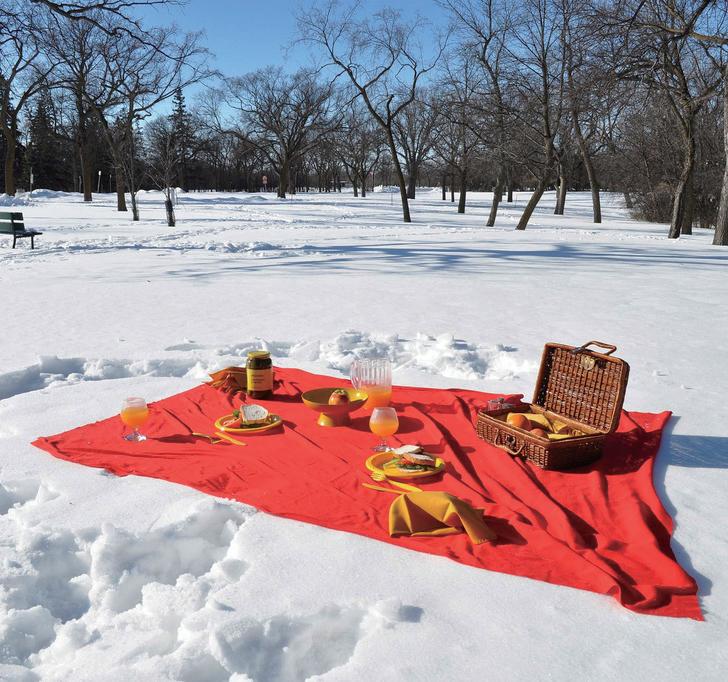
“Assiniboine Park, February 2010” by
Chelsea Sanders
Please contact designteam@themanitoban.com if you are interested in submitting a cover image.
For other volunteer inquiries, please come to our office in University Centre (across from Tim Horton’s, behind GOSA) or email the editor of the section for which you are interested in writing.
Please direct all other inquiries to editor@themanitoban.com
contact information: umsande5@cc.umanitoba.ca
Toban Talkback
Patterson, staff
and if so, which event are you most looking forward to?
Unist’ot’en Camp resident visits Winnipeg to discuss resistance
Community fights against pipeline construction
Quinn Riche R t, StAff
W
innipeg’s Mondragon
Bookstore and Coffeehouse filled up quickly on the evening of Monday, Jan. 21 for a community dinner and discussion in support of Unist’ot’en Camp, a resistance community in northern B.C. on the traditional land of the Wet’suwet’en people. The remote community is attempting to blockade the con struction of several major pipelines through Wet’suwet’en land.
The Winnipeg talk was organized in conjunction with the Winnipeg Indigenous People’s Solidarity Movement, and included a video presentation featuring commentary and images from Unist’ot’en camp.
Additionally, Brett Rhyno, a resident and ally of the blockade community, spoke to the crowd and answered questions on a variety of issues pertaining to the camp’s orga nization, supply needs, legal matters, and reasons for opposing pipeline construction.
Members of Wet’suwet’en nation are opposed to pipelines being built on their traditional land—a plot spanning about 58,000 sq. km— because they view such projects as environmentally destructive to a
limited remaining quantity of pris tine land.
“We are opposing these projects because we have very few areas that are pure and still in a natural state [ . . . ] industry has destroyed most of our areas and we have very little left. If we don’t protect it, we’ll be saying, ‘We used to have moose. We used to have fish,’” said Freda Huson, a Unist’ot’en spokesperson featured in the video presentation.
Pipeline routes through Wet’suet’en land have been pro posed by Kinder Morgan, Pembina Pipelines, and Enbridge. There is also a joint project, Pacific Trails Pipeline (PTP), which is owned by the Apache Corporation, EOG Resources, and Encana.
Rhyno recalled a circumstance in which Unist’ot’en Camp mem bers confronted PTP contracted employees conducting surveys on Wet’suwet’en land close to the cen tral camp.
“In November, 2011, the surveyors tried to come out [ . . . ] we were able to get on them right away and they were issued an eagle feather, which is a traditional warning of trespass according to Unist’ot’en law,” said
Rhyno.
A document sent to the involved pipeline companies following this incident explained that the Wet’suwet’en people see themselves as sovereign from the Canadian state and maintain that their land is unceded.
“Wet’suwet’en territory, which extends from just east of Burns Lake
“We
are opposing these
projects because we have very few areas that are pure and still in a natural state.”
– Freda Huson
to the coastal mountain range, is sov ereign and unceded territory, which has never been ceded to the colonial Canadian state; the Wet’suwet’en are not under treaty with the Canadian government. Their territory, there fore, is and always will be free, and
belongs to the Wet’suwet’en people alone,” reads the letter.
Rhyno echoed this sentiment when he explained to the Mondragon audience that Unist’ot’en residents are “backing away from treaty processes.”
“The government has a standard treaty process and they will only compensate you for a small percent age of your land. And that’s their base and they won’t move from that base. I think the value is around five per cent. So when you make a treaty, you are surrendering your land,” Rhyno elaborated to the Manitoban Rhyno also referred to a landmark Supreme Court case, known as the Delgamuukw decision, which in 1997 ruled that the original aborigi nal title to land in British Columbia had not been overridden and thereby recognized the authority and legal significance of oral traditions and hereditary chiefs.
“When it went to the Supreme Court, they overruled previous courts and said the aboriginal title had not been extinguished. It did not grant them the aboriginal title because of a technicality in terms of the way the case had been presented, but it set out
Winnipeg weather affects all walks of life
Weeklong span of frigid weather interrupts city
Alyci A Rod Rigues, StAff
W
innipeg recently lived up to its reputation when, for the first time in years, wind chill warn ings decreased the temperatures to below minus 40 and created many issues for residents. Warnings on the weather channel stated that “at these extreme wind chill values frostbite on exposed skin will occur in less than 10 minutes.”
Due to the temperatures, Canada Post issued a service warning, saying they would have to postpone mail services and resume once the extreme weather conditions improved. This left approximately 18,000 residents without mail for a period of 2 3 days.
CAA also issued a statement to the Winnipeg Sun claiming a record amount of vehicle services in four years. In 2008 their record was 1,125 vehicles and as of Monday, Jan. 21, CAA had already beat that record with 1,300 vehicles. The company claimed they had taken over 744 service calls by 2 p.m., with the wait time at approximately six hours. CAA Manitoba spokeswoman Liz Peters explained why the numbers were so high.
“It is pretty typical, but never this high. The reason why I’m thinking
it’s this high is because it’s a Monday.
Mondays are always our busiest days because a lot of people don’t drive on the weekends and then they hop in their car on Monday morning to go to work and realize ‘oh darn, I forgot to plug in,’ and it’s now been three days in a row of deep freeze,” said Peters.
The cold temperatures affected everything from transit, with buses having trouble keeping on schedule, to cars, due to the slick icy roads
that are still having an impact on Canadian drivers east of Manitoba.
The cold weather is especially unpleasant for those who spend most of their time outside, such as those who work in the elements all day or homeless people who do not have a place to go. In frigid weather such as this, homeless shelters are at capacity even with the addition of extra beds.
The Salvation Army added 35 extra beds to their shelter, which already
holds 285 beds.
Keesha Daniels, manager of the Main Street Project, told the Winnipeg Free Press that there are no statistics available on deaths related to the cold, despite the increased risk of frostbite and freezing to death.
The last documented death occurred three years ago when a woman was found dead in a bus shelter after being outside in minus 20 degree weather.
Daniels stated she believes the small amount of deaths is due to the combined efforts of all shelters in
“We’re maxed out, to the point where people are literally in the halls to keep out of the weather. That’s wall-to-wall [sleeping] mats and everything. It’s never enough.”
– Keesha Daniels
criterion for a future court case for what would constitute aboriginal title [ . . . ] it also recognized oral tradition as having legal validity,” explained Rhyno.
Rhyno concluded his talk with a brief note on the recent successes at Unist’ot’en Camp and its plans for the future.
“Amazingly, two major companies backed out after our [2012] day of action,” said Rhyno. “Our resistance actually got a fair amount of media, and Encana and EOG resources sold their shares. All indications are they didn’t get a great price.”
Those shares were purchased by Chevron, an American energy corporation.
Since the exchange between Encana, EOG, and Chevron, Rhyno says the Wet’suwet’en have been focused on growing the number of camps on Unist’ot’en land.
“Right now we are fortifying. We are building up our resources over the winter, and in spring we are going to build more cabins,” Rhyno told the crowd.
“The plan is not to have this be a blockade, but the starting of a new community.”
Winnipeg, even after reaching their limit. They do not turn anybody away, especially in weather like this, and do everything they can to accommodate for those with nowhere to go.
“We’re maxed out, to the point where people are literally in the halls to keep out of the weather. That’s wall to wall [sleeping] mats and everything. It’s never enough,” said Daniels.
All the shelters work together dur ing times like this to ensure everyone’s safety. The homeless are carefully watched with workers looking for signs of hypothermia or frostbite. Those under the influence of alcohol or drugs are especially at risk.
The Downtown Winnipeg BIZ program called Downtown Watch has individuals trained to help the homeless connect to shelters. The homeless are already facing multiple stressors and the cold is another major strain.
“The reality is we never turn any one away from our doors, especially in these temperatures. We’re the last stop,” said Chris Dickens of the Salvation Army.
Without a paddle
Paddlewheel restaurant closes doors shy of 60 years of service
B Ryce h oye, StAff
Earlier this month adminis tration released the statement, “After careful consideration, The Bay and Compass Group Canada have announced the closure of the Paddlewheel restaurant operated within the Downtown Bay store.”
After decades of faithfully serving Winnipeggers its reasonably priced cafeteria style food and comfort, the Paddlewheel closed its doors on Thursday, Jan. 24. On its last day of busi ness, dozens of people of all ages flocked to take photos and take in the unforgettable Paddlewheel restaurant one last time.
chicken fingers were among all that remained on the menu after a surge of nostalgic Winnipeggers consumed and depleted the restaurant’s food supply in its final days.
“It was always the same, and mostly the same kind of food,” reflected a long time Paddlewheel patron, “but it wasn’t about the food [ . . . ] it was an establishment, something of his tory. As chil dren from the 50s, this was an outing.”
“It wasn’t about the food. It was an establishment, something of history.”
– Restaurant patron
Not about the food
Outside the restaurant’s entrance on Jan. 24, a sign read, “Attention Paddlewheel customers: our servery is now closed. Because of the unex pected turnout, our food selection is limited.” Turkey stew, hotdogs, grilled cheese sandwiches, and
A link to the past
The Portage Avenue res taurant was located on the sixth floor of The Bay downtown and opened to the public in the fall of 1954. It was a mainstay for generations of urbanites and seniors until the day it closed.
Poplar Point resident Patrick Bend reminisced, “I always remember the wheel,” reflecting on his childhood trips into Winnipeg with his family in the 60s, taking in the “big city” and the Paddlewheel.
“The sad thing [ . . . ] is that seniors and students really rely on this building – for [groceries] down stairs and for the restaurant upstairs,” remarked another customer and for mer employee, referring to the immi nent closure of both the Paddlewheel as well as the basement located Zeller’s grocery store slated to close this spring.
“I knew people who would walk [here] from seniors’ complexes for breakfast, lunch, and supper.”
The Paddlewheel wishing well, landscape wall mural, stucco ceil ings, and dated clapboard siding
aesthetic were central to the restau rant’s identity and the Paddlewheel experience.
“It’s exactly the same – no change,” remarked Henry and Betty Fast, patrons of the Paddlewheel since the 70s.
For the Fasts and others, the unchanging nature of the Paddlewheel restaurant’s interior design and “meat and potatoes” menu made visits espe cially nostalgic.
Location, location, location
Despite attracting droves of
Province backing Lake Winnipeg groups
Members talk with the Manitoban about importance of funding
Quinn Riche R t, StAff
G
roups involved in Lake Winnipeg research and water quality advocacy received a total of $600,000 in funding from the provin cial government on Monday, Jan. 21.
Funding was provided to seven different projects, including four at the universities of Winnipeg and Manitoba. Two projects underway at the U of M’s Watershed Systems Research Centre received a combined $74,000. Fifty thousand dollars of that money will be put toward a “pilot proj ect aimed at storing run off water on agricultural land.”
Additionally, the Lake Winnipeg Research Consortium (LWRC) received $150,000 in funding and Lake Friendly, a coalition of nine municipalities along the south basin of the lake engaged in water qual ity advocacy and public awareness, received $75,000.
According to Gord Mackintosh’s office, that $75,000 injection has tri pled Lake Friendly’s funding.
“The funding announced [on Jan. 21] is creating partnerships that will help us all reduce our environmental footprint, protect the environment and sustainably manage natural resources now and for future genera tions,” said Mackintosh, the province’s Minister of Conservation and Water Stewardship, in a press statement.
Colleen Sklar, executive director
of the Lake Friendly Initiative, told the Manitoban that she continues to be pleased with the province’s willingness to take action on Lake Winnipeg’s water quality concerns, but underscored the fact that individ ual citizens are also respon sible for restoring the lake’s health.
“I think the leadership is all moving in the same direction. I haven’t spoken to anyone who is not concerned about the lake and not trying to make changes. But I think that at a very basic level we need to have an understand ing of what it is we need to do and then get at it. I don’t think that is just up to the politicians. It is up to every single one of us,” said Sklar.
According to Sklar, the most financially costly ele ment of the Lake Friendly Initiative’s work is effectively communicating that mes sage to as many individuals as possible.
other provinces [ . . . ] but we believe that a Manitoba first strategy is essen tial for communications. We need to engage Manitobans on this issue, and then reach out to our neighbours [ . . . ] we have to take the lead on this.”
She also noted that Lake Friendly deliberately focuses its advo cacy work within Manitoba, despite the fact that the Lake Winnipeg watershed covers multiple provinces and states.
“We are involved in talking with
Karen Scott, science and educa tion program coordinator for LWRC, is also happy with the direction the province is moving, regarding Lake Winnipeg.
“The province is a member of the
LWRC and has an active role in monitoring the lake and watershed. Initially, the province may have been a bit slow in recognizing that there was an issue before them, but since then they have stepped up and, in my view, are working hard to improve the situation,” Scott said.
LWRC is a group that provides a ship for the use of many researchers conducting fieldwork on Lake Winnipeg. Scott told the Manitoban that secur ing the funding necessary to maintain the ship (the M.V. Namao) and to cover administrative costs has been challenging year to year. Despite this, the LWRC has played a key role in much of the research and monitoring done on Lake Winnipeg since 1998.
According to Scott, LWRC supported research on the lake indicates that it is a complex matter whether or not the water quality of Lake Winnipeg is further declining or improving.
While nutrient levels remain higher than desirable, Scott says that algal blooms have not been produc ing harmful toxins and low oxygen
sentimental and appreciative Winnipeggers in its last week of business, the Paddlewheel’s expan sive one room space was rarely crowded and typically only populated by a small but committed group of regulars.
Shy of its 60th birthday—it was set to undergo a series of renovations in 2011 that never came to fruition— little is known regarding what will happen to the vacant space once home to the iconic Winnipeg eatery. University of Winnipeg students Devon Barker and Alanna Deluca used to frequent the Paddlewheel as children with their parents.
“This is my first time here since I’ve been [at the U of W] and it’s already my fifth year of university,” stated Barker, adding “so we haven’t frequented [the Paddlewheel] that much.”
“It would be interesting if this [venue] were to stay a restaurant [ . . . ] marketed more towards our gen eration,” said Barker. “Maybe make it something more accessible to the university crowd. I feel like a lot of us would come here.”
events are rare. Furthermore, it is now known that the Red River is the most significant source of nutrients for the lake. This new information will allow for more effective nutrient management.
Whether or not the water quality of the lake is improving or worsening, Scott advised not to expect things to turn around quickly.
“Long term trends for the better won’t be apparent immediately, nor should we expect them to be. After all, the degradation didn’t happen overnight, and it won’t improve over night either.”
In the wake of the $600,000 in grants given to LWRC, Lake Friendly, and others like them, Scott and Sklar agree that perhaps the most impor tant step towards a healthy Lake Winnipeg is a well informed public.
“Manitobans are becoming more aware but, unfortunately, some of the information being dispersed is inac curate,” explained Scott.
“Awareness that is ill informed or based on fear does not contribute to overall environmental literacy within the general public, which, in my view, is where the real solutions lie for the long term protection of water, not just the remediation of Lake Winnipeg.”
Controversy looms over Morris newspaper
U of M faculty member attempts discussion with editor
R Achel Wood, StAff
AUniversity of Manitoba native studies lecturer, Niigaanwewidam James Sinclair, recently attempted to discuss Indigenous issues with Morris Mirror editor in chief Reed Turcotte.
On Jan. 22, Sinclair waited outside of the newspaper office, but did not get the meeting he hoped for.
Controversy first arose when the Morris Mirror published comments toward Aboriginal peoples, which many found offensive. An editorial written by Turcotte commented that First Nations peoples “are acting like terrorists in their own country,” label ling them as corrupt and lazy while discussing the Idle No More move ment, which Turcotte gave a “thumbs down” to in his piece.
Despite the opinions of the edi tor, and the apparent support of the editorial voiced in the letters to the editor published in the Mirror, U of M lecturer Sinclair praised the people and mayor of the small town. After meeting with them, he said that resi dents were open and incredible and labeled the mayor as inspiring and phenomenal.
Sinclair, who arrived to find
the Mirror office closed and locked, waited to meet with Turcotte in freez ing temperatures for two hours.
Eventually, the academic taped a letter for the editor on the office door, which he hopes will be published in the next issue of the publication.
“It’s unfortunate but not everyone is ready. Not everyone is ready to have that conversation [ . . . ] I can’t force anyone to be ready for that dialogue,” said Sinclair to the CBC.
“It’s my responsibility to talk to that individual about those words and for him to take responsibility for them, and for him to also explain his position to me.”
Sinclair told the Manitoban that he had planned to discuss Turcotte’s description of Aboriginal peoples as “lazy” and “corrupt” with the editor. By explaining the history of Canada and Treaty One—an agreement signed in 1871 regarding land and annuities for First Nations peoples—as well as discussing historical policies that displaced Indigenous people, Sinclair hoped to reconcile the difference of opinion between him and Turcotte.
“I also would have enjoyed a cup of
coffee with him as a fellow member of a shared community and [talked] with him about the beautiful pos sibilities of life for our children in this territory [ . . . ] I only wanted to
“It’s unfortunate but not everyone is ready. Not everyone is ready to have that conversation.”
– Niigaanwewidam James Sinclair
meet a fellow relative of my home and bring him a gift.”
The publication, whose web site claims that they are “reflecting the views of the local community,” sparked outrage from many, includ ing residents of Morris.
Local businesses and politi cians pulled their advertising from
the publication in the wake of the controversy.
A local grocery store, Big Way Foods, commented to the CBC that their advertisement would be pulled, as the paper no longer reflects the people of Morris.
Progressive Conservative MLA Mavis Taillieu also decided to remove her advertising after reading the editorial.
“I try to support the local news papers in my constituency. They have only their advertising to rely on because they give away their papers for free [ . . . ] I initially said I wanted to see what type of retrac tion he would have, but once I saw [the paper] I could not agree with his comments,” said Taillieu to the Winnipeg Free Press Division in the small town remained evident in the aftermath of the editorial. Mayor Gavin van der Linde was vocal about his disapproval of the opinion piece.
“I’m shocked and appalled that somebody can write something like that and think that it was right and acceptable to say it,” van der Linde
told the CBC.
Some residents and readers of the Morris Mirror, however, remain sup portive of the editor’s comments and have recommended that the mayor move back to his home country, South Africa, due to his disdain of the editorial.
An issue of the Black Rod, a pub lication that aims to “analyze news coverage by the mainstream media and highlight bias,” was posted to the Mirror website on Jan. 28. The issue defends Turcotte’s original edi torial and suggests that Sinclair was “stalking” Turcotte when he insisted on a meeting after the editor had declined.
“Sinclair refused to take the hint and showed up at the newspaper office anyway, with the CBC spin ning the story to make the editor look as if he was refusing to engage in [dia logue] with an aboriginal,” read the Black Rod
Sinclair remains open to discuss the editor’s comments with the writer himself.
“I will wait. My door will always be open,” he said.
Lululemon founder recipient of IDEA Award
Chip Wilson recognized for entrepreneurial feats
Alyci A Rod Rigues, StAff
T
he University of Manitoba will honour Chip Wilson, co founder and chairman of Lululemon, with an authentic gold medal manufac tured by the Royal Canadian Mint. Wilson was named a recipient of the International Distinguished Entrepreneur Award (IDEA) of 2013. The award will be presented by Asper school of business associates on June 4, 2013.
David Barnard, University of Manitoba’s president and vice chan cellor, named Wilson as the ideal can didate for the honour. Barnard stated that the award is given to someone who shows “passion, drive, vision and entrepreneurial spirit that the IDEA Award represents.”
“In addition to building a now iconic international clothing brand, he is sharing his success by investing in philanthropic education and health care projects at home and abroad.”
Wilson’s philanthropic work includes donations to Vancouver’s B.C. Children’s Hospital and the Union Gospel Mission, in addition to building schools in Ethiopia.
Wilson, who graduated from the University of Calgary with a BA
in economics, founded Lululemon Athletica Inc. in 1998 after suc cessful ownership of the snowboard, skate, and surf brand Westbeach Snowboarding Ltd.
Wilson held the position of chief executive officer of Westbeach from 1980 to 1995 and acted as the head of design and production from 1995 to 1997.
Lululemon Athletica Inc. has generated $700 million in North America and the company can be found across the world in places like Australia, New Zealand, Hong Kong, and Great Britain.
Wilson was ranked number nine on the list of richest Canadians in Forbes magazine with a net worth of $2.9 billion.
Wilson, who was also the chief product designer of the company from December 2005 to March 2010, stepped down from his executive role with Lululemon on
Jan. 29, 2012. Controversy arose over the printing of an Ayn Rand phrase
on Lululemon bags in November of 2011 that read, “I am John Galt.” Galt
is a character in Rand’s novel Atlas Shrugged, which Wilson read when he was 18 and claims had a big impact on him. The novel emphasizes self interest and argues that placing others’ interest above one’s own leads to chaos.
One particular blog post, penned by Lululemon support centre employee “Alexis,” stated on the company’s website, that “Only later, looking back, did he realize the impact the book’s ideology had on his quest to elevate the world from mediocrity to greatness [ . . . ] Our bags are visual reminders for ourselves to live a life we love and conquer the epidemic of mediocrity. We all have a John Galt inside of us, cheering us on.”
The company also made headlines that same month when news arose of the brutal mur der of Lululemon employee Jayna
Murray. Brittany Norwood, the con victed killer and a fellow company employee, apparently showed no emotion at her trial after bludgeoning Murray to death with various differ ent instruments.
Despite these controversies, Lululemon remains a leading brand in the workout industry. Arni Thorsteinson, chair of the IDEA committee for the associates and president of Shelter Canadian Properties Limited, addressed the impact Wilson has made.
“Over a 15 year period, Chip Wilson has made Lululemon Athletica Inc. one of the most powerful brands in yoga and fitness, and a company of exponential growth. The IDEA com mittee agreed that an entrepreneur of this magnitude belongs among the distinguished entrepreneurs who have received this prestigious award in [the] past.”
Wilson was nominated by Jérémie Rivard, a former student of the Asper school of business, who finds the entrepreneur to be a source of inspiration.
ILLUstRatION
Job Posting
Political Studies Students’ Conference sees 29th year at
R Achel Wood, StAff
The University of Manitoba department of political studies will hold its 29th Political Studies Students’ Conference (PSSC) from Jan. 30 to Feb. 1.
The 2013 conference, enti tled “Canada and NATO After Afghanistan,” will take place at the U of M Fort Garry campus and will be a tribute to Dr. Paul Edward Buteux.
Buteux was an academic who focused on NATO and Canadian foreign and defence policy, as well as a U of M professor in the political studies department. He also founded the original PSSC in 1985.
The conference is organized by a group of undergraduate and gradu ate studies in the department, under the supervision of the department’s faculty. Key organizers include Alexander Salt and Courtney Rempel, co chairs, and Dr. James Fergusson, director of the Centre for Defence and Security Studies and a professor in the political studies department. The planning process for the confer ence began in February, 2012.
The PSSC will feature a keynote speech by Ray Henault, a retired gen eral in the Canadian Forces who also served as the chief of the defence staff and chairman of the NATO mili tary committee. Henault’s presence is suitable within the theme, which focuses on NATO’s relationship with Canada.
Alison Kimlinger, communica tions officer for the conference, told the Manitoban that the conference “will examine broad challenges to Canadian defence and security pol icy; nuclear arms control; the types of operations that the Canadian mili tary may participate.” She went on to explain that, “Many of the discussion panels will take a forward thinking approach that will seek to explore what is to come rather than analyz ing the past.”
The PSSC is funded through efforts of the conference organizers. This year’s event is mainly funded through the Centre for Defence and Security Studies, as well as several private, governmental, and university
sources.
Open to public and free of charge, the PSSC has a focus on open dia logue and inviting opinions and ques tions from all individuals, resulting in an inviting venue that draws in a broad array of participants.
“It is anticipated that recent devel opments in Afghanistan, Libya, and Syria will be prominent in the discus sion this year,” said Kimlinger.
With numerous panels featuring 16 Canadian scholars discussing the relationship between Canada and NATO with a specific focus on the war in Afghanistan, attendants can expect knowledge on current affairs from some of the greatest minds in the country, as well as the opportu nity for questions and answers after the panel discussions.
“The high quality and diversity of presenters have made the PSSC a noteworthy and highly anticipated event and a point of pride for members of the department of political studies at the University of Manitoba.”
inte R n A tion A l ne W s BR iefs
Clinton takes heat over management of Benghazi raid
Secretary of State Hillary Clinton has come under criticism over the Sept. 11, 2012 raid on the U.S. consulate in Benghazi, Libya. The raid left U.S. Ambassador Christopher Stevens and three other officials dead.
Clinton spoke at a Senate commit tee hearing, saying she takes respon sibility for the security inadequacies that led to the raid, but claims she was not notified of the requests for more security prior to the attack.
“Nobody is more committed to getting this right. I am determined to leave the state department and our country safer, stronger and more secure,” said Clinton.
During the hearing, Senator Ron Johnson stated that the Obama administration misled the public about the raid.
“We were misled that there were supposedly protests and then some thing sprang out of that, an assault sprang out of that.”
Ban on women in U.s. military lifted
It has been decided by U.S. Defence Secretary Leon Panetta that the U.S. military’s ban on women serving in combat will be lifted.
The ending of the ban has the potential for opening up close to 230,000 military jobs for women.
By Jill Patterson, staff
The ban was first put in place in 1994 with a rule that denied giving women assignments to small ground combat units. The military has until 2016 to request any particular posts or jobs that they wish to keep women apart from.
“This policy change will initiate a process whereby the services will develop plans to implement this deci sion, which was made by the Secretary of Defense upon the recommendation of the Joint Chiefs of Staff,” said a senior defence official.
frenCh woman jailed for kidnapping to Be released from mexiCan prison
Florence Cassez, a French woman sentenced in 2007 to 60 years of imprisonment in Mexico for kidnap ping, is set to be released following a decision by the Mexican Supreme Court.
Cassez was arrested at a farm near Mexico City in 2005 where numer ous hostages were found. It was dis covered later that her then boyfriend was involved in the kidnappings, but Cassez denied having any knowledge of his activities.
The Supreme Court decision was determined by three out of five judges who voted to have Cassez released.
The situation caused tension between Mexico and France, however, French President Francois Hollande
said that her release puts an end to a “particularly painful period.”
“France thanks all those who, in Mexico as well as here at home, have fought so that truth and justice prevail.”
north korea plans missile test aimed at U.s
North Korea has announced that it has plans to conduct a nuclear test with missiles aimed at the United States.
Prior to this nuclear test, North Korea had conducted two similar tests, one in 2006 and one in 2009.
“We do not hide that the various satellites and long range rockets we will continue to launch, as well as the high level nuclear test we will proceed with, are aimed at our arch enemy, the United States,” quotes the Korean Central News Agency.
The UN Security Council recently condemned a December rocket launch by North Korea, as it was viewed by the U.S. and neighboring countries as a prohibited test of long range missile technology. However, North Korea claimed the rocket was only being launched to position a satellite.
“It will be a mistake and a missed opportunity if they were to do it,” said Glyn Davies, the U.S. special envoy on North Korean policy.
“This is not a moment to increase tensions on the Korean Peninsula.”
The 57th inauguration
President Obama begins his second term
Rich ARd Jung
“W
e, the people, still believe that our obligations as Americans are not just to ourselves, but to all posterity.”
I had the privilege of attending the 57th U.S. Presidential Inauguration— which took place on Monday, Jan. 21, 2013—and witness the winds of change that had seemingly disap peared near the end of President Obama’s first term in office.
This moment marked a special day in inauguration history, as it took place on Dr. Martin Luther King Jr. Day in the United States, 50 years after the civil rights movement, and 150 years after the Emancipation Proclamation. As President Obama himself admitted, it would not have been possible for him to become president without the effort of the people of those past eras. A strong sense of symbolism could be felt when President Obama used Dr. King’s and President Lincoln’s bibles for his inauguration, both of whom were champions of social movements of their generation.
Over 800,000 people from all over the United States and around the
world—including Canada—arrived to watch the inauguration. My friends and I were up at 5:30 a.m. to head over to the National Mall, only to find that thousands of other people had been waiting there even earlier.
The speech President Obama delivered may not have had memora ble quotes such as John F. Kennedy’s famous “ask not” speech; rather, it gave a sense of the future for America.
When President Obama deliv ered the first speech of his second term, it brought a sense of direction and hope for the U.S. Obama mentioned various issues that the people must be united towards repair ing, emphasizing that these difficul
Crisis in Mali
North African nation on the brink
spence R fe Rn A ndo, StAff
The crisis in Mali has been in the headlines recently, especially as our own nation is contributing to the effort to stop extremists in that country.
To begin with, it’s important to have a bit of background facts on the nation of Mali: Mali is located in Northeastern Africa, and gained independence from France in 1960. It is the 66th most pop ulous country in the world, with a population of over 15 million. Mali has one of the lowest life expectancies in the world: 54.73 years for women and 51.43 for men. As of 2013, Mali has 228,918 internally displaced persons.
From the above statistics, it is clear that Mali is a nation facing a difficult future. As if this wasn’t enough, Mali is now embroiled in a violent con flict between government aligned forces and extremists with links to al Qaeda. This conflict has resulted because
of a power vacuum in the leadership of Mali. This vacuum was created when military officers —angry at the government’s refusal to strike harder at Tuareg Rebels—performed a coup d’etat. This coup, while short lived, provided an opening for extremists, which they seized to take over two thirds of Northern Mali – an area nearly twice as big as the United Kingdom.
Extremists cannot be allowed to gain the upper hand and impose an oppressive regime upon the innocent people of Mali. While much of the world has been throwing off the chains of tyr anny or fighting for freedom as in Syria, Mali risks going in the other direction, backsliding into violence and terror.
ties only makes the union stronger. Certain aspects of his speech evoked a strong response from the crowd, such as the reconstruction of the middle class to give each and everyone an equal opportunity of success if they worked for it, tackling climate change and continuing to develop alterna tive energy sources, and, most impor tantly, fixing the budget and reducing the debt of the United States.
This truly marks a new period for the Democratic Party of the United States. Four major winds of change have occurred over the history of the Union: the first being the inaugural shift in the party in power which occurred from John Adams to Thomas
Jefferson, the second being Abraham Lincoln’s restoration of the Union, the third being Franklin D. Roosevelt’s New Deal and birth of social security, and the fourth was the presidency of Ronald Reagan. I believe that if President Obama can accomplish all of his objectives, this would put him amongst Roosevelt in terms of social reform, and could mark the fifth major shift in American history.
During his speech, President Obama sent a message to the world that with four years of experience under his belt and the grassroots support that won him the election, he intends to make the most of this opportunity to reconstruct the United States.
Remember, history has taught us that this is not the first time the United States was on the verge of bankruptcy; never forget that after the War of Independence from 1775 1783, the independent states could not afford to pay for the war debt until Alexander Hamilton introduced the idea of a federal government in charge of national fiscal management.
Reforming healthcare, education,
and entitlement programs will not be an easy task, but just as many of the people loved President Lincoln, so too do many love President Obama. Together, with the people, this moment could mark the beginning of the greatest social reform of the 21st century in the United States.
And in the following quote, President Obama summed up the task that lies ahead: “That is our generation’s task - to make these words, these rights, these values of life and liberty and the pursuit of happiness real for every American.”
RIChaRD JUNg
about the state of the world. The advancement toward more freedom and democracy is not assured or automatic.
As the world has learned, if al Qaeda linked extremists are able to create a base in a failed state, the con sequences may not be limited to that nation alone, and there is a concern that allowing terrorists to set up a base in Mali could potentially put all of us at risk.
After Iraq and Afghanistan, there is clearly a lessened desire among the western world for foreign intervention. However, as the Libyan experience showed—which included a signifi cant and brave contribution by the Royal Canadian Air Force—there is still a need to protect innocent people from those who will do them harm, whether it be a rogue government in Libya’s case, or extremists in the case of Mali.
Extremists cannot be allowed to gain the upper hand and impose an oppressive regime upon the innocent people of Mali. business.humber.ca/postgrad
Led by France, who formerly held Mali as a colony, some west ern nations are seeking to help the government of Mali fight against the extremists.
This is an important lesson: we cannot afford to be complacent
The people of Mali deserve to live in safety and security, for only then can they establish the foundation from which to build prosperity and hope for the future. Let us hope that the extremists can be defeated and the people of Mali can start on the path to rebuilding their society.
Spencer Fernando is the comment editor for the Manitoban.
phOtO by
MaRgINet
The controversy over Zero Dark Thirty
And trying to make sense of it
mAtt A BRA , volUnteer StAff
About a month ago the contro versy surrounding Zero Dark Thirty had to do with whether the film, in spite of its fact based account, was pro torture. Recently that has been replaced by a more tangible controversy: whether or not it is a fact based account. John McCain, for instance, has spoken out against the film, claiming that the torture depicted in the film—or “enhanced interrogation”—was not as instru mental to finding Osama bin Laden as the film might suggest.
Zero Dark Thirty ’s early torture scenes, in which a pair of CIA agents torture an al Qaeda member by the name of Ammar, are the source of
most of the controversy because they suggest, in no uncertain terms, that the torture worked. The operatives are able to extract a name from the interogation – Abu Ahmed al Ku waiti, a courier who worked for bin Laden, and the man they will spend the rest of the movie trying to find. If people want to claim that torture played no part in finding bin Laden, then the act of the agents acquir ing that name from Ammar would have to be factually inaccurate and, by most accounts, it isn’t. Sorry, John McCain.
One note of interest is that the interrogation depicted in the movie was actually meant to procure infor
mation about a coming attack by the “Saudi Group;” a terrorist cell within Saudi Arabia and, in that regard, it was unsuccessful. The attack still occurs, as do many others through out the film’s 10 year time span. But in some ways that point seems irrelevant, because proponents of “enhanced interrogation” have always viewed it as a means to an end and, in the end, they do get bin Laden. The movie is not sugarcoating anything, nor is it blatantly anti torture, which is another idea arising as a result of drastic misinterpretations of the early scenes.
For example, in her review of the film in the New York Times, Manohla Dargis writes, “The abuse scenes are crucial to Zero Dark Thirty because they serve as a claim [ . . . ] that these interrogation methods are unreliable when it comes to producing action able information [ . . . ] It is only later, when Dan and Maya lie to Ammar, sit across from him at a table, talk to him like a human being and give him food and a cigarette, that he offers them a potential lead.”
What Dargis misses, possibly out of some inherent desire for the film to land on the side of good, is that when Dan and Maya talk to Ammar like a “human,” it is a very calculated deci sion. They know that his abuse and sleep deprivation have completely
warped his mind, making him vul nerable to the lies they use in order to extract the information. Make no mistake about it – the plan worked.
Thus, before the debate goes fur ther, I think people need to get a firmer grasp on what they are actually upset about. Liberals mostly seem to think the film is inaccurate because they want it to be inaccurate. The argument against torture has always existed on two levels.
The first argument, and my own, is that torture is immoral. The Bush administration and other conserva tive movements have tried to obfus cate the definition, using ambiguous terminology like “enhanced inter rogation” in place of “torture.” This is something liberals never bought into. Waterboarding, sleep depriva tion, and other cruelties are, to us, a violation of the Geneva Conventions, a molestation of Western values, and a desertion of the moral high ground. It makes us no better than our enemies.
not an effective tool, but that single person also eliminates the notion that it never works. The question to be asked is not “does torture work?” but “does the amount of useful informa tion acquired from torture justify it in proportion to the morality that it simultaneously compromises?” My quick answer is, and always had been, “absolutely not!”
Yes, Zero Dark Thirty makes the claim that accurate information was attained from “enhanced interroga tion.” My take on this is not unlike the Infinite Monkey Theorem: a thousand monkeys at a thousand typewriters with an infinite amount of time will one day produce the work of Shakespeare. Keep at something long enough and there will always be minor successes. Liberals need to be realistic – the idea that torture never works is too naïve and idealistic. In many cases torture doesn’t work; in this case, it did.
Zero Dark Thirty is just presenting the facts and its sense of neutrality, even journalistic integrity, is possi bly its greatest accomplishment as a movie. Director Kathryn Bigelow said herself, “Those of us who work in the arts know that depiction is not endorsement.” As a person who also dabbles in the arts, the inability, and at times unwillingness, to accept this basic fact has always been a huge source of frustration for me.
The second argument against torture, and the one that Zero Dark Thirty has seemingly challenged, is that it doesn’t work. A person under duress will say anything to make the madness stop, providing false leads and unreliable information, creating a mess of intelligence that exacer bates the problem further. Liberals ask outright: if torture is immoral and unreliable, how could it possibly be defended?
Here’s the misapprehension: saying that torture is unreliable is not the same thing as saying that it never works. If one in every hundred detainees breaks and provides infor mation, it is fair to conclude that it is
In the end I think that is the real heart of the controversy over Zero Dark Thirty. There is such a thing as art and there is such a thing as politics, and people on both sides can never seem to reconcile the two.
ILLUstRatION by bRaDLy WOh LgeMUth
A day in the life of an undergrad researcher
To experiment is to err
e liz AB eth dRe Wnik
For those interested in knowing what it feels like to work in a science lab, I will be penning a series of autobiographical reflections over the coming weeks under the “day in the life” column headline, where I will take you through various days of experiments experienced by yours truly.
Ialways wondered what it would feel like, what it would mean to per form scientific experiments in a real science lab. Let’s face it: as educational and as necessary as undergraduate labs are, they lack not only the authenticity, but also a certain je ne sais quois associ ated with what goes down behind the closed doors of our beloved professors’ labs.
For the past couple years, I’ve had the indescribable honour, privilege, and opportunity to work closely with a professor from the University of Manitoba and learn firsthand about the frustrations and hopeful successes that make up the days of a career in research.
The main difference between undergraduate labs and research labs is
that in undergrad labs, mistakes don’t matter. Sure, you may get docked a couple of points from your lab report here and there, but if worse comes to worst, you can always “borrow” the results of a generous classmate and fit it into your report.
And let’s be honest here – everyone has experienced a failed experiment at least once in their undergraduate career (due to either the faults of them selves or others, or the experimental design in general). I remember organic chemistry labs, in which I’d gener ated negative yields for my samples; or biochemistry labs, in which I was unfortunate enough to have chosen a malfunctioning spectrophotometer to perform my experiment on, resulting in misleading data.
For undergrad labs, these “disas ters” are not disasters at all. Borrow the correct sample results from friends, reference said results in a group lab report properly to demonstrate a basic understanding of the data and errors committed, hand in said report, and attain at least 90 per cent of the grade for a valiant effort (and correct error
Hacking JSTOR
A closer
look at Aaron Swartz’s case
tom i ng RA m, StAff
The death of Aaron Swartz earlier this month marks an important moment in the history of open data activism.
In the last 15 years, in response to theorizing and activism by people like Lawrence Lessig and Richard Stallman in the late 20th century, a number of movements with varying degrees of legitimacy have sprung up – from Creative Commons and the Open Source Initiative to WikiLeaks and The Pirate Bay. Now that these movements have begun to gain trac tion, some of them have started to see strong opposition from governments and corporations. Aaron Swartz was part of this broad range of movements and, according to his family, he was hit with “an exceptionally harsh array of charges [ . . . ] to punish an alleged crime that had no victims.” They believe his prosecution drove him to suicide.
In light of all this, it seems impor tant to take a look at what exactly Aaron Swartz (allegedly) did, why he was prosecuted so ardently, and why his allies believe his actions were right or at least excusable.
what did swartz do?
According to the indictment, he entered a restricted networking closet at MIT, connected a laptop to the network, and hid it under a cardboard box for several months while it ran a program to automatically download articles from JSTOR, a subscription service that offers access to academic journals. The laptop was discovered and, shortly after Swartz returned to retrieve the data, police apprehended him.
U.S. Attorney Carmen Ortiz, whose office was in charge of prose cuting the case, said in 2011, “stealing is stealing whether you use a com puter command or a crowbar, and whether you take documents, data or dollars.” However, even if Swartz did break the law, it’s not quite that simple – it appears from the infor mation that’s been made public that Swartz’s access to JSTOR may have been legitimate.
Visitors to MIT can register a guest account on their network. Guest accounts can access JSTOR, and one of the things you can do with
citation).
Every science student who has ever taken a course with a laboratory com ponent and fouled up an experiment is familiar with the above “protocol”; salvaging whatever data remains from a flawed experiment and cobbling it together with results from lab mates.
It’s easy for undergrads to forget that this protocol does not fly in a real lab setting. In a formal research envi ronment there is something far more at stake than simply getting a good grade. Great pains are taken; meticu lous planning and preparation, as well as a disproportionate amount of time and energy are invested for precious little in the way of sound data.
So if an experiment doesn’t work out in a real lab for any number of rea sons, guess what? You repeat it. And repeat it. And repeat it again. And when the experiment does work out? That’s right, repeat!
Over the next several issues of the Manitoban, I will be taking you on a personalized journey through the enlightening drama that I have experienced in undergraduate science research.
ILLUstRatION by CaROLINe NORMaN
JSTOR access is download PDFs of academic articles.
However, Swartz did register his guest account under a false name, which might be a violation of MIT’s terms of service. Also, JSTOR’s rules specifically disallow the use of automated programs to download from their servers. Swartz was being prosecuted under the U.S. Computer Fraud and Abuse Act of 1984, which was designed to allow for the govern ment to prosecute people who steal information from computers or dis rupt computer functionality. Their argument is that violating a site’s terms of service runs afoul of the act, which is a stretch but not as much as you might think.
When technicians at both ends tried to block Swartz’s computer, he evaded security by spoofing his MAC address—a number that is supposed to uniquely identify a computer’s network card—and reassigning his IP address. The constant download ing strained JSTOR’s servers, and users at MIT were unable to access the service for days at a time.
In other words, Swartz may have
had the right to download the articles from JSTOR – and if he didn’t, it hardly matters because academics are usually happy to liberate JSTOR articles for people without access. What’s more problematic is the way in which he downloaded them, which was underhanded and disruptive, to say nothing of his alleged intention to upload them to file sharing ser vices. Philosophically, the problem isn’t that Swartz was “checking too many books out of the library,” as activist David Segal put it, but that he drove a dump truck through the library’s wall to carry them.
Many of Swartz’s allies, such as law professor Lawrence Lessig and open data activist Carl Malamud, have acknowledged that Swartz’s methods were problematic and pos sibly illegal, but have questioned the way the case was prosecuted. It does seem strange that for something that is so minor in the grand scheme of things, Ortiz’s office hit Swartz with charges that carried up to 35 years in prison and US $1 million in fines. This is an especially salient point of consideration given that JSTOR was not interested in pursuing charges. In the end, the main takeaway from this situation is that issues of copyright, property, and theft become much more slippery when we introduce modern technology. We’re dealing not with solid objects, but abstract patterns of data that can be endlessly reproduced, and we have to think in ways that are still, after all this time, new to us. It is imperative that we approach cases like this in a spirit of philosophical calm, not polarized hysteria.
ILLUstRatION by bRaDLy WOhLgeMUth
Heavy metal blunder
First international mercury treaty too weak, scientists say
tom i ng RA m, StAff
Over 140 United Nations mem ber states agreed to a treaty to reduce mercury emissions on Geneva. The treaty has been under negotiation for four years. Named the Minamata Convention on Mercury after a Japanese city that was hit hard by mercury pollution in the mid 20th century, it is the first legally binding international agreement to reduce mercury emissions. But some activists and non governmental organizations (NGOs) are arguing that the treaty is not strict enough.
The treaty was adopted on Saturday, Jan. 19, after a week of talks and an evening of negotiations. It will be signed later this year in Minamata. Then it must be ratified by 50 nations before it comes into effect. It will be another three to four years before that happens.
The agreement will ban certain products containing mercury and require countries with small scale gold mining operations to draw up national plans to reduce mer cury emissions. Coal plants will be required to install the best available technologies to control mercury emis
sions. Specific thresholds and caps were not agreed upon, and will be discussed at the first meeting once the treaty enters into force.
Mercury is a toxic metal that usually reaches humans through contaminated fish. It can cause nerve damage, kidney damage, memory loss, and linguistic impair ment. Children and pregnant women are especially vulner able to mercury poisoning. The two largest sources of mercury emissions are coal and small scale (artisanal) gold mining. Since mercury is present in coal, it is released in large amounts by coal fired power plants. It is used in artisanal gold mining opera tions to separate the metal from its ore. This use, largely unregulated throughout the world, accounts for 35 per cent of the total global mercury emissions per year.
Environment Program (UNEP) says that approximately 200 tonnes of mercury are retained by the Arctic each year.
According to Sarah Beattie, a
the ocean, on the snow cover, or onto the sea ice.
“Since mercury is an element, it will never be removed from the envi ronmental system entirely. It can only be converted into safer, less toxic species.”
Mercury is a particular concern for Canada because the Arctic is hit especially hard by mercury pollution.
A report from the United Nations
master’s student at the University of Manitoba who studies the cycle of mercury in the Arctic, the metal evaporates into the atmosphere in warmer regions and moves toward the poles, where it condenses out of the atmosphere and is deposited into
The case for electric vehicles
Crunching numbers - Part 1 of 3
Rodge R lepinsky
The biggest carbon dioxide (CO2) emissions from consumers come from transportation.
According to Natural Resources Canada, the sector producing the most greenhouse gases (GHG) is transportation, accounting for 37 per cent of all emissions. This is even more than industry, which accounts for 32 per cent.
At the 2010 Behavior, Energy and Climate Change Conference, Meredith Herr estimated that of the typical U.S. consumer’s impact on the environment, 38 per cent of it comes from transportation.
For every U.S. gallon (3.8 litres) of gasoline that an internal combustion engine (ICE) vehicle burns, an aver age of 19.7 pounds (9.0 kilograms) of CO2 are created. Or, to put that in metric: for every litre of gas burned, 2.4 kgs (5.2 lbs.) of CO2 is created. For every 15 gallon (57 litres) tank of gas, 295.5 pounds (134.3 kgs) of carbon dioxide is created.
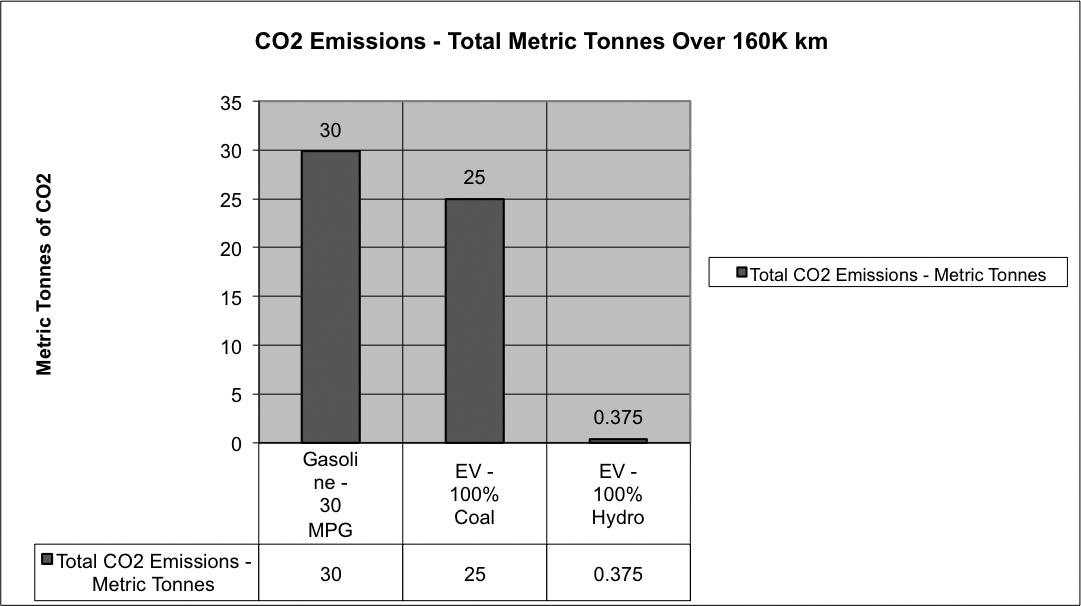
This means that even if your car gets 7.8 litres per 100 kilometres over a lifetime of 160,000 kms, the car will consume 12,617 litres and create 29,848 kilograms (or 29.8 tonnes) of carbon dioxide. Since many cars such as the Toyota Camry weigh about one metric tonne, this means that the car will produce about 30 times its weight
in CO2 over 160,000 kms.
On the other hand, electric vehi cles (EVs) produce only a fraction of the emissions that internal combus tion engine (ICE) vehicles do. Of course, these are indirect emissions, just like your cell phone. The calcula tion is more difficult, because electric ity produced by different electrical methods produces different levels of CO2.
Over 98 per cent of Manitoba’s electricity is produced by renew able technologies, such as hydro or wind power. From a CO2 standpoint, both are very clean technologies. According to studies by Luc Gagnon at Hydro Quebec, when creating a kilowatt hour (kWh) of electricity with hydropower, only 15 grams of
CO2 are produced. By comparison, with wind power only nine grams of CO2 are created.
What’s really dramatic: producing a kWh of electricity with coal creates about 1,000 grams of CO2, making coal roughly 67 times “dirtier” than hydroelectricity, and 111 times dirtier than wind!
The most popular strictly battery reliant electric vehicles (BEV) for sale in Canada right now are the Nissan Leaf and the Mitsubishi MiEV. The MiEV has a 16 kWh lithium ion bat tery, and has a range of at least 100 km. This works out to an average of 6.3 kilometres per kWh.
The Leaf has a 24 kWh battery and a range of 160 kms, according to Nissan, which works out to 6.7 kilo
According to UNEP, once it has been deposited, the mercury can circulate for centuries at a time, and any reduction in mercury emis sions would take years or decades to be felt.
Beattie said that strict emission regulations should be implemented, with specific numbers given upfront.
“My opinion is that we will only see Arctic mercury concentrations decrease if all countries (including Canada) sign this treaty, and if the restrictions within this treaty are properly enforced.”
Beattie is not alone in expressing concerns about the treaty. Several NGOs have complained that it is too lenient and too open ended.
“We hope that many of the pro
visions in this treaty can still be improved, but as it stands now the treaty offers only vague or no options for controlling emissions from the world’s worst sources of mercury pollution,” said Joe DiGangi, senior science advisor for the International Persistent Organic Pollutant Elimination Network (IPEN), a coalition of NGOs. “Countries that do not want to do this can escape quite easily.”
IPEN, along with some Japanese activists, takes issue with the treaty’s name, saying that its restrictions would not have prevented the health issues in Minamata.
“Water pollution resulting in con taminated sediment and fish caused the Minamata tragedy, but the treaty contains no obligations to reduce mer cury releases to water and no obliga tions to clean up contaminated sites,” said Japanese activist Takeshi Yasuma in an interview with the CBC Supporters of the treaty have called it a first step, and hope that it will become stronger over time.
metres per kWh.
Assuming the vehicles only get, on average, 6.4 kilometres per kWh to cover the same 160,000 kilometres, 25,000 kWhs of electricity will be required to travel the same distance. The corresponding CO2 for these vehicles charged with hydroelectric ity will be only 375 kgs, which is less than half a metric tonne. Compared to the almost 30 metric tonnes that the ICE vehicle produces, the electric vehicle running on hydroelectricity is about 80 times cleaner!
Even if all the electricity was pro duced using 100 per cent coal, the ICE vehicle—getting 13 kilometres per litre (kml)—will still be dirtier than the EV. The ICE vehicle will still produce about 30 metric tonnes
of CO2, while the EV will only pro duce 25 metric tonnes. Of course, if the ICE vehicle gets worse gas mile age (say, only 15.7 kml) the CO2 emis sions will be far worse.
What is not discussed much is the indirect emissions and energy costs of gasoline, also known as the “long tailpipe.” It takes a certain amount of energy in the forms of electricity and fossil fuels to drill for, ship, and refine crude oil into one gallon of gasoline. After refining, there are also energy costs required to transport, store, and pump the gasoline to the consumer.
From an emissions standpoint, electric vehicles have a number of advantages over internal combustion engine vehicles. EVs pollute orders of magnitude less to that of ICE vehi cles and, from an energy standpoint, EVs are not only very efficient; they are several times more efficient than ICE vehicles.
Be sure to check out next week’s issue to read part two: electric vehicle technology.
Rodger Lepinsky is a master's student in the U of M’s Natural Resource Institute, and a member of the Manitoba Electric Vehicle Association. He sometimes blogs at: http://rodgerswriting. blogspot.com.
ILLUstRatION by JUstIN LaDIa
ILLUstRatION by JaMes CULLetON
Challenge yourself to eat local and fair
Food Matters and the MCIC offer incentives for Manitobans to be food conscious
Jodie lAyne, StAff
How well do you think you eat?
Whether you’re a ramen noodle munching non chef or a loca vore who reads every label and is up first thing for the best pick at the St. Norbert market, there are always things to learn. If the great quinoa debacle of 2013 has taught us any thing, it’s that even superfoods can come at a cost. Whether you want to start planning and making your own meals, learn about fair trade, or want to learn how to plan out a garden, there are two initiatives that will meet your needs and quench your curiosity.
The first is Food Matters Manitoba’s “Dig In Challenge,” a five month initiative that aims to connect participants with local farm ers, get them cooking from scratch, eating family meals, and teaching them skills to help them get more out of less.
“The program is designed to impart new and basic skills,” says Darcy Penner, project coordinator.
The keyword here is definitely local with an emphasis on knowing more about where our food comes from and having as home grown a diet as possible in the winter, which
can be tricky in our climate.
Starting in February and running until June, “Dig In” is aiming to cre ate long term behavioural change in the lives of its participants. There are prizes for participating that change each week and a grand prize drawing at the end to encourage participants to remain engaged and see the pro cess through.
“It’s a really community driven project; we’re paired up with a lot of different Manitoba organizations who will be facilitating the work shops,” says Penner.
Workshops on topics such as seed starting, fermenting, canning, and farmer meet and greet are designed to supplement the activity ideas par ticipants can choose based on their priorities and goals. This is the second year of the annual challenge and the biggest difference is that the pledges are now customizable so that par ticipants can decide what changes they would like to make during the challenge.
If one of those goals is the sug gested, “take action for fair food,” the Manitoba Council for International Cooperation’s “One Month Challenge” (also launching this February) is another incentive to be food conscious. They will be facilitat ing the first “Dig In” workshop on Monday, Feb. 4 at 7 p.m. in the lower
level of 640 Broadway Street. This is the seventh year of the challenge that encourages Manitobans to consume only fair trade chocolate, tea, and cof fee for 30 days.
“Manitobans are familiar with fair trade and like the idea of supporting producers in developing countries,” says Larissa Kanhai, Fair Trade Outreach worker for MCIC. “By registering for the challenge as an individual or as a family, church, or office, they gain support, prizes, and ideas.”
MCIC has chosen to focus on cof fee, tea, and chocolate as they are the most widely consumed and available products.
“The gist of the ‘fairness’ of fair trade is for producers or farmers to receive a fair wage for what they have done,” says Kanhai.
In developing countries where most tea, cocoa, coffee, fruit, and flowers come from, it means being able to feed and clothe their families with their wages, safer work envi ronments, and an investment into community, dignity, and increased expertise.
While the challenge focuses on food, Kanhai says that one of the worst offenders is one that people are often shocked to hear – soccer balls.
“At 690 stitches for a standard sized ball, the truth of the matter is that
child labour is merely a symptom of greater systemic problems. Issues persist stemming from the reliance on ‘precarious work’—casual or tem porary labour—that create environ ments where overtime is necessary, low wages are paid, benefits are refused, and workers can be at risk of hazardous working conditions.”
Choosing fair trade can be con fusing once you actually get to the store, so here is how to tell if the item you are purchasing is fair trade: in 2011, logos for fair trade certification became streamlined, so all you have to do is look for the little green and blue logo.
Some may be confused by see ing labels for fair trade and labels for direct trade; what is the difference? Fair trade items must be certified to meet certain standards for labour, pro duction, and trade. Direct trade items simply cut out the many middlemen involved in producing and shipping an item, keeping more money in the pockets of producers. Direct trade is the most desirable standard for fair trade items, but not all direct trade items are fair trade certified.
To find out more information about these challenges, check out www.diginmanitoba.ca and www.fairtrademanitoba.ca.
Beefdonut, Johnny Sizzle, and Steve Basham
T
his is a message to all the denizens of this dark n’ dreary, sometimes inspiring, other times heartbreaking flutopia otherwise known as Winnipeg. I am here to issue you a challenge. Unplug your self from your Netflix stream of nos talgic television shows, cast off that warm comforter, and go check out what I’m sure will be a magical night of music and lyrical mayhem.
Friday, Feb. 1st at 200 Colony, Ghost Town, Manitoba will be presenting the ninth edition of its legendary Solo Series. Some of you will recognize Ghost Town, Manitoba as the promoter behind such magical evenings as the Wax Mannequin show last summer that started in an
Exchange District coffee shop and ended on Albert Street in the wee hours of the morning.
This edition of the Solo Series brings you Beefdonut, Johnny Sizzle, and Steve Basham, stripping down and letting you get intimate with some of the best songs emanating from this fair city. For those of you unfamiliar with those names, allow me to drop some science.
this man has an immense palette at his disposal. You never know what kind of picture he is going to paint.
Johnny Sizzle is Winterpeg’s longest running institution of rock n’ roll
Johnny Sizzle is Winterpeg’s longest running institution of rock n’ roll rebellion.
Beefdonut (A.K.A. Joel Klaverkamp) might be one of Winnipeg’s most diverse musicians. From the new wave-ish Drums and Wires, to the dance beats of Yopeckummah, to his blistering college rock set last month at the Windsor,
rebellion. He’s been blasting out his unique form of acoustic punk since the 80s – way back before that thing was any kind of cool. He’s played everywhere from the temples of the
counterculture elite to the lowliest street corners Canada has to offer. He’s a poet and a philosopher, proclaiming his peculiar perspective on life, love, culture, and politics, wrapped lovingly in the strum of a power chord.
Last but not least we have Steve Basham, everybody’s lo-fi heartthrob. This guy has to be one of the hardest working entertainers in Winnipeg. He’s an artist, a filmmaker, and in multiple bands – aside from playing solo he also fronts the Girth and plays bass in the Unbelievable Bargains. This guy works so hard that, if you are so inclined, you can get a double dose of Steve this week – hit
up the Girth at Draft Night at the Windsor on Jan. 31 before the Solo Series the next night.
One final note before I leave you to make your decision: if you do attend Solo Series 009, remember –this show is not at a traditional venue. The people putting this on are doing so out of a genuine love of creativ ity and music. This kind of love has become a hot commodity in these days of fast fame and hollow hearts. Nurture it by being respectful and remembering to say thanks.
“Locals to look out for” is a new column by local musician and enthusiast David Skene (the Manic Shakes). Check it out every week to see what local music he recommends!
ILLUstRatION by sILVaNa MORaN
Return of the Winnitron Boats to release their new album this February at the WECC
Jenn A d iu BA ldo, StAff
B
ack in December, Boats— undoubtedly one of Winnipeg’s most fun indie bands—put out a three song cassette tape as a prelude to their new CD, and now, come Feb.
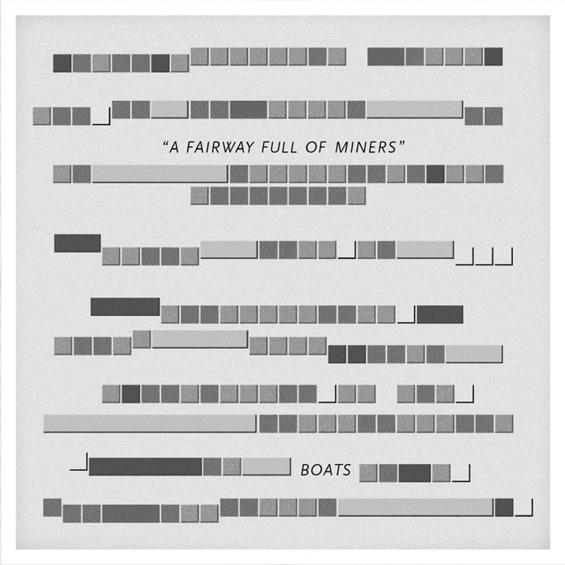
2, they will be releasing their newest album, entitled A Fairway Full Of Miners
“I think I had trouble deciding whether or not I should be writing more simple songs or more complex songs and ended up doing both,” said Mat Klachefsky, the band’s guitarist and lead singer. “This album is a lot more polarized – there are some sixminute meandering songs with no solid structure and there are some short and simple pop songs. The growly songs got more growly, the soft songs got more soft. It feels like we turned everything up.”
Klachefsky also describes the album as less optimistic than past releases and
attributes it simply to growing up.
“A lot of the songs that are on our first album I wrote as a teenager and now I’m 31,” stated Klachefsky. “If I were to force a thesis onto our three albums it would be: first album, ‘everything is awesome so let’s bash our heads together in a field;’ second album, ‘that was stupid and painful and now there is blood everywhere;’ third album, ‘now we have brain damage and we are going to die in a field.’”
All too familiar with life on the road and grueling tour schedules, Boats spent the better part of 2011 touring North America and after this new album is released the band will be heading out once again to visit their
A big, steaming pile of garbage
CD review: No Doubt, Push and Shove
When it was announced that No Doubt would regroup to release a new full length album, a feeling of hope and excitement fell over the
world. Would the ska/pop four piece that we all know and love from the mid 90s re emerge? Would the wonderful
sounds of Gwen Stefani’s signature vibrato heavy voice, Tony Kanal’s walking bass lines, Tom Dumont’s catchy guitar riffs, and Adrian Young’s
fans in both Canada and the U.S.
“[Touring extensively] is extremely difficult. I work in a very understanding record store and I am also a substitute education assistant in elementary schools, so I pick my own hours. I have no idea how the others do it – their employers must be incredibly understanding. I know we often have to straight up quit and get new jobs when we get back.”
One thing is for certain – this band knows how to throw a release party.
With the demise of their regular venue, Lo Pub, Boats will be taking over the West End Cultural Centre instead, but bringing along Lo Pub’s most prized possession – a custom
made, Winnipeg-themed arcade-style video game called the Winnitron “[This show is] going to [include] the Random Band Spectacular where 12 local musicians are forming three bands the week before [the show] and doing cover songs that they did not choose,” said Klachefsky. “It’s a killer lineup of locals, [including members of] Les Jupes, Rusty from Imaginary Cities, Jay Churko, Ricardo Lopez (Oldfolks Home), Ian La Rue, Alannah from Cannon Bros., and more. Also, the Winnitron will be there.” Catch Boats, along with the Random Band Spectacular and the return of Winnipeg’s beloved Winnitron, at the West End Cultural Centre on Feb. 2.
precise drumlines once again grace our eardrums? Would this new, more mature No Doubt release a modern version of their 1995 hit album and have us all scrambling to pick up a copy of Tragic Kingdom version 2.0?
The answer is no. No, they would not.
Push and Shove, No Doubt’s first album of brand new material in over ten years, was released upon the anx iously awaiting world in September, 2012, and surprisingly (or not surpris ingly) it was a big, steaming pile of garbage.
Fans disappointedly found that this was not a No Doubt album at all, but rather a Gwen Stefani album in disguise, with the other musicians formerly known as No Doubt provid ing backing tracks.
Push and Shove was very much in line with Stefani’s most recent solo work featuring laser sound effects, sweeping synthesizers, and overpro duced vocals aplenty.
When the song “Settle Down” was announced as the first single off this new album, there was such a feeling of anticipa tion. What potential this song had— judging by the name—to be a great dancehall reggae number, or some upbeat ska punk ditty that would tri umphantly declare No Doubt’s return as a pop music icon.
Instead fans were subjected to a boring, stagnant pop song of Stefani’s creation that barely resembled the band No Doubt once was.
The rest of the album continues on as such with dreams of a reborn No Doubt getting back to their roots being slowly destroyed, song by song.
Not only did No Doubt manage to disappoint with Push and Shove,
The world did indeed have some doubts, and they were confirmed.
but their second single off this album, “Looking Hot,” managed to offend an entire race of people through the release of a “cowboys and Indians” themed video for the song that included Stefani dressed in traditional Indigenous garb, sing ing in a teepee, and being cap tured by cowboys. All in all, this album managed to erase all the fond memories of No Doubt and replaced them with a sour taste in the mouth. The world did indeed have some doubts, and they were confirmed.
Flagrantly fat and fucking fabulous
Book review: Hot & Heavy by Virgie Tovar
Jodie lAyne, StAff
Hot & Heavy is the book that almost never was.
Author Virgie Tovar originally pitched it as a book with her as the single author and with it mostly being about fat women and sex – it was passed up. Tovar, a certified sex ologist, body image coach, and fat activist, didn’t even consider herself
a writer before her first essay/mani festo, entitled “Fatties of the World Unite,” was published on a website for a friend’s thesis project.
“[The manifesto was] one of those moments writers talk about; like the words just pour out of you and you just become a vessel for these words and ideas,” says Tovar.
Writing the piece and the subsequent response that it got were together the catalyst for her becoming a writer. It was when Tovar started doing her master’s program at San Francisco State University that she became immersed in the fat positive movement – a movement she wasn’t explicitly aware of, but always sort of suspected was there. It was while she was sur rounded by amazing fat women that she realized their stories needed to be told. Tovar re pitched the book and it was published in November of 2012 by Seal Press.
public eye or marketplace. It was on the verge of becoming a major, major movement. I thought it was the time and the publisher agreed.”
Tovar was fascinated that such an
Recent studies show that overweight and obese people actually have longer lives and a better chance at surviving terminal illness than their slimmer counterparts.
important and prevalent issue hadn’t broken through the way that some liberation movements had.
“To be a fat person, and I think particularly a fat woman, is to walk around with a death sentence, and that never made sense to me,” says Tovar.
“The issue was so important and so interesting, but not really in the
Recent studies show that over weight and obese people actually
have longer lives and a better chance at surviving terminal illness than their slimmer counterparts. Tovar recounts a story of her friend who lost 25 lbs. because a doctor told her she needed to if she wanted to get pregnant. A few weeks after she lost the weight, she was sprinting for a train and fell on a wooden step that was split in half. It pierced one of her internal organs –something the doctor told her wouldn’t have happened had she had that 25 lbs. pro tecting her.
“I’ve had so many people tell me stories like that and they don’t really make it into our cultural memory of what it means to be fat,” says Tavor.
Hot & Heavy: Fierce Fat Girls on Life, Love and Fashion definitely goes deeper than its title might suggest.
The book is not fluffy, not a how to fat shion book; it is a well rounded, well curated selection of stories that give ample views into individual expe riences of living life as a fat woman
and gaining acceptance from yourself. Although it does talk about fashion in Tovar’s piece co authored with Deb Malkin (“10 Tips from a New York Fatshionista”), which provides valuable, practical advice, emphasiz ing the idea that being “flagrantly fat and fucking fabulous” is a political statement.
The collection includes beautiful prose from Sydney Lewis’ “I Came to Femme Through Fat and Black” and a look at personal history in “Fat Histories, Fat Futures” by Amithyst Fist and Genne Murphy.
The book ties together honest accounts and triumphant tales of happy endings that acknowledge the ongoing struggle of bodies constantly under attack. It is for fat girls who need a little encouragement to make it through society and, more broadly, to help create compassion and squash stereotypes.
Hot & Heavy is an empowering, uplifting anthology that breaks your heart, then mends it up, puts some glitter on it, and feeds you a pecan pie.
Communicating desires
Quality, honest, and open com munication is absolutely crucial to the health and survival of any relationship. Whether you’re having sex in a committed romantic rela tionship or casually, you’re going to need to talk about what you want, need, and expect, as well as what your boundaries and limits are. This means not only saying “yes” or “no,” but exploring desires, chal lenging beliefs, and negotiating.
Okay, I know this sounds a bit like a movie about a middle aged couple reconnect ing or an article for newlyweds in Oprah Magazine, but that’s because it’s true.
from, “I don’t like getting head” to “I feel uncomfortable passively receiving pleasure.”
Communication not only serves the immediate need of, well, com municating, but it also allows you to go deeper into the “why,” the “how,” and become more intimate with your
easier.
1) pick the right time and place
The week your partner has a final or a paper due is not the right week to tell them that you wish you were having sex more often.
Communication isn’t just for devoted couples to bare their souls to each other, it’s what we use to be able to say, “That thing I saw in porn… I want to try it.” It also takes you from saying, “I don’t want to have sex today,” to, “I am really attracted to you, but today I want some time to myself.” Communication can go
partner. Communication can deepen or cause more distance in your rela tionships depending on how efficient it is. Some people are naturally skilled at communicating and some need a little more practice. Regardless of where you or your partner fall on that spectrum, there are some tools and guidelines that can help make things
The week your partner has a final or a paper due is not the right week to tell them that you wish you were having sex more often. The moment when your partner is run ning off to work is probably not the best time to inform them you don’t actually like that thing they do with their tongue. Casually doing the crossword at a cafe on a Sunday is not the time to decide to spill the beans you’ve been wondering what a prostate massage might feel like. Pick a time when you have no other obligations or distractions and where you can focus on having a con versation. Pick a time when neither of you are arguing, angry, hostile, exhausted, or fragile. Give yourself time and private space to hash out a real conversation. There’s noth ing worse than misconstruing what someone meant and having to turn it over in your head all day.
2) Be honest, but kind Lying or even just truth bending is only going to lead to frustration and resentment on both parts. It might be hard to ask for something or to spill a desire, but you’ve set aside time to talk – so talk. If you can’t ask for something, you won’t get it, period. How you choose to say something is crucial, though. For example, “I think sex with you is boring,” is a much different statement than, “I was looking at some stuff from the sex store – this ______ seems like fun.” My rule is, you can’t complain about something unless you have an alternative solution to propose.
3) Be willing to listen Hearing your partner say they want something different or more or less or they want to try some thing new can be uncomfortable. You might think it means you’re not good enough or sexy enough or thin enough or your appendages are too small; however, try looking at the fact that they can discuss sensitive topics with you as an honour.
Take a deep breath and listen. Don’t think about what you’re going to respond with – just listen. If they’re stumbling with their words, ask ques tions to try and figure out what they mean. “I was thinking of trying an open relationship,” could be followed by questions like, “What about non monogamy is appealing to you?”
4) Be gracious with one another
Remember that you like each other and you like seeing each other naked. If you flip out when your partner asks if you would be into anal, they’re going to have a hard time trusting you to be accepting and won’t come to you in the future. Do whatever it takes to help you keep calm: a little kissing break, grabbing five minutes alone, or going for a walk. This person is your friend and you’d like to keep it that way, so act accordingly.
You can confidentially submit a question or topic to jodie.m.w.layne@gmail. com.
Jodie lAyne, StAff
Fierce and to the point
CD review: the Parting Gifts, Strychnine Dandelion
Jenn A d iu BA ldo, StAff
T
he Parting Gifts consist of garage rock duo Greg Cartwright (Reigning Sound, the Oblivians) and Coco Hames (the
Ettes, Coco Motion) doing what they do best – playing fast paced, no frills rock and roll.
Their debut LP Strychnine Dandelion sounds very much like what you would expect if these two musicians got together and gave birth to a music baby. Cartwright’s high energy, 60s influenced rock and roll songwriting is very well matched by Hames’ similar style, but is interestingly complemented by a female counterpart.
While songwriting credit for all 15 tracks goes to Cartwright and Hames, the album features guest appearances from some of America’s most talented musi
cians including Dan Auerbach (the Black Keys), Patrick Keeler (the Raconteurs), Jem Cohen and Poni Silver (the Ettes), and Dave Amels (Reigning Sound).
Hames provides balance to Cartwright’s rough and gruff vocals with her somewhat nasal and intense yet pretty voice. The album consists of fierce and to the point rock and roll that seems to jump between various influences such as country and sloppy garage rock.
While the album is bulky with 15 songs, the listener is still left want ing more and wondering how long it will be until this couple releases their next album.
Event Listings
By Orubite Boma
Men’s B-ball team pushing for first place
Win streak extends as Bisons sweep Pronghorns
mARc lAg Ace, StAff
The Bisons men’s basketball team pushed their winning streak to five games as they swept the Lethbridge Pronghorns in a pair of games this past weekend.
On Friday, the Bisons had five players score double digit points as Manitoba cruised past Lethbridge 88 76. Yigit Ozsayiner led the Bisons with 18 points and Wyatt Anders came off the bench and pitched in with a double double (13 points and 11 rebounds).
The first quarter was wild, as both teams managed to control play for
stretches of time. The Pronghorns jumped out to a 12 4 lead, as they controlled the tempo early. The Bisons responded with their own 15 2 run, as the teams entered the second quarter tied 21 21.
Manitoba started to pull away in the second, even leading by double digits at one point, as the teams headed into halftime with the Bisons ahead 46 35. The second half saw the home team dominate, going up by as much as 21 points in the fourth quarter.
The two teams went at it again the
following evening, with the Bisons breaking triple digits for only the second time this season, earning a 104 94 victory.
Stephan Walton led all players with 19 points in the first half as the teams entered the second with the Bisons leading 55 54. Derek Waldner—Lethbridge’s top scoring player the night before—got into foul trouble early and was on the bench for most of the second quarter.
In the third, Lethbridge pulled ahead, as they hit five of nine attempts from beyond the arc. The
Bisons did their best to match them offensively, but still found themselves down 81 76 heading into the final quarter. With two crucial points in the standings on the line, head coach Kirby Schepp decided to make some defensive changes.
“We changed up a bit defen sively,” Schepp told Bison Sports. “We went zone in the fourth, which is counter intu itive because they were shooting the ball really well. We just needed to change something.”
(24 points). Things will only get harder for the Bisons from here on out, as their remaining games are all against teams vying for a playoff spot.
The Bisons are the second-highest scoring team in the conference, averaging 82.6 points per game through 17 games.
The changes must have worked, as Manitoba pulled away in the final frame. Jonar Huertas lead all players with 32 points, going 7 for 12 on 3 pt attempts. Ozsayiner was solid again, recording a double double with 14 points and 11 rebounds.
The win streak has Manitoba sit ting in second place in the Canada West conference with a 12 5 record
They take on the conference leading Alberta Golden Bears on Feb. 1 2 on the road, before returning home the follow ing weekend to host the Saskatchewan Huskies. Manitoba’s sea son concludes with a mid week matchup at home against the Winnipeg Wesmen on Feb. 13.
Alberta sits two points ahead of Manitoba at 26, while Saskatchewan and Winnipeg are tied for third in the conference with 22 points. With five huge games remaining in the regular season, the streaking Bisons’ post season fate rests solely in their own hands.
Bisons men looking to hand Alberta first loss of season
Coach Pischke discusses team record vs. Regina
mARc lAg Ace, StAff
T
o say that there’s a rivalry between the Regina Cougars and Manitoba Bisons men’s volleyball teams would be to totally misunder stand the meaning of the word. But there certainly is history attached to the match up of the two teams, dat ing back three decades.
In his 32nd year as head coach of the Bisons men’s volleyball pro
gram, Garth Pischke has amassed an incredible 133 1 record versus Regina – that’s a win percentage of 99.3 per cent!
Despite the incredible nature of the statistic, when asked about the record, coach Pischke was noticeably humble.
“I think it’s a neat accomplishment, to be honest,” said Pischke, adding
Sunday Mass > 11am, Christ the King Chapel
Weekday Mass > Tue-Fri 11:45am, Side Chapel
Volunteer musicians and singers are welcome for choir practice > 5:30pm Fridays & 10am Sundays
Winnipeg Harvest Volunteering > Feb 2 12:15pm departure
Filipino Mass > Feb 3 11am, potluck in Hanley Hall
Ash Wednesday Mass > Feb 13 11:45am with distribution of Blessed Ashes
Co ee House > Mar 2
8:00pm | Fundraiser for students involved in spiritual & social justice activities. Volunteer entertainers welcome.
that the lone loss came as more of a relief than a disappointment.
“I felt an enormous amount of relief when I did lose that one. I think there was a string of about 60 matches where I felt pretty tense going in there, going ‘hey, I see that zero. I’d like to protect that.’”
“I’m a lot calmer now, since that loss. I think that’s a good thing.”
Career win loss records aside, the Bisons picked up two important wins against Regina in straight sets this past weekend. They will continue to jockey for position in an extremely competitive Canada West conference, with perhaps their biggest test com ing up against the undefeated Alberta Golden Bears.
Sitting at 18 0, Alberta has already clinched a first round bye in the play offs and will host the Canada West Final Four.
From that point on, the next four teams are all within two points of each other. Currently, Trinity Western sits in second with 26 points, while Manitoba, Saskatchewan, and UBC are tied for third in the confer ence with 24.
“We’re playing our best volleyball,” said Pischke, who added, “ever since the Christmas break we’ve really got
ten some guys healthy again and our chemistry [is] much better.”
With the undefeated Golden Bears in town this weekend, coach Pischke believes that his team is up to the task of doing what no teams have done this season.
“They’re a fantastic team – they haven’t lost yet,” Pischke said, “but if there’s a team that can beat them, it’s us.”
“It’s going to [be] a great measuring stick, and we’re feeling pretty confi dent about our game.” Beyond the post season implica
tions, this weekend will be the final pair of regular season home games for a handful of fifth year players. According to gobisons.ca, there are five players currently in their final year of eligibility: Derek Nieroda, Dane Pischke, Joseph Brooks, Chris Voth, and Carson Kauenhowen. Both Friday and Saturday’s men’s volleyball games start at 8:00 p.m. at the Investors Group Athletic Centre.
FOLLOWING THE HERD
LOCKING IT UP!
JAN. 25 8:00 PM VS LETHBRIDGE INVESTORS GROUP AC JAN. 26 8:00 PM VS LETHBRIDGE INVESTORS GROUP AC JAN. 25 6:00 PM 6:00 PM VS UBC OKANAGAN INVESTORS GROUP AC
JAN. 26 6:00 PM VS LETHBRIDGE INVESTORS GROUP AC
Nic Demski selected by Team World for 2013 International Bowl
Running back/kick returner representing his school and country
d e Rek gAgnon, StAff
For the second year in a row, a Manitoba Bisons football player will be playing for the International Federation of American Football (IFAF) World Team in what is now the fourth annual International Bowl.
Nic Demski suited up this past sea son as both a running back and as a kick returner for the Bisons, posting 95 yards and two touchdowns rush ing, 295 yards and three touchdowns receiving, 460 yards and one touch down returning punts, and 460 yards returning kicks. Those stats combined gave him 1,310 all purpose yards, as his versatility made him a threat every time he stepped on the field, earning him the 2012 CIS First Team All Canadian honours.
Demski is following in the foot steps of RB Anthony Coombs and DL Evan Gill, who represented the Bisons last year in the International
Bowl.
Demski is excited for the oppor tunity, and said “it’s something I wanted to make since last year when Anthony made it.”
“Every time we see each other, that’s the main convo. They’ve given me a heads up on what’s going to hap pen there.”
Coombs was named MVP of the game after leading Team World to victory with 147 yards rushing and two touchdowns. Demski will undoubtedly be looking to rival that kind of performance when Team World takes on Team USA on Feb. 5 in Austin, Texas.
Twenty six Canadians will line up alongside players from countries such as Brazil, the Netherlands, and American Samoa, as Team World looks to be repeat winners after their 35 29 victory in 2012.
Bisons swimmer Dillon Perron reaches podium
Team captain wins two medals at Canada West Championships
The University of Manitoba swim team earned a pair of individual medals at the 2013 Canada West Swimming Championships in Victoria, B.C., which took place Jan. 25-27. The men’s team captain Dillon Perron made it to the podium twice. In the men’s 100m breaststroke, Perron finished second with a time of 1:01.97 and third in the 200m breaststroke event with a time of 2:15.58.
The Bisons had four other finishes in the top five: Kimberly Moors (fourth) in the women’s 50m butterfly, Kendra Garagan (fifth) in the women’s 50m backstroke, and Perron again with a fourth place finish in the men’s 50m breaststroke and a fifth place finish in the 50m butterfly. Both the Bisons men’s and women’s teams finished sixth overall in the eight-team event.
Bisons’ Jesse Deckert standing tall between the pipes
Defence-first philosophy key to success going into playoffs
d e Rek gAgnon, StAff
After a pair of wins against the Lethbridge Pronghorns this past weekend, the Manitoba Bisons men’s hockey team sits alone in second place in the Canada West standings with a record of 15 5 4, giving them 34 points, one ahead of third placed Saskatchewan. A big part of the Bisons’ success has to be attributed to fifth year goalie Jesse Deckert of Winnipeg, MB. Deckert has had a lengthy career, in which he has played five seasons in the Western Hockey League with the Regina Pats, Tri City Americans, and the Prince Albert Raiders.
Since moving on from the junior level, he has played five seasons in Canada West, first debuting in 2007 2008 with Lethbridge before making the switch to Manitoba where he secured the starter’s role this season. His stats this year are good enough to put him not only amongst the best of the Canada West conference, but of the CIS as a whole, as his 14 win status is the third best in the nation. Deckert’s save percentage of .921 and Goals Against Average of 2.08 are also good enough to make it into the top 10 in the country.
The Manitoban managed to catch up with the Bisons star goalie after his games in Lethbridge this past weekend.
the Manitoban: Your team is in a solid position right now, sitting second in Canada West with the possibility of hosting playoff games. What has it taken to get to this point, and what do
you think it will take in your last four games to finish in second or better?
Jesse Deckert:
Our biggest strength is our com mitment to team defence. Having all our guys buy into the system that is implemented and having our success going into the playoffs is the depth we possess at all positions.
M:
It has definitely been noticeable, as the team has been able to cycle play ers in and out of the lineup while maintaining positive results. How do you view your own play this year? If I were to label you as the MVP of the team, how would you view that?
JD:
Personally I’m very grateful for the opportunity to play some games and stay healthy. In regards to the MVP, I’d say the goalie is only as good as the team in front of them. My main goal is to be consistent as that is something I lacked in the past – but being older and more mature, you really appreciate how [the] mental aspect of being a goal tender and being mentally prepared is the most important part of being successful.
M: As you mention your past, it’s been a long journey indeed to get to this point, including a stop with Lethbridge whom you just played. The past couple of seasons in particular have seen you put up
impressive numbers that could get you noticed by pro clubs. Any plans beyond this season to continue your hockey career?
JD:
Yeah, it’s been a long road to get here. I definitely want to continue playing hockey and getting an edu cation was something I didn’t think I’d achieve, but it’s reassuring that I’ll have that to fall back on when I decide to stop playing competi tive hockey. But I definitely want to turn pro and see where that road will lead
M:
Good to hear, I’m sure you will do well.
Going back to the Bisons, do you believe the team has to win out in order to hold on to second place? You face a UBC team that beat you twice earlier this season, and finish off against a Regina team that just took three points from Saskatchewan. What can you change against UBC to obtain better results?
JD:
I don’t think we have to change anything. We are a completely dif ferent team this second half. We’ve progressed so much this year and if we stick to our defence first phi losophy we will be fine
Deckert and the Bisons men’s hockey team return to the Max Bell Arena for their final two home games of the regular season against UBC on Feb. 1-2.
The 2013 Manitoban Hockey Pool
Pool leaders and injury breakdown
mARc lAg Ace, StAff
We’re less than a month into this shortened NHL season and there have already been a handful of fantasy players forced to the sidelines. Here’s a breakdown of the injuries and absences that have an impact on the pool:
Adam Henrique: recently resumed practice (left thumb surgery)
Scott Hartnell: expected to miss one to two months (broken left foot)
Steve Downie: on injured reserve, out for the season (knee surgery)
Dan Carcillo: out indefinitely (lower body)
Kris Versteeg: on injured reserve (hip surgery/groin)
Ian White: expected to miss two to three weeks (lacerated left leg)
Max Pacioretty: out three to four weeks (emergency appendectomy surgery)
Happy returns:
Jamie Benn will make his debut this season after missing the first three games due to lengthy contract negotiations. For the nearly one-quarter of entrants who selected Benn as their extra attacker, this ought to be a huge relief. In 2011/12, Benn had 63 points and 55 penalty minutes in 71 games. Those numbers would have been good for 90 points according to the Manitoban Hockey Pool scoring rules.
P.K. Subban finally came to terms on a new contract with Montreal, signing a two-year deal worth $5.75 million. The 23-yearold defenceman put up 36 points and 119 penalty minutes in 2011-12, so Subban has the potential to be a huge point-getter in the pool. With 44 games remaining in Montreal’s schedule since the deal was announced, Subban will certainly try to make up for the lost playing time.
Danny Briere suffered a hairline fracture on his wrist while playing with Eisbaren Berlin of Germany, but was cleared to play this past weekend. The Philadelphia Flyers have gotten out to a brutal start this season, but the return of Briere and the recent addition of former Flyer Mike Knuble might help Philly improve across the board.