UMSU VP violates position duties, says judicial board
Milan Lukes, staff
U
niversity of Manitoba Students’ Union (UMSU) vice-president student life Bolu Akindele has violated her position duties, according to a ruling by UMSU’s judicial board.
The ruling was shared at the UMSU board of directors meeting on March 27 by Gurpahul Kaur, vice-chair of the judicial board, which noted that a complaint alleged that Akindele violated six sections of UMSU’s governing documents.
“We do believe that two out of those six sections were violated,” read the judicial board ruling.
Kaur stated that the board “collectively came to the conclusion” that Akindele vio -
lated a clause in the positions and duties section of the UMSU Governance and Operations Manual, which calls for the vice-president student life to “[serve as] the liaison between UMSU and UMSU’s community representatives, while ensuring UMSU consults with, and provides appropriate supports to marginalized communities on campus.”
UMSU currently has seven community groups which represent a wide range of interests and backgrounds, according to UMSU’s website.
Each community group is allotted a designated room by UMSU and $16,000 from a community initiative fund to support events and initiatives that benefit the community.
Akindele violates intent of funding approval structure
Kaur stated that Akindele — who was absent from the board meeting — also breached a section relating to the approval structure of the community initiative funding.
“The intention of the approval structure is to provide support for initiatives in a way that respects the autonomy and self-governance of the communities, while also meeting the oversight and transparency requirements of UMSU’s by-laws,” was the section deemed to have been vio
lated.
Academic misconduct incidents reach six-year low
Milan Lukes, staff
Reported academic misconduct incidents have reached a six-year low at the U of M, according to the latest university discipline committee annual report.
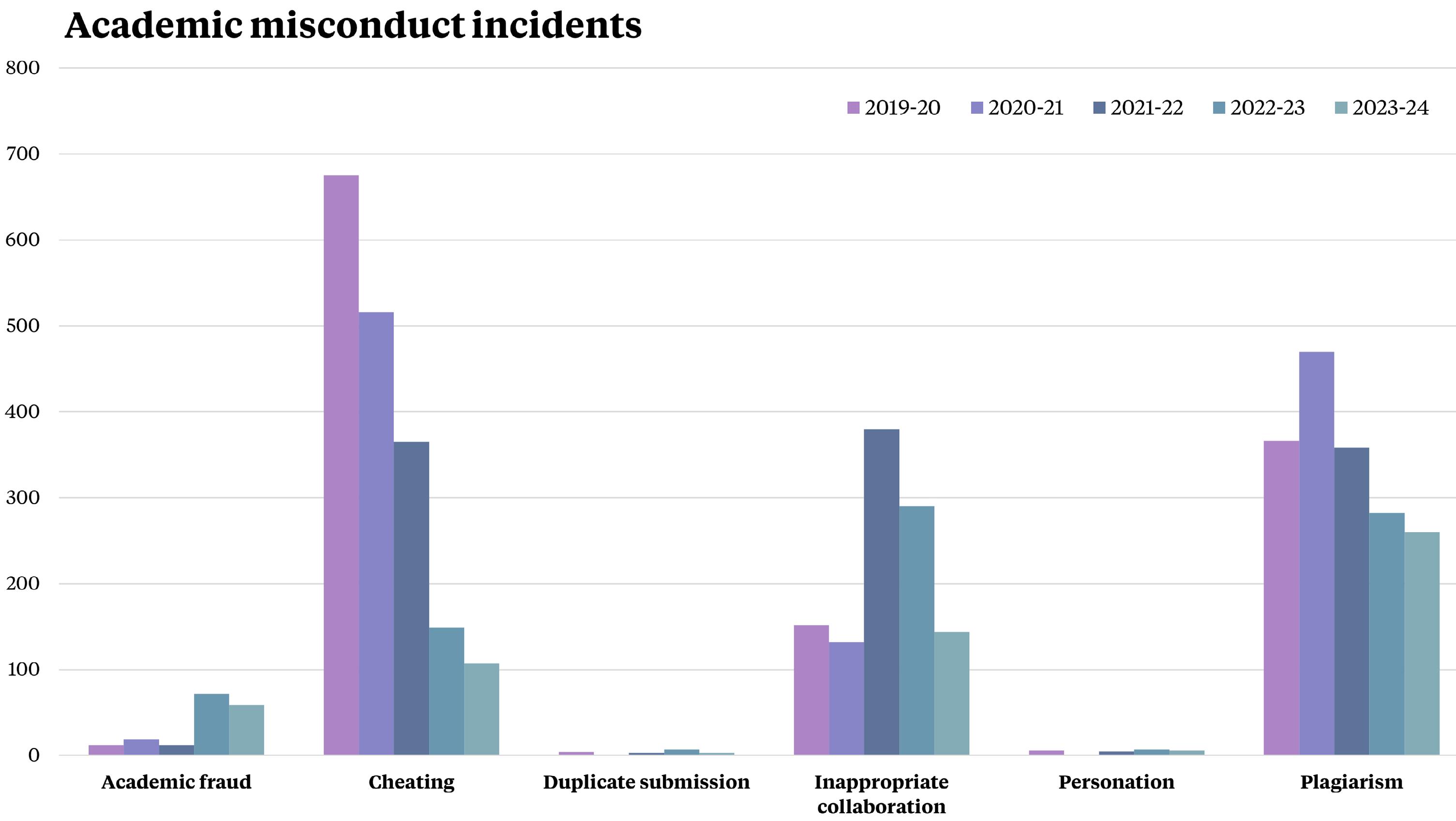
The report, which covers the period from Sept. 1, 2023 to Aug. 31, 2024, reveals that there were 683 recorded incidents of academic misconduct — the lowest since 201718, which recorded 626 incidents.
The latest report indicates that 38 per cent of incidents were related to plagiarism, followed by inappropriate collaboration at 21 per cent and cheating at 16 per cent of incidents.
Only three cases of duplicate submission and six cases of personation were recorded.
According to information from disciplinary authorities provided in the report, an unnamed department “that was previously and consistently very active in catching cases of academic misconduct” reported a decrease in overall cases of academic
misconduct, believed to be “related to students using generative artificial intelligence.”
The university administration was unable to disclose the name of that department, citing privacy legislation,
according to a statement.
Generative AI is “significantly more difficult to catch,” states the report signed by university discipline committee chair Robert Biscontri. Another disciplin-
ary authority attributed a decrease in academic misconduct incidents to “a set of practices implemented in a first-year course, where the instructors have worked collaboratively in consultation
with department leadership, to develop clear, concise and comprehensive instructions for their assignments and examinations.”
The report also states that a disciplinary authority noted “an explosive increase in the use of ChatGPT,” resulting in an increase in incidents categorized as “other.”
“The disciplinary respondent observed that there is not [a] uniform policy on the use of artificial intelligence in their faculty, with some instructors allowing the use of tools such as Grammerly [sic], allow artificial intelligence use for outlines or prompt generation, or for more extensive use as long as it is properly cited,” read the report.
“Instructors are advised to stress to their students that expectations differ by class, and that students must not assume a carry over artificial intelligence use policies [from] one course to another.”
Cont’d p. 6 / Generative <
-
photo
/
Milan Lukes / staff
photo / Ebunoluwa Akinbo / staff
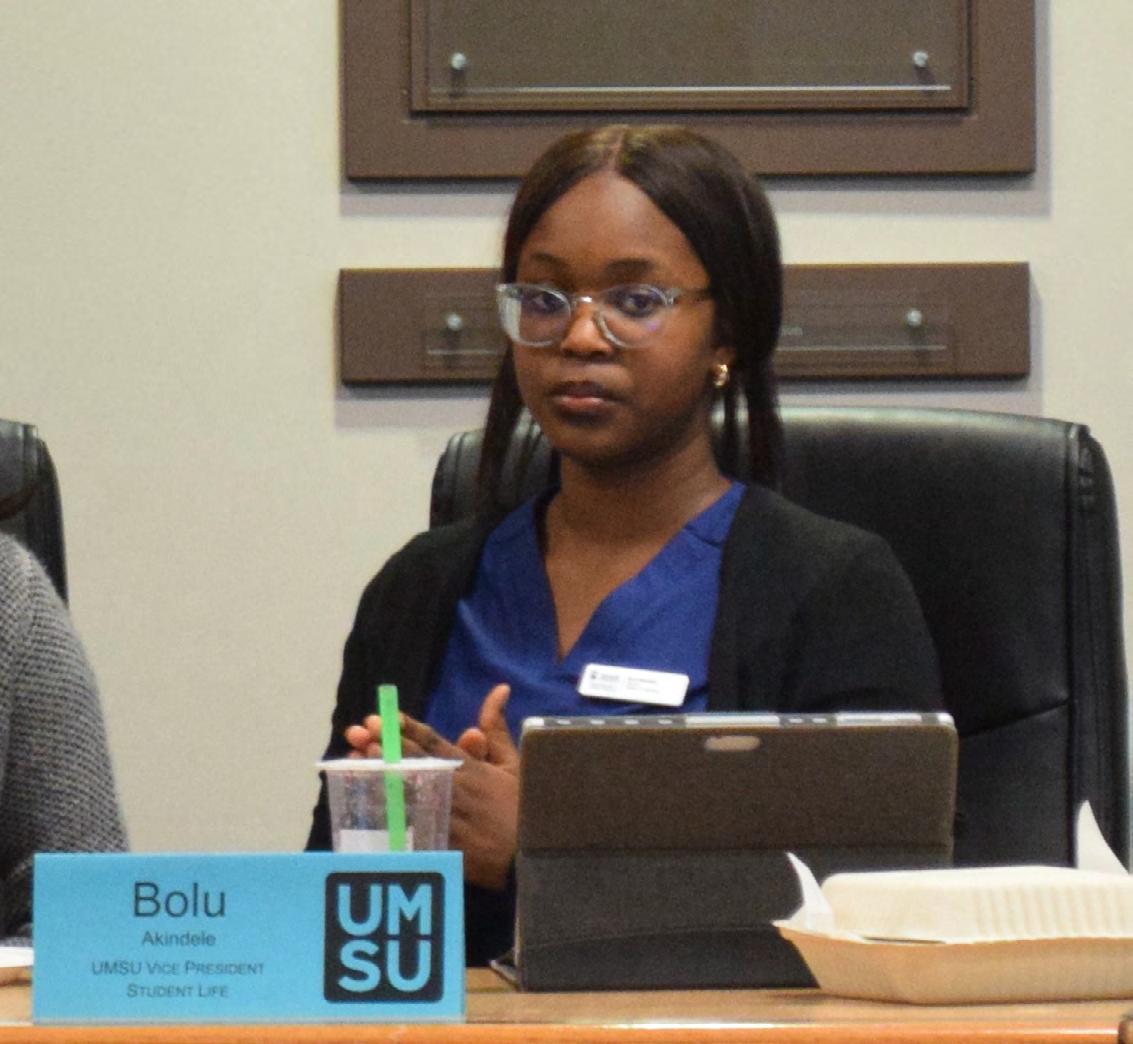
Bolu Akindele, seen in a file photo from 2024, denies violating UMSU’s governing documents.
Cont’d p. 3 / Community <
EDITOR-IN-CHIEF Milan Lukes editor@themanitoban.com
BUSINESS MANAGER Alice Teufack accounts@themanitoban.com
BUSINESS SUPPORT MANAGER Joshua Herold ads@themanitoban.com
SOCIAL MEDIA EDITOR Devvrat Nathwani social@themanitoban.com
REPORTERS
NEWS Ngozi Okose
NEWS Taycie Adeoti
RESEARCH & TECHNOLOGY Divyata Gosai
COMMENT Quinn Mayhew
COMMENT Thandeka Katsika
ARTS & CULTURE Boris Tsun Hang Leung
ARTS & CULTURE Carrington Dong
SPORTS Faiyaz Chowdhury
SPORTS Israel Abejoye
VOLUNTEERS
VOLUNTEER STAFF
Emma Gillich, Adam Johnston, Anthony Nardella
VOLUNTEERS
interested in volunteering?
email me@themanitoban.com today!
THEMANITOBAN.COM
109 HELEN GLASS BUILDING
UNIVERSITY OF MANITOBA WINNIPEG, MB 204. 474. 6535
The Manitoban is the official student newspaper of the University of Manitoba. It is published monthly during the summer and each week of regular classes during the academic year by the Manitoban Newspaper Publications Corporation.
The Manitoban is an independent and democratic student organization, open to participation from all students. It exists to serve its readers as students and citizens.
The Manitoban is a member of the Canadian University Press, and our journalistic standards can be found on the Manitoban’s website.
The newspaper’s primary mandate is to report fairly and objectively on issues and events of importance and interest to the students of the University of Manitoba, to provide an open forum for the free expression and exchange of opinions and ideas and to stimulate meaningful debate on issues that affect or would otherwise be of interest to the student body and/ or society in general. The Manitoban serves as a training ground for students interested in any aspect of journalism.
Students and other interested parties are invited to contribute to any section of the newspaper. Please contact the appropriate editor for submission guidelines.
The Manitoban reserves the right to edit all submissions and will not publish any material deemed by its Editorial Board to be discriminatory, racist, sexist, homophobic or transphobic, ableist or libellous.
Opinions expressed in letters and articles are solely those of the authors. Editorials in the Manitoban are signed and represent the opinions of the writer(s), not necessarily those of the Manitoban staff, Editorial Board or the publisher.
A “volunteer staff” member is defined as a person who has had three volunteer articles, photographs or pieces of art of reasonable length and/ or substance published in the current publishing year of the Manitoban.
Any individual who qualifies as a volunteer staff member must be voted in by a majority vote at a Manitoban editorial board meeting. Elected representatives and non-students may be excluded from holding votes as volunteer staff members in accordance with the Manitoban Constitution.
Akindele resigns as committee chair two days after judicial board starts hearings
< Cont’d from front page
Community groups seeking funding from the community initiative fund are required to receive application approval from the Community Assembly — a monthly assembly of students from each community group. Afterwards, the application must be submitted to the Membership Services Committee (MSC) for final approval.
As vice-president student life, Akindele served as chairperson of the MSC and could grant exceptions to the funding application submissions, according to UMSU’s Funding Criteria and Regulations.
Kaur also stated in her report that the judicial board does not believe that the community initiative funding clause was solely violated by Akindele, “but also by the Member Services Committee, with or without malice.”
‘I did not violate any clauses,’ says Akindele
“I respect the work of the judicial board. However, I disagree with the decision and maintain that I did not violate any clauses,” said Akindele in a statement.
“Ensuring responsible spending of student dollars does not undermine autonomy, it upholds integrity,” she stated.
“This decision sets a concerning precedent for responsible governance and financial accountability within UMSU. I continue to remain committed to ensuring that all clubs and community groups receive the support they need.”
Akindele did not provide further details on the incident or incidents that may have caused the complaint to be filed, and Kaur stated that the judicial board could not pro-
vide more information on the violation details.
Kaur stated that the judicial board received a formal complaint against Akindele on Feb. 20 from one of the seven community representatives, which was deemed valid on Feb. 26. The first hearing was set for March 2 as part of the investigation.
None of the community representatives responded to the Manitoban’s request for comment by the publication deadline.
Resignation of Membership Services Committee
Akindele stepped down as chair of the MSC on March 4, according to vice-president finance and operations Carolyn Wang, who served as interim chair at the March 20 MSC meeting. Wang did not comment
board,
judicial board’s findings at the March 27 board meeting.
on the reason why Akindele stepped down from serving as chairperson.
Akindele did not respond to the Manitoban’s request for comment on her resignation by the publication deadline.
Judicial board presents recommendations
Along with the ruling, the judicial board recommended that Akindele and all other UMSU executives take a mandatory certified accessibility training before the end of April. It was also recommended that all incoming UMSU executives take the training each year before their terms begin on May 1.
“multiple discrepancies and administrative issues with MSC were uncovered that led to the most of the things that were mentioned in the complaint.”
It was recommended that MSC guidelines be revised and “added to the official UMSU governing documents.”
“Within these guidelines there need to be clear instructions on how applications are
Other recommendations include mandating communities to seek pre-approval from MSC before purchases over $1,000, ensuring that MSC compiles and adheres to the last five-year precedent regarding purchasing amounts and that the final date to submit funding applications be extended beyond the April 20, 2025 deadline.
“This decision sets a concerning precedent for responsible governance and financial accountability within UMSU”
— Bolu Akindele, UMSU vice-president student life
Kaur stated that the judicial board intends to present a motion with these recommendations at the April 10 board of directors meeting.
The ruling noted that
processed, who has speaking rights, the role of the chair, what to look for in passing or rejecting a motion and how to keep minutes, among many other things.”
Akindele told the Manitoban in February that she would not be seeking re-election due to “commitments with nursing school, which have become increasingly demanding.”
Gurpahul Kaur, vice-chair of the judicial
read the
photo / Milan Lukes / staff
UMSU approves $50K for building feasibility study
Motion cites ‘urgent need for a dedicated UMSU building to better serve students’
Milan Lukes, staff
T
he University of Manitoba Students’ Union (UMSU) has approved $50,000 for a building feasibility study at the March 27 UMSU board of directors meeting.
The motion was put forward by the executive committee and called for a feasibility study to “assess the viability, costs and potential benefits of establishing a dedicated UMSU building.”
The motion passed with nine votes in favour, three opposed and two abstentions.
As part of UMSU’s fiveyear strategic plan, which was launched on March 13, one of the six goals included increasing UMSU’s physical presence.
“I
UMSU president Divya Sharma stated that UMSU put out a request for proposal for multiple different architectural firms and opted to proceed with Number Ten Architectural Group — who was responsible for designing
UMSU University Centre in the 1960s.
The budget proposal from Number Ten Architectural Group for the feasibility study amounts to $46,400, not including taxes and other services.
The proposed costs include the development of a project charter at $5,500, development of a facility space program and site analysis each at $9,200, a preliminary design at $19,500 and a cost estimate at $3,000.
Sharma previously stated in February that the university owns the majority of UMSU University Centre, but that
photo / Milan Lukes / staff
know the students that are going to use this building and benefit from it will greatly appreciate the investment this board makes into making this project possible”
The motion stated that “a dedicated space would allow UMSU to properly support student groups, clubs and community initiatives, fostering a more inclusive and dynamic campus environment.”
— Divya Sharma, UMSU president
UMSU has “very limited space inside.”
The UMSU offices and the majority of UMSU businesses are all located in UMSU University Centre.
It also stated that an UMSUowned building would create new revenue sources, “helping to offset operational costs and reduce financial burdens on students.”
Sharma said that funds for
the building would in-part come from UMSU’s capital fund.
UMSU collects $39.44 annually from each student for the capital fund as part of the UMSU fee, described as a fund which “covers large projects, renovations and maintenance for UMSU owned spaces and businesses.”
“Our capital fund is exceptionally healthy,” said Sharma, claiming that UMSU is a $16 million organization. “We’re actively looking to make good investments,” she added.
UMSU vice-president finance and operations Carolyn Wang did not respond to
the Manitoban’s inquiry on the fund’s value by the publication deadline.
Wang also did not respond to the Manitoban’s inquiry on whether UMSU owns any space in UMSU University Centre or has lease agreements in place.
Sharma stated that she expects the feasibility study to take “quite a number of months.”
“I know the students that are going to use this building and benefit from it will greatly appreciate the investment this board makes into making this project possible,” said Sharma.
Women’s Centre organizes counter-protest
The Women’s Centre organized a counter-protest against an anti-choice group on campus on Monday, March 31. In a post to social media, the Women’s Centre stated that “it’s crucial to respect individuals’ autonomy over their bodies and their right to make decisions about their reproductive health.” The Women’s Centre stated that they have another counter-protest set for Wednesday, April 2 from 3 p.m. to 4:15 p.m.
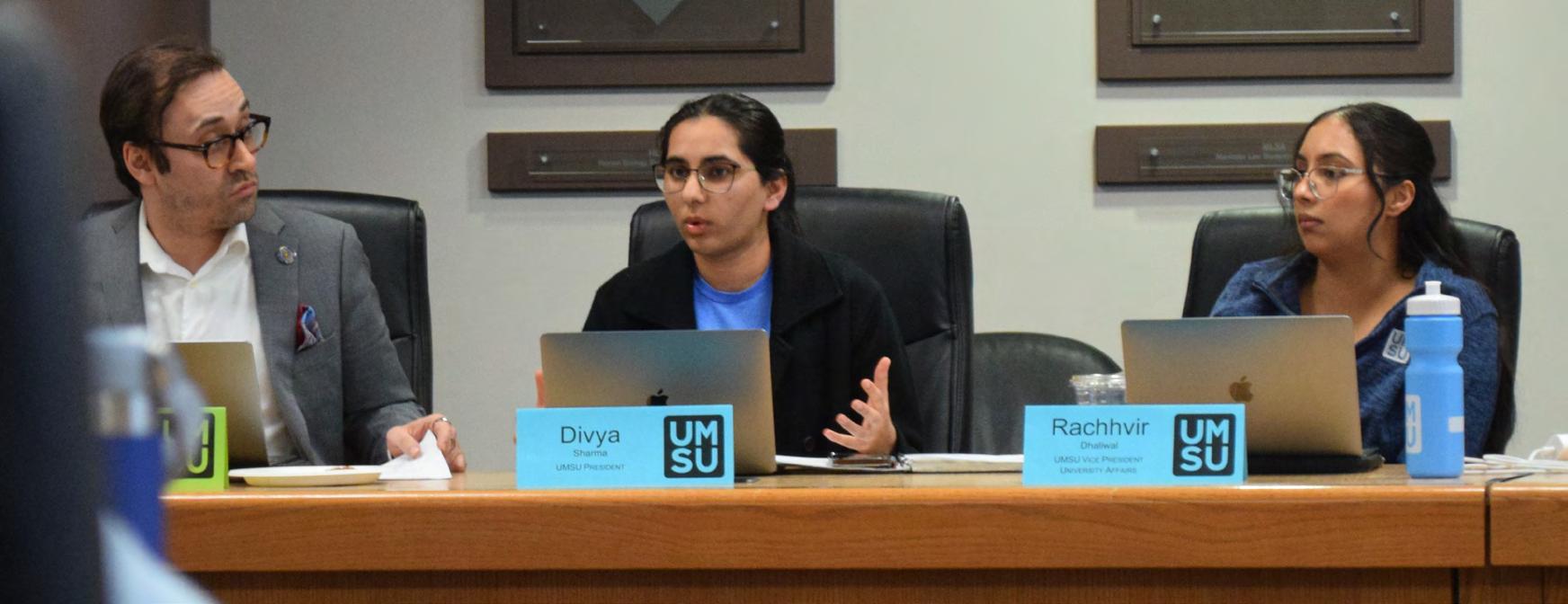
UMSU president Divya Sharma (centre) spoke in favour of the motion at the March 27 board meeting.
photos / Ebunoluwa Akinbo / staff
Features of UM Safe app for students, staff and faculty
Security Services app to improve safety and emergency response on campuses
Iyanda Ajuwon, staff
The UM Safe app is a mobile application designed to enhance security and emergency response across the Fort Garry and Bannatyne campuses.
While the app has been available since being launched in the fall of 2020, recent safety incidents have increased the importance of installing this app to stay informed and connected in case of emergencies.
The UM Safe app provides instant access to nine safety features on the home screen, including emergency con-
tacts, safety toolbox, mobile blue light, safe walk and ride, friend walk, walk alone, emergency plans, report a tip and support resources.
The mobile blue light feature allows users to alert Security Services and share their real-time location in any situation, allowing for faster response times — similar to the code blue emergency poles across campus.
The police will also be contacted should the user move off campus after activating the alert, according to UM Today.
The safe walk and ride fea-
ture allows users to request Security Services to accompany them to their vehicles, bus stops or other campus locations within designated boundaries. Security Services can either walk or drive them to a location.
The safe walk service is available 24 hours a day on both the Fort Garry and Bannatyne campuses, seven days a week, but the safe ride service is only available Monday to Friday until midnight on the Bannatyne campus.
Unlike the safe walk feature, friend walk does not
involve Security Services.
Friend walk allows users to share their live location with a trusted contact. This allows the trusted contact to monitor their movement displayed on a map, on or off campus, in real time.
The work alone feature is designed for students or staff who work alone on campus, allowing them to register with Security Services or another emergency contact.
Once this feature is activated, Security Services or the selected emergency contact will be notified that the stu-
dent or staff is working alone on campus and scheduled check-in times will be set.
If the student or staff fails to check in, Security Services will visit their location to confirm their safety.
The report a tip feature allows users to report suspicious activity or concerns to Security Services, either by phone, text or through filling out an in-app tip form that is emailed to Security Services.
The U of M Safe app is available for free on both iOS and Android devices.
Manitoba Budget 2025 allocates $3.7B for capital projects
Investments set to enhance Manitoba’s health care, education and jobs
Ngozi Okose, staff
The Manitoba government has announced Budget 2025, marking the largest capital investment in the province’s history, according to the press release. Finance Minister Adrien Sala revealed on March 20 that the budget aims to grow the economy, protect jobs and fulfill commitments to rebuilding the health care system and reducing costs for Manitobans.
According to Sala, the budget was created at a crucial moment in Manitoba’s history and is designed to meet the tariff challenges ahead with a significant investment in capital projects. “We didn’t start this trade war but we are not backing down,” he said. “We are Building One Manitoba.”
With a record $3.7 billion allocated to capital projects,
the budget prioritizes constructing new schools, emergency rooms and personal care homes while upgrading critical infrastructure to sustain Manitoba’s economic momentum, according to Sala.
Some of the projects include the second phase of the North End Water Pollution Control Centre, improvements to the Port of Churchill and Hudson Bay rail line, upgrades to Manitoba Hydro’s infrastructure, twinning the east Trans-Canada Highway and initiating work on Lake St. Martin and Lake Manitoba outlet channels as well as Wasagamack Airport.
Sala said these investments are expected to generate nearly 18,000 new jobs.
Budget 2025 includes plans for multiple hospital expan-
sions and renovations, according to Sala. Construction will begin on a new emergency room and Mature Women’s Centre at Victoria Hospital, a new emergency room in Eriksdale and a new HealthCare Centre of Excellence in downtown Winnipeg.
The Health Sciences Centre Children’s Hospital emergency room will also see renovations completed to enhance care for young patients and their families.
According to Sala, the budget introduces several measures to ease financial pressures to support families and businesses. These include an increase to the Homeowners Affordability Tax Credit, expanded access to free birth control, reductions in payroll taxes, an extension of the $10-a-day child care into
the summer and a new Business Security Rebate program. Manitobans will also benefit from free entry to provincial parks for a year.
The budget also provides contingency funding to help businesses adapt to new markets and support for Manitoba’s canola farmers and pork producers who are facing tariff challenges from the U.S. and China, per a press release.
The U of M will receive a 2 per cent increase to its operating grant while being permitted a 3.5 per cent tuition increase for the 2025-26 academic year, according to UM Today. The budget includes $2.3 million in continued funding for health programs designed to train nurse practitioners, physician assistants and clinical psychologists.
Capital investments are also
Bannatyne campus reintroduces in-person
planned for U of M, including $10 million toward a new building at Bannatyne campus to expand undergraduate medical education. Additional funding includes $3.9 million for the Prairie Crops and Soils Research Facility to support agricultural research and $4.5 million for deferred maintenance projects to ensure sustainable campus infrastructure.
The U of M is currently reviewing the details of the provincial budget and will finalize its 2025-26 budget in May before presenting it to the board of governors and sharing it with the broader university community, according to UM Today.
For more information on Budget 2025, visit manitoba. ca/budget2025.
advising International student advising provided by designated officials
Iyanda Ajuwon, staff
After a period of virtual-only support due to the pandemic restrictions, students can now book in-person appointments with the International Centre’s international student advisors (ISAs) at U of M’s Bannatyne campus during office hours.
ISAs help international students navigate challenges regarding personal matters, academics and university regulations and policies. Advisors can also provide students with guidance on topics ranging from study permits
and visas to general campus life and transitional support.
“There’s a large population of international students at the Bannatyne campus that have numerous stressors or numerous aspects of being an international student that they need to navigate,” said Cyndi Kindret, director of student services at Bannatyne campus.
“Having someone who has that knowledge and understanding, and I guess just information, is something that the students need.” Kindret also noted the
importance of in-person advising to students.
“I think virtually, it’s sometimes hard to connect with a person on the other screen, versus being in person with somebody and making a connection,” she said. “So, a big piece of that is accessibility, so that these students know that there’s somewhere they can go, where they can feel safe, where they can feel comfortable, where it’s confidential.”
According to UM Today, ISAs have recently received the regulated international student immigration advisor
designation for meeting requirements set by the College of Immigration and Citizenship Consultants.
Rebecca Irving, one of the international student advisors, told UM Today that the designation legally allows ISAs to give students guidance concerning immigration and provide clear and direct advice to students regarding their own personal situations.
Irving also added that these enhanced services from the ISA team have been essential to help the growing international student population,
especially in light of changes that Immigration, Refugees and Citizenship Canada has recently made — such as the number of hours international students are allowed to work off campus.
International students at Bannatyne seeking assistance from an ISA can book an appointment by visiting 3615. waitwell.ca or reach out by emailing Bannatyne student services at bcstudentservices@umanitoba.ca or calling 204-272-3190.
‘Generative AI-related incidents are on the rise’ says discipline chair
< Cont’d from front page
Generative-AI misconduct definition in the works
Biscontri stated in the report that “generative AI-related incidents are on the rise,” and that updating the Student Discipline Bylaw and Procedure to include a definition for misconduct related to generative-AI would “provide more guidance to instructors and students.”
He stated that the Academic Integrity Advisory committee is currently working on a relevant definition for the bylaw. According to the Centre for the Advancement of Teaching and Learning, students at the U of M are expected to complete assessments on their own, “without any outside
assistance, unless otherwise specified by their instructors.”
“Written assignment instructions should indicate what types of tools are permitted; vague references will generally not suffice.”
The report also revealed that 80 incidents involving non-academic misconduct were recorded by the university discipline committee — the lowest since 2020-21. This included 53 cases of abuse of university policies, procedures or regulations, 12 cases of inappropriate or disruptive behaviour and 15 cases of threats of harm or actual harm.
The rate of student discipline incidents reported to the university disciplinary committee per one hundred students was 2.5 per cent for 2023-
24 — the lowest since attaining the same level in 2017-18.
Since the 2006-07 academic year, the highest number of academic misconduct incidents was recorded in 201920 at 1,220 incidents with over half relating to cheating. Several disciplinary authorities suggested that this was due to remote delivery and testing methods, according to the 2019-20 university discipline committee annual report.
Students that engage in academic and non-academic misconduct are subject to disciplinary action under the Student Discipline Bylaw.
photo / Nischal Karki / staff
Canadians to head to the polls for a federal election
Key policy proposals for Liberal, Conservative and NDP leaders
Sylvester Delali Agbado, staff
T
he 2025 Canadian federal election is set to take place on April 28, following Prime Minister Mark Carney’s request to Governor General Mary Simon to dissolve parliament.
Carney, who assumed office on March 14, 2025 following Justin Trudeau’s resignation, leads the Liberal Party into an election defined by economic uncertainty and rising geopolitical tensions with the U.S.
The election comes amidst a period of strained relations with the U.S., as President Donald Trump has imposed tariffs on Canadian goods and made controversial remarks suggesting that Canada should join the U.S. as its 51 state.
As Canadians prepare to vote, the major political parties, the Liberal Party of Canada, the Conservative Party of Canada and the New Democratic Party (NDP) have unveiled their policy commitments.
Liberal Party promises
One of the priorities of the Liberal Party and Mark Carney include expanding the operations of the Canadian Armed Forces in the Arctic. They plan to adopt Australia’s over-the-horizon radar system to enhance security while also committing $253 million to Indigenous reconciliation programs in the North.
In addition to these military measures, the Liberals have pledged $187 million toward repairing and rebuilding infrastructure in Jasper National Park.
On economic matters, the party has confirmed that the planned capital gains tax increase will not proceed, and they aim to provide immedi-
ate relief to workers affected by U.S. tariffs by removing the one-week waiting period for employment insurance benefits. Businesses will receive temporary deferrals on income tax, Goods and Services Tax (GST) and Harmonized Sales Tax payments.
Supporting military personnel is another priority, with commitments to increasing salaries, expanding housing on military bases and improving access to healthcare and child-care services.
The party has also set a target to accelerate defence spending to meet North Atlantic Treaty Organization’s two per cent GDP threshold by 2030.
For the auto sector, they plan to introduce a $2-billion strategic response fund aimed at protecting Canadian jobs and manufacturing, prioritizing investment in Canadian-built vehicles.
Conservative Party promises
Pierre Poilievre and the Conservative Party have framed their campaign around reducing crime, lowering taxes and addressing housing affordability.
They have proposed mandatory sentences for major crimes, including life imprisonment for large-scale fentanyl traffickers, human traffickers convicted of five or more counts and those exporting 10 or more illegal firearms.
Their economic policies emphasize tax relief, particularly through allowing Canadians to contribute an additional $5,000 annually to a tax-free savings account if the funds are invested in Canadian companies.
The Conservatives have committed to maintaining
the retirement age at 65 while allowing working seniors to earn up to $34,000 a year without paying income tax.
The Registered Retirement Savings Plan (RRSP) withdrawal deadline would also be extended from age 71 to 73.
Housing affordability is another focus, with a promise to eliminate GST on new homes costing up to $1.3 million and to help push municipalities to release more land, speed up building permits and cut development charges.
Poilievre has pledged to reduce the lowest income tax bracket from 15 per cent to 12.75 per cent, potentially saving dual-income families up to $1,800 per year, a policy to be funded by cutting federal bureaucracy.
In the realm of job training, the Conservatives propose expanding training halls for skilled trades and providing direct grants and quicker access to employment insurance for licensed-trades apprentices.
The Conservatives plan to also accelerate resource and mining development by establishing “shovel-ready zones” with pre-approved permits and ensuring all federal approvals for mining in Ontario’s northwestern region are completed within six months.
The party also aims to repeal the entire carbon pricing law, broaden eligibility for clean technology and manufacturing tax credits and reward businesses that produce low-emission goods.
New Democratic Party promises
Jagmeet Singh and the NDP have centered their campaign on housing affordability, economic fairness and labour
protections.
Their housing strategy includes a ban on corporations purchasing affordable rental properties and preventing corporate landlords from accessing low-interest federal loans, tax benefits and mortgage loan insurance.
They propose expanding the rental protection fund to help non-profits acquire affordable housing units and utilizing federal Crown land to construct 100,000 rent-controlled homes over the next decade.
Additionally, the NDP pledged $1 billion over five years to secure public land for affordable housing. Their economic platform emphasizes worker protection and higher wages, with a plan to increase employment insurance benefits for jobs in the Canadian auto sector and direct revenue from counter-tariffs toward affected workers and communities.
Singh has also called for stronger protections for Canadian auto manufacturing,
proposing legal measures to prevent publicly funded auto companies from relocating plants or equipment outside Canada.
To address affordability, the NDP wants to raise the basic personal income tax exemption to $19,500 and remove GST from diapers, grocery store meals and essential household bills such as cellphones, internet and heating. Seniors would benefit from an increase in the guaranteed income supplement.
The party seeks to train 100,000 workers in skilled trades and improve infrastructure investments to create jobs and expand trade beyond reliance on the U.S.
In terms of defence policy, the NDP has pledged to cancel Canada’s F-35 fighter jet contracts and instead build military aircraft domestically. Singh also plans to strengthen Arctic defence, build marine search and research stations, increase soldiers’ salaries and invest in infrastructure for northern communities.
Carolyn
Rachhvir
Magnus Gnilo highlights tennis career
The U of M tennis athlete expresses optimism about the tennis club
Abdul-Jalilu Ahmed, staff
The U of M Tennis Club athlete Magnus Gnilo shared insights into his tennis journey, highlighting how the sport has allowed him to connect with people.
Gnilo expressed optimism about the future of the tennis club.
The Manitoban: What makes playing tennis so special to you?
Gnilo: It’s always been special to me because it’s been introduced to me by my dad. My whole family plays tennis, so I come from a family of tennis players. I think what’s nice about it is I get to meet a lot of people. Tennis is a sport you can play for all ages. So, I get to meet a variety of people, not just people my age. And that makes it really fun and interesting for me.
M: There are other sports. There is football, there is volleyball, but you chose to play tennis. Any reason behind that?
G: Well, honestly, as a kid, I grew up playing basketball, played a little bit of soccer too. My dad tried to introduce me to baseball, but I want to say I’ve always been the best at tennis. And it’s just something that I’ve liked more ever since I was a kid. So, you know, as I grew up, I leaned more and more into it especially when I started playing competitively, I decided to drop everything and only play tennis.
M: If you want to be a competitive tennis player, what is
required of you as a player?
G: It takes a lot of time and effort, obviously, just like any other sport. But really, I think since tennis is a technical sport, it’s really hard to improve without a nice coach. I’m grateful enough that my father was my coach. So I had a 24/7 coach, right? He helped me on and off the court. And that’s the commitment I think that makes a tennis player really good, especially from when they’re just starting.
M: Psychologically, does playing tennis require that you focus and concentrate all the time?
G: A hundred percent, yeah. It’s a very technical and physical sport, it requires both physical and mental strength, especially the higher you go, the more the mental strength plays a role. All the best tennis players, top 10, top 100 in the world all have very great mental game. It’s a requirement.
M: Let’s look at the Edmonton tournament. You guys went to Edmonton. It was such a great and wonderful performance, you guys did well. How did you guys manage to do that?
G: It’s a team effort, obviously, like aside from the training we do here. All the sessions we do here, we have an on-court training here. We do an off-court mental training session, led by Craig. Other than that, we’re all individual. Individually, we’ve been playing tennis since we were young. I know everyone in the
team. We’re all just competitive tennis players from when we were juniors. And so really, it just stems from we’ve been working hard since we were younger and all that stuff too.
M: When it comes to playing doubles, how are you guys able to come out with team bonding on the court?
G: Personally, I play with one of my best friends. It’s really easy for me to have that chemistry. I’ve known him for a long time now. I’ve played so much with him. But I think we just have a lot of chemistry just because we play with each other so much. We’re a small team and it’s a small tennis community, just in general in Manitoba. Everyone here plays with each other a lot. We’re very familiar with each other’s game styles, personalities, just as a person. And it just really helps us on court that we know each other so well.
M: What would you say about the way forward for University of Manitoba Tennis Club?
G: It’s going in a really great direction. We’re like a newer sport here, a newer team. And I think for the amount of time we’ve had at the University of Manitoba, I think we’re doing phenomenal. Like the amount of players we have, our competitive team is doing really good. I think it’s going in the right direction. I like it. I’m excited.
photos / Ebunoluwa Akinbo / staff
Diving into an immunology career path
U of M immunologist shares career insights and advice for future researchers
Divyata Gosai, staff
Immunologists are research scientists who study and treat diseases related to the immune system.
Kent HayGlass is a professor emeritus in the department of immunology at the U of M’s Rady faculty of health sciences.
During his undergraduate studies, HayGlass found a microbiology course interesting, especially a segment on immunology. This course encouraged him to explore the unknown aspects of the immune system and ask important questions about its functions.
The opportunity to explore fundamental scientific puzzles sparked his interest, leading him to pursue a career in immunology.
HayGlass shared insights on his career path in immunology, and career advice for students.
“If you’re in the sciences, a lot of kids — myself included at the time — are thinking, so what do I want to do?” he said. “Certainly, if you’re interested in the physical or the biological sciences, it often comes down to maybe something in medicine.”
Students frequently consider three main options after completing their undergraduate studies. They consider pursuing clinical medicine (such as becoming a physician, nurse or therapist), continuing research through graduate studies or entering the workforce to explore career opportunities.
HayGlass emphasized that there is no single best career path, and it is important to explore and gain experience. He noted that many young people do not have the life experience to understand what a career truly involves, and the media often presents a misleading impression. Choosing a career should ultimately align with your personal strengths and skillset, which may differ from those of your friends.
For instance, in the field of medicine, success often relies
on mastering a vast amount of established knowledge and applying it in a structured manner.
HayGlass explained that medicine adheres to strict clinical guidelines to ensure quality care, emphasizing the importance of teamwork among health-care professionals. He added that a career in medicine demands passion for helping the sick and being part of a collaborative team.
clinical work often involves being on call at all hours, while research offers more independence and suits those who prefer flexibility and collaboration across different specialties.
“I’m an immunologist,” he said. “I would collaborate with
due to her struggle with the absence of definitive answers.
Research and clinical work often lack fixed hours, unlike structured jobs, but both require strong personal investment. They also involve significant teaching, so a passion for sharing knowledge is beneficial.
“If you really like being with people and seeing them whether at their worst, then you can really make huge contributions”
— Kent HayGlass, professor emeritus in the U of M’s Rady faculty of health sciences
“You better really like people,” he said. “If you really like being with people and seeing them whether at their worst, then you can really make huge contributions.”
HayGlass explained that
someone who’s a biochemist and someone who does proteomics.”
Success in research requires comfort with uncertainty and genuine curiosity. He provided an example of a colleague who left research
“I love teaching,” he said. “I’m retired and I’m teaching now for fun. I don’t get paid. I do a program because I like sharing immunology.”
HayGlass highlighted the significance of gaining practical experience to explore potential careers. He noted that simply observing professions, such as surgery or research, is insufficient with-
out hands-on experiences like summer jobs or volunteering in hospitals, clinics or laboratories.
Real-world exposure enables individuals to see firsthand what a career truly involves and helps them determine if it aligns with their interests.
HayGlass explained that there are exciting opportunities in biomedical research today, emphasizing the increasing interconnection of biochemistry, microbiology and immunology.
He encouraged students to explore various career paths early on through jobs, internships or conversations with professionals to discover what truly aligns with their skills and interests.
“Think carefully about your career choices and do your best not to be influenced by your friends.”
graphic / Fumnaya
Ifeadi / staff
A glimpse of global health research
How sustainable research efforts lead to global health improvements
Rhea Bhalla, staff
Ties Boerma, a professor of global and population health at the U of M, has spent decades researching public health in low-resource settings, with a particular focus on Sub-Saharan Africa. His work has examined the HIV/AIDS epidemic, maternal and child health and the role of data in improving health outcomes.
Boerma’s career began with an interest in clinical work, as he was initially trained as a medical doctor in his home country of the Netherlands. He later shifted to public health research, focusing on broader public health rather than individual patient care.
His research has been shaped by global health crises, particularly the HIV/AIDS epidemic of the 1980s and 1990s, during which he conducted research primarily in Africa.
“This was the time that many things were unknown,” Boerma said. “It was coming up in the 80s and early 90s, and so [we were] trying to understand the epidemic, what can be done about it [and] what preventative measures can be taken.”
His research examined factors influencing the spread of the HIV virus and explored preventative measures such as male circumcision, which was found to reduce transmission. When treatment became available, Boerma worked with local clinics to effectively scale it up.
Boerma later turned his focus to maternal and child health, examining “hidden problems” such as maternal mortality and aiming to expose health disparities in the field.
“Even today, well over 250,000 women die every year due to causes that can be prevented,” he said.
His research has explored the reasons behind high maternal mortality rates and strategies to improve health systems in low-income regions. A key component of this research involves learning from countries within the region that lowered their mortality rates, increased their immunization coverage and improved the quality of health care delivered.
One of the most striking aspects of Boerma’s career was his long-term research in Tanzania. In 1994, he began working with the Tanzanian Institute in East Africa on a large-scale population study initially tracking 19,000 people across seven villages. Nearly three decades later, that number has grown to 55,000, providing a rare longi-
graphic / Fumnaya Ifeadi / staff
tudinal view of public health progress.
“What we’ve seen there is an incredible improvement in so many indicators,” Boerma said. “They got a little bit richer, and they got many things, but it’s also so impressive to see how child mortality went down, how maternal mortality went down, how survival of adults improved so much.”
“Now everybody’s got their shiny roof,” Boerma said. “At least in the area where we did research. And along with that, so many things changed for the better — education, but
difference?”
“A critical, constructive voice is necessary for advancing society, for advancing health, for advancing health equity”
By working alongside Tanzanian researchers, Boerma has helped document a remarkable transformation in public health, providing insights into how sustained efforts can lead to lasting improvements in health and quality of life.
— Ties Boerma, U of M professor of global and population health
The study documented not only health improvements but also broader social and economic shifts. Boerma and his Tanzanian colleagues have jokingly referred to this transformation as the “mabati revolution.” Mabati, the Swahili word for corrugated iron, symbolizes the region’s development, where homes that were once made of thatch or mud now stand with solid metal roofs.
particularly health, and that’s really inspiring.”
This long-term study exemplifies the role of public health research in tracking gradual change. Instead of focusing on a single medical breakthrough, Boerma explained that his research focuses on large-scale health trends, noting that “it’s not so much an invention of a drug or anything like that, but that’s what you do in population health — you try to see, is there a big
Eventually, his journey in academia brought him to the U of M.
“What I like about the way we’re doing work here in Manitoba is we are still doing global health, but we are linking the research in a very pragmatic way to what’s needed in the field,” Boerma said. “We’re trying to be as relevant as possible to the people themselves.”
Throughout his career, Boerma has emphasized the importance of ensuring that research has a tangible
impact through collaboration to ensure relevancy to and impact on the target population.
“It’s not only important what you research and what your findings are,” he said. “It’s also important how you do the research.”
Boerma also reflected on the broader challenges within academia, in an era where researchers’ voices face increasing criticization and resource restriction.
“These are difficult times for academia and research,” he said. “It will be harder to get resources for critical topics, and it will be harder to get our academic voices heard. I think it’s still hugely important that there is a strong academic community like in Manitoba, and it’s important that we’re heard.”
“A critical, constructive voice is necessary for advancing society, for advancing health, for advancing health equity.”
Travel wellness
Keep you and your stuff safe
Quinn Mayhew, staff
Being a woman is extremely hard. Let alone a solo female traveller who’s going abroad for the first time, now that’s downright terrifying. A recent study by a specialist accommodation finder revealed that women make up 67 per cent of solo travellers, yet 88 per cent of them reported feeling their safety was threatened in some way because they travelled solo.
The sad reality of being a solo female traveller is the constant fear of something bad happening or things going wrong, and the overall concern for your safety and well-being. I have scheduled my first trip abroad in about a month and to say I’m scared is an understatement.
I have been constantly googling tips and doom-scrolling Instagram for tips and tricks on “how to keep you and your stuff safe.” I have now picked up a few I’d like to share.
An important part of staying safe is setting boundaries with strangers. Saying “no” is a full sentence. Do not let people try to pressure you into
doing things you are not comfortable with.
Plan your destinations you want to go to ahead of time with lodging, restaurants and transportation. Make sure you know your surroundings and where you’re going. Also, make sure a friend or family member knows your travel plans for that day.
Make it a priority to protect your personal belongings such as your passport, cash and credit cards. Invest in a suitcase with a lock, carry your passport with you so it doesn’t go missing or purchase travel insurance to make sure you are fully covered medically when you travel to reduce stress.
I think these safety tips should be more common knowledge amongst women who are travelling anywhere. These safety tips can be life-saving and essential for the well-being of female travellers who are just starting on solo expeditions and even for those with many travel experiences. When you’re well prepared for travelling and have knowledge on the area you’re going to, this can help mini-
mize the chances of anything going wrong.
Even though travelling anywhere can be risky at times, I think taking time to travel is an important step into adulthood and is well worth the risk. Taking that step into adulthood can look like
going on a solo trip by yourself, travelling somewhere with friends, or if you don’t have the money to take a trip abroad, doing little day trips by yourself.
I’m sure a lot of you reading this have been dragged on a trip by your parents to go see windmills on the prairies, or perhaps you were
from your home to visit your grandparents. Maybe it was something else you were forced to go to that your parents suggested was a “family trip,” but was just what they wanted to do.
Travelling without your family is a big step toward independence and self-discovery, to think about what you want to do and not just what your parents want to do.
It’s an essential part of adulthood, realizing your parents will not always be there for everything and discovering the types of things you like to do.
Whether big or small, travel plans are an important part of growing up. However, taking safety precautions, especially for women, is super important for our well-being and safety. If you are planning on travelling, make sure to take the necessary steps to feel safe during your journey so you can enjoy it instead of stressing out.
hours away
dragged
graphic / Fumnaya
Ifeadi / staff
Breaking up with Grimes
When to quit an artist
Mikaela Warkentin, staff
T
he first time I found myself enraptured by Grimes was on a quiet afternoon in the fall of 2020 — while clicking through my friends-of-friends’ Spotify playlists. Much of my life at that point was soundtracked by my constantly running bedroom speaker and Zoom classes, and Grimes’s album Art Angels suddenly parted the clouds and opened my ears to a whole other world of music. While I don’t consider myself a Grimes superfan by any means, I would be lying to you if I said I didn’t like her music at all. Her music is, until recently, where my interest in Grimes ended. But with the current state of the world, I have been inclined to examine my own relationship to Grimes.
Who even is Grimes?
Claire Elise Boucher, stage name Grimes, is a singer-songwriter born in Vancouver to her well-to-do parents, who, after being expelled from McGill University, went on to pursue music and has been making waves from the start. Her 2010 debut album Geidi Primes, inspired by Frank Herbert’s Dune novels, launched her career in the Canadian indie scene and planted her firmly in the spaces of the fledgling social media culture. Her 2012 album, Visions, is by far her most popular to date, winning her the Electronic Album of the Year at the 2013 Juno Awards. Lead singles “Genesis” and “Oblivion” are still being featured everywhere, from television to TikTok, cementing her prevalence in popular culture with more than 700 million streams between them on Spotify alone. Her music blends electronic and synthpop and is a sonic treat to listen to — one that has been a cornerstone of indie since her debut in the music scene.
iod of her life where she “only ate spaghetti.” While there’s a sharp awareness of her distance from normalcy, I think she’s incredibly open and honest with her fans and the internet as a whole. Grimes has curated herself as a sort of brand, but without any sort of
Beyond her music, she’s a fascinating person — In 2009, she and a friend tried floating down the Mississippi river until their impoundment in Minneapolis. In 2020, she revealed there was a per-
pomp. However, Grimes, in all her zany glory, has become more faded for me over the last few years. Her self-stated role as a feminist artist began to ring hollow as her online activity shifted into more controversial spheres — notably praising patriarchy for its role in “developing society” and selling her art as NFTs. More recently, she’s best known on the internet for dating Elon Musk, a man she is still affiliated with to this day for having three children with him. This was in 2018, well before Musk rose to infamy in the U.S. government, but their partnership didn’t exist in a vacuum then, and it certainly does not now.
The elephant-sized Tesla in the room
I won’t give you an exhaustive biography of Elon Musk.
There are enough people examining his upbringing, his life as a child of emerald mine owners in the wake of South African apartheid and his current role within the U.S. government. Buying out Tesla and founding SpaceX made the name Elon Musk synonymous with progress prior to recent years. For the longest time, he worked hard at attaching his name to a future that would be full of electric cars and trips to Mars. But Musk’s problems couldn’t be overcome by this glossy idea of the future. Apart from taking credit for the work of Tesla prior to his actual involvement, he has taken both of these companies and made these objectively cool things accessible only to people willing to pay the price. For example, his “Tesla
Tunnels” under cities like Las Vegas are not only reinventing the public transit wheel but also overcomplicating and overcharging for something that already exists. His Tesla vehicles themselves are riddled with paywalled features and updates — under Musk, the future is not for everyone.
Hold on, aren’t we talking about Grimes?
Grimes’s partnership with Musk came about from their mutual love for posting online — specifically, it was a pre-Musk Twitter that brought them together. At pure face value, Grimes and her interests in the unusual and science fiction would make sense with Musk — his less savory traits don’t seem to have turned her off, either. On their eldest child, Grimes has said that X Æ A-12’s life “mirrors Paul-type stuff” from the same Dune novels that inspired her first album. While aesthetically Dune is cool, critics (and myself) argue that Paul’s white savior-esque path is a cautionary tale, not an aspirational one. Projecting this “chosen one” mentality not only on her child but onto herself (in the books, Paul’s mother is integral to the prophecies he eventually fulfills) just feels weird.
graphic / Teegan Gillich / staff
Considering that Grimes, despite working her way to the top, was given opportunities that others aren’t by way of her family’s wealth, her being comfortable with putting a starving artist veneer over her currently glitzy life does not sit well with me. In my own opinion, she has also weaponized this quirky, spa-
ghetti-diet persona to lighten her actions done in the context of people like Musk. Even her lofty delusions for their shared child can be shrugged off with the understanding that she just really likes the Dune books. There is nothing damning for Grimes herself, only for the people she surrounds herself with.
Earlier this year, after Musk’s “Roman salute” at Donald Trump’s inauguration, Grimes went on X (formerly Twitter) and denounced Nazism — but definitely not Musk. This doesn’t seem to be enough for me. Despite Grimes’s current distance from problematic topics, it is not as reassuring as I would like it to be. I’m not sure if I want to salvage an artist in my mind who hasn’t taken issue with things that I would in my own personal life, so I am taking a step back. In my own opinion, this is a long-overdue examination of Grimes. For the longest time, I didn’t want to look at her critically because of her contributions to the Canadian indie scene and general musical talent. The void she’s left behind in my playlists is felt, but nothing that some deeper research into similar artists hasn’t been able to fix. No one is perfect, but my patience with Grimes has run out with her constant alignment with the alt-right and fascist people. There’s a saying that’s been floating around online, “RIP Grimes, you would have hated Grimes,” implying that the old Grimes, the person who created music that shifted the scene and was beloved online, would have despised the Grimes we see today. I don’t hate this analysis — it’s one part death of the author, one part separating the art from the artist. However, Grimes is, in fact, still alive and well and attending parties celebrating Donald Trump’s inauguration. Maybe this is the person she was all along, maybe people change as time passes. Either way, Art Angels is good, but I don’t think it can fully eclipse my own problems with its creator.
To complete Sudoku, fill the board by entering numbers 1 to 9 such that each row, column, and 3x3 box contains every number uniquely. In Straights, like Sudoku, no single number 1 to 9 can repeat in any row or column. But rows and columns are divided by black squares into compartments. Each compartment must form a “straight.” A straight is a set of numbers with no gaps but it can be in any order, eg [7,6,9,8]. Clues in black cells remove that number as an option in that row and column, and are not part of any straight. Glance at the solution to see how “straights” are formed.
entering numbers 1 to 9 such that each row, column and 3x3 box contains every number uniquely.
For many strategies, hints and tips, visit www.sudokuwiki.org for Sudoku and www.str8ts.com for Str8ts. If you like Str8ts and other
Provided by: Teegan Gillich
Royal MTC presents Casey and Diana
Inspired by Princess Diana’s 1991 visit, play explores compassion amid AIDS crisis
Carrington Dong, staff
R
oyal Manitoba Theatre
Centre continues its 202425 season with the play Casey and Diana. Written by Nick Green, the play is inspired by the historic visit of the late Diana, Princess of Wales, to Toronto’s Casey House in 1991, at the height of the AIDS crisis.
“[Casey House] is an AIDS hospice,” said actor Noah Beemer. “[The play] basically follows a few of the characters in the hospice in the week leading up to a visit from Princess Diana.” While Diana appears as herself, the other characters are fictional, though the story is based on real events.
Beemer plays Andre, a new resident whose arrival opens the play.
“It’s kind of an impossible situation [Andre]’s being faced with,” Beemer explained.
role, Beemer said he enjoys playing Andre and discovering humour within the character.
“Andre specifically is a character that I have so much love for […] he is such a character that breaks my heart,” Beemer said. “I think something that I’ve loved finding honestly, has been the humour and the joy in the character and in the play. I think on the surface it can sound like a challenging watch, which in some ways it is, but I do want to emphasize that it’s a really funny show.”
Humour plays a key role in the show, despite its heavy themes. Beemer explained that residents of Casey House used humour as a coping mechanism, which is reflected in the interactions between
exciting environment.
“He’s equipped us so well to do the show,” Beemer said. “We were given incredible research materials […] just to kind of enrich our understanding of the world and the time period. And he has such a history with this play and was able to bring so much knowledge and care to it.”
According to Beemer, audiences have been surprised by the comedy and humour in the play.
“The amount of laughter in the audience, it has been quite boisterous and surprising and lovely. That was a really great thing to discover […] just how much fun and joy there was in the audience, in spite of the challenges and the sadness in the show as well.”
“That was a really great thing to discover […] just how much fun and joy there was in the audience, in spite of the challenges and the sadness in the show as well”
“He’s a young man in his early 20s, and he sort of just arrived to Toronto less than a year ago to start his life and to find a queer community and to discover himself […] And then very quickly, once getting there, he gets an AIDS diagnosis and finds out he’s going to die.”
Beemer described Andre as “sad” and “angry” for much of the play, frustrated by his situation. However, he ultimately finds the community he was searching for at Casey House.
Despite the heaviness of the
— Noah Beemer, actor
Andre and the other characters.
“That’s been a fun thing for me with Andre to find the humour with him and the joy and the laughter, because that’s so important. I mean, especially for someone in that situation, that’s like one of the most important things to find,” he said.
Beemer has enjoyed working with the rest of the cast during production and praised director Andrew Kushnir for creating a safe and
Beemer hopes the play leaves audiences reflecting on love, community and supporting one another.
“I think especially right now, the world is in a bit of an intense and potentially scary place. And it feels really special to be doing this show that is so much about love and humanity and people helping other people in the most dire and difficult circumstances,” he said.
Royal Manitoba Theatre Centre’s Casey and Diana runs until April 12 at the John Hirsch Mainstage. For tickets and more information, visit royalmtc.ca.
photos courtesy of / Dahlia Katz
Catherine Wreford in Casey and Diana, a co-production with Theatre Aquarius.
When music and code collide
Jack Campbell to perform music of the Bombe and Enigma machines
Boris
O
Tsun Hang Leung, staff
n April 3, Canadian concert violinist and composer, Jack Campbell, will present his long-time project, Sounding Bombe in Winnipeg. Inspired by the mathematical systems used by both the Axis and Allies in the Second World War, Campbell’s music highlights the ingenuity of humans in times of violence and hardship.
In an interview, Campbell described his compositional style as experimental modern classical music, drawing inspiration from a variety of genres, including Renaissance and Baroque music, as well as improvisational jazz and electronic sound art mediums. He also has special interests in how music overlaps with other disciplines.
“What really fascinates me about music is the connection between music and science and music and history,” he said. “Music is a mathematical phenomenon, from the way that sound projects, to the way in which we receive sound, to the way in which, sort of, logical musical form
and logics of harmony are created through musical patterning.” After five years of work, Campbell’s piece premiered at the National Museum of Computing in England last November. He is now on tour in Canada, New York City and the U.K., ending with a record release this summer and five shows at the Edinburgh Festival Fringe, the world’s largest arts festival.
Campbell said Sounding Bombe is inspired by the Enigma, the machine used by the Axis powers to encrypt radio transmissions, and the Bombe, the machine invented by Alan Turing in the U.K. to crack the Enigma code. The Bombe machine shortened the war by many years, saving countless lives and changing the course of human history.
“I’ve built musical versions of the Enigma and Bombe machine using linguistical and mathematical data to translate it. And what you will hear is you will hear a very beautiful folk melody, which was actually Alan Turing’s favourite piece of music that he used to play on the vio-
lin himself, decrypted,” said Campbell.
“So you will hear it encrypted into something that’s totally atonal and experimental, and you can’t really find the patterning to it, but it is played in a Morse code rhythm to grab your attention, and then over the 50 minutes of the piece, it will gradually be decrypted in a way which you won’t understand musically until it returns to this beautiful original melody.”
Given recent global events, Campbell said, the Second World War and technological advancements remain relevant topics. With his music, he hopes to highlight the power of ingenuity and creativity in challenging hostile forces in the world.
“This piece celebrates how some of the most brilliant scientists of human history used their brilliance to protect humanity and to fight against injustice. And some of these scientists, mainly Alan Turing, due to the fact that he was LGBTQ, later experienced severe injustice themselves,” he said.
“I would like this piece to serve as a reminder of what the brilliance of the human mind is capable of, and how we can use — each one of us can — use our individual gifts and talents to protect humanity against evil. And I also think it’s a reminder that cultural activity is a tool against
injustice, and it is so important to celebrate that part of music.”
Sounding Bombe for solo violin will take place at Sidestage (700 Osborne St.) on April 3 at 7:30 p.m. Tickets are available at sidestagewpg. com.
Prairie Diva presents Spring Fling Burlesque Fusion Cabaret
The Winnipeg dance school’s showcase to celebrate love in all forms
Carrington Dong, staff
Winnipeg native Meagan Funk began dancing at the age of four.
“I’ve always loved moving my body to music […] ever since I was little, ever since I can remember walking, I have been dancing,” she recalled.
After training in various styles throughout childhood and adolescence, Funk moved to Toronto to study dance at George Brown College, after which she danced professionally. During that time, she began teaching dance to children part-time and found that she enjoyed it. It was during her time in Toronto that she discovered burlesque fusion.
Winnipeg and opened Prairie Diva, a dance school, along with a professional dance company, M. Funk Dance Productions. Drawing from her own experiences in the dance industry, she wanted to create an environment that fostered self-love and provided a space where dancers could feel confident in their own skin.
“As I was auditioning in Toronto, I found […] it was always about what you look like to get the role, which makes sense, but it could take
Prairie Diva and M. Funk Dance Productions have staged showcases at the Park Theatre for 10 years, each featuring a different theme. On April 6, they will present the Spring Fling Burlesque Fusion Cabaret, featuring performances from M. Funk Dance Productions and Prairie Diva’s students.
“It’s a celebration of love,” Funk said. “So, every single dance routine has something to do with love, like the excitement about love or heartbreak or, you know, self-love as well.”
“I’m just so proud that we’ve built this sisterhood and sense of camaraderie. It’s nice to see the students feel confident in their skin and just embrace who they are”
— Meagan Funk, founder and owner
“It was more sensual and just like embracing who you are […] really all about selflove, and I really liked that […] We didn’t really have anything like that here [in Winnipeg] other than pole dance, there wasn’t that style, so I wanted to bring that style here to Winnipeg,” she explained.
In 2014, Funk returned to
a toll on your self-esteem,” she reflected. “Also, once I would get the jobs we had weekly weigh-ins and you could see how so many of the women in the industry, it was kind of beating them down […] I will never do weekly weigh-ins. I will never judge someone. It’s a judgment free zone with both our professional company and our dance school.”
The performances will feature dancers of all experience levels, from beginner to advanced. The cabaret will also feature solo, duo and trio performances created by Prairie Diva students, local guest artists, an aerial hoop performance and showgirl-themed performances by M. Funk Dance Productions.
Funk hopes audiences will enjoy the cabaret’s energetic atmosphere and appreciate the diversity of dancers
on stage, representing a range of ages, shapes and sizes. She also expressed pride in the close bond shared between the company’s members and students.
“I’m just so proud that we’ve built this sisterhood and sense of camaraderie,” she said. “It’s nice to see the students feel confident in their skin and just embrace who they are, to be able to foster a community where we can all work together […] I hope people can come out and enjoy it with us, and
then maybe they will want to step on the stage as well.”
Prairie Diva’s Spring Fling Burlesque Fusion Cabaret will take place on April 6 at the Park Theatre. Doors open at 6 p.m., with performances beginning at 7 p.m. Tickets are available at ticketweb.ca/ event/spring-fling-burlesquefusion-cabaret-the-park-theatre-tickets. For information on future events, please visit mfunkdance.com.
photo courtesy of / Vancouver Symphony Society
photo courtesy of / Rangda Films
M. Funk Dance Productions at Park Theatre
An interview with Bisons volleyball athletes
Grahame and Ludwig share their journey as student-athletes for the Bisons
Israel Adeogo Abejoye, staff
S pencer Grahame and Sammy Ludwig shared their experiences on balancing academics and athletics, managing stress and their thoughts on mental health initiatives on campus.
When asked about how they cope with academic stress alongside their volleyball commitments, Grahame emphasized the importance of time management. “It’s just being a little bit smarter about the time, and not leaving things to the last minute,” he said.
Ludwig acknowledged that there are times when their volleyball schedules conflict with their academic responsibilities. “We have away games sometimes,” he said. “So, I’ll miss classes or labs that are on Thursday and Friday, so that can be difficult to deal with sometimes.”
He included that outside of road trips, the sport does not really interfere with his studies. “Like during exam periods, practices become somewhat optional, if you have an
exam that day it’s okay to miss […] other than the road trips, I’d say it’s okay.”
Ludwig also added that his professors have been supportive in helping him catch up on missed classes and assignments. “All of my professors always post the notes and everything, so I can always go look at them after,” he said. “When it comes to labs and classes where attendance is taken or there are in-class assignments, we are able to email our professors […] and we don’t lose any marks for missing those classes.”
In terms of financing their university studies, Grahame expressed his gratitude for the scholarship money he receives from playing volleyball, as well as the support from his employers and parents. “I’m thankful very much for the scholarships that the university athletics is able to provide along with some other academic scholarships,” he said. “In the summer I work. I do involve with internship programs through my education […] My parents are also
very generous, and they help me out,” he said.
Both Ludwig and Grahame stressed the need for social connections in maintaining mental balance amid their academic, athletic and personal lives.
For Ludwig, his volleyball teammates serve as a vital support system. “My teammates are like my family, they are like my best friends, so seeing them in practice every day, that’s like, more than enough of a social life,” he said.
Grahame on the other hand, highlighted the value of stepping outside the volleyball bubble from time to time. “I think for me connecting with some people outside of volleyball that aren’t on the team once in a while is good too, so I don’t get super wrapped up into it all the time,” Grahame said.
When asked about what initiatives or events they would like to see more of on campus to support students’ mental health, Grahame suggested that more events that promote socialization would
be beneficial. “I think a big thing would be trying to get people together a little bit more,” he said. “When you go to the big, huge event with
a lot of people to meet new people, I think that can be really good mental health,” he noted.
Winning the national championship and what is next
Eve Catojo shares secrets to success after national title victory
Israel Adeogo Abejoye, staff
The Bisons’ win of the national championship remains a historical moment. The Manitoban was interested to interview other Bisons’ stars, and this time, it was middle blocker, Eve Catojo.
Catojo shared her thoughts on the experience of how it felt to have won the competition. “The only word I can use to describe it is just amazing,” she said. “We worked so hard. It’s impossible to even describe and convey to people who weren’t a part of the team how much work we actually did put into this.”
Catojo spoke about the importance of her team’s culture and the strong bonds between teammates. She noted that their connection, built over years of growing and competing together, was a key factor in their success. “We just care about each other so much,” she said. “You just lay down your life for the girls on this team. We’ve been together. We started out as a very young team in Canada West all together. And our team has not changed fundamentally for four years […] the relationships we have are so incredibly deep that it just
makes you want to succeed for each other.”
The camaraderie played a significant role in their success, as Catojo noted that “everyone is so invested in our goals [...] Everyone is watching the film, everyone is buying into the game plan.”
Regarding her personal motivation for performing well in the competition, Catojo cited her desire to do it for her team. “Some of the girls have just gone through things this year that are just tough, extremely tough,” she said. “We just have a culture of showing up always and pushing through anything.”
Her faith also played a crucial role in her motivation.
“There was a point in the season where I was dealing with my back injury, and it was so debilitating,” she said. “I just knew like every weekend I had to perform, and I was an integral part, and I just couldn’t let anybody down.”
Catojo acknowledged that she struggled with anxiety and self-doubt, particularly before games. “I’m a person who will sit before a game and be like, ‘I’m going to make 50 errors today, and I’m going to miss every serve, and I’m
going to trip and fall,’” she said. “It’s like something just completely out there that will never happen.”
When asked about her plans for the future, Catojo expressed her desire to become a kindergarten teacher and settle down. “I want to just kind of lay low, teach my kindergartners,
have a family, raise my kids,” she said. “I’ve always wanted to live on an acreage outside of the city.”
Looking ahead to next year’s competition, Catojo is confident that her team will continue to thrive despite the loss of several key players. “I don’t believe for one second that the level of our play is
going to drop after this year,” she said. “We have girls that have been working so hard behind the scenes.”
Catojo highlighted the depth of her team’s roster, citing players like Ella Gray and Chelsea Siebenga who are ready to step up and make a difference.
photo courtesy of / Dave Mahussier
photo courtesy of / Neil Noonan
The Bisons finish just outside playoff range
The Bisons women’s basketball team close season ranked 11th in Canada West
Faiyaz Chowdhury, staff
The 2024-25 season was a mixed bag for the Bisons women’s basketball team. Despite showing flashes of growth and grit, the team closed out the year ranking 11th in Canada West and falling just shy of a playoff spot.
The Bisons wrapped up their season with back-toback losses at home to Mount Royal, capping a run of four games in February that mirrored the team’s season-long trend — alternating sparks of promise with costly lapses. They had three wins and seven losses at Investors Group Athletic Centre and four wins and six losses on the road, unable to string together enough momentum to climb into the top tier of the standings.
The Bisons averaged 63.4 points per game on a 36.7 shooting percentage — ranking 11th out of all teams in offensive production. Their 30.2 shooting from threepoint range percentage placed them in the middle of the pack, while a 68.8 free throw percentage provided some steadiness in late-game scenarios. On the boards, the Bisons hauled in 42.3 overall rebounds per game, staying competitive even against top defensive rebounding teams like Alberta (39.6) and Saskatchewan (33.6).
Leading the charge was second-year forward Anna Miko, who emerged as the team’s top scorer and rebounder. Miko averaged 11.8 points and 7.3 rebounds per game, showcasing strength in the paint and consistency from the line. Her inside presence proved key to the team’s wins.
Senior forward Emerson Martin was close behind with 11.3 points per game, combining reliable mid-range shooting with long-range accuracy. Martin started every game, averaging nearly 25 minutes per game, and was instrumental in maintaining spacing on the offensive end.
Fresh-faced guard Paige Schatkowsky added a breakout rookie campaign, chipping in 10.6 points per game while leading the team in field goals made. Her efficiency, especially inside the arc, added versatility to the Bisons’ perimeter-heavy lineup. Veteran guard Emily Mandamin, who played the most minutes of any guard this season, contributed 7.8 points per game and 2.2 assists per game.
Off the bench, freshmen like Darya Rom and Sera Bartsch added valuable minutes. Rom was a steady contributor, averaging 7.3 points and 3.3 rebounds, while also
shooting a chunk from the deep. Bartsch, despite limited playing time, showed potential with a balanced skillset.
Defensively, the Bisons faced challenges against more physical and experienced teams. Opponents averaged 74.4 points per game against the squad, shooting 36.6 per cent from the floor and 26.4 per cent from the three-point range. While the Bisons forced a respectable number of turnovers — 8.0 steals per game
— the team often found itself trailing in the rebound battle, especially on second-chance plays.
February’s final stretch summed up the team’s trajectory. While offensive execution improved, defensive rotations and foul trouble remained persistent hurdles. The Bisons ranked 11th in the Canada West shooting table — ahead of the local rivals Winnipeg Wesmen and the Brandon Bobcats, but behind
playoff contenders like the Calgary Dinos and the UBC Thunderbirds. Their defensive rebounds per game was ranked third, underscoring the team’s growing perimeter game. However, overall offensive efficiency lagged behind the upper level.
From a lineup perspective, the Bisons remained relatively consistent, with Martin, Miko, Mandamin and Autumn Agar starting nearly every game by the end of the
season. The rotation blended senior leadership with junior energy — a promising sign for 2025-26. Despite missing the playoffs, the season offered foundational takeaways. With the top scorers to return, including Miko and Schatkowsky, the Bisons have a solid core to build on. Defensive structure and depth remain areas for refinement, especially with the conference only growing more competitive.