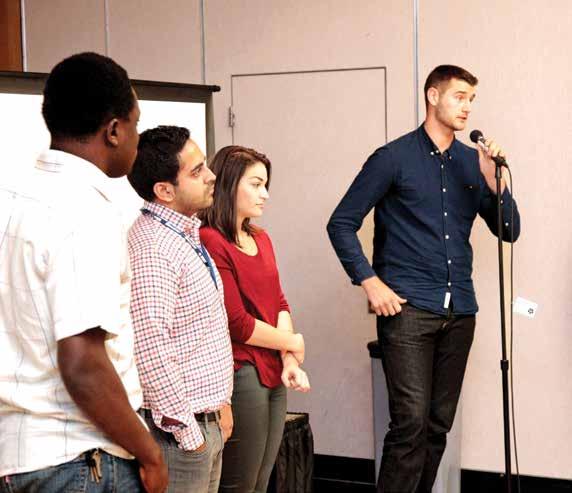
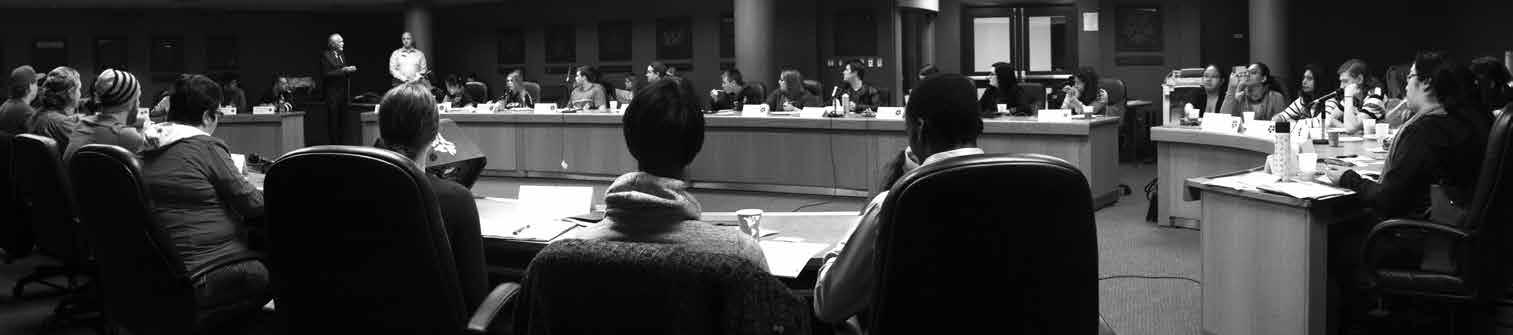
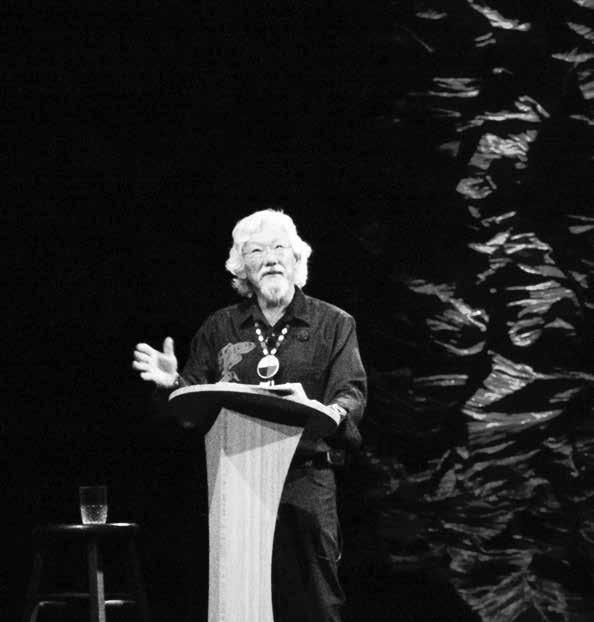
David Suzuki stops in Winnipeg to discuss the importance of the environment
Pages 7 & 14
Volunteer Contributors
MANITOBAN
A “volunteer staff” member is defined as a person who has had three volunteer articles, photographs, or pieces of art of reasonable length and/or substance published in three different issues of the current publishing year of the Manitoban. Any individual who qualifies must be voted in by a majority vote at a Manitoban staff meeting. Elected representatives and non-students may be excluded from holding votes as volunteer staff members in accordance with the Manitoban Constitution. The Manitoban is the official student newspaper of the University of Manitoba. It is published monthly during the summer and each week of regular classes during the academic year by the Manitoban Newspaper Publications Corporation.
The Manitoban is an independent and democratic student organization, open to participation from all students. It exists to serve its readers as students and citizens.
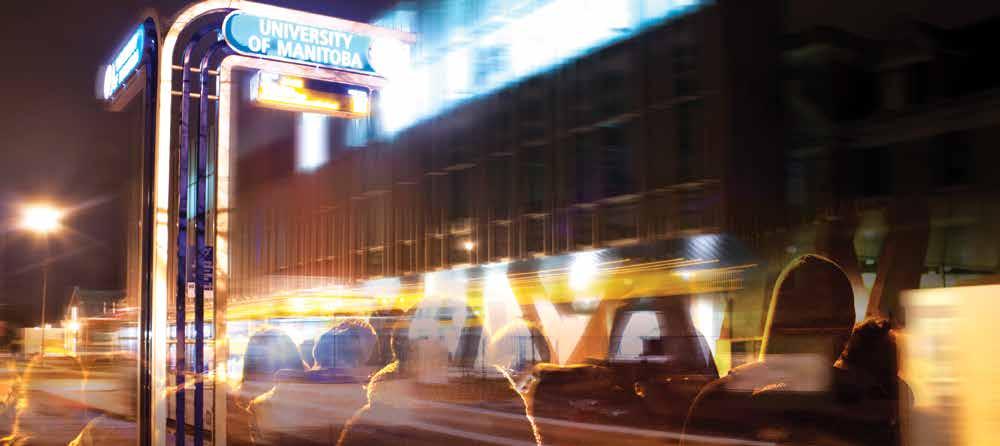
New mayor, St. Norbert councillor support U-Pass, bus rapid transit expansion
E T han Ca BE l, staff
Winnipeg is under new management, and citizens, along with University of Manitoba students, can expect big changes over the next four years.
That is the message of mayor-elect Brian Bowman, the 43-year-old privacy lawyer. With 111,504 votes (47.5 per cent ) Bowman won the race for mayor last week over a crowded field of candidates that included former frontrunner Judy Wasylycia-Leis, a past New Democratic Party member of parliament and member of the legislative assembly.
“This was a clear demonstration that Winnipeggers were ready for positive change,” Bowman told the Manitoban
“You can win a campaign without having to sell out and become part of the problem and part of the old-school negative politics that previously [have] worked and been very effective.”
Bowman, who proposes to raise property taxes no more than the annual rate of inflation, ran on a detailed platform that included a plan to bolster investment through a bigger tax break for small businesses and a vow to have all six of the city’s proposed bus rapid transit lines built ahead of schedule, by 2030.
In a month that will see a critical referendum period on the U-Pass—a subsidized bus pass for University of
Winnipeg students and University of Manitoba undergraduate and graduate students slated to be included in the cost of tuition – the mayor-elect expressed support for the student-led proposal.
“I fully support it and I’ll do whatever I can to make sure that it happens sooner rather than later,” he said.
Bowman added that bus rapid transit—including transit-oriented housing and commercial development—is an integral part of his agenda for the next four years.
“For those Winnipeggers concerned with suburban growth and suburban sprawl, this really is a significant piece of the puzzle when it comes to growing up as much as we’re growing out.”
Bowman has big plans on issues that resonate with students and young professionals: high-density development, a strengthened technology sector, and an improved transit system. Two experts interviewed by the Manitoban —political analyst Curtis Brown and city politics expert Jino Distasio—argued that the mayorelect could face an uphill battle to fund these measures without a substantial tax increase – let alone to get them passed by city council.
“He has no specific political experience,” said Brown, vice-president at Winnipeg-based polling firm Probe Research. Brown added that the city faces a severe budget shortfall in 2015.
“This is his first full-on, true elected office and I think there is going to be a very steep learning curve for him just in terms of figuring out how things work and how to get his agenda passed.”
Beyond the change in the mayor’s office, Winnipeg voters—traditionally known for returning incumbents to city council—generated vast turnover, booting out three incumbents: Thomas Steen (ElmwoodEast Kildonan), Grant Nordman (St. Charles), and Harvey Smith (Daniel McIntyre).
In addition to these changes , city hall governance is slated to change considerably under Bowman.
The mayor-elect has vowed to only appoint councillors to his executive policy committee (EPC)—the mayor’s de facto cabinet—that are elected by a majority council vote. This means that, unlike his predecessors, he will be unable to handpick the members of his inner circle.
“The mayor is a pretty powerful person, but at the end of the day they have one vote” – Jino Distasio, University of Winnipeg associate vicepresident of research and innovation
“The mayor is a pretty powerful person, but at the end of the day they have one vote,” said Distasio, associate vice-president of research and innovation at the University of Winnipeg. Distasio argued that relationship building will be crucial to any policy success Bowman may have over the next four years.
“He needs to figure out a way to surround himself with councillors— regardless of EPC or council floor— that are going to support his ideas.”
Bowman expressed optimism in his abilities: to work with council to get his long list of priorities accomplished and encourage educated young people to stay in Winnipeg after they graduate from university or other post-secondary institutions.
“There is no single answer to attracting or retaining the best and
brightest young minds in the city,” said Bowman, a U of M alumnus.
“But really it’s going to come down to making sure there’s a growing, thriving economic development initiative and a lot of good, high-paying jobs here in Winnipeg.”
According to data from the Canadian Socioeconomic Information Management System database by Statistics Canada for 2011-2012, four major prairie cities—Regina, Saskatoon, Edmonton and Calgary—have experienced a net gain in migration among people between 20-29 years-of-age. On the other hand, Winnipeg has experienced a net loss.
Student unions respond
In response to the civic election, UMSU and the University of Winnipeg Students’ Association (UWSA) reacted differently.
“We supported the vote and the democratic process but we certainly did not endorse a candidate because we knew we’d have to work with whomever won,” said Al Turnbull, UMSU president.
Turnbull added that he is hopeful UMSU can work with Bowman and new St. Norbert Councillor Janice Lukes when it comes to the U-Pass and other transit initiatives.
“That was a staunch contrast with the UWSA but, mind you, they wear their colours a little bit bolder or more apparently than we do here. We try to be inclusive to all students because we know a lot of the students have voted for different candidates across the board.”
Rorie Mcleod Arnould, UWSA president, expressed disappointment in the results given the election of several right-of-centre candidates, singling out Jeff Browaty (North Kildonan), Russ Wyatt (Transcona), and Scott Gillingham (St. JamesBrooklands) for scrutiny.
“Generally speaking, I don’t think that they represent the politics of the
future, the politics of tomorrow, the politics that will make our city a more interesting, dynamic, attractive, magnetic environment for young people,” Mcleod Arnould said.
He added that left-leaning candidates like Jenny Gerbasi (Fort Rouge) and Ross Eadie (Mynarski)—both backed by the provincial NDP in 2010 and the Canadian Union of Public Employees and the Winnipeg Labour Council in 2014—better fit that description.
A new face for St. Norbert
St. Norbert—the city ward that includes the U of M—also has a new councillor after last week’s election.
Janice Lukes, a former community assistant for past St. Norbert councillor Justin Swandal, won the seat. Lukes told the Manitoban she is committed to working with UMSU and other student groups to facilitate greater communication between students and city council.
“I would like to be able to regularly engage and understand what some of the student issues and challenges are and opportunities they see,” she said, adding that the key to keeping young people in Winnipeg is economic development.
“We have to have job opportunities. So this council, going forward, we must focus on economic development and generating economic revenue that will help us create a vital, exciting city to live in.”
Lukes brings transportation expertise to the job, having served on the active transportation advisory committee that informed the first phase of the city’s rapid transit plan. When it comes to assessing Bowman’s broader rapid transit plan, Lukes told the Manitoban that she believes it ambitious, and an “encouraging sign.”
“If he is thinking that far ahead, that inspires me,” Lukes said of Bowman’s plan to build the six-bus rapid transit lines by 2030.
by
Photo
Carolyne KroeKer
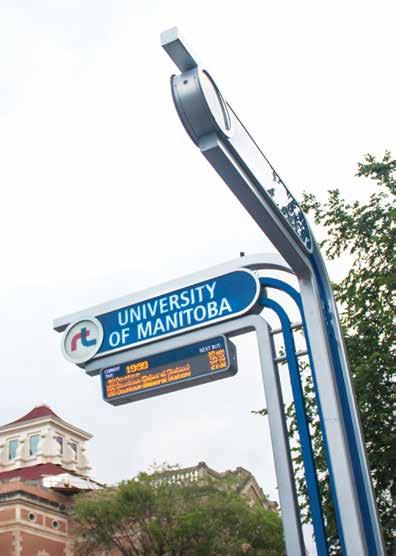
The future of the U-Pass, public transportation on campus
Forum provided evidence-based insight on transit questions
Dana h aT h E rly, staff
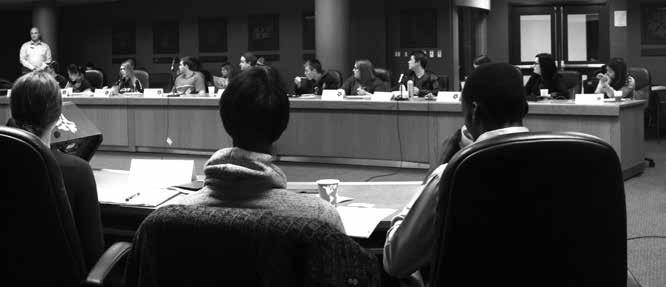
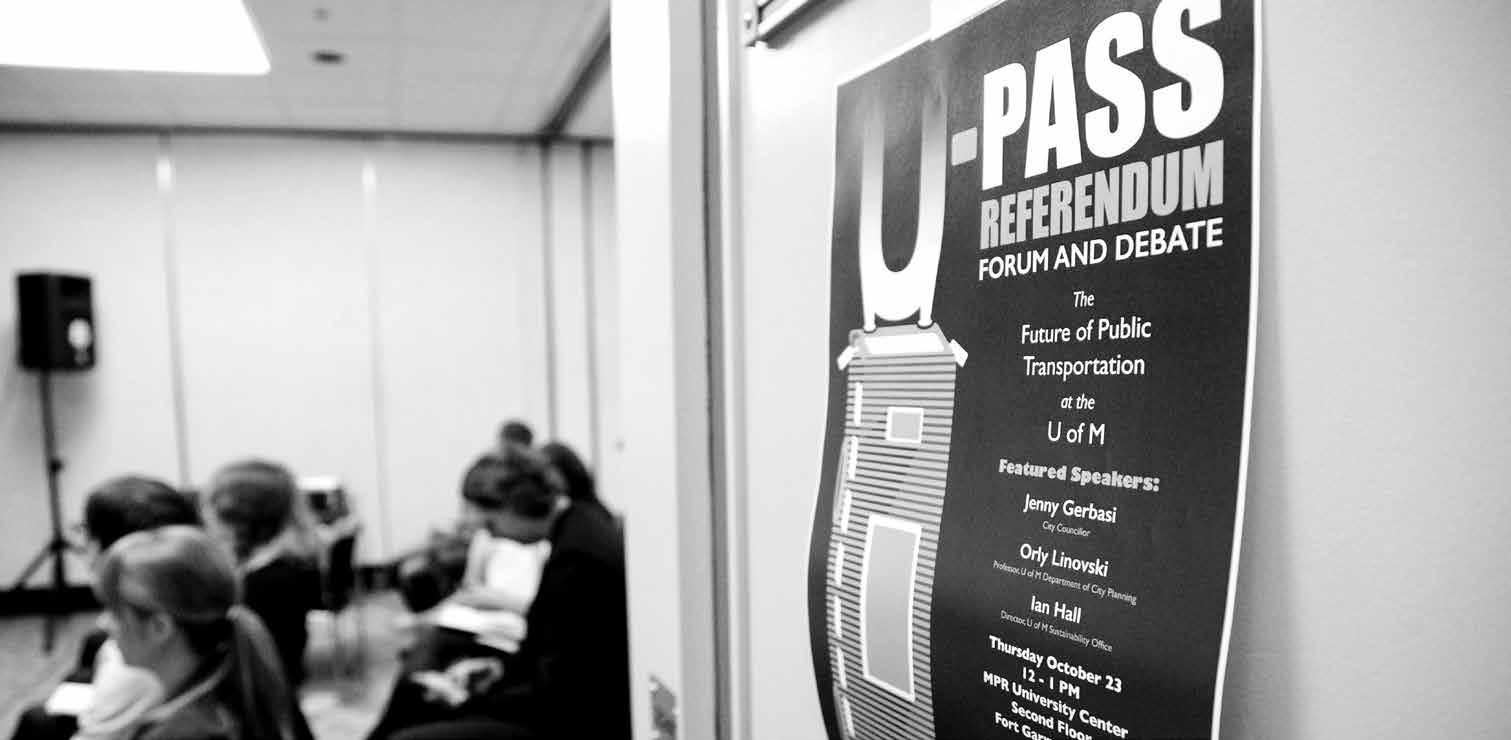
In light of the upcoming referendum in which students will vote to determine the outcome of the U-Pass, the U-Pass referendum forum was held to shed some light on the evidence and issues on each side of the debate. The Manitoban, University of Manitoba Graduate Students’ Association (UMGSA), and UMSU collaborated to host the forum about the future of public transportation on campus.
The Manitoban, alongside UMSU vice-president Christian Pierce and UMGSA president Laura Rempel, welcomed student participants, featured guests, and the spokespeople campaigning for and against the U-Pass.
The guest panel included Jenny Gerbasi, re-elected last week as city councillor for Fort Rouge-East Fort Garry; Ian Hall, director at U of M office of sustainability; and Orly Linovski, assistant professor of city planning at the U of M.
The UMGSA campaign representatives for the Yes side were Dan Penner, master’s student in the faculty of architecture’s department of city planning, and chemistry masters’ student Temilolu Idowu, and pharmacy doctorate Sarandeep Malhi for the No side. During his presentation, Malhi said that he was present to represent the students at the Bannatyne campus, who may not directly benefit to the same extent as students at the Fort Garry campus. Malhi said he was “about 80 per cent yes, and 20 per cent no.” The authorized representative from UMSU for the Yes side campaign was Sarah Gerbasi.
The panel featured experts and
decision-makers with the capacity to influence the implementation of the U-Pass. The panellists were requested to speak to the question of the U-Pass, and provide students with their knowledge about it and the pros and cons grounded in evidencebased research. Following the expert panellists, representatives from the Yes and No sides of the U-Pass debate presented about their campaign position on the U-Pass. The event then proceeded to voting information and a question period.
Students were invited to write down questions on index cards provided upon arrival at the forum and specify who they requested to answer the question; or panellists who had a response provided them. Pierce and Rempel were also on hand to provide insight from their position on their respective councils.
The upcoming vote
On Oct. 28-30 and Oct. 29-31, respectively, UMGSA and UMSU members will be eligible to vote in a referendum to determine whether or not the U-Pass will be implemented with other post-secondary institutions across the city.
Two executive terms ago, the first referendum gauged the will of the student body to buy into the U-Pass program. Seventy-four per cent of U of M students voted in favour of the U-Pass. Due to proposed rate increases since then, students will vote once again at the end of October to determine whether or not the U-Pass will be implemented.
“All UMSU members will be eligible to vote in the referendum.
Nearly all undergraduate students at the University of Manitoba are UMSU members. If you paid fees to UMSU on your university fee statement, you are an UMSU member and are entitled to vote,” according to the UMSU website. “Regardless of your opinion on the U-Pass, UMSU encourages you to come out and vote and make your voice heard!”
“We won’t act until after the referendum – now it’s in the students’ hands” – Al Turnbull, UMSU president
The referendum question posed by UMSU reads:
“Are you in favour of a mandatory universal bus pass (or U-Pass) that would: provide unlimited access to Winnipeg Transit services for students for the months of September to April inclusive; cost $260 per student to be adjusted on a yearly basis according to inflation; and have exemptions as determined by the City of Winnipeg and Winnipeg Transit for students living outside the city of Winnipeg and for students with special accessibility needs?”
The UMSU website previously read, “UMSU is currently lobbying the City of Winnipeg, the Government of Manitoba, and the University of Manitoba to invest in the U-Pass to ensure that the cost to
students is within the amount established by the U-Pass referendum.” At the time of publication, that content had been removed from the website. The Manitoban has yet to receive a response as to why this information can no longer be found. The site presently reads that, “UMSU Council voted on Sept. 29 to hold a referendum, in keeping with the motion put forward at city council, on a $260 U-Pass.”
Councillor Gerbasi and former Mayor Sam Katz motioned to city council to include the U-Pass proposal in the City of Winnipeg’s operating budget. At a price point of $260 plus inflation per student, the motion to support the U-Pass was passed—at least in principle—by city council on Feb. 4, 2014.
“The universal transit pass (U-Pass) is a transit pass that would give eligible students unlimited access to Winnipeg Transit services for fall and winter academic terms (SeptemberApril) for a set price,” according to information on the Canadian Federation of Students-Manitoba website. Students would receive these passes at a rate—comparable to other institutions nationally, and at cheaper rates for Winnipeg students—established through collective purchasing and government subsidies. The U-Pass has already been implemented in other cities across the country, with at least 30 universities and colleges across the country participating in a U-Pass program.
“We have been lobbying to try to get [the U-Pass] to that $170 price point. The price the city gave us was $260, and at that point the lobby-
ing ends,” said UMSU president Al Turnbull.
“We won’t act until after the referendum – now it’s in the students’ hands,” Turnbull continued, “We will see if the price point passes. Once that passes, we will lobby again to ensure that [the city upholds] that price. Once the city council had agreed that they would support it, I think the lobbying now can continue until we’re done.”
The experts
The forum organizers justified extending invites to these particular expert panellists on the basis of providing different approaches to the question of the U-Pass and evidence-based research from the various perspectives.
Councillor Gerbasi represented a voice from Winnipeg city hall in her capacity to convey her support for the U-Pass to other councillors, the former mayor, and mayor-elect Brian Bowman; direct the implementation of the U-Pass at the political level; and negotiate with Winnipeg Transit.
In terms of her vision for the city, Gerbasi’s campaign website reads, “Jenny supports a focus on highpriority community transportation needs and social amenities, such as fixing existing roads and sidewalks and future expansion of rapid transit including active transportation (walking and cycling) and developing a sound financial plan to make this a reality. Jenny is committed to championing the establishment of programs such as the U-Pass for stu-
Continued on next page
dents as well as investing in public transit to make our city more accessible and sustainable and improve quality of life.”
In a report from Gerbasi on the final budget recommendations to city council for this year she wrote that, “The long-term benefits of this will be developing a culture of lifelong transit use, increased ridership, affordability, decreased congestion, and greenhouse gas reductions.”
Ian Hall provided a local voice to represent the university community from the Office of Sustainability on campus.
According to the U of M website, the strategic vision for action plan launched by the Office of Sustainability in 2012 marked “a significant milestone in the university’s efforts to improve sustainability and operate in a way that respects and supports our environment. In an effort to become a leader in this regard, the University of Manitoba Sustainability Committee has developed a comprehensive action plan that sets out a number of goals and actions with respect to campus operations, planning and community engagement. This plan was based on “ideas and feedback received from the university community.”
The Office of Sustainability is working towards “a campus that promotes safe, sustainable and accessible transportation options to students, staff, faculty, and the university community,” read Ian Hall’s presentation.
Hall provided information about the various modes of transportation and statistical trends based on students’ use of private vehicles, transit, cycling, and as pedestrians. The 2014 student population totalled 29,648 students, as reported by Hall. Evidence from the Office of Sustainability shows that 33.6 per cent use transit, 31.5 per cent drive only, 20.2 per cent bike, 10.5 per cent carpool, and 4.2 per cent walk.
According to Hall, about 65 per cent travelled less than 10 kilometres. The average distance travelled by students in Winnipeg and
across Manitoba was just over six kilometres.
Hall presented that the number of driving commuters would be reduced therefore reducing the struggle for parking. With a total of 6,500 parking spots on Fort Garry campus, there are 3,000 permits on 2,340 spots at a rate of $67 per month. Only 26 per cent of parking stalls are for casual parking with 1690 spots at rates varying from $5-11 per day. There is no student parking for the Bannatyne campus.
“The long-term benefits of this will be developing a culture of lifelong transit use, increased ridership, affordability, decreased congestion, and greenhouse gas reduction” –Jenny Gerbasi, city councillor
The transit trends presented by Hall showed that more students are using transit now than in earlier years. In terms of transit arrivals on campus, an average of about 9,700 students rely on transit to arrive to campus daily. Hall reported that those numbers are typically “higher in winter” and “lower in summer.”
Hall also presented about the capacity of transit in regards to citywide on-time performance and accessibility. On average, he reported that 75 per cent of buses ran on time, 15 per cent ran late, and 10 per cent were early. Winnipeg Transit estimated that 90 per cent of Winnipeg households are within 400 metres of transit routes.
The graph used in his presenta-
tion showed that there has been a steady increase in the proportion of students who purchase monthly passes. Since slightly more than 10 per cent of students bought passes in 2000-2001, the numbers for 20132014 show that over 25 per cent of students bought monthly passes.
Orly Linovski spoke from a city planning perspective. Laura Rempel justified the organizers’ decision for hosting Linovski, telling the Manitoban that a city planner would provide an unbiased and critical evaluation of the implications of the U-Pass at the city level.
Linovski stated that “unlimited transit access programs are widespread across Canada and North America.” According to Linovski, the benefits of the U-Pass are to reduce parking demand, increase public transit ridership, and increase transportation equity.
In terms of parking, Linovski pointed out that fees do not typically factor in the costs of building and maintaining parking.
Linovski also presented evidence from other cities which demonstrated that U-Pass programs are usually associated with increased ridership. She explained that the implications for this are reduced fares, improved transit service, “more familiarity with [the] transit system,” and “more groups travelling together.”
Linovski presented on the potential equity benefits achieved “through access, affordability, and possible service improvements.” The benefits are likely to impact non-drivers, those who “tend to be lower income,” are “transportation disadvantaged,” and will generally “improve basic mobility,” Linovski reported.
The limitations of the U-Pass were addressed by Linovski, who said that “transit quality impacts ridership—though not as much as you would expect—[and] service should be increased to accommodate higher ridership.”
Photos by beibei lu
“Vote – anywhere”
U of M’s advanced polling station saw 290 people cast ballots for the municipal election
Craig aD olph E , staff
The University of Manitoba campus’s advanced polling station stayed open over a span of three days—Sept. 30 to Oct. 2— during which 290 people cast ballots for Winnipeg’s 2014 municipal election.
The station was located in room 112 on the main floor of University Centre – off the tunnel to the Engineering Building. Polls were open from 9:30 a.m. to 3:30 p.m. on Tuesday, Sept. 30 and Thursday, Oct. 2 and from 12:30 p.m. to 6:30 p.m. on Wednesday, Oct. 1.
A polling station set up at the U of M over a span of two days for the 2010 municipal election saw a similar turnout, with 293 people having voted. Marc Lemoine, senior election official for the City of Winnipeg’s city clerk’s department, provided the voter turnout figures to the Manitoban Advanced polling stations were identified as a success story in the 2010 municipal election when 30,000 people showed up to
vote before the day of the election, doubling the number of advanced voters compared to the 2006 municipal election and accounting for approximately 15 per cent of the total ballots cast in the 2010 election.
This time around the voter turnout increased slightly while the number of advanced ballots cast stayed the same, sitting just above 30,000.
At advanced polling stations –branded “vote – anywhere” locations by the city – people were able to cast ballots regardless of which ward and school division they would be casting ballots for. Normally voters are required to go to a specific polling station where ballots are cast for the local candidates. This model was meant to encourage increased voter participation.
However, no polling stations were set up at the U of M on the day of the election.
UMSU Council fills vacant representative seats
Aboriginal, international, and students living with disabilities representatives appointed
Craig aD olph E , staff
On Oct. 14 UMSU Council filled three empty community representative council seats by appointing new students to fill the aboriginal, international, and students living with disabilities representative positions.
The appointments were made in accordance with bylaw 3350 from UMSU’s bylaw manual. The bylaw lays out the circumstances in which UMSU Council can vote to appoint a new councillor and the procedures for doing so.
“1. If a position remains vacant after the Annual General Election, nominations to fill the position by appointment of council shall reopen on October 1.
“2. If a position becomes vacant through any other means after or during September and before March, nominations to fill the position by appointment of council shall be reopened on the first of the next month.
“4.b. If, by the end of the nomination period [ . . . ] one or more people have been nominated, council shall decide by voting after a presentation by each of the nominated candidates. Council shall also request the perspective and input of community members associated with the position. The candidate with a plurality of votes shall be considered appointed to the position.”
Two of the representative positions—aboriginal and international students’ representatives—went unfilled during the last UMSU election period. The students living with disabilities representative position was left vacant after Matthew Riesmeyer, who won the seat in March, resigned.
Posters were put up and advertisements placed in the Manitoban to publicize the aboriginal and international students’ representative positions and the one-week window that existed—from Oct. 1 to Oct. 7—for candidates to selfnominate through letters of intent sent to UMSU Council’s secretary. When the position of students living with disabilities representative was added to advertisements that were released in the Manitoban’s Oct. 8 issue, the nomination period for the other two representative positions were extended to Oct. 14.
The nomination period for aboriginal and international students’ representative lasted a week longer than
specified in point 3 of bylaw 3350, which states that it should last one week, but no candidates have voiced any concerns about the extended nomination period.
Posters for the open council positions notably used the Refresh slate’s logo in place of UMSU’s logo.
Candidates for the three representative positions were invited to attend the Oct. 14 council meeting where they were given an opportunity to present themselves to the council. After all the candidates had spoken the council went in-camera and all non-councillors, including candidates, media, and students-at-large, were asked to leave the room so they could deliberate and proceed to vote.
Aboriginal students’ representative
During last year’s election, after no candidates had applied for the aboriginal students’ and women’s representative positions, UMSU’s CRO Jacqueline Keena extended the nomination period by a week for those positions in the hopes of attracting candidates. In that week Reanna Blair and Ninia Ogbuji entered the race for women’s representative, with Blair winning the seat. However, no candidates stepped forward to run for aboriginal students’ representative and the position remained unfilled.
This October three candidates selfnominated for the position of aboriginal students’ representative. They included Will Landon, Destinee Comegan, and Lionel Daniels.
Comegan and Daniels both offered written submissions for the nomination process. Landon appeared at the council meeting in person and spoke about what he thought he would bring to the position of aboriginal students’ representative, and ended up winning the seat.
Landon told the Manitoban that he hoped to improve dialogue between indigenous and non-indig-
enous students and to build relationships between UMSU leaders and indigenous leaders on campus.
Landon emphasized the importance of dialogue and partnerships in tackling issues important to the indigenous community.
“We face a social environment that often has misinformation that leads to negative [views] of us. The barriers that block communication and understanding must be broken to create a strong community. That is [a] responsibility all students must take on.”
International students’ representative
Astitwa Thapa was the only applicant for the position of international students’ representative. Thapa was one of two candidates who had originally registered to run for international students’ rep in March’s election, along with Munashe Gudu, but both candidates dropped out of the race before the election, leaving the position vacant.
According to Thapa the lack of opposition candidates should not be taken as a sign of disinterest from international students.
“Quite a few people asked me if I was running or not and that’s when I made it clear that I am running [ . . . ] people didn’t put in their [names].”
Thapa is the president of the Nepali Students’ Association and is serving as student senator for the Clayton H. Riddell faculty of environment, earth, and resources.
He was also a leading organizer of the student protests against the faculty of engineering’s admissions policy that took place over the summer.
Thapa said one of his goals for his term is to bring back the international student caucus – a group where international students can discuss pertinent issues. Thapa told the Manitoban that the caucus has existed as a part of UMSU for several
years but that recently it hasn’t been meeting regularly.
“The international student caucus is a caucus which [is supposed to meet once every] 15 days. They decide on what should be done or what are the issues that concern international students. It plays an important role in generating awareness about issues on visas, issues on work-permit regulations, [and] on health issues – or, for that matter, providing international students with basic services: if they’re feeling homesick or they’re feeling depressed [and] they have nowhere to go.”
Promoting intercultural events was another priority for the new international students’ rep.
“You have one event right now, that, if it’s an Indian event, there are only Indians going. If it’s a Pakistani event there are only Pakistanis going. My goal would be to increase the intermingling. So if it’s an Indian event we could likely [invite] a lot of Chinese students to come in,” said Thapa.
Students living with disabilities representative
Five candidates competed for the position of students living with disabilities representative. The five candidates were Alan Bridgeman, Andrew Fenwick, Boris Degas, Daniel Tingskou, and Stephanie Croy.
Four of the candidates were in attendance on Oct. 14—with Degas unable to attend, but having sent a letter—and spoke to the council about what they would bring to the position. After council’s vote, Fenwick was appointed to the representative position.
Fenwick has served as the accessibility representative for the Arts Student Body Council since May and also previously served as the youth ambassador for the Children’s Rehabilitation Foundation.
“I hope to accomplish a lot but my main goals are to fix the elevator in
Fletcher Argue, make sure all ramps and thresholds are up to standards, and make a seminar mandatory for professors,” said Fenwick.
“I would also like to be a voice for the students living with disabilities but I feel like people aren’t really [ready] to talk about problems they face, so I’ve found problems such as the elevator in [Fletcher Argue] and I am pursuing that.”
Last year Matthew Riesmeyer won his position in an election against Rocco Scarcella, but has since resigned.
Scarcella decided not to seek the open council rep position but spoke to council prior to the vote about the high calibre of the candidates who were running and the significance of having so many candidates running for the position.
“Traditionally either the position would remain vacant or one person would run for it. To have four candidates is actually a pretty big deal,” Scarcella told the council. “So I don’t envy your job in selecting one.”
Fenwick echoed that sentiment when he spoke to the Manitoban “I think it is awesome that so many people ran for the position. Accessibility is a huge issue that I don’t think gets enough attention. So having so many people out for the position was amazing to see.
“Everyone who ran would’ve made a great representative. They were all bright, driven, and willing to make a difference. Everything that was brought up was awesome.”
VP advocacy’s reaction
UMSU vice-president advocacy Rebecca Kunzman said she was extremely happy with the number of candidates who stepped forward to fill the vacant council seats.
“I’m very pleased to have all three positions filled. I think it’ll help to reflect a better representation of diversity on our council and I’m very excited [about] moving forward with a full council,” said Kunzman.
Kunzman also expressed hope that the candidates who had not won seats would continue to stay involved with UMSU initiatives such as the student union’s new campaigns series.
“We’d love to have those individuals who did come out today and show that initiative, and took the time to prepare a speech and run for the position, still involved regardless of the outcome of the election.”
by
Photos
Carolyne KroeKer
David Suzuki’s environmental movement moves Winnipeg
Reflections on treaty rights, human rights to a healthy environment
p hilma S C h EE p E r S , staff
Renowned Canadian scientist and environmental activist David Suzuki’s Blue Dot Tour made its way to Winnipeg—and to the University of Manitoba campus— on Friday, Oct. 24.
The first part of the Winnipeg stop included an event held at the U of M’s Great Hall in University College, which featured indigenous ceremonies as well as panel dialogues on indigenous environmental stewardship and Aboriginal and treaty rights in Manitoba.
Suzuki was honoured by the indigenous community for his “leadership in protecting the sacred land and for being a strong voice and advocate for aboriginal and treaty rights.”
“It was very clear that his entire campaign and the people who are on that campaign tour with him are very dedicated to the indigenous [component] of environmental stewardship,” said Amanda Fontes, the U of M Science Students’ Association’s indigenous representative.
Fontes told the Manitoban that she was very impressed with Suzuki’s appreciation for and indigenous perspective on the environment.
The discussion panel at the afternoon event on campus included U of M president and vice-chancellor David Barnard; elder Dave Courchene Jr.; assistant professor of law Aimée Craft; and human rights and environmental protection author and expert David R. Boyd. The event moderator was widely-known indigenous Canadian politician and lawyer Ovide Mercredi.
The conclusion of the discussion panel was led by Stewart Hill, secondyear PhD student of water studies at the U of M’s Natural Resources Institute, with a summary of the conversations. Hill is part of CREATE H2O, a science-engineering research training program that combines water management training with indigenous theory and law.
“Part of our responsibility as an indigenous people is to protect the environment,” Hill explained. He added, “The creator formed this earth and we have to live in it and take care of it.”
Economic compromise
During the event held at the Burton Cummings Theatre on Friday night, Suzuki explained that the four elements—earth, air, fire, and water—are referred to by indigenous people around the world as sacred and beyond economic valuation.
“The conflict between economic development and environmental stewardship is very obvious, and I think anybody can see that,” Fontes told the Manitoban. Fontes stated that any time that a country or a group of people wanted to move forward economically, there had to be compromise somewhere, and the compro-
mise always seems to involve either human rights or environmental rights.
“We need to figure out a way to move forward economically while still protecting our fundamental rights,” Fontes said.
“It’s not about hindering the economy,” said Suzuki during his speech. “Environmental rights often improve economic performance.”
Hill used an example from his community in Gods Lake Narrows, Manitoba to explain the conflict between economic policy and environmental stewardship. “In Gods Lake there is gold running through our area, coming in from Ontario. We are a poor community so we need to consider the jobs but we also don’t want to destroy the land.”
Suzuki brought up another example concerning the Haida people who have traditionally occupied territories in British Columbia and continue to face extreme poverty and unemployment. Suzuki explained that even in the face of all these difficulties, when approached with the prospects of logging on their land, although it would bring jobs and money to their community, the Haida resisted.
“I applaud the indigenous communities for all the work that they have done in protecting the environment because they truly have an appreciation that other Canadians don’t necessarily have,” Fontes told the Manitoban.
A healthy environment is a right
The ultimate goal of Suzuki’s Blue Dot Tour is to amend the Canadian Charter of Rights and Freedoms to include the right to live in a healthy environment. According to Suzuki, Canada is falling behind the rest of the developed world as, unlike most other wealthy industrialized nations, it does not yet include an environmental policy in its charter.
“To me, the concept of sustainability is the long-term commitment of society to ensure that no generation suffers a decrease in opportunity or fulfillment of basic needs. There can be no need greater for any of us than a healthy environment,” Suzuki said.
“Recognition in the charter is the final step in protecting the right to clean air, fresh water, and healthy food for all Canadians. This ensures that we all benefit from a healthy environment, world-class standards, and a say in the decisions that affect out health,” reads the Blue Dot Tour website.
Environmental hazards and toxic pollution disproportionately affect people on the lower end of the socioeconomic scale, said Suzuki. He went on to explain that this is why a campaign for environmental rights is also a campaign for human rights and social justice.
Proactive activism
“The term ‘activist’ is a little intimidating because it has a very strong connotation, meaning you have to step up and be a leader when that’s not for everybody,” Fontes told the Manitoban
“I’m not the kind of person who is going to ride my bike to school at minus 40 degrees, but I am very diligent when it comes to recycling and water consumption.
“It’s really quite simple,” Fontes explained. “Any activity that you do that helps the cause makes you an activist; it doesn’t need to be drastic.”
“I’ve never been much of a leader. I’ve always been the guy who stays in the background,” said Hill. He went on to state that, “I believe that it’s encoded in us how to be human; we just need to embrace that. There’s an inherent understanding in each of us on how to respect our environment.”
It is time for the indigenous community in particular to become active and to start standing up for their rights when it comes to the environment, Hill told the Manitoban
“We are a very deserving people and we need to start working toward equality and fighting for our rights. Everyone deserves a good life no matter who they are, and part of that is protecting the environment we live in.”
The environment is a difficult thing to take action on and get fully united behind because of its scale, said Fontes. “In changing the constitution, we are taking that one big step that needs to be taken because it makes the entire country accountable for the environment.”
Photo by Carolyne KroeKer
Comment Editor: Tom Ingram Contact: comment@themanitoban.com / 474.6529
Voting on the U-Pass
A look at some of the issues regarding the U-Pass referendum
Tom i ngram, staff
This week, UMSU members will vote on the issue of a proposed mandatory universal bus pass for students. UMGSA is also holding a similar referendum on whether to pursue the U-Pass. By the time this article hits newsstands, the University of Winnipeg Students’ Association will be finishing their referendum.
With the date of the UMSU vote fast approaching, I’d like to look at the arguments for and against the pass. The benefits of the pass are wellknown. For students who take public transit to school (around 50 per cent of University of Manitoba students and 70 per cent of University of Winnipeg students, according to a city spokesperson), it would represent a significant savings – the proposed cost is $260, which works out to $32.50 per month from September to April. The cost of a monthly post-secondary student pass is currently $67.75.
It is likely that many students who do not take public transit would begin to do so. This would reduce vehicle traffic on the roads and possibly take some of the burden off of the U of M’s parking lots. It would also encourage students to take public transit to places other than the university.
But it’s not all sunshine and roses. Let’s take a look at some of the arguments that have been presented against the U-Pass.
Legitimacy
One of the most prevalent arguments against the U-Pass since it was first resurrected in 2011 is that it is unfair. As a mandatory pass with limited opt-out options, it would require students who drive to school to pay for a service they don’t use –effectively, some have argued, forcing them to subsidize the transportation choice of other students.
Why should you pay for a service you don’t use? An article by Foster Lyle published in the Manitoban two years ago makes an argument along these lines.
“If UMSU gets their way students will be unfairly forced to pay into the transit system,” Lyle wrote. “I’ve never seen a movement of this type to subsidize car insurance costs, or parking pass prices for those students who choose to drive, and I’m sure I never will.”
Lyle argues that he should not have to be subjected to UMSU’s influence in deciding how to come to school. The decision should be a private one, taking into account only one’s own resources and preferences.
“Students should be able to pay their hard-earned dollars into whichever system works better for them,” so the choices of others are irrelevant to my choice.
This kind of a la carte model of student services, which is the logical conclusion of this argument, only works if every student has his or her own relationship with UMSU limited by very strict rules. A U-Pass would violate these rules unless
there were some equivalent benefit for students who drive. Any interest that UMSU or Winnipeg as a whole would have in encouraging students to take transit is irrelevant.
The problem with this argument is that an improvement to public transit represents a benefit to the community over and above the benefit to each individual transit user – and in this respect the U-Pass is unlike a hypothetical subsidy for student car insurance or parking.
Paying for things you're not going to use so that the group as a whole can benefit is part of the price of belonging to any community
When you attend a university you are, like it or not, buying into the campus community and to some extent the city as a whole. To say that UMSU or Winnipeg as a whole have an interest in encouraging transit use is to say that each UMSU member and Winnipegger has that same interest.
Arguments like Lyle’s are essentially attempts to dodge certain responsibilities of community membership by construing the individual student’s relationship to the student body through UMSU as an exclusively financial one. Such an evasion of responsibility will not wash. Paying for things you’re not going to use so that the group as a whole can benefit is part of the price of belonging to any community.
Practicality
A more plausible argument against a U-Pass is presented in the second half of Lyle’s article. Any frequent transit user knows that getting from any part of the city to any other in under an hour is difficult – sometimes impossible. At peak hours passengers are often turned away by buses that are already dangerously overfilled. At non-peak hours, buses come infrequently and are so consistently late you could set your watch by them. Late at night and early in the morning they don’t come at all.
At the current level of service, Winnipeg Transit cannot handle the drastically increased passenger load that would be the inevitable result of a U-Pass. A Winnipeg Transit report in 2013 said that it would be necessary to operate more buses and hire more staff to meet an estimated 20 per cent increase in ridership.
The reason we are having the present referendum is to determine whether students accept the increase in the proposed cost of the pass. This increase is necessary to close the funding gap caused by the Winnipeg
Transit upgrades.
One hopes that these improvements will indeed be sufficient, but the precedent is not good. The Rapid Transit corridor, touted as a major improvement in the city’s transit system, turned out to reduce commute times by a staggering “not very much,” while almost cutting off one section of Pembina Highway from bus service and ignoring more than half the city.
It would be all too characteristic of our city if, instead of increased service to meet increased demand, we saw more people being left behind at stops by clown-car buses running 15 minutes late. We have to decide this week whether to pay into the program, and there is no way to tell at this point whether Winnipeg Transit’s proposed improvements will be adequate. An objection to the U-Pass on grounds of practicality seems more reasonable.
I encourage all eligible students to vote in the referendum according to their conscience. But I ask that we all keep these considerations in mind when we go to the polls.
The UMSU U-Pass referendum is being held from Oct. 29-31 at various locations on campus. The UMGSA referendum is being held from Oct. 28-30 with online voting.
Photo by Carolyne KroeKer
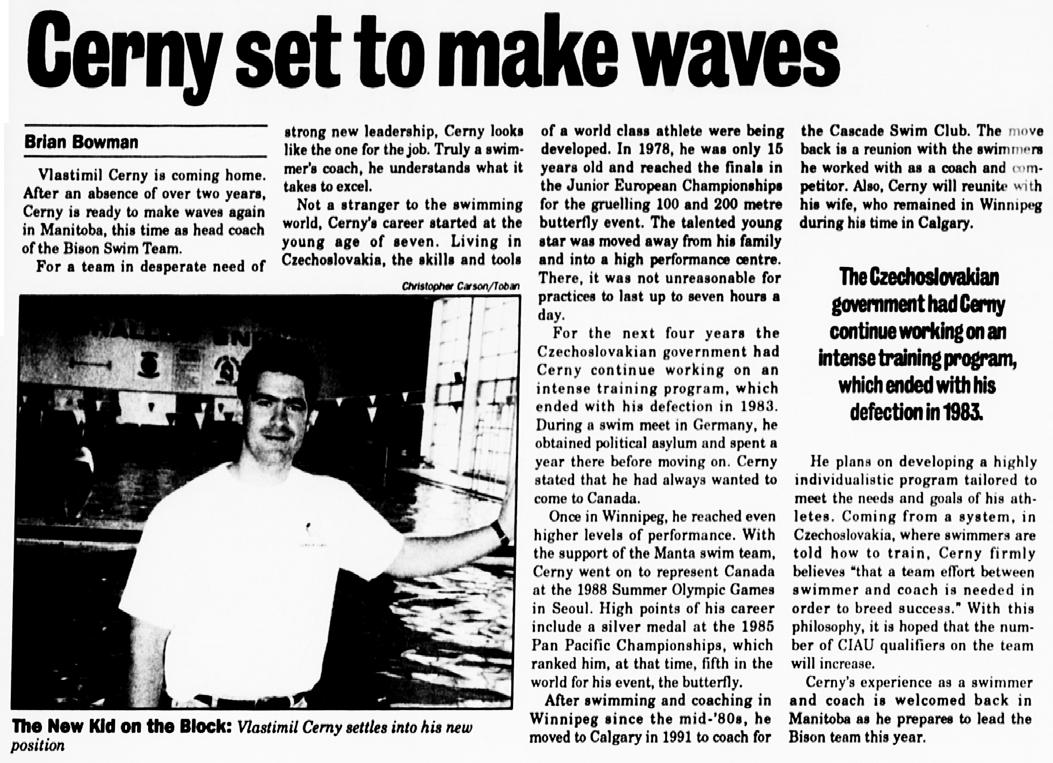
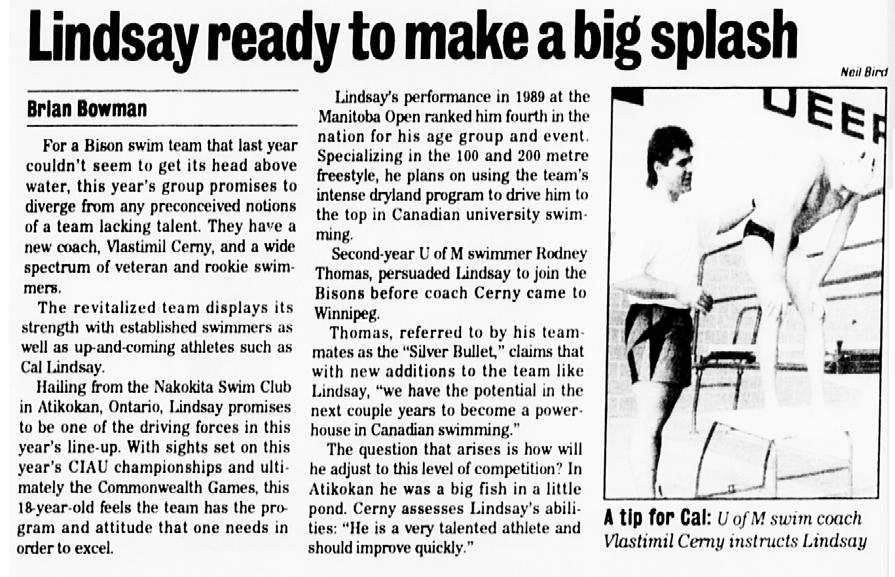
Mayor-elect Brian Bowman used to write for the Manitoban. His first article for the Manitoban, written in Aug. 1993, was a profile of then incoming swimming coach Vlastimil Cerny, who, 20 years later, is the current head coach of the team. He first made the front page with an article coauthored with Chris Zuk, who now manages sport information and media relations for the Bisons.
True North deserves a shout out, but not during the anthem
Alteration of the anthem signals disrespect for Canada
Fra SE r nE lun D, staff
Canada’s national anthem can be heard at every game the Winnipeg Jets play. At home, and sometimes away, crowds full of enthusiastic fans shout “True North” much louder than they sing the rest of the words. This is followed by cheering. The “shout out” is intended to acknowledge the contribution of True North Sports and Entertainment Ltd. (TNSE) to Winnipeg, the return of a professional hockey franchise. The “shout out” devalues the anthem.
True North Sports and Entertainment Ltd. did not orchestrate this custom, nor have they actively encouraged its progression.
The tradition came to life soon after the Atlanta Thrashers franchise was bought by TNSE and the NHL returned to Winnipeg. The current phenomenon purportedly began with one voice at the Jets’ first season opener, in 2011.
In Canada the NHL voluntarily has team anthems performed before games begin. The Government of Canada’s website says “there is no specific rule as to when it is appropriate to sing the national anthem at an event.”
Emphasizing the role of a corporation while performing a ceremony meant to be a declaration of patriotism obfuscates the pride we take in being a part of this nation
The choice evidences a sense of patriotism.
As far as Manitoban institutions go, TNSE is amongst those most deserving of respect. The return of professional hockey to Winnipeg has given Winnipeggers the opportunity to gather and share experiences. True North Sports and Entertainment Ltd. has a charitable arm—True North Foundation—with deep community ties, demonstrating a commendable commitment to good causes around the city. The corporation has done, is doing, and will continue to do great things for Winnipeg. Its reputation for upstanding corporate citizenship is well-deserved.
Singing the national anthem signals a sense of community and a feeling of kinship with all citizens of our nation. The insertion of an acknowledgement of even the most worthy corporation acts counter to the purpose of the anthem’s performance. Emphasizing the role of a
corporation while performing a ceremony meant to be a declaration of patriotism obfuscates the pride we take in being a part of this nation.
Freedom is as much at the core of being Canadian as respect is. I am not attacking people’s right to free speech. It is proper that the choice of whether or not to interrupt the anthem is, as the Government of Canada holds, “left to the good citizenship of individuals.”
True North Sports and
Entertainment Ltd. is a corporation; to purchase their products, be they tickets or Jets paraphernalia, is to be appropriately supportive of the organization. To scream support during Jets games or at nearly any other time is just fine. The benefits TNSE has brought to Winnipeggers quite rightly inspires more than just brand loyalty.
The True North Foundation runs numerous charitable events where Winnipeggers can further
reward and encourage the behaviour of the organization. These foster community.
Participation in hockey culture and community building events comes at no cost to Canadian values.
The custom of interrupting the anthem in favour of cheering for a corporate entity undermines Canadian values.
I am not saying that if you have shouted “True North” you have less pride in Canada. The intention
behind the gesture’s rise to prominence, recognizing admirable action, is as laudable as TNSE itself. Musical memes are, by definition, catchy. Contemplation is seldom a sports fan’s duty.
I think it is a Jets fan's duty here, though.
Taking into account the nature of the symbolism involved, it is clear that there are more appropriate ways to say “Thank you.”
David Suzuki is a geneticist, environmentalist, and broadcaster from British Columbia. He is also, arguably, Canada’s ambassador for the environment.
Suzuki made two Winnipeg appearances on the Blue Dot Tour on Oct. 24. He discussed indigenous issues at the University of Manitoba in the afternoon, and in the evening went to the Burton Cummings Theatre for his main show.
For some people Suzuki is a beacon of hope, his voice a calm call for action. In his final national tour Suzuki has set the goal of protecting Canada’s future through our environment.
Gaining its name from an image of the Earth taken by the space probe Voyager 1, and as a nod to Carl Sagan, the Blue Dot Tour captures the sobering fact that our only home is this chunk of rock and water called Earth.
The Blue Dot Tour centres on the notion that Canadians have a right to live in a healthy environment. Clean water, safe food, and clear air should be available to every single resident of our country.
The main concern of The Blue Dot Tour is that Canada falls short when it comes to environmental action. The driving force of the tour is that change is possible through Canadians’ collective actions.
There are three main goals of this movement: the formation of stronger environmental laws, the better enforcement of existing laws, and a decisive adherence to these laws in the future.
The ultimate goal of the tour is seeing an amendment to the Canadian Charter of Rights and Freedoms addressing these concerns.
The Burton Cummings Theatre event featured special guests such as Sierra Noble, who gave a roots music take on this grassroots movement with her signature fiddle and beaming smile.
Winnipeg children’s musician Fred Penner started off his performance by sharing a core philosophy in his life.
“Never underestimate your ability to influence the life of a child,” Penner told the audience.
Penner then had the audience singing along to lyrics, such as,
“Home is where the heart is, home is where we learn to love,” and echoing the word “garbage” in a rendition of a song popularized by the late Pete Seeger.
Musical duo Cris Derksen and Tanya Tagaq improvised during their performance. Derksen’s cello and Tagaq’s throat singing formed a haunting piece from highs and lows.
Ovide Mercredi, a First Nations leader and University of Manitoba alumnus, spoke of the importance of accessible water and a healthy environment by telling a story of his hometown of Grand Rapids,
Manitoba.
The penultimate presentation of the night was a performance by the Royal Winnipeg Ballet, a beautiful piece which captured the environmental concerns of the tour and the tone of the night through dance.
Finally, Suzuki took to the stage. “Science shapes our stories,” he said, explaining both the wonderful and concerning things that he believes shape our existence as humans.
“The environment is embedded inside, within us,” said Suzuki as he implored the audience to view the environment not as an external entity,
but one that is a part of ourselves.
“Is soil a complex community of organisms, or simply dirt? Is another species our biological kin, or a resource?” Suzuki asked the audience.
“The way we see the world determines the way we treat it.”
The emphasis throughout was on enacting reform.
“If not us, then who?” asked Suzuki, shortly before concluding the night.
The Blue Dot Tour encourages Canadians to make a change to the way our nation regards the environment.
Photos by Carolyne KroeKer
Bacterial selection pressures and pressure for antibacterial selection
Researcher profile: Ayush Kumar
J E r E miah yarmi E , staff
A
yush Kumar is an associate professor in the department of microbiology. His research interests include infectious diseases and antimicrobial resistance. An alumnus of the University of Manitoba, Kumar completed his PhD in microbiology in 2004 and returned to the department in 2013.
In those years of absence, Kumar has noticed a shift in the way research is being carried out in the department. “Microbiology is still about microorganisms, but we are digging much deeper,” said Kumar. Part of this shift is due to the accessibility of modern molecular biology techniques.
“There are few stand-alone microbiology departments in the country,” Kumar explained, as he discussed his return to the University of Manitoba.
“There is so much complimentary research. The fact that you can interact with other graduate students and other faculty members on topics that you are interested in is really amazing.
“The interest of students is a good indicator of the health of the department,” Kumar told the Manitoban. Between major degrees, honours degrees, co-op placements, and research projects, microbiology students have a breadth of opportunities.
The Kumar lab has taken an interest in studying Acinetobacter baumannii , a pathogen that is particularly notorious for causing infections in individuals with compromised immune systems.
A. baumannii infections are of concern because this pathogen is resistant to almost every common class of antibiotics, and typically acquired in hospitals or health care settings, meaning it is nosocomial. Other common nosocomial infections include methicillinresistant Staphylococcus aureus and Clostridium difficile.
“This is the exact reason why the [Centers for Disease Control and Prevention] has classified this organism as a serious threat to human health,” said Kumar.
“I was really fascinated by the fact that it just accumulates antibiotic resistance mechanisms from the environment. It isn’t shy.”
Triclosan is an antibiotic compound that is found in many cleaning products, including toothpaste and soap. The use of triclosan and similar compounds is of interest due to the increasing
usage of antibacterial products.
Recent research from the Kumar lab has shown that triclosan treatment can result in A. baumannii developing resistance to many antibiotics in addition to triclosan itself. This resistance develops through an increased expression of a pump on its surface which shoots antibiotics out of the cell.
So why have we seen an increase in the use of antibacterial products like triclosan? Kumar believes it is partially due to the lack of microbiological education.
“Whenever you hear about bacteria in the news it is generally bad. There is this sense of paranoia in society. The whole idea of ‘I don’t want any bacteria on my telephone, or keyboard, or my skin,’ is driving this.”
When a person or company make claims about the bacteria present on an object or surface, the typical focus is the amount of bacteria present. Which bacteria are present is another story, and most of them are harmless.
“The way you see the growth of this antimicrobial product industry tells you that the paranoia is not going away.
“The problem is that we haven’t been able to, at the societal level, distinguish between good and bad bacteria. We know that one per cent of bacteria, or even less of what we can culture in labs, cause disease. Seeing bacteria on your domestic products is not a cause for alarm.
“We certainly need antibiotics, there is no doubt about that. If I went in for surgery tomorrow I’d need antibiotics. Otherwise, chances are I’d end up dying,” said Kumar.
“Evidence shows that there is no advantage of using triclosan in our homes. What it actually does is kill all of the good bacteria, and the bad ones survive.”
“The other key component is better infection control practices. Preventing the spread of pathogens is something we need to get better at. Another thing that we absolutely need is faster diagnostics.”
If you are interested in learning more from Kumar or about infectious diseases in general, he teaches a microbiology course titled “Mechanisms of Microbial Disease.”
Let’s Talk Science’s
Spooky Science Family Night
On Friday night, Oct. 24, the atrium of the Engineering complex was alive with excitement. Dressed in costumes, volunteers engaged children from grades four to nine in exciting, hands-on science activities with a Halloween twist. The event attracted approximately 200 Winnipeg children and parents to learn how to extract DNA from pumpkin innards, make “radioactive” slime using household products, sew a “scary” microbe, and learn about microbial anatomy using pipe cleaners and felt.
Who were these mad scientists dazzling participants with fun, educational activities? Let’s Talk Science is a national non-profit science outreach organization passionate about science literacy. Let’s Talk Science volunteers are University of Manitoba students from the faculties of science, engineering, business, art, and education.
This was the third annual Spooky Science Family Night.
“We started Spooky Science [Family] Night in 2012 and had 100 children and parents attend. Last year, in 2013, the number grew to 200. We are hoping for a similar turnout this year,” said Richard Jung, a site co-ordinator for Let’s Talk Science’s U of M branch
One of their most popular activities, Pumpkin DNA, involves children crushing pumpkin slime in a plastic sandwich baggy. This is a modification of their Strawberry DNA activity.
“You break up the cells mechanically like this,” explained the volunteer. The children were then instructed to add a mixture of dish detergent and water to break
through the fatty cell layer. After filtering the mixture into a small plastic cup, the volunteer added isopropyl alcohol while the child was instructed to stir the solution with a stick. Semi-transparent white goo began to collect.
“That’s DNA!” a volunteer explained as a child observed closely.
Who were these mad scientists dazzling participants with fun, educational activities?
In addition to the myriad science activities made available in the atrium, a Chemistry Magic Show took place at regular intervals throughout the evening – complete with liquid nitrogen, dry ice, and fire. The children shrieked with joy at the science happening before their eyes.
When the University of Manitoba branch of Let’s Talk Science was founded in 1999, they had as few as 10 members at the beginning. Fifteen years later, a sixperson co-ordinating team and 200 volunteers work together to deliver presentations, workshops, and activities to over 13,000 students across Manitoba.
Spooky Science Family Night is just one of many of their exciting events Let’s Talk Science has planned for next year. There
is no lack in diversity, with rural outreach, mall events, classroom activities, a high school summer camp, and, currently in the planning stages, the CancerTalk High School Symposium.
“We are partnering with the Winnipeg Jets True North Foundation to plan the CancerTalk High School Symposium,” said Jung. “It will be a fun day where students will have the opportunity to listen to leading researchers and oncologists debate, participate in ethical discussions, and visit a research facility.”
Jung hopes that showcasing the leading research in the province will show these students how much science has progressed in the battle against cancer. He hopes this experience may help students understand cancer and influence some of them to someday pursue a career in oncology to fight the disease themselves.
“Cancer is a disease that impacts every generation,” Jung remarked. From grade four children discovering how to extract DNA from pumpkin slime under the instruction of a volunteer wearing face paint, to high school students listening to leading researchers debate and discuss their research, Let’s Talk Science’s breadth and impact is impressive.
To learn more about Let’s Talk Science, their volunteer opportunities, or upcoming events, contact the co-ordinating team at lts.uofm@gmail.com
Photo Provided by
Let's Talk Science co-ordinators Elise Remillard, Rebecca Van Ginkel, Rachel Rubin, Richard Jung, Kirsten Chan, and Jasmine Frost are the masterminds behind events like the Spooky Science Family Night.
Science & Technology
IEEEXtreme Programming Challenge 8.0
University of Manitoba students go head-to-head in international programming challenge
Chan TE ll E Du B oi S , staff
On Oct. 17 the University of Manitoba hosted IEEEXtreme 8.0, a programming challenge held simultaneously around the world over a 24-hour span. The event began at 7 p.m. in Winnipeg. Organized by the Institute of Electrical and Electronic Engineers (IEEE), the challenge has student teams consisting of three participants compete in solving a set of programming problems which range from moderate to difficult in complexity.
The Institute of Electrical and Electronic Engineers is the largest
professional association in the world, with over 400,000 members in 190 countries. The U of M’s own Witold Kinsner is a life senior member of the IEEE, student counsellor for the IEEE’s U of M branch, past chair of IEEE Winnipeg, and now presidentelect of IEEE Canada.
Kinsner oversaw the development of the locally hosted event, along with 16 proctors from the faculty of engineering, the department of computer science, and the engineering industry. This year Winnipeg had six teams compete, with many partici-
pants spending the night on campus and programming throughout the 24-hour period.
“What is unique about the University of Manitoba’s performance this year is that it was completely raw. There was no training or preparation of the participants before the event,” said Kinsner, who then went into some details about the impressive statistics the event produced.
The best team at the University of Manitoba placed within the top 17 per cent globally, and the worst
Notes from Gnaraloo
Sea turtle conservation in remote Western Australia
mE li SSa Tan an D Bail E y r ankin E , volunteer staff
Recently, I resigned from my position as Science and Technology editor with the Manitoban to participate in an oncein-a-lifetime experience with an
Australian marine turtle conservation program. Over the next six months I will be documenting my experience with the program and struggles with Australianisms at Gnaraloo Bay in the column, Notes from Gnaraloo.
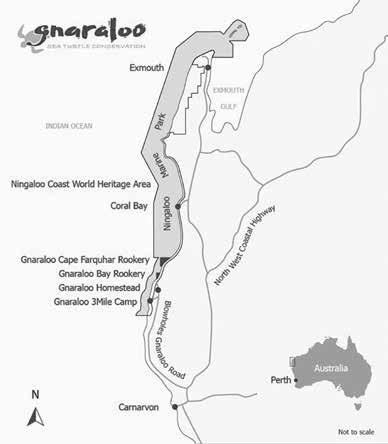
Gnaraloo is a wilderness tourism business and working pastoral station on the Ningaloo Coast in Western Australia, located approximately 1,000 km north of Perth, and adjacent to the Ningaloo Marine Park. The goals of the Gnaraloo Turtle Conservation Program (GTCP) are to identify important nesting rookeries of the endangered marine turtles, and monitor and protect them.
Gnaraloo is special
because it is one of only three full season turtle monitoring programs in Australia, and being the home to more than 500 nests per season, is also the largest rookery in Western Australia.
The Gnaraloo Feral Animal Program (GFAP) has played a role in reducing the predation of turtle nests by feral animals, and has successfully prevented predation completely for the last four years. The program protected 47,000 loggerhead turtle eggs last season, with a running total of 188,000 loggerhead eggs since the program commenced in 2010.
My interest in sea turtles was sparked at a young age; I once saw a documentary where divers in Hawaii were cutting sea turtles loose from fishing nets and I immediately decided that I needed to save sea turtles too. However, growing up in a land-locked area I found that my career goal wasn’t taken very seriously. My first step was to get to the coast.
placed within the top 29 per cent in the worldwide pool of around 2,300 teams.
Even more impressive is that this year the challenges incorporated the “elegance” of the solutions and did not accept just any workable solution for full points.
“Elegance is a difficult thing to measure in programming,” said Kinsner. However, a combination of program length and computation time were used to determine the points distributed for a solution. The faster a program produced results and the fewer lines of code used to write it, the higher the point distribution for that challenge.
On top of entering the competition with no prior training for the challenges and facing a much stricter point distribution system, many of the participants were also involved with the GradCon and had midterm exams. Kinsner was pleased that these students participated and did well.
Kinsner said the outcome indicates that U of M students are performing well in the programming arena: “This is a measurable result that our students are very good.”
Erik Johnson, a third-year computer engineering student and an IEEE student member, was a participant in this year’s IEEEXtreme challenge. Out of the 23 problem sets, his team was able to successfully solve two.
“The time-outs were really low,” Johnson said. While solving one of
the problems, he found that some lines of code had an extra space at the end, which slowed down his algorithm, the part of the program that performs the desired calculations. Since part of the point distribution was based on computation time, something minor, such as an extra character in the program, affected the results.
Johnson said his favourite challenge was the Nekops-Nu Sequences problem. “I solved that problem with 19 lines of Python,” he said. In other challenges, he used the programming languages C# and Java. The challenge lists many programs which the challenges may be solved with, giving participants the freedom to choose based on their own preference or skill level.
Canada had 79 participating teams – a high participant-to-population ratio compared to the U.S., which had 240 teams participate. Team turnout for IEEEXtreme increased from 1,830 in 2013 to approximately 2,300 in 2014. “This is a very good thing,” said Kinsner. “I hope in the future our participants [at the University of Manitoba] can excel even further.”
The IEEEXtreme challenge is held annually in October. Anyone interested in participating in future years is encouraged to contact kinsner@ece. umanitoba.ca to find out more details.
I completed my undergraduate studies at Vancouver Island University, a program which included field schools and excursions. I attended a five-week tropical ecology field school in Belize which changed my life forever and provided me with the hands-on skills I needed to break into the “turtle world.” Currently, my master’s thesis in Aquatic Toxicology is on hold so I can “chase turtles” in Australia.
Since 2008, the GTCP has recruited scientific interns nationally and internationally every season. My specific role is data quality control and assurance. I will be responsible for the meticulous management of all data collected, further development of the turtle tracking training module, and liaising with other international turtle organizations. I will live as part of a small team at Gnaraloo station, and be involved in all aspects of turtle monitoring, including species identification, nest-
ing activity determination, monitoring predation of nests, identification of feral animal tracks, conducting on-site and off-site presentations, and writing a scientific report of the findings.
I will also be involved in community engagement activities. These activities of the GTCP connect the program with the younger generation and educates them about marine conservation. Through this program, 4,589 individuals were reached last season, and more through media outlets such as radio, publications and online.
I am thrilled for the opportunity to participate in such a valuable program in this pristine and untouched part of the world. Gnaraloo welcomes all visitors and strongly encourages community participation in the GTCP.
For more information please visit gnaraloo.com
Photo by Carolyne KroeKer graPhiC
Buzz across the board
Winnipeg’s board game café and restaurant seeing massive success
l aur E n Si DDall, staff
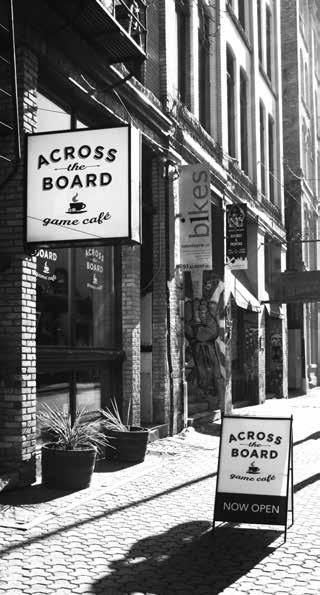
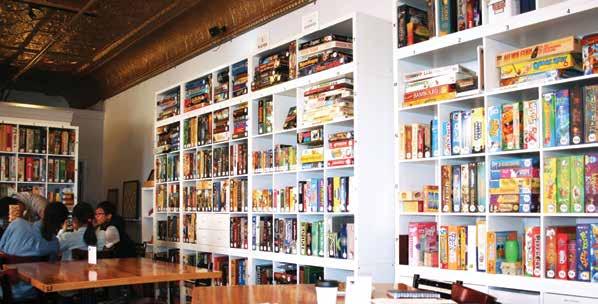
Guess who has delicious, fresh food; is in one of Winnipeg’s trendiest areas; and has upwards of 700 board games? Across the Board, that’s who.
Winnipeg’s newest board game café is located in the heart of the Exchange on Albert Street – a location that made perfect sense to Clinton Skibitzky, the owner of the restaurant.
“Ideally we wanted something downtown for several reasons: it’s centrally located, and it’s also close to our other business, which has a certain practicality.”
Buzzing with culture, the Exchange District thrives on the unique. The buildings are, for the most part, repurposed, bursting with history and breathtaking architecture. Across the Board is no exception. Their building is over 100 years old, complete with spectacular moulding on the ceiling that perfectly tops off the restaurant.
The space is beautifully furnished, from the rich wooden tables to the chandeliers suspended from the ceiling, to the jaw-dropping board game library; 93 Albert Street is a work of art, as intended by the creators.
Upon visiting other, undisclosed game cafés across the globe, Skibitzky and business partner Olaf Pyttlik noticed what they consider to be a massive problem.
“A lot of them were kind of run down and had crappy plastic tables for people to sit at, and sold the kind of food that no one would really want
to eat, and weren’t licensed,” notes Skibitzky. “So it was the kind of thing that we said ‘well, if we were to do this, here’s a bunch of things we would probably do differently, and here are things that would appeal to our demographic’ [ . . . ] We wanted to have a real social atmosphere.”
Creating a menu customers would actually enjoy was a priority.
“I wanted to have really good tasting food, really healthy food – as fresh as possible, prepared here, as much as we can. It’s a limited space so there are some really finite constraints with that,” Skibitzky says of the menu.
“From my perspective, when we started out and talked to [chef] George, I wanted to have [an experience] in contrast to some of these other experiences we had where
we went into an establishment in Toronto and we were playing a game and were hungry so ordered lunch, and the food was of a quality that, if I went back there, I would go out of my way not to eat there.”
Boasting in excess of 700 games—with 55 on their way from Germany—there is something to pique everyone’s interest
Due to the size constraints, chef George Hudson says he plans to
change the menu seasonally. The recently-released fall menu features warmer, heartier food – including a mouth-watering Indian, veganfriendly dish and a fresh arugula garden salad.
The menu’s impressive diversity is matched and exceeded by the board game library.
Boasting in excess of 700 games— with another 55 on their way from Germany—there is something to pique everyone’s interest.
“There’s everything from a dexterity balance game, to a press your luck game, to a strategy game, to a combination of both, to something where you have roles and you’re bluffing with people,” says Skibitzky.
“There are probably about 10 to 12 different categories of games. And it’s
important to have a good set of games in each of those categories. And then it’s important to have games that can be played by everyone from one-person—we have a few that are just oneplayer games—to two-player games, and it’s nice to have a good selection of those just because it suits people coming in; and then you ramp all the way up to games you can play with lots of people.”
The Exchange restaurant also flaunts a board game expert during the evenings.
“They identify what sort of game the customer should play based on how long they want to stay, who they’re playing with, and games they haven’t played before. And with the big selection, it’s nice to be able to go ‘here’s something new to you.’”
Across the Board has far exceeded Skibitzky’s original expectations – particularly the restaurant component.
“To be honest, a year ago if you had talked to me about this, we were making a game café that was also a restaurant. And I think it’s really changed to being a restaurant that’s also a game café. The restaurant has more than met its expectations that way; it’s been able to become as much of the identity as the games.”
Across the Board is located at 93 Albert Street. They are open from 11 a.m. to 10 p.m. on Tuesdays and Wednesdays; 11 a.m. to midnight on Thursdays, Fridays, and Saturdays; and are closed on Mondays.
Photos by lauren siddall
Ar ts & Culture
New name, new music: Dan Mangan + Blacksmith
Canadian indie rocker returns with psychedelic single and 2015 ambitions
After two years out of the spotlight, indie rocker Dan Mangan returns to the public eye, bringing a six-piece band along for the ride. Releasing a music video for their new single “Vessels” on Oct. 21, Dan Mangan and the band have high hopes for the upcoming year. They are releasing their new album Club Meds Jan. 13, 2015.
Mangan is a Canadian musician and songwriter based out of Vancouver. While his music can be described generally as “indie folkrock,” the range of his music is much broader – drawing comparisons to U.K. artists such as Radiohead and Peter Gabriel.
His last full-length album, Oh Fortune, earned him the 2012 Juno Awards for “Alternative Album of the Year” and “New Artist of the Year.”
While “Dan Mangan + Blacksmith” is a new label, the band is comprised of members who have been part of Mangan’s ensemble for years. Having released music under his own name in the past, Mangan saw it as only logical that credit be given to the rest of the musicians.
“It’s weird to feel like a band but be named as an individual. This gives credence to all the amazing players I get to work with, and how much time/
energy they’ve put into the project,” says Mangan.
Working with Colin Stewart— who has worked with artists such as A.C. Newman and Pink Mountaintops—Mangan describes their co-producing partnership as clear-cut.
“Colin and I have a really beautiful working relationship. It’s easy,” states Mangan.
The end product of this partnership is Club Meds, featuring 11 tracks from the seven-piece ensemble prepped for 2015.
Mangan saw releasing “Vessels” as the debut single as key to Club Meds ’ introduction. “I think it’s a good segue into the new album for folks who are used to how our other albums sound.”
Alongside an equally psychedelic music video, “Vessels” can be seen as a continued departure from Mangan’s earlier folk hits like “Robots” and “Road Regrets.” Featuring a simplistic flute synthesizer and reverberated drum beat, the track continues to expand as the song progresses until it reaches its finale as a chaotic sounding orchestra – all within the span of about three minutes.
The track was also key to the independent film Hector And The Search For Happiness, an adventure-drama starring Simon Pegg. Mangan, having scored the film alongside fellow B.C. musician Jesse Zubot, aligned the release of the single with the release of the film in theatres.
With Dan Mangan + Blacksmith taking the stage on March 5, 2015 at the Garrick Centre, Mangan alludes to a colourful visual performance in the band’s live set.
While the album has yet to be made available, the band already has plans set for a North American tour.
“We’ll be a seven-piece band, but we’ll also have some more visual elements to the show this time around. I want to keep expanding and evolv-
The thin line between addictions counsellor and addict
ing how the band plays live, and I’m excited to introduce some projection and more elaborate lighting.”
Club Meds will be available on Jan. 13, 2015. Dan Mangan + Blacksmith will be playing the Garrick Centre on March 5, 2015. Tickets are available at galleryac.com and Ticketmaster.
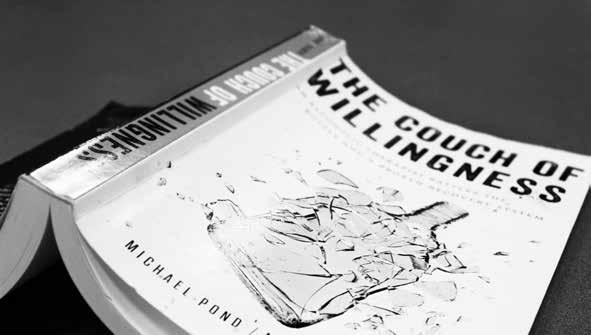
Review of The Couch of Willingness, a memoir by Michael Pond and Maureen Palmer
T
he Couch of Willingness —written by Michael Pond, a psychotherapist living in Vancouver, and his partner, former CBC producer and current filmmaker Maureen Palmer— focuses on Pond’s adult life, following him to Vancouver Island, the Okanagan, and even rural Manitoba during a flashback to his childhood. The Couch of Willingness’s premise is straightforward: Pond is a successful psychotherapist who helps his clients overcome addictions.
He also happens to be an alcoholic on a downward spiral.
The unabashed irony of his circumstance renders the story surreal as Pond, the accomplished professional, rapidly loses control of his life.
Addiction’s volatile nature is put on full display as Pond attempts to hold on to the family and career he has worked towards for so long. Instead, his personal relationships with his wife, sons, clients, and friends all whither away to nothing, as his alcoholism hurts everyone he cares about.
The notorious “rock bottom” becomes all too real as Pond is kicked out of his home and treatment centres – ending up homeless, in recovery homes, incarcerated, or hospitalized.
The memoir fills with tension as the reader waits for the next inevitable bad decision from Pond, and every small step forward he manages is negated by catastrophic steps backward. It is only towards the end of the memoir that permanent sobriety becomes a realistic possibility for Pond.
The Couch of Willingness contains an interesting twist: the narrator is a trained psychotherapist, social
worker, and psychiatric nurse. The hectic events of the narrative are punctuated by moments of lucidity as Pond takes inventory of his current state, and mentally evaluates his appearance and level of functionality with clinical precision.
As Pond grapples with his own troubles, he notices contradictions and flaws within a system designed to assist some of society’s most vulnerable and powerless members.
Passages such as “Because the cruel irony here is that just when these guys need medication most, it’s forbidden. Fresh Start only accepts clients who aren’t on any medication,” highlight the many issues addicts face battling a dysfunctional system while attempting to reach sobriety.
The Couch of Willingness invites readers to empathize with members of society that are usually stigmatized or ignored. When the harsh realities of addiction and recovery options are
revealed, it becomes easier to understand the difficulty of achieving sobriety; there are inadequate supports available to those who need help most.
Pond and Palmer masterfully paced the memoir, and were wholly unapologetic in presenting the grittiest details of life in and out of recovery homes. The result is a riveting narrative that reads like fiction – a testament to their storytelling abilities. Refreshingly honest, The Couch of Willingness leaves nothing to be imagined but reveals much to be desired when it comes to the addictions recovery system.
Michael Pond now has a psychotherapy practice out of Vancouver, where he lives with Maureen Palmer. Pond currently specializes in addictions, mental health, relationships, and First Nations counselling.
Photo by norman Wong
Photo by Carolyne KroeKer
i an T.D. Thom S on, staff
Indoor comforts and foodie opportunities
Knox Community Kitchen re-opens indoor market every other Friday
i an T.D. Thom S on, staff
While the weather outside may be getting frightful, the Knox Community Kitchen is hoping to make the fall and winter months a little more delightful.
Having re-opened its indoor market on Oct. 17, the community kitchen hopes to bring a diverse lineup of food and entertainment to every second Friday from 11 a.m. to 2 p.m. for the colder months to come.
The community kitchen is located in the historic Knox United Church (400 Edmonton Street) in the heart of Winnipeg. The re-opening of the kitchen’s indoor market came about after a successful pilot project run in March that continued until June of this year.
Natasha Ross, executive director of the Knox Community Kitchen, sees the impact of the kitchen and indoor market in the larger context of the downtown area around Central Park.
“I think Central Park has the potential to be a more frequented destination for leisure and cultural activity, but one of the challenges we face in Central Park are perceptions of safety,” explains Ross.
“Our market and kitchen attempt to deal with this issue by creating events and opportunities that bring outsiders to the neighbourhood on a frequent basis through food-based activities.”
The main attractions for customers are the food commodities that are provided.
“Our product offering is diverse and includes prepared and readyto-eat foods from Africa and the Philippines; baked goods (breads, cupcakes and pies); authentic Belgian waffles; gourmet donuts; healthy meal packages; and Texas-style breakfast tacos,” explains Ross.
“My mouth is watering just talking about it!”
Since opening earlier this year, the Knox Community Kitchen has offered food entrepreneurs unique business opportunities and experiences.
“Our commercial kitchen helps get food businesses started that would normally not be able to due to the high cost of establishing a commercial kitchen,” says Ross.
“We are helping people improve their earning potential and financial security – while supporting and
encouraging the creation of new and unique food products to be enjoyed.”
Buttercream by Alareen
Alareen Doherty, owner of the food venture Buttercream by Alareen, specializes in the sweet and savoury.
“I design, create, and bake custom-made cakes, cupcakes, cake pops, cupcakes in a jar, and anything baked,” explains Doherty.
Providing her custom delicacies for all occasions and special events, Doherty speaks highly of what the community kitchen has been able to provide for her and her business.
“Having baked from home for months, the move to Knox Kitchen has been incredibly beneficial for my business. Working in the commercial kitchen has greatly improved my production efficiency – allowing me to bake mass quantities of products in a short time frame,” says Doherty.
“Cake decorating requires many tools and supplies [ . . . ] This [move] has freed up a large amount of space in my small 800-sq.-ft. home.”
As one of the businesses present at the inaugural re-opening on Oct. 17, Doherty sees potential in the Knox
Evil Dead: The Musical at the Park Theatre
Cult classic turned musical premiers in Winnipeg
Cai T lyn m a S ki E w, volunteer staff
Winnipeg is known for its enthusiastic support of cult films, and now an opportunity to see one re-imagined on stage is approaching. Evil Dead: The Musical has its Park Theatre premier on Oct. 29 and runs until Nov. 9. It is an interactive production, sure to get everyone into the Halloween spirit.
The Evil Dead series is comprised of four movies directed by Sam Raimi. The first installment premiered in 1981, with the subsequent movies taking the world by storm, becoming cult classics.
While the four movies directed by Raimi are the only official films, there have been unofficial sequels produced in Italy, as well as an indirect sequel featuring one of the film’s original characters in his day-to-day life.
From the movies came the musical, which is an international sensation. It has been produced 150 times, all over the world – including as a offBroadway production in New York, and with variations in Tokyo and Seoul. The writers took plot liberties and combined the original movies into one fulllength, two-act musical featuring songs such as “All the Men in My Life Keep Getting Killed by Candarian Demons” and “Ode to an Accidental Stabbing.”
The music is fun and exciting, the composition is reminiscent of the doo-wop style of Little Shop of Horrors. The musical features many famous moments from the movies and some of Ash’s classic one-liners.
The showing at Park Theatre will include the “splatter zone.” Players and producers invite patrons to show up in full costume.
“It’s an experience; you’ll get entertainment unlike anything you’ve seen before” – Quinn Greene, producer
The show is accessible to everyone, even if you have never heard of the franchise. For musical theatre enthusiasts, there are great song and dance numbers, and for action-inclined individuals, the musical is packed with great fight choreography.
Producer Quinn Greene saw a unique opportunity in Winnipeg, a city with a penchant for loving cult
films – such as Phantom of the Paradise, The Rocky Horror Picture Show, and The Room
“Winnipeg loves interacting with performers, so that was another draw for me as well,” Greene says. He had heard of others wishing to put the show on, and subsequently hired director Cory Wreggitt to take on the project.
The show features local performers who Greene and Wreggitt had previous experience with, in addition to others recruited through a public casting call. Greene was amazed at the overwhelming response to the casting call; many talented individuals showed up to audition for the show.
Even the choreographers, art directors, and make-up production team are local. This show is something Winnipeg should be proud of.
“[Evil Dead: The Musical] is a live theatre performance you can’t get anywhere else,” explains Greene. “We encourage costumes, we encourage interactivity [ . . . ] it’s an experience; you’ll get entertainment unlike anything you’ve seen before.”
Evil Dead: The Musical will be shown at the Park Theatre from Oct. 29 until Nov. 9. Tickets are available on ticketfly.com
Community Kitchen indoor market.
“Because my orders are primarily online and I do not have a store front, the market is a great way for people to sample my products without putting an order in and it also helps to put a face to a name.”
For more information on Buttercream by Alareen, visit buttercreambyalareen.com
Menu Beyond Borders
Menu Beyond Borders provides Winnipeggers with plates from around the world.
“Our meals come from many different countries, and are a rich source of inspiration worthy to be tasted and sure to satisfy; whether it is your first taste, or one you’ve been missing from home,” explains sole proprietor Helen Akue, who offers items such as beef and chicken pies (also known as “Jamaican patties”) and oxtail soup.
The Knox Community Kitchen has provided Akue with a source of inspiration in her craft.
“The availability of the commercial kitchen in a strategic location has allowed me to test my business
ideas and given me the opportunity for growth in the food industry,” explains Akue.
“The kitchen location is very central, with lots of diverse cultures visiting the Knox Church building for different programs [ . . . ] This cultural diversity has inspired my business idea.”
With the re-opening of the indoor market, Akue and Menu Beyond Borders returned to 400 Edmonton Street.
“It was exciting to be part of the market again. I met with new and old customers and colleagues, which was great.”
For more information on Menu Beyond Borders, visit menubeyondborders.com
The Knox Community Kitchen at Knox Church (400 Edmonton Street) presents its indoor market every Friday bi-weekly from 11 a.m. to 2 p.m. The next indoor market will be on Oct. 31.
Photo Provided by aPril Plett PhotograPhy
Bison briefs
Football and volleyball
Football
The University of Manitoba Bisons found themselves on the wrong end of an upset for the second time this season, as they fell 56-41 on the road against Regina.
Early miscues by backupturned-starting quarterback Theo Deezar helped Regina jump out to a 28-0 lead midway through the second quarter. Despite a valiant effort from the Bisons, who responded with 24 unanswered points of their own, a Manitoba win was not meant to be. The combination of running back Atlee Simon, (154 yards rushing, 3 TDs) and Noah Picton (17-24, 368 yards, 3 TDs) was too much for the Manitoba defence, which also lost starting safety Tyler Fong in the first half.
Despite the loss, there were some positives for the Bisons. Offensively, Deezar settled down in the second half, and finished with 439 yards, and four TDs, while Nic Demski had a whale of a game, hauling in nine receptions for 238 yards, and a TD. Defensively, Jayden McKoy continued to shine, recording 11 total tackles and a forced fumble.
returned to the lineup after missing last week. Dobie tallied 10 digs and one kill in her return on Friday, but it wasn’t enough to help the Bisons overcome the balanced attack of UBC Okanagan.
The Heat maintained that wellrounded attack all weekend. Four players had eight or more kills on Friday, and seven or more kills on Saturday.
The loss puts the Bisons into ninth place in Canada West. They have a lot of ground to make up if they are going to reach the playoffs. Manitoba continues their play on the road as they take on Trinity Western in Langley next weekend.
Manitoba added to the Heat’s season woes by sweeping their weekend series, winning in three straight sets Friday night, (25-22, 25-17, 25-22) and three sets to one on Saturday night (2125, 25-18, 25-15, 25-22)
The next football action will come this Saturday at Investors Group Field against top-ranked Calgary, in Manitoba’s final regular season home game of the year. Kickoff is at 2 p.m.
Women’s volleyball
The Bison women’s volleyball team was on the road this weekend, taking on the fourth-ranked UBC Okanagan Heat. The Bisons were unable to stamp out the Heat, losing 3-1 (25-15, 19-25, 26-11, 25-23) on Friday night and 3-0 (25-17, 25-15, 25-15) on Saturday night.
Captains Rachel Cockrell and Brittany Habing continued their strong play this weekend in Kelowna. Friday night saw Cockrell pick up 18 kills and eight digs, and Habing collect 31 assists and 14 digs. The duo continues to shine this year and will be relied on to help the Bisons regain their winning form.
Starting libero Caleigh Dobie
Men’s volleyball
The Bison men’s volleyball team rolled into Kelowna this weekend to take on the winless UBC Okanagan Heat. Coming off a strong performance at home last weekend, that saw coach Pischke break the North American all-time coaching win record, the Bisons were brimming with confidence.
Manitoba added to the Heat’s season woes by sweeping their weekend series, winning in three straight sets Friday night, (25-22, 25-17, 25-22) and three sets to one on Saturday night (21-25, 25-18, 25-15, 25-22).
Devren Dear led the attack on Friday with 14 kills, while Adam DeJonckheere had a strong allaround game with a team-leading seven digs plus nine kills. Luke Herr led the team in assists with 28.
The Heat took the first set on Saturday, but the Bisons responded with a solid team effort. Dear tallied 21 kills and led the Herd with 14 digs. DeJonckheere had 18 kills and 12 digs, Kenny Rooney picked up 10 kills and six digs, and Luke Herr had 46 assists. Dear now moves into fourth overall for most kills per set in Canada West and Luke Herr has the third highest assists per set in the conference.
The weekend wins move the Bisons into a tie for second in the Canada West Conference.
Shoot for the cure, score for the herd
Bison women’s hockey sweeps Lethbridge at home
Coming off of a weekend sweep on the road against Mount Royal, the Bison women’s hockey team returned to Wayne Fleming Arena this week to take on the Lethbridge Pronghorns. Led by rookie Alanna Sharman and sophomore Rachel Dyck, Manitoba took it to the visitors, winning both matinee games.
On Saturday afternoon, the team laced up with pink, wrapped their sticks in pink tape, and redecorated the Wayne Fleming Arena with pink streamers and balloons in support of Shoot For the Cure. With a large crowd in attendance, the Bisons delivered a 3-1 victory.
Manitoba opened the scoring seven minutes into the game with a rocket off Sharman’s stick. The Longhorns tied the game and put the Bisons on their heels with 20 seconds left in the first period on a goal by Sadie Lenstra. Lethbridge went into the break with the momentum, something that head coach Jon Rempel touched on.
“I thought we did a really good job of not panicking,” Rempel said. “I thought we were flat. They were winning most of the battles and competing for the puck.”
The Longhorns carried the play in the second period, but were taken down a notch by a strong power play from the Bisons near the end of the second. Erica Rieder had several good chances from the blue line and made a clean pass to Sharman, who almost netted her second of the night.
Rempel pointed to the power play at the end of the second period as the turning point in the game for the Bisons.
“I thought it gave us a little more confidence to do things with the puck [ . . . ] And I really think that generated some momentum and a little more energy for the third,” said Rempel.
“These kids coming in here aren’t afraid to play, not afraid of the big moments, and they’re not afraid of responsibility” – Jon Rempel, head coach, Bison women’s hockey team
The Bisons took the lead for good at 6:42 of the third, moments after Caitlin Fyten prevented a shorthanded break, which then allowed Megan Tully to put away the eventual game winner. Almost a minute later, Sharman netted the insurance goal for the Bisons to cap the scoring.
Dyck had a 16-save performance in net, continuing to lead the Canada West with the lowest goals against average. Rempel lauded the play of his goalie, touching on her
work ethic.
“No question Rachel is pretty dialled in. I really think her approach every day is what’s showing up in games here. Her diligence in practice, her diligence in the weight room, things she did in the off-season, the things she does with her goalie coach; she set the bar really high,” Rempel said.
Sunday afternoon saw Amanda Schubert called to the net, where she helped backstop the Bisons’ 5-3 win over the Pronghorns. Manitoba improved to an impressive 6-1-1 and are currently tied for the top spot in the Canada West.
Sharman continued her impressive rookie campaign by adding a power play goal in the second period. Two Bisons found the back of the net twice on Sunday: rookie forward Lauryn Keen and second-year forward Alana Serhan. The youth on the Bisons have had a considerable impact on the success of this team, and coach Rempel had high praise for this year’s recruitments’ class.
“These kids coming in here aren’t afraid to play, not afraid of the big moments, and they’re not afraid of responsibility,” said Rempel.
The Bisons are on a bye this week. Their next action takes place Nov. 7 against the University of Alberta in an important matchup on the road. The University of Alberta is currently tied with the Bisons for first in the conference. Game times are at 7 p.m. Friday and 2 p.m. Saturday.
Davi D g ra D, staff
Photo by shaWn Coates
Game of throws
A closer look at the University of Manitoba’s ultimate frisbee team
m ik E S T ill, staff
Amidst the numerous Bison student athletes competing in weekly action stand the lesserknown teams, which fall under the recreation clubs category. There are currently 11 groups, which play either competitively or leisurely. One of the groups that perform competitively is the ultimate frisbee team.
Jesse Greenberg, the current president/captain of the University of Manitoba’s ultimate team, has been around since the club resurfaced a couple of seasons ago.
“There was a team a while back which ran for a few years and just kind of ended once players graduated. I started playing in 2011 when the team first started up again,” said Greenberg. “We only became affiliated with the U of M last year. The team is made up of a solid mix of veterans from 2011 and the past two years.”
The process of trying out for the team is relatively simple. It occurs at the end of August and beginning of September every year.
“We typically see a lot of graduates from the junior provincial program come try out for spots, but as of recently we’ve been seeing more players who haven’t taken the for-
mal provincial team role trying out,” said Greenberg.
“After tryouts we announce players who will be coming to nationals (also known as the Canadian University Ultimate Championships) with the team. This year we started up a B team with a mix of veterans and new players to attend the Canadian Prairie University Ultimate Championships in Regina as well.”
As Greenberg mentioned, 2013 was the first year the team became officially affiliated with Recreation Services, which affected the protocol for who was able to attend nationals with the club.
“In previous years we simply got as many players as possible together to send a team to nationals. We would receive funding from the Manitoba Organization of Disc Sports and an Ultimate Canada subsidy and headed off to nationals – otherwise we had no affiliation,” Greenberg said.
“We had combined our players from the U of W as well and got consortium status, which allowed us to compete as “Manitoba” for 2011 and 2012. In 2013 we registered as a club in Recreation Services and only allowed U of M players
to compete with the team.”
Manitoba has had a fair amount of success at the CUUC since their rebirth in 2011. They placed first in 2011, second in 2012, and seventh in 2013, before recapturing the gold just a few weeks ago in Montreal.
Greenberg was quite thrilled with the way the team responded one year after an unfortunate finish.
“It felt good to be on top again. This is my second time winning gold in the university series. Especially after last year’s seventh place result, it felt much better redeeming ourselves and having the chance to rematch the teams we lost to last year in Ottawa,” said Greenberg.
“The last time we placed first was in 2011, which was my first year playing for the university team. I’m looking forward to next year as well, since no one will be graduating or leaving the team.”
When asked what the most enjoyable part about being on the team is, Greenberg was quick to emphasize the competitive aspect.
“The best part about playing university ultimate is the competition and good times had at tournaments. We put in a lot of effort during practices to perform well at the tournaments we attend and it’s always great to see everyone wanting to win and making it happen,” said Greenberg.
“There’s something about university sports that adds an extra level of enjoyment and camaraderie when trying to win a national championship.”
If anyone has any questions about potentially trying out for the ultimate team next season, they can contact Greenberg, at jesse_greenberg@hotmail.com, or visit the team’s Facebook page, which can be found under “University of Manitoba Ultimate Club.”
Shooting for the top
2014-15 Bison basketball season preview
m ik E S T ill, staff
There is nowhere to go but up for both the men’s and women’s basketball teams at the University of Manitoba in 2014-15. Coming off of what could be considered a “character building” season in 2013-14, where neither squad made the playoffs, look for increased drive and focus heading into a new campaign.
Men’s team
If history holds true, the 201415 season should be a successful one for the Bison men’s basketball team. Head coach Kirby Schepp, entering his sixth year at the helm for Manitoba, has not missed the playoffs in two consecutive seasons since taking the reins for the Bisons back in 2009-10. With a stable mix of veterans as well as experienced younger players, Manitoba should see a huge turnaround from their 6-16 record last year.
The Bisons will be led by fifthyear point guard Stephan Walton, who is returning to the lineup after suffering a knee injury in the preseason last year, which sidelined him for all of 2013-14. A Canada West All-Star the previous year, with 17.3 points per game and five assists, Walton helped guide the Bisons to a second place, 14-8 record in 2012-13. He has the ability to change any game single-handedly with his speed and intelligence on the court, and having him back will be crucial to the team’s success going forward.
the team) provide energy in the back court, while Wyatt Anders and Brett Jewell will be vital in the front court.
Anders, another senior, was third on the team in rebounds last season with 118 while Jewell, entering his third year, will see an enhanced role after the graduation of Dan Penner, who led the team in all but one rebounding category in 2013-14.
Women’s team
After serving as co-head coach for the past two seasons, Michele Hynes will be in full control of the women’s basketball team in 2014-15.
Head coach Kirby Schepp, entering his sixth year at the helm for Manitoba, has never missed the playoffs in two consecutive seasons
A member of the herd from 200510, Hynes was a captain the last time the Bisons clinched a playoff berth back in 200809, and will look to lead her squad to the post-season this year.
The Bisons had just six players compete in all 22 regular season games last season, and will have five of them (all seniors) return for 201415. Stephanie Gill, Robyn Eyer, Sheree CarmonaGaldamez, Allison Balasko, and Vanessa DeVries will all play critical roles this season, on a team that is otherwise relatively young.
Having depth at the point guard position will also aid Manitoba. This will come from fellow fifthyear senior and 2013-14 captain Amir Ali, who played in all 22 conference games last season. His leadership, both on and off the court, will be a key asset for the Bisons.
Dynamic sophomores Andre Arruda (2013-14 Canada West Rookie of the Year), and Justus Alleyn (2.4 assists per game, led
Gill (fourth in team scoring last year) and Eyer (third in team scoring) were captains last season and will likely maintain those roles this year. Carmona-Galdamez and Balasko both reached double digits in points per game (10.8, and 10 respectively) while DeVries was first on the team in steals and offensive rebounds, as well as second in defensive rebounds.
Second-year Jenilyn Monton (second on team in field goal percentage at .395) and third-year Rebecca Potter (played in 21 of 22 games) will add depth and energy for Manitoba.