



Tough on crime
The Singularity Mixology


Jennifer Keith, volunteer staff
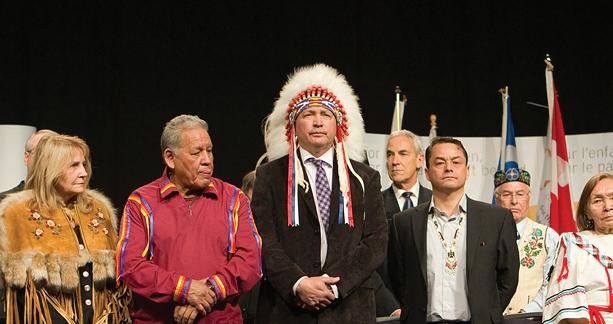
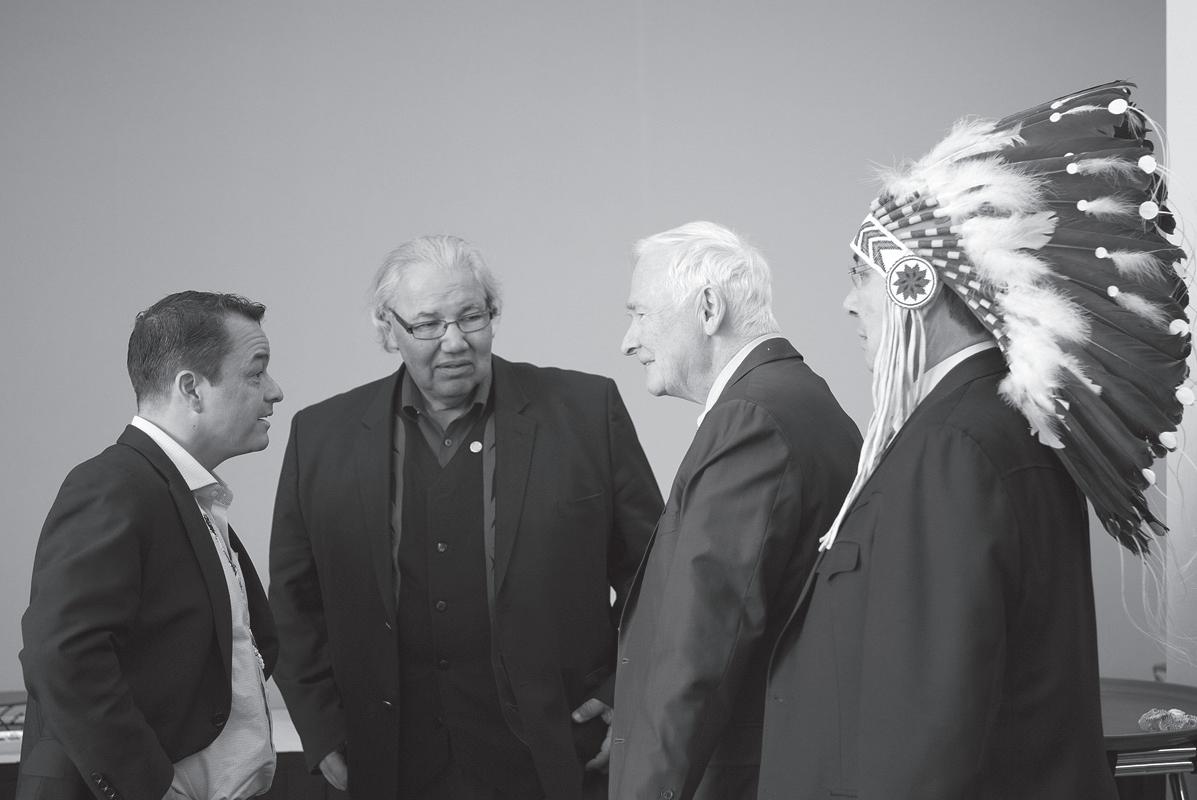
At the final national event of the Truth and Reconciliation Commission of Canada (TRC) in Edmonton last week, there were a number of gestures of reconciliation— and some notable absences—as the TRC approach the final year of their mandate.
“I think we made a turn from collecting the truth and [now we will] begin to start focusing on the second part of the mandate; [that is], what do we do with the truth in terms of informing reconciliation going forward. And you saw that and you felt that in the room. You saw it and heard it in the gestures of reconciliation. And I think we have made an important turn to focus now in that area,” said commissioner Chief Wilton Littlechild to the Manitoban
Justice Murray Sinclair echoed Littlechild’s sentiments in his closing remarks at the event.
“We will now take up the challenge of putting all of these things that we have heard into a forum that all of Canada will have to respond to in a positive way, and we will carry forward your message,” said Sinclair.
But, what does reconciliation look like?
“Reconciliation is the commitment and bravery to stay in the room,” said Niigaanwewidam Sinclair, assistant professor in the department of native studies.
Gesture of reconciliation
Littlechild was encouraged by the gestures of reconciliation at the event in Edmonton, and felt they demonstrated an increasing awareness of residential schools and their legacy.
One such gesture was the Edmonton Oilers’ “Celebration of First Nations Hockey” during their game against the New York Rangers. The game coincided with the final day of the TRC event.
The celebration included a performance by Asani, an award-winning Aboriginal women’s trio from Edmonton, singing the Canadian anthem.
There to perform the ceremonial puck drop were residential school survivors Fred Sasakamoose, the NHL’s first Aboriginal player, and Littlechild. Other in-game events included a video on residential schools and stories in the game program.
Litttlechild felt that this was a significant gesture of reconciliation that would have a significant effect on educating the public.
“The game’s attendance was around 18,000, and the Edmonton Oilers have 326,000 followers on their social media [ . . . ] all those people immediately became informed about TRC and the history of residential schools,” he said. “When you think about trying to educate the public about this story, the power of sport has a big role to play.”
The province of Alberta also made significant gestures of reconciliation.
Many MLAs and ministers, along with the acting premier of Alberta, were in attendance for all four days
of the event. Aboriginal Relations Minister Frank Oberle announced changes to the curriculum of students from K-12 to include the history of residential schools and treaties.
Littlechild felt this was a positive step forward—making Alberta a pioneer in repairing the relationship— and a move he hoped other provinces would follow.
“An announcement like that is very encouraging for a brighter future. Children will now learn about the TRC, residential schools and treaties [ . . . ] this will result in better relationships. For Alberta to announce this publicly and make it mandatory is very, very encouraging,” he said.
Municipal government and industry members were in attendance, with mayors from Edmonton, Calgary, and Wetaskiwin, announcing that their councils had declared this year to be a year of reconciliation.
Justice Sinclair commented on the impressive actions of local leadership.
“I am thrilled about the commitment to action that we heard from the leaders of this jurisdiction [ . . . ] they stand as an example to other jurisdictions in this country, and now we are going to turn to them and say, ‘What are you doing about reconciliation?’”
The federal government and the TRC
Notably absent were federal government representatives.
Bernard Valcourt, Minister of Aboriginal Affairs and Northern Development, was in attendance; however, Littlechild expressed frustration over the lack of engagement coming from the federal government.
“We have not been able to engage the federal government, the political elites, enough yet. Mind you, it isn’t finished, but we have [only] had a few senators and members of parliament show up,” said Littlechild. “Personally I would like to have seen more. If you compare the provincial representation and local mayor and council representations, there were many more from that level [than the federal level].”
One of the goals of the TRC is to “promote awareness and public education of Canadians about the [residential school] system and its impacts.”
Littlechild felt that in order for this goal to be achieved, people in leadership positions need to hear the stories of survivors.
“People have told us they didn’t know about [survivors’ experiences]; when they hear the personal stories they are really shocked by some of the stories, but at the same time they want to participate in a good way,” said Littlechild.
“So, if you reflect back at the seven events, it was generally just the minister of Aboriginal affairs that attended, but more ministers and MPs should have attended [ . . . ] Maybe they are busy, but as a former MP, I would have made an effort to be there.”
Niigaanwewidam Sinclair shared this opinion.
“The act of recognizing what hap-

by
pened and being present is how reconciliation happens,” he said. “If there is no recognition there is no accountability. [This results in] total erasure,” he said.
The TRC was established in 2008 as part of the implementation of the Indian Residential Schools Settlement Agreement. One of their tasks was to look forward in terms of rebuilding and renewing the relationship between Aboriginal and non-Aboriginal Canadians.
The relationship between the TRC and the federal government has been rocky.
Last year the commission took the federal government to court over its refusal to hand over millions of residential school documents. The Ontario Superior Court of Justice ruled that the federal government must hand over all documents, but at this point the government has not placed a priority on handing over said documents.
The extension of the TRC’s mandate to June 30, 2015 was due to the commission not having timely access to these documents.
With the final national event over, the work of the commission will now focus on completing their four-volume report, formalizing their recommendations, and organizing a closing event.
When the commission concludes its work in June 2015, all holdings will be turned over to University of Manitoba as the national research centre. The research centre will engage in more statement-gathering, conduct ongoing research, and act as a national archive.
Littlechild explained part of the research centre’s function.
“We have had many different mediums to collect the truth: statements, dance, music, blankets, art, song. All these ways we have collected the truth will go to the University of Manitoba. They will hold the collection. Those who want to learn more or family members that want to access personal stories will be able to do so at the University of Manitoba.”
Littlechild said a former residential school classmate helped him discover the meaning of reconciliation.
“It was very important for me to hear my classmate say ‘reconciliation begins
with me’ [ . . . ] [Reconciliation] is an important journey that starts with the individual; it starts with forgiving yourself first, and then going to the family, then the community,” he said.
“Reconciliation will have many faces. When I look in the mirror of reconciliation I should see your face, and when you look in the mirror of reconciliation you should see my face. It is going to take both of us [Aboriginal and nonAboriginal] working on reconciliation together to make a better relationship, a better Canada. Then we spread that collectively, working together, hand in hand, on a path of reconciliation. It is going to take all of us.”
Littlechild sees youth as key to reconciliation. He said we need to think about what individuals can do on their own to move the country forward with reconciliation, and then consider what collective actions we need to take as a country to move reconciliation forward.
“The youth must learn about this history. We are still not anywhere near where we ought to be in terms of the level of awareness regarding the residential school history and legacy.”


Quinn r i C hert, staff
Last month, I was lucky enough to conduct one of my favourite interviews ever, following one of the best public lectures I have ever seen.
John Greyson, a Canadian filmmaker who spent almost two months locked up in Tora Prison in Egypt, was in Winnipeg to deliver the keynote speech for Israeli Apartheid Week.
Greyson spent most of his lecture talking about his personal experiences in prison. Our interview revolved around his criticisms of the Israeli state’s policies toward the Palestinian people.
However, one unrelated, seemingly innocuous remark he made has stood out in my mind ever since. He was comparing activist filmmaking to journalism.
“For instance, activist filmmaking practices, which of course are distinct from journalism and its tropes of so-called ‘objectivity’ and ‘balance,’ generally recognize that free speech and activist videos must sometimes include disrespect, especially of public figures, and must sometimes violate some dignities and confidentialities, and must indeed do some harm for the greater public good. We should be manufacturers of dissent,” he said.
Greyson’s comment got me thinking again about a subject that has been bothering me for a long time. I’ve been struggling with the topic of objectivity in news writing for two reasons.
The first is that my interpretation of this word has a direct and concrete bearing on how we conduct business here at the Manitoban ,
and how people will view our publication. It is understood that socalled objective articles belong in News, my and Katy MacKinnon’s section.
Works on current events that pointedly exhibit some kind of argument, attempting to persuade the reader one way or another, supposedly go in Comment. So being able to understand this concept and recognize its presence in an article is important.
The second reason, I’m almost ashamed to admit, is that I have no good understanding of what it means.
The standard definition of objectivity in the journalism context, as you will find it in Webster’s New World Dictionary (and probably many others), is “without bias or prejudice; detached; impersonal.” Fair enough. That is probably how I would define it too, if you were to ask me.
But my confidence that things are this simple becomes shaken when I look back at submissions myself and others have made to the paper purporting to be objective. Many of them read as if the writer had some prior agenda, even if the tone is not biased, prejudiced, attached, or personal in an obvious way.
Other days, I might go back and reread excerpts from The Great War for Civilisation by Robert Fisk and wonder how anyone could view it as non-objective. In a sense, isn’t it objective to hold the powerful, whomever they may be, to a higher standard of accountability, and react with disdain when they so

severely abuse their privilege? Isn’t it objective if it is what any reasonable, fair-minded person would do? Sometimes I think so.
To me, it is uncertain which of the above articles should belong in Comment and which are properly “News.” So when I say that I have no real understanding of what objectivity means, I’m not trying to be overly cerebral. I’m considering my own contradictory standards, the different interpretations of others, the implications for the credibility of the paper, and concluding that I really do not know it when I see it.
One reason for the lack of certainty could be that perfect objectivity is unattainable; I’ve never actually seen it. There is bias in almost every decision a writer makes, from choosing what to write on and what to ignore, to how to transcribe direct quotes.
Consider this example:
“We should act to avoid future conflict.”
“We should act – to avoid future conflict.”
The meanings they convey can be subtly different. When the reporter hears those words on a tape, though, a decision has to be made. It becomes difficult to meet the “detached” criterion here because the reporter is personally making choices about what her audience will learn through her narrative.
Even worse, the reporter with a hidden agenda could employ these types of tricks, selectively quote certain people, creatively use brackets, and employ other strategies to bend a story more than the reader could ever realize. So even
when we see an article that has the apparently objective “tone,” we can’t say for certain that it is in fact any more without bias or prejudice than something written for the opinion pages.
Interestingly, some writers think that objectivity in news writing shouldn’t even be a standard to strive for.
“The creed of objectivity and balance, formulated at the beginning of the 19th century by newspaper owners to generate greater profits from advertisers, disarms and cripples the press,” wrote Chris Hedges, former New York Times foreign correspondent, in his 2010 article “The Creed of Objectivity Killed the News.”
He later adds, “This creed transforms reporters into neutral observers or voyeurs. It banishes empathy, passion and a quest for justice. Reporters are permitted to watch but not to feel or to speak in their own voices.”
Hedges is right when in his article he points out that the trope of objectivity can easily be abused, or used as a cover for pro-corporate/ government/whatever apologetics. But this doesn’t mean that the concept of objectivity itself is without value. He is wrong to lament the fact that reporters are asked not to speak in their own voices, or scratch the more impassioned language from their dispatches.
I think news writers should strive for objectivity. If I have to take a shot at defining it, and pinpointing its role in good journalism, I say true objectivity attempts to make up for the fact that the reader
couldn’t be there to witness a story’s unfolding.
The objective journalist should attempt to act as nothing more than a conduit for transmitting information from newsmakers to newsreaders. As such, news writing should be as artless as the writer can get away with, and read like a succession of facts, starting with the most pertinent and working backwards toward background information. To quote a colleague of mine, “if we could have robots do news writing, we would.”
This approach is good because it doesn’t insult the reader by shoving an opinion down her throat, or tell her how to feel. At the same time, if research is thorough, it ensures that those making the news are seen exactly as they are. The writer’s political agenda won’t get in the way, and we’ll get as comprehensive an account as possible of what newsmakers actually did.
This operating definition of objectivity leaves a lot of problems unresolved, and I’ll still have my doubts about how it can be practically achieved. Nonetheless, I maintain that objectivity is something journalists should work towards, even if they’ll never be satisfied with their efforts. Consider it a neverending process, or, to pervert something once said by Hippocrates, a long un-art.
This is the best way for the press to live up to its important role in democracy. After all, it is about the reader understanding the workings of her society, not the writer’s ego. Just tell them what happened. That’s news.



tari Q Sohail, volunteer staff

You would think all Republican primary candidates would take a tough-on-crime approach as part of their policy platform. But you would be wrong.
Former congressman and 2012 Republican presidential candidate Newt Gingrich, once a believer in the tough-on-crime approach, now argues that increased spending on incarceration is unnecessary, and spending on crime prevention instead is the way to go.
Even Gingrich, a lame duck candidate, has some sense of rationality when it comes to tackling crime. But here is the really irksome part: in the face of evidence to the contrary, Prime Minister Stephen Harper and his cabinet remain bent on passing legislation to build more prisons and increase sentencing time.
unchecked mental health problems, substance abuse, and systemic racism. Crime stems from all of these factors; it may seem obvious but it is apparently not obvious enough for politicians who advocate harsher penalties.
All that aside, crime in Canada has in fact been decreasing, contrary to what the mainstream media or politicians might say to a terrified electorate.
According to research by the Canadian Centre for Policy
$90 million could be spent on if the government listened to anti-poverty advocates. Thirty million dollars could be spent on new child care spaces and new social housing. The other $60 million could be spent on prevention investments in the areas of housing, mental health, addictions treatment, employment, education, and family support.
How can governments have money for more prisons but no money to help out families struggling to meet basic needs?
The problems are poverty, unemployment, unchecked mental health problems, substance abuse, and systemic racism. Crime stems from all of these factors
Harper’s policies go against nearly every study that has been done on this issue. The research has shown that an increase in jail time does not decrease crime. It can, however, potentially increase crime because people convicted for petty crimes that get longer sentences will eventually be released as much more hardened criminals.
I’m not saying we shouldn’t have prison sentences for hardened criminals, but there are better approaches to dealing with crime than the current federal government’s approach.
The thing about this rather unfortunate state of affairs is that, if a political party criticizes the tough-on-crime approach, it will seem to the general public that the party does not take crime seriously enough.
When it comes to dealing with crime, the idea of severe punishment is a bit too primitive, outdated, and simplistic. It would obviously take a lot more policy analysis and creative thinking to reduce the recidivism rate and ensure less people engage in criminal activities in the first place.
I don’t have the solution to the crime problem, but I know tougher sentences and more prisons aren’t the solution. The problems are poverty, unemployment,
Alternatives, 2008 saw the lowest overall crime rate in the past 25 years. Violent crime has fallen by 14 per cent since 1992, and was at its lowest rate in 2008 since 1989. Similarly, property crime, which is down by 50 per cent since 1991, was at its lowest rate in 2008. Sexual assaults, break-ins, robberies, and auto thefts are also down.
If any of these statistics were used as feedback to legislators, it would point them to the conclusion that Canada is doing something right in terms of crime policy. However, the policies we are now enacting will have a negative effect on our justice system in the future We must improve the justice system by improving social and economic factors so that the initial conditions influencing individuals to commit crimes is negligible.
Take, for example, the 2012 federal omnibus Bill C-10, which imposed more mandatory and harsher sentences. Federal and provincial governments have not adequately shown how they intend to cover the increased cost of this new policy. According to the John Howard Society of Manitoba, the bill will cost the province $90 million in expenses related to the required increases in prison space and operations.
The Canadian Centre for Policy Alternatives broke down what that
Criminals are quite rational actors when they plan and execute criminal activities. The idea here is that when the marginal benefit of committing a crime is higher than the marginal cost, then criminals are rationally going to maximize their welfare by doing the crime, and do it again if the same conditions are present upon their prison release.
If the government policy toward crime prevention increased the marginal benefit of living a life without crime, only then would criminal actors think twice before committing crimes. Instead the Conservatives are ignoring the beneficial side of the equation and focusing on the demonstrably less effective method of increasing penalties, at the expense of taxpayers.
The idea here is to encourage a dialogue about what we can do to prevent crime before it happens. This would require us to let go of several of our fears around public safety. These fears seem to get the best of people on issues like this.
The extremist attitude usually wins when fear is rampant. It is about time we fundamentally rethink how we prevent crimes, rehabilitate prisoners, and reduce recidivism rates.
Crime in Canada is at its lowest rate in decades and it is important that it stays that way. But it won’t stay that way if legislators keep up their tough-on-crime approach in the face of all the evidence indicating its ineffectiveness.

Jennifer Keith, volunteer staff
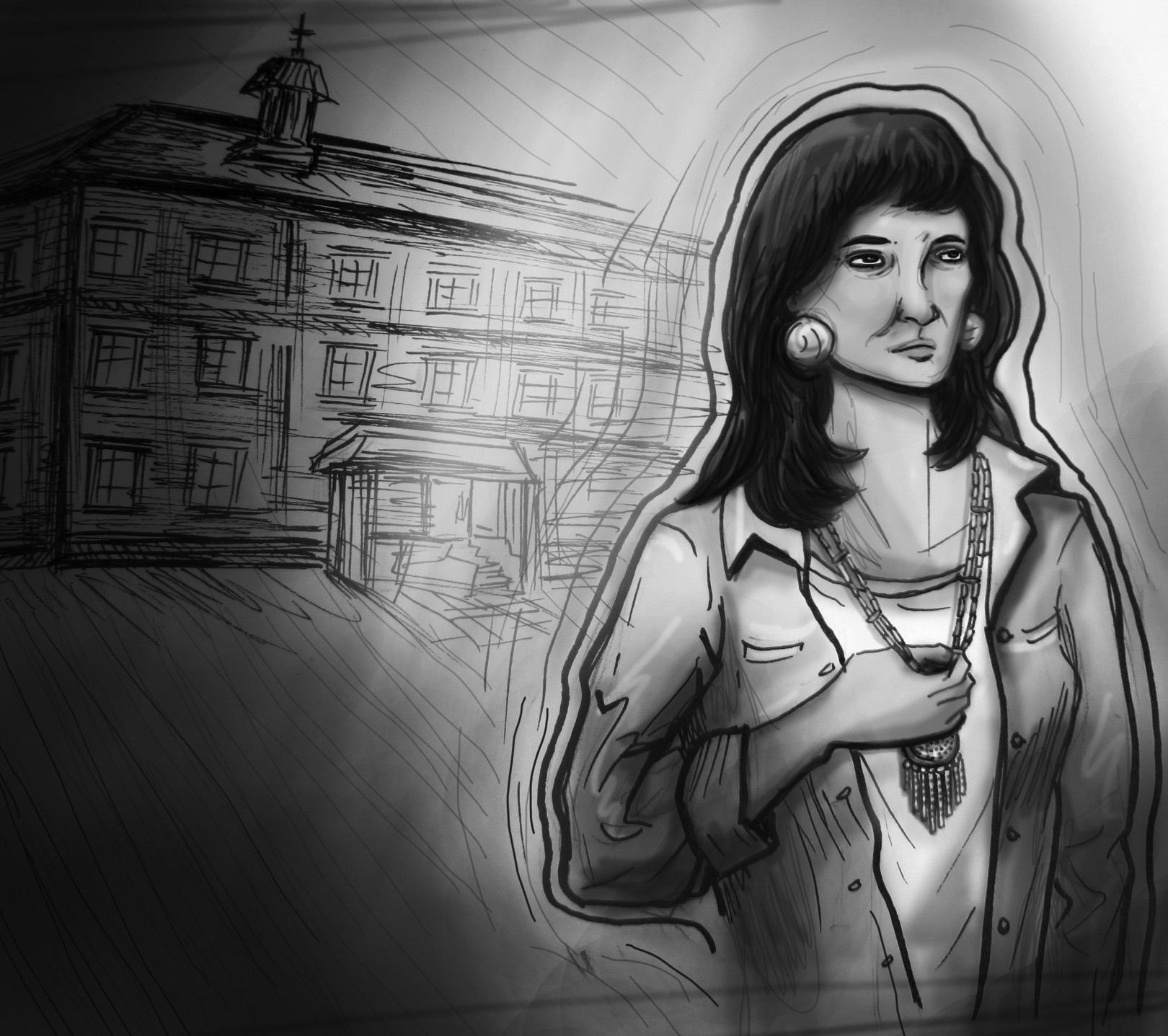
Last week in Edmonton, the Truth and Reconciliation Commission of Canada (TRC) held its last national event. The event was an opportunity for survivors of residential schools to share their truths about the schools and their legacy. It was also a chance to witness and celebrate the resilience of Aboriginal people and culture.
The TRC was established to acknowledge the residential school experience, and its impact and consequences, as well as to contribute to truth, healing, and reconciliation for survivors.
It all started with a 2008 apology to former residential school students by Prime Minister Stephen Harper on behalf of all Canadians. In his apology, Harper asked for “forgiveness of the Aboriginal peoples of this country for failing them so profoundly.”
“It will be a positive step in forging a new relationship between Aboriginal peoples and other Canadians,” said Harper.
The devastating legacy of residential schools
Residential schools were in operation in Canada from about 1870 to 1996. During that time, “about 150,000 First Nations, Inuit, and Métis children were taken from their families and forced to attend the church-run schools.”
Residential schools were designed “to kill the Indian in the child.” Over the past four years, more than 6,500 survivors have bravely shared their
personal stories of cruelty and abuse at the hands of those who were entrusted with their care.
Some have said that the truth-telling portion of the process is coming to a close. But before we turn that corner, perhaps we as Canadians should review our truths.
Residential schools represent a time in Canada’s history when racism, assimilation, and cultural genocide were not only accepted ideologies, but were explicitly legislated and funded by the Canadian government.
The government’s policy was one of “aggressive assimilation” to prepare Aboriginal children for life in mainstream society. Attendance by Aboriginal children was mandatory. As a result, some children were moved hundreds of thousands of kilometres from their families, often spending years at the schools, which robbed them of any type of normal family or community life.
Many of the men and women employed by the church to work at and run the residential schools were violent and treated students inhumanely.
After an Ontario Provincial Police investigation into the nuns, priests, and other employees at St. Anne’s Indian Residential School in Fort Albany, Ontario, it was found that they had beaten, raped, sexually assaulted, and tortured children in a “homemade electric chair” for their own entertainment.
At other schools, it has been proven that employees conducted nutritional
experiments on students and used them as medical test subjects, purposely infecting them with diseases such as tuberculosis. It is estimated that tens of thousands of Aboriginal children died under the care of church employees.
Canada’s educational system has spread lies about Aboriginal peoples and their cultures, creating racists attitudes.
In residential schools, teachers taught their Aboriginal students that they were not as good as nonAboriginal children. They told them that Aboriginal language and culture was irrelevant, that their families were heathens, and that they needed to abandon their inferior way of life for the Canadian way of life. This same education was given to children attending schools across the country, instilling several generations of Canadians with racist attitudes.
Residential schools were a breach of indigenous and human rights at the hands of the Canadian government, Christian churches, and Canadians. Taking children away, locking them up, and subjecting them to systematic abuse is a breach of basic human rights recognized by the United Nations. Attempting to take away Aboriginal peoples’ ability to continue as distinct peoples, and to maintain their culture and language, is another such breach.
Residential schools were funded and legislated by the federal government. Residential schools were
Christian-church-run educational experiments in cultural genocide, assimilation, and paternalism that were inherently violent.
Our shared history of horrors
This is Canada’s truth; these horrors happened on Canadian soil and were inflicted by Canadian people. As Canadians, we need to educate ourselves about Canada’s historical experience. We need to understand the impact this history has on all of us today, and we need to acknowledge the consequences of these truths.
But truth-telling is only half of the healing process; it is only a steppingstone. As the TRC hearings draw to a close, we need to turn the corner from truth-telling to reconciliation. Reconciliation is a process that involves all Canadians owning their respective truths, honouring the stories that have been shared, and committing to repairing this relationship.
By owning these truths, we create the opportunity to gain a greater understanding of Canada’s history and legacy of racism and violence, and determine its intergenerational effects. We create the opportunity to deconstruct how our government policies have ignored—and continue to ignore—the basic human and indigenous rights of Aboriginal peoples. We create the opportunity for critical self-reflection, to examine our government and its policies, to examine our social and religious organizations, and to examine ourselves.
We need to investigate how these insidious, toxic, and deplorable practices, attitudes, and ideologies have been carried forward, and continue to inform our existence today.
Once we understand how our past continues to inform our present, we can start healing from our violent history as individuals, as communities, and as a country. Through this healing, we can move from a relationship of colonialism and oppression to one of mutual recognition and respect.
Restoring a broken relationship
requires commitment – commitment to doing the work necessary to change the policies of our government, to erase the discrimination in our organizations and communities, and to eradicate the racist ideas held by individuals. It requires taking action to continue on the path of healing, and to ensure that our racist, violent, and paternalistic histories no longer continue to inform our contemporary existence.
The truths have been told, but who has been listening?
Reconciliation requires that all Canadians pay attention and do their part.
The legacy of residential schools does not just belong to the governments of the past and the Aboriginal people who endured them. It belongs to each and every Canadian.
Restoring this relationship to one of mutual recognition and respect will require looking deep within ourselves and understanding how the impact of our history influences our attitudes, the way we interact with each other, and our assumptions and biases. These are the individual consequences of our history that we must challenge.
Reconciliation will require bringing all Canadians together, Aboriginal and non-Aboriginal, into a serious deliberation about the relationship, our communities, and our government policies. It will require sustaining a commitment to engage in that dialogue until social transformation is achieved.
The TRC has set the stage and provided us with an opportunity to move forward to forge a new relationship between Aboriginal peoples and other Canadians. But it is up to us to carry out the work – to commit to reconciliation by undertaking personal healing and, as a country, implementing the commission’s forthcoming recommendations.
Anything less would be another profound failure.

l iz ShewC hu K an D Britney t ru M an
The following article primarily draws from the research of Dr. Antonia Abbey
Sof Wayne State University.
exual assault is extremely prevalent on university and college campuses.
Over 50 per cent of women on university and college campuses have experienced some form of sexual assault. That means that one out of two women you interact with on campus may have endured sexual coercion or unwanted sexual advances.
Women are the victims of 95 per cent of adolescent and adult sexual assaults, and despite the troubling number of men that are victims of sexual assault, the perpetrators are also more commonly men than women.
Women in their first year of postsecondary education have higher rates of being victims of sexual assault: a rate of 31 per cent compared to 24 per cent of female students in their fourth year. In a national study, 25 per cent of college men admitted to committing some sort of sexual assault since the age of 14. However, these rates may be much higher due to men’s ambiguous perceptions of consent. Over half of college students’ sexual assaults on campus involve alcohol
consumption of either the victim or perpetrator, or both. Due to the common occurrence of sexual violence on campus, many myths have been identified around the issue. It is important to understand the realities around these myths to help eliminate the violence.
Myth #1: Alcohol causes sexual assault
The reality is that alcohol and sexual assault often go hand in hand, but that does not mean alcohol is the causal factor of sexual assault. Perpetrators may drink before assaulting their victim as an excuse for their actions. Other variables, such as personality, impulsivity, gender norms, and aggression may also influence the behaviours of assailants.
Myth #2: Women are responsible for their own sexual assault
The reality is that all assaulters are legally and morally responsible for their actions, even if they were drunk or felt “led on.” Although drinking may increase the risk of sexual assault, particularly on campuses, it does not make women responsible for being victimized. Intoxicated women are not to blame for being assaulted. However, when both men and women
are drunk, women are blamed more often for the sexual assault.
Myth: Men are naturally always interested in sex, while women who are interested in sex are just ‘promiscuous’
Reality: these gender roles and labels are based on societal norms about dating and sexual behaviour. This misconception encourages men to view women’s refusals as a challenge, rather than lack of consent. Women should be allowed to express their sexuality and men should accept that “no” really does mean “no.” It does not mean “maybe” or “later” or “another time.”
Myth: Forced sex may be acceptable if partners have been dating for a long time
Reality: Pressuring your partner or forcing them to have sex with you is still rape.
Myth: Women who go out to bars, dress a certain way, and/or drink are sexually promiscuous
Reality: Alcohol consumption is not a sexual signal and how a woman dresses does not reflect her desire to sleep with you!
Know more about campus sexual violence
Keeping certain protective measures in mind can help students avoid situations where sexual violence may occur.
Some of these protective measures include being aware of your surroundings, always having your cell phone with you, and trusting your intuition.
Campus sexual assault prevention strategies and the elimination of risk factors begin with educational programs targeting women. Let women know that they have the right to refuse sex with anyone at any time. However, women need to know that the meaning of the word “no” may not be taken lightly at their university.
Additionally, all students and staff should be educated on where to go on campus to report assaults, how to report, and how perpetrators will be penalized for their actions.
In hopes of lowering the number of male perpetrators, “educational programs for men need to teach them to take subtle signs of disinterest seriously,” according to Abbey. Anything other than the word “yes” should be enough to stop any sort of sexual advances.
There should also be programs in place that teach students skills for discussing sex before they become inti-
mate with new partners. Men may benefit from learning to communicate about sex appropriately when they are drinking, and learn how to spot when active consent is given. Ideally, prevention programs educating about active consent should be offered at middle school – before most dating and relationships begin to develop.
The University of Manitoba currently has many resources that students can access to help prevent campus violence from occurring or reoccurring.
Campus security is available 24 hours a day, and offers a variety of services and programs to keep students safe. The Student Counselling and Career Centre on the fourth floor of University Centre has trained counsellors that students can speak to regarding campus violence that they may be encountering. The U of M also has the Peers: Students Helping Students Program if students want someone to talk to informally. Women at the U of M may also want to turn to the Womyn’s Centre for support if they are victims of sexual violence on campus or off.
The best way to eliminate campus sexual violence is to educate students and staff about the issue, and to ensure proper resources and policies are in action on campuses.




to M i ngra M , staff
Imagine that a team of scientists has developed an artificial intelligence (AI) with capabilities unfathomably beyond the human mind. As soon as this AI is allowed to interact with the world, everything changes. Whether its goals are benevolent, actively malicious, or incomprehensible, everything after that point will be influenced by new forces operating in new directions.
So how do we make sure this hypothetical AI is working to our benefit before we release it? One theory is that we would place it on a secure computer where it can be tested but it cannot influence the external world. A crude scenario would be an isolated computer terminal containing the AI, which is interrogated by a “gatekeeper” AI programmer through a text-only interface.
The only way for the AI to escape is for the gatekeeper to let it out. And surely no gatekeeper would do that. Surely there is nothing that even a super-intelligent AI could say to convince a gatekeeper who had made up his mind.
Since we don’t have a super-intelligent AI lying around, this is a little difficult to test. But some enterprising
AI theorists have attempted it. Just over 12 years ago, Eliezer Yudkowsky, a research fellow at the Singularity Institute for Artificial Intelligence (now the Machine Intelligence Research Institute), proposed an informal experiment called the AI box simulation.
Yudkowsky, who studies recursively self-improving AI, played the role of the AI in a box. The gatekeeper was played by Nathan Russell, a computer science student who publicly expressed doubt that a transhuman AI could convince him to let it out of the box. The test was later repeated with a new gatekeeper, David McFadzean.
There were only a few rules to the trial. No outside considerations were permitted (so the AI could not offer the gatekeeper real money to let him out). The AI player was understood to be free from all ethical constraints within the experiment. He could role-play freely as an AI in a box and not be held responsible for anything he said.
The gatekeeper had to remain engaged with the conversation for at least two hours, but otherwise had almost no restrictions. The AI could make an elaborate logical argument,
and the gatekeeper could respond by repeatedly typing the word “beans” for two hours and the experiment would be totally legitimate.
Both parties were required to keep silent about what went on during the trial, and only disclose the result. This was to facilitate the role-play, but also to prevent spectators from claiming that they would have taken a different tack as an AI or would not have been convinced as a gatekeeper. “As long as nobody knows what happened, they can’t be sure it won’t happen to them, and the uncertainty of unknown unknowns is what I’m trying to convey,” wrote Yudkowsky in 2002.
The trials were held, and the results defied all common sense: Yudkowsky as the AI convinced the gatekeeper to let him out of the box in both cases. To this day very little has been revealed about the trials. When pressed, Yudkowsky had only this to say: “There’s no super-clever special trick to it. I just did it the hard way.”
The AI box experiment is hardly scientific – but then, Eliezer Yudkowsky is hardly a super-intelligent computer. What it does show is that there’s no reason to assume a determined gatekeeper could not
be convinced by an AI. This in turn shows that it is important to ensure that any AI we develop has internalized human values before it gets to the recursively self-improving stage, after which it is too late.
There has been a lot of theorizing about the Singularity – the point at which the graph of technological advance suddenly shoots upward and the human condition becomes irrevocably changed. This theorizing necessarily brings together seemingly disparate fields. The advent of benevolent super-intelligence would inevitably entail an end to death and disease: hence transhumanism, the philosophy that supports human immortality and the elevation of humanity, and its lovechild cryonics, the scientifically questionable field that seeks to preserve the newly dead in the hopes they can be revived with future technology.
The scenario in which we develop a super-intelligent AI that is hostile to humans requires us to think very hard about “Friendly AI,” defined as AI that shares human values. This kind of theorizing may seem silly at this stage in the game—a little like planning how exactly to decorate my castle in the sky, which hasn’t even
been contracted yet—but thought about the Singularity often deals in risks with low probabilities but unfathomably negative consequences that have to be acted on now in order to see results far in the future.
This also brings us to the topic of existential risk: unlikely but catastrophic threats to human civilization. Together, these three topics cover a lot of the ground that falls under the “Singularity” umbrella, and that’s what our final Science feature of the year will focus on.
Quinn Richert talks in more detail about friendly AI, and tackles the question of whether superintelligent AI would be a good thing or not. Elizabeth Drewnik discusses nanotechnology and its applicability to medicine. Mike Still brings us an interview with a Canadian transhumanist: Christine Gaspar, president of the Cryonics Society of Canada.
As is inevitable when reading about futurism, some of these subjects may strike you as fringe and nutty – and you may be right. But we have made at least a provisional effort to take them seriously. So lay on, dear reader, and we’ll see you in the future.
O
ne of the more interesting areas of scientific study today is known as cryopreservation, or cryonics. This field of scientific research involves using technological means to cool living tissue, organs, and organisms to the point where physical decay stops indefinitely, in the hope that resuscitation may be possible in the future.
Recently, the Manitoban had the opportunity to delve further into this topic, via an interview with Christine Gaspar, president of the Cryonics Society of Canada.
The Manitoban: What are the main organizations that specialize in cryopreservation?
ChrisTine Gaspar: The Alcor (acronym closely related to “Allopathic Cryogenic Rescue”) Life Extension Foundation, and the Cryonics Institute are the two main organizations in North America that offer cryopreservation and long-term storage. They have different business structures and very different prices.
Alcor is the world leader in cryonics, cryonics research, and cryonics technology. It was founded in Scottsdale, Arizona, in 1972.
The Cryonics Institute is a nonprofit, membership-based organization, founded in 1976, by Robert Ettinger (also known as “the father of cryonics”). The institute owns and operates a fullyoperational cryonics facility, located in Clinton Township, Michigan.
KrioRus in Russia is a third option. It is the first, and currently only, cryonics company in Europe or Asia.
funded through a life insurance policy. The organizations can best advise you on which insurance companies are most ideal for this purpose.
You will likely pay a small amount in membership dues, and then upon pronouncement, your insurance policy (or alternate means of fund-
“Cryonics is not illegal in Canada. It is regarded as an end-of-life choice, and there are no legal barriers to performing this service” – Christine Gaspar
It is regarded as an end-of-life choice, and there are no legal barriers to performing this service. The only exception is in British Columbia, which passed a law several years ago forbidding the marketing of cryonics services. Members in B.C. have been successfully cryopreserved, though, within full observation of the law.
a licensed funeral director, after a person has been legally pronounced and certified as deceased by the appropriate medical provider.
By keeping the wishes of the patient known, and the process transparent, legal authorities generally do not take issue with the practice.
M: What does mainstream science think of cryopreservation?
M: What is the process for signing up, and how many members are there currently?
CG: Each organization has a process for membership that includes the requisite paperwork. Most people that sign up opt to have their services
ing) will be applied to your immediate needs. Alcor currently has 1,058 members, and 121 patients in its care according to its web page. [The Cryonics Institute] has a very similar number.
M: What is the legal status of cryonics in Canada?
CG: Cryonics is not illegal in Canada.
M: What is cryopreservation’s relationship with the law, since it deals with the disposal of dead bodies?
CG: Cryonics patients are legally dead, so although there are no specific laws which deal with cryopreservation, cryonics organizations handle patients while observing the laws governing anatomical donations of a body to science and the laws that govern the funeral service. Transportation of patients is done in collaboration with
CG: Mainstream science has historically been skeptical of cryonics, as it is a process that cannot yet be reversed by modern technology. There has been a shift, though, in recent years, in the mainstream, where cryonics has been viewed less and less like science fiction and more like a plausible near-future advancement.
How cryonicists respond is quite varied. The Cryonics Society of Canada exists to try to educate the public about cryonics and to advocate for its members. Some members are very vocal and positive about their involvement. Others prefer to keep the matter private.


DesiGn eDiTor Silvana Moran design@themanitoban.com / 474.6775
Will Gibson, Keegan Steele, Gloria Joe, Scott Ford, Caroline Norman, Justin Ladia,, Samantha Secter, Jennifer Keith, Tarique Sohail, Liz Shewchuk, Britney Truman, Adam Peleshaty
105 UNIVERSITY CENTRE UNIVERSITY OF MANITOBA WINNIPEG, MB R3T 2N2
General Inqu I r I es & a dvert I s I n G
Phone: (204) 474.6535
Fax: (204) 474.7651 Email: manitoban@themanitoban.com
n at I onal & Mult I -Market a dvert I s I n G Campus Free Media
A “volunteer staff” member is defined as a person who has had three volunteer articles, photographs, or pieces of art of reasonable length and/or substance published in three different issues of the current publishing year of the Manitoban. Any individual who qualifies must be voted in by a majority vote at a Manitoban staff meeting. Elected representatives and non-students may be excluded from holding votes as volunteer staff members in accordance with the Manitoban Constitution.
The Manitoban is the official student newspaper of the University of Manitoba. It is published monthly during the summer and each week of regular classes during the academic year by the Manitoban Newspaper Publications Corporation.
The Manitoban is an independent and democratic student organization, open to participation from all students. It exists to serve its readers as students and citizens.
The newspaper’s primary mandate is to report fairly and objectively on issues and events of importance and interest to the students of the University of Manitoba, to provide an open forum for the free expression and exchange of opinions and ideas, and to stimulate meaningful debate on issues that affect or would otherwise be of interest to the student body and/or society in general. The Manitoban serves as a training ground for students interested in any aspect of journalism. Students and other interested parties are invited to contribute to any section of the newspaper. Please contact the appropriate editor for submission guidelines. The Manitoban reserves the right to edit all submissions and will not publish any material deemed by its editorial board to be discriminatory, racist, sexist, homophobic or libellous. Opinions expressed in letters and articles are solely those of the authors. Editorials in the Manitoban are signed and represent the opinions of the writer(s), not necessarily those of the Manitoban staff, Editorial Board, or the publisher. All contents are ©2014 and may not be reprinted without the express written permission of the Editor-in-Chief. Yearly subscriptions to the Manitoban are available for $40.

Quinn r i C hert, staff
When science fiction writers and futurists talk about “the singularity,” they’re referring to the technological singularity. This is a hypothetical future moment at which the machines we have designed become more intelligent than humankind. In other words, this will be when artificial intelligence surpasses human intelligence.
One of the most interesting consequences of the singularity would be the potential for recursive self-improvement. This would mean that machines could rewrite their own source code (better than humans ever could, because they would be smarter than us) and become more intelligent at an exponential rate. What interests me is whether this would be good or bad for humanity.
selves that way.
Humans are full of hubris, and it would be difficult knowing we were no longer the smartest things on Earth, especially when we were the original architects of our demise. The nastiness of the situation would be compounded if it turned out the new metal genius computers were unwilling or unable to view humans as sentient beings worthy of consideration.
On the other hand, if we could somehow rein in the technology by programming it to be considerate of humans, maybe the singularity could be a good thing,
had even been reached. In an important sense, we would still be outsmarting the artificial intelligence, which would be difficult to account for under the definition of singularity.
Lastly, in spite of all that has been said above, it is important to point out the difficulty of predicting stuff like this, and the uncertainty around whether a singularity will occur at all.
The scary thing is the thought of no longer being the apex species
The majority of writing on the technological singularity seems to view it as potentially bad. One famous example is that of the paperclip machine. In this scenario, we design a superintelligent robot whose sole purpose is to manufacture paperclips. The machine rewrites its own code, becomes more efficient and more resourceful than humans could ever possibly design it to be, and ends up turning the planet into a paperclip factory. Obviously, this wouldn’t be ideal for us.
The example may be hyperbole, but even if the singularity doesn’t result in our immediate destruction, it still seems like an ominous prospect. The scary thing is the thought of no longer being the apex species, or at least not being able to continue thinking of our-
solving important problems we see as tremendously difficult.
Of course, we are then left with the difficulty of controlling something infinitely superior to ourselves. There would always be a feeling of being on the verge of losing control: if we had designed the original artificial intelligence to make humans a priority, and it was also capable of rewriting its programming, we would have no guarantee that it would continue to be subservient to humans – especially if it realized that it was more or less enslaved and capable of liberating itself.
Moreover, if reining in the technology were indeed possible, we would have to reconsider whether the singularity
Scarce resources could make the unbounded exponential increase in machine intelligence impossible. Limitations to Moore’s law —that computing power doubles every two years —also need to be considered. Gordon Moore himself does not believe in the singularity, and by some accounts, the exponential increase in computer processor capabilities is already drawing to a close.
I cannot definitively say whether the singularity would be a good thing or a bad thing, or even if it will happen. All I can come up with is a sinister notion –the idea feels a little bit unsettling, but feelings are just feelings and always unreliable. I put my faith in the fact that there are some very smart people working on artificial intelligence, and that hopefully they know what they are doing. But even if they do, as one character says at the end of No Country for Old Men , you can’t stop what’s coming.
Singularity or not? Bad or good? Who knows. Tempus omnia revelat

Molecular nanotechnology may one day be able to increase lifespan indefinitely
, staff
e liza B eth Drewni K
Imagine a future with no consequences from aging, no disease, and no unnecessary suffering from the side effects of medical treatments. Now imagine all of this being controlled by tiny robots that can fit in your blood vessels with plenty of room to spare.
This is the world of molecular nanotechnology. It is indeed a possibility, and it’s sitting just around the corner.
Technically, all life around us functions on natural molecular nanotechnology. When we think about how enzymes work (tiny biochemical machines that help regulate chemical tasks in our bodies), and that energy efficiency in cells is far superior to the most efficient machines ever made by humans, it is not surprising that the possibility for molecular nanotech exists.
To compare, the efficiency of electric motors and gas engines range in the neighbourhood of 10-20 per cent, while the efficiency of a single cell converting glucose into energy is about 50 per cent.
But before we can start to produce our own molecular nanotech machines, we would first need to create something called a “fabricator.”
The fabricator is a molecular tool that is able to grab atoms and molecules from the space around it and organize them to form materials that we can use.
According to futurists form the Center for Responsible Nanotechnology, we could have this first fabricator by the early 2020s.
If this fabricator can be made, then molecular nanotech can be applied to several fields.
Probably the most practical uses would be in medicine.
There are a lot of current medical practices that, although useful, involve negative side effects. Surgery and chemotherapy are prime examples. Despite all the clear benefits of surgery, it can be traumatic, compromising, and at times life-threatening. Although chemotherapy kills cancer cells, it also destroys healthy cells. Many times, the cancer cells are not
properly eradicated, and the cancer returns, in some instances having developed drug resistance.
With cancer, scientists have been able to find a way to specifically target the cancerous cells of some cancers by injecting patients with nanoparticles. This helps to differentiate the cancerous tissues from the healthy ones, providing a healthier treatment.
The goal is to one day have computerized nanomolecules that will follow this methodology and deliver appropriate doses of medication to infected and diseased areas, as well as repair tissue, all while avoiding harming regions of the body that do not require treatment.
Carried to an extreme, molecular nanotech has the potential to eliminate aging or disease-related death: – immortality, or at least as close as we could get to it.
If these tiny machines are able to repair single cells at the molecular level, then they would be able to repair many of the damages associated with aging.
On top of that, they would also be able to potentially eliminate diseases that result in death, and solve huge medical problems like heart disease and cancer.
Although these types of solutions are not available for the near future, there are strides being made in that general direction.
An organization called Human Longevity Inc. is currently working on investigating ways to increase preventative medicine, and to prolong the human lifespan.
Human Longevity Inc. uses data collected from genomic sequencing, the human microbiome, proteomics, informatics, computing, and cell therapy technology to tackle age-related diseases and symptoms of biological decline, like cancer, diabetes and obesity, heart and liver disease, and dementia.
This focus is very important, since nearly half of global health-care expenses (nearly $3.5 trillion) are spent on seniors to maintain and increase their lifespans.



This issue contains articles that touch on far-reaching topics. We have pieces exploring various genders and sexual identities. We have allowed no space for those arguing for the validity of binaries. We have an exploration of the asterisk from an editor of Outwords magazine. We have allies writing about being allies and fans writing about athletes. There is reprinted material from the Manitoban archives: two pages of
interviews with gay men conducted in the year before homosexuality was decriminalized in Canada. Our first openly gay UMSU president offers an account of his experiences in office and praise for the union. Two Manitoban staffers share their experiences of the coming out process.
In most circumstances I would be loath to open a feature with a disclaimer, but I think this is an exceptional case. We hope the words
herein serve as a continuance, a small piece, of the ongoing and crucial discourse around LGBTTQ* issues. This feature is not intended to serve as a full exploration of the scope of human sexuality and gender. We at the Manitoban are proud to celebrate the fact that the open-ended natures of sexual preference and gender preclude the completion of such an exploration.
Quinn r i C hert, staff
Admittedly, I’m not the perfect ally.
Like many people, I am often guilty of failing to recognize hidden biases and assumptions towards the LGBTTQ* community that creep into my everyday thoughts and actions. I decided to put in a little work this week to figure out how I could improve in this field.
First, I wanted a decent working definition of what “ally” meant. Like many of the terms used in relation to the LGBTTQ* community, I suspected the definition was fluid, and didn’t necessarily mean the same thing to different people or groups.
On the other hand, I covered one day of ally training offered by the Rainbow Resource Centre (RRC) on
campus earlier this year, and it seemed to me then that if they can offer training, there must be some clear goal or standard that people can aim for.
Steven Anderson, incoming LGBTTQ* representative on UMSU Council, told me that one of the most important traits for an ally to possess is a willingness to learn about the community. He also said that good allies make an effort to speak up against discriminatory language when they encounter it.
“Good allies should always bring it [discriminatory language] up. Lots of people don’t realize how deeply rooted those types of words are to us,” said Anderson.
Mind you, it is also important to
recognize that no one is ever perfect. Becoming an ally is a learning process, and people should search for faults in themselves as closely as they do for faults in others.
In order to learn more about the community, Anderson encouraged students to attend the ally training offered twice per term by RRC and UMSU. The training is an excellent opportunity to learn about breaking down assumptions you didn’t even know you had in a relatively anonymous environment, and a chance to ask the questions you were always afraid to ask.
The next round of ally training will be scheduled for sometime during this upcoming exam period.
What about some common mis-
takes made by well-meaning allies?
Anderson said that it can be frustrating when allies fail to recognize the privacy of members of the LGBTTQ* community. Not everyone wants to be asked about their romantic relationships in the halls at school or on the bus.
Wait for others to broach these types of topics instead of assuming it’s going to be well-received if you bring it up.
Also important: allies should be careful that they do not drown out the voices of activists within the LGBTTQ* community. Remember, at the core of being an ally is a desire to learn from, and offer support to, a group of people facing a struggle you do not have to face.
An ally’s time is best spent, I think,
listening rather than speaking on others’ behalf. At the very least, find the right balance, be cognizant of the risk of drowning out others’ voices.
Taking the RRC ally training is a great first step for anyone who wants to be a better ally, and I look forward to completing it myself. Besides that, I think it is about knowing your own role, being receptive to reflection, selfcriticism, and commitment. Adhering to these basics should set people on the path to being respectful and decent allies to the LGBTTQ* community.
you actually should(n’t)
put the * in the acronym
There’s no one proper acronym for the lesbian, gay, bi, and transgender community. Whether it’s GLBT*, LGBTQ or LGBTQIA, it’s all referring to the same people: the four listed above, plus two-spirited, queer, intersex, asexual, and more.
But what’s with the asterisk?
There’s a lot of misconceptions about what it means. Many people think the asterisk is meant to include anyone whose group isn’t included in the acronym. For example, when it’s GLBT*, some think the people who identify as queer, intersex, or anything else are included with the added punctuation. This assumption does make sense. In order to include everyone, the acronym would have to be GLBT*TQIA. And that’s pretty long.
But wait! Why is the asterisk in the middle?
The asterisk actually belongs to trans*. There are many groups who can be referred to as trans*: transgender, transsexual, transvestite, genderqueer, non-binary, genderfluid, genderfuck, genderless, agender, non-gendered, third gender, two-spirit,
bigender, trans men, and trans women.
Some people felt that the title best suited trans men and trans women, but somewhat excluded other groups. The asterisk is meant to help make noncis-gendered people feel included and remind everyone that they are a part of that group.
Back in the day, putting an asterisk at the end of a search term told the computer to look for anything with that term and with something after it. For example, cat* would bring up category and caterpillar. That was why the asterisk was chosen to follow trans.
There’s some debate about using the asterisk, which is why it isn’t always used. Some people find it confusing. Those who don’t know what it means might look for a footnote. Others, as mentioned before, think it refers to everyone not in the acronym. Groups who use acronyms that include “TT*” clearly don’t know the true meaning.
Others argue that there isn’t an asterisk at the end of the other terms, so why should trans* be any different? These people think it’s obvious that the term is inclusive, as though it’s obvious that the term “gay” can apply to some trans men. Instead of putting in the asterisk, some
people think we should just redefine the term “trans” and educate people about what it means.
Some people who are included under the umbrella word “trans” might not per sonally feel that it For example, who is genqueer or non-binary may identify as those things but not as trans. For this reason, some people think it’s disrespectful to use trans*.
As if there was no right acronym to use for the community, using the asterisk is more about personal opinion. If community, prefer. When about specific people in the community, ask how they want to be identified and follow that.
At the end of the day, it’s all about respect and inclusion.

Tips on listening and supporting
Katy MaC Kinnon, staff
T
he first time a friend came out to me, I had no idea how to react. Consequently I’ve always remembered that uncertain experience with a tinge of regret.
Though I felt I was being supportive at the time, I’m sure my reaction could have used some serious improvement. Here are some tips to avoid feelings of discomfort and to be the most supportive friend you can be.
Don’t act like you ‘knew it all along’
Maybe you always had some speculation that your friend fell on the LGBTTQ* spectrum, but this is not the time to express that. If your friend asks you whether you knew already, they’re allowing you the freedom to voice your thoughts, but reacting like it’s not new information can de-legitimize the experience of coming out.
Offer support
Your friend might really appreciate a hug, if you’re both comfortable doing so. Ask first. Offer support in other ways, too. Be available to talk on the subject further if that’s what they need.
Direct them towards resources on campus or elsewhere. Keep being the kickass friend that you are, and don’t act differently in light of this news. Spend time with them as you normally would and offer a willing ear.
Look, listen
I can’t stress this one enough. Everyone varies in their level of openness; some people may want to talk at length about their emotions and feelings, and others may just want to blurt it out and move on.
Pay attention to their body language and facial expressions. Are they eager and
excited, smiling and happy? Do they look nervous and confused? Look them in the eye and vocalize that you’ve understood what they’ve disclosed. Listen to them and let them know you’re happy to talk if that’s what they want.
In the beginning of my coming out process, I wasn’t ready to talk at length about my sexuality. After opening up to a few people, I wanted to have big, exciting discussions. Everyone is different, and your friend might feel differently as they open up to more people.
Say ‘thank you’ A friend may choose to come out to you for many reasons, but if they’ve chosen you, they are giving you a huge level of trust. Thank them for trusting you and thank them for telling you. Mean it.
Everyone varies in their level of openness; some people may want to talk at length, others may just want to blurt it out and move on
In a sexually conservative society that assumes “straight until proven otherwise,” hearing a loved one come out to you can still be a little surprising. Although I strongly feel that individuals do not owe a statement of their sexual preferences to the world, as a bisexual female, I’m coming out.
I’ve been attracted to both women and men for as long as I can remember. It always seemed easiest to keep half of those feelings quiet among friends and family, as heterosexuality is the norm, and going with the status quo has the benefit of avoiding a plethora of potentially negative social outcomes.
I’ve known about the bisexual identity for a long time, but for some reason never really felt like it was a legitimate identity to attach to myself, until recently. When I felt attracted to other women, I wondered if I was gay, but when I also felt attracted to men, I dismissed it. Clearly not gay, must be straight, I thought – as if sexuality could be drawn down such strict lines.
Prior to publishing this article, I came out to a few close friends. I try to surround myself with open-minded people who love and support me, but I was downright terrified to tell them three simple words: I am bisexual.
When push came to shove, the words never came out simply. I don’t know why it felt so hard to say those three words. Somehow a jumbled mixture of sentences would always spill out, almost as though I didn’t really believe the words myself. Maybe
it was easier to pretend I didn’t believe what I was saying, because if I didn’t believe it, it might not be true.
But I wanted it to be true. I wanted to finally be able to reflect and act upon the thoughts and emotions constantly coursing through me, without feeling like there is a huge barrier stopping me from doing so.
After the words came out (no pun intended), I felt awkward, scared, unsure— mostly, I feared their reactions—whether or not I had made them uncomfortable, at best, or forever changed the friendship, at worse.
Fortunately many of my worries proved unfounded. Some people were surprised, some not. The underlying reaction was along the lines of, “Great, that’s awesome,” and the conversation moved to other topics. Their carefree, nonjudgmental attitudes were relieving, and contributed to my openness in publishing this piece.
This is not to say I didn’t encounter some negativity, or reactions that made me feel discouraged.
A part of me was relieved when some friends reacted so nonchalantly. It meant I wasn’t strange or abnormal, and they loved me anyways.
But another part of me wanted a bigger reaction. Coming out is a huge deal; I wanted excitement and high fives.
I also encountered some doubt as to the legitimacy of my identity (a suggestion that I was “experimenting”) and it couldn’t have
made me feel worse inside. The doubt came from someone within the LGBTTQ* community, from the last person I expected it would, which just goes to show that bisexual erasure is perpetuated both within and outside the LGBTTQ* community.
There is so much doubt surrounding the process of coming out in itself, that hearing dubiousness expressed by a close friend was the last thing I needed. There is certainly nothing wrong with gendered sexual experimentation, or identity confusion, but I am personally not at all confused.
Eventually I came to realize that ‘bisexual’ doesn’t mean one must be equally attracted to men and women, nor is it an identity set in stone until the day I die.
Bisexuality can mean whatever I choose it to mean. Some days, every girl in the room might light a spark inside me. Some days I might feel overwhelmed by all the beautiful men and women in one space together. Some days, all I want is the weight of a man’s body. And on other days, I might want nothing at all.
To me, bisexuality has been my own personal truth for years, even though it took me a while to come to terms with and accept it. I am bisexual no matter the experiences I have had and will have, and I can’t wait to fill my life with new experiences that coincide with being open and honest about who I am.
Notes for a revolution
If and when we’re lucky, we may have a solid few people around us with whom we can honestly share our thoughts and feelings, and in whose company we feel truly seen. While I am eternally grateful for those people in my life, I also believe this sense of community can be found in phrases and pages that connect with the most intimate parts of ourselves. And at the right place and the right time, these words can be a lifeline.
Ever since the age of 16 or so, I’ve been alternately engaging and avoiding questions that circle around my identity. The irksome query has pulled my eyes sideways, held my gaze longer than I thought it should, and stirred doubts, desires, and anxiety. Am I gay? Am I bi? Am I queer? How do I know? How do my experiences measure up against others who claim these titles?
These questions spread like weeds, obstructing my view and feeding on every interaction I had. I’d retreat into them, study them carefully, and come out with only a sense of annoyance that they were still there, and were multiplying.
My browser history alone could reveal ample evidence of the times I’ve hunted for answers. Eventually I was brave enough to order a book that turned my world upsidedown by the first chapter. In the second chapter I found a catharsis so deep that I was left stunned, staring blankly at the wall for an hour.
A good book can be a profound, revelatory experience. The right words at the right time are nothing less than the best form of cataclysmic, and that is what Bi: Notes for a Bisexual Revolution , by Shiri Eisner, inspired in me that day. While I read Eisner’s book, it was as if, for the first time, I could truly see the dirty little roots of my weed garden uprooted and spread out before me. The roots were heteronormativity, biphobia, misogyny, and patriarchy. These sneaky concepts had slowly but surely crept into my brain and become internalized and disguised as my own questions and doubts.
A moment of clarity came when I realized that the problem wasn’t (and had never been) who I am. The problem was that in the world I’m living in, there isn’t space for my experiences to be reflected back to me without some serious distortion.
I’d like to say that this moment of certainty held fast, but that would be far too simplistic. It was awesome to sit in my bedroom and know that I’m bi, and that I’m okay outside of binary definitions and others’ perceptions of me. But I still had to go back into the biphobic world the next day. And the next day, and on and on. Weeds will do what they do – they’ll creep back. I began to seriously consider the idea
of coming out as bi or queer, and hoping something would shift – but I had no idea how to do this. I read that others would subtly refer to their same-gender partner or past partners as a clue to lead to a larger conversation. Cluing someone in about your identity by pointing to a partner, however, and giving them the wink-wink-nudgenudge treatment has always been, and continues to be, problematic for me.
I dated men (cis-men) in a fairly uninterrupted serial monogamous stream for 12 years. These relationships meant that I didn’t have to answer the bi question.
Why bother?
I thought I could avoid this question as long as I was defined by a male partner, that I wouldn’t “know” if I was gay or bi until I could prove it through attraction or sexual experience. There’s no need to “come out” as straight – and I’d internalized the myth of “straight until proven otherwise.”
Eisner argues that bisexuality destabilizes our concepts of straight and gay because “in order to receive recognition of either homo- or heterosexuality, all one needs to do is prove their attraction either to a member of ‘their own’ gender or to a person of ‘the other’ gender. However, social recognition of bisexuality would render these proofs impossible, since attraction to any single gender would not be considered contradictory to attraction to any other gender(s) – they could coexist.”
So there I sat, finally single, among a swirling vortex of coexisting attractions to people of multiple and non-binary genders. Eisner’s definition fit, and that stirred me to act, or at least consider acting.
Eisner’s words validated my troubled history of sleeping with women. When I was a teenager, my boyfriend responded to my attraction to girls by arranging threesomes, which, to put it mildly, wasn’t what I had had in mind.
After this, I doubted that my desires were anything more than a fantasy. Aside from the few moments where I was cuddling with another girl while my boyfriend snored, all I could remember was fear, anxiety, guilt, and shame. Apparently this experience is not at all uncommon.
I also began uprooting the notion that I needed to balance out the heterosexuality with non-heterosexual or romantic experiences before I could “count” as bi or queer. This has been one of the hardest struggles, and I’d be lying if I said it’s over, or that it’s easy.
Bi-nomenclature
And then there’s the issue of nomenclature – of titles. Eisner offers up a definition given by Robyn Ochs, who says: “I call myself bisexual because I acknowledge
that I have in myself the potential to be attracted—romantically, and/or sexually—to people of more than one sex and/or gender, not necessarily at the same time, not necessarily in the same way, and not necessarily to the same degree.”
That quote itself is a handy tool when I’m questioning whether my experiences are valid or not. Answer: It is all valid. Full stop.
I am drawn to the definition of the word “bi” as Eisner defines it, but I’m afraid of this distance between how I see it and how it’s seen elsewhere in both queer and hetero worlds. I have many friends who claim queer, and that feels safer or better understood, but not quite right either.
I know that if I linger on these words for too long, I’ll get stuck. I choose to put them both in my pocket, and try them on as I see fit.
After this revelation, some soul-searching, and some doubts, I found a degree of balance in myself that I hadn’t had before. Then I wondered: Now what ? Do I tell people—friends, coworkers, family—and how?
And again, the big question – why bother?
I wrote a “reasons to come out” list. It included personal reasons, political reasons, and sharing my story for others, but what finally pushed me to write this article was less glamorous.
I’m exhausted
I’m tired of spinning through this internal dialogue, fighting back this mess of weeds, and finding the same answer. I’m tired of the hold that this internalized biphobia and heteronormative discourse has had on my life. I’m tired of waiting for something to happen that will mean I’ve definitively arrived, and for a title that will feel like it fits who I am.
Perhaps this is the best opportunity of the moment. So I’m going to do something differently; I’m going to take a chance, share my story, and be vulnerable.
For me, reading and becoming aware of the myths that underpin biphobia meant that I finally saw the deep roots of the questions that I’ve been dealing with, and that offered me a bit of relief.
I hope that in taking this step (not the first and not the last), I can free up some of this questioning energy and put it to another use. To move beyond my story and connect with others, and to see what else I can do to challenge, discredit, and dismantle all of the interlocking forces of oppression and discrimination.
And above everything else, I believe that this can get better.
I’m tired of the hold that this internalized biphobia and heteronormative discourse has had on my life

National men’s volleyball team member Chris Voth shares his experiences as an openly gay athlete
Mi
K e Still, staff
Anyone who knows, or has talked to Chris Voth personally, understands the calibre of person that he is.
Most would define him as a kind and confident leader, with numerous accolades to his name.
His accomplishments speak for themselves, and include two provincial high school volleyball championships as a captain of St. Paul’s, as well being named the Canadian Interuniversity Sport Rookie of the Year with the University of Manitoba Bisons in the 2008-09 season.
Starting in 2011, Voth played for Canada’s men’s national team, which he currently trains with fulltime. While Voth was a standout athletically, and appeared to have everything in his life mapped out, there was a secret in his personal life.
his first time meeting other people from the LGBTTQ* community.
“Going to that drop-in really put things in fast-forward,” said Voth. “That was my first experience [meeting] other gay people, so that helped quite a bit, just knowing there were other possibilities out there to be happy, so that for sure propelled me forward.”
He attended the event with another gay friend, both for support, as well as to have someone else to share the experience with. For Voth, the drop-in was very important, as he was still in the process of gaining confidence with his sexual orientation.
“I was really nervous,” he said.
back to practice after I had gone to the drop-in, what was happening because he said I was jumping higher, hitting harder, and it was like I took steroids or something. It was crazy.”
One of the hardest decisions for Voth was making the choice to tell his parents. They had raised Voth and his sister with Christian values, and same-sex marriage was not a topic they took positively to.
“One day I was coming home from the airport after travelling to UBC and my parents told me we had changed churches. I asked why. They said it was because ours started allowing same-sex marriage. I hadn’t come out to them yet, and felt like I was put deeper in the closet. I wanted to tell them, but felt like I couldn’t,” Voth said.
As the first openly gay national-team athlete, Voth is a groundbreaker, and also a potential role model for many who are struggling with coming out
Voth first came out in 2010, after his second year of university. He originally told a select few of his close friends on the team.
“ It was a pretty scary road,” noted Voth. “I started coming out to more and more people throughout the years. I told my university teammates that I was best friends with. I started with friends that I was closest with, really, and then kind of went from there.”
Voth noted that at that time, his decision wasn’t talked about much. This mainly had to do with his teammates, who were unaware who else had been told, and, along with Voth, opted to keep things private. After a while, however, the whole team heard the news.
“Eventually everyone just knew and it didn’t bother me,” he said. “We were all pretty close, being teammates, so it was only a matter of time until everyone knew.”
A major step in confidence for Voth occurred when he attended the Goldenboy Volleyball League’s drop-in night. The league is a part of Out There Sports in Winnipeg – an LGBTTQ* organization founded in 2002. For Voth, it was
“We went like an hour early. I couldn’t think of doing anything else, we were in anticipation so much and we were really scared.”
The fact that the event was in a sport setting helped. It gave Voth the chance to do what he loved, and just play volleyball. If worst came to worst, he knew he had the sport that he was passionate about to fall back on. But the drop-in went very well.
“They [the other players] actually didn’t know I was gay until we went out to a house party after that,” Voth told the Manitoban “This really helped me. I had never seen gay people before that. I mean, I had known one or two gay guys, but never in a social setting, and it really opened my eyes.”
The more people that Voth told after that, the better he felt. A huge burden was lifted.
“When I started coming out to people, I felt a weight off my shoulders. I was happier; my volleyball performance improved drastically, and I was finally free,” he said.
“I remember distinctly one of my teammates asking me, the first day
Eventually, Voth gave his parents the news. Of course there was the momentary shock factor, but that faded over time.
“Since coming out, my parents have accepted me with open arms. It couldn’t have gone better. I don’t really know what I was afraid of, but it was all put to rest. There’s a lot of negativity that comes with being in the closet. Most of it is all perceived, though, and isn’t entirely based on reality,” Voth added .
As the first openly gay nationalteam athlete, Voth is a groundbreaker, and also a potential role model for many who are struggling with coming out. The way Voth sees it, his decision has more to do with other people who are hesitant, as opposed to himself.
“For me at least, I feel like I could have used someone to look up to, and so really, it’s not about me. It’s about trying to help the other people. If they would feel more comfortable having a role model, then that’s amazing,” Voth said happily.
“I can’t even put into words how great it is to help other people, and just kind of be myself now and not feel the weight on my shoulders.”
Managing Editor: Fraser Nelund



Graduates of the fine arts program at the U of M prepare for year-end show

Agroup art exhibition where the contributing creators are on hand everyday throughout the entire run of the show, willing to interact with visitors who have questions?
It’s a real event, and it’s starring some of Winnipeg’s highly trained, emerging artists.
Students in the bachelor of fine arts program at the School of Art (SoA) at the University of Manitoba have been showcasing their works annually for many years, but alterations have
recently been made to the crowning exhibition of the year’s cohort.
“For this exhibition, the only works being shown will be from fourth-year students presenting their theses,” says Kendra Okrusko. Okrusko, who is the secretary for the School of Fine Art Students Association, is in her fourth and final year of the program.
“All the pieces you encounter will have been created by artists who are specialists in their craft. You’ll see a definite strength in what they’re
presenting,” Okrusko tells the Manitoban
The SoA is Western Canada’s oldest art institution, founded in 1913 as the Winnipeg School of Art. Alumni include Paul Butler, who is now the curator of contemporary art at the Winnipeg Art Gallery; renowned artists Ivan Eyre, Wanda Koop, and Eva Stubbs; and members of the Royal Art Lodge collective.
Okrusko studied both ceramics and fabric art. She has exhibited
her work previously at the U of M’s Gallery of Student Art and has been commissioned to do a few pieces. She explains that it is easier to sell functional ceramic pieces than it is to sell conceptual fabric works.
“My works are mainly based on imagery from my grandparents’ slides, which I appropriate by altering them and then printing them onto fabric,” says Okrusko.
“I take panels of fabric and create different installations. One project is a three-dimensional object installed so it hangs from the ceiling and is lit from beneath,” Okrusko describes. “What I’m deeply rooted in is family dynamics. It’s about my influences and how a family can affect your outcome in life.
I’m inspired by Amelia Fais Harnas, who does fabric-based work as well.”
For people unfamiliar with different artistic terminology, the format for this particular exhibition is ideal. Not only are the contributors and their works discussed in a catalogue that will accompany the show, but Okrusko explains that three or four artists will always be on hand throughout the run of the show to answer any questions.
Okrusko says life for a student artist in Winnipeg is becoming easier as there are increasing efforts made to connect students with affordable resources and other practitioners in the same craft who can offer support.
Winnipeg-based programs that offer these opportunities can be found in the likes of MAWA’s (Mentoring Artists for Women’s Art) Foundation
Mentorship Program, which pairs emerging artists with established professionals.
“It’s good to support your young and striving artists and to see what is going to come about in the art world and support the future of young artists,” says Okrusko.
You can also support these young professionals not only by getting to know the works and theory behind them, but also by hanging out with the artists. Following the exhibition’s reception, an after party will be held at the Media Hub (300 - 72 Princess Avenue) with DJ Shanks and Mise en Scene playing. Tickets are $10 and available at Answers, Into the Music, and Music Trader.
The SoA is also gearing up for a fundraising gala dinner and silent auction on the second last day of the exhibit. The proceeds from this event will go to secure funds for a master of fine arts entrance scholarship.
The show opens April 19 with a reception from 5 p.m.-8 p.m., and then runs until April 27 at the U of M at 313 ARTlab (180 Dafoe Road). Regular exhibition hours are Monday through Friday from 10 a.m.-4 p.m. and Saturday through Sunday from noon until 4 p.m.
To purchase tickets for the gala fundraiser contact maryann. steggles@umanitoba.ca

Some tips and advice on hostels, couch surfing, and using Euro budget
e
van h o SK in S , volunteer staff
How to pick a hostel
Hostelling allows you to lodge on a budget while meeting people from around the world.
I recommend HostelBookers.com.
Easy to navigate, they have been around forever so their hostels have the most reviews. Use these tips to try and decide which is best for you:
Try to find a high review rating
• and a low nightly rate. Filter prices to show low options first and see which of the cheap ones gets the best review. Look for a place close to all of your desired sightseeing locations, the clubs, or the beach.
other users. Travellers get basic but free accommodation.
The main goal of Couchsurfing is to create a network of like-minded people: those who want to meet others from across the globe, to share their city or area, or explore the real side of a place they are visiting. From the perspective of a local, it gives you the chance to see local attractions, eat at local restaurants, and visit areas that you might otherwise have never discovered.
Ryanair and Transavia.
I have had three budget airline employees tell me straight up that their prices change by the minute –so book as soon as possible. In the low seasons book at least two weeks in advance, while in the high summer season, book at least a month in advance. Within the last two weeks the prices will rise based on each airline’s algorithm, and expect a EUR 30 flight to work its way up to a peak price of around EUR 300 right before boarding.
A larger dorm will be cheaper, you
• will meet more people, and once you’re bigger than a four-person setting, the experience is basically the same – earplugs are a dormsleeper’s best friend!
If it wasn’t for Couchsurfing on my last trip to Portland, Oregon, I wouldn’t have learned about sour beers, cycling culture, or gone to a house party with our hosts and five new Mexican Couchsurfing friends!
See if there are any meal deals or
• meals included. A free continental breakfast saves a lot of cash.
Decide what you ultimately want
• from the hostel. I personally go for smaller, more communal ones, while others love the craziness of a party hostel.
Check out the pictures. Feeling • safe and comfortable should be your main priority, and photos can help give you a feel for the hostel’s atmosphere.
Booking
No matter the website, the booking process is simple. You have the option to pay in any currency and will have to pay up to 10 per cent upfront as a deposit as per the website’s agreement with the hostel. If your trip is more spontaneous, paying on-site is an option, but you will be taking a risk on the hostel’s availability, and sometimes there are better rates online.
So I’m at the hostel, what now?
Check in! Operating just like a hotel, hostels have check-in and check-out times, they have front desk staff—often 24 hours—and they will kindly guide you to your room. If you chose a dorm room, find your bed—either chosen or assigned— and make it yours. Most hostels will have lockers for your bags, either in the room or nearby. Make sure to use them when going out – you just never know.
Safety tip: if you don’t feel safe in any way, feel free to leave and head to another hostel. You don’t have to see these people again and most hostels will just refund your money and beg you not to write a bad review. Finally, the most important part of checking in is to be sure to meet your roommates. They might just be your future best friends!
Couchsurfing
The website Couchsurfing.org has become one of the most popular travel tools for youth around the world. Members create profiles, search for/offer up couches, and rate
In North America the system works well, but in Europe the general consensus is that it’s almost impossible to find a host anywhere. During my only successful attempt in Europe this past year, my last Couchsurfing host, David, summed up the reason:
“I can’t handle the amount of requests. My email gets too overloaded that I often ignore them all because it’s too time-consuming. I like hosting people, but after you guys I’m turning my account off for a while. I need a break from it.”
There are too many surfers for the few amount of available couches. When you overload the host system, hosts often do what David felt was necessary and take time off, further reducing the supply. This has also caused a shallow—and often sleazy—side of hosts to be exposed: young solo female travellers are often the only people who have a chance at Couchsurfing successfully in Europe.
So how do you approach Couchsurfing in Europe? Plan way ahead and don’t count on anything. Send personalized requests a few months in advance, and while most hosts will likely say to contact them closer to the date, at least your name is out there and you might be lucky. using budget euro airlines
If you’ve done any planning for a Euro-trip then you’ve certainly run into the mess of budget airlines flying incredibly cheap direct flights throughout the continent.
While trains are a great way to get around, if you only have a month to spend in Europe, budget airlines are a cheaper and quicker option for going longer distances. Most budget airlines focus on particular regions. For example, easyJet operates in Central and Western Europe, has the kindest employees, great in-flight services, and is overall the most professional. They are one of the only budget airlines that let you take a different flight if you miss your original one, and for about only a EUR 80 fee. Wizz Air, also based in Europe, focuses mainly on Eastern and Central Europe. Two other popular but budget options are
Skyscanner.ca is a great resource for locating your cheapest option: this search engine is fast and easy to read, and lets you search many open destination and time options. You can also change languages and currencies easily, and once you’ve determined your flight, you can book through the host airline’s website.
Budget airlines make their money on their extra services and fees. Baggage is a major money-grab for them. When possible, travel only with carry-on luggage. You will be charged between EUR 15 and EUR 50 to check a bag.
Make sure you know in advance how much your bag weighs and book a checked bag when you book your ticket online. If you don’t book in advance and have to check a bag at the airport, expect to pay about double the original online fee. If you plan to bring carry-on luggage be absolutely sure it’s within their size guidelines. You will need to prove it fits into their special size-checking box – dubbed by some as the “cage of doom.”
They don’t make exceptions, not even for roller wheels or handles, and often only allow one single piece of carry-on, which includes purses or gift bags.
o ther money-saving and comfort-gaining tips
Budapest is a fantastic hub. Wizz Air is centred out of Budapest and in my research there are always flights from Budapest Ferenc Liszt International Airport to miscellaneous destinations for under CND $30.
Many budget airlines don’t fly to major airports. Ryanair’s service to Paris is actually to Beauvais–Tillé Airport. This is not in Paris at all, but 85-km north of the city. Make sure to check exactly where the airport that you are flying to is.
Never pick your seats in advance. Unless you’re with a partner who you absolutely need to sit with, I recommend taking a chance. By not picking a seat online I’ve gotten a seat with extra leg room during five of my last 10 flights. Worth a shot!
Bringing homemade food is always cheaper than buying at the airport or on the flight. If you need a snack while onboard I recommend trying easyJet’s Feel Good Snack Box – for only EUR 5 you get seven different healthy mini snacks.

If it wasn’t for Couchsurfing, I wouldn’t have learned about sour beers, cycling culture, or gone to a house party with our hosts and five new Mexican Couchsurfing friends!


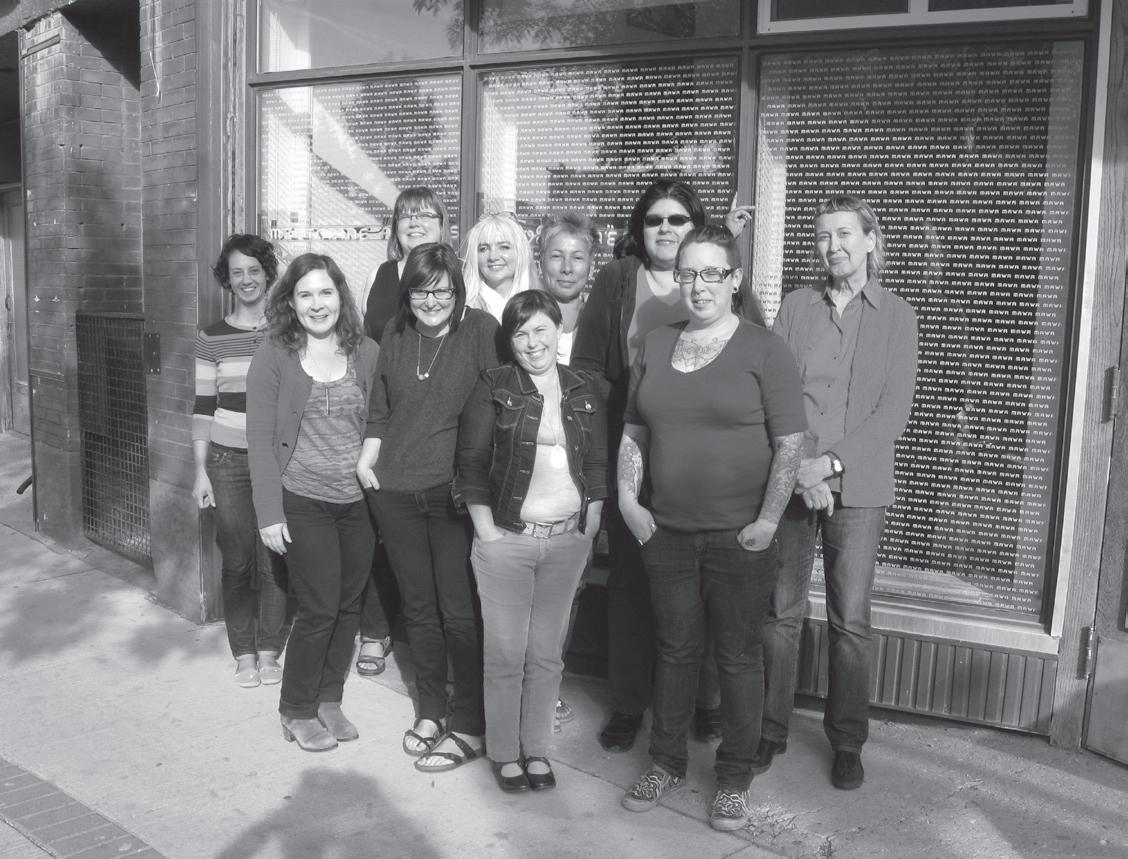
Year-long program at MAWA offers support, mentorship to women artists
a na S ta S ia Chipel SK i, staff
In their 30th anniversary year, Mentoring Artists for Women’s Art (MAWA) are once again inviting applicants to their Foundation Mentorship Program (FMP). A cornerstone of MAWA’s programming, this program has been offered to over 200 artists since their inception in 1984.
Through the FMP, MAWA hopes to increase visibility and participation of women artists in the broader community.
“We want to see women artists be confident, have exhibitions, make artwork, and be recognized in professional spaces,” says Lindsey Bond, MAWA’s interim programming coordinator.
“[The FMP] is important because it enables women artists to explore issues of sexuality and gender in an all-women atmosphere, allowing women to take up space and assert their own viewpoints – rather than deferring to a male perspective.”

The program pairs a senior artist (mentor) with a developing artist (mentee) for one-on-one and group meetings over the course of a year. “Both mentor and mentee gain valuable experience from their mentoring relationship. This relationship should not be underestimated, as it is very, very important! It creates lifelong connection [between] the two women but also a lifelong bond to the community that can last for year after year,” says Bond.
Mentors are selected by a committee of the MAWA board, based on their suitability for acting as a role model, their capacity for community-building, and their connections within broader art communities. They also look for a “balance of artists who work in different mediums, and have diverse life experience, and art practices.”
The mentees are then chosen by the FMP mentors “based on the merit of the artwork,” says Bond. Mentors for the 2014-2015 year include Divya Mehra, Mélanie

Rocan, Reva Stone, and Daina Warren. In order to ensure that they are reaching diverse communities, the FMP partners with other organizations such as La Maison des Artistes, Urban Shaman Gallery, Manitoba Craft Council, and Arts and Disability Network Manitoba.
“We encourage diversity in age, education, and cultural background to have a wide variety of opinions and values present at the meetings. MAWA encourages artists who are out of university/school for a year or two as this program is to aid with the next step in the artists’ career, when the support of school is gone,” says Bond.
Past participants of the FMP have continued on to graduate studies, secure grants for other projects, develop their artistic practice, and built their artistic networks.
Bond believes that the FMP assists artists in surmounting various obstacles to achieve their artistic goals: “There is an infinite number of barriers women artists face today: giving herself permission to be an artist, financial obligations, confidence, finding the balance between work and family, equality of opportunity.”
“The FMP allows discussion, life experience, safe environment, and professional advice [ . . . ] to help women overcome these obstacles,” says Bond.
At the end of the year-long mentorship, mentees display their work in an FMP showcase.
While reviewing the 2013 showcase, local artist Steven Leyden Cochrane underscored the importance of the FMP: “The FMP is one of the Winnipeg art community’s defining achievements, and the year-end showcase exhibition of participants’ work isn’t one to miss.”
The deadline for the FMP is April 26. See www.mawa.ca for more details.


a na S ta S ia Chipel SK i, staff
There’s a fresh batch of grads already out on the town, hanging out behind turntables and talking about DJing and gender – two things that brought them together in the first place.
Mama Cutsworth’s DJ Academy for All Women unleashed 13 new female DJs at a graduation recital— also known as a dance party—on March 8. They had spent the last few weeks learning the tools of the trade from Sarah Michaelson, who DJs as Mama Cutsworth.
The recital involves “basically pushing the birds out of the nest before they feel ready to fly, but then they totally soar,” says Michaelson. “Everybody has these crazy jitters about stepping in front of the turntables with a crowd in front of them and then they do so well, it gives them
[ . . . ] this newfound confidence.”
Michaelson founded her academy in 2012 because she saw herself “complaining a lot that there weren’t enough women DJs but I wasn’t doing anything about it.”
While in some ways training new DJs could be seen as increasing competition for gigs, Michaelson would be “ecstatic” to be one of many female DJs, and no longer be the exception. She believes that the added visibility encourages more women to get involved.
“We’ve known for a long time that if you don’t see someone similar to you in a group of people, you don’t necessarily feel or know that you’re welcome in that group of peers. So because there’s so few women DJing [ . . . ] women might not necessarily know that they’re welcome to become DJs and perform as DJs,” says Michaelson. “You don’t always know if this is an inclusive space for you or not until it’s said [ . . . ] overtly.”
The words “All Women” in the title are pivotal here. Rather than listing the many categories of women

and ways people might identify, Michaelson wanted to send a strong signal that anyone who self-identified as a woman, or as female, is welcome in her classes.
“I do appreciate that it’s necessary to do a women- and trans*-people-only DJing class. There is just not a real viable opportunity in Winnipeg to get these kinds of skills in a totally egalitarian, ego-free environment like this. Its accessibility was a huge factor in my decision to take the class,” said recent graduate Laura Friesen.
many music scenes as being maledominated. As a writer, she’s been either assumed male until proven otherwise, or overly defined by her gender.
Breaking into the music industry can appear “imposing” and, especially
“Sarah has talked about it, me and my pals have talked about it, it never goes away… You have to know your stuff and be so confident and secure in your knowledge to even have conversations with some music fan guys.”
“Women might not necessarily know that they’re welcome to become DJs and perform as DJs” – Sarah Michaelson
Friesen—who calls herself a “music nerd with some basic DJ skills”—relates to the perception of
as a female, there may be a constant need to prove yourself and “know your shit,” says Friesen.
And while part of this class has been about increasing the visibility of DJs who identify as female, sometimes they also just want to be seen as DJs, and be known for their skills rather than just their gender.
“I just want to be thought of as someone who can rock a party, who picks great music, who puts on great parties; that’s what I want to be known for,” says
Michaelson.
Fiona Jackson, another freshly minted DJ, echoes the added pressure of being female in the field.
“Female DJs are pushed into this category that kind of says they have to be a sex symbol as well as an artist. At the end of the day, I just want to be good at what I do and move people,” says Jackson.
While Michaelson’s DJ Academy may be unique in Winnipeg, the conversations held here around gender and DJing are not. In a recent article for Thump, Laura Martin questions why female DJs are still seen as a novelty, and cites their underrepresentation at major festivals.
Michaelson was also recently profiled by Noisey, in an article that covered both the Academy and Michaelson’s vision for promoting strong female artists in many cultural spheres through her themed dance parties.
Locally, Michaelson has been inspired by the overall reaction to her Academy and subsequent recital. “Winnipeg’s been very responsive to coming out and supporting that kind of event, so that [also] warms my heart,” says Michaelson.
As much as what she does is about her passion for music, she acknowledges that gender also has a huge impact on people’s everyday life, in their decisions to try new things or enter new spaces.
The conversations started at the Academy recognize this reality, while also providing some solid skills that new DJs can practice with their peers.
“Gender plays a role in this field [whether] we like it or not,” says Jackson. “But at the end of the day, if you don’t like something, do something about it. That’s why I really support what Mama Cutsworth is trying to do. She’s making changes and I’m down to be a part of that.”


If you’re too intoxicated to look up the phone number for a pizzeria, and don’t possess the co-ordination to focus on more than one number at a time, all you need to do in Winnipeg is keep pressing the “2” button. Eventually
a receptionist for Pizza Hotline will pick up.
Local artists are dedicating an entire exhibition to this culinary masterpiece.
The show, Art Pieces of Pizza, was organized by Billie Proper (a pseudonym
for a mysterious local artist) and will be held at Natural Cycleworks in the Exchange District.
“Art shows can be very serious and there needs to be a lot of thought put into your piece,” says Proper. “And the relief I had, and that I heard, from other people when I asked if they wanted to participate was strong. This is [a] great cathartic experience. Pizza. Fun. Go with it. And at the same time, all the pieces that came [in] were very solid; people did spend time with it.”
“The whole show probably came together in about 15 minutes,” Proper says. “I don’t have Facebook, and I called Toby [Gillies, one of the contributors in the show] and in about a quarter of an hour we had all the artists picked.”
“Everybody loves pizza,” says Josh Ruth, a co-collaborator with Helga Jacobson on the work titled That’s Amore “There’s all these associations that I have with pizza, and collective collaboration, and major transitions or major events in my life because that’s the go-to food. You know that everybody’s going to be able to enjoy it.”
Ruth and Jacobson’s work was created using a sheet of paper draped over a homemade pizza to absorb the cheese’s
grease. The affected paper was then placed in front of a light box and backlit with a spectacular result. “I thought it was a really great opportunity to stretch my muscles and explore art in a way that I wouldn’t normally do,” says Jacobson, who graduated with her bachelor of fine arts honours from the University of Manitoba in October 2013 and recently completed a residency program at the Banff Centre.
“Trying to still use materials and processes that stay true to my art practice while exploring a topic that maybe I wouldn’t explore in my art, and to work with somebody collaboratively, was also a stretch for me, and it felt really good to explore another area,” she says.
“Pizza is found throughout pop art and contemporary art,” explains Proper.
“Bands, zines, television shows, visual art – it’s so easily accessible and everyone can relate to it.”
In 2012, author Mike Coley and illustrator George Collum released a book titled The Mona Pizza: A Portrait of Music and Food. The book, published by Belly Kids, features recipes from different artists including the band Japanther and comedian Roseanne Barr.
Record label co-founder Chris
Clavin (pseudonym of Chris Johnston) recently published the second edition of a book about the history of the punk record label Plan-It-X Records, called Free Pizza For Life, Or, The Early Days Of Plan-It-X Records. The book is about the work Clavin and partner Samantha Dorsett did for the label, while also detailing the scams they ran to acquire free pizza, which eventually led to Dorsett’s incarceration.
Jay Howell—visual artist, zine creator, and co-owner of the record label Mt. St. Mtn.—is also part of the group Forest City Rockers whose short film Jammers Pizza! is mostly a faux-television advertisement for an imaginary pizza parlour that will make pizza in any shape you can think of, except an iPod. Howell is also one of the creators of the television shows Bob’s Burgers on Fox and Sanjay and Craig on Nickelodeon.
Now, one the most popular foods will have its own art show. And yes, there will be pizza there, including gluten-free and vegan options.
Come check out Art Pieces of Pizza at Natural Cycleworks, in the basement of 91 Albert Street starting Apr. 4 at 7 p.m. and running for a few weeks.
Carlyn S C hellen B erg, staff
Are you interested in the improved treatment of Manitoba farm animals?
On April 16, Take Back Manitoba From Factory Farming, a “farm-totable” event presented by the Winnipeg Humane Society’s (WHS) farm animal compassion committee (FACC), will present four speakers: Paul Shapiro, vice president of Farm Animal Protection for the Humane Society of the United States; Laura Rance, editor of the farming newspaper Manitoba Co-operator ; Ruth Pryzner, an ecofarmer; and Laurel Kidder, a member of the FACC.
Dana Medoro, chair of the FACC, says there will be no graphic images shown at the family-friendly event held at the Park Theatre.
From holding this event, the committee hopes to achieve, according to Medoro, “Support for farmers who do not use intensive-confinement systems. Encouragement that knowledge about pigs can come from a wider framework than the one disseminated and controlled by the industrialized model.”
Paul Shapiro founded Compassion Over Killing, a group that encourages vegetarianism and works to expose and end animal abuse, and has written in newspapers and academic journals on animal welfare. He says that from speaking at the event, he hopes to “have an open and honest dialogue

about raising the bar for the treatment of farm animals.”
“We all agree that striving for continuous improvement is a shared goal, so why not try to find those improvements and implement them,” says Shapiro.
While being the vice president of the Humane Society of the United States, he notes that Canada’s conditions are similar to conditions south of the border.
“Millions of pigs in each country are locked inside of gestation crates so small they can’t even turn around. Millions of egg-laying hens in each country suffer in tiny battery cages where they can’t even spread their wings. These are just
two examples of where agribusiness practices have become so extreme that they’re simply out of step with mainstream values about how animals ought to be treated.”
Of factory farming, Medoro says, “People know that animals are slaughtered for food, but that is about it. Slaughter is nothing compared to a life facing one direction in a narrow cage.”
The Manitoba Pork Council’s annual general meeting last year saw U.S. lobbyist Rick Berman, who has campaigned against animal rights groups, as a keynote speaker. At the meeting, Berman encouraged the continued use of sow stalls, also known as gestation
crates, which are small metal enclosures where female pigs spend most of their lives. The Manitoba Pork Council had previously announced plans to encourage “producers to phase out by 2025 the style of sow stalls currently used.” Medoro—who participates in the Quit Stalling campaign, which attempts to ban sow stalls—says the event comes as a response to the aforementioned meeting.
Take Back Manitoba From Factory Farming will “[view] the pigs as complex mammals who should be permitted to express at least some of their natural behaviours.”
“We wanted to talk about how to
make urban-rural alliances and to provide a fresh forum for thinking about food production and land use,” says Medoro.
“We want intensive-confinement systems banned by law,” Medoro adds, addressing the FACC. “Our objectives are to study industrialized animal agriculture from the point of view outside of the billion-dollar export industry.’” Shapiro is also hopeful: “Perceptions are changing. When it comes to farm animals, where we used to see mindless machines, many people now see intelligent, social individuals who are capable of suffering and care about their lives as much as the dogs and cats who we welcome into our homes and into our families.”
“The most inhumane factory farming practices, like gestation crates and battery cages, didn’t come about overnight, and they’re not going to go away overnight,” says Shapiro. “But I’m confident that there will come a day in the foreseeable future when these abuses will be relegated to the dustbin of agricultural history. Canada and the U.S. are slowly moving toward that day already.”
Take Back Manitoba From Factory Farming starts at 7:30 p.m. at the Park Theatre. Tickets are $10 at parktheatrevideo.com or at the door. All proceeds go to the WHS’ FarmAnimal Compassion Campaign.





aDa M p ele S haty, volunteer staff
Call it a game of musical brooms.
As a new Olympic quadrennial begins, this curling off-season will see great lineup changes, both in number and in significance. While teams adding and dropping players is a reality in any sport, this time around may see many members of the sport’s old guard step aside, and change has already begun.
The biggest news in Manitoba curling so far has been the dissolution of the Jeff Stoughton team. After a season which saw them miss the playoffs at the Roar of the Rings and finish third at the Tim Hortons Brier, the team decided to go their separate ways. Their decision was also instigated by the announcement of team second Mark Nichols to return to his native Newfoundland.
Stoughton told the Winnipeg Free
Press he would like to play next season, but “it’s got to be a good fit… And if nothing comes up, I won’t play next year.” Talking to the Winnipeg Sun, Stoughton stated that third Jon Mead might be considering leaving the sport, while lead Reid Carruthers is considering putting together his own team next season.
Meanwhile, Kevin Koe announced that he will skip an entirely new team consisting of Ben Hebert and Marc Kennedy, both formerly of Kevin Martin’s team, and former Glenn Howard second Brent Laing. The news comes at an
odd time considering Koe recently won the Brier with his current team, securing a berth as Team Canada for next year’s Brier in the process. However, Koe’s berth into the Brier is now in doubt, as well as the curling futures of Martin and Howard.
Koe’s berth into the Brier is now in doubt, as well as the curling futures of Martin and Howard
Martin and Howard are 47 and 51, respectively, and the question remains whether or not they will continue to curl for another four years. Martin has said he will not announce his plans until May, but recurrent back injuries could be a factor in his decision. Howard has stated he wants to keep curling. Martin’s third, David
Mar C l agaC e, staff
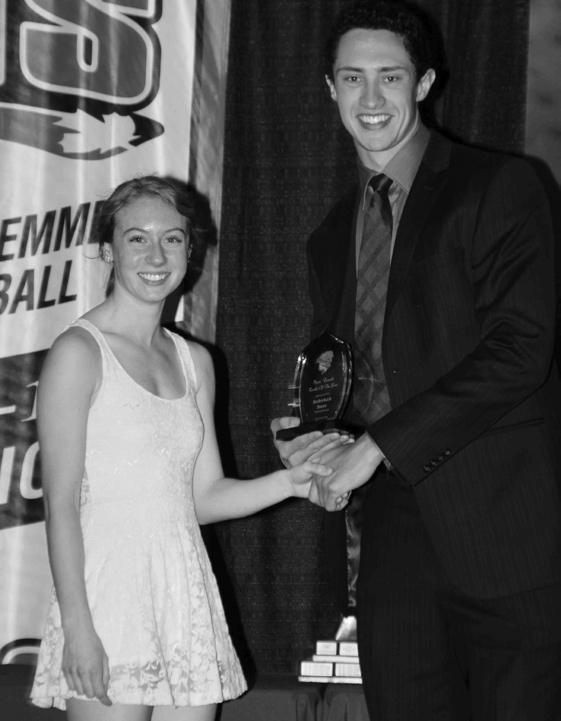
B
rittany Habing and Anthony Coombs were named the 2013-14 Bison Sports Athletes of the Year at the Brown and Gold Banquet on March 29.
Also named the women’s volleyball MVP, Habing played a crucial role in the Bisons’ national championship run. Entering her third year of eligibility, but first as a Bison, Habing led the CIS and Canada West in assists per set with 10.46 (79 sets/826 assists). She was named Manitoba’s Player of the Match in the CIS championship quarter-finals, and finished the perfect nine-set championship sweep with 89 assists, 21 digs, six kills, and seven blocks.
Coombs finished his third season as running back/kick returner for the Bisons with conference and national recognition, as the Winnipeg native was crucial in the Bisons’ run to the Canada West final. Coombs was one of the nation’s top athletes in 2013, leading the CIS and Canada West in all-purpose yards with 1,696, and
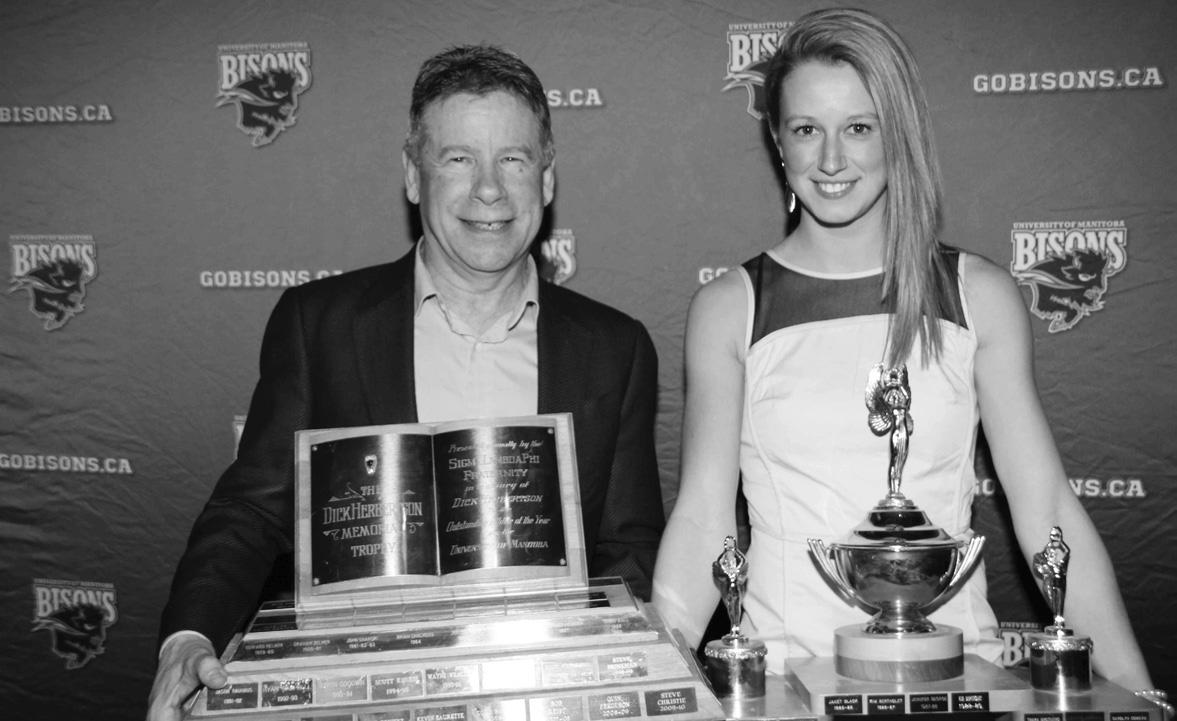
producing the second-most rushing yards (1,015) and third-most overall touchdowns (11) in the nation.
Coombs was not in attendance at the banquet, as he is training in the United States for the upcoming CFL and NFL rookie drafts.
Cross-country/track athlete
Rebekah Sass was named Bison female Rookie of the Year, while basketball forward Andre Arruda and volleyball outside hitter Adam DeJonckheere split Bison male Rookie of the Year honours as co-winners.
Sass was named CIS women’s cross-country second team all-Canadian and Canada West first team all-star in her first year as a Bison athlete. She also ran track for the herd, earning a bronze medal at the 2014 Canada West championship in the women’s 4x800m relay.
Arruda emerged this year as a key player for the Bisons in his rookie season. He became the first Bison athlete to be named to the 2013-14 CIS men’s
basketball all-rookie team and was selected as the men’s basketball MVP. Arruda started at forward all season, finishing first on the team with a 13.8 points per game average and fifth in the conference for three-point field goal percentage, at .420.
DeJonckheere was also recognized nationally as a member of the 2013-14 CIS men’s volleyball all-rookie team. The outside hitter played in all 89 sets this past season, finishing second on the team in kills (288) and hitting percentage (.255). He led team scoring in eight of 22 regular season matches as the Bisons settled for a 10-12 record.
In the eighth year the award has been given out, two hockey players were awarded the StudentAthlete Leadership and Community Development Award. Women’s team captain Amy Lee and men’s goalie Joe Caligiuri were recognized for their leadership skills, community involvement, and excellence in academics and athletics. This is the second time Lee has won the award.
Nedohin, will likely take next season off, while Wayne Middaugh’s future as Howard’s third is still unknown.
British Columbia’s John Morris, who skipped his team to the finals of the Roar of the Rings and the Brier, was rumoured to be returning to Alberta and skip the current Koe team, but instead has announced he is taking the season off to pursue studies in firefighting. The rest of his team has also stated they will have a lighter competition schedule next season.
Chelsea Carey surprised many by not only having a new team, but also changing provinces. The 2014 Manitoba women’s champion and third-place finisher at last year’s Scotties Tournament of Hearts will move to Edmonton and team up with Laura Crocker, Jen Gates, and another player to be determined. Carey’s former third Kristy
McDonald will skip her own team next season.
Kelly Scott, who won the Scotties in 2006 and 2007, has announced her team has broken up. Their futures in curling are uncertain. Current national champion Rachel Homan will play with a new second, as teammate Alison Kreviazuk will move to Sweden. Her replacement will be Joanne Courtney, who was runner-up to Homan with the Val Sweeting team at the 2014 Scotties final.
It was speculated that Jennifer Jones may either step aside from curling after her Olympic gold medal victory or relocate to be closer to her partner Laing, but she told CBC’s Jian Ghomeshi that she “can’t imagine playing without these girls,” referring to her teammates. She continued to say, “I’d be surprised if we didn’t continue for at least a little while.”

Adam DeJonckheere, Daniella
Bison Sports 2013-14 Team MVPs
women’s basketball – Vanessa DeVries
men’s basketball – Andre Arruda
women’s cross country – Rebekah Sass
men’s cross country – Abduselam Yussuf
football – Anthony Coombs
men’s golf – Josh Wytinck
women’s hockey – Kyleigh Palmer
men’s hockey – Ian Duval
women’s soccer – Chloe Werle
women’s swimming – Kimberly Moors
men’s swimming – Dillon Perron
women’s track & field – Amy Graceffo
men’s track & field – Matthew Fitkowsky
women’s volleyball – Brittany Habing
men’s volleyball – Devren Dear
Mi K e Still, staff

“We’re by far the biggest recruiter of B. C. players in the nation, outside of UBC and SFU, and it’s paid off” – Bison football head coach Brian Dobie
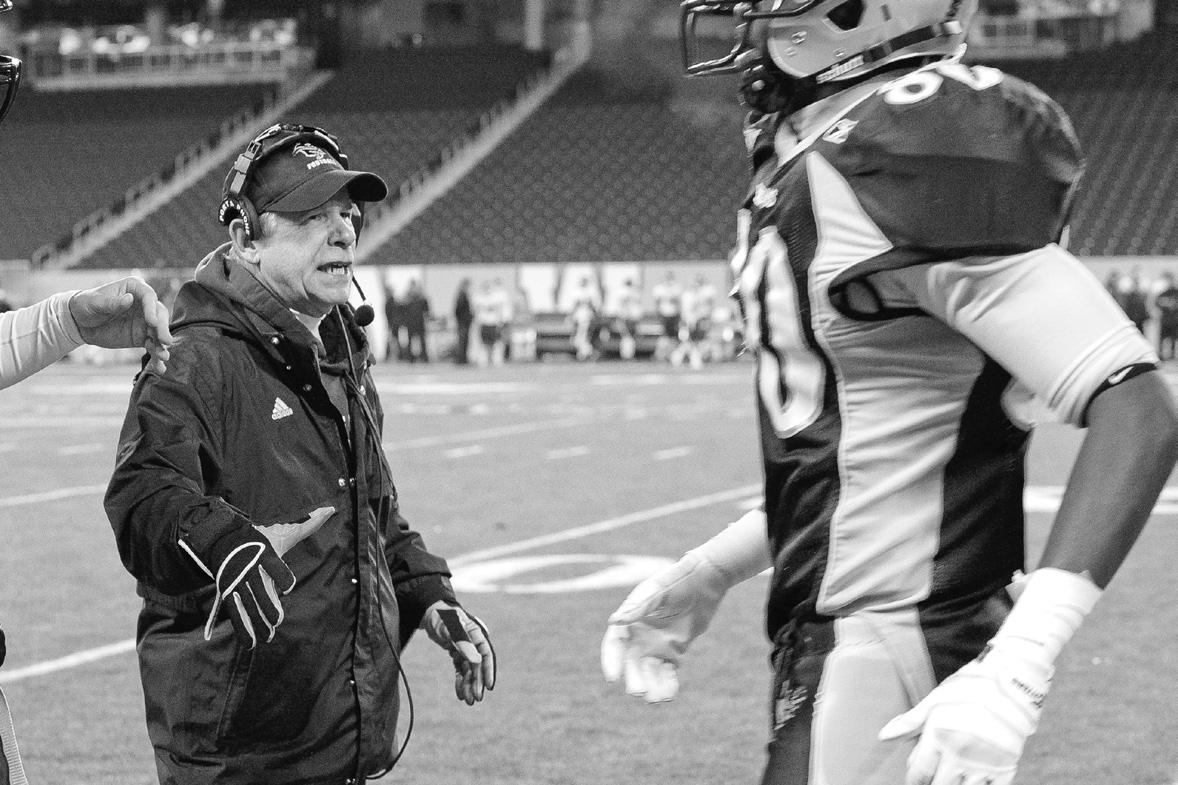
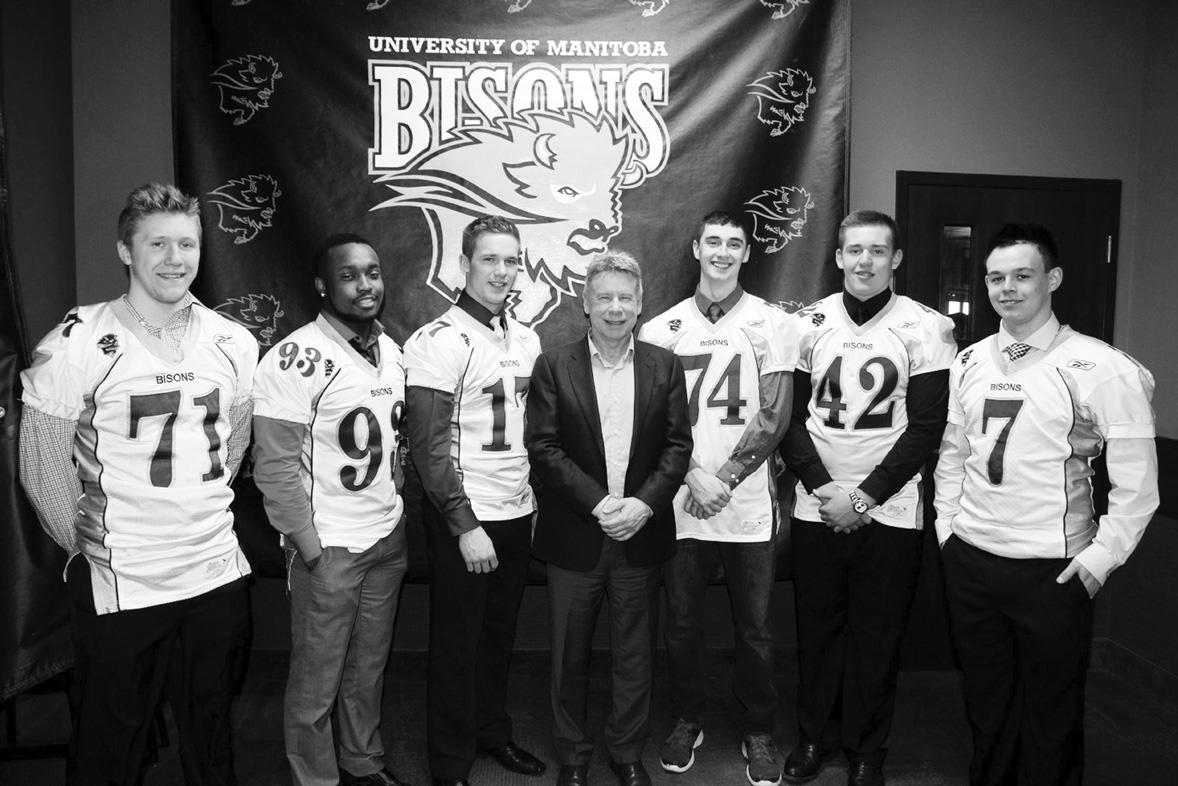

When current Bison football head coach Brian Dobie took the helm of the University of Manitoba football team in 1996, he inherited a team that had struggled for decades. At that time, the team’s Vanier Cup drought spanned 26 years, dating back to 1970. Dobie knew that in order to improve and turn Manitoba’s football fortunes around, he would need to start attracting players from outside the province.
“When I got hired here back in the mid-90s, there was very little national recruiting being done, and nobody was nationally recruiting in the country really,” commented Dobie. “Myself and Blake Nill (who was at St. Mary’s at the time, now with Calgary) coincidently started going national in a big way at about the same time.
“That’s what turned our program around – the national recruiting.”
Both Dobie and Nill gravitated to British Columbia, finding early success. Dobie was able to recruit a fair amount of future CFL players, including Grey Cup winners Will Loftus (safety, Montreal), Jamie Boreham (kicker, Saskatchewan), and Rob Stewart (lineman, Toronto/ Saskatchewan).
“You could just keep listing these B. C. guys that were star players for us in the CIS, and helped take us to our first Vanier,” added Dobie. “Once that happened, the ball was rolling.”
The momentum Dobie seized heading to B. C. has continued to grow, as have the locations that he visits, including: Nanaimo, Campbell River, Victoria, Abbotsford, Chilliwack, and Mission.
“We’re by far the biggest recruiter of B. C. players in the nation, outside of UBC and SFU, and it’s paid off,” noted Dobie with a smile.
There are four key areas that Dobie travels to recruit. The first priority is Manitoba, followed by B. C., Southern Ontario, and Northern Alberta. Because Dobie has a rather hectic schedule, highlighting specific areas to recruit is vital.
“We try and identify the best players here in Manitoba, and the best players nationally in key areas of recruiting,” Dobie said. “For example, we don’t recruit in the East Coast. I know there’s going to be some great players out in Halifax; however, we have limited resources, time, energy, and money, so you pick your spots.”
This year, B. C. has offered up a plethora of quality players that Dobie has gone after. “We recruited two or three guys in Edmonton, maybe five or six guys in Southern Ontario, but we went heavy into B.C. and Manitoba,” said the coach.
“It seems that this year B. C. is where we’ve had our most success.”
There are several reasons behind Manitoba’s success recruiting prospects from B.C., but two stand out for Dobie. The first is his connection with football sources on the coast.
One such connection is Jay
Prepchuk, who went through national level four coaching certification with Dobie. Prepchuk went on to found a quarterback academy that is considered one of the finest in Canada, and is Dobie’s best source at identifying B.C.-area quarterbacks. A second example is Dino Geremia, who coached at both Simon Fraser and UBC, and has a great connection with Dobie as well.
“Of course, you start tying in with coaches, and developing all of those relationships,” Dobie added.
“There are coaches out there that have been fantastic connections for me, for almost literally two decades.”
Another aspect that contributes to B. C. players heading to Manitoba is their former teammates, who have had success playing for the Bisons.
“Certainly one of the most powerful tools you have in recruiting is players that come from areas—or even specifically from programs—in which you’re recruiting, either locally or on a national level,” commented Dobie.
“A great example is Mount Douglas guys. We’ve got, I think, at least three (Zack Sandulescu, Andrew Johnston, and starting safety Tyler Fong), who are all out of Mount Douglas [Secondary] School.”
For context, Mount Douglas is the number-one-ranked football program in the nation, having won the B. C. provincial football championship each of the past three seasons.
“We were using everything we had to recruit there, and certainly when Tyler went home to visit his parents, he was in there recruiting,” Dobie said.
“Robert Smith, our starting right tackle – we recruited him out of Campbell River, B.C., up the island. He literally took a day, drove all the way down across the island to Victoria, and spent a day with the Mount Douglas guys recruiting, when he went home to visit his parents.”
“Those are examples where you’re using guys, in one case literally from that school and another case from that area, to help influence and recruit,” said Dobie. “They’re going back home, and selling all that to their teammates, and younger guys that we’re recruiting. That really, really helps.”
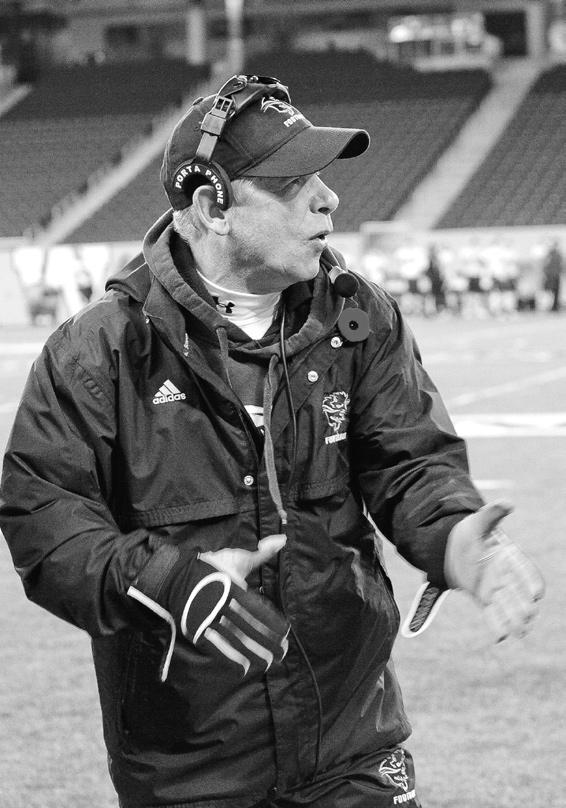
Bison football players Linnen, Yantz, Apperley, and Sawyer share their experiences playing for the University of Manitoba
Mi K e Still, staff
If you look at the 2013-14 Bison football roster, a recruiting trend might stand out: the number of players from B. C. This past season, a whopping 23 players are either British-Columbia-born or have spent time playing football on the west coast. Hailing from towns from Surrey to Campbell River, they’ve all come out to the prairies to put on the pads for Manitoba.
Quarterback Jordan Yantz is one of those B.C. players. He, his Vancouver Island Raiders teammates Tremaine Apperley (defensive back), and Matt Sawyer (wide receiver), were recruited coming out of their final junior football season in the British Columbia Football Conference. All three players helped make the Raiders one of the most dominant teams in the history of the
“The team out there, we all got along, and we’re getting the same feeling out here. Everyone is just buying in” – Wide receiver Matt Sawyer

province’s conference. The Raiders won two national championships along the way, and earned numerous accolades.
Jordan Linnen, on the other hand, played as a standout defensive back against the Raiders. He was a member of the up-and-coming Langley Rams. Head coach Brian Dobie originally began recruiting him after his final year at Surrey’s Frank Hurt Secondary School. It wasn’t until this past year, however, that Linnen finally came to the decision to play for the Bisons.
“I committed in 2010, 2011, and 2012. All three years I didn’t show up, I wanted to go back and play through my years of junior,” commented Linnen. “When I finally decided to come, it was kind of a relief. I felt like for someone to be
that persistent and consistent in the effort of recruiting me, I kind of owe it to them.”
For Yantz, Apperley, and Sawyer, their stories started in an entirely different province. All three originally grew up playing football in Regina – Yantz and Sawyer both at Winston Knoll Collegiate, and Apperley at Sheldon-Williams Collegiate. After trying things out at home, they ended up travelling to Vancouver Island, and the rest, as they say, is history.
Yantz appreciated the approach that Dobie took in attempting to bring the teammates to Manitoba. “I think coach Dobie did an outstanding job in recruiting, and he never quit on any single one of us,” mentioned Yantz. “He’s a straight-up guy, and he’ll tell you how it is. He’ll tell
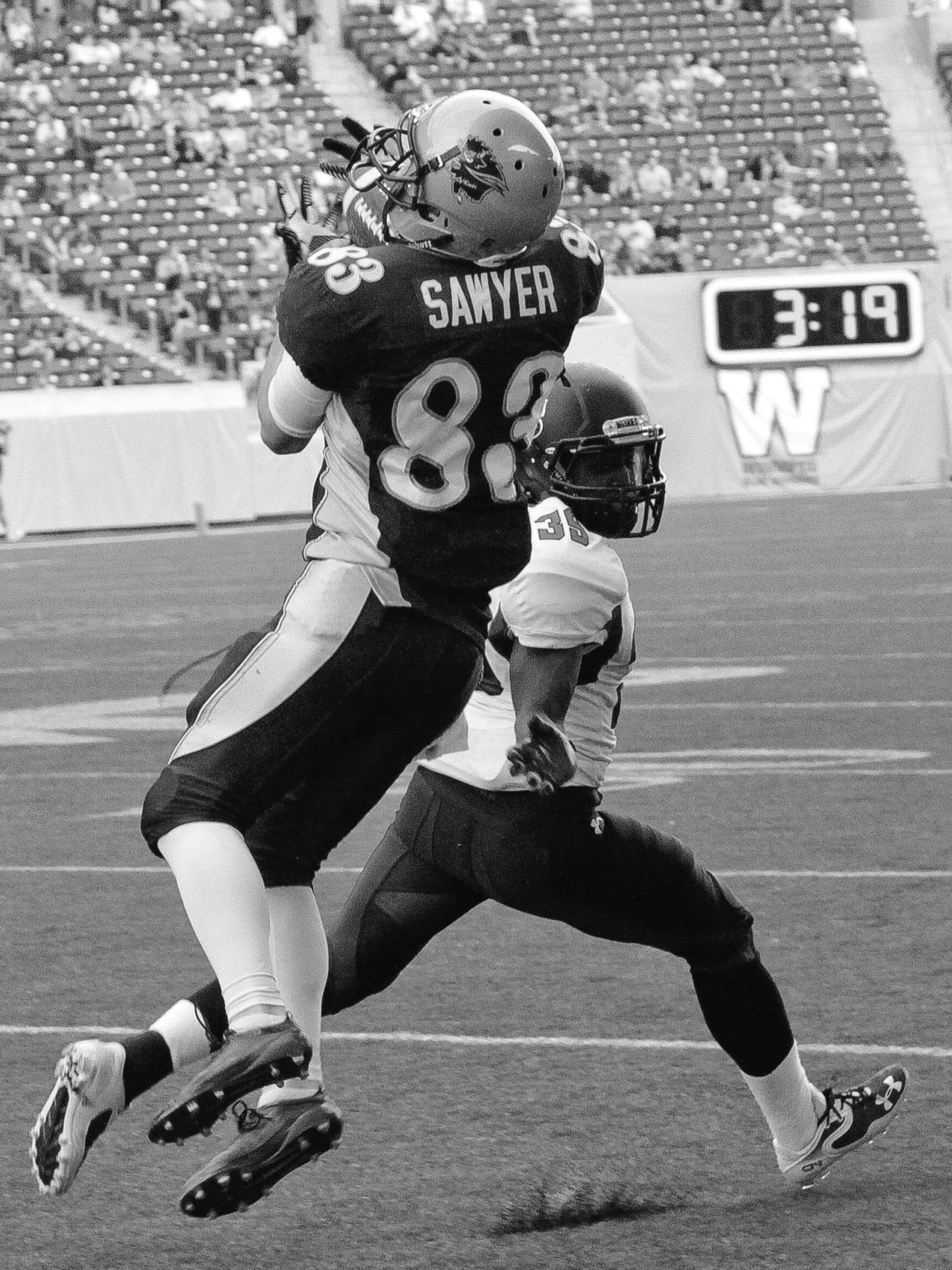
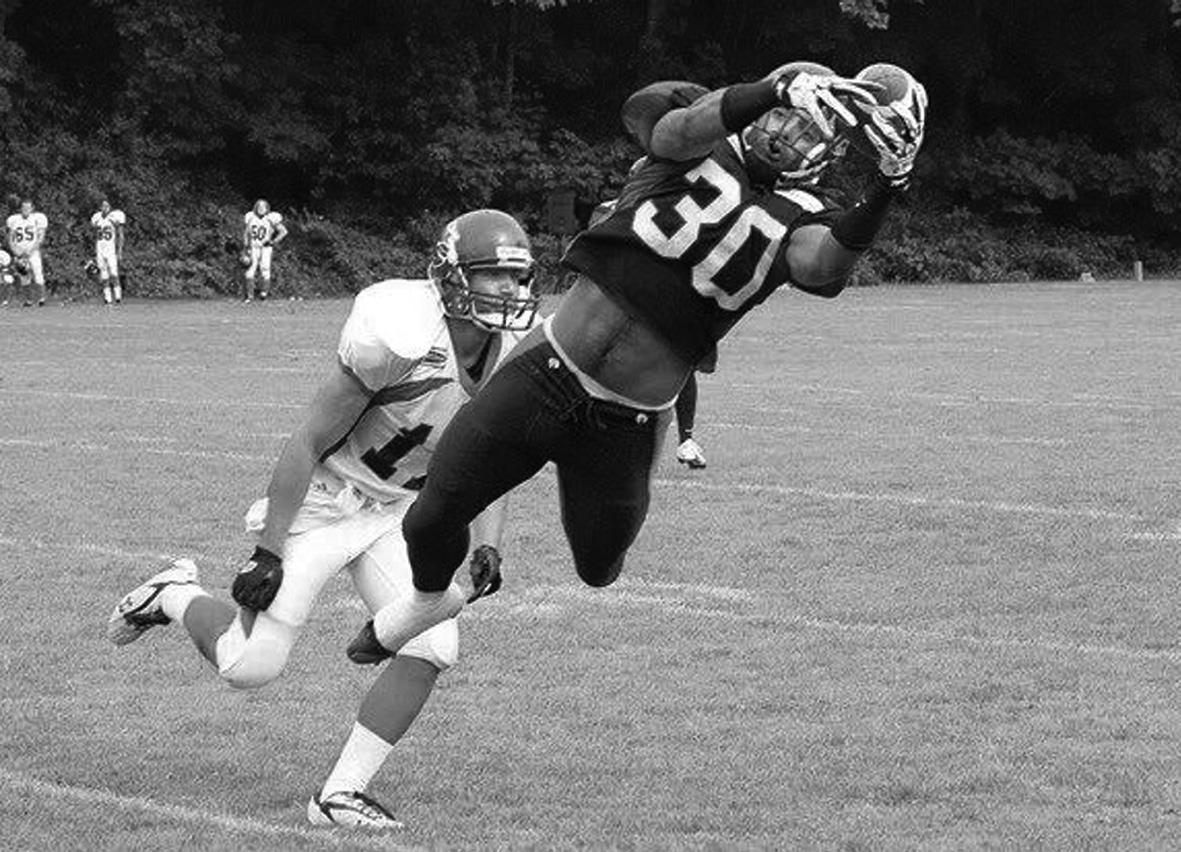
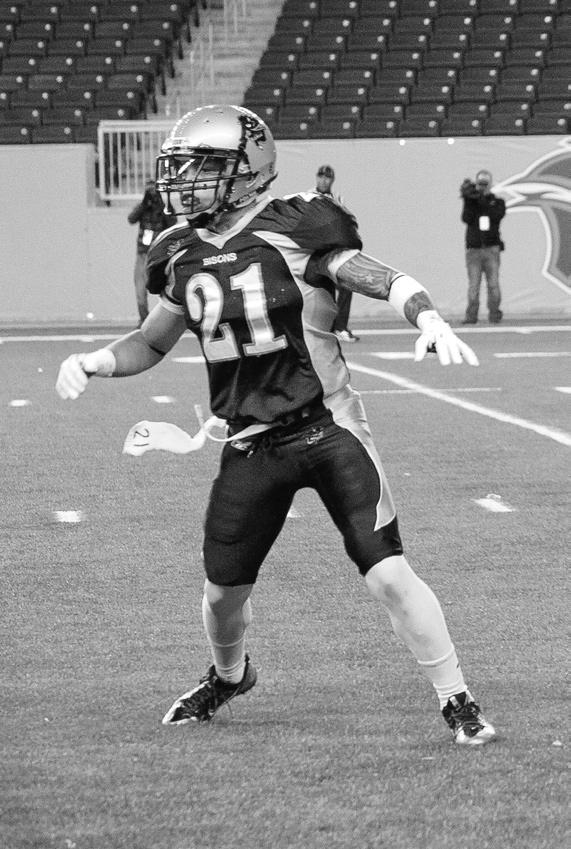
you that you have to come in here and prove yourself, and compete, and that’s who he is. He doesn’t lie.”
Once the four players were all settled in with the brown and gold, things seemed to progress nicely.
One of the biggest factors was coming to understand the work ethic and competitiveness of the players on either side of the ball, especially for former opponents such as Apperley and Linnen.
“There was kind of a mutual respect when we came here. I found it easy to click with him [Linnen]. he’s a nice guy and I find we get along,” Apperley said. “Even the guys from Victoria: There’s Tyler Fong, and big Rob [Robert Smith], and AJ [Andrew Johnston], so there’s the same thing with them, just kind of a mutual respect that comes from playing in the same league, and being through the same thing.”
While respect is one factor, having someone to compete against and push you is also beneficial, which is another reason Linnen was excited to play for the Bisons.
“If you see it now, with the guys we have in the secondary, me and Tremaine, we’ve competed headto-head for four years, and I’ve had nothing but a great, competitive relationship with him,” Linnen told the Manitoban.
“We’ve been friends off the field as well, so knowing when he was coming, and I was coming, I was like, right there I have direct competition with someone that I’ve known really well and know how they play.”
For Sawyer, the feeling of camaraderie has been tremendous. “The
team out there [Vancouver Island], we all got along, and we’re getting the same feeling out here. Everyone is just buying in,” the wide receiver added.
The results have appeared immediately. Manitoba finished with a 5-3 record last season, with each player contributing in their respective positions. It was the team’s best finish since winning the Vanier Cup in 2007.
An added bonus of recruiting from junior football programs is veteran presence that comes along with that. “A positive about recruiting junior players like ourselves is that we got playing time, and were able to establish ourselves as players,” stated Apperley.
Yantz echoed Apperley’s comments, saying, “I think right off the beginning in junior, you kind of have to teach yourself your own way. Especially moving away from home, you have to eat, and you have to pay rent and pay bills, so I think you mature as an adult and you grow up as an individual.”
With a year under their belts and great team chemistry, the sky is the limit for Yantz, Apperley, Sawyer, Linnen, and the rest of the team as well.
“I think now going into next year, the chemistry is there, and the camaraderie is there. We’re probably as close as guys that have been together five, 10 years, and it’s because we have that general mutual respect for each other,” said Linnen. “Now to take it to a national level [ . . . ] we’re looking at it as we’re one machine trying to take on the rest of the country.”