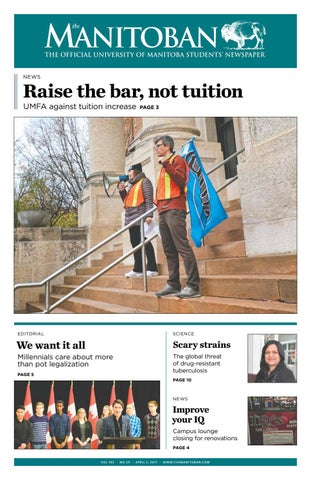
Faculty union comes out against tuition hikes, prepares for bargaining
UMFA president says proposed fee increases will put post-secondary education out of reach for some Manitoba families
g arett Williams, staff
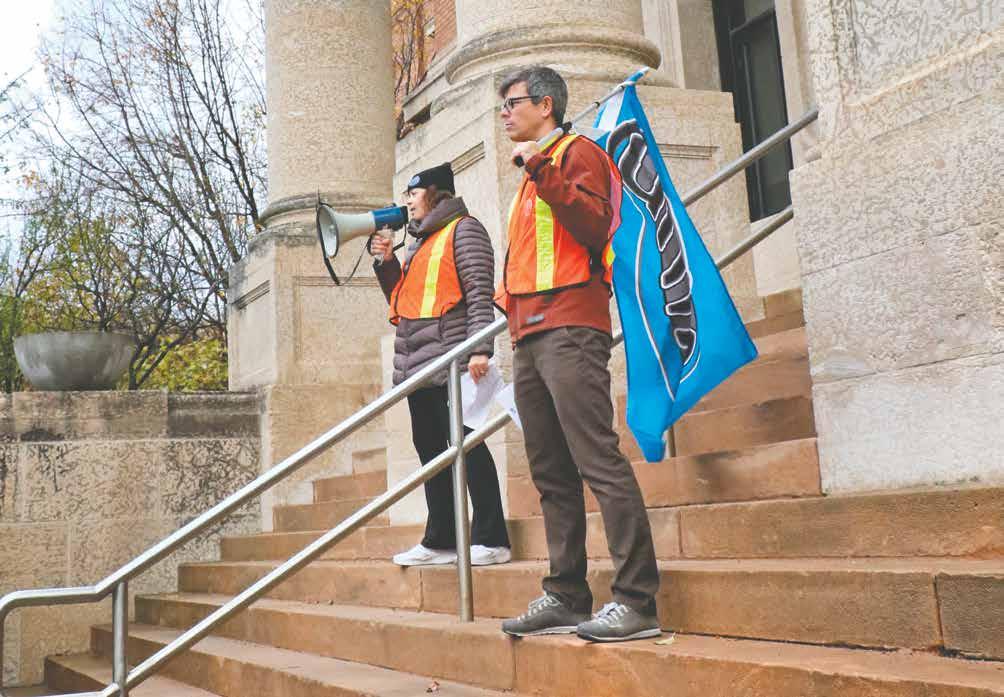
The University of Manitoba Faculty Association (UMFA) is speaking out against expected tuition increases after the provincial government introduced legislation relaxing a cap on fee hikes in March, arguing that higher costs will put university out of reach for many families.
The Progressive Conservative government introduced a bill to amend legislation put in place by the NDP in 2012 tying tuition increases to inflation. The amendment allows for tuition increases as high as five per cent above inflation annually.
“That doesn’t sound like a whole bunch of money for somebody that’s looking at it with a steady job and a salary, but it’s not the reality for a lot of students [and] it’s not the reality for a lot of Manitoba families,” said Mark Hudson, UMFA president.
Tuition increases have been tied to inflation for five years, following more than a decade-long freeze. For the 2016-17 academic year, tuition increased by 1.2 per cent.
Hudson also noted that the legislation appears to loosen controls on increases to course-related costs, such as lab fees.
He said the uncertainty of courserelated fees, coupled with the possibility of a 20 per cent tuition increase over the term of a four-year degree, leaves students charting their academic path in the dark.
“That’s a huge question mark for students and for families who are planning,” he said.
Any increases under the amendments will not come into effect until the 2018-19 academic year. The University of Manitoba has signaled that it plans to raise tuition to bring its rates in line with other similar universities.
Hudson added that the amendments show the provincial government undervalues the public good post-secondary education represents, noting that public funds once accounted for as much as 80 per cent of university budgets.
“That was a reflection of the fact that post-secondary education actually had the public good component to it,” he said.
“It’s not just about students investing so that they can get a higher income later on – there’s actually a really significant public good.”
Hudson was also critical of the government’s public comments that post-secondary education should be more tightly aligned with the needs of the private sector.
Minister of education and training Ian Wishart has said that the government is aiming to foster tighter links between universities and private businesses, in part to ensure that university programming helps answer the market’s needs and so graduates have
jobs to step into when their studies are complete.
The government introduced changes to the Manitoba Scholarship and Bursary Initiative in the fall that it says will increase the program to $20 million in part by pursuing greater private investment.
“It’s not just about students investing so that they can get a higher income later on – there’s actually a really significant public good” –
Mark Hudson, UMFA president
“It is a fundamental mischaracterization of what a university is,” said Hudson.
“Universities have a role in preparing people for work, but that’s not the be-all and end-all by any means of what a university is supposed to do. It’s an institution of knowledge creation and to reduce a university to some kind of a job training mechanism is really fundamentally
to misunderstand what a university is and does.”
Bargaining
UMFA – which represents 1,200 professors, librarians, and instructors – and the University of Manitoba are preparing to negotiate a new collective agreement after the most recent contract expired March 31.
The latest round of bargaining comes less than six months after the two sides settled on a short-term, one-year deal in November to bring to an end a strike that interrupted classes for three weeks in the fall.
The strike followed more than seven months of negotiations.
Hudson said the union is meeting with members and holding consultations to establish the priorities the faculty intends to take to the bargaining table. However, he acknowledged that Bill 28, legislation introduced last month instituting a two-year public sector wage freeze, is limiting.
“We’re pretty constrained on that front right now,” he said.
“Compensation looks like it’s off the table again, given Bill 28 [the public services sustainability act], and so we have to figure out what other things might we have some flexibility to bargain with.”
The two sides have held one preliminary meeting toward a new agreement.
University of Manitoba executive director of public affairs John Danakas said the university is seeking ways to expedite bargaining and avoid another labour disruption.
The agreement reached in November included gains for UMFA surrounding teaching workload assignments, the use of metrics to assess faculty performance, and job protections.
However, it did not include salary increases after the provincial government directed the university to extend the existing terms an additional year more than six months into negotiations.
UMFA filed a complaint with the Manitoba Labour Board claiming the university failed to bargain in good faith after a four-year proposal that included a seven per cent increase was withdrawn. The case went before the board in March.
The union also filed a complaint that the university’s introduction of two voluntary days-off programs without first consulting with UMFA went against the collective agreement. That case went before the labour board in late February.
Decisions on the two cases have yet to be issued.
photo by megan colwell
IQ’s café closed for summer renovations
d iana u b O kud O m, staff
IQ’s Café & Billiards, located on the third floor of University Centre, is closing temporarily for renovations that will take place over the summer.
According to an official press release, this will be the first major renovation to the café in 18 years.
The upgrades were first proposed by the 2015-16 University of Manitoba Students’ Union (UMSU) council, with final plans, financing, and construction
approved by the current council.
In January, UMSU council approved spending up to $1 million on the renovations.
UMSU president Tanjit Nagra said the renovations were initially scheduled to take place last year, but were postponed after council members jointly agreed that it “was best to hold off and take their time finalizing the project over this school year.”
Nagra said that IQ’s will reopen
for the fall session, just before the start of classes, and with better facilities in place to enhance student experience.
In the meantime, accommodations will be put in place to ensure that students and staff are not affected by the closure.
“Students will be welcomed by a new, inviting and brightened space,” Nagra said in an email. “The renovated space will have more open space
for students to study or catch up with friends.”
“The current UMSUshi space will be converted into [a] kiosk with more ‘grab-and-go’ food options, bubble tea, and coffee,” she said.
Nagra also added that current staff of IQ’s will be reassigned to other UMSU businesses while the renovations last.
Nagra said the union is also taking other accommodations into consid-
Joint music and education program put on hold for restructuring
eration, like increasing the hours of operation at other UMSU businesses.
“We are considering adjusting the hours for GPA's Convenience Store for exam period,” she said. “As well, the Starbucks Coffee offered at IQ's should be available at GPA's very soon – though this will be limited to coffee as opposed to other forms of mixed drinks.”
“Students will be welcomed by a new, inviting, and brightened space”
– Tanjit Nagra, UMSU president
“For those in search of a quick bite to eat or a cup of coffee it has been as simple as going to Degrees instead, and there has already been a noticeable increase in traffic at the coffee counter,” she said.
In the press release, Nagra expressed excitement and commended the long-awaited move.
“We are hoping we see an increase in student use of the space,” she said.
“These renovations will make IQ’s more open and inclusive and the expected increase in use will allow UMSU to reinvest in student services.”
Senate votes to halt enrolment in integrated bachelor of music/education program for a year
Osh O samuel a detunji, staff
T
he University of Manitoba integrated bachelor of music/education program (Int. Mus/Ed) has been temporarily suspended for reorganization with the hopes of being reintroduced in fall 2018.
The U of M senate passed a motion on Feb. 1, tabled by the faculties of education and music, to suspend admission into the Int. Mus/Ed program for a one-year period.
The current program was introduced in 1984 as a five-year degree with a requirement of 174-177 credit hours. In fall 2016, both faculties involved in the curriculum agreed to forward a proposal to the senate seeking a restructuring of the program .
According to Edmund Dawe, dean of the faculty of music, changing academic standards from the provincial government now mean
students must complete a six-year, 180 credit hour program to meet certification requirements for a higher salary bracket.
The 174-177 credits that most students in the current program complete are no longer enough to classify them in the higher salary bracket once they graduate.
“Consistently, over 50 per cent of integrated students are taking six years to complete the current fiveyear model,” Dawe said. “Students are graduating at a [lower] classification, yet they have completed six years of course work.”
“At the start of their careers, they are not being compensated fairly for their training, and this has significant long-term financial and career implications,” he said.
Prior to the move for the motion
for suspension, consultations were held with a number of stakeholders including faculty, students, advisers, the music education community, and the faculties of education and music.
Dawe also said the Int. Mus/Ed program demanded more intensive efforts from students, as it spanned from September to June, leaving students with less time than others to pursue summer jobs.
He went further to emphasize the challenges and “heavy workloads” that students face during their years of enrolment in the program.
“The result is unreasonably heavy student workloads, and significant annual logistical challenges in both faculties,” Dawe said.
When the proposal is fully enacted, the integrated program will be replaced with a four-year bachelor
of music degree program with a major in music education.
After completing the program, students will be qualified to apply for their B.Ed, which is an after-degree, two-year program.
“A four-year bachelor of music program will enable students to complete all required music courses, music education specialization, teachable minor, and breadth prior to an after-degree in education,” Dawe said.
“After-degree music students will be better integrated with cohorts of education students in the early, middle, or senior years’ areas.”
The music education specialist in the Desautels Faculty of Music will serve as liaison with the faculty of education and work with the director of school experience in the faculty of education for the practicum compo-
nent of the music education students.
Dawe also stressed that the aftermath of this renewed efforts between the faculties of music and education is expected to yield tremendous results for the students both during their studies and after graduation.
“The result will be a better structured and paced program with both faculties working collaboratively to ensure an outstanding student experience, and a more reasonable professional classification after graduation,” Dawe said.
“A new model will enable the Desautels Faculty of Music to offer a better breadth of music and music education courses to more thoroughly prepare our graduates for their careers as teachers.”
photo by chantal zdan
Editor-In-Chief: Craig Adolphe
Contact:
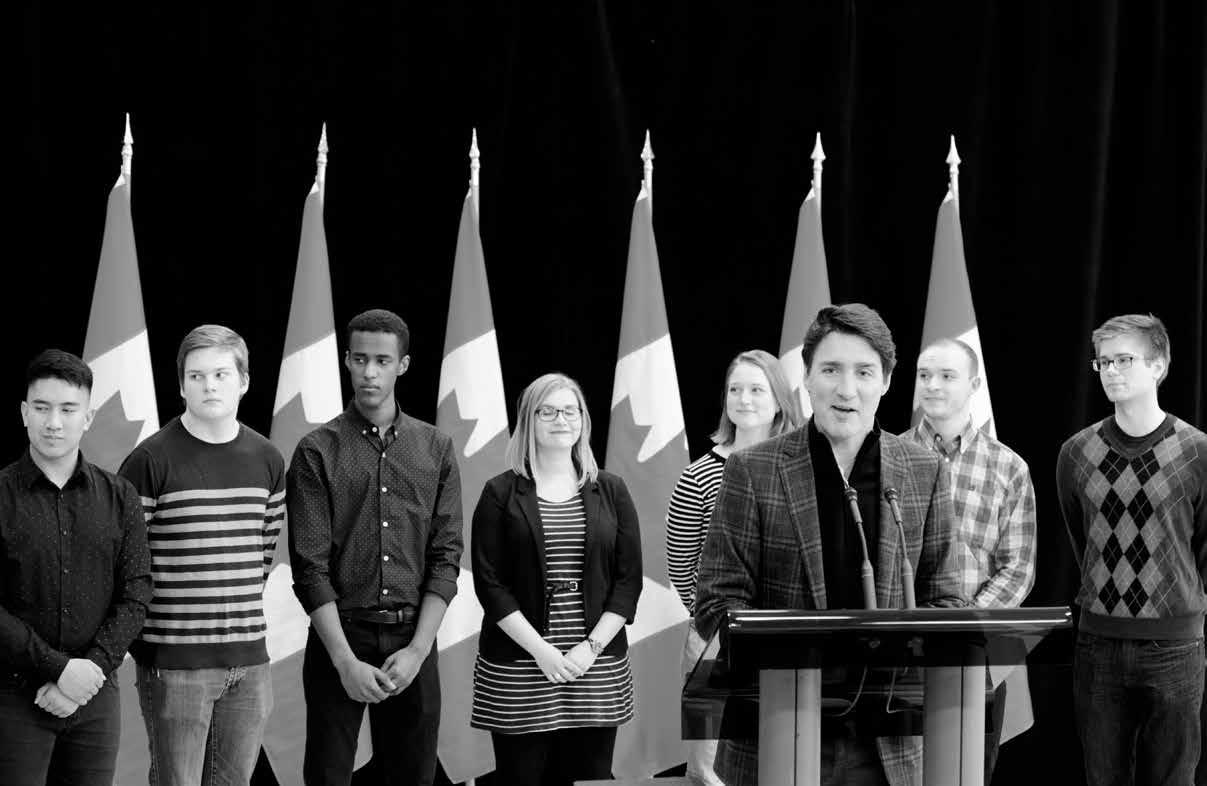
Pot legalization won’t solve Trudeau’s youth problem
Marijuana alone won’t bring youth back to the polls in 2019
l evi g arber, staff
Get the brownie batter mixing, folks. We’ve got a landing date for marijuana legalization.
July 2018. Yes, 2018.
Okay, maybe put the batter in the freezer for the time being.
Finally, Trudeau government officials have confirmed that this month they will announce legislation to legalize the recreational use of weed by July 1, 2018.
Obviously, this is a cause that many young Canadians from coast to have been fighting for and whining about for years, if not decades. So much so that giving Canadians the right to light up a bowl or roll a joint was a central promise during Justin Trudeau’s election campaign, designed to lure young Canadian voters and portray the Liberals as Canada’s youthful party.
Well, we were pretty darned sure that the Conservatives were never the party to represent young people and in 2015, the NDP were busy pandering to centrist baby-boomers, so the Liberals’ plan worked.
According to data from Elections Canada, voter turnout for Canadians aged 18-24 grew to 57.1 per cent in 2015, up from 38.8 per cent in 2011. A full 45 per cent of those young voters went over to the Liberals, according to a survey from April 2016 by Abacus Data.
Was it Trudeau’s charming smile? The selfies? The “youthful energy”?
Absolutely not.
Young Canadians voted Liberal because now, more than ever, we care
about what goes on in Ottawa and Trudeau made promises to our generation that appealed to our struggles and realities.
Turns out many of those promises were as hollow as the pipes we’ll soon be legally blazing out of.
According to extensive polling data from Abacus, three of the seven main issues young Canadians wanted prioritized over the legalization of recreational weed were “creating better job opportunities for young Canadians” (63 per cent), “making college and university more accessible/affordable” (60 per cent), and “dealing with climate change and the environment” (39 per cent).
Legalizing the recreational use of marijuana fell to 20 per cent. Further, when asked if marijuana legalization was their top priority for the new Liberal government, only four percent of Canadians aged 18-24 said yes.
If marijuana fell so low on the list of priorities, then surely the Trudeau Liberals have spent the first 16 months in power working hard to deliver better job opportunities for young Canadians, more affordable tuition, and a feasible climate change strategy, right?
Well, not exactly.
In another attempt to sway young, disillusioned voters, Trudeau promised to create 40,000 “good youth jobs” each year over a three-year period. He would achieve this by investing $300 million in a renewed youth employment strategy.
In 2016, only 9,000 part-time jobs
for Canadians aged 15-24 were added to the economy after 40,000 full-time jobs were lost that year and 49,000 part-time jobs were created, according to data from Statistics Canada. Assuming that part-time gigs at Dairy Queen or the local supermarket aren’t what Trudeau considers a “good youth job,” it’s fair to say that the strategy is a pretty huge flop.
The Liberals shouldn’t be worried that young people won’t go to the polls in 2019 – they should be worried that we will
To boot, in 2016, the Liberals invested $164.5 million in the youth employment strategy and in this year’s budget, which was tabled last month, the Liberals committed to an additional $395.5 million for the program over the next three years.
That means in total, the Liberals will spend $560 million over four years on a strategy that – according to the numbers we’ve seen so far –doesn’t seem to be working.
Who knows? Maybe the marijuana dispensary business will fill that void of 31,000 youth jobs per year.
I’m not ready to put my money on it, though. That is, if I had any money, which I don’t, because I’m a millennial student.
And what about affordable and accessible post-secondary education? Well, the Liberals were far less committal during their election campaign on this front.
They did, however, promise and deliver on increases to the maximum amount low-income students can receive from the Canada Student Grant and lifting of the two per cent funding cap on the Post-Secondary Student Support Program for Indigenous students.
These achievements, however hard-fought-for by the groups who lobbied for them, are nowhere near enough to combat Canada’s huge student debt levels or aid provinces that are experiencing perpetual growth in post-secondary enrolment and facing financial hardship when it comes to providing adequate funding for their universities and colleges.
The federal government should listen to student leaders calling for them to set up a dedicated transfer system to subsidize provincial grants and thereby make funding more robust, much like the federal health transfers that provinces rely on to keep hospitals and clinics running.
This, in tandem with a continued provincial post-secondary grant support, would keep tuition at more affordable rates, and prevent the sort of fee increases we’re about to see here in Manitoba.
Maybe the feds could redirect some of those hundreds of millions of dollars that are currently earmarked for a struggling youth-jobs program.
Just an idea.
Oh, and the environment? That pesky matter of climate change threatening our country and planet? Has the Trudeau government been making enough of a decisive effort to combat the most pressing dilemma of this generation and generations to come?
We may not get any good jobs, an affordable education, or be left with an Arctic, but that first legal toke on Canada Day 2018 will be so worth your vote
The approval of the Trans Mountain and Line 3 pipelines, which combined will pump nearly one million more barrels of oil from Alberta per day, dispelled any hopes that this government placed caring for the environment high on its priority list.
Yes, there’s a carbon tax coming, and yes, Trudeau signed the historic Paris climate change agreement to keep global warming below two degrees Celsius this century. Those acts alone, however, do not translate to tangible efforts to reduce Canada’s carbon footprint or transition the country to a green economy.
Instead, it seems the Liberals are focusing on a different kind of green.
So, young Canadians, rejoice. We may not get any good jobs, an affordable education, or be left with an Arctic, but that first legal toke on Canada Day 2018 will be so worth your vote.
The Liberals owe young Canadians their majority government. Trudeau, who by the way is also the minister of youth, has an obligation to address the issues youth are facing right now. Otherwise, the Liberals shouldn’t be worried that young people won’t go to the polls in 2019 – they should be worried that we will.
photo by miguel yetman
Addressing the opioid epidemic begins with safe drug use sites
dylan Fijal
On March 1, thirty-one year old Ashten Cook was found dead in a hotel room on Pembina Highway. She had succumbed to an opioid overdose
This is yet another tragic occurrence in a growing opioid addiction epidemic in Manitoba, and indeed, across Canada. In 2016 there were at least 24 opioid-related deaths in Manitoba. Of these deaths, nine were related to fentanyl .
This is a health crisis that needs to be addressed, and addressing this crisis begins with safe drug use sites. Safe drug use sites, which currently exist as supervised injection sites, are safe, clean locations in which users can inject drugs under the supervision of medical staff using clean, supplied equipment. In this environment, medical staff can immediately respond to an overdose, and the pro-
vided clean equipment prevents the spread of infectious diseases, including HIV/AIDS.
Supervised injection sites are an
example of harm reduction put into practice. Harm reduction refers to reducing the harms associated with drug use without requiring users to abstain from drug use. It’s meant to treat those who are unable or unwilling to stop using drugs, and to treat them with dignity and without judgement – as people rather than
as undesirables. Harm reduction is also incremental, focused on manageable small steps rather than difficult big leaps. Supervised injection sites can be the first small step for addicts . If we want to effectively address the opioid epidemic, we need to move away from criminalizing drug users and move toward harm reduction. Not only is it a more compassionate means of treatment, it’s an effective means of treatment. The Insite supervised injection site in Vancouver’s downtown Eastside is the first such legal facility in North America. Insite also operates as a gateway to other services, including addiction treatment and detox services.
In 2015, Insite saw 263,713 visits by 6,532 unique individuals, 768 overdose incidents , and 5,359 clinical treatment interventions, as well as 5,368 referrals to other social and health services,
of which many were for detox and addiction treatment services .
That’s 6,532 people who are at reduced risk of disease from unclean equipment. That’s 768 prevented cases of serious harm, including risk of serious brain damage, coma, or death. That’s 5,368 instances of people seeking help for health or other issues. It's important to remember that behind these numbers there are real people getting the help they need.
The concept of supervised injection sites has proven effective, and proponents are attempting its expansion beyond Vancouver to Toronto and Ottawa. Supervised injection sites should not only be funded across the country, the concept of the supervised injection site should also be expanded beyond just injection to general safe drug use sites.
While supervised injection sites
are great for those who are injecting drugs, spaces like these are also needed for those with addictions to drugs that are consumed in other ways, like methamphetamines that are smoked, and prescription medications that are consumed orally. This would further help address the opioid epidemic in Manitoba by providing more robust supports and could help thousands seek treatment for their addictions.
It’s time to move away from criminalization and toward compassion.
Tuition hikes call for the exercise of popular power
UMSU is a roadblock to rather than the vehicle for the student movement
k ieran l ab O ssière
UMSU sucks and we all know it
It’s been said many times before and will continue to be said, but the reality is we can no longer wait for a failed union to become a success.
On March 20, the provincial government announced its plans to raise the cap on post-secondary tuition fees in Manitoba, which have been tied to the rate of inflation since 2012.
The proposed legislation would allow the University of Manitoba administration to raise tuition by five per cent plus the rate of inflation annually. U of M president David Barnard has publicly expressed his desire to raise tuition by $2,000 in order to “catch up” with Saskatchewan. This increase would damage the ability of students to access post-secondary education and would significantly impact their financial prospects upon graduation in a province where average student debt is in excess of $25,000 per student.
How are students supposed to take out a mortgage, pay for rent, get a car loan – to start their adult lives, really – if they have $25,000 in debt hanging over them? This, compounded with the fact that the minimum wage has been frozen under the new Progressive Conservative government, has students’ financial outlook looking even bleaker than before.
UMSU’s official position is unconditional opposition to all forms of post-secondary user fees, including tuition, but it is unclear whether the union will mount a significant opposition to pending increases. UMSU
is structurally unable to effectively resist tuition increases, and is generally limited to writing spineless, cloying press releases and letters. We need to adopt a strategy of mass struggle to oppose tuition hikes and to fight for our interests in an increasingly
It is this kind of consultative approach to “democratizing” UMSU that makes the union such an abject failure
precarious world.
What is to be done?
We need to organize on a smaller scale. Trying to organize 25,000 undergraduate students from an office of five executives and a dozen staff is like trying to herd 25,000 stressed and sleep-deprived cats. That’s not some jab at the executives or of council, it’s just the reality of an institution in which a grand total of 53 people are elected to represent 25,000 students. Most students have no interaction with UMSU besides getting a bus pass, dealing with the health plan, or maybe once a year voting for five people whose faces cover every conceivable surface of campus.
This is at the heart of why UMSU sucks: students have no meaningful say in how it works and don’t feel
any kind of direct connection to the organization.
What really needs to happen is organizing on a small scale and giving students direct democratic power. Organizing on a departmental and faculty level would help to build a robust movement that mounts a strong opposition to the harmful policies of the government and university administration.
There are personal and political reasons that organizing on a microscale is more effective. From the perspective of the students, it is far easier to get involved at the departmental level because that is the level with which students are most familiar. They know the people in their department, they take classes with them, where they have probably made friends. Organizing at the local level takes away the impersonality of large institutions and makes students actually want to participate.
From a political perspective, this micro level allows more direct democratic involvement. Departments and small faculties are more easily able to organize general assemblies of their membership to have truly democratic decision making processes.
The mass struggle
Most of us young people have grown up in a country or countries where mass popular struggle is but a fading social memory. We’ve seen a resurgence in mass political movements through Black Lives Matter and the Bernie Sanders campaign, but this is a far cry from the social movements of the 1960s and the
labour struggles of the first half of the twentieth century. These movements are examples of the power of grassroots organizing. What we need are
Representative institutions can be useful but only to the extent that they can channel the power of popular action into lobbying meetings
new, invigorated social movements to take on the very real threats that we are facing today.
Beyond tuition fees, we are facing an environmental catastrophe that our leaders refuse to seriously deal with, a resurgence of racist ultra-right nationalism in our country, and economic policies that undermine our healthcare, education, and equality.
We live in a world where the Middle East has been thrown into chaos by western powers. A world in which eight men control as much wealth as the poorest 3.6 billion people and corporate interests control the political discourse.
We see and sense these problems yet feel entirely powerless to do anything about them. But we are not powerless. Political and economic power may be held by very few but we are the majority and we must come together to exercise our collective power. The most effective movements
are the ones that are able to harness the collective power of the people.
Look at the civil rights movement. Black communities organized themselves into local chapters of civil rights organizations. Masses of people took to the streets, took direct action in the fight for their rights and won massive gains.
Look at the labour movement. Militant workers won the right to the eight-hour work day, safe working conditions, maternity leave, and many other things we take for granted. These things were won through mass actions such as strikes, work slowdowns, and marches. Workers faced violent repression at the hands of the police and the state (as in the 1919 Winnipeg General Strike) but continued to fight. And just five years ago, 250,000 students in Quebec walked out of their classes and into the streets in the face of tuition increases and won a massive victory, stopping the fee hikes and toppling a provincial government in the process.
Tuition hikes are coming. Massive cuts to social supports that will crush the poor and vulnerable are coming. The concentration of wealth in the hands of the few is only getting worse. Racists are walking out in the open again. The climate is getting warmer. Institutions like UMSU cannot and will not protect us from these things. We’re going to have to organize in our communities, in our faculties, and in our departments to build the kind of mass movement that will be needed to take control in light of what is coming.
graphic by aldo rios
From war to Winnipeg
World University Service of Canada helps lift refugee students out of combat zones and into the classroom
valerie n yam O ri
Al Montaser Bellah Al Jajeh is a landed immigrant from Syria and a student at the University of Manitoba.
He was sponsored to the U of M through the World University Service of Canada (WUSC), a non-profit organization that helps to resettle and educate individuals from areas of the world experiencing turmoil.
He goes by the name Montaser, which means victorious by the will of God. He is a cheerful, outgoing individual.
Before the carpet was pulled out from under his feet, Al Jajeh resided in Damascus, Syria, with his parents and three siblings. They were middleclass and owned a family business.
From early childhood, Al Jajeh said he knew what he wanted to do with his life. “I was going to start my own business in IT solutions at 19,” he said in an interview on campus.
Al Jajeh said his father was arrested for political reasons when he was 19 years old and he had to flee to Jordan abruptly that very day, leaving his family behind. He stayed in the house of a relative in Jordan as a refugee for just over four years.
He worked illegally in very limited capacities and earned low wages. He said he remembers running for cover from authorities on several occasions
in the middle of his work day. Most of his meagre wages were spent on basic needs. He was studying engineering but could only afford to go to school every other term.
As the years went by, Al Jajeh became more convinced that rescue was not coming. He had applied to many organizations but the waiting continued.
“I had applied for everything,” he said. At that point, he said he was slowly losing hope.
One day a friend posted a status update on Facebook promoting WUSC.
“I remember it was such a random post,” he said.
Al Jajeh was hesitant to apply since everything else had failed. His friend had to convince him.
“I received a response within two hours,” he said. But he still wasn't convinced. “I believed it was real at the interview because there was an embassy employee,” he explained, laughing.
After the interview, Al Jajeh was advised that he would not leave for Canada until the following year, as WUSC could not find a placement for him in 2015. Al Jajeh said he was devastated. He was hoping to leave right away.
According to Al Jajeh, the story
of a three-year-old Syrian boy whose lifeless body was photographed at the shores of the Mediterranean Sea made a world of difference for many Syrians.
This story demonstrated to the world the dire situation that Syrians faced. Al Jajeh arrived in Manitoba that same year in December as a landed immigrant and student.
WUSC at U of M
WUSC has been in existence since 1920, using the name International Student Service until 1950, and is currently working with people and refugees in 27 countries through more than 86 committees across Canada.
Over 1,500 students have been sponsored through WUSC’s student refugee program in Canada, including 27 who have come through the U of M.
Carly McFall is a member of the U of M's WUSC student refugee program committee.
“This organization aims to empower, educate, and employ youth throughout the world,” she said.
The University of Manitoba currently has seven WUSC students and they are each permanent residents of Canada. WUSC not only sponsors refugees to obtain permanent residence and education, but also pro-
vides a support system for the scholars through mentorship and weekly events to keep them connected.
“There are nine million people in [Damascus] and I would run into people I know all the time,” said Al Jajeh.
“I don't think I'll ever be able to repay those people but I will try” – Al Montaser Bellah Al Jajeh, WUSC volunteer
Al Jajeh said that he is beginning to make connections in Winnipeg as well.
“It’s different here, so that's what WUSC offers. Our relationship has extended beyond [sponsorship].”
Al Jajeh is currently studying global political economy and now volunteers with WUSC as the student refugee program committee coordinator.
“I don't think I'll ever be able to repay those people but I will try,” he said.
On March 14, WUSC held a fundraising event at Ten Thousand Villages on Plaza Drive, which McFall said was a great experience for all of them.
WUSC volunteers are hopeful that through their efforts to raise awareness at the fundraising event, they will see more students getting involved and supporting the organization. Proceeds from the event will go to support WUSC’s student refugee program.
A coffee house event is being held by St. John’s College on April 13 with funds from the ticket sales also going towards the student refugee program. Carly McFall said all students, friends, and families are invited to attend the event.
“We hope as many students as possible will purchase tickets and come out to this fun event,” she said.
Meanwhile, Al Jajeh is having his own fun living in Canada.
“I love Winnipeg,” he said. “Even though I have three scars from mosquito bites, I will still go camping.”
For questions about WUSC or their upcoming events contact uofm.wusc@ gmail.com.
Lungs of mice found to produce blood
Lungs are a crucial organ in many animals, including humans. While their function has always seemed pretty straightforward –to take in oxygen, transfer it into blood, and exhale carbon dioxide – scientists have found a previously unrecognized function of the lungs of mice: blood production.
The study, which was published in Nature by researchers at the University of California San Francisco, was performed by inserting
fluorescent protein into the mouse’s genome. The protein caused the platelets (small blood cells that bind together to help create blood clots when a blood vessel is damaged), in the mouse to glow, allowing scientists to trace the platalets’ paths. What they found was a massive number of megakaryocytes, a stem cell that produces in the lungs.
If these findings are reproduced in humans, it will prove that the sheer amount of platelets that lungs produce has been greatly underestimated
When researched further, scientists found that the lung was producing over 10 million blood-producing platelets per hour, and the platelets produced by the lung accounted for the majority of platelets in the mouse’s circulatory system. Researchers are theorizing that the megakaryocytes are created in the bone marrow, but then travel to the lung to produce platelets.
While it is known that human lungs produce platelets and produce blood, as small amounts of megakaryocytes have been found in lungs before, if these findings are repro-
duced in humans, it will prove that the sheer amount that lungs produce has been greatly underestimated.
The study also found a reservoir of stem cells with the ability to become blood cells in the lungs. Researchers implanted lungs with the fluorescent megakaryocyte cells into mice that had been engineered to have no blood stem cells in their bone marrow, and found that the fluorescent cells travelled from the lungs to the marrow, and helped to produce platelets and other “ingredients” in blood, including neutrophils. In cases where the bone marrow is dealing with platelet or stem cell deficiency, these stem cells were able to leave the lung and contribute to the “refilling” of platelets in the marrow.
If further research indicates that these findings also apply to humans –which they very well may, considering the genetic and biological similarities between mice and humans – it will not only disprove the current theory that states the bone marrow accounts for most of the human body’s platelet production, but it will also affect how scientists approach treating blood diseases in humans, particularly ones that result in a platelet deficiency, such as thrombocytopenia.
Get Out and see this socially aware horror hit
Jordan Peele’s
e melia FO urnier, staff
5/5
W
directorial debut succeeds at scares, humor, and sending a message
ritten and directed by MADTv and Key and Peele alumnus
Jordan Peele, Get Out has received mass acclaim from both critics and moviegoers – and for good reason. Dubbed a “social thriller,” Get Out blends horror with elements of social commentary and satire into a solid plot full of surprises.
Chris Washington (played by the talented Daniel Kaluuya) goes to visit his white girlfriend’s parents. Before leaving, he asks his girlfriend Rose Armitage (played by Alison Williams), “Do they know I’m black?” to which she admits they don’t, but assures him it won’t be a problem.
From the beginning of the visit, there is discomfort for white liberals
trying to demonstrate how not racist they are, with the patriarch claiming he “would vote for Obama for a third time if I could,” as Rose had claimed he would.
Rose’s “douchebag” older brother displays some repressed aggression toward Chris, something that hadn’t happened with her previous boyfriends, apparently. Catherine Keener does a superb, nuanced portrayal of an almost impassable mother, who offers to hypnotize Chris to help him quit smoking.
The black employees of the household, groundsman Walter (Marcus Henderson) and housekeeper Georgina (Betty Gabriel) keep frighteningly tight smiles and unsettling good cheer throughout their first encounters with Chris. The
discomfort mounts when a large family party takes place, with the eeriness eventually escalating into sheer terror by the latter portion of the film.
Get Out blends horror with elements of social commentary and satire into a solid plot full of surprises
Lil Rel Howery provides welcome comic relief as Chris’s best friend and transport security administration officer Rod. Overall, Peele does an excellent job at balancing humour with terror in the movie.
The score of the film helps carry what could otherwise be perceived as a sometimes uncomfortable tone to an eerie, more threatening tone –there is something sinister underlying the awkwardness throughout the first half of the film, as we find out later.
The aesthetic and use of visual metaphors throughout the film are well-thought-out. Some recurring imagery and foreshadowing – such as the deer that Rose and Chris hit with their car at the beginning of the film – keeps the audience on their toes and enables them to make connections between the visual metaphors and the film’s plot even after the movie has ended.
The strong (if slightly over-thetop) acting of the cast, captivating cinematography, and Peele’s abil-
ity to smoothly transition between comedy and horror keep the audience engaged throughout the film. Get Out is an intelligent, visually striking horror movie, and one that deals with racialized issues from tokenism to cultural appropriation, liberal ignorance, and the flawed idea of a “post-racial” world. Peele wants to make more installments of “social thrillers” – we can hope for more engaging, funny, terrifying films in the future.
U.S. women’s hockey team reach agreement with USA Hockey, will play at the World Championship
The agreement is a major victory for women’s hockey
jas O n Pchajek, staff
Following a week-long standoff between the women of the U.S. Women’s National Hockey Team (USWNT) and USA Hockey, the country’s governing hockey body blinked.
Friday morning, the women were on the ice for their only practice before the World Championship tournament they did not know they would be attending. They ended their boycott of the World Championships hours before they were slated to face the rival Canadians, and two days after signing their landmark agreement with USA Hockey.
“I’m glad we could come together and reach an agreement that will have a positive and lasting impact,” USWNT star Hilary Knight said of the deal. “This is an inspirational time and we’re excited to get back on the ice and represent our country.”
Details of the agreement were released on March 29. Each player will now receive USD$70,000 in compensation, along with performance bonuses which include USD$20,000 for a gold medal and USD$15,000 for silver. Players will also receive a USD$2,000 stipend, insurance, travel compensation, and per diem amounts on par with the men’s team. Marketing, scheduling,
and public relations committees will be established, substantially increasing the support the team has.
These are massive gains for the women, who previously received around USD$6,000 from USA Hockey during Olympic years, in return for staying in peak shape and attending various tournaments.
Meanwhile, the USA Hockey National Team Development Program – a U-18 team which has churned out names like Patrick Kane, Phil Kessel, Jack Eichel, and Auston Matthews – receives around $3.5 million in funding annually.
“That’s what basically we’ve been saying all along: ‘What do they have?
Okay, equitable to that,’” American defender Kacey Bellamy told the Associated Press. “And I think that that’s the most important thing. We’re not asking for more.”
On the right side of history:
USWNT supporters
The writing appeared to be on the wall throughout the fight, with countless professional athletes and organizations standing behind the women.
“These women understand inequality when they see it and are expressing their right to be treated fairly as ath-
letes and workers,” read a statement by the NFL Players Association. “Of course, they have our support in daring to withhold their services until a fair agreement is reached.”
“I’m glad we could come together and reach an agreement that will have a positive and lasting impact” – Hilary Knight, U.S. forward
“NHL players fully support the U.S. Women’s National Team’s effort to reach an equitable agreement with USA hockey,” the NHLPA said in a statement. “It is important that the best American women players be on the ice for the World Championship and the notion of seeking replacement players will only serve to make relations, now and in the future, much worse.”
USA Hockey seemed to be sticking to statements made earlier this month, stating that they wouldn’t pay their players to play. In an effort
to grease the wheels in negotiations, USA Hockey began reaching out to players in order to build a replacement team, but were met with swift resistance as players chose to stand with the USWNT.
USA Hockey asked current pros, college players, high school players, and even asked a few rec-league players to fill out the roster. However they consistently received the same response.
“What I kept going back to is, ‘How do I say no, but how do I say yes?’ I mean, I just play in a beer league,” an anonymous player told ESPN. “I just play for fun now. I don’t train like I did in college. It’s insane.”
The challenge ahead: the 2017 World Championship
Despite the short turn around, expectations will be high for the defending champs. The USWNT has medaled in every World Championship since the tournament began, meeting team Canada in the finals every single time.
The United States has won the last three world championships, leaving Canada hungry to take them down on home soil. However, the Canadians are happy their bitter rivals will be taking part this year.
“We’re excited that they’re here,” team Canada goalie Shannon Szabados told the Associated Press. “It wouldn’t be the same without them whether they weren’t here or if it was a different squad that they brought.”
Even with the star-studded roster, the USWNT will be in for a tough slog. The talent pool in women’s hockey has grown steadily over the years, with many European players playing college hockey in North America. Look for Finland – who own the third highest medal total at the World’s, despite only ever winning bronze – to make noise in the tournament, along with team Russia.
As fans tune in to watch the women in red and white try to take home the gold, they shouldn’t forget the history that was made. The win for the USWNT in these negotiations was not just a win for them, but for all of women’s hockey. However, with the storm surrounding the NWHL and the axing of the University of North Dakota women’s hockey team, which abruptly ended due to lack of funding from the university, there is much more work to be done to make sure young girls can have the same hockey dreams as young boys.
graphic by kelly campbell
Geoff Gray turns heads at NFL pro day
ryan s telter, staff
O
n March 30, Bison offensive lineman Geoff Gray hosted eight NFL scouts and two CFL scouts for his pro day. Gray’s day started in the weight room at Investors Group Field where his measurements (height, weight, wingspan, flexibility) were taken.
The six-foot-six 315-pound lineman recorded a 31-inch vertical and threw up 25 reps at 225 pounds on the bench press. His vertical jump would have been one of the top results at the NFL combine had he been there.
The day then moved to the campus soccer fields where he was tested with a variety of drills, including the broad jump, 40-yard dash, 20-yard shuttle, and 3-cone. Seemingly every single local media outlet was in attendance, as well as a large majority of his teammates. Gray’s 114-inch broad jump would’ve had him tied for second at the combine.
“I think it went well,” Gray said afterwards. “[The scouts] didn’t leave halfway through so I think that’s a good sign.”
The Winnipeg native wrapped up his day with a tour on his unicycle, much to the amusement of all in attendance.
“I started [riding the unicycle] in grade nine,” Gray said. “I mentioned
it in passing at one point and I guess I thought it would be something that would distinguish me from anyone else.”
“I definitely want to be playing football somewhere, and I am lucky enough to have two leagues where I can play football” –Geoff Gray, Bison offensive lineman
Gray wants to play in the NFL next season, but is not opposed to potentially playing in the CFL with the Winnipeg Blue Bombers. “I definitely want to be playing football somewhere, and I am lucky enough to have two leagues where I can play football,” he said. “There would be some advantages in playing for the Bombers, I know a couple guys on [the team] and I’ve heard good things.”
Head coach Brian Dobie was beaming with pride afterwards, not
only for Gray, but the entire Bison football program.
“Since 2000 we’ve been the number three pro producer in the nation, just behind Laval and Calgary,” he said. “It’s a real credit to our coaching staff. It’s also a real credit to the culture of our kids.”
The electrical engineering student finished his fourth season with Manitoba, playing in all eight confer-
ence games. He was also selected as one of the only two U Sports players to play at the 92nd annual East-West Shrine game in January. Gray has never missed a game in his time as a Bison, and has played almost every position on the offensive line. Unfortunately, he will not be watching the NFL draft which takes place April 27-29 in Philadelphia, as he will be busy studying for an exam.
“I actually have an exam on the 28th, so up until the 28th I will be in my basement studying for my machine design exam,” he said. “If I get a phone call that will brighten up my day but I still have to do good on the exam.”
2016-17 Bison Sports award winners
k ellen taniguchi, staff
On April 1, athletes gathered for the annual awards banquet where standout players were recognized for their performance this year. Here are some of the major winners from the afternoon.
Bison Sports Athlete of the Year:
Female: Lauryn Keen (women’s hockey)
The third-year forward is just the fourth women’s hockey player to claim the annual award during its 54-year history, and was also the first Bison to be named the Canada West
Women’s Hockey Outstanding Player of the Year. Keen had a stellar season where she put up a Canada Westbest 34 points (nine goals, 25 assists), with her 25 assists leading all players within U Sports. Keen’s monster season also got her named to the 2016-17 Canada West First All-Star team as well as the 2016-17 U Sports women’s hockey First All-Canadian team.
Male: Devren Dear (men’s volleyball)
In his fifth and final year as a Bison, Dear was a key piece of a team that finished the Canada West
regular season schedule ranked as the number one team in the conference.
Dear finished his final season with an impressive 3.96 kills per set, which was good enough for fourth best in Canada West, and led Manitoba with 309 kills throughout the season. He also finished fifth in conference hitting percentage at .308, and never missed a match for the herd.
Dear was named to the 2016-17 U Sports men’s volleyball All-Canadian First Team and was named a 2016-17 Canada West men’s volleyball First Team All-Star. The veteran enjoyed a second place finish at the Canada West Final Four, and played his last set as a Bison at the 2017 volleyball nationals.
Bison Sports Rookie of the Year:
Female: Kelsey Wog (swimming) Wog made an immediate splash in her rookie year for Manitoba, and was recognized in conference meets as well as at U Sports meets. She was named Canada West rookie of the meet at the 2016-17 Canada West swimming championship, and was also named a conference First Team All-Star after recording three wins at the meet. Wog was also honoured as a 2016-17 U Sports First Team AllCanadian and stood on the podium
four times at the 2017 U Sports swimming championships (one gold, one silver, and two bronze medals). Given her stellar first year, Wog is likely to be a force for the Bisons in the pool for many years to come.
Lauryn Keen is just the fourth women’s hockey player to claim the annual award during its 54-year history
Male: James Wagner (men’s basketball) Wagner was able to contribute to the veteran-filled Manitoba team instantly, and was named to the 201617 Canada West men’s basketball AllRookie team. Wagner led the Bisons and ranked third in the conference in field goal percentage, with 56.8 throughout his rookie season. He was also at the 2016 FIBA Americas championships in Chile as well as competing with a veteran Bison team during the Canada West playoffs and the 2017 U Sports National champi-
onships in Halifax. Wagner will look to carry his success and experience into the 2017-18 campaign.
Bison Sports Coach of the Year:
Garth Pischke (men’s volleyball)
This is the fourth time that Pischke was honoured with the Bison Sports Coach of the Year award for his stellar work with the men’s volleyball team. Pischke led the herd during a successful year that included being ranked number one in the nation, winning silver at the Canada West final four at home, and competing at the U Sports nationals. Pischke also reached an individual milestone this season and won his 1,300th match on Jan. 14. He has the most wins by a coach in U Sports history. The men’s volleyball team will be losing many veteran players this upcoming season, but if anybody is able to lead a young team to success, it’s Pischke.
photo provided by jeff miller
photo by ryan stelter
Women’s hockey pro-league faces crisis in second season
jas O n Pchajek, staff
When the National Women’s Hockey League (NWHL) began operation in 2015, the hockey world celebrated the history making venture. However, by the time the puck dropped for the second annual Isobel Cup playoffs, support and positive sentiments had faded.
As the first professional women’s hockey league to pay its players, the NWHL caught the attention of many in the hockey community. The new league was seen as a challenge to the Canadian Women’s Hockey League (CWHL) which doesn’t pay its players.
“I’m not sure it’s sensible or healthy for women’s hockey to have two leagues”
– Brian Burke, Calgary Flames president of hockey operations
Cracks in the NWHL started to show in early November, as league commissioner Dani Rylan announced that player salaries would be cut to offset losses due to slumping attendance. It appeared that the fervor and excitement surrounding the first season, which lead to sellout crowds and national media attention, had passed. Players, though, were not convinced.
In a statement released on Nov. 19, the players demanded a third party audit of league finances, proof of insurance for players, naming of the league’s investors, and a report
on why league revenues dropped so markedly.
To date, the audit has not gone forward, but the NWHL Players’ Association was established, which seemed to calm the waters around the league. Under the waves, however, things seem more turbulent.
With the IIHF World Women’s Hockey Championship looming, and beginning when the Isobel Cup playoffs would’ve began, Rylan and league execs decided to shorten the season. However, it seems that season ticket holders have not been offered refunds for the lost games.
Then there was the issue of last season’s Isobel Cup final between
the Boston Pride and Buffalo Beauts, which had to be played out of market at the New Jersey Devils’ practice facility.
Calgary Flames president Brian Burke – who sits on an advisory board for the CWHL – has repeatedly expressed his displeasure with having two professional women’s leagues operating.
“The whole issue of the two leagues will hopefully be resolved in the next year or two,” Burke said in an interview with Yahoo Sports. “I’m not sure it’s sensible or healthy for women’s hockey to have two leagues.”
When asked if he foresaw the failure of one league or a merger of the
two, Burke was uncharacteristically quiet.
“I guess one of those things would happen.” Burke said. “I wouldn’t speculate on which league would survive. But for the NHL to get behind this and for clarity in the market place, for people that want to support women’s hockey, we need one league.”
Similar to the time when the NHL and World Hockey Association (WHA) both fought for domination of the professional hockey market, we could see a similar fate befall either the NWHL or CWHL.
In 1979, facing major financial difficulties the WHA agreed to merge
with the NHL, bringing over the Edmonton Oilers, Winnipeg Jets, New England Whalers, and Quebec Nordiques. The other two remaining clubs – the Cincinnati Stingers and Birmingham Bulls – were paid to shut down operation. Perhaps a similar situation will occur here, with the CWHL having much more successful operation and the NWHL’s groundbreaking business model, the two could potentially amalgamate. It is clear that the NWHL is in trouble, but if the situation with the U.S. national team is any indication, those who pay women to play are on the right side of history.