Please contact designteam@themanitoban.com if you are interested in submitting a cover image. For other volunteer inquiries, please come to our office in University Centre (across from Tim Horton’s, behind GOSA) or email the editor of the section for which you are interested in writing.
Please direct all other inquiries to editor@themanitoban.com
Want to volunteer for the
nterested in getting your very own
lished in the
Visit: www.themanitoban.com/apply-to-volunteer and get in touch with our friendly section editors!
Toban Talkback
Jill Patterson, staff
“Go Bisons volleyball!” by Beibei Lu
3 Egypt announces ceasefire between Israel, Hamas
Violence persists up to deadline
Quinn Riche R t, Staff
Aweek of intense fighting between Hamas and the Israeli military drew to a close on Nov. 21 with the signing of a ceasefire agreement between the two sides.
The short document totaled well under a full page of text, only vaguely describing the terms of the ceasefire, called on each side to “stop all hostilities” against the other, including the “targeting of individuals” by Israel.
Only two more stipulations in the document pertain to the “agreement of understanding for a ceasefire in the Gaza Strip.”
One guarantees the commencement of negotiations on “facilitating the movements of people and transfer of goods” across borders within 24 hours of the ceasefire coming into effect. The other states that “other matters as may be requested shall be addressed” in the talks following the ceasefire implementation.
Negotiations for the ceasefire took
place in Egypt and were facilitated by that country’s new government. Prior to the start of negotiations, many felt skepticism over whether or not Egyptian President Mohamed Morsi could fairly perform as a mediator between Hamas and Israel. Morsi has been affiliated with the Islamist movement the Muslim Brotherhood, of which Hamas was an offshoot. Nevertheless, Morsi’s and the Egyptian government’s performance in working out the ceasefire was praised by both the United States and the United Nations secretary general Ban Ki-moon.
“President Morsi brings to the office a legitimacy from elections and the ability to reach all sides. I told him that he is uniquely placed among the leaders in the region to bring this crisis to an end through his political leadership,” said Ban in a statement shortly after the ceasefire was announced.
Tami Jacoby, professor of political studies at the University of Manitoba, commented on Egypt’s role in brokering the truce.
“During the Arab Spring, when the new government was brought in, they were talking about rescinding the [1979] peace agreement with Israel. The position Egypt has taken here is a testament to how strong the peace agreement between Egypt and Israel is [ . . . ] Although there may be much rhetoric on the streets, politically it has always been at the level of diplomacy. So it is a good sign that the state is going this route.”
Other key players in negotiation talks included Ban Ki-moon, Palestinian President Mahmoud Abbas, representatives of Turkey and Qatar, as well as U.S. officials including Secretary of State Hillary Clinton.
The process of drawing up a deal was complicated, however, by the refusal of representatives from several states to meet face-to-face. Hamas, as well as Turkey and Qatar, only communicated with Israel through Egypt, while Israel spoke through Egypt and the U.S.
While the agreement thus far appears to be holding, mistrust lingers on both sides, and the truce is a fragile one. In an official statement by Israeli Prime Minister Benjamin Netanyahu, he reinforced his claims that Israel is prepared to take up military actions once again, if need be.
“I realize that there are citizens who expect a harsher military action and we may very well need to do that,”
said Netanyahu. “But at present, the right thing for the State of Israel is to exhaust this possibility of reaching a long-term cease-fire.”
“These are really immediate demands that would contribute to a very limited result – a return to a situation that was intolerable for both sides,” said Jacoby about the current ceasefire agreement.
“The issues behind this are not just the buildup along the border, or the tunnels, but the final status issues. And there will be a continuing cycle of violence as long as these issues are not resolved [ . . . ] The utility of the current ceasefire is that it is not possible to negotiate under fire.”
Violent attacks between Israel and Hamas carried on right up to the deadline for the ceasefire. Only hours before the truce was to take effect, a bomb was detonated inside a bus in Tel-Aviv, wounding 21 people. The bomb exploded in close proximity to Israel’s military headquarters. A bomb attack of this type has not been witnessed in Tel Aviv since 2006, in the aftermath of the Second Intifada.
The Globe and Mail reported that Israeli police have arrested multiple suspects in the bus bombing.
Israel maintained a steady pace of attacks over Gaza, reportedly hitting over 100 targets, while 31 rockets were fired out of Gaza towards Israel.
Almost half of those fired at Israel were shot down by its Iron Dome missile defence system.
Obtaining an accurate death toll for the entirety of the conflict has proven difficult. A report published by
the Wall Street Journal stated, “Most counts put the number of Palestinian deaths above 150.” Six Israelis were killed, four of which were civilians.
The latest bout of violence in Gaza was started with Israel’s assassination of Ahmed al-Jabari, a Hamas military leader. Jabari was a central figure in the capture and negotiated release of Israeli soldier Gilad Shalit in 2006. Jabari was killed when his car was struck by a missile on Nov. 14, an attack that also killed eight others.
Shortly after the killing of Jabari, the Israeli Defence Forces (IDF) released a statement claiming “the purpose of this operation was to severely impair the command and control chain of the Hamas leadership, as well as its terrorist infrastructure.”
Jabari’s killing was part of a “widespread campaign on terror targets in the Gaza Strip” undertaken by the IDF called Operation Pillar of Defence.
Jacoby explains that the targeted killing of Hamas military personnel is nothing new for the IDF and is only superficially responsible for the outbreak of violence.
“Israel has long seen targeted assassinations as the superior alternative to going to war. Palestinians see it differently. This was a revered military hero [ . . . ] It’s not that the violence resulted from this one incident. It was always there simmering.”
Human rights and legal groups critique inquiry process
Missing women inquiry didn’t involve those it impacts the most, says West Coast LEAF
Rachel Wood, Staff
T
hree human rights and advocacy organizations have released a report critiquing the Missing Women Commission of Inquiry (MWCI). West Coast LEAF (Legal Education and Action Fund), B.C. Civil Liberties Association, and Pivot Legal Society have openly disagreed with the process in which the inquiry took place.
The inquiry was a result of the disappearances and murders of marginalized women in Vancouver’s downtown eastside. Robert Pickton was charged with second-degree murder of six missing women, although he had boasted about murdering 49 women. Pickton was sentenced to six life sentences with no chance of parole for 25 years.
According to the groups, their
report criticizes the process of the inquiry rather than the final result.
The report focuses on six main areas of critique: independence of the inquiry, the quality of evidence, how the rules of evidence were applied (which they claim were too formalistic), support for the witnesses, development of the terms of reference, and consultation leading up to the development of the inquiry.
Kasari Govender, executive director of West Coast LEAF, told the Manitoban that one main theme emerged throughout the criticisms.
“[The inquiry] should be including the voices of those most directly impacted by the subject matter of the inquiry and putting those voices front and centre, both for the fact-finding process, but also for the purpose of
reconciliation.”
The inquiry commissioner, Wally Oppal, submitted his 1,448 page final report to the government on Nov. 22. The groups, however, released their criticisms days before that.
“The report focuses on the procedure, on the process of the inquiry, not the outcome. And we say that the process itself was an opportunity for reconciliation. [ . . . ] Whatever recommendations come out, they can’t achieve the most important goal, the goal of reconciliation. The goal of making people feel listened to and that their stories were heard and that their perspectives were valued,” said Govender.
According to Govender, the faults in the inquiry began from the start of the process. Many groups who called
for the inquiry were not consulted. These groups were denied funding from the government to partake in the inquiry. Govender argued that certain important witnesses weren’t called and the witnesses that were included did not have the proper support.
Oppal urged the groups to remain receptive of his report.
“My report puts forward strong recommendations for change and it is imperative that everyone comes together to ensure that we can better protect our most vulnerable citizens.”
Govender stated that they will remain open and optimistic to Oppal’s conclusions; however, that will not change the shortcomings of the inquiry process.
“I think that the issue is at the core of how the justice system operates,
how women’s safety is valued, and I think that those are essential issues to how society operates,” argued Govender.
The importance of the inquiry, according to Govender, is best illustrated through a quote by Oppal on the front of the legal groups’ critical report.
“The greatness of a society can be measured by how it treats its weakest members.”
Reports of police officer’s apprehension into investigating the missing women due to victims’ involvement in the sex trade and drug activity were a reason behind the inquiry which, Oppal explained, aimed to determine whether the vulnerable women were treated differently than other citizens.
COuRtesy
Large majority of students say yes to U-Pass
Biggest UMSU voter turnout in 15 years
Jill Patte R son, Staff
he results of the U-Pass refer-
Tendum have shown that a large majority of students have voted in favour of the U-Pass.
The referendum was held from Nov. 14 to 16 with various polling stations around campus. Of the 6,897 students who voted at the referendum, 5,068 of them voted yes, while 1,797 voted no.Translated into percentages, a majority of 73.82 per cent voted in favour of the U-Pass, while 26.17 per cent voted against it.
Although a total of only 26.59 per cent of UMSU members voted, the turnout is still the largest that UMSU has seen in 15 years.
“We haven’t seen this many students vote in an election or referendum in over 15 years. It’s obvious that students are passionate about the U-Pass,” said UMSU president Bilan Arte.
When asked why this referendum saw such a high voter turnout, Arte said that she feels that this is an issue that students see as directly affecting them and felt compelled and responsible to voice their opinion.
“I think that no matter which side of the debate they were on, many students recognized that this was an issue [that] directly affected them and as such many felt inspired and responsible to participate in the democratic process and exercise their rights to vote.”
Although the students have voted in favour of the U-Pass, there is still no guarantee that it will in fact be put into place. There is still campaigning and negotiating that UMSU must do with Winnipeg Transit, the University of Manitoba administration, the provincial government, and the City of Winnipeg.
UMSU has reportedly already been conducting negotiations with Winnipeg Transit to make the U-Pass a reality, but there are still barriers that stand in the way. There will need to be firm program negotiations to be able to put this plan into action, according to Arte.
“UMSU will be mandated to pursue concrete conversations with transit about what types of transit service improvements and infrastructure improvements to public transportation they would be willing to negotiate. Our hope is to come back to our members with an agreement outlining a valuable and beneficial program for as many of our students as possible.”
The most important negotiation that must be made—not only with Winnipeg Transit, but with the City of Winnipeg, the university, and the Province of Manitoba—is how the U-Pass will be funded.
The students voted to allow no more than $85 a term be added to their tuition but this amount will not
be enough to cover the entire cost of the U-Pass.
“The program itself [will] cost Winnipeg Transit 283 [dollars] per year [per student] to be cost-neutral. Our hope is to engage the city, the province, the university, as well as other outside funding partners to help us fill the funding gap,” said Arte.
If, after negotiations are settled, everything runs smoothly, UMSU members could see the U-Pass implemented as soon as September of next year, according to Arte.
“If all goes well, we could see a U-Pass in effect as soon as September 2013. This all depends, however, on whether or not we can strike a deal with transit [that] our students feel comfortable with, and that we are able to fill the aforementioned funding gap. If we aren’t successful this year in doing that, this project could be pushed back to fall 2014.”
According to UMSU, a U-Pass would not only benefit students but also the City of Winnipeg, the university, and the province.
A U-Pass would improve the province’s environmental sustainability, reduce costs for roads and other infrastructure, as well as make university education more affordable and accessible for students, claims UMSU.
“We’re very excited to have had so much uptake on the issue, and to have a strong mandate with a clear direc-
tion on where our members want to see us head with this program for the next few years,” said Arte. UMSU asks that anyone interested in putting the U-Pass into action through talks with the City of Winnipeg, the
Province of Manitoba, and University of Manitoba Administration to email UMSU at u-pass@umsu.ca for more information on how to get involved.
phOtO by beibei Lu
inte R national ne W s b R iefs
By Jill Patterson, staff
Palestinian leader’s body to be exhumed
The body of Palestinian leader Yasser Arafat was scheduled to be exhumed Nov. 27, amid accusations that he was murdered. Arafat died eight years ago in a Paris hospital at the age of 75.
The cause of death was never determined as no autopsy was conducted due to his widow’s request at the time.
Suspicions of foul play have always surrounded the death of Arafat. A murder inquiry was officially opened this past August after a Swiss institute claimed it
had found high levels of radioactive polonium on his clothing, which were obtained from his widow, Suha.
Tawfiq al-Tirawi, the head of the Palestinian committee in charge of the investigation, said “it is a painful necessity” to exhume the body of Arafat, who has come to be the icon for the Palestinian fight for statehood through years of turbulent times with Israel.
a nti-government P rotest
eru P ts in b angkok
Approximately 10,000 people gathered in the city of Bangkok
to protest against the government of Yingluck Shinawatra, who is the sister of the former Prime Minister.
A group called Pitak Siam (translated to “Protect Thailand”), who accused Shinawatra of corruption and of being a puppet of her brother, former Prime Minister Thaksin Shinawatra, organized the protest.
The police used tear gas against the protesters who attempted to climb over the concrete and barbed wire barriers, which were blocking entrance to the protest site at Bangkok’s Royal Plaza.
“We used tear gas because protesters were blocking police and did not comply with the security measures we put in place,” said Piya Uthaya, a police spokesperson. argentina declines to Pay debt to u s
Argentina is planning to appeal a U.S. ruling that ordered payment of $1.3 billion to foreign creditors to whom the government defaulted on in 2001.
The default of 2001 was $10 (US) billion. The government has been given until Dec. 15 to pay the hedge funds. The Economy Minister of
Contest to change U of M’s campus landscape
Winner will play decisive role in future of campus
a lycia Rod Rigues, Staff
The official launch of the Visionary (re)Generation Open International Design Competition commences Dec. 5. Competitors are able to register for the competition on this date and the winner will decide the landscape of the future U of M Campus.
As shown in a 2011 report from the City of Winnipeg, the Southwood Lands is considered a major transformative area.
The goal of the competition is to attract top urban planners from around the world to re-design the university campus which will include the newly acquired Southwood Lands (former Southwood Golf Course).
The goal of the campus re-design is to create “a thriving, connected community where a conversation at a small café gives life to the next big idea. A walkable, truly urban neighbourhood where a culture of learning and discovery powers the innovation that turns a campus into a destination,” said the U of M’s website dedicated to the competition.
Design objectives for those entering the competition are based around
the pillars of connection, destination, sustainability, community, and transformability.
The connection pillar is designed to connect the city and the campus by creating an environment available to all ages. This includes new economically-friendly buildings and a winter-friendly landscape environment. Rapid transit bus routes are designed to get people in and out of the campus at a faster pace.
The destination pillar on the other hand is designed to have the university as a place that people find a reason to visit as well as a reason to stay on the campus. The goal is to create a welcoming environment through a diversity of services available.
communication and a stimulating environment. The goal is for people to have a place to network, facilitating the innovation for the campus.
The last pillar, transformative, intends to make the campus experience a memorable one, bringing in
is the actual competition, launching in January 2013, and projected to finish in October of the same year, with an award ceremony for the Area Master Plan. The third phase is more of a continual phase including a contract award that works with the winning design team to put the plans in action.
“Visionary (re)Generation represents opportunity and potential. We are being given an opportunity to think differently about the university community where we live, work, study, and discover.”
The sustainability pillar views the campus with an ecological, social, and economic eye. The goal is a living lab which is a constant source of innovation and research.
The community aspect aims to bring in a diversity of people for
new students as well as offering them a place to stay. The goal is for the U of M to be recognized as leading innovative environmental design.
The competition consists of three phases. The first includes collecting ideas in order to structure the outline of the competition in terms of what stakeholders want. The second phase
The whole process is being overseen by Benjamin Hossbach, the founder and managing director of Phase Eins, a project consultant and design competition organizing company involved in the competition fruition. The company is Berlin-based and is renowned for its successful completion of global projects. They have been involved in sustainable development projects in the Netherlands, South Africa, Germany, Morocco, the Ukraine, Libya, and the United Arab Emirates.
The jury was announced on Nov. 9 by U of M’s President Dr. David Barnard who will also be one of the ten jurors.
Argentina, Hernan Lorenzino, has rejected the decision to pay the default, claiming it is illegitimate to pay “vulture funds.”
Some analysts have said that the legal victory of the hedge has raised fears that Argentina could be plunged into another debt default. President Cristina Fernandez de Kirchner of Argentina has said that her administration would not pay anything towards the default.
U.S. District Judge Thomas Griesa claimed, “it is hardly an injustice to have legal rulings which, at long last, mean that Argentina must pay the debts which it owes.”
“Visionary (re)Generation represents opportunity and potential. We are being given an opportunity to think differently about the university community where we live, work, study, and discover,” said Barnard.
The jurors will consist of two categorized groups: technical and general. The technical jurists were chosen for their expertise and experience in planning and design while the general jurists are considered stakeholders who have a vested interest in either community or university.
A support team of deputy jurors, technical experts, and guests will also be involved to further help the decision of the jury.
One of the main partners of the project is Manitoba Hydro. President and CEO Scott Thomson stated that the company is very proud to be involved in such a project happening in Winnipeg.
“Manitoba Hydro is pleased to be part of this process as part of the design jury. We expect our technical expertise in cold climate energy management can contribute to achieving the dream,” said Thomson.
Plane crash devastates northern Manitoba
Pilot dies among wreckage
Rifca K Reme R
O
n Nov. 18, amidst heavy fog, extreme humidity, and low cloud ceiling, pilot Mark Gogal and seven passengers left the runway at 10 a.m., destined to Winnipeg. Shortly after, the Cessna 208 mysteriously failed and crashed into the dense forestry surrounding Snow Lake. Gogal died in the accident and the seven passengers, all of which were miners for the nearby Lalor Mine, are currently in stable condition at various hospitals throughout Manitoba.
One of the miners involved in the crash dialed 911 shortly after the crash, signalling a community-wide response. Local residents arrived on snowmobiles and on foot through
the thick brush leading to the crash site to assist in the rescue.
Upon hearing the news, contractor Gerald Strilkiwski lent his team and a bulldozer to help in the effort to get to the crash site through the thick forestry. Paramedics reached the site after about an hour and a half, at which point the survivors had to be evacuated strategically by snowmobile to ensure those worse off were given priority.
The community’s concerted response allowed for the quick retrieval and treatment of the miners.
“Snow Lake is a close-knit community. What was impressive was
how everybody really came together [ . . . ] Without the help from the people here, we would not have gotten them out in the timely fashion that we did,” RCMP corporal Jason Schalla told the Winnipeg Free Press
One survivor, Mikael Guénard, was able to call his family from a satellite phone at the scene of the crash. Guénard relayed to his father that the pilot did not survive.
The small hospital in Snow Lake was unprepared to face a crisis of this scale. At the time of the crash, the one nurse and one aid who were working were forced to call the remaining four nurses in the town. The hospital staff had only two hours
to prepare for the coming influx of patients who arrived at noon. Even with their best efforts, the hospital contained only six beds, causing two of the injured miners to be treated in the hallway.
“This many patients, and this kind of an accident, you know, I have never been involved in something like that,” said one of the hospital’s managers, Kelly Wiwcharuk, to the CBC.
Most of the injuries included trauma and broken bones, and four of the more seriously injured miners had to be taken by helicopter overnight to Winnipeg. The remaining three were sent for care in Thompson, Flin Flon, and The Pas.
Noted as a veteran pilot of more than 20 years of experience, 40-yearold Mark Gogal was the son of Larry Gogal, who owns Gogal Air Service. Because Snow Lake is remote, roughly 700 km north of Winnipeg, flying is the primary way to travel in and out.
Gogal was well-known throughout the community and his death has deeply affected everyone. Locals have remained quiet out of respect for the family, who has declined questioning
The cause of the crash is still unknown. The Cessna 208 is being sent to the Transportation Safety Board Lab in Ottawa for analysis.
Working Hard for Manitoba Students
Greg Selinger
MLA for St. Boniface Premier of Manitoba (204) 237-9247 GregSelinger.ca
James Allum
MLA for Fort Garry-Riverview (204) 475-2270 JamesAllum.ca
Flor Marcelino
MLA for Logan (204) 788-0800 FlorMarcelino.ca
Erin Selby
MLA for Southdale (204) 253-3918 ErinSelby.ca
Jennifer Howard
MLA for Fort Rouge (204) 946-0272 JenniferHoward.ca
Theresa Oswald
MLA for Seine River (204) 255-7840 TheresaOswald.ca
Deanne Crothers
MLA for St. James (204) 415-0883 DeanneCrothers.ca
Jim Rondeau
MLA for Assiniboia (204) 888-7722 JimRondeau.mb.ca
Nancy Allan
MLA for St. Vital (204) 237-8771 NancyAllan.ca
Dave Gaudreau
MLA for St. Norbert (204) 261-1794 DaveGaudreau.ca
Bidhu Jha
MLA for Radisson (204) 222-0074 BidhuJha.ca
Mohinder Saran
MLA for The Maples (204) 632-7933 MohinderSaran.ca
Sharon Blady
MLA for Kirkfield Park (204) 832-2318 SharonBlady.ca
Ron Lemieux
MLA for Dawson Trail (204) 878-4644 Ron-Lemieux.ca
Matt Wiebe
MLA for Concordia (204) 654-1857 MattWiebe.ca
Kerri Irvin-Ross
MLA for Fort Richmond (204) 475-9433 KerriIrvinRoss.ca
Kevin Chief
MLA for Point Douglas (204) 421-9126 KevinChief.ca
Eric Robinson
MLA for Kewatinook (204) 943-2274 Eric-Robinson.ca
U of M professor explores swine housing options for farmers
Dr. Laurie Connor discusses her research efforts with the Manitoban
Quinn Riche R t, Staff
Aprofessor at the U of M is conducting research into tools that will assist farmers in making the transition from the individual housing of sows to group housing.
Laurie Connor is a professor in the faculty of agricultural and food sciences and head of the animal science department. Her research into alternative housing for sows is focused on transitioning from the housing of pregnant sows in individual gestation stalls into one of several group housing configurations, and on helping farmers intending to make that switch decide which configuration would best suit their needs.
Typically, sows have been kept in individual gestation stalls, which facilitate ease of management for large numbers of animals. This housing arrangement also presents problems, however, as sows are allowed very limited amounts of exercise and are unable to engage in many of the social behaviours characteristic of their species.
Group housing schemes, on the other hand, are seen as more closely resembling a pig’s “natural” environment and allows them room to walk freely.
“Pigs are naturally social animals, so being with other pigs is considered important. In group or loose housing they can express their investigatory
or foraging behaviour, have freedom of movement/exercise and within the confines of the space, can choose the most comfortable environment at any point in time,” explained Dr. Connor.
There is a concern, however, that choosing the wrong group hous ing configuration can have dire consequences.
“Group housing, per se, does not improve sow welfare. If we don’t get the right combination there can be major wel fare problems for group housed sows,” remarked Connor.
These welfare problems include aggressive and bullying behaviours during feeding time between the ani mals, which were common in tradi tional group housing arrangements before the advent of indi vidual gestation systems.
The solution involves
farmers selecting from one of four modern feeding systems, as well as one of four flooring systems, each with their own pros and
lize an electronic sow feeder (ESF) coupled with a partially slatted concrete floor. Such a setup would give pigs a comfortable area on which to rest and allow animals to be fed on schedule without human intervention, but also presents the possibility of computer malfunctions getting in the way of a scheduled feeding.
Connor recently presented her research at the Saskatchewan Pork Industry Symposium, where she discussed how her and her colleagues’ project would aid farmers in making a transition that is potentially quite expensive. Connor explained that the current project has been divided into two phases. “Phase 1 is a thorough review of the literature and presenting it in a form readily acces-
Write for Rights event comes to U of M
Human rights activists write letters in support of justice
a lycia Rod Rigues, Staff
Amnesty International’s annual Write for Rights event will be held on Dec. 10, the day recognized as Human Rights Day. The University of Manitoba Amnesty International group met on Nov. 26 and 27 at the fireside lounge in University Centre to write letters for the event.
World leaders adopted a “Universal Declaration of Human Rights” on Dec. 10, 1948 to recognize the basic rights of people around the world. It is now celebrated as Human Rights Day
and educates, promotes, and mobilizes human rights.
Write for Rights draws participants from 30 countries who write letters that call for justice to global human rights violations.
Amnesty International is a global movement involving over three million people from over 150 countries. Their goal is to raise awareness about human rights and global violations. They use research to create the best possible action and claim to have provided reliable and accurate information for over 50 years. As an independent organization they do not accept funding from any government, political ideology, economic interest, or religious bodies.
This year participants have the opportunity to write for 12 cases. The countries include Iran, South Africa, Canada, Greece, Nigeria, Libya, Taiwan, the U.S.A., Sudan, and Romania, with two more cases pending.
Alberta Johnson, coordinator for
the Write for Rights event at the U of M, told the Manitoban that the event is part of a two-week campaign students are holding against gender violence. The Write for Rights event kicked off the campaign, which includes movies and a vigil in honour of the victims of the École Polytechnique Massacre, the 1989 shooting that resulted in the death of 14 women.
“Each year we pick a different focus, so last year it was women and the year before that it was children. This year we’re working on the human violation rights in Canada [that] Amnesty is focusing on. We’re particularly pushing Stolen Sisters,” said Johnson. Stolen Sisters is an Amnesty initiative to confront discrimination and violence towards Indigenous women in Canada.
Others included in the theme of gender violence are cases in Iran and South Africa. The Write for Rights U of M Amnesty Group pushed these events as well.
Narges Mohammadi, from Iran,
is proclaimed to be a women’s right activist, engineer, journalist, mountain climber, and avid Iranian music fan. According to Amnesty, the Iranian authorities closed the Centre for the Defenders of Human Rights in Tehran, where she was the executive chairperson. Members were allegedly harassed, arrested, and sentenced to prison.
According to Amnesty, Mohammadi is currently serving a six-year prison sentence, reduced from 11 years after appeal, for crimes against national security and spreading propaganda against the system. She was unable to deliver a speech for the Nobel Women’s Initiative, Amnesty claims, on the “Role of Women and Democracy in Iran,” due to a ban on travelling abroad. Mohammadi is actively trying to create solutions for laws discriminating against Iranian women.
Noxolo Nogwaza, an activist for lesbian, gay, bisexual, and transgender rights from South Africa, was stabbed,
sible and readable for the layperson/ farmer.”
The second phase is the designing of an “interactive computer program that will assist in the step-by-step plan for the conversion.”
“We have been consulting with the pork producers/farmers at each stage in an effort to ensure we are meeting the needs of the sector with this project,” noted Connor.
Dr. Connor is also at work with colleagues in setting up a national project – the National Sow Housing Conversion Project (NSHCP). The NSHCP will involve a collaborative effort between Saskatchewan’s Prairie Swine Centre and provincial pork organizations spanning five provinces.
“Based on the work of our Manitoba project and knowledge base of the other partners we have applied for funding to establish a National Sow Housing Working Group and demonstration farm conversions in five provinces.”
More information on Dr. Connor’s research will soon be made available on the official websites of Manitoba Pork, the Manitoba Rural Adaptation Council, and the National Centre for Livestock and the Environment.
raped, and beaten on her way home from a night out with her friends. Among many LGBT individuals, Amnesty claims she faced violence and threats every day. Her murder was assigned to the Tsakane police but they failed to investigate or look further into her death. According to Amnesty, the LGBT community often does not get the help or attention it deserves in South Africa.
The U of M Amnesty Group is also dealing with a more local cause that involves Stolen Sisters. According to Amnesty, it has been estimated that Indigenous women are five to seven times more likely to die as a result of violence. There have been over 580 cases of missing and murdered Indigenous women in the last 30 years. While it has received recent media attention, Amnesty claims that it has been a struggle to catch the Canadian government’s attention.
Johnson encouraged all students to participate in the Write for Rights event.
iLLustRatiON by phiLipp fisCh
iLLustRatiON by aiCheLLe sayuNO
editor-in-chief Ryan Harby editor@themanitoban.com / 474.8293
business manager Foster Lyle accounts@themanitoban.com / 474.6535
Voluntee R contR ibuto R s Alex Passey, Emilie St. Hilaire, Will Gibson, Dany Reede, Mathieu Boulet, Juliana Kusyk, Caroline Norman, Justin Ladia, Allan Lorde, James Culleton, Carla Risley, Rifca Kremer, Chris Hearn, Al Klassen, Adam Peleshaty, Elizabeth Drewnik, Philipp Fisch
MANITOBAN
105 UNIVERSITY CENTRE UNIVERSITY OF MANITOBA WINNIPEG, MB R3T 2N2
General Inqu I r I es & a dvert I s I n G
Phone: (204) 474.6535
Fax: (204) 474.7651
Email: manitoban@themanitoban.com
n at I onal & Mult I -Market a dvert I s I n G Campus Plus Media Services Toll-Free (In Canada): 1.800.265.5372
Email: info@campusplus.com
Canadian Publications Mail Product Sales Agreement #589160
A “volunteer staff” member is defined as a person who has had three volunteer articles, photographs, or pieces of art of reasonable length and/or substance published in three different issues of the current publishing year of the Manitoban. Any individual who qualifies must be voted in by a majority vote at a Manitoban staff meeting. Elected representatives and non-students may be excluded from holding votes as volunteer staff members in accordance with the Manitoban Constitution. The Manitoban is the official student newspaper of the University of Manitoba. It is published monthly during the summer and each week of regular classes during the academic year by the Manitoban Newspaper Publications Corporation.
The Manitoban is an independent and democratic student organization, open to participation from all students. It exists to serve its readers as students and citizens.
Let me pose a question: is it even possible for someone to like something ironically?
I know, I know, if you follow the pop culture pundits, bloggers, and next-door-knowit-alls you’ll be reassured that of course it’s possible to like something ironically, people do it all the time. Howling wolf sweaters, cutoff jean shorts, outdated art from thrift stores, recumbent bicycles, these are all supposedly the currency of the ironic.
For years we’ve been inundated with the idea that certain cultural choices are made— particularly by the current generation of twenty-somethings—because of the simple fact that they are, by definition, counter or antithetical to mainstream sensibilities.
Recently, Princeton University assistant professor Christy Wampole wrote a much derided, though thoroughly circulated article for the New York Times entitled, “How to Live Without Irony.” In it, Wampole takes aim to define the would-be “ironic movement” for the purpose of lambasting a culture that has been defined from the outside. Actually, this is being fairly reductionist but I can’t help to think that Wampole’s overall argument, condensed, echoes the thoughts of many on the topic of the ironic.
The basic idea is that the very fabric of our society is being ripped apart and made utterly meaningless by a group of people who can’t string together enough sincere statements to fill more than a Twitter post.
For fear of babbling, let me get to my point. For all of those who would take pleasure in making judgmental declarations about a cultural sect that is not their own: please, fuck off.
Historically, the effort to identify a group of people from the outside has, shall we say, been a foolhardy endeavour. Especially if you consider the fact that this group of people (no matter how insufferable or repugnant you might find them) may not self-identify with these labels that have been placed upon them.
According to Wampole, people who live in an ironic fashion do so in order to deflect the responsibility of what would otherwise be earnest, sincere sentiment. It’s a lifestyle that is inherently self-defensive in that it allows the ironic to hide in plain sight, never having to take ownership of real world choices.
Now, the majority of these critics, these crusaders who fight against the scourge of the ironic, are in no uncertain terms talking about a generational issue. It may make for a more concrete argument to claim that this cult of irony exists separate from a certain, particular age demographic but logistically that’s just false.
You know just as well as I do that when someone dismissively refers to something/ someone as “ironic” or, often, a “hipster” (society has taught us that these words ought to be indelibly linked, whether we like it or not) their crosshairs are firmly aimed at those classified as the Millennials, the Generation Ys, the Internet babies, those who, try as they might, fail to understand the same principals and truisms of the pre-Instagram era. Insert sarcasm here.
Let me take a moment to stick out my
neck and apply a tactic that is all but loathed in academic and journalistic circles; reference the dictionary definition of a word in order to prove a point (and no, that does not mean I am doing it ironically).
According to the handy-dandy multivolume tomb that is the Oxford English Dictionary, irony is a “figure of speech in which the intended meaning is the opposite of that expressed by the words used; usually taking the form of sarcasm or ridicule in which laudatory expressions are used to imply condemnation or contempt.”
Using irony as an active life choice can, strictly speaking, only be possible as conscious rebellion. That is, the disenfranchised would be using irony to make a statement about the culture of the world that surrounds them. This is not totally unlike the example of Kurt Cobain wearing a shirt that reads, “corporate magazines still suck” on the cover of Rolling Stone – vintage 1992.
But even still, my problem isn’t so much that irony is wholesale ascribed to an entire generation as a defining feature, but that the justification for doing so suffers the same darn pitfalls of those who are supposedly guilty of the assertion: it is lazy, half-hearted, ineffectual, and ultimately backwards.
Again I ask: is it even possible for someone to like something ironically? Or is this just a weak stereotype directed at a certain “type” of people in place of a real effort to understand something?
In fairness, it’s important to consider the massive, sweeping modern enlightenment that is still expanding with the dawn of the Internet era. Beginning in the mid-to-late nineties the widespread availability of the Internet effectively broadened any and all niche horizons 100-fold. Be it one’s affinity to a certain children’s cartoon show, a penchant for creating/riding odd-shaped bicycles, or what would previously be considered an otherworldly notion of sexuality, the age of the Internet exploded our world of cultural possibilities. And it just so happens that those who were coming of age during this time period have thus far proved the most adept at harnessing these tools to encourage their growth as a person.
In Wampole’s estimation the Internet age has indeed helped a certain ironic sensibility to flourish and to an extent that is true, but let’s not diminish the significance of this shift – everything expanded and flourished with the advent of the World Wide Web. This made possible a new age of information that saw the emergence of an unprecedented frontier of connectivity.
What this means is that beginning with the late Gen Xers / early Gen Yers (or whatever you’d like to call them) you actually have the early stages of an absolutely unmatched level of celebration. And with that you have many people—again, many young people— who are afforded the opportunity to truly celebrate whatever they want, no matter how bizarre, esoteric, or obscure.
When you view the whole "ironic" argument from this perspective it’s actually— truthfully—a little disheartening to think of the reaction that has led to the vastly over-
saturated use of the term irony.
Teenage Mutant Ninja Turtles, Degrassi Junior High, vintage clothing, fringe sporting events, lo-fi music and, of course, the triumphant reemergence of the moustache – like it or not these are all celebrations of the eclectic rather than referential shrugs from an emerging youth who doesn’t give an honest shit about anything or anyone.
The justification for labelling someone ironic suffers the same pitfalls of those supposedly guilty of the assertion: it is lazy, halfhearted, ineffectual, and ultimately backwards.
The kind of society-destroying irony you only read about in books is just that: a complete fiction. Worse, it’s one perpetuated by the people who, simply put, just plain old don’t like the generation of youth that at some point in the line has followed their own.
National Post writer David Berry, for one, did a spectacular job in identifying one of the many falsehoods in the assertion that today’s youth are any more or less inclined to ironic tendencies, even when the study sample is hyperfocused for prime results.
“Things don’t actually get much better if you narrow it down to hipster-approved culture,” says Berry, ““there is [the television show] Community, and what have you, but read Pitchfork sometime and try to say with a straight face that [this] whole scene’s problem is that they’re not sincere enough.”
And as many have since pointed out in the past week, you just don’t get record numbers of youth voters turning out in the past two U.S. elections from a generation that is so insincere they can barely get off the couch.
In time many of these activities currently serving time in irony detention will be freed, so to speak, and future generations will be able to crochet an afghan without getting beaten to death with the notion that the sentiment behind it isn’t honest.
Unfortunately these things tend to be cyclical so although the overabundant use of the words “irony” and “hipster” will soon fall by the wayside (overflowing with characteristics to the point that any understandable meaning washes away – see: alternative) we can be sure at some point in time a new codifying term will emerge to both categorize and belittle a new generation of youth. Maybe there will be another MTV generation, who knows?
Until that time comes when these fastaging perceptions shed their current place of cultural relevance, I can only hope the next set of loosely tied beliefs directed toward an unwitting demographic will be a little more original than: “they do the things they do for the sake of being ironic.” That one, to me, just feels so uninspired.
editor- in-Chief: Ryan harby
The right to die
Gloria Taylor’s fight for euthanasia
a lex Passey, voLUnteer Staff
Early this October, Gloria Taylor passed away of natural causes at the age of 64. Many people will not recognize this woman’s name and, indeed, under normal circumstances her passing would have remained unnoticed by the media’s radar. But in her dying days, Gloria Taylor became something of a symbol for a movement that is important to many Canadians.
Three years ago Taylor was diagnosed with Amyotrophic lateral sclerosis (ALS), a deteriorative ailment more commonly known as Lou Gehrig’s disease. In most cases, ALS sufferers experience their muscles weaken and atrophy until they can
no longer initiate or control voluntary movement. Many will develop difficulties speaking and swallowing. In the late stages of the disease, it is not uncommon for those afflicted with ALS to need machines to help them eat, breathe, and excrete their digestive wastes.
It horrified Taylor to think she might die in such a fashion. If she was to face death she wanted the choice to face it on her own terms so that she might pass from this world with what she felt constituted dignity. Unfortunately, Canada’s laws regarding euthanasia would bar her from doing so. So Taylor challenged those laws, taking her case all the
Marcel A. Desautels Faculty of Music presents Christmas Carols at the Admin
featuring e University of Manitoba Singers under the direction of Dr. Elroy Friesen
hosted by the O ce of the President ursday, December 6 12:00 to 1:00 p.m.
Administration Building, Fort Garry Campus Everyone welcome.
UofM Christmas Carols at the Admin ad-Manitoban Nov 28, 2012 - 4 x 5”
way to the highest court in British Columbia. The judges in the B.C. Supreme Court ultimately ruled in Taylor’s favour, deciding that Canada’s ban on physician-assisted suicide is unconstitutional, granting Taylor an exemption from the law, and the right to seek a peaceful end at her own discretion.
Quite predictably, our ideologically-driven Conservative government would not let such a decision stand, and appealed Taylor’s case. The government also sought to prevent Taylor from being euthanized during the appeal process, which was expected to take until next spring to resolve, quite possibly enough time that Taylor’s disease might have progressed to the stages she feared to suffer through. It is almost poetic that nature saw fit to grant Taylor the quick end that our government wished to deny her.
But Gloria Taylor’s cause lives on. Thankfully, in the wake of Taylor’s passing, the B.C. Civil Liberties Association has agreed to take up her court fight, so her crusade need not die with her. She is, after all, only one of many Canadians who wish not to die caught in the throes of a painful disease, or spend their last days on this planet wracked by cognitive dissonance that would leave them a shadow of their former selves. So the court case will proceed, and the debate will continue.
The argument in favour of legalized euthanasia is fairly straightforward, I think. In a free society, a person has the right to live free from pain and suffering. Forcing a person to carry on living against their will under such intense duress is tantamount to cruel and unusual punishment, which humanity has been principally opposed to since the thirteenth century, when the Magna Carta was drafted. Simple enough,
one would think.
But of course, nothing is ever that simple. Traditionally, there are two strains of argument in opposition to legalized euthanasia. The first is the religious argument, the idea that god created all human life and only god has the right to take it away. Essentially, there is a sect of religious fundamentalists who believe that doctors would be playing god if they took a patient’s life before the spirit leaves the body of its own volition. Of course, the idea that doctors might be playing god by prolonging a patient’s life artificially through the use of life support machines never seems to dawn on these fundamentalists. With all due respect to religious fundamentalists, that archaic argument should have been euthanized long ago.
In
a free society, a person has the
right to live free from pain and suffering.
Then there is the slippery slope argument. Many anti-euthanasia activists are quick to point to the Netherlands as an example of how horrible things can get after a nation adopts a policy of legalized euthanasia. The problem is these anti-euthanasia activists have a habit of cherry picking data and playing on people’s fears with misleading statistics and terminology. Occasionally they will even outright lie. During the last race for the American Republican Party leadership, Rick Santorum stated that, in the Netherlands, elderly people walk around wearing “Do Not Euthanize Me” bracelets, that ten percent of all deaths are euthanizations, and that half of those euthanizations are involuntary. These claims are not correct.
Of course, Santorum is an extreme case. Most anti-euthanasia activists are more rational and, indeed, some of their arguments even carry some merit. However, I think that in some cases they will still mislead you about some things to prove their point. They may be quick to point out that euthanasia deaths in the Netherlands are on the rise, but not bother pondering if this might be in correlation with an aging population and the fact that baby boomers are entering into a phase of their lives when many debilitating diseases take hold. They will talk about the people who are euthanized in the early stages of dementia, who still seem to be mostly healthy, but will ignore the fact that these people were of sound mind when they made this choice, and in full knowledge that their minds would not have been sound enough to legally make such a decision in the later stages of their disease.
But the entire Netherlands argument is moot anyway because we don’t live in the Netherlands, we live in Canada. We will craft our own legislation, with our own safeguards to ensure that the vulnerable are not exploited.
Every day terminally ill Canadian citizens like Gloria Taylor are forced to suffer needlessly. While she did not face the kind of death she had feared, we can’t keep turning a deaf ear to the pleas for help of many people in pain, just for fear of some slippery slope that might or might not lie beyond the horizon.
Eight days later
The return of the status quo in the Middle East?
ch Ris h ea Rn, voLUnteer Staff
And the ceasefire is on, at least at the time of me writing this. Who knows what tomorrow will bring in the never-ending saga that is Israel/ Palestine/Gaza/West Bank.
So, after eight days of battle the death of five Israelis and over 140 Gazans, where are we? Well, basically with a whole pile of rubble in the Gaza strip, a whole lot of rocket debris in Israel, and, in the final hours before a ceasefire, a blown up bus in Tel Aviv. Both sides have claimed their own victory. Israel believes it was able to dismantle a good portion of the Hamas infrastructure and kill off a good number of their personnel. Hamas has claimed that they were able to fight off the “evil Zionists,” which some are claiming has given them a new boost and even some legitimacy.
In Cairo, the new Egyptian pres-
ident Muhammad Morsi probably came out of this looking best by being front and center at ceasefire negotiations and working with both Hamas and the U.S. to help stop the bloodshed, for at least a short period. Here is a man that, it is fair to say, the West has been relatively cool to, being from the infamous Muslim Brotherhood, which are seen as being a little too Islamic and extreme for the liking of most in the West. But, in the end, he was the man that the U.S. dealt with, he was able to wield some power and influence, and from it he has gained a new legitimacy. Kudos to him, I think. What will come of this, I’m not sure. Is a more powerful Morsi really a good thing?
Really, no one directly involved in the conflict is any farther ahead than they were when Hamas fired rockets into Israel and Israel started
its airstrikes into Gaza in earnest to try and dismantle Hamas’ military might. According to Israel, over 1,500 “terrorist” sites were taken out, including missile launching sites, smuggling tunnels, and actual Hamas members. Unfortunately, they also ended up killing women and children in Gaza, and this understandably has emboldened the opposition to Israel and its activities in Gaza, including its blockade and control over what goes in and out.
completely dismantled Hamas. There are those on the other side who wish that a ceasefire didn’t happen because they wish to see Israel wiped off the face of the earth. See anything new here? No, of course not, that’s because there is nothing new here.
Everyone is right back where they started.
Many in Israel are upset because they are tired of the back and forth cycle of violence, and the unpredictability that comes with it. Many wish that this latest round could have settled things once and for all and
The Conservative heart
What being a conservative means to me
a l Klassen
My grandparents lived in the Interlake region of Manitoba many years ago. At the time, the community in which they made their home was mostly agricultural. Exposed to the harsh seasonal elements, with all the crude chores necessitated by rural life, the individual who was rendered unable to work as a result of injury or disability faced a very difficult path.
One such individual in their town was named Yash Kroeker. He had a significant speech impediment and lived with a cognitive impairment. Life was tough for him, and he needed support. Seeing this, my grandparents decided to lend him a helping hand. They got together with some neighbours and divided up the responsibilities of making him a warm place to stay, feeding him, and giving him odd jobs around their farm to keep him occupied. My grandparents and their neighbours didn’t have it easy. Money was tight and work was hard. Yet here was a group of conservative people who were moved by conscience to open their hearts and their homes to someone in need.
To me, this simple story embodies the spirit of the Conservative Party. The substance of conservative philosophy is not to horde what one has earned, but to be generous. My conservative friends are among the most generous people I know. When I visit with their families their parents give me refreshments without even asking if I want them. They are among those who organize the outreach events to beautify and serve the community. Many run charitable non-profit orga-
nizations benefiting those in need.
So, why all the criticism of conservative policies? What is the essence of the conflict between the left and the right?
At times, the left characterizes people on the right like Ebenezer Scrooge and the right pigeonholes people on the left as controlling despots who punish the talented and successful by imposing massive taxes. Of course, neither extreme is true. This brings to mind a conversation where I mentioned to someone that I enjoyed studying politics and they responded: “It’s interesting but a little too scary for my taste.” I couldn’t help but sympathize with them, what with the crude exchanges that generally dominate debates on public finance and other political issues. It got me asking, what’s the real reason we send representatives halfway across the country to represent us? What are they arguing about?
The answer—like many things I believe when it comes to social justice—is simple. Both sides are fighting for the public good. They both want to see Canada become the best country it can be. What they are essentially disagreeing about is how to realize this vision.
For me, the essential element of the conservative vision of how to create a better country is to provide as much freedom as possible while maintaining a secure society.
I realized this reason had been behind my inclination towards a conservative mentality for some time. The freedom to excel, the freedom to pursue opportunity and education, and freedom from violence - these
were the things I wanted to see in my country and in the world. Because the people of my grandparent’s community that I mentioned earlier were free, they were able to respond quickly and effectively to the needs of Yash Kroeker. They did not have to send a letter to a magistrate to secure the funding for this man’s food and shelter. They acted immediately. This can be a reminder that while government can do some important things, government interference in many ways inhibits as much as it helps.
One such self-identified Conservative who embodies the spirit of freedom and charity, recognized by Scotiabank as a finalist for the National Game Changer competition, is Ian Rabb. Rabb has changed the lives of countless Winnipeggers who struggle with addiction. When he realized that there was a shortage of housing for people coming out of substance abuse he founded Two-Ten Recovery Inc. to help them become free of addiction. Rabb overcame substance abuse in his life, became a successful property manager and now makes strides to work within the community to make peoples’ lives better.
I think that this is what public discourse should concern itself with. Imagine if Government focused on creating freedom and improving the community, not the senseless bickering over whose jurisdiction a problem falls under, whose fault it is, or how long it can be put off. Simply put, the question when there is a problem must be: “What is going to be done about it, and how soon can it be done?”
Everyone is right back where they started, with both sides angry and polarized, having gained a bit more verbal ammunition to sling at each other over who did what over the eight days of tit-for-tat. Those who are against Israel have more deaths of children to add to the list to show that Israel is overreacting. Israel has more rockets and a new bus attack to prove that Hamas are terrorists. There have been
a few slight concessions made, like a possible easing of border restrictions. Israel has said that it will not fire on Gaza anymore, as long as Hamas doesn’t shoot rockets off or attack border posts anymore. But both have said they will retaliate if the other does something stupid. So, nope, no farther ahead, just further divided. And again, the whole world is sitting here all asking the same thing: “Now what?” The answer seems to be that no one knows. Both sides are just watching each other to see if the other side screws up. Isn’t that what was happening before? What exactly was the point of all this? Why did all of this happen? Was it just a bad dream? Sadly, it wasn’t. It’s just the never-ending nightmare that is the Middle East. How long can this go on? The answer is too long.
Myself, and the millions of Canadians who elected the Conservative Party to a majority government, believe that the principles of freedom and compassion go hand in hand, and help to strengthen and reinforce each other. We believe the Conservative Party has shown that
these principles of freedom combined with a commitment to social justice, are making this country a better place. This is why the conservative philosophy is shared among many people, from many diverse cultural, religious, and ethnic backgrounds, and why I am proud to embrace it as my own.
English Language Centre
Now Open!
Exchange District Campus Residence at Red River College
Apply now for Red River College’s new Exchange District Campus Student Residences, opening January 2013 in the Paterson GlobalFoods Institute.
For more info, contact residence@rrc.ca or 204.631.3371.
rrc.ca/campusliving
Chasing phantoms
Pseudo-science opposing vaccination helps no one
a lex Passey, voLUnteer Staff
The trees have forgotten their leaves. More and more often, our breath comes in rolling, smoky plumes. The clinging frost grips the world just a little bit tighter every day. Anyone who has spent a winter in Winnipeg is perfectly familiar with these signs of the oncoming deep freeze of winter. Just as predictable is the wave of influenza that is currently attempting to find a foothold in our city. And just as predictable still, will be the insistence of some people that the vaccinations, such as the one that keeps the flu virus at bay, actually do more harm than good.
Despite mounting scientific evidence to the contrary, there is still a segment of the population who believe that vaccinations cause autism, a cognitively debilitating neurological disorder, and that vaccines may also be responsible for other learning disabilities. In fact, there are some who would even go so far as to suggest that vaccines are responsible for the growing rates of conditions such as asthma, diabetes, and obesity. Every day there seems to be more and more pseudo-science out there with the sole purpose of convincing parents that vaccinating their children is little more than government sanctioned child abuse.
rosal may result in a temporary shortage of vaccinations, so not everyone who wanted immunization for their children would be able to receive it.
There were others who decided that the simple act of the government making the decision to no longer use thimerosal in vaccines was an admission that the preserva-
phone through which these people continue to spread their hackneyed pseudo-science.
Unfortunately, I think that for people like Kennedy and Dr. Geier, the spreading of fear about vaccinations has become something of a profitable business. I think there is an incentive for lawyers to represent families who claim vaccines have caused them injury and are entitled to compensation because the Office of Special Masters of the U.S. Court of Federal Claims underwrites the cost of their legal counsel. There is incentive for journalists to take on the cause of vaccinations in order to establish a name for themselves, just as there is for the few doctors who choose to take an anti-vaccine position.
umanitoba.ca/distance
Flexible Degree Studies
One would think that it should be obvious that there could never be one single simple and obvious scapegoat to blame for so many serious and widespread health issues, which seemingly have no other relationship with one another. But when a parent believes that they are acting in the best interest of their child, sometimes rationality takes the back seat.
So let’s get the facts on the table. For the most part, the vaccine debate revolves around autism and thimerosal. Thimerosal is a mercury-based preservative that was commonly found in many vaccines until 2001. In 1999, the United States Food and Drug Administration decided to take the precautionary step of removing thimerosal from childhood vaccines, fearing that it may be exposing young children to an unnecessary dose of ethyl mercury at too young an age. Some people thought that this step was too hasty, since thimerosal had been used in vaccines since the 1930s and there had never been any scientific evidence to suggest that it was doing any harm to children. They feared, and quite correctly so, that the discontinuation of thime-
tive had been causing some sort of harm all along. Some fear mongers started to postulate that if, perhaps, since rates of autism were on the rise, and since the symptoms of autism manifest themselves around one to three years of age (around the time when children receive most vaccinations) the vaccinations might be the cause of the autism. Could thimerosal have been responsible for essentially poisoning thousands of children?
Parents raising autistic children are faced with a monumental task. They can hardly be blamed
But the fact of the matter is there is simply no scientific evidence to support the idea that vaccines have ever caused a single case of autism.The amount of children diagnosed with autism has been on the rise for many years and, indeed, the onset for autism does take place when children receive most of their vaccinations, but correlation does not equal causation.
People are eager to believe that there must be an environmental cause for the disease that these children are suffering, and vaccines are certainly an environmental factor that many children are exposed to, but such speculations fall far short of proof. In reality, autism rates have continued to rise sharply, even though thimerosal has been
Despite mounting scientific evidence to the contrary, there is still a segment of the population who believe that vaccinations cause autism.
for rushing to judgement when presented with the possibility that the disorder they and their children are forced to live with was not only preventable, but was actually injected directly into their child’s bloodstream. Rather, I feel that the blame falls to those people who have made careers out of misdirecting parents; people like Robert F. Kennedy Jr. and Dr. Mark Geier, who continue to disseminate misleading or flat out false information regarding vaccinations as a cause for autism. The blame also falls to the media sources who act as a mega-
absent from childhood vaccines for over a decade. This alone should be enough to show that vaccinations were never the cause of the incline in autism, but unfortunately there are still many people out there who have a stake in convincing fearful parents otherwise.
Autism is a devastating disease, and we need to do everything we can to study and understand it. However, we do ourselves no favours by chasing phantoms.
iLLustRatiON by James CuLLetON
Astronomy round-up
Super-Earths, broken satellites, and rogue planets
tom i ng R am, Staff
Astronomers have been doing brisk business over the last few weeks. Recently there have been a number of important discoveries about the nature of our universe. Here’s a roundup of three of them. Researchers led by Mikko Tuomi of the University of Hertfordshire in the UK have announced the discovery of three new “super-Earth” planets orbiting the star HD 40307 – and one of them is in the star’s habitable zone. The term “super-Earth” is a little misleading, because it implies that the planet is like Earth, only bigger and better. In reality, a super-Earth is just a terrestrial planet that is up to ten times more massive than Earth – in other words, a rocky planet
discovery. The French Convection, Rotation, and Planetary Transits (CoRoT) satellite had a computer failure earlier this month, and is
French researchers may have found the first clear example of a free-floating “rogue” planet unattached to a star.
larger than Earth but smaller than Uranus.
HD 40307 was previously known to have three planets in its orbit. These planets, also super-Earths, orbit close to the star, too close to support life. Now the researchers have discovered three additional planets. The outermost of these, a planet seven times the mass of Earth, orbits HD 40307 at a distance similar to the Earth’s from the Sun. It exists in HD 40307’s “Goldilocks zone” (i.e., habitable zone), meaning the planet could support liquid water and a stable atmosphere. It also rotates on its axis in a way similar to Earth, suggesting the possibility of a day-night cycle like our own.
The discovery was made possible by a new technique for analyzing data from the HARPS spectrograph. HARPS senses the changes in the colour of a star’s light due to the gravitational pull of its planets. By filtering out noise from the star itself, the scientists were able to find extremely weak, previously undetectable signals indicating the presence of these three planets.
On Nov. 16, the journal Nature learned of a somewhat less thrilling
currently unable to retrieve data from its telescope.
“To be frank, I think the problem is serious,” said Fabienne Casoli, director of space science and exploration for CNES, the French space agency.
The satellite attempts to spot exoplanets—planets outside the solar system—by looking for transits. A transit is like an eclipse seen from a great distance. The transiting planet passes across the line of sight from the Earth to the planet’s star, and while it does not completely block out the star, the reduction in brightness is noticeable. The change in the star’s brightness can say a lot about the planet, including its size, mass, and the composition of its atmosphere.
CoRoT was the first satellite to discover exoplanets by the transit method. It also gave astronomers an important insight into the oscillation of red giants and discovered CoRoT-7b, which was the smallestknown exoplanet at the time of discovery and has many remarkable features such as its extremely short “year,” which lasts only 0.85 days.
The CoRoT mission was launched in 2006, and was only
designed for a three-year lifespan. In 2009, it suffered a computer failure and had to switch to its backup unit. Now the backup has failed. CNES has tried to revive the backup unit several times without success. In December, they are going to try to restart the first computer. It is, according to Casoli, “one of the last things we can do.”
In a third discovery, French researchers, in cooperation with scientists at the Université de Montréal, may have found the first clear example of a free-floating “rogue” planet unattached to a star. Known as Isolated Planetary Mass Objects (IPMO), these planets could be formed in one of two ways. Either they are failed brown dwarfs— objects that are formed through the same methods as stars, but are too small to be proper stars in their own right—or they are ordinary planets that were ejected from their solar system.
Several candidate IPMOs had already been identified, but this was inconclusive because scientists were unable to determine the age of these objects with reasonable certainty. The new discovery, known as CFBDSIR2149, is a member of the AB Doradus Moving Group, a cluster of objects whose age is wellknown. It’s also quite close—about 100 light years away—which means that it is visible through telescopes and easier to study in detail. This is fortunate because the usual way of discovering far-off planets—the transit method described above— will not work for planets that do not orbit a star.
“Intrinsically, [‘rogue’ planets are] interesting on a human level, as solitary planets in space,” said Loïc Albert, a researcher at the Université de Montréal. “But they can also be a proxy for the study of other planets. They can be models to help us study other objects that are harder to see.”
Rat poison toxic to birds
Use of blood-thinning agent to be restricted in Canada, U.S.
bRyce h oye, Staff
An article produced by the journal Nature recently took a look at a variety of rodent poisons that ecotoxicologists are increasingly finding present in “non-target” wildlife species.
Recent research has brought to light just how toxic a group of blood thinning rodent poisons are to animals, such as predatory birds. Raptors—hawks, owls, eagles, and falcons—in particular are one of the hardest hit groups, as rodents are considered one of their dietary staples.
Much like the typical mousetrap, these blood-thinning agents are available at household department stores and are typically used to exterminate common house mice.
When rodents—from moles, voles, and field mice, to squirrels, chipmunks, and ground squirrels— consume anticoagulant poisons, the physiological effect is that they essentially lose the ability to produce clotting agents in their blood, and this can cause them to suffer lethal internal bleeding.
Scavenging and predatory bird species like hawks and owls find these poisoned rodents and consume them, resulting in the toxic anticoagulant bioaccumulating in the birds, potentially resulting in
their death.
The variety of chemicals under consideration are known as secondgeneration anticoagulant rodenticides (SGAR), and function similar to first-generation poisons like the “rat poision” warfarin – a blood-thinning agent also used by humans to treat the formation and migration of blood clots through the body.
The first/second generation distinction relates to how the toxins bioaccumulate in nature. Warfarin, being a first generation poison, is less toxic and tends not to accumulate in biological communities as significantly as SGARs.
A recent study in the surrounding Vancouver area showed that among 130 deceased predatory birds recovered and autopsied, nearly 100 per cent of hawks and owls contained traces of at least one SGAR in their livers.
The U.S. Environmental Protection Agency is entertaining banning sales of SGAR products to the public, while Health Canada has vowed “as of January 1, 2013, [to restrict] several commercial class rodenticides.”
“The intent is to prevent the accidental exposure of children and non-target animals.”
St. Paul’s College Christ the King Chapel Sunday Masses 11:00 a.m.; Weekday Mass TuesdaysFridays 11:45 a.m. side chapel. Volunteer musicians and choir members welcome for practice 10:00 a.m. Sundays. Advent Retreat & Penitential Service 4:00-8:00 pm. December 7th, Christ the King Chapel.
Faith-based Social Justice Exposure Experience with Catholic Missionary Sisters in the Dominican Republic Reading Week 2013: Registration cost $950.00 includes travel during the program and room and board with host families. Flight, vaccinations, health insurance, etc. are additional.
Our Lady of Guadalaupe Hispanic Mass 11:00 a.m. December 16th followed by pot-luck meal. For more information and other activities contact Sr. Elaine at 204-474-9784 ebaete@ cc.umanitoba.ca; Fr. Michael Koryluk,204-474-8460 korylukm@cc.umanitoba.ca ; www.umanitoba.ca /stpauls; 70 Dysart Road, University of Manitoba
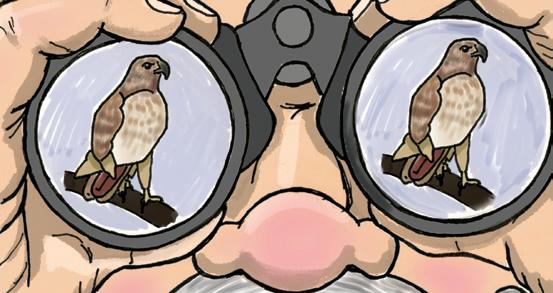
Christmas Bird Count 2012
Citizen science event to take place on Dec. 16
bRyce h oye, Staff
Since the winter of 1900, amateur and experienced birdwatchers alike have participated in the annual Christmas Bird Count (CBC).
Ornithologist Frank Chapman started this ambitious citizen science project by enlisting members of the public to monitor the various bird species wintering in their neighbourhoods. Today this data is pooled into an international database shared between Canada, the U.S., the Caribbean, and Latin America.
Canada’s CBC is organized on a national scale by Bird Studies Canada. According to Bird Studies Canada, the CBC takes place between Dec. 14, 2012, and Jan. 5, 2013, in “over 2,000 localities across Canada,” annually.
The CBC is conducted all across Manitoba, and here in Winnipeg regional CBC coordinator Rudolf Koes is one of the main group organizers. In an interview with the Manitoban, Koes said anyone with an interest in birds is qualified to sign-up and participate in this years CBC, which takes place on Sunday, Dec. 16.
Seasoned observers are matched with “novice birders,” ideally somewhere near their home neighbourhood.
“All CBCs cover an area identical in size: a circle with a diameter of 15 miles,” stated Koes, adding “the Winnipeg circle has its center at
Polo Park and the circle falls roughly within the Perimeter.”
Koes is from the Netherlands and has been a keen birder (i.e., those who watch birds as a recreational activity) his entire life. Koes has been involved with the CBC in Winnipeg since the late 60s, and described how he eventually inherited the compiler’s role.
“It is a rather time consuming job and few people are willing to take it on, but someone has to do it.” Koes is the co-author and illustrator of Birds of Manitoba, a book which won the Manitoba Writers’ Guild and the Association of Manitoba
Book Publishers’ “Best Illustrated Book of the Year” award almost a decade ago. Koes is also a member of the Manitoba Breeding Bird Atlas’ steering committee and is involved with several other local bird-centric organizations, including Nature Manitoba. In addition, Koes guides birding tours with Eagle-Eye Tours, which operates both on a local and international scale.
In terms of the bird species Christmas Bird Counters can expect to see in Winnipeg, well, that depends. In certain areas of the city, during the winter birders can expect to see
Feeling lonely?
Altered brain structure may contribute to social loneliness
e lizabeth dRe Wni K , voLUnteer Staff
Everyone experiences feelings of intense loneliness. However, there is a difference between feeling lonely and being lonely. In a recent study published in Current Biology, Rhyota Kanai et al. define loneliness as a “dis tressing feeling associated with the perceived absence of satisfying social relationships.”
In other words, feeling lonely for a short period of time is an experience with an expected end, but being lonely is a state of mind, a continuous frustration at one’s own inability to socialize with others. In essence, the latter feeling is distressful because the one who is lonely believes themselves inherently incapable of maintaining social relationships, reinforcing feelings of disappointment and low standards, which can have detrimental effects on their mental health.
of chronic loneliness is linked to brain structure, which affects the ability to perceive and understand social dynamics. They studied a region of the brain called the left
that loneliness is associated with difficulty in processing social cues, especially ones that involve the eyes. When we communicate, we tend to do so both verbally and non-verbally, and depending on the nature of the conversation, a great deal of communication can be non-verbal. Social cues, such as eye and hand gestures, postures, and socially expected reactions under certain circumstances, all contribute to non-verbal communication.
white-breasted nuthatches, downy and hairy woodpeckers, common redpolls, dark-eyed juncos, whitethroated sparrows, blue jays, several species of raptors (hawks, eagles, falcons, owls), and, of course, pigeons, house sparrows, and starlings to name a few.
There is also always the chance to glimpse a few migratory stragglers and other oddities – like certain species of waterfowls. As Koes noted, “Every year some unusual birds are spotted. It could be lingering waterfowl, a rare raptor, a bird from the West, a rarity at a feeder, etc.”
“Examples over the past few decades include wood duck, gyrfalcon, red-bellied woodpecker, varied thrush, and Baltimore oriole,” Koes added.
Another interesting factor that is affecting Winnipeg’s resident winter bird species relates to climate change, and the ever milder and shorter winters we’re experiencing. According to Koes, certain species’ numbers have increased significantly in recent years, citing the American crow, white-throated sparrow, and dark-eyed junco as examples.
Koes also speculated that an increase in public interest in the welfare of wintering birds has likely resulted in the presence of more bird
feeders, adding “the maturation of and increase in variety of trees in the city” may also play a factor. Conversely, changes to the landscape resulting in habitat loss and fragmentation have lead to “the disappearance of species such as ruffed grouse and sharp-tailed grouse from” from the CBC.
Whatever your level of expertise, participating in the CBC is a great opportunity to get outside and enjoy Winnipeg’s winter. It allows novice birders to improve their bird identification skills and learn from other local birders, and can even be a great opportunity for first timer birders to get exposed to the curious world of birding.
For those interested in sharpening these skills, Koes encourages people to get in touch with a group like Nature Manitoba, as it organizes birdwatching tours in and around the city throughout the year. Another handy resource is available online, where postings in the Yahoo group “Manitobabirds” include descriptions from members of birds recently seen around the province.
To participate in or donate to this year’s CBC , go to www.birdscanada. org/volunteer/cbc
Kanai et al. indicate that the nature
they discovered is that people who have higher scores on the UCLA loneliness questionnaire tend to have a smaller volume of pSTS grey matter. Kanai et al. have also confirmed
People afflicted with loneliness were tested for sensitivity to these social perceptions, and were correlated with negative results, meaning that they are unable to process non-verbal social cues. What is most interesting is that the majority of these people are very proficient in their verbal communication skills.
It is hypothesized that the pSTS region of the brain is involved in the initial stages of social perception—
Kanai et al. have also confirmed that loneliness is associated with difficulty in processing social cues, especially ones that involve the eyes.
combining different sensory cues such as eye gaze, hand action, and body movements—and that lonely individuals may have deficits in basic social perception. The pSTS is recognized to contribute to several fundamental aspects of processing social information.
Having a poor ability to recognize social cues may cause difficulty in developing social relationships, leading to social isolation from others, and thus generating loneliness. It’s not that an altered brain structure directly makes these people feel lonely; rather, certain brain structures are associated with a lack of social perception, resulting in a reduced ability to adequately socialize with others. It is the lack of experience of socialization that directly contributes to loneliness.
The researchers suggested that improvements in social perception may be made by training people to be sensitive to social cues. This is great news for those who are predisposed to loneliness. Despite the fact that some people may be unable to recognize social cues on their own due to biological factors, there is still hope that these individuals may be alleviated of their loneliness with the proper social training. This means that there is the possibility for a risk-free treatment for people suffering from loneliness. Rather than prescribing drugs, perhaps less expensive and less substance-dependent methods can be applied to help individuals with chronic loneliness.
iLLustRatiON by JustiN Ladia
iLLustRatiON by mathieu bOuLet
Five tips to help you get a great tattoo
Jenna d iubaldo, Staff
Recently I watched a show on the TLC network called America’s Worst Tattoos, which featured some of Amurikuh’s most prized inhabitants displaying some of the most poorly thought-out and terribly executed tattoos I have ever seen.
As someone who is fairly new to the tattoo world—I have seven tattoos in my collection so far— I know firsthand that getting a tattoo can sometimes be a pretty scary and intimidating experience, especially if it’s your first time getting some work done. So, to help make your tattoo experience a bit less painful (see what I did there?!), I’ve put together a few tips based on lessons I’ve learned through getting tattooed myself.
Hopefully by following these steps—and not picking a dumbass design concept—you can avoid being featured on national television getting your playboy bunny tattoo covered up, and instead spend a lifetime looking at a beautiful work of art.
Spontaneous tattoos can be fun, and often tattoo artists will have a stock of flash designs to choose from specifically for walk-in clients. However, an impromptu tattoo means you’ll need to be flexible about what you get because often you will be forced to choose an already drawn-up design rather than having a tattoo that is custom-made for you.
#2 - Don’t get hung up on the price tag
While getting a tattoo can be an expensive endeavour, paying top dollar for a tattoo does not always necessarily ensure the quality of the finished product. There are many talented, experienced tattoo artists who have very reasonable hourly rates.
That being said, a tattoo is not something that you should cheap out on – the saying “you get what you pay for” certainly applies in most cases. If you can’t afford a tattoo from an artist that you really want to work
#1 – Consider and reconsider your idea
Not every tattoo has to have some deep and meaningful story behind it, but it’s important to take some time to consider your idea and make sure you’re comfortable with what you’re putting on your body because, well… it will be there forever.
Can you see yourself still enjoying your tattoo in 25 years? Are you getting the name of a significant other tattooed on your neck? Does the acronym YOLO come to mind when thinking of your design?
with then save up, or talk to the artist about splitting the tattoo into multiple sittings to spread the cost out over a longer period of time.
Most tattooists are willing to work within a budget, but be clear about what your budget is prior to being tattooed. When negotiating don’t forget that your artist has invested years into perfecting their craft and tattooing is likely their livelihood. Nobody likes a cheapskate.
#3 - Choose a tattoo artist wisely
No two tattooers are exactly alike, so when choosing an artist do your
research. Check out tattoo shops online, add tattooers on Instagram, or even pop into a few shops to check out some portfolios.
Often tattooists are skilled in many styles of tattooing, but most of the time an artist will have a focus or a specialty – one style that they particularly excel in and enjoy tattooing the most. Often, deciding what style of tattoo you’re looking for and then searching for an artist who specializes in that style or has tattooed that specific idea before can help. For example, if you’re looking to get a realistic portrait of a family member you might not want to go to the artist who specializes in traditional tattooing, but if you want a 50s style pin-up, that same artist might be a great choice.
Rule of thumb: if you’re not sure then book a consult – they’re free and it provides an opportunity to meet the
artist and get their feedback on the idea you have in mind.
#4 - The artist knows best
Sometimes we have a really firm idea in our head of the tattoo that we want, how it should look, where it should be placed, and what size it should be. Often we’ve been thinking of this idea for years and when it comes time to actually get the tattoo we can be reluctant to accept feedback on our design idea.
It’s important to remember that when getting a tattoo, the artist knows best. If your artist makes suggestions relating to placement, size, and content, my advice is to seriously take it into consideration when making your final decision. Ultimately it’s your call because you have to live with your tattoo for the rest of your life, but just remember that this is what
your tattooist does for a living, so any advice given is well-informed.
#5 - Prepare yourself for the big day
Don’t drink alcohol the night before your tattoo and get a good sleep. Hydrate yourself with plenty of water prior to, and drink a sugary beverage during the session. Eat a hearty meal before your appointment, rather than eating only a bowl of cereal for breakfast, getting tattooed for six hours, and then spending the evening trying not to puke because your blood pressure is super low. Not that I did that myself or anything…
And most importantly, tip your artist!
phOtO by daWyNe LaRsON
Healing waste with human hands and mindful work
The 2nd Annual Cycle of Giving
When you think of magical transportation around the holiday season, a sleigh and reindeer might be the first thing that springs to mind. Even though the streets are ice-covered and snow-dusted, the Winnipeg Repair Education and Cycling Hub, better known as the W.R.E.N.C.H., is planning 24 hours of bike-making magic. On Dec. 15 and 16, the Atomic Centre at 167 Logan Ave. will turn into a workshop filled with volunteer bike mechanic elves.
For the second year in a row the W.R.E.N.C.H. is collecting donations of bikes, wheels, bike parts, and cash to build over 200 bicycles for Winnipeg children in need. Aside from a new set of wheels, the bikes also come equipped with lights and locks to help keep their new riders and their bikes safe. This year they are also hoping to send each bike out with a helmet thanks to a partnership with Active and Safe Kids Manitoba.
Organizer Greg Unger says it all started last year when fellow W.R.E.N.C.H. staff member Pat Krawec was feeling the Christmas spirit. It was a success and they were able to make the holiday memorable for a total of 245 children.
“He came up with the idea quite late in the year and we busted our butts to put it together in a month,” says Unger.
“Today is Black Friday and it is just the most depressing, suicidally consumeristic time of year,” says Krawec. “When you work in back alleys and garbage dumps like I do, you see so many kids’ bikes crying out to be fixed up. This is the opposite of that consumerism.”
The W.R.E.N.C.H works with organizations in the inner city like North End Women’s Centre and Art City to distribute the bikes to low-income families, so they can gift their children with the bikes that they would otherwise be unable to afford. Some community partners, like the NEEDS Centre, saved theirs until spring when the
W.R.E.N.C.H staff could customfit, size, and tune-up the bikes for kids. Krawec says that they were ecstatically happy – and with good cause. Most of the children are receiving their first bike ever thanks to the marathon.
This kind of holiday miracle doesn’t come on its own – the support of the community is needed to help put this generosity to work. Unger says they need 75 volunteers with all kinds of skill sets to help make the workshop a success. Whether you can fix a bike, ride one to test it out, clean it up, or write a card, no skill is overlooked. Bands are also welcome to donate their skills to help entertain the volunteers during the marathon. Even cooking up some finger food for the volunteers or serving as a hospitality guide to help boost morale is a huge help.
Of course, monetary donations are also more than welcome to help provide locks, lights, helmets, and to help support the education that the W.R.E.N.C.H and other bike hubs do year-round.
Volunteer Will Belford is helping out because of his skills in bike mechanics and is trying to beat his bike-building record and make eight bikes in his shift. There is also a rumour that the staff of Natural Cycle—where Belford works— and Bespoke Cycle are having a build-off to see who can get more staff out and more bikes built.
Friendly competition aside, this is really a chance for everyone to contribute something meaningful to an often wasteful season.
“While everyone is buying and destroying our planet as fast as we can, there is something great about healing waste with human hands and mindful work,” says Krawec.
Unger and Krawec say they can use any skill, so email them at cog@thewrench.ca and let them know what they you can do – they will find a use for you.
Reel Injun
Discussing the portrayal of Aboriginal people in film
You’d think with over 4,000 films made about First Nations people in the past 100 years Hollywood might have gotten it right by now.
Cree filmmaker Neil Diamond travelled North America interviewing actors, directors, and filmmakers, mapping out the history of Native people in cinema in his film, Reel Injun. The film has won three Gemini Awards and the prestigious Peabody award, recognizing the best in digital media. Reel Injun disassembles tropes such as the "White Messiah" (Dances with Wolves) and the "Groovy Indian" (perpetuated by Cher in “Half Breed”), and features films that truly amplifies Aboriginal voices, like Atanarjuat: the Fast Runner
Stereotypes not only run rampant in the present, but in the past were combined with the fact that white actors were dressed up and put in brown-face to play the parts of Native actors. Aside from being offensive and untrue, this was effectively wiping representation of Aboriginal people completely from mass media and popular culture.
“That is a genocide that occurred and the [American] culture wanted to perpetrate the idea that [Native people] are now mythologic, you know, they don’t even really exist, they’re like dinosaurs,” says director Jim Jarmusch.
Urban Native Girl blogger and actress Lisa Charleyboy agrees.
“There is a massive lack of knowl-
edge as to how the history of this country and colonization has led to the social and political implications that many First Nations people struggle with today,” says Charleyboy.
The stereotypes shown not only fail to educate the general public with historical accuracy and the importance of the First Nations peoples to the social fabric of Canada – they are also damaging and confusing to First Nations peoples themselves.
Charleyboy states that, for women, being portrayed only as the “Indian Princess” or the “Squaw” leaves little room to see other roles for themselves modeled in the media. The roles of mother, daughter, or doctor simply don’t exist.
a negative self-image or lead one to think that there are societal expectations of what being a Native woman is.”
Russell Means, a prolific Aboriginal rights activist, cites Marlon Brando having Sacheen Littlefeather deliver his Oscar acceptance speech as a turning point.
“We don’t believe we’re going to get out of [Wounded Knee] alive and the morale is down low and Marlon Brando and Sacheen Littlefeather totally uplifted our lives,” says Means.
In 1972, members of the American Indian Movement occupied Wounded Knee, South Dakota, to protest the tribal leader and had a standoff with the FBI and U.S. Federal Marshalls. Brando used his platform at the Oscars to give Littlefeather an audience to speak out about the incident as well as the treatment of Aboriginals in cinema, declining the award due to the latter.
“I always see stereotypes represented both in pop culture and in mass media,” says Charleyboy. “In films, we are often stereotyped as the 'noble savage' or the 'Indian princess.' Then the stereotypes moved onto the 'drunk' or the 'squaw' as represented both in the present day films, television, and in the news media.”
Charleyboy says it wasn’t until films like Smoke Signals and North of 60 came out that the depictions started to meaningfully shift.
The stereotypes shown not only fail to educate the general public with historical accuracy and the importance of the First Nations peoples to the social fabric of Canada – they are also damaging and confusing to First Nations peoples themselves.
“[Native women are missing] all of these other shades that other races are able to view themselves as while growing up. This can shape
“I think it is highly important for First Nations people to pursue careers in all aspects of film, media, journalism, so that we can educate, inform, and start to shift perspectives and stereotypes that are currently still in existence.”
Charleyboy cites programs like the National Screen Institute’s Aboriginal programs for young filmmakers, and the Adam Beach Film Institute as promising programs for ensuring this happens.
“Our stories are very important and through filmmaking we can look at our oral traditions and storytelling in a new way.”
Jodie l ayne, Staff
Jodie l ayne, Staff
One Night Stand investigates a new way to share contemporary art
Ka R a Passey, Staff
Collin Zipp is a multi-disciplinary artist who works with video, photo, sculpture, painting, and installation. He received his BFA from the University of Manitoba’s School of Art in 2005 and his MFA from the University of Lethbridge in 2011. In addition to producing work that explores notions of viewer experience and expectation, Zipp has an interest in curating artwork and producing shows in unconventional ways.
Before leaving Winnipeg for grad school, Zipp was involved in the opening and operation of an experimental gallery space called Gallery 803. While that gallery’s location was unconventional—a showroom of a furniture store that ran shows for up to eight weeks—it is unlike Zipp’s new project, One Night Stand, which is nomadic and exists for one night only.
“One Night Stand exists as a nomadic contemporary art gallery. I want to approach the gallery in a very experimental way; organize and program shows in different venues, with exhibitions running for one night only,” says Zipp. “If you want to see the show, you have to go that night. Either you do it or you don’t.”
“I’ve always been drawn to alter-
Experimental and unconventional Phlegm Fatale
native and experimental galleries.
There is freedom to try and see new approaches to both making and exhibiting art,” he adds.
Zipp says he doesn’t want to limit himself to the local art scene either.
“I am looking into the opportunity
"If you want to see the show, you have to go that night. Either you do it or you don’t."
to travel the gallery to different sites and organize one night shows there as well. Where there’s an available space, there is opportunity for an exhibition.”
One Night Stand’s most recent exhibition was on the fifth floor of an old warehouse in a rustic but freshlypainted gallery space. The show was titled the Full Complement and shared diverse collection of contemporary paintings, sculptures, audio art, and performance from artists Ian August, Michael Benjamin Brown, Theo Sims,
Aston Coles (Single White Female), Ben Borley, and Peter Kralik. The evening was very relaxed and was not unlike old friends meeting and catching up on life.
“I’ve been working at [Plug In ICA] doing contract installation work with all the artists in the show. There was no theme [ . . . ] so in a way I just programmed the artists, and not their work. I was curious in seeing how both their individual work and the artists themselves would come together to create an exhibition,” says Zipp.
August, who grew up in Winnipeg and received his BFA Honours Degree from the University of Manitoba’s School of Art, is known for his flawless oil paintings and collaborative work with Winnipeg’s Two-Six collective. His contribution to the Full Complement was an oil painting titled “Natura Morta”—Italian for “still life”—with an accompanying video by the same name. The video was a static visual of a found art sculpture bust with an orange, sitting on top of a shipping palette and wrapped with shrink wrap. It was played on a TV set which sat on a plinth near the painting, which was a well-rendered portrait of the
sculpture.
“The small spaces that I construct and use as source material for paintings are kind of like little architectural maquettes or miniature theatrical sets,” says August. “Lately I have been thinking of them more as the staged props for still life paintings. I have been into the paintings of Giorgio Morandi for a while so I guess the
title is a nod to him.”
Zipp is already planning his next exhibition, which will be a solo show of Sylvia Matas’ work, another graduate from the U of M. For updates and information on upcoming exhibitions and invites, make sure to follow One Night Stand on Facebook by visiting www.facebook.com/onenightstandartgaller y
A debut album of awesomely sloppy garage rock to be released on Nov. 30
Jenna d iubaldo, Staff
Phlegm Fatale can best be described as a hot mess of dirty guitar riffs, riot grrrl screaming, and ridiculous stage antics that will leave you feeling fired-up and ready to party.
With Alana Mercer on guitar, Karyn Broadfoot-Walters on bass, and what sounds like a Casio keyboard on drums, this duo has perfected the art of sloppy garage rock and is now ready to release a fulllength album.
Phlegm Fatale will be releasing a 10-song CD on Transistor 66 records
due out on Nov. 30, but fans who don’t want to wait that long can look forward to the tracks being released on iTunes prior to the official CD release.
I chatted with Mercer through the magic of the internet about their upcoming release and here’s what the rock and roll vixen had to say.
The Manitoban: How was Phlegm Fatale formed?
Alana Mercer: We were friends that just started
jamming on ridiculous cover songs together when we hung out. After a while Karyn played me some of her original stuff and I kind of had a meltdown I was so excited! [They were] super catchy – I didn’t expect pop songs like that.
M: Where was your new album recorded and how did that influence the final product?
"I feel like writing myself a letter back in time that says, ‘Just wait. You’ll have a dance-rock band.’"
AM: Kalyn Hanuschuk recorded us at Quagmire’s jam space, which is also her studio. Her presence had a fantastic effect on us. She was very positive and understood right away what we were doing and I think her attention to detail—especially when it came to recording all of Karyn’s weirdo sound effects randomly thrown into songs—brought out
the fun that we were having [while] recording it!
M: What can fans expect from this album?
AM: Well, we keep laughing to each other that it’s turned out to be the album we both wanted to make when we were about seven years old and obsessed with bands like Veruca Salt, Ace of Base, Technotronic, Joan Jett & the Blackhearts; basically everything that fell between (what we knew of) heavy metal and techno. I feel like writing myself a letter back in time that says, “Just wait. You’ll have a dance-rock band.”
M: Given that you’re a two-piece, have you ever considered adding a drummer, or are you satisfied with using samples to back your music?
AM: I actually originally drummed for this [band], and we had two men who played guitar while Karyn played bass and sang, but there was something missing, or maybe too much was being added. When we stripped it down to just my guitar and a ridiculous Salt-N-Pepa beat [ . . . ] we found that so much more came out of the
songs. Also, the beauty of not having to move around a drum kit for every show is definitely a perk.
I love my old Pearl [drum kit] but holy hell some winter nights you just want to turn the kick drum into some sort of [a] transportation device where it magically whisks you and all your stupid hardware that’s freezing to your hands back home without any effort whatsoever. So no, pretty sure we’re sticking with the drum machine.
M: What can we look forward to at your album release (besides an awesome album)?
AM: A crazy party. We’ve been working on this album a while now and really can’t wait to put it out. It’s going to be on iTunes before the actual show, but it’s so much more fun to have the actual thing. Also, Quagmire and Archagathus are playing which means the night is starting off rowdy and really loud. We’re really tickled pink to have these bands involved –the members have been so supportive. The least we could do is throw them a big party.
Check out Phlegm Fatale’s CD release party at the Cavern on Nov. 30.
phOtO by COLLiN zipp
Friends with benefits
Dear Jodie,
Recently I get easily aroused. I wanted to do something different, other than masturbation, but I don’t have a girlfriend… Do you think a friend with benefits is a useful way to switch it up?
Signed, anonymous
Oh, yes – masturbation is a great tool for self-pleasure and requires no more than a hand and maybe a little lube. But, just like any great sexual relationship, things can get stale after awhile.
and desires is something that you will need to do both alone and with your partner. Deciding if you would like to have one consistent partner, or just random one-night stands is a good place to start. If you would like to have a consistent partner, how do you intend to do that? How often would you ideally like to be having sex with that person? Do you want to hang out with them or just booty-call and have them over for a quick sexual encounter?
There are a few ways you can spice up your solo routine, such as using masturbator sleeves, which offer different textures, pressures, and new sensations. You can also masturbate to different porn or fantasies, or read some erotic literature. If you’ve already tried these things or are just ready to try something else, a casual sexual partner could be appropriate for you. It sounds like you know for sure you are looking to have sex with someone else and aren’t looking for a girlfriend.
The first thing to consider is your safety and the safety of any would-be partner. Before you even think of making an arrangement for continual casual sex, get yourself tested for a full STI panel. Unless you have been tested six months from your last sexual encounter, you need to get tested again. Keep in mind that it is impossible to test men for HPV – a virus whose strains can cause cervical cancer in women and can cause warts and cancer of the penis, anus, or throat in men. Knowing your status will help you make informed decisions about what kind of sex you are willing to have with someone and what kind(s) of protection you will need to use.
Deciding your boundaries, needs,
Deciding
your boundaries, needs, and desires is something that you will need to do both alone and with your partner.
Is there anything specific you are into as far as sexual acts, kinks, or fetishes that you are looking to explore? It’s important to sort out your sexual boundaries beforehand - not just what you want to do, but what is definitely a no-go.
Deciding who will provide protection and where you will have sex is also worth considering. A big issue is whether you will have other sexual partners or be monogamous. As many STIs are transferred through bodily fluids, deciding whether to kiss open-mouthed or ingest the other’s ejaculate (becoming fluid-bonded) can be kind of a big deal.
Kissing and cuddling can be seen as very intimate acts; discussing this and deciding if you will
engage in them should happen as well. What will you do if one of you starts having emotional feelings towards the other? What will you do if one of you meets someone they are interested in dating? Hashing these things out beforehand will ensure that you can communicate with and trust your partner be prepared for issues that may arise and have a reasonable, agreed-upon way to deal with them. You might question whether you are over-thinking or over-discussing, but there really is no such thing.
In terms of staying physically safe, safer sex methods are not the only thing to worry about. If you intend to find a sex partner online—as many more people than you think do—then it is important to take as many precautions as possible to make sure you are not at risk of any other physical harm.
Meet a potential partner in a public place before getting down to the sexy stuff and make sure you feel safe and they are who they say they are. Let a trusted friend know where you are going, how long you expect to be, a physical description of the person, and what their name is. Get them to call you to check in when you think you will be finished getting it on. Be responsible and make sure you update them; there is nothing worse than having the cops bust in on your sexy-times.
Once you cover your bases, have fun with your new partner and make the most out of your mutually-beneficial relationship. Check in often to ensure you are both comfortable with the way things are progressing – and don’t forget about masturbating!
You can confidentially submit a question or topic to jodie.m.w.layne@ gmail.com
Jodie l ayne, Staff
Fieldtrip to N.A.S.A.
By Juliana Kusyk
Do you have a super awesome photo that you want the world to see? No matter if you took it using your camera or your smart phone, send your “PHOTO OF THE WEEK” to PHOTO@ THEMANITOBAN.COM.
CaRLa RisLey
Bisons trample Cougars in men’s hockey
Score 13 goals while only allowing two in pair of games
10 WAYS TO LAUNCH YOUR CAREER
FIND YOUR NICHE WITH A POSTGRAD IN BUSINESS
Heading into this weekend’s games, the Manitoba Bisons and Regina Cougars found themselves tied in the Canada West standings with 6-4-2 records, good for 14 points on the season. Both teams also had 32 goals for, but as the Bisons had allowed four fewer goals they owned the tiebreaker and sat in fourth place, while Regina sat fifth. With stats like that it seemed like this would be a pair of very close games and could easily go into overtime. That was not the case this weekend at Max Bell.
The Bisons came charging out of the gate on Friday night, taking the lead just 71 seconds into the game as James Henry tipped in a Brandon Lockerby point shot that put the home team up early. Two and a half minutes later, Luke Cain would net his fourth of the year as he rushed in and backhanded a shot passed Regina netminder Lucas Gore. Before the opening period was out the Bisons would make it 3-0, as fifth-year forward Tyler Dittmer would be sent in on a breakaway and snap one in off the crossbar for his fifth goal of the year.
The Bisons struck early in the second period, as another Brandon Lockerby point shot was tipped in, this time off a Regina player, earning Lockerby his first goal of the year.
Manitoba goalie Jesse Deckert was only forced to stop five shots in the period, but two of them were beauties. Early in the period, a redirection caught him going to wrong way, but he managed to extend his glove hand to make the save. Later in the period it was a two-on-one
break that was denied by a sprawling Deckert, who displayed why he was named September/October 2012 Canada West men’s hockey HuskyWHL Graduate of the Month.
On a scarier play, Regina forward Tyler Henry nearly impaled himself on his stick when he ran out of real estate behind the Bisons net. Luckily for him, the composite stick broke and he only left the game for a short time.
The third period saw the Bisons grind line get in on the scoring act, as Dylan Kelly netted his second in as many games with his linemates Jesse Paradis and Paul Ciarelli getting assists. The trio would give the vaunted GST line of the Winnipeg Jets a run for their money on this night, as Regina could get nothing going when they were on the ice.
The Regina power play was dreadful, as the best chances during their three opportunities with the man advantage went to the shorthanded Bisons. Matthew Lowry would capitalize on one of these chances in the third, as he picked up a pass from goalie Jesse Eckert and sprang in on a breakaway and scored a short-handed goal. All that was left to see in this one was if Deckert would hold on for his first shutout of his Bisons career. A close call occurred with two minutes left as Carter Selinger broke in alone, but Deckert denied him and helped preserve the 6-0 final score.
Game two on Saturday afternoon got off to a rocky start for the Bisons, as the Regina power-play broke free from its slumber and got the Cougars on the board just 1:05 into the game as Carter Selinger
tucked one passed Deckert. Early on, it seemed as though the script might be reversed from the previous evening’s action.
The Cougars nearly scored a shorthanded goal a short time later as Deckert came out to play the puck, only to have it bounce off his own defender and just narrowly missed scoring on the vacated net. The Bisons would tie up the score on a great play by Eric Mestery, who used all of his 6’5” frame to keep the puck in at the blue line and fed James Henry in the slot, who deked Regina goalie Andrew Hayes out of his jock and roofed it. The Bisons grabbed the lead before the period was out, as a bomb of a shot by Darren Bestland was tipped in by Brendan Rowinski.
The floodgates opened in the second period, as Manitoba put up four goals, three coming on the power play. Blair Macaulay, James Henry, Travis Bobbee, and Jeremy Schappert would all get tallies on the second period score sheet.
The third period saw the Bisons grab a 7-1 lead via Tyler Dittmer. Regina got a late one from Mark Schneider, but it was far too little too late.
Jesse Deckert turned aside 41 of 43 shots on the weekend, improving his save percentage to 92.2 per cent on the year. James Henry had five points on the weekend to give him 10 on the year.
The Bisons play at home next weekend against Alberta, who are currently ranked first in the nation.
The Golden Bears won the previous meetings this season by scores of 4-2 and 7-2.
Legends of the Periphery:
Introducing bad boy bowler Pete Weber
Ryan h a Rby, Staff
From time to time, even some of the greatest and most prolific heroes in all of sports fall through the cracks of obscurity and are lost to the world at large. Legends of the Periphery celebrates the best of the best among the forgotten, the bizarre, the esoteric, and the obscure.
If Christopher Nolan’s Batman series has taught us anything it’s that heroes can at times be dark, conflicted, polarizing figures. They can be so driven and single-minded that it may even appear that they are themselves villains.
Such is the case with pro bowling’s Pete Weber.
Weber is a unique type of competitor; not unlike fellow L.O.P. inductee
Billy Mitchell, his pursuit of perfection is matched only by his confidence and cocky, bad boy attitude. Get in Weber’s way and he’ll straight-up run you down. In a sport filled with a seemingly endless roster of run-of-the-mill average Joes, Pete Weber is anything but.
titles within the next six years – the youngest player to achieve such a goal. By the age of 26, Weber had claimed his first PBA national championship, making him a bona fide PBA triple crown winner, having won the U.S. Open, the Tournament of Champions and the PBA National
a single title. Adding to Weber’s woes was the fact that his classic in-yourface demeanor hadn’t exactly won him many friends within the ranks of the PBA; many thought his antics were unsportsmanlike and, at worse, offensive to the players and fans.
The new millennium brought with
what’s going to sell the PBA,” Weber told USA Today
Under the new ownership of the PBA Weber flourished like never before. By this point in his career Weber had begun wearing his now trademark sunglasses to every competition. According to Weber, the
sion appearances.
By 2004, Weber had regained much of his professional stride (preceded by a major title win in 1998 and a Hall of Fame induction in the same year) when he won what would be the first of three PBA U.S. Open major titles in the next decade.
Born Aug. 21, 1962, in St. Ann, Missouri, Weber was the son of legendary bowler Dick Weber. Introduced to the game of bowling at a young age, Weber was defeating adults as a teen before he broke into the Professional Bowlers Association as a 17-year-old.
In 1980, Weber won the PBA Rookie of the Year award, setting the stage to win a total of 10 PBA
Championship. Pistol Pete’s rocket-like ascension to the top of the bowling world, however, didn’t come without its share of hardships. Despite a staggering amount of earnings and professional titles Weber would soon face his darkest days in the 1990s. By ’95 Weber had gone through his second of two divorces and was mired in a stretch that saw arguably the worst bowling of his career, going three consecutive seasons without winning
it a ray of hope for Weber, though, as the PBA Tour was purchased by a group a former Microsoft executives who were very much eager to showcase the various personalities of the professional bowling world. And in the realm of bowling personalities, Pete Weber was the unquestioned king.
“The new PBA has told me to be animated, and I was already animated to begin with. The new PBA likes me, likes my antics. They think that’s
Cougars pounce on Bisons in women’s hockey games
Manitoba only grabs one point, falling to last place in Canada West
d e Re K g agnon, Staff
W
hile the men’s hockey team was busy drubbing the Regina Cougars, their female counterparts had more than their hands full when they visited the Co-operators Centre in Regina for games on Nov. 23 and 24.
Friday night saw the Bisons grab the lead in both the first and second periods through goals from Nellie Minshull and Kyleigh Palmer. But Regina evened the score each time, eventually taking the lead in the third period. A goal by Kayleigh Wiens with 7:21 to play in the third
would tie things up 3-3, sending the game to overtime. The winner went to Regina, as Carleen Meszaros scored for the Cougars late in OT to give Regina a 4-3 win. Dée-Ana Marion turned aside 28 of 32 shots in the effort.
On Saturday night, the Bisons outshot Regina 26-19, but lost the battle on the scoreboard. It was 3-0 Cougars before the Bisons could respond with a pair of their own from Kayleigh Wiens and Sara Barnabe in the second period. The Bisons kept it close until the
Cougars put the game to rest, as Paige Wheeler scored her second of the game into an empty net with 24 seconds left in the game to make it a 4-2 final score.
Leiette Klassen stopped 15 of 18 shots – including a penalty shot by Stephanie Sawchuk in the first period. The Bisons will next travel to Edmonton to take on the Alberta Pandas. Alberta sits in third in Canada West with 18 points, while the Bisons sit in last place, two points out of a playoff spot.
glasses were a means to block out the glaring lights of the television crews but they only added to his larger-than-life persona that now included signature crotch chops (a mimed gesture of the WWE “suck it” catchphrase) and a golf glove he wore on his dominant bowling hand. By his own admission, Weber is a massive pro-wrestling fan, going so far as to have his favourite wrestler Triple H’s ring entrance music play following a strike or spare on televi-
With the most recent of these U.S. Open titles, coming in 2012, Weber managed to fully transcend the world of bowling when his exuberance for the win caught the eye of many television viewers, then SportsCenter viewers, then YouTube viewers, now totaling well over 900,000 views for the uploaded video entitled, “PETE WEBER GOD DAMMIT I DID IT WHO DO YOU THINK YOU ARE” since February of this year.
In the now infamous video, which chronicles Weber’s record-breaking fifth U.S. Open title, the prolific bowler knocks down a game-clinching strike and then promptly losses his shit, screaming “That is right, I did it! Are you kidding me?! That’s right! Who do you think you are?! I am! Damn it, right!”
Thirty-six total titles and counting for one of the greatest bowlers of all time. As always, classic Weber.
iLLustRatiON by RyaN haRby
Staying grounded
The story of Houston Rockets rookie Royce White
a dam Peleshaty, voLUnteer Staff
When the Houston Rockets picked Iowa State forward Royce White 16th overall in last June’s NBA Draft, it was widely considered to be a risky selection. White was an overall talent in college—the only player in the NCAA to lead his team in points, rebounds, assists, steals, and blocks—but it was his own mind that was considered to be his greatest weakness.
White has generalized anxiety disorder, obsessive compulsive disorder, and a fear of flying. Diagnosed while in high school, White has chosen to be open and honest about his conditions and his success at the collegiate level has been an inspiration to those suffering from these disorders. During training camp and pre-season, the Rockets agreed to let White travel by bus to most games in order to alleviate his anxieties. However, the relationship between the two sides has since evaporated without White having played a single regular-season game with Houston.
Earlier this month, White left
the Rockets claiming, in a statement, that the Rockets “have been inconsistent with their agreement to proac tively create a healthy and successful relationship.” His absence coincided with the team’s plans to send him to their NBA D-League affiliate, the Rio Grande Valley Vipers. Exacerbating the situation are White’s posts on Twitter saying that his mental health takes prece dence over playing. He has also refuted claims by the Rockets that he had failed to attend sessions with the team’s therapist and that his absence was unexcused. The Rockets have fined him for every day of his absence, while White has told ESPN that he is considering leaving the NBA entirely.
White’s stance is an
admirable and understandable one. He has a right to defend his own well-being and if he feels that the Rockets are not supporting him properly—which is his claim—then he should not be forced into any activity that endangers his health. The Rockets assumed White’s risk when they drafted and subsequently signed him to a contract. Rockets GM Daryl Morey has also said that the team is committed to White in
On the other hand, if the situation is to be resolved soon, then White must also display some professionalism on his part. Airing out grievances on Twitter will certainly not help matters. It is okay to be open and honest, but contract disputes, until they are ended, are sometimes better kept behind closed doors. The Rockets must also examine whether or not
the investment into accommodating White’s needs is worth the reward. White must also realize the harsh reality that the NBA, and the rest of professional sports, can only adjust so much to players like him.
It is best for both sides to talk in order to alleviate the miscommunication, but in the end, it is what White wants that matters. In his aforementioned statement, he opened with, “In hindsight, perhaps it was not a good idea to be open and honest about my anxiety disorder.” Perhaps he will play for the Rockets this season. Perhaps he will take a hiatus before returning to pro basketball. Perhaps he will leave altogether. But the best example he can be to those who have OCD or anxiety disorders is to show that he can live a healthy and happy life, with or without basketball. But before he can help others, he must help himself. The truth is, halting his NBA career might, in the end, also set him free.
Jump on the NBA bandwagon!
The Manitoban helps you find your new favourite team
m a Rc l agace, Staff
The 2012-13 NBA season is underway!
If you’re a fan of the NBA, it’s a given that you already have a favourite team. But for NHL fans patiently waiting for the return of professional
hockey you might find yourself forced to talk about—or even watch—basketball on a regular basis. Heaven forbid! Here at the Manitoban, we want to help you find the right team to
follow – at least until hockey returns. We would also like to cut down the number of fans who jump on the bandwagon of the league’s most successful teams. So, without further ado, we offer our selections for trendy NBA teams to bandwagon until the NHL returns.
1. Los Angeles Clippers
The Clippers are a competitive, exciting team that has yet to win a championship, or even a division title, in the franchise’s 40-year history. But all signs point to the Clippers bucking that trend in the near future. Defending slam-dunk champion Blake Griffin, renowned for his high-flying antics, is the face of the team. Despite Griffin getting off to a slower start this season, the Clippers’ supporting cast—that already featured highly coveted talent Chris Paul—appears vastly improved. Lamar Odom returns to the team that drafted him after spending the majority of his career playing in the same city, but for the rival L.A. Lakers. Meanwhile, Jamal Crawford is off to the best start of his 12-year career, coming off the bench and leading the team with an average of 18.6 points per game.
2. Brooklyn Nets
Formerly known as the New Jersey Nets, the team has revamped their image and jersey with the move to the borough of Brooklyn. This is the ideal time to jump on the Nets bandwagon. The Nets are sitting near the top of the Atlantic Division, but there’s more to this season than just wins and losses. The team and the community will continue to deal with the aftermath of Hurricane Sandy that wrecked havoc on their home court and surrounding communities. Much like the 2006 New Orleans Saints, Nets fans should be in for good karma over the next couple years. Best of all, if you join the bandwagon now, no one could possibly accuse you of jumping on a “dream team” that’s sure to win multiple championships (looking at you, non-Floridian Miami Heat fans).
3. Minnesota Timberwolves
Historically, the Timberwolves have been awful. They haven’t made the post-season since 2004, when they went all the way to the Conference Finals before losing to the team that used to call Minnesota home: the Los Angeles Lakers. The T-Wolves nosedived from there, hitting rockbottom in 2009-10 when they finished the season with a record of 15-67 – a win percentage of only .183!
Despite all that, they’re still the closest to Winnipeg, which means that you could realistically drive down to watch some games live in downtown Minneapolis. The Wolves currently find themselves reeling from a fivegame losing streak. Maybe, with just a bit more support from out of town fans, they can turn this season around!
4. Seattle Supersonics
Yeah, I know what you’re probably saying; the Supersonics no longer exist, leaving Seattle in 2008 and relocating to Oklahoma to become the OKC Thunder. But the dream of NBA basketball is still alive in Seattle; city officials have recently approved a new arena while a group of investors actively searches for a team to purchase. Winnipeg sports fans certainly know the pain of losing a beloved sports franchise – and the overwhelming joy when a new team triumphantly returns to fill the void. So while there is not yet a team to follow on the court, this is an evolving sports story worth following that will hopefully have a happy ending for sports fans in the Washington state region. Jump on the bandwagon now, so you can say “I told you so” later.
iLLustRatiON by CaROLiNe NORmaN
iLLustRatiON by aLLaN LORde
FOLLOWING THE HERD
MEN’S WOMEN’S
TWO POINTS
THE NUMBER OF POINTS THAT SEPARATE THE LASTPLACE BISONS FROM THE FINAL PLAYOFF SPOT.
DEC. 2 3:00 PM VS TRU INVESTORS GROUP AC
Bison athlete profile
Bison volleyball co-captain Rachel Cockrell
m a Rc l agace, Staff
Rachel Cockrell’s success on the volleyball court this season is a testament to her work ethic and perseverance. In her rookie season, Cockrell was named to the CIS All-Rookie team. Unfortunately, a lingering injury forced her to miss the entirety of the 2011-12 season, but Cockrell did all she could to get back into game form.
Heading into the 2012-13 season— officially her second year of CIS eligibility—Cockrell was named one of three team captains. Nine games in, she’s leading the Bison attack with 130 kills and pitching in on defence with 17 blocks. The Manitoban caught up with Rachel after the Bisons’ win over Thomson Rivers University on Friday night.
the Manitoban: How has the season been so far for you?
rachel cockrell:
Awesome, it’s really great. We’ve got a good group of girls and it’s a fantastic atmosphere. I couldn’t ask for any better. We had a rough weekend last weekend [against UBC Okanagan], but we’re hoping for a turnaround
now.
M: Is this where you expected the team to be now, at 6-3 after nine games?
rc:
I thought we’d be a bit higher, but you have your ups and downs. We have a big weekend coming up against UBC.
M: With the fall portion of the schedule wrapping up, how do you think this team will do down the stretch? Is the winter break a good or bad thing in terms of keeping momentum?
rc: Oh, it’s definitely a good thing. I have full confidence in this team that we are going to go all the way and hopefully win this.
M: You also enjoy playing competitive beach volleyball with (first-year Bison) teammate Taylor Pischke. Is it nice to have her on the team?
rc:
Yes, it’s so nice. We’ve played together for so many years it’s nice to have her back here for sure.
M: You mentioned the team chemistry earlier. As a captain, what is your role? Do you try and keep people motivated?
rc:
Yeah, you definitely have to make sure everyone is staying focused. We all have one goal—to win the CIS National Championships—and every day when we practice we have to remember that’s our goal. Play every ball like it’s our last. That’s the biggest thing.
M: You’re enrolled in the Faculty of Arts. What’s your academic focus?
rc: I want to be an occupational therapist, so I’m majoring in Psychology [and] minoring in Biology.
M: Switching over to questions to get
to know Rachel Cockrell the person, what’s your favourite band, or genre of music?
rc: I like lots of techno, but I also like country and basic pop. I’ll give you one of each. For techno right now, it’d be Tiesto; country, Luke Bryan; and pop would be… Rihanna.
M: Any recent movies that you would recommend to readers?
rc:
Hmm, recent movies (Someone down the hall yells “Twilight!”) [laughs] I haven’t seen Twilight! I haven’t gone to see a movie in forever. I’m more into TV shows. Nashville, Vampire Diaries
M: So, given the option between TV and Movies…
rc: TV for sure!
DEC. 1 1:00 PM VS UBC OKANAGAN INVESTORS GROUP AC
DEC. 2 1:00 PM VS TRU INVESTORS GROUP AC
M: Why would you recommend Nashville or Vampire Diaries?
rc: Because Nashville is all about country singers! [laughs] And Vampire Diaries, why not? They’re vampires!
M: What’s your favourite pre-game meal?
rc: Booster Juice. I always have a Booster Juice and a Booster Bake before every game.
M: Your choice: Coke or Pepsi.
rc: Pepsi, although I don’t drink pop ever!
M: Finally, if you could be an animal, which animal do you think best represents you?
rc: Kangaroo. People always say I’m like a kangaroo because I can jump!
Beauty The Beast
We all need to manage the waste we create. If you’re like 90% of Manitobans, you already recycle. But one third of us admit we still throw into the trash some items that could be re-used or recycled into useful materials. Let’s manage to do better!
More than half of all household garbage can be recycled. Are you recycling all you can?