Frozen soil underestimated as global warming culprit
High expectations
Just
a taste
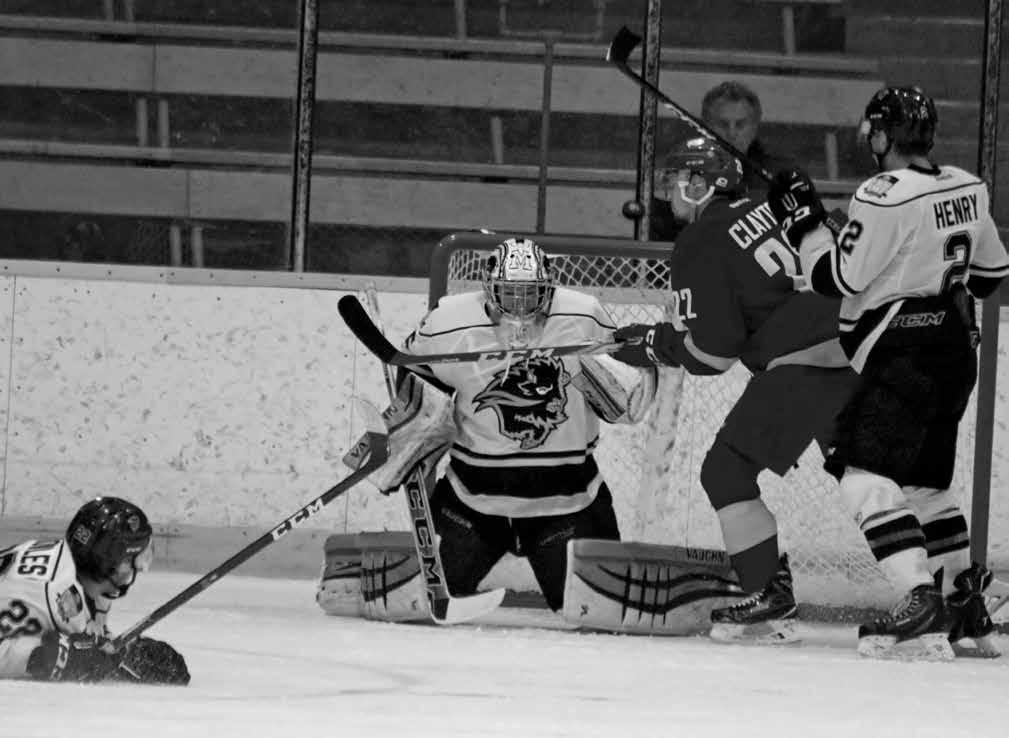
Byron Spriggs experiences a pro game with the Charlotte Checkers
Chong or bust
Why progressives should get involved in the Conservative leadership race
Welcome to Winnipeg Middle Coast sets up shop after moving from Brandon
Check the Manitoban’s website and Facebook page for:
• interviews with Niki Ashton and Michelle McHale, U of M students vying for the federal and provincial NDP leadership spots
• a look at the U of M's 5 Days for the Homeless fundraiser
• a look back at infamous UMSU presidential candidate Aaron Griffiths
eDitor-in-chief
Design
Design eDitor Bram Keast
design@themanitoban.com
graphics eDitor Kelly Campbell graphics@themanitoban.com
photo eDitor Miguel Yetman photo@themanitoban.com
Design associate Kellie Huynh
graphics associate Aldo Rios
photo associate Chantal Zdan
photo associate Star Roxas
photo associate Megan Colwell
r eporters
n ews Osho Samuel Adetunji
n ews Diana Ubokudom
columnist Jeremiah Kopp
columnist Shaden Abusaleh
arts & culture Olivia Michalczuk
arts & culture Emelia Fournier
sports Kellen Taniguchi
sports Jason Pchajek
copy Joseph Gonzalez
Volunteer Contributors
MANITOBAN
109 HELEN GLASS UNIVERSITY OF MANITOBA WINNIPEG, MB R3T 2N2
General Inqu I r I es & a dvert I s I n G
Phone: (204) 474.6535
Fax: (204) 474.7651
Email: manitoban@themanitoban.com
Free Med I a Campus Plus Media Services
Phone: 1.780.421.1000
Email: advertise@free-media.ca
Canadian Publications Mail Product Sales Agreement #589160
A “volunteer staff” member is defined as a person who has had three volunteer articles, photographs, or pieces of art of reasonable length and/or substance published in three different issues of the current publishing year of the Manitoban. Any individual who qualifies must be voted in by a majority vote at a Manitoban staff meeting. Elected representatives and non-students may be excluded from holding votes as volunteer staff members in accordance with the Manitoban Constitution.
The Manitoban is the official student newspaper of the University of Manitoba. It is published monthly during the summer and each week of regular classes during the academic year by the Manitoban Newspaper Publications Corporation.
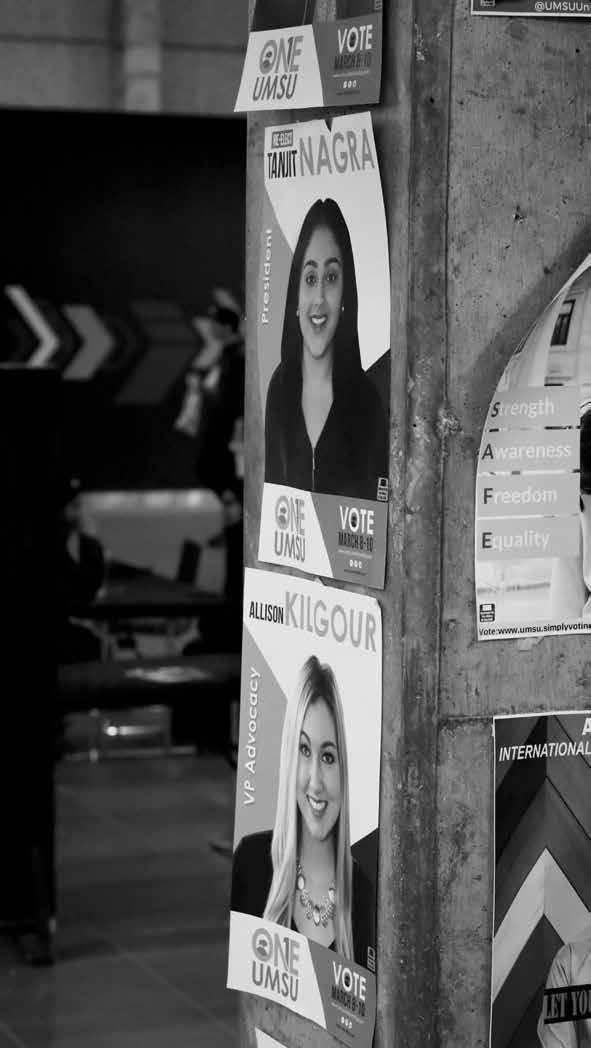
Increased UMSU election turnout attributed to online voting, engagement
Osh O samuel a detunji, staff
With the recent completion of both the University of Manitoba Students’ Union (UMSU) and University of Winnipeg Students’ Association (UWSA) general elections – and the University of Manitoba Graduate Students’ Association (UMGSA) election happening this week – discussions are beginning to examine the impact online polling and crowded slates play on voter turnout.
The 2017 UMSU general elections, which concluded March 10, recorded the highest voter turnout in at least 20 years with 27.7 per cent of members casting ballots. More than 6,200 voters participated in 2017, nearly double the 3,760 who voted in 2016.
Only two slates contested the executive positions, fewer than last year when three full slates, one partial slate, and an independent presidential candidate faced off.
In sharp contrast to the UMSU electoral returns, the 2017 UWSA general elections, which closed March 8, had a voter turnout of only 13.8 per cent – a turnout that was still higher than other recent UWSA elections. The 2017 UWSA elections, a contest of two full slates, one partial slate, and an independent, ended with
a little above 1,100 ballots cast.
The chief returning officer for UMSU’s elections, Michael Catanese, said his team explored various social media strategies to boost student participation for the union’s first online election.
“First of all, it is easier to vote because of the online voting,” he said.
“From my office, we had Snapchat filters, Facebook ads, Instagram ads, we had the UMSU social media posting stuff, we had UM Learn and D2L posting and notifications [a] couple of weeks before the elections and also on voting days.”
Catanese said there is no established link between the number of candidates competing for executive positions and voter turnout, saying that participation varies and is dependent on several factors.
“I don’t think there is a direct correlation, but there are some years when we will have either unopposed candidates or candidates where people just kind of know who is already going to win,” he said.
“Maybe there is one big name and the other people are just doing it for fun, those years we definitely see lower turnout. We have had years when even like four to five per cent of
people voted because they don’t care.”
Catanese said that barring candidates from actively campaigning on campus during the three-day voting period drove activity online, which further lifted voter participation.
“We have had years when even like four to five per cent of people voted because they don’t care” – Michael Catanese, UMSU CRO
“I think having the candidates not on the [University Centre] floor on voting days forces the candidates to be on social media and I think that was helpful for voter turnout,” he said.
While UMSU’s first test of online voting proved fruitful, the UWSA election maintained traditional, oncampus polling stations.
UWSA chief elections commissioner Hollie Swart said her team employed an array of promotions, coupled with outreach and increased
polling station accessibility, to stimulate voter participation both on campus and through social media.
“We spoke to several students each week about the election, [explained] how they can be nominated for positions on the board, how they can vote, and just generally made them aware of the UWSA and the election,” she said.
“We also did loads of promo throughout campus, on CKUW 95.9 FM, in the Uniter, and on social media in the weeks leading up to and during the election.”
She said she is optimistic that following suit with online polling could increase turnout moving forward.
“Online voting is definitely something to be considered for future elections at the university,” she said.
“It certainly seems more efficient and readily available to anyone at the university, and has potential to increase voter turnout in future elections,” she said.
UMGSA voting
The 2017 UMGSA general elections completed this week with 17 candidates, including two full slates and three independent candidates, vying for the association’s executive
spots. Results were not available by press time.
Despite turning to online balloting in 2011, the UMGSA has experienced low voter turnout the last few years after experiencing an initial boost.
The association does not allow candidates to make use of social media platforms for campaigning.
According to chief returning officer Md Momin Al Aziz, the UMGSA election policy has left the candidates with no choice than to make use of “archaic methods.”
“UMGSA still follows some of the archaic methods of campaigning... according to its election policy. These candidates reached out to most of the research labs which are spread throughout the Fort Garry, Bannatyne and St. Boniface campus,” he said.
“I think such endeavor will at least make sure that this year we might have more participation than [the] last few years, where usually the voting participation is only five to ten per cent of the total population.”
photo by miguel yetman
New Democrat leadership hopefuls discuss youth representation, tuition
U of M students Niki Ashton, Michelle McHale vying for federal, provincial NDP leadership, respectively
l evi g arber, staff
The federal and provincial New Democratic Party (NDP) may only be a few weeks into their leadership races, but the campaigns of two candidates who study at the University of Manitoba are already in full swing.
The two Manitoba women vying for leadership of the federal and provincial wings of the NDP respectively are party veteran Niki Ashton and party newcomer Michelle McHale. Representing the federal riding of Churchill–Keewatinook Aski, Ashton has been an MP since 2008 and announced her bid to replace Thomas Mulcair as leader of the federal NDP on March 7, becoming the first woman to enter the race alongside British Columbia MP Peter Julian, northern Ontario MP Charlie Angus, and Québec MP Guy Caron. Ashton completed her undergraduate degree in global political economy at the U of M in 2004 before
attending Carleton University to complete a masters degree in international affairs and later return to the U of M to pursue a PhD in peace and conflict studies, focusing on millennial feminism – a degree she is still working toward.
The NDP critic for jobs, employment, and workforce development was in Winnipeg March 17 to kick-off the Manitoba NDP’s 2017 convention and spoke to the Manitoban at the U of M prior to the event.
Ashton discussed a range of issues she said she believes impact students in Manitoba and across the country, including youth underemployment, economic inequality in Canada, and tuition fees.
“We’re facing a trend that we haven’t seen in our country ever. That trend is growing inter-generational inequality. So Canada is becoming more and more unequal,” she said.
“You’re seeing young people say-
ing that they believe that they will live lives that are worse off than their parents,” she said. “That’s a shocking statement in a country as wealthy as Canada.”
Ashton called the unemployment and underemployment of Canadian millennials an emerging national crisis that the federal government must address.
“We need to look at ways in which we can stop the neo-liberal agenda that has led to us losing so many jobs,” she said.
“So, putting a stop to privatization, outsourcing, austerity, bad trade deals that are selling us out, and increased corporate concentration. These are the trends that have led us to losing good jobs for our generation.”
According to Statistics Canada, the unemployment rate of Canadians aged 15-24 was 12.4 per cent in February 2017. That is almost twice the overall unemployment rate,
which sat at 6.6 per cent for that same month.
According to the same data, 13.1 per cent of Manitobans aged 15-24 were unemployed in February, while the overall unemployment rate in the province stood at less than half of that at 5.8 per cent.
“The Manitoba government’s reference to increasing tuition fees is certainly not in line with the reality young people are facing” – Niki Ashton, federal NDP leadership candidate
Ashton also discussed the trend of rising tuition rates across Canada, laying out her campaign’s pledge to make post-secondary education tuition-free. She also pointed to Manitoba in particular as a province that would be negatively affected by tuition increases.
“We’ve committed to an agenda that includes free tuition for students at the university, college, and vocational levels,” she said.
“[We are] recognizing that postsecondary education is non-negotiable and what we can’t be doing is indebting a generation of individuals who are simply wanting to get what they need, which is an education.”
“In terms of Manitoba, I’m very concerned about what I’m seeing here in my own home province,” Ashton said. “The Manitoba government’s reference to increasing tuition fees is certainly not in line with the reality young people are facing.”
The Progressive Conservative government of Manitoba has been hinting at increasing tuition for months and confirmed the speculation Monday by introducing the Advanced Education Administration Amendment Act.
The legislation, known as Bill 31, raises the cap on tuition – introduced in 2012 by the NDP government led by Greg Selinger – that ties tuition hikes to the rate of inflation. Starting in the 2018-19 academic year, postsecondary institutions will be able to raise tution by five percent more than the rate of inflation.
The 2012 cap tying tuition to the rate of inflation came after 13 years of an overall tuition freeze implemented by the Doer government in 1999.
Lone provincial contender
Ashton is not the only U of M student running for a leadership role in the NDP that wants to fight for affordable tuition.
Part-time labour studies student, Manitoba Federation of Labour executive, and Steinbach Pride organizer Michelle McHale announced her bid to replace Selinger as leader of the Manitoba NDP on March 9. She is the only candidate in the race so far.
In an interview at on the convention floor, McHale echoed Ashton’s sentiments on affordable tuition.
“I really think that we need to get to a place where university education is accessible to everyone,” she said.
“Right now, given tuition rates even as they are, education is only available for a certain number of people who have had a particular start in life.
“It’s not fair to disadvantage people for things that they didn't choose.”
McHale also discussed the importance of youth and student involvement in politics.
“Right now, given tuition rates, even as they are, education is only available for a certain number of people who have had a particular start in life” - Michelle McHale, provincial NDP leadership candidate
“It’s really important for students to know that their voices count and they matter. Sometimes we think that politics is for people who are only at a certain stage in life or who only know certain things,” she said.
“It’s im portant to get involved right away because that perspective is so important as we move forward and develop policy.”
Voting for both the federal and provincial NDP leadership races will take place in the fall.
top: photo provided by soraya atayee. bottom: photo by asad aman
Top: Michelle McHale. Bottom: Nikki Ashton
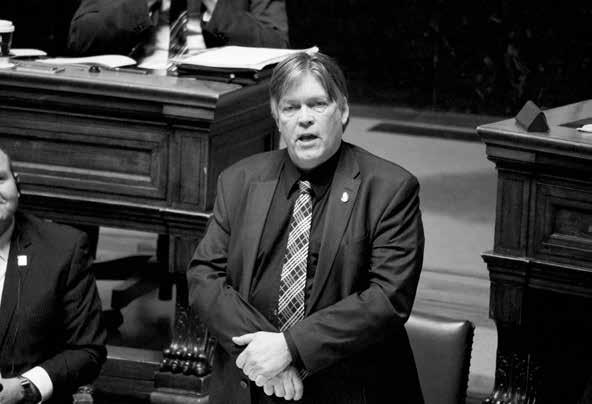
Pallister government introduces legislation to raise postsecondary tuition cap
Bill 31 would open the door for post-secondary institutions to increase tuition above rate of inflation
l evi g arber, staff
The Progressive Conservative government introduced legislation Monday that will lift a cap on postsecondary tuition in Manitoba.
Bill 31 – the Advanced Education Administration Amendment Act –will amend legislation put in place by the NDP in 2012, removing the requirement that post-secondary institutions tie tuition hikes to the province’s rate of inflation.
“We
need to make sure that we have quality education now and into the future. We need the finances to do that” – Ian Wishart, minister of education and training
The 2012 legislation followed a more than a decade-long tuition freeze.
Bill 31 will allow universities in the province to hike tuition annually by five per cent, plus inflation. Last year, the rate of inflation in Manitoba was 1.2 per cent.
Any tuition increases enabled by the legislation would not take effect until the 2018-19 academic year, and would not affect the Canadian Mennonite University.
Education and training minister Ian Wishart introduced the bill just before question period Monday and said universities need the increases to compete with other modern Canadian universities.
“We need to make sure that we have quality education now and into the future,” Wishart told reporters after introducing the bill. “We need the finances to do that.”
“Five per cent we think is a very modest increase,” he said. “I think it’s fair to say that Manitoba will remain the lowest cost tuition in western Canada for some time into the future.”
University of Manitoba president and vice-chancellor David Barnard said in a release the U of M will take advantage of the opportunity to increase tuition.
“It is of critical importance that students in Manitoba have access to a post-secondary education at modern, well-equipped, nationally and internationally competitive universities,” he said in the release.
“At the U of M we have maintained
consistently that increasing tuition rates to bring them more in line with those at similar universities across Canada will help achieve this goal.”
Any tuition increases at the U of M must be approved by the university’s board of governors. In January, the PC government appointed 11 new members to that board.
NDP education critic and MLA for Fort Rouge Wab Kinew spoke out against the proposed legislation during question period and said that any tuition increases will negatively effect lower-income students in the province.
“When I was in the university system, I heard from low-income students that if you’re going to increase tuition by $1,000, you might as well increase it by $10,000 because it’s that much of a barrier to them,” Kinew told reporters following question period.
Kinew worked as the first director of Indigenous inclusion at the University of Winnipeg between 2011-2014 and was appointed acting associate vice-president of Indigenous affairs for the U of W before running to represent Fort Rouge in the 2016 provincial election.
“I think the Pallister government is out of touch with students and out of touch with working families in Manitoba,” said Kinew.
The Canadian Federation of Students-Manitoba (CFS-MB) brought nearly 40 students to the legislature to witness the introduction of Bill 31. About halfway through question period the students left the visitors’ gallery and began protesting in the foyer of the building, shouting various slogans protesting the proposed fee increases. The shouting could be heard from within the legislative chamber.
“I think the Pallister government is out of touch with students and out of touch with working families in Manitoba”
– Wab Kinew, NDP education critic
The protesting students were then peacefully escorted out of the building.
CFS-MB chairperson Michael Barkman spoke with reporters following the small protest and said Manitoba students are saddened by the prospects of paying higher tuition.
“Students are very disappointed and very upset with the news today,” Barkman told reporters.
“This is something that is not going to build our economy, it’s not going to build our province to increase fees for students,” he said. “It’s going to leave our generation more in debt, having a harder time participating in the economy, buying a home, starting a job or business in Manitoba because of these fee increases.”
In a release published soon after the legislation was introduced, the University of Manitoba Students’ Union (UMSU) called on the university “to acknowledge that an increase
of the cap is not an opportunity to drastically increase tuition.”
UMSU president Tanjit Nagra said she hopes the university will consider the range of challenges students have faced over the past few years when considering tuition hikes. “U of M students have been on a roller coaster the past few years. We've seen successive budget cuts, astronomical hikes in international student tuition, a faculty strike, and now we're facing even more tuition increases,” Nagra told the Manitoban “We’re asking the university to practice restraint.”
U of M law students organizing behind pipeline resistance
Student Pipeline Action Committee looks to foster dialogue around resource development
g arett Williams, staff
Agroup of first-year University of Manitoba law students are jumping into the debate over North American pipeline construction.
The Student Pipeline Action Committee (SPAC), which formed in January, emerged out of a constitutional law course that drew upon the then-ongoing Standing Rock protest in North Dakota.
Thousands of protesters contested the construction of the USD$3.8 billion Dakota Access Pipeline – which has since been completed under the Missouri River – for more than six months.
The blockade drew international attention to Indigenous land rights in
North America. The United Nations recently issued a report critical of the United States’ handling of the project, including its failure to consult with the Standing Rock reservation which draws water from the river.
Between August 2016 and February 2017, some 700 protesters were arrested in an enforcement response that at times turned violent, including the use of rubber bullets, tear gas, and water cannons in subzero temperatures.
“The example that was posed to us – which is actually a very real possibility – was that similar protests and blockades will erupt here,” said SPAC executive member Danielle Morrison.
In January, the Assembly of Manitoba Chiefs filed a motion in court challenging the Enbridge Line 3 Replacement project. The more-than-1,600 kilometre pipeline – which will run from Hardisty, Alta. through southern Manitoba and into the U.S. to Lake Superior – was approved by the National Energy Board in April and given the go-ahead through a Nov. 25 order-in-council.
“There is a real possibility that more conflicts will be occurring on our side of the border here in Canada,” said Morrison, citing the potential resistance to the Line 3 development.
“We’re just gearing up for that –
what can we do to help, if we need money raised, and where can we put the money.”
The SPAC held its inaugural meeting in February and struck a fundraising campaign selling teeshirts to support the Water Protector Legal Collective, a team working to provide advocacy and support for protesters, branded water protectors.
“It’s not just a fight for Indigenous peoples – it’s a fight for everybody” –Rayanna Seymour, SPAC supporter
“Law students are always looking for an opportunity to practice and refine our skills,” Morrison said.
“I definitely think we are going to continue having those conversations about what we can do as law students to help out and also what we can be doing within the University of Manitoba.”
Drawing off the water protector theme, Morrison said she created a woodland-style design in the vein of Anishinaabe artist Norval Morrisseau projecting the very simple message: “water is life.”
Morrison noted that Standing Rock protesters displayed Najavo and west-coast Indigenous artwork and said the woodland design brings a regional flavour to a universal theme.
She said the group plans to host regular fundraising drives and foster a dialogue around the “critical battle against pipelines in North America.”
SPAC is also building relationships with other like-minded organizations, including Divest Winnipeg, and aims to assist communities fighting to protect their Indigenous territories.
“The problem that I’ve always come across with these types of legal issues is that people don’t understand what their rights are,” she said, adding that while the students can not provide legal counsel, they can offer guidance and support.
“That’s what we do as lawyers – we help people understand what are their rights in these scenarios.”
The next SPAC general meeting is scheduled for March 28 at noon in room 207 in Robson Hall.
Second-year law student Rayanna Seymour attended the first SPAC meeting and said she immediately supported the fundraising drive by purchasing a shirt.
She said SPAC provides a valuable space for an open discussion on pipeline construction and broader conversations around resource extraction and Indigenous land rights.
In November, Seymour was among a contingent of U of M students that travelled to Standing Rock to support the community’s protest.
“We were there to stand in solidarity with the Sioux, with the Lakota, on their lands and to help in any way we could,” she said.
“I couldn’t believe my eyes,” she added. “There were just thousands of people – everywhere – people were coming in constantly.”
Seymour said the conversation around resource development needs to reach deeper than a simple economic question of money versus water toward a more serious examination of what will be left behind.
“It’s not just a fight for Indigenous peoples – it’s a fight for everybody,” she said.
“We’re not just thinking of ourselves and our connection to the land, which is really important. We’re also thinking of the future generations as well. I think that’s really important to understand.”
The Student Pipeline Action Committee (SPAC) is leading a fundraising drive selling tee-shirts to support the legal defence of protesters arrested in Standing Rock, North Dakota. The campaign’s page can be viewed here: squareup.com/store/ student-pipeline-action-committee
photo provided by C spaC
Email your rEsumE and covEr lEttEr to chair@thEmanitoban.com bEforE march 24, 2017.
Editor-In-Chief: Craig Adolphe
Governments need to regulate the sharing economy
SkipTheDishes’ recent treatment of U of M student highlights exploitation in the labour market
s haW n g arbutt, staff
On March 13, University of Manitoba student Taylor Byrnes posted screenshots on Twitter of an email exchange with an HR representative of SkipTheDishes.
SkipTheDishes is an online-based Canadian start-up that lets consumers order takeout from a variety of restaurants. The company, serving as a third-party delivery service, gives customers easy access to restaurants who don’t provide their own in–house delivery.
Byrnes had gone through a firstround job interview and was waiting to go in for a second. In the email, Byrnes politely asked what kind of wage and benefits she would be receiving should she be hired to fill the position.
You know, simple questions concerning simple matters. Wage and benefits: the things workers get in exchange for their labour.
SkipTheDishes saw the inquiry in a different light though. Rather than a prospective worker looking for basic information about the job, Byrnes’ question regarding compensation was treated as an act of flagrant misconduct.
Citing their “unique corporate culture,” the representative for SkipTheDishes promptly cancelled the second interview that was already scheduled, tossing Byrnes aside
while claiming her question about how this job would help sustain her was evidence of a priorities mismatch between her and the company.
Byrnes’ question regarding compensation was treated as an act of flagrant misconduct
While we should be aghast by this kind of corporate behaviour, it’s nothing to be shocked about. Indeed, we should always expect big business to exploit workers. What is surprising is the attempt to hide behind their supposed commitment to “corporate culture” and “hard working values” – as though these justify unfair treatment of workers.
An appeal to values and work ethic is a strategy companies increasingly use to deny improved compensation and working conditions. By claiming to emphasize traditionally esteemed character traits, corporations can suppress worker mobilization while avoiding public outrage. “We prize a strong work ethic and self-starters” is code for
“work for cheap and don’t expect regular breaks,” while “we expect perseverance and intrinsic motivation” translates to “don’t ask questions when profits increase while your salary remains stagnant.”
Word games of this kind are all slick optics strategies, designed to spin public perception and create the façade that exploitation is a thing of the past.
Such semantic machinations all seek to shift the balance of power even more in favour of employers. By framing their practices as appeals to virtue, companies face less outcry should they successfully convince current and prospective employees that their poor circumstances are the result of their own misdeeds rather than the structural woes of state-sponsored capitalism. It further allows corporations to base hiring decisions on criteria such as the willingness to accept total ignorance regarding compensation while also permitting for gluttonous hoarding of corporate profits.
Exploitation in the labour market will always exist so long as there exists a capitalist class and a working class. In the long term, governments should be doing everything in their power to do away with this division. More immediate action, however, can be both punitive and regulatory in
nature. Strict compliance with existing labour laws should obviously be enforced; however, new additions are required in order to grapple with changing dynamics in the work force.
Unfortunately, financial action on the part of the government so far has been sorely lacking and sums have been paid out to all the wrong players with too few stipulations.
Once a small-time prairie pipe
The government has a duty to step in and halt the unethical practices of what can be called Big App
dream, SkipTheDishes ended up on the tail end of millions of dollars in government support and has since turned into a multinational corporation. Bought out by British rival Just Eat for $110 million, SkipTheDishes has set out to become a major player in the “sharing economy” – but clearly at the expense of its employees.
When regulating the private sector, subsidizing budding business should always come second to robust labour laws. The government has a
duty to step in and halt the unethical practices of what can be called Big App: the new wave of technologicallybased businesses. These companies reap massive profits by capitalizing on the regulatory wild-west of the sharing economy and mask their exploitation with justificatory references to “corporate culture,” wolf in sheep’s clothing social media campaigns, and the innocuous clicks of many a “like” button. Governments would do well to exercise their authority in order to cease the unethical practices of companies that have their employees paid dirt while they carry out the daily operations that make the corporate model feasible.
In the meantime, we should all start this year’s round of spring cleaning by taking a closer look at the apps we have downloaded on our phones.
graphiC by kelly Campbell
What to expect from UMSU in 2017-2018
Challenging times ahead for experienced team
j eremiah KOPP, staff
Universities are incubators for diverse views and heady debates as we learn, mature, and stretch our intellectual capabilities. Since its creation, student governance has been the campus infrastructure through which ideologies clash and students engage in competing political narratives. At our university, this particular vehicle for discourse is called the University of Manitoba Students’ Union (UMSU).
UMSU has existed since 1914 and has undergone many transformations since that time. Given that the union is a political entity, with undergraduate student executives elected each year, it is understandable that the objectives and efficacy of the organization have often fluctuated. As the dust settles from this year’s UMSU election, it is important to take stock of the past and look to what the future may hold.
UMSU council and the incoming executive team will be evaluated on their ability to create a common vision, unite the student body, and respond to the challenges ahead
The union is governed by five documents: the UMSU Act, a bylaw manual, a governance and operations manual, an election and referendum manual, and a position statement book. The importance and rigidity of these documents roughly follows in the aforementioned order. Most important is the UMSU Act, which outlines the authority of the union through an act of legislature, last amended in 1990.
This document declares that the organization’s objectives are to “promote the welfare and interests of students of the University of Manitoba ... in all matters of common interest; act as the official representative of the members of the corporation; promote and maintain responsible student government at the university; promote and encourage participation in cultural, athletic, intellectual, and social activities; and maintain communication between the student body and the various authorities of the university, and to assist in the maintaining of good conduct of the students of the university.”
These responsibilities outline a general course of direction for the union, subject to the interpretation of the generally elected UMSU council and executive committee members who govern the day-to-day affairs of
the organization. While there will be changes in policy and direction determined by election cycles, there are several core organizational tenets that have stood the test of time: mainly, that UMSU is responsible for student advocacy, programming, and capital management.
Each incoming UMSU executive does their best to create a meaningful student experience. The challenging aspect of this mandate arises in the fact that the student experience is subjective – it means different things to different students. A student who is passionate about social justice may be concerned primarily with advocacy on behalf of marginalized groups. In contrast, another student might be focused on meeting new friends at the campus pub or attending faculty socials to enjoy a more social aspect of their university experience. There are countless paths to participating in student life and everyone does it in their own unique way.
This diversity of opinion is further complicated in that UMSU is structurally different from other unions. Firstly, it is highly atypical for a union to represent its members for only three- to five-year periods, on average. Employees usually engage with a union for the duration of their career and the relationship is more long-term than the time it takes to complete an undergraduate university degree. Secondly, most unions undergo collective bargaining and have mechanisms at their disposal to aid in this process. UMSU, for a variety of reasons, does not participate in any such process in regards to tuition and has no recourse other than lobbying and protest in combatting undesirable changes. Thirdly, unlike most unions, UMSU does not exist purely as a means of advancing employee benefits, salaries, job security, and advocacy. UMSU owns and operates multi-million dollar businesses, hosts social programming, engages in capital projects, and operates a charitable foundation.
Even a neutral stance would be seen as a resounding failure to take action
Irrespective of the difficult political terrain, strong action should be expected of the incoming UMSU executive. President Tanjit Nagra and vice-president external Wilfred SamKing have been re-elected, providing valuable institutional knowledge to the organization. The three new executive members also have significant student governance knowledge. This election demonstrated once more that students consistently elect slates that appeal to a moderate approach.
Moreover, the team received a strong mandate from students, with most members of the team receiving roughly 65 per cent of the ballots cast. This should give them the confidence to act boldly and assuredly in representing the student body.
It is possible that this upcoming year will be recognized as a particularly significant confluence of events in UMSU’s storied history
A frustrating, oft-advanced narrative is that UMSU executives and councillors do not have a mandate due to low voter turnout. Seemingly, this argument implies that if a high enough threshold of students does not show up at the polls, government is illegitimate. This is, of course, not how democracy works and does not make sense from a practical standpoint. While low engagement in UMSU elections should not be applauded, it is certainly not dissimilar from most other campuses throughout Canada. Moreover, what is the supposed magical threshold for ‘enough’ voters? Democratic processes cannot be invalidated simply because they do not evoke a response from the public.
Ranked by election year in descending order, Winnipeg municipal elections have seen voter turnout rates at 50.2%, 47.1%, 38.3%, and 48.7%. Appropriately, no one is arguing that the municipal government should be dismantled or invalidated because half or more of the population of the city is not voting. Those who make pointed comments from the sidelines seem to believe that it is easy to engage the entire student body and inspire widespread, unanimous participation; this is because often they have never tried to do it themselves and are unaware of just how gargantuan a task this is. In public service, one should always strive to encourage as much engagement as possible. This should not be done, however, at an expense great enough to impact ordinary union activities or lobbying efforts.
A strong mandate from the student body is necessary given the looming challenges ahead. There is no question that external relations and advocacy efforts will dominate UMSU’s agenda for the upcoming year. The traditional balance between advocacy, programming, and capital management must be upended in the face of changes to the broader
political environment. Students will expect that a priority is given to lobbying efforts and collective action to make sure that the student voice is heard.
Bargaining is set to resume between the administration and the faculty association while the Pallister government has signalled that they will likely allow tuition to rise above the rate of inflation. These events may not be directly related, but will become conflated through the university and community stakeholders such as progressives and the campus unions who will be actively engaged in resisting changes to policy and fee increases. While there is certainly a financial case to be made for the necessity of increasing university revenues, this will be a politically untenable position for the new executive. Even a neutral stance would be seen as a resounding failure to take action in what could be seen as a pivotal moment in the university’s history.
While it is unlikely that the Progressive Conservative government or university administration will alter
financial plans based on grassroots student organization, UMSU nevertheless must organize effectively and do everything they can to combat these impending changes. A fullscale campaign must be launched that mobilizes the collective power of the union. Given these tumultuous external events, it is possible that this upcoming year will be recognized as a particularly significant confluence of events in UMSU’s storied history. The battles to come will occur at the intersection of competing political ideologies and visions for the future – moments that have the propensity to divide our campus. UMSU council and the incoming executive team will be evaluated on their ability to create a common vision, unite the student body, and respond to the challenges ahead.
photo by megan Colwell
Comment Editor: Shawn Garbutt
Listen to students and you’ll hear ‘education for all’
Over the past two years, I have had the great pleasure of working with and representing students in Manitoba. While serving as the provincial chairperson of the Manitoba branch of the Canadian Federation of Students, I’ve heard many concerns, experiences, and anxieties from students.
My role, primarily, involves listening.
Listening to students at the University of Manitoba dealing with the impact of three years of sustained budget cuts. Listening to international students across the province concerned with rapidly rising differential fees. Listening to Indigenous students whose communities fear they will be forced to send fewer students to post-secondary due to rising fees.
Time and time again, I hear the same message: rising tuition fees will only create larger, more insurmountable barriers to accessing Manitoba’s post-secondary education system.
The only piece of legislation that provides some sort of tuition predictability and protection is now being drastically altered. On Monday, the government announced that the cap would now be increased to allow tuition increases of five per cent above the rate of inflation. This change paves the way for steep tuition hikes for all students in Manitoba.
Manitoba needs a comprehensive, holistic plan to open the doors of postsecondary education to anyone who wants to attend
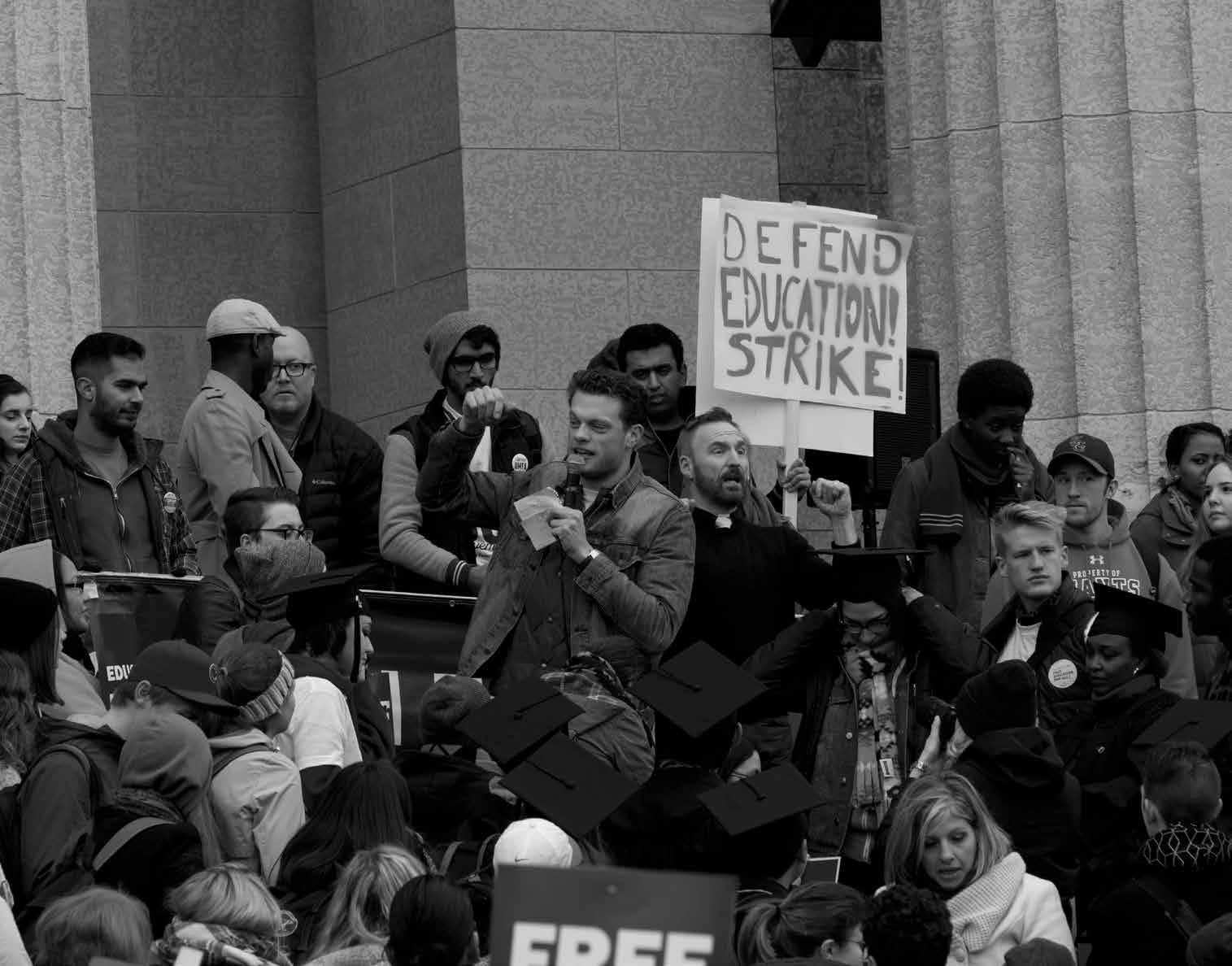
Hiking tuition fees would be a step backwards for Manitoba. When students gathered on the
steps of the legislature on Nov. 2, demanding our federal and provincial governments take decisive and meaningful action on the elimination of tuition fees, provincial finance minister Cameron Friesen said we were “fear-mongering.” Not wanting to add to our fears of spiked tuition, Friesen said that “we [the government] understand that affordability matters to students and Manitobans.”
If students truly had nothing to fear and the province understood that affordability mattered to students and their families, it would immediately protect and expand current legislation on post secondary tuition to include all students, including international, professional, and college students, all of whose tuition remains unpredictable and unregulated. It is unjust that these students’ education remains so volatile because of sporadic fee increases.
Small increases to scholarships and bursaries are not enough, especially in light of tuition hikes.
Manitoba needs a comprehensive, holistic plan to open the doors of post-secondary education to anyone who wants to attend, beginning with ensuring the provincial tuition cap is applied to all students.
Post-secondary education has immense benefits for our economy, culture, and society at large. An educated society is healthier, reducing costs for the health care system and increasing societal well-being. Education reduces poverty and decreases dependence on social assistance. Education leads to lower levels of crime and increased participation in arts and culture. It will only serve to improve our province to make accessible education a priority.
For me, it has been both inspiring and downright depressing to hear the stories of the high cost of postsecondary education for Manitoba students. I would recommend the government listen to the diversity of students studying in the province, and hear the stories of what hiking
the fees will mean for the future for students and for Manitoba.
Fortunately, Manitoba students are listening – to each other.
We are organizing, ready to say no to tuition hikes and yes to a positive vision for education in this province. Every Thursday, from 12:00 to 1:30 p.m. in the U of M Arts Student Lounge, students are meeting and planning for action. Anyone is welcome to join. Together, students can defeat fee hikes and education cuts and build a province that values education for all.
Michael Barkman is the chairperson of the Canadian Federation of Students – Manitoba.
m ichael b ar K man
photo by miguel yetman
Why progressive Canadians should sign up to vote in the upcoming Conservative leadership election
The movement to stop far right-wing populists demands your vote
s
haden a busaleh, staff
The alt-right – an offshoot of conservatism that combines elements of populism, white nationalism, bigotry, and reactionary anger due to growing income inequality and the deteriorating quality of life – has gone from being a largely obscure, online subculture lurking in the shadows of the internet to a mainstream central player in the political spheres of the United States, the Netherlands, and France, among others. In particular, it was Donald Trump’s rise to the American presidency that emboldened these nativist elements, giving the alt-right movement legitimacy and strength.
And while we like to think of Canada as one of the last remaining havens of liberal tolerance, we have also witnessed a recent surge in racist, alt-right propaganda, especially around Canadian campuses.
Posters, flyers, and other paraphernalia promoting alt-right slogans have been found on several campuses across the country – the University of Toronto, Ryerson University, York University, and McMaster University.
“Make Canada Great Again” posters displaying anti-Muslim and anti-gay symbols were posted around McGill University in December. And posters picturing a Sikh man with bold letters plastered across his turban reading “Fuck Your Turban” were taped around the University of Alberta.
Fortunately, there are differences between Canada and the United States that can work against our own rising tide of alt-right activity.
For one, laws around free speech differ. In Canada, “hate propaganda” is forbidden. This includes any form of visible, verbal, or physical representation that promotes hatred, discrimination, hostility or “the destruction of an identifiable group.” Unlike their American counterparts, Canadian judges also have the power to confiscate any such publication. Interpretations of the First Amendment in the U.S. limit free speech that incites violence or falls under slander and obscenity, but it does not limit hate speech. In a way, hate crime legislation in Canada keeps the alt-right in check.
Additionally, the alt-right movement in Canada places less emphasis on the issue of gun rights and the mantra of survivalism, and it is less organized as it suffers from internal conflicts and lacks the same level of political support we see in the United States and Europe.
But Canada is not immune to the re-normalization of these right-wing extremist sentiments. The alt-right exists here and it may be growing. Indeed, there are a number of Canadians that can be classified as
“sympathizers” – those who don’t completely align with the alt-right but are visiting their websites and agreeing with their arguments.
The rise of the alt-right movement has inspired officials on the Canadian right to espouse a similar populist message. Conservative leadership candidates Kellie Leitch and Chris Alexander already tested these waters when they proposed the Barbaric Cultural Practices act in the last federal election – an RCMP hotline for Canadians to report on “barbaric practices” they witness.
Leitch even outright celebrated
Donald Trump’s win when she sent out an email to her supporters hoping to spread Trump’s “exciting message” to Canada. Recently, she posted a video that looks more like a Saturday Night Live sketch than a policy video where she laid out her immigration plan, which among other things would require the federal government to screen potential immigrants and refugees for “Canadian values.”
The latest poll on the Conservative leadership race, released in February, discovered that out of the 14 candidates running, Kevin O’Leary, the self-interested, cash money connoisseur is the most appealing candidate to Canadians. This is despite the fact that since entering the race, O’Leary
has spent more than half his time in the U.S. and a few weeks ago chose to skip the Edmonton bilingual debate, attributing his absence to the debate’s “terrible” format in what seemed to be an attempt to deflect from the fact that he can hardly speak a word of French.
Whoever wins the Conservative leadership race will inevitably shape and define the ideology that will dominate the Conservative Party and consequently the 2019 general federal elections. Conservative or not, it is our duty to ensure that we prevent any candidate that aligns themselves with the alt-right from becoming the leader of the Conservative Party and we can do this by an unconventional yet effective way: voting in the Conservative leadership race.
Unlike the Liberal Party, which opened up its leadership race to all Canadians, the Conservative party still requires a $15 membership purchase from those wishing to participate in the leadership vote. So here’s my plea to progressive millennials concerned about the country’s future: sign up as a member of the Conservative political party before March 28, tell your friends to do the same, and vote on May 27. Then, during the 2019 elections, vote for whomever you want.
The only somewhat progressive candidate in the Conservative leadership race is Michael Chong, tied for second in the polls alongside Maxime Bernier. Both appear to have a good chance of becoming the next Conservative Party leader. But it’s not Bernier that progressives should be interested in.
Conservative or not, it is our duty to ensure that we prevent any candidate that aligns themselves with the alt-right from becoming the leader of the Conservative Party
Chong has highlighted the urgency of climate change and supported the move toward carbon taxation and was the only Conservative MP to publicly support M-103 – the controversial anti-Islamophobia motion. Chong also notably fought
against the lack of government oversight in Bill C-51 in 2015, which is also known as the Anti-Terrorism Act. The legislation broadened the government’s ability to share information about individuals, infringing upon the rights and freedoms of Canadians for the sake of public safety. By paying the $15 fee and signing up for the Conservative membership, you are not endorsing the party or its policies. Rather, you are participating in the democratic process by adding your voice and choosing a candidate who will likely realign the Conservative Party with the fundamental values we all share and expect from our leaders: multiculturalism, equality, and environmental protection. We can commit the party to meeting the real needs of Canadians. This is an opportunity for us to move beyond party lines and open up constructive political dialogue that will hopefully move us away from the “left versus right” discourse that has separated us has and halted the potential for real and effective change – change that we all seek regardless of political affiliation.
graphiC by aldo rios
Bees use ‘social healthcare’ to keep entire colony healthy
m ala K a bas, staff
On March 14, the University of Manitoba’s department of entomology hosted a seminar on honeybee colonies by Marla Spivak, a professor of entomology at the University of Minnesota.
Spivak is a prominent bee researcher who specializes in bee health and hygiene. In 2010, she was awarded a MacArthur Fellowship
grant, and in 2013 she gave a TED Talk on the rapid disappearance of honeybee colonies.
After the seminar, Spivak spoke with the Manitoban about the amazing behaviors that bees utilize to keep themselves healthy.
Bees use what Spivak calls “social healthcare” within their colonies. These are basically steps that bees
will take to ensure long-term health for both themselves and the entire colony, and can range from preventative measures to executions of bees from the hive.
While Spivak says that this concept is similar in theory to our own publicly funded healthcare system, where singular members of a society contribute to the wider health of the
brood, she notes that bees do it without any overt governance.
“It applies fairly directly, but the difference with a honeybee colony, or a social insect colony, is that they don’t have a government, or a central authority. So there’s no government healthcare, there’s no one mandating it, they just do it themselves,” Dr. Spivak said.
[Bees are] all doing things that help each other all the time” – Marla Spivak, entomologist
“So the way they behave in the colony, their behaviours and their own individual immune systems contribute to the health of the colony itself. So they’re all doing things that help each other all the time.”
One of the most astounding qualities of bees is their use of common ingredients to create bacteria-fighting tools to help the entire hive. Most importantly, honeybees will use propolis – a mixture of wax and tree resin – to keep the hive sterile. This, in turn, boosts the immunity of the entire hive.
“What they do is line the whole interior of the cavity where they’re nesting with this layer of resin. So once it’s in the nest we call it propolis, but it’s actually just resins from trees,” Spivak said.
“It kills off any bacteria, fungi, any other microbes that are in their house, but it also helps their immune system. So if there’s fewer microbes in the nest that means their immune systems don’t have to be ramped up and turned on all the time. And having your immune system quieter is a benefit.”
Spivak noted that these decisions are made within the hive by communicating amongst themselves through sensory techniques including movement and odor, and then making a decision based on the needs of the collective hive. She added that the fair and just nature that bees have towards communication is admirable, and that humans could learn from it.
“Maybe if we were more like bees, we’d be more interested in hearing a wide range of opinions or information, and then making our own personal decisions based on what we’ve learned. It’s very democratic.”
photo by megan Colwel
Thawing soil larger factor in climate change than previously thought
Canadian study suggests impact of nitrous oxide emissions from thawing soil have been underestimated
m ala K a bas, staff
New research suggests that the thawing of frozen soil is a more prominent source of greenhouse gas emissions than once believed.
The study, which was published in Nature Geoscience earlier this month, states that freeze-thaw emissions in cultivated soil are underestimated so strongly that properly including them may increase scientists’ recordings of nitrous oxide emissions by agricultural sources from 17-to-28 per cent.
Mario Tenuta, a professor of soil ecology within the department of soil science at the University of Manitoba, co-authored the study along with Claudia Wagner-Riddle at the University of Guelph in Ontario. Tenuta spoke with the Manitoban about this new research.
The thawing of frozen soil
Frozen soil itself is not what actually causes the emissions, but the act of thawing frozen soil.
“In terms of soil, agricultural soil, the main greenhouse gas emitted is nitrous oxide. And that is emitted from nitrogen-cycling processes in soil. Frozen soil emits nothing when it’s frozen, but it’s the action of being frozen and then being thawed,” Tenuta said.
“And it’s during that thawing period, that thaw time, which happens from March or beginning of April every year in Manitoba – there’s nitrous oxide that is emitted during that thawing.”
Nitrous oxide has a particularly dangerous global warming potential, even when compared to fellow greenhouse gases, as it contributes to the thinning of the earth’s ozone layer and is not regulated strongly as other organic compounds known to cause ozone depletion. To put it into perspective, it is believed to be 300 times more powerful as a potential greenhouse gas than carbon dioxide.
“What we have here at the University of Manitoba, we’re very fortunate to have some special equipment that can monitor fluxes automatically without us being there” – Mario Tenuta, co-author
This study notes that nitrous oxide is emitted because of bacteria in the soil. The bacteria reduces nitrates through a process called denitrification. Denitrification is a respiratory process that uses nitrates in the absence of oxygen. This generally occurs when there is a lack of oxy-
gen in an environment, and bacteria respire nitrates as a substitute. When the bacteria use nitrates instead of oxygen, it results in the emission of nitrous oxide, an ozone-depleting substance.
Soil overloaded with fertilizer or manure is especially prone to nitrous oxide emissions. Using fertilizer or manure in soil essentially concentrates the nitrogen in the soil, which the aforementioned microbes in the soil take and convert to nitrous oxide.
The U of M’s unique equipment
So why has seasonal freezing been so underrepresented when researching greenhouse gas emissions? Tenuta says that the biggest problem is accessibility to do said research using traditional means. Typically, research on nitrous oxide emissions in gas is a very physical process, which requires researchers to brave cold and wet conditions to obtain gas samples. Driving up to these sites is almost impossible, so researchers would often have to travel by foot.
“It’s so hard to measure in that time of year. It’s really challenging to get onto a field and make our measurements,” Tenuta noted.
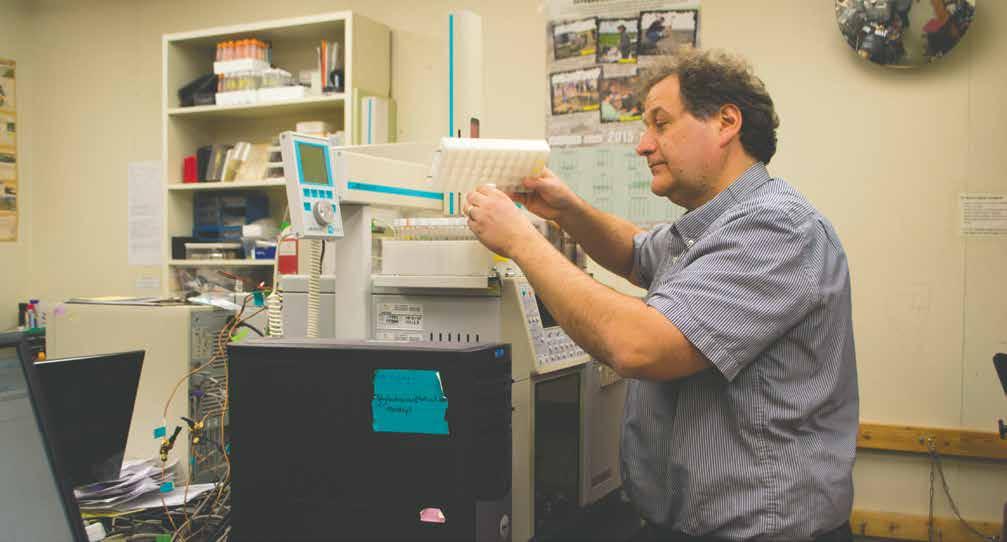
The University of Manitoba was able to help produce this research because of relatively new equipment that took the physical stress out of receiving and analyzing samples. The Trace Gas Manitoba (TGAS MAN)
Greenhouse Gas Field Emission Site is the only site in western Canada that provides continuous measurements of nitrous oxide emissions and tracks greenhouse gas potential and soil health over multiple years through the utilization of a diode laser.
“What we have here at the University of Manitoba, we’re very fortunate to have some special equipment that can monitor fluxes automatically without us being there,” Tenuta said.
Currently, Canada is one of the highest per capita greenhouse gas emitters in the world
“And we’ve done that at the Glenlea research station. The instrumentation they have out there is a laser that is measuring the nitrous oxide concentration. We measure the weather, and then we can calculate the flux of the gas. So we don’t have to be out there. We’ve had that set up since 2005. So we’re very unique here in that we have this large data set of emissions.”
This study took a number of years. Every half hour, both the University of Manitoba and the University of Guelph monitored greenhouse gas emissions at sites in Ontario and
Manitoba for 14 and 9 years, respectively. This data was then compared with other research sites around the world.
What to do with this research?
Currently, Canada is one of the highest greenhouse gas emitters per capita in the world. From that, the government of Canada suggests that 10 per cent of greenhouse gas emissions, and over half of Canada’s total nitrous oxide emissions, stem from livestock and crop production. Tenuta noted that particularly in Manitoba, these statistics could be affected positively by working with farmers.
“Our big task now – and we have research on this – is extension to the farmers, and helping them make better decisions on how to use their nitrogen fertilizer or manures to reduce the emissions,” Tenuta said.
“The key thing we want is to not have too much nitrogen left over in the fall going into the winter. So the farmer can be careful of how much nitrogen fertilizer they use, to make sure they don’t over-apply. We can use perennials, forage grass, they do a great job at reducing thaw emissions. So there’s a whole bunch of things we want to do work on.”
photo by Chantal Zdan
ComiC by sCott lerCher
Local musicians gather to pay tribute to underground folk hero Daniel Johnston
Benefit gig honoring underground folk singer encourages conversation, music as therapy
e melia FO urnier, staff
Local musicians and DJs are getting together for a collaborative benefit gig – Don’t Be Scared: A Tribute to Daniel Johnston – at the Good Will on Sunday, March 26 at 8 p.m.
CKUW 95.9FM host Kent Davies (Peg City Groove, Amateur Hour) and 101.5 UMFM host Matt Moskal (Bonus Hour) will be hosting the show, which will feature performances by locals Trampoline, Okay Mann, Tansy, Cole Zachary (Tent Rentals), Mike Fox and Marshall Birch (Odanah and Marshall & The Buddy System), Paige Drobot (the Psychics), Joshua Letkeman (June Killing Stones), Kara Elizabeth Parkinson Wight, Shea Johnson, and Matt Moskal.
Performers will cover their favourite tracks by American folk singer Daniel Johnston. Tickets are $10 at the door, and all proceeds will be donated to the Canadian Mental Health Association of Manitoba and Winnipeg.
Daniel Johnston is known for his musical authenticity and his eccentricity. He got started in music by producing his own music in his basement and handing out free cassettes on the street.
“[Daniel] just made an unbelievable amount of music, and wasn’t that concerned with the specific mix of the keyboards versus the vocals, or the pitch of his singing,” Katlin Mathison – the artist behind the moniker Okay Mann – told the Manitoban
“It was more like, ‘this is art, this is real, and I just have to pump it out as fast as possible.’”
Johnston was the feature subject of the 2005 award-winning documentary The Devil and Daniel Johnston,
a frank examination of his journey through psychosis and mental health issues that helped bring to light the severity of mental illness, especially in the music community.
“With mental health now being more openly discussed, I feel as though it has been unifying within the artistic community” –Rachel Letkeman, Trampoline member
Many musicians have found solace and a sort of kindred spirit in Johnston’s story.
“There were so many parallels between his childhood, his neurosis, and my own that it spawned the realization that if this tormented kid with a pitchy voice could write compelling songs, there was a chance that maybe I could too,” said Michelle Lecnik of Trampoline.
Matt Moskal, the chief organizer of the show – as well as host and performer – did an interview with Daniel Johnston about music and mental health years ago.
“There’s something he said about how when he was first making music and he was not medicated, he felt like he had a lot of friends, but he felt like he was not close to everyone, and then as soon as he was taken care of, everyone sort of cheered him on and
encouraged him more and more he felt happier and happier,” said Moskal.
“Something about the story of getting help, and being taken care of, was very inspiring, because it’s difficult to ask for help, even during those manic episodes.”
Artist involved with this project said that mental health issues are extremely prevalent throughout artists and the music industry.
“It’s almost as if sometimes, for some mediums of art – not just music – the public almost prefers that their artists suffer... There’s almost an expectation that the art will suffer if the artists is in tip-top shape, mentally, which is totally backwards,” said Mathison.
Musicians – especially those who operate independently – are seldom only guitarists, vocalists, songwriters, etc. but also often act as their own booking agent, manager, promoter, and online content creator.
“Everything else can be ten times as hard, depending on the mental illness,” said Mathison.
“A self-starter entrepreneur dealing with mental health issues, you would say ‘that looks hard.’ But musicians are basically that, but almost expected to be dealing with mental health issues.”
While some excellent art comes from times of pain and hardship, there is a distinction between channeling negative emotions into something beautiful and being in a perpetual state of ill mental health while trying to create.
“I don’t think it’s anything that should be glamourized. It’s very scary, and very real, and I just know that it’s best to remember that. There is a thin line between someone who
is truly genius, and someone who is truly hurting and truly ill,” Moskal commented.
Furthermore, the lifestyle associated with working musicians could be harmful in and of itself – it can be conducive to a lack of routine, through both touring and irregular work hours.
“Something
about the story of getting help, and being taken care of, was very inspiring, because it’s difficult to ask for help, even during those manic episodes”
– Matt Moskal, host/performer
“It’s starting to be talked about more. Before, I don’t think it really was a topic – if you’re a struggling musician and you’re partying all the time, or you’re mentally troubled, that was kind of the aesthetic,” said Kathryn Kerr, who performs under the name Tansy.
“In the past ten years, people have finally started to ask, ‘what does being an artist do to your mental health? What does being on the road do to your mental health?’ [Mental illness] is not a new thing, we’re just finally starting to talk about it.”
Music enables people to connect with each other when they are feeling
isolated. Daniel Johnston, in particular, has experienced intense periods of loneliness, especially existing as a solo artist and with people misunderstanding his mental health issues, but through music, he has been able to connect with people.
“Music becomes this safe place to express all of the undercurrent of human emotion,” said Rachel Letkeman of Trampoline.
“With mental health now being more openly discussed, I feel as though it has been unifying within the artistic community, because it becomes very much, ‘oh, you too? I'm safe to discuss these struggles I'm having?’”
The goal of the show is to lessen that loneliness while raising funds, and paying tribute to Daniel Johnston.
“A show like this is special because a lot of mental health initiatives taken on in the public are met with criticisms because they feel like there is another agenda underneath them,” said Mathison.
“I think this event is special because everything is presented at face value... It’s just a bunch of people who care about [Johnston’s] music, and raising some awareness about mental health.”
Moskal expressed his desire to see a greater portion of funding granted to artistic industries everywhere to “go back to the community.”
“If there’s anything I’d like to see more of, it’s more conversation.”
Don’t Be Scared: A Tribute to Daniel Johnston is presented by 101.5 UMFM, and takes place at the Good Will on March 26 at 8 p.m. Admission is $10 at the door.
Middle Coast cruising towards record release
Former Brandon band relocates to Winnipeg, prepares to release debut full-length
Olivia m ichalczu K , staff
Recently relocated pop/rock trio
the Middle Coast (formerly called Until Red) have hit their new hometown of Winnipeg, and are set to release their new album The Making Of: The Middle Coast on May 12 at the Handsome Daughter.
Though the band has been playing together since they were 15 years old, this will be the first album release for Liam Duncan, Roman Clarke, and Dylan MacDonald.
The Middle Coast grew up together in Brandon, MB, all attending different high schools.
“It was actually great being from different high schools,” Duncan told the Manitoban of the band’s beginnings.
“We used to throw these community centre shows, and just pack them full, because we all knew a bunch of people from all three-out-of-three high schools in Brandon.”
The trio has made their way through the music scene in Winnipeg by not only performing but also attending shows and meeting local music fans, as well as other local artists.
“We are total road dogs, and we’ve toured from Charlottetown to Victoria,” said Duncan.
“Winnipeg absolutely has something special. Something about its isolation from other large cities fosters a unique support of local arts and culture.”
Duncan went on to extol the virtues of Winnipeg’s local music scene – he also thinks we’ve got a lot of great food.
“There’s also just an unbelievable amount of great bands and musicians coming out of Winnipeg like, all the time. Every time I go to another show I am amazed,” he said.
"Winnipeg
absolutely has something special. Something about its isolation from other large cities fosters a unique support of local arts and culture”
–
Liam Duncan, the Middle Coast
“The food scene is great. Also, we’ve slowly made more friends here, and we’re just itching to go see more shows and play more. We love Winnipeg. The scene is so friendly, there’s a ton of music, and we are never bored.”
With the band rapidly becoming well-known in the city and abroad, the Middle Coast’s debut full-length is sure to provide the sweet effortless harmonies, clever lyrics, and raw talent that they’ve so quickly become known for.
“It’s very ‘us.’ We recorded a few parts of it at Stereobus and Collector Studio – two great local studios – but
a good chunk of it was actually done in my basement,” Duncan explained.
“I think what excited me the most about the album is its imperfection. The sounds are not perfect, the production is not perfect, and I don’t care. We’re just figuring out what we sound like. We’re also figuring out who we are as individuals, and who we want to be. Those things go hand in hand.”
Beyond the album, the Middle Coast is planning to hit the road this upcoming spring with a western Canadian tour in April and May, heading eastward to Toronto in late May.
“Our summer festival circuit is taking shape, which is exciting. We’ve done a lot of touring with an amazing Canadian artist named Michael Bernard Fitzgerald. There are a bunch of dates coming down the pipe with him as well,” said Duncan.
The Middle Coast’s relationship with their fans – as well as the group’s approach to their image – has been part of the process in both creating the album and growing as a band. It’s something they approach with a sense of humor, especially in their social media presence.
“But we try not to lean on it too heavily, because our music isn’t really funny,” said Duncan.
“When you’re growing up, you try on all sorts of different personalities. We tried to be cool and hip, turns out we’re basically a bunch of dad-rockers stuck in their twenties [...] We try to put out content that will make us laugh, and hope that it will make you
laugh. Hopefully you’ll come to our shows too. That would be awesome. May 12 at the Handsome Daughter. It will be fun, or the very least won’t be terrible.”
Keep up with the band at www. themiddlecoast.ca for updates on the album, tour, and the release party at the Handsome Daughter.
photo provided by middle Coast
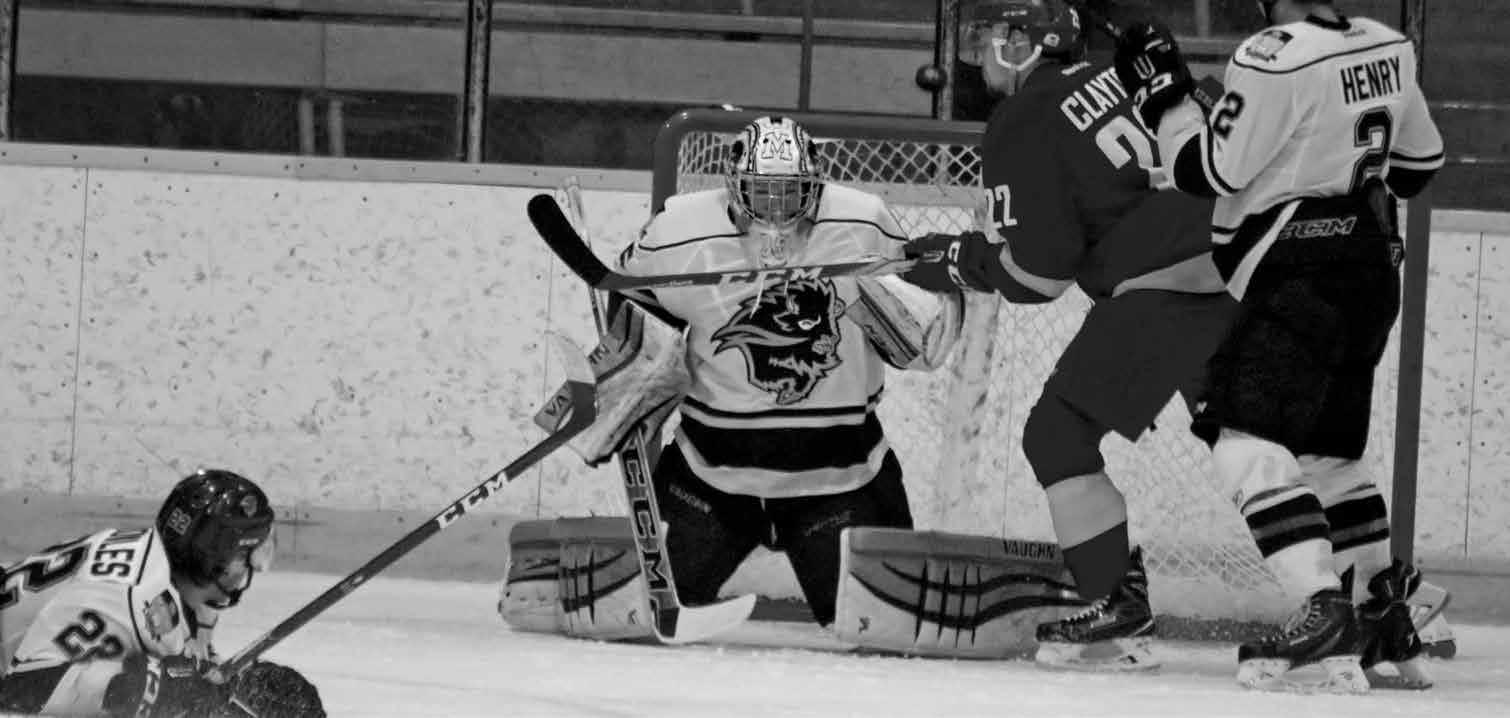
Byron Spriggs is making a name for himself
Spriggs talks about his experience with the Charlotte Checkers, his play this season
ryan s telter, staff
It was an average Thursday for Bison
men’s hockey goaltender Byron Spriggs, until he got a text from their trainer, Shane Carson.
“Charlotte’s goalie came in but the gear didn’t,” the text said. It was no longer an average Thursday for Spriggs.
The third year netminder had the opportunity to participate in the morning skate with the Charlotte Checkers of the American Hockey League (AHL) before their tilt with the hometown Manitoba Moose. That enough would have been a cool enough experience for Spriggs, but it got better.
“As I walked off the ice to get to the change room, I saw an equipment guy stitching up a name bar for me,” he said. “I remember going ‘what’s that for?’”
That equipment guy was stitching on Spriggs’ name on a Checkers jersey because they needed a backup goalie for the night.
“I jumped all over it, I was pretty euphoric to get a text from their GM,” Spriggs said. “It was pretty surreal to be in that environment with them.”
The whole experience was eyeopening for Spriggs: he got his own stall with his equipment and got to sit on the bench with the team.
“The AHL is only one step down from the NHL so you have a lot of good players in that dressing room,” he said.
“It was a super great experience just to sit on the bench with them, seeing the energy that they have. Hearing things said on the bench that you would never really hear when you’re up in the stands.”
Spriggs even got to sign a contract with the Checkers, of course making sure it did not affect his U Sports eligibility.
“It’s called an amateur tryout contract, so obviously there’s no money involved,” he said. “Mike [Sirant] and I made sure we followed the steps, making sure I was still eligible for next year. I should’ve asked for a copy of it.”
“The AHL is only one step down from the NHL so you have a lot of good players in that dressing room” –Byron Spriggs, Bison men’s hockey goalie
The story of Spriggs is not the first time we have seen a U Sports goalie getting that kind of pro experience. Matt Hewitt of the UBC Thunderbirds suited up as the backup for the Vancouver Canucks in a game against the St. Louis Blues in October. Ryerson Rams goaltender Taylor Dupuis was signed to an ATO by the Toronto Marlies of the AHL in January.
“There’s always a thought in your mind that it may happen, you think they have a list of guys that they go to, and [Charlotte] has never talked to me before,” Spriggs said. “It’s never happened in my time here, so just getting that opportunity is pretty cool.”
Playing with professionals has given Spriggs some motivation to potentially play professional hockey down the line.
“This was the first year I ever even considered being able to potentially play [pro],” he said.
“You start going through the ranks of junior and now Canadian university hockey, and I’ve been fortunate enough to be able to play high levels of hockey but not where guys are going off and playing in places like the AHL.”
Having been on the ice with some of the guys on the Checkers, Spriggs started to see himself being able to compete at that level.
“A lot of them are really good players, but you’d be surprised it’s not a lot different from what we’re doing at our practices,” he said.
“Their top end guys can really rip the puck, but guys on our team can really rip the puck too. At the beginning of the practice I was a bit intimidated but as the practice wore on I got into a bit of a groove.”
The experience with the pros has also given Spriggs motivation going into next year with Manitoba.
“Going in to next year it’s definitely going to be added motivation,” he said. “Especially in the summer, making sure to bear down and make sure I’m in the gym quite often, and make sure I’m on the ice refining my game. That’ll be my big push to make a name for myself.”
Although he may think otherwise, Spriggs has already made a name for himself this past season with the Bisons. He established himself as Manitoba’s starting goalie, playing
in 22 games and posting a 2.82 goals against average and a .913 save percentage. He finished second in the Canada West both in shutouts with three, and wins with 12.
“Going in to next year it’s definitely going to be added motivation”
“It’s such a short season, once you get on a bit of a roll it’s easy to keep rolling with that one guy,” Spriggs said. “I felt like I settled into a bit of a rhythm this year, seeing the puck a little bit better. Obviously my d-men help immensely, they made the games really easy for me. I think this year we bought into the whole team defense mentality.”
Despite Spriggs dominating the crease this season, the Winnipeg native had some competition with second year goalie Justin Paulic and redshirt Dasan Sydora.
“Justin and I have a bit of a friendly competition, we’re both good goalies and we like to push each other in practice. Even Dasan too, he’s a great goalie and he was really nipping at our heels this year,” Spriggs said. “All three of us have built a healthy relationship where we push each other.”
With the added motivation going into next season, Spriggs is determined to go on and win titles with the Bisons. There are plenty of players in the Manitoba room who have won championships at different
levels, including Spriggs, who won the MJHL championship with the Winnipeg Blues in 2014. Spriggs is hoping to take that championship experience and go get a national title with the herd.
“It’s one thing to win at the junior A level or even the WHL level,” he said. “Winning in the Canada West is very very difficult. I think we’re settling in as a group, finding our identity.”
It will be a tough task for the Bisons if they want to take out the perennial powerhouses of the Canada West, the Saskatchewan Huskies and the Alberta Golden Bears. Spriggs is optimistic that because this group of guys are so close that they can do special things.
“We’re all best friends,” he said. “We’re in the same mood whether it’s 4 p.m. on a Thursday or 6 a.m. on a Sunday. We’re still chatting and joking, and I think that’s a big part of what our success is going to be.”
The majority of this Bison squad comes from Manitoba, and many of these guys have played together or against each other in years prior.
“It makes a big difference,” Spriggs said. “Playing with someone is one thing but having played against a guy you get another level of respect for him. It’s helped our team to come together and tell some funny stories to look back on.”
Spriggs and the Bisons will hope to build on the success they had in the last half of the season in 2017, and take it to new heights in the upcoming season.
photo by megan Colwel
Who is the NBA’s Most Valuable Player?
James, Westbrook, Harden, and Leonard the key players in this race
j ustine m amucud
As the NBA draws closer to the playoffs, the season MVP award is up for grabs. Unlike last season where the MVP resulted in the first unanimous vote for Stephen Curry, this year is without a doubt one of the most confusing MVP races to date.
While the emergence of superteams like the Golden State Warriors and Cleveland Cavaliers have casual fans of basketball thinking that the MVP will come from either of these teams, think again. The 2016-17 NBA season has brought an incredible amount of talent from players that the NBA has not seen in a long time, and for one of these players, something we have not seen since the early 1960s of NBA basketball. Here are some of the most likely candidates to win this year’s award.
LeBron James
One of the forerunners of the MVP race this year, and for the last decade, is LeBron James. The king is back (again) as one of the top candidates this year. Averaging 26 points, nine assists, and eight rebounds a game, James is undeniably the best
basketball player on the planet. Not just from his ability to consistently light up the stat sheets, but through his value to the league itself.
Averaging a 30-point triple-double this season, Westbrook has been destroying records all year
It is without a doubt that James is literally the NBA’s most valuable player through monetary standards alone, but we aren’t looking at monetary value. James has consistently made it to the NBA finals for the last six years, winning three of six appearances, and securing the finals MVP award three times. Aside from this, James has done this with two different teams in the past decade. James seems to carry an innate ability to turn lottery teams into championship teams and for that
reason, this year, and most likely for every year until retirement, James will have a say in who the league’s season MVP will be.
Kawhi Leonard
Unlike James’ loud and celebrated career, other MVP candidates like to fly beneath the radar of unwary fans. This is the case for the San Antonio Spurs’ Kawhi Leonard. The backto-back defensive player of the year is finally receiving his time in the spotlight as the retirement of Tim Duncan became a reality for this Spurs team.
Without Duncan, the Spurs rely heavily on Leonard who is averaging 26 points, three assists, and six rebounds per game. Leonard is regarded as a player whose play style resembles that of Michael Jordan.
As an offensive and defensively gifted player, Leonard leads the Spurs as one of the top three teams in the western conference. If history repeats with the MVP award going to the player in a top three team, Leonard is in great MVP contention this year.
James Harden
Last year saw the Houston Rockets struggle even with two key players in their team in James Harden and Dwight Howard. During the offseason, however, the Rockets opted to let Howard walk and sign a deal with the Atlanta Hawks, which led to Harden having yet another breakout season. With superstar averages of 29 points, 11 rebounds, and eight assists, Harden becomes an instant contender for the MVP award this year.
After this week, Harden has managed to produce 18 triple-doubles, while carrying this team to a top three seed in the western conference. The Rockets are considered a dark horse team this year, having seen victories amongst the top teams in the NBA. If Harden can manage to bring this team to 55 wins this season, and in the tough western conference, there is a high likelihood he will steal the MVP award this year.
Russell Westbrook
Finally, we have Russell Westbrook. After the sudden departure of Kevin Durant from
Oklahoma City, Westbrook has been left all alone to carry the Thunder in the western conference.
Westbrook has been doing just that. Despite the lack of all-star quality players on this Thunder roster, Westbrook seems unstoppable on the court. Averaging a 30-point triple-double this season, Westbrook has been destroying records all year. No other player has done this, except for Oscar Robertson who played in the NBA in the 1960s.
Aside from his stats, Westbrook also holds the first overall rating for player efficiency, demonstrating his prowess on the hardwood. If the MVP award is consistent with all other years, it will be hard for Westbrook to end his season with the award as the Thunder sit at 40 wins this season.
If Westbrook could bring this Thunder team to 55 wins and grab the MVP award along with him, he will no doubt be listed as one of the greatest to play the game.
Rush returns to the ring
After four years out, Georges St-Pierre prepares for his first encounter
jas O n Pchaje K , staff
After months of speculation and verbal jabbing through the media, Georges “Rush” St-Pierre is returning to the octagon.
UFC president Dana White broke the news of the MMA legend’s return back on March 1, announcing that St-Pierre will take on the current middleweight champion Michael Bisping.
White also noted that despite rumors and reports, the UFC had not entertained a super-matchup against current lightweight champion and UFC megastar, Conor McGregor. He is still training for the seemingly inevitable bout against Floyd Mayweather, which already has a reserved date of June 10 at the T-Mobile Arena.
This will be the first fight for St-Pierre on the new multi-fight deal he signed with the UFC on Feb. 17, which has since been revealed to be a four fight deal for the former star. Bisping later revealed on a podcast that the UFC is targeting July 8 for the date of the fight.
while only three of Bisping’s last seven went the distance.
Despite the size difference –Bisping is six-foot-one and St-Pierre is five-foot-eleven while fighting at the same weight – the Canadian fighter has a four inch reach advantage – 76 inches to Bisping’s 72 inches – allowing him to keep “The Count” at a distance while landing strikes.
There is also the somewhat negligible age difference between the fighters, who are both old by MMA standards. St-Pierre is the younger of the two at 35, although he did take time away from the octagon, while 39-year-old Bisping continued his career when many told him to retire.
The Vegas odds may favor St-Pierre, but that’s not the true tale of the tape
The Quebecborn St-Pierre hasn’t fought since 2013, when he took a decision victory against Johny Hendricks to defend his welterweight title. That capped off a 12-fight win streak, which spanned six years.
St-Pierre, a well-known points fighter who aims for the largest volume of strikes and takedowns over knockout quality, will be in tough against the 30-7 champion.
Bisping has made a career out of being a slugger, winning 16 of his 30 bouts by knockout or TKO, while St-Pierre has only managed eight over his 25 and two welterweight career. In fact the last seven fights of St-Pierre’s career have gone the full five rounds,
Despite the time off, the Vegas odds still favor St-Pierre to take the fight, however slightly, at 5/4 odds – a fact that did not seem to faze Bisping’s coach.
“Anybody can beat anybody on any given day, especially a talented fighter like GSP,” Jason Parillo said in an interview with the Las Vegas Review Journal. “But we’ve been preparing for bigger beasts, badder beasts, stronger beasts, and we’re going [to] prepare for this guy.”
Complicating the situation further is the fact that St-Pierre is mov-
ing up a weight class to fight Bisping, which is not an easy task.
St-Pierre has never fought at 185 pounds, a weight class where guys hit much harder than the 170-pound weight class that he’s used to. Bisping on the other hand has fought guys who push the upper limit of the class, namely Dan Henderson who fights at 205 pounds, and took the middle-
weight belt from six-foot-three Luke Rockhold.
The Vegas odds may favor St-Pierre, but that’s not the true tale of the tape. He’s fighting a much bigger and stronger opponent than he’s used to, and while he’s got great kicks, they may pale in comparison to the strikes that his opponent can throw. However, if the jiu-jitsu master
can outmuscle Bisping at the ground game, and wait out the clock like he’s done his whole career, he may just have a shot at winning.
photo by ryan mallard
U.S. women’s hockey team boycotts World Championship
Players demand fair pay and better funding of the national program
jas O n Pchaje K , staff
W
aves are being made in the world of women’s hockey this year, as the U.S. women’s national team has decided to boycott the upcoming World Championship due to stalled negotiations with their country’s governing hockey body. The central issues of the dispute seem to be unfair wages paid to the players, as well as the level of sup-
port the highly successful program receives from USA Hockey. Current reports put the monthly wage paid to these players at just US$1,000 each. They also have the expectation that they will keep at peak physical levels while travelling, and supporting themselves.
“We are asking for a living wage,” U.S. captain Meghan Duggan said
in an interview with ESPN. “And for USA Hockey to fully support its programs for women and girls and stop treating us like an afterthought.”
A few hours after the boycott became public, USA Hockey responded with a statement that expressed disappointment with the boycott threat. The statement went on to mention that, in preparation for the 2018 Olympics, the organization provided stipends and medal incentives which totalled around US$85,000 per player, along with housing allowances, travel allowances, meal expenses and insurance to players.
USA Hockey then set a firm deadline of March 16 for the players to rescind the boycott and report for camp; otherwise they would try and pull a team together last minute to defend the title earned in 2016.
“Good luck getting a suitable No. 1 competition to represent our country on the world stage,” U.S. star Hilary Knight said of the ultimatum. “I kind of dare them.”
The deadline passed, but the players did not budge.
USA Hockey issued another
update Friday afternoon, appearing to show outrageous demands from the players. They claimed that the women’s team was asking for a new deal that would cost US$8 million during an Olympic year and US$5.7 million every other year. This would total around US$149,000 per player in a non-Olympic season, and balloon to US$237,000 if the team were to win Olympic gold.
“We are asking for a living wage” –Meghan Duggan, United States captain
The team later released a statement, calling USA Hockey out for not distinguishing between money they provide and the U.S. Olympic Committee does. They also note that USA Hockey only provides support for the six-months surrounding the Olympics, and nothing for the remaining three years where the players are expected to remain competitive.
“There’s a reason why we haven’t
Manitoba loses in quarterfinals to the Golden Bears, finish in fifth
ryan s telter, staff
The Manitoba Bison men’s volleyball team slipped up at the 2017 U Sports volleyball nationals in Edmonton. In their opening quarterfinal match against the hosts Alberta, the Bisons fell 3-1 in a tough contest. The Bisons bounced back in the consolation bracket, sweeping UNB then beating Laval 3-1 in the fifth place game.
A week removed from the Canada West Final Four in Winnipeg, the Bisons were roaring for revenge after losing to the Trinity Western Spartans in the Canada West final. Manitoba did not get that chance, as
they failed at the first step against an Alberta team they beat twice in the regular season.
Quarterfinal
The first set was all Alberta, with the Golden Bears using the loud hometown crowd to their advantage. Manitoba found themselves down 16-9 at the technical timeout, and never gained too much after that losing 25-18. Again in the second set, the Bisons were down for most of the set, but stormed back to win some crucial points late on. Adam DeJonckheere
gave the Bisons their first lead of the match when he made it 23-22. DeJonckheere finished with eight kills on the night. The herd went to tie the match back up, winning the second set 25-23.
No momentum was carried over into the third set for the visiting Bisons, as Alberta jumped out to a 6-0 lead. It was 16-8 for the Golden Bears at the technical timeout, and the Bisons fell 25-21 after a late surge.
Alberta grabbed hold of the lead in the fourth set, leading 19-10 late in the set. The Bisons mounted a small comeback, but lost the set 25-16.
“Our serving pressure was weak, our spike servers didn’t do a very good job, missed a lot of the float serves,” Garth Pischke said after the game. “If you do that against a team like Alberta, with the middle attack that they have... they absolutely killed us in the middle.”
Consolation Semifinal
Having been relegated to the consolation bracket, the Bisons played the University Varsity Reds in the consolation semifinal. The Bisons bounced back and easily dispatched of the Reds 3-0.
This was the first time the Bisons and the Reds had ever played each
other at a national championship. However, Manitoba played UNB back in an October preseason tournament, winning 3-0.
Devren Dear led Manitoba with 13 kills and seven digs, and DeJonckheere earned four service aces. The first set was a back and forth affair, but the Bisons pulled away late on, scoring five straight points to win 25-20.
“We made the most of it. You never want to lose the last game of the season” – Ken Rooney, Bison middle
Manitoba dominated the second set winning 25-15, with middle Ken Rooney getting the set-winning kill. A closer third set saw the Bisons manage to win 25-22 and move on to the consolation final.
Consolation Final
Manitoba had never finished lower than fifth place at a national championship, and with their 3-1 win over the Laval Rouge et Or they
won [an Olympic] gold medal in 20 years,” Knight told the Associated Press “They need to step up. Who does USA hockey aspire to be?”
If the team does not report, and USA Hockey can’t field a new team in time, it will represent a significant blow to the program. The tournament, which is set to begin in Plymouth, Michigan on March 31, is meant to be a title defence for the program.
The U.S. Women’s National team has won gold at seven of the last 17 tournaments.
A no-show or a subpar replacement will surely set the stage for Canada to reclaim gold, perhaps finally against a non-North American opponent. Canada has won 10 gold medals in the 17 tournaments, with every single final in the tournament’s history being played between the U.S. and Canada.
Perhaps this will be the year where Finland will meet the Canadians in the final, after winning 11 bronze medals in 17 tries.
continued that trend. This was the 12th time these two teams met at a national championship, with the last time coming in 2012 when Laval won 3-1 in the semifinals.
A tightly contested match for the two unfamiliar foes, the Bisons took the first set 25-22 after an Evan Jackson kill. One of the few players who will not be graduating this year, Jackson finished the day with 10 kills. Laval won a lengthy second set 28-26 after a pair of Vincente P. Villalobos kills; he finished with a court-best 30 kills. Manitoba won the third set to take a 2-1 match lead, and won the fourth set 25-22 after Rooney smacked home his final U Sports kill to win the match 3-1.
“We made the most of it. You never want to lose the last game of the season,” Rooney told Bison Sports after the match. “We went out and had some fun and this was the last time playing together and it was nice getting a win.”
Manitoba finishes in fifth place despite being the number two seed heading into this weekend’s tournament. The Bisons have never finished lower than fifth place in 27 prior appearances at nationals.
graphiC by aldo rios
photo by megan Colwell
The life and career of Joe Daley
Former Winnipeg Jet recounts playing days, talks about his store in Winnipeg
Kellen taniguchi, staff
Joe Daley is a former World Hockey Association (WHA) and NHL goaltender who manned the crease for the Pittsburgh Penguins, Buffalo Sabres, Detroit Red Wings, and the Winnipeg Jets throughout his career. Daley’s most memorable stint was with the Winnipeg Jets from 197279, where he was able to backstop the team to three Avco Cups. Daley grew up in the East Kildonan area of Winnipeg, so to finish his career as a Jet was really a type of homecoming for the veteran goalie.
Daley decided to get into the game of hockey at a very young age. When he found out that he had a niche for the game, he went down to the Bronx Park Community Club to sign up and jumped at the opportunity to play in net.
“As soon as I could get out on the street with a ball and a stick I started playing,” Daley said.
“I put my name down on the list to be a goalie, and when I came home and told mom and dad that I had done this they said ‘Why did you put your name to be a goalie?’ And I said ‘Nobody else did so I knew I was going to get a chance to play’ so that’s how it all got started.”
Early playing days
Being a goaltender, Daley has always admired the work of other goalies in the league. Growing up he idolized the great Terry Sawchuk; he also admires the work Martin Brodeur has done in the crease throughout his career. In today’s game, Daley is impressed by Carey Price and the Winnipeg Jets’ goal-
tender Connor Hellebuyck.
“Growing up in East Kildonan, Terry Sawchuk was from East Kildonan and I idolized him,” he said. “Still to this day I think he was certainly one of the top two or three goaltenders to ever play in the NHL, so he was probably the one I enjoyed watching play the most.”
Due to being a part of the Penguins, Sabres, and Red Wings early on in his career, stability was always difficult for Daley and his family. It wasn’t until he became a member of the Jets that he felt more secure with his role due to being signed to longer-term contracts.
“I really didn’t have a lot of stability until I decided to jump to the WHA and come home to play in Winnipeg,” he said.
“Prior to that there was a lot of travel and a lot of disruption for family. Luckily the boys weren’t that old, they started school when we were away but really the brunt of their schooling was done in Winnipeg, so we were established here at home.”
Daley stated that he was very fortunate to have the opportunity to come home and play for his home team, and it was a big part of his career and by far the most enjoyable part.
“I always considered myself a team guy, and certainly the successes that we had with that team and with the great players that I had the opportunity to be associated with will always be very fond in my memories as a player,” Daley said of his championship teams.
“The ultimate is when you’re a
player you play for a championship, and to have challenged for it five times and won it three times was pretty successful for us as an organization and I am quite proud to be a member of that team.”
All-star company
Daley has suited up with the famous ‘hot line’ of Anders Hedberg, Bobby Hull, and Ulf Nilsson in Winnipeg. He also played with Marcel Dionne in his rookie season in Detroit, and with Gilbert Perrault during his rookie year in Buffalo, both of which have now been inducted into the Hockey Hall of Fame.
“It was always a pleasure to have said I’ve played against Bobby Orr, Gordie Howe, and Jean Beliveau, and some of the all-time greats of the game,” Daley said.
“It was always nice to be able to reflect and say that I know how good those boys were, and certainly I can look back now and be quite proud of the fact that I was able to grace the ice with greats like that.”
Before everyone was wearing masks, goaltenders used to play without wearing a mask, and Daley was one of the last players to go through that experience. Andy Brown, who is a friend of Daley’s, actually never put on a goalie mask, so Daley considers himself the second last to play without a mask.
“I really never wore one for any length of time until my last five years in Winnipeg,” he said. “That was due to my partner Ernie Wakely, who is still until this day a great friend and
he suggested maybe I should get one made so my evening in the net was going to be a long one, rather than a short one where he would have to come in and replace me.”
“As soon as I could get out on the street with a ball and a stick I started playing” – Joe Daley
Setting up shop
After Daley hung up the skates, he coached the Penticton Knights for a brief period in the Okanagan, before returning back to Winnipeg. When Joe and his family returned to Winnipeg his youngest son Travis suggested they open a business that they could grow in the city, and that business is now known as Joe Daley’s Sports and Framing.
“We certainly started in a very humble way, pretty much selling the cards, and supplies, and a few candy bars and such,” Daley said of his shop.
“As time has gone on the custom framing of everything has become very very important in our sustainability as far as an operation goes and we’ve had a lot of fun over the years with meeting people and developing our store and our reputation.”
Jets 2.0
Joe believes that the current
Winnipeg Jets aren’t far off from being a very competitive team, but overall stated that the return of the team has been great for the city and of course for business.
“Selfishly it’s been tremendous for business, there’s no two ways about it,” he said with a laugh.
“Just as a fan of the game and a citizen of Winnipeg what having an NHL team means to everybody here is tremendous, the excitement of being able to talk about our team on a daily basis, but also just how everybody feels about themselves. You always feel quite good when you know that everybody in the world is looking at you as a city and your professional teams, and certainly the Jets have been very good for us to have back, so as a fan I am very very happy.”
Daley is now a member of the Manitoba Hockey Hall of Fame, and was recently inducted into the WHA Hall of Fame in 2010.