photo eDitor Beibei Lu photo@themanitoban.com / 474.6775
D
r eporters
n
Volunteer Contributors
Will Gibson, Tariq Sohail, Geoff Lister, Gloria Joe, Keegan Steele, Robert Dearden, Chris Friesen, Caroline Norman, Justin Ladia, Aichelle Sayuno, Heather Kat Cole, Ian T.D. Thompson, Michael Carlisle
MANITOBAN
105 UNIVERSITY CENTRE UNIVERSITY OF MANITOBA WINNIPEG, MB R3T 2N2
Canadian Publications Mail Product Sales Agreement #589160
A “volunteer staff” member is defined as a person who has had three volunteer articles, photographs, or pieces of art of reasonable length and/or substance published in three different issues of the current publishing year of the Manitoban. Any individual who qualifies must be voted in by a majority vote at a Manitoban staff meeting. Elected representatives and non-students may be excluded from holding votes as volunteer staff members in accordance with the Manitoban Constitution.
The Manitoban is the official student newspaper of the University of Manitoba. It is published monthly during the summer and each week of regular classes during the academic year by the Manitoban Newspaper Publications Corporation.
The Manitoban is an independent and democratic student organization, open to participation from all students. It exists to serve its readers as students and citizens.
Students, experts, activists look at contemporary indigenous issues
Quinn Ri C he R t, staff
The 2014 Aboriginal Students
Gathering was held at the University of Manitoba’s Migizii Agamik building earlier this month.
On Feb. 14 and 15, students discussed a range of issues relevant to Aboriginal politics and culture, and heard from experts and community leaders such as Nahanni Fontaine and Derek Nepinak.
The event was sponsored by the Canadian Federation of Students (CFS) and supported by the students’ unions of the U of M and Brandon University, in addition to the U of M Aboriginal Students Association (UMASA) and others. According to CFS, the gathering hosted students from all three Manitoba universities.
The first day of the event included opening remarks and a welcome feast. The second day saw students and expert guests discuss, in turn, four issues considered by organizers to be priority topics for Aboriginal students.
In a roundtable format, the group discussed barriers to post-secondary
education funding, and then missing and murdered Aboriginal women. Nahanni Fontaine, special advisor on Aboriginal women’s issues to the province of Manitoba, joined the group for the latter conversation.
“If there is anything you get out of my presentation, I would like all of you to go back and read the treaty documents” – Sylvia McAdam
The third topic of the day, environmental justice, focused mostly on criticism of the federal government’s Navigable Waters Protection Act, the closure of Ontario’s Experimental Lakes Area, and the perceived muzzling of scientists by the Conservative majority government.
Participant Shannon Bear noted
the need for more Aboriginal students to pursue science at the university level in order to catalyze a shift towards evidence-based debates on environmental issues.
UMASA treasurer and UMSU Aboriginal students’ representative Clyford Sinclair commented on the connection between land base and Aboriginal culture, noting that industry-driven environmental degradation could pose a threat to the quality of life of future generations.
“The way things are progressing, we’re really quickly destroying our land [ . . . ] it goes back to that simple Cree proverb – you can’t eat money,” Sinclair said to the group.
The final key talking point for the gathering was Idle No More. Shifting from a roundtable format to a lecture-style presentation, Jerry Daniels, activist and former Aboriginal students’ representative on the CFS board of directors, discussed his role as an Idle No More organizer in Manitoba.
After Daniels’ formal discussion of Idle No More ended, Sylvia
McAdam, lawyer and Idle No More co-founder, presented a lecture titled “Organizing Our Movement.”
McAdam’s talk traced the history of indigenous resistance in Canada leading up to and during Idle No More, touching upon the Oka Crisis, Unist’ot’en Camp in British Columbia, and the Grassy Narrows blockade. McAdam also addressed the misinterpretation of Canada-First Nations treaties, arguing that many individuals do not understand the benefits they are afforded under the agreements.
“If there is anything you get out of my presentation, I would like all of you to go back and read the treaty documents,” said McAdam.
“I’ve heard people criticize the treaty documents, but I’m here to tell you as a lawyer, I have read those documents, and they could not have been crafted any better had a lawyer been there at the time of treaty making, when our people were negotiating the terms and promises.”
The final speaker of the event was Derek Nepinak, grand chief of the
Family of Brian Sinclair drops out of inquest
Real issues ignored by the court, they allege
Caleigh
The legal inquest into the death of Brian Sinclair—the man who died in a Winnipeg emergency room after 34 hours of waiting to be treated—will continue into its second phase without the participation of either the Sinclair family or the two Aboriginal service groups that had heretofore been party to the proceedings.
The announcement followed the proceedings of Jan. 10, where judge Timothy Preston outlined the parameters for phase two of the inquest. Phase two is tasked with determining what could be done to prevent similar incidents.
So far, the second phase has focused on “reasons for delays in treating patients presenting in emergency departments of the [Winnipeg Regional Health Authority (WRHA)]” and “measures necessary to reduce the delays in treating patients in emergency departments.”
The Sinclair family dropped out shortly after the commencement of phase two, explaining in a Feb. 18 letter to Preston their reasons for doing so. The letter cited disregard at the inquest for key issues underlying Sinclair’s death.
“According to the rulings of former chief judge Raymond Wyant [ . . . ] issues of race, poverty, disability, and other factors of marginalization were supposed to be front-and-centre at this inquest [ . . . ] it appears to the Sinclair Family that phase two will no longer allow the biases and attitudes that were at the root
of Mr. Sinclair’s death to be fully understood, and will instead entrench the marginalization of Aboriginal voices,” said Sinclair family counsel in the letter.
Furthermore, as the letter makes clear, the Sinclair family is unhappy with the witnesses lined up for phase two.
“Phase two will exclude all but a token number of independent expert witnesses. For example, there will be only one single independent witness called to address Aboriginal health issues [ . . . ] In comparison, the inquest will call six WRHA witnesses and three Manitoba Nurses’ Union witnesses to speak about the issues that interest them. Thus, as the family sees it, phase two seems more likely to become a public relations platform for [the] WRHA than an opportunity to catalyze meaningful systemic change.”
Aboriginal Legal Services of Toronto (ALST), one of the groups that dropped out of the case, cited similar reasons for their decision.
“We are disappointed that the majority of phase two witnesses will be WHRA staff speaking about patient flow, rather than independent experts speaking about systemic issues facing Aboriginal patients in the healthcare system,” said Emily Hill, an ALST lawyer, in a statement.
“The evidence heard so far in phase one of the inquest makes it very clear that there are important issues to be addressed concerning the assumptions that were made about Brian Sinclair
Assembly of Manitoba Chiefs. After Nepinak’s closing remarks, students were invited to participate in a sweat lodge ceremony, which ran from 6 p.m. until late in the evening. Later reflecting on the event, Clyford Sinclair, who is currently running for vice-president internal at UMSU, told the Manitoban that the two-day summit led participants to organize into a group concerned with coordinating opposition to extended government control of First Nations education.
“Once we finished with all the speakers, the outcome was that we started a new movement. We decided, 30 students, to call it the Indigenous Students’ Movement (ISM),” said Sinclair.
“We’re going to focus on the education topic, because it affects us all as post-secondary students.”
Sinclair explained that ISM is concerned about the First Nations Education Act, and is considering organizing a sit-in outside Winnipeg’s Aboriginal Affairs and Northern Development office later this year.
when he came to the Health Sciences Centre for medical attention.”
Judge Timothy Preston cited the limits of the inquest’s mandate as his basis for selecting individuals to speak.
“The reasons why people appear at emergency departments are myriad. Included in these are the social determinants of health, such as race, poverty, disability, [and] substance abuse,” said Preston during Jan. 10 proceedings.
“The analysis of why these factors play into a person’s need and use for emergency department medical care is an important and necessary analysis [ . . . ] The reasons for delay that occur once a person presents at an emergency department, and measures to reduce that delay, are the subject matter of this inquest,” he continued.
Preston stressed that an inquest’s purpose is strictly defined by the chief medical examiner, whereas an inquiry is broader in scope.
“I have no intention of turning this inquest into a de facto inquiry.” Preston’s decision has led to the Sinclair family to again call for a public inquiry.
“If we don’t fix the root problems, we are afraid there could be another Brian Sinclair,” said Robert Sinclair, cousin to Brian, in a statement.
“We cannot accept that.”
MaC Donal D, staff
Asper student wins provincial championship
Sinan Leylek to take Party Pyrotechnics to regional competition
Katy MaC Kinnon, staff
niversity of Manitoba student
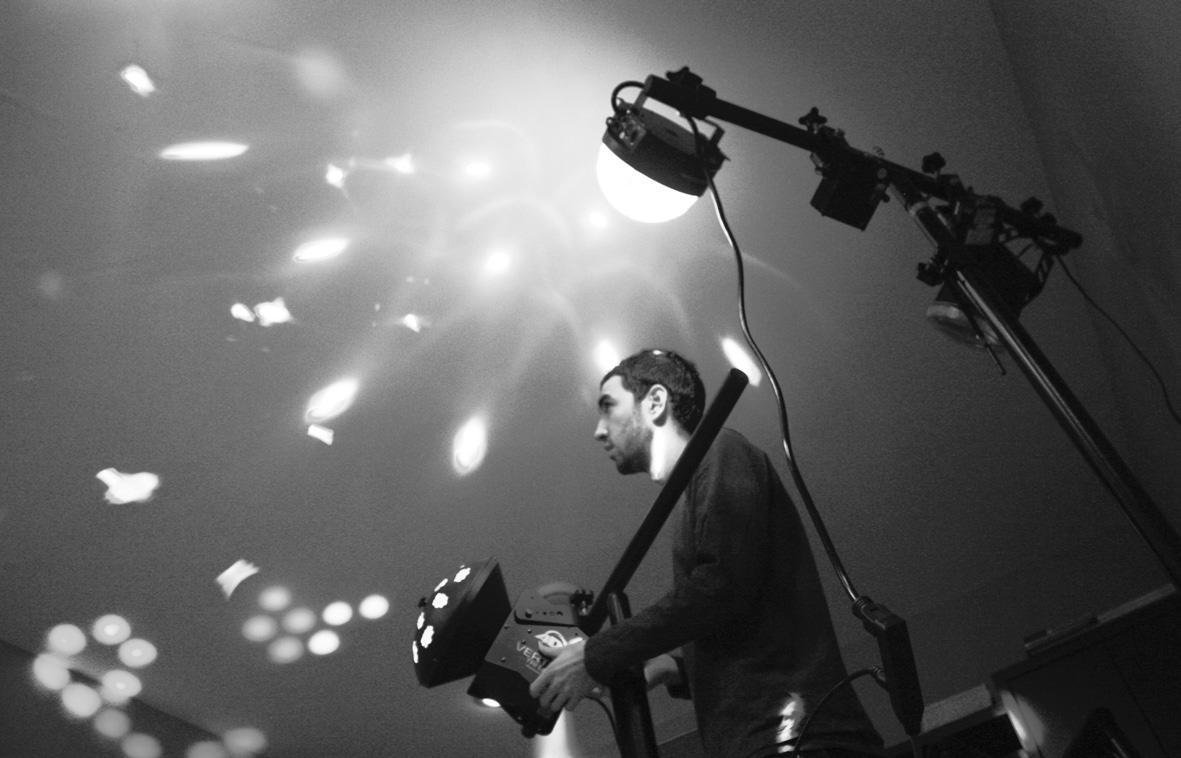
USinan Leylek has been named a provincial champion of Enactus Canada’s Student Entrepreneur National Competition, which is currently in its 18th year. Leylek is the owner and founder of Party Pyrotechnics, an online startup selling and renting party equipment such as fog machines and strobe lights.
Leylek will be competing at the regional competition for a cash prize of $1,000 and a place in the national competition, offering a prize of $10,000. The competition provides student entrepreneurs a chance to network with fellow student business owners, the media, and business professionals.
“I think one of the most exciting
things I’m looking forward to is meeting other entrepreneurs from other schools across Canada [ . . . ] interacting with them and seeing what their ideas are, and some of the struggles they’ve found – particularly with being at school and juggling all the demands of running a business on the side,” said Leylek.
Leylek was chosen as provincial champion in part for his “ability to balance the demands of a fulltime course [load] and a growing business.”
This balance is one of the biggest challenges, said Leylek.
“It’s hard to really put all the ideas I want to into place; it takes a bit longer,” he said.
Enactus Canada president Nicole Almond described juggling these demands as “a pretty incredible thing” and feels that celebrating young entrepreneurs in small businesses is important.
“For the student, the value [in participating] is getting feedback on their business – they’ll get com-
ments and feedback from the judges on how they can grow their business, feedback on how they’re doing, and what more they could be doing,” said Almond.
Communication with the media at the competition is helpful, since, according to Almond, students rarely solicit media attention on their own.
“A lot of the media attention that they get through the competition means a lot to them and their business, and helps them grow,” she said.
The idea for Party Pyrotechnics was sparked by a Kijiji advertisement. Leylek purchased a fog machine and strobe light for a party in high school, but found they were not being used enough. The demand and market for party equipment has propelled his business forward over the past four years.
The website offers rental and purchasing options, which the company delivers upon order. Leylek has received inquiries from various parts of North America – from Winnipeg, to northern Manitoba reserves, to
Texas.
“It’s really exciting to see it grow from a small startup and in the past couple years, and see where it’s come,” said Leylek.
The online nature of the business provides flexibility since Leylek can fill orders via phone and email. He noted that his education through the Asper school of business has been beneficial, as has receiving help from family and friends.
In the future Leylek wants to perfect his ordering system so consumers can easily see available products. Selecting products by the type of event will be helpful to those who are less knowledgeable about the equipment.
“We want to make it a seamless process,” he said.
Leylek often sponsors university events, and is offering his services to student groups at the U of M who are in need of party equipment.
Visit Party Pyrotechnics at http:// partypyrotechnics.weebly.com
Fair Elections Act to introduce extensive changes to electoral process
Legislation met with criticism from opposition parties, civil society groups
Kevin l in K late R , staff
On Feb. 10, the Harper government introduced the Fair Elections Act to parliament. Pierre Poilievre, minister of state for democratic reform, tabled the bill.
The bill would see numerous changes introduced to the democratic process in Canada, and has drawn widespread criticism from the other parties in the House of Commons, as well as civil society groups.
The many changes introduced by the bill include alterations to campaign spending rules, voter identification at the polls, and Elections Canada – the body that oversees Canadian elections and enforces the Canada Elections Act.
Among the proposed campaign spending changes, the bill would increase the limits for donations to registered parties and the amount that candidates may contribute to their own campaigns.
The Conservatives have heralded this legislation as keeping big money out of politics by allowing small donors to give more, and by keeping large special interests from dominating funding through loan arrangements.
Another proposed change would see the elimination of the voucher
system that allows one voter to vouch for the identity of another.
Some experts have warned that this would deal a blow to the voting rights of Canadians.
Canadian Chief Electoral Officer Marc Mayrand warned that eliminating vouching would affect over 100,000 voters, with the consequences falling disproportionately on young voters who move frequently and Aboriginal Canadians.
The opposition parties have cried foul, saying there will be a negative impact on voter participation in the democratic process.
“This is a form of voter suppression that reminds us of what we have seen south of the border. I never thought I would see it in Canada. We have the kind of policies being put forward in the bill that would absolutely disenfranchise our most vulnerable, including the low income, transients, and our youth,” said Jinny Sims, official opposition critic for employment and social development, in parliament on Feb. 10.
“We have a government that is absolutely suppressing the voters who might have the most complaints against its policies and
who are very disturbed by how they are being marginalized more and more,” she added.
Voter turnout has been low in recent elections, with only 53.8 per cent of adult Canadians voting in the 2011 federal election, up slightly from the nadir of 53.6 per cent in 2008.
One of the proposed changes would see Elections Canada, the body that oversees the electoral process, have its power to investigate electoral irregularities stripped and placed in a separate office.
Investigative powers would be removed from this non-partisan bureaucratic body and transferred to the Department of Justice, which is accountable not to parliament but to the government.
At least one Conservative MP, Cheryl Gallant, has argued that Elections Canada unfairly targets the Conservative party for investigation.
“[I]t seems that Conservatives are held to a different standard by Elections Canada than other political parties,” said Gallant during a House debate.
The Conservatives were found guilty of numerous electoral irregularities in the 2011 federal
elections. The most publicized of these was the so-called robocall scandal. Voters not likely to vote for the Conservatives were targeted by misleading calls, which came from callers claiming to be from Elections Canada, giving false information on the locations of polling stations.
The Fair Elections Act will seek to prevent such abuses in the future by proposing a “mandatory pub -
lic registry for mass calling” and prison sentences for the impersonation of elections officials.
The NDP is hoping to start a broader debate on the bill, with cross-country committee hearings.
The Conservatives have hurried this bill through the House, using their majority to minimize debate on the second reading.
phOtO OF SiNaN LEyLEK paRty pyROtEChNiCS
Video games to help battle dyslexia
Research on reactions to sights and sounds lead to use of video games as therapy for dyslexia
e lizabeth D R ewni K , staff
Playing video games is not only for the fangirls and fanboys (although that new Deadpool game sure looks great). They can also be used to help people struggling with literacy from dyslexia.
Between five and 10 per cent of people are affected by dyslexia – a developmental neurological disorder that results in poor spelling and reading ability. A recent study conducted by Vanessa Harrar, of the Oxford University Department of Experimental Psychology, looked at
the way auditory and visual senses interact in these individuals while they used video games. Dyslexic participants in the study had a harder time shifting their attention between sights and sounds, and were much slower at making those shifts than the control individuals they were compared with.
It is generally known that dyslexic brains function differently than the brains of people without dyslexia. This results in different patterns of responses to auditory and visual stimuli.
Dyslexia even manifests in individuals of normal intelligence in environments with plenty of educational opportunities. Because these factors don’t hold a great influence, it is thought that developmental problems of dyslexia start before birth in the cerebral cortex.
People with dyslexia present differences in brain anatomy, though the exact significance of these differences is still unknown. Dyslexia itself is described as a multisystem deficit possibility. The brain struggles to conduct tasks based on rapidly occurring and infrequent stimulation, like visual cues quickly followed by sounds.
passed down within families, given that studies have traced the developmental disorder to specific chromosomal regions.
In the past, therapy for those struggling with the disorder would only include guidance from experts such as speech and occupational therapists, neuropsychologists, and
specific patient groups had reaction times that favoured auditory inputs compared to visual inputs. This could mean that dyslexics would have a harder time processing visual information.
Video games that focus on how fast the players can visually respond to what’s going on have proven to be successful in improving literacy within dyslexic individuals
The largest differences noted between dyslexic and nondyslexic groups were their responses to sounds produced right after sights. It’s also thought that more attention is focused on the visual cues when attention needs to be shifted from one cue to another, such as from sights to sounds. This supports the theory that dyslexics might have a visual attention disorder.
Interestingly, dyslexia happens to be more frequent in men than in women. This is thought to be due to specific hormonal factors, such as fetal testosterone levels, affecting the development of the brain during the later stages of pregnancy.
Dyslexia is also thought to have a genetic association since it can be
The spread of superbugs
specialized educators.
The benefits of treatment can become visible months, if not years, after commencement. However, patients may still struggle with their literacy.
Harrar’s video game study proposes that the differences in the way stimuli are responded to should be taken into consideration and focused on when designing training programs used to help dyslexic individuals with their reading and writing skills.
Other patients of the experiment who had trouble responding to stimuli at healthy speeds showed response patterns similar to those of dyslexics. It was noted that these
Harrar and her team suspected that a majority of dyslexics in their sample also had ADHD. Previous research with individuals possessing ADHD have shown that they have a preference for diverting their attention toward visual cues, resulting in slower reactions to sounds. This was a factor that might potentially contribute to skewing the study’s results. Overall it still remains that the stimuli responses were lower in those with dyslexia in comparison to those without the condition. This means the potential that participants had ADHD would not too adversely affect the outcomes. Harrar’s team also suggests investigating how visually-based cues might provide some answers on the actual cause of dyslexia, as well as further help to develop better training programs.
Video games that focus on how fast the players can visually respond to what’s going on have proven to be successful in improving literacy within dyslexic individuals. The research paper describes these video games as a great way for giving perceptual learning to dyslexics.
Research shows the spread of antibiotic resistance genes along sacred sites in India
t ho M son, volunteer staff
Researchers from Newcastle University, U.K., and the Indian Institute of Technology Delhi, recently shed light on a growing health concern. Published in the journal Environmental Science & Technology, their research was able to detect an upward trend of antibiotic-resistant genes in water samples taken from locations along the Upper Ganges River. These findings imply, interestingly, that the trend is due to human migration from more densely populated areas. The locations of the study were sacred sites around the river. These sacred sites include spots in the Indian towns of Rishikesh and Haridwar, which are known to go through those periods of seasonal mass migration. As the study points out, these towns may receive up to 500,000 visitors within the months of May and June.
Antibiotic resistance refers to the condition of a microorganism—such as a bacterium—which has gained the ability, through genetic mutation, to withstand the effects of certain antibiotics (which are often in place to eliminate that microorganism). If the organism becomes resistant to several antibiotics, it is deemed a “superbug.”
The dilemma faced in the studied sites deals with the spread of a gene known as blaNDM-1. This gene helps code the New Delhi metallo-beta-lactamase 1 protein (NDM-1 for short), which goes on to make the bacteria resistant to antibiotics – specifically to a class of antibiotics known as carbapenems.
origin in 2008, a 2010 study in Sweden observed the movement of this antibiotic-resistance gene to the surface water and sediments in India. The gene is now present
The spread of the blaNDM-1 gene to the Upper Ganges River, caused by the pilgrimage season, presents a very serious health problem to the area
to compare the presence of the resistant gene before and after the seasonal influx of visitors. Given that Rishikesh has a population of around 80,000, and Haridwar of over 200,000, waste management and treatment are an issue – especially when the town becomes engulfed in tourists and visitors.
purity of these sacred sites.
While the NDM-1 protein and the blaNDM-1 gene were first discovered in a patient of Indian
inside the human gut flora of many locals along the Ganges River, and is brought into the environment through excretion. By studying water samples taken around sites along the upper Ganges in February, and then later in June, the researchers were able
The results of the study showed that the presence of antibiotic-resistant genes were at higher levels within the samples taken in June compared to those taken in February.
A striking statistic places this blaNDM-1 gene as 20 times more prominent (per capita) in the Upper Ganges River in June compared to February – further illustrating that the human mass movement is producing a detrimental impact to the
The spread of blaNDM-1 to the river, caused by the pilgrimage season, presents a very serious health problem to the area. According to David Graham of Newcastle University, one of the researchers on the study, “If we can stem the spread of such antibiotic-resistant genes locally—possibly through improved sanitation and waste treatment—we have a better chance of limiting their spread on larger scales.”
Without proper waste management, these pilgrimage sites will continue to develop into potential “hot spots” for the spread of antibiotic-resistant genes and proteins. By improving the waste treatment within the area, we can reduce the spread of the blaNDM-1 gene and lower the likelihood of creating superbugs.
iLLuStRatiON by aiChELLE SayuNO
Senate reform long overdue
Chamber of sober second thought must be independent, representative
ta R i Q s ohail, volunteer staff
The recent Senate expense scandal has brought some hard truths about Canadian democracy to the fore. There have always been calls to reform the Canadian Senate, but in the past year the scandal has revealed gross incompetence, and broken the public’s trust.
Decades before former Prime Minister Lester B. Pearson, Liberal governments had been talking about reforming the Senate but without results. In 1965 it was Pearson’s government that instituted the mandatory retirement for senators at age 75. Prime Minister Stephen Harper went into office saying that the Senate is an abomination to democracy – though he appointed senators loyal to the Conservative platform.
Just four weeks ago, Liberal leader Justin Trudeau removed all 32 Liberal senators from the Liberal caucus. This was truly remarkable
for two reasons: one is that Liberals have always had senators and now do not; the second is that this makes the Senate more independent – as it should be.
The only problem is that independent senators are now less accountable. Even though there are no Liberal senators, 32 senators are still Liberal-leaning. Removing them from caucus doesn’t necessarily change all that much.
Trudeau’s Senate reform plan promises that he will set up an independent commission to nominate non-partisan individuals for the Senate. This is a step in the right direction. Having an elected Senate would be redundant because we might as well add 100 more seats to the Lower House.
checkpoint between a majority government and its ability to pass laws. Majority governments can sometimes pass laws which are not truly representative of Canada, which is why the Senate must exist. Currently, the Senate is not representative of the country because there are disproportionately more
selection criteria could be similar to theirs, or we could come up with our own, unique to our democracy.
The Brits also place an emphasis on independence just as most Canadians would want our Senate to exhibit.
Majority governments can sometimes pass laws that are not truly representative of Canada, which is why the Senate must exist
senators per capita for Atlantic Canada than for Western Canada.
The Senate should act as a
The United Kingdom reformed their Upper House in 2000, establishing an independent commission for Senate appointments. Our
It is important to note, however, that all this depends on whether Canada is able to amend the Constitution. This is currently being decided on by the Supreme Court who will deliver a ruling near the end of this year. If history proves anything, it is that amending the Constitution of Canada is a difficult task. It would require seven provinces and 50 per cent of the population to be on board to pass.
The Conservative government
has also asked the Supreme Court if it could unilaterally impose term limits on senators and if we could have consultative elections. This means senators would be voted on, but the prime minister would consider whether to officially appoint them or not. While I may not agree with this kind of reform, it would still be better than the system we currently have in place.
I think the most appropriate thing to do would be to not abolish the Senate. It can have a useful function in our democracy for checks and balances. Senators need to have term limits and they should be selected by an independent commission that does not kowtow to the prime minister or special interests. Only then could we see the Senate function as an institution with the ability to better our democracy.
Our moral superiority at the 2014 Winter Olympics
Western
indignation at Russia’s anti-gay law disingenuous
Kevin l in K late R , staff
Russia has been in the international spotlight for much of the last two weeks for hosting the 2014 Winter Olympics. However, the actual games themselves have often been overshadowed by Russia’s deteriorating human rights record – most notably the introduction last year of a controversial anti-gay law. The law prohibits the public support or promotion of homosexual lifestyles, and has further encouraged a culture of violence and hatred towards this minority group within the country. Videos and pictures of gangs of thugs intimidating or beating supposedly gay people in Russia have been seen and shared widely over the Internet.
The situation in that country is abhorrent and should indeed be condemned in the strongest possible terms. Three things, however, strike me as I listen to the indignation and uproar coming from the West. Firstly, homosexual people have only recently started to gain equal treatment in the West. Many Western countries are only now undergoing a revolution in terms of how homosexuality is viewed. Samesex relationships that were once barely tolerated are finally becoming accepted by mainstream society – even celebrated.
That said, we have only just recently become so enlightened and civilized. Recall that gay marriage
in Canada was only made legal in 2005, a mere nine years ago. In the Netherlands, one of the most progressive Western countries, gay people weren’t afforded the right to marry until 2001.
Let us remember that we were denying gay people these same basic rights not too long ago, and in some places, being gay was, and continues to be, received with true hostility.
You may rightly point out that while same-sex marriage may not have recognition in all Western countries, for the most part, gay people certainly aren’t being systematically targeted by such disgusting laws as they are in Russia.
This is true, but it brings me to my second point that should be kept in mind when looking at the situation in that country: Russia’s recent history and the role played by the West in creating such a corrupt and dysfunctional economic and political system.
When the Soviet Union collapsed, Russia was violently dragged into the capitalist world system. This transition has seen the evisceration of the Russian economy, catastrophic unemployment, capital flight, near hyperinflation, and deindustrialization that makes the Rust Belt in the Midwestern United States look minor by comparison.
As is usually the case when the economic situation deteriorates, so too do a number of other social indicators.
For example, life expectancy for
males dropped from 65 years in 1987 to 57 in 1994. According to official government statistics, infant mortality increased from 17.4 per 1,000 live births to 19.9 per 1,000 live births, due to deteriorating health infrastructure and nutrition levels. The country has been experiencing disastrous population decline, with the population decreasing from nearly 150 million in 1991 to 139 million in 2011. Decline is projected to continue to 128 million in 2025, and then 109 million in 2050.
Many of these problems were a result of the brutal economic policies championed by the International Monetary Fund (IMF) and the United States – policies termed “shock therapy.” The logic of these policies was that if privatization and price liberalization were imposed quickly, the country wouldn’t slide back into strict economic control by the state.
In reality, what happened was that a few well-positioned individuals in the black market were able to raid Russian assets, creating a small and incredibly wealthy oligarchic elite. These elites now control the country—stifling reform, civil society, and democracy— and rule in a dictatorial fashion.
The existence of this oligarchy can be traced to the policies championed by the IMF and the United States, and it is this oligarchy which has drummed up hatred against homosexual people, minorities, and foreigners in Russia, scapegoating the country’s problems onto these groups.
Which brings me to the third point
that strikes me when the West so bitterly criticizes Russia for its stance on gay rights: the selectivity of our outrage.
Where is the outrage for the horrendous violence visited upon ethnic and religious minorities in Russia? Immigrants and non-Christians are routinely singled out for discrimination and acts of abuse. Neo-Nazi thugs and gangs of far-right ultranationalists continuously target non-white or nonRussian-looking people. Immigrants and visible minorities face a situation in Russia that is just as dangerous as that faced by gay people.
The majority of the people encountering this violence are Muslim and Turkic peoples from the former Soviet states of Central Asia. We don’t say anything about their plight. Where is the outrage and moral indignation for them? I would argue that our own Islamophobia is one reason we are silent towards this equally terrible situation.
In short, we should not expect a country that has been experiencing disastrous socioeconomic conditions, that is undergoing catastrophic depopulation, and is ruled by a corrupt and authoritarian government, to be a warm and welcoming place for gay people. We should also remember our role in Russia’s tragic, recent history, and that our own attitudes towards homosexuality have only just become accepting and welcoming.
When it comes to morals, we cannot claim the high ground; we do not deserve a place on that podium.
iLLuStRatiON by juStiN Ladia
When our humanity meets mental illness
The Valley portrays the experience of individuals, families, and police when dealing with mental illness
lu K as t hiessen, staff
If you want to be confronted with the challenges of being human sans heavy-handed preaching, then check out the upcoming production of The Valley at Prairie Theatre Exchange (PTE).
The play is the newest by multi-awardwinning Canadian playwright Joan MacLeod, bringing her total number of works for the stage to an even 10. This piece was written in light of the death of Robert Dziekański, who was fatally tasered at the Vancouver International Airport by RCMP officers in 2007.
In the play, a teenager who has recently entered university falls into depression and drops out of school while living with his mother. The action also follows a woman coming out of post-partum depression and her relationship with her husband, a police officer. The teenager and the officer encounter one another on Vancouver’s SkyTrain, where the incident with Dziekański is evoked.
“ I’m a professor of writing at UVIC [University of Victoria] and the character of Connor in The Valley is really familiar to me,” says MacLeod. “He’s fictional, of course, but a young man who is suddenly coping with mental illness his first year at university is a narrative I know all too well.”
With an oeuvre full of plays, poems, and professorial work, MacLeod is skilled at capturing essential human qualities in her writing. At the same time, she has the openness to allow others to bring her writing to life.
She was at the Banff Centre in the then Advanced Writers’ Studio as a poet in 1984, while the Playwrights Colony was also happening. She spent time with other playwrights and found a new venue for her writing.
“My work—poetry with a strong narrative and a novel that was written in the first person—was much stronger out loud than on the page.”
After starring in her first play when the lead was unable to fill the role at the last minute—a position she hopes to never revisit—she now crafts the script and then passes it on to others to manifest it.
“I have never directed my own work. I’d be terrible at it. I have weak visual skills,
I’d say. For me plays start with my love of language, with creating characters and letting them speak and help me tell their stories in a way that feels right and true,” says MacLeod.
“It’s always scary and thrilling working with directors—and actors and designers for that matter—and of course their vision is going to be different than mine but that’s okay. That’s good. My job is to write strong dialogue and tell a good story. The director and actors will do all the rest.”
Toby Hughes, the actor playing Connor, is back at PTE where his acting career began before he was a decade old. He took classes there until he graduated from high school, and then helped found Outside Joke Improv during his first year of university.
Hughes credits director Ann Hodges for making it possible to have a natural flow in the characters’ movements, while also allowing the audience to see all the characters from multiple angles at PTE, which has a thrust stage, so the audience is on three sides.
In addition to Hodges’ direction, the cast received assistance from mental health experts and police officers that joined them in rehearsal to offer advice and insight.
Although the topic is depression, that doesn’t mean the play has one tone.
“The show is just human and also quite funny,” says MacLeod. “I wanted to look at what connects us.”
Hughes concurs. “The play presents two functional, stable families and then explores how the home dynamics change with the introduction of a mental illness. It may seem like a downer, but Joan MacLeod’s script is far from heavy-handed. Although the subject matter is very thoroughly researched and explored, the play is grounded enough in real emotion that it never feels didactic.”
The Valley runs Feb. 27 until Mar. 16 at Prairie Theatre Exchange (third floor at Portage Place Shopping Centre). Tickets are available at the box office, located at the theatre; by phone, 204-942-5483; or online at www.pte.mb.ca. Prices range from around $24-43. There are affordable prices for students with valid ID as any unsold seats 30 minutes before show time are only $10.
iMagE pROVidEd by pRaiRiE thEatRE ExChaNgE
event Listings
Poetry Slam Bout #2
Comeback central
Bisons rally from one game down, advance to Canada West semi-finals
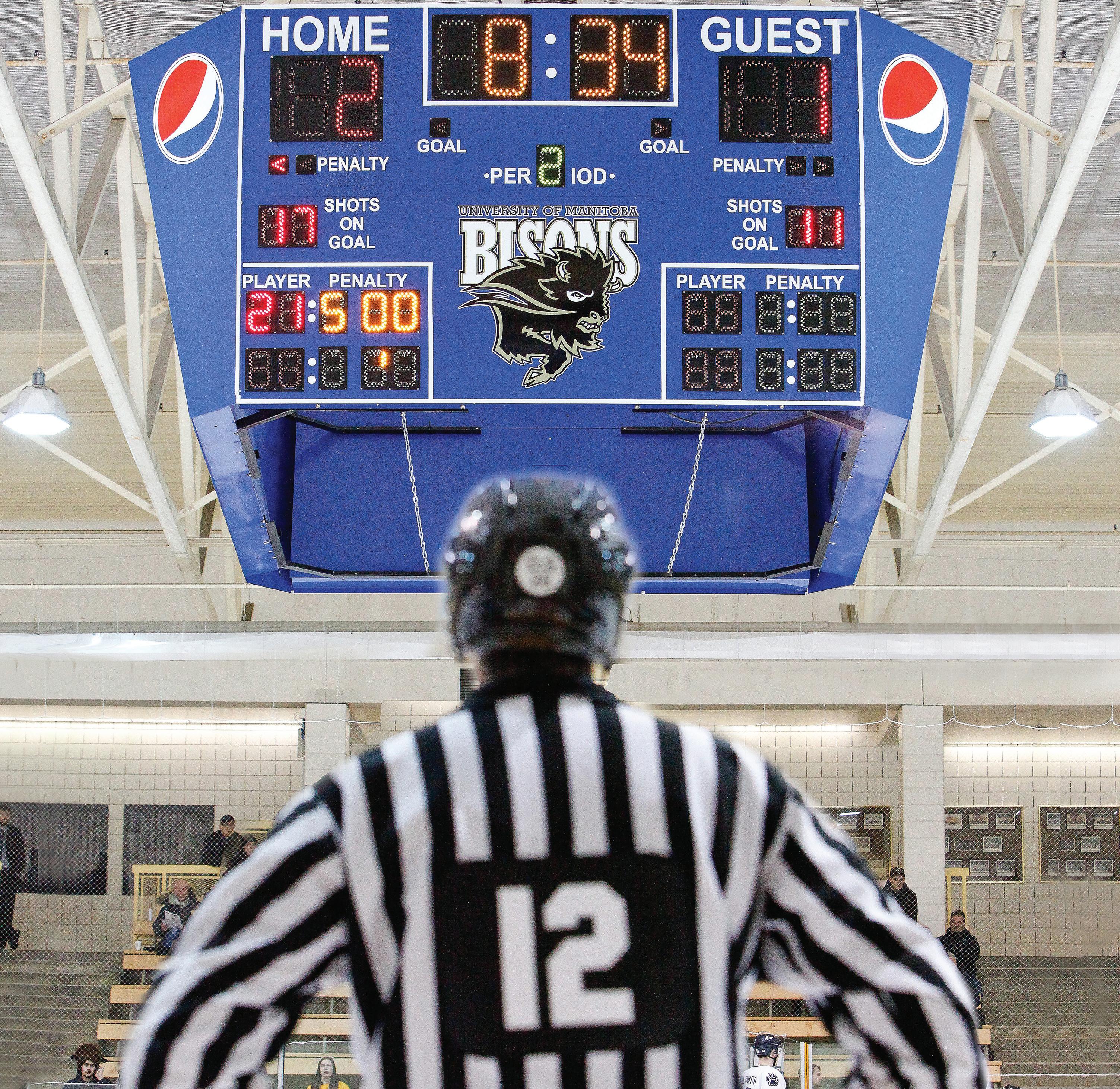
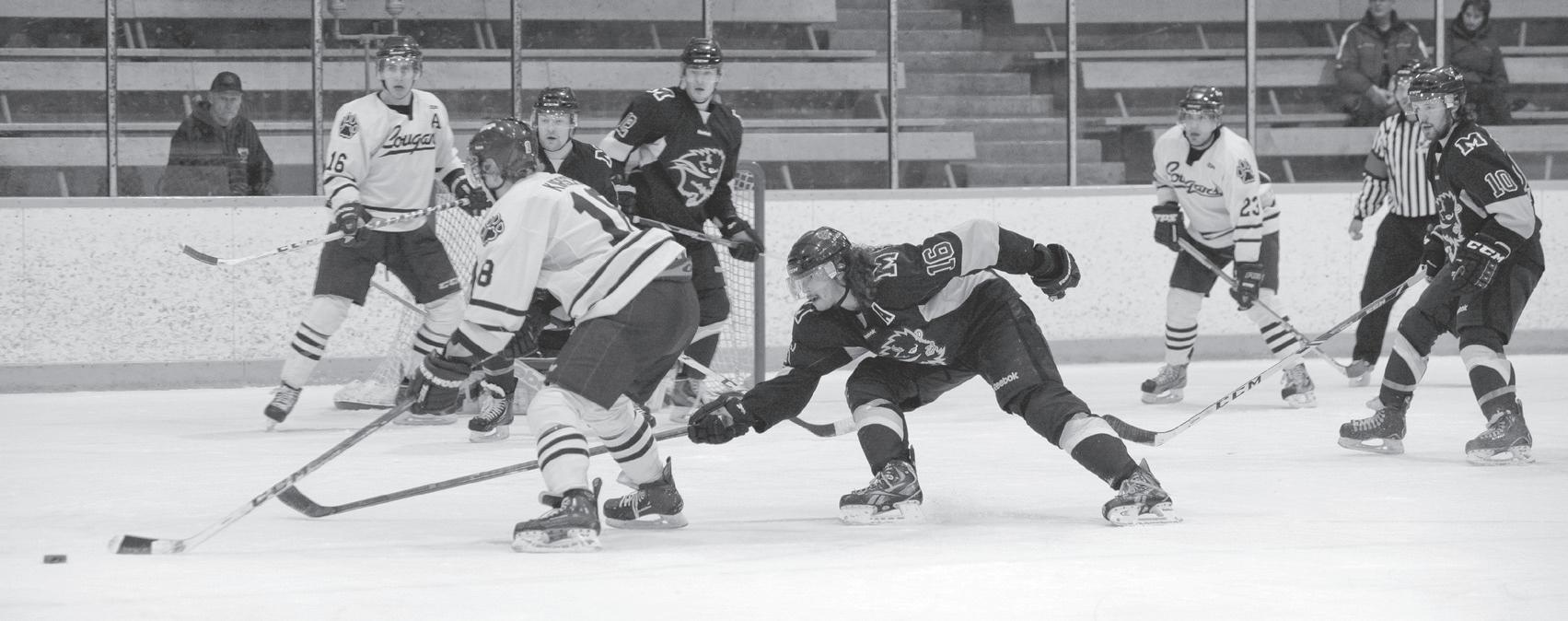
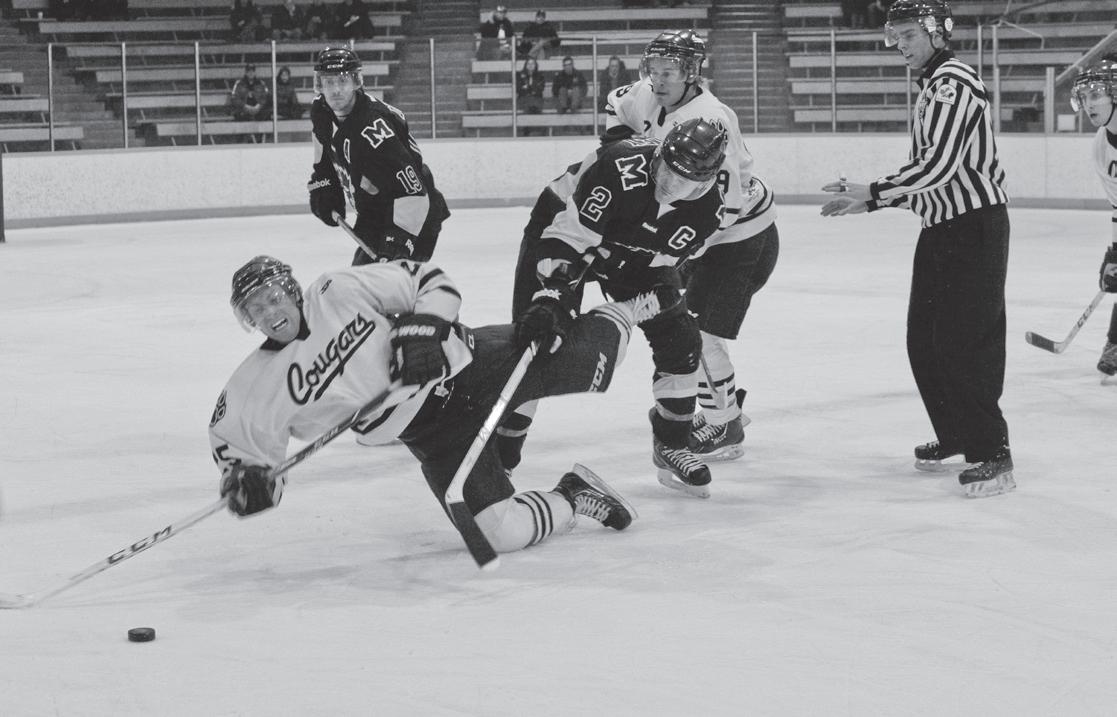
The Manitoba Bison men’s hockey team entered playoff action with their spirits high after clinching a home playoff berth the week prior. Their opponents, the Mount Royal Cougars, were making their first-ever Canada West playoffs appearance and gave the home squad everything they could handle. The Bisons showed tremendous resolve after losing game one, eventually taking the series 2-1. Friday’s action featured a double overtime thriller with a combined 103 shots on net. Mount Royal came out of the struggle with a 3-2 win.
The Bisons dictated the pace through the first 10 minutes of play after two Mount Royal penalties. Once back at even strength, the Cougars surged and outshot Manitoba 14-9 in the period. Bison goaltender Joe Caligiuri stopped two tight scoring chances late in the first to keep the game scoreless after 20 minutes.
Relentless pressure from Mount Royal forced the Bisons to take a roughing penalty at 7:02 in the second. Just 12 seconds into the power play, Cody Cartier found the back of the net on a beautiful pass from Matt Brown to put the Cougars up 1-0. The visitors added to their lead at 9:58, as Tyler Fiddler flew down the left wing, going stick side on Caligiuri.
Bison rookie sensation Jordan DePape scored his first Canada West playoff goal off of a one-timer before the period ended. A number of huge stops by Caligiuri kept Manitoba in the game, including a glove save in close while falling backwards. Heading into the third, Mount Royal’s lead was cut to one.
The Cougars took a costly interference penalty with less than three minutes remaining in the third, and the Bisons pounced. After Caligiuri was pulled for a 6-on-4 advantage, Brendan Rowinski deflected a Taylor Dickin shot into the back of the net at 18:94, sending the game into overtime.
The first overtime settled nothing, as both goalies were outstanding. Manitoba appeared physically exhausted heading into double overtime. The Cougars ended things at 4:09, as Brenden Turnbull’s quick
wrister slipped past Caligiuri, a heartbreaking finish for Manitoba.
Each net minder played sensational throughout, as Mount Royal’s Dalyn Flette stopped 46 shots for the win, while Caligiuri made 53 saves in a losing effort.
“We knew they [were] a physical, hard-working team, but it’s a playoff game,” said head coach Mike Sirant post-game. “You can’t get discouraged, though. We’ve got to find a way to score and find a way to win a hockey game.”
After playing the seventh-longest men’s playoff game in Canada West history, both teams were looking to shake off the fatigue the following evening. Despite a tough start, the Bisons emerged with a 4-2 victory to even the series.
The first period began at a sluggish pace. Mount Royal got on the board first, as Billy Marshall forced the puck underneath the leg of Caligiuri in a mad scramble at 6:11. The Bisons tied things up before the period ended, with Dickin scoring off of a great pass from DePape with just 1:01 remaining.
The Bisons—led by Darren Bestland, who was a force all weekend on the boards—picked up their physical game in the second period. The uptempo play led to a goal at 10:48, as Jesse Paradis flipped a loose puck in the crease over Flette’s shoulder for the 2-1 lead. Despite taking a five-minute major at 11:26, the Bisons stayed strong defensively and held onto their lead heading into the third.
Manitoba put the game away in the third. Ian Duval made it 3-1, following up on an Aaron Lewadniuk
rebound on an odd man rush. Mount Royal stayed persistent and cut Manitoba’s lead to one on a 5-on-3 power play, but Dickin would secure the win, making no mistake on the receiving end of a cross-ice pass at 18:40, for his second goal of the game.
Caligiuri was firm between the pipes yet again, stopping 22 shots in the win, including two critical diving saves in the third.
Manitoba’s win set up a decisive third game on Sunday afternoon, where undisciplined play from Mount Royal and fast-paced play from Manitoba would eventually lead to a 2-0 series-clinching Bison win.
Manitoba threw 16 shots at Flette in the first, and eventually grabbed the lead at 9:53. Luke Cain finished off a long pass from Bestland. The Cougars managed just five shots, and were visibly outmatched throughout the period.
Duval added to the lead just under three minutes into the second, burying a pass from Lewadniuk. Mount Royal again managed very little and surrendered four minor penalties.
The Cougars showed urgency in the final 20 minutes, entering the Bison zone on a frequent basis, but were shut down by the Bisons’ stout defence, whose efforts ensured a 24-save shutout for Caligiuri.
Manitoba now advances to the Canada West semi-final, and will play on the road against Calgary in a best-of-three series this weekend.
phOtOS by bEibEi Lu
Bison briefs
Let’s get critical
Post-season
edition
Ma RC l agaC e, with files from mike still
Women’s hockey
The 17-7-4, fourth-ranked Manitoba Bison women’s hockey team was ready to do battle in the post-season. The Bisons hosted the Regina Cougars in their first home playoff series since the 2010-11 season, when they went on to capture their second Canada West Championship.
This year the Cougars finished fifth in the Canada West standings, with an overall record of 11-13-4.
The Bisons went 3-1 against Regina in the regular season, and were looking to continue their regular season success in the quarter-final matchup.
Unfortunately, Manitoba ran into a hot goalie, netting just one goal over the two games played at Wayne Fleming Arena, and was bounced from the playoffs in the first round.
Special teams was the difference in game one on Friday, as Regina scored on both of their goals on the power play, en route to a 2-0 victory.
“You kill off every power play against you in the last five games, then you give up two in a playoff game – that’s just not gonna get it done,” said head coach Jon Rempel.
The following afternoon, the Bisons were hoping to take the series to a deciding third game. It was not to be. Regina scored three unanswered goals in the final 13 minutes, eliminating Manitoba with a 3-1 win. Kyleigh Palmer scored the lone goal for Manitoba early in the first period, but Regina ultimately completed the sweep to move on in the Canada West playoffs.
Track and Field
The Bison track and field team earned seven medals at the 2014 Canada West Track and Field Championships. Hosted by the University of Alberta, the two-day event was held on Feb. 21 and 22.
On day one, five Bison athletes competing in individual events and one relay team reached the podium.
In the men’s pentathlon, Wyatt Eyford finished in first place with 3,711 points while teammate Arthur Buchanan finished in third
place with 3,496 points. Matthew Fitkowsky earned silver in the men’s 300-metre with a time of 35.32 seconds.
Melissa Richards tied for second in women’s pole vault with a jump of 3.62-metres, and Wilfred Samking finished third in the 60-metre hurdles with a time of 8.44 seconds. In the women’s 4x800-metre relay, Manitoba finished with a time of 9:18.
On day two, fourth-year track star Buchanan finished in third place in the men’s high jump with a leap of 1.98-metres. Bison teammate Neil Clark ended up tying for fourth place with a jump of 1.95-metres. The men’s 4x400-metre relay team clinched a bronze medal with a time of 3:20.44.
Overall, the Bison men’s team finished in fifth place overall with 50.5 points, while the women’s team finished in seventh place with 22 points.
Three Bison athletes qualified for nationals: Eyford, Fitkowsky, and Richards will be heading to Edmonton for the 2014 CIS T&F Championships from Mar. 6-8.
Swimming
Three Bison swimmers took to the pool at the 2014 CIS Swimming Championships, hosted by the University of Toronto. But all eyes were on Dillon Perron; the thirdyear Bison athlete and team cocaptain had a phenomenal weekend, reaching the podium and setting multiple provincial records during the three-day event.
Perron won the first national swimming medal for the University of Manitoba since 2006 on the first day of competition, in the men’s 100-metre breaststroke. His time of 1:00.86 is a new provincial record. On day two, he set two more provincial records: a time of 2:12.76 in the 200-metre breaststroke and 24.28 seconds in the 50-metre butterfly.
Bisons Artur Kroitor and Kimberly Moors improved on their results in previous appearances at the national championships, and both managed to crack the top 10 in one event: eighth for Moors in the women’s 50-metre butterfly and 10th for Kroitor in the men’s 50-metre freestyle.
A phenomenal journey
The story of Bison point guard Christiane Fischer
Christiane Fischer has come a long way over the past five years. Hailing from BietigheimBissingen, Germany, the 5’6’’ point guard has found success everywhere she’s travelled.
Fischer’s North American journey began in the 2009-10 season at Northeast Community College in Norfolk, Nebraska. The Northeast Hawks compete in the Nebraska Community College Athletic Conference (NCCAC).
“When I first came over to North America I thought I wanted to play Division I NCAA [basketball],” said Fischer. “It didn’t work out at first so I thought I would go to Nebraska, play junior college, and then go on.”
She found immediate success in Nebraska: Fischer was named to the 2009-10 NCCAC women’s all-conference team, helping to lead the team to a conference championship. She was named team captain and averaged 6.5 points per game the following season. Fischer was also Academic All-Region in 2010 and Academic All-American in 2011.
Despite her triumphs away from home, Fischer wasn’t completely happy with how things were going in Nebraska.
“It was a different culture; it was rural Nebraska so it was very different from German, urban life. The team was fun, but the people around were not so much in accordance to my lifestyle.”
That’s when Manitoba came knocking. Women’s basketball head coach Pam Danis recruited Fischer for the 2011-12 season.
“A great opportunity came up and I got the chance to come up here and play basketball, so I took it – and from then on, I’ve been a Bison,” Fischer told the Manitoban Since arriving in Manitoba, Fischer has been a leader on and off
Bisons second seed at CIS championships
Settle for silver in Canada West showdown vs. UBC
Ma RC l agaC e, staff
The University of Manitoba women’s volleyball team is off to the national championships in Regina, SK after earning silver at the Canada West Women’s Volleyball Final Four this past weekend in Vancouver.
Reading week synced up nicely with the Bisons’ training schedule, as players could focus on their goal of reaching the podium out West and securing a spot to challenge for the CIS national title. Manitoba was the only team representing the prairies, as UBC, Trinity Western, and UBC Okanagan rounded out the top four teams in the conference.
was impressed with his team’s performance in the win, which guaranteed Manitoba a berth at nationals and set up a showdown with the topranked team in the nation, the UBC Thunderbirds.
“We need more of the same,” Bentley told GoBisons.ca when asked what it would take to topple the T-Birds.
have officially been seeded in second, just behind UBC. They play their first match Friday, Feb. 28 against the seventh-seeded Ottawa Gee-Gees of the Ontario University Athletics (OUA). This is the first time the Bisons have qualified for the CIS Women’s Volleyball Championships since the 2009-10 season, in which they lost to UBC 3-1 in the gold medal match.
Manitoba played Ottawa in a pre-season friendly, which Ottawa won 3-2. Coach Bentley described the match as ‘more challenging’ as the Bisons were without Piskche, Caleigh Dobie, and Erika Sandor. So far, the Bisons have achieved two of the three goals they set for themselves at the beginning of the season: to host a playoff series, and then to qualify for the national championships
the court. She has been a team captain for the last two seasons, and led the team in assists this past season with 53.
Canada has been a perfect fit for the point guard, who has found the style of play suits her.
“Canada’s kind of a hybrid between German basketball and culture and the U.S. basketball and culture.
U.S. basketball is very individually based and very scoring based [ . . . ] Germany is very structured. You don’t have a lot of freedom to roam around, and I don’t really like that much either.”
“Canada’s kind of a mix,” remarked Fischer. “For me that was kind of my perfect fit.”
While Fischer has continued to excel on the court, she has also been very productive in the classroom. In April 2013, she joined four other students and five University of Manitoba faculty members in attending the G20 Youth Forum in St. Petersburg, Russia. This past season was Fischer’s final year of CIS eligibility, so while her time on the court in a Bison uniform may be over, she is planning to continue to challenge herself, both academically and athletically.
“This year I’ve spent a lot of time thinking about indigenous issues in Canada, and indigenous politics,” said Fischer.
“I would like to pursue that. So I’m going to take a year off, probably go back to Europe and play some basketball, just because I’m not ready to give it up yet, and it’s too much fun.”
No matter what Fischer decides to do next, she will fondly look back on her experiences in Winnipeg.
“[They are] amazing people. I love Winnipeg, I love the people here. I love how international it’s becoming more and more. I think the warmth of the people here is totally making up for the cold we get.”
The Bisons came into the weekend knowing they only needed one win to clinch their berth, and they did so with a dominating straightsets victory over the Trinity Western Spartans 3-0 (25-17, 25-21, 25-23).
Taylor Pischke and Rachel Cockrell led the Bison attack with 12 and 11 kills respectively, while Brittany Habing had a game-high 35 assists.
Bison head coach Ken Bentley
“We can’t worry about their side too much. Our side needs to be what it was tonight and more for us to be successful. We will take on the challenge. Obviously, they are the favourite, but we will do what we can to make the match interesting.”
UBC proved to be too much for Manitoba. UBC held Pischke and Cockrell to a combined 13 kills, the same number as UBC’s Lisa Barclay, who was centre stage all night for the T-Birds and later named the 2013-14 Canada West MVP.
Despite settling for silver, the Bisons achieved their ultimate goal of qualifying for nationals, where they
“Our final goal was to win [a national championship]. We’re certainly capable of it, it’s not going to be easy,” said Bentley.
“That’s what we trained for. That’s what we put all this time in and lifted all those weights, it’s for this moment. I think we’re all really excited to go and challenge ourselves to play our best volleyball.”
The Bisons may have some support joining them on the road for their championship run; the notorious Big Horns posted the following via Twitter early Sunday afternoon: “Hotel booked. See you in Regina.”