109 HELEN GLASS UNIVERSITY OF MANITOBA WINNIPEG, MB R3T 2N2
General Inqu I r I es & a dvert I s I n G
Phone: (204) 474.6535
Fax: (204) 474.7651
Email: manitoban@themanitoban.com
Free Med I a Campus Plus Media Services
Phone: 1.780.421.1000
Email: advertise@free-media.ca
Canadian Publications Mail Product Sales Agreement #589160
A “volunteer staff” member is defined as a person who has had three volunteer articles, photographs, or pieces of art of reasonable length and/or substance published in three different issues of the current publishing year of the Manitoban. Any individual who qualifies must be voted in by a majority vote at a Manitoban staff meeting. Elected representatives and non-students may be excluded from holding votes as volunteer staff members in accordance with the Manitoban Constitution.
The Manitoban is the official student newspaper of the University of Manitoba. It is published monthly during the summer and each week of regular classes during the academic year by the Manitoban Newspaper Publications Corporation.
Jakob Sanderson to succeed Tanjit Nagra as UMSU president
g arett Willia M s and Qudus a busaleh, staff
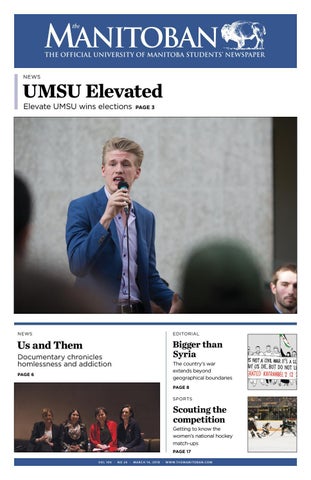
Elevate UMSU - anchored by Arts Student Body Council president
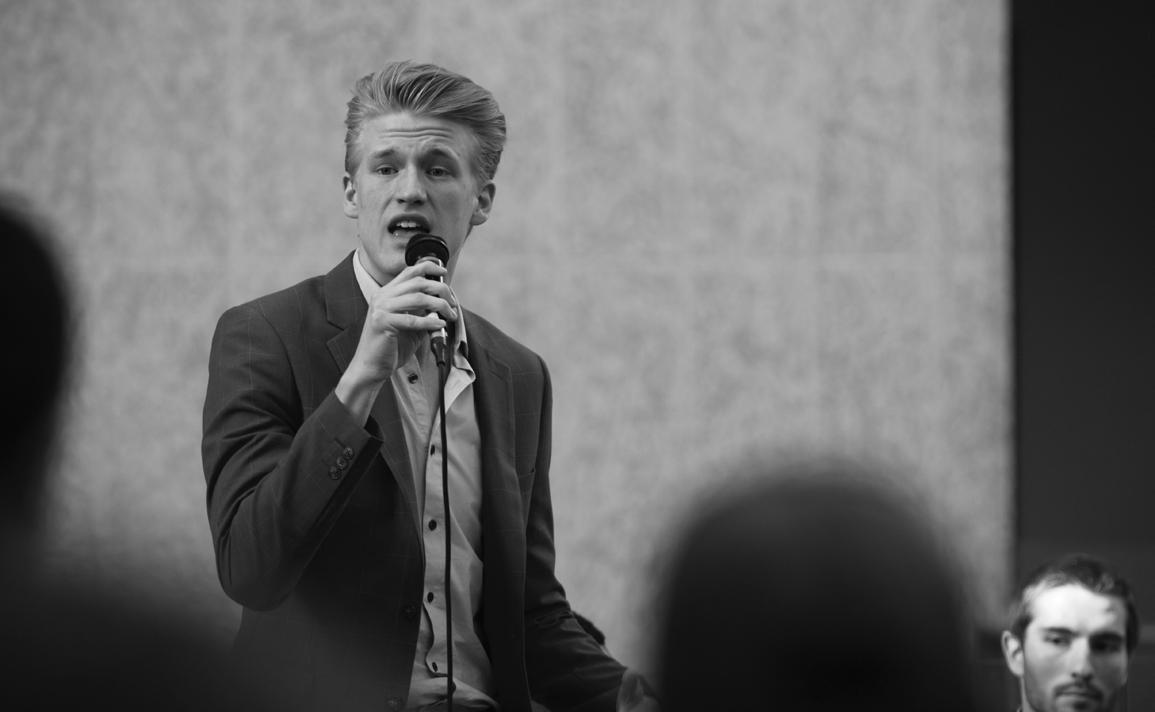
Jakob Sanderson - swept the 2018 UMSU executive election.
Sanderson beat out current UMSU VP finance and operations
Jehan Moorthy’s Future UMSU slate and Mathew Scammell’s Two Brothers UMSU by taking slightly more than 45 per cent of ballots cast. 2,360 of the 5,616 ballots cast for president went to Sanderson. 1,518 went to Moorthy and 1,353 to Scammell. There were 385 abstentions.
Sanderson will lead the next UMSU executive along with Sarah Bonner-Proulx, VP advocacy; Owen Black, VP external; Mbuli Matshe, VP finance and operations; and Carly Mastromonaco, VP student services.
“One of the largest elephants in the room about our union is that nobody really participates in it” - Mathew Scammell, Two Brothers’ UMSU presidential candidate.
Bonner-Proulx took 61 per cent of votes cast to Future UMSU’s Athena Skarban’s 39 per cent. Black bettered Future UMSU’s Brooklynn Krul 60 per cent to 40. Matshe collected 58 per cent of ballots cast compared to Future UMSU’s Jonah Wasylak’s 42. Mastromonaco won with 46 per cent of the vote over Two Brothers’ Sean Scammell, 27 per cent, and Future UMSU’s Brandon Barratt, 27 per cent.
Sanderson said his team is excited and ready to share their “fresh perspective” with the union’s membership, adding that he plans on ensuring it
is one that is “as present as possible to all students.”
“I am excited for all of the things we are planning to do next year,” he said.
“Our term officially starts on May 1, but I cannot wait to be talking to students and hear exactly what they want from the next UMSU executive, find out why they elected us,”
Sanderson said.
“And I want to talk to every single person who didn’t vote for us and find out why it is that they went the other way and find out what we can do to make sure that they feel included within our UMSU executive because we want to make sure we fight for every single student on this campus.”
VP student services-elect
Mostromonaco called her team’s victory an “indescribable feeling” and
said she looks forward to the transition process.
Two Brother’s UMSU presidential candidate Mathew Scammell lamented what he called a “problematic ” voter turnout.
“There has to be some kind of incentive for students to actually care about what’s going on,” he said.
Scammell said that with his graduation planned for October, and his current term as UMSU councillor representing Society of Earth Science and Environmental Studies coming to an end, he will continue to advocate for a transparent and effective student union.
“One of the largest elephants in the room about our union is that nobody really participates in it,” Scammell said.
Future UMSU declined to comment.
Alannah Mckay, Abubakar Ibrahim, and Eun-Bi Kang ran and were supported for the uncontested UMSU community representative positions of Indigenous students’ rep, international students’ rep, and LGBTTQ* students rep, respectively.
Overall campus voter participation was down slightly this year compared to 2017, with a total of 25 per cent voter participation and a total of 5,616 ballots cast. Participation spiked last year with more than 27 per cent participation and 6,247 total votes counted.
The campaign period was relatively quiet until this week when social media posts accused Future UMSU VP finance and operations candidate Wasylak of involvement in a racially-charged incident at the Hub Social Club in October.
Wasylak was among a group of five Bison men’s hockey players who were briefly banned from the Hub following an incident where two international students were allegedly attacked with racial slurs.
An investigation found no proof of the slurs and the bans were later withdrawn. Moorthy commented on behalf of Wasylak and denied his involvement. He declined to comment on the results of the election.
Five complaints were registered with the chief returning officer over the 12 day campaign period, all between the Elevate UMSU and Future UMSU slates. There were six complaints filed in 2017.
Engage slate takes UWSA executive unchallenged
Malak a bas, staff
UWSA Engage, led by presidentelect Morgan Brightnose, ran unchallenged and was voted in for executive positions of the University of Winnipeg Students’ Association.
Brightnose received 504 out of the 557 votes cast. VP external affairs Zee Morales received 483 out of the 550 votes cast. VP student affairs Jade Defehr received 500 out of the 551, and VP internal affairs Brenden Gali received 508 of the 561 votes cast.
UWSA Engage focused its campaign on working against tuition increases, partnering with local campaigns and community groups, and
working to increase campus resources for marginalized students.
Outside of the Engage executive slate, board of directors’ candidates were also elected.
Daniel Denton was voted in as science director, receiving 297 votes to Tessa Bortoluzzi’s 276. Ugonna Chigbo and Meseret Kahsay took the community liaison position as a team, receiving 349 votes to Mia RyderMarks and Nicholas Warsza’s 215.
Megan Linton won the board of regents position, with 305 votes to Sophia Hershfield’s 261.
The remainder of the director
The sole slate running, UWSA Engage, led by president Morgan Brightnose, were voted in for executive positions
positions went to candidates running unopposed - Jerico Nieves, arts director; Ifeoma Nnadi, international students’ director; Avery
Letkemann, environmental ethics director; Quentin Mayhew and Jude Yallowega, LGBT* directors; Mohamed Behi, accessibility director; Goldie Arora, PACE director; and Michael Kvern as an UWSA senator. These votes translate to about a 6.8 per cent turnout by University of Winnipeg students. Comparatively, the UMSU general election this year brought out about 25 per cent of the student body,
down from 27 per cent in 2017. The election also saw the passing of a referendum that presented a 25-cent levy per credit hour on education courses which will be used to create awards, grants, bursaries, or foundation investments specifically for University of Winnipeg education students.
photo by quincy houdayer
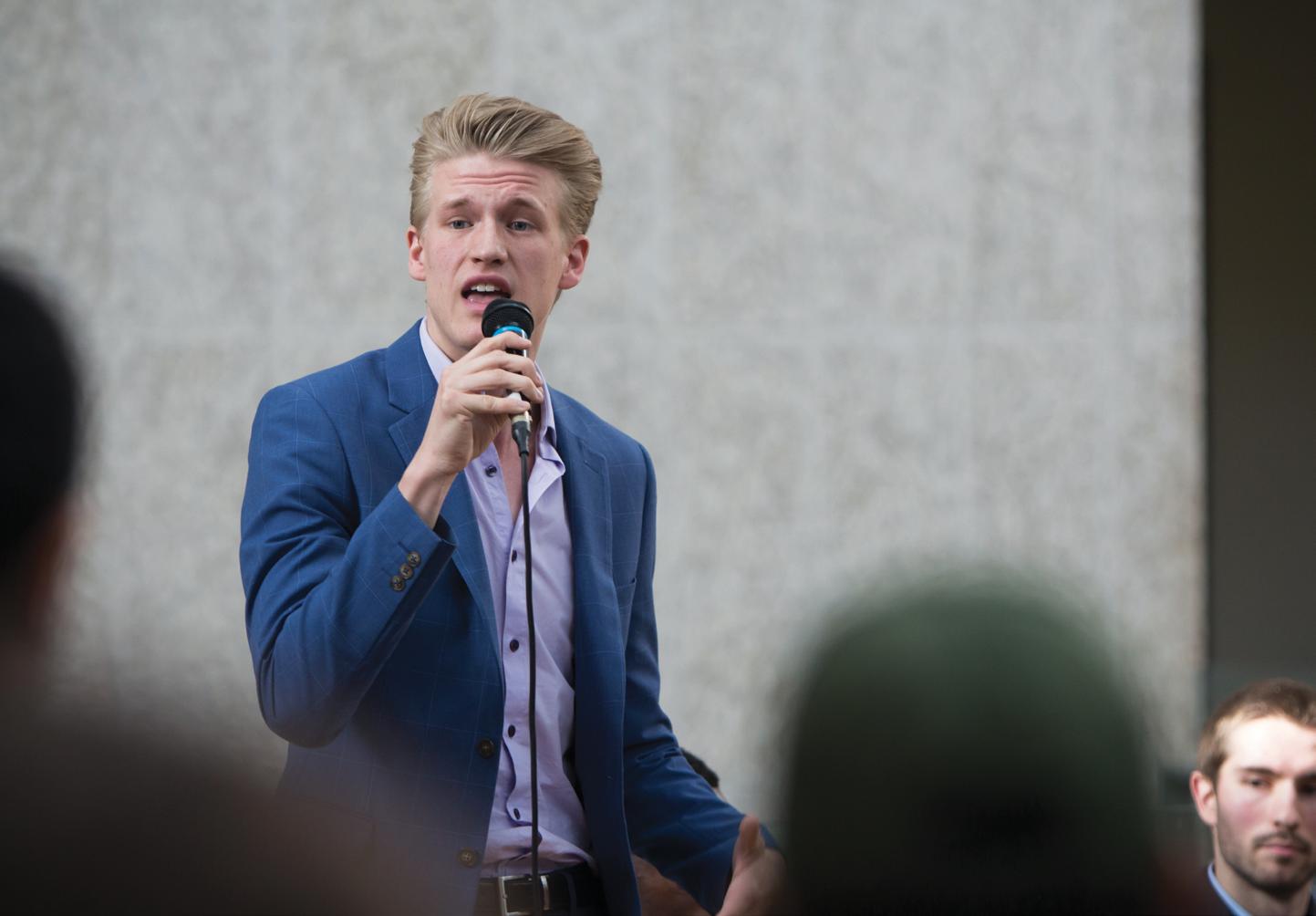
Jakob Sanderson will start his term as UMSU president on May 1st.
Future UMSU candidate accused of involvement racially charged altercation
Investigation into October incident at the Hub uncovered no proof of racial slurs being uttered, no official complaint filed
Malak a bas and s haden a busaleh, with files from Garett williams, staff
Future UMSU VP finance and operations candidate Jonah Wasylak is facing accusations of involvement in an incident where two international students are alleged to have been verbally harassed with racial slurs inside an UMSU business in October.
The VP finance and operations position was won by Mbuli Matshe from the Elevate UMSU slate, who took 58 per cent of the ballots cast, compared to Wasylak’s 42 per cent.
The accusations began circulating March 7 on social media. An investigation involving UMSU, the Hub Social Club - where the alleged incident took place - and Bison Sports uncovered no evidence of the alleged slurs. The international students involved did not submit official statements or complaints.
Online posts included a screen shot of the Hub’s patron ID scanner that showed Wasylak and four other members of the Bisons men’s hockey team had been banned from the pub for an “extremely serious” disturbance that included “excessive racial slurs directed at bar patrons” inside and outside the bar.
The bans - which were extended to five members of the hockey team - were later changed to “disturbancebreach of conduct” and eventually lifted altogether following an investigation and the submission by the players of a written apology to the bar, in which they denied using racial epithets.
According to individuals who came forward to speak with the Manitoban, Wasylak was part of a group involved in an altercation with international students while at the Hub just before 2 a.m. on Oct. 18.
The alleged confrontation began in a washroom where the interna-
tional students were subjected to racial slurs.
Wasylak and the other students were then removed from the bar. The international students requested pub security escort them to their vehicle, and the confrontation continued in the parking lot.
“When they left outside, all the hockey players were outside waiting for them,” said someone familiar with the incident, who asked to remain anonymous.
“The repercussions were that we had a game in 48 hourswhat are you doing in a bar 48 hours before?” - Gene Muller, Bison Sports director of athletics and recreation
The Hub security member “was a big guy, tough guy, and he was having to push their way through and they were trying to jump them or beat them up or whatever,” he said.
UMSU presidential candidate Jehan Moorthy - who campaigned with Wasylak on the Future UMSU slate and facilitated the investigation following the incident in the fall - acknowledged the Bison forward and Asper school of business student was involved in an incident, but said Wasylak was, in fact, trying to break up the confrontation.
“He was sober that night,” said Moorthy.
“He wasn't engaged in any of the sort of confrontation that took place, he was simply there to maintain his friends, move away from the incident and just to go on by the end of the night. There was drinking involved with some of his friends that were present and he wanted to make sure that his friends sort of de-escalated any hostile behaviour.”
Moorthy said he discussed the incident with Wasylak before including him on the Future UMSU slate, and is confident he did not repeat a slur and is not racist.
UMSU president Tanjit Nagra said she is aware of the incident but did not name any particular students.
“There was an incident that occurred involving students, I believe there was racism involved and racial slurs towards some students - it was involving some Bison athletes,” she said, adding that Moorthy, in his role as UMSU VP finance and operations, took a lead in trying to resolve the matter.
She said she understood the issue to be resolved in December after a letter of apology from the players was delivered to Hub staff, and the coach of the men’s hockey team, along with the athletic director of Bison Sports, assured her that the team would be banned from the pub and sensitivity training would take place.
Bisons Sports director of athletics and recreation Gene Muller acknowledged members of the Bisons hockey team were involved in an incident, but said the five athletes were not the instigators.
Muller said that from his understanding of the altercation it was a “hanger-on,” rather than a Bisons hockey player, who uttered the slurs, and only after being “sucker punched” in the washroom.
Wasylak later corroborated this by posting a status referencing the situation on Facebook March 8. He claimed the altercation was instigated by a person not involved with the Bisons men’s hockey team.
“They kept shouting back and forth, and I stepped up to pull him away,” Wasylak said. “My main regret is that I didn’t step in sooner.”
The investigation found no evidence of the alleged sixth individual being present or involved, either on security footage provided by the U of M and the Hub, or recorded by the bar’s patron ID scanner.
Muller acknowledged the incident continued outside the bar but said the athletes “were not waiting to cause a ruckus or to cause a fuss.”
“My understanding is they were scared for the safety [of the student using racial slurs],” he said.
Muller said that while the hockey players involved faced several repercussions - including writing the apology letter “because of the disturbance,” undergoing a “session with human rights and conflict management,” and “extra training because of the night out” - it was not the allegations of racially-charged language that drew the punishment.
“There were certain repercussions, but the repercussions were not related to the racial slurs,” he said.
“The repercussions were that we had a game in 48 hours - what are you doing in a bar 48 hours before?”
Muller said he met with the men’s hockey coach and the players involved, and believes their version of events.
“I refuse to believe that these guys would be this stupid, in this day and age, and they are all - from knowledge of them - really good people,” he said.
“And I know that when one of our players heard that, he objected to the person involved. It’s [2018], you’re not allowed to use language like that.” Muller would not release the name of the student he alleged used the racial slurs. He added that he encouraged staff at the Hub to further investigate the situation, but because the victims did not come forward or press charges, there was little he could do.
“I said that if there is no allegation, and we only have one side to the story, then that was the case closed to me because there were no people coming forward,” Muller said.
The anonymous source said he brought the issue forward at this time because he believes the alleged actions of that night do not line up with the values Wasylak advocated while campaigning.
“Two of their slate’s focusing points are respect [and transparency] - I don’t think he displayed respect at all that night,” he said. “And as far as transparency goes, I think people should know about that, and [it] should be his own belief, too, that people should know about that.
“I know people saying racial slurs might not mean that’s actually how you feel about a race - you might not actually be racist - but it’s completely disrespectful and inappropriate, especially someone who’s representing students like that. I don’t think that’s right.”
U of A highlights lack of diversity among U15 leadership positions
d iana u bokudo M , staff
Arecent study conducted by University of Alberta professor Malinda Smith for the University of Alberta Academic Women’s Association found a lack of diversity in leadership positions at Canada’s U15 research-intensive universities.
The study found that among top leadership positions at U15 institutions, “women, racialized minorities, Indigenous peoples, and persons with disabilities” are largely underrepresented.
The study examined social diversity, disciplinary diversity, and professional backgrounds of individuals occupying various leadership positions.
The assessment of social diversity of mid-level and senior leadership positions, including board chairs, chancellors, presidents, provosts, and vice-presidents academics revealed that those occupying these positions were predominantly white and male.
Visible minorities and Indigenous peoples were underrepresented at mid-level and senior leadership positions.
With regards to disciplinary backgrounds, positions, namely presidents, provosts, and VP-academic, and VP research were analyzed.
According to the study, these positions are mostly filled by individuals from science, technology, engi-
neering, and mathematics (STEM) backgrounds, including the three female presidents and visible minority presidents.
Lastly, an examination of professional backgrounds of board chairs and chancellors revealed that individuals with backgrounds in business, law, politics, and public administration were overrepresented in these positions. Both types of positions are held primarily by white males.
While only 14 per cent of board chairs were visible minority or Indigenous men, neither visible minorities nor Indigenous women were represented in these positions.
The University of Manitoba lead-
ership team was reported as being made up of 40 per cent each white males and white females, and 20 per cent men of visible minorities. Indigenous men and women, as well as women of visible minorities, were absent altogether.
Out of 21 deans from major faculties and schools examined from the U of M, 76.2 per cent were white males, 14.3 per cent were white females, 4.8 per cent were men of visible minorities, and 4.8 per cent were women of visible minorities.
Overall, the U15 research-intensive universities did not include Indigenous females in any of the positions examined in the study.
U of M executive director of public affairs John Danakas said the university’s principles of “equity and inclusion” are reflected in president Barnard’s leadership team.
“President Barnard’s current senior leadership team, for example, includes two vice-presidents who are female, two who identify as members of the [LGBTTQ*] community, and one who is a visible minority.”
He maintained that the university remains dedicated to these principles, and “to continuous improvement with regard to inclusion at all levels of leadership.”
Indigenous Awareness Week extended
d iana u bokudo M , staff
The University of Manitoba has extended its annual Indigenous Awareness Week into Indigenous Awareness Month this year.
The U of M is hosting several events between March 5 and 29 to explore Indigenous history, cultures, and traditions.
Among the planned events are the Indigenous Awards of Excellence, the 15th annual Elders and Traditional Peoples Gathering, and the ReconciliACTION campaign launch. Several lectures will also be held on campus throughout the month.
Amanda Fredlund, female co-president of the University of Manitoba Aboriginal Students Association (UMASA) and one of 10 Indigenous Awards of Excellence 2018 recipients, said the month-long celebration means more events can be held.
Fredlund said the UMASA executive team was excited as two events planned by UMASA - the Misko Fest and launch of the ReconciliACTION campaign - are included in the agenda. They are scheduled for March 22 and March 27, respectively.
She said that the Misko Fest will
feature singing, drumming, and dancing, giving both Indigenous and non-Indigenous students the opportunity to experience Indigenous culture.
“It’s a good way to give non-Indigenous or even Indigenous people who have never been to any sort of cultural celebration like that, exposure to it”- Amanda Fredlund, UMASA female co-president
“It’s a good way to give non-Indigenous people or even Indigenous people who have never been to any sort of cultural celebration like that exposure to it,” Fredlund said. The ReconciliACTION cam-
paign aims to see the U of M implement the Truth And Reconciliation Commission’s recommendation number 16, which calls upon postsecondary institutions across Canada to “create university and college degree and diploma programs in Aboriginal languages.”
Marjorie Ward Annual Lecture
St. John’s College hosted the 34th Annual Marjorie Ward lecture March 7.
The lecture, titled “Reclamation & Reconciliation: Indigenous Literary Voices Today,” was one of the events lined up for Indigenous Awareness Month.
Presented by Governor General’s Literary Award winner David Alexander Robertson, the lecture focused on the importance of representation of Indigenous voices in the literary world.
Robertson said that truth is just as important as reconciliation, adding that Indigenous peoples present this truth in a unique way through story telling.
He said that reconciliation
could not be achieved by waiting for the government to take action, but required proactive action by individuals.
Robertson said this proactivity means engaging in meaningful conversations regarding reconciliation, incorporating the true history of Indigenous peoples into school curriculums, and providing teachers with the right tools to engage with children on this subject.
“If we wait for the government to lead us towards reconciliation - what-
ever that means - we’re going to be waiting a really long time,” Robertson told the audience.
“We can’t wait for the government. They’re not going to do anything. To me, reconciliation is always going to be a movement of the people.”
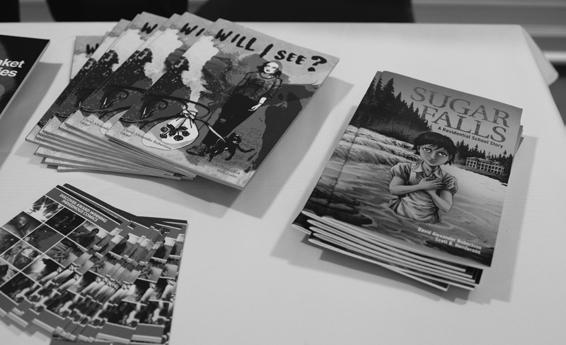
Governor General’s Literary Award winner David Alexander Robertson signs books following his lecture, “Reclamation & Reconciliation: Indigenous Literary Voices Today.” photos by asha nelson
A collection of Robertson’s popular children’s literature.
Documentary highlights experiences of chronically homeless
Spanning more than 10 years, film
links homelessness and addictions with MMIWG
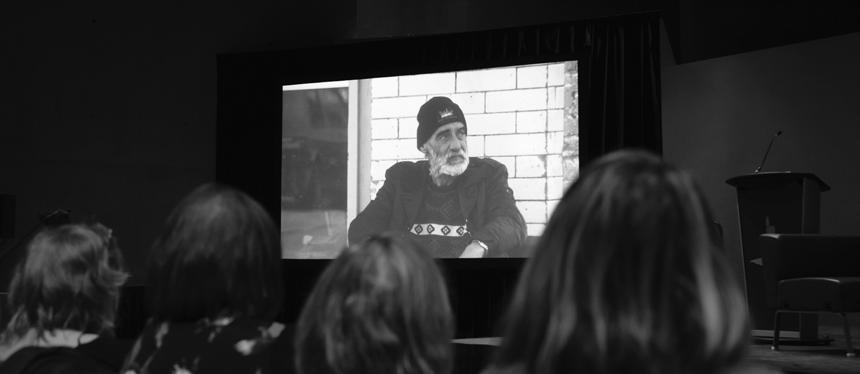
Adocumentary highlighting the lived experiences of four chronically homeless people in British Columbia was screened at the Canadian Museum for Human Rights March 8.
Directed, produced, and written by Krista Loughton the documentary, titled Us and Them links homelessness and addictions with the issue of missing and murdered Indigenous women and girls (MMIWG).
“We are really trying to correlate the issues of homelessness and addictions with the MMIWG,” Loughton said.
Lougton added that talking about homelessness in a vacuum should be replaced with a serious discussion that uses an intersectional approach to understand the complexities of the trauma faced by homeless people which makes them more vulnerable.
“A lot of people talk about housing first, which is a system where you put people in a unit regardless of if they are using [substances] or not,” which Loughton said should be coupled with extra support services.
“If we had these services in place, where there was housing and Indigenous-run housing with Indigenous-run cultural supports for people, that would prevent a lot of the women that are at risk out there that are generally speaking are from a low socioeconomic bracket,” she said.
Loughton said one of the participants in the film “has a sister on the MMIWG list and another one of her sisters was murdered by the police officers in Prince Albert, Saskatchewan. So this issue is very close to my heart.”
"Us and Them is a deeply visceral film that shows audiences the reality
of life outside on our streets,” she said.
The film spans a period of more than a decade, which Loughton said honestly presents the stories of four individuals along with destroying some of the stereotypes about homeless people.
“I wanted people to leave the theatre and never look at a homeless person the same way again.”
Loughton said that even though she lives in a gentrified area of Vancouver, she did not understand the extent of the issue of homelessness until she started working on the documentary.
“We are all the same. It is just that their experiences are more intense and then that allows for people to look at the situation through a compassionate lens. It is a very emotional film but it is also inspiring at the end.”
Loughton said it was a spe -
cial event to screen the film on International Women’s Day (IWD), March 8, a day celebrated around the world to recognize the achievements and struggles of women.
MaryAnn Mihychuk, member of parliament for Kildonan–St. Paul, attended the screening.
“It’s been [an] especially happy and robust and active [IWD], much more active than last year or years before and I think that it is truly a celebration and time for us to really make the change we have all hoped for,” she said, adding that Indigenous women face unique challenges and difficulties.
The film screening, she said, will move the audience “through the process of truth and reconciliation.”
“It is all linked together to be a very special evening.”
The screening was followed by a panel discussion emceed by Ry Moran, director of the National Centre for Truth and Reconciliation.
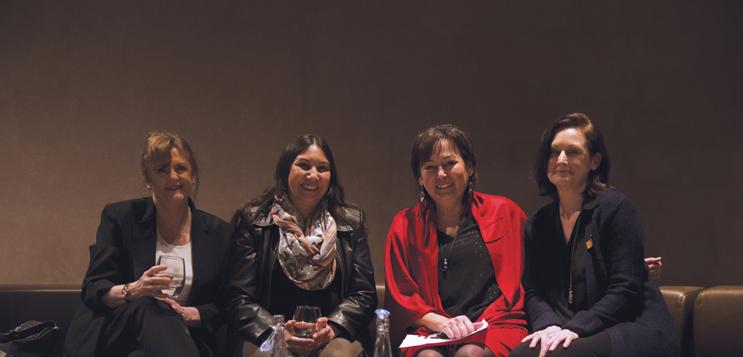
The panelists included Loughton, Sandra DeLaronde, co-chair of the Coalition for MMWIG, Althea Guiboche, of Got Bannock, and Jane Meagher, former director of Red Road Lodge.
MMIWG inquiry
The federal government launched a national inquiry into MMIWG in 2015. Since the inquiry’s launch, numerous staff members, commissioners, and researchers have resigned.
Families of MMIWG have criticised the inquiry for not keeping them at
GPESA to highlight alternate growth models
the heart and centre of the hearings.
Marion Buller, the chief commissioner of the national inquiry, asked the federal government for a two-year extension last week.
“I think it is really important that we get down to business and house and care for people,” Loughton said, adding that the requested extension “seems to be an extension of the pain.”
“Like in the case of Tina Fontaine, a 15-year old girl who was targeted by a 52-year old man - you know that there were a lot of holes in the system that made that happen to her.”
Fonatine, from Sagkeeng First Nation, had been reported missing numerous times before her body was discovered in the Red River in the summer of 2014. Law enforcement officials and Child and Family Services have been criticized for their handling of the matter.
A jury acquitted Raymond Cormier of second-degree murder charges relating to Fontaine’s death Feb. 22.
Mihychuk said Canadians are experiencing the aftermath of “centuries of colonialism, of apartheid, of systemic racism that has subjugated peoples that were generous and open.”
Mihychuk said even though reconciliation is a difficult task, the government is moving in the right direction and urged Winnipegers and urban Canadians to provide “culturally appropriate” safe spaces for families moving from First Nation communities to urban centres.
Speakers will focus on alternative ways of conceptualizing consumption, wellbeing
Qudus a busaleh, staff
T
he University of Manitoba’s Global Political Economy Students’ Association (GPESA) is set to host a panel discussion examining alternative ways of conceptualizing consumption, measurements of wellbeing, and progress at the Gas Station Arts Centre March 17.
Running from 3:00 p.m. to 5:00 p.m. and titled “Regrowth: reimaging ecology, equity, + the economy,” the event will include a three-speaker panel that will include Dalhousie University associate professor of political science Anders Hayden, University College of the North professor Ramona Neckoway, and Sarah Leeson-Klym, the Manitoba Regional Director of The Canadian Community Economic Development (CED) Network.
Event organizer and fifth-year global political economy student Julia Greening said the event will begin by highlighting how aspects
of the Canadian economy, such as economic health and success, have been conventionally measured and the ecological costs that underly such measurements.
“This includes highlighting the true ecological costs of a system premised on perpetual growth, and the way they disproportionately fall on already marginalized groups,” she said.
Following this, Greening added, “We want to emphasize alternatives to this model, and give a platform to those currently working to create change. We think our speakers are such people.”
Speaker profiles Hayden’s research is focused on examining the socio-political responses to climate change and other environmental challenges. More specifically, the political science professor is interested in the evolving balance
between promoting “green growth” and sufficiency-based challenges to the endless growth of production and consumption.
Speaking to Hayden’s most recent book, When Green Growth is Not Enough: Climate Change, Ecological Modernization, and Sufficiency , Greening said Hayden “Contrasts various approaches to addressing climate change, and concludes that socalled ‘green technologies’ [are not] an adequate solution to this enormous problem.”
She added that “He argues that a more fundamental change is required, one that emphasizes sufficiency over scarcity as an organizing economic principle.”
Neckoway, a PhD candidate at the University of Manitoba, focuses her research on the many perspectives, experiences, and implications of energy production on Cree homelands in Northern Manitoba.
After collecting and integrating countless local perspectives on the growing presence of Hydro development in the North over the last decade, Neckoway is hoping to develop an alternative narrative regarding energy production.
Leeson-Klym, the Manitoba Regional Director for the Canadian CED Network, a national web of community organizations building healthy, sustainable, and inclusive communities and local economies, is adamant that community economic development can spearhead efforts to address nationwide challenges such as inequality, poverty, and environmental degradation.
Since 2011, Leeson-Klym has been involved in various CED-led initiatives, including coordinating the annual Manitoba Gathering for community and economic developers as well as playing a role in establishing the Enterprising Non-Profits program.
The Manitoba Gathering, an annual CED conference, brings together over 500 people each year from different areas of the not-forprofit, social enterprise, and community development sectors for a day of “sharing, learning, networking and celebration.”
Leeson-Klym has also worked with Enterprising Non-Profits, a collaborative program that fosters social enterprise development and growth as a way to build strong nonprofit organizations and healthier communities.
Today, in partnership with the provincial government, LeesonKlym provides leadership to the Manitoba Social Enterprise Strategy that aims to create jobs in the province though the development of social enterprises.