Talking with some seniors on the Bison men’s basketball team
PAGE 20 Supporting refugees
Trophy haul
EDITOR-IN-CHIEF
DESIGN
DESIGN
DESIGN ASSOCIATE Kellie Huynh
GRAPHICS ASSOCIATE Aldo Rios
PHOTO ASSOCIATE Chantal Zdan
PHOTO ASSOCIATE Star Roxas
PHOTO ASSOCIATE Megan Colwell
REPORTERS
NEWS Osho Samuel Adetunji
NEWS Diana Ubokudom
COLUMNIST Jeremiah Kopp
COLUMNIST Shaden Abusaleh
ARTS & CULTURE Olivia Michalczuk
ARTS & CULTURE Emelia Fournier
SPORTS Kellen Taniguchi
SPORTS Jason Pchajek
COPY Joseph Gonzalez
MANITOBAN
109 HELEN GLASS UNIVERSITY OF MANITOBA WINNIPEG, MB R3T 2N2
GENERAL INQUIRIES & ADVERTISING
Phone: (204) 474.6535
Fax: (204) 474.7651 Email: manitoban@themanitoban.com FREE MEDIA Campus Plus Media Services Phone: 1.780.421.1000 Email: advertise@free-media.ca Canadian
A “volunteer staff” member is defined as a person who has had three volunteer articles, photographs, or pieces of art of reasonable length and/or substance published in three different issues of the current publishing year of the Manitoban. Any individual who qualifies must be voted in by a majority vote at a Manitoban staff meeting. Elected representatives and non-students may be excluded from holding votes as volunteer staff members in accordance with the Manitoban Constitution. The Manitoban is the official student newspaper of the University of Manitoba. It is published monthly during the summer and each week of regular classes during the academic year by the Manitoban Newspaper Publications Corporation.
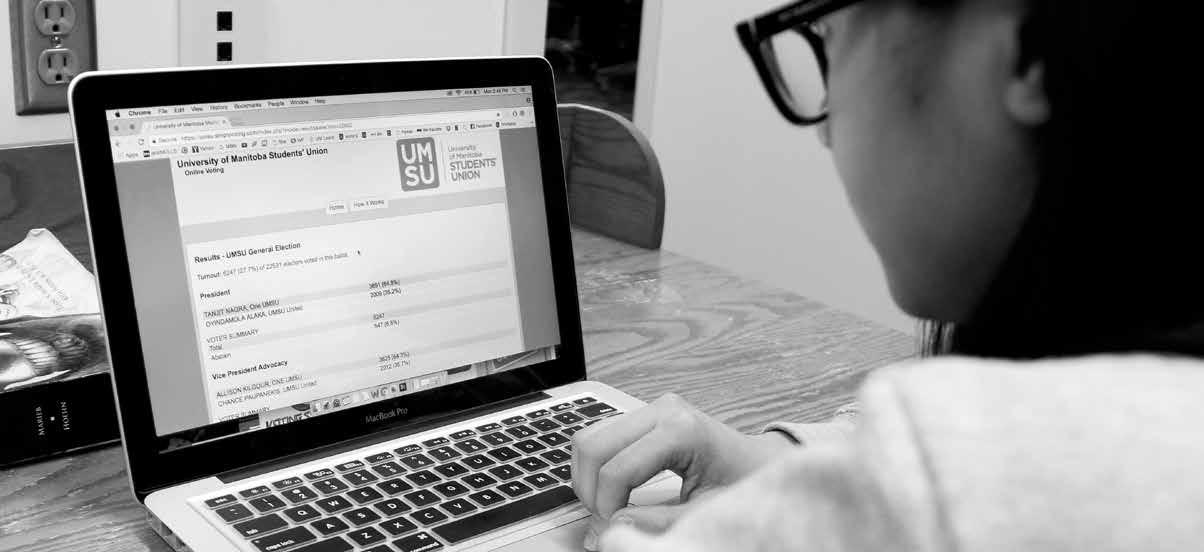
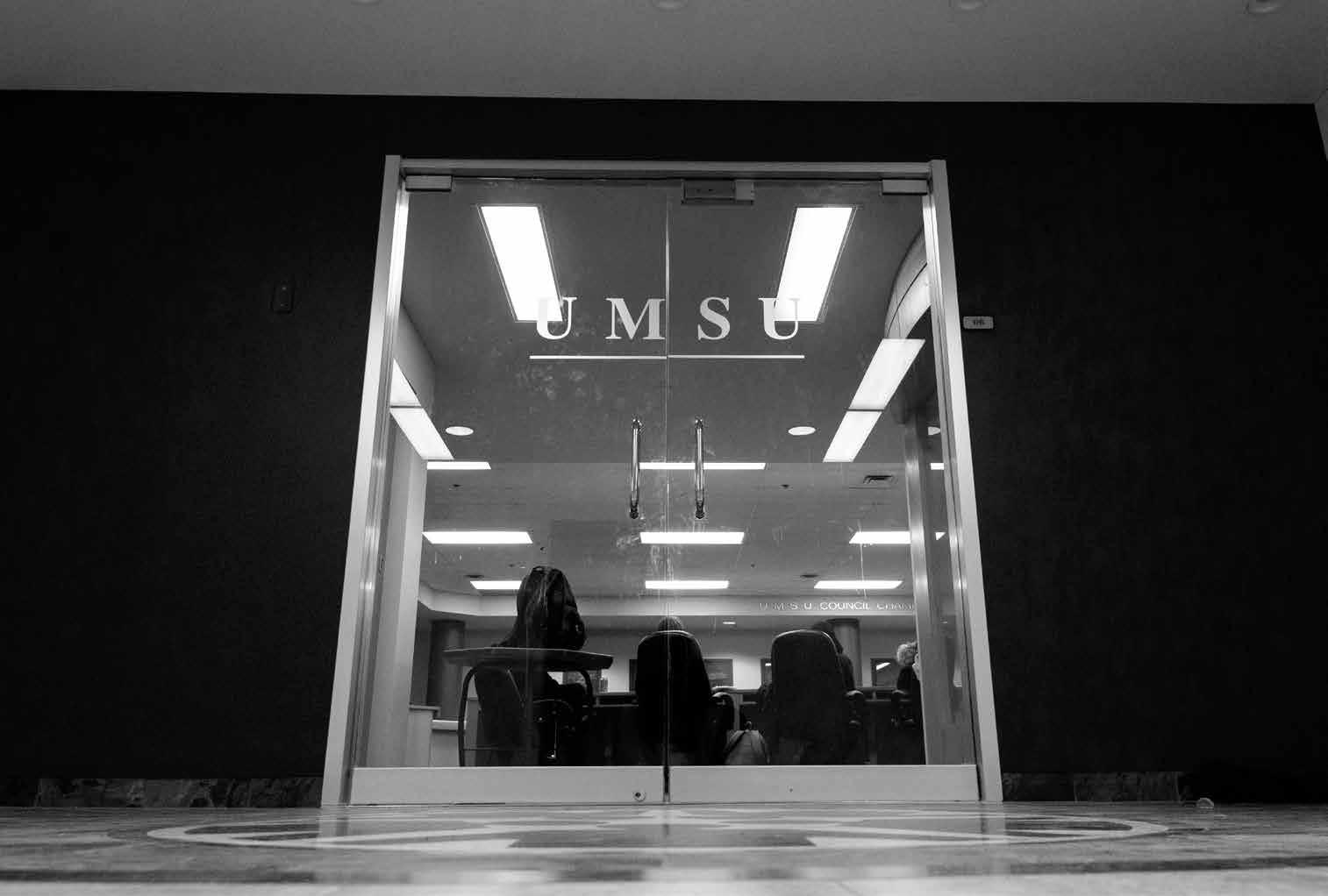
One UMSU sweeps executive positions in 2017 general election
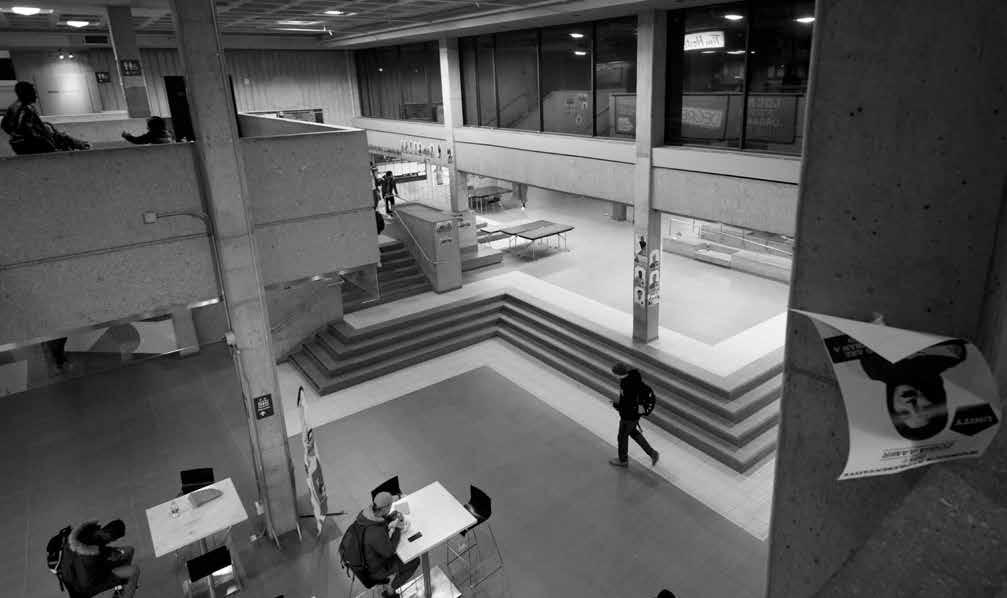
Student election sees highest turnout in years with online voting
LEVI GARBER, STAFF
In an election with the largest voter turnout in recent memory, One UMSU has won all five executive positions. The incoming executive will be led by incumbent UMSU president Tanjit Nagra.
Voter turnout reached 27.7 per cent, a full four points higher than the 20-year high set in 2013.
In addition to the One UMSU victory, four community representatives were elected: Zobia Aamir as women’s representative; Chris Otisi as international students’ representative; Noah Wilson as Aboriginal students’ representative; and Sarah White as LGBTTQ* representative.
The students living with disabilities representative position had no nominees this year, and will likely be filled by council appointment later in 2017.
Nagra handily defeated UMSU United presidential candidate and former Nigerian Students’ Association president Oyindamola Alaka by a margin of 3691 votes (64.8 per cent) to 2009 (35.2 per cent).
Following her win, Nagra said she and her team are excited to get to work next term.
“I'm very proud of the One UMSU team. They worked tirelessly throughout the campaign period and they'll continue to work tirelessly for students next term,” Nagra told the Manitoban
“We are excited to start building a strong union, and working towards a better campus for everyone.”
One UMSU vice-president advocacy candidate and Arts Student Body Council senator Allison Kilgour beat out UMSU United’s Chance Paupanakis with 3625 votes (64.3 per cent) compared with Paupanakis’ 2012 votes (35.7 per cent).
Wilfred Sam-King defeated UMSU United candidate Mathew Scammell to hold on to his position of vice-president external for another year with 3685 votes (65 per cent) compared to Scammell’s 1988 votes (35 per cent).
One UMSU’s Jehan Moorthy beat Stephen Paul-Michael for the
position of vice-president finance and operations with 3012 votes (54.7 per cent) to Paul-Michael’s 2490 votes (45.3 per cent).
The position of vice-president student services was taken by Jeremy Semchyshyn with 3222 votes (57.5 per cent), who beat UMSU United’s Debbie Steinmann with 2382 votes (42.5 per cent).
Community representatives
Only two of the five community representative positions were contested in this election.
Second year political studies major from Nigeria Chris Otisi won the position of international students’ representative with 423 votes (43 per cent), defeating second year political studies student Christina Aliu and Abdul Qadir, who received 328 votes (33.3 per cent) and 233 votes (23.7 per cent) respectively.
Second year kinesiology student Zobia Aamir defeated first year student Hifza Jalbani for women’s representative with 1836 votes (53.4 per cent) to Jalbani’s 1604 votes (46.6 per cent).
Noah Wilson won the aboriginal students’ representative position with 3041 votes and Sarah White took the position of LGBTTQ* representative with 2994 votes in uncontested races.
Laura Garinger and UWSA Connect sweep U of W student elections
CRAIG ADOLPHE, STAFF
The University of Winnipeg Students’ Association (UWSA) has elected a new executive and board of directors for the upcoming 2017-18 academic year.
Current vice-president student affairs Laura Garinger won in the race for president with the other three members of her slate UWSA Connect taking the union’s other executive positions. The incoming executive will include Megan Linton as vice-president external affairs, Brenden Gali as vice-president student affairs, and Morgan Brightnose as vice-president internal affairs.
Three slates – Students’ Voice, UWSA Connect, and Rising Voice – faced off for the executive positions with one more independent candidate, James Nellis, running for president. Each slate was led by one of the
union’s current vice-presidents.
Students’ Voice was led by current vice-president internal affairs David Fanhbulleh; UWSA Connect was led by Garinger; and Rising Voice was led by current vice-president external affairs Sadie-Phoenix Lavoie.
Garinger defeated her three competitors with 463 votes compared to Fanhbulleh’s 376 votes, Nellis’ 247 votes, and Lavoie’s 196 votes.
Linton won the vice-president external position with 490 votes, defeating Students’ Voice candidate Teruni Walaliyadde and Rising Voice’s Andrew Vineberg, who received 409 votes and 317 votes respectively.
Gali won the vice-president student affairs position by only 4 ballots, with 474 votes compared to Students’ Voice candidate Oladele Ojewole’s
470 votes and Rising Voice candidate Felisha Hartig’s 271 votes.
The largest margin of victory for UWSA Connect, however, went to vice-president internal affairs candidate Morgan Brightnose, who received 697 votes compared to Students’ Voice candidate Elena Spitcyna, who received 486 votes. Rising Voice didn’t field a candidate for internal affairs after Mitchell van Ineveld submitted his nomination forms with the wrong position listed and was unable to change it after the nomination period closed.
In 2016, the UWSA elected a mixed slate, with Garinger, Lavoie, and current UWSA president Kevin Settee elected as part of the Momentum slate. That year, Fanhbulleh, running with the United Voice slate, beat out Jonathan
Northam, Momentum’s fourth member.
Among the other contested positions this year, Sia Kermani beat out Daniel Denton for science director; Janel Bortoluzzi beat out Evan Krosney and David Wiebe for arts director; and Jade DeFehr beat out Patricia Nosal for status of women director.
Several other directors were also elected after running uncontested including Taylor Daigneault as education director; Simran Badhan as international students’ director; Avery Letkemann as environmental ethics director; Mohamed Behi and Andrew Minenko sharing the role of accessibility director; Devin Woodbury as business and economics director; Abraham El-Giadaa as board of regents student repre-
sentative; and Lester Aidoo and Waarengeye Vikram as senate student representatives.
Voting for the UWSA 2017 election ran from March 6 to 8 with turnout reaching 13.8 per cent.
Chief elections commissioner Hollie Swart said with 28 candidates having run for 14 positions this “may [have been] the largest ballot in close to 10 years.”
PHOTO BY STAR ROXAS
U of M law students working with Welcome Place to challenge US-Canada refugee agreement
Robson Hall students also helping refugees prepare asylum claims
GARETT WILLIAMS, STAFF
With a record number of immigrants travelling north through unmanned sections of the CanadaU.S. border, Manitoba’s refugee settlement resources are being nearly overwhelmed.
But a group of University of Manitoba law students are stepping up to help carry some of the load.
Since the beginning of the year, more than 200 refugees have entered into Canada at unmonitored sections of the Canada-U.S. border near Emerson, Man. The asylum seekers are often travelling on foot – crossing through ditches and fields – and brave extreme winter conditions to make a claim for asylum in Winnipeg.
During a severe late-season snowstorm that shut down a number of area highways last week, 19 made the trek north from North Dakota. According to reports, two were discovered the evening of March 7 and another 17 just before dawn on the 8th, huddled together in a carport at an old golf course.
In December, two Ghanaian refugees had all of their fingers save for their thumbs amputated after suffering frostbite following hours outside in freezing temperatures.
“A lot of the stories of people walking from the States and from conflicts really resonated with me, because
that was very similar to the stories I grew up with about my family,” said Victoria Weir, a second year U of M law student who has been volunteering at the Manitoba Interfaith Immigration Council’s Welcome Place, Manitoba’s largest refugee settlement agency.
“I am doing it because I am a Canadian and a Winnipegger and a law student – you don’t have to be a former refugee to help other refugees” – Kobra Rahimi, Welcome Centre volunteer
Weir’s family immigrated to Canada from Hungary as refugees in the 1950s and she said she did not hesitate when the call for volunteers opened.
“I think I saw a lot of my family in
those people and I didn’t even think about it,” she said.
Weir has been volunteering in three- to four-hour shifts for the past two weeks helping asylum seekers prepare general application and basis of claim forms.
Completing the application includes learning the stories of the refugees, including one man who she said fled to Russia after facing political charges in Ethiopia. He made his way to Cuba, and then to Columbia where he began the trek north to Canada, much of it on foot.
“Just to hear the journey that people have gone on and what they’ve been through – and you’re talking to them after they’ve gotten here the day before – it’s just really amazing to see what people will go through when they believe their lives are in danger,” she said.
Second-year law student Maddie Pearlman said she was moved to organize student volunteers after learning through media reports how far Welcome Place’s resources are being stretched.
Pearlman, with fellow law student Kobra Rahimi and assistance from Robson Hall immigration and refugee law professor Shauna Labman, has lined up the 10 U of M law students who are volunteering weekly
shifts at Welcome Place.
The students supplement Welcome Place staff and assist asylum seekers in completing their claims forms.
Pearlman said even more students signed up to volunteer but language barriers – ideal volunteers speak either French or Arabic – and capacity set the cap at 10, who rotate two shifts of three or four hours per day through the week.
Pearlman was also instrumental in organizing the U of M branch of a nationwide law student researcha-thon in February examining the Safe Third Country Agreement with the U.S.
Under the agreement, asylum seekers must claim refugee status in the first safe country they arrive.
Canadian border officials must turn away any such claimants trying to enter Canada via customs at U.S. land borders.
Many of the refugees who are making the crossing in Emerson –as well as Hemmingford. Que., and other areas – are seeking refuge in Canada to avoid toughened immigration laws in the U.S.
“This is unprecedented,” Pearlman said of the number of immigrants crossing into Manitoba through Emerson. She added that the recent rhetoric – including from the head of
the union representing border officers comparing the boundary to “Swiss cheese” – is unhelpful.
“Yes, there is an increase in arrivals, but the floodgates aren’t open,” she said. “We have a very robust system here. I think there is a bit of fear mongering that’s happening and definitely some misconceptions.”
“It can be really moving. What all of these refugee claimants have gone through – as someone who is so privileged to be living here, it’s unimaginable, in a sense” – Maddie Pearlman, Welcome Centre volunteer
“It can be really heartbreaking,” she said of learning the stories that bring some of the refugees to Winnipeg.
“It can be really moving. What all of these refugee claimants have gone through – as someone who is so privileged to be living here, it’s unimaginable, in a sense. And the claimant is just really appreciative and they show immense strength in so many ways.”
Rahimi herself immigrated to Canada as a refugee in 2001, when she was 14. Her parents fled Iran in 1979 and spent the next 22 years in an Iraqi refugee camp before landing in Winnipeg.
“I don’t think that you would need to experience it yourself to have empathy for them but I think that sometimes I have a better, or deeper, understanding of what they are going through,” she said. “There were many individuals that supported us when we came here and I feel that it’s kind of my duty to support others who are in need.”
She dismissed complaints that refugees are an overall burden, saying, like anyone else, they immigrate to Canada to build a better life.
“It’s just right now they need help,” she said. “There was a time where I needed help, my parents needed it, and now we don’t. It’s temporary.”
“I’m not doing this because I am a former refugee,” she added.
“I am doing it because I am a Canadian and a Winnipegger and a law student – you don’t have to be a former refugee to help other refugees.”
PHOTO BY STAR ROXAS
Active Living Centre to offer women and non-binary gym hours
U of M facility follows University of Winnipeg, other universities in setting aside special hours
DIANA UBOKUDOM, STAFF
T
he University of Manitoba Active Living Centre (ALC) is organizing special hours for women and non-binary gym users.
Advanced by Aly Raposo, women’s representative for the Arts Student Body Council and founder of the Women’s and Gender Studies Student Association, similar initiatives are already underway at other Canadian universities, including the University of Winnipeg.
The U of W began the inclusive gym initiative pilot project in the fall, providing exclusive hours to women, non-binary students, and other marginalized student groups.
Raposo said she was inspired by the move and decided to propose a similar program for the U of M, though she admitted it is a tougher sell in the larger University of Manitoba environment.
“The motive behind the initiative was that there are people of minority
groups and people that are needing equality,” she said.
“So we wanted to give them that equity that they needed.”
Saif Baloch, international students’ commissioner with the Canadian Federation of StudentsManitoba, is helping develop the initiative alongside Raposo and said the proposal received strong support from various student groups and the ALC alike.
“They were very open-minded about it and they were very welcoming,” he said. “They’re framing the wording and being careful of the language, being very inclusive.”
Raposo and Baloch both emphasized the importance of the initiative, saying inclusivity and safety for all students are key values which they hope to promote.
“It’s something that we pay in our tuition fees. It’s something that is for all of us. But if people aren’t using it,
we need to find out why,” said Raposo.
“And if they’re not using it because they’re not comfortable, then I want them to be comfortable.”
Raposo said the ALC is currently organizing a trial hour for the initiative on Wednesdays. As soon as the hours are finalized, the initiative will be officially announced.
Backlash
Both Raposo and Baloch said that while most of the response to the initiative has been positive, there has also been some backlash, especially when it was initially brought forward to the University of Manitoba Students’ Union council.
“When we proposed the idea to the council, there was a lot of confusion and backlash and a lot of allegations calling it a ‘reverse segregation,’ which doesn't make sense to me at all,” said Baloch.
Despite the criticisms, Raposo
said she is resolved to push forward the initiative, especially after the positive feedback she received from students complaining they don’t feel safe or comfortable using the facility.
“We wanted to give them that equity that they needed” – Aly Raposo, ASBC women’s representative
“I had not just a lot of negative backlash, but I also had lots of very positive feedback from people who wanted the space and who wanted these hours because they wanted to go to the gym very badly but they couldn't because of the way they
felt – unsafe,” she said.
Raposo said women and nonbinary students had raised concerns about gym culture.
“They [said they] had people that were taking pictures of them in the gym. There were a lot of bodyshaming instances. There was a lot of people who didn't feel comfortable.”
Raposo expressed optimism about the project, saying that if things unfold the right way it could become sustainable for the long term.
“It’s going to be a great success in my eyes,” she said. “And if the right promoting is done, signage is done, as it’s announced, and people are aware that this is happening, and know that it’s available to them, then I think there’s an absolute chance that it could be used as something that will benefit everyone in the long run.”
PHOTO BY MIGUEL YETMAN
Craig Adolphe
Editor-In-Chief:
Contact:
UMSU needs to get organized to fight tuition increases and budget cuts, and quick
CRAIG ADOLPHE, STAFF
PHOTO BY MIGUEL YETMAN
With another UMSU election in our collective rear view mirror, it’s time to look toward the next year of student action.
After successive years of departmental budget cuts and with tuition increases looming on the horizon, now more than ever the union needs to re-establish its advocacy and lobbying roles.
The new PC provincial government has signalled plans to nix a provincial regulation that holds tuition to the rate of inflation. These changes, which could signal a new era of increasingly unaffordable postsecondary education, might be proposed as soon as the provincial budget announcement which is scheduled for April 11.
Unfortunately, there were few signals during the UMSU election that either slate had serious plans for any fierce opposition to this development, with both slates being either focused on more superfluous issues or unable to effectively communicate a full plan.
However, the March 7 election forum saw some lively responses from both slates on this issue: the strongest
anti-tuition increase rhetoric of any seen during the campaign.
Vice-president advocacy candidates Allison Kilgour and Chance Paupanakis answered a question for their respective slates about how they would respond to possible tuition increases enabled by the provincial government and enacted by the university.
If the last few years are any indication, the executive won’t take action without pressure from students
Paupanakis told the crowd and viewers watching an online stream that his slate was “dedicated fully to actually lobbying and actually sitting down with government and talking about the issues that plague our students here.”
“We have the power of 25,000 peo-
ple,” Paupanakis said. “Essentially, the administration should be answering to us. We should be the ones making the rules here at the University of Manitoba, not the administration, not the provincial government. And our slate would genuinely lobby for the lowering of tuition fees, we wouldn’t just sit in our offices and write letters... We would get out on the streets, we would get out onto the marches, and actually fight for the lowering of tuition fees.”
Kilgour responded with equal vigour, even signalling interest in walkouts.
“Our team is committed to fighting for lower tuition for students,” Kilgour said. “All this year, Tanjit and Wilfred have been working with different groups on campus like the U of M student action network, like different faculty councils, to organize different events, to work on lowering tuition.”
“We’re going to work so hard next year to keep these fees down. We’ve been doing it all year on different levels... and we’re going to make sure next year that we’re a strong voice for
you folks, that we do everything in our power to make sure that tuition stays affordable for students. You know, I’ve heard rumours of student walkouts. Let’s do it. Let’s show everyone that University of Manitoba students are united and that we can work together to lower these fees.”
Kilgour and Paupanakis’s answers were the strongest anti-tuition increase rhetoric in a campaign that tended to focus on superfluous issues
These responses might have given a casual observer hope that whichever way the election went, there could be a pushback by student representatives, but if the last few years are any indication, the executive won’t take action
without pressure from students.
Recent UMSU executives have repeatedly stressed having a seat at the table, and that can be valuable when the other parties have good intentions and are open to change. But a seat at the table does nothing if the others sitting around it aren’t listening.
It’s time for the executives to stop playing patty cakes with admin and the government, get out front of the student union, and get students organized to fight budget cuts and tuition increases, because they are coming.
Here’s hoping those answers meant something.
Online voting won’t save student democracy
Substantial engagement is what will bring students to the polls, not slick voting methods
ISAAC WELDON
Imagine a campus full of students just waiting for the opportunity to voice their opinions, express their concerns, and cast their ballots. But voter turnout is low and everyone is in despair because of a cumbersome voting processes and inaccessible polls that result in the inability to easily cast ballots.
Someone has an idea: what if students can vote online, on their phones or computers, from anywhere in the world with just a touch of a button? Perfect, just the solution we were waiting for! Online voting gets implemented in the student union’s general election for the first time ever on campus – students rush online with a newfound sense of hope in the system’s ability to accurately reflect their concerns. Our dilapidated system is pulled out of a rut of dismal voter turnout by the implementation of online voting. Except, not really.
Voter turnout in the 2017 UMSU general election was low, but it was not because of a lack of ability to vote. It was because of a lack of desire to vote. Online voting was an artificial messiah for a superficial democracy.
Hold on, voter turnout reached a record high this past election with a whopping 27.7 per cent of electorates participating. This indicates some hope, right? Not so fast. A simple examination of the last five years of voter turnout numbers contradicts any claim that online voting is a remedy for apathetic student democracy.
Take the difference between the second-highest turnout rate in the last five years and compare it with our numbers this year. In 2013, turnout was 23.7 per cent, which means
that this year we saw a comparative increase of only four per cent. 2016 saw a lull in voter turnout at 16.8 per cent of electorates, an amazing 6.9 per cent decrease from 2013. It gets worse: compare 2013 with 2012 when voter turnout was an abysmal 7.3 per cent, and the difference between those two years is 16.4 per cent!
Blaming the system is easier than blaming ourselves, but blaming the electorate for poor turnout is a cowardly excuse
Sure, voter turnout saw a 10.9 per cent increase from last year, but this fluctuation pales in comparison to the evidence apparent in the larger trends of voter turnout. At best, you could say online voting is causally inconclusive and democratically insignificant when it comes to mass engagement in student politics.
Don’t worry – we’re not alone in this struggle. Evidence from across the country where student unions implemented online voting shows similarly disappointing results. Although there appears to be an uptick in voter turnout in years closely following the initial use of online voting, the correlation only holds tenuously in the long run. Considering this, I guess we should not have expected much else for UMSU.
So why did we think online voting was the saviour of poor participation? Easy: blaming the system is easier than blaming ourselves, but blaming the electorate for poor turnout is a cowardly excuse. We, the student leaders, are all guilty for failing the students.
Every election season student leaders have the opportunity to drive the discourse of their campaign. This opportunity comes hand
Sophie Grégoire-Trudeau
Women’s Day,
SHADEN ABUSALEH, STAFF
Sophie Grégoire-Trudeau sparked controversy when she posted an Instagram photo of her and her husband, Justin Trudeau, holding hands on the eve of International Women’s Day. In the caption she asked her female followers to take a picture holding hands with a male ally with the hashtag “tomorrow in hand” – a call for us women to “celebrate the boys and men in our lives who encourage us to be who we truly are, who treat girls and women with respect, and who aren’t afraid to speak in front of others.”
That’s because, as many have wryly pointed out, men should be handsomely and publicly acknowledged for doing the bare minimum: believing that women are human beings worthy
in hand with the responsibility to identify the issues that face students and present meaningful ways that these issues can be addressed. Voter turnout is a critical reflection of the quality of the discourse during an election combined with the candidates’ abilities to display their commitment to addressing fundamental issues.
Oscar Wilde once said: “There are two tragedies in life. The first is
BY
not getting what you want, and the other is getting it.” We wanted online voting, and now we have it. What’s our excuse now?
Isaac Weldon is the president of the Arts Student Body Council
missed the point of International
but so did the people attacking her
of respect and celebration.
But Grégoire-Trudeau makes a fair point, and her heart’s clearly in the right place. Feminism is about gender equality, including the advocacy of women’s rights. This inevitably entails that men, women, and others need to stand together at the forefront in support for equal rights.
But like other holidays recognizing important people in our lives that have made tremendous change, International Women’s Day should be a day about women. Just read the name. It should be a day where we
remember all women suffragists who fought tenaciously to expedite their agency in the world. It should be a day where we remember the women who stood up and continue to stand up against a patriarchal society that continues to find ways to infringe upon women’s rights and freedoms. It should be a day to celebrate that womanhood comes in all shapes and forms, and that each is a beautiful ode to the mosaic of expression.
Let’s hold hands with the women in our lives who have inspired, encouraged, and continue to motivate us throughout our struggles
International Women’s Day marks all the progress that women have made in the battle for equal rights and acknowledges how far they have yet to go, so, let’s hold hands with the women in our lives who have inspired, encouraged, and continue to motivate us throughout our struggles. And let’s also recognize that women are in no need of having their hands held.
Gregoire-Trudeau’s message may be infuriating to some, coming across as explicit faux-feminism.
But International Women’s Day is also about making room for dialogue
and achieving progress. This means that instead of bashing and slamming those we disagree with, we must react to the dissenters and obstacles we face with a prioritization of respectful dialogue. That is the ideal representation of what International Women’s Day is all about: equality, inclusion, and respect.
PHOTO
MIGUEL YETMAN
Manitoba First Nations Science Fair comes to the U of M
Indigenous students from all over the province come together to talk science
MALAK ABAS, STAFF
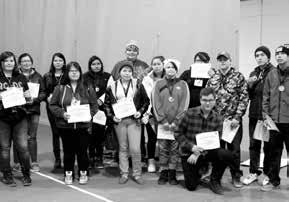
On March 9 and 10, the University of Manitoba hosted the 15th annual Manitoba First Nations Science Fair.
The fair featured projects from students ranging from grades four to 12, and consisted of visual displays, live experiments, and written reports. Students travelled from all over Manitoba to compare projects, and are all from First Nations schools. Each one of the hundreds of students attending were given either a bronze, silver, or gold medal for their work, and four projects will be chosen as winners.
“Science
and the scientific process, and all of the things we’re trying to teach in science, have been part of First Nations culture for as long as they’ve been living on this land” – Rudy Subedar, founder of the Manitoba First Nations Science Fair
The fair, which is presented annually by the Manitoba First Nations Education Resource Centre (MFNERC), hopes to inspire children in First Nations schools to take part in, be inspired by, and enjoy the pursuit of scientific discovery. The program was founded by
Rudy Subedar, who now works for the University of Manitoba in the University 1 transition program, but was the science and technology program manager for MFNERC for 15 years, and founded the First Nations Science Fair in 2002. Subedar believes that the science fair is crucial not only for the sake of individual students’ research, but also for communication and solidarity between schools.
“What this program does is it engages more and more of First Nations students into science and technology, and by hosting the science fair itself, it brings the students together from different communities,”
Subedar told the Manitoban
“So that they by meeting each other, by networking with each other, by seeing each other’s work, they support each other’s interests in science and technology.”
“Listeners of the Earth”
The fair’s theme this year, “Listeners of the Earth,” was meant to inspire students to pursue a project that connected their research to their environment. This practice, Subedar mentioned, is a central component of Indigenous culture.
“Science and the scientific process, and all of the things we’re trying to teach in science, have been part of First Nations culture for as long as they’ve been living on this land,” Subedar noted.
“When you look at all of the technologies they’ve developed over thousands of years to actually survive in, and thrive, in a harsh environment, when you look at the traditional knowledge, and the traditional technologies – the thinking, the skills that went into that, and developed those
processes, is exactly what we’re trying to teach in science classrooms today.”
This sentiment has become especially relevant in recent years, with more and more scientists in Canada using Indigenous oral tradition to supplement their research. Just last year, a study connected ancient DNA collected from sites in Prince Rupert in British Columbia to their descendants living in the Lax Kw'alaams and Metlakatla First Nations in British Columbia. The researcher’s findings – particularly that the Metlakatla First Nations had lived in the area for thousands of years – were not news to people living in the area, as these facts had been the subjects for traditional oral stories passed down through generations of Metlakalta people.
Subedar added that communitybuilding programs like the Manitoba First Nations Science Fair help Indigenous students bridge that connection between “Westernized” school plans and their own cultures.
“So in that way, it’s a really good fit,” said Subedar.
“Even though in our school system, it might not seem that way, because of the western perspective on how we teach science, and what we teach about science and the history of it, this gives the Indigenous students
an opportunity to see that in fact a lot of the knowledge and the traditional practices that existed within their communities and their culture is no different from what it is we teach in a science classroom.”
Subedar added that communitybuilding programs like the science fair help Indigenous students bridge that connection between “Westernized” school plans and their own cultures
First Nations people are particularly underrepresented in the STEM fields in Canada. According to Canada’s 2006 census, only eight per cent of Aboriginal Canadians have a university degree, compared to 23 per cent of non-Aboriginal Canadians. Subedar believes that statistics like these are the obvious result of Canada’s long and dark history of
colonialization and marginalization of First Nations people.
“First Nations people are underrepresented not only in science, but in a lot of places in Canadian society, simply because of systemic racism and the fact that they are a marginalized population that live in the margins of society. Period. That’s it.”
A project with a personal touch
Present at the Manitoba First Nations Science Fair were Kateri and Rochelle – grade 9 and 10 students respectively from St. Theresa Point high school – who were kind enough to explain their project to the Manitoban. Their experiment, which was presented with the help of a display board and an iPad, was on the positive effects of pranmaya yoga exercises on blood pressure levels.
Rochelle said that her favorite part of the project was hosting a “mini yoga class,” and that she even got her family involved.
“I even tried it on my mom,” Rochelle explained, proudly presenting photos of the yoga sessions on the iPad.
“And it worked for her too. After she finished, she said she felt so much better.”
PHOTOS BY MANITOBA
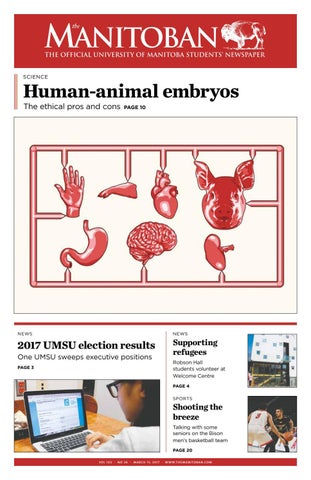
Recent human-pig hybrid embryo raises ethical concerns, hopes for new research
For most of us, the word “chimera” evokes grotesque imagery: in Greek mythology, the chimera was a fire-breathing hybrid of lion, goat, and snake. A recent study attracted worldwide attention when researchers reported the first construction of a human-animal chimera last month. In this context, a chimera refers to a non-human animal embryo that contains human cells. In this particular
situation, the non-human embryo was a pig’s. This interspecies study marked a step forward in a field that promises new sources to grow human organs for transplants.
In this study led by Juan Carlos Ezpisua Belmonte at the Salk Institute and published by the journal Cell, chimeras were generated by injecting human stem cells into developing pig embryos at very early
stages. These human stem cells are unique in their ability to make any tissue from all over the body — in this case they focused on making heart, eye, and pancreatic cells. Pigs were chosen as a suitable host animal because they are relatively similar to humans in organ size and biology. As instructed by ethical guidelines, these chimeric embryos were not allowed to develop past the fetal stage dur-
ing experimentation. However, in a separate study published in Nature, a team of researchers from universities in Japan, the U.K., and the U.S. recently demonstrated functional application when mouse pancreatic cells were grown and harvested in rats and transplanted back into mice. Clinical applications are many years away but in the short-term, chimeras may provide a way to study human organs in a more accurate, living system — something that is very difficult to do in the lab today.
The growth of healthy human tissues in non-human animals provides a potential clinical alternative to donor organs, but it raises its own host of bioethical concerns
The need for organ donation is increasing, as hundreds die every year while on the list of more than 4,500 people waiting for organs in Canada
alone. The growth of healthy human tissues in non-human animals provides a potential clinical alternative to donor organs, but it raises its own host of bioethical concerns.
Due to these bioethical implications, this study was strictly funded by private sources, as public funding for chimera experiments is prohibited in the U.S. and Canada. Indeed, there is a ubiquitous “yuck” response to chimerism, which seems informed by moral intuitions. However, a general sense of ethical revulsion has not served well as a moral compass in the past for cases like blood transfusion and organ transplantation, as well as many other social issues.
Instead, some have argued for our duty to protect human dignity. This does seem to be a necessarily human issue, as interspecies plant and animal breeding are much less controversial. What constitutes a uniquely human quality? Is human dignity based on appearances and intuition or psychological qualities like consciousness and the capacity for moral decisionmaking – emergent properties of a nervous system? These questions dictate whether this study, which combined less than one human cell in 100,000 pig cells, warrants the public horror that it has garnered.
GRAPHIC BY ALDO RIOS
GRAPHIC BY ALDO RIOS
New GoSA photo exhibit centers on U of M faculty strike, student feelings
EMELIA FOURNIER, STAFF
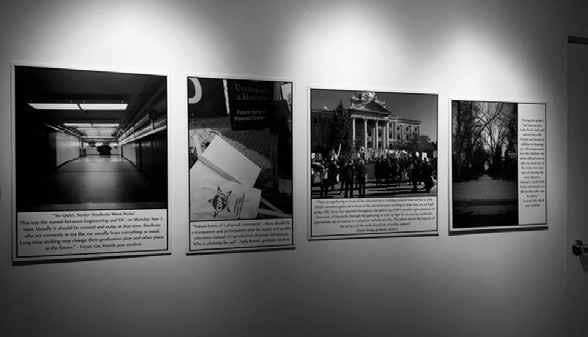
The Gallery of Student Art’s (GoSA) latest exhibit, Our Voice, was showcased from March 6 to 10 to give some U of M students the opportunity to showcase how they were affected by the recent U of M Faculty Association (UMFA) strike through quotations and photography, employing a qualitative research method called photovoice.
All of the photographs collected were taken by students of varying backgrounds from a fourth-year environment and geography course called Applied Qualitative Research: Making a Difference.
Over the course of the strike last November, the drama between UMFA and the U of M administration was largely publicized and dis-
cussed. Some students, on the other hand, often found themselves caught in the middle of the conflict.
The strike went on for three weeks, after negotiations that had been ongoing since the spring broke down. Students were left in an odd state of purgatory while the negotiations between UMFA and the administration were at an impasse. The fall term was extended into the New Year, the winter term started later, and students’ graduation dates were pushed back, affecting travel plans, job opportunities, and many more aspects of students’ lives.
Student photographers captured different student perspectives of the strike. One student captured the serenity accompanied with the suspension of university responsibilities. Another showed a science student attempting to scrape off a “Students Support UMFA” sticker in resistance to the “formal” stance taken by the University of Manitoba Students’
’Toban turntable
VIKINGS are a local electronic pop trio that has been playing both locally and abroad for nearly half a decade. Over the years, the group has played many local mainstay events – Festival du Voyageur, Jazz Fest, and the U of M’s own Frost Fest to name a few – amidst tons of other gigs, and have even found the time to pump out a couple EPs.
Animal Kingdom is the group’s latest offering, and seems to show something of a stylistic shift for the band – perhaps an attempt to move
closer to pop-oriented song structures and dense instrumentation, as opposed to the relatively minimalist, yet propulsive and boisterous electronica of the band’s self-titled release of 2013.
Regrettably, this shift is not working for them.
While each track on Animal Kingdom contains a lush tapestry of synthesizers, trigger pads, and all other requisite electronica-whathave-you that’s applicable, gone are the pulsing, danceable tempos of the group’s past.
The first three tracks on Animal Kingdom are plodding numbers that offer little variation throughout. A solid backbeat on these is either
hidden beneath walls of synthesizer chords, awkwardly paced for dancing, or utterly washed out in the mix by everything else.
It seems as though this is being done with the goal of creating a spacious, atmospheric sound, but it just sounds awkward paired with the band’s party-positive lyrics and wordy, arena hall-style vocals.
That’s really the root of the problem with Animal Kingdom. It’s not that VIKINGS can’t pull off a drastic stylistic shift – in fact, they should be applauded for making the effort alone – but the change feels half-measured here. Most successful pop songs are anchored on grandiose vocal lines and irresistible hooks – two things uncharacteristic of Vikings’ bare bones, concise approach to dance music, and two things virtually missing on Animal Kingdom
All this said, one can’t help wonder where the band will go from Animal Kingdom . Amidst what sounds like a confused half step into new territory, the album’s last track “Queen of the Night” is an absolute winner. The song sports a deep, ominous, and prominent bass synth throughout the verses, and a magnificent, disco-infused hook on the chorus. Here’s hoping the group explores these vibes for a more energetic, vital release down the road.
Union (UMSU) on students’ behalf.
One international student who participated in the project noticed the absence of other international students in the protests. There were images of the picket line, of students themselves, and of the silent, empty campus.
Leanna Fehr took the strike as an opportunity to unwind and reflect, capturing her sense of peacefulness with a shot of her walk to St. John’s absent of people in the middle of the day. Fuyan Gu captured the absence of students differently, with an eerie shot of the empty tunnel between the Engineering complex and University Centre.
One student, Sarah Flattery, offered a photograph of a tipi captioned with the explanation of how it can be used as a metaphor for her solution to the strike. “When all the [tipi] poles stand in a circle leaning on one another they become even stronger and can withhold [sic] any storm
and all are equal. This represents the possibility if all of the university staff, students, unions and associations working together and supporting one another they can accomplish many goals [...] only if they work together,” read her caption.
Our Voice captured a wide range of emotions felt during the strike. Anger, frustration, humour, relaxation, and stress were showcased through the different perspectives. These photographs and captions, while valuable, did not offer much depth in the motivation behind why students did or did not support the strike, and a very limited number of voices were captured.
This is understandable, given the small amount of students involved in the project. However, it would be valuable to have a project with a wider scope to truly capture a faculty strike’s impact on students, as well as the way students perceive this disruption of their lives.
exuberant, yelping vocals front and centre – the song’s lyricism and vocal melody are actually a little repetitive of Joel’s breakout tune “Lightning Bolt” from 2012’s Scrappy Happiness. The reference/self-plagiarism however, can be forgiven, as “Blank Cheque” is indisputably the best song on the record, featuring a phenomenally catchy chorus, rough and passionate guitar leads, and some of Joel’s best one-liners, like “You can’t get higher, than a climate change denier.”
Solidarity marks a heartwarming, collaborative new step for Nova Scotian indie rocker Joel Plaskett. After gaining notoriety and the ability to pursue music full-time within the bands Thrust Hermit and (more recently) the Emergency – while maintaining a steady solo act – Joel’s latest release sees him adopting a mellower sound reminiscent of 60s protest folk and teaming up with his father, Bill Plaskett.
It should be immediately noted that this album contains some great guitar-playing. Opener “Dragonfly” makes this known immediately with some delicate intricate fingerpicking that would sound right at home on a record like Neil Young’s Harvest – that is, until the younger Plaskett’s spastic, twangy guitar solo bursts in to cue the song’s outro.
“Blank Cheque” sports a bluesshuffle sort of rhythm, with Joel’s
Overall, while the talent on Solidarity is very apparent and often well used, this album doesn’t quite have the immediacy to truly blow any minds. Aside from standouts like “Dragonfly,” “Blank Cheque,” and the Bill-led “Help Me Somebody Depression Blues” – which carries a real keepon-truckin’, classic Bob Dylan vibe – most of this album tends to run together, many songs going in one ear and out the other, albeit pleasantly so, with little variation. Plaskett’s latest is not the searing, guitar-centric Canadian indie masterpiece we may want. What Solidarity is, however, is a heartwarming and fun experiment of an album, with overt and understandable chemistry between its two stars. Solidarity leaves one wanting, but curious what future collaborations between the two could bring.
Bill & Joel Plaskett Solidarity 3.5/5
PHOTO BY EMILY FOURNIER
WAG exhibit gives platform to Indigenous artist-boarders
EMELIA FOURNIER, STAFF
R
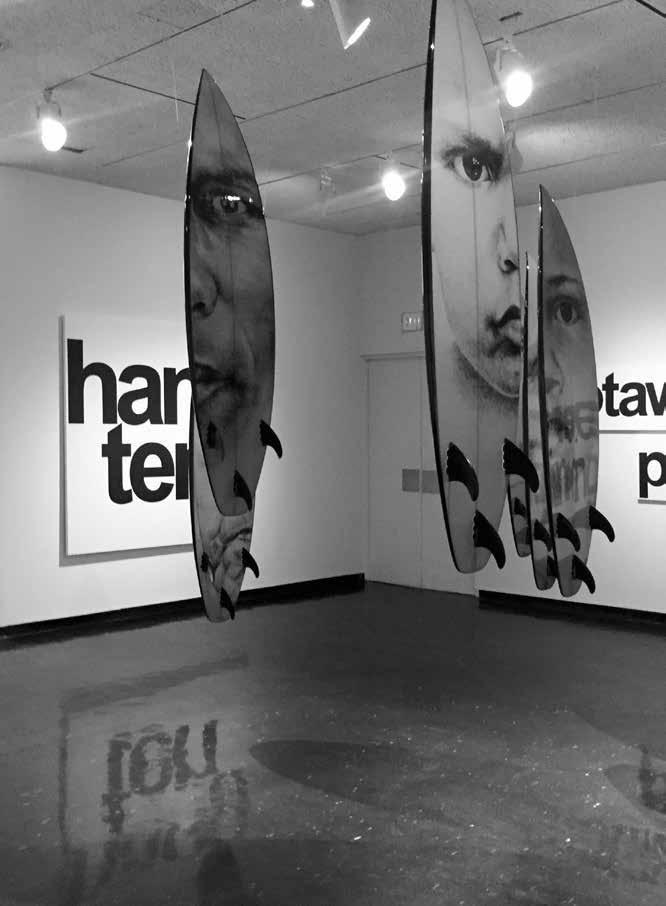
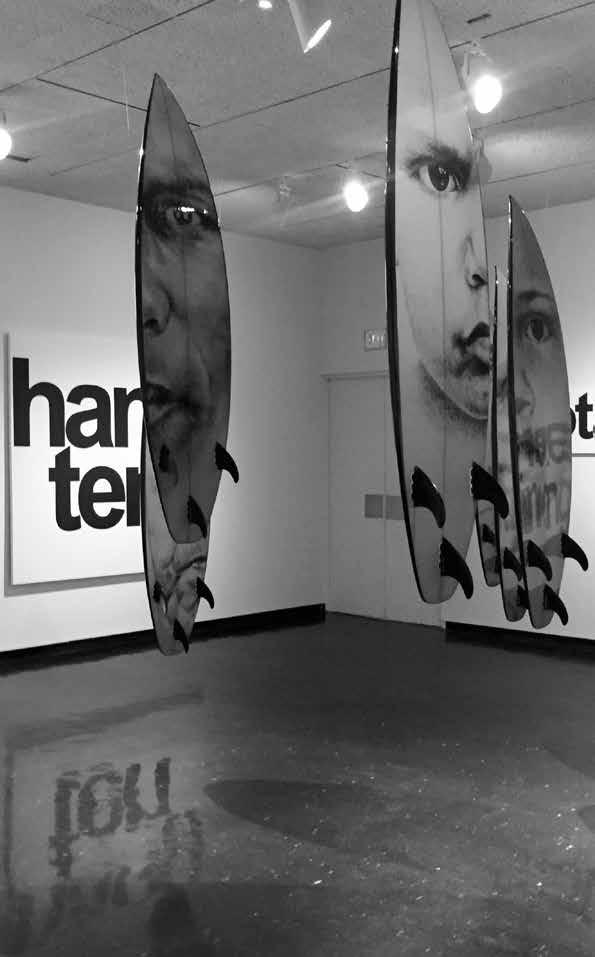
unning through April 2 at the Winnipeg Art Gallery, Boarder X features Indigenous Canadian artists who surf, skate, and snowboard.
Board sports are, at their core, about working with the surrounding environment, be it concrete, ocean, or snow, rather than attempting to control it. Boarder X seeks to highlight the way in which Indigenous individuals can challenge the mostlyCaucasian status quo of board-sports and perform Indigenous conceptualizations of nature through their practice.
The Boarder X exhibit carries themes of land navigation and respecting nature. Entering the exhibit , the viewer’s focus is first drawn to Mason Mashon’s giant photograph of a lone snowboarder on top of imposing, scintillating slopes, the largest piece in the main exhibition room.
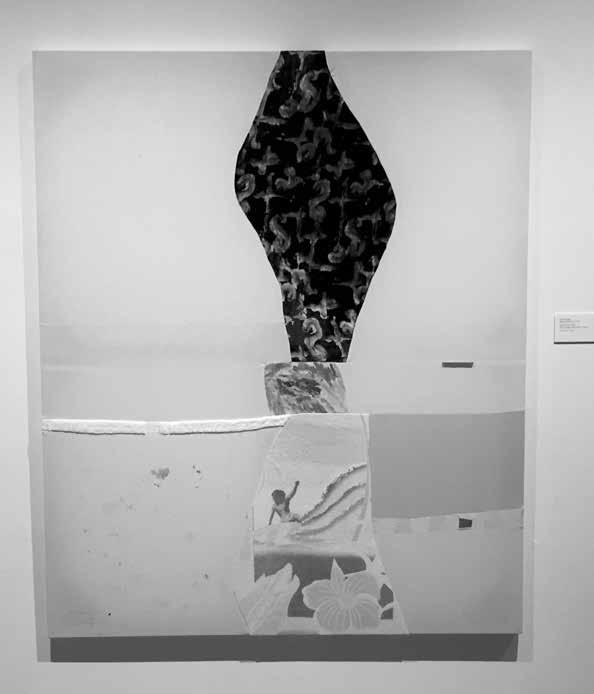
Roger Crait’s colourful, bold painting is also eye-catching. Crait’s lively interpretation of urban life contrasts with the serenity of Mashon’s piece, portraying the sprawl and unbridled dynamism of the city that he skateboards through. Subtle messages like a sign that reads “IMFraud” and “This land is your land” are incorporated to the painting, along with an offensive “Indian” mascot cut out. There is protest and joy in Crait’s work, making the painting a critical but excited rendering of his city.
Meghann O’Brien – a snowboarder and textile artist – has an installation of suspended woven white balls in front of a painting. They
appear to be weightless, suspended like giant snowflakes frozen mid-fall.
Videos on display also showcase the talent of different kinds of boarders navigating their urban or natural elements, as well as exploring their individual histories with their boards.
In description of their works, the artists collected all tie their art-making in with their boarding practices by seeing both mediums as forms of self-expression, acts of perseverance,
and sources of identity creation and confirmation.
While the collection of pieces is fairly small, Boarder X still managed to highlight many different Indigenous boarders’ experiences.
Learn more about Boarder X , and about hours of operation and admission at www.wag.ca
Nic Dyson dead set on Searchlight finals
Local singer/songwriter advances to regional finals in CBC’s musical competition
OLIVIA MICHALCZUK, STAFF
Local singer/songwriter Nic Dyson has made it to the regional finals for CBC Searchlight 2017 competition. The Canada-wide competition is looking across the country for musicians to celebrate Canada’s 150th birthday based on votes cast online for musicians nationwide.
The ultimate winner of CBC Searchlight will receive a lucrative “career booster” package, a commission on an original song for Canada’s 150th, and a two-week songwriting residency with a celebrity mentor, among other amenities. Dyson is one of approximately 230 regional finalists, and one of the top 10 voted in Manitoba.
Dyson’s initial musical inspiration was the headliner for this year’s upcoming Folk Festival – City and Colour.
“He was the one to make me fall in love with the acoustic guitar and honest songwriting,” Dyson told the Manitoban
“Now, it has evolved into anything and everything. From folk favorites like Iron and Wine, the Head and the Heart, and the Paper Kites to Modern Baseball, Citizen, the Front Bottoms, John K. Samson, the Weakerthans, Lights.”
Dyson’s interest in music started at a young age but only came to fruition in recent years. In his last year of high school, Dyson met a group of inspiring and like-minded young individuals at an arts camp. Along with life-changing friendship, they also provided him with inspiration to sing and play music.
“After months of believing it would be the only song I ever wrote, I discovered I was wrong.”
In the summer following his experience at camp, Dyson used music as a type of therapy to aid in some life-altering experiences.
“[The] best part is the respectful silence I sometimes get to experience, when I can feel that everyone in the room is hanging onto every word” – Nic Dyson, Winnipeg singer/songwriter
With time, Dyson decided to share his songs with a select few people that he trusted with his music, something that exposed the most vulnerable parts of himself.
opportunity to play a show in his shop, without having heard him play or any of his music before. Ever since, Dyson has been creating and sharing music at larger and larger venues in the city. His first album release nearly sold out the Park Theatre in 2014, and he has now established himself as an act in Winnipeg’s punk and hardcore scene as well.
silence I sometimes get to experience, when I can feel that everyone in the room is hanging onto every word,” said Dyson.
“There's nothing quite like that, no words to describe it. Worst part is the constant self-doubt that I'll never write another song again, or everyone will suddenly just stop listening, or that I can always do better. I am never satisfied, constantly pushing myself to write and perform better than before.”
“When it was over, I missed them so much I wrote a song about it,” said Dyson.
Kelly Hughes, the former owner of now-defunct local venue/store Aqua Books, gave Dyson the first
Dyson’s shows are genuine, and littered with hard-hitting lyrics, emotional highs and lows, and sweet guitar picking that leaves you feel like you’re floating inches above the ground. Hooked on his every word, the audience is wrapped around his finger and melts in the palm of his hand.
“[The] best part is the respectful
Nic Dyson is celebrating the release of his second full-length album Where We’re From at the Park Theatre on June 16. Tickets are available through the bands, the Park Theatre, and online at www.ticketfly.com
PHOTOS PROVIDED BY EMILY SIKORA
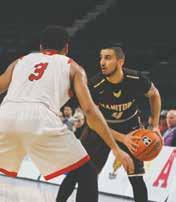
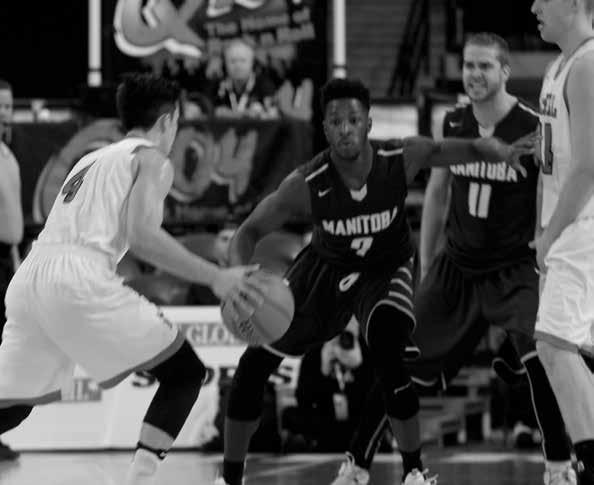
Bisons’ impressive run comes to an end at nationals in Halifax
KELLEN TANIGUCHI, STAFF
This weekend the University of Manitoba men’s basketball team took part in the U Sports Final Eight Championships in Halifax. The Bisons dropped their opening game to the McGill Redmen 63-53 on Thursday, and were sent to the consolation bracket where they fell 92-84 in the semi-finals to the Calgary Dinos on Friday.
Thursday
Justus Alleyn got the Bisons on the scoreboard early with a good layup and jumper to give his team an early 4-0 lead. The Redmen avoided being put in an early hole and answered with a 9-0 run, and didn’t give up the lead for the remainder of the game. Manitoba shot just 31 per cent from the field in the first frame, while McGill found twine on 42 per cent of their looks to give them an 18-10 first quarter lead.
After a difficult opening quarter, the herd came out and shot 57 per cent from the field to claw back into the game. The Bisons were able to spread the ball out more in the second quarter with AJ Basi, Brett Jewell, and Ilarion Bonhomme all scoring five points. McGill guard Jenning Leung put up six of his total 13 points in the second frame to help his team
take a 35-30 heading into halftime.
The third was dominated by defensive play with the Redmen stealing four balls, the Bisons stealing three, and both sides forcing five turnovers. McGill shot a dismal 25 per cent in the quarter, while the Bisons shot the rock a little better at 33 per cent.
McGill outscored Manitoba 11-8 in a quarter dominated in the defensive ends.
This weekend the University of Manitoba men’s basketball team took part in the U Sports Final Eight Championships in Halifax
With McGill leading 56-49 midway through the final quarter, they were able to pull further away by going on a late 7-0 run. The Redmen held their strong lead and went on to win the game 63-53. Francois Bourque netted eight points in the
second half for the Redmen and finished the game with a doubledouble of 13 points and 15 rebounds. Keith Omoerah scored nine points in the second half and finished with 13 points, which was tied with Basi for the team-high.
Friday
Manitoba came out firing on all cylinders and opened the consolation semi-final on an 11-0 run. With the score 17-6, Calgary strung together seven straight points to cut the Bison lead to four points, and clawed back within two points to end of the opening quarter. Alleyn knocked down seven of his team-high 17 points in the opening quarter.
Thomas Cooper converted an early second quarter layup to tie the game for the Dinos, but Manitoba went on a massive 15-0 run to take a 37-22 lead. Calgary responded with a 9-0 run of their own to get back into the game, and ended the half with a 12-2 run to put the Dinos on top 43-42 at the buzzer.
Omoerah and Basi each scored six points for the herd in the second frame, with Omoerah finishing the game with 15 points and Basi finishing with 13, while Jasdeep Gill put home all 10 of his points for Calgary in the frame.
Calgary went on an 8-0 run, and a 10-0 run within the first six minutes of the third to take a commanding 15-point lead. Manitoba didn’t go away and ended the quarter strong by going on a 9-2 run, which cut the Calgary lead to 69-66. Cooper scored 10 of his game-high 30 points in the third and came down with 11 rebounds for the Dinos to finish with a double-double.
Calgary scored the first six points of the fourth quarter to expand their lead to nine points early on. Bonhomme came up big, and netted nine points in the final quarter for Manitoba and finished with a total of 16 in the game. The Dinos grabbed the 92-84 win to end Manitoba’s impressive season.
Bisons come up short at Canada West Final Four
Manitoba can’t overcome Trinity Western in the final, will head to nationals next weekend
RYAN STELTER, STAFF
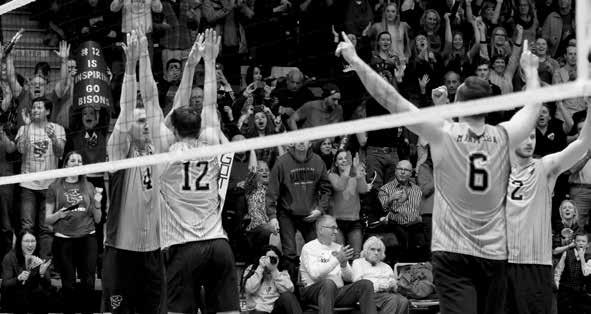
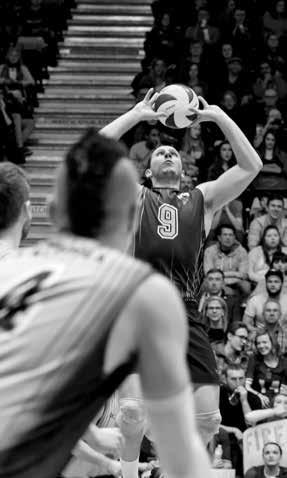
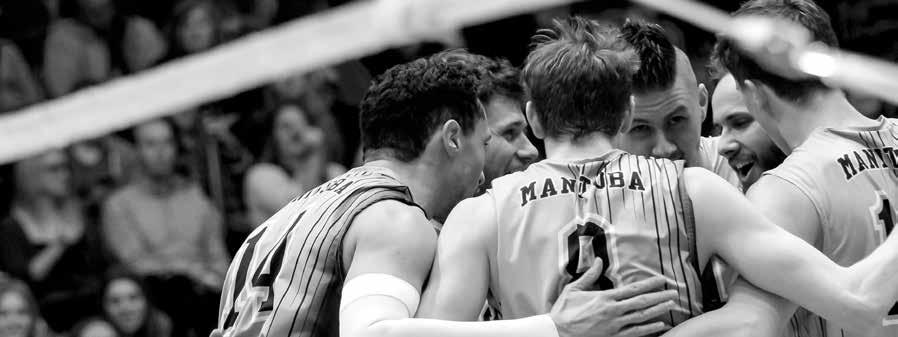
This weekend, the University of Manitoba men’s volleyball team played host to the Canada West Final Four. They started the weekend off with a 3-0 win versus the UBC Thunderbirds in the semi-final, and lost a close battle 3-2 in the final on Saturday against the Trinity Western Spartans.
Semi-final
The Bisons and the Thunderbirds took to the court on Friday night for the first semi-final of the Canada West Final Four. Manitoba came out 3-0 match winners after a competitive game.
A tightly contested first set opened with four missed serves by both teams. The Bisons’ play off the serve was the story of the first set as they made eight service errors and gave up two service aces.
The Bisons managed to take a 16-11 lead into the technical timeout and held that lead to win the opening set 25-22.
In the second set, the Bisons opened the floodgates a little bit, doubling up the Thunderbirds by the technical timeout. Luke Herr came up with three huge digs in a set just before the technical timeout that had
the 2,200 fans at the IGAC roaring.
“We don’t get [that many fans] very often,” left side hitter Evan Jackson said post game. “I’ll give a shout out to our fans because they definitely helped us.”
The Thunderbirds managed to claw their way back in the latter half of the set but the Bisons escaped 25-22 set victors after Cam Fennema botched a serve.
The third set was more of the same with the Bisons leading throughout. Ken Rooney gave the Bisons a 16-11 with a massive kill that sliced through UBC’s block.
Manitoba cruised to a 25-17 third set win to sweep the UBC Thunderbirds and earn a spot in the Canada West final. Devren Dear, who finished with a game-high 13 kills said that they were able to shut down UBC’s attack.
“We knew what their strong points were,” he said. “We knew that their best players are their setter and left side hitter and we were able to key in on them big time. That just shut their offence right down.”
Final
It was a rematch of the final game of the regular season between
the first-ranked Trinity Western Spartans and the second-ranked Bisons for the Canada West final. In the closest way this match could’ve finished, the Spartans won in five sets against the host Bisons.
The first set was a seesaw affair, with the teams exchanging the lead. The Spartans were able to pull ahead late after some service aces, and Canada West Player of the Year Ryan Sclater then hammered home the setwinning kill. Sclater was named the Canada West MVP of the Final Four tournament.
In the second set, it was yet again another back-and-forth affair, with neither team able to go on a big run. The set needed some extra time, with
usual suspect Dear making the score 29-27 to win it after a 44-second rally. Dear finished with a team-best 17 kills and a .130 hitting percentage.
Manitoba was fired up for the third set, jumping out to a 6-1 lead, prompting a Spartan timeout. The herd never looked back from there, fueled by the raucous crowd at the IGAC, the Bisons took the third set 25-16.
In the fourth set, the Spartans turned the tides and dominated the proceedings. The Bisons managed to make it close with some good serving, but the Spartans sent it to a fifth and final set with a 25-20 victory.
The Spartans grabbed hold of the momentum in the fifth set and took it 15-9 to win the Canada West championship.
The Bisons will head off to the University of Alberta for the U Sports volleyball nationals in Edmonton on March 17-19.
PHOTOS BY STAR ROXAS PHOTO BY MIKE STILL
Reid Duke of the Brandon Wheat Kings joins the Golden Knights
JASON PCHAJEK, STAFF
L
ate Monday afternoon the Golden Knights signed the first player in the team’s history, inking forward Reid Duke to a three-year, entry-level deal.
On a somewhat slow news day in the NHL, history was made with very little fanfare around the league. With the final expansion payment clearing, and the Vegas Golden Knights given the greenlight to start making deals on March 1, it took a
few days for them to take that allimportant first step.
Duke, a former Minnesota Wild draft pick back in 2014, has spent the last three years with the Brandon Wheat Kings. He has recorded 88 goals and 180 points over those three seasons, after recording 25 goals and 70 points over the same span of time with the Lethbridge Hurricanes.
“I’m a really good two-way forward,” Duke said in an interview with
Sportsnet. “I like to think of myself as a pass-first player, but also someone that enjoys scoring and using my shot too.”
The Calgary native is one of those hard-working, blue-collar type players that the Golden Knights have mentioned they will be targeting. Knights GM George McPhee noted that the identity of the team will have that edge, saying they want to target guys that have worked hard for the chances they’ve got.
“He faced adversity straight on,” McPhee said discussing the signing.
“We like those players that it hasn’t been easy for them. They become scrappers.”
“I like to think of myself as a passfirst player” – Reid Duke, Vegas Golden Knight forward
An easy assignment for a team that will be built off the dregs of the other 30 teams in the league.
It appears that Duke was a known quantity for the brass in Sin City.
Assistant GM Kelly McCrimmon is the longtime owner of the Wheat Kings, acting as the GM and head coach consistently over the years. He was the one responsible for bringing Duke over from the Hurricanes in 2014, and coached the young forward until this summer when he replaced himself with David Anning.
“I think what’s impressive with Reid is a high skill level and yet a guy that’s able to play a big, strong, heavy game,” McCrimmon said in a statement regarding Duke.
McCrimmon may have the chance to bring another one of his products
into the Vegas fold, as the Golden Knights have the third best odds to land the first-overall pick in the 2017 NHL entry draft. Although many analysts have pegged this year’s draft class as a particularly weak one, with a shallow talent pool, it still appears that Brandon centre Nolan Patrick is set to be taken first.
However, after the last three drafts producing names like Connor McDavid, Auston Matthews, and Aaron Ekblad, anything short of a masterclass will look shallow.
Patrick is no slouch himself, putting up 42 points through just 28 games in an injury-shortened season. Although he’s unlikely to hit the 102 points he reached last season, Patrick is lighting it up heading into the draft.
McPhee and the rest of the Golden Knights front office are not the only ones in the organization who are excited about the prospect of picking the Winnipeg native in the draft.
“I think it’d be pretty cool if Patrick was there with me,” Duke said when asked who he’d like to play with in Vegas. “That would be crazy if we ended up there together.”
For now though, McCrimmon and Duke are the only Wheat Kings alum headed for the strip.
PHOTO PROVIDED BY BRANDON WHEAT KINGS
Bison volleyball programs take home Canada West hardware
Men’s volleyball head coach Garth Pischke, players Ken Rooney and Kearley Abbott take home awards
RYAN STELTER, STAFF
L
ast week, Bison men’s volleyball head coach Garth Pischke was named the Canada West coach of the year for the first time in his 35-year career. Ken Rooney, a fifth-year middle for the men’s volleyball team, took home the Canada West StudentAthlete Community Service award. He is now nominated for the Dale Iwanoczko Student-Athlete award, the national award.
Kearley Abbott of the women’s volleyball team was named the Canada West rookie of the year. The last two times a Bison won the Canada West rookie of the year, they went on to win the national award as well.
Abbott was a stud for the Bisons, leading the Bisons with 247 kills, which was 11th in the Canada West. She was 19th in the Canada West with a .206 hitting percentage and eighth in the conference with 306 points. The Winnipeg native finished second on the team with 187 digs. Abbott played in every single set this season, a big accomplishment for any rookie.
“I think the first half of [the season] was pretty good,” she said. “There’s
always games where you play really amazing, then there are some weeks that aren’t that great. My teammates were really good at helping me through that time.”
“These kids really look up to us, even though we as student-athletes don’t think we’re that big of a deal” – Ken Rooney, middle Bison men’s volleyball team
The jump from high school volleyball to university volleyball took Abbott a little bit to get used to, but the preseason helped her adjust. “The first couple weeks were pretty challenging,” she said. “I just remember swinging as hard as I could and not getting any points. I think after preseason that got me adjusted to how I needed to play.”
Abbott was also named a first year captain for the Bisons, and head coach Jon Hykawy did not see that as part of her game.
“She led more by how she played,” he said. “I never expected her to play that well. She really helped our group this year in just the sense of her compete level. It’s a big honour for Kearley to get that Canada West rookie of the year [award].”
Rooney, who is four years removed from his rookie year, is honoured to have been given the Community Service award.
“I just really enjoy giving back to the community,” the fifth-year middle said. “These things are really important to me. These kids really look up to us, even though we as student athletes don’t think we’re that big of a deal.”
Rooney has been a three-time U Sports Academic All-Canadian, as well as a captain on the Bisons for the past four seasons. He has been a volunteer for Manitoba’s “I Love to Read Month”, Siloam Mission, and a club volleyball coach during his whole five-year career at Manitoba.
For Pischke this is the first time he has been named Canada West Coach of the Year, although he was named Coach of the Year numerous times when Manitoba played in the Great Plains Athletic Conference (GPAC).
“It feels great, this is team of the year, the team of the regular season,” Pischke said. “I felt our team played great this regular season, we played exceptionally well at home. This is just a symbol of how good my staff is and how well the players played.”
PHOTO
Breaking down the NCAA March Madness Tournament
JUSTINE MAMUCUD
Shocks and upsets are the name of the game as the highly anticipated March Madness Tournament will be in full swing this week. The following teams have proved to be powerhouses in the 2016-17 season and they are gunning for the coveted NCAA title.
Kansas Jayhawks
The Jayhawks have been a longstanding institution when it comes to college basketball and this year, they uphold the outstanding reputation that they have built from prior years. Led by Frank Mason III, Kansas has a strong chance of winning the title this year. Heavy reliance on Mason’s talents, however, means they must maximize his time on the floor. The starting point guard is the catalyst for this team’s championship contention this year.
Villanova Wildcats
The defending champions are back and this time they attempt to defend their title against the likes of Kansas and UCLA. This year, the Wildcats have Josh Hart and Kris Jenkins, who can play a variety of positions ranging from shooting guards to power forwards. This means the Wildcats could replicate the “Small Ball Death Squad” that the Golden State Warriors of the NBA sported in their 2015 title-
winning season that was a challenge to defend.
UCLA Bruins
The Bruins are back and gunning for championship contention this year with the arrival of Lonzo Ball. They are known for their seemingly loaded backcourt with returning players such as Bryce Alford and Isaac Hamilton who appear to be allergic to injuries. UCLA could make a serious run with the addition of the best point guard recruit in the country, Ball. If the Bruins could overcome their defensive woes, this UCLA team could be the undoing of the Final Four heading into the championship.
Gonzaga Bulldogs
With the loss of their top scorers from last season, most fans have counted Gonzaga as a bracket risk. Their one light of hope however, lies in the return of their premier frontcourt in Przemek Karnowski. The sevenfoot-one Polish centre has returned from injury along with a handful of quality players like Josh Perkins and Silas Melson. With the sheer size of quality players on their rosters, a team like Gonzaga can be playing two games simultaneously. It will be a challenge defending against the Bulldogs this year as they have at least two solid players who can play in each position.
Oregon Ducks
This year, Oregon finally have their ducks in a row, as they easily establish themselves as one of the tournaments elite shot blocking teams. Led by their brand of the twin towers in Jordan Bell and Chris Boucher, the duo forms a formidable wall in the paint for the Ducks. If the Ducks could supplement their elite shot blocking with perimeter defense, this lineup could make a deep run in the brackets even against teams that rely heavily on guard play.
North Carolina Tar Heels
The Tar Heels are back this year sporting the same high level of intensity on the offensive glass this year with players like Kennedy Meeks and Isaiah Hicks who have developed as monsters on the offensive glass. Both players are top 80 in the nation for offensive boards and lead North Carolina in rebounds. With their deep arsenal of weapons in the paint, North Carolina rivals even the Ducks as the undisputed kings of the paint in the coming weeks.
Arizona Wildcats
This year, the Wildcats appear to be weaker in the paint with the departure of last season’s talented frontcourt. To supplement this, the Wildcats acquired a massive recruit-
ment of three five-star quality freshmen along with a transfer in Keanu Pinder. Likened to the Gonzaga Bulldogs, the Wildcats can field a soccer team filled with quality players, which has the potential to make a deep run in the tournament this year.
The Cardinals, as their name might suggest, are one of the peskiest teams in this tournament
Kentucky Wildcats
The Wildcats are perhaps the most offensively creative team of this tournament. Kentucky’s offence runs on the “dribble-drive” offense developed by Vance Walberg that guarantees a basket in every possession if poorly defended. Led by one of the highly sought-after NBA draft picks, Malik Monk, Kentucky simply have their guards dribble to the basket for an easy layup, or dish out the ball to the open man if the defense responds. With their “small ball” like forwards who stand at six-foot-nine who enjoy standing at the perimeter shooting threes, this lineup becomes a nightmare to defend.
Baylor Bears
Baylor is another example of a team that refuses to give teams a chance in the paint. With Johnathan Motley leading the Bears with his outstanding numbers, the Bears’ main highlight is their ability to grab offensive boards. In the past couple of seasons, Baylor’s rebound game has been top of the pack. If they can stay healthy, this squad can prove to be a solid contender this year despite their lacking perimeter defense.
Louisville Cardinals
The Cardinals, as their name might suggest, are one of the peskiest teams in this tournament. Louisville takes pride in their defense. The Cardinals average 18.6 seconds per defensive possession, ranked secondoverall, which results in a buffet of turnovers and bad shots for opposing teams. One of the troubles this team runs into is its lack of veterans on the floor. With its young core of players, this squad is prone to stumble against other giants within the tournament who have seasons and seasons of experience on the big stage.
GRAPHIC BY ALDO RIOS
Homegrown herd a success on the basketball court
How local talent has turned the men’s basketball program into a consistent Canada West contender
MIKE STILL, VOLUNTEER STAFF
W
hen Kirby Schepp took over head coaching duties of the Manitoba Bison men’s basketball team for the 2009-10 season, he was tasked with guiding a program that hadn’t seen the postseason since 2004.
It didn’t take long for the former standout coach at Sturgeon Heights to right the ship, as he guided the Bisons to the playoffs in just his second year at the helm, doing so with primarily local talent – players that he’d had the opportunity to either coach or see develop during or after their high school years.
Through his first eight seasons, Schepp has led the herd to the playoffs five times and he continues to prove that developing homegrown talent and trusting the process can lead to success.
“It’s part of our philosophy that the core of our team is going to be local guys, and we’ll continue to do that. We’ve been fortunate in the last little while to be able to recruit some of the best local guys,” Schepp said.
“In some ways I think it speaks to the quality of play in Manitoba and the quality of the development system
of the high schools and the provincial teams and elite development systems that have been really, really good, especially in the last number of years.”
Local players such as Jonar Huertas, Kevin Oliver, and more recently Amir Ali and Wyatt Anders have all left their mark on the program in recent years, due largely to the fact that Schepp brought out the best in their games. He believed in them, knowing they would fit a role on his team, and as the years went by, each individual’s development increased.
This 2016-17 roster was no different, with fifth-years AJ Basi, Brett Jewell, and Keith Omoerah all local high school products, as well as fourth-years Joey Nitychoruk, Justus Alleyn, and Malik Irwin. Rookie James Wagner from John Taylor also fits the bill.
Breaking down the local talent
The assortment of Winnipeg high school graduates came to Manitoba under different circumstances. Basi and Jewell, for example, weren’t
highly recruited. Schepp knew what they could do though, and a few years later, Basi – a Sturgeon Heights grad – became one of the best shooters in the conference and a two-time cocaptain. Jewell – a John Taylor alum – developed his post-up game and became a tough matchup inside.
“Kirby’s known my family for a very long time, and so my relationship with him has been good for a very long time. That’s sort of the reason why I ended up going to the U of M was because of my relationship with him,” Basi said.
For Omoerah and Nitychoruk, patience was the key. A standout from Grant Park, the former had a stint with the herd early in his university career, but lacked the maturity to balance school and athletics. The latter was highly recruited coming out of St. Paul’s, but chose to attend Lakehead instead, earning a trip to nationals with the Thunderwolves along the way.
Fast forward to 2015, and a more mature Omoerah and Nitychoruk both found themselves a spot on Schepp’s roster, providing invaluable
leadership and strong two-way play.
“I wanted to play for the U of M, I wanted to play for coach Kirby Schepp,” Nitychoruk told the Manitoban in 2015, shortly after returning home from Lakehead.
“It’s part of our philosophy that the core of our team is going to be local guys, and we’ll continue to do that” – Kirby Schepp, head coach, men’s basketball
“I like being in my community, I love my city, I love everything that has to do with Winnipeg, so I wanted to really support it here with the U of M program.”
Alleyn and Irwin were both highly touted recruits coming out of St. Paul’s in 2013-14, while Wagner was arguably the most sought-after prospect in the province this past year coming out of John Taylor Collegiate. All three chose to stay home, and have reaped the benefits. This season for example, Alleyn was named a Canada West All-Star, while Wagner was named to the All-Rookie Team.
The proof that honing in on local talent has been evident, specifically over the past two years. In 2015-16, the herd made it all the way to the Canada West Final Four, and this past season, they earned a trip to nationals for the first time since 1986.
For Schepp, it’s all about trusting the process.
“We’ve been fortunate that those guys that have stayed have bought in. Their work ethic has been outstanding and we’ve managed to keep that culture up and keep getting better each year,” he said.
PHOTO BY MIKE STILL
AJ and Brett: Reflecting on a memorable five years
Q & A with two cornerstones for the men’s basketball program
MIKE STILL, VOLUNTEER STAFF
Guard AJ Basi and post Brett Jewell have left a permanent impression on the Bison men’s basketball team over the past five years, and have been fixtures in the starting lineup.
This past season, the two local products helped lead the herd back to nationals for the first time since 1985. While the end result wasn’t what they would’ve hoped, the journey itself was just as fun. The Manitoban sat down and talked to both players; they shared about their time playing for Manitoba.
THE MANITOBAN: What was it like to finish your career off at nationals with coach Schepp, someone you both know quite well?
BRETT: I wasn’t really highly recruited out of high school, and I was going to go to U of M anyways for my education and that’s when I met with Kirby. Kirby saw something in me, I gave it a shot and five years later, to still have a role and on a national team, is pretty cool.
M: What was your nationals experience like?
AJ: It’s an unreal experience to be a part of, and it’s an honour just to
be here and to be recognized as one of the best teams in the country. Definitely years ago this would have been a far-fetched dream. I think the fact that we took steps every single year to get closer and closer to climbing the situation and to be able to get to nationals and get a Can West silver medal, it’s been a blessing of a last year and it’s really capped off the journey.
B: Just getting here, and realizing the teams that are here, we can compete with them, and now the younger guys travelling can get to see what the competition level is like at nationals, and kind of realizing that we belong here. It’s going to raise the program up.
M: What would you say is the biggest development you made as a player during your university career?
AJ: I think the biggest development I made was maturing over my time here, and becoming a leader. That was something that wasn’t probably expected of me in my earlier years. Coach talked to me in my third year and fourth year and started pushing me to take on more of a leadership role and lead by example for younger guys. Not even basketball-skill related, coach sort of challenged me and helped me develop as a person and as a leader.
M: Aside from nationals, what has stood out for you during your five years with Manitoba?
AJ: I think the relationships and sort of the culture that we formed around this team and around this program now, is really starting to stick out. I thought Coach has done a phenomenal job ever since he stepped foot at the U of M in making it sort of a local core and then build up from there. I think the character of guys and the people that he brought together on the team kind of sticks out.
B: I just remember the playoff games and every year we sort of took a step forward. The last two seasons
together ended in Calgary and to go to Calgary this year and beat them in the semi-finals was pretty special. We started to see the kind of team we were and the kind of team we could be and sort of coming in to our potential.