

Craig aD olphe, staff

Alist of candidates for the 2015 UMSU General Election has been finalized. The deadline for applications passed on Friday, Feb. 13 at 5 p.m.
Two slates, previously reported by the Manitoban, have been confirmed as the only two in the race for executive seats. The names of the slates have also been confirmed: Clear Slate and Your UMSU.
Clear Slate consists of Spencer Yasui running for president; women’s representative Reanna Blair running for vice-president external; Zach Leclerc running for vice-president internal; Bénédicte LeMaître run-
ning for vice-president student services; and Jesse Greenberg running for vice-president advocacy.
Shawn Singh is registered as campaign manager for the Clear Slate.
Your UMSU is composed of outgoing vice-president internal Jeremiah Kopp running for president; international students’ representative Astitwa Thapa running for vice-president external; Christopher Bélanger running for vice-president external; Jessica Morrison running for vice-president student services; and Rebecca Kunzman running to retain her position as vice-president advocacy.
The registered campaign manager for Your UMSU is Matt Carvell, who was appointed by UMSU as the chair for UMSU Council over the course of the 2014-15 executive year. Candidates for UMSU’s five community representative positions were also finalized, including three that had not been identified in a preliminary list of candidates reported by the Manitoban
Three candidates were confirmed for students living with disabilities representative: Alan Bridgeman; Daniel Tingskou; and current representative Andrew Fenwick, who was elected to the then-vacant posi-
tion by UMSU Council at a meeting in October.
Two candidates were confirmed in the race for women’s representative: Alana Robert and Fariba Shakibani.
Only one candidate applied for each of the remaining three community representative positions. Running unopposed means that candidates will be required to collect more votes in favour of than against in order to be elected.
Current Aboriginal students’ representative Will Landon is running to retain his seat after having been elected by UMSU Council to the then-vacant position at a meeting
in October. Charles Kimball will be running for LGBTTQ* representative, and Mujtaba Abdul Jalil will be running for international students’ representative.
The campaigning period for the election officially opened on Feb. 23 at 9 a.m. and ends on March 6. The voting period is held from March 4 to 6 at polling stations to be available throughout the university.
Visit the official UMSU General Election website, operated by the Chief Returning Officer, at umsu. ca/elections for more information.
Craig aD olphe, staff
T
he University of Manitoba Graduate Students’ Association (UMGSA) closed nominations for their annual elections on Feb. 13 – the same date as the closing of nominations for the UMSU General Election.
The UMGSA includes over 3,000 U of M graduate students, from the Fort Garry and Bannatyne campuses, as well as some students from the Université de Saint-Boniface.
Two candidates submitted nomination papers to run for president of the UMGSA. Junhui Gong and current vice-president academic Kristjan Mann, are both running to replace outgoing president Laura Rempel.
Aida Adlimoghaddam and David Terrazas Gonzalez are both running for vice-president academic – the only
contested vice-president position.
The other three vice-president positions to be filled in the election each feature a single candidate:
Enoch A-iyeh for vice-president external, Valery Agbor for vicepresident internal, and Beibei Lu for vice-president marketing and events. Both Agbor and Lu are looking to retain their current positions on the executive.
Four candidates are running to fill the three U of M senate seats reserved for UMGSA representatives: Gustavo Mejicanos, Kathryn Marcynuk, Gagan Sidhu, and Richard From. From is the only incumbent.
The senate is the senior academic governing body, responsible for all academic matters at the university
that do not fall under the scope of the U of M Board of Governors.
The UMGSA elects three students to sit on the senate as part of the annual UMGSA elections. This differs from undergraduate students, who are represented on the senate by the UMSU president and 25 other student representatives directly elected through their faculty councils.
The CRO has confirmed two slates in the election. Mann, Agbor, Lu, Gonzalez, A-iyeh, From, and Sidhu are running together. Gong, Adlimoghaddam, and Mejicanos are running together as an incomplete slate. Marcynuk will be running independently.
The position of vice-president health sciences, currently held by Melissa Rabb, is a position reserved
on the UMGSA executive for the president of the Health Sciences Graduate Students’ Association (HSGSA). Members of the UMGSA vote to elect their own HSGSA executive each year, including for president, vice-president internal, vice-president external, vice-president academic, vice-president marking and events, and vice-president Saint-Boniface.
The nomination period closed on Feb. 20 at 4 p.m. for the HSGSA election.
Colin Graydon was the only candidate nominated for the position of HSGSA president.
Other candidates include Chuwunonso Onyilagha for vicepresident academic, Deepak Upreti for vice-president internal, Crystal
Acosta for vice-president St. Boniface, Michelle Perner for vice-president marketing and events, and Hadeesha Piyadasa for a seat on the senate on behalf of HSGSA.
Marc-Antoine De La Vega and Mohammed Fazle Rabbi are competing for the vice-president external position – the HSGSA’s only contested position.
Only health sciences graduate students may run or vote in HSGSA elections. In last year’s HSGSA election all of the positions went uncontested.
Online voting for the UMGSA and HSGSA executives will take place March 16-18.
Craig aD olphe, staff

Members of Winnipeg’s Muslim community hosted a candlelight vigil at the University of Manitoba on Friday, Feb. 13 to pay tribute to victims of a triple homicide – the three Muslim students who were killed in the University of North Carolina at Chapel Hill earlier this month.
Craig Hicks shot and killed Yusor Mohammad Abu-Salha, 21; her husband, Deah Barakat, 23; and her sister, Razan Mohammad Abu-Salha, 19 in the victims’ apartment on Feb. 10.
Chapel Hill police have reported that the incident was the result of a parking dispute. Friends and family of the victims have called that determination premature and suggest that
the shooting was motivated by religious hatred.
Suzanne Barakat, sister of Deah Barakat, has been speaking out to the media, arguing that there was more to the attack than an argument between neighbours.
“This is a pattern, this is not an isolated incident,” Barakat said in an interview on MSNBC. “This was premeditated murder. Someone came into my brother’s home when they were unarmed, murdered them by shooting bullets into their heads, execution-style. You don’t do that over a parking dispute.”
President Barack Obama released a statement on Feb. 13 in response to the shooting, offering his condo-
lences to the victims’ loved ones, saying that, “No one in the United States of America should ever be targeted because of who they are, what they look like, or how they worship.”
Local support
Following the incident, there has seen an outpouring of support for the slain students through rallies and charitable fundraising.
The candlelight vigil hosted at the U of M began with a series of speeches, ending with a moment of silence, held at the Fireside Lounge in University Centre. Over 100 people were in attendance, including students and non-students of all ages.
Rami Elzayat, one of the event organizers, said it was important that the event be held on campus.
“The people that died were students so we felt that it’s only fair and proper to have it on campus,” said Elzayat. “They’re students, so students will sympathize more.”
Speakers at the event included U of M president David Barnard; Zeeshan Zamir, president of the U of M Muslim Student Association; Jeremiah Kopp, UMSU vice-president internal; Lynda Trono, United
Church minister and chair of the education committee of the Manitoba Multifaith Council; Shaden Abusaleh, U of M global political economy student; and Manitoba Grade 12 student Aboudul qudus Abusaleh.
Shahzad Musaddiq, U of M alumnus and director of the Canadian Muslim Leadership Institute, served as MC for the event.
Musaddiq said that the Muslim Student Association provided a lot of support in coordinating the event, but that the organizing work represented a broader effort from Winnipeg’s Muslim community.
“This is kind of unique because it’s not really a group formally. We all represent different organizations in the city.
“So it’s sort of a coming together of a lot of different groups.”
Maryam Bezzahou, Association Etudiante de l’Université de SaintBoniface representative of student life, was in attendance at the event. She said that she hoped the event could raise awareness of violence towards the Muslim community.
“Their deaths are tragic, but it happens all over the world. So we’re
here not only to support their work and to honour them, but also to raise awareness for all those other people: all those other Deahs, and Yusors, and Razans all over the world that are neglected, that we never get to hear about because of the media and lack of coverage.
“It’s just to come show support, show humanity, because the world lacks humanity nowadays.”
Ifrah Zohair, a second-year student in the faculty of science, also expressed concern about what he called a lack of media coverage in the days following the murders.
“When something like this happens, when Muslims are on the other side, it’s just not represented enough so people don’t know about it. And I think that’s what we wanted to do, create awareness, but then also come together and celebrate their lives and join together in peace to kind of say we’re with you and we’re sorry for their loss for their families.
“Even though what happened was in North Carolina, it was in the United States, it still affects us because in Islam we’re all brothers and sisters even if we don’t know each other.”
Proposal garners mixed reaction from student leaders
e than Ca B el, staff
W
hile required science and humanities courses are customary for undergraduate students across the country, the University of Winnipeg Students’ Association (UWSA) seeks to add another requirement for U of W students – a three credit hour indigenous studies course.
“We want to create something that lets students take a course they’re actually organically interested in but that also focuses on a particular perspective that is largely ignored in Canadian society,” said Rorie Mcleod Arnould, president of the UWSA.
“What we’re doing here is the goal of any undergraduate university degree, which is to give people the broad tools they need to succeed, not only in an environment of higher learning, but also as leaders in their communities.”
The UWSA motion, which will be considered by the University of Winnipeg senate over the next two months, would require all U of W undergraduate students to take a three credit hour indigenous studies course in order to graduate.
If the senate approves the UWSA motion, the university will have
a year to refine a course list before the requirement is implemented in September, 2016. The requirement would only apply to new students enrolled at the U of W as of that date and not be applied retroactively to any current U of W undergraduate students.
As part of their preparation for the motion, the UWSA analyzed the university’s course calendar and found over 100 courses that they believe can fulfill the new requirement.
Mcleod Arnould told the Manitoban that the UWSA considers four general themes as falling within the indigenous studies field. These include the indigenous lived experience in Canada, indigenous history, indigenous culture, and indigenous epistemology, which deals with spirituality and the belief systems of Canada’s indigenous peoples.
The motion, which was drafted with the help of the University of Winnipeg Aboriginal Students’ Council, has received broad support from senior administration and faculty at the U of W, according to Mcleod Arnould. However, not everyone is convinced that an indigenous studies requirement will
reap the kind of benefits the UWSA imagines.
Will Landon, UMSU Aboriginal students’ representative, told the Manitoban that one three credit hour course is not enough to address the systemic absence of indigenous perspectives in a plethora of academic disciplines.
“It only scratches the surface of where indigenous people are coming from,” Landon said.
Landon told the Manitoban that there are two primary issues with the requirement. First, it forces students to take a course that they may not be interested in, which can be counterproductive. Second, the requirement cannot be a substitute for the incorporation of indigenous perspectives in the education system more generally.
“One thing that can happen, is if people are going to be experts in their field, they can also become somewhat of an expert in the indigenous side of what they’re working on,” he said, adding that primary and secondary school are the time to introduce students to general indigenous perspectives.
“The secondary system should be our main focus because that can hit
more people. If we’re hitting universities we’re only hitting a small percentage of students who go on that far because colleges are starting to become more prominent now as opposed to the university level.”
The primary and secondary school curriculum has been a hot topic in Manitoba since a report late last year by the Council of Ministers of Education ranked the province last in the country for mathematics, science, and literacy.
According to Manitoba Progressive Conservative education critic Wayne Ewasko, the social studies and history curriculum also needs to be improved in the wake of the report, particularly in order to teach students about indigenous history before they reach the post-secondary level.
While supportive of the UWSA motion, Ewasko argues that much of the supplemental indigenous curriculum that has already been developed has not been implemented in Manitoba primary and secondary schools.
For his part, Mcleod Arnould maintains that the indigenous course requirement complements necessary education on indigenous perspectives at the primary and secondary school levels.
“A course that will be offered in a high school is going to be that rather generic, holistic course. It’s the nature of education at the high school level, whereas this gives students the ability to branch off, to take something they are genuinely interested in, and hopefully spark their interest in the indigenous perspective on that topic,” he said.
“This requirement is one of the ways that we [ . . . ] look at the larger social condition of Winnipeg, and, more broadly speaking, the social conditions of Canada, and say, ‘what can we do here that would help push back against racism and create more welcoming, peaceful communities?’”
“I think the curriculum is there already, I think the teachers are teaching it and doing a good job with it [but] I think there is supplementary material that has been developed and there’s been tons of time put in by experts and grassroots, local, indigenous people, and I don’t believe the minister’s department is putting the emphasis on it,” Ewasko said.
University of Manitoba strategically plans to decolonize, emphasize indigenous success
Dana h atherly, staff; with files from Bushra tahir, staff
In light of the University of Manitoba’s five-year strategic plan, the university community gathered at the U of M earlier this month to learn about various approaches for “decolonizing” post-secondary institutions from across the nation.
The plan, titled Taking Our Place: University of Manitoba Strategic Plan 2015-2020, exclusively prioritizes indigenous achievement and ways of knowing at the province’s only major research university.
About 15 per cent of Manitoba’s population is indigenous – one of the highest rates in Canada.
That number is growing.
Predictions based on Statistics Canada Census data indicate that indigenous people will compromise nearly 19 per cent of the province’s population by 2026.
In a statement following a Maclean’s magazine article on racism in Winnipeg, U of M president David Barnard commented on the need for improved efforts to decolonize the university.
“We’re trying to work with indigenous leaders to try to build a welcoming environment on campus and to make the indigenous reality in this province a larger part of what’s visible at the University of Manitoba,” Barnard said.
Established almost 140 years ago under the passage of an act that described the university’s purpose as one of “raising the standard of higher education in the province, and of enabling all denominations and classes to obtain academical degrees.”
According to Barnard, the U of M remains committed to fulfilling that mandate.
Deborah Young, the executive lead of indigenous achievement at the U of M, told the Manitoban that she is excited to promote indigenous learning at the university.
“Not only is indigenous achievement a standalone priority, but it is woven throughout all of the priority areas, including an acknowledgement statement at the beginning, affirming the university’s commitment to advancing reconciliation efforts, connecting to indigenous students, staff, and academics, and forging new relationships with partners and communities,” said Young.
Since the summer, Young told the Manitoban in an email interview, she has organized planning sessions with elders, indigenous support staff, academics, and non-indigenous allies.
For the first time, Young said, the indigenous community came together to build on the existing foundation of support at the university, ranging from indigenous recruitment and student support services to the hiring of indigenous scholars, working to advance indigenous ways of knowing.
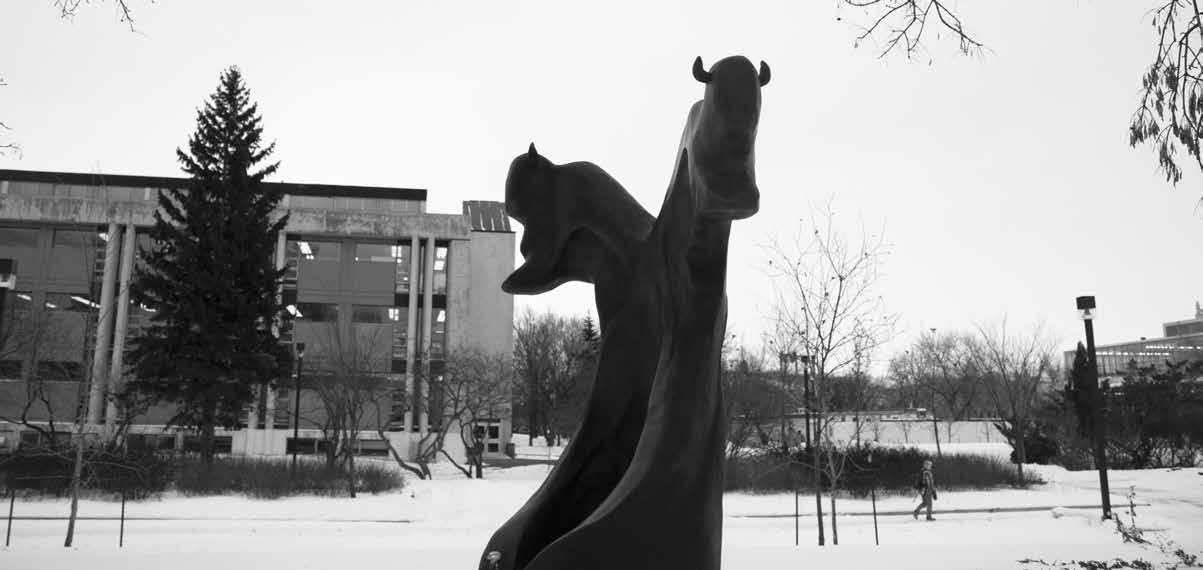
The 2009-2014 Strategic Planning Framework was intended to guide decision-making, providing some direction and a degree of specificity, about programs, structures, and the allocation of resources and energy at the University of Manitoba.
Building on the backbone of the former five-year plan, the 2015-2020 strategic plan signals strong commitment to indigenous achievement as a separate, but integral, priority in the strategic plan.
University senators were generally supportive of the increased focus on, and commitment to, indigenous achievement indicated throughout the draft of the plan. Senior administration at the U of M will be held accountable, ensuring that priorities, goals, and supporting actions of the strategic plan are achieved and that operational plans are developed in pursuit of the common goal towards indigenous achievement.
As the first priority for implementing the plan, the university will develop a framework to ensure that its priorities are implemented. The framework will ensure that university administration is accountable to the board of governors.
So far, some baseline targets have been established at the U of M, such as those for indigenous enrolment. Now, the university is tasked with developing an assessment framework that encompasses both the qualitative and quantitative dimensions to measure progress on priorities—such as indigenous achievement—and be accountable to the board of governors, the senate, and the university community.
Some skeptical senators
A draft of the 2015-2020 Strategic Plan was provided to the senate for comment in the fall.
According to the senate minutes, the draft generated a significant amount of thoughtful feedback at the senate meeting. As part of a broader consultative process, Joanne Keselman, vice-president (academic) and provost, said that the strategic planning committee took that into account when developing the final draft of the strategic plan.
“We are losing our language [ . . . ] Are we doing well?” –Robina Thomas (Qwul’sih’yah’maht), University of Victoria director of indigenous academic and community engagement
With respect to equity and diversity, Tina Mai Chen, department head of history, argued at the senate meeting that gender and indigenous issues overshadowed other important issues in the strategy plan.
Chen proposed that the document clearly outline the university’s commitment to equity and diversity in broader terms. She cautioned that, given the current fiscal climate, any decisions about what constitutes an appropriate range of academic programs offered at the university should be based on academic priorities. With the university’s international engagement in mind, Chen suggested supporting actions that might promote or foster knowledge of other parts of the world.
Several members also expressed
concern that, with a focus on quantitative metrics and those tied to revenue and research dollars, research in basic sciences and humanities may not be measured using quantifiable means.
Young said that measured outcomes and results are significant indicators of success.
“As we are developing our implementation plans both for the Strategic Enrollment Management and Taking Our Places, there will be clear activities identified, along with timelines and indicators of success,” she said.
“I am also working on developing a new Aboriginal Self-Declaration Strategy to help increase more awareness on the importance of self-declaration,” said Young, adding that obtaining reliable data about those of indigenous identity is key for relevant assessment.
Many universities and colleges have put indigenous education at the forefront of their plans.
At the recent Decolonizing the University workshop at the U of M, speakers presented about building new relations and working towards reconciliation and coordination to support them, affirming that decolonization is a mindful process that needs to be reflected in secondary school and university curricula.
Robina Thomas (Qwul’sih’yah’maht), director of indigenous academic and community engagement at the University of Victoria, said that the university she represented introduced programs for promulgating indigenous norms and rights, including an elders’ lounge, drum groups, counselling services, an office of indigenous affairs, academic and community engagement, and hiring of faculty members.
“We are losing our language,” Thomas said, adding that the loss of traditional languages should prompt significant reflection.
Linc Kesler, associate professor of First Nations studies and English at the University of British Columbia, suggested the need for an exchange of ideas and information from within and between communities and institutions, derived from a long history of relations between people, places, and the land.
Kesler said the indigenous connection must be made to “train another generation of students, experts, and practitioners who look back on this basic knowledge about our country, culture, and history.”
Cynthia Wesley-Esquimaux, viceprovost of Aboriginal initiatives at Lakehead University in Thunder Bay, said that comprehensive dialogue to decolonize universities must be inclusive and socially justifiable; identifying existing barriers and boundaries, and incorporating indigenous knowledge and world views to make visible commitments to inclusion and change.
“Indigenous people are duelling with academies on one hand, and duelling with the dire results of the imposition of artificial communities on the other hand,” WesleyEsquimaux said.
Young said that, although more needs to be done at the university, she believes that “as an academic institution, we are certainly heading in the right direction.
“As a Cree woman and a former university student, although there is much work that still needs to be done, it truly delights me to see postsecondary institutions stepping up their efforts on moving indigenous achievement forward.”
eM ily ZaryC hta, staff
S
tudents with disabilities at the University of Manitoba are pushing for accessibility upgrades for several campus facilities and services.
Andrew Fenwick, UMSU representative for students living with disabilities, told the Manitoban that several campus facilities are outdated and must be brought up to current standards.
“Lots of the people that are in charge don’t see things the same way, so it’s kind of hard to figure out how to make things better for this group of people they don’t belong to,” Fenwick said, adding that his proposals for change have received positive reaction from the university so far.
“It’s really awesome because they are really open to all of the things I’ve brought up.”
Fenwick explained that some of the ramps around campus have a slope of 10 or 13 per cent when the standard for new buildings in Manitoba is eight per cent or lower.
According to the 2010 City of Winnipeg Accessibility Design Standards, the maximum allowable ramp slope in a retrofit situation is just over eight per cent. The standard outlined by the city is between five and 6.7 per cent, with the ideal slope being 20 inches in length for every one inch in height.
Fenwick told the Manitoban that there is a plan to extend a ramp over the summer that has an 11.5 per cent incline.
However, these are not the only issues for students with disabilities on campus.
While Fenwick is impressed with the accessibility of the new Active Living Centre gym, which will be open to students this week after several delays, he is currently fighting for the ability of quadriplegic students to opt out of the $75 sports and recreation fee levied on all students to pay for the Active Living Centre.
Rocco Scarcella, president of the Beyond Abilities student group at the University of Manitoba, told the Manitoban that the U of M is accessible to students with disabilities, but there is room for a great deal of improvement.
“When I think about accessibility I think about breaking down barriers and making the university more inclusive for all students,” he said.
“The university does provide for the opportunity to make the cam-

pus more accessible, and that’s primarily done by students, like myself and others.”
Scarcella proposed an UMSU motion with respect to accessible voting ballots for the UMSU General Election, which would mean large print and braille ballots for blind and partially sighted students. The motion passed unanimously on Feb. 9.
“Participating in the democratic process will now be accessible for all students.”
University response
Accessibility comes in many forms and services: hearing, learning, injury-related, mental health, physical, visual, and temporary (like breaks or strains).
Carolyn Christie, coordinator of Student Accessibility Services, said that while the U of M campuses are accessible, “there is always room for improvement,” adding, “the U of M has shown its commitment to continue this journey toward accessibility.”
In terms of accessing technology, Christie told the Manitoban that the Student Accessibility Services office is increasing its accessibility technology program, which includes an accessibility technologist, production lab, and will eventually incorporate a dedicated accessibility technology lab.
“The U of M is the first, and may be still the only, to have university policy and procedures regarding the creation of accommodation teams and accessibility advisory committees; these are made up of academic staff members along with a Student Accessibility Services representative to discuss non-standard accommodations in relation to academic standards,” Christie said.
She said Student Accessibility Services, Physical Plant, and the UMSU representative for students living with disabilities belong to an accessibility committee looking at physical accessibility issues on campus and setting targets to improve those areas.
Rebecca Kunzman, UMSU vice-president advocacy, said that in terms of access, “a lot still needs to be done.”



Craig aD olphe, staff
On Feb. 12, CBC Manitoba
hosted a special event, CBC Tweet Up Manitoba, at which local social media “leaders”—identified as “tweeps” by CBC—were asked to meet up and do something. It’s not clear what they were meant to do, or what putting them all in a room with a plate of cheese and mini sandwiches could accomplish, but rest assured, the lack of defined purpose didn’t stop them.
The CBC spent the hour jumping in and out of coverage of the event to talk about what a magnificent game-changer tweeting is for journalism. The public was encouraged to participate—whatever that means—by tweeting using the hashtag #CBCtweetupMB.
The request rang particularly hollow since it wasn’t evident there was even a meaningful way for the actual attendees to participate in anything. People were shown looking at their phone screens and taking pictures of themselves. Admittedly, several were seen talking in the background, but it’s unclear what the organizers hoped that would lead to. There was no context or information provided; it was self-celebratory mess.
Two online articles on the CBC website profiling the event were posted shortly after the Tweet Up and provided no additional information as to why the CBC had bothered to host the event, what they had hoped to accomplish by putting social media socialites together in a room, or how the 109 “most prolific Manitoba tweeters” were selected.
Tweet Up coverage
The first half hour of news included over eight minutes of confusing coverage of the awkward Tweet Up event. Notable activities included posing in front of the meteorologist’s green screen with a blue shirt, taking selfies with a selfie stick, and of course everybody’s favourite: standing in place and continuing to talk about Twitter.
The CBC’s first cut to the event took place less than a minute into the news coverage, in the middle of describing their lead story of the night: a 67-year-old man being physically assaulted after leaving a bingo parlour.
Even more tasteless, the banter used to segue to a story about a young girl coping with cancer treatment used a cheesy reference to the previous Twitter segment.
“Well this little girl still likes it when people put pen to paper,” said CBC News host Janet Stewart, referring to letters of support the little girl receives while being forced to live in an isolation room in Children’s Hospital.
“She just finished her seventh round of chemotherapy and she’s only four.”
In a subsequent cut to the event in CBC’s Studio 41, where the party was hosted, Katie Nicholson, a CBC employee, continued to string words
together.
“I kind of feel like I’m inside my Twitter feed right now. There’s a whole bunch of my followers here, and people that I follow. So I’m pretty excited about getting to meet these people in the flesh. But that’s the thing about Twitter [ . . . ] you don’t necessarily need to know people face-to-face to connect with them. I can tweet just as easily the chef of my favourite restaurant as I can the mayor of the City of Winnipeg.”
There was no context; no information was provided; it was selfcelebratory mess
Late night news host Marjorie Dowhos provided additional comment from the Tweet Up event.
“I’m live here in studio 41 and take a look at this place. Look at this spread that they have here. Look at all of this food. A lot of people tweeting about the food that’s here at this Tweet Up event. The room is just packed right now. Take a look at this, people are socializing, getting to know one another. More than what we just see on Twitter, you know we always see the hashtags or we see the handles and we don’t actually see some people face to face. Well this is the chance for that to happen.”
All in all, at least six CBC employees were on hand reporting from the event throughout the news hour.
The unexplored consequences of the digital era
Susie Erjavec Parker of SPARKER Strategy Group provided comment for a pre-recorded segment about Twitter’s impact on the public’s relationship with government. The segment also included interviews with NDP MLA and leadership candidate Steve Ashton and Mayor Brian Bowman.
“I always say that Twitter and social media have turned what was once a broadcast into a dialogue and a conversation,” said Parker. “Now if you tweet out something about budgetary concerns I get to say ‘Hey, those cuts are going to affect my district immediately and I have some things to say about that.’”
It’s true we no longer have a singular broadcast but it’s certainly not a discussion. A discussion isn’t done as an act of public presentation, it’s not done without having to interact with another person, and it’s not done in 144 characters or less. Instead, we have a series of people broadcasting titbits back and forth to each other.
We haven’t been able to assess the full impact of a digital society yet. It’s unclear what the full range of consequences will be on how we relate to one another and public fig-

ures. I have reservations about the notion that people’s voices will be heard more clearly with Twitter. Is there any reason to think tweets will be taken more seriously by politicians than letters?
How does Twitter address the fact that the majority of people are just tuned out from politics? It’s the same handful of people contacting the mayor, city councillors, and other elected officials as it’s always been –now they just have a new toy to do it with.
I respectfully disagree with Parker’s conclusions. Similarly, I recognize that social media outreach may play a positive role in campaigning and media relations for both Ashton and Bowman, while taking a skeptical stance on its effects on the public’s overall relationship with government.
I disrespectfully disagree with is the CBC’s position. Their job is to provide insightful coverage. That means using a critical eye to analyze these ideas in-depth. But there’s nothing insightful or critical in the shallow rhetoric and self-glorification they used to promote their strange party.
As much as this event highlights the obliviousness of the CBC in how to integrate social media into journalism, it’s only an example—although an admittedly cringeworthy one—of a broader trend towards increasingly vapid coverage and filling time with inexpensive social media outreach gimmicks.
It’s true we no longer have a broadcast but it’s certainly not a discussion. Instead we have a series of people broadcasting back and forth to each other
These obnoxious practices now seemingly permeate every major media outlet. The CTV regularly features videos of animals and babies pulled from YouTube in their nightly news hour.
The Winnipeg Free Press’ editorial page, which used to exclusively fea-
ture short comment pieces about topical issues or submitted in response to earlier news stories, now fills space with reprinted comments and messages drawn from their website.
Anyone who’s spent time looking at the comment section of an online newspaper knows that it’s a black hole for intelligent and respectful discourse.
The idea of turning the comment section into a form of content legitimizes the anonymous and often aggressive commenters who populate the paper’s online comment section and shrinks the size of submissions from short pieces that strive to concisely make a point to mind-numbing quips that pretend to make one.
It suggests the people making these editorial decisions either don’t understand the difference between substantive and vapid content or they don’t care. These trends are an easy way out for news outlets because they’re easier to produce and fill time with than actual, heavily researched news stories – the kind that people need to navigate social and political issues in their communities.
We need the CBC to provide serious coverage. So #GetItTogetherCBC.

Comment Editor: Tom Ingram
Contact: comment@themanitoban.com / 474.6529
Mark Stewart
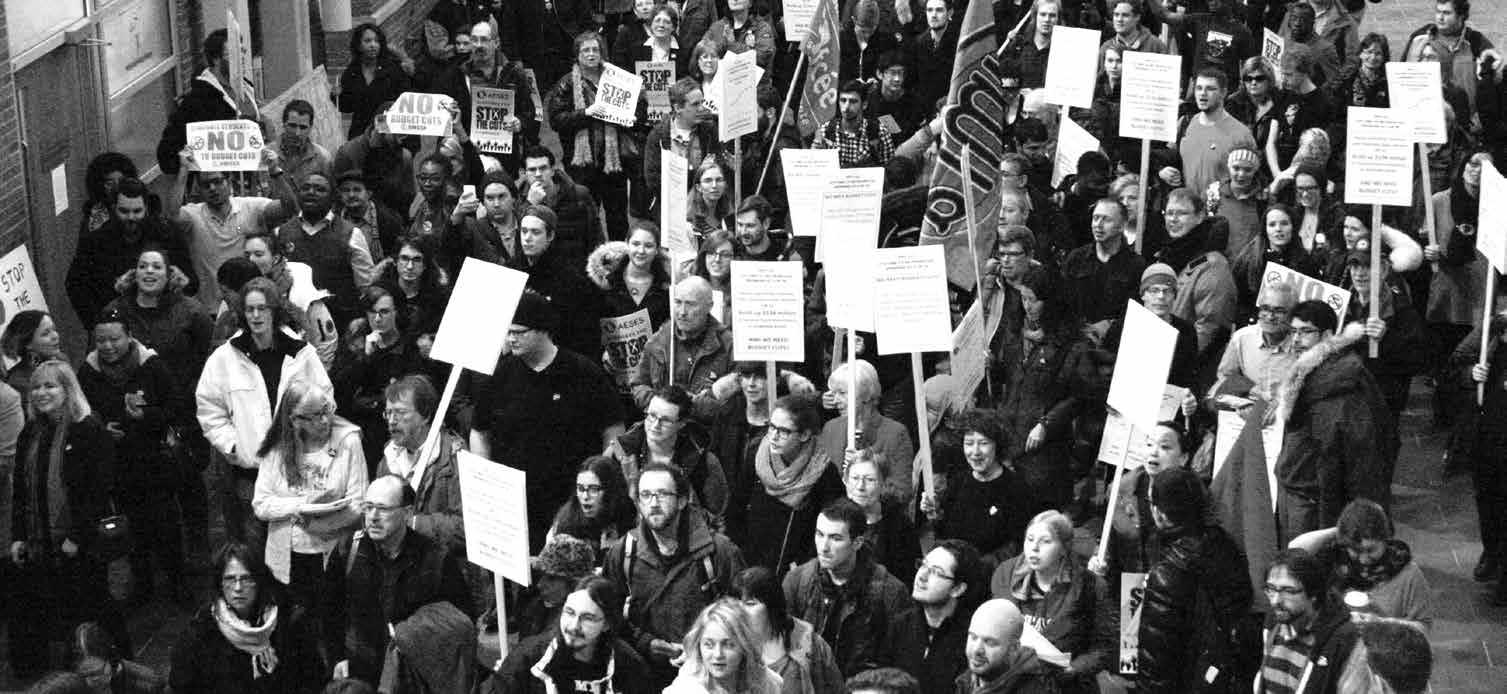
Over the course of the last few months there has been a rising chorus of voices calling on the University of Manitoba administration to put an end to the proposed cuts to the budget. This collective of students and unions, including the Canadian Federation of Students, places the blame for the cuts on the shoulders of the administration, claiming that the funding priorities are astray.
There is a silent majority of students that understand this these budget cuts are in fact the unfortunate repercussions of the prolonged tuition freeze that Manitoba went through in the 2000s. Since the freeze has been lifted, the university has been heavily restricted in how much tuition can be raised, limiting it to the rate of inflation.
This would work if the university’s operating costs were bound to the rate of inflation as well, but this is not the case. The University of Manitoba Faculty Association (UMFA) is one of the organizations that has signed on to criticize the administration, but it can be argued that they are doing more than their fair share towards creating the funding gap. A quick perusal of their collective agreement (readily available online) shows UMFA members earning a raise of around 3 per cent per year, while Statistics Canada shows the annual rate of inflation is closer to 1.5 per cent.
UMFA’s involvement in any opposition to budget cuts is highly suspect, and downright hypocritical considering that the entitlement felt by its membership that has contributed to the situation we are in. The ones that suffer in a budget cut are not the professors, but students and the sessional instructors who do the lion’s share of our educating and are not UMFA members.
It’s time for those that claim to represent students to understand that they do not speak for us all. There is a silent majority of students who recognize that the calls for reduced tuition but no corresponding budget cuts are not sustainable. Just like the engineering students realized in 2007, a quality education has
a cost to it, though back then it was students fighting to increase their own tuition.
The same organizations that got us into this mess are the ones leading the charge for a stop to the budget cuts, but what you do not see is a plan. There is no alternative proposed to the university on how to deal with its shortfalls. As a result, any legitimate points are buried in the rhetoric.
There does need to be a discussion about the university’s budget, and there does need to be student representation. But instead of a loud and disorganized rabble amassing and making noise in Chancellor’s Circle, let us use the established systems to have these discussions.
For a change, let’s actually have a voice speak for all 24,665 of us undergraduates, rather than the couple hundred that hold a particular viewpoint and decided to hold a rally. Let UMSU Council be the site of legitimate debate on the merits of the issues. Just because “A Rally for the Understanding that Things Cost Money” isn’t as catchy as “Stop the Cuts” does not mean this viewpoint is any less valid.
We are at a crossroads where we as students must decide whether we want a cheap education or a quality education. I for one would rather pay for quality, and am sick and tired of a small segment of the student body claiming to know what is best for me. The fact remains that the student leaders who have been in any budget-related discussions understand that this is an inevitability. So to those that stand in opposition to the budget cuts I ask but one question: what is your alternative?
Mark Stewart is in his final year of a bachelor of arts. He has previously served as the senior stick of arts.
Money is available, but administration’s priorities are misplaced
Devon h anel
Faculties and other non-academic units at the University of Manitoba are being asked to prepare for three to four per cent cuts not just this year, but also the next. When such a reduction is prescribed it is a responsibility to treat this evaluation with due skepticism.
President David Barnard claims “the financial demands associated with operating our institution have outpaced the growth of our resources” and that as a result the funding model in place is inadequate. An inadequate funding model combined with the requirement for the University of Manitoba to maintain a balanced budget would superficially appear to lend credibility to austerity measures.
The majority, 56 per cent, of the U of M’s funding is provided by the provincial government through an operating grant. Tuition fees account for 24 per cent, while the remaining 20 per cent is provided by other sources such as campus businesses and sales of goods and services.
As it stands the U of M is facing a $10.5 million budget shortfall for 2015-2016. Administration claims a 2.5 per cent increase in the provincial operating grant this year and last is meagre compensation for a province which has the third lowest tuition fees in the country.
Given inconsistent provincial funding and a cap on tuition already low, with perceived room to increase, it is regrettable, though unsurprising, many are willing to stop here and embrace a position of comfortable credulity in favour of cuts. Perhaps now is the place where a responsibility for skepticism is to be practised.
The U of M produced $43.3 million in net revenue for 2014. Now, why does the need to cut anything exist given this simple figure? The answer is that the majority of this revenue is shifted, through inter-fund transfers, from the operating fund to the capital fund. The capital fund is used for expenses such as library acquisitions, equipment purchases,
construction, and renovations.
At the year-end of 2014, $42 million was transferred to the capital fund, meaning that 97 per cent of the year’s net revenue had already been spent.
Of this capital money, $10.5 million was spent on library acquisitions. There is no doubt to the importance of increasing library collections, however what is the use of a wellstocked library if we have fewer professors and less qualified, underpaid instructors? This is to say nothing of the exorbitant construction projects, such as the $3.6 million spent on the Welcome Centre.
Consider also that there is over $130 million in unrestricted general investments which hypothetically may be used to remedy the U of M’s budget woes. The administration claims these funds in reserve are “virtually all committed” and that utilizing them would lead to cancellation of upcoming projects critical to the U of M’s goals. The particulars of such investments and goals remain in question, though the primacy of retaining quality academics is not.
Further, the administration says that the reserves “serve as an important cushion in the case of an emergency or unexpected situation.” Well, when the province decreases its promised funding, offering less than expected two years in a row, how are we not in an unexpected situation if not an emergency?
Is it that foolish to think that cuts themselves count as an emergency? Those who believe the primary focus of a university is education give an emphatic “no.”
The question to be asking is not whether budget cuts are inevitable or necessary: of course they are not. Rather, we should ask this same question of the university administration’s priorities and principles, or, if you must, “strategic plans.”
Devon Hanel is a third-year science student with an interest in philosophy and political theory.

n i C k S C hroe D er
Aparadigm shift beginning in the latter half of the 20th century has led to an increased focus on patient autonomy in the physician-patient relationship. Physicians, who were once considered the primary decision-makers in regards to their patients’ wellbeing, now grant the same patients absolute control of their own health care.
Perhaps, then, Margaret Somerville, an ethicist at McGill University, finds false irony when she writes in her book The Ethical Canary that “the norm that we must not kill must now be defended more vigorously than its opposite – that we may take human life in certain circumstances.”
If total patient rights are truly what our society ought to be progressing towards, then it appears that control over one’s own end-oflife decisions is an inevitable consequence. The practice of physician-assisted suicide gives patients the ability to decide when pain and suffering have increased to intolerable levels and death is preferable to a prolonged arduous existence.
Moreover, the practice of assisted suicide provides those with healthy lives the harmless reassurance that they will not need to live through tremendous suffering if they do reach such a point in their own lives.
A common concern from opponents of assisted suicide is it allows doctors to kill –something seen as fundamentally incompatible with our conception of good health care. In Canada, it can be argued, patients have the negative right to refuse treatment but are not granted the positive right of having a physician end our life.
This worry, however, may be a matter of framing as the “negative right” against undesired interference can be considered a positive right to control our own bodies. If we view the issue in this manner, it appears that
assisted suicide coincides well with our notion of health care.
The act of killing, if undertaken within the guidelines to be set by upcoming health legislation, ought not be considered morally different than the act of letting someone die. Suppose a person has expressed the desire not to continue on life support in the event of serious illness. It would broadly be agreed upon that although the person died of the illness, the death was the outcome of the patient’s decision.
This does not seem morally distinct from a case of the same patient expressing consent for a doctor to prescribe a lethal dose of medication to end her life. In both cases, the death was the result of the patient’s autonomous decision for her life to be over and the physician responding appropriately.
Finally, there would be no risk to current hospice and palliative care practices and funding. In jurisdictions where physician-assisted suicide is already implemented, it affects a very limited portion of the population.
Since the 1997 ruling allowing for physician-assisted suicide in Oregon, there have only been 859 cases of patients dying from the practice. Assisted suicide accounted for 73 deaths in Oregon in 2013.
Similarly, in the Netherlands, physicianassisted suicide only accounted for 286 deaths in 2013. This suggests that the number of people wishing for physician-assisted suicide is so insignificant in comparison to the general population that a person who desires traditional end-of-life care methods will be unaffected by the Supreme Court ruling.
Nick Schroeder is a master’s student in the department of philosophy interested in bioethics and health policy.
Mark D. Stewart
Support for legalizing assisted suicide here in Canada is not limited to secular society – it is also embraced by Christians. As a Catholic, I was particularly shocked to find that a recent Ipsos Reid poll of 2,500 people found that 83 per cent of Catholics support the legalization of assisted suicide. For this reason, I wish to take this opportunity to reexamine what the Catholic Church teaches on end-of-life decisions such as assisted suicide.
When the Supreme Court of Canada upheld the law against assisted suicide in the case of Sue Rodriguez in 1992, Justice John Sopinka stated that “distinctions based upon intent are important, and in fact form the basis of our criminal law. While factually the distinctions may, at times, be difficult to draw, legally it is clear.” What has changed since then?
Our lives are not at our disposal. So when can medical intervention be withheld or withdrawn from a patient? The Church teaches that the key principle is that one does not will to cause death.
life of the suffering and those around them. Christians believe that Jesus Christ’s suffering reunited humanity to God.
The Church encourages us to discover how to be compassionate, and how to enter into and share the burden of suffering of others. This is why a great emphasis needs to be placed on strengthening and utilizing palliative care, and for family and friends to be strong when loved ones feel weak.
Assisted suicide is not a private matter, for it requires a change of law to sanction it and a third party to carry it out. Such a law may jeopardize the consciences and roles of medical practitioners, whose purpose is to safeguard life.
Assisted suicide is not a private matter, for it requires a change of law to sanction it and a third party to carry it out
The author of the assisted suicide bill recently presented to the senate is Conservative MP Steven Fletcher. He is a Christian, and his support for this legislation stems from a tragic car accident that left him a quadriplegic, as he does not think God would have wanted this for him. Fletcher, like so many, misunderstands what the Catholic Church teaches with regard to God’s will for suffering.
The Church recognizes that suffering is not good in and of itself; however, it can have great meaning and redemptive power in the
The Catechism states that “suicide contradicts the natural inclination of the human being to preserve and perpetuate his life. It is gravely contrary to the just love of self. It likewise offends love of neighbour because it unjustly breaks the ties of solidarity with family, nation, and other human societies to which we continue to have obligations.”
In short, assisted suicide is contrary to love. Love is not always about good feelings. If it were, love would not be willing the good of others, but willing the good of yourself instead. In this light, assisted suicide is opting out of a selfless love.
Mark D. Stewart is a first-year student at the University of Manitoba with an interest in church history and religion.


Jere M iah yar M ie, staff
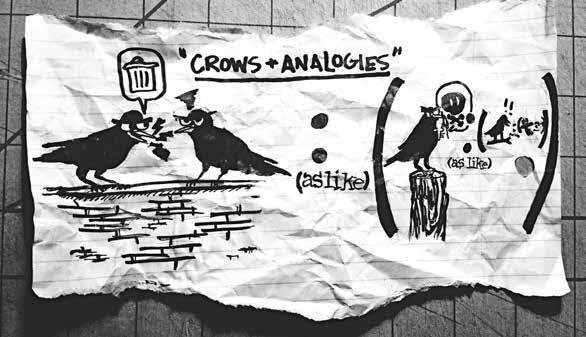
Crows are extremely intelligent birds that are part of the corvid family, which also includes magpies and blue jays. Research done in collaboration between Moscow State University and the University of Iowa shows that crows are capable of analogical reasoning. This same reasoning does not develop in humans until the age of three or four.
The study relies on the crows’ ability to identify “sameness,” the characteristics between two objects that makes them the same. The crows were presented with three cards with a pair of shapes on each of them that differed in type, colour, and size.
The crows were tasked with choosing the flanking card that was analogous to the middle card. This ability,
termed relational matching-to-sample, can be demonstrated using letters. Which is analogous to BB? CD or EE. Okay. Which of those is analogous to AB? These were the kinds of problems that the crows were presented with. They succeeded over three-quarters of the time and did so spontaneously, without prior training.
Debbie Kelly’s research at the University of Manitoba
Interest into the social brain hypothesis helped focus research interest onto corvid intelligence.
According to psychology professor Debbie Kelly, the social brain hypothesis states that “[if] a species has long developmental periods, lives to a long age, lives in a complex social
group, and has the right hardware, those are the prime things for the evolution of intelligence [ . . . ] A lot of the corvids fit into those categories.”
“Research just started pouring out showing that birds can plan, they can reason for the future, they can do relative concept learning,” said Kelly. “And that just snowballed.
“We’re studying the Clark’s nutcracker. It’s not a social bird,” said Kelly. “It’s a food-storing bird and it stores 10 to 30 thousand seeds in the mountains, and then six months later it has to go and remember where those seeds are.”
“What seems to be the key is that they learn it relationally,” said Kelly. They remember where their caches are by learning its position relative to

landmarks, such as between two trees.
“We have just submitted a paper that is very similar to the analogy paper. We have shown for the very first time a corvid that is better than any non-human primate studied to date in being able to quickly form a relative concept,” said Kelly.
Clark’s nutcrackers that were presented with samples of eight images can determine same versus different, even with images that they have never seen before.
“Rhesus monkeys needed more training than that,” said Kelly. “None of the other species tested were able to do it with as few examples as the Clark’s nutcrackers.”
I’ve just seen a face
Research published in 2012 from John Marzluff’s lab at the University of Washington shows how well crows remember human faces.
Crows use both dangerous firsthand experience and word-of-beak social information to distinguish the faces of dangerous humans. The tradeoff for the crows is accuracy versus cost.
Crows typically respond to dangerous individuals by scolding them, characterized by aggressive crowing at the individual, typically following them around in a big mob.
In the study, researchers wore a unique “dangerous face” mask while capturing, banding, and releasing crows. The captured crows immediately scolded the dangerous face.
The number of scolding crows increased over a number of years, and the scolding area steadily grew.
Bystander crows witnessing the masked individuals capturing their friends would join in on the scolding of the dangerous mask.
Unaffected crows learned to scold the dangerous mask by joining in mobs with previously captured crows, a form of horizontal social learning.
Younger birds that were born after the capturing took place were taught by their parents to scold the dangerous mask, a form of vertical social learning.
In 2012, Bryce Hoye wrote for the Manitoban about new research at the time indicating that crows are capable of causal reasoning, the ability to understand cause and effect.
Another study from early in
2014 showed that a crow’s level of casual intelligence rivals that of a five-year-old.
Aesop’s fable The Crow and the Pitcher tells the story of a thirsty crow that comes upon a pitcher containing water that it can’t reach. Too weak to push the pitcher over, the crow drops pebbles into the pitcher one after another until the water level rises enough for the crow to drink.
The 2014 study presented crows with Aesop’s fable. Crows presented the ability to raise the water level in glass tubes by dropping objects into them, understanding to choose solid objects over hollow ones and sinking objects over floating ones.
Too weak to push the pitcher over, the crow drops pebbles into the pitcher one after another until the water level rises enough for the crow to drink
Why birds, why now?
Crows and other animals are burdened with the task of adapting to human-made urban environments.
“Cognitive abilities help us to get into all sorts of different environments. That probably is what selected for this behaviour in crows too,” said U of M biological sciences assistant professor Kevin Fraser.
“There is a climate change context here too. Birds that are most flexible and able to figure out new problems are more likely to be the ones that can deal with the changing environment,” said Fraser.
The list of fascinating studies on crow behavioural intelligence goes on and on. They are remarkably intelligent birds.
Chantelle D UB oi S , staff
Cosmology has been shaken up by new theories on the origins of the universe which have recently received attention in the media. Did the universe begin with a big bang? With two? Or with none? Or perhaps, some other way altogether?
The Big Bang theory
In 1927 Georges LeMaitre, a
Belgian physicist and priest, developed mathematical models based on Einstein’s general relativity equations which suggested the universe was expanding.
The consequence of LeMaitre’s model was that the universe had to begin at a singular point, which he called the “primeval atom.” He reasoned that if the universe was
expanding with time, then at the beginning of time, approximately 13.8 billion years ago, everything must have existed in a very dense and compact state.
Shortly after in 1929 Edwin Hubble, an American astronomer, published his discovery of the red shift – the acceleration of distant galaxies away from the Milky Way.

This discovery supported LeMaitre’s theory.
LeMaitre described the initial cause of the expansion as an instability in the primeval atom, resulting in an explosion and then expansion.
Fred Hoyle, an English astronomer, criticized the theory and made a sarcastic remark suggesting the universe began in a “big bang.”
This name stuck, and today we know LeMaitre’s model of an expanding universe as the Big Bang theory.
Since then, several variations of evidence have been discovered to support the Big Bang theory.
One of the most important is the accidental discovery of the cosmic microwave background radiation by Arno Penzias and Robert Wilson in 1965.
One of the biggest flaws of the Big Bang theory is that it cannot explain what happened during the singularity, or before the Big Bang; the model only explains what happens immediately after the Big Bang occurs
Cosmic microwave background radiation was predicted to exist as the result of when approximately 400,000 years after the Big Bang the universe cooled enough to allow the formation of hydrogen atoms. These atoms then began emitting high frequency radiation.
Since the universe is expanding, once the radiation reaches Earth it should be in the form of microwave radiation, and should be uniform and detectable from any point in the universe. Looking further into the universe is similar to looking back in time, and so these microwave frequencies originated 13.8 billion years ago.
Another piece of evidence more recently discovered is the primordial B-mode polarization. Patterns in the cosmic microwave background radiation which result from gravitational twisting of the early expansion of the universe are expected in measurements taken. However, this discovery by researchers at Stanford University may have been compromised by cosmic dust that was not accounted for, and currently the results are being further analyzed.
Two big bangs
The Two Big Bangs theory suggests there are two definitions of the Big Bang. The first in which all matter and energy was contained in a singularity, which exploded and then
cooled; the second in which the Big Bang is the inflation of the universe being guided by energy inherent to space itself – or vacuum energy.
The difference would be that the universe is inflating instead of expanding, and that the beginning of the universe wasn’t the “Big Bang.”
Some cosmologists believe the biggest flaw in the Big Bang theory is that it cannot explain what happened during the singularity, or before the Big Bang; the model only explains what happens immediately after the Big Bang occurs.
Researchers from Lethbridge, Alberta and Benha, Egypt came up with a new model, combining quantum mechanics and general relativity.
This new model removes the possibility of singularities, including the one the Big Bang theory suggests is the beginning of the universe.
In addition, it also suggests there will be no ending singularity, or the “Big Crunch.” This is when the universe is said to begin collapsing on itself until it is a single point once more.
The result is that there is no beginning and no end, and that the universe has always existed. The model does account for a smaller universe in the distant past, but not one which was a singularity.
This theory also explains dark energy and dark matter as the result of gravitons which existed earlier in the universe’s history and have no mass.
The Ekpyrotic Model suggests that the Big Bang was the result of two three-dimensional universes colliding in a fourth dimension.
The only aspects in which this model differs from the Big Bang theory is that the beginning is different, and that it is based on the string theory.
This collision explains the Big Bang, and also explains what existed or happened before the Big Bang. Instead of a dense singularity, two universes which were both mostly empty and cold came in contact.
When this contact occurred, the kinetic energy turned into electrons, protons, and quarks. Ripple in the fourth dimension causes the effects of the collision to happen everywhere in both universes at different times, which can explain fluctuations in radiation and energy densities.
This model remains unproven, and is but one of many theories being developed by cosmologists to explain the beginning of the universe.
The many theories on the origins of the universe shows that it continues to be a topic of great interest to cosmologists and physicists around the world.
Jere M iah yar M ie, staff

Students participating in the Canadian Satellite Design Challenge flocked to Magellan Aerospace on Feb. 17 and 18 to attend a Preliminary Design Review (PDR).
Members from the University of Manitoba Space Applications and Technology Society (UMSATS) joined individuals from the University of British Columbia, York University, Concordia University, and the University of South Wales in Australia, among others.
The Winnipeg location of Magellan Aerospace specializes in engineering and support services.
“Winnipeg actually has a very large aerospace industry, which many people may or may not be aware of,” electrical engineering master’s student Pawel Glowacki told the Manitoban
The two days were filled with workshops and presentations put on by Magellan.
“One engineer gave us a lecture about orbital mechanics – the theory of how objects move in space,” said Glowacki.
The main focus of the PDR were 10-minute presentations where the participating teams presented their planned payloads.
“A payload is essentially an experiment you do onboard a
spacecraft, or a specific object you want the spacecraft to transport. The payload is the reason the rest of the spacecraft was built in the first place,” said Glowacki.
The PDR allowed the UMSATS team to gain insight into the other projects in the works.
Viridania Ureña Ramírez, a microbiology master’s student at the University of Manitoba, says that some of the other teams intend to develop payloads which focus on wildfire recognition and spectroscopy to measure pollution in the atmosphere.
“I think our project has good foundation thanks to our advisors,” said Ureña Ramírez.
The UMSATS tardigrade project may have relevance in future research into sending biological samples into space, for example, to seed Mars.
The project may also give insight into the hardiness of tardigrades, which may have organ preservation applications.
The next big test for the UMSATS team will be this fall when the team presents their critical design review.
Visit umsats.ca for more information about the U of M’s Canadian Satellite Design Challenge team.
Jere M iah yar M ie, staff

The smell of rain is earthy and distinct. Raindrops splatter against the ground and release earthy odourant molecules into the air, but the exact mechanism of this event hasn’t been elucidated until now.
Recent research from the Massachusetts Institute of Technology sheds light on exactly how rain spurs these hidden Earth smells.
In their study published in Nature Communications, mechanical engineers Young Soo Joung and Cullen Buie took to observing drops of water as they hit porous materials using powerful highspeed cameras.
As the simulated raindrops hit the materials, small bubbles of air formed at the contact point, rose through the body of the drop, and fizzled out of the top, forming aerosols. This phenomenon was observed upon synthetic materials, as well as soil samples.
As the bubbles fizzled away, they released bits and pieces that it picked up from the soil. Not only could odourant molecules that we associate with the smell of rain be aerosolized, but so could soildwelling bacteria and viruses.
This process is very quick, occurring on the magnitude of one-millionth of a second. The formation of bubbles only occurs during light to moderate rain. Raindrops during heavy rainfall move too fast for this process to occur.
Petrichor is a term coined by Australian mineralogists in the 1960s describing the earthy smell that is liberated from the ground during rainfall.
One of the molecules responsible for rain’s earthy aroma is the organic molecule geosmin. The molecule tends to stay suspended in the air after a storm passes, and is responsible for the earthy postrain smell.
Geosmin is synthesized by
Streptomyces bacteria, which also produce the majority of naturally sourced antibiotics that we use. Besides the earthy smell of a storm, geosmin also contributes to the flavour of beets.
Humans are able to detect geosmin in the air as diluted as five parts per trillion. That’s the equivalent of three seconds per 100,000 years. This sensitivity may be due to the fact that our ancestors relied on rain for its life-bringing properties.
Before a storm, a different scent fills the air. Ozone is formed in a series of chemical reactions trigged by lightning in the sky. Atmospheric nitrogen and oxygen are split apart and react to form the ozone molecule, which is made up of three oxygen atoms. Ozone’s name is derived from the Greek word ozein, which means “to smell.” Unfortunately there is no hope of scenting summer storms in the midst of a Winnipeg winter. We can only long for petrichor.












Ten Thousand Coffees announces new partnership with Etsy

For the past year, Ten Thousand Coffees has been breaking down barriers between young entrepreneurs and those who are already well-established in their field – all over a cup of coffee.
With the announcement of a national partnership with Etsy, a new “maker” category has been added to the online platform, allowing users to interact with some of Etsy’s best creative professionals.
Launched in January 2014, Ten Thousand Coffees has revolutionized the way young people make connections in the business world.
“We knew that if we could create a platform where industry professionals and the next generation could easily connect and engage over something as simple as coffee to share ideas and insights, that the possibilities of what could come from these conversations would be endless,” said founder Dave Wilkin.
Users can join as either a novice or a professional. Once they complete their profile, novices are able to browse the platform and invite experts for a coffee in person, over email, phone, or Skype.
“One of the best memories I think I have was when one of our team members was invited for coffee by a young woman who was hearing impaired. This young woman was smart and a very talented writer but was apprehensive to participate in networking events hosted by her school because she was more of an introvert,” said Wilkin.
“Going on a one-on-one coffee
chat with our team member gave her confidence to invite more people for coffee and made her realize that a one-on-one coffee chat was a great way for her to be able to network with people.”
Seeing firsthand how something as simple as access to a conversation can provide people with the tools, ideas, insight, and confidence they need to move forward constantly encourages Wilkin.
“Ten Thousand Coffees believes that the power of people and the advice they have to share can enable experiences that move the next generation forward” – Dave Wilkin, founder of Ten Thousand Coffees
“Every day we have users email, phone, or even come up to us on the street and tell us how valuable their coffee conversations were. People have found jobs that they otherwise wouldn’t have known about, industry professionals have learned insights about their industry that has encouraged them to
ACI hosts their fourth annual workshop for recent arts grads
a lana t raC henko, staff

Imake changes in their tactics to reach the next generation.”
By partnering with Etsy, Ten Thousand Coffees will open doors to thousands of upcoming creatives and reach a broader audience than ever before.
“Etsy is not only the largest marketplace for creative entrepreneurs, it’s also a people-powered economy,” said Wilkin.
“Ten Thousand Coffees believes that the power of people and the advice they have to share can enable experiences that move the next generation forward. The launch of the makers category is bringing together artists, designers, and makers from diverse backgrounds to engage in conversations, exchange ideas, and spark insights about their industry.”
To celebrate this new partnership, Etsy will be providing 20 free listings to any newcomer opening an online shop on their website. A $5,000 merit-based grant is also up for grabs to help one lucky entrepreneur kick-start his or her creativity into a business.
“We know the impact conversations between two people can have. We want to see thousands of conversations happening across Canada between makers and young creatives,” Wilkin said.
“This current generation is the most educated, technology savvy, and entrepreneurial generation yet. We want them to gain the confidence and advice they need to turn their crafts into their own business.”

f you have recently graduated from one of the many arts programs available in Manitoba, you are likely being asked a lot of questions right now. Your parents are wondering when you will get a job and how you are going to support yourself, and your friends nod in feigned understanding when you use terms like “freelance” and “Kickstarter campaign.”
Graduating as an arts student can be scary – the structure of daily life is replaced by the sudden freedom of making your own schedule. Even if you have found a job in your desired field, the industry has evolved in such a way that a lot of your time will be spent looking for work.
and to be reminded that success is defined by the individual – not only does it look different for everyone, but it also develops and fluctuates over time.
“Many grads will discover that, unless they disregard what they learned from their degrees and go work in another industry, it can be hard to find a full-time job where you get to exercise your art in its purest form, whether it be creative fiction writing, experimental filmmaking, or classical Shakespearean acting,” Faucher said.
“We all want to support each other and see each other do well, and I think that’s important for emerging artists to encounter” –
Alicia Faucher
To speak to the daunting questions freshlyminted grads have, the Arts and Culture Industries Association of Manitoba is hosting their fourth annual symposium titled Putting Your Arts Degree to Work. The workshop will cover topics such as budgeting, networking, and mentoring.
Alicia Faucher of the Arts and Culture Industries Association of Manitoba says that there is a lot to take away for those who are new to the creative field.
“I think seeing people speak who are currently working in the industry, who are happy, warm, and eager to share their stories will encourage attendees to keep at it,” Faucher said.
“We all want to support each other and see each other do well, and I think that’s important for emerging artists to encounter.”
Faucher thinks the workshop is a good place for grads to network
“To do those things, you work from one gig to the next, taking opportunities as they come. You end up being a freelancer, or even fully selfemployed if you work hard enough.”
Freelancing is one of the topics covered at the symposium, helping to quantify a style of work that is considered insecure and open-ended.
“I think some concerns for graduating arts students are that they may not find as much support for their pursuits as other grads might. They will have to fight and work harder than most in other careers to be taken seriously and be successful,” Faucher said.
“The satisfaction in being happy with their lives and the work they produce for a living is quite a reward in itself.”
The workshop will be taking place at 245 McDermot on Feb, 28. Tickets are $10. For more information, visit: 245mcdermot.ca/events/345/ creative-entrepreneurshipputting-your-arts-degree-work
David Cross’ directorial debut premiers at Park Theatre, brings pay-what-you-want format

Log off of your Facebook and Instagram pages – HITS, a dark comedy film examining the social media generation, has its Winnipeg premiere at the Park Theatre on March 4.
The movie presents a striking portrait of the need to be famous in the 21st century. Set in upstate New York, HITS tells the story of Dave, a municipal worker played by Matt Walsh (Ted, The Hangover, Veep). After a video of him ranting at a town hall meeting goes viral on YouTube, Dave quickly becomes famous to the dismay of the townsfolk.
The proceeding events have the small town of Liberty, New York filter through delusions of grandeur. His daughter, a fame-addicted 20-something itching to “make it” on the reality show The Voice, becomes jealous and frustrated at her father’s random fame.
“I should be famous,” sighs his daughter.
The movie marks the directorial debut of David Cross. Cross, known primarily for his role as Tobias in the critically acclaimed show Arrested Development, acts as both writer and director for the film.
Although a celebrity himself, Cross finds the fame-obsessed characters—who are constantly connected to social media—in the film despicable.
“The idea that you can monetize something as nebulous and meaningless as a bunch of followers on Twitter, [such as] ‘I have a million friends on Facebook!’ is insane to me,” explained Cross in an interview.
“But that’s the language now.”
With HITS exploring the concept of going viral in the digital age, the fact that the movie became a viral phenomenon provides an ironic context for its release. The film premiered at the Sundance Film Festival in January. While several distributors approached Cross to release the film in a traditional format, Cross admits that the distributor’s plans were lackluster.
It was with this that the movie became a film experiment.
“We want you to decide how much tickets cost and you pay artists directly, not distributors or studios. This is an experiment, a first of its kind to see if we can make it more sustainable for both fans and filmmakers,” said David Cross in statement to the press.
The digital film became available on Feb. 13 after being released on the file-sharing program BitTorrent. It is the first feature-length film to be released on BitTorrent with the pay-what-you-want model.
However, Cross also admits to wanting the film released in the classic movie theatre format.
“I’m psyched people can watch it on their laptop, but that’s slightly distasteful to me. I want it to be in the theatres. And that’s where the Kickstarter to get it into as many theatres as possible [came up],” said Cross.
Through the success of a Kickstarter campaign, supporters of the film raised over $100,000 to help distribute HITS to theatres. What started as a modest goal of premiering in two cities developed into the film’s premier across several North American theatres, including Winnipeg’s Park Theatre on March 4.
The screening at the Park Theatre introduces the unique paywhat-you-want format. Purchasers are given the option to pay anywhere from one dollar to upwards of $20.
This format has been used frequently in the music industry, gaining notoriety in 2007 when Radiohead released their album In Rainbows in this format. However, the pay-what-you-want method has not been frequently used in the movie industry. Cinemas such as SilverCity still charge $10.50 general admission no matter what you may want to pay.
HITS premieres at the Park Theatre on March 4. Ticket reservations are available at ticketfly.com
Winnipeg surf rock band the Thrashers release robotic new album
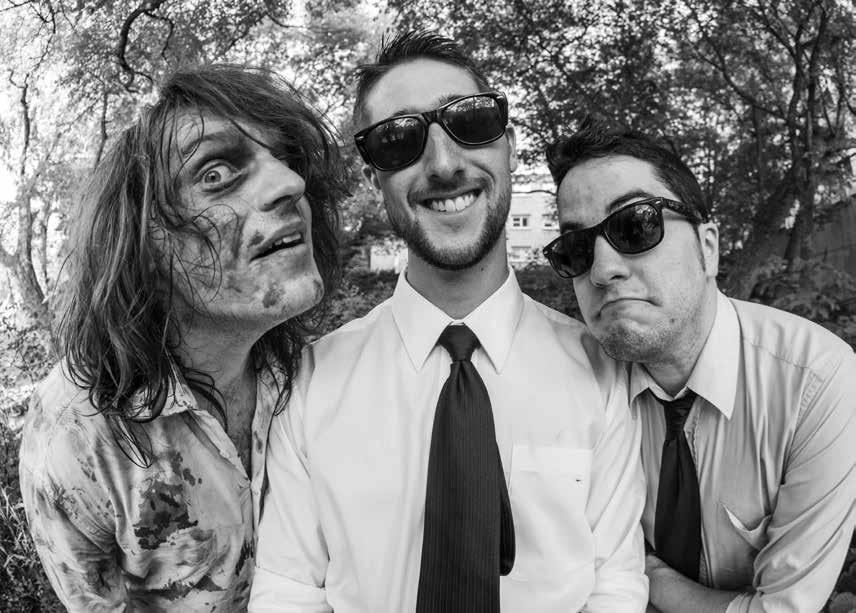
When it comes to blending retro aesthetic with robot invasion, no one in Winnipeg has the musical concept down quite like the Thrashers. Focusing their efforts on punk rock and roll, the Winnipeg trio is set to release their new album Robot Invaders from the Death Galaxy at the West End Cultural Centre on March 28.
“We figured a title like Robot Invaders from the Death Galaxy was equal parts straightforward, humorous, and intriguing,” said Bercier.
“We figured a title like Robot Invaders from the Death Galaxy was equal parts straightforward, humorous, and intriguing” –Jesse Bercier, the Thrashers
The Thrashers’ music is a throwback to retro genres, with the group citing influences of ’50s rock and roll, ’60s surf rock, and ’70s punk rock. The group started with two friends, Jesse Bercier and Iaian Loeppky, and a humorous inspiration.
“Iaian and I [ . . . ] started writing a few songs together after agreeing that the concept of a surf band from the prairies was both a funny concept and something that we should take a stab at,” explained Bercier to the Manitoban
Rounding off the trio with Sean G. on drums, the local band has gone on to release three albums since its conception in late 2007. Their last release was 2012’s Ramp Locals, a three-song EP described as an essential for anyone who skateboards.
Robot Invaders from the Death Galaxy, their newest full-length album, is comprised of 10 songs taken from the group’s live set. Named after one of their songs, the album is rooted in the idea Bercier and Loeppky had of making a short film involving robots invading Earth.
While the group notes that the record is not a concept album, many of the tracks detail elements surrounding a “mechanical invasion.” Songs such as “Dynamite,” presented as a quick 99 seconds of rock and roll music, give the impression that there will be an even faster tempo when performed live.
With the Robot Invaders from the Death Galaxy receiving a proper release at the WECC, expect the show to be just as extravagant as the album title. Along with the band’s developed live show, the release party will be a full stage show featuring a nine-foottall robot.
“We like to think we’re putting our own ’50s sci-fi twist on an Alice Cooper stage show,” explained Bercier.
The Thrashers take the stage at the WECC on March 28 with punk acts the Zorgs and Mobina Galore. Tickets are $12 in advance and are available at Into the Music and Music Trader.

a lana t raC henko, staff
Tony Nesca admits his favourite type of writing, as a kid, were genres such as science fiction. As an adult, however, Tony writes short stories and poems that are dark and lyrical. Rather than searching for a publishing company that would take him on to write in his preferred style, Tony started Screamin’ Skull Press in 1994. In 2007, the company grew by one with the addition of Tony’s wife and writing partner, Nicole Nesca.
“We were both publishing online,” Tony said when asked how he and Nicole met. “We noticed each other’s writing and we started corresponding purely as fans of each other’s work [ . . . ] we were each other’s groupies first.”
Since then, both Tony and Nicole have published a number of works, including short stories, poems, and novels. They have also had the opportunity to publicize their work online, as well as travel around Canada and to the United States to do book signings.
Their distinct, melodic style of writing has attracted a significant fanbase that enjoys the contrast between the poetic language and the brassy content.
“It’s not short sentences the way Hemingway or Bukowski would write [ . . . ] the words flow down the page like music,” said Tony. “I was a musician first. I played in a band for many years, and the way I write is the way I play guitar, in a sense.”
Being a part of Winnipeg’s music scene gave Tony an appreciation for its vivid urban scene, making an appearance in the majority of his work.
“I’ve been told by people that have read my books that Winnipeg is like another character,” Tony said. “My latest book Crazy Legs is almost a love letter to Winnipeg, but about the gritty, downtown Winnipeg.”
Tony said he knows the city well

after living in it for 20 years, and hanging around the neighbourhoods that populate his writing.
“I’m not blind to the city’s problems, but I think it’s a great place,” Tony said. “Other writers that write about Winnipeg always write about the farm on the prairies, but they don’t write about our huge downtown, and that street corner where people drink and do drugs.”
While Tony doesn’t suggest navigating to those areas of the city, he feels that Winnipeg writers should comment on it. Nicole writes about urban life as well, but having lived in Ohio for most of her life, her work comes from an American perspective.
For now, Screamin’ Skull Press remains a company of two. Even though the pair has been successful
with sales and exposure, they are not ready to take on other writers quite yet.
“It costs a lot of money to promote and market,” Tony said. “It wouldn’t be fair to other writers not to be able to back them as a publishing company should, even an indie company.”
If things pick up, Tony and Nicole are interested in publishing works by other authors that are similarly minded, whose works cohere with what Screamin’ Skull Press has put out so far.
Works by Screamin’ Skull Press are available at Coles in Cityplace, McNally Robinson, and online at screamingskullpress.blogspot.ca


GoSA exhibit explores alternative economies
l aU ren Si DDall, staff

As much as we like to believe we are all independent, autonomous individuals, our lives are all intertwined. We are all connected to each person we cross paths with; they become part of our story. But can more than a mere memory capture these fleeting moments?
A current master of fine art student at the University of Manitoba, Carolyn Mount, aims to prove it possible with her current exhibit in the Gallery of Student Art, entitled Art for Trade
Mount uses intersecting lines in her silkscreen works to demonstrate the nature of our interconnectedness – aiming to emphasize the line as a means of forging new connections. Undulating between form and the formless, she creates abstract works of art, demonstrating the subjective experience of social interaction.
While attempting to capture the intimacy of intersecting lives is a difficult task in itself, Mount has also dedicated her time to creating moments of connection with her patrons. All artwork in the exhibit, as suggested by the name, is available to be taken home by viewers. The kicker is you cannot simply purchase the works; they must be traded for.
Mount has accumulated, among other things, a pearl necklace, an antique tricycle, and hand-knit socks through the alternative economy. This system creates vulnerability for the artist—each buyer sets their own price—that will inevitably create a connection between artist and patron. The barter structure suffuses the transac-
tion with a sense of comradery our capitalistic market lacks.
The exchange of the artwork also acts as a more tangible representation of Mount’s exploration of social connection. By setting up camp in different public spaces— such as flea markets, community markets, and on campus—the artist is entwining herself in the community and creating new moments of connection.
“I decided to commit myself to giving or trading all my work for a one-year period as an alternative way of being in and building community,” explained Mount.
“Originally my research was going to be focused on financial debt [ . . . ] I was struggling with the isolation and shame of it all. However, I believe we are not limited by what we owe and I wanted to explore ways of building and sharing in community outside the social and environmental limitations of the market economy.”
The result is a cyclical, almost self-maintaining process. Mount creates artwork to illustrate moments of connection among people, which she then trades with new individuals to create new connections, that are then transformed into more artwork for the exhibit.
Art for Trade will be displayed in the Gallery of Student Art until Feb. 27. All artwork and traded pieces will be exhibited in Mount’s MFA thesis, ExChanged, showing in the School of Art Gallery June 4-12. Trade times are Feb. 24, 26, and 27 from 11 a.m.-2 p.m.



Mike Still, staff
Post-season action heated up this past weekend for the University of Manitoba Bisons; however, the end result wasn’t in the herd’s favour, as both the men’s basketball and hockey teams saw their seasons come to an end.
Men’s hockey fell in three games to the host the UBC Thunderbirds, while men’s basketball was swept 2-0 on the road against Calgary.
Men’s hockey
Manitoba entered the playoffs as the fifth seed, but were just one point behind opponents from UBC heading into the weekend matchup. Despite taking three out of four games against the Thunderbirds in the regular season, the Bisons failed to match UBC’s intensity when it
counted, falling two games to one in their quarter-final matchup.
The home squad took advantage of their opportunities, scoring first in each of the three games, even though the Bisons outshot their opponents in the first two games of the series.
Game one on Thursday night saw UBC open up a two-goal cushion in the first three minutes of the game, a deficit that the Bisons weren’t able to come back from. The Thunderbirds received goals from five different players, en route to a 5-1 victory. Manitoba’s lone goal came from Kyle Rous, who scored at 9:57 of the first period.
With their backs against the wall on Friday night, the Bisons were able to respond, forcing a third and final game. The herd showed incredible
resolve, coming back from one goal down on three separate occasions, pulling out a 4-3 overtime win. Their only lead ended up coming from the game-winning goal just 44 seconds into the extra session, off of the stick of Darren Bestland.
The Bison’s other goals came from Shaquille Merasty, Brett Dudar, and Josh Elmes.
Saturday’s deciding third game featured physical intensity from both squads, with a combined 48 minutes in penalties being dished out. It was UBC that would get the advantage on the scoreboard though, winning 3-1.
Manitoba ran into a hot goalie as Eric Williams was on top of his game, stopping 28 of 29 Bison shots, and fell just five seconds short of a shut-out, which was ended by Jory Coates.
Men’s basketball
Losers of seven straight games entering the post-season, the men’s basketball team was looking to change their fortune against a 12-8 Dino squad, which Manitoba had taken one out of two games against on the road earlier in the season.
Unfortunately, the herd was unable to extend their season, losing 92-81 on Friday, and 93-81 on Saturday.
Friday’s stat sheet was relatively equal, with the difference occurring the first and fourth quarters. Calgary out-scored Manitoba 27-17 in the first and 22-15 in the fourth.
All five of the Dinos’ starters reached double figures, with Lars Schlueter leading the way with 21 points off of 5-of-9 shooting from beyond the arc. AJ Basi also had 21
points to head up the scoring for the Bisons.
Game two, on Saturday, was another close contest, with free throws playing a key factor in the result. Manitoba entered the fourth quarter down by just eight, but couldn’t capitalize on their chances from the line in the final 10 minutes, shooting just 69 per cent, compared to 83.9 per cent for Calgary.
Veteran Jarred OgungbemiJackson played a crucial role down the stretch, hitting a few contested shots to pad his team’s lead. He finished with a game-high of 23 points. Basi led the way again for the Bisons with 20 points.
Mike Still, staff
The University of Manitoba Bison women’s hockey team proved that age is just a number this past weekend, as their rookie-fuelled roster took down the visiting Regina Cougars two games to one at the Wayne Fleming Arena, in the opening round of the Canada West conference playoffs.
It was the ultimate act of revenge for the Bisons, who were upset by the very same team at home in last year’s quarter-final matchup.
Manitoba entered the playoffs with the number three seed, after finishing the regular season with 54 points. Their opponents from Regina finished sixth, with just 38 points; however, the three-game contest was highly competitive.
Manitoba grabbed game one, with a 4-1 victory, in which they basically dictated the pace start to finish. The Cougars finished with 10 total penalty minutes, resulting in their downfall, as they were never able to grab consistent momentum.
The herd outshot Regina in every period, and also cashed in on two of their man-advantages, with goals coming from Michelle Pawluk and captain Maggie Litchfield-Medd on the power play. Courtlyn Oswald and Lauryn Keen also scored for Manitoba. Kylie Gavelin notched the Cougars’ only goal of game one.
Bison head coach Jon Rempel, fresh off being named 2014-15 Canada West Coach of the Year, made sure to instill the same level of intensity in his team from what they demonstrated in a strong regular season.
“Just before the game I told them not to change too much,” Rempel said. “Your team’s personality is what it is, and you’ve got to play that way
the whole year – you don’t change for the playoffs.”
Gavelin would come up big the very next night, notching a hat trick to lead the way for Regina, who pulled off a 4-3 double overtime victory, taking the series to a deciding third game.
The Bisons led the game 1-0 after the first intermission, and 2-1 after the second; the third period and extra session, though, were where Gavelin took over, recording all three of her goals in that span.
Rookie sensation Alanna Sharman would get the scoring started in this one, tallying her first goal of the playoffs at 17:11 on the power play, which was the lone goal in the opening 20 minutes.
Carleen Meszaros answered back in the second for Regina, scoring a power play goal of her own, at 2:23. Keen would net her second of the series with the extra attacker at 13:24, and Regina found their season pushed to the brink, down 2-1 heading into the third.
Gavelin sparked the troops, however, scoring just a minute in to yet again tie things up. Alana Serhan would restore the Bisons’ lead at 11:52 on the power play, but Gavelin made sure that momentum was short-lived, tying things up at three just under two minutes later.
It took a second set of overtime for Regina to pull out the come-frombehind victory, but they eventually got it done, as Gavelin cashed in on a wrap-around a minute in, sending both teams to the brink for Sunday’s final game.
It was fitting that Sunday’s deciding game would also take more than 60 minutes to find a winner, with
both squads upping the compete level. Oswald would be the hero for Manitoba, potting the game and series winner at 6:06 of the extra session, en route to a 3-2 Bison victory. First-line sensations Litchfield-
Medd and Sharman would also provide goals for Manitoba, who will now move on to play the UBC Thunderbirds on the road this coming weekend in one of two conference semifinals.
Game one will go Friday, Feb. 27 at 9 p.m., with game two on Feb. 28 at 5 p.m., and, if necessary, game three, on March 1 at 5 p.m.

k enny o liver
It’s hard to visualize what will happen after a season ends. Most players can empathize with the cloud of emotions and memories that trigger when they realize that their season is over. When we sit down at the end of the year for one last drink among friends, we will reflect on the good and the bad, the new experiences gained, and the new mistakes we’ve— hopefully—learned from.
The Big Horns started with an idea. You select a place with a distinctive look for those interested in campus spirt and culture to congregate.
We pitched our initial ideas to Christian Pierce and a few other UMSU representatives. They were surprised that our proposal included props that we had stayed up all night to make in preparation for the meeting. I was impressed that Pierce was so approachable and he even joined our student group that week and became one of our strongest supporters and most loyal members.
Learning experiences
As a group, we attracted a variety of third-party opinions. Some people loved us, especially the families of team members, while others would prefer that we just didn’t rock the boat. Change for a community is difficult and everyone experiences growing pains.
We developed a rivalry with the engineering band, who have accused me on several occasions of trying to copy their concept. I appreciate that they think of us constantly and I hope to see them stay for a whole game at least once before I retire.
We were ineffective at generating a rivalry with the Wesmen. They notice when we show up at their campus, but mostly they just think we are louder than they are and would prefer we cancelled the game as opposed to cheering against us.
We have found a proper nemesis, The UBC “Thunderturds,” who never fail to get involved in the cheering
and beaking that occur at every game. Lexi Janovcik, from our Bison women’s volleyball team, demanded fried chicken be eaten in front of the Thunderbirds.
We look forward to seeing you all on campus. Please stop in and say hello, and participate in a new era of campus culture
The Big Horn season started strong this year. We had a good turnout for the soccer game against Calgary, and the battle for Winnipeg against the Wesmen.
The Big Horn “grand poohbah,”
Darren Sancartier, was master of ceremonies at our campus pep rally, a turnout of approximately 23 Big Horns, most of whom were new applicants. The season was looking prosperous and we had more potential members than any time before.
In an effort to make membership easier to attain, we offered it to members based on casual commitment over a period of a month. As a result, we gained many new people, but as the term continued we were losing memberships as fast as we were gaining them.
We failed to create lasting relationships with people as we had done in the past. New members entering the group didn’t feel as welcome, and we look forward to rectifying this next year.
When the Big Horns were at their peak performance, we had events every Friday including an informal lunch meeting in University Centre. With the campo and science lounges
Bison thrower Justin Krantz named co-winner of 2014 aboriginal male athlete of the year award
Mike Still, staff
It’s been a long journey for University of Manitoba Bison thrower Justin Krantz. Originally hailing from the small town of Roblin, Manitoba, the multi-sport athlete at Goose Lake High School began as a thrower eight years ago, and started taking track and field
seriously in Grade 10. Since then, he has put in an excessive amount of work and mileage to get where he is today.

“I’ve been throwing competitively for the last four years, mainly by myself as it was tough to have professional coaching living in rural Manitoba,” Krantz said.
A breakthrough moment in Krantz’s career occurred when he met Bruce Pirnie, the current throwing coach for the Bisons, who was also a member of the 1972 and 1976 Canadian Olympic teams in shot put.
Pirnie first approached Krantz when he was in 10th grade, asking to train him after he had placed second in junior varsity shot put at high school provincials. Up to that point, Krantz had been training every day on his own.
“I would travel to Winnipeg to train with coach Pirnie as much as I could, but obviously it was very expensive considering I lived five hours away from Winnipeg,” Krantz said.
Despite the issue of distance, Krantz stayed committed and continued to hone his craft, both on his own and with Pirnie, who had a large impact on his growth.
“I look up to all his accomplishments and how he has affected the athletics community Canada-wide. I aspire to be as great as him one day,” Krantz said.
This past winter, Krantz officially committed to the Bisons after a stellar 2014 campaign, which included setting the provincial shot put record, as well as being named Manitoba’s top male
under construction, students didn’t congregate the same way they had before.
The Big Horns had one major success that has lasted since day one. Senior members and our returning members feel that they own it. They also feel that they own a piece of campus, that they have a profound connection to their community. Many of our members are from other countries and have developed a second family within the Big Horns.
Our mandate was to create a nexus of campus spirit, and we have been successful in doing so. We want to continue doing charity work, attending social functions, competing against residences, gathering food for the campus food bank, and maintaining our attendance every week.
We look forward to seeing you all on campus. Please stop in and say hello, and participate in a new era of campus culture. In short, the state of The Big Horns is prosperous.
discus thrower by Athletics Manitoba. Those recognitions helped him not only get recruited, but also gave him the distinction of being named a cowinner of the Manitoba Aboriginal Sport Male Athlete of the Year for 2014.
“I was extremely surprised when I first found out that I won the award, as I didn’t know I was even nominated,” Krantz said.
“It was a great accomplishment for myself. I felt honoured and very proud that I could represent my hometown and my culture.”
Along with his achievements in sport, Krantz—who is of Métis heritage—has also embraced his indigenous roots, giving back to the community when possible.
He is currently on the northwest Métis youth recreation and wellness committee, and has been a long-time volunteer with the Roblin Métis band. Along with his coach, Krantz was also thankful for his family’s support in getting to this point.
“My parents and brother sacrificed endless amounts of time and effort into helping me compete, and for that I’m forever grateful,” Krantz said.
The future looks very bright for Krantz, and if he keeps up at this pace, expect to see more awards coming his way.
a n Dy Che, staff
W
innipeg Jets general manager Kevin Cheveldayoff was likely breathing a sigh of relief when it was officially confirmed that misfit Evander Kane was traded to the Buffalo Sabres in a packaged deal with included defenceman Zach Bogosian and the rights to prospect goalie Jason Kasdorf on Feb. 11, 2015.
While Kane’s infamous “moneyphone” and, more recently, “moneypushup” posts on social media went viral, the 23-year-old left-winger’s latest rambunctious antics finally reached a boiling point when he reportedly violated the Jets’ formality policy by donning a tracksuit to a team meeting before their clash against the Vancouver Canucks on Feb. 3. An altercation ensued with his teammates and Kane appears to have authorized himself a healthy scratch one hour before puck drop.
Two days following the incident, Kane was placed on injured reserve with season-ending shoulder surgery. Yet the details of his run-in with Dustin Byfuglien continued to emerge.
“What happens in the room stays in the room,” Jets captain Andrew Ladd told tsn.ca to alleviate the locker room drama; however, by that point the situation had already escalated beyond repair.
Cheveldayoff’s deal with Buffalo marks the first player-for-player trade since the Jets’ return to the NHL, and it came with some instrumental value.
effort in Detroit, and then scored the shootout winner.
Perhaps the most advantageous aspect in comparing Kane to Stafford is that the Jets are relieving themselves of Kane’s six-year, $31.5 million contract. Already in the third season of that deal, he was evidently performing well short of that five million-per-year level.
On the other hand, Stafford becomes an unrestricted free agent at the end of the season, in the final season of a four-year $16 million contract. It certainly wouldn’t hurt the Jets to lock up Stafford long-term; however, he may be look appealing to other teams if Cheveldayoff wants to move up a few draft picks during the 2015 NHL Entry Draft.
Head-to-Head: Myers v. Bogosian
Perhaps the most effective piece of the acquisition so far has been the revelation of Tyler Myers. Known for his towering six-foot-eight frame, the native of Houston Texas is reviving his rookie days which saw him win the 2009-10 Calder Trophy as NHL Rookie of the Year. After impressively scoring 21 goals and 85 points during his first two NHL seasons, Myers was locked up to a lucrative sevenyear, $38.5 million contract in 2011.
Kevin Cheveldayoff has proved his worth in handling playerfor-player deals which could hint at further bold transitions in the Jets franchise nearing the trade deadline
Winnipeg acquired forward Drew Strafford, defenceman Tyler Myers, prospects Brendan Lemieux and Joel Armia, as well as a first-round draft pick which belong to either the St. Louis Blues or New York Islanders.
While Stafford is unlikely to provide the offensive expertise of Kane, who averaged a goal every three games as a Jet, the 29-year-old processes a smart, versatile, two-way game and can be deployed in all three forward positions.
The 13th overall selection of the 2004 draft, Stafford is a veteran of nearly 600 NHL games, along with 20 in the post-season and adds greater forward depth to a team which ranks 19th in the league this season in goals. He potted his first Winnipeg goal during the Jets’ dramatic comeback
Since then, his offensive performance on the blue line has suffered, totalling only 66 points in the previous four seasons as a Sabre. In four games as a Jet, Myers has averaged a point per game, scoring one goal and adding five assists.
Zach Bogosian signed a sevenyear, $36 million contract extension at the beginning of last season, but unlike Myers, his all-around defensive play does not warrant such lucrative figures.
Similar to Myers, Bogosian was a top draft selection from the famous “defence-dominated” 2008 NHL draft class and is capable of controlling the defensive side of the ice. The 25-year-old defenceman has never lived up to the offensive upside he established in his final season of junior hockey.
Bogosian has averaged 18 points per year in seven NHL seasons, compared to Myers’ 26 points per year in six seasons.
The change of scenery could be

the reason for Myers’ sudden offensive rediscovery. After starring for Buffalo, with under-fire support on the blue line, the 25-year-old could have dipped due to the pressure of early comparisons as the next Chris Pronger or being labelled as the league’s next great defenceman.
Whatever the case may have been, Myers’ rewarding introduction has certainly marked a new cornerstone on the Winnipeg defence and could serve as a positive influence on the budding Jacob Trouba as well.
Like father, like son
While it’s safe to say that Winnipeg probably won the battle on the blue line, the Jets’ two new prospects acquired from Buffalo could one day compensate for the loss of Kane on the team’s frontline.
Brendan Lemieux is the son of four-time Stanley Cup champion Claude Lemieux, and from what the 18-year-old is displaying for the Barrie Colts this season, he is proving the apple does not fall far from the tree.
He has scored 37 goals and 54 points in 49 OHL games, while killing off 130 penalty minutes. Although a slightly undersized power forward
at six feet, Lemieux’s knack to agitate his opponents and wicked nose for the net could result in the 31st overall selection of 2014 turning pro as soon as next season.
The other prospect heading to Winnipeg is Finnish winger Joel Armia. While he was a hyped prospect during his Finnish junior career, capped off with 12 points in six games at the 2013 World Junior tournament, Armia is coming off his first season in the AHL and clearly has work do to in adjusting to North Americanstyle hockey.
A consistent sniper in Finnish Elite League, he scored just seven goals and 20 assists in 54 AHL games with the Rochester American in 201314. Time is on the 21-year-old’s side to continue improving with the St. John’s IceCaps; however, with the likes of Nic Petan and Nikolaj Ehlers possibly turning pro next season, Armia will have to prove himself sooner rather than later.
Other Details
Goaltender Jason Kasdorf, who hails from Winnipeg, had his NHL rights traded to Buffalo. He has yet to sign to an entry level contract. Cheveldayoff’s choice to move a pros-
pect goalie opens up breathing room for the two promising netminders in the team’s depth chart, namely Eric Comrie and Connor Hellebuyck.
Buffalo may have a deeper goaltending depth compared to the Jets, but with less well-rounded prospects in goal, Kasdorf may have a better crack at the NHL if he is signed to an entry-level contract with another organization.
The first-round draft selection from Buffalo will be either the St. Louis Blues’ or New York Islanders’ first-round pick in the upcoming draft. Since both teams are destined for the Stanley Cup playoffs, the Jets will likely gain a late-in-the-round pick.
Though the Winnipeg Jets may have very well won this trade in the early going, more is yet to be told. Whatever the case may be, Kevin Cheveldayoff has proved his worth in handling player-for-player deals which could hint at further bold transitions in the Jets franchise nearing the trade deadline.