GRAPHICS EDITOR Kelly Campbell graphics@themanitoban.com
PHOTO EDITOR Miguel Yetman photo@themanitoban.com
DESIGN ASSOCIATE Kellie Huynh
GRAPHICS ASSOCIATE Aldo Rios
PHOTO ASSOCIATE Chantal Zdan
PHOTO ASSOCIATE Star Roxas
PHOTO ASSOCIATE Megan Colwell
REPORTERS
NEWS Osho Samuel Adetunji
NEWS Diana Ubokudom
COLUMNIST Jeremiah Kopp
COLUMNIST Shaden Abusaleh
ARTS & CULTURE Olivia Michalczuk
ARTS & CULTURE Emelia Fournier
SPORTS Kellen Taniguchi
SPORTS Jason Pchajek
COPY Joseph Gonzalez
VOLUNTEER CONTRIBUTORS
MANITOBAN
109 HELEN GLASS UNIVERSITY OF MANITOBA WINNIPEG, MB R3T 2N2
GENERAL INQUIRIES & ADVERTISING
Phone: (204) 474.6535
Fax: (204) 474.7651
Email: manitoban@themanitoban.com
FREE MEDIA
Campus Plus Media Services
Phone: 1.780.421.1000
Email: advertise@free-media.ca
Canadian Publications Mail Product Sales Agreement #589160
A “volunteer staff” member is defined as a person who has had three volunteer articles, photographs, or pieces of art of reasonable length and/or substance published in three different issues of the current publishing year of the Manitoban. Any individual who qualifies must be voted in by a majority vote at a Manitoban staff meeting. Elected representatives and non-students may be excluded from holding votes as volunteer staff members in accordance with the Manitoban Constitution. The Manitoban is the official student newspaper of the University of Manitoba. It is published monthly during the summer and each week of regular classes during the academic year by the Manitoban Newspaper Publications Corporation.
The Manitoban breaks down promises brought forward by the two slates of the 2017 UMSU election
LAUREN SIDDALL, STAFF
Leading up to the UMSU election, March 8-10, the Manitoban summarizes the major platform points of the two slates running for UMSU. Here is your UMSU election Spark Notes
One UMSU
One UMSU has promised to introduce a flexible parking pass, and flexible health and dental plans to cater to individual students more effectively, two initiatives that went into the works earlier this year. The slate is also looking to work with Winnipeg Transit to introduce a U-Pass for the summer months and introduce a “late night bus.”
Nagra and her team plans to lobby against expected tuition increases from the provincial government, as well as work with the Progressive Conservative government to introduce a tuition cap for international students. One UMSU promised to
work with administration to prevent future budget cuts. They also wish to create more scholarship and bursaries for University of Manitoba students, and improve the affordability of housing near the three U of M campuses.
One UMSU vice-president external candidate Wilfred SamKing – who is seeking re-election – has promised to create mentorship programs for new students, allowing them to connect with more senior students who can help make the transition to university easier. Sam-King has also pledged to increase the number of student jobs and work-study grant programs available.
Under the umbrella of student advocacy, One UMSU says they aim to revise the voluntary withdrawal and grade point average policies that were recently changed, in addition to implementing a safe space policy for all UMSU-owned businesses, events, student groups, and office spaces.
The slate has also promised to provide U of M students with nap pods in University Centre, increase the public seating available in UC, extend GPA’s hours of operation, and introduce on-demand food delivery. They also plan to develop an academic tutoring app and expand their campus speaker series.
UMSU United
UMSU United has also promised to fight against fee hikes and budget cuts and increase the number of scholarships and bursaries available for U of M students. Further, the slate promises to lobby the government and administration to lower tuition costs and work with UMSU businesses to provide students living in residence with discounts. Alaka and her team have also promised to continue the development of a flexible health and dental plan, increase co-op opportunities, and introduce
a textbook rental program. They have also pledged to make mental health a priority if elected and have committed to reducing the wait times for seeing a counselor on campus, in addition to providing increased support for student groups. UMSU United also promises to implement a Reconcili-Action campaign and EndIslamaphobia campaign, as well as a sexual assault prevention and response unit.
UMSU United vice-president external candidate Mathew Scammell says he aims to promote environmental sustainability on campus by working with the U of M Office of Sustainability to create a compost program and reduce water waste. The slate has said they will eventually look to establish a bike share program at the U of M. UMSU United has also promised to work with Winnipeg Transit to increase bus routes on campus and increase
UMSU VP candidate apologizes for comments on transgender rights
One UMSU VP finance and operations candidate criticized federal bill to extend protections to trans Canadians in November
LEVI GARBER, STAFF
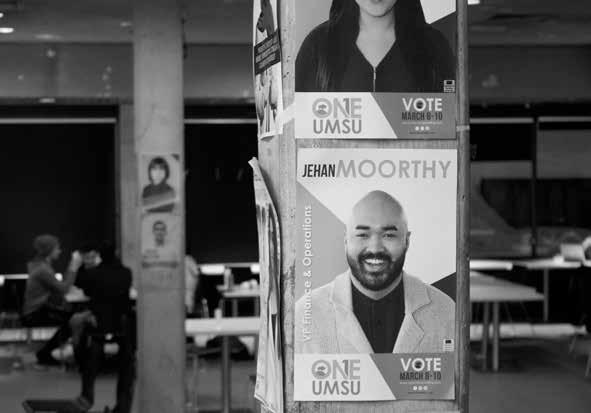
AUniversity of Manitoba Students’ Union (UMSU) vice-presidential candidate has apologized for comments made in November regarding a federal government bill that would provide further protections for transgender people in Canada.
In a social media post from Nov. 22, One UMSU vice-president finance and operations candidate Jehan Moorthy criticized a government bill that would amend the Canadian Human Rights Act to add gender identity and gender expression to a list of prohibited grounds of discrimination.
In the post, Moorthy wrote: “could go to Jail and be fined for not referring to someone as ‘he’ or ‘she.’ Right how do I get off Planet Earth. I’ve had it. I’ve had enough,” and provided a link to Liberal justice minister Jodie Wilson-Raybould’s statement on the passage of the bill from Nov. 18. Moorthy’s post has since been deleted.
The law, titled Bill C-16, would also amend the Criminal Code of Canada to extend protections against hate propaganda or offences motivated by bias, prejudice, or hate to transgender Canadians.
Bill C-16 passed in the House of Commons 248 to 40 on Oct. 18, but has not yet been voted on in the Senate.
the frequency of buses during rush hour, as well as extend operating hours.
UMSU United vice-president advocacy candidate Chance Paupanakis has promised to increase security in student lounges and study spaces and ensure all UMSU events are inclusive to students of all cultural and ethnic backgrounds. They have also promised to increase union transparency by live-streaming all UMSU council meetings.
UMSU United has also promised to promote consent culture on campus by working with Justice for Womyn and the U of M health and wellness office.
For more information, watch candidate interviews online at themanitoban. com
The comments are especially pertinent, as during a segment of One UMSU’s official campaign video released on March 2 , Moorthy discussed his slate’s goal to “promote and celebrate all of our students, no matter what their religion, race, gender, or sexuality.”
“As a transgender person, I do not feel that comfortable voting for someone who questions something that is as simple as treating me as the person I am ” –
Theo Desilva, former UMSU LGBTTQ* representative
Former UMSU LGBTTQ* representative and transgender U of M student Theo DeSilva said he was “saddened” when he became aware of Moorthy’s comments.
“Someone that is running to repre-
sent all students on campus showed his disdain to using the appropriate pronouns for a person,” he said.
“As a transgender person, I do not feel that comfortable voting for someone who questions something that is as simple as treating me as the person I am.”
Moorthy apologized for his comments Monday in an email to the Manitoban, saying that he did not understand the ramifications of Bill C-16 when he made the comments.
“I apologize to the trans community for my insensitivity when making that post,” he said. “ I realized I made a mistake and deleted it shortly after posting it.”
Moorthy also indicated that he is willing to take some form of sensitivity or ally training.
One UMSU presidential candidate and current UMSU president Tanjit Nagra said that she was previously unaware of Moorthy’s comments and that she wanted him to apologize.
“Jehan is aware that UMSU recently passed a position statement that promotes an equitable campus and opposes transphobia,” she said in an email.
“He is aware that if he wants to be an acting officer of UMSU that he must represent this position to the
best of his ability.”
Rainbow Pride Mosaic (RPM) –an UMSU service group and campus safe space for LGBTTQ* students and staff – coordinator Brandon Clayton said he is satisfied with Moorthy’s apology.
“We are glad Moorthy realized his mistake and we are glad he will have a more inclusive mindset moving forward,” Clayton said. “It is important that people on [UMSU] council realize they represent all students, no matter who they are.”
Clayton also said that RPM would offer ally awareness training
in the future for any students “for learning opportunities on LGBTTQ* issues.”
DeSilva, however, said he was not satisfied with Moorthy’s apology and insisted the VP finance and operations candidate take the training.
When asked whether she thinks Moorthy should take some form of sensitivity training, Nagra said “I think all students should receive bystander intervention, consent culture, mental health first aid, allied, and sensitivity training. However, enforcing this would be very difficult.”
Large counter-protest dwarfs antiMotion 103 rally at Winnipeg City Hall
Small
Winnipeg protest part of Canada-wide rallies against Liberal anti-Islamophobia motion
LEVI GARBER, STAFF
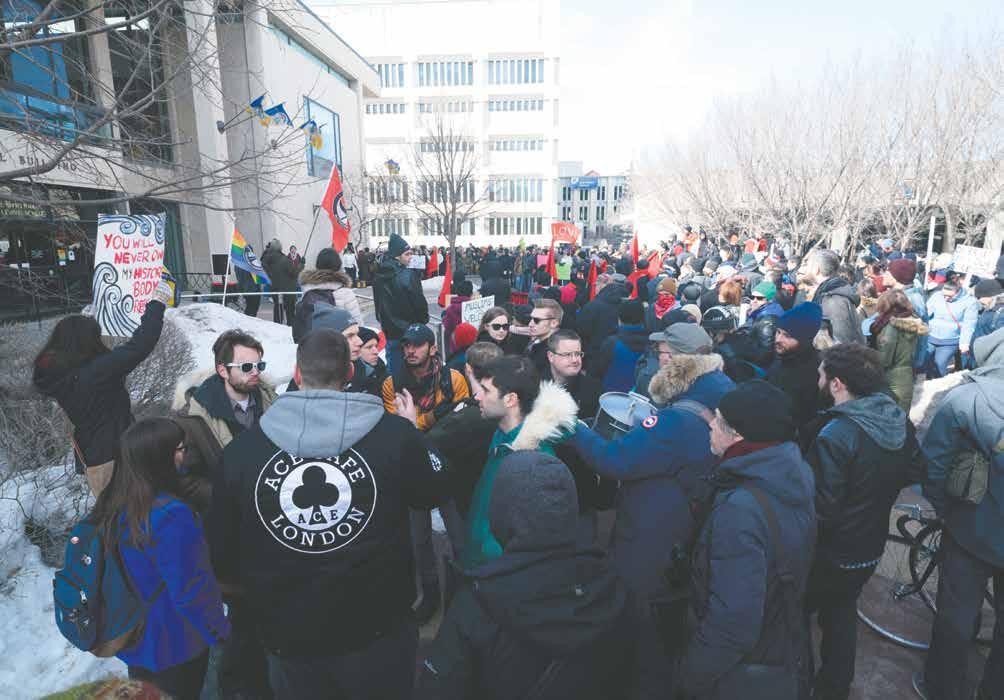
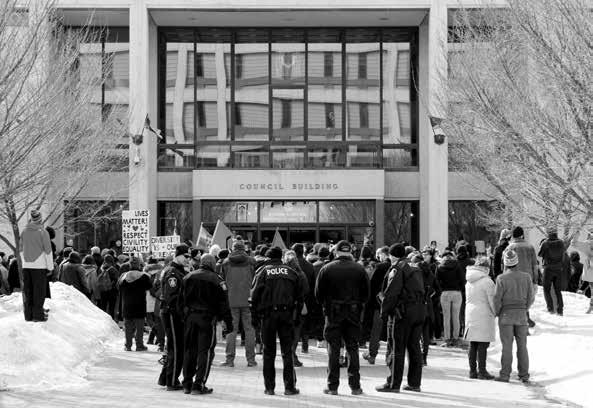
Asmall group of protestors was confronted by a much larger crowd of counter-protestors outside City Hall Saturday.
The original rally, organized by the smaller group, was meant to oppose a federal Liberal motion that would condemn all forms of religious discrimination, including Islamophobia.
Motion 103 was introduced in Parliament by Mississauga MP Iqra Khalid last December and debate on the motion begain in February, not long after a mass shooting at a Quebec City mosque in January left six men dead.
If passed, M-103 would “recognize the need to quell the increasing public climate of hate and fear,” request that a government committee “develop a government-wide approach to reducing or eliminating systemic racism and religious discrimination, including Islamophobia,” and collect data on hate crime reports in Canada.
Although it was difficult to tell, nearly 15 protestors attended the Winnipeg March for Freedom, Liberty, and Justice, organized by the Canadian Coalition of Concerned Citizens (CCCC) as part of a nationwide day of protests against M-103. Some protestors carried inflammatory signs and one wore a slogan on his back that read “Stop Sharia Law” next to an image of the Canadian flag.
The small group was dwarfed however by a much larger crowd of just over 200 counter-protestors waving Indigenous and Pride flags and carrying signs with slogans such as “Refugees Welcome.”
Counter-protest organizer Omar Kinnarath said he coordinated the opposing rally to respond to what he sees as a growing far-right movement in Canada.
“Very far-right or alt-right groups have been coming into Canada and this was kind of the first national
action by any group, so [we] felt the need to draw the line in the sand early,” Kinnarath told the Manitoban
“We found out about this rally from our anti-fascist contacts in Toronto and then we organized it right away,” he said. “It’s fantastic. Being a Muslim myself, it’s great to see all the support from everyone, from all sides.”
There was a large police presence at City Hall, although no violence broke out between the groups of protestors.
For over an hour, counter-protestors shouted at the small group of protestors and argued over a range of issues with them, including Islamophobia, Indigenous rights, residential schools, and Donald Trump, among other topics.
One of the protestors clad in a red “Make America Great Again” hat, who would only provide his first name (Nicholas), said he joined the
demonstration because he found it interesting.
“To be honest with you, I actually wear this hat every day all the time,” he said. “I came here to check things out to see what’s going on. No rhyme or reason, just coming to check things out.”
According to a release from the CCCC, the protest was organized –among other reasons – to tell the government that M-103 is not needed, as “Canada’s existing laws are sufficient.”
“It is not government’s role to single out a specific religion or provide that religion with special privileges,” read the release published on Mar. 3.
M-103 is not a bill therefore it cannot become law. If the motion passes, it will not place any legal restrictions on freedom of speech in Canada.
Canadian Federation of StudentsManitoba international students’ commissioner and University of Manitoba international student Saif Baloch disagreed with the CCCC’s stance and argued with protestors at the rally Saturday.
“I think it’s important to talk about
what’s been happening and what happened in Québec earlier this year,” Baloch told the Manitoban. “The hateful rhetoric that’s going around, even from the establishment parties [...] is not justified.”
“People need to be informed about the hateful rhetoric that’s coming up,” he said. “There was even a person that was saying ‘hate speech doesn’t exist’ and I was appalled by it.”
A similar protest in Montréal Saturday erupted in violence as nearly 100 anti-M103 protestors clashed with counter-protestors.
The Winnipeg protest and counter-protest ended at around 12:30 p.m.
PHOTOS BY MIGUEL YETMAN
Stephen Lewis slams Trump on human rights during U of M lecture
Professor of distinction and United Nations veteran urged Canadian policy to push back against American nativism
OSHO SAMUEL ADETUNJI, STAFF
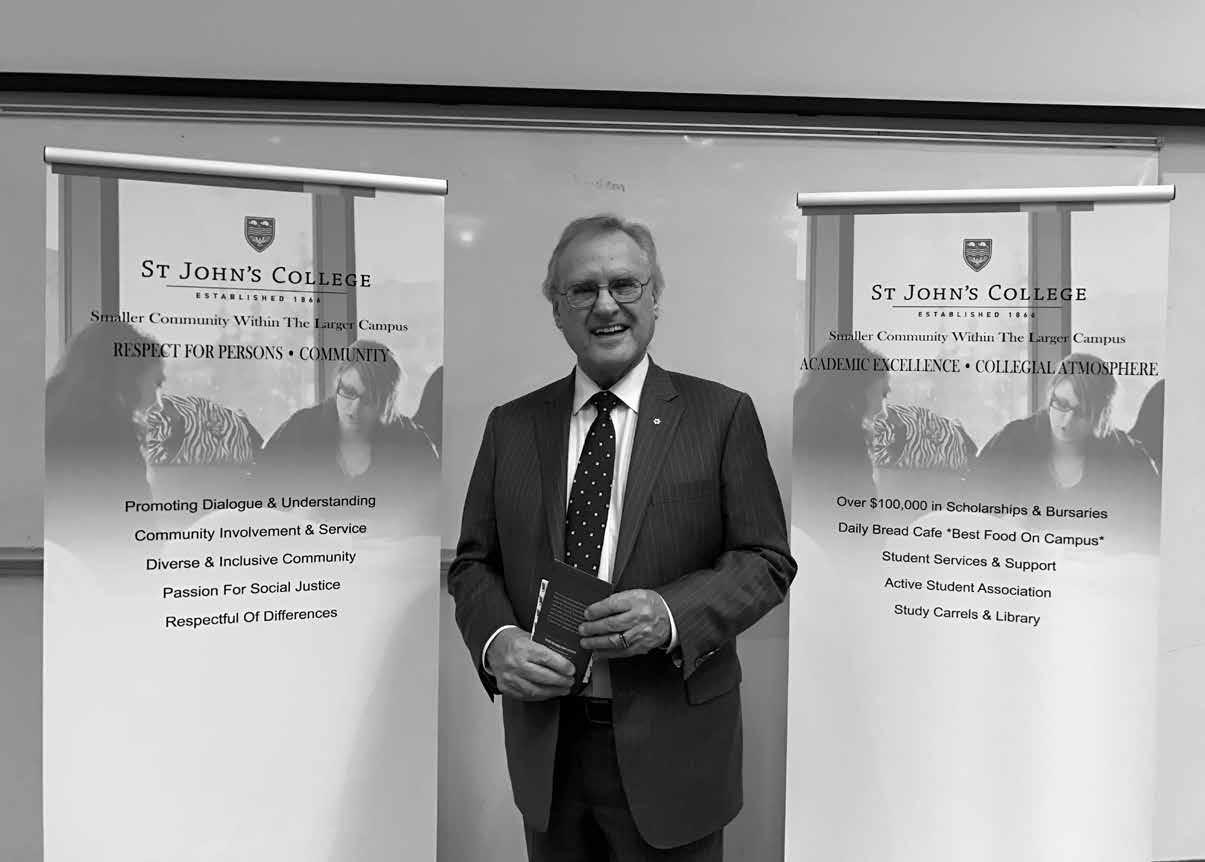
A strong voice calling for the revival of human rights spoke at St. John’s College Feb. 28 for the annual Marjorie Ward Lecture.
Stephen Lewis, a professor of distinction at Ryerson University and a renowned former politician who worked with the United Nations for more than two decades, delivered a lecture asking “are human rights eroding in the 21st century?”
The one-hour address exposed the numerous threats to human rights and their crucial effects on the quality of life for the current generation. Lewis’ speech outlined the role of the United States in the ongoing erosion of human rights and what is expected from Canada as a nation.
“Countries like Canada have to find the courage to stand up to these atrocities”
– Stephen Lewis, former UN secretary general’s special envoy for HIV/AIDS
Lewis began with a long list of possible implications of the inauguration of a new administration in the White House, led by President Donald Trump, that is averse to the entrenchment of ideals and human rights.
“We now have a fundamentally altered landscape in the United States and therefore internationally – which is frankly terrifying,” he said.
“We have a moron in the White House who understands almost nothing about the way the world works and is not ideological except for egomaniac narcissism and accumulation of wealth.”
Just this week, Trump issued a second travel ban targeting six Muslim-majority countries. An earlier version of the ban was abandoned after a federal appeals court refused to reinstate an executive order that restricted travel from seven Muslimmajority countries and suspended entry to refugees.
“The consequences and the terrible erosion of rights are identifiable and palpable on every front,” said Lewis, “because it is necessary to say, as all of you know, that this is the most important position in the world, the most important and influential country in the world.”
Lewis reiterated his concerns about the leadership of the United States by referring to the speeches of the United Nations secretary general Antonio Guterres and United Nations high commissioner for human rights
Zeid Ra’ad Al Hussein at the ongoing session of the United Nations Human Rights Council which started late last month in Geneva.
Lewis pointed out that they both “without naming names, made it clear how deeply offended and concerned they were about the behaviour of the president of the United States.”
Lewis voiced his concerns about the recent development in the Trump-led government to increase funding to defence while cutting foreign aid. He lamented the implications of the decision, which he said may inhibit the United States from continuing to champion charitable causes in developing countries via foreign aid.
“The president of the United States has amassed a little cabal of senior military officers around him and we are now going to begin successively to increase the defence budget at the expense of human priorities and so therefore, you have an unstable, irrational, unpredictable president,” he said.
“I see that not only are they cutting the environmental protection agencies in order to provide money for arms, but they are going to cut foreign aid. Now, maybe it is because I lived my life in that world for the past 30 years, but it is almost impossible to imagine the human havoc, the truncation and elimination of human
rights that occurs when the United States – which is frequently the single largest donor – starts cutting back.”
“We have a moron in the White House who understands almost nothing about the way the world works and is not ideological except for egomaniac narcissism and accumulation of wealth” –Stephen Lewis
He condemned the initial executive order on refugees, issued January, and called on Canada to stay true to the endearing values that have sustained the country for 150 years since confederation.
“I am increasingly of the opinion that what this world wants – and what this world needs – is a voice of principles to say to the president of the United States ‘you are wrong,’” he said.
“We, as a country, have a series of values and principles which we cherish for 150 years and we are not prepared to have them subdued by executive orders issued from the United States of America.”
He called on Canada to stand strong and entrench human rights.
“I don’t think any country should attempt to assuage the egotism of Donald Trump by playing nice, by shaking hands deferentially, sometimes reverentially, by pretending to accept his admonitions provided he maintain trade plans,” he said.
“Countries like Canada have to find the courage to stand up to these atrocities. As I say, it does not have to be unduly confrontational but can be uttered with respect and dignity just dissociating ourselves from the pattern or behaviour and saying to the world, ‘you want a beacon of conscience? It is called Canada.’”
“And yes,” he added, “we may suffer some agitation and some difficult trade talks and we may suffer some abuse via torture in the middle of the night, but we are not going to recoil from that – we have a position and we are going to hold to it.”
Welcoming to Winnipeg
Winnipeg mayor Brian Bowman was among the dignitaries who attended the event and he spoke about the efforts of his administration
BY
to make the City of Winnipeg – once called the most racist city in Canada – a place where everyone is welcomed and received with open arms.
“We try to gather community leaders and advocates who are championing various human rights to undertake the simple act of working together,” he said, citing a recent symbolic walk for human rights.
“We are continuing to provide more supports to welcoming newcomers, especially refugees, to Winnipeg. Certainly, when it comes to our Indigenous community, we are doing a lot of work right now to increase our Indigenous inclusion efforts. What we saw during the presidential campaign, some of the rhetoric that then-candidate, nowPresident Trump voiced were deeply offensive and certainly have empowered some groups that we would not like to see empowered.”
“And so what we are trying to do is really just demonstrate to our own citizens but also to our neighbours as well as global citizens that Canada is a place where we welcome newcomers and we value and promote human rights.”
PHOTO
CHANTAL ZDAN
Editor-In-Chief:
Craig Adolphe
Contact: Editor@themanitoban.com / 474.6770
Automation isn’t the problem, capitalism is
SHAWN GARBUTT, STAFF
W
hen it comes to depictions of futuristic societies in film and literature, science fiction nigh unanimously errs on the side of dystopia. So too do pundits – and nearly half of young people in developed industrial economies, according to a 2016 poll by Future Foundation – when the topic of automation of the labour force is discussed. Indeed, headlines often blare job losses to technological innovation in numbers that seem impossible: one 2016 report by the Mowat Centre, a public policy think tank, declared that a little over 40 per cent of Canadian jobs are highly vulnerable to automation in the next 10 to 20 years And while high-risk occupations also tend to be low-income, illustrious STEM fields (science, technology, engineering, and mathematics) have also become increasingly susceptible to creeping automation due to some of the repetitive task-based elements that come along with high degrees of specialization. While this isn’t the Terminator’s famous Skynet scenario, the prospect of large-scale unemployment at the hands of robots may understandably foster hostility and anxiety in the minds of today’s modern precarious worker, or alternatively, precariat. Another major factor in this potential discontent is the current status of
social infrastructure in Canada and the West at large, which is frankly failing.
Through nationalization, we may ensure that the fruits of automation are distributed appropriately and equitably
Unions have been falling both in terms of strength and membership since the eighties, and benefits for both the employed and unemployed have been subject to continual downgrades over the past few decades. Employed workers have seen their benefits shrink due to the spread of the “gig economy,” which has replaced traditional fulltime employment and all the security alongside it with much more turbulent, part-time contract work. Meanwhile, the vast majority of the unemployed have seen their safety net shredded. In the past 40 years, the distribution of employment insurance has been halved, covering only 39 per cent of unemployed Canadians in
2016 as opposed to 82 per cent in 1978. At large, both local and global labour markets have become characterized by precarity.
It is speculated that the new “digital economy” will only exacerbate these woes. However, such a conclusion rests on premises of maintaining the ideological status quo: the assumption that labour regulations will continue to benefit owners at the expense of labourers. But rather than becoming mired in cynicism, we must at least attempt to summon the political will to change the course of the future for the better. That is to say, the automation of the workforce need not be a looming dystopia, but instead could be a gleaming utopia – so long as the weaknesses in our social infrastructure are addressed.
Fears surrounding a robotic invasion of the workforce are largely influenced by the trenchant grip of late capitalism on modern society. With certain measures in place, mass automation of the labour force is not only permissible, but desirable: a pursuit worthy of all the political capital the left can muster.
A priority of any government allied both to the modern day labourer and economic automation should be the implementation of a robust universal basic income. Specifically, one with a progressive index that scales back the
payable sums the higher a recipient falls on the income bracket. This is in order to ensure that those who are temporary or permanently displaced from the workforce can continue to live a reasonable lifestyle, and as a result are able to continue engaging in the economy.
The automation of the workforce need not be a looming dystopia, but instead could be a gleaming utopia
Secondly, all industries that provide the infrastructure for automation must be nationalized. Otherwise, income inequality would soar as capitalists reap massive profits as staffing costs vanish altogether from budgets. To allow private holdings in critical industries of the digital economy would spawn a superpowered class of robo-capitalists, consisting of those who own the intellectual property rights to automation technology and those who own the companies manned not by salaried but automated workers. It would be naïve to think the ensuing economic boom in
the private sector wouldn’t translate to a monopoly on political power. Through nationalization, we can ensure that the fruits of automation are distributed appropriately and equitably. Not only would extreme class stratification be prevented, but re-energized profit streams on an unprecedented scale raised from booming business will fund a universal basic income scheme among other additions to the welfare state. These will include comprehensive skill-building programs needed for the maintenance of a smaller but more diversified economy as well as the resources necessary to integrate coding curricula into the education system. Both would be necessary for the maintenance of economy-wide automation.
With such measures implemented, a reduced workload becomes one of the stepping stones to enlightenment. Freed from the monotonous drone of an all-consuming work week, workers subject to automation will be displaced not only from their jobs but from being cogs in a machine. With widespread automation, onceworkers will be able to invest in their creative pursuits, their relationships, and meaningful projects that genuinely attract their interest. Even those who wish to continue as career-driven will be free to do so without repercussions, as the types of employment primarily requiring human capital will be dynamic, complex, and richly engaging. Of course, this is all ideal speculation. Nevertheless, the chance of this never coming to pass ought not to dissuade our pursuit of what could be.
The drawbacks to automation on a mass scale stem not from the innovation itself but rather from the fact that modern social systems are woefully unequipped to deal with the upheaval that would follow from what is essentially an economic revolution. The welfare state in its current form does not have the resources to effectively cope with the aftershocks of widespread automation of the labour force. As the economy undergoes paradigm shifts, so too must public policy and the discourse surrounding it. Should we successfully reimagine the boundaries of this debate, past the neoliberal confines of free markets and small government, then society as a whole will reap the benefits. In terms of progress, the alternative simply does not compute.
GRAPHIC BY KELLY CAMPBELL
UMSU community reps need a bigger platform
JEREMIAH KOPP, STAFF
In the throes of yet another UMSU election, it is often easy to become distracted by the high-profile executive positions. These roles are typically contested by well-organized teams with student leaders who have talent, enthusiasm, and experience. The executive committee is responsible for the day-to-day operations of the union, so it is natural that these candidates are the primary focus of attention. This may be the nature of things, but the problem is that other elected positions are often drowned out and don’t receive the same level of interest or consideration.
UMSU exists to identify and fill gaps in the student experience through advocacy, services, and programming. The five community representative positions – womyn’s representative, international students’ representative, LGBTTQ* representative, Aboriginal students’ representative, and students living with disabilities representative – are of particular importance because they speak on behalf of traditionally mar-
ginalized communities that benefit from the collective action of their community. These individuals give voice to their constituency groups through their representation at UMSU council, the governing body of the union. This platform is incredibly important because it is used to educate the rest of council and the student body as a whole to the very real needs and issues of these groups.
for election and use their voice to advance their community’s interests.
The starting point should be in how elections are run and publicized. There are always ways to amplify the voices of these representatives and put
UMSU community representatives need more resources so the advocacy of marginalized groups can be carried out more efficiently, more substantially, and with greater impact
Marginalized groups are by definition those who are systematically disadvantaged relative to others. Those representing these communities are, in turn, often operating from a deficit given that they themselves are a member of that marginalized community. That is why it is so important that the electoral process and subsequent governance system create space to level the playing field and ensure that students feel empowered to stand
them front and centre in the public dialogue. These measures do not have to be revolutionary either – an email could be sent out to the student body, specifically focusing on these community positions and their policies. UMSU could also continue to hold a separate community representatives election forum in order to increase dialogue with constitutents and the student body at large.
These election-period actions, however, are not a substitute for the
institutional support that will be required if attracting more candidates, interest, and support to these positions is the ultimate goal. UMSU can play a role in facilitating this process by ensuring community representatives have support once they are elected. This can include information sessions for the representatives on the history and policies of the union, financial resources to attend conferences and workshops pertaining to their role, as well as UMSU staff support for research and advocacy initiatives.
One way to expand the profile and platform of these representatives would be through an “advocacy report” that UMSU could distribute to the student body on the representatives’ behalf with issues that the community has brought forward, notices about upcoming events, and information on how to get involved
on campus with specific regard given to the five currently identified community representatives.
UMSU community representatives need more resources so the advocacy of marginalized groups can be carried out more efficiently, more substantially, and with greater impact. For a union, there’s no reason not to raise up those members who have historically been knocked down.
PHOTO BY MEGAN COLWELL
Trudeau needs to scrap the Third Safe Country Agreement
The
agreement between Canada and the U.S. is putting refugee claimants at risk
SHADEN ABUSALEH, STAFF
W
hen it comes to refugee policy, Prime Minister Justin Trudeau has two stances: one on Twitter, and the other on paper.
Nowhere is that more clear than in Emerson, Manitoba, a small border town with a population of 700 people, that has made its way to international headlines due to the sharp increase in the number of asylum seekers entering Canada near the border crossing. In 2017 alone, at least 190 people, have made the decision to take this dangerous journey and cross into Canada to claim asylum. Between April and December of 2016, 410 immigrants made the crossing. And while there has been an outpouring of support for refugees from Manitobans over the last few months, there have also been many who have called on authorities to implement stricter regulations at border crossings in order to slow down the influx of asylum seekers.
The number of refugee claimants entering Manitoba has increased significantly since Donald Trump’s election to the American presidency last November. A number of claimants who have made their way into Canada have even cited Trump and
his infamous executive order – the “Muslim ban” – as the reason why they decided that asking for refugee protection in the U.S. would be a fruitless effort, fearing deportation.
The Liberal government should ensure that those who cannot now count on safe haven in the U.S. can find it here
It is also important to keep in mind that in addition to the growing intolerance spreading across the Western world, we are living in a time where the number of people who have been forcibly displaced from their homes is at a record high.
A 2015 UNHCR report concluded that the number of people forcibly displaced from their homes globally, either within their home country or outside their home country, is at 65.3
million. This means that one person in 113 is a displaced person. This number is greater than the population of Canada, Australia, and New Zealand combined.
And while Prime Minister Justin Trudeau painted a rosy picture of Canada’s openness on Twitter, claiming to welcome all those “fleeing persecution, terror and war,” his viral tweet left out an important and strict agreement that Canada adheres to: the Safe Third Country Agreement. Under the Canada-U.S. Safe Third Country Agreement, which came into effect in 2004, the U.S. is considered a ‘safe country,’ which is meant to denote a state where claiming refugee protection is possible. The agreement forces refugees to make their asylum claims in the country they first landed in. This bars asylum seekers who wish to make their claim in Canada but arrived in the U.S. first. As a result, any refugee claimant coming from the United States into Canada through regulated border crossings is denied entry.
Because this agreement only applies at regulated border crossings, very few are claiming asylum at offi-
cial border crossings, and many are instead opting to risk their lives and limbs and trek for hours through the harsh and unforgiving winter weather by “illegally” crossing into Canada through farmers’ fields. Because once a claimant enters Canada, the state must abide by the 1951 United Nations Refugee Convention, which “asserts that a refugee should not be returned to a country where they face serious threats to their life or freedom.” In other words, while it is technically “illegal” to cross into Canada outside of an official border crossing, international law requires refugees be protected from punishment and deportation on the grounds that they are fleeing persecution.
Many across the country are calling on the Liberal government to amend and even scrap the Safe Third Country Agreement, including much of the law community as well as the NDP. Students at the University of Manitoba Robson Hall faculty of law held a research-a-thon to draft legal memos as part of the nationwide effort to scrap this agreement.
One can make a logical, sound argument on why scrapping the
Safe Third Country Agreement and opening our borders has economic, societal, and even cultural benefits. Trudeau said it best: “diversity is our strength.” But the moral, humanitarian argument should beat out all other arguments, and now more than ever the Liberal government has a moral obligation to scrap the Safe Third Country Agreement. Even after an appeals court upheld the suspension of Trump’s ban, those seeking protection from persecution will remain in danger, especially considering the Trump administration will be trying its hand at a second attempt.
A 2015 UNHCR report concluded that the number of people forcibly displaced from their homes, either within their home country or outside their home country, is at 65.3 million
A report from Harvard Law School concludes that the United States cannot be considered a “safe country” for asylum seekers anymore because Trump’s executive orders highlight “this administration’s hostility toward refugees and asylum seekers.” The report points to the grave potential consequences of Trump’s executive orders on immigration, which include inhuman and arguably unconstitutional actions such as the large-scale detention of asylum seekers, the removal of refugees without due process, the empowering of local officials to detain individuals on mere suspicion of immigration violation, and permitting discrimination based on asylum seekers’ religion and nationalities. When two Ghanian refugees almost died after walking for hours to cross into Manitoba from the U.S. on Christmas Eve, losing most of their fingers and toes due to frostbite, Ottawa should have immediately taken a stronger stance and either amended or scrapped the Safe Third Country Agreement. If Trudeau meant what he wrote in his viral tweet about Canada’s commitment to openness in the wake of Trump’s travel ban, then his Liberal government should ensure that those who cannot now count on safe haven in the U.S. can find it here.
GRAPHIC BY ALDO RIOS
Vaquita porpoises at risk of immediate extinction due to illegal fishing trade, says WWF
MALAK ABAS, STAFF
The world’s rarest marine mammal, the vaquita porpoise, has lost half of its population in one year.
Just last year, it was reported by the Committee for the Recovery of the Vaquita (CIRVA) that there were approximately 60 vaquitas left in the wild. Currently, CIRVA has estimated there to be just 30 vaquita porpoisesst left in the wild.
It was not always this dire for the vaquita porpoise. Sadly, their population has declined by 92 percent in just 20 years. The vaquita porpoise is the world’s smallest cetacean (typically they reach about five feet in length and weigh around 120 pounds) and only exists in Mexico’s northern Gulf of California.
The World Wildlife Federation
(WWF) and the Mexican government are at odds over how to approach this critical situation. While the WWF is calling for an outright fishing ban in the Gulf of California, Mexican authorities, believing this to be too costly, have suggested instead placing several of the remaining vaquitas in custody, in hopes of preserving the species.
handful of vaquitas in the capturing process could permanently render the species extinct.
It was not always this dire for the vaquita porpoise. Sadly, their population has declined by 92 percent in just 20 years are ignoring the ban, and are continuing to gillnet fish while eluding authorities.
However, choosing to take the capture route in the case of the vaquita porpoise is dangerous and considered a last resort. With only 30 vaquita porpoises left, losing even a
Mexcio has already banned illegal gillnet fishing near the vaquita porpoise’s habitat. The government has offered $74 million to locals over two years in hopes that the compensation would supplement what locals who rely on gillnet fishing would lose from the ban. Despite this, many fishers
“This breaks my heart,” said Leigh Henry, WWF senior policy advisor.
“Wildlife conservation can be a tough job.
What’s so devastating about the vaquita is that it could go extinct with the majority of the world having no idea this beautiful animal even existed.”
“But I refuse to give up hope. We’ll fight on.”
Vaquita porpoises have died at such a rapid rate mainly because of
something called “bycatch,” which occurs when a marine species lives too close to a more sought-after marine species, and is caught in illegal gillnets set out by fishers who mean to catch the other species. In the vaquitas’ case, they habituate the same area as the totoaba fish. The totoaba, which is also endangered, is pursued by fishers for its swim bladder, which is used in a Chinese medicinal soup believed to improve fertility. The WWF is also calling for the US and China to end the shipment and sales of totoaba-based products.
GRAPHIC
How do we fix our infamous pothole season?
An interview with the U of M Pavement Research Group’s Ahmed Shalaby
DELICA LEBOE-MCGOWAN, VOLUNTEER STAFF
After surviving months of winter driving, the Manitoban driver’s reward is the beginning of pothole season. The erratic fluctuations between warm and cool temperatures in early spring are responsible for this annual damage to the road system: the warm periods cause water to enter the foundation of pavement as the snow and ice on top of the road melt, and when cold weather returns, this absorbed water freezes and expands, forcing the pavement upward. This process is called “frost heave.” The ice eventually melts, leaving voids beneath the surface of the road. One of these hollow sections becomes a pothole when the bulging asphalt collapses – often under the weight of a vehicle.
In order to reduce how many of these hazards drivers will need to dodge, the City of Winnipeg, the Province of Manitoba and the Government of Canada have invested a combined $105 million towards more than 150 construction projects on local streets. This commitment is more difficult to appreciate from the perspective of drivers, whose commute becomes longer with every lane closed for repairs.
In order to reduce how many of these hazards drivers will need to dodge, the 2017 budget allocates $105 million towards more than 150 construction projects on local streets
Fortunately, engineers are working to spare all road users from this recurring nuisance by developing strategies for making road maintenance less expensive and more efficient. The faculty of engineering at the University of Manitoba is contributing to these advancements through the team of engineers who comprise the Pavement Research Group. The Manitoban spoke with Dr. Ahmed Shalaby, the principal investigator of the Pavement Research Group, about his research. The goals of this research include determining how to prevent environmental stressors from weakening pavement, how to prolong the effectiveness of repairs to damaged pavement, and how to detect early signs of damage on roads.
As annoying as the road conditions in Manitoba can be, it is worth considering whether there are any other options available to us. Surprisingly, the basic material that provides the foundation for many modern road systems does not actu-
ally represent a modern technology.
Ancient Mesopotamia provides the site of the first documented paved road system, and the material used by that civilization was essentially the same as the material that often forms the basis of our own modern streets and highways. That material is called bitumen-modern road builders refer to this substance as asphalt.
It may seem confusing that the strategy being used today to build better roads was the system used as far back as in Ancient Mesopotamia. However, when asked, Shalaby noted that Manitoba was working with the best materials available.
“A lot of the roads in Manitoba are one of two materials, either it’s asphalt or bitumen or concrete. The City of Winnipeg builds a lot of concrete [roads], and those are the two typical materials around the world. They are the best materials because they are ubiquitous – they are everywhere – and cost-effective,” Shalaby explains.
“I’m not sure there is any other material that can meet those requirements and remain cost-effective. Anything else that we may use would be maybe too expensive. If we didn’t have [asphalt or concrete], we’d probably have to go back to gravel roads – unsurfaced roads.”
One of the challenges that we face
when maintaining roads in Manitoba, other than the wide range of temperatures, is the relatively soft soil that we must build our roads upon. According to Shalaby, one solution for this problem is to use lightweight materials in road embankments.
“With the use of traditional materials, you can expect to have more deflections and more settlements later on,” Shalaby said.
“But with lightweight materials like [shredded] rubber tires or foam… or lightweight concrete, you are able to minimize the stress on the soil, while, at the same time, elevating the road structure to the level that is required by design.”
Shalaby’s Pavement Research Group is also active in evaluating the suitability of different road sealants, which are applied when cracks form in road surfaces, caused by the often extreme climate in Manitoba. Shalaby notes, however, this does not entirely fix the problem.
“[This damage] reduces the integrity of the structure, meaning that a cracked structure cannot take load the same way an intact structure can. The other way, which is even more damaging, is that it provides more opportunities for water to go through the road structure, and that causes a lot of damage through erosion and other mechanisms like frost heave,
for example,” said Shalaby. “That’s one of the maintenance activities that needs to be done promptly… to seal cracks and repair surfaces.”
Automated road monitoring systems, a relatively new invention, can now evaluate road quality with a level of precision that is not possible to achieve merely with human vision
Naturally, repairing damaged roads is a priority, but finding ways to detect which roads demand repairs before the damage is too severe is also an important and cost-effective way to ensure that our road systems remain safe for motorists and their passengers. Automated road monitoring systems, a relatively new invention, can now evaluate road quality with a level of precision that is not possible to achieve merely with
human vision.
“[Engineers have developed] vans equipped with lasers that are pointing down to the road. They are proximity lasers, so they can measure how far is the road surface and what shape is the road surface, too, and whether there are any undulations in that road surface,” Shalaby said.
“There are software programs that take this data and simulate what happens if a car drives on this road, or a bus drives on this road, or a truck drives on this road, and comes up with kind of a composite index – a value – to say, here is the quality of this road. In terms of its ride quality, [it describes] how smooth that ride will be. Through research, it was found that that index correlates very well to the performance of the road, meaning how long this road should last.”
“That data is collected now routinely on Manitoba’s highway network, and there is a lot of analysis that can be done on this data, in terms of identifying sections that should be repaired or replaced. Because when you have poor ride quality, it makes the road surface less safe… It impacts the stability of vehicles on the road. It impacts, ultimately, the safety of the motorist and the public.”
GRAPHIC BY ALDO RIOS
3Peat put faith in local music scene
Up-and-coming local hip-hop outfit shares musings on local rap, music, and personal influences
OLIVIA MICHALCZUK, STAFF
3Peatis a local hip-hop trio comprised of members WATG Steve, Dill the Giant, and E.GG. The troupe delivers hard-hitting lyrics to solid backbeats that have their audiences hooked on the first song.
Though the group only released their EP in September 2016, the Winnipeg music scene has already picked up on the music that they’ve been producing since 2015, playing big local events such as Spaceland, Big Fun Festival, and various hip-hop centric events around the city. The group has also been picked up for a show at Canadian Music Week 2017 in Toronto.
According to Steve, Winnipeg’s hip-hop scene is on the rise for the first time in a long while.
“In my opinion, the scene is actually healthier than it has been in a long time. Although we’ve always had a budding creative and music scene, it’s always seemed like it lacked a community aspect, but recently it seems like those barriers are being broken down, and you're seeing a lot of local artists creating together, sharing bills, and just pushing each other to go further.”
“There are not enough of us. We gotta get everybody doing their thing out here and supporting one another,” added Dill.
Each member of the group brings something different to the table, but one thing that’s evident by 3Peat’s performance is that they work together like a well-oiled machine.
“We like to refer to ourselves as
a triangle offence of various styles,” said Steve.
“Everyone is very different when it comes to rhyme style, content, and overall taste, but there’s something special that happens when we get together, and the pieces just fit together like a puzzle. Kinda like Voltron, if you will.”
“Although we’ve always had a budding creative and music scene, it’s always seemed like it lacked a community aspect, but recently it seems like those barriers are being broken down” – WATG Steve, 3Peat member
“We all got bars, we've all got vibes, we've all got something a little different to bring on stage,” added Dill.
The process of writing a song for 3Peat is an organic process that includes the musical and lyrical work of all members.
“With us, the songs practically create themselves. Someone will make the beat, whether it be myself, Dill, or
E.GG, and before we know it, we're coming up with concepts, writing the verses, and recording,” Steve explained.
“Sometimes that happens all in the same night, sometimes over an extended period of time. We like to keep things as self-sufficient and organic as possible.”
3Peat’s inspiration ranges from local artists to classic “golden era” hiphop, focusing on genuine and honest artists, and standing by the mantra that “real recognizes real.”
Steve mentioned Chris Bennett and Super Duty Tough Work when talking about local inspirations.
“I’ve always liked the classics –Biggie, Pac, Jay Z, et cetera. Locally,
I grew up hearing Mood Ruff, Grand Analog, Winnipeg’s Most, and Young Kidd,” said Dill.
E.GG also referenced classic rappers like 2Pac and Nas influencing his poetic style.
Non-musical inspirations for 3Peat range from members’ day jobs as a barber and a social worker in a group home to traveling, culture, and family.
Steve said his parents have been extremely supportive of his art, and he draws inspiration from the lessons they’ve provided: to work hard and stay positive.
Dill’s inspiration comes from skateboarding as he believes it is “the purest form of pushing yourself forward, literally.”
E.GG says that his inspiration comes from traveling.
“That, along with just living day by day, and the interactions with any and everybody. Who knows who you'll meet along the way that might change or influence your life, right?”
3Peat is especially grateful and inspired by the reception they have had in Winnipeg so far.
“Winnipeg, first and foremost, I want to say respect for the unconditional love and support,” said E.GG on the group’s reception in the city up to this point.
Check out 3Peat’s music at www. soundcloud.com/threepeatmusic and keep up with the band on Facebook or Twitter.
PHOTOS PROVIDED BY STEFANIE INFANTINO
SoFar Sounds sets up shop in Winnipeg
International secret concert network opens strong in the city
EMELIA FOURNIER, STAFF
If you didn’t hear about the strippeddown concert featuring local artists
Okay Mann, Sol James, and Logan McKillop on Feb. 27, don’t feel bad. It was supposed to be a secret. It was
the first “Sofar” ever to be held in Winnipeg, courtesy of international network SoFar Sounds.
A “Sofar” is the network’s term for their intimate shows, featur-
’Toban turntable
EMELIA FOURNIER, STAFF
ing emerging artists performing in unconventional spaces to a respectful, appreciative audience.
SoFar Sounds – a network for artists, hosts, and guests – opened its online Winnipeg branch in January 2017. Madi Allen was recruited in August 2016 as the Winnipeg city leader to manage the branch by a friend who was running Sofar Edmonton at the time. She has been spreading the word about the organization through social media, and informing musicians through word of mouth.
“My favourite thing [about SoFar Sounds] is the community. Whether it’s friends of mine, friends of friends, or just Sofar show followers, the attendees of the shows are so supportive. They are eager to come and just quietly witness stunning live music,” said Allen.
Sofars are often hosted in people’s homes, and audience members are expected to remain silent throughout the set. Because of the unconventional venues, usually a small space, artists are required to strip down their set to acoustic instruments only. Vocals are usually unamplified, and artists are encouraged to get creative
with their performances to accommodate the venue.
The lineup and venue locations are kept secret. Guests have to apply for tickets ahead of time, and the secrecy of the line-up ensures that guests do not apply for tickets based on who is headlining – this allows upcoming musicians to gain more exposure. Because the events are held in people’s homes, the location is only divulged to approved guests to ensure there are not too many audience members, and to keep the event intimate and respectful.
“I had a blast,” said Katlin Mathison, the artist behind the moniker Okay Mann.
“Because there was no microphone or amplification, it felt much more like playing to a group of friends than a typical venue gig. I could also see everyone’s faces, and noticed how intently everyone was listening. It was a special feeling.”
Mathison was first exposed to SoFar Sounds while attending school in the UK, where several cities have their own Sofar communities. Having heard positive things from other artists across Canada involved with Sofar, he was eager to perform at one himself.
“We welcomed guests to sit in our kitchen and dining room which both have a clear view of the living room, where the performance took place,” Mathison said of the event, which he also helped host.
“We also provided wine and s’mores which definitely added to the intimate feeling of the room.”
The branch is currently trying to reach out to more musicians and audience members to strengthen and grow a community to support and host future Sofars through both word-of-mouth and social media.
To find out when Sofars are happening in Winnipeg, check out www. facebook.com/SofarSoundsWinnipeg, or www.sofarsounds.com/winnipeg. To get involved, either as a performer, a volunteer, or a host, and to apply for tickets, visit www.sofarsounds.com/winnipeg.
Okay Mann will be playing another intimate show in collaboration with From Here and Away, a Canadian photography and ethical outdoor goods company, at the Forks on March 18. Tickets are available at www.fromhereandaway.ca
Japandroids
Near to the Wild Heart of Life 4/5
Vancouver-based indie-rock duo Japandroids’ new album Near to the Wild Heart of Life is an ode to rebellion and joy. Keeping tradition with the band’s typically uplifting lyricism, the opening titular track gets the listener “fired up,” and urges the listener to not “leave your dreams to chance or to a spirit in the sky.”
This song introduces larger themes that course through the album: the daunting pursuit of happiness and freedom, and the juxtaposition between the comfort of home and the adventure of new places, backed by an almost adoles-
cent, reckless energy.
The album’s second offering, “North East South West,” explores relationships through Canadian geography.
David Prowse’s persistent, flowing drumbeats continue through “True Love and a Free Life of Free Will,” a song that reconciles freedom with loving devotion.
“I’m Sorry (For Not Finding You Sooner)” is a distorted love song reminiscent of an older Blur song with repeated, hypnotic lyrics.
Japandroids have been experimenting with different types of effects and synthesizers on this album – something new for the band. While this adds additional texture to some songs, it fits comfortably within their usual style of
pulsing alt-rock, with tracks that tend to perpetually sound like they’re on the verge of euphoria.
“Midnight to Morning” and “No Known Drink or Drug” bring the listener back to a very familiar lyrical stomping ground for rock: yearning for a distant love. The album ends on the meditative “In a Body Like a Grave,” a more existential, pondering tune that’s fitting for the end of the album.
Near to the Wild Heart is filled with anthemic alt-rock that sometimes verges on the territory of cheesiness, but overall, it’s an enjoyable ride.
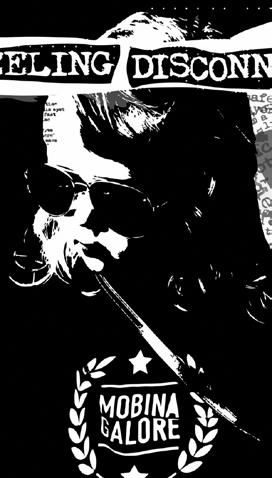
Mobina Galore Feeling Disconnected 4/5
Power chord-heavy Winnipeg duo Mobina Galore’s latest release – Feeling Disconnected – offers up raw, catchy punk tunes.
The duo expresses dissatisfaction with themselves and their environment through honest lyrics and Jenna Priestner’s strong, yelling vocals. Priestner emphasizes the different rhythmic styles of the songs through her percussive vocals, and it makes her lyrics all the more distinguishable. She transitions well between smoother, more melodic singing to rougher styles.
The overall tone of the album wavers between anger, dissatisfaction, fear, and resilience. The disconnect Mobina Galore presents here is within themselves, their location, and people around them. While not every track stands out on its own and some are more forgettable, none are outright displeasing.
“Vancouver” expresses the band’s urge to be in bigger and better places, to leave the comforts of their home to experience something greater. “There’s comfort in these walls, they’ve taken me this far, I won’t let it bring me down,” Priestner screams, echoing the
struggles that many young adults feel: the choice between security and adventure.
“Suffer” and “Nervous Wreck” speak to emotional disconnect and being distracted by internal turmoil affecting direct present experiences.
Overall, Mobina Galore manages to maintain an honesty and vulnerability that complements their aggressive, punk-rock attitude.
Feeling Disconnected is tough, it’s loud, and most importantly, it’s human.
PHOTO PROVIDED BY MANITOBA MUSIC
Sports Editor: Ryan Stelter Contact:
Men’s volleyball final four preview
Trinity Western, Alberta, and UBC invade Investors Group Athletic Centre
KELLEN TANIGUCHI, STAFF
T
he University of Manitoba men’s volleyball program will host the Canada West final four for the first time since 2004. The Bisons will be the highest seed in the tournament and will play the Alberta Golden Bears in the first semi-final. The Manitoban takes a look at the three teams invading the Investors Group Athletic Centre during March 10-11.
#1 Trinity Western Spartans
Regular season record: 21-3
Record vs Bisons: 2-0
Streak: Won five in a row (including playoffs)
Key players and strengths: Ryan Schlater is one of the biggest hitters in the conference, and is second in Canada West kills and kills per set. The Spartans do not make many attacking errors, with Schlater ranked fourth in conference hitting at .308 per cent; teammate Blake Scheerhorn is third in hitting percentage at .318. The two powerful hitters punished the host Bisons team during their regular season match-
ups, and were major contributors to that weekend sweep. Spartans setter Adam Schriemer is also a key piece to the club and he finished second in the conference with 10.28 assists per set, which is a sliver more than Manitoba setter Luke Herr’s 9.88 per set.
The University of Manitoba men’s volleyball program will host the Canada West final four for the first time since 2004
With all the attackers in the Spartans lineup, they finished first in Canada West hitting percentage. Trinity Western also finished at the top of the conference in service aces, with outside Eric Loeppky leading the conference with 0.55 aces per set.
Weakness: The Spartans finished in the top half of the league in most categories, but came in 12th in conference digs. To beat a top tier team like Trinity Western, the opposing attackers must have a good game and take advantage of the team’s inability to come up with digs. Opposing attackers should be able to find some space and success, as the Spartans are eighth in conference blocks.
#4 Alberta Golden Bears
Regular season record: 20-4
Record vs Bisons: 0-2
Streak: Won four straight games (including playoffs)
Key players: Alberta’s Taylor Arnett is the Canada West leader in hitting percentage at .377, and the team ranks third in the conference in that category. They also court one of Canada West’s top killers as well, with Ryan Nickifor finishing fourth in kills with 335, and fifth in kills per set with 3.94. The attacking is never possible without great assists, and Brett Walsh leads the conference
with 10.48 assists per set.
As a team, the Golden Bears defend well and rank second in Canada West blocks. They also rank third in service aces, so serving mistakes are rare for this team and could be the difference in a set.
Weakness: Like Trinity Western, Alberta has some trouble coming up with digs. To beat Alberta, you will need to out-hit them, and hope they are unable to come up with the digs when they need them. If attacks are successfully applied towards the Golden Bears, then that is the best chance an opposing team has to defeat them.
#6 UBC Thunderbirds
Regular season record: 16-8
Record vs Bisons: 0-2
Streak: Won two straight playoff games
Key players: UBC has what their opponents lack, and that is the ability to come up with digs.
The Thunderbirds rank fifth in the conference in digs, and have Tyson
BY
Smith and Byron Keturakis who rank in the top 10 in number of digs. Thunderbirds setter Keturakis also ranks fourth in service aces per set with 0.43, and ranks fifth with 9.46 assists per set.
As a team, UBC ranks first in conference assists, first in kills, second in service aces, and play well defensively finishing third in Canada West blocks. The T-birds have the most rounded defense, coming behind just Alberta in team blocks.
Weakness: The Thunderbirds have the worst hitting percentage of the four remaining teams, with a .241 per cent that was good enough to rank fifth in the conference. This is a weakness for them because the other three teams in the final four finished as the top three teams in hitting percentage.
The Bisons play their first match against the UBC Thunderbirds on March 10 at 6:30 p.m. at the Investors Group Athletic Centre.
PHOTO
STAR ROXAS
Bison men's volleyball team on the court
Five Bisons given all-star nod after stellar season
Lauryn Keen named Outstanding Player, Jon Rempel takes coaching award
JASON PCHAJEK, STAFF
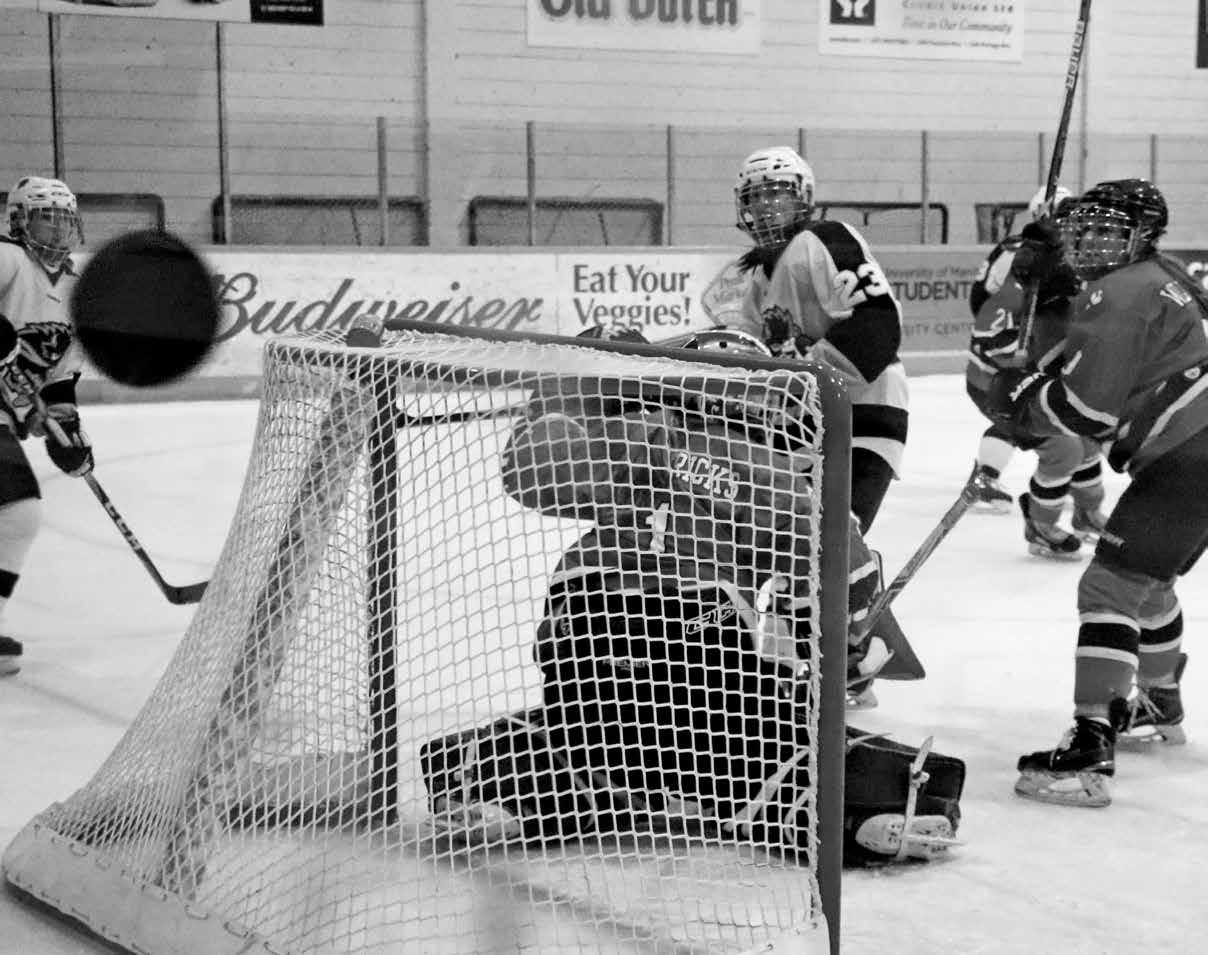
The season may not have ended the way they wanted, with the Bisons being swept in two games by the University of Alberta Pandas, but Rachel Dyck, Lauryn Keen, and Venla Hovi still had cause to celebrate. The three women were among the five Bisons players named to the Canada West first and second all-star teams. Alexandra Anderson and Erica Rieder were also given the honour. The Manitoban sat down with Keen, Dyck, and Hovi and talked about the season.
“It’s a team game but to be recognized personally is always nice,” Bisons goaltender Dyck said. “Pretty humbling to see your hard work pay off throughout the season, and it’s a competitive conference so we know that if you do receive anything like this then it’s pretty legitimate.”
Dyck finished the year tied for first in both wins and shutouts amongst Canada West goalies, with 15 and five respectively. The Winnipeg Beach native had success across the board, putting up a 1.51 goals against average and .931 save percentage while playing the second-most games among goalies in the conference.
Keen’s 34 points outpaced all other skaters in Canada West, leading to her receiving a nod as the conference’s Most Outstanding Player. She recorded nine goals and 25 assists through 28 games this season, eclipsing her previous career totals.
“It just goes to show how hard work can pay off,” Canada West leading scorer Keen said. “When you work as a team it really brings out individual abilities as well, like working hard so other people can be noticed.”
Hovi says that the sheer number of Bisons selected is a testament to the quality of the team.
“You also have to look at it big picture,” the second-year winger said. “Taking five out of one team, that’s a big amount so it just says something about our team for sure.”
Hovi missed time this season due to injury, but that didn’t slow down the Finnish forward, who produced at a consistent clip on a line with Keen. Despite appearing in only 22 games this season, she finished tied for third in Canada West scoring, riding a 1.14 points per game average to 10 goals and 15 assists.
Apart from the disappointing end to the season, all three women felt pleased with the year and excited for the next. The Bisons finished the season with a 19-7-1-1 record, good enough for 56 points and a third place finish in the conference.
“I thought this was probably one of our best seasons,” Dyck said of the year as a whole. “We were just consistent the whole way through. We hit a few bumps, we had injuries, people going away on trips, that kind of thing but it didn’t really affect us.”
This sentiment was reflected by
Keen. “Basing it on my last two years we’ve been the most consistent this year,” she said.
“My first year we had zero expectations so we were just playing to play, last year people weren’t too sure about us, then this year I think the expectations were so much higher and I think we did a good job meeting those expectations.”
“It’s a team game but to be recognized personally is always nice” – Rachel Dyck, Bison women’s hockey goaltender
Hovi said that the team has learned from last year, translating that into a successful season.
“I think the whole group just grew so much from last year,” she said. “Playing consistently this season definitely told us that we’ve grown as players and as athletes and people too.”
The same day the five Bisons were given the all-star nod, their coach was given his own praise. Bisons
head coach Jon Rempel was named Canada West’s Coach of the Year for the 2016-17 season. Rempel has been coaching the team for the past 13 seasons, guiding them to two conference championships – in 2008-09 and 2010-11 – as well as five national championship appearances. This is the fourth time Rempel has been named coach of the year, with the last coming during the 2014-15 campaign.
“I have to say personally he was a little different this year,” Hovi said of her coach, prompting laughter from her teammates. “He was able to trust us more and give us more freedom and in that sense he showed us that he was really trusting of all of us and was maybe a little bit calmer.”
“I also liked his approach this year,” Keen said. “I wasn’t around when he was very very intense but there have been times where he’s pushed us very hard and it was nice to come in this year and know what he expects of us, but not having to force us to do it all the time.”
With all three women coming back for the next Bisons season, expectations may be even higher. Despite losing some key contributors, including Dyck’s backup Amanda Schubert, the three were all optimistic about the season ahead.
“Well I’m going to be in my fifth year so that’s scary,” Dyck said. “I think each year we’ve been able to do something pretty cool and I think next year is just going to get better. So I’m pretty excited about the possibility of what we can do.”
“I think the whole group just grew so much from last year” – Venla Hovi, Bison women’s hockey forward
Keen added that she was also excited and is looking forward to the offseason ahead.
“Putting this year behind us and looking to next year, so it’s exciting knowing we have a summer to train and get better and take a break from the rink a bit but I’m excited to come back next year and take it all the way,” she said.
Hovi also pointed to the potential the team has to keep rolling next season.
“When you’re left with the emo-
tions of being disappointed that we didn’t go any further I’m sure the whole team is very hungry to work even harder,” she said. “This season we recognized how important those little things are and next year will be our year.”
For now, the three are looking towards their summer break. However, that doesn’t mean they’ll be resting too much.
“Hopefully get a good job,” Dyck said of her summer plans with a laugh. “The off-season is always exciting. You get that opportunity to work on your game, train hard, and make yourself hungry for next season.”
Keen is looking to fine-tune her game during the off-season, but also looking forward to some time off.
“You get a whole lot of time to work on your game, the little aspects you can’t work on in-season,” she said. “Like personal strength for me and shooting. Just getting some time away from the rink also.”
Hovi is in a different boat, as she will be heading back home to Finland for some time with the national team, a well-deserved reward for a great year.
PHOTO BY MEGAN COLWELL
Manitoba wins semi-final match, but falls to Alberta in Canada West finals
KELLEN TANIGUCHI, STAFF
This weekend, the University of Manitoba men’s basketball team played in the Canada West final four in Calgary. The Bisons opened the weekend with a thrilling 74-72 semi-finals victory over the fifth-ranked Calgary Dinos on Friday. The herd closed out the weekend with a tough 93-72 loss to the eighth-ranked Alberta Golden Bears in the Canada West finals. With the win in the semi-finals, Manitoba has clinched a spot at the U Sports final eight in Halifax that will take place from March 9 to 12.
Manitoba has clinched a spot at the U Sports final eight in Halifax that will take place from March 9 to 12
Friday
The Bisons defeated the Dinos in a nail-biting 74-72 game to advance to their first national championship since 1985. After Manitoba’s last two playoff runs ended in Calgary, the Bisons got their revenge.
The first half was played tight defensively, but neither team was able to turn their defense into offense.
Keith Omoerah was huge for the Bisons in the opening quarter, scoring all of his seven first-half points in the frame. The tight defense and Omoerah’s big seven points led to the Bisons’ 16-12 lead after the first frame.
Omoerah concluded the game with a double-double of 17 points and 14 rebounds.
In the second quarter, both teams were again kept under 20 points. AJ Basi led Manitoba with 2 treys in the frame, but the home side closed the gap and a Thomas Cooper layup tied the game at 30 at halftime. Basi finished the game with a game-high 19 points, while Cooper led the home team with 17 points.
The offense was rejuvenated in the second half, with the Bisons shooting 50 per cent from the field in the half and the Dinos shooting 44 per cent. Manitoba’s attempts from beyond the arc were a major factor and they were able to find the bucket on seven of nine attempts, while Calgary could only net two treys in the half.
There were nine lead changes in the second half, eight of which came in the third quarter. The two teams set a faster pace in the half, and exchanged drives throughout. Calgary was trailing 73-71 late, when
Omoerah sent Max Eisele to the line, but he was only able to sink one of the two free throws and cut the Bison lead down to just one point.
Calgary had to foul on the next possession, which sent Basi to take some free shots, but Basi was also only able to hit one free-throw to make the score 74-72. With just 13 seconds remaining, Cooper missed a game-tying shot for the Dinos. Dinos guard Mambi Diawara was able to snag the rebound, but missed on his last second attempt as well, and Manitoba hung on to win the game.
Saturday
Alberta and Manitoba played a tightly-contested opening half, with the Golden Bears taking a 38-32 lead into halftime. The Bisons struggled from the field, shooting just 36 per cent, but were able to hold Alberta to 45 per cent in a half that included five lead changes. Omoerah led the herd with 11 first-half points and finished the match with a double-double of 17 points and 10 rebounds. Ilarion Bonhomme also netted seven of his 15 points in the half.
The Golden Bears’ shooters were dialed-in in the second half and shot an unbelievable 66 per cent from the field, while holding the Bisons to 37 per cent. Manitoba was able to keep pace in the third frame, with Basi knocking down seven of his 17 total points.
With Alberta up 75-66 in the fourth, they put together a 10-0 run to build a 19-point lead on Manitoba. The Bears didn’t look back from there and rolled onto a big 93-72 Canada West championship victory. Brody
Clarke was an animal for Alberta, finishing with a double-double of a game-high 29 points and 12 rebounds, while Mamadou Gueye scored another 20 for the champions.
PHOTO BY STAR ROXAS
Two Bison football players to play at 2017 East-West Bowl
RYAN STELTER, STAFF
J
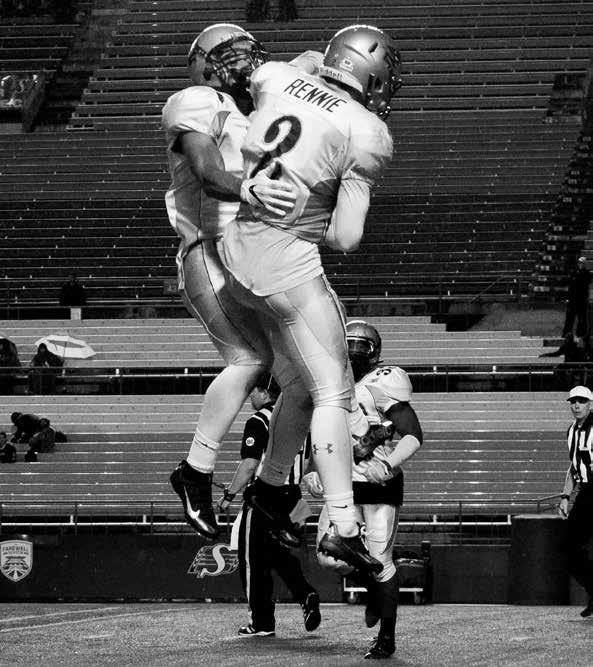
ayden McKoy and Houston Rennie have been selected to represent the West at the 2017 U Sports East-West Bowl on May 13. In the last two seasons, David Oneymata (2015) and Geoff Gray (2016) attended the EastWest Bowl.
Onyemata went on to win the J.P Metras Trophy as the best down lineman in Canada, and was selected by the New Orleans Saints in the 2016 NFL draft. Gray was nominated for the J.P Metras trophy and has earned himself an NFL pro day on March 30.
return yards with 79. McKoy started all eight conference games this past season.
The Winnipeg native has earned himself a place in the Bison record books despite only playing three seasons. He is 14th all time in tackles with 115.5, 6th all time in interceptions with ten, and 3rd all time with 208 interception return yards.
good enough for 15th in the Canada West. Rennie has made 56 total tackles in his three-year Bison career.
McKoy’s explosiveness and vision in the secondary has made him a key member of the Bisons’ defense
Senior defensive lineman Evan Foster was named the defensive MVP at the 2016 East-West Bowl in Montreal.
Third year defensive back McKoy is coming off a great season for the Bisons. He finished the 2016 season with 34 tackles, the 17th-best in the Canada West. The former Miles Mac Buckeye also finished second in the Canada West with four interceptions. He also finished first in interception
McKoy’s explosiveness and vision in the secondary has made him a key member of the Bison defense. McKoy’s speed will be on display for many scouts at the East-West Bowl and he will hope to raise his stock for the CFL draft.
Rennie, also in his third year, made the move to linebacker and has had a career year. The six-foot linebacker racked up 37 total tackles,
The East-West Bowl includes representatives of all 27 member schools and is for players who are eligible for the upcoming CFL draft. A national committee of U Sports and CFL head coaches selected the players that were nominated by their respective teams. The Bowl is a chance for players to showcase their talents to an array of CFL scouts and coaches.
The West and East teams have traded victories during the past four years, with each team winning twice. The West won 29-14 in last year’s edition at McGill.
The East-West Bowl will take place on May 13 at TELUS-UL Stadium at Laval University with an 11:30 a.m. kickoff.
PHOTO BY CHANTAL ZDAN
Jets fail to solve problems at the deadline with big names left on board
JASON PCHAJEK, STAFF
Looking back to the trade deadline two seasons ago, when the Jets made key acquisitions that landed them a playoff berth, this past deadline was the usual deal for Kevin Cheveldayoff and company. The only deal made by the Jets was to send Drew Stafford, a pending unrestricted free agent, to the Boston Bruins for a conditional sixth-round pick.
When names like Matt Duchene, Gabriel Landeskog, Ben Bishop, and Marc-Andre Fleury are available on the trade market, you would expect the Jets to try and address the multitude of issues that remain for the team. Despite this, the phone lines remained quiet at the MTS Centre.
Goaltending: is a move worth it?
The goaltending situation for the Jets this season has been, without a doubt, an absolute disaster. While the Connor Hellebuyck-Michael Hutchinson tandem was initially met with a great deal of excitement,
a mixture of the group in front of them and poor play caused the recall of veteran Ondrej Pavelec.
Analysts are quick to point out that the Jets have had defensive issues this season, but you need to expect your goaltender to make “that save” when you need them. Frankly, Hutch and Buck have not done that. Pavelec has, but to this point still is not consistent to rely upon long-term.
Three great goaltenders were available at this season’s deadline that could have turned the situation around. Consider Bishop, who was shipped off to the Los Angeles Kings, while Fleury was not moved ahead of the expansion draft.
Both could have been more solid options for the Jets in net, while acting as a mentor to Hellebuyck as he develops. Bishop is the more comparable player, a six-foot-seven American goaltender, playing a similar style to Hellebuyck. However the major drawback would be the asking price, his need for a new contract, and injury history.
Another goaltender that should have gotten more calls was Scott Darling of the Chicago Blackhawks. The Illinois native is six-foot-six and owns a 15-5-2 record, 2.18 goals against average (GAA), and .929 save percentage in a backup role behind Corey Crawford. The 28-year-old is potentially the best backup in the league and a player that George McPhee will be looking at hard as the Vegas Golden Knights begin to plan their roster.
Defense: the Jets are all right
In the modern NHL there is no greater commodity than the righthanded defenseman, a commodity the Jets have in surplus currently. Dustin Byfuglien, Jacob Trouba, Tyler Myers, and Paul Postma all shoot right. Currently Josh Morrissey and Ben Chiarot are the only lefties getting great minutes, which simply won’t last.
Trouba’s highly publicized disdain for playing the left side, if given
the credence it deserves, would give the Jets an unbeatable right side on defense. However, Morrissey is still growing into the top-two role he deserves, and the success of Chiarot has always depended on the partner he has with him.
The
goaltending situation for the Jets this season has been, without a doubt, an absolute disaster
While the rest of the Jets’ young prospects develop, and Julian Melchiori is consistently being made a healthy scratch, the team let better players go to other teams. Johnny Oduya, a former Jet, was dealt back to the Blackhawks squad he won two cups with, and Jordie Benn was sent to the Montreal Canadiens to finally
become more than just Jamie Benn’s brother.
Both players would’ve shored up the Jets top four on the left side, letting Trouba play his natural position and sheltering Morrissey. Benn fits the Jets mold as a six-foot-two, stayat-home defender. Something the Jets sorely need, as they currently sit 19th in the league in shots against per game with 30.9 and 27th in team goals against at 3.19.
It’s no longer a Jets team that can’t score – they sit 10th in the league with 2.92 goals per game – so something on the back end needs to change. A change could’ve come March 1, but didn’t.
Quite simply, the 2017 trade deadline was another dud for the Jets. The draft-and-develop strategy only goes so far and with the caliber of pieces available, the hometown brass swung and missed. The Jets need to win, and soon, because fans can only be patient so long.
GRAPHIC BY CAROLINE NORMAN
Calling it a career
Sarah Klassen and Caleigh Dobie
RYAN STELTER, STAFF
They say that all good things must come to an end, and for Caleigh Dobie and Sarah Klassen of the Bison women’s volleyball team, they saw their careers come to an end on Feb. 28 in a conference match against the Trinity Western Spartans.
Dobie and Klassen have been an integral part of the Bison women’s volleyball program for the last five years. The pair have been been dynamite on the court, whether it’s Dobie’s uncanny ability to dive for a dig to keep a rally alive, or Klassen managing to always come up with a massive block to end a set.
The two of them helped bring the women’s volleyball national championship back to Manitoba in 2014, the first time in 14 years. From the highs of a national championship, to the lows of the last two seasons and being leaders on a young, developing team, they’ve seen it all.
Playing in your senior year can be emotional, as there are many final moments, but Dobie says that you can’t get wrapped up in it all.
“It’s obviously an emotional year, but it’s an emotional year every year,” she said. “[Sarah and I] treated it as a celebration, so it was exciting when we finished something because it was another thing we have accomplished. It kept us sane to approach it that way.”
In the beginning
It’s hard to imagine that five years ago, both Dobie and Klassen were in similar positions as many of the first year players on the current squad.
“The first really emotional night for me was our first home game,” Dobie said. “Walking out onto that court and seeing friends and family in the crowd knowing that I had made it.”
For Dobie, being a Bison was really a no brainer for her, with her dad – Brian – being the head coach of the football team.
“I’ve always wanted to be a Bison since I can remember what university volleyball meant,” Dobie said. “When [head coach] Ken Bentley came to my house to recruit me, I remember calling him to commit
had five memorable years as Bisons
[after], and my heart just felt warm.”
With Klassen, she was not expecting to be looked at by the Bisons and she recalls when Bentley came to talk to her after a match.
“I’ve always wanted to be a Bison since I can remember what university volleyball meant” – Caleigh Dobie, Bison women’s volleyball libero
“I was the rural recruit. I was from Winkler and I remember being in a tournament and seeing Ken watching some of the teams,” she said.
“I remember thinking ‘who could he be possibly be watching?’ After the game my coach said they Coach Ken wanted to talk to me and it was shocking. Coming from Winkler I didn’t expect [that].”
Klassen has called being a Bison one of, if not the coolest things she has ever got to experience.
“I was really proud to be a Bison, I saw it as a privilege,” she said. “Not many people get to represent their university on that sort of scale and travel the country and show people what it means to be a Bison.”
When asked what she thought it meant to be a Bison, Klassen said it was all about putting your nose to the grindstone and working hard.
“Being a Bison just means you are willing to work the hardest,” she said. “You’re willing to put in the time, to preserve, and just grind it out. It means putting the team, the university ahead of yourself.”
Special relationship
Dobie and Klassen have experienced a lot together; they both joined the program at the same time, and Klassen calls winning the national
title the highlight of her career.
“Winning a national championship was absolutely thrilling, definitely the highlight of my volleyball career,” Klassen said. “It’s something not many U Sports athletes get the chance to experience.”
“I was really proud to be a Bison, I saw it as a privilege” – Sarah Klassen, Bison women’s volleyball middle
The pair has developed a special bond in their time as Bisons, and even though both were interviewed separately, they both had plenty of words of adoration for each other.
“I love that kid,” Dobie said of Klassen. “She’s incredible. Over the years we became best friends. Sarah
is intelligent, warm-hearted, the most caring person I’ve ever met. She wears her heart on her sleeve and she is one of my best friends in the entire world.”
Klassen shares the same sentiment of her teammate and best friend, citing her leadership abilities.
“Caleigh was my other half for the past five years, I don’t think I would be the athlete I am without her,” she said. “She is so down to earth, and I think being a captain is just her thing.”
What now?
Dobie will be trading the volleyball court for the tennis court, and get back into dancing.
“I want to get really good at playing tennis. I used to be a dancer for years, so I’m going to take some ballroom dancing classes,” she said. “I want to keep active and busy and do some things that over the last 13 years of playing this sport you really don’t get the time to do.”
It’ll be wedding bells for Klassen, and she is looking forward to off-thecourt life after being so committed
BY
to the Bison program for the last half decade. Dobie will of course be a bridesmaid for Klassen at her wedding.
“I am looking forward to graduating, and I get the chance to get married to an incredible guy,” she said. “I’ve loved being a student-athlete, but possibly the next thing I do, to think that I could love that as well, is really exciting.”
The departure of Dobie and Klassen will be felt hard by the Bison women’s volleyball program. They are not only fierce competitors, but great teammates and leaders on and off the court. Once a Bison, always a Bison.