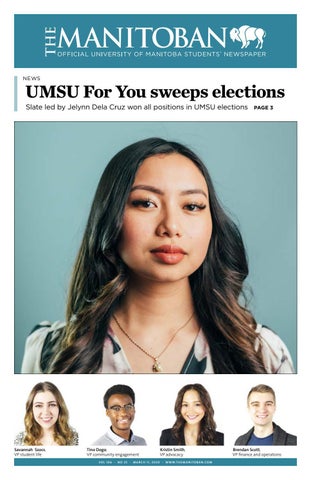
UMSU For You sweeps elections
Slate led by Jelynn Dela Cruz won all positions in UMSU elections PAGE 3
Savannah Szocs, VP student life
Tino Dogo, VP community engagement
Kristin Smith, VP advocacy
Brendan Scott, VP finance and operations
Surrogate mothers need legislated standards
Better protection from exploitation and health risks necessary
MEAGAN HUGHES, STAFF
Pregnancy is a complex process that carries a certain degree of risk.
Complications can lead some to seek out surrogate mothers.
Surrogates carry an embryo created using gametes from the intended parents which the surrogate brings to term.
This allows intended parents to have a baby when they may have encountered difficulties on their own.
Surrogates play a valuable and unique role in our communities, though proper medical standards have yet to be implemented in order to protect them.
Right now, there is no standard for the length of time required for surrogates to recover to start a new pregnancy after giving birth.
The lack of such medical standards puts surrogates at risk of complications from back-to-back pregnancies pressured upon them by both the desire to help intended parents and by the agencies that manage the surrogacy clients or intended parents.
Surrogate mothers are not paid for carrying a baby. In fact, under Canadian law, it is illegal for a surrogate to receive compensation beyond reimbursement for expenses incurred while pregnant such as medical bills or lost wages.
Paying a surrogate may result in tens of thousands of dollars in fines and even prison time.
Since they are not paid, surrogates carry children as volunteers that provide a life-changing favour to friends or strangers who desire greatly to build families.
If potential surrogates became attracted to surrogacy simply for the prospective financial gain, they may not take their own and the baby’s health as they would if financial gain was not there.
And the labour involved in this work is unique — it results in the birth of a human child.
It makes sense to desire to protect the creation of life from commodification.
On the other hand, even though true “surrogate agencies” are technically illegal in Canada — providing services specifically related to surrogacy — this does not stop agencies from using loopholes in the law to profit off of surrogacy.
Agencies that manage services not actively participating in the surrogacy process — like “consulting,” which isn’t technically a part of the surrogacy process — do make money off
intended parents.
Because of the profits from consulting fees, a perverse incentive is established — to push surrogates into bearing more children more quickly. This establishes a power struggle between the involved parties. Surrogates want to help the clients all the while being at risk of pressure and manipulation from the agencies who seek to make a profit. Sadly, these agencies have already found their way to commoditizing the womb: the process requires intended parents factor in a budget of around $60,000 to $80,000, which makes the whole process more expensive for everyone involved.
There have also been unfortunate cases of some intended parents being taken advantage of by surrogates claiming receipts for expenses that do not fall under the umbrella of eligible expenses and claiming duplicate receipts.
Health Canada has sought to remedy this issue, with new regulations taking effect this June that outline the limitations of what expenses are eligible for surrogates to claim. However, this may discourage more people from opting to become surrogates, putting even more pressure
on the current surrogates.
The agencies operating like a forprofit fast-food chain must be strictly regulated in the same way adoption agencies are.
Surrogates want to help the clients all the while being at risk of pressure and manipulation from the agencies who seek to make a profit
develop any level of attachment to the child during pregnancy. This is part of why counselling is important for surrogates.
Canada must ensure that surrogates are able to receive consultation and counselling from licensed medical professionals that are not a part of a profit-driven corporation — professionals that hold the well-being of the surrogate as their top priority.
It is imperative that care be taken before, during and after pregnancy to ensure that a surrogate’s mental and physical well-being is maintained.
Pregnancy can be a very physically and emotionally intense experience for child-bearers.
In addition, there is a risk of postpartum depression in surrogate mothers due to the child being taken by the intended parents after birth.
It is difficult for surrogates not to
And if the pressure to start new pregnancies soon after delivery associated with the current system is still prevalent — which can lead to serious health complications that can render the individual unable to bear more children, or worse — Health Canada must impose more strict guidelines on the number of months a potential surrogate mother must wait between pregnancies.
The reality is that there will likely always be a demand for surrogates and there will always be people who want to help.
We must respect and protect aspects of what make us human.
That is why we must make sure to tread carefully around the subject and seek to build proper legislation to approach these issues in a sensitive and humane manner.
i & d i istation
Okechukwu Efobi Cody Ross
Julia Minarik
Ehsan Tahmasebian
Mahder Teffera
Senator 2
Senator 1
HSGSA President
VP Academic
Carl Neumann President
Tanjit Nagra
GRAPHICS BY EVAN TREMBLAY
City not taking climate action — or
itself — seriously Students,
environment, logic left out of 2020 city budget
JAKOB SANDERSON, UMSU PRESIDENT
I thought I was done writing articles in the Manitoban about the U-Pass. And, of course, students probably thought they were done reading about it.
For anyone who needs a refresher, this year is the final one of our U-Pass contract. The public service proposed a fair increase of $24.50 per semester beginning May 2020 to ensure the program maintained its total gross subsidy level while being expanded to include Red River College. This rate was subsequently endorsed by city council. UMSU then went to referendum in February and a stunning 78 per cent of ballots were cast in favour of retaining the U-Pass.
In fact, more students voted in favour of the U-Pass in 2020 than voted entirely in the 2014 referendum. More UMSU members voted in favour of the U-Pass than voted entirely in any UMSU election on record in its 101-year history.
Suffice to say, it was a truly resounding result. Yet fast forward to March 6 and you’ll see that the U-Pass was proposed to be cut in the city’s latest budget.
What is perhaps most remarkable is that this rebuke not only goes
against the clear will of students — but against the priorities the city’s leaders have continuously espoused.
Mayor Brian Bowman, on the day the U-Pass was enacted, stated what he least wanted to see when “the second phase of rapid transit comes in line
[… was] Winnipeggers saying there aren’t enough people riding the bus.”
Bowman’s assessment was accurate then and will be born out in the near future. Given the investment in the Southwest Transitway to the tune of $420 million, we should be optimizing that investment by incentivizing increased ridership.
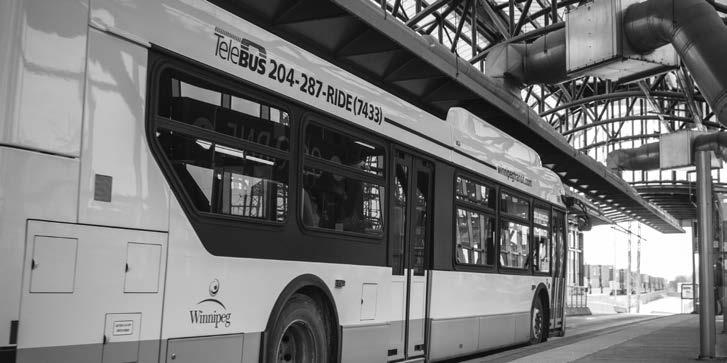
The U-Pass — which has shown an increase in ridership of 25 per cent on routes to and from the U of M since inception — has taken a minimum of 7,000 students out of their cars and onto a bus each day.
As the mayor said, “by encouraging public transit there are many environmental benefits. There are benefits of getting more cars and trucks off the road. And the overall costs of doing so is less wear and tear on our infrastructure.”
So why did he change his mind?
The chair of public works, Matt Allard, is thus far the only member of the executive policy committee to address the city’s change of position on the record.
But despite now claiming this budget as an overall positive package for transit, he previously had nothing but positive words for the U-Pass.
“I think the U-Pass is a great story,” stated the St. Boniface councillor in 2018. “Not only does it make using the bus affordable for students but I think it also builds a culture that makes using the bus something that you do every day to commute.”
Of the specific U-Pass deal that passed his committee, and council, unanimously, he said “I think this is a win-win the way this is being structured.”
So why the change of heart?
Currently, the budget points to the newly-proposed low-income pass as a replacement.
the city. It is the reason it anticipates the U-Pass — which is only $10 cheaper per month, affects a smaller population that has access to other subsidized passes, and is universally applied regardless of usage — will somehow cost more annually than the low-income pass.
In my view, this is a patently baseless assumption. Nevertheless, for the city to force this as a zero-sum game between the two programs is dubious, given transit ran a surplus of $6.9 million in 2019.
The mayor and city councillors that tabled this budget have turned their back on our environment If the city had the calibre of foresight that students do, it would immediately reverse this destructive decision
And while it is an admirable program, it is not a fix. Most students will not qualify for the low-income threshold, causing costs for students to rise massively.
Even more importantly, it is no comparison when it comes to the most important issue we should be framing our policy around: combatting emissions and protecting the environment.
The low-income pass is opt-in only. It is a cheaper bus pass for many Winnipeggers who are in need of the savings and likely bus anyhow. Ever wondered why a coffee shop offering 25 cents off your coffee for bringing a mug is a lot less successful than one that also charges you 25 cents for a cup?
Are 16,000 low-income people (not including students) who are not currently busing really going to abandon their cars because of the chance to get a cheaper bus pass?
This is the assumption made by
For the U-Pass cancellation to be viable environmentally or economically, ridership must be assumed to remain stable when the U-Pass goes away. It won’t.
That 25 per cent increase came as a direct result of a universal program that incentivized busing and disincentivized driving.
According to UMSU’s internal survey in December, 19 per cent of students who predominantly bus to university will revert to driving if this cut goes through.
That cuts deeply into the city’s expected revenue, and will heavily pollute the environment.
Students who voted in favour of an increased rate for a program that many affirmative voters could not or did not even use should be righteously distraught. If the city had the calibre of foresight that students do, it would immediately reverse this destructive decision.
I ended my last U-Pass article with a quote from a “once-wise” man that said “most of all, we at war with ourselves.” It seems our once-progressive city councillors have dialled up their hypocrisy to a level nearly equalling that of the afore-quoted Kanye West. Boasted Allard on the city council floor just three months ago: “I don’t want [my daughter] to say that dad had an opportunity to act, but getting elected was more important. That’s not why I got involved in politics. [Climate change] is the issue of our generation and we need to deal with it.”
We truly are at war with ourselves. This time, however, I’m not ending the article here.
The good news is that this city’s councillors will be hearing from the students they’ve let down. On March 12, the public works committee is hearing public delegations. On March 19, it’s the executive policy committee. Links to sign-up are in UMSU’s bio on Instagram, and we will be hosting training sessions and phone banking this week. So show up. Call your councillor. Get Angry. Get Mobilized. Get Ready. Because this is a major battle in what is truly the fight of our lives. And we need every last solider.
The mayor and city councillors that tabled this budget have turned their backs on our environment.
PHOTO
QUINCY HOUDAYER, STAFF