VPI resigns after taking position with provincial government
Page 3
Transit on campus
Transit union, students raise concerns over safety
Page 4
Upset central
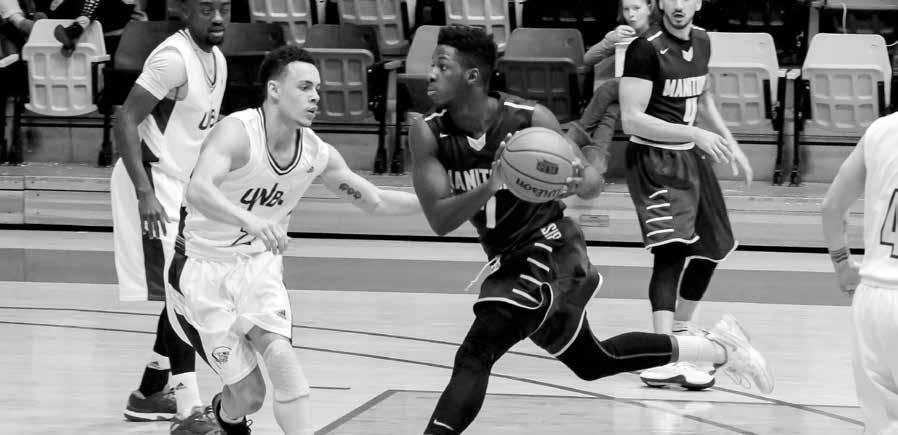
Win over UBC puts Bisons in final four Page 22
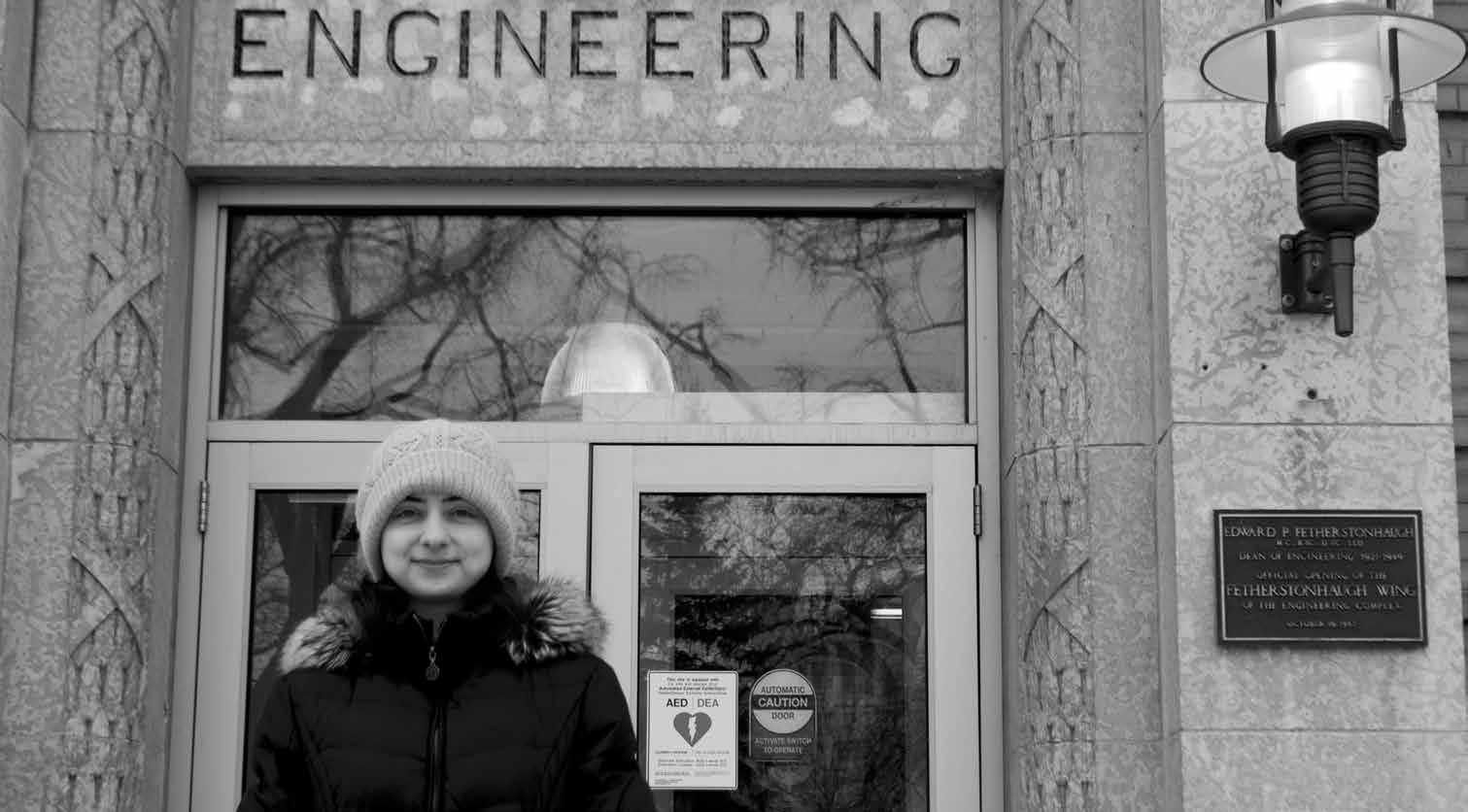
A consequence of climate change
Winter wonderland
Experiencing the Festival du Voyageur
Page 15
Corrections: The Jan. 25, 2017 issue was published with a cover date of 2015, which should have been 2017. Additionally, in the Feb. 15, 2017 issue, the article titled 'Five graduating players will make last run towards a championship' used a photo of the women’s basketball team instead of the men’s basketball team. We apologize for the errors.
Democratize, don’t politicize
Direct action necessary for a successful student movement
Check the Manitoban’s website and Facebook page for:
• 2017 UMSU General Election candidate interviews
• Synagogues in Germany: A Virtual Reconstruction
• a look at the U of M's 140th anniversary celebrations
Design
Design eDitor Bram Keast
design@themanitoban.com
graphics eDitor Kelly Campbell graphics@themanitoban.com
photo eDitor Miguel Yetman photo@themanitoban.com
Design associate Kellie Huynh
graphics associate Aldo Rios
photo associate Chantal Zdan
photo associate Star Roxas
photo associate Megan Colwell
r eporters
n ews Osho Samuel Adetunji
n ews Diana Ubokudom
n ews Seamus Hamilton-Pattison
columnist Jeremiah Kopp
columnist Shaden Abusaleh
arts & culture Olivia Michalczuk
arts & culture Emelia Fournier
sports Kellen Taniguchi
sports Jason Pchajek
copy Joseph Gonzalez
Volunteer Contributors
MANITOBAN
109 HELEN GLASS UNIVERSITY OF MANITOBA WINNIPEG, MB R3T 2N2
General Inqu I r I es & a dvert I s I n G
Phone: (204) 474.6535
Fax: (204) 474.7651
Email: manitoban@themanitoban.com
Free Med I a Campus Plus Media Services Phone: 1.780.421.1000
Email: advertise@free-media.ca
Canadian Publications Mail Product Sales Agreement #589160
A “volunteer staff” member is defined as a person who has had three volunteer articles, photographs, or pieces of art of reasonable length and/or substance published in three different issues of the current publishing year of the Manitoban. Any individual who qualifies must be voted in by a majority vote at a Manitoban staff meeting. Elected representatives and non-students may be excluded from holding votes as volunteer staff members in accordance with the Manitoban Constitution. The Manitoban is the official student newspaper of the University of Manitoba. It is published monthly during the summer and each week of regular classes during the academic year by the Manitoban Newspaper Publications Corporation.
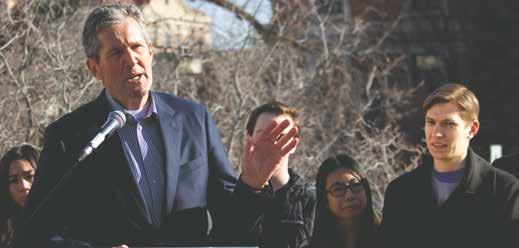
Adam Pawlak issued resignation more than two weeks after being appointed provincial minister’s assistant
g arett Williams, staff, with files from levi Garber
And then there were three.
A second University of Manitoba Students’ Union (UMSU) executive member has stepped down in less than six months as the union announced last week that vice-president internal Adam Pawlak has submitted his resignation.
The announcement came more than two weeks after Pawlak was appointed as a minister’s assistant in the provincial Progressive Conservative government on Feb. 7.
According to a Feb. 8 Manitoba Order in Council, finance minister Cameron Friesen recommended Pawlak’s appointment.
This leaves the five-member UMSU executive short two members with the 2017 election beginning. Former vice-president student services Jessica Smith stepped down from her position in the fall.
An UMSU release issued Feb. 23 said Pawlak accepted a position with the Manitoba provincial government but will remain on in a voluntary capacity to finalize ongoing projects.
The resignation notice followed the appointment by 16 days and was issued after the Manitoban reached out to Pawlak for comment after questions were raised about whether the government position represented a potential conflict of interest.
Pawlak – who worked for the provincial Progressive Conservative Party between May 2015 and May
2016 – represented UMSU in September and October meetings with provincial minister of education and training Ian Wishart to discuss changes to the Manitoba Scholarship and Bursary Initiative (MSBI).
Under the proposed changes, the scope of the MSBI will increase to just over $20 million, with a third of that – up to $6.75 million – coming from the province if post-secondary institutions provide the remaining $13.5 million.
At the time, Pawlak said the changes “strengthen MSBI [...] and put us on the right path so that everyone comes out on top.”
Multiple messages to Pawlak went unreturned. UMSU president Tanjit Nagra said she is prohibited from commenting due to her ongoing campaign for re-election, along with vice-president external Wilfred Sam-King. Dara Hallock, who is not running for re-election and the only other remaining executive member, was out of the office until March 1.
Pawlak was present at the last UMSU regular council meeting Feb. 16 but did not raise the issue of his appointment and submitted only a verbal report before leaving early. Several councillors reported only learning of the appointment through the Feb. 23 UMSU release.
Science Students’ Association
UMSU councillor Ashley Penner, who sat on the UMSU finance com-
mittee with Pawlak, said the government position is a clear conflict.
“I was shocked to see that he had already begun a new job,” she said.
“It is, however, a conflict of interest for an UMSU executive who is to be lobbying the government on behalf of students to also be working for the government”
– Ashley Penner, UMSU councillor
“It’s unfortunate to see another executive leave before completing their term. It is, however, a conflict of interest for an UMSU executive who is to be lobbying the government on behalf of students to also be working for the government.”
UMSU by-laws do not explicitly state holding a position in government presents a conflict and only calls for any appointee, signing authority, or employee to recuse themselves from participation in any decision they hold a direct or indirect material interest in.
Arts Student Body Council UMSU representative Serena Gawryluk said she was sad and surprised to hear Pawlak was stepping down.
“He was a great addition to the exec and I really enjoyed my time working with him on member services committee and space revitalization committee,” she said.
“He was very committed to his work on council and as much as I'm sad to see him go, I wish him all the best in his new position with the provincial government.”
Pawlak was instrumental in the roll out of the universal transit pass – branded the U-Pass – after taking over negotiations from the previous vice-president internal when taking over office in the spring of 2016.
In December, Pawlak publicly accused Winnipeg Transit of reneging on a commitment to support a grant that would compensate UMSU for some administrative fees relating to the program’s rollout.
After Pawlak argued UMSU’s case before the city’s executive policy committee in December and through follow-up meetings with Winnipeg Transit in January, the city’s committee on infrastructure and public works recommended UMSU receive a 0.5 per cent annual commission on all U-Pass sales, translating to $26,000 over the next four years.
Pawlak was also involved in a $1
million capital renovation of IQ’s Billiards Lounge, which is scheduled to break ground this summer. He will remain involved with UMSU on a voluntary capacity to finalize ongoing projects.
“It’s been an honour to serve the students at the University of Manitoba,” he said in a release. “A great opportunity arose to start my post-university career, but I will miss all of my wonderful colleagues here at UMSU.”
Pawlak’s resignation will go before UMSU council at its next regular meeting March 9. His term was set to expire April 30.
UMSU council can vote to appoint the incoming vice-president finance and operations (the new title for the vice president internal) and vice-president student services to their positions early following the 2017 executive elections.
Voting is scheduled to run March 8 to 10.
photo by garett williams
Transit, campus safety questions raised after slaying of driver
Union calls for dedicated police unit, students grapple with safety concerns
Osh O samuel a detunji, staff
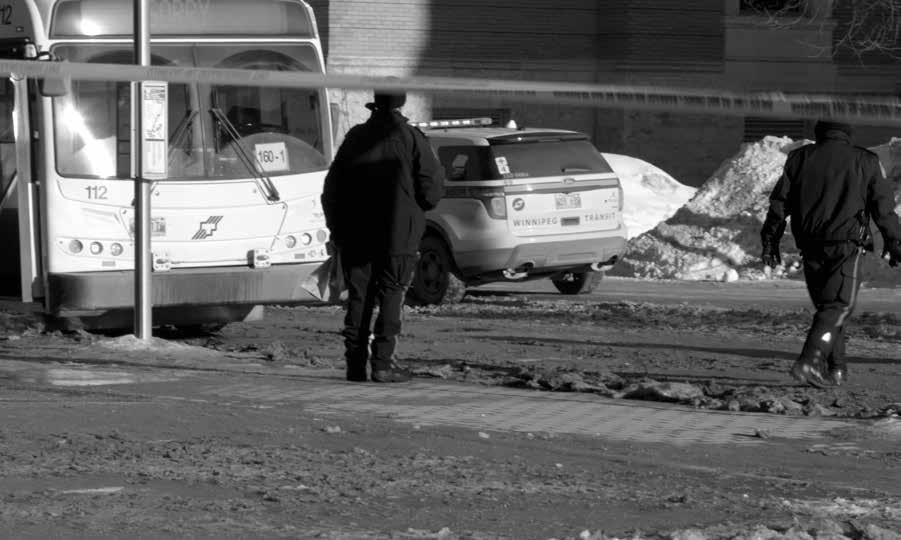
Questions about campus and transit safety in Winnipeg are being raised after the Feb. 14 killing of a 58-year-old Winnipeg Transit operator on the University of Manitoba Fort Garry campus.
Irvine Jubal Fraser was stabbed repeatedly in the early-morning hours by a passenger who refused to exit a bus at its final stop of the night on Dafoe Road, directly across from Taché Hall.
Fraser was transported to hospital in critical condition and later died as a result of his injuries. Brian Kyle Thomas, 22, was arrested trying to flee across the frozen Red River. He is facing second degree murder charges.
According to reports, Thomas has convictions dating back to 2012 for crimes that include weapons offences, assault, and robbery. He has been in and out of custody and was last on probation in November.
Fraser himself was facing charges of sexual assault and sexual interference at the time of his death. He was scheduled to face trial in January 2018. The trial was initially scheduled for October but Fraser failed to appear for jury selection.
Court documents reveal that Fraser was arrested in 2013 and
charged with repeatedly assaulting a girl between 1982 and 1991. Fraser denied the charges.
On the Friday following the attack, a rally was attended by hundreds of transit workers demanding a safer work environment where they can peacefully do their jobs.
“It did not make me feel unsafe, it made me feel upset” –Taylor Nimchonok, third-year student
John Callahan, president of the Amalgamated Transit Union (ATU) local 1505, said supports for bus operators are insufficient to guarantee driver safety and called for a dedicated police transit unit.
“I am concerned about the lack of safety initiatives that exist to meet the demands of today’s situation,” he said.
“The protocols, the response time, the support is inadequate on a day-today basis. We need dedicated police – part of the Winnipeg Police but dedicated solely to transit.”
He expressed concerns about the code of conduct for transit riders and the inability of the current transit inspectors – who he said are not adequately trained – to enforce its rules.
“We have the rider’s code of conduct but I don’t believe it is being enforced because the transit inspectors who we currently use to address those issues don’t have the ability to do anything,” he said.
“They don’t have the ability to arrest or detain individuals who may have infractions against the code of conduct.”
Callahan emphasized the need to secure the safety of both drivers and riders, noting a 2014 case where a driver suffered a broken nose after being punched in the face while driving a bus loaded with passengers.
“The safety of our members is only a part of it. What affects our members can affect the riding public,” he said.
“One of the fears that we have is that a possible worst-case scenario is if the driver has a bus full of people and he is in service and gets struck or knocked unconscious behind the wheel.”
The number of U of M students holding transit passes doubled in the
fall of 2016 with the rollout of the universal transit pass, dubbed the U-Pass. More than 19,000 of the discounted passes have been issued.
Numbers provided by Callahan show that assaults on drivers reached a five-year low in 2014 with 39 attacks. Sixty-two assaults were reported in 2015 and 45 in 2016.
Callahan made a plea to commuters and users of public transit system to start a conversation with the city in a bid to seek better safety strategies.
“I think our riders need to contact their city councillors and say that they are concerned, too, and they want greater safety initiatives in place to protect both themselves and our members because we go hand in hand. I think that is very important,” he said.
“They need to hear it loud and clear that people want to use public transit but they need it to be safe for them to do so.”
Students react
Following the slaying, third-year biology student Taylor Nimchonok started a GoFundMe campaign to raise funds to support Fraser’s family. In less than two weeks, the campaign raised more than $7,000.
Nimchonok said she started the campaign with the purpose of channelling the emotional response of the community into a positive venture.
“Because I am really involved in social media, I noticed that a lot of people were feeling a lot of things,” she said.
“They were very emotional about it and I knew that I was feeling very upset and I wanted to give students, and give the community of the University of Manitoba, an opportunity to harness what they were feeling and try and turn it into something good.”
She echoed Callahan’s concern that drivers need a safer environment to do their work.
“It did not make me feel unsafe, it made me feel upset. It made me feel sad and I was very upset that something like this would happen on campus,” Nimchonok said.
“I do understand the need for more
safety for bus drivers,” she added. “I don’t feel unsafe as a student but if I were a bus driver, I will absolutely feel unsafe.”
Nimchonok stressed her belief in the fundraising campaign despite learning of the charges facing Fraser at the time of his death.
“My feelings did not change,” she said, noting that the money raised is for the family Fraser left behind.
“I am very sorry that she [the alleged victim] would not get the justice that she deserves through a court of law because they did not end up going to court,” she said, “but he left behind a wife and a granddaughter who have already faced a lot of tragedy in the past year and my main goal is to lighten the burden for them.”
Japanese exchange student Yuto Takada said he was shocked to learn about the incident and feels the campus can be dangerous during the night.
“I feel unsafe on the bus,” he said.
“I am from Japan and it is [a] safer place compared to Canada. I feel the campus is safe but overnight it is so dangerous, so we have to be more careful.”
Sridhar Majety, an electrical engineering graduate student who recently moved to Winnipeg, said he had seen the driver on campus a few times previously and was disappointed to learn an attack occurred on campus.
“When I moved here, everyone said ‘downtown is not a safe area, the university area is pretty safe.’ I was surprised to see that such an incident happened in the safest place in Winnipeg,” he said.
“It was not like it happened behind walls or something – it was like the centre of the university... It is really sad.”
photo by soraya atayee
UMSU general election campaign kicks off
Two full slates and seven community representative candidates in the running
Craig a d O l P he, staff
C
ampaigning for the 2017 University of Manitoba Students’ Union (UMSU) General Elections went into full swing this week, after the executive slates and individual community representatives were announced during the February reading week.
Among the candidates are two full slates running for the five executive positions and seven individual candidates running to fill four of the five community rep positions.
Voting, which will take place online for the first time this year, runs from March 8 to 10.
The executive slates running are One UMSU and UMSU United.
One UMSU is made up of two incumbents, president Tanjit Nagra and vice-president external Wilfred Sam-King. The slate also includes former Strong UMSU campaign manager Jehan Moorthy, Arts Student Body Council senator Allison Kilgour, and St. Paul’s College Student Association senior stick Jeremy Semchyshyn.
Nagra and Sam-King are both seeking re-election in their positions, while Moorthy is running for vice-president finance and operations
(formerly known as vice-president internal), Kilgour for vice-president advocacy, and Semchyshyn for vicepresident student services.
Nigerian Students’ Association president Oyindamola Alaka is running for UMSU president with the UMSU United slate along with vicepresident external candidate Mathew Scammell, vice-president finance and operations candidate Stephen Paul-Michael, UMSU Aboriginal students’ representative and vicepresident advocacy candidate Chance Paupanekis, and former German Students’ Association president and
There are three candidates for international students’ representative: Abdul Qadir, Chris Otisi, and Christian Aliu.
Hifza Jalbani is running against Zobia Aamir for womyn’s representative.
LGBTTQ* representative candidate Sarah White and Aboriginal students’ representative candidate Noah Wilson are the only two
community rep candidates running unopposed.
There are no candidates running for students living with disabilities representative.
University community affected by U.S. travel ban
U of M students, researchers navigate new U.S. presidents’ executive order
ryan Catte
U
niversity of Manitoba research assistant and PhD candidate Elnaz Afsharipour was on her way to an engineering conference in San Francisco with her husband on Jan. 28 when she was denied access to the U.S due to a recently-introduced travel ban.
Afsharipour and her husband are Iranian but have been living in Winnipeg for four years on student visas. The two were prevented from boarding their U.S.-bound flight at the Winnipeg James Armstrong Richardson International Airport.
A day earlier, U.S. president Donald Trump issued an executive order imposing a 90-day ban on entry to the United States for citizens from seven predominantly Muslim countries – Iran, Iraq, Libya, Somalia, Sudan, Syria, and Yemen.
“If the current situation does not change, I am going to miss next year’s conference as well,” said Afsharipour shortly after.
“Since the largest events of many fields are usually held in [the United States], I am going to miss different academic conferences, seminars, competitions, exhibitions, and industrial events.”
On Feb. 3 – shortly after the Manitoban spoke with Afsharipour – a judge from the Washington state district court suspended the travel ban nationwide.
Afsharipour said the ban will not impede her academic progress from
moving forward.
“[The] travel ban, with all its aspects, might prevent us from some events, but it is not making my academic career more difficult,” she said.
“My academic career will go greater than it was.”
Timeline
The executive order issued by Trump on Jan. 27 suspended travel for residents of the seven affected countries for 90 days and suspended refugee admissions for 120 days. The order applied to permanent U.S. residents as well as foreign visitors.
The ban’s implementation caused immediate chaos at U.S. airports and affected as many as 60,000 nonAmerican travellers.
The following day, a New York federal judge issued an emergency stay on the travel ban, releasing valid visa holders who were being detained in U.S. airports.
On Jan. 30, 2017, Washington state filed a lawsuit in federal court requesting a nationwide restraining order blocking the travel ban. Four more states and a number of individuals followed suit. By Feb. 10, some 20 lawsuits were working their way through the U.S. court system.
On Feb. 3, a Washington state district court suspended the ban nationwide and issued a temporary restraining order. On Feb. 9, an appeals court in Washington upheld the decision.
The Trump administration has since signaled it will not challenge the decision to the Supreme Court but will issue an amended order, expected sometime this week.
“Prior to being Iranian or a Canadian or an American or any other nationality, we are all human” –Ramin Soltanzadeh, U of M student subjected to U.S. travel ban
University response
Only days after the executive order was signed, the U of M organized a pair of community events – one on the Fort Garry campus Jan. 31 and another on the Bannatyne campus Feb. 3 – to provide a safe space for students, faculty, and staff to open up and learn about available supports.
The Fort Garry event seconded as the de facto memorial to discuss the mass shooting that occurred in a Quebec City mosque only two days earlier that left six men dead.
Among the speakers at the Fort Garry event was Afsharipour’s hus-
band and fellow PhD student Ramin Soltanzadeh.
He said the travel restrictions have instilled a sense of anxiety about the future direction of the relationship between Middle Eastern nations and the new American administration and called on Canada to demonstrate to the global community its strength as a leader in multiculturalism.
“Prior to being Iranian or a Canadian or an American or any other nationality,” he said, “we are all human.”
According to Todd Mondor, dean of the faculty of graduate studies, the university has implemented a dual effort in response to the ban. First, the U of M is helping current graduate students pay for certain travel costs that they incurred due to the travel ban and second, the university is extending the application deadline for any potential graduate students from the seven affected countries as well as waiving the application fee.
Mondor indicated that more than 50 applicants have reached out for support since Feb. 2.
Law students dig deep
Earlier in February, 50 current law students at the University of Manitoba teamed up with students from each of the other 22 Canadian law schools to help U.S refugees entering Canada.
Maddie Pearlman, organizer of the U of M research sit-in, said, “The
U.S. executive orders on immigration, including the Muslim ban, present an access to justice issue on both sides of the border and we are doing what we can to respond.”
Since January, more than 130 asylum seekers have crossed the Canadian-U.S. border at Emerson, Manitoba, seeking refuge in Canada.
According to the Safe Third Country Agreement between Canada and the U.S., which has been in effect since 2004, individuals are required to claim refugee status in the first country they arrive in.
Human rights and immigration advocates have called for the agreement to be repealed and the students participating in the sit-in were researching avenues around the agreement under the premise the U.S. under the travel ban is no longer a safe country for refugees.
“Robson Hall students have a more comprehensive understanding of how safe-third-country agreements create circumstances in which refugees become extremely vulnerable in light of changing on-the-ground country conditions,” said Pearlman.
“Students have also become more interested in immigration law and policy.”
photo by Chantal zdan
Editor-In-Chief: Craig Adolphe
Contact: Editor@themanitoban.com / 474.6770
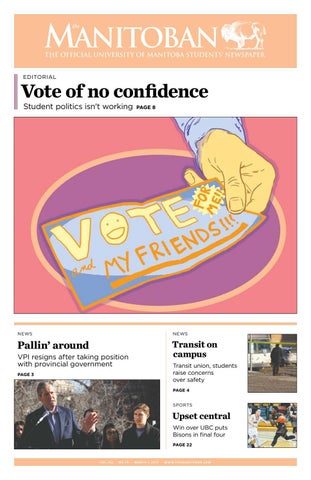
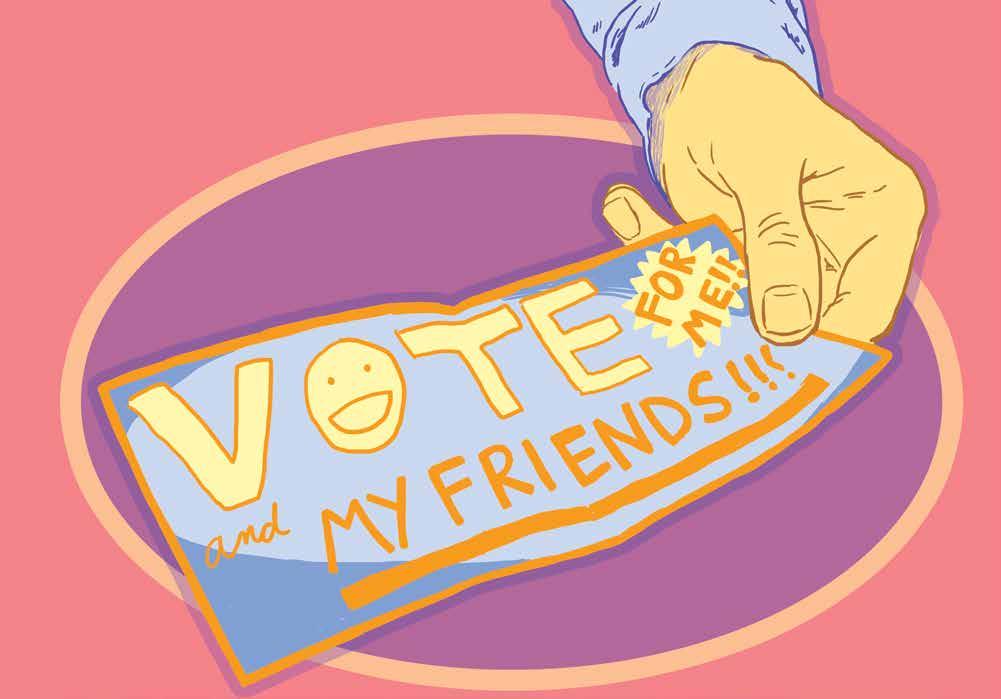
The malaise of student politics
Major reform is needed for the union to bear fruit again
s haW n g arbutt, staff
W
ith another general election dawning on the University of Manitoba Students’ Union (UMSU), the attentive student has to ask, “what’s the point?” The inattentive student asks, “there’s an election?” The serene student asks, “what’s UMSU?” When it comes to student politics, ignorance is bliss.
Briefly said, the state of student politics at is a failed one. First and foremost, its democratic process is defunct to the point of it being a laughing matter. Not only are elections for student officials dismal affairs – with more emphasis being placed on putting forward good angles for a camera-friendly campaign than policy content – but they also attract voter margins that couldn’t authorize leadership to run a roadside lemonade stand, let alone a multi-million dollar student organization.
UMSU’s highest-ever voter turnout fell at a mere 23.7 per cent, where it tends to hover in recent years. In the past, lows like 7 or 12 per cent were more typical.
Consequently, the student union is being steered by executives who are empowered by only a fraction of the student body they are meant to represent. There lies no valid claim to representation when less than a quarter of constituents show up to vote. Even less vote for the individuals who assume power. In student elections, results are ultimately artificial; the same people run in similar slates, and the winners end up being whoever has sat on the most faculty and departmental councils – in short, whoever has the most connections.
Democratic only in name, student politics is also as superficial as the shallow end of a kiddie pool. Lacking accountability because of a politically inactive student body, the stakes for executives are minimal and tend to land in the range of their own con-
cerns. And while lacking a legitimate majority mandate, UMSU is powered by the tyranny of the self-interested. Rather than operating on a robust advocacy model, campaign platforms engineered by wannabe career politicians often capitalize on minor issues and matters surrounding the “student experience,” intent on avoiding the big questions.
UMSU is powered by the tyranny of the self-interested
The times are calling for improved access to post-secondary through lower and even abolished tuition, a weightier distribution of funds to the academic poles of campus, and a paradigm shift toward humanistic education rather than the current corporate model: all things that require advocacy with a resounding voice and an iron fist to match.
Student election campaigns, on the other hand, tend to revolve around balanced budgets, improving campus parties, and minor commitments to incremental reform. Meanwhile, governments and university administrations are hunkering down on austerity agendas, be it in the form of clawbacks or increased reliance on the private sector to produce public goods. With no radical counterproposals in sight, prospective executives instead repeat the oft-heard promise of guaranteeing a “voice at the table” during budget negotiations. Student politicians are bringing water pistols to a gun fight, be it unknowingly or through utter indifference.
Even when UMSU has bared its teeth in the past, the most notable instances have been a petty spat with the Canadian Federation of Students
or against its own interests, as when UMSU initially refused to comment on the university administration issuing sudden budget cuts. Indeed, UMSU and the CFS continue to this day their juvenile bickering, taking turns displaying shock at the other’s actions, and the union so far has failed to stop or even stall the ongoing budget reductions to academic units on campus.
It took UMSU weeks of deliberation before it could reach a stance on the UMFA strike. While the student union remained in talks with the administration during this period to ensure student needs were being addressed, their demands would have been sorely defanged as the executives had failed to procure a mandate from the student body regarding the strike until it was halfway over. It’s easy to see how this has a crippling effect on leveraging power, for any statements UMSU could have made toward the administration would be shadowed by the fact that the union was mired in confused disarray.
The winners end up being whoever has sat on the most faculty and departmental councils – in short, whoever has the most connections
It was not clear what position UMSU was to have on the strike –violating a historical principle of union solidarity – and discussion surrounding the topic was flush with red herrings. Discussions were run aground with talk of short- and
long-term benefits, who the strike was impacting most, who had the most to lose from the strike, whether it was the place of UMSU to even get involved, what the most strategic decision for UMSU was, and other such babbling malarkey.
This conduct illuminates the malaise that plagues student politics. Low-stakes issues take the spotlight because those in power have no need to handle uncontroversial events with delicacy, and so it is easy to run with them and garner quick credentials. High-stakes issues, on the other hand, end up bungled because the payout for issues like tuition reduction or budget negotiations is a long-term game, resulting primarily in benefits for future students. Those endeavours, holding no prospects for padding a curriculum vitae or promotional material for executive re-election, are either left high and dry or treated with such caution that action on the issue looks like inaction.
Student politics is broken. It’s undemocratic, and it’s self-serving.
While the CFS has long been accused of being NDP stomping grounds, essentially acting as politicking boot camp for future party hacks, so too has UMSU become a magnet for small-time party politics.
An executive this year, vice-president internal Adam Pawlak, has resigned at his post in order to take on government work with the Manitoba Progressive Conservatives, while last year vice-president student services Jessica Morrison took a leave of absence before resigning in order to work in Ottawa for the federal Liberals.
Executives’ connections to establishment political parties conflates student interest with the interest of the party. This is ethically dubious, given student representatives are meant to answer to the constituents who elected them, not party brass.
Executives having ties to political parties like the NDP, Liberals, or Conservatives blurs the line between where representatives stand on issues and problematically moulds their vision for the student association they are charged to lead. Nor is such an arrangement conducive to the uncompromising, unapologetic advancement of policies that benefit students – especially when one of those parties assume government at the provincial or federal level.
The union must become more invested in educating, agitating, and organizing the student body. Otherwise, its declining advocacy role is doomed to become terminal
In order to resurrect student politics, numerous radical steps are in order. Firstly, the spirit of democracy needs to be instilled in the student body. This means getting students to participate not only in the annual UMSU elections, but in town halls, consultations, and the regular goingson of UMSU council. The union must become more invested in educating, agitating, and organizing the student body. Otherwise, union executives will continue to be chosen through pseudo-election, and its declining advocacy role is doomed to become terminal.
The revival of mass student participation is also vital for curbing the current shallow, self-interested bent of union politics. Only through weaving a tighter-knit social fabric between elected representatives and constituents can the work of the union become centered on the pursuit of goals more meaningful than making campus pretty again.
Without major and radical restructuring to its existing incentive structures, student politics at large and UMSU specifically will only continue on as an institution that is symptomatic in its approach. The world is undergoing spastic changes with political turmoil to follow. The status quo is untenable.
Ultimately, a disregard for the underlying disease that afflicts student politics – apathy, political disengagement, and shrinking advocacy functions – will be fatal to progress.
graphiC by kelly Campbell
Student elections make a difference, but you have to vote
j esse b laC kman, volunteer staff
It’s that time of year again. Your daily routine is going to become a hassle of nonstop electoral nonsense. Classes will be interrupted with speeches. Candidate posters will cover the walls. People who would never consider speaking to you will be pretending to care about what you have to say, pining and pandering for your vote. It will become hard to navigate campus without someone commanding you to vote for someone you don’t know for some reason you can’t relate to because of promises you don’t care about.
And it seems like, worst of all, student elections are just a massive popularity contest. The hurdle to assuming office as an executive in the student union amounts to how many friends and friends of friends you can convince to cast a vote your way.
But dismissing student elections as an irrelevant popularity contest is a mistake, because believe it or not, election results have an impact.
As someone who has held an executive position, these claims may feel not only biased but wholly overstated. But from my experience, I know firsthand that a candidate’s ideas and skillset have a concrete effect on the student experience on campus.
It will become hard to navigate campus without someone commanding you to vote for someone you don’t know for some reason you can’t relate to because of promises you don’t care about
Executives and directors enter the student politics scene with a huge diversity of motivations, competencies, and abilities to follow through. As with any election, this makes supporting the candidate who best represents your values to be, well, the point of the matter.
Student representatives primarily have influence over union finances, services, and events. They may, over their respective terms, commit an incredible amount of time, energy, and resources to leaving their mark on campus, hopefully making it a better place. Faced with a challenging situation, do you want a student politician to take action, fire off a tweet, or call a meeting at Joey’s?
Different candidates have a different set of priorities. Your vote may seem to be an irrelevant choice, and a simple one at that, but the impact of your vote is anything but frivolous. The ballot you cast decides whether the student union spends money at
events like Frosh Fest or on services like the campus food bank, if travel funds send executives to Ottawa or students to academic conferences, what kind of health plan students have access to and how much they will cost, if campus safe spaces are a cause worth fighting for or just a cause worth fighting, how much union employees are paid, if businesses grow or shrink, whether fighting tuition fees will be a practice or a rhetorical tool, if the pro-life student group will be recognized or rejected, and if the province will be challenged or applauded on their tuition policies.
When it comes down to it, writing off student elections is the worst mistake you can make
When it comes down to it, writing off student elections is the worst mistake you can make. What may start as a small cause heralded during campaign season may be carried forward and have a lasting impact of successive years of students. The U-Pass is a great example of this. The original advocates will never personally use it, but love it or hate it, the U-Pass was a
student initiative. Full-time students at the U of M and U of W now have a U-Pass, not necessarily because most students want or benefit from it, but because more students showed up to vote in favour of it (twice).
Take the example of the University of Manitoba strike from this past fall, when the executives of the University of Manitoba Students’ Union took criticism on the nose from all sides. First for their lack of action, then later for taking a position on the strike. A thick skin and an open mind are useful tools for effectively fulfilling an elected position. It is safe to say that any executive team and board will handle pivotal situations differently; as constituents of the organization executives are steering, voting in student elections is the easiest way to make a difference.
When considering who to support, it is worthwhile to consider someone’s history and their campaign platform. If you get the chance, it’s worth asking candidates a difficult question too. Though predictions are difficult to make, someone who campaigns on eliminating tuition is probably more likely to take bold stances on issues than someone who campaigns for the best Frosh Fest ever.
Choosing which candidates to elect, however, is more complex than assessing campaign taglines. Skillsets play a big factor in the ability
to advance the goals of the organization. It is easy to talk a great game, but actually accomplishing promises is where student leaders really show their worth. While big personalities can draw a lot of attention, it’s performance outside the spotlight that often makes the difference between advocacy and accomplishment.
When
considering who to support, it is worthwhile to consider someone’s history and their campaign platform
It can also be challenging to judge how well a candidate will fill the position they are running for. Boasting the experience of being a church choir’s treasurer is great, but it doesn’t give a lot of confidence in someone’s capacity to manage a multi-million dollar organization’s finances. Ultimately, no matter how high or low the turn out, someone will win the election. Student politics generally tend toward lower turn outs, varying a little by the organization, and so this amplifies the power of individual voters to influ-
ence outcomes.
So every vote does count in standard student elections. As much as that sounds glib, the fact that UMSU and the UWSA have had presidents decided by a double-digit vote swing in the past couple of years is a testament to how crucial engagement is for members. Greater turnout can give more legitimacy to the organization – that might not be such a bad thing.
Once elected, student politicians will have a title, decision-making power, a salary, and a claim to fame: representing students. So I strongly encourage you to take the time to consider proposed policies and competencies in relation to your own values and beliefs. Even taking the time to spoil a ballot makes a big statement. The student movement can make a difference. It’s up to you to decide how that difference takes form.
Jesse Blackman is a former vicepresident external for the University of Winnipeg Student Association
photo by miguel yetman
Conservatives have it wrong on Parliamentary motion condemning Islamaphobia
s haden a busaleh, staff
W
hen Liberal MP Iqra Khalid
tabled M-103, a parliamentary motion that calls on the Standing Committee on Canadian Heritage to study and recommend solutions to discrimination, systematic racism, and Islamophobia in Canada, Conservatives as the official opposition were quick to cook up a slew of implausible arguments against the motion. The Tories deemed it vague and the first step toward implementing Sharia blasphemy laws, which would supposedly penalize those who criticize Islam.
To oppose a motion that calls for solidarity with Muslim Canadians is both silly and dangerous
The Tories didn’t stop their slippery slope argument there. They’ve called M-103 an infringement on free speech and a motion that unfairly favours Muslims and Islam. Yet, curiously, Tories took no issues when they unanimously voted in support of a parliamentary motion in 2015 that deservedly condemned antiSemitism. Nor did the party raise an uproar on limiting free speech when Tories unanimously supported an anti-Islamophobia motion tabled in Parliament last October by NDP
leader Thomas Mulcair.
Most Conservative leadership candidates have spoken out against the motion, including the “tell-it-asit-is” celebrity business mogul Kevin O’Leary, who bravely called M-103 “a slap in the face to other religions.”
But Kellie Leitch won this round by going all out in her protest, launching an online petition to stop the motion with an image of a little blue-eyed girl – photoshopped from their original brown – with “M-103” taped over her mouth whilst standing in front of a background image of the 2016 Parliament Hill shooting.
And, just to score political points, Conservatives tabled their own version of M-103 last week. It called for a condemnation of all forms of racism and intolerance. It specifically avoids mention of Islam and the discrimination Muslims face in the West.
But, through their coldly-calculated ignorance, the Tories have missed the point entirely. To begin, let us break down M-103.
Simply put, M-103 is not proposed legislation. It merely asks the federal government to: recognize the need to end “increasing public climate of hate and fear;” condemn Islamophobia and all other racism and religious discrimination; request the Standing Committee on Canadian Heritage to study how the government can develop strategies that work to reduce and eliminate systematic racism and religious discrimination, including Islamophobia; and collect data in order to provide context for hate crime reports.
An important point to recognize is that M-103 is a motion, not a bill. And so, the Conservative Party’s fears are not only unwarranted, but also irrational. Whether or not M-103 passes is irrelevant to Canadian law.
If M-103 passes, no changes will be made to the Canadian legal code. There will be no new legal limitations on the freedom of expression or speech in any way, nor will the government be compelled to take legislative action, and the Canadian Charter of Rights and Freedoms will remain untouched. This means that the motion contains no new legal recourse for anyone who decries and publicly rails against Islam and Muslims.
M-103 is an opportunity for members of Parliament to use their platform and take a clear stance against growing intolerance and hatred, and to demonstrate how systematic racism and religious discrimination need to be taken seriously. It must be made explicit by our representatives that Islamophobia has no place in Canadian society whatsoever. A watered-down version of the motion will miss the point entirely.
A wave of anti-Muslim sentiment has swept throughout Europe and the United States and has inevitably made its way into Canada. The shooting in Quebec City that left six Canadian Muslims dead and the recent antiMuslim rally in front of a Toronto mosque that called for a ban on Islam did not magically appear out of thin air. Islamophobic rhetoric seems to be rising at an alarming rate and hate
crimes against Muslim-Canadians have more than doubled over a period spanning 2012-2014. And as recent events have shown – such as Brexit and the American election – populist right-wing outbursts precede spikes in police-reported hate crimes.
Growing irrational fear and hatred of Muslims doesn’t seem to be going away any time soon. A case in point is the numerous threats and repulsive racial slurs that MP Iqra Khalid received after tabling M-103, which includes a YouTube video where she was threatened to be recorded while others shot her.
Arguing that “no religion should be singled out for special consideration” aligns Conservatives with the counterproductive “All Lives Matter” movement
More than ever, there is good reason to specifically single out Islamophobia when discussing intolerance in Canada today, especially as thousands of Syrian and Iraqi refugees – most of whom happen to be Muslim – are making Canada their home.
Arguing that “no religion should be singled out for special consideration” aligns Conservatives with the counterproductive “All Lives Matter” movement. It prevents us from recognizing that these problems exist, that these problems are urgent, and that these problems need to be addressed as soon as possible before another fatal tragedy falls into our hands. To oppose a motion that calls for solidarity with Muslim Canadians is both silly and dangerous.
It is clear that Tory ethics need to be straightened out. Conservatives must recognize that tapping into Canadians’ worst fears by arguing that M-103 will result in anti-blasphemy laws and limits on free speech is a dangerous game to play. The ploy may win them a few extra seats in Parliament, but it is a costly trade-off. It is up to the Conservatives to figure out their priorities. Whether human dignity will beat out cheap rhetoric is something that remains to be seen.
Study shows Canadian glaciers are major contributor to sea level rise
Surface melt has risen by 900 per cent in the last ten years
m alak a bas, staff
According to a new study, Canada’s glaciers are having a serious effect on rising sea levels.
As climate change begins to rear its ugly head, its consequences are already making a significant difference to Canada’s landscape. The study, which was the first long-term analysis of ice flow into the ocean, found that surface melt from glaciers
off the Queen Elizabeth Islands, a peak northern region shared between Nunavut and the Northwest Territories, had grown by 900 per cent between 2005 and 2015, jumping from an estimated three gigatons to 30 gigatons of melted ice per year.
Equally alarming is the shift in ice loss causation. The study states that prior to 2005, ice loss that could
be attributed to simply melting accounted for about 48 per cent of ice loss. Now, only ten years later, it appears to be the cause of about 90 percent of all ice loss.
Rising sea levels can have devastating effects on our planet, including increased earth erosion, more powerful and destructive storms, and of course, massive flooding. The quick
melting of glaciers caused by global warming is a large factor in rising sea levels, and Canada has the secondlargest amount of Arctic ice in the world – behind Greenland – and therefore sits at the forefront of this dilemma.
As climate change begins to rear its ugly head, its consequences are already making a significant difference to Canada’s landscape
The northern part of Canada is not the only part of the country to feel the effects of global warming on their icebergs. Studies have shown that glaciers in British Columbia and Alberta are expected to lose up to 80 per cent of their volume before the year 2100.
Snail venom provides new hope for people suffering from chronic pain
m alak a bas, staff
Acompound found in snail venom may be the future of treatment for severe chronic pain.
The peptide compound is called Rg1A, and it is found in the venom of the Conus regius sea snail, or the “crown cone” snail. These snails are particularly venomous, and have been known to even attack humans. In their original habitat (the Caribbean Sea, the Gulf of Mexico, and the Atlantic Ocean off the coast of Brazil) they use their venom as a means of paralyzing and even killing their prey.
Scientist’s current best treatment for severe pain is through the administration of opioid painkillers, such as fentanyl or oxycodone. Opioids work by binding to opioid receptors, protein receptors that exist in our nervous system, mainly in our brain and spinal cord but also found in our digestive tract. When bound, opioids can affect the nervous system by creating feelings of pleasure or pain relief. Unfortunately, opioid treatments are deeply flawed, as subjecting the human brain to this constant cause-and-effect reward system can transgress into an addiction. Opioid addiction can be so severe that one of the more successful treatments is taking methadone – another, less
addictive opioid medication – for the rest of the patient’s life.
This new research, published by scientists at the University of Utah through the journal Proceedings of the National Academy of Sciences, suggests an alternate approach to treating moderate to severe pain.
Doctors’ current best treatment for severe pain is through the administration of opioid painkillers, such as fentanyl or oxycodone
Rodents were given a chemotherapy drug that causes skin hypersensitivity and the Rg1A compound, and were then compared with rodents who were given the chemotherapy drug, but not the compound. What they found was that the rodents given the Rg1A compound not only did not feel any pain, but actually matched rodents that had been genetically
As the race to slow down global warming continues, environmental scientists are constantly offering new ideas as to how we approach this possible catastrophe. Industrial engineer Peter Flynn of the University of Alberta was the first to propose an extremely hands-on approach to the rapidly declining ice: pump massive amounts of saltwater on top of the ice, creating a thicker, sturdier sea ice. Flynn himself warns that this should be treated as an absolute last resort idea, however.
Another possible option for rebuilding glaciers through Arctic geoengineering comes from Steve Desch, an astrophysicist at Arizona State University. He proposes that, through the use of wind turbines, Arctic sea water could be brought to the surface and re-frozen. Desch spoke on his proposal during an episode of CBC Radio’s The Current, and says that while millions of wind turbines would be needed, and the overall cost to implement this plan would reach 500 billion dollars, it must be considered in comparison to other very expensive human endeavors, and says that it is indeed possible.
bred to not have the pain pathway receptor at all. Through these rodent tests, researchers have found that Rg1A actually blocks a different pain receptor than opioids do, which could lead to pain relief that feels like opioids, but without the addictive quality. Researchers are now working on pre-clinical testing of the snail venom as a method of drug therapy. This is not the first time snail venom has been used to treat pain, however – a pharmaceutical drug based on compounds from cone snails (this time, from the Conus magnus) already exists, and is marketed under the name Prialt. To ensure it is able to cross the blood-brain barrier, Prialt is introduced directly into the nervous system through intrathecal infusion, meaning a direct injection into the spinal canal. Unfortunately, while effective, the side effects can be devastating, and range from dizziness and nausea to hallucinations and memory loss. These are side effects that scientists will have to look to remove from this new treatment.
photo provided by ansgar walk
graphiC by Caroline norman
A day at Festival du Voyageur
One of Winnipeg’s biggest festivals continues to thrive
e melia FO urnier and Olivia m i C halC zuk, staff
Images of rain, melting snow, and slip and slide conditions are not usually associated with Winnipeg’s most beloved winter celebration, Festival du Voyageur. What was once a frozen winter wonderland with sculptures of intricate design have mushed into indecipherable heaps overnight that you can navigate carefully around through puddles and ice patches.
Though the weather that looms during this year’s edition of the festival is unlike the Winnipeg norm, the good vibes and high spirits associated with Festival du Voyageur assures that there will be good times within the many heated tents that feature some of Winnipeg’s best bands across several genres.
The downside of having such a mass of talent at a winter festival is that their performances are inside heated tents with limited capacity. The daytime performances are more or less geared towards families and children on school field trips. The bands that perform at this time play songs that are easy on the ears and laced with fiddlers, gigueurs, and sweet French harmonies. Though the evening bands are primarily English, there is a good chance you will be surprised by a French greeting or verse, if not a “hé ho” (festival lingo).
French performances continue into the night as fiddles can be heard above the sounds of hard bass and rock music that permeates the cold winter air. The spirit of the lively festival is captured with every show and band that performs, though they cut across different languages and genres.
Festival du Voyageur
is an embodiment of the endurance of Winnipeggers and our ability to party even in terrible weather conditions
The evening shows are near indescribable, as the atmosphere is unlike any other local festival. The warm tent lined with sweet-smelling wood chips that get stuck in your scarves and hair welcomes you in from the cold like a shot of Caribou. Colourful ceinture fléchées, French fingerwoven belts, catch your eye as people from all cultures wear them around their waist, as is tradition, or around their heads like a badge of being a true voyageur.
The side of the tents and tables are lined with temporarily abandoned jackets, mittens, and scarves that have been deemed unnecessary due to the amount of imported heat and close quarters with your neighbours and newfound friends.
It is wise to grab a traditional drink at the bar before the bands begin. If you ask someone if they’ve
had Caribou, you can tell if it’s their first Festival if they assume you’re speaking about the animal. Caribou is a traditional Quebecois beverage that was created in the 17th century.
The drink, made of Caribou blood mixed with whiskey, is said to have kept the woodsman and loggers warm while trapping and hunting for the fur trade. The drink is now served with port or red wine, whiskey, and maple syrup, and if you’re lucky, you can try it at the ice bar where it is served in a beautifully crafted glass made of ice.
Traditional meals are served in the tents to fill your bellies and warm your bones like tourtière (meat pie), soupe au pois (pea soup), or the famous tire. Tire is a treat that’s made on the spot when warm maple syrup is carefully poured onto snow and rolled up on a popsicle stick. Patience while the syrup freezes is rewarded, as you’re left with a homemade lollipop that is so sweet you will have the energy to hop up and down, and side to side, to the sounds of the upcoming performances.
As you slide and shimmy your way towards the stage, you will undoubtedly be greeted in French at least a handful of times, a gesture that can be replied with a smile or similar greeting. One thing that is evident here is that everyone’s intention is a good time. After finally reaching the indoors, there is nothing but wide smiles all around.
The crowd creeps to the front as show time nears, and once the emcee introduces the band in both English and French, the audience is drawn to the stage like heavily-packed moths to a glowing flame. The lively performances provide the tempo for the group of gigueurs and swaying fans
to party. The audience is at the mercy of the band performing, behaving in such a supportive and enthusiastic way that the energy of the tent is that of film or fantasy. The end of the night is when you must dig for your winter gear and perhaps have a Caribou for the road and face the cold, much like the 17th century voyageurs.
Over the years, the audience of Festival du Voyageur has grown considerably. The diversity of the musical line up has seen the festival develop from a small community event to one that attracts a large number of Canadian Anglophones and Francophones, with some coming in from the United States.
As the audience of Festival
expands, Franco-Manitobans can showcase their lively, celebratory culture to more and more people. The festival is remarkable in that it has maintained its integrity while its popularity has skyrocketed. While some may disparage the influx of Anglophone bands, the diverse lineup takes nothing away from the celebration of French-Canadian culture; rather, it has become more accessible. Festival is still run and largely attended by Franco-Manitobans.
This year, the queues were incredibly long, and people had to be turned away at the gate after 7:30 p.m. on some nights. Although physical expansion could be a logistical nightmare for Festival, it would be
amazing to see the site grow along with its audience – this way, there would be more room for dancing and tent-hopping without getting stuck in another hour-long queue.
Festival du Voyageur is an embodiment of the endurance of Winnipeggers and our ability to party even in terrible weather conditions . It showcases Franco-Manitoban culture and its ability to open its arms to the community in which it is a minority without assimilating itself. Until next year, hé ho!
The Broken Dreams Club provides needed support to local musicians
Olivia m i C halC zuk, staff
Agroup of Winnipeg musicians have formed a collaborative dubbed the Broken Dreams Club to offer support in networking and recording their music.
Eighteen-year-old Lino D’Ottavio, the co-founder of the Broken Dreams Club, records and mixes music in his basement alongside other young local artists, such as Sam Singer and Anton Danylko, who play in bands featured in the collective.
“I think it started partly as a joke when me and Sam [Singer] were
recording The Sam Singer LP and I said ‘maybe I should start a record label,’” D’Ottavio said.
“We both laughed and then I realized a record label required managing and effort so I figured I'd take a pointer from the Elephant 6 Recording Company and just have a free-to-join collective of me, hopefully producing cool hip people’s music, and having it all somewhat affiliated with everyone else. It's like a fun little community or something. ”
The Broken Dreams Club’s name was derived from the idea that the
collective acknowledges that making it big is not always in the cards for young musicians. It is meant to encompass an ironic sense of humour that isn’t nearly as dark as it seems.
“It was kind of a good way to soften a blow of the inevitable broken dreams that most, if not all musicians, eventually will face. A good hint at the worstcase scenario, just in case.
mote their music. I mean, I'm by no means a promoter of any sort, but I'm always happy to share good music.”
D’Ottavio has some level of freedom through the availability of equipment in his home, his father
“The goal is, I guess, just to give people a sort of support group of musicians to play in each other’s bands and help each other with music” – Lino D’Ottavio, co-founder of the Broken Dreams Club
“It also coincidentally seems to so far fit in well with the general, and I hate to use this word, ‘aesthetic’ of music written by people around my age in Winnipeg.”
While still in its infancy, the project is geared towards creating a space for musicians to get familiar with the recording process while still maintaining a safe and creative atmosphere.
“The goal is, I guess, just to give people a sort of support group of musicians to play in each other’s bands and help each other with music as well as to allow said musicians a platform on which to release or pro-
Dirty Water Comics set to release debut publication
Dino D’Ottavio having been in several popular local bands in the 90s. The steps to recording a song that is ready to release is formed with a necessary framework but the fluidity of the Broken Dreams Club process allows for artistic and creative freedom.
“The process is, well, with my own music that I am writing is to write it and then record it within my own basement studio and mix it and master it and such and release it, fairly standard,” said D’Ottavio.
“When other bands come in it’s the same idea, but with less writing and
Local writer depicts sailing adventures in new graphic novel
e melia FO urnier, staff
Dirty Water Comics, a new local publishing company founded by Jamie Michaels, is launching their first publication, Canoe Boys, on Saturday, March 4 at 7 p.m. The launch will feature a reading of an excerpt from the graphic novel, a Q&A about canoeing to Mexico, and a book signing.
Canoe Boys is Jamie Michaels’ fictionalized account of his canoe trip from Winnipeg to Mexico with some childhood friends. He and two of his friends navigated rivers, lakes, and ocean in a 23-foot, 84-pound canoe –large by canoe standards, but dwarfed by other marine crafts along the way.
“I’ll tell you a plot twist to save you reading all the editions of the book – it’s actually much quicker if you fly,” Michaels said. “We did all our navigating by hand, nothing new school, everything old school, no cell phone assist. It was so poorly planned in retrospect.”
“Everything was kind of trial and error for us, and we kind of learned as we went,” said Michaels.
As they progressed towards their destination, the Canoe Boys – as they called themselves – learnt new and
different paddling techniques, portaged way more than they intended to, and probably almost died a few times. Nevertheless, the trip allowed Michaels and his friends to take a risk, wrestle with nature, and challenge themselves.
“I think the graphic novel is the most dynamic medium. It’s such a great interplay between texts and images that you can’t really have another format” – Jamie Michaels, author and founder of Dirty Water Comics
The new graphic novel is intended to be a three-part series with each part representing an ideological facet of the trip. The first issue will nar-
rate the upstream struggle to reach the Mississippi River, the second issue will cover the quintessential Americana of the Mississippi, and the third will depict the existential terror of canoeing the open ocean of the Gulf Coast.
“There’s such an unbridled joy in the Mississippi, then you come out, and you’re just in this merciless, open inter-coastal waterway that feeds into the Gulf of Mexico. Such a different experience,” said Michaels.
“There’s something so surreal about starting in Winnipeg where the river freezes over and you can skate on it, and by your own human power ending in an ocean where dolphins will pop up and pause beside your canoe.”
Michaels used journals from the canoe trip to write Canoe Boys. He would write out scenes, then create storyboards to send over to his illustrator and childhood friend Evin Collis. His collaboration with Collis helped bring his words to life. He started working on the project with Collis shortly after returning from Mexico, and their efforts took about five years to come to fruition.
“I’m a bit of a perfectionist, so I
would even draw out very crude stick figures and describe motion, and describe the scene, and Evin’s got a really good grasp of the world we were trying to create. He did an amazing job of fleshing out the universe,” said Michaels.
“I think the graphic novel is the most dynamic medium. It’s such a great interplay between texts and images that you can’t really have another format,” said Michaels.
The graphic novel allows Michaels to depict the stagnancy of house parties through repetitive framing, the slow pace of canoeing through repeated imagery coupled with dialogue, and juxtapose retrospective narration with events unfolding before the reader’s eyes.
In the process of developing the graphic novel, Michaels started his publication company Dirty Water Comics. Michaels initially funded the project with his savings, then turned to Kickstarter to make the money back. Dirty Water Comics’ Kickstarter was highly successful, with over $10,000 raised.
“The writing is really where my heart lies, but I was looking at get-
more recording. We have a fun time, they play some stuff, sometimes they get me to play some stuff, and then I mix it all up and master it and release it whenever both me and whomever else is involved is happy with it. It’s kind of a boring process when I see it in words but I swear it’s a fun time.”
Thus far, the Broken Dreams Club has produced a small collection of music and D’Ottavio is eager to expand. Presently, the collective includes Pisces//, Bikers, Sam Singer, Viewing Party, Mitch Merrick, Joko Tea, Felt, and C U LATER.
“I’ll basically work with anyone who I enjoy or who I feel would be interesting to work with. Thankfully a few people have felt I had enough qualifications to work with them and allowed me to produce and play on their music which is pretty incredibly tight.”
ting some of my work published conventionally, and I thought it was a little bit eclectic, and a little bit out of the norm of what people are looking at right now. It’s a little gritty,” Michaels said.
“We’re extremely grateful. It’s always such a pleasure to see the community come to support a local cultural project.”
Michaels is hoping to open up a submissions process for Dirty Water Comics for ‘quality Canadian literature that’s a bit off of the beaten track’ by the end of 2017.
The Canoe Boys launch will be held at McNally Robinson at 7 p.m. on March 4. For more information, visit http://www.dirtywatercomics.com/
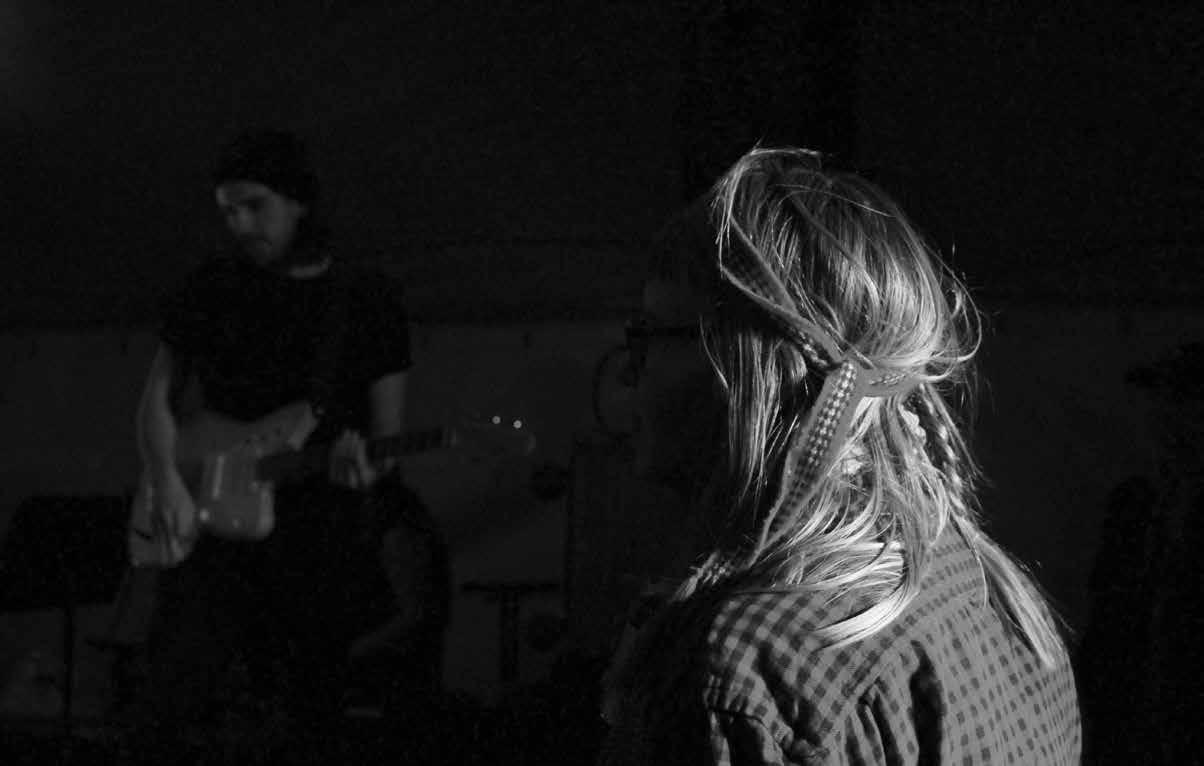
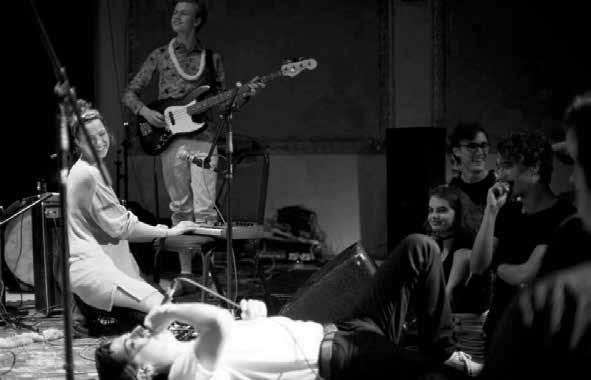
photo provided by broken dreams Club
Bisons debut highly-touted recruit and new coaching staff at press conference
jas O n P C hajek, staff
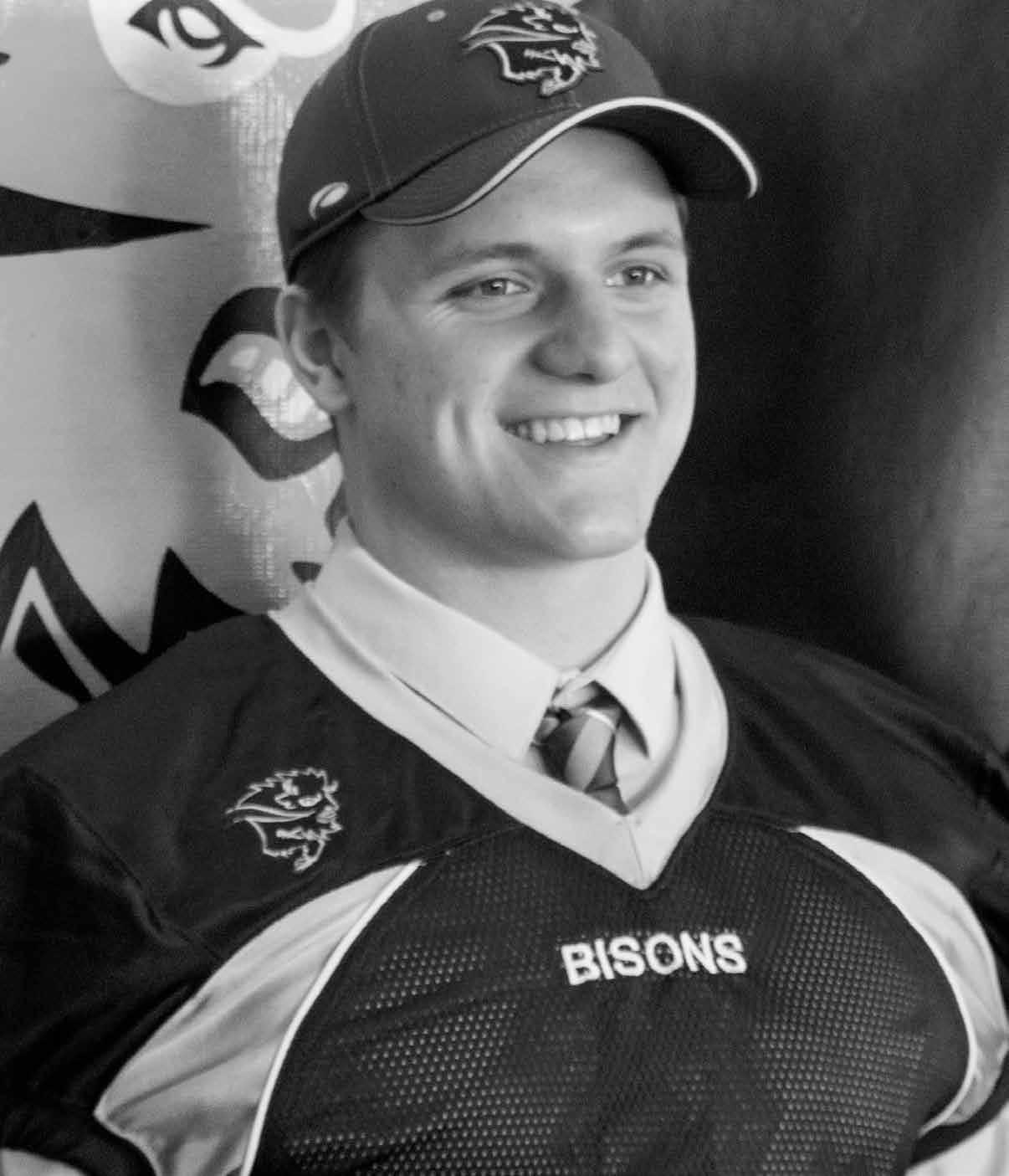
It was a big day for Bison football on Feb. 23, as the club announced the commitment of a new star defensive tackle, a new offensive coordinator, and a special teams coordinator.
The new recruit –Cole Adamson
The big news coming out of Thursday’s press conference was the signing of 17-year-old Cole Adamson, a recent Oak Park grad and the team’s new defensive tackle. The six-footfive, 265lb kid was potentially the most sought after recruit in Canada, with Bison head coach Brian Dobie putting him in the same class as guys like former Bison and current New Orleans Saint defensive lineman David Onyemata and Bison offensive lineman Geoff Gray.
“He is going to be a great player. I believe he’s going to become one of the faces of our program” –Brian Dobie, Bison football head coach
“He was recruited by everybody, and we all talk about recruiting battles, we all do across the country. It’s the biggest part of our job,” Dobie said. “It literally turned into a recruiting war.”
Dobie went on to list the schools Cole turned down, walking away from offers by Simon Fraser, UBC, Western, and McGill to stay and play in his hometown. From all accounts Adamson is a star in the making.
“There’s nothing missing. He’s a 90 average [student], taking very highend academic subjects,” Dobie said of their new tackle. “He is going to be a great player, I believe he’s going to become one of the faces of our program, I believe he’ll become an academic all-Canadian and a football all-Canadian.”
Despite the hype, Adamson was quite humble about the chance he was being given. When asked if the success of other Manitoba-produced linemen like Onyemata and Gray weighed on his decision, Adamson praised the program and was hopeful for the future.
“For them to make it that big into their career definitely shows that they had great coaching here and had the skills taught to them and the techniques to play at that next level,” Adamson said. “It’s exciting to have that same coaching that they had, and hopefully I can pursue to be like them.”
The new bosses –Atkinson and Karhut
The new tackle for the Bisons wasn’t the only one garnering praise. Dobie beamed at the group’s new
offensive coordinator Blair Atkinson and special teams coordinator Ryan Karhut.
Atkinson played for the Bisons from 2003 to 2005, and after a short stint with the Winnipeg Blue Bombers in 2006-07, he became the receivers coach for the Bisons. He is taking the reins from previous offensive coordinator Vaughan Mitchell. In his first season as the receivers coach, the team won the 2007 Vanier Cup. Since then, Atkinson has had six of his players selected in the CFL draft and three sign as free agents.
“Definitely something I’ve been waiting patiently for,” Atkinson said. “Definitely had a lot to learn from
Vaughan, and I feel like I’m ready for the job.”
Those fans worried that the Bisons O-line will have everything change drastically heading into next season need not worry.
“It’s not going to change a ton,” Atkinson said of his approach. “There’ll be a few tweaks here and there, we’ll rip a few pages out, we’ll add a few pages. We hope to control the ball a little more than the previous season.”
Karrhut spent time playing for the University of Central Florida before joining the Bisons and then turning pro with the Montreal Alouettes in 2008. The former offensive lineman
returns to the team he helped lift the Vanier Cup with back in 2007, after getting some experience coaching at the high school, junior, and U Sports levels.
“The timing was just right,” Karhut said. “Stuff in life was trying to pull me back here and obviously the opportunity was open here at the same time. So it was just one of those things where timing fit. Everything was matching up perfectly so it was just time to do it.”
Although Dobie joked that both Karhut and Atkinson had Bisons tattooed on their hearts, Karhut took the sentiment more literally when discussing his feelings about returning.
“I literally have a Bison tattoo,” Karhut said with a chuckle. “It was always something in my mind when I got into coaching was to come back to be part of the Bison staff.”
With the experience shown by the two new members of the Bisons’ coaching staff, and the seemingly limitless potential of their new star, the 2017 football season is beginning to look like another banner year for the herd.
photo by Jason pCha Jek
Bisons compete in the pool and at the track
Kelsey Wog steals the show at national swimming championship for Manitoba
ryan s telter, staff
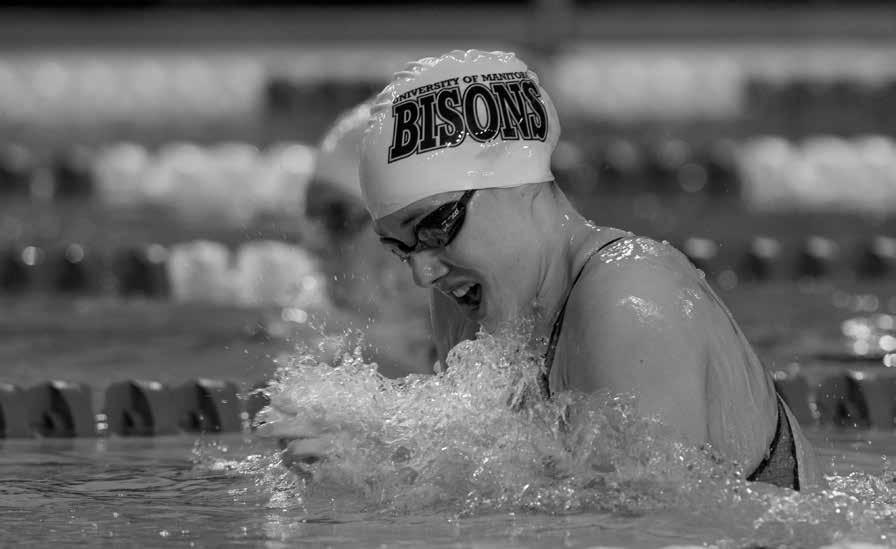
This weekend, Bison athletes of the swimming team headed to Sherbrooke, Quebec to participate in the U Sports national championships. Members of the Bison track and field team headed to Regina, Saskatchewan for the Canada West track and field championship.
Swimming
It was Kelsey Wog once again grabbing headlines for the Bisons,
as she grabbed four medals – one gold, one silver, and two bronze.
On the first day of the competition, Wog grabbed her first gold with a time of 1:06.06 in the women’s 100 metre breaststroke. Afterwards, Wog simply stated to Bison Sports, “It was a pretty good swim.”
Wog finished second in the 50 metre backstroke with a time of 30.99 seconds and third in the 200 metre backstroke with a time of 2:24.92.
Wog collected another bronze in the individual medley with a time of 2:12.10.
Wog’s performances helped the Bison women’s swim team finish in 12th spot with 69 points, an improvement of eight places from last year’s national championships. The Bison men’s swim team tied for 22nd overall with four points.
Track and field
Both the Bison men’s and women’s track and field teams were close to podium finishes at the Canada West championships. The men finished in fourth place with 53 points and the women finished in fifth with 47.5 points. Trinity Western won the men’s title for the first time, and Alberta won the women’s title for the second year in a row.
It was Kelsey Wog once again grabbing headlines for the Bisons, as she grabbed four medals – one gold, one silver, and two bronze
On the first day of the two-day event, the Bisons had four podium finishes. Third year Winnipeg native Brooke-Lynn Boyd grabbed gold in women’s shotput when she threw for 13.40 metres. Eric Guy earned a silver medal in men’s hurdles with a time of 8.25 seconds, and Gee-ef Nkwonta got bronze in men’s long jump with a 6.83 metre leap.
Tayo Babalola earned bronze in the women’s 300 metre with a time of 39.85 seconds. Jessica Gundrum just missed out on the podium in the women’s pentathlon when she finished fourth with 3057 points.
The second day had two gold medals being placed around Bison athletes’ necks. Tegan Turner won the women’s 60 metre with a time of 7.42 seconds, setting the new record. Alhaji Mansaray was the other gold medal recipient on day two, when he won the high jump with a 2.06 metre hop.
Nkwonta got back on the podium with a second place finish in the men’s triple jump with a 14.9 metre jump. Rebekah Eckert also finished in second in the women’s triple jump, jumping for 11.87 metres. Eckert was selected as the Canada West female rookie of the year.
Adam Gundrum grabbed a bronze medal in the men’s heptathlon with 4462 points, and teammate Jean-Luc Perron was not far behind, finishing in fifth in the same event.
The Bisons will have a few representatives at the national championships in Edmonton as the top two athletes from each individual event qualify.
photo provided by yves longpre
Bisons eliminated from Canada West playoffs following loss to Pandas
jas O n P C hajek, staff
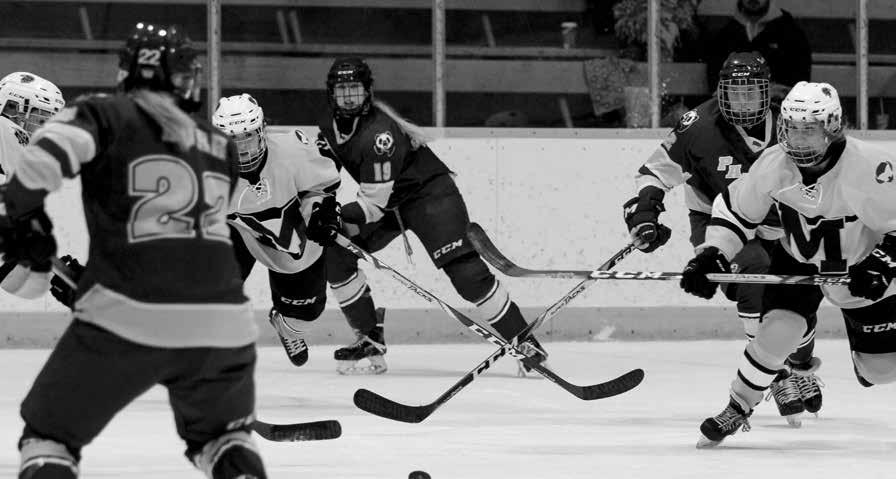
Following a quarterfinal sweep of the Mount Royal Cougars, the Bisons women’s hockey team were back in action in the semi-finals against the University of Alberta Pandas. The Bisons were swept by the Pandas, losing 3-2 on Friday, and losing by the same score on Saturday.
Special teams were the story of the game, as three of the five goals in the game were scored on the power play
Friday
The Bisons were set on their heels early against the Pandas but battled back, and ultimately fell 3-2 on Friday night.
Alberta got on the board first thanks to defender Abby Benning scoring on the power play. Benning took a pass at the point, stepping into a shot from just beyond the faceoff dot. The shot glanced off the glove of Rachel Dyck and into the Bisons’ net for the early 1-0 Pandas lead.
Lauryn Keen of the Bisons got
her team into the game early in the second period. Keen took a shot from below the goal line which snuck its way past Pandas goaltender Lindsey Post. Amy Boucher of Alberta answered a few minutes later, however, using a nice deke move to beat Dyck and make it 2-1 Pandas.
Alex Poznikoff of the Pandas scored early in the third period –again on the power play – to give her team a 3-1 lead. This was followed up by yet another power play goal by the Bisons, as Erica Rieder tucked a shot in tight by Post to cut the lead to 3-2.
Despite drawing close the Bisons couldn’t even things up, falling to Alberta 3-2 in game one of the bestof-three series. Special teams were the story of the game, as three of the five goals in the game were scored on the power play, with a fourth coming just as the offending player stepped back on the ice.
Saturday
The Bisons were back on the ice Saturday, attempting to stave off elimination and force a deciding game three against the Pandas. The teams traded chances, but luck was on Alberta’s side as they were able to book their ticket to the Canada West conference final with a 3-2 win.
Benning got Alberta on the board first for the second straight game.
Benning took a pass at the point unleashing a shot towards the goal. The shot blew by two Bisons and one Pandas player, sneaking under Dyck’s arm for the 1-0 lead.
The herd struck back in the second on the power play, the way they did it all series long. A pass from the corner by Alana Serhan went by two Pandas players to Karissa Kirkup, who was drifting into the slot. Kirkup ripped a shot low glove on Post to tie the game.
Alberta got back in front minutes later in odd fashion. A point shot
missed the net and Dyck lost track of it, but Ashley Morin didn’t. She picked up the loose puck, rifling a shot off Dyck and in to give the Pandas a 2-1 lead.
Despite a 5-on-3 opportunity in the final few minutes of the game, the Bisons were unable to even the score, with Alberta snagging an empty net goal to make it 3-1. There was hope for the Bisons in the final seconds of the game, as Venla Hovi blasted home a point shot to bring her team within one.
However, this was as close as the herd could get and the Pandas took the game 3-2, winning the series in a two-game sweep. Alberta is now off to the Canada West final where all signs point to a showdown with the UBC Thunderbirds. The Bisons will head home as a promising season comes to an all-too-early end.
photo by star roxas
Bison men’s basketball advance to final four for second straight year
Manitoba upsets #2 UBC with a sweep in Canada West quarter-finals
k ellen tanigu C hi, staff
The Bison men’s basketball team swept the Regina Cougars in their best-of-three play-in series last weekend, and continued their playoff success with a sweep of the secondranked UBC Thunderbirds in the Canada West quarter-finals. They won a close game 79-75 on Thursday, and took a 98-96 overtime victory on Friday night.
With the series win, Manitoba advances to the Canada West final four for the second consecutive year and will once again play the Calgary Dinos with a spot in the conference finals on the line. The Bisons split their season series with the sixthranked Dinos with an 85-81 win and
a 102-77 loss at the beginning of the season.
Thursday
The Bisons and Thunderbirds engaged in a tightly-contested affair in a game that included 14 lead changes and six ties. Neither team was able to make noise in the opening half with strong defense holding the herd to 40 per cent shooting from the field, and the T-birds to just 37.5 per cent.
AJ Basi led both sides in the opening half with 11 points, and continued to be effective in the second half, finishing with 22 points. Manitoba was able to hold the leading scorer of
the Canada West, Connor Morgan, to just three first half points, helping them take a slim 35-31 lead into halftime.
Pace picked up in the second half, with eight lead changes in the third quarter alone. Teams exchanged baskets throughout the quarter with Manitoba hanging onto a one-point lead entering the final quarter of play. Keith Omoerah put up six points in the third, and finished the game with a double-double of 17 points and 15 rebounds.
Manitoba gave themselves some breathing room and opened the final quarter with a 7-0 run, which gave them a 61-53 lead. The Bisons led by a
game-high 10 points with just over six minutes to play, but the Thunderbirds responded with an 11-1 run to tie the game at 70. The UBC run was led by Jordan Jensen-Whyte’s six points; the guard finished the game with 22 points. Basi hit a three to take a late lead, and Ilarion Bonhomme iced the game at the free throw line for the game one win. Bonhomme scored all of his 12 points in the final frame to help the Bisons secure the win.
Friday
The two teams engaged in yet another close game, with the Bisons winning a thriller 98-96 in overtime. Once again, defense controlled the beginning of the game with neither team able to open up a big lead, and Manitoba contained UBC star Morgan, keeping him off the score sheet in the first half. Justus Alleyn netted eight of his 16 points in the opening half, helping the herd take a 35-30 lead into the break.
The offensive floodgates opened in the third quarter, with both teams exchanging looks throughout the frame. With UBC leading 61-60 late in the quarter, Manitoba strung together nine consecutive points before the Thunderbirds connected on a late three, and Manitoba took a 69-64 lead into the final quarter.
The Bisons led by as many as nine points in the fourth, but the T-Birds were able to cut the lead down to two
Bison volleyball teams out-dueled by Trinity Western in last regular season action
ryan s telter, staff
A
fter a conference bye last weekend, the University of Manitoba volleyball teams headed out west to play their final regular season series against the Trinity Western Spartans. The men’s volleyball team were on the losing end of a sweep against the third-ranked Spartans, whilst the women continued their dreary 2017 by getting swept.
Men It was a rare off weekend for the Bisons, having suffered their first defeat since late October on Friday.
The Bisons lost again on Saturday, this time by a score of 3-1.
The silver lining for the first-ranked Bisons is that because they won a set in Saturday’s defeat, they managed to finish first in the Canada West with a 21-3 record and will host the Canada West final four on Mar. 10-11.
All the sets were closely contested, as two of the top-ranked teams in Canada went toe-to-toe. Devren Dear finished with a combined 21 kills on the weekend; he finished the regular season with 309, averaging 3.96 a set – good enough for fourth in the conference.
Adam DeJonckheere had a .286 hitting percentage in both games against the Spartans; he had an overall hitting percentage of .308 on the
year. DeJonckheere finished fifth in the Canada West in that category.
The play of rookie Kearley Abbott this season has to be commended, as she finished first for the Bisons in kills with 247
Women
The Bison women’s volleyball team did not have a great second half of the season, losing their last 12 games of the year. This included not picking up a set victory against the third-ranked Spartans team.
Josie Abbott finished the weekend with 15 kills, while Tori Studler only finished with a combined eight, her
points with just 37 seconds to play. UBC came up with a huge stop, and Jensen-Whyte with ice in his veins connected on two free throws to send the game to overtime.
Bonhomme scored all of his 12 points in the final frame to help the Bisons secure the win
The overtime period featured four lead changes, but Manitoba got the last laugh when they were down by one-point with 19 seconds remaining. Bonhomme missed a contested three-point attempt, but Malik Irwin snagged the rebound and passed it out to Basi, who connected on a game-winning three with just six seconds left on the clock. The Bisons completed the sweep in UBC, with Omoerah posting another doubledouble and Bonhomme leading the team with 26 points and 10 rebounds.
The Bisons and Dinos tip-off in Calgary on March 3 at 9 p.m. CT, with the winner advancing to the conference finals on March 4.
lowest output of the season. Second-year setter Sydney Booker finished the year with 786 assists, averaging 8.73 a set, finishing fourth in the Canada West. The play of rookie Kearley Abbott this season has to be commended, as she finished first for the Bisons in kills with 247 and first in kills per set with 2.66. Abbott will most likely be in the conversation on the Canada West all-rookie team, as well as the Bison female rookie of the year award.
The Bisons started out the season with a lot of promise, heading into the Christmas break sitting one game below .500. Then the wheels fell off a bit with the team only winning one game in the second half of the season, finishing the year 6-18. It is still an improvement from last season, when they finished 3-21 and were second last in the Canada West. There is lots to learn for this young team in the coming years.
photo by star roxas
photo by megan Colwell
NHL Department of Player Safety needs to hand out consistent punishment
k ellen tanigu C hi, staff
On Feb. 19 Winnipeg Jets defenseman Jacob Trouba laid a hit on Ottawa Senators forward Mark Stone, one that was clearly a hit to the head that kept Stone out for the remainder of the game. Trouba was given a two-minute minor penalty, and consequently had a meeting with the NHL’s Department of Player Safety to assess if a suspension was required or not. On Feb. 20 the decision was made, and Trouba was suspended for two games. It doesn’t matter what team you cheer for, Trouba’s hit was definitely a punishable offense.
Trouba’s absence was noticed when the Jets took on the Toronto Maple Leafs on Feb. 21. Winnipeg fell to Toronto 5-4 in overtime, with the Jets defense unable to conjure up with an answer for the young, attacking Leafs offense. Trouba has been one of, if not the most consistent defenseman for Winnipeg and his absence came at an inopportune time that could cost the Jets some valuable points that are needed to make a run towards the postseason.
The punishment enraged Jets fans and others around the league because of a similar hit on Winnipeg captain Blake Wheeler that was delivered by Evgeni Malkin of the
Pittsburgh Penguins a few days prior that received zero discipline. Malkin clearly lifts himself off the ice before he hits Wheeler, giving him elevation to deliver the head shot. It was a clear hit to the head, and all that fans are asking for is consistency when it comes to the NHL’s Department of Player Safety.
Wheeler stated after the Trouba suspension was revealed, that he had no issue with the suspension, but believes there needs to be some consistency when it comes to these decisions. Malkin did not even receive a call about his hit on Wheeler, while Trouba got one right away. One key difference between the two hits is that Wheeler was able to get back up and continue playing, while Stone had to exit the game and miss a couple of games following the hit. But the severity of the injury should not come into play when deciding if a suspension is needed. All hits to the head need to be disciplined to protect the players on the ice.
There are three things that the Department of Player Safety looks at when reviewing these hits. They must be able to see clear illegal contact to the head, and decide if there was any charging or if the player lifted himself to make the hit. They also look to see
if there is any interference such as hitting the player without making a play on the puck. They looked at all three of these and decided that Malkin never crossed the line on any of them. Trouba on the other hand, mainly fell victim to the illegal contact to the head infraction, as he made contact with only Stone’s head when he could have made a full body contact check.
At the end of the day, fans in Winnipeg may not be impressed with the twogame suspension given to Trouba, but he deserves the suspension
With all the controversy over why Malkin was not suspended, NHL director of media relations John Dellapina released a report to the Winnipeg Sun on how the Malkin hit differed from the one Trouba laid out. First they believed that Wheeler’s
body took the majority of the hit, even if the head was contacted with first. They then looked to see if the hit involved any sort of charging, but what they believed was that Malkin was bracing himself for a collision at the center of the ice.
If you watch the replay of the hit closely, an argument could and should be made that Malkin propelled himself up prior to contact with Wheeler. Lastly, they would have to review if there was any interference on the play, but even though Wheeler never touched the puck they believed he made an attempt to make a play on the puck but Malkin got there first. Overall, the hit to the head should have been enough for Malkin to at least receive a phone call, which the lack thereof is a cause for the fuss.
Other controversial hits
Another controversial hit was Toronto’s Nazem Kadri’s hit on forward Daniel Sedin this season on Nov. 5. Vancouver personnel made it clear that they expected Kadri to get suspended for the hit, which they saw as a hit to the head. A case can be made that it was in fact a head shot, especially since Sedin’s helmet flew off on the play. However, the
Department of Player Safety elected to not suspend Kadri, which dissatisfied the Canucks staff and players. Winnipeg Jets head coach Paul Maurice also made some comments about the suspension. Maurice is another person looking for some consistency, and compared the incident back to a hit that Bryan Little took last year from Tampa Bay’s Anton Stralman. Little missed the remainder of the 2015-16 season with some fractured vertebrae that resulted from the hit. Little was a defenseless skater on the play, and when he was falling down Stralman collided with him head on, and there was no punishment even considered on Stralman’s end.
At the end of the day, fans in Winnipeg may not be impressed with the two-game suspension given to Trouba, but he deserves the suspension. All Jets fans and the rest of the NHL can hope for is that the Department of Player Safety lays out a clear rubric for suspensions so that suspensions can be given out consistently to protect the players on the ice.