Nationwide rallies support Colten Boushie’s family PAGE 3
Tipping the scales
Indigenous imbalance on juries roadblock to reconciliation
PAGE 6
Bisons
make history
Women’s hockey secures home ice throughout playoffs
PAGE 14
Bridge over heckling water
Town halls should prioritize policy discussion PAGE 9
We’re on to UBC
Bisons move on to quarter finals
15
Here
come the Cougars
Bisons hosting Mount Royal in playoffs
16
Correction: A story in the Feb. 7 issue of the Manitoban incorrectly stated that UMSU council passed a motion to introduce a mature student representative position to council. In fact the motion was sent to the governance committee. The motion is on the agenda for the Feb. 15 UMSU council meeting. The Manitoban regrets the error.
EDITORIAL
DESIGN
DESIGN EDITOR Bram Keast design@themanitoban.com
GRAPHICS EDITOR Kelly Campbell graphics@themanitoban.com
Lovecrafted event supports ArtsJunktion
Fundraiser and showcase project raised $500
PAGE 12 ARTS
Check the Manitoban’s website and Facebook page for:
• Video coverage of Winnipeg's rally in support of Colten Boushie's family
• Toban Talkback - Valentine's edition
PHOTO EDITOR Asha Nelson photo@themanitoban.com
SOCIAL EDITOR Carolyne Kroeker social@themanitoban.com
DESIGN ASSOCIATE Kellie Huynh
GRAPHICS ASSOCIATE Ernest Zarzuela
PHOTO ASSOCIATE Chantal Zdan
PHOTO ASSOCIATE Quincy Houdayer
REPORTERS
GENERAL ASSIGNMENT Qudus Abusaleh
GENERAL ASSIGNMENT Diana-Abasi Ubokudom
COLUMNIST Levi Garber
COLUMNIST Kenny Ingram
ARTS & CULTURE Jen Doerksen
SPORTS Jason Pchajek
COPY ASSOCIATE Matthew Doering
VOLUNTEER CONTRIBUTORS
MANITOBAN
109 HELEN GLASS UNIVERSITY OF MANITOBA WINNIPEG, MB R3T 2N2
GENERAL INQUIRIES & ADVERTISING
Phone: (204) 474.6535
Fax: (204) 474.7651
Email: manitoban@themanitoban.com
FREE MEDIA
Campus Plus Media Services
Phone: 1.780.421.1000
Email: advertise@free-media.ca
Canadian
A “volunteer staff” member is defined as a person who has had three volunteer articles, photographs, or pieces of art of reasonable length and/or substance published in three different issues of the current publishing year of the Manitoban. Any individual who qualifies must be voted in by a majority vote at a Manitoban staff meeting. Elected representatives and non-students may be excluded from holding votes as volunteer staff members in accordance with the Manitoban Constitution. The Manitoban is the official student newspaper of the University of Manitoba. It is published monthly during the summer and each week of regular classes during the academic year by the Manitoban Newspaper Publications Corporation.
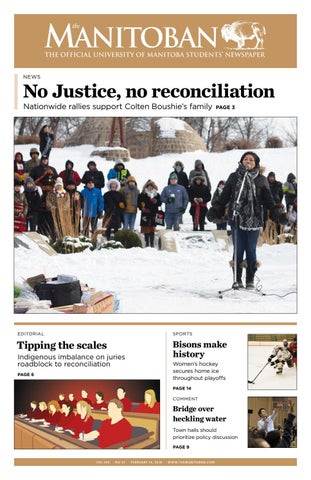
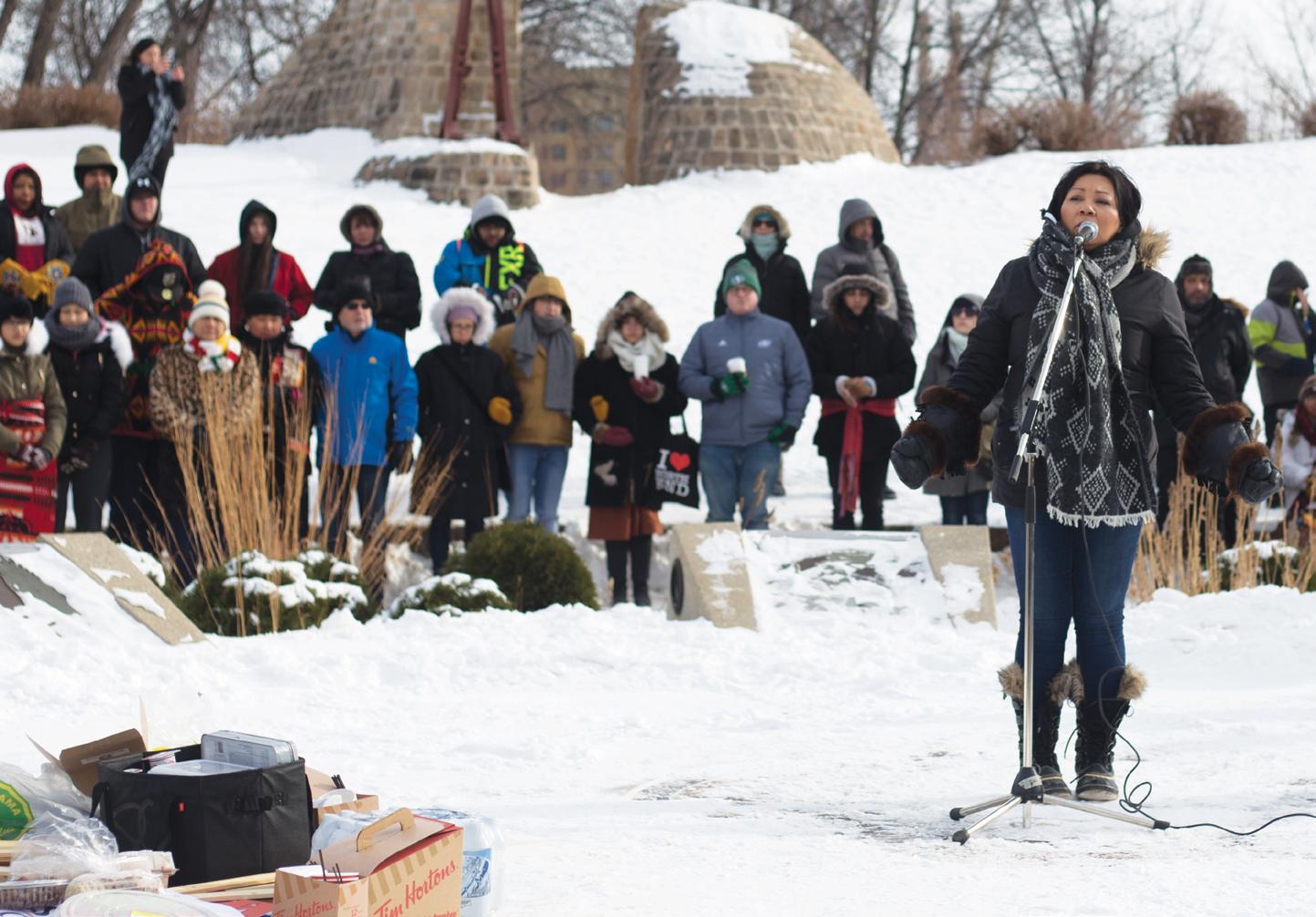
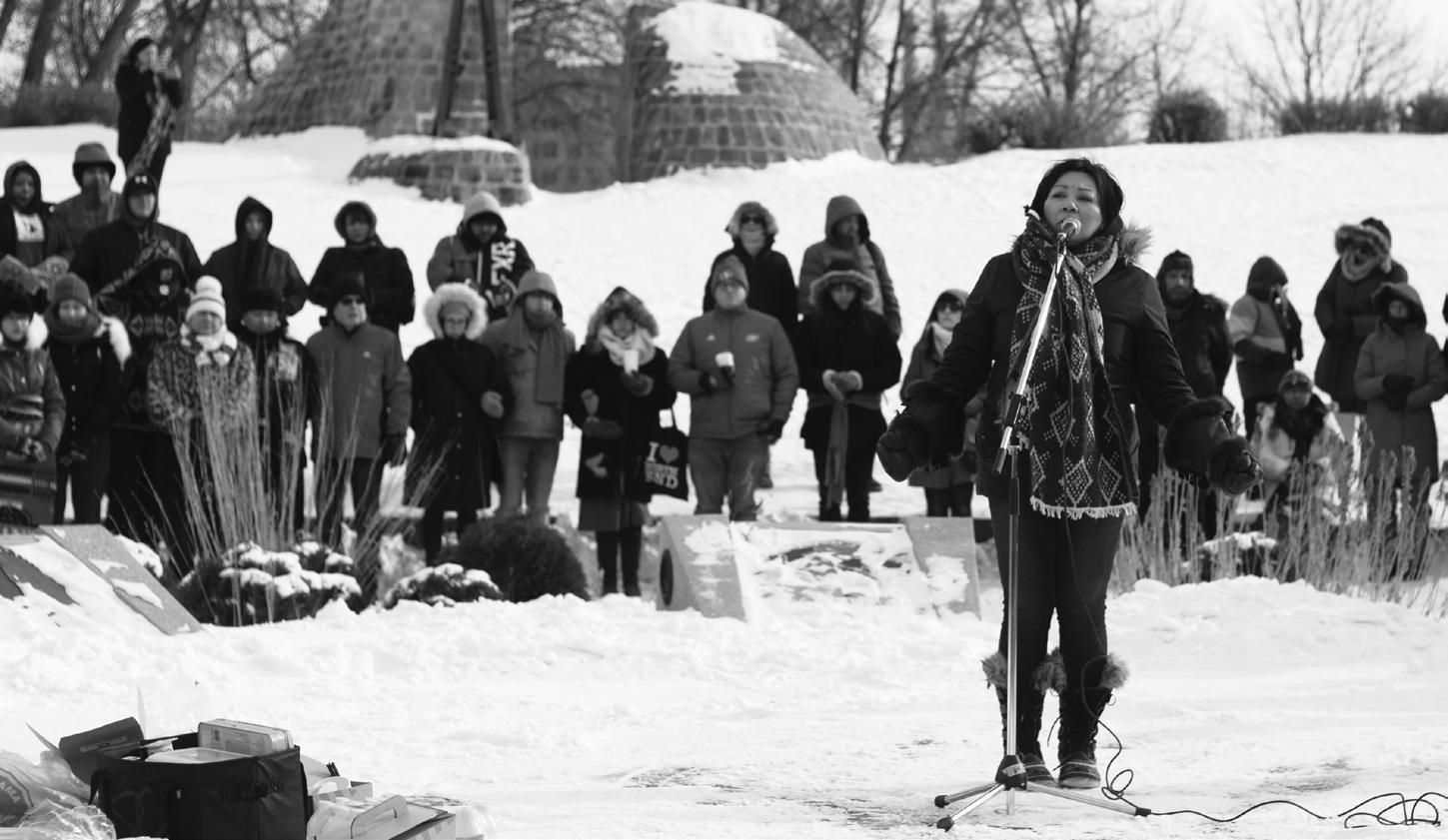
Hundreds gathered at the Odeena Celebration Circle at the Forks Saturday afternoon to rally in support of the family of Colten Boushie.
Boushie, a 22-year-old man from Red Pheasant First Nation, was shot and killed in August 2016 after an SUV he was riding in with four friends was driven onto Gerald Stanley’s Saskatchewan farm. Boushie was shot in the head, which resulted in his instant death.
Stanley was charged with second-degree murder. On Friday, he was acquitted by a Court of Queen’s Bench jury in Battleford, Saskatchewan, that deliberated for more than 13 hours.
The court heard Stanley thought an ATV was being stolen from his property. He testified that he fired two warning shots and reached into the SUV to take away the keys when his gun “just went off.”
The driver of the SUV testified that the group had been drinking and admitted they attempted to break into a truck on a neighbouring farm. The driver said they went to Stanley’s farm looking for help with a flat tire.
Before the trial began, Boushie’s family shared its concern with media that the jury lacked Indigenous representation.
The verdict sparked rallies across Canada which involved marches on police stations and courthouses calling for an overhaul of Canada’s criminal justice system.
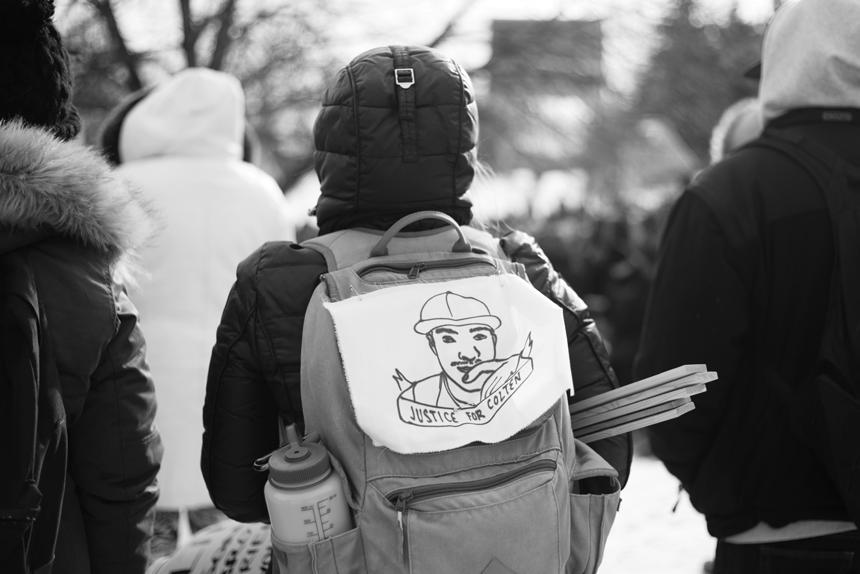
Protests calling for “Justice for
Colten” took place in in Ottawa, Toronto, Edmonton, Regina, Saskatoon, Calgary, Vancouver and Winnipeg.
Winnipeggers march in solidarity
Niigaan James Sinclair, assistant professor of native studies at the University of Manitoba, emceed the Winnipeg rally.
Sinclair said the event is not just a reminder of the “love that we have
for the Boushie family,” but the event also served as a “reminder to this country that we are still here and that we are not going anywhere.”
“We commit to a spirit of love. We commit to a spirit of change," said Sinclair during his opening remarks.
In a release issued by organizers before the event, Sinclair urged Canadians to show solidarity for the family by “refusing to let Canada continue along a path of racism and division.”
Elder Gerry Shingoose started the gathering with a prayer which she said she hoped would bring peace to the Boushie family.
“I ask each one of you go into your heart and into your spirit and think about the family - how it must have been for them last night, the last few days, and how it will be in the future and I ask you to send that love and support to them so they can walk into the future,” she said.
Sheila North Wilson, grand
chief of Manitoba Keewatinowi Okimakanak, thanked the audience for coming out to show solidarity in numbers.
“We are standing united against violence,” she said. “We are standing united against racism and injustice.”
North Wilson noted that the act of violence against Boushie was not an isolated incident.
“It was years of history that went behind that gun shot that took that life,” North Wilson said, reminding the audience that more needed to be done to address the existing racism in Canada.
The crowd marched to the Law Courts Building on York Avenue.
Leah Gazan, organizer and education instructor at the University of Winnipeg, said in a press release, “This sends a poor message across Canada that if you are an Indigenous man, a white man can shoot you in the back of the head and be found #NOTGUILTY by an all-white jury.
“There is no reconciliation without justice.”
Speaking in front of the law courts, Gazan said “ We’re hoping to push for justice for Colten Boushie’s family and changes to the criminal justice system so that it truly protects all individuals regardless of race, class, gender, or sexual orientation.”
PHOTOS BY ASHA NELSON
MKO grand chief Shiela North Wilson addresses the crowd during Saturday’s rally calling for justice for Colten Bushie.
A "Justice for Colten" graphic was shared widely on social media and frequently spotted in the crowd.
University of Guelph professor talks Indigenous-led conservation
The impacts of
industrial
development on Indigenous land means a critical approach is necessary
QUDUS ABUSALEH, STAFF
T
he University of Manitoba's Clayton H. Riddell faculty of environment, earth, and resources hosted Faisal Moola, University of Guelph associate geography professor, for a lecture on Indigenous-led environmental conservation Feb. 9. Moola’s talk was built around how Indigenous communities can better provide quality protection over traditional lands in comparison to current federal conservation policies.
Indigenous approach to land governance
Moola said the chief difference between government policy and I ndigenous-led “environmental assessment” processes is the fundamental comprehension of the land itself.
“An environmental assessment process that was driven by Indigenous people for Indigenous peoples would focus on the management needs of the land, the water, the air, the wildlife, the communities that depend on those resources first,” he said.
“In practical terms, it would mean that rather than focusing on what we should take from nature to cre-
ate wealth and employment,” he continued, “we should first consider what needs to be retained in nature to sustain both the wildlife and the wellbeing of local communities.”
Moola’s talk coincided with the federal government’s recent introduction of Bill C-69 on Feb. 8, which will overhaul current methods of environmental assessments and streamline the approval process for major natural resource extraction projects.
The proposed bill would scrap the National Energy Board (NEB) and create the Impact Assessment Agency of Canada, which would carry out more extensive reviews of industrial projects by assessing their environmental, health, social, and economic impacts, as well as their effects on Indigenous communities.
The NEB is an independent regulatory agency, created in 1959, to oversee parts of the energy industry and whose mandate includes regulating the construction, operation, and abandonment of pipelines, natural gas and crude oil imports and exports, as well as oil and gas exploration.
Moola noted that Indigenous scholars remain concerned that the
bill does not explicitly incorporate Indigenous voices in the decisionmaking process for industrial development projects.
He stressed that discourse on industrial development should not take place in the absence of a worldview that highlights humankind's essential connection to nature.
“ Nature is our home,” Moola said. “Nature provides our most fundamental needs and nature dictates limits to growth.
“So the protection of nature should be our highest priority when it comes to the way in which we regulate and manage our resources.”
Treaty 8 and impacts of industrial development on traditional lands, Moola's talk also highlighted the story of the Dane-Zaa people, long inhabitants of the Peace River region in northeastern British Columbia.
Following European settlement across British Columbia and the province's incorporation into confederation in 1871 , the Dane-Zaa people signed Treaty 8 in 1900.
Moola said Treaty 8 “enshrined a
solemn and binding promise” ensuring that the “Dane-Zaa would be able to continue their traditional activities” such as hunting, trapping, and fishing “without forced interference or forced dependenc y upon the Crown.”
Moola noted that although the Crown’s newly procured consent to develop any land in the Peace River region rested on this promise, the Dane-Zaa and other I ndigenous communities “have seen their lands irrevocably damaged” through industrial activities like deforestation, mine and dam construction, and fracking operations.
He said this latter development gradually resulted in a “sprawling network” of “thousands upon thousands of kilometres of seismic lines of roads and pipelines” that have come to “dominate the landscape.”
Moola said that as part of a study conducted with the David Suzuki Foundation and Dane-Zaa partners, The Peace Dividend: Assessing the Economic Value of Ecosystems in B.C's Peace River Watershed, he and his team published the first spatial analysis of industrial land use pressures and industrial land use change
over a 56,000 square kilometre region of Dane-Zaa and Cree territory in northeastern B.C.
The study found that within DaneZaa territory, there are over 16,267 oil and gas well sites, 8,517 petroleum and natural gas facilities, 45,293 kilometres of roads, 1,163 kilometres of transmission lines, and over 28,587 kilometres of oil and gas pipelines.
“More than half of all of the pipelines in British Columbia are just found within Dane-Zaa territory,” Moola said.
Moola also noted that if all these industrial ventures in the Peace River region were to be laid out and wrapped around the planet, they would go around “almost five times.”
Public education funding announcement draws fire from teachers’ union
Provincial 0.5 per cent funding increase lags behind rate of inflation, criticized as “de facto cut”
SHADEN ABUSALEH, STAFF
Manitoba public school teachers are expressing outrage at the provincial government’s recent announcement regarding upcoming public school funding.
Manitoba minister of education and training Ian Wishart announced in a press conference Feb. 8 that the provincial government will invest a total of $1.323 billion in primary and secondary public education for the 2018-19 school year, increasing funding by $6.6 million or 0.5 per cent - half of the one per cent increase schools received last year.
Wishart said the provincial government is directing school boards to limit education property tax increases to two per cent, adding that the province may consider legislative options if school boards do not abide by the two per cent cap.
The province will also phase out the Tax Incentive Grant (TIG) over the next six years, which rewarded school divisions that did not raise their property taxes.
“We believe this limit on education property tax is achievable in light of Bill 28 […] which comes into effect for all public school teachers as of July 1st,” said Wishart. “This will ease some of the financial pressure on divisions.”
Passed in June of last year, the
Public Services Sustainability Act freezes wages for public sector workers - including public school teachers - for two years, followed by a 0.75 per cent increase in the third year and a one per cent increase during the fourth.
School divisions will also see a 15 per cent reduction in their administration cost caps. Wishart said that over the past three years, all divisions have kept costs below their respective caps and as such this reduction will not hurt “divisions which have already made an effort to streamline administrative costs.” Failure to comply, Wishart said, will mean reduction in funding.
As well, the province wants to reduce the number of teachers’ collective bargaining units with a centralized bargaining process, with Wishart saying Manitoba is “literally the last province” permitting each school division to negotiate teachers’ salaries.
Wishart said that with 38 separate bargaining units for public school teachers, the result is “a replication 38 times over of a process which generally delivers very little variation in settlements.” Wishart called this “inefficient and it takes our teachers’ and trustees’ time as they sit around the bargaining table.”
“We want to free up teachers,” Wishart said. “So instead of negotiating, they can be in the classroom and focus on children’s education.”
The push towards central, province-wide bargaining, which will require regulatory changes, coincides with the expiration of teacher contracts on June 30.
Wishart also announced a $40,000 increase in Intensive Newcomers Support (INS) grant funding “to help divisions with new arrivals of refugees and other high-needs English as an additional language students.”
INS sets out school programs targeting newcomer students in Grade 6 through 12 who have experienced significant disruption to their education as a result of warfare, civil conflict, or poverty.
Reiterating the government’s commitment to education, Wishart said the PCs will launch a review of the K-12 education system in early 2019. This review will look into factors such as quality of education, how the public education system is financed, roles and responsibilities of school boards, and taxation power of school divisions.
“We believe governments at all levels must live within their means and provide services taxpayers can afford,” Wishart said. “When school
divisions create their budgets for the year ahead, we expect them to manage their expenditures accordingly.”
A “de facto cut”
Wishart noted that this “significant increase in funding,” comes “in spite of the fiscal challenges our government inherited.” However, the 0.5 per cent increase is the smallest in nearly two decades.
The Manitoba Teachers’ Society (MTS) president Norm Gould said the 0.5 per cent increase is actually equivalent to a 1.5 per cent funding drop because it “sits at less than a third of the rate of inflation.”
MTS is the collective bargaining organization for all of the teachers in the province’s public schools.
“Teachers are facing large increases in student enrolment, a growing influx of refugee and newcomer students, chronic - and I mean chronic - child poverty, and more special needs kids than ever,” Gould said, “and this is what the government thinks our students are worth?”
The government's funding announcement was criticized in a statement issued by NDP education critic Matt Wiebe.
“What the government announced today is a de facto cut in the schools and classrooms we rely on to educate
the future leaders of our province,” said Wiebe in the release.
Wiebe was also critical of TIG’s gradual removal, claiming that this will leave “a $61 million hole in the budgets of school divisions at the end of six years.”
“Not only does this funding cut hurt students, but heavy-handed changes to the collective bargaining process is disrespectful,” he said.
When asked during the press conference about estimated savings following public school funding changes, Wishart said, “We don’t know hard numbers, we just know there are significant savings to be had there.”
Wishart said that alongside the reduction in the administration cap, the two per cent local levy change, and freezing of teacher salarieswhich, he noted, was “the biggest single part of [school divisions’] costs” - coping with the small 0.5 per cent increase is “doable.”
Editor-In-Chief: Garett Williams
Lack of Indigenous representation on juries paints portrait of unbalanced justice system
Outrage over Stanley verdict highlights long road to reconciliation
GARETT WILLIAMS, STAFF
If even the appearance of bias is cause for concern, Canada’s justice system is in a poor state.
Last week, a jury acquitted Gerald Stanley of second-degree murder in the 2016 killing of 22-year-old Red Pheasant First Nation resident Colten Boushie.
Stanley is white. Boushie was Cree. And there was no visible Indigenous representation on the jury of seven women and five men that heard the case. The optics are not good.
Before the verdict was even returned, Indigenous advocates and legal experts were already arguing that the case is just one further example among many that Canadian juries need to be made more diverse.
During selection in late January, a number of potential Indigenous jurors were rejected outright through
the defence’s use of peremptory challenges - where no reasons for dismissal need be submitted.
The 1991 Manitoba Aboriginal Justice Inquiry - which determined this province’s system to be a “glaring example of systemic discrimination” - called for such challenges to be eliminated.
The selection process alone moved Boushie’s uncle to lament that “the deck is stacked against us."
The facts of this case are tragic.
The court heard Boushie was sitting in an SUV on Stanley’s property when he was shot in the back of the head in what the defence called a “freak accident.”
Stanley testified that he thought an ATV was being stolen from his property and, after firing warning shots, he reached into the SUV to
take away the keys when his gun “just went off.”
The driver of the SUV said a group of four people had been drinking throughout the day and admitted they attempted to break into a truck on a neighbouring farm. The driver said they went to Stanley’s farm looking for help with a flat tire.
The testimony of the witnesses in the SUV was challenged by the defence, and they admitted to lying to investigators about the attempted theft and changing their stories before testifying.
None of this is cause for execution. The sentence for attempted theft is not death.
But the case shines a light on the ongoing failures of the Canadian justice system that, at minimum, gives the impression that justice is unfairly
Toban Talkback isn’t worth it
distributed. At worst, it illuminates a two-tiered system where Indigenous people are not afforded the rights of all Canadians to be represented by a jury of their peers.
The Supreme Court weighed in in 2015 when it upheld a manslaughter conviction of a Grassy Narrows, Ont., man who was tried before a jury that did not include Indigenous representation.
Overturning an earlier Ontario Court of Appeal decision that threw out the initial conviction, the upper court determined by a 5-2 margin that Ontario made reasonable efforts to include Indigenous populations on its jury selection rolls. Hardly a high bar to meet.
The dissenting opinion - written by Justice Thomas Cromwell and supported by Chief Justice Beverley
People hear what they want to hear, and feel what they want to feel
JESSE BLACKMAN
F ebruary has shown no love to the Manitoban. First, the University of Manitoba Students’ Union saw a motion to defund the paper. Just days later, a Toban Talkback segment featuring engineering students talking about their impression of arts degrees triggered pockets of outrage. Donald Trump would be proud. Let’s leave easy points about freedom of the press and freedom of expression at the door. People choose their political moves and - barring a myriad of accessibility issues - they
choose their educational paths.
UMSU’s actions and the U of M’s arts degrees do not resemble anything close to vulnerable characteristics under the Manitoba Human Rights Code, nor should they.
The bigger issue seems to be that some people feel entitled to have only their perspective presented back to them in the media. When they don’t see this, some turn to social media condemnation instead of channeling it towards thoughtful debate. There is a difference between acting out of
rage or out of reason. When a journalist interviews the bust of a statue in the earlier "What is a ‘Wesmen’?” episode of the Toban Talkback series, it is easy to reason that the content associated with these campus interviews is intended as humour.
Whether you find it funny or not, your personal sense of humour cannot detract from the fact that the piece is intended to be humorous. Even if engineering students talking about arts degrees is not funny - without the content actually being offensive,
demeaning, prejudiced, or hatefulturning red in the face and blowing smoke out your ears is hardly worth it. Making fun of a cruel job market is not a personal attack.
Critical thinking skills can go a long way.
The reality is that arts degrees are not created in pursuit of a career, and finding a job can be challenging with almost any general education, as opposed to a professional program. Laughing about our economic realities can ease that pain. If you don’t
McLachlin - argued that forcing a defendant to select a jury from a roll that excluded a significant part of his community was “an affront to the administration of justice and undermines public confidence in the fairness of the criminal process.”
An earlier report from Ontario called it an “undeniable fact” that the problems of improving Indigenous representation on juries are linked to the “justice system’s treatment of members of First Nations generally.”
At the same time Indigenous people are underrepresented on juries, the proportion of Indigenous adults in custody is nine times higher than their representation in the population at large. Indigenous adults, especially women, are also overrepresented as victims of crime.
Less than 24 hours after the Stanley verdict was read out in court, thousands of Canadians - including some 700 in Winnipeg - participated in numerous rallies across the country calling for “Justice for Colten.” The Assembly of Manitoba Chiefs has also joined a call for an inquiry into the trial.
Prime Minister Justin Trudeau, along with Indigenous services minster Jane Philpott and justice minister Jody Wilson-Raybould, took the extraordinary measure of taking to Twitter to comment on the verdict, with the latter stating that “as a country we can and must do better.”
It has been more than two years since the Truth and Reconciliation Commission released its 95 calls to action toward rebuilding the relationship between Canada and its Indigenous population.
If this ongoing project is to be taken seriously, it will take more than the appearance of regret from government. And if justice is to even appear to be served, Indigenous people need to be invited into the jury box.
laugh, you may as well cry, and where’s the joy in that?
Ultimately, if criticism of arts degrees is troubling to you, it may be worth mentioning that the U of M’s voluntary withdrawal date for winter term courses is March 16.
Viva la Toban.
Jesse Blackman has a degree in women’s and gender studies and has had several jobs.
GRAPHIC BY KELLY CAMPBELL
Student journalism crucial stepping stone
Who must support student journalism more than students themselves?
LEVI GARBER, STAFF
There are important stories in the newspaper you are reading right now.
Flip or scroll to the news, sports, or arts sections of this paper and you will find articles on peoples’ passions, triumphs, pitfalls, and tribulations.
This newspaper strives to hold politicians and bureaucrats accountable, and its reporters and editors keep their ears to the ground to cover events and news in your community.
The next generation of Canada’s journalists are working for your university newspaper. If their fellow students do not support them, then no one will
And this newspaper has been doing so for 104 years.
This month, however, the Manitoban’s future was nearly thrown into jeopardy when a single student union councillor proposed a motion to hold a referendum on the newspaper’s funding.
Thankfully, the outpouring of support for the Manitoban on social media and the lack of confidence from fellow councillors pushed the lone student politician to withdraw his motion.
For a brief period of time, it seemed as though the intense defunding challenges facing local and national journalists across the country were about to hit student media. But is student journalism really journalism worth saving from those who would rather see it go?
After all, student newspapers across the country rely on student
levies - a portion of student fees set aside from tuition - to run their daily operations.
Just last month, an article from J-Source, a collaborative online project by journalism schools all over Canada, delved into that very question.
The article asked the question: “Is this really journalism?” to a series of student journalists across the country.
The answer to that query came back an unequivocal and unapologetic “Yes.”
Just in the last year or so, the Manitoban has covered a number of important stories that have had real impacts on students in the province.
During the 2016 faculty strike, constant updates from the Manitoban, from both the Fort Garry campus and the provincial legislature, kept students informed of how negotiations were progressing to get students back in their classes.
In February 2017, the Manitoban received a document that confirmed the province had hired an UMSU executive as a political aid.
Soon after the newspaper reached out to them for comment, they resigned from his executive position.
Additionally, the newspaper’s coverage of tuition hikes that are slated go into effect next year had barely any competition from established news organizations like CBC News and the Winnipeg Free Press
Across the entire country, student journalists are breaking stories that are having significant impacts on the university communities they serve.
In October 2017, the University of Victoria’s student newspaper, the Martlet, reported that their student society’s mishandled health insurance switchover led to one student losing access to her $250,000-per-year cystic fibrosis medication.
The Martlet was also the first outlet to report on the failures of the University of Victoria’s sexualized violence policies in 2016.
Soon after, the B.C. government
passed a law that forced post-secondary institutions to adopt policies to prevent and respond to sexual violence on university campuses. Manitoba’s government adopted similar legislation in October 2016.
Over on the mainland, the University of British Columbia student newspaper, the Ubyssey, has held the university administration and student union leaders to account in true form.
Last February, the Ubyssey printed leaked confidential documents that detailed how the university’s undergraduate admissions office grades entrance essays.
The UBC student newspaper also conducted a large-scale investigation into the UBC-Okanagan student union over widespread financial mismanagement. That investigative reporting won the Ubyssey a John H. McDonald award for excellence in student journalism.
Across the country, in Toronto, journalists from the University of Toronto’s student-run paper, the
Varsity, gained first access to the U of T professor whose opinions on gendered pronouns made international headlines.
The list goes on.
However, it is not just meaningful journalism that student newspapers are producing: some of Canada’s most notable journalists got their starts in campus reporting.
The National Post ’s Andrew Coyne began his political musings as the comment editor of the Manitoban, and CBC foreign correspondent Nahlah Ayed also began her journalism career in the pages of the Toban David Cochrane, a senior reporter in CBC’s parliamentary bureau, worked at the Muse, the Memorial University of Newfoundland’s student paper.
CBC Radio’s As It Happens cohost and legendary Canadian journalist Carol Off was a staff writer for the Gazette , the University of Western Ontario’s newspaper. Toronto Star and Maclean’s columnists Susan Delacourt and Paul Wells also
Toban Talkback needs to be held to account
launched their careers at the Gazette
CBC’s Piya Chattopadhyay worked at the Sheaf at the University of Saskatchewan, and the Queen’s Journal, Queen’s University’s student paper, produced former editors-inchief of the Toronto Star and the Globe and Mail
Again, the list goes on.
So the next time you pick up a copy of the ‘Toban - and bless you for still reading the print edition - or read articles on the paper’s website, remember what that small share of your student fees are contributing to: true journalism.
No, the Manitoban isn’t perfect. No student newspaper, anywhere in the country is. We are students, too.
We are still learning.
The next generation of Canada’s journalists are working for your university newspaper. If their fellow students do not support them, then no one will.
T
he Toban Talkback video about the opinions of engineering students on arts students had a very negative reaction, and for good reason.
There is no need to create a further divide between working class people, let alone students who are trying their best every day to get their degrees. Indeed, many Facebook commenters were upset over how belittling the interviewed engineering students were. The beginning of the video starts off with mentioning the “rivalry between the arts students and the engineering students.” This is a nar-
row-minded view of the education system which assumes that one type of employment is more valuable than others. Ultimately, there is not any sort of rivalry between engineering students or art students as they work in completely separate fields. Highlighting this brings up a few other concerns, such as the demographic of the interviewees. There were only masculine-presenting folks who spoke their opinion, and no femme or other gender-oppressed folks were given a chance to speak. If they did, their voices were not used in the video. While it can be
dangerous to follow identity politics dogmatically, it is important to take into account the opinions of those who are marginalized even if it is for a “funny video.”
As mentioned in the so-called apology Toban Talkback released, the creators were “simply trying to get the funniest responses out of people. It was unfortunately not understood that way.” This shows their sense of humour is lacking, and they are in need of better reporting skills. If they are reporting for the Manitoban, having a sense of humour that relies on degrading and belittling folks
is not needed, wouldn’t you say? If not, the reporting becomes incredibly biased and further marginalizes folks who are not represented in the article - or video in this case. If the humour relies on making people feel unimportant and unrepresented, that translates into the inability to create a good quality report.
The published “apology” was not a true apology. It was a classic dismissal of feelings and more of an “I’m sorry you felt that way” statement than a sincere expression of regret. For creating a video that devalued not only different careers but also marginal-
ized voices, a better apology is needed. Deleting the video on all social media, as the Manitoban did, does not correct anything; it merely shows an inability to confront the errors made. I would like to see an apology with more truth behind it, and more realization of the mistakes made in the video.
Jayelyn Rae is pursuing a bachelor of arts in art history and political science.
Public engagement should be forum to discuss policy, not an echo chamber of talking points
KENNY INGRAM, STAFF
Prime Minister Justin Trudeau’s first town hall tour in 2017 cost taxpayers over $131,000.
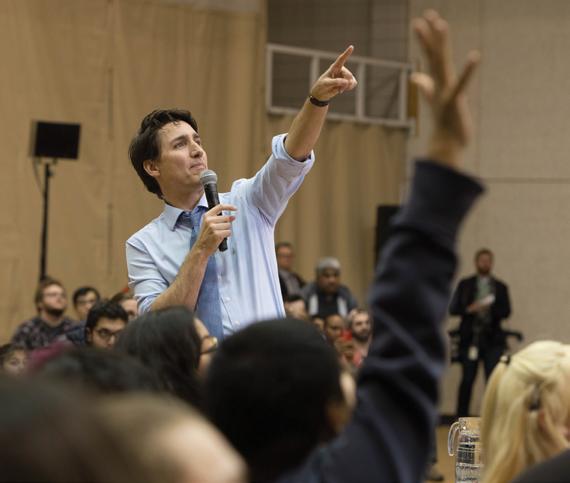
Trudeau kicked off his second tour Jan. 9, 2018, and visited various locations across the country, eventually stopping in Winnipeg at the Investors Group Athletic Centre Jan. 31 before continuing westward.
With this cost in mind, there should be one clear goal of these town halls: democratic participation in the political process.
Democratic participation is pivotal in a democracy, and starting these conversations is half of the battle. Remember, it was only three years ago that Canada was led by Stephen Harper, who - forget town halls - attended a whopping 35 per cent of question periods in 2015. Reporters were about as likely to ask him a question as they were to be struck by lightning.
Admittedly, that is no pat on the back for Trudeau - a prime minister encouraging democratic participation in a liberal democracy should be the bare minimum. The reality is that there are a lot of steps which must be taken to ensure a fair process unfolds in a town hall setting. Some of these are simply organizational. For instance, do not require those who attend to RSVP online ahead of time.
Another would be to perhaps consider announcing tour dates well ahead of time - instead of the less than a week notice Winnipeggers were given. When traveling on the dollar of the taxpayer, you have the obligation to make sure as many people can attend as possible.
But at the centre of the issue with these town halls are the hecklers. Protesting or heckling - for the pur-
poses of advancing a political ideology with the objective of derailing the event - cannot be tolerated. There is no gray area when discussing this in the context of town halls. We require clear, concrete, public rules on what kind of behaviour leads to one’s physical removal from a town hall.
At this point, it doesn’t take a genius to realize the true objective of these town halls: a political campaign around the country on taxpayer dollars
This should not be conflated with protests in other realms. Protesting a political rally is very different than protesting a town hall. A rally is a place where leaders can echo whichever talking point serves their agenda, whatever slogan will get a crowd roaring. To kick out a protester from a political rally - who is not attempting to derail the event - is nothing short of authoritarian. On the other hand, it would be comical to think that any person or group of people should have top priority in a town hall setting. That defeats the entire purpose of the event: a forum to discuss public policy in a democratic manner.
If Trudeau was truly interested in engaging democratically, he would have clear rules in place for these events that outline exactly which behaviour will be tolerated and which will not. In such a context, having
people escorted out is not an act of authoritarianism but rather an act of respecting the thousands of others who gave up hours of their evening to hear the prime minister speak.
In order to run town halls effectively, we require rules that remove those who refuse to play by the rules. Trudeau already gives few good answers to those who bring up pressing issues at these events. In the spirit of a photo op, he dances around serious policy questions and aims not for answers but higher polling numbers. Trudeau’s avoidance of questions is compounded when he gains extra dodging time through extended interactions with hecklers. Trudeau gets away with giving illegitimate answers to policy questions while being praised with thunderous applause for giving extremely poor answers to hecklers. Who needs a real policy discussion when - instead of a response to a difficult question - you get a free lecture on the importance of having respect for democracy? Trudeau ultimately wins: he fails to provide meaningful responses, but is lauded as though he has.
Case in point: I personally asked Trudeau a question about environmental policy during his 2017 tour. Trudeau was then interrupted by a group of University of Winnipeg students before even having the chance to respond to the question about his then-recent approval of three oil pipelines. The student hecklers held up the town hall for 15 minutes or so while chanting anti-pipeline sentiments.
Although my initial question seemed to be well-received by the vast majority of those attending, the students holding up the event - who conceivably held similarly anti-pipe-
line views - did not receive such support. Instead of letting Trudeau fall flat in his answer, which he eventually got out - that renewable energy “won’t happen overnight,” and that somehow building permanent pipelines helps in the transition - it was the heckling and Trudeau’s response to it that dominated the subsequent news cycle.
If Trudeau and his team genuinely cared about the democratic process, they would have put in place guidelines that audience members must abide by. Instead, a quick Google search will find more than enough videos from the current tour of audience members heckling the prime minister at will, rarely being removed. To Trudeau, these hecklers are not a bug, but the system working smoothly. The tension they inhabitbetween whether they are allowed to stay or are removed - serves to
reinforce his image as the cool, calm, and rational prime minister looking to offer a teachable moment to naive idealists.
At this point, it does not take a genius to realize the true objective of these town halls: a political campaign across the country on taxpayer dollars. Another ingenious marketing ploy from the same people who brought us the shirtless photo-bombings and staged explanation of quantum computing.
Masquerading as a prime ministerial Ask Me Anything session, and running out the clock preaching the value of democracy and respecting others, has become a cover for combatting deteriorating approval ratings.
PHOTO BY ASHA NELSON
Performance choreographed in a flash
Choreographer
and students of the School of Contemporary Dance create and perform a piece in only eight days
JEN DOERKSEN, STAFF
What would normally take five weeks to prepare took only eight days for choreographer Stephanie Ballard and students from the School of Contemporary Dancers.
The VERGE Dance Dialogues performance debuted on Feb. 8 at the Rachel Browne Theatre. The show explored history, time, and the conversations between different generations of dancers.
“A four to six-week process is the norm for a full length, including choreographing it and rehearsals,” said Ballard.
“I worked with the dancers, but I also came very prepared with choreography that I already had. It’s about half and half of recreating solos and duets I’d done before. So, I didn’t have to create it, I’m recreating it, but it’s new for the dancer."
Subdued, rough exhales were heard over the music while a dancer stretched his arms outwards to the
sides, spun, and fell to the floor. A projector filled the back wall with a film prepared for this dance. The dark stage at the Rachel Browne Theatre was level with the audience, which allowed the dancer, Mark Dela Cruz, to approach the edge of the stage and present Ballard, who sat in the front row, with a strip of white cloth, a piece of his costume for this part of the performance.
VERGE Dance Dialogues, organized by Winnipeg’s Contemporary Dancers, is a chance for students and recent graduates of the School of Contemporary Dancers to work with an accomplished choreographer to co-create a performance.
According to Ballard, it's a stepping-stone between finishing school and starting to dance with a company, or to dancing at a professional level. The performance explored the idea of time by projecting pre-recorded footage on the wall behind the danc-
ers while they performed. The performance started with a slideshow featuring historic photographs and newspaper articles relating to the dance community in Canada. The slideshow was followed with a commentary by Ballard on the history of contemporary dance in Canada.
“I’m creating a new atmosphere that really deals with lineage and legacy,” Ballard said.
“I kind of believe when you’re dancing you’re having a dialogue, the creative exchange. And then there’s also me literally introducing the history of dance with a slideshow we start the show with.”
After Ballard’s speech, the dancers took to the stage and performed a number of pieces, more than half of which included projections on the wall that were prepared in part by guest artist Kayla Jeanson.
Jeanson said that Ballard had a lot of creative control in the filming
process and it was not until the editing process, along with looking at Ballard’s past work, that the connections between the film and the choreography start to become apparent.
“I kind of believe when you’re dancing you’re having a dialogue”Stephanie Ballard, choreographer, VERGE Dance Dialogues
“She was getting us to re-enact things that other dancers had been doing before,” she said.
“[Ballard] was making con-
nections across time, figuring out - Trevor kind of resembles Dan in this moment, in this costume, let’s find a place where we can create this moment again. That’s where there’s echoes across the pieces.”
The closing piece paired a film of the performing dancers moving from dramatic lighting into silhouette, with all of the dancers performing on stage.
“At first you see their faces, and then they walk and it turns to silhouette, and it has this layering effect of time and past selves, and it just felt right to explore that with that illusion created,” Jeanson said. She said she embraced Ballard’s way of making connections across time to create her film piece.
Emerging composer from within the walls of Desautels
Student Kristen Wachniak premieres piece at Winnipeg New Music Festival
OLIVIA MICHALCZUK, STAFF
University of Manitoba and Marcel A. Desautels faculty of music student Kristen Wachniak participated in the second annual Winnipeg New Music Festival (WNMF) Composers Institute which took place Jan.27 to Feb. 2.
The Winnipeg Symphony Orchestra (WSO) premiered one winning piece, and one piece each by the six other emerging composers that participated in the Composers Institute. Wachniak applied to the WNMF Composers Institute last fall with her piece Disjunction. Wachniak was one of the two Manitobans selected.
There, Wachniak, and the other selected composers had a behind-thescenes experience of WNMF and attended development workshops. Wachniak said her experience with the WNMF was a meaningful one.
“It’s also uncommon for an emerging composer to have their work performed by a professional orchestra, so I’m incredibly grateful,” said Wachniak.
“Premiering work with the orchestra of my home city has been extra special.”
Wachniak began composing at a young age: her first competition win was in Grade 5, when she won a melody competition that was made into a short piece played by the WSO.
“The premiere at the WNMF was like a real deal follow-up a decade
later,” she said.
“It’s really special to have made the connection with that little dreamer in me.”
Wachniak began playing piano at a young age and even though she disliked it, her parents pushed her to keep playing.
Her interest in composing started with the mistakes she would make while practicing.
“At some point, I started tuning into mistakes I was making in my scales and pieces that sounded interesting - a finger slipping from one note to another, beginning on the wrong note,” she said.
“I was more interested in exploring how I could expand certain mistakes into something musical than focus on the actual material.”
Those mistakes and her parents’ encouragement to keep playing led Wachniak to start composing.
“I dabbled in composing and song writing as a kid, and eventually took a composition class in high school, [at] Miles Macdonell Collegiate, which is what got me thinking seriously about pursuing composition further,” she said.
In the program, Wachniak was also presented with many opportunities that have helped her become a better composer by pushing her creative boundaries.
“The composition department has provided great opportunities to
workshop and premiere pieces with performers in and outside of the faculty,” she said.
“I’ve worked with several ensembles, including the [U of M] wind ensemble and orchestra, as well as guest performers from other cities. These opportunities aren’t readily available to young composers, and I am so grateful for this type of firsthand education.”
Wachniak is set to graduate from Marcel A. Desautels faculty of music in May, and her graduation recital in March will feature the premiere of her first chamber opera, written “for three vocalists, percussion quartet, and electronics.”
Following graduation, Wachniak will be attending the composition academy at Lunenburg Academy of Music Performance in Lunenburg, Nova Scotia.