Winnipeg Transit recommends $39,000 to UMSU for U-Pass commission, implementation costs
UMSU and UWSA reach tentative agreement with Winnipeg Transit over U-Pass costs
LEVI GARBER, STAFF
The University of Manitoba Students’ Union (UMSU) is nearing an agreement with the City of Winnipeg to recoup some of the costs surrounding the U-Pass.
A city hall committee on infrastructure and public works is recommending UMSU and the University of Winnipeg Students’ Association (UWSA) each receive a 0.5 per cent annual commission on all U-Pass sales, translating to $26,000 annually for UMSU over the next four years – the length of the current U-Pass contract – and $7,500 annually for the UWSA.
The committee also recommends both student unions receive compensation of up to 50 per cent of costs related to implementing the universal bus pass. The committee estimates that covering half of implementation costs for each union would translate to $13,000 for UMSU and $10,000 for the UWSA.
The two student unions would only receive a one-time compensation payment for implementation of the
pass, according the committee report.
The U-Pass is a universal transit pass available to all full-time undergrad and graduate students at the U of M and University of Winnipeg for a reduced fee payable with tuition. The recommendation would apply to any future U-Pass partners such as Red River College as well.
The standing policy committee on infrastructure renewal and public works, made up of four city councillors, Winnipeg Transit director David Wardrop, and two other public service officials, announced the recommendation on Jan. 31, following a meeting between student union officials and Winnipeg Transit on Jan. 24.
The terms of covering half of all U-Pass implementation costs have yet to be determined, however, and UMSU vice president internal Adam Pawlak said another meeting between union officials and Winnipeg Transit is needed to finalize the agreement.
Committee chair Coun. Marty Morantz said in a release that approv-
ing the agreement would demonstrate the city’s continued commitment to the U-Pass program.
“Our goal is and always has been to make sure all students have the opportunity to get to university to further their educations” –Marty Morantz, city councillor
“The U-Pass is an example of a cooperative effort between Winnipeg Transit and its partners to provide low-cost bus service to university students in the city,” he said in the Jan. 27 release.
“Our goal is and always has been to make sure all students have the
opportunity to get to university to further their educations.”
The potential agreement comes after UMSU claimed in December that Winnipeg Transit reneged on a commitment to support a grant that would compensate the union for some administrative fees relating to the pass.
UMSU issued a release in December claiming the city failed to negotiate in good faith after the transit department removed a $27,000 grant request from its 2017 budget proposal. Pawlak said in December that Wardrop had agreed to support the grant request for the first two years of the U-Pass contract.
Student union reaction
Pawlak said he is pleased with the new agreement, calling it “a big win for students.”
“Not only do students get to enjoy the service of the U-Pass but they can [also] know that the union is not suffering with massive administration and implementation costs because of
this product,” Pawlak said in an email.
“We are getting our fair deal and saving so much, rather than paying additional student money on just running the program,” he said. “Funds we are saving can now be used to invest in other union activities and help avoid deficits.”
UWSA president Kevin Settee said that he is also satisfied with the recommendation.
“We applaud the City of Winnipeg for strengthening our partnership and joint commitment to the U-Pass program,” Settee said in the Jan. 27 press release issued by the city.
“We look forward to further cultivating opportunities that increase students’ accessibility to public transit.”
The estimated total transfer of $56,500 from the city to UMSU and UWSA will be included in Winnipeg Transit’s 2017 budget, according to the release, and will need to be passed by city council.
GRAPHIC BY MEGAN COLWELL
UMSU Mental Health Awareness Week challenges stigma head-on
Week of events aimed at pulling mental illness out of the shadows
OSHO SAMUEL ADETUNJI, STAFF
The University of Manitoba Students’ Union (UMSU) is leading into the February reading week break by hosting Mental Health Awareness Week.
Several activities have been planned for this week aimed at both arming students with the right information about mental health and breaking down the stigma fac-
ing people living with mental health diseases.
The week-long event kicked off Monday with a self-love photo booth from Active Minds and art therapy sessions. The Graduate Students’ Association lounge was also transformed into a relaxation room, an initiative of one of UMSU’s partners, Healthy U.
Other activities scheduled for the week include pet therapy sessions, further art therapy sessions, and a social media contest where students can post a picture of themselves taking part in stress-relieving activities.
UMSU vice-president advocacy Dara Hallock stressed the need for increased mental health awareness on campus, while also encouraging students to pay attention to their own health and seek help when the need arises.
“There is stigma that surrounds those who face mental illness throughout their lives but what many people may not recognize is that although one in five Canadians live with mental illness, five of five of us have mental health, and we need to take measures to maintain our mental health,” she said.
“It is important – especially as students who face many responsibilities and stressors – to take time to check in with ourselves and reach out for help if we are having a tough time emotionally or physically.”
According to a survey of more than 43,000 Canadian post-secondary students released by the Canadian Association of College and University
Student Services in the spring of 2016, 44 per cent of students interviewed indicated that they felt so depressed it was difficult to function at one point over the last 12 months. More than 64 per cent reported suffering from overwhelming anxiety and two per cent said they have attempted suicide in the past year.
“It’s all about breaking down the stigma that surrounds mental health and mental illness” - Dara Hallock, UMSU vice president advocacy
Hallock said there is a connection between the 2017 February reading week and the preceding Mental Health Awareness Week, as the two events encourage students to take a break from academic activities to focus on managing the stress of the semester and increasing their productivity.
“Reading week has historically been looked at as a chance for students to take a break from the stress of university and studying to help them catch up on some work, but also with themselves and their own lives,” she said.
“We are hoping to promote stu-
dents to take some time on reading week to participate in healthy coping strategies for stress,” she added. “This can include getting outside and being active, reading a book, or simply watching some Netflix.”
According to David Ness, director of the U of M student counselling centre, events like UMSU’s awareness week foster connections among people in the community and can bring them closer to useful information that can help address their situations.
“Events like the one UMSU is planning [...] help to encourage people to be open and connect with others and get support and to address their difficulties rather than just stay silent and maybe have their difficulties become worse,” he said.
Hallock said that the main message of the UMSU-led campaign is to bring mental illness out of the shadows.
“It’s all about breaking down the stigma that surrounds mental health and mental illness,” she said, “so that if we normalize talking about it, we can start supporting those that need it and help everyone live a healthier and well life.
PHOTO BY MIGUEL YETMAN
Arts Student Body Council hosts Valentine’s Day campaign to combat domestic violence
Event supports local non-profit that provides services for women and children fleeing abuse
DIANA UBOKUDOM, STAFF
T
he University of Manitoba’s Arts Student Body Council (ASBC) is lifting the veil on domestic violence for Valentine’s Day.
On Tuesday, the ASBC partnered with the University of Manitoba Students’ Union, the Womyn’s Centre, the Justice for Women student group, and a handful of other student organizations in a day-long event aimed at raising awareness of domestic violence.
Allison Kilgour, an ASBC senator and a lead organizer, said activities ranged from educational to interactive, including a fundraising effort to support Winnipeg’s Alpha House Project – a non-profit organization that provides services for women and children fleeing abusive relationships.
She said hosting the event on Valentine’s Day was a deliberate attempt to bring attention to the reality that not all relationships should be commemorated.
“We thought it would be a little provocative – a little kind of pushing
the norm – to have an event on the very stereotypical day of celebrating love and relationships to discuss the fact that not all relationships should be celebrated and that domestic violence is a huge issue, not just in Canada, but around the world,” she said.
Kilgour noted that a woman is killed by her intimate partner every six days in Canada, a statistic she called overwhelming.
versity community.
“I think the whole day is fabulous,” she said. “I think that it is very important to be raising the awareness of domestic violence, the impacts on society, on women, children – any
they are even being abused,” she said.
“So [it is] recognizing that just because they are nice on one day doesn't mean that it's okay what they are doing.”
“I think that it is very important to be raising the awareness of domestic violence, the impacts on society, on women, children –any way we can break the cycle and getting the word out” – Liz Millward, women’s and gender studies associate professor
“Not only is it a good time in the semester to plan something like this, but the fact that it is on Valentine’s Day is going to really get people thinking ‘I need to be cautious of my relationship,’” she said.
Cherie Hennessey, executive director of Alpha House Project, welcomed the support from the uni-
way we can break the cycle and [get] the word out.”
Hennessey echoed Kilgour in noting the significance of planning such an event on Valentine’s Day.
“When you think of Valentine’s Day, you think about love and it coincides, right, because there's lot of people who don't understand that
Beyond providing shelter and housing to women and children transitioning away from violence, Alpha House provides counselling to women and children to help build back self-confidence and self-reliance so they can live independently.
Hennessey noted the shelter also helps clients navigate the legal system and find suitable housing and community supports.
Kilgour said the long-term approach adopted by Alpha House is the main reason the proceeds from the event will be donated to the organization.
“It's kind of a second-chance organization that helps women get their lives back on track and gives them an anonymous place to do that,” she said.
The event was aided by additional support from the Women’s and Gender Studies Students’ Association, the University of Manitoba Aboriginal Students’ Association, the student chapter of Jack.org UManitoba, and the University of Manitoba Muslim Student Association.
Hennessey said the funds raised will go toward lifting the spirits of the families at Alpha House.
“We like to do activities for the families,” she said.
“The spring break is coming up [and] our families don't have a lot of money, they're all low-income. Even taking them on an outing is something they normally don't get to do.”
GRAPHIC BY EKLLY CAMPBELL
Editor-In-Chief:
Craig Adolphe
Contact: Editor@themanitoban.com / 474.6770
Justice served with the absolute discharge of Vince Li
Attitudes toward mental illness, disorders in need of a paradigm shift
SHAWN GARBUTT, STAFF
The absolute discharge of Vince Li
– now going by a different name – by the Manitoba Criminal Code Review Board is hopefully the last of a series of events that have haunted the province ever since the tragic death of Tim McLean in July 2008. A story too gruesome for the smalltime prairie town by which it took place, McLean was decapitated and cannibalized by Li on a Greyhound bus west of Portage la Prairie. Li suffered from undiagnosed schizophrenia at the time and was caught in the grips of a psychotic episode when he attacked and killed McLean.
Having been found not criminally responsible (NCR) for his actions, Li has spent just under a decade at different psychiatric clinics and supervised homes where he has received treatment for his mental illness. Dr. Steven Kremer, the psychiatrist who testified at a hearing with the review board in 2015 regarding Li’s move to a group home, gave testimony that suggested Li was dedicated to improving his condition and had in fact achieved much of that during his time in care. Doctors that have been involved with treating Li have reported that he is a model patient that shows a keen interest in simply getting better.
In 1999, the Supreme Court of Canada ruled that unless it can be shown that the NCR patient in question poses a “significant threat” to public safety, proven with evidence
that extends beyond the mere fact that the patient is mentally ill, then the review board is compelled to issue an absolute discharge. This is the precedent the review board considered when examining Li’s case. And it would seem that Li has given no indication over the last eight years to suggest he poses even a marginal threat to society now that he’s being treated. To say otherwise would require singling out his mental illness as being culpable under the law.
The likelihood of an NCR individual committing a “serious, violent re-offence” falls at a negligible 0.6 per cent
Beyond his psychotic break on the Greyhound bus, back when he was undiagnosed with paranoid schizophrenia, Li’s record is crystal clear. There is absolutely no evidence to suggest he would re-offend now that he is under treatment, and it is nonsensical to claim Li would stop taking his medication when he has shown outstanding devotion to continuing his treatment program and crippling
regret over what transpired on the Greyhound bus.
It is most troubling that many of those who have come out against the review board’s decision to grant Li absolute discharge do seem to think that having a psychotic disorder like schizophrenia is grounds for persecution.
When discussion arises around this controversial topic, it is often said that to release Li is simply too great a risk to take. But adopting this logic leads one down an unsettling path –if it’s true that some risks are simply too great to take, then what risks are these exactly? Who quantifies the risk? Should every violent offender be put under lock and key for eternity, all for the sake of risk aversion? Do we want the state to enact a judicial system that punishes people on the basis of “what ifs”? Should the justice system swoop down on every individual diagnosed with paranoid schizophrenia and cage them as though they are feral beasts?
It’s important to remember that Li’s attack on McLean in the Greyhound bus was as anomalous as it was gruesome. Yet even that is beside the fact, for the data collected on NCR offenders shows that tough-on-crime rhetoric is entirely misplaced.
A 2015 study conducted by the Mental Health Commission of Canada dispels many of the myths
currently being espoused by those opposed to Li’s return to freedom.
The study found that rates of recidivism (a return to criminal activity) are extraordinarily low for NCR individuals, who are half as likely to recommit than the general prison populations. Findings also show that the likelihood of a NCR individual committing a “serious, violent reoffence” falls at a negligible 0.6 per cent.
Indeed, the study also linked 31 per cent of NCR individuals to substance abuse problems while 71 per cent received governmental income supplementation. This only goes to show that such mentally ill offenders are not criminals but those in need of aid. Society requires more support systems, not a court that pursues excessively punitive measures.
To claim that the mentally ill are a danger to society, unrepentant and irreparable, is a gross mischaracterization as well as dehumanizing to those who suffer from treatable psychotic disorders – not to mention a falsified account of NCR offenders.
What the justice system needs now is a more comprehensive, restorative approach. In modern society, law and order should not be the punitive revolving door we see in Manitoba. Yet this is integral to the current retributive paradigm, which would sooner jail an offender than examine the conditions in which
crime takes place and take steps to address those features.
Progress demands proactive approaches when it comes to dealing with those suffering from mental illness at the margins of society; a ham-handed punitive approach that is the inevitable outcome of law and order politics will only exacerbate deep-rooted ills, ultimately leaving them to fester.
It's important to
remember that Li’s attack on McLean in the Greyhound bus was as anomalous as it was gruesome
I can only begin to imagine the depths of misery Tim McLeans’s mother has been swallowed in since the loss of her son. She and her family are as much a victim as her son. Yet as much as we want to support the McLeans, we must also remember that mental illness is treatable, and living with psychotic disorders like schizophrenia is possible. We cannot forego the broader issue: mental illness continues to lurk just beyond the confines of acceptable public discourse, and remains highly stigmatized even when openly acknowledged.
Li himself, in an interview with a representative of the Schizophrenia Society of Canada about the incident that has brought him infamy, said that while he was glad he was still alive, he still felt the RCMP should have killed him that night on the Greyhound bus – a night etched into his mind. The memory of that night, Li says, will never allow him happiness.
Vincent Li deserves a second chance. The man is more than his illness, and with continued treatment, recovery and reintegration into society is more than plausible. Li’s remembrance of his traumatic deed should be price enough to pay, and to continue his suffering beyond the trauma he already experiences would be the farthest thing from justice.
GRAPHIC BY KELLY CAMPBELL
Immigrants won’t accept Pallister’s changes to Manitoba’s Provincial Nominee Program
ANTHONY HUYNH, WITH FILES FROM SHAWN GARBUTT
On Nov. 25, 2016, Premier Brian Pallister announced changes to the Manitoba Provincial Nominee Program (MPNP). Effective April 2017, successfully nominated applicants will be forced to pay a $500 fee in order to have their immigration papers processed. This new draconian measure by the Manitoban government is reminiscent of the Chinese head tax that was imposed on Chinese immigrants between 1885 and 1923 . The Chinese head tax was especially egregious because it singled out Chinese immigrants during a time when they were the primary reason for the construction of the Canadian Pacific Railway – but the primary evil is that immigrants were being singled out as a tax resource. Only now, all immigrants are being targeted.
In response to Pallister’s actions, members of the immigrant community mobilized together on Dec. 5 at Broadway United Church to challenge the government’s new Labour Market Strategy for immigrants. From this meeting, the Save MPNP coalition was formed.
The newly attached fee is simply a cash grab that places a financial burden on immigrant families. The Pallister government has said that the $500 fee will be used for investment into language support programs and other resources for immigrants. However, the MPNP already expects nominees in the economic class –
identified in 2008 as the largest of the program – to enter Canada with a high level of English competency. But this is beside the point. The proposal is essentially to issue user-fees to immigrants for resources the government ought to already be implementing with funds from general tax schemes, which newcomers will be contributing to.
The new fees are xenophobic and portray immigrants as a burden, linking newcomers to welfare
However, instead of viewing the new head tax as merely an economic attack, the changes to the MPNP are a much grander attack on the immigrant community. The new fees are xenophobic and portray immigrants as a burden, linking newcomers to welfare. Yet according to Statistics Canada, the rate of employment for landed immigrants is higher than that for Manitoban-born residents . Indeed, the Canadian economy was built on the backs of immigrants –similarly, migrants new to Manitoba are hardly a net drain.
In addition, the MPNP is moving
away from family sponsorship and community connection to employerdriven nominations , which will make bringing family and friends more difficult unless they already have jobs. This would not only make workers more vulnerable to abuses and exploitation in the workplace but also jeopardize the high retention rate of immigrants staying in Manitoba under the MPNP .
As is the reality with other immigrants, many are forced to participate in precarious working conditions where their labour is valued but their human potential is not. More generally, the changes to the MPNP have ramifications not only for immigrants but for racialized workers who are
Canadian citizens and permanent residents. Immigrants are already treated as mere means for business interests – making public policy explicit in that statement will only further harm newcomers as they continue to be viewed as capital investments instead of people. Racialized workers are already subject to racist and xenophobic language, “stealing Canadian jobs,” as common nationalist rhetoric goes. This won’t be helped by having a government that only cares about immigrants as economic stimulus.
As Manitobans, we must act together and work together, and stand in solidarity with our immigrant brothers and sisters. If we let
the government do as they please, what will prevent them from imposing another burden on the immigrant community?
On Feb. 28, 2017, assemble with Save the MPNP Coalition at Broadway United Church at 6:30 p.m. as we march to the Manitoba Legislative Assembly and make our demands known to Pallister. Anthony Huynh is a member of the Save the MPNP Coalition You can find the group on Facebook at https:// www.facebook.com/savempnp/ for more information
Pallister begins lining Crown corporations up at the chopping block
SHADEN ABUSALEH, STAFF
W
ith madness unfolding below our border, it is often difficult to keep track of what is happening on our own doorstep. Manitoba premier Brian Pallister is rolling back on promises he made during his election campaign by pursuing shortsighted, economically impractical solutions, including his plan to implement regulatory cutbacks by axing two regulations for every new regulation introduced as legislation – a one-stepforward, two-steps-backwards policy.
Most recently, the provincial government announced that it would proceed with cuts targeting Crown corporations. Manitoba Liquor and Lotteries and Manitoba Public Insurance are expected to engage in “management reduction” amounting to 15 per cent of employees. Laying blame on the previous NDP government for failing to address bureaucratic over-hiring, Pallister also announced that further cuts will be made toward Manitoba Hydro as executive positions are to be reduced
by 30 per cent and 900 employees at large will be laid off – nearly onesixth of the workforce.
Manitoba Hydro CEO Kelvin Shepherd explained that the cuts made would save the utility between $60 million to $65 million a year. But these cuts will not be enough to stop rate increases of at least 10 per cent per year that Manitobans will face over the next five years. The double-digit rate increases will have a significant impact, especially on low-income, energy-poor families who will likely face hardships while austerity measures continue to be doled out as the so-called “Progressive” Conservatives get settled in government.
One of Canada’s top employers, Manitoba Hydro is one of the most important job creators in the province. It provides high quality jobs, good pay and benefits, and helps boost incomes throughout Manitoba that keep our economy going. Adopting austerity measures and throwing out 900 jobs from our economy, reducing
state involvement, and hoping that the invisible hand will figure things out is not a sound strategy and will hinder rather than boost the economy.
Taking away 900 well-paid jobs will notably impact our province’s economy for the worse
The cuts made at Manitoba Hydro have been met with strong criticism by NDP labour critic Tom Lindsey, who explained how this ill-advised move will result in the loss of an important number of skilled workers, inevitably hurting Manitoba Hydro in the long-term as “it will force Hydro to rely more heavily on contract and out-of-province labour to fit the gaps Pallister is creating.” There are so many unanswered
questions. Are the employees being laid off young and mid-career workers, or are they on the brink of retirement? Will these 900 workers be able to find equivalent professional jobs? If so, how? What support systems will be put in place? How exactly will these workers be compensated? How will these cuts consequently affect Manitobans who rely on Manitoba Hydro’s services?
Taking away 900 well-paid jobs will notably impact our province’s economy for the worse.
But as has been clearly demonstrated through the government’s unwanted and unwarranted involvement in the UMFA strike, Pallister dislikes anything that remotely looks like the public sector. The families and workers affected will definitely be hurt by these cuts, and those hit hardest won’t be able to find reprieve in Costa Rica.
The doom and gloom scenario that Pallister’s government has been spinning gives them the excuse they need
to shrink government and go after public-sector workers. It also sets up Manitoba Hydro for a major intervention, perhaps of the private kind. Pallister claims his mission is to make Manitoba the “most-improved province” in Canada. While it isn't clear how he intends to measure this improvement, it is difficult to imagine how the loss of 900 decent jobs in a small economy like ours and doubledigit increases to Hydro rates will improve anyone’s lives.
Trudeau right to scrap electoral reform
More pressing matters require federal attention
JEREMIAH KOPP, STAFF
Prime Minister Justin Trudeau may have reneged on an election promise in discarding his commitment to electoral reform, but he was
right to do so. Electoral reform is not a pressing need for Canadian democracy, nor are the potential pitfalls worth the risk.
Politicians are often charged with breaking promises and changing their minds on issues. If it is done purely for political expediency, this will reek of hypocrisy and disenfranchise voters. It is unfortunate, however, that this charge is often applied broadly even when it makes sense to alter the legislative agenda.
Electoral reform has never been a burning election issue outside of university campuses or political circles. The reality is that more directly impactful subject areas, such as the economy, job creation, healthcare, environmental stewardship, and others will always be more important to the average Canadian voter. Electoral reform is also an enormous undertaking, one with consequences that may not be immediately discernable. Given the instability within present global affairs, is this really the time to be tinkering with our governing institutions?
The first problem with electoral reform is deciding what alternative model should be used in lieu of the current first-past-the-post system. The ranked ballot model would be viewed as too self-serving and therefore politically untenable, given that the Liberals would be the likely
beneficiaries. The other alternative would be proportional representation. This model would more accurately reflect the views of the population, but it could result in representation for fringe groups that could hold the balance of power in coalition governments.
Given the instability of present global affairs, is this really the time to be tinkering with our governing institutions?
While some will charge that this will result in greater cooperation and better governance, the reality is that it would create confusing legislation. If a coalition government is comprised of a myriad of politically heterogeneous parties, concessions would have to be made to minority partners in government. This gives undue influence to radical and fringe groups in an effort to preserve stability. It also
results in more elections, given that no one party would have a strong mandate. More time is spent running elections every two years than managing the affairs of the nation, something that Canadians would surely tire of.
The old adage of “if it ain’t broke, don’t fix it” is applicable to this debate. While the system may not be perfect, it works well and is wellknown. This model has been used since confederation and has created the two-and-a-half party system that our country has become so familiar with as we’ve oscillated between Liberal and Conservative governments since 1867. Our current model allows for thorough debate and discourse without allowing fringe views into governance positions.
Canada’s legislative powers are premised in the constitution on the belief in “peace, order, and good-government;” rushed and unpredictable electoral reform flies in the face of this covenant. In deciding to remain with our current model, Trudeau should be commended for making the right decision in a difficult situation.
PHOTO BY MIGUEL YETMAN
Building a movement to support women in science and tech
Day of recognition, brought forward by the UN, hopes to bring light to underrepresented women in science
STEFI ANNE DIVINA
Last weekend marked the second annual International Day of Women and Girls in Science (IDWGS). The day, which takes place on Feb. 11, was first brought forward by the United Nations with a resolution in 2015. It’s meant to recognize the important contributions of women and girls to science and technology.
In light of the International Day of Women and Girls in Science, the United Nations Educational, Scientific, and Cultural Organization (UNESCO) director-general Irina Bokova released a statement that called the day an “opportunity for all to take a stand for girls and women in science.”
“Girls continue to face stereotypes and social and cultural restrictions, limiting access to education and funding for research, preventing them from scientific careers and reaching their full potential,” Bokova said.
“Women remain a minority in science research and decision-making.”
The resolution of the United Nations with combined efforts of subsidiary groups such as UNESCO and the United Nations Entity for Gender Equality and Empowerment of Women (UN-Women); other groups such as the International Nations Entity for Gender Equality (ITU); and movements like the International
Day for Women and Girls in Science highlight the contribution of women and girls in science and technology.
While the percentages of women graduating with a bachelor’s degree in all STEM-related fields but biological sciences and psychology is still significantly lower than men, projects like these work to empower women working in science-related fields such as the life sciences and engineering.
On March 14, 2011, the United Nations and the Commission on the Status of Women agreed to continuously work on increasing women’s participation, access, and work in the field of science and technology. Giving women and girls full access to the innovations of the science and technology world is deemed imperative by the UN and its partners in attaining gender equality and empowering women.
While the stigma when it comes to women working outside of the home has decreased over the past decades, statistics show that in STEM fields, women remain widely underrepresented. Even to this day, women seem less likely to join and learn about fields such as engineering or computer science, although over half of all bachelor’s degrees in biology are now earned by women.
As a university student, it is easy to assume that because there are so many women studying around you the Canadian educational system must be equal in terms of opportu-
nities for both men and women. This, however, is not the case. According to studies released by Statistics Canada as recently as 2015, not only are female Canadian university graduates consistently less likely to choose a degree in STEM, regardless of tested mathematical ability, and those who do choose a STEM degree and work in the field still, on average, earn less than their male peers.
“Women remain a minority in science research and decisionmaking” – Irina Bokova, UNESCO director-general
While there is still much work to do, the Canadian government is taking steps to promote the inclusivity of women and girls in STEM fields, including a new social media campaign, called “Choose Science.” On the Choose Science website, there are links to educational programs for girls, along with suggestions for parents and teachers looking to get young women interested in science.
“One of my goals now is to encourage more young women to be curious, to challenge the norm and to
be courageous in the pursuit of their dreams,” Kirsty Duncan, Canada’s minister of science, said in a filmed statement for the site.
“I also want to ask your parents and grandparents, your brothers and sisters, your teachers, professors, and friends to support your desire to discover.”
As a University of Manitoba student, studying microbiology and women’s and gender studies has taught me many things about the way the STEM fields work for men and women today. While I like to think that both genders are given equal opportunities when it comes to research and representation in the workforce, it seems that there is still quite a bit of work left to do. With enough support and encouragement from society, the goal of equality – not only in STEM, but in other aspects as well – will hopefully be achievable. While there are some discouraging statistics, there are some signs of progress – there are more women working as engineers, for example, in many developing countries. The International Day of Women and Girls in Science being celebrated every year may just be the next step to bringing equality to the world of science and technology.
GRAPHIC BY ALDO RIOS
Tyrant alpha chimp killed, cannibalized in rare intra-tribe murder
Recent study offers a look in the complicated and often violent lives of Fongoli chimps
MALAK ABAS, STAFF
Arecent study has theorized that a chimpanzee murder so grisly and rare that it left the anthropologist leading the study “disturbed” was most likely about sex.
The story is reminiscent of a gangster movie. The researchers involved with this study have been studying a group of chimps in western Africa referred to as Fongoli chimps since 2005. Fongoli chimps have been witnessed using rocks and sticks as tools, and are very intelligent – their daily life consists of creating and testing alliances within their community.
Their leader in 2005, named Foudouko, was known to the researchers as being the alpha male, and was nicknamed “Saddam” for his tyrannical style of leadership. The group’s beta male, Mamadou, led alongside Foudouko. However, in 2007, Mamadou suffered a leg injury, allowing other males in the community an opportunity to chase Foudouko out of Fongoli.
Foudouko disappeared. Even the researchers assumed that he had died. To their surprise, however, Foudouko returned nine months later. Mamadou’s brother, David, was now the new alpha, and Mamadou remained the beta. While certain chimps welcomed his return, Foudouko was forced to live on the outskirts of Fongoli, amongst the chimps that had suffered under his rule. He was frequently chased and attacked by the chimps he once ruled.
The study just published in the International Journal of Primatology, provides no clear answer as to what
led the chimps to react so violently towards their former alpha, but suggests that the last straw for the Fongoli apes came when Foudouko attempted to court a female chimp in heat. The Fongoli community is concentrated with males, and competition in regards to sex is especially fierce amongst them.
Chimps are prone to violence against other chimps – but killing a chimp within their own community is very rare
Jill Pruetz, who led the study, attributes this skewed ratio in part to poaching, as female chimpanzees in Senegal are often taken and used to breed infants sold in the pet trade. Chimps are prone to violence against other chimps – but killing a chimp within their own community is very rare. So rare, in fact, that this is only the ninth time researchers have been able to film it happening. The graphic video shows Foudouko being stomped on, beaten, and eventually cannibalized.
While the attack was strange and disturbing, it also provides a wealth of information for chimpanzee researchers. While Foudouko’s body was buried by the anthropologists, it will later be exhumed and studied. It also provides interesting insight into chimps’ understanding of death. Foudouko’s body was attacked long after he had died, and researchers also noted that even after the body had been buried by them, the other chimpanzees made fearful calls all
through the night, leading researchers to believe they were still afraid of Foudouko returning.
While Foudouko is gone, the drama of the Fongoli community continues. Mamadou has since been exiled from the community, presumably because of his alliance to
Foudouko after his return, and David faces similar violent backlash in the form of random attacks from other members of the Fongoli chimps.
PHOTO PROVIDED BY WILLIAM WARBY
Master Playwright Festival celebrates Agatha Christie
Local thespians showcase some of the English author’s best works
OLIVIA MICHALCZUK, STAFF
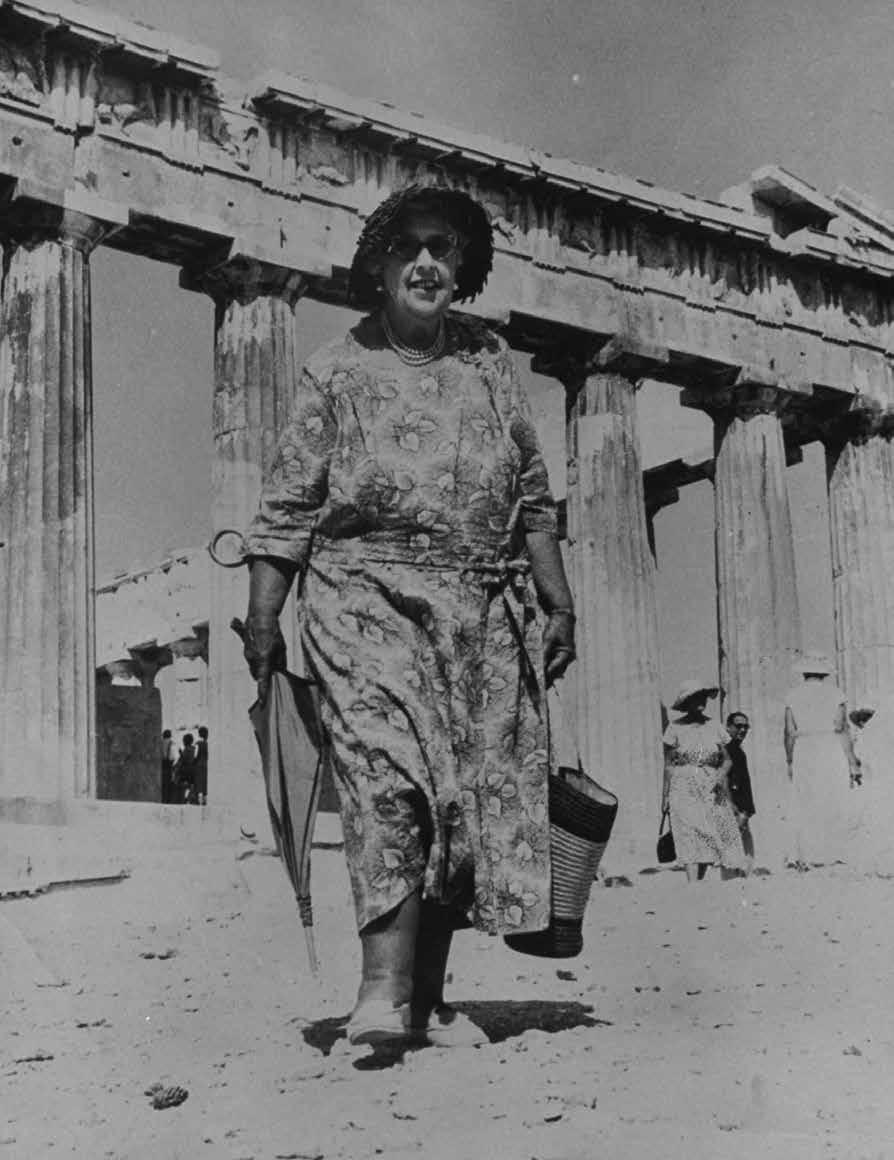
From Feb. 8 to 26, the Royal Manitoba Theatre Company (RMTC) is honouring the late English author Agatha Christie at the Master Playwright Festival. This year’s edition is the 17th installment of the annual festival, which takes on a selected number of works from a celebrated artist.
The Master Playwright Festival provides opportunities for both professional and emerging artists from a variety of organizations and independent theatre companies to produce work under the umbrella of a larger festival. It also provides patrons with an opportunity to thoroughly immerse themselves in the works of a renowned playwright. The first Master Playwright Festival took place in 2001, across eight venues, and featured 15 plays written by Samuel Beckett. Since then, the festival has grown and featured many wellknown writers.
Agatha Christie is one of the world’s best selling novelists, with over 66 detective novels, 150 short stories, and 20 plays in her extensive body of work. One of her most well known and celebrated works is The Mousetrap, and with 26,000 showings, it is the longest continuously running play in history.
“We hope to reveal the shining truth about this beloved playwright and her unquestioned mastery of our art form,” said Steven Schipper, the artistic director of the RMTC.
Agatha Christie is only the second woman to be honoured by the RMTC Festival and the first mystery writer. The festival will include some of her popular novels such as And Then There Were None, showing at the Winnipeg Mennonite Theatre, and Murder on the Orient Express, showing at the Dalnavert Museum.
“Audiences love plays about detectives and the mysteries they solve, but they are devilishly difficult to write. Christie had to lay out clues that somehow keep us from guessing the identity of the murderer, yet make the climactic revelation seem obvious in retrospect. The characters must be sympathetic yet suspicious,” said Schipper.
“The murder must create suspense but not disgust. The dialogue must be both clever and realistic. The conclusion must satisfy us intellectually and emotionally. And the themes
– love, justice, redemption – must resonate with an audience even after the whodunit is solved. It’s a wonder any writer bothers trying, let alone mastering the bloody things.”
The festival features 15 plays on stages at different local theatres, and includes free lectures. Amongst the several theatre companies partaking in the festival are the Dramatic Theatre, the Winnipeg Mennonite Theatre, and the Tara Players.
“With ChristieFest, we hope to reveal the shining truth about this beloved playwright and her unquestioned mastery of our art form” – Steven Schipper, artistic director, RMTC
Erin Meagan Schwartz, the producer of the modern adaptation of The Hollow, which has all its six shows sold out at the Rudolf Rocker Cultural Centre, found it challenging yet fulfilling to translate Christie’s work into a modern perspective along with her talented compilation of local performers and creators. The cast and crew include University of Manitoba student Elena HowardScott, who will be playing a lead role in the performance, and directors Frances Koncan, an AnishinaabeSlovenian writer and director, and Angelica Schwartz, a theatre production graduate from Langara College’s Studio 58.
“I find Agatha Christie's work interesting, especially The Hollow, because of the way she writes women in the show. They are often very cunning and complex behind the veneer of poise,” said Schwartz.
“Having Agatha Christie as the second female master playwright in the 17th year of the RMTC festival is wonderful, and I am glad that her and her work are being celebrated.”
The Tara Players Theatre Company will be putting on a production of Love from a Stranger,
an adaptation of the 1924 Christie mystery novel Philomel Cottage Production teams involved in the festival have expressed their appreciation for the festival and delight over honouring Christie at this year’s festival.
“We are always so pleased to be a part of the RMTC Master Playwright Festival as it really helps us to reach new audiences and support some of the best writers in the
industry,” said Danielle Savage, the general manager of the Tara Players.
As one of the venues for the festival, the Dalnavert Museum has embraced the work of Christie as inspiration for a detective- and mystery-themed month of programming as well, which can be found on their website.
With over a week left in the festival, there is still a chance to catch some of the amazing works that are
being highlighted by talented performers at various venues
For more information about venues, show times, and tickets for the Royal Manitoba Theatre Company’s 2017 Master Playwright Festival, visit www. royalmtc.ca
across the city.
PHOTO PROVIDED BY NATIONAL MEDIA MUSEUM
Festival du Voyageur hosts outdoor fashion show and first winter Pride event
EMELIA FOURNIER, STAFF
F
estival du Voyageur has grown
to be Manitoba’s biggest winter celebration. While the events at Festival’s main site at Fort Gibraltor are sure to be fun, the Manitoban took a look at some of the lesser known events that readers may find interesting.
Winter Pride Celebration
As part of Festival du Voyageur, Winnipeg’s first ever Winter Pride Celebration will take place on Feb. 18. The celebration will involve a skating event along the river trail, followed by a dance party and an afterparty at Jekyll and Hyde’s . All of the events are free and open to everyone.
Craig Larkins , Winter Pride Celebration’s organizer, grew up in Winnipeg going to Festival du Voyageur. He noticed there was a gap in LGBTTQ* celebrations during the winter months.
“Winnipeg is a winter city. Why are we not celebrating Pride in the winter?” said Larkins.
When he lived in Calgary, Larkins attended the Calgary Stampede’s LGBTTQ* events, and thought something similar could work with Festival. His goal was to create an
inclusive community event during winter, so it made sense for Larkins to pair up with Manitoba’s biggest winter festival.
“They’ve been so helpful. From organizing, to marketing, to even sound equipment, Festival has been awesome to work with,” said Larkins.
The idea of having a winter Pride event seems so obvious for a winter city like Winnipeg. The daytime skate allows families to get out and celebrate with their loved ones. The outdoor component of the events –the Great Winter Pride Skate and the Winter Pride Party – will be hosted at Rendez-Vous on Ice.
“It’s nice to draw all the important people in your life into something that’s important to you,” said Larkins.
While gay bars can provide a community-building safe space, they are not accessible to teenagers and children, as well as other friends and family. With these free and public events associated with Festival, LGBTTQ* people are able to celebrate with friends, family, and the community.
The opening ceremony for the Winter Pride celebration will feature two-spirited members of the Indigenous community, as well as
seven-year-old Rylee Sandberg , an Anishnaabe, Cree, and Métis hoop dancer. Larkins’ event company, Room Service #WPG , has lined up DJs and a drag performance for the night as well.
“It’s an opportunity for everyone to come together and have a happy moment. Everything is so negative right now, so just come and dance, and be proud of who you are and happy to be who you are,” said Larkins.
Fashion on Ice
As it has for the past few years, Festival will also include Fashion on Ice, a show that will showcase local designers and models. The fashion show will be held on Sunday, Feb. 19 at 4 p.m. at Rendez-Vous on Ice. This year, the show has almost doubled in size, featuring local designers and 50 models.
“These people are chosen, submit themselves as a candidate and then choose based on fact that they’re mentors, inspirational,” said Lili Lavack , local designer and organizer of Fashion on Ice.
There will be photographers, lawyers, artists, and individuals from all
walks of life modeling in the show. The models were selected based on their community involvement. They will also have the help of choreographer and model trainer Carly Van Ryssel.
The fashion show is a community-building event for local fashion designers themselves. The fashion designing industry is usually cutthroat and competitive, and very difficult to get into.
“Having a fashion show that reunites designers creates a sense of community,” said Lavack. The designers are able to network and see their pieces combined together on different models.
The show will highlight the variety of styles available from local designers. Working with the Forks Trading Company, the fashion pieces showcased will be available for purchase at the Forks. The items are affordable, unlike fashion showcased at many other fashion shows.
“Fashion started off as a creative thing. Fashion was social change, like when Yves St-Laurent created a line of trousers for women, that was a part of the feminist movement. It used to be very value-oriented, and
has become so fast-fashion that we have forgotten the craft,” said Lavack.
Mass-produced, sweatshop-created fashion has become the norm, and the low prices of rapidly changing styles of clothes available at stores like H&M and Wal-Mart make it difficult for local designers to break into the fashion market.
Fashion on Ice brings Winnipeg’s local designers to members of the community that may be looking to buy more ethically, sustainablymade clothing, but are not aware of the wide range available to them in their own city. It also showcases the strength of Winnipeg’s community as a whole through the models themselves, celebrating all different kinds of talent.
For more information on the Festival du Voyageur’s events, visit https://festivalvoyageur.mb.ca/en/. To see a full listing of their official sites, visit https:// festivalvoyageur.mb.ca/en/festival/ official-sites/
Sports Editor: Ryan Stelter
Prepping for the post-season push
Bison women’s hockey team is set to take on Mount Royal in promising playoff year
JASON PCHAJEK, STAFF
Heading into the final weekend of the regular season, the University of Manitoba Bisons were neck and neck with the University of Alberta Pandas. With one final series to decide who would take second place behind the powerhouse UBC Thunderbirds, the team fought hard but dropped the series in a two-game sweep, falling to third in Canada West and drawing the Mount Royal Cougars in the first round.
With a playoff spot locked and a matchup set, the path to a potential championship is becoming clearer and clearer. This group of Bisons, under the watchful eye of head coach Jon Rempel, has put up a stellar record, often bowling over opponents on their way to a third place finish. Expectations are as high as ever for the herd, which looks like a championship-caliber squad every time they hit the ice.
Keys to success: firepower, goaltending, special teams and versatility
Numerous times throughout the season, the Bisons were without key contributors. Alanna Sharman, who recently pulled on the red and white for her country, missed a large stretch before the holiday break with a knee injury. Likewise, Venla Hovi, who is second on the team in scoring with 10 goals and 15 assists, missed some time. These injuries did not slow down a Bisons team that boasts enviable
depth. The emergence of Lauryn Keen was a factor. Keen finished the regular season with nine goals and 25 assists, and was first amongst all players in Canada West, blowing by her career-high of 18 points set back during the 2014-15 season. Not only does the team have the firepower that let them blow teams like the Calgary Dinos – who the Bisons outscored 12-3 on the year –and the Lethbridge Pronghorns – outscoring them 18-2 – out of the water, but they have an all-star in goal with Rachel Dyck. Dyck finished the year with a 1.51 goals against average and .931 save percentage, placing first amongst Canada West goaltenders in wins.
Perhaps the greatest strength of this Bisons squad is their ability to adapt to different games
Special teams have also been a point of pride for the herd, as they have consistently ranked near or at the top in both power play and penalty kill percentages. The team moves the puck exceptionally well with the man advantage, often taking teams down with crisp cross-ice passes or using open points to power in goals.
When down to four skaters the team has likewise had major success, playing their system to almost perfection, helped out by the stellar play of Dyck throughout the year.
Perhaps the greatest strength of this Bisons squad is their ability to adapt to different games. Whether they’re banging bodies with teams like the Saskatchewan or facing offensive powerhouses like Alberta, the team has consistently shown that they can play many different types of games when called upon. However they tend to play best when they are under the structure imposed by Rempel and the rest of the coaching staff, moving the puck well and crashing the net.
If the Bisons continue to show this structure, while getting depth scoring and more stellar play in goal, they will have no problem making noise in the Canada West playoffs.
Biggest roadblock: the Thunderbirds
There is no bigger threat to the success of a deep run in the playoffs for Manitoba than the UBC Thunderbirds.
The trap teams often fall into when playing UBC seems to be their greatest strength: their ability to build off momentum. Teams consistently fall behind in games against the Thunderbirds, and then get buried by their strong system. You need not look further into the season
results than the 6-1 drumming of the Calgary Dinos and a 4-3 win against the Bisons that turned into a track meet.
There is no bigger threat to the success of a deep run in the playoffs for Manitoba than the UBC Thunderbirds
Teams will either get buried, or face a tough slog against an experienced and strong defensive club.
Thankfully for the Bisons faithful, the team has already found out how to silence the Thunderbirds potent offence. In the last series between the two teams, Manitoba in fact outscored the Thunderbirds by a combined 5-4 in the series split. The first of these games was a 2-0 shutout win where the Bisons were able to weather the storm, shutting down the Thunderbirds with tight checking, riding a brilliant performance by Dyck and their special teams to victory.
The following game was the aforementioned 4-3 track meet where the Bisons were playing from behind for most of the game and couldn’t keep up with the UBC attack. If the
Bisons are able to lock down and grind out an early lead against the Thunderbirds, they have a strong chance to take control of a seemingly eventual playoff showdown.
Round one: the Cougars
The Bisons will play in the quarterfinal next weekend. Because of their losses to Alberta they will not receive a first round bye. Instead of enjoying a bye, the Bisons will play a best-of-3 series against the Mount Royal Cougars in front of a home crowd.
This matchup is quite favorable for the Bisons, as they won the season series against the Cougars three games to one, outscoring them 11-6 over that stretch. Bison netminder Dyck may be the happiest member of the team, as she recorded two of her league-leading five shutouts against the Cougars this year.
For this series the Bisons should aim to capitalize on the disciplinary issues Mount Royal has had against them this season. Across all four games the Cougars were handed 16 penalties, giving the Bisons six power play goals. On the flip side, Mount Royal netted one power play goal across 11 chances.
Should Rempel and his coaching staff stick to the plan and turn to their star goalie, the rest of the team should have no problem burying Mount Royal with a balanced attack and power play supremacy.
PHOTO BY STAR ROXAS
Bison athletes get hair cut in support of cancer survivors
Athletes donate their locks, raise funds for cancer research
RYAN STELTER, STAFF
Growing out the flow has been something hockey players have been doing for decades, from Jaromir Jagr’s legendary locks in the 1990s to Patrick Kane’s playoff mullet of today. Jonah Wasylak and Brett Stovin of the Bison men’s hockey team, as well as Liam Grace of the Bison football team, snipped their hair on Feb. 9 in support of cancer research.
“We just wanted to use our personal experiences and help raise awareness for everyone” – Jonah Wasylak, Bison men’s hockey forward
The trio had their hair cut to make a wig for cancer patients experiencing hair loss. Wasylak said that both he and Stovin wanted to do this last year but they didn’t have the length to do it. You need about seven ponytails to make a wig; between Wasylak, Stovin, and Grace, they collected 20.
“We thought about last year, but
we weren’t quite there for the length. We decided to wait a year and grow it out,” he said.
Cancer has touched almost everyone, and Wasylak has had his own experience with the disease as his grandma was diagnosed with it.
“My grandma was diagnosed with breast cancer four years ago,” he said.
“She’s beaten [it], she’s good, but still it’s a scary thing. It’s not everyday you hear the positive stories. We just wanted to use our personal experiences and help raise awareness for everyone.”
Stovin said afterwards that although it was strange to have all his hair cut, he felt good knowing it was going to be used for a good cause.
“It was quite a good feeling seeing all the hair go into that bag,” he said.
“It’s nice to know someone is going to be happy about receiving a wig out of this.”
In Stovin’s case, cancer has affected many members of his family, as well as a member of the men’s hockey team, so this was special cause for him.
“It kind of runs in my family,” he said. “Everywhere you look, it’s there – it takes so much courage to fight it. It was like if they have the courage to fight an illness like that, we can
cut our hair and do a small little bit to help out.”
Both Stovin and Wasylak have been sporting the longer hair for quite some time, and Stovin is feeling quite different after the cut.
“There’s not going to be any hair in my mouth when I’m eating, there’s
definitely a nice cool breeze on my ears,” Stovin said with a laugh.
Along with the wigs the athletes were able to donate, both Stovin and Wasylak set up a GoFundMe to raise money for their cause. They started with a goal of $500 but that was quickly surpassed and they then set a goal of $4,000, which they nearly accomplished. Before the Bisons took to the ice on Feb. 10 against the Alberta Golden Bears, Stovin and Wasylak presented a cheque of $3,755 to the Canadian Cancer Society.
PHOTO BY ASAD AMAN
Bison men’s volleyball team wins 20th straight, women’s team lose 10th in a row
RYAN STELTER, STAFF
T
he Bison volleyball teams rolled into Edmonton this weekend to play a two-game series against the MacEwan Griffins. The men’s volleyball team brought their winning streak to 20 with two straight wins, and the women’s volleyball team extended their losing streak to 10 with two straight losses.
Men
The first-ranked Bisons came into this weekend loaded with con-
fidence. They dismantled the Griffins in straight sets on Friday. They had an impressive hitting percentage of .536 on the night, compared to the Griffins’ .175. Adam DeJonckheere hit a team-best 12 kills, with Devren Dear registering the only ace of the evening.
It was more of the same on Saturday, with the Bisons dispatching the Griffins in three straight sets once again. The Bisons were led by Evan Jackson this time, who ham-
mered home 16 kills. MacEwan was not much of a test for the top-ranked Bison team, as they were dominated in almost every single statistical category.
The Bisons head into their conference bye with a 21-1 record and sit atop the Canada West standings. They have only lost 14 sets all year, which is the lowest in the Canada West. The Bisons will have two weeks to prepare for a big clash against the secondranked Trinity Western Spartans.
They have the second-best hitting percentage in the Canada West with .315 – the Spartans are first at .316.
Women
The Bison women’s volleyball team saw another disappointing weekend, as they had their losing streak extended. Since beating the Winnipeg Wesmen on Jan. 7, the Bisons have yet to win.
On Friday, the Bisons lost in five sets. The teams exchanged set
victories with the Griffins winning the fifth and decisive set 17-15. Tori Studler had 13 kills for the herd, with rookie captain Kearley Abbott hitting 12. Studler also registered a team-best 16 digs, along with Cassie Bujan who also had 16.
The Bisons head into their conference bye with a 21-1 record and sit atop the Canada West standings
Saturday was more of the same, as the Bisons lost another close match against the Griffins, losing in five sets. After losing the first set, the Bisons won the next two, but then the Griffins won the next two to take the match victory. Studler led the Bisons again in kills, with rookie Darby Coughlin hitting 12 kills.
The Bisons still have an outside shot at making the playoffs, with two games remaining against the Trinity Western Spartans. Manitoba sits four points back of the final playoff spot, and will need a lot to go right for them in order to make the playoffs, starting with sweeping the Spartans, who are second in the Canada West with a 17-3 record.
The Bison volleyball teams have a week off before they head out to Langley, B.C. on Feb. 24-25 against the Trinity Western Spartans.
Bisons split the Golden Bears at home
RYAN STELTER, STAFF
This weekend, the sixth-ranked University of Alberta Golden Bears came to play a two-game series against the University of Manitoba men’s hockey team. The Bisons lost 4-2 on Friday night, but rebounded with a 2-1 win on Saturday night.
Friday
The Bisons lost 4-2 in a rough affair against the Bears on Friday night in the first of the back-to-back.
Riley Kieser opened the scoring for the Bears when he threw a low shot far side under Byron Spriggs’ pad early in the first. Five minutes later, Remi Laurencelle struck back for the Bisons shorthanded, when he fired a hard slap shot under the glove of Bears netminder Brendan Burke.
Justin Augert put the home team in the lead on the power play after some great puck work. Laurencelle picked up an assist on the play, his second point of the night. The Bisons led the Bears 2-1 after a chippy opening 20 minutes.
Halfway through the second period on a Bears power play, defenseman Jason Fram went high blocker on Spriggs from the point to make the score 2-2. That scoreline held as the teams went to the dressing rooms at the second intermission.
Ten minutes into the third period, Tyson Baillie put the Bears ahead
3-2. Baillie cut into the Bisons’ zone and roofed a backhand shot over Spriggs. Minutes later, Stefane Leagult pounced on a rebound to make it 4-2 for Alberta. Manitoba pushed late with the net empty, but eventually lost.
The effort was there, we competed hard, and we’ll have to bounce back tomorrow.”
Saturday
“It’s a tough loss for us tonight. The effort was there” – Mike Sirant, Bison men’s hockey head coach
“I thought we played real well. We were playing our game and we were playing fast, playing physical,” Bison head coach Mike Sirant said postgame. “It’s a tough loss for us tonight.
Captain Jordan DePape, defenseman Lee Christensen, and winger Jesse Paradis all suited up in their last home game as Bisons on Saturday. It was DePape who played hero, as his third period goal won the game for the Bisons to split the Golden Bears. Ryan Rehill scored the opening goal for Alberta on the power play. That was the only scoring in the first 20 minutes. The Bisons tied
the game through former Steinbach Piston Jonah Wasylak, as he scored his fourth of the season. Brett Brooks and Liam Bilton drew the other two assists on the play.
DePape scored the eventual game winner with a slap shot on the power play, his team-leading 12th goal of the year. With the split, the Bisons managed to hold on to fifth place in the Canada West. Manitoba finished the year with a 14-12-2 record, after going 8-3-1 in the second half the season.
Manitoba goes on the road Feb. 17-19 to play the Mount Royal Cougars in the Canada West quarterfinals.
PHOTO BY STAR ROXAS
Five graduating players will make last run towards a championship
No shortage of confidence with Bisons entering basketball playoffs
KELLEN TANIGUCHI, STAFF
The University of Manitoba men’s basketball team has qualified for the playoffs, and will be the fifth seed. The Bisons will host the 12-seed Regina Cougars in a play-in series that will run from Feb. 16-18. Manitoba swept their weekend series against Regina on Jan. 13-14, winning by scores of 93-81 and 84-75. They also came out on top in their quarterfinal matchup at the Wesmen Classic during the holiday break, winning 100-79.
The Bisons opened the season with a 2-6 record, playing some of the topranked teams early on. They were able to win 10 of their final 12 conference games to finish with a record of 12-8.
“We had a tough start. We still weren’t happy with the losses and thought we should have won some of those games,” Bison guard AJ Basi said. “We saw the second half and we saw where we needed to finish at record-wise to be able to host a playoff series at home.”
If the herd is able to take down the Cougars, they have a tough road to make it to the Canada West Final Four.
“We feel like we can play with anybody when we’re playing our game,” Bison guard Ilarion Bonhomme said. “We’ve had some weekends where we kind of got away from that a little bit, and Coach has been harping on that and we’re trying to get back to it.”
Although Manitoba opened the season poorly, they were able to beat the Calgary Dinos 85-81 on the road in their season opener. The Dinos are one of the top four teams in the league and so are the UBC Thunderbirds, who the Bisons were able to play close with, losing by scores of 96-89 and 75-72 back in November. Despite losing those matchups earlier in the season, the Bisons can take some positives from them.
“It doesn’t matter who we've got to play or where it is, we have full confidence that we can beat anyone in the league” – AJ Basi, Bisons guard
“It gives us some confidence knowing that if we have to go to any other gyms, we can beat them on any given night,” Basi said. “It doesn’t matter who we’ve got to play or where it is, we have full confidence that we can beat anyone in the league.”
Manitoba holds a very veteran lineup, with five of their players
(Bonhomme, Basi, Keith Omoerah, Jonathan Alexander, and Brett Jewell) graduating after this year’s playoff run. This is the last chance for these players who will take a lot away from their time being a Bison.
“The first day I came here, I see all these guys in the gym getting in extra shots, because to be good every team has two hours of practice in a day,” Bonhomme said. “These guys do so much outside of those two hours, and the coaching was amazing.”
With the regular season coming to an end, the graduating players know that the most important part of the game is still up for grabs, and this is the last chance for these players to become champions.
“Before this year is done I think the most important part is still there,” Basi said. “That’s to make a run in the playoffs and try to bring a banner to the gym here.”
There is no shortage of confidence in the Bison locker room, and when Basi was asked if he believed this team has what it takes to make a deep playoff run, he needed just one word to answer. “Absolutely,” Basi said.
The Bisons host the Regina Cougars on Feb. 16-18 at the Investors Group Athletic Centre; tip-off is at 7:30 p.m. for all games.
Bisons sweep Mount Royal Cougars to end regular season
KELLEN TANIGUCHI, STAFF
This weekend, the Bison men’s basketball team played host to the Mount Royal Cougars to wrap up their regular season. The Bisons came away with a sweep, but it was not all that easy, as they won 72-71 on Friday and 71-68 on Saturday.
Friday On Friday Bisons got in the win column with a heart-stopping 72-71 victory over the Mount Royal Cougars.
Manitoba stormed the court early on, going on an 8-0 run, and following it up with a 9-0 run to put them up 19-3. The teams exchanged points throughout the remainder of the quarter, with the Bisons taking a 27-14 lead into the second.
The Cougars were able to slow things down in the second, keeping Manitoba to just 12 points within the quarter. Manitoba’s defense continued to roll, holding the Cougars to 15 points. Brett Jewel ended the frame with a vicious dunk, energizing the fans, and sending the herd into half-
time up 39-29. Justus Alleyn scored 10 of his 16 points in the opening half.
“I thought we’ve been coming up kind of flat lately, and to have a good first quarter was nice to see” – AJ Basi, Bison guard
Mount Royal accelerated to a 16-0 run early in the third to steal the lead and put them up 48-43. Rookie James Wagner was huge for Manitoba, keeping pace with Mount Royal and scoring the next nine points for Manitoba, contributing to the Bisons’ 54-52 lead.
The teams were back-and-forth for the entirety of the fourth, and AJ Basi collected eight of his 12 points in
the frame. The game was tied at 71 in the dying seconds when Alleyn was fouled on his attempt with just 1.8 seconds to play and made no mistake, giving Manitoba a one-point win.
The home side’s first half wasn’t great last weekend in Brandon, but the strong effort in the first quarter saved them in this game.
“It was nice to see us have a good start,” Basi said postgame. “I thought we’ve been coming up kind of flat lately, and to have a good first quarter was nice to see.”
Saturday
On Saturday, the Bisons again defeated the Mount Royal Cougars in a thrilling 71-68 game. With the win, Manitoba finishes their regular season schedule with a 12-8 record, including 10 of their last 12 conference matchups.
The first half was much like the one from the day prior, with the home side getting out to an early lead. After trailing 16-11 thanks to an 8-0 Cougar run, the Bisons ended the opening
frame with a forceful dunk from Jonathan Alexander.
Manitoba stole the lead early in the second quarter and expanded it with a 12-0 run to lead 32-20. Alleyn scored eight of his game-high 20 points in the second, helping the Bisons take a 34-25 lead into halftime.
The start of the third quarter was competitive, with the teams exchanging looks until the visitors were able to string together eight points and cut the lead down to just two. The Bisons didn’t panic, and Malik Irwin hit a buzzer-beater three to give his side a 56-50 lead entering the final quarter of play.
Mount Royal came out firing and outscored the home team 9-2 early on, to take a 59-58 lead. The Cougars led 68-67 late, with Keith Omoerah answering with a layup.
The Bisons defense forced a turnover on the next play, and Jewell hit a mid-range shot to put Manitoba up 71-68; they held on for the victory. Derek Wolf led Mount Royal’s comeback attempt, scoring six of his
team-high 16 points in the fourth.
This was the final regular season home game for the Bisons, and their five graduating players (Basi, Omoerah, Jewell, Alexander, and llarion Bonhomme) were honoured pre-game.
“Special night,” Schepp said. “It’s just nice to have a special night for those guys and to be able to recognize them.”
The Bisons will host a play-in series running from Feb. 16-18 at the Investors Group Athletic Centre; tip-off for all games will be at 7:30 p.m. CT.