The Manitoban will be featuring select anonymous confessions posted to the UManitoba Confessions Facebook page. Confidentially submit your very own campus confessions and dirty secrets to www.facebook.com/confessionsumanitoba
"I realize getting a degree is not meant to guarantee me a job after graduation... but I am graduating this year and it seems there is not a lot of opportunity that pays enough for me to support myself and pay off my student debt. Some of my friends that did not go to school have just bought their own houses. I feel a little misled about postsecondary education..."
photo eDitor Beibei Lu photo@themanitoban.com / 474.6775
r eporters
n
Volunteer Contributors
Will Gibson, Rebecca Henderson, Matt Giesbrecht, Caroline Norman, Alyssa Arnold, Adam Peleshaty, Gloria Joe, John Stinzi, Keegan Steele, Tariq Sohail, Samantha Secter, Michael Carlisle, Meg Bergeron, Lauren Siddall
MANITOBAN
105 UNIVERSITY CENTRE
UNIVERSITY OF MANITOBA WINNIPEG, MB R3T 2N2
General Inqu I r I es & a dvert I s I n G
Phone: (204) 474.6535
Fax: (204) 474.7651
Email: manitoban@themanitoban.com
n at I onal & Mult I -Market a dvert I s I n G
Campus Plus Media Services
Toll-Free (In Canada): 1.800.265.5372
Email: info@campusplus.com
Canadian Publications Mail Product Sales Agreement #589160
A “volunteer staff” member is defined as a person who has had three volunteer articles, photographs, or pieces of art of reasonable length and/or substance published in three different issues of the current publishing year of the Manitoban. Any individual who qualifies must be voted in by a majority vote at a Manitoban staff meeting. Elected representatives and non-students may be excluded from holding votes as volunteer staff members in accordance with the Manitoban Constitution.
The Manitoban is the official student newspaper of the University of Manitoba. It is published monthly during the summer and each week of regular classes during the academic year by the Manitoban Newspaper Publications Corporation.
The Manitoban is an independent and democratic student organization, open to participation from all students. It exists to serve its readers as students and citizens.
Native studies’ winter colloquium series brings Wab Kinew to campus
Journalist and educator shares thoughts on Aboriginal identity in modern times
Kevin Lin KL ater, staff
Last Wednesday, indigenous Canadian educator and broadcasting personality Wab Kinew spoke at the University of Manitoba’s Aboriginal Student Centre as part of the native studies department’s 2014 winter colloquium series. Kinew discussed his travels, issues of identity, and what being indigenous means when travelling abroad.
Kinew introduced his presentation, entitled “The 8th Fire and the World: Anishinaabe in Global Context,” with a seemingly straightforward and singular question of personal identity: “who am I?” He proceeded to show that the question necessitates a complicated answer.
“Who am I? Well, I’m an Anishinaabe kid from Northwestern Ontario who works in the United States for an Arab-owned television network. And that’s the reality of the world today [ . . . ] What does it mean to be indigenous when I go to Dubai? What does it mean to be indigenous when you are no longer indigenous to the place where you are?” asked Kinew.
Kinew, who recently took up a position as a foreign correspondent for the Al Jazeera media network, shared a story of a trip to Yemen,
and how it put his identity as Anishinaabe into a global context.
“I was sitting with these guys, about to do an interview on the topic of their brother, who had been incarcerated in Guantanamo Bay [detention camp] for close to a decade. We sat there for a while before the interpreter arrived, trying to just hang out, but only being able to stare at each other and nod back and forth awkwardly. And then his face lit up and he pointed at me and he said ‘Cherokee!’ and sat back with a satisfied look on his face.”
Kinew went on to explain that many in Yemen were generally unaware of the history of First Nations people in North America; according to Kinew, it was assumed that people who looked like Europeans had always inhabited the continent.
“This forced me to confront [ . . . ] how do I explain to this person what it means to be Anishinaabe when they have no idea of the existence, much less the details, of the cultures of the indigenous peoples of the Americas? It was a real eyeopening experience for me.”
Kinew also touched on the importance of preserving indigenous culture and language, even
in a modern, capitalist, global context.
“In today’s economy, the most important thing is knowledge. And having a plurality of knowledge and a diversity of viewpoints will make us stronger. That is why it is important to hold onto these things,” said Kinew.
“Who am I? Well, I’m
an Anishinaabe kid from Northwestern Ontario who works in the United States for an Arab-owned television network. And that’s the reality of the world today” – Wab Kinew
The U of M’s Fort Garry campus will be the site of a multitude of events this term geared towards a First Nations audience. UMSU Aboriginal students’ representative Clyford Sinclair recently hosted
a roundtable discussion, aimed at identifying and tack ling some of the most pressing problems facing indigenous people in Canada today.
“I was approached by CFS Manitoba to see if we wanted to host a large Aboriginal gathering with the intent of for mulating resolutions for change. And there were four main issues identified: missing murwomen, post-second ary education funding, community organizing, and environmental justice,” Sinclair told the Manitoban.
The issues identified at the discussion will be taken up at a Feb. 14 meeting, where speakers with expertise in each of the four areas will be brought in to lead discussions on the topics. The
opening speaker will be Derek Nepinak, Grand Chief of the Assembly of Manitoba Chiefs.
Kinew finished his talk on a positive note, emphasizing the need for First Nations in Canada to gain a global perspective, and to share the unique perspective that they have with the world.
“You don’t have to lose your indigenous identity in order to be a player in the global economy. You don’t have to lose your ties to your home community in order to participate in that form of modernity. These things can aid you in that and don’t have to hold you back.”
Teen sexter convicted of child porn charges
“Precedent-setting” case raises questions about cyberbullying
Ca L eigh MaC Dona LD, staff
I
n what the prosecuting lawyer is calling a “precedent-setting” move, a 17-year-old girl from British Columbia has been convicted of child pornography charges stemming from her distribution of nude photos of another girl via text message.
The charges came after the accused reportedly distributed photos of the ex-girlfriend of her then-17 -year-old boyfriend, and threatened the victim repeatedly online.
According to Chandra Fisher, crown prosecutor for the case, the accused took issue with the contact between her boyfriend and her boyfriend’s ex-girlfriend.
The judge in the case called the messages “mean, rude, and antagonistic,” and stated that the images shared by the accused fall “within the definition of child pornography.”
The court was informed that the accused intended to both humiliate and threaten the victim.
The accused, who was 16 at the time of the 2012 offence and thus
cannot be named, was charged and found guilty of uttering threats and distributing child pornography. She is currently out on bail and awaiting sentencing.
Christopher Mackie, lawyer for the accused, said he plans to challenge the ruling on a constitutional basis under the argument that since it is legal for adults to send “erotic images” to each other, it should be legal for teens to “sext.”
“The law was written with a clear intention, prosecuting pedophiles, and was never intended to apply to such cases. The problem is that our laws haven’t caught up to the problem of sexting. We need specific laws tailored to this sort of situation,
their privacy.
Opponents claim that while the bill is right in its attempt to criminalize cyberbullying, the rest of its contents are too similar to Bill C-30, which was vehemently opposed for a perceived potential for privacy violations in the form of online surveillance.
“Lawmakers need to get off their asses and start writing laws that deal with our modern age” –Neil McArthur, associate director of the centre for professional and applied ethics
“Child pornography laws were intended to protect children, not to persecute them,” Mackie told the CBC.
Neil McArthur, associate director of the centre for professional and applied ethics and associate professor of philosophy at the University of Manitoba, agrees.
so that the police aren’t forced to use whatever laws they can find to prosecute people who do it.”
It is a problem that government officials tried to remedy in the proposed Bill C-13, a bill that has been met with resistance from many who fear it will impose on
“Much of Bill C-13 is almost a cut-and-paste of C-30,” wrote the BC Freedom of Information and Privacy Association.
“The major difference is that the overly broad surveillance provisions are rolled up with provisions dealing with a genuine problem (cyberbullying).
Can we now expect Justice Minister Peter MacKay to stand in the House [ . . . ] and declare ‘you can stand with us or you can stand with the
cyberbullies’?”
The debate is capable of drawing out the passing of the bill for months, which, as McArthur pointed out, does little to help current victims.
“Quite frankly, lawmakers need to get off their asses and start writing laws that deal with our modern age,” said McArthur.
“Yes, sexting is a relatively new problem, but it didn’t start happening just yesterday. Legislatures have had several years to deal with it, and they are only now starting to.”
Referring to cases such as that of Amanda Todd, Rehtaeh Parsons, and Rebecca Ann Sedwick, McArthur said, “People need to start pressuring their elected representatives to get moving. It’s a huge problem, which is destroying people’s lives and, in some tragic cases, leading to suicide.”
For anti-bullying resources, visit Prevnet.ca
iLLuStRatiON by bRaM KEaSt
international news briefs
By Caleigh MacDonald, Staff
Obama speaks tO Nsa privacy cONcerNs
On Jan. 17 U.S. President Barack Obama spoke in an international broadcast to address concerns that have plagued the global community for years regarding the National Security Agency (NSA) and its ability to collect information about private citizens.
In a 45-minute speech, Obama acknowledged many of the recent criticisms of the NSA’s intelligencegathering practices, specifically those pertaining to mass collection and storage of personal data by the government.
“I believe we need a new approach,” said Obama.
“I am therefore ordering a transition that will end the Section 215 bulk meta data program as it currently exists, and establish a mechanism that preserves the capabilities we need without the government holding this bulk meta data.”
The president also announced sev-
eral other changes that would expand upon the procedures that regulate the oversight of the NSA and other such intelligence agencies.
Obama did maintain, however, that “we cannot unilaterally disarm our intelligence agencies,” and that many of the proposals mentioned require legislation and debate on Capitol Hill, which could lengthen the time period before they are enacted.
HeariNgs Over Quebec cHarter Of values begiN
Public hearings have begun over the controversial Quebec Charter of Values bill proposed by Bernard Drainville, minister for democratic institutions and active citizenship in the province.
The charter, which has drawn the ire of many, was tabled last year with the aim of “af fi rming the values of state secularism and religious neutrality and of equality between women and men, and providing a framework
for accommodation requests.”
The contentious issue at hand is that, if passed, the bill will ban the wearing of “overtly” religious symbols by any person working in the public sector. Affected positions would include police officers, firefighters, paramedics, and anyone else whose profession is directly funded by the government.
Although there is not currently any definitive list as to what would constitute an overt symbol of faith, the proposed bill lists items such as “headgear, clothing, jewellery, or other adornments which, by their conspicuous nature, overtly indicate a religious af fi liation.” Also explicitly named is a ban on face coverings.
Numerous people have protested the bill, claiming that it discriminates against them.
Sanjeet Singh Saluja, a Quebec emergency room doctor and practising Sikh who wears a turban while at work, stated in an interview with the Montreal Gazette that if the bill
were passed, he would leave Quebec before removing his turban.
“It almost says to me that I need permission to be an individual in this community. It’s both insulting and just plain racist,” Singh recently told the Montreal Gazette
Another doctor, Michael Malus, who is chief of family medicine at the Jewish General Hospital, expressed his personal opinion that the bill was “legislated bigotry,” in an interview with the Montreal Gazette
Despite the protests, polls show that the proposed bill has an approval rating of approximately 48 per cent. Hearings are expected to take several months.
mOre time ON matH dOes NOt eQual better scOres fOr c aNadiaNs
Canadian students are spending more time in the classroom than ever before, but that has not stopped their math marks from falling, says a study from the Organization for Economic
Co-operation and Development (OECD).
When the OECD’s international student achievement rankings were published in December, Canadian educators were dismayed to see that Canada had fallen to 13th place in math rankings.
Educators have advocated for more time spent on mathematics in the classroom, but according to this study, Canadian students already spend more time on math than those in any other country in the Western world.
Some have blamed the lower scores on the way that Canadian curricula are structured.
“We have a situation where we’re not focusing on the basics,” said Michael Zwaagstra in a January interview with Maclean’s “We’re focusing on everything else.”
bRadLy J WOhLgEMuth
Marilyn was no role model
Glorifying troubled stars problematic
Meg Bergeron
Ihave to admit, I’ve never been on board the big Marilyn Monroe bandwagon. It’s not that I hate her; it’s just that after so many years of seeing troubled, drug-addicted celebrities die young, I don’t think she was
all that special. Hold your stones, girls. There’s a lot to be said about this woman – a lot that’s undoubtedly as fascinating as she was beautiful. What most people find the most striking,
of course, is her untimely death, and the tragedy that surrounded her in life. I really believe that if she had not died near the height of her popularity—if she had grown old— she would not be placed on a pedestal the way she is now. The fact that she was deeply troubled to the point of dying of a drug overdose doesn’t attest to her suitability as an inspirational role model.
I see women posting pictures of her on social media all the time, yet this was a woman who got her early roles based (to some degree) more on her sexuality than her talent. Am I slut-shaming? No. There’s a difference between accepting a woman’s behaviour and glorifying it,
and I’m not about to glorify a woman for doing things she likely would not have done if she had not been in such deep emotional pain.
Marilyn was a sex icon, and it served her well in her career, but terribly in her personal life. That pedestal the public put her on was hard to come down from
I know you’re probably mad at me. But have you read her biography? I can quite honestly say that if she were someone I knew in person, I would not want to be her friend. Sure, she sounded very sweet, but so are a lot of people. The truth is, according to this biography, she was unpredictable and unhappy, and not even the long-term therapy she received was enough to help her.
I’m not saying I don’t care about the problems she went through. I care deeply. I think her problems are the problems of many women, and it’s depressing. But we need to help these women, not idolize them. Marilyn’s therapist should not have crossed the professional boundaries with her that
Living wage a winwin for Manitobans
Eliminating poverty good for families and businesses
tariq Sohai L , volunteer staff
T
he problem with having to live while earning less than the living wage is that it is very stressful. Families living on less than a living wage have to face hard choices: for example, paying the rent, or feeding the children, or heating the house. Poverty remains a huge problem in Manitoba even though the economy is growing and the province has low unemployment rates.
Living wage is different from minimum wage. Minimum wage is the legal standard set by the province and must be followed by all employers. Living wage ensures that a parent’s full-time work (35 hours a week) should yield economic stability to their families so they can meet their basic
needs. According to the Canadian Centre for Policy Alternatives (CCPA), the living wage required for a family of four with two parents and two children in Winnipeg is $14.07/hour, as calculated for the year 2013. Winnipeg’s living wage increased by 4.7 per cent from 2009 to 2013, but Winnipeg’s inflation rate from 2008 to 2012 was 5.8 per cent. The fact that the inflation rate is higher than the growth in living wage should be a cause for alarm.
The reasons for having a living wage are simple.
There is plenty of research indicating that growing up in an engaged and supportive environment leads to good health and general well-being
in the long run.
The issue here is that low-income parents have a hard time providing such an environment. Children coming from low-income families typically have lower rates of literacy and perform poorly at school. As adults, they often lack job security, are underemployed, and have health-related issues.
Low income also results in absenteeism, which is estimated to cost Canadian employers around $4.5-6 billion per year.
Research done by the CCPA indicates that there are positive effects from paying living wage. It reduces absenteeism and staff turnover, increases morale and productivity, and lowers training costs. These are incentives for
employers to pay according to the costs of living for a family. If employees do not feel as though they are in a constant struggle to make ends meet, they will perform better at their jobs.
Living wage is not a new idea.
For example, in 1948, the United Nations General Assembly’s Universal Declaration of Human Rights suggested that every human being who works is entitled to receive a wage that is in tune with human dignity and respect.
The problem of being paid below living wage is not solely the responsibility of the private sector, nor of the public sector. Government cannot fix the problem by itself. Both sectors have to work together and ensure that
he did (having her interact socially with his family), inhibiting his ability to heal her. And yes, I believe she really did need people to love her – for more than just her body and ability to make a ton of money.
Marilyn was a sex icon, and it served her well in her career, but terribly in her personal life. That pedestal the public put her on really was hard to come down from, and the abuse she allegedly endured in her childhood didn’t appear to help her self-image in the least.
Are other tragic female celebrities who suffered sudden, premature deaths destined to be that legendary? I highly doubt girls everywhere will one day be putting up posters of Brittany Murphy and Anna Nicole Smith in their bedrooms, quoting them, or trying to look like them. So what sets Marilyn apart? I honestly don’t know. Maybe it’s that she’s from a long-lost era of glamour that we desperately want to recapture in our own lives. Maybe she stood apart as the first celebrity to be so overtly sexual in an age of innocence. For me, those are not good enough reasons to raise her above the rest of the troubled stars.
Instead of glorifying her, adoring her, worshipping her, let’s instead view her story as a cautionary tale of how it can all go terribly wrong.
everyone is paid a living wage so it is not a constant struggle for families. Government policy that maximizes utility is the best option. The idea here is to boost general welfare and also to be socially progressive. Higher real wages offered by employers, transfer payments like government benefits, and tax cuts stimulate the economy. It makes sense because lower income families will spend more money, therefore increasing tax revenue and increasing business profits. It is a winwin for everybody involved. There are always winners and losers with any government policy, but eliminating poverty is the right thing to do.
iLLuStRatiON by SaMaNtha SECtER
Keeping our word
Neil Young sheds light on the importance of treaties, and we should all listen
Katerina t efft, staff
In recent weeks, Neil Young’s Honour the Treaties tour has brought much attention to the important issue of treaties and First Nations land rights in Canada. Unfortunately, a lack of early education on the history of the conception of the Canadian state, coupled with widespread misinformation on the role of indigenous peoples in Canada’s history, still results in knee-jerk reactions and prejudices from Canadians who find their dominant worldview challenged by any mention of the treaties.
Young, whose short Canadian tour raised money and awareness for Alberta’s Athabasca Chipewyan First Nation in support of their ongoing legal battle against oil sands development in their traditional territory, has been met with vociferous criticism from politicians and oil executives alike. He’s been accused of misunderstanding the economic benefits of oil sands development and exaggerating the severity of the resulting environmental degradation.
fashion choice. In late 2013, an Aboriginal high school student was kicked off a city bus in Winnipeg’s North End for wearing a hoodie emblazoned with the slogan, “Got land? Thank an Indian.” In early January, an Aboriginal Grade 8 student in Saskatchewan was told by her school administration to stop wearing a similar hoodie because some of her fellow students found it offensive and “racist,” although the school later recanted.
The treaties apply to all Canadians forever. We all, as inhabitants of this land, benefit from them every day
Never mind the gross misunderstanding of the term “racist” in this context; the deeper issue here is that acknowledging the treaties and the important roles of indigenous peoples in the formation of Canada makes Canadians so uncomfortable that many would rather deny them until they’re blue in the face, or react with extreme defensiveness – but it doesn’t have to be this hard.
The vital importance of environmental protection aside, these critics are all missing the crucial point of Young’s message: the federal government has a duty to consult First Nations in any matters that have an impact on their traditional lands and livelihoods, and to act honourably toward them, which stems not just from the treaties but from the constitution. It’s not just about legality; it’s about mutual respect and co-operation. It’s about placing more value on those principles than on any amount of money.
Young’s critics accuse him of ignorance, but Young understands the importance of the treaties better than most Canadians. He hit the nail on the head when, in a recent press conference, he told reporters that, as a child, he was taught to clean up his mess and keep his word, and that those values have not been upheld in regard to the oil sands and First Nations peoples.
It doesn’t take a sophisticated knowledge of the treaties to understand that, in a nutshell, their essence in the present day is about keeping our word to the original inhabitants of this land, and honouring the agreements they made with the British crown to share the land forever, in peace.
It seems like a straightforward idea, but Canadians remain remarkably resistant to it, as exemplified by two recent instances involving a seemingly tongue-in-cheek
Canada’s history of genocide of indigenous peoples, and of not honouring our treaties, is indeed a shameful one, but whenever anyone mentions it, many Canadians react as though they are being singled out for sole responsibility for these injustices, which is simply not the case. But just because we as individual settlers and descendants of settlers haven’t personally massacred anyone or forced anyone off their land doesn’t mean we can shirk responsibility for upholding the treaties and ensuring that First Nations are treated with the respect they are owed.
The treaties apply to all Canadians forever. We all, as inhabitants of this land, benefit from them every day. Without them, this country might look very different. Without them, we might not have our First Nations peoples to fight for our environment.
Simple ignorance and misinformation are other contributing factors in these negative attitudes; the colonialist narrative of the English and French nations coming together to form Canada that has been institutionalized in our educational system is harmful and inaccurate, as it erases the crucial third party in this story – the First Nations peoples, whose importance in Canada’s history cannot be overstated.
With a little humility, a willingness to listen, and a commitment to open-mindedness and respect, we as Canadians can still learn the importance of keeping our word and cleaning up our messes.
Science & technology
Improving our health care
President of the Institute of Medicine comes to U of M for lecture
eL iza B eth Drewni K , staff
On the morning of Jan. 14, Harvey V. Fineberg, winner of the 2013 Henry G. Friesen International Prize in Health Research, paid a visit to the University of Manitoba’s Bannatyne campus to present a lecture on “Quality, Safety and Value in Health Care.” The lecture was part of the annual John P. Maclean Memorial Lecture series for the Internal Medicine Grand Rounds. The Grand Rounds, a series of selfapproved group learning sessions, are held on Tuesdays throughout the academic year.
As the president of the Institute of Medicine (IOM), an independent, non-government, non-profit organization focused on health care in the United States, Fineberg has made numerous contributions to policy development and decision-making in medical care and public health.
Prior to his involvement with the IOM, Fineberg served 14 years as the dean of the Harvard School of Public Health, as well as the provost of Harvard University for an additional five years. Further involvements include being a member of the Public Health Council of Massachusetts, chairman of the Health Care Technology Study Section of the National Center for Health Services Research, president of the Society for Medical Decision Making, president of the Association of Schools of Public Health, as well as serving on the review committee for the World Health Organization International Health Regulations of the 2009 H1N1 influenza pandemic. Fineberg also received the Frank A. Calderone Prize in 2011, considered the highest prize in public health.
The prize is given to those who have made specific and dedicated contributions to the world of public health. As one of the responsibilities of accepting the Henry G. Friesen prize, Fineberg had been travelling to major universities and research institutions across Canada. During his time at the University of Manitoba, Fineberg spoke of the efficiency of health care, and how it related to value. One of the most important concepts stressed was that “quality [in health care] is really a multi-dimensional phenomenon.”
Fineberg discussed six types of problems in public health, including the lack of proper facilities, the attitude with which clinicians approach patients, and stress and fatigue among clinicians working long hours under conditions of extreme crisis or boredom.
He emphasized the importance of understanding health-care problems as problems in a system, rather than looking for an individual to blame.
“The idea [ . . . ] is not to make a system in which it is possible to practice safe care, but to design a system where it’s virtually impossible to practice unsafe care,” said Fineberg. “That mindset [ . . . ] is a lot of what’s behind the thinking at the IOM.”
Stressing the importance of system design, Fineberg introduced the analogy of the “coffee pot for masochists,” in which both the handle and the spout were located on the same side of the pot. He pointed out that “even everyday utensils are designed to be functional and safe.” In the same way, health care should also be designed to be functional and safe.
In a 2012 paper published in the New England Journal of Medicine,
Fineberg discussed the attributes of successful and sustainable health systems. He stressed that a successful health system should have healthy patients, superior care, and fairness. Likewise, a sustainable health system must be affordable, acceptable to patients and health-care providers, and adaptable to a changing environment.
These concepts were brought into greater light during the lecture given at the U of M.
To start, Fineberg discussed the basis of health efficiency in a population.
Simply put, health efficiency is the distribution of health resources so
“The idea [ . . . ] is not to make a system in which it is possible to practice safe care, but to design a system where it’s virtually impossible to practice unsafe care” – Harvey Fineberg, president of the Institute of Medicine
that the health of a population is optimized. The question then became: how is health efficiency measured? First it is necessary to know the input cost needed to sustain a particular
health service. Then the value of the benefits received from that service would have to be measured.
What Fineberg wanted to make clear was that efficiency was not definitively about making the costs of health services cheaper or the lives of the medical staff easier at the expense of the patients. Efficiency is the elimination of waste within a system.
One measure of health efficiency discussed was life expectancy. Fineberg compared the life expectancy of Canadians, Americans, and several other countries over a 50-year period.
“The United States had a lower rate of improvement than many of the other countries, including Canada,” Fineberg said. However, Canada also has room for improvement, he said: of the seven countries examined by the Commonwealth Fund, Canada and the U.S. came in last place.
Fineberg provided examples of flaws in health care for the United States.
The first concern mentioned was for elderly Medicare patients. Each state has different expenditures for Medicare, but the states that spend more are not necessarily providing better care.
“The message here is that spending more per capita is not associated with doing better; in fact, it’s the opposite,” said Fineberg. “Every year hundreds of millions of dollars available in the U.S. health system are being expended for purposes that do not contribute materially to the health benefit of people,” said Fineberg. “And that is an enormous opportunity for savings.”
He also expressed concern about
end-of-life care in the U.S.
“We often give patients and families the kind of care they do not want toward the end of life in complicated illness,” he said. “They want to be free of pain, they want to be with their loved ones, and they want to be kept comfortable, and instead we put them in places with tubes and noise and isolation.”
Fineberg emphasized that this was a “political as well as a humanitarian problem.”
With respect to preventative health practice, he noted that in nearly every country, not enough is being done initially to prevent disease, particularly in populations that are geographically, socially, or financially disadvantaged.
However, Fineberg said he was “very pleased to hear about the growing role of regional authorities in Manitoba and other provinces [ . . . ] that could help improve the kind of co-ordination and allocation of resources that makes better sense.”
When looking at costs associated with health care, Fineberg provided two key examples.
The first discussed a seemingly simple chronic condition: hypertension (high blood pressure). When looking at individual patients, drugs prescribed to hypertensive patients do not seem like they cost much, but when taking all the cases together, the cost adds up rather quickly. A study was conducted that looked at where the biggest financial hit was occurring with respect to these costs.
It turned out the largest contributors to increased cost were pharmaceuticals. The difference between higher and lower costs was largely due to the type of drug prescribed. When comparing all the drugs, it turned out that they all worked fairly well, even the less expensive ones. According to Fineberg, the point is that “standards of care can make a huge difference overall in cost.”
Institutionally, costs could also be managed by redesigning systems for which patients are admitted into surgery from the emergency room, for example. By tweaking the scheduling and arrangement of patient admission into surgery at St. John’s Hospital in Springfield, Missouri, it was observed that the hospital emergency room capacity rose dramatically without any additional beds.
Fineberg finished his presentation by saying that “we need to move from the idea of doing things that are good for the institutions of care to doing things that are good for people, and the people who are in our care.”
He encouraged everyone involved in health care to take on the collective responsibility for caring for our patients in ways that enhance the safety, quality, and value of our health care.
phOtO Of haRVEy V. fiNEbERg
Siren songs for a frozen city
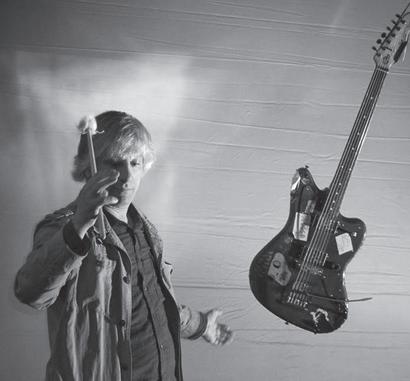
Big Fun offers 36 musical reasons to leave your pillow fort
staff
It’s long been inferred that the rich musical and cultural scenes in Winnipeg are a direct result of our cold, dark winters – as if we become a city of homebound hermits curling up around our guitars, or other vice of choice, and stewing in malaise for six long months.
But what of the creative minds that are scheming up plans to draw the rest of us out of hibernation? They call themselves Big Fun, and have scheduled a festival weekend full of shows showcasing local and regional talent, all nefariously designed to draw music lovers outside and into, well, fun.
“[We] try to promote a show-hopping vibe, which we can encourage by finding spaces within reasonable walking distance, which is why the festival is typically divided each day by neighbourhoods,” says Stefan Braun, artistic director.
Between Jan. 22 and 26, a grand total of 36 bands from multiple genres will be playing throughout Winnipeg. Big Fun spans 11 venues, including Union Sound Hall, the Windsor Hotel, A.N.A.F. Unite “Club 60,” Into the Music, and aceartinc.
The recent losses of many favourite
local venues have proved a challenge for Big Fun.
“It keeps us on our toes and always has us trying to find new spots open to the ideas of the festival,” says Braun. “This has led to new opportunities as it seems there are always spots willing to open themselves up to concerts.”
You can take the festival showby-show, or grab a full festival pass for $60 – a steal of a deal considering the treats carefully curated for you by Braun and company. A sampling of show headliners includes METZ, Venetian Snares, B.A. Johnston, and Les Jupes, and they are all paired with equally delightful and complementary acts.
“I’m constantly amazed by the amount of talented bands submitting that I have never heard of,” says Braun, adding that his favourite part of the job is the task of “constantly discovering new and exciting bands.”
His picks this time around—not necessarily reflective of the “collective tastes of the festival”—are Surprise Party, SMRT TYPE, and Potatoes.
The full Big Fun ensemble consists of Braun, David Schellenberg, Lauren Swan, Aaron Johnston, and Eryn Maloney, who all identify as
Haifaa Al Mansour is a courageous director who took a stance against sexist laws in the Middle East with her brave film about a 10-year-old-girl living in the capital of Saudi Arabia, a country known for having very strict laws against women’s rights.
The film is named after its main character, Wadjda (Waad Mohammed), who is a bright, intelligent, and playful girl with a rebellious spirit. She pushes the boundaries of
society, questions the rules, and gets into all sorts of trouble. Her goal is to buy a bicycle and nothing, not even Saudi Arabia’s gender laws, will stop her.
Wadjda is an easy character to connect with. She has everything one would admire in a protagonist, such as a sense of determination and a willingness to defy coercive authority. A well-crafted character, Wadjda is certainly the hero the Islamic feminist movement needs at
musicians, music lovers, or both. Together they have brought this festival into its third and biggest year yet.
While they draw some of their inspiration from larger cities’ famous festivals, like Pop Montreal and NXNE, the passion for the music scene is definitely Winnipeg-bred.
“I grew up going to all-ages punk shows all the time. I basically spent every weekend at the [West End Cultural Centre] or some community centre,” says Braun.
“Those were the places where I met musicians that helped shape my music taste and really showed me that Winnipeg had a music scene to believe in.”
By including all-ages shows in their lineup, Big Fun hopes to continue indoctrinating local youth with this love for the music scene. Each day of the festival includes at least one all-ages offering. Says Braun, “We hope to bring a lot more all-ages content in the future and really give the festival an all-inclusive feel.”
Find the full lineup, schedule, maps, and ticket information at www.bigfunfestival.com
this time. Mohammed, a relatively unknown figure in the international film industry, does an excellent job with her performance; her eyes show a combination of innocence and a hunger for change.
Unfortunately the film is a bit light in content; we get a pinch of the difficulties facing Arabian women, but we don’t get a harsh in-depth exploration. Wadjda leans more on fantasy than realism, which hurts the political aspect, but I suppose since the story is from a child’s point of view it can’t be too drenched in reality. Wadjda’s world is of kindness and cruelty, though there is some magic in the way she never gives up. The film’s optimistic message is truly inspiring: 3/5
Check out more of Michael’s reviews at goodbadcritic.blogspot.ca, and catch a screening of Wadjda at Cinematheque (100 Arthur Street) on Jan. 22 and 24 at 7 p.m. and Jan. 23 at 9 p.m.
A vivid journal and shared stories
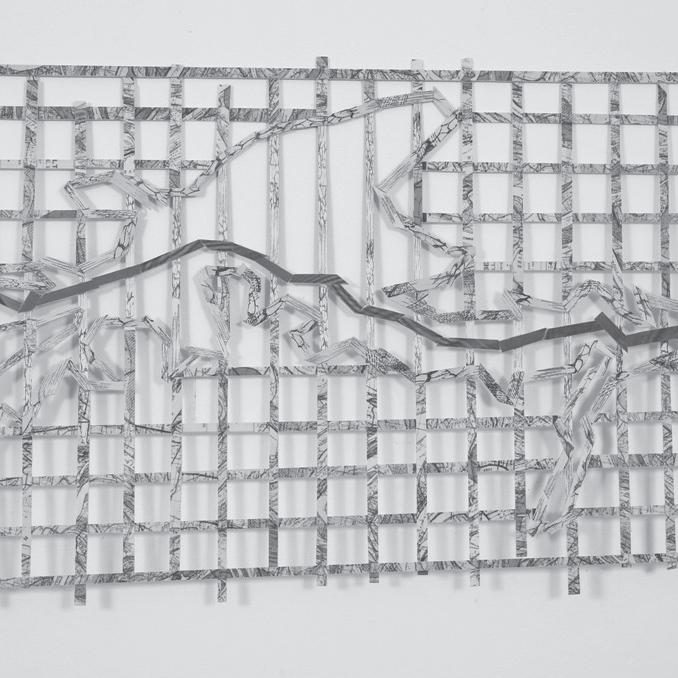
Take a sneak peek into Takashi Iwasaki’s imaginary landscapes
What do a building facade in Taiwan, a bolt of fabric, and a gallery on Main Street in Winnipeg have in common?
Nothing, yet. But as of Jan. 24, they will all have hosted works of art by Takashi Iwasaki. A versatile artist whose distinct style crosses many different media, Iwasaki will be holding his first solo show since 2012 at the Edge Gallery, located at 611 Main Street, until Feb. 7.
Iwasaki will be mixing it up a bit for the Edge Gallery. “There will be paintings, embroidery pieces, and many small collages with quirky stories,” says Iwasaki.
One of the most common and apt descriptors for Iwasaki’s work is “colourful”; while his backgrounds may remain monotone, they are peppered with innumerable vivid shades of thread or paint.
He describes his bright pieces as being similar to journal entries. They are his way of telling a story, or relating a feeling, and sharing a kind of positive energy.
“I’ll be showing works which revolve around my ongoing theme of creation – visualization of my imaginary worlds and landscapes. That’s the central theme for this show,” says Iwasaki. “You can peek in on what’s going on in my head through the works.”
Previous sneak peeks into Iwasaki’s whimsical and multichromatic mind have sometimes been relayed through more abstract forms, though recognizable shapes and symbols also appear.
“Lately I’ve been enjoying making collages that have figures and stories in them, and putting them
in elaborate picture frames that I make,” says Iwasaki.
“It’s been a fun way of creation for me to combine the shapes that I used to use in my paintings and embroidery, figures and characters to add more stories and dimensions in the contents, and a sculptural element by working on the details of picture frames – all those elements in one type of work.”
This combination of elements speaks to Iwasaki’s comfort across a range of media. While he may be more well-known for his embroidery work—having been featured in Hoopla: The Art of Unexpected Embroidery (published by Arsenal Pulp Press) and in Fiberarts magazine—he has also lent his talents to CD artwork for musicians such as Sarah and Christian Dugas, and the Duhks.
Of course, there is also the Fubon Financial Center in Taipei, Taiwan – the building whose facade was decorated for a full year by an Iwasaki design titled A Place to Call Home
Enjoyment of Iwasaki’s work can take place much closer to home for the next little while, as his show at the Edge will continue from Jan. 24 through to Feb. 7. Pop by the closing reception from 7-10 p.m. on Feb. 7 if you’d like a chance to meet the radiant mind behind these works.
Check out www.takashiiwasaki. info for more samples of Takashi Iwasaki’s past work, and www. edgevillage.com for this and other openings at the Edge Gallery.
MyStiC phOtO pROVidEd by big fuN
iMagE pROVidEd by taKaShi iWaSaKi
event Listings
The
events to attend this weekend
viSual arT
oTher
Saturday,
Maurice is the man
Jets will benefit from vocal, experienced coach
Mi K e Sti LL , staff
On Jan. 12, after the team dropped their fifth straight game of 2014, the Winnipeg Jets fired head coach Claude Noel. Replacing him behind the Jets bench is 46-year-old veteran Paul Maurice, who has coached a total of 14 NHL seasons with the Hartford Whalers, Carolina Hurricanes, and the Toronto Maple Leafs. Concerns have been raised regarding Maurice’s hiring: namely, his (at the time of hiring) losing record as head coach of 460-457-167. While these worries are legitimate, I am of the opinion that Maurice is the right man for the job. During his first tenure with the
Monkey off, buffalo on
Whalers and Hurricanes, from 19972004, Maurice was able to develop a number of young skaters into complete players.
Forwards such as Bates Battaglia, Sami Kapanen, Erik Cole, and Jeff O’Neill, as well as defenceman Marek Malik, thrived under his tutelage. He also drew out the best in his unheralded veterans, such as Rod Brind’Amour, Glen Wesley, and captain Ron Francis.
The leadership Maurice brought resulted in four consecutive winning seasons, from 1998-2002. His hard work also culminated in an underdog appearance in the 2002 Stanley Cup.
The current-day Winnipeg Jets remind me quite a bit of his former team. Big play veterans that mimic the former Hurricanes squad, such as Andrew Ladd, Olli Jokinen, Blake Wheeler, and Dustin Byfuglien will benefit from Maurice’s vision and coaching style. In his first three games as head coach, the Sault Ste. Marie, Ontario native has shown an increased participation level
Chelsea Carey’s rink finally representing Manitoba at Scotties
volunteer staff
aDa M p e L e S haty,
After years of competing under the shadow of Jennifer Jones, and losing two previous women’s provincial curling finals, Chelsea Carey’s team finally got to wear the buffalo on their backs.
Playing out of the Fort Rouge Curling Club, Carey’s team is rounded out with third Kristy McDonald, second Kristen Foster, and lead Lindsay Titheridge. Carey’s rink won the 2014 Manitoba Scotties Tournament
of Hearts in Virden on Jan. 5, a 6-2 win over Kerri Einarson in the final.
With the win, they are set to represent Manitoba at the 2014 Scotties Tournament of Hearts in Montreal from Feb. 1-9.
“I’m kind of in a daze,” Carey said after the competition. “Once I get my hands on that (Team Manitoba) jacket, then it might sink in for me a little bit. It’s just surreal right now.”
Previously, the Manitoba Scotties
had not been kind to this team. In 2011, after going through the round-robin and playoffs undefeated, they lost in the final to Cathy Overton-Clapham. The next year, they lost in the final again, that time on Jones’ last rock.
Last year, eventual finalist Barb Spencer bounced the team in the playoffs. The win was extra special for McDonald; she had lost two provincial finals in 2005 and 2006 before joining Carey’s team in 2010. Not surprisingly, McDonald was the most emotional after the victory.
“I held it in as long as I could,” said McDonald. “Then, the rock made contact and the tears came in. I wanted to keep it together.”
Carey’s team made Canadian curling fans take notice at last December’s Roar of the Rings in Winnipeg. After a 10-2 loss to Jones in a nationally-televised opening game, they won four of their next six en route to a fourth-place finish. Ironically, Jones’ victory at the Roar of the Rings enabled Carey to become the Manitoban #1 seed and odds-on favourite to win the 2014 Manitoba Scotties.
on the bench, actively communicating with players after their shifts – something Noel neglected.
Young stars such as Jacob Trouba and Mark Scheifele will only get better with a seasoned mind helping them out. Scheifele has four points in three games since Maurice has arrived, while Trouba has three points, as well as a plus/minus of +6.
Hardworking, underrated players such as Michael Frolik, Chris Thorburn, and Devin Setoguchi may find the biggest improvement with the new bench boss. Frolik has been brought up to the first line with Bryan Little and Andrew Ladd. The three seem to have found an immediate chemistry. Setoguchi snapped his five-game scoring drought in the first game with Maurice as coach, and has elevated his physicality, along with Thorburn.
Maurice is a student of the game. He will analyse all of the little things that the Jets have lacked, including a consistent scoring touch. In two of his first three games, Winnipeg was able
to put up five goals, something they did only seven times all year under Noel. This is also not the first time Maurice has come in as a mid-season replacement. In the 2008-09 season, he replaced Peter Laviolette after 25 games. Maurice led the team to a 33-19-5 record, their first berth in the playoffs since 2006, and an appearance in the conference final.
His experience is also a factor. On Nov. 28, 2010, he became the youngest coach in history to coach 1,000 NHL games.
Maurice’s commitment to the team is evident, especially in his post-game comments following an overtime victory over Edmonton on Saturday.
“I’ve been here for a week. They showed up the first day, they looked like good players, and nothing’s changed my mind.”
With a passionate coach taking over a team that has shown flashes of promise, it’s my opinion that there is no reason that the Jets cannot be successful under Maurice.
robin, Carey’s team played a tiebreaker to reach the playoffs, and therefore had to win four straight games to take the championship. Her next three victories were fittingly all against three-time Manitoba women’s curling champions: Darcy
father and coach, and Bill Carey, her uncle, have both won the Brier. McDonald’s father, Bob Jenion, played in five provincial men’s finals before winning in 2003.
Winning the Manitoba Scotties will add to family curling traditions, but there is tough competition coming their way in Montreal.
The Manitoba Scotties had not been kind to this team in the past; the team had lost in two of the past three Scotties finals
Despite a 5-2 record in the round
Robertson, Janet Harvey, and Spencer Einarson. Einarson, a two-time Manitoba mixed curling champion, and her upstart team were undefeated going into the final, but Carey scored three in the ninth end to clinch the victory. Provincial curling success runs in the families of both Carey and McDonald. Dan Carey, Chelsea’s
Some of the teams include Rachel Homan— representing Team Canada—Saskatchewan’s Stefanie Lawton, and Alberta’s Val Sweeting, all of whom competed at the Roar of the Rings, while Heather Smith of Nova Scotia won bronze at the 2012 Scotties national tournament. Carey’s provincial championship win has shown the team can be as tenacious as their Olympic-bound rivals. Where that tenacity has helped Jones in past Scotties, this year, Carey and her team may finally realize their potential.
iLLuStRatiON by CaROLiNE NORMaN
phOtO by Matt giESbRECht
Bisons trudge on
Women’s hockey takes 3 of 4 points
Mi K e Sti LL , staff
This past weekend there were heavy playoff implications for the Bison women’s hockey team. Sitting just five points out of top spot in the conference, Manitoba secured three of a possible four points in two games against the visiting Calgary Dinos.
On Friday night, Manitoba carried a 3-0 lead halfway into the third period, holding on down the stretch to pull off a 3-2 victory.
The Bisons roared to a thunderous start, scoring just 43 seconds in on their first shot of the game.
Kyleigh Palmer, on a points streak dating back to Nov. 30, zipped into the Dinos zone with the puck, found Rachèle Bosc with a pass right onto the tape, and Bosc put it into the back of the net. Both teams tightened up their plays defensively, as Manitoba took their 1-0 lead into the second period.
in the final 10 seconds. With the Dinos on a 6-on-5 advantage and their net empty, Amanda Schubert was forced to lunge across the crease, absolutely robbing Calgary of the game-tying goal and preserving the win.
“[Schubert] made a couple key saves in tight at times, and I thought she managed her game pretty good,” said head coach Jon Rempel post-game.
In the rematch the following day, Manitoba let an early lead slip away, losing 2-1 in overtime.
Calgary opened up the game with intensity, drawing a Bison penalty which allowed the Dinos to generate several solid scoring opportunities.
“[Schubert] made a couple key saves in tight at times, and I thought she managed her game pretty good”
The home team was able to loosen up the Calgary defence in the middle frame, generating a number of quality chances. Amanda Tapp stood strong in net for the Dinos, keeping this one close. Tapp’s play in net seemed to wake up the visitors as they dictated the pace over the last 12 minutes of the period, though they could not crack the scoreboard.
The third period was filled with action as both teams picked up the intensity looking to put away the win. Maggie Litchfield-Medd carried momentum from a Bison scoring chance in the dying moments of the second period, putting away a Palmer rebound only 2:02 into the final frame. Just 13 seconds later the Bisons added to their lead, Kayleigh Wiens scoring on a mad scramble in the Calgary zone.
After falling behind 3-0 with two goals in the first two minutes of the final period, the Dinos made a change in net. The decision appeared to spark their offence, as Jessyka Holt scored at 9:17, followed just over a minute later by Calaine Inglis at 10:36.
The play of the game occurred
Bison briefs
men’s volleyball
At home this weekend, the Bison men’s volleyball team dropped two matches to the Mount Royal Cougars.
On Friday, the Bisons lost 3-1 (19-25, 25-18, 25-21, 25-21). Devren Dear led all players with 22 kills in the loss. The Bisons were swept the following evening 3-0 (25-22, 25-19, 25-15).
The losses drop Manitoba’s record to 8-10, leaving the Bisons sitting in tenth place – one win back from a three-way tie for the seventh and
Manitoba stayed composed, killed the penalty, and dominated play for the next seven minutes. Just like on Friday night, it was Kyleigh Palmer who stepped up early for the Bisons. She skated in with the puck on a brilliant rush that was finished off with a goal from captain Amy Lee at 11:52 to give the Bisons the lead.
Both teams had chances on the power play in the second period, but neither could find the back of the net. Manitoba outshot the Dinos 10-6, maintaining their 1-0 lead going into the third.
Manitoba goalie Dee-Ana Marion had her shutout bid snapped at 6:12, as Calgary’s Erika Mitschke had her shot redirected off of a Bison stick. Calgary pushed the pace from that point on, keeping Marion on her toes, but could not take the lead. The Bisons got one last chance in the final seconds, but Tapp robbed Palmer with a big shoulder save.
Sarah Astle ended things at 3:25 of overtime for Calgary, completing the comeback by going fivehole on Marion.
The Bisons travel to UBC next, taking on the Canada West’s top team in a crucial series on Jan. 24 and 25.
final Canada West playoff spot. The Bisons will travel to face Regina on Jan. 24 and 25.
men’s hockey
The Bison men’s hockey team suffered two tough losses on the road against the Calgary Dinos.
On Jan. 17, the Bisons allowed the Dinos to jump out to a 5-0 lead in the first period, but valiantly fought back to within one goal late in the third period. Ian Duval had three points on the night, including two power play goals. Unfortunately Duval and the Bisons could not find the game-tying goal before time ran out on a 5-4 loss.
The following night was a more balanced affair. The Bisons and Dinos exchanged the lead three times before heading into overtime tied 3-3. Calgary’s Chris Collins potted the game-winner in the second overtime period .
Manitoba is on the bye this upcoming weekend, but will return to action at home on Jan. 31 against Regina.
Basketball
The men’s basketball team broke their 10-game losing streak against the Brandon Bobcats this weekend with a 68-51 victory on Jan. 18.
After dropping the first of the weekend’s two games 89-73, the Bisons were led by Andre Arruda’s 22 points in just their second victory of the 2013-14 season. The Bisons are now 2-12 on the year and in last place in the Canada West prairie division.
The Bison men’s hockey team suffered two tough losses on the road against the Calgary Dinos
The Bison women’s team dropped both of their games against Brandon 70-51 on Jan. 17, and 57-49 on Jan. 18. Like their male counterparts, they are last in their division.
The basketball teams travel out west this weekend to challenge Thompson Rivers University on Jan. 24 and UBC Okanagan on Jan. 25.
Mar C L agaC e, staff
phOtO by aLySSa aRNOLd
phOtO by aLySSa aRNOLd
Headed in the right direction
Bisons sweep Mount Royal Cougars on home turf
Mar C LagaC e, staff
The Manitoba Bison women’s volleyball team got two huge wins over Mount Royal when the Cougars made their first visit to the U of M campus since joining the Canada West conference last season. The Cougars swept the Bisons last season in two five-set matches played in Calgary.
Manitoba entered Friday’s match shorthanded; the flu bug had bitten third-year Rachel Cockrell, who leads the team in kills this season.
With Cockrell out of the lineup, the Bisons pushed past the Cougars 3-1 (25-21, 15-25, 25-19, 36-34) in front of a crowd of fans that featured the growing contingent of rowdy Big Horns.
The Bisons jumped out in front early in the first set. The Cougars evened things up at 9-9, and the two teams continued to duel for control over the next 12 points until the Bisons managed to pull away.
The second set was dominated by Mount Royal. Cougar Julia Pasieka pitched in with four of her teamleading seven block assists. She also had four kills as Mount Royal took an early lead and held on to tie the
match at one set apiece.
Manitoba dominated the third set, taking an 18-point lead at one point.
Mount Royal managed to close the gap considerably but could not stem the Bisons’ momentum.
Manitoba dominated the third set, taking an 18-point lead at one point. Mount Royal managed to close the gap considerably but could not stem the Bisons’ momentum
The match came down to a thrilling fourth set, which had the crowd at the Investors Group Athletic Centre rocking until the final point.
After the previous two sets had been blowouts, the fourth proved to be a
true test of stamina and determination. The teams went well beyond match point, battling tooth and nail for the key set.
The Bisons and Cougars exchanged the lead 13 times after the Bisons first reached match point 24-22. On their ninth attempt to put the match away, a kill by Taylor Pischke set up match point, where Jordana Milne and Brittany Habing made the match-winning block for Manitoba’s 36th point of the set.
“Mount Royal is a good team,” said Bison head coach Ken Bentley, just moments after the wild fourth set finale. “They’re experienced with a lot of fourth- and fifth-year kids.”
“They’ve come off a tough first half, so this is do-or-die for them. I fully expected what we got tonight.”
The following evening was an easier night for the Bisons. Cockrell was back in the lineup and contributed 11 kills in a straight-sets victory, 3-0 (25-18, 25-15, 25-20). Pischke— who is nominated for the Manitoba Sportswriters & Sportscasters Association Female Athlete of the Year award—was the top Bison on
the weekend, accumulating 32 kills and 22 digs over the course of seven sets.
After Friday’s game, coach Bentley spoke about the team’s current status.
“We had great training over Christmas, and I thought we made really good progress as a team. We’re going in the right direction.”
* * *
After cheering on the Bisons to victory through their epic fourth-set rally against the Cougars, Bentley had a lighthearted message for the students who are a part of the Big Horns.
“I want to put [the Big Horns] on scholarship,” said a smiling Bentley, “tell those guys I’m going to find a way to put them on scholarship.”
Currently sitting in fourth place in the Canada West conference, the Bisons have six matches remaining to improve their playoff position. You can catch the final home games of the 2013-14 regular season with the Big Horns on Jan. 31 and Feb. 1 as they host UBC Okanagan.