22 October 2025

Page 1


109 HELEN GLASS BUILDING UNIVERSITY OF MANITOBA WINNIPEG, MB THEMANITOBAN.COM | 204. 474. 6535

GENERAL INQUIRIES: ME@THEMANITOBAN.COM

CIRCULATION INQUIRIES:

MISSING OR INCOMPLETE PAPER?

EMAIL: DISTRIBUTION@THEMANITOBAN.COM

EDITOR-IN-CHIEF Mikaela Warkentin editor@themanitoban.com

BUSINESS MANAGER Alice Teufack accounts@themanitoban.com

BUSINESS SUPPORT MANAGER Joshua Herold ads@themanitoban.com

EDITORIAL

MANAGING EDITOR Peace Ifeanyi me@themanitoban.com

COPY EDITOR Eden Quiring copy@themanitoban.com

COPY EDITOR Mursal Ghiyasi

NEWS EDITOR Jesse Brogan news@themanitoban.com

NEWS EDITOR Roy Albright Obah news@themanitoban.com

RESEARCH & TECHNOLOGY EDITOR Mansura Meghla research@themanitoban.com

COMMENT EDITOR Quinn Mayhew comment@themanitoban.com

ARTS & CULTURE EDITOR Boris Tsun Hang Leung arts@themanitoban.com

SPORTS EDITOR Abdul-Jalilu Ahmed sports@themanitoban.com

DESIGN

DESIGN EDITOR Deveney Jarrow design@themanitoban.com

DESIGN ASSOCIATE Patricia Sanque

GRAPHICS EDITOR Emma Gillich graphics@themanitoban.com

GRAPHICS ASSOCIATE Teegan Gillich

AUDIO AND VIDEO

AUDIO EDITOR Max Reid audio@themanitoban.com

PHOTO EDITOR Mike Thiessen photo@themanitoban.com

PHOTO ASSOCIATE Ebunoluwa Akinbo

VIDEO EDITOR Zulkifl Rafah video@themanitoban.com

DIGITAL MEDIA EDITOR Faisal Rahman social@themanitoban.com

SOCIAL MEDIA ASSOCIATE Paula Robles Andia

REPORTERS

NEWS Arifah Gheesah

NEWS Nafisa Al Lilo

RESEARCH & TECHNOLOGY Nawal Semir

COMMENT Thandeka Katsika

COMMENT Kyra Campbell

ARTS & CULTURE Carrington Dong

ARTS & CULTURE Jordan Anglin

SPORTS Faiyaz Chowdhury

SPORTS Israel Abejoye

VOLUNTEERS

VOLUNTEER STAFF

VOLUNTEERS

interested in volunteering?

email me@themanitoban.com today!

The Manitoban is the official student newspaper of the University of Manitoba. It is published monthly during the summer and each week of regular classes during the academic year by the Manitoban Newspaper Publications Corporation.

The Manitoban is an independent and democratic student organization, open to participation from all students. It exists to serve its readers as students and citizens.

The Manitoban is a member of the Canadian University Press, and our journalistic standards can be found on the Manitoban’s website.

The newspaper’s primary mandate is to report fairly and objectively on issues and events of importance and interest to the students of the University of Manitoba, to provide an open forum for the free expression and exchange of opinions and ideas and to stimulate meaningful debate on issues that affect or would otherwise be of interest to the student body and/ or society in general. The Manitoban serves as a training ground for students interested in any aspect of journalism.

Students and other interested parties are invited to contribute to any section of the newspaper. Please contact the appropriate editor for submission guidelines.

The Manitoban reserves the right to edit all submissions and will not publish any material deemed by its Editorial Board to be discriminatory, racist, sexist, homophobic or transphobic, ableist or libellous.

Opinions expressed in letters and articles are solely those of the authors. Editorials in the Manitoban are signed and represent the opinions of the writer(s), not necessarily those of the Manitoban staff, Editorial Board or the publisher.

A “volunteer staff” member is defined as a person who has had three volunteer articles, photographs or pieces of art of reasonable length and/ or substance published in the current publishing year of the Manitoban

Any individual who qualifies as a volunteer staff member must be voted in by a majority vote at a Manitoban editorial board meeting. Elected representatives and non-students may be excluded from holding votes as volunteer staff members in accordance with the Manitoban Constitution.

All contents are ©2025 and may not be reprinted without the express written permission of the Editor-in-Chief.

U of M Indigenous studies celebrates jubilee anniversary

50 years of education, community and impact, tracing roots to student activism

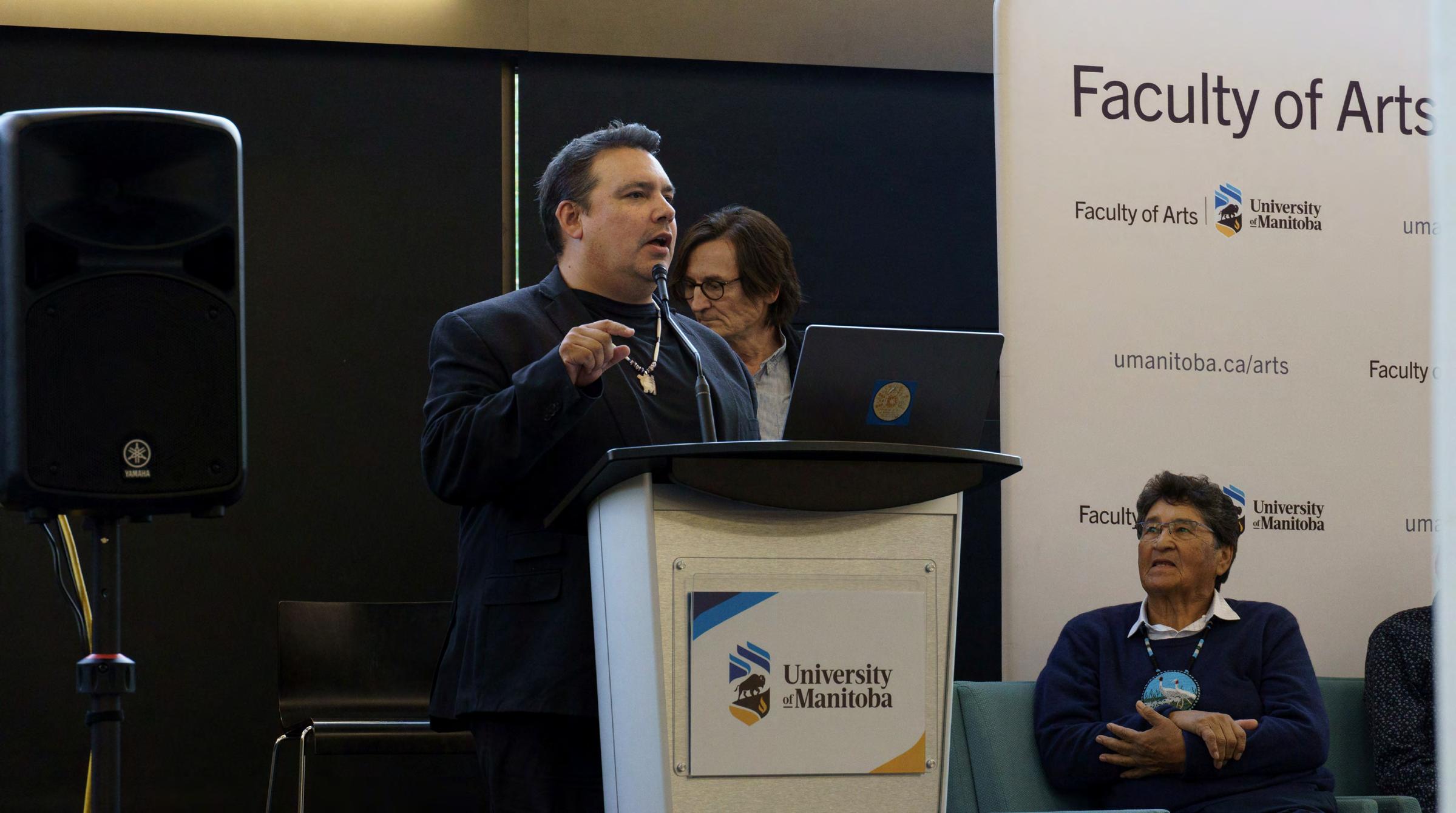
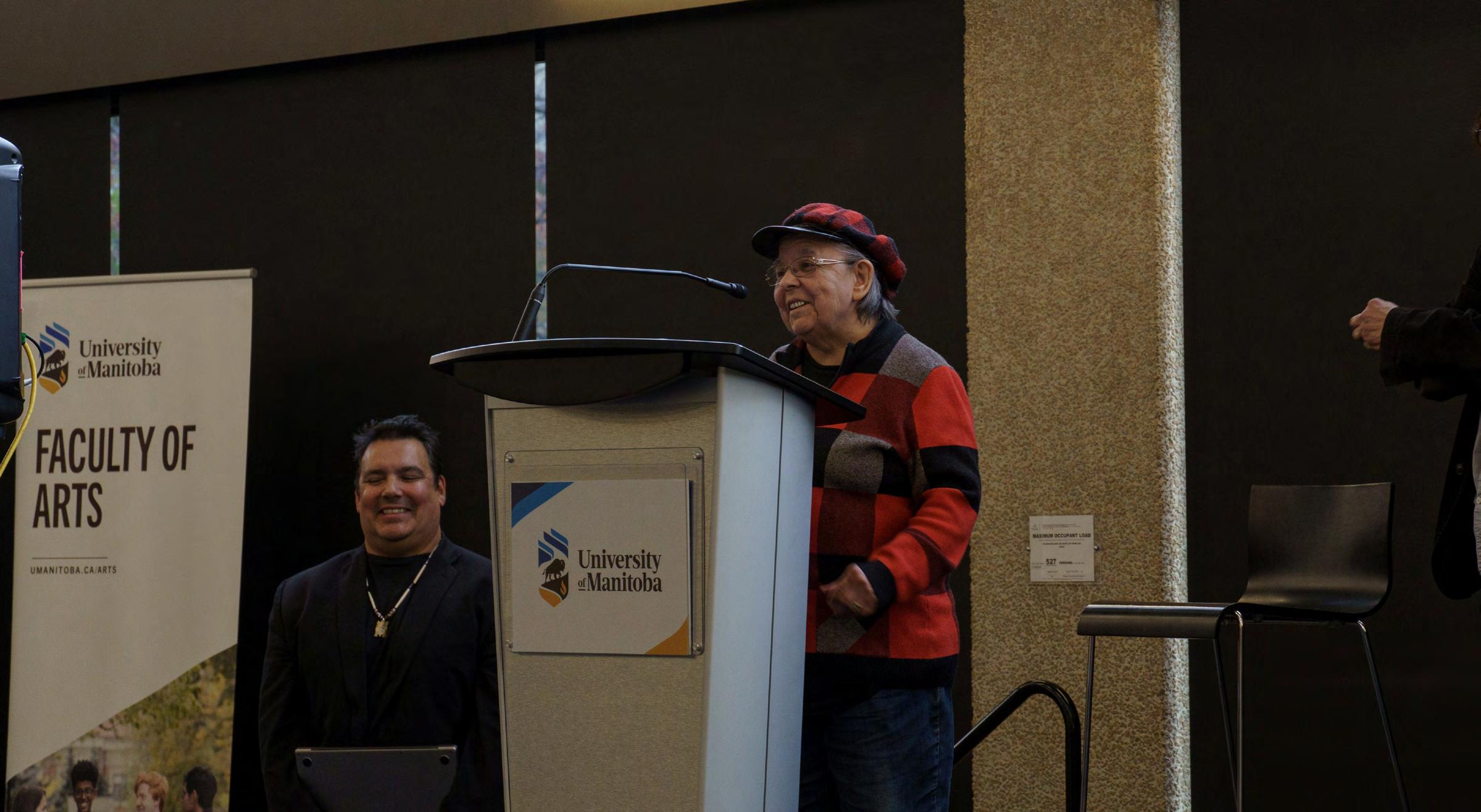
The U of M’s department of Indigenous studies celebrated its 50th anniversary on Oct. 15 at Marshall McLuhan Hall. The event brought together faculty, alumni and students to honour five decades of Indigenous excellence, academic impact and community-building.

The gathering was an opportunity to both reflect on the past and reconnect with those who helped shape the department’s journey over the years. Founding members of the Indian, Métis, and Eskimo Student Association (IMESA), formed in 1971, were among the honoured guests.

Edwin Jebb, one of the original members of IMESA, shared that the formation of the association came during a time of strong social movements on campus. He said Indigenous students at the U of M faced racism on campus and believed that education was one of the best ways to challenge it. “We wanted to push for an Indigenous studies program. That way, we would educate the world and educate other students so they would have a better understanding of our people,” Jebb said.

Muriel Houle, an alumna of the Indigenous studies program, expressed her hopes for the department’s future. “I hope to see something new. As I was coming to U of M, I was very excited to take [a course on] my own language, and I know that was a recent development through a lot of hard work,” she said. “I love this community, and I really hope I can continue to be part of this community going forward.”

Encouraging new students to participate, Houle added, “Join the community, join the clubs, [there are] lots of opportunities […] I was [in] lots of clubs last year and it helped [me] build a family on campus.”

David Parent, an assistant professor of Indigenous studies and history, spoke about the importance of community engagement for Indigenous students. He said, “I would encourage you to get involved […] in your communities, in your nations, and always give back.” He also cautioned about the risks of disengagement, noting that it leaves the responsibility to individuals who do not have the lived experiences of Indigenous people, which can lead to “problematic frameworks.”

Lydia Gork, a Métis PhD

student, said the department’s interdisciplinary approach was key to her academic path. “I found that the department of Indigenous studies was the perfect fit for my research because of its interdisciplinary nature and the way that it privileges Indigenous knowledges.” Gork noted that her studies allowed her to “bring my family’s Métis knowledge into the academy […] to help challenge existing histories that have dehumanized Métis people.”

Niigaanwewidam Sinclair, a professor of Indigenous studies, former head of the Indigenous studies department and a current colum-

nist for the Winnipeg Free Press, surveyed the immense impact of the department’s alumni. “[At the department] you have seen people who have changed lives, published the most groundbreaking books, you have seen people who have done incredible contributions to Indigenous communities at the grassroots level,” he said. “Many of our students go on to become chiefs, or counsellors, or doctors or lawyers,” he added, citing the Grand Chief of Manitoba as a former student.

For Sinclair, this evidence demonstrates “that Indigenous studies is not only a critical part of this university,

but it’s really a critical part of the province.” The department’s work, he explained, has formed a critical foundation. “It has formed the basis for so [many] of the relationships we now know between Indigenous peoples and Canadians.”

Sinclair concluded by defining the department’s enduring legacy. “The legacy of Indigenous studies is really about building the country but also building the sovereignty […] of our First Nations, Inuit and Métis communities.”

The event also honoured Emma LaRocque, Indigenous studies professor and

author of the influential 1975 book Defeathering the Indian, for her contributions to the department. Sinclair was also honoured for his 2024 publication, Wînipêk. Indigenous student enrolment at the U of M grew by 10.7 per cent this term, increasing from 2,933 students in fall 2024 to 3,248 in fall 2025. This growth highlights the university’s continued dedication to reconciliation and Indigenous excellence, and reflects the confidence Indigenous students place in the U of M as a meaningful part of their academic path.

PHOTOS BY ZULKIFL RAFAH / STAFF

Islamic Heritage Month in Manitoba

Celebrating faith, contributions and justice

he month of October

Tmarks Islamic Heritage Month (IHM) in Manitoba, a time to recognize the history, culture and contributions of Muslims across the province.

The legislation, outlined in Schedule 32.1 of the Statutes of Manitoba, acknowledges the growing Muslim community and its social, economic and political impact. This month serves as both a celebration and a reminder of the ongoing fight against Islamophobia.

On Oct. 30, the Esplanade Riel bridge and the Winnipeg sign at The Forks will be lit green, celebrating the growth and unity of Manitoban Muslims and the wider Manitoban community, a reminder of how deeply connected our lives have become.

Throughout the month, several events are being held across Winnipeg to celebrate

and educate. Some highlights include Celebrating Muslim Women’s Contributions: Past and Present on Oct. 25, hosted by the Islamic Social Services Association (ISSA) and the Canadian Muslim Women’s Institute; Celebrating Muslim Youth Volunteers on Oct. 26, organized by ISSA and Winnipeg Central Mosque; and Healing Across Centuries — Muslim Physicians at the Forefront on Oct. 29, hosted by the Muslim Medical Association of Canada. The U of M Muslim Students’ Association (UMMSA) is also planning an event during the first week of November.

Hussein Chokr, an executive member of Students for Justice in Palestine at U of M, said, “We are called to remember that our heritage is not only one of faith, art and knowledge, but also one of justice, compassion

and unwavering resistance to oppression.”

He added that Muslims have “a legacy of standing with the oppressed.”

“Islam taught us that faith without justice is incomplete,” Chokr said, connecting IHM to broader struggles for justice, including the ongoing struggle of Palestinians. “In their steadfast, we see the spirit of Islam — the refusal to surrender one’s dignity no matter how great the hardship.”

Chokr also reflected on the teachings of Imam Hussein, which show that the stand for justice transcends time.

“Our fight for justice doesn’t just stop at Palestine […] From the Indigenous people of Canada defending their lands, to the Black Lives Matter movement, to women demanding safety and dignity, to students calling for divestments from occupation and apartheid

— as Muslims, our heritage aligns with all of these struggles.”

Ayesha Sultan, current executive member and immediate past president of UMMSA, as well as current universities and schools coordinator at Islamic Heritage Month Manitoba (IHMM), said she joined the committee because she wanted “to amplify Muslim voices and to celebrate their contributions that they have [made] within our communities.”

For Sultan, IHMM is an opportunity to apply what she has learned through her leadership at the U of M. “Over the years, my time at university and living in Canada as well, I learned a lot about Muslims and their impact in Manitoba, and across the world,” she shared. “At the same time, unfortunately, being part of university and in

general, I have seen that there are challenges that Muslims face, either being underrepresented, or overlooked. That made me even more determined to be part of [IHMM].”

“This is just the first year of our committee. It’s really exciting to help lay the foundation,” Sultan said. “I really hope and pray it will grow and even make a greater impact in the coming […] years, for more youth, and elderly, and everyone, to learn from.”

Islamic Heritage Month is a reminder that there is so much we can learn from one another. By celebrating faith, contribution and justice, Manitobans are invited to grow together, share experiences and strengthen the bond that makes our community strong.

Women’s Centre hosts Pro-Choice and Protesting 101

Student-led event to educate peers on reproductive rights and engaging in activism

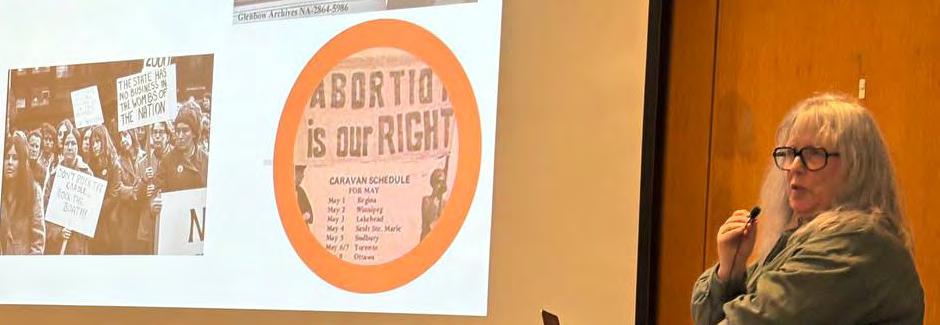
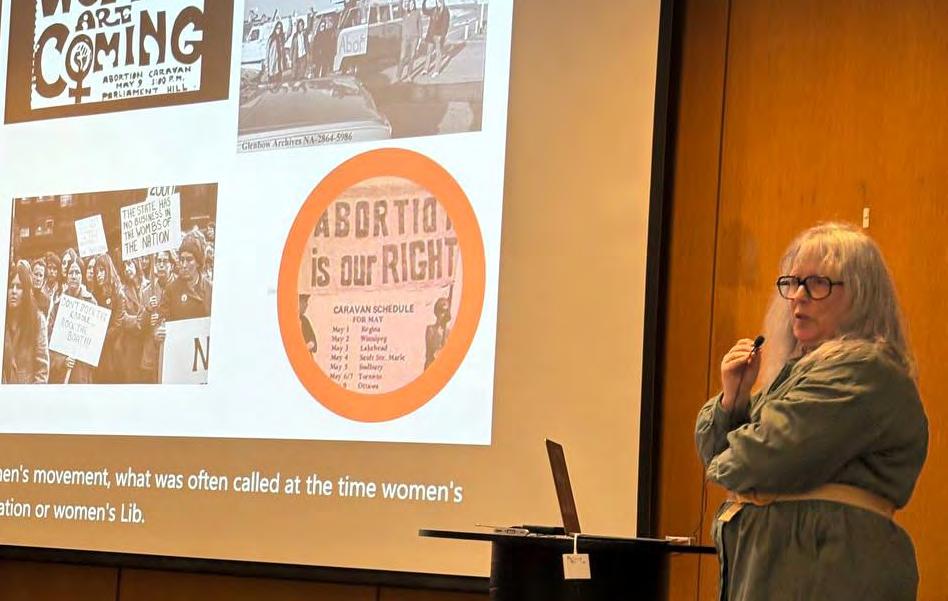
Students filled the John A. Russell Building atrium at the U of M on Oct. 15 for ProChoice and Protesting 101, an event designed by UMSU’s Women’s Centre to educate students and community members about reproductive rights, protest safety and community advocacy.

Leata Goulet, the event’s intiator and UMSU women’s representative, said the idea came from witnessing anti-abortion demonstrations on campus.

“For a long time now, the anti-choice group has always made their way onto our campus, pushing their so-called ‘pro-life’ agenda with extremely triggering and false images,” said Goulet. “Last year, I was a part of the Women’s Centre team and [helped plan] the counter-protests, especially in March where they were here for four days in a row.”

Goulet stated that those experiences inspired her to take an active leadership role.

“After that week, and after I knew that I was going to be the next [UMSU women’s representative] I knew that this [was] something I had to take a role on.”

Goulet outlined that the university’s neutral stance on this topic has made it challenging to restrict anti-abortion protests on campus.

“They are legally allowed to be here, so it is quite difficult, especially since the university is neutral on this stance.”

The idea for pro-choice education came in June, after Goulet joined a virtual

meeting with student leaders across Canada who have faced similar issues.

“They really recommended putting together an educational event,” said Goulet.

“To not only show support to our community through counter-protesting, but [show] support through actually trying to reach out and educate people about the importance of these [reproductive health] services.”

The evening brought together both campus and community organizations,

‘Toban news briefs

Tax exempt system for churches in Canada is under consideration

Parliament’s Finance Committee’s 2025 prebudget report proposes two measures that could impact faith-based charities. This change could revoke charitable status for pro-life groups and eliminating “advancement of religion” as a ground for tax exempt registration. This is a change urged by the B.C. Humanist Association. If adopted in the next federal budget, religious organizations could lose tax exemptions and the ability to issue donation receipts, and if the provinces also follow the change, it could mean the loss of property-tax breaks as well.

First Nigerian Muslim mosque opens in Winnipeg

Winnipeg’s Nigerian Muslim community opened its first mosque, Al-Haqq Masjid, at 500 Dovercourt Dr. in Whyte Ridge on Saturday. The new mosque is fully funded by local donors through the Al-Haqq Prayer Group of Canada. The mosque and resource centre will host worship, education and community programs open to all faiths. Leaders, including community member Titi Tijani and Imam Yunusa Salami, said they discovered rapid growth in the Muslim population in Manitoba and it’s important to have a new area to accommodate the growing community.

including the Women’s Health Clinic, the Centre for Human Rights Research, the Social Justice Hub, UMSU and the Sexuality Education Resource Centre.

Beyond advocacy, the event also emphasized calm and respectful dialogue.

“One of my goals for counter-protesting [this year] is to have more calm conversations with these people,” said Goulet. “[That’s] why I brought in the Social Justice Hub […] to talk about the importance of trying to use

your words properly in a conversation and to not always be so defensive.”

For Goulet, being prochoice is ultimately about showing respect to others.

“There is no harm in being pro-choice,” said Goulet. “Every human should be able to make decisions about their own body and about what they want their future to look like.”

“When abortion is accessible, it happens less often and women don’t die as much or get injured as much,” said

Goulet. Her message to students is simple — education and empathy go hand in hand.

“We’re seeing people’s human rights being taken away across the world right now, not only just about abortions, but in many different ways, and this is a very basic right that people should be able to have,” said Goulet.

“If you want to support women, you should support their right to make their own choices about their bodies and what they want to do with their own lives.”

Premier Norquay biography wins prestigious award

The J.W. Dafoe Book Prize named its 2025 winner — The Honourable John Norquay: Indigenous Premier, Canadian Statesman by U of M professor Gerald Friesen. Published last year, the biography pulls from family-preserved letters in the Archives of Manitoba to fully bring to life Norquay’s premiership and character. Friesen said the honour is a “remarkable validation” after a decade of work.

New Indigenous language bachelor’s degree programs

Two Manitoban institutions will launch Indigenous language bachelor’s degrees

in January 2026. The University of Winnipeg will offer an Anishinaabemowin (Ojibway) immersion BA and University College of the North (UCN) will create an Ininimowin (Cree) BA. The province is contributing $4.5 million for the development of these projects, of which $2.3 million will go toward U of W’s program and $759,000 will go toward UCN’s program. $1.49 million out of the province’s contribution will be used to develop a new Centre for Aboriginal Languages and Culture at UCN. The programs are in alignment with the Truth and Reconciliation Commission’s calls to action and hopes to develop Indigenous language teachers.

Manitoba arts and culture generates $2 billion

A new Manitoba Arts Council (MAC) report says arts and culture generated $1.75 billion in 2023, which equates to about 3 per cent of Manitoba’s GDP and 20,000 jobs. Two thirds of Manitobans through a survey said arts is a vital part of their well-being and support government funding. Live music, museums and festivals topped the list as respondents’ favourites, and the survey showed roughly half of respondents attended an event last year. Nearly half of respondents said they do not view the sector as economically important — a perception MAC and Probe Research say needs to change.

PHOTO BY NAFISA AL LILO / STAFF
ADELE PERRY, DISTINGUISHED PROFESSOR AND DIRECTOR OF THE CENTRE FOR HUMAN RIGHTS RESEARCH, SPEAKS AT THE

Research & Technology

U of M researcher innovates remedy for surgical anxiety

A new VR program hopes to reduce pre-surgery stress and improve patient comfort

Renée El-Gabalawy, an associate professor in the department of clinical health psychology at the U of M’s Max Rady college of medicine, studies how mental health affects medical care, especially pre-surgery. She is also director of research in the Health, Anxiety & Trauma Lab, an adjunct scientist at CancerCare Manitoba and a clinical psychologist with Shared Health.

“My research investigates how mental health influences the experience and outcomes of adverse health events and medical trauma (e.g., life-threatening illness, surgery, ICU admission),” she said, “including the development of conditions such as [post-traumatic stress disorder] and delirium.”

El-Gabalawy explained that anxiety before surgery can affect recovery in serious ways. “We knew from the literature and my own work […] that anxiety before surgery actually contributes to nega-

tive perioperative outcomes,” she said, adding that pre-surgery anxiety can lead to longer hospital stays, higher rates of re-admission, greater pain and fatigue and, in some cases, increased risk of death within a year.

Her research team is developing innovative solutions to address this gap. One of the most promising is the use of virtual reality (VR) to help patients manage anxiety. The idea stemmed from her interest in integrating evidence-based anxiety interventions into VR to support patients before surgery.

“We developed a program that aims to support patients’ mental health before surgery,” she highlighted. “We worked with patient partners, we ran focus groups, we’ve published a number of studies in this area, and we have the intervention in its final form,” she noted.

said. “Even though it didn’t include, at that point, those evidence-based aspects to it.”

El-Gabalawy’s team has also expanded into other areas. They are studying VR use during procedures performed under local anesthesia to reduce pain and stress, including in urological procedures such as vasectomies.

“We’ve developed a program that aims to support patients’ mental health before surgery”
— Renée El-Gabalawy, associate professor in the U of M’s Max Rady college of medicine

The project has grown into a full intervention, developed with input from patient partners and refined through focus groups. It is now being tested in a large, randomized clinical trial with support from CancerCare Manitoba.

According to El-Gabalawy, early results have been promising. Patients in pilot studies valued the program, even when it was in its early prototype stage. “We found […] that 100 per cent of the participants […] thought the additional appointment was worthwhile of their time, in terms of receiving that virtual reality intervention,” she

Post-operative applications are also underway. “We’ve developed a VR program specifically for people who undergo amputations and experience phantom limb pain after their surgeries,” she said. Phantom limb pain affects about 70 per cent of patients who receive amputations.

Her approach is shaped by a career that blends clinical psychology with medical research. Originally plan-

ning to pursue medicine, she shifted to psychology after receiving a Vanier Scholarship during her graduate studies. “I realized that I could do something I love and work within the faculty of medicine in the context of being a clinical psychologist,” she said.

El-Gabalawy emphasized the collaborative nature of her work. “Great research doesn’t happen alone, it takes a team. I’m fortunate to collaborate with brilliant colleagues and students whose diverse strengths spark innovation and make our work possible.”

For students interested in research, she emphasized the need for passion and mentorship. “I would say it’s really important to identify a good mentor who is enthusiastic, who can provide support and who you feel that you have a collaborative relationship with,” she said. “You have to be passionate and enthusiastic and believe in the work you’re doing.”

GRAPHIC BY EMMA GILLICH / STAFF

Understanding capitalism’s impact on the environment

Exploring how social and economic systems shape our relationship with nature

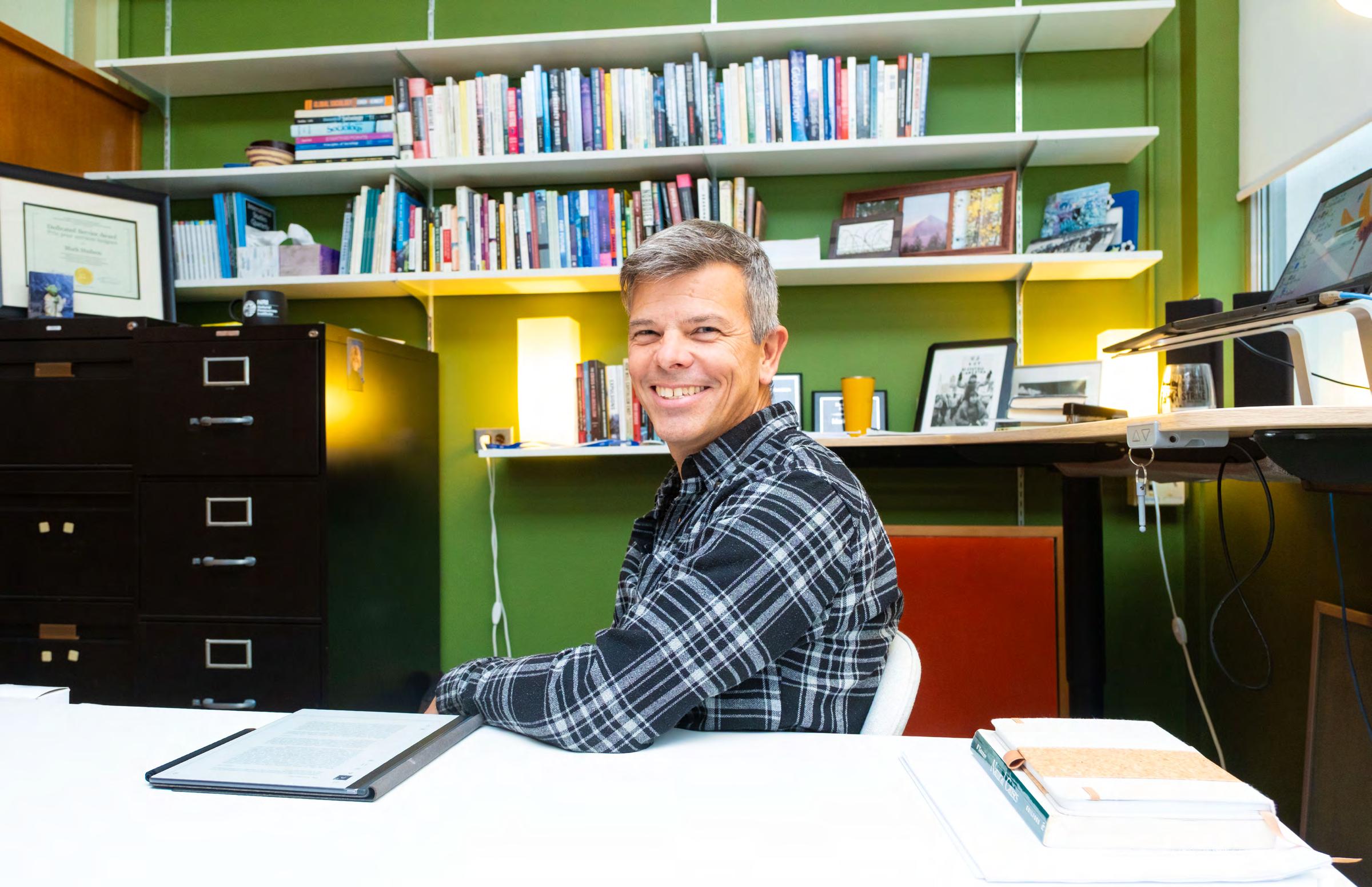
M ark Hudson, a professor in the department of sociology and criminology at the U of M, studies how social structures and political economies influence the way people relate to the non-human world. His research has taken him from coffee farms in southern Mexico to union halls in Manitoba, examining how work, trade and politics shape both human and ecological systems.

Hudson’s work connects environmental sociology, labour and political economy — fields that often intersect in global climate discussions. His research stems from observing how capitalist economies have intensified environmental degradation.

“Our relationship with the non-human world is in a critically bad state,” he said. “In critical areas like climate change, biodiversity and nutrient cycles, all signs point toward a worsening of the situation, perhaps beyond critical tipping points.”

His interest in environmental research began while working as a tree-planter in British Columbia. “Walking the vast clearcuts, thinking about the labour of the loggers and my own labour planting monocrop, even-aged tree farms […] got me more interested in this work,” he said. That experience led him from economics to an interdisciplinary master’s in environmental studies.

Hudson recently co-authored a report on Alberta’s coal phase-out alongside research assistant Khatereh Salimi, an MA student in sociology. The project examined what happened to nearly 3,000 coal workers affected by the province’s plan to end coal-fired energy generation by 2030.

“We wanted to get rich accounts of what happened in people’s lives, rather than statistical results about re-employment,” Hudson said. Most participants found themselves in similar or better situations after transitioning out of coal production, though many still faced social and financial strains.

about how to support workers through what all of the climate science tells us is an absolutely necessary phaseout of fossil energy,” he said. Hudson’s broader goal

“Our relationship with the non-human world is in a critically bad state”

Mark Hudson, professor in the U of M’s department of sociology and criminology

According to Hudson, the challenge now is ensuring that climate policy aligns with justice for workers, before the window to act closes. “We need to be thinking seriously

is to reframe climate politics. According to him, much of today’s climate politics remains overly reliant on elite-driven solutions — whether those are political negotiations, techno -

logical fixes like carbon capture or market-based incentives for renewable investment. While such efforts may play a role, Hudson noted that history offers little evidence they can meet the scale of the crisis. Instead, he hopes his research shifts focus toward people-led action.

“If we want a liveable planet, it will need to be built by the 99 per cent,” Hudson said. For him, the fight for environmental sustainability and workers’ rights are deeply interconnected as they are “rooted in the same soil.”

Currently, Hudson is returning to research on wildland fires — the subject of his PhD and first book. He plans to spend part of his upcoming sabbatical in Finland and Sweden to study how societies can live with fire, rather than seeking to eliminate it entirely. Hudson wants students to “have really good mental health supports, and build or join a community of critical but supportive colleagues.” He also encouraged students to look beyond surface explanations. “Always take the extra step to move from people’s values or beliefs to […] investigate where they came from.”
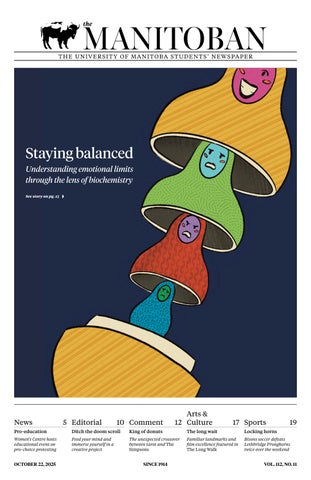

PHOTO BY MIKE THIESSEN / STAFF

Find your creative flow

Making time for creative projects is beneficial for your mental well-being

As someone who enjoys painting, drawing and photography, I would describe myself as a creative person. I, however, would not describe myself as an artist or a photographer. Growing up, I took many art classes, but throughout adulthood, I have lost some of those skills and never committed the time to practicing and regaining them.

For years, I have been wanting to get back into painting or drawing, but every time I tried, I was never happy with what I made, didn’t have the patience for it or didn’t trust the process enough to finish what I started.

This feeling of wanting to be creative but not liking the outcome is something I am sure many can relate to, and is what prevents a lot of people from seeing their projects through or trying creative projects altogether.

This is unfortunate, because partaking in creative hobbies and reaching a creative flow state can be so beneficial to our mental well-being. According to The Journal of Positive Psychology, practicing creative hobbies is shown to increase positive mood through joy and optimism and decrease stress and anxiety. Similarly, how walking outside is good for mental well-being, it is good to make things with your hands, whether that’s through cooking, painting or building.

Becoming immersed in a creative hobby or project and having the ability to let go of a desired outcome can feel so liberating. The feeling of accomplishment when the project turns out can be compared to a runner’s high. So, if creativity is so great, why is it so hard to get started?

This past year, I signed up for a photography class within the fine arts department at the U of M to fulfill one of my elective courses. This course rekindled my love for creating and the creative process as a whole. Each project, I was so nervous about meeting the expectations of the briefs and having to display my work amongst other students who were actually pursuing degrees in fine arts, but this pushed me to take chances and create some of my favourite works.

For my final project in this course, I decided to try something I had never done before, which was to paint on top of my photographs. As mentioned, I do not con-

sider myself a photographer, but I did have some previous experience with Photoshop and painting. As the deadline approached, I still had no clue what to photograph or paint and was driving home one night when inspiration struck.

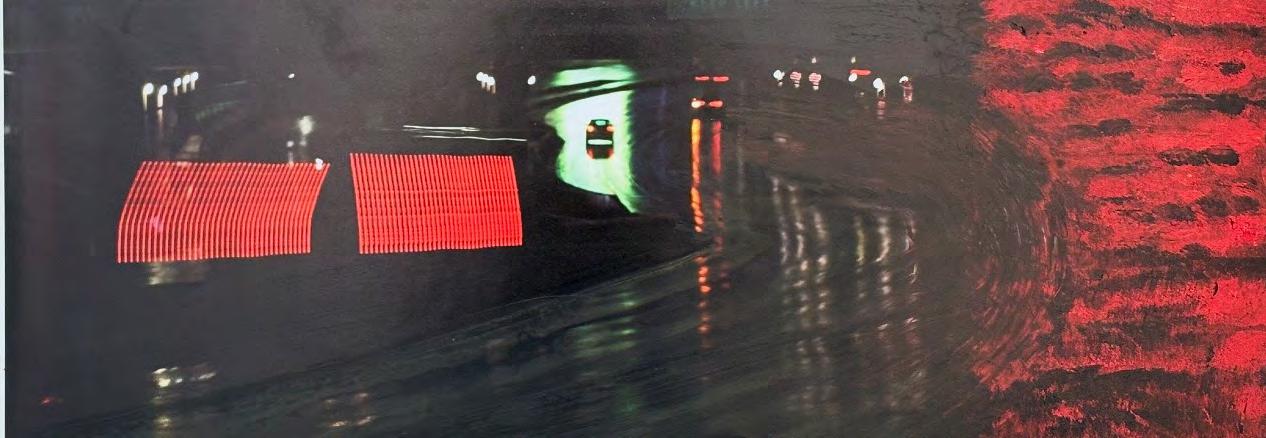
The roads were wet from rain, and the lights from the city were vibrant and reflecting off of everything — the colours from the lights were blending together like a painting. I immediately drove home, grabbed my camera and headed back out to try my hand at nighttime photography to capture the painterly quality I had seen on my drive.

Over the next few days, I started scouring through images I had taken over the years, to find other scenes that also had some flow or painted qualities in them. I then began digitally overlaying similar outtakes over one another and manipulating them to create a more blended appearance prior to printing them out. Then, it was time to paint.

I went in with no real plan, just my instincts. The feeling was like muscle memory — using only my old tubes of three primary colours and white and black paint, I had to trust my gut and not overthink it, just mix the colours to match the photo, then decide on a painting technique. Don’t think, just do.

By the end, I was using everything from brushes to saran wrap, my hands and cloths to blend or create texture where I thought it was needed. It was around 3 a.m., and I had had so much fun making the images that I didn’t really care if they would be considered “good” or not — the process of making them from start to finish was thrilling. I had finally rediscovered my love for painting and creativity again.

Since that class, I have yet to return to painting — I have no idea what to paint! I have, however, opened the door to less “risk-taking” creative projects like DIY miniature book nook dioramas. These include simple step-by-step instructions that let you get immersed in making something with your hands without having to make any of the decisions. If you are wanting to pick up a creative hobby, but have no clue where to begin, I would highly recommend these book nooks to get you started! Otherwise, just pick up some paint and go for it.

PHOTOS BY DEVENEY JARROW / STAFF

Mark Carney wants the grade, not the work

Carney plays it safe globally and at home, leaving real leadership undone

Prime Minister Mark Carney’s last-minute decision to attend the Gaza peace summit in Egypt was the diplomatic equivalent of the group project member who shows up at the end, repeats what others have already said and expects to see his name on the cover page.

It appears Carney believed that simply being visible at the summit would be enough to convince concerned Canadians he is committed to peace. However, he offered nothing new, instead repeating familiar points and continuing to call for peace, as if simply repeating these appeals might be enough to move the needle and make peace in Palestine a reality.

The lack in his leadership is even clearer when you look at a comparison like the Hague Group, a new coalition of Global South nations that assembled earlier in 2025 to uphold the rulings of international law regarding Israel’s occupation of Palestine. These nations have taken public stands on issues of peace and accountability at a time when Canada too often settles for simply showing up.

The summit seemed to reveal Carney’s preference for image over impact. For instance, in his statement, Carney called for humanitarian access to Gaza, supported preparations for an international stabilization force and emphasized strengthening Palestinian governance. But, these came with conditions and caution, never fully committing to Palestinian self-determination.

These points reflect status quo government policy rather than offer comprehensive ideas to advance peace, matching the group project analogy. Rather than taking any sort of risk or showing progressive leadership, Carney has favoured safe, non-controversial statements that maximize line-walking at the expense of Canada’s fading identity.

While the true human rights impact and legitimacy of the summit are certainly of concern — given the absence of Palestinian representation and participation, the dominance of external powers and the vague and unenforceable nature of these commitments — these issues only amplify my central point. Carney’s role was symbolic. By not

even inviting the Parliamentary Press Gallery to the summit, Carney favoured potential optics over substance and failed to push for any sort of accountability.

This approach is not unique to the Gaza peace summit. Carney often promises he is all in on the project, but when the real work begins, he is nowhere to be found.

On climate, Carney has stated in his own book Value(s) that sustainability is a core principle to him, and the threats of climate change are “existential.” However, his government has yet to implement measures that align with this value he felt so strongly about.

In a recent Bloomberg interview, Carney defended his record by saying that he is focused on climate policies, as they are “likely to have the greatest impact at a time of strained resources and multiple crises.” He made this response, pushing back against claims that he is retreating on domestic environmental action.

In practice, however, climate regulations have stalled or been softened in response to industry pressure and a

desire to make quick changes, potentially without considering long term outcomes. It could be argued in a time of economic crisis leaders are wise to play it safe. However, real leadership is not about avoiding difficult decisions or just going with the flow. Even when times are hard, and especially when times are hard, Canadians deserve leaders who will put in the work for thoughtful, long-term policy rather than settling for optics or temporary approval.

Playing it safe may seem easier, but it does little to address the challenges we face or to rescue Canada’s identity as a respected global leader. If Carney were truly committed, he would put in the work — he would seek out bold ideas and push for meaningful results. Canadians deserve more than a leader who wants the “grade” for showing up, without putting in the grounded work that meaningful, long-term success requires.

GRAPHIC BY TEEGAN GILLICH / STAFF

Can tarot and The Simpsons predict the future?

How a deck of cards and cartoon offer more than predictions

As a teenage girl, I never had the experience of dabbling in tarot, Ouija boards and witchcraft. I was scared by the horror movies I would watch as a prepubescent teenager and was afraid that I would summon a demonic spirit that would torment me, as if a mundane teenage girl from Winnipeg, Manitoba could summon the likes of Satan.

Although I never did the whole witchcraft rigmarole, I would listen to my friends who had, captivated as they told me of their experience of using a Ouija board and how

they managed to contact the undead.

Even though I never dabbled in the world of witchcraft as a teenager, I always had the utmost respect for those who chose to practice. Now, as an adult woman, I find myself enjoying more of the things I was too embarrassed to explore as a middle schooler, such as tarot.

Tarot has always fascinated me, with the deck consisting of 78 cards to choose from. At its most basic form, tarot exists as a way to tell us of the cycles of our lives. The action of shuffling the deck and choosing cards at random

reveals struggles or joys that one might experience.

The premise of tarot is to predict the future. I know a lot of people tend not to put a lot of stock into the accuracy and predictability of tarot. Still, I see tarot as a similar entity to that of the television series The Simpsons

The Simpsons is known for accurately predicting multiple historical events, such as FIFA’s corruption scandal in 2015, Canada’s legalization of marijuana and even the COVID-19 pandemic.

With The Simpsons’ reputation for predicting the future, both the show and tarot

explore possibilities for the future and pose open-ended questions about life’s mysteries.

Tarot is often seen as an unreliable way to predict the future, and in some circumstances, I would have to agree with that. When I see people doing mass tarot card readings on TikTok lives, I am immediately unconvinced of the reliability of these tarot readings.

Tarot hinges on the ability to ask private questions that are then used to interpret cards that can offer advice or predict the outcome of a situation. With mass social media readings, you lose that intim-

acy that private readings can bring.

Both tarot and The Simpsons force you to think through questions they are asking you. With tarot, those questions come in the form of guided reflection on your personal life, but with The Simpsons, you are forced to think about the state of the world through the show’s farcical nature.

Tarot and The Simpsons both have different ways of predicting the future, but despite their difference in form, both allow you to critically think about yourself and how you occupy the world around you.

GRAPHIC BY EMMA GILLICH / STAFF

Emotional buffers

Maintaining emotional equilibrium in an ever-changing world

I

n an effort to milk every penny out of my tuition, this semester I have committed myself to fully engaging with all the material presented in my classes.

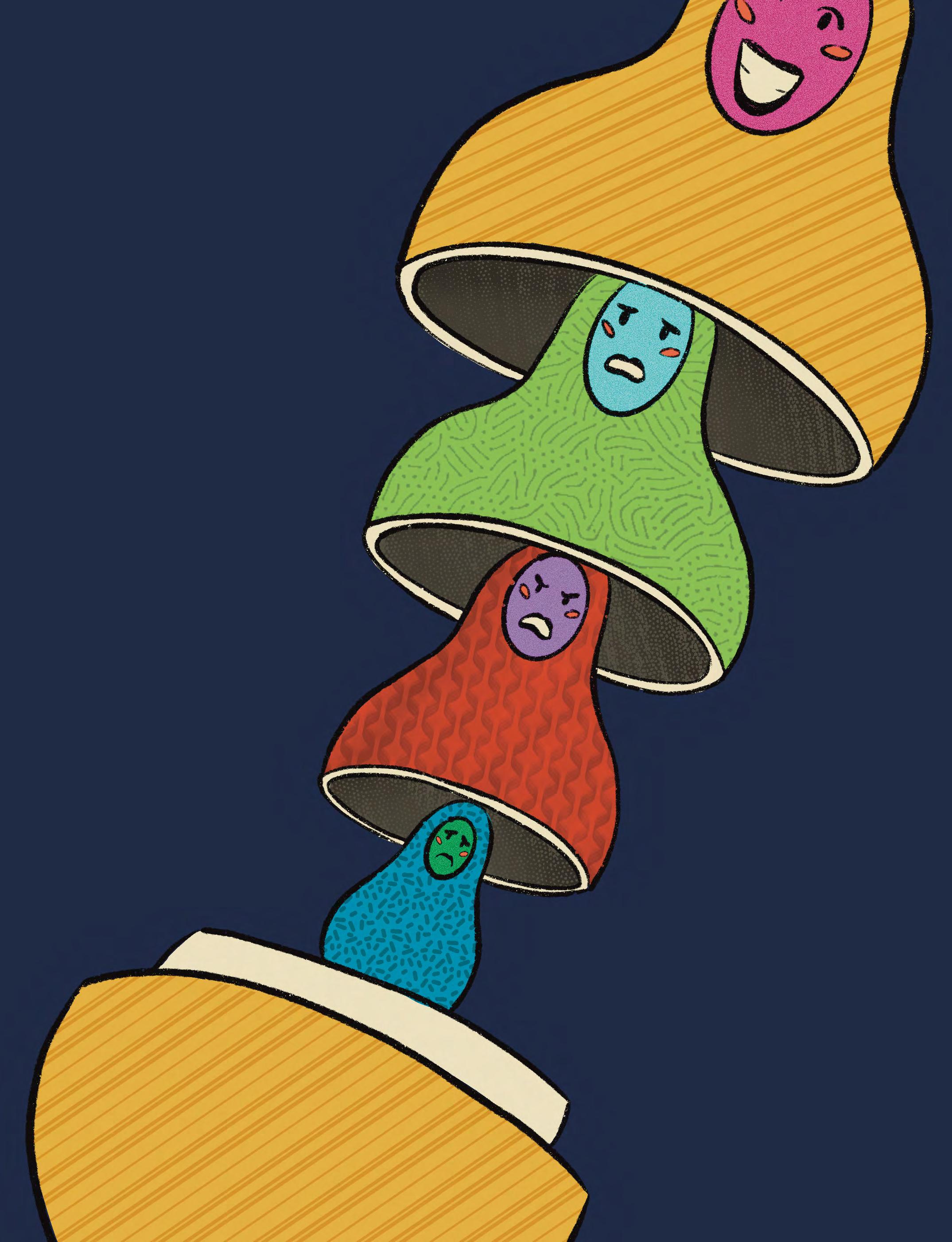
In biochemistry, we are currently learning about buffers — weak acids and conjugate bases that “buffer,” or resist, aggressive changes in pH within a certain range. While this concept is fascinating biologically, I feel like it has some real-world applications too.

Just as chemical buffers keep biological systems stable, I think emotional buffers are also necessary to stabilize our emotions. It is important to have mechanisms that help resist extreme shifts in mood.

Life is filled with unpredictable challenges and surprises, and sometimes even the tiniest inconveniences can spiral into complete meltdowns if we do not set up a system to support emotional constancy.

In chemistry, buffers work because they contain both a weak acid and its conjugate base, and the two are complementary — emotional buffers require that same balance. You need the courage to be vulnerable and the wisdom to be reflective. While vulnerability is often seen as a weakness, it actually allows us to build stronger relationships with others and ourselves. Reflection, on the other hand, helps us stay aligned to our deeper values. Together, reflection and vulnerability form a sys-

tem that can help us interact with this ever-changing world without being consumed by it.

To understand a buffer, it is important to first understand the solution’s condition. In real life, I would translate this to being self-aware. Checking in with yourself can make an enormous difference for mental well-being. Sometimes, feelings of exhaustion, overstimulation or even hunger can leave us feeling emo-

tionally dejected. Taking a few minutes to breathe, rest or simply pause when you feel an emotional breakdown coming can be beneficial. It’s not about avoiding how you feel, but allowing yourself enough space to process these feelings.

I believe relationships can also serve as powerful emotional buffers. The people who truly know and care for us help absorb some of our emo -

tional intensity. But for relationships to have a meaningful effect, they have to be centered in vulnerability. It is difficult to get help from people when they don’t know the truth of your problems.

I also think gratitude, faith and mindfulness play an important role in reflection. For me, prayer often acts as that gentle stabilizer — a space to release what is heavy and to embrace peace. For

others, journaling, meditation or even quiet walks might serve a similar purpose.

We can, however, only do so much. Even chemical buffers have limits. I am sure there are times when emotions are too strong, or a change too sudden, and we lose our balance, but that’s okay.

At the end of the day, perfection is not the goal, supporting balance is.

GRAPHIC BY TEEGAN GILLICH / STAFF

To complete Sudoku, fill the board by entering numbers 1 to 9 such that each row, column, and 3x3 box contains every number uniquely. In Straights, like Sudoku, no single number 1 to 9 can repeat in any row or column. But rows and columns are divided by black squares into compartments. Each compartment must form a “straight.” A straight is a set of numbers with no gaps but it can be in any order, eg [7,6,9,8]. Clues in black cells remove that number as an option in that row and column, and are not part of any straight. Glance at the solution to see how “straights” are formed.

Kiran Sran presents solo art exhibition at U of M

Exploring belonging and heritage on a global scale

Kiran Sran, a third-year fine arts student, unveiled her solo exhibition Belonging and Heritage at the School of Art Student Gallery last week.

For many, the ideas of belonging and heritage might conjure ideas of ones own genealogy or birthplace, but Sran wanted to explore these concepts as an integral and shared aspect of humanity.

“I am trying to focus on the collective human experience of not just a cultural identity and heritage, but also its loss and also looking at [the heritage of] a global community, not individually based on our cultures or religions,” Sran said.

Some of the works in the exhibition explore the natural world as heritage. For example, “I am home” is a painting dedicated to St. Adolphe, Manitoba and depicts a chimney swift, a local bird loved by the community.

“Land and Its Flowers,” on the other hand, is a collage of paintings that shows how pay-

ing attention to nature can unite people across differences.

“These are all the endangered flowers across the globe […] You will see a little map flowing through it, and the different depths of the canvases are directly proportional to what their status [is] now [or] how endangered [they are]. So the ones that are really pushed back into the wall are now extinct,” she explained.

“This is [what will happen] if we don’t see everything around us as a common heritage, as a collective human experience. Division leads [to extinction], so if we can just look past that, there’s a lot more that we have inherited from mother nature.”

Additionally, the artwork in this collection touches upon the theme of immigration. Sran was born in India and later moved to Canada, leaving her stuck between the two cultures. This can be seen in “Self portrait,” a ceramic bust made of hollow hexagonal puzzle pieces, suggesting incompleteness and estrange-

ment.

“Biji and me” also depicts immigration and is one of Sran’s favourite paintings. She painted a portrait of her grandmother over a world map, symbolizing how she was her world.

“While she was alive, she kept us all together, [but] everybody has moved away from home, so the families are scattered, siblings are scattered, and it’s not the same anymore. But it’s a common, collective experience of every immigrant family that when you move away from home, you lose the language, the culture and everything else,” she said.

“I painted my own portrait also and cut it into puzzle pieces [and] slapped it back on the canvas so you could see my hair. It’s a tiny bit of me, but this is how I feel.”

Sran holds a bachelor’s and master’s degree in medical physiology and works in clinical research, but she felt compelled to start a degree in fine arts because art has always made her feel grounded and

connected. She urged students to, as she has done — find a way to be connected to the world.

“I would like them to think about what belonging [means] to them, and remember also we are all one, regardless of what we look like, what we eat, what language we speak, and

to see more common grounds, to find those rather than look] for division,” she concluded.

Belonging and Heritage concludes on Oct. 22. Visit umanitoba.ca/art/student-gallery for upcoming exhibits at the School of Art Student Gallery.

PHOTO BY EBUNOLUWA AKINBO / STAFF
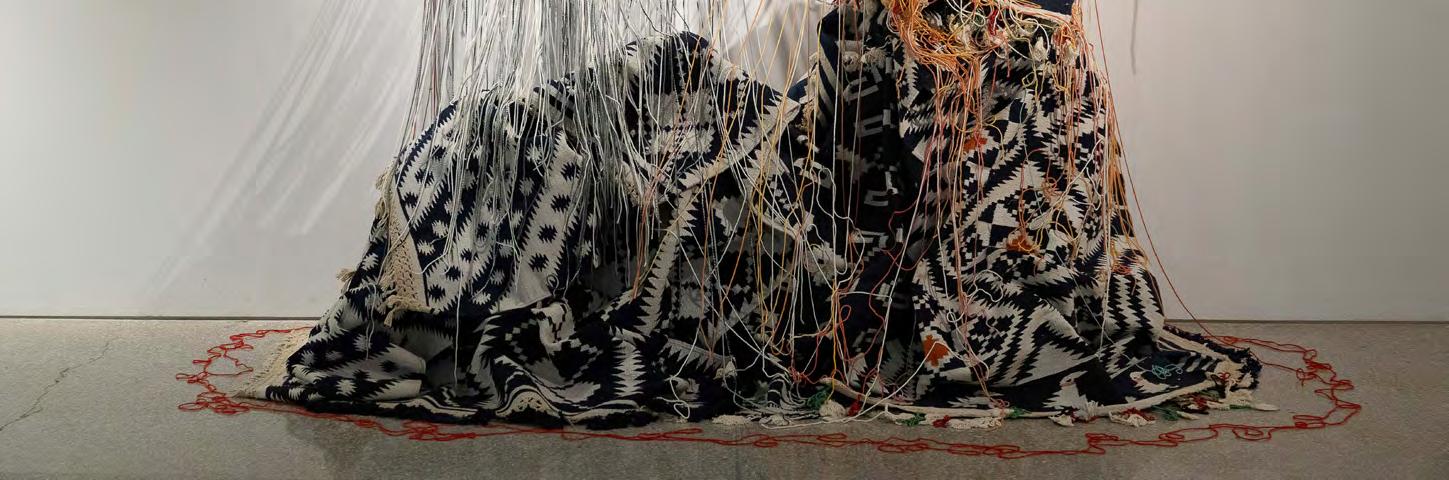
“‘SHE’...” BY KIRAN SRAN, AS PART OF HER SOLO EXHIBIT, BELONGING AND HERITAGE, AT THE SCHOOL OF ART STUDENT GALLERY.

School of Art Gallery wraps up Visiting Curator Program

Program concludes with Exchange as a Symmetrical Gesture panel event

T

he U of M’s School of Art Gallery invited two emerging curators in 2021, Lillian O’Brien Davis and Shalaka Jadhav, to create exhibitions and receive mentorship from Grace Deveney, an associate curator of photography and media at the Art Institute of Chicago. Previously, Deveney was an associate curator of the art triennial  Prospect in New Orleans.

The program resulted in three art shows — Open Structure by Deveney, The Performance of Shadows by Davis and To Broadcast is to Scatter by Jadhav.

On Oct. 16, the three curators gathered in Desautels Concert Hall to speak about their experiences in the

now-completed program in an event titled Exchange as a Symmetrical Gesture. The night began with artist Erika DeFreitas reciting poetry to accompany her compositions, the on a colourless blue series, which was featured in The Performance of Shadows

A panel, moderated by artist Nic Wilson, took the stage for the next half hour.

The panel spent most of their time on the topic of building relationships in the industry. Davis appreciated Deveney’s conversational style of mentorship and the confidence it gave her. Jadhav responded that Deveney helped her learn how to be a better colleague and shaped the way she will approach questions and themes in her

future work.

Davis recounted that she and DeFreitas have been working together since they were graduate students. The Performance of Shadows began with their connection and grew with the inclusion of artist Tim Whiten. She was overwhelmed by his generosity and compared their longterm collaboration to a stew simmering. Building relationships is one of her favourite parts of being a curator, she expressed.

Jadhav compared curation to gardening and highlighted the work each requires to uphold — projects start with an ideal vision during conceptualization and research, then more work comes when collaborating with the art-

ists. Jadhav concluded her allegory with imagery of a picnic shared with friends to represent the final product.

For Davis, the curation process begins with seeing other’s art and forming questions from the experience. She envisioned her role as a curator as paying attention to new and interesting works artists are creating. Davis is now the associate curator at the MacKenzie Art Gallery in Regina.

The curators also spoke about the social impact of curation. Deveney is particularly interested in galleries and museums as spaces of informal learning, since they combine creativity and academics. They differ from other forms of education because

people are often there while doing another activity, such as a family outing or a date with a partner. For her, exhibitions are a third place that bring people together. Finally, Jadhav recalled gallery programing playing a pivotal role in her youth. No one in her family was involved in the arts, but going to see performance art made exhibits more accessible for her. She kept this in mind when creating To Broadcast is to Scatter, which included two performances, showing the power of art in inspiring the next generation of curators.

Visit umanitoba.ca/art/exhibitions-and-events for more events hosted by the school of art.

PHOTO BY EBUNOLUWA AKINBO / STAFF
NIC WILSON (MODERATOR), LILLIAN O’BRIEN DAVIS, SHALAKA JADHAV AND GRACE DEVENEY SPEAK AT EXCHANGE AS A SYMMETRICAL GESTURE ON OCTOBER 16.

The Long Walk as gut-wrenching on screen as on paper

Film adaptation of Stephen King’s classic has proven well worth the wait

After languishing in development hell since 1988, Stephen King’s 1979 dystopian novel The Long Walk has finally made it to the big screen – and it was well worth the wait.

Directed and produced by Francis Lawrence from a screenplay by JT Mollner, the film stars rising young actors Cooper Hoffman (son of the late Academy Award winner Philip Seymour Hoffman) and David Jonsson in the central roles, with Garrett Wareing, Tut Nyuot, Ben Wang, Charlie Plummer, Judy Greer and Mark Hamill also appearing.

Set in a dystopian alternate version of 1970s America, the film follows 50 teenaged “Walkers” participating in the film’s titular walking contest. The Walkers are required to maintain a speed of three miles (five kilometres) per hour throughout the walk, risking execution if they slow down. The walk ends when only one Walker is left standing.

Notably, The Long Walk was filmed in various locations in Manitoba, including Birds Hill Provincial Park and the town of St. Lazare. Viewers from Manitoba may recognize these familiar spots as they appear on screen, adding a fun bonus to the viewing experience.

From the start of the walk until the credits roll, viewers will feel as though they are walking alongside the competitors, feeling their pain through every step. I felt loss every time a Walker succumbed to the pressures of the journey, even if they had only appeared for a few seconds in the film prior to that point (spoiler alert – if it wasn’t made clear already, there are deaths in this movie, some gruesome). The costume and makeup design, done by Manitobans Heather Neale and Doug Morrow, respectively, along with the excellent cinematography, do a great job at displaying the bleakness of the story and the struggles that the Walkers experience.

This tragic tale succeeds on the big screen largely because of its cast. Hamill is brilliantly evil as the contest’s leader, known only as “The Major,” and I found myself loving to hate him. Wang (who you may remember from his star role in this summer’s Karate Kid: Legends) provides some much-needed comic relief as the confident Hank Olson, and Plummer is compelling as the unpredictable, antagonistic Gary Barkovitch. I was able to remember nearly

every named character in this movie, which is a testament to the strong performances throughout.

However, the heart of this film is the friendship formed between Ray Garraty (Hoffman) and Peter McVries (Jonsson). I could feel the bond that Garraty and McVries shared, which made the circumstances they were in even more tragic.

the acting performances, noting the friendship between Garraty and McVries characters as being “deeply affecting.”

“This movie is a tough watch, for all the right reasons – you want to cheer for these characters, knowing full well that no happy ending awaits them”

There were some changes made from King’s novel, particularly some differences in Garraty and McVries’ motiva-

Hoffman is a steady anchor, serving his role well as a compelling protagonist. However, if I had to name just one standout among the cast, it would be Jonsson, who has a magnetic presence. He delivers every line with a nuance and complexity that warmed my heart in one moment and crushed it in the next.

Critics have raved about the film. It received an 88 per cent “Certified Fresh” rating on Rotten Tomatoes, with its critics’ consensus stating, “Cooper Hoffman and David Jonsson’s soulful performances bring a lot of heart to Stephen King’s dystopian tale, making The Long Walk a lifeor-death ordeal for its characters but a riveting ride for audiences.”

Writing for the Hollywood Reporter, Frank Scheck praised Lawrence’s direction, stating, “[Lawrence] does a superb job with material that could easily have proven tiresomely repetitive in the wrong hands.” He also commended

tions for entering the Walk. Most notable is a significant change to the story’s ending — while it does end with only one Walker standing, the rest of the finale takes a very different turn from the book. However, those who loved the book can rest assured that these changes do not lessen the emotional weight of the story. Make no mistake, as with

any Stephen King adaptation, The Long Walk is not for the faint of heart. This movie is a tough watch, for all the right reasons. You’ll want to cheer for these characters, despite knowing that no happy ending awaits them. For those who are interested in thrillers and enjoy Stephen King’s work, it is a must-watch. Just prepare to be physically and emotionally exhausted when the credits roll — as though you, too, have walked for days without stopping.

PHOTO PROVIDED BY MURRAY CLOSE / LIONSGATE

Bisons men’s hockey loses home opener 4-0

Bisons struggled offensively as Calgary Dinos dominated

The Bisons men’s hockey team held their 2025–26 home opener at Wayne Fleming Arena on Friday, Oct. 17. They faced the Calgary Dinos, and the match ended in a 4-0 loss for the Bisons.

The game started off with a thunderous cheer. Initially, the Dinos led the attacks with the Bisons backed up to defend. Both teams were testing each other out, playing cautiously to avoid mistakes. The Bisons were working the puck deep along the boards to their wingers, who would either drive toward the slot or feed a centring pass for an open scoring chance. In the opening period, the Dinos had nine shots on goal, while the Bisons had five, but neither team was able to score.

The second period started with the Dinos launching multiple offensive attacks. Just under six minutes in, the Dinos forward Hayden Pakkala broke the deadlock, banging in a rebound to give the Dinos a 1-0 lead. Midway through the period, the Dinos kept the pressure on, and defenceman Connor Horning

sniped another one past the Bisons goalie to double their lead. The Bisons had a couple of chances but could not capitalize on them, and by the end of the period, the Bisons were down by 2-0.

In the third period, the Dinos were back at the attack. Despite the Bisons attacking initially, the Dinos forward Jacksenn Hungle scored early in the period to make the score 3-0, putting the Bisons on their heels. The Bisons tried to mount a comeback, peppering Dinos’ goalie Carl Stankowski with shots, but he was a brick wall. Late in the period, with the Bisons’ net empty for the extra attacker, Dinos forward Adam Kydd fired one down the ice for the empty-netter, sealing the game at 4-0.

Bisons men’s hockey head coach Gordon Burnett shared his views on the game. “The second [period] wasn’t great, but I think it was a little better than our first, after things calmed down. In the third period, I thought we did some really good things.”

Regarding the breakdown of the scoring and the performance during the game,

he said, “I thought we got better as the game went on, and I think that if we play the same way we played this afternoon tomorrow afternoon, I think it’s [going to be] a different result on the scoreboard.” He added, “I think Carl Stankowski did a really good job in their net, and not to take away from the game they played, but I think their goalie did do a good job, and you have to give him his credit […] I think there’s some chances that we missed on.”

“We’ll look to recover for tomorrow and see if we can change the result.”

Some players stood out during the game, such as Sam Borschowa, defenceman for the Bisons, who showed effort in defence and tried to contain the Dinos’ attack. He blocked shots and contributed defensively throughout the game, even though the game did not go their way.

Another standout was Stankowski, Dinos goalie, who was the backbone of the team’s defence, stopping all 32 shots from the Bisons, contributing to Dinos’ control throughout the game. His performance

devastated the Bisons as they could not score.

Pakkala, Dinos forward, also played well. He opened the scoring in the second period and consistently created offensive opportunities. His initial goal and presence in the centre ice helped the Dinos maintain momentum and put pressure on the Bisons’ defence.

Bisons football pulls off home win

Bisons defeat Calgary Dinos 33-31 at home

Abdul-Jalilu Ahmed, staff

The Bisons football team pulled off a narrow 33-31 win over the University of Calgary Dinos on Saturday, Oct. 18 at the Princess Auto Stadium.

The Dinos struck first with a single point from Vince Triumbari at 14:53 of the opening quarter. The Bisons answered when Maya Turner kicked a 17-yard field goal at 9:37, putting them ahead 3-1. The Dinos tied the game 3-3 after forcing a team safety at 6:21. Triumbari then added a 31-yard field goal at 1:42, giving the Dinos a 6-3 lead to close out the first quarter.

At the 11:39 mark in the second quarter, Braeden Smith caught a 10-yard pass from Jackson Tachinski to give the Bisons a 10-6 lead. Later, with 2:01 left, Jet Zakrzewski made a two-yard run for the Dinos, placing them ahead 13-10 at halftime.

In the third quarter, Evan Smith caught a 15-yard pass from David Jordan at 11:27, extending the Dinos’ lead to 20-10. The Bisons responded as Turner kicked a 25-yard field goal at 8:12, cutting the

deficit to 20-13. Turner struck again with a 19-yard field goal at 3:14, narrowing the gap to 20-16. At 0:00, Bisons Tachinski made a two-yard run, giving the team a 23-20 advantage.

The Bisons widened their lead to 26-20 in the fourth quarter when Turner kicked a 26-yard field goal at 9:01. The Dinos answered at 6:45 with a 19-yard field goal from Triumbari, cutting the deficit to 23-26. With 1:44 left, Tachinski made a one-yard run to give the Bisons a 33-23 edge. At 1:28, Zion Grant received a 78-yard pass from Jordan, closing the gap to 30-33. At 0:00, Triumbari added a single point on a rouge for the Dinos, bringing the score to 31-33. The Bisons held on to seal the narrow victory.

Bisons football head coach Stan Pierre urged his players to stay committed to executing their game plan in order to win. “I think that [players, especially of this age,] tend to not want the bad thing to happen to them that costs the team the game, and I don’t want them ever thinking

that way,” said Pierre. “I only want them thinking about the thing that they can do to help the team win. They practice, they’ve been through hundreds and hundreds of repetitions. They know what to do, they know how to execute, so I want them to execute and to win games.”

He pointed out the approach that should be taken to win the next game. “Our players need to match [the opponent’s] energy at the beginning of the game and put some doubt in their heads that they’re not going to roll.”

Bisons quarterback Tachinski expressed confidence in his teammates, noting that they always play with determination and never give up. “This team just doesn’t quit. I don’t really care what the score is at any point in the game, it doesn’t really matter to this team — we’re gonna play our hardest. Whether it’s first quarter, fourth quarter, we never quit and that’s the best part about this team […] These guys fight till the end.”

Bisons linebacker Dario Macchia outlined the key fac-

The Bisons faced the Dinos again on Saturday, Oct. 18, at the Wayne Fleming Arena. The Bisons put up a good fight, but it was not enough, as they lost 5-4.

The Bisons men’s hockey team will face Mount Royal Cougars on Friday, Oct. 24 and Saturday, Oct. 25 at 7 p.m. CT at the Wayne Fleming Arena.

tors that have made an impact on the team this season. “Our communication’s gotten a lot better. We’re always on the same page, knowing what’s going on, so I think that’s the main thing.”

Macchia explained how he continues to build confidence in his career. “Every year [it just gets] more and more comfortable […] You get more and more reps in practice and

more game time as well.”

In the league standings, the Bisons football team has eight points, with four wins and three losses from seven games.

The Bisons football team will play the Saskatchewan Huskies on Saturday, Oct. 25, 3 p.m. CT in Saskatoon, Saskatchewan.

PHOTO PROVIDED BY ZACHARY PETERS
PHOTO BY EBUNOLUWA AKINBO / STAFF

Bisons soccer dominates Lethbridge

Bisons shut out Pronghorns in a 3-0 win

Israel Adeogo Abejoye, staff

The Bisons soccer team throttled the University of Lethbridge Pronghorns 3-0 in a match at the East Turf Field on Saturday, Oct. 18. The Bisons’ dominance was evident from the opening whistle, with the team controlling the tempo of the game and creating scoring opportunities at will.

The first half showed a strong performance by the Bisons, with the team scoring three goals and outshooting their opponents 6-0.

The Bisons’ first corner kick came in the third minute [3:12], and they followed it up with another in the 13th minute [13:34], but neither made it in.

The persistence paid off when Pronghorns goalkeeper, Heidi Andres, opened the scoring in the 14th minute [14:43], deflecting a corner kick from Breyanna Johnston-Krulicki into her own net. The momentum shifted firmly in the Bisons’ favour.

Sarina Mann doubled the Bisons’ lead just before halftime, scoring her third goal of the season in the 34th minute [34:00]. Bianca Cavalcanti’s dribbling down the right flank created chaos in the Pronghorns’ penalty area, and her pass found Mann, who slotted the ball past Andres. The Pronghorns tried to respond, but the Bisons’ defense was solid, and they were unable to create any significant threats.

The Bisons were not done

yet, as Mia Fonseca notched her first goal of the season just a minute after Mann’s strike [35:00]. Fonseca’s finish was clinical, thanks to an assist from Mann, who continued to torment the Pronghorns’ defense. The Pronghorns made two substitutions towards the end of the first half, but it was too little, too late.

The second half was a more subdued affair, with both teams creating fewer scoring opportunities. The Bisons’ defense, marshalled by their backline, comfortably saw out the game, with goalkeeper Holly Dyker making two crucial saves to deny the Pronghorns any scoring.

The Pronghorns began the second half with three changes, while the Bisons made one.

The Bisons continued to create scoring opportunities, with Mann and Cavalcanti attempting to score in the 52nd and 55th minutes [52:20 and 55:37], respectively. However, Andres made several key saves to deny the Bisons goals. The Bisons made several substitutions throughout the second half, giving all their players a chance to contribute to the win.

The statistics underscored the Bisons’ dominance, with the team registering 11 shots to Lethbridge’s three. The Bisons also enjoyed more set-piece opportunities, earning six corner kicks to the Pronghorns’ one. Andres, despite the own

goal, made seven saves, while Dyker made two.

The foul tally was almost evenly matched, with the Bisons committing 12 fouls and the Pronghorns 11. Bisons’ Isabella Lone was the only player to receive a yellow

card, which came in the 75th minute [75:19].

In the end, the Bisons emerged victorious, but both teams gave it their all, showcasing their skills and determination on the field. While the Bisons’ clinical finish-

ing and strategic play ultimately paid off, the Pronghorns’ efforts were commendable.

The match was clearly a reflection of the competitive spirit of both teams, providing valuable lessons from the encounter.

Bisons soccer thrashes Pronghorns in second game

Bisons enjoy

a 6-2 win over Pronghorns

Israel Adeogo Abejoye, staff

The Bisons soccer team continued their winning form in the return leg against the University of Lethbridge Pronghorns at the Princess Auto Stadium on Saturday, Oct. 19. The Bisons dominated the match, scoring six goals and conceding two, to secure a 6-2 victory.

The Bisons started strong, scoring three goals in the first half. Taylor Sousa opened the scoring in the 8th minute [8:42], assisted by Tabata Bravo. Paris Sidhu doubled the lead just before the 26th minute [25:58], thanks to a pass from Bianca Cavalcanti. Cavalcanti herself scored the third goal, assisted by Bravo, in the 34th minute [34:07].

The Pronghorns seemed to be on the back foot, but they refused to give up. Goalkeeper Kate Prince’s free kick found

its way to Bronwyn Pittman, who headed the ball into the net, reducing the deficit to 3-1. Just before halftime [45:00], Julia Reale’s corner kick was met by Chiara Duenser’s head, and she nodded the ball into the net, giving the Pronghorns a glimmer of hope at 3-2. However, the Bisons’ momentum continued in the second half. Mia Fonseca scored her second goal of the season, assisted by Chloe Morin, in the 49th minute [49:21], bringing the score to 4-2. The Pronghorns tried to mount a comeback, but the Bisons’ defense was solid.

Bisons head coach Mark Colvin said, “On the defending side, I thought we were really organized. We’re not giving Lethbridge any space to play through us […] It was great that we were able to defend together and then have more

possessions within the game. It’s something that we’ve been working on the last couple of weeks.”

Taleesa Minnaar scored her second goal of the season, assisted by Sarina Mann, in the 80th minute [80:10], giving the Bisons a 5-2 lead. In the final minute of the match [90:00], Minnaar completed yet another goal, assisted by Neesha Claire, securing a 6-2 victory for the Bisons.

Bravo shared how she was able to motivate her teammates before and during the match. “It’s just a matter of still wanting to score. I think everyone here was on the same page,” she said. “I told my attackers and I told my wingers, ‘Guys, I believe in you. I believe in myself. And that’s all we have to do. Even if you don’t see me making that run, send the ball. I promise I

will make those runs. I promise I will not give up.’ And that’s literally how the second or the third goal happened.”

The match saw a total of 28 shots, with both teams having 14. The Bisons’ goalkeepers made seven saves, while the Pronghorns’ goalkeepers made three. The Bisons committed 12 fouls, while the Pronghorns committed nine.

Three Bisons players, including their coach, received yellow cards, while only one player from the Pronghorns received a yellow card.

The Bisons scored nine goals in total this weekend. “Early in the weekend, a big thing for us was to score that first goal. It allowed us to play with less stress, and that confidence just drives when we’re in front of goal […] then the confidence for the second goal drives the confidence for

the third,” Colvin said. “It’s not that surprising that we get to nine. Certainly we have the quality within the team to put the ball in the back of the net. It’s just about our decision-making in the final third and composure and ruthlessness to score.”

The Bisons concluded the season in seventh place, finishing 10 points ahead of the Pronghorns at the bottom of the prairie division standings. They fell short of a playoff spot, sitting 14 points behind fourth-place Saskatchewan, which was the final qualifying position. With Calgary, Mount Royal and MacEwan securing the other spots in the top four, the Bisons will have to wait until next season to make another push for the playoffs.

PHOTO BY EBUNOLUWA AKINBO / STAFF

Easy Peasy

You drink it. You bin it.

Get an A in recycling empty beverage containers. Without studying.

Turn static files into dynamic content formats.

Create a flipbook