A “volunteer staff” member is defined as a person who has had three volunteer articles, photographs, or pieces of art of reasonable length and/or substance published in three different issues of the current publishing year of the Manitoban. Any individual who qualifies must be voted in by a majority vote at a Manitoban staff meeting. Elected representatives and non-students may be excluded from holding votes as volunteer staff members in accordance with the Manitoban Constitution.
The Manitoban is the official student newspaper of the University of Manitoba. It is published monthly during the summer and each week of regular classes during the academic year by the Manitoban Newspaper Publications Corporation.
The Manitoban is an independent and democratic student organization, open to participation from all students. It exists to serve its readers as students and citizens.
11 candidates run in election; 50 students turn out to vote
CRAIG ADOLPHE, STAFF
The University 1 student council held elections last week to fill its 11 representative positions.
Outgoing UMSU representative for the U1 council and CRO for the U1 elections, Sanjana Vijayann, told the Manitoban that 50 voters turned up over two days to vote in the election, a major drop-off compared to the roughly 200 students in last year’s U1 election.
Eleven positions were open as part of the U1 election. Only 11 people applied with two candidates running for the president position, nine of the other 10 council positions being won through acclamation, and a single seat remaining unfilled.
The one contested seat was won by Luigi Imbrogno in a low-key contest against Mattison Froese. Imbrogno received 27 votes while Froese received 13. Ten of the 50 ballots were either spoiled or left blank for presidential candidates.
When only one candidate is running for a position, voters simply vote “yes” or “no” with respect to the individual candidate. As long as “yes” votes outnumber “no” votes, the candidate is elected.
Craig Karpinksy was elected vice-president with 27 yes and 7 no votes. Jessica Smith was elected director of programming with 36 yes and 4 no votes. Jaron Hart was elected treasurer with 30 yes and 6 no votes.
Four UMSU representatives were elected. Changxiao Li was elected with 21 yes and 11 no votes, Tache Forbister with 23 yes and 8 no votes, Esther Atoyebl with 19 yes votes and 11 no votes, and Oluwatosin Kolade with 17 yes and
12 no votes.
Two of the three senate assessors were elected. Shira Dveris was elected with 31 yes and 5 no votes, and Oyindamola Alaka was elected with 22 yes and 10 no votes.
Vijayann said the U1 council would host a by-election to fill the empty senate assessor seat.
Vijayann said that the timing and location of this year’s election may have impacted the voter turnout.
“We couldn’t get a table at University Centre [as we usually would], because student recruitment week was going on [ . . . ] But we tried to advertise that the location was at Fletcher [Argue] this year.”
Vijayann said elections would normally take place in September but were delayed until October this year which affected the availability of UC for a polling station.
The delay came as a conscious decision on the part of U1 council who wanted to host the election after they changed their bylaws at the September general meeting. During the September general meeting, U1 council made changes to the timeframe of U1 councillor terms in order to reduce the required shadow period before assuming office.
The previous shadowing process had newly elected U1 councillors come on as non-voting members for the entire first year to learn the roles and responsibilities before officially joining council for the following year. With the new changes incoming, councillors will assume office after December, leaving new members with a shorter, three to
four month shadowing period.
Vijayann said that members of the U1 council hoped the changes would increase participation in council going forward.
“People lost interest [ . . . ] not having voting powers or just shadowing for a whole year.
“[Councillors] decided, coming from their own experience, that they wanted to change it.”
Vijayann said that U1 council had also hoped the additional time would give incoming students more time to consider running and get to know about the U1 student council.
“We wanted to give [new students] some time to get a feel of school and be able to advertise the council for a little bit before we opened the positions.”
Luigi Imbrogno, president-elect of U1 council, didn’t comment on the drop in voter turnout from last year but said he wasn’t surprised at how low it was.
“In a school election like [this] where it’s first-year students who aren’t really involved in a lot of other things—it’s different if you’re second [or] third year and you’re in your faculty and you know what’s going on—but first-year students mostly just come for school, then leave.”
When asked what he might do in partnership with next year’s CRO to improve voter turnout, Imbrogno suggested announcements in first-year classes and more posters to notify students of the election.
Profile: U of M students running in Winnipeg’s municipal election
Two local students make their final push in their respective bids to become school trustees
CRAIG ADOLPHE, STAFF
T
wo University of Manitoba students are running for school trustee as part of Winnipeg’s 2014 municipal election, taking place Oct. 22.
The Manitoban asked both candidates about themselves and their experiences running for office.
Tanjit Nagra
Tanjit Nagra is an 18-year-old arts student majoring in political studies. She’s also the outgoing vice-president of the U1 student council and the vice-president external of the undergrad political studies students’ association.
Nagra is one of three candidates for school trustee in Ward 1 of the Louis Riel School Division. She is facing off against incumbent Louise Johnston and labour endorsed Cindy Turner. Two of the three candidates will be elected to represent the ward.
Nagra said if elected she’ll bring a fresh perspective to the position while sustaining what has been done over the last four-year term.
“Things I’d like to advocate for is inclusiveness – providing equal opportunity for all students, whether that’s LGBT* rights or whether its students with disabilities or special needs. I think it’s important that they have the tools they need to succeed.”
Nagra isn’t a francophone— although she’s taken French as an elective and speaks it at a basic level —but said that she’s also campaigning on sustaining French immersion programs in the Louis Riel School Division.
Nagra said two of the major barriers to students participating in elections are the time commitments associated with classes and knowing how to get involved in the process.
“Being a student is obviously timeconsuming. I am taking a lighter course load. In the summer I took extra courses just so I had the option of only going to school part-time this year that way I can fully commit to my campaign – but I think sometimes it’s also just not knowing how to get involved or who to reach out to.”
Nagra said she did not know she would be committing to candidacy in the 2014 election last year.
“It’s just something I started researching. I started attending the public board meetings the division has and I really started enjoying it. And I started reaching out to trustees, just kind of seeing what it would be like if [I was] in that position.
Nagra said she was expecting a lot of people to be critical of her age but said that it has not been a major issue in her campaigning.
“There’s been a couple of people saying ‘Oh, you’re just too young,’ but to be honest I’ve been getting way more positive [feedback] than negative. I think that’s fantastic.”
Luigi Imbrogno
Luigi Imbrogno is another candidate for school trustee in the 2014 election. Imbrogno is an 18-year-old U1 student pursuing a science degree at the University of Manitoba. He was recently elected president of the U1 council at the U of M and has worked as a volunteer for Jon Gerrard, Manitoba’s only Liberal MLA.
Imbrogno is running in Winnipeg School Division – Ward 1. The ward is arguably the most contested in the city with seven candidates in the running and only one to be elected.
River East Transcona School Division – Ward 1 also has seven candidates running but is electing two. Louis Riel School Division – Ward 3 has eight candidates running but is electing three of them. Similarly, Seven Oaks School Division – Ward 2 has nine candidates running but is electing four of them.
Other candidates for the ward include Heather Condona, Paul Guise, David Lobson, Sheri Oberman, Sherri Rollins, and Marilyn Simon.
Imbrogno said the thing that sets him apart from the other candidates is the fact that he still knows what it is like to be a student.
“I just went through the Winnipeg School Division system. It’s all fresh in my mind so I have that hands-on, practical knowledge of what’s going to help students my age and what programs [we are] spending money on that we don’t need to spend money on.”
Imbrogno said he has been engaged in a lot of door-to-door campaigning in his bid for school trustee and that he has encountered people who are skeptical about him as a candidate because of his age, but that overall most voters are very receptive.
“I think it’s more that people won’t take you seriously at first. They’ll think it’s kind of a joke.
“There’s that stigma [that] you need to be experienced and an older person to run for office outside of a student body council.”
Jeremiah Kopp
UMSU vice-president internal Jeremiah Kopp ran for school trustee for Louis Riel School Division in a 2011 by-election. In the eight-person race, Kopp came in second place with 817 votes, losing out to Colleen Mayer who received 976 votes.
Kopp said he had no regrets about his run for school trustee.
“It was definitely a fantastic experience. In many ways it prepared me for working for UMSU in terms of running campaigns, and being involved, and being a politician.
“I hope it’s been rewarding process for them as well. I know them personally, they’re two outstanding young leaders in our community and regardless of the outcome of this election they will play important roles in Winnipeg’s future. Both fantastic individuals, both very young but can bring a lot to the table.”
Kopp said he was happy to see young people getting involved in politics and hoped to see more in the future.
“Just put your name out there. Put your ideas out there. Always work hard and never get discouraged if things don’t go the way you want them to. Keep trying.
“Politics is a very noble thing to get involved with. You’re always going to have people who are trying to hold you back but ultimately if you’ve got a vision, and if you’ve got a passion for it, then you have to keep pushing and keep trying no matter what.”
PHOTOS BY CAROLYNE KROEKER
‘Gum is something you ask for, sexual assault is not’
Campaign posters challenging sexual violence vandalized
DANA HATHERLY, STAFF
Trigger warning: rape.
Newly posted campaign posters intended to engage students at the University of Manitoba by acknowledging and critiquing rape culture on campus were vandalized with victim-blaming statements less than one week later.
The posters were put up on Oct. 9 throughout the University of Manitoba tunnels and buildings. The public service announcements featured an image of a pack of gum with rape myths and the expression, “Gum is something you ask for, sexual assault is not.”
“Our society, culture, and media bombard women with the message that if they are to be valued, they must be beautiful, sexy, and alluring, and yet simultaneously blame women if they are raped or sexually assaulted for looking ‘too sexy’” – Wanda Hounslow, U of M sociology student
By Oct.16 at least four posters were found to be defaced. The vandalized posters were tagged with messages like, “Then don’t dress like a skank” and “Ignorance is bliss ‘til you get
raped. Dress smart!”
The various tags appear to have been written with a similar pen and in similar handwriting.
“I noticed the graffiti as I was walking through the tunnels,” said Wanda Hounslow, U of M sociology student.
“At first I thought it was just the one [defaced poster], but when I continued on, I passed several more so I decided to pull them down.”
Hounslow is leading the new UMSU-supported campaign to address myths surrounding sexual assault and rape culture on campus under the banner of #NoMoreBlurredLines. The posters were originally developed over the summer for a project in sociology professor Mary-Anne Kandrack’s class and were recently posted across campus to raise awareness as part of the #NoMoreBlurredLines campaign.
“[The project] meant to address the myth that ‘women ask’ to be sexually assaulted by the way they dress or act,”
Hounslow told the Manitoban
“Our society, culture, and media bombard women with the message that if they are to be valued, they must be beautiful, sexy, and alluring, and yet simultaneously blame women if they are raped or sexually assaulted for looking ‘too sexy.’
“By this same logic, male football players in spandex outfits—or the countless topless men that parade our Winnipeg streets on the warm days of summer—are also asking to be raped.”
Hounslow explained that this logic implies that men have no control or agency over their own sexual desires; that victims of sexual assault are to blame for their rapist’s behaviour; and that rape is a sexual act.
Meanwhile she says that, “it is in fact an act of power and violence.”
Based on his newly proposed campaign position, Robert-Falcon Ouellette, Winnipeg mayoral can-
didate and program director for the U of M Aboriginal Focus Program, spoke to the issue of sexual violence on campus and in our city. “Men need to be accountable and responsible for their own actions, and the remarks on posters show that people just aren’t taking [sexual assault] seriously. It is
“Men need to be accountable and responsible for their own actions, and the remarks on posters show that people just aren’t taking [sexual assault] seriously” – RobertFalcon Ouellette, Winnipeg mayoral candidate and program director for the U of M Aboriginal Focus Program
always going to be an ongoing process of education and raising awareness.”
“I am saddened to hear that vandalism has taken place with regard to campaign materials produced by students, for students,” said Rebecca Kunzman, UMSU vice-president advocacy.
“That the campaign has already received this backlash only proves how desperately we need to address the issue of myths and misconceptions surrounding sexual assault and the ways in which silence and rape culture contribute to gender-based
violence,” said Hounslow. She said that she intends to contact UMSU and Security Services to inquire about “reviewing the videotape footage of the tunnels and making an official complaint.”
“Going forward,” Kunzman said, “students at the U of M can expect continued dedication and great work from the student leaders behind the campaign.”
“The first step is that [sexual violence] needs to be taken seriously,” Ouellette said. “It needs to be made a priority, and priorities need to be funded.
“In my plan for the city, we are putting resources into creating safe places so that if people find themselves in trouble, they know that can get safe.” Ouellette continued, “Many of these would also work on campus, and some are in place: awareness, safe spaces, effective enforcement. Everyone should have the right to feel safe on campus.”
“These incidents have only grounded my resolve, [and] serve as an example of precisely why campus rape culture needs to be addressed,” Hounslow said. “This is what rape culture looks like.”
PHOTO BY CAROLYNE KROEKER
Canadian Federation of Students-Manitoba hosts student activism forum
University of Manitoba students encouraged to direct action on campus
PHILMA SCHEEPERS, STAFF
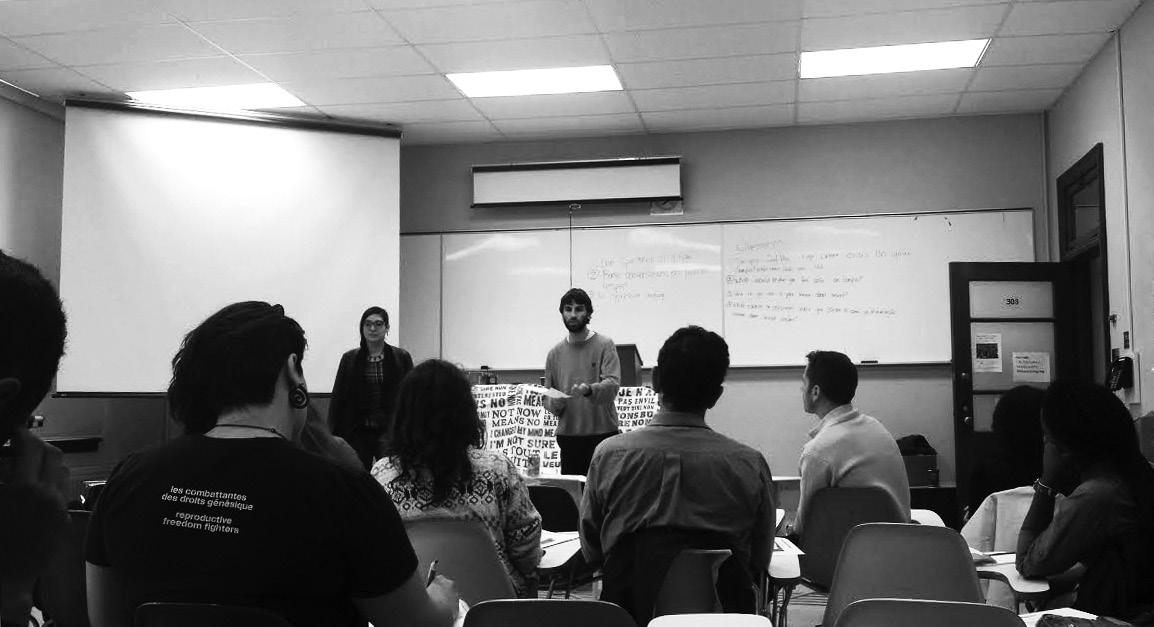
The Canadian Federation of Students-Manitoba campaigns forum held at the University of Manitoba on Saturday, Oct. 11 featured workshops on eliminating rape culture, fossil fuel divestment, affordable education, building inclusive campaigns, and a U of M Student Action Network campaign.
The workshops were hosted by CFS-MB at the U of M campus because it is the biggest campus in the province, according to Mitchell van Ineveld, deputy chairperson for CFS-MB and Minister of the Parlement Jeunesse Franco-Manitobain.
The featured workshops had been chosen based on topics voted on by the CFS earlier this year, said Zach Fleisher, CFS-MB chairperson.
“We tried to have workshops that reflected our provincial executive,” he explained. “This is just the beginning. We are using these workshops to recalibrate our campaigns and to direct them further for the year ahead.”
The workshops were not chosen based solely on interest, according to van Ineveld. He noted that there were many other topics that students showed interest in that could have easily been included in the program. Instead, he said the topics were chosen based on the availability of people who could host them.
“We had hoped to include initially more topics but were concerned that if we could not find the right people to offer those workshops, that it would compromise their quality,” said Allison Reimer, CFS-MB women’s commissioner and co-facilitator
for the CFS No Means No campaign. Reimer explained that not every workshop will be of interest to everyone based on their different preferences.
“All of the issues that we try to address in CFS are directly affecting students, such as sexual assault and financial difficulties. It’s really crucial that students have a say in the running of our country and of our province,” said van Ineveld.
Moving the student movement
Despite the change-positive atmosphere, third-year honours philosophy student Ian McDonald, who attended the campaigns forum, told the Manitoban that he is worried that there is widespread apathy amongst Manitoban students.
“We tend to use a lot of hypothetical talk in activism,” said McDonald. “There have been recent movements— both in Winnipeg and throughout the world—that have suffered from being pure momentum and enthusiasm.
“People like to get involved, get together, and complain about stuff. Some of these movements have even gotten loud enough to be heard, only to realize that they don’t know what to say,” continued McDonald.
“Others have had a goal in mind, but have instead not had any effect due to methods used.” He felt that the only way to have an effective movement is to have a concrete strategy with steps and goals.
“It can be hard to become active because activism can sometimes be intimidating to people,” added
Reimer. “It’s great to start with things that you’re passionate about and read up on them, and if there’s a campaign that aligns with your morals and starts a fire in you, then that’s what you should be following.”
During the Education for All campaign workshops, co-presenter van Ineveld said that “anger is the tool of movements.” He encouraged students to read the news and find something that makes them outraged. “Whatever it is that makes you angry—whether it’s climate change or racial discrimination—start looking for organizations that are organizing around that issue.”
The CFS campaigns forum was also attended by UMSU vice-president advocacy Rebecca Kunzman. “I wanted to make sure that UMSU had a representative at the campaigns forum to let students know that UMSU has taken on a new campaigns structure this year and have successfully been able to recruit a number of students that have been involved in the campaigns that we are offering,” Kunzman explained, “as well as taking on some new campaigns that I’m very excited to see start on our campus.”
During the U of M Student Action Network workshop, Kunzman addressed UMSU’s new campaigns structure and their involvement with CFS. “We see [UMSU] fitting into this new structure as a supportive role and as a liaison in providing support to students who want to organize and create positive change for themselves, their campus, and their community,” Kunzman told the Manitoban
The U of M Student Action
Network was directed specifically at U of M students who attended the forum to promote student activism on the university campus. Kunzman said that she was “glad to see that there were so many student leaders from the U of M campus that got involved today and were excited to organize on campus.”
As part of his Education for All presentation, van Ineveld used the Campaign Cycles diagram to dem-
onstrate what CFS deemed to be the necessary steps for a successful movement.
“We haven’t seen a lot of CFS activity on the U of M campus in the last couple of years and one of our big goals this year is to be on campus and really engage with students and get things moving,” Ineveld told the Manitoban
PHOTOS
Editor-In-Chief: Bryce Hoye
Contact: Editor@themanitoban.com / 474.6770
Playing the name game
Analyzing racist sports logos
MIKE STILL, STAFF
Debate has raged on in recent months over the Washington NFL football team’s name, the Redskins.
The team moved to the nation’s capital in 1937. Numerous parties, including the National Congress of American Indians, have made their voices heard over the controversial team name since that time.
Despite increased demand to change the name, Redskins owner Dan Snyder has remained firm in his support of the title.
“A redskin is a football player. A redskin is our fans,” Snyder said in an interview on ESPN’s “Outside the Lines” program. “The Washington Redskin fan base represents honour, represents respect, represents pride. Hopefully winning.”
These words represent a large contradiction. Clearly, Snyder is trying portray the product on the field as unifying and something that supporters should be proud of. He has successfully branded the team,
and has a loyal following within the fanbase.
I am personally offended by the “Redskin” name, and it bothers me that Snyder is not respecting the rights of Native Americans, who are beginning to find their voice in this matter
What he has failed to understand is the negative and demeaning connotations that the word “Redskin” entails – especially for those of Aboriginal descent. To me, whether language is offen-
sive ought to be determined by the group most impacted by it, not by someone outside of that group who will be inclined to defend its use for whatever tasteless reason.
As an individual with First Nations heritage, I am personally offended by the “Redskin” name, and it bothers me that Snyder is not respecting the rights of Native Americans, who are beginning to find their voice in this matter.
Even United States President Barack Obama has chimed in on the issue and is aware of the growing concern regarding the Redskins logo.
“If I were the owner of the team, and I knew that there was a name of my team—even if it had a storied history—that was offending a sizeable group of people, I’d think about changing it,” Obama said, in an October 2013 interview with the Associated Press.
This is not the first time that a team has come under fire for its name. It’s happened relatively frequently in the NCAA, with universities such as Eastern Michigan (the Hurons until 1991), Marquette (the Warriors until 1994), St. John’s (the Redman until 1994), and North Dakota (the Fighting Sioux until 2012).
Perhaps the most pertinent name change came from Miami of Ohio, which used to go by the Redskins as well. The university decided to switch to the Red Hawks, beginning in 1997.
This brings up an important question. If numerous NCAA schools, including one which used to go by the same name which Washington still holds, can take the higher road, why can’t a professional team do the same?
In my opinion, the difference comes down to branding. The
Redskins are the third most valuable franchise in the NFL, with a $395 million annual revenue, and $143.4 million operating income. To change the name now doesn’t make economic sense for Snyder. He would have to build a whole new image to get consumers to buy into.
On the other hand, NCAA schools don’t face the same dilemma, mainly because their university sporting teams aren’t the sole providers of income. Therefore, a change in branding, even slightly, doesn’t have
the same impact.
For those speaking out against the Redskin logo, it appears that the only way change will occur is if Snyder steps down, and that isn’t likely to happen anytime soon. For the time being, the back and forth debate on both sides will continue, which is flat out unacceptable. I know the term “Redskin” is disrespectful, as do most other people. To me, the answer to this problem is simple. Dan Snyder: stop acting like a colonialist, and just change the name.
Timeline of Name Changes in the NCAA
Science & technology
And the winner is…
The Scientific Nobel Prize recipients of 2014
JEREMIAH YARMIE, STAFF
T
he Nobel Prizes in Chemistry, Physics, and Medicine were handed out earlier in October. The prize-winning research included advancements in the small world of microscopy, innovation in sustainable light sources, and how brains makes sense of locations.
Chemistry
The Nobel Prize in Chemistry was awarded to Eric Betzig, Stefan W. Hell, and William E. Moerner for their work on “the development of super-resolved fluorescent microscopy.”
Typical light microscopy has a physical limitation when it comes to the smallest size it can image. The team of chemists developed two separate microscopy techniques that surpass these limitations.
When a fluorescent molecule is exposed to light, it shines light back out of a different colour. Both of these techniques depend on fluorescence.
In 2000, Hell developed a microscopy technique called stimulated emission depletion microscopy. The basis of stimulated emission depletion involves a sort of nano-flashlight. It works by exciting fluorescence molecules, and immediately blocking the bounce-back light from all molecules, except for those in a very tiny spot in the middle, which is recorded.
This flashlight can sweep across a sample to compose a very detailed image. Betzig and Moerner each carried out research developing the other awarded method, single-molecule microscopy, which was first unveiled in 2006. Single-molecular microscopy revolves around the ability to repeatedly excite different fluorescent molecules with weak shots of light, and combining the taken pictures into a composite image.
These techniques allow us to venture into the nanoscale world, and visualize the finest details of living cells.
Physics
The Nobel Prize in Physics was awarded to Isamu Akasaki, Hiroshi Amano, and Shuji Nakamura for their work on “the invention of efficient blue light-emitting diodes which has enabled bright and energy-saving white light resources.”
To produce white light, you have to combine red, green, and blue light through an additive effect. Red and green light emitting diodes, or LEDs, have been around for a while, but the invention of blue LEDs allowed the commercial utilization of white LED light.
Light emitting diodes have the benefit of being very efficient. Older light sources—incandescent and fluorescent lamps, for instance— saw most of the electricity being turned into heat, a rather wasteful use of energy.
Light emitting diodes, on the other hand, do not have this problem; LED lights also have the benefit of “lasting 100 times longer than incandescent bulbs and 10 times longer than fluorescent lamps.” The low energy requirements and long lifespan of LEDs have revolutionized light use in society. Chances are, if you aren’t reading this article on print, you are probably using LED light at this very moment.
Physiology or medicine
The Nobel Prize in Physiology or Medicine was awarded to John O’Keefe, May-Britt Moser, and Edvard Moser for their work on “discoveries of cells that constitute a positioning pattern in the brain.”
There are particular cells in rat brains that compose a sort of internal Google Maps, allowing them to make sense of locations and their position amongst them. The hippocampus is an area of the brain involved in memory, and in 1971, O’Keefe observed that when rats were placed in particular locations, certain nerve cells in this area of the brain were activated.
O’Keefe showed that these “place cells” work together to develop an internal map of the rat’s environment.
In 2005 , May-Britt and Edvard discovered a similar process in a nearby area of the rat brain, which interacts with O’Keefe’s hippocampal place cells. These cells form a grid which compose a co-ordinate system in the brain. Recent research has shown that these mechanisms are also found in humans.
It is always humbling to consider how human brains allows us to carry out experiments to understand how the human brain works.
The award recipients and their research helps to make sense of the world around us, as we perceive it, and will allow us to view things in new and sustainable ways. One can argue that, perhaps, scientific research does not have to be rewarded, and that it is intrinsically rewarding.
It would be hard to argue that we would do better without the research that is being acknowledged.
Freaks of Nature: Clownfish
Making the switch from Marlin to Coral
JEREMIAH YARMIE, STAFF
Welcome back to Freaks of Nature! This week we have a particularly innocent and inconspicuous freak: the clownfish.
Also known as anemonefish, the majority of clownfish species belong to the genus Amphiprion. Clownfish are common aquarium fish, and were made popular by the Pixar movie Finding Nemo
Clownfish live in a mutually beneficial, close association with sea anemones. The two organisms help each other out in a number of ways.
Both organisms may leave around leftovers of food for the other to eat. This kind of arrangement may not work well for roommates, but clownfish and anemones are not too picky.
The clownfish are protected from their predators by living inside the anemone, which have toxic stingers.
The clownfish are protected from the anemone’s stingers by a layer of mucus on their skin.
Anemones, in turn, are protected from their predators by the presence and actions of their resident clownfish. These fish can scare off animals, like turtles, who attempt to make a meal out of their home anemone.
Clownfish also help protect their anemone from infectious parasites.
All clownfish are sequential hermaphrodites which are born male. Sequential hermaphroditism is a process of sexual determination in which individuals change sexes at some point in their life.
Clownfish are protandrous hermaphrodites, meaning they transition from male to female.
Clownfish are monogamous, with a single breeding female and male
pair per group. This monogamy may have developed due to the small living spaces available in anemones.
Along with the two breeding fish, several non-breeding juvenile males may reside within an anemone as well.
The fish residing in an anemone adhere to an aggressive hierarchy based on size. The large alpha female is aggressively dominant over the males. The beta fish, the breeding male, is, in turn, aggressive toward the smaller non-breeding males, which are all ranked based accordingly by size.
Many non-breeding males are unable to produce sperm. These juveniles are physically deterred from attempting to mate with the female. As well, the female’s dominance over the males prevents the formation of another female. This helps establish
and maintain the hierarchy found within the groups.
This is where things get interesting! Upon the death or loss of the female, the breeding male will change sex and become the new breeding female.
A large non-breeding male will rapidly grow and assume the role of breeding beta male. In this way, nonbreeding fish eventually inherit the territory possessed by the breeders upon their death. This future benefit most likely contributes to why nonbreeders tolerate aggressive oppression from the breeding pair.
This inevitably brings us to our short discussion on Finding Nemo What should have happened in eve-
BY RITIKS
ryone’s favourite animated sea tale not starring the Beatles?
Well, Nemo’s father Marlin, upon the death of his beloved wife Coral, became the most dominant fish in the anemone. As a result, Marlin should have turned into the resident breeding female.
Nemo, the only juvenile fish remaining in the anemone, may have eventually grown into the next breeding male, and Marlin’s next mate. I, for one, am happy that Pixar decided not to go for scientific accuracy on this one.
Although they might not appear to be very unorthodox, the sequential hermaphroditism of clownfish is equal parts fascinating and weird.
PHOTO
Comment Editor: Tom Ingram Contact: comment@themanitoban.com / 474.6529
A musician’s worst nightmare
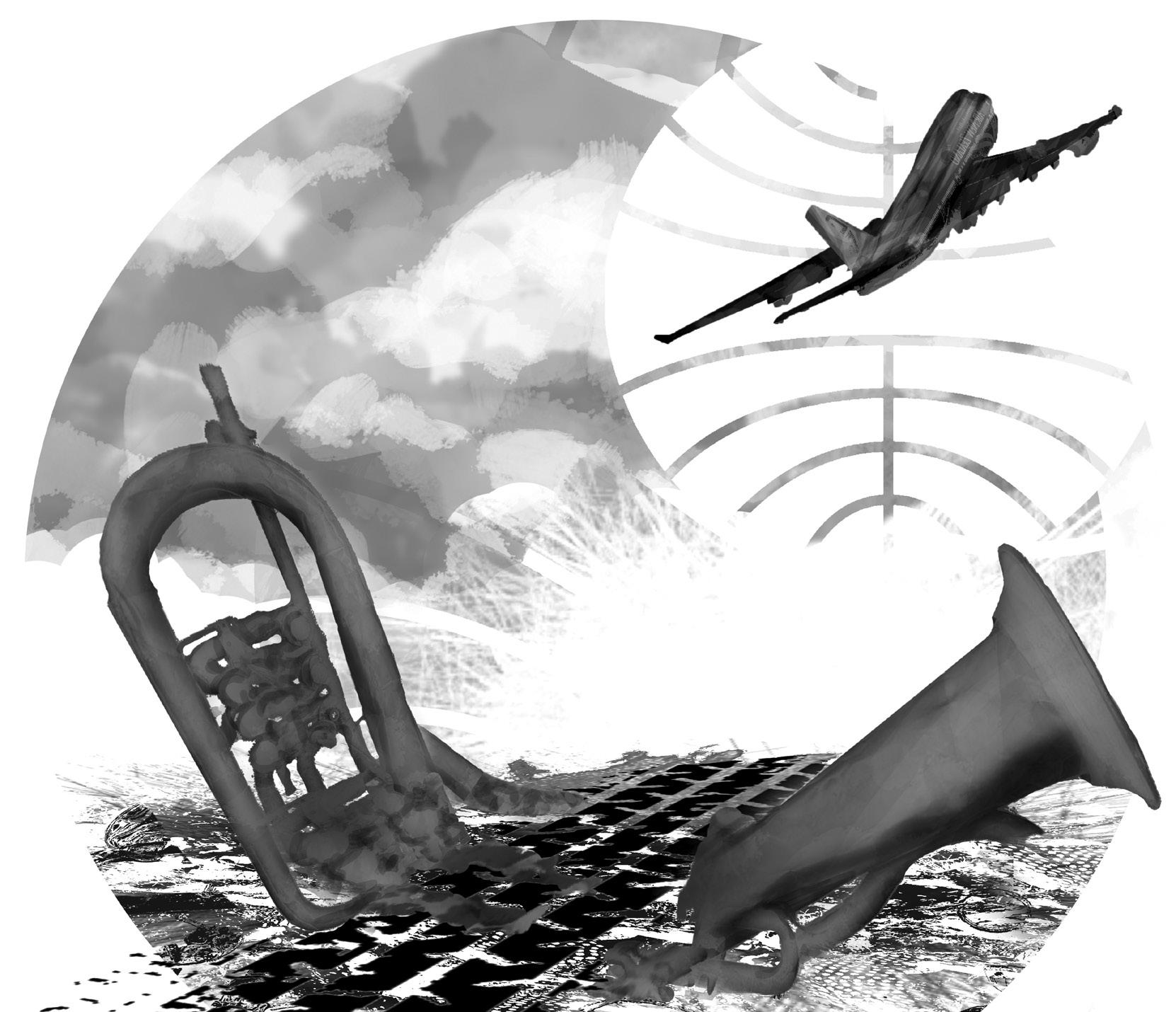
Airlines need to examine their policies on musical instruments
TOM INGRAM, STAFF
Recently a Chinese billionaire made a provocative and, at its core, American statement. In an article translated by the Cambridge Entrepreneur Academy, Jack Ma, executive chairman of the Alibaba Group, said a great many things that the poster children of capitalism love to say.
He told the story of how he started his own company from the ground up even though nobody believed in him. And he stated that if you are still poor when you reach 35 years of age, no one will pity you. The headline of the article went even further, saying that if you’re still poor at 35 you deserve it.
Now, there is obviously a heck of a lot wrong with this broad judgement. Giving Ma the benefit of the doubt, we will assume that he doesn’t actually believe that every single person is born with the genetic and social means to become wealthy. We will assume that he isn’t denigrating the mentally ill, physically handicapped, or the single mothers who are reliant on the welfare system just to survive, even though he certainly doesn’t offer any such caveats.
Maybe he doesn’t believe that people of certain, races, creeds, genders, or classes have disadvantages that are sometimes nearly impossible to overcome, but for argument’s sake let us assume that isn’t what he means. We will be generous and assume that he is just trumpeting some good old fashioned support for the American dream – namely that if you are of sound mind and body and if you just work hard enough you can, and will, achieve a comfortable existence.
into modern capitalism.
Of course anyone can do what Ma did by starting a successful company and accumulating more wealth than they or several generations of their children could possibly spend. Yes, anyone can do that, but not everyone can. There is not an infinite amount of wealth to go around. Economics is a balancing act, which means that when some people have disproportionately much, others have disproportionately not enough. And that means when you have multibillionaires, poverty is basically built into the system.
Capitalism doesn’t have to work this way, but with the middle class shrinking, poverty has been growing, and the income gap between the highest and lowest earners has increased. It will continue to get worse if we keep bending to the whims of corporations.
Because of gratuitous concessions and subsidies for corporations that have a tendency to pay their employees below a living wage, those lowpaying sectors continue to grow. People who might have found more skilled employment with a higher wage find themselves working as greeters or flipping burgers.
A broken instrument is a terrible misfortune, over and above the ordinary misfortune of lost or damaged luggage
But is Jack Ma really the embodiment of the American dream? Jon Stewart of the Daily Show sums up Ma’s company, Alibaba, as “an Internet start-up that makes no tangible product, with a hugely inflated IPO, that is in the United States due to a Cayman Island loophole that avoids regulations in its home country.”
There is no denying that Jack Ma is good at making money and that Alibaba is successful as a market entity, but has it really come to fruition just by following the spirit of the American dream? Is Jack Ma’s success solely the result of hard work, or is it also the by-product of shady systemic manipulations?
However, we will put aside the methods through which Ma has amassed his fortune, because there is a larger issue. The American dream is an admirable thing in itself, but the real problem with it, and with Ma’s assertion that poor people deserve what they get, is that poverty is built
Consumers often choose to buy from these kinds of businesses, therefore workers often have to work for them.
When Jack Ma says that poor people deserve what they get, I don’t know if he is being callous and ignorant or simply disingenuous. Of course it is in the best interest of billionaires to say things like that, both to make people believe that if they just work hard enough they will ultimately reach the top of the ladder, and to paint a portrait of lazy poor people who just aren’t working hard enough.
It is in the upper classes’ interest to give people somewhere to direct their anger other than at the people holding the purse strings. But the reality is that for every success story in modern Western capitalism there are thousands of people stuck working in near-minimum wage jobs for big corporations, and those same corporations spend millions of dollars lobbying the government to stagnate the minimum wage to a rate of growth that doesn’t even come close to keeping up with inflation.
The middle class is being systematically destroyed because of corporate agendas. So when a billionaire gets up and says that people are poor because they deserve to be poor, I think we ought to get pissed off.
GRAPHIC
The fallacy of the American dream
Poverty is built into modern capitalism
ALEX PASSEY
Avery small controversy recently raged among musicians online due to Air Canada’s policy on musical instruments. As of Oct. 2, the policy on the airline’s website stated that while violins could be taken on planes as carry-on luggage, violas (which are only slightly larger and not significantly heavier) could not. Complaints were made, the rules were revised, and at present the Air Canada website does not list any policies for specific musical instruments, instead offering the general size and weight rules.
The original policy was amusingly inexplicable— apart from the rules on violas, it said that bassoons (which are solid tubes of wood) can only be carried on if they can be “folded”— but it was a refreshingly honest and forthright statement on musical instruments by an airline. The rules might have been stupid, but at least you knew what they were.
past summer. Another acquaintance of mine took a flight with a major airline, and they lost his tuba.
In the aftermath of instrument damage, musicians face the bureaucratic nightmare of paperwork, phone calls, and employees dodging responsibility. Guitarist Dave Carroll relates the story of United Airlines breaking his guitar and then putting him through a Kafkaesque gauntlet after which they refused to pay his repair costs. Cellist
Economics is a balancing act, which means that when some people have disproportionately much, others have disproportionately not enough.
Kenneth Woods described being treated with “contempt and hostility” by Delta Air Lines employees enforcing their musical instrument policies.
The policies published by WestJet and Delta Air Lines are vague enough that travelling musicians are at the mercy of airline staff, their natural enemies, and now Air Canada’s policy has fallen back into line.
Airlines’ musical instrument policies may seem like a small issue, but they are a major concern to Canada’s thousands of professional musicians and the even greater number of music students. Travel is an inescapable part of the profession, and Canada is big enough that airplanes are often the only practical way to get from one city to another quickly. So professional and aspiring professional musicians are going to have to fly with instruments whether they like it or not.
And for many musicians, their instrument is the most precious thing they own, ranging in value from hundreds of dollars to literally priceless. Flying with an instrument as checked or gate-checked baggage would be bad enough if you knew that the baggage handlers would be careful with it or at least not go out of their way to damage it. Unfortunately, as anyone who has ever watched them from the window of a plane can tell you, this is not the case.
The problem was so bad that in 2006 the American Federation of Musicians called for a boycott of Delta Air Lines. The boycott was lifted when Delta changed their policies, but horror stories of instruments on airplanes still abound. I know someone whose trumpets were crumpled by an airline this
The only other options besides checking your instrument are carrying it on or buying a seat. I’m lucky enough to be a clarinetist, so my instruments are well within the standard carry-on baggage size. But for anyone with an instrument that is oddly shaped (horn) or large enough that its carry-on status is disputable (trombone), flying is fraught with nerve-wracking uncertainty. Gate checking simply is not an option for musicians, and buying a seat for an instrument at the gate is a dicey proposition – not to mention that it asks rather a lot of a group that is not exactly made of money.
Professional musicians are not a wealthy bunch, but at the very least they have things like insurance and jobs. But many people flying with instruments are amateurs or students, who have to pay out of pocket for absurdly expensive flights to camps and festivals and would be financially devastated if they had to replace a broken instrument.
A broken instrument is a terrible—sometimes irreparable— misfortune, over and above the ordinary misfortune of lost or damaged luggage. There is no reason it should ever happen on an airline’s watch. But it does happen, and with alarming regularity.
Airlines need to work with musicians to develop policies on musical instruments that are unambiguous and legally binding. Any such policy must include a credible promise of full compensation in the event of damage. And there must be consequences for airlines that repeatedly break or lose passengers’ instruments.
William Eakin’s Time deserves a bit of yours
Winnipeg-based artist evokes reflection with his latest photography installation at the Actual Gallery
ALANA TRACHENKO
T
he Actual Gallery is one of those hidden gems of the city that you have most likely passed in the Exchange without thinking twice about it.
Winnipeg is full of places you have to hunt for, and that’s fine with me. I was happy to have William Eakin’s photography exhibit to myself because it meant I could absorb both the grand and subtle gestures Eakin presents in his photos.
Eakin attended the Vancouver School of Art and the School of the Museum of Fine Arts in Boston, and has taught at several schools, includ-
ing the University of Manitoba. His experience with fine arts is evident in his boldly executed and focused pieces that have the ability to make you look for an extra minute, coincidentally.
The entire collection is a series of clocks – some textured and some showing images. Space and galactic textures underlie most of the pieces, giving a sense of perspective beginning forcefully with the sun and moon clocks at the front.
The numbers on the clocks either dominate the photograph or hide in the background, but Eakin never wants you to forget what you are
looking at.
There is a tension throughout between big and small – between global and local, generalized and specific. There is a relationship, Eakin shows, between our universe, and the day-to-day living that we do; he juxtaposes grand concepts of galaxy and space with the finer gestures of certain time periods.
The collection seems to suggest that we all measure time in our own way – the camping boy scout measures his by passing rather lonely hours by the campfire, while others may pass time by collecting base-
ball cards, or waiting for the Soviet regime to end. If nothing else, there are the basic timekeepers – the sky, moon, and sun.
The front pieces are playful and full of cool colour, while the piece at the back is mammoth and energetic.
Eakin has prepared a series of textured clocks whose texture resembles the sun at the front and divided them into rows. The end result is consuming – every clock is done differently, each demanding a look.
I recommend going to Eakin’s exhibit. I haven’t been able to stop thinking about it since I left. It’s
rare that we get a chance to stop and think about what time means to us, and Eakin’s photographs make it an impossible topic to ignore.
How are you spending your time? What does the passing of time really mean? We forget that we have the ability to mould these seemingly concrete concepts in our hands, minds, and, in Eakin’s case, through a lens.
Time will be displayed at the Actual Gallery, 300 Ross Avenue, from Oct. 9 through Nov. 8, open 12 p.m. to 5 p.m., Tuesday through Sunday.
Winnipeg’s flashy new festival
Winnipeg’s inaugural Flash Photographic Festival to feature over 40 photographers during the month of October
LAUREN SIDDALL, STAFF
W
innipeg has established itself as a cultural super-centre for festivals. From the Winnipeg Folk Festival to Folklorama to Culture Days, our city thrives on the festival mentality.
There was, however, a gaping hole in our festival scene. Despite the lineup of art festivals, there was not a single established photography festival within Winnipeg.
That is, until Leif Norman had his say.
The Flash Photographic Festival is modelled after a similar festival in Toronto: Contact Photo Festival,
claiming to be the largest photo festival in the world with more than 200 participants. Although following the same mould as the Toronto festival, the Winnipeg variation has one essential difference.
“There’s no elitism,” says Norman, executive producer of the festival.
“In our numerous photographers we have total newbies and we have people like John Paskievich; they’re classics, they’re literally legends in the Winnipeg photography scene.
“We have people that are doing pure art and we have people doing
more commercial stuff. We have everything.”
While some big-name artists within the Toronto festival are paid to participate and hold solo shows at art galleries, all Winnipeg photographers are invited to take part in the festival – with each artist choosing their own venue and receiving 100 per cent of the profits earned during the showings.
“As long as the photographer has a show and secures a venue, and submits the submission fee to the festival, then they’re in!”
Norman emphasizes the importance of running an egalitarian program, intending to keep the playing field equal in future festivals.
“I don’t want to have the usual artworld stigma of saying certain people are better than others. I mean that’s what the art world is about. You go to the WAG because the pieces were chosen to be in. So sometimes it’s really good [ . . . ] but sometimes it means excluding people.”
The festival, now halfway complete, is seeing massive success.
“People have been saying that it is
going really well. Anecdotally, people are telling me that they like it. The businesses are telling me that people are coming in and that it’s actually working. People are going there to look at the photography and then also experiencing the venue for what it is.” With each artist selecting the venue that best represents their work, the festival is breaking down the barriers of the classic gallery showing of art. People do not need to go into stark white galleries to experience and understand the art. It is infused into their day-to-day living, by simply engaging with the unique venues around Winnipeg.
“I want to bring people into the downtown area to experience all these really cool little shops [ . . . ] Come down to the exchange, go down to Portage and Main. That’s unique. Look at the architecture [ . . . ] that’s where the power and the culture is.”
While wanting to draw more attention to downtown and the surrounding area, the main goal remains to expose Winnipeg to the diverse array of photographers of all levels working within the city.
“I want to help out the underdog,” says Norman. “I want to help out the photographer that’s never had a show. And I want Winnipeggers to buy photography.”
The Flash Photographic Festival runs all of October; each venue is marked with a festival logo. Visit flashfest.net for a complete list of photographers, venues, and events.
PHOTO BY THOMAS FRICKE
UMFM Pledge-O-Rama 2014
Campus and community station’s annual fund drive returns
IAN T.D. THOMSON, STAFF
M
ark your calendars. Your campus and community radio station, UMFM 101.5, is bringing Pledge-O-Rama back during the week of Oct. 17-24.
With the goal of raising $28,000, the station needs your support during this annual fund drive to continue to broadcast music and talk radio of all varieties.
The weeklong pledge drive, which first began in 2012, was created out of financial necessity.
“Since 1998, the station has been run on roughly the same amount of funding through our student levy. As the costs associated with running UMFM have continued to rise [and] our student funding has stayed the same, you can quickly see how the [goal] just makes sense,” says UMFM station manager Jared McKetiak.
The money raised from the event goes towards the general maintenance of the station. Everything from basic microphones and cables to larger fixed costs like the radio tower rent are financed by the annual drive.
McKetiak says that the funds raised during the pledge drive represent about 15-20 per cent of UMFM’s annual operating budget.
As a non-profit organization, UMFM prides itself on the uniqueness of music and talk programming by its volunteer hosts. For the week
of Pledge-O-Rama, program director
Michael Elves says to expect special programming.
“We turn the dial up to 11,” says Elves.
With show hosts bringing in local bands to play live, developing their own unique pledge products, or teaming up with other radio programs, every show provides their own distinctive inducement to pledge towards the station.
“It’s a bit like watching a plate spinner keep adding more plates, one atop
the other,” says Elves.
Going into its third year, the structure of Pledge-O-Rama has only continued to improve.
“Admittedly, things were a little hectic in years one and two as we got our bearings, but we’re confident that this year is going to be our most successful Pledge-O-Rama yet,” says McKetiak.
For the first time, the station has also added three live events during the week, including a kickoff show at the West End Cultural Centre on Oct. 16
co-sponsored by Half Pints Brewing Co.
The show featured The Noble Thiefs, Kieran West & His Buffalo Band, and Surprise Party – three popular local acts that have received airplay from the station.
The event is seen as a “thank you” to listeners before the week’s chaos ensues.
As with the past two years, UMFM offers one-of-a-kind products to pledgers based on the amount they decide to pledge.
The voice on the radio
MICHAEL ELVES
I
n celebration of the third annual drive to raise funds for UMFM during Pledge-O-Rama, host Michael Elves provides insight on the origins and insides of his many shows aired on the station: Technically, I “host” four shows on UMFM Turning Pages, Wednesdays at 10:30 a.m., is a series of featurelength interviews with authors about one of their works. It actually grew out of my Friday night show, Thank God It’s Free Range (TGIFR). Free Range runs nightly from 6:30 to 8 p.m. and features interviews, live performances, new music, and upcoming shows, with a different
host providing a different flavour and focus.
My tastes are pretty expansive, so TGIFR is all over the map, but I was regularly talking to authors coming to town and, thus, spun off the book show.
Speaking of expansive, I also program an overnight show—Friday
mornings, 1 to 3 a.m.—called Expansive Prairie Skies. I don’t talk on that one; I just curate a mix of contemporary classical, jazz, noise, avant-garde, and other music I enjoy and don’t get a chance to play on TGIFR – due to either length or content.
For $25, supporters receive a UMFM Friends with Benefits card— which offers special deals to many local Winnipeg businesses—as well the Transmissions From UMFM 101.5 2014 CD.
The CD is a compilation of songs from local artists who recorded live sessions in the UMFM recording studio. Brand new items for this year’s pledge drive include a UMFM toque, travel mug, and hoodie.
While there is a fiscal objective underlying Pledge-O-Rama, the larger theme remains the sense of community brought by both the volunteers and the larger Winnipeg community during the week.
“It’s great to see so many UMFM volunteers, new and old, getting to know one another and all jumping in to work towards a common, united goal. It’s also great to hear from so many of our listeners who are raising their voices in support of what we do,” says McKetiak.
“It’s a pretty overwhelming, amazing feeling!”
Pledge-O-Rama runs from Oct. 17 at 6:30 p.m. to Oct. 24 at 8 p.m. You can pledge online (umfm.com/ info/donate/), over the phone during the week (204-474-6610), or in person (210 University Centre).
Lastly, during the baseball season, our Bison Sports show scales back to 30 minutes and the Bisons’ sports information officer, Chris Zuk, and I use the remaining half-hour— Fridays from 11:30 a.m. to noon—to talk MLB, fantasy baseball, and the Goldeyes on The Bench Jockeys
PHOTO BY CAROLYNE KROEKER
PHOTO BY CAROLYNE KROEKER
The campus, the community, and the music: UMFM 101.5
Three volunteers display the importance of the University of Manitoba station
IAN T.D. THOMSON, STAFF
The campus: Tom Woodward, At Large
Student-at-large Tom Woodward is the host of one of the newer programs on UMFM 101.5. Entitled At Large, Woodward hosts a musical variety show, airing Mondays from 2 to 3:30 p.m
“ My show, At Large, is about many types of music that have been recorded from the 60s to the present time. The songs I play during my show may have a lot of contrast, but they are connected though instrumentation, vocal style, genre, or feel,” explains Woodward.
Woodward is a student at the University of Manitoba and, when he is not on air, can be found studying psychology on campus. While At Large only premiered back in September, Tom has been volunteering for the radio station for a few years. He is currently the chair of the UMFM Board of Directors.
“By being a volunteer at UMFM, I feel more a part of the university and I have a better understanding of what is going on at the university. This comes
through hearing university-related events on the radio and also by discussing university events and issues with volunteers at the station,” says Woodward.
This will be Woodward’s inaugural year hosting a show during Pledge-O-Rama and he hopes to bring the same level of enthusiasm demonstrated in previous years.
“I’m looking forward to a lot of excitement during Pledge-O-Rama: lots of volunteers at the station manning phones, listeners interacting by phoning in to make pledges, the chance to talk to listeners making pledges, and hearing how and why UMFM makes a difference to them.”
The community: Trevor Alexander, The Hockey Show
Hitting the airwaves on Sept. 13, 2012, The Hockey Show touts itself as “Canada’s only campus-produced radio show exclusively about the game of hockey.” Live every Thursday night from 5:30 to 6:30 p.m., the program evolved out of a hockey blog by one of its co-hosts, Trevor Alexander
(aka Teebz).
“Michael [Elves, UMFM program director] asked me if I’d like the opportunity to take my rambling thoughts to the airwaves. After discussing it over, we agreed this would be a fun venture, and I rounded up a co-host in Brenden, aka ‘Beans,’ and The Hockey Show hit the airwaves,” explains Alexander.
The Hockey Show is just as its name proclaims. “We cover all leagues, and we include stories from individuals all over the hockey world: ice crew members, to front-office executives, to players, to the fans on the street,” says Alexander.
“If it’s hockey, we cover it.”
While the program focuses exclusively on the best game you can name, off-air, Alexander stresses the importance of the community that surrounds the station.
“The people who work and volunteer at the station are some of the best people I’ve ever had the pleasure of meeting, and I’m happy to call them colleagues and friends,” says Alexander.
“The people have made my experience more than just ‘a radio show.’”
Going into their third year at Pledge-O-Rama, The Hockey Show plans on bringing excitement to the airwaves in the form of a Sega Genesis classic.
“If things go well, expect NHL ’94 to be prominently featured in our promotion that week.”
The music: David Dobbs, hllyh!wpg!
David Dobbs, host of hllyh!wpg! started his show out of the classic Winnipeg fallacy: “I would often hear people talk about there being ‘nothing to do in Winnipeg,’ which is ridiculous, because if you look at any poster board there are dozens and dozens of things to do!” explains Dobbs.
“So I wanted to play local artists alongside nationally and worldly popular artists in hopes to help people realize the caliber of artistry in Winnipeg is just as high.”
Sharing the local music scene with listeners across Winnipeg every
Tuesday at 8 p.m., Dobbs’ expertise in the field extends past his role as a host. As guitarist and vocalist for post-garage band Vampires, Dobbs’ own music has had prominent success in the local Winnipeg scene. Having released their Every Kind of Light EP back in May of this year, Vampires saw their music topping the chart in the very station it was recorded in.
“UMFM has been very good to me and the music my band makes. We have recorded two of our releases there.
“Because UMFM does their sought after ‘Live Session’ programming, as one of their sound engineers, I’ve been able to familiarize myself with the technical components of recording music and putting out records.”
As a host, Dobbs looks forward to the buzz that surrounds the PledgeO-Rama week. “Every year there is more and more electricity in the air [at the station].”
PHOTO BY CAROLYNE KROEKER
Still in perfect harmony
Low makes a rare appearance in Winnipeg
JOEL TRENAMAN
L
ow, a three-piece Minnesota band, first became renowned back in the 90s for measured, melodic performances that channel raw emotion. Nowadays they are moving at a slightly faster tempo, and on Oct. 18 they sped up the I-29 for a long-awaited show at the West End Cultural Centre.
Driven by the impeccable harmonizing of couple Alan Sparhawk and Mimi Parker (elementary school sweethearts), the band has expanded its repertoire across 10 albums, incorporating elements of indie rock, textured soundscapes, and beautiful folk pop around the integral guitar-bassdrums foundation.
Sparhawk—the band’s frontman—reflected on Low’s journey in a lengthy, candid interview (abridged here, believe it or not).
THE MANITOBAN: Since your appearance at the Winnipeg Folk Festival almost a decade ago, why haven’t you played here, and why now?
SPARHAWK: As close as it is, sometimes the close things end up being the most far away. Psychologically, anytime we tour west, the first thing we think of is to get right out to the coast. [Mimi] and I grew up in northwest Minnesota, so Winnipeg was even closer than where we are now [ . . . ] It took a poke, saying it’s been a long time. It’s the beginning of a tour with Slow Dive, and it fell [into place].
M: Because this is Low’s first show in eight years here, many people will hear you for the first time. How would you describe your music to a new listener?
SPARHAWK: In a certain way, it’s just electric folk – kind of the same thing everybody’s been making. It’s true to our heritage so to speak: the kind of music that comes from this area, whether you talk about [Bob] Dylan or Neil Young. There’s defi-
nitely sort of a local vibe, even though as kids we were probably trying to escape that. We’re slow, and mostly quiet, and we sing together [ . . . ] a lot. Sometimes it gets loud, and sometimes it’s a little dark [ . . . ] It’s kind of hard to describe without being self-deprecating.
M: How has your view of Low’s music changed over the years?
SPARHAWK: I’ve come to accept more that I’m definitely a product of where I came from. When we started the band, we were trying to do something a little more avant-garde, more in the British tradition of post-punk. We were influenced and inspired by bands like Joy Division. When we were young, we were trying to create this new thing but the more you do it, the more you realize, “I’m a slave
to my influences as much as anybody.” If you’re being honest with yourself, you end up with your own voice and you don’t really have control over that. You just have control over whether you’re true to that.
M: There are some noticeable changes on The Invisible Way; what are the key differences behind this album?
SPARHAWK: The minimalism –that’s something we’ll always lean towards if there’s a decision, but on different records we’ve sort of elaborated. Most of the time, we’re trying to keep it trim – try stuff and then pull it out, unless it’s adding something significant to the dialogue or the picture. With The Invisible Way, we really worked quickly. We were prepared, so there wasn’t a lot of experimenting. Essentially because
we could only afford so much [studio] time!
M: Mimi has said previously that she is much more “comfortable in the background.” Did something change for her?
SPARHAWK: We’re always pushing [Mimi] to write because the stuff she comes up with is really good [ . . . ] Mimi doesn’t have any aspiration to be looked at or listened to any more than she has to be. But she wrote more songs this time, so I was like, “let’s do yours first!”
M: So, at this point in your career, what do you feel you get back from music? What is it still teaching you or enabling for you in your lives?
SPARHAWK: [It’s] a firm belief that
this is what we do. Every time we write a new song, it’s an affirmation: here’s a song that needs to be done [ . . . ] It’s a lesson in how much you are nothing. It can be a very spiritual lesson.
There’s something mystical going on. It’s an affirmation of [ . . . ] if you want to call it God, or spiritual, or a higher eternity [ . . . ] It’s a similitude to actually creating [ . . . ] in the same way that maybe God does. In many ways being creative [ . . . ] is a little microcosm into the nature of a God and, therefore, ourselves.
Even if all that is complete bullshit, there’s something going on [ . . . ] I know it, I’ve felt it, and it’s lifeaffirming. For me it’s a language I depend on.
PHOTO
Editor: Mike
Following the herd
Standings and summaries
MIKE STILL AND DAVID GRAD, STAFF
Women’s hockey summary
The Manitoba Bison women’s hockey team continued to roll this weekend, picking up a weekend sweep of the Mount Royal Cougars. The Bisons won 4-1 on Friday and 3-1 on Saturday. Forward Alanna Sharman led the way offensively, with four goals over the two game set. Rachel Dyck started both games in net for Manitoba, allowing a single goal in both games, en-route to securing her third and fourth wins of the season.
Alana Serhan, Maggie LitchfieldMedd, and Tasmine Hemingway also scored for the Bisons.
Manitoba returns to the Wayne Fleming Arena this weekend, taking on the Lethbridge Pronghorns on Oct. 25 and 26. Both games are at 1 p.m.
Soccer summary
Fighting for their playoff lives, the Bison soccer team was unfortunately eliminated from post-season contention over the weekend, after a Saskatchewan sweep of Regina .
Battling hard, Manitoba finished the season with two tough draws against the Lethbridge Pronghorns.
Saturday ended in a stalemate for Manitoba as neither team was able to score. Both teams struggled to put shots on goal, as Bison goaltender Martina Arran faced just one shot on goal and Lethbridge goalie Myriah Marino faced three. Manitoba’s chances were quality, and included an opportunity from captain Sarah Haiko, as well as a great save by Marino on Bison rookie standout Bruna Mavignier in extra time.
Sunday’s season finale saw the Bisons put up eight shots on goal, as they flooded the Pronghorn net with pressure. Six of the Bisons’ eight shots on net occurred in the first half, where they notched their only goal – coming from Mavignier 34 minutes in.
Lethbridge picked up their play in the second half, putting three shots on goal after having none in the first half. Kayla Wurzer would score the tying goal in the 72 minute, as the
game ended in a 1-1 draw.
Despite not making the postseason, the team can be quite happy with their progression from last year. They improved their win total, from one in 2013 to four in 2014, and also doubled their total goals, from eight in 2013 to 16 in 2014.
Women’s hockey individual statistics
In early season stats, Sharman leads the team, and is tied for fifth in the conference in points with six. She also leads the team in goals with four.
Serhan, Litchfield-Medd, and Michelle Pawluk are all currently tied for the team lead in assists with three.
Dyck is currently first in the conference, with a 0.73 goals against average. Her GAA, and total goals against, are also both tops in the CIS among goalies who have played at least four games.
Soccer individual statistics
Mavignier’s eight total goals tied her for third in the Canada West .
Canada West women’s soccer final standings (x=made playoffs)
She also finished tied for fifth in total points, with 17. Her shooting percentage of 40 was also first in the conference, for players who had at least 10 shots on net.
Robyn Kastner finished the season tied for fifth in the conference in assists, with four, and goalie Martina Arran’s two shutouts tied her for sixth in the conference overall.
Habing selected as CIS Top 8 Academic All-Canadian for 2013-14 season
For the first time since 2009-10, a Manitoba Bison was selected as a CIS Top 8 Academic All-Canadian.
Volleyball player Brittany Habing, currently in her second year with Manitoba after transferring from the University of Winnipeg last year, received the honour after finishing 2013-14 with a brilliant 4.0 GPA in science.
“I am honored and humbled to receive this recognition. I feel this award highlights the hard work done on and off the playing field by
student-athletes across the country,” Habing told gobisons.ca.
One female, and one male student-athlete from each region (eight overall) across Canada are selected annually as CIS Top Eight Academic All-Canadians.
Eyer named tournament all-star at 2014 BOB FM Shootout tournament
On Oct. 10-12, the Winnipeg Wesmen hosted a pre-season basketball tournament at the David F. Anderson Gym. The four-team tournament included Winnipeg; Manitoba; Brandon; and Lakehead. Despite going 0-3, Robin Eyer still had an impressive overall performance.
Against Winnipeg, the Bisons’ cross-town rivals, Eyer led the team with eight points, and was also 2-3 from the three-point line. She was named a tournament all-star for her efforts over the three-day tournament.
Canada West women’s hockey standings
Women’s hockey:
Bison sports upcoming October and November home schedule
Oct. 25 (1:00) & 26 (1:00) vs Lethbridge
Nov. 21 (6:30) & 22 (6:00) vs UBC
Nov. 28 (6:30) & 29 (1:00) vs Alberta
Men’s hockey
Nov. 7 (7:00) & 8 (6:00) vs Alberta
Nov. 14 (7:00) & 15 (6:00) vs Calgary
The Bison men’s hockey team currently sits tied for fourth in the Canada West conference, with a 5-3-0 record.
Women’s volleyball
Nov. 7 (6:00) & 8 (5:00) vs UBC Nov. 21 (6:00) & 22 (5:00) vs Thompson Rivers
The Bison women`s volleyball team currently sits in a four way tie for second in the Canada West conference, with a 2-2 record.
Men’s volleyball
Nov. 7 (8:00) & 8 (7:00) vs UBC
Nov. 21 (8:00) & 22 (7:00) vs Thompson Rivers
The Bison men`s volleyball team currently sits in a four way tie for second in the Canada West conference, with a 3-1 record.
Football
Nov. 1 (2:00)-Final regular season home game, as well as senior game vs Calgary
The Bison football team currently sits tied for third in the Canada West conference, with a 3-3 record. Alberta, who is also 3-3, holds the tie breaker, after beating Manitoba earlier this season.
Women’s and men’s basketball
Both teams begin their season at home on Oct. 31 and Nov. 1, against Trinity Western. The women play at 6:00, and 5:00, and the men play at 8:00, and 7:00. Look for a team preview for both squads next week!
Division) Team
A fight to the finish
Men’s hockey splits weekend series against 5th-ranked Mount Royal
DAVID GRAD AND MIKE STILL , STAFF
I
n a battle of two nationally ranked teams, the University of Manitoba Bisons and Mount Royal Cougars, both lived up to their CIS top 10 statuses, taking one game apiece over the weekend. Each side pitched a shutout, as the Cougars prevailed 4-0 on Friday, while Manitoba snagged Saturday’s contest 1-0.
Friday night’s loss was highlighted by standout play from Mount Royal goalie Dalyn Flette, who stopped all 28 shots he faced, including a breakaway on forward Jordan DePape in the second period.
The Bisons struggled to stay out of the penalty box all weekend, racking up over 40 minutes of penalties over the two games. Manitoba started Friday night with two penalties in the opening minutes of the game and continued the trend until the final whistle , which limited their chances of gaining momentum. On the flipside, Mount Royal had their fair share of discipline issues as well, though the Bisons
weren’t able to notch any power play goals.
Mount Royal got goals from four separate players, including three in the third period. Jeff Barrett, Matt Brown, Tyler Fiddler, and Cody Cartier all lit the lamp for the Cougars. Shaquille Merasty and Aaron Lewadniuk led the way offensively for Manitoba, with four shots.
Saturday’s game had a noticeably physical edge. Pushing, shoving, and punches resulted in no love lost for the contest
After allowing four goals the previous night, goalie Deven Dubyk came into Saturday night on a mission. Dubyk stood tall, stopping all 28 shots that came his way. First-year defenceman Josh Elmes potted the winner late in the third period.
Saturday’s game had a noticeably physical edge. Pushing, shoving, and punches resulted in no love lost for the contest. Darren Bestland led the charge for the Bisons, throwing his weight around all weekend long.
Both teams now head into a conference bye. Manitoba’s next action will be on Oct. 31, when they head to Lethbridge for a weekend set.
Defending their turf
Bison football fights adversity, gets redemption against Saskatchewan
MIKE STILL, STAFF
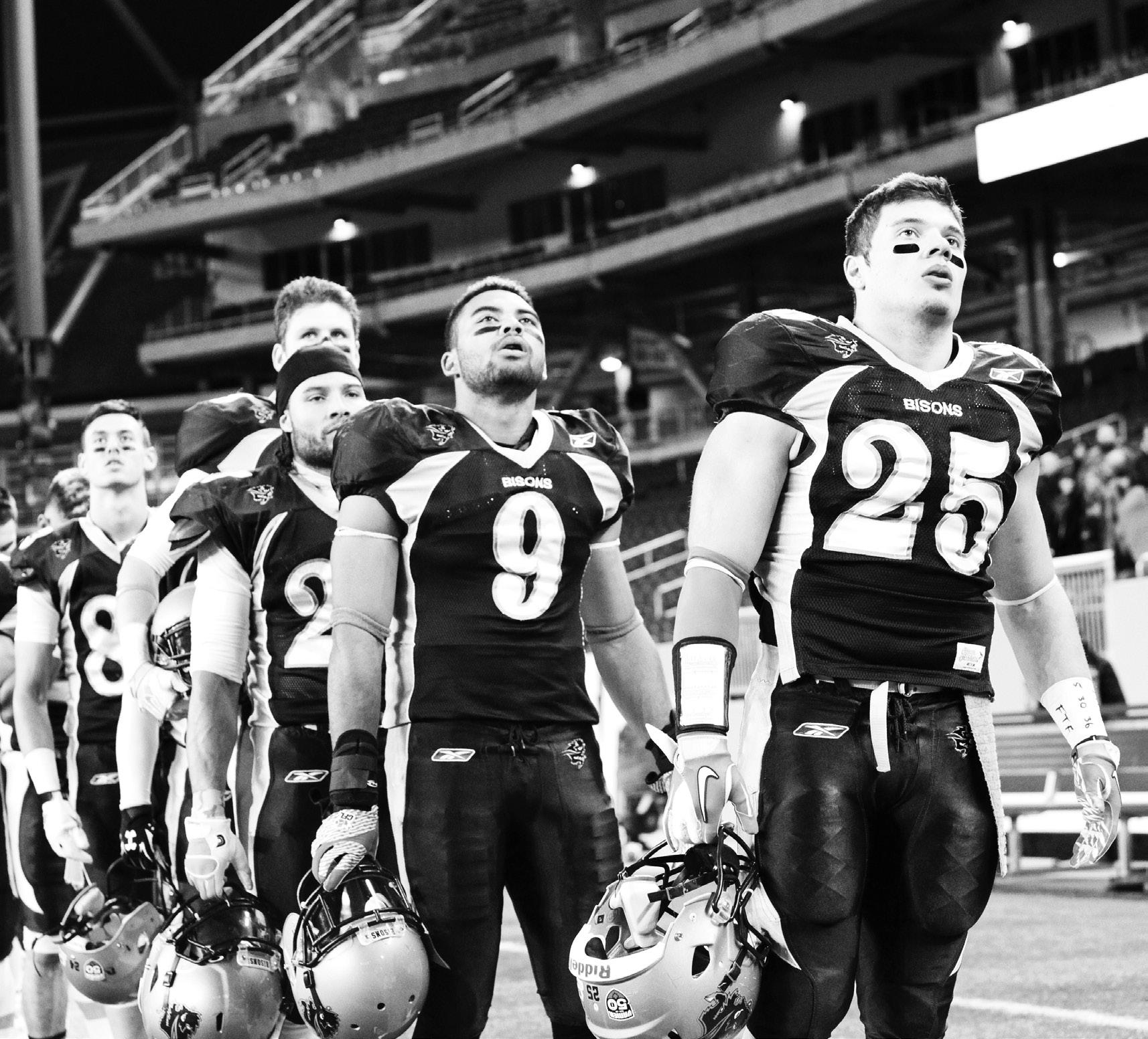
Losers of two straight games, the University of Manitoba Bisons football team entered Friday’s action in desperate need of a win. To get it, they would have to knock off the eighth-ranked Saskatchewan Huskies, a team that defeated them in week one. Not only did Manitoba accomplish that feat, they did so in impressive fashion, winning 41-8 at Investors Group Field.
The Bisons were able to make things look easy all game long on both sides of the ball, despite losing star quarterback Jordan Yantz in the second quarter. The defence stood tall, and Kienan LaFrance and Nic Demski stepped up big on offence.
Manitoba set the tempo early on, as Tyler Fong recovered a Huskies fumble on the second play from scrimmage, setting the Bisons up on the Saskatchewan 15-yard line. Unfortunately, the home squad couldn’t cash in, as their field goal attempt on the ensuing drive was mishandled.
Both defences held strong in the first quarter, with the only point coming on a punt single by Saskatchewan. It was their only lead of the game, as Manitoba dictated the next three quarters .
Yantz was excellent through the first 12 minutes of the second frame, engineering two consecutive scoring drives. The first was capped off with a six-yard touchdown pass to Matt Sawyer, and the second with a 10-yard QB sneak by Yantz.
The Bisons’ jubilation was cut short with just over three minutes
remaining in the half, as Yantz was forced out of the game after a late hit to the head. The injury appeared to be a concussion. His second quarter completion percentage before the injury was nothing less than impressive, going 12-for-12. He left the game with 189 passing yards, and a touchdown.
“We have to play well to be able to win. With Yantz going down, and Theo [Deezar] stepping up, now we have to continue to play, and play as a team” – Jayden McKoy, defensive back, Manitoba Bisons
Ryan Jones added a late field goal for Manitoba, as they went to the half up 17-1. Despite the injury to Yantz, head coach Brian Dobie noted the positive manner in the locker room from his troops. He compared the mood of the players to that of the 2007 Vanier Cup, after star running back Matt Henry went down with a broken femur.
“Instead of the team going, ‘Oh my God,’ it was the opposite [ . . . ] Halftime was very interesting in
the Bison locker room,” said Dobie. “It was a very, very, very motivating [a] and good place to be.”
The second half was more of the same from Manitoba. LaFrance churned out over 100 yards on the ground, and 21 yards receiving, along with a major. Demski scored an electrifying 76-yard punt return touchdown, to go with 57 yards receiving, and backup QB Theo Deezar—a standout at St. Paul’s High School and the Okanagan Sun— recorded his first career touchdown pass, 14 yards to Sawyer.
The defence held their ground as well, registering four sacks overall, and an interception from Jayden McKoy – his team-leading third of the season. The secondary had arguably their best game of the year, holding Saskatchewan pivot Drew Burko to 164 yards and no touchdowns, and the front seven allowed just 50 yards rushing.
Manitoba now heads on the road, taking on the Regina Rams for the second time this season. The Bisons may have to look at life without Yantz for that game, however when asked how the loss of the QB may affect the team going forward, McKoy was very optimistic.
“We have to play well to be able to win,” McKoy said postgame. “With Yantz going down, and Theo [Deezar] stepping up, now we have to continue to play, and play as a team.”
Game time next weekend against Regina will be Saturday, Oct. 25, at 2 p.m. MT (3 p.m. CST).
PHOTO BY BEIBEI LU
PHOTO BY CAROLYNE KROEKER
Sweeping in a new record
Men’s volleyball head coach Garth Pischke sets new North American coaching win mark
DAVID GRAD, STAFF
Men’s volleyball
This past weekend was a historic moment for Garth Pischke and the Bison men’s volleyball team. The team rallied together and fought to earn a 6-0 sweep of the Regina Cougars, elevating coach Garth Pischke into the record books as the most winningest volleyball coach in North America with a total of 1,240 wins.
Pischke moved past former UCLA men’s volleyball head coach Al Scates, who had a record of 1,239-290 in his 50 seasons at the helm.
Pischke had his team looking sharp in their weekend matchup. Leading the way over the two matchups for the Bisons was libero Alex Strachan with 18 digs, Devren Dear with 20 kills, and Kenny Rooney with 10 blocks.
Friday night saw a strong attack with Dear picking up seven kills, Kevin Falconer with 10, and Adam DeJonckheere with 11. Timely attacks and defence played a big role in Friday night’s win as the Cougars pushed the attack in each set to always stay within a few points.
Saturday was a different story as the Bisons dominated the Cougars
25-17, 25-17, and 25-18 in sets. Dear had a big night as he threw down 13 kills against the Cougars. Falconer helped the attack with eight kills and Rooney led the team up front with six blocks.
The Bisons improve to 3-1 on the season, which places them in third place in the Canada West.
The next men’s action occurs on Oct. 24 and 25, as the Bisons travel to Kelowna, B.C. to take on UBC Okanagan.
Women’s volleyball
Bison co-captain Rachel Cockrell racked up 38 kills this weekend as Manitoba took both games in a weekend series against the Regina Cougars. Cockrell is in a league of her own, dominating Canada West with 93 kills, almost double what the next highest kills leader has managed to rack up this year.
The Bisons entered the weekend matchup on the heels of a disappointing loss in their home opener. The team was focused and determined to win as they controlled the Cougars throughout the match on Friday night, winning 25-19, 25-22, and 25-17 in sets. Libero Cassie Bujan had a solid showing, in her
first start of the season on Friday night, leading the team with 13 digs. Cockrell had a standout game on Saturday, leading the team with 22 kills, 14 digs, and a service ace. Brittany Habing had a strong showing, helping her teammates with a total of 33 assists. Habing is currently tied for the CIS lead in assists with 149 on the season. Bujan also had another solid showing with 13 digs.
The Cougars came out with a much stronger showing on Saturday but the Bisons stood tall. Defensively, the Bisons received contributions from all of the team, with Jordana Milne and Habing contributing seven digs each and Kalena Schulz adding six. Milne and Sarah Klassen helped round out the offence. Klassen had seven kills and Milne had six.
The Bisons now move to 2-2 on the season and look to pick up their championship form from last year. Manitoba will head on the road this weekend for the first time, taking on UBC Okanagan on Friday, Oct. 24 and Saturday, Oct. 25.